Shared posts

31 May 13:22

The True Nature of Existence

by Zak Sabbath
Broadly applicable, but I specifically wrote it for Demon City:
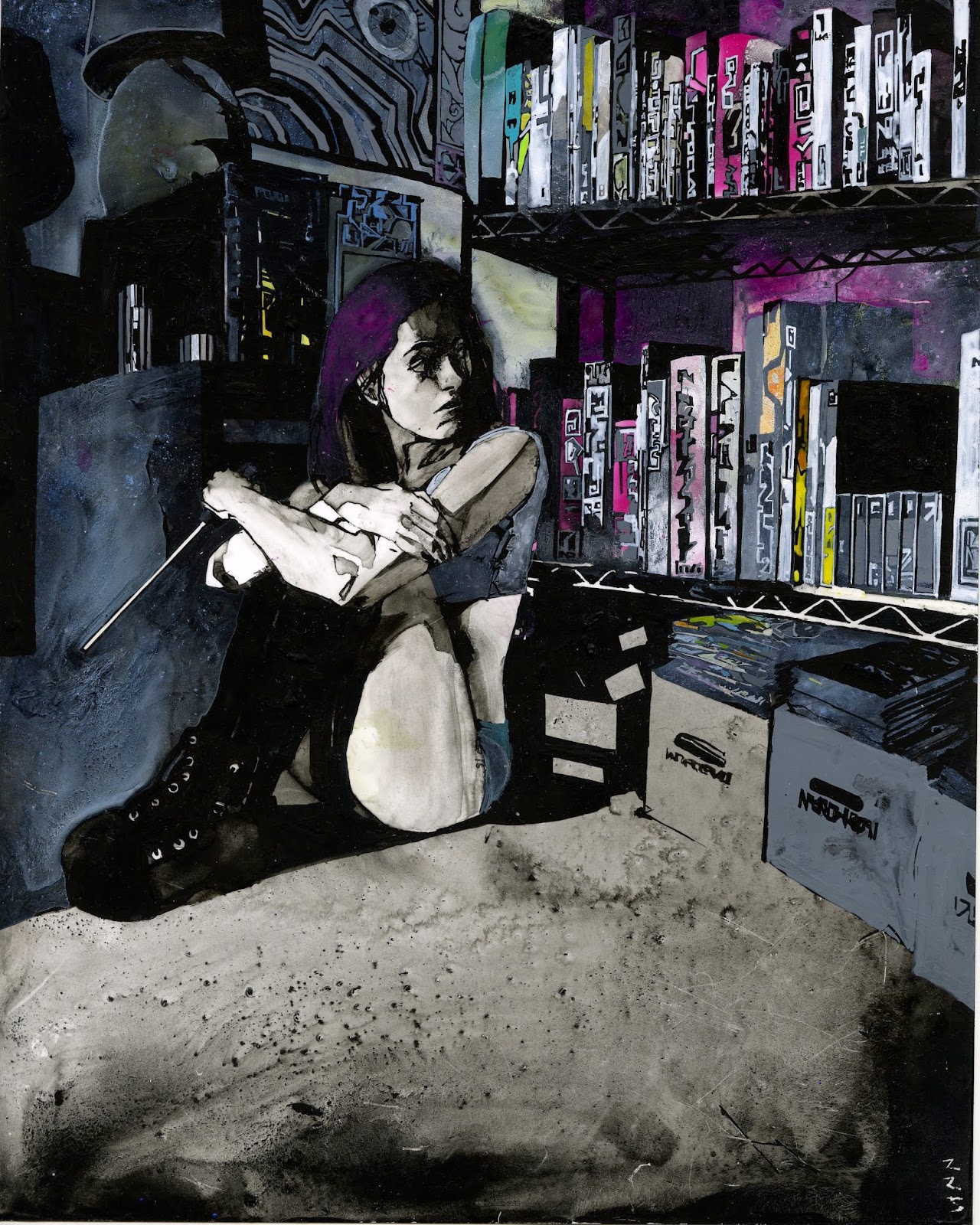
New painting for Demon City, click to enlarge
Imagine a laid-flat brick of black gelatin. Pick a spot on the left wall and, imperfectly and at a diagonal, slide a soda straw in until it sticks out the right side.

The left side of the brick represents the second you were born, the right the second you die, the brick itself all you might've experienced and the path of the straw all that you did experience.

This tunnel through the gelatin is the path of your life. Now imagine a second tunnel, shaped like a crazy straw--carving likewise broadly left to right but looping and wild--intersecting and sometimes overlapping the path of your life, but rounding off and taking its own route at many places. This tunnel is the life of someone else you know.

Your story and another person's only have to agree when these paths overlap. Only if you both witness the same event will your stories need to be alike in order to maintain a sense of an objective and sensical world. If your father was alone in a field and says he saw a length of rusted wire, this cannot threaten your sense of reality if you were a thousand miles away at the time. Why wouldn't your dad have seen a wire?

Your exact position in any given space and at any given time, like your experience, is unshared and unique to you. You experience the look of you favorite picture and the taste of your favorite food in ways that do not necessarily precisely match the experience of any other creature that ever was or will be.

Imagine now further, that due to your unique pattern of shape, mass, and velocity, the precise physical laws that govern your existence are also unique to you. You move in a reality envelope where the air is generally 78% nitrogen and 21% oxygen and free-falling objects where you are gain speed at 9.8 meters per second squared and fireflies glow golden with a darkening around the edges and people, when you ask for directions, are generally kind.

The truth is this: it is not necessary that everyone share these rules, all that is necessary for the spreading network of reality to maintain its shape is that the rules of the subrealities experienced by everyone in the one greater reality look the same when and only when they intersect.

Having a cigarette on the train platform at 10am, you tell your sister there's no such thing as ghosts--and your sister says there is. You are both right--by the rules governing your tunnel through the gelatin there can be no ghosts, and by the rules governing your sister's tunnel there can be, but so long as you both agree there are no ghosts to be seen right now on this train platform at 10am, reality holds.
The key, then, to ruptures in the ordinary face of life, to accessing the vast distortions of what we think of as natural which might be possible if free-falling objects gained speed at .00000000000000000000001 meters per second squared more than they should or if an effect might in some circumstances precede a cause or an action not have a precisely equal and opposite reaction is isolation.

The farther from things with which one might interact, the farther the unique curve of an individual's unique set of laws might bend from the norm. This isn't because things change as you move away--it's because this is always how it was going to be. The universe is organized in such a way as to keep consistent. Your father was always going to be alone when he saw the rusted wire, and your sister was always going to be the last one to leave the office when she heard the voice that wasn't a voice from that white face pressed against the far side of that window.

Divagations from the understood are less likely when more disparate bystanders appear whose subrealities the larger reality needs to satisfy. This is why the greatest wonders and terrors are witnessed lonely hills, in basements, on dead streets when the background music of life seems to have dropped away and a sneakered footstep sounds as clear as a nail being clipped...or in the presence of severe ranks of disciples who have trained their souls to follow a single and common path. And, likewise, this is why such events will never be believed or understood in the wider world--at least until the last generation discovers the implications of whatever rules they earned that position by ignoring.
-
-
-
True transformation--the changing into something else--is always coincident with a life of profound and complex isolations. Just as the good work of the rules-as-written Calvinist Protestant does not earn a place in Heaven by doing good but rather doing good demonstrates she always was predestined to be there, the other worlds that interpenetrate the familiar world are not formed by the desperate and the strange but rather their desperation and strangeness are part of that same offshoot from the mainstream of life that allows such eddies to jell and pool and develop their own ecosystems.

By this token the many systems of supernatural and metaphysical wisdom recorded across human history are not so mutually-exclusive as they might first appear. What the Babylonian heresiarch inscribed on a tomb wall, what the Han dynasty sculptor cast in impure bronze, what the Elizabethan witch-hunter printed and circulated--these things are as real as anything in a life that we have not lived can ever be, as are the declarations that these things are impossible. They are simply rules for tunnels that never intersect.

What then is necessary to summon demons is to observe carefully the reality you are in, and look for the rules that have always been there--as a character in a book might guess the ending by discovering the genre he's being written in.

Once these rules begin to be found, the adept will grasp that all activity has a second meaning. Gestures, decisions, echo forward in ways not previously understood--for you, and for anyone who will encounter you. Even your words are a dialogue in a performance judged by new gods.

To know these things, the research must be done, the books read, the practices observed, but most of all: experiments must be conducted. And what will be unleashed is what was meant to be and what is then wrought can only be no more than what should have been.
-------
Support the Demon City Patreon here.

24 May 12:25

memoriter: Dictionary.com Word of the Day

memoriter: by heart; by memory.
23 May 11:22

ultracrepidarian: Dictionary.com Word of the Day

ultracrepidarian: noting or pertaining to a person who criticizes, judges, or gives advice outside the area of his or her expertise.
21 May 19:19

What 1000 Feet Away Looks Like

by Zak Sabbath
If you write tabletop RPG stuff, you're used to using resources totally not designed for you. This is because if you write tabletop RPG stuff, almost no resources are designed for you.

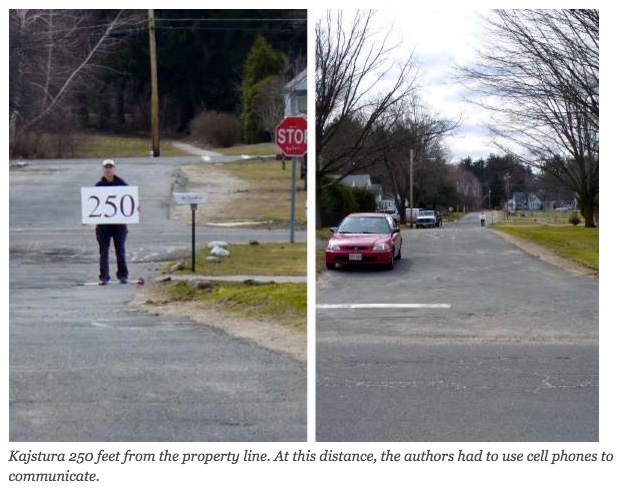
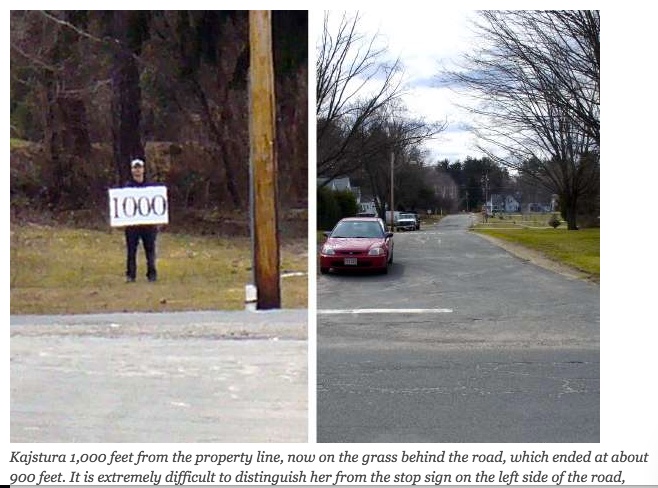
Here's one: RPGs are full of ranges--Silence 15' radius, the Ruger is accurate up to 1000' yards...ever wonder what various ranges actually look like?

Somebody was writing an article about how big don't-sell-drugs-to-school-children zones should be-(a subject upon wish I have no opinion I which to discuss with game bloggers), but they did provide a useful illustration of some ranges:


So using this I figured out the Drowned Woman Ghost can stray no further than 500' from the body of water where she committed suicide.

And now, a word from our sponsor:
Donate to the Demon City project here.  If you don't know what that means, go here.

21 May 14:13

Faking is depressing.

by Jessica Hagy

Share and Enjoy:DiggStumbleUpondel.icio.usFacebookTwitterGoogle Bookmarks

The post Faking is depressing. appeared first on Indexed.

15 May 04:48

Draw smooth lines.…by using the natural geometry of your...


Draw smooth lines.

…by using the natural geometry of your joints. It took me a while to figure out that it’s easy to draw lines in some directions and hard in others. And most of the time it’s simply down to respecting the pivots of the elbow and the wrist. And also why we tend to angle our notebooks so much to the desk, and why, if you want to draw a smooth line at another angle, you’re really best-off just turning the paper.

As a corollary, I figured out that by looking at angle of most of Leonardo Da Vinci’s cross-hatching you can see that he was drawing left-handed.

11 May 21:21

How to Break Free From Social Media

image

This post presumes you already have a firm understanding of why you should cut ties with social media. If you aren’t there yet, you probably don’t need to read on. But perhaps you’d be interested in the following articles on happiness, avoiding depression, etc.

If you already know that social media is making you miserable and you’re just trying to find a way to escape then read on and follow this 5 step plan.

1. Tell your real friends your intentions. It’s crazy, but people might think you are unfriending them if you shut down your accounts. Do it in a non-judgmental fashion. “I just gotta lay low for a while.”  “I’m spending too much time staring at my phone.” Keep it simple, you don’t need to tell them that social media has become a leading cause of depression. They might not want to hear it, and that’s fine.

***Whatever you do, don’t pull one of those bullshit things where you post on social media that you are leaving social media.  People will just think you’re fishing for attention. Because you probably are just fishing for attention.***

2. Turn that shit off.

3. Make a list of what you’ll be missing.

You probably use social media for a number of reasons. Your original reason like connecting with old classmates that you haven’t seen in years was probably replaced by things like:

  • Spying on ex GF’s, BF’s, your kids, spouses, lovers.
  • Reading news (i.e. watching John Oliver clips)
  • Reading fake news
  • Collecting likes. And spending meaningful events in your life (like vacations, weddings, births) thinking about how to frame that moment on Instagram or Facebook and what you’ll say.
  • Looking at things you could buy.
  • Getting invited to events that you don’t want to go to, but… FOMO.
  • Looking at pictures from events that you missed that make them look way more fun than they actually were.

  • Taking 5 minute breaks from work.

4. Figure out healthy ways to replace what you’re missing.

  • Email an old friend that you haven’t connected with in a while.
  • Spend meaningful life events being present and undistracted by technology. Maybe just bring a camera or nothing to the beach or Disney World for one day to see how it goes.
  • Actually watch the concert or game you have attended. Especially if your friends or children are participating.
  • Stay informed on things you care about by subscribing to RSS feeds on a tool like The Old Reader! There’s almost infinite amazing content on every topic you can imagine. But you’re probably missing most of it while obsessing over random crap on Facebook.
  • Go for a 5 minute walk outside. Even if the weather stinks. Walks in the rain can be pretty awesome.
  • Meditate for 5 minutes. Just focus on breathing and clearing your head. No iPhone app or expertise required.

5. You’re free! Just because social media is a growth area and a new technology doesn’t mean it’s a good thing. I mean, seriously, your parents are watching you again! You’d finally broken free and moved to a different state. And now they know about everything you do.

10 May 15:04

Hell Rose by NanFeAs found...


Hell Rose by NanFe

As found at:

http://nanfe.deviantart.com/art/Hell-Rose-499067025

My favorite succubus character of the month by far.. Her overall look is just so strikingly seductive…

10 May 15:03

holus-bolus: Dictionary.com Word of the Day

holus-bolus: all at once; altogether.
09 May 18:55

Spring is a state of mind.

by Jessica Hagy

Share and Enjoy:DiggStumbleUpondel.icio.usFacebookTwitterGoogle Bookmarks

The post Spring is a state of mind. appeared first on Indexed.

08 May 16:18

Drifting by idomuchrisAs found...


Drifting by idomuchris

As found at:

http://idomuchris.deviantart.com/art/Drifting-498970764

Just a really moody, almost tragic feeling piece of succubus art…

08 May 16:18

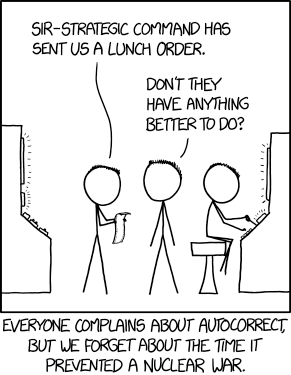
Lunch Order

GO FOR LUNCH, REPEAT, GO FOR LUNCH.
05 May 04:53

Succubi Image of the Week 485

by TeraS

There are some images of Morrigan Aensland that appeal to me. The ones that I enjoy the most are one is which they seem to be like a portrait of her. Focusing more on her personality rather than her cleavage appeals to me. This week’s Succubi image is an excellent example of this…

Vain Princess by TOYDREAMER

Vain Princess by TOYDREAMER

This work is called Vain Princess and is by an artist on DevaintArt called Toydreamer. You can find the original page with this art here on DeviantArt and this artist’s page can be found here.

Just one of the most wonderful images of Morrigan that I have in my collection really. Her expression, that little smile, the tilt of her head, the overall confidence that she expresses in this art reflects so well her personality. There’s a strength, a certainty within her form that comes out in this work.

Capitating eyes, lovely detail in her hair, skin tones, wings and the curve of her clothing. A wonderful creation that expresses that Morrigan isn’t just pretty to look at, she’s a force in her own right and that is forgotten at one’s own peril…


Tera

04 May 14:02

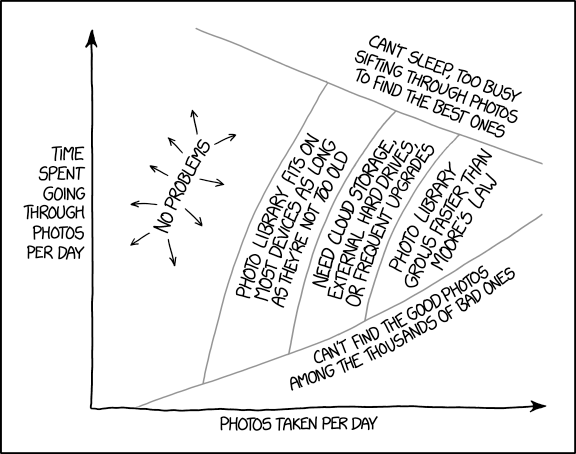
Photo Library Management

A good lifehack is to use messy and unstable systems to organize your photos. That way, every five years or so it becomes obsolete and/or collapses, and you have to open it up and pick only your favorite pictures to salvage.
02 May 19:45

Adventure-Building and The Ecology of Murder

by Zak Sabbath
This is a new painting I made for Demon City, click to enlarge it
The silver ant of the Sahara can survive about ten minutes in the mid-day sun. Platoons of them crawl up from their ant hills, skitter widely, searching fast, then, when prey's found--a beetle, a tiny lizard--teams quickly re-swarm and rush the corpse back.

Sometimes it's hard to drag the irregular corpses back over the rock and debris while time runs short in the killing sun, so they go hastily to work with their mandibles, sawing off legs and arms to make the dead thing easier to roll back to the nest.

Scale this drama up: If you were a detective and you came upon this scene after the fact what would you see? Arms and legs hastily chopped off, maybe drag-marks, no torso or head. 

You could reskin them as anything smaller than their victim--sun-sensitive albino cannibal children, packs of wild dogs afraid of detection. The point is, in their collective haste to get back where they came from they left a distinctive trail of limbs--and that's the first scene of your campaign.
-
-

-
-
To make a horror adventure you usually start with the horror--the murderer or monster--and game masters are used to thinking of horrors only in terms of their appearance and their abilities: it looks like this and it does that. In a classic adventure game you can often get away with it: yes, Mr Greenwood the green ooze has a life cycle but the main thing is it's eating your foot and then there's some other monster in the next room--in an investigation, which relies on squeezing every ounce of story-potential from a single monster, the horror needs an ecology.

It doesn't just have that strange look and strange power, it has specific methods--a niche, a consistent way of doing things. In an investigation, knowing the ecology doesn't just provide flavor or depth if needed--it generates the whole adventure. Before you begin, you run the horror through its horrible day and its more horrible night, and imagine what would be left behind--that's what the players then find, and must back-engineer the nature and location of the creature.

Buffalo Bill has his strangely skinned corpses (because he's making a suit out of women), the Murder at the Rue Morgue has ear-witnessing neighbors with conflicting reports of the murderer's language (because it was an orangutan), each of these opening clues comes not necessarily from what makes the horror horrible, but from what makes it itself.

Often this can involve the creature's weaknesses--the silver ants saw off those limbs not because they have some special ability to move their prey but because they don't, and they are hustling hard before the sun kills them. Imagine a creature that could only move in silence--the players might find identically slain corpses off lonely roads and in recording studios (which are soundproofed, yes, but how long before they make that connection?).

Nearly the entire plot of Get Out is just the slow revelation of a specific ecology, despite not starting with a murder. (Spoilers) The daughter brings unwitting but able-bodied black victims to the house, the parents auction off the victims to aging friends, and--aided by hypnosis and surgery--the brains of the villains end up in the bodies of the victims. The "house servants", rather than a rotting corpse, are the first clue.

There is no way to mechanize the process of inventing these ecologies: horror needs mystery, mystery needs the unknown and the unknown means you'll need to think up at least some details on your own. But you'll be surprised how much mystery and horror you can get out of a very simple ecology--grab one at random and try it:

The pitcher plant? It has a sweet nectar on the rim, but in order to get at it, insects inevitably slip down the inner walls and then slowly dissolve in the acidic pool at the bottom. Translate this to a horror scenario in the most literal terms and maybe we have an opening scene with an acid-scarred lunatic roving the streets, smelling like candy. Investigation might reveal a pattern of children who never came back from school, clustered around a warehouse district...

Alright. Now a word from our sponsor...
To support the game, go here

02 May 12:09

Gods and Monsters in the Odyssey

by blackboardfiction
  My students and I have been debating: of all the characters that Odysseus meets, which is the most and which the least civilised? We worked out that we could place them on a scale inspired by Aristotle: Anyone who… does not partake of society is either a beast or a god. Thus, in the middle... Read More in Gods and Monsters in the Odyssey
01 May 12:39

The Invisible Dungeon & Wallet, Keys, Pants

by Zak Sabbath
The Invisible Dungeon and Wallet, Keys, Pants are, like the hexcrawl, dungeoncrawl, heist or Hunter/Hunted, basic formats for open-ended adventures that avoid railroading.

...mostly. The trick is they makes use of one key choker: the party is already in the dungeon. Though it's actually a metaphorical dungeon--they're not in a physically restricted underground maze, but they are unwillingly inside the villains' scheme when the adventure begins.

These are written for the Demon City project (donate to the Patreon here), but can apply to pretty much any game...

Invisible Dungeon

In the Invisible Dungeon, the trick is the players don't know it.

At the beginning of Alien, the Company has just woken up the crew to go investigate a distress call which it knows is dangerous ("crew expendable" according to the secret orders) and, as I noted in an earlier entry, when Get Out opens the photographer is already on his way to the girlfriends' country house which will lead to the party which will lead to him being auctioned off. From the main characters' POVs these are, at the beginning, more or less ordinary situations.

In practice, starting the players in a situation where they don't even know they're in trouble is different by just a hair, in terms of preserving meaningful choice, from being told "Hey we're running this module so you want the gold from Blastoskull Manor", but once the set-up is done, the Host should respect player choices and the scenario should be designed so that any player choice thereafter fuels the adventure.

Dungeons offer choices, but the also have walls: likewise, the Invisible Dungeon should be designed ahead of time with some barriers to escape the villains' dastardly scheme. If the crew of the Nostromo decided to leave the Alien planet without going into the egg chamber what would happen? Well the Host would've had Ash (the Company's secret android) secretly try to kill whoever made that decision and/or somehow get the crew back to the planet to investigate--possibly by sabotaging the ship. If, near the beginning of Get Out, Daniel Kaluuya had decided to, well...get out, the family would've tried a combination of physical force and hypnosis to prevent it (which they do, later in the film).

Now, in a genuine railroad these prevention schemes would automatically work--I recommend you not run things like that. Let the situation play out however it plays out--and if the party escapes the Invisible Dungeon you made early, you switch to a story of pursuit. Even dead bad guys have friends. It's easy to imagine a continuation of the truncated Alien story above where the Company tries to hunt down the crew who've seen its robot go berserk and it's easy to imagine a sequel to Get Out where the police are asking around about this photographer kid who was apparently around at the old country house when that family got killed.

However, the point of prepping an adventure is to prevent having to do all that improvising of new scenarios all at once, and to have players encounter things as well-thought-out and complex as your downtime allows. To get that to happen, it's as important to promise "treasure" inside the "dungeon" as it is to build walls around it. In mass media, this is less necessary than it is in a game--unlike players, movie characters don't know they're in a movie and will walk right into the heart of darkness if the screenplay demands it. Hosts have to be cleverer than screenwriters.

A simple way to do this is to turn an avenue of investigation into a trap. For example: a witness (secretly a villain or villain's pawn) tells the players they saw the gunman flee into a warehouse. The warehouse is a fiendish Saw-like. The (evil) clerk tells the players the records they need are kept at the country courthouse, upon entering, the guards lock the doors and the cell tower is sabotaged.

Another way is to build a breadcrumb trail out of things the players will want to follow even if it has nothing to do with the investigation. The lifeguard with the big blue eyes invites you down to the (wereshark-infested) island for a weekend. You have to know your players and their playstyles pretty well in order for this to work, though.

What not to do is simply decide, after the fact, that whatever the players felt like doing it will turn out to be the trap--this creates a situation where you've artificially removed players' choices, and in the long run this makes them think about their decisions less, and makes a game of decisions and investigations less fun. If the witness is a pawn of the villain, there's always a chance a clever player could find that out, if a clerk is evil the players theoretically might find a way to discover that before heading to the courthouse. If you respect the rules of the imaginary world, the players will learn to investigate it with care.

If you want the Invisible Dungeon to last longer than a single session then it helps to have the villains have some plan for the party besides just killing them. A horror bent on seducing the party members, quietly grooming them for membership in a cult, driving them insane or (as in Get Out) showing them to prospective buyers can maintain a ruse of harmlessness and mystery far longer. The players will know something is wrong (they're playing Demon City, after all) but they won't know who the danger is and who's a harmless NPC.

And there should be, occasionally, harmless NPCs--not just to throw off the players, but also because friendly non-player characters are part of the advancement system.


Wallet, Keys, Pants

In this kind of format, you wake up missing your wallet, your keys and your pants. Or something equally valuable. You may also wake up far from home. Unlike the Invisible Dungeon, the players immediately know something's wrong. The Invisible Dungeon works by luring the PCs in with something they want, Wallet, Keys, Pants works by taking away something the PCs want back.

The advantage of this format is it's easy to add obstacles (the characters were asleep, you can surround them with challenges and terrors) and easy motivate players to face them (they need to find their stuff or escape or both).

The disadvantage is--unless you do it as the opening of the entire campaign--you need to get the characters knocked unconscious. It's no fair just deciding in the middle of a campaign that last time they slept this happened, you have to have the bad guys creep in--roll to see if the PC notices--inject the benzodiazapines--roll to see if they wake up with the pain--and sneak them away to the getaway vehicle.

The wallet, keys, pants option is also a good adventure format if you finish a combat with all the heroes knocked unconscious.

Aside from the beginning, the Host also has to answer a few questions: why did the horror leave the PCs alive? Did something go wrong mid-kidnapping? Does the horror have only an animal intelligence, and so left the party alone at the wrong moment? Do they want something more complex from them than just their flesh? After that, the WKP adventure consists of the same kinds of clues, hazards and a fights as any other adventure--just put these things between the party and whatever it is they want
-
-
-
01 May 12:30

diacritic: Dictionary.com Word of the Day

diacritic: a mark, point, or sign added or attached to a letter or character to distinguish it from another of similar form, to give it a particular phonetic value, to indicate stress, etc., as a cedilla, tilde, circumflex, or macron.
30 Apr 01:47

drupe: Dictionary.com Word of the Day

drupe: any fruit, as a peach, cherry, plum, etc., consisting of an outer skin, a usually pulpy and succulent middle layer, and a hard and woody inner shell usually enclosing a single seed.
27 Apr 12:14

perfidious: Dictionary.com Word of the Day

perfidious: deliberately faithless; treacherous; deceitful.
27 Apr 12:14

dinkum: Dictionary.com Word of the Day

dinkum: genuine; authentic.
25 Apr 12:44

lacuna: Dictionary.com Word of the Day

lacuna: a gap or missing part, as in a manuscript, series, or logical argument; hiatus.
24 Apr 05:30

College of Arms Recruitment

by Stephen J F Plowman

From the College of Arms website:

The College of Arms is seeking to recruit a research assistant (trainee) for a period of six to twelve months. The successful candidate will learn how to deal with heraldic and genealogical enquiries arising from members of the public and various organisations, how to process applications for new grants of arms and about other work undertaken by the College. Upon completion of this training period, the candidate will be assessed with a view to appointment as an officer of arms. If appointed, he or she will be able to run an independent heraldic and genealogical practice within the College generating his or her own income.

Research Assistantship (Traineeship) with a view to appointment as an Officer of Arms


24 Apr 05:25

jammy: Dictionary.com Word of the Day

jammy: very lucky.
24 Apr 05:19

Bugs and releases.Smaller software releases generally means...


Bugs and releases.

Smaller software releases generally means fewer bugs, and bugs that are easier to fix. The number of bugs created typically increases with the complexity of interactions of code, which in turn increases with the size of release. This means that a number of smaller releases can hopefully get you to a large change in a safer way with less bugs, and less problematic bugs, created along the way than a single release with the whole lot. There’s probably a somewhat more general relationship with amount of unexpected problems created and the size of any change.

Credit to Ewan Silver.

16 Apr 17:32

sententious: Dictionary.com Word of the Day

sententious: abounding in pithy aphorisms or maxims.
09 Apr 17:27

paganalia: The internal rooms of the Major Arcana of the...


paganalia:

The internal rooms of the Major Arcana of the Tyldwick Tarot.

09 Apr 17:26

kenning: Dictionary.com Word of the Day

kenning: a conventional poetic phrase used for or in addition to the usual name of a person or thing, as “a wave traveler” for “a boat.”
09 Apr 17:26

Orthogaphic projection.A handy technique for communicating much...


Orthogaphic projection.

A handy technique for communicating much of what you need about something.

07 Apr 16:46

A Comic About Beer

by shazam

This one had me giggling the entire time I was drawing it. Sometimes the stupidest things make me lose it. (Also, I don’t think caricatures are my strongest suit? That’s Albert Einstein, if that helps any you any.)

Share