12 Dec 08:41
by Yago García-Rodeja, Miquel Solà, F. Matthias Bickelhaupt , Israel Fernández
Abstract
The Diels–Alder reactivity of different bowl-shaped polycyclic aromatic hydrocarbons (namely, corannulene, cyclopentacorannulene, diindenochrysene, hemifullerene, and circumtrindene) has been explored computationally within the DFT framework. To this end, both the increase in reactivity with the size of the buckybowl and complete [6,6]-regioselectivity in the process have been analyzed in detail by using the activation strain model of reactivity in combination with the energy decomposition analysis method. These results have been compared with the parent C60 fullerene, which also produces the corresponding [6,6]-cycloadduct exclusively. The behavior of the buckybowls considered herein resembles, in general, that of C60. Whereas the interaction energy between the deformed reactants along the reaction coordinate mainly controls the regioselectivity of the process, it is the interplay between the activation strain energy and the transition-state interaction that governs the reactivity of the system.

Bigger bowls, better reactivity: Starting from corannulene, there is a smooth convergence to the C60 energy barrier and reaction energy for the Diels–Alder reaction with cyclopentadiene when the size of the buckybowl is increased (see figure). Through density functional calculations, the origins of both this trend of reactivity and the observed exclusive [6,6]-regioselectivity are analyzed in detail.
12 Dec 08:40
by Chi-Ho Siu, Lawrence Tien Lin Lee, Sze-Chun Yiu, Po-Yu Ho, Panwang Zhou, Cheuk-Lam Ho, Tao Chen, Jianrong Liu, Keli Han, Wai-Yeung Wong
Abstract
Three new unsymmetrical phenothiazine-based platinum(II) bis(acetylide) complexes PT1–PT3 with different electron-donating arylacetylide ligands were synthesized and characterized. Their photophysical, electrochemical, and photovoltaic properties have been fully investigated and the density functional theory (DFT) calculations have been carried out. Under AM 1.5 irradiation (100 mW cm−2), the PT1-based dye-sensitized solar cell (DSSC) device exhibited an attractive power conversion efficiency (η) up to 5.78 %, with a short-circuit photocurrent density (Jsc) of 10.98 mA cm−2, an open-circuit photovoltage (Voc) of 0.738 V, and a fill factor (ff) of 0.713. These findings provide strong evidence that platinum–acetylide complexes have great potential as promising photosensitizers in DSSC applications.

An attractive power conversion efficiency (η) of up to 5.78 %, a short-circuit photocurrent density of 10.98 mA cm−2, an open-circuit photovoltage of 0.738 V, and a fill factor of 0.713 are displayed by the newly synthesized PT1-based dye-sensitized solar cell (DSSC) device. These findings provide strong evidence that platinum–acetylide complexes have great potential as promising photosensitizers in DSSC applications.
12 Dec 08:40
by Xianbo Yu, Bin Qu, Yang Zhao, Chunyan Li, Yujin Chen, Chunwen Sun, Peng Gao, Chunling Zhu

A general strategy based on the nanoscale Kirkendall effect is developed to grow hollow transition metal (Fe, Co or Ni) oxide nanoparticles on graphene sheets. When applied as lithium-ion battery anodes, these hollow transition metal oxide-based composites exhibit excellent electrochemical performance with high reversible capacities and long-term stabilities at a high current density, superior to most transition metal oxides reported to date. More information can be found in the Full Paper by Y. Chen, C. Sun, P. Gao et al. (DOI: 10.1002/chem.201503897).
06 Dec 13:41
by Himchan Cho
Organic-inorganic hybrid perovskites are emerging low-cost emitters with very high color purity, but their low luminescent efficiency is a critical drawback. We boosted the current efficiency (CE) of perovskite light-emitting diodes with a simple bilayer structure to 42.9 candela per ampere, similar to the CE of phosphorescent organic light-emitting diodes, with two modifications: We prevented the formation of metallic lead (Pb) atoms that cause strong exciton quenching through a small increase in methylammonium bromide (MABr) molar proportion, and we spatially confined the exciton in uniform MAPbBr3 nanograins (average diameter = 99.7 nanometers) formed by a nanocrystal pinning process and concomitant reduction of exciton diffusion length to 67 nanometers. These changes caused substantial increases in steady-state photoluminescence intensity and efficiency of MAPbBr3 nanograin layers.
Authors: Himchan Cho, Su-Hun Jeong, Min-Ho Park, Young-Hoon Kim, Christoph Wolf, Chang-Lyoul Lee, Jin Hyuck Heo, Aditya Sadhanala, NoSoung Myoung, Seunghyup Yoo, Sang Hyuk Im, Richard H. Friend, Tae-Woo Lee
06 Dec 13:40
by Phil Szuromi
06 Dec 13:36
Chem. Sci., 2015, Accepted Manuscript
DOI: 10.1039/C5SC03828F, Edge Article

Open Access
Ji Chen, Yao Zhang, Miao Zhang, Bowen Yao, Yingru Li, Liang Huang, Chun Li, Gaoquan Shi
Graphene oxide (GO) sheets with controlled species of oxygen-containing groups are important for fabricating graphene materials with desired structures and properties. Here we report a water-addition modified Hummers method to...
The content of this RSS Feed (c) The Royal Society of Chemistry

06 Dec 13:34
Chem. Sci., 2015, Accepted Manuscript
DOI: 10.1039/C5SC04070A, Edge Article
Open Access
Xing Lu, Muqing Chen, Lipiao Bao, Min Ai, Wangqiang Shen
The reaction between an N-heterocyclic carbene (NHC), namely 1,3-bis(diisopropylphenyl)-imidazol-2-ylene (1), and Sc3N@Ih-C80 successfully affords a Lewis acid-base pair (2a). Single crystal X-ray crystallographic results unambiguously reveal the unexpected structure of...
The content of this RSS Feed (c) The Royal Society of Chemistry

06 Dec 13:24
by Tomohiro Higashino, Tomoki Yamada, Masanori Yamamoto, Akihiro Furube, Nikolai V. Tkachenko, Taku Miura, Yasuhiro Kobori, Ryota Jono, Koichi Yamashita, Hiroshi Imahori
Abstract
The unprecedented dependence of final charge separation efficiency as a function of donor–acceptor interaction in covalently-linked molecules with a rectilinear rigid oligo-p-xylene bridge has been observed. Optimization of the donor–acceptor electronic coupling remarkably inhibits the undesirable rapid decay of the singlet charge-separated state to the ground state, yielding the final long-lived, triplet charge-separated state with circa 100 % efficiency. This finding is extremely useful for the rational design of artificial photosynthesis and organic photovoltaic cells toward efficient solar energy conversion.

Optimization of donor–acceptor electronic coupling remarkably inhibits the undesirable rapid decay of the singlet charge-separated state to the ground state, yielding the final long-lived, triplet charge-separated state with circa 100 % efficiency. This finding is relevant to the rational design of artificial photosynthesis and organic photovoltaic cells.
06 Dec 13:21
by Georgios Rotas, Nikos Tagmatarchis
Abstract
Energy conversion schemes have attracted considerable attention in recent years. A large amount of research effort has focused on fullerenes, particularly C60 and its derivatives, as suitable electron acceptors, owing to their outstanding properties. In this context, C59N-based donor–acceptor systems have lately attracted attention, owing to their exceptional energy-and electron-transfer properties. As a result, chemical derivatization of C59N plays an important role in the realization of the aforementioned systems. The current Minireview aims to familiarize researchers with the main aspects of azafullerene synthesis, chemistry, and photophysical properties, while it mainly focuses on the synthetic methodologies employed for as well as on energy conversion schemes of azafullerene-based donor–acceptor systems.

Energy conversion schemes: Donor–acceptor systems based on the azafullerene C59N are reviewed. While focusing on the synthetic strategies, the properties of systems employing this azafullerene as electron or energy acceptor are also presented, unfolding both the synthetic access as well as the unique electronic properties of these systems. Both in dyads in solution as well as in solar cell devices, C59N is revealed as a promising acceptor for energy conversion schemes.
06 Dec 13:20
by Yoshinao Shinozaki, Kei Ohkubo, Shunichi Fukuzumi, Kosuke Sugawa, Joe Otsuki
Abstract
A coupled light-harvesting antenna–charge-separation system, consisting of self-assembled zinc chlorophyll derivatives that incorporate an electron-accepting unit, is reported. The cyclic tetramers that incorporated an electron acceptor were constructed by the co-assembly of a pyridine-appended zinc chlorophyll derivative, ZnPy, and a zinc chlorophyll derivative further decorated with a fullerene unit, ZnPyC60. Comprehensive steady-state and time-resolved spectroscopic studies were conducted for the individual tetramers of ZnPy and ZnPyC60 as well as their co-tetramers. Intra-assembly singlet energy transfer was confirmed by singlet–singlet annihilation in the ZnPy tetramer. Electron transfer from the singlet chlorin unit to the fullerene unit was clearly demonstrated by the transient absorption of the fullerene radical anion in the ZnPyC60 tetramer. Finally, with the co-tetramer, a coupled light-harvesting and charge-separation system with practically 100 % quantum efficiency was demonstrated.

Dual functionality: A coupled light-harvesting and charge-separation system is constructed by coordination-directed assembly of specifically functionalized chlorophyll molecules, in which nearly 100 % charge separation is achieved once a photon is absorbed (see figure; EnT=energy transfer, ET=electron transfer).
24 Nov 08:40
by Semonti Bhattacharyya, Mitali Banerjee, Hariharan Nhalil, Saurav Islam, Chandan Dasgupta, Suja Elizabeth and Arindam Ghosh

ACS Nano
DOI: 10.1021/acsnano.5b06163

24 Nov 08:39
by Zhenyu Yang, Oleksandr Voznyy, Mengxia Liu, Mingjian Yuan, Alexander H. Ip, Osman S. Ahmed, Larissa Levina, Sachin Kinge, Sjoerd Hoogland and Edward H. Sargent

ACS Nano
DOI: 10.1021/acsnano.5b05617

24 Nov 08:39
by Xiaolong Liu, Itamar Balla, Hadallia Bergeron, Gavin P. Campbell, Michael J. Bedzyk and Mark C. Hersam

ACS Nano
DOI: 10.1021/acsnano.5b06398

24 Nov 08:35
by Marc S. Lavine
24 Nov 08:35
by Phil Szuromi
24 Nov 08:35
by Michele Sessolo
Just six years after their discovery, organolead halide perovskite solar cells have taken the lead among emergent photovoltaic (PV) technologies, thanks to the demonstration of power conversion efficiencies (PCEs) of up to 20% (1, 2). The perovskite precursor compounds are abundant and inexpensive and can easily be converted into thin films. Perovskite photovoltaics can therefore, in principle, generate electricity at a very low cost. However, high efficiencies have been limited to very small devices. On page 944 of this issue, Chen et al. (3) report perovskite solar cells of 1 cm2 with a certified efficiency of 15%.
Authors: Michele Sessolo, Henk J. Bolink
09 Nov 02:38
by Srabani Kar, Y. Su, R. R. Nair and A. K. Sood

ACS Nano
DOI: 10.1021/acsnano.5b04804

09 Nov 02:38
by Tae Joon Park, Sun Kak Hwang, Sungmin Park, Sung Hwan Cho, Tae Hyun Park, Beomjin Jeong, Han Sol Kang, Du Yeol Ryu, June Huh, Edwin L. Thomas and Cheolmin Park

ACS Nano
DOI: 10.1021/acsnano.5b05234

09 Nov 02:35
by Donghyeon Kang, Tae Woo Kim, Stephen R. Kubota, Allison C. Cardiel, Hyun Gil Cha and Kyoung-Shin Choi

Chemical Reviews
DOI: 10.1021/acs.chemrev.5b00498

09 Nov 02:34
by Zhiyong Wang, Shinobu Aoyagi, Haruka Omachi, Ryo Kitaura, Hisanori Shinohara
Abstract
D5h-symmetric fullerene C70 (D5h-C70) is one of the most abundant members of the fullerene family. One longstanding mystery in the field of fullerene chemistry is whether D5h-C70 is capable of accommodating a rare-earth metal atom to form an endohedral metallofullerene M@D5h-C70, which would be expected to show novel electronic properties. The molecular structure of La@C70 remains unresolved since its discovery three decades ago because of its extremely high instability under ambient conditions and insolubility in organic solvents. Herein, we report the single-crystal X-ray structure of La@C70(CF3)3, which was obtained through in situ exohedral functionalization by means of trifluoromethylation. The X-ray crystallographic study reveals that La@C70(CF3)3 is the first example of an endohedral rare-earth fullerene based on D5h-C70. The dramatically enhanced stability of La@C70(CF3)3 compared to La@C70 can be ascribed to trifluoromethylation-induced bandgap enlargement.

The missing link: The molecular structure of a missing metallofullerene La@C70 was determined for the first time through in situ trifluoromethylation of the fullerene cage, followed by single-crystal X-ray diffraction. La@C70 is greatly stabilized as a consequence of trifluoromethylation-induced bandgap enlargement.
09 Nov 02:33
by Dovilė Račkauskaitė, Rokas Gegevičius, Yutaka Matsuo, Kenneth Wärnmark, Edvinas Orentas
Abstract
The assembly of a discrete hydrogen-bonded molecular tube from eight small identical monomers is reported. Tube assembly was accomplished by means of selective heterodimerization between isocytosine and ureidopyrimidinone hydrogen-bonding motifs embedded in an enantiopure bicyclic building block, leading to the selective formation of an octameric supramolecular tube. Upon introduction of a fullerene guest molecule, the octameric tube rearranges into a tetrameric inclusion complex and the hydrogen-bonding mode is switched. The dynamic behavior of the system is further explored in solvent- and guest-responsive self-sorting experiments.

Be my guest: An octameric supramolecular tube was assembled from identical small bicyclic building blocks by means of selective heterodimerization between isocytosine and ureidopyrimidinone hydrogen-bonding units. Upon treatment with C60, the hydrogen-bonding mode is switched, leading to rearrangement of the tube into a tetrameric inclusion complex.
03 Nov 12:01
by Teahoon Park, Jongbeom Na, Byeonggwan Kim, Younghoon Kim, Haijin Shin and Eunkyoung Kim

ACS Nano
DOI: 10.1021/acsnano.5b04042

03 Nov 11:59
by Zhike Liu, Peng You, Shenghua Liu and Feng Yan

ACS Nano
DOI: 10.1021/acsnano.5b04858

01 Nov 00:30
by Masahiro Kako, Kyosuke Miyabe, Kumiko Sato, Mitsuaki Suzuki, Naomi Mizorogi, Wei-Wei Wang, Michio Yamada, Yutaka Maeda, Marilyn M. Olmstead, Alan L. Balch, Shigeru Nagase, Takeshi Akasaka

Exohedral derivatization of Lu3N@Ih-C80 was successfully conducted by the photoreactions with disilirane and digermirane. The single-crystal X-ray structural analyses firmly established the 1,4-bis-silylated and bis-germylated structures, which represent rare examples of the crystallographic studies of functionalized Lu3N@Ih-C80. The electrochemical and theoretical studies revealed that the redox properties of the bis-silylated and bis-germylated derivatives were remarkably altered compared to those of the parent Lu3N@Ih-C80. For more details see the Full Paper on page 16411 ff. by M. Kako, M. M. Olmstead, A. L. Balch, S. Nagase, T. Akasaka et al.
28 Oct 12:03
by Shuai Shao, Habtom B. Gobeze, Paul A. Karr, Francis D'Souza

A series of wide-band capturing, self-assembled supramolecular donor–acceptor conjugates comprised of bis(donor styryl)BODIPY (donor=triphenylamine or phenothiazine; BODIPY=4,4-difluoro-4-bora-3a,4a-diaza-s-indacene) and C60 have been newly assembled. These conjugates are shown to undergo ultrafast photoinduced charge separation leading to radical ion pairs by femtosecond transient spectroscopy. For more details see the Full Paper by F. D’Souza and co-workers on page 16005 ff.
28 Oct 12:02
by Takuya Kubo, Yoshiki Murakami, Madoka Tsuzuki, Hiroshi Kobayashi, Toyohiro Naito, Tomoharu Sano, Mingdi Yan, Koji Otsuka
Abstract
Herein, we report a newly developed C60 fullerene-bonded silica monolith in a capillary with unique retention behavior due to the structure of C60 fullerene. N-Hydroxysuccinimide (NHS)-conjugated C60 fullerene was successfully synthesized by a thermal coupling agent, perfluorophenyl azide (PFPA), and assigned by spectroscopic analyses. Then, NHS-PFPA-C60 fullerene was attached onto the surface of a silica monolith in a capillary. The capillary provided specific separation ability for polycyclic aromatic hydrocarbons in liquid chromatography by an effective π–π interaction. Furthermore, corannulene, which has a hemispherical structure, was selectively retained in the capillary based on the specific structural recognition due to the spherical C60 fullerene. This is the first report revealing the spherical recognition ability by C60 fullerene in liquid chromatographic separation.

Spherical recognition: A C60 fullerene-bonded silica monolithic medium was prepared by using a thermal coupling agent conjugated with C60 fullerene. The C60 fullerene-bonded monolith prepared in a capillary showed a very strong π–π interaction in liquid chromatography. Also, the hemispherical molecule corannulene was dramatically retained in the C60 fullerene-bonded monolith by the unique molecular recognition based on a buckyball (see figure).
28 Oct 12:01
by Tsukasa Futagoishi, Michihisa Murata, Atsushi Wakamiya, Yasujiro Murata
Abstract
An open-cage C60 tetraketone with a large opening was able to encapsulate N2 and CO2 molecules after its exposure to high pressures of N2 and CO2 gas. A subsequent selective reduction of one of the four carbonyl groups on the rim of the opening induced a contraction of the opening (![[RIGHTWARDS ARROW]](http://onlinelibrarystatic.wiley.com/undisplayable_characters/002192.gif) 2) and trapped the guest molecules inside 2. The thus-obtained host–guest complexes N2@2 and CO2@2 could be isolated by recycling HPLC, and were found to be stable at room temperature. The molecular structures of N2@2 and CO2@2 were determined by single-crystal X-ray diffraction analyses, and revealed a short N
2) and trapped the guest molecules inside 2. The thus-obtained host–guest complexes N2@2 and CO2@2 could be isolated by recycling HPLC, and were found to be stable at room temperature. The molecular structures of N2@2 and CO2@2 were determined by single-crystal X-ray diffraction analyses, and revealed a short N![[TRIPLE BOND]](http://onlinelibrarystatic.wiley.com/undisplayable_characters/00f8fd.gif) N triple bond for the encapsulated N2, as well as an unsymmetric molecular structure for the encapsulated molecule of CO2. The IR spectrum of CO2@2 suggested that the rotation of the encapsulated molecule of CO2 is partially restricted, which was supported by DFT calculations.
N triple bond for the encapsulated N2, as well as an unsymmetric molecular structure for the encapsulated molecule of CO2. The IR spectrum of CO2@2 suggested that the rotation of the encapsulated molecule of CO2 is partially restricted, which was supported by DFT calculations.

Single-molecule trap: After insertion of N2 and CO2 molecules into open-cage C60 tetraketone, a subsequent selective reduction of one of the four carbonyl groups induced a contraction of the opening and trapped the guest molecules. The isolation of the thus obtained molecular complexes was accomplished by recycling HPLC. These structures were unambiguously determined by single-crystal X-ray analyses.
28 Oct 11:58
by Bin Yang, Ondrej Dyck, Jonathan Poplawsky, Jong Keum, Sanjib Das, Alexander Puretzky, Tolga Aytug, Pooran C. Joshi, Christopher M. Rouleau, Gerd Duscher, David B. Geohegan, Kai Xiao
Abstract
A two-step solution processing approach has been established to grow void-free perovskite films for low-cost high-performance planar heterojunction photovoltaic devices. A high-temperature thermal annealing treatment was applied to drive the diffusion of CH3NH3I precursor molecules into a compact PbI2 layer to form perovskite films. However, thermal annealing for extended periods led to degraded device performance owing to the defects generated by decomposition of perovskite into PbI2. A controllable layer-by-layer spin-coating method was used to grow “bilayer” CH3NH3I/PbI2 films, and then drive the interdiffusion between PbI2 and CH3NH3I layers by a simple air exposure at room temperature for making well-oriented, highly crystalline perovskite films without thermal annealing. This high degree of crystallinity resulted in a carrier diffusion length of ca. 800 nm and a high device efficiency of 15.6 %, which is comparable to values reported for thermally annealed perovskite films.

A breath of fresh air: Simple room-temperature air exposure can drive the interdiffusion between perovskite precursor layers and crystallize the perovskite thin films. The obtained perovskite films show high crystallinity and well-aligned orientation. The devices with and without a TiO2 electron transporting layer yielded high efficiencies of 15.6 % and 13.8 %, respectively.
28 Oct 08:29
by Li Su, Zhen Xuan Zhao, Hua Yang Li, Jian Yuan, Zhong Lin Wang, Guo Zhong Cao and Guang Zhu

ACS Nano
DOI: 10.1021/acsnano.5b04995

16 Oct 00:54
Chem. Sci., 2015, Advance Article
DOI: 10.1039/C5SC03215F, Edge Article
Open Access
Yuen Yap Cheng, Andrew Nattestad, Tim F. Schulze, Rowan W. MacQueen, Burkhard Fuckel, Klaus Lips, Gordon G. Wallace, Tony Khoury, Maxwell J. Crossley, Timothy W. Schmidt
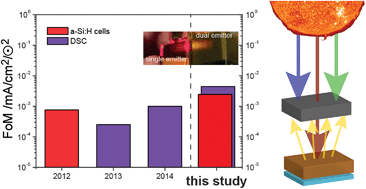
A dual-emitter upconvertor is applied to thin-film solar cells for the first time, generating record figures of merit.
To cite this article before page numbers are assigned, use the DOI form of citation above.
The content of this RSS Feed (c) The Royal Society of Chemistry