Discord is facing backlash after announcing that all users will soon be required to verify ages to access adult content by sharing video selfies or uploading government IDs.
According to Discord, it's relying on AI technology that verifies age on the user's device, either by evaluating a user's facial structure or by comparing a selfie to a government ID. Although government IDs will be checked off-device, the selfie data will never leave the user's device, Discord emphasized. Both forms of data will be promptly deleted after the user's age is estimated.
In a blog, Discord confirmed that "a phased global rollout" would begin in "early March," at which point all users globally would be defaulted to "teen-appropriate" experiences.
A federal immigration agent tackles a protester to the ground in Minneapolis, in February 2026. | Alex Kormann/The Minnesota Star Tribune via Getty Images
Two judges on the United States Court of Appeals for the Fifth Circuit, a court dominated by MAGA Republicans, just handed the Trump administration broad authority to lock up millions of immigrants — provided that it can get those immigrants to Texas, Louisiana, or Mississippi.
In the short term, the Fifth Circuit’s decision in Buenrostro-Mendez v. Bondi is likely to accelerate the Trump administration’s already-common practice of taking people arrested in Minnesota and other places, and moving them to Texas where their lawsuits seeking release will be heard by the Trump-aligned Fifth Circuit.
Should the Supreme Court embrace the Fifth Circuit’s reading of federal law, moreover, it will mean that virtually any person captured by federal immigration enforcement will be locked in a detention facility for months or longer, regardless of their ties to the United States or, in many cases, the merits of their claim that they are lawfully entitled to remain in this country.
Buenrostro-Mendez turns on two provisions of federal law, one of which applies to non-citizens who are “seeking admission” to the United States, and another which applies to the “apprehension and detention of aliens” within the US interior. The first provision says that many immigrants seeking admission at the border must be held in a detention facility while the legal proceedings that will determine whether they may enter are pending. The later provision, meanwhile, typically permits immigrants who are arrested inside the US to be released on bond.
For nearly 30 years, after these provisions became law in 1996, every presidential administration including the first Trump administration read immigration law to call for mandatory detention only for certain immigrants “seeking admission” at the border, because that’s what the law actually says. But last July, the Trump administration announced that all immigrants who are found in the United States without being lawfully admitted at the border will be automatically detained.
Since then, the overwhelming majority of federal judges have rejected this new reading of the statute. According to Politico’s Kyle Cheney, “at least 360 judges rejected the expanded detention strategy — in more than 3,000 cases — while just 27 backed it in about 130 cases.” These judges are spread throughout the country, and many of the judges who rejected the administration’s novel reading of the statute are Republicans.
Nevertheless, in Buenrostro-Mendez, two Fifth Circuit judges adopted the minority view, concluding that the government must detain all undocumented immigrants found anywhere in the country. The author of the Fifth Circuit’s opinion, Judge Edith Jones, is a former general counsel to the Texas Republican Party who once ruled that a man could be executed despite the fact that his lawyer slept through much of his trial.
It remains to be seen whether the Supreme Court, which has a 6-3 Republican majority, will accept Jones’s outlier position. But even if the justices ultimately decide to reverse Jones, it matters a great deal how quickly they do so. Twice during the Biden administration, after an outlier judge ordered the government to take a harsher approach to immigrants, the Supreme Court sat on the case for nearly an entire year before ultimately reversing the lower court’s decision. The lower court’s decision remained in effect for that entire time.
If the Supreme Court takes a similar approach in Buenrostro-Mendez, that will allow ICE to round up immigrants and ship them to Texas, where they will be locked up pursuant to Jones’s decision, for as long as that decision is in effect.
What does the law actually say about immigrants arrested within the US interior?
Federal immigration law includes one provision (Section 1225, Title 8 of the US Code) which applies to noncitizens arriving at the US border, and a separate provision (Section 1226) which applies to immigrants apprehended within the United States. The latter provision allows immigrants inside the US to be released from detention while their immigration cases are proceeding, sometimes after paying a bond, while the former provision does not.
Section 1225 provides that “in the case of an alien who is an applicant for admission, if the examining immigration officer determines that an alien seeking admission is not clearly and beyond a doubt entitled to be admitted, the alien shall be detained” pending an immigration proceeding. Because this statute only applies to “an alien seeking admission,” the overwhelming majority of judges have concluded that its call for mandatory detention only applies to, well, immigrants who are seeking to be admitted to the United States.
It does not apply to immigrants who are already in the United States, even if those immigrants are not lawfully present.
Her argument has two parts. First, she notes that the statute defines the term “an alien who is an applicant for admission,” to include immigrants that are present in the United States without going through the legal admissions process. She then argues that the separate term at issue in Buenrostro-Mendez — the words “an alien seeking admission” — should also be read to have the same definition.
Jones claims that “it would make no sense” to say that someone seeking admission to a college is no longer seeking admission “as soon as the applicant clicks ‘submit’ on her application.” Similarly, she claims, an immigrant who passively waits in the United States without formally seeking to be admitted lawfully should also be understood as “seeking admission.”
The problem with this argument, however, is that Jones’s hypothetical college applicant has actually taken an affirmative act to “seek” admission to a college: They submitted an application. Jones is correct that some immigrants within the United States are deemed to be “an applicant for admission” by a statutory definition, but that doesn’t mean that those immigrants have actually sought admission. Jones’s analogy only makes sense if you imagine a high school student who, despite the fact that they decided not to apply to the University of Texas, had an application filed against their will because of some state or federal law.
The mandatory detention provision, in other words, doesn’t apply to all immigrants who are defined by law as an “applicant for admission.” It applies only to a subset of those immigrants who are also “seeking admission.”
Jones’s decision encourages ICE to round up immigrants and ship them off to Texas
One reason why the Fifth Circuit’s decision matters so much is that, in Trump v. J.G.G. (2025), a 5-4 Supreme Court concluded that immigrants who claim that they are illegally detained must do so using a process known as “habeas,” and habeas petitions may only be filed in “the district of confinement” — that is, in the specific place where the person challenging their detention is detained.
Even before the Fifth Circuit’s decision in Buenrostro-Mendez, the Trump administration was already flying many immigrants detained in Minnesota to Texas — no doubt because Trump’s lawyers anticipated that the MAGA-friendly judges on this court would do whatever they could to bolster his deportation plans. One consequence of this already-existing practice is that immigration lawyers in Minnesota must race to file a habeas petition while their client is still located in that state, because if ICE succeeds in removing the immigrant to Texas, then the immigrant will lose their ability to seek relief before a nonpartisan bench.
Another consequence is that, when immigrants sent to Texas are later released, ICE often just kicks them out of the Texas detention facility with no way to make their way back home to Minneapolis.
This practice of snatching up immigrants in non-Fifth Circuit states and flying them to Texas is likely to accelerate, at least while Jones’s opinion in Buenrostro-Mendez remains in effect. Under Jones’s decision, once an immigrant crosses into the Fifth Circuit, they effectively lose their right to seek release or demand a bond hearing until their immigration proceeding is resolved.
What the immigrant parties in Buenrostro-Mendez can do now
Procedurally, the immigrant parties in Buenrostro-Mendez have two paths to seek Supreme Court review of Jones’s decision. One is to file a petition asking the justices to give this case a full hearing and formally reverse Jones’s decision, but that process typically takes months or more. If these immigrants were to seek Supreme Court review tomorrow, the Court is unlikely to release its decision until June of 2027 — meaning Jones’s decision would remain in effect for well over a year.
The immigrants could also ask the Supreme Court to temporarily block Jones’s decision on its “shadow docket,” a mix of emergency motions and other matters that the justices often decide without issuing an opinion explaining their conclusions. If the Court ruled in favor of these immigrants on the shadow docket, that would suspend Jones’s decision until the Supreme Court could give the case a full hearing and decide it using its ordinarily much slower process.
But it’s far from clear that these justices would grant shadow docket relief to immigrants detained in Texas, even if they ultimately decide that Jones’s Buenrostro-Mendez decision is wrong. When the Trump administration has sought the Court’s intervention on the shadow docket, the justices typically act with lightning speed — often handing Trump a victory within weeks. But the Court’s Republican majority frequently slow-walks cases brought by pro-immigrant parties.
During the Biden administration, for example, two Trump-appointed judges handed down decisions requiring President Joe Biden to reinstate a Trump-era border policy, and also forbidding the Biden administration to tell ICE officers to focus on immigrants who endangered public safety or national security, and not on undocumented immigrants who were otherwise law-abiding. While the Supreme Court eventually concluded that both of these lower court orders were not supported by law, it sat on both cases for nearly an entire year, effectively allowing these two Trump judges to set federal immigration policy during that year.
So, even if Jones’s decision is eventually rejected by the Supreme Court — and given the overwhelming consensus among federal judges that Jones is wrong, this outcome is fairly likely — the Court’s Republican majority may still hand Trump a significant victory by sitting on its hands.
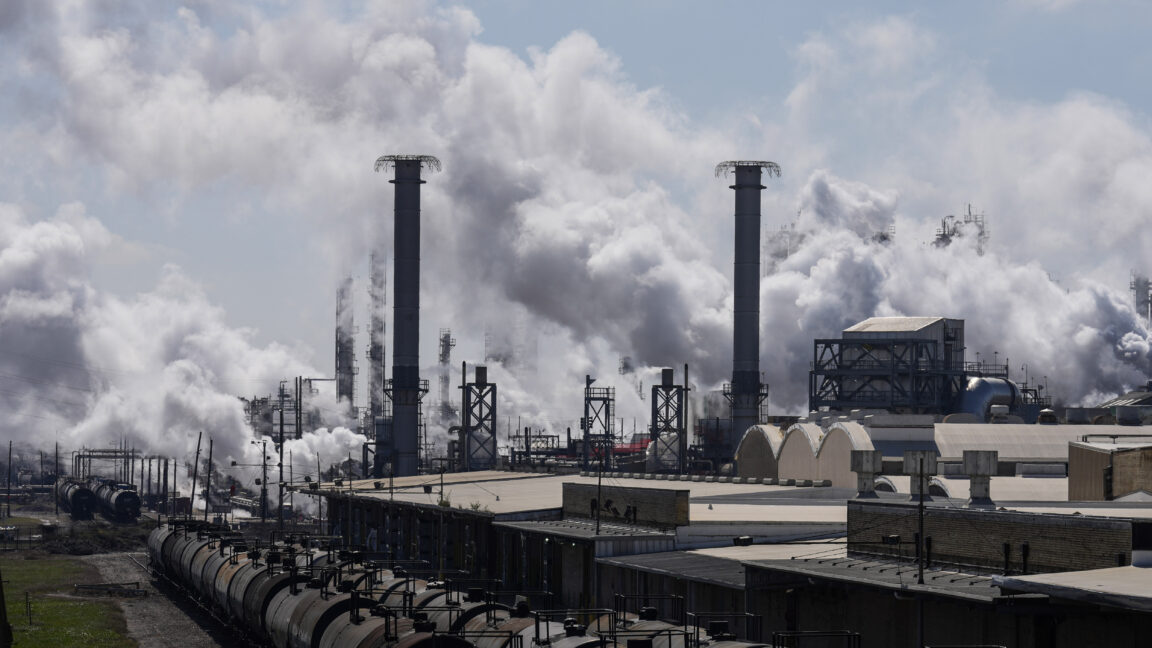
Enforcement against polluters in the United States plunged in the first year of President Donald Trump’s second term, a far bigger drop than in the same period of his first term, according to a new report from a watchdog group.
By analyzing a range of federal court and administrative data, the nonprofit Environmental Integrity Project found that civil lawsuits filed by the US Department of Justice in cases referred by the Environmental Protection Agency dropped to just 16 in the first 12 months after Trump’s inauguration on Jan. 20, 2025. That is 76 percent less than in the first year of the Biden administration.
Trump’s first administration filed 86 such cases in its first year, which was in turn a drop from the Obama administration’s 127 four years earlier.
An anonymous reader shares a report: A new bill in the New York state legislature would require news organizations to label AI-generated material and mandate that humans review any such content before publication. On Monday, Senator Patricia Fahy (D-Albany) and Assemblymember Nily Rozic (D-NYC) introduced the bill, called The New York Fundamental Artificial Intelligence Requirements in News Act -- The NY FAIR News Act for short.
"At the center of the news industry, New York has a strong interest in preserving journalism and protecting the workers who produce it," said Rozic in a statement announcing the bill. A closer look at the bill shows a few regulations, mostly centered around AI transparency, both for the public and in the newsroom. For one, the law would demand that news organizations put disclaimers on any published content that is "substantially composed, authored, or created through the use of generative artificial intelligence."
President Donald Trump is once again begging to get impeached after he issued a blatant extortion threat to Senate Minority Leader Chuck Schumer.
According to multiple reports, Trump said he would release federal funding that Congress already appropriated for the Gateway tunnel—a critical infrastructure project that would add two additional rail tunnels connecting New Jersey and New York—if Schumer agreed to name Washington-Dulles International Airport and Manhattan's Pennsylvania Station after Trump.
Trump canceled the Gateway funding during the government shutdown in October, using the cancellation of the funds as a bargaining chip to get the government reopened. He thought—incorrectly—that canceling the funds would scare Democrats into agreeing to fund the government without getting any concessions from Trump and the GOP.
"The project in New York—it’s billions and billions of dollars that Schumer has worked 20 years to get—it’s terminated," Trump said at the time.
A tunnel is under construction in Manhattan that will connect New York and New Jersey.
But months after the government funding battle ended, Trump still hasn't released the funds.
New Jersey and New York both filed a joint lawsuit on Tuesday seeking immediate release of the money. The project was set to run out of funds on Friday and put the tunnel construction on hold indefinitely—a move that not only halts the project but will also lead to 1,000 workers losing their jobs, according to state lawmakers, including New Jersey Gov. Mikie Sherrill.
“Suspending the funding for this monumental project based on the President’s desire to punish political rivals violates the Administrative Procedure Act many times over,” New York Attorney General Tish James and acting New Jersey Attorney General Jennifer Davenport wrote in the complaint, which will be heard by a federal judge on Friday.
Yet, rather than simply stop punishing New York and New Jersey and release the funds, Trump reportedly issued another extortion threat, this time that he’d unfreeze the funds if Democrats agreed to stain two major American transportation hubs with Trump’s dumb name.
“There was nothing to trade,” an unnamed "person close to Schumer" told Politico. “The president stopped the funding and he can restart the funding with a snap of his fingers.”
Other Democratic lawmakers slammed Trump for committing yet another impeachable offense.
Senate Minority Leader Chuck Schumer, shown on Jan. 28.
"Six years ago, I proudly led the effort to impeach Donald Trump over his illegal scheme to extort Ukraine. Today, he is once again attempting to extend his extortion racket by smearing his name onto Penn Station while holding up billions in critical funding for the Gateway Project," Democratic Rep. Jerry Nadler of New York wrote in a post on X.
"While American infrastructure crumbles, Trump would much rather prioritize selfish renaming over much-needed rebuilding. The Gateway Project funding must be released immediately. Donald Trump’s legacy will not be defined by where he slapped his name; it will be defined by the mess he left our nation’s most important infrastructure project,” he continued.
New York Sen. Kirsten Gillibrand, a Democrat, echoed those sentiments.
"This is ridiculous," she said in a statement. "These naming rights aren’t tradable as part of any negotiations, and neither is the dignity of New Yorkers. At a time when New Yorkers are already being crushed by high costs under the Trump tariffs, the president continues to put his own narcissism over the good-paying union jobs this project provides and the extraordinary economic impact the Gateway tunnel will bring."
Trump is a malignant narcissist whose obsession with himself hurts the American people and is below the dignity of the office he holds. He must be impeached and removed from office.
Google-spinoff Waymo is in the midst of expanding its self-driving car fleet into new regions. Waymo touts more than 200 million miles of driving that informs how the vehicles navigate roads, but the company's AI has also driven billions of miles virtually, and there's a lot more to come with the new Waymo World Model. Based on Google DeepMind's Genie 3, Waymo says the model can create "hyper-realistic" simulated environments that train the AI on situations that are rarely (or never) encountered in real life—like snow on the Golden Gate Bridge.
Until recently, the autonomous driving industry relied entirely on training data collected from real cars and real situations. That means rare, potentially dangerous events are not well represented in training data. The Waymo World Model aims to address that by allowing engineers to create simulations with simple prompts and driving inputs.
Google revealed Genie 3 last year, positioning it as a significant upgrade over other world models by virtue of its long-horizon memory. In Google's world model, you can wander away from a given object, and when you look back, the model will still "remember" how that object is supposed to look. In earlier attempts at world models, the simulation would lose that context almost immediately. With Genie 3, the model can remember details for several minutes.
It’s clear by now that the Trump administration remains furious that it is required to give immigrant detainees even the meager due process they are currently owed. So it’s setting out to change that.
On Thursday, the Department of Justice announced an interim final rule that effectively dismantles the immigration appeals process, making it nearly impossible to appeal adverse decisions by immigration law judges. It goes into effect automatically within 30 days, bypassing the normal notice and comment period to make sure the government doesn’t have to take into account any input from bleeding heart libs who don’t want immigrants abducted and deported.
But of course that’s not how the DOJ is framing it. No, you see, they’re just helping to speed things up!
The DOJ says the rule will “streamline administrative appellate review by the Board of Immigration Appeals ("Board" or "BIA") of decisions by Immigration Judges by making review of such decisions on the merits discretionary, by setting appropriate times for briefing in cases that are reviewed on the merits, and by streamlining other aspects of the appellate process to ensure timely adjudications and avoid adding to the already sizeable backlog at the Board.”
Okay, to be fair, it definitely does streamline an appellate process if you just refuse to hear the appeals outright.
What this means in practice: by default, an appeal to the BIA will now get summarily dismissed—as in the Board will not hear it at all—unless a majority of the Board votes to hear it. Dismissals have to be issued within 15 days, which the administration smugly lies is Good, Actually, because it will allow people to “seek federal court review expeditiously, rather than potentially waiting for years for a Board decision that in the vast majority of cases would affirm the underlying Immigration Judge.”
They’re kinda saying the quiet part out loud there at the end by admitting that the BIA generally just rubber-stamps the decisions of the immigration law judges.
Immigrants will now have only 10 days, rather than 30, to file a notice of appeal from an ILJ decision. And thanks to a provision in the Big Beautiful Bill, that now costs $1,000. And after the BIA inevitably denies that appeal? Then the person gets deported, unless they file a petition with a federal circuit appellate court, which costs $600. But they can still get deported during that time unless the court grants them an emergency stay.
What’s appalling here is that the structure of the appeals process is, just like the first-rung immigration law judge process, already wildly tilted in favor of the government. First, it isn’t a neutral appeals board or a court. It’s just a part of the executive branch, and the attorney general names people to it.
President Donald Trump didn’t just purge the board of people who aren’t ideologically in agreement with his anti-immigrant crackdown, but also shrank it. In April 2025, the administration issued a rule limiting the board to 15 members, down from 26 at the end of the Biden administration.
Most of these faux-judges are now Attorney General Pam Bondi-approved specials, but chief appellate “judge” Garry Malphrus is a holdover from the George W. Bush era.
If you’d like a sense of why Malphrus has been allowed to stick around for so long, know that for all published decisions in 2025 (most BIA appeals are not published), all but one was negative for the immigrant.
The board faces a backlog of its own making, exacerbated by now having fewer judges to hear appeals.
But wait—there’s more. The Trump administration has also utterly compromised the immigration law judge process. First, Trump fired hundreds of experienced immigration law judges, making sure there are no pesky people who are foolish enough to believe that being a judge means fairly considering both sides.
Those folks are being replaced with ones who are happy to answer an ad looking for “deportation judges,” and they get a whopping two weeks of classroom training and one week observing hearings. During that woefully inadequate training, they are now told not to grant asylum in most cases.
So now an immigrant faces inexperienced ILJs specifically chosen for their eagerness to deport people, and their recourse is to appeal to a board comprised of people chosen for their eagerness to deport people, and that board doesn’t even have to glance at their appeal. If they just let it sit on a desk for 15 days, on day 16, the appeal is dismissed.
Add to this that the administration has also broken the habeas process by which detained immigrants can challenge the legality of their detention. First, it often immediately transfers people well outside the jurisdiction where they were arrested, isolating them from resources and their community.
Next, the administration cannot and will not promptly address the massive backlog of habeas petitions resulting from its spree of wrongfully detaining immigrants. In Minnesota, ICE has wrongfully detained so many people that there are hundreds, if not thousands, of petitions languishing.
Indeed, the first few weeks of January 2026 saw as many habeas filings in the Minnesota federal court as the entirety of the previous year. And even when petitioners prevail and the court orders them to be released, the administration often just … doesn’t release them.
So, to recap: Immigration law judges are now selected for their willingness to rule against immigrants. Administrative appeals are now basically gone. If you’re wrongfully detained and have to file a habeas petition to get out of whatever prison ICE stashed you in, good fucking luck, because the administration is functionally ignoring those cases and orders to release.
Treasury Secretary Scott Bessent appeared before the Senate Committee on Banking, Housing, and Urban Affairs on Thursday. Having been publicly embarrassed during a hearing the day prior, Bessent was no more prepared for an interrogation on President Donald Trump’s failing economic policies this time around.
Democratic Sen. Elizabeth Warren of Massachusetts dismantled Bessent’s attempts to blame Trump’s distressed economy on former President Joe Biden and Democrats, cutting through his deflection and demanding to know whether grocery prices had dropped since Trump returned to office.
In response, Bessent claimed that “numerous prices” had fallen.
“I'm sorry, I don't know if you can't hear me. Did grocery prices drop in 2025?” Warren asked again, before citing Trump’s own Bureau of Labor Statistics’ report that consumer costs were 2.4% higher at the end of 2025 than they were at the end of 2024.
“So if you're just going to insult people by denying the facts that are out there and tell people they're doing great when they're struggling, I think that's just another way to say you don't have a plan to bring down these prices,” Warren added.
Warren then shifted to Kevin Warsh, Trump’s nominee to replace Federal Reserve Chair Jerome Powell. A former Fed official, Warsh is best known for backing nearly every wrong position during the 2008 financial crisis.
Referencing Trump’s recent comment that he would sue Warsh if he didn’t lower interest rates, Warren said, “At least I think it was a joke,”
“Can you commit right here and now that Trump's Fed nominee Kevin Warsh will not be sued, will not be investigated by the Department of Justice if he doesn't cut interest rates exactly the way that Donald Trump wants?” she asked.
“I, I … that is up to the president,” Bessent said before attempting to turn the questioning around on Warren.
“I'm sorry, you can’t say that he won’t be sued if he doesn’t drop interest rates and he won't be criminally investigated?” Warren exclaimed. “That was supposed to be the softball.”
WARREN: This should be an easy one. Can you commit that Trump's Fed nominee, Kevin Warsh, will not be sued or investigated by the DOJ if he does not cut interest rates in the way Trump wants? BESSENT: That's up to the president WARREN: I'm sorry -- you can't say he won't be… pic.twitter.com/bPgAK2cySX
A few Senate Democrats introduced a bill called the ‘‘ICE Out of Our Faces Act," which would ban Immigration and Customs Enforcement (ICE) and Customs and Border Protection (CBP) from using facial recognition technology.
The bill would make it "unlawful for any covered immigration officer to acquire, possess, access, or use in the United States—(1) any biometric surveillance system; or (2) information derived from a biometric surveillance system operated by another entity." All data collected from such systems in the past would have to be deleted. The proposed ban extends beyond facial recognition to cover other biometric surveillance technologies, such as voice recognition.
The proposed ban would prohibit the federal government from using data from biometric surveillance systems in court cases or investigations. Individuals would have a right to sue the federal government for financial damages after violations, and state attorneys general would be able to bring suits on behalf of residents.
Pretty sure I have this already, but if not, gonna fix that
To maximize the shingles vaccine’s value, we need more research, and we need more people to take it. | Getty Images
An elixir for keeping our brains and bodies younger may already be sitting on pharmacy shelves across the United States — if only we’d take advantage of it.
I’m talking about the shingles vaccine.
It was invented because, well, shingles is a terrible disease. If you ever had chickenpox (like I did), this virus is lurking inside your body already. Shingles is the reactivation of the same varicella zoster virus later in life. It can lead to painful red rashes that last for weeks, and for some people, they will suffer from debilitating nerve pain for the rest of their lives.
The debut of the first shingles shot in 2006 was a big public health win for that reason alone. But the benefits may be even greater than we realized at the time.
Sign up for the Good Medicine newsletter
Our political wellness landscape has shifted: new leaders, shady science, contradictory advice, broken trust, and overwhelming systems. How is anyone supposed to make sense of it all? Vox’s senior correspondent Dylan Scott has been on the health beat for more than a decade, and every week, he’ll wade into sticky debates, answer fair questions, and contextualize what’s happening in American health care policy. Sign up here.
Over the past year, there has been a steadystream of studiesshowing that the shingles vaccine doesn’t just stop the painful skin rashes — it could also stave off dementia and slow our biological aging.
A recent study that tracked specific biomarkers in human samples strengthened the case that there is a genuine cause-and-effect. The science surrounding the shingles vaccine is a new window into how we age and how we might even slow it down. These findings could open doors to powerful new anti-aging, anti-dementia treatments.
But that will require more investment — and researchers working on these projects told me it’s been surprisingly hard to find the necessary financial support. Just as importantly, we need to get more seniors to take the vaccine: As of now, less than a third of eligible Americans over 50 are getting their shingles jab.
The remarkable anti-aging shingles shot
The first shingles vaccine, released in 2006, decreased the risk of shingles by 60 percent and also reduced by two-thirds the risk of long-term nerve pain. Experts said at the time that the shot “represents a major public health advance.”
But it was only within the last year that the awesome dementia-defeating powers of the shingles vaccine started to come into focus.
Pascal Geldsetzer, who researches population health at Stanford University, spotted an opportunity: In 2013, Wales had established new standards for who could receive the shingles vaccine. People who were born before September 2, 1933, were not eligible, and everyone born on that day or after was. There were two large groups of people who were otherwise the same, differing in age by only weeks, except one of them had received the shingles shot and the other had not. It’s about as rigorous a “natural experiment” as you could hope for. And so a few years ago, Geldsetzer and his co-authors looked back at the country’s comprehensive health records to track what had happened to patients after they received a shingles vaccine (or didn’t).
And the results, published in April 2025, were striking: Receiving the shingles vaccine was associated with a 20 percent lower chance of being diagnosed with dementia. Those findings held up to all kinds of veracity checks — and they were repeated in similar natural experiments in Australia and Canada (the latter also co-authored by Geldsetzer). A December 2025 study based on the same Welsh data concluded that people who already had dementia and received the shingles vaccine saw slower progression of the disease and fewer deaths, suggesting that the shot may be effective in treating dementia, too.
So the circumstantial case for the shingles shot has grown robust — and now we’re starting to get lab-based research that could explain why this is happening.
A recent study analyzed biomarker data from blood samples collected by the US government as part of regular surveys monitoring Americans’ health. Whereas the earlier studies were observational, this was an attempt by scientists to actually see what was happening — to measure changes in the body at the molecular level. The researchers found that the vaccine was associated with slower overall biological aging, lower inflammation, and less cell damage. The findings fit with what we’re learning about how chronic inflammation may slowly damage the body over time, leading to various chronic health problems.
The study did leave one mystery: The biomarkers specifically linked to dementia did not actually decrease. But the authors noted that we’re still figuring out how to understand the relationship between brain biomarkers and disease. It is possible, for example, that less systemic inflammation leads to less dementia without specifically altering the biomarkers that were tracked.
But now money is drying up for vaccine research
The existing research largely focuses on the initial vaccine released. But in 2018, an even better version came on the market.
Shingrix, which combined virus proteins with an immunity booster, prevented shingles in more than 90 percent of cases in clinical trials, with similar success in preventing nerve damage. It is now the standard vaccine in the US.
But does Shingrix have the same anti-aging effects? Unfortunately, we just don’t know. We need more research — and that’s where all this promising news runs into a brick wall.
Ideally, researchers would run randomized clinical trials. But despite these amazing findings, Geldsetzer told me he had been struggling to find financial support to study Shingrix.
“I think to really convince the public health and medical community what we need now is a true clinical trial, a randomized trial on the effect of shingles vaccination for dementia prevention and cognition,” Geldsetzer said. “There’s little commercial interest. It’s not been easy at all.”
A number of things are working against him and his peers. The initial Welsh research was supported by an NIH grant, but pro-vaccine research does not exactly align with the administration’s priorities under US Health Secretary Robert F. Kennedy Jr.’s leadership. Drug manufacturers have also been pulling out of the vaccine business for years, a trend that is getting worse under the Trump administration.
There is a bitter irony here.
The shingles vaccine was made possible because pharmaceutical companies, philanthropy groups, and national governments invested in a new vaccine platform while searching for a malaria shot, just one of many examples of how scientific investment can pay off in unexpected ways. But now, money is short.
Let’s not miss this tremendous health care opportunity
To maximize the shingles vaccine’s value, we need more research, and we need more people to take it. Vaccination rates are still surprisingly low: Only 30 percent of eligible patients received the shingles shot as of 2022.
Lower vaccination rates among men, underrepresented and historically marginalized groups, and lower-income people suggest this is partly a health care access issue. (Adding to that evidence: People without chronic conditions are also less likely to get it, probably because they have less contact with the health system.)
But on top of that, we’re now entering a new era of vaccine hesitancy, even among older people. Vaccination rates among seniors for pneumonia and flu have been dropping.
This is a big public health test: We seem to have a cheap intervention for aging and cognitive decline.
In a more pro-vaccine alternate reality, we might even be pondering questions like: Should even younger people get it? Shingles has grown increasingly common among people in their 30s and 40s, and given the studies so far have found the shot’s anti-aging effects persist for years, the long-term payoff could be immense.
Those are the policy challenges. At the personal level, what each of us can do is talk to the seniors in our lives; a lot of them aren’t getting vaccinated. Shingles sucks — and the shot for it might also stave off dementia and slow your body’s aging. Win-win-win.
yup. pity their voters also have the same position.
Republican lawmakers have defended President Donald Trump's lawless and deadly immigration crackdown as federal agents violently round up people of color and hold them in squalid and inhumane detention facilities in an effort to meet an arbitrary deportation quota set by Trump aide Stephen Miller, a wannabe Joseph Goebbels.
But as soon as the deportation force comes to their home states, the GOP lawmakers’ tune changes real quick.
For example, get a load of Republican Sen. Roger Wicker of Mississippi, who on Wednesday sent a letter to Homeland Security Secretary Kristy Noem voicing opposition to the Trump administration's plan to convert a giant warehouse in his state into an immigrant detention facility.
"While I support the enforcement of immigration law, I write to express my opposition to this acquisition and the proposed detention center," Wicker wrote.
He added:
This site is currently positioned for economic development purposes. It represents an opportunity for job creation, private investment, and long-term economic growth in Marshall County. The county is already experiencing meaningful growth and increased interest from employers seeking to locate or expand in North Mississippi. Preserving limited, development-ready industrial sites is essential to sustaining this growth. Converting this industrial asset into an [Immigration and Customs Enforcement] detention center forecloses economic growth opportunities and replaces them with a use that does not generate comparable economic returns or community benefits.
What a morally bankrupt position to stake out.
Republican Sen. Susan Collins of Maine, shown last May.
First, Wicker is not opposed to converting a warehouse into an inhumane human storage locker. He's instead mad that it will strain local resources and hurt business opportunities in his state.
Of course, those problems would exist in other states, too, but as long as it's not happening in his own backyard, he's cool with it.
Then take a gander at perpetually "concerned" Sen. Susan Collins, the Maine Republican who apparently worked behind the scenes to get Trump to pull his goons from her state, where they had been carrying out the same violent and unconstitutional immigration crackdown that Minnesota is suffering.
I have been urging Secretary Noem and others in the Administration to get ICE to reconsider its approach to immigration enforcement in the state [Maine]. I appreciate the Secretary's willingness to listen to and consider my recommendations and her personal attention to the situation in Maine. ICE and Customs and Border Protection will continue their normal operations that have been ongoing here for many years. I will continue to work with the Secretary on efforts to end illegal immigration, drug smuggling, and other transnational criminal activity.
In fact, Fox News host and Trump sycophant Brian Kilmeade said Tuesday on his radio show that DHS removed agents from Maine to help Collins politically since she faces a difficult reelection and ICE's unpopular raids would hurt her chances.
"Huge arrests over in Maine, although they're winding down a little in Maine to help Sen. Susan Collins, who's gonna be in a tough fight to keep her seat," Kilmeade said. "And why does the president want Susan Collins to win? She's about the only Republican that can win in Maine. They don't wanna flip that seat [to Democrats].”
Collins, however, isn't doing anything to rein in ICE's conduct in other states.
Republicans don't give two flying fucks about Trump's anti-immigration cruelty—until it starts to negatively impact them. Then they'll do the bare minimum to stop the conduct in their backyards, while letting it continue elsewhere.
Please join the team that makes it possible for your friendly neighborhood comic strip Tom the Dancing Bug to exist in this hostile Trumpverse! JOIN US FOR 2026 IN THE INNER HIVE, and be the first kid on your block to get each week's Tom the Dancing Bug comic – before it's published anywhere.
Sign up for the free weekly Tom the Dancing Bug Review! Not nearly as good as joining the Inner Hive, but it's free!
Now available: THE 2025 TOM THE DANCING BUG ANNUAL, collecting every ding-dong Tom the Dancing Bug comic of the past year in one handsomely bound PDF.
Treasury Secretary Scott Bessent proved no match for Democratic Rep. Sean Casten of Illinois during a House Financial Services Committee on Wednesday. Casten tangled up the aging Howdy Doody impressionist with his own words, citing a letter in which Bessent wrote plainly that “tariffs are inflationary”—which directly contradicted Bessent’s earlier testimony.
Bessent’s efforts to dodge the question made things worse. Cutting through Bessent’s stammering responses, Casten asked, “You said tariffs are inflationary. Do you want to correct what you said to the ranking member, or did you lie?”
The exchange left Bessent such a bumbling mess that Rep. French Hill of Arkansas, the Republican chair of the committee, had to step in to end Bessent’s humiliation.
This is not the first, second, or hundredth time Bessent has looked like a liar while defending President Donald Trump’s chaotic tariffs. And as Trump’s corruptly conceived economic agenda continues to fail Americans, Bessent will likely have many more opportunities to abase himself in public.
Amid the Trump administration's attack on universities, Harvard has emerged as a particular target. Early on, the administration put $2.2 billion in research money on hold and shortly thereafter blocked all future funding while demanding intrusive control over Harvard's hiring and admissions. Unlike many of its peer institutions, Harvard fought back, filing and ultimately winning a lawsuit that restored the cut funds.
Despite Harvard's victory, the Trump administration continued to push for some sort of formal agreement that would settle the administration's accusations that Harvard created an environment that allowed antisemitism to flourish. In fact, it had become a running joke among some journalists that The New York Times had devoted a monthly column to reporting that a settlement between the two parties was near.
Given the government's loss of leverage, it was no surprise that the latest installment of said column included the detail that the latest negotiations had dropped demands that Harvard pay any money as part of a final agreement. The Trump administration had extracted hundreds of millions of dollars from some other universities and had demanded over a billion dollars from UCLA, so this appeared to be a major concession to Harvard.
AI is changing the web, and people want very different things from it. We’ve heard from many who want nothing to do with AI. We’ve also heard from others who want AI tools that are genuinely useful. Listening to our community, alongside our ongoing commitment to offer choice, led us to build AI controls.
Starting with Firefox 148, which rolls out on Feb. 24, you’ll find a new AI controls section within the desktop browser settings. It provides a single place to block current and future generative AI features in Firefox. You can also review and manage individual AI features if you choose to use them. This lets you use Firefox without AI while we continue to build AI features for those who want them.
I originally thought they meant you could turn off AI on websites, but it’s just AI features in Firefox. The way we’re headed, it seems like one day a browser to shut out AI features across the full browsing experience would be useful. Baby steps, I guess.
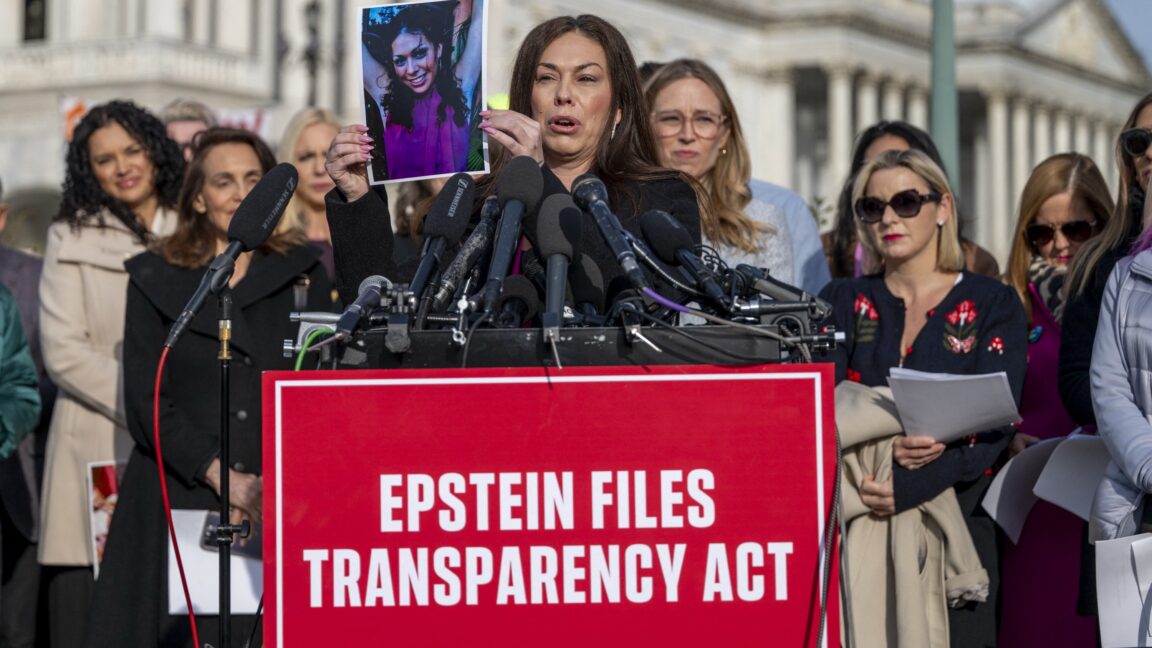
Amid the fallout from the partial and inept release of the government’s files on sex offender Jeffrey Epstein, the sycophants in President Donald Trump's Department of Justice have concocted a new defense to absolve their Dear Leader and his associates of culpability in Epstein's crimes.
"It's not a crime to party with Mr. Epstein," Deputy Attorney General Todd Blanche—yes, he of giving Epstein co-conspirator Ghislaine Maxwell a cushy prison upgrade—said Monday night on Fox News. "It's not a crime to email with Mr. Epstein."
Blanche debased himself to make the argument after Trump, multiple members of his administration, and other powerful figures have been exposed as having close relationships with Epstein, who was charged in 2019 with sex-trafficking minors but was found dead in a prison cell before he faced the trial.
In fact, some of the men featured in the files spoke about traveling to the island where Epstein would "party"—as Blanche put it—with the underaged girls he allegedly trafficked.
Trump was once a close friend of Epstein’s, and he, his wife, his Mar-a-Lago estate, and other words relevant to him are referenced more than 38,000 times in over 5,300 files, according to an analysis from The New York Times.
Meanwhile, GOP benefactor Elon Musk was exposed as having sought multiple times to visit Epstein’s island, inquiring about when the “wildest party" would take place and once lamenting that he was "disappointed" he couldn't travel to the island due to a scheduling conflict because he was, “really looking forward to finally spending some time together with just fun as the agenda."
Commerce Secretary Howard Lutnick was also exposed as a liar. Despite claiming he had ended his ties to Epstein in 2005, Lutnick is shown in the files to have planned a visit to Epstein’s island in 2012. “Nice seeing you,” Epstein said to Lutnick in 2012, via an assistant’s email.
And Kevin Warsh, Trump's new nominee to chair the Federal Reserve Board, appears in the files in an email that listed him as someone who spent Christmastime in St. Barths at the same time as Epstein in 2010.
This redacted photo released by the Department of Justice shows files documented in 2019 during a search of Jeffrey Epstein's home on Little St. James island in the U.S. Virgin Islands.
Blanche may be right that it isn't necessarily a crime to have been at parties with Epstein or to have emailed with him. But on a basic human level, it looks horrible to have been Epstein's pal and to have traveled to the very place where his alleged crimes took place—and to have done so after Epstein was convicted in 2008 of soliciting a minor for prostitution.
I'd venture to guess that the public—which disapproves of Trump’s handling of the files—won't be so receptive to Blanche's defense that partying with Epstein isn't a crime. In fact, it’s easy to imagine that very video clip being used in campaign attack ads in the 2026 midterms.
Indeed, Democrats have already slammed Blanche for the comment.
“[Blanche] dismisses what happened as men partying with Epstein. That is offensive to survivors,” Democratic Rep. Ro Khanna of California, co-author of the legislation that forced the release of the Epstein files, said on CNN. “These are men making plans with Epstein, a pedophile, to go to Epstein's island where young girls are being raped and paraded naked at parties. There should be an investigation where they are asked under oath what they saw and who raped and abused these girls.”
Rep. Melanie Stansbury, Democrat of New Mexico, echoed those sentiments.
"This is the Dept Attorney General of the U.S. saying 'it is not a crime to party with Epstein' in response to a question about prosecuting men who engaged in relations with minors. Sir, yes it is a crime. And, prosecuting these crimes is your job. It’s time for Blanche to go," Stansbury wrote in a post on X.
Meanwhile, Democratic Rep. Robert Garcia of California called Blanche's comments "gross" and "sick."
"Todd Blanche should be ashamed of himself. He should apologize to all the survivors," Garcia said in an appearance on CNN.
Ultimately, the latest dump of Epstein files looks really bad for Trump and the people he surrounds himself with. And Blanche’s tone-deaf defense won’t do anything to change that.
Baghdad bob would blush at the shamelessness on display
Former White House press secretary and current Fox News host Kayleigh McEnany went into full propaganda mode Monday, hyping first lady Melania Trump’s new documentary and adding to increasingly dubious stories about stellar ticket sales.
“My mom went to it this weekend in Florida,” McEnany said on Fox News. “She said not only was the theater packed, it was, you know, standing room only—if you could, like, try to sneak in the back of the theater. People were cheering through it. They were excited. It was interactive, people interplaying with the film. She said it was just electric.”
Kayleigh: My mom went to see Melania. She said the theater was packed, it was standing room only. People were cheering through it, they were excited. It was interactive—people interplaying with the film. She said it was just electric. pic.twitter.com/dimgT5jGPF
“Melania” did exceed some of the lowest expectations, pulling in a reported $7 million opening weekend. But once you factor in the cost—Amazon bought the rights to the film for $40 million and spent another $35 million to promote it—the opening weekend was anything but “electric.”
Crunchyroll is one of the most popular streaming platforms for anime viewers. Over the past six years, the service has raised prices for fans, and today, it announced that it's increasing monthly subscription prices by up to 25 percent.
Sony bought Crunchyroll from AT&T in 2020. At the time, Crunchyroll had 3 million paid subscribers and an additional 197 million users with free accounts, which let people watch a limited number of titles with commercials. At the time, Crunchyroll monthly subscription tiers cost $8, $10, or $15.
After its acquisition by Sony, like many large technology companies that buy a smaller, beloved product, the company made controversial changes. The Tokyo-based company folded rival Funimation into Crunchyroll; Sony shut down Funimation, which it bought in 2017, in April 2024.
The Environmental Protection Agency (EPA) cracked down on lead-based products—including lead paint and leaded gasoline—in the 1970s because of its toxic effects on human health. Scientists at the University of Utah have analyzed human hair samples spanning nearly 100 years and found a 100-fold decrease in lead concentrations, concluding that this regulatory action was highly effective in achieving its stated objectives. They described their findings in a new paper published in the Proceedings of the National Academy of Sciences.
We've known about the dangers of lead exposure for a very long time—arguably since the second century BCE—so why conduct this research now? Per the authors, it's because there are growing concerns over the Trump administration's move last year to deregulate many key elements of the EPA's mission. Lead specifically has not yet been deregulated, but there are hints that there could be a loosening of enforcement of the 2024 Lead and Cooper rule requiring water systems to replace old lead pipes.
“We should not forget the lessons of history. And the lesson is those regulations have been very important,” said co-author Thure Cerling. “Sometimes they seem onerous and mean that industry can't do exactly what they'd like to do when they want to do it or as quickly as they want to do it. But it's had really, really positive effects.”
Great, but since when has "hav[ing] no principled basis to complain" ever stopped GOP whining? they have no principles other than whatever will get them power right this second.
Though some of the Supreme Court’s Republican justices occasionally break with President Donald Trump, they typically do so on issues that split the Republican Party. | Andrew Harrer/Bloomberg via Getty Images
Utah’s Republican governor, Spencer Cox, signed legislation over the weekend that will add two seats to his state’s supreme court — seats that Cox plans to fill shortly. The law is widely viewed as an effort to move Utah’s highest court to the right after it handed down several decisions that Republicans disliked.
In September, the pre-packed Utah Supreme Court sided with plaintiffs challenging Utah’s GOP-friendly congressional maps. According to the Salt Lake Tribune, in recent years, Utah courts also “blocked Utah’s ban on most abortions, temporarily stopped a law banning transgender girls from playing high school sports, and found the state’s school voucher program unconstitutional.”
“Court-packing,” or adding seats to a court in order to change its ideological or partisan makeup, is often spoken of as if it were the political equivalent of detonating a nuclear weapon. In 1937, shortly after winning reelection in a landslide, President Franklin D. Roosevelt proposed adding six seats to a US Supreme Court that frequently sabotaged his New Deal policies. But, even at the height of his power, Roosevelt struggled to build support for his plan. Some historians blame his court-packing proposal for shattering the New Deal coalition in Congress.
Since then, national leaders have typically spoken of court-packing with trepidation. In 2020, for example, as Republicans were consolidating their 6-3 supermajority on the US Supreme Court, then-presidential candidate Joe Biden warned that he was “not a fan of court-packing” as a solution to Republican partisanship on the high court.
But, at the state level, Republicans now engage in court-packing often enough that it has become just a normal part of partisan judicial politics. In 2016, Republicans in Georgia and Arizona did the same thing Utah just did, adding seats to their state supreme courts in an apparent effort to move those courts to the right. So that’s three packed supreme courts in a single decade.
This is oddly short-sighted behavior by the Republican Party. A Republican US Supreme Court is the GOP’s most durable power center, and Republicans have wielded this power center aggressively. The Court’s six Republicans held that President Donald Trump may use the powers of the presidency to commit crimes. And they spent the first year of Trump’s second term neutering lower courts that tried to constrain Trump’s ability to violate the Constitution and to remake the federal government. Though some of the Court’s Republicans occasionally break with Trump, they typically do so on issues that split the Republican Party.
Democrats who want to push back against these decisions are in a bind, even when they control both Congress and the White House. The Constitution does not permit many relatively modest Supreme Court reforms that Democrats have proposed in the past, such as term limits for the sitting justices. But it does permit Congress to add seats to the Court whenever it wants; the number of justices has varied from as few as five, to as many as 10 over the Court’s history.
So the longstanding norms against court-packing, at least at the federal level, prevent Democrats from using their most potent weapon against an increasingly partisan Supreme Court. If those norms break down — and they appear to have already broken down completely in Utah, Georgia, and Arizona — Democrats would gain a powerful tool if they want to yank the federal judiciary away from the GOP.
The leading moderate proposals to reform the Supreme Court are unlikely to survive constitutional review
The Constitution seeks to protect federal judges from political interference. Among other things, it provides that federal judges and justices “shall hold their offices during good behaviour,” and it also provides that their “compensation … shall not be diminished during their continuance in office.” The first provision is widely understood to give federal judges life tenure, while the later prevents Congress from undermining this life tenure by stripping judges of their salaries.
One weird quirk of the Constitution, however, is that it gives Congress nearly unlimited authority to decide how many justices sit on the Supreme Court. Outside of the impeachment process, which requires two-thirds of senators to agree to remove a justice, Congress cannot kick a justice out of office. But it can dilute that justice’s vote by adding an unlimited number of new justices.
As a practical matter, this constitutional quirk means that several relatively moderate proposals to reform the Supreme Court are unconstitutional, but court-packing, the nuclear bomb of Supreme Court reforms, is not.
In his final year in office, for example, Biden proposed three reforms targeting the Court: term limits for justices, a binding ethics code for the Supreme Court, and a constitutional amendment overturning the Court’s decision allowing Trump to commit crimes. Because the Court’s Trump immunity decision was, at least nominally, rooted in the Constitution, Biden recognized that fixing that error without changing the Court’s personnel would require a constitutional amendment.
Biden’s term limits proposal, meanwhile, was quite popular. Around the time he proposed it, a poll found that 68 percent of Americans endorse term limits for members of the Supreme Court.
But imposing term limits on the current justices would almost certainly require a constitutional amendment. Again, the Constitution provides that justices “shall hold their office during good behavior,” and not for a fixed term. Though there are some academic arguments that this provision does not preclude term limits, those arguments are largely irrelevant, because the power to decide whether the Constitution permits term limits rests with the Supreme Court. And the justices are unlikely to agree to a constitutionally dubious proposal to limit their own power.
Similarly, it is unclear whether Biden’s proposed ethics code for the justices would have any real teeth. While a congressionally imposed ethics code is constitutional — the Constitution provides that the justices may only exercise their appellate jurisdiction “under such regulations as the Congress shall make” — the justices could simply ignore the code or even invent a spurious reason to declare it unconstitutional.
Indeed, at least one justice, Justice Samuel Alito, has already indicated that he would do so. In a 2023 interview, Alito claimed, falsely, that “no provision in the Constitution gives [Congress] the authority to regulate the Supreme Court — period.”
A law adding seats to the Supreme Court, by contrast, is not vulnerable to the Court’s current membership. It is well-established that Congress may determine how many justices sit on the Supreme Court, and Congress has used this power multiple times in the past. And, if justices like Alito attempted to strike down a court-packing law, they would likely be outvoted by their new colleagues.
This means that the primary constraint on Congress’s court-packing power is political — not constitutional. Congress has historically used this power sparingly, both out of a desire not to politicize the judiciary, and because of the strong norms against doing so — norms that were strong enough that they withstood even Roosevelt’s attempt to pack the Court.
But the Supreme Court is already politicized. And now, Republicans have torn down the norms against court-packing in multiple states. If Republicans in Arizona, Georgia, and Utah can do it, why can’t Democrats do it elsewhere — including at the highest Court of them all? The state-level GOP power grabs mean that Republicans will have no principled basis to complain if, in three or four years, a new president and Congress decide to de-Trumpify the Supreme Court.
The Epstein files released by the Department of Justice on Friday included at least a few dozen unredacted nude photos and names of at least 43 victims, according to news reports.
The DOJ missed a December 19 deadline set by the Epstein Files Transparency Act by more than a month, but still released the files without fully redacting nude photos and names of Jeffrey Epstein's victims. The New York Times reported yesterday that it found "nearly 40 unredacted images that appeared to be part of a personal photo collection, showing both nude bodies and the faces of the people portrayed."
While the people in the photos were young, "it was unclear whether they were minors," the article said. "Some of the images seemed to show Mr. Epstein’s private island, including a beach. Others were taken in bedrooms and other private spaces." The photos "appeared to show at least seven different people," the article said.
An anonymous reader quotes a report from SecurityWeek: The White House has announced that software security guidance issued during the Biden administration has been rescinded due to "unproven and burdensome" requirements that prioritized administrative compliance over meaningful security investments. The US Office of Management and Budget (OMB) has issued Memorandum M-26-05 (PDF), officially revoking the previous administration's 2022 policy, 'Enhancing the Security of the Software Supply Chain through Secure Software Development Practices' (M-22-18), as well as the follow-up enhancements announced in 2023 (M-23-16).
The new guidance shifts responsibility to individual agency heads to develop tailored security policies for both software and hardware based on their specific mission needs and risk assessments. "Each agency head is ultimately responsible for assuring the security of software and hardware that is permitted to operate on the agency's network," reads the memo sent by the OMB to departments and agencies. "There is no universal, one-size-fits-all method of achieving that result. Each agency should validate provider security utilizing secure development principles and based on a comprehensive risk assessment," the OMB added.
While agencies are no longer strictly required to do so, they may continue to use secure software development attestation forms, Software Bills of Materials (SBOMs), and other resources described in M-22-18.
An anonymous reader shares a report: Oracle could cut up to 30,000 jobs and sell health tech unit Cerner to ease its AI datacenter financing challenges, investment banker TD Cowen has claimed, amid changing sentiment on Big Red's massive build-out plans.
A research note from TD Cowen states that finding equity and debt investors are increasingly questioning how Oracle will finance its datacenter building program to support its $300 billion, five-year contract with OpenAI.
The bank estimates the OpenAI deal alone is going to require $156 billion in capital spending. Last year, when Big Red raised its capex forecasts for 2026 by $15 billion to $50 billion, it spooked some investors. This year, "both equity and debt investors have raised questions about Oracle's ability to finance this build-out as demonstrated by widening of Oracle credit default swap (CDS) spreads and pressure on Oracle stock/bonds," the research note adds.
Another idiot. Getting the financial crisis so wrong should be disqualifying.
President Donald Trump continued to flood the zone with horrific news Friday, this time by nominating a hack who got literally everything wrong during the 2008 financial crisis to serve as Federal Reserve chair.
Trump chose Kevin Warsh, a member of the Federal Reserve Board from 2006 through 2011 when the U.S. economy nearly collapsed, to replace Jerome Powell, whose term expires in May.
“I have known Kevin for a long period of time, and have no doubt that he will go down as one of the GREAT Fed Chairmen, maybe the best. On top of everything else, he is 'central casting,' and he will never let you down,” Trump wrote on Truth Social.
Federal Reserve Chair Jerome Powell, who has been a target of President Donald Trump’s since he’s refused to bend the knee.
Despite having nominated Powell, Trump later turned on him because he wasn’t willing to bow to Trump’s whim. In fact, Trump has crowed about firing Powell—a move that spooked financial markets—but is now trying to scare Powell into resigning by launching a corrupt criminal probe.
It goes without saying that anyone Trump picks to replace Powell is likely going to be a sycophant who will do whatever Trump wants.
Indeed, Warsh has close ties to Trump.
Warsh’s father-in-law is Ron Lauder, the heir to the Estée Lauder fortune who has donated millions to Trump’s political endeavors and is partly behind Trump’s idiotic and unpopular quest to conquer Greenland. It’s a major conflict of interest, as Lauder would surely be a conduit for Trump if Warsh is ultimately confirmed to the role.
On top of that, Warsh is also an idiot who was comically wrong about literally everything during the 2008 financial crisis that almost took down the entire U.S. economy.
As unregulated banks issued predatory and risky loans that would ultimately cause multiple major financial institutions to crumble, Warsh was instead crowing about nonexistent inflation. And once shit hit the fan and unemployment spiked to a whopping and horrific 10%, Warsh argued against lowering interest rates to help spur businesses.
Economic experts brought this up back in 2017, when Warsh was on Trump's short list to lead the Fed before he ultimately chose Powell.
His [Warsh’s] specialty was seeing inflation problems that didn't exist. He warned about inflation in 2006 when, excluding volatile food and energy prices, it was just 2.1 percent. Then he did in 2007 when it was 2 percent by the same measure. And again in 2008 when core prices were rising a relatively nonthreatening 2.3 percent, going so far as to say that he was “still not ready to relinquish my concerns on the inflation front” the day after Lehman Brothers failed.
What Warsh wasn't worried about, though, were all the risks banks had been taking that would ultimately require them to be bailed out. A few months before the credit crunch began in 2007, Warsh even said that “an important source of strength has been financial innovation,” highlighting the purported benefits of credit default swaps and other derivatives that Warren Buffett would go on to call “financial weapons of mass destruction.” This was supposed to be Warsh's area of expertise."
It’s why Democrats immediately came out against Warsh’s nomination.
“Trump chose Kevin Warsh for Fed Chair because his father-in-law is a billionaire donor, the brains behind Trump’s idiotic scheme to invade Greenland. He also chose him because Warsh has shown willingness to wildly alter his views on monetary policy based on who is in the White House, and because he is ‘out of central casting,’” Democratic Rep. Don Beyer of Virginia wrote on X.
He continued, “The Senate should note these bad qualifications and remember Warsh’s awful track record at the Fed during the 2008 financial crisis and Great Recession. These concerns along with Trump’s attacks on the Fed mean this nominee must face hard questions about independence and monetary policy. Warsh can’t just get a rubber stamp.”
A cartoon by Jack Ohman.
But at the moment, Warsh is unable to clear the nomination process, as Republican Sen. Thom Tillis of North Carolina said that he’s placed a hold on all of Trump's Fed nominees until he drops his politically motivated criminal investigation into Powell.
"Kevin Warsh is a qualified nominee with a deep understanding of monetary policy. However, the Department of Justice continues to pursue a criminal investigation into Chairman Jerome Powell based on committee testimony that no reasonable person could construe as possessing criminal intent," Tillis wrote on X. "Protecting the independence of the Federal Reserve from political interference or legal intimidation is non-negotiable."
He added, "My position has not changed: I will oppose the confirmation of any Federal Reserve nominee, including for the position of Chairman, until the DOJ’s inquiry into Chairman Powell is fully and transparently resolved."
A group of Linux gaming-focused distros and developers have formed the Open Gaming Collective to pool work on shared components like kernels, input systems, and Valve tooling. The Verge reports: Universal Blue, developer of the gaming-focused Linux distribution Bazzite, announced on Wednesday that its helping to form the OGC with several other groups, which will collaborate on improvements to the Linux gaming ecosystem and âoecentralize efforts around critical components like kernel patches, input tooling, and essential gaming packages such as gamescope." The other founding members of the OGC include Nobara, ChimeraOS, Playtron, Fyra Labs, PikaOS, ShadowBlip, and Asus Linux.
[...] It's worth noting that this will mean some changes to Bazzite, which is switching to the OGC kernel, replacing HHD with InputPlumber as its input framework, and integrating features like RGB and fan control into the Steam UI. Bazzite also added that, "We'll be sharing patches we've made to various Valve packages with the OGC and attempting to upstream everything we can."
That'll win real points with anyone younger than 45
During a predictably uninformative Cabinet meeting Thursday, President Donald Trump offered up some monumentally worthless remarks about the cost of housing in the United States.
“Existing housing, people that own their homes, we're going to keep them wealthy. We're going to keep those prices up,” Trump said. “We're not going to destroy the value of their homes so that somebody that didn't work very hard can buy a home.”
Having disparaged tens of millions of Americans who cannot afford to own a home in today’s economy—regardless of how hard they work—Trump offered up his nonexistent plan for affordability: lowering interest rates.
But if you can’t afford a 10% or 20% downpayment, don’t worry—Trump has no intention of making it any easier.
“I want to drive housing prices up for people that own their homes, and they can be assured that's what's going to happen,” he said.
Trump: "People that own their homes -- we're gonna keep them wealthy. We're gonna keep those prices up. We're not gonna destroy the value of their homes so that somebody who didn't work very hard can buy a home." pic.twitter.com/FlyaHZAspa
According to a recent study by loan platform LendingTree, renting is now cheaper than owning a home in every major metropolitan area. At the same time, Americans who already cannot afford to buy homes are facing rising costs on nearly everything—regardless of Trump’s delusion that he’s “solved” the affordability crises his own economic moves have exacerbated.
The good news, according to Trump, is that if you already own a home, he wants you to “feel like” you are “wealthy,” even if you aren’t.
As for the rest of us, I guess we can all start collecting cans.
Apple TV+ has landed the screen rights to Cosmere, the sprawling literary universe created by Brandon Sanderson. "The first titles being eyed for adaptation are the Mistborn series, for features, and The Stormlight Archive series, for television," reports the Hollywood Reporter. From the report: The deal is rare one, coming after a competitive situation which saw Sanderson meet with most of the studio heads in town. It gives the author rarefied control over the screen translations, according to sources. Sanderson will be the architect of the universe; will write, produce and consult; and will have approvals. That's a level of involvement that not even J.K. Rowling or George R.R. Martin enjoys.
Sanderson's literary success and fan following helped pave the way for such a deal. One of the most prolific and beloved fantasy authors working today, he has sold over 50 million copies of his books worldwide, collectively across his series. [...] While the Cosmere books are set in various worlds and eras, the underlying premise concerns a being named Adolnasium who is killed by a group of conspirators. The being's power is broken into 16 shards, which are then spread out throughout many worlds by the conspirators, spreading many kinds of magic across the universe.
Of all the departments to do AI regulations, one who is known for regulations "being written in blood" seems an especially poor fit
Do you like hopping on an airplane or driving your car? If so, are you fond of rigorous safety regulations that make those things relatively non-deadly? Well, the Trump administration dares to ask, what if—instead of having experts carefully develop those regulations—we just let Google Gemini do it?
Yes, over at the Department of Transportation, whatever employees who remain after the administration’s purge of federal workers are now being told to use Google’s glorified chatbot to write brand-new safety regulations.
Transportation Secretary Sean Duffy
And if you were wondering whether there was a plan to ensure that these new AI-fueled regulations would be good, the DOT’s top lawyer, Gregory Zerzan, is just operating on vibes.
“We don’t need the perfect rule. We want good enough,” he said.
While Zerzan might just want “good enough,” most people actually do want the perfect rule when it comes to transportation safety. Regrettably, as ProPublica described, Zerzan “appeared interested mainly in the quantity of regulations that AI could produce, not their quality.”
Zerzan explained his approach as, “We’re flooding the zone.”
Does it engender confidence to have the DOT lawyer invoking Steve Bannon’s strategy of overwhelming your political opponents?
Zerzan apparently told DOT employees that “it shouldn’t take you more than 20 minutes to get a draft rule out of Gemini.”
But DOT staffers were also told that they could draft rules in a matter of seconds or minutes, rather than having pesky experts take up a bunch of time yammering about safety.
This is, to be blunt, terrifying. It’s not just the blind faith that somehow Google’s glorified chatbot is more knowledgeable than an entire agency of specialized experts, but also that complex safety regulations can just be generated in seconds.
But that’s what you get when you put people like Sean Duffy in charge of a government agency.
This fetishization of AI isn’t limited to the DOT. After firing basically everyone, the Trump administration seems to think that AI will replace everything. That’s pretty convenient, as it also allows the administration to shovel millions of dollars into tech companies that, in turn, give millions of dollars to Trump.
Last year, the administration proposed using AI to find “fraud, waste, and abuse” at the Social Security Administration. That didn’t happen, but what did happen was some random so-called Department of Government Efficiency tween sharing your private Social Security data with a group that wants to overturn election results. Terrific.
Google CEO Sundar Pichai and Elon Musk are seen at President Donald Trump’s inauguration on Jan. 20, 2025.
DOGE also deployed AI tools to review Department of Education grant information, including the personal data of everyone who managed those grants.
Better still, it used a non-government AI tool that it accessed through Microsoft’s cloud service. So safe, so secure.
Similarly, after firing thousands of Internal Revenue Service employees, the Trump administration is having Salesforce’s AI do their jobs instead. That will definitely work out.
But perhaps nothing is worse than the military going all in on Grok, Elon Musk’s child sexual abuse material-generating machine, with Defense Secretary Pete Hegseth burbling on about how Grok will also be fed information from sensitive intelligence databases.
Surely nothing will go wrong there.
The Trump team’s AI push is dumb and shortsighted, but hey, at least it’s also incredibly dangerous and expensive!