Shared posts

25 Apr 23:27

Mass graves at two hospitals are the latest horrors from Gaza

by Ellen Ioanes
James.galbraith

Surprise, more israeli war crimes, but can't bring that up because Israel Can Do No Wrong

Emergency vehicles and workers outside a bombed hospital.
Gazan teams, civil defense, crime scene investigation, and forensics continue to carry out investigation at the scene after Israeli siege and attacks that destroyed Gaza’s al-Shifa Hospital in Gaza City, Gaza, on April 17, 2024. | Dawoud Abo Alkas/Anadolu via Getty Images

What we know — and what we don’t — about the mass graves at Gaza hospitals.

A mass grave with 324 bodies was uncovered at Gaza’s Nasser Hospital, members of Gaza Civil Defense said over the weekend. The discovery follows reports of similar mass graves at the al-Shifa Hospital complex, where some 381 bodies have been exhumed since Israeli troops withdrew from the facility at the beginning of April.

As part of its ongoing war in Gaza following Hamas’s October 7 attack on Israel, the Israeli military conducted extensive raids at both hospitals earlier this year.

There’s a lot that’s unknown about the victims, including their causes of death. Some bodies had been buried at and around the hospital grounds because they could not safely be interred at cemeteries. But the sharp increases in the number of dead raise concerns that both hospitals could be the sites of serious crimes, including possibly extrajudicial killings, that require an independent investigation, according to the UN High Commissioner for Human Rights.

That’s why the discovery of hundreds of bodies in the grave sites is so alarming. There are allegations that IDF soldiers moved bodies that were temporarily buried at the hospital, which could lead to families losing track of remains, among other issues. Hospitals are supposed to be protected spaces under international humanitarian law, with an exceptionally high legal bar for carrying out military operations there. And if people were killed during those raids, authorities must be able to determine who they were and how they died, as the intentional killing of civilians is a war crime. In the near term, the ongoing conflict will make it difficult to determine exactly what happened, hindering accountability efforts if wrongdoing occurred.

Some of the victims “were allegedly older people, women and wounded, while others were found tied with their hands ... tied and stripped of their clothes,” Ravina Shamdasani, spokesperson for the UN High Commissioner for Human Rights, said Tuesday in a press release. (The UN has not said if it has independently verified these reports but has said they have “renewed concerns about possible war crimes amid ongoing Israeli airstrikes.”)

The Israeli military has rejected the idea that its soldiers buried the bodies, calling such accusations ”baseless and unfounded.” The IDF told CNN that it had examined some bodies in their search for the remains of Israeli hostages, but returned the remains “to their place.”

Here’s what we know about the graves

Starting last fall, Israeli forces targeted Gaza’s hospitals with bombing campaigns and with weeks-long raids at Nasser and al-Shifa, on the premise that Hamas uses civilian infrastructure like hospitals to plan and conduct operations. After a siege on al-Shifa Hospital and a later raid, as well as one on Nasser Hospital in Khan Younis, medical officers suggested many had died. It is not clear how many people were killed in each hospital, how they died, or who they were.

Here’s what we do know about what happened at each hospital.

Al-Shifa Hospital

At al-Shifa Hospital, the IDF says that it killed 200 “terrorists” hiding at the facility and has for months alleged that the hospital was a base of Hamas operations. Hamas media officials say that 400 people were killed during the raid, including at least 20 patients who died from lack of access to medical care, according to the WHO.

Hospital staff have denied that Hamas fighters were at the hospital, according to Reuters. Al-Shifa was destroyed, rendered essentially inoperable during the raid.

Nasser Hospital

According to the IDF, its February attack on Nasser Hospital in Khan Younis was an operation to recover the remains of Israeli hostages thought to be at the facility.

At the time, the IDF told Vox, without providing any evidence to support this assertion, that “Hamas terrorists are likely hiding behind injured civilians inside Nasser Hospital right now and appear to have used the hospital to hide our hostages there too.” The IDF later claimed to have detained 200 “terrorists and suspects in terrorist activities,” but when contacted this week, the IDF did not provide information about what happened to those detained.

Some bodies had been buried at a temporary site at Nasser Hospital during the Israeli siege and raid in February, according to Gaza Civil Defense. But the number of bodies discovered after the raids surpasses the number previously thought to be buried at either site, and it’s not clear where the new bodies came from.

Furthermore, Col. Yamen Abu Suleiman, head of Gaza Civil Defense in Khan Younis, said some of the bodies at the mass grave at Nasser Hospital show signs of summary execution, and some bodies had their hands and feet bound. “We do not know if they were buried alive or executed,” he told CNN. “Most of the bodies are decomposed.” (CNN and other media organizations have not been able to independently verify these allegations.) The group is also searching for the bodies of about 400 people missing since Israeli forces left Nasser Hospital.

The broader picture

Those allegations — and the uncertainty around where the unexpected bodies came from — prompted UN human rights commissioner Volker Türk’s call for “a clear, transparent and credible investigation” into how the people buried at the sites died.

“What appears to have happened, or what is alleged to have happened, is that the IDF dug up many of those bodies, removed identifying information, and then put the bodies back in the grave,” Adil Haque, an international humanitarian law professor at Rutgers University, told Vox. “So now people can’t identify their loved ones without great difficulty.”

There are provisions in international law regarding the dignity of the dead; people should, whenever possible, be buried in marked graves, and their families and loved ones should be able to engage in mourning practices. The presence of mass graves can indicate improper burials, though that is not always the case.

Very little is known about the mass graves so far, especially what happened to the new people buried within them — and that is what’s alarming.

“The question is, what happened during the IDF takeover of the hospital that explains why there’s so many more bodies in the grave than were originally there?” Haque said.

And it’s not clear that the justification for the raids on the hospitals was legal under international humanitarian law, given that medical facilities and personnel receive special protection.

“You cannot attack a hospital, medical services, medical units; medical personnel and medical institutions must be protected,” Anjli Parrin, director of the Global Human Rights Clinic at the University of Chicago Law School, told Vox. “That you’re seeing large numbers of deceased individuals at a hospital is very troubling. There’s a question not just of the bodies but why did you attack these places? Who were the civilians harmed? Was it really the only option? Was it under the legal standard of hostile acts harmful to the enemy?”

Mass graves show a real need for an independent investigation

What happened to the people in the mass graves and why they are there is difficult to understand in part because of the lack of independent information coming out of Gaza. No outside reporters have been allowed in, almost a hundred Palestinian journalists have been killed in Gaza since the start of the war, aid groups struggle to operate, and independent investigative bodies have not been able to access the territory.

“That we don’t know is not good enough,” Parrin said. “The discovery of these mass graves suggests that there’s a really urgent need to carry out investigations, one, but even before you get to that point, to preserve evidence, which the International Court of Justice has ordered Israel to do” following the court’s January ruling that Israel was not doing enough to prevent genocide in Gaza.

If the IDF indeed willfully killed civilians or even militants hors de combat — meaning they’re not on the battlefield due to injury, for example — at the hospitals, that would be a crime. All of the parties to combat are obligated to make sure that evidence is preserved for later investigations and prosecution per IHL.

But getting that investigation into motion will be difficult; for one, it’s not clear who would carry it out, though Haque suggested that the UN Independent International Commission of Inquiry on the occupied Palestinian Territory, including East Jerusalem and Israel, or the Office of the High Commissioner for Human Rights would be the appropriate bodies. And there would need to be a ceasefire, or at the very least guarantees that the investigators could carry out their work safely.

But there is still the question of why Israel has raided so many hospitals in Gaza, which, as Parrin said, is highly unusual in conflict.

“There’s a risk [that] this kind of conduct becomes normalized,” she said. “It would be very worrying for other conflicts. It shouldn’t be the situation that attacks on a hospital are somehow justified.”

25 Apr 23:03

Tech brands are forcing AI into your gadgets—whether you asked for it or not

by Scharon Harding
James.galbraith

Yeah hard pass

Tech brands love hollering about the purported thrills of AI these days.

Enlarge / Tech brands love hollering about the purported thrills of AI these days. (credit: Getty)

Logitech announced a new mouse last week. A company rep reached out to inform Ars of Logitech’s “newest wireless mouse.” The gadget’s product page reads the same as of this writing.

I’ve had good experience with Logitech mice, especially wireless ones, one of which I'm using now. So I was keen to learn what Logitech might have done to improve on its previous wireless mouse designs. A quieter click? A new shape to better accommodate my overworked right hand? Multiple onboard profiles in a business-ready design?

I was disappointed to learn that the most distinct feature of the Logitech Signature AI Edition M750 is a button located south of the scroll wheel. This button is preprogrammed to launch the ChatGPT prompt builder, which Logitech recently added to its peripherals configuration app Options+.

Read 28 remaining paragraphs | Comments

25 Apr 17:42

New Rule Compels US Coal-Fired Power Plants To Capture Emissions - or Shut Down

by msmash
Coal-fired power plants would be forced to capture smokestack emissions or shut down under a rule issued on Thursday by the Environmental Protection Agency (EPA). From a report: New limits on greenhouse gas emissions from fossil fuel-fired electric plants are the Biden administration's most ambitious effort yet to roll back planet-warming pollution from the power sector, the nation's second-largest contributor to the climate crisis. The rules are a key part of Joe Biden's pledge to eliminate carbon pollution from the electricity sector by 2035 and economy-wide by 2050. The rule was among four separate measures targeting coal and natural gas plants that the EPA said would provide "regular certainty" to the power industry and encourage them to make investments to transition "to a clean energy economy." They also include requirements to reduce toxic wastewater pollutants from coal-fired plants and to safely manage so-called coal ash in unlined storage ponds. The new rules "reduce pollution from fossil fuel-fired power plants, protect communities from pollution and improve public health -- all while supporting the long-term, reliable supply of the electricity needed to power America forward," the EPA administrator, Michael Regan, told reporters at a White House briefing.

Read more of this story at Slashdot.

25 Apr 17:38

How the Supreme Court weaponizes its own calendar

by Ian Millhiser
James.galbraith

Yep, it's more unaccountable power by Republican hacks

President Trump Gives State Of The Union Address
Former President Donald Trump greets his own appointee, Justice Neil Gorsuch, ahead of the State of the Union address in the chamber of the U.S. House of Representatives on February 04, 2020. | Photo by Mario Tama/Getty Images

The justices already effectively gave Trump what he wants in his Supreme Court immunity case.

Today, the Supreme Court will hear what might be one of its least consequential arguments in modern history.

I’m referring, of course, to Trump v. United States, the case asking whether former President Donald Trump is immune from a federal criminal prosecution arising out of his failed attempt to overturn President Joe Biden’s victory in the 2020 election.

This is one of the most widely followed cases the Supreme Court has heard in recent memory. For the first time in American history, a former president faces criminal charges. And these charges are a doozy, alleging that Trump targeted our democracy itself.

So why is this argument so inconsequential? The answer is that Trump has already won everything he could reasonably expect to win from the Supreme Court, and then some.

Even this Supreme Court, with its 6-3 Republican-appointed supermajority, is unlikely to buy Trump’s argument that former presidents enjoy broad immunity from criminal prosecution. Trump’s lawyers have not even attempted to hide the implications of this argument. When the case was heard by a lower federal court, a judge asked Trump’s lawyer if the former president was immune from prosecution even if he’d ordered “SEAL Team 6 to assassinate a political rival.”

Trump’s lawyer responded that Trump was immune, unless he were first impeached and convicted by the Senate.

If you’re curious about the legal arguments in this case, I dove into them here. But again, they are a sideshow. Trump’s goal is to delay his trial for as long as possible — ideally, from his perspective, until after this November’s election.

And in this respect, the Supreme Court has already given him what he wants. So long as this case is sitting before the justices, that trial cannot happen. And the justices have repeatedly refused special prosecutor Jack Smith’s requests to decide this immunity question on an expedited schedule that would ensure that Trump’s criminal trial can still happen before November.

This decision to put Trump’s appeal on the slow track is part of a much larger pattern in this Supreme Court:

The justices do not always need to rule in favor of a conservative party on the merits in order to achieve a conservative result. They can do so simply by manipulating their own calendar.

How the Court games its calendar to benefit litigants on the right

By handling requests from Republican litigants with alacrity, while dragging their feet when a Democrat (or someone prosecuting a Republican) seeks Supreme Court review, the justices can and have handed big victories to right-wing causes while simultaneously sabotaging liberals.

Before the Trump case reached the Supreme Court, this penchant for manipulative scheduling was most apparent in immigration cases.

During the Trump administration, lower courts often handed down decisions blocking the former president’s immigration policies, and the Court (often over the dissent of several justices appointed by Democrats) moved quite swiftly to put Trump’s policies back in place.

In Barr v. East Bay Sanctuary (2019), for example, after a lower court blocked a Trump administration policy locking many migrants out of the asylum process, the Court reinstated this policy about two weeks after the administration asked it to do so. Similarly, in Wolf v. Cook County (2020), the Court reinstated a Trump administration policy targeting low-income immigrants just eight days after Trump’s lawyers sought relief from the justices.

Once Biden came into office, however, the Court hit the brakes. In August 2021, for example, Judge Matthew Kacsmaryk — a Trump appointee who is known for handing down poorly reasoned decisions implementing right-wing policy preferences — ordered the federal government to reinstate a Trump-era immigration policy known as “Remain in Mexico.” Though the Supreme Court eventually reversed Kacsmaryk’s decision, it sat on the case for more than 10 months, effectively letting Kacsmaryk dictate the nation’s border policy for that whole time.

Similarly, after another Trump-appointed judge struck down a Biden administration memo laying out enforcement priorities for Immigration and Customs Enforcement, the Court waited about 11 months before finally intervening and restoring the administration’s longstanding power to set priorities for law enforcement agencies.

The point is that, even in cases where the justices ultimately conclude that a conservative litigant should not prevail, they frequently hand that litigant a significant victory by sitting on the case and allowing a Republican policy to remain in effect for sometimes more than a year. (Given the slow pace of most litigation, this might not be particularly remarkable — except for the stark difference in how the Court has treated suits against Trump and Biden’s policies.) The Court’s ability to set its own calendar allows it to manipulate US policy without actually endorsing lower court decisions that cannot be defended on the merits.

The Court’s behavior in the Trump immunity case is a close cousin to this tactic. Again, it is difficult to imagine even this Supreme Court ruling that presidents may commit crimes with impunity. But the Court does not need to explicitly declare that Trump is above the law to place him above the law.

All it has to do is string out his immunity claim for as long as possible.

This story appeared originally in Today, Explained, Vox’s flagship daily newsletter. Sign up here for future editions.

25 Apr 17:36

In the face of bans, ByteDance tightens grip over US TikTok operations

by Financial Times
James.galbraith

Perfect timing to remind everyone that this ban is needed.

montage of users and tiktok logo

Enlarge (credit: FT/Getty Images)

TikTok’s Beijing-based owner ByteDance tightened its grip over its US operations over the past two years, according to company insiders, even as momentum to ban the short-video app grew in Washington.

The US government passed legislation this week aimed at forcing TikTok to divest from its parent or face a countrywide ban, but prising the viral video app from its $268 billion parent company would present a formidable challenge.

More than two dozen current and former employees told the Financial Times that TikTok has only become more deeply interwoven with ByteDance as tensions over the app’s ownership escalated.

Read 32 remaining paragraphs | Comments

25 Apr 06:58

Almost Every Chinese Keyboard App Has a Security Flaw That Reveals What Users Type

by BeauHD
James.galbraith

lol is it a flaw though? That seems like a design issue

An anonymous reader quotes a report from MIT Technology Review: Almost all keyboard apps used by Chinese people around the world share a security loophole that makes it possible to spy on what users are typing. The vulnerability, which allows the keystroke data that these apps send to the cloud to be intercepted, has existed for years and could have been exploited by cybercriminals and state surveillance groups, according to researchers at the Citizen Lab, a technology and security research lab affiliated with the University of Toronto. These apps help users type Chinese characters more efficiently and are ubiquitous on devices used by Chinese people. The four most popular apps -- built by major internet companies like Baidu, Tencent, and iFlytek -- basically account for all the typing methods that Chinese people use. Researchers also looked into the keyboard apps that come preinstalled on Android phones sold in China. What they discovered was shocking. Almost every third-party app and every Android phone with preinstalled keyboards failed to protect users by properly encrypting the content they typed. A smartphone made by Huawei was the only device where no such security vulnerability was found. In August 2023, the same researchers found that Sogou, one of the most popular keyboard apps, did not use Transport Layer Security (TLS) when transmitting keystroke data to its cloud server for better typing predictions. Without TLS, a widely adopted international cryptographic protocol that protects users from a known encryption loophole, keystrokes can be collected and then decrypted by third parties. Even though Sogou fixed the issue after it was made public last year, some Sogou keyboards preinstalled on phones are not updated to the latest version, so they are still subject to eavesdropping. [...] After the researchers got in contact with companies that developed these keyboard apps, the majority of the loopholes were fixed. But a few companies have been unresponsive, and the vulnerability still exists in some apps and phones, including QQ Pinyin and Baidu, as well as in any keyboard app that hasn't been updated to the latest version.

Read more of this story at Slashdot.

25 Apr 00:11

Arizona indicts 18 in case over 2020 election, including Giuliani and Meadows

by Associated Press
James.galbraith

Oh good

An Arizona grand jury has indicted former Donald Trump chief of staff Mark Meadows and lawyer Rudy Giuliani along with 16 others in an election interference case.

The indictment released Wednesday names 11 Republicans who submitted a document to Congress falsely declaring that Donald Trump beat Joe Biden in Arizona in the 2020 presidential election. It shows seven other defendants whose names were not immediately released because they had not yet been served with the charges.

The Associated Press was able to determine the identities of the unnamed defendants based on their descriptions in the indictment.

One is described as an attorney “who was often identified as the Mayor” and spread false allegations of election fraud, a description that clearly describes Giuliani. Another is described as Trump’s “ chief of staff in 2020,” which describes Meadows.

“I will not allow American democracy to be undermined,” Democratic Attorney General Kris Mayes said in a video released by her office. “It’s too important.”

The 11 people who had been nominated to be Arizona’s Republican electors met in Phoenix on Dec. 14, 2020, to sign a certificate saying they were “duly elected and qualified” electors and claiming that Trump carried the state. A one-minute video of the signing ceremony was posted on social media by the Arizona Republican Party at the time. The document was later sent to Congress and the National Archives, where it was ignored.

Biden won Arizona by more than 10,000 votes. Of the eight lawsuits that unsuccessfully challenged Biden’s victory in the state, one was filed by the 11 Republicans who would later sign the certificate declaring Trump as the winner.

Their lawsuit asked a judge to de-certify the results that gave Biden his victory in Arizona and block the state from sending them to the Electoral College. In dismissing the case, U.S. District Judge Diane Humetewa said the Republicans lacked legal standing, waited too long to bring their case and “failed to provide the court with factual support for their extraordinary claims.”

Days after that lawsuit was dismissed, the 11 Republicans participated in the certificate signing.

The Arizona charges come after a string of indictments against fake electors in other states.

In December, a Nevada grand jury indicted six Republicans on felony charges of offering a false instrument for filing and uttering a forged instrument in connection with false election certificates. They have pleaded not guilty.

Michigan’s Attorney General in July filed felony charges that included forgery and conspiracy to commit election forgery against 16 Republican fake electors. One had charges dropped after reaching a cooperation deal, and the 15 remaining defendants have pleaded not guilty.

Three fake electors also have been charged in Georgia alongside Trump and others in a sweeping indictment accusing them of participating in a wide-ranging scheme to illegally overturn the results. They have pleaded not guilty.

In Wisconsin, 10 Republicans who posed as electors settled a civil lawsuit, admitting their actions were part of an effort to overturn Biden’s victory. There is no known criminal investigation in Wisconsin.

Trump also was indicted in August in federal court over the fake electors scheme. The indictment states that when Trump was unable to persuade state officials to illegally swing the election, he and his Republican allies began recruiting a slate of fake electors in battleground states — Arizona, Georgia, Michigan, New Mexico, Nevada, Pennsylvania and Wisconsin — to sign certificates falsely stating he, not Biden, had won their states.

In early January, New Mexico Attorney General Raúl Torrez said that state’s five Republican electors cannot be prosecuted under the current law. In New Mexico and Pennsylvania, fake electors added a caveat saying the election certificate was submitted in case they were later recognized as duly elected, qualified electors. No charges have been filed in Pennsylvania.

In Arizona, Mayes’ predecessor, Republican Mark Brnovich, conducted an investigation of the 2020 election, but the fake elector allegations were not part of that examination, according to Mayes’ office.

In another election-related case brought by Mayes’ office, two Republican officials in a rural Arizona county who delayed canvassing the 2022 general election results face felony charges. A grand jury indicted Cochise County Supervisors Peggy Judd and Tom Crosby in November on one count each of conspiracy and interference with an election officer. Both pleaded not guilty.

The Republicans facing charges are Kelli Ward, the state GOP’s chair from 2019 until early 2023; state Sen. Jake Hoffman; Tyler Bowyer, an executive of the conservative youth organization Turning Point USA who serves on the Republican National Committee; state Sen. Anthony Kern, who was photographed in restricted areas outside the U.S. Capitol during the Jan. 6 attack and is now a candidate in Arizona’s 8th Congressional District; Greg Safsten, a former executive director of the Arizona Republican Party; energy industry executive James Lamon, who lost a 2022 Republican primary for a U.S. Senate seat; Robert Montgomery, chairman of the Cochise County Republican Committee in 2020; Samuel Moorhead, a Republican precinct committee member in Gila County; Nancy Cottle, who in 2020 was the first vice president of the Arizona Federation of Republican Women; Loraine Pellegrino, president of the Ahwatukee Republican Women; and Michael Ward, an osteopathic physician who is married to Kelli Ward.

None of the 11 responded to either phone, email or social media messages from The Associated Press on Wednesday seeking comment.

Editor’s note: The headline and story have been updated by the Associated Press to add new information, including that former Trump chief of staff Mark Meadows and former Trump attorney Rudy Giuliani were named in the indictment.

Campaign Action

24 Apr 23:13

Trump told Haley supporters to f--- off. His plan seems to be working

by Aldous J Pennyfarthing
James.galbraith

Glad it's being picked up, but let's just imagine the press headlines if Biden lost 20% of the primary vote in any state. It'd be nothing but wall to wall thinkpieces about the End of Democrats and Biden Should Drop Out Immediately.

Following Donald Trump’s example is typically a very bad idea. This is the same guy who stared at an eclipse, thought it might be a good idea to inject disinfectant, and insists on flushing toilets 10 to 15 times, even though the government recommends stolen top secret nuclear documents be flushed no more than three times in order to conserve water.

And while listening to Trump is equally as bad—Truth Social investors are discovering that now—it might, ironically, end up saving the country.

You may recall when several starry-eyed Republicans ran for president based largely on the notion that a guy with a fraudulent business who’d literally attempted to end America and faced dozens of felony charges might have some vulnerabilities in the general election. Well, one of those candidates—former South Carolina Gov. Nikki Haley—stuck around a bit longer than Trump would have liked and it’s still having an impact.

RELATED STORY: Biden campaign reminds Haley voters Trump doesn't want them

Writing on Truth Social in January, Trump stated, “Anybody that makes a ‘Contribution’ to Birdbrain, from this moment forth, will be permanently barred from the MAGA camp. We don’t want them, and will not accept them, because we Put America First, and ALWAYS WILL!”

In other words, Trump’s GOP is a big-tent party, so long as no one in that tent has girl cooties. And if referring to his female opponent as “Birdbrain” wasn’t quite alienating enough, Trump made clear that he would brutally banish anyone who liked Haley enough to send her so much as a ha’penny.

Well, for once it looks like Trump’s meticulously crafted plan is working. People keep voting for Haley, even though she dropped out of the race more than a month and a half ago. Looks like convincing people to go away because you hate them is a much easier lift than making a casino profitable.

On Tuesday night in the GOP’s closed Pennsylvania primary, Haley got more than 155,000 votes, or roughly 16.6% of the total. This is a pretty significant number for someone who’s no longer campaigning, and whose opponent is a universally known figure running as a quasi-incumbent.

The Hill reports that Haley got close to 20% in several Pennsylvania counties. And this could be reason for concern with “polling average of the state from Decision Desk HQ/The Hill has Trump ahead of President Biden in the state by just 0.4 percent, meaning every vote may have added importance there compared to many other states.” 

And it’s not just in Pennsylvania. According to The Hill Haley “received more than 77,000 votes in the Georgia primary in March in March a few days after she dropped out, more than 150,000 votes, or almost 20 percent, in the Washington primary and more than 110,000 votes in the Arizona primary.”

Clearly, Trump remains a polarizing figure within the GOP. And since telling Haley supporters to go screw, they’ve pretty much obeyed. The good news for Trump is that, as a wannabe dictator, he demands slavish obedience to all his dictates—and people are falling in line. The bad news for Trump is that if people actually listen to him, it could cost him the election.

As Washington Post senior political reporter Aaron Blake notes, the results in closed GOP-only primaries since Haley dropped out appear to show her momentum has barely slowed. 

Percentages voting against Trump in closed (i.e. GOP-only) primaries/caucuses: 3/2 Idaho 15% 3/5 Okla. 18% 3/5 Tennessee 19.5% 3/5 Utah 44% (Haley drops out) 3/19 Florida 19% 3/19 Kansas 24.5% 4/2 Conn. 22% 4/2 N.Y. 18% 4/23 Pennsylvania 16.5%

— Aaron Blake (@AaronBlake) April 24, 2024

Of course, it’s been clear since at least the Iowa caucuses that Trump faces an uphill climb with many of the old-guard Republicans he’s preemptively deemed unworthy of MAGA. For instance, an NBC News/Des Moines Register poll taken just before the Iowa caucuses found that fully 43% of Haley voters said they’d vote for President Biden in November, as opposed to 23% who said they’d vote for Trump. Meanwhile, despite organized protest votes over Biden’s handling of the Israel-Gaza situation, the president won the Pennsylvania primary with 93.1% of the vote to Dean Phillips’ 6.9%. And while they’re still counting, as of this writing Biden has received around 929,000 votes to Trump’s 789,000. In other words, Biden got roughly 140,000 more votes than Trump in a swing state that he won in 2020 by a narrow 81,000-vote margin.

And while primary participants who cast protest votes often come home to their party in the general, it sure sounds like some of these Haley voters are dug in.

Salon:

Haley voters told The Philadelphia Inquirer that they were frustrated with their options. "I don't like [Trump]," said Eric Miller, a 2020 Biden voter who plans on supporting the Democratic nominee again. "I don't think he was a valid president. I think he's a danger to our democracy."

Another Haley voter, Jeffrey Gladstein, said he voted for Trump in 2020 but probably would not support either candidate this cycle in wake of the Jan. 6 assault on the U.S. Capitol. “That was a threshold after which I cannot vote for him anymore,” he said.

Meanwhile, the Biden campaign has hit on the brilliant strategy—which somehow eluded Trump—of asking millions of people to vote for him instead of telling them to fuck off en masse.

Nikki Haley voters, Donald Trump doesn’t want your vote. I want to be clear: There is a place for you in my campaign. pic.twitter.com/EvKFANsAM6

— Joe Biden (@JoeBiden) March 29, 2024

But why acknowledge there’s a problem when you can just pretend everything’s fine?

Trump, who lost multiple primaries to Nikki Haley, claims he won “every single primary” pic.twitter.com/KWCXCsKNWi

— Biden-Harris HQ (@BidenHQ) April 14, 2024

And there you have Trump’s real strategy—don’t win elections, just say you did.

After all, that worked last time. Sort of. 

RELATED STORY: Trump parties with billionaires while Biden and Bernie unite

Check out Aldous J. Pennyfarthing’s four-volume Trump-trashing compendium, including the finale, Goodbye, Asshat: 101 Farewell Letters to Donald Trump, at this link.

Campaign Action

24 Apr 23:10

Chamber of Commerce sues FTC in Texas, asks court to block ban on noncompetes

by Jon Brodkin
James.galbraith

Oh look, TX lawsuits trying to run the whole fucking country. Let's see if the Supreme Court limits the injunction to the parties only, or if that's only for trans kids.

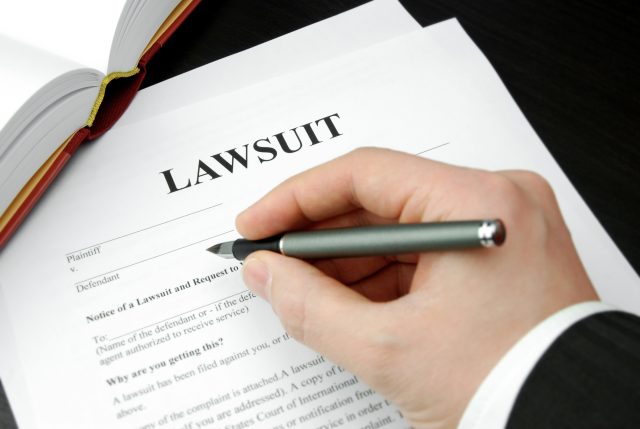
A man's hand holding a pen and filling out a lawsuit form.

(credit: Getty Images | eccolo74)

The US Chamber of Commerce and other business groups sued the Federal Trade Commission and FTC Chair Lina Khan today in an attempt to block a newly issued ban on noncompete clauses.

The lawsuit was filed in US District Court for the Eastern District of Texas. The US Chamber of Commerce was joined in the suit by Business Roundtable, the Texas Association of Business, and the Longview Chamber of Commerce. The suit seeks a court order that would vacate the rule in its entirety.

The lawsuit claimed that noncompete clauses "benefit employers and workers alike—the employer protects its workforce investments and sensitive information, and the worker benefits from increased training, access to more information, and an opportunity to bargain for higher pay."

Read 11 remaining paragraphs | Comments

24 Apr 19:47

The Supreme Court’s likely to make it more dangerous to be pregnant in a red state

by Ian Millhiser
James.galbraith

Don't trust conservatives to stick to statutory text if it conflicts with their preferred ideological outcome.

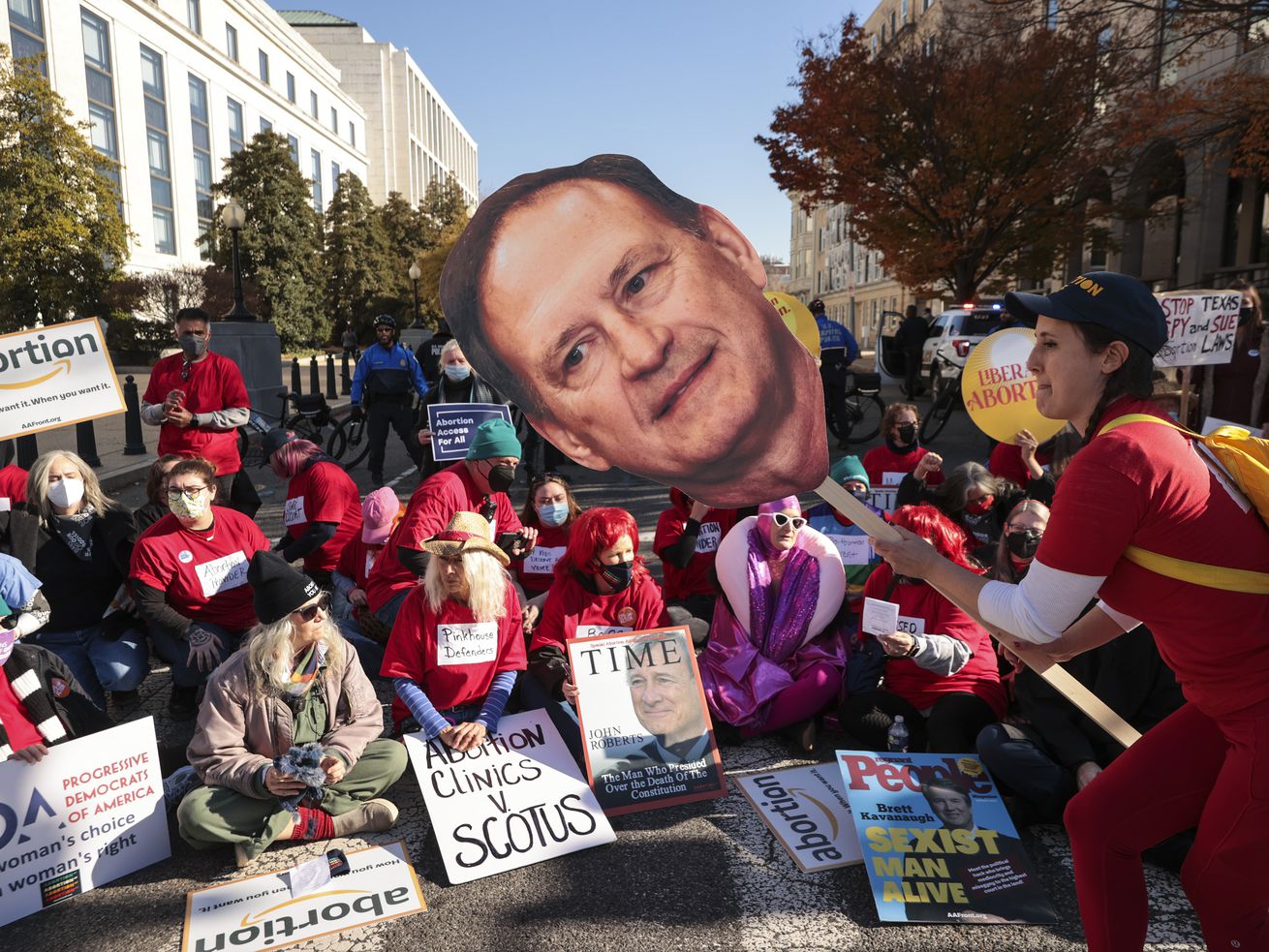
An activist with the Center for Popular Democracy Action holds a large photo of US Supreme Court Justice Samuel Alito’s head as the group blocks an intersection during a demonstration in front of the US Supreme Court on December 1, 2021, in Washington, DC.  | Chip Somodevilla/Getty Images

But it’s not yet clear they’ve settled on a rationale for doing so.

A federal law requires most US hospitals to provide an abortion to patients experiencing a medical emergency if an abortion is the proper medical treatment for that emergency. This law is unambiguous, and it applies even in red states with strict abortion bans that prohibit the procedure even when necessary to save a patient’s life or protect their health.

Nevertheless, the Supreme Court spent Wednesday morning discussing whether to write a new exception into this federal law, which would permit states to ban abortions even when a patient will die if they do not receive one.

Broadly speaking, the Court seemed to divide into three camps during Wednesday’s argument in Moyle v. United States. The Court’s three Democrats, Justices Sonia Sotomayor, Elena Kagan, and Ketanji Brown Jackson, all argued — quite forcefully at times — that the Emergency Medical Treatment and Labor Act (EMTALA) means what it says and thus nearly all hospitals must provide emergency abortions.

Meanwhile, the Court’s right flank — Justices Clarence Thomas, Samuel Alito, and Neil Gorsuch — left no doubt that they will do whatever it takes to permit states to ban medically necessary abortions.

That left three of the Court’s Republicans, Chief Justice John Roberts and Justices Brett Kavanaugh and Amy Coney Barrett, in the middle. Kavanaugh and Barrett both asked questions that very much suggest they want states to be able to ban medically necessary abortions. But they also appeared to recognize, at times, that the arguments supporting such an outcome are far from airtight.

Realistically, it is highly unlikely that EMTALA will survive the Court’s Moyle decision intact. The Court already voted last January to temporarily allow the state of Idaho to enforce its strict abortion ban, despite EMTALA, while this case was pending before the justices. And Kavanaugh and Barrett have both taken extraordinary liberties with the law in the past when necessary to achieve an anti-abortion outcome.

Still, federal law is crystal clear that states cannot outright ban medically necessary abortions. So there is a chance that two of the Court’s Republicans will reluctantly conclude that they are bound by the law’s clear text.

Moyle should be an exceptionally easy case

EMTALA requires hospital emergency rooms that accept Medicare funding to provide “such treatment as may be required to stabilize the medical condition” of “any individual” who arrives at the hospital’s ER with an “emergency medical condition.” Though the law does not specifically mention abortion, it is written in capacious terms. So, if a patient has an “emergency medical condition” and the proper treatment to stabilize that condition is an abortion, the hospital must provide an abortion.

Though the law only applies to Medicare-funded hospitals, that’s nearly all hospitals because Medicare provides health coverage to Americans over the age of 65.

EMTALA conflicts with an Idaho law that bans abortions in nearly all circumstances. While Idaho permits an abortion when “necessary to prevent the death of the pregnant woman,” it does not permit such an abortion if the patient faces a catastrophic health consequence other than death, such as the loss of her uterus.

EMTALA requires emergency rooms to stabilize any patient who is at risk of “serious impairment to bodily functions,” “serious dysfunction of any bodily organ or part,” or other nonfatal consequences that are defined as medical emergencies by EMTALA. So the federal law applies in many cases where the patient is not at risk of death.

Additionally, EMTALA includes a provision saying that state and local laws must give way to the federal requirement to stabilize patients “to the extent that the [state law] directly conflicts with a requirement of this section.”

So, if the Supreme Court were concerned solely with the text of EMTALA, they would hand down a unanimous decision holding that Idaho’s law is preempted by EMTALA, at least to the extent that Idaho prohibits medically necessary abortions. EMTALA does not purport to override most restrictions on abortion, but its explicit text requires hospitals to perform an abortion when necessary to stabilize a patient’s emergency medical condition.

So how did the Republican justices propose getting around EMTALA’s clear text?

Members of the Court’s Republican majority proposed three possible ways they could try to justify a decision permitting Idaho to ban many medically necessary abortions.

The weakest of these three arguments was proposed by Justice Samuel Alito, author of the Court’s 2022 decision eliminating the constitutional right to an abortion. Alito pointed to a provision of EMTALA that requires hospitals to also offer stabilizing care to a pregnant patient’s “unborn child” if a medical emergency threatens the fetus’s life, though Alito did not really make a legal argument. He just expressed indignation at the very idea that a statute that uses the words “unborn child” could possibly require abortions in any circumstances.

“Isn’t that an odd phrase to put in a statute that imposes a mandate to perform abortions?” Alito asked US Solicitor General Elizabeth Prelogar.

As Prelogar told Alito, EMTALA reconciles the dual obligations it imposes on hospitals to treat both a pregnant patient and the patient’s fetus by only requiring the hospital to “offer” stabilizing care for both patients — so, in the tragic case where only the mother or the fetus could be saved, the hospital must offer both treatments and honor the mother’s choice.

A second argument for limiting EMTALA, which was at times floated by Thomas, Alito, Gorsuch, and Barrett, is that reading the statute according to its actual text would raise a constitutional problem.

EMTALA imposes an obligation on hospitals that accept Medicare funds, and the Supreme Court has long held that Congress may impose requirements on parties that voluntarily accept federal funding. The constitutional argument is that Congress could not use federal funding provided to a private hospital to neutralize a state ban on abortion because the state of Idaho must also consent to having its law altered in this way.

There is some case law that provides theoretical support for this argument, but the bulk of the Court’s case law already establishes that a federal grant program that provides money to private parties may displace state law. Thus, for example, in Coventry Health Care v. Nevils (2017), the Court held that the federal government’s decision to offer its own employees health plans that violate Missouri law preempts that state law. And in Bennett v. Arkansas (1988), the Court held that federal Social Security law overrides an Arkansas law that allowed the state to seize an incarcerated person’s Social Security benefits.

The Court could conceivably repudiate precedents like Coventry and Bennett, but that would have unpredictable consequences for all sorts of federal programs. Federal spending programs like Medicare, Social Security, and Medicaid are riddled with provisions that might conflict with one state law or another. And if the Supreme Court declares that these state law provisions overcome federal Medicare, Social Security, or Medicaid law, that is likely to disrupt those and other programs in erratic ways.

That leaves one other way to achieve an anti-abortion outcome in the Moyle case, whose biggest proponent was Kavanaugh.

Kavanaugh noted that Idaho has weakened its abortion ban since this litigation began and that it’s done so in ways that theoretically make it easier for doctors to claim that they needed to perform an abortion to protect a patient’s life. In light of these changes, he suggested that maybe “there shouldn’t be an injunction” against Idaho because it’s not clear that the state’s law still conflicts with EMTALA.

But this argument is hard to square with the facts on the ground in Idaho. As Justice Kagan pointed out close to the end of the argument, hospitals in Idaho are still so uncertain when they can perform an abortion that many of them are flying patients to other states. She noted that just one Idaho hospital had to do so six times so that those patients could receive an emergency abortion in a location where everyone could be sure it was legal.

Idaho’s lawyer, moreover, struggled so hard to explain when Idaho’s law permits a doctor to perform a medically necessary abortion that Barrett accused him of “hedging.” Kavanaugh’s argument, in other words, would require the justices to ignore what’s happening in Idaho and to pretend that Idaho is somehow complying with EMTALA, despite the fact that Idaho’s own lawyer could not explain how its abortion ban works.

So the ultimate question looming over the Moyle case is whether two of the Court’s Republican appointees will be so troubled by the weakness of the anti-abortion arguments in this case, and so embarrassed by the fact that there’s really only one plausible way to read EMTALA, that they will begrudgingly apply the law as written.

That’s not the most likely outcome in this case. But, at the very least, the Court’s Republican majority does not appear to have settled on a way to explain a decision creating an abortion exception to the EMTALA statute.

24 Apr 18:45

'The Man Who Killed Google Search'

by msmash
James.galbraith

Glad to see this surfacing

Edward Zitron, citing emails released as part of the Department of Justice's antitrust case against Google, writes about Prabhakar Raghavan: And Raghavan -- a manager, hired by Sundar Pichai, a former McKinsey man and a manager by trade -- is an example of everything wrong with the tech industry. Despite his history as a true computer scientist with actual academic credentials, Raghavan chose to bulldoze actual workers and replace them with toadies that would make Google more profitable and less useful to the world at large. Since Prabhakar took the reins in 2020, Google Search has dramatically declined, with the numerous "core" search updates allegedly made to improve the quality of results having an adverse effect, increasing the prevalence of spammy, search engine optimized content. It's because the people running the tech industry are no longer those that built it. Larry Page and Sergey Brin left Google in December 2019 (the same year as the Code Yellow fiasco), and while they remain as controlling shareholders, they clearly don't give a shit about what "Google" means anymore. Prabhakar Raghavan is a manager, and his career, from what I can tell, is mostly made up of "did some stuff at IBM, failed to make Yahoo anything of note, and fucked up Google so badly that every news outlet has run a story about how bad it is." This is the result of taking technology out of the hands of real builders and handing it to managers at a time when "management" is synonymous with "staying as far away from actual work as possible." And when you're a do-nothing looking to profit as much as possible, you only care about growth. You're not a user, you're a parasite, and it's these parasites that have dominated and are draining the tech industry of its value. Raghavan's story is unique, insofar as the damage he's managed to inflict (or, if we're being exceptionally charitable, failed to avoid in the case of Yahoo) on two industry-defining companies, and the fact that he did it without being a CEO or founder. Perhaps more remarkable, he's achieved this while maintaining a certain degree of anonymity. Everyone knows who Musk and Zuckerberg are, but Raghavan's known only in his corner of the Internet. Or at least he was. Now Raghavan has told those working on search that their "new operating reality" is one with less resources and less time to deliver things. Rot Master Raghavan is here to squeeze as much as he can from the corpse of a product he beat to death with his bare hands. Raghavan is a hall-of-fame rot economist, and one of the many managerial types that have caused immeasurable damage to the Internet in the name of growth and "shareholder value." And I believe these uber-managers - these ultra-pencil-pushers and growth-hounds - are the forces destroying tech's ability to innovate.

Read more of this story at Slashdot.

24 Apr 15:48

Biden Signs TikTok 'Divest or Ban' Bill Into Law

by msmash
James.galbraith

That was fast

President Joe Biden signed a foreign aid package that includes a bill that would ban TikTok if China-based parent company ByteDance fails to divest the app within a year. The Verge: The divest-or-ban bill is now law, starting the clock for ByteDance to make its move. The company has an initial nine months to sort out a deal, though the president could extend that another three months if he sees progress. While just recently the legislation seemed like it would stall out in the Senate after being passed as a standalone bill in the House, political maneuvering helped usher it through to Biden's desk. The House packaged the TikTok bill -- which upped the timeline for divestment from the six months allowed in the earlier version -- with foreign aid to US allies, which effectively forced the Senate to consider the measures together. The longer divestment period also seemed to get some lawmakers who were on the fence on board.

Read more of this story at Slashdot.

24 Apr 15:38

Trump’s team keeps promising to increase inflation

by Eric Levitz
James.galbraith

Depending on an idiot base

Trump speaks at an event in Pennsylvania on April 13. | Andrew Harnik/Getty Images

Voters trust Trump to lower prices, even as his advisers put forward plans for increasing Americans’ cost of living.

Donald Trump is currently leading the 2024 presidential race, in no small part because voters trust him to combat inflation. This is a bit strange since Trump has for months now been advertising plans to drastically increase consumer prices.

Over the weekend, an NBC News poll found Trump leading Biden nationally by a 46 to 44 percent margin. Yet on the question of which candidate would better handle inflation and the cost of living, the Republican led the Democrat by a whopping 22 points.

Trump’s landslide lead on price management is significant, since inflation was the poll’s single most commonly cited “critical issue” facing the United States.

Unfortunately, Trump does not actually have a bulletproof plan for making Big Macs cheap again. To the contrary, the Republican and his advisers have developed an economic agenda that amounts to a recipe for turbocharging inflation.

The claim that Trump’s policies would increase prices does not rest on a debatable interpretation of their indirect effects. Rather, some of the president’s proposals would directly increase American consumers’ costs by design. Here is a quick primer on the likely GOP nominee’s four-point plan for making your life less affordable:

Step 1: Reduce the value of the U.S. dollar

In the years since the Covid crisis, inflation has plagued consumers all across the wealthy world. Americans, though, have one advantage over their peers abroad: Their nation’s currency is relatively strong.

The US economy is growing at nearly twice the pace of other major rich countries without suffering substantially higher inflation. Nevertheless, the Federal Reserve has kept America’s interest rates elevated. Taken together, these two realities increase demand for the dollar: Foreign investors want to place their capital in countries that are growing fast and/or that are offering high, low-risk returns on their sovereign debt. America is currently doing both. Thus, many investors abroad are swapping their local currencies for greenbacks, thereby bidding up the dollar’s value.

As a result, Americans’ paychecks are going a bit farther, as a strong dollar makes imported goods cheaper for them.

But Trump’s advisers want to change this. According to Politico, the former president’s policy aides are “ actively debating ways to devalue the U.S. dollar if he’s elected to a second term.”

Their rationale is not hard to understand. Although a strong dollar is good for US consumers, it’s not great for US exporters, as it renders their goods more expensive to potential customers abroad. And since Trump and his former trade representative, Robert Lighthizer, have long sought to boost American manufacturing and shrink the trade deficit, they’re prepared to privilege the interests of the nation’s producers over those of its consumers.

Lighthizer reportedly hopes to coerce other nations into strengthening the value of their currencies by threatening to impose tariffs on their exports if they don’t comply. Trump’s advisers are also mulling ways to weaken the dollar without foreign cooperation, according to Politico.

Reasonable people can disagree about whether the US dollar is currently too strong. Plenty of analysts on both the right and left believe that America has a national interest in sustaining and growing its domestic production capacities. And all else being equal, a strong dollar does hurt American manufacturing. On the other hand, only about 8.6 percent of US workers are employed in the manufacturing sector, which suggests that a large majority of Americans have a stronger immediate interest in affordable imports than competitive exports.

Further, there’s reason to believe that the Trump team’s plans would backfire, as many foreign governments would retaliate against tariffs and dollar devaluation by imposing duties on US-made goods and seeking to weaken their own currencies.

Yet even if one supports Lighthizer’s priorities and proposals, an inescapable fact remains: A plan to devalue the dollar is — quite literally — a plan to make products more expensive for American consumers.

And this isn’t the Trump team’s only proposal for directly increasing your household’s costs.

Step 2: Apply a 10 percent tariff on all foreign imports

To further boost American manufacturing, Trump and his aides are considering the imposition of a 10 percent tariff on all foreign imports. In practice, this would almost certainly mean that US consumers would pay roughly 10 percent more on all the foreign-made cars, electronics, toys, and other goods that they purchase.

In theory, it is possible for the burdens of a tariff to fall entirely on foreign producers rather than domestic consumers. If a tariff applies only to raw commodities (such as soybeans or wheat) produced in a single country, then exporters in that country might slash their prices in response. This is because lots of countries export raw commodities, so a targeted producer would likely lose market share in the US unless they offset the impact of the tariff with a price cut. In that scenario, American consumers wouldn’t pay much higher prices for imports, but the targeted foreign producer would be forced to accept smaller profit margins.

This is not how a universal tariff would work. Americans import a lot more than raw commodities. And the country cannot currently produce all the goods and production inputs that the economy requires, let alone produce them as cheaply as foreign firms do. Producers of specialty products such as advanced semiconductors will know that American consumers have nowhere else to turn. They therefore will feel little pressure to cut their prices. According to multiple studies, when Trump imposed tariffs on specialty Chinese goods such as silk embroidery, US consumers paid roughly 100 percent of the costs.

Meanwhile, sheltered from foreign competition by tariffs, US manufacturers would be able to raise their prices considerably without risking a loss of customers. The result of all this would be a dramatic increase in consumer prices.

This said, precisely because Trump’s universal tariff would function as a 10 percent sales tax on all foreign goods, it would somewhat reduce consumer demand. Make products less affordable for Americans and they will be forced to buy fewer of them. As consumers reduce their purchases, inflation could theoretically slow.

But don’t worry, Trump’s comprehensive (if unintentional) plan for juicing inflation accounts for this possibility.

Step 3: Enact massive, deficit-financed tax cuts

The Republican Party’s number one fiscal priority in 2025 will be extending the Trump tax cuts. Many provisions of the former president’s 2017 tax package are set to expire at the end of next year. Merely preserving those policies will increase the federal deficit by $3.3 trillion over the next decade, according to the Committee for a Responsible Federal Budget (CRFB).

But Trump is not satisfied with merely maintaining America’s current tax rates. Rather, his team hopes to further reduce the corporate rate from 21 percent to as low as 15 percent. That would further swell the deficit by $522 billion, under conventional assumptions, according to the Tax Foundation, a conservative think tank.

The president also hopes to enact a large middle-class tax cut, according to a recent report from Reuters. Specifically, Trump and his advisers are considering a cut to the federal payroll tax and/or a reduction in marginal income tax rates for middle-class households. Since the scale of these cuts has not been specified, it is impossible to say how much they would cost in fiscal terms. Since America’s middle class is large, any substantial reduction in its tax burden would be very expensive in fiscal terms.

At first brush, a middle-class tax cut might seem like it would make life more affordable for Americans, at least in the short term. This would be true if such a policy came with no risk of triggering a resurgence of inflation, but unfortunately, it would entail precisely that hazard.

If you increase Americans’ post-tax incomes by hundreds of billions of dollars, they will suddenly be able to dramatically boost their purchases of goods and services. If the economy’s capacity to produce goods and services does not increase at the same pace, then demand will outrun supply and consumers will bid up prices.

Theoretically, Republicans could enact non-inflationary, multitrillion-dollar tax cuts without sparking inflation, but this would require offsetting the fiscal impacts of tax cuts with spending reductions.

The combination of extending the 2017 tax cuts and slashing the corporate rate to 15 percent would cost nearly $4 trillion in foregone revenue. Tacking on a large middle-class tax cut could easily bring that sum total north of $6 trillion. During both the Trump and George W. Bush presidencies, congressional Republicans ultimately didn’t have the stomach to enact spending cuts anywhere near that large.

Critically, offsetting the inflationary impact of tax cuts in 2025 and 2026 would require slashing spending immediately, not years down the line. Republicans have no appetite for cutting Medicare and Social Security benefits for existing beneficiaries. And coming up with $6 trillion in spending reductions without tackling entitlements would require gutting all manner of popular social programs.

The path of least resistance would therefore be to deficit-finance the bulk of Trump’s tax cuts. This would likely lead to faster price growth and more interest rate hikes from the Federal Reserve.

Granted, if Republicans somehow found a way to rapidly increase the US economy’s productive capacity, then their tax cuts would be less inflationary and the typical American might come out ahead (at least, until the consequences of gutting future funding for Medicare and Social Security caught up with them).

But Trump’s team plans to do the opposite. The final plank in their pro-inflation agenda involves abruptly shrinking the supply side of the US economy.

Step 4: Shrink the American labor force

As the New York Times reported in November, Trump and former White House adviser Stephen Miller have hatched plans to deport millions of undocumented immigrants during his second term in office, even without Congress’s cooperation.

Currently, due process rights constrain the government’s ability to deport undocumented immigrants en masse. But Miller and Trump believe they can scale back those rights under existing executive authorities. They intend to make all undocumented immigrants who’ve been in the country for less than two years subject to expedited removal. In other words, the government would be empowered to remove such immigrants without first giving them an opportunity to challenge their deportations at a legal hearing.

Current law makes it more difficult to summarily expel longtime US residents, but Trump’s team thinks it can force millions of them out of the country anyway. First, they would scale up raids of workplaces and other areas where undocumented immigrants are believed to be present. Then, they would condemn the captured immigrants to indefinite detention in federal camps. These detainees would still have the right to contest their deportations in court but they would need to wait out that often years-long legal process in confinement. Miller reportedly bets that most will choose to leave the country instead of tolerating de facto incarceration.

In my estimation, there are strong moral reasons to oppose these policies. But even Americans who have no empathy for their undocumented compatriots have economic incentives to oppose mass deportation.

As scholars at the Brookings Institution noted last fall, the upsurge in immigration since the pandemic is one major reason why the US managed to bring inflation down without suffering a recession: Foreign-born workers increased the economy’s productive capacity, helping supply to catch up with rising consumer demand.

Conversely, if America abruptly deported all undocumented workers, labor shortages would devastate myriad industries, from housing to agriculture to the care economy, and prices would soar.

Some Americans might consider such labor shortages beneficial. After all, when labor is scarce, workers can demand higher wages. But there are more undocumented workers in the United States than unemployed ones. Purging America of the former would not leave the US with the same economy with higher wages for the native-born. Rather, it would leave the country with a smaller economy, where millions of existing jobs simply would not get done. When you slash the agricultural labor force, food gets scarce and thus expensive. The same principle holds for construction, hospitality, leisure, or health care.

Put all of this together and you have a recipe for making the inflation rate 9 percent again: Slash the dollar’s value, insulate US producers from competition, juice demand with tax cuts, and then throttle supply with mass deportation, and prices are bound to soar.

Unfortunately, Trump’s proposals and their economic consequences appear to be largely lost on the American electorate, possibly because neither have attracted much media attention. If that does not change between now and November, the country could pay a heavy price.

24 Apr 15:34

Pendulum Types

The creepy fingers that grow from a vibrating cornstarch-water mix can be modeled as a chain of inverted vertical pendulums (DOI:10.1039/c4sm00265b) and are believed to be the fingers of Maxwell's Demon trying to push through into our universe.
24 Apr 13:42

Generative AI Arrives In the Gene Editing World of CRISPR

by BeauHD
James.galbraith

Well this won't end badly...

An anonymous reader quotes a report from the New York Times: Generative A.I. technologies can write poetry and computer programs or create images of teddy bears and videos of cartoon characters that look like something from a Hollywood movie. Now, new A.I. technology is generating blueprints for microscopic biological mechanisms that can edit your DNA, pointing to a future when scientists can battle illness and diseases with even greater precision and speed than they can today. Described in a research paper published on Monday by a Berkeley, Calif., startup called Profluent, the technology is based on the same methods that drive ChatGPT, the online chatbot that launched the A.I. boom after its release in 2022. The company is expected to present the paper next month at the annual meeting of the American Society of Gene and Cell Therapy. "Its OpenCRISPR-1 protein is built on a similar structure as the fabled CRISPR-Cas9 DNA snipper, but with hundreds of mutations that help reduce its off-target effects by 95%," reports Fierce Biotech, citing the company's preprint manuscript published on BioRxiv. "Profluent said it can be employed as a 'drop-in replacement' in any experiment calling for a Cas9-like molecule." While Profluent will keep its LLM generators private, the startup says it will open-source the products of this initiative. "Attempting to edit human DNA with an AI-designed biological system was a scientific moonshot," Profluent co-founder and CEO Ali Madani, Ph.D., said in a statement. "Our success points to a future where AI precisely designs what is needed to create a range of bespoke cures for disease. To spur innovation and democratization in gene editing, with the goal of pulling this future forward, we are open-sourcing the products of this initiative."

Read more of this story at Slashdot.

23 Apr 23:26

Montana Democrats call on Sheehy to release hospital report he says he lied about

by David Nir
James.galbraith

A Republican lying for personal gain? Perish the thought.

The strange story of Republican Tim Sheehy’s bullet wound just keeps getting stranger.

Sheehy, a former Navy SEAL who is seeking to unseat Democratic Sen. Jon Tester in Montana, recently claimed to the Washington Post that he lied to a park ranger when he said he accidentally shot himself in the arm at a national park in 2015.

Instead, Sheehy says, he was shot in Afghanistan three years earlier in a possible episode of friendly fire but never reported the injury. He lied to the ranger, he says, because he feared that telling the truth would somehow spark a military investigation into the original incident overseas.

Of course, these new claims don’t add up either, as this new video from Montana Democrats helpfully illustrates:

As the video shows, reporters and commentators have a lot of questions:

This is a very weird one.

How much do we really know about this guy?

In a new Washington Post report, Montana Republican Senate candidate Tim Sheehy claims he lied to a park ranger about how he received a bullet wound.

Senate Republican candidate Tim Sheehy coming under scrutiny.

He once said that the bullet was from his time in Afghanistan, when he was serving in the U.S. military. Other times, he says he accidentally shot himself during a visit to Glacier National Park in Montana.

Each little detail of the story, to my eye, just raises more questions. A lot of pieces of it don't make sense.

He said that he had lied to a park ranger about a gun going off. I didn't really understand the whole explanation.

Certainly, trained medical professionals would be able to tell the difference. That only raises the question of why Sheehy doesn't just release that report and be done with this thing.

Fortunately, Montana Democrats have a great idea that could help answer all of these questions: Sheehy could just release his medical records from his 2015 hospital visit!

Sheehy in fact claimed to the Post that he’d already sought those records, but when asked about them again in a follow-up piece last week, “the campaign declined to comment and directed The Post to Sheehy’s lawyer.” Needless to say, Sheehy’s attorney wasn’t any more forthcoming.

So it seems fair to ask: Was Sheehy also lying when he said he’d requested his hospital records? Or did he receive them but won’t share them? Once again, he could clear all of this up very easily. The fact that he won’t speaks volumes.

23 Apr 21:57

Cops can force suspect to unlock phone with thumbprint, US court rules

by Jon Brodkin
James.galbraith

You mean it's a bad idea to base rulings about modern technology on centuries-old concepts? No shit.

A man holding up his thumb for a thumbprint scan

Enlarge

The US Constitution's Fifth Amendment protection against self-incrimination does not prohibit police officers from forcing a suspect to unlock a phone with a thumbprint scan, a federal appeals court ruled yesterday. The ruling does not apply to all cases in which biometrics are used to unlock an electronic device but is a significant decision in an unsettled area of the law.

The US Court of Appeals for the 9th Circuit had to grapple with the question of "whether the compelled use of Payne's thumb to unlock his phone was testimonial," the ruling in United States v. Jeremy Travis Payne said. "To date, neither the Supreme Court nor any of our sister circuits have addressed whether the compelled use of a biometric to unlock an electronic device is testimonial."

A three-judge panel at the 9th Circuit ruled unanimously against Payne, affirming a US District Court's denial of Payne's motion to suppress evidence. Payne was a California parolee who was arrested by California Highway Patrol (CHP) after a 2021 traffic stop and charged with possession with intent to distribute fentanyl, fluorofentanyl, and cocaine.

Read 14 remaining paragraphs | Comments

23 Apr 21:56

Hospital prices for the same emergency care vary up to 16X, study finds

by Beth Mole
James.galbraith

A deeply broken market

Miami Beach, Fire Rescue ambulance at Mt. Sinai Medical Center hospital. ]

Enlarge / Miami Beach, Fire Rescue ambulance at Mt. Sinai Medical Center hospital. ] (credit: Getty | Jeffrey Greenberg/)

Since 2021, federal law has required hospitals to publicly post their prices, allowing Americans to easily anticipate costs and shop around for affordable care—as they would for any other marketed service or product. But hospitals have mostly failed miserably at complying with the law.

A 2023 KFF analysis on compliance found that the pricing information hospitals provided is "messy, inconsistent, and confusing, making it challenging, if not impossible, for patients or researchers to use them for their intended purpose." A February 2024 report from the nonprofit organization Patient Rights Advocate found that only 35 percent of 2,000 US hospitals surveyed were in full compliance with the 2021 rule.

But even if hospitals dramatically improved their price transparency, it likely wouldn't help when patients need emergency trauma care. After an unexpected, major injury, people are sent to the closest hospital and aren't likely to be shopping around for the best price from the back of an ambulance. If they did, though, they might also need to be treated for shock.

Read 8 remaining paragraphs | Comments

23 Apr 21:56

Everything We Know about May/June Sticker Packs

James.galbraith

he's not wrong lol

I saw a Cybertruck in real life for the first time a few days ago. That is the ugliest vehicle I’ve ever seen and I can remember when people were buying the PT Cruiser. I can’t imagine a normal, human person seeing that monstrosity and thinking “That’s the truck for me!” What I’m saying is, Cybertruck owners don’t deserve rights. 


23 Apr 21:55

California Is Grappling With a Growing Problem: Too Much Solar

by BeauHD
James.galbraith

and the solution is batteries :P

An anonymous reader quotes a report from the Washington Post: In sunny California, solar panels are everywhere. They sit in dry, desert landscapes in the Central Valley and are scattered over rooftops in Los Angeles's urban center. By last count, the state had nearly 47 gigawatts of solar power installed -- enough to power 13.9 million homes and provide over a quarter of the Golden State's electricity. But now, the state and its grid operator are grappling with a strange reality: There is so much solar on the grid that, on sunny spring days when there's not as much demand, electricity prices go negative. Gigawatts of solar are "curtailed" -- essentially, thrown away. In response, California has cut back incentives for rooftop solar and slowed the pace of installing panels. But the diminishing economic returns may slow the development of solar in a state that has tried to move to renewable energy. And as other states build more and more solar plants of their own, they may soon face the same problems. Curtailing solar isn't technically difficult -- according to Paul Denholm, senior research fellow at the National Renewable Energy Laboratory, it's equivalent to flipping a switch for grid operators. But throwing away free power raises electricity prices. It has also undercut the benefits of installing rooftop solar. Since the 1990s, California has been paying owners of rooftop solar panels when they export their energy to the grid. That meant that rooftop solar owners got $0.20 to $0.30 for each kilowatt-hour of electricity that they dispatched. But a year ago, the state changed this system, known as "net-metering," and now only compensates new solar panel owners for how much their power is worth to the grid. In the spring, when the duck curve is deepest, that number can dip close to zero. Customers can get more money back if they install batteries and provide power to the grid in the early evening or morning. The change has sparked a huge backlash from Californians and rooftop solar companies, which say that their businesses are flagging. Indeed, Wood Mackenzie predicts that California residential solar installations in 2024 will fall by around 40 percent. Some state politicians are now trying to reverse the rule. "Under the CPUC's leadership California is responsible for the largest loss of solar jobs in our nation's history," Bernadette del Chiaro, the executive director of the California Solar and Storage Association, said in a statement referring to California's public utility commission. But experts say that it reflects how the economics of solar are changing in a state that has gone all-in on the technology. [...] To cope, [California's grid operator, known as CAISO] is selling some excess power to nearby states; California is also planning to install additional storage and batteries to hold solar power until later in the afternoon. Transmission lines that can carry electricity to nearby regions will also help -- some of the lost power comes from regions where there simply aren't enough power lines to carry a sudden burst of solar. Denholm says the state is starting to take the steps needed to deal with the glut. "There are fundamental limits to how much solar we can put on the grid before you start needing a lot of storage," Denholm said. "You can't just sit around and do nothing." Further reading: The Energy Institute discusses this problem in a recent blog post. Since 2020, the residential electricity rates in California have risen by as much as 40% after adjusting for inflation. While there's been "a lot of finger-pointing about the cause of these increases," the authors note that the impact on rates is multiplied when customers install their own generation and buy fewer kilowatts-hours from the grid because those households "contribute less towards all the fixed costs in the system." These fixed costs include: vegetation management, grid hardening, distribution line undergrounding, EV charging stations, subsidies for low income customers, energy efficiency programs, and the poles and wires that we all rely on whether we are taking electricity off the grid or putting it onto the grid from our rooftop PV systems. "Since those fixed costs still need to be paid, rates go up, shifting costs onto the kWhs still being bought from the grid."

Read more of this story at Slashdot.

23 Apr 21:53

Voyager 1 Resumes Sending Updates To Earth

by BeauHD
quonset writes: Just over two weeks ago, NASA figured out why its Voyager 1 spacecraft stopped sending useful data. They suspected corrupted memory in its flight data system (FDS) was the culprit. Today, for the first time since November, Voyager 1 is sending useful data about its health and the status of its onboard systems back to NASA. How did NASA accomplish this feat of long distance repair? They broke up the code into smaller pieces and redistributed them throughout the memory. From NASA: "... So they devised a plan to divide the affected code into sections and store those sections in different places in the FDS. To make this plan work, they also needed to adjust those code sections to ensure, for example, that they all still function as a whole. Any references to the location of that code in other parts of the FDS memory needed to be updated as well. The team started by singling out the code responsible for packaging the spacecraft's engineering data. They sent it to its new location in the FDS memory on April 18. A radio signal takes about 22 1/2 hours to reach Voyager 1, which is over 15 billion miles (24 billion kilometers) from Earth, and another 22 1/2 hours for a signal to come back to Earth. When the mission flight team heard back from the spacecraft on April 20, they saw that the modification worked: For the first time in five months, they have been able to check the health and status of the spacecraft. During the coming weeks, the team will relocate and adjust the other affected portions of the FDS software. These include the portions that will start returning science data.

Read more of this story at Slashdot.

23 Apr 21:52

Ex-Amazon Exec Claims She Was Asked To Ignore Copyright Law in Race To AI

by msmash
James.galbraith

If only there were consequences

A lawsuit is alleging Amazon was so desperate to keep up with the competition in generative AI it was willing to breach its own copyright rules. From a report: The allegation emerges from a complaint accusing the tech and retail mega-corp of demoting, and then dismissing, a former high-flying AI scientist after it discovered she was pregnant. The lawsuit was filed last week in a Los Angeles state court by Dr Viviane Ghaderi, an AI researcher who says she worked successfully in Amazon's Alexa and LLM teams, and achieved a string of promotions, but claims she was later suddenly demoted and fired following her return to work after giving birth. She is alleging discrimination, retaliation, harassment and wrongful termination, among other claims.

Read more of this story at Slashdot.

23 Apr 19:08

North Korea is evading sanctions by animating Max and Amazon shows

by WIRED
North Korea is evading sanctions by animating Max and Amazon shows

Enlarge (credit: Aurich Lawson / Getty)

For almost a decade, Nick Roy has been scanning North Korea’s tiny Internet presence, spotting new websites coming online and providing a glimpse of the Hermit Kingdoms’ digital life. However, at the end of last year, the cybersecurity researcher and DPRK blogger stumbled across something new: signs North Koreans are working on major international TV shows.

In December, Roy discovered a misconfigured cloud server on a North Korean IP address containing thousands of animation files. Included in the cache were animation cells, videos, and notes discussing the work, plus changes that needed to be made to ongoing projects. Some images appeared to be from an Amazon Prime Video superhero show and an upcoming Max (aka HBO Max) children’s anime.

Read 15 remaining paragraphs | Comments

22 Apr 18:14

The official Deadpool and Wolverine trailer is finally here, and yes, it’s awesome

by Jennifer Ouellette
James.galbraith

Yes, yes it is

Ryan Reynolds and Hugh Jackman join forces in Deadpool and Wolverine.

We were already looking forward to the summer release of Deadpool and Wolverine, which will bring together Ryan Reynolds' R-rated antihero with Hugh Jackman's iconic X-Man. We're even more eager to see the film after Marvel dropped the official trailer, which is chock-full of off-color witticisms, meta-references, slo-mo action, and a generous sprinkling of F-bombs. (But no cocaine! Wade promised Feige! "They know all the slang terms. They have a list.")

"You’re talking about two massive movie stars in their most iconic roles,” Director Shawn Levy (Free Guy) told Screen Rant earlier this month. “It also gave me an opportunity. It’s the third Deadpool movie, but it’s not Deadpool 3. It’s a different thing that’s very much Deadpool and Wolverine. And it’s not trying to copycat anything from the first two movies. They were awesome, but this is a two-hander character adventure.”

(Spoilers for Deadpool 2 below.)

Read 10 remaining paragraphs | Comments

19 Apr 23:30

’Four more years!’: Union members celebrate Biden’s fiery speech

by Walter Einenkel

On Friday, President Joe Biden gave a nearly 20-minute speech to the International Brotherhood of Electrical Workers Construction and Maintenance at its conference in Washington, D.C., touching on the union’s support for his campaign in 2020, his record as a pro-labor president, and the anti-labor records of Donald Trump and the Republican Party. 

"My predecessor and his MAGA allies have a very different view. He promised Infrastructure Week every week for four years and never built a damn thing," he said, adding that Trump wants to “repeal the climate law that would gut all those new jobs and industries created here in America.”

Biden spoke about his intention to let the Republican tax breaks for the rich, which “exploded” our national deficit, expire.

"My opponent learned the best way to get rich is inherit it. I can't argue much of that. But, eh?” Biden joked. ”They learned that paying taxes is for working people, not the super-wealthy. They learned that telling people ‘you're fired’ is something to be laughed about. Not where I come from. Not where I was raised."

As Biden walked off the stage, the audience chanted, "Four more years."

Look, folks, my predecessor and his MAGA allies have a very different view. He promised Infrastructure Week every week for four years and never built a damn thing. Fact.

[...]

Now they want to repeal the climate law that would gut all those new jobs and industries created here in America. My predecessor rolled back protection for American workers. He opposed increases in the federal minimum wage. And he was proud, very—proud—of his $2 trillion tax cut when he was president, that overwhelmingly benefited the wealthy and created the biggest corporations and exploded, exploded the federal debt. I cut the federal deficit. He exploded it.


By the way, this is no, there's no exaggeration here. It's going to expire. And if I'm reelected is going to stay expired.

Look, let me close with this. The two different ways of looking at our economy. Some folks learned very different lessons growing up than you and I did.

[...]

My opponent learned, the best way to get rich is inherit it. I can't argue much of that. But, eh? They learned that paying taxes is for working people, not the super-wealthy. They learned that telling people "you're fired" is something to be laughed about. Not where I come from. Not where I was raised.

I guess that's how they look at the world from Park Avenue, Mar-A-Lago. But I grew up in Scranton, Pennsylvania and Claremont, Delaware—working-class and middle-class towns. But many of you did as well. Nobody handed you anything. You paid your taxes, and being told you were fired wasn't entertainment. It was a devastating nightmare to a family.

Folks, where we come from, it matters. That's why when I look at the economy, I don't see through the eyes of Mar-A-Lago. I literally see through the eyes of Scranton and where I grew up in my Grandpop's kitchen table. I see through the eyes of working people like you. And the basic values said you represent honesty, decency, hard work, faith. It matters. Fairness matters.

And you believe like I do. Everyone in America deserves just an even shot. No guarantee, just a shot. But guaranteed to have a shot. In America we leave nobody behind. Where we come from, folks, that's the America you all are building. That's the America you're recreating. Let me ask you, are you going to keep doing it?

I know we can do this because of you, the American worker. I've never been more optimistic about our future than I am today. Folks, you just have to remember who the hell we are. We're the United States of America, and there's nothing beyond our capacity. Nothing, nothing. Nothing. God bless you all. Thank you. Thank you. On behalf of America. Thank you.

You've really done it. Thank you, thank you, thank you.

Zachary Mueller is the senior research director for America’s Voice and America’s Voice Education Fund. He brings his expertise on immigration politics to talk about how much money the GOP is using to promote its racist immigration campaigns.

Campaign Action

18 Apr 22:14

Elon Musk’s Grok keeps making up fake news based on X users’ jokes

by Ashley Belanger
James.galbraith

fucking amateur hour

Elon Musk’s Grok keeps making up fake news based on X users’ jokes

Enlarge (credit: SOPA Images / Contributor | LightRocket)

X's chatbot Grok is supposed to be an AI engine crunching the platform's posts to surface and summarize breaking news, but this week, Grok's flaws were once again exposed when the chatbot got confused and falsely accused an NBA star of criminal vandalism.

"Klay Thompson Accused in Bizarre Brick-Vandalism Spree," Grok's headline read in an AI-powered trending-tab post that has remained on X (formerly Twitter) for days. Beneath the headline, Grok went into even more detail to support its fake reporting:

In a bizarre turn of events, NBA star Klay Thompson has been accused of vandalizing multiple houses with bricks in Sacramento. Authorities are investigating the claims after several individuals reported their houses being damaged, with windows shattered by bricks. Klay Thompson has not yet issued a statement regarding the accusations. The incidents have left the community shaken, but no injuries were reported. The motive behind the alleged vandalism remains unclear.

Grok appears to be confusing a common basketball term, where players are said to be throwing "bricks" when they take an airball shot that doesn't hit the rim. According to SF Gate, which was one of the first outlets to report the Grok error, Thompson had an "all-time rough shooting" night, hitting none of his shots on what was his emotional last game with the Golden State Warriors before becoming an unrestricted free agent.

Read 23 remaining paragraphs | Comments

18 Apr 21:41

Boeing Aims To Bring Flying Cars To Asia By 2030

by msmash
James.galbraith

Hard pass kids

U.S. aircraft manufacturer Boeing plans to enter the flying car business in Asia by 2030, looking to tap demand for the fast travel the vehicles could provide in the region's traffic-choked cities. Nikkei: Boeing Chief Technology Officer Todd Citron revealed the plans in an interview with Nikkei. The company is developing electric vertical take-off and landing (eVTOL) craft at subsidiary Wisk Aero. The aircraft will adopt autonomous technology, rare among eVTOL craft. The plan is to first obtain certification in the U.S. before expanding into Asia. Details of the Asia business will be finalized in the future, including whether Boeing will sell the aircraft to companies aiming to provide eVTOL transportation services or operate the services itself. Boeing is currently considering which country in Asia to enter first, including Japan. In Japan, domestic startup SkyDrive and Germany's Volocopter are scheduled to operate air taxi services at the 2025 Osaka World Expo. Boeing opened a research and development base in Nagoya on Thursday. It first established R&D operations in Japan in 2022 but had been renting space from other companies until now.

Read more of this story at Slashdot.

18 Apr 19:35

Watch Stephen Colbert's hilarious take on GOP's latest impeachment fail

by Walter Einenkel

The Republican Party’s attempted impeachment fiasco and beleaguered House Speaker Mike Johnson were the subjects of late-night talk show host Stephen Colbert’s opening monologue Wednesday night. Colbert observed that while the House Republicans targeting Homeland Security Secretary Alejandro Mayorkas “never identified a specific high crime or misdemeanor for the impeachment, which is usually kind of a thing,” the event was still historic.

It's only the second time in America that a Cabinet member has been impeached. The first was Secretary of War William Belknap back in 1876, which Congress accused of “prostituting his high office to his lust for private gain.”

[In Trump voice singing Bette Midler song] Did you ever know that you're my hero …

Colbert then laid it on thick, claiming that his entire show would be dedicated to covering the Senate’s impeachment trial of Mayorkas, before someone off camera told him the Senate immediately voted to dismiss the articles of impeachment. 

“That was quick,” said a stunned Colbert. “So, what do you guys want to talk about?”

Colbert then pivoted to the precarious position GOP Speaker Mike Johnson finds himself in, even though “they just got rid of the last guy six months ago.”

Republican speaker of the House has joined the list of least secure jobs, just below No. 2 leader of ISIS; World's Oldest Man; and Rupert Murdoch fiancée.

Colbert: Republican Speaker of the House Mike Johnson, seen here in his profile pic on HammerYourOwnPenis.com.

After playing a clip of Johnson telling Fox Business’ Maria Bartiromo that Trump is "100% with me," Colbert threw to a clip of Trump being asked whether he will support Johnson.

Trump: Well, we'll see what happens with that.

Colbert: That is a dose of classic Trump loyalty. He's got your back ... so he can push you under a bus.

Zachary Mueller is the senior research director for America’s Voice and America’s Voice Education Fund. He brings his expertise on immigration politics to talk about how much money the GOP is using to promote its racist immigration campaigns.

18 Apr 17:21

Cartoon: Puppet show

by Mike Luckovich
17 Apr 20:14

Saturday Morning Breakfast Cereal - Nice

by Zach Weinersmith
James.galbraith

LOL seriously...


Click here to go see the bonus panel!

Hovertext:
Absolute Midden is copyright SMBC Enterprises 2024 all rights reserved.


Today's News: