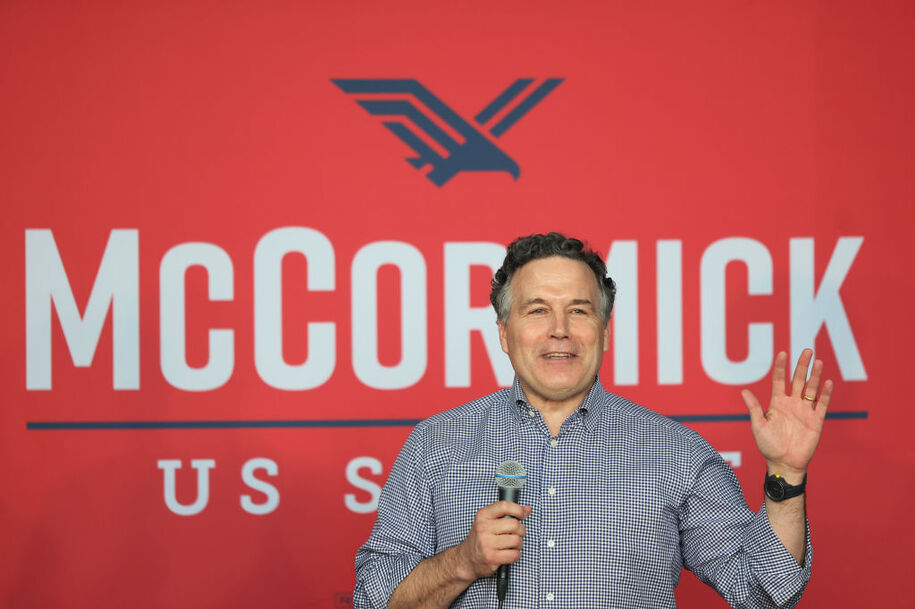
Pennsylvania GOP Senate candidate David McCormick, who has called Chinese fentanyl a “terrorist threat” and an “insidious attack on America,” made some of his millions off of investments in China’s largest fentanyl manufacturer, according to a report from The Keystone on Tuesday.
McCormick was serving as CEO of Bridgewater Associates in 2021 when it invested $1.7 million in China’s Humanwell Healthcare, the company that owns 90% of China’s market for fentanyl according to a 2022 RAND Corporation report. McCormick served in his role at Bridgewater until Jan. 2022. “In 2023, McCormick told the American Enterprise Institute that he was responsible for whatever the company did,” The Keystone reports.
Presumably, that includes investing in the largest fentanyl producer in the nation most responsible for the illegal fentanyl crisis in the U.S. That very fentanyl and the precursor chemicals for it are finding their way to Mexican gangs and across the border into the U.S. In 2021—the year McCormick’s hedge fund was profiting off the drug—opioids like fentanyl killed more than 5,400 Pennsylvanians and fentanyl seizures in the state increased by 346%.
McCormick, of course, has been campaigning against that scourge. “I think we need to treat it as a national security threat it is,” he told attendees at a Pittsburgh-area event in April, according to Keystone Newsroom. “What would I do? I would go after China in the sense I’d interdict ships, I would treat this like it’s nuclear plutonium.”
Recently, a super PAC supporting McCormick launched a $30 million ad campaign, with one ad featuring McCormick vowing to put an end to the crisis.
“Today we face a shadow growing on the Pacific horizon. … I’m proposing a new [path]. Stop the flow of fentanyl, ban purchases of American land and U.S. investment that supports the Chinese [Communist] Party,” McCormick says in that ad, according to The Keystone.
In 2022, days before uber-rich Connecticut resident McCormick launched his previous bid for Senate—he lost in that GOP primary to another uber-rich non-Pennsylvanian, Mehmet Oz—he was profiting off of the Chinese fentanyl industry. The same industry that has killed thousands of Pennsylvanians and hundreds of thousands of Americans.
You mean there's strings attached? maybe it'll help the GOP understand if it's "work requirements" on the handout money the states and ISPs are receiving.
Enlarge (credit: Getty Images | Matt Anderson Photography)
Republican lawmakers are fighting a Biden administration attempt to bring cheap broadband service to low-income people, claiming it is an illegal form of rate regulation. GOP leaders of the House Energy and Commerce Committee announced an investigation into the National Telecommunications and Information Administration (NTIA), which is administering the $42.45 billion Broadband Equity, Access, and Deployment (BEAD) program that was approved by Congress in November 2021.
"States have reported that the NTIA is directing them to set rates and conditioning approval of initial proposals on doing so. This undoubtedly constitutes rate regulation by the NTIA," states a letter to the NTIA from Committee Chair Cathy McMorris Rodgers (R-Wash.), Subcommittee on Communications and Technology Chair Bob Latta (R-Ohio), and Subcommittee on Oversight and Investigations Chair Morgan Griffith (R-Va.).
As evidence, the letter points to a statement by Virginia that described feedback received from the NTIA. The federal agency told Virginia that "the low-cost option must be established in the Initial proposal as an exact price or formula."
The idea that Donald Trump is forcing the Republican Party to moderate its extreme positions on abortion and LGBTQ rights would make for an interesting story. So interesting, in fact, that the story was all over the mainstream press. The only problem with this very interesting story is that it didn’t happen.
On Monday, a draft of the GOP platform began circulating ahead of the Republican convention. The coverage of the platform’s position on abortion was remarkable in its uniformity. The New York Times’ headline blared, “Following Trump’s Lead, Republicans Adopt Platform That Softens Stance on Abortion.” NBC News announced, “Trump Pushes New GOP Platform Softening Party’s Positions on Abortion and Same-Sex Marriage.” The Washington Post concurred: “GOP Adopts Platform That Softens Language on Abortion, Same-Sex Marriage.” These headlines could not be more misleading. (One outlet, The 19th, commendably got it right.)
First, although the new platform omits language from the 2016 version opposing marriage equality, it is silent on equal rights for same-sex couples, and certainly does not endorse them. That omission is meaningful, and should not be interpreted as moderation. The Trumpified right-wing majority on the Supreme Court has already taken quiet aim at the decision that granted same-sex couples the right to marry, and some of the sitting justices, such as Samuel Alito, have denounced that decision outright. Once the right-wing bloc on the Court has the numbers and the right case, that decision will likely be overturned.
In other words, the removal of the previous opposition does not amount to a recognition of equal rights for same-sex couples. It is a strategic silence asserted in the belief that the Roberts Court will narrow those rights in its own time without the GOP having to pay a political price for making that happen. Other language in the new platform refers to being able to “act in accordance with those [religious] Beliefs, not just in places of Worship, but in everyday life.” This is about justifying religious exemptions to anti-discrimination laws, which will target LGBTQ Americans and women, among others. This is an agenda that contemplates second-class citizenship for anyone who is not a right-wing Christian, and elevated status for those who are.
Second, if the party’s stance on marriage equality is a matter of strategic silence, the media coverage of the abortion language amounts to strategic illiteracy. Here is the plank, under a heading that reads “Republicans Will Protect and Defend a Vote of the People, From Within the States, on the Issue of Life”:
We proudly stand for families and Life. We believe that the 14th Amendment to the Constitution of the United States guarantees that no person can be denied Life or Liberty without Due Process, and that the States are, therefore, free to pass Laws protecting those Rights. After 51 years, because of us, that power has been given to the States and to a vote of the People. We will oppose Late Term Abortion, while supporting mothers and policies that advance Prenatal Care, access to Birth Control, and IVF (fertility treatments).
The key language here is “We believe that the 14th Amendment to the Constitution of the United States guarantees that no person can be denied Life or Liberty without Due Process, and that the States are, therefore, free to pass Laws protecting those Rights.” The actual language of the Fourteenth Amendment, plain to anyone who has read it, says, “No State shall make or enforce any law which shall abridge the privileges or immunities of citizens of the United States nor deny to any person within its jurisdiction the equal protection of the laws.”
The doctrine that a fetus is morally equivalent to a fully born child is called “fetal personhood”; it asserts that a fetus obtains constitutional rights at the moment of conception, and therefore, ending a pregnancy is identical to murder. In its 2016 platform, the Republican Party made this claim by saying that the Fourteenth Amendment’s due-process protections guarantee that “the unborn child has a fundamental right to life which cannot be infringed,” and calling for a constitutional amendment to enshrine this understanding. Eight years later, the Trump-appointed justices on the Supreme Court who helped strike down Roe v. Wade have conservatives hoping that an amendment won’t actually be necessary to change the interpretation of the Fourteenth Amendment—that the right-wing justices will simply rewrite the Constitution to ban abortion nationally on those grounds. Instead of calling for an amendment, this year’s platform asserts the same belief in fetal personhood, and says that protecting it is up to state law.
But this is incoherent. If the Fourteenth Amendment bars abortion—the implication of the doctrine of fetal personhood—then no state laws are necessary to enforce that constitutional guarantee. The wording of the platform restates the same radical position that Republicans took in the 2016 platform, but makes it more confusing. There is no softening of the GOP’s position on abortion here, just a garbled reiteration of the party’s position that abortion for any reason should be illegal everywhere in the United States, hidden behind an irrelevant aside about states’ rights.
Furthermore, there is no “states’ rights” version of the Fourteenth Amendment. The entire point of the Fourteenth Amendment is that the states cannot do whatever they want, that they cannot violate the fundamental rights of their residents. In the interpretation of the Fourteenth Amendment adopted by the Republican Party in its platform, abortion rights are unconstitutional because a fetus is a person and therefore entitled to those constitutional protections.
The point, presumably, of the muddled and contradictory language adopted by the platform was to get the media to run with a bunch of headlines announcing that the party was moderating on abortion, while allowing the language to serve as a promise to anti-abortion activists, who fully understand that Donald Trump intends to follow through on their agenda while in office. That includes, as my colleague Elaine Godfrey reported in February, banning abortion through novel enforcement of the 19th-century Comstock Act without any need for Congress. As Godfrey wrote at the time, “Any Trump endorsement of a national abortion limit is nothing more than strategic messaging—a ploy to win over moderate voters in the general election.” The same is true of this new state-by-state approach.
Trump and the Republican Party have records on abortion that show what they would do with federal power. Trump appointed three of the six justices who issued the decision overturning a national right to an abortion after he promised to do just that. Republican-controlled states acted swiftly to ban abortion as soon as they could, not just enacting draconian bans and restrictions on speech and movement related to abortion, but seeking to criminalize leaving the state to get an abortion or providing information on how to get one. Republicans in the Senate blocked a bill to protect in vitro fertilization. As with anything else, what politicians have actually done is a much more reliable guide to what they will do than what they say they will do.
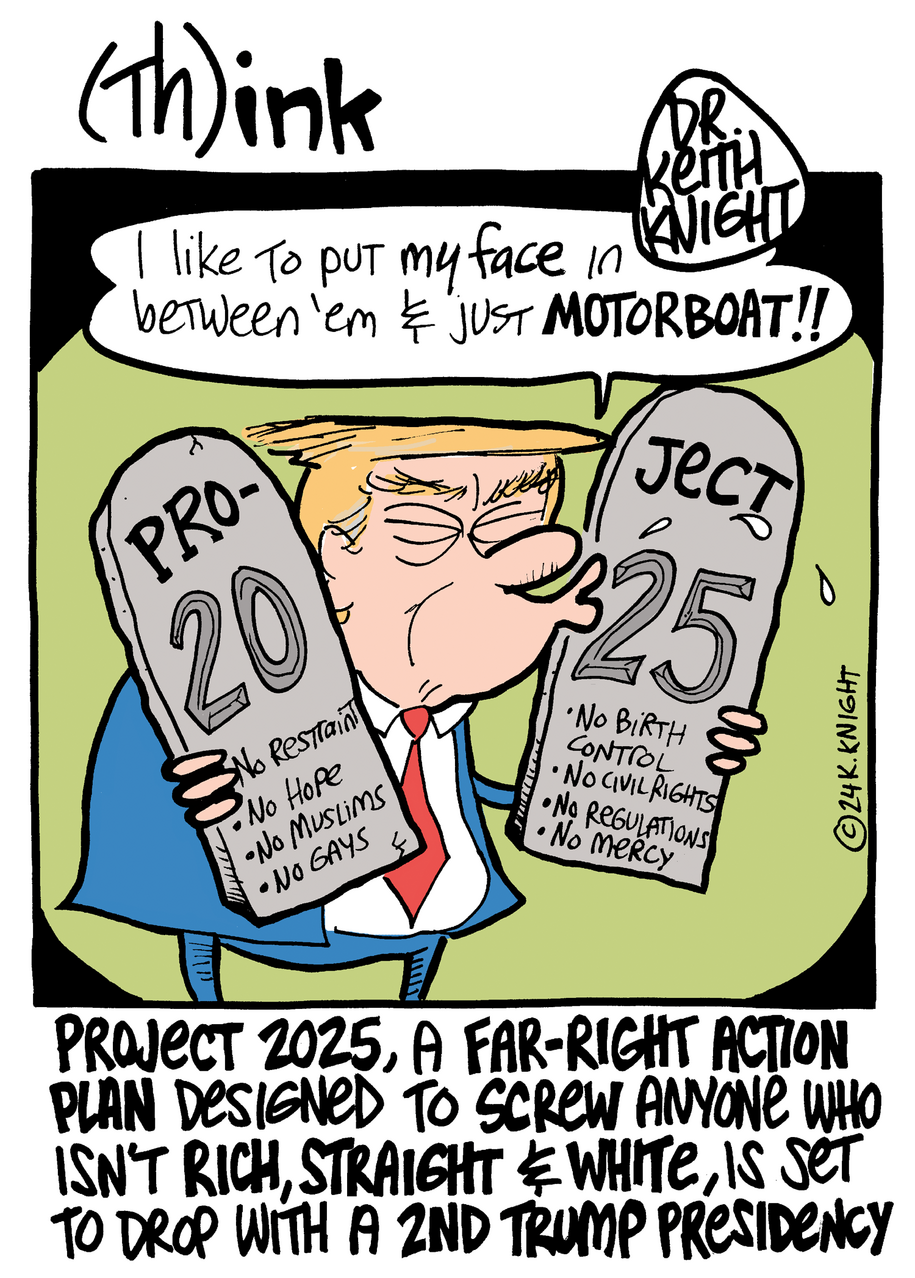
If Trump returns to the White House, the power of the federal government will likely be focused on restricting Americans’ rights to free expression, travel, and bodily autonomy in the name of preventing abortion. Project 2025, the Heritage Foundation blueprint for a second Trump administration, which Trump has unconvincingly attempted to disavow despite the plan having been written by veterans of his first administration, details possible avenues for such restrictions. The Project 2025 agenda contemplates allowing employers to deny health-care coverage for contraception to their workers, allowing hospitals to refuse to provide abortion care when someone’s life is at risk, and otherwise limiting access to abortion medication and contraception. Project 2025 also wants to use the Department of Health and Human Services to force states to track abortions in order to crack down on what it calls “abortion tourism,” that is, women being forced to leave their home state to obtain medical care that they are prevented from getting where they live. Last year, a Texas mother named Kate Cox had to flee the state to get an abortion because her fetus had a fatal abnormality, and carrying the pregnancy to term could have endangered both her life and her ability to get pregnant again. This is what the people who would run the next Trump administration regard as “abortion tourism.”
The idea that Republicans would not do such things because they are unpopular ignores the fact that abortion bans are also deeply unpopular—even conservative voters in some red states have rejected them since the Supreme Court’s Dobbs decision—and many Republican-run states instituted draconian bans on abortion anyway. Red states’ response to voters rejecting Republican extremism on abortion at the polls was not moderating on the issue, but attempting to take the decision out of voters’ hands entirely by preventing abortion from being the subject of statewide referendums in which abortion bans keep losing.
The GOP platform is an obvious bait and switch, and it doesn’t even try very hard to hide the switch. As the writer Jessica Valenti notes, “The platform doesn’t change a single thing about what Trump would do if elected, nor does it mean that there’s an actual rift between his campaign and the anti-abortion movement. This is political theater, and the mainstream press is handing out programs.” The GOP platform on abortion does not show Trump or the GOP “softening” or shifting on abortion rights; it shows them trying to avoid the political consequences of their position on the matter by hiding them in plain sight.
It has been clear from the beginning that Trump regards abortion rights as a political vulnerability for Republicans and would seek to seem moderate on the issue, just as it’s clear that the anti-abortion camp understands that Trump will do its bidding when in office, as he did last time. One reason he may get the chance is mainstream press organizations’ embracing the narrative of Trump as an abortion moderate—despite all available evidence to the contrary.
Former South Carolina Gov. Nikki Haley announced on Tuesday that she is releasing the delegates she earned in the Republican primaries and asking them to vote for Donald Trump. This will not alter the outcome; Trump secured enough delegates to ensure his nomination months ago. But now he may be spared the distasteful distraction of hearing someone else’s name entered into nomination during his coronation next week in Milwaukee.
For Haley, this is the final step down a descending staircase of self-abasement and humiliation.
Now Haley’s voters, who continued to cling to her name as a symbol of their dislike for Trump even after Haley officially suspended her campaign, are finding that Haley’s tough talk about Trump has vanished. They’re getting confirmation that being a Republican in 2024 means supporting Trump. And nothing else.
For months during the campaign, Haley repeatedly signaled to her voters that she was never going to get behind Trump’s run to return to the White House. In February, she declared that Trump was a “bully” who was “getting meaner and more offensive by the day.”
Haley may have offered a series of proposals on foreign policy and her own plan for the economy, but most of those who voted for her simply did not care about any of that. As The Atlantic wrote in May, they voted for Haley, and continued to vote for her long after her candidacy was no longer viable, for a simple reason: “as a way to stop Donald Trump.”
Haley didn’t get nearly 29% of the vote in Minnesota a week after suspending her campaign because they were enamored with her thoughts on Israel or her plans for economic investment. They voted for Haley as a symbol, as a life raft. As the one remaining spot of earth lingering about a rising MAGA tide.
When Haley endorsed Trump in May, that little nubbin of desolate rock sank almost to the top of the waves. Now it has gone under.
And now all those donors and supporters who looked to Haley as their anti-Trump option, including big Republican donors and organizations who bet big on Haley as a firebreak on Trump’s takeover of the party, realize that they’ve been had.
Haley may have talked a big game. She may have presented an almost ideal image of an anti-Trump candidate, offering traditional Republicans and Never-Trumpers the idea that the Republican Party could continue as the Republican Party, rather than as a vehicle for the worship of a single man and his maniacal campaign of vengeance and destruction.
But that image proved to be as substantial as the rainbow on an oily puddle.
On Tuesday, Haley stood up to that “bully,” to the “mean” and “offensive” and “unstable” and “unhinged” man who had threatened both her and her supporters, and gave her last abject surrender. She’s far from the first to make this descending journey. But in this round, she’s pretty much the last.
Millions of Republicans still seem to believe that there’s room in the Republican Party for someone who didn't bow to Trump. They’re wrong.
Sign up for The Brief, The Texas Tribune’s daily newsletter that keeps readers up to speed on the most essential Texas news.
Texas is receiving federal aid for Hurricane Beryl later than needed because state leaders were slow to request an official disaster declaration from the White House, President Joe Biden told the Houston Chronicle Tuesday.
With Gov. Greg Abbott out of the country on an economic development trip in Asia, Lt. Gov. Dan Patrick has served as acting governor amid the storm, making him responsible for putting in the state’s request for aid.
A White House spokesperson told the Chronicle that officials had tried multiple times to reach Abbott and Patrick, and Biden said he only connected with Patrick Tuesday, after which he issued the disaster declaration. Beryl came ashore on Texas' Gulf Coast early Monday morning, bringing heavy rain and winds that wreaked havoc over Houston and other parts of southeast Texas.
Patrick denied Biden's account, writing on social media that the president was "falsely accusing" him of being unreachable.
"I am disappointed that President Biden is turning Hurricane Beryl into a political issue," Patrick said, describing a "cordial call" with Biden earlier Tuesday in which the president granted his request for a major disaster declaration.
Patrick added that state officials "needed to determine what our outstanding needs were" before they could make an official request.
"We were working on that with local officials as we traveled the impacted areas," Patrick said. "As I was being briefed today, the president called."
An Abbott spokesperson added that Biden's comments were "a complete lie" and said the president and his administration "know exactly how to get in contact with the Governor and have on numerous occasions in the past."
"The State of Texas has been working closely with FEMA and other federal partners ahead of and throughout the storm to get the support Texas needs," Abbott press secretary Andrew Mahaleris said in a statement. "The State of Texas had all necessary disaster declarations in place well before today, despite what President Biden said."
As Beryl approached the Texas coast, Patrick issued a state disaster declaration authorizing the use of "all available resources of state government" needed to respond to the storm. At issue Tuesday, though, was the state's request for federal aid, which Patrick made earlier in the day. The major disaster declaration from Biden allows federal officials to help Texas pay for debris removal and emergency supplies and goods.
In a statement early Tuesday evening, Biden noted that FEMA resources had been on the ground in Texas “since well before the storm." That included 500,000 meals and 800,000 liters of water that were "ready to distribute at the state's request," FEMA officials said in a statement Monday. The agency also deployed 60 generators "to provide power to critical infrastructure, if needed."
The disaster declaration includes 121 counties, including Harris County and other parts of southeast Texas that were hit hard by Beryl, Texas Division of Emergency Management Chief Nim Kidd said at a press conference Tuesday afternoon.
A TDEM spokesperson said the state had been able to fulfill all requests from local officials, and FEMA officials had been in briefings with Kidd and Patrick "before, during, and after" Beryl and have "a permanent seat in our State Emergency Operations Center."
Biden, a Democrat, has frequently butted heads with Abbott, Patrick, and other Texas GOP leaders over immigration policy and other areas. Politics have also regularly infused the response to past Texas storms, most recently when then-Land Commissioner George P. Bush, a Republican, feuded with then-Houston Mayor Sylvester Turner, a Democrat, over Hurricane Harvey aid. Bush also accused the Biden administration of using "red tape" and "complex regulations" to slow the distribution of aid.
The political sparring came as millions of Texans remained without power as temperatures climbed into the 90s in parts of the state, one day after Beryl’s deadly winds and rain caused widespread damage.
James Barragán contributed to this report.
The Texas Tribune is a member-supported, nonpartisan newsroom informing and engaging Texans on state politics and policy. Learn more at texastribune.org.
This is the profit-taking part of monopoly behavior
Enlarge / Artist's conception of Microsoft executives after today's Game Pass pricing announcements. (credit: Getty Images)
For years now, Microsoft's Xbox Game Pass has set itself apart by offering subscribers launch-day access to new first-party titles in addition to a large legacy library of older games. That important "day one" perk is now set to go away for all but the highest tier of Game Pass' console subscribers, even as Microsoft asks for more money for Game Pass across the board.
Let's start with the price increases for existing Game Pass tiers, which are relatively straightforward:
"Game Pass Ultimate" is going from $16.99 to $19.99 per month.
"Game Pass for PC" is going from $9.99 to $11.99 per month.
"Game Pass Core" (previously known as Xbox Live Gold) is going from $59.99 to $74.99 for annual subscriptions (and remains at $9.99 for monthly subscriptions).
Things get a bit more complicated for the $10.99/month "Xbox Game Pass for Console" tier. Microsoft announced that it will no longer accept new subscriptions for that tier after today, though current subscribers will be able to keep it (for now) if they auto-renew their subscriptions.
Microsoft has withdrawn from its non-voting observer role on OpenAI's board, while Apple has opted not to take a similar position, reports Axios and Financial Times. The ChatGPT maker plans to update its business partners and investors through regular meetings instead of board representation. The development comes as regulators in the EU and US increase their scrutiny of Big Tech's investments in AI startups due to concerns about stifling competition.
Axios reports that on Tuesday, Microsoft's deputy general counsel, Keith Dolliver, sent a letter to OpenAI stating that the tech giant's board role was "no longer necessary" given the "significant progress" made by the newly formed board. Microsoft accepted a non-voting position on OpenAI's board in November following the ouster and reinstatement of OpenAI CEO Sam Altman.
Last week, Bloomberg reported that Apple's Phil Schiller, who leads the App Store and Apple Events, might join OpenAI's board in an observer role as part of an AI deal. However, the Financial Times now reports that Apple will not take up such a position, citing a person with direct knowledge of the matter. Apple did not immediately respond to our request for comment.
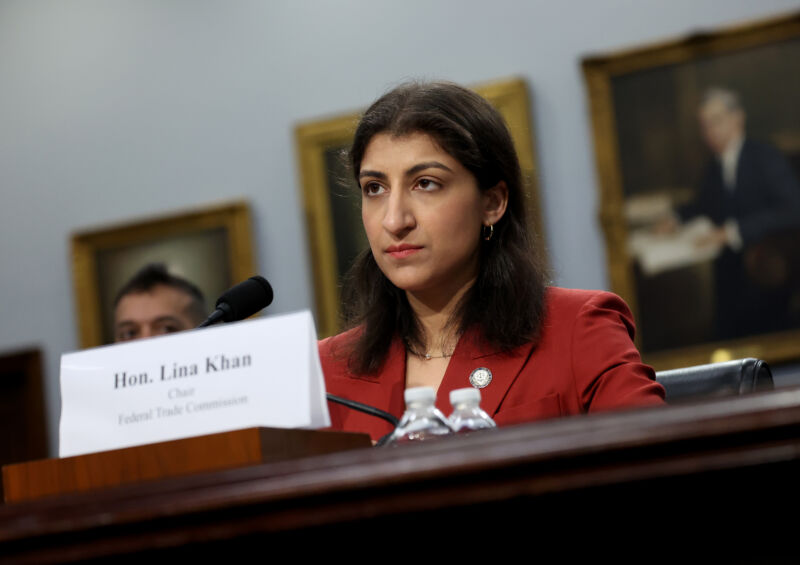
Enlarge / Lina Khan, chair of the Federal Trade Commission (FTC), testifies before the House Appropriations Subcommittee at the Rayburn House Office Building on May 15, 2024, in Washington, DC. (credit: Getty | Kevin Dietsch)
Firms that serve as intermediaries to negotiate and control prescription drug access in the US "wield enormous power," largely with "extraordinarily opaque" business practices, and may be "inflating drug costs and squeezing Main Street pharmacies" for profit, according to a searing interim report released Tuesday by the Federal Trade Commission.
Amid a national focus on America's uniquely astronomical drug costs, the FTC is taking aim at firms that largely work deep in the bowels of the country's labyrinthine health care system, well hidden from public understanding and scrutiny: pharmacy benefit managers (PBMs).
PBMs were initially hired by various payors—employers, health insurance companies, government health plans, and others—to manage prescription drug benefits through various plans. But PBMs have evolved over the years to also negotiate rebates from drugmakers, set reimbursements for dispensing pharmacies, and develop drug formularies (the list of drugs that a health plan covers.) While those functions alone grant PBMs a large amount of power, consolidation and integration over recent years has concentrated that power in troubling ways, according to the FTC report.
One of the most widely used network protocols is vulnerable to a newly discovered attack that can allow adversaries to gain control over a range of environments, including industrial controllers, telecommunications services, ISPs, and all manner of enterprise networks.
Short for Remote Authentication Dial-In User Service, RADIUS harkens back to the days of dial-in Internet and network access through public switched telephone networks. It has remained the de facto standard for lightweight authentication ever since and is supported in virtually all switches, routers, access points, and VPN concentrators shipped in the past two decades. Despite its early origins, RADIUS remains an essential staple for managing client-server interactions for:
VPN access
DSL and Fiber to the Home connections offered by ISPs,
Wi-Fi and 802.1X authentication
2G and 3G cellular roaming
5G Data Network Name authentication
Mobile data offloading
Authentication over private APNs for connecting mobile devices to enterprise networks
Authentication to critical infrastructure management devices
Eduroam and OpenRoaming Wi-Fi
RADIUS provides seamless interaction between clients—typically routers, switches, or other appliances providing network access—and a central RADIUS server, which acts as the gatekeeper for user authentication and access policies. The purpose of RADIUS is to provide centralized authentication, authorization, and accounting management for remote logins.
An anonymous reader quotes a report from The Guardian: A court in south-west Spain has sentenced 15 schoolchildren to a year's probation for creating and spreading AI-generated images of their female peers in a case that prompted a debate on the harmful and abusive uses of deepfake technology. Police began investigating the matter last year after parents in the Extremaduran town of Almendralejo reported that faked naked pictures of their daughters were being circulated on WhatsApp groups. The mother of one of the victims said the dissemination of the pictures on WhatsApp had been going on since July.
"Many girls were completely terrified and had tremendous anxiety attacks because they were suffering this in silence," she told Reuters at the time. "They felt bad and were afraid to tell and be blamed for it." On Tuesday, a youth court in the city of Badajoz said it had convicted the minors of 20 counts of creating child abuse images and 20 counts of offenses against their victims' moral integrity. Each of the defendants was handed a year's probation and ordered to attend classes on gender and equality awareness, and on the "responsible use of technology." [...] Police identified several teenagers aged between 13 and 15 as being responsible for generating and sharing the images. Under Spanish law minors under 14 cannot be charged but their cases are sent to child protection services, which can force them to take part in rehabilitation courses. Further reading: First-Known TikTok Mob Attack Led By Middle Schoolers Tormenting Teachers
All that "self reliance" bullshit goes out the window. They'll be begging for federal money as soon as they get the power form their dilapidated infrastructure back online. So...August?
Many of the millions left without power after Hurricane Beryl crashed into Texas, killing several people and unleashing flooding, sweltered and fretted Tuesday as the storm deprived them of air conditioning, food and water in dangerous heat.
A heat advisory took effect through Wednesday in the Houston area and beyond, with temperatures expected to soar into the 90s (above 32.2 Celsius) and humidity that could make it feel as hot as 105 degrees (40.5 Celsius).
“We can handle it, but not the kids,” said Walter Perez, 49, as he arrived early Tuesday at celebrity pastor Joel Osteen's megachurch in Houston, which served as a cooling center and distributed 40-bottle packs of water to cars that drove up.
Perez said he, his wife, their 3-year-old son and 3-week-old daughter, and his father-in-law retreated from their apartment after a night he described as “bad, bad, bad, bad."
Beryl, which made landfall early Monday as a Category 1 hurricane, has been blamed for at least seven U.S. deaths—one in Louisiana and six in Texas—and at least 11 in the Caribbean. At midday Tuesday, it was a post-tropical cyclone centered over Arkansas and was forecast to bring heavy rains and possible flooding to a swath extending to the Great Lakes and Canada.
Buffalo Bayou floods stranding vehicles near Downtown Houston after Beryl came ashore in Texas as a hurricane and dumped heavy rains downtown.
More than 2.2 million homes and businesses around Houston lacked electricity Tuesday, down from a peak of over 2.7 million on Monday, according to PowerOutage.us. For many, it was a miserable repeat after storms in May killed eight people and left nearly 1 million without power amid flooded streets.
Food spoiled in listless refrigerators in neighborhoods that pined for air conditioning. Long lines of cars and people queued up at any fast food restaurant, food truck or gas station that had power and was open.
Damonte Oliver, 32, visited Osteen's Lakewood Church with his girlfriend and her mother. Their apartment had lost power for days after the May storm.
“I know they are trying to do their best to get everything back on. It’s just a waiting game on how long it’s going to take,” he said before walking to a convenience store to buy cigarettes.
“I’ve got to calm down a little bit myself,” Oliver said.
It could take days to fully return power in Texas after Beryl toppled 10 transmission lines. Top priorities for power restoration include nursing homes and assisted living centers, said Texas Lt. Gov. Dan Patrick, who is acting as governor while Gov. Greg Abbott is out of the country. Sixteen hospitals were running on generator power Tuesday morning, according to the Federal Emergency Management Agency.
Beryl's strength at midday Tuesday—with sustained winds near 30 mph (48 kph)—wasn't expected to change much in the next two days. It was forecast to bring heavy rains and possible flash flooding from the lower and mid-Mississippi Valley to the Great Lakes into Wednesday, the National Weather Service said.
An upended tree rests on Bethel Church after Hurricane Beryl moved through the area on Monday.
A flood watch was in effect for parts of Oklahoma, Arkansas, Missouri, Illinois, Indiana, and Michigan. A few tornadoes were possible in Missouri, Tennessee, Kentucky, Illinois, Indiana, and Ohio, forecasters said.
When Beryl made landfall, it was far less powerful than the Category 5 behemoth that tore a deadly path through parts of Mexico and the Caribbean. But its winds and rains still knocked down hundreds of trees that had already been teetering in saturated earth and stranded dozens of cars on flooded roads.
Beryl was the earliest storm to develop into a Category 5 in the Atlantic. In Jamaica, officials said Monday that island residents will have to contend with food shortages after Beryl destroyed over $6.4 million in crops and supporting infrastructure.
So many terrible arguments. Note how none of them are "he is a good candidate"
As Democrats debate whether to replace President Joe Biden, an ill-conceived argument for retaining him as the nominee is alarmingly common.
Its premise is that Biden has earned voters’ loyalty—as if the question that confronts Americans is what we owe an individual politician rather than what’s best for the country. No matter how one feels about Biden, that premise is deeply flawed.
Vice President Kamala Harris put it this way last week: “President Joe Biden has devoted his life to fighting for the people of our country. In this moment, I know all of us are ready to fight for him.”
California Governor Gavin Newsom declared, “Joe Biden’s had our back. Now it’s time to have his.”
Governor Wes Moore of Maryland told reporters, “The president has always had our backs, and we’re going to have his back as well.”
Loyalty can be a virtue, but this invocation of it is appalling.
I am glad that Biden prevailed in 2020. I am grateful for his public service, despite disagreeing with his ideology. But do Harris, Newsom, and Moore really believe that if a president works on behalf of the public––that if he does the job that he sought out and was paid to perform––he is owed reelection, even if his cognitive capacities suddenly decline or other circumstances arise to make him less capable of doing his job well?
Their loyalty statements do not argue that Biden is the Democrat most likely to beat Donald Trump, or that Biden would make the best president of any electable Democrat, or that Biden will be cognitively capable of serving four more years as president, or even that his present cognitive abilities are sufficient. They appeal to a duty of reciprocity, treating other questions as less important or irrelevant.
That’s frustrating because all those other questions are of much greater importance. If loyalty is a virtue at all, the loyalty we owe to family members, to friends, to colleagues, and to country––that is, to our roughly 336,706,000 fellow Americans––will always compel us to put what’s best for them before what’s best for any politician, including any president, no matter how much he has achieved or sacrificed.
Democratic National Committee Chair Jaime Harrison told Al Sharpton that in the Black community, he is seeing intensified support for Biden (something that is not evidenced in polls), because “people understand this: that Joe Biden has always had our back, and we’re going to have his.” That always is itself preposterous. For instance, Biden was on the wrong side of the school-integration efforts of the 1970s. But even if it were true, voters who prioritize the interests of Black Americans, or Americans generally, should ask Who will serve us best these next four years? not Who has served us best in the past? Should the answers differ, the civic responsibility is to back whoever is most likely to improve lives going forward, not to reward past performance at the future’s expense. No honorable politician would want that.
Senator John Fetterman of Pennsylvania stated, “I’m unwilling to discard a great president, a decent man and a loving father after 50 years in public service, over a 90-minute debate. Responding with disorder, panic, and disloyalty is not meeting this moment.” By injecting questions of loyalty and disloyalty into his argument and implying that deciding that a politician lacks the cognitive fitness to do the toughest job in the world is somehow tantamount to discarding him, Fetterman failed to meet the moment. Forced retirement at 81 is not exile. Many have sacrificed more for the common good.
Democrats would do better to run Vice President Harris than Joe Biden, and better still to run whichever Democrat polls best, in terms of approval rating and in head-to-head matchups with Trump. But even Democrats who think Biden should stay in the race should abandon the flawed loyalty argument.
Most Americans, including most independents and undecided voters, will be understandably alienated by a Democratic talking point that amounts to Ask not what the presumptive Democratic nominee can do for you, but what you owe the presumptive Democratic nominee.
Americans do owe our elected officials fair-mindedness, appreciation of how hard governing is, and thanks for a job well done, when earned. To Biden and other past presidents, we also owe a pension, Secret Service protection, and the option to be buried at Arlington National Cemetery. But we owe them loyalty exactly never.
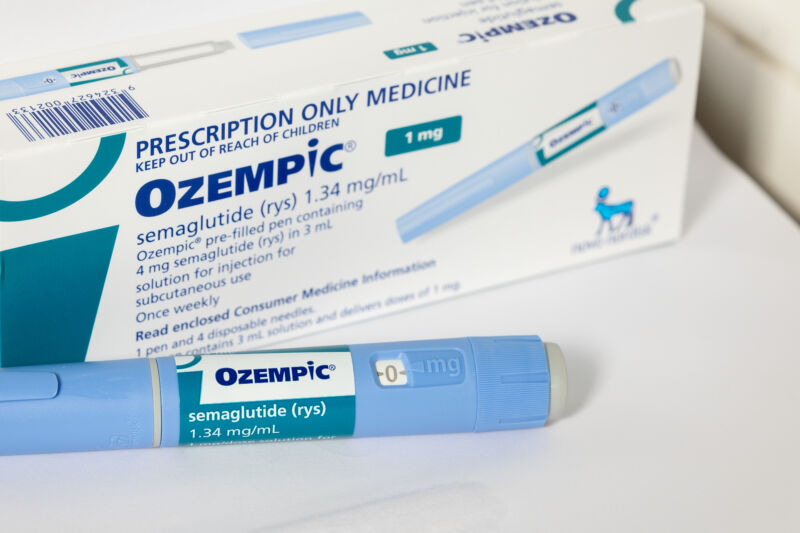
For patients with Type 2 diabetes, taking one of the new GLP-1 drugs, such as Ozempic, is associated with lower risks of developing 10 out of 13 obesity-associated cancers as compared with taking insulin, according to a recent study published in JAMA Network Open.
The study was retrospective, capturing data from over 1.6 million patients with Type 2 diabetes but no history of obesity-associated cancers prior to the study period. Using electronic health records, researchers had follow-up data for up to 15 years after the patients started taking either a GLP-1 drug, insulin, or metformin between 2008 and 2015.
This type of study can't prove that the GLP-1 drugs caused the lower associated risks, but the results fit with some earlier findings. That includes results from one trial that found a 32 percent overall lower risk of obesity-associated cancers following bariatric surgery for weight loss.
This is the worst argument for keeping Biden and shows a telling degree of desperation. "I won the primary that I rigged to eliminate all competition" is not a democratic result in either the small or large D sense.
President Joe Biden speaks to supporters during a campaign rally on July 5, 2024, in Madison, Wisconsin. | Scott Olson/Getty Images
President Joe Biden avowed that he was “firmly committed” to staying in the 2024 presidential race, in a letter to House Democrats released Monday morning.
And in addition to maintaining that he believed he was the best person to beat former President Donald Trump, Biden’s letter relied heavily on one particular argument: that he was the choice of Democratic primary voters, and it would be wrong to overturn their decision.
“The voters of the Democratic Party have voted. They have chosen me to be the nominee of the party. Do we now just say this process didn’t matter? That the voters don’t have a say?” Biden wrote.
“I feel a deep obligation to the faith and the trust the voters of the Democratic Party have placed in me to run this year,” he continued. “It was their decision to make. Not the press, not the pundits, not the big donors, not any selected group of individuals, no matter how well intentioned. The voters — and the voters alone — decide the nominee of the Democratic Party.”
In one more flourish, Biden said he viewed remaining on the ticket as crucial to his larger stand in defense of American democracy: “How can we stand for democracy in our nation if we ignore it in our own party? I cannot do that. I will not do that.”
Viewed through a certain lens, that argument is ridiculous. Biden ran against no serious opposition in a low-turnout, low-interest primary season. Democrats worked to deter any credible alternative from running, and if any had run, they would have faced intense criticism for disloyalty to the president and harming his chances against Trump. And since Biden avoided debates, primary voters arguably lacked crucial information about how he’d fare in one.
And yet Biden’s characterization is not entirely off-base. Just as he says, the effort to push him off the ticket is very much an elite-driven initiative, with support strongest in the (unelected) media, while rank-and-file Democratic voters have mixed feelings about it. Any process to pick a new nominee at this late date would not truly have widespread popular participation. And if anyone credible had run against Biden in the primaries, they very likely would have lost.
But should the votes of the 15 million people who voted in Democratic primaries earlier this year be the be-all end-all for what represents “democracy”? Perhaps the party deliberating over and choosing a different option is its own form of democracy in action. And what about the 150 million or so people who may vote in the fall — most of whom, polling suggests, have concerns about Biden’s age and would prefer a different Democratic nominee? Should their views matter?
Biden won the 2024 primary before voting even began
Due to his low approval ratings and age, there was occasional speculation that Biden might not run for reelection in 2024. Some polls in 2022 and 2023 showed a majority of Democratic voters saying he shouldn’t run again. But he never seems to have seriously considered bowing out. After taking office, he consistently said he intended to run again, and in April 2023 he made that official. (It’s likely that Democrats’ better-than-expected performance in the midterm elections prevented what would have been some pressure on Biden not to run again.)
Once Biden was in, Democratic officials fell solidly behind him. That is quite normal for an incumbent president — the last president to face a serious primary challenge was Jimmy Carter in 1980, and credible primaries against incumbents at any level are relatively rare. Parties frequently try to deter such challenges, viewing primaries as messy, expensive, divisive, and potentially harmful to the party’s general election chances (Carter lost).
In the end, none of the party’s ambitious governor or senator rising stars wanted to roll the dice of challenging Biden — believing they likely would have lost, and then been blamed if Trump won in the general. A little-known Congress member, Rep. Dean Phillips (D-MN), was the only elected official who jumped in the race. Author Marianne Williamson wasn’t a serious contender, and activist Robert F. Kennedy Jr. pulled out of the primary to run as an independent in the general election instead.
Some polling suggested that Democratic voters weren’t exactly thrilled with their lack of plausible options. In September, a CNN poll of Democrats and Democrat-leaning independents found that only 33 percent said they wanted Biden as the nominee, and 67 percent wanted someone else. The problem is: Who else? An imaginary idealized alternative polls better than a real person, and no polling showed any specific potential candidate anywhere near Biden.
Could this have been different if Gov. Gretchen Whitmer (D-MI), Gov. Gavin Newsom (D-CA), or someone else had jumped in the race? We’ll never know for sure, but I’m skeptical. One could spin an optimistic scenario where such a candidate suddenly catches fire, or a messier one in which something akin to Biden’s bad debate performance drags him down. But challenging an incumbent president in the primary is a very difficult thing to pull off.
The reality is that Biden won the 2024 primary well before voting even began, by winning the “inside game.” In doing so, he prevented disgruntled Democrats from having a realistic alternative to him on the ballot. So it’s a bit rich that he’s now arguing that the process presented a sacrosanct verdict of the people. Still, it seems very likely to me that he would have won even if a more formidable challenger jumped in.
Should primary voters matter more than the party or the general public?
One question going forward is whether the primary results are still valid in describing the “will of Democratic voters” in the wake of the debate; polls have found wildly different results.
Reuters/Ipsos found that 66 percent of Democratic voters said they wanted Biden to stay in the race.
The Wall Street Journal poll found the exact opposite result — that 66 percent of Democratic voters said they wanted to replace Biden as the nominee.
The New York Times/Siena College poll landed in the middle, with 48 percent of Democrats wanting Biden to stay in and 47 percent wanting a different nominee.
Polls are just polls, and because we can’t rerun a six-month primary process on short notice, there’s no plausible way to actually have a nationwide vote on the matter.
Another question, though, is whether the “will of Democratic primary voters” really should outweigh all other concerns in determining whether Biden remains the nominee.
The modern presidential primary process was created in the 1970s as an attempt to give voters, not party insiders (who were often criticized as corrupt backroom dealers), more of a say in choosing the nominees. But in recent decades, that system has come under criticism from two fronts.
One group of critics is, essentially, pro-party. They believe party deliberations are a form of democracy, even if it’s not mass participatory democracy as expressed in elections. They don’t shudder at the prospect of giving “party insiders” more of a say in picking nominees — that’s how parties in many other democracies function, and it’s how American political parties functioned until the past half-century. They think parties should be able to respond to circumstances, deliberate on the best path forward, and present their preferred candidates to voters. So they’d argue that Democrats would be well within their rights to replace Biden.
Another group of critics is anti-polarization. They believe that, in practice, party primaries are low-turnout affairs that too often prize extremists and ideologues — like Trump — and fail to produce candidates who appeal to the broader electorate. Some argue that the partisan primary and the two-party system are breaking America, and seek voting reforms to shake up the system. But basically, they think our political system is too responsive to primary voters and not responsive enough to the general electorate.
They might point out that large majorities of voters have, for years, said Biden was too old to serve another term — but that the primary process failed to present voters with a viable alternative option, and now the country is stuck choosing between Biden or Trump. Why should a country where over 150 million people may vote be held hostage to the preferences of 15 million Democrats who barely even got a choice?
There’s no sugarcoating it: Any process to replace Biden at this late date would inevitably be driven and dominated by party elites, and could not really be reflective of mass public participation on the level of the primaries.
But the 2024 primaries were not exactly a sterling testimony to the wonders of democracy either. It’s entirely possible — though far from assured — that a process to replace Biden could produce a more popular nominee aligned with the preferences of more voters overall.
Yup...these days I keep the AC set to 80 when I'm home. Thankfully Seattle's still a 2-week a year AC climate, though that's up from 2 days a few years ago
By setting your thermostat one degree warmer, you can save 6 percent on energy costs, according to the EPA.
Micah Pollak had no idea the trouble he was getting himself into when he shared his preferred thermostat settings on social media. “I just discovered most of our friends set their AC at 68-73F during the summer,” Micah, who is an economist at Indiana University, posted on Threads in late June. “We keep ours at 77-78F. Are we monsters!?” Nearly a thousand replies later, the consensus was that, yes, Micah’s family are monsters, probably some type of lizard.
Although he didn’t realize it, Micah has been following a set of numbers from the Environmental Protection Agency that tends to spark an internet freakout every summer, often after a local news station does a segment on how to reduce your energy consumption and lower your utility bills. The recommendations include keeping your thermostat at 78º when you’re at home during the day, 82º at night, and 85º when you’re away during the warm months.
To many people, sleeping in 82º heat is simply outrageous. (Not to mention terrible for your sleep, according to experts.) But energy prices are crazy too, and they’re only expected to rise as utility companies spend more and more to make the grid more resilient to the effects of climate change. Extreme weather events are becoming more common, and heat waves in particular can strain the power grid, especially when thousands of people are running their ACs at full tilt.
So maybe cranking up your thermostat isn’t such a bad deal. Typically, I’m inclined to set my AC to 72 on a really hot day. If I could get used to a balmy 78º inside, I’d not only save money, I’d be doing my part to keep the grid running smoothly so that everyone can enjoy a little bit of air conditioning, too. And the savings are real. The EPA says that for every degree warmer you set your AC, you can save 6 percent on your cooling costs, although you get diminishing returns as you go higher and higher. Put simply, if your cooling bill is usually $170, setting your thermostat a single digit higher will save you over $10 a month.
There’s one big problem, though. That 78º baseline isn’t a real federal government recommendation. The EPA’s Energy Star program does have a guide for programmable thermostat settings, but it doesn’t recommend a specific number to set your thermostat to in the summer. The numbers that show up in the news actually come from a table in a 2009 document that offered examples of what energy-saving settings could look like.
“Your household temperatures are very much a personal choice, and ultimately people should do what makes them comfortable,” Leslie Jones, a public affairs specialist from Energy Star, told me.
The agency’s official position is that you can save “up to 10 percent on heating and cooling settings by simply turning your thermostat 7°-10°F for 8 hours a day from its normal setting.” In other words, if you keep it at 71 while you’re home, go ahead and set it to 78 if you leave for the day.
Then again, setting your thermostat at 78√ at all times is not a monstrous idea. And setting it at 72º probably means you’re wasting some energy.
Nobody wants the government telling them to suffer more in the summer heat. A lot of our assumptions, though, about how air conditioning works, how to optimize the effectiveness of this century-old technology, and how to save energy in the process are just that: assumptions. To clear up the outrage over where we set out thermostats, I talked to experts in thermal comfort, HVAC technology, and the built environment.
It turns out, some of the most effective ways to stay cool are both simple and cheap.
Why we fight over the thermostat
It’s a time-honored American tradition to fight over the thermostat. Winter, summer, spring, and fall, any given home will be too hot or too cold for someone in the family.
This is for good reason, too. Physiologically, we each have our own optimal thermal comfort level. It comes down to a few key factors, according to Boris Kingma, a human thermal performance researcher at the Netherlands Institute of Applied Technology (TNO). The environment, including temperature, humidity, wind, and solar radiation, is obviously the big one. If it’s hot outside, you’ll feel hot. But a person’s metabolic rate and general physiology, including age and overall health, also play a big role — as does the clothing you’re wearing.
Metabolism is what’s at play when you talk to people who say they “run hot.” They might literally do that if they have a high metabolism, which causes your body to produce more heat. People with more muscle mass, for instance, tend to have higher metabolisms, retain heat, and prefer cooler temperatures. The opposite goes for people with lower metabolisms, who lose heat and might need to wear a sweater in their over-air-conditioned office. Our metabolisms decrease with age, which might be why you think your grandparents keep their house too warm.
It is therefore difficult, if not impossible, to find a single thermostat setting that will make all of America happy. Heck, it’s hard enough to agree on anything in a single family. But the good news is that our bodies are very good at acclimating to new environments. Kingma told me that it only takes about 14 days for your body to adjust to a new baseline temperature. So if you’re used to New York City’s relatively mild summer average of 80°F and then move to Miami, where it’s closer to 90°, you’ll probably get used to it.
The same holds for thermostat settings. If you do try and save some money by moving your thermostat one digit up, your body will adjust in a couple weeks, especially if you use a fan and wear lightweight clothing inside. Fans are especially effective, since they move air around your skin, helping sweat evaporate. Loose clothing has the same effect.
“Many of the solutions to this particular problem don’t need to be high tech,” said Kingma. “Dealing with temperature is about as old as humans.”
The role of evaporation cannot be overstated here. Sweating cools us down because the fluid on our skin evaporates and helps us shed heat. This explains why humidity is so miserable: The air is already so saturated with moisture that your sweat doesn’t evaporate effectively, which means you don’t cool down as easily. On windy days or in dry climates — a dry heat, if you will — sweat evaporates more readily, making it easier to stay cool. Fans can help in either scenario.
Focusing on reducing humidity is actually how we got air conditioning in the first place. In 1902, an engineer named Willis Carrier installed an “apparatus for treating air” at a printing company in Brooklyn that was having problems with magazine pages wrinkling in the summer heat. The machine sent air through coils filled with cold water, which removed humidity from the air and cooled the room. It wasn’t until 1922 that the Carrier Air Conditioning Company of America introduced the first practical centrifugal refrigeration compressor that would become the foundation for modern air conditioners.
Most AC units today do the job with three simple steps. They pull warm air out of the room, cool it down by running it over coils filled with refrigerants, and then pump the cold air back into the room while releasing the heat to the outside world by using a compressor, which is why your AC can sound like a starting car. Heat pumps, which can heat and cool a home, operate using the same principles when cooling — more on that in a minute.
Air conditioning is an energy-intensive process, and the refrigerants used in them present a few problems of their own. The most common refrigerants needed to make these machines work include chlorofluorocarbons (CFCs) and hydrofluorocarbons (HCFCs), commonly known as “freon,” which are greenhouse gasses that deplete the ozone and contribute to climate change. The EPA has been banning many of these chemicals in recent decades to comply with the Montreal Protocol on Substances Depleting the Ozone Layer. However, many modern replacements that do not damage the ozone are still potent greenhouse gasses.
In other words, air conditioning has historically been great for comfort but bad for the climate.
Not only do they require a lot of energy, which may or may not be supplied by fossil fuels, but most air conditioners also pump more greenhouse gasses into the atmosphere. ACs can keep us cool, but they’ll also warm the planet in the process. It’s a real paradox.
Technologies like heat pumps promise a greener future for heating and cooling, but it will take years to update our HVAC infrastructure due to the cost and sheer scale of trading old, inefficient equipment with new systems. And for many, including renters and certain businesses, those upgrades may even be impossible. So for now, the fight over the thermostat continues.
The futile effort to make everyone comfortable
There is no magical thermostat number to make everyone happy and maximize energy savings. For some, like Micah, the economist, 78º during the day is just fine. For others, 68º is perfect. There have been attempts to solve this problem on an institutional level. And if you’ve ever spent a hot summer day in a large office building, you know that some of those attempts have failed.
The big difference between setting a thermostat at work and at home, of course, is that you typically don’t have any control over the office thermostat. A look at how offices attempt to make everyone comfortable does, however, provide some insight into how we make decisions at home.
First formed as the American Society of Heating, Refrigeration, and Air-Conditioning Engineers, ASHRAE sets the industry standards for all things HVAC-related. One specific standard, ANSI/ASHRAE Standard 55, provides guidance on how to optimize thermal comfort in the built environment. That includes adapting temperature, humidity, air movement, and thermal radiation in an occupied space to the activity and clothing of the people occupying it. If you’re building a business and want to figure out how to make everyone inside the office comfortable, this is the guide.
ASHRAE, unlike the EPA, specifies an ideal number to set a building’s thermostat to. It’s a range, actually: around 23°-26°C, or 73.4°-78.8°F, in the summer. According to Bjarne Olesen, a former ASHRAE president, “At least 80 percent of men and women are satisfied in that range.” Some might say that the upper end of that range is a bit too warm for good productivity. That assumption would line up with a 2021 review of scientific studies about temperature and work performance, which found the optimal temperature is between 22°-24°C, or 71.6°-75.2°F. But again, the number on the thermostat is not the only thing to consider.
Even fancy office buildings are not immune to energy costs. While the EPA suggests that a single digit, or setpoint, higher on the thermostat can add up to 6 percent savings on your cooling bill, the savings are magnified if you scale them up to an entire building or even an entire city. A 2023 study of three decades of weather and energy cost data concluded that a single setpoint change coupled with behavioral changes could result in 20 percent energy savings. Behavioral changes, which include everything from using fans in addition to AC and wearing lighter clothing, are especially essential in cities, which are designed to depend on air conditioning.
“The technology of cool air allowed people to design buildings that would not normally be comfortable in our environment,” said Robert Bean, a fellow and lecturer at ASHRAE. “And as this environment changes, it puts us in a tough spot.”
There have been some high-profile experiments in thermostat tweaks and energy savings. In 2005, Yuriko Koike, who was Japan’s environment minister at the time, launched an initiative called Cool Biz that pushed government offices to turn their thermostats up to 82ºF from May to September to save energy and reduce greenhouse gas emissions. As an incentive of sorts, workers were allowed to ditch their formal office attire — suits and ties, for instance — in favor of lighter, more casual attire, like aloha shirts and linen pants. There were fashion shows and everything. Big corporations followed the government’s lead, and within a couple years, Cool Biz was a national pastime. By 2023, some 86 percent of workplaces participated in the initiative.
When it comes to energy savings, turning the thermostat up works, too. Estimates vary, but Cool Biz reportedly saves Japan between 1 and 3 million tons of carbon dioxide emissions every year. The program became even more significant in the aftermath of the 2011 Fukushima nuclear disaster, when reactors across the country shut down and the government mandated further energy savings. They called it Super Cool Biz. There’s even an initiative to turn thermostats down during the winter months. And yes, it is called Warm Biz.
“It’s not rocket science,” said Kingma, the Dutch researcher. “As long as you have the ability to adapt, the problem may be solved by actually adapting.”
Not everybody in Japan loves this, of course. And there is research that shows productivity starts to dip once the temperature rises to 77°F. But Japan’s example shows that an entire nation can adapt to different indoor temperatures for the greater good — and they can look good while they do it. Maybe the rest of the world can, too.
How to stay cool and save the planet
Let me make a confession: I like the thermostat set at 72. If it’s 72 or less outside, I’ll open a window and enjoy the breeze. If it’s warmer, I seal myself into my Brooklyn apartment, let the AC do the work, and wait for nightfall.
Or at least, that’s what I used to do. I actually stopped setting my thermostat at 72 while reporting this story. After my conversations with thermal comfort researchers and HVAC professionals, I realized that cranking up the AC unnecessarily isn’t just a waste of energy, it’s not that comfortable either. It’s silly to get goosebumps inside in the middle of a July day because your cooling machine has cooled the room down too much. That’s why I started to heed the advice of the experts. And let me tell you, these experts are fans of fans.
Stefano Schiavon, a professor at the University of California Berkeley and a member of ASHRAE, told me his colleagues stick with a “fans first” strategy to cooling. “If you feel hot,” he said, “the first thing you turn on is a fan.” You can also use fans to supplement your AC, especially if you’re trying to stay comfortable at a high setpoint. Wearing loose clothing will only add to the cool enjoyment of it all.
“There’s been a movement — arguably driven by the air conditioning industry — to say the fan is a technology of the past, we don’t want them,” Schiavon explained. “But fans cost much less to manufacture, they use a small fraction of the energy, and they’re very intuitive to people so people know how to use them.”
There are also less obvious strategies to stay cool and save energy. Running your dishwasher and doing laundry at night cuts down on bringing excess heat into the home. You can also try spending time in the rooms of your house or apartment furthest from the sun, like on the northern side of the building or in a basement.
Maintenance also plays a big role in making sure everything is running at peak efficiency. That means cleaning your air conditioner vents and changing filters regularly. You should also be sure to keep cool air in and hot air out, so be careful about opening windows and doors unless you’re doing so to ventilate the space.
Smart thermostats are another promising solution, although they don’t necessarily work in older homes with radiators or window units. If you have central AC, you can swap out the thermostat on your wall with an internet-connected thermostat that lets you control everything with an app. You set the system up to automatically change settings at certain times of day or optimize their performance to save energy. Good ones cost about $250, but Amazon sells a basic one for $80. If you have a window unit, you can upgrade it with a smart AC controller that adds connectivity. Your utility company may even help you pay for one of these devices.
You also shouldn’t sleep on the heat pump trend. Again, heat pumps operate on the same principle as an air conditioner for cooling: They use electricity and refrigerants to pull humidity and heat out of the air. They tend to be as efficient as ACs, too, so don’t expect your summer bills to drop if you make the switch. But by moving heat from one place to another rather than actually generating it, heat pumps are much more efficient when it comes to heating buildings. The Department of Energy says that heat pumps use up to 65 percent less electricity than old fashioned furnaces or baseboard heaters. You can also get a tax break for installing one in your home.
“There’s no wrong way to save energy,” said Jones from Energy Star. “It’s just a matter of figuring out what is appropriate and right for you given your situation.”
It’s possible that some magical new invention could come along and change the way we stay cool. One promising technology involves installing radiant panels filled with cold water that effectively pull heat off of people as they pass by them without actually cooling the air. Researchers at Princeton showed off a system like this in Singapore in 2019. They called it a Cold Tube, and people who walked through it reported feeling cool, even though the temperature of the air didn’t actually change. This type of technology is decades away from becoming mainstream, but it’s proof that a future without air conditioning is possible.
But for the futuristic AC-free technology to work well, guess what’s required? Fans.
RACINE, WISCONSIN - JUNE 18: Republican presidential candidate former President Donald Trump speaks during a rally at Festival Park on June 18, 2024 in Racine, Wisconsin. This is Trump's third visit to Wisconsin, a key swing state in 2024. (Photo by Scott Olson/Getty Images)
The Republican party is going in two directions on race at the same time.
Electorally speaking, the modern GOP has never been so diverse. Each of the past two elections, and most available 2024 polling, reveals the GOP making real inroads with Black and (especially) Latino voters. These gains shouldn’t be overstated — Democrats still dominate among non-whites as a whole — but they are real.
But at the elite level, conservative intellectuals and operatives are developing a new doctrine of white identity politics. And it’s already shaping the Trump administration’s plans for a second term.
A new book on “anti-white racism” — The Unprotected Class, by Claremont Institute fellow Jeremy Carl — illustrates this trend clearly.
Its April release went unheralded outside conservative circles, but it received laudatory attention inside them. Tucker Carlson praised it as “outstanding”; leading activist Chris Rufo described it as a “must-read.” Nate Hochman, a former speechwriter for Florida Gov. Ron DeSantis, called it “the most important thing you read this year.” Carl got friendly interviews on Donald Trump Jr.’s web show and on Fox News during primetime.
Carl’s book centers on the claim that “anti-white racism is the most predominant and politically powerful form of racism in America today.” What mainstream scholars of race call “white privilege” is, in his view, a series of “informal evanescent cultural legacies.” By contrast, anti-white discrimination “is increasingly legal and formal.”
This discrimination is, for Carl, primarily the product of a pernicious ideology popular among elites (nonwhite and white alike). “Anti-white racism is the all-but-official ideology of our ruling regime,” he writes — and they have acted in such a way as to ensure that whites are increasingly shunted to the bottom of America’s social hierarchy.
Carl’s arguments for this view resemble a funhouse mirror version of American racial history: roughly the same series of events, but with the roles of victim and perpetrator reversed.
Everyone agrees, for example, that the integration of America’s cities led white people to move to suburbs and other outlying areas. Traditionally, historians and social scientists see this as a manifestation of white racism: either white urbanites worried about the effects of integration on property values or they simply disliked living near Black people. The flight of white wealth then deprived Black people and neighborhoods of high-quality public services, recreating the inequalities of de jure segregation on a de facto basis.
But Carl argues that white flight can more accurately be described as a reaction to anti-white racism. He claims that integration brings crime, often involving minority perpetrators targeting longtime white residents (Carl sources data on “interracial murder” to the anonymous Twitter account @fentasyl). The situation for whites is so perilous, Carl argues, that it’s akin to state-sanctioned mob assaults on Jews in czarist Russia.
“Anti-white crime functions as a twenty-first-century de facto pogrom, driving whites out of areas where they have lived for decades,” he writes.
Carl’s version of white identity politics is hardly isolated on the intellectual right. He cites two other prominent book, by New York Times contributor Christopher Caldwell and think tanker Richard Hanania, to argue that the legal roots of anti-white racism were created by the legislative victories of the civil rights movement. Their accounts align on the idea that the basic structure of anti-discrimination protections — including the Civil Rights Act of 1965 — needs to be overhauled or repealed entirely.
Of course, conservatives have complained about “reverse racism” for decades. What’s new is not just the aggressiveness of Carl’s claims and others like them, but their direct connection to radical policy proposals — and the fact that people in positions of power appear to be listening.
In April, Axios’s Alex Thompson reported that “close Trump allies” are planning a second-term overhaul of anti-discrimination law, one that would “dramatically change the government’s interpretation of Civil Rights-era laws to focus on ‘anti-white racism’ rather than discrimination against people of color.”
Much of this work, per Thompson, is coming out of America First Legal — the law practice of infamous Trump aide Stephen Miller. Since leaving government, Miller has filed a number of lawsuits alleging anti-white discrimination. Examples include a suit against the NFL’s “Rooney Rule,” which requires teams to interview a minority candidate for some high-level coaching positions, as well as a successful bid to block pandemic assistance for women-and-minority-owned restaurants.
Miller is poised to play an important role in a second Trump administration. Ty Cobb, Trump’s former attorney, told the Guardian that “Trump is looking to Miller” when it comes to choosing his White House lawyers and Justice Department officials. With that kind of power, Miller’s quest to write white identity politics into law could well start succeeding next year.
This story appeared originally in On the Right, a newsletter about the ideas and trends driving the conservative movement. Sign up here for future editions.
Donald Trump is addressing the Faith and Freedom Road to Majority Conference at the Washington Hilton in Washington, DC, on June 22, 2024 (Photo by Andrew Leyden/NurPhoto via Getty Images).
For a fractious coalition that at times seems to be held together with spit, baling wire, and old memories of Barack Obama, the Democratic Party has a remarkably singular message: Donald Trump is an existential threat to the country.
For the Biden campaign, the existential threat to democracy has become the overriding theme in his bid for reelection. “There is one existential threat: It’s Donald Trump,” Biden said at a fundraiser in February.
For the environmental activists in the party, climate change is the existential concern, and a Trump victory would be devastating for the planet, as Biden himself argued at Thursday’s debate: “The only existential threat to humanity is climate change, and [Trump] didn’t do a damn thing about it.”
Reproductive rights, too, are cast in existential terms. “Trump poses an existential threat to abortion rights in Pennsylvania,” Democratic US Rep. Mary Gay Scanlon said at a press conference in April. “If given the chance, he will ban abortion across the country with or without Congress.”
Existential math
As it happens, I know a little bit about existential threats, having written a book in 2019 on the subject. It refers to those threats that could conceivably risk the extinction or widespread destruction of humanity.
The real way to tell the difference between an existential threat and a more ordinary one is not what people warning say, it’s what they do. Existential threats demand existential responses. After all, if you conceivably felt the country and perhaps even the world were truly at risk, you’d presumably do everything you could to prevent that catastrophe.
When it comes to the Democrats and the left — from the Biden campaign on down to the activists — it is impossible to look at what they’re doing and conclude that they truly believe Donald Trump is an existential threat. And that may pose an existential challenge to the party.
Winning is the only thing
Biden entered Thursday night’s debate clearly losing, and it’s safe to say that afterward, very few people — outside perhaps Biden’s inner circle — think the president is positioned to win this election. The debate spotlighted the one issue that voters have repeatedly told pollsters is a serious problem, the one issue Biden can do almost nothing to change: his age. And rather than seizing a rare opportunity to disprove those fears, Biden’s halting, often disoriented performance did the opposite.
Cue the Democratic panic and an entire New York Times editorial board worth of columnists urging Biden to step aside. The campaign instantly said, as it has said every time these calls have been made, that the president would do no such thing, and at this point there’s little reason not to believe them.
Some of this is risk aversion: A president has never called off a reelection bid this late in the campaign, and no one really knows what would come next. Some of it is presumably pride. Biden is a proud man who was on his third try for the presidency when he finally won in 2020. Giving up is not really in his DNA.
Some of it is political calculation. If the president steps aside, the logical candidate is Vice-President Kamala Harris, but Harris has struggled in office and her poor poll ratings mirror those of Biden. If the Democratic Party tries to sideline Harris and open the door to other candidates through an open convention, they risk alienating her and her supporters and opening up further wounds in the Democratic coalition.
Bad choices, all. But the nature of an existential threat is that everything else — feelings, ambition, everything — is put aside. Yet even as the chance of a second Trump presidency rises by the day, the Democratic political establishment does nothing. That’s not how you act in the face of an existential threat.
Existential until it isn’t
It’s not just politicians, though. The winners of presidential elections pick Supreme Court justices, and it was obvious that a then-83-year-old Ruth Bader Ginsburg might not make it through the next presidential term after the 2016 election, potentially imperiling abortion rights, among other Democratic priorities. Yet Ginsburg — buoyed by a number of Democratic supporters who viewed calls for her retirement as sexist — refused to step down. We all know what happened later.
One would think that sitting Democratic justices would have learned from Ginsburg’s example and acted differently in the face of a new supposedly existential threat from Trump. Yet Justices Sonia Sotomayor and Elena Kagan — who are 70 and 64, respectively — have so far refused to heed increasingly desperate calls from writers like my colleague Ian Milhiser to step down and lock in their seats for decades. Each has perfectly good reasons to stay on, as did Ginsburg; none of those reasons make sense in the face of a true existential threat.
Nowhere is the gap between existential rhetoric and existential action greater than in climate change, which has emerged in recent years as one of the top priorities for Democrats.
You can’t find a climate activist — and, increasingly, a Democratic politician — who doesn’t frame climate change as an existential issue. With reason — the worst-case climate scenarios really do represent something like an existential threat to the future of not just the US, but the entire world. And given Trump’s determined opposition to actual climate policy, it’s fair to view his potential return to the White House as a part of that threat.
Yet there is a clear and yawning gap between climate rhetoric and climate action. On the Democratic political side, that’s perhaps understandable; climate change is not a top priority for most voters, and politicians have to grapple with that fact. (You can’t save the Earth if you don’t have the votes.)
Too often, though, climate activists and groups end up opposing many of the new energy projects that are needed to actually decarbonize energy, from transmission lines to solar projects to wind power, often tying them up in years of litigation. The Sunrise Movement, one of the most radical climate activist groups out there, has bafflingly withheld its endorsement from Biden so far, even though he prioritized passage of the most ambitious climate bill in US history.
The groups have reasons for what they’re doing — there are always reasons — but if climate change were treated as the existential threat the loudest activists say it is, those reasons wouldn’t matter.
Do you believe what you say?
Treating an existential threat as existential requires the one thing that the Democratic coalition has increasingly struggled to do: prioritization. It means putting aside personal feelings, individual ambition, and subjective preferences in favor of a single goal: success. Otherwise, it’s just empty rhetoric.
As New York Timescolumnist Ezra Klein, who has been pushing the possibility of an open convention to replace Biden, said on his podcast after Thursday’s debate: “If the fate of American democracy is hinging on this election — as Democrats are always telling me it is and as I think there is a chance that it is — then you should do everything you can to win it.” That a strategy, any strategy, might make people or groups uncomfortable cannot be a reason not to pursue it in the face of an existential threat. Not if you believe what you’re saying.
This story was originally published by ProPublica.
Investigating how the world’s largest software provider handles the security of its own ubiquitous products.
After Russian intelligence launched one of the most devastating cyber espionage attacks in history against US government agencies, the Biden administration set up a new board and tasked it to figure out what happened—and tell the public.
No interview could reverse the damage that Joe Biden did to his campaign in the first presidential debate, but his conversation with George Stephanopoulos tonight showed that the president doesn’t even understand how profound the damage is.
The 20-minute interview, which aired this evening on ABC, featured a combative Biden, more like the president who gave a widely praised State of the Union address in March than the one who crumbled on a debate stage last week. Biden clearly believes that he can and will win the race against Donald Trump, but he seems stuck on June 26, unable to recognize the doubts that his party and voters have about him after the first presidential debate.
One of the interview’s most striking moments came when Stephanopoulos pressed Biden on whether he would submit to an independent neurological assessment. He refused. “Look, I have a cognitive test every single day,” Biden said, pointing to the duties of the presidency. If that’s true, he failed the test on June 27, and no interview, no matter how strong, can erase that failure.
The president didn’t dispute his poor performance in the debate. “It was a bad episode. No indication of any serious condition,” Biden said, blaming his own preparation, a bad cold, exhaustion, Trump shouting at him despite his microphone being off, and Trump’s many lies.
All of that may be true—though were the lies really a surprise?—but Biden simply isn’t reckoning with just how damaging the performance was. Biden didn’t merely have a “bad night,” as he said at one point, the way former President Barack Obama did during his first debate against Mitt Romney. No one who watched that encounter back in 2012 thought Obama was not up to the job. By contrast, a string of Democratic officials and donors has begun calling for Biden to drop out. Today, Governor Maura Healey of Massachusetts said he should step aside, and The Washington Post reported that Senator Mark Warner of Virginia is organizing a group of senators to pressure Biden.
Biden insisted to Stephanopoulos that he has the energy to be president. “Can I run the 100 in 10 flat? No. But I’m still in good shape,” he said, and denied that he was frailer than four years ago: “No. Come keep my schedule.” Rather than his stunned, vacant stare at the debate, he met the most challenging questions with a classic gleaming Biden grin.
The trouble is that Biden’s go-to answer for concerns about whether he can handle another four years is to cite his accomplishments during the past four, including turning around the economy, marshaling support for Ukraine, and expanding the U.S. microchip industry. His administration has been extremely productive, and—as he emphasized—exceeded many expectations. Biden no doubt feels it is unfair to not be recognized for these achievements, but his record has nothing to do with whether voters believe he can go on.
Whatever steps Biden has lost, he remains as stubborn as ever, and he demonstrated it throughout the interview. He denied that he is losing to Trump. (“Do you think polling data’s as accurate as it used to be?”) He wrote off signs of Democratic discontent as a creation of the press. And he said he’d drop out if “the Lord Almighty” came down and directed him, but refused to say what he would do if top Democratic allies told him it was time to go: “I’m not going to answer that question. It’s not gonna happen.” That prediction will be tested soon enough.
It's impossible to overstate the incoherence and bad faith of the Court
Sign up for The Decision, a newsletter featuring our 2024 election coverage.
Forget Donald Trump. Forget Joe Biden. Think instead about the Constitution. What does this document, the supreme law of our land, actually say about lawsuits against ex-presidents?
Nothing remotely resembling what Chief Justice John Roberts and five associate justices declared in yesterday’s disappointing Trump v. United States decision. The Court’s curious and convoluted majority opinion turns the Constitution’s text and structure inside out and upside down, saying things that are flatly contradicted by the document’s unambiguous letter and obvious spirit.
Imagine a simple hypothetical designed to highlight the key constitutional clauses that should have been the Court’s starting point: In the year 2050, when Trump and Biden are presumably long gone, David Dealer commits serious drug crimes and then bribes President Jane Jones to pardon him.
Is Jones acting as president, in her official capacity, when she pardons Dealer? Of course. She is pardoning qua president. No one else can issue such a pardon. The Constitution expressly vests this power in the president: “The President … shall have Power to grant Reprieves and Pardons for Offenses against the United States.”
But the Constitution also contains express language that a president who takes a bribe can be impeached for bribery and then booted from office: “The President … shall be removed from Office on Impeachment for, and Conviction of, Treason, Bribery, or other High Crimes and Misdemeanors.” And once our hypothetical President Jones has been thus removed and is now ex-President Jones, the Constitution’s plain text says that she is subject to ordinary criminal prosecution, just like anyone else: “In cases of Impeachment … the Party convicted shall … be liable and subject to Indictment, Trial, Judgment and Punishment, according to Law.”
Obviously, in Jones’s impeachment trial in the Senate, all sorts of evidence is admissible to prove not just that she issued the pardon but also why she did this—to prove that she had an unconstitutional motive, to prove that she pardoned Dealer because she was bribed to do so. Just as obviously, in the ensuing criminal case, all of this evidence surely must be allowed to come in.
But the Trump majority opinion, written by Roberts, says otherwise, proclaiming that “courts may not inquire into the President’s motives.” In a later footnote all about bribery, the Roberts opinion says that criminal-trial courts are not allowed to “admit testimony or private records of the President or his advisers probing the official act itself. Allowing that sort of evidence would invite the jury to inspect the President’s motivations for his official actions and to second-guess their propriety.”
But such an inspection is exactly what the Constitution itself plainly calls for. An impeachment court and, later, a criminal court would have to determine whether Jones pardoned Dealer because she thought he was innocent, or because she thought he had already suffered enough, or because he put money in her pocket for the very purpose of procuring the pardon. The smoking gun may well be in Jones’s diary—her “private records”—or in a recorded Oval Office conversation with Jones’s “advisers,” as was the case in the Watergate scandal. Essentially, the Court in Trump v. United States is declaring the Constitution itself unconstitutional. Instead of properly starting with the Constitution’s text and structure, the Court has ended up repealing them.
In a quid-pro-quo bribery case—money for a pardon—Roberts apparently would allow evidence of the quid (the money transfer) and evidence of the quo (the fact of a later pardon) but not evidence of the pro: evidence that the pardon was given because of the money, that the pardon was motivated by the money. This is absurd.
In the oral argument this past April, one of the Court’s best jurists posed the issue well: “Giving somebody money isn’t bribery unless you get something in exchange, and if what you get in exchange is [an] official act … how does [the case] go forward?” The answer, of course, is by allowing evidence of all three legs of the bribery stool—the quid (the money), the quo (the official act), and the pro (the unconstitutional and vicious motive). Yet Roberts’s majority opinion entirely misses the thrust of this oral-argument episode.
This is astonishing, because the impressive jurist who shone in this oral exchange was none other than the chief justice himself. John Roberts, meet John Roberts.
And please meet the John Roberts who has long believed that the judiciary shouldn’t be partisan. Over the course of his career, Roberts has repeatedly said that there are no Republican justices or Democratic justices, no Trump justices or Obama justices or Biden justices—there are just justices, period. Yet the Court in Trump v. United States split along sharply partisan lines—six Republican appointees, three of whom were named to the Court by Trump himself, versus three Democratic appointees. Roberts failed to pull these sides together.
This is precisely the opposite of what happened in the celebrated decision United States v. Nixon, also known as the Nixon-tapes case, in which the Court—including three justices appointed by Richard Nixon himself—issued a unanimous no-man-is-above-the-law ruling against the president. (A fourth Nixon appointee—William Rehnquist, for whom a young Roberts later clerked—recused himself.) The opinion also made clear that presidential conversations with top aides are indeed admissible when part of a criminal conspiracy.
Yesterday’s liberal dissenters came much closer to the constitutional mark, but they, too, made mistakes. Their biggest blunder in Trump was relying on a 1982 case, Nixon v. Fitzgerald, that simply invented out of whole cloth broad immunity for ex-presidents in civil cases. If liberal precedents lacking strong roots in the Constitution, such as Roe v. Wade, are fair game for conservatives, then mistaken conservative precedents ought to be fair game for liberals. Fitzgerald made stuff up, and the liberals should have said so.
No one is above the law—or, at least, no one should be. Not presidents, not ex-presidents, and not justices either. Because the Constitution itself is our highest law, jurists across the spectrum must prioritize that document’s letter and spirit above all else. In Trump v. United States, the Court failed to do this and also failed to live up to America’s highest ideals: nonpartisan justice and the rule of law.
It’s impossible to view this Monday’s Supreme Court decision to grant immunity for all acts that Donald Trump performed in his official capacity—whether legal or not—through any lens but that of the 2024 election and the strong possibility of Trump regaining the Oval Office. As journalist Adam Serwer observes in The Atlantic, “With this ruling, the Trump Court is saying that Trump is entitled to immunity from prosecution for crimes he has already committed, and for the ones he intends to commit in the future.”
American citizens, however, don’t have to wait to understand the results of this court’s new edict. The people who would make up Trump’s second administration have provided the country a clear template, one drawn from a dark chapter of our history that Americans have all but forgotten.
Most Americans alive today have no memory of McCarthyism. In the 1950s, Republican Sen. Joseph McCarthy weaponized and exploited the anti-communist hysteria sweeping the nation, creating what would become among the ugliest and most shameful eras in our nation’s history.
Trump mentor and chief counsel Roy Cohn advising Wisconsin Sen. Joe McCarthy, 1954.
There has been no real analogue to this repulsive blot on our history over the last seventy years. Until now, that is.
Trump is expected to staff a second administration with people vetted largely by far-right, nationalist organizations, which are already borrowing a page from the McCarthy era. The Heritage Foundation’s comprehensive manifesto—known as Project 2025—is replete with the right’s most cherished goals and fever dreams, leaving much of its planned methodology unspoken. But, as detailed at Daily Kos last Wednesday, Project 2025 has already spawned a bastard child, known as Project Sovereignty 2025, which fills in some of the missing pieces for us.
Project Sovereignty 2025’s name echoes the nationwide attack currently underway against journalists and media in Viktor Orbán’s quasi-fascist enclave of Hungary, by that state’s newly formed “Sovereignty Protection Office.” As reported by Radio Free Europe/Radio Liberty, legal experts characterize that office as an organ intent on preserving Orbán’s regime by creating “a perfect setting of intimidation” through widespread surveillance and spying on journalists and private citizens.
The initial goal of those behind Project Sovereignty 2025 is to force out federal employees seen as opposing an incoming Trump administration—and to at least start this before November. This summer, they intend to publish a website containing a McCarthy-esque blacklist “to publicly name and shame career government employees that they consider hostile to Donald Trump,” according to The Guardian. In other words, the list’s only conceivable intent is to intimidate and terrorize these individuals into leaving their jobs by exposing them to online and possibly in-person harassment.
As reported by The Guardian:
The group behind the list is the American Accountability Foundation (AAF), which was founded in 2020 and describes its mission as “working non-stop to expose the left’s secrets and hold Biden accountable.” A 2022 New Yorker profile described AAF as a “conservative dark-money group” and “slime machine.”
Doxing people is a favored method of Donald Trump, who routinely engages (by himself and through his campaign) his rabid supporters by publishing the names and identifying information of his targets. As employed by Trump, this tactic deliberately gives him plausible deniability for any violence or harassment that follows, and as the hundreds of people subjected to this by Trump’s minions can attest, the harassment can be unremitting and even violent.
That a private organization could publicly tout a McCarthy-like enemies list—and do so before this year’s election—indicates how Republicans and other right-wing extremists will operate if the tools of government are handed over to them. What is now a private effort of conservative think-tanks to intimidate swaths of the federal workforce portends an overall intent of exposing other opponents of Trump’s policies. In effect, Project Sovereignty 2025 can be understood as a prototype method for attacking anyone the administration deems an enemy. The movement’s Project 2025, if imposed, would enable this virulent form of McCarthyism by enlisting a Trump-loyal Department of Justice and FBI to investigate those who oppose Trump’s policies, either actively or by simply refraining to protect them from right-wing attacks.
Already, it’s clear how congressional Republicans will behave if Trump is elected again. In December, Ohio Sen. (and Trump vice-presidential aspirant) J.D. Vance penned a letter to Attorney General Merrick Garland, demanding Garland investigate an alleged conspiracy to commit insurrection by the conservative, anti-Trump columnist Robert Kagan. The impetus for Vance’s letter? An opinion piece that Kagan authored for The Washington Post that described the likelihood of a dictatorship should Trump return to office. (It did not appear to cross Vance’s mind that his demand for such an investigation was in fact the best evidence that Kagan was right.)
Earlier than this, the performative “witch hunts” that Republican Rep. Elise Stefanik and her colleagues led against several Ivy League presidents, done under the pretense of rooting out antisemitism on college campuses, is another precursor of how the government could be weaponized against Trump’s opponents. Those hearings were less grounded in genuine concern about antisemitism, and more intended for these Republicans to score political points against higher education—a goal in tandem with Project 2025.
There is virtually no limit on this movement’s list of possible targets. Planned Parenthood, GLSEN, and the Southern Poverty Law Center are all left-leaning organizations that have been attacked—sometimes physically—in the past by right-wing extremists. None of these organizations would escape targeting by a Trump administration eager to snuff out dissenting voices.
But while 1950s McCarthyism depended on stoking an anti-communist panic among the public, this new brand of intimidation promises to be more meticulous. Thanks to the internet and a vast right-wing media, Project 2025 has the unprecedented ability to pry into the lives of liberal organizations and individuals. This far exceeds the tools wielded by 1950s demagogues.
At each step along the way, the public had a choice: cower in fear or try to stop it. The news media had that choice as well. And both largely failed to do so. Ultimately—and thankfully—McCarthy ended up self-destructing under the withering contempt of a single Boston lawyer and the spotlight of a few brave reporters.
But we live in a far different time. If Donald Trump is reelected, this new strain of McCarthyism will be more dispersed, more agile, and more selectively targeted, enabled by political demagogues and a right-wing media establishment that has proved itself capable of deluding vast numbers of Americans. It will have the tools of a now-unaccountable and vindictive executive, and it will have devout followers behind it, spawning a McCarthyism on steroids, crafted for this hyper-partisan internet age. Elected Democrats—who will certainly oppose Trump’s regime—will find themselves under attack.
Conservatives see this election as their moment to establish a persistent, ruthless hegemony over our government. Their published plans show they will stop at nothing, even if that means dragging our country back into one of the worst eras in our history. We have one opportunity to stop this from happening: by voting—and, just as important, by getting out the vote—this November. If we fail, it seems increasingly unlikely we will get another chance.
For the New York Times, Josh Holder and Lauren Leatherby show how the Conservatives lost the election from multiple angles: lost seats, historical vote share, shift of support to Reform, an easy win by Labour, and an age breakdown. It looks bad for Conservatives any way you cut the data.
It's almost like judges don't have the skillset to be micromanaging technical decisions. Well no one told the pricks at the Supreme Court that. They just look to the GOP and do whatever their sugar daddies say.
In the weeks ahead of IA's efforts to appeal that ruling, IA was forced to remove 500,000 books from its collection, shocking users. In an open letter to publishers, more than 30,000 readers, researchers, and authors begged for access to the books to be restored in the open library, claiming the takedowns dealt "a serious blow to lower-income families, people with disabilities, rural communities, and LGBTQ+ people, among many others," who may not have access to a local library or feel "safe accessing the information they need in public."
During a press briefing following arguments in court Friday, IA founder Brewster Kahle said that "those voices weren't being heard." Judges appeared primarily focused on understanding how IA's digital lending potentially hurts publishers' profits in the ebook licensing market, rather than on how publishers' costly ebook licensing potentially harms readers.
Thursday night’s debate was a microcosm of where we are. It told you everything you need about the two presumptive nominees as human beings, everything about the two political parties they represent, everything about the media that both provided and described the event, and everything about America in 2024.
On stage were one man who derives sick pleasure from breaking things, one man who tries to make everything better, and a network that invited them both into a glass house and handed them mallets. Then, after 90 minutes of watching the first man send shards in all directions, we got to listen to everyone complain that the second man didn’t swing his mallet with sufficient vigor.
If you give a minute to Donald Trump, he will use it to lie. If you give a minute to President Joe Biden, he will use it to try and correct the lie—and answer the original question that Trump ignored. If it seems like Trump has the easier task, you’re right. If you think Biden should do something else, you’re on the wrong team.
In a YouGov survey published on Wednesday, Americans said they trusted Joe Biden more than Donald Trump to babysit their kids. They think Biden would be a more thoughtful houseguest. That he would give better advice on parenting and relationships.
And they think, by a large margin, that Biden would be more willing to return a lost wallet.
That’s who they are: the guy who would seek you out if he found your wallet on the street, and the man who would pocket the cash and move on. That, in a nutshell, is the choice America faces.
Before Trump walked onto the debate stage Thursday evening, CNN had already explained that they would do no fact-checking. Not because this was impossible—after all, NPR teamed up with PolitiFact and ran real-time fact-checking right down to the candidates’ respective golf handicaps—but because … because. Sorry, it’s impossible to think of any good reason that CNN didn’t choose to do this.
It took Trump about one second to begin exploiting this by simply lying. It took less than five minutes for him to discover that CNN would also not attempt to make him answer the question asked. Better still, they would respond to anything he said—anything—with “Thank you, President Trump.”
This was Trump’s wet dream. If Jake Tapper had called him “sir” at some point, Trump would have needed new pants.
Biden made the huge mistake of trying to answer the questions. From the very first moment, he was running a hundred miles an hour, trying to fit in an evening’s worth of policy discussions into the one- or two-minute space when his light was green.
And when Trump started piling on lies, Biden tried to correct Trump and answer the questions. On multiple occasions, Biden tried to deal with all the lies Trump had just spat out, then jump to a completely different topic—the actual topic of the question—and then deal with that as well. All in one or two minutes.
That’s who they are. Biden is the guy who helps out a stranger. Trump is the guy who scams him. Biden returns that lost wallet. Trump steals it.
Trump didn’t just drive the nation into a ditch during his administration, he left behind a devastated economy, thousands of Americans dying each week from a pandemic he mishandled, and international alliances in shambles. Biden has spent every moment since his inauguration rebuilding that economy, mending those alliances, and—oh yeah—saving those lives.
If you think that Biden should be more willing to let Trump’s lies slip past, let the questions go unanswered, and concentrate instead on the optics, you are always, always going to be disappointed.
The trouble is, pundits watched an hour of a convicted felon lying his ass off—and not just small lies, not just stories or fibs or misstatements. If there was anything to admire about Trump’s performance on Thursday evening, it was the sheer scale of his lies: Democrats want to abort babies after they are born, Nancy Pelosi took full responsibility for Jan. 6. These are the King Kong and Godzilla of lies.
Oh, excuse me. I did that wrong.
Democrats want to abort babies after they are born. “Thank you, President Trump.”
Nancy Pelosi took full responsibility for Jan. 6. “Thank you, President Trump.”
There. That’s the CNN way.
Pundits—even some supposed Democratic pundits—are admiring the massive, nonchalant lying of a convicted criminal while clutching their pearls over Biden trying to set things right, and that tells you everything about them.
If the Democratic Party fails to dust itself off, stand in front of the cameras, defend Biden, and explain how a lying felon is worse than laryngitis and some verbal stumbles, then it will say everything about us.
Turns out it is possible for the press and pundits to push a coordinated effort to get a presidential candidate to drop out of the race. Who knew, given the silence after the Republican nominee for president was convicted of 34 felony counts.
It's hard to overstate how huge of a deal this is and how utterly shameless the Court is. Stealing more authority for itself while being utterly unaccountable is insane. Pack them or eliminate them. I don't care, but this cannot stand.
The Supreme Court on Friday upended a 40-year-old decision that made it easier for the federal government to regulate the environment, public health, workplace safety and consumer protections, delivering a far-reaching and potentially lucrative victory to business interests.
Billions of dollars are potentially at stake in challenges that could be spawned by the high court’s ruling. The Biden administration’s top Supreme Court lawyer had warned such a move would be an “unwarranted shock to the legal system.”
The heart of the Chevron decision says federal agencies should be allowed to fill in the details when laws aren't crystal clear. Opponents of the decision argued that it gave power that should be wielded by judges to experts who work for the government.
“Courts must exercise their independent judgment in deciding whether an agency has acted within its statutory authority,” Chief Justice John Roberts wrote for the court.
Roberts wrote that the decision does not call into question prior cases that relied on the Chevron decision.
But in dissent, Justice Elena Kagan wrote that the assurance rings hollow. “The majority is sanguine; I am not so much,” she wrote.
The court ruled in cases brought by Atlantic herring fishermen in New Jersey and Rhode Island who challenged a fee requirement. Lower courts used the Chevron decision to uphold a 2020 National Marine Fisheries Service rule that herring fishermen pay for government-mandated observers who track their fish intake.
Conservative and business interests strongly backed the fishermen’s appeals, betting that a court that was remade during Republican Donald Trump’s presidency would strike another blow at the regulatory state.
The court’s conservative majority has previously reined in environmental regulations and stopped the Democratic Biden administration's initiatives on COVID-19 vaccines and student loan forgiveness.
The justices hadn’t invoked Chevron since 2016, but lower courts had continued to do so.
Forty years ago, the Supreme Court ruled 6-0, with three justices recused, that judges should play a limited, deferential role when evaluating the actions of agency experts in a case brought by environmental groups to challenge a Reagan administration effort to ease regulation of power plants and factories.
“Judges are not experts in the field, and are not part of either political branch of government,” Justice John Paul Stevens wrote in 1984, explaining why they should play a limited role.
But the current high court, with a 6-3 conservative majority, has been increasingly skeptical of the powers of federal agencies. Justices Samuel Alito, Neil Gorsuch, Brett Kavanaugh and Clarence Thomas all had questioned the Chevron decision.
Opponents of the Chevron doctrine argue that judges apply it too often to rubber-stamp decisions made by government bureaucrats. Judges must exercise their own authority and judgment to say what the law is, they argued to the Supreme Court.
Defending the rulings that upheld the fees, President Joe Biden's administration said that overturning the Chevron decision would produce a “convulsive shock” to the legal system.
Environmental, health advocacy groups, civil rights organizations, organized labor and Democrats on the national and state level had urged the court to leave the Chevron decision in place.
Gun, e-cigarette, farm, timber and home-building groups were among the business groups supporting the fishermen. Conservative interests that also intervened in recent high court cases limiting regulation of air and water pollution backed the fishermen as well.
The fisherman sued to contest the 2020 regulation that would have authorized a fee that could have topped $700 a day, though no one ever had to pay it.
In separate lawsuits in New Jersey and Rhode Island, the fishermen argued that Congress never gave federal regulators authority to require the fisherman to pay for monitors. They lost in the lower courts, which relied on the Chevron decision to sustain the regulation.
The justices heard two cases on the same issue because Justice Kentanji Brown Jackson was recused from the New Jersey case. She took part in it at an earlier stage when she was an appeals court judge. The full court participated in the case from Rhode Island.
Seriously. Obama's shortsightedness really hurt the country. Fucked over healthcare reform, plunged AZ into a decade of rightwing insanity, and gutted the party apparatus. It's insanity.
ATLANTA, GEORGIA, UNITED STATES - JUNE 27: President of the United States Joe Biden and Former President Donald Trump participate in the first Presidential Debate at CNN Studios in Atlanta, Georgia, United States on June 27, 2024. (Photo by Kyle Mazza/Anadolu via Getty Images)
A viciously xenophobic demagogue — who fomented an insurrection against the US government less than four years ago — is on track to win the White House this fall. And the only remotely viable alternative to him, for now, is a massively unpopular, geriatric Democrat who just advertised his inability to speak in complete sentences on national television.
This is the reality that confronts us in the wake of Joe Biden’s catastrophic performance at Thursday night’s presidential debate. A comprehensive account of how we arrived at this grim moment would require a multi-volume history. But one cause of our current predicament is worth highlighting: Democratic presidential candidates repeatedly failed to select running mates with an eye to their party’s long-term best interests.
Vice presidents do not always go on to become presidential nominees. But they very often do. In partisan primaries, few résumé items are more advantageous than a tenure as a beloved president’s heir apparent. Given this reality, a presidential nominee should aim to pick a running mate whom they consider highly electable.
Unfortunately, the last two Democratic presidents did not prioritize political chops when selecting their veeps.
Barack Obama didn’t choose Joe Biden because he thought that the then-Delaware senator would make a great Democratic nominee in 2016. To the contrary, by most accounts, Obama thought that Biden would be a totally nonviable candidate by the time his own hypothetical presidency ended. And he reportedly selected Biden precisely for that reason.
According to senior Democrats who spoke with New York magazine’s Gabriel Debenedetti in 2019, Obama had assumed that Biden would be too old to run for president by 2016. And he reasoned that this fact would render Biden an especially loyal second-in-command: Bereft of political aspirations of his own, Biden would have no compunction about putting Obama’s interests and goals above all else.
As it happened, Obama misjudged his running mate in more ways than one. In hindsight, it appears likely that Biden would have been a stronger nominee in 2016 than Hillary Clinton — Obama’s hand-picked successor — proved to be.
Nevertheless, Obama was certainly correct that — even eight years ago — Biden, then 71, was much older than an ideal presidential candidate. Instead of making the Delaware senator his running-mate, or putting his thumb on the scales for Clinton, Obama should have found a veep who was in his or her political prime and boasted a demonstrable capacity to compete in a swing state. Instead, he put his own campaign and future administration’s interests over the long-term best interests of the Democratic Party, likely damaging his own legacy in the process.
Biden’s choice of Kamala Harris in 2020 was even more misguided. When he made that choice in August 2020, there was little basis for believing that Harris was one of the most politically formidable Democrats in the country.
Harris had just mounted an exceptionally lackluster bid for the presidency. Then a California senator, Harris had entered the race for the Democratic nomination with strong donor support and an early surge in the polls. Despite these early advantages, Harris failed to maintain — let alone build out — her coalition over the ensuing months, and her campaign collapsed before the primary’s first ballots were cast.
Nor was Harris’s electoral track record before 2020 especially encouraging. She had never won an election in a swing state or competitive district. And in her first statewide race in deep blue California in 2010, Harris defeated her Republican rival by less than 1 percentage point. Two years earlier, Barack Obama had won that state by more than 23 points.
Given that Biden was 77 in August 2020, the likelihood that his running-mate would one day become his party’s standard-bearer was unusually high. It was entirely plausible that health problems would force him to retire before the end of his first term, let alone his second. And were Harris to become an incumbent president, no other Democrat would stand a chance of defeating her in a contested primary. For these reasons, Biden’s primary consideration in choosing a running-mate should have been his or her electability.
Instead, he put enormous weight on demographic considerations. “I think he came to the conclusion that he should pick a Black woman,” former Democratic Senate Majority Leader Harry Reid told the New York Times in the summer of 2020. “They are our most loyal voters and I think that the Black women of America deserved a Black vice-presidential candidate.”
Without question, it is desirable for a vice presidential candidate to energize the Democratic Party’s most loyal constituencies. That is one dimension of electability. But it is not obvious that Harris actually possessed that capability; after all, her 2020 campaign resonated so little with Black voters in South Carolina that she was forced to withdraw before that state’s primary.
In any case, the ability to appeal to swing voters is much more electorally valuable than a penchant for pleasing loyal Democrats. Turning out a Democratic voter who would otherwise stay home increases your margin by 1 point; flipping a Republican voter into your column increases it by 2.
The desire to give historically marginalized groups representation at the apex of American power is a righteous one. Such representation does have the potential to shift cultural perceptions about race and gender in a progressive direction (although, as Obama’s presidency showed, it also has the potential to catalyze a reactionary backlash). But such diffuse cultural shifts are ultimately of less consequence than public policy, above all for the most vulnerable in American society. Working-class Black women have more to lose from a Congress that guts Medicaid and a civil rights division that prioritizes anti-white discrimination than they have to gain from seeing someone of their race and gender squander a national election.
In 2020, there were plenty of non-white-male Democrats with a proven record of appealing to swing voters for Biden to choose from. Amy Klobuchar had repeatedly won landslide victories in light blue Minnesota. Tammy Duckworth had unseated a Republican incumbent in a purple Illinois House district before subsequently winning election to the Senate. Michigan Gov. Gretchen Whitmer had demonstrated her appeal to Rust Belt independents. Tammy Baldwin had repeatedly won Senate races in Wisconsin.
Instead, Biden opted for a running mate who few in the party considered to be an optimal general election candidate, despite the fact that — were Biden to win — there was a high probability that Harris would be her party’s standard-bearer at some point in the near future.
Over the past two years, Harris’s poor poll numbers — and Democratic insiders’ lack of confidence in her political acumen — reduced pressure on Biden to step down, and allow his party to run a less aged and unpopular nominee. Many party leaders seemed to reason that Biden was a safer bet than his vice president.
After Thursday night, it looks like this view was mistaken. For all her liabilities, Harris’s approval rating is somewhat better than Biden’s at this point. The vice president has some gifts as an orator and no shortage of vitality. Given the immense difficulty of coordinating behind a non-Biden candidate at this late date, there’s a plausible case that she is now the Democratic Party’s best option.
Considering the importance of keeping Trump out of power, however, we deserve a better option. And if Obama and Biden had prioritized their party’s long-term best interests when choosing their running mates, we would likely have one.