Shared posts

13 Dec 22:19

House Democrat starts what should be groundswell, demands McConnell recuse himself from impeachment

by Joan McCarter
James.galbraith

Damn right

House Judiciary Committee member Rep. Val Demings, a Florida Democrat, is demanding that Senate Majority Leader Mitch McConnell recuse himself from the Senate's impeachment trial.

She accused McConnell of promising the White House to "sabotage" the trial. "No court in the country would allow a member of the jury to also serve as the accused’s defense attorney. The moment Senator McConnell takes the oath of impartiality required by the Constitution, he will be in violation of that oath," she said in a statement. That's in response to McConnell's admission on Sean Hannity's Fox News show Thursday night that he would act on Trump's behalf. "Everything I do during this, I'm coordinating with White House counsel," he said. "There will be no difference between the president's position and our position as to how to handle this."

He would be in violation of his oath, as Demings pointed out, referencing Article 1, Section 3 of the Constitution which delineates "The Senate shall have the sole Power to try all Impeachments. When sitting for that Purpose, they shall be on Oath or Affirmation." That oath, or affirmation, every senator will take says "that in all things appertaining to the trial of the impeachment of [President Trump], now pending, I will do impartial justice according to the Constitution and laws: So help me God."

Demings should not stand alone. Every Democrat—including Speaker Nancy Pelosi and her leadership team and Senate Minority Leader Chuck Schumer and his team—should join her. And they should publicly shame any Republican senator still capable of feeling that emotion who is allowing McConnell to get away with this.

Sign the petition: Mitch McConnell must recuse himself from Trump impeachment trial.

13 Dec 19:43

No, polarization won’t produce endless impeachments in our future

by Paul Waldman
James.galbraith

Fuck the GOP

Warning that it will only minimizes Trump's very real misdeeds.
13 Dec 19:39

Mitch McConnell to Hannity: ‘We All Know How it’s Going to End … No Chance the President’s Gonna Be Removed from Office’ — WATCH

by Andy Towle
James.galbraith

The GOP needs to be destroyed

Senate Majority Leader Mitch McConnell paid a visit to Sean Hannity to assure FOX News viewers that he was in lockstep with White House lawyers regarding the impeachment trial.

Said Moscow Mitch: “Everything I do during this, I’m coordinating with White House counsel. There will be no difference between the president’s position and our position as to how to handle this to the extent that we can. We do not have the kind of ball control on this that a typical issue, for example, comes over from the House. If I don’t like it, we don’t take it up. We have no choice but to take it up. But we’ll be working through this process, hopefully in a short period of time, in total coordination with the White House counsel’s office and the people representing the president in the well of the Senate. … I’m going to take my cues from the president’s lawyers.”

McConnell also said he wouldn’t be surprised to get one or two Democrats voting to acquit.

USA Today reports: “Rep. Hakeem Jeffries, D-N.Y., read part of McConnell’s interview out loud during Thursday’s impeachment markup, stating that: ‘In other words, the jury — Senate Republicans — are going to coordinate with the defendant — Donald Trump — on how exactly the kangaroo court is going to be run.’ According to the rules expressed in the Constitution, during an impeachment trial of the President of the United States, the Senate takes an oath to act as impartial jurors. According to the rules expressed in the Constitution, during an impeachment trial of the President of the United States, the Senate takes an oath to act as impartial jurors.”

The post Mitch McConnell to Hannity: ‘We All Know How it’s Going to End … No Chance the President’s Gonna Be Removed from Office’ — WATCH appeared first on Towleroad Gay News.

13 Dec 19:39

Amid impeachment, Trump and Giuliani are still coordinating on anti-Biden dirt

by Alex Ward
James.galbraith

And the media will dutifully continue to report on every lie that they concoct as though it is actual news.

Rudy Giuliani stands as President Donald J. Trump participates in a signing ceremony for H.R. 1327, an act to permanently authorize the September 11th victim compensation fund, in the Rose Garden at the White House on Monday, July 29, 2019 in Washington, DC. | Jabin Botsford/The Washington Post via Getty Images

Giuliani actually admitted it on a phone call.

President Donald Trump’s entire impeachment mess began over his efforts to pressure Ukraine to investigate former Vice President Joe Biden’s family and Democrats with the help of his personal lawyer Rudy Giuliani. But even as an impeachment vote in the House Judiciary Committee loomed, both men continued to coordinate on Giuliani’s Ukraine efforts on behalf of his powerful client.

Giuliani recently returned from a trip to Kyiv this month in which he interviewed local officials to learn more about Hunter Biden — Joe’s son — and his time on the board of the Ukrainian gas company Burisma. He also wanted to prove the conspiracy theory both he and Trump believe — that Ukraine, not Russia, interfered in the 2016 presidential election.

After landing in New York last Saturday, according to the Wall Street Journal, the president called his attorney while the plane was still taxiing. “What did you get?” Trump asked, according to the Journal’s Friday interview with Giuliani. “More than you can imagine,” the former New York City mayor replied, noting he would be putting his findings in a 20-page report.

One almost has to respect (while remaining appalled at) how brazen Giuliani’s admission is here. He’s openly telling the Wall Street Journal that his anti-Biden investigation in Ukraine continues, and that Trump is still interested in knowing about it.

What’s more, their call came three days after the House Judiciary Committee held a hearing with legal experts about the constitutional grounds for Trump’s impeachment, and just six days before the panel approved articles of impeachment against the president.

Giuliani reportedly visited the White House on Friday, perhaps to give Trump the briefing he requested on the trip. Trump also asked his attorney to tell lawmakers and Attorney General William Barr what he discovered in Ukraine, the Wall Street Journal reports.

Even as the lawyer’s friends tell him to lay low, the Journal notes, Giuliani argues he’s well within his right to continue pushing forward despite the opposition to his efforts, because his job is to defend his client.

But what this entire episode highlights is a president and lawyer tag-team unwavering in their anti-Biden crusade, even as Trump’s political future hangs in the balance. If the prospect of losing his job won’t keep Trump away from Giuliani’s Ukraine efforts, surely nothing will.

Of course, it’s unlikely to change much in terms of the impeachment process. Democrats remain committed to seeing Trump booted out of office, and Republicans remain just as committed to defending him.

Which means that Trump’s likely acquittal in the Senate would allow him to proceed working with Giuliani to dig up dirt on the Bidens that could help with his 2020 reelection campaign — indicating he learned absolutely nothing from this experience.

13 Dec 19:38

Georgia councilman admits interracial marriage makes his 'blood boil' in roundabout defense of mayor

by Lauren Floyd
James.galbraith

The fucking South. This isn't "real america", it's a bunch of bigots and hicks.

Here’s where I agree with racist Georgia councilman Jim Cleveland, who rose to infamy after proudly articulating his opposition to interracial marriage: There is a stark difference between Atlanta and the rest of Georgia. While Atlanta may boast a diverse population that's more than 50% black and headed by Mayor Keisha Lance Bottoms, a black woman, larger Georgia seems to defy the bounds of time, with many residents still harboring a fondness for the Confederacy and the white supremacy that is its hallmark. 

That sentiment is so popular that when Mayor Theresa Kenerly of Hoschton, a city about 50 miles northeast of Atlanta, admitted that she snuffed a black job candidate's chances because of his race, the aforementioned councilman defended her by admitting he couldn't stomach seeing blacks with whites together on television, according to The Atlanta Journal-Constitution. "Makes my blood boil because that's just not the way a Christian is supposed to live," Cleveland said.

He went on to explain his beliefs.“I understood where she was coming from,” Cleveland told the AJC. “I understand Theresa saying that, simply because we’re not Atlanta. Things are different here than they are 50 miles down the road.” He’s since resigned, saying Tuesday that he would rather quit on his own terms than face voters in a recall election next month. “I’m not going to give them the pleasure of saying they recalled Mr. Cleveland,” he told the paper.

City Attorney Thomas Mitchell read the councilman’s handwritten resignation letter at a special council meeting the next day, according to Fox 5 Atlanta. “Effective today, December 10, 2019, I, Jim Cleveland, do hereby tender my resignation,” Mitchell said, reading the letter. Meanwhile, don’t think this means Cleveland has changed his mind about interracial marriage. He didn’t even pretend to backtrack yet still contended last month with Fox 5 that he’s not a racist. “I still don’t believe it’s a good idea for whites and blacks to marry but I am as antiracist as anybody,” Cleveland said.

RELATED: Michigan city council candidate wants to keep her town white 'as much as possible'

Councilman Shantwon Astin, a black man, accepted Cleveland’s resignation, Fox 5 reported. “I will make the motion to accept the resignation of councilman Jim Cleveland on behalf of the citizens of Hoschton and every member of the city which he has offended,” Astin said. Erma Denney, the former mayor, counted herself among them when she talked to an 11 Alive reporter in May. "They don't speak for Hoschton. They don’t represent us,” she said. “This is not who we are, and this is not what we want the world to think we are.” 

Although Denney may not want Hoschton to be known as a racist town, its mayor has her fair share of supporters. “I would keep the mayor in office,” Hoschton resident Chuck Cameron told Fox 5, adding “she’s done a good job.” There have also been many calls, though unanswered, for Kenerly to resign. “She would be the first mayor recalled out of office in the state of Georgia and that’s a huge historic thing,” Pete Fuller, chairman of the Jackson County Georgia Democrats, told Fox 5.

Keith Henry, the black man formerly up for a city administrator role when the mayor opposed him, told KHOU in May that he planned to sue the city. "I think it's a issue that's far beyond the city of Hoschton or even the state of Georgia," Henry told KHOU. "This often happens for many minorities across the country." A black former nursing home executive won more than $6 million in a New Jersey discrimination suit after her boss allegedly overturned her promotion because she didn’t "want a black person walking around here in a suit as VP," according to Atlanta Black Star. Care One executive Alison Fitzpatrick-Durski allegedly told Rebecca McCarthy: "I want you in scrubs, flats and a lab coat,” according to the news site.

13 Dec 10:12

New baby Yoda mini figs, designed by ME and coming from Hasbro next MAY!

James.galbraith

Adorable

New baby Yoda mini figs, designed by ME and coming from Hasbro next MAY!

So exciting, I only drew these 2 weeks ago and to be sculpted, approved and announced this early is INSANE. Such is the power of Green Bean!

They are apparently available to preorder now on Hasbro Pulse’s website.

13 Dec 06:10

Nikki Haley whines that 'outrage culture' won't let her bothsides the Confederate flag

by Hunter
James.galbraith

No, not an excuse. They're idiotic children

Former South Carolina Gov. Nikki Haley, just off a stint as Donald Trump's appointed ambassador to the United Nations, thoroughly stepped in it a few days ago in a speech bothsidesing the Confederate battle flag, a Civil War banner that has been used as symbol of violent and institutionalized white nationalism and white supremacy since its inception. She has done this before, and will do it again, largely by pretending to be completely unaware of the flag's role  through American history, no matter how often it is explained to her.

The problem here is that Haley, who just released a similarly whining and self-serving book, wants very much to run for president under a Republican banner. That means catering to the vast swath of racists who themselves pretend that the Confederate flag is not one of the most identifiable symbols of organized American racism, but is instead a symbol of a murky, ill-defined "heritage" of revering white supremacist figures, slaveholders, terrorists, and the "Lost Cause" of states getting to decide to enslave black Americans if they damn well want to.

That’s no reason for The Washington Post to give her space for yet another official do-over, though. It's especially redundant if Haley is going to use the space to issue snowflakian whines about how the problem isn't her attempts to signal to racists that she feels their pain—the problem is that you people, out there, had a reaction against what she said. It is you who should feel ashamed of yourselves, not her. Wrote Haley, "Today’s outrage culture does not allow any gestures to the other side. It demands that we declare winners and losers."

If you're making a gesture to people who think that flying the flag of the slaveholding South, one repurposed by violent white supremacists as symbol of opposition to every civil rights demand for a century, you are going to be critiqued. The nation offers its deepest sympathies to your glass ego, person who insists on being in the national spotlight despite these travails.

But the big claim, the big fat malevolent claim that Haley trots out and shoots in the middle of the road, and one of the most common claims of conservative cretins denying their own racist beliefs, is that it's not the "disturbing" "upsurge in white nationalism" that threatens civil rights, but the rest of you. You, there, with your "outrage culture." And if you take Haley’s claim as a threat, you should, because that is how it is intended every time.

Says Haley of the begrudging vote to remove the Confederate battle flag from its position flying before the South Carolina statehouse, which was taken only after a white supremacist murdered black Charleston churchgoers in what he believed to be the first step of a long-promised "race war,” "Sadly, I’m not sure that in today’s political climate we would have been able to remove the flag."

Oh, really? Why? It's not the "upsurge in white nationalism," so what is it?

"Rather, the reason is today’s media hysteria that makes it far more difficult to have the kind of thoughtful and prayerful dialogue we had following the Charleston murders."

Hear that? The problem is that you people are piping up with outrage over defense of the flag rather than shutting up while post-mass-murder conservatives get on with their Thoughts and Prayers and, well, maybe conservatives are just going to leave the symbols of institutional racism up if that's how you people are going to respond. It's an "outrage culture" that "insists that everyone who holds a view that's different from our own is not just mistaken. They must be evil and shunned."

"I know too many good people in South Carolina who think differently about the flag but who are not the least bit racist," Haley says. But they might just vote for more racism, like leaving the flag up, if people are mean to them in public. Not because they are racist, but because nonconservatives drove them to it out of not-racist spite.

There's no point in arguing this. We should take Haley at her word, out of politeness if nothing else. She most definitely believes that people being mean to her after a speech is a greater threat to civility than white nationalism, and there's not a conservative anywhere in the country who hasn't horked that hairball onto a busy public street in recent years. We will just note that Nikki Haley, who supported Trump throughout her term and is the author of a recent book lauding and embracing him in response to a question nobody asked, is preparing for an evident run for the presidency. As a Republican.

And that, in turn, explains everything else.

13 Dec 00:21

Trump's attacks on FBI could have a 'chilling effect' on future investigations, agents warn

by Laura Clawson
James.galbraith

The GOP is fine with that. Anything that enables their rampant criminality.

Donald Trump and his pet attorney general, William Barr, have repeatedly attacked the FBI—even following the Justice Department inspector general’s conclusion that the investigation into Trump’s 2016 campaign’s Russia ties was not political—and the attacks could be having the intended effect. Next time there’s good reason to investigate someone powerful, the FBI might think twice, current and former officials told CNN.

“We're constantly told to be agile and use all the legal tools available to us,” an FBI counterintelligence employee told CNN. “But who is going to risk sticking their neck out now only to have DOJ chop it off?”

”These comments will have a chilling effect on the workforce,” a retired agent said.

That, of course, is what Trump wanted—along with delegitimizing the concerns about him, his campaign, and their ties to Russian election interference.

12 Dec 23:28

Ky. Gov. Bevin rushed to pardon fundraiser's killer brother, child rapist, and guy who hired hitman

by Meteor Blades
James.galbraith

No shame whatsoever

Some true stories these days would never last three minutes as scripts in a Hollywood producer’s office. The author would be shown the door for fiction that is just too implausible for the audience to handle. Like, say, a U.S. president meeting the Russian foreign minister just as a U.S. ally is trying to get the Kremlin to quit killing his people and occupying a chunk of his nation. “Get out of here, even Oliver Stone couldn’t make that believable.”

A couple of investigative reporters wrote just such a story last night about Kentucky’s former governor, Republican Matt Bevin. Andrew Wolfson and Joe Sonka at The Louisville Courier Journal report that in his last days in office after losing the November election, Bevin pardoned a murderer whose brother, Eric Baker, hosted a July 2018 fundraiser to retire the governor’s campaign debt from 2015. Baker and his wife also contributed $4,000 of their own money to Bevin at that fundraiser.

The brother, Patrick Baker, had been sentenced in 2017 to 19 years for reckless homicide, robbery, impersonating a law enforcement officer, and tampering with evidence. Two men convicted with him are still in prison, even though he’s the one who squeezed the trigger in a home invasion robbery.  Commonwealth’s Attorney Jackie Steele, who prosecuted Baker, was outraged about the pardon: "What makes Mr. Baker any different than the other two?" He thinks it’s the Baker family’s money that did the trick.

Bevin said he pardoned Baker because he didn’t think the evidence was convincing. Judge David Williams, a onetime Republican president of the Kentucky Senate, sentenced Baker in 2017. He told the Courier Journal that in his 30 years of practice, he’s “never seen a more compelling or complete case … the evidence was just overwhelming.”

This part of the story would probably get a pass in Hollywood. It is, after all, the kind of corruption we’re all too familiar with. Not just believable, but almost a cliché. Money for a favor.

But that’s not all. Bevin pardoned 428 people between losing his campaign for reelection on Nov. 5 and Dec. 10, when the winner, Democrat Andy Beshear, was sworn in. Those included:

Micah Schoettle, convicted last year and sentenced to 23 years for raping a 9-year-old child in Kenton County. Bevin’s rationale was that there was no physical evidence. The prosecutor in the case, Commonwealth’s Attorney Rob Sanders, told the Courier Journal, “I’ve got news for him: Child molesting rarely happens in front of witnesses or leaves physical evidence. If we didn’t pursue those cases, 99% of child rapists would never be prosecuted.” Irvin Edge, convicted of murder and solicitation to murder for hiring a hit man to kill his business partner, and sentenced to life. In 2004, the parole board ordered him to serve out that sentence. Michael Hardy, convicted in 2014 for the murder of Jeremy Pryor. Bevin said the pardon depended on Hardy’s not drinking alcohol and on his sharing his story “in schools, churches and other gatherings no less than six times per year for at least the next 20 years.”

Clemency is an important gubernatorial prerogative in 41 states. We’re not talking about exoneration of the innocent or of people convicted because of legal malfeasance, such as withholding or fabricating evidence. Nor is clemency an effective means for dealing with the outrageous mass incarceration that still plagues our nation. These are different matters that need broader resolution, sometimes including prosecution. 

Decisions about who should be pardoned are subjective, of course. But every pardon ought to be carefully considered. That’s not what Bevin did. He had just 33 days to review the records and sign 428 pardons when he wasn’t cleaning out his desk or commiserating on the phone with disappointed backers. Note to Hollywood: Give that pitch a chance. Just make sure the script’s governor character is a modern Republican, and your movie will be perfectly plausible.

12 Dec 22:38

Apple Working on Fix for Screen Time Communication Limits Workaround Exploited by Kids

by Juli Clover
Apple on Tuesday released iOS 13.3, a new update that includes Communication Limits for Screen Time, designed to allow parents to limit who can contact their children and who children can contact.

As it turns out, though, there's a bug in the feature that's allowing children to communicate with anyone who texts them.


As outlined by CNBC, Communication Limits is designed to prevent children from communicating with people not in their Contacts list (it can be set to Everyone or Contacts Only).

When an unknown number texts a child, there's an option to add that number to the list of Contacts, allowing the child to then text, call, and FaceTime that person even without parental permission.

This particular workaround only works when there is active Screen Time available. In the Downtime mode, when a child is not supposed to be using an iOS device, there is no option to add a number to the Contacts app.

CNBC says that children can also skirt the contact restrictions when there's available Screen Time by using an Apple Watch paired to an iPhone to call or text a phone number, regardless of whether that number is in the contacts list.

Apple told CNBC that a fix for this workaround is in the works, but parents can take the following steps to prevent children from exploiting the bug:

  1. Open Settings.

  2. Open Contacts.

  3. Select Default Account.

  4. Change it to iCloud.

Forcing contacts to sync with ‌iCloud‌ apparently prevents the bug from occurring on devices that default to syncing contacts with Gmail or other services.

CNBC suggests Apple can address the bug by removing the "Add Contact" option when a child receives a text from a number that's not already in the address book, or Apple could require a PIN before allowing a contact to be saved.


This article, "Apple Working on Fix for Screen Time Communication Limits Workaround Exploited by Kids" first appeared on MacRumors.com

Discuss this article in our forums

12 Dec 20:15

Gaetz’s effort to make the impeachment hearing about Hunter Biden’s problems backfired spectacularly

by Aaron Rupar
James.galbraith

the GOP just lies. Not even carefully, just bold face two year old hand in the cookie jar lies.

House Judiciary Committee Meets For Markup On Articles Of Impeachment Gaetz listens to Johnson rebuke him during Thursday’s hearing. | Sarah Silbiger/Getty Images

“I would say that the pot calling the kettle black is not something we should do,” Hank Johnson told him.

During Thursday’s impeachment hearing, Republicans on the House Judiciary Committee repeatedly tried to shift the focus from President Donald Trump’s apparent abuse of power to the Bidens — their goal being to establish that Trump had legitimate reasons to try and cajole the Ukrainian government into investigating one of his domestic political foes.

“There is clear evidence of wrongdoing between Hunter Biden, the former Vice President Joe Biden, and the Ukraine and the corporation Burisma,” Rep. Ken Buck (R-CO) said early during Thursday’s hearing, despite the fact that there is no such evidence; and even if there was, the US president doesn’t normally personally ask foreign governments to investigate individual Americans. “So the idea that there was a smear [of the Bidens] going on — let’s look at the facts.”

Rep. Matt Gaetz (R-FL) took this effort to a new level when he went out of his way to bring up Hunter Biden’s well-documented substance abuse issues. But his effort backfired when Rep. Hank Johnson (D-GA) pointed out that Gaetz, who was arrested for driving under the influence in 2008 (the case was later dropped), doesn’t have a leg to stand on when it comes to trying to score points on substance problems.

While introducing an amendment to the articles of impeachment that would replace a reference to “Joe Biden” with references to Burisma and its “corrupt” hiring of Hunter Biden, Gaetz discussed how Hunter reportedly got into a car accident with a crack pipe in his rental car.

“It’s a little hard to believe that Burisma hired Hunter Biden to resolve their international disputes when he could not resolve his own dispute with Hertz rental car over leaving cocaine and a crack pipe in the car,” Gaetz said.

After he wrapped up, Johnson was recognized to speak. He immediately highlighted Gaetz’s hypocrisy.

“I would say that the pot calling the kettle black is not something we should do,” Johnson said, with people in the chamber audibly reacting as they pieced together what he was talking about. “I don’t know what members, if any, have had any problems with substance abuse, been busted in [a] DUI — I don’t know. But if I did, I wouldn’t raise it against anyone on this committee. I don’t think it’s proper.”

C-SPAN cameras captured an uncomfortable-looking Gaetz looking on as Johnson not-so-subtly called him out. Watch:

But if you thought Johnson’s rebuke would be enough to prompt Gaetz to think twice about dredging up Hunter Biden’s personal problems again during Thursday’s hearing, you were quickly proven wrong. It took Gaetz about 30 minutes to again bring up Hunter Biden’s divorce and taste for expensive liquor as reasons it was “entirely appropriate” for Trump to ask a foreign government to investigate him.

This Republican gloss on Trump’s conduct is at odds with reality. “Corruption” never even came up on Trump’s July 25 phone call with Ukrainian President Volodymyr Zelensky, according to a summary of the conversation released by the White House, but Trump did repeatedly bring up his desire to see the Ukrainian government investigate the Bidens. Trump never used his executive authority to conduct an official review of corruption in Ukraine. Yet Republicans like Gaetz and Judiciary Committee ranking member Doug Collins (R-GA) insist that Trump’s real motivations weren’t so self-interested.

During a news conference held immediately after Thursday’s hearing went into an early afternoon recess, Collins told reporters that Trump “felt all along” that “corruption in the Ukraine is a problem.” But Collins was flummoxed when Manu Raju of CNN responded by pointing out that at no point during Trump’s two calls with Zelensky did he ever bring up corruption.

“He didn’t say ‘corruption’ in the call and he asked for an investigation of Joe Biden,” Raju pointed out.

Instead of addressing the point, Collins brusquely ignored it and moved on to taking a question from a different reporter.

Both the Gaetz and Collins episodes show how instead of defending what Trump actually did, House Republicans are trying to reimagine it in a manner indicating Trump actually had good faith concerns about corruption, not just his reelection prospects. But Trump did them no favors by going out of his way on Thursday morning to use his presidential platform to promote a business he still owns and profits from.


he news moves fast. To stay updated, follow Aaron Rupar on Twitter, and read more of Vox’s policy and politics coverage.

12 Dec 20:13

House Republican: Yes, Trump is allowed to directly solicit foreign election interference

by Hunter
James.galbraith

The GOP finally admitted it: they're fine with foreign interference as long as it helps republicans. There's nothing they won't say or do to cling on to power despite their base dying off (though not nearly fast enough).

Republican Rep. John Ratcliffe, a fervent Trump supporter, was the Republican to finally take up Rep. Pramila Jayapal's challenge for someone to defend the specific principle of a United States president being in the right to ask a foreign government to interfere in a U.S. election. Ratcliffe says yes, presidents are allowed to do it. He also made the false claim that it happens all the time.

As he has throughout these hearings, Ratcliffe is lying. Ratcliffe pins his theory on the notion that it was the Obama administration that sought foreign interference by investigating Trump—but intelligence officials were basing their concerns about members of the Trump campaign not on administration requests for a probe, but after alarms were raised about numerous suspicious foreign contacts by individuals who had connected themselves to the campaign. Australian intelligence warned its American counterpart of George Papadopoulos' brag of Russian ties; Paul Manafort's dealings with pro-Russian Ukrainian oligarchs were cause for alarm apart from his for-free work on the Trump campaign, and the revelation of that work would quickly cause Trump to cut him loose.

As he has throughout his Trump defense, Ratcliffe is ignoring evidence to spin whichever overt lie would best advantage Trump. He is insisting that any law enforcement investigation of a campaign or candidate—which, despite his own amnesia, happened to both presidential candidates, and only one of those investigations was leaked incessantly by federal authorities during the last months of the election—is exactly equivalent to a president directly withholding military aid to an ally unless it grants a list of specific personal favors. He claims to be unable to tell the difference between everyday acts and criminal ones, and that we should take him, and his allies, at their word.

This is the answer Rep. Jayapal was fishing for, and the answer that should alarm every voter: Yes, a House Republican is asserting that using the tools of government to extort foreign countries into granting personal favors is not just defensible behavior, but commonplace. From this we can assume with near certainty that Ratcliffe—and, presumably, Devin Nunes, and each member whose campaign may have been a beneficiary of Lev Parnas' Russian cash—considers it acceptable to break those laws himself.

In a time of rampant administration and congressional corruption (see: Duncan Hunter), the blanket assertion by House and Senate Republicans that their candidates are allowed to break U.S. law to advantage themselves in their elections is a crisis of democracy. Ratcliffe, and more critically senators such as Mitch McConnell and Lindsey Graham, are attempting to institutionalize that lawbreaking as legitimate, if that lawbreaking works to their advantage. It is, indisputably, a fascist moment.

Rep. Jayapal has her answer. No House Republican was willing to say that demanding foreign election interference was improper. House Republicans instead make it clear that the Republican Party will do exactly that.

12 Dec 19:11

Nikki Haley reveals how Republicans will absolve themselves of Trump

by Paul Waldman
James.galbraith

Boundless bad faith

Whose fault is it when conservatives do the wrong thing? Liberals, of course.
12 Dec 18:44

“Wall Street Pete”: Progressive protesters crash Buttigieg fundraiser

by Katelyn Burns
James.galbraith

Not a good look

Pete Buttigieg greets supporters after speaking to a crowd during a fundraiser for his presidential campaign in August. | Derek Davis/Portland Portland Press Herald via Getty Images

A local progressive group tracked down the event to protest the candidate’s reliance on big money donors to fund his campaign.

At one of Pete Buttigieg’s first high-dollar fundraisers since he agreed to open them up to the press, the South Bend, Indiana, mayor and his donors were greeted by more than just a new level of media scrutiny: A local progressive group also protested outside.

New York Communities for Change (NYCC) tracked down the Wednesday event in New York City to protest the presidential candidate’s reliance on big money donors to fund his campaign.

While Buttigieg is far from the only candidate to face protesters at fundraisers, Wednesday’s protests come at a moment when his surging campaign has faced extensive scrutiny over his ties with big money.

According to a video posted on NYCC’s Twitter account, it appears protesters attempted to enter the Upper West Side home of Kevin Ryan, a tech investor who was hosting the fundraiser, at which point the police were called to control the crowd of about two dozen people.

According to one of the posted videos, protesters chanted “no justice, no peace! Where is Pete?” while police looked on and led some protesters away from the front door of Ryan’s residence. Inside the fundraiser, Buttigieg reportedly commented on the protest. “Wow, they’re excited,” he joked, adding “One of the things you learn on a deployment is dealing with distracting noises,” referring to his time in Afghanistan.

Another video posted on Twitter by NYCC shows the candidate leaving the fundraiser while protesters chanted “Wall Street Pete!” According to the New York Daily News, Buttigieg left the event to attend another fundraiser at the Greenwich Village home of Anna Wintour, the long-time editor of Vogue Magazine. It was his third large fundraiser of the day after spending time in Midtown with a group of investment bankers in the Redbury Hotel earlier on Wednesday.

It was the second night in a row the group was able to track down the campaign’s fundraiser.

“Pete can’t run a populist presidential campaign while he’s being funded by billionaires,” NYCC executive director Jonathan Westin told the Daily News. “You can run for president without taking money from executives.”

The Buttigieg campaign did not respond to a request for comment from Vox, but touted the campaign’s connections with small-dollar donors late Wednesday when asked by Newsweek about the protests. “We’ve received the financial support of over 700,000 individuals and ... an average contribution in Q3 was $32,” Buttigieg’s rapid response communications manager Sean Savett told Newsweek. “Of those, 98 percent of our donations were under $200, 85 percent of our donations were under $50.”

In comparison, Sen. Elizabeth Warren’s average donation size for the third quarter was $26 from over 940,000 individual donors, while Sen. Bernie Sanders received an average $18 donation from over 1.4 million individual donors. Both candidates have centered on small-dollar donations throughout their campaigns. Former Vice President Joe Biden’s campaign said their average donation this quarter was $44 while raising a total of $15.2 million.

This isn’t the first time Buttigieg has had to answer questions about his coziness to power

Buttigieg’s connection to moneyed power has come under increasing scrutiny of late, particularly from Democratic primary challenger Sen. Elizabeth Warren.

“It is even more important that candidates expose possible conflicts of interest right now,” Warren said when asked about his three years working for McKinsey, a global consultancy firm who’s had some ethically questionable work in the news recently. “And that means, for example, that the mayor should be releasing who’s on his finance committee, who are the bundlers who are raising big money for him, who he’s given titles to and made promises to.”

In response to criticism, the Buttigieg campaign announced Monday that they would be opening the candidate’s fundraisers to the press. Though according to the Daily News, Warren herself attended a fundraiser at Ryan’s residence for her 2012 Senate campaign, she has sworn off high-dollar fundraisers for her presidential campaign this year.

She and Sen. Bernie Sanders are relying on small-dollar donations to fuel their campaigns. As Vox’s Ella Nilsen and Emily Stewart explained, “Biden is doing big fundraisers, but he’s let press into them from the beginning.”

On Tuesday, Buttigieg released the names of the clients he did work for when he was with consulting firm McKinsey, which included Blue Cross Blue Shield of Michigan, Canadian grocery chain Loblaw’s, Best Buy, the US Department of Defense, the Energy Foundation, the US Postal Service, and a group of environmental nonprofits, public utilities, and government agencies like the Environmental Protection Agency.

Even with a newfound commitment to openness surrounding his campaign’s fundraising apparatus, Wednesday night’s protest shows that Buttigieg doesn’t appear to have allayed progressive skepticism. Concerns over his campaign’s finances don’t appear to be going away, as Nilsen and Stewart explained:

Getting money out of politics is a big issue for Democrats, whether liberal or moderate. Democrats want politicians who are less beholden to corporate interests and who don’t feel like they owe favors to donors. That’s the concern Buttigieg is trying to allay, but he will likely be getting more questions down the road.

Earlier this week, a video showing a teenager confronting Buttigieg over his reliance on big-dollar donations went viral on Twitter. “I wanted to ask you if you think taking big money out of politics includes not taking money off of billionaires and closed-door fundraisers,” asked the teen.

Buttigeig’s reply? A curt “no,” before moving on.

12 Dec 17:38

73-year-old Trump bullies 16-year-old Thunberg on Twitter. She once again makes a fool of him

by Marissa Higgins
James.galbraith

Cue the GOP outrage at dragging a minor child through the mud...oh wait

Sixteen-year-old Greta Thunberg was named TIME magazine’s 2019 Person of the Year for her work as an environmental activist and advocate. Thunberg is the youngest person to receive this recognition. Donald Trump, who was a finalist for the position, and who himself was dubbed Person of the Year in 2016, responded to Thunberg’s cover in a manner suggesting that he, not Greta, is the teenager in this equation. After TIME’s cover was revealed, Trump took to Twitter to mock Thunberg and suggest that she seek anger management and watch a movie with a friend.

x

This isn’t the first time Trump has bullied Thunberg on Twitter. In September, Thunberg gave a speech urging adults to act on climate change. "I shouldn't be up here," the teenager said in her U.N. climate action speech. "I should be back at school on the other side of the ocean. Yet you all come to us young people for hope. How dare you! You have stolen my dreams and my childhood with your empty words.”

Moving, for sure, but not particularly happy. Trump, who has described climate change as a hoax and whose administration continues to attack the environment, made haste on Twitter to diminish her as a “very happy young girl” as her speech went viral.

Trump attacking people, and specifically women, on social media is nothing new. Notable with regard to his attacks on Thunberg, however, is that many Republicans have criticized people for making reference to Trump’s 13-year-old son Barron. Trump’s own wife, Melania, recently tweeted that, as minors, kids should be “kept out of politics.”

x

In spite of Melania’s “Be Best” anti-bullying campaign, Trump seems to have no issue attacking teenagers—or anyone. 

How has Thunberg reacted to Trump’s latest outburst? With a lot of hilarity and patience, as usual. Instead of replying to Trump directly, she updated her Twitter bio.

x

She made a similar move when Trump described her as a “happy young girl,” updating her bio to mimic his phrasing: “A very young happy girl looking forward to a bright and wonderful future.” She has also said that she is uninterested in meeting with Trump to discuss climate change, astutely noting that it would be a “waste of time.”

Teenagers shouldn't have to handle being bullied by the sitting U.S. president with this much grace and maturity, but Thunberg continues to lead by example. 

12 Dec 17:37

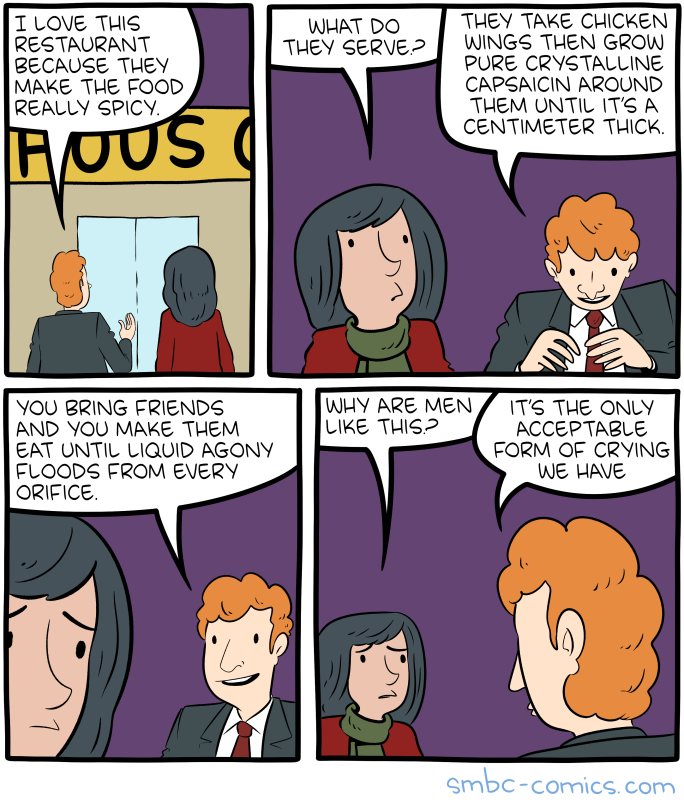
Saturday Morning Breakfast Cereal - Spicy

by tech@thehiveworks.com


Click here to go see the bonus panel!

Hovertext:
I believe this is technically possible, and I hereby make a no-liability dare.


Today's News:
12 Dec 17:35

McConnell’s plan for sham trial reveals depths of Trump’s corruption

by Greg Sargent
Let's be clear on what Trump and Republicans really are planning here.
12 Dec 17:33

New memo claims Trump didn't delay Ukraine funds: It was the OMB all along

by Mark Sumner
James.galbraith

Yeah, no

Donald Trump withheld military assistance to Ukraine because he doesn’t like foreign aid. Donald Trump withheld military assistance to Ukraine because he didn’t think Europe was sending it enough. Donald Trump withheld military assistance to Ukraine because he was concerned about corruption.

Considering the amount of testimony to the fact that Trump withheld military assistance from Ukraine because he was extorting that nation to announce “investigations” into a pair of conspiracy theories designed to give him a personal political advantage, the litany of excuses—most of which seem to have appeared ex nihilo as Republicans representatives scrambled to provide some reason, any reason, for Trump’s action—has been a bit hilarious. Especially considering that the universal statement from everyone involved in the House, Senate, State Department, Defense Department, and Office of Management and Budget was that when they tried to get an answer on why Trump was holding back the support, all they got was silence.

Throughout the House impeachment hearings, Republicans asserted one or all of the theories above, even though doing so meant drawing a ludicrous set of inferences. Now, as it turns out, they needn’t have bothered.

Because the real reason Donald Trump withheld military assistance to Ukraine was that … he didn’t. He never withheld it at all. Instead, the delay of the assistance to Ukraine was entirely the idea of the Office of Management and Budget. As The Washington Post reports, a new legal memo maintains that the whole thing was just a “programmatic delay” generated when leaders at the OMB took it on themselves to conduct a double-check to make sure the assistance was in compliance with its own rules. And they’re just getting around to explaining that … now.

Sorry about that whole impeachment thing, nation. But now that it’s clear this was all done inside the OMB, Democrats can pack away the whole process and Republicans can stop trying to think of excuses. 

However, the claims in the new legal memo—repeating: legal memo—don’t completely leave Trump out of the equation. Instead, they maintain that the decision to suspend assistance to Ukraine was made because Trump was clearly upset. Not over anything he was learning from the State Department or the review of the aid conducted by the Department of Defense—that was all completed on May 23 with a declaration that Ukraine both was making good progress on democracy and had met the legislative guidelines for handling corruption. Instead, the OMB says, it kicked off discussions on holding up hundreds of millions of dollars in vitally needed assistance because Trump got angry after he read an editorial in the right-wing Washington Examiner. Seriously.

The memo doesn’t really stop there. It doesn’t actually say that Trump got angry about the assistance after reading the Examiner editorial. It claims that Trump learned about the assistance from the editorial. Which then, according to the Post, “sent aides scrambling” to find some way to defuse Trump’s anger.

That way was to place a temporary hold on the military assistance. Eight times. In the process, two OMB officials resigned, though the legal memo denies that they resigned because of the delayed assistance. It doesn’t actually provide a reason for the resignations, but … come back soon. They’ll have one.

All of this seems amusing, and the kind of comedy of errors, everyone scurrying around the White House responding to a bellowing Trump, who doesn’t know what his own White House is doing until he reads about it in a right-wing rag, is all too believable. Don’t believe it.

Because this narrative takes Trump’s affirmative, knowledgeable, criminal actions, and turns them into bumbling nonsense. Which is awfully, awfully convenient.

12 Dec 17:32

There’s a conservative civil war raging — over porn

by Jane Coaston
James.galbraith

They're not conservatives, they're the christian taliban

Yui Mok/PA Images via Getty Images

The stakes are lot bigger than they might seem.

Social conservatives are ready to launch a new national war on pornography.

It’s been nearly 50 years since the Nixon administration’s “War on Porn” and more than two decades since the signing of the Communications Decency Act, the first major federal effort to regulate online pornography. But pornography continues to be a target of Republicans at the state level; in addition, the 2016 Republican Party platform stated that “pornography, with its harmful effects, especially on children, has become a public health crisis that is destroying the lives of millions.”

This fall, Republican members of Congress asked the Department of Justice to “declare prosecution of obscene pornography a criminal justice priority.” Conservative commentators also argue that government power can — and should — put a stop to pornography for the benefit of the “common good.” By doing so, social conservatives argue that they can alter American culture itself.

Terry Schilling, executive director of the American Principles Project, a conservative think tank, argued in October in the Catholic magazine First Things that efforts to regulate pornography are part of a broader phenomenon. “In our time, a new conservatism is being born — one less interested in managing our nation’s decline than in using political power to promote virtue, public morality, and the common good,” he wrote. “Conservatives need to overcome their fear of governing the nation that elected them.”

In doing so, social conservatives are facing opposition from libertarians as well as fellow conservatives. They argue that efforts to ban or otherwise tighten regulations on pornography is the kind of overreach they have long stood against.

As Reason Magazine editor-in-chief Katherine Mangu-Ward told me, “What you’re seeing now is this rise of a much more authoritarian and state-oriented variant of conservatism and it just says, ‘You know what? Actually, never mind. Let’s take away the bad choices. Let’s make some bad choices illegal.’ This has long been a characteristic of the American left.”

The fight over pornography is emblematic of a larger fissure within movement conservatism, one centered on crucial questions over how the powers of the state should be used or what the point of conservatism even is. Should conservatism focus on advancing individual freedoms — even the freedom to make bad decisions — or on advancing the “common good” and family values?

“We say we’re conservatives. Well, what the hell are we trying to conserve? And maybe that question really is the central question of this whole debate,” said the Daily Wire’s Matt Walsh, a social conservative who has argued in favor of a total ban on pornography.

“The welfare of our people”

On Friday, four Republican members of Congress — Reps. Mark Meadows, Jim Banks, Vicky Hartzler, and Brian Babin — penned a letter to Attorney General William Barr over their “concern for the rule of law as well as the welfare of our people.” The representatives asked Barr to “declare the prosecution of obscene pornography a criminal justice priority” worthy of the full power of the federal government.

Referencing both Barr’s anti-pornography efforts in the 1990s, when he served as an attorney general under President George H.W. Bush, and a 2016 anti-internet pornography pledge signed by then-candidate Donald Trump, the letter is a plea for the Department of Justice to enforce existing federal obscenity laws and prosecute “the major producers and distributors of such material.”

Meadows, Banks, Hartzler, and Babin argue that pornography is responsible for rising rates of violence against women as well as human trafficking. But it’s worth noting that many researchers have long debated the representatives’ premises, which are often invoked by anti-pornography advocates. For example, as Reason’s Elizabeth Nolan Brown wrote earlier this week, violent crime, including sexual assault, has decreased markedly over the past several decades. In addition, research published in the journal Aggression and Violent Behavior showed “an inverse relationship between pornography consumption and rape rates.”

Nonetheless, for some social conservatives, pornography is a clear and present danger, a health crisis as well as a moral scourge. “Porn is bound up with human trafficking,” New York Post op-ed editor Sohrab Ahmari told me in an email. “There is no way for porn consumers on aggregator sites to make sure that the women in these images aren’t exploited or coerced. Porn twists how young men think about women and sexuality. And distorts what they expect from sexual encounters. It’s degrading. Andrea Dworkin was right.”

Other conservatives also point to potential harms caused by pornography as their reason for wanting to ban it, or at least heavily restrict the industry from which much of it comes. In an opinion piece for the Washington Post, First Things senior editor Matthew Schmitz argued for an all-out ban on pornography on the basis of misogyny and the medium’s harmful impact on women:

If you cringe at Trump’s sneering misogyny, then join me in calling for a ban on the thing that made his crude appeal possible. Pornography’s enjoyments may be private, but its harms are inescapably public.

The Daily Wire’s Walsh has been one of the most outspoken conservative writers on the subject of pornography, arguing on his podcast that pornography has contributed to the “collective corruption of entire generations of children” and causes “real trauma” to children who see it. He published an article on Friday praising the group who wrote the letter to Barr:

To be clear, what they are requesting is the enforcement of existing laws that would help to tamp down some forms of pornography. They are not calling for new laws to be put on the books. Personally, I’d hope that this is a first step towards a wider-ranging war on hardcore porn, though that’s not what the lawmakers are advocating. At the very least, this should be the beginning of a conversation about the proliferation of hardcore porn, and the government’s role in addressing the problem.

(I’ll note here that the adjective “hardcore” has a specific meaning within the porn industry and in legal matters. When I spoke to Walsh, he said, “Anything that we would recognize as pornography on the internet, I would call hardcore porn.”)

Groups like the American Principles Project agree with Walsh and argue that the US government already has the means to regulate and limit the pornography industry. In the article Schilling (the American Principles Project’s executive director) wrote for First Things in October, he suggested three ways to curtail access to pornography:

  • Create an “opt-in” system in which internet service providers would be legally required to offer a filtered version of the internet, with an option for adults to access an unfiltered version.
  • Mandate “domain zoning,” by which all pornographic websites would have to use the domain “.xxx” and require site visitors to verify their age.
  • Rewrite Section 230 of the Communications Decency Act of 1996 in order to strip protections from sites that publish “obscene” materials, thus giving users the ability to sue those sites.

What is pornography? Whose “prurient interest?”

But even if Americans broadly agreed to ban pornography or restrict access to it, the debate over pornography can often get mired in definitional weeds: for example, the difference between pornography and “obscene” pornography, or even what “obscenity” is.

Obscenity laws still exist at both federal and local levels, but they rely on a unified concept of “obscenity.” And the current legal standard for what obscenity is was set in the 1973 Supreme Court case Miller v. California.

In that case (which centered on a California man who sent out fliers advertising “adult” material and was subsequently arrested), the court determined that obscene material was not protected by the First Amendment and applied the following test for determining what’s obscene and what’s not:

The basic guidelines for the trier of fact must be: (a) whether “the average person, applying contemporary community standards” would find that the work, taken as a whole, appeals to the prurient interest ... (b) whether the work depicts or describes, in a patently offensive way, sexual conduct specifically defined by the applicable state law; and (c) whether the work, taken as a whole, lacks serious literary, artistic, political, or scientific value.

Unsurprisingly, as Shannon Creasy detailed in a 2010 Georgia State University Law Review article, the Miller test “has been widely criticized as unconstitutionally vague and overbroad.”

Who is the “average” person, for example? What constitutes a “prurient interest”? And, perhaps more importantly, what is a “contemporary community standard” in the age of the internet? That’s a question that’s come up before, like in a 2008 court case in which an attorney planned to enter into evidence the Google Trends results for the city of Pensacola, Florida, in an attempt to show that, based on what people in his community were Googling, his client’s material did not meet the legal definition of breaking “contemporary community standards.”

And then there’s the question of whether pornography constitutes a form of speech protected by the First Amendment. Though the Supreme Court has ruled previously that the answer is “yes,” many on the right feel differently.

In the New York Post on Monday, Ahmari wrote that we should return to a “common-law” perspective on obscenity:

“Real originalists,” as Harvard Law School’s Adrian Vermeule quipped recently, “uphold obscenity convictions ­under the common-law rule,” the broad definition that prevailed for most of the nation’s history: Obscenity is any material with a tendency to “deprave and corrupt the morals of those whose minds are open to such influence.” PornHub would most definitely count. Indeed, the Founding generation would likely have reacted to it not with high-libertarian nostrums, but with tar and feathers.

The law as moral teacher

For several decades now, movement conservatism has adhered to Andrew Breitbart’s maxim that “politics is downstream of culture,” arguing that rather than engage the forces of government to create change, conservatives should focus on changing popular culture instead.

But some social conservatives are now arguing the very opposite. In another Schilling piece for First Things, he wrote, “But politics is not separate from culture, nor irrelevant to culture, nor downstream from culture. Politics is a key part of culture, and often drives it. The law can serve as a teacher and a guide to encourage positive behaviors and discourage negative ones.”

Jon Schweppe, the director of government affairs at the American Principles Project, told me, “We believe that law is a teacher.” Using the example of shoplifting, he added, “Everyone knows shoplifting is morally wrong, but people think about it, right? And so what ends up happening is that there’s this analysis of risk that takes place and it’s like, okay, I could steal this candy bar and I’ll probably get away [with it], but if I get caught I might go to jail. I might have a felony. And that law is what puts a lot of people over the edge.”

Arguments in favor of the use of laws to change or improve human behavior hasn’t been a characteristic of the post-2010 conservative movement that still bears the influence of the Tea Party and libertarian-leaning Republicans like former Rep. Ron Paul. In fact, Mangu-Ward told me that such arguments were, in her view, generally made by left-leaning politicians and thinkers. Referencing former New York City Mayor Michael Bloomberg’s efforts to ban large sodas, she said such rationales stem from “the idea that we should prohibit people from making bad choices,” or in short, “make the bad thing illegal.”

Mangu-Ward also said that libertarians within movement conservatism had previously been able to keep conservatives from attempting to use the law for moral improvement. But “that’s no longer the case” in 2019, she said. On that point, social conservatives seem to agree. In an article for First Things, the Daily Wire’s Josh Hammer wrote in support of the congressional letter sent to Barr, arguing that “libertarianism is uninterested in prioritizing the political pursuit of justice, the common weal, or human flourishing” and added that “at its core, libertarianism misunderstands the human condition.”

On his podcast, Walsh also mentioned the “influence of libertarianism” as a reason conservatives no longer focus on how the government can work toward the “common good,” a common refrain among some social conservatives who believe that libertarian influence has caused the right to ignore moral questions and focus too much on economics as an indicator of national well-being.

Walsh said the problem he’s noticed with libertarians is that “they tend to shy away from moral arguments, from arguments that are rooted in ideas like justice and what is good and what is right.”

He continued:

I think that that’s a major flaw and a huge problem, because at the end of the day, we have to have some conception of what the government is, why it’s instituted, what [it] fundamentally is supposed to be doing.

You have the left that’s always making moral arguments and always making arguments about justice. I think conservatives like to make fun of social justice warriors and all of that, but they’re making justice-rooted arguments. And I think the arguments are wrong, but I think we need to engage on that level and say, “No, here’s our idea of justice and what’s right and what’s good.”

“Wait a second, is this actually what conservatism is supposed to be?”

I reached out to the Department of Justice for comment on this story and have not received a response. But in a statement to the Heritage Foundation publication the Daily Signal, Barr’s office said, “We have received and are reviewing the letter” from the congressional Republicans.

As acting attorney general under President George H.W. Bush, Barr focused extensively on obscenity and pornography prosecutions, leading some in the porn industry to voice their concerns about his nomination in 2018, while anti-pornography advocates expressed hope for more action to be taken against the industry.

But this whole debate is bigger than pornography or obscenity. It’s about what the conservative movement is supposed to do, or more accurately, what conservatism even is.

Is conservatism still supportive of a limited government if that means the makers and sellers of pornographic materials go unpunished? Does it still advocate for a free market that makes pornographic material easy and readily available? If you can stop people from making bad decisions through the power of the law, should you? Social conservatives and libertarians, once unified against the common threat of communism, vigorously disagree on these questions, and many others.

Walsh told me that following his discussions and debates over pornography, “I think we’re seeing a little bit of a pushback in conservatism where people [who] are conservatives like myself are saying, ‘Wait a second, is this actually what conservatism is supposed to be?’”

12 Dec 17:21

India just redefined its citizenship criteria to exclude Muslims

by Sigal Samuel
James.galbraith

See religion as a plague

An elderly man holds a placard saying “Stop Hate Politics” during a protest against the Citizenship Amendment Bill in New Delhi, India. A man holds a placard during a protest against the Citizenship Amendment Bill in New Delhi, India. | Getty Images

With a new law — and massive new detention camps — the country is undermining its status as a democracy.

India is home to 200 million Muslims. Under Prime Minister Narendra Modi, they have faced mounting threats to their status in the majority-Hindu country. And on Wednesday, they were walloped by a new worrisome development: The upper house of India’s Parliament passed the Citizenship Amendment Bill (CAB).

The legislation turns religion into a means of deciding whom to treat as an illegal immigrant — and whom to fast-track for citizenship. The bill is being sent to President Ram Nath Kovind for his approval (he will almost certainly sign it), and then it will become law.

At first glance, the bill may seem like a laudable effort to protect persecuted minorities. It says Hindus, Sikhs, Buddhists, Jains, Parsis, and Christians who came to India from Afghanistan, Bangladesh, and Pakistan won’t be treated as illegal. They’ll have a clear path to citizenship.

But one major group has been left out: Muslims.

That’s no coincidence.

The CAB is closely linked with another contentious document: India’s National Register of Citizens (NRC). That citizenship list is part of the government’s effort to identify and weed out people it claims are illegal immigrants in the northeastern state of Assam. India says many Muslims whose families originally came from neighboring Bangladesh are not rightful citizens, even though they’ve lived in Assam for decades.

When the NRC was published in August, around 2 million people — many of them Muslims, some of them Hindus — found that their names were not on it. They were told they had a limited time in which to prove that they are, in fact, citizens. Otherwise, they can be rounded up into massive new detention camps and, ultimately, deported.

So far, this measure affects potentially 2 million people, not all 200 million Muslims in India. However, Modi’s ruling Bharatiya Janata Party (BJP) has said it plans to extend the NRC process across the country.

Muslims have faced increasing discrimination and violence over the past few years under Modi’s BJP. But the one-two punch of the NRC followed by the CAB takes this to a new level. The country is beginning to look less like a secular democracy and more like a Hindu nationalist state.

If the Indian government proceeds with its plan, in a worst-case scenario we could be looking at the biggest refugee crisis on the planet. The United Nations, Human Rights Watch, and the US Commission on International Religious Freedom have all warned that this could soon turn into a humanitarian disaster of horrifying proportions.

The Citizenship Amendment Bill

The CAB is only the latest measure the Indian government has taken to marginalize its Muslim minority (more on this below). This measure is particularly blatant in its discrimination.

The CAB will grant citizenship to a host of religious minorities who fled three nearby countries where they may have faced persecution — Afghanistan, Bangladesh, and Pakistan — before 2015. But Muslims will get no such protection.

The BJP is positioning the CAB as a means of offering expedited citizenship to persecuted minorities. “It seeks to address their current difficulties and meet their basic human rights,” said Raveesh Kumar, a spokesman for the country’s Ministry of External Affairs. “Such an initiative should be welcomed, not criticized by those who are genuinely committed to religious freedom.”

After the CAB passed on Wednesday, Modi tweeted: “A landmark day for India and our nation’s ethos of compassion and brotherhood! ... This Bill will alleviate the suffering of many who faced persecution for years.”

In fact, this bill is likely to increase the suffering of many Muslims and is discriminatory on its face, as some of the BJP’s political opposition and several human rights advocates in India have noted.

Shashi Tharoor, whose Congress party opposes the CAB, dubbed it “fundamentally unconstitutional.”

Cedric Prakash, a Jesuit priest and human rights advocate, said in an emailed statement that by “assuring citizenship to all undocumented persons except those of the Muslim faith, the CAB risks ... destroying the secular and democratic tenets of our revered Constitution.”

India’s Constitution guarantees everyone equality under the law. Religion is not a criterion for citizenship eligibility, a decision that goes all the way back to the 1940s, when India was founded as a secular state with special protections for minorities like Muslims.

Harsh Mander, a noted rights advocate of Sikh origins, wrote that the CAB represents “the gravest threat to India’s secular democratic Constitution since India became a republic.” He said that if the bill becomes law, he’ll declare himself a Muslim out of solidarity. Meanwhile, he’s also calling for Indians to fight the CAB with a nationwide civil disobedience movement.

Already, protests are underway. In Assam’s capital, authorities have shut down the internet and implemented a curfew. The New York Times reported:

The Indian Army was deployed in the northeastern states of Assam and Tripura as protests grew bigger and more violent. The police were already battling demonstrators over the past few days with water cannons and tear gas. More than 1,000 protesters gathered in the heart of Assam’s commercial capital, Guwahati, yelling: “Go Back Modi!” In other areas, angry men stomped on effigies of Mr. Modi. Crowds set fire to tires and blocked thoroughfares with trees.

As protests against the legislation erupted in different corners of the country, the debate centered on what kind of country India should be.

“The idea of India that emerged from the independence movement,” said a letter signed by more than 1,000 Indian intellectuals, “is that of a country that aspires to treat people of all faiths equally.” But this bill, the intellectuals said, is “a radical break with this history” and will “greatly strain the pluralistic fabric of the country.”

Meanwhile, international human rights organizations are up in arms. The US Commission on International Religious Freedom said India is taking a “dangerous turn in the wrong direction,” adding that the US should weigh sanctions against India if it enshrines the bill in law.

Activists from All Assam Students Union burn effigies of India’s Prime Minister Narendra Modi and others associated with the Citizenship Amendment Bill. Getty Images
Activists from All Assam Students’ Union burn effigies of India’s Prime Minister Narendra Modi and others associated with the Citizenship Amendment Bill.

However, Modi enjoys strong support from the Hindu majority, members of which seem to applaud him even more loudly when he cracks down on Muslims. And the country has swung to the right since he first came to power in 2014. It’s noteworthy that the bill passed not only in the lower house of parliament, where the BJP enjoys a majority, but also in the upper house, where it does not.

Now, the CAB will almost certainly be signed into law. The only hope for those who oppose it is that it will be struck down in court on the grounds that it’s unconstitutional.

Muslims stripped of citizenship may end up in massive detention camps

Exacerbating Muslim Indians’ anxiety about the citizenship bill is the recent rhetoric around the NRC.

Those in Assam whose names do not appear on the NRC have been told the burden of proof is on them to prove that they are citizens. But many rural residents don’t have birth certificates or other papers, and even among those who do, many can’t read them; a quarter of the population in Assam state is illiterate.

Residents do get the chance to appeal to a Foreigners’ Tribunal and, if it rejects their claims to citizenship, to the High Court of Assam or even the Supreme Court. But if all that fails, they can be sent to one of 10 mass detention camps the government plans to build, complete with boundary walls and watchtowers.

The first camp, currently under construction, is the size of seven football fields. Even nursing mothers and children will be held there. “Children lodged in detention centers are to be provided educational facilities in nearby local schools,” an Indian official said.

If the detainees in the camps end up being expelled from India — and that is the government’s plan — this could constitute a wave of forced migration even greater than that triggered by Myanmar in 2017, when hundreds of thousands of Rohingya Muslims were displaced.

And it’s not clear where the newly stateless people would go. Neighboring Bangladesh has already said it won’t take them. All this has induced such intense anxiety that some Muslims are committing suicide.

By undermining the status of Muslims, India is undermining its own democracy

India is known as the largest democracy in the world. But its current government is leading it away from democratic norms.

Modi champions a hardline brand of Hindu nationalism known as Hindutva, which aims to define Indian culture in terms of Hindu history and values and which promotes an exclusionary attitude toward Muslims. UN human rights chief Michelle Bachelet recently expressed concerns over “increasing harassment and targeting of minorities — in particular, Muslims.”

Under Modi, vigilante Hindus have increasingly perpetrated hate crimes against Muslims, sometimes in an effort to scare their communities into moving away, other times to punish them for selling beef (cows are considered sacred in Hinduism). And this summer, Modi erased the statehood of Jammu and Kashmir, India’s only Muslim-majority state, which had previously enjoyed considerable autonomy over its own affairs.

Muslims comprise approximately 14 percent of the national population. and more than twice that in Assam state. In the 2019 Indian election, one of Modi’s central campaign promises was that he’d get the NRC in shape and deal with the Muslim migrants in Assam once and for all. Other BJP members have used dehumanizing language to describe the Muslims there.

“These infiltrators are eating away at our country like termites,” BJP president and home minister Amit Shah said at an April rally. “The NRC is our means of removing them.” Shah has openly said the goal is to deport those who are deemed illegal immigrants.

Last month, Shah said the government will conduct another count of citizens — this time nationwide. This could be used to clamp down on Muslims throughout India, potentially triggering a huge humanitarian disaster.

Sign up for the Future Perfect newsletter. Twice a week, you’ll get a roundup of ideas and solutions for tackling our biggest challenges: improving public health, decreasing human and animal suffering, easing catastrophic risks, and — to put it simply — getting better at doing good.

12 Dec 17:18

One Million People Sign Petition Calling on Netflix to Pull Gay Jesus TV Special in Brazil: WATCH

by Andy Towle
James.galbraith

oh poor persecuted christians, someone's poking fun at them? however will their tender feelings survive.

Netflix has sparked outrage from religious conservatives in Brazil over The First Temptation of Christ, a holiday comedy special depicting Jesus as a gay man.

Nearly one million people (and counting, as of this posting) have signed a Change.org petition calling on Netflix to pull the show.

Says the Netflix synopsis: “Jesus, who’s hitting the big 3-0, brings a surprise guest to meet the family. A Christmas special so wrong, it must be from comedians Porta dos Fundos.”

The NY Daily News reports: “The First Temptation of Christ is the second satirical take on Christmas brought to the web screen by the International Emmy-winning comedy group Porta dos Fundos (or “backdoor” in English), a popular comedy troupe with over 16 million YouTube subscribers. In the 46-minute-long comedy, Jesus and his new friend Orlando arrive at Mary and Joseph’s house, where a group of friends are waiting to throw the Son of God a surprise birthday bash.”

Eduardo Bolsonaro, the son of right-wing Brazilian president Jair Bolsonaro, supported the boycott, tweeting, “We are in favor of freedom of expression, but is it really worth attacking the faith of 86% of the population??

Check out the trailer below:

The post One Million People Sign Petition Calling on Netflix to Pull Gay Jesus TV Special in Brazil: WATCH appeared first on Towleroad Gay News.

12 Dec 17:11

Millennials Are Leaving Religion And Not Coming Back

by Daniel Cox and Amelia Thomson-DeVeaux
James.galbraith

Religion is a cancer. Good riddance.

Millennials have earned a reputation for reshaping industries and institutions — shaking up the workplace, transforming dating culture, and rethinking parenthood. They’ve also had a dramatic impact on American religious life. Four in ten millennials now say they are religiously unaffiliated, according to the Pew Research Center. In fact, millennials (those between the ages of 23 and 38) are now almost as likely to say they have no religion as they are to identify as Christian. 29

For a long time, though, it wasn’t clear whether this youthful defection from religion would be temporary or permanent. It seemed possible that as millennials grew older, at least some would return to a more traditional religious life. But there’s mounting evidence that today’s younger generations may be leaving religion for good.

Social science research has long suggested that Americans’ relationship with religion has a tidal quality — people who were raised religious find themselves drifting away as young adults, only to be drawn back in when they find spouses and begin to raise their own families. Some argued that young adults just hadn’t yet been pulled back into the fold of organized religion, especially since they were hitting major milestones like marriage and parenthood later on.

But now many millennials have spouses, children and mortgages — and there’s little evidence of a corresponding surge in religious interest. A new national survey from the American Enterprise Institute of more than 2,500 Americans found a few reasons why millennials may not return to the religious fold. (One of the authors of this article helped conduct the survey.)

  • For one thing, many millennials never had strong ties to religion to begin with, which means they were less likely to develop habits or associations that make it easier to return to a religious community.
  • Young adults are also increasingly likely to have a spouse who is nonreligious, which may help reinforce their secular worldview.
  • Changing views about the relationship between morality and religion also appear to have convinced many young parents that religious institutions are simply irrelevant or unnecessary for their children.

Millennials may be the symbols of a broader societal shift away from religion, but they didn’t start it on their own. Their parents are at least partly responsible for a widening generational gap in religious identity and beliefs; they were more likely than previous generations to raise their children without any connection to organized religion. According to the AEI survey, 17 percent of millennials said that they were not raised in any particular religion compared with only five percent of Baby Boomers. And fewer than one in three (32 percent) millennials say they attended weekly religious services with their family when they were young, compared with about half (49 percent) of Baby Boomers.

A parent’s religious identity (or lack thereof) can do a lot to shape a child’s religious habits and beliefs later in life. A 2016 Pew Research Center study found that regardless of the religion, those raised in households in which both parents shared the same religion still identified with that faith in adulthood. For instance, 84 percent of people raised by Protestant parents are still Protestant as adults. Similarly, people raised without religion are less apt to look for it as they grow older — that same Pew study found that 63 percent of people who grew up with two religiously unaffiliated parents were still nonreligious as adults.

But one finding in the survey signals that even millennials who grew up religious may be increasingly unlikely to return to religion. In the 1970s, most nonreligious Americans had a religious spouse and often, that partner would draw them back into regular religious practice. But now, a growing number of unaffiliated Americans are settling down with someone who isn’t religious — a process that may have been accelerated by the sheer number of secular romantic partners available, and the rise of online dating. Today, 74 percent of unaffiliated millennials have a nonreligious partner or spouse, while only 26 percent have a partner who is religious.

Luke Olliff, a 30-year-old man living in Atlanta, says that he and his wife gradually shed their religious affiliations together. “My family thinks she convinced me to stop going to church and her family thinks I was the one who convinced her,” he said. “But really it was mutual. We moved to a city and talked a lot about how we came to see all of this negativity from people who were highly religious and increasingly didn’t want a part in it.” This view is common among young people. A majority (57 percent) of millennials agree that religious people are generally less tolerant of others, compared to only 37 percent of Baby Boomers.

Young adults like Olliff are also less likely to be drawn back to religion by another important life event — having children. For much of the country’s history, religion was seen as an obvious resource for children’s moral and ethical development. But many young adults no longer see religion as a necessary or even desirable component of parenting. Less than half (46 percent) of millennials believe it is necessary to believe in God to be moral. They’re also much less likely than Baby Boomers to say that it’s important for children to be brought up in a religion so they can learn good values (57 percent vs. 75 percent).

These attitudes are reflected in decisions about how young adults are raising their children. 45 percent of millennial parents say they take them to religious services and 39 percent say they send them to Sunday school or a religious education program. Baby Boomers, by contrast, were significantly more likely to send their children to Sunday school (61 percent) and to take them to church regularly (58 percent).

Mandie, a 32-year-old woman living in southern California and who asked that her last name not be used, grew up going to church regularly but is no longer religious. She told us she’s not convinced a religious upbringing is what she’ll choose for her one-year-old child. “My own upbringing was religious, but I’ve come to believe you can get important moral teachings outside religion,” she said. “And in some ways I think many religious organizations are not good models for those teachings.”

Why does it matter if millennials’ rupture with religion turns out to be permanent? For one thing, religious involvement is associated with a wide variety of positive social outcomes like increased interpersonal trust and civic engagement that are hard to reproduce in other ways. And this trend has obvious political implications. As we wrote a few months ago, whether people are religious is increasingly tied to — and even driven by — their political identities. For years, the Christian conservative movement has warned about a tide of rising secularism, but research has suggested that the strong association between religion and the Republican Party may actually be fueling this divide. And if even more Democrats lose their faith, that will only exacerbate the acrimonious rift between secular liberals and religious conservatives.

“At that critical moment when people are getting married and having kids and their religious identity is becoming more stable, Republicans mostly do still return to religion — it’s Democrats that aren’t coming back,” said Michele Margolis, author of “From the Politics to the Pews: How Partisanship and the Political Environment Shape Religious Identity.” in an interview for our September story.

Of course, millennials’ religious trajectory isn’t set in stone — they may yet become more religious as they age. But it’s easier to return to something familiar later in life than to try something completely new. And if millennials don’t return to religion and instead begin raising a new generation with no religious background, the gulf between religious and secular America may grow even deeper.

12 Dec 04:06

Low-Risk Ultrasound Procedure Destroys 80 Percent of Prostate Cancers In One-Year Study

by BeauHD
James.galbraith

Impressive

An anonymous reader quotes a report from SlashGear: A new treatment shows promise for revolutionizing prostate cancer treatment, offering a minimally-invasive and relatively low-risk alternative to traditional surgeries and radiotherapies. Called TULSA, this method uses sound waves to eliminate the diseased tissue in the prostate, leaving the rest of the healthy tissues behind. According to the researchers, patients treated with this method experience "minimal side effects." The transurethral ultrasound ablation (TULSA) method uses an MRI to guide the procedure, which involves inserting a rod through the urethra into the prostate, where it uses heat via sound waves to destroy the cancerous tissues. Unlike the surgery typically used to treat this condition, TULSA is minimally invasive and can be performed as an outpatient procedure. Using guided and controlled sound waves, doctors are able to preserve the nerves near the prostate while eliminating the diseased tissues using a total of 10 elements located on the insertable rod. A software algorithm is part of the system -- it controls the strength, direction, and shape of the ultrasound beam, though doctors watch carefully using the MRI in real-time. A new study involving 115 men found that the average treatment time for this procedure is a bit less than an hour. The researchers found that 80-percent of patients experienced elimination of "clinically significant" cancer and that 72 of the men had no signs of cancer after the first year. As well, incontinence was a very rare side effect of the procedure, which also had low instances of impotence.

Share on Google+

Read more of this story at Slashdot.

12 Dec 03:52

Pawn shop worker saves falling infant while distracted mom shops for shotguns

by Walter Einenkel
James.galbraith

Rural Utah family values

Video from a security camera inside of the Family Pawn Shop in Hurricane, Utah, has been making the rounds for cringe-inducing reasons. The video shows two women looking at a rifle that’s resting on a glass case. They admire that rifle, as a shop person ostensibly tries to sell them the firearm. There is nothing particularly interesting about watching someone fetishize a gun. However, sitting next to the women on the glass case, with their back to the gun enthusiasts, is an infant, semi-swaddled in a camouflage blanket (or possibly jacket).

The glass case is reportedly rises 3.5 feet off the concrete flooring of the shop. The baby is sitting up in that wobbly way that infants who are newly upright sit. The three people continue to stare at the gun and flip it about while the infant slowly begins to fall over and off of the case. Luckily, the manager walking the floor of the pawn shop is actually paying attention to the only thing worth anything in the store, and is able to heroically run over and catch the child before the infant hits the floor—head first.

The manager, Bill Reel, told CBS 17 that he “just saw the baby look unsteady and I just booked it that way.” He said he was happy that the child didn’t get hurt, but the whole experience stressed him out. “I was scared to death. My heart was racing. I was pretty shaken up. I held the baby for a couple of seconds, and then gave it back to I believe, grandma.”

Being a parent is tough. Having a small child is incredibly tough, and frequently the tragic and truly awful stories one reads about parents forgetting their infant children in hot cars and the like can be very directly attributed to the profound levels of sleep deprivation that parents, and especially working parents, deal with in the modern era. But what is happening here is not that.

The first thing to know is that this is a baby—an infant, and not a toddler. That child cannot toddle yet, they are far too little. And having had two infants in my life and under my care, I can tell you accidents happen. You put your infant on the couch and turn to grab something in the kitchen and you come back and your baby was able to get themselves to the end of the couch and fall off? That can happen a lot easier than you’d think. Lesson learned.

You put your baby on a glass case more than a yard off the floor in a store and then forget about your baby as you admire a gun you are thinking of getting someone for Christmas? That cannot happen. That’s a dumb and dangerous thing to happen. If you put your infant on the edge of your dining room table and then decided to inspect your rifle with your back to your baby, you would be considered an idiot. You sit your infant on the edge of the hood of your car and then check the scope of your gun by pointing it at your chimney? You are being an unsafe asshole.

For all of the talk about guns and hunting and families with long traditions of those things, the fact of the matter is that far too many “responsible” gun owners suck at being safe around guns. Study after study and statistics on accidental gun deaths and children show that even those Americans who believe themselves to be smart and responsible about guns are frequently full of shit because nothing bad has yet to happen to them. If you want to have a society where you are allowed to have guns, then you need to act like those guns are as serious as they are. 

The two women in that store made a terrible mistake and were lucky that Bill Heel was watching their charge when they were being neglectful. Stories like this one will be pointed to as shaming the ladies in the video and being intolerant of gun culture in general, and there is something true in that. But this is a moment of shame and luckily just embarrassment for those two women, who could have been spending the next 24 hours beating themselves up in an emergency room. 

Warning: The video is distressing.

x

And CBS 17’s news story below.

x x YouTube Video

11 Dec 22:44

Trump abandons fight to shutter federal agency because his television told him to

by Hunter
James.galbraith

Jesus fucking christ

One of the Trump administration's hard-right goals of drowning the government in a bathtub has taken a major hit, as The Washington Post reports that Donald Trump has abandoned his effort to shut down completely the Office of Personnel Management. The effort, which would have moved OPM operations to the General Services Administration, was never likely to be successful. It faced considerable opposition from lawmakers, who considered the plan to be, well, unhelpful at best.

The reason Team Trump has had to give up the fight, though, is both interesting and hilarious. Trump reportedly made the decision based on something he saw on his idiot box. "Trump soured on continuing the fight after seeing an obscure television program about government while he was in the residence," the Post reports, citing anonymous White House officials.

Whatever "obscure" program Trump was watching, it convinced him that he wasn't going to win that fight and that trying would "bring him poor reviews." Unindicted international extortion schemer and current acting chief of staff Mick Mulvaney and other conservative bonesaw-wielders tried to convince him to keep up the fight, says the Post, but were unsuccessful.

So there you go. Trump may have surrounded himself with the most hardline conservative reactionaries in Republicanism, but once again we see that even they are no match for his most trusted adviser of all: his television set.

11 Dec 22:03

America’s weak gun laws enable shootings by terrorists and extremists

by German Lopez
James.galbraith

They just slap the last 2/3 of this article on every mass shooting notice, because it matters and isn't getting any better.

A Jersey City, New Jersey, police officer reacts at the scene of a mass shooting on December 10, 2019. A Jersey City, New Jersey, police officer reacts at the scene of a mass shooting on December 10, 2019. | Rick Loomis/Getty Images

When it’s easy for anyone to get a gun, even people with very bad intentions can get their hands on a firearm.

On Friday, a Saudi aviation student killed three people at the Naval Air Station in Pensacola, Florida. The FBI said it will conduct its investigation “with the presumption that this was an act of terrorism.”

Then, on Tuesday, gunmen with apparent links to the Black Hebrew Israelite movement, which has been labeled a hate group by the Southern Poverty Law Center, killed four others at a kosher supermarket in Jersey City, New Jersey.

The investigations into both shootings are still in the very early stages, but both appear to be forms of terrorism or hate crimes. Officials in Jersey City first said the gunmen seemed to randomly choose the kosher market for the shooting, but Mayor Steven Fulop has since said that “we now believe the active shooters targeted the location they attacked” — making the shooting, potentially, an anti-Semitic attack.

We’re sure to learn a lot more about the shooters and their motives in the coming days, weeks, and months, including whether these truly were terrorist attacks or hate crimes.

But we already know one thing: America’s weak gun laws make it much easier to commit shootings like these. This is a widely known fact, including among terrorist groups. Back in 2011, a now-dead American al-Qaeda operative, Adam Gadahn, said as much in a video to supporters:

In the West, you’ve got a lot at your disposal. Let’s take America for example. America is absolutely awash with easily obtainable firearms. You can go down to a gun show at the local convention center and come away with a fully automatic assault rifle without a background check, and most likely without having to show an identification card. So what are you waiting for?

Gadahn’s assertions weren’t quite right. (Fully automatic weapons are highly regulated in the US, though semiautomatic assault weapons can be bought at stores and gun shows.) But the sentiment is true: It is fairly easy for just about anyone with any motive to get a gun in the US and to use it for horrible attacks, because the country’s gun laws are so lax and make it so easy to get a firearm.

We already know, for example, that the Pensacola shooter managed to obtain the handgun he used legally by showing a valid hunting license, which is one of the exceptions that let foreign nationals obtain firearms in the US. This is the type of loophole that’s popped up again and again in the aftermath of mass shootings.

So once again, the problem here is the guns. No other country in the world has as many guns as the US, and other developed nations have significantly stricter gun laws. That’s what makes America so vulnerable, both to shootings motivated by extremist views and to other kinds of gun violence.

America’s gun problem, briefly explained

Every country is home to extremists and other hateful individuals. People of every country get into arguments and fights with friends, family, and peers. But in the US, it’s much more likely that someone who’s extreme, hateful, or otherwise angry is able to pull out a gun and kill someone — there are so many guns around and few barriers to obtaining the weapons.

It comes down to two basic problems.

First, America has uniquely weak gun laws. Other developed nations require one or more background checks (at the very least) to purchase a gun, and almost always something more rigorous beyond that, from specific training courses to rules for locking up firearms to more arduous licensing requirements to specific justifications, besides self-defense, for wanting to own a firearm.

In the US, even a background check isn’t an absolute requirement: Current federal law is riddled with loopholes and hampered by poor enforcement, so there are many ways around even basic background checks. And if a state enacts measures that are stricter than federal laws, someone can simply cross state lines to buy guns in a jurisdiction with looser rules. There are simply very few barriers, if any, to getting a gun in the US.

Second, the US has a ton of guns. It has far more than not only other developed nations but also any other country, period. In 2017, the estimated number of civilian-owned firearms in the US was 120.5 guns per 100 residents, meaning there were more firearms than people. The world’s second-ranked country for guns was Yemen, a quasi-failed state torn apart by civil war, where there were 52.8 guns per 100 residents, according to an analysis from the Small Arms Survey.

A chart showing civilian gun ownership rates by country. Small Arms Survey

These factors combined make it uniquely easy for someone with violent intent to find a firearm, allowing them to carry out a horrific shooting.

This is borne out in statistics that show America experiences far more gun violence than other developed nations. The US has nearly six times as many gun homicides as Canada, more than seven times that of Sweden, and nearly 16 times that of Germany, according to UN data for 2012 compiled by the Guardian. (These gun deaths are one reason America has a much higher homicide rate, which includes non-gun deaths, than the rest of the developed world.)

A chart shows America’s disproportionate levels of gun violence. Javier Zarracina/Vox

If having so many guns around actually made the US safer, as the National Rifle Association and pro-gun politicians claim, America would have one of the lowest rates of gun violence in the world. But the statistics suggest that, in fact, the opposite is true.

The research, compiled by the Harvard School of Public Health’s Injury Control Research Center, is also pretty clear: After controlling for variables such as socioeconomic factors and other crime, places with more guns have more gun deaths. Researchers have found this to be true not only with homicides but also with suicides (which, in recent years, comprised around 60 percent of US gun deaths), domestic violence, violence against police, and mass shootings.

As a breakthrough analysis by UC Berkeley’s Franklin Zimring and Gordon Hawkins in the 1990s found, it’s not that the US has more crime than other developed countries. This chart, based on data from Jeffrey Swanson at Duke University, demonstrates that the US is not an outlier when it comes to overall crime:

A chart showing crime rates among wealthy nations.

Instead, the US appears to have more lethal violence specifically, driven in large part by the prevalence of guns.

“A series of specific comparisons of the death rates from property crime and assault in New York City and London show how enormous differences in death risk can be explained even while general patterns are similar,” Zimring and Hawkins wrote. “A preference for crimes of personal force and the willingness and ability to use guns in robbery make similar levels of property crime 54 times as deadly in New York City as in London.”

A chart showing homicides among wealthy nations.

Researchers have found that stricter gun laws could help. A 2016 review of 130 studies in 10 countries, published in Epidemiologic Reviews, found that new legal restrictions on owning and purchasing guns tend to be followed by a drop in gun violence, a strong indicator that restricting access to guns can save lives. A review of the US evidence by RAND also linked some gun control measures, including background checks, to lower rates of injuries and deaths. A growing body of evidence from Johns Hopkins researchers further supports the efficacy of laws that require a license to buy and own guns.

That doesn’t mean bigots and extremists will never be able to carry out shootings in places with stricter gun laws. Even the strictest gun laws can’t prevent every shooting.

Guns are not the only contributor to violence, either. Other factors include, for example, poverty, urbanization, alcohol consumption, and the strength of criminal justice systems.

But when researchers control for other confounding variables, they have found time and time again that America’s loose access to guns is a major reason the US is much worse off than its developed peers in terms of gun violence.

With its lax laws and abundance of firearms, America makes it uniquely easy for people to commit horrific gun violence. Until the US confronts that issue, it will continue to see mass shooting after mass shooting — including some that may be hate crimes or acts of terrorism.

For more on America’s gun problem, read Vox’s explainer.

11 Dec 22:01

Trump’s speech in Hershey revealed a presidency off the rails

by Aaron Rupar
James.galbraith

And the GOP is fine with this

President Trump Holds Campaign Rally In Hershey, Pennsylvania Trump speaks in Hershey, Pennsylvania, on Tuesday. | Mark Makela/Getty Images

It was one of his ugliest rallies yet — and put the stakes of 2020 in sharp relief.

As House Democrats prepare to vote on articles of impeachment related to his alleged abuse of power and obstruction of Congress, President Donald Trump gave a speech at a campaign rally on Tuesday night in Hershey, Pennsylvania, that highlighted many of the reasons people feel that the country will struggle to withstand another year of this — even in the likely event that the Senate doesn’t end up removing him from office.

Over the course of a more than 90-minute delivery, Trump pushed conspiracy theories and blatant lies, trashed law enforcement officials that aren’t blindly loyal to him, exhibited thuggish tendencies toward protesters, made misogynistic remarks, and demonstrated that he fundamentally misunderstands the Constitution.

It was one of his most troubling performances in recent memory and served as a stark illustration of just how ugly Trump’s reelection campaign will be.

“That’s what I heard. I don’t know if it’s true.”

As the president, Trump has access to information and briefings from some of the world’s top intelligence professionals. And yet he can’t seem to stop himself from spreading rumor and innuendo in an effort to demean his political foes.

During a portion of his speech on Tuesday in which he demeaned both the FBI rank-and-file and bureau leadership, Trump out of nowhere suggested, without evidence, that former FBI agent Lisa Page took out a restraining order against former FBI agent Peter Strzok. Strzok and Page became become right-wing punching bags and the subject of conspiracy theories after it was revealed that while in the course of having an affair with eachother during their FBI tenures, the two shared personal text messages in which they expressed anti-Trump opinions.

“Did I hear he needed a restraining order after this whole thing, from Lisa? That’s what I heard. I don’t know if it’s true,” Trump said.

Page herself later tweeted that Trump’s claim is “a lie,” adding, “Nothing like this ever happened.”

It obviously doesn’t take much to debunk a claim of this sort. But the point is that the president is shameless enough to push them in the first place. Fact-checks and logical reasoning have a hard time dealing with Trump’s firehose of nonsense.

“You have great people in the FBI, but not in leadership.”

Trump’s comments about Strzok and Page were part of his broader attack on the FBI. Hours after Trump lashed out at FBI Director Christopher Wray for telling the truth about an Inspector General report that concluded the origins of the bureau’s Russia investigation weren’t tainted by political bias, Trump took aim at his hand-picked director once again.

“You have great people in the FBI, but not in leadership. You have not good people in leadership,” Trump said.

Later, while lamenting how the FBI “destroyed the lives of people” who were associated with his campaign — a comment alluding apparently to people like Paul Manafort and Roger Stone — Trump referred to FBI agents as “scum.”

“Their lives have been destroyed by scum, ok? By scum,” Trump said, before hyping a forthcoming report by US Attorney John Durham that apparently will be harsher on the FBI than the just-released IG report.

Not only were these comments ugly, but they demonstrate how Trump demands total personal loyalty from law enforcement agencies that in theory are supposed to operate independently of partisan politics. But to Trump, if the FBI director speaks the truth and refuses to validate conspiracy theories about anti-Trump bias in the FBI, then he’s not the right person for the job. If bureau brass goes after his associates, they’re “scum.” If the Inspector General was appointed by Barack Obama, then his work is inherently suspect.

Open thuggishness and misogyny

Trump has been accused of sexual misconduct by more than 20 women, and yet during his speech in Hershey he tried to politicize sex crimes committed by undocumented immigrants. He gloated about how his use of a racial slur hurt Sen. Elizabeth Warren’s poll numbers — “she opened that fresh mouth of hers and it stopped,” he said — and at another point, told a story in which he referred to Warren’s marriage as “a phony, disgusting deal.”

When his speech was disrupted by a protester, Trump lamented that security wasn’t rougher with her, saying, “that particular guy wanted to be so politically correct. Ahhh! Ahhh! We don’t want to be political correct!”

Later, Trump referred to House Intelligence Committee Chair Adam Schiff as a “crooked bastard” and seemed to barely catch himself from wishing physical harm upon him.

But perhaps even more ominously, Trump warned of doomsday if he doesn’t win reelection next year.

“At stake in our present battle is the survival of the American nation itself. We will destroy our country if these people get in,” Trump said.

When he wasn’t warning of the apocalypse if he doesn’t win a second term, Trump teased shredding the Constitution by serving as many as 29 years in office.

Though Trump took pains to point out that he’s kidding, this particular “joke” has become such a staple of his speeches that one can’t help but wonder.

Up is down

Less than a week after video of Canadian Prime Minister Justin Trudeau and European leaders mocking him at a NATO summit went viral, Trump claimed, absurdly, that “this country is so respected. And we were not respected four years ago. We were laughed at.” And just hours after a federal judge blocked his plan to spend billions of military dollars on his border wall, Trump said “we’re building it and it’s fine and we have the military money coming in from the military. Believe me ... we started winning in court.”

Trump described the whistleblower complaint that initially sounded the alarm about his dealings with Ukraine as incorrect, despite the fact that every key allegation in it has been corroborated. As his speech wound down, Trump proclaimed “we support, protect, and defend the Constitution of the United States.” But earlier in the speech he described Democrats’ efforts to follow the impeachment process as specified in that very same Constitution as an attempt to “overthrow our democracy.”

Many more examples of ugliness from just Trump’s speech in Hershey could be cited. He sensationalized crimes committed by undocumented immigrants in gory detail — “last summer at least 19 illegal aliens were charged in connection with grizzly homicides, including hacking victims to death and ripping out, in two cases, their hearts,” he said — and made a variety of false accusations against Democrats, including that they want “to get rid of religion” and support infanticide. He also expressed his usual tragicomical level of ignorance about how wind energy works.

The dark spectacle doesn’t necessarily bolster Democrats’ impeachment case, but it does illustrate what the stakes are — not only of a possible impeachment trial, but of the 2020 campaign. Watching Trump deliver such a nakedly authoritarian speech behind the presidential seal made it hard to shake the thought that the election that really mattered was 2016.


The news moves fast. To stay updated, follow Aaron Rupar on Twitter, and read more of Vox’s policy and politics coverage.

11 Dec 21:56

In two minutes of questioning, Amy Klobuchar demolishes Republican spin on FBI Russia probe report

by Joan McCarter
James.galbraith

Actual competence, what a delight

Sen. Amy Klobuchar showed her former-prosecutor chops in Wednesday's Senate Judiciary Committee hearing, in which Justice Department inspector general Michael Horowitz testified about his examination of the probe conducted by the FBI into Russian efforts at interference in the Trump campaign and the 2016 election. In a rapid-fire question-and-answer portion of her questioning, Klobuchar and Horowitz deflated the Republican "witch hunt" talking points.

First off, Russian interference: "Does anything in your report call into question the finding in the special counsel's report that the Russian government interfered in the 2016 presidential election in a sweeping and systematic fashion?" she asked. "No, it doesn't," Horowitz answered, adding that his report cites the Mueller report and others that have all outlined that interference. The follow-up from Klobuchar: "Does anything in your report call into question Chairman Burr's statement that, quote, Russia is waging an information warfare campaign against the U.S. that didn’t start and didn’t end with the 2016 election?" His answer, "No, it doesn't."

What about the Mueller report finding that "quote, the Russian government perceived it would benefit from a Trump presidency and worked to secure that outcome?" Horowitz said, "We don't take issue with any part of the special counsel's report, no."

Then, in rapid-fire back-and-forth, she asked if he had "any evidence that political bias or other improper consideration affected the FBI's decision to open the investigation into" a series of players:

George Papadopoulos. "No, we don't."

Paul Manafort? "No, we don't."

Michael Flynn? "We did not"

Carter Page? "No documentary or testimonial evidence or other evidence."

"Did your report uncover systematic political bias at the FBI?" she asked. Horowitz responded, "As to what we looked at in the openings, we did not find documentary testimonial evidence to support a finding of bias."

So much for Attorney General William Barr's disinformation campaign. This, Democrats, is how to do it. Yes, no, unambiguous, without grandstanding.

x

11 Dec 21:54

Trump's food assistance cuts will have huge ripple effect, especially for rural America

by Joan McCarter
James.galbraith

I have a hard time mustering any sympathy for GOP constituencies at this point.

The 700,000 people expected to lose food assistance because of new rules the Trump administration will put in effect next spring aren't going to be the only ones harmed by the cuts, experts say. The new rules will impose work requirements for Supplemental Nutrition Assistance Program participants ages 18 through 49 who aren't raising minor children in their homes.

These "able-bodied" adults, not all of whom are able-bodied, are all desperately poor and more likely to be people of color and/or living in rural communities. Many aren't, in fact, able-bodied, but don't have the resources to get the medical assistance they need to be deemed disabled. SNAP is the only federal benefit for which many of these people qualify. They will be expected to work—and prove they worked—20 hours a week, despite the fact that many live in communities where there aren't jobs. Many work in the gig economy, and have no way to prove their work hours.

"These are folks who are already living on the edge," Lisa Hamler-Fugitt, the executive director of the Ohio Association of Foodbanks tells Mother Jones. She adds, "It is our national nutrition safety net and it serves 40 million Americans. I've never witnessed anything like this. It's a deliberate attack." And it's another attack on rural America and economically distressed communities, where food stamps are helping to keep grocery stores open. "Grocery stores are not going to stay in those communities," Hamler-Fugitt says. "That's a quality-of-life issue for everyone." And as a food bank director, she knows the challenges. "Do not think for one minute that food banks and pantries can fill this gap."

Robert Greenstein at the Center on Budget and Policy Priorities points out that the next recession will be made substantially worse by the rule. States can currently get a waiver from the existing work requirements in the law. These new rules will make it much harder to get the waiver to allow assistance, and "far fewer areas will qualify for waivers during a widespread, national recession." He argues that this "will limit a core strength of SNAP—its responsiveness to changes in economic conditions so that individuals who lose their source of income can quickly qualify for temporary food assistance. Instead of mitigating a recession's harm, the new rule will exacerbate it."

But this administration, says Hamler-Fugitt, "doesn't give a damn" even though it's some Trump states that will be hit the hardest.

11 Dec 20:15

British PM Boris Johnson Mocked After Hiding in Fridge to Avoid Piers Morgan Interview: WATCH

by Andy Towle
James.galbraith

Profiles in conservative courage

Prime Minister Boris Johnson was mocked on social media after running into a fridge to avoid an interview with Piers Morgan on Good Morning Britain on the eve of the election.

Johnson appeared to mouth “for f**k’s sake” when approached by the reporter.

The Guardian reports: ‘The prime minister was ambushed by the Good Morning Britain producer, Jonathan Swain, during a pre-dawn visit to Modern Milkman, a business in the Tory-held constituency of Pudsey, in Yorkshire. … When Swain presses the prime minister, stating he was live on the show, Johnson replied “I’ll be with you in a second” and walked off, before Piers exclaims “he’s gone into the fridge”. Johnson walks inside a fridge stacked with milk bottles with his aides. One person can be heard saying: “It’s a bunker.”’

The post British PM Boris Johnson Mocked After Hiding in Fridge to Avoid Piers Morgan Interview: WATCH appeared first on Towleroad Gay News.