James.galbraith
Shared posts
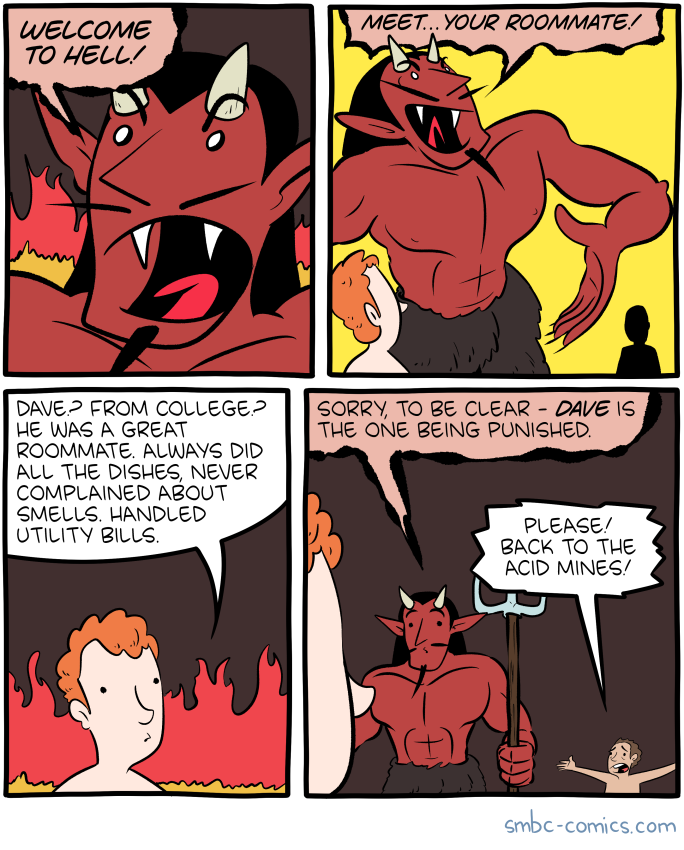
Saturday Morning Breakfast Cereal - Hell
James.galbraithlol
Click here to go see the bonus panel!
Hovertext:
At least in Hell, old dishes left in the common room just burn up.
Today's News:
Trump thanks Putin for his support as Rudy Giuliani appears on Russian TV to promote Ukraine scam
James.galbraithwtf
On Friday evening, Donald Trump found his ultimate supporter in his claims that he was completely right to extort Ukraine—Vladimir Putin. Trump presented a statement from Putin as proof that his impeachment was a “witch hunt.” And apparently an imaginary witch hunt, as Trump posted later tweets claiming he had not “really” been impeached. Not … not really.
The love affair is mutual; at least to the extent that Putin loves how Trump is weakening America, defending Russia, and attacking Ukraine. As The Independent reports, Russian state TV was also too happy to repeat an interview that Rudy Giuliani did for alt-Reich outlet OAN. Because the message that Trump and Giuliani are putting out is one that doesn’t just give Trump an excuse to squeeze Ukraine for investigations, but also one that exonerates Putin, repudiates the universal conclusion of U.S. intelligence agencies, and places the blame for hacking DNC email on Ukraine and Hillary Clinton.
All of this is especially head-smacking in light of reporting on Friday that Trump told White House staffers he “knew” that Ukraine, not Russia, was behind DNC hacking because “Putin told me.” So Trump is now claiming innocence over his involvement in extorting an investigation into a conspiracy theory, by citing the man who convinced him of the conspiracy theory.
Excerpts from Giuliani’s OAN interview, in which he supported both the theory that Hillary Clinton hired Ukrainian hackers to pretend to be Russians and steal emails from the DNC as part of an elaborate plot to set up Trump’s impeachment before he was ever elected, were run on Russia-1 on Friday. So were statements from Giuliani in which he claimed to have evidence of multiple “crimes” committed by Joe and Hunter Biden.
Journalist Rachel Maddow previously referred to OAN as “paid Russian propaganda,” after which she was sued for $10 million. However, Maddow wasn’t making up facts. She was reporting on a Daily Beast story showing that OAN reporter Kristian Brunovich Rouz was also a reporter for the Kremlin-owned Sputnik wire service. Maddow is seeking dismissal of the suit.

GM Car Executive Says Self-Driving Cars Are the Only Way Forward
James.galbraithno shit


Read more of this story at Slashdot.
Fresh off seeking foreign election interference, Trump campaign calls Democrats un-American traitors
James.galbraithBuckle up...the next 11 months are only gonna get worse
“Are you a Democrat or an American?” asked a fundraising email from the campaign of a man who’s just been impeached for pressuring a foreign country to help him out in his next election, after benefiting from foreign interference in his previous election.
The email, coming under the name of Trump 2020 campaign manager Brad Parscale, has the subject line “Make them pay,” before diving right straight into encouraging Trump supporters to see Democrats as un-American. It then goes on to claim that “229 Democratic TRAITORS voted to impeach President Trump for NO REASON other than the fact that they don't like him.” That and, you know, the fact that he withheld military aid to extort Ukraine to launch a phony investigation into a political opponent.
It’s just the latest step in setting Trump up as a king (or dictator) in the eyes of his followers, and any opposition to him as therefore straight-up illegal, treasonous, un-American. But the reality is that that is the un-American move.

A devastating report on Rep. Matt Shea finds he engaged in domestic terrorism
James.galbraithLadies and gentlemen, the GOP.
The fact that Washington state legislative officials have been sitting on the long-awaited investigative report for two weeks on Rep. Matt Shea’s activities in empowering the far right, uttering nary a peep, was already a sign that whatever it contained would be explosive. No one, however, was quite prepared for just how bad the report, released Thursday afternoon, actually turned out to be.
Shea, the report found, engaged in domestic terrorism against the United States as part of his activities. It focused particularly on his activities during the run up to the January 2016 armed standoff between federal agents and a faction of “Patriot” militiamen led by Ammon Bundy at the Malheur National Wildlife Refuge in Oregon.
“Representative Shea, as a leader in the Patriot Movement, planned, engaged in and promoted a total of three armed conflicts of political violence against the United States,” the report reads. “In one conflict Representative Shea led covert strategic pre-planning in advance of the conflict.”
Shea, who is the second-most senior member of the Washington House Republican Caucus but was demoted earlier this year, was promptly denounced by Washington Republican leaders, who urged him to resign. “Rep. Matt Shea has been suspended from any role in the House Republican Caucus,” tweeted House GOP Minority Leader J.T. Wilcox of Puyallup. “He should resign. He cannot use House Republican staff, he cannot meet with the caucus, his office will be moved.”
Good to Wilcox’s word, the GOP caucus had removed Shea’s image and name from its website on Thursday afternoon. Shea has so far declined to respond to press queries. Shea had declined to participate in the investigation, led by an independent firm overseen by a former FBI agent, the Rampart Group.
In addition to Shea’s participation in the Malheur standoff, the report cited two other armed standoffs in which the state House member had played significant roles:
In April 2014 at Bunkerville, Nevada, when he had participated in protests against the federal government and Bureau of Land Management led by rancher Cliven Bundy, mainly after an armed standoff on April 14 had nearly erupted into bloodshed. Shea was a leading figure in the parade of far-right politicos who made appearances at Bundy’s ranch afterward. The much more brief, and less reported, incident in August 2015 in Priest River, Idaho, involving a veteran who suffered a stroke and was deemed by healthcare professionals no longer eligible to possess firearms; when a Veterans Administration employee was scheduled to appear at his home to inspect and remove the man’s guns, Shea and a host of other “Patriot” movement figures showed up en masse, heavily armed, to prevent any such removal. The VA backed down. Shea, the report notes, was prepared for violence at the scene and expected a protracted standoff.Officials from the Spokane area have previously asked state Republicans to remove Shea from his seat. The focus of their ire has been Shea’s ongoing affiliations with the secessionist “Liberty” movement that seeks to create a new, militia-friendly state run by “Patriots,” along with his apparent participation in the online surveillance of his political enemies.
Shea had encouraged running “background checks” on liberal activists, and he loved to organize paramilitary “Christian” training in rural areas for boys and young men. More recently, he has compiled dossiers on his political opponents and even conducted a blacklist of people within his own network he suspected of being informants.
Shea’s online chats discussing this surveillance included exchanges about violent attacks on his critics and other “nonbelievers.” Shea also authored a text calling for a “biblical war” in order to create a “Christian” state in which anyone resisting their rule could be put to death.
Shea has been deeply involved with a radical Christian nationalist sect based in the tiny northeastern Washington town of Marble, whose members practice paramilitary techniques in the deep woods there, partially in preparation for the formation of their new state, part of a longer-term “American Redoubt” plan to form a “Patriot”-run homeland.
The proposed new state—dubbed “Liberty”—is essentially apocalyptic in nature. Shea and his fellow Liberty State advocates see it as a necessary preparation for when the rest of the world falls apart. They’ve been actively promoting it in neighboring counties.
As reporter Leah Sottile has documented extensively, the northeastern Washington community of Marble—dominated by a single Dominionist Christian church that at one time was affiliated with the racist Christian Identity movement—is the chief nexus of the Liberty State organizing. Much of it—with Shea’s avid participation—has entailed making preparations for violence with guns and other weapons. “Their whole thing is, ‘The world is evil and the government is evil’,” a longtime Marble resident told Sotille. “[They want] to get back to Puritan America.”
She described how Shea led workshops for young campers: “An exercise in field skills for youth, including (but not limited to): field strip and reassemble assigned weapon; orienteering, field dressing wounds, following orders, PT, shooting skill, etc.” He titled his after-dinner session “Going Underground.”
The 18 best TV shows of 2019
James.galbraithA very solid list, and glad to see You're the Worst on the honorable mention list. They really did wrap it up well
 Amanda Northrop/Vox
From Watchmen to Succession, from Fleabag to David Makes Man — these are the top shows of the year.
The TV of 2019 gave me hope for the medium’s future.
Don’t get me wrong: There’s still way, way too much of it (688 series airing in primetime or on a streaming service, by one count). No one person can reasonably hope to watch all of it, and no one person should try.
But in 2019, I felt like TV abruptly remembered what makes TV great, which was a feeling I didn’t have last year. More than any year since Netflix came on the scene in 2013, television was dominated by great shows that were released the old-fashioned way — week to week — and forced us all to watch new episodes more or less together.
Shows like Succession and Watchmen and Stumptown asked viewers to keep coming back, to make the time for them each week. So did two of the biggest TV stories of the year — HBO’s final season of Game of Thrones and Disney+’s Baby Yoda star vehicle The Mandalorian. And audiences obliged. Social media discussion would spike with every new episode, and what ratings data we have suggests each of these shows found an audience.
Were there great binge-watch shows, too? Of course. I would be remiss not to recognize, say, Amazon Prime Video’s Fleabag or Netflix’s Russian Doll. But in 2019, TV felt like TV again, a medium of giant stories that are, nevertheless, made up of smaller stories, and that felt good.
Here are my top 18 shows of 2019, ranked from bottom to top.
18.) Stumptown (ABC)
/cdn.vox-cdn.com/uploads/chorus_asset/file/19242430/152844_5747.jpg) ABC
ABC
ABC’s private eye show isn’t perfect. But it stars Cobie Smulders as the scuzzball detective of my dreams, and with each and every episode, it figures out a little more what it’s doing. The central trio of Smulders, Jake Johnson, and Michael Ealy gets both more comfortable and more fraught with sexual tension. And it earns bonus points for treating Smulders’s character’s bisexuality (mostly) matter-of-factly.
Stumptown airs Wednesdays at 10 pm Eastern on ABC. Previous episodes are streaming on Hulu.
17.) True Detective (HBO)
/cdn.vox-cdn.com/uploads/chorus_asset/file/14837931/8715c85fc1866edcac876a71cfd8e4fdb84a6313d825e2e4680a98ab72d03692f603bc50278483a422e24122d1cfe836.jpg) HBO
HBO
The third season of HBO’s famously uneven anthology series was its best yet, leaping across three separate decades — the 1980s, the 1990s, and the 2010s — to tell the story of one man who nearly lost himself by plunging headlong into the investigation of a missing girl. Mahershala Ali was tremendous playing versions of the central character at three distinct ages, and the final few episodes were a powerful evocation of memory and the way trauma haunts us endlessly.
True Detective is available on HBO’s streaming platforms. A fourth season has not yet been announced.
16.) Unbelievable (Netflix)
/cdn.vox-cdn.com/uploads/chorus_asset/file/19201127/UnbelievableWorkingTitle_Season1_Episode1_00_37_33_21.jpg) Netflix
Netflix
Netflix’s true-crime miniseries could be hard to stomach, despite Kaitlyn Dever’s deeply committed performance, due to its story about a young girl who was raped, then had her testimony discredited by the police. But it was also a winning cop show, with Merritt Wever and Toni Collette offering a modern riff on the female buddy cop story that was all the more remarkable for having really happened. (And, yes, these first three shows are all variations on the detective show, which had a good year.)
Unbelievable is streaming on Netflix.
15.) The Magicians (Syfy)
/cdn.vox-cdn.com/uploads/chorus_asset/file/16180108/NUP_186685_0012.jpg) SYFY
SYFY
The fantasy drama’s controversial fourth season also proved its most thoughtful. The second half of the season comprised a series of smaller gut punches that led right into a massive gut punch of a finale, and all along, it kept asking questions about why we keep putting cis, straight white guys at the center of our power fantasies. The Magicians also aired an unexpectedly poignant musical episode set in a desert, something no other show on this list can boast.
The Magicians’s first four seasons are streaming on Netflix. Season five debuts January 15, 2020 on Syfy.
14.) Chernobyl (HBO)
/cdn.vox-cdn.com/uploads/chorus_asset/file/16318552/a6e2f8daf120b54f869c6314d5d8bb449217064adf782530c4f74fef995035b6005e1fdc8e1faee847f46b863c02926a.jpg) HBO
HBO
In their five-episode HBO miniseries, writer Craig Mazin and director Johan Renck turned the 1986 meltdown at the Chernobyl power plant into a pure horror story, without distorting the record of what actually happened (at least not too much). Jared Harris led a note-perfect cast, and Chernobyl’s evocation of the grim slog that was thanklessly saving the world from nuclear disaster made for a series that never once blinked while staging enough, “How did they do that?” set pieces to make a surprisingly easy binge-watch.
Chernobyl is available on HBO’s streaming platforms.
13.) Pose (FX)
/cdn.vox-cdn.com/uploads/chorus_asset/file/19101902/POSE_210_2454r.jpg) FX
FX
After briefly losing focus during a funeral episode that tried mightily to be the cable drama version of Angels in America, the back half of Pose’s second season was the strongest the series has been, thanks to a genius cast and a warm depiction of queer found families that argued they are perhaps even more important than blood families, simply because they are chosen. The season’s ninth episode, featuring a boozy beach getaway for a group of trans women, was as loose and lovely an hour as TV produced this year.
Pose’s first season is streaming on Netflix; its second season will be added in the new year. A third season has been ordered and will air on FX.
12.) PEN15 (Hulu)
/cdn.vox-cdn.com/uploads/chorus_asset/file/13744196/Screen_Shot_2019_02_07_at_2.04.06_PM.png) Hulu
Hulu
Maya Erskine and Anna Konkle co-created (with Sam Zvibleman) this excruciatingly awkward middle school comedy set in 2000. But perhaps even more importantly, the two women — both in their 30s — also play their 13-year-old selves. It absolutely should not work, and yet PEN15 not only doesn’t fall on its face, but thrives. TV is experiencing a bit of a teen TV boom right now, and this is one of the few shows to truly capture the inner lives of adolescents with thoughtful insight.
PEN15 is streaming on Hulu. A second season has been ordered.
11.) Couples Therapy (Showtime)
A reality show about couples therapy could be so very disastrous. A documentary series about couples therapy, though? That has promise. And in the hands of the same folks who made the award-winning documentary Weiner (about the scandal-plagued politician Anthony Weiner), Couples Therapy is a soothing but unflinching weekly dive into the lives of four deeply broken couples, guided by the coolly compelling Dr. Orna Guralnik to confront their core differences and talk through their biggest arguments. This show was perhaps 2019’s strongest argument for TV as a force for good.
Couples Therapy is available on Showtime’s streaming platforms, and the network has renewed the show for season two.
10.) David Makes Man (OWN)
/cdn.vox-cdn.com/uploads/chorus_asset/file/19015927/PHOTO4_DMM101d0883_r1.jpg) Rod Millington/Warner Bros. Entertainment
Rod Millington/Warner Bros. Entertainment
Or maybe 2019’s strongest argument for TV as a force for good was David Makes Man, focused on a black teenage boy growing up in Florida. The series, from Moonlight co-writer Tarell Alvin McCraney, alternated between theatrical flights of fancy, depicting David’s visions of the world around him as a kind of dreamscape, and more realistic looks at how horribly underfunded David’s school was and how much poverty had hurt? affected? his neighborhood. Newcomer Akili McDowell is terrific as David, and Phylicia Rashad gives a wonderfully guarded performance as a teacher who wants to help the boy.
A marathon of David Makes Man will air on OWN on New Year’s Day. OWN has ordered a second season.
9.) Mr. Robot (USA)
/cdn.vox-cdn.com/uploads/chorus_asset/file/19362782/NUP_186156_0665.jpg) Scott McDermott/USA Network
Scott McDermott/USA Network
I know the conventional wisdom is that Mr. Robot made a grand entrance in a fun first season, then choked on its own hype. But both its third season (which aired in 2017) and this year’s fourth and final season have provided fascinating looks at what happens when capitalism creates division and dissension among people who might otherwise connect. The final season has been a wildly entertaining, throw-everything-at-the-wall sequence of events, which resolved Mr. Robot’s main conflict with several episodes still to go, delivered a silent episode and a stage play homage episode, and concluded with a trip to an alternate universe. It was truly unique.
Mr. Robot’s series finale airs Sunday, December 22, on USA. The show’s first three seasons are streaming on Amazon Prime Video.
8.) Better Things (FX)
/cdn.vox-cdn.com/uploads/chorus_asset/file/19545742/BT_311_0119.jpg) FX
FX
The wondrous third season of Pamela Adlon’s meditation on womanhood at middle age saw the show’s storytelling grow more serialized, with fully developed arcs involving Samantha Fox (Adlon) and all three of her daughters, as well as most of the other important people in their lives. And despite Better Things’s focus on biological family, it’s also very wise about chosen families — about the way that people with similar spirits are drawn to one another, while blood relations we don’t quite fit with become almost like ghosts. The show remains one of TV’s hidden treasures.
Better Things’s first three seasons are streaming on Hulu. A fourth season is currently in production and will air on FX.
7.) Barry (HBO)
/cdn.vox-cdn.com/uploads/chorus_asset/file/16211620/53876173d0687cb0d4fcff0d378631f3d32517febc37fa64c08589b1c6b501a6.jpg) HBO
HBO
Bill Hader’s work as a hitman who really wants to be an actor reached new heights in the show’s second season, as Barry himself reached new depths. Several sequences in which the character channeled his rage into his performances — but never quite figured out how to effectively temper that rage so as not to terrify the audience — made for some of the best TV acting of the year. But, really, Barry might have TV’s best ensemble cast, from top to bottom, and the show’s blend of over-the-top humor with genuine pathos and a fair dose of bloodletting is one of TV’s most unpredictable mixes.
Barry’s first two seasons are available on HBO’s streaming platforms, and HBO has renewed the show for season three.
6.) Lodge 49 (AMC)
/cdn.vox-cdn.com/uploads/chorus_asset/file/19325274/LODGE_209_JLD_0422_0494_RT.jpg) AMC
AMC
2019’s most unfortunate cancellation was this AMC drama about wastrels drawn together by a fraternal order that just might have been sitting on real magic — or maybe just a vague approximation of magic. The second season brought all of the characters together in a quest to find meaning amid the ruins of both capitalism and their personal lives, continuing the series’s celebration of friendship and human connection in a world that seems intent on splitting everybody apart. Plus, it had one of the TV year’s most inspired guest turns, from Paul Giamatti as a rapscallion of a crime novelist with an immense appetite for life.
Lodge 49’s only two seasons will eventually both stream on Hulu. For now, just season one is available there.
5.) Fosse/Verdon (FX)
/cdn.vox-cdn.com/uploads/chorus_asset/file/16304978/FV_2502.jpg) FX
FX
FX’s eight-episode biographical miniseries was an okay biography of legendary Broadway choreographer and director Bob Fosse; an excellent biography of Gwen Verdon, the muse Fosse ground down into a fine dust; and a transcendent biography of Fosse/Verdon, the unusual alchemy that developed between them. The show was criticized for the way it seemed too willing to celebrate the controversial Fosse (a rampant sexual harasser who endlessly propositioned women he worked with, mistreating them if they said no), but those critiques missed the way the miniseries’s ingenious structure doubled back in on itself to reveal the rot within Fosse and the instability of any partnership founded atop such decay.
Fosse/Verdon is available on Hulu.
4.) Russian Doll (Netflix)
/cdn.vox-cdn.com/uploads/chorus_asset/file/13729702/1461496_15619_zoomedR.jpg) Netflix
Netflix
Building a TV show around a time loop is such a natural fit for a medium where every single episode resets to a status quo that it’s a wonder no one has ever done it quite as well as Russian Doll, a brilliant dark comedy co-created by star Natasha Lyonne, director Leslye Headland, and Amy Poehler. You might come to the show for the story of a woman (Lyonne) who just keeps dying and then being resurrected again on the night of her birthday party. But you’ll stay for the show’s crackerjack plotting and the way that Headland and the show’s other directors depict the time loop’s decay with each new iteration, as things falling apart, people disappear, flowers wither. Lyonne’s performance is excellent, too, all bruised soulfulness and hard-won hope.
Russian Doll’s first season is streaming on Netflix, and the show has been renewed for season two.
3.) Succession (HBO)
/cdn.vox-cdn.com/uploads/chorus_asset/file/19260601/4d5f2cf34a7c115b3b3e725389af53f2bfe2f2753634ff154b71a9a15c47e21c80dd17f204f363013ea5676a49ae1e53.jpg) HBO
HBO
The top three shows on this list almost ended up in a three-way tie for first place, as I seriously considered all three the show of the year at one time or another. Succession transcended its already excellent “operatic soap about horrible rich people” roots in its second season, leaning more heavily into both comedy and tragedy. It was frequently the funniest show on television — I don’t think I laughed more at any line of dialogue this year than when a disgusted senator read, “You can’t make a Tomlette without breaking a few Greggs” — but it was also full of crushing sadness and horror, as Succession made very clear that its characters all live in the shadow of patriarch Logan Roy’s tyrannical abuse. Few shows have so artfully captured how it feels to live in a world where the ruling class seems intent on driving us straight off a cliff.
Succession is available on HBO’s streaming platforms. HBO has renewed the show for season three.
2.) Fleabag (Amazon Prime Video)
/cdn.vox-cdn.com/uploads/chorus_asset/file/16293244/fleabag_season_two_fleabag_2_20180922_d22_ep01_0009_fnl.jpg) Amazon Video
Amazon Video
Fleabag season two was very nearly perfect. Phoebe Waller-Bridge followed up the show’s already great first season with one that was somehow more accessible yet still had Fleabag’s dark edge. Fleabag herself (Waller-Bridge) had softened a bit between seasons, but her quest for self-improvement hadn’t yielded much in the way of happiness or fulfillment. Then she met a priest — a Hot Priest (Andrew Scott) — and the series kicked off six brilliantly conceived and structured episodes that flirted with and subverted romantic comedy tropes before revealing that the show’s real subject wasn’t love, but the remarkable power of knowing that somebody sees you for who you truly are.
Fleabag is streaming on Amazon Prime Video. It’s probably over for good, but you never know.
1.) Watchmen (HBO)
/cdn.vox-cdn.com/uploads/chorus_asset/file/19441291/411ff9c2097ac476793197b6b88a58d2f2f0bf5adb27cdf133753ce2d41c9db361f93838886b1ed232d9a1fb4796e4c8.jpg) HBO
HBO
TV’s wildest ride in 2019 was HBO’s fanfic reinterpretation of Alan Moore and Dave Gibbons’s landmark 1986 comic. For its move to TV, Lost and The Leftovers co-creator Damon Lindelof rearranged the comic’s bones around an entirely new story that still resonated and intersected with the old one. Beloved characters from the comic — Laurie Blake! Adrian Veidt! — dropped in as 30-years-older versions of themselves, but Watchmen’s real trick was inventing an entire supporting cast of folks from Tulsa, Oklahoma, who could stand toe-to-toe with the legends.
The season’s dominant theme was race in America, a dangerous minefield for a white showrunner and an especially dangerous one for a genre series that combined depictions of historical race massacres with a superhero whose power involved being able to slip and slide on the ground. But the show’s absurdist streak and its love of superhero goofiness allowed it to create a rich reflection on the many horrors wrought by white Americans on nonwhite Americans, and especially on black Americans. Its most memorable episode retconned the rise of superheroism itself to be something white folks appropriated from one black hero, and its ultimate subject was the way that white supremacy is a cancerous growth on society that is extremely tough to kill.
There were more flawless shows than Watchmen in 2019. There might even have been better shows than Watchmen in 2019. But there was no show I felt more evangelical about this year than Watchmen, no show I pressed as fervently on other people. It was a grand, messy, messed-up TV experiment, and it left me as excited by the possibilities of the medium as anything I’ve seen this decade. It ended perfectly, and I never wanted it to end.
Watchmen is available on HBO’s streaming platforms. The network hasn’t yet made a decision on whether to order a second season.
11 honorable mentions
/cdn.vox-cdn.com/uploads/chorus_asset/file/16324916/Molly_Yeh_on_Girl_Meets_Farm.jpg) Food Network
Food Network
I flirted with including all of these shows on the list at one point or another, so it’s only fair that they get a shoutout, too.
- Dickinson (AppleTV+) was the kind of teen comedy that felt like it was designed less for teens and more for former English majors in their 30s, but you know what? It was pretty perfect at being just that.
- Evil (CBS) took the creators of The Good Wife from the courtroom to the horror genre, putting a weirdo modern spin on The X-Files by daring to suggest that maybe it’s demons who’ve made the world as bad as it is.
- Girl Meets Farm (Food Network) is my favorite comfort food show of the moment. Host Molly Yeh’s Midwestern folksiness conceals a winking deadpan that makes her one of food TV’s most engaging personalities.
- I Think You Should Leave with Tim Robinson (Netflix) was as hit-and-miss as all sketch comedy shows, but when it hit, it left me in stitches.
- One Day at a Time (Netflix) wasn’t as strong in its third season as it had been previously, but it remained TV’s warmest and most watchable family comedy, with an ensemble cast operating at the peak of its powers.
- Ramy (Hulu) featured a rich, empathetic portrayal of Muslims living in America, from the devout to those whose faith has all but faded away. Its look back at the characters’ lives before and after 9/11 was one of the best TV episodes of the year.
- Superstore (NBC) followed up a barn-burner of a fourth season with a fifth season that deflated just a little, but when the show is on its game, there are few comedies more pointed or funny.
- Undone (Amazon Prime Video) didn’t entirely convince me it knew what it was talking about when it came to mental illness, but its story of a young woman who starts seeing her father’s ghost — and learns she can time travel — looked like nothing else on TV.
- Vida (Starz) is one of TV’s sexiest shows and one of the only shows that’s trying to talk about how gentrification is changing historically significant neighborhoods where people of color have traditionally lived. Maybe an acquired taste, but a vital one.
- When They See Us (Netflix) had the slight air of “eat your vegetables” TV in its first couple episodes, but its methodical portrayal of the systematic failure of the falsely convicted Central Park Five built and built to a thunderous roar against racism in America.
- You’re the Worst (FXX) wrapped just about perfectly, with a series finale that twisted itself into timeline pretzels to tell the story of its central couple’s wedding — and then to peek beyond that happy day. The show was TV’s most unconventional romantic comedy, and its conclusion a potent reminder of what made it so good.
Greta Gerwig’s Little Women adaptation is genuinely extraordinary
James.galbraithLooking forward to this
 Saoirse Ronan and Timothée Chalamet in Little Women. | Sony Pictures
The new movie doesn’t “update” the novel. It does something much better.
Greta Gerwig made my favorite movie of 2017, Lady Bird. I was struck by how much it was simply about the relationship between attention and love. Late in the film, school headmistress Sister Sarah Joan praises the college entrance essay that Saoirse Ronan’s Christine a.k.a. Lady Bird has written, about her hometown of Sacramento, which Lady Bird cannot wait to leave.
“You write about Sacramento so affectionately, and with such care,” says Sister Sarah Joan. Lady Bird insists that she just pays attention, but Sister Sarah Joan gently pushes back. “Don’t you think they are the same thing?” she says. “Love and attention?”
There’s an echo of Sister Sarah Joan late in Gerwig’s new Little Women adaptation, which stars Ronan as Jo March, the intrepid writer and most independent of the four March sisters. Jo is walking with Meg (Emma Watson) and Amy (Florence Pugh) outside Plumfield, the sprawling house that wealthy Aunt March (Meryl Streep) willed to Jo.
The trio is discussing the book that Jo is writing. It’s not like Jo’s other stories, lurid tales of pirates and witches and murder, the kind of thing she thinks sells. It’s a novel about herself and her sisters, concerning what Jo calls the “domestic joys and struggles” the girls experienced growing up in Concord, Massachusetts during the Civil War. (Yes, Jo is writing Little Women.) But Jo is skeptical that anyone will want to read about the plays they put on or the squabbles they had or the Christmas they gave away their breakfast to a poor family when their mother (Laura Dern), whom everyone calls Marmee, asked them to. These things aren’t important enough for others to care about.
“Writing doesn’t confer importance,” Jo says. “It reflects it.”
But Amy disagrees. “Writing things,” she says, “is what makes them important.”
As she was with Little Women author Louisa May Alcott, who wrote the 1868 novel based on her own youthful experiences, Jo seems to be Gerwig’s proxy in the film, and her sentiments throughout the movie come off as echoes of Gerwig’s own. But the way Amy’s statement rings in harmony with Sister Sarah Joan’s suggests they’re both voices of wisdom, reflecting something we ought to learn.
Little Women is clearly the work of a writer and director who has learned to pay loving attention to the small and beautiful things in life, and wants us to do so, too. It also teaches something lovely about paying attention to beloved, much-adapted texts like Alcott’s novel. And it is, at all times, a purely moving delight.
/cdn.vox-cdn.com/uploads/chorus_asset/file/19545311/littlewomen4.jpg) Sony Pictures
Sony Pictures
Little Women didn’t need “updating.” What it needed was a newly attentive eye.
If you, like me, grew up watching the 1994 Gillian Armstrong adaptation of Little Women — starring Winona Ryder, Susan Sarandon, Christian Bale, Eric Stoltz, Claire Danes, and Kirsten Dunst — the idea that anyone needed another adaptation may seem dubious. Little Women has been adapted for stage and screen many times, and film versions usually boast at least one marquee name in the cast. Katharine Hepburn played Jo in the 1933 version, and Elizabeth Taylor played Amy in the 1949 adaptation. But the beloved Armstrong version feels definitive for many people, as fresh now as it did then.
Gerwig’s Little Women stands out nonetheless. Rather than try to replace the other versions, the film finds its own new way into the March sisters’ lives while remaining respectful and faithful to Alcott’s source material. And that makes it an instantly vital addition to the Little Women canon.
Instead of telling the story chronologically, as most film adaptations (and Alcott’s novel) have, Gerwig splits it into two timelines. The movie opens late in Little Women’s familiar story, with Amy in Europe with Aunt March and Laurie (Timothée Chalamet); Beth (Eliza Scanlan) at home; Meg married to John Brooke (James Norton); and Jo in New York, where she’s met Professor Baehr (Louis Garrel). Jo is trying to sell her swashbuckling fiction to a magazine edited by the dour and mutton-chopped Mr. Dashwood (Tracy Letts), to help support the family back home in Concord.
Then the film moves back and forth between this later timeline, shot in cool-toned hues, and the rosier past, seven years earlier, when the girls were all teenagers living at home with Marmee while their father (Bob Odenkirk) was away with the Union army. They meet Laurie, who’s come to live next door to the Marches with his stern and very wealthy grandfather, and be tutored by John Brooke.
If you’ve seen previous adaptations or read the novel, you know what happens next; if you haven’t, I don’t want to spoil that for you.
Just know that what Gerwig does with this very familiar tale is remarkable, and a little hard to describe. There’s a feeling of restoration to her film — shades of meaning are lightly brushed onto characters and scene so that, once you see them, you get the sense they must have been there all along. Some of the quibbles people have had with the book, about the bratty flatness of Amy’s character, or about how the romantic relationships unfold, are reconsidered with a depth of humanity and understanding of the time in which the book was written, infusing them with new life.
/cdn.vox-cdn.com/uploads/chorus_asset/file/19545334/littlewomen3.jpg) Sony Pictures
Sony Pictures
It’s a genuinely extraordinary screenplay in that it feels like a work of criticism, in the very best way: Gerwig closely examines the original text and finds a new way to interpret it that adds only richness to the original. This Little Women doesn’t feel the need to “update” the story in order to make it “relevant,” nor does it really need to; the Marches (like the Alcotts) were ahead of their time, parents who believed in educating girls and giving them freedom to develop more like wildflowers than hothouse plants, and that comes through loud and clear in the film.
But it also shows evidence of contemplation. Gerwig’s Little Women is aware of the ways its characters do or do not fit the gendered norms of the 19th century, particularly with respect to how women are expected to comport themselves and earn their way in the world. The novel’s text is both sacred to this film and also layered with meaning, and Gerwig’s screenplay draws out and reimagines what has been taken for granted in the past.
And it doesn’t hurt that the film boasts what is likely the best cast version of the story; it’s difficult to imagine anyone better than Chalamet for indolent, lovable Laurie; a more believably ambitious and vivacious Jo than Ronan; or a better, finer Aunt March than Streep. But Pugh manages to blow them all away as Amy, who has to believably pull off Little Women’s biggest character arc, growing from impudent child to elegant and thoughtful woman. (What a year for Pugh, between this movie and Midsommar.)
Gerwig’s reimagining of Little Women brings new life to old stories
But what comes through the most, for me, is the way the movie’s double-track timeline and fresh take emphasize what Amy says: That writing about things, or showing them in a movie, makes them important. Ordinary objects in our lives — a banister, a dress, a spinet piano, a little mailbox in the woods, rumpled bedsheets, burning paper — accumulate memories over the years.
The house you grew up in has all kinds of memories buried in it; the dishes you grew up eating dinner on, the funny old way a door creaks, the hours you spent reading in your favorite chair — those all meant one thing in the past, but take on new significance when you encounter them again. There is a reason we treasure heirlooms.
Often in Little Women, the girls’ memories become stacked on top of one another, with the rosy past and more cool-toned present colliding to provoke happiness, grief, love, and loss at the same time. Small sounds or repeated visual motifs emphasize that feeling. And it is the job of a writer like Jo March or Louisa May Alcott, or a filmmaker like Greta Gerwig, to notice those details and bring them to life — to remind us that all of life occurs in small moments, as we are dreaming of some grand future.
That’s why Gerwig’s Little Women is the kind of work that teaches patience and love and attentiveness to its audience, too. Amy’s exhortation to Jo suggests it’s up to her to find her own voice and drive her own story, and by the end of the film, it’s clear that’s exactly what Jo has done. It’s a surprising, perfect ending to a movie that’s a masterclass in how to love a work, and also love a world.
Little Women opens on Christmas Day.
Trump knew that Ukraine, not Russia, interfered in 2016 election because 'Putin told me'
James.galbraithSuch a credulous idiot
The idea that Ukraine interfered in the 2016 U.S. election was never a matter of a couple of obscure officials authoring an op-ed, or someone putting mean statements on a Facebook page, as some Republicans claimed during House Judiciary Committee hearings. The claims that Trump has made about Ukraine involve an absolutely ludicrous conspiracy theory with dozens of moving parts and an element of time travel. There has never been the least scrap of support for these claims, despite all the claims of Rudy Giuliani and a worldwide hunt by William Barr, but Trump—and increasingly, other Republicans—have been pushing these ideas. And now we know the real source.
As The Washington Post reports, Trump seized on the theory that Ukraine conspired with Hillary Clinton to fake a break-in to the DNC, feed documents to WikiLeaks, blame Russia, and lay a trap for Trump. He became adamant that this was the case— after meeting privately with Vladimir Putin.
Trump’s encounter with Putin took place in 2017, when the two got together on the sidelines of the G-20 meeting after Trump made a series of apparently frantic gestures across the dinner table to signal his eagerness to meet with the Russian autocrat. At the time, the fact that Trump suddenly began spouting a ludicrous, unsupported conspiracy theory that exonerated Putin and insisted that Ukraine was behind the theft of Democratic emails got a bit lost in the wash—because everyone was focused on how this meeting came just as Trump was making daily changes to his explanation of why the top members of his campaign team had met with Russian operatives in Trump Tower.
But now that Trump has been impeached over his attempts to force Ukrainian officials into backing an unbelievable conspiracy theory that includes a nonexistent server, claims that a U.S. company is secretly controlled by Ukraine, and genuinely, really claims that Hillary Clinton threw the election to set Trump up for an inevitable impeachment, it seems worth asking again: Where did Trump get such an illogical, inane, and simply impossible idea?
The Post reports that one former senior White House official had the answer to that question. That official said Trump stated “explicitly” that “he knew Ukraine was the real culprit because ‘Putin told me.’”
It’s easy enough to understand why this particular encounter between Trump and Putin and its relationship to the Ukraine story have been missed to this point. That meeting came just one day before The New York Times broke the story that Trump had personally dictated the lies that Donald Trump Jr. provided about the Trump Tower meeting, straight from Air Force One. So reporters were focused more on whether Trump’s desperate tableside hook-up with Putin was meant to coordinate claims that that meeting was really about helping Americans adopt Russian orphans.
But there was at least one clue that more than Trump Tower had been on their agenda. Shortly following this no-notes, no-U.S.-interpreter get together, Trump announced that the U.S. and Russia would be working together on cybersecurity. Apparently Trump was so convinced by Putin’s claims about security firm CrowdStrike and fake Russian hackers that he was ready to turn America’s security over to the Kremlin.
That Ukraine-did-it theory, direct from Vladimir Putin, is the same claim that Republicans such as Devin Nunes and Matt Gaetz defended in House hearings. It’s also the theory that Republican Louie Gohmert was spouting on the House floor when House Judiciary Committee Chair Jerry Nadler rightly commented on Gohmert’s use of Russian propaganda.
The Post based its article on interviews with no fewer than 15 former White House officials—all of whom Trump will now declare fake. Or maybe traitors. First, he needs to check in with Putin for some advice.

Republican lawmakers are retiring at same pace as last cycle, and we know what happened then
James.galbraithGood
They're still dropping like flies in the House, folks. GOP lawmakers, that is. North Carolina’s Mark Meadows was the latest to announce his departure—bummer. To date, 25 House Republicans have announced their exit from the congressional stage, while just nine Democrats have said they won't run for reelection.
Republican retirements are also perfectly on pace with where they were at this point last cycle. Check out the graph below, demonstrating just how unusually high GOP retirements were in the '18 cycle (40-plus) compared to previous cycles. In fact, Republican retirements have already outpaced total GOP retirements in '12, '10, and '06.
One person who really likes the look of it is House Speaker Nancy Pelosi, who tweeted Friday, "It means that they know they're gonna lose. And if they win, they’re going to serve in the minority under a Democratic President." Amen to all of that.


New federal rule will hurt renewables, help gas and coal
James.galbraithOf course it will

Enlarge / Pennsylvania wind turbines that probably spent the day trying to understand what a "MOPR" is. (credit: Jeff Kubina)
On Thursday, the US Federal Energy Regulatory Commission (FERC) issued a long-awaited decision that had been log-jammed until Commissioner Cheryl LaFleur stepped down, breaking a 2-2 tie. The details are complex, and they relate to a part of the electrical system you likely didn’t know existed, but the decision could have the effect of significantly stifling renewables in the mid-Atlantic US.
The story starts with PJM Interconnection, a grid operator responsible for balancing power in a region spanning 13 states, from Illinois to Delaware. PJM runs a capacity market, with annual auctions to secure enough generation to cover peak demand several years into the future. Utilities bid on these contracts based on their cost to provide power.
However, some generators in recent years have complained that they were losing to lower bids from renewables and nuclear in some places, on the basis that those sources can benefit from state subsidies. Renewables only claimed a very small slice of the pie in the last auction, but generators were concerned this would grow.
Read 8 remaining paragraphs | Comments
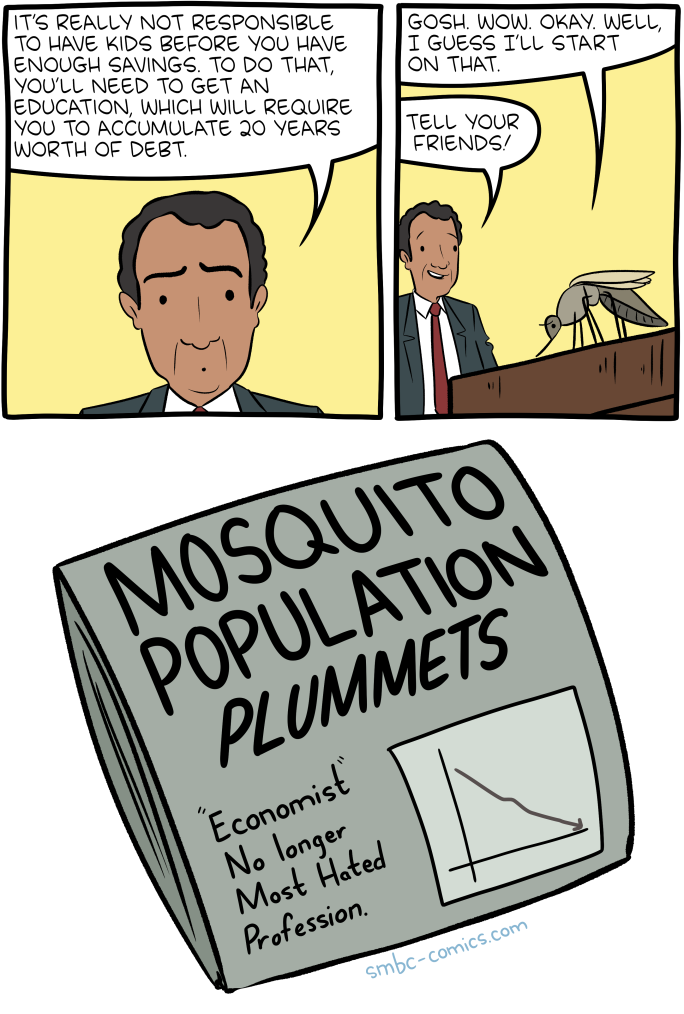
Saturday Morning Breakfast Cereal - Responsible
James.galbraithlol
Click here to go see the bonus panel!
Hovertext:
I'm convinced you could exactly tune the population growth rate via debt.
Today's News:
NBA Star Dwyane Wade Offers Powerful Thoughts on 12-Year-Old Zion: ‘I Watched My Son from Day One Become Into Who – She – Now Eventually Has Come Into’ — WATCH
James.galbraithVery nice
NBA star Dwyane Wade gave a powerful speech about accepting his queer 12-year-old child Zion on Stephen Jackson and Barnes’ “All The Smoke” podcast this week.
“You want to talk about strength and courage?” said Wade. “My 12-year-old has way more than I have. You can learn something from your kids.”
Said Wade: “I had to look myself in the mirror when my son at the time was 3 years old and me and my wife started having conversations about us noticing that he wasn’t on the boy vibe that Zaire (Wade’s other son) was on. And, I had to look myself in the mirror and say, ‘What if your son come home and tell you he’s gay? What are you going to do? How are you going to be? How are you going to act?’ It ain’t about him. He knows who he is. It’s about you. Who are you? All these people that’s out there saying those things, look at yourself. Understand that you’re the one who got the issues. It’s not the kids. I watched my son from day one become into who – she – now eventually has come into. And for me it’s all about, nothing changes with my love. Nothing changes with my responsibilities.”
The Wade family has gotten grief from haters on social media over Zion’s appearance but have fought back powerfully, with pride and love.
View this post on InstagramA post shared by Gabrielle Union-Wade (@gabunion) on
I’ve seen some post-thanksgiving hate on social about my family photo. Stupidity is apart of this world we live in—so i get it. But here’s the thing—I’ve been chosen to lead my family not y’all. So we will continue to be us and support each other with pride, love & a smile!
— DWade (@DwyaneWade) November 30, 2019
Earlier last year, they took Zion to Pride.
“I grew up with the same perspective as a lot of these people out here that’s a little ignorant,” Wade said of the negativity and hate on social media. “I grew up with a similar perspective. And, you meet people along the way that help you take those glasses off and put on some different ones. Look through life through a different lens. That’s what my wife has been able to do. So, it’s been cool.”
Added Wade: “Everybody get used to it, man. This is the new normal. So if anybody different, we looked at as different. You know what I’m saying? The ones that don’t understand it. The ones that don’t get it. The ones that are stuck in a box. You’re different. Not the people that are out here living their lives, man.”
The post NBA Star Dwyane Wade Offers Powerful Thoughts on 12-Year-Old Zion: ‘I Watched My Son from Day One Become Into Who – She – Now Eventually Has Come Into’ — WATCH appeared first on Towleroad Gay News.

The Witcher has monsters and naked wizards. Somehow, it’s boring.
James.galbraithWell damn
 Henry Cavill in The Witcher. | Netflix
Henry Cavill and a lot of nude mages can’t save The Witcher.
During filming of Netflix’s new fantasy-action series The Witcher, star Henry Cavill’s workouts were apparently so intense and his bulk so massive that his muscles began wearing down his tough leather costumes at a rapid pace. Just the sheer enormity of his shoulders and glutes eroded the dead-cow clothes to unusable looseness. The Witcher’s designers had to constantly produce and reproduce outfit pieces to keep the shoots rolling.
Unfortunately, after watching eight uneven episodes of The Witcher’s first season, which debuts on Friday, December 20, I found using my imagination to fill in the myth of Cavill’s relentless costume grinding far more titillating than anything the show itself had to offer.
The only thing that this show appears capable of is retreating into tired fantasy tropes complete with dark warlords, gratuitous nudity (predominantly female), and chaotic evil women that could, in a moment of heated anger, obliterate the world. It’s as if D.B. Weiss and David Benioff, clearly out of steam after showrunning that final season of Game of Thrones, found a way to sell off their unused, undercooked ideas under the table to the powers that produce The Witcher.
All those ruined outfits were, it seems, for naught.
The Witcher wants to have fun without having anything to say
/cdn.vox-cdn.com/uploads/chorus_asset/file/19545089/Witcher_105_Unit_00265_RT.fkqyzww88f.jpg) Netflix
Netflix
Before making its way to Netflix, The Witcher was originally a series of Polish fantasy novels first Andrzej Sapkowski and published in the 1990s. The series was eventually adapted into a 2001 fantasy film, a subsequent Polish television series in 2002 , and a hugely successful video game franchise beginning in 2007. The film and television series were considered the poorest representations of Andrzej Sapkowski’s novel; Netflix’s English adaptation, created by Lauren Schmidt (The Umbrella Academy), will give those two a run for their money.
The Witcher novels are touted by its fans for their world-building, and how they incorporate Eastern European myth in new ways. The series revolves around a white-haired, chiseled mutant named Geralt of Rivia (Cavill), who is a monster-hunter that’s been shunned by society. One would think that someone who rids towns of evil monsters and is relatively attractive in a supernatural way would find it easy to make friends, but that’s not the case, as regular folk look down on his profession. (Chalk up that improbability to fantasy.)
Cavill’s turn as Geralt is one of the bright spots of the show. Cavill isn’t relying on the natural charm that allowed him to play Superman, but instead taps into a gruffer, more menacing side. He plays Geralt as a man stocked with curt lines, eye rolls, and furrowed stare downs. Geralt’s the smartest and most skilled person in every room, and he spends his time frustrated or annoyed at the incompetent souls around him.
Each of the episodes — Schmidt has writing credits for all eight episodes, while six other writers are credited for one episode each — more or less functions as a Monster of the Week procedural, with Geralt tasked with killing a monster, a supporting character regurgitating a Wikipedia article about said monster, and then many, many minutes of Geralt slaying the monster before getting shunned, moving on, and repeating the process.
Think: Geralt’s Law and Order: Monster Victims Unit.
The Witcher has a bad habit of explaining things the minute they happen, like the folklore and mythology and whatnot — a signal that we should really care about a striga (a screaming monster from Slavic folklore) or a kikimora (a demonic spirit), and a nod to Sapkowski’s world-building and a wink to video game fans. But it also has a habit of tossing some of this information away just as quickly between episodes, simultaneously signaling that most of everything we’re being told is disposable.
Looming beyond these monsters du jour and stray strigas is something actually important: a princess named Ciri from the kingdom of Cintra that is part of Geralt’s destiny. If you’ve seen other fantasy shows or movies, it’s not hard to deduce that Ciri has powers. Which is why the series’ villains, a group known as the Nilfgaard Empire, have sacked Cintra, a kingdom commanded by the bawdy queen Calanthe. Nilfgaard desperately wants to kidnap Ciri so that it can use her powers to take over the world for its own gain.
In another corner of the continent is Yennefer of Vengerberg, an abused, disabled woman with a hunchback (the hunchback is primarily the reason for the abuse), who the show demands we know her significance by abruptly and heavily focusing on her as early as its second episode.
At the onset, the show fails to explain why we’re supposed to care about her or how this woman, living with a terrible family, snaps into the puzzle of Geralt’s destiny since she’s not from Cintra nor does she seem to be within Geralt’s general orbit. But it’s quickly made clear that she’ll be the secondary protagonist of the show, because she’s recruited into a league of powerful sorceresses by a very stern female mage named Tissaia de Vries.
Yennefer, despite her disability, has high magical potential because she’s brimming with unbridled chaos, Tissaia says. Even though Yennefer fails the traditional tests of sorcery, Tissaia keeps pushing her, and eventually Yennefer begins to fulfill her potential.
At some point, you get the sense that Yennefer will represent a lesson about how greatness can come from the people, women especially, who we overlook the most. Which is a fine lesson to teach, except that Yennefer is almost immediately transformed into a hot, booby witch.
Mages like Yennefer are meant to be the companions of kings, and to achieve that, they also have to be beautiful. Luckily for Yennefer and her fellow mages, they have a special plastic surgeon mage (I’m not making this up) that can change their appearance however they want, which means making them hot to men. It says a lot that Geralt only meets Yennefer after Yennefer undergoes her transformation, and after said transformation, the show then includes a barrage of scenarios in which Yennefer does a lot of topless magic.
Essentially, these ultra-powerful mages who can bend nature and reality to their will are just content with being hot and serving as right hands to their respective kings. It doesn’t make total sense even within the story — but it’s perfect if you want to create a show with very good-looking women doing lots of fun, topless magic and lots of mystical robes with chest cutouts.
Aside from this mystic boob-show loophole, it’s actually the lack of imagination or ingenuity is the true letdown of The Witcher.
The biggest of the show’s problems is its weak writing. From Geralt’s adventures, to the kingdom of Cintra, to Yennefer, there are myriad characters who exist just to talk story to each other and the audience. The exposition leads to a plodding pace out of the gate, and it also undercuts any kind of emotional impact that Geralt’s loneliness, or Ciri’s destiny, or Yennefer’s upheaval might yield.
The easiest comparison to make here is, unsurprisingly, Game of Thrones. The Witcher’s dependence on high fantasy tropes with ostentatiously F-bomb-laden antiquated English mixed in is pure Game of Thrones, which has become the model for fantasy TV series aimed at adults. And no doubt Netflix is hoping that fans searching for a GoT replacement might forgive The Witcher’s faults and stick with it.
But Game of Thrones, even in its horrendous last season, always told stories with greater meaning and ramifications than simplistic character-based quests. Usually, its themes revolved around power, and the maniacal lengths that people would put themselves through to achieve it whether for their own personal or moral gain. That thematic guidance is absent in The Witcher, where characters function more like action figures playing around in different stories, and the adventures feel more like fleeting topics.
Each time a character opens their mouth, they dump out a laundry list of basic information: their name, title, occupation, and current objective. One character even unloads these bland story details upon a dead baby at one point — that’s the level of riveting dialogue to expect from The Witcher.
When I realized that I felt bad for the baby not because it was dead, but because it couldn’t even rest in peace without being talked plot at, I knew that The Witcher had nothing more to actually say to me. I suppose we, dead baby included, can’t be as lucky as Henry Cavill’s leather, only experiencing The Witcher in tiny doses and getting to do so while being worn to death by the mortal hug of Cavill’s thighs.
DNC raises thresholds again for January debate
James.galbraithGood

LOS ANGELES — The Democratic National Committee is again raising the thresholds to participate in the party’s next presidential debate, despite calls from some candidates who have been excluded to lower the qualifying criteria.
In order to qualify for the next debate on Jan. 14, candidates must earn at least 5 percent in four qualifying polls released between Nov. 14 and Jan. 10, or 7 percent in two polls conducted in one of the four early-voting states on the nominating calendar: Iowa, New Hampshire, Nevada or South Carolina.
The polling thresholds for Thursday night’s PBS NewsHour/POLITICO debate in Los Angeles were 4 percent in all surveys and 6 percent in early-state polls.
Additionally, candidates must receive donations from 225,000 individuals, up from 200,000 for Thursday’s debate, with a minimum of 1,000 donors in at least 20 states.
The qualification deadline is Jan. 10 — four days before the debate, hosted by CNN and The Des Moines Register at Drake University in Des Moines, Iowa.
Five candidates have already qualified for the debate, according to POLITICO’s tracking of public polling and donor information: Joe Biden, Pete Buttigieg, Amy Klobuchar, Bernie Sanders and Elizabeth Warren.
Biden, Buttigieg, Sanders and Warren have all previously said they have over 225,000 donors. On Friday morning, a spokesperson for Klobuchar also tweeted that she has qualified for the debate, meaning she has hit that donor mark as well.
Additionally, former New York Mayor Mike Bloomberg, who has been in the race for about only a month, has already hit the polling threshold. But Bloomberg, whose net worth has been valued at more than $50 billion, isn’t accepting donations and won’t be able to meet the donor threshold for the January debate without them.
Andrew Yang has also publicly said he’s cleared the raised donor threshold. But he has accrued only one of the four required polls to be on stage. Tom Steyer, the last remaining candidate to participate in Thursday’s PBS NewsHour/POLITICO debate, has two of the four polls needed and has not publicly said he’s hit 225,000 donors.
The increased thresholds will likely exclude every candidate who is still in the race but did not participate in the Thursday debate: Michael Bennet, Bloomberg, Cory Booker, Julián Castro, John Delaney, Tulsi Gabbard, Deval Patrick and Marianne Williamson.
Booker and Castro have increasingly been critical of the debate process, after the pair was excluded from the last debate of the year.
Booker’s campaign pressured the DNC to lower, not raise, the thresholds for future debates. Booker, Castro and the seven candidates on stage Thursday all signed a letter urging DNC Chairman Tom Perez to allow for candidates to qualify by hitting either a donor or polling threshold, not both.
At the time, the DNC pushed back against the letter — and the new thresholds confirm that it didn’t consider lowering the bar to be on stage.
Booker said in a fundraising email last week that he had over 234,000 donors, but he is unlikely to clear any polling threshold.
Article originally published on POLITICO Magazine
[Eugene Volokh] Kindergarten Bars Boys from Wearing Ear Studs, Parents Sue for Sex Discrimination
James.galbraithFacially discriminates based on sex, so it needs to go.
[The school policy allows girls to wear small earrings, but doesn't allow them for boys.]
On its face, the policy clearly does discriminate based on sex, and thus seems like a facial violation of Title IX and a presumptive violation of the Equal Protection Clause (since the kindergarten is a public charter school). But courts in employment discrimination cases have long upheld certain kinds of sex-differential grooming policies, such as hair length policies, so long as both men and women are subjected to standards that are seen as socially accepted for their sex. Here is an excerpt from Hayden ex rel. A.H. v. Greensburg Community School Corp. (7th Cir. 2014), the precedent on which the plaintiff chiefly relies, which struck down a male-only hair-length limit for a high school's baseball and basketball players:
Whether and when the adoption of differential grooming standards for males and females amounts to sex discrimination is the subject of a discrete subset of judicial and scholarly analysis. This line of authority—much of it pre-dating the Supreme Court's decision in Price Waterhouse v. Hopkins, 490 U.S. 228, 250-51, 109 S.Ct. 1775, 1790-91, 104 L.Ed.2d 268 (1989) (plurality) (employer may not demand that employee's appearance and deportment match sex stereotype associated with her gender)—is most developed in the employment context, but it has a parallel in the school context as well. See, e.g., Carroll v. Talman Fed. Sav. & Loan Ass'n of Chicago, 604 F.2d 1028 (7th Cir.1979) (holding that workplace dress code which required women but not men to wear uniforms constituted sex discrimination in violation of Title VII of Civil Rights Act of 1964, 42 U.S.C. § 2000e-2(a)(1)); id. at 1032 ("So long as [personal appearance regulations] find some justification in commonly accepted social norms and are reasonably related to the employer's business needs, such regulations are not necessarily violations of Title VII even though the standards differ somewhat for men and women."); Jespersen v. Harrah's Op'g Co., 444 F.3d 1104, 1110 (9th Cir.2006) (en banc) (majority) (sustaining make-up requirement for female employees in absence of objective evidence that such requirement imposed unequal burden on women) ("We have long recognized that companies may differentiate between men and women in appearance and grooming policies, and so have other circuits. The material issue under our settled law is not whether the policies are different, but whether the policy imposed on the plaintiff creates an `unequal burden' for the plaintiff's gender.") (citations omitted); id. at 1115-16 (Pregerson, J., dissenting) (contending that make-up requirement constituted the sort of impermissible sex-stereotyping proscribed by Price Waterhouse); id. at 1117 (Kozinski, J., dissenting) (contending that because make-up requirement had no genuine equivalent in grooming standards for male workers, question of fact presented as to whether standards imposed unequal burdens on men and women); Barker v. Taft Broadcasting Co., 549 F.2d 400, 401 (6th Cir.1977) (grooming standards imposing different limitations on hair length and style for male and female employees did not constitute sex discrimination absent allegation that standards were subject to unequal enforcement between the sexes); Earwood v. Continental Se. Lines, Inc., 539 F.2d 1349, 1350 (4th Cir.1976) ("sex-differentiated grooming standards do not, without more, constitute discrimination under Title VII of the Civil Rights Act of 1964"); Knott v. Missouri Pac. R. Co., 527 F.2d 1249, 1252 (8th Cir. 1975) ("Defendant's hair length requirement for male employees is part of a comprehensive personal grooming code applicable to all employees. While no hair length restriction is applicable to females, all employees must conform to certain standards of dress. Where, as here, such policies are reasonable and are imposed in an evenhanded manner on all employees, slight differences in the appearance requirements for males and females have only a negligible effect on employment opportunities."); Willingham v. Macon Tel. Pub. Co., 507 F.2d 1084, 1092 (5th Cir. 1975) (en banc) ("It does not appear that defendant fails to impose grooming standards for female employees; thus in this respect each sex is treated equally…. [B]oth sexes are being screened with respect to a neutral factor, i.e. grooming in accordance with generally accepted community standards of dress and appearance.") (internal quotation marks and citations omitted); Dodge v. Giant Food, Inc., 488 F.2d 1333, 1337 (D.C.Cir.1973) (grooming regulations that prohibited men from wearing long hair and required women with long hair to secure it did not constitute sex discrimination violating Title VII: "Giant enforces strict grooming regulations against both male and female employees."); Harper v. Edgewood Bd. of Educ., 655 F.Supp. 1353, 1356 (S.D.Oh. 1987) (school did not violate students' equal protection rights by enforcing school board's dress regulations and prohibiting students from attending school prom dressed in clothing of opposite sex; school dress code did not differentiate based on sex but required students to dress in conformance with community standards); Johnson v. Joint Sch. Dist. No. 60, Bingham Cnty., 95 Idaho 317, 508 P.2d 547, 548-49 (1973) (school dress code that prohibited female students from wearing slacks, pantsuits, or culottes impermissibly discriminated on the basis of sex); Scott v. Bd. of Educ., Union Free Sch. Dist. No. 17, Hicksville, 61 Misc.2d 333, 305 N.Y.S.2d 601, 606-07 (N.Y.Sup.1969) (similarly finding invalid provision of school dress regulations prohibiting girls from wearing slacks except with permission of principal when warranted by cold weather); Jeremiah R. Newhall, Sex-Based Dress Codes and Equal Protection in Public Schools, 12 Appalachian J. Law 209 (2013); Jennifer L. Greenblatt, Using the Equal Protection Clause Post-VMI to Keep Gender Stereotypes Out of the Public School Dress Code Equation, 13 U.C. Davis J. Juvenile Law & Policy 281 (2009).
Whether and to what extent these cases survive Price Waterhouse is a question that we have not yet had occasion to address. The Ninth Circuit has concluded that sex-differentiated grooming standards remain permissible after Price Waterhouse, see Jespersen, 444 F.3d at 1109-12; Nichols v. Azteca Restaurant Enters., Inc., 256 F.3d 864, 875 n. 7 (9th Cir.2001), although it has left the door open to proof that some sex-specific standards may be the product of impermissible sex-stereotyping, Jespersen, 444 F.3d at 1113. But we may assume, without deciding, that this line of authority remains mostly if not wholly unmodified by Price Waterhouse.
The relevant and dispositive point here is that this line of precedent has been ignored entirely in this appeal. The parties have litigated the hair-length policy in isolation rather than as an aspect of any broader grooming standards applied to boys and girls basketball teams.
We were told, when we raised the subject at oral argument, that male and female athletes alike are subject to grooming standards; and indeed the parties jointly stipulated below for purposes of the preliminary injunction hearing that whereas only the boys basketball and baseball teams have hair-length policies, the other school athletic teams do have grooming policies. But the content of those grooming policies has never been established, and the fact that there are grooming standards for both girls and boys teams was not even mentioned in the stipulated facts submitted to the district court for purposes of resolving the case.
The stipulated facts reveal only that there is a hair-length policy for the boys basketball team but for not for the girls basketball team (or, for that matter, any other girls team). As such, the stipulated facts indicate that a boy wishing to play basketball at Greensburg is subject to a requirement, impinging upon a recognized liberty interest, that a girl is not.
Presumably in this case, the school will indeed argue that its policy provides extensive grooming rules (albeit not identical ones) both for boys and for girls:
Appropriate undergarments must be worn and not visible. Camis for girls and undershirts for boys are allowed, but not required, and must not show.
Make-up may not be worn until the 7th grade and must be conservative in nature.
Tattoos and body piercings, other than girls' earrings, are not allowed. Earrings must be limited to 1 earring per ear. Large, dangling or hoop-type earrings are not allowed.
Jewelry other than watches for boys or girls, and small earrings on girls, may not be worn. This includes bracelets. Bracelets are not allowed. Official RMCA bracelets are allowed to be worn.
Necklaces may be worn but should be inside the shirt.
Hairstyle and hair color must be conservative in nature. Boys' hair must not extend below the top of the shirt collar in the back, the bottom of the ears on the sides or the eyebrows in front. Mohawk, faux hawk, no symbols, shapes or designs of any kind shaved into the head or anything that inhibits the learning environment as determined by the campus principal.
Hair may not be spiked. Large hair decorations may not be worn. Bandanas may not be
worn. Highlights must be two tones lighter or darker than the student's natural hair color.No highlights that are not a natural hair color.
No pocket chains or hats may be worn in the building.
And the Supreme Court's pending case on whether gender identity discrimination violates Title VII may ultimately affect the analysis as well, depending on what reasoning the Court endorses. You can read the plaintiff's motion for a temporary restraining order, and here's the school's public statement in response (its legal arguments have not yet been filed):
Rocky Mountain Classical Academy works hard every day to create a positive school environment for all its students. Since the School's opening, an important component of this has included a dress code for all students. Our dress code is part of our overall student code of conduct, which expects students to uphold a high standard of excellence and contribute in a positive fashion to their class and the school. Our dress code is published on our website and contained in the Parent Student Handbook, which all parents must review and sign at the beginning of each school year. The mother in this situation signed the Parent Student Handbook at the beginning of the year like all other parents. She was aware of RMCA's dress code prior to enrolling her son in Kindergarten.
As with every other parent, numerous RMCA employees have asked the mother to bring her son to school in compliance with the dress code, which would mean removing his earrings when he is at school. She has refused and appealed her disagreement up the chain of command to the RMCA Board, which upheld the dress code after a public meeting on December 3, 2019. Once the Board made its final decision, the School instructed the mother to comply with the dress code by December 9, but she continued to refuse. This left the School no choice but to suspend the student for willfully disobeying the School's rules. The School will continue to insist that this family, like every other, obeys the RMCA dress code, which contributes towards the positive educational environment that all RMCA families enjoy each day.
Barr announces that Durham is looking beyond the FBI, and a former CIA director is in their sights
James.galbraithBarr is a cancer, and everyone who voted to confirm him is unfit for office
Attorney General William Barr wasn’t able to get his report on how the world has conspired against Donald Trump in time to blow up Trump’s impeachment. Instead, Barr and his padawan, John Durham, had to settle for taking potshots at an inspector general report that failed to provide any evidence for the labyrinthine nest of entangled conspiracies that Trump has claimed exist. But that doesn’t mean they’ve given up. In fact, their own scheme to prove Trump’s nightmarish vision continues to expand, as Barr and Durham reach out to drag in everyone whom Trump regards as an enemy. Which is almost everyone.
As The New York Times reports, Durham’s latest expansion of scope involves chasing after former CIA Director John Brennan. Which only makes sense, as previous reports have indicated that Brennan’s involvement in the Russia investigation was … nonexistent.
Still, Brennan was critical of Trump after leaving his position, and did appear on television to display his disdain for both Trump’s handling of intelligence and Trump’s intelligence. And Trump has been on the attack against the former CIA director from the moment Brennan first rolled his eyes over Trump’s willingness to accept Vladimir Putin’s version of events over that of the U.S. intelligence community. That alone seems to be sufficient driving force for Durham to demand Brennan’s emails, call records, and all other documents related to his time at the CIA.
In particular, Durham wants to know what Brennan knew about (where is that macro key?) the Steele dossier. According to the Times, Durham wants to know whether Brennan privately “contradicted his public comments” about the information collected by former British intelligence officer Christopher Steele. How Brennan saying something in public that he didn’t say in private would be an indication of conspiracy, or a crime, or even wrong isn’t clear. But then, it’s not as if Barr and Durham are actually looking for evidence that would hold up to scrutiny in normal circumstances.
How Barr and Durham reacted to the inspector general’s report, and how Republicans from Trump to Fox News treated the report, is probably the best sign of things to come. After the IG produced a report specifically saying that there was no evidence of political bias in FBI actions, Trump and company simply treated the report as if it said what they had claimed all along. Expect that same quality of reasoning to be the heart of the Durham dossier.
In October, the Department of Justice let it be known that the Durham investigation had become “a criminal investigation.” But there have been exactly zero statements about what crimes are being investigated, who may have committed them, or why the department felt it necessary to announce a criminal investigation. What there has been is a round-the-world jaunt in which Barr and Durham have attempted to destroy U.S. intelligence agencies and have deeply damaged relationships with U.S. allies. And when it comes to Barr and criminal investigations, it’s worth noting that Barr blocked any criminal investigations related to Trump and Rudy Giuliani’s actions in Ukraine.
So when it comes to the frequent Republican question, “Why aren’t there any criminal charges mentioned in the impeachment articles?” the answer is: Because William Barr.
If there’s any doubt about the effort to create an all-encompassing, fulfill-every-aspect-of-Trump’s-vindictive-paranoia narrative, Barr appeared on Fox News on Thursday evening to let it be known that Durham “is not just looking at the FBI. He is looking at other agencies.”
So just because the inspector general failed to find the conspiracy that Trump was looking for in the FBI doesn’t mean they won’t find it. After all, the inspector general was looking into the FBI before Barr arrived, and it might have looked pretty odd if he had stopped that effort before launching his own investigation. But there’s no inspector general looking into the CIA. And there’s no one to contradict any conspiracies that Durham and Barr “find.”
(480): I think my stomach is...
James.galbraithlol
This former governor pardoned a man convicted of raping a child. His reasoning was deeply flawed.
James.galbraithBevin's got so many of these he has to ask which one?
 Matt Bevin, then governor of Kentucky, speaks with the media prior to a campaign rally for President Donald Trump on November 4, 2019 in Lexington, Kentucky. | Bryan Woolston/Getty Images
It could keep survivors from coming forward.
Before he left office, former Kentucky Gov. Matt Bevin pardoned not one, but several men convicted of sexually abusing minors.
And on Thursday, he defended one of these pardons by sharing intimate details about a child’s anatomy.
Bevin pardoned Micah Schoettle, now 41, who had been convicted of raping a 9-year-old girl. The reason for the pardon, Bevin said, is that the girl’s hymen was intact.
“If you have been repeatedly sexually violated as a small child by an adult, there are going to be repercussions of that physically and medically,” Bevin said in a local radio interview, according to the Louisville Courier Journal.
But experts say that an intact hymen is in no way evidence that a child has not been raped; one study found that just over 2 percent of survivors in child rape cases had visible damage to the hymen, the Courier Journal reports. Moreover, the former governor was publicly talking about a minor’s sexual organs as a way to discredit her testimony about her sexual assault.
Bevin was already facing heavy criticism for the hundreds of pardons he issued in the last days of his term, including at least two other men convicted of sexual abuse of children. The pardons are part of a complex legacy on criminal justice issues, including an effort to reduce the number of people incarcerated in Kentucky, as Vox’s Casey Quinlan explains. But in the case of Schoettle’s pardon, Bevin appears to have misunderstood the law and science of sexual abuse — and his words play into stigma and misinformation around hymens and sexual activity that could keep survivors from coming forward about their assaults.
Bevin’s defense of the pardon is medically inaccurate
Bevin, who left office earlier this month, was asked about Schoettle’s case in an interview with the radio station WHAS.
“There was zero evidence,” he said, according to Alfred Miller and Joe Sonka at the Courier Journal.
He said that the survivor’s sister was present when the 9-year-old said the assaults occurred, and denied that they happened.
“Both their hymens were intact,” he went on.
But his claim that an intact hymen means no assault occurred is completely wrong, Dr. George Nichols, former chief medical examiner for the state of Kentucky, told the Courier Journal.
“Rape is not proved by hymen penetration,” he said, adding that Bevin “not only doesn’t know the law, in my humble opinion, he clearly doesn’t know medicine and anatomy.”
The prosecutor in the case, Kenton County Commonwealth’s Attorney Rob Sanders, has asked for an investigation into the pardon, the Courier Journal reported.
“Even the defense experts testified they would not expect to find an injury in the victim’s sexual assault exam,” he told the paper. “This was the subject of an eight-hour court hearing Matt Bevin obviously never watched.”
He has pardoned multiple people convicted of sexually assaulting minors
But Schoettle is only one of the men convicted of child sexual abuse that Bevin pardoned. In fact, he was initially confused when his interviewer brought up the subject of a child rape case.
“Which one, though? Because there were a couple of people that were accused of that whose sentences I commuted.”
He also freed Dayton Jones, who was convicted of sexually assaulting a 15-year-old boy at a party; the boy sustained severe internal injuries. And he pardoned Paul Donel Hurt, who had been convicted of sexually abusing his 6-year-old stepdaughter.
In Hurt’s case, Bevin cited the fact that in 2015, Hurt’s stepdaughter, whose name has not been made public, recanted her allegations. However, several judges declined to set aside Hurt’s conviction, the Courier-Journal reported, in part because of the role of Jefferson Circuit Judge Stephen Mershon in the recantation. Mershon presided over Hurt’s original conviction in 2001, but later began corresponding with Hurt and also contacted the stepdaughter.
In 2016, one judge said that Mershon had “altered” the stepdaughter’s memory and used “judicial coercion and intimidation” to get her to recant. After Hurt’s pardon, Mershon was the one to pick him up from prison.
These and other pardons have led Democrats and Republicans alike to criticize Bevin, with Senate Majority Leader Mitch McConnell calling them “completely inappropriate.”
The pardons are “a controversial capstone” to a governorship that focused on criminal justice issues, Vox’s Quinlan writes. Bevin aimed to stop the growth of Kentucky’s prison population, but it didn’t work — a reform bill backed by the governor failed, and there were more people in prison in the state in 2015 than before he took office.
Instead of reducing his state’s incarcerated population, Bevin has succeeded in spreading misinformation about sexual assault and human anatomy. The idea of “testing” a person’s hymen for evidence of sexual activity has been a topic of widespread public discussion since the rapper T.I. said he has a doctor check his daughter’s hymen once a year. But experts say that the absence of a hymen does not mean someone has been sexually active.
And, as the Kentucky medical examiner noted, the presence of a hymen does not prove that someone was never sexually assaulted. By making his inaccurate comments, Bevin may have discouraged sexual assault survivors from coming forward, for fear that they won’t “pass” some sort of physical test.
He is no longer in office to continue making criminal-justice decisions in the state of Kentucky. But his words and their impact could linger long after his term is over.
Trump's attorney general unveils plan to help boost the same law enforcement racism as before
James.galbraithRacist shithead strikes again
On Thursday, Trump’s U.S. Attorney General William Barr took time away from trying to directly undermine our Constitution to announce work on undermining our Constitution at the local—and more directly racist—level. Barr went to Detroit, Michigan, to announce the Department of Justice’s plan to throw money into law enforcement in Detroit, Albuquerque, Baltimore, Cleveland, Kansas City, Memphis, and Milwaukee. Called “Operation Relentless Pursuit,” the $71 million in federal funding, Barr told the press, will be used to “intensify federal law enforcement resources” in these cities with higher rates of violent crime than the rest of the country.
Of course, even Barr had to admit that across the nation, violent crime rates have fallen, saying “while nationwide violent crime rates are down, many cities continue to see levels of extraordinary violence.” This is an old conservative line of politics that stretches all the way back to Roman governor of Judaea Pontius Pilate. The Trump administration has worked hard to destroy the kind of law enforcement reforms our country needs to fix some of our more glaring and violent white supremacist structures.
First, under the historically racist Jeff Sessions, the Trump administration pulled back on funding and “review” reform agreements between the Obama-era DOJ and many of the country’s law enforcement agencies. Now, the DOJ is putting resources into the same fundamentally racist and anti-low income policing policies that have perpetrated the kind of civil rights injustices we see daily.
But don’t you worry: William Barr and Donald Trump love the troops! Or, I mean, the police. Or I mean, whoever it is that has the state’s guns.
As Barr pandered, “I feel there is too much anti-law enforcement rhetoric, and not sufficient respect for police officers and law enforcement officers and the job they do.” Having respect for law enforcement and recognizing how difficult a job it is they do, does not exclude having human rights standards above those of a low rent dictatorship. To this end, the Trump administration has had to manufacture statistics that give a more dire view of violence in the U.S. while trying to downplay the rise in hate crimes since Trump took office.
Criminal justice activists and leaders have long been critical of Trump’s attorney general picks (first Sessions and now Barr), and the two men’s bigoted and myopic stances on police violence, civil rights, and justice. Not discussed by Barr was the fact that there is more evidence showing that less guns mean less violent crime, not more law enforcement and prison. But Barr and Trump aren’t really interested in getting rid of violent crime, are they?

The movie Cats doesn’t even know what the musical Cats is about
James.galbraithDumpster fire
 Universal Pictures
Cats is a case study in how not to adapt a musical.
In an alternate universe, the new movie adaptation of Cats, the long-running Andrew Lloyd Webber dance musical about cats, could have been a glorious holiday gift to the world. I’ve written a lot this year about how weird Cats is, and believe me, Cats, a story in which lots of cats introduce themselves and then one of them goes to cat heaven, is inherently weird. But there’s a vibrant, fun spark that runs through the musical’s threadbare plot — after all, it’s based on a book of children’s poems by T.S. Eliot — and despite the public’s generally baffled reaction to this movie’s existence, Cats had the potential to be joyous and light.
But it also had the potential to be a giant embarrassment, and I was wary that Cats wouldn’t be able to overcome either its own inherent quirkiness or the penchant of its director, Tom Hooper, to obliterate any emotional ebb and flow in his films and ratchet the pathos up to 11 at all times. His previous musical adaptation, 2012’s Les Misérables, was Oscar-nominated but also critically lambasted thanks to Hooper’s frequent misuse of fundamental filmmaking techniques, like close-ups and camera angles. As a fan of the stage musical’s mix of spectacle and compelling human drama, I also felt like he obliterated most of the musical’s emotional and scenic appeal.
So I was not optimistic. But I found it promising that Hooper was already a big Cats fan; plus, he had the assistance of Hamilton choreographer Andy Blankenbuehler, who also choreographed the recent Cats revival on Broadway, as well as Lloyd Webber himself. Maybe this would all go well.
Friends, it did not go well.
Some elements of Cats almost work. The set looks terrific, even though the scale is nonsensically inconsistent. The dancing is wonderful — when the camera manages to sit still long enough to showcase it. The music is essentially unchanged, and I happen to like the new song. It’s got its share of tongue-in-cheek levity, my particular favorite being the moment Judi Dench’s Old Deuteronomy solemnly instructs us, the audience, to address our cats thusly: “O, Cat.” One musical sequence in particular came really close, for me, to capturing Cats’ effervescent whimsy.
But Hooper makes baffling directorial decisions at every turn. His staging misses key opportunities to bring the onscreen action in line with our expectations and especially with the music. This is a crucial point of objection, because Cats is primarily about the music and not much else. But Hooper’s film far too frequently disconnects its audience from its musical score by making choices that undercut or distract from what the music is doing. And that contributes to the overall disjointed, confusing effect Cats leaves us with.
Here’s a brief breakdown of the ways Cats maladapts its source material. (Some minor Cats spoilers follow.)
When the music of Cats is at its most happy and danceable, Cats the movie shows us lots of other stuff that is not a bunch of happy dancing cats
Embedded above is the discombobulating, jarring, trippy overture to Cats. There’s a lot of discordant synthesizer noise at first that builds up, rather brilliantly, I think, to the introduction of Cats’ main theme at 1:11 — the Jellicle cats theme. You can hear this very clearly in the orchestration: The single melody takes over from all the bombastic orchestral noise, the bottom drops out completely, and the only thing that’s left is this slinky, delightfully feline melody.
What do you picture in your mind when you hear these soaring notes, my fellow travelers? Do you see, maybe, a row of curious, dizzying, daring cats venturing forth beneath an expansive London night? Or, perhaps, a single solitary cat leaping into the frame with all of the joy and majesty and agility that only a cat — or a human pretending to be a cat — could bring to this kind of bobbing, weaving melodic line?
Or do you see the visceral thump of a cat’s helpless body as it bounces off an alley step after being abandoned by its owner?
Guess which option Tom “both feet in the bucket of cement” Hooper got excited about? If you prayed for the former, you are, sadly, wrong.
This is how Cats, the movie, opens — with a cat in a bag being physically abused in time to this music. What about this music screams “throw a cat down a bunch of steps at the climax,” Tom Hooper? Who hurt you?! A dramatic moment like this could have been an effective way to open the film, but instead it has a fundamentally discordant effect. Which emotion are we supposed to be experiencing? The one connected to what we’re seeing — a pet being brutally abandoned — or the one connected to what we’re hearing, which is a jaunty musical theme meant to convey the essence of a cat’s mystery and inscrutability?
Again and again, Hooper shoves stuff at us visually that has nothing to do with what we’re hearing. The staging seems to ignore the dictates of the music to an infuriating degree; the camera often zooms in and out for inexplicable reasons and follows cats around the edges of the looming set while other stuff fills the background. It’s difficult to get a handle, visually, on where we’re supposed to be focused.
This spatial confusion meant that there were several times in which the film suddenly introduces us to major characters, only to be met with laughter by the audience at my screening. In a stage musical, character entrances should always be seeded dramatically with proper blocking, lighting, and musical cues — something a film can and should approximate, instead of just randomly cutting to someone we’ve never seen before. When something as simple as a character entrance is met with ridicule for being so abrupt and inexplicable, there is a serious, intrinsic problem with your movie musical.
Throughout this unfocused staging, the ensemble dancing that would ideally take precedent — you know, the thing you’re here to see, dancing cats — is frequently happening way off in the background. It’s maddening! In the 2016 Broadway revival, Blankenbuehler’s choreography made ample room for large ensemble numbers, which suggests this paucity of ensemble dancing lies squarely at Hooper’s feet. Particularly in the Jellicle Ball, which is supposed to be the big dancing cats scene, the majority of the number is now allotted to individual cats having random solo dance-offs. We don’t care about these individual dance-offs, though, because we know next to nothing about these individual cats. We just came for lots of cats dancing together! Give us lots of wide, full-body shots of rows of dancing cats, Tom Hooper! JUST GIVE US THE DANCING CATS!
You know — like this:
It introduces lots of new stuff, but the new stuff just makes Cats more confusing, not less
You might not think it possible that Cats the musical could become more baffling, given the addition of new contextual material to its random and barely there plot. But you would be so, so wrong.
For instance: The movie starts with our abused and abandoned cat, Victoria (Francesca Hayward), being dumped on the street by her former owners and then immediately inducted into the ineffable world of Jellicle-ness. There’s not a moment’s pause between these events. She doesn’t even get a moment to be sad! It’s just thump-bounce-thump, welp, here’s your new life, kid. This isn’t just bad pacing, it’s a muddled delineation of exposition. The movie then goes one step further and dramatically presents the idea that Victoria needs to learn her own secret Jellicle name. It stands to reason that this development means Victoria’s narrative will end with her finding out what that name is. Nope! Never happens.
Then there’s the backstory for Grizabella, Jennifer Hudson’s once-glamorous dance cat who’s now, erm, a fallen cat prostitute. (I told you, Cats is weird.) The details regarding Grizabella’s journey from celebrated performer to sex worker have never been clear in any version — but in the film, they’re made even more bizarre. That’s because another cat, Macavity (Idris Elba), is now, somehow, her pimp and a catnip pusher. So instead of just having to accept cat sex workers, we have to accept an entire feline underground of sex and drug trafficking.
Was this more necessary to helping us understand Cats than, for example, actually showing us some of the fabulous scenes Gus performed in his acting heyday? While we’re at it, did we really need an extended sequence of Rebel Wilson’s Jennyanydots eating cockroaches? And why on earth was she wearing a whole fake catsuit over her actual cat body; did her schtick as a cat who’s mostly active at night really necessitate cosplaying as ... a larger version of herself? Why did some scenes take every lyric literally, while others ignored the lyrics altogether? Why is it that every time Jennifer Hudson shows up, it feels like a completely different movie just walked onto the set and tried to tell you its melodramatic sob story when you just came out for some dancing? What is up with that random leg lift Deuteronomy does?! Is she horny for Gus?! And did we need to see Judi Dench being horny for Ian McKellan?!
I could live with one or two of these things being presented as part of the ineffable mystery of Cats, with no resolution sought or needed. But when every scene presents us with a pile of these endless bafflements, it becomes a giant, inexplicable mess.
With considerably less literalism, more attention given to the spirit of Cats, plenty of wider camera angles allowing the dancing to be the main focus as it always should have been, and clearer direction, this could have been a sincere pleasure. Instead, Tom Hooper has created a clusterfuck that will spawn an instantly ironic, mocking cult following.
I know this version of Cats had this squandered potential somewhere in its feline soul because of the one moment that somehow manages, despite everything, to be absolutely charming. That number, of all things, is “Skimbleshanks the Railway Cat,” the random train song that features the world’s most extra time signature (13/8, my god!) and one of Cats’ most forgettable characters. But in the movie, there’s a minor miracle: After a killer tap-dance break from Skimbleshanks (Steven McRae), we’re treated to a glorious wide shot showing a line of cats dancing under the sky over the River Thames. And just like that, Cats suddenly becomes magical. It’s a glimpse of another movie altogether — one that treats its story like a poetic child’s dream of a cat’s life, as T.S. Eliot originally intended, instead of this film’s mostly heavy-handed, stone-cold, somber approach.
So here’s my compromise. I’m just going to pretend that Macavity, the drug-pushing magical pimp, snuck onto the set of Cats and steadily vanquished all the sequences of that other, better film to the far realm of Growltiger’s pirate ship. I’m going to pretend that Skimbleshanks was the only sequence from that other, better film that managed to escape and find its way to us. I will hold that other film-that-could-have-been close to my heart and hope this inferior, imposter version of Cats hasn’t soured us too badly on movie musicals.
And when people ask me if I liked Cats, I will clutch my teal-sequined Cats premiere headband and say: Look — a new day has begun.
Trump says he's getting tougher on Russia as he works to destroy new sanctions
James.galbraithTrump is a Russian stooge at best.
What Donald Trump is saying: He’s getting tougher on Russia. What Donald Trump is actually doing: He’s working to destroy a new round of sanctions and keep Vladimir Putin’s international crime syndicate open for business.
If there’s anything that’s been learned over the last three years, it’s that lying comes as naturally to Donald Trump as covering himself in a half-inch of orange goo every morning. And there seems to be no reason he should bother to check himself. After all, Trump has been running around for weeks saying, “Read the transcript,” when the words in that transcript are utterly damning. But his supporters, both at his rallies and in the Senate, have made it clear that what’s in the actual transcript doesn’t matter to them at all. Trump’s statement is enough.
So no matter how often Trump tosses out claims about how “tough” he is being on Russia, it should not be surprising when The Daily Beast reports that Trump is attacking a package of sanctions against Russia. In fact, Trump’s State Department has assembled a 22-page letter that pushes back against every item in the package. In particular, the White House is arguing against regulations on Russian banks and Russian energy companies because watching them would … well, it would make the use of both as massive international pipelines for the movement of stolen wealth more difficult, but the Trump argument is that it would somehow “cripple the international energy market” to place limits on companies controlled by sanctioned Russian oligarchs.
Making it extra head-squeezy is the fact that the author of the sanctions bill Trump is attacking is Lindsey Graham. Graham is one of those so convinced that Trump was out to do no wrong in Ukraine that he doesn’t need to read the evidence. And he’s also one of those so ready to acquit Trump that he has no problem swearing to be an impartial jurist after he’s already declared his intention to vote down impeachment. Odds that Trump demonstrating again just how in the tank for Russia he really is will cause Graham to go beyond momentary concerns? Zero.
But there is someone who is supporting Trump on both the sanctions and the impeachment. As CNN reports, Vladimir Putin backed up Trump on Thursday and said that the impeachment in the House of Representatives was based on “made up reasons.” Trump supports Putin. Putin supports Trump. It’s like the Golden Rule … in its most cynical form.

Why doesn’t McConnell want witnesses at Trump’s trial? Because he’s guilty.
James.galbraithNo shit
The White House’s defense of Trump’s Dingell comments shows there’s no bottom
James.galbraithThe GOP will defend everything and Trump will keep going even worse
 White House press secretary listens to Trump speak outside the White House last month. | Chip Somodevilla/Getty Images
Trump attacked a widow by denigrating her dead husband. The White House is portraying Trump as the real victim.
On Thursday, White House surrogates for President Donald Trump proved that they’re willing to defend anything by going on TV and trying to justify remarkably crass comments President Donald Trump made suggesting that the late Rep. John Dingell (D-MI) is in hell.
Trump’s remarks on Wednesday evening during his rally in Battle Creek, Michigan, were meant as a shot at Dingell’s widow — Rep. Debbie Dingell, who now serves in John’s old House seat — because she voted in favor of two articles of impeachment that same day.
Referring to a phone call Trump had with Debbie after John passed away last February, Trump said, “She calls me up. It’s the nicest thing that’s ever happened. ‘Thank you so much. John would be so thrilled. He’s looking down. He’d be so thrilled. Thank you so much, sir.’” (Debbie Dingell claims Trump’s account is false and that he in fact called her.)
But Trump then suggested that heaven might not be where John Dingell, a World War II veteran who became the longest-serving Congress member in the country’s history, ended up.
“I said, ‘That’s OK, don’t worry about it.’ Maybe he’s looking up, I don’t know,” he said, prompting audible groans from the audience. “But let’s assume he’s looking down.”
Trump laments that Debbie Dingell voted to impeach him despite the fact that he allowed the normal state funeral to proceed for her late husband, former Rep. John Dingell. Trump then suggests John Dingell is in hell -- to audible groans. pic.twitter.com/wsYfddNIA9
— Aaron Rupar (@atrupar) December 19, 2019
Debbie Dingell responded to Trump with a tweet addressed directly to him in which she noted that she’s “preparing for the first holiday season without the man I love” and said his remarks “brought me down in a way you can never imagine and your hurtful words just made my healing much harder.”
Trump’s comments prompted bipartisan condemnation and calls for him to apologize. But on Thursday, White House press secretary Stephanie Grisham and deputy press secretary Hogan Gidley went on TV and made clear that the president intends to do no such thing.
On ABC’s Good Morning America, host George Stephanopoulos asked Grisham, “Why do you think the president said that last night?” She responded by describing Trump as a “counter-puncher.”
“As we all know, the president is a counter-puncher. It was a very, very supportive and wild crowd,” she said. “He was just riffing on some of the things that had been happening the past few days.”
NEW: In one-on-one with @ABC News' @GStephanopoulos, White House Press Secretary Stephanie Grisham defends Pres. Trump as a "counter-puncher" who's "under attack" after the president suggested late Michigan congressman in hell. https://t.co/yFr5LlYWBI pic.twitter.com/oVfBruXaAV
— ABC News (@ABC) December 19, 2019
When Gidley was asked a similar question during a subsequent Fox News appearance, he went even further in trying to portray Trump — not the Dingells — as the victim.
“No matter what the president says people are going to parse it apart, try and tear it apart, and focus on the most negative aspects of it,” Gidley said, as if there were any positive aspects to Trump’s comments.
“He’s been under assault ever since he took the oath of office. Even before — for the last several years,” Gidley continued. “And so, look, it’s understandable that someone’s frustrated by the fact that you have 93 percent negative news coverage against you, even though you have so many successes on behalf of the American people.”
WH spox Hogan Gidley responds to Trump joking about John Dingell being in hell by trying to make *Trump* the victim: "No matter what the president says...people are going to parse it apart, try & tear it apart & focus on the most negative aspects of it...he's been under assault" pic.twitter.com/gV3uEllRkS
— Aaron Rupar (@atrupar) December 19, 2019
While the White House tried its best to pass off Trump’s comments as no big deal, House Speaker Nancy Pelosi characterized Trump’s comments as “very sad” during a news conference.
Referring to a similar attack Trump made against the late Sen. John McCain earlier this year, Pelosi said the president “is clearly insecure when it comes to statespersons.”
“Let us pray for the president,” she added. “What the president misunderstands is that cruelty is not wit ... it’s not funny at all. It’s very sad.”
Pelosi on Trump suggesting John Dingell is in hell: "Let us pray for the president ... think of what he said about John McCain & his supporters just overlooked that. Now John Dingell. What POTUS misunderstands is that cruelty is not wit ... it's not funny at all. It's very sad" pic.twitter.com/WqtQwEcK6p
— Aaron Rupar (@atrupar) December 19, 2019
Just after Pelosi wrapped up, House Minority Leader Kevin McCarthy held a news conference in which he dodged questions about Trump’s comments but described John Dingell as a “very bright individual” who “made a great contribution to America.”
Trump, for his part, ignored repeated questions about whether he’ll apologize to Dingell during a media availability at the White House on Thursday afternoon. But if past Trump scandals have taught us anything, it’s that he is far more likely to escalate his attacks than he is to express any sort of remorse.
The news moves fast. To stay updated, follow Aaron Rupar on Twitter, and read more of Vox’s policy and politics coverage.
J.K. Rowling’s transphobia is a product of British culture
James.galbraithAnd her country's culture is a cesspit on this issue. You know it's bad once this bubbles up to Vox.
 J.K. Rowling accepts an award onstage during the Robert F. Kennedy Human Rights Ripple of Hope ceremony on December 12, 2019, in New York City. | Bennett Raglin/Getty Images for Robert F. Kennedy Human Rights
Her “gender critical” tweet on Thursday shouldn’t be surprising.
There’s been speculation for years within the transgender community that best-selling author J.K. Rowling, who wrote the Harry Potter series, held transphobic views. Now a tweet posted on Thursday morning has seemingly confirmed those suspicions.
In the tweet, Rowling expressed support for Maya Forstater, a researcher and self-proclaimed “gender critical” feminist whose contract was not renewed after her employer, an international think tank that campaigns against poverty and inequality, discovered her involvement in anti-trans campaigns online.
“Dress however you please,” Rowling wrote. “Call yourself whatever you like. Sleep with any consenting adult who’ll have you. Live your best life in peace and security. But force women out of their jobs for stating that sex is real? #IStandWithMaya #ThisIsNotADrill.”
Dress however you please.
— J.K. Rowling (@jk_rowling) December 19, 2019
Call yourself whatever you like.
Sleep with any consenting adult who’ll have you.
Live your best life in peace and security.
But force women out of their jobs for stating that sex is real? #IStandWithMaya #ThisIsNotADrill
The tweet drew immediate criticism from trans people and allies, while trans-exclusionary accounts hailed the author as a hero and a “defender of women.” But this is not the first time Rowling has flirted with transphobia. Her 2015 novel The Silkworm, written under her pseudonym Robert Galbraith, featured a scene in which the main character, Cormoran Strike, discovers a trans woman and threatens her with prison time, with the accompanying threat of prison rape. In 2017, Rowland was caught liking a tweet that linked to a Medium piece filled with vitriol directed at trans women.
A similar incident occurred in March 2018, when Rowling liked a tweet that called trans women “men in dresses,” which her representatives at the time played off as “a middle-aged moment,” claiming her finger accidentally hit the like button for the tweet.
Rowling’s transphobia has come as a disappointment to many of her fans, despite trans people repeatedly pointing it out. But it shouldn’t come as a surprise to anyone familiar with the current state of British mainstream feminism. Though an anti-trans strain of UK feminism has always simmered under the surface, it’s really come to flourish over the last several years, especially in the wake of proposed reforms to the country’s Gender Recognition Act.
The rise of trans-exclusionary radical feminists in the UK
The Gender Recognition Act, which was signed into law in 2004, defines the legal process for trans people to change their legal sex on their birth certificates, which currently involves an expensive and highly intrusive investigation by an anonymous government board that has the final say over a trans person’s legal sex. In 2017, the UK government announced an inquiry into a proposed reform that would let trans people make a legal declaration that they pledged to live the rest of their lives as their transitioned genders. Opponents of the reforms seized the narrative, backed by a friendly press, distorting the proposal’s aims at so-called “self-ID.”
Anti-trans members of the British press repeatedly and falsely claimed that “self-ID” meant that a person could ostensibly declare themselves a man on Monday and a woman on Friday, allowing potential sex perverts to claim a female gender identity in order to access women’s spaces for nefarious purposes — a claim that research on the subject shows has essentially no merit.
The disinformation campaign soon moved on to spread falsehoods about trans children, and other hot trans topics du jour. As a result, a large proportion of mainstream British feminists, who sometimes call themselves “gender critical,” have expressed potentially transphobic views like Rowling’s, saying that it’s not possible to change biological sex. Meanwhile, in most mainstream US feminist circles, speaking out against trans women is not considered feminism.
But trans-exclusionary radical feminist (TERF) ideology has been helped along in the UK by media under the leadership of Rupert Murdoch and the Times of London for years. Any vague opposition to gender-critical thought in the UK brings accusations of “silencing women” and a splashy feature or op-ed in a British national newspaper. Australian radical feminist Sheila Jeffreys went before the UK Parliament in March 2018 and declared that trans women are “parasites,” language that sounds an awful lot like Donald Trump speaking about immigrants.
According to Heron Greenesmith, who studies the modern gender-critical movement as a senior research associate at the social-justice think tank Political Research Associates, gender-critical feminism in the UK grew out of a toxic mix of historical imperialism and the influence of the broader skeptical movement in the early aughts — which was hyperfocused on debunking “junk science” and any idea that considered sociological and historical influence and not just biology. Those who rose to prominence in the movement did so through a lot of “non-tolerant calling-out and attacking people,” Greenesmith said, much like gender-critical feminism. “Anti-trans feminists think they have science on their side. It is bananas how ascientific their rhetoric is, and yet literally they say, ‘Biology isn’t bigotry.’ In fact, biology has been used as bigotry as long as biology has been a thing.”
TERFism has spread so far in the UK that many pundits even blamed the overwhelming Tory victory in last week’s election on trans people, claiming that trans issues are just a hyper-woke product of a political left that has simply gone too far. The claim is a stretch, given that trans issues were not a significant issue in an election largely dominated by the looming prospect of Brexit and that many of the loudest anti-trans voices in the UK are in the Labour Party.
Then came the ruling in the Forstater case on Wednesday. Forstater sued the Centre for Global Development in UK employment court, claiming her view that “sex is a biological fact, and is immutable” represented a deeply held and legally protected philosophical view. However, court documents from the case show that Forstater’s actions went much farther than merely stating her beliefs. Several fellow CGD coworkers expressed concern to management over her anti-trans tweets. In one case, Forstater repeatedly misgendered a nonbinary person on Twitter. She also told the court that she does not believe it’s possible to change your sex and refused to recognize the legal right for trans people to do so.
After a hearing with a UK employment tribunal, Judge James Tayler ruled that Forstater’s gender-critical views did not represent a legally protected philosophical belief. “I consider that the Claimant’s view, in its absolutist nature, is incompatible with human dignity and [the] fundamental rights of others,” he wrote in his judgment.
Wednesday’s ruling has already been seized upon by the usual anti-trans voices who are propping it up as the latest example of the alleged suppression of free speech. It has become increasingly common for upper-class white people to express anti-trans views. For example, Irish comedian Graham Linehan, who now lives in the UK, has become infamous for his Twitter obsession with trans people and trans issues, which he claims is merely “defending women.”
Other celebrities, however, have spoken up for trans people. In fact, Hermione Granger herself, actress Emma Watson, supported trans rights in a viral Instagram post in October 2018.
View this post on Instagram✊ @stonewalluk @mermaidsgender @genderedintelligence
A post shared by Emma Watson (@emmawatson) on
As for Rowling, it’s likely she’s simply a product of her country’s culture. But that’s a cold comfort for fans of her work who happen to be transgender.
J.K. Rowling’s latest tweet seems like transphobic BS. Her fans are heartbroken.
James.galbraithYep, she really has done a number on her popularity, and for good reason. Just another religious bigot with delusions of grandeur.
 (Ben Pruchnie/Getty Images)
JKR just ruined Harry Potter, Merry Christmas.
Eagle-eyed Harry Potter fans have spent several years voicing their growing concerns that their hero, author J.K. Rowling, might be transphobic.
Now, in response to a significant UK court case, Rowling has provided what might be the ultimate, upsetting confirmation of her perceived transphobic leanings — and many fans are taking the revelation as a betrayal of the values of tolerance, compassion, and equality that they first learned from the Harry Potter series itself.
Rowling is customarily outspoken about her politics, which can be generalized as ranging from moderately liberal to progressive — though over time, she’s seemed increasingly less so than her fans. On Thursday morning, many of them woke up to a tweet from Rowling, which might seem at first to be a typical example of Rowling’s broadly liberal feminism.
Dress however you please.
— J.K. Rowling (@jk_rowling) December 19, 2019
Call yourself whatever you like.
Sleep with any consenting adult who’ll have you.
Live your best life in peace and security.
But force women out of their jobs for stating that sex is real? #IStandWithMaya #ThisIsNotADrill
In context, however, Rowling’s tweet reveals itself as a shocking dismissal of transgender identity: its first three lines seem to directly attack trans identity, while its final line mischaracterizes the facts surrounding a court case that involves significant transphobia.
Many fans have found Rowling’s statement deeply disturbing — so much so that the reaction to it was trending on Twitter on early Thursday morning, ahead of the historic impeachment of Donald Trump.
The backstory to Rowling’s tweet involves a precedent-setting UK court case that’s rife with transphobic intent
In 2018, a think tank called the Centre for Global Development (CGD) contracted with a British woman named Maya Forstater as a consultant. Forstater is a vocal TERF — or a trans-exclusionary radical feminist, a supporter of a transphobic political movement arguing that transgender women are men, and thus should be exempt from the legal and social protections afforded to women who are biologically assigned female at birth. TERF activism has been on the rise for years, particularly in the UK, where transmisogyny has become deeply embedded in feminist movements.
Throughout September 2018, and over the course of several different conversations in several different contexts, Forstater tweeted and retweeted a number of critical and dehumanizing things about both trans people in general and one specific trans man in particular. The tweets made staff members at the CGD uncomfortable, and ultimately, in March 2019, the company declined to renew Forstater’s contract.
Forstater responded by suing the company and its director, claiming that not renewing her contract was workplace discrimination against which she was protected by Britain’s 2010 Equality Act — even though that act also prohibits discrimination on the basis of “gender reassignment.” The case was seen as a major test of the law, with queer and trans activists fearing that a ruling in Forstater’s favor would mean open season on harassment of marginalized communities in the workplace.
Instead, on December 18, the court dismissed Forstater’s claim, in a ruling which outlined her extensive history of transphobic remarks and found that she “is absolutist in her view of sex and ... will refer to a person by the sex she considered appropriate even if it violates their dignity and/or creates an intimidating, hostile, degrading, humiliating or offensive environment. The approach is not worthy of respect in a democratic society.”
It’s this committed ideological dedication to repudiating trans identity — the approach that’s been legally deemed unworthy of respect — that J.K. Rowling is championing in her “#IStandWithMaya” tweet. And as this context became clear to Harry Potter fans, a big, and sadly familiar, revolt occurred on social media.
Harry Potter fans have been here before — but this time their outrage is fresh
If you’ve paid any attention to the Harry Potter fandom in recent years, you probably have some idea of how turbulent it can be. From the moment J.K. Rowling opened herself up to longstanding accusations of queerbaiting by outing Dumbledore after his death; to her defense of the casting of accused abuser Johnny Depp in the Fantastic Beasts franchise; to criticism of how she has handled issues of race and appropriation, she’s frequently come under fire from fans who feel that the author, and the massive magical universe she created, aren’t keeping step with the more progressive times they’re in.
JK Rowling and Joss Whedon are the same sort of late 90s-early 2000s "woke" where their views on race, sexuality, women's rights, etc. might have been revolutionary back then, woefully inadequate now, but they're too rich to, like, learn or care lol
— [clever holiday-related nickname] (@KattyCorner) January 31, 2018
In addition to this long, problematic history, trans fans have spent several years pointing out that, for a while now, Rowling seems to have been subtly sending what might best be described as transphobic dog whistles. For instance, in her 2015 novel The Silkworm (published under the pseudonym Robert Galbraith), Rowling includes a jarring subplot involving a trans woman who’s framed through a transphobic lens. Another scene in her following book, 2017’s Career of Evil, left some readers questioning whether it could be interpreted as transphobic satire. In 2018, she liked a transphobic tweet accusing trans women of being “men in dresses” — after which her publicist framed the like as a “middle-aged moment,” i.e. an accidental click. Rowling had a similar “accident” again in June 2019, when she straight-up followed a virulently transphobic British TERF on social media, to great uproar:
Cool. So, for #Pride2019, @jk_rowling is following a proud youtube transphobe. pic.twitter.com/06EuMDU2nn
— transadvocate (@transadvocate) June 23, 2019
In fact, upon closer inspection, Rowling turned out to have followed at least a dozen TERFs.
But despite previous rumblings, there was plausible deniability to the act of liking a lone tweet or even following a number of trans-exclusionary feminists. It was possible, after all, that she was just keeping tabs on the contrarian viewpoint. And in fact, that’s exactly what her representatives said, telling queer media outlet PinkNews in June, “she follows on Twitter a wide range of people she finds interesting or thought-provoking.”
So for a lot of fans, none of their hero’s latent transphobic leanings really sunk in until the far more blatant transphobic rhetoric of Thursday’s tweet. But reactions to the tweet were swift and bitter.
Trans women are women.
— Human Rights Campaign (@HRC) December 19, 2019
Trans men are men.
Non-binary people are non-binary.
CC: JK Rowling.
Harry Potter and the Wrong Side of History (2019) pic.twitter.com/PRw9heyQAK
— It's Not Disney. It's Disney Prime Video. (@GetDisneyPrime) December 19, 2019
The best part of the Harry Potter fan community is that we read so much queer shit into JK Rowling's books despite her being a disappointing failure of a human who is probably horrified.
— Ella Dawson (@brosandprose) December 19, 2019
Remus and Sirius were 100% in love.
Tonks was definitely all kinds of gender fluid.
By far the most intense reactions came from trans fans themselves.
I grew up as a trans child reading your books as an escape. I would often pick out names from characters to give to myself, before I ever felt comfortable in who I was. This decision, to support people that hate me, and want to do me harm. It brings me to tears... Why. Why?
— Noel is entering peak holiday spirit (@notafootstool) December 19, 2019
as a little trans fan of urs back in 97 i feel pretty sick reading this
— JESSIE 4THEMANY M. (@jessiemclaugh) December 19, 2019
Significantly, many fans tried hard to reconcile and contextualize the J.K. Rowling they thought they knew with the J.K. Rowling they know now, as they’ve done for years.
Every time you tweet defending racists, transphobes and abusers I swear my tattoo hurts. HP is everything to me and you’re slowly killing everything it represents.
— Dada (@dadatina) December 19, 2019
JK Rowling at JK Rowling at
— ☃️ ℝ ☃️ (@_LJWR) December 19, 2019
The start of vs. The end of the
The decade Decade pic.twitter.com/Th4ob7x63Z
"Scholars doubt that this person 'JK Rowling' even existed. Some theorize that the books were actually written by Sir Francis Bacon. Others believe they were authored by Christopher Marlowe. However, most scholars agree that the books simply appeared one day as if by... magic?"
— Travis McElroy, The Internet's Best Friend (@travismcelroy) December 19, 2019
As a longtime Harry Potter fan, someone who’s stuck with the fandom through countless moments of drama and real abuse and toxicity, I deeply relate to Travis McElroy’s wish in the thread above to be able to magically un-sully this thing that I love by somehow divorcing Harry Potter itself from the now-tainted voice of its author. But barring that, perhaps the best thing we can do is turn the saga of Harry Potter itself into a giant, ironic, cautionary tale: Never tweet.
Impressive that JK Rowling has managed to completely incinerate all of the goodwill she accrued from creating the most successful youth fantasy series of all time in just under a decade. Anything is possible, folks, if you just keep tweeting.
— Erik Hinton (@erikhinton) December 19, 2019
Five top Pentagon officials have resigned in the last week. Should we, um, be worried?
James.galbraithThis seems like it should be a much bigger deal
While much of the nation has been focused on impeachment, Team Trump’s capacity for bungling absolutely everything else remains undiminished. The last week has seen five new high-level resignations inside the Department of Defense: The latest is senior adviser for international cooperation Tina Kaidanow, who left on Monday. Other departures include top Asia policy chief Randall Schriver and Deputy Undersecretary of Defense for Intelligence Kari Bingen.
What's going on? It's not clear, other than the usual: Under Trump, being an expert in policy, intelligence, or anything else means holding a tenuous position at best, and being in the federal government as a gaggle of possibly criminal idiots (see: Giuliani, Rudy) wreck much of what you've been working on over the course of your career has got to be soul-crushing from week one—let alone how bad it has to be in year three.
The net result is that, as in the State Department, the ranks of top Pentagon officials have been dwindling. Over a quarter of all Senate-confirmed defense positions are now vacant, and there seems little chance that most of those will be filled before the November 2020 election because (1) Team Trump has no need for policy experts to begin with, and (2) few sane people would agree to sign up for top positions in the last year of a maybe-survives-impeachment, maybe-doesn't administration now famous for ignoring and belittling its own top experts—when Trump isn't tweeting demands that they be thrown in jail because reasons.
So we're a wee bit screwed, for the time being. The State and Defense departments are both nonentities, from a policy standpoint, their recommendations ignored as the White House instead goes off on whatever tangent the batshit insane narcissist has demanded on any particular morning (buying Greenland; demanding the removal of all Americans from South Korea). And that will continue long into the next administration, and the next, as the departments attempt to rebuild themselves after Team Trump's intentional neglect.
You could easily make the case that Trump should be impeached simply for incompetence: Time and time again, his White House team has proved itself incapable of staffing the government, of formulating any policy that lasts longer than a Fox News commercial break, or of keeping itself from breaking U.S. laws. You could make that case, but you wouldn't get very far. Senate Majority Leader Mitch McConnell is not a man who particularly cares whether the United States has a coherent national defense policy. He is a man who cares whether a criminal Russian oligarch gets U.S. sanctions against him lifted in time to build a new aluminum plant in his state. It's all a matter of priorities.

Why Trump is more likely than ever to seek foreign interference
James.galbraithAnd the GOP is fine with this
Rural economies will be hit hard by Trump administration's food assistance cuts
James.galbraithThey'll still vote for Trump. They asked for this shit.
When the Trump administration slashes food assistance for hundreds of thousands of people, with changes going into effect in April 2020, it won’t just leave those people hungry. It could also have a devastating effect on rural economies, Mother Jones’ Nathalie Baptiste reports.
Rural counties will be hit hard by the Trump food stamp cuts: 136 of the 150 counties with the highest Supplemental Nutrition Assistance Program participation rates are rural, including 48 of the top 50.
Many rural communities depend on small grocery stores, and those small grocery stores often depend on SNAP business. The $177 a month the USDA estimates these grocery stores will lose could be a significant blow to their survival. SNAP business can be as much at 40% of the profits at small grocery stores in rural Alaska, according to one report, and “SNAP users help grocery stores’ bottom line,” the director of Kansas State University’s Rural Grocery Initiative, David Procter, told Mother Jones.
But if the local grocery store goes out of business, it’s not just shoppers on food assistance who lose a source of food—everyone does, while the store workers lose their jobs, distributors and utilities lose a customer, and more disruption occurs in a ripple effect through a community. The Trump administration wants to hurt poor people, and it’s found a way to do so. But it’s going to be hurting many communities in Trump’s own base to get that done.


[Stephen Sachs] The Fifth Circuit ACA Case: The Good, the Bad, and the Ugly
James.galbraithThe 5th Circuit gives away the game: GOP hacks in robes.
[The plaintiffs' quarrel is with the statute book, not the defendants.]
Josh and Ilya have already analyzed the Fifth Circuit's ACA opinion; I'll add three more points.
1. The good. The decision is a real step forward on severability. It's rightly skeptical of the claim that the 2017 Congress, when it dropped the mandate penalty to $0, feared the entire 900-page statute would crumble unless people felt compelled to buy insurance anyway. In particular, the court noted that the 2017 Congress "was able to observe the ACA's actual implementation," so it wasn't bound by an earlier Congress's assumptions of how important the mandate would be. The district court should never have found the entire statute inseverable, and sending the case back down for a redo is a good result.
(There's much more to be said about the government's incoherent position on severability. The DoJ maintains that the statute is wholly inseverable—that no part of the Patient Protection and Affordable Care Act of 2010, Pub L. No. 111–148, 124 Stat. 119, is actually valid law—and also that U.S. attorneys may still bring criminal prosecutions for false-statement offenses created solely by that Act. The enforce-what-you-claim-isn't-law approach was wrong when the Obama administration did it in Windsor, and it's wrong when the Trump administration does it here. The government says the judgment in this case should only address the plaintiffs' injury, and not unrelated things like false-statement offenses; but the issue is the legal position of the United States, not the scope of this particular judgment. If the statute really is inseverable, then the criminal defendants all can make the same arguments the government does here, and on the government's view they ought to win.)
2. The bad. The decision is a step backward on individual standing. There's a lot wrong with modern standing doctrine, but the court's individual-standing analysis takes us further down the wrong road. The opinion, as Josh describes, argues that the plaintiffs really are disadvantaged by the mandate: they're legally obliged to buy insurance when they don't want to. I don't disagree; people ought to take their legal obligations seriously, even if there aren't any penalties attached. (NB: if anyone were ever injured as a proximate result of the plaintiffs' failure to carry health insurance, this breach of legal duty might be held negligence per se.)
But the Fifth Circuit was asking the wrong question. It asked whether the plaintiffs need protection from the statute, when it ought to be asking whether they need protection from the defendants. After all, the defendants in this case are the United States and various agencies and government officials. Putting sovereign immunity issues aside, what exactly are the plaintiffs afraid that the IRS or the HHS Secretary will do to them? Sue them for $0? Charge them an extra $0 in taxes? I can't remember who'd first used this line, but it strikes me that the plaintiffs' quarrel is with the statute book, not with the defendants.
Elsewhere the court cites Jonathan Mitchell's great paper on the "Writ of Erasure" fallacy. Mitchell explains that courts don't really 'strike down' statutes, stripping them out of the U.S. Code. They simply decline to apply invalid provisions in particular cases and controversies already before them. So if there's nothing these defendants are going to do to the plaintiffs, there's no reason to award a judgment against them—and no reason to file a declaratory-judgment action if there's no conceivable enforcement action either. (Cf. the Bray/McConnell/Walsh amicus brief.)
The same problem infects the court's state-standing analysis. The state plaintiffs say their employees' compliance with the mandate increases their costly reporting obligations. That may be true, but what do these defendants have to do with it? What the states seem to want from the court is a really reassuring advisory opinion, one that would convince their employees that it's safe to ignore the mandate. But that doesn't make the opinion any less advisory. My civ pro students would really have liked a court's reassurance about Hanna and Shady Grove in time for their exam, but that's not grounds for a lawsuit.
3. The ugly. The decision should have done more, in this highly controversial case, to stay above the political fray. Consider footnote 3 and accompanying text:
Other reforms sought to lower the cost of health insurance by using both policy "carrots" and "sticks."[FN3]
[FN3]: Some opponents of the ACA assert that the goal was not to lower health insurance costs, but that the entire law was enacted as part of a fraud on the American people, designed to ultimately lead to a federal, single-payer healthcare system. In a hearing before the House Committee on Oversight and Government Reform, for example, Representative Kerry Bentivolio suggested that Jonathan Gruber, who assisted in crafting the legislation, had "help[ed] the administration deceive the American people on this healthcare act or [told] the truth in [a] video . . . about how [the Act] was a fraud upon the American people." Examining Obamacare Transparency Failures: Hearing Before the H. Comm. on Oversight and Government Reform, 113th Cong. 83 (2014) (statement of Rep. Kerry Bentivolio).
I don't really know what this fraud allegation is doing there, other than to advance a policy argument—and that's putting it mildly—against the ACA. The allegation is given no legal significance in the opinion, and it plays no role in the court's subsequent reasoning. (Footnote 5 adds a similar "Opponents … argue" paragraph, this time on the "If you like your doctor, you will be able to keep your doctor" claim.)
I happen to believe the ACA has a lot of problems. But in a case with major policy consequences, courts should be especially careful to stick to the law and not to venture into the policy dispute. The legal question is whether Congress was allowed to enact the ACA, not whether it was wise to do so. In that context, the Fifth Circuit's footnote strikes me as unfortunate, even injudicious.