James.galbraith
Shared posts
The Iowa caucuses are a crime against democracy
James.galbraithWe need to stop pretending Iowa is somehow magic and The Only Real America.
NPR’s sanitizing of Trump’s Milwaukee rally shows how he’s broken the media
James.galbraithThis shit has to stop. Present the facts and let people draw their own conclusions. It's not the media's job to pretend that this is normal.
 Trump at his rally in Milwaukee on Tuesday. | Kyle Mazza/Anadolu Agency via Getty Images
In trying to be above taking sides, the mainstream media does Trump a favor by making order out of his chaos.
By almost any standard, President Donald Trump’s rally on Tuesday evening in Milwaukee was a bizarre affair. The president went on a lengthy tirade about lightbulbs, toilets, and showers; touted war crimes; joked about a former president being in hell; and said he’d like to see one of his domestic political foes locked up.
I tried to capture some of the speech’s disconcerting oddness in my write-up of the event. In many ways, the remarks the president made were typical of him. And that provides the media with a challenge: Describing Trump as he really is can make it seem as if a report is “anti-Trump” and that the reporter is trying to make the president look foolish.
But for media outlets that view themselves as above taking sides, attempts to provide a sober, “balanced” look at presidential speeches often end up normalizing things that are decidedly not normal.
A brief report about Trump’s Milwaukee speech that aired Wednesday morning on NPR illustrates this phenomenon. It presented Trump’s at times disjointed ramblings as a normal political speech that “ranged widely,” and characterized it as one in which he “snapped back at Democrats for bringing impeachment proceedings.”
“Trump was taking on Democrats on their own territory,” the reporter said, when in reality Trump heaped abuse on them, for instance, suggesting former Vice President Joe Biden is experiencing memory loss.
Listen for yourself:
This NPR clip illustrates how the media subtly normalizes Trump. His speech last night in Milwaukee in which he ranted about lightbulbs and toilets, touted war crimes, and joked about a former president being in hell is presented as a typical political speech. pic.twitter.com/NaJB9BhWfE
— Aaron Rupar (@atrupar) January 15, 2020
On Twitter, Georgetown University public affairs professor Don Moynihan noted that NPR’s report about the rally “mentioned specific topics like Iran and impeachment but carefully omit the insane stuff. This is one way the media strives to present Trump as a normal president.”
NPR is far from alone in struggling to cover Trump.
As I wrote following a previous Trump rally in Wisconsin last April, outlets including CBS, USA Today, the Associated Press, and the Hill failed to so much as mention in their reporting that Trump pushed dozens of lies and incendiary smears during his speech.
The irony is that the media is one of Trump’s foremost targets of abuse. He calls the press the “enemy of the people,” yet the very outlets he demeans regularly bend over backward to cover him in the most favorable possible light.
The disconnect between the real Trump and the whitewashed version that emerges from mainstream reporting was captured nicely by Guardian Australia editor Lenore Taylor in a piece she wrote last September headlined, “As a foreign reporter visiting the US I was stunned by Trump’s press conference”:
I’ve read so many stories about his bluster and boasting and ill-founded attacks, I’ve listened to speeches and hours of analysis, and yet I was still taken back by just how disjointed and meandering the unedited president could sound.
...
I’d understood the dilemma of normalizing Trump’s ideas and policies – the racism, misogyny and demonization of the free press. But watching just one press conference [in real time] helped me understand how the process of reporting about this president can mask and normalize his full and alarming incoherence.
It is difficult to cover Trump, and it is important to honor the public’s trust in the press by providing fair and balanced coverage. But we also have to pay attention to how much more alarming the unfiltered Trump is when compared to the sanitized version that often emerges in mainstream media reporting.
The news moves fast. To stay updated, follow Aaron Rupar on Twitter, and read more of Vox’s policy and politics coverage.
[Keith E. Whittington] A Missed Opportunity
James.galbraithNo. Fuck you. I'm so tired of "Democrats have to be the adults, the GOP can do whatever the fuck it wants." Pick a standard and stick with it.
[Justin Amash should have been named a House impeachment manager.]
Speaker Nancy Pelosi has now announced the slate of House managers who will prosecute the impeachment case before the Senate. Consistent with the Democratic approach to the impeachment process as a whole, there was no real effort to reach across the aisle and try to appeal to and persuade those on the political right who might be skeptical of Trump and sympathetic to his impeachment. The Democratic leadership failed to reach across the aisle in conducting the impeachment hearings, as Volokh co-blogger Jonathan Adler noted. They have now compounded that mistake.
Justin Amash would have made an excellent House manager. Amash has formally left the Republican Party but remains a vocal advocate of the classical liberal principles that once were understood to be at the heart of modern American conservatism. Amash broke from the GOP over the actions of President Trump and the complete inability of the party to tolerate any criticisms of the president. His appointment as a House manager would have been the obvious political play to make to signal that a presidential impeachment was in the nation's interest and not just the Democratic Party's interest.
For many months, Amash has been among the most eloquent critics of President Trump in the House of Representatives. He did a far better job than most Democrats in explaining the significance of the findings of the Mueller Report, and he has done a far better job than most Democrats in explaining the impeachment power and the reasons why the House needed to pursue an impeachment of the sitting president. He had served on the House Oversight Committee, one of the main committees investigating the administration, until he left the GOP.
An impeachment should not be a partisan affair. The Republicans in Congress have failed to take their constitutional duties seriously. The Democrats have made a hash of the process as well and made Trump's job easier as a result.
The hottest new thing in sustainable building is, uh, wood
James.galbraithlong article but fascinating
 The Centre for Interactive Research on Sustainability, at the University of British Columbia, showing off some timber. | CIRS
The many, many benefits of using wood in place of concrete and steel.
Architects, builders, and sustainability advocates are all abuzz over a new building material they say could substantially reduce greenhouse gas (GHG) emissions in the building sector, slash the waste, pollution, and costs associated with construction, and create a more physically, psychologically, and aesthetically healthy built environment.
The material is known as, uh, wood.
Trees have been used to build structures since prehistory, but especially after disasters like the Great Chicago Fire of 1871, wood came to be seen as unsafe and unstable relative to the two materials that have since become staples of the construction industry worldwide: concrete and steel.
However, a new way of using wood has put the material back in the spotlight. The hype is focused on structural timber or, as it’s more popularly known, “mass timber” (short for “massive timber”). In a nutshell, it involves sticking pieces of soft wood — generally conifers like pine, spruce, or fir, but also sometimes deciduous species such as birch, ash, and beech — together to form larger pieces.
Yes, the hottest thing in architecture this century amounts to “wood, but like Legos.”
Mass timber is a generic term that encompasses products of various sizes and functions, like glue-laminated (glulam) beams, laminated veneer lumber (LVL), nail-laminated timber (NLT), and dowel-laminated timber (DLT). But the most common and most familiar form of mass timber, the one that has opened up the most new architectural possibilities, is cross-laminated timber (CLT).
/cdn.vox-cdn.com/uploads/chorus_asset/file/19599954/CLT.gif) Arch Daily
Arch Daily
To create CLT, lumber boards that have been trimmed and kiln-dried are glued atop one another in layers, crosswise, with the grain of each layer facing against the grain of the layer adjacent. Stacking boards together this way can create large slabs, up to a foot thick and as large as 18-feet-long by 98-feet-wide, though the average is something more like 10 by 40. (At this point, the size of slabs is restricted less by manufacturing limitations than by transportation limitations.)
Slabs of wood this large can match or exceed the performance of concrete and steel. CLT can be used to make floors, walls, ceilings — entire buildings. The world’s tallest mass timber structure, at 30 stories and over 280 feet, was recently built in Norway.
I talked to lots of people who are extremely excited about mass timber, both for its architectural qualities and for its potential to help decarbonize the building sector, and a few raised important cautions. We’ll run through all the advantages and caveats in a moment. But first, let’s take a quick spin through the history of mass timber and where it currently stands.
/cdn.vox-cdn.com/uploads/chorus_asset/file/19599938/headerhaut_blok_1_amstelkwartier_amsterdam_netherlandsc_team_v_architecture3.jpg) Arup
Arup
Mass timber is (finally) coming to America
CLT was first developed in the early 1990s in Austria, where softwood forestry is extremely common. It was championed by researcher Gerhard Schickhofer, who is still active and who won a prestigious forestry prize last year for his work to standardize and secure popular support for the new material.
In Austria and in Europe generally, where it spread in the 2000s, CLT was developed for use in residential construction. Europeans do not like the flimsy wood stick-frame construction used for so many US houses; they prefer more solid materials like concrete or brick. CLT was meant to make residential construction more sustainable.
But in the US, CLT can’t (yet) compete with stick-frame construction, which is cheap and ubiquitous. It wasn’t until North American architects got the idea of using CLT in bigger buildings, as a substitute for concrete and steel, that it began popping up in North America in the 2010s.
In 2015, CLT was incorporated into the International Building Code (IBC), which jurisdictions across the US adopt as their default. A set of new changes that will enable mass timber structures up to 18 stories tall have been accepted and are expected to be formalized into the newest IBC code in 2021.
Some jurisdictions in the US have been aggressive about supporting mass timber, including Washington and Oregon (which have preemptively accepted the new changes to the IBC; Oregon incorporated CLT as a “statewide alternative method” in 2018).
/cdn.vox-cdn.com/uploads/chorus_asset/file/19602567/C12_main_w_sun_jpg.jpg) Carbon 12
Carbon 12
The Pacific Northwest is understandably excited about a possible shift to wooden building materials, as it is home to copious forests and idled sawmills.
“Timber harvest in [the Pacific Northwest] has declined significantly as a result of the weak domestic demand during the housing crisis, which has been devastating to the forest products industry,” reports a recent study of CLT lifecycle emissions. “In Washington State, the volume of lumber produced declined 17% between 2014 and 2016 and, compared to 10 years ago, lumber mills (the largest sector by timber consumption) produced one third fewer boards.”
Nationally, forests are so overstocked that the Forestry Department is giving out $9 million in grants for new ideas for how to use wood. Plenty of local communities would welcome new demand.
While CLT is continuing to explode in Europe and is accelerating in Canada, it remains hampered in the US by anachronistic and overly prescriptive building codes, limited domestic supply, and the small-c conservative thinking of the building trades.
On the supply front, Vaagen Brothers, a well-known Washington sawmill, has already retooled around CLT; other mills are expected to follow. A company called Katerra recently opened the largest CLT manufacturing facility in North America in Spokane, Washington, with state lawmakers on hand to celebrate. That may help mass timber get going in earnest in the region.
Our state leads in so many ways, and now Washington will lead the nation in manufacturing cross-laminated timber for buildings with the new @katerrainc facility in Spokane. https://t.co/iMmOtcIMzb
— Governor Jay Inslee (@GovInslee) September 20, 2019
For now, there are a number of flashy one-off CLT projects in the US: the Catalyst innovation hub in Spokane, the T3 office building in Minneapolis, the Carbon 12 condominiums in Portland, Oregon, Franklin Elementary School in West Virginia, and more. But because they are one-offs, they require a lot of extra work in testing, designing, and securing permits. And there’s a shortage of both suitable materials and contractors and builders familiar with them. “It’s not a mature industry,” says architect Michael Green, whose seminal 2013 TED talk on mass timber helped kickstart interest in the US.
Nonetheless, the growing enthusiasm of builders and advocates seems to be chipping away at the resistance. Why are they so geared up?
The advantages of mass timber
1. It performs well in fire
Especially in the US, people associate wood in buildings with stick-frame construction, 2X4s and plywood, which are flammable AF. It doesn’t help that the media has recently been full of images of stick-frame houses and subdivisions burning in California. It is everyone’s first question about mass timber: what about fire?
The thing is, large, solid, compressed masses of wood are actually quite difficult to ignite. (Hold a match up to a large log some time.) In the case of fire, the outer layer of mass timber will tend to char in a predictable way that effectively self-extinguishes and shields the interior, allowing it to retain structural integrity for several hours in even intense fire.
Reports on fire testing of CLT come from the US Forest Service, the International Code Council, and the Fire Protection Research Foundation. (The Forest Service has also done extensive blast testing of CLT, which it passed with flying colors, opening the door to its use in military facilities.) The bottom line is that all building materials have to meet code, and CLT meets code for fire safety.
An interesting aside: Most people don’t realize that “steel is terrible in fire,” says Green. “Once it reaches a yielding temperature, it becomes highly unpredictable, and it’s done. Your building has to be torn down.” When Green does use steel, he often surrounds it with CLT to protect it in the event of fire.
2. It reduces carbon emissions
Roughly 11 percent of global greenhouse gas emissions come from building materials and construction; another 28 percent comes from building operations, which mostly involve energy. As energy gets cleaner in coming years, materials and construction will represent a growing fraction of buildings’ carbon impact. That’s what mass timber aims to reduce.
Determining the full lifecycle impact of mass timber on carbon emissions is a tricky business. At least three carbon effects must be tallied up.
First, some greenhouse gas emissions are released by the supply chain, starting with forestry. In logging, soil carbon is disturbed and released, plant and wood waste is generated that eventually rots and releases carbon, and emissions are generated by the vehicles and machinery necessary to cut the wood, transport it to the mill, and treat it. Notably, most conventional lifecycle analysis counts wood supply as carbon-neutral, assuming it comes from sustainably managed forests; as we will see later, that’s not always a safe assumption.
Second, there is some amount of carbon embedded in the timber itself, where it is sequestered in buildings that could last anywhere from 50 to hundreds of years. Though the exact amount will depend on tree species, forestry practices, transportation costs, and a number of other factors, Green says a good rule of thumb is that one cubic meter of CLT wood sequesters roughly one tonne (1.1 US tons) of CO2. (Again, as we’ll see later, this depends on some assumptions about forestry.)
/cdn.vox-cdn.com/uploads/chorus_asset/file/19602516/shutterstock_155830595.jpg) Shutterstock
Shutterstock
Third and most significantly, substituting mass timber for concrete and steel avoids the carbon embedded in those materials, which is substantial. Cement and concrete manufacture are responsible for around 8 percent of global GHG emissions, more than any country save the US and China. The global iron and steel industry is responsible for another 5 percent. Something like half a ton of CO2 is emitted to manufacture a ton of concrete; 2 tons of CO2 are emitted in the manufacture of a ton of steel. All those embodied emissions are avoided when CLT is substituted.
Exactly how those three carbon effects balance out will depend on individual cases, but research suggests that, for all but the most poorly managed forests, the overall impact of using CLT in place of concrete and steel will be a reduction in GHGs. A 2014 study in the Journal of Sustainable Forestry looked deep into the question of the carbon effects of large-scale substitution of wood products for alternatives and concluded: “Globally, both enough extra wood can be harvested sustainably and enough infrastructure of buildings and bridges needs to be built to reduce annual CO2 emissions by 14 to 31% and FF consumption by 12 to 19% if part of this infrastructure were made of wood.” The biggest drop in CO2 emissions came, it said, from “avoiding the excess [fossil fuel] energy used to make steel and concrete structures.”
More recently, a team at the University of Washington attempted a full, soup-to-nuts lifecycle analysis comparing a “hybrid, mid-rise, cross-laminated timber (CLT) commercial building” to “a reinforced concrete building with similar functional characteristics.” After tallying up all the many factors, they concluded that the CLT building represented a “26.5% reduction in global warming potential.”
That’s likely a decent rule-of-thumb estimate, though again, that number could be pushed in either direction by better or worse forestry, transportation, milling, construction, and disposal practices.
3. It allows buildings to be constructed faster, with lower labor costs and less waste
Rather than materials being ordered in mass quantities, cut to size on site, and assembled, as with conventional construction, much of the labor and fabrication for CLT buildings is done at the factory, often using “computer numerical control” (CNC) machines to allow precision cuts.
If provided detailed plans by architects and designers, the factory can fabricate, e.g., a CLT wall exactly to specifications, with door and window openings in the right places and space for plumbing and electric. It virtually eliminates material waste — there are no door and window cutouts to throw away because the wood was never put there in the first place. With computer-guided fabrication, wood is placed only where it is needed.
Because these prefabricated pieces can be assembled a few at a time, in sequence, with relatively little labor, they can be shipped to the construction site on a just-in-time basis, avoiding massive on-site inventory and minimizing on-site disruption. Construction projects can be squeezed into tight, idiosyncratic urban spaces.
Even tall towers can be constructed within weeks, with low labor costs. According to the softwood lumber industry, “Mass timber buildings are roughly 25% faster to construct than concrete buildings and require 90% less construction traffic.”
Factory-based manufacturing “will create a high level of repetition that will blow out the waste and wasted costs” of conventional building, Green says, eventually making something like a kit of parts for house incredibly cheap.
Indeed, in a story for National Geographic, journalist Saul Elbein writes about John Klein, an architect at MIT, who believes “his firm could offer the teeming cities of the 2020s a line of standardized, customizable, mid-rise apartments and office buildings, largely made of modular mass timber, that developers could order to spec like IKEA sofas.”
Right now, Klein says, “every building is a prototype,” designed and built once. Mass timber will help change that.
4. It is fantastic in earthquakes
The performance of mass timber in earthquakes has been much tested (and tested and tested) and has proven remarkably good.
While concrete simply cracks in earthquakes, which means concrete buildings must be demolished and replaced, wood buildings can be repaired after earthquakes.
Mass timber is also lighter and can be built on urban land, e.g. brownfields, not suitable for heavy concrete construction.
5. It is aesthetically and even spiritually appealing
Wood is often left exposed in mass timber buildings — it doesn’t need to be wrapped or bolstered to meet code — and there is nothing quite so beautiful as large expanses of exposed wood. It is appealing on a primal level, a connection to nature. Wood is “nature’s fingerprint in buildings,” as Green puts it, and it has a deeply soothing effect.
Architect Susan Jones of Atelierjones LLC oversaw the building of one of the first and still only CLT single-family residences — her home of five years in Seattle, built to super-efficient passivhaus standards. (It was featured in Dwell Magazine.) “We love living there,” she says. The interior is entirely swathed in timber and “the acoustics are incredibly rich, there’s a beautiful tone, you can still smell a little bit of pine scent in the air, and the way it captures the light is absolute magical.”
/cdn.vox-cdn.com/uploads/chorus_asset/file/19602532/CLT_HOUSE_04_3000__1_.jpg) Atelier Jones
Atelier Jones
(Jones says, all things considered, building her home with CLT added about 8 percent to total costs.)
Mass timber is also a good natural insulator: “Softwood in general has about one-third the thermal insulating ability of a comparable thickness of fiberglass batt insulation, but about 10 times that of concrete and masonry, and 400 times that of solid steel.” That makes it particularly good for windows and doors.
6. It can help pay for good forest management on public land
Forests in the West have become tinderboxes, in part thanks to climate change and in part thanks to years of poor management. They are filled with trees dead or weakened from pine beetle infestations. Decades of overzealous fire protection have left them choked with closely clustered, small-diameter trees. Lately, with all this kindling around, “there’s so much fuel, the intensity of the fire wipes out everything,” says Hilary Franz, Commissioner of Public Lands in Washington state. The land is being permanently scarred.
The forests on public lands badly need thinning, but there’s never enough funding. This has given Franz an idea: use weak and small trees, for which there is no other market, for mass timber. (Logs with tops as small as 4.5 inches will work.) A sufficiently large market for mass timber would create funding for thinning those trees out. As a bonus, Franz wants to use mass timber to build low-cost affordable housing on publicly managed land.
7. It can create jobs in struggling rural areas
Softwood (mostly pine, spruce, or fir) forests in the US are predominantly found in the Northwest and the Southeast, and the communities that live and work in them have been struggling, especially since the housing crash and the great recession.
New demand for softwood could help reopen some of the closed mills and revive some of those communities, aligning their interests with a Green New Deal-style program of national revitalization.
8. There is no other choice
In his TED talk, Green notes that billions of people worldwide lack homes — a half-billion in North America — and will need to be housed in the coming century, largely in cities. If all that urban housing is accomplished with concrete and steel, the climate is hosed.
“Over the next 20 years, more than half of new buildings expected to 2060 will be constructed,” reports the United Nations Environment Program (UNEP). “More alarmingly, two-thirds of those additions are expected to occur in countries that do not currently have mandatory building energy codes in place.”
A more sustainable alternative must be found. And wood is the only material sufficiently abundant and renewable to do the job. We’ve got to figure out how to make it work. “We have no choice,” Green told me. “This is the only option.”
/cdn.vox-cdn.com/uploads/chorus_asset/file/19602390/Alison_Brooks_Architects___The_Smile___London___Photo_Exterior_Day_1200x840.jpg) Alison Brooks Architects
Alison Brooks Architects
Reservations about mass timber
In all that I’ve read and everyone I’ve talked to about mass timber, I have encountered nothing but enthusiasm about its architectural properties. The one exception may be the Build With Strength coalition, which fought mass timber’s inclusion in the IBC, characterizing it as rickety, highly flammable, and environmentally unsustainable. But Build With Strength is, ahem, sponsored the concrete industry.
By and large, architects and builders are excited about mass timber, as are timber businesses and communities, timber-state politicians, climate hawks concerned about the carbon impact of building, and city officials looking for ways to accelerate decarbonization (and win some good PR).
It hasn’t all been smooth sailing — several CLT panels cracked and collapsed during construction of an Oregon State University building in March 2018; plans for a wooden tower in Portland, Oregon fell through — but the tailwinds behind mass timber are strong. A material that can be grown in abundance, creates rural jobs, reduces construction waste and labor costs, and slows the growth of concrete and steel seems like a win-win-win.
The good-faith reservations that do exist are about the supply chain, and they come in two forms.
First, protecting and properly managing forests is a huge part of fighting climate change and of preserving a livable world. Intact forest ecosystems provide not only carbon sequestration but ecosystem services, wild animal habitat, recreation, and, y’know, beauty.
/cdn.vox-cdn.com/uploads/chorus_asset/file/19602542/shutterstock_58674541.jpg) Shutterstock
Shutterstock
Environmentalists worry that North American forests are not sufficiently protected to weather a sharp uptick in demand. The Natural Resources Defense Council has a harrowing report on the (systematically undercounted) amount of GHGs being released by clearcutting in Canada’s Boreal forest, as intact ecosystems are replaced by managed forest monocrops. Oregon Wild has a similar report on that state’s outdated forestry rules, some of the weakest in the nation.
There are two competing certification standards for harvested wood: the Sustainable Forestry Initiative (SFI), sponsored by the industry, and the Forest Stewardship Council (FSC), an independent body created by environmentalists. Unsurprisingly, the FSC standards are considerably more strict regarding clearcutting, pesticide use, and more. Though the SFI has its defenders and has made reforms recently, environmentalists remain unimpressed and several architects and builders I talked to strongly preferred to source FSC wood. (Jones said she suggests it to clients, but it adds a 10 percent premium, so they don’t always go for it.)
Second and relatedly, some environmentalists worry that the sequestration benefits of wood as a building material are being overestimated.
The International Institute for Sustainable Development issued a report last year looking at gaps and weaknesses in lifecycle analysis as applied to building materials, wood in particular. They found that “existing LCAs produce widely variable results, even for similar buildings,” that there is wide regional variability in building performance, and, most notably, that LCA tends to exaggerate the importance of “embodied carbon” in the wood by ignoring or underplaying emissions in other parts of the life cycle.
Specifically, it said, the most uncertain parts of most LCAs have to do with carbon sequestered in wood and carbon released at the end of life — two issues of central importance to mass timber.
Numerous environmental groups, led by the Sierra Club, signed an open letter to California state officials in 2018, urging caution about mass timber. Notably, they did not oppose it outright. They argued that, thanks to current forestry practices, its climate benefits have been exaggerated. “CLT cannot be climate-smart unless it comes from climate-smart forestry,” they said.
The letter provides a short list of principles that should guide climate-smart forestry, including: “Logging of the world’s remaining mature and primary forests, as well as unroaded/undeveloped and other intact forest landscapes, should cease.” And: “Tree plantations should not be established at the expense of natural forests.”
While it is not perfect, they concluded, “FSC certification of privately owned forestlands can support progress in the right direction.”
“There’s no question that [FSC] is the gold standard,” says Jones, “but it’s all better than not doing anything.”
How do you design an accounting system that incentivizes climate smart forestry? Critical issue moving forward...https://t.co/KfJauQXXyQ pic.twitter.com/SxutoNBtxL
— Glen Peters (@Peters_Glen) June 20, 2017
Mass timber must be coupled with sustainable forestry
What should we conclude from all this?
It is worth emphasizing that there are many ways to reduce the environmental and climate impact of the building sector, some of which are arguably more important, at least for now, than the embodied carbon of materials. They include dense urban infill and multimodal transportation, more sustainable supply chains and construction practices, electrification of heating and cooling, and better building performance (efficient heat, light, and air circulation).
But still, the math is clear: it will be a disaster if we try to accommodate a rising, urbanizing 21st century population with buildings made of concrete and steel, just as it will be a disaster if we try to do it with energy generated from fossil fuels.
Mass timber appears to be the only viable alternative. And it’s cool! It cuts down on waste and costs, opens up the possibility of factory-based mass production of low-cost housing, and has sparked the interest and creativity of the building community. “It’s so much fun!” Jones says.
/cdn.vox-cdn.com/uploads/chorus_asset/file/19602563/T3_West_Plaza_1800.jpg) 3XN
3XN
As cool as it is, though, it would also be a disaster if a turn to mass timber resulted in further loss of mature forests and intensified clearcutting. The impact of unsustainable forestry could undo the rest of the benefits.
To me, the moral, economic, and strategic arguments all point the same direction: mass timber is worth celebrating and supporting, but it must always and everywhere go hand-in-hand with a renewed emphasis on climate-smart forestry. At the very least, everyone advocating for or involved in mass timber should be pushing for FSC certification standards to become a regulatory floor, not a voluntary ceiling.
There is enough wood; Green estimates that it takes about 13 minutes for 20 North American forests to collectively grow enough wood for a 20-story building. But if we want the forests to do more for us, to provide all our apartments, offices, and houses, we must care for them so that they can do the same for future generations.
Further reading
Some detailed resources for people who want to get into mass timber:
- The industry group Think Wood has a CLT Handbook, which covers “manufacturing, structural design, connections, fire and environmental performance, and the lifting and handling of CLT elements.” It also offers numerous pages on specific mass-timer topics like CLT.
- The architecture and design firm Fast+Epp has a Developer’s Guide to mass timber, a “brief overview of different types of mass timber, examples of recent mass timber towers, marketing opportunities, and construction advantages and risks.”
- Canadian Architect magazine has an extremely detailed primer on mass timber from the perspective of structural engineering.
- Utility Dive has an interview with architect Andrew Tsay Jacobs that it bills as “mass timber 101.”
A few well-done, accessible popular-media introductions to mass timber:
- Washington Post, by Doug Struck
- National Geographic, by Saul Elbein
- Seattle Business Magazine, by Andrea Watts and Leslie Helm
- The Economist
- The Urbanist, by Conor Bronsdon and Andrew Lewis
And don’t miss Michael Green’s Ted talk.
Four big takeaways from the explosive Lev Parnas documents
James.galbraithShould, but will still go straight in line with Trump anyway.
New Shady Figure in Impeachment Scandal Tracked Ambassador Marie Yovanovitch, Was Taken into Custody in Bizarre Incident at Trump Resort
James.galbraithJesus christ, he's 40?? He looks like shit.
Robert F. Hyde, a GOP Congressional candidate in Connecticut, has emerged as a shady new figure in the Trump impeachment inquiry after text messages surfaced revealing that he appeared to have U.S. Ambassador to Ukraine Marie Yovanovitch under surveillance. As you may recall, Yovanovitch testified that she was forced out of her job because she was getting in the way of the extortion plot to withhold U.S. aid to Ukraine in exchange for an investigation of Trump’s political rivals, and Trump said she was “going to go through some things.”
Thankful this man is our President! pic.twitter.com/xMa8Ug4aX0
— HYDE for U.S. Congress (@rfhyde1) January 11, 2020
I stand with @realDonaldTrump! pic.twitter.com/lKLTYZAfIy
— HYDE for U.S. Congress (@rfhyde1) January 3, 2020
Mother Jones reports: “The 40-year-old Hyde is a curious figure. In recent years, he has donated tens of thousands of dollars to Trump and the Republicans, as he has tried to establish himself as a Washington, DC lobbyist and public affairs operator. The former owner of a landscaping company, he was arrested in 2011 after his firm’s work led to a tree falling on power lines, according to CT Insider. (He has said the charges were later dropped and he paid a fine.) His Facebook, Instagram, and website pages feature a parade of photos of him posing with Trump and other notable Republicans, including Ivanka Trump, Donald Trump Jr., Eric Trump, Vice President Mike Pence, Rep. Jim Jordan, now-convicted felon Roger Stone, and Florida Gov. Ron DeSantis.”
The Daily Beast reports: “In WhatsApp messages exchanged in March 2019 with Rudy Giuliani associate Lev Parnas, who provided the committee with the files, Hyde and Parnas discussed Yovanovitch’s location. Hyde, a retired Marine, appeared to have associates in Ukraine monitoring her.”
The text messages said things like, “They know she’s a political puppet. They will let me know when she’s on the move… They are willing to help if you/we would like a price. If you want her out we need to make contact with security forces.”
And “Guess you can do anything in Ukraine with money… what I was told.”
“Wow. Can’t believe Trumo (sic) hasn’t fired this bitch. I’ll get right in that.”
And this: “They are moving her tomorrow. The guys over they (sic) asked me what I would like to do and what is in it for them. Wake up Yankees man. She’s talked to three people. Her phone is off. Computer is off. She’s next to the embassy. Not in the embassy. Private security. Been there since Thursday.”
As a former mafia prosecutor, this sure sounds like a mob hit was being planned on a public servant in a foreign country by associates of the POTUS. A POTUS who said she was “going to go through some things.” This takes Trump’s lawlessness & misogny to new level. https://t.co/Cx5S0u4vQP
— Mimi Rocah (@Mimirocah1) January 15, 2020
Asked about the text messages, Hyde told the Daily Beast: “How low can liddle Adam Bull Schiff go? I was never in Kiev. For them to take some texts my buddy’s and I wrote back to some dweeb we were playing with that we met a few times while we had a few drinks is definitely laughable. Schiff is a desperate turd playing with this Lev guy. Have fun with your witch-hunt liddle Schiff.”
Unbelievable that this Hyde guy is an American citizen, never mind that he is or was running for Congress! https://t.co/w616MkyP3R
— Mel Ross (@melross4735) January 15, 2020
Yovanovitch released a statement through her lawyer Lawrence Robbins: “Needless to say, the notion that American citizens and others were monitoring Ambassador Yovanovitch’s movements for unknown purposes is disturbing. We trust that the appropriate authorities will conduct an investigation to determine what happened.”
Rachel Maddow reported on the developments last night:
Isn't that funny, Trump was aware of Hyde's plan to make a move against Yanvanovitch. https://t.co/UVj61CxndC
— Տℍᗅℛᝪℕ #CountryOverParty (@WomanRises) January 15, 2020
Last May, Hyde was “taken into police custody at the Trump National Doral Miami … before being involuntarily admitted to a medical facility in accordance with a state law that allows the confinement of people believed to pose a danger to themselves,” the DB adds.
According to an “incident/investigation” report filed by the Doral, Florida, police department, on May 16, 2019, an officer was dispatched to the Trump National Doral Miami to deal with a “male in distress fearing for his life.” That man was Hyde. The report noted that Hyde explained to the police officer that “he was in fear for his life, was set up and that a hit man was out to get him. Mr. Hyde spoke about e-mails he sent that may have placed his life in jeopardy. Mr. Hyde explained several times that he was paranoid that someone was out to get him.”
The report stated that Hyde cited “a variety of different names, contacts and provided information in reference to why he felt his life was in danger.” After being taken into custody by the police, according to the report, “Mr. Hyde continued to act paranoid telling us not to stop next to certain vehicles…[H]e explained that he was scared due to several painting workers and landscape workers trying to do harm to him because they weren’t working. Additionally Mr. Hyde explained that his computer was being hacked by Secret Service. And then went on to further explain that the secret service [sic] was arrival [sic] on the premises watching him.”
The police report said that “it was determined that Mr. Hyde was suffering from a [redacted],” that he was “transported to [redacted] for further evaluation,” and that a “crisis form was filled and filed.”
The report classified the incident as “Baker/Marchman Act.” In Florida, the Baker Act and the Marchman Act allow for holding people who might harm themselves involuntarily for assessment.
Head to Mother Jones for much more.
No doubt this will further develop.
The post New Shady Figure in Impeachment Scandal Tracked Ambassador Marie Yovanovitch, Was Taken into Custody in Bizarre Incident at Trump Resort appeared first on Towleroad Gay News.

The Supreme Court takes up a deeply fraught case about state funding of religious schools
James.galbraithRight wing hacks will come out in all their glory on this one.
 Supreme Court Chief Justice John Roberts listens to President Donald Trump’s State of the Union address to a joint session of Congress on January 30, 2018. | Tom Williams/CQ Roll Call
The fight over public subsidies for religious schools, explained.
The outcome of Espinoza v. Montana Department of Revenue, a potentially consequential religion case the Supreme Court will hear on January 22, is not particularly uncertain. The case asks whether states may subsidize secular private education without also subsidizing religious education. It’s likely the Court will rule in favor of allowing the subsidies, following a decision in Trinity Lutheran Church v. Comer (2017) that covered similar ground — although there is a chance the Court will decide it lacks jurisdiction to hear this case.
But the question of how the Supreme Court should write its opinion is devilishly difficult. Push too far in one direction and it could lead to states denying very basic services to religious institutions. Push too far in the other direction and the Court could wind up making public funding of religious schools mandatory.
Both Trinity Lutheran and Espinoza involve state constitutional provisions that prohibited those states from spending money to “aid” churches and other religious institutions — the first cases involved Missouri’s Constitution, while the more recent case emerges from Montana. Read literally, both state constitutions could produce absurd results.
As Justice Elena Kagan noted during oral arguments in Trinity Lutheran, the Missouri constitutional provision at issue in that case might be read to prohibit the state from providing “police protection or fire protection” to churches. That is, if a church caught ablaze, the fire department would be required to let it burn.
At the other extreme, lawyers for the plaintiffs in Espinoza — parents who wish to keep their children in a private, Christian school — push a radical theory of the government’s obligations to religious institutions in their brief to the Supreme Court.
The problem with a legal rule that allows the government to subsidize secular private schools but not religious ones, they argue, is “this means that the student may be forced to choose between attending a school that accords with her beliefs or receiving thousands of dollars in government benefits.” States, they claim, “cannot condition an individual’s receipt of public benefits on her ceasing religiously motivated conduct.”
Taken seriously, this argument would deeply undermine public education. A student faced with a choice between attending a public school or paying tuition at a religious private school may also have to “choose between attending a school that accords with her beliefs or receiving thousands of dollars in government benefits.” According to US Census data, states spend an average of $11,392 per year on each public school student.
If taken to its logical extreme, in other words, the plaintiffs’ argument in Espinoza could, if it carries the day, require every state to give thousands of dollars’ worth of tuition subsidies to religious schools.
The Constitution points in two directions in religion cases
The First Amendment places two limits on the government’s interaction with religion: “Congress shall make no law respecting an establishment of religion, or prohibiting the free exercise thereof” (although the First Amendment speaks of “Congress,” the 14th Amendment makes its provisions applicable to the states as well).
Thus, the establishment clause limits the government’s ability to advance religion, while the free exercise clause limits the government’s ability to target people of faith. Although the proper scope of these limits is hotly contested, the Supreme Court has acknowledged that these two clauses of the First Amendment are “frequently in tension.” The government is obligated both to stay out of religious matters and to protect the rights of the faithful.
“The Court has struggled to find a neutral course between the two Religion Clauses,” it admitted nearly half a century ago. Both clauses are “cast in absolute terms,” and both of them, “if expanded to a logical extreme, would tend to clash with the other.”
According to the state, the Montana constitutional provision at the heart of Espinoza, which was enacted in 1972, is an effort to manage this tension. That provision provides that the state “shall not make any direct or indirect appropriation or payment from any public fund or monies” to churches or other religious institutions.
Because of this provision, the state Supreme Court struck down a state program that helps some private school students pay their tuition.
The state argues in its brief to the Supreme Court that the state constitutional provision was enacted to “prevent the government from gaining undue influence over religious schools, preserve funding for public schools, and protect the rights of taxpayers with religious objections to state aid.” Thus, the provision is not just a safeguard against taxpayer funding of religious education; it’s also a safeguard against a situation where state subsidies begin to reshape religious schools — potentially violating the establishment clause in the process.
The specific program at issue in Espinoza provides very favorable tax treatment to individuals who donate to scholarship programs for private school students — an effective subsidy for those private schools. According to the state, 94 percent of the scholarships funded by this program went to religious institutions in the fall of 2018.
The Montana Supreme Court struck down these subsidies for private schools in 2018, holding that they violate the state constitution’s prohibition on aid to religious entities.
In response, the Espinoza plaintiffs argue that such a bar on funding for religious schools violates the federal Constitution — and under existing precedents they have a very strong case.
Trinity Lutheran involved a Missouri program that offered “state grants to help public and private schools, nonprofit daycare centers, and other nonprofit entities purchase rubber playground surfaces made from recycled tires.” Like Montana, Missouri’s Constitution also bars aid to religious institutions, so the state “had a policy of categorically disqualifying churches and other religious organizations from receiving grants under its playground resurfacing program.”
The Supreme Court struck down this policy, and it spoke in fairly expansive terms at it did so. “Denying a generally available benefit solely on account of religious identity imposes a penalty on the free exercise of religion that can be justified only by a state interest ‘of the highest order,’” Chief Justice John Roberts wrote for the Court in Trinity Lutheran. Thus, Missouri could not forbid religious groups from participating in the playground resurfacing program.
“The State has pursued its preferred policy to the point of expressly denying a qualified religious entity a public benefit solely because of its religious character,” Roberts wrote. “Under our precedents, that goes too far.”
Given Trinity Lutheran’s forceful language, it may seem odd that Espinoza needs to be heard by the Supreme Court at all. The two cases present nearly identical legal questions. So if Trinity Lutheran came down in favor of subsidies for religious schools, so too should Espinoza.
But Roberts’s opinion in Trinity Lutheran also includes one of the oddest footnotes ever to appear in a Supreme Court opinion.
The Supreme Court appears to understand that Espinoza is a tough case
After laying out an expansive theory of the free exercise clause in Trinity Lutheran, Roberts then appeared to negate his work in this footnote:
This case involves express discrimination based on religious identity with respect to playground resurfacing. We do not address religious uses of funding or other forms of discrimination.
This footnote appears to be an acknowledgment that it is not easy to come up with a comprehensive legal doctrine governing all cases where a religious group seeks a public subsidy. But it also renders the holding of Trinity Lutheran somewhat incoherent.
Needless to say, courts typically do not limit constitutional doctrines to the very particular context of playground resurfacing. As Justice Neil Gorsuch wrote in a separate opinion criticizing Roberts’s footnote, “our cases are ‘governed by general principles, rather than ad hoc improvisations.’”
Read in context with his full opinion, Roberts’s footnote appears to draw a distinction between laws that deny government aid on the basis of religious “identity” and those that deny such aid because of “religious uses.” And this distinction does have some grounding in precedent. In Locke v. Davey (2004), the Supreme Court upheld a scholarship program that could be used to fund education at religious colleges and universities, but only for students who did not pursue a degree in “devotional theology.”
Thus, while a state might not be allowed to exclude religious institutions from public programs, it may be able to say that it won’t fund particular activities that are inherently religious in character. Students at Christian-identified schools could still compete for government-funded scholarships, but the school could not seek to fund a missionary program.
It’s not clear how sustainable a distinction between religious identity and religious action is in a world where conservative Christians are fighting hard to blur this line — and where much of the Supreme Court appears eager to let them. In Masterpiece Cakeshop v. Colorado Civil Rights Commission (2018), for example, a baker claimed that his opposition to same-sex marriage is so essential to his identity as a Christian that he should be allowed to ignore a civil rights law prohibiting anti-gay discrimination.
Certainly, the Court’s right flank is eager to tear down any distinction between religious identity and religious action. As Gorsuch wrote in his Trinity Lutheran opinion, “I don’t see why it should matter whether we describe [a] benefit, say, as closed to Lutherans (status) or closed to people who do Lutheran things (use). It is free exercise either way.”
And that right flank also comes into Espinoza in a much stronger position than they were during Trinity Lutheran. Justice Anthony Kennedy, a relatively moderate conservative, is no longer on the Court. His replacement, Justice Brett Kavanaugh, is much more likely to see things Gorsuch’s way than Kennedy was.
The Espinoza plaintiffs, moreover, appear eager to take advantage of a world where the line between religious identity and religiously motivated actions no longer exists. “Many devout families are required by their religious status to place their children in full-time religious schooling,” their brief claims. As evidence, it points to a canon law stating that Catholics have an obligation to entrust “their children to Catholic schools wherever and whenever it is possible,” as well as a brief filed by an Orthodox Jewish group suggesting that children should study the Torah at Orthodox Jewish schools.
The problem with these arguments, once again, is that it is difficult to draw a principled legal distinction between different government programs that fund secular education. If it is unconstitutional to exclude religious schools from a program subsidizing secular private education, then it is hard to come up with a reason the same governments that subsidize secular public education aren’t also required to fund religious education.
Two ways out of this dilemma
There are two ways the Court could resolve Espinoza that would ward off the very difficult questions presented by this case. The first, which Montana proposes in its brief, is to declare the case moot — meaning there is no longer a real dispute between the two sides.
As a general rule, state supreme courts have the final word on questions of state law. They cannot be overruled on matters of state law even by the Supreme Court of the United States. In Espinoza, the Montana Supreme Court held that the private school subsidy program at the heart of this case must be struck down in its entirety, meaning that the highest legal authority in the state of Montana has concluded that this program does not exist at all.
The opposing parties in Espinoza, in other words, are arguing over whether a state program that no longer exists must include religious schools. If there’s no program, there’s a very strong argument that the case is moot.
Should the Court declare the case moot, that won’t put off forever a resolution of the difficult First Amendment questions presented by Espinoza; eventually, another party is likely to arrive at the Supreme Court with a similar claim. But it will buy some time.
Alternatively, the Supreme Court could follow the lead of Chief Justice John Roberts’s majority opinion in Rucho v. Common Cause (2019).
Rucho, which held that federal courts may not even consider challenges to partisan gerrymanders, was rooted in the proposition that it’s just too hard to come up with a principled way to determine which maps are unconstitutional gerrymanders. As Roberts wrote in Rucho, his Court “struggled without success over the past several decades to discern judicially manageable standards for deciding such claims.”
The Court has also struggled without success to manage the tension its own opinions acknowledge between the establishment clause and the free exercise clause. One way to respond to this difficult question: The Court could simply throw up its hands and declare that state lawmakers can operate free from federal judicial oversight, as it did in Rucho.
Of course, the downside of this approach is that it is hard to reconcile such judicial abdication with the text of the Constitution. Both the free exercise clause and the establishment clause are a part of that text. It seems strange for the Supreme Court to simply ignore them.
But the First Amendment also prevents the government from engaging in viewpoint discrimination. That didn’t stop the Court from holding in Rucho that a state legislature may draw legislative maps that inherently favor people who hold one political viewpoint and that disfavors people with a different political viewpoint.
Let’s be serious. There’s little chance that a conservative Supreme Court that appears eager to expand the rights of religious conservatives is going to hold that cases like Espinoza are too hard to decide. But whatever you may think of Rucho, the decision isn’t completely devoid of wisdom.
It is true that if the Supreme Court is so eager to address a particular problem that it does not fully consider the implications of its decision, it can wind up doing more harm than good. Sometimes, the best thing the Court can do when faced with a tough question is to move slowly, or to look for off-ramps that will give the justices more time to consider the issue in a later case.
Machine Repairs Injured Human Livers and Keeps Them Alive Outside the Body For One Week
James.galbraithThat's fantastic. I saw the preservation angle but this is the first story to mention the repair side.


Read more of this story at Slashdot.
House panel releases trove of damning new evidence from Giuliani associate Lev Parnas
James.galbraithWell that didn't take long
The House Intelligence Committee released a trove of new impeachment-related information Tuesday supplied by indicted Rudy Giuliani associate Lev Parnas. The new documents, which had been subpoenaed by the House panel last fall, appear to include a wealth of information. They range from Parnas’ handwritten notes about getting Ukrainian President Volodymyr Zelensky to announce an investigation into Joe Biden, to a letter Rudy Giuliani penned to Zelensky in May requesting a meeting with Donald Trump’s “knowledge and consent,” to some creepy surveillance of Marie Yovanovitch, the former U.S. ambassador to the Ukraine who was abruptly removed from her post following a Giuliani-led smear campaign.
Here’s where you can find all the stuff:
Transmittal letter with description of materials Materials 1 Materials 2Let’s all remember that this came out just before the impeachment trial is set to begin in the Senate, where vulnerable GOP senators will have to grapple with producing the appearance of a fair proceeding. It’s another strategic win for House Speaker Nancy Pelosi.
Here’s a sampling of some of the evidence circulating on Twitter.
xxThe House investigating committees have just sent out some additional ‘evidence’ apparently from Parnas’s devices that they’re transmitting to the Judiciary Committee. pic.twitter.com/gc5AiUt0UP
— southpaw (@nycsouthpaw) January 14, 2020
xThese texts from former congressional candidate Robert Hyde to Lev Parnas, about his surveillance of Ambassador Yovanovitch, are incredibly creepy. pic.twitter.com/qerUWh82Hc
— Susan Simpson (@TheViewFromLL2) January 14, 2020
xMany of the messages released this evening appear to relate to an effort to get a US visa for Viktor Shokin. After a setback, Rudy refers Parnas to another Trump lawyer, Jay Sekulow—who is supposed to have a speaking role at next week’s impeachment trial. https://t.co/DdO0AmOLSi pic.twitter.com/QpMUAH9UpK
— southpaw (@nycsouthpaw) January 14, 2020
Giuliani writes—on Giuliani letterhead—to Zelenskiy on May 10, references Trump's 'knowledge and consent.' "In my capacity as personal counsel to Pres. Trump and with his knowledge and consent, I request a meeting with you on this upcoming Monday, May 13th or Tuesday May 14th." pic.twitter.com/XcuJDdgLGP
— Kyle Griffin (@kylegriffin1) January 14, 2020

House Dems release new impeachment evidence related to indicted Giuliani associate
James.galbraithSo curious what's there

The House Intelligence Committee released new evidence on Tuesday related to the impeachment inquiry of President Donald Trump, including information turned over by Lev Parnas, an indicted former associate of Trump’s personal attorney Rudy Giuliani.
The release, which reflects the unfinished nature of the House’s impeachment inquiry, comes ahead of an expected House vote on Wednesday to formally send the impeachment articles to the Senate for a trial.
“Despite unprecedented obstruction by the president, the committee continues to receive and review potentially relevant evidence and will make supplemental transmittals,” Intelligence Committee Chairman Adam Schiff (D-Calif.) wrote Tuesday to Judiciary Committee Chairman Jerry Nadler (D-N.Y.), whose panel is responsible for compiling the complete record of the investigation ahead of the Senate’s trial.
The material released on Tuesday contains several handwritten notes, emails, encrypted messages, and other documents that underscore the close relationship between Parnas and Giuliani, who was actively pursuing an effort last year to push the Ukrainian government to announce investigations targeting Trump’s political rivals. The documents also complicate one of Trump’s oft-stated defenses of his actions toward Ukraine.
A previously undisclosed May 2019 letter from Giuliani to Ukrainian President Volodymyr Zelensky is among the tranche of documents the Democrat-led committee made public on Tuesday.
In the letter, which was obtained from Parnas’ cell phone that was turned over the Intelligence Committee on Sunday, Giuliani asked for a half-hour meeting with Zelensky as the former New York City mayor was pursuing investigations targeting former Vice President Joe Biden — and Giuliani made clear that he was acting with Trump’s “knowledge and consent” and in his capacity as a “personal” attorney for the president. Trump, though, has stated that he was acting on behalf of the U.S. government when he allegedly pushed for the investigations.
“In my capacity as personal counsel to President Trump and with his knowledge and consent, I request a meeting with you on this upcoming Monday, May 13th or Tuesday, May 14th,” Giuliani wrote in the letter, which was obtained from a screenshot contained on Parnas’ phone.
One of the documents included in the disclosure is a handwritten note by Parnas that states: “Get Zelensky to announce that the Biden case will be investigated.” Another refers to Lanny Davis, the attorney representing Trump’s former attorney and fixer Michael Cohen: “Get rid of Lanny Davis (nicely!)”
Former Ambassador to Ukraine Marie Yovanovitch was also a frequent target in text messages between Parnas and his allies. In some texts, it appeared that Yovanovitch’s very movements were being tracked amid a rising frustration that she was not already ousted.
Trump ultimately recalled her from Ukraine amid a Giuliani-led smear campaign against her; when that moment came, State Department officials told her to leave the country immediately.
Trump referred to Yovanovitch as “bad news” in a July 25 phone call with Zelensky and said she was “going to go through some things.”
“Needless to say, the notion that American citizens and others were monitoring Ambassador Yovanovitch’s movements for unknown purposes is disturbing,” said Lawrence S. Robbins, an attorney for Yovanovitch, in a statement. “We trust that the appropriate authorities will conduct an investigation to determine what happened.”
Both Giuliani and Parnas were subpoenaed as part of the House’s impeachment inquiry. Giuliani has refused to comply, while Parnas was granted permission from a federal judge earlier this month to release the contents of his devices, which were seized by the U.S. Attorney’s Office for the Southern District of New York when he was arrested, to the Intelligence Committee in compliance with the subpoena.
Parnas was arrested on Oct. 9 at Dulles International Airport outside Washington. He was charged with campaign finance violations involving the steering of foreign dollars into American elections. Parnas has pleaded not guilty to the charges.
Ahead of Schiff’s disclosure on Tuesday, Speaker Nancy Pelosi cited new evidence that had emerged in the weeks since the House impeached Trump on Dec. 18, including new emails indicating that senior Trump administration officials were worried that the president’s order to freeze critical military aid to Ukraine was potentially illegal, to justify her decision to delay the formal transmission of the impeachment articles across the Capitol.
Pelosi has also pointed to other significant developments in Democrats’ case, including former White House national security adviser John Bolton’s expressed willingness to testify before the Senate.
Senate Majority Leader Mitch McConnell indicated earlier Tuesday that the crux of the trial will begin next Tuesday, while senators are expected to be sworn in later this week. The House is expected to pass a resolution on Wednesday that names the House’s impeachment managers, triggering the formal start of the Senate’s trial.
Schiff said the new evidence shows that Parnas “communicated extensively by phone and messaging applications” with Giuliani and senior Ukrainian officials.
“These communications, often in Russian, demonstrate that Mr. Parnas served as a direct channel between President Trump’s agent, Mr. Giuliani, and individuals close to President Volodymyr Zelensky,” Schiff wrote.
The evidence also includes a letter from Trump's personal lawyer, Jay Sekulow, in which he indicates that Trump authorized another attorney — John Dowd, who previously represented Trump — to serve as counsel to Parnas and Igor Fruman, another Giuliani associate who was arrested and indicted last year on similar charges.
The White House and Giuliani did not immediately respond to requests for comment.
Kyle Cheney, Darren Samuelsohn and Nahal Toosi contributed to this report.
Best Directors Who Were Not White Men
James.galbraithjesus fucking christ

From 1928, the year of the first Academy Awards, to 2019, there have been 455 nominations for Best Director. Of those, 18 of them went to non-white men. Read More
Verizon offers no-tracking search engine, promises to protect your privacy
James.galbraithHere's a bridge we'd like to sell you
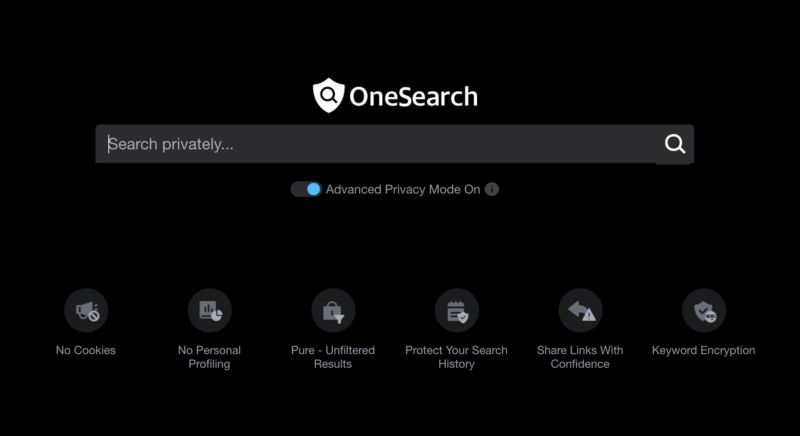
Enlarge / Verizon's OneSearch, a privacy-focused search engine. (credit: Verizon)
Verizon today launched a new search engine, claiming that its "OneSearch" service will offer users more privacy than the standard options in a market dominated by Google.
Verizon's actual search results are provided by Microsoft's Bing, but Verizon added several privacy-focused features—while retaining the ability to serve contextual ads.
"To allow for a free search engine experience, OneSearch is an ad-supported platform," Verizon said in its announcement. "Ads will be contextual, based on factors like search keywords, not cookies or browsing history."
Read 16 remaining paragraphs | Comments
Work requirements for food assistance led to more hunger, no additional jobs in West Virginia
James.galbraithPeople that have to work for a living have no business voting GOP.
While the Trump administration continues to hack away at the safety net, one Trump state provides a preview of what the effects will be. Four years ago, West Virginia started imposing work requirements on food assistance in areas that it said were no longer experiencing economic distress. The result: a lot more hunger, no more jobs.
Work requirements have been imposed on food stamps, or Supplemental Nutrition Assistance Program (SNAP) benefits, since 1996. The law added a time limit for able-bodied people to remain on the program unless the recipient was working or in job training for a minimum of 20 hours a week. But states have been free to waive those restrictions during economic downturns and for their communities that have become economically distressed. West Virginia decided to reimpose those restrictions, and now the Trump administration is effectively eliminating these waivers. It could kick some 700,000 out of the program. The administration says it will force lazy good-for-nothings who could work but refuse to get jobs.
That's exactly the rationale West Virginia Republicans had and that's exactly how it hasn't worked in the nine counties where the restrictions have been enacted, The New York Times reports. “It was just like, ‘Boom, what’s going on here?’” said Mitch Webb, director of the Huntington City Mission. From providing an average of around 8,700 meals a month, they were soon dishing out 12,300 meals every month. "It never renormalized," Webb told the Times.
Diana Van Horn, who runs the Trinity Episcopal Church food pantry confirms how the need skyrocketed. "A few years ago, at the first of the month we would be slow and toward the end of the months we would be busy," she said. "Now we are busy all the time." It's the story of the working poor, who live in rural and underserved and economically marginal areas, who don't have access to stable jobs that promise a minimum of 20 hours a week and who don't have reliable transportation to get to those jobs if they can find them.
The jobs won't come to these areas and these people aren't able to relocate to find them. So they go hungry and rely more on charity. The fact that they have even less money to spend means lessened demand for other goods and services in their communities and a continuing downward cycle of distress. The West Virginia Center on Budget and Policy analyzed it all, and can prove it didn't work to create jobs, reporting, "While around 5,410 people lost food stamps in the nine counties, the growth in the labor force in these counties over the ensuing three years significantly lagged the rest of the state. Average monthly employment growth in the counties actually slowed, while it nearly doubled in the rest of West Virginia."
That's not a problem for Republican Delegate Tom Fast who sponsored legislation to impose the work restrictions statewide. He says it's a policy success because "The information I have is that there’s been significant savings overall." Of course, his narrow vision of "savings" doesn't encompass the extra strain put on charities. "If a person just chooses not to work, which those are the people that were targeted, they're not going to get a free ride," he told the Chicago Tribune. No excuses for anyone: “If there's a will, there's a way." Spoken like someone who's never had to worry about where their next meal is coming from.
Here's what Jerome Comer, who works in a food bank warehouse and who actually has had food insecurity, had to say about it. "You say, 'Well, they're able-bodied Americans.' Yeah, but they live 40 miles out in the holler. They can't walk to McDonalds," he told the Times.

Trump is diverting another $7.2 billion in military funds to build his border wall
James.galbraithHey Congress, fucking do something
 A section of the border wall stretches through the Rio Grande Valley sector of the Texas border on August 20, 2019. | Jinitzail Hernández/CQ-Roll Call, Inc via Getty Images
The funds transfer would bring the total amount devoted to border wall construction under Trump to $18.4 billion.
The Pentagon — not Mexico — will again be paying for the construction of President Donald Trump’s wall on the US’s southern border, to the tune of $7.2 billion in 2020.
According to a Washington Post report, the White House will use last year’s national emergency declaration to pull $3.5 billion from military counter-drug enforcement, up significantly from the $2.5 billion taken from the same program in 2019. An additional $3.2 billion will be taken from Department of Defense construction projects for additional fencing projects. The number is more than five times the amount allocated to barrier construction by Congress for 2020.
The funds transfer would bring the total amount devoted to border wall construction under Trump to $18.4 billion. So far, the administration has only completed about 101 miles of barrier construction, far short of the 450 miles Trump promised to complete by the end of this year. However, administration officials have recently begun counting miles of fencing under construction — rather than completed — as their goal metric, moving the goalposts on Trump’s promise.
The border wall was perhaps Trump’s most prominent 2016 campaign promise and the battle over border wall funding has raged since Trump’s first days. In December 2018, Trump shut down part of the government for 35 days after he refused to sign a bipartisan spending bill to fund the government in 2019. Finally, Congress compromised to give the president $1.375 billion for “existing technologies” like “bollard fencing,” far less than the $5.7 billion originally requested by the White House.
When he reopened the government — without most of the wall money he wanted — Trump got creative, declaring a national emergency in order to divert military funds to build the wall. That triggered a legal and congressional headache, as Vox’s Emily Stewart explained:
In trying to get wall funding through the National Emergencies Act, the question then becomes which existing laws he can try to use to get the money. That’s where he — and the legal scholars trying to figure out what he’s talking about — run into trouble: identifying the laws and statutes he could actually use. The Brennan Center for Justice tracks about 130 laws that contain special powers Trump could access.
“It could be that by putting together a lot of different sources of emergency authority, the president could tap a lot of different funds and at least start,” Kim Lane Scheppele, a professor at the Center for Human Values at Princeton University, told me.
She pointed to a handful of preexisting laws the president could potentially use.
He could, for example, reallocate military spending on construction projects for the wall. One law allows the defense secretary, after a national emergency declaration, to direct the army’s civil works program to construct a structure needed for national defense and use the military budget to do it. Another lets the secretary direct other military services for construction projects. For example, money could come out of the budget for building housing on military bases for service members and into the budget for the wall.
The Supreme Court allowed Trump’s administrative sidestep, ruling in July that a lower court’s block on $2.5 billion in military funding would be lifted, and the money could start being spent on wall construction while litigation against the move continues.
Congress could step in and limit the president’s ability to make these transfers, and the House version of the National Defense Authorization Act barred diverting military funds for the wall. However, that provision was negotiated away in conference meetings to settle differences between it and the Senate version of the bill. As a result of the 2020 NDAA, which was signed in late December, contains no limit on border wall funds diversion.
Trump’s border wall quest got another major boost last Thursday when a Fifth Circuit court of appeals panel ruled 2-1 to lift an injunction which stood in the way of a transfer of $3.6 billion in military construction funds last year for the wall. The ruling overturned a stay put into place by El Paso-based federal judge David Briones in a suit brought by the county of El Paso, Texas, and the Border Network for Human Rights, an immigrant advocacy group based in El Paso, arguing that the government did not have a right to divert funds otherwise allocated by Congress.
A New York Times report from last September revealed that 127 military construction projects had been suspended or delayed because of last year’s diversion of funds. There has been no word yet on whether those or any additional projects will be delayed because of this year’s transfer of border funds.
Correction: The Supreme Court allowed the Trump administration to start using Pentagon funding to begin construction on border barriers, while returning the litigation against the move to the appeals court.
Trump: Saudi Arabia paid the US $1 billion for more troops. Pentagon: Eh, not quite.
James.galbraithMore lies
 President Donald Trump and first lady Melania Trump at the College Football Playoff national championship game in New Orleans on Monday. | Alika Jenner/Getty Images
Trump seemingly announced a major deal during his latest Fox News interview, but officials are walking it back.
During an interview on Laura Ingraham’s Fox News show Friday night, President Donald Trump made a stunning announcement: Saudi Arabia was paying the US $1 billion to send US troops to defend it from Iran.
“We’re sending more [troops] to Saudi Arabia, and Saudi Arabia is paying us for it,” Trump said. “I said, ‘Listen, you’re a very rich country. You want more troops? I’m going to send them to you, but you have to pay us.’ They’re paying us. They’ve already deposited $1 billion in the bank.”
TRUMP brags about turning the US military into a mercenary force: "We're sending more [troops] to Saudi Arabia, and Saudi Arabia is paying us for it ... they're paying us. They've already deposited $1 billion in the bank." pic.twitter.com/8mINgc02h2
— Aaron Rupar (@atrupar) January 11, 2020
Critics, including Rep. Justin Amash (I-MI), slammed the move, accusing Trump of using American troops as “paid mercenaries.” “He sells troops,” Amash tweeted.
On MSNBC, Rep. Barbara Lee (D-CA) raised the possibility that Trump deposited the Saudi money in a personal bank account and said the president is “selling our soldiers as mercenaries to foreign governments.”
“It’s outrageous,” Lee added. “He does not deserve to be the commander in chief of the United States of America.”
As is often the case when it comes to Trump, the details of this purported transaction with Saudi Arabia are murky. Ingraham didn’t ask any follow-up questions about it, and Trump didn’t offer any additional details.
Though the Pentagon did announce last October that it would send troops to Saudi Arabia to defend the country against Iran, there had been no reporting about Saudi Arabia financially compensating the US.
Trump’s comments immediately raised questions: Into which bank account did Saudi Arabia deposit the $1 billion? What exactly are US troops doing over there? And did this transaction even happen, or was the president just making stuff up?
Days later, we’ve learned a bit more about what Trump was talking about. And it seems the president, as he often does, was exaggerating.
In a statement to Vox, Pentagon spokesperson Cmdr. Rebecca Rebarich said, “The Department of Defense has engaged Saudi Arabia on contributing to US activities that support regional security and dissuade hostility and aggression.”
But the statement did not specify whether any sort of financial transaction took place — on the contrary, it said that “discussions are ongoing to formalize these contributions.”
Here’s Rebarich’s statement in full:
Consistent with the president’s guidance to increase partner burden-sharing, the Department of Defense has engaged Saudi Arabia on contributing to US activities that support regional security and dissuade hostility and aggression. The Saudi government has agreed to contribute to the costs of these activities, and discussions are ongoing to formalize these contributions. Contributions of this nature do not lead to the deployment of additional US forces, and they do not drive DoD to take on new missions or responsibilities.
“Discussions are ongoing” is quite different from Trump’s unequivocal claim that Saudi Arabia had “already deposited $1 billion in the bank.”
Trump’s comments came during an interview in which he bragged about war crimes, told blatant lies about the FBI, and said he feels no obligation to publicly detail the intelligence underpinning his decision to approve a military strike against an Iranian official that brought the country to the brink of war.
Any of those remarks from the mouth of the president would’ve likely generated a major scandal in a previous era. But three years in, Trump has normalized gaslighting and authoritarian rhetoric to such an extent that this interview with Ingraham barely registered as a blip on the news radar.
Sean Collins contributed reporting to this article.
The news moves fast. To stay updated, follow Aaron Rupar on Twitter, and read more of Vox’s policy and politics coverage.
Kentucky School Expels Student for Celebrating Birthday with Rainbow Cake, Calls it a ‘Lifestyle Violation’
James.galbraithUnending bigotry
Kayla Kenney, a freshman at Whitefield Academy in Louisville, Kentucky, has been expelled from the school after officials at the Christian school saw a social media post by her mother showing her celebrating her birthday with a rainbow cake, in a matching sweater.
Kenney’s mother was told that the photo “demonstrates a posture of morality and cultural acceptance contrary to that of Whitefield Academy’s beliefs [and follows two years of ] lifestyle violations,” the Courier-Journal reports.
Kenney’s mother says her daughter is not gay, and the bakery listed the cake as “assorted colors.”
The other “lifestyle violations” included getting caught with Juul pods.
WAVE reports: “The code of conduct does address sexual orientation and says if a student’s off-campus behavior isn’t in line with the school’s beliefs they can be disciplined. But Alford wants to know how the shirt brought them to that conclusion.”
Here’s what it says: “On occasion, the atmosphere or conduct within a particular home may be counter or in opposition to the biblical lifestyle the school teaches. This includes, but is not limited to, sexual immorality, homosexual orientation or the inability to support Biblical standards of right and wrong … In such cases, the school reserves the right, within its sole discretion, to refuse admission of an applicant or to discontinue enrollment of a student.”
The post Kentucky School Expels Student for Celebrating Birthday with Rainbow Cake, Calls it a ‘Lifestyle Violation’ appeared first on Towleroad Gay News.

A modest proposal to save American democracy
James.galbraithInteresting idea
 In a democracy, neither one of these men would have their jobs. | Mark Wilson/Getty Images
A law journal just floated a wild idea to add 127 more states to the union. And it’s all constitutional.
American democracy is broken.
We have a president who lost the popular vote, a Senate where the “majority” represents about 15 million fewer people than the “minority,” and a Supreme Court where two justices were nominated by that president and confirmed by that unrepresentative Senate.
An unsigned note, entitled “Pack the Union: A Proposal to Admit New States for the Purpose of Amending the Constitution to Ensure Equal Representation” and published in the Harvard Law Review, offers an entirely constitutional way out of this dilemma: Add new states — a lot of new states — then use this bloc of states to rewrite the Constitution so that the United States has an election system “where every vote counts equally.”
To create a system where every vote counts equally, the Constitution must be amended. To do this, Congress should pass legislation reducing the size of Washington, D.C., to an area encompassing only a few core federal buildings and then admit the rest of the District’s 127 neighborhoods as states. These states — which could be added with a simple congressional majority — would add enough votes in Congress to ratify four amendments: (1) a transfer of the Senate’s power to a body that represents citizens equally; (2) an expansion of the House so that all citizens are represented in equal-sized districts; (3) a replacement of the Electoral College with a popular vote; and (4) a modification of the Constitution’s amendment process that would ensure future amendments are ratified by states representing most Americans.
Under the Constitution, new states may be admitted by an ordinary act of Congress enacted with a simple majority vote. The Constitution does, however, prevent new states from being carved out of an existing state unless the legislature of that state consents. Chopping up the District of Columbia gets around this problem because Washington, DC, is not a state.
One can quarrel with the details of the Harvard proposal. Ratifying a constitutional amendment, for example, requires the consent of three-fourths of the states. So it makes more sense to divide the District of Columbia into 150 states, rather than 127 states, to ensure that pro-democracy amendments will actually be ratified. (Under the Harvard proposal, there would be 177 states, so 133 of them would have to agree to a new amendment. That means that six existing states would need to play along.)
It also would be a good idea to draw the boundaries of those new states to ensure that the electorate within each of the new states supports such amendments.
Similarly, the Constitution effectively prohibits amendments that eliminate Senate malapportionment. The Harvard note proposes getting around this problem by transferring the Senate’s powers to another body. “The Senate’s duties,” it argues, “could be changed without modifying its composition.”
Fair enough. But a more straightforward solution might be ratifying two separate amendments: one to eliminate the restriction on amendments eliminating Senate malapportionment, and a second to actually eliminate Senate malapportionment.
Details aside, however, the wild thing about this Harvard Law Review proposal is that it is absolutely, 100 percent constitutional. The Constitution provides that “new states may be admitted by the Congress into this union,” but it places no limits on the size of a state either in terms of population or in terms of physical space.
Literally nothing in the Constitution prevents Congress from admitting the Obama family’s personal DC residence as a state — a state which would then be entitled to two senators, one member of the House, and exactly as much say on whether the Constitution should be amended as the entire state of Texas.
Congress could then follow up this move by adding the personal DC residences of 149 other staunch Democratic families as states, each of which would then get two senators of their very own.
Indeed, there is a long history of partisans selectively admitting new states in order to pack the Senate with their own fellow partisans. In 1864, for example, Republicans admitted the state of Nevada — then a desert wasteland with only several thousand residents — giving themselves two extra Senate seats in the process.
Similarly, the reason why there are two Dakotas is because Republicans celebrated their victory in the 1888 election by dividing the Republican Dakota Territory up into two states, thereby giving themselves four senators instead of only two.
So let’s be frank. The Harvard note’s proposal is ridiculous, but it is no more ridiculous than a system where the nearly 40 million people in California have no more Senate representation than the 578,759 people in Wyoming. As the Harvard note says of its own pitch, “radical as this proposal may sound, it is no more radical than a nominally democratic system of government that gives citizens widely disproportionate voting power depending on where they live.”
Russians reportedly hack Burisma, the Ukrainian gas company tied to Hunter Biden
James.galbraithYep, sure looks like they're digging to help keep their puppet in the White House
 Hunter and Joe Biden at an event in 2016 | Teresa Kroeger/Getty Images for World Food Program US
The hacking suggest the Russian government might want to interfere in the US presidential election again.
Is the Russian government trying to help President Donald Trump’s electoral chances yet again?
Burisma — the Ukrainian natural gas company that Hunter Biden served on the board of — was hacked by the Russian military late last year, the New York Times’ Nicole Perlroth and Matthew Rosenberg reported Monday, citing a security firm that attributed the hack.
Trump has long been obsessed with the idea that there is some sort of corruption involving Burisma and the Bidens, though he’s had no evidence to prove it. And he tried to pressure the Ukrainian government to investigate the topic earlier this year — a request that spurred a whistleblower complaint from a government official and, eventually, Trump’s impeachment.
The security firm, Area 1, found that the hacking attempts began in early November, around the time public testimony in the impeachment inquiry was beginning.
A spokesperson for the Biden campaign, Andrew Bates, said in an emailed statement that the news shows that Russian president Vladimir Putin “sees Joe Biden as a threat.” He added: “Any American president who had not repeatedly encouraged foreign interventions of this kind would immediately condemn this attack on the sovereignty of our elections.”
This isn’t the first time Moscow has hacked organizations in a way designed to affect American elections. Back during the 2016 campaign, hackers for the GRU, Russia’s foreign military intelligence agency, infamously targeted leading Democratic officials (such as Clinton campaign chair John Podesta) and organizations (such as the Democratic National Committee).
Foreign hackings targeting top political players is nothing new, but what the Russians did with the information was surprising and innovative. They strategically released stolen emails and documents — having many given to WikiLeaks, while posting others through their own online persona “Guccifer 2.0” and on a site called “DCLeaks.” The US media then covered the releases, and Trump touted them on the campaign trail. Much of the information released wasn’t particularly scandalous — but some caused controversy. For instance, DNC chair Debbie Wasserman Schultz resigned after some DNC staffers’ private comments criticizing Bernie Sanders were posted on WikiLeaks.
Special counsel Robert Mueller eventually indicted 12 GRU officials for crimes related to the hacks — but since all of them reside in Russia, none were ever arrested or brought into custody. Trump and his campaign associates were never accused of any involvement in the hacks or any conspiracy with the Russian government, though questions still remain about whether some Trump associates coordinated with WikiLeaks.
The Burisma hack poses the prospect that, once again, the Russians may have obtained unflattering information about someone close to the potential Democratic presidential nominee — Hunter Biden.
Now, Trump’s unfounded conspiracy theory — that Joe Biden forced out Ukraine’s prosecutor general Viktor Shokin to protect Burisma and his son from an investigation — seems to make little sense, as it was the consensus position of the US government and Western institutions like the IMF to oust Shokin due to his own corruption and ineffectiveness.
Still, Hunter’s lucrative position on Burisma’s board doesn’t look great. Hunter had no expertise in the field or the region, and his main qualification for the gig appeared to be that his father was vice president and involved in Ukraine policy at the time.
We of course don’t know what material the Russian hackers may have obtained about Hunter and the Bidens from Burisma, exactly — or what they plan to do with it. Is it damaging? Can it be made to look damning, even if it isn’t? Will it be released at key moments in the 2020 campaign, like last time around?
And the news also poses a challenge for the US media — about whether journalistic outlets will again cover information released by Russian hackers trying to interfere with the election.
This piece was updated with a statement from the Biden campaign.
Kaine and Lee predict as many as 10 Republicans could support war powers resolution
James.galbraithI'll believe it when I see it
Sen. Tim Kaine, the Democratic sponsor of a war powers resolution, says there could be as many as 10 Republican senators willing to vote with Democrats to limit Donald Trump's ability to wage war in Iran.
"Probably about 10" Republicans could side with Democrats, Kaine told The Hill. "There's good discussion going on." His resolution would direct Trump to remove any U.S. forces from hostile action against Iran within a month's time of the resolution passing. Republican Sens. Mike Lee of Utah and Rand Paul of Kentucky have already said they'll support the resolution. Lee told The Hill that it "would not be unreasonable to say that there might be a group of 10 who should be considered potential candidates to vote for it." Among those others are Susan Collins of Maine, Lisa Murkowski and Todd Young of Alaska, and Utah's Mitt Romney.
Lee said that the language of the resolution is unobjectionable, saying it simply states that "additional hostilities against Iran need to be authorized by Congress." He added, "That is a perfectly unremarkable statement. […] The fact that this would be objectionable to anyone in either political party is really saying something." That's particularly true after Kaine agreed to amendments from Republicans to make the resolution applicable to any president, and to ensure that it wouldn't force a withdrawal of troops in areas where proxy forces of Iran are present.
The vote could come this week, Sen. John Thune, the majority whip, told reporters. "It all depends upon cooperation." That, presumably, is a swipe at Democratic leader Chuck Schumer, who just wants to make sure that the senators running for president—Amy Klobuchar, Bernie Sanders, and Elizabeth Warren—are able to be present for the vote.

Trump, bored at pretending he's a real president, says reason for killing Soleimani 'doesn't matter'
James.galbraithwtf
The White House has been scrambling for days now trying to keep up with Donald Trump's lies and shifting justifications for the assassination of Iranian Maj. Gen. Qassem Soleimani, which is kind of a big deal. If you're going to go around killing high-ranking officials of foreign governments, it's best to have a legal rationale for doing so. But now Trump's gotten bored with all those niceties.
He tweeted Monday that the "Fake News Media and their Democrat Partners are working hard to determine whether or not the future attack by terrorist Soleimani was 'imminent' or not, & was my team in agreement. The answer to both is a strong YES, but it doesn’t really matter because of his horrible past!"
So there. Doesn't matter, anyway. We're at the brink of war because he wanted us to be and he doesn't need a reason. That doesn't mean that the next time he's in front of a microphone he won't say that he knew that Soleimani was going to attack 12 embassies and the White House, but for now he's bored with having to pretend to be a legitimate president.

How GOP senators are already pre-spinning their coverup for Trump
James.galbraithOnly if the media lets them get away with it
Pelosi announces Wednesday vote on sending articles of impeachment to Senate
James.galbraithThis table should be at the front of every newscast
Speaker Nancy Pelosi announced that the House will likely vote Wednesday on sending articles of impeachment to the Senate. She made the announcement at a House Democratic caucus meeting Tuesday. The House managers, the lawmakers who will act as prosecutors in the Senate, have not yet been named.
Pelosi set the stage for the vote by reminding the Senate that she might be ready to send the articles over, but she’s not going to let anyone forget that Majority Leader Mitch McConnell is planning to make a sham of it.
xThis is why President Trump was impeached for obstruction of Congress, and why a Senate trial with no witnesses or documents is a cover-up. #EndTheCoverUp #DefendOurDemocracy pic.twitter.com/w9Gl5VmjBu
— Nancy Pelosi (@SpeakerPelosi) January 14, 2020

[Jonathan H. Adler] President Trump Rejects Premise of Justice Department Briefs in ACA Case
James.galbraithIf only the courts actually cared about the arguments instead of just protecting the GOP on this shit.
[Once again, the President's Twitter feed contradicts the claims of his lawyers.]
Last night, the President tweeted about his health care policy accomplishments:
I stand stronger than anyone in protecting your Healthcare with Pre-Existing Conditions. I am honored to have terminated the very unfair, costly and unpopular individual mandate for you!
— Donald J. Trump (@realDonaldTrump) January 13, 2020
According to this tweet, the President "terminated" the individual mandate, presumably by signing the federal tax reform bill that eliminated the tax penalty that had been used to enforce the Affordable Care Act's minimum coverage requirement, which is usually referred to as the "individual mandate." By zeroing out the tax penalty for failing to obtain qualifying health insurance, the tax reform bill turned the purported requirement into nothing more than a precatory statement, as there is no consequence for anyone who fails to comply with the statutory requirement.
Interestingly enough, the Department of Justice does not share the President's understanding of what happened to the mandate. For while the President is taking credit for eliminating the mandate, DOJ is in federal court arguing that the mandate still exists and is capable of imposing Article III injuries on individuals. According to DOJ, there is still a legal obligation to obtain qualifying health insurance, and that anyone who purchases insurance in order to comply with that requirement has suffered an injury-in-fact that satisfies the requirements of Article III standing.
A perverse corollary of DOJ's position is that Congress and the President, by zeroing out the tax penalty for failing to obtain qualifying health insurance, actually made the Affordable Care Act more coercive on the American people. This is because, after NFIB, Americans were left with a choice—obtain health insurance or pay a "tax." This was deemed not coercive by the Supreme Court, which stressed there was no consequence for failing to purchase health insurance other than paying the "tax." DOJ's position, however, is that once the tax penalty was zeroed out, the mandate actually imposes a real obligation to purchase insurance. In other words, DOJ's position is not only that Congress and the President failed to "terminate" the individual mandate, but also that President Trump—by signing the tax reform bill—actually made the mandate more coercive, by eliminating the choice to forego health insurance and pay a "tax."
In most cases, when President Trump tweets something that contradicts the statements of other government officials, it's safe to assume that the President got it wrong. In this case, however, the President is actually the one who got it right.
[Post-script: There's actually an argument that the President is wrong here, but not in a way that helps the DOJ's position. There is a serious argument, made by my co-blogger Randy Barnett here, that NFIB v. Sebelius actually eliminated the mandate, leaving just a tax penalty. Under this view, there was no mandate to eliminate, just a tax penalty to zero out. Another implication of this view is that, if the DOJ is right that there is a mandate to challenge, then the tax reform bill somehow managed to resurrect the individual mandate and reimpose it on the American people. Otherwise, there would be no mandate capable of imposing a legal obligation, let alone an Article III injury.]
NOTE: The last paragraph was edited for clarity.
(404): He told his wife he was too...
James.galbraithoh my...video please lol
Cryptic Rumblings Ahead of First 2020 Patch Tuesday
James.galbraithFFS
Read more of this story at Slashdot.
Upcoming Fall 2020 5.4-Inch iPhone Will Be Similar in Size to iPhone 8
James.galbraithWhich would be handy. I like my iphone 8 size
Citing Apple suppliers exhibiting at CES, Mac Otakara says that Apple "might be developing Face ID models beside Touch ID models as an updated version of iPhone 8."

This confusingly seems to refer to the low-cost "iPhone SE 2" or iPhone 8 successor Apple has in development, but a further mention of the 5.4-inch iPhone with Face ID suggests that it actually refers to the higher-end 5.4-inch device rumored for the fall of 2020.
The body size returns to iPhone 7, and the receiver size is in between the iPhone 11 series and the iPhone XS series. The rear camera is much bigger compared to iPhone 8, and the LED True Tone flash size returns to iPhone 7.Prior rumors have indicated that Apple is working on devices in multiple sizes for its flagship 2020 iPhone lineup, including a 5.4-inch iPhone, a 6.1-inch iPhone (or two devices in this size, based on one rumor), and a 6.7-inch iPhone.
By employing TrueDepth camera, the verticle width of the active area size for the display expands and thus becomes 5.4-inch size, and the possibility of it being the model buzzed about increases.
Mac Otakara says that the 5.4-inch iPhone will have an iPhone 7 body size and a rear camera that's "much bigger compared to iPhone 8." By using the TrueDepth camera system and eliminating the Home button, the display's active area measures in at 5.4 inches, though the device's size will be similar to the iPhone 8.
The iPhone 8 (and the iPhone 7) features a 4.7-inch display along with thick top and bottom bezels that provide room for the front-facing camera and the Home button. By eliminating the bezels, Apple can offer a larger display in a smaller body. The 5.4-inch iPhone will be the smallest iPhone Apple has offered since the 2017 iPhone 8.
There are mixed iPhone rumors right now, but in a nutshell, it seems that Apple will release four to five new iPhones in 2020. The first will come in the spring of 2020 and will be an "iPhone SE 2" or iPhone 8 successor is meant to be a low-cost iPhone with Touch ID and a single-lens camera. This iPhone won't have Face ID and will continue to have thick top and bottom bezels.
In the fall, Apple will introduce three or four new flagship iPhones in 5.4, 6.1, and 6.7-inch size options, and these iPhones will feature edge-to-edge displays, 5G connectivity, multi-lens cameras, and more. Early rumors suggested we should expect three iPhones in the fall of 2020, but a JPMorgan analyst recently said there could potentially be two 6.1-inch iPhones, a prediction that was quickly corroborated by noted analyst Ming-Chi Kuo.
Apple's 2020 fall lineup will be similar to the 2019 iPhone lineup, with iPhones available at multiple price points starting at around $700, while the rumored early 2020 iPhone 8 successor could be priced as low as $399.
This article, "Upcoming Fall 2020 5.4-Inch iPhone Will Be Similar in Size to iPhone 8" first appeared on MacRumors.com
Discuss this article in our forums
How Texas textbooks gloss over discrimination and why it's not surprising
James.galbraithAgain, fuck Texas
In a review of eight textbooks comparing how authors contextualize historical events differently for California and Texas readers, The New York Times gave further proof that the Lone Star State’s practices are just about as backward as we all thought, and authors are preparing the next generations of voters to be similarly misinformed. “Eager to please” publishers battling to find relevance in a digital age in which some teachers would rather find their own primary sources for instruction are catering to policymakers to determine just how much history to expose children to, according to the Times’ analysis.
The newspaper cited several examples of this tailoring from the well-known Pearson publisher distributing a Texas textbook that questions the quality of Harlem Renaissance literature to the equally notable McGraw-Hill publisher’s “critical” description of cultural movements that don’t revolve around white culture in one Texas book. In documenting (or in the case of Texas texts failing to document) pushback against black progress, the Times pointed out that while authors of California texts explained that black Americans didn’t have access to “the suburban dream” of the 1950s, authors of a Texas rendition made no such mention.
The Texas textbook United States History Since 1877, simply stated: "Reasons for suburban growth varied. Some people wished to escape the crime and congestion of the city." Authors added in a California version of the McGraw-Hill textbook entitled United States History & Geography: Continuity and Change: “Movement of some white Americans from cities to suburbs was driven by a desire to get away from more culturally diverse neighborhoods." Similarly, Texas textbooks erased the practice of redlining and housing discrimination from history even though they have been so detrimental to the upward mobility of black and brown citizens that many of us are still feeling the effects today.
When lynching was brought up, a Texas textbook described the act of murder only as a result of missteps of “racial etiquette” following the Reconstruction era, leaving out an important driving factor. California textbook authors described that lynchings were tactics meant to prevent black communities from gaining financial and political power, the Times reported.
And heaven forbid McGraw-Hill’s Texas version of United States History & Geography: Growth & Conflict would mention lesbian, gay, bisexual or transgender Native Americans who held leadership positions like the California text does. That kind of truth-telling might send the red state with a governor who sees fit to joke about lynchings into utter chaos. Gov. Greg Abbott tweeted: "Get a rope" in response to a tweet asking him on Dec. 14, 2019, what he would do about Whataburger being "OUT of Dr. Pepper." Not that any textbook would help Abbott at this point, still, the thought of an entire state raising little Abbotts in the making with whitewashed history lessons is beyond terrifying.
Albert Broussard, a McGraw-Hill author of both Texas and California textbooks told the Times: “American history is not anymore the story of great white men.” But in many ways, it still would be if not for the work of teachers like Texas high school teacher Kerry Green, who took it upon herself to discuss redlining with her students, according to the Times. “The textbook companies are not gearing their textbooks toward teachers; they’re gearing their textbooks toward states,” she told the newspaper.
CBS renews Star Trek: Picard for a second season
James.galbraithOh good
Jean-Luc Picard (Patrick Stewart) comes out of retirement in Star Trek: Picard, coming soon to CBS All Access.
Streaming service CBS All Access has already renewed Star Trek: Picard for a second season just over a week before the first season is even set to start airing, Deadline reports.
The announcement was made at the Television Critics Association (TCA), a recurring event at which television networks present their slate of programming to advertisers, the press, and partners. In a Picard-themed panel at the event, the show's cast and showrunner talked about what viewers can expect from the series, which returns to a character who has not appeared on screen since the film Star Trek: Nemesis way back in 2002.
Executive Producer Akiva Goldsman said we can expect to see some of the social relevance that the Star Trek franchise has been known for. Quoted in Deadline, he said:
Read 4 remaining paragraphs | Comments
White House, reportedly fearing 4-plus GOP defections on Senate trial vote, pushes dismissal
James.galbraithWell that's interesting
The White House reportedly believes as many as four-plus GOP senators will vote with Democrats to call witnesses in Donald Trump’s impeachment trial, according to CBS News. If true, that's a whopper of a turnabout. CBS names Sens. Lisa Murkowski of Alaska, Susan Collins of Maine, Mitt Romney of Utah, and possibly Cory Gardner of Colorado as the first four potential defections, with Sens. Rand Paul of Kentucky and Lamar Alexander of Tennessee as two other possibilities.
This development would explain a lot of things, chief among them why Trump went from pushing for testimony from House Speaker Nancy Pelosi on Sunday morning to several hours later tweeting his support for a Senate vote to dismiss the trial altogether. It was quite an evolution, even for Trump.
But Senate Majority Leader Mitch McConnell doesn't have the votes for dismissal, according to CNN, and he's stalling on laying out a timeline on a vote to set the parameters for the trial. Naturally, McConnell went to the Senate floor Monday to take a victory lap on Pelosi agreeing to send over the impeachment articles before the Senate's parameters were clear. He said she had accomplished "nothing."
But at the last minute, at least, it seems more like a “Republicans in disarray” moment. Trump's switching horses on the Senate trial midstream because he's freaked. The White House is pushing McConnell to take a vote on dismissal for which he doesn't have enough GOP support. At the same time, top Republicans are trying to publicly dissuade Trump from insisting on incorporating the House GOP clown car in his defense team.
“My advice to him would be: Let's not infect the Senate trial with the circus-like atmosphere of the House,” Cornyn told reporters.
Sorry, but it looks like Pelosi has at least given the White House and Republican senators a touch of heartburn, among other things she accomplished.

Why Trump has to lie about health care
James.galbraithAnd the GOP is fine with this. Lying their ass off.