Shared posts

29 Apr 18:48

Why Biden Probably Won’t Announce His Running Mate For Months

by Nathaniel Rakich
James.galbraith

That's fine, but keep vetting all the way through

With the presidential primary essentially settled, talk has already turned to who will be former Vice President Joe Biden’s running mate. But if history is any guide, we won’t know the answer for a few months.

In the modern era of presidential nominations, which began when a number of primary reforms were implemented in 1972, the presumptive presidential nominee has never announced his or her vice presidential pick before July 6. And we could be waiting much longer than that: A few running mates haven’t been announced until late August.

Running mates often get picked in late summer

When each vice presidential nominee was announced, since 1972

Pres. Nominee V.P. Nominee Party Date Announced Days Before Convention
McGovern Shriver* D Aug. 5, 1972 -23
Carter Mondale D July 15, 1976 0
Ford Dole R Aug. 19, 1976 0
Reagan H.W. Bush R July 17, 1980 0
Mondale Ferraro D July 12, 1984 4
Dukakis Bentsen D July 12, 1988 6
H.W. Bush Quayle R Aug. 16, 1988 0
Clinton Gore D July 9, 1992 4
Dole Kemp R Aug. 10, 1996 2
W. Bush Cheney R July 25, 2000 6
Gore Lieberman D Aug. 7, 2000 7
Kerry Edwards D July 6, 2004 20
Obama Biden D Aug. 23, 2008 2
McCain Palin R Aug. 29, 2008 3
Romney Ryan R Aug. 11, 2012 16
Trump Pence R July 15, 2016 3
Clinton Kaine D July 22, 2016 3

*Sargent Shriver replaced Thomas Eagleton as McGovern’s vice presidential pick 23 days after the 1972 Democratic National Convention ended.

Mondale, Dole, H.W. Bush and Quayle were announced during their party’s convention.

SourceS: News reports, library of congress

But that wide date range obscures the fact that vice presidential candidate announcements are closely tied to the timing of the party conventions — which, of course, varies every election year. Four of the vice presidential nominees since 1972 were announced at the convention, and almost all the others were announced shortly before.22

For most of American history, vice presidential nominees were chosen during the conventions themselves, originally by the same chaotic, multiple-ballot process that was used to pick presidential nominees, but eventually at the direction of the presidential nominee, a trend that started with Franklin D. Roosevelt choosing Henry Wallace in 1940. And in 1984, Walter Mondale became the first presidential candidate to announce his running mate before the convention began (his pick, Geraldine Ferraro, also made history in another, more important way — she was the first woman on a major-party presidential ticket).

Since then, the No. 2 spot on the ticket has almost always been announced the week before the convention, with the median vice presidential announcement occurring four days before the convention gavels in. However, there have been some exceptions to this pattern. John Kerry revealed John Edwards as his choice on July 6, 2004 — 20 days before the Democratic convention — and Mitt Romney unveiled Paul Ryan on Aug. 11, 2012 — 16 days before the Republican conference.

This (plus failed presidential candidate Sen. Ted Cruz’s stunt of choosing businesswoman Carly Fiorina in 201623) could suggest it’s becoming more common for candidates to announce their running mates weeks in advance. However, Cruz’s selection was seen as a desperate ploy to resurrect his sinking presidential campaign, and Romney’s was seen as an attempt to change the narrative amid a bad news cycle, so we should probably still only expect early announcements in limited circumstances. (And considering that Biden is leading Trump in most early polls, he does not fit the historical mold of a candidate who needs to announce his choice early.)

At one point, we probably could have expected Biden’s announcement in early July, shortly before the Democratic National Convention kicked off on July 13. But the coronavirus-related delay of the convention to the week of Aug. 17 probably also pushed back the timing of the veep pick. If Biden follows the pattern of past nominees, we can probably expect to learn the identity of his running mate the week of Aug. 10. And if you’re trying to plan when exactly to track airplanes or monitor finalists’ every move, might I recommend Friday, Aug. 14? The last five vice presidential picks have all been announced either the Friday before the convention or early that Saturday morning.

FiveThirtyEight Politics Podcast: Is COVID-19 already hurting Trump politically?

29 Apr 18:21

'Great success story': Jared Kushner praises COVID-19 response as death toll surpasses Vietnam War

by Marissa Higgins
James.galbraith

Heaven save us from such overwhelming success

As the United States roared beyond 1,000,000 people infected with the novel coronavirus, many people are also discussing another disturbing number: More people in the U.S. have now died because of the novel coronavirus than the number of Americans killed during the Vietnam War. As NPR points out, this means the novel coronavirus death rate has climbed notably higher. It’s been close to a month since we rolled past the number of people killed during 9/11. And what does Jared Kusher, White House senior adviser, have to say about all of this?

According to his interview on Fox & Friends on Wednesday morning, he seems to feel he has much to brag about. Trump’s son-in-law said: “The federal government rose to the challenge, and this is a great success story.”

“We’re on the other side of the medical aspect of this,” Kushner said in the clip, which is now going viral on Twitter. “I think that we’ve achieved all the different milestones that are needed.” Meanwhile, Dr. Anthony Fauci wants every single American who wants a test to be able to have a test by June. Seems like a pretty important milestone, no?

Kushner stressed that the goal is to reopen the economy.

Watch: Jared Kushner tells Fox News on testing: �Somebody asked me why it took so long, I actually said you should look at how did we do this so quickly� the eternal lockdown crowd can make jokes on late night television, but the reality is is that the data is on our side.� pic.twitter.com/SFE2nAHjI1

� TV News HQ (@TVNewsHQ) April 29, 2020

“The eternal lockdown crowd can make jokes on television but the reality is that the data is on our side,” Kusher continued. “And President Trump has created a pathway to safely open up our country and make sure that we get our economy going.”

This “pathway,” of course, has low-income workers, people of color, food service workers, and others terrified about returning to work for minimal wages, perhaps without health insurance or affordable child care as students stay out of school, all while only a minuscule fraction of the public has been tested for the virus. Though Trump himself recently told governors to consider and maybe “get going” on reopening schools, so while the logic is baffling, it’s apparently consistent between Trump and Kushner. 

“The hope is by July,” Kushner suggested, “the country is really rocking again.” Again, this coincides with Trump’s plan for a Fourth of July event on the National Mall in Washington, D.C., this year… in spite of the global pandemic. 

In other bizarre Fox-related news, The New York Times shut down Sean Hannity’s request for a retraction (or even an apology), alleging the newspaper “mischaracterized” his coverage of the pandemic. Between The New York Times and The Washington Post, excellent analyses are out about just what Trump has been saying during his press briefings and related remarks on the novel coronavirus: he praises himself more than anything else, and he congratulates himself and other top members of his team more than he extends empathy to anyone, including condolences for victims. 

All of this, of course, while our testing number remains shamefully low, and the new Centers for Disease Control and Prevention data suggests our death toll is actually far higher than has been reported. 

29 Apr 18:20

Why the coronavirus may be killing more Americans than the government data says

by Dylan Scott
James.galbraith

No shit

Riders pass a makeshift morgue in Brooklyn, New York. A new study indicates the US saw more than 15,000 excess deaths in March and early April, a higher toll than the official Covid-19 fatality count. | Andrew Lichtenstein/Corbis via Getty Images

There are likely many uncounted Covid-19 fatalities. People are also dying from the economic and health system crises.

It’s long been the consensus of experts that more Americans are dying in the coronavirus pandemic than the official figures indicate. But exactly how many?

This week, the first estimate of how many more people have perished was published in the Washington Post, using one of the best methods commonly used by researchers: measuring excess deaths.

And it was a grim one. The Post, in partnership with researchers from the Yale School of Public Health, estimated that 15,400 more people died between March 1 and April 4 than would ordinarily have been expected, a substantially higher toll than the 8,128 coronavirus deaths that were reported over that time by government agencies. Ordinarily, the researchers project the US would have had a little more than 50,000 deaths in the studied period, but the actual deaths were more than 60,000.

Not all of those excess deaths were necessarily directly a result of Covid-19. As the Post reporters wrote, mortality in a pandemic is a complicated recipe:

The excess deaths are not necessarily attributable directly to covid-19, the disease caused by the coronavirus. They could include people who died because of the epidemic but not from the disease, such as those who were afraid to seek medical treatment for unrelated illnesses, as well as some number of deaths that are part of the ordinary variation in the death rate. The count is also affected by increases or decreases in other categories of deaths, such as suicides, homicides and motor vehicle accidents.

But in any pandemic, higher-than-normal mortality is a starting point for scientists seeking to understand the full impact of the disease.

“Determining the cause of death is more of an art than a science, and guidelines can change,” Daniel Weinberger, who led the Yale School of Public Health researchers, told me. “There are likely many more people who died of coronavirus-related causes than who have ‘coronavirus’ listed as a cause of death on the death certificate.”

Then again, you also have to account for how many of the people who died from Covid-19 might have died anyway, given poor health, as well as the lives saved because, for example, fewer people are driving automobiles during a period of nationwide lockdowns.

“One way to avoid these biases is to look at what happens to rates of death due to any cause,” Weinberger said. His team created a regression model that adjusts for the seasonal variations in mortality and changes in mortality over time. They accounted for flu activity as well.

The bottom line, according to Weinberger: “With all those complexities, we still see that there were about 15,000 excess deaths from March 1 to April 4. This is about 1.5 to 2 times higher than the reported number of Covid-19 deaths at the time.”

And if anything, that is probably the floor. Experts including Weinberger agree the death counts are likely to be revised upward as more reporting come in. Tallying deaths always takes time because of inconsistent reporting across states.

“As we gain more detailed information on the causes of death, we will learn more about whether Covid-19 caused them directly, or whether the many disruptions, both to health care, and economic disruption, could have caused many of the excess deaths,” Ellen Meara, a health economics professor at Harvard, told me over email. “What is remarkable to me about the sheer number of excess deaths is that this spike in deaths has occurred despite some trends that we expect to lower deaths during Covid-19.”

More people are dying from Covid-19 than the official count says

More than 58,000 Americans are confirmed to have died from the coronavirus as of midday on April 29. As the Yale study suggests, that number is likely low.

In some respects, it is no mystery why more people have died during the coronavirus pandemic than the government figures indicate. The officially reported number of Covid-19 deaths generally comes from hospitals. People who die at home may not be counted if they are never tested for the coronavirus. Instead, they may have a pulmonary embolism or heart attack listed as their cause of death, even if Covid-19 was the catalyst for their passing.

“People who die at home are least likely to be counted, particularly since we are seeing some people dying of pulmonary embolism or other clotting,” Natalie Dean, a biostatistics professor at the University of Florida, said.

“It would be hard to identify COVID-19 as the cause of the death there unless they are doing postmortem testing,” she said. “I assume there is more postmortem testing now than there was earlier, but when tests were in really short supply, I have to imagine postmortem testing was very rare.”

New York City has already revised its death count upward to account for nearly 4,000 people assumed to have died of Covid-19 but who were never tested for it. The city is now up to 17,700 reported deaths, as of April 29. Future official revisions may be made, but this is one advantage of the approach taken by Weinberger and company: it simply counts how many people are dying overall, of any cause, and compares it to a hypothetical reality with no Covid-19.

Undercounting coronavirus deaths isn’t only an American problem. The Financial Times analyzed data from 14 countries and found 122,000 excess deaths above what would be expected. Spain has seen 27,600 more deaths than usual in March and April; Italy is up to 21,500, and France 16,500. A separate FT analysis of England and Wales estimated that Covid-19 is killing twice as many people as the government has attributed to the crisis.

And these numbers are really a baseline. “Revisions AAAAALLLLLWAAAAAAAYS go up,” Lyman Stone, an economist and adjunct fellow with the American Enterprise Institute who has studied mortality rates, told me over email.

Using a methodology to account for expected revisions, he is preliminarily projecting that excess deaths could exceed 60,000 or more in March and April.

You get the point. The coronavirus’s toll is likely worse than we know right now. The big question is why.

There are other reasons people might be dying more — or less — during Covid-19

In all likelihood, some of the 15,400 excess deaths measured in the Yale study were not the direct result of Covid-19. So why else are so many more people dying in a pandemic?

One of the most obvious candidates is the strain on the American health system from coronavirus, which is leading people to die from causes they might otherwise not have — think of a mild heart attack or a complication if somebody with a chronic condition runs short on medicine and can’t see their doctor to get a prescription filled. This was a fear from the start, as medical facilities revamped their operations to focus on Covid-19, and emergency responders were inundated with a record number of calls.

“It‘s possible that emergency response teams, hospitals, and nursing home facilities overburdened with coronavirus have been unable to effectively prevent deaths from other causes they would ordinarily have been able to,” Jessica Ho, a USC sociologist who studies mortality, said.

The interruptions to routine care for people with chronic conditions could also be to blame, with primary care practices postponing many outpatient services and furloughing staff. As I wrote recently on the dramatic downturn in primary care visits during the outbreak:

“Within my lifetime, I have not seen anything of this magnitude,” Ateev Mehrotra, a professor at Harvard Medical School who led the study, told me.

He also said that “our real concern is those patients who might have deferred a visit and they’re going to have a flare-up of their chronic illness.” In a worst-case scenario, that could lead to patients dying at home — a person with heart failure, for example — who might not have if they’d been able to see their regular doctor. This will add to the death toll of Covid-19, but it will be hard to fully measure.

Dania Palanker, an assistant research professor for the Center on Health Insurance Reforms at Georgetown’s Health Policy Institute and a chronic care patient herself, worried about people recently diagnosed with diabetes or heart disease who won’t be able to get that critical first appointment with a new doctor. “You can’t delay those appointments for a few months.”

The mental health toll of the current economic crisis caused by the coronavirus and accompanying lockdowns could also be driving up deaths, several experts told me. (There are indications domestic violence is increasing during the pandemic, though it’s not clear if that is translating to a rise in deaths.)

“We know that reported levels of anxiety and depression are rising, and claims for unemployment insurance are at historic highs,” Meara said. “All of these could contribute to increased death from suicide, as prior economic downturns suggest.”

On the other hand, other causes of deaths might be down because of the pandemic and stay-at-home orders. Car accidents are one obvious candidate. Pollution is down, and that could be a boon for health. Some people with physically demanding jobs are working less, which could also be resulting in fewer deaths than would otherwise occur.

Throw all these ingredients together — uncounted Covid-19 deaths, other preventable deaths from a health system overload, the health toll of record unemployment, and then saved lives because people are driving less and other behavioral changes — and you get a fuller picture of the coronavirus’s toll. The Yale researchers provided a preliminary figure; Stone’s personal estimates anticipate excess deaths will continue to mount.

This data is a reminder that a pandemic can take a toll beyond the damage caused by the pathogen itself. But first and foremost, when excess deaths are twice as high as the official coronavirus death toll, it’s a clear indication that we are not doing a good job of counting all the deaths that are the direct result of this virus.

As Josh Michaud, associate director for global health policy at the Kaiser Family Foundation, told me: “In all likelihood, many of these excess deaths can likely be attributed to Covid.”

This story appears in VoxCare, a newsletter from Vox on the latest twists and turns in America’s health care debate. Sign up to get VoxCare in your inbox along with more health care stats and news.

Join the conversation

Are you interested in more discussions around health care policy? Join our Facebook community for conversation and updates.


Support Vox’s explanatory journalism

Every day at Vox, we aim to answer your most important questions and provide you, and our audience around the world, with information that has the power to save lives. Our mission has never been more vital than it is in this moment: to empower you through understanding. Vox’s work is reaching more people than ever, but our distinctive brand of explanatory journalism takes resources — particularly during a pandemic and an economic downturn. Your financial contribution will not constitute a donation, but it will enable our staff to continue to offer free articles, videos, and podcasts at the quality and volume that this moment requires. Please consider making a contribution to Vox today.

29 Apr 18:18

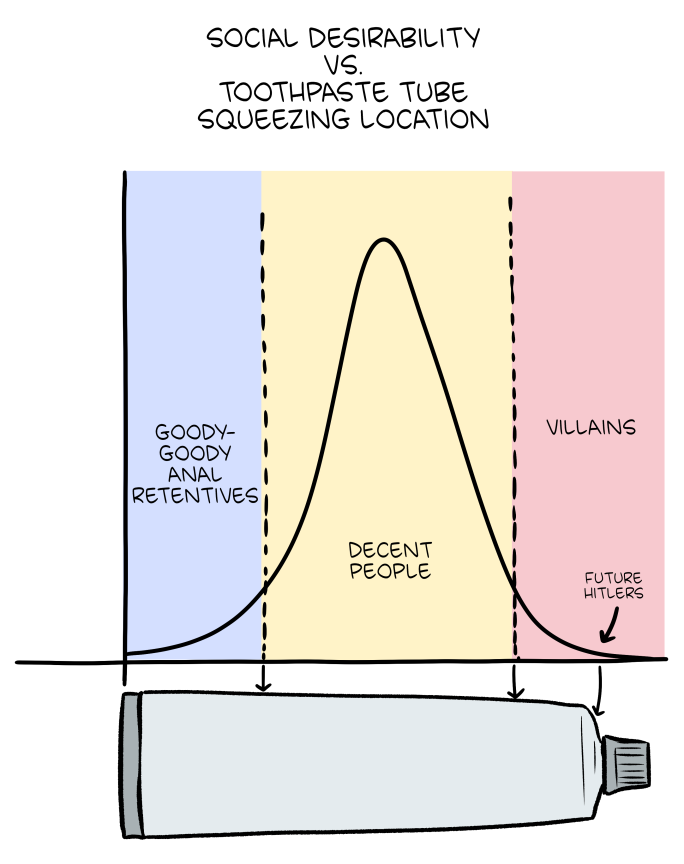
Saturday Morning Breakfast Cereal - Social Desirability

by tech@thehiveworks.com


Click here to go see the bonus panel!

Hovertext:
If you happen to be a Future Hitler, you can purchase an indulgence via the SMBC store.


Today's News:
29 Apr 18:15

Virus Likely To Keep Coming Back Each Year, Say Top Chinese Scientists

by msmash
James.galbraith

No surprise there

Chinese scientists say the novel coronavirus will not be eradicated, adding to a growing consensus around the world that the pathogen will likely return in waves like the flu. From a report: It's unlikely the new virus will disappear the way its close cousin SARS did 17 years ago, as it infects some people without causing obvious symptoms like fever. This group of so-called asymptomatic carriers makes it hard to fully contain transmission as they can spread the virus undetected, a group of Chinese viral and medical researchers told reporters in Beijing at a briefing Monday. With SARS, those infected became seriously ill. Once they were quarantined from others, the virus stopped spreading. In contrast, China is still finding dozens of asymptomatic cases of the coronavirus every day despite bringing its epidemic under control. "This is very likely to be an epidemic that co-exists with humans for a long time, becomes seasonal and is sustained within human bodies," said Jin Qi, director of the Institute of Pathogen Biology at China's top.

Read more of this story at Slashdot.

29 Apr 18:15

‘Positive Data’ Reported in Trial of Gilead Anti-Viral Drug Remdesivir Against Coronavirus

by Andy Towle
James.galbraith

Every little bit, which is enough to goose the markets hard lol

remdesivir
Photo by Dimitri Karastelev on Unsplash

Last week we reported that Remdesivir, an anti-viral drug originally developed by Gilead Sciences as a possible treatment for the Ebola virus, showed preliminary promise in treating COVID-19 patients.

On Wednesday, Gilead reported additional promising news following a “single-arm” study of the drug on coronavirus patients.

Bloomberg reports: “Gilead Sciences Inc.’s experimental drug to treat coronavirus helped patients recover faster than standard care, the company said, offering hope for what could be the first effective treatment for the illness that has swept the world. A trial being run by the U.S.’s National Institute of Allergy and Infectious Diseases looked at whether Gilead’s remdesivir helped people with Covid-19 recover faster than without it. Details are expected to be released later, the company said in a statement.”

CNBC reports: “Gilead Sciences said Wednesday preliminary results of a coronavirus drug trial showed at least 50% of patients treated with a 5-day dosage of antiviral drug remdesivir improved and more than half were discharged from the hospital within two weeks. … The study tracked two groups of patients who were hospitalized with Covid-19. One group received a 5-day treatment of remdesivir, while the other group took the drug for 10 days. The researchers said more than half of the patients in both treatment groups were discharged from the hospital within 14 days. Roughly 64.5% of the patients who received the shorter treatment course were discharged, compared with 53.8% of the group who were treated for 10 days. “

Wrote Gilead: “Remdesivir is not yet licensed or approved anywhere globally and has not yet been demonstrated to be safe or effective for the treatment of COVID-19. This study sought to determine whether a shorter, 5-day course of remdesivir would achieve similar efficacy results as the 10-day treatment regimen used in multiple ongoing studies of remdesivir. Secondary objectives included rates of adverse events and additional measures of clinical response in both treatment groups. Patients were required to have evidence of pneumonia and reduced oxygen levels that did not require mechanical ventilation at the time of study entry. Clinical improvement was defined as an improvement of two or more points from baseline on a predefined seven-point scale, ranging from hospital discharge to increasing levels of oxygen support to death. Patients achieved clinical recovery if they no longer required oxygen support and medical care or were discharged from the hospital.”

The post ‘Positive Data’ Reported in Trial of Gilead Anti-Viral Drug Remdesivir Against Coronavirus appeared first on Towleroad Gay News.

29 Apr 18:13

“It’s going to go away”: Trump’s blind faith won’t solve America’s coronavirus testing problem

by Aaron Rupar
James.galbraith

This is not a man with an abundance of coping skills

President Trump speaks at the White House on April 28. | Mandel Ngan/AFP via Getty Images

Trump’s comments about testing are troublingly similar to his efforts to wish away the coronavirus in February.

President Donald Trump’s latest comments about the United States’ coronavirus testing problem come straight out of the playbook he used to downplay the coronavirus problem in January and February. That’s not a reassuring thing.

Trump seems to be in denial about the reality that experts say the US needs to more than double its daily coronavirus testing capacity in order to safely relax stringent social distancing. To hear him and other White House officials like Jared Kushner tell it, states already have more than enough testing resources to get on with reopening schools and businesses. (Governors disagree.)

Trump’s dismissiveness of the testing problem was demonstrated by his most recent press conference on Tuesday. The president responded to questions about the state- and private sector-centric testing plan he unveiled the day before — one that, even if executed properly, would fall far short of what’s needed — with a mix of brazen lies, nonsensical deflection, and wishful thinking.

“We are the best in the world in testing. We’ve tested much more than anybody else, times two. Or every country combined — we’ve tested more than every country combined,” Trump said, falsely, as the US has not even come close close to doing more testing than all other countries combined.

“We inherited a very broken test, a broken system, and a broken test,” Trump continued, seemingly trying to blame his predecessor — President Obama, who left office in 2017 — for his own government’s costly initial failure to develop an effective test for a virus that didn’t even exist until late last year, let alone reach the US until he had been in office for three full years.

As illogical as his responses might be, Trump’s effort to shift blame is meant to obfuscate from the fact that while the raw numbers of tests completed are piling up thanks to the passage of time, the per-day numbers continue to fall short.

According to the Covid Tracking Project, the US is currently conducting about 220,000 coronavirus tests a day. Experts broadly agree that at least 500,000 per day is needed, and some think as many as 5 million daily tests are necessary to adequately identify and contain Covid-19 outbreaks.

The testing plan Trump unveiled on Monday would only get the US up to about 260,000 tests a day by the end of May — a slight improvement over the current state of affairs, but one that still falls far short of what’s needed.

But when Trump was asked on Tuesday if he’s confident that the country can do 5 million tests a day soon, his response bordered on the delusional.

“We’re going to be there very soon. If you look at the numbers, it could be that we’re getting very close,” Trump said, ignoring that 260,000 is nowhere near 5 million — and that such a sharp uptick would require the sort of increase in the production of test materials that’s proven impossible so far. “We’re gonna be there very soon.”

Those comments were troublingly reminiscent of what Trump was saying about the coronavirus back in February and March, when he was insisting everything was under control and the virus would go away on its own, “like a miracle.”

Those claims were obviously false at the time, and look even worse 1 million confirmed US cases and nearly 60,000 deaths later. Trump’s claims about testing are likely to also age poorly, and even more so if he keeps pushing for states to reopen businesses and schools without the testing capacity needed to keep the virus under control.

Trump, however, made it abundantly clear on Tuesday that he’s still engaged in wishful thinking. Pressed by a reporter about how he can be so confident that the worst of the pandemic is behind us even as deaths continue to mount and no vaccine or effective treatments are available, Trump expressed blind faith, then pivoted to talking about his hopes for a sharp economic rebound in time for November’s election.

“I think what happens is it’s going to go away. This is gonna go away,” Trump said, adding later: “I really believe that fourth quarter is gonna be, maybe tremendous.”


Support Vox’s explanatory journalism

Every day at Vox, we aim to answer your most important questions and provide you, and our audience around the world, with information that has the power to save lives. Our mission has never been more vital than it is in this moment: to empower you through understanding. Vox’s work is reaching more people than ever, but our distinctive brand of explanatory journalism takes resources — particularly during a pandemic and an economic downturn. Your financial contribution will not constitute a donation, but it will enable our staff to continue to offer free articles, videos, and podcasts at the quality and volume that this moment requires. Please consider making a contribution to Vox today.

29 Apr 18:11

The backlash over fumbled coronavirus stimulus is starting, and it's all on Trump

by Joan McCarter
James.galbraith

No surprise there

After a concerted two decades of Republican efforts to destroy government—to the extent that they put a corrupt, sociopathic clown of a Russian puppet in the White House—it shouldn't come as a surprise that this government is disastrously failing at responding to this crisis. There's not an element of the $2.2 trillion CARES Act that the Trump administration hasn't messed up delivering on, with the possible exception of the tax cuts to the very wealthy.

The Small Business Administration has had two terrible rollouts of the Paycheck Protection Program, with the system crashing and overwhelmed within minutes of being launched both times. Except for the very big businesses, the ones whose CEOs can bypass that whole applying online business by just making a call to their personal contact at the very big bank and getting pushed to the front of the line. Some of those very big business were publicly shamed into returning the money, but plenty of publicly traded big borrowers are refusing to do so even as Treasury Secretary Steven Mnuchin encourages them to. Because he might be the one person in the Trump administration who is bothered by bad press.

Lawmakers are hearing about it: "Our constituents have a lot of questions about where the hell this $3 trillion is going and why it isn't coming into their pockets," said Pennsylvania Democratic Rep. Mary Gay Scanlon last week during a meeting at the Capitol when the House returned to pass the Phase 3.5 bill that boosted funding for the small business loans. That's a bipartisan sentiment, by the way. "Fraudulent actors go to where the money is, and this is where the money is right now," said Rep. Rob Woodall, a Georgia Republican. "So I absolutely think that we have to redouble our effort to make sure that these dollars aren't wasted."

Even the $1,200 stimulus check was problematic for many, including people who needed it most—those who didn't make enough money to have to file taxes in the past two years—having to jump through ridiculous hoops to collect it. People whose spouses are documented immigrants and aren't eligible. Checks being sent to dead people. Expanded unemployment insurance benefits are great, but only if the states' systems for processing them can handle the influx of applicants.

Hospitals are "utterly perplexed," in one health consultant's words, about how they are supposed be getting their billions in funds. The formula Health and Human Services (HHS) initially used was the easiest for them: give the money based on the ones that had the most Medicare reimbursements, even though those weren't the hospitals that were the hardest hit in the pandemic. "We are all utterly perplexed trying to figure out what the hell this formula is and how it’s going to work," they said. "They could be sending out checks today, and we truly don't know how they're doing it."

The administration also hasn't made clear at all how the money it has designated for caring for uninsured coronavirus patients is going to work. HHS hasn't told hospitals how much money is available to them in this pot, and it has banned any hospital that uses the funds from billing patients. HHS also hasn't told those patients how to get their medical bills covered. Even the telehealth program that was approved early on has been problematic because the Federal Communications Commission refuses to grant some of the $200 million it got to all hospitals.

In trying to get checks out to everyone, the IRS is dealing with systems that are literally four and five decades old with staff already depleted by years and years of budget cuts. This is where the super-rich are like the rest of us, at least—the IRS is having difficulties processing the requests for the big tax cut for wealthy business owners in the stimulus.

Small farmers and ranchers have been left out, too. They're having as much difficulty getting those PPP loans as other real small businesses, and the lenders they normally work with didn't even get approved by Treasury to loan out the money in the first round. "We're not confident at all that this will be terribly effective for agriculture," said Todd Van Hoose, president of the Farm Credit Council. "We had a terrible time getting approval for our lenders to participate through the SBA program."

It's all a mess, and it can almost entirely be laid at Trump's feet. Because of the urgency of the crisis, the only response Congress should have is just to throw more money at all of it—starting with $2,000 monthly payments to everyone in America—and then figuring out how to claw it back from those who shouldn't have gotten it afterward. What it also means is that Democrats absolutely should not be afraid of going for the maximum in the next package and defending it to the hilt.

29 Apr 17:37

Matt Bomer Reacts to Viral Meme Suggesting He Looks Like Every Other Ryan Murphy Leading Man

by Andy Towle
James.galbraith

Ryan murphy clearly has a type lol

Matt Bomer on Wednesday responded to a viral meme featuring a lineup of white guys — Cheyenne Jackson, Finn Wittrock, Max Greenfield, and Wes Bentley — cast as leading men by producer Ryan Murphy.

Wrote Twitter user @vintagehols: “i could not name one of these men if someone put a gun to my head.”

Replied Bomer: “I love all of these men and their unique talents. But if you’re going to line us up and objectify us every few months like Ryan Murphy’s version of a Hitchcock blonde…then I’ve got dibs on Grace Kelly.”

Bomer followed that tweet with another, soliciting donations to CenterLink, a coalition of more than 250 LGBTQ community centers from 45 states, Puerto Rico, the District of Columbia, as well as Canada, China, Mexico, and Australia. CenterLink strengthens, supports, and connects LGBTQ community centers, which serve over 2 million people each year.

The post Matt Bomer Reacts to Viral Meme Suggesting He Looks Like Every Other Ryan Murphy Leading Man appeared first on Towleroad Gay News.

29 Apr 17:33

The birth control wars return to the Supreme Court. And this time, conservatives have the votes.

by Ian Millhiser
James.galbraith

This is how "religious liberty" becomes a sword, not a shield

Supreme Court Hears Arguments In Case Margot Riphagen of New Orleans dresses as a birth control pill pack while dancing in front of the US Supreme Court during oral arguments in Sebelius v. Hobby Lobby March 25, 2014, in Washington, DC. | Chip Somodevilla/Getty Images

The Christian right is likely to score big wins from a majority-Republican Supreme Court.

Next Wednesday, the Supreme Court will hear a pair of cases, Little Sisters of the Poor v. Pennsylvania and Trump v. Pennsylvania, which could write the final chapter in a multi-year struggle over whether employers with religious objections to birth control may deny insurance coverage of contraceptives to their employees.

With two Trump appointees occupying seats on the Supreme Court, the Court is now far more conservative than it was four years ago, when a similar birth control case reached the justices. It is likely, in other words, that religious conservatives can look forward to a big win in the Pennsylvania cases — one that would mean many individuals could be left without birth control coverage.

The question of whether people with a religious objection to a particular law must follow that law is now a mainstay of the Supreme Court’s docket. The Court will hear another case in its next term presenting the question of whether people with anti-LGBTQ religious beliefs may discriminate against same-sex couples, and it last took up a case involving religious objections to contraception in Zubik v. Burwell (2016).

But the Zubik case largely fizzled after Justice Antonin Scalia’s death left the Court divided 4-4 on which side should prevail. Now, however, the Supreme Court has five solidly conservative Republicans, so there will likely be a majority ready to grant expansive legal exemptions to religious conservatives.

The specific legal issue at stake in the Pennsylvania cases is slightly different from the one at issue in Zubik, largely because the current administration is extraordinarily sympathetic to religious conservatives. Past Supreme Court cases asked whether religious objectors may defy federal regulations requiring most employers to provide contraceptive coverage to their employees — or, at the very least, to participate in some minimal way in a government program that provides birth control coverage to workers.

The Pennsylvania cases, by contrast, involve challenges to Trump administration regulations giving many employers broad exemptions from the general rule that employee health plans must cover contraception. Under these regulations, employers that are not publicly traded may refuse to provide birth control coverage if they object to birth control, either on religious grounds or due to a “sincerely held moral” conviction.

Nevertheless, there is a fairly high chance that the Supreme Court will rule that broad exemptions for religious objectors are mandatory, regardless of whether the incumbent administration supports those exemptions. It is less clear, however, whether the exemption for “moral” objections will be upheld.

What’s happened in the legal fight over religion and birth control so far

Until about six years ago, religious objectors stood on very weak ground if they sought to deny a right to their employees. As the Supreme Court held in United States v. Lee (1982), “when followers of a particular sect enter into commercial activity as a matter of choice, the limits they accept on their own conduct as a matter of conscience and faith are not to be superimposed on the statutory schemes which are binding on others in that activity.”

Thus, an employer generally could not impose its religious views on third parties that do not share those views.

The turning point came in Burwell v. Hobby Lobby (2014), after regulations promulgated under the Affordable Care Act began requiring insurance plans to cover contraception. Hobby Lobby held that the federal Religious Freedom Restoration Act (RFRA) allows many employers that object to birth control on religious grounds to exclude contraceptive coverage from their employees’ health plans.

Hobby Lobby was hugely significant as a matter of legal doctrine, as it effectively eradicated the old rule that religious objectors many not undercut the rights of third parties. But the Court’s opinion in that case appeared to be fairly limited in scope. Justice Samuel Alito’s opinion for the Court leaned hard into the fact that, rather than requiring all employers to provide birth control coverage directly to employees, the Obama administration could have achieved the same goal more indirectly.

Under this indirect approach, an employer could “self-certify that it opposes providing coverage for particular contraceptive services.” Once that happened, the government could make a separate arrangement with the insurer that runs the employer’s health plan, which would ensure that the employer’s workers receive coverage for birth control.

After the Obama administration took up the Supreme Court on its suggestion that it use this more indirect method of providing contraceptive care, some religious employers objected to the process the Supreme Court appeared to endorse in Hobby Lobby. The result was a second round of litigation, which culminated in the Zubik decision.

Yet with the Court apparently split 4-4 on the proper outcome in Zubik, that decision did little more than punt the case back to the lower courts. The broader question of whether employers can wield their religious objections to deny birth control coverage to their employees remains unresolved.

The two sides in the Pennsylvania cases want the Supreme Court to decide vastly different questions

The striking thing about the briefs in the Pennsylvania cases is that the two sides want the justices to resolve very different issues. The states challenging the Trump administration’s regulations push for a narrow, highly technical decision tossing out those regulations because the administration did not jump through some required procedural hoops.

Meanwhile, both the Trump administration and an order of nuns that hope to preserve the administration’s broad exemption for religious objectors ask the Court for the same sweeping victory that religious conservatives sought in Zubik. (The order of nuns, known as the Little Sisters of the Poor, are not an original party to this lawsuit, but a federal appeals court permitted them to “intervene” in the case, thus giving them many of the same rights to litigate the case as an actual party.)

As a general rule, federal agencies must go through a process known as “notice and comment” before a new regulation can take effect. Under this process, the text of a proposed regulation is made public so that anyone can comment on it, and the administration normally must respond to these comments before the new rule can take effect.

But the Trump administration bypassed notice and comment when it created the strong exemptions for religious and moral objectors at the heart of the Pennsylvania case, although it did retroactively put the exemptions through notice and comment after they were already in effect.

According to a federal appeals court that struck down the exemptions, this backward process is not allowed. Though the administration argued that it could bypass notice and comment because of “the urgent need to alleviate harm to those with religious objections to the current regulations,” the lower court rejected this argument.

“All regulations are directed toward reducing harm in some manner,” Judge Patty Shwartz explained for the lower court. So if harm reduction were sufficient reason to bypass notice and comment, that process wouldn’t need to exist.

If the states convince the Supreme Court to embrace a similar rationale, that will delay resolution of the larger issues presented in the Pennsylvania cases, but it probably won’t do so for long. The Trump administration could always reinstate broad exemptions by going through a proper notice and comment period. And even if Trump leaves office before this process is complete, religious objectors could still file a new lawsuit claiming they have a statutory or constitutional right to deny contraceptive coverage to their employees.

Meanwhile, both the Trump administration and the nuns argue that the broad exemptions supported by the administration are mandated by law. As the nuns claim in their brief, the RFRA “not only permits, but affirmatively requires, the Final Rule.”

Indeed, the Trump administration argues that the very same self-certification process that the Court appeared to endorse in Hobby Lobby does not provide enough protection to religious objectors. “As became clear in litigation following Hobby Lobby,” the administration claims, “some employers hold the sincere religious belief that participating in a process by which their employees receive contraceptive coverage ‘makes them complicit in providing [that] coverage,’ even if the coverage is actually paid for by other parties.”

And so, the administration claims, these religious employers have an absolute right to refuse to participate in any way in a regime that helps provide contraceptive coverage to others, even if it means than many individuals will be denied access to birth control coverage.

The Court might rule that the administration’s “moral” exemption goes too far

Given the Supreme Court’s Republican majority, and the way the two parties have polarized on the question of religious exemptions for conservative Christians, there isn’t much doubt how the Pennsylvania cases will be resolved. Though there is an off chance that the Supreme Court will agree that the Trump administration didn’t follow the proper notice and comment procedure, it is very likely that five justices will back a broad exemption for religious objectors.

That said, it is unclear where the Trump administration derives the power to create a freestanding exemption for people with “sincerely held moral” objections to birth control. Shwartz’s opinion leaves open the possibility that the RFRA may permit the administration to create religious exemptions — provided that it jumps through the appropriate procedural hoops first. But the Religious Freedom Restoration Act is the Religious Freedom Restoration Act. It’s not the Moral Freedom Restoration Act.

Alternatively, the administration argues that the power to create a moral exemption flows from the Affordable Care Act, which allows a federal agency to provide “comprehensive guidelines” regarding which forms of women’s preventive care shall be made available in employer health plans.

But the purpose of the Affordable Care Act is to expand coverage, not to give the federal government the power to deny coverage to certain workers. And the Court’s Republican majority is often wary of arguments that would give a federal agency broad power to set national policy without sufficient guidance from Congress on what that policy should be.

So while there are likely to be five votes in favor of a broad religious exemption, the fate of the Trump administration’s novel “moral” exemption is less certain.


Support Vox’s explanatory journalism

Every day at Vox, we aim to answer your most important questions and provide you, and our audience around the world, with information that has the power to save lives. Our mission has never been more vital than it is in this moment: to empower you through understanding. Vox’s work is reaching more people than ever, but our distinctive brand of explanatory journalism takes resources — particularly during a pandemic and an economic downturn. Your financial contribution will not constitute a donation, but it will enable our staff to continue to offer free articles, videos, and podcasts at the quality and volume that this moment requires. Please consider making a contribution to Vox today.

29 Apr 17:30

Mitch McConnell is gaslighting Democrats (again)

by David Roberts
James.galbraith

It's about time for Dems to wake up and start asserting themselves

Senate Majority Leader Mitch McConnell prepares to put on his face mask as he leaves the Capitol on April 20. He walks in darkness. | Bill Clark/CQ-Roll Call Inc via Getty Images

He is framing necessary stimulus measures as concessions. Democrats should call his bluff.

There is no political debate in the US more important right now than the ongoing fight over how the federal government should spend to help the economy recover.

Currently, Republican Senate Majority Leader Mitch McConnell is setting the pace of stimulus and the terms of the debate. Democrats are being baited into negotiating “victories” that consist of measures every reasonable economist agrees is necessary. Efforts to secure even those basic measures are being denounced as hostage-taking, and Democrats in the House, forever attendant to their skittish purple-district “moderates,” have proven typically easy to scare. “We’re terrified that we’ll look like obstructionists,” one Democratic Senate aide told Politico reporter Michael Grunwald.

The fear, like most Democratic fears, is overblown. There is an enormous amount of bluffing going on among Republicans, who need ongoing stimulus just as much as Democrats. Sooner or later, if Democrats don’t want to get steamrolled, played, and blamed for the next six months, they are going to have to call some of those bluffs.

Senate Votes On $500 Billion Aid Package For Coronavirus Pandemic Photo by Chip Somodevilla/Getty Images
“They called us names!”

Aid for hospitals is not some Democratic wish-list item

At Slate, Jordan Weissmann captures the sense of dismay with which the left greeted the phase 4 (or is it 3.5?) stimulus passed last week.

The Paycheck Protection Program, the primary vehicle for getting money to struggling small businesses, had run out of money (after being poorly administered). Republicans needed it renewed; it was their headline stimulus achievement.

Democrats had leverage. They used it to “win” more money for hospitals and coronavirus testing. Having done so, they had none left over to win funds for cash-strapped states, help for the US Post Office, or any number of progressive priorities.

As Weissmann says, “what’s frustrating about this deal is that it seemingly consists of things any rational person should want.” Aid for hospitals and ramped-up testing are obvious, glaring national needs. Why on earth should they be something Democrats push for and Republicans resist?

Republicans know such aid is necessary just as well as Democrats. They say in the press that these are concessions, things they are giving up, but why should anyone else adopt that absurd framing?

By theatrically “conceding” money for hospitals, Republicans get the optics of a bipartisan achievement while ensuring that they define the limits of the possible.

“By theatrically ‘conceding’ money for hospitals, Republicans get the optics of a bipartisan achievement while ensuring that they define the limits of the possible”

Now House Speaker Nancy Pelosi is out saying that it wasn’t a concession at all to give up funding for states, that governors are just being “impatient,” and that the next stimulus bill will contain state and local aid “in a big way.” She envisions a thoughtful, phased approach, based on demonstrated need. But there’s little reason to think Republicans will cooperate.

Think back to the debt ceiling fight of 2011. Raising the debt ceiling was also something every independent analyst agreed was necessary to keep the economy healthy. But Republicans framed it as a Democratic ask, something for which they could extract enormous concessions. They were entirely willing to gamble with the economy.

With each successive stimulus bill in the coronavirus crisis, there will be a little less fear and urgency within the GOP caucus and Democrats will have a little less leverage. Republicans dragging their feet, treating obvious necessities as concessions, prevents any true progressive priorities — expanded health care, paid sick leave, higher wages, green infrastructure investment, postal banking — from entering the conversation. Republicans define the playing field and Democrats dutifully play on it.

Speaker Pelosi and Majority Leader McConnell Photo By Bill Clark/CQ-Roll Call, Inc via Getty Images
Some physically distanced negotiating the the Capitol hallway.

McConnell is gaslighting; you can tell because his mouth is moving

McConnell is leading the GOP stimulus messaging effort, which consequently consists mostly of gaslighting. It seems to be the role for which he was born.

Anyone who wants to understand McConnell should read Jane Mayer’s extraordinary profile in the latest New Yorker and Alec MacGillis’s 2014 biography, The Cynic. Both are in-depth examinations that find very little depth in their subject. Meyer writes that the introverted McConnell got “hooked” on “the respect that comes with holding elected office” while he was still in school. (He was student council president.) He set out in pursuit of power and has been pursuing it single-mindedly ever since.

That’s the beginning and end of it. There are no consistent ideological principles, conflicted motivations, or lingering reservations. McConnell says and does whatever is necessary to secure power for the conservative coalition he helps lead, especially the big-money donors.

When Democrats pushed for state aid and McConnell suggested that it was a “blue state bailout,” an attempt to rescue fiscally irresponsible blue-state governors who had let their pension obligations get too large, he knew full well that it was bullshit. There is no moral hazard in a pandemic. There’s no point means testing states. It’s not a reward to states to bolster their budgets when consumers are literally being told by the government to stay home. It’s one reason the federal government exists.

And red states need money too — there are, after all, red-state governors pleading for help.

It makes no sense, but McConnell’s not trying to make sense. He doesn’t care whether it’s reasonable or defensible. He’s just trying to put Dems on the defensive and force them to fight for the basics. He wants to frame state aid as a concession to Democrats and send a signal to the right-wing base that Democrats are up to something shady. He doesn’t give a rat’s ass about pension obligations. This is a 1,000 percent cynical maneuver. (Now Treasury Secretary Steven Mnuchin has picked up this nonsense and run with it.)

The same goes for McConnell’s sudden concern that stimulus spending might raise the deficit too much.

Oh, please.

More than almost any other purported GOP principle, deficit concern comes and goes depending on the party’s immediate interests. It was nowhere to be found in 2017 when McConnell’s own Congress passed a giant tax cut for corporations that will add $2.6 trillion to the deficit over the next 10 years. It was nowhere to be found when Trump ran up the deficit, or when George W. Bush, George H.W. Bush, or Ronald Reagan ran up the deficit.

“The deficit” is a way for conservatives and centrists to fight against social spending, in almost all cases.

In this case, as Vox’s Dylan Matthews argues, it is particularly ludicrous. There is little credible economic justification for avoiding deficit spending in the first place, but even the most dedicated deficit scold accepts that stimulative federal spending is appropriate during a historic demand-side recession in which a substantial fraction of the economy’s resources have been deliberately idled. There is no conceivable economic circumstance in which deficit spending could be more obviously justified. Growth is the only way forward; austerity will make the recession into a depression.

McConnell knows this as well as anyone. He doesn’t give a rat’s ass about the deficit either. He’s just trying to make it look like any spending he signs on to is a magnanimous concession. He’s getting the deficit story into the media so that conservative Democrats — the suckers who actually believe the deficit myths — will start getting gun-shy, pushing to limit spending from within the caucus, doing McConnell’s work for him.

And he’s setting up the next confrontation. When the crisis passes, Republicans will use the deficit they created as an excuse to attack spending on Medicaid, Medicare, and Social Security.

If Joe Biden wins the 2020 presidential election but Republicans keep the Senate — a not-unlikely outcome — McConnell will immediately block any further stimulus. Just as he blocked every bit of Obama stimulus that he could to hurt Obama, he will the same to Biden. And he will use deficit concern as his cover story.

McConnell wants to trade state and local aid for corporate protections

On Monday, McConnell showed his hand. He will demand that the next stimulus bill include liability protections for business owners that reopen after (or, if their governors allow it, during) the pandemic.

Protecting bosses from lawsuits, allowing them to put front-line workers in danger without fear of repercussion, really is a wish-list item — from a corporate wish list. It is nakedly partisan in a way state and local aid is not.

Nonetheless, as Bloomberg reporter Steven Dennis says, McConnell is setting himself up for a trade: aid to states in exchange for liability protections.

It would be utterly bananas for Democrats to accept these terms. State and local aid is a necessity and something Republicans are going to sign off on eventually, unless they want to answer for a procession of laid-off red-state teachers and firefighters.

But protecting corporate executives from worker lawsuits is just a crude bit of corruption, nothing Democrats would ever agree to in normal circumstances. It’s not a fair trade; it’s McConnell manipulating the playing field, trying to get something for his donors in exchange for something he would have to do anyway.

When it comes to McConnell, the most cynical interpretation is usually the correct one. Whatever words may be coming out of his mouth, what he is doing it trying to maximize partisan advantage.

McConnell will opt for maximal partisan warfare; that’s what has worked for him

Many people (myself included) have pointed out that it is in the best interests of Republicans, especially Trump, to maximize stimulus spending. The faster they put a floor beneath the cratering economy and begin building it back up, the better for Trump’s electoral prospects. All things being equal, a depression ravaging the country is not going to help the incumbent.

Nonetheless, for the last 15 years, McConnell has heard pundits tell him that it’s risky to obstruct too much, attack too hard, violate norms too flagrantly, or act too openly against the national interest for partisan gain. Pundits wring their hands endlessly about such things.

Democrats have heard and internalized those messages. They worry about how they look to the media and political class. But McConnell has completely ignored them, and it has redounded to his benefit again and again.

When he refused to hold confirmation hearings on Obama Supreme Court nominee Merrick Garland in 2016, everyone in the political ecosystem (outside of conservative media) warned him of the dangers, the grave risk to comity and tradition and institutional integrity. He blew them all off. For his troubles, he got Brett Kavanaugh.

(Last month, McConnell said that he would happily hold a confirmation vote on a Trump Supreme Court nominee, even in the last year of a Trump presidency. Critics accused him of hypocrisy. He didn’t care.)

Supreme Court Justice Brett Kavanaugh. Drew Angerer/Getty Images
Remember this guy?

McConnell used the filibuster to block everything Obama tried, and then when Democrats killed the judicial filibuster, he used that to pack the federal bench, winning on both sides. He bottled up bills, worked to open up politics to unlimited dark money, and presided over a farcical, witness-free show trial of an impeached Donald Trump.

And it keeps working. Leaning into ruthless power politics in the face of elite media and political opinion won Republicans a fateful midterm landslide in 2010. It gave them the Senate in 2014, Trump in 2016, a giant tax cut in 2017, and hundreds of right-wing federal judges, ongoing.

Ignoring critics — not just ignoring them, but smirking at them, placidly thumbing his nose at them — has proven wildly successful for McConnell.

The maximal-partisan-warfare approach for McConnell going forward would be to keep stimulus spending just high enough to prevent a total crash, channel as much of it as possible to GOP constituencies, block attempts to secure fair access to voting, block any funding of progressive priorities or Dem-aligned industries (like clean energy), relentlessly attack Democrats for obstructionism, and then try to squeeze out another narrow, Electoral College-based victory in November.

That is, from the point of view of decency or good government, the worst thing that McConnell could do. And it also seems highly risky — if the economy suffers too much, Republicans could pay for it in November.

But McConnell has made a career out of betting on the worst thing and winning. There’s every reason to believe he will continue.

Democrats must learn to use their leverage

At every stage of the stimulus negotiations, McConnell is going to push for partisan advantage, defining basic recovery policies as Democratic so that he can limit discussion and prevent progressive priorities from being heard.

The only way Democrats are going to secure those priorities is to push back.

To do that, they need to think like McConnell. They need to realize that no amount of words — no op-eds, sharp comments on Meet the Press, eloquent arguments, or thoughtful proposals — will make any difference. There’s now a library’s worth of essays from non-conservatives about how America “must” meet this crisis, but all that “must” adds up to nothing in the absence of power.

McConnell doesn’t care about Democrats’ opinions, or Washington opinion, or even popular opinion. He is fighting for conservatives, and through right-wing media, he has their unstinting support. All he cares about is vote counts.

The only real power Democrats have, their only true leverage, is in their votes. Specifically, they can withhold them. No bill can pass the Democratic House unless Democrats vote for it.

It is Democrats’ choice to make state and local aid their baseline demand, thereby setting themselves up to declare victory if that necessary and inevitable policy is passed. They could choose to demand more, to demand something as ostentatiously in the interests of workers as McConnell’s liability shield is in the interests of executives.

They could demand universal access to postage-paid mail-in ballots, to ensure a free and fair election in November. (And they could pay for electric mail trucks to deliver those ballots.) They could demand more money for unemployment programs and ongoing direct payments to all families, of the sort that went out with the first stimulus bill, only bigger, ongoing, and better administered. They could demand universal paid sick leave or a better program to cover small-business payrolls or a multitrillion-dollar green infrastructure package.

That’s what Joe Biden, sounding newly fiery, says he wants: a stimulus plan “a hell of a lot bigger” than the $2 trillion CARES Act. He wants more forward-looking investments that include, uh, “dealing with environmental things that create good-paying jobs.”

Biden appears sober, brightly lit by stage lights, in a dark suit and red tie. He stands at a podium in front of a row of US flags. Michael Brochstein/Echoes Wire/Barcroft Media/Getty Images
The other guy.

But talk is cheap. If Democrats really want to fight, they will have to obstruct — to take hostages, in the argot. They will have to show that they are willing to withhold their votes if they don’t get what they want. When they do so, or even threaten to do so, McConnell and Trump will attack them and the political media will be filled with pundit hand-wringing about the risks.

Again, Democrats should do what McConnell does: ignore the doubters and scolds. Stay focused on objectives. Treat political media like a game; say what needs saying to win the next news cycle. It is fluff, vapor, to be gone and replaced with some other story within 48 hours. Only legislative outcomes matter.

Democrats don’t like this kind of power politics. They are accustomed to trying to win the approval of referees, trying to get points for being reasonable and responsible and open to compromise. They are so accustomed to it that they haven’t noticed there are no refs anymore. The pundits and talking heads they fear have no power. There’s no one to judge their arguments superior or award them a sportsmanship trophy.

There is only power; there are only outcomes. Behind all the rhetoric, Democrats have one real point of leverage: they can vote for or against. It gives them some power if they are willing to use it.

McConnell will do and say whatever is necessary to serve his donors. He is willing to risk his political future on it. Democrats should be just as ruthless and unromantic in their service of the public interest.

29 Apr 17:29

It’s Time For Another 2020 Vice Presidential Draft

by A FiveThirtyEight Chat
James.galbraith

Interesting discussion and generally some good points.

Welcome to FiveThirtyEight’s weekly politics chat. The transcript below has been lightly edited.


sarahf (Sarah Frostenson, politics editor): You may have thought that with former Vice President Joe Biden as the presumptive Democratic nominee our 2020 drafts were finally over. Well, no such luck. There’s still the question of whom Biden will pick as his vice president. We know thanks to his announcement at an earlier presidential debate that he plans to pick a female running mate, but that’s it.

So we’re back with a snake draft of whom Biden should pick for his VP. How it works is simple: Three rounds total, so between the three of us, nine potential 2020 Democratic veeps. And the draft line up is …

  1. Nathaniel
  2. Sarah
  3. Geoffrey

OK, you’re up, Nathaniel.

nrakich (Nathaniel Rakich, elections analyst): Ahhh, I wanted the second pick.

geoffrey.skelley (Geoffrey Skelley, elections analyst): Hahaha, really?

nrakich: Yeah — I think there are two equally strong contenders for the first overall pick. But I will go for the more obvious one: Sen. Kamala Harris.

Harris obviously ran for president already, which means she’s been vetted. She has also long been considered a rising star in the party. Plus, she would make history as both the first African American and first Asian American vice president, and African American voters are probably a group that Biden should reach out to given that he won the nomination thanks largely to their support. And this goes without saying, but Democrats will want to try to get African American turnout in the general election closer to where it was for former President Barack Obama than where it was for Hillary Clinton.

There will inevitably be some “ooh, remember how they attacked each other in that first primary debate” chatter, but I think that moment is overblown. Harris was doing what she had to do to win. And both before and after that incident, Biden and Harris have reportedly gotten along quite well.

geoffrey.skelley: Some say the first rule of vice presidential selection is to “do no harm,” and Harris would probably fit that bill on a number of fronts. She’s been in the spotlight and vetted as a former presidential candidate, as Nathaniel said. In other words, she’d meet the “Ready on Day 1” test that I think is pretty key for Biden.

Additionally, California isn’t a swing state, but Harris’s Senate seat would likely remain in Democratic hands. Democratic Gov. Gavin Newsom would appoint her replacement and when her seat is up in 2022, Democrats would be very likely to hold onto it.

nrakich: Yeah, I think the home-state effect of vice-presidential candidates is slim to none. That’s going to inform a lot of my picks.

sarahf: In their veepstakes feature on Tuesday, Politico set up Biden’s VP decision as a choice between appealing to black voters and appealing to the progressive wing of the party. So if he were to select Harris — whom I agree does seem like a very solid pick for him — I guess that only checks one of those boxes. But arguably, it’s not really possible for Biden to check both boxes with one VP.

geoffrey.skelley: I think the Biden campaign would argue Harris gives them some of both — she is a cosponsor on Sen. Bernie Sanders’s Medicare for All legislation, for instance.

sarahf: That’s true, but I still think about how she infamously raised her hand in one of the early debates to say she supported Medicare for All, only to walk that back later.

nrakich: Yeah, one downside to Harris is that the progressive wing of the party doesn’t really trust her. (Think of the “Kamala is a cop” meme.) But I agree, it’s hard to appeal to both, and I think African Americans are the more important constituency for Biden.

sarahf: Well, and to the point you raised initially, Nathaniel, Biden won the nomination thanks in large part to black Democrats’ support — think South Carolina in particular — so it’s hard to not think that is a major consideration for Biden when weighing options.

But OK, I’m up. Ugh. At least I don’t have to go last in this draft.

geoffrey.skelley: Sigh.

sarahf: So I’m not totally sure I agree with my own pick, but if part of the optics around Biden’s VP pick requires appealing to black voters or progressive voters, I wonder if he can’t try and do both by picking Rep. Ayanna Pressley.

I know Sen. Elizabeth Warren would be a more natural, high-profile pick to represent the progressive wing of the party, especially considering she ran for president, and Pressley is only a one-term House representative, but I’d argue Pressley, like fellow Reps. Alexandria Ocasio-Cortez, Rashida Tlaib and Ilhan Omar, represents a new direction for the party, which I think is an important characteristic for Biden’s VP to have.

I suppose that Pressley’s lack of experience is what hurts her chances to be Biden’s running mate the most. Massachusetts isn’t exactly a swing state either.

nrakich: Bold pick! Although I have learned the hard way not to bet against Sarah in these drafts…

I think Pressley is an interesting choice, but ultimately, I think the lack of experience dooms her. Biden, at 77, is the oldest major-party presidential nominee ever. That means the top consideration for the Biden campaign should be picking someone who will be ready to become president on day one.

geoffrey.skelley: Yeah, Pressley is fascinating, and it’s no coincidence that her name popped up in discussions about what might happen to Warren’s Senate seat if Warren had won the nomination (or maybe the vice presidency, still). But I agree with Nathaniel that Biden is unlikely to pick a one-term House member.

She’s a rising star, but maybe the 2020 election is just too near.

sarahf: The lack of experience definitely cuts against Pressley. But if Biden’s top VP considerations are appealing to black and progressive voters, I think it’s impressive she can check both boxes. I also thought she was a pretty effective endorser of Warren in the primary, but yeah, I admit that I’m not convinced this will actually happen.

OK, you’re up Geoffrey!!

geoffrey.skelley: Alright, I think my first pick is a bit predictable, but she would obviously fit in nicely with Biden’s political outlook: Sen. Amy Klobuchar.

nrakich: Oh, bad pick.

Maybe my alternative first choice will still be on the board after all…

geoffrey.skelley: She ran for president and has a long history of doing well in a purple state. Plus, she endorsed Biden right after dropping out of the Democratic presidential primary, so that may have also nicely positioned her for consideration.

And again, if the idea is to do no harm, she’s a fairly safe choice. But whereas I can see some progressives coming around to Harris, it’s harder to see that happening with Klobuchar.

Nevertheless, I think that after Harris, she’s probably the second-most-likely senator to get picked.

sarahf: That’s true, Geoffrey, I don’t see progressives warming up to Klobuchar like they might with Harris. In some ways, picking Klobuchar would be Biden doubling down on his base — i.e., appealing to more moderate voters, right?

Why do you say, bad pick, Nathaniel?

nrakich: I just don’t see what Klobuchar adds. She is incredibly redundant with Biden in terms of ideology and appeal to swing voters. Biden should try to pick someone who appeals to a different constituency.

geoffrey.skelley: There’s a chance Biden will view that redundancy as a good thing, though.

nrakich: I’m also not sure that Klobuchar wouldn’t do any harm … While I could see the left grumbling about, but ultimately accepting, Harris, I think they would be much more actively opposed to Klobuchar, who was always toward the center of the Democratic presidential field.

geoffrey.skelley: That’s fair, but at the same time, I suspect Klobuchar wouldn’t turn off some of the voters in the middle the way Harris might.

nrakich: Also, it’s not necessarily a dealbreaker in the same way it would be for some other potential VP picks (cough Tammy Baldwin cough), but if Klobuchar resigns from the Senate, her seat would go to a special election in November 2022, two years ahead of schedule, putting a Senate seat unnecessarily in danger.

geoffrey.skelley: But that’s a concern with almost every senator outside of Harris!

Democrats have a fairly deep bench in Minnesota, too, so that might not be that risky of a move.

nrakich: Hm, I disagree there. Other senators are on different schedules or hail from bluer states than Minnesota.

geoffrey.skelley: Out of the people likely to get picked, though?

Maybe Sen. Kirsten Gillibrand.

nrakich: Shhh, spoilers!

geoffrey.skelley: Lol, the Senate special election discussion could take up half the chat.

Anyway.

nrakich: Was that not the plan??

In all seriousness, though, it’s a very important factor in the veepstakes discussion. A President Biden would need every Democratic vote in the Senate he can muster to pass his agenda.

sarahf: That’s a good point, but OK — you’re up again, Geoffrey.

geoffrey.skelley: My next pick is Sen. Tammy Duckworth. The Illinois senator flies a little under the radar, but she’s got a fascinating background as an Asian American veteran who lost both her legs as a helicopter pilot fighting in Iraq. She’s also from a blue state, so her seat would be more likely to remain in Democratic hands (it’s up in 2022).

However, as 2010 showed, weird things can happen — the GOP captured this very same seat that year, formerly held by Obama, so it’s worth noting that Illinois isn’t California.

nrakich: Ah, dammit. Duckworth was my second choice. She would be a great pick, for all the reasons Geoffrey says.

geoffrey.skelley: She also gave birth while in office, the first senator to do so!

There’s just a lot to her story that I could see winning the Biden campaign over.

nrakich: Yeah, she has a great story to tell, on many different dimensions.

And her low national name recognition right now could be seen as a reason not to pick her, but it’s also an opportunity.

sarahf: Right, I mean it’s not like Sen. Tim Kaine had a huge national profile prior to when Clinton picked him in 2016.

nrakich: Yeah, I think people generally overrate people who ran for president and lost when thinking about veep contenders.

geoffrey.skelley: Yeah, honestly the main reason I picked Klobuchar ahead of Duckworth was Klobuchar ran for president and has more of a national profile. But Duckworth might be the better pick — it’s less clear that she would offend any part of the Democratic coalition.

sarahf: OK, let’s see. It undercuts my first pick (Pressley), but I also think Warren would be interesting. Clearly, I have a Massachusetts bias.

nrakich: Massachusetts bias is nothing to be ashamed of, Sarah.

sarahf: But assuming national profile matters somewhat in who a candidate picks for VP (to be clear, the political science on this isn’t really clear, but it does seem to matter to party elites), Warren has got that covered. And apparently, when Biden was still considering running in 2016, he wanted Warren as his running mate! That’s interesting to me, considering the visible bad blood between the two during the debates (thinking about their heated exchange over who deserves credit for the Consumer Financial Protection Bureau).

What Warren would bring to the ticket is an ideological balance that I think few other candidates could give Biden, but I could also see her being a potential general election risk for Biden. I’m also not sure if the other constituency she appeals to — college-educated whites — is where Biden needs the most help?

geoffrey.skelley: Warren would certainly meet the Ready on Day 1 test, plus she’d unify the party pretty well. I do wonder if she’s a case where the Biden campaign might be concerned that the VP pick outshines the presidential nominee. That’s on top of the concerns that her progressive views might alienate some in the middle.

nrakich: Yeah, Warren was also pretty high on my board. If you decide your goal is to appeal to progressives, there’s no better choice (other than, I guess, Sen. Bernie Sanders, although that isn’t going to happen for many reasons). She has the experience to be president and demonstrated that she has a loyal following with her strong presidential campaign.

geoffrey.skelley: That’s true, but there is still the always-thorny electability question about whether Warren’s progressive positions would harm Biden’s attempts to have a broader appeal.

nrakich: Yeah, I wonder how that would play, Geoffrey. In this age of polarization, it’s debatable whether a presidential nominee on the ideological extremes still puts the ticket at a disadvantage; would a vice-presidential nominee on the extremes do the same thing? I’m not so sure.

geoffrey.skelley: I will say that a Warren pick would be interesting in that, at 71 years old by Election Day, Warren would be less likely to end up running for president should Biden win, so the VP pick wouldn’t necessarily be a launch pad for the next presidential contender.

nrakich: Eh, I don’t know, she could probably run in 2024 if she wanted. (I think there’s a strong possibility that Biden would not run for a second term.)

geoffrey.skelley: That’s true, but with most of these other names, the VP would very likely run in the future if the ticket won — or even if it didn’t. But we’re probably getting a little ahead of ourselves here.

sarahf: OK, Nathaniel, you’re up with your second and third picks!

nrakich: OK, next on my list is Sen. Catherine Cortez Masto of Nevada. She has risen quickly in the Senate ranks; though she was just elected in 2016, she has already become chair of the Democratic Senatorial Campaign Committee. (I guess you could ding her for being inexperienced, but she was also state attorney general for two terms before that — in other words, she’s as experienced as Harris.) And, as a Latina, she would bring some racial diversity to the ticket, although I don’t want to imply that means she will automatically boost the ticket with Latino voters. Latinos are not a uniform group, and picking a Mexican American woman from the West wouldn’t necessarily resonate with, say, Cuban American voters in Florida.

(And, for you Senate special-election nerds, Cortez Masto’s seat will be up for election in 2022 regardless, so the only difference will be whether it is an open seat or not.)

geoffrey.skelley: Definitely a good pick. She’s under the radar, sort of like Duckworth, but has a very strong resume and a history-making backstory.

But with the Senate stuff, you wonder if the Biden team’s mindset is, ‘Look, we’ll probably lose the Senate in 2022 even if Democrats overcome a tough map to narrowly gain control of it in 2020, so we should make the best pick regardless of what that means for the Senate.’

nrakich: Yeah, maybe. But there is definitely a downside to picking someone like Wisconsin Sen. Tammy Baldwin, who I suspect will go unchosen in this draft. Baldwin’s seat would go immediately to a special election in 2021, and Wisconsin of course is a purple-to-light-red state. So that would cripple Democrats’ hypothetical Senate majority almost right away.

sarahf: That’s a good pick, Nathaniel, and could be a good way for Biden to broaden his base, considering his struggle to win the Latino vote in Nevada relative to Sanders. Although, of course, that has its limitations. What do we know about Cortez Masto’s politics, though? Isn’t she more of a moderate Democrat?

geoffrey.skelley: According to VoteView.com’s ideological scoring, she’s more or less around the middle of the Democratic Party, maybe slightly to the left of it.

nrakich: I think because she is unknown to many voters, she (and/or Biden) could define her ideology however they want, which I think is a plus. (Although she is a member of the establishment, as evidenced by her leadership of the DSCC.)

sarahf: OK, last round — take us away, Nathaniel.

nrakich: For my last pick, I’ll go with New Mexico Gov. Michelle Lujan Grisham. She’s arguably the best pick among Democratic governors, many of whom were just elected in 2018 and therefore aren’t that experienced. However, Lujan Grisham also served six years in the House of Representatives, so I think her combined experience passes the bar. Plus, as a Latina, she is Democrats’ only nonwhite woman governor.

sarahf: I was wondering if we were going to get around to including any governors in this draft!

geoffrey.skelley: I think some folks may be surprised she was the first governor taken!

But agreed, she has an experience level that surpasses some other newly-elected 2018 governors.

nrakich: Yeah, even though many governors are getting high marks for how they’re handling the coronavirus crisis right now, Democrats’ gubernatorial bench is just pretty weak thanks to their drubbings in the 2010 and 2014 midterms. Plus, Democrats really love picking senators as running mates — 15 of the last 18 Democratic vice-presidential candidates have been senators!

sarahf: Is that some foreshadowing of your last pick, Geoffrey?

geoffrey.skelley: I guess that may depend on what you do, Sarah!

sarahf: So for my last pick, I’m going to go with Stacey Abrams. Working against her is the fact that she probably has the least amount of government experience of all the picks named. Yes, she was a Georgia state representative for 10 years, but she isn’t currently a public official. That said, her 2018 gubernatorial bid against Gov. Brian Kemp was close, which is impressive in a red state like Georgia.

It’s a testament to how skilled of a politician she is too, considering she’s been able to stay in the national conversation, even though she’s not currently in office. The way she’s breaking the (unspoken) rules by actively campaigning for VP is fascinating to watch, too. She had this powerful line in a recent interview where she explained her decision to push for the job, saying, “If you don’t raise your hand, people won’t see you.”

I understand how her outspoken desire for the job will be portrayed as a power-hungry move and alienate some in the party because it violates the norms around how nominees pick their running mates, but I could also see that drive resonating with a lot of voters.

nrakich: Yeah, Sarah, I’m also fascinated to see where her unorthodox strategy of campaigning for the job leads. But ultimately, I think Abrams would be a bad pick for Biden because there would be lots of questions about whether she is prepared to step into the role of president.

geoffrey.skelley: “Unorthodox” is the right word — it’s atypical for someone to actively seek the vice presidency in the press.

nrakich: I could see it rubbing a lot of people the wrong way, but also, I think there would be a racial and gendered element to any criticism. Would a white man be criticized for being outspoken about his ambitions?

sarahf: Exactly, Nathaniel, that’s why I think it’s so interesting to see Abrams campaign for the job in this way. You’re right that it probably does irritate some party veterans, but I think it’s a powerful message that could resonate with a lot of rank-and-file voters.

geoffrey.skelley: Abrams could be an energizing force for Biden’s campaign, too. She’s only 46 and has such a strong profile built off her narrow loss in the 2018 gubernatorial race in Georgia. Maybe there’s a case that she helps Biden with black voters and younger ones whom Biden didn’t do as well with during the primary.

sarahf: True. But OK, Geoffrey, take us home! Last pick!

geoffrey.skelley: Alright, for my last pick, I was a bit torn because there are a fair number of directions I could see the Biden campaign going. But I’ll pick “that woman in Michigan” — Gov. Gretchen Whitmer. Her experience level is a question mark — she only won her office in 2018. But she’s had a lengthy political career in Michigan, and if her approval holds up on her handling of the coronavirus crisis despite becoming a national political figure, maybe that strengthens her resume enough.

While I, too, am skeptical of there being a significant home-state benefit to vice-presidential picks, Whitmer is from Michigan, a state Trump very narrowly carried in 2016. And more broadly, she might serve Biden well in the region as a whole. She’s also only 48 years old, making her one of the younger possibilities we’ve mentioned today. That could give the ticket a nice generational balance.

nrakich: Yeah, on the experience front, I dunno… She might get a pass from the media or low-information voters because she’s been governor during this time of crisis. And she was the Democratic leader in the Michigan Senate, which isn’t nothing. But I just don’t know if that’s enough to be prepared to be leader of the free world.

Her handling of the coronavirus crisis may not be the selling point that many analysts assume it is either. She got in trouble recently for giving a no-bid state contract for tracking coronavirus cases to Democratic-connected firms. That’s the kind of rookie mistake that comes with inexperience.

Plus, how would it look for her to take a leave of absence from the governorship amid a pandemic to go campaign?

sarahf: One other thing that’s been weighing on me as we’ve chatted about Biden’s potential VPs is the kind of weird place we find ourselves in. On the one hand, we know Biden is going to pick a woman, but we just don’t know who.

And that’s complicated because whomever Biden picks, she’ll be tasked with defending his alleged track record with women, which is daunting — there’s the inappropriate touching claims from earlier in 2019 and now former Biden staffer Tara Reade has accused Biden of sexual assault. That’s something that his VP, especially because she will be a woman, will have to speak to no matter who she is.

nrakich: Yeah, I’ll be watching how these latest allegations play out.

For whatever reason — no room in the coronavirus news cycle? media bias? Trump and Republicans aren’t harping on it? — Reade’s allegations haven’t gotten a lot of traction yet. But with Business Insider finding someone whom Reade told about the alleged assault at the time, it seems like they aren’t going away either.

So far, though, female politicians (not that women are the only ones who care about this issue), including some we mentioned in this chat, are still supporting Biden, or at least aren’t saying anything about the accusations. Hillary Clinton even endorsed Biden on Tuesday.

sarahf: Yeah, it’s hard at this point to say how this will all shake out for Biden. If more women step forward or if we get more corroboration around Reade’s allegations, I have to think this causes Biden serious trouble. But even if that doesn’t happen, whoever Biden’s VP is will have to talk about his relationship with women, and as Rebecca Traister wrote for New York Magazine, that might be a hard pill to swallow.
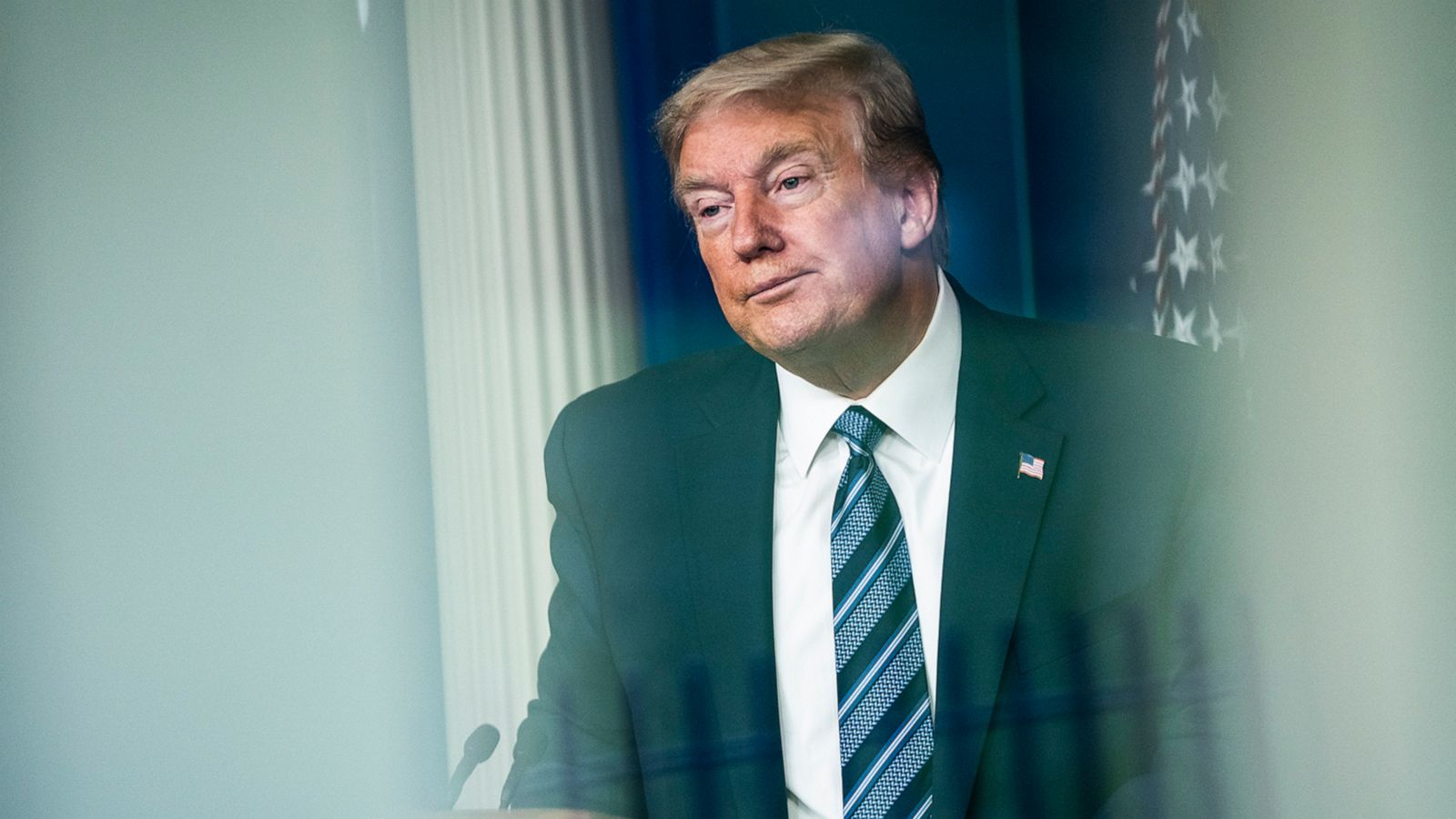
FiveThirtyEight Politics Podcast: Is COVID-19 already hurting Trump politically?

29 Apr 17:21

The unlikely alliance trying to rescue workplace health insurance

by Susannah Luthi
James.galbraith

Because the flaws in being dependent on having a job in order to get medical treatment are now quite clear.


Big businesses and powerful Democrats are aligning around a proposal to bail out employer health plans in the wake of staggering losses to the insurance industry, as some worry that a surge in uninsured Americans could give new life to a stalled push for “Medicare for All.”

The business and labor interests, who have strong economic motives to keep the current system of employer-based care, are rallying behind a Democratic effort to subsidize temporary extensions of newly unemployed Americans’ workplace health plans in Congress’ next coronavirus rescue package.

But to some progressives who cheered Bernie Sanders' (I-Vt.) Medicare for All plan, the crisis has exposed what they see as the folly of tying employment to health coverage. Sanders, who's advocating for an emergency version of his health plan during the pandemic, ripped the idea of propping up an expensive employer system in a POLITICO op-ed Tuesday.

"Not only would health insurance corporations make massive profits off the plan—profits that come at the cost of the American taxpayers—but it would still leave tens of millions uninsured or underinsured," the former Democratic presidential candidate wrote. "And during this pandemic, a lack of insurance means more Covid-19 transmissions and more deaths."

America’s health care system since World War II has relied on the increasingly costly employer insurance market. But with 26 million people rapidly losing their jobs amid a massive health crisis, the idea of tying coverage to the workplace is facing its biggest stress test yet.

Employers, health care groups and unions badly want the employer system to emerge from the health crisis unscathed, believing it would ward off any new expansion of government health care. Joe Biden’s rise to becoming the presumptive Democratic nominee was a relief to the health care industry, which has spent the past two years attacking Medicare for All. Health care groups also oppose other more incremental government expansions, like a public option Biden and other moderate Democrats support.

“This crisis will be over — not soon enough, but it will be over — and we need to fundamentally keep that highway back to jobs and job-provided health care open,” said Ilyse Schuman, senior vice president of health policy for the American Benefits Council, which represents major employers. “That’s what Congress needs to do now, and employer-sponsored insurance plays a big role in that.”

Experts estimate the job-based insurance market has likely already lost millions of customers as unemployment skyrockets, and a growing number of insurers hoping to retain business are offering grace periods on premium payments. Few people losing their jobs sign up for temporary workplace insurance, known as COBRA plans, unless they desperately need the coverage. And it's both complicated and extremely costly, since it comes without employer subsidies that typically cover the lion’s share of monthly premiums.

Newly unemployed people losing health insurance can often find cheaper or even free coverage through the Obamacare insurance markets or Medicaid. However, President Donald Trump’s refusal to broadly reopen the Obamacare markets or make enrollment easier for those eligible may limit the safety net’s reach. Many of the poor won't be eligible for Medicaid in the remaining 14 states that have not expanded the programs under Obamacare.

While the health industry and Democrats still want to bolster Obamacare, an unusual bloc is pressuring Congress to fully subsidize workplace premiums for the uninsured. Corporations would benefit because the employer-based system supplies a big tax break for benefits they can use as a recruiting tool. Unions would keep the generous coverage they have negotiated with corporations. And hospitals and doctors could maintain the big payouts from private insurance, which are far higher than the Medicare and Medicaid rates paid by government.

Such an idea could hit the political sweet spot on Capitol Hill. Workplace plans, which covered an estimated 160 million Americans before the pandemic, remain popular. Democratic leaders in Congress know Republicans have little appetite for broadly expanding government coverage, and Biden has endorsed temporarily subsidizing workplace plans. Republicans, despite railing against insurer “bailouts” in Obamacare for years, are friendlier to employer-based insurance and may be more receptive to a deal that could prevent millions of people joining the Medicaid rolls.

The health care industry is spooked by a widely circulated projection that between 12 million and 35 million people could lose their employer health plan in the economic fallout from coronavirus. The same analysis from consulting group Health Management Associates predicts the uninsured ranks could swell from 28 million to 40 million people, while Medicaid rolls in expansion states would also grow. That prospect worries the hospital industry, which endorsed COBRA aid on Tuesday, since the safety net program typically pays much less than Medicare.

Meanwhile, the health care industry is also trying to win back Americans’ trust about the affordability of the system, just months after hospitals and physician groups helped derail an effort to ban exorbitant “surprise” medical bills. Big insurance companies are waiving deductibles and copays for their commercial plans and the Trump administration is offering Medicare payments to hospitals so they don’t charge uninsured coronavirus patients.

Industry experts downplay the idea the pandemic poses an existential threat to employer insurance, noting that once the economy rebounds the same dynamics that have made the market attractive will remain unchanged.

Still, the market has already taken a hit. Additionally the yearslong trend of small businesses dropping employee coverage will likely accelerate, either because they will have shuttered or need to cut costs.

Ultimately, the future of employer-based insurance will be steered by large corporations that are the backbone of the market, said Linda Blumberg of the Urban Institute. The uncertain prospects for recovery from this crisis, however, remain a wild card.

“I think a lot remains to be seen with regard to how strongly the labor market bounces back and how long it takes,” she said.

Unions, major insurers, hospitals and the consumer advocacy group Families USA have banded together through a group called the Alliance to Fight for Health Care, and are lobbying Congress to subsidize COBRA through the next stimulus package.

Supporters said COBRA aid would provide a backstop to hospitals and physicians, whose finances have been hurt by the cancellation of elective procedures during the crisis. Congress has already approved $175 billion to health care providers with few strings attached.

“Hospitals and providers are seeing tremendous expense and increase in uncompensated care and uninsured individuals coming in, while also seeing drops in elective procedures, so I think it’s money well spent in protecting employees in a time of crisis,” said Katie Mahoney, vice president of health policy for the U.S. Chamber of Commerce.

House Speaker Nancy Pelosi first pitched COBRA subsidies a month ago in a proposed alternative to the $2.2 trillion CARES Act that was ultimately approved by Congress. House Education and Labor Chairman Bobby Scott (D-Va.) and Rep. Debbie Dingell (D-Mich.) earlier this month unveiled standalone legislation fully subsidizing employer premiums for laid-off or furloughed workers.

Support from unions puts pressure on progressive Democrats, the driving force behind Medicare for All, to back the policy.

Unite Here, representing mostly service workers, said Congress must subsidize workplace plans. The union’s international president, D. Taylor, estimates 95 percent of its members are unemployed during the crisis.

“The health care crisis of a lifetime requires full emergency health care coverage for those millions of hardworking Americans who, through no fault of their own, have become unemployed," Taylor said.

But the effort has raised eyebrows among some liberal policy experts, who say Democrats are overlooking the health care law they’ve spent the past 10 years defending. They said Democrats should be trying to expand that safety net at a time when health coverage independent from a workplace is more important than ever.

The law’s individual market plans are expensive but are still ultimately cheaper for the government to subsidize than employer coverage. Medicaid plans, which offer full coverage for lower-income adults in expansion states, are cheaper still. And analysts question whether the subsidies would be money well spent when they only buy temporary certainty for workers and their families, who may ultimately have to turn to the Affordable Care Act if the economy is slow to recover.

“At a time when you don’t know if people are going back to work, or where they’ll go back to work, getting them better ACA coverage would be more expedient,” said Arielle Kane, director of health policy at the Progressive Policy Institute.

Moreover, experts note, COBRA subsidies come with a huge price tag and ultimately help the middle- and higher-income people, rather than lower-income people more likely to work retail and service jobs affected by shutdowns.

“Almost no matter the employment outlook or time horizon, COBRA subsidies are unlikely to be the most cost-effective way of expanding coverage or relieving financial hardship,” said Matt Fiedler, former chief economist of the Council of Economic Advisers under the Obama administration. “They’re just not targeted on the right people.”

Congress subsidized COBRA in the last recession, before Obamacare was passed. The aid had limited reach — only about one-third of those eligible for subsidies signed up for coverage, according to a 2015 Labor Department review. Congress at the time agreed to a 65 percent premium subsidy. This time, groups are pushing to cover the entire amount.

Tom Leibfried, a health care lobbyist for AFL-CIO, acknowledged some progressives would rather expand government coverage through the crisis, but he stressed that it would be easier to work within the existing system to deliver faster relief.

“So as happened in 2009, during the Great Recession, it’s just more practical to turn to existing institutions and use those to make sure people get the care they need and don’t face financial hardship,” he said.

29 Apr 17:20

'Our answer is no': New York Times shuts down Sean Hannity's request for retraction, apology

by Marissa Higgins
James.galbraith

Brevity is the soul of wit, and the Times' lawyers did an excellent job.

Attorney Charles Harder demanded that The New York Times retract stories that were allegedly “mischaracterizing” his client’s coverage of the novel coronavirus pandemic, as reported by The Daily Beast. Who is the client in question? Host Sean Hannity of Fox News. The response from the Times has Twitter going pretty wild.

Harder sent his letter threatening legal action to the general counsel for the Times, as well as three writers, on Monday night. Of particular focus was recent Times coverage of a New York bar owner (and reported Fox News watcher) who died of the novel coronavirus after a cruise to Spain. The deceased man’s daughter suggested to the Times that her father “watched Fox, and believed it was under control.”

“You have acted with actual malice in publishing the foregoing statements,” Harder writes in reference to the Times coverage. “As detailed herein, it was readily apparent at the time of publication that Mr. Hannity had devoted substantial, truthful coverage to the coronavirus, and his remarks attributed by you were made eight days after Mr. Joyce had already embarked on his cruise.”

Harder also suggested that his client was being singled out and that “your intentional disregard for the foregoing irresponsible Democratic Party politicians and Democratic Party-friendly media outlets, including ABC, NBC, CBS, and MSNBC establishes clear bias on your part.”

David E. McCraw, legal counsel for the Times, gave a short and to the point response that quickly went viral on Twitter.

Here is New York Times deputy general counsel David McCraw's response to a retraction request from Sean Hannity's lawyer. pic.twitter.com/OuPwV8XCQr

� NYTimes Communications (@NYTimesPR) April 28, 2020

New York Times lawyer David McCraw responds to @seanhannity's legal threat, saying the columns his lawyer Charles Harder cited are accurate and protected speech. "In response to your request for an apology and retraction," McCraw adds, "our answer is 'no.'" pic.twitter.com/vexnw0hSeZ

� Oliver Darcy (@oliverdarcy) April 28, 2020

New York Times newsroom lawyer David McCraw delivers this response to @seanhannity request for retraction and apology related to @nytimes coverage: "No." Addressed to Hannity lawyer Charles Harder: pic.twitter.com/0v7URfo1kz

� ErikWemple (@ErikWemple) April 28, 2020

Doesn�t @seanhannity realize that the @nytimes lawyers will crush him during discovery? Please let him be dumb enough to go through with it. https://t.co/syBOR7TQo7

� Hamish Mitchell Photography (@H_MitchellPhoto) April 28, 2020

so if everything goes according to his plan, sean hannity will voluntarily allow the new york times to see the things he's said in private about coronavirus? https://t.co/OS1Xb1oVrb

� Max Tani (@maxwelltani) April 28, 2020

Just in case no one saw the New York Times brilliant response to little Sean. Your move, Seanny. pic.twitter.com/vgU0z4sZ1o

� Jim Cognito (@JimCognito2016) April 28, 2020

The Daily Beast reports that a spokesperson for the Times gave the publication the following statement: “We have reported fairly and accurately on Mr. Hannity. There is no basis for a retraction or an apology.”

As Daily Kos has covered, Donald Trump once did a phone interview with Hannity where Trump essentially downplayed the virus as a “corona flu” and suggested the death rate was “fake numbers.” In another phone call with Hannity, Trump complained about the number of ventilator requests he was getting from concerned governors. A nonprofit in Washington state has also sued Fox News over coronavirus misinformation. One new, working study, highlighted by Vox, suggests that Hannity’s show on Fox may have actually contributed to the spread of the coronavirus by dismissing (or outright ignoring) it at the time, ultimately linking watching misinformation presented on his show in February and early parts of March to “a greater number of Covid-19 cases” as well as related deaths. This study has not yet been peer-reviewed. 

29 Apr 00:54

Mike Pence without a mask at the Mayo Clinic starts trending because Mike Pence is an #@&*$@#%*

by Walter Einenkel
James.galbraith

Yeah this has been amazing

Our country’s feckless leadership continues proving over and over again how and why we are in the current pandemic mess we are in. On Tuesday, there was a video of Vice President Mike Pence visiting with patients and staff at the world-renowned Mayo Clinic in Rochester, Minnesota. What stood out in the video was how Pence did not wear the clinic’s required face mask. Everybody else did. Just not Mike. Was it a show of fealty to the world’s dumbest leader? Did the Lord come to Mike in a dream and tell Mike that he too is Jesus? Who knows?

After the video went around, the Mayo Clinic tweeted out that they had informed the vice president of their mask policy before his arrival. That tweet has now been deleted. The mixture of Pence’s dangerous behavior and the Mayo Clinic’s quick retraction brought #MayoClinic and #MayoClinicPence to the top of the trending lists.

PENCE flouts Mayo Clinic policy that everyone on campus wear a mask, even as he meets with staff and a patient. pic.twitter.com/kfo64KQDhU

— Dan Diamond (@ddiamond) April 28, 2020

The clinic’s response and second response, in one tweet.

In response to questions about why Pence wasn�t wearing a mask, the Mayo Clinic tweeted this earlier. Then they deleted it. So that�s normal. pic.twitter.com/7peNxMxx7t

— shauna (@goldengateblond) April 28, 2020

And then the replies came.

What was the point of @MayoClinic deleting their tweet? To create plausible deniability that Pence, THE HEAD OF THE CORONAVIRUS TASKFORCE, DIDN'T KNOW TO WEAR A FACE MASK INSIDE OF THE MAYO CLINIC?

— Matt Rogers (@Politidope) April 28, 2020

"Mayo Clinic, you like that PPE we let you buy? Be a real shame if something were to happen to it." https://t.co/O1xQmuuC0N

— The Blackhanders (@theblackhanders) April 28, 2020

There’s a lot of evidence for this gangster-inspired theory.

Mayo Clinic is a liberal conspiracy!! Just ask @realdonaldtrump

— Conservativ (@Conservaturd1) April 28, 2020

Fair enough. Science and helping others seem to be exclusively partisan qualities these days.

the Mayo Clinic, what do they know about anything related to medicine, I'm going with Captain Clorox

— Jon Danziger (@jondanziger) April 28, 2020

Of course, there was the general bewilderment at our current administration’s mind-bending, confusing moves.

@WhiteHouse @realDonaldTrump @VP @PressSec What�s the reason behind this. He�s not wearing a mask. Despite the Mayo Clinic�s Policy. Even violating CDC Guidelines. Potentially putting others in danger. No Social Distancing measures at all. pic.twitter.com/pQncUpBLIg

— PerryLawrence (@lawrence1979Ak) April 28, 2020

And there were others who wanted to remind everyone that Mike Pence didn’t just show up yesterday. He’s been an incompetent theocrat for decades now.

Watching VP Mike Pence break the rules at the Mayo Clinic today by not wearing a mask makes it REALLY easy to understand how he botched the response to the HIV epidemic breakout in Indiana a few years ago. He's not all that competent. But I'm sure he'll self-congratulate. pic.twitter.com/fjN0obUaup

— Russell Drew (@RussOnPolitics) April 28, 2020

And then there was the humor we look toward to get us through this madness.

waiting for the LIBERATE MAYO CLINIC tweet from trump

— Michael Tisserand (@m_tisserand) April 28, 2020

Pence standing in the middle of the Mayo Clinic with no mask is about the most Mike Pence thing I�ve seen since pic.twitter.com/EqdNafwACq

— Angry Staffer (@AngrierWHStaff) April 28, 2020

And finally,

Pence... pic.twitter.com/Dvy593yMpx

— Karen Waldorf (@mrjoeywhiskers) April 28, 2020

29 Apr 00:02

New York Times op-ed: Trump and friends didn't just 'ignore' COVID-19, they engaged in a cover-up

by Dartagnan
James.galbraith

Intentional malfeasance. There must be consequences.

Much ink has been spilled to more than amply demonstrate that, when it came to the threat of the novel coronavirus, the Trump administration ignored its own intelligence, its own CDC, and the urgent warnings of the medical community, from as early as January and well into February of this year. New York University professor Ryan Goodman and NYU student Danielle Schulkin conclude, in an op-ed in the The New York Times, that the administration’s actions went well beyond mere “negligence” and trying to “wish” the pandemic away. Rather, for a five-day period in late February and early March, Donald Trump and his team of “very best people” engaged in a deliberate and malicious cover-up of the seriousness of COVID-19—for the sole purpose of intentionally misleading the American people.

As accounts of what was actually known to Trump and Health and Human Services Secretary Alex Azar, as well as Defense Secretary Mark Esper and National Economic Council director Larry Kudlow begin to take shape amid the administration’s fuzzy web of denials and deflections, an unmistakable picture of calculated malfeasance has emerged.

They knew it was serious, and they knew it would or could kill hundreds of thousands of Americans. But they continued to lie. Goodman and Schulkin don’t accept that such ineptitude was simply a case of “flat-footedness” or simply “time lost.” In reality, they write, “Over the last five days of February, President Trump and senior officials did something more sinister: They engaged in a cover-up.”

Goodman and Schulkin conclude that the public statement of Dr. Nancy Messonnier, the CDC’s authority on respiratory diseases, made on Tuesday, Feb. 25, is the key to unlocking the subsequent cover-up, because it was the actual catalyst of the administration’s response.

“As we’ve seen from recent countries with community spread, when it has hit those countries, it has moved quite rapidly. We want to make sure the American public is prepared,” Nancy Messonnier, director of CDC’s National Center for Immunization and Respiratory Diseases, told reporters.

“As more and more countries experience community spread, successful containment at our borders becomes harder and harder,” she said.

[...]

“Disruption to everyday life might be severe,” Messonnier said, adding that she talked to her children about the issue Tuesday morning. “While I didn’t think they were at risk right now, we as a family ought to be preparing for significant disruption to our lives.”

We now know that there is absolutely no doubt that, when she made that statement, the administration was well aware of the seriousness of the pandemic and the threat it represented to Americans, as Goodman and Schulkin note.

At the time, senior officials knew the coronavirus was an extreme threat to Americans. Thanks to information streaming in from U.S. intelligence agencies for months, officials reportedly believed that a “cataclysmic” disease could infect 100 million Americans and discussed lockdown plans. The warnings were given to Mr. Trump in his daily brief by the intelligence community; in calls from Alex Azar, the secretary of health; and in memos from his economic adviser Peter Navarro.

In fact, on the very same day in February, the U.S. military’s National Center for Medical Intelligence raised its warning to WATCHCON 1 at all levels inside the U.S. government, indicating that the pandemic was now considered a full-bore threat.

What did the administration do in response to Dr. Messonnier’s very public, very embarrassing warning? They lied, intentionally and knowingly. Trump’s rationale? He didn’t want to “upset” the stock market. A full-blown pandemic was likely to sink the only thing holding his reelection chances above the water line. He decided instead to concoct a panoply of phony assurances, and his collaborators, Kudlow, Esper and Azar, were only too happy to oblige. That very afternoon, just hours after Messonnier’s statement, Azar held a press conference, stating that “Thanks to the president and this team’s aggressive containment efforts,” the novel coronavirus “is contained.”

On that same Tuesday afternoon, Kudlow appeared on CNBC, and said the virus was “contained.”

The next day, Mark Esper told U.S. military commanders to provide him with advance notice of any measures they might be taking that might “run afoul” of the president’s messaging, indicating, as presented in a New York Times report, that he was well aware of the WATCHCON 1 status of the pandemic, and the fact that it contradicted the administration’s contrived “happy talk.”

Hundreds of thousands, if not millions, of Americans took solace in these deliberate lies that were broadcast to the country. On that same Wednesday, Trump himself came out with his infamous suggestion that only “15” Americans were likely to catch the virus.

As Goodman and Schulkin point out, Trump and Azar continued to spew these lies—Trump at his political rallies, and Azar in public appearances—over the next few days. Five days of lies, in total.

In effect, for five days, the president along with some of his closest senior officials disseminated an egregiously false message to Americans. The messaging would continue well beyond those days until the stark images of refrigerated morgue trucks and spiked lines on colored graphs showed the escalating numbers of cases and dead.

Understanding this playbook is not only important in its own terms. It goes to the heart of whether Americans can trust this administration in the months ahead when they must make life-or-death decisions about how to protect their health and when to reboot the economy.

Trump’s COVID-19 failure was not simple dysfunction, not simple negligence, but an intended, malicious cover-up of the actual facts, all to create a false sense of assurance in the American people while the administration grappled to find an acceptable political escape—a way to salvage the impending disaster from the electoral fallout that was sure to follow for Trump.

Ultimately, of course, there was no escape, and here we are: facing an administration that has already lied to us, over and over again, and can’t stop, won’t stop, and didn’t stop, even when the truth could have made the difference between life and death.

28 Apr 23:02

Has Sweden found the best response to the coronavirus? Its death rate suggests it hasn’t.

by Alex Ward
James.galbraith

Yep, per capita is the way to compare, and Sweden is not in a good place

People have lunch at a restaurant in Stockholm on April 22, 2020, during the coronavirus pandemic. | Jonathan Nackstrand/AFP via Getty Images

Sweden’s coronavirus death toll is worse than America’s but better than New York City’s.

You’d be forgiven for thinking Sweden had somehow found the secret to handling the coronavirus crisis without having to impose severe lockdowns.

Its total number of deaths, roughly 2,300 as of April 28, seems low, and it doesn’t look anywhere near as chaotic as, say, New York City. It’s no surprise, then, that the New York Times in a Tuesday story made the case that “to a large extent, Sweden does seem to have been as successful in controlling the virus as most other nations.”

“Sweden’s experience would seem to argue for less caution, not more,” the story also said.

But that sentiment obfuscates some very real problems with Sweden’s approach — problems that become much clearer once you zoom out.

The chart below, which I made using the Our World in Data website’s coronavirus statistics, helps put Sweden’s situation in perspective. It compares countries’ rates of coronavirus deaths per 1 million people.

As the chart shows, Sweden is actually faring worse than other Scandinavian nations and even worse than the United States, which has the highest number of confirmed total cases in the world. (It’s important to note that other nations — such as Spain and Italy — not included in the chart have higher death rates per million people than Sweden.)

The reason for Sweden’s high death rate has to do with the government’s policies.

Following the advice of the country’s chief epidemiologist, Anders Tegnell, the Swedish government chose not to impose strict lockdowns, curfews, or major border closings because the government felt it would hurt the economy and would only push the crisis further down the road.

“Locking people up at home won’t work in the longer term. Sooner or later, people are going to go out anyway,” Tegnell told reporters this month.

And while experts say the vast majority of Swedes followed the government’s social distancing guidelines and voluntarily stayed home, those who continued to drink at bars and shop at stores likely spread the disease around.

The New York Times even noted what Sweden’s public health officials now admit: That “more than 26 percent of the 2 million inhabitants of Stockholm will have been infected by May 1.”

That’s still higher than New York City’s infection rate, which New York state officials estimate could be around 21.2 percent based on recent antibody testing (though these numbers are still preliminary and based on just one study).

Where Sweden does compare favorably to the US is the country’s death rate when compared to New York City’s (not the whole US). About 12,000 reported deaths as of April 28 in a city of 8 million is surely worse than 2,300 deaths in a country of 8 million.

But there are three main reasons why the Big Apple would be worse off than the entire country of Sweden, experts say.

The first is population density: New York City has over 38,000 people per square kilometer, while Sweden has just 25 people — meaning it’s harder to socially distance.

Second, some hospitals in New York City were overwhelmed while Sweden still has about 250 hospital beds unoccupied. There are indications, though, that the hospital surge in New York City is declining.

Finally, there is significantly more international travel to New York City than there is to Sweden, which means there were more opportunities for people from countries suffering from severe outbreaks to spread the virus to the city than to the European country.

But when zooming out, it’s clear that Sweden as a whole is worse off than the US as a whole. That could, of course, change down the line, but any current arguments that Sweden got its outbreak response right are premature at best and dangerous at worst.


Support Vox’s explanatory journalism

Every day at Vox, we aim to answer your most important questions and provide you, and our audience around the world, with information that has the power to save lives. Our mission has never been more vital than it is in this moment: to empower you through understanding. Vox’s work is reaching more people than ever, but our distinctive brand of explanatory journalism takes resources — particularly during a pandemic and an economic downturn. Your financial contribution will not constitute a donation, but it will enable our staff to continue to offer free articles, videos, and podcasts at the quality and volume that this moment requires. Please consider making a contribution to Vox today.

28 Apr 22:23

Arizona Republican Party chair tells fringe-right pandemic protesters to dress as healthcare workers

by Hunter
James.galbraith

Chemtrail Kelli is back at it again. Making AZ proud.

The head of the Arizona Republican Party, dedicated weirdo and symbol of everything wrong with modern "conservatism" ex-state-senator Kelli Ward, took to Twitter last Friday with some odd advice for protesters who want to mill around public spaces demanding their state "reopen" despite the ongoing deadly pandemic the news channels keep shouting about. You folks should dress up and pretend to be healthcare workers, says Ward.

"Planning protest to #ReOpenAmerica? EVERYONE wear scrubs & masks - the media doesn't care if you are really in healthcare or not - it's the 'message' that matters," Ward tweeted.

In this case, the "message" is that for some reason the public isn't taking scattered collections of sometimes-armed, snake flag-waving, ex-tea party nutcases seriously when it comes to matters of public health, but maybe if we lie and imply that Actually the crowd is made up of, um, "healthcare" workers then Ward's followers can bamboozle somebody into thinking they're not know-nothing wackos.

Plus, it will take scrubs and masks out of the hands of actual medical professionals, wasting the still-being-rationed items for the sake of the Ward-sanctioned publicity stunts. Also good!

Trying to probe the thoughts of the fringe right is a pathway to madness, and it's not clear that people holding up conspiracy-minded signs and demanding the right to infect hairstylists if they damn well want to would be treated more seriously, as Ward seems to believe, if they showed up in cosplay. It is possible. It's also possible they could be truly mistaken for healthcare workers, causing every fellow protester with a cough to make a beeline for them to ask them for medical advice, which could certainly liven up the show.

Or it may simply be a way for fringe-right science deniers to gain a bit of applause, wandering back home again. If the public isn't keen on you doing your own thing and calling yourself a "hero," maybe you can trick them into thinking you're a real one.

We don't know. Ward, who technically is an actual medical doctor, has not elaborated on this new plan. And unlike her, most of the "Reopen America" protesters do not know medical personnel, do not like medical personnel, and are in no position to ask medical personnel if they can borrow an outfit or two in order to fake being healthcare workers during their next weekend rally.

So it just may be that this new Ward plan doesn't get very far to begin with.

28 Apr 21:09

Fringe anti-lockdown protests stoked by Republicans take aim at ... Republicans

by Kerry Eleveld
James.galbraith

GOP in disarray

What started out as a conservative effort to harass Democratic governors who are working to minimize the spread of the novel coronavirus in their states has come back like a boomerang at Republican governors and other GOP officials.

The fringe anti-lockdown protesters who targeted state capitals in a swath of blue states are now taking aim at red state governors who the protesters don't think are moving fast enough to reopen their states’ economies, writes Politico. That ranges from governors like Ohio's Mike DeWine, who moved far more swiftly than most Republicans to shut down his state, to the governors in states like Texas, Arizona, and Missouri, who initially dragged their feet on enacting lifesaving stay-at-home orders. 

Frankly, the whole effort is as much a mess for Republicans now as it is for Democrats, if not even more so. While certain conservative groups like Tea Party Patriots and FreedomWorks have helped to organize and amplify the protests, others like Koch-backed Americans for Prosperity have favored developing safer routes to reopening. 

In the meantime, GOP governors like Greg Abbott of Texas, who was slow to adopt distancing measures and has already begun a phased reopening, have been facing the wrath of anti-lockdown agitators in their own states. "We're not just going to open up and hope for the best," Abbott told reporters in Austin, defending his plan to let some businesses reopen at partial capacity. “A more strategic approach is required so that we don’t open only to close down again."

Arizona Gov. Doug Ducey, also slow to act, is feeling the heat too as he plans to begin reviewing data at the end of the month to formulate a plan for reopening. “I hear them. I understand how they feel,” Ducey said of the protesters. “I feel the same way. I want what they want," he offered, adding that he didn't want lose the gains in public health.

An anti-lockdown event has even been planned to take place at the White House this Friday. Trump, after originally backing the protests, has now waffled on the issue, backstabbing Georgia Gov. Brian Kemp's move to reopen even as testing lags and the state's infection rate continues to rise. Anti-lockdown elements have rallied around Kemp out of concern that if he falters, it could be a major setback for the whole push to reopen nationwide. 

In any case, that's the problem with stoking fringe anti-government sentiment. Once the brushfire starts, it's difficult to control. Ultimate chaos may be Trump's jam, but it isn't good for any of these GOP governors or for Republican unity as a whole. 

28 Apr 21:06

Turkish President Defends Cleric Who Said Gay People are ‘Evil’ and ‘Bring Disease’

by Andy Towle
James.galbraith

No wonder Trump likes him so much

Turkish President Recep Tayyip Erdogan defended a cleric whose remarks about homosexuality in his first Ramadan sermon were condemned by human rights groups. The cleric, Ali Erbas, said homosexuality “brings disease and causes this generation to decay.”

“Erbas also maintained that hundreds of thousands of people every year are exposed to HIV due to homosexuality and adultery and called on worshipers to come together to fight ‘this kind of evil.'” NBC News reported.

Erdogan said criticism of Erbas “amounted to an attack on the state” and a “deliberate attack against Islam,” according to media reports.

The post Turkish President Defends Cleric Who Said Gay People are ‘Evil’ and ‘Bring Disease’ appeared first on Towleroad Gay News.

28 Apr 20:16

Pence embodies GOP COVID-19 denial by refusing to wear a damn mask in a damn hospital

by Joan McCarter
James.galbraith

Fucking ridiculous

Republican coronavirus denial has already gone to ridiculous and dangerous lengths. Now this. Vice President Mike Pence isn’t going to let a little thing like possibly infecting people in a hospital setting by not wearing a mask make him actually wear a mask. Even though it’s the policy of the Mayo Clinic, where he visited Tuesday. Even though the Mayo Clinic made it clear to him that it was their policy.

Why the Mayo Clinic deleted that tweet is unclear, except that he’s the fucking vice president of the United States and if the hospital makes him and Trump mad, they’ll probably send the FBI and DHS in and seize all their protective gear and medical equipment to resell it to the highest bidder.

PENCE flouts Mayo Clinic policy that everyone on campus wear a mask, even as he meets with staff and a patient. pic.twitter.com/kfo64KQDhU

— Dan Diamond (@ddiamond) April 28, 2020

28 Apr 20:13

Trump suggests federal bailout for states could hinge on sanctuary city policies

by Myah Ward
James.galbraith

I must have misplaced the GOP outrage about Trump elevating a swing state governor for COVID information as "too political" while decrying Democrats.


President Donald Trump on Tuesday suggested that state and local bailout money from the federal government could hinge on whether the immigration policies of the individual governments seeking relief align with Trump administration priorities.

From skyrocketing health care expenses to the costs of an unprecedented economic shutdown, the coronavirus has imperiled state and local budgets across the country, prompting calls for federal relief. During an exchange with reporters on Tuesday, the president suggested he would be open to such a plan, but only for states economically impacted by coronavirus, not for problems “related for mismanagement over a long time.”

Alongside Trump’s suggestion that states will have to look at sanctuary city policies, the president said a payroll tax cut would need to be part of any negotiation on a state and local bailout.

“I think there's a big difference with a state that lost money because of covid and a state that's been run very badly for 25 years,” the president said during his meeting with Florida Gov. Ron DeSantis. “There's a big difference, in my opinion. And you know, we’d have to talk about things like payroll tax cuts. We’d have to talk about things like sanctuary cities, as an example. I think sanctuary cities is something that has to be brought up where people who are criminals are protected, they are protected from prosecution.”

He continued: “I think that has to be done. I think it’s one of the problems that the states have. I don’t even think they know they have a problem, but they have a big problem with the sanctuary situation.”


Some lawmakers have resisted the idea of bailing out state and local governments, some of which were in perilous financial situations even before the outbreak of the coronavirus pandemic. Senate Majority Leader Mitch McConnell (R-Ky.) suggested last week that states be allowed to declare bankruptcy, a notion that was widely criticized by Democrats, as well as state and local government officials.

In a bipartisan letter to Congress last week, the National Governors Association emphasized that coronavirus-related financial hardship has struck blue and red states across the country. But the president has used the requests as an opportunity to attack Democrat-led states, insisting on Tuesday that without certain conditions, such bailouts would be unfair to the states “that have done such a good job.”

“Why should the people and taxpayers of America be bailing out poorly run states (like Illinois, as example) and cities, in all cases Democrat run and managed, when most of the other states are not looking for bailout help?” the president wrote on Twitter Monday. “I am open to discussing anything, but just asking?”

28 Apr 20:03

North Carolina's Tillis won't break with Trump enough to say it's not a good idea to drink bleach

by Joan McCarter
James.galbraith

Profiles in GOP courage

You would be hard pressed to find a bigger Donald Trump sycophant today than North Carolina's Republican Sen. Thom Tillis. The vulnerable senator, up for reelection in 2020, is saying that it's probably a good idea for his constituents to stay at home, wear their masks, and social distance, which is a big deal for the guy who once railed against restaurant employees being required to wash their hands after using the restroom.

He's still kind of that guy, though, WFAE reports. They say that while "it's been easy for Tillis to support the official recommendations from the White House coronavirus task force," he was more conflicted "when asked about the president's suggestion last week that people might be cured by injecting disinfectant." He didn't answer, but had his campaign say that "people who think they are sick should contact their doctor."

North Carolina, do yourself a favor. Don't drink bleach, and replace Tillis with Cal Cunningham.  

Tillis has a tenuous relationship with the Donald, having once opposed Trump's emergency declaration to build the border wall, though he reversed himself on that. Still, Trump has taken pains to make sure Tillis understands the thinness of the ice upon which he stands. For example, when Trump was in North Carolina stumping for Tillis in January, he said: "We had a good relationship, but we sort of disagreed on a couple of minor policies. That's OK. […] Of course, I won't put up with it for long, Thom Tillis."

And now Tillis won't tell his constituents that drinking bleach is a really bad idea for fear of Trump's disfavor. I'd say it's unbelievable, but of course it isn't.

28 Apr 18:43

The US has now passed 1 million confirmed Covid-19 cases

by Dylan Scott
James.galbraith

Fuck the GOP

Rani Molla/Vox

Very soon, the US will also likely exceed 60,000 reported deaths from the coronavirus.

The United States has surpassed 1 million confirmed Covid-19 cases, just a few months after the novel coronavirus first arrived in America.

The confirmed number of cases, based on the Johns Hopkins Coronavirus Resource Center’s tally, is almost surely an undercount. The US’s initial response to the outbreak was stifled by undertesting and, while America’s testing capacity has increased in the last month, experts say there are still likely many more cases than are actually included in the official counts. Various attempts to roughly capture the share of the population that has been exposed to the coronavirus through serological testing seem to confirm that the US has not fully measured the extent of the outbreak within its own borders.

And within a matter of days, the US is also likely to pass another ominous milestone: more than 60,000 confirmed deaths from Covid-19. The current total sits north of 55,000 and more than 1,000 Americans are dying every day from the virus.

President Donald Trump once claimed that such a toll would count as a victory, given the projections of millions of deaths if there were no social distancing measure put into place. The ultimate cost in lives of the coronavirus remains to be seen, and, again, experts believe the actual number of people to die from the disease or because the health system has been overstretched is likely much higher than the official count.

The US has by far the most confirmed Covid-19 cases (Spain is second with about 230,000) and deaths (Italy is next, with about 27,000), though many countries have the same issues with undertesting and asymptomatic cases make it difficult to track the virus. China has also acknowledged initially undercounting its cases and outside reporting suggests the pandemic has been deadlier there than the official numbers suggest, though it is difficult to assess whether it has been worse than in America.

 Rani Molla/Vox

Regardless, at this point, the United States has been and will continue to be the clear epicenter of this global pandemic.

The US health system was less prepared for a pandemic than those of other wealthy nations. A high uninsured rate, high out-of-pocket health care costs, and low medical system capacity combined to make the country more vulnerable to a pathogen before the coronavirus ever came to our shores. America’s lax response in the early days of the outbreak only compounded those structural problems.

“Everyone working in this space would agree that no matter how you measure it, the US is far behind on this,” Jen Kates, director of global health and HIV policy at the Kaiser Family Foundation, told Vox in mid-March of the initial coronavirus response.

As the US implements dramatic measures to control the spread of Covid-19, with schools and businesses closing and general social distancing underway, the country is still struggling to understand the full scope of the outbreak because of the slow start of testing. It has undeniably hindered the US response.

“The testing failure is putting additional strain on our already challenged health system,” Cynthia Cox, director of the Peterson-Kaiser Health System Tracker, said in March. “The combination of all of these factors will make the US worse off than similar countries.”

Testing is not only important because it gets people diagnosed and appropriate treatment if they have an infection, it also establishes how widespread a virus actually is. Experts know the size of the problem, they know the rate at which people are being hospitalized or dying, and they can follow its movements.

But the United States faltered in rolling out coronavirus tests, initially putting America behind its economic peers in tracing the outbreak. A manufacturing problem with the test kits that were initially sent out in the field, and a delay in approving commercial tests, set the nation back in stopping or slowing down Covid-19.

Even as testing capacity has ramped up in the US, as of April 27, America is still lagging behind other places in the world hit hardest by the virus in the share of its population being tested. The US has tested about far fewer people per million residents as Italy, a focal point of Europe’s outbreak, and Germany, considered a model of rapid and widespread testing.

There have been nearly 5.4 million tests conducted in the US for its population of 329 million, but the number of tests per capita conducted varies greatly by state.

The US has finally started to catch up to the rest of the developed world in responding to Covid-19. But as case numbers and deaths continue to increase, we’re still learning the full scope of the crisis.


Support Vox’s explanatory journalism

Every day at Vox, we aim to answer your most important questions and provide you, and our audience around the world, with information that has the power to save lives. Our mission has never been more vital than it is in this moment: to empower you through understanding. Vox’s work is reaching more people than ever, but our distinctive brand of explanatory journalism takes resources — particularly during a pandemic and an economic downturn. Your financial contribution will not constitute a donation, but it will enable our staff to continue to offer free articles, videos, and podcasts at the quality and volume that this moment requires. Please consider making a contribution to Vox today.

28 Apr 18:42

Bloomberg News: Trump will use Defense Production Act to force closed meat plants to reopen

by Hunter
James.galbraith

Because the DPA is now another campaign tool, since people are noticing how this mismanagement impacts their lives.

As pandemic-related closures rock the nation's meat processing plants, Bloomberg is now reporting that Donald Trump plans to "order" beef, chicken, pork, and egg processing plants to remain open despite the risks to employees and surrounding communities.

Bloomberg cites an unnamed source to report Trump "plans to use the Defense Production Act to order the plants to stay open."

This would be a ... surprising move, to say the least. The plants, owned by meat producing giants like Smithfield and Tyson foods, have been shuttered due to mass outbreaks of infection among employees and multiple deaths. Over 300 workers in a now-shuttered Smithfield plant tested positive for COVID-19. Trump would essentially be ordering workers at those plants, by law, to return to the job despite the risk.

Workers continue to charge plant owners with taking insufficient measures to protect them from contamination. While Bloomberg reports the government will allegedly "provide additional protective gear" and "guidance" for reopening plants, Trump has hinted that he will solve the problem of endangering workers in a more brute-force way: by immunizing plant owners from liability if their employees do get infected—or die.

This would be a smaller scale version of the blanket immunity the White House and Republican leaders are mulling for all reopening businesses.

Whether workers will agree to return to work is not clear; Trump may be able to "order" the plants to reopen, likely paving the way for plant owners to swiftly fire any workers who refuse to come back or who demand safer working conditions for their return. However, that does not necessarily mean other workers will be eager to take their place after numerous plants throughout America swiftly became hotspots for coronavirus infection.

28 Apr 18:40

How Washington state, a model for public health, plans to relax social distancing

by Dylan Scott
James.galbraith

Yeah it's going to be a long process

People practice social distancing at a park in Seattle, Washington, on March 20. | Karen Ducey/Getty Images

The state will probably reopen its economy more slowly than the White House suggests.

Seattle was the first place in the US to go into lockdown over the coronavirus, after an outbreak at a local nursing home woke Americans up to the threat the virus presented. Now, the city and Washington state are starting to plan for an eventual, gradual reopening.

Public health experts credit Gov. Jay Inslee and local leaders for taking the dramatic steps necessary to get the Covid-19 outbreak in the state under control. And the curve there is flattening, with new cases and deaths down from their earlier peak. But the economy has endured the same shock felt across the country. Officials have begun to discuss how to restart the economy, without risking a sudden resurgence in infections and deaths. With global giants like Microsoft and Starbucks headquartered in the state, Washington could be a model for the rest of the country on the best way to climb out of the coronavirus hole.

The hard truth is no matter how cautiously reopening happens, Covid-19 is going to continue to spread. “I don’t think it’s possible to prevent all transmission. We need to keep the number of cases manageable,” Jeffrey Duchin, who leads the epidemiology division of the King County health department, told me. “We want to see something like a slow burn, where it doesn’t evolve into an uncontrollable raging fire.”

The goal will be to relax some of the social distancing restrictions without overwhelming the health care system. The first small step came late last week, when Inslee announced that ongoing construction projects could resume, so long as they follow certain safety protocols. The next step may not come for some time; Inslee has already said the state’s stay-at-home order will extend beyond its current May 4 expiration date.

Local public health experts expect the state will wait to see weeks of declining cases and deaths before taking more significant steps to restart its economy. Duchin told me that he wants to see “way more” progress before social distancing policies are changed. And once they are, just a few restrictions may be lifted.

“It’s essential that we go carefully slowly and in a stepwise fashion. After each step, we’ll evaluate the impact,” Duchin said. “That will take two or three weeks. We need to stop and observe. Unfortunately we can’t figure this out in a few days. It will take a few weeks.”

Washington state’s reopening plan is likely to share many features of the White House’s reopening guidance, which suggests a phased approach, local experts told me — except the state is likely to adopt a more cautious timeline than the Trump administration’s guidelines, which are more like a bare minimum.

“There’s a continuum, from people who really just care about making sure people don’t get sick and then to the other side, who don’t want the economy to be tanked,” Hilary Godwin, dean of the University of Washington’s school of public health, told me. “I would put the White House more on the end of caring more about the economy, though obviously they care about the people. What we’ve seen so far in Washington state is obviously Inslee cares deeply about the economy, but he has been a conscientious actor.”

Overt caution worked for Washington in clamping down on the coronavirus. Now, the state sees it as the safest path to resuming normal life.

Washington acted quickly and has seen its coronavirus curve start to bend

The first known case of Covid-19 showed up in a Seattle suburb in mid-January; a man walked into a clinic complaining of fever and a cough. His doctors quickly learned he had recently returned from Wuhan, China, the original epicenter of the coronavirus outbreak.

A month later, on February 29, the first reported death from coronavirus occurred at a Washington nursing home — a man whom, as the New Yorker reported, had had many family members come in to visit him shortly before his death. Local health officials soon petitioned Microsoft to ask its employees to work from home, which the company did on March 4, hoping it would set an example for other firms capable of remote work. One week later, on March 11, Seattle’s schools were closed. They have not reopened.

Though Inslee did not issue a stay-at-home order until March 23, much of the state had already started to shut down before then. As Dom Constantine, the King County executive, told the New Yorker, local leaders believe the preliminary steps — closing schools, having Microsoft and Amazon employees working from home — had communicated the severity of the situation to most people:

Constantine thought that announcing school closings was a potent communication strategy for reaching even people who weren’t parents, because it forced the community to see the coronavirus crisis in a different light. “We’re accustomed to schools closing when something really serious happens,” Constantine told me. “It was a way to speed up people’s perceptions—to send a message they could understand.”

A month later, the results speak for themselves. Washington has tallied about 13,700 coronavirus cases and 760 deaths as of April 28. Adjusting for population, the state ranks 19th in cases per capita and 15th in deaths — despite being the first place to suffer a known outbreak and having to deal with uncontrolled spreading from the Kirkland nursing home. The daily highs for new cases and deaths came in late March. The state has seen several weeks of halting but evident decline.

 Washington State Department of Health

“When people ask me why things are going so great, I say, ‘We were on the front end, we reacted quickly, and we got lucky,’” Godwin said. “We are the public health model for doing things right.”

But that success has come at a cost, Godwin added. “If I cared a lot about economics, I wouldn’t be as thrilled.”

Seattle businesses, hit hard by Covid-19, are taking cues from Microsoft and Starbucks about how to reopen

Like the rest of the country, Washington’s economy has ground to a halt because of the lockdowns put in place to limit the spread of the coronavirus.

Nearly one-quarter of Washington households said somebody in their home had lost a job because of the economic downturn, according to data provided by the Downtown Seattle Association. About 650,000 jobless claims had been filed as of mid-April. Daily restaurant sales in Seattle were down nearly 80 percent; hotel revenues in the city have dropped by more than 90 percent. The expected cancellations of conventions in Seattle are projected to lead to economic losses exceeding $170 million.

“I think realistically it’s a few years before we have something approaching the economic activity we had pre-pandemic,” Markham McIntyre, executive vice president of the Seattle Chamber of Commerce, told me. “That’s how we’re thinking of this, a multi-year campaign.”

That toll is why these reopening conversations have begun to pick up. Government leaders are holding routine phone calls with businesses and their representatives to communicate their thinking and discuss the gestating plans to start easing social distancing. Officially, there is no plan yet for reopening. Inslee tweeted last week that discussions are ongoing, and Washington joined California and Oregon to formulate a roadmap for the entire West Coast.

“...We need to keep the number of cases manageable. We want to see something like a slow burn, where it doesn’t evolve into an uncontrollable raging fire”

The Seattle area has one advantage over some other parts of the country: the presence of Microsoft and Starbucks headquarters, companies that have already undergone a partial reopening process in their locations in China. Microsoft is representative of a white-collar office setting and Starbucks has experience in retail. They’ve been sharing their lessons with the people and businesses working on a reopening plan, according to Markham and Jon Scholes, president and CEO of the Downtown Seattle Association.

Microsoft, for example, has been suggesting some ideas about how to strengthen office culture, to set expectations for managers and workers about their productivity in an unusual environment. They’ve also covered basic sanitation, how to set up socially distant protocols for using elevators, and how to best arrange people’s desks to decrease the chances of airborne spread.

Seattle businesses have also been working with software developers to come up with a “personal protective equipment wizard.” It would be a program into which companies could enter their industry, number of employees, operating square footage, and other key criteria. An algorithm would tell them how many masks and other protective equipment they should keep on hand at all times.

Business leaders I spoke with emphasized the need for flexibility on the part of the government. New safety protocols will look different for a coffee shop than a factory or an office building. They floated the idea of setting “performance goals” — certain standards businesses should strive to meet — and then allowing businesses to figure out the best way to achieve them.

“It will be very hard for the government to have a highly regulated response to this,” Markham said. “They don’t have the bandwidth or the interest in trying to manage a massive regulatory framework to check and enforce how businesses are reopening.”

But businesses are also realistic about the pace of reopening — and the possibility social distancing restrictions would need to be put back into place if there is a surge in Covid-19 cases and deaths. As Markham said: “Any reopening is gonna be a dial, not a switch.”

Washington’s reopening will be gradual and it will depend on good public health practices

The uncomfortable truth is there’s no way to know when the right time to reopen an economy is. There is no evidence right now that the summer months will lead to a sudden decline in Covid-19 spread, and federal health officials are already warning of a second wave in the fall. No proven treatments for people who get infected exist nor do any vaccines to prevent people from becoming infected in the first place.

If public health were the only consideration, the solution to the coronavirus would be to keep everything shut down. It has been the only proven intervention. But it is also a blunt instrument, and there are other considerations.

 John Moore/Getty Images
A doctor and a nurse converse before testing patients for the coronavirus at the University of Washington Medical Center in Seattle, Washington, on March 13.

“The other side of the equation is the economic and personal financial costs of shutting things down,” Joel Kaufman, a UW professor who studies environmental and occupational health sciences and epidemiology, told me. “I think were it not for that, the answer would be to continue to stay at home. But that appears not to be a realistic option for the other parts of our country which are influenced by economic activity.”

That being said, public health experts in Washington told me they expected the state to broadly follow the guidelines recently released by the White House — but with a few important exceptions and a higher threshold for when it’s safe to relax more restrictions.

The Trump administration has said states should wait until they see 14 consecutive days of declines in flu-like and Covid-like symptoms. Washington is likely to wait longer than that before taking any more significant steps to relax social distancing.

“We have already passed that for the state of Washington, and I don’t think any public health experts would say today is the day,” Godwin told me. “I expect to be more protective of public health under our government.”

It’s also unlikely Washington will fully embrace every bullet point in the White House plan. Godwin scoffed at the idea of large gatherings, which would be permitted with some restrictions in Phase 2 (out of 3) in the Trump administration outline. Washington has put a ban on gatherings of more than 250 people and experts expect that to be among the very last of the restrictions lifted, a sharp contrast to the federal guidance.

“The thing that makes me say what was the large venues. I wouldn’t expect us to do that,” Godwin said. “The reason they were the first thing put into place is statistically if you have a large group of people and you have Covid-19 circulating, the chances you have somebody who is asymptomatic and they’ll pass it along are high.”

But opening restaurants, with social distancing guidelines, and some retail locations might make sense, Godwin said. Factories and offices need to take certain precautions, but they could also probably start to resume activities soon. Inslee has already announced that schools would not reopen before the end of the academic year, though Trump recently suggested that might be possible. But the belief now is they will start back up in the fall.

The success of social distancing depends not only on sound government policies but on individuals behaving responsibly. Since it appears the coronavirus may be more transmissible by air than by touch, Kaufman said he hopes that mask-wearing will remain commonplace when people go back to work.

“When you’re out of your own house and have any opportunity to interact with other people, you are wearing a mask to prevent you from spreading the virus to other people,” he said, adding that it should be communicated that not wearing a mask is “an act of incredible selfishness.”

Maybe most critical to the reopening plan will be the government’s ability to conduct contact tracing: the tedious work of identifying people who have the coronavirus and then getting in touch with everybody they’ve recently had contact with and either testing them or making sure they self-quarantining.

It will require a massive ramp-up: Johns Hopkins researchers estimate that, nationwide, the US has only a fraction of the trained staff necessary to do this work. Phone apps could automate some of the work “disease detectives” do, but a major expansion of the public health workforce will be necessary.

“Even a few cases if unrecognized will spark an outbreak that will spiral out of control. You have to be able to identify almost all the cases. If you miss a few, those little sparks can set off a forest fire,” Duchin said. “We’re not absolutely sure that we’re gonna be able to do it.”

The coronavirus is a particularly challenging pathogen to track because symptoms don’t appear for several days after a person has been infected. “The rapidity with which this work has to be done is really unprecedented.”

But everybody, even Duchin, is anxious for some degree of normalcy to resume. He’s looking forward to getting back out with his cycling friends (he’s feeling out of shape these days). He also has a daughter, a senior in college, hoping to visit with friends before the summer comes and goes. The public health experts who are urging caution feel the same kind of pressure as the rest of us.

But this process will require patience. That will be the first, second, and third principle of Washington’s reopening plans.

“This disease isn’t gone. One of the misperceptions is it’s going to go away if we suppress it and we can go back to normal. But it’s lurking. We’re just as susceptible,” Duchin said. “The potential for this to spiral out of control will be with us for many months.”


Support Vox’s explanatory journalism

Every day at Vox, we aim to answer your most important questions and provide you, and our audience around the world, with information that has the power to save lives. Our mission has never been more vital than it is in this moment: to empower you through understanding. Vox’s work is reaching more people than ever, but our distinctive brand of explanatory journalism takes resources — particularly during a pandemic and an economic downturn. Your financial contribution will not constitute a donation, but it will enable our staff to continue to offer free articles, videos, and podcasts at the quality and volume that this moment requires. Please consider making a contribution to Vox today.

28 Apr 18:39

Red states complaining about 'blue state bailouts' now need a bailout

by kos
James.galbraith

Well that didn't take long

Given the economic devastation wrought by the coronavirus pandemic and the incompetent federal government’s response, it’s only a matter of time before all  states and municipalities need bailing out. Yet Republicans have been whining about “blue state bailouts” given the need to rescue states and municipalities hardest hit by the pandemic. Yesterday, it was senators in Florida, Kansas, and Kentucky as well as impeached president Donald Trump. Today, the administration has continued to beat the drum:

Treasury Secretary Mnuchin said states that had poorly managed budgets before the Covid-19 outbreak shouldn't be rescued by the federal government. https://t.co/h5GMAhE65r

— Bloomberg Law (@BLaw) April 28, 2020

But perhaps those senators should’ve kept their mouth shut as it is their own states, just a day later, who are now extending their hands to ask for help. 

First up, Senate Republican leader Mitch McConnell’s hometown in Kentucky:

There are millions more in reductions in a spending plan that's "not much different than one in wartime.� #coronavirus #lexington https://t.co/cDCQvka2Kd

— Lexington Herald-Leader (@heraldleader) April 28, 2020

Kentucky already is the nation’s largest recipient of federal largess. Will Senate Republican leader Mitch McConnell really resist the urge to go back out and ask for more to help his struggling state? 

Then there’s Kansas. 

�I don�t want Kansas taxpayers bailing out states that have made poor fiscal decisions, living beyond their means,� says @JerryMoran. Kansas entered pandemic with $1 billion surplus, but now faces a $650 million shortfall. @GovLauraKelly urges federal aid https://t.co/4h3LNFE5zS

— Bryan Lowry (@BryanLowry3) April 28, 2020

Uh oh. Look at that. Predictable. But both Kansas senators have firmly come out against state bailouts. Awkward. Perhaps this is a good opportunity for Kansas residents to consider whether to elect another Republican for the vacant seat caused by Sen. Pat Robert’s retirement, or whether it’s time to follow up 2018’s stunning Democratic pickup with an even more stunning Senate flip this year. You know that Dr. Barbara Bollier wouldn’t be trying to block federal aid to disaster-stuck states. 

Then there’s Florida. Tourist-dependent Florida. Suddenly empty Florida. And you know what happens when a state’s top industry evaporates overnight, right? 

“[T]he negotiated budget that held up the session’s ending will probably be drastically changed when new revenue projections show the loss of tax dollars collected,” reported the South Florida Sun Sentinel. “Without a state income tax, Florida is heavily reliant on sales tax collections that will be greatly diminished by the closing of bars, restaurants, movie theaters, theme parks, stores and other businesses.”

Tourists aren’t coming back in any real numbers anytime soon, and forget foreign tourists from Latin America, Canada, and Europe. There will be little appetite for big crowds. 

Throw in the hit to the economy with people cutting Disney World from their plans as a money-saving measure, and you’ve got a state without its key source of income. 

Oh, and this year’s hurricane season is expected to be extra rough, perhaps the worst in a decade

Florida will be asking for federal dollars before long. 

So quit the blue state bashing and just concede that all states and municipalities will be hurting from this disaster, and future disasters, and that in a United States of America, all the states help all the other states.

Otherwise, let’s just go ahead and split the country into this. 

April 27: Nevada & Colorado formally join Western States Pact, county health officials on the Illinois-Missouri border work together since their governors won't, and Massachusetts now also coordinating with Vermont, Maine, and New Hampshire. 1/ pic.twitter.com/WrcosfLsS8

— Alfred Twu (@alfred_twu) April 27, 2020

28 Apr 18:34

Trump just can't quit his briefings even as they prove fatal to both him and the country

by Kerry Eleveld
James.galbraith

Admirable final question

First it was on, then it was off, then it was suddenly back on again. No, we're not talking about the latest episode of The Bachelor. Trump's daily coronavirus briefing was originally on the books for Monday, then canceled, then suddenly rescheduled over the span of several head-spinning hours.

Though Trump had mused Sunday about canceling the daily briefings altogether because they just weren't "worth the time," Trump ultimately just couldn't cede the limelight. The draw of telling millions of Americans to ingest disinfectant during a live briefing was simply too powerful for Trump to pass up. And once again, Trump delivered a bevy of attack-ad worthy moments that will leave Republican lawmakers both aghast and increasingly fearful for their prospects in November.

Among the highlights was Trump once again shirking any responsibility for his actions as leader of this country during a global pandemic. When he was told that Maryland reported an increase in people ingesting disinfectant following his spitballing session last week, Trump responded, "I can't imagine why. I can't imagine why." When the reporter immediately followed up with, "Do you take any responsibility?" Trump simply said, "No, I don't." 

Asked about the potential that the second quarter will mark the greatest decline in Gross Domestic Product (GDP) since the Great Depression, Trump assured reporters a “recovery” was on the way, taking full credit for the once-roaring economy that was mostly built on Barack Obama's watch.

"They were just telling me inside, and it’s fact, I built the greatest economy—with the help of 325 million people—I built the greatest economy in the history of the world," Trump boasted, personifying the classic saying: Born on third base, thinks he hit a triple. But it was big of Trump to give a shoutout to the American people while trying to claim sole credit for an economy he's now destroying.

Finally, Trump was asked both the best and last question of the press conference: "If an American president loses more Americans over the course of six weeks than died over the entirety of the Vietnam War, does he deserve to be reelected?"

Trump quoted original projections of perhaps 2.2 million deaths (which was always a worst-case projection if the U.S. did absolutely nothing at all), then predicted: "We're probably headed for 60,000, 70,000." Apparently no one's told Trump we've already topped 55,000 deaths this week and will almost surely surpass 60,000 by week's end. Trump noted that even one death was too many—he was very clearly briefed on Washington Post reporting that after blathering on for 13 total briefing hours, he had only dedicated 4.5 minutes to expressing condolences for coronavirus victims. But ultimately Trump said: "I think we've made a lot of good decisions" (repeated twice) and "I think we've done a great job" and (again, because he was briefed) "one person is too many."

After that question, Trump lost his appetite for more inquiries and ended the briefing immediately.

But in short, yes, Trump thinks he deserves reelection no matter what, he takes no responsibility for any death and destruction he’s caused, yet he takes full credit for building the greatest economy in the history of world. Trump 2020: All credit, no blame.

Here are some of the key moments:

��@BrianKarem asked @realDonaldTrump about the spike in people using disinfectants after Trump�s �sarcastic� comments last week. Trump: �I can�t imagine why.� Karem: �Do you take any responsibility?� Trump: �No, I don�t.��#coronavirus #COVID19 pic.twitter.com/3We3KKc1zB

— Dr. Dena Grayson (@DrDenaGrayson) April 27, 2020

Trump: "I built the greatest economy ... with the help of 325 million people - I built the greatest economy in the history of the world." pic.twitter.com/1fG0lNiexp

— Josh Marshall (@joshtpm) April 27, 2020

"If a president loses more Americans over six weeks than died in the entirety of the Vietnam War, does he deserve to be reelected?" Donald Trump is asked about the coronavirus death toll in the US. He said "one person is too many" and that "we've done a great job". pic.twitter.com/psAOW5ICMM

— Channel 4 News (@Channel4News) April 28, 2020

28 Apr 18:33

Republicans’ new fear: Trump will drag them down with him

by Paul Waldman
James.galbraith

It's like tying your entire party to a delusional incompetent narcissist has consequences. Who knew?

The election is six months away, and there are some failures you can't spin.
28 Apr 18:19

Congressman’s appearance at New Jersey coronavirus briefing upsets GOP

by Matt Friedman
James.galbraith

So Dems have to be above politics, but Trump & Co are free to turn their briefings, carried free on national TV, into a political hype rally. Got it. Fuck off.


New Jersey Gov. Phil Murphy’s decision Monday to invite a Democratic congressman involved in a tough reelection fight to speak at his daily coronavirus briefing angered Republicans who accused the governor of mixing essential news with partisan politics.

A spokesperson for Murphy said all members of New Jersey’s federal delegation — both Republican and Democrat — have been invited to participate in the briefings.

Freshman Rep. Tom Malinowski spoke for about 10 minutes during Monday‘s briefing in Trenton, and slammed Senate Majority Leader Mitch McConnell for opposing what the Kentucky Republican has called “blue state bailouts.”

Malinowski noted New Jersey consistently pays more in federal taxes than it receives in funding — about 90 cents on the dollar — while McConnell’s home state gets more in funding than it pays in taxes. New Jersey is one of the wealthiest states in the nation, and Malinowski’s Central Jersey district is one of the richest in the state.

“This is about the survival of small-town America. And at the end of the day, I’m not sure if Mitch McConnell wants to be the person who is responsible for telling small town America to go to hell. That’s what he’s doing right now,” said Malinowski, who said he’s sponsoring a bill that would provide $500 billion in relief to state and local governments.

McConnell said last week that he would rather see states go bankrupt than extend them a federal bailout, casting Democratic states in particular as irresponsible spenders and labeling the request for federal funding “blue state bailouts.”

While Malinowski accused McConnell of injecting partisan politics into a nonpartsian issue, Phil Valenziano, executive director of the New Jersey Republican State Committee, took to Twitter to denounce the “shameful hyper-partisan political attacks launched by Malinowski at an official briefing.”

Malinowski, who defeated former Republican Rep. Leonard Lance in 2018, is expected to face state Senate Minority Leader Tom Kean Jr. (R-Union) in November. The race is considered one of the most competitive in the state.

Harrison Neely, a spokesperson for Kean and the Republican State Committee, called Malinowski’s appearance at Monday’s briefing a “shameful display of partisan politics.”

This is not the first time Murphy has hosted a vulnerable freshman Democratic House incumbent at one of his daily briefings. Earlier this month, Rep. Andy Kim (D-N.J.) attended a briefing during which he criticized the Federal Emergency Management Agency for not setting up a coronavirus testing site in South Jersey.

Kim’s appearance did not draw much attention from Republicans.

“We extended an open invitation to every member of our congressional delegation, both Democratic and Republican members, to attend the governor’s daily coronavirus briefing,” Murphy spokesperson Mahen Gunaratna said in a statement.

“To date, Senator [Cory] Booker, Congressman [Josh] Gottheimer, Congressman Kim, and Congressman Malinowski have joined,” Gunaratna said.

Booker, Gottheimer, Kim and Malinowski are all Democrats. There are only two Republicans in New Jersey’s congressional delegation — Reps. Chris Smith and Jeff Van Drew. In December, Van Drew switched parties from Democrat to Republican.