Shared posts

29 May 18:02

George Floyd’s death set off uprisings across the country

by Catherine Kim
Protesters gather in front of the third precinct police building as it burns in Minneapolis, Minnesota, on May 28. | Scott Olson/Getty Images

Minneapolis sees a third night of unrest after the fatal arrest of the unarmed black man.

Derek Chauvin, the arresting police officer who killed George Floyd, was charged on Friday with murder and manslaughter — following protests and riots in Minneapolis on Thursday during the third day of unrest.

The protests began after a video of Floyd’s fatal arrest surfaced on Monday, showing a police officer pushing down on Floyd’s neck with his knee as Floyd yelled, “I can’t breathe.” The officer and three of his colleagues involved in the incident were fired after Floyd’s death by Thursday, but prosecutors were still deciding on charges — fueling protesters’ anger. The Minneapolis Police Department’s Third Precinct was targeted on Thursday night because the four officers had been based there.

Peaceful protests had started earlier in the day as people marched and shouted, “These killer cops have got to go” and “I can’t breathe,” according to the Star Tribune’s Andy Mannix.

 Stephen Maturen/Getty Images
Protesters march through downtown Minneapolis on May 28.
 Jerry Holt/Star Tribune via Getty Images
Tony Clark holds a photo of George Floyd were he was killed in front of the Cup Food Store.

Some protesters had set up an impromptu triage and first aid center next the Third Precinct, where they even stocked up on milk — which serves as a makeshift remedy — in preparation of the police’s use of tear gas, Mannix reported. Police in riot gear first began throwing tear gas at protesters on Tuesday to disperse the crowd.

Although some businesses had boarded up their windows and doors to avoid looting on Thursday, protesters made their way into big chain stores including a Target and TJ Maxx. Wednesday night had also seen looted stores, vandalized buildings, and one man shot dead (when asked by the local CBS station about reports that he may have been killed by a pawn shop owner, police said it was “one of the theories”).

“This is bigger than all of us,” said Sophie Peterson, a 21-year-old nursing student who is one of the organizers of the first aid center. “This is a fight that’s going to take longer. … Businesses can come back, but murdered men can’t.”

The demonstrations took a volatile turn on Thursday night: Protesters threw fireworks at police in riot gear, and the officers fired back with projectiles, according to the New York Times. By 10 pm, the precinct building was evacuated as protesters broke in to smash equipment and lit fires. No serious injuries were reported.

Over the past few days of conflict, Minneapolis Mayor Jacob Frey, who had been supportive of the protesters and called for the arrest of the officer that killed Floyd, pleaded for peace.

 Elizabeth Flores/Star Tribune via Getty Images
Minneapolis Mayor Jacob Frey became emotional during a press conference as he provided an update on the response to the uprisings on May 28.

“And in believing in our city, we must believe we can be better than we have been,” he said during a Thursday press conference. “We must confront our shortcomings with both humility and hope. We must restore the peace so we can do this hard work together.”

In anticipation of major conflict, Gov. Tim Walz signed an executive order activating the state National Guard on Thursday. Five hundred members were deployed later that night as the violence escalated.

“As Governor, I will always defend the right to protest,” Walz said in a release. “It is how we express pain, process tragedy, and create change. That is why I am answering our local leaders’ request for Minnesota National Guard assistance to protect peaceful demonstrators, neighbors, and small businesses in Minnesota.”

By early Friday morning, St. Paul police reported dozens of fires and more than 170 damaged or looted buildings, but said there were no indications of serious injuries. The demonstrations prompted a tweet from President Donald Trump, who called the protesters “thugs” and suggested that they’d be shot for looting. As a result, Twitter marked his tweet as “glorifying violence.” Although company policy suggests a tweet like this could be taken down, the company has kept the post up for the “public’s interest.”

 Scott Olson/Getty Images
Protesters gather near the Third Precinct police building while it burns.

For many, the Minneapolis protests closely resemble demonstrations that rocked Ferguson, Missouri, after the death of unarmed black teenager Michael Brown in 2014. This time around, however, demonstrators are better prepared, activist Anika Bowie told the Daily Beast.

“Just since Ferguson, we’ve had this whole backlog of history of police brutality,” she said. “Now, we have more networks to exchange this information and communication.”

People all over the nation are protesting police violence against black people

The protests in Minneapolis were prompted by the death of George Floyd — a 46-year-old black man who was fatally arrested on Monday — which was caught on video. The footage shows an officer pinning Floyd’s neck to ground as Floyd shouts, “I can’t breathe.” Bystanders in the video complain about the officer’s excessive use of force until Floyd’s body goes limp and he becomes silent.

Chauvin — the officer who had pinned Floyd down — was promptly fired, along with three of his colleagues that were involved in the incident. Chauvin had a history of complaints and has been involved in several police shootings during his 19-year career, according to the Star Tribune. Tou Thao, another officer in the video who stood beside Chauvin, was sued in 2017 over an accusation of excessive use of force, the paper reported.

Chauvin was also charged with murder and manslaughter, Hennepin County Attorney Mike Freeman announced on Friday. The three other officers involved in the incident are still under investigation. Freeman said that the initial charges are intended to focus on the “most dangerous perpetrator.”

Floyd’s death, and the lack of arrests until Friday, set off protests across Minneapolis, and black communities mourned the loss of another life to police violence. Thursday marked the third day of demonstrations, which have been growing more volatile each day.

“What happened in Minneapolis was the culmination of the anger of young ppl who are marginalized in the city. The unemployment rate for Blacks before the pandemic was 3 times that of Whites. Police have been brutalizing ppl here and killing folks for decades. Floyd was the match,” tweeted Mel Reeves, a longtime human rights activist from the city.

Floyd’s death has also prompted action in other cities: In New York City, at least 70 people were arrested Thursday night as marching protesters blocked traffic in Lower Manhattan and clashed with the police. In Denver, police in riot gear fired rubber bullets and tear gas at protesters that were vandalizing cars and buildings. And in Columbus, demonstrators broke down the windows of the Ohio Statehouse to enter the building.

 Matthew Hatcher/Getty Images
What started as a peaceful demonstration near the Ohio Statehouse ended with clashes between police and protesters in Columbus.

Angry protests are being fueled by another injustice: the death in March of Breonna Taylor, a black woman in Kentucky who was shot in her own apartment by police officers for an investigation that she wasn’t involved in. Protesters gathered in Louisville, Kentucky, on Thursday demanding for accountability as they chanted, “No justice, no peace, prosecute police,” according to the New York Times. As tension escalated, a gun was fired from within the crowd — Louisville Mayor Greg Fischer said none of the officers had used their weapons — and seven people were injured.

“It’s not right that they keep killing black people,” protester Courtney Artis told the Courier-Journal. “My parents are from Birmingham, Alabama, and I’m tired of them repeating history. We’ve been peaceful too long, so that’s why we’re out here.”


Support Vox’s explanatory journalism

Every day at Vox, we aim to answer your most important questions and provide you, and our audience around the world, with information that has the power to save lives. Our mission has never been more vital than it is in this moment: to empower you through understanding. Vox’s work is reaching more people than ever, but our distinctive brand of explanatory journalism takes resources — particularly during a pandemic and an economic downturn. Your financial contribution will not constitute a donation, but it will enable our staff to continue to offer free articles, videos, and podcasts at the quality and volume that this moment requires. Please consider making a contribution to Vox today.

29 May 18:01

Trump just threatened to have looters shot. Biden urged calm. That says it all.

by Greg Sargent
James.galbraith

No shit

It's time to seriously come to terms with Trump's efforts to incite white backlash.
29 May 18:00

As Republicans try to save themselves, Trump embarks on an anti-mask crusade to nowhere

by Kerry Eleveld
James.galbraith

Good riddance. They deserve to go down with him. They've spent 4 years enabling every terrible impulse, and now they're stuck with him.

Sen. John Cornyn of Texas shared a masked photo of himself on Instagram Monday. “We all have to do our part. Maintain social distancing but if you can’t, do this,” wrote Cornyn, who's up for reelection in November in a seat that would normally be a gimme. “Easy peasy. Go for it.”

When Donald Trump has lost go-along-to-get-along John Cornyn, that's a problem. Even GOP Leader Mitch McConnell of Kentucky, also seeking reelection, weighed in on the side of masking up. "There's no stigma attached to wearing a mask. There's no stigma attached to staying six feet apart," McConnell told Kentuckians Thursday at a local event, adding, "you have an obligation to others."

What we're witnessing here is Senate Republicans, who occupy relatively safe seats in any other electoral environment, putting a little extra piece of insulation between themselves and Donald Trump. And it might not be as notable as it is but for two factors.

First, a huge part of the reason Trump behaves as ludicrously as he does today is precisely because Senate Republicans barely made so much as a peep while Trump ran roughshod over the Constitution and tried to steal the upcoming election with foreign assistance. So even these tiny ripples of dissent from McConnell and Cornyn suggest that three years of the Senate Republican “let Trump be Trump” modus operandi might be coming home to roost.

Second, what the two senators along with some other GOP politicians (such as red-state governors) are signaling about wearing masks is just grossly out of step with Trump, who is on an all-out anti-mask tear. After absolutely refusing to wear a mask in any public appearances for weeks because he reportedly thinks it makes him look bad, Trump turned his fire on presumptive Democratic nominee Joe Biden this week for daring to do what Trump couldn't while memorializing veterans on Monday. 

Pictures of the mask-clad Biden in aviators drew derision from conservative commentator and Trump toadie Brit Hume, who mockingly tweeted, "This might help explain why Trump doesn’t like to wear a mask in public."

Trump, deathly afraid that someone might say the same of him if he actually wore a mask, piled on, tweeting Wednesday, "He looks better!" 

By Thursday, the Trump campaign was debuting new Facebook ads featuring a maskless Trump against the backdrop of an American flag next to Biden wearing a mask with "Sleepy Joe" lettering and a Chinese flag behind him. Apparently, trying to stop the spread of a global pandemic is a slippery slope to communism.

New Trump campaign Facebook ads mock Biden wearing a mask with a China flag behind him While Trump is shown with no mask in front of an American flag pic.twitter.com/xMIQD5nADf

— Will Steakin (@wsteaks) May 28, 2020

In case it isn't perfectly clear, Trump has jumped off the deep end on this issue, not to mention the fact that he started escalating this fight right as the nation was on the precipice of reaching 100,000 American deaths due to coronavirus on his watch.

Additionally, one of the reasons some GOP senators are inching away from Trump's crusade is that the polling is indisputably against his position. As the Washington Post noted, "three recent public polls have found that between 64 and 72 percent of the public says Trump should wear a mask," including between 38% and 48% of Republicans.

On top of that, multiple polls this month have shown that anywhere between 72% and 84% of Americans say they have worn masks in public either regularly or all of the time, including at least 60%-plus of Republicans/Trump supporters in each poll.

Trump's mask posture is just incredibly stupid on so many levels. It's only playing to a fringe group of Trump’s loyalists within the Republican party and it's setting him up to take the blame if a second coronavirus wave spikes after he pushed the country to reopen. Even Senate Republicans like Cornyn and McConnell don't want any piece of that, and one has to wonder if more fissures will emerge.

So keep an eye on this tiny schism between Trump and the Senate GOP caucus. Senate Republicans will never publicly upbraid Trump. But this is the first public divergence between the two camps since Trump's approvals started dipping (particularly among the key voting blocs of independents and older voters) and Senate Republicans have truly begun to wonder whether Trump will sink them all in November.

29 May 17:56

The Trump campaign isn't about winning, but setting the stage for whatever happens after he loses

by kos
James.galbraith

It will be an epic meltdown. *popcorn*

Look at this ridiculous bullshit: 

New Trump campaign Facebook ads mock Biden wearing a mask with a China flag behind him While Trump is shown with no mask in front of an American flag pic.twitter.com/xMIQD5nADf

— Will Steakin (@wsteaks) May 28, 2020

We as liberals and Democrats are supposed to be upset at that. It’s their entire strategy: to troll liberals. But really, it’s just another sign that this isn’t a campaign built on a winning strategy and that’s nothing but good for us. 

The polling has been clear: Joe Biden is winning. I know that makes liberals cringe, dredging up horror memories from November 2016. But that doesn’t mean we can ignore the current reality, and that current reality is that in the polls of polls, this is the state of the game: 

  • WI: +2.7 Biden
  • FL: +3.3 Biden
  • AZ: +4.0 Biden
  • MI: +5.5 Biden
  • PA: +6.5 Biden
  • NC: +1.0 Trump

And that doesn’t include Georgia, which is also in play

Let’s just take those states in which presumptive Democratic nominee Joe Biden leads by a big four points, and we have this: 

Biden already has an Electoral College victory, and he’s leading in the other four gray tossup states! And as I showed several days ago, Trump is losing ground with independents on a critical issue: jobs. 

So we’re at 100,000 dead, 40 million have lost their jobs just in the last two months, people are losing faith in Trump’s ability to create jobs, and this is how his campaign responds? 

Whose mind is going to be changed by this? Who is going to say: “Aunt Susan died and I have no job, but hey, Joe Biden wore a mask and he’s ‘sleepy’ and something about China and now I’m going to vote Trump!” 

Literally no one. 

The reality is that when it comes to presidential politics, it is very hard to move numbers. Just look at how stable Trump’s favorabilities have been ever since he was inaugurated: 

Those numbers come from almost a quarter million responses. So think minuscule margin of error and in that time frame, we’re talking about a spread of maybe four net points between his most favorable and least favorable days. And yes, he is currently matching the most unpopular ratings of his presidency at 42-55 favorable-unfavorable, but numbers just don’t move that much! 

So you have polarized public opinion. You have a mass death event currently underway. You have an economic cataclysm currently underway. You have the most noncontroversial nominee the Democrats could’ve nominated. (Yeah, he’s boring and problematic to base liberal activists, but the fact that he’s “blah” means there is little for the broader nonpolitically engaged public to dislike about him. He’s just a boring white guy.) 

And Trump’s campaign response? It isn’t to highlight Trump’s work or make substantive policy distinctions or in any way try to persuade Biden supporters or fence-sitters that Trump is the smarter choice. 

No, they double down on the divisive “us vs them” strategy that gets their deplorable base all whipped up into a frothy frenzy, but does nothing to actually help Trump win the election.

So what’s going on here? Do they really think this is a path to victory? It’s not as if Trump has a strategic bone in his body. He’s 100% lizard brain, always reacting to either whatever is triggering him at the moment, or whatever gets the biggest cheers from his worst supporters. So they hate masks? Okay! Let’s make fun of Biden for wearing a mask, even though 72% of Americans think it’s smart and important to wear a mask. That’s not a campaign decision based on winning votes, that’s a campaign decision meant to get cheers from his existing supporters. Which, again, would make some sense if he was winning. But he’s not. He’s losing. 

So no, this can’t be a tactic predicated on winning votes. Rather, it’s predicated on selling his band of deplorables on the idea that any Democratic victory couldn’t possibly be legitimate, that it would be stolen, that it would be manipulated, that it would be rigged.  

Thus, vote-by-mail is now a plot to rig the ballot box. Social media is now plotting to censor conservative voices. The media is the enemy of the people, biasing people against Trump. People dying aren’t a national tragedy, but a plot to make Trump look bad. China created the coronavirus to defeat Trump. Democrats want to give more generous unemployment benefits to those affected by the coronavirus so that they don’t go back to work, since high unemployment rates, again, make Trump look bad. 

Everything is a plot against Trump. Everything. And if enough people believe that the world conspired against their weak Dear Leader to rob him of his reelection, then ... something. This is where we can start engaging in our own paranoid fears. Except that maybe they’re not so paranoid as Trump follows the despot’s playbook to a “T”. There’s a nonzero chance that he refuses to leave office if and when he’s defeated. And if 30% of his paranoid and armed base stands by him, we can imagine the sorts of horrors that might ensue. 

So if nothing else, we can dispense with the idea that Trump is trying to persuade anyone to vote for him. He’s already decided that anyone who opposes him is illegitimate. He says it daily. Like when the Department of Veterans Affairs found that hydroxychloroquine was not an effective COVID-19 treatment, he called the study a “Trump enemy statement.” Or when he retweeted video yesterday saying that “the only good Democrat is a dead Democrat.”

Nah, Trump doesn’t have any interest in or desire to persuade anyone to vote for him. His only tactic is to delegitimize the opposition in the eyes of his supporters, thus having an able and willing army to back him when and if he is defeated at the ballot box. 

29 May 17:41

Miss. Mayor Refuses to Resign Over Heinous George Floyd Posts: ‘I Will Never Surrender to the Mob Mentality’: WATCH

by John Wright
James.galbraith

And this is why no rational person should ever pretend these hicks represent anything American or decent.

Hal Marx, the mayor of Petal, Mississippi, refused calls from city officials and residents to resign Thursday after defending the police officers who killed unarmed black man George Floyd in Minneapolis.

In the aftermath of Floyd’s death, Marx wrote on Facebook, “If you can talk you can breathe. Think about that before rushing to judgement.”

He also wrote on Twitter that he “didn’t see anything unreasonable” about the actions of officers who knelt on Floyd’s neck while he pleaded with them that he couldn’t breathe.

“If you can say you can’t breathe, you’re breathing,” Marx wrote. “Most likely that man died of overdose or heart attack. Video doesn’t show his resistance that got him in that position. Police being crucified.”

WDAM-TV reports: Petal aldermen called for Marx’s resignation on Thursday night during a special-called meeting to address the situation. … Alderman Clint Moore read a statement on behalf of the Board at the beginning of the meeting, saying the city wishes to embrace the diversity of Petal and condemned Marx’s comments for isolating members of the community. … Marx responded to the statement, saying he wished he had said his comments differently. He said he didn’t mean to minimize Floyd’s death, but wished to say that people should wait for all the facts before rushing to judgement. “I didn’t think through what I said as far as including some sympathy for Mr. Floyd, his family,” Marx said. Marx declined the request for resignation and said he would serve out his term, which ends July 1, 2021. The Board tabled an agenda item requesting a salary reduction for the mayor to get an opinion from the Attorney General. Aldermen also tabled a motion to introduce a social media policy to allow further research and discussion.

More from USA Today: “I will never surrender to the mob mentality,” said Marx, adding that he and his family had received death threats. Residents, with emotions running high, called for his resignation. Protests, sparked by his comments, are planned over the next three days. … Marx tried to apologize for phrasing his comments on social media in a way that was offensive, but did not back down from the intent of his message. As he spoke, members of the audience shouted over him, drowning his words. “You already have your minds made up about me,” he told them. The meeting at times grew heated, and Marx threatened to have the room cleared. Moore asked the audience to let the mayor speak before allowing public comment.

Watch a report from WAPT-TV, as well as video of the full meeting, below.

The post Miss. Mayor Refuses to Resign Over Heinous George Floyd Posts: ‘I Will Never Surrender to the Mob Mentality’: WATCH appeared first on Towleroad Gay News.

29 May 17:39

A Texas Supreme Court decision could disenfranchise millions during the pandemic

by Ian Millhiser
James.galbraith

Which is of course the goal. The GOP is terrified of people actually voting

Texas Attorney General Ken Paxton. Texas Attorney General Ken Paxton. | Robert Daemmrich Photography Inc/Corbis via Getty Images

Voters under age 65 could potentially be disenfranchised.

The Texas Supreme Court, a body made up entirely of Republicans, handed down a decision Wednesday evening that could potentially disenfranchise millions of Texans if the coronavirus pandemic keeps voters at home come Election Day.

The case, In re State of Texas, involves an unusual state law that permits Texas voters to receive an absentee ballot merely by requesting one — but only if they are older than 65. For younger voters, the state imposes strict limits on voting by mail.

The overwhelming majority of states allow any lawful voter to obtain an absentee ballot without having to justify their request. Texas, by contrast, allows only a minority of voters to obtain one. One provision of state law allows elderly voters to vote absentee. Another permits absentee ballots if a voter will be away from their home county on Election Day. A third provides that “a qualified voter is eligible for early voting by mail if the voter has a sickness or physical condition that prevents the voter from appearing at the polling place on Election Day without a likelihood of needing personal assistance or of injuring the voter’s health” — a requirement that, according to the state Supreme Court’s decision in Texas, applies only to people who are ill or disabled.

Civil rights groups and the state Democratic Party argued that this third provision should be broadly interpreted to allow anyone who could become infected with the coronavirus to vote absentee. The words “physical condition,” they argued, includes the physical condition of being susceptible to a deadly pandemic disease. In other words, during a pandemic that requires social distancing to control the spread of said disease, nearly everyone has a “physical condition” that should enable them to vote absentee.

In recent elections, older voters have tended to prefer Republican candidates over Democrats. Texas Attorney General Ken Paxton, a Republican, objected to the broader interpretation of the law. At one point, his office even threatened to bring criminal prosecutions against any organization that encourages younger voters to request an absentee ballot. The state Supreme Court’s nine Republican justices ultimately sided with Paxton, although two of the nine did so for different reasons.

The court’s decision in Texas will not be the last word on whether younger Texans may vote absentee in November. In a separate Texas lawsuit, a federal trial judge ruled last week that the state cannot discriminate against younger voters. Among other things, he determined that the Texas law violates the 26th Amendment, which permits all otherwise eligible voters over the age of 18 to cast a ballot.

But the federal decision has been appealed to the notoriously conservative US Court of Appeals for the Fifth Circuit and may ultimately be heard by a US Supreme Court that is frequently hostile to claims of voter suppression. So it is far from clear that younger Texans will be allowed to vote absentee.

Because the Texas Supreme Court acted quickly, its decision may wind up helping voting rights advocates

The thrust of Chief Justice Nathan Hecht’s majority opinion in Texas is that the state law allowing people with a “sickness or physical condition” to vote absentee applies only to individuals with a condition that sets them apart from the population as a whole. “A lack of immunity to Covid-19, though certainly physical,” Hecht writes, “is not an abnormal or distinguishing condition.”

That’s an entirely plausible reading of the Texas law — if an unfortunate one, given the stakes in this litigation. But while the ruling means that younger voters won’t find relief at the state level, the fact that the Texas Supreme Court decided Texas well in advance of the November election is somewhat good news for voting rights advocates. Had the court waited too long to hand down its decision, federal courts may have delayed their own decisions on Texas absentee voting until it was too late.

One issue in Texas Democratic Party v. Abbott, the federal lawsuit claiming that Texas’s law violates the 26th Amendment, concerns when, if ever, federal courts are allowed to decide whether the Texas law is unconstitutional.

In Railroad Commission of Texas v. Pullman Co. (1941), the US Supreme Court held that federal courts may abstain from hearing a case involving state law when the meaning of the law is currently being litigated in state court. In a separate decision, Purcell v. Gonzalez (2006), the Court warned that “orders affecting elections can themselves result in voter confusion and consequent incentive to remain away from the polls,” adding that “as an election draws closer, that risk will increase.”

More recent Supreme Court decisions have read Purcell to suggest that federal courts must altogether avoid issuing orders that impact state election procedures as an election nears.

The plaintiffs in Texas Democratic Party, in other words, were potentially in a bind. So long as the case was pending before the state’s highest court, Pullman might have prevented federal courts from striking down the Texas law. But if the state Supreme Court sat on the case for too long, Purcell might kick in and prevent federal courts from ruling on Texas Democratic Party before the November election rendered it moot.

Now that the Texas Supreme Court has ruled, however, Pullman should be off the table. That doesn’t mean that conservative judges on the Fifth Circuit or the US Supreme Court will be inclined to favor voting rights. But it does give them one less reason to rule against voting rights in Texas Democratic Party.


Support Vox’s explanatory journalism

Every day at Vox, we aim to answer your most important questions and provide you, and our audience around the world, with information that has the power to save lives. Our mission has never been more vital than it is in this moment: to empower you through understanding. Vox’s work is reaching more people than ever, but our distinctive brand of explanatory journalism takes resources — particularly during a pandemic and an economic downturn. Your financial contribution will not constitute a donation, but it will enable our staff to continue to offer free articles, videos, and podcasts at the quality and volume that this moment requires. Please consider making a contribution to Vox today.

29 May 17:38

Gay Rep. Brian Sims Says GOP Lawmaker Heckled Him With ‘Little Girl’ Slur on House Floor: VIDEO

by John Wright
James.galbraith

Hopefully we're seeing the beginning of the end of the GOP for a while

Pennsylvania state Rep. Brian Sims says a GOP lawmaker yelled “little girl” from the House floor on Thursday while the openly gay Democrat was addressing the chamber.

Sims made news this week for a viral, profanity-laced video in which he accused GOP leadership of covering up a Republican lawmaker’s COVID-19 diagnosis, potentially exposing him and others to the virus.

Sims was speaking about the same subject on the House floor Thursday when he said GOP Rep. Jerry Knowles yelled “little girl.”

“My colleague @repknowles just yelled from the Floor while I was speaking to the House to call me a ‘little girl!’ The irony of a guy from a Party scared to death of women, who himself spent years ensuring pedophile priests couldn’t be prosecuted, thinking that’s a slur is thick.” Sims wrote.

“Hey little girls! Run for office. This country NEEDS your leadership. Please check out @emilyslist, @RepresentPAC, @SheShouldRun, @runforsomething, and @wgfpa,” Sims added.

“They’re losing,” Sims wrote later. “I know it doesn’t feel like that after days like this. But their behavior wreaks of fear and failure.”

Watch Sims’ speech and check out a few reactions below.

The post Gay Rep. Brian Sims Says GOP Lawmaker Heckled Him With ‘Little Girl’ Slur on House Floor: VIDEO appeared first on Towleroad Gay News.

29 May 17:21

‘Reporting While Black’: Minnesota Police Arrest CNN Journalist During Live Broadcast: WATCH

by John Wright
James.galbraith

And this is the "real america" we're supposed to pine for? Fuck no. Bunch of racist backwater hicks.

In a surreal moment, Minnesota state police arrested a CNN crew during a live broadcast on the streets of Minneapolis on Friday morning.

The CNN crew was led by reporter Omar Jimenez, who is black.

Jiminez had told the officers as they approached that the crew was willing to relocate wherever necessary. Also handcuffed were CNN producer Bill Kirkos and photojournalist Leonel Mendez.

The crew was covering ongoing protests over the killing by police of unarmed black man George Floyd.

A short time later, CNN issued a statement saying: “A CNN reporter & his production team were arrested this morning in Minneapolis for doing their jobs, despite identifying themselves – a clear violation of their First Amendment rights. The authorities in Minnesota, incl. the Governor, must release the 3 CNN employees immediately.”

About an hour after the arrests, Democratic Gov. Tim Walz reportedly apologized and told CNN he was working to have the crew released.

UPDATE, 7:40 a.m. Eastern: After about 90 minutes in custody, Jimenez and his crew have been released. Here’s his account of his arrest:

The post ‘Reporting While Black’: Minnesota Police Arrest CNN Journalist During Live Broadcast: WATCH appeared first on Towleroad Gay News.

29 May 17:20

The VP Choice Everyone Is Missing

by Edward-Isaac Dovere
James.galbraith

Interesting idea. But can't let the GOP exercise a veto. Pick the best person for the job.

Updated at 10:30 a.m. ET on May 29, 2020

Joe Biden’s concern about the national-security impact of the coronavirus has led him to weigh picking the Obama-administration national security adviser Susan Rice as his running mate, according to several people who’ve spoken privately with the presumptive Democratic presidential nominee in recent weeks.

Rice is well known in Washington, but has a much lower national profile than most of the other women being considered, and comes with few conventional political upsides. She isn’t particularly likely to be selected, people inside the campaign say (some who have spoken about her with Biden see her as a more likely pick for secretary of defense or secretary of state), and Rice has told confidants that she knows that.

But the interest Biden has expressed in Rice reflects his concerns that the ongoing economic and public-health crisis the U.S. faces may require him to pick a strong national-security hand as his running mate.

That perceived need for someone with national-security experience is also why Jim Clyburn, the South Carolina congressman and majority whip in the House who made a powerful endorsement of the former vice president, included Rice on the list of suggestions he gave Biden, Clyburn told me.

“I just don’t know how the country will look in the next several months, but it would seem to me that we have a lot to do in this country, not to just restore the confidence in the American people, but we’ve got to restore confidence around the world,” Clyburn said. He told me he’d leave Biden to make a decision based on personal dynamics and polling, but “I don’t know that there’s another African American woman in the country, or any woman other than maybe Hillary Clinton, who has the stripes that she has on foreign policy.”

Before Rice became national security adviser, she served as Obama’s first United Nations ambassador. But although she has advised three presidential campaigns, she has never run for office herself. She’s also the star of Republican fever dreams about a Benghazi cover-up, and now the “unmasking” of Michael Flynn, her successor as national security adviser who was caught making assurances to the Russian ambassador. Supporters of Donald Trump have seized on an email she wrote to herself on the day of his inauguration, detailing an Oval Office meeting several weeks earlier with Biden, Barack Obama, and then–FBI Director James Comey discussing concerns about Flynn’s contact with Russians. Trump allies have insisted that the email, which appears to be purposefully memorializing the conversation for later reference, was part of a larger attempt to frame Flynn, though this is an idea that exists only in the ambiguous conspiracy of half-cooked allegations Trump calls Obamagate.

[Read: Susan Rice's careful dance on Trump surveillance]

Biden’s usual instinct is to avoid antagonizing his political opponents, which picking Rice clearly would. His campaign has shown some willingness to ignore conspiracy theorists: Andrew Weissmann, the top deputy to Special Counsel Robert Mueller in the Russia investigation, was scheduled to headline a Biden fundraiser on June 2, for example. But the campaign canceled the event this morning after the Trump campaign criticized it.

Rice told me that she’s ready to be picked, if that’s where this process lands.

“I am honored, honestly, and I’m humbled that I might be being considered,” she said, “and I really truly care only about doing all I can to get Joe Biden elected and Donald Trump retired, because I truly deeply believe that the fate of our country depends on it.” She added, “I’ll help in whatever way I can and if that’s licking envelopes and raising money, that’s fine, and if it’s serving in a much more senior capacity, if that’s what Vice President Biden thinks makes sense, that’s fine, too.”

She declined to comment when I asked her how Trump’s “Obamagate” claims might factor into the running-mate selection process.

Biden has a variety of personal and professional connections to some of the other women his campaign is looking at, a group that includes several governors as well as Senator Elizabeth Warren, who set up the Consumer Financial Protection Bureau before running to represent Massachusetts, and Senator Kamala Harris, who ran a huge office as attorney general of California. But Rice is the only one of these possibilities whom he’s worked with every day, during the eight years they both spent in the Obama administration, and none of the others has Rice’s level of experience in the executive branch, or in crisis management. Biden believed that reconstituting the gutted federal government after Trump was going to be a massive undertaking even before the coronavirus became a pandemic. In her own memoir released last year, Obama’s second UN ambassador, Samantha Power, wrote, “Susan was said to have a ‘black belt’ in bureaucracy,” and recounted early advice from her: “Act like you are the boss, or people will take advantage of you.”

Rice is the rare government official who has gotten intense national political exposure without ever running for office. And she may be one of only two nonelected black women with that sort of experience, the other being the Republican Condoleezza Rice (who’s of no relation). Susan Rice has earned respect, but also enemies, for her often impolitic, cut-the-crap demeanor. Still, the closest she’s come to the kind of political barrage that any running mate would have to survive is her 2012 morning of five Sunday-show appearances a few days after a coordinated attack on two U.S. government facilities in Benghazi. At the time, she said the violence had started with a “spontaneous” demonstration brought on by the reaction to what was seen as an anti-Muslim video; she has since said she was going off the American intelligence available at the time.

Rice has expressed regret for agreeing to the appearances in the place of then–Secretary of State Hillary Clinton and then–National Security Adviser Tom Donilon. “I do believe that Hillary Clinton and Tom Donilon appreciated what I did not: The first person to tell the public about a highly political tragedy was likely to pay a price," she wrote in her book, Tough Love, which was released last year. That price may have included getting passed over a few months later when Obama was picking Clinton’s replacement as secretary of state. She’s since grimly joked privately that the experience has left her battle-hardened.

[Susan Rice: In Syria, America had no good options]

As the vetting process begins, Rice is getting to flex some of her crisis-management experience, co-chairing the Washington, D.C., advisory commission on reopening the district amid the pandemic. The group issued an 80-page report last week that includes several extremely stringent recommendations, such as that schools in the city not go back to full capacity and schedules until a vaccine is widely available.

That’s all potentially helpful experience in an administration. But first, Biden has to beat Trump, and he has to think about whether picking Rice would win him any votes. Obama has advised him to pick a running mate whose strengths complement his own, and some of the people he discussed Rice with pressed him to remember that advice. Biden, like Rice, already has extensive foreign-relations, national-security, and institutional experience; he lacks some of the constituencies and skill sets that other potential running mates have.

“I want to make sure that wherever I speak to, whoever I have, has some qualities that I don't possess, as well as is willing to, in fact, tell me the truth, but also do it in a way that is between the two of us—between her and me—so that they can, in fact, be completely candid with me,” Biden said at a fundraiser on Wednesday. “I want to have people around me that have strengths and capacities I don’t.”

Depending on how rough of a situation the country is likely to be in when and if he wins, and where Biden decides he wants to focus, doubling up may be appealing, Jim Clyburn told me.

“If Biden feels that he is the best person to restore the faith of the world community in the United States, then he may look to having a very strong domestic person as the VP,” Clyburn said, noting that that person could be Rice.

Biden’s campaign declined to comment on his running-mate search.

29 May 06:21

Senate committee to vote on new subpoenas on Russia probe origins

by Andrew Desiderio
James.galbraith

GOP priorities


A key Senate panel will vote next week to authorize subpoenas as part of a Republican-led effort to investigate the origins of the Russia probe and actions by Obama administration officials that “unmasked” associates of President Donald Trump.

Members of the Senate Homeland Security and Governmental Affairs Committee were informed Thursday morning that the panel will convene in one week to vote on the subpoenas, which will seek “records and testimony” from government agencies and individuals, according to the official notice.

Chairman Ron Johnson (R-Wis.) later released a list of subpoena targets, including the FBI, Justice Department, Office of the Director of National Intelligence and several Obama administration officials. But he added that he would only issue subpoenas as a last resort.

“We are going to vote on this authorization with the hope that subpoenas won’t be necessary,” Johnson said in a statement. “In some cases, we are already working with the agencies and individuals identified to obtain the information we need to do our work, and inclusion on the list should in no way be interpreted to suggest they have been noncompliant.”

The effort is the latest in a series of new investigations Senate Republicans are pursuing amid encouragement from Trump himself. The Senate Judiciary Committee recently launched a sweeping probe into the origins of the 2016-era investigations that ensnared Trump and his associates for years, and Johnson’s committee is already investigating claims pushed by the president and his allies about former Vice President Joe Biden’s son Hunter.

The investigations have drawn intense scrutiny from Democrats, who argue that Senate Republicans are abusing congressional oversight authority to boost the president’s political fortunes. Republicans say the probes are legitimate, pointing to a Justice Department watchdog report that found widespread abuses of the surveillance courts as it pertained to a former Trump campaign adviser.

If next week’s vote is successful, Johnson will have the authority to subpoena the Justice Department’s inspector general for all documents related to that report. It would also give him the power to compel documents from the State Department related to officials’ communications with Christopher Steele, a former British spy who produced a dossier about Trump that contained unverified allegations.

“We have a great tradition in this country of peaceful and cooperative transitions of power, and the American people deserve to know if any wrongdoing occurred to corrupt the process and sabotage the new administration,” Johnson said.

Former Deputy Attorney General Rod Rosenstein is scheduled to testify before the Judiciary Committee next Wednesday as part of that panel’s inquiry. The following day, the committee will vote to authorize Chairman Lindsey Graham (R-S.C.) to issue a slew of subpoenas to former Obama administration officials who were involved in the investigations that targeted Trump and members of his team.

Johnson has recently placed a greater emphasis on the unmasking issue in light of the Justice Department’s decision to drop the criminal case against former national security adviser Michael Flynn, who pleaded guilty to lying to the FBI about his contacts with Russia’s ambassador to the U.S.

Earlier this month, Johnson released a declassified list of former Obama administration officials who might have been involved in efforts that “unmasked” Flynn’s identity in intelligence reports. Joe Biden’s name was on the list, in addition to other senior White House and administration officials.

Johnson’s subpoena authority would allow him to seek additional documents from the Office of the Director of National Intelligence relating to the unmasking of Americans “affiliated, formally or informally, with the Trump campaign, Trump transition, or Trump administration from June 2015 through January 2017.

29 May 03:30

McConnell, Koch brothers, and NRA get their wish: Trump ends nonprofit requirement to disclose cash

by Walter Einenkel

One of the only federal checks on campaign contributions is being done away with by the Trump administration. A new policy, which is set to go into effect on Thursday, takes away the responsibility of some nonprofits to disclose who their biggest money donors are. Up until now this has been one of the only ways for our country to try and keep foreign money and interests out of our elections. The fact that Trump—someone with a long history of foreign money backing—is making sure it’s easier for foreign money to leak into our election process is not surprising, just depressing.

But this isn’t a new, Trump-created policy. Fighting to end any semblance of transparency in campaign finance is one that has been fought for by conservative groups like the National Rifle Association and Koch groups like Americans for Prosperity for over a decade. Senate Majority Leader Mitch McConnell has pushed for this clouding up of campaign finance for years now, arguably adding a cherry on top of his legacy of helping to create a powerful and hidden ruling donor class.

Conservative groups like the NRA—a nonprofit that is in dire need of some untraceable money as it deals with lawsuits and mismanagement—tell CNN that they are over the moon about this new policy, saying it "helps safeguard the legitimacy of the political process and helps ensure donors on both sides of the aisle will not be attacked for their beliefs." The argument that has been made by McConnell, the Kochs, and others has been that the political nonprofits now exempted do not offer up charitable donations, so the IRS need not be involved. This argument has been coupled with the perennial conservative snowflake whining that forcing political action committees and campaign contributors to divulge the sources of their finances leaves timid red-blooded Americans open to oppression by the IRS.

Campaign finance reformers—and anyone paying attention to how dubious big money spending in elections has become—point to the need for there to be checks and scrutiny over where and how much money is being spent in service of our democracy. The Trump organization’s willingness to take any and all money offered to them is well documented. The connections between the Trump campaign and Russian interests is also well documented. The NRA’s strange relationship with ”access agent” Maria Butina landed Butina in jail.

It’s not simply Donald Trump’s dubious campaign money that’s at stake. The Republican Party has a long history of campaign finance shenanigans, charges of suspicious and unscrupulous uses of campaign money and nonprofit money, and coordinations. 

29 May 03:29

Flawed COVID hypothesis may have saved Washington from being NYC

by Beth Mole
James.galbraith

umm excuse me?

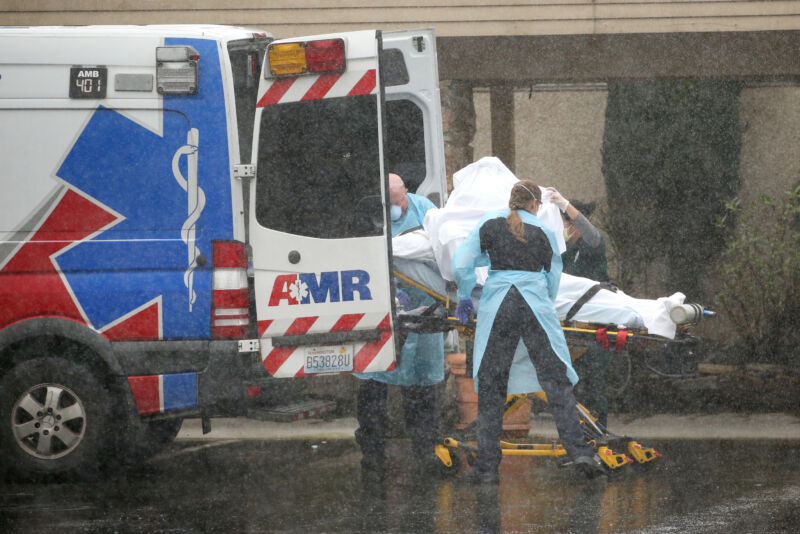
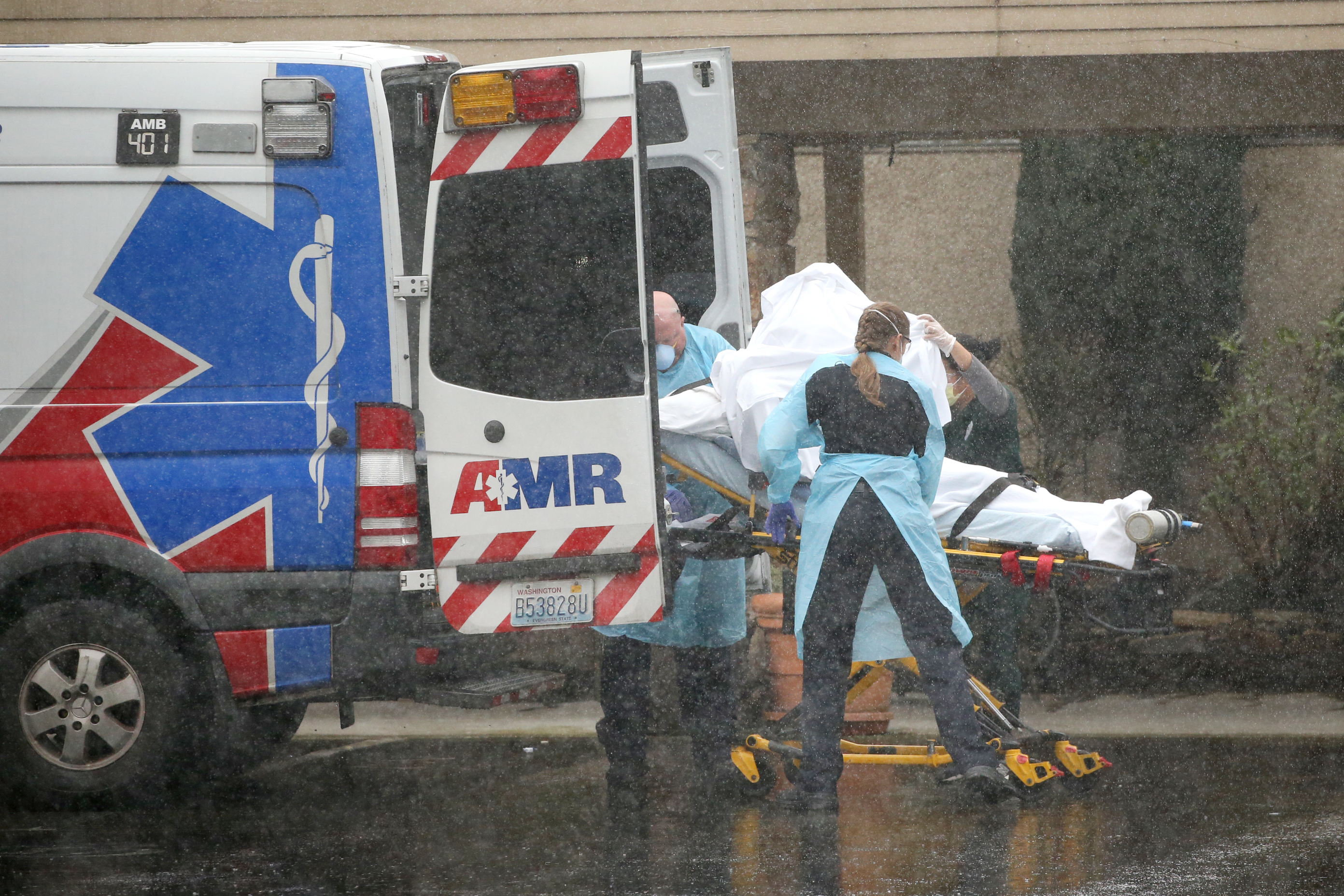
People in protective gear load a stretcher-bound patient into an ambulance.

Enlarge / KIRKLAND, Wash.: A patient is shielded as they are put into an ambulance outside the Life Care Center of Kirkland on March 7, 2020. Several residents have died from COVID-19, and others have tested positive for the novel coronavirus. (credit: Getty | Karen Ducey)

When cases of COVID-19 began popping up in Washington state in late February, researchers were quick to dive into the genetics of the viruses infecting residents. Based on what they knew at the time, they hypothesized that those cases in late February were genetically linked to the very first case found in the state—one in a person who arrived in Washington on January 15 after traveling from Wuhan, China, where the outbreak began. The case was also the first infection identified in the whole of the United States.

If correct, the genetic hypothesis linking the late February cases to that very first case meant that early efforts to contain the pandemic coronavirus—isolating the initial patient, tracing contacts, etc.—had failed spectacularly. It also meant that the virus, SARS-CoV-2, had been cryptically circulating in the state for six weeks. And that would mean that, in addition to those early cases, there were potentially hundreds or thousands of others out there, undetected and possibly spreading the infection further.

The hypothesis played into state officials’ decision to issue some of the country’s earliest social-distancing measures. But now that we know far more about the genetics of circulating SARS-CoV-2 viruses, that hypothesis appears to be wrong.

Read 21 remaining paragraphs | Comments

29 May 01:31

What is the point of dating now?

by Rebecca Jennings
James.galbraith

Seriously

An illustration of a person sitting in front of a laptop computer while raising a glass to the hand reaching out of the laptop in a toast. Getty Images/iStockphoto

11 single people on looking for love in quarantine.

“I’d love to be able to wear crop tops and go out dancing and make out with strangers,” Genevieve, a 27-year-old public relations specialist, tells me. It’s her first summer as a single woman in London, after all, and the crop top-wearing and kissing is the best part.

But in London, as in major cities across the globe, there will be no sweaty dance parties this summer. This, unfortunately, is only one of a great many complicating factors for people who are attempting to date during the coronavirus quarantine. Standard questions like, “Are you free this week?” or, “When was your last STD test?” now feel quaint compared to the myriad cosmic obstacles to two people meeting and hooking up. “Is it ethical to hold hands?” and, “Do I really like this person or am I just stuck with them for the foreseeable future?” are now real concerns, often ones people are forced to make without even meeting each other face to face.

That doesn’t mean folks aren’t trying. On Tinder, users have been messaging each other 20 percent more frequently, and average conversation lengths are around 25 percent longer, according to the company. Now that nobody’s traveling, ironically, location matters less than ever: Tinder briefly allowed users to access a paid feature where you could set your location anywhere in the world, “and it went crazy,” Tinder CEO Elie Seidman says. The company will soon launch Global Mode, where users are served potential partners from all over the world, regardless of where they live.

It’s very possible that the way we date now — more virtually and more carefully — could become part of the “new normal” that society has been clumsily crawling toward since quarantine began. While some of the side effects of the pandemic on potential relationships have been positive (as Sable Yong argues in GQ, now is the time to shoot your shot!), dating has always been hard, and for the most part, the coronavirus has only complicated coupling.

I asked people to tell me what kinds of new questions they were grappling with while dating in quarantine. They ranged from the immediate (is there a way to make Zoom dates less horrifically awkward?) to the existential (should I even be dating right now?). During our interviews, the most common sentiment shared by all of them was this: What’s the point?

(I’ve included only people’s first names and ages due to the highly personal nature of our interviews. Names with asterisks have been changed for further privacy.)

How am I supposed to have a sexy single summer?

I’m newly single for the first time in two years, and I’m so frustrated to not be able to go out to bars and meet people. It’s so annoying. In any other circumstance, I would be killing it.

“In any other circumstance, I would be killing it”

Some people [on the dating apps] are clearly searching for their partner. That’s totally fair and totally normal, but that is not the position that I’m in. I wanna be on my own for a while and just enjoy being single. But how am I supposed to keep up these conversations with people, and to what end and for what purpose? What is the point of this conversation with these random guys on dating apps?

A lot of guys will just ghost after a few days — maybe they just all hate me — but what I think is they just don’t have the energy to keep up this conversation and they don’t see the point in it. —Amanda*, 23

How do I make a Zoom date less awkward?

I tried two Zoom dates and I’ve refused to go on any more. I just feel a friend vibe, and I can’t tell if it’s the guy or the medium. I really felt like I couldn’t be myself — like, my sense of humor is a little sarcastic and teasing-based, and over videoconference that just comes off as cold or mean. The fun part of dating is having one cocktail too many and touching someone’s arm. If you can’t do that, what’s the point? —Julia, 34

Does distance matter anymore?

I live with a teacher who has to go back and teach little kids, so there’s just no possibility for me of taking a risk physically. So how do you balance that with the feeling of, “I’d really like to talk to some people and I’d really like to get back out there,” without just entering into a month-long emotional affair with a stranger you’ll never see? That’s where I’m at present.

“The fun part of dating is having one cocktail too many and touching someone’s arm. If you can’t do that, what’s the point?”

For me, I’m going back and thinking, “Do I go back to people I’ve dated in the past who were not ever really possibilities because they were far away and we couldn’t see each other? I moved [to London] from New York years ago, so I’m like, “Do I go back to the random guys I used to hook up with in New York and message them on Instagram and just be like, “Hey, let’s send some steamy messages?” I don’t know. —Genevieve, 27

How do I set boundaries with strangers on dating apps?

I’ve only really connected and had FaceTime dates with two people, and those people have been people that are not working [jobs] at all. While I have liked those people a lot, they don’t have anything else really going on, and so it’s been a lot of texting and then my energy is completely gone.

The reason why a lot of people are dating right now is because they’re lonely and scared that the normal ways that you meet someone are not gonna come back for a very long time. So now people are texting, “What are you doing right now? What’s your weird quarantine hobby?” Maybe on a weekend day, I can do that, but I’m just trying to deal with my own mental health and checking all my friends and people I already know, so during the day, it’s really hard for me to want to become invested in someone that I don’t know.

For me, the big question is, “Because everyone’s lifestyles are so varied right now, how do you set a communication boundary with someone you don’t even know?” How do you say, “Hey, I would love to get to know you, but I’m depressed and exhausted and staring at a screen for a date doesn’t feel fun to me. So can we maybe keep our communication to these hours and this day?”

We haven’t met each other in person or anything, so I just let those completely fizzle. What’s the point? —Rosemary, 32

Is it love or is it quarantine?

Before quarantine started, I had gone on three dates with this guy but was planning to keep meeting other guys on Bumble. I liked the guy and he lived up the street, so it was pretty easy to hang out. We ended up hanging out every day, and it was probably two or three weeks of nonstop sleepovers and marathon hangouts.

“I’m happy that quarantine — not coronavirus — happened because I don’t think this relationship would otherwise”

Then a friend of mine asked us to come to her roof and socially distance. And so the “What are we doing here?” conversation started to come up. We’re both in flux points of our lives, so it was like, “When this is over, what are we gonna do with our lives?” It would have taken me six months, probably, to spend this much time with someone if I was going to work every day. I think I’m actually grateful for quarantine in that respect: It’s a good pressure cooker.

I’m happy that quarantine — not coronavirus — happened because I don’t think this relationship would otherwise. I would have dated other people. I was very much in a cycle of dating where I wasn’t really giving anyone a shot. When you’re on dating apps in a big city, there’s a million options and it’s hard to really get to know someone. It’s much easier to have in-depth conversations when you’re forced to hang out for hours at a time in a room with minimal distractions. You jump into what life is like together 10 years down the road. —Lydia*, 27

How can I tell if my crush likes me?

There’s someone who has been a part of my friend group — this also may be a queer gay yearning thing — who I’ve had an on-and-off crush on for a while. I’ve been able to gauge whether people are interested once we’re face to face, but it’s so much more difficult [remotely]. I’m at this point where I’m like, “I think this person’s interested in me, but also maybe they’re just lonely or don’t have anyone to talk to.” They did send me a playlist.

But because parties aren’t happening anymore, we have to be a lot more intentional. You have to text the individual person, like, “Hey, I wanna hang out,” or, “Let’s Zoom or let’s watch a movie.” So, ironically, that crush has moved forward a lot more since we started quarantine.

“A weird or distant Zoom hangout where I confess my feelings is too apocalyptic for me”

I feel like [the “I think you’re cute” conversation] needs to happen in person, though. I feel really weird over Zoom or over FaceTime just being like, “Hey, by the way, here’s this thing you need to know.” A weird or distant Zoom hangout where I confess my feelings is too apocalyptic for me. —Hannah, 23

How am I supposed to get over my ex now?

I have no intention of actually meeting somebody right now, but since I’m going through a breakup, I want to get that out of my system. But it’s an itch that you can’t scratch. I had a video date though Bumble and it was just odd. We talked for two hours because neither of us had to go anywhere. It’s like, “I’m gonna do this puzzle while we talk for a while and never talk to you again.”

“If you’re on a dating app, you’re probably lonely in some regard as it is, but now nobody’s faking it”

I’ve been swiping through Bumble a lot, but honestly, I’m mostly pissed that this pandemic is robbing me of a rebound experience. It’s really frustrating because none of my friends can be like, “Get back out there.” They’re like, “Don’t get back out there.” I could sit here and think about my ex all night, or I could swipe through Bumble. Or both. It’s not even a good distraction because everybody’s in the same boat. We’re single, we’re sad. The conversations are just like, “How have you been handling all this?” “It’s pretty bad.” If you’re on a dating app, you’re probably lonely in some regard as it is, but now nobody’s faking it. —Sam, 23

When’s the right time to hold hands?

I’ve gone on several in-person walks, which I’ve been okay with as long as they’re keeping their distance. After restrictions started to lift around town, I went to this one guy’s house and he was like, “Well, should you come in? Would that be weird?” I come to find out that this man is an incredible clean freak. I’ve never seen a cleaner house in my goddamn life.

We were watching a movie — very far apart because he knew that I was very anxious about it so he stayed on the very end of the couch — but eventually I was like, “Listen, can I hold your hand?” He was like, “I was going to ask you the same thing, but I thought you were afraid so you didn’t want to!”

“It’s funny how holding hands felt scandalous. It’s so dirty!”

It was very cute, holding someone’s hand after months of no human contact. It’s just really nice just to have another human near you, even if we don’t end up dating in the foreseeable future. When I left, I kissed my hand and put it to his face. I was like, “That’s what you get!” It’s funny how holding hands felt scandalous. It’s so dirty! —Julianna, 33

How do I say no to quarantine sex?

I started talking to this guy on Hinge and we had this crazy chemistry. We started exchanging voice notes over text super heavily for, like, three days straight, and it was really hot. We started bonding over our interests and how we’re staying cozy in quarantine. It all escalated really quickly to the point where, three days in, he was wanting to meet up.

It was a fun fantasy to play with, but I was like, “I don’t know you.” The fact that he’s not even offering to meet me in public first? I was like, “You just wanna stick your dick in something.” As cute and sexy and smart as you are, I know what you’re thinking, and we’ve never even met.

I set a boundary; I was like, “Listen, as fun as this is, I’m not putting myself out there for casual sex. I haven’t even seen my family, I’m not gonna freaking go rogue just because I want affection.” I was trying to be smart about it, but it was so tempting. It was really sad because it was such a nice quarantine crush to play with for a little bit. —Lauren, 31

Should we feel guilty for hooking up?

It was definitely a situation where we were both horny and hadn’t done anything sexual with another person for a couple of months. There was a whole discussion: We were texting trying to rationalize it, like, “I think it’s safe. I live alone.” He has roommates, but they’re adhering to social distancing, so we were like, “Maybe this is an okay risk.”

“It was definitely a situation where we were both horny”

I was like, “Come over. I’m totally game.” But he was going back and forth. At some point he was like, “Actually, I’d feel like a hypocrite,” because he’s been critical of his friends who weren’t adhering to it. I was like, “Hey, that’s fair.” Then he texted me three days later and was like, “Actually the more thought about it, I think it would totally be safe.” So I was like, “Sounds great!”

I haven’t really talked to him to see if he felt bad doing it or if he actually felt like a hypocrite. I’ve just been window shopping on Grindr, seeing what’s out there. There are definitely people who are immediately like, “Come over,” or, “Let me come over.” Like, I don’t even know you. This doesn’t seem safe. —CJ, 28

Should I even be on Tinder right now?

Really the main dating question that I’ve been asking is, “Is this actually just a good way of spending my time?” And I increasingly find the answer is no. Dating apps used to be a fun thing that led to something concrete and now they’re just not, for me at least. It’s been nicer to spend more time with my friends and people I actually know.

The thing about Tinder that was nice and fun was that there was always something that can happen, and it really doesn’t feel like there’s something that can happen right now. That makes it a sad place for me. —Daniel, 24


Support Vox’s explanatory journalism

Every day at Vox, we aim to answer your most important questions and provide you, and our audience around the world, with information that has the power to save lives. Our mission has never been more vital than it is in this moment: to empower you through understanding. Vox’s work is reaching more people than ever, but our distinctive brand of explanatory journalism takes resources — particularly during a pandemic and an economic downturn. Your financial contribution will not constitute a donation, but it will enable our staff to continue to offer free articles, videos, and podcasts at the quality and volume that this moment requires. Please consider making a contribution to Vox today.

29 May 00:44

Cisco security breach hits corporate servers that ran unpatched software

by Dan Goodin
James.galbraith

Oh come on guys

Cisco security breach hits corporate servers that ran unpatched software

Enlarge (credit: Prayitno / Flickr)

Six servers Cisco uses to provide a virtual networking service were compromised by hackers who exploited critical flaws contained in unpatched versions the open source software service relies on, the company disclosed on Thursday.

Got updates?

The May 7 compromise hit six Cisco servers that provide backend connectivity to the Virtual Internet Routing Lab Personal Edition (VIRL-PE), a Cisco service that lets customers design and test network topologies without having to deploy actual equipment. Both the VIRL-PE and a related service, Cisco Modeling Labs Corporate Edition, incorporate the Salt management framework, which contained a pair of bugs that, when combined, was critical. The vulnerabilities became public on April 30.

Cisco deployed the vulnerable servers on May 7, and they were compromised the same day. Cisco took them down and remediated them, also on May 7. The servers were:

Read 5 remaining paragraphs | Comments

29 May 00:20

Trump’s executive order on social media is legally unenforceable, experts say

by Shirin Ghaffary
James.galbraith

No shit

President Trump Issues Executive Order Against Social Media Companies President Trump announcing his executive order on social media in the Oval Office on Thursday. | Doug Mills-Pool/Getty Images

Legal experts say the executive order is largely toothless — but it could set a symbolic precedent about government censorship of the internet.

Despite President Donald Trump’s threats that Republicans might shut down social media companies in retaliation for fact-checking his tweets, the executive order he signed on Thursday unsurprisingly doesn’t come anywhere close. Even in the order’s more limited scope, legal experts say it will be difficult to enforce.

Trump’s new order aims to limit social media companies’ legal protections if they don’t adhere to unspecified standards of neutrality. It comes just two days after Twitter fact-checked two of his tweets that made misleading claims about voting-by-mail in the 2020 elections.

“Twitter is completely stifling FREE SPEECH, and I, as President, will not allow it to happen!” Trump tweeted on Tuesday. On Wednesday, Trump followed up by threatening to “strongly regulate social media companies” or close them down altogether, and cautioned that a “big action” is coming.

The order calls for limiting protections that a law called Section 230 offers tech companies like Twitter, Facebook, and Google by not holding them responsible for what users post on their platforms. (Recode’s Sara Morrison explains everything you need to know about Section 230 here.) To do this, the order tasks regulators at the Federal Communications Commission and the Federal Trade Commission to create new rules that could pull back some of those protections, potentially opening them up to a litany of lawsuits for libel, defamation, and other complaints.

“Currently, social media giants like Twitter receive an unprecedented liability shield based on the theory that they are a neutral platform, which they are not,” Trump said in the Oval Office on Thursday. “We are fed up with it. It is unfair, and it’s been very unfair.”

The order specifically mentions Twitter six times — more often than its bigger and arguably more influential competitors, Facebook and YouTube.

It argues that companies like Twitter, Facebook, and YouTube “are engaging in selective censorship that is harming our national discourse” that allegedly favors certain political viewpoints over others. Some conservatives have long argued — without real evidence — that social media platforms are biased against their politics.

Critics — including reportedly, some of Trump’s most conservative advisers — have warned the order could set a dangerous and unconstitutional precedent that the president can use executive powers to effectively censor companies for political reasons. Many legal experts say the order is largely toothless and will be challenged in court.

“The most obvious thing I would say about this order is that it’s not enforceable — it’s kind of a piece of political theater,” Kate Klonick, a professor of internet law at St. John’s University told Recode (Klonick was speaking about a draft of the order which was similar to what ended up being signed on Thursday).

Still, the order is being viewed as a symbolic threat to social media companies, particularly as they continue to grapple with moderating contentious speech.

Conservatives accusing the social media companies of liberal bias point to times when these platforms have banned conservative figures, such as far-right commentator Alex Jones and right-wing activist Laura Loome, after they repeatedly violated the sites’ harassment policies.

Many liberals, meanwhile, have argued that these platforms aren’t doing nearly enough to moderate the conspiracy theories, hoaxes, and politically misleading content shared on their sites — such as President Trump’s Facebook ads that purported to be links to the US census but instead directed people to a survey for his reelection campaign. After Recode and others reported on the misleading ads, Facebook eventually took them down.

Another unintended side-effect of Trump’s executive order could impact his own tweets: Tech companies might become “more aggressive about policing messages that press the boundaries,” as the New York Times reported, to protect themselves from being sued without the protection of Section 230.

“This is a hopeless quagmire to enter,” Former FTC chairman Bill Kovacic, who was appointed by President George W. Bush, told Recode. Kovavic said the order presents immediate legal challenges, and that the bipartisan FTC and FCC will likely be hesitant to enforce this. “There should be conservatives objecting, too, because what happens if a future president who’s a Democrat gets tired of listening to Fox — or can’t stand the National Review anymore?”

The FCC and the FTC did not immediately respond to a request for comment.

As I previously explained, aside from getting the FTC and FCC on board, Trump also has serious challenges ahead in trying to enforce this order, primarily because it arguably violates the First Amendment.

[T]he First Amendment does not limit Twitter, Facebook, Google, or any social media platform. It limits the government, not private companies, from infringing on people’s freedom to say what they please. That means you can’t go to jail for, say, blogging unfounded conspiracy theories about the Illuminati, but you can get kicked off a social network — just like you could get fired from your job for lying or for saying something racist to a colleague.

Ironically, it’s actually Trump — not Twitter — who is wading into unconstitutional territory here. If Trump were to try to shut down social media companies in retaliation for Twitter’s fact-check of his tweets, that would be a clear violation of the First Amendment. It would be sure to invite a fierce legal challenge and would signal an alarming attempt by the president of the United States to wield his executive power against one of the most fundamental rights in this country.

Trump can, however, try to get legislation passed that would selectively cull tech companies’ legal protections unless they follow certain standards of neutrality, and his executive order tasks the attorney general to draft a proposal for such a law. But Democrats — some of whom have also been pushing for reform to Section 230, though not in the way Trump is suggesting — would need to also get on board in order to tally enough votes to pass the legislation through the Democrat-controlled House of Representatives.

In the meantime, the big question is what happens next for social media companies. Will they start to roll back the new policies they’ve incrementally put in place around policing hate speech, harmful posts, and misleading information?

“I don’t think [social media companies] will change their content moderation policies overnight. It really depends how the public reaction to executive order is,” said Klonick. Twitter and other companies could “play a little bit of chicken,” to see if people pursue legal action against them — or they could try to seek a court injunction to stop enforcement of the order.

Twitter declined to comment and Facebook did not immediately respond to a request for comment.


Support Vox’s explanatory journalism

Every day at Vox, we aim to answer your most important questions and provide you, and our audience around the world, with information that has the power to save lives. Our mission has never been more vital than it is in this moment: to empower you through understanding. Vox’s work is reaching more people than ever, but our distinctive brand of explanatory journalism takes resources — particularly during a pandemic and an economic downturn. Your financial contribution will not constitute a donation, but it will enable our staff to continue to offer free articles, videos, and podcasts at the quality and volume that this moment requires. Please consider making a contribution to Vox today.

29 May 00:04

Pence chief of staff has 'red alarm' conflict of interest in pandemic-related stock holdings

by Kerry Eleveld
James.galbraith

jesus fucking christ

Vice President Mike Pence's chief of staff knew he had stocks that could create conflicts of interest. Marc Short, a former White House aide, declared at least some of those problematic stocks in public disclosures when he was hired to head up Pence's office. But Short was apparently never told to purge those holdings and opted not to divest from them after he wasn't offered the tax break sometimes given to government officials who sell stocks in compliance with ethics laws.

Now, according to NPR, Short and his wife own somewhere between half a million and $1.7 million’s worth of stocks in companies that are doing pandemic-related work. 

Some of those companies pose some obvious conflicts of interest: 3M, Abbott Laboratories, Gilead Sciences, Procter & Gamble, Medtronic, Bristol Myers Squibb, and Johnson & Johnson. Others—such as CVS, Thermo Fisher Scientific, Walmart and Roche—have been singled out for praise by the White House for their pandemic efforts.

Legally, executive branch officials are prohibited from taking part in any policy decisions or deliberations involving companies in which they have a financial interest. 

A Pence spokesperson defended Short, telling NPR he had "followed all applicable ethics laws." But Short has specifically touted the work of several companies in which he has holdings, including 3M and Honeywell.

Walter Shaub, the former director of the Office of Government Ethics, thinks the conflict is egregious enough to warrant an independent investigation. "This is now a red alarm. We have enough information to know that there is a serious possibility of a conflict of interest and a very realistic chance that he may have participated in matters affecting his financial interests," said Shaub, who now works with the government watchdog group Citizens for Responsibility and Ethics in Washington.

Another day in the Trump administration, more grift. This administration apparently exists for the purpose of lining the pockets of its exclusive members. 

28 May 22:08

Cop who targeted George Floyd had 17 complaints against him, but Klobuchar still didn't prosecute

by Lauren Floyd
James.galbraith

And this is why she should never be on a national ticket.

Years before now-fired Minneapolis police Officer Derek Chauvin knelt on the neck of a Black forgery suspect named George Floyd until he died, Sen. Amy Klobuchar had a chance to bring charges against him but didn’t, according to MintPress News. She was chief prosecutor and Chauvin had 17 complaints filed against him over the years, with all but one closed without discipline, according to records Buzzfeed News obtained and shared on Twitter.

Even that discipline only came in the form of a letter of reprimand. And Chauvin wasn’t the only officer Klobuchar spared.

Minneapolis officer Derek Chauvin, who knelt on George Floyd's neck, has had 17 complaints against him filed over the years. All but one were closed without discipline, per records. pic.twitter.com/WSy57sKr4S

— Tasneem N (@TasneemN) May 28, 2020

She failed to bring charges against more than two dozen cops who killed citizens on duty, including Chauvin, MintPress News reported. But Klobuchar didn’t exactly detail her own prosecutorial failures in her call for justice in Floyd’s death Tuesday on Twitter.

“Every single person in every single community in this country deserves to feel safe,” Klobuchar said in her Twitter statement. “As the Mayor of Minneapolis noted, this tragic loss of life calls for immediate action.”

My statement on the officer-involved death in Minneapolis: pic.twitter.com/HUoGfXEj7R

— Amy Klobuchar (@amyklobuchar) May 26, 2020

The same statement was true more than a decade ago, according to Ira Latrell Toles, an alleged victim of Chauvin's. He told The Daily Beast he didn't immediately recognize Chauvin as the same cop who beat him up in his own bathroom and shot him in the stomach 12 years ago, but Toles’ sister confirmed that it was Chauvin.

“The officer that killed that guy might be the one that shot me,” Toles had texted his sister on Tuesday. “They said his last name and I think it was him.”

“It’s him,” she responded immediately.

Toles told The Daily Beast if Chauvin were disciplined properly, it may have prevented Floyd's death. “If he was reprimanded when he shot me, George Floyd would still be alive,” Toles said. 

Chauvin was a seven-year veteran of the Minneapolis police force when he shot Toles May 24, 2008 on a domestic violence call, according to the St. Paul Pioneer Press. Police told the newspaper a 911 operator could hear a woman screaming for someone to stop hitting her. When Chauvin and another officer arrived at the scene of the call, Toles ran and when officers tried to arrest him, he grabbed one of their guns, according to police. That's when Chauvin reportedly fired at Toles, the Pioneer Press reported.

Toles told The Daily Beast the mother of his child called the police on him, but he was surprised when several officers arrived without announcing themselves. He said when he saw that an officer had breached the front door, he ran to the bathroom. “Then [Chauvin] starts kicking in that door,” Toles said. “I was in the bathroom with a cigarette and no lighter.” He said Chauvin broke into the bathroom and started hitting him with no warning. "My natural reaction to someone hitting me is to stop them from hitting me," Toles said, admitting that he struck the officer back.

“All I could do is assume it was the police because they didn’t announce themselves or ever give me a command,” Toles told The Daily Beast. “I didn’t know what to think when he started hitting me. I swear he was hitting me with the gun.”

Toles ended up pleading guilty to a misdemeanor charge in the incident. “To turn a misdemeanor disorderly situation into a felony situation that could have resulted in me dying? He tried to kill me in that bathroom.”

Chauvin, who was initially put on paid administrative leave, was eventually allowed back into the field.

“I knew he would do something again,” Toles told The Daily Beast. “I wish we had smartphones back then.”

RELATED: Klobuchar asked to suspend campaign after probe suggests she may have put innocent teen in jail

RELATED: As Minneapolis protests continue in the name of George Floyd, National Guard is called in

RELATED: Four police officers involved in the chokehold death of Minnesota Black man fired

28 May 22:07

Cartoon: Another dreaded visit from... The Don

by RubenBolling
James.galbraith

Seriously

The two upcoming Tom the Dancing Bug books, Tom the Dancing Bug: Into the Trumpverse, and The Super-Fun-Pak Comix Reader, are now available for order, but will only be available by online pre-order.

Information about the books, including how to pre-order, and special offers here. The deadline for ordering is June 30, 2020.

JOIN Tom the Dancing Bug's INNER HIVE. Get exclusive access to comics before they are published, sneak peeks, insider scoops, and lots of other stuff. JOIN TODAY.

FOLLOW @RubenBolling on the Twitters and a Face Book perhaps some Insta-grams, and even my/our MeWe.

28 May 22:07

Trump’s Twitter tantrum is a distraction for everyone — including himself

by Emily Stewart
James.galbraith

Less than 24 hours from his butthurt tantrum to order, but sure, masks and PPE can wait months. GOP priorities in action.

Trump sits at his desk holding up a copy of the New York Post. President Donald Trump holds up a copy of the New York Post before signing an executive order related to regulating social media on May 28 in the Oval Office. | Doug Mills-Pool/Getty Images

100,000 Americans have died of the coronavirus, and Trump is worried about a fact-check on Twitter.

There is a lot going on right now, to say the least — a global pandemic, an economic recession, millions of people without jobs, riots over police murdering a black man in Minnesota. And yet, the president is in a tizzy over a label Twitter put on two of his tweets.

President Donald Trump, who has spent recent days online pushing a conspiracy theory about a former staffer of a television host he doesn’t like, has spun into a rage after Twitter for the first time added a fact-check label to two of his tweets that shared misleading information.

In the tweets in question, which Trump posted on Tuesday, he claimed without evidence that there is “no way” that mail-in ballots “will be anything less than substantially fraudulent,” and particularly pinpointed California’s vote-by-mail plans. Twitter added a label to Trump’s tweets, encouraging users to “get the facts” about mail-in ballots and pointing them to more information. (Recode’s Shirin Ghaffary has the full breakdown on the fact-check drama.)

And then, all hell broke loose.

The president accused Twitter of interfering in the 2020 presidential election and of stifling free speech. He’s continued to rail against the company since and is now threatening to “strongly regulate” or close down social media companies. He signed an executive order on Thursday that will attempt to allow regulators to go after Facebook, Google, and Twitter for how they handle content posted on their platforms. He and other Republicans are specifically targeting Section 230, a part of the 1996 Communications Decency Act that acts as a shield and a sword for internet platforms. They’re generally not liable for the content posted on their platforms (the shield), and they can police their platforms however they like (the sword). Now Mark Zuckerberg is weighing in. So is Sen. Josh Hawley. And a bunch of other people.

Here’s the thing: Republicans have been complaining about supposed social media bias against conservatives for a long time. Last year, Trump hosted a sham social media summit at the White House during which he declined to invite the big social media companies. And Hawley — sometimes seriously, sometimes not — has had an eye on taking on Big Tech for quite some time.

There are legitimate questions to explore about the power and scope of tech giants, and there are debates to have about Section 230, too. Democrats have raised concerns about it as well.

But is now really the time, given, you know, everything?

100,000 coronavirus deaths and a “Stay Tuned” on Twitter

On Wednesday evening, the official coronavirus death count in the United States surpassed 100,000 people. And yet on Wednesday and Thursday, Trump fired off multiple tweets about his feud with Twitter and his upcoming executive order before acknowledging the deaths. When asked about the timing of Trump’s tweets at a press conference on Thursday afternoon, White House press secretary Kayleigh McEnany said the president had lowered flags to half-staff the day before.

It appears as though the president’s attention right now is trained very much on Twitter, a label put on a tweet, and whether or not he can lie on social media with absolute impunity, which he’s done freely until Twitter’s action this week. It’s also important to note that Twitter’s move was a small one. It didn’t take down his tweets. It didn’t take down his account. And it’s hard to imagine Twitter ever would make such a move, since its policies specifically grant exceptions to posts from world leaders, which are considered “newsworthy.”

Trump lies a lot, so you can see why, for him, it would be annoying that a platform might start to flag when he does it — especially months ahead of an election. This fits into a clearly established narrative and campaign plan he’s pursued for a while to distract the press and the public from more urgent issues, and to create a political boogeyman in tech companies. And the president seeks to politicize everything, including a public health emergency, which will ultimately impact how social media companies approach the matter.

But of all the things for him to be focusing on right now, it’s hard to justify why a Twitter fact-check would be the top priority.

As Vox’s German Lopez has laid out, the Trump administration wasted weeks and even months of valuable time at the onset of the coronavirus crisis, as it spread abroad and to the US. It lagged behind other countries in terms of testing, contact tracing, and health care capacity in vital moments. And the delays, not only at the federal level but across the country, led to an estimated 36,000 more lives lost than if the government had acted sooner, according to Columbia University.

The president, staying true to form, has often congratulated himself for his coronavirus response. Earlier this week, he estimated that if he hadn’t “done his job well,” more than a million people would have died. And for any shortcomings, he tends to blame others — China, the states, etc.

While the situation has improved modestly in the US, the coronavirus crisis is not over. Scientists are still searching for treatments and vaccines, and it’s unclear whether reopenings will bring about a resurgence in the disease or if we’ll see cases start to crop up again in the fall. And there is also the economic aspect of the crisis: Millions of people have lost their jobs; businesses have been shuttered, some permanently; and there’s an enormous amount of uncertainty about what’s ahead.

The White House’s priorities seem more than a bit off

It’s been difficult to parse the White House’s logic on what counts as urgent in all of this and what does not. Twitter label? Code red. State economies going under? Their own fault, especially if they’re blue states. Another stimulus? Eh, maybe let’s wait and see. Trump seems eager to take the victory lap on coronavirus, even though testing is only just now getting up to speed and a vaccine is months and even years away. The Defense Department on Thursday announced it has signed a contract to increase domestic production of N-95 ventilator filters and respirators — but not until August.

There’s no way to get into the president’s head and clearly identify his motivations on this, but it’s fair to make some informed judgments, given his patterns of action and personality. Sure, he’s probably bothered by Twitter. He also knows this is a way to distract from more serious issues and is well aware this is a way to gin up his base and generate anger to help propel his campaign forward. This is an easy button to push for Trump, and one he’s pushed before — there was a similar dustup over a social media bias draft out of the White House in August 2019.

But this isn’t just a distraction for the media or for the public — it’s also a distraction for Trump. And the president has already admitted that earlier distractions hindered his coronavirus response. In March, he said that he was “probably” sidetracked by impeachment earlier this year as the virus spread. Now worried about the Twitter fact-check, the president is sidetracked again. It’s a vital moment for the country, and he’s focusing his right to lie on one specific online platform. After all, as Mark Zuckerberg’s made clear, Facebook has no problem with it. Trump wants to win reelection in November, and that’s his focus right now. Bashing Twitter is a means to that end.


Support Vox’s explanatory journalism

Every day at Vox, we aim to answer your most important questions and provide you, and our audience around the world, with information that has the power to save lives. Our mission has never been more vital than it is in this moment: to empower you through understanding. Vox’s work is reaching more people than ever, but our distinctive brand of explanatory journalism takes resources — particularly during a pandemic and an economic downturn. Your financial contribution will not constitute a donation, but it will enable our staff to continue to offer free articles, videos, and podcasts at the quality and volume that this moment requires. Please consider making a contribution to Vox today.

28 May 22:02

Trump administration killed planned regulation to protect healthcare workers from airborne diseases

by Laura Clawson
James.galbraith

of course

The list of things we know the Trump administration did that have made the coronavirus pandemic worse just got longer by one. In early 2017, as part of Donald Trump’s drive to weaken regulations of every kind, the administration stopped work on a planned regulation to—drum roll, please—make sure the healthcare industry was prepared to fight an airborne infectious disease.

Work started on the planned regulation after dozens of healthcare workers got sick during the H1N1 pandemic. The plan was to come up with a similar set of protections for those healthcare workers against bloodborne diseases like HIV/AIDS—protections that help fight other bloodborne diseases like Ebola and hepatitis. But then Trump came in and said nah, there’s no reason to have a plan for enough personal protective equipment and other needs in case of an airborne virus pandemic.

“If that rule had gone into effect, then every hospital, every nursing home would essentially have to have a plan where they made sure they had enough respirators and they were prepared for this sort of pandemic,” the former head of the Occupational Safety and Health Administration (OSHA) told NPR. 

We all know how that went!

House Democrats have passed a similar infectious disease standard, but, as usual, Senate Republicans are not interested and Trump’s OSHA is opposed, with its head insisting that the existing standards for bloodborne pathogens are enough despite all evidence to the contrary. The hospital industry, too, is opposed to anything that’s a rule rather than a suggestion.

“You're right; they're not regulations, but they are the guidance that we want to follow,” the American Hospital Association’s Nancy Foster told NPR. “They set forth the expectation for infection control, so in a sense they're just like regulations.” Except for the part where they’re required rather than, y’know, nice if you want to do it.

In case you’re keeping track of all the warnings the Trump administration ignored and the preparedness measures it ended:

It never seems to end.

28 May 21:47

Graham amps up McConnell's court-packing scheme, says conservative judges over 65 should step aside

by Joan McCarter
James.galbraith

Fuck you Lindsey. That's the sound of a man who is scared of losing the Senate. Die in a fire. You don't get to run the country for 50 more years just because you're going to lose.

Now that Mitch McConnell's court-packing plan of talking older right-wing judges into retiring so he can replace them with younger, even righter-wing judges has been blessed by Chief Justice John Roberts, it's full-steam ahead. That now includes the odious Sen. Lindsey, chairman of the Senate Judiciary Committee.

Our old pal Huckleberry is joining the effort, asking judges in "your mid-60s, late 60s" to step aside. "This is an historic opportunity," Graham said in an interview with Hugh Hewitt Thursday. "We've put over 200 federal judges on the bench. […] If you can get four more years, I mean, it would change the judiciary for several generations. So if you're a circuit judge in your mid-60s, late 60s, you can take senior status, now would be a good time to do that, if you want to make sure the judiciary is right of center." These judges wouldn't have to actually retire, they could stay on the bench with "senior status," taking a reduced workload but still serving.

We can boot Graham, McConnell and the Republican Senate majority, with your $3.

And they need to make the decision snappy, Graham says. "Well, if you wait, you know, November the 1st," would be too late to get someone else confirmed before the election. "So do it now. […] I need some time." Trump already has one in four U.S. Circuit Court judges, the pathway to the Supreme Court. He's also got two Supreme Court Justices. All of these appointees are young and rabidly, rabidly ideological. A handful of them are unqualified by virtue of lack of experience or temperament to serve by the American Bar Association's analysis.

Graham's desperation on this, by the way, isn't going to make Trump (who already has some awfully catty things to say about Graham) very happy. That's Graham assuming that the election doesn't go Trump's way. Hell, it could be Graham nervous that the election doesn't go his way. He's got reason for worry, as he's currently tied with his Democratic opponent in the polls back home.

It's also pretty much a 180-degree turn for Graham, who just two years ago said about a potential Supreme Court vacancy, "If an opening comes in the last year of President Trump's term and the primary process is started, we'll wait for the next election." That was when he felt he had to be consistent with his support in 2016 of refusing to consider allowing President Obama to fill a Supreme Court vacancy, under the completely specious theory that election year vacancies had to be left open. Graham, who was pretending at being reasonable back then, was one of just a few who even bothered to meet with Obama's nominee, Merrick Garland. Back then, when he was being a moderate, Graham said he and Garland discussed the "politicization of the judiciary."

"[Garland] said he hopes that the politics between the parties will not do a lot of damage to the judiciary," Graham said after the meeting. "I worry about that. That's why I think the 60-vote requirements [to confirm Supreme Court nominees] are good because it requires both parties to get a handful of votes." That lasted as long as it took to get Trump elected. There's a reason Graham is doing so poorly back home—only Susan Collins rivals him for demonstrating an utter lack of principle when it comes to saving their political skin.

28 May 20:19

Two Weeks After Residents Flooded Bars, Wisconsin Sees Record Number of COVID-19 Cases, Deaths

by John Wright
James.galbraith

Who could have predicted...oh wait.

Two weeks after the Wisconsin Supreme Court struck down Democratic Gov. Tony Evers’ stay-at-home order, the state saw a record number of COVID-19 deaths and new cases on Wednesday.

The court’s May 13 decision prompted residents to flood bars — with many not wearing masks or social distancing — after the Tavern League of Wisconsin instructed members to feel free to “OPEN IMMEDIATELY!” 

“We’re going to have more cases, we’re going to have more deaths, and it’s a sad occasion for the state,” Evers told MSNBC in response to the court’s decision.  “We’re the Wild West. There are no rules, no regulations.”

Yahoo News reports: The state reported 599 new known COVID-19 cases on Wednesday with 22 known deaths, according to Wisconsin’s Department of Health Services, the highest recorded daily rise since the pandemic began there. … The previous record in new coronavirus cases was 528 the week prior. … Some local officials, including those in Milwaukee and Madison, have since instituted their own regulations.

More from ABC 9: State health officials said it was not clear if the stay home order being overturned on May 13 caused the spike in cases. Gov. Tony Evers said Wednesday he cannot issue a mandate, but he can issue a plea: “One of the most important things you can do to help others is to wear a mask or other face covering in public. Wearing a mask shouldn’t be a political statement. It isn’t controversial, and it’s not hard to do,” he said.

NBC 15 notes that the trend continued with the release of Thursday’s data.

The post Two Weeks After Residents Flooded Bars, Wisconsin Sees Record Number of COVID-19 Cases, Deaths appeared first on Towleroad Gay News.

28 May 20:19

Joe Biden shows Trump how to properly use Twitter by making him eat his own words

by Mark Sumner

As several pundits have pointed out, Donald Trump isn’t spending more time on Twitter than he is on the coronavirus because he’s trying to distract from the 100,000 who have died on his watch. Trump isn’t strategic. This is just where he puts his values. That’s why over the course of the morning, Trump tweeted threats against social media, lies about President Obama, more lies about Joe Biden, and attacks on the Mueller investigation. That’s what he cares about. The only time the two Vietnam War’s worth of Americans he’s done in through incompetence crossed Trump’s mind was when he paused to attack Democratic Gov. Gretchen Whitmer's social distancing guidelines.

Donald Trump is a troll who is only concerned about keeping his name at the top of the news no matter how many people have to die to keep it there. Literally. And Twitter is his main tool for trolling.

But sometimes, that tool can be flipped around to smack Trump right in the pumpkin. And Joe Biden did exactly that.

Biden’s tweet was short and simple. He merely directed attention to two other tweets that happened on the same date back in October.

Two tweets from the same day in October. pic.twitter.com/rsSslLCsTW

— Joe Biden (@JoeBiden) May 28, 2020

On that day, Biden was warning that America was unprepared to face exactly the crisis that we’re now experiencing. Trump was concerned about the difficulty of mastering the phone screen swipe.

But again, this isn’t really a matter of guile on the part of either man—both spent that day talking about what they felt was important. Biden was concerned about the health of the nation and its citizens. Trump was concerned about the tool he uses to spew hatred. 

And, to be fair, that’s not the only thing Donald Trump tweeted on that day. Nope. In fact, Trump tweeted 47 times on that day on topics as central to the Republic as his next rally, his last rally, his latest appearance on Hannity, multiple threats to sue Adam Schiff, and especially all the great things he’s done for the African American community. How’s that last one going, by the way?

Biden’s tweet was both timely and on target, identifying a gaping hole that Trump had allowed to form in the nation’s security. Trump’s tweets were about stroking his own ego. Anyone looking at how we got here could learn a lot from looking at those two tweets.

28 May 20:16

A $350 “anti-5G” device is just a 128MB USB stick, teardown finds

by Jon Brodkin
James.galbraith

Idiot tax

Photo of a USB stick sold on the 5GBioShield website.

Enlarge / The 5GBioShield, a USB stick that allegedly protects you from 5G and other radio signals. (credit: 5GBioShield)

Believers of 5G conspiracy theories have apparently been buying a $350 anti-5G USB key that—not surprisingly—appears to just be a regular USB stick with only 128MB of storage.

As noted by the BBC today, the "5GBioShield" USB stick "was recommended by a member of Glastonbury Town Council's 5G Advisory Committee, which has called for an inquiry into 5G." The company that sells 5GBioShield claims it "is the result of the most advanced technology currently available for balancing and prevention of the devastating effects caused by non-natural electric waves, particularly (but not limited to) 5G, for all biological life forms."

The product's website charges £283 for a single 5GBioShield, which converts to nearly $350. That's what it costs to get "protection for your home and family, thanks to the wearable holographic nano-layer catalyser, which can be worn or placed near to a smartphone or any other electrical, radiation or EMF emitting device."

Read 20 remaining paragraphs | Comments

28 May 20:15

Zuckerberg dismisses fact-checking after bragging about fact-checking

by Kate Cox
James.galbraith

No shit.

A frowning man in a business suit.

Enlarge / Facebook CEO Mark Zuckerberg testifying before Congress in April 2018. It wasn't his only appearance in DC this decade. (credit: Bloomberg | Getty Images)

Almost exactly two weeks ago, Facebook CEO Mark Zuckerberg was touting the success his platform has had with fact-checking and false-content warnings on posts. This week, however, Zuckerberg told Fox News that, really, he doesn't think Facebook should be in the fact-checking business at all.

"I just believe strongly that Facebook shouldn't be the arbiter of truth of everything that people say online," Zuckerberg said in an interview with Dana Perino. "Private companies probably shouldn't be, especially these platform companies, shouldn't be in the position of doing that."

The comments come amid a renewed debate about fact-checking on social media as Twitter and its most famous user, President Donald Trump, find themselves at odds. Twitter appended a fact-check notice—its first—to two Trump tweets relating to mail-in ballot fraud. In retaliation, Trump is expected to sign a new executive order as soon as today explicitly targeting Facebook's and Twitter's ability to fact-check, restrict, or otherwise manage content.

Read 5 remaining paragraphs | Comments

28 May 18:22

[Eugene Volokh] If the Government Bans Viewpoint Discrimination by Social Media Platforms, That Would Also Protect Pro-Terrorist Content

by Eugene Volokh
James.galbraith

Well a decent chunk of the GOP is pro-terrorism, as long as it's done by white people. Seems like a feature, not a bug.

[Government action protecting speech must itself be viewpoint-neutral, I think -- and this makes it much less likely that such viewpoint discrimination requirements will indeed be adopted.]

There's been a good deal of talk, in President Trump's "Preventing Online Censorship" draft Executive Order as well as elsewhere, about forbidding viewpoint discrimination by social media platforms. (Some call for that outright, while others suggest using the threat of increased liability to pressure platforms to stop such viewpoint discrimination.) I don't think that's consistent with current law (more on that soon), but I can certainly imagine Congress enacting some such statute.

Platforms could respond that they have a First Amendment right not to host speech they disapprove of, much like newspapers may refuse to publish items they disapprove of (see Miami Herald Co. v. Tornillo). But it's possible that they would be treated more like cable systems; the Supreme Court rejected (by a 5-4 vote) a First Amendment challenge to facially content-neutral "must-carry" statute requiring cable systems to carry broadcast channels (see Turner Broadcasting Sys. v. FCC).

But, as I understand it, social media platforms routinely engage in one form of broadly accepted viewpoint discrimination: They try to block and to remove pro-terrorist speech (see, e.g., this general Facebook policy). This isn't limited to speech by known terrorist organizations, nor is it limited to constitutionally unprotected incitement of imminent terrorist activity, or solicitation of specific terrorist acts. Even speech that is protected by the First Amendment from governmental punishment, such as a lone-wolf American urging people to generally engage in jihadist violence, or praising people who had recently engaged in jihadist attacks, gets blocked. What's more, as I understand it, the federal government has long appreciated such actions (though it couldn't constitutionally require them).

If Congress were to indeed require social media platforms to be viewpoint-neutral (or content-neutral) in dealing with user-generated content, then they would have to stop blocking content that expresses a pro-terrorist-violence viewpoint. Likewise, if the federal government stops advertising on platforms that impose "viewpoint-based speech restrictions" or "Violate Free Speech Principles," it would have to limit online platform advertising to groups that don't discriminate against pro-terrorist speech, either. (I quote here from sec. 3 of the draft Executive Order, which seems to contemplate stopping advertising on such platforms, though it doesn't on its face prohibit such advertising.)

Likewise, sec. 4 of the draft Order says that "It is the policy of the United States that large social media platforms, such as Twitter and Facebook, as the functional equivalent of a traditional public forum, should not infringe on protected speech." Again, though, much pro-terrorist advocacy (including of the sort that social media platforms try to stop) is protected speech under the Supreme Court's precedents.

Nor do I think that the draft Order could be revised to just have a "but not pro-terrorist viewpoints" limitation. To the extent that Congress can indeed impose limits on social media platforms' editing, those limits must themselves be viewpoint-neutral (and perhaps even content-neutral). Certainly Turner Broadcasting, which upheld Congress's power to require cable systems to carry channels they didn't want to carry, stressed the content-neutrality of that rule. Likewise with PruneYard Shopping Center v. Robins (cited by the draft executive order), which upheld a state's power to require shopping centers to carry speech they didn't want to carry.

The government isn't allowed to discriminate based on viewpoint when it uses its own property to promote a diversity of private ideas. (See, e.g.Rosenberger v. RectorMatal v. TamIancu v. Brunetti.) By the same logic, it can't discriminate based on viewpoint when it tries to promote a diversity of private ideas on private property, either. Such a grant of immunity from private restraint is as much a government-provided benefit as a grant of money to a wide range of university student groups (Rosenberger) or a grant of trademark protection to a wide range of trademark owners (Matal and Iancu).

The matter is not completely certain, as I discuss at pp. 375-77 of this article; for instance, in Ralphs Grocery Co. v. United Food & Commercial Workers Union Local 8 (Cal. 2012), the California Supreme Court upheld a content-based law that allowed union picketing but not other picketing on employers' private property. In practice, though, even that content-based rule wasn't really viewpoint-based because employers of course could all along speak out in opposition to the union speech on their own property. And in Waremart Foods v. NLRB (D.C. Cir. 2004), the D.C. Circuit held that a similar rule would be unconstitutional precisely because it was content-based. The Supreme Court's plurality opinion in Pacific Gas & Elec. v. Pub. Util. Comm'n (1986) likewise generally condemns "content-based grant[s] of access to private property." (In Turner Broadcasting, the majority seem to endorse the plurality's condemnation of content-based grants of access, by stressing that, "unlike the access rules struck down in [Pacific Gas & Elec.], the must-carry rules are content neutral in application.") And, as I noted above, the general prohibition on viewpoint discrimination in programs aimed at promoting a diversity of private views is broad and strong.

Of course, if a government rule were indeed to require content neutrality—the rule in traditional public fora—and not just viewpoint neutrality, then even more platform restrictions (including some pretty popular ones) would be forbidden. Consider, for instance, some platforms' deleting material (especially on user request) for being pornographic (at least unless they're constitutionally unprotected hard-core "obscenity"), containing nonlibelous personal insults, containing vulgarities, and so on.

Now of course one possible response is that platforms indeed shouldn't be allowed to ban pro-terrorist speech, because the platforms really are "the functional equivalent[s] of a traditional public forum," and the solution for bad speech—on the platforms as well as on sidewalks and in parks—is counterspeech. Another response might be that platform exclusion of pro-terrorist speech is good on its own, but on balance it's better to sacrifice that in order to ban viewpoint discrimination by platforms more broadly. There is much to be said for these sorts of arguments.

But here I just wanted to note that requiring viewpoint neutrality by platforms would indeed invalidate platforms' attempts to suppress pro-terrorist advocacy, and that requiring viewpoint neutrality but excluding some viewpoints would likely be unconstitutional—a result that would make such viewpoint neutrality mandates much less plausible politically.

28 May 18:13

As Trump ponders being country's 'best president,' GOP operatives mull electoral 'wipeout'

by Kerry Eleveld

As the nation mourned 100,000 dead Wednesday and Trump tweeted out claims of being the country's "best president" in history, Republican strategists are quietly mulling the possibility that Trump could ultimately sink them all in November. 

CNN talked to seven GOP operatives not directly involved with Trump's campaign and they were, let's just say, sounding grim.

Wanna kick Senate Republicans to the curb? Give $2 right now to end the GOP’s grip on power.

Trump's abysmal pandemic response combined with the economic fallout is starting to spill over on to other Republicans running for reelection. The public polling showing Joe Biden ahead of Trump nationally is consistent with their private polling, and that's starting to become a bigger liability for Republicans in key Senate races. 

Taken together, the strategists’ outlook now has changed considerably from pre-pandemic times when they were still feeling bullish about keeping the GOP Senate majority. Democrats would have to net either four seats or three seats plus the presidency to take control of the upper chamber. Now GOP operatives are contemplating the possibility of a "wipeout," as CNN put it, and talk has turned to minimizing their losses.

"This leaves them hoping for a minor rather than devastating defeat, something akin to Mitt Romney's narrow loss in 2012, when Republicans lost two Senate seats, rather than John McCain's performance four years earlier, when they lost eight," writes CNN.

At this point, the strategists worry about taking a double hit at the ballot box from depressed turnout among GOP loyalists and a rejection by swing voters. How it all plays out could come down to whether Americans trust Trump to rebuild the economy. The operatives are hanging on to polling that shows low-40s approval from Trump's pandemic response but still has him at around 50% for his handling of the economy. That's also a point the Trump campaign is echoing as they stress that Trump is the right person to helm an economic reboot.

The problem, of course, is that Trump is pushing America back to work without any inkling of a containment plan in the event of a second wave. So Trump's argument for reelection rests almost entirely on the Hail Mary pass he's in the process of making. And historically, voters' views of the economy are usually baked in by the end of the second quarter anyway.

In the meantime, the Trump campaign is trying to sell GOP lawmakers on not abandoning Trump.

"Any candidate that wants to win will run with the President," said Erin Perrine, the Trump campaign's deputy communications director. "He has the energy, the enthusiasm and the grass roots infrastructure. If you are a candidate you are going to want to be a part of that movement."

If you have to say that out loud, things are getting a little desperate.

28 May 18:02

Hulu and Plex Rolling Out New Features for Streaming Video With Friends

by Juli Clover
Hulu is testing a new "Watch Party" feature that's designed to allow up to eight people to watch TV shows and movies together through the Hulu website and chat with one another while the content is playing.


Some Hulu users who sign in on the web will see a popup describing the new Watch Party option, which is available for a select number of TV shows and movies. Watch Party is limited to customers who have the Hulu plan with no ads, and it is only on the web at this time
We're testing something new on hulu.com so you can watch together, even when you're apart. Start a Watch Party by clicking the watch party icon on the details page of your favorite shows and movies. Try it and tell us what you think.
Starting a Watch Party with friends can be done by choosing a TV show or movie that supports the feature and clicking on the Watch Party icon. Hulu then provides a link that can be shared with up to seven people, and when everyone has joined, the host can start the show.

Participants need to be logged into Hulu and watchers need to have the no ads Hulu subscription, priced at $12 per month. As the TV show or movie plays, participants can chat with one another through an included chat box, and each person using the service can control their own playback without impacting the rest of the group.

Watch Party is a Hulu-built feature that works in any browser that supports Hulu streaming, with no plug-ins or extensions required.


Along with Hulu, Plex has also announced a new "Watch Together" beta feature today, which is designed to allow multiple people to watch movies and TV shows through Plex for free. The feature works with all free on-demand content on Plex, as well as content from personal media libraries.

Plex's feature has no communication option, however, and Plex recommends viewers use a separate chat app such as Zoom. Watch Together works on iOS, tvOS, Android devices, and Android TVs. Plex's Watch Together feature is an early release and more functionality will be coming in the future. Unlike Hulu's Watch Party, Watch Together is free to use.
Tags: Plex, Hulu

This article, "Hulu and Plex Rolling Out New Features for Streaming Video With Friends" first appeared on MacRumors.com

Discuss this article in our forums

28 May 18:01

Pennsylvania Democratic lawmakers accuse their GOP colleagues of secretly exposing them to coronavirus

by Ian Millhiser
James.galbraith

Fuck the GOP

A vendor hawks Trump-themed face masks for $10 during a protest rally outside the Pennsylvania Capitol Building regarding the continued closure of businesses due to the coronavirus pandemic. | Mark Makela/Getty Images

A Republican lawmaker got sick, and no one told Democratic representatives.

Pennsylvania state Rep. Brian Sims, a Democrat, posted an explosive Twitter thread Wednesday evening warning that he may have been exposed to the coronavirus by his Republican colleagues — and that those colleagues kept him in the dark.

Shortly before Sims’s tweets, a Republican representative, Andrew Lewis, released a statement admitting that he “was tested for COVID-19 and on Wednesday, May 20, I was notified that my test came back positive.” Lewis said that he self-isolated, and that he “contacted the House of Representatives, and our caucus Human Resources department.” Lewis also claims that he worked to determine “exactly who I may have been in contact with, and who I may have possibly exposed to the virus.”

The Pennsylvania House of Representatives conducted in-person sessions while Democrats say they were unaware of Lewis’s diagnosis.

And yet, while Lewis tested positive on May 20, Democrats say they did not learn that one of their colleagues may have exposed them to the virus until Wednesday, May 27. According to Rep. Dan Frankel, the top Democrat on the House Health Committee, members of the Democratic caucus learned on Wednesday “that four members of the Republican Caucus have been in self quarantine after one of those four tested positive for COVID-19 a week ago.”

One of those four members, Republican Rep. Russ Diamond, posted a lengthy statement on Facebook Wednesday evening attacking the very idea that public health officials should engage in contact tracing to determine who may have been exposed to the virus.

Diamond says he made the decision to self-isolate “because I wanted to provide an example of how responsible adults can conduct their lives without the need for heavy-handed government mandates,” before claiming the real problem is that someone might erroneously be advised to quarantine:

There’s a lot to object to about contact tracing of this sort. I was offered no proof the person I was in “contact” with had already contracted, and was an asymptomatic carrier, of COVID-19 on May 14. And what if this notice had been sent to me in error? I happen to know someone else who received a similar notice in error. That person was fortunate enough to be able to clarify and get the record corrected and avoid self-quarantine. However, if a government agency with enforcement authority would be sending out these notices, would one be able to obtain such a correction? I highly doubt it.

As the Washington Post notes, Diamond is a “vocal opponent of wearing masks.” On the same day that Diamond began his self-quarantine, he spoke before a Pennsylvania House committee without wearing a mask.

Yet despite his behavior, Diamond is right about one thing. Contact tracing is not a perfect system. Contact tracers are a kind of public health detective; they interview people diagnosed with the virus and try to uncover who they may have exposed to the disease. But respiratory viruses such as the novel coronavirus are difficult to track because many people infected with the virus won’t remember everyone they may have been in contact with, and they might not even be aware of individuals that could have entered a room shortly after the infected person left.

That is why Republicans should have notified their Democratic counterparts of Lewis’s infection. Even if Lewis and his Republican colleagues did make every reasonable effort to uncover who Lewis might have exposed to the virus, such efforts are not 100 percent reliable. And if Lewis did unknowingly infect someone before he went into isolation, that person could also spread the disease throughout the state legislature and beyond.


Support Vox’s explanatory journalism

Every day at Vox, we aim to answer your most important questions and provide you, and our audience around the world, with information that has the power to save lives. Our mission has never been more vital than it is in this moment: to empower you through understanding. Vox’s work is reaching more people than ever, but our distinctive brand of explanatory journalism takes resources — particularly during a pandemic and an economic downturn. Your financial contribution will not constitute a donation, but it will enable our staff to continue to offer free articles, videos, and podcasts at the quality and volume that this moment requires. Please consider making a contribution to Vox today.

28 May 18:00

This is going to be very concerning for Susan Collins: She's down nearly 10 points in latest polling

by Joan McCarter
James.galbraith

Let's hope it holds

Well, this is going to be awfully concerning for Sen. Susan Collins. The Maine Republican is down by nearly double digits against her likely Democratic opponent in a new poll out of Maine. In this poll—which is from an apparently new pollster, Victory Geek—Collins trails Maine House Speaker Sara Gideon by nine points, 51-42.

The Maine primary has been postponed from June to July 14 because of the coronavirus epidemic. The frontrunner in the Democratic primary is Gideon, but respondents to this poll will vote for whichever Democrat wins against Collins in the general, 49-39. This poll is somewhat of an outlier, but there hasn't been polling in the state since the first week of March when PPP found Gideon up 47-43. A lot has happened since March 5, like more than 100,000 deaths from the coronavirus nationwide and a negligent federal government response. Collins in particular remains pretty darned unpopular in this poll, with 52% having an unfavorable opinion of her: 36% say very unfavorable. What's more, 79% of voters say they've made up their minds. Yes, she's going to be very concerned.

Let's make sure her time is up. Please give $1 to help Democrats in each of these crucial Senate races, but especially the one in Maine!