James.galbraith
Shared posts
Can we trust Trump to act in the interests of the United States — ever?
James.galbraithNo, no we cannot
Hampton Inn ‘Karen’ Calls Police on Black Hotel Guest for Using Swimming Pool with Her Kids: WATCH
James.galbraithFucking racist idiot white people. stop it

Hilton is apologizing after a white Hampton Inn employee in Williamston, North Carolina called the police on a black female guest who was trying to use the swimming pool with her children.
USA Today reports: “In a nearly 10-minute Facebook Live video shared across social media, a white hotel employee and two Williamston police officers approach a Black woman who is using the pool with her children. They ask the woman, identified on her social media account as Anita Williams-Wright, to prove that she’s staying at the hotel.”
Said Williams-Wright in the clip, which has nearly 900K views on Facebook as of this posting: “This lady here is discriminating (against) me. I have a key to get in and I can show you that it works… I have a room here. I don’t have to give my name. I didn’t break the law.”
The police officers then further degraded Williams-Wright when they showed up by running her license plate, even after she had showed them her room key.
The Global Head of Hampton by Hilton released a statement: “Hampton by Hilton has zero tolerance for racism or discrimination of any kind. On Saturday, we were alerted to an online video of a guest incident at one of our franchise properties. The team member is no longer employed at the hotel.”
Hampton by Hilton has zero tolerance for racism or discrimination of any kind. pic.twitter.com/1Wc7uidoOU
— Hampton by Hilton (@HamptonByHilton) June 29, 2020
The post Hampton Inn ‘Karen’ Calls Police on Black Hotel Guest for Using Swimming Pool with Her Kids: WATCH appeared first on Towleroad Gay News.

Treasury decides to stick with July 15 tax deadline
James.galbraithblah, guess I may need to file lol
The Treasury Department announced Monday that it will not be moving the tax-filing deadline for a second time, despite some pressure to do so because of the coronavirus pandemic.
After considering an additional postponement, the agency said the evening that it is sticking with the current July 15 deadline, and that people who need more time can ask for a normal extension that would give them until mid-October to complete their returns.
“After consulting with various external stakeholders, we have decided to have taxpayers request an extension if more time is needed,” Treasury Secretary Steven Mnuchin said in a statement.
An extension would give taxpayers until Oct. 15 to file their returns, though they would still have to pay what they owe by July 15 in order to avoid interest and penalties.
The decision is sure to please many and disappoint others, all of whom had been anxiously awaiting the agency’s decision after Mnuchin said last week he was considering an additional delay.
The agency had initially delayed the filing deadline by three months in the wake of the coronavirus pandemic.
A slew of conservative groups, though, had urged Mnuchin for more time, arguing the economy is still too weak to ask individuals and businesses to fork over a slug of taxes to the government.
At the same time, a union representing IRS employees also sought a reprieve, saying that would allow for more social distancing and other precautionary measures since agency workers could be brought back to offices more slowly.
On the other side were those concerned about everything from the knock-on effects on state budgets — many peg their own filing deadlines to the federal one — to tax preparers already contending with what can seem like a never-ending tax season. Others wondered if additional delays would leave people with snowballing tax obligations they could not pay.
IRS figures indicate that almost 90 percent of taxpayers have already filed, with the remainder being disproportionately wealthy.
The agency said it has programs in place to help people who cannot afford to pay balances due by July 15.
“We have many payment options to help taxpayers,” said IRS Commissioner Chuck Rettig. “These easy-to-use payment options are available on IRS.gov, and most can be done automatically without reaching out to an IRS representative."
Trump Knew Russia Was Paying Taliban Bounties for the Scalps of American Troops in March 2019, a Year Earlier Than Previously Thought
James.galbraithAnd still the GOP is in lockstep behind him

Donald Trump has known since March 2019, almost a year earlier than previously thought, that Russia offered secret bounties to Taliban-linked militants if they killed American troops in Afghanistan, but has taken no action in retaliation.
The AP reports: “Top officials in the White House were aware in early 2019 of classified intelligence indicating Russia was secretly offering bounties to the Taliban for the deaths of Americans, a full year earlier than has been previously reported, according to U.S. officials with direct knowledge of the intelligence.”
Both former national security advisor John Bolton and intelligence officials briefed Trump on the bounties.
MSNBC’s Rachel Maddow hammered Trump on Friday night: “This is kind of sickening news. … Vladimir Putin is offering bounties for the scalps of American soldiers in Afghanistan. Not only offering, but some of the bounties that have been offered have been collected.”
“Not only does the president know … there was that unexpected and friendly conversation he had with Putin. According to the Kremlin what they discussed on that call was how much Russia would like to be allowed back into the G7. President Trump then got off that call with Putin and immediately began calling for Russia to be allowed back into the G7. … That’s how Trump is standing up for Americans being killed for rubles paid by Putin’s government.”
The post Trump Knew Russia Was Paying Taliban Bounties for the Scalps of American Troops in March 2019, a Year Earlier Than Previously Thought appeared first on Towleroad Gay News.

The 3 Weeks That Changed Everything
James.galbraithTrain wreck plus airplane disaster
Coping with a pandemic is one of the most complex challenges a society can face. To minimize death and damage, leaders and citizens must orchestrate a huge array of different resources and tools. Scientists must explore the most advanced frontiers of research while citizens attend to the least glamorous tasks of personal hygiene. Physical supplies matter—test kits, protective gear—but so do intangibles, such as “flattening the curve” and public trust in official statements. The response must be global, because the virus can spread anywhere, but an effective response also depends heavily on national policies, plus implementation at the state and community level. Businesses must work with governments, and epidemiologists with economists and educators. Saving lives demands minute-by-minute attention from health-care workers and emergency crews, but it also depends on advance preparation for threats that might not reveal themselves for many years. I have heard military and intelligence officials describe some threats as requiring a “whole of nation” response, rather than being manageable with any one element of “hard” or “soft” power or even a “whole of government” approach. Saving lives during a pandemic is a challenge of this nature and magnitude.
It is a challenge that the United States did not meet. During the past two months, I have had lengthy conversations with some 30 scientists, health experts, and past and current government officials—all of them people with firsthand knowledge of what our response to the coronavirus pandemic should have been, could have been, and actually was. The government officials had served or are still serving in the uniformed military, on the White House staff, or in other executive departments, and in various intelligence agencies. Some spoke on condition of anonymity, given their official roles. As I continued these conversations, the people I talked with had noticeably different moods. First, in March and April, they were astonished and puzzled about what had happened. Eventually, in May and June, they were enraged. “The president kept a cruise ship from landing in California, because he didn’t want ‘his numbers’ to go up,” a former senior government official told me. He was referring to Donald Trump’s comment, in early March, that he didn’t want infected passengers on the cruise ship Grand Princess to come ashore, because “I like the numbers being where they are.” Trump didn’t try to write this comment off as a “joke,” his go-to defense when his remarks cause outrage, including his June 20 comment in Tulsa that he’d told medical officials to “slow the testing down, please” in order to keep the reported case level low. But the evidence shows that he has been deadly earnest about denying the threat of COVID-19, and delaying action against it.
[David Frum: This is Trump’s fault]
“Look at what the numbers are now,” this same official said, in late April, at a moment when the U.S. death toll had just climbed above 60,000, exceeding the number of Americans killed in the Vietnam War. By late June, the total would surpass 120,000—more than all American military deaths during World War I. “If he had just been paying attention, he would have asked, ‘What do I do first?’ We wouldn’t have passed the threshold of casualties in previous wars. It is a catastrophic failure.”
As an amateur pilot, I can’t help associating the words catastrophic failure with an accident report. The fact is, confronting a pandemic has surprising parallels with the careful coordination and organization that have saved large numbers of lives in air travel. Aviation is safe in large part because it learns from its disasters. Investigators from the U.S. National Transportation Safety Board go immediately to accident sites to begin assessing evidence. After months or even years of research, their detailed reports try to lay out the “accident chain” and explain what went wrong. In deciding whether to fly if I’m tired or if the weather is marginal, I rely on a tie-breaking question: How would this look in an NTSB report?
Controlling the risks of flight may not be as complex as fighting a pandemic, but it’s in the ballpark. Aviation is fundamentally a very dangerous activity. People are moving at high altitudes, at high speed, and in high volume, with a guarantee of mass casualties if things go wrong. Managing the aviation system involves hardware—airframes, engines, flight control systems—and “software,” in the form of training, routing, and coordinated protocols. It requires recognition of hazards that are certain—bad weather, inevitable mechanical breakdowns—and those that cannot be specifically foreseen, from terrorist episodes to obscure but consequential computer bugs. It involves businesses and also governments; it is nation-specific and also worldwide; it demands second-by-second attention and also awareness of trends that will take years to develop.
The modern aviation system works. From the dawn of commercial aviation through the 1990s, 1,000 to 2,000 people would typically die each year in airline crashes. Today, the worldwide total is usually about one-10th that level. Last year, before the pandemic began, more than 25,000 commercial-airline flights took off each day from airports in the United States. Every one of them landed safely.
In these two fundamentally similar undertakings—managing the skies, containing disease outbreaks—the United States has set a global example of success in one and of failure in the other. It has among the fewest aviation-related fatalities in the world, despite having the largest number of flights. But with respect to the coronavirus pandemic, it has suffered by far the largest number of fatalities, about one-quarter of the global total, despite having less than one-20th of the world’s population.
[James Fallows: Is this the worst year in modern American history?]
Consider a thought experiment: What if the NTSB were brought in to look at the Trump administration’s handling of the pandemic? What would its investigation conclude? I’ll jump to the answer before laying out the background: This was a journey straight into a mountainside, with countless missed opportunities to turn away. A system was in place to save lives and contain disaster. The people in charge of the system could not be bothered to avoid the doomed course.
The organization below differs from that of a standard NTSB report, but it covers the key points. Timelines of aviation disasters typically start long before the passengers or even the flight crew knew anything was wrong, with problems in the design of the airplane, the procedures of the maintenance crew, the route, or the conditions into which the captain decided to fly. In the worst cases, those decisions doomed the flight even before it took off. My focus here is similarly on conditions and decisions that may have doomed the country even before the first COVID-19 death had been recorded on U.S. soil.
What happened once the disease began spreading in this country was a federal disaster in its own right: Katrina on a national scale, Chernobyl minus the radiation. It involved the failure to test; the failure to trace; the shortage of equipment; the dismissal of masks; the silencing or sidelining of professional scientists; the stream of conflicting, misleading, callous, and recklessly ignorant statements by those who did speak on the national government’s behalf. As late as February 26, Donald Trump notoriously said of the infection rate, “You have 15 people, and the 15 within a couple of days is going to be down close to zero.” What happened after that—when those 15 cases became 15,000, and then more than 2 million, en route to a total no one can foretell—will be a central part of the history of our times.
But what happened in the two months before Trump’s statement, when the United States still had a chance of containing the disease where it started or at least buffering its effects, is if anything worse.
1. The Flight Plan
The first thing an airplane crew needs to know is what it will be flying through. Thunderstorms? Turbulence? Dangerous or restricted airspace? The path of another airplane? And because takeoffs are optional but landings are mandatory, what can it expect at the end of the flight? Wind shear? An icy runway? The biggest single reason flying is so much safer now than it was even a quarter century ago is that flight crews, air traffic controllers, and the airline “dispatchers” who coordinate with pilots have so many precise tools with which to anticipate conditions and hazards, hours or days in advance.
And for the pandemic? Since at least the early years of the George W. Bush administration, the U.S. government has devoted scientific, military, and intelligence tools toward refining its understanding of what diseases might be emerging and where, and what might be done about them. One reason for this increased emphasis was the overall heightened (and sometimes overhyped) domestic-security awareness after the 9/11 terrorist attacks. Another was the series of anthrax attacks soon after 9/11, in which envelopes containing toxins were mailed to media and political figures on the East Coast.
But the most important event was the H5N1 “bird flu” outbreak, in 2005. It originated in Asia and was mainly confined there, as the SARS outbreak had been two years earlier. Bush-administration officials viewed H5N1 as an extremely close call. “We were deeply and genuinely concerned about the potential for human-to-human transmission of the bird flu,” John R. Allen, now president of the Brookings Institution, told me. Allen is a retired four-star Marine Corps general who during the Bush administration was an early participant in the contingency-planning efforts to assess the lessons of the H5N1 threat. “We realized that if it had spread worldwide, the numbers would have been enormous. So the national-security system was pulled right into the process of improving our awareness mechanisms, and developing a national pandemic strategy.”
The awareness mechanisms were a combination of military and civilian, structured and informal, open-source and classified, with a heavy emphasis on the then-infant tools of artificial intelligence, or AI. For instance, in Bush’s second term, an unclassified government-funded project called Global Argus—named for the all-seeing giant of Greek mythology—began sifting through news reports, radio broadcasts, road-traffic patterns, business data, and other kinds of open-source information for signs of abnormalities that, in turn, could be early indicators of disease.
[Read: How the pandemic will end]
“Epidemics cause social disruption,” the program’s creators explained, in a PowerPoint presentation from that era that I have seen. “Social disruption is a common feature that can be tracked and used in lieu of direct reporting of disease.” As a person involved in the process explained to me, the direct and indirect indicators of social disruption could range from reports of hospital-admission rates to unexplained changes in food prices. “Suddenly the price of chicken goes down in Thailand, and it gets your attention,” a man who worked on Global Argus told me. “It may mean that farmers have seen that their flock is sick, and they slaughter them all at once and send them to market.” This project aspired to process 250,000 bits of news per day, in nearly three dozen languages, for advance warning of anomalies that could possibly indicate disease.
Fifteen years later, in the age of autonomous tracking of everything, that scale might seem quaint. A current app like Waze, for instance, is at any given moment combining readings from tens of millions of cellphones to gauge current traffic conditions on roads across the country. But Bush-era programs like Global Argus predated the introduction of the very first iPhone, and naturally algorithmic powers have increased at least as fast as civilian technology has. These days, “AI has the capacity to ingest virtually all open-source media around the world, all day every day,” a person with direct experience in the process told me. “That can provide us with the early warning that would give the opportunity for the U.S. to move out quickly with civilian medical specialists, and military-logistics teams if necessary.” Then, with these early warnings in place, this person said, “we could focus our advanced national-intelligence assets there and be able to go at a moment’s notice. We would prepare to go to ground zero, help them understand what was happening, and do everything to keep the disease from spreading.”
What might such help entail? The metaphor several people used was of firefighters from Oregon and Idaho traveling to help contain a forest fire in California before it can spread. The U.S. has many times in the past 20 years deployed scientists, doctors, and logistical-support teams to Africa, Asia, and the Middle East during disease outbreaks.
The U.S. military excels in logistics: mobile hospitals, teams of medics, food and water, masks and gowns. American scientists, at leading universities as well as the Centers for Disease Control and Prevention (despite its well-documented recent hollowing-out and politicization), are still seen as world leaders in many fields.
[Read: ‘How could the CDC make that mistake?’]
Shortly before Barack Obama left office, his administration’s Pandemic Prediction and Forecasting Science and Technology Working Group—yes, that was a thing—released a report reflecting the progress that had been made in applying remote-sensing and AI tools since the early days of Global Argus. The report is freely available online and notes pointedly that recent technological advances “provide opportunities to mitigate large-scale outbreaks by predicting more accurately when and where outbreaks are likely to occur, and how they will progress.”
James Giordano, a biosecurity expert at Georgetown University Medical Center who has been extensively involved in pandemic-response planning, told me this spring: “Absolutely nothing that has happened has been a surprise. We saw it coming. Not only did we see it, we ran the models and the gaming exercises. We had every bit of the structure in place. We’ve been talking about a biohazard risk like this for years. Anyone who says we did not see this coming has their head in the sand, or is lying through their teeth.”
The system the government set up was designed to warn not about improbable “black swan” events but rather about what are sometimes called “gray rhinos.” These are the large, obvious dangers that will sooner or later emerge but whose exact timing is unknown. Did the warning system work this time, providing advance notice of the coronavirus outbreak? According to everyone I spoke with, it certainly did. A fascinating unclassified timeline compiled by the Congressional Research Service offers a day-by-day and then hour-by-hour chronology of who knew what, and when, about developments in central China. By at least late December, signs were beginning to show something seriously amiss—despite foot-dragging, lies, and apparent cover-up on the Chinese side. A different kind of Chinese government might have done a different job, calling for help from the rest of the world and increasing the chances that the coronavirus remained a regional rather than global threat. But other U.S. leaders had dealt with foreign cover-ups, including by China in the early stages of the SARS outbreak in 2002. Washington knew enough, soon enough, in this case to act while there still was time.
[Read: Coronavirus researchers tried to warn us]
Through routine work or personal emails and other means of contact, U.S. and other international scientists began hearing from their Chinese colleagues very late last year about a new outbreak of what was initially referred to as pneumonia or flu. On December 31, the open-source platform ProMED—the Program for Monitoring Emerging Diseases—carried a translated “Chinese media report about the outbreak.” According to all of the intelligence-community veterans I spoke with, signals like this would certainly have been enough to alert U.S. officials to a significant development. “From these early indications, a pattern would have been discernible, and we would have slewed the rest of the system to find out more about it,” one of these people said. “Particularly since we’d know what to look for. If Martians were invading, we wouldn’t know what that would look like. But we have been down this road before, with MERS and SARS and Ebola, and we know the indications that are visible and detectable.”
With cues like these, the intelligence apparatus directed more attention at the area around the city of Wuhan. “China is a very hard target,” a man who recently worked in an intelligence organization told me. “We have to be very deliberate about what we focus on”—which in normal times would be military developments or suspected espionage threats. “The bottom line is that for a place like Wuhan, you really are going to rely on open-source or informal leads.” During the Obama administration, the U.S. had negotiated to have its observers stationed in many cities across China, through a program called Predict. But the Trump administration did not fill those positions, including in Wuhan. This meant that no one was on site to learn about, for instance, the unexplained closure on January 1 of the city’s main downtown Huanan Seafood Wholesale Market, a so-called wet market where wild animals, live or already killed, were on sale along with fish and domesticated animals. It was at this market that the first animal-to-human transfer of the virus is generally thought to have occurred, probably from a bat. But by that time, as Marisa Taylor of Reuters first reported, the Trump administration had removed dozens of CDC representatives in China.
Nonetheless, information came in. By the final days of December, and no later than January 1, a warning would have appeared in the President’s Daily Brief—the classified summary of international developments distilled from all intelligence agencies and passed to the president and a handful of advisers. “It was in the briefings by the beginning of January,” a person involved in preparing the president’s briefing book told me. “On that there is no dispute.” This person went on: “But knowing it is in the briefing book is different from knowing whether the president saw it.” He didn’t need to spell out his point, which was: Of course this president did not.
To sum up: The weather forecast showed a dangerous storm ahead, and the warning came in plenty of time. At the start of January, the total number of people infected with the virus was probably less than 1,000. All or nearly all of them were in China. Not a single case or fatality had been reported in the United States.
2. The Air Traffic Controllers
From the sky you see only the natural features that separate countries and continents—mountains, water—and not the political demarcation lines. The system that makes flying safe has done so by means of a thoroughgoing, borderless internationalism.
Controllers and flight crews around the world are supposed to be competent in the same spoken language—English—and use the same formulaic instructions that serve as an unambiguous code. For instance: Aviation English prescribes “tree” as the pronunciation for three, in part because the th- sound can be difficult for non-native speakers. Controllers around the world say “Climb and maintain 4,000 feet” rather than “Climb to 4,000 feet,” because to could be misheard as two. Controllers in Paris sequencing a Korean Air plane to land between ones from Lufthansa and Aeromexico at Charles de Gaulle Airport must be sure that all the nationalities involved will follow the same procedures in the same way.
In cases of disease outbreak, U.S. leadership and coordination of the international response was as well established and taken for granted as the role of air traffic controllers in directing flights through their sectors. Typically this would mean working with and through the World Health Organization—which, of course, Donald Trump has made a point of not doing. In the previous two decades of international public-health experience, starting with SARS and on through the rest of the acronym-heavy list, a standard procedure had emerged, and it had proved effective again and again. The U.S, with its combination of scientific and military-logistics might, would coordinate and support efforts by other countries. Subsequent stages would depend on the nature of the disease, but the fact that the U.S. would take the primary role was expected. When the new coronavirus threat suddenly materialized, American engagement was the signal all other participants were waiting for. But this time it did not come. It was as if air traffic controllers walked away from their stations and said, “The rest of you just work it out for yourselves.”
[Read: America’s patchwork pandemic is fraying even further]
From the U.S. point of view, news of a virulent disease outbreak anywhere in the world is unwelcome. But in normal circumstances, its location in China would have been a plus. Whatever the ups and downs of political relations over the past two decades, Chinese and American scientists and public-health officials have worked together frequently, and positively, on health crises ranging from SARS during George W. Bush’s administration to the H1N1 and Ebola outbreaks during Barack Obama’s. As Peter Beinart extensively detailed in an Atlantic article, the U.S. helped build China’s public-health infrastructure, and China has cooperated in detecting and containing diseases within its borders and far afield. One U.S. official recalled the Predict program: “Getting Chinese agreement to American monitors throughout their territory—that was something.” But then the Trump administration zeroed out that program.
“We had cooperated with China on every public-health threat until now,” Susan Shirk, a former State Department official and longtime scholar of Chinese affairs at UC San Diego, told me. “SARS, AIDS, Ebola in Africa, H1N1—no matter what other disputes were going on in the relationship, we managed to carve out health, and work together quite professionally. So this case is just so anomalous and so tragic.” A significant comparison, she said, is the way the United States and the Soviet Union had worked together to eliminate smallpox around the world, despite their Cold War tensions. But now, she said, “people have definitely died because the U.S. and China have been unable to cooperate.”
[From May 2020: H. R. McMaster: What China Wants]
What did the breakdown in U.S.-Chinese cooperation mean in practice? That the U.S. knew less than it would have otherwise, and knew it later; that its actions brought out the worst (rather than the merely bad) in China’s own approach to the disease, which was essentially to cover it up internally and stall in allowing international access to emerging data; that the Trump administration lost what leverage it might have had over Chinese President Xi Jinping and his officials; and that the chance to keep the disease within the confines of a single country was forever lost. “If Trump had been following the norm of previous presidents, we would have known about this informally, because our people would have been on the ground in China,” Shirk said. “But the Trump administration pulled them out, and the last epidemiologist who worked for the U.S. government left last year.”
In addition to America’s destruction of its own advance-warning system, by removing CDC and Predict observers, the Trump administration’s bellicose tone toward China had an effect. Many U.S. officials stressed that a vicious cycle of blame and recrimination made public health an additional source of friction between the countries, rather than a sustained point of cooperation, as it had been for so many years. Through Trump’s time in office, official American attitudes toward China have been a mixture of servility and truculence. Trump himself has been almost as personally flattering and subservient to Xi Jinping as he has been to Vladimir Putin. In his speeches and tweets he has emphasized that Xi is a “great leader” and his personal friend. (And if former National Security Adviser John Bolton’s account is to be believed, Trump told Xi that he liked the idea that Xi was holding Muslim Uighurs in concentration camps in Xinjiang.) But at the official level, Trump’s administration has been as hostile to China as Trump sounds in his rally speeches, when he utters “Chy-nah” as if the word itself were profane. Visa allowances have been tightened; long-standing cooperative arrangements have been cut; “thought leaders” of the administration, from Vice President Mike Pence and Secretary of State Mike Pompeo onward (but not including Trump, who is a “tone leader”), have suggested that it’s time for a new Cold War, with China as the existential foe.
“The state of the relationship meant that every U.S. request was met with distrust on the Chinese side, and every Chinese response was seen on the American side as one more attempt to cover up,” Paul Triolo, a former U.S. government official with extensive experience in Asia (and who is now with the Eurasia Group), told me. “There was a huge distrust of China as a malign actor on all levels, that you would never want to help them in any way. At the working level, this had a significant impact.”
In January, Trump-administration officials asked to send back into China some of the CDC observers they had previously withdrawn. The Chinese declined. “One of the puzzles has been why the Chinese initially said no when we finally offered to send people there,” Susan Shirk said. “I think they must have been alienated by our having pulled those people out.” Several weeks later, some observers did get in.
[Read: Don’t believe the China hype]
In normal circumstances—three words I heard often as a qualifier in these conversations, sometimes also phrased as “in a normal administration” or “with a normal president”—the president’s national security adviser would have called his counterpart in Beijing, and worked out a quiet modus vivendi for dealing with the pandemic. Or the president himself would have called his Chinese counterpart. What the U.S. would have wanted early in the process—at the beginning of January, while the Chinese were still covering up the extent of the disease, or in February, when the disease was beginning to spread more rapidly—would be (ironically) more U.S. scientists on the scene, and more Chinese openness to the world.
Would Xi Jinping have been willing to consider such requests, if he had received a call from the president? “I think there would have been leverage,” Ryan Hass, now of Brookings, who was the senior NSC staffer for China policy under Barack Obama, told me. “Not out of goodwill. Just pure self-interest. If we would have privately brought to the Chinese leadership’s attention that they had a potential pandemic outbreak in one of their provinces and we wanted to provide assistance in locating the source and scale of its spread, they would have answered the phone call.”
Several officials who had experience with China suggested that other presidents might have called Xi Jinping with a quiet but tough message that would amount to: We both know you have a problem. Why don’t we work on it together, which will let you be the hero? Otherwise it will break out and become a problem for China and the whole world.
These calls never happened. Donald Trump has claimed that impeachment proceedings, which ran through much of January, preoccupied him. That didn’t keep him from making five separate campaign trips to rallies during that same month, or from watching television (and tweeting about it) for several hours every day.
Beginning with Jimmy Carter’s administration and continuing through Obama’s, the U.S. and Chinese governments had woven an ever-denser web of institutional and personal connections. U.S. Treasury officials met regularly with officials from the Chinese ministry of finance; the Pentagon and the People’s Liberation Army had exchange programs; the Federal Aviation Administration trained Chinese air traffic controllers; and on through a long list, whose combined intention was to buffer inevitable superpower strains. Under Trump, most of these stopped. The only influential U.S. officials who had regular contact with Chinese counterparts were Steven Mnuchin, the Treasury secretary, and Robert Lighthizer, the trade representative. They were intent on getting the “phase one” U.S.-China trade deal signed, and all other business ran a distant second to that. Mnuchin and Lighthizer “didn’t want to be pressing Xi Jinping with anything else,” a former intelligence official told me.
[Read: China has dominated the West before]
“CDC asked for access, and was denied it [by the Chinese government],” Ron Klain, who coordinated efforts against the Ebola pandemic during the Obama administration, told me. “In normal circumstances, that request would have gone up the chain, and you would have had senior-level people in the NSC pressing at senior levels. My guess is that it wasn’t pressed in this case because the senior people were Mnuchin and Kudlow, and they had other priorities.” (Larry Kudlow, the director of the National Economic Council at the White House, was also pushing aggressively for a trade deal.)
“It would have taken diplomatic pressure on the Chinese government to allow us to insert our people” into Wuhan and other disease centers, Klain said. “The question isn’t what leverage we had. The point is that we gave up leverage with China to get the trade deal done. That meant that we didn’t put leverage on China’s government. We took their explanations at face value.”
Trump flattered Xi in public statements until the trade deal was signed, on January 15, and for a while kept on flattering him. On January 22, the U.S. had its first diagnosed case—a traveler who had arrived from Wuhan a week earlier. On that day, Trump referred to this traveler and said, “It’s one person coming in from China. We have it under control.” Eight days later, on January 30, he said, “We’re working very closely with China and other countries, and we think it’s going to have a very good ending for us.” The next day, Trump issued his partial ban on travel from China, but through February he was still publicly complimenting Xi. “He is strong, sharp, and powerfully focused on leading the counterattack on the coronavirus,” Trump said on February 7.
By the middle of March, Trump had switched to blasting the “Chinese virus,” which he continued doing through much of the month. On March 11, he gave a poorly received national address from the Oval Office, in which he bungled the announcement of an upcoming ban on most (or maybe all; it wasn’t clear) air travel to the U.S. from Europe. Several people who have dealt with past disease outbreaks told me that, in a normal administration, one option for mid-January would have been a temporary, but total, ban on all inbound international flights to the United States. “A serious option in all contingency planning would be total closure of the airspace,” a former senior official with experience in pandemic response told me. “We learned from the bird flu that as long as the airspace was open, we were completely vulnerable as a population. It is a draconian approach that could strand thousands of people. But as we look back—when taking early intelligence into serious consideration from the start—this one option would be an early choice for the president to make. It would be followed immediately by humanitarian support, and then transitioned through hubs to permit a measured flow of people to key locations. Follow-on screening would also take place prior to any further travel.”
[Graeme Wood: The ‘Chinese virus’ is a test. Don’t fail it.]
Not everyone I spoke with agreed that a total travel freeze, similar to the multiday shutdown on air travel after the 9/11 attacks, would have been feasible. All agreed that Trump’s limitations on travel from China, in late January, and from parts of Europe, six weeks later, made a bad situation worse. The Chinese “ban” was a further irritant to the Chinese government (despite Trump’s ongoing personal praise of Xi Jinping), and because it wasn’t absolute, some 40,000 U.S. citizens and others flew into American airports from China, with minimal testing, screening, or quarantine provisions. The ban might even have worsened the situation, by impelling Americans (who might have been exposed) to get back while they still could. The president’s advance notice of the partial European ban almost certainly played an important part in bringing the infection to greater New York City. Because of the two-day “warning” Trump gave in his speech, every seat on every airplane from Europe to the U.S. over the next two days was filled. Airport and customs offices at the arrival airports in the U.S. were unprepared and overwhelmed. News footage showed travelers queued for hours, shoulder to shoulder, waiting to be admitted to the U.S. Some of those travelers already were suffering from the disease; they spread it to others. On March 11, New York had slightly more than 220 diagnosed cases. Two weeks later, it had more than 25,000. Genetic testing showed that most of the infection in New York was from the coronavirus variant that had come through Europe to the United States, rather than directly from China (where most of the early cases in Washington State originated).
Officials in New York and elsewhere made their own errors, but the game was already over. The strategy for a potential pandemic should have been like that for a forest fire: do everything possible to contain it where it first broke out. Once that chance was missed, it was gone for good.
3. The Emergency Checklist
For me, as an amateur pilot, the most gripping moments in the Tom Hanks movie Sully come immediately after the bird strike. The film re-creates Captain Chesley Sullenberger’s feat of safely gliding a fully loaded US Airways plane to a landing in the Hudson River, after it flew through a flock of Canada geese and lost power in both of its engines. Obviously the moment of touchdown brings drama. But what I found most remarkable was the calm with which the captain and his first officer systematically worked through their cockpit emergency checklist, looking for every possibility to regain power as the plane headed down.
Aviation is safe because, even after all the advances in forecasting and technology, its culture still imagines emergencies and rehearses steps for dealing with them. Especially in the post-9/11 era of intensified concern about threats of all sorts, American public-health officials have also imagined a full range of crises, and have prepared ways to limit their worst effects. The resulting official “playbooks” are the equivalent of cockpit emergency checklists. Following steps in the cockpit checklist was not enough for Captain Sullenberger to restart his plane’s engines. But following the steps in the main U.S.-government pandemic playbooks would have saved tens of thousands of lives.
Anything that Barack Obama had recommended, Donald Trump was predisposed to ignore. Of the many lies Trump and his defenders have spun, none is more flatly false than the claim, as stated by Senate Majority Leader Mitch McConnell in May, that the Obama administration “did not leave … any kind of game plan for something like this.”
In response to McConnell’s claim, Ron Klain tweeted about the official pandemic playbook left for Obama’s successors. McConnell, surprisingly, retracted his statement—but the White House spokesperson, Kayleigh McEnany, then claimed that whatever “thin packet of paper” Obama had left was inferior to a replacement that the Trump administration had supposedly cooked up, but which has never been made public. The 69-page, single-spaced Obama-administration document is officially called “Playbook for Early Response to High-Consequence Infectious Disease Threats and Biological Incidents” and is freely available online. It describes exactly what the Trump team was determined not to do.
What I found remarkable was how closely the Obama administration’s recommendations tracked with those set out 10 years earlier by the George W. Bush administration, in response to its chastening experience with bird flu. The Bush-era work, called “National Strategy for Pandemic Influenza” and publicly available here, differs from the Obama-era playbook mainly in the simpler forms of technology on which it could draw. But the premises, recommendations, and warnings are fundamentally similar in each—and at complete odds with the “let’s just ignore it” nature of the Trump administration’s response.
The Bush report explained clearly why new diseases would inevitably emerge, and why they would constitute a severe threat to national security in the broadest terms. Its central premise was the importance of working seamlessly with other governments so as to contain outbreaks before they spread worldwide. “Given the rapid speed of transmission and the universal susceptibility of human populations, an outbreak of pandemic influenza anywhere poses a risk to populations everywhere,” the report explained. “Our international effort to contain and mitigate the effects of an outbreak of pandemic influenza beyond our borders is a central component of our strategy to stop, slow, or limit the spread of infection to the United States.”
I’m tempted to devote the next 20 pages of this article to quoting whole passages from the Bush report. But here is a sample—and remember, this was an official assessment by the U.S. government more than a dozen years before the first case of COVID-19 was diagnosed:
The animal population serves as a reservoir for new influenza viruses … It is impossible to predict whether the H5N1 virus [in 2005] will lead to a pandemic, but history suggests that if it does not, another novel influenza virus will emerge at some point in the future and threaten an unprotected human population.
The economic and societal disruption of an influenza pandemic could be significant. Absenteeism across multiple sectors related to personal illness, illness in family members, fear of contagion, or public health measures to limit contact with others could threaten the functioning of critical infrastructure, the movement of goods and services, and operation of institutions such as schools and universities. A pandemic would thus have significant implications for the economy, national security, and the basic functioning of society.
It is almost as if we had been warned. Here is one more sample. I know that long block quotes can be off-putting. But consider the one below, and see how, sentence by sentence, these warnings from 2005 match the headlines of 2020. The topic was the need to divide responsibility among global, national, state, and community jurisdictions in dealing with the next pandemic. The fundamental premise—so widely shared that it barely needed to be spelled out—was that the U.S. federal government would act as the indispensable flywheel, as it had during health emergencies of the past. As noted, it would work with international agencies and with governments in all affected areas to coordinate a global response. Within its own borders it would work with state agencies to detect the potential for the disease’s spread and to contain cases that did arise:
Unlike geographically and temporally bounded disasters, a pandemic will spread across the globe over the course of months or over a year, possibly in waves, and will affect communities of all sizes and compositions. In terms of its scope, the impact of a severe pandemic may be more comparable to that of war or a widespread economic crisis than a hurricane, earthquake, or act of terrorism. In addition to coordinating a comprehensive and timely national response, the Federal Government will bear primary responsibility for certain critical functions, including: (1) the support of containment efforts overseas and limitation of the arrival of a pandemic to our shores; (2) guidance related to protective measures that should be taken; (3) modifications to the law and regulations to facilitate the national pandemic response; (4) modifications to monetary policy to mitigate the economic impact of a pandemic on communities and the Nation; (5) procurement and distribution of vaccine and antiviral medications; and (6) the acceleration of research and development of vaccines and therapies during the outbreak.
This was produced by an administration that at the time was still enmeshed in doomed warfare in Iraq, Afghanistan, and elsewhere. Even so, it laid out a plan for dealing with security threats of a different sort.
The Obama playbook, like the Bush report, is chillingly prescient. Its emphasis is on the step-by-step “how to” of the government’s response. In an airplane cockpit, the emergency checklists have a series of decision trees and yes/no choices for coping with failures. If the engine fails, first check the fuel supply, and so on. The Obama playbook was something like that. To give just one example, here was the checklist on deciding when and whether to ban travel from infected areas:
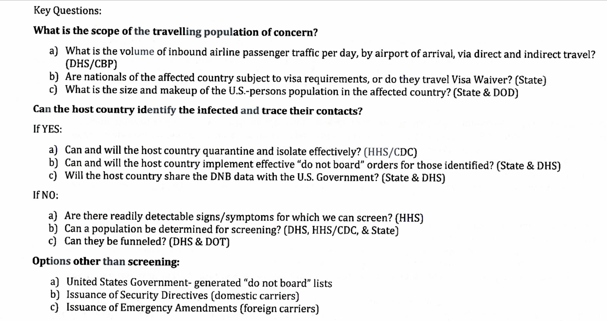
Referring to the detailed pandemic playbooks from the Bush and Obama administrations, John R. Allen told me: “The moment you get confirmation of a problem, you would move right to the timeline. Decisions by the president, actions by the secretary of defense and the CDC, right down the list. You’d start executing.”
Or, in the case of the current administration, you would not. Reading these documents now is like discovering a cockpit checklist in the smoking wreckage.
4. The Pilot
You don’t need to have seen Top Gun or The Right Stuff to be aware that pilots can be too proud of their cool bravado. But a virtue of Sully is the reminder that when everything else fails—the forecasts, the checklists, the triply redundant aircraft systems—the skill, focus, and competence of the person at the controls can make the difference between life and death.
So too in the public response to a public-health crisis. The system was primed to act, but the person at the top of the system had to say “Go.” And that person was Donald Trump.
“Here is the way I would put it,” a person who has been involved with the President’s Daily Brief process told me, referring to Trump. “The person behind the desk is the same person you see on TV”—emotional, opinionated, fixed on his own few hobbyhorses and distorted views of reality, unwilling or unable to absorb new information. “In a normal administration, the president would have seen the warnings unfolding from January onward. But this president hadn’t absorbed any of it.”
[Peter Wehner: The Trump presidency is over]
John R. Allen, who during his military career had extensive experience coordinating and commanding multinational efforts, told me, “No matter how good your planning is, or how prescient your scientists and generals, in our system you depend on the commander in chief. After you’ve given your very best advice, if the commander in chief decides not to accept it, there you are.”
People I spoke with described the ways in which staffers tried to catch or sustain Trump’s interest. Everyone recognized that he would never even look at the President’s Daily Brief. The trick was seeing whether crucial information could spark interest among others on the staff and eventually drift its way to Trump. “Does he just willfully ignore all outside information?” Paul Triolo asked. “I don’t think he ever saw or read any of the intel reports. He does listen to Navarro”—Peter Navarro, the former labor economist who had become a leading hawk on trade policy toward China. On January 29—after the trade deal Navarro championed had been signed—Navarro sent Trump a memo warning of the pandemic threat spreading from China. Navarro had no public-health background, and the people I spoke with viewed the memo mainly as an extension of his overall perspective on China. Whatever its merits, there is no evidence that Trump read or absorbed this memo or any other written documents.
In a resigned way, the people I spoke with summed up the situation this way: You have a head of government who doesn’t know anything, and doesn’t read anything, and is at the mercy of what he sees on TV. “And all around him, you have this carnival,” an intelligence officer said. “Pompeo is very ambitious to take the reins of the anti-China campaign. Mnuchin and [Commerce Secretary Wilbur] Ross are thinking about their trade deals. You end up thinking that the voice of reason is … Jared”—Kushner, the president’s son-in-law, whose many areas of responsibility in the administration have included the China relationship.
One truth through the decades, under presidents Republican and Democratic alike, is that what the president cares about, everyone else cares about too. “As the president said in his State of the Union address” is the way White House staffers begin a typical conversation with staffers of Cabinet departments. Or “As I heard directly from the president.” This president was saying that the disease didn’t matter, or would solve itself. No one was capable of attracting his attention, or changing his mind, or even using his indifference as a shield for behind-the-scenes preparation for a response.
A military official told me, “I have wondered, as a thought experiment: If the outbreak had been in Tennessee rather than Wuhan, would the outcome for the world have been worse, better, or the same?” This person said that he thought the disease might have spread even more rapidly. Why? “I think it would have been harder to convince Trump to lock things down here, than to throw a ban on China.” Blaming the “Chinese virus” (or, as Trump put it in Tulsa, the “kung flu”) and imposing an ineffective and even counterproductive “ban” was rhetorically and intellectually easy for Trump, after the trade deal had been signed. But the man who has refused ever to be photographed wearing a mask would have been—and has been—slow to impose any domestic controls.
[Read: America is giving up on the pandemic]
The United States still possesses the strongest economy in the world, its military is by far the most powerful, its culture is diverse, and, confronted with the vicissitudes of history, the country has proved resilient. But a veteran of the intelligence world emphasized that the coronavirus era has revealed a sobering reality. “Our system has a single point of failure: an irrational president.” At least in an airplane cockpit, the first officer can grab the controls from a captain who is steering the aircraft toward doom.
5. The Control Systems
The deadliest airline crash in U.S. history occurred in 1979. An American Airlines DC-10 took off from O’Hare Airport, in Chicago—and just as it was leaving the ground, an incorrectly mounted engine ripped away from one of the wings. When the engine’s pylon was pulled off, it cut the hydraulic lines that led from the cockpit to the control surfaces on the wings and tail. From that point on, the most skillful flight crew in the world could not have saved the flight. The commands they desperately tried to give as they pushed and pulled on the yoke in the cockpit had no effect on the plane’s doomed course.
It’s a grisly comparison, but also an instructive one in the case of the pandemic. Suppose the administration had paid attention when it mattered. Suppose Donald Trump had been willing to call Xi Jinping. Suppose Trump had put aside his categorical dismissal of his predecessors’ efforts and looked at the Bush and Obama playbooks. By the time the pandemic emerged, it may have already been too late. The hydraulic lines may already have been too damaged to transmit the signals. It was Trump himself who cut them.
The more complex the organization, the more its success or failure turns on the skill of people in its middle layers—the ones who translate a leader’s decision to the rest of the team in order to get results. Doctors depend on nurses; architects depend on contractors and craftsmen; generals depend on lieutenants and sergeants. A president depends on people who have developed the skills and muscle memory needed to shift a huge bureaucracy’s focus. Because Donald Trump himself had no grasp of this point, and because he and those around him preferred political loyalists and family retainers rather than holdovers from the “deep state,” the whole federal government became like a restaurant with no cooks, or a TV station with stars but no one to turn the cameras on.
“There is still resilience and competence in the working-level bureaucracy,” an intelligence-agency official told me. “But the layers above them have been removed.” Near the end of one full term in office, an unusually large number of senior deputy-secretary and assistant-secretary posts in Cabinet departments remain empty. Donald Trump’s zeal for filling lifetime-appointment judicial vacancies has not extended to the regular government. An unusually large share of those who have been appointed are political staffers, donors, or Trump protégés without experience in their field.
Traditionally, the National Security Council staff has comprised a concentration of highly knowledgeable, talented, and often ambitious younger figures, mainly on their way to diplomatic or academic careers. For instance, during both terms of the Obama administration, the main NSC staffer covering Chinese affairs was Evan S. Medeiros. By the time he joined Obama’s staff, he had a doctorate in international relations and had written many books and papers on military, political, and economic developments in China; he had lived and traveled in the region; he spoke Chinese. Under Donald Trump, the most influential staff figures on China appear to be Robert Lighthizer, the trade representative, who has decades of experience in that field but sees China and Japan almost exclusively through a commercial lens; Peter Navarro, who apparently came to Trump’s attention after Jared Kushner did an online search for books on China and came across Navarro’s inflammatory and thinly researched polemic Death by China; and Matthew Pottinger, a Chinese speaker who worked for years in China as a reporter for Reuters and The Wall Street Journal and then spent five years in the Marines. The three share a skeptical view of China—Lighthizer on trade, Navarro on everything, and Pottinger because of the repression and corruption he observed as a foreign correspondent. Even with Pottinger included, this was a shallower pool of China experience than under other administrations.
[Read: Can the West actually ditch China?]
“There is nobody now who can play the role of ‘senior China person,’” a former intelligence official told me. “In a normal administration, you’d have a lot of people who had spent time in Asia, spent time in China, knew the goods and bads.” Also in a normal administration, he and others pointed out, China and the United States would have numerous connective strands—joint working groups on anti-terrorism efforts, or climate projects, or even, yes, pandemic-prevention strategies. “There would be some ballast in the relationship,” this person said. “Now all you’ve got is the trade friction”—plus the personal business deals that the president’s elder daughter, Ivanka, has made in China, as have relatives of her husband, Jared Kushner. What all these figures lack is any experience whatsoever with bureaucracies—that is, with running an organization any larger than their own, family-controlled enterprises.
Every president is “surprised” by how hard it is to convert his own wishes into government actions. In 1960, the political scientist Richard E. Neustadt got John F. Kennedy’s attention with his book Presidential Power: The Politics of Leadership, which analyzed the range of tools a president must employ to persuade the Congress, the public, foreign leaders, and members of the permanent bureaucracy to work toward his goals. Before that, Harry Truman had famously converted this principle into a joke. When preparing to leave the Oval Office and turn it over to the newly elected Dwight Eisenhower, Truman pointed at his desk and said: “He’ll sit right here and he’ll say ‘Do this, do that!’ And nothing will happen. Poor Ike. It won’t be a bit like the Army.”
Presidents cope with this discovery in varying ways. The people I spoke with had served in past administrations as early as the first George Bush’s. George H. W. Bush came to office with broad experience in the federal government—as much as any other president. He had been vice president for eight years, a CIA director, twice an ambassador, and a member of Congress. He served only four years in the Oval Office but began with a running start. Before he became president, Bill Clinton had been a governor for 12 years and had spent decades learning and talking about government policies. A CIA official told me that Clinton would not read his President’s Daily Briefs in the morning, when they arrived, but would pore over them late at night and return them with copious notes. George W. Bush’s evolution from dependence on the well-traveled Dick Cheney, in his first term, to more confident control, in his second, has been well chronicled. As for Obama, Paul Triolo told me: “By the end of his eight years, Obama really understood how to get the bureaucracy to do what he wanted done, and how to get the information he needed to make decisions.” The job is far harder than it seems. Donald Trump has been uninterested in learning the first thing about it.
In a situation like this, some of those in the “regular” government decide to struggle on. Others quit—literally, or in the giving-up sense. “The problem is not just the president, erratic as he is,” an intelligence official told me. “The ‘process’ is just so chaotic that it’s not a process at all. There’s no one at the desk. There’s no one to read the memos. No one is there.”
James Giordano, who continues to work on projects forecasting national-security threats, said that the right-wing “Fire Fauci” trend, though brief, had a powerful demoralizing effect on the experienced professionals who, in the federal government as in any large organization, get the daily work done. (The aviation counterpart would be a pilot who sneered away cautions from maintenance experts, weather forecasters, or air traffic controllers as fraidy-cat “deep state” talk.) During March and April, when Donald Trump thought it advantageous to have hour-long live White House “briefings” on the pandemic day after day, Dr. Anthony Fauci became world famous for his calm, clear, cautionary explanations. Trump loyalists began grousing that Fauci had “better ratings” than his boss. By mid-April, when Fauci had politely but clearly taken his distance from some of Trump’s most extreme promises and claims, #FireFauci began circulating on Twitter—and in mid-April, Trump himself retweeted one message in that vein. In practical terms, Trump couldn’t actually fire Fauci, who (apart from his personal eminence) held the sort of civil-service position not subject to presidential dismissal without cause. But having an online mob riled up against a civil servant is no joke. My own house, in Washington, D.C., is a few blocks from Fauci’s—and starting about that time, my wife and I noticed government security vehicles stationed outside it around the clock.
[Read: Anthony Fauci’s Gen Z cred]
“That hashtag is indicative of the risk-averse climate I am talking about within government at present; clearly a result of top-down influence,” Giordano said. “If this could happen to Fauci, it makes people think that if they push too hard in the wrong direction, they’ll get their heads chopped off. There is no reason in the world something called #FireFauci should even exist. The nation’s leaders should maintain high regard for scientific empiricism, insight, and advice, and must not be professionally or personally risk-averse when it comes to understanding and communicating messages about public safety and health.”
Giordano concluded, “If I sound frustrated, that is because I am”—and we spoke at a time when the U.S. death toll was “only” about 10,000. “It’s not just personal frustration. It’s professional frustration. In the midst of this emergency, we should have been able to act, swiftly and soundly—and we didn’t.”
Over nearly two decades, the U.S. government had assembled the people, the plans, the connections, and the know-how to spare this nation the worst effects of the next viral mutation that would, someday, arise. That someday came, and every bit of the planning was for naught. The deaths, the devastation, the unforeseeable path ahead—they did not have to occur.
[Read: A devastating new stage of the pandemic]
6. The Crash Landing
Today, six months after the president was given his first warnings, more than 2.3 million Americans have been infected by the coronavirus. More than 120,000 have succumbed to the disease. New infections are being reported at the rate of thousands per day—as many now as at what some saw as the “peak” two months ago.
The language of an NTSB report is famously dry and clinical—just the facts. In the case of the pandemic, what it would note is the following: “There was a flight plan. There was accurate information about what lay ahead. The controllers were ready. The checklists were complete. The aircraft was sound. But the person at the controls was tweeting. Even if the person at the controls had been able to give effective orders, he had laid off people who would carry them out. This was a preventable catastrophe.”
The summation by a former senior official was less dry and less clinical. He said to me, “Here we stand, on a mountain of dead.”
Trump’s Justice Department has a powerful tool to fight police abuse. It refuses to use it.
James.galbraithBecause Sessions is a blatant white supremacist
 Christina Animashaun/Vox
Right before he resigned, Jeff Sessions sabotaged the DOJ’s ability to fight police abuse.
Jefferson Beauregard Sessions was about to become irrelevant.
It was his last day in office. Donald Trump’s attorney general, formerly a US senator from Alabama, had lost favor with the president for failing to stop the special counsel investigation into the Trump campaign’s alleged collusion with Russia in the 2016 election.
But he wasn’t quite done yet. Shortly before Sessions left the Department of Justice (DOJ) on November 7, 2018, he circulated a memo to senior Justice Department lawyers announcing a new policy.
The memo concerned consent decrees, a kind of court order negotiated between federal and state or local officials that the Justice Department uses to pressure police departments with a history of systemic civil rights abuses.
Sessions’s memo marked a significant change of course from the Obama administration. It instructed the department’s lawyers to be very reluctant to pursue consent decrees. And that meant that if civil rights lawyers within the DOJ wanted to go after a particularly egregious police department, they would have to fight with at least one arm tied behind their back.
In previous administrations, consent decrees were used to fight police misconduct. The very first consent decree targeting police misconduct, a 1997 agreement President Clinton’s Justice Department reached with the Pittsburgh police force, briefly turned the force into a “widely emulated model department,” according to the New York Times (or, at least, it did until the decree was lifted in 2002 and the department started to backslide).
/cdn.vox-cdn.com/uploads/chorus_asset/file/20054107/GettyImages_893665008.jpg) Chip Somodevilla/Getty Images
Chip Somodevilla/Getty Images
/cdn.vox-cdn.com/uploads/chorus_asset/file/20054110/GettyImages_149191729.jpg) Sean Gardner/Getty Images
Sean Gardner/Getty Images
During the Obama administration, the Justice Department wielded consent decrees to hold wayward police departments accountable where state and local governments would not or could not. An Obama consent decree transformed the New Orleans Police Department from one of the most corrupt in the nation into a department that other law enforcement agencies now look to for guidance. A 2016 consent decree in Ferguson, Missouri — two years after the shooting of Michael Brown — forced that town to curtail its practice of collecting escalating fines and fees from low-income residents in order to fund the town budget, and it committed the Ferguson police to deescalating their use of force.
Sessions’s memo instructed the department to “exercise special caution before entering into a consent decree with a state or local governmental entity.” It permitted DOJ lawyers to enter into such decrees only in limited circumstances. And it required that those lawyers get permission from many of the Justice Department’s most senior officials before entering into a consent decree.
In practice, these restrictions have seemingly put an end to new consent decrees against police departments that systematically violate civil rights.
Under President Obama, the DOJ entered into consent decrees with 14 law enforcement agencies, including in places like Ferguson and Cleveland, Ohio, where police killed people. Since Trump took office, the Justice Department has entered into zero consent decrees.
This abdication of the department’s previous oversight role — to police the police — can mean that no one will step in when law enforcement agencies will not obey the law.
And in a time when protesters fill the nation’s streets, Sessions’s memo means that the federal government can do far less to address these protesters’ demands for an end to police brutality.
To be clear, consent decrees are not a panacea for bad policing — some have achieved only mixed or transient results — but they have shown promise as a government tool in combating police brutality and protecting the rights and health of communities. In the best cases, they can transform — and have transformed — police departments.
But they have now been shelved, due to Jeff Sessions and the Trump administration.
Consent decrees, briefly explained
The Violent Crime Control and Law Enforcement Act of 1994 has fallen deeply out of favor with criminal justice reformers. Often referred to simply as the “crime bill,” the legislation has come to be considered “one of the cornerstone statutes that accelerated mass incarceration,” according to a recent white paper from the liberal Center for American Progress.
But a provision of this bill made it possible for the Justice Department to target state and local police departments with a history of lawless behavior. Section 14141 of the crime bill permits the Justice Department to investigate any “pattern or practice of conduct by law enforcement officers” that “deprives persons of rights, privileges, or immunities secured or protected by the Constitution or laws of the United States.” And if the department uncovers systemic violations within a police department, it may sue to “obtain appropriate equitable and declaratory relief to eliminate the pattern or practice.”
Which brings us to consent decrees. A key word in this phrase is “consent.” Consent decrees are agreements between two or more parties to a lawsuit — often the Justice Department and a particular police department — where a party agrees to change its conduct in certain ways.
At least before the Trump administration, specialized lawyers in the Justice Department’s Civil Rights Division monitored media reports, cases handled by other parts of the DOJ, and even letters sent to the Justice Department for signs that a particular police department had a pattern of constitutional violations. Once the DOJ decided to intervene, it could conduct a formal investigation, pressure the police department to make voluntary changes, and, if necessary, file a lawsuit.
Consent decrees allow police departments to avoid expensive and protracted litigation against the federal government. Often, these agreements can be quite long and meticulously detailed. The Obama-era consent decree governing the New Orleans Police Department, for example, is more than 120 pages long, and its provisions impose very detailed requirements on the department: One requires the department to “identify official and vital documents that are subject to public dissemination, and require translation of such documents into Spanish and Vietnamese.” Another requires officers to “issue three loud and clear warnings that a canine will be deployed” in most cases before a police dog may be used on a suspect.
“One of the most dangerous, and rarely discussed, exercises of raw power is the issuance of expansive court decrees,” Sessions wrote in 2008.
Consent decrees differ from ordinary lawsuit settlements in that they must be approved by a judge. Once the consent decree is approved, the judge is empowered to enforce it, and they will often appoint a professional monitor who will watch over the police department and provide periodic reports on whether the department is complying with the agreement.
The presence of a monitor is key, and often just as important as ensuring that a police department has good policies on its books. As Monique Dixon, deputy director of policy and director of state advocacy at the NAACP Legal Defense and Educational Fund, told me, “It’s not enough to have policies in place.” Police departments “must also have systems and mechanisms to make sure that personnel follow those policies.”
While a federal monitor cannot adjudicate every case where an officer is accused of misconduct, that monitor can notify the judge if a department has inadequate systems in place to discipline rogue officers. And the monitor’s mere existence is a reminder that someone with power over the department is keeping an eye on its actions.
Some consent decrees are more successful than others. And, because police consent decrees are a relatively recent phenomenon — police departments and the DOJ have only entered into a few dozen consent decrees since the crime bill became law — it’s hard for researchers to reach definitive conclusions about their effectiveness.
But there is evidence that, in the aggregate, consent decrees are effective at reducing civil rights violations. A 2017 study, for example, looked at 23 police departments subject to consent decrees. It found that civil rights suits against these departments “dropped anywhere from 23 percent to 36 percent after a federal intervention”— although the number of lawsuits also tended to tick up after the consent decree was lifted.
Another study found that consent decrees are quite effective in reducing deaths caused by police officers, but only when police are overseen by a monitor. “In the absence of court-appointed monitors, consent decrees did not result in significant changes to the number of citizen fatalities,” writes Li Sian Goh, a PhD candidate in criminology at the University of Pennsylvania. But “when federal courts appointed monitor teams to oversee the consent decree settlement, police departments saw a 29 percent decrease in fatalities.”
Sessions’s case against consent decrees
The very idea that the federal government might assert power over a local police department forms the core of Sessions’s objection to consent decrees against those departments.
“One of the most dangerous, and rarely discussed, exercises of raw power is the issuance of expansive court decrees,” Sessions wrote in 2008, while he was still a senator. Such decrees, he claimed, “have a profound effect on our legal system as they constitute an end run around the democratic process.”
Ten years later, Sessions elaborated on this reasoning in his parting memo. When a federal judge is placed in charge of implementing reforms, the outgoing attorney general claimed, “this supervision can deprive the elected representatives of the people of the affected jurisdiction of control of their government.” Instead of having local or state policing policy set by elected officials, consent decrees can transfer power to a federal judge.
Of course, consent decrees are negotiated agreements to avert a lawsuit, and local or state elected officials generally are represented in these negotiations. But Sessions also warned that such agreements can take away a local or state government’s ability to change its mind. “A consent decree,” according to Sessions, “can reduce long-term flexibility in how the defendant remedies the legal violation, especially if the passage of time has resulted in changed circumstances.”
Sessions claimed, in other words, that consent decrees are an attack on local control and local democracy. In some cases, Justice Department lawyers may use the threat of a lawsuit to pressure local officials into accepting terms they’d otherwise refuse. In other cases, he wrote in 2008, “certain governmental agencies secretly delight in being sued because they hope a settlement will be reached” that calls for more money to be spent on the agency than the legislature otherwise would have appropriated, and that could “bind the hands of future state executives and legislatures.”
But the binary world that Sessions sketches — one that places unelected federal lawyers against democratically legitimate officials in cities and states — is not the world we live in.
The mass protests against police violence arise out of frustration that the democratic system is not working to ensure that police respect civil rights, a frustration born out of the perception that police often operate outside the democratic process — often with the support of police unions that view protecting their own as more important than ensuring that police obey the law.
Consider a Twitter thread by Steve Fletcher, a Minneapolis City Council member, explaining why political leaders have been unable to rein in the police department that employed Derek Chauvin, the white cop who pinned George Floyd, a Black man, by the neck with his knee for nearly nine minutes, and who is now charged with Floyd’s murder.
Politicians who cross the MPD find slowdowns in their wards. After the first time I cut money from the proposed police budget, I had an uptick in calls taking forever to get a response, and MPD officers telling business owners to call their councilman about why it took so long.
— Steve Fletcher - Minneapolis Ward 3 (@MplsWard3) June 2, 2020
As Fletcher writes, when elected leaders push policies that police find objectionable, those police can retaliate with work slowdowns or stoppages that target the elected official’s constituents. Politicians who push back too hard against police risk losing their jobs in the next election.
The tactics Fletcher describes are hardly limited to Minneapolis. In Baltimore, police responded to prosecutors’ 2015 decision to (unsuccessfully) charge several officers in the killing of Freddie Gray with a work stoppage known as “the pullback.” As journalist Alec MacGillis explained, “many officers responded to calls for service but refused to undertake any ‘officer-initiated’ action.” Arrests fell by more than half compared to the previous year, and crime spiked.
In a single month, May 2015, Baltimore saw 41 homicides, more than it experienced in any other month since the 1970s. Baltimore’s police department eventually entered into a consent decree with the Department of Justice, eight days before President Obama left office.
New York police engaged in similar tactics in late 2014 and early 2015, after tensions flared between protesters, the city’s mayor, and its police union — although the New York work slowdown may not have sent the message police officers hoped it would. A study found that crime actually dropped slightly during this protest by police.
The point, however, remains: The police are not always under the effective command and control of political leaders. They can selectively do their jobs in order to reward political supporters and punish opponents. And they can form tight bonds that lead them to place protecting their own above protecting the public — or obeying commands from their jurisdiction’s lawful authorities.
As Ezekiel Edwards, director of the ACLU’s Criminal Law Reform Project, told me, a “police department often operates like a gang, or like a crew.”
Consent decrees can enable federal officials to succeed where local officials can fail, and break up this crew mentality — or, at the very least, to impose consequences on cops who behave like they are a law unto themselves.
How the DOJ can help fix rogue police departments: The case of New Orleans
The New Orleans Police Department was one of the worst (if not the worst) law enforcement agencies in the country.
In the early 1990s, more than 40 police officers were arrested for crimes such as bank robbery, rape, and bribery. Underpaid cops worked off-duty “details” to supplement their income, sometimes providing security to criminal enterprises. After a drug dealer complained to the FBI that police were shaking him down for protection money, federal agents launched Operation Shattered Shield, an operation where undercover FBI agents posed as drug dealers and paid New Orleans police officers to guard buildings where the cops were told a cocaine deal was happening.
This operation caught Len Davis, a police officer who moonlighted as a middleman — doling out jobs to officers looking to get paid to guard cocaine sales — arranging the murder of a woman who had filed a police brutality complaint. Davis was eventually sentenced to death for this killing.
The Davis incident triggered a round of reforms to the New Orleans Police Department — among other things, the department’s internal affairs office was replaced by a new Public Integrity Division that included several FBI agents. Yet, by the time President Obama took office in 2009, the department was still in need of reform. In 2011, the Justice Department released its report on a two-year investigation into the New Orleans Police Department, and it described a law enforcement agency awash in violence, incompetence, and racism.
It found that in 2009, the department arrested 565 Black people under the age of 17 for serious crimes such as homicide, robbery, or aggravated assault. During the same period, just nine white people in the same age cohort were arrested for similar crimes — although about a third of New Orleans residents are white.
“Adjusting for population,” the report explains, “these figures translate to a ratio of arrest rates for both African-American males to white males and African-American females of nearly 16 to 1.” Nationwide, the ratio is approximately 3 to 1.
/cdn.vox-cdn.com/uploads/chorus_asset/file/20053539/GettyImages_897504728.jpg) Nick Otto/Washington Post/Getty Images
Nick Otto/Washington Post/Getty Images
And then there was the violence in the department. The DOJ uncovered “many instances in which NOPD officers used deadly force contrary to NOPD policy or law.” Yet the department’s internal review process “has not found that an officer-involved shooting violated policy in at least six years, and NOPD officials we spoke with could recall only one out-of-policy finding even before that time.”
The report found officers used force unnecessarily against suspects in handcuffs and against those with mental illness. In one particularly troubling incident, an officer punched a jail inmate in the jaw after that individual spat on the back of the cop’s head — striking this individual so hard that he fell backward and hit his head on the wall. The individual was then placed, unsecured, in the back of a transport wagon and began to “roll around.” Although this individual had to be taken to a hospital for treatment, a police sergeant “approved the officer’s admitted use of force, even though, if used as described by the officer, the force was clearly retaliatory and excessive.”
In July 2012, New Orleans officials and the Justice Department signed a lengthy consent decree intended to bring the city’s police department into compliance with the law. It lays out detailed rules requiring officers to deescalate their use of force, including a ban on pepper spray, and nearly three pages of rules governing the use of police dogs — DOJ’s report found that “NOPD’s canines were uncontrollable to the point where they repeatedly attacked their own handlers.”
The consent decree required officers to be trained on when it is appropriate to stop, search, or arrest a suspect. It explicitly protects the right of bystanders to video-record officer conduct. It imposes detailed reporting requirements on the department. And it protects whistleblowers who report police misconduct, among many other things.
Eight years later, this consent decree appears to be a success. According to a 2019 report by the court-appointed monitor, police shootings declined from 20 in 2012 to just four in 2018. The number of sexual assault reports more than tripled between 2014 and 2017 — addressing a concern raised in DOJ’s 2011 report that New Orleans police were misclassifying sexual assaults as non-criminal activity. Nearly all officers have received the training required by the consent decree. No one was bitten by a New Orleans police dog in 2018.
Similarly, a 2019 report in the Christian Science Monitor found that “serious use of force by officers has plummeted from 14 in 2013 to 1 last year” and that “the percentage of people whose interactions with police were described as pleasant and courteous rose from 53 percent in 2009 to 87 percent a decade later.”
Indeed, the consent decree’s proved so successful that Judge Susie Morgan, the federal judge overseeing the decree, announced in late 2019 that the department may come into full compliance with its obligations this year.
The promise and limits of consent decrees
As protests swept across the country after the death of George Floyd, many police officers appeared determined to prove the protesters’ point — that cops are out of control and do not respect the civil rights of the people they police. As of this writing, a Google spreadsheet compiled by anti-police violence protesters includes nearly 700 videos capturing alleged incidents of police misconduct against protesters.
If the Justice Department sought to intervene, these incidents may themselves be sufficient reason for it to open investigations into police departments across the country. The Justice Department, after all, may intervene to challenge any “pattern or practice of conduct by law enforcement officers” that “deprives persons of rights, privileges, or immunities secured or protected by the Constitution or laws of the United States” — and the right to protest is secured by the First Amendment to the Constitution.
But even when the Justice Department is aggressive about opening such investigations, and even when it secures strong consent decrees, federal court decrees do not last forever. In the Supreme Court’s words, judges typically must lift a court order after “local authorities have operated in compliance with it for a reasonable period of time.”
So while Judge Morgan’s suggestion that the consent decree on New Orleans may be lifted soon is a cause for optimism — it means that the New Orleans Police Department has met most of the demands of that decree — Morgan’s nod to a future when the consent decree is lifted is also a potentially ominous sign. When released from judicial oversight, departments have been known to backslide.
That’s what seemed to happen in Pittsburgh after the consent decree binding its police department was lifted in 2002.
In 2010, Pittsburgh police beat Jordan Miles, a black 18-year-old honors student, claiming they believed that a bulge in Miles’s coat was a gun — Miles says he had nothing in his pocket, while police later claimed it was a bottle of Mountain Dew. Subsequent reporting revealed that “between 2010 and 2015, the city had used $4.9 million in tax money to settle more than 28 civil rights-related lawsuits against the police.” By 2014, Pittsburgh Mayor Bill Peduto warned that Pittsburgh police had backslid so much that the city was close to “going into another consent decree.”
And this in a police department that, according to the New York Times’s Sheryl Gay Stolberg, “was considered a model of progressive policing” when the consent decree lifted.
Consent decrees also cannot transform the culture of a police department overnight. For instance, a department’s existing police force may be dominated by officers who are set in their ways, and who may have grown accustomed to a culture of impunity for abusive cops.
Dixon, the lawyer with the NAACP Legal Defense and Educational Fund, pointed to Cincinnati's 2002 Collaborative Agreement as an example of a successful consent decree. But she also noted that it was successful in part because “there was a great deal of turnover in personnel.” The Cincinnati Police Department’s “culture changed some because many of the officers transitioned out and the new officers came in under new policies.”
Consent decrees are also an imperfect vehicle to address contracts with police unions that shield bad cops. After George Floyd’s death, Minneapolis Mayor Jacob Frey told the New York Times that “the elephant in the room with regard to police reform is the police union,” adding that the Minneapolis union’s contract with the city, which expired in January, can be a “nearly impenetrable barrier” to disciplining officers who engage in misconduct.
/cdn.vox-cdn.com/uploads/chorus_asset/file/20054139/GettyImages_1218023263.jpg) Stephen Maturen/Getty Images
Stephen Maturen/Getty Images
As Roy Austin, who served as a senior civil rights lawyer in the Justice Department and as deputy assistant to President Obama for the Office of Urban Affairs, Justice, and Opportunity, told me, a city negotiating a consent decree “cannot agree to something that is contrary to its collective bargaining agreement.” Again, a key word in the phrase “consent decree” is “consent,” and a city cannot consent to a court order that conflicts with its obligations under another, existing contract.
The Justice Department could potentially bring a lawsuit seeking to breach a collective bargaining agreement, if that agreement enables unlawful conduct by police, but such a suit could take years to litigate.
An additional problem with consent decrees is that they are only as good as the judges charged with approving and enforcing them. Because the Justice Department has not sought any consent decrees against police since Trump took office, we do not know yet how Trump’s notoriously conservative judicial appointees will view a proposed consent decree that they are asked to approve, most likely if Trump gets voted out and a Democratic DOJ changes course. But some members of the civil rights community expressed fears that Trump’s judges could be sympathetic to Sessions’s views about federal oversight of police.
“The Trump takeover of the courts does not bode well,” said Lynda Garcia, policing campaign director for the Leadership Conference on Civil and Human Rights.
Finally, consent decrees — indeed, litigation generally — are unlikely to bring about the kind of radical change that many protesters enraged by police violence seek. Courts are not “radical or revolutionary” institutions, Edwards of the ACLU told me. They might order police officers to refrain from unjustified violence or to abandon racist practices. But they will not fundamentally rewrite state and city budgets to transfer police funding to progressive priorities such as education or affordable housing, something the “defund the police” movement calls for.
Consent decrees, in other words, are not a panacea. They do not always succeed, and even when they do, police departments can backslide after the decree is lifted. They cannot address every obstacle to good policing, and they are not a shortcut around difficult political conversations about how states and cities should allocate limited resources.
But they are a powerful tool in the hands of the federal government’s civil rights attorneys. They can drastically change the culture of a police department like the one in New Orleans. And they are one of the few mechanisms the federal government has to transform a police department in situations where state and local governments have proven unwilling or unable to do the job.
As the nation’s top law enforcement officer, Sessions should have known all this. He may be gone from the Trump administration, but his disdain for federal oversight of rogue police departments lives on.
This series was made possible through a collaboration with the Center for Public Integrity.
Politics Podcast: Biden Is Currently Competitive In Georgia And Texas
James.galbraithThat should send a shudder through every republican.
A slew of new, high-quality polls provides the clearest picture yet of the presidential race in swing states, and it isn’t looking good for President Trump. In this installment of the FiveThirtyEight Politics podcast, the crew discusses polling showing Joe Biden leading in every swing state and essentially tied in Georgia and Texas. The team also looks at how Republican politicians are responding to new outbreaks of COVID-19 across the Sun Belt.
You can listen to the episode by clicking the “play” button in the audio player above or by downloading it in iTunes, the ESPN App or your favorite podcast platform. If you are new to podcasts, learn how to listen.
The FiveThirtyEight Politics podcast publishes Mondays and Thursdays. Help new listeners discover the show by leaving us a rating and review on iTunes. Have a comment, question or suggestion for “good polling vs. bad polling”? Get in touch by email, on Twitter or in the comments.
(516): The highlight of my week is...
James.galbraithlol. desperate times in quarantine apparently
Detroit police chief cops to 96-percent facial recognition error rate
James.galbraithWhat the fuck???

Enlarge / CCTV security guard in the mall building.
Detroit's police chief admitted on Monday that facial recognition technology used by the department misidentifies suspects about 96 percent of the time. It's an eye-opening admission given that the Detroit Police Department is facing criticism for arresting a man based on a bogus match from facial recognition software.
Last week, the ACLU filed a complaint with the Detroit Police Department on behalf of Robert Williams, a Black man who was wrongfully arrested for stealing five watches worth $3,800 from a luxury retail store. Investigators first identified Williams by doing a facial recognition search with software from a company called DataWorks Plus. Under police questioning, Williams pointed out that the grainy surveillance footage obtained by police didn't actually look like him. The police lacked other evidence tying Williams to the crime, so they begrudgingly let him go.
Now Vice's Jason Koebler reports that Detroit Police Chief James Craig acknowledged the flaws with its facial recognition software at a Monday event.
Read 5 remaining paragraphs | Comments
Police officers placed on leave for taking cruel photos at Elijah McClain’s memorial
James.galbraithThe rot goes very deep
Thousands across the country have come together to protest the death of 23-year-old Elijah McClain, who died after being put in a chokehold while in the custody of the Aurora Police Department in Colorado. Amid those who came out to honor and support justice for McClain were some Aurora police officers who chose to act inappropriately at the young Black man’s memorial.
Multiple officers have been placed on administrative leave pending an internal investigation after allegations that the officers took photos reenacting a chokehold at the spot at which McClain was arrested and wrestled to the ground, CBS News reported.
The city’s interim police chief, Vanessa Wilson, released a statement Monday acknowledging she learned of these allegations on Thursday. They were “reported to Internal Affairs by an Aurora Police Officer alleging multiple Aurora Police officers were depicted in photographs near the site where Elijah McClain died.” According to the statement, all the involved officers were “immediately placed on administrative leave with pay in non-enforcement capacities.” Wilson added that upon conclusion, the investigation will be shared publicly “in its entirety. This will include reports, photographic evidence obtained, officer’s names, and my final determination which can rise to the level of termination,” Wilson said.
Wilson did not detail the content of the photographs or confirm when they were taken. A spokesman for the department declined to comment further on the investigation, noting that it is ongoing, The Washington Post reported.
While it remains unclear when the photos were taken and who the officers are, the alleged actions they took are not only inappropriate but inhumane. “People congregated to pay tribute to [McClain], to call for accountability for his death, and to play their violins in his honor,” MSNBC’s Chris Hayes said on Monday. “And then Aurora police basically re-created the dynamic of McClain’s death.” In addition to having taken these photos, the Aurora police department allegedly pepper-sprayed and threatened the demonstrators who peacefully gathered to protest McClain’s death on Saturday.
My sources say the photos were disseminated within @AuroraPD to other officers and showed the officers reenacting the hold that preceeded McClains death. Question :were the officers on duty and in uniform? Its hard to believe this story could get worse. It just did. @CBSDenver
� Brian Maass (@Briancbs4) June 30, 2020
The department acknowledged this action and attempted to defend it by citing violence as the cause for the use of force. “Pepper spray was used after a small group of people gathered rocks/sticks, knocked over a fence, & ignored orders to move back. Tear gas was not used,” the department said on Twitter. Siding with the department’s use of violence, Aurora Mayor Mike Coffman called for a city council meeting on Tuesday to discuss the department’s handling of Saturday’s peaceful protests and vigil. “We are hearing many questions and concerns from the community about the tactics used by the Aurora Police Department during Saturday’s protests, and council needs to hear first-hand specifically what happened,” Coffman said in a press release. “The tragic death of Elijah McClain brought out many peaceful people over the weekend who want their voices heard, and unfortunately there were disruptions that overshadowed the broader message. I look forward to working with City Council to understand more and make sure we are upfront and transparent with our residents.”
On Aug. 24, 2019, McClain was stopped by three white officers on his way home from a convenience store after a 911 caller described a "suspicious person” matching his description, Adams County District Attorney Dave Young said in a police summary of the incident. According to the audio of the call, while the caller reported a suspicious person, they made no mention of any crimes.
Officers claimed McClain resisted contact, which prompted them to wrestle him to the ground and place him in a chokehold, the incident report said. In a video, McClain can be heard telling the officers: "I can't breathe correctly." Paramedics were then called, and they administered a sedative. On the way to the hospital McClean suffered cardiac arrest and was declared brain-dead. He was taken off life support days later.
McClain’s heartbreaking story has prompted more than 4 million people to come together and sign a Change.org petition seeking justice for McClain and demanding all officers involved in his death to be taken off duty. While placed on administrative leave following McClain’s death, the officers in the case, including Nathan Woodyard, Jason Rosenblatt, and Randy Roedema, were later reinstated after prosecutors declined to file charges against them, CNN reported.
Despite Colorado Gov. Jared Polis’ announcement last week that a special prosecutor would investigate McClain’s case, the officers in question remain uncharged and only face the repercussion of being removed from patrol duty as of last week. The decision to remove them from duty was taken not in an effort to enact justice for their brutality, but as an act of protection for the officers. "This was done in an effort to protect those officers," a spokesperson for the city of Aurora told CBS News Friday.

While Republicans scramble for cover, intelligence has receipts on Russian payments to Taliban
James.galbraithjesus
Republicans were outraged at the idea of Russia placing a bounty for the killing of American forces. Or at least they were so long as they thought surely Donald Trump hadn’t known about that one. Now that it’s clear Trump very much did know, Republicans are starting to move to a new position—one that says a foreign nation engaging in proxy war against the United States by paying for the murder of American forces is simply not worthy of Trump’s time. To simplify the questions that come up in most scandals: How much did Donald Trump know? Everything. When did he know it? A year ago.
Next up is sure to be the “But Putin denies it, so everything’s cool” phase. However, before Republicans join Trump in trusting Vladimir for the inside info, it might be worth knowing that Russia didn’t even bother to cover up their tracks. As The New York Times reports, American intelligence intercepted records showing “large financial transfers from a bank account controlled by Russia’s military intelligence agency to a Taliban-linked account.” These payments suspected of being explicit payments for the murder of American forces. Even if they’re not, they show Russia directly engaging in a war the U.S. has been fighting for two decades.
Officials in Afghanistan have announced the arrest of a number of businessmen who helped to transfer the Russian funds to the Taliban through a series of informal “hawala” arrangements. One of these men was found with over half a million dollars, but the nature of the system makes it difficult to determine how much money was transferred in total. These men are suspected of being just part of a ring that funneled money from Russia to Taliban fighters and other militants whose job wasn’t just to kill American soldiers, but to keep America entangled in Afghanistan, tying up large amounts of revenue and harming both American military capabilities and foreign policy.
The White House held a Monday morning intelligence briefing for Congress, by which they mean that selected Republicans who have expressed their undying support for Trump were brought in to be given their talking points on how to describe this scandal. Probably something, something, Benghazi, email. Possible Benghazi, email, Ukraine. Democrats, and even most Republicans, were excluded from this get together stage managed by former Trump-supporting Congressmen Mark Meadows and John Ratcliffe, who modeled for their former colleagues the perks of being the best … at being the worst.
The talking point that Meadows and Ratcliffe appear to be pushing is that there was a lot of doubt behind the intelligence suggesting Russia was paying to put a target on Americans. Enough doubt, apparently, that the appropriate level of followup was none at all. This runs absolutely counter to the evidence which has emerged to show that, not only where British officials warned of the Russians scheme, but Trump was personally briefed by John Bolton at a meeting created solely for the purpose of briefing Trump on this one item. The information was also included in a widely read internal intelligence newsletter sent out at the beginning of May.
At a second briefing, Democrats were able to collect some information. Enough so that Adam Schiff paused to say, “I find it inexplicable in light of these very public allegations that the president hasn’t come before the country and assured the American people that he will get to the bottom of whether Russia is putting bounties on American troops and that he will do everything in his power to make sure that we protect American troops.”
Meanwhile, NBC News is now confirming earlier reports that Trump has known about this scheme for over a year. The intelligence was known a month before a car bomb attack in April 2019 that killed three Marines.

Inside the three hours it took to get Trump's 'white power' tweet deleted
James.galbraithGOP priorities
The basic facts are these: Sunday morning, Donald Trump tweeted about the “great people” in a video in which one of his supporters yelled “white power.” Three hours later, he deleted the tweet. Through the rest of Sunday and Monday, neither Trump nor any official spokesperson condemned the use of “white power” as a rallying cry. But how did it happen?
The White House continues to claim that Trump didn’t hear the white power part. It’s not that he didn’t listen to the video, aides say, he just somehow didn’t hear it. Or bother to condemn it once he knew about it. But, The Washington Post reports, “senior White House advisers say they immediately realized they had a problem” with the tweet, and it “set off a scramble.”
“Senior staffers quickly conferred over the phone and then began trying to reach the president to convey their concerns about the tweet,” the Post reports. “White House press secretary Kayleigh McEnany, son-in-law Jared Kushner and other senior advisers spoke with president, said several people familiar with the discussions, who spoke on the condition of anonymity to share details of private conversations.”
And three hours later, Trump agreed to have the tweet deleted, “moved, in large part, by the public calls from Sen. Tim Scott of South Carolina, the Senate’s only black Republican, to do just that, aides said.”
In other words, it was by no means a foregone conclusion that Trump would agree to delete the tweet. It took Kayleigh and Jared and unnamed other senior advisers and someone pointing out that it’s probably a good idea to listen to the Senate’s only Black Republican on this one. Although NBC News reported that the delay was also because White House officials could not immediately reach Trump, who “was at his golf club in Virginia and had put his phone down.”
Sit with that a minute: The president of the United States could not be reached for permission to delete a white power tweet because he was golfing.
Since then, Trump and the White House have had ample opportunity to distance themselves from the call for “white power.” Trump’s Twitter feed, for instance. Or when McEnany appeared on Fox & Friends on Monday and said “His point in tweeting out that video was to stand with his supporters, who are oftentimes demonized.” (Yeah, for saying things like “white power.”) Or when McEnany held a press briefing and claimed “he did not hear that particular phrase,” but somehow did not get a question about whether he condemned it until she had ended the briefing and was leaving, when she ignored questions shouted after her. (Not exactly well played, White House press.)
”A senior White House official said that had McEnany been asked, she was prepared to say that of course the president condemns white power, white nationalism and racism in any form,” the Post reports. She just … didn’t. Which is telling—although we already knew what it tells us.

House passes first ACA expansion bill since the law passed in 2010, Trump promises veto
James.galbraithThe GOP platform
In response to the Trump administration's plea to the Supreme Court to kill the Affordable Care Act, in the midst of a pandemic with no end in sight, the House of Representatives passed legislation expanding the law on Monday, the first significant expansion in the decade the law has been in effect. It will not, of course, become law because Mitch McConnell won't bring it to the floor and the White House has already promised a veto.
The bill would expand subsidies for people purchasing insurance through the ACA marketplaces, so that more people could qualify for coverage. It would put a financial squeeze on the last hold-out states that have refused the Medicaid expansion by reducing the traditional Medicaid payments they're receiving, but would also incentivize expansion by paying for the entire initial cost of the expansion. It would also allow Medicare to negotiate prescription drug prices, and end the Trump administration's expansion of short-term insurance plans, junk insurance, that don't have to meet all the demands of the ACA's protections and benefits. For example, the plans allowed under Trump's short-term plan expansion don't have to provide coverage for preexisting medical conditions.
House Speaker Nancy Pelosi spoke about the importance of the law and her expansion of it Monday. "As lives are shattered by the coronavirus, the protections of the Affordable Care Act are more important now, more than ever," she said. Noting that both Trump and congressional Republicans keep saying that they intend their as-of-yet totally absent replacement plan for the ACA to cover people with preexisting medical conditions, she said: "Oh really? Then why are you in the United States Supreme Court to overturn them?" She has a point.
This legislation would fix one of the biggest problems for people with higher incomes attempting to buy insurance in the marketplace, the subsidy cliff that puts plans out of reach. It eliminates the existing income ceiling for subsidies, currently 400% of the federal poverty level, or about $51,000 annually for individuals and $105,000 for a family of four. Instead of that cap, the legislation stipulates that no one purchasing on the exchanges would have to pay more than 8.5% of their income to get a plan in the most popular tier. It expands Medicaid, as well, giving new mothers a full year of Medicaid coverage after they've given birth.
In Trump's veto statement, the White House said that the bill "attempts to exploit the coronavirus pandemic to resuscitate tired, partisan proposals." It also said that it would hamper development of new drugs in a way that is "imprudent given the current focus on developing vaccines and therapeutics rapidly to help America and the world combat the coronavirus." That exposes the real concern here: profits to the drug and health insurance industries.

McSally, after votes to take away healthcare protections, lies through her teeth about saving them
James.galbraithgood riddance
Arizona Sen. Martha McSally, vying with fellow Republican Sen. Cory Gardner of Colorado for whose political career is most likely to be toast come November, is pretending that she cares about whether or not you have health care. She's running an ad back home in Arizona, where coronavirus is raging out of control in which she says “Of course I will always protect those with preexisting conditions. Always."
Hahahahahahahaha. There are going to be a helluva lot of Arizonans with preexisting conditions when we come out of this pandemic, and so far McSally hasn't taken a single vote that would indeed protect their coverage. She voted at least eight times while she was in the House from 2015-2017 against expanding health care, including two votes to repeal the Affordable Care Act. She voted in 2017 for the American Health Care Act, the House Trumpcare bill that would have let insurers charge people who have preexisting conditions more for their insurance. That's the opposite of protecting people, in case it wasn't obvious. In fact, she didn't just vote for it. She enthusiastically voted for it, infamously cheerleading in her conference that it was time to get this "fucking thing" done.
"Anyone who voted for that bill was voting to take away the ACA's preexisting condition protections," Jonathan Oberlander, a health policy professor at the University of North Carolina-Chapel Hill told Kaiser Health News and Politifact. "Sen. McSally is trying to erase history for electoral purposes." Back home in Arizona, Dr. Daniel Derksen, a professor of public health, medicine and nursing at the University of Arizona says "Martha McSally has in her actions, in her votes, been pretty consistent about cutting back benefits and trying to repeal the ACA without any clear plan in mind that would protect people who gained insurance through the ACA. […] Her words on preexisting condition protections don't align with any votes I've seen."
McSally's campaign defended her claim saying that she's supporting a bill from North Carolina Republican Sen. Thom Tillis (who has his own reelection concerns) called the Protect Act. That bill has the words that say it bans insurance plans from imposing preexisting condition exclusions, but it does nothing to keep insurance companies from pricing insurance for people with health issues out of reach. It is literally just lip service to the idea of protections. What's more, McSally has refused to say whether she supports the Trump administration's efforts to have the Affordable Care Act—including those protections—struck down. "When given the opportunity, she has declined to oppose this lawsuit, which would essentially eliminate the protections that exist," Sabrina Corlette, a research professor at Georgetown University, said.
The pandemic is guaranteeing that this is going to be another healthcare election. It guarantees that people are going to be watching what their elected officials do and say to protect our health and our futures. Back in 2018, when she was running for the Senate, McSally complained to Sean Hannity, "I did vote to repeal and replace Obamacare on that House bill—I'm getting my ass kicked for it right now because it's being misconstrued by the Democrats. […] They're trying to, you know, invoke fear in people who have family members or loved ones with pre-existing conditions." It worked. She got her ass kicked by Democrat Kyrsten Sinema, but then got the consolation prize of being appointed to John McCain's seat after his death.
She's going to get her ass kicked again, this time by Mark Kelly, and health care will be one of the top reasons why.

‘Why Hasn’t the President Condemned White Power?’ — Kayleigh McEnany Abruptly Exits Contentious WH Press Briefing: WATCH
James.galbraithBecause Trump is a firm believer in White Power, obviously. He knows that's his base

Kayleigh McEnany abruptly exited a White House press briefing as reporters shouted questions, asking the White House Press Secretary why Donald Trump hasn’t condemned “white power” after he tweeted a video over the weekend of his supporters yelling it.
The exit occurred after McEnany cited the “Russia hoax” and slammed the New York Times and the Washington Post when asked about credible and confirmed reports that Trump was briefed by U.S. Intelligence as early as January that Russia was paying bounties to the Taliban to kill U.S. troops in Afghanistan and did nothing.
McEnany responds to Q seeking clarity about whether Trump was briefed about intel indicating Russia offered bounties for US troops by attacking the Times, then abruptly ends the news conference while ignoring a shouted Q about why Trump hasn't yet "condemned 'white power'" pic.twitter.com/3xFDKqIqIv
— Aaron Rupar (@atrupar) June 29, 2020
McEnany also falsely characterized the U.S. coronavirus surge as “embers” that need to be “put out” and was asked if Trump believes “it was a good thing that the South lost the Civil War.”
McEnany called the question “absurd” and said, “he’s proud of the United States of America.”
Asked if Trump believes "it was a good thing that the South lost the Civil War," McEnany doesn't directly answer but calls the question "absurd" and says, "he's proud of the United States of America." pic.twitter.com/mxJJKtCwmG
— Aaron Rupar (@atrupar) June 29, 2020
The post ‘Why Hasn’t the President Condemned White Power?’ — Kayleigh McEnany Abruptly Exits Contentious WH Press Briefing: WATCH appeared first on Towleroad Gay News.

Trump ‘Did Not Hear’ His Supporters Yell ‘White Power’ in First 9 Seconds of Video He Shared, Says Unconvincing Spokesman
James.galbraithBullshit

Donald Trump “did not hear” his supporters yell “white power” in the first 9 seconds of a video he shared and then deleted on Sunday morning.
Said unconvincing White House spokesman Judd Deere: “President Trump is a big fan of The Villages. He did not hear the one statement made on the video. What he did see was tremendous enthusiasm from his many supporters.”
And a cleanup statement from White House spokesman Judd Deere:
— Jonathan Lemire (@JonLemire) June 28, 2020
“President Trump is a big fan of The Villages. He did not hear the one statement made on the video. What he did see was tremendous enthusiasm from his many supporters.” https://t.co/M3TkCI7Nme
The post Trump ‘Did Not Hear’ His Supporters Yell ‘White Power’ in First 9 Seconds of Video He Shared, Says Unconvincing Spokesman appeared first on Towleroad Gay News.

Roe v. Wade isn’t safe
James.galbraithno shit
 Activists on both sides of the abortion issue during a demonstration outside the US Supreme Court in Washington, DC, on March 4, 2020. | Saul Loeb/AFP via Getty Images
The Supreme Court just struck down an anti-abortion law. Here’s why access is still at risk.
At Hope Medical Group for Women, staff were taking care of patients when the decision came down.
The mood was one of “absolute giddiness” when they heard the news that the Supreme Court had ruled in their favor, clinic administrator Kathaleen Pittman said in a press conference Monday. Even though everyone was wearing masks due to the coronavirus pandemic, the excitement was palpable, with staff trying to calm down enough to get back to their work.
“It’s crazy times,” Pittman said. “It’s a wonderful, good thing.”
The Shreveport, Louisiana, clinic was at the center of June Medical Services v. Russo, a Supreme Court case that some saw as an opportunity for the new conservative majority to weaken — or even overrule — the landmark abortion decision Roe v. Wade. But instead, the Supreme Court on Monday struck down a state law that could have shuttered Hope, and dealt a major setback to abortion opponents around the country.
On the surface, the ruling seems like a clear victory for abortion rights advocates. It’s the second time in five years that the Court has struck down a law requiring abortion doctors to get admitting privileges at a local hospital. The ruling will likely make it much harder for states to pass — or defend — such laws in future.
But it doesn’t mean Roe v. Wade is safe in the long term. Nor does it mean that people around the country can actually get an abortion when they seek one.
Long before this year, abortion in America had become deeply stratified: accessible to those, often white, who have money and the ability to travel — and out of reach for those, often Black or Latinx, who do not. As Marcela Howell, president of In Our Own Voice: National Black Women’s Reproductive Justice Agenda, put it to Vox, “there are a large number of women who have never lived under Roe v. Wade.”
That stratification has only increased, for many, during the coronavirus pandemic, as states have moved to ban abortion by designating it a nonessential service. “Even though people in Louisiana are safe from this harmful law going into effect, the fight to secure abortion access for everyone in this country is far from over,” Fatima Goss Graves, president and CEO of the National Women’s Law Center, said in a statement Monday. “The recent attempt by policymakers to exploit the devastating Covid-19 pandemic to shut down abortion clinics — including in Louisiana — shows that reality.”
And while the Court’s decision Monday may make it more difficult to pass admitting privileges laws in future, it also leaves the door open for a more direct attack on Roe. The evidence of the past few months — and the years that came before — suggest that abortion rights advocates have a long road ahead of them.
“I’m celebrating today,” Pittman said in the Monday press conference, “but I’m still worried about our future.”
The Court’s decision harms communities already devastated by the pandemic, advocates say
Abortion opponents have been campaigning to restrict abortion since Roe v. Wade was decided (and in some cases, even before). In recent years, they’ve often backed restrictions on clinic operations, hoping that such restrictions will survive the inevitable legal challenges and potentially make it to the highest court in the land.
The latest case to do so was June Medical Services. Abortion opponents had described the Louisiana law at issue in the case, passed in 2014, as an effort to protect patients’ health. They argued that requiring doctors to have admitting privileges at a local hospital would help ensure patients’ continuity of care if they suffered complications after an abortion. They also said that requiring admitting privileges could be a way of ensuring that doctors were highly qualified.
Such concerns are even more important during the pandemic, some said. “Our world is in such crisis mode, we should be able to trust those who say that they’re on the front lines to take care of us,” Alexandra Seghers, director of education at Louisiana Right to Life, told Vox.
But abortion providers and abortion rights advocates argue that admitting privileges laws actually have no benefit for patients; they point out that patients can always get care at a hospital, whether or not the doctor who performed their abortion has admitting privileges there. Meanwhile, they note that it can be very difficult for abortion providers to get privileges — often, paradoxically, because so few of their patients are ever admitted to hospitals (fewer than 0.25 percent of patients have major complications after an abortion, according to one 2014 study). The result has been that in states with admitting privileges laws, clinics are forced to close — about half the clinics in Texas shut their doors after such a law was passed there.
For these reasons, the Supreme Court has been skeptical of admitting privileges laws in the past. In the landmark 2016 case Whole Woman’s Health v. Hellerstedt, the Court struck down the Texas law, finding that it did not offer a medical benefit to patients that was “sufficient to justify the burdens upon access” it imposed.
Abortion opponents had hoped that the 2020 Court, with the addition of Trump nominees Neil Gorsuch and Brett Kavanaugh, would reconsider. But ultimately, Chief Justice John Roberts joined with the Court’s liberals, arguing in a concurrence that the Louisiana law was functionally identical to the Texas law at issue in Whole Woman’s Health, and that the Court was thus bound by precedent to hand down the same decision. “The Louisiana law imposes a burden on access to abortion just as severe as that imposed by the Texas law, for the same reasons,” Roberts wrote. “Therefore Louisiana’s law cannot stand under our precedents.”
Though the ruling allows Hope and other clinics in Louisiana to stay open for now, some believe Roberts’s words signal an openness to a different, more direct challenge to abortion rights. As Vox’s Ian Millhiser writes, Roberts notes in his opinion that neither party in June Medical Services asked the Court to revisit Planned Parenthood v. Casey, a key 1992 abortion decision that established the standard for determining the constitutionality of abortion laws that’s still in use today. Under Casey, these laws are invalid if they impose an “undue burden” on a patient seeking an abortion. As Millhiser notes, Roberts’s reference to the 1992 case could be “a hint that, if future litigants directly attack Casey, Roberts will welcome such a challenge.”
The Center for Reproductive Rights is “concerned” about Roberts’s opinion, Julie Rikelman, an attorney for the Center for Reproductive Rights who argued the clinic’s case before the Supreme Court, said at the Monday press conference. “We think the opinion muddies the waters a bit and will lead to more litigation rather than less.”
While the June Medical Services decision may be the end of admitting privileges laws, state legislatures have passed numerous other restrictions in recent years, from mandatory ultrasound laws to so-called “heartbeat” bills that ban abortion as early as six weeks into pregnancy. Many see the six-week bans as so clearly in conflict with Roe — and so transparent an attempt to force a court challenge — that the Supreme Court is unlikely to take them up. “I don’t think that the heartbeat bans are likely to be taken by the court in the near future,” Rikelman said.
Nonetheless, there are many other abortion cases working their way up through the courts at the moment — including a challenge by Hope to a Louisiana law requiring a 72-hour waiting period for an abortion — that could give Roberts and others a chance to revisit Casey and Roe in the years to come.
“We will be back in court tomorrow and will continue to fight state by state, law by law to protect our constitutional right to abortion,” Nancy Northup, president and CEO of the Center for Reproductive Rights, said in a statement Monday.
Abortion was out of reach for many people in America. Then the pandemic hit.
Supreme Court decision or not, the events of the past few months show that states already have broad leeway to chip away at abortion access, making Roe v. Wade, for many Americans, essentially meaningless.
When the Supreme Court heard oral arguments in June Medical Services v. Russo on March 4, abortion access in Louisiana was already hanging by a thread. With just three clinics in a state where about 10,000 people seek abortions every year, 45 percent of patients had to travel more than 50 miles to get to a clinic as of 2018. And since Louisiana law requires that patients have an ultrasound and then wait 24 hours before an abortion can be performed, people seeking abortions have to visit a clinic twice, multiplying the distance traveled and the cost of the procedure.
At Hope Medical Group for Women, the costs for an abortion and ultrasound start at $600. Abortion funds and other groups can offer financial assistance, but due to state and federal restrictions, the procedure typically isn’t covered by insurance. For the 70 to 85 percent of Hope patients who live at or below the poverty line, cost can be a major hardship.
And that was before the pandemic hit.
As states imposed lockdowns in March and April, many anti-abortion governors and other leaders moved to designate abortion as a nonessential medical procedure, effectively banning it during the pandemic. In Texas, for example, Gov. Greg Abbott on March 22 ordered all abortions postponed unless the life of the pregnant person was in danger. And on April 9, Louisiana Gov. John Bel Edwards announced that state Attorney General Jeff Landry would be investigating abortion clinics in the state to see if they were providing “non-emergency” procedures in violation of state lockdown rules.
“All instances of non-compliance with these important directives not only put patients and staff at risk, they also divert much needed Personal Protective Equipment away from the brave medical professionals currently treating Louisiana’s coronavirus patients,” Landry said in a statement at the time.
As a result of the investigations, Hope had to cancel abortion services for several days and turn patients away, Rikelman told Vox. Because of the pandemic, the clinic had already had to space out patient appointments and take other steps to maintain social distancing. “It was already extremely difficult for them to be providing care,” Rikelman said. “The fact that they had to stop services for a few days was terrible for patients.”
The Center for Reproductive Rights filed a lawsuit, and the group was ultimately able to resolve the case with the state so that abortions could continue. But that wasn’t the case everywhere — in Texas, for example, abortion providers fought the governor’s order in court until April 23, when it was lifted as part of a larger lifting of pandemic restrictions. During that time, patients had few options except to travel across state lines in the midst of a public health emergency to seek abortions — according to Planned Parenthood, clinics in neighboring states saw a 706 percent increase in patients from Texas between March 23 and April 14, compared with the entire month of February.
The pandemic bans were just part of a longstanding pattern in which states in the South and Midwest have made abortion more and more difficult to access, even as it remains technically legal, Rikelman said. Between 2011 and 2017, 83 clinics in those regions closed as increasingly stringent restrictions were passed, with half of the clinics in Ohio and Texas shutting their doors. “It’s really all part of the national coordinated strategy to push abortion out of reach,” Rikelman said.
Crucially, since 1976, the Hyde Amendment has blocked Medicaid coverage for most abortions, a ban that disproportionately impacts Black patients, who are more likely than white ones to get coverage through Medicaid. Lack of insurance coverage means patients often have to pay for abortion out of pocket, a serious financial hardship for many. “We know that people have sold things in their house,” Howell said. “They’ve borrowed money from their family.”
In recent years, states have added restrictions like mandatory counseling and waiting periods, pushing abortion further out of reach for many. Those laws mean “you have to travel somewhere, miss your work, get this counseling, come back home, and then go again,” Howell said, a process that’s deeply onerous for people in low-wage jobs and those caring for children. “There are all those kinds of barriers that are set up against women with low income accessing abortion,” Howell said.
And the pandemic and the economic crisis that came with it have made the barriers to abortion even higher for many low-income people.
“For our callers, expenses like groceries and rent are already difficult to obtain,” Cristina Parker, communications director at the Lilith Fund for Reproductive Equity, which funds abortions in Texas, told Vox in an email in April. “But with the added instability of our economy — and with so many losing their jobs virtually overnight — paying out of pocket for an abortion can be next to impossible.”
The pandemic left abortion rights advocates dealing with a new level of challenge. “When everything was shutting down, we were sending people out of state with frequency,” Elizabeth Gelvin, client and community coordinator at the New Orleans Abortion Fund, told Vox. “We were constantly having to track, is this Amtrak running? Is this bus running? Is it even safe to take a flight right now?”
Patients went to Florida, Georgia, Illinois, Gelvin said, with the longest trip over 900 miles — one way.
As abortion became harder to obtain in Louisiana this spring, “we started living in a version of the reality that we were fearing would happen come decision day,” Gelvin said. For instance, the fund started paying for and helping coordinate travel for patients, when it had previously funded only the abortion procedure itself.
“The kind of organizing, the deep rapport-building and trust-building between different funds and practical support network that’s come out of this pandemic, has made us stronger and more prepared for whatever comes on decision day.”
Now that day is here, and for now, patients and abortion rights advocates won’t have to face the closure of clinics in Louisiana. But the events of the past few months have both prepared activists for what comes next and offered a reminder of how uncertain access remains.
“We are incredibly relieved that the Court set Louisiana straight and that we can stay open,” Pittman said in a statement Monday. However, “Louisiana has more abortion restrictions than any other state, and every year they pass more. It’s a never-ending battle.”
Support Vox’s explanatory journalism
Every day at Vox, we aim to answer your most important questions and provide you, and our audience around the world, with information that has the power to save lives. Our mission has never been more vital than it is in this moment: to empower you through understanding. Vox’s work is reaching more people than ever, but our distinctive brand of explanatory journalism takes resources — particularly during a pandemic and an economic downturn. Your financial contribution will not constitute a donation, but it will enable our staff to continue to offer free articles, videos, and podcasts at the quality and volume that this moment requires. Please consider making a contribution to Vox today.
Reddit Finally Bans Hate Speech, Removes 2,000 Racist and Violent Forums
James.galbraithAbout fucking time.


Read more of this story at Slashdot.
'iPhone 12 Pro' Models Could Be Capable of Shooting 4K Video at 120fps and 240fps
James.galbraithImpressive, but ludicrous. What are the use cases for a camera like that in a phone?

Specifically, the video modes are said to include the ability to shoot 4K video at 120fps and 240fps. The new modes are thought to be coming to Apple's higher-end "iPhone 12 Pro" and "iPhone 12 Pro Max".
Weinbach reportedly tore down the Camera app in the recently released developer build of iOS 14 and found references to the new video modes.
Weinbach's Apple source subsequently confirmed that Apple is internally testing these new camera modes for upcoming iPhones, and that they'll likely be reserved for the higher-end models in this year's upcoming lineup.
Camera improvements are expected in the "iPhone 12" lineup. For example, rumors suggest some of the new iPhone models coming in 2020 will feature a 3D camera, which sounds like the LiDAR Scanner feature that Apple added in the 2020 iPad Pro models.
However the new 4K shooting modes are probably something to do with Apple's A14 chip. Current iPhones are limited to 4K at 60fps and 1080p at 240fps.
Apple plans to release four "iPhone 12" models with OLED displays in the fall, including one 5.4-inch model, two 6.1-inch models, and one 6.7-inch model, according to analyst Ming-Chi Kuo. All of the devices are expected to support 5G and they may sport a new design that includes more of a flat edged metal frame like the iPad Pro or iPhone 4.
This article, "'iPhone 12 Pro' Models Could Be Capable of Shooting 4K Video at 120fps and 240fps" first appeared on MacRumors.com
Discuss this article in our forums
Once again, John Roberts tries to save the Republican Party from itself
James.galbraithYup. Between that and desperately trying to avoid changes to the Court, that explains 99% of his actions in the past month.
Over 80% of Republican state lawmakers in Wisconsin voted by mail—while forcing others to the polls
James.galbraithIs anyone surprised?
Back in April, Wisconsin Republicans fought bitterly to prevent mail-in voting during a pandemic, instead demanding that voters instead wait in long lines to cast in-person votes despite the literal danger to their lives.
The Associated Press now reports that of those Republican state senators and assembly members, over 80% of them themselves voted absentee in the same election. Specifically, 81% of Republican assembly members and 83% of Republican state senators voted by mail. Surprise!
Campaign ActionIt is not actually a surprise, of course. Wisconsin Republicans have been among the most active in putting up roadblocks to voting, and despite the overt bullshit spewed by party leadership Republicans demanded a host of new restrictions on absentee ballots, all of them more disadvantageous to poor voters than other voters.
There's a lot of talk about how the heavy use of mail-in ballots by Republican leaders, from 80% of Wisconsin's Republican lawmakers to Donald Trump and Mike Pence (both of whom screwed up their absentee ballot applications in ways that could result in election fraud charges for Lesser Americans, because of course they did), shows hypocrisy on the part of the Republican Party. This is not true. The Republican Party is now fully fascist in nature: Their objection to vote-by-mail is not that nobody should vote by mail, but that people who do not support them should not be allowed to vote by mail.
Each Republican roadblock to voting is aimed at Black Americans, at poor Americans, at young Americans, and toward any other group that disproportionately votes against them. This has been true for a half-century. College identification cards are deemed insufficient proof of identity; gun permits are allowed. Insufficient allocation of voting booths result in hours-long wait times in communities that vote against the party; conservative suburbs may see no voting lines at all.
It is an attempt to cling to power and to racism before demographic tides make a hundred different Republican "policies" impossible to maintain. There is no particular hypocrisy in a raw grab for power, only corruption.

Video shows Detroit police SUV ramming into crowd, but chief says 'agitators' baited police
James.galbraithWhat precisely is the "baiting" that excuses this?
A video viewed 1.8 million times on Twitter alone shows a Detroit police SUV ramming into a crowd of protesters Sunday, but the city’s police chief says his officer only accelerated after the rear window was knocked out by “agitators” looking for violence. The incident took place at one of many protests held throughout the nation to demand justice after the deaths of George Floyd and countless other people of color who were victims of police brutality.
Ethan Ketner, a protestor who filmed the wreck, said in a Facebook post that between 10 and 12 people were hit. "Someone was trapped on the hood and eventually tossed as the officer swerved to throw him off,” he said.
Ketner said officers drove into the protest after demonstrators walked past their vehicles. “They did not need to drive past us for emergency purposes because they had other officers on the other side ready,” he said. “This was a clear act of aggression.”
Detroit Police Department drove into 10-12 protesters including myself. Multiple people are going to the hospital. #NoJusticeNoPeace #detroitpolice #GeorgeFloyd #BreonnaTayor #PoliceBrutality pic.twitter.com/etj3a6ejzN
— Activist Ethan Ketner (@DJEazyTwist) June 29, 2020
Detroit police, however, described a situation that remained peaceful until a select few began targeting police vehicles. Detroit Police Chief James Craig, a Black man, said during a media briefing Monday this wasn't the first protest in the city, and the protests have mainly been nonviolent. "Yesterday was no different,” he said. “It did start as a peaceful protest."
At one point, however, the event took a turn due to “a few agitators,” Craig said, repeatedly noting that the majority of attendees were peaceful. Some, however, attacked two police vehicles and police began to get reports that several protesters were armed with hammers, Craig said.
He explained that the police SUV didn’t drive into the crowd until several protesters from a group of about 25 to 30 agitators jumped on the hood and someone smashed the rear window.
"And during our investigation officers reported that once they heard the rear window smash—it was very loud—they (were) not certain that they were not being fired upon," Craig said. "So it was important for them to get out of there for their safety and certainly the safety of others."
Police kept their distance and watched as most of the protest, which started in Patton Park, ventured away from the park and started to circle back to the area, according to the Detroit Free Press. The chief said a supervisor made a “judgment call” to redirect the crowd’s path through an area that wasn’t as busy, but protesters were otherwise allowed to go where they wanted to go.
Craig said he ultimately thinks agitators didn't want to see a peaceful protest, and he read a statement from an unnamed peaceful protester. "I was there and I was leaving because they were plotting to provoke the police," the protestor reportedly said in the statement. "As I was leaving, I saw those same guys starting to hit the police vehicle for no reason."
Jae Bass, one of the protesters thrown from the hood, told the Detroit Free Press that officers trying to prevent protesters from returning to the park started moving when he attempted to lead demonstrators through a roadblock. He told the newspaper he stood in front of the police SUV as a question to try to prevent police from hurting demonstrators.
"In response to that, he just floored it," Bass said. "He went super fast. Me and a couple of other organizers that were with me, just went flinging off. We went flying off. He ran over a couple people's arms, feet. He ran over her phone. I think I was the last person on the car. I was just holding onto the car. I could feel him speeding up and then he did one of these and he flinged me off the car."
The police chief said he’s not aware of any injuries resulting from the incident, but is inviting anyone injured to come forward and talk to police.

Democrats eye filibuster reform if they win the Senate
James.galbraithNo shit. It's about fucking time.
Momentum is building among Democrats to reform or eliminate the legislative filibuster if the party retakes the Senate in November. And about time.
Sen. Jeff Merkley has been pushing filibuster reform for years, but suddenly some of the key voices for stasis are changing their tunes. “I just heard they started talking and I’m interested in listening to anything because the place isn’t working,” said conservative Democratic Sen. Joe Manchin. Manchin recently voted with Republicans on a weak criminal justice reform bill blocked—using the filibuster—by most Democrats, so that puts him in a position to argue that filibuster reform is a downright conservative move.
One significant potential convert on filibuster reform is Sen. Chris Coons. Coons is not only a centrist Democrat, he’s a close ally of Joe Biden and a longtime champion of the filibuster.
“I will not stand idly by for four years and watch the Biden administration’s initiatives blocked at every turn,” Coons told Politico recently. “I am gonna try really hard to find a path forward that doesn’t require removing what’s left of the structural guardrails, but if there’s a Biden administration, it will be inheriting a mess, at home and abroad. It requires urgent and effective action.”
Also significant: Democratic Senate candidates in states central to the push to win back the Senate say they’re open to reform. In Colorado, John Hickenlooper would “listen to any rule change” and Andrew Romanoff supports eliminating the filibuster. In Maine, a spokeswoman for Sara Gideon said Gideon “supports getting rid of the filibuster so the Senate can function more productively and make a real difference for Mainers.” Montana Gov. Steve Bullock, now running for Senate, is also on board.
While the filibuster’s supporters tend to refer to it as an unchanging part of the Senate and of American democracy, the reality is that it was never intended for the kind of constant use it’s gotten in recent years. “From 1917, when the cloture rule was put in place, to 1970, there were fewer than 60 cloture motions; the most notable filibusters where those blocking civil rights legislation,” the Center for American Progress reports. “Between 1970 and 2000, cloture votes increased to an average of about 17 per year. Finally, starting in the 2000s, minority parties in the Senate began to routinely filibuster substantive legislation proposed by the other party. During this period, from 2000 to 2018, an average of 53 cloture votes were held every year, with a continuing trend upward.”
Any meaningful reform will be a tough lift because if Democrats win the Senate it will be by a narrow margin, and some Democrats remain outspokenly in favor of gridlock. But the momentum is in the right direction. David Nir has created a filibuster whip list to help you keep track of where Senate Democrats stand.
Help take back the Senate! Can you give $1 to help Democrats in each of these crucial Senate races?
Kavanaugh makes Collins his fool, breaking his supposed promises on abortion case
James.galbraithShe's an idiot and he's a hack. They deserve to go down together
Sen. Susan Collins is 0-3 with her guy Brett Kavanaugh's votes on the Supreme Court so far this session. Kavanaugh, who is on the Supreme Court because of Collins, has voted to kick Dreamers out of the country, let employers fire LGBTQ people solely on the basis of their sexual orientation, and now to take abortion rights away from Louisiana women. It's that last one that must really sting for Collins, since she premised her entire support for the guy on the fact that he would respect precedent, especially when it came to abortion. Kavanaugh told her, she said that he believed "decisions become part of our legal framework with the passage of time, and that honoring precedent is essential to maintaining public confidence." She also said he was the first nominee she had spoken with "to express the view that precedent is not merely a practice and tradition, but rooted in Article III of our Constitution itself." Boy, does she look stupid now.
Because respecting precedent is precisely what he did not do in the minority in the Louisiana abortion case decided Monday. Just four years ago, the Supreme Court struck down an identical abortion law from Texas. The law required abortion providers to have admitting privileges at nearby hospitals, against all medical necessity, and the Supreme Court struck it down. The court shouldn't have even heard the Louisiana case, since this issue had already been decided, but there was a difference this time around: the absence of Justice Anthony Kennedy, replaced by Kavanaugh.
The floor speech Collins made justifying her vote is chock full of these kinds of empty promises from Kavanaugh. Kavanaugh told her, she said, that the court need to uphold past decisions to create "stability, predictability, reliance, and fairness." She said "When I asked him, would it be sufficient to overturn a long-established precedent if five current justices believed that it was wrongly decided, he emphatically said no." He must have had his fingers crossed behind his back.
She went on CNN and reiterated all that. She told Dana Bash that Kavanaugh told her, "for a precedent, among established precedents like Roe, to be overturned, it would have to have been grievously wrong and deeply inconsistent. He noted that Roe had been reaffirmed 19 years later by Planned Parenthood vs. Casey and that it was precedent on precedent." So much for abortion ruling precedents.
She might be right. Kavanaugh might not vote to overturn Roe. But he would vote to make abortion impossible to have in every state of the union, given the chance, leaving the completely gutted husk of Roe. That's on Collins.

Artists played on as police threatened peaceful demonstrators and disrupted Elijah McClain vigil
James.galbraithCops desperately want to cover up their own murders
The heartbreaking story of 23-year-old Elijah McClain’s death has made waves through social media. Although McClain was killed last year while being detained by Denver police in Colorado, his story has recently gained widespread attention amid the movement to end police brutality. Thousands gathered outside the Aurora Police Department Saturday to call for justice in McClain’s death, who was in the custody of, and put in a chokehold by, Aurora police.
The peaceful demonstration was organized by the Denver chapter of the Party for Socialism and Liberation, the Denver Post reported. It began with a march and rally following a youth-led protest and violin vigil in a local park—to honor McClain who reportedly played the violin for sheltered kittens. While the demonstration began on a joyful note, officers in riot gear proceeded to disrupt the demonstration by first pushing protestors and musicians, then launching tear gas and pepper spray to clear demonstrators away from the police department building, according to Colorado Public Radio News.
The Aurora Police Department issued a statement Saturday that reports that tear gas was used are false, but admitted the use of pepper spray. “Pepper spray was used after a small group of people gathered rocks/sticks, knocked over a fence, & ignored orders to move back. Tear gas was not used,” the department said on Twitter. But while the threats of arrests continued, demonstrators did not get off the lawn and musicians continued to play.
Aurora PD breaking up the peaceful violin vigil for the very kid they murdered. #ElijahMclain pic.twitter.com/OP4TlawVk5
� Jessie Broom (@jessiedesigngir) June 28, 2020
According to the Associated Press, police in Aurora issued a statement Saturday before the event began saying they supported a peaceful protest but warned of those planning destruction. "Please remain peaceful, and do not hijack the messages being heard today,” the police department added on Twitter. Oddly, despite the threats they issued attendees Saturday, they even tweeted a thank you to those in attendance of the demonstrations. But no matter the police’s response, demonstrators remained positive and motivated to demand change.
Among the local musicians playing in honor of McClain were two renowned artists who flew in specially for the occasion. Six-time Grammy-nominated violinist Ashanti Floyd, from Atlanta, played uninterrupted to thousands of people in a separate vigil alongside Lee England, Jr. who is from New York.
"I see myself in him a lot. That easily could have been me in a lot of situations," Floyd said of McClain to 9 News. "I’ve heard about it for a long time but I just watched the video a couple of days ago. It really made me think about life and how blessed I am."
England Jr. reiterated Floyd’s thoughts stating: ”It was like, I saw myself in his story. That could have been me.” He added that he felt it was “necessary” to do his part. "At this point, I’m at a loss for words,” England Jr. said. “I don’t actually know what me showing up there is going to bring and how it’s going to impact the community. I just feel drawn, I feel called to show up."
The demonstration’s turnout felt like a blessing and depicted overwhelming support Keisha Mosley, McClain’s cousin, said Saturday. “At the end of the day, Elijah is not here anymore and as I have said before, I have Black sons and so it’s necessary. We need to be out here. They have got to be stopped," Mosley said.
Eliza Lucero, an organizer with the Party for Socialism and Liberation, noted that while only a few advocated for McClain last year, millions now support the cause as awareness grows. "There was a small group of activists that tried to press to get the cops off the streets, to get murder charges put on them however there wasn't enough public attention brought to it to make real change," Lucero said. "In the current state of police brutality being on the forefront of many Americans' minds, what better time to bring back up Elijah McClain and the atrocity of his murder by the Aurora Police Department."
A Change.org petition seeking justice for McClain and demanding all officers involved in his death to be taken off duty garnered more than 4 million signatures this month. While placed on administrative leaving following McClain’s death the officers in the case, including Nathan Woodyard, Jason Rosenblatt, and Randy Roedema were later reinstated after prosecutors declined to file charges against them, CNN reported. On Thursday, following demands for justice across the country, Colorado Gov. Jared Polis announced that a special prosecutor would investigate McClain’s case.

Washington Post: Russian bounty program targeting U.S. troops resulted in 'several' American deaths
James.galbraithThere had better be hell to pay. There's no reason why the GOP gets a reputation as the "security" party after this shit. They're fine letting soldiers die as long as Trump gets to continue sucking up to Putin.
In a new Sunday evening story, The Washington Post cites unidentified sources to confirm that the Russian program offering "bounties" to Taliban militants for killing U.S. forces in Afghanistan is "believed to have resulted in the deaths of several U.S. service members." It was previously unclear as to whether the Russian program had been successful; the Post's sources indicate that it was.
The Post also reports slightly more detail on Trump administration deliberations about what to do about the Russian murder program. Trump special envoy to Afghanistan Zalmay Khalilzad wanted to confront Russia "directly" about the bounty program, while "some" of the National Security Council members tasked with Russia "were more dismissive of taking immediate action." Again, the Post confirms that the bounty program was the subject of a "restricted high-level" White House meeting in late March.
What's still not clear even now is whether the Trump administration took any action in response to the Russian program. While Donald Trump and Russian president Vladimir Putin exchanged a flurry of phone calls in the last days of March and first weeks of April, it is not known whether the topic came up. It seems implausible to believe that any action in response to the Russian program targeting U.S. troops would have taken place without briefing the United States "president" and gaining his direct authorization.
But the administration is continuing to insist, loudly and almost certainly falsely, that Donald Trump and Mike Pence themselves were never told of the Russia program. While a Post source suggests that officials were not "withholding" the information from Trump but merely wanted to be "absolutely sure" the intelligence was valid, that excuse, too, would suggest that U.S. intelligence officials told British counterparts of the plot before they told Trump himself—and in fact did not tell Trump until news of the program was leaked to the U.S. and British press.

White House briefs Republicans on Russian bounties
James.galbraithFucking ridiculous. Welcome to the GOP, where only republicans get briefed in a republican administration. Fuck these guys.
The White House briefed eight House Republicans on intelligence that Russia offered bounties to Afghan militants who targeted U.S. troops for assassination, according to Trump administration officials and congressional sources.
The Republicans attended the briefing, including Reps. Mac Thornberry and Michael McCaul, ranking members on the House Armed Services and Foreign Affairs panels, respectively. A mix of other Republicans from those committees — Reps. Liz Cheney (R-Wyo.), Elise Stefanik (R-N.Y.), Adam Kinzinger (R-Ill.), and Jim Banks (R-Ind.) — also attended. Rep. Chris Stewart (R-Utah), a member of the House Intelligence Committee and Rep. Andy Biggs (R-Ariz.), who doesn't sit on either panel but leads the House Freedom Caucus, were also present.
Noticeably absent from the briefing, which are traditionally bipartisan affairs, were any Democrats, despite controlling both House panels. House Majority Leader Steny Hoyer (D-Md.) is expected to bring a group of Democratic members to the White House for a briefing Tuesday at 8 a.m.
The group includes Hoyer as well as Eliot Engel, chair of the Foreign Affairs Committee, Adam Schiff, chair of the Intelligence Committee, Armed Services Chair Adam Smith of Washington, Gregory Meeks of New York, Brad Sherman of California, Abigail Spanberger of Virginia, Elissa Slotkin of Michigan, Bill Keating of Massachusetts and Ruben Gallego of Arizona.
Republican-only attendees of Monday's briefing began characterizing the intelligence and defending Trump over allegations he let the bounty allegations languish for months without action. Banks in particular tweeted that the intelligence probe on the bounties is ongoing.
The White House’s decision to bring in only Republican son Monday followed demands from Speaker Nancy Pelosi and Senate Democratic Leader Chuck Schumer for briefings for all members of Congress, pointing to those news reports and conflicting statements by President Donald Trump on the matter. That left Democrats decrying an effort to manipulate intelligence for Trump's benefit.
“It’s hard to say the Trump Administration isn’t politicizing the military when only members of their party get invited to the briefing,” tweeted Rep. Debbie Wasserman Schultz (D-Fla.).
The issue of partisan intelligence briefings flared in January, when Trump acknowledged that Republicans had received advanced notifications about his order to strike Iranian general Qasem Soleimani without notifying Democrats, a break from the typical bipartisan intelligence sharing that has occurred on military matters.
It’s unclear if any lawmakers had previously been briefed on intelligence related to the Russian bounties. Senate Intelligence Committee Chairman Marco Rubio (R-Fla.) declined to comment on the recent reports but said, “the targeting of our troops by foreign adversaries via proxies is a well established threat.”
The New York Times reported over the weekend on the intelligence assessment, which indicated that senior White House and intelligence officials knew about the bounty allegations since at least March but took no action. The Times reported that Trump was briefed on the matter and that it was included in his Presidential Daily Brief, but Trump denied ever learning of the intelligence and late Sunday said his leaders in the intelligence community told him it wasn't credible.
"The questions that arise are: was the President briefed, and if not, why not, and why was Congress not briefed. Congress and the country need answers now," Pelosi wrote in her letter to Director of National Intelligence John Ratcliffe and CIA Director Gina Haspel. "I therefore request an interagency brief for all House Members immediately. Congress needs to know what the intelligence community knows about this significant threat to American troops and our allies and what options are available to hold Russia accountable."
During a CNN interview, Pelosi said it was "clear that the intelligence is real."
"The question is whether the president was briefed. If he was not briefed, why would he not be briefed?" she said, "Were they afraid to approach him on the subject of Russia? And were they concerned that if they did tell him, that he would tell [Russian President Vladimir] Putin?”
Since the news reports emerged, Democrats and some Republicans have been demanding details from the administration. Early Monday, congressional aides indicated no briefing had been set up for the House intelligence, armed services or foreign affairs committee. It's unclear if the Gang of Eight — the leaders of the House and Senate, as well as the intelligence committee — will be briefed, but as of Monday morning there was no meeting scheduled, per a congressional source.
Democrats have long accused Trump of being soft on Russia and its president Vladimir Putin, despite the country’s well-documented attempts to interfere in U.S. elections, its aggression in Ukraine and annexation of Crimea, and its support of Bashar al-Assad in Syria’s brutal civil war. Those allegations were inflamed anew earlier this month with the publication of a memoir by former Trump national security adviser John Bolton, who accused the president of cozying up to autocrats, including Putin, for political gain.
The new allegations — which the New York Times and Washington Post reported may have led to the deaths of U.S. soldiers in Afghanistan — have once again brought Trump’s relationship with Russia under scrutiny.
Senior House Democrats were furious with the reports, which first surfaced Saturday. Pelosi told ABC ‘s ‘This Week” on Sunday: “This is as bad as it gets.”
“If reports are true that Russia offered a bounty on U.S. troops in Afghanistan and Trump wasn’t briefed, that’s a problem,” House Intelligence Committee Chairman Adam Schiff (D-Calif.) tweeted Sunday. “What will it take to get Trump to abandon the fiction that Putin is our friend?”
Some Republicans, too, have vowed to investigate the reports. Sen. Lindsey Graham (R-S.C.), a close confidant of Trump who spent part of the weekend golfing with the president, called it “imperative” that Congress learn the details.
“I expect the Trump Administration to take such allegations seriously and inform Congress immediately as to the reliability of these news reports,” Graham tweeted.
Trump retweeted Graham’s comment late Sunday to downplay the new reports.
“Intel just reported to me that they did not find this info credible, and therefore did not report it to me or @VP,” Trump said. “Possibly another fabricated Russia Hoax, maybe by the Fake News @nytimesbooks, wanting to make Republicans look bad!!!”
Democrats, however, hammered the president over the bounties.
“It’s sickening that American soldiers have been killed as a result of Russian bounties on their heads, and the Commander in Chief didn't do a thing to stop it," said Max Rose (D-N.Y.), a combat veteran who served in Afghanistan.
Sarah Ferris contributed to this story.
Trump officials fan out to dodge pandemic responsibility while praising governors doing the same
James.galbraithIf only there were a group of people responsible for coordinating responses among states
Trump officials took to the Sunday shows today to, as usual, defend themselves and their incompetent leader from the latest scandals and demonstrations of incompetence.
Today's message was clear: The now-surging COVID-19 numbers in states like Florida, Texas, and Arizona means we are on the verge of a catastrophe, and it will be very important for somebody who is specifically not them to maybe consider doing something about that.
Health and Human Services Secretary Alex Azar was the one tasked with sounding the loudest alarm, telling his CNN host that the "window is closing" for the United States to take action. The window has been closing since Donald Trump first declared that the worldwide pandemic would not be reaching our shores to begin with, of course, but what Azar means in this circumstance is that we are in a "very, very serious" new phase that threatens to bring the catastrophic hospital overflows seen in New York City to each of the states now in danger. What Azar was not willing to back, however, was the idea that moves by Trump and Republican governors to "reopen" the country even as the pandemic was spreading nationwide is the very reason we are now precisely where government and medical experts predicted we would be. Nor was he willing to endorse mandatory mask usage, even after warning that "we have to act" and strongly urging Americans to wear masks as "individuals."
On the NBC leg of his cross-network tour, Azar would not comment on Trump's own refusal to wear a mask, undermining federal efforts to get Trump's idiot supporters and others to take the single step that would do the most to stop the pandemic in its tracks. "I'm not going to talk about politics," Azar replied.
Oh, and Azar put on his best hyper-partisan hat to assure America that if the Trump administration and his Republican Party succeed in convincing the Supreme Court to wipe "Obamacare" from the books, then for sure, this time, then present a Republican plan to "protect those with preexisting conditions" with new legislation that hasn't been written, that Azar would not describe, with "exact details" that do not yet exist. As a reminder, Republicans have had nearly a decade to propose an alternative to the Affordable Care Act that would do so: They have not.
Appearing in Dallas today as part of the administration's Trump Typhoid & Toadies Tantrum Tour, fellow White House COVID-19 task force member Dr. Deborah Birx chose to feed a few more fragments of her now-shattered reputation through the wood chipper with a message of praise for the state now experiencing a massive increase in cases. Lauding the reopening that have sent the Texas case rate soaring, Birx said it was "a very serious and safe opening plan, and you can see the impact of the opening plan and how it worked out."
It is possible she was trolling her audience. That would be a wonderful thing to think, if Mike Pence did not follow up with his own praise for the reopening as well. "I want to commend the governor for your decisive action reopening this economy," Pence burped out in his usual style.
It's not that Pence and Birx don't know what's going on, in Texas. It's that the importance of slathering praise on Trump's delusions is of vastly more career importance than whether or not U.S. pandemic casualties reach 200,000, or 300,000 or more. You're on your own, Every State. When the case rates rise, you won't even be able to get members of the so-called federal COVID-19 "task force" to even admit on camera that it's happening.
It was not Republican governors ignoring expert advice to "reopen" states in time for Memorial Day, nor Trump's constant blasting of lockdown orders, nor Trump's partisan contempt for mask usage, nor the party's anti-science ravings about the basics of pandemic spread. It is the young people, says Pence. It is the fault of the young people, and their young people ways, and not the fault of Republican leaders who themselves have ignored all guidance to declare that despite evidence, their states would be fine.
As states like Texas and Florida see #COVID spikes, @VP says it's due to young people ignoring #socialdistancing guidance: "Younger Americans have been congregating in ways that may have disregarded the guidance that we gave on the federal level for all the phases of reopening" pic.twitter.com/zDuhTeKJPT
— Face The Nation (@FaceTheNation) June 28, 2020
White House economic catastrophe Peter Navarro, on C-SPAN, spent his own time again undermining the legitimacy of pandemic lockdown orders, insisting yet again that the "depression, drug abuse" and "alcoholism" that take place "when people are locked up in cages to hide from virus" is more harmful than the number of Americans now dying and expected to die in the next few months.
The summary, then, remains the same. We are in the worst possible situation. The Trump administration, led primarily by Mike Pence, is fully invested in the theory that the federal government has no further responsibility in stopping the pandemic, has no particular responsibility in promoting safe practices, is utterly uninvested in whether individual states begin to experience catastrophic case loads, and is unwilling to offer even the slightest criticisms of Republican governors whose actions now threaten the lives of millions of Americans. It is not that the administration is merely incompetent; having discovered their incompetence, they have retreated into the defensive argument that it is simply not their problem.
Sucks to be you, Every State. Let us know what happens with that.

Trump, Ratcliffe implausibly claim Trump was never told of Russian bounties for murder of US troops
James.galbraithBullshit
Numerous news agencies have now confirmed the story broken by The New York Times on Friday: The Russian government secretly issued bounties on U.S. troops in Afghanistan, offering cash to militants in exchange for the killing of American soldiers. The Russian intelligence unit in question is believed to be the same one behind the poisoning of ex-spy Sergei Skripal, in 2018.
The Trump administration's response to this now-undeniable news is coalescing around a bizarre argument: Despite the immediate danger to U.S. forces, nobody in U.S. intelligence told Donald Trump or Mike Pence it was going on.
Despite the Times reporting that Trump's National Security Council met in late March to present Trump with a "menu" of possible retaliatory responses, both Trump and his surrounding toadies now claim that Trump and Pence were not told of the clear and substantive danger to U.S. troops. Director of National Intelligence John Ratcliffe, newly installed in the post after maudlin and sycophantic performances as a House Republican defending Trump during impeachment proceedings, gave the most definitive declaration:
"I have confirmed that neither the President nor the Vice President were ever briefed on any intelligence alleged by the New York Times in its reporting yesterday. The White House statement addressing this issue earlier today, which denied such a briefing occurred, was accurate. The New York Times reporting, and all other subsequent news reports about such an alleged briefing are inaccurate."
This is almost certainly a lie—as would be expected from Ratcliffe. There are few plausible scenarios in which top U.S. intelligence officials would hide a Russian operation to assassinate U.S. soldiers from the White House, and fewer still in which this would happen, but the Times' government sources would instead falsely invent a scenario in which he was.
Trump's installed team, however, is suggesting one of only two possible scenarios. One, that those surrounding Trump and Pence did not feel a high-level Russian espionage operation directly promoting the murder of U.S. troops was worth White House attention.
Or two, the U.S. intelligence community was intentionally hiding information about the Russian operation from Trump and Pence. If so, that would be an astonishing choice, and would suggest that intelligence officials believed there were national security reasons to keep Trump and Pence in the dark about just how much the U.S. knew about Russian operations.
The Director of National Intelligence is either suggesting that Trump and Pence are such impotent figures that his office did not bother to alert them or discuss with them a Russian plot to murder Americans, or that his office believed telling Trump about the Russian scheme would itself compromise U.S. security. Both of those possibilities are alarming.
It seems far more likely that both Ratcliffe and the White House are lying, directly, about Trump's involvement. At the end of March, Trump and Putin spoke by phone five times in three weeks, an "unprecedented" level of communications; the White House, as usual, has concealed the contents of those calls.
Trump's own denials are scattershot and ridiculous. In a petulant pair of tweets Trump proclaimed that "Nobody briefed or told me, @VP Pence, or Chief of Staff @MarkMeadows about the so-called attacks on our troops in Afghanistan by Russians, as reported through an “anonymous source” by the Fake News @nytimes," before wandering off to attack Hunter Biden again.
But Mark Meadows was not Trump's chief of staff during the period in question, and Trump is misstating the actual story. Russians did not "attack" U.S. troops directly, but have offered bounties for others to attack them. Trump, or whoever is tweeting for him, seems to have little ability to comprehend the thing he is denying—a point in favor of Ratcliffe's claim that Trump is simply too stupid to be of use to intelligence officials, to be sure.
Again: We will almost certainly learn that Ratcliffe, Trump, and Trump's indignant but forever-lying spokescreatures are lying blatantly about Trump's knowledge of the Russian operation. That is almost a given. The next question to be answered is why Trump (and Pence), despite learning of the bounties in March, have taken no action in response to Russia's act.
That answer, too, seems self-evident. It is the same reason it was necessary to install a thoroughly corrupt but loyal House Republican into a top intelligence spot to begin with.


Saturday Morning Breakfast Cereal - Behold
James.galbraithlol
Click here to go see the bonus panel!
Hovertext:
But later when they start offering roots and berries it all gets a little too on the nose.
Today's News: