Shared posts

10 Aug 02:38

Will pharmacist resistance hamper law to expand access to HIV prevention meds?

by Capital and Main
James.galbraith

Yep more reasons why religious exemptions are dangerous

Pre-exposure prophylaxis can save lives, but patients seeking the medications face numerous obstacles.

By Larry Buhl, for Capital and Main

In 2012, the U.S. Food and Drug Administration approved Truvada to prevent HIV in a regimen called pre-exposure prophylaxis, or PrEP, a potential life-saving game changer for people at risk of contracting the virus. Truvada, taken along with other meds, can also be used in post-exposure prophylaxis, or PEP, for people who may have accidentally exposed themselves to the virus. Studies have shown that PrEP, which now can be prescribed with a newer drug, Descovy, can reduce the risk of contracting HIV from sex by up to 99%, and the federal government considers widespread use of PrEP and PEP as a key part of its goal to significantly reduce the number of HIV infections. But a fraction of the number of people who could benefit from PrEP are taking it, partly, HIV advocates say, because there are so many obstacles to obtaining the medication.

The California Department of Public Health estimates that up to 238,628 Californians would meet the criteria for PrEP – that is, they have unprotected sex or are IV drug users. But waiting several days for a doctor’s visit, another few days for HIV test results and maybe another day for insurance preauthorization can make PEP unusable and can make potential users of PrEP think twice about whether they really want the meds. 

The CDPH estimates that up to 238,628 Californians would meet the criteria for the HIV prevention regimen PrEP.

To help boost the sale and use of PrEP and PEP, the California Legislature last year passed SB 159, a first-in-the-nation law allowing pharmacists to write prescriptions for it (and for PEP) and, in theory, to let the patient get the medication on the same day. The hope is that the law will significantly increase PrEP/PEP use for populations most vulnerable to HIV: Latino and Black gay and bisexual men whose doctors are less likely to prescribe the medication. But a question remains whether this well-meaning law could ultimately be hampered by systemic issues of a for-profit health care system, a system where disparities of care can be intractable.

In the first part of this series, I explored the disparities in PrEP access throughout California, and which regions might benefit from the law. Sprawling San Bernardino County, with its lack of LGBT support services and few public clinics, I speculated, could benefit the most—while San Francisco, the least.

In part two, I dig deeper into whether the dispersion of retail pharmacies and financial disincentives for pharmacists might undermine the law.

The Theory: SB 159 makes it easier to get PrEP

Before SB 159’s passage, obtaining PrEP required a prescription from a doctor and an HIV test. (If you test positive you don’t need, and can’t get, a prescription for PrEP, though people with HIV can get Truvada or Descovy for treatment.) The law still requires an HIV test, and standard protocol for PrEP still includes ongoing kidney function tests, to be conducted every three months. Each of those steps creates a potential delay for people who want to get the medication. There’s a financial hurdle, too: Lab tests are often an out-of-pocket expense.

SB 159 eliminated insurance preauthorizations for PrEP and PEP, saving, at the very least, time. Another part of the law, allowing pharmacists to prescribe PrEP and PEP, was designed as an end run around doctors, by partially “de-medicalizing” these potentially lifesaving meds. This part is meant to equalize very unequal health care outcomes because providers in some areas are much less likely to prescribe medication to prevent a disease that is largely spread through sexual activity and IV drug use—if they even know about the medication. 

One sexually active young man said his doctor asked why PrEP was needed and, “Why are you gay?”

Many young, sexually active LGBT participants in Los Angeles told me their primary care doctors were hostile to the idea of providing medication to prevent HIV from sex. One said his doctor asked why the medication was needed and, “Why are you gay?” Several participants agreed that many primary care physicians, especially in Latino communities, are from other countries, older and conservative, and that many doctors who serve Medi-Cal patients are generally not gay-friendly. Some doctors and nurses are also clueless about HIV and STD testing, especially if their practice gets few requests for them. “If they do an HIV test, they don’t do a full STD panel, and never a throat swab or anal swab, and they don’t know what billing code to use,” said one participant.

Dr. Clint Hopkins, owner and pharmacist at Pucci’s Pharmacy in Sacramento, testified before the legislature in favor of SB 159, because, as he told Capital & Main, “Pharmacists are the most accessible health care providers in the community.”

Hopkins claims that one HMO, Kaiser Permanente, makes it difficult to get PrEP, requiring referrals to an infectious disease doctor in the network who will order the HIV test. “It can take up to two months to get PrEP (through Kaiser),” Hopkins said. When asked to verify that the process could take up to two months, a Kaiser spokesperson declined to comment.

SB 159 set out to prevent resistance from physicians, insurers and HMOs. Obstacles from the health care industry would also, in theory, be reduced by simply obtaining both a prescription and meds from pharmacists. But there are three ways the law may fall far short of its goal, at least initially, of making PrEP access easier for the most vulnerable populations. Unless retail pharmacies, a., opt in to the law, b., provide the required HIV test on-site and c., make that HIV test free, customers who are younger, lower income, or in areas with few pharmacy options won’t find it easier to get PrEP. 

“If we want to end HIV then people should be able to walk into any pharmacy and get a test for free.”

— Dr. Clint Hopkins, Pucci’s Pharmacy

But Hopkins is concerned that the resulting law doesn’t go far enough. “Nothing in the law says insurers have to pay for the meds or the lab tests. Patients may have an undue burden to pay for testing out of pocket. And there is a lack of testing sites even in Sacramento. If we want to end HIV then people should be able to walk into any pharmacy and get a test for free.”

PrEP deserts might remain deserts

As reported in part one of this series, most urban areas in California have an extensive network of PrEP providers, some of which offer one-stop shopping for PrEP. Large swaths of the state have fewer physicians who have written or are willing to write a prescription, according to CDC data. Any doctor could prescribe PrEP or PEP, but not all know what the medication does, and more conservative doctors stigmatize and “slut-shame” patients who ask for it. Doing an end run around doctors, thus streamlining the process of getting PrEP/PEP, is one goal of SB 159. But the effectiveness of the law depends in part on where the pharmacies are and whether they choose to participate.

I have identified San Bernardino County as one of the counties that could be helped most by SB 159. It has one of the lowest overall rates of PrEP use—35 out of 100,000 people—and among the lowest rates of use of PrEP based on the estimated number of people who could benefit from it (PrEP-to-need ratio, or PnR), and the lowest PnR in California for people under 24 years old. There are currently only eight locations where prescriptions are being written for PrEP, for a population of 2 million—making much of the county a PrEP desert. (A 2019 study classified PrEP deserts in the United States as areas where the one way driving time was 30 minutes or more.) SB 159 could help shrink some of those deserts, provided that pharmacies in those areas agree to participate in the law.

However, overlaying a map of California pharmacies on a county map of PnR shows that even if the majority of pharmacies participate in SB 159—again, not a sure thing—there will still be PrEP deserts in California. Hayfork, in Northern California, is in a PrEP desert. The options for its residents for getting a PrEP prescription are Planned Parenthood in Redding and Redwoods Health Center in Redway, 43 and 45 miles away respectively. But even with SB 159, Hayfork would still be a desert: The nearest pharmacy is a CVS in Weaverville, 29 miles away and about 40 minutes of driving time.

Even under SB 159 the process for obtaining PrEP and PEP is a little more complicated than procuring birth control, which is covered by another opt-in law. SB 159 spells out requirements for HIV testing before a pharmacist can furnish PrEP, stating that a patient must be “HIV negative, as documented by a negative HIV test result obtained within the previous seven days from an HIV antigen/antibody test or antibody-only test or from a rapid, point-of-care fingerstick blood test approved by the federal Food and Drug Administration.”

In theory, a patient could get a test at a free clinic, if there’s one nearby, a day or so before heading to the pharmacy for a prescription. But when I contacted a CVS Minute Clinic in West Hollywood, which has been providing PrEP under an arrangement to work with one or more physicians called a collective practice agreement (CPA), I discovered several obstacles:

  • A nurse practitioner first performs an evaluation by appointment only (there are no walk-ins due to the COVID-19 crisis).
  • The NP then sends the patient to a lab for an HIV test.
  • After a wait that can last 72 hours, patients receive the results and may return to the Minute Clinic for the medication.

Additionally, patients must call their health insurance company to see if labs are covered, and these insurers might not be open on the weekends. This practice would make getting PEP, which must be taken within 72 hours of risky sexual contact, futile, and could make those who want PrEP give up. And this is at a pharmacy/clinic in a city known for decades as a mecca for LGBT people.

As mandated by the Affordable Care Act, HIV testing is free for those with insurance, but it may not always be easy to find a place offering HIV tests. According to CDC data, there are 20 places to get an HIV test, free or not, within three miles of ZIP code 90069, West Hollywood. But a search of Hayfork (in the middle of a PrEP desert) turns up no testing locations nearby. ZIP code 92363, Needles, shows one testing location seven miles away. Needles, in San Bernardino County, abutting the Arizona border, has only one pharmacy, a Rite Aid. If this pharmacy doesn’t offer HIV testing, residents there wanting PrEP will have to make a significant trek to get one. If the store doesn’t participate in SB 159, it will be a moot point, and residents wanting PrEP will have to travel at least 22 miles to get an HIV test and prescription. Then they’ll have to take that prescription back to their pharmacy.

A lack of incentives for pharmacists

One nagging concern about the rollout of SB 159 is that pharmacies will not opt in, either because of financial or moral objections. In those cases, the current PrEP deserts in California will remain deserts. In other words, for the law to work, pharmacists must buy in. To ensure that buy-in, it helps to have a financial incentive beyond the small Medi-Cal payment for each prescription.

The key for successful implementation of SB 159 is widespread pharmacy buy-in, according to Maria Lopez of Mission Wellness Pharmacy in San Francisco. “If they’re paid adequately they might [buy in], she says. “They have to invest in infrastructure and training staff, and that costs money.” Lopez is also developing a training module to instruct pharmacists on the law.

Hopkins hopes that more pharmacies like his will offer free, on-the-spot HIV testing to help reduce the number of steps people need to take to obtain PrEP. “There is no way to do (free testing) without the pharmacists losing money. If patients don’t pay for it, who will? Also, there is time involved. There’s OSHA, training requirements for the staff.”

A precursor to SB 159 was a 2013 law expanding the ability of pharmacists to act more like doctors, to order lab tests and interpret and modify prescriptions. But Hopkins, who did register for the 2013 law, SB 493, says that as with testing services, the lack of financial reimbursement from the state has prevented most pharmacists from registering.

“We’re not trying to get rich,” Hopkins said. “But the equipment and supplies are not free. We are paid pennies on prescriptions. Many opted not to get registered on SB 493 because it will cost them money.” And if they don’t get registered on SB 493, they won’t be able to offer testing, meaning more time and money will be spent by a potential PrEP customer before the medication is sold.

Hopkins and Lopez, whose practices for years have had certified physician assistants with doctors who prescribe PrEP and PEP, say CPAs can help pharmacists to provide these meds more easily. But Hopkins believes only a small percentage of pharmacies will do this because there’s no financial incentive. “Insurance providers typically will not recognize a pharmacist for the services that they provide outside of dispensing prescriptions. If there were a financial incentive, I’m certain that many more pharmacies across the state, both independent and chain alike, would seek out these relationships and provide more services.”

If few pharmacists, or, more important, pharmacies and their parent companies, decide to participate in SB 159, the current PrEP deserts in California will remain PrEP deserts. 

Outreach and education needed, but who will provide?

Just as some doctors are unaware that Truvada and Descovy can be used to prevent HIV, it’s news to many pharmacists as well. A 2018 study showed that nearly three quarters of pharmacists nationwide didn’t know the CDC protocols for PrEP, and nearly half didn’t even know what PrEP is. 

A 2018 study showed that nearly half of pharmacists nationwide didn’t know what PrEP was.

In California, there may be greater knowledge of PrEP, but very little awareness of SB 159, and without any money in the state budget for education and outreach in the California FY 2021 budget, that outreach is up to the California Pharmacists Association and LGBT social services organizations.

I randomly called seven San Bernardino County pharmacies in mid-June, nearly six months after the law went into effect, to see, first, whether they already provided PrEP with a doctor’s prescription, and whether their pharmacists were going to take the training to prescribe it themselves. For those pharmacies that sold PrEP with a doctor’s prescription, not only was pharmacist training not in the cards, none of them had heard about SB 159. An assistant at the CVS Minute Clinic in Rancho Cucamonga said that he wasn’t sure whether the pharmacy carried Truvada or Descovy, but that I should make an appointment on the website to meet with a nurse practitioner to learn more. But on the website, neither PrEP nor PEP nor anything related to HIV was given as an option.

The Planned Parenthood of Victorville was very helpful, though they don’t have meds on site: If I wanted PrEP they would set up an in-person visit to give an HIV rapid response test with same-day results. Planned Parenthood would submit a prescription for Truvada at the pharmacy of my choice. Calling on a Friday afternoon I found available appointments for Monday, but not over the weekend.

This brings up another potential benefit of SB 159. Many pharmacies are open on weekends and after 6 p.m.; most doctors’ offices and clinics are not. That might be a boon to people who need PEP, which has to be taken within 72 hours after sexual activity—right now an ER, if it carries it, is the only option for obtaining PEP on a Sunday afternoon. Again, the law only works as intended if pharmacies opt in.

The California Board of Pharmacists said that a 90-minute training module is close to being complete and that pharmacists must complete that or other state-approved training in order to prescribe PrEP or PEP. But as of mid-July no pharmacists had completed any training, and there was a statewide campaign to inform Californians about SB 159. I contacted two of the largest chains in the U.S., Walgreens and CVS, to see whether they would launch awareness campaigns. CVS responded by reiterating its support for HIV-related meds but said nothing about SB-159 awareness in California. A Walgreens spokesperson, in an email, said the chain was “considering a pilot program in the state to gather key learnings and insights that will help to determine any future steps in how our pharmacists can more broadly offer PrEP and PEP.”

Dr. Maria Lopez of Mission Wellness said that it has taken some effort in getting San Franciscans to know that her pharmacy provides PrEP without a doctor’s prescription. She said in addition to referrals from partners, people learn about her pharmacy through a city ad campaign, social media, word of mouth, and PleasePrepMe. She has also reached out to Latino and Black residents through an ad campaign for PrEP and drawn a higher percentage of these populations than in the city as a whole.

It’s unclear whether pharmacies in other parts of the state, including PrEP deserts, will go to such lengths to inform the public that they provide PrEP through SB 159. It’s possible that larger chains might advertise on gay hookup apps, like Grindr and Scruff. Those platforms feature ads from telemedicine apps, like Plushcare, NURX and the gay-focused Mistr, which provide on-demand doctor’s “visits,” PrEP by mail and, in some cases, home self-tests. These telehealth apps are gaining in popularity and may be an even more important link to PrEP for people in PrEP deserts, both in California and the rest of the U.S.

All advocates for SB 159 have admitted that it has some kinks to be worked out, and Hopkins said it’s a good “foot in the door” toward greater use of potentially lifesaving HIV prevention meds. But with all the ways the law might not work as expected, a question looms: Why is it so hard to provide access to meds to prevent a disease that’s a public health crisis? The answer, says Hopkins, is the for-profit health care system, which incites “turf wars” on the part of some doctors and the California Medical Association—who, he says, oppose laws expanding the role of pharmacists because it infringes on their ability to get paid. The CMA initially opposed the bill, because it disrupted the “patient-physician relationship,” but the final version of the bill required pharmacists to refer a PrEP customer to a doctor after providing up to a 60-day supply.

“The only way to end HIV is to make access to testing and PrEP universal,” Hopkins says. “insurance co-pays and a lack of free public HIV testing services not only make it harder to prevent HIV, they make the case for socialized medicine.

“I did some of my education in England, where you can walk in with a prescription for anything, and it is covered,” Hopkins says. “Everyone is treated the same. It is hard to bring HIV to zero with the health care system we have now.

This article was produced as a project for the USC Annenberg Center for Health Journalism 2019 Data Fellowship.

This story first appeared in Capital & Main.

10 Aug 02:33

Trump adviser says God created executive orders to save Americans from 'divided government'

by Hunter

For those of you who were literally just born, let us explain a bit of history from the before-times of the Barack Obama presidency. During those years, Republicans, conservatives, and racists—but I repeat myself—were all absolutely certain that President Barack Obama's executive orders on take-your-pick were "tyranny." They were "menacing" evidence of an emerging dictatorship, and an affront to the Framers, and evidence of the "corruptibility of power," and that's just from a single Fox News freak-out.

Now it is One White President later and conservatives would like you to know that Actually, presidential executive orders come from Jesus.

WATCH: Peter Navarro says “the Lord and Founding Fathers created executive orders because of partisan bickering and divided government.” #MTP #IfItsSunday pic.twitter.com/2cwgun9yFd

— Meet the Press (@MeetThePress) August 9, 2020

Are you clear now, American citizenry? Before Trump: Executive orders are tyranny. After Trump: God Himself literally created executive orders to deliver our nation from bickering. The Lord is indifferent to whether our government kills 160,000 people through gross incompetence, but hates bickering. So He delivered unto the Founding Fathers an Eleventh Commandment: Everybody shut up and do what Captain Taxcheat von Rapeguy says. There you go, problem solved.

Peter Navarro is, and you probably will need to look this up on Google because even they themselves are perpetually unclear on just what job responsibilities each of these ambulatory migraines is supposed to have, so what chance to you have, is in theory Trump's Director of Trade and Manufacturing Policy. He was courted to the role because Jared Kushner saw his name on Amazon, and also appears to be nominally in charge of some large percentage of this nation's entire pandemic preparedness "plan" for some reason, including which magic medicines Americans should be taking. His main recent career has been Saying Things On Television, most of which continues to be proven wrong.

But he knows which policies do and do not come from directly from God, a remarkable power that has nonetheless proven unhelpful in formulating actual government policies. This is probably because it is a power touted by seemingly every single conservative Republican in existence—a lot of divine overkill for something that appears to boil down to "when we do it God likes it."

09 Aug 23:23

‘Fake Federal Agent Karen’ Warns Worker That She Will Be Personally Sued by the Government if She Enforces Store’s Mandatory Mask Policy: WATCH

by Andy Towle
James.galbraith

There has to be an impersonation charge in there somewhere

Lenka Koloma

A woman posing as an agent from a fake federal agency, the “Freedom to Breathe Agency,” has gone viral after harassing an employee at Mother’s Market in Orange County, California, telling her that she could face legal action from the government if she continued to enforce the store’s mandatory mask policy.

The woman was later identified as Lenka Koloma, an extreme right-wing holistic health and detox nut.

Said Federal Agent Karen to the young staffer: “We are with FTBA, the Freedom to Breathe Agency. We are a We The People Organization making sure that people’s constitutional rights, civil and federal laws are not broken, okay? And so you personally need to take this to your manager because you personally can be sued for this, okay?”

“I’m just following my store policy right now,” the employee replied.

“You’re probably paid $12 an hour or $15 an hour, okay? But you are putting yourself into a major legal liability. You personally. Okay? You guys need to be careful.”

The New York Times also identified Koloma as the founder of the fake agency in a June article about its bogus face mask exemption cards.

Koloma responded on her Instagram page after the video went viral.

View this post on Instagram

Message to all the haters that stormed my IG account today: “Thank you. Thank you for showing your ignorance to what the United States of America stands for. Our republic was built on promises of freedom and personal liberty. I have lived in communism where the government dictates what you can and cannot do. You have no idea or reference. If you want to wear a face mask please feel free to do so. Just please allow others to make their own educated decision. If you cannot see through all the lies and corruption you are lost and asleep. For the rest of us, the true patriots, our fight goes on and you only bring the needed attention to our cause. So, thank you. Just remember that hate and anger will never bring you an inner peace. We feel for you and see that you are hurting for which we send tons of love and healing light your way because that’s who we are. Namaste” 🙏🙏🙏❤❤❤🇺🇸🇺🇸🇺🇸#peace #loveyourself #freedom #truth #healthylifestyle #nofear #awake #faith

A post shared by Lenka (@lenka_koloma) on

Wrote Koloma: “Message to all the haters that stormed my IG account today: ‘Thank you. Thank you for showing your ignorance to what the United States of America stands for. Our republic was built on promises of freedom and personal liberty. I have lived in communism where the government dictates what you can and cannot do. You have no idea or reference. If you want to wear a face mask please feel free to do so. Just please allow others to make their own educated decision. If you cannot see through all the lies and corruption you are lost and asleep. For the rest of us, the true patriots, our fight goes on and you only bring the needed attention to our cause. So, thank you. Just remember that hate and anger will never bring you an inner peace. We feel for you and see that you are hurting for which we send tons of love and healing light your way because that’s who we are. Namaste’ 🙏🙏🙏❤❤❤🇺🇸🇺🇸🇺🇸#peace #loveyourself #freedom#truth #healthylifestyle #nofear#awake #faith

The post ‘Fake Federal Agent Karen’ Warns Worker That She Will Be Personally Sued by the Government if She Enforces Store’s Mandatory Mask Policy: WATCH appeared first on Towleroad Gay News.

09 Aug 23:20

Hypocrite GOP Congressman Defends Trump After Attacking Falwell, Says Moral Code Doesn’t Apply to President: WATCH

by John Wright
James.galbraith

lol pathetic

North Carolina GOP Congressman Mark Walker, a former Southern Baptist pastor who made headlines this week by calling for Jerry Falwell Jr.’s resignation, said Friday that the same moral standards don’t apply to President Donald Trump.

Walker, who has close ties to Liberty University, appeared on CNN to explain why he thinks Falwell Jr. should step aside as president of the school after sharing a racy photo on Instagram this week.

“I just think there is a code that leaders have to live by, especially when you’re leading the largest Christian evangelical university in the country,” said Walker, a former Liberty instructor who sits on the school’s Music Faculty Advisory Board. “We cannot look the other way with this kind of behavior.”

Later in the interview, CNN’s Brianna Keilar asked Walker, “Couldn’t you make the same criticism, or raise the same questions, about President Trump and his actions?”

“I don’t think there’s any question that when it comes to someone with a background such as the president’s, you can certainly make the case that this is someone who has not led the most moral life,” Walker admitted.

“But unlike the chancellor or the president of a Christian university, it is the people that get to make that decision, every four years in November, to be able to say, ‘Well, do we want someone who has a sweet or kind or gentle or even a moral personality, if you will, or do we want someone who’s able to get us from Point A to Point B?'” he added.

“And I think there’s much evidence to support the argument that for the first three years [and] two months, the president did exactly that — when it comes to our economy, when it comes to criminal justice reform, there is much to celebrate,” Walker said. “I think that’s where the American people are and were. We’ll see what they say this November, but it’s not necessarily the moral content that makes a good leader. Would you like to have both? Certainly always, but I think the success and getting things done is what most American people are looking for in an election.”

Watch the full interview below.

The post Hypocrite GOP Congressman Defends Trump After Attacking Falwell, Says Moral Code Doesn’t Apply to President: WATCH appeared first on Towleroad Gay News.

09 Aug 23:18

‘Freedom, God, and Donald Trump’: 250K Bikers Gather to Spread COVID-19 in Sturgis (WATCH LIVE)

by John Wright
James.galbraith

That'll end well

Amid a literal pandemic, as many as 250,000 bikers are expected to descend on Sturgis, South Dakota, this weekend for their annual 10-day rally that is among the largest in the world.

The Washington Post reports: The mayor of Sturgis says there’s not much to do but encourage “personal responsibility,” set up sanitation stations and give out masks — though face coverings won’t be required. “We cannot stop people from coming,” Mayor Mark Carstensen said Thursday on CNN. Worried residents, however, say officials should have canceled the Sturgis Motorcycle Rally in a state where Republican Gov. Kristi L. Noem resisted stay-at-home orders and mask rules — and last month welcomed another mass event, President Trump’s Fourth of July weekend speech at the foot of Mount Rushmore. A city survey found that more than 60 percent of Sturgis residents wanted the event postponed, the Associated Press reported

More from the Daily Beast: “Nobody is social distancing and none of them are wearing masks,” local psychologist Michael Fellner told The Daily Beast. “None.” … And, having come from seemingly everywhere with whatever virus they might happen to carry, they will all mingle and return home with any virus they happen to pick up. Some will have purchased one of the souvenir T-shirts that retired school counselor Linda Chaplin of Sturgis saw a street vendor selling. The front reads: “Screw COVID-19. I came to Sturgis.” … [S]everal local business people spoke of how dependent they are on the revenue generated by the rally. And there were also folks such as a lifelong Sturgis resident named Bob Davis. “Freedom, God, and Donald Trump,” he said.

Watch CNN’s report, and check out a few live feeds from Sturgis, below.

The post ‘Freedom, God, and Donald Trump’: 250K Bikers Gather to Spread COVID-19 in Sturgis (WATCH LIVE) appeared first on Towleroad Gay News.

09 Aug 23:09

How an Iowa summer resort region became a Covid-19 hot spot

by Emily Mendenhall
James.galbraith

And these idiots want "real america" to make decisions? No fucking thank you.

A crowd of people in bathing suits floating on rafts on a lake. A party on Lake Okoboji in the Iowa Great Lakes region over July Fourth weekend.

A medical anthropologist on why the coronavirus response is so controversial in her hometown.

ARNOLDS PARK, Iowa — Walking down Broadway Street, flanked with nightclubs and restaurants, you would never know that the coronavirus is lurking here. The sun is shining, maskless people are buzzing about, and ice cream is selling. This is the 100 days of summer in which the Iowa Great Lakes region makes most of its money. Everything is open.

But this year, the vacation destination is also a regional coronavirus hot spot.

The local economy shut down in the spring for about a month. There were six cases recorded in the area by May 1, when Republican Gov. Kim Reynolds partially reopened restaurants, retail stores, and many other businesses in rural areas, like Dickinson County, where the lakes are located. There was also minimal testing.

By Memorial Day, only eight cases had been recorded in the county, which has a population of about 17,000 people year-round and nearly 100,000 in the summer. Although big events were canceled, the hotels began filling back up and the lakes were scattered with tourists.

As of August 7, cases in Dickinson were up to 377, and at least six county residents have died from the virus. Many additional cases may have originated here because of the constant flux of tourists, young and old, from places like Sioux Falls, Omaha, and Des Moines.

Why have there been so many cases here this summer? Why is it so unusual to see people wearing masks, despite broad consensus that they are helpful in limiting the spread of Covid-19?

As a medical anthropologist who has studied the overlap of diseases and society around the world, I set out in June to understand what was going on in the Iowa Great Lakes region where I grew up. I interviewed more than 80 people all over town, reaching out to old friends and classmates, business owners, elected officials, and public health leaders.

Here is what I learned about my hometown region — and how its deep conflicts around the coronavirus reflect broader friction across the country.

Boaters congregate on Lake Okoboji in the Iowa Great Lakes region over the July Fourth weekend.

Conflicting Midwestern values

Dickinson County is largely white (96 percent), Republican (72 percent of voters returned a straight Republican ballot in the November 2016 election), and Christian (more than two-thirds). There is an overwhelming ethos of American individualism over collectivism, along with the cultural ideal of self-sufficiency and of pulling yourself up by your bootstraps. I heard many people say, “I am not scared of coronavirus,” or, “I’m not scared, I believe in God,” or, “If it’s my time to go, God will take me.”

For instance, if you wear a mask around here, it reflects defiance against President Trump. When masks became this sort of political statement, most people described feeling deeply hurt — simply due to the divergent views that were (or weren’t) now spread across their faces.

This division recently came to a head in a heated open school board meeting on August 3 about reopening schools. Many board members invoked “freedom” and “individual choice” in their comments on masking at schools.

One school board member said he would not “dictate” what the children do because personal liberties were more important. Another member dissented by arguing that masking should be mandatory for high school students due to overwhelming safety concerns.

Sometimes this conflict was apparent even in individuals. On her way out the door, one member said she was going to “pray real hard” about what to do about masking in schools, moments after asking if the school board could get sued if it didn’t implement more stringent measures.

These conflicts are being fostered by a lack of local political support for public health measures, which reflects the greater coronavirus tragedy in the American Midwest. The superintendent of the school district, for example, plans to open schools with few safety measures in place, despite the local public health leaders providing opposing advice.

At the state level, Gov. Reynolds never instituted a statewide lockdown and recommended closing most businesses for only a little over a month. This meant some local business owners felt entitled to actively try to impede public health measures, including calling the hospital and demanding them to stop putting educational videos on Facebook because it was hurting business.

Statewide, the governor’s approval rating over handling the coronavirus outbreak is markedly low in part because of her lack of leadership on public health measures.

When I asked people what they have taken away from these leaders’ actions (and inactions), most say that because there was never a state lockdown and the state is open, there is no need to wear masks. This sentiment is perpetuated from the top and embodied in local behavior: The pandemic is over. Now you’re on your own.

A person on a Jet Ski and people on a motorboat move past a crowded restaurant-bar built on a water-level pier on the lake.
A water bar on Lake Okoboji over the July Fourth weekend.

“A theater of masks”

As a regional tourist destination, the Iowa Great Lakes region has a strong vacation vibe, even in the pandemic. Many young people in the area, for example, still exhibit the carefree frivolity of summer — packing bars, boats, and barges with booze.

“Everyone has Covid!” is a common excuse I heard to forgo masking and social distancing around town. Other people worry, “Nobody will take it seriously until someone prominent in the community dies.” (This is despite the fact that six people now have died, including some who were well known.)

Some (incorrectly) believe that because Covid-19 has largely affected the young in the region, there is a weaker strain of the virus circulating, dubbed “corona light.”

A 21-year-old waiter called mask-wearing a “theater of masks.” I see people touching their faces, moving masks up and down to take orders. Others say masks do more harm because they make you ingest more carbon dioxide (that’s entirely untrue). If you wear a mask, you’re a “maskhole” or a “fool.” Why use them? If nobody else wears one, why should I?

In a Facebook post, Richard Ashby, who was visiting from Texas, described an altercation over masks in the Iowa Great Lakes region over the July Fourth weekend. When he wore a mask in a Casey’s convenience store, he was harassed by a group of young men not wearing masks. He and his partner were the only people masked at the convenience store:

 Richard Ashby

Elsewhere in this region, workers at national stores such as Walmart have worn masks consistently for months. I spoke to a manager at Menards, a regional home improvement chain, who said they have been required to wear masks since March.

When the staff first was required to wear masks, she made extras for her coworkers who had fewer means. She said it wasn’t a big deal and wants to keep herself, family, and community safe. Although, she notes, they are occasionally harassed by customers.

In the past month, both Walmart and Menards made mask-wearing mandatory for customers nationwide, regardless of local mask rules. Because of this, a high-ranking elected official told me, he “avoids” Walmart altogether because masking encroaches on his personal choice.

Corona contested

The divisive atmosphere in the Iowa Great Lakes Region around the coronavirus isn’t that uncommon, especially in other parts of rural America where the response to the virus remains contentious. Without a unified state or national response, the patchwork we have created will allow coronavirus to spread, loved ones to die, and communities to fracture.

Many individuals remain conflicted about the situation, too, and beliefs around masks and staying home have created animosity among neighbors and friction among friends. One teacher told me her son’s friends changed according to the families who stayed home and those who did not.

These times are radically altering our community dynamics and demonstrate how splintered our society has become. But only by understanding one another and rebuilding trust in our institutions, science, and each other can we come out of this crisis stronger.

Emily Mendenhall is a Provost’s Distinguished Associate Professor in the Edmund A. Walsh School of Foreign Service at Georgetown University. She is the author of Rethinking Diabetes and more than 70 articles, books, and commentaries at the intersection of anthropology, public health, and medicine. She graduated from Spirit Lake High School in the Iowa Great Lakes. She thanks Lori Eich, Dr. Abby Adams, and Dr. Adam Koon for their comments on this article.

David Thoreson is an adventure photographer and author of One Island, One Ocean, about his expedition around the Americas. He has an extensive portfolio of photos around the Iowa Great Lakes region, where he spends his summers.

Correction: An earlier version of this story stated that there were no cases in Dickinson County before May 1. In fact, there were six cases before May 1. It also stated there were only six cases by Memorial Day; the correct number is eight.


Support Vox’s explanatory journalism

Every day at Vox, we aim to answer your most important questions and provide you, and our audience around the world, with information that has the power to save lives. Our mission has never been more vital than it is in this moment: to empower you through understanding. Vox’s work is reaching more people than ever, but our distinctive brand of explanatory journalism takes resources — particularly during a pandemic and an economic downturn. Your financial contribution will not constitute a donation, but it will enable our staff to continue to offer free articles, videos, and podcasts at the quality and volume that this moment requires. Please consider making a contribution to Vox today.

09 Aug 22:54

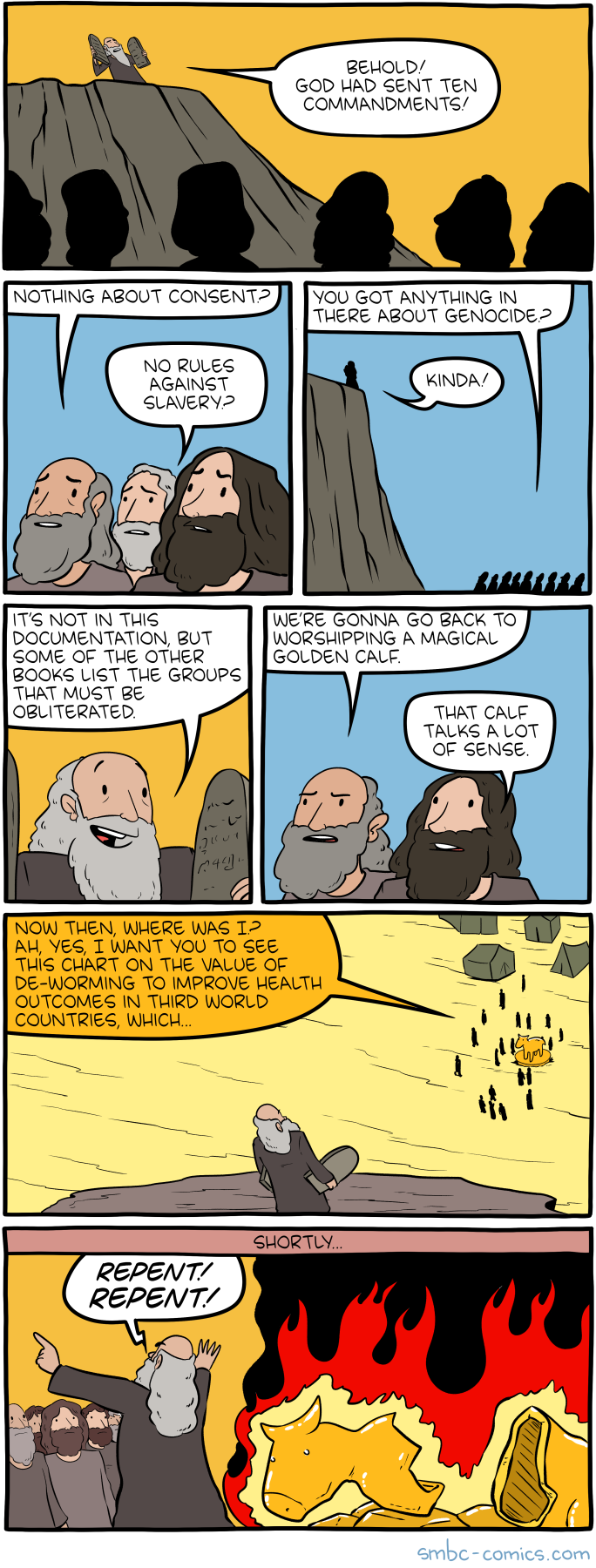
Saturday Morning Breakfast Cereal - Commandments

by tech@thehiveworks.com


Click here to go see the bonus panel!

Hovertext:
The cow's discourse on monetary policy was remarkably lucid despite all the nuance.


Today's News:
09 Aug 22:49

Review: Doom Patrol comes back strong with fierce and fun S2

by Jennifer Ouellette
James.galbraith

aaand downloading ;)

Trailer for the second season of Doom Patrol.

Lots of people missed last year's debut of Doom Patrol, a delightfully bonkers show about a "found family" of superhero misfits, because it aired exclusively on the DC Universe streaming service.  Fortunately, S2 also aired on HBO Max, expanding the series' potential audience. Apart from one sub-par episode, this second season expanded on the strengths of the first, with plenty of crazy hijinks, humor, pathos, surprising twists, and WTF moments. Alas, the season finale is bound to frustrate fans, since it ends on a major cliffhanger and leaves multiple dangling narrative threads.

(Spoilers for S1; some S2 spoilers below the gallery.)

As we reported previously, Timothy Dalton plays Niles Caulder, aka The Chief, a medical doctor who saved the lives of the various Doom Patrol members and lets them stay in his mansion. His Manor of Misfits includes Jane, aka Crazy Jane (Diane Guerrero), whose childhood trauma resulted in 64 distinct personalities, each with its own powers. Rita (April Bowlby), aka Elasti-Woman, is a former actress with stretchy, elastic properties she can't really control, thanks to being exposed to a toxic gas that altered her cellular structure. Larry Trainor, aka Negative Man, is a US Air Force pilot who has a "negative energy entity" inside him and must be swathed in bandages to keep radioactivity from seeping out of his body. (Matt Bomer plays Trainor without the bandages, while Matthew Zuk takes on the bandaged role.)

Read 11 remaining paragraphs | Comments

09 Aug 22:27

Another impasse on the rescue package. Imagine if the president were a dealmaker.

by Paul Waldman
James.galbraith

lol seriously

The economy is in crisis, Congress is at an impasse, and the idea that Donald Trump could solve the problem is a joke.
09 Aug 22:15

3 of the 4 'executive orders' Trump signed weren't actually executive orders

by Jessica Sutherland
James.galbraith

toothless

If you didn’t know, Donald Trump is golfing and hanging out with rich people in New Jersey this weekend, so of course, high on flattery, he’s holding media events. Saturday’s press conference took Trump away from the links for less than half an hour, ending abruptly when a CBS News reporter challenged the impeached president on one of his favorite falsehoods. The event centered around the signing of several sweeping “executive orders” which aim to bypass Congress and bankrupt Social Security, all under the guise of helping the nation navigate the prolonged COVID pandemic … while also, predictably, benefiting the wealthiest of Americans. Trump was sure to repeatedly blame Democrats for just about everything, and promised a dark future for a United States that fails to re-elect him to a second term. It was an incoherent shitshow.

Trump, of course, is his most stunning when he’s off-book, and not in the “my eldest daughter is stunning” kind of way. Sure, the scripts that Trump’s handlers and yes-people write for him are not heralded for excellence in speechwriting, but there’s nothing like the rambling we hear when the gold-plated Republican is given a chance to freestyle. As Axios’ Jonathan Swan so deftly showed the world, the current chief executive is unable to mask that he has no clue what he’s doing or what he’s done. What he does know is that he hates Democrats and loves himself, and that he wants to stay president. With such a sparse foundation, it’s no wonder that Trump continues to stumble through his appearances, even when he’s speaking to a mostly-friendly crowd, like the one in red hats and golf shirts at Bedminster Country Club on Saturday.

Again, the “point” of this presser, at least on the surface, was to sign four “executive orders,” Trumps latest idea to address the seemingly endless suffering the coronavirus continues to inflict. 

Trump said the actions would provide economic relief to millions of Americans by deferring taxes and, he said, providing temporary unemployment benefits. The measures would attempt to wrest away some of Congress’s most fundamental, constitutionally mandated powers — tax and spending policy. Trump acknowledged that some of the actions could be challenged in court but indicated he would persevere.

But, as The Washington Post notes, the EOs are basically just pretty books Trump got to write on with a big marker.

A leading national expert on unemployment benefits said one of the actions would not increase federal unemployment benefits at all. Instead, the expert said it would instead create a new program that could take “months” to set up. And Trump’s directive to halt evictions primarily calls for federal agencies to “consider” if they should be stopped.

Trump also mischaracterized the legal stature of the measures, referring to them as “bills.” Congress writes and votes on bills, not the White House. The documents Trump signed on Saturday were a combination of memorandums and an executive order.

As Politico notes, the EO to enhance unemployment isn’t all that it seems. 

Trump also announced a $400-per-week supplemental payment for those who have lost their jobs, a decrease from the extra $600 unemployed Americans were receiving weekly before the benefit expired at the end of July.

States would be on the hook for covering 25 percent of the extra payments if they decided to extend them, Trump said. But those who opted in could use federal coronavirus relief funds to help offset the costs.

To reiterate:

To recap: 1/ Evictions: No eviction moratorium or new rental $, asks HUD to "consider" if evictions should stop 2/ Unemployment: Uses $44B from FEMA to cover $300/week benefit for ~5 more weeks 3/ Taxes: Option to defer payroll tax payment, but w/o new law they'll still be due

— Jeff Stein (@JStein_WaPo) August 9, 2020

Trump also signed a pretty promise to defer student loan payments until December. 

Why is @BarackObama constantly issuing executive orders that are major power grabs of authority? This is the latest http://t.co/4IVBckTE

— Donald J. Trump (@realDonaldTrump) July 10, 2012

Experts seem certain most of Trump’s Saturday Sharpie Show was just that: for show. In fact, most of the “executive orders” weren’t even executive orders.

Just in : Trump appears to have tonight actually only signed one Executive Order that extends rental evictions during the coronavirus pandemic. Other three documents were memoranda, per White House release.

— Hugo Lowell (@hugolowell) August 8, 2020

“The President cannot create new money with an executive order. These EOs simply show the limitations of the President’s legal authority,” Jack Smalligan, a former official at the Office of Management and Budget (OMB) told The Washington Post.

But Trump’s performance was so much more than signing his name and showing the cameras. Politico described the rest of the event to be “akin to a campaign-style diatribe against his political opponents.” When he wasn’t bashing Biden for being “sleepy,” or lying about Veterans Choice, or blaming Democratic congressional leaders for holding “vital aid hostage,” or reframing the progressive left as extremists, or mocking the press, Trump was making vague promises and threats of what might happen if he loses on November 3.

The most disturbing part? The applause he received from those rich guys in golf shirts, even as he ran away like a coward.

Wait... Trump did a press conference with a live studio audience? https://t.co/yV6VcgRccI

— Matt Murchison 💛🐝 (@MattMurchison) August 8, 2020

If you’re not having a bad enough day, you can watch the entire press conference here. 

COVID-19 is ravaging the country, and we have no idea whether it will even be safe to vote in person come November. With Turnout2020, you can start calling swing state voters now—and help them request an absentee ballot. No one should have to risk their health to exercise their right to vote Sign up to volunteer today.

09 Aug 22:14

A blueprint for an ultra-partisan, progressive Biden presidency that keeps the Democrats in charge

by Dartagnan
James.galbraith

A very important project

MIT’s emeritus professor Noam Chomsky once described the Republican Party as “the most dangerous organization in human history.” Saturday’s issue of The New York Times confirms it, as one story offers a glimpse of how dismal this moment in time is for millions of Americans whose lives are now hanging by a slender thread, thanks to the deliberate action (or in this case inaction) of Senate Republicans.

For many of the 30 million Americans relying on unemployment benefits, it could already be too late to prevent lasting financial harm. Without the extra $600 a week, which ran out at the end of July, they will need to get by on regular state unemployment benefits, which often total a few hundred dollars a week or less. For many families, that will not be enough to prevent eviction, hunger or mounting debt that will make it harder to climb out of the hole.

This stunning dereliction of responsibility stems primarily from the gross mismanagement and reckless disregard of the Trump administration. But that mismanagement would not have taken place without the complicity of the Republican Party, specifically Republican senators, Republican governors, and Republican state legislators. As of this writing, there has been no agreement between the Democratically-controlled House and the Republican-controlled Senate on how to save—or even temporarily protect—ordinary Americans from the catastrophic economic spillover from the COVID-19 pandemic. Nor is there reason to believe that any aid, however temporary, will change the status quo significantly between now and election day. 

Joseph O’Neill is a professor at Bard College. In an essay written for the New York Review of Books, O’Neill explains how the Democratic Party, and specifically Joe Biden, should govern the country—assuming the current polling hold, and the Democrat ascends to the presidency, along with a Democratic House and Senate, in January 2021.

It will be anything but “business as usual” because, as O’Neill grimly explains, the time we are about to live through simply will not tolerate “business as usual.”

Somewhat unexpectedly, ensuring the success of the Democratic Party has become the most important political project in the world. The United States remains the world’s largest economy and superpower, and its constructive international leadership is essential if the climate crisis and other world-historical dangers are to be overcome. This can happen only if Democrats dominate the national government for the best part of the next ten years or so. Republicans cannot be trusted with meaningful power precisely because they form one of the world-historical dangers that must be overcome.

The predominant and urgent theme of O’Neill’s essay is that once it assumes power, the Democratic Party must work tirelessly to drum the Republican Party out of existence, through an aggressive, highly partisan approach that’s unprecedented in modern history.

He notes, correctly, that, in the eyes of the public, what is driving the Democratic Party at present is a singular, if vehement, antipathy towards Donald Trump. Once Trump departs the field, O’Neill demands that Democrats ensure that Republicans never have an opportunity to govern again. Faced with the off-the-charts economic disaster that  Republicans are leaving for American citizens, O’Neill views the party’s current approach towards simply cobbling together disparate coalitions and doing its best to “minimize intraparty differences” is tactically insufficient. With regard to Biden, In O’Neill’s view, ”If, as seems likely, he wins in November, his administration and its supporters will need a new, broadly acceptable partisan ideology in order to win a series of subsequent elections.” The question then becomes how that hyper-partisan approach can best be implemented.

To be clear, by “partisan,” O’Neill is not simply recommending being “anti” any individual Republican officeholders but rather wholly embracing a clear, straightforward Democratic agenda, with an enemy clearly and broadly defined as the Republican Party. The idea of “bipartisanship” must be relegated to the dustbin—forever. This is a Democratic world O’Neill foresees, one in which there is no longer any room for Republican ideology, policy, or philosophy of any sort.

To that end, as O’Neill states, “if Democrats want to win elections repeatedly, they must enact policies that are both effective and popular with Democrats.”  This, he believes, is the only way the energy of the Democratic grassroots organizations that form the Party’s base of support will stay engaged, and continue to vigorously vote and re-vote the Democrats back into power.

O’Neill draws upon E.J. Dionne’s new book, Code Red, for the template on how to harness the same grassroots energy that, in 2018, drove the Republican Party from its chokehold on the House of Representatives. Both Dionne and O’Neill believe that, in the wake of this horrific pandemic, the American public will countenance broad, government-based solutions to the inequities that this virus has laid bare. With Democratic majorities, a President Joe Biden could conceivably achieve the same sort of legislative milestones that were established during the first few years of the Lyndon Johnson administration (the Civil Rights Act, Voting Rights Act, Medicare and Medicaid are some of the most prominent ones). Above all, O’Neill believes that the American people now crave the “legality, competence, and decency” which have been non-existent over since Donald Trump was inaugurate in January 2017. 

Yet O’Neill also recognizes that for this to occur, so-called “moderate” Democrats must acknowledge that the energy of the Party is now centered among its most progressive members, and specifically that ”moderates must accept that their conservative assumptions have been overtaken by events.” O’Neill recognizes that Biden’s development of his platform already demonstrates its marked departure from that of either Barack Obama’s or Hillary Clinton’s, by embracing such progressive programs as the Green New Deal, and proposing a “Clean Energy Revolution” identical in many respects to that proposed by Bernie Sanders.

O’Neill also suggests that recent years in the minority may have conditioned “traditional” Democratic leaders such as Charles Schumer and even Nancy Pelosi to be reticent to recognize their job to enact policies that “Democrats like and Republicans don’t like.” The reflexive attitude that Republicans must somehow be mollified, in other words, must be discarded forever, according to O’Neill. Yes, it will come as a bit of a shock to voters, even Democratic ones, who have been conditioned to expect only incremental policy achievements on the “D” side, such as the passage of the Affordable Care Act.

The policies Biden will need to save this country from extinction will make the ACA look like a minor achievement, in the scheme of things.

How, then, to achieve the type of party unity necessary to carry this agenda forward, and to reduce the Republican Party to “electoral rubble” in the eyes of Americans? O’Neill acknowledges that, to a great extent, existing organizations within the Democratic Party establishment must be “co-opted.”

Specifically, it requires appropriate action by the three main stakeholders: the Democratic Party apparatus, in particular the DNC; Democratic elected officials; and, finally, the (potential) supporters of the party who are ordinary civilians. Of these stakeholders, the institutional ones have the most immediate agency—the power to generate partisan coherence by action. It’s pretty clear what they must do: gain the trust and loyalty of the younger, more progressive cohort; keep the trust of the more centrist party faithful; and make swing voters trust Democrats more than they trust Republicans.

The first step in achieving the unity of purpose is by developing a vocabulary all are comfortable with. O’Neill specifically cites Dionne’s recommendation, that the concept of dignity be the glue that binds that effort into a singular, unified purpose. Dignity as in “the state or quality of being worthy of honor or respect.” Beginning with assumption that all Democratic constituents deserve to be treated with dignity can go a long way towards unifying the party behind a set of discrete tactics and legislative measures.

Which tactics and measures does O’Neill recommend?

1) Appointing progressive figures respected by the left to positions of power within the Biden administration;

2) Taking concrete action to implement progressive policies without watering them down: Raise taxes on the wealthy, implement a Green New Deal, expand the Affordable Care Act—for starters;

3) Implementing wide-ranging police reforms, curtailing or abolishing ICE, implementing immigration reform, re-establishing the Voting Right Act and legislating against voter suppression;

4) Ending the filibuster if the GOP uses it to get in the way of a Democratic agenda, and expanding the Supreme Court to do away with the monstrous domination imposed by the Federalist Society cabal; and, finally,

5) Working “from Day One” towards retaining our Majority through 2022 and beyond, by making the DNC an arm of the Democratic grassroots.

Above all, Democrats must brand—and continue to brand—the Republican Party as a disaster that Americans cannot afford to ever let happen again. O’Neill suggests the prevailing theme should always be “The Republican Party can no longer be trusted with power. Repeat this at every opportunity, then verify this narrative by investigating and bringing to light all Republican misdeeds.”

In other words, treat them as they deserve to be treated after what they’ve done to the country.

Call the disastrous Republican economy that Biden will inherit “the disastrous Republican economy.” Call the Republican pandemic crisis “the Republican pandemic crisis.” Always be trumpeting the success of your initiatives, always be talking about the danger of letting Republicans back into power. On no account repeat the mistakes of 2008–2010, when Democrats apologized for the Affordable Care Act and took ownership of the Republican financial crisis. If Democrats comport themselves like the natural party of government, they will be perceived as such and win more elections.

O’Neill isn’t blind to the overall changes in mindset that needs to occur to bring all of this about. Until Trump is cast into the Lake of Electoral Oblivion (along with the GOP Senate), being “the Party That Is Not Donald Trump” may well suffice for Democrats. But from the point of victory forward, there can be nothing but raw, unbridled, Democratic partisanship, if we want to truly capture this historical, once-in-a-lifetime moment.

The ring is there for the taking. The Democrats just need to go ahead and grab it.

Ready to hand Trump—and every Republican—a HUMILIATING defeat? Sign up with Vote Forward to write personalized letters to infrequent, but Democratic-leaning, voters in swing states. Help us wash Trump out of office with a big blue wave of record-breaking turnout.

09 Aug 22:10

Friday night massacre at USPS: Trump ally completely restructures, gets rid of 23 execs

by SemDem
James.galbraith

For fucks sake

Louis DeJoy, a Donald Trump flunky, was appointed to be Postmaster General despite him having ZERO experience at the Post Office—which is unheard of. He was, however, a major donor to the Republican Party and to Trump’s campaign. DeJoy and his wife also have serious conflicts of interest, since they both have assets between $30.1 million and $75.3 million in USPS competitors or contractors.

But really, how much damage could he do?  Well, in case you haven’t noticed, quite a damn bit.

This is bad, folks. REAL BAD!

Ah, the joys of the Friday evening news dump. https://t.co/Ap9WRY5zaT pic.twitter.com/XDsIjt73kf

— Graeme (@graemem) August 7, 2020

The U.S. Postal Service (USPS) now has a serious backlog of letters and packages, which are piling up at distribution centers. Despite the increase in packages during the pandemic, Trump’s new Postmaster General has cut hours and banned all overtime, and is also placing fewer trucks on the road. He even changed priorities in mailing.

NEW: Trump’s postal service is piloting a new program that will take already-delayed first-class mail and delay it further, by ordering carriers to no longer sort and box newly arrived mail in the morning and then deliver it. Instead, they must wait till the end of the day. pic.twitter.com/AEJYgBP1vJ

— Ryan Grim (@ryangrim) July 22, 2020

Postal leaders are already complaining about sabotage. The American Postal Workers Union has been sounding the alarm, with the president saying she is “terrified” of how the sabotage is going to affect the upcoming election.

Then, on Friday, Dejoy took out the machete and started cutting. Twenty-three executives with decades of experience were reassigned, and power is now consolidated around DeJoy. 

Coincidentally, this year will be a record year for voting by mail, which Trump is doing everything he can to undermine. In fact, Trump admitted that mail delays will help him in his election. Of course, it’s also a census year, which Trump is also doing everything he can to undermine. We need more mail carriers, not fewer, although DeJoy has instituted both a hiring freeze and requested future buyouts—two things Democrats in Congress specifically asked him NOT to do. The results are obvious.

Trump's gutting of USPS could lead to 1000s of ballots thrown out. "If they keep this up until the election, there’s no telling how many days-worth of delays there could be. I mean, we’ll be delivering political mail days after the election” a postal worker from California said pic.twitter.com/8F8oN0APU1

— Ari Berman (@AriBerman) July 31, 2020

This may be Trump’s doing, but Republicans are completely on board. Not one Republican has spoken out against this. It’s up to Democrats to save the post office. We also have to save our democracy and our republic, so might as well just add it to the list.

In the meantime, sound the alarm. Tell your GOP representative that this is NOT cool, and that you are watching. Tell your Democratic representative to be more vocal about this. Democrats are all over the map on several issues, but we must focus! We need public hearings, and we need to demand more funding (along with safeguards that DeJoy will use it as ordered) as a top priority! This is worth a major fight. People in this country love their mail, and we need to make it clear that one party is on the side of saving it while the other side is out to destroy it! 

Here’s a state-by-state scorecard on how prepared your state is for vote-by-mail.  If there are drop boxes, encourage people to use those and promote their locations.  If you are doing it late, please deliver your mail-in ballot in person if you have to. If you can’t, please consider using certified, priority or express mail so there is proof of delivery and when it was mailed.  

Thirty-four states require that they receive ballots by Election Day—a policy which, under Trump and DeJoy, will cause millions to be thrown out. Democratic leaders need to be pushing for a law that allows votes to be counted afterwards, and force Republicans to fight them on this. In the meantime, encourage everyone you know who isn’t voting in-person NOT TO WAIT! Vote as soon as you are able.

I know it gets old that we have to fight for our very democracy on what is a seemingly day-to-day basis, but this is who Trump is, and what Trump wants. Let’s go all in, every single day, until we can finally rest—the day after November 3.

Effective Get Out the vote can change an election. With Turnout2020, you call Democratic-leaning swing state voters & help them request an absentee ballot. During the COVID-19 pandemic, this is needed now more than ever. Sign up to volunteer, and you can make these phone calls from the privacy & comfort of your own home.

Saturday, Aug 8, 2020 · 4:12:04 PM +00:00 · SemDem

This just happened, too: The Postal Service has informed states that they’ll need to pay first-class 55-cent postage to mail ballots to voters, rather than the normal 20-cent bulk rate. That nearly triples the per-ballot cost at a time when tens of millions more will be delivered.

Saturday, Aug 8, 2020 · 9:26:07 PM +00:00 · SemDem

This just won't stop. Trump is mulling multiple executive actions from ordering the postal service to "not deliver certain ballots" to forcing local officials from counting them after Election Day, even if the state law says otherwise.

09 Aug 22:02

Kansas governor angered after House Speaker attended meeting, didn't disclose COVID hospitalization

by Jen Hayden
James.galbraith

Quintessential republican

What kind of a person would go from being hospitalized with COVID-19 symptoms for a week and then return to work as normal without telling his coworkers? Kansas House Speaker Ron “Rona” Ryckman, that’s who. 

The Kansas lawmaker, a senior Republican from Olathe, a suburb of Kansas City, told supporters in an email obtained by the Kansas City Star about his diagnosis. Ryckman said he tested positive the week of July 13 and was then hospitalized for a week. The problem? He never told Democratic lawmakers in the Sunflower State, and even worse, he attended a July 29 meeting with Gov. Laura Kelly and members of the State Finance Committee, which was held indoors. While attendees were socially distanced in their spacing, Ryckman also removed his mask during the meeting. 

Needless to say, those in attendance are outraged. In a statement, Gov. Kelly sternly criticized Ryckman for endangering everyone in the meeting, “Speaker Ryckman’s decision to attend the State Finance Council meeting after being released from the hospital, while concealing his diagnosis from those of us in the room and taking his mask off, was reckless and dangerous.”

Dangerous, indeed. Reckless and cruel, possibly even deadly indifference to his fellow lawmakers. One has to seriously wonder how we arrived at this point where Republicans are so selfish and callous during a global health crisis, one that is now estimated to kill 300,000 Americans by early December. 

Of course, Ryckman led the charge, alongside other Kansas Republicans, to limit Gov. Kelly’s ability to issue public health directives, like closing schools and requiring masks, to keep Kansans safe from the disease.

Ryckman claimed he was cleared by a doctor before attending the meeting, but doesn’t common sense and common decency dictate that you inform your peers of such a diagnosis? Shouldn’t they have a choice about whether they want to take a chance on being exposed? It isn’t like Ryckman was walking around asymptomatic—the man was hospitalized for a week. 

Ryckman called Kelly’s statement “fear mongering and public shaming.” Classic Republicanism, always playing the victim. 

08 Aug 20:11

Biden: Latino community is diverse, ‘unlike the African American community’

by Matthew Choi
James.galbraith

Oh for fucks sake


Joe Biden said in remarks on Wednesday that the Latino community is "incredibly diverse," "unlike" the Black community.

"Unlike the African American community, with notable exceptions, the Latino community is an incredibly diverse community with incredibly diverse attitudes about different things," Biden said. "You go to Florida, you find a very different attitude about immigration than you do in Arizona. So it's a very diverse community."

Biden made the comment during an interview hosted by the National Association of Hispanic Journalists and the National Association of Black Journalists that was released in full on Thursday. His remarks on diversity were a response to a question from NPR reporter Lulu Garcia-Navarro, who asked a question about whether Biden, the presumptive Democratic presidential nominee, would engage with Cuba and on the differing immigration concerns between Cuban and Venezuelan Americans.

Biden's campaign said the comment was meant to describe the diversity of political opinion among Latino Americans and was not a judgment on cultural diversity.

"If you look at the full video and transcript, it’s clear that Vice President Biden was referring to diversity of attitudes among Latinos from different Latin American countries," Symone Sanders, a senior Biden campaign adviser, said in a statement. "The video that is circulating is conveniently cut to make this about racial diversity but that’s not the case.”

But only moments after his campaign responded to POLITICO on his interview, Biden again contrasted Latino and Black Americans — this time explicitly on the topic of national and cultural origin.

"We can build a new administration that reflects the full diversity of our nation. The full diversity of the Latino communities," Biden said. "Now when I mean full diversity, unlike African American community, many other communities, you're from everywhere. From Europe. From the tip of South America, all the way to our border and Mexico and in the Caribbean. And different backgrounds, different ethnicities, but all Latinos."

Biden made those remarks during the virtual National Association of Latino Elected and Appointed Officials conference. He eventually tweeted a thread further explaining what he meant by his comments later Thursday night.

“In no way did I mean to suggest the African American community is a monolith — not by identity, not on issues, not at all,“ Biden wrote. “Throughout my career I‘ve witnessed the diversity of thought, background, and sentiment within the African American community. It‘s this diversity that makes our workplaces, communities, and country a better place.“

“My commitment to you is this: I will always listen, I will never stop fighting for the African American community and I will never stop fighting for a more equitable future.“

Still, President Donald Trump's campaign was quick to attack Biden over his NAHJ/NABJ interview Thursday afternoon, saying it diminished the diversity of opinions among Black voters and calling it an example of "condescending white liberal racism."

Katrina Pierson, a Trump campaign adviser, said in a statement that the former vice president "tells a group of Black reporters that ‘you all know’ that Black people think alike. There’s a reason Joe Biden can’t count on the support of Black voters and it’s because of his plantation owner mentality."

"Joe Biden would rather we all just shut up, get in line, and know our place,” she said.

Biden also drew criticism in May for saying that "you ain't Black" if "you have a problem figuring out whether you’re for me or Trump." The Democratic candidate made the remarks during an interview with The Breakfast Club, a nationally syndicated radio show, and later apologized for his comments.

Biden enjoys considerable support from an overwhelming majority of Black voters. A Washington Post/Ipsos poll from June found that 92 percent of Black voters support the former vice president. Latino support for Biden, meanwhile, hovers closer to 60 percent.

Elsewhere in Biden's interview with the journalism associations, Biden bristled at a reporter's question about whether he has taken a cognitive test akin to the one Trump has bragged about acing. Biden replied to the question from CBS News correspondent Errol Barnett, who is Black, by saying “That's like saying to you, before you got on this program if you had taken a test were you taking cocaine or not. What do you think, huh? Are you a junkie?"

Biden's campaign defended those comments by calling Barnett's question "preposterous" and "deserving of a response that showed the absurdity of it all."

07 Aug 02:12

BORTAC unit that terrorized Portland just helped raid a humanitarian medical camp at border

by Gabe Ortiz
James.galbraith

Time to tear CBP to pieces

A humanitarian group that provides water and other lifesaving aid to migrants in the desert along the southern border says that Customs and Border Protection (CBP) has yet again retaliated against the organization for releasing information about the agency’s tactics, last week raiding No More Death’s medical camp. “Around sunset on July 31st, US Border Patrol raided No More Deaths’ humanitarian aid station, Byrd Camp, detaining over thirty people who were receiving medical care, food, water, and shelter from the 100+ degree heat,” the group said. 

Among the agents who carried out the raid were members of BORTAC, the same tactical unit that recently kidnapped demonstrators off the street who were protesting police violence in Portland, Oregon. “The initial detention and surveillance of Byrd Camp was set up just 24 hours after No More Deaths released emails from a FOIA request revealing the role of BORTAC ... and the Border Patrol Union’s role in a 2017 raid of the same aid station,” No More Deaths said. “The message is clear: expose Border Patrol abuses, face retaliation.”

“In a massive show of force, Border Patrol, along with BORTAC, descended on the camp with an armored vehicle, three ATVS, two helicopters, and an estimated 24 marked and unmarked vehicles,” the group said about the raid last week.

“Agents refused to show a warrant upon entry, and were not wearing masks,” the group continued. “For two hours, in darkness, they detained and chased people receiving care while a Border Patrol cameraman filmed the scene. The day before, agents had entered the property without a warrant and detained one person receiving care. Border Patrol then set up 24-hour surveillance around the perimeter, deterring anyone else from entering the camp to seek help.” In The Los Angeles Times, columnist Mariah Kreutter writes the raid “suggests government retaliation at the border”—and that’s exactly what it is. 

Border Patrol also stabbed all of the gallons in the back of a truck that was at Byrd Camp during the raid on Friday. Attacks on our work are attacks on people crossing the border. Irreparable damage was done to the people who sought aid in our camp. pic.twitter.com/g6exib7G2M

— No More Deaths (@NoMoreDeaths) August 6, 2020

Back in 2018, remember that No More Deaths volunteer Dr. Scott Daniel Warren was arrested just hours after No More Deaths released a devastating report that included footage of Border Patrol agents trying to kill migrants by gleefully destroying some of the lifesaving jugs of water left by volunteers in the desert. The Justice Department tried not once, but twice to get him convicted on felony charges of harboring undocumented immigrants. It failed.

“[B]order Patrol harmed thirty people in irreparable ways,” he said in response to this latest raid. “On a daily basis those who migrate through the Arizona desert are targeted, terrorized, detained, and deported … [W]e witnessed these tactics deployed against people who sought medical care and relief at our Byrd Camp aid station. As always when humanitarian aid in the borderlands is targeted, those who seek care are the ones that face the brunt of these violent escalations.” 

Data suggests that since the 1990s, more than 8,000 migrants have died crossing the border desert, where temperatures skyrocket into the triple digits. Footage released by the organization in 2018 showed a border patrol agent smiling at the camera as he poured out jugs of water one by one, saying “make sure you get a nice shot […] picking up this trash that somebody left on the trail.” In other footage, agents also appear to be smiling as one kicks over jug after jug of water meant to save lives. But it’s the humanitarian workers who got in trouble.

Friday’s raid was a cruel reminder of the violence people face every day in the borderlands. “The guns were pointed at us for a minute, but they're always pointed at people in the desert" - Yanely Rivas, No More Deaths Aid Worker.

— No More Deaths (@NoMoreDeaths) August 6, 2020

“The disproportionate legal action taken against No More Deaths and its volunteers exemplifies the deliberate cruelty of the Trump administration’s border policies,” Kreutter wrote. “Meanwhile, debates around free speech focus on minor disputes while ignoring a case with terrifying implications: the attempt, by government agents, to harass and intimidate a group speaking out against inhumane state policy.” Let’s repeat it again: Humanitarian aid is not a crime.

07 Aug 02:11

Washington Republicans nominate cop with ties to 'Patriot' movement for governor's race

by David Neiwert
James.galbraith

Fucking idiots. Thankfully he'll get demolished in November.

It’s not the first time that Republicans in Washington state have chosen a far-right gadfly as their nominee for the governorship, but Tuesday’s primary in which Loren Culp—a small-town cop who has never previously run for elective office—handily outpaced a large field to take on incumbent Democratic Gov. Jay Inslee marks the first time the party has selected a bona fide extremist from a faction mostly connected to militias, armed takeovers, and terrorism.

After all, Culp—who first gained notoriety for refusing to enforce a gun-control initiative approved by 60% of voters—not only is a hero to the far-right gun-rights and property-rights crowds, he is a leading figure in an extremist organization which claims, among other things, that county sheriffs, not the Supreme Court, are the arbiters of what’s constitutional, and which has been associated with armed standoffs and defiance of legal authorities, usually under the guise of the “Patriot”/militia movement.

In 1996, Washington Republicans nominated a far-right gadfly named Ellen Craswell—an anti-gay, anti-tax evangelical Christian—for the governorship who then went on to lose badly in the general election, garnering only about 42% of the vote. And while Craswell later in life migrated to the extremist Constitution Party, she was not affiliated with the “Patriot” movement during her candidacy for governor.

Culp, however, has unapologetically embraced the association with the radical right—primarily, a far-right “constitutionalist” organization, the Constitutional Sheriffs and Peace Officers Association, that primarily recruits law-enforcement officers into a belief system that includes the notion that the county sheriff is the highest law officer in the land whose edicts supersede state and federal laws and the officers who enforce them. (“Constitutionalists” also believe that the federal government is not permitted to own public lands, and that federal taxes are not permitted under the law.)

Culp first gained statewide attention in 2018 by announcing that he intended to refuse to enforce a new state gun control law—dubbed Initiative 1639, which mainly imposed new restrictions on semi-automatic guns—even though it had been approved by 60% of voters statewide.

“I’m just standing up for people’s rights,” he told the Seattle Times. “I had people asking if the Police Department was going to start arresting teenagers, 18-, 19-, 20-year-olds, carrying and using a semi-automatic .22 rifle. I told them, ‘I’m not going to infringe on someone’s constitutional rights.’”

The stance made Culp a national hero among gun rights extremists, particularly the CSPOA. The organization—primarily overseen by a former Arizona sheriff named Richard Mack, who made a similar name for himself in the 1990s by defying federal gun control laws—hailed the Republic chief’s actions as heroic.

At CSPOA’s October 2019 annual conference in Mesa, Arizona, Mack conferred the honor of “Police Chief of the Decade” on Culp for “his unprecedented stance for liberty and the example he has set for all peace officers throughout the United States of America in defense of the people the right to keep and bear arms.”

“Our state and our nation are at a crossroads,” Culp told the audience. “The question facing voters in Washington is do we want to continue to support leaders who continually find new ways to assault our liberties and freedoms, or do we want to elect leaders who actually support and defend the Constitution while making real progress in combatting our state’s most pressing issues?”

Mack has a long history of promoting the theory that county sheriffs, not federal law enforcement, represent the supreme law of the land. This radically decentralized vision of government was first promoted by the old far-right Posse Comitatus movement, which proffered governance in which federal authorities had little to no role (and which also was profoundly racist and anti-Semitic).

During a recent appearance at a pro-police rally in Albany, New York, earlier this week, Mack claimed to journalist Zach Roberts that CSPOA’s approach to law enforcement would have prevented the arrest of Rosa Parks at an Alabama bus stop in 1955—because any police officer would have been able to judge for himself that the law demanding her incarceration was unconstitutional.

Pressed on this point, Mack (while insisting that the United States is “not a democracy” but “a constitutional republic”) claimed that sheriffs and police officers—by virtue of having taken an oath to uphold the Constitution—were the true arbiters of what the law permits, and may choose not to uphold laws they deem outside it, regardless of any court rulings, even at the highest federal levels:

Why do you think that I have an obligation to go along with any unconstitutional act or anything that violates liberty? It's not my definition. It’s right there, it's plain and easy. I know what “shall not be infringed” means. I know what that means. Because my legislature bestows no obligation on me to go along. Just the opposite. I swore to uphold and defend the Constitution, and you, like everybody else, think I don't have to. That's the problem. We don't follow the Constitution anymore. Let's try that for a year. But it's your definition. It's not my definition.

… Why is the sheriff so powerful? Look at your history of the sheriff. Also, look, he is the only elected law enforcement officer anywhere in the country. He's the only one. He gets his power directly from the people. He reports only to them. There is only boss. He has no other boss except the people. And he promised them that he would uphold and defend their constitutional rights. And so you're saying, no, he doesn't have to. If the legislature tells him not to, if they pass a law. You think all laws are good if they pass?

In his county … the governor’s not his boss. He doesn’t report to the governor. He doesn’t report to the president. When they are wrong, what do we do?

Not one of these arguments has ever been upheld in any court of law in the United States. Moreover, as the Center for Public Integrity explored in depth in a 2014 study of the CSPOA, the organization’s worldview is dangerously aligned with views held by domestic terrorists and violent white supremacists:

What’s unique about his group is not that it opposes gun controls but that its ambition is to encourage law enforcement officers to defy laws they decide themselves are illegal. On occasion, some of his group’s sheriffs have found themselves in curious agreement with members of the sovereign citizens’ movement, which was also founded on claimed rights of legal defiance and is said by the FBI to pose one of the most serious domestic terrorism threats.

Indeed, the sovereign citizens movement that preaches the same beliefs vis-a-vis the role of government has, over the past 20 years, also posed the most lethal threat to law enforcement officers in the country. The FBI in 2010 designated the movement a significant source of domestic terrorism.

“It’s terrifying to me,” Justin Nix, a University of Louisville criminology professor who specializes in police fairness and legitimacy, told The Washington Post. “It’s not up to the police to decide what the law is going to be. They’re sworn to uphold the law. It’s not up to them to pick and choose.”

A 2016 report by the Southern Poverty Law Center found that the CSPOA’s reach was fairly widespread nationally, though hard numbers are difficult to come by. The CSPOA claims to have “about 5,000 members,” and in 2014 issued a letter condemning the Obama administration’s gun rights policies cosigned by 485 sheriffs. It also claims to have “trained” about 400 sheriffs.

The report noted the damage caused by the CSPOA is both direct and indirect:

The spread of this ideology has consequences. The number of threats and assaults against the [Bureau of Land Management] rose from 15 incidents in 2014 to 28 in 2015, according to Public Employees for Environmental Responsibility. The number of incidents targeting the U.S. Forest Service rose from 97 in 2014 to 155 last year.

The CSPOA and its law enforcement philosophy have played major roles in the two armed confrontations over public land led by the Bundy family—in 2014 at Bunkerville, Nevada, where Cliven Bundy and an army of “Patriots” forced federal agents to back away from enforcing environmental laws on his ranch, and in 2016 at the Malheur National Wildlife Refuge. Bundy and his son Ammon tout a version of “constitutionalist” ideas identical to Mack’s.

Mack himself was a familiar figure at the Bunkerville scene, showing up on the dais with various speakers and guests and offering interviews to the media. Mack eagerly regaled a Fox News reporter with the “Patriot” strategy at the armed standoff: “We were actually strategizing to put all the women up at the front. If they’re going to start shooting, it’s going to be women that are televised all across the world getting shot by these rogue federal officers,” he said.

Loren Culp has a number of other issues in his background as a police chief, including his botched handling of a child sex-abuse case in Republic in 2013. According to the plaintiffs in a lawsuit filed against the city and the police department, Culp and two other officers bungled an investigation after a 17-year-old girl reported her ongoing molestation by a male relative since she was 5 years old; Benton County detectives later arrested the man, who pleaded guilty to child rape, molestation, and incest charges.

Culp, who wrote in a 2014 report on the case that he believed the girl’s claims were “made up,” responded to press queries that the guilty plea didn’t prove the man’s guilt: “He had a son, so he didn’t want to spend 30 years in prison. He took the plea deal. Not everyone who takes a plea deal is actually guilty,” Culp said.

Gun-control laws are not the only area where Culp has embraced a far-right position popular with the “Patriot” movement: In recent months, he’s been outspoken in opposing Inslee’s COVID-19 stay-at-home orders, which he has also deemed “unconstitutional.” On the night of the election, he hosted a large campaign event in Leavenworth at which masks were scarce and social distancing mostly nonexistent, in a crowd numbering in the hundreds—in open defiance of the governor’s orders banning gatherings of more than five people.

“We are free Americans,” Culp told a KING-TV reporter. “It’s a personal choice. If people want to wear a mask, they can wear a mask. Article 1, Section 7 of the Washington Constitution give us the right. It says, ‘No citizen shall be disturbed in their private affairs.”

07 Aug 02:09

Republicans are still trying to frame Joe Biden with Ukraine

by Paul Waldman
James.galbraith

They'll go down carrying his water. Idiots.

An absurd Senate "investigation" is still on the lookout for the Burisma smoking gun.
07 Aug 02:07

Trump is using D.C.-based Republican convention plans to suck more profit out of the presidency

by Laura Clawson
James.galbraith

Is anyone surprised?

Donald Trump’s main reason for wanting to give his Republican National Convention speech on the South Lawn of the White House is most likely the venerable backdrop and the aura of importance it will lend him. If he can’t have the screaming, adoring crowd he was expecting first in Charlotte, North Carolina, and then in Jacksonville, Florida, at least he can look presidential. But as always with Trump, the grift is never far behind the ego.

Trump’s Washington, D.C., hotel has jacked up its prices for the week of the planned kinda-sorta convention. Never cheap, the hotel’s rates for those dates are 60% higher than for the surrounding weeks. Because why only shatter norms and bend ethics laws to the breaking point when you can also make some money off it?

“If it's in D.C., and all these people are coming in to be around a big event for him, they will almost certainly be going to the Trump Hotel,” Citizens for Responsibility and Ethics in Washington’s Jordan Libowitz told the Daily Beast. “Every major Trumpworld figure will be there.” And they’ll be ready to to pay for the privilege of telling Trump, if they see him, that they’re staying in his hotel.

Other luxury hotels in the District are not raising their rates to the same extent. In fact, they’re cutting them. So it’s specific to the Trump hotel and to the dates around when Trump will be speaking. Consider that as virtual confirmation of the South Lawn ethics disaster. We didn’t need confirmation of Trump’s corruption.

FWIW—No need to go to hotels dot com or other aggregators to compare Trump Hotel DC prices. The hotel's website makes it easy to see (and it's more accurate).https://t.co/TcLWxPElWz. pic.twitter.com/vtR34gX5ER

— Zach Everson (@Z_Everson) August 6, 2020

06 Aug 22:59

‘Thighland’ Trends After Trump’s Latest Mispronunciation Gaffe: WATCH

by John Wright

Fresh off his “Yosemite” moment, President Donald Trump on Thursday mispronounced Thailand as “Thighland” while reading from a teleprompter at a Whirlpool factory in Ohio.

“Your foreign competitors moved their factories to prevent a level playing field and to avoid liability, shifting production to Thighland and Vietnam,” Trump said, before correcting himself. “Thailand and Vietnam — two places that I like their leaders very much … ”

Bill Palmer writes at the Palmer Report: “Let’s be clear here: while Trump is weak in the literacy department, this goes beyond just a literacy issue. Even someone who doesn’t know how to spell ‘Thailand’ would come across it in print and understand it when they say it. In contrast, Donald Trump is looking at words like ‘Thailand’ and ‘Yosemite’ and not even being able to recall having ever heard of them, hence why he’s forced to make up phonetic pronunciations on the spot. Trump really is roughly 50% senile, which makes things complicated because he’s 100% corrupt and evil.”

More reactions below.

The post ‘Thighland’ Trends After Trump’s Latest Mispronunciation Gaffe: WATCH appeared first on Towleroad Gay News.

06 Aug 21:53

Trump-Loving House Candidate May Face Charges for Pulling Down Gay Pride Flag at Church

by John Wright
James.galbraith

prosecutors will have fun with this one. He'd be an idiot to roll the dice with a Bainbridge Island jury.

A state House candidate in Washington who identifies as a member of the “Trump Republican Party” is facing possible charges for pulling down an LGBT Pride flag at a church.

Daniel Charles Svoboda, 41, was wearing a red “Trump” shirt during the July 20 incident at Seabold United Methodist Church on Bainbridge Island. After pulling down the flag and placing it on the ground, he allegedly warned people at the church, “If it gets put back up, I will take it down.”

Svoboda, a candidate for the 24th District House seat, has a history of similar incidents in the Pacific Northwest. In an email to local newspaper the Leader, he admitted to pulling down the flag because it “sends the wrong message to the very world that the church is supposed to be saving.”

“The mission of the church/body of Christ is to be a beacon of light unto a lost, dark and hurting world and to be a place of salvation from one’s own sins,” he wrote. “The church has lost her way and fails to communicate this message when it flies a sodomite flag.”

Svoboda, a truck driver, faces possible charges of harassment and malicious mischief, both gross misdemeanors, in connection with the latest incident. Previously, Svoboda was arrested on suspicion of third-degree theft for scaling the side of Silverado, a gay bar in Portland, and taking down an LGBT Pride flag in 2015. The following year, Svoboda was fired by a taxi company after parking his cab outside another Portland gay bar, Scandals, before pulling out a bullhorn and preaching against LGBT people. He returned to Scandals to harass patrons in 2017, on the same day that President Donald Trump proposed his transgender military ban.

In videos on his Facebook page, Svoboda has talked about being fired from two jobs after confronting people over their sexuality. According to the Leader, Svoboda’s police file includes a statement from the primary voters guide in which he vowed “no more special rights for women, people of color, homosexuals and those that wish to misrepresent their gender, tribes, and illegal aliens and anyone else that believes they deserve special rights. I am pro life and do not believe in a women’s right to vote or kill their child.”

When police called Svoboda to discuss the incident, he reportedly “asked how he should go about having the flag removed from the church property.”

“He mentioned a petition, a court order or asking the city council to order the flag removed,” a police report states. “Svoboda said that if he was flying a ‘White Lives Matter’ or a Confederate flag that he was sure he would be forced to have it taken down.”

According to the Peninsula Daily News, Svoboda conceded his legislative race after finishing third in Tuesday’s primary.

The post Trump-Loving House Candidate May Face Charges for Pulling Down Gay Pride Flag at Church appeared first on Towleroad Gay News.

06 Aug 20:33

CBP is blocking Congress from key findings in probe into racist and violent Facebook group

by Gabe Ortiz
James.galbraith

Nope, time for some actual oversight

More than a year after a racist and vile Facebook group that counted current and border Customs and Border Protection (CBP) agents as members was exposed by ProPublica, the agency has blocked key information from congressional investigators, including who was behind the gross posts or even the names of the few agents who were ultimately disciplined for their participation in the group, ProPublica newly reports. 

Texas Rep. Veronica Escobar, among the legislators personally targeted by the group with sexist and violent expletives, slammed the agency’s defiance. “More than a year after the existence of the group was reported, CBP continues to obstruct a congressional investigation into the results of the agency’s findings, blatantly shielding agents that have dehumanized immigrants and fostered a culture of cruelty and violence,” she said according to ProPublica.

ProPublica reports “CBP has provided little new information about ‘I’m 10-15’ or its efforts to address toxic attitudes within the ranks. Instead, it has released a basic summary of its findings. The agency has not said who was behind the group or its most egregious posts.” 

And it’s refused to name the lone four agents who were fired from the nearly 140 employees who were ultimately investigated. Roughly half were apparently dismissed as “unsubstantiated,” The Los Angeles Times reported last month, and of the rest, most got away with a slap on the wrist. Not only did they get away with it, an internal document revealed by the House Oversight Committee showed the agency negotiated a deal to protect at least one agent who had been recommended for termination.

“CBP continues to obstruct the committee’s investigation by refusing to lift redactions, hiding names and roles of CBP employees as well as employee conduct,” Chair Carolyn Maloney said at the time, “which is preventing the committee from determining whether the specific employees who made these threatening and repugnant posts continue to work for CBP in positions of power over immigrants and children.”

ProPublica reports that one of the four agents who was fired had reportedly suggested locking up migrants in shipping containers, according to sources within the agency. But after apparently running crying to the Breitbart-friendly National Border Patrol Council, he “could potentially win his job back at an upcoming arbitration hearing,” the report said. “The union has condemned the offensive Facebook posts, saying the ‘inappropriate content’ is not representative ‘of our employees and does a great disservice to all Border Patrol agents, the overwhelming majority of whom perform their duties honorably.’”

But former Border Patrol Chief Carla Provost admitted to Congress that she had also been a part of the racist and vile group, though she claimed she had no idea it was a racist and vile group. Her successor, Rodney Scott, was also a member. So, far from a few bad apples. The whole barrel is rotten.

Following the initial report of the four firings last month, Rep. Escobar also tweeted that she never got investigation results from CBP even though she was personally targeted by its agents. “The posts shouldn't have just triggered firings but also an investigation into why other members never reported it,” she said at the time, calling Facebook “a cesspool.” Just like the immigration agency.

06 Aug 20:08

Democrats launch probe into $765M Kodak loan

by Zachary Warmbrodt
James.galbraith

Where there's smoke...


House Democrats are investigating a $765 million federal loan awarded to Eastman Kodak for the photography company to start producing drug ingredients — a surprising deal that has drawn scrutiny because of stock transactions by company insiders around the announcement.

House Coronavirus Crisis Subcommittee Chair Jim Clyburn (D-S.C.), Financial Services Chair Maxine Waters (D-Calif.) and other committee leaders sent letters seeking information to Eastman Kodak Executive Chair James Continenza and to U.S. International Development Finance Corp. CEO Adam Boehler, whose agency issued the loan.

The lawmakers are seeking details on how Kodak obtained the government support, which the Trump administration said would allow the company to begin producing critical pharmaceutical components. They're also requesting documents related to stock transactions by company executives.

"Companies and individuals that receive federal funds in response to the coronavirus crisis must follow the law and not engage in abusive practices," they said in the letter to Continenza. "DFC’s decision to award this loan to Kodak despite your company’s lack of pharmaceutical experience and the windfall gained by you and other company executives as a result of this loan raise questions that must be thoroughly examined."

The Democrats' inquiry will fuel growing questions about the deal, which the Trump administration approved under the Defense Production Act. The loan surprised many in the pharmaceutical industry, given Kodak's historic focus on photography. The company has some experience manufacturing chemicals but needs to retool plants in Rochester, N.Y., and St. Paul, Minn., before it can begin pumping out drug ingredients.

"Although Kodak has experience manufacturing chemicals used in photography, it has not traditionally manufactured chemicals for use in pharmaceutical products," House members wrote to Continenza. The senior lawmakers probing the deal also include House Oversight Chair Carolyn Maloney and Foreign Affairs Chair Eliot Engel, both New York Democrats.

A spokesperson for Kodak said the company "intends to fully cooperate with the subcommittee" and added that the loan agreement has not been finalized, with additional due diligence by the government still pending. A spokesperson for the U.S. International Development Finance Corp. said the agency received the letter and was reviewing it.

The scrutiny by House Democrats follows a Wall Street Journal report that the Securities and Exchange Commission is also investigating the issuance of the loan.

The plan underlying the deal is for Kodak to make essential drug ingredients that are in short supply, as determined by the Food and Drug Administration. White House trade adviser Peter Navarro has said these will include components of hydroxychloroquine, even though several major clinical trials have shown the malaria drug does not benefit Covid-19 patients.

The White House has pushed to bring drug manufacturing back to the U.S. to ensure supplies of critical medicines. More than 70 percent of the world’s drug ingredients are made overseas, with the bulk coming from China and India. In May, the Trump administration signed a $354 million deal with a Richmond, Va., startup called Phlow to produce drug ingredients and generic medicines.

Beyond Kodak's competency for pharmaceutical production, Democrats are also probing stock transactions by company leaders before the loan's July 28 announcement. The deal was accompanied by a spike in the company's share price, possibly enriching executives such as Continenza, who was awarded 1.75 million stock options the day before the loan was announced.

Democrats are seeking documents and communications related to the issuance of Kodak stock and options to company insiders including to Kodak board members on May 20 and to Continenza on July 27. They also want documentation of stock trades by Kodak's leadership, such as share purchases by Continenza and board member Philippe Katz on June 23.

Lauren Morello contributed to this report.

06 Aug 20:05

Trump’s voter suppression effort has devolved into farce

by Paul Waldman
James.galbraith

insanity

Beware the sinister conspiracy of ... drop boxes!
06 Aug 20:04

Saturday Morning Breakfast Cereal - Fractions

by tech@thehiveworks.com


Click here to go see the bonus panel!

Hovertext:
I actually made an error in the original draft of this where I said 1/3 was smaller.


Today's News:
06 Aug 19:56

Immigration facility guards have used violent force against hundreds of detainees during pandemic

by Gabe Ortiz
James.galbraith

Of course they have

The novel coronavirus isn’t the only thing that’s surged inside immigration detention facilities in the past several months. A BuzzFeed News investigation has found that guards have used violent force against more than 600 detained people who have been protesting their ongoing detention amid the pandemic. In the months preceding, Hamed Aleaziz reports, “there were two use-of-force incidents against more than 10 detainees, according to a review of the documents BuzzFeed News obtained.”

Aleaziz reported that Immigration and Customs Enforcement (ICE) makes it harder to know what’s going inside these facilities because the agency “does not compile data from use-of-force incidents within detention centers nationwide.” The would require ICE keeping itself accountable, right? So instead, he had to review internal documents to get the answers himself.

“Since the end of March through the beginning of July, guards at detention centers across the country deployed force—pepper spray, pepper balls, pepper spray grenades—in incidents involving more than 10 immigrants at a time on a dozen occasions, according to a review of internal reports,” Aleaziz reported. “In total, more than 600 detainees have been subjected to these group uses of force.”

He writes that at the notorious ICE prison in Adelanto, California, guards shot pepper spray and pepper balls at over 150 detained people following one protest, sending several to the hospital and leaving Alejandro Ramirez blinded in one eye for three days. “One of the pepper balls used struck a table, Ramirez said, and a broken piece cut his eye,” the report said. In another instance, “detention guards pepper-sprayed underneath a door after some detainees protested being isolated due to potential COVID-19 exposure, according to an internal report.”

Adelanto, like many other ICE prisons, is privately operated. During testimony to Congress last month, CoreCivic and LaSalle Corrections executives claimed they had no knowledge of the use of violent force against people jailed at their facilities. When confronted by New York Rep. Kathleen Rice with the fact that his company’s spokesperson had actually confirmed the use of pepper spray against detainees at one New Mexico facility, the CoreCivic executive claimed he’d “misunderstood” initial questioning, and conceded the use of force there, Mother Jones reported at the time.

Meanwhile, a third executive from the private prison company that runs Adelanto massively downplayed the truth: “GEO Group CEO George Zoley said he was aware of one incident in California,” Mother Jones reported at the time. There have been at least five.  

“ICE officials acknowledged the recent uptick,” Aleaziz reported, “which they attributed to disruptive detainees.” So pleading for their lives amid a pandemic is now being labeled “disruptive” by this agency, which has every power and ability to release larger numbers of people, including children and their parents detained at migrant family jails, but won’t. Nearly two weeks after a federal judge’s deadline to release kids from these facilities, they remain jailed because ICE won’t release them with their families together.

“We are numbers to them," Ramirez said in Aleaziz’s report. "We are not people. They are not going to listen to us. They are going to follow their rules. There is nothing we can do.”

06 Aug 19:54

Trump’s latest plan to use the census for political gain, explained

by Nicole Narea
James.galbraith

No shit

A person holds up a letter from the Census Bureau. The new deadline to respond to the US census is September 30, 2020. | Smith Collection/Gado/Getty Images

His decision to end data collection a month early could lead to undercounts among communities of color, immigrants, and those in rural areas.

President Trump has fired another shot in his war on the 2020 census.

His administration announced earlier this week that it will conclude operations for the census a full month earlier than previously scheduled. With about four in 10 households yet to be counted, the move will likely lead to an undercount among historically hard-to-count populations, including people of color, immigrants, and those in rural areas.

The Census Bureau will now stop soliciting responses — by mail, online, or in-person when census takers go door-to-door — on September 30. The Bureau had originally pushed back the deadline for collecting data from August 15 to October 31 on account of disruptions due to the Covid-19 pandemic, but it moved up the date on the basis that it was necessary in order to meet its statutory December 31 deadline to provide census figures to Congress.

It’s likely Monday’s decision will mean that hard-to-count populations, which include renters, low-income people, and children under the age of 5, could be undercounted, eroding their political power and undercutting their federal funding over the next decade.

States currently draw congressional districts, determining the areas that each elected official represents based on the total population, including unauthorized immigrants. The current maps are due to be redrawn in 2021 after the results of the 2020 census come in, and the stakes are high: Each redistricting has a lasting influence on who is likely to win elections, which communities will be represented in Congress, and, ultimately, which laws will be passed. If states can’t complete their redistricting efforts ahead of upcoming elections, including the midterms in 2022, courts can intervene and draw temporary maps.

The Trump administration’s attempt to cut census operations short will likely reduce the counts in hard-to-count areas across the US, particularly in numerous congressional districts where the response rates remain at least 10 points below the 2010 response rate.

As of August 4, the national self-response rate is still lagging 3.5 percent behind the final 2010 self-response rate of 66.5 percent. And at this point in the process, it’s unlikely that significantly more people will self-respond to close that gap. That means that the Census Bureau will have to do more door-knocking than in the previous census to ensure an accurate count, but the administration’s decision to cease operations in September will cut that process short.

Nevertheless, the Census Bureau said Monday that it expects to obtain a “similar level of household responses as collected in prior censuses, including outreach to hard-to-count communities.”

But Rob Santos, vice president and chief methodologist at the Urban Institute and president-elect of the American Statistical Association, said that in order to capture households that failed to self-report, the Bureau will have to rely much more heavily on reports from their neighbors, which are not nearly as accurate.

It will also have to rely on administrative records, including Social Security and Internal Revenue Service data. That could be a problem — the hard-to-count households are precisely the kind of households for which the federal government lacks reliable administrative records. For instance, unauthorized immigrants do not have Social Security numbers and may rely on a cash economy without filing taxes with the IRS (though to be clear, many of them do file taxes).

“Everything hinges on the quality of those data,” Santos said. “Everything is adding up to one of the most flawed censuses in history.”

A day after the Census Bureau’s announcement, four former census directors urged in a statement to the Trump administration to delay the deadline to respond to the census until April 2021. They also called on Congress to assign an independent, apolitical institution to develop metrics for judging whether the final census numbers are reasonably accurate and, if not, determine the next necessary steps.

“Having helped to plan, execute or lead five decennial censuses serving nine Presidents of both parties, our expert opinion is that failing to extend the deadlines to April 30, 2021 will result in seriously incomplete enumerations in many areas across our country,” they said.

The decision to end the census early could undercut minority and rural communities

Latino and immigrant advocates have called the decision to conclude census operations early a blatant attempt to suppress the voting power of their communities. About 62 percent of Latino registered voters identify with or lean toward the Democratic Party, according to a January 2020 Pew Research survey.

“It’s an attempt at political beheading of the Latino vote,” Domingo Garcia, the national president of the League of United Latin American Citizens, or LULAC, said. “It just reeks of political opportunism.”

In Texas, a historically red state, Latinos make up roughly 40 percent of the population and are expected to become the largest population group in the state by 2022, according to Census Bureau projections. But Santos says he’s concerned about how the 2020 census could undercut predominantly Latino communities in Texas’s Rio Grande Valley. They have been difficult to count in the past: More than one-third of families in the region live in poverty and some are unauthorized immigrants. But it’s even harder now that they’re also grappling with one of the most severe Covid-19 outbreaks in the country and are still recovering from the damage caused by Hurricane Hanna, which made landfall in late July.

The best way to improve response rates in the area would be to go door-to-door. Garcia said that LULAC had reached out to Senator John Cornyn, a Texas Republican, urging him to support efforts to count Latino communities in the state, which could increase state funding for health care and education. But Cornyn’s office has been quiet. (His office did not immediately respond to requests for comment.)

“We need equity in our society,” Santos said. “If there is one thing that’s come out of Covid, it is a scream for equity in this country. This is not only going to exacerbate that problem, but it’s going to reinforce the systemic racism that already existed.”

Rural communities will also suffer from the shortened census timeframe. Howard Fienberg, co-director of the Census Project, an organization that supports an accurate and inclusive census, said that he’s particularly worried by the self-response rates for Oklahoma, where there is high variation at the county level: One county has an almost 70 percent response rate, while about half of the state’s counties are in the range of 30 to 50 percent.

New Mexico’s statewide self-response rates are similarly concerning at the county level. The statewide self-response rate is about 53 percent, but in more than half the counties the response rate is less than 40 percent. The more than 491,000 households in the state that still need to be visited by a census taker are primarily in the most remote parts of the state, which take a long time to reach, Fienberg said.

“A shortened period of non-response follow-up and minimal time to effectively boost any more self-response is unlikely to make a big dent in those numbers,” he said.

Trump has long been trying to use the census for political gain

It’s not the first time that Trump has politicized the census. He previously sought to put a question about citizenship status on the 2020 census. Several states, including California and New York, challenged the question in court on the basis that it would depress response rates among immigrant communities, leading to an undercount that would cost their governments critical federal funding. Their lawsuit came before the Supreme Court, which ruled in their favor in June 2019 on the basis that the Trump administration had lied about why it chose to include the question on the census.

Trump, on the other hand, argued that citizenship data would aid the Department of Justice’s enforcement of the prohibitions against racial discrimination in voting. But that rationale was just a pretext, introduced after the fact to justify the question and meant to obscure the administration’s actual reasoning, the justices found.

Had the administration decided to continue pursuing the citizenship question, it would have had to race to support its decision with more valid reasoning in order to print the census forms on time.

Trump ultimately decided against doing so, instead issuing an executive order in July 2019 that instructed the US Census Bureau to estimate citizenship data using enhanced state administrative records.

Trump has facilitated the creation of that data, though it’s not clear just how accurate it is. The executive order authorized the Census Bureau to collect more data from Immigration and Customs Enforcement, Customs and Border Protection, and Citizenship and Immigration Services in an attempt to identify the citizenship status of more people. The bureau later started asking states to voluntarily turn over driver’s license records, which typically include citizenship data, to determine the citizenship status of the US population.

Trump later revealed how he intended to use that data: He issued a memorandum in July excluding unauthorized immigrants living in the US from census population counts for purposes of redrawing congressional districts in 2021, as legislators in Texas, Arizona, Missouri, and Nebraska had already sought.

The White House argued that by law, the president has the final say over who must be counted in the census. And Trump has said that unauthorized immigrants should not be counted because it would undermine American representative democracy and create “perverse incentives” for those seeking to come to the US.

But many legal experts have characterized the memorandum as baldly unconstitutional; some Republicans have even been reluctant to endorse it because it could hurt the population counts in their home states.

The memorandum has been challenged in federal court. If it survives, it would reduce the counts in areas where foreign-born populations have traditionally settled — primarily Democrat-run cities — and therefore undermine their political power relative to more rural, Republican-run areas. But it could also impact red states with large immigrant populations, including Texas.

But that’s not all Trump has done with the census. In June, he added two new political appointees to the Census Bureau, drawing speculation from Democrats that he was trying to use the census to pursue partisan goals.

Nathaniel Cogley, a former political science professor, assumed the newly created position of deputy director for policy, and Adam Korzeniewski — a former political consultant for the YouTube personality “Joey Salads,” who is known for creating racist pranks — became his senior adviser. The scope and authority of their positions remain unclear, but Democrats have raised concern that they may have undue influence over how the 2020 census is administered.

“The decision to create two new senior positions at the Census Bureau and fill them with political operatives is yet another unprecedented attempt by the Trump Administration to politicize the 2020 census,” Rep. Carolyn Maloney, the chair of the House Oversight and Reform Committee, said in June.


Support Vox’s explanatory journalism

Every day at Vox, we aim to answer your most important questions and provide you, and our audience around the world, with information that has the power to save lives. Our mission has never been more vital than it is in this moment: to empower you through understanding. Vox’s work is reaching more people than ever, but our distinctive brand of explanatory journalism takes resources — particularly during a pandemic and an economic downturn. Your financial contribution will not constitute a donation, but it will enable our staff to continue to offer free articles, videos, and podcasts at the quality and volume that this moment requires. Please consider making a contribution to Vox today.

06 Aug 19:43

Sony takes on Bose with new WH-1000XM4 noise-cancelling headphones

by Jeff Dunn
James.galbraith

You mean to say "continues to stomp the shit out of"

  • Sony's latest high-end pair of noise-cancelling headphones: the Sony WH-1000XM4. [credit: Sony ]

Sony on Thursday announced its latest flagship pair of wireless noise-cancelling headphones: the WH-1000XM4. The new over-ear cans are the follow-up to Sony's WH-1000XM3, which have been widely regarded as being among the best premium pairs of noise-cancelling headphones on the market—and have been an Ars favorite—since launching in 2018.

The XM4 is available for pre-order starting today, with shipping to start sometime in "mid-August," according to Sony. The headphones cost $350, which is the same price as the XM3 at launch and Bose's competing QuietComfort 35 II, but $50 less than Bose's Noise Cancelling Headphones 700.

I've had the XM4 on hand for the past couple of days; I plan to have a more detailed comparison in the near future, but for now I can share some initial impressions alongside today's news.

Read 15 remaining paragraphs | Comments

06 Aug 19:42

Trump: Biden is ‘Against the Bible’ and ‘Against Religion’ (AUDIO)

by John Wright
James.galbraith

Fucking ridiculous

bible trump

President Donald Trump claimed on Thursday that Democrat Joe Biden is “against the Bible” and “against religion.”

Trump made the comments during an interview with Geraldo Rivera on his Cleveland radio show.

Rivera pointed to recent polls showing Biden ahead and asked, “Are you trailing now? Would you admit that?”

“I don’t think so,” Trump responded. “I mean I went to Texas, I’ve never seen such enthusiasm. I went to Florida, never saw such enthusiasm. Got the support of law enforcement all over the state, and all of the sheriffs in Florida. Same thing in Texas.

“I mean when you think of it, how about Texas? One of the polls said Trump is leading by one [point] in Texas. OK, I’m in favor of oil and gas. I’m in favor of the Bible. I’m in favor of Second Amendment. Biden is against all of those things. He’s against oil, he’s against the Bible — essentially against religion — but against the Bible, and he’s against the Second Amendment.”

“That may be a little harsh, him being against the Bible,” Rivera responded.

“Well, the people who control him totally are. It may be a little harsh for him. but he’s going to have no control,” Trump said.

The exchange occurred shortly after the 18-minute mark in the audio above. A few reactions below.

The post Trump: Biden is ‘Against the Bible’ and ‘Against Religion’ (AUDIO) appeared first on Towleroad Gay News.

06 Aug 19:41

How to drive fossil fuels out of the US economy, quickly

by David Roberts
James.galbraith

Here's to hoping. It's a good start

Solar panels atop the “Circa” building on Platte Street in the Lower Highland neighborhood in Denver, Colorado. The roof of the 96,000-square-foot “Circa” building on Platte Street in the Lower Highland neighborhood in Denver, Colorado, is covered by solar panels. | Hyoung Chang/The Denver Post via Getty Images

The US has everything it needs to decarbonize by 2035.

In the run-up to World War II, President Franklin Delano Roosevelt enlisted the entire US economy in an effort to scale up production of war material. All of the country’s resources were bent to the task. In 1939, the US had 1,700 aircraft and no bombers; in 1945, it had 300,000 military aircraft and 18,500 B–24 bombers.

By the time the war was won, the economy was up and humming with a massively expanded workforce (drawing in women and African Americans) and turbocharged productive capacity. Investments made during the war mobilization yielded a robust middle class and decades of sustained, broadly shared prosperity.

A similar mobilization will be necessary for the US to decarbonize its economy fast enough to avert the worst of climate change. To do its part in limiting global temperature rise to between 1.5° and 2° Celsius, the US must reach net-zero carbon emissions by 2050 at the latest. To achieve this, the full resources of the US economy must be bent toward manufacturing the needed clean-energy technology and infrastructure.

FDR began with two questions. First he asked, not what was politically feasible, but what was necessary to win the war. He also asked, not how much funding was available in the federal budget, but how much productive capacity was available in the economy — what was possible.

Saul Griffith is trying to answer those same questions on climate change: what is necessary, given the trajectory of global warming, and what is possible, given the resources in the US economy.

 Courtesy of Saul Griffith
Saul Griffith

A physicist, engineer, researcher, inventor, serial entrepreneur, and MacArthur “genius” grant winner, Griffith’s recent work spans two organizations. First, he is founder and chief scientist at Otherlab, an independent research and design lab that has mapped the energy economy.

And alongside Alex Laskey, co-founder of Opower, he recently started Rewiring America, which will develop and advocate for policies to rapidly decarbonize the US through electrification. (It is going to release a book called — be still my heart — Electrify Everything.)

Last week, Rewiring America made its big debut with a jobs report showing that rapid decarbonization through electrification would create 15 to 20 million jobs in the next decade, with 5 million permanent jobs after that. For the most part, the media covered it as just another jobs report, saying basically what other clean-energy jobs reports have said.

But the jobs are, in many ways, the least interesting part of the work. Much more interesting is Griffith’s larger project — the model he’s built and its implications.

In a nutshell, he has shown that it’s possible to eliminate 70 to 80 percent of US carbon emissions by 2035 through rapid deployment of existing electrification technologies, with little-to-no carbon capture and sequestration. Doing so would slash US energy demand by around half, save consumers money, and keep the country on a 1.5° pathway, without requiring particular behavior changes. Everyone could still have their same cars and houses — they would just need to be electric.

“The report reinforces a key finding,” says Leah Stokes, an environmental policy expert at the University of California, Santa Barbara. “Cleaning up the electricity system solves the lion’s share of the problem. It allows us to electrify our transportation and building sectors and parts of heavy industry, which would address more than 70 percent of total emissions.”

Some of Griffith’s conclusions run contrary to conventional wisdom in the energy space. And they are oddly optimistic. Despite the titanic effort it would take to decarbonize, the US doesn’t need any new technologies and it doesn’t require any grand national sacrifice. All it needs, in this view, is a serious commitment to building the necessary machines and creating a regulatory and policy environment that supports their rapid deployment.

heat pump Shutterstock
The humble heat pump.

In this post, I will walk through the energy data he’s assembled, what the data reveal about the fastest way to decarbonize, how fast that decarbonization could be accomplished, why it’s doable, its political challenges, and its political promise.

Griffith’s work is among the most interesting contributions to the climate discussion in ages. There’s a lot here, but it is worth your time. Let’s start with how he built the model.

How energy is used in the US economy, explained

In 2018, after applying for years, Otherlab was finally awarded a contract from the Department of Energy’s Advanced Research Projects Agency-Energy to assemble in one place, for the first time, all publicly available data on how energy is used in the US.

As it happens, the US has great energy data. In response to the oil crisis of the 1970s, presidents created the Energy Information Administration, the Department of Energy, and the Environmental Protection Agency. Those agencies began gathering data on how energy is generated, transported, and used in various parts of the economy, and since have accumulated an enormous catalog.

Oddly, all that data has never been gathered, harmonized, and put in a single database. So Griffith and colleagues spent years poring over agency output from the last 50 years — he ruefully cops to being “the only person on the planet who has read every footnote of every DOE report since 1971” — and assembling it in a massive dashboard, which you can view here.

It tracks where every unit of energy enters the economy and how it is used as it passes through.

 Rewiring America/Saul Griffith
A zoomed-out image of Griffith’s visualization.

This is not a model, per se, it’s just lots and lots of data visualized, a close-up “machine-level” view of energy flows in the US economy. But having the data in one place provides the raw material for Rewiring America to build a high-resolution model of what it would actually take to decarbonize — how many machines must be built, what kind, and how fast.

“Where most studies look at decarbonization in specific individual sectors such as transportation, the electricity grid, or buildings — and mostly only on the supply side,” the Rewiring America report says, “we build a model of the interactions of all sectors, both supply and demand, in a rapid and total decarbonization.”

The fastest way to decarbonize is to electrify everything

Griffith begins with a core assumption: We need to make a plan to solve the problem with the tools available. It is unwise, for instance, to bet on a large amount of carbon capture and sequestration coming online in time to make a difference. The technologies are still in the early stage and there are strong arguments they will never pencil out.

Griffith takes a “yes, and” approach. If carbon capture sequestration works out, great. If next-gen nuclear reactors work out, great. If hydrogen-based fuels work out, great. But we shouldn’t rely on any of them until they are real. We need to figure out how to do the job with the technology available.

On that score, Griffith’s modeling reaches two key conclusions.

First, it is still possible to reduce US greenhouse gas emissions in line with a 1.5°C pathway. Specifically, it is possible to reduce US emissions 70 to 80 percent by 2035 (and to zero by 2050) through rapid electrification, relying on five already well-developed technologies: wind and solar power plants, rooftop solar, electric vehicles, heat pumps, and batteries.

Think of those technologies as the infrastructure of 21st century life. If everyone uses carbon-free energy to heat their homes and get around, the bulk of the problem will be solved.

Second, to decarbonize in time, substitution of clean-energy technologies for their fossil-fuel counterparts must ramp up to 100 percent as fast as possible, after a brief period of industrial mobilization. Every time a gas or diesel car is replaced, it must be replaced with an EV; every time an oil or gas furnace is replaced, it must be replaced with a heat pump; every time a coal or gas power plant goes offline, it must be replaced with renewable energy.

An abstracted graph showing market adoption of technologies under various conditions like “high carbon tax” or “‘free market.’” Rewiring America/Saul Griffith

There is no room left in a 1.5° or 2° scenario for more fossil fuel infrastructure or machines.

We need to radically ramp up production of electrification technologies and implement the policy and financing tools that will enable 100 percent substitution.

An abstracted graph of market adoption versus degrees Celsius of global warming. Rewiring America/Saul Griffith

Clocking the maximum feasible transition to clean energy

Griffith and his colleagues set out to model a “maximum feasible transition” to carbon-free energy, limited only by the country’s production capacity. They describe it like this:

The maximum feasible transition (MFT) involves two primary stages: (i) an aggressive WWII–style production ramp–up of 3–5 years, followed by (ii) an intensive deployment of decarbonized infrastructure and technology up to 2035. This includes supply–side generation technologies as well as demand–side technologies such as electric vehicles and building heat electrification.

When it says production ramp-up, it’s no joke. Within three to five years, production of electric vehicles would would have to increase four-fold, batteries 16-fold, wind turbines 12-fold, and solar modules 10-fold.

Accommodating all those new electricity loads would also mean expanding the size of the grid by three- or four-fold. “Today we deliver about 450 gigawatts constantly,” says Griffith, “in the model of the future — where everyone’s house is the same size, everyone’s car is the same size, but it’s all electrified — you need to deliver 1,500 to 2,000 gigawatts.”

(To be clear, Griffith doesn’t necessarily think Americans should keep driving giant cars and living in giant houses. He supports urbanism and cycling and downsizing generally. He spent many years running a radical downsizing experiment on his own life. But he wants the public to know that changing their lifestyle is not necessary for decarbonization.)

Almost all the heavy lifting in the maximum feasible transition is done by electrification, “the exception being 5-10 Quads of non–electrical energy sources coming from [biofuels]” the Rewiring America report says. “Hydrogen or other synthetic fuels (which are generated from electricity) are deployed for a few high–temperature applications. The scenario does not rely on any deployment of carbon capture and storage, and all primary energy sources are net zero.”

In terms of generation, wind and solar do the bulk of the work, “along with a doubling of the current nuclear electricity fleet from 100GW to 200GW.” In particular, distributed energy (rooftop and community solar and batteries) plays a huge role, “accounting for around 25% of energy supply and a high degree of the storage capacity” would reduce the amount of energy the US needs by half.

One key aspect of electrification makes this transformation possible, and it represents perhaps the most astonishing finding in Griffith’s modeling: Large-scale electrification would slash total US primary energy demand in half, from around 100 quads to about 45-50. This a huge deal — it means America only needs to produce about half the energy with renewables that it is currently producing with fossil fuels.

And that massive drop in demand assumes no behavior change, no insulated buildings or double-glazed windows, no traditional “efficiency” measures of any kind. The transition from fossil fuel combustion to electricity, in and of itself, is the largest demand-side climate policy available.

How is that possible? The simple answer comes down to the fact that electric motors are more efficient than fossil fueled motors at converting primary energy into useful work.

The somewhat more complicated answer is this. You cut almost 10 percent off of energy demand right off the bat, says Griffith, because the Energy Information Administration has been overestimating, due to the way it accounts for nuclear and hydroelectric energy. (It’s too complicated to get into here.)

Another 10 percent of energy used in today’s economy goes toward “finding, mining, refining, and transporting fossil fuels,” Griffith says, and that demand goes away in an electrified economy. So it’s down to 80 percent left to replace.

Shifting from fossil fuel power plants to renewable energy saves another 15 percent, because carbon-free, non-thermal power sources rely on fewer energy conversions than thermoelectric sources. Electrifying transportation gets another 15 percent, because EVs are more efficient than ICE vehicles. Electrifying buildings gets another 6 to 9 percent.

To be clear, the US could reduce demand even more if it continued to better insulate buildings and other efficiency measures, if it downsized homes, drove less, and relied more on walking and electric cycling to get around.

But it is worth emphasizing, again: The biggest demand-side policy by far is electrification, which could slash US energy demand by half.

“You can’t efficiency your way to zero,” Griffith says. “You have to transform.”

EVs charging Shutterstock
EVs are more efficient than ICE vehicles.

Industry is not as big a carbon problem as it appears

The alleged difficulty of decarbonizing heavy industry has been a major topic in carbon circles lately. (I have written about it myself.) It is one of the reasons often offered for why large-scale negative emissions will be needed.

Griffith disagrees. He points out that a big chunk of the carbon emissions attributed to industry are devoted to fossil fuels, and will disappear as they do. For instance, four to five percent of US energy is used to turn oil into gasoline, a subcategory of industry that will decline along with ICE vehicles.

As for the rest, “steel is tiny, and we can use hydrogen to make steel,” he says. “Aluminum traditionally makes a lot of CO2 because we use carbon electrodes for the smelting process; Alcoa and Rio Tinto already have carbonless electrodes for aluminum. Cement is still hard, but that’s only 1 percent. And the rest of industrial heat can mostly be done with induction for high-temperature heat or heat pumps for low-temperature heat.”

In short, industry is a problem, but a relatively small one. “It’s the last 5 percent of emissions,” Griffith says. “It’s hardly the thing that should stop us.”

There’s no way to accomplish a rapid energy transition with market-based policies

In his decarbonization “field manual” (written with colleagues, also on the Rewiring America site), Griffith is frank about what will be necessary to drive the MFT:

A 100% adoption rate is only achieved by mandate. The invisible hand of markets is definitely not fast enough; it typically takes decades for a new technology to become dominant by market forces alone as it slowly increases its market share each year. A carbon tax isn’t fast enough, either. Market subsidies are not fast enough.

Businesses and the market can and will help, he says, but “when Mother Nature arm–wrestles with the invisible hand, she will always win.”

A MFT cannot be accomplished through the usual incremental tax tweaks. A three- to five-year industrial ramp-up, followed by a sustained period of 100 percent substitution, would require wartime mobilization, which entails government taking a direct hand in industry, working with it to hit specific production targets through some mix of incentives, penalties, and mandates. For the first three to five years, it would be something more like a command economy than Americans are used to.

It is difficult to imagine such unity of purpose in today’s political circumstances (to say the least), but America has met big challenges with decisive government action before.

And Griffith emphasizes that, in proportional terms, today’s task is less substantial than FDR’s. It took the equivalent of 1.8 US GDPs to win World War II, whereas “the total cost of decarbonizing America is more like 1.2 to 1.5 GDPs,” he says. “Proportionally, it’s a significantly smaller interruption to the economy.”

Workers assemble the tail fuselage of a B-17F bomber at the Douglas Aircraft Company in Long Beach, California, circa 1942. Corbis/Getty Images
Workers assemble the tail fuselage of a B-17F bomber at the Douglas Aircraft Company in Long Beach, California, circa 1942.

FDR’s interventions did not spoil America’s market economy, they strengthened it. The enormous investments the US made in its productive capacity yielded an expanded and more egalitarian workforce and decades of prosperity.

Unlike Sen. Bernie Sanders (I-VT), Griffith and his colleagues do not envision government picking up the bulk of the tab for the energy transition. The Rewiring America report says that “the total government share of the expense is likely only $250-350 billion per year, with the total public and private spending over 20 years at about 20-25 trillion dollars.” Three trillion in direct government spending over 10 years is well within the range proposed by most Democratic presidential candidates, including former Vice President Joe Biden.

Rather than direct public funding, the MFT leans heavily into the idea that government capital will attract private capital through the establishment of new financing mechanisms. (Contrary to popular imagination, much of the original New Deal worked this way as well.)

The best way to ensure universal access to clean energy is clever financing

Energy infrastructure used to be composed exclusively of big public projects like dams and high-voltage transmission lines. But in an age of distributed energy, much of what can reasonably be thought of as infrastructure is small and distributed, located “behind the meter,” on the customer’s property. Solar panels on the roof, a heat pump and a battery in the basement, and an electric vehicle in the garage are 21st century infrastructure — they are all connected to, and interacting with, the grid.

To accomplish the MFT, the US needs to stop financing those behind-the-meter technologies like consumer items and start financing them like infrastructure, with low-cost, government-backed loans.

America has done this before, too. The US invented auto financing in the 1920s, radically democratizing car ownership, and the 30-year, government-guaranteed mortgage in the 1930s, radically democratizing home ownership. During the New Deal, the US invented electric co-ops that could access cheap government loans, radically democratizing access to electricity.

Consumers need access to cheap loans for electrification. How cheap? Griffith writes:

If we have to pay for it on a credit card, solving climate change will be very expensive — credit card interest rates hover at 15–19%. If we use the common financing options available for [rooftop] solar today, we’ll be paying around 8%. If we can pay for it with a government–backed, low–interest rate loan at something like mortgage interest rates of 3.5–4%, it will be affordable for nearly everyone.

A graph showing varying interest rates over a period of time. Rewiring America/Saul Griffith

For the average American household, going fully electric (rooftop power, heat pump, battery, EV) requires about $40,000. Obviously, most people can’t pay that up front, but 3.5 to 4 percent financing could bring it in reach for almost everyone.

So the question is how to extend low-cost, government-backed loans to every homeowner and building owner, such that electrification becomes the default choice any time a piece of equipment or roof is replaced.

The Rewiring America team has been thinking about this and will release some formal policy proposals soon. Alex Zurofsky, a constitutional lawyer who helped oversee New York Gov. Andrew Cuomo’s climate and energy portfolio and has been consulting with the group, says the first step is determining a “qualifying list of machines,” which is no simple matter. Second is determining a target, a state-by-state interest rate that is low enough to make electrification a money-saver for everyone.

Third is extending loans to consumers. Zurofsky mentions several models. One is securitization and “wrapping” of loans, i.e., bundling them and having the federal government guarantee them up to a certain amount.

Another is along the lines of the Electric Home and Farm Authority (EHFA), created in 1935 in connection with the Tennessee Valley Authority. The TVA’s dams were generating too much electricity and the government needed consumers to buy more electric appliances, so the EHFA, backed by the Treasury, bought loans directly from businesses that extended low-interest credit to consumers for approved products. Zurofsky imagines something like the same model, only drawing on private capital.

A third is “on bill financing” by utilities, which are already “a long way ahead on customer acquisition and relationships,” Zurofsky says. Local utilities are one of the few entities most Americans trust with energy decisions.

All these models are being batted around as the team thinks over financing. It will be worth revisiting the subject, because as Griffith writes, “if done right, innovative low–cost financing will be the most effective way to ensure equity and universal access to cheap, reliable energy in the 21st century.”

Full electrification will bring all kinds of political benefits

For ages, the climate community has been accused of being too gloomy and doomy, lacking a positive vision for what decarbonization could mean for ordinary folks around the proverbial kitchen table. Climate is said to be too big and abstract to motivate most people, especially if they are being asked to give up things and use less.

Griffith’s model undercuts all that. Its benefits are extremely tangible at a kitchen-table level.

First, obviously a massive industrial mobilization would create jobs. Specifically, the MFT would create “as many as 25 million net new jobs at peak,” with 5 million ongoing new jobs after the initial surge. These jobs would be distributed over every zip code in the US, in a wide variety of well-paying trades and professions. What’s more, the jobs involved in installing solar panels and smart appliances, retrofitting buildings, and constructing high-voltage electricity lines cannot be outsourced. (If you want more on this, the report gets into extreme detail on the types of jobs that will be both destroyed and created, and how they will be distributed.)

 Ben McCanna/Portland Portland Press Herald via Getty Images
A roofer installs a solar panel on a home in Falmouth, Maine.

Second, full electrification would practically eliminate most major sources of air pollution, which would bring transformative social and health benefits in the form of fewer respiratory and cardiac illnesses, lower health costs, fewer missed work and school days, and better work and school performance. The benefits would be especially concentrated in low-income and communities of color, which suffer disproportionately from air pollution. Electrification of transportation would also eliminate an enormous amount of urban noise pollution (buses would hum rather than roar).

Third, the report concludes that “with appropriate regulatory policies and implementation, energy costs will be lower and the average [US] household will save $1,000–2,000 per year.” Even including the cost of building and deploying all those new solar panels, wind turbines, batteries, EVs, and heat pumps, electricity beats fossil fuels on efficiency that the costs still pencil out in consumers’ favor, even in the short term.

Fourth, from the consumer’s perspective, electrified life will just be cooler. Electric vehicles are better than ICE vehicles. They have better torque and handling. They can be continuously updated with new features and capabilities over wifi. They have much lower fuel and maintenance costs.

Well-insulated homes and apartments with heat pumps and radiant floor heating are more comfortable than fossil-heated buildings, with far better indoor air quality.

Solar panels on the roof coupled with batteries in the garage provide cheap, guilt-free power, a potential income stream, and resilience in the case of grid outages.

You might not notice that your water heater is communicating with your refrigerator, or that they are coordinating with your solar panels and batteries, or that the whole system is coordinating with the larger grid, but you will notice that your power is quietly, invisibly reliable.

All these benefits make perfect sense at the kitchen table, and with the right policy and financing, they can be available to every American.

This is the Green New Deal technical manual

The Green New Deal made some lofty demands for rapid industrial mobilization and decarbonization. The response of its critics was often that it lacked a detailed roadmap to accomplish its goals. Griffith has provided that roadmap, with detail down to the machine level. It is possible to substantially decarbonize the US economy by 2035 — we know what to build, how fast to build it, and where to put it.

Sunrise Movement protest Nelson Klein, Sunrise Movement
This is the plan.

Where governments have implemented clear standards and invested in electrification technology, it has grown quickly and gotten cheaper. Griffith cites Australian rooftop solar policy, German heat pump policy, and California EV policy as examples.

“The report is clear that our old policy approaches will not cut it,” Stokes says. “A carbon tax will not result in sufficient infrastructure turnover at the pace and scale necessary. We need to take a standards and investment approach to transform the economy.”

American households could have great things: solar on every roof, powering heat pumps in every building and EVs in every garage, all communicating and coordinating, bringing stability to the grid. Homes could be more comfortable, cities could be quieter, the air could be cleaner, power could be more reliable, energy costs could be lower, and frontline communities could be free of the burden of living next to, and suffering disproportionately from fossil fuel infrastructure.

The US could be a more prosperous, healthier, and pleasant place to live.

“For so long we’ve been sold the lie that we have to choose between a livable planet and a thriving, equitable economy,” says Varshini Prakash, executive director of the Sunrise Movement. “The Rewiring America Plan puts that lie to rest once and for all. We can achieve a just transition to a better world out of the wreckage of this economic crisis.”

That’s the story that needs to be told about tackling climate change. Not a story of privation or giving things up. Not a story of economic decline or inexorable ecological doom. A story about a better, electrified future that is already on the way.

We can muster the effort and investment over the next 10 to 15 years to accelerate it, to reach it in time to avert the worst of climate change. We can have clean air, clean energy, a prosperous economy, and a stable climate, all the things we want, if we’re just willing to do the work.


Support Vox’s explanatory journalism

Every day at Vox, we aim to answer your most important questions and provide you, and our audience around the world, with information that has the power to save lives. Our mission has never been more vital than it is in this moment: to empower you through understanding. Vox’s work is reaching more people than ever, but our distinctive brand of explanatory journalism takes resources — particularly during a pandemic and an economic downturn. Your financial contribution will not constitute a donation, but it will enable our staff to continue to offer free articles, videos, and podcasts at the quality and volume that this moment requires. Please consider making a contribution to Vox today.

06 Aug 19:38

Scientists Rename Human Genes To Stop Microsoft Excel From Misreading Them as Dates

by msmash
James.galbraith

Because MS thinks it can think for everyone, and it's almost always wrong

There are tens of thousands of genes in the human genome: minuscule twists of DNA and RNA that combine to express all of the traits and characteristics that make each of us unique. Each gene is given a name and alphanumeric code, known as a symbol, which scientists use to coordinate research. But over the past year or so, some 27 human genes have been renamed, all because Microsoft Excel kept misreading their symbols as dates. From a report: The problem isn't as unexpected as it first sounds. Excel is a behemoth in the spreadsheet world and is regularly used by scientists to track their work and even conduct clinical trials. But its default settings were designed with more mundane applications in mind, so when a user inputs a gene's alphanumeric symbol into a spreadsheet, like MARCH1 -- short for "Membrane Associated Ring-CH-Type Finger 1" -- Excel converts that into a date: 1-Mar. This is extremely frustrating, even dangerous, corrupting data that scientists have to sort through by hand to restore. It's also surprisingly widespread and affects even peer-reviewed scientific work. One study from 2016 examined genetic data shared alongside 3,597 published papers and found that roughly one-fifth had been affected by Excel errors.

Read more of this story at Slashdot.