Shared posts

22 Jan 04:24

It's starting to occur to Trump that some of his endorsements have proven subpar

by Kerry Eleveld
James.galbraith

lol only realizing that now? wow

Donald Trump has reportedly caught on to the fact that the cadre of hangers-on around him may not, in fact, be "the best."

Trump has apparently grown suspicious that some of his advisers are giving him bad advice (!) and just might be doing so for their own benefit (!), according to Politico Playbook.

Trump is a tad late to the game with this revelation, but his solution to the problem is even more daft than the languishing pace of his faculties.

Trump's keen insights came to the fore due to endorsements he's been making in a series of races across the country. Trump is both worried that he's "picking the wrong horse" and that his aides might simply be pushing him to endorse candidates with whom they have personal or financials ties (!). I mean, what are the chances that the ultimate con man has surrounded himself with a bunch of snake oil sellers?

“He’s at times suspicious of the recommendations that people give him when he knows they’re being paid,” a former Trump adviser told Playbook. “He’s been asking who is paying who.”

Let's stop for a second and give Trump some credit for at least briefly visiting the universe the rest of us inhabit—the one in which everyone willing to associate with him, including his kids, are users and grifters.

In fact, Trump started getting cold feet after he endorsed alleged wife beater Sean Parnell for the open Pennsylvania Senate seat at the urging of his son, Don Jr. Parnell finally bowed out of the race last November after he lost custody rights over his kids. Trump also has doubts about backing Rep. Ted Budd (pushed by Mark Meadows) for the North Carolina Senate seat and Rep. Mo Brooks (pushed by Stephen Miller) for the Alabama Senate seat.

But back to Trump's simply brilliant idea to hedge his bets by potentially endorsing two candidates in a single GOP primary.

“I get two chances to win," Trump explained to one of his allies.

Genius! So like, if there's a three-way primary with two Trumpers and one relatively sane Republican, then Trump will entirely dilute his influence, confuse his cultists, and an anti-Trumper might actually emerge victorious.

That wouldn't happen in all cases, but it certainly could in some situations. Most people, instead of diluting their endorsements, actually vet candidates before backing their campaigns. But that would be a lot of work.

Playbook cites several high-profile races where Trump aides are gunning for conflicting endorsements.

— In Ohio, tech billionaire PETER THIEL has been lobbying Trump to pick J.D. VANCE for Senate, while [Kellyanne] Conway works for BERNIE MORENO’s campaign. Neither candidate is a clear frontrunner.

— In the Pennsylvania Senate race, former White House aide DINA POWELL is pushing Trump to endorse her husband, hedge fund magnate DAVID MCCORMICK. But SEAN HANNITY is urging him to back celebrity doctor MEHMET OZ.

— In Arizona, Thiel and Trump’s top political aide SUSIE WILES have been pushing BLAKE MASTERS in the GOP Senate primary. Wiles works for Masters’ super PAC. But former Trump ambassador RIC GRENELL has endorsed JIM LAMON.

Trump's other option is to sit out some of these races, but his allies fear that could give Senate Minority Leader Mitch McConnell the upper hand on Senate picks.

From a Democratic standpoint, we highly encourage Trump to get involved in as many races as possible. His Senate picks for Georgia (Herschel Walker), Pennsylvania (Sean Parnell), and North Carolina (Ted Budd) have already muddled GOP chances in three of the most important races. Why stop now, Trump?

22 Jan 04:18

Critics say Biden has been too ambitious. There’s a big hole in their argument.

by Paul Waldman
He should "focus" on problems, they say, but not make any actual change.
22 Jan 04:17

Florida bill aims to ban elementary schools from talking about LGBTQ people in the classroom

by Marissa Higgins
James.galbraith

Fuck Florida

Another day, another queer person discussing their identity, journey, and humanity in an appeal to lawmakers in hopes of preventing them from doing harm. At this point, this scenario feels like it could come from almost anywhere around the United States, but this particular instance comes out of Florida. While states have been pushing a variation of anti-trans legislation, SB 1834 in Florida has a different (but still terrible) agenda. What is it? It wants to ban school districts from discussing sexual orientation or gender identity with children.

Like many other pieces of anti-LGBTQ+ legislation, this bill is titled “Parental Rights in Education,” because framing the issue as being about parental rights reads a lot less nefariously than outright saying you want to prevent young people from knowing LGBTQ+ people exist. Luckily, a video of a brave man speaking up to lawmakers in the state has started to gain traction online, hopefully helping to get people’s attention on this horrifically prejudiced legislation.

In specifics, the bill seeks to “prohibit” district school boards from “encouraging classroom discussion about sexual orientation or gender identity in primary grade levels or in a specified manner, etc.” Later in the text, it adds: “or in a manner that is not age-appropriate or developmentally appropriate for students.”

There is absolutely no reason young children can’t leave about queer people in some capacity; yes, things need to be age-appropriate so they’re accessible, but children can absolutely learn that LGBTQ+ people not only exist but are all around them—their teachers, doctors, favorite movie stars, musicians, writers, and so on. Sure, it needs to be “age-appropriate” and “developmentally appropriate,” just like it’s considered “age-appropriate” and “developmentally appropriate” when teachers reference their spouse when in a heterosexual marriage … right?

Students are also perfectly capable of understanding the basics of respecting someone’s pronouns and name changes; in fact, some students in that age group are exploring those things themselves. How would it feel to show up at school and realize that not only are you possibly part of a group you can’t even discuss in school but that your friends likely have not learned how to process your identity? Very isolating. 

This also goes back to archaic, hateful ideas that LGBTQ+ people are inherently predatory, dangerous, or inappropriately sexual. Whereas cisgender, heterosexual people are considered the norm and the default, LGBTQ+ people are othered and seen as innately different. That’s not okay, ever, and especially not when vulnerable young children could internalize these discriminatory messages. 

Equality Florida, a group that works to achieve full equality for LGBTQ+ people in the state, shared a moving video from Jon Harris Maurer, who spoke to lawmakers after they decided to move forward with the bill on Thursday, Jan. 20.

“What we do know is that LGBTQ people are a normal, healthy part of our society,” Maurer said in part to lawmakers. “We’re parents, students, and teachers. We are your brothers and your sisters. Conversations about us aren't something dangerous that should be banned; that’s deeply prejudicial and sends a terrible message to our young people, including LGBTQ young people or young people who have LGBTQ parents.”

You can check out the full video below.

Today, lawmakers moved forward a bill to ban discussion of LGBTQ people in schools. Our own Jon Harris Maurer had a powerful reply: "We're parents, students, & teachers. We are your brothers & sisters. Conversations about us aren't something dangerous that should be banned." ❤️ pic.twitter.com/4vxM5dAxgV

— Equality Florida (@equalityfl) January 20, 2022

22 Jan 03:42

Pupating

21 Jan 23:23

COVID testing firm piled unprocessed swabs in trash bags, billed feds $113M

by Beth Mole
James.galbraith

Umm that's a lot of felonies there.

A person takes a rapid COVID-19 test.

Enlarge / A person takes a rapid COVID-19 test. (credit: Getty | Bloomberg)

Federal and state investigations into a large national chain of COVID-19 testing sites have turned up tests that were never labeled with patients' names, tests piled into trash bags stored for long periods at room temperature, tests that were never processed, and test results that were clearly fake.

Behind the testing sites are two Illinois-based companies: Center for COVID Control (CCC) and Doctors Clinical Laboratory, Inc., which is said to carry out COVID PCR testing for CCC. The two companies share the same address, though CCC is owned by Chicago-area couple Akbar Syed and Aleya Siyaj, while the clinical company is owned by Mohammed Shujauddin.

Together, the companies claim to provide rapid and PCR testing for COVID-19, with fast turnaround times and no appointments necessary. So far, they have collected more than 400,000 samples from over 300 locations across the US. And they have billed the federal government over $113 million for running many of those tests.

Read 12 remaining paragraphs | Comments

21 Jan 04:17

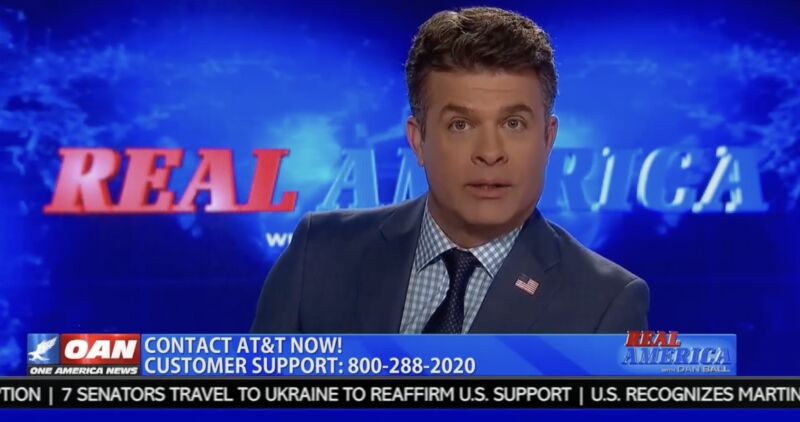
OAN panics as DirecTV drops network, asks viewers to find “dirt” on AT&T chairman

by Jon Brodkin
OAN host Dan Ball urges viewers to contact AT&T.

Enlarge / Dan Ball, host of One America News show "Real America." (credit: One America News)

One America News is in panic mode after DirecTV decided to drop the right-wing network from its channel lineup.

OAN host Dan Ball on Monday night urged viewers to dig up "dirt" on AT&T Board Chairman William Kennard, a Democrat who was Federal Communications Commission chairman during the Clinton administration and US Ambassador to the European Union under Obama. (AT&T is DirecTV's majority owner.)

A Daily Beast article said Ball told viewers that OAN "is now at war with AT&T." The Daily Beast article continued:

Read 17 remaining paragraphs | Comments

21 Jan 04:15

What Xbox will likely do with its $68B purchase of Activision Blizzard King

by Sam Machkovech
James.galbraith

Nothing good

What Xbox will likely do with its $68B purchase of Activision Blizzard King

Enlarge (credit: Aurich Lawson)

You might have heard the news: Microsoft has announced plans to acquire gaming behemoth Activision Blizzard King (ABK) and its subsidiary development studios. The deal is valued at $68.7 billion—or roughly 17 acquisitions of the Star Wars franchise—and that kind of money isn't spent without an expectation of major moves (and revenue) going forward.

After my colleague Kyle Orland chronicled everything we know thus far about the deal, I wanted to take a deeper look at the shape these combined companies (and their expected game launches) may take going forward.

Game Pass must be fed

The best sellers in the console industry continue to be holiday-adjacent releases, and Activision has a long track record of topping holiday sales charts. But Microsoft has been bullish about its Xbox brand growing not because of console sales and gifts under Christmas trees but because of the bigger profits possible when fans subscribe to Xbox services and spend money on the Xbox brand every month, primarily via Xbox Game Pass. In that business model, subscriber numbers are what matter, not breakout first-party games or console sales.

Read 25 remaining paragraphs | Comments

21 Jan 04:14

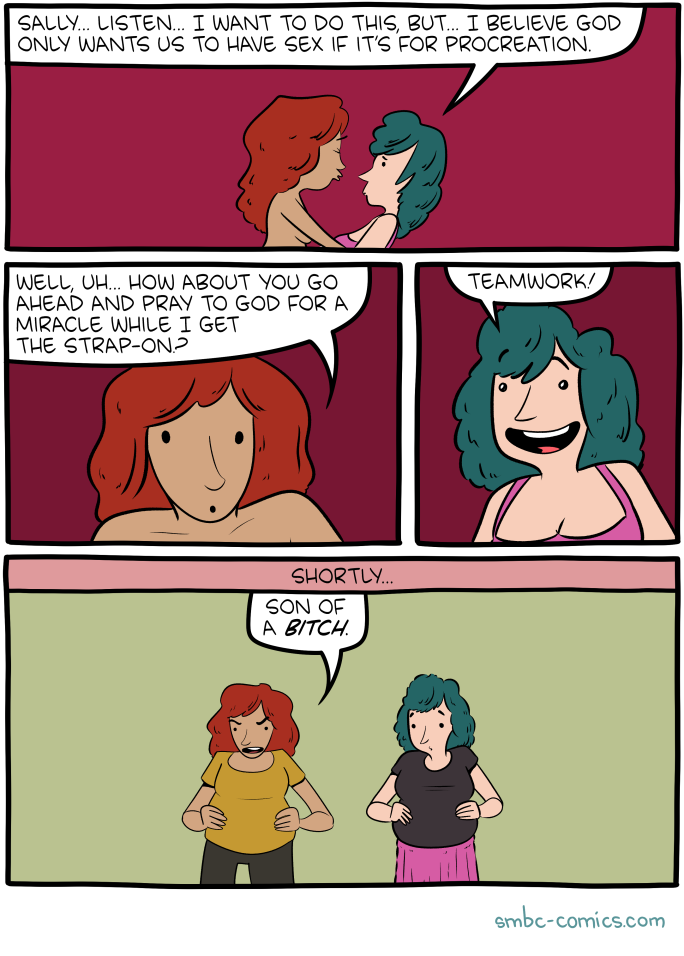
Saturday Morning Breakfast Cereal - Anne

by tech@thehiveworks.com


Click here to go see the bonus panel!

Hovertext:
Sorry apes, every 19th century orphan-saves-community story is just juicing your hindbrain. Enjoy!


Today's News:
21 Jan 04:02

Texas went big on oil. Earthquakes followed.

by Neel Dhanesha
James.galbraith

The sooner Texas destroys itself or falls into the ocean, the better for the rest of the country

A man wearing a hard hat watches a natural gas flare being burned off at a chimney.
A natural gas plant in the Permian Basin. Wastewater injection from oil and gas operations in the Permian is causing thousands of earthquakes in Texas each year. | Spencer Platt/Getty Images

Thousands of earthquakes are shaking Texas. What the frack is going on?

It’s been a big winter for earthquakes in West Texas. A string of small tremors rocked Midland County on December 15 and 16, followed a week later by a magnitude-4.5 quake, the second-strongest to hit the region in the last decade. Then a magnitude-4.2 quake shook the town of Stanton and another series of small earthquakes hit nearby Reeves County.

That’s an unsettling pattern for a state that, until recently, wasn’t an earthquake state at all. Before 2008, Texans experienced just one or two perceptible earthquakes a year. But Texas now sees hundreds of yearly earthquakes of at least magnitude 2.5, the minimum humans can feel, and thousands of smaller ones.

The reason why is disconcerting: Seismologists say that one of the state’s biggest industries is upsetting a delicate balance deep underground. They blame the oil and gas business — and particularly a technique called wastewater injection — for waking up ancient fault lines, turning a historically stable region into a shaky one, and opening the door to larger earthquakes that Texas might not be ready for.

The state is finally trying to change that. In December, the Texas Railroad Commission — the state agency that regulates oil and gas operations and no longer has anything to do with railroads — suspended wastewater injection at 33 sites across a region where more than half a million people live. This is a notable turnaround for the Railroad Commission, which until recently did not acknowledge a link between oil and gas operations and earthquakes, and might be a sign of just how serious the earthquakes have gotten.

Historically, Texas has been seismically sleepy. Its fault lines have lain mostly dormant for eons. “At some point, Texas was a plate boundary,” Heather DeShon, chair of the Department of Earth Sciences at Southern Methodist University in Dallas, told Vox. “All those faults are still present. They’ve just been buried by 300 million years of sedimentation, the formation of the Gulf of Mexico, and building new mountains. So they’re very deep, but they’re still there.”

When faults are active, as they are in earthquake zones like California and the Pacific Northwest, explained DeShon, they constantly put out energy. Rocks in those faults deform for years before breaking in an earthquake. “When you’re no longer on a plate boundary, that constant reloading and breaking of energy doesn’t happen anymore. But some amount of energy was left over on those faults,” DeShon said. The injection of wastewater can help release it.

Early signs of trouble came in 2008, when Dallas-area residents felt a series of small earthquakes that originated in the nearby Fort Worth basin. More earthquakes followed, and a magnitude-4 quake hit a town southwest of Dallas in 2015. No damage was reported, but according to the US Geological Survey, the impact of a magnitude-4 earthquake can include: “Dishes, windows, doors disturbed; walls make cracking sound. Sensation like heavy truck striking building. Standing motor cars rocked noticeably.”

Earthquakes in West Texas increased from a grand total of 19 in 2009 to more than 1,600 in 2017, according to a 2019 study, coinciding neatly with the rise of wastewater injection in the area. Nearly 2,000 earthquakes hit West Texas in 2021, a record high. According to the TexNet, the University of Texas’ earthquake catalog, 17 of those were magnitude 4 or higher.

Chart showing earthquakes and fossil fuel production rising in parallel Adapted from “The Proliferation of Induced Seismicity in the Permian Basin, Texas” by Robert J. Skoumal and Daniel T. Trugman.
Earthquakes have risen alongside wastewater injections in Texas. This chart shows earthquakes around the city of Pecos. Red indicates earthquakes. Green is oil production, and blue is wastewater disposal in millions of barrels. (Yellow shows the rise in natural gas production.)

It’s hard to overstate just how important Texas is to American oil and gas production. The Permian Basin, which spans West Texas and eastern New Mexico, is responsible for 40 percent of American oil production and 15 percent of the nation’s natural gas supply, with tens of thousands of wells dotted across the landscape. Hydraulic fracturing, also known as fracking, is the most common drilling method in the Permian.

Both traditional drilling methods and fracking can cause the same problem: Each year, drilling releases billions of gallons of briny, salty wastewater that has been trapped underground for millennia. The water flows back to the surface along with oil and gas (and, in the case of fracking, the additional water used to force oil and gas out of shale). That water has to go somewhere, and for decades the conventional wisdom has been to simply re-inject it deep into the ground, at some site that doesn’t get in the way of oil and gas wells.

Often, that water is injected into deep aquifers that often sit on the edges of fault lines. Injecting more water into those aquifers, DeShon said, is a bit like sitting on an old mattress that has a cup of water balanced on one end. The added pressure upends the balance of things, and the cup might fall over — which, in this metaphor, means a fault could slip and release energy in an earthquake.

In regions where wastewater injection receded, mostly because oil and gas operations in the area became less profitable, earthquakes dropped off too. But fracking continues to pick up, generating more wastewater that can lead to more earthquakes.

Oil and gas companies say they support the Railroad Commission’s restrictions, which mirror steps Oklahoma regulators took when they clamped down on disposal operations in 2014 after years of injection-induced earthquakes in that state. “None of us want any seismic activity, and so we support that action,” Ben Shepperd, president of the Permian Basin Petroleum Association, told the Houston Chronicle. But Shepperd praised the Railroad Commission for limiting its regulations to specific wells, rather than “painting the whole area with a broad brush.”

So far, none of the earthquakes triggered by wastewater injection in the Dallas-Fort Worth region or around the Permian Basin have been blamed for injuries or damage to buildings. “We should count ourselves lucky that cities such as Stanton have not been truly battered by a serious earthquake but we can’t keep counting on that good fortune,” wrote the Houston Chronicle’s editorial board recently.

DeShon also argued that there’s still reason to worry. “Once you have started having earthquakes in an area, the earthquake hazard goes up,” she said. “There’s still a lot of unknowns in such a complex system.”

One unknown that remains is where the wastewater ought to go. The Texas Railroad Commission is part of a consortium studying new ways to recycle water produced from drilling, a spokesperson told Vox. For now, the spokesperson added, operators of wastewater disposal wells “can apply to amend their permits for shallow injection and plug deeper portions of such amended disposal wells.” At least one disposal well operator has already had their permit amended.

Then there’s the question of wastewater injection in parts of the Permian Basin that the Railroad Commission hasn’t restricted yet. If bigger earthquakes shake populated areas, DeShon said, Texans won’t be ready for it — the infrastructure was made with tornadoes in mind, and most Texans don’t know what to do in the event of an earthquake.

“My personal opinion is that any community that has been experiencing earthquakes — and we’ve seen the earthquake size increase — should not be scared, but they should be informed about what to do in an earthquake,” DeShon said. “They need to know to drop, cover, and hold on. You don’t run out of buildings, you don’t stand under doorways. You wait until the shaking stops. There’s this education component that needs to happen, and I don’t know that it is.”

21 Jan 03:37

Arizona state representative wants to require parental consent for students to join LGBTQ clubs

by Marissa Higgins
James.galbraith

for fucks sake

Arizona is no stranger to anti-LGBTQ+ legislation. For example, Republican Sen. Wendy Rogers proposed Senate Bill 1045 to block gender-affirming health care for trans youth and teenagers, such as hormones, as well as forcing teachers, nurses, and any other school staff to tell a minor’s parent about their gender identity. Also proposed by Rogers is Senate Bill 1046, which would bar trans youth from sports at both public and private schools and at all levels. It would also require a medical review of a student’s anatomy to determine sex assigned at birth. 

Recently, Republican state Rep. John Kavanagh introduced House Bill 2011, which would effectively require consent from a parent or guardian in order for a student to participate in an LGBTQ+ club at school. And no, this parental consent isn’t required when it comes to other clubs, just the ones for queer students and allies. 

The text of the bill says that school districts would be prohibited from allowing any student to participate in “any school student group or club involving sexuality, gender, or gender identity” without the student’s parent providing “written permission” for student participation.

The legislation also calls for the school to explicitly inform parents that they’re allowed to “review the group’s or club’s formation documents,” which could include bylaws, statements of purpose, mission statements, or goal documents.

To state the obvious, this sort of bill puts already vulnerable youth in even more danger. Not all youth are “out” to their parents or families, and that’s completely fine. LGBTQ+ (and questioning) youth deserve the opportunity to feel safe, seen, and supported by their peers and adults in their lives, even if those people aren’t their family members. LGBTQ+ youth face disproportionate levels of bullying and violence at school; taking away opportunities for solace feels especially cruel, especially given that trans youth are also being pushed out of sports. No one should have to live in the closet, and the last place queer youth need to feel even more isolated and attacked is at school.

And for youth who aren’t LGBTQ+, the very framing of a queer club needing “different” or “extra” permission suggests that there’s something inherently wrong or dangerous about being LGBTQ+. This only adds to already negative stereotypes about the queer community and queer people, and might add to learned perspectives of queerphobia or that queer people are somehow “other” or to be avoided. 

This bill seems to use the foundation of parental rights when it comes to sex education and sexual health classes offered at public and charter schools in the state. The bill stresses that parents of students in public schools have the right to “review” learning materials and activities in these courses in advance, and may object to any “learning material or activity” on the basis of it being “harmful.” They may request to withdraw the student from that class or program. They may request an “alternative” assignment instead. 

By the way, if Kavanagh sounds familiar to you, it might be because he was the initial pusher for the anti-trans “bathroom bill” in Arizona back in 2013. He originally wanted to make it a crime for trans people to use the bathroom that aligned with their gender identity and wanted to protect businesses from lawsuits and prosecution if they banned trans people from using the bathrooms that matched their gender identity. 

For the curious, he’s also described immigrants as criminals, apparently suggested that everyone “shouldn’t be voting,” and argued in favor of more requirements when it comes to voting in elections, not fewer. 

In short, Kavanagh’s anti-LGBTQ+, pro-discrimination stance is nothing surprising, but it is horrifying. Youth (and adults, for that matter) deserve so much better. As we’re seen with the ongoing slew of anti-trans sports bills, Republicans are more than happy to spew hate if it gets them votes, so we need to be on our game when it comes to countering all of these legislations, no matter what fresh angle they try to use. LGBTQ+ youth are some of the most vulnerable people in this nation, and every adult should be doing what we can to support them, not harm them. 

If you want a little blast from the past, you can see Kavanagh speaking to Jake Tapper in defense of a religious freedom bill that was essentially a license to discriminate. 

21 Jan 03:04

McConnell admits he doesn't think Black people are American as voting rights dies in the Senate

by Laura Clawson
James.galbraith

And this is what Sinema and Manchin support. Unbelievable

Sens. Joe Manchin and Kyrsten Sinema made it official Wednesday night: Whatever they say, the reality is that they oppose voting rights. Democracy itself is something to which Manchin and Sinema give lip service, but which they will not do anything to defend. And Republicans? Republicans aren’t even pretending to support voting rights, while Senate Minority Leader Mitch McConnell made clear that he doesn’t think Black people are American.

Manchin and Sinema voted yes on a voting rights bill that they knew would be filibustered by Republicans—the bill was split at 50-50, but Vice President Kamala Harris could have broken that tie if it was a simple majority vote. It wasn’t, and not one Republican, let alone the 10 needed to overcome the filibuster, voted for it. Manchin and Sinema then voted against a rule change that would have allowed the voting rights bill to pass with a simple majority by restoring the talking filibuster. With every Republican opposed and every other Democrat in favor (a major achievement, if a hollow one), that meant the rule change failed, 48 to 52.

Both Manchin and Sinema repeatedly offered pieties about the sanctity of the filibuster, but both also voted to waive the filibuster to lift the debt ceiling just last month. Both function in a Senate in which nominees, including to lifetime judgeships, are confirmed by majority votes. And if they want to claim a concern for the history of the Senate, well, the talking filibuster, in which senators can hold off a bill as long as they can keep talking but cannot simply block a final vote without significant effort, has a rich history. 

The filibuster is not that sacrosanct, in other words. Manchin and Sinema just don’t really want to pass voting rights legislation. Manchin had even guided the shape of the legislation up for a vote—it was filled with things that supposedly had his full commitment. But minority rule in the Senate overrode any concern he might have for restoring the Voting Rights Act or establishing basic national standards for elections. 

Sinema was enjoying what she clearly saw as her McCain-saving-the-Affordable-Care-Act moment, reveling in the congratulations of a series of Republican senators after her vote. For this, she’ll lose her EMILY’s List endorsement, which has been a major source of campaign funding. But she clearly thinks her position will help move her on to bigger things. 

Manchin claims to want to stick with the history of the Senate (in the form of the filibuster) and promote bipartisanship, but he refused to acknowledge the history of the filibuster or how the talking filibuster—in a proposal that would have allowed each senator to delay a final vote by speaking for as long as they wanted, twice—would encourage the bipartisanship he claims to cherish.

Sen. Jeff Merkley explained: “The talking filibuster says you have leverage and you can slow things down, but you have an incentive to negotiate because you’re doing the painful work of being on the floor. And the majority has an incentive to negotiate because they’re in the painful situation of floor-time being eaten up by the minority—and that’s the most valuable thing we have.”

But as for bipartisanship, here’s the leader of the Republicans Manchin claims to think he could negotiate with on voting rights. Wednesday evening, asked by reporter Pablo Manríquez what he would say to voters of color concerned about voting rights, McConnell said, “The concern is misplaced,” because, get this, “if you look at the statistics, African American voters are voting in just as high a percentage as Americans.”

African American voters … versus Americans. Well. That pretty much tells us where McConnell stands, doesn’t it? “Said the quiet part out loud” has been a badly overused phrase in recent years, but it’s true that McConnell was articulating in so many words a position underlying Republican voting policy and Republican understanding of the legitimacy of Democratic victories.

In case you missed it, Mitch McConnell said the quiet part out loud last night: “African-American voters are voting in just as high a percentage as Americans.” Make sure everyone sees this.pic.twitter.com/ReOvHGJcnI

— MeidasTouch.com (@MeidasTouch) January 20, 2022

Manchin and Sinema had the chance to kill voting rights and reject the restoration of the talking filibuster because this is how every Republican in the Senate thinks—including the “bipartisan” ones who would require a fainting couch, their voices quavering with indignation, at the suggestion.

20 Jan 07:18

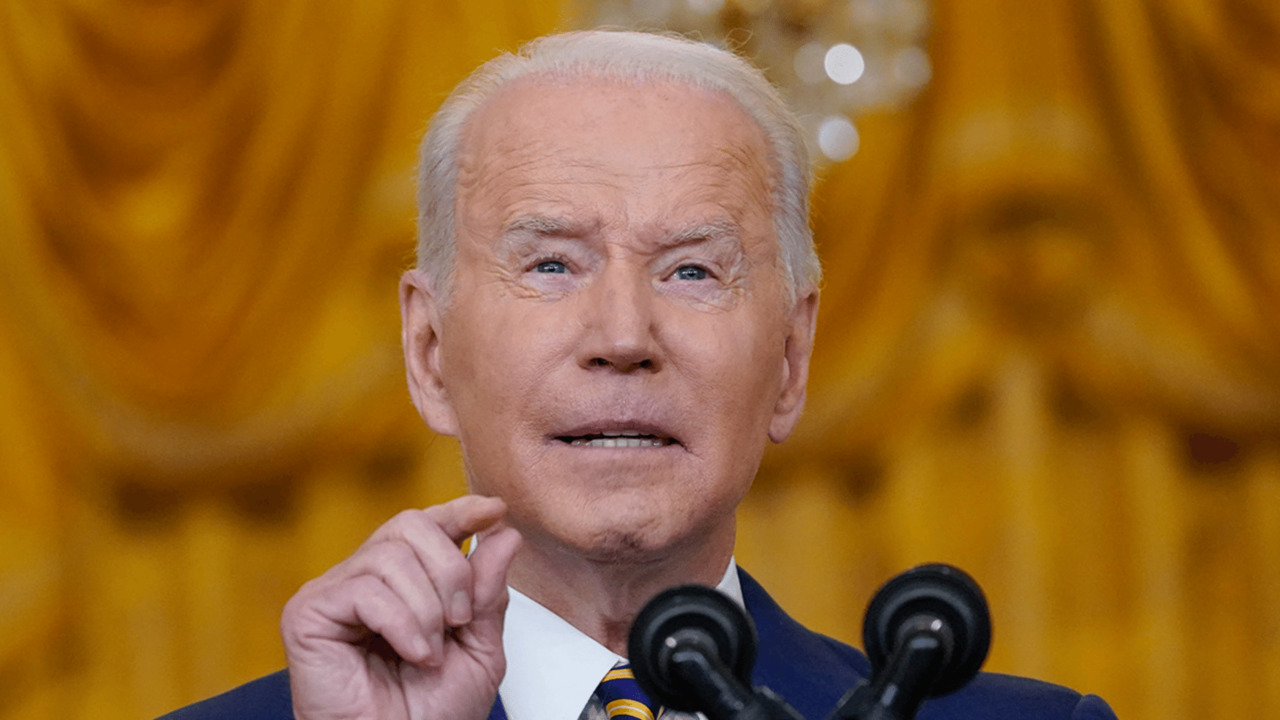
Biden: The GOP epiphany I predicted didn't come

by Laura Barrón-López and Myah Ward
James.galbraith

Gee, who could have ever predicted that


After enduring weeks of withering headlines about the state of his presidency, President Joe Biden tried a new tactic on Wednesday: self-reflection.

In a nearly two hour press conference, Biden conceded he had made some misjudgments during his first year in office, acknowledged the public's frustrations with the ongoing pandemic, and resigned himself to scaling back his domestic agenda.

It wasn’t all contrition. The president framed the work he had done as historic in depth and nature. He defended some of the tougher calls he had made in office, including his withdrawal from Afghanistan. And he called out Republicans for opposing his major agenda items without offering alternatives.

But, in total, the event was notable for the contrasts it set to his prior months in office. Biden had held only one other solo press conference at the White House during his presidency. For this one, he spoke longer than his two immediate predecessors had done at any press conference of their own. Biden had not publicly conceded that his Build Back Better agenda would need a dramatic revamping. On Wednesday, he talked about rescuing chunks of it.

Most notably, Biden had been bullish about getting Republicans to support his agenda, insisting they’d have an epiphany in the post-Donald Trump era. In front of the White House press corp, he implied that his optimism had been misplaced.

“One thing I haven’t been able to do so far is get my Republican friends to get in the game of making things better in this country,” Biden acknowledged.

Wednesday’s press conference marked the one year anniversary of his entering the Oval Office. And, for the occasion, Biden tried to explain his legislative strategy and decisions to combat the mutating coronavirus, while recognizing voters’ criticisms and frustrations. In taking questions for an hour and 51 minutes, Biden also sought to implicitly demonstrate stamina and fight the caricature of himself propagated by right-wing media. His aides seemed to delight in the coverage of how long the press conference went.

Asked right off the bat if his administration had over promised what it could accomplish to Americans, the president responded, “I didn’t overpromise. I have probably outperformed what anybody thought would happen...and I’m going to stay on this track.”


With persistently low approval ratings, Biden acknowledged both tactical and operational missteps. He said that he needs to get out of Washington, D.C. more to meet frustrated voters where they live and on their issues. He also conceded that there should have been more coronavirus tests available earlier during the current Omicron wave. But Biden also touted the work he and his team had done on the pandemic — from passing a massive relief package to standing up a comprehensive vaccine program. And, on his social spending agenda, he said it remains “realistic” that components will pass, chiefly the more than $500 billion to combat climate change and funds for early education.

“I think we can break the package up, get as much as we can now, come back and fight for the rest later,” Biden said. But he also admitted that there are some pieces he thinks Democrats will have to wait on.

“There’s two really big components that I feel strongly about that I’m not sure I can get in the package,” Biden said. “One is the child care tax credit and the other is help for the cost of community colleges.”

At the heart of Biden’s press conference was a frustration he said he felt with the political opposition he faced. The president campaigned for office pledging that his style of governance would help defuse partisan bickering — despite repeated warnings from those in his party that such a prediction was political fantasy. While Biden scored a major bipartisan victory with the passage of infrastructure reform, he admitted on Wednesday that staunch GOP opposition to his presidency had caught him off guard. He argued that the opposition was worse than what his former boss, President Barack Obama, faced while in office.

“I did not anticipate that there would be such a stalwart effort to make sure that the most important thing was that President Biden didn’t get anything done,” Biden said. “Think about this: What are Republicans for? What are they for?”

Biden said he personally likes Senate Minority Leader Mitch McConnell but again asked what McConnell’s proposals are on immigration and other policies currently being debated. When asked about electoral reform, Biden said he predicted Congress could get something done. A small group of bipartisan senators have met in recent weeks to discuss changes to the Electoral Count Act, which sets the process of the certification of presidential election results, and other voting measures.

But Biden said he believed it was his job to lay out, in stark terms, the threats to democracy facing the country. At one point, he said the 2022 midterms could “easily be illegitimate” if Trump loyalists running for positions overseeing the election process were able to use those positions to effectively nullify results.

“Imagine if those attempts to say that the count was not legit, you have to recount it and we’re going to discard the following votes” succeed, Biden posited. “The increase and the prospect of being illegitimate is in direct proportion to us not being able to get these reforms passed. But you’re not going to see me and I don’t think you’re going to see the Democratic party give up.”

Biden’s press conference came as Senate Democrats were heading toward a failed vote on reviving the talking filibuster as a pathway to pass voting and elections legislation. Despite the clear blockades put up by two senators in his party to two major agenda items, Biden refrained from directly attacking those in his party. But he made no apologies for his forcefulness across two speeches this month when asking lawmakers what legacy they wanted to leave behind — one like Martin Luther King Jr. and the late congressman John Lewis (D-Ga.) or segregationists Bull Connor and George Wallace. Both speeches drew Republican condemnations despite near unanimous GOP opposition to voting rights legislation being considered in Congress and many Republicans’ perpetuating Trump’s lies about election fraud.

“There are certain things that are so consequential that you have to speak from your heart and your head,” Biden said, his tone rising during one brief flash of frustration in the long press conference. “No one forgets who was on the side of King or Bull Connor. The history books will note it. I was making the case: don’t think this is a freebie. You don’t get to vote this way and somehow it goes away, this will stick with you the rest of your career.”

20 Jan 07:15

Florida suspends county health officer for daring to encourage vaccination among his employees

by Aldous J Pennyfarthing
James.galbraith

Florida really has completely lost their minds

Republicans are really on a roll, aren’t they? First, they support Donald Trump, then Vladimir Putin—and now they’re using the copious political capital they’ve built up with the pig-ignorant half of America to go all-in for COVID-19. I shudder to think what’s next. Maybe they can repeal car-seat laws so toddlers are free to catapult into chemical freight trucks, as God and the Founders intended.

So Florida—which is basically Disney World surrounded by 65,000 square miles of childish fantasy—has apparently decided that making Joe Biden look bad so its governor can take over and kill everyone in the country is the summum bonum of human endeavor. And they’re not relenting. Oh, no.

Check this out. It’s not enough just to slap down every reasonable COVID-19 mitigation strategy that comes along. Now they’re going after a top health official who—wait, this can’t be right, can it?—actually encouraged his employees to get vaccinated.

According to The Orlando Sentinel:

Dr. Raul Pino, who became a trusted voice of the pandemic response in the nation’s tourist capital, has been placed on administrative leave from his post as the state’s chief health officer in Orange County as the Florida Department of Health conducts an investigation.

Sources who spoke to the Orlando Sentinel on condition of anonymity because they were not authorized to discuss Pino’s status said he was placed on administrative leave after a Health Department employee complained about an email he sent Jan. 4 to agency staff about employee vaccination rates.

I can’t believe what I just read. Truly …

It’s hard to believe this is Pino’s only “offense.” He must be selling human organs out of an Igloo cooler in his ‘70s shaggin’ wagon or something, because suspending a doctor for encouraging people to get vaccinated against a deadly disease that’s already killed more than 800,000 Americans seems, erm, rather daft.

According to media reports, in the Jan. 4 email to his employees, Pino wrote, “I have a hard time understanding how we can be in public health and not practice it.” He also noted that only 77 of 568 members of his department had been boosted against COVID-19, while 219 had received two doses and 34 had received just one. “I am sorry but in the absence of reasonable and real reasons it is irresponsible not to be vaccinated,” Pino stated in the email. “We have been at this for two years, we were the first to give vaccines to the masses, we have done more than 300,000 and we are not even at 50%. Pathetic.”

Yeah, that is pretty pathetic. But somehow Florida was able to make it pathetic-er by punishing the guy who was being compassionate and responsible and refusing to champion the deeply held values of the death-spreaders.

Remember that the next time a conservative tells you they’re all about “common sense.”

”Clearly vaccines are working for us … and are the solution to this crisis,” Pino said in December as the omicron variant began to pick up steam. “The vaccine continues to be effective against the variants.”

Right? I mean, if more people were listening to Pino and fewer to Ron “Gasping Goofus” DeSantis, neither Florida nor the U.S. would have much of an omicron crisis at all.

For what it’s worth, here’s how the Florida Department of Health responded to this bonkers controversy: “As the decision to get vaccinated is a personal medical choice that should be made free from coercion and mandates from employers, the employee in question has been placed on administrative leave, and the Florida Department of Health is conducting an inquiry to determine if any laws were broken in this case,” spokesperson Weesam Khoury stated in an email to The Orlando Sentinel. “The Department is committed to upholding all laws, including the ban on vaccine mandates for government employees, and will take appropriate action once additional information is known.”

Hmm. That’s … bizarre. And rather Orwellian coming from a “health” department.

Then again, I suspect every Florida government agency is just a glorified Ron DeSantis for President campaign office these days. Should we really expect any better?

It made author Stephen King shout “Pulitzer Prize!!!” and prompted comedian Sarah Silverman to say, “THIS IS FUCKING BRILLIANT.” What is it? The viral letter that launched four hilarious Trump-trolling books. Get them all, including the finale, Goodbye, Asshat: 101 Farewell Letters to Donald Trump, at this link. Or, if you prefer a test drive, you can download the epilogue to Goodbye, Asshat for the low, low price of FREE.

20 Jan 06:55

Democrats’ voting rights debacle

by Andrew Prokop
James.galbraith

There will be consequences

Protestors are detained by US Capitol Police after rallying for voting rights legislation on the Senate steps at the Capitol on January 18. | Drew Angerer/Getty Images

Did the party waste a year on a doomed Senate push? Or was this their best chance?

Sometimes there is no plan.

Democrats’ big voting rights push is headed for a brick wall in the Senate — again. To get their bill past the filibuster, they need all 50 Senate Democrats to support changing the chamber’s rules. And Sens. Joe Manchin (D-WV) and Kyrsten Sinema (D-AZ) still refuse to do so.

With failure imminent, finger-pointing and second-guessing about Democrats’ voting rights strategy has become rampant. “Has there ever been a legislative campaign this dumb, doomed and disastrous from the beginning?” one Democratic campaign professional griped to me, speaking anonymously to more freely criticize his party’s strategy.

It’s become clear that the party never had a plausible plan for success on voting rights. Congressional leaders, activists, and outside groups have mostly been in lockstep trying to unite Democrats around a sweeping legislative package, then charging full steam ahead into a filibuster. The hope was, apparently, that persuasion or pressure would spur Manchin and Sinema to abolish or weaken the filibuster, even though they’d repeatedly vowed they wouldn’t.

All along, some Democrats have been quietly skeptical on both tactical and substantive grounds, as I wrote last year. They argued that the likely impact of the bills for “saving democracy” was exaggerated, and that their chances of success were far lower than leaders were admitting. An adviser to a prominent Democratic donor worried that discussions on the topic were becoming “exercises in unreality,” per an email obtained by Politico.

President Biden’s White House at times seemed to side with the skeptics: He kept his distance from the voting rights push through much of 2021, giving the occasional speech or statement, but not making it a top priority compared to the Build Back Better Act, which seemed to have a greater chance of success. But activists intensely criticized Biden for his inaction, and then Build Back Better stalled, so he finally got engaged in the voting push this month — to no effect on Manchin or Sinema.

Barring a startling turnaround, Democrats will head into the midterms having failed to pass the bills they touted as so urgently necessary. It’s a big mess. Of course, the failure of one strategy does not mean there was an obviously better option. Still, it’s natural to ask whether there were some roads not taken — and whether the alliance of congressional leaders and outside groups steering this effort has steered into a ditch.

 Bill Clark/CQ-Roll Call, Inc via Getty Images
Senate Majority Leader Chuck Schumer speaks at a news conference following the Senate Democrats caucus meeting on voting rights and the filibuster on Tuesday, January 18.

How Democrats got here

The strangeness began early last year. Donald Trump had just made an unprecedented effort to overturn the presidential election results, resulting in chaos and violence at the Capitol on January 6. Then Republican-led state legislatures started moving toward passing restrictions on voting. The moment, it seemed, demanded a response.

So Democratic congressional leaders put forward a bill: the For the People Act. It was a “mega-bill” containing dozens of proposals that good government reformers had supported for years, on topics ranging from voting accessibility standards to redistricting reform to small donor campaign financing. There was no hope of getting any Republican support for this bill, as it was crafted as a kind of a Democratic wish list and, in its initial version, didn’t really address Trump’s schemes to steal the election at all.

Then there was the problem of passing it — 60 votes would be required to get it past the Senate filibuster. That could be circumvented if Democrats rammed through a rules change with just a majority. But in January 2021, Manchin and Sinema both publicly pledged to keep the filibuster intact.

Still, Democratic congressional leaders and their allies pressed onward with an apparent two-part plan: first, brand the bill as crucial to saving democracy, and second, pressure or persuade Manchin, Sinema, and other moderates to change Senate rules, so the bill could pass.

Some of the details have changed in the ensuing year. The For the People Act was replaced by a two-bill combo, the Freedom to Vote Act and the John Lewis Voting Rights Advancement Act. Certain provisions were dropped and others, including some related to election subversion, were added. But the basic strategy has remained the same: push a big sweeping legislative package overhauling many aspects of elections and voting with no Republican support, and hope Manchin and Sinema covert to the cause of filibuster reform.

Spoiler: They haven’t.

Why did the party go down this path? The Democratic campaign professional told me he’s observed a “lawyer vs. practitioner dichotomy.” He believes the big bill strategy was crafted by lawyers in the party and at allied nonprofit groups, such as the Brennan Center for Justice, who had grand ambitions of overhauling the law, but who lacked campaign professionals’ expertise about which policy changes are most likely to impact election outcomes and legislators’ savvy about how to actually get a bill through Congress.

In this interpretation of events, those lawyers caught the ear of influential donors and donor-funded activist groups. To keep these constituencies happy, congressional leaders embraced the lawyers’ strategy to push these sweeping mega-bills — and the White House, after some initial reluctance, followed. (Teddy Schleifer reported on the donors behind the voting rights effort at Puck News.)

Another circulating theory is that this whole effort has been a bit of a sham, or at least a performance, from Democratic leaders’ perspective. In this interpretation, top Democrats knew all along they’d never be able to pass anything because of the filibuster. So they put together a “message bill” aimed at making their interest groups and certain key donors happy, but which they never thought or intended would actually become law. The goal has been to prove to activists and the base that they are “fighting” for the cause of voting rights, even though they knew they would lose.

 Kent Nishimura/Los Angeles Times via Getty Images
Sen. Joe Manchin walks to an elevator en route to a Senate democratic caucus meeting on voting rights and the filibuster on Capitol Hill on Tuesday, January 18.

Was there another option?

All this might come off as too-savvy second-guessing. A more generous interpretation is that Democratic leaders and advocates knew the strategy’s odds of success were slim, but they thought it was worth a shot anyway, and they didn’t think any alternative strategies would be likelier to produce policy changes that would protect democracy.

“It’s an important moment that the U.S. Senate is debating how to protect voting rights and fair elections at a time when our democracy is under attack from Donald Trump’s Big Lie and those who would abet it,” Michael Waldman, president of the Brennan Center, said in a statement. “We’re proud to be part of an extraordinary movement of racial justice, democracy, religious, labor, and other groups in this fight. It’s a broad democracy movement our country has long needed.” Supporters of the effort also argue that they have plenty of campaign professionals and experts who agree with them on the importance of fighting voter suppression restrictions.

But there can be costs to failure. For one, it may amount to wasting a year — Manchin and Sinema’s support for the filibuster has been clear since January 2021, after all. Former Obama White House aide Dan Pfeiffer argued in a recent Substack that insiders privately knew failure was likely, but publicly pretended otherwise, setting the stage for supporters’ disillusionment with Biden’s presidency overall. “Every Democrat — myself included — did a miserable job of managing expectations and leveling with our most loyal activists, volunteers, and donors,” Pfeiffer wrote.

Biden did initially try to manage expectations by prioritizing other issues first. But that’s led to another round of second-guessing from those who argue he should have gotten involved earlier. “When Biden fully entered the battle, the other warriors were already bloody, bruised and exhausted,” the New York Times’s Charles Blow writes.

Yet considering Manchin’s willingness to tank Build Back Better as well as the voting rights bills, it seems unlikely that earlier presidential pressure would have made him and Sinema bend. The president and progressives have no leverage over Manchin, who represents a deeply conservative state — indeed, they need him for everything they want to do.

Sinema is theoretically vulnerable to a primary from the left, but she certainly isn’t acting like she believes that, and that election wouldn’t be until 2024 anyway. For now, Biden is at their mercy, and continued pressure on them could well backfire and make them more recalcitrant on other issues.

Another question is whether, in going for broke trying to pass their dream bill, Democrats will have missed an opportunity to get less sweeping but still significant reforms enacted. Washington is abuzz with news that some Republican senators want to engage in talks about reforming the Electoral Count Act — the law Trump tried to use to get Congress and Vice President Pence to throw out Biden’s wins in key states. Yet leading Democrats like Schumer have so far voiced skepticism of those efforts.

Whether any GOP reform offer is worthwhile depends on the details, and it’s possible no deal will come together. But right now, the alternative appears to be getting no reforms at all.

The unpleasant reality for Democrats is that they’ll only be in a position to pass the agenda they say is necessary if they manage to win more elections. Yet their prospects for doing that in 2022 look bleak, considering Biden’s grim approval numbers. There’s still a chance to make the bipartisan deals they can now, and try to win more elections later. But the time for tilting at windmills is drawing to a close.

19 Jan 03:15

Second state attorney general refers fake Trump electoral certificate to federal prosecutors

by Laura Clawson
James.galbraith

How have both the states and the feds not already been all over this FOR A FUCKING YEAR OR MORE

After Republicans in several states forged documents claiming Donald Trump had won their states and submitted the documents to the federal government, the attorney general of a second state has made a referral to federal prosecutors. Michigan Attorney General Dana Nessel was the first to do so last week, but late Friday, New Mexico Attorney General Hector Balderas said he had done the same.

“Election laws are the foundation of our democracy and must be respected,” Balderas, a Democrat, said in a statement. “While review under state law is ongoing, we have referred this matter to the appropriate federal law-enforcement authorities and will provide any assistance they deem necessary.”

The New Mexico Republicans who created alternate paperwork awarding the state’s electors to Trump—who lost by 11 percentage points, nearly 100,000 votes—fudged a little, claiming that their move was made “on the understanding that it might later be determined that we are the duly elected and qualified Electors for President and Vice President of the United States of America from the State of New Mexico.”

Republicans in Pennsylvania used similar language in their fake “Trump won” documents, but Republicans in Michigan, Wisconsin, Arizona, Georgia, and Nevada did not qualify their claims, instead submitting documents claiming that they were the “duly elected and qualified electors.” Which they were not.

Pennsylvania Attorney General Josh Shapiro has said that because of the language admitting that the fake electors were being named for a possible future in which Trump would be named the winner, the documents don't meet the standard for forgery. New Mexico’s Balderas appears to disagree. But either way, there are five states where that language wasn’t included and Republicans unambiguously tried to present themselves as electors and Trump as the winner despite his losses in those states.

This was not a case of Republicans in different states independently coming up with the same idea. “The fake documents had identical formatting, spacing, fonts, and phrasing, leaving little doubt that there was a template for Republicans to follow in each of these states,” Steve Benen writes, linking reports in Pennsylvania and Michigan in which local Republicans point to Trump campaign lawyers as the source of the plan. A participant in the Arizona documents said she had met with Rudy Giuliani and Mark Meadows, who was then the White House chief of staff, exchanged text messages about the plan with members of Congress. No one was freelancing here. This plan came from the top.

These documents, which tried to replace the legitimate electors of five states with fakes awarding the election to the loser, with provisional attempts in two more states, have to be seen as part of a broader coup attempt. “[A]t the same time he was urging his MAGA hat-wearing supporters toward insurrection, Trump was engaged in an extensive coup plot that involved attempts to strong-arm local officials, enlist state legislators, subvert the Department of Justice, and instruct Republicans in Congress on how they could support the end of American democracy. That plot included a series of memos from Trump attorneys creating a false legal pretext for the coup and a PowerPoint briefing for Republicans in Congress filling them in on next steps,” Mark Sumner has written. “The fake electoral certificates were a key part of this effort. They were the props Republicans were to turn to—the bloody shirt to be waved—as ‘proof’ that the election remained undecided. As such they played a central role in a conspiracy to interfere with counting the electoral votes in a U.S. election.”

Donald Trump attempted a coup, with the eager participation of Republicans in positions of power in multiple states and the U.S. Congress. This is something we should continue to be very alarmed about.

19 Jan 03:15

Cartoon: Petro-persecution

by Jen Sorensen
19 Jan 03:08

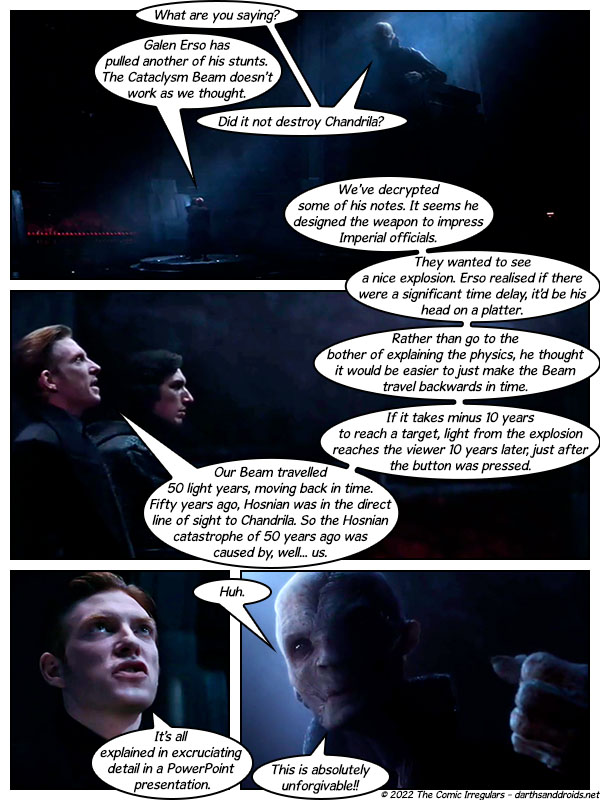
Episode 2102: Future Presenting the Past

Episode 2102: Future Presenting the Past

You have to be careful treading the fine line between Don't Shoot the Messenger and Shoot the Messenger. Of course if you're reporting to the Big Bad Evil Guy, you kind of have to expect to be arbitrarily disposed of at some point anyway, so perhaps it doesn't matter too much.

aurilee writes:

Commentary by memnarch (who has not seen the movie)

Oooooookay then, time for a quick exit stage right for General Hux. Snoke doesn't seem like the type to enjoy getting bad news, and Kylo won't hesitate to kill the messenger if Snoke does get angry about the news and wants Hux dead. I'm betting Hux isn't going to live through the end of the movie either way since he has a rather forgettable character design. Combed hair, plain black suit, no rank pin, sometimes a hat; if the hair color isn't mentioned, one could think this unfortunate is the one being described instead.

Obviously now, this can't be close to the movie plot. While I was mostly certain Episode VII here wouldn't bother referencing some dude that died halfway through a different movie and that he's not the weapon designer in the first place, the PowerPoint presentation part definitely tosses that idea out. With how much energy is actually needed to explode a planet (versus just melting it for example), it's probably more likely that it's just a "cool/unexplained super tech" type plot hole. Assuming it is a plot hole anyway, I would say it's only a lot more obvious here due to the movie going fancier/bigger/better on almost everything else; this one thing is just a miss for me without the dramatic CGI sequence.

Transcript

19 Jan 03:07

Some Roku Smart TVs Are Now Showing Banner Ads Over Live TV

by BeauHD
James.galbraith

aaaaaand nope

Some Roku smart TV owners are seeing banner ads appear over live content, according to a thread on the r/cordcutters subreddit. Ars Technica reports: [A photo posted by the Reddit user] shows a Sharp TV running Roku software and displaying an ad for a bed over a live sports broadcast, plus a prompt to 'press OK to get offer.' These ads don't seem to appear on Roku's own hardware, like the Roku Ultra, Express, Streambar, or Streaming Stick. Rather, they show up on certain smart TVs running the Roku TV platform -- and it might just be certain brands, like Sharp. Some owners of TCL Roku TVs commented that they had not seen the ads. Fortunately, users in the thread reported that the feature can be disabled in privacy settings. But it's possible that doing so may disable other Roku features.

Read more of this story at Slashdot.

19 Jan 03:05

Microsoft fixes Patch Tuesday bug that broke VPN in Windows 10 and 11

by Andrew Cunningham
James.galbraith

wow about fucking time

Microsoft fixes Patch Tuesday bug that broke VPN in Windows 10 and 11

Enlarge (credit: Aurich Lawson)

Microsoft's monthly Patch Tuesday updates for Windows are generally meant to fix problems, but that isn't how it always goes. January's updates, released last week, caused a handful of problems for businesses in particular. The most serious, especially for people still dealing with pandemic-driven remote-work setups, was a bug that broke certain kinds of VPN connections. Microsoft has provided fixes for this and other issues as of today, a few days after acknowledging the problem on its Known Issues page.

According to Microsoft's documentation and reporting from Bleeping Computer, the VPN connection issues affected "IPSEC connections which contain a Vendor ID," as well as L2TP and IPSEC IKE VPN connections in Windows 10, Windows 11, and Windows Server versions 2022, 20H2, 2019, and 2016. Windows' built-in VPN client seems to be the most commonly affected, but third-party VPN clients using these kinds of connections could also run into the error.

The latest round of Patch Tuesday updates also caused some problems for Windows Server, including unexpected reboots for domain controllers and failed boots for Hyper-V virtual machines. These problems have all been resolved by other out-of-band patches, though not before causing problems for beleaguered IT admins.

Read 1 remaining paragraphs | Comments

19 Jan 03:04

Safari and iOS users: Your browsing activity is being leaked in real time

by Dan Goodin
James.galbraith

well, shit

Safari and iOS users: Your browsing activity is being leaked in real time

Enlarge (credit: Getty Images)

For the past four months, Apple’s iOS and iPadOS devices and Safari browser have violated one of the Internet’s most sacrosanct security policies. The violation results from a bug that leaks user identities and browsing activity in real time.

The same-origin policy is a foundational security mechanism that forbids documents, scripts, or other content loaded from one origin—meaning the protocol, domain name, and port of a given webpage or app—from interacting with resources from other origins. Without this policy, malicious sites—say, badguy.example.com—could access login credentials for Google or another trusted site when it’s open in a different browser window or tab.

Obvious privacy violation

Since September’s release of Safari 15 and iOS and iPadOS 15, this policy has been broken wide open, research published late last week found. As a demo site graphically reveals, it’s trivial for one site to learn the domains of sites open in other tabs or windows, as well as user IDs and other identifying information associated with the other sites.

Read 9 remaining paragraphs | Comments

19 Jan 03:02

Microsoft is buying one of the biggest names in games — if Washington lets it

by Peter Kafka
James.galbraith

And Washington REALLY should not let this go forward

A Call of Duty display by Activision at the E3 gaming conference in 2017. | David McNew/Getty Images

Microsoft-Activision is like Disney-Fox. Maybe bigger.

Microsoft is buying Activision Blizzard for $69 billion. For those of you who play video games or pay attention to video games — and there are a lot of of you — we don’t really need to spell out why this is a Really Big Deal.

The rest of you might want some context. Remember when Disney bought much of Rupert Murdoch’s Fox empire, and formally kicked off a wave of consolidation in Hollywood? This is like that.

Maybe bigger: The deals are roughly the same size. Microsoft’s deal values Activision at about $69 billion, and Disney paid a little more than $70 billion for Fox’s movie studio and other assets. But this deal — if it goes through — is both horizontal and vertical integration, pairing Microsoft’s Xbox console business, which already owns huge game franchises like Minecraft and Halo, with one of the world’s most valuable gaming companies, which owns giant titles like Call of Duty, World of Warcraft, and Candy Crush.

While streaming TV shows and movies occupy a ton of media attention, video games capture a ton of regular people’s attention: Microsoft says there are 3 billion gamers around the world today, and says that number will get to 4.5 billion by 2030.

And if you want to get really fanciful: If any version of the metaverse or virtual reality future we’ve been hearing about for the past couple years comes to pass, it will almost certainly be grounded in games. Maybe Future You won’t want to strap on face goggles throughout your day. But putting on a device to shoot at virtual strangers is less of a stretch.

This is something Microsoft, which not coincidentally has been working on its own face goggles, is leaning into to justify its deal. “When we think about our vision for what a metaverse can be, we believe there won’t be a single, centralized metaverse,” Microsoft CEO Satya Nadella said after announcing the deal on Tuesday.

You can also read that statement as a message to Lina Khan, the head of the Federal Trade Commission, along with the rest of the Biden administration’s antitrust enforcers: I know it seems like we are swallowing up a lot of the games business, but don’t think of this as consolidation in an important industry — think of it as competition against Facebook in a new industry. Competition is good, right?

This deal is certainly going to draw a lot of attention in Washington, which has been focusing on big and small deals made by most of the tech industry — but has largely left Microsoft alone until now. (The irony, of course, is that Microsoft spent a long time fighting federal antitrust charges over its web browser dominance two decades ago; the company averted a forced break-up but lost much of its mojo along the way).

This deal has a $3 billion breakup fee — that is, cash Microsoft will have to pay Activision if the merger gets stopped by regulators — which seems like a lot of money to you and me but is fairly small beans for this kind of transaction. Still, it’s supposed to signal the two companies’ confidence that it will get done. When it comes to making its case to Washington regulators, you can expect Microsoft to argue that 1) its Xbox business is much smaller than Sony’s Playstation business and 2) that the future of gaming is about mobile, which means Microsoft isn’t just competing with Sony but with Apple and Google as well.

Those are good arguments, but we’ll see. Microsoft has also been moving away from its console business — low-margin boxes consumers buy for $300 or more, but tend not to replace very often — and to its Netflix-style subscription model called GamePass, where you pay the company $15 a month and can play its games on any kind of device.

Microsoft already has 25 million subscribers for that service. I wouldn’t expect Microsoft to make most of Activision’s big games exclusive for GamePass — just like with movies and TV shows, games are most valuable if they’re available to as many people as possible — but you can certainly see why Khan and her colleagues will want to poke into this one.

Also worth watching: What happens to Activision’s leadership, which has been embroiled in sexual misconduct scandals for the last year or so. Last fall, the Wall Street Journal reported that CEO Bobby Kotick didn’t tell his own board of directors about an employee who said she was raped by a supervisor, and a subsequent out-of-court settlement. Most recently, Activision says it has “exited” dozens of employees after investigations into harassment and other misconduct.

There’s been widespread speculation in the games industry that the scandals could cost Kotick his job and potentially lead to Activision’s sale. Now, Microsoft says Kotick will continue to run his company after the deal goes through but will report to Phil Spencer, who runs Microsoft’s gaming business.

It’s possible Kotick will stay on indefinitely. But you don’t tend to see people who run really big companies and make really big salaries — Kotick made $154 million in 2020, making him the second-highest-paid CEO in the US that year — stick around for long when they report to the person who reports to the CEO.

Again, all of this only comes into play if Microsoft gets regulators to sign off. A few years ago, that might have seemed pretty straightforward — Washington had pretty much given big tech companies the go-ahead to buy whatever they’d like, and few paid much attention. But a lot of people will care about this one. Both because a lot of people play games — hence the $69 billion price tag — and a smaller number of very influential people are newly skeptical about letting Big Tech get bigger.

18 Jan 01:26

The IRS is broken, just as Republicans intended. It's what they want for the rest of government

by Joan McCarter
James.galbraith

No shit

Tax filers in 2022 will face the same frustrations and delays that have characterized tax season for years now, heightened by the pandemic. Treasury officials recently spoke to reporters in a conference to begin the process of lowering taxpayers’ expectations.

The IRS, they told reporters, is dealing with the pandemic and the fact that it has just 15,000 employees tasked with customer services, expected to handle more than 240 million calls. That’s about 16,000 calls per employee. The workforce at the IRS in 2022 is about the same size as it was in 1970. The population of the country has grown by about 60% since 1970. Officials also said that fewer auditors are working in the IRS now than at any point since World War II—when there were something like 200 million fewer people in the U.S.

Republicans have forced budget cuts on the agency for years, with Democratic help, that have resulted in a 25% cut in the workforce at the IRS. “By definition, no matter how much more efficient you are, you can’t lose 25 percent of the workforce and assume you can do the same volume of work. It’s a problem across the board—information technology; revenue agents; people answering the phones,” John Koskinen, who served as commissioner of the IRS under presidents Barack Obama and Donald Trump, told reporters.

This is why enforcement has been so lopsided—the IRS has been going after regular people with audits because they’re so much easier. The millionaires and billionaires and corporations who commit fraud can afford to hire accounts and lawyers and fight audits, and the IRS simply doesn’t have capacity to fight that.

Decades of budget cuts have left the agency with ancient computer systems and far too few staff members. The House Budget Committee acknowledged these problems with the IRS in a report in 2020. “The Internal Revenue Service (IRS) has faced harsh budget cuts over the last decade, hindering its ability to serve the American people in fundamental ways,” the committee said. “Even before the pandemic, the underfunded IRS struggled to carry out its core functions of tax collection and enforcement.”

That means a lot of tax cheats—the big ones who could owe hundreds of thousands or even millions—have been getting away with it. “According to a recent report by the Treasury Inspector General for Tax Administration (TIGTA), due to a lack of resources, the IRS failed to audit more than 897,000 wealthy individuals who skipped out on filing tax returns over three years—and these individuals owed nearly $46 billion in taxes,” the committee reported. This comes after decades of Republicans vilifying, attacking, and starving the agency.

The Build Back Better legislation would help fix this. It still includes  $44 billion to build the IRS’s enforcement capabilities back. The Biden administration estimates that would add $400 billion to the Treasury in unpaid taxes.“The framework will create a fairer tax system through transformation investments in the IRS: hiring enforcement agents who are trained to pursue wealthy evaders, modernizing outdated IRS technology, and investing in taxpayer service, so regular Americans can get their questions answered and access to the credits and benefits they are entitled to,” the White House said.

Democrat Joe Manchin doesn’t want that to happen. Hmm, I wonder why.

18 Jan 01:26

Microsoft warns of destructive disk wiper targeting Ukraine

by Dan Goodin
Microsoft warns of destructive disk wiper targeting Ukraine

Enlarge (credit: Getty Images)

Over the past few months, geopolitical tensions have escalated as Russia amassed tens of thousands of troops along Ukraine’s border and made subtle but far-reaching threats if Ukraine and NATO don’t agree to Kremlin demands.

Now, a similar dispute is playing out in cyber arenas, as unknown hackers late last week defaced scores of Ukrainian government websites and left a cryptic warning to Ukrainian citizens who attempted to receive services.

Be afraid and expect the worst

“All data on the computer is being destroyed, it is impossible to recover it,” said a message, written in Ukrainian, Russian, and Polish, that appeared late last week on at least some of the infected systems. “All information about you has become public, be afraid and expect the worst."

Read 16 remaining paragraphs | Comments

17 Jan 19:55

Trump’s Arizona project shows the dire threat to American democracy

by Paul Waldman
James.galbraith

Yup, it's going to go very badly

The 2024 election could be decided there, and he's putting in place a slate of extremists who will do anything to help him.
17 Jan 19:49

How Manchin and Sinema Completed a Conservative Vision

by Ronald Brownstein
James.galbraith

Yep, we're fucked

The decision by Senators Kyrsten Sinema and Joe Manchin to block their fellow Democrats from passing new federal voting-rights legislation clears the path for years of tightening ballot restrictions in Republican-controlled states. It also marks a resounding triumph for Chief Justice John Roberts in his four-decade quest to roll back the federal government’s role in protecting voter rights.

Roberts as much as anyone set in motion the events that have led to this week’s climactic Senate confrontation over voting legislation. In a series of rulings over the past 15 years, the Supreme Court, often in decisions written by Roberts himself, has consistently weakened federal oversight of voter protections and struck down federal regulations meant to reduce the influence of money in politics. Almost all of those decisions have unfolded on a strict party-line basis, with the Republican-appointed justices outvoting those appointed by Democrats.

Those decisions have had an enormous practical impact on the rules for American elections. But many voting-rights advocates say that the rulings have been equally important in sending a signal to Republican-controlled states that the Supreme Court majority is unlikely to stand in their way if they impose new restrictions on voting or extreme partisan gerrymanders in congressional and state legislative districts.

Democrats are still pressing the two senators to reconsider their decision before this week’s votes. Barring an unlikely last-minute reversal of their position, Manchin and Sinema have effectively blocked federal voting-rights legislation by insisting that it remain subject to a filibuster that provides Senate Republicans a veto. And that could trigger a renewed red-state offensive.

[Read: Democrats stare into the abyss]

“We’re going to see a new wave of [state] legislation that is just as dangerous as what we’ve seen [so far] and that is going to create additional barriers to the ballot,” Deborah Archer, an NYU School of Law professor and the president of the American Civil Liberties Union, told me.

Roberts, who served as a young clerk to conservative Supreme Court Justice William Rehnquist and as a Justice Department assistant in the Reagan administration, has long expressed hostility to federal oversight of voting and election rules. As the journalist Ari Berman recounted in his 2015 book, Give Us the Ballot, Roberts “led the charge” against the bipartisan 1982 reauthorization of the Voting Rights Act, which ultimately reversed a Supreme Court decision (supported by Rehnquist) weakening one key section of the law. Roberts wrote “upwards of 25 memos” opposing the legislation’s provision requiring that the Justice Department prove only discriminatory “effect” rather than purposeful “intent” in order to block state or local voting restrictions. (The Court had ruled the opposite, severely limiting the law’s applicability.)

In one memo reported by Berman, Roberts revealed his broader philosophy about voting rights: The test for federal objection to local voting laws should be extremely difficult to meet, he wrote, “since they provide the basis for the most intrusive interference imaginable by federal courts into state and local processes.”

That approach has guided Roberts on the Supreme Court. As the Harvard Law School professor Nicholas Stephanopoulos, an expert in voting law, wrote in a 2019 law-review article, “The Roberts Court has … never nullified a law making it harder to vote.” To the contrary, in a series of landmark decisions, it has nullified efforts to ensure voter access, combat gerrymanders, and to limit political contributions and spending.

Those cases have included Citizens United v. Federal Election Commission in 2010, which swept away federal prohibitions on undisclosed, unlimited corporate spending in federal elections; Shelby County v. Holder in 2013, which eviscerated the Justice Department’s authority under the Voting Rights Act to review, or “preclear,” any changes in voting procedures in states with a history of discrimination against minorities; Rucho v. Common Cause in 2019, which ruled that federal courts cannot overturn even the most extreme partisan gerrymanders; and Brnovich v. Democratic National Committee in 2021, which severely weakened Section 2 of the Voting Rights Act—the same provision that Roberts, as a young Reagan aide, targeted all the way back in 1982.

Those decisions generally aligned every Republican-appointed justice on the Court at the time against every Democratic-appointed justice (with the exception of Citizens United, in which one GOP-appointed justice, the center-left John Paul Stevens, sided with the minority). The first three cases were decided by the narrowest possible 5–4 majorities, and the most recent one by a 6–3 count that reflected the Court’s larger GOP advantage. Roberts personally wrote the decisions in both the Shelby and Rucho cases.

Roberts has often appeared reluctant to let the Court be seen in purely partisan terms. But that instinct, as many critics have noted, has not extended to cases involving the core electoral interests of the two political parties—cases in which he’s been entirely willing to engineer sharply divided rulings that separate the justices along partisan and ideological lines. (No Democratic-appointed justice has supported any of these rulings.)

“There’s no consistent explanation that can account for Roberts’s rulings in election-law cases other than just a partisan motive,” Stephanopoulos, echoing the view of many critics, told me. “Intervene when it’s restrictions on money in politics; don’t intervene when it’s partisan gerrymandering or voting restrictions. Intervene again when it’s Congress trying to do something about racial vote suppression or racial vote dilution. Sometimes mention the Framers, sometimes don’t mention the Framers. It’s anything goes as long as the final outcome is the preferred partisan outcome.”

Of Roberts’s voting-rights decisions, the Shelby ruling in 2013 contributed most to the confrontation unfolding in Congress now. The case’s immediate impact was to free states with a history of discrimination from the requirement to receive approval from the Justice Department for changes in their election laws. If that provision still applied, the restrictive voting laws passed in 2021 in Georgia, Arizona, and Texas, states that had been covered under preclearance, almost certainly would have been rejected by the Biden administration’s Justice Department and probably would not “have even surfaced in the same way” as proposals, Janai Nelson, the associate director-counsel of the NAACP Legal Defense and Educational Fund, told me. (Florida was partially covered under the act and the restrictions it approved last year might have faced challenges too.)

But the blast radius of the Shelby decision extended far beyond the states directly freed from DOJ oversight, many analysts believe. “Shelby County in practical ways made a huge difference, and then in psychological ways, it also made a huge difference because it signaled to everybody that this is a Supreme Court that doesn’t really give a blank about your voting rights,” Jessica Levinson, a professor at Loyola Marymount Law School who specializes in election law, told me.

The twin voting-rights bills that Democrats hoped to move through the Senate this week both passed the House in 2021. They establish a new national floor of requirements for states to ease voter-registration rules, as well as provisions to combat new red-state laws making it easier to subvert the counting of ballots, and guarantee early- and mail-voting options. Both bills, at heart, seek to reverse the changes in the political system that the Roberts Court set in motion.

The John Lewis Voting Rights Advancement Act is written to undo the overturning of preclearance, as well as the 2021 Brnovich decision weakening another section of the voting law. The broader Freedom to Vote Act that Democrats also hoped to pass this week would undo many of the voting restrictions that Republican-controlled states have imposed since Shelby. That bill also sets new limits on partisan gerrymandering of congressional districts and requires greater disclosure of unlimited “dark money” political contributions; the former responds directly to the Rucho decision and the latter to Citizens United.

Manchin and Sinema say they support the substance of the Democrats’ voting-rights proposals (even if Manchin has privately raised new objections lately, as Democratic officials say). But with every Senate Republican opposing the Freedom to Vote Act, and all of them except potentially Alaska’s Lisa Murkowski opposing the new Voting Rights Act, legislative action is essentially off the table for the remainder of this congressional term so long as Manchin and Sinema defend the filibuster. And Democrats face long odds of getting another chance to pass these bills after this session: The last four times a party went into a midterm election holding unified control of the White House, House, and Senate, as Democrats do now, they have lost it. What’s more, since 1980, neither Democrats nor Republicans have regained unified control of Washington sooner than 10 years after voters revoked their majorities.

[Read: It’s time for Democrats to break the glass]

That prospect could leave red states a nearly unfettered opportunity throughout this decade to advance more restrictions on voter access. Last year, 19 states passed 34 laws making it more difficult to vote, according to the tabulations of the Brennan Center for Justice at NYU School of Law. For 2022,  Brennan reports, 152 restrictive bills are carrying over in 18 states, while new proposals to impose further restrictions or launch partisan reviews of the 2020 election are surfacing as well. In Georgia, where Republicans passed a sweeping bill last year imposing new restrictions, a prominent GOP state senator has already proposed eliminating all ballot drop boxes in the state.

The options for Democrats and civil-rights advocates to break that cycle are limited. In some cases, Archer said, they could challenge voting restrictions under state constitutions, but that alternative does not appear promising in many of the key states where Republican appointees also dominate the state courts. Organizing voters around threats to voting rights is another option, she said, but one with inherent limits. “We can’t vote our way out of a system … designed to minimize and dilute the voting power of traditionally marginalized groups,” Archer said.

The federal courts are no more promising. Based on the GOP Supreme Court majority’s rulings, Levinson, like others, believes that they are unlikely to block almost any red-state moves to tighten voting access in the name of combating fraud. Red states, she said, are behaving as if they feel “not … the slightest” concern about the Court striking down their restrictions. The one exception that could prompt Court intervention, Stephanopoulos noted, might be “Trump-style postelection efforts that appear to be naked subversion: not counting validly cast votes, trying to prevent or rescind the certification of the election.”

If anything, Stephanopoulos said, the Republican-appointed Court majority might go further to undo election protections: Under the “independent-state-legislature doctrine” that several conservative justices have already touted, the Court could bar secretaries of state from changing election rules without explicit authorization from state legislatures or conceivably even prevent state supreme courts from overturning gerrymandered congressional maps (as courts have done over the past few years in several states including North Carolina, Pennsylvania, and most recently Ohio).

Nelson, like a broad range of voting-rights advocates, said that the last constraint on the Court’s movement toward such positions may be Roberts’s often-expressed concern about appearing too partisan. “To the extent the Court cares at all about its ongoing authority and legitimacy, they will have to draw a line at some point when it comes to the erosion of voting rights,” she said.

Yet Roberts’s record has demonstrated that such concerns rarely seem persuasive enough to tilt him against the GOP’s preferred position in cases that revolve around the basic rules of democracy and elections. (The one big exception to his partisan pattern on election-related cases was his joining in the 2019 ruling rejecting Donald Trump’s effort to add a citizenship question to the census.)

In many ways, Roberts’s hand has done the most to sketch the electoral landscape now coming into view, with voting rights between red states and blue states diverging more and more, and the federal government hobbled in its ability to set a common national floor of rights that applies in every state.

The one force that was best positioned to resist Roberts’s zealous vision was the ability of Congress and a president to sign new laws reasserting federal voting protections. And now Manchin and Sinema, combined with the impenetrable Senate Republican opposition, have blocked that route—possibly for years. Without federal legislation restoring a baseline set of national voting rights, “it’s hard to imagine the political process delivering any sense of fairness that represents the will of the majority,” Nelson said. “I think the ramifications will endure for generations. It is truly that consequential.”

With crucial help from Manchin and Sinema, Roberts’s triumph now appears complete. And that could trigger a decade of struggle over access to the ballot, unmatched since the days of Jim Crow segregation.

17 Jan 19:47

Is It Wrong To Mock People Who'd Opposed Covid Vaccines and Then Died of Covid?

by EditorDavid
James.galbraith

No, no it's not.

Slashdot reader DevNull127 shares a transcript from a recent segment on CNN: CNN: Here's a moral question peculiar to these days: Is it wrong to mock people who publicly crusade against the Covid vaccine, and then die of the disease? Or does it drive home the message about saving lives? There are entire web sites that are devoted to such mockery. Sorry Antivaxxer.com gleefully tales stories and photos of anti-vaccine advocates who end up in the ICU, intubated, or dead from the disease. One recent case of this kind of tasteless taunting spurred two dueling opinion pieces in the Los Angeles Times. Orange County Republican Kelly Ernby, a former assistant D.A. and state assembly candidate who had lobbied publicly against the Covid vaccines, passed away earlier this month at age 46 from Covid complications. She was unvaccinated. Ernby's death unleashed a torrent of reaction on the internet. On her own Facebook page under a Christmas collage that she had posted, there are now more than 4,600 comments. Some are sympathy notes; many other are not. In response to the piling on, Los Angeles Times columnist Nicholas Goldberg wrote, "I don't understand how crowing over the death of others furthers useful debate — or increases vaccination rates." But a few days later, Goldberg's colleague Michael Hiltzik published a column expressing the exact opposite. "Mocking anti-vaxxers' Covid deaths is ghoulish, yes — but may be necessary." Michael Hiltzik joins me now, he's the L.A. Times' business columnist. He's also a Pulitzer Prize winner. Michael let's make clear at the outset: you are not talking about the everyday people who don't get vaxxed, sadly contract Covid, and die. You're talking about people with a platform, right? Michael Hiltzik: That's correct... In my column, I pointed out that the unvaccinated really fall into three categories. There are those who can't get vaccinated for legitimate reasons — small children, people with genuine medical contra-indications of vaccination. Then there's a fairly large group of people who I think have been duped into resisting the vaccine, duped by misinformation and disinformation about the vaccines, and sort of nonsense about preserving our freedoms in the face of this pandemic. The real targets who are important here are those who spent the last few months or years of their lives crusading against sensible, safe policies such as vaccination and social distancing and what have you — and ended up paying the ultimate price for their own — basically, their own folly. [CNN puts a pargraph on the screen, highlighting Hiltzik's comment that "Mockery is not necessarily the wrong reaction to those who publicly mocked anti-Covid measures and encouraged others to follow suit, before they perished of the disease the dangers of which they belittled."] Michael Hiltzik: You know, we have sort of a cultural habit of not speaking ill of the dead, of treating the good deceased — looking at the good that they've done during their lives. I'm not sure that in this case that's entirely appropriate, because so many of them actually have promoted reckless, dangerous policies. And as I wrote there, they took innocent people along with them. So is mockery the only response? Well, I don't know — but as I wrote, every one of these deaths is a teachable moment. And unfortunately we haven't been learning from the lesson that we should be hearing from them. In his column, Hiltzik had argued that "[P]leas for 'civility' are a fraud. "Their goal is to blunt and enfeeble criticism and distract from its truthfulness. Typically, they're the work of hypocrites."

Read more of this story at Slashdot.

16 Jan 22:07

No Democrat who supports the filibuster should ever be elected to the Senate again

by Dartagnan
James.galbraith

Seriously, this is a litmus test to put in place.

Now that Sens. Joe Manchin and Kyrsten Sinema have apparently torpedoed the Biden administration’s hopes for achieving anything substantive legislatively for the remainder of 2022 (at minimum), a new consensus has emerged among the Democratic rank and file that makes opposition to the filibuster an absolute litmus test for any Democratic hopeful to be elected to the Senate in the future.

The frustration at seeing the entire Democratic agenda held hostage by a Republican Party clearly intent on obstructing, voter-suppressing, and gerrymandering itself into permanent minority rule has transformed and elevated what was once a “debate” about an arcane procedural mechanism into an existential imperative for Democrats.

That consensus is evident in fundraising appeals from candidates for whom support of the filibuster would previously have been an accepted and not especially controversial fact, such as Rep.Tim Ryan, currently running for Senate in Ohio, and Rep. Conor Lamb, running for Senate in Pennsylvania. 

I will vote to end the filibuster. Republicans are abusing it to block voting rights & endanger our democracy. To block health care & child care & union protections. We have to win this Senate seat to end the filibuster. I can win & help get it done. It's that simple. #PASen pic.twitter.com/lJSEkXVM8Z

— Conor Lamb (@ConorLambPA) January 3, 2022

Both Reps. Ryan and Lamb hail from the more “centrist” wing of the party, but both of them clearly recognize the intense anger and frustration felt by the Democratic electorate about Manchin and Sinema’s obstinacy.  Rep. Lamb, for example, is facing a potential primary fight against an unabashed progressive in current Lt. Gov. John Fetterman, who has already made abolishing the filibuster a primary issue for his campaign.

As observed by Paul Waldman for The Washington Post, in the five states where Democrats currently stand a chance of recapturing Senate seats currently held by the GOP—Florida, North Carolina, Ohio, Pennsylvania and Wisconsin—all of the leading candidates on the Democratic side have expressed support for “ending the filibuster or significantly reforming it.” According to Waldman, that is because opposition to the filibuster has in fact gone beyond a mere consensus position, and is now “foundational.”

That’s because, in the way Republicans use it today, the filibuster doesn’t just stymie progressive legislation, it stymies almost all legislation. If it was only used to block single-payer health care or a guaranteed basic income, Democrats such as Lamb would still favor maintaining it. But by using it against almost every significant piece of legislation, Republicans have pushed even centrist Democrats into a position where they can no longer support it.

If Democratic voters had been asked two years ago whether they considered the filibuster a critical issue, even those who actually knew what was wouldn’t have likely considered it as an overriding concern. But its impact on this president’s ability to achieve the goals he campaigned on now stands in such stark relief against the monolithic obstruction of the now wholly Trump-dependent Republican Party. The continued existence of this archaic vestige, from a era of Senate comity that long ago passed into history, has now become an infuriating symbol of weakness and political impotence. As Waldman observes, the filibuster is now being understood by Democrats in the broader context of the Republicans’ coordinated efforts to undermine our democracy at every turn. 

This is also occurring against a broader backdrop in which Republican procedural radicalism is at play at every level of government and politics. It isn’t just about the filibuster, it’s also about gerrymandering, about voter suppression, about the insanity of the debt ceiling, about state legislatures enacting blatantly unconstitutional laws and then getting the conservative supermajority on the Supreme Court to give them a wink and a nod.

It’s about holding open Supreme Court seats to obtain that supermajority, about taking over the machinery of elections, about “preemption” laws that Republican state legislatures use to prevent Democratic cities from setting their own rules, and about the shape of minority rule that gives Republicans such disproportionate power.

Josh Marshall, editor of Talking Points Memo, takes it a step further. In his view, there is no chance that any Democrat who supports or accepts the filibuster will ever again be elected to the United States Senate. Marshall notes that Ohio Rep.Tim Ryan’s fundraising pitches in particular have crossed the Rubicon between the aspirational and the fully committed.

It’s fair to note that this kind of pitch isn’t solely or even primarily aimed at Ohioans. It’s going to Democrats nationwide. Contributors tend to be more partisan, more liberal. But any candidate is on the line for a position they take so strongly, even in a fundraising email.

I don’t know the next time the Democrats will have a Senate majority if they lose it in 2022. But like I said, no one can get a Democratic Senate nomination let alone win a Senate seat as a Democrat while embracing the filibuster. It won’t ever happen again.

As Marshall implies, a candidate who voices such a commitment to abolish the filibuster can always risk the wrath of his/her constituents by backtracking once in office. But at this point in time, the mood of the Democratic electorate is that it has little left to lose, given a lawless and malevolent Republican party intent on cementing itself into power for a generation, and given a hostile and ideologically corrupt Supreme Court sitting wholly in its service.

The thing about anger is that it always seeks an outlet, and Democratic voters—who are now forced to witness not only their hopes but the country itself being sabotaged right before their eyes—have seen quite enough.

16 Jan 22:03

Fulton County District Attorney Fani Willis may have best case to hold Trump criminally liable

by Charles Jay
James.galbraith

So fucking do it

Donald Trump is feeling the heat from Fulton County District Attorney Fani Willis, who may have the strongest case against him. The Atlanta district attorney is conducting a criminal investigation of alleged attempts by Trump and others to pressure Georgia officials to overturn Joe Biden’s presidential election victory in the Peach State.

“As remarkable as it may be, a single state district attorney may have the best shot to hold Trump criminally liable and deter future failed candidates from trying to overthrow an election again,” Washington Post columnist Jennifer Rubin wrote in an opinion piece published Tuesday.

Just a day earlier, the Associated Press (AP) reported that in an interview, Willis said a decision on whether to bring charges could come as early as the first half of the year.

AP said that “Willis said her team is making solid progress, and that she’s leaning toward asking for a special grand jury with subpoena power to aid the investigation.”

“I believe in 2022 a decision will be made in that case,” Willis told AP. “I certainly think that in the first half of the year that decisions will be made.” But Willis cautioned that she had set no deadlines for her team. “We’re going to just get the facts, get the law, be very methodical, very patient and, in some extent, unemotional about this quest for justice.”

On Monday evening, Rachel Maddow dropped another bombshell in an exclusive report: "We can report exclusively tonight that attorneys for former President Donald Trump have now met in person with the Fulton County district attorney's office in Georgia."

That meeting occurred a month ago. Within days, Trump had his spokesperson send a rather bizarre tweet. The defeated former guy complained: "All the Democrats want to do is put people in jail.... They are destroying people's lives, which is the only thing they are good at." Trump went on to whine that district attorneys, attorneys general, and "Dem Law Enforcement" are "out of control."

MORE: A Trump statement in which he railed against "DA's, AG's, and Dem Law Enforcement" came within days of his lawyers meeting with prosecutors in Fulton County, Georgia, who are investigating Trump criminally for his alleged actions to pressure election officials there. pic.twitter.com/E0uMZLav3A

— Maddow Blog (@MaddowBlog) January 11, 2022

Interestingly, Trump decided Tuesday to issue a statement in which he once again made the baseless claim that the election in Georgia was stolen from him and that Biden actually “lost BIG” in the state.

NEW! President Donald J. Trump: “Stacey Abrams helped Biden steal the 2020 Election in Georgia but now she won’t even share a stage with Joe. Stacey knows that Biden actually lost BIG in Georgia, and in the 2020 Presidential Election as a whole, and he’s been so terrible... pic.twitter.com/1Ua0bFiv2H

— Liz Harrington 🍊 (@realLizUSA) January 11, 2022

In her column, Rubin noted that “unlike the federal case concerning the instigation of a violent insurrection, Trump’s direct participation is not at issue in Georgia.”

The potential smoking gun in the Georgia case is the taped Jan. 2 phone call in which Trump sought to pressure Georgia Secretary of State Brad Raffensperger to “find” 11,780 votes—just enough to give the former president a victory in Georgia. On the tape, Trump also implicitly threatened Raffensperger and his lawyer by saying their failure to find the extra votes would be “a criminal offense” and “a big risk.” Trump White House Chief of Staff Mark Meadows and Trump’s lawyers were also on the call, and could be subpoenaed by a grand jury.

Willis confirmed to AP that the investigation’s scope also includes—but is not limited to—a November 2020 phone call between U.S. Sen. Lindsey Graham of South Carolina and Raffensperger; the abrupt resignation of the U.S. attorney for the Northern District of Georgia, Byung J. Pak, on Jan. 4, 2021; and comments made during the December 2020 Georgia legislative committee hearings on the election.

The key issue in making a case against Trump is whether the prosecutor can prove intent—that Trump was not seeking an accurate vote count, but a count that would make him the winner. Rubin turned to an opinion previously expressed earlier this year by Harvard constitutional law professor Lawrence H. Tribe about the Trump-Raffensperger phone call:

“It’s very hard to understand that conversation any other way when he says ‘you and your lawyer’ are going to be in basically criminal trouble if you don’t somehow, ‘find’ one more vote than the number by which I lost to Biden, according to your count.” Trump’s demand, Tribe says, was “really strong-arming extortion, a violation of the election laws.”

In February, Willis sent a letter to Raffensperger, Gov. Brian Kemp, and other Georgia state officials asking them to preserve documents related to her investigation “into attempts to influence” the administration of the state’s 2020 presidential election.

“The investigation includes, but is not limited to, potential violations of Georgia law prohibiting the solicitation of election fraud, the making of false statements to state and local government bodies, conspiracy, racketeering, violation of oath of office and any involvement in violence or threats related to the election’s administration,” the letters said.

Willis told AP she had received threats from people unhappy that she is considering possible criminal charges against Trump who have “expressed their frustration in a way that is so irrational that I believe that they would do me harm.”

But she said that she is undeterred. As a long-time prosecutor in the Fulton County District Attorney’s office, she said threats are nothing new. “They are truly wasting their time. It is not going to deter me from doing my job, period,” she said. “I’m not going to do any less or more because, you know, you try to offend me because I’m Black or female or of a political party. We were elected to do a job and that’s what I’m going to sit here and do.”

16 Jan 22:03

Texas salon owner who gave Ted Cruz horrible haircut targets Chinese students in racist tweets

by Aysha Qamar
James.galbraith

Racist gets caught saying racist things, desperately tries to make people forget they are racist.

The Texas hair salon owner who made national headlines in May 2020 for refusing to close her business amid COVID-19 lockdowns has made the spotlight again. This time it’s not for the awful haircut she gave Ted Cruz, but for her racist commentary.

“Chinese students should be BANNED from attending all Texas universities,” Shelley Luther said on Twitter last week, NBC News reported. “No more Communists!” While her tweets have since then been deleted, of course, social media users screenshot them prior. But that’s not all: After deleting the comments, Luther chose a different approach, again targeting Asians. This time, she said state taxpayers “should not be subsidizing the next generation of CCP leaders.” She added that it’s “common sense” that Chinese Communist Party (CCP) members “should not have access to our schools.”

Luther, who gained popularity as an anti-lockdown advocate, is currently running for a House seat against Rep. Reggie Smith. She previously ran for Texas Senate and lost.

It’s common sense: CCP members should not have access to our schools https://t.co/MbiFkbUUN8

— Shelley Luther (@ShelleyLuther) January 5, 2022

While she has received almost no backlash from Republican leaders for her comment, at least one member of the GOP who identifies as Asian American, alongside Democrats across the country, has condemned her comments.

Rep. Jacey Jetton tweeted Sunday that the GOP “should stand against canceling Chinese Students on college campuses.” Despite this request coming from a Republican, no one from the GOP acted upon it or seemed to comment on the issue.

Jetton also called Luther’s comments an “attempt to score cheap political points,” noting that she doesn’t “speak for Republicans or Texans like me.”

To make matters worse, when State Rep. Gene Wu, a Chinese American Democrat from Houston, condemned Luther’s comments and requested she publicly apologize, Luther refused.

Wu said in a statement released Friday:

“My parents came here as Chinese students. My wife’s parents came here as Chinese students. Thousands upon thousands of proud Texans originally came here as Chinese students. Like my family, these Texans also chose to use their talents and acquired knowledge here instead of returning to their home countries. In my family alone, these former Chinese students have become nurses, doctors, lawyers, engineers, and physicists. Unquestionably, ‘Chinese students’ have made Texas and this nation a better place through their hard work and perseverance.”

“To casually conflate all Chinese students in America with actual registered members of the ruling party in the People’s Republic of China is not only ignorance of an extreme nature, it is also the type of rhetoric that drives anti-Asian hate crimes. Luther’s racist statement not only paints a target on the backs of Chinese nationals studying in America, but it labels and targets anyone who looks or sounds vaguely Asian as a potential enemy.”

In response to calls for her to apologize, Luther defended her comments. Unlike other Republicans, she didn’t even bother issuing a nonapology.

“It doesn’t surprise me that a socialist Democrat who doesn’t even know how to show up to work thinks the position that communist Chinese citizens should not access taxpayer-funded state institutions is racist,” Luther said in a statement to The Texas Tribune.

She did later try to backtrack though, a typical move made by racists, in which she claimed she had not seen Wu’s statement. Obviously, that doesn’t make sense since she first directly replied to it.

Luther also attempted to explain that her comment was not referring to Asians living in the U.S. but instead “people that live outside the United States”—like that clarification makes things any better.

“I’m saying people from China right now, communist China, should not be getting free scholarships and money to attend Texas schools. Absolutely,” she said, according to the Star Telegram. “But it’s obviously not Chinese-Americans and not people that were born here.”

Referring to comments that she is a racist, Luther said:

“As far as anyone thinking that I’m racist, I’m a Spanish teacher of 13 years and in my salon when I opened it, I was the sole white person that worked in there out of 19. So, me being called a racist is ridiculous … I do not agree with communist thinking, and I do not want our state to be run, or I do not want our state to be influenced by any communism.”

Luther’s comments come as Asian Americans across the country battle another pandemic, racism. Crimes against the AAPI community continue to rise nationwide with data indicating the highest rise in crimes against the community in decades.

According to Stop AAPI Hate, a coalition of organizations dedicated to addressing anti-Asian discrimination, at least 10,370 incidents of anti-Asian bias were reported from Mar. 19, 2020, to Sep. 30, 2021. This data confirms a rise in hate crimes against Asian Americans. Last month, data by the FBI found that hate crime reports rose by 76% in 2020, Daily Kos reported.

Wu not only issued a statement condemning Luther’s comments, but also created a thread Monday featuring the achievements of Chinese Americans. “America is a better place because young people can come here and study,” he said. “The entire world is better when America educates their young.” In the thread, he included renowned cellist Yo-Yo Ma, Olympian Michelle Kwan, and others. 

In the comments, shout out an Asian American community member who has made a difference to you!

16 Jan 22:02

Saturday Morning Breakfast Cereal - Procreate

by tech@thehiveworks.com


Click here to go see the bonus panel!

Hovertext:
The text from panel 2 is a great re-caption for any comimc.


Today's News: