James.galbraith
Shared posts
A surprising poll about GOP book bans should light a fire under Democrats
James.galbraithIf only
The absurd Supreme Court case that could gut the EPA
James.galbraithAnd they will

Nothing is at stake in West Virginia v. EPA — yet somehow everything is at stake.
West Virginia v. Environmental Protection Agency is a case about an environmental regulation that no longer exists, that never took effect, and that would not have accomplished very much if it had taken effect. If the plaintiffs prevail in their case, they will be in the exact same position they are in right now. It is a case about nothing.
Yet West Virginia could also be the most consequential environmental case to reach the Supreme Court in a very long time. The plaintiffs in this case, and in three other consolidated cases, seek an opinion from the Supreme Court that would do considerable violence to the Environmental Protection Agency’s power to, well, protect the environment. And if the Court indulges them, the fallout from this decision could wreak havoc throughout the federal government.
The cases involve the Clean Power Plan, an Obama-era effort to fight climate change. When this plan was announced in 2015, it was widely touted as President Barack Obama’s most ambitious climate policy initiative. Obama’s EPA predicted that, by 2030, the Clean Power Plan would lower carbon emissions from power plants by about a third below where they stood in 2005.
When the Clean Power Plan was announced, the coal industry and many red states treated it like the apocalypse, warning that the plan would cause “tens of millions of tons of lost coal production, thousands of lost jobs in the mining industry, and rippling unemployment effects for those dependent on the coal industry.” Four days before Justice Antonin Scalia’s death temporarily deprived Republicans of a majority on the Supreme Court, the Court voted along party lines to suspend the plan.
Less than a decade later, however, things look — well, different. Although the Clean Power Plan was blocked too fast for it to accomplish anything, the energy sector achieved its 2030 goals for emissions reductions by 2019. As the EPA explained in 2019, many power companies retired older, dirtier coal-fired plants because they were more expensive to operate than technologies such as natural gas or renewable energy. (Coal executives also complained that unrelated Obama-era rules restricting mercury emissions also led them to shut down coal plants.)
As it turns out, the plan’s original goals were too unambitious to matter. Market forces and other regulations achieved those goals, and they did so much faster than anticipated.
Nevertheless, a small army of litigants are now in the Supreme Court asking the justices to strike down the Clean Power Plan — which, again, is not in effect right now, which never really took effect, and which President Joe Biden’s administration does not plan to reinstate.
But while it’s not at all clear that the Supreme Court has any business hearing this case — federal courts do not have jurisdiction to hear lawsuits where there is no live dispute between the two parties — the stakes in this case are still quite high. The plaintiffs challenging the nonexistent Clean Power Plan rely on arguments that, if taken seriously by the Supreme Court, could permanently strip federal agencies like the EPA of much of their authority to regulate.
And so we wait, to see whether the Court will use a case about nothing to ensure that the Biden administration never does anything meaningful to fight climate change.
The Supreme Court is not supposed to hear cases about nothing
As a general rule, a plaintiff who wishes to challenge a federal policy must show that they were injured in some way by that policy, or federal courts are not allowed to hear their case. This limit is supposed to bind all levels of the federal judiciary, including the Supreme Court. If, the day before the Supreme Court hands down a major decision, the policy that animated that suit ceases to exist, then the Court typically must dismiss the case (with a few complicated caveats).
In Lujan v. Defenders of Wildlife (1992), the Supreme Court laid out several hurdles that all plaintiffs must overcome if they wish to bring their case before a federal court. Among other things, a plaintiff must not only show that they are injured in some way by the defendant’s actions, this injury must be “actual or imminent” and not “conjectural” or “hypothetical.“
The West Virginia plaintiffs’ best argument that they clear the bars established by Lujan flows from an opinion a federal appeals court handed down the day before President Joe Biden took office, in January 2021. That lawsuit, American Lung Association v. EPA, challenged a Trump-era rule, euphemistically named the “Affordable Clean Energy” (ACE) rule, which replaced Obama’s Clean Power Plan with weaker standards.
In American Lung Association, the appeals court determined that Trump’s EPA relied on a “mistaken reading of the Clean Air Act” when it repealed the Clean Power Plan and replaced it with a different policy. This decision didn’t simply strike down the ACE rule, moreover, it also arguably struck down the Trump administration’s decision to repeal the Clean Power Plan. Thus, for a brief moment, the American Lung Association decision appeared to breathe life into the Obama administration’s zombie plan.
But if Clean Power Plan stans hoped to see this policy implemented, their hopes were swiftly dashed. Shortly after American Lung Association was handed down, Biden’s EPA announced that it did not read that decision to reinstate the plan. “As a practical matter, the reinstatement of the CPP would not make sense,” the EPA explained in a very brief memo, in large part because, as already mentioned, its goals were already accomplished.
Then, to cement this understanding, the EPA asked the appeals court to stay the parts of its decision that arguably reinstated the Clean Power Plan while the EPA writes an entirely new rule — and the appeals court granted this request in a February 22, 2021, order.
The result is that there is currently no rule in effect governing the power plants that would have been regulated by the Clean Power Plan. Trump’s rule is dead, and the only court order that could be read to reinstate the Obama-era rule has now been stayed.
In theory, the appeals court could lift its stay — although the EPA has given no sign that it will ask the court to do so. And it is still possible that whatever new rule the EPA comes up with will injure the West Virginia plaintiffs in some way.
But recall that Lujan does not permit plaintiffs to bring a federal lawsuit if their injury is merely “conjectural” or “hypothetical.” All that the West Virginia plaintiffs have right now is conjecture that, at some point in the future, either the EPA or an appeals court might take some hypothetical action that might injure them in some way.
That’s not a valid basis to sustain a federal lawsuit.
If the Court doesn’t dismiss the West Virginia case, it could fundamentally alter the balance of power between the elected branches and a GOP-controlled judiciary
The West Virginia plaintiffs ask the Court to answer a few closely related questions: Does the federal Clean Air Act permit the EPA to implement the Clean Power Plan (assuming, of course, that the EPA actually wanted to do so)? And does the Constitution permit Congress to delegate such authority to a federal agency?
The Clean Air Act requires certain power plants to use the “best system of emission reduction” that can be achieved with currently available technology, while also accounting for factors such as cost. But the question of what the “best system” is to reduce emissions at any given moment is a moving target — the technology that exists today is a great deal more sophisticated than the emissions-reduction technology that existed in the 1970s.
So Congress tasked the EPA with monitoring technological advancements, and imposing stricter emissions standards on power plants when new developments make it possible for those plants to achieve more ambitious emissions reduction goals.
The Clean Power Plan was supposed to be the Obama-era EPA’s best effort to comply with this obligation, but the coal industry and red states argued it had overstepped the Clean Air Act’s bounds.
Now the West Virginia plaintiffs raise several different legal arguments against the nonexistent Clean Power Plan, several of which could permanently hobble the federal government’s power to regulate if adopted by the Court.
A brief filed by several senior red-state officials, for example, rests heavily on the “major questions” doctrine, a legal doctrine that is currently fashionable among Republican judges but that was also invented entirely by judges and has no basis in any statute or provision of the Constitution.
The major questions doctrine claims that there are fairly strict limits on federal agencies’ power to hand down particularly impactful regulations. As the Court most recently stated in NFIB v. OSHA (2022), “we expect Congress to speak clearly when authorizing an agency to exercise powers of vast economic and political significance.” And several of the plaintiffs in West Virginia argue that the Clean Air Act isn’t sufficiently clear to justify a regulation like the Clean Power Plan.
One problem with this major questions doctrine is that it is vague. The Court has never explained what constitutes a matter of “vast economic and political significance,” or just how “clearly” Congress must “speak” to permit an agency to issue significant regulations. So, in practice, the major questions doctrine largely just functions as a veto power, allowing judges to justify blocking nearly any regulation they do not like. If a judge doesn’t like a particular regulation, they can just claim that it is too big.
The unusual history of the Clean Power Plan, however, should give the justices some pause about their ability to determine which regulations have vast significance. Seven years ago, the argument that the Clean Power Plan would require much of the energy industry to remake itself in order to comply with a new government mandate seemed plausible. Now the Clean Power Plan looks like a dud.
If the army of policy experts, industry analysts, advocates, and coal executives who all evaluated the likely impact of the Clean Power Plan in 2015 were so wrong, why should we trust nine lawyers in black robes to get this answer right?
Other briefs in the West Virginia case suggest that the Clean Power Plan violates the “nondelegation doctrine,” another judge-created doctrine that limits Congress’s power to delegate the power to issue binding regulations to federal agencies. This doctrine is even more vague than the major questions doctrine, and even more capable of being applied selectively to strike down regulations that a particular panel of judges do not like.
As Justice Neil Gorsuch described nondelegation in 2019, a federal law authorizing an agency to regulate must be “‘sufficiently definite and precise to enable Congress, the courts, and the public to ascertain whether Congress’s guidance has been followed.” How “precise” must the law be? That’s up to judges to decide.
Notably because this doctrine outright forbids Congress from delegating certain powers to an agency, a Supreme Court decision that struck down the Clean Power Plan on nondelegation grounds could permanently strip Congress of its power to authorize the EPA to issue major regulations in the future. Indeed, depending on how broadly the Supreme Court worded such a decision, it could impose drastic new limits on every single federal agency.
In any event, the issues at stake in West Virginia can be summarized fairly concisely. It is a case about a regulation that does not exist, that never took effect, and that would have imposed obligations on the energy industry that it would have met anyway. It also involves two legal doctrines that are mentioned nowhere in the Constitution, and that have no basis in any federal statute.
And yet, West Virginia could wind up permanently hobbling the government’s ability to fight climate change.
This is who they are: Republicans hurry to support Russian dictator and sneer at America
James.galbraithyup
Trump’s response came during an interview on Tuesday with Trump-supporting podcaster Buck Sexton.
Trump: "I went in yesterday and there was a television screen, and I said, 'This is genius, Putin declares a big portion of the Ukraine, of Ukraine, Putin declares it as independent. Oh, that’s wonderful. I said, 'How smart is that?'”
Genius. Wonderful. Smart. That’s what Donald Trump thinks of Putin’s open seizure of property from a U.S. ally. But Trump didn’t stop there. He expressed a wish that some of those Russian tanks should come here.
Trump: “And he’s gonna go in and be a peacekeeper, That’s the strongest peace force… We could use that on our southern border. That’s the strongest peace force I’ve ever seen. There were more army tanks than I’ve ever seen. They’re gonna keep peace all right. No, but think of it. Here’s a guy who’s very savvy."
It’s almost as if Trump believes that the puppet show Putin put on for his state-run media fooled everyone. Oh, gee, golly, we have to let Russia go in there and keep the peace for those poor independent republicans, yup, yup, yup.
Putin’s attempt to excuse his actions is a sick joke. Much like Trump.
Also on Tuesday, former Secretary of State Mike Pompeo hustled out to sing his praises of Putin and undercut the U.S. position. In fact, he’s doing it so well that Pompeo is getting repeat play on Russian state TV.
Pompeo: “Very shrewd. Very capable. I have enormous respect for him.”
And then there was Hawley. A column from Feb. 3 called Hawley “Putin’s new favorite pet” for adopting Russian talking points and urging the nation to turn its back on Ukraine. Or, as The Kansas-City Star puts it: “Insurrection, racism, appeasement: Call it the Hawley Trinity.”
Hawley’s position—if it can be called a position—can be summed up in these two self-contradictory statements:
Hawley: “We have a strong interest in deterring Russian adventurism. But these interests are not so great that we should commit ourselves to fight Russia over Ukraine’s future.”
Appeasement is the order of the day for most Republicans in both politics and media. Here’s Charlie Kirk to complain about Biden calling it “a peacekeeping operation and invasion” and following it up with what might be the Republican theme song of the day.
Kirk: “Who cares? This is a family dispute between two countries. One rather strong, and one very corrupt and weak.”
Sure. When has it ever been a good idea to stop the strong from beating up the weak? That’s certainly not in the Republican world view.
Tucker Carlson, who has been carrying Putin’s water so long that he has almost (almost) developed a muscle, was reliably there for him on Tuesday, insisting that because Putin didn’t call him a racist or start the pandemic, there’s no reason to be mad at him.
Tucker: It may be worth asking yourself… why do I hate Putin.. Has Putin ever called me a racist? Has he threatened to get me fired for disagreeing with him? pic.twitter.com/0jlXfS0PYy
— Acyn (@Acyn) February 23, 2022
According to Democratic Rep. Tom Malinowski, most Republicans in Congress started out “totally solid on Ukraine” and wanted to push back against Russia. However, “They’re beginning to feel this pressure percolating from their base because [Carlson] is the guy that speaks to more Republicans every day than anyone else in America.”
Carlson’s point is, of course, don’t hate Putin … hate Biden. It’s a point that the House Republicans underscored yesterday when they posted this response to Biden’s speech announcing an initial set of sanctions against Russia, with more to follow.
This is what weakness on the world stage looks like. pic.twitter.com/0Krq48gbIy
— House Republicans (@HouseGOP) February 22, 2022
When they’re not spreading the news that Putin is strong, Biden is weak, and that the United States has no interest in promoting democracy, defending nations against aggressors, or upholding our word to allies, Republicans have taken some time out to make it clear that Ukraine totally deserves it. That “corrupt” that Kirk tossed into his statement was no coincidence. It’s how Republicans are describing Ukraine in statement after statement. And there’s this extraordinary claim from Rep. Marjorie Taylor Greene.
Marge Greene yesterday told a complete lie that “Ukraine was the number one donor to Hillary Clinton when she was running for president.” pic.twitter.com/UvJ7Hep3JE
— Ron Filipkowski (@RonFilipkowski) February 20, 2022
A day earlier, Greene declared that she wanted to impeach Biden for “threatening war with nuclear Russia.”
It’s not that Republicans don’t want a war. It’s that they’re already waging one—against democracy in the United States. This was what was on Steve Bannon’s mind on Tuesday as he grew concerned over how Russia’s invasion might interfere with issues of real importance.
Steve Bannon today: “We have a chance, once in our lifetime, to destroy the Democratic Party as an institution. We cannot let this slip from our grasp .. That is everyone’s maniacal focus. We’re in a war.” pic.twitter.com/0A2vmrew5V
— Ron Filipkowski (@RonFilipkowski) February 23, 2022

Fox News appears to back off its 'Hillary spied' narrative after she mentions 'actual malice'
James.galbraithyup. GOP central control suddenly got scared.
So when one of their narratives falls by the wayside, one is naturally forced to wonder why. And in the case of Fox’s latest guileful pile o’ piffle—their accusation that Hillary Clinton “spied” on Trump—they appear to have tucked their tails and run.
Anyone watching Fox News this week was told that Hillary Clinton’s campaign had been caught spying on former President Donald Trump. This was reported across many Fox News programs as fact, with some hosts adding exotic frills to the story. More reputable news outlets were quick to pour cold water on the assertion. Some even called out Fox News for being either stupid or willfully misinforming their viewers.
Oh, yeah. I saw clips of that coverage. And Hillary Clinton apparently did, too. As noted in a previous diary, she fired a shot across the network’s bow when she accused it, during a keynote address at the New York State Democratic Convention on Thursday, of “getting awfully close to actual malice.”
Clinton:So now his accountants have fired him and investigations draw closer to him and right on cue, the noise machine gets turned up. Fox leads the charge with accusations against me counting on their audience to fall for it again. They’re getting awfully close to actual malice pic.twitter.com/OgSYzI6CKz
— Acyn (@Acyn) February 17, 2022
CLINTON: “We can’t get distracted, whether it’s by the latest culture war nonsense or some new right-wing lie on Fox or Facebook. By the way, they’ve been coming after me again lately, in case you might have noticed. It’s funny. The more trouble Trump gets into, the wilder the charges and conspiracy theories about me seem to get. So now his accountants have fired him and investigations draw closer to him, and right on cue the noise machine gets turned up, doesn’t it? Fox leads the charge with accusations against me, counting on their audience to fall for it again. And as an aside, they’re getting awfully close to actual malice in their attacks.”
It was a pointed comment aimed straight at their pointy heads. Proving “actual malice” is the standard the Supreme Court has set for public figures who believe they’ve been slandered or libeled by the media. In other words, if Hillary were able to prove actual malice, she could sue the pantaloons off Fox. And that would be the most satisfying turn of events since career creepazoid Bill O’Reilly got the heave-ho.
In the past six days, John Durham was mentioned 219 times on Fox News, according to TVEyes. But as of 11 a.m. [Friday]. his name was mentioned only once by Steve Doocy on Fox & Friends, and it was in the context of Hillary Clinton being asked a question by a reporter.
So what happened? Mediaite reached out to Fox News to ask if the network no longer felt the bombshell that Hillary Clinton spied on Trump was newsworthy, or if they no longer believe that it’s true. Fox News has not replied.
Fox News has not replied? Wait, they’re suddenly at a loss for words?
Well, here’s one theory to explain the network’s sudden reticence: Special Counsel John Durham, whose filing Fox was twisting into pretzels to make the spying allegation feel legit, issued a statement distancing himself from the network’s “reporting,” and Fox may have felt they could no longer support their unsupportable accusations:
John H. Durham, the Trump-era special counsel scrutinizing the investigation into Russia’s 2016 election interference, distanced himself on Thursday from false reports by right-wing news outlets that a motion he recently filed said Hillary Clinton’s campaign had paid to spy on Trump White House servers.
Citing a barrage of such reports on Fox News and elsewhere based on the prosecutor’s Feb. 11 filing, defense lawyers for a Democratic-linked cybersecurity lawyer, Michael Sussmann, have accused the special counsel of including unnecessary and misleading information in filings “plainly intended to politicize this case, inflame media coverage and taint the jury pool.”
In a filing on Thursday, Mr. Durham defended himself, saying those accusations about his intentions were “simply not true.” He said he had “valid and straightforward reasons” for including the information in the Feb. 11 filing that set off the firestorm, while disavowing responsibility for how certain news outlets had interpreted and portrayed it.
Of course, that explanation—that Fox saw Durham’s statement and walked back their own wild claims—assumes that Fox cares about the truth, which it obviously doesn’t. No, I can only assume that the network, which is already embroiled in a $1.6 billion defamation lawsuit with Dominion Voting Systems over a deluge of bullshit post-election reporting, heard from their lawyers, who told them to back the fuck off.
Which makes one wonder why more people don’t do what Hillary did. Then again, she’s already given away every last one of her fucks to Goodwill, so why not go for the jugular? After all, a lawsuit would be the delicious cherry on top of bullshit mountain.
It made comedian Sarah Silverman say, “THIS IS FUCKING BRILLIANT,” and prompted author Stephen King to shout “Pulitzer Prize!!!” (on Twitter, that is). What is it? The viral letter that launched four hilarious Trump-trolling books. Get them all, including the finale, Goodbye, Asshat: 101 Farewell Letters to Donald Trump, at this link. Or, if you prefer a test drive, you can download the epilogue to Goodbye, Asshat for the low, low price of FREE.

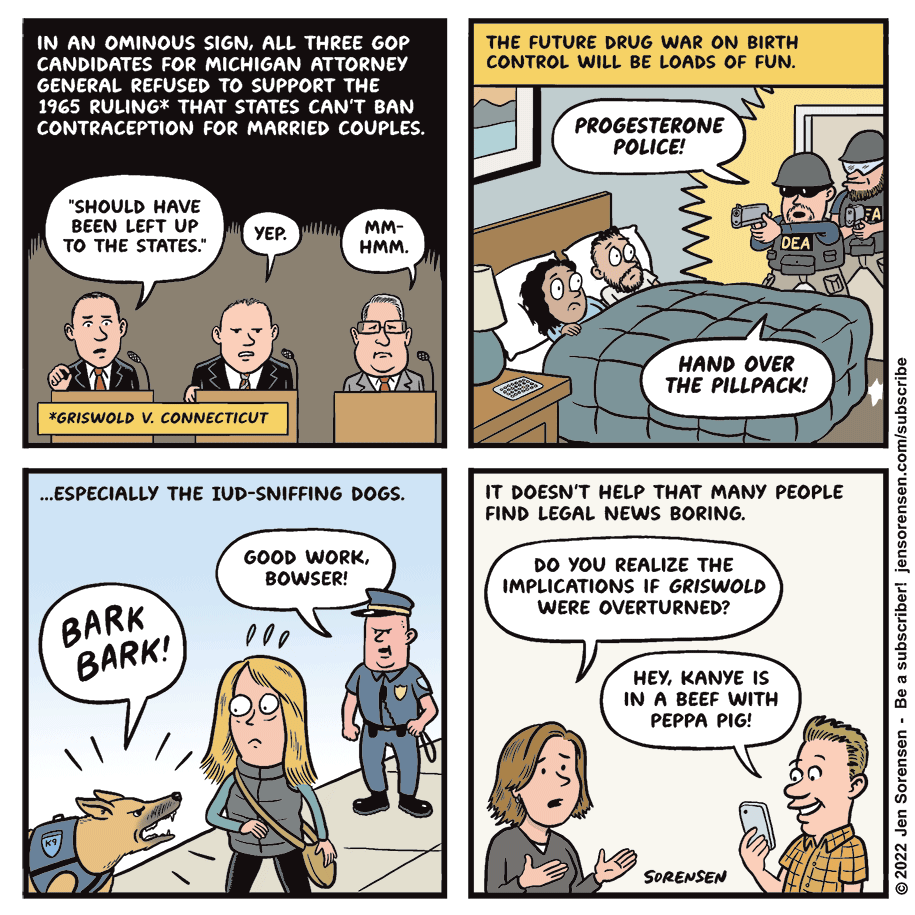
Cartoon: Contraception cops
James.galbraithyup
Support these comics by joining the Sorensen Subscription Service!
Follow me on Twitter at @JenSorensen
Tesla Is Working To Make Steam Video Games Work In Its Vehicles
James.galbraithwhat could possibly go wrong?


Read more of this story at Slashdot.
The Supreme Court will hear a big case about whether religion is a license to discriminate
James.galbraithNo shit. This will end badly.

This is unlikely to go well for LGBTQ people.
In the past few years, the Supreme Court danced around the question of whether religious conservatives have a constitutional right to violate anti-discrimination laws — and specifically laws prohibiting discrimination against LGBTQ people.
Now, it appears ready to come out and say that at least some businesses have a constitutional right to discriminate.
On Tuesday, the Court announced that it will hear 303 Creative v. Elenis, a case that is likely to give at least some businesses a right to openly refuse services to LGBTQ customers.
This question first arose in Masterpiece Cakeshop v. Colorado Civil Rights Commission (2018), where the Supreme Court ruled in favor of a baker who refused to bake a wedding cake for a same-sex couple. Yet, while Masterpiece Cakeshop was a victory for the religious right, it turned out to be a very narrow one. The Court held that states could still enforce bans on anti-LGBTQ discrimination, but that state officials had to be careful not to disparage the religious beliefs of people who use those beliefs to justify discrimination.
Then, in Fulton v. City of Philadelphia (2021), the Court handed down a similar nothingburger opinion, ruling in favor of a government contractor that refused to work with same-sex couples seeking to foster a child — but on exceedingly narrow grounds.
303 Creative presents many of the same questions at issue in Masterpiece Cakeshop and Fulton. It involves a web design company owned by a woman named Lorie Smith, who refuses to create websites celebrating same-sex weddings. She claims that “doing that would compromise my Christian witness and tell a story about marriage that contradicts God’s true story of marriage.”
Thus far, Smith has not sold her services to anyone who wants a wedding-related website, because she fears violating Colorado’s law prohibiting discrimination against LGBTQ people. She wants the Supreme Court to give her license to design wedding websites for opposite-sex couples — and only for opposite-sex couples.
In the likely event that Smith prevails before this very conservative Court, 303 Creative could offer another narrow victory to religious conservatives. Or it could wind up dismantling what remains of a seminal 1990 precedent holding that religious individuals typically need to follow the same laws as everyone else. At the very least, 303 Creative could give people in creative professions a sweeping new right to discriminate.
The Supreme Court appears eager to give religious conservatives sweeping exemptions from the law
In Employment Division v. Smith (1990), the Supreme Court held that people who object to a law on religious grounds must still obey that law, unless it imposes obligations on religious people that don’t apply to secular individuals. In Smith’s words, religious objectors must still follow a “valid and neutral law of general applicability.” (A federal statute applies a stricter rule to federal laws that burden religion, but this rule does not apply to state laws that burden people of faith.)
In other words, a law that prohibits all businesses, regardless of whether their owners are secular or religious, from discriminating against LGBTQ customers complies with Smith. But a law that imposes obligations on religious institutions, but not secular businesses, would likely be found unconstitutional.
Shortly after Justice Amy Coney Barrett’s confirmation gave Republicans a supermajority on the Supreme Court, however, the Court’s new majority started dismantling Smith by redefining what constitutes a “neutral law of general applicability.” As a 5-4 Court held in Tandon v. Newsom (2021), “government regulations are not neutral and generally applicable . . . whenever they treat any comparable secular activity more favorably than religious exercise.”
The Court, moreover, defined the term “any comparable secular activity” quite expansively. Suppose that, at the height of the Covid-19 pandemic, a state placed restrictions on church attendance that it didn’t apply to grocery stores. Under Tandon, the restrictions on churches would be illegal, even though people are much more likely to catch Covid at a highly attended religious service than at a supermarket.
Among other things, people don’t typically gather together for hours in a grocery store, or socialize in a supermarket, or sing hymns while they are buying food. But the Court did not care about these distinctions in Tandon, deeming attending religious services and buying groceries to be “comparable” activities.
In any event, the plaintiffs in 303 Creative argue that Colorado’s anti-discrimination law is not neutral or generally applicable because it only applies to certain forms of discrimination. Among other things, the law permits gender discrimination when such discrimination “has a bona fide relationship” to the services provided by that business. So a women-only gym is allowed to remain a women-only gym.
To be clear, the Court’s previous cases express no view on whether states should permit businesses to engage in gender discrimination. They merely leave the question of whether to permit businesses like single-sex gyms up to state lawmakers. States have historically been allowed to decide which forms of discrimination they wish to prohibit and which ones they wish to permit, and there is a great deal of variation among state anti-discrimination laws.
According to the Human Rights Campaign, for example, about a dozen states have no laws whatsoever prohibiting LGBTQ discrimination, while other states have expansive protections.
In Tandon and similar cases, however, the Court signaled that any law that imposes restrictions on religious objectors is suspect if it provides any exemptions for secular activity. So it’s unlikely that this Court will allow Colorado to apply its anti-discrimination law to religious objectors, because the law does contain an exception for secular businesses such as single-sex gyms.
The Court is likely to tell us just how much it values preventing anti-LGBTQ discrimination
303 Creative also asks just how important preventing anti-LGBTQ discrimination is, in the eyes of the justices.
The lower appeals court that heard 303 Creative largely approached it as a free speech case. Lorie Smith is engaged in an inherently creative activity, making custom websites for her customers, and the Colorado law would make her design websites that promote a message she disagrees with — a message supporting a same-sex wedding. That’s the sort of compelled speech that the First Amendment typically forbids.
Yet the lower court ruled against Smith, pointing to a test known as “strict scrutiny.”
As a general rule, there are few absolutes under the Constitution. Though laws compelling speech, discriminating on the basis of race, or singling out religious people for inferior treatment are all presumptively unconstitutional, such laws can survive judicial review when they advance particularly important goals — that is, when they advance a “compelling interest” and when the law is “narrowly tailored to satisfy that interest.”
The lower court determined that Colorado has a compelling interest in “ensuring ‘equal access to publicly available goods and services,’” and that the state’s anti-discrimination law is properly tailored to achieve that goal. Exempting Lorie Smith from that law, the court explained, “would necessarily relegate LGBT consumers to an inferior market.”
But the Supreme Court has suggested that preventing anti-LGBTQ discrimination is not a “compelling interest” that can survive the strict scrutiny test. In Burwell v. Hobby Lobby (2014), a majority of the Court concluded that “the Government has a compelling interest in providing an equal opportunity to participate in the workforce without regard to race,” but it rather pointedly did not state that the government has a compelling interest in preventing anti-LGBTQ discrimination — of, for that matter, in preventing discrimination on the basis of gender.
Moreover, while Masterpiece Cakeshop and Fulton were narrow decisions, both permitted plaintiffs who refused to provide services to LGBTQ individuals to engage in such discrimination.
The Court has been signaling for a while, in other words, that it is likely to grant religious objectors a license to violate laws prohibiting anti-LGBTQ discrimination. At the very least, 303 Creative is likely to give Smith a license to do so, and it could very well give an expansive license to all business owners who claim that their religion requires them to discriminate against LGBTQ people.
Saturday Morning Breakfast Cereal - Econs
James.galbraithlol
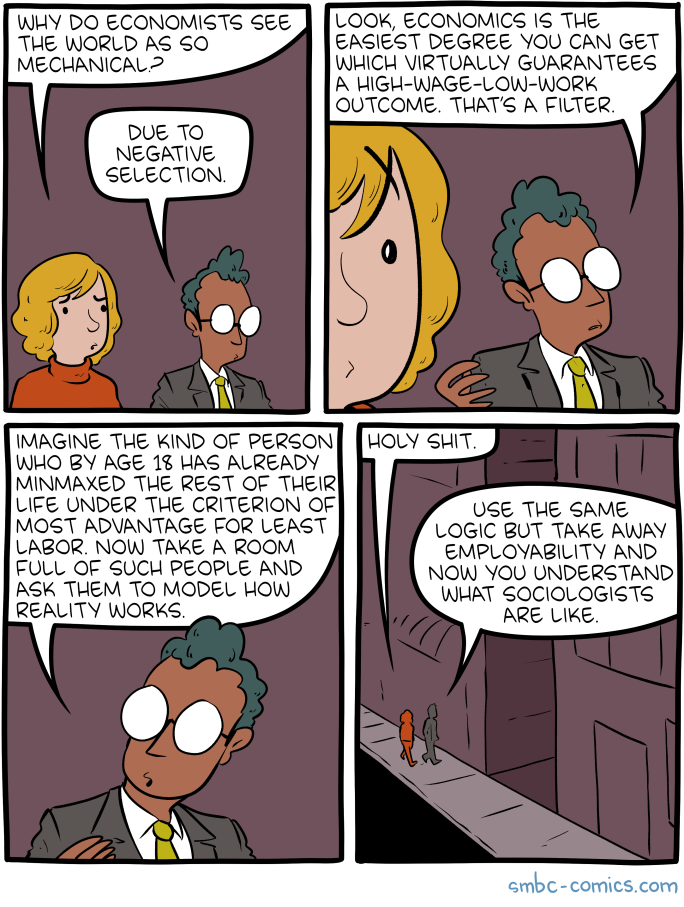
Click here to go see the bonus panel!
Hovertext:
I feel this is a universal and underappreciated phenomenon. Like, consider how all poetry is written by the kind of people who are attracted to poetry classes.
Today's News:
Do ‘Stand Your Ground’ Laws produce more gun homicides?
James.galbraithBrought to you by the Party of Life (tm)
Rick Scott reveals the GOP’s election strategy: All culture war, all the time
James.galbraithBingo
[Josh Blackman] SCOTUS Grants Cert in 303 Creative On Free Speech Question
James.galbraithThis will go badly
[The Court did not accept the question presented on the Free Exercise Clause.]
The Supreme Court has granted cert in 303 Creative v. Elenis. That petition presented two questions:
1. Whether applying a public-accommodation law to compel an artist to speak or stay silent, contrary to the artist's sincerely held religious beliefs, violates the Free Speech or Free Exercise Clauses of the First Amendment.
2. Whether a public-accommodation law that authorizes secular but not religious exemptions is generally applicable under Smith, and if so, whether this Court should overrule Smith.
Once again, the Court narrowed the QP:
The petition for a writ of certiorari is granted limited to the following question: Whether applying a public-accommodation law to compel an artist to speak or stay silent violates the Free Speech Clause of the First Amendment.
The Court will punt the Smith question for another day.
303 Creative was first distributed on January 7, so this case did not linger for long.
The post SCOTUS Grants Cert in <i>303 Creative</i> On Free Speech Question appeared first on Reason.com.
Republicans have found their goal: Turn back the clock to the 1950s
James.galbraithThis isn't news
Ivermectin fails another COVID trial as study links use to GOP politics
James.galbraithno shit

Enlarge / Tablets of ivermectin. (credit: Getty | Nurphoto)
The antiparasitic drug ivermectin failed to treat COVID-19 in yet another randomized clinical trial, but the drug remains popular amid the pandemic thanks to Republican politics. That's the takeaway from two separate studies published Friday in JAMA Internal Medicine.
Together, the studies raise yet more concerns for the use of ivermectin against the pandemic virus—as well as the reasons behind its use, which appear politically motivated.
"Political affiliation should not be a factor in clinical treatment decisions," the Harvard researchers behind one of the studies concluded. "Our findings raise concerns for public trust in a non-partisan health care system."
Read 11 remaining paragraphs | Comments
'Crypto Ruined My Life': the Mental Health Crisis Hitting Bitcoin Investors
James.galbraithBecause it's not investing, it's straight up gambling
Read more of this story at Slashdot.
After Blackouts, Texas Became a Top State for New Solar Installations as Thousands Install Microgrids
James.galbraithWhat happens when you can't depend on government...
Read more of this story at Slashdot.
The Supreme Court is not being honest with you
James.galbraithNo shit. It's just white christian supremacy cloaked in legal language.

Justice Amy Coney Barrett appears to be quite unfamiliar with her own judicial record, and that of her colleagues.
Justice Amy Coney Barrett delivered a speech this week that echoed decades of conservative talking points about the proper, limited role of judges in a democracy. But that restrained vision is completely divorced from Barrett’s own conduct as a conservative justice — not to mention that of the Republican majority she consistently votes with.
Her remarks, which were offered at an academic symposium hosted by Notre Dame Law School, were grounded in the rhetoric of judicial restraint that Republican politicians have used to talk about the proper role of the courts at least as far back as Richard Nixon.
The Court’s youngest justice drew a distinction between “pragmatists,” judges who “tend to favor broader judicial discretion,” and “formalists,” who “tend to seek constraints on judicial discretion” and “favor methods of constitutional interpretation that demand close adherence to the constitutional text, and to history and tradition.” She placed herself in the latter camp.
As a justice, however, Barrett has behaved as an unapologetic pragmatist. Along with the Court’s other Republican appointees, Barrett supports flexible legal doctrines that give her Court maximal discretion to veto federal regulations that a majority of the justices disagree with — especially regulations promoting public health or protecting the environment. And she’s joined her fellow Republican justices in imposing novel limits on the Voting Rights Act that appear nowhere in the law’s text.
The rhetoric of judicial restraint is potent, so it is understandable why Barrett wants to tap into that potency. Formalist rhetoric enables the justices to claim that they didn’t roll back voting rights or strike down a key prong of President Joe Biden’s efforts to promote vaccination because they prefer weaker voting laws and a flaccid public health system — they simply did what the law requires.
And Barrett is hardly the only justice to engage in such rhetoric. Justice Neil Gorsuch recently published an entire book claiming that judges should rely almost exclusively on the text of a statute or constitutional provision while interpreting it. Justice Clarence Thomas frequently calls for radical shifts in the law, claiming they are necessary to restore the “original understanding” of the Constitution. Even Justice Samuel Alito, the Court’s most partisan justice, recently attributed his new, entirely atextual limits on the Voting Rights Act to having taken “a fresh look at the statutory text.”
The problem with this rhetoric, in short, is that it bears no resemblance whatsoever to the current Supreme Court’s actual behavior.
“Pragmatism” v. “formalism,” briefly explained
Barrett was at Notre Dame to deliver the keynote address at a symposium on “The Nature of the Federal Equity Power,” a topic that, as Barrett wryly acknowledged in her speech, “sounds like one that only a law professor could love.”
As Barrett explains, “equity” is a legal concept that arose in England as a way of mitigating harsh outcomes that were required by inflexible legal rules. The English system even had a special court, the Court of Chancery, which was a “place for litigants to come” when ordinary legal rules were “too harsh.”
This dual court system, Barrett explained, highlighted a “tension between the demands of the law, which constrains, and the demands of fairness, which is flexible.” Ordinary judges were more akin to mechanical dispensers of legal rules, while judges applying equitable principles had more leeway to reach results they deem fair.
If that tension sounds familiar, Barrett told an audience of mostly law students that it should. “It’s the same dispute that we see in a context that’s probably more familiar to you — the context of constitutional interpretation.”
According to Barrett, there are two opposing sides in this dispute. “Formalists,” such as herself and the late Justice Antonin Scalia, who “favor methods of constitutional interpretation that demand close adherence to the constitutional text, and to history and tradition.” Meanwhile, Barrett claims that “pragmatists” favor a more flexible approach that is less concerned with applying consistent legal rules, and more concerned about the harsh results that can arise from a too-rigid adherence to legal texts.
Most of what Barrett said at Notre Dame is uncontroversial. She fairly summarizes the development of English courts of equity. She is also correct that modern-day judges frequently divide into what she describes as the formalist and pragmatic camps.
But Barrett is wrong to label herself a formalist. In her brief tenure on the Supreme Court, she’s shown extraordinary willingness to join other Republican-appointed justices in opinions that bend the rules of the law in order to achieve results they deem to be just.
No one who joined the Court’s opinion in Whole Woman’s Health v. Jackson can claim to be concerned about the rule of law
Flexibility — what Barrett labels judicial “pragmatism” — is the hallmark of the Roberts Court, and especially the new, proudly conservative majority that Barrett’s confirmation brought into being. The Court’s most high-profile decisions will sometimes ignore the text of the Constitution, or of a major statute, altogether. And the Court frequently applies harsh legal rules to disfavored litigants that it would never apply to political conservatives.
As Scalia once explained, the formalistic demand that legal rules must apply universally to all similarly situated litigants is one of the most important constraints on judicial discretion. “When, in writing for the majority of the Court, I adopt a general rule,” the late justice wrote in 1989, “I not only constrain lower courts, I constrain myself as well.” Because “if the next case should have such different facts that my political or policy preferences regarding the outcome are quite the opposite, I will be unable to indulge those preferences.”
And yet, the current Court doesn’t seem to just indulge such a preference, it revels in it. The most blatant example is the 5-4 decision in Whole Woman’s Health v. Jackson (2021), which Barrett joined in full.
Jackson involved Texas’s anti-abortion law SB 8, a law that effectively bans all abortions after six weeks, in violation of the fetal viability standard established in Planned Parenthood v. Casey (1992). And SB 8 was, in Justice Sonia Sotomayor’s words, designed to “evade judicial scrutiny.”
Ordinarily, when someone wishes to challenge an unconstitutional state law in federal court, they are not allowed to sue the state directly. Rather, such a plaintiff must sue the state official charged with enforcing that unconstitutional law. But Texas tried to design SB 8 so that no state official would be empowered to enforce its anti-abortion provisions — and thus no one could be sued to block the law.
SB 8 relies on a bounty hunter system. Under SB 8, “any person” except for an employee of the state of Texas may bring a lawsuit against any abortion provider accused of performing an abortion after the sixth week of pregnancy. If an abortion provider loses such a suit, they must pay the plaintiff a bounty of at least $10,000 — and there is no upper limit on this bounty.
SB 8, in other words, terrorizes abortion providers by potentially subjecting them to hundreds or even thousands of lawsuits if they are suspected of violating SB 8’s terms.
As Chief Justice John Roberts explains in a dissenting opinion in Jackson, Texas did not actually succeed in writing a law that is not enforced by state officials — and is therefore immune from federal judicial review. Because “the mere threat of even unsuccessful suits brought under SB 8 chills constitutionally protected conduct,” Roberts wrote, “court clerks who issue citations and docket SB 8 cases are unavoidably enlisted in the scheme to enforce SB 8’s unconstitutional provisions, and thus are sufficiently ‘connect[ed]’ to such enforcement to be proper defendants.”
But the five most conservative justices, including Barrett, all backed Texas’s play. Barrett joined an opinion by Gorsuch that effectively immunized SB 8 from any federal lawsuit challenging Texas’s bounty hunter system. (Technically, Gorsuch’s opinion allowed suits to move forward against state health officials who play a minor role in enforcing the law, but their role in doing so is so small than a hypothetical court order against these officials would be basically useless.)
The implications of this decision are staggering. As Roberts writes in dissent, quoting from an 1809 Supreme Court opinion, “if the legislatures of the several states may, at will, annul the judgments of the courts of the United States, and destroy the rights acquired under those judgments, the constitution itself becomes a solemn mockery.” Jackson provides every state with a roadmap that it can use to neutralize virtually any constitutional right.
So what’s really going on here? Would Barrett really vote to uphold a state law subjecting all gun owners to SB 8-style lawsuits? That seems unlikely. Among other things, Barrett is an outspoken proponent of more expansive gun rights. And a majority of the justices appeared inclined to expand the scope of the Second Amendment significantly during a separate case that was argued last November.
But the disagreement between the majority and dissenting opinions in Jackson can be explained by the distinction between formalism and pragmatism that Barrett draws in her Notre Dame speech.
In Jackson, Chief Justice Roberts — a conservative who typically opposes abortion rights — nevertheless takes the formalists’ position: The Constitution is the supreme law of the land. States must follow it. They also must follow Supreme Court decisions, like Roe v. Wade, that interpret the Constitution.
Meanwhile, Justice Barrett, an outspoken opponent of abortion rights, takes the pragmatist’s approach. The opinion she joined in Jackson makes no sense as a matter of legal formalism — taken seriously, it would allow a state government to nullify nearly any constitutional right, including rights that Barrett no doubt wishes to enforce. But the lead opinion in Jackson makes perfect sense if you believe that abortion is murder, and so the interests of justice must bend to the formal demands of the law.
The Court’s Republican majority is giving itself a flexible power to veto federal regulations
Barrett’s pragmatic approach to the law, and that of her Republican colleagues, is also on display in their decisions weighing the Biden administration’s power to protect public health.
Recall that Barrett defined a pragmatic judge as one who tends “to favor broader judicial discretion,” and formalistic judges as those who “tend to seek constraints on judicial discretion.” Since joining the Court, Barrett has sought to maximize her own discretion to veto federal regulations, while eliminating longstanding constraints on judicial power. And she’s largely succeeded in these efforts because she has five colleagues who share the same goal.
Consider the Court’s recent decisions in National Federation of Independent Business (NFIB) v. Department of Labor (2022), which struck down the Biden administration’s rule requiring most workers to either be vaccinated against Covid-19 or be regularly tested for the disease, and Alabama Association of Realtors v. Department of Health and Human Services (2021), which struck down the Centers for Disease Control and Prevention’s eviction moratorium in areas with substantial levels of Covid transmission.
Both cases questioned the power of federal agencies to write binding national regulations under long-existing federal statutes empowering those agencies to do just that. Before former President Donald Trump started remaking the judiciary, the Court’s decisions governing such rules urged judges to be deferential to both the agencies themselves and to the Congress that delegated such power to an agency.
In Mistretta v. United States (1989), for example, the Court held that judges should be exceedingly reluctant to strike down an act of Congress giving a federal agency the power to regulate. And Chevron v. Natural Resources Defense Council (1984) held that courts should typically defer to federal agencies, regarding the scope of the agency’s authority to regulate, if the statute permitting the agency to issue binding rules is ambiguous.
Thus, under Barrett’s distinction between formalist and pragmatic judges, both Mistretta and Chevron are formalistic decisions. Both impose “constraints on judicial discretion,” by requiring that judges defer to federal agencies.
In NFIB and Alabama Association of Realtors, however, the Court walked away from this more restrained approach to judging — with Barrett joining the majority in both decisions. Both cases relied on the so-called “major questions doctrine,” a doctrine that was invented entirely by judges, and that has no basis in any statute or in the Constitution’s text.
This doctrine places vague limits on federal agencies’ power to issue regulations that are likely to have a significant impact. “We expect Congress to speak clearly when authorizing an agency to exercise powers of ‘vast economic and political significance,’” the Court stated in both the NFIB and the Alabama Association of Realtors cases.
The problem with this major questions doctrine is, as federal appellate Judge Jane Stranch wrote in a lower court opinion upholding the Biden administration’s vaccination rules, “the doctrine itself is hardly a model of clarity, and its precise contours—specifically, what constitutes a question concerning deep economic and political significance—remain undefined.” The Court also hasn’t explained just how “clearly” Congress must “speak” if it wishes to delegate important powers to a federal agency.
The major questions doctrine, in other words, is an invitation to pragmatic judging. The major questions doctrine maximizes judicial discretion because it is so vague, and thus permits judges to invoke it whenever they disagree with a federal regulation and wish to strike it down. After all, if no one can say for sure “what constitutes a question concerning deep economic and political significance,” then the ultimate answer to this question will rest with Barrett’s court.
The same can be said about the nondelegation doctrine, a similarly vague constraint on federal agencies advanced by Barrett’s five Republican colleagues. (The Court’s most recent majority opinion discussing this doctrine, Little Sisters v. Pennsylvania, was decided a few months before Barrett joined the Court in 2020. So there is still a little uncertainty regarding Barrett’s views on nondelegation.)
The nondelegation doctrine would scrap the deferential approach that the Court advocated in Mistretta. In Gorsuch’s words, nondelegation calls upon judges to strike down federal laws permitting agencies to regulate, unless those laws were “‘sufficiently definite and precise to enable Congress, the courts, and the public to ascertain’ whether Congress’s guidance has been followed.”
Thus, like the major questions doctrine, the nondelegation doctrine is so vague that it maximizes the discretion of judges to restrict federal agencies. It is a fundamentally pragmatic doctrine under Barrett’s distinction between pragmatic and formalistic judges.
The Court needs to be more honest about what it’s actually doing
Opinions like Jackson, NFIB, and Alabama Association of Realtors are quite disingenuous about what the Court is actually up to in those decisions.
Gorsuch’s opinion in Jackson, for example, tries to present his Constitution-destroying approach as a simple application of a formalistic rule prohibiting federal courts from issuing court orders against state courts. “If it caught on and federal judges could enjoin state courts and clerks from entertaining disputes between private parties under this state law,” Gorsuch wrote, “what would stop federal judges from prohibiting state courts and clerks from hearing and docketing disputes between private parties under other state laws?”
Similarly, the Court often justifies doctrines like nondelegation and major questions by claiming that they are necessary to restore the framers’ vision for how power would be shared between Congress and the executive branch. But, as law professors Julian Davis Mortenson and Nicholas Bagley explain in an important paper, this justification is ahistorical. The first Congress — a Congress made up of many of the Constitution’s drafters — enacted several laws delegating sweeping authority to federal agencies.
I could list more examples of the Court disguising pragmatic legal decisions with a patina of formalistic rhetoric. In Brnovich v. Democratic National Committee (2021), for example, the Court fabricated a bunch of new limits on the Voting Rights Act that appear nowhere in the law’s text — including a strong presumption that voting restrictions that were in place in 1982 are lawful, or a similar presumption favoring state laws purporting to prevent voter fraud. As Justice Elena Kagan wrote in dissent, Brnovich “mostly inhabits a law-free zone.”
But that didn’t stop Justice Samuel Alito, who wrote Brnovich, from claiming that his opinion would “start with a careful consideration of the text” of the Voting Rights Act. Nor did Brnovich’s profoundly pragmatic approach stop Barrett from joining Alito’s opinion.
It would be one thing if this Supreme Court were honest about what it is doing. It could write explicitly pragmatic opinions — which emphasize the justices’ desire to reach results that a majority of them deem to be fair, and which admit openly that these results cannot be justified by any provision of the Constitution or any federal statute.
But the Court is not being honest about what it is doing. Rather than admitting that they are engaged in an unfettered, pragmatic approach to judging, the conservative justices continue to wrap themselves in the rhetoric of judicial formalism. Barrett’s Notre Dame speech is only the most recent example.
Republican positions are abhorrent and radical. Democrats must go on the attack
James.galbraithSeriously...
If Democrats don’t answer Republican hits, the party operatives warned, the GOP’s lead on the generic ballot balloons to 14 points from 4 points — a dismal prediction for Democrats when the GOP only needs to win five seats to seize back the majority. But when voters heard a Democratic response to that hit, Republicans’ edge narrowed back down to 6 points, giving candidates more of a fighting chance, especially since those numbers don’t factor in Democrats going on the offensive.
The notion that offering direct rebuttals to GOP attacks blunts the fallout to just a 6-point Democratic deficit doesn't exactly inspire confidence—especially when, in the main, those GOP attacks are entirely bogus.
So yes, Democrats, respond directly, and then pivot—immediately. There's no reason Democrats should spend the bulk of 2022 on defense when the Republican Party just spent two weeks debating whether an armed insurrection targeting U.S. lawmakers was a "legitimate" protest.
Democrats, including the DCCC, must put a significant amount of energy into demonstrating just how radical the Republican Party has become on everything from abortion to guns to the economy and even the deadly Jan. 6 insurrection. Republicans have truly given Democrats an embarrassment of riches to work with, but Democrats absolutely must focus on making the case to voters. Just to scratch the surface, here are several key issues that can absolutely work in Democrats’ favor.
1) Abortion—the GOP-packed Supreme Court is likely to gut Roe v. Wade and turn back the clock a century on women's rights. Every single Democratic candidate and incumbent should be talking about the issue and trying to nail down their opponent's position on the upcoming ruling and any current bills in their home state. OUTLAWING ABORTION IS NOT A WINNING ISSUE FOR REPUBLICANS IN SWING STATES AND DISTRICTS—AND THEY KNOW IT.
2) Crime and "law and order"—Republicans want to talk about the rising crime rate and how Democrats supposedly don't support police. Okay, how about passing gun reforms? If Republicans are worried about crime, why do they oppose super basic gun measures like passing background checks?
Also, if Republicans are so big on law and order, how do they feel about pardoning the Jan. 6 seditionists who bludgeoned police officers, as Trump has promised? And do they support the national GOP's embrace of the deadly Jan. 6 attack as "legitimate political discourse"? EVERY SINGLE REPUBLICAN SHOULD BE FORCED TO ANSWER THESE QUESTIONS BECAUSE THEY SPLIT TRUMP-SUBURBAN VOTERS.
3) Education—Why are Democrats taking the brunt of the education debate when Republicans are enacting parental censorship of curricula and promoting book bans and book burnings? Data for Progress just released polling that found 71% of likely voters don't support giving local school boards the power to ban books, including 66% of independents and 64% of Republicans. EVERY TIME A REPUBLICAN BRINGS UP CRITICAL RACE THEORY, THEY SHOULD BE ASKED WHETHER THEY SUPPORT CENSORSHIP, BOOK BANS, AND GIVING ONE PARENT VETO POWER OVER THE EDUCATION OF ANOTHER PARENT’S KID.
4) Vaccines, masking—There are a million ways to tease out the GOP's anti-vaxx, anti-mask policies, which have not only cost lives, but have also hobbled the economic recovery, efforts to keep schools open, etc. Here's the bottom line—PROMOTING PERSONAL FREEDOMS THAT POSE A MENACE TO THE 70% OF AMERICANS WHO HAVE GOTTEN VACCINATED ISN'T POPULAR.
5) The economy—If Republicans are so concerned about the economy, why did they vote against funding to keep small businesses afloat in the American Rescue Plan?
If they're supposedly concerned about American families, why did they all uniformly oppose increasing the child tax credit—an actual tax cut for American families?! REPUBLICANS UNIFORMLY VOTED AGAINST A TAX CUT FOR AMERICAN FAMILIES AND HELPING SMALL BUSINESSES SURVIVE THE PANDEMIC.
Honestly, this is just the tip of iceberg, but Republicans are now a radicalized party that exists outside mainstream American values on almost every issue that will be relevant in this year's midterms. The fact that Republicans are running several points ahead in the generic ballot suggests Democrats simply are not connecting on the issues that matter most to voters. But Democrats certainly shouldn't spend all their time rebutting Republican attacks when nearly every GOP policy is designed to appeal to like one-third of Americans.
There’s plenty of fodder Democratic candidates can use to paint Republicans into a corner; they just need to pick their issues and go on offense.

Trump attorney's concerned that Trump can't plead the Fifth without looking guilty ... like everyone
James.galbraithIt'll be interesting to see how this goes, but maybe a glimmer of hope
After Judge Arthur Engoron’s ruling on Thursday, Trump’s legal team was open about the possible result, as ABC reported.
“If she wants sworn testimony from my client,” said Trump’s latest criminal defense lawyer Ronald Fischetti, “he’s entitled to immunity. He gets immunity for what he says, or he says nothing,”
This is a case about the corrupt finances of the Trump Organization. The Trump Organization is not the property of stockholders, or of partners. It is owned 100% by Donald J. Trump. Giving Trump immunity in exchange for his testimony would be like giving Jeffery Dahmer immunity to find out where he bought his spices. This is not happening.
But, says Trump’s criminal attorney, “If [Trump] goes in and follows my advice, which will be you cannot answer these questions without ... immunity because that’s what the law provides, and take the Fifth Amendment, that’ll be on every front page in the newspaper in the world. And how can I possibly pick a jury in that case?”
Yeah. That’s a problem. How, asks Fischetti, can Trump invoke his right to refuse to testify on the grounds that it might incriminate him without potential jurors thinking that makes him look guilty?
The answer is simple enough: He can’t. This isn’t some unique burden exclusive to Trump; it’s one that faces anyone who invokes their Fifth Amendment right. Refusing to testify on the grounds that it can make you seem guilty ... makes you seem guilty. Wait, it makes you look “guilty as hell!” There is no getting past that. Which is why, outside Trump’s circle, where it seems to be the in fad, using this means of avoiding testimony is relatively rare.
In a criminal case, an attorney can’t expressly draw the jury’s attention to the fact that someone has invoked their Fifth Amendment rights, or try to get jurors to take any implications from that action. But that doesn’t mean that jurors will fail to notice, or that they won’t draw their own conclusions.
Invoking the Fifth may be less damaging than either giving false testimony that can be disproven in court, or giving truthful testimony that provides direct evidence of guilt. Still, it’s anything but invisible.
As The Washington Post reports, pleading the Fifth in a civil case has even more consequences:
“You can do it, and you won’t be held in contempt for failing to testify. … But a decision to take the Fifth may be used against a party in a civil case (if the party is the witness who refuses to testify, or is closely enough connected to the witness).”
In a civil case, the prosecuting attorney can point out that someone has pleaded the Fifth and can invite the jury to draw conclusions from that action. At the moment, the investigation into the Trump Organization is expected to generate a civil proceeding. Followed by a likely criminal proceeding. And the testimony in the first could be admissible in the second.
This, according to the Post, puts Trump between “a rock and a hard place.”
“Given the concurrent criminal and civil investigations, it seems rather obvious he would plead the Fifth (notwithstanding his past commentary on such things) to avoid divulging potentially revealing information that could be used against him in the former case. … But declining to testify in a civil case can hurt his cause there — even beyond the mere perception that he’s being evasive.”
Any move by Trump to take the Fifth, and those “hundreds of times” that Eric tagged out in that same way, can absolutely be mentioned to the jury in a civil proceeding. Civil is just a legal term, Donny. It doesn’t mean they have to be nice.

New York Mayor Eric Adams Calls Out NYC Workers To Return To Offices
James.galbraithThis guy sure is hell bent on governing like a Republican
Read more of this story at Slashdot.
A Trump judge’s new decision would undo more than 50 years of voting rights law
James.galbraithYup. Anything in the name of white supremacy

Trump Judge Lee Rudofsky’s decision could completely neutralize the Voting Rights Act when the GOP controls the White House.
A Trump-appointed judge handed down a decision on Thursday that, if embraced by the Supreme Court, would render crucial safeguards against racial discrimination in elections virtually unenforceable — particularly during Republican administrations.
To be clear, this is a decision by a federal trial judge, which means that it must survive contact with an appeals court and the Supreme Court before its narrow approach to voting rights becomes the law of the land. Nevertheless, the Supreme Court’s 6-3 Republican majority is typically hostile to voting rights suits, so there is a very real risk that they will agree with this trial judge.
The case is Arkansas State Conference NAACP v. Arkansas Board of Apportionment, and the plaintiffs claim that Arkansas’s statehouse maps are racially gerrymandered in violation of the Voting Rights Act (VRA), the landmark civil rights law that probably did more than any other statute to end Jim Crow. Among other things, the plaintiffs note that the maps contain only 11 (out of 100) majority-Black districts, even though Black voters make up more than 16 percent of the state’s population.
But Lee Rudofsky, the Trump judge assigned this case, barely engages with the substance of this racial gerrymandering claim. Instead, Rudofsky concludes that such a claim “may be brought only by the Attorney General of the United States” and not by private plaintiffs.
Private suits enforcing the VRA have been a fixture of American civil rights law since the 1960s. As the Supreme Court explained in Allen v. State Board of Elections (1969), “the achievement of the Act’s laudable goal could be severely hampered ... if each citizen were required to depend solely on litigation instituted at the discretion of the Attorney General.” Among other things, “the Attorney General has a limited staff and often might be unable to uncover quickly” new state policies that target voters of color.
And a law that only the attorney general can enforce will be utterly useless if the attorney general does not choose to enforce it. During the entire Trump administration, for example, the Justice Department’s voting section brought only one lawsuit alleging discrimination under the Voting Rights Act — and that was a fairly minor suit alleging that the method of electing school board members in a South Dakota school district “dilutes the voting strength of American Indian citizens.”
Nevertheless, Rudofsky now seeks to neutralize one of the most important protections against racism in American elections.
Rudofsky opinion is wrong
The most straightforward reason why Rudofsky is wrong is that the Supreme Court determined that he is wrong in Morse v. Republican Party of Virginia (1996). In that case, a majority of the Court concluded that Section 2 of the VRA, the provision at issue in Arkansas State Conference, is enforceable through private lawsuits.
Additionally, while the Voting Rights Act does not contain any language which explicitly states that “private plaintiffs may sue under this law,” it does contain some provisions which make no sense unless private suits are permitted. One provision, for example, states that federal courts hearing VRA lawsuits shall exercise their jurisdiction “without regard to whether a person asserting rights” under the VRA has exhausted other potential legal remedies.
It makes no sense for the VRA to contain a provision referring to “a person asserting rights” in a Voting Rights Act lawsuit unless the law permits such a person to assert those rights in the first place.
Rudofsky wants to shift the goalposts in order to neutralize the Voting Rights Act
Rudofsky’s primary argument is that Allen and Morse do not apply because the Supreme Court has since abandoned their approach to interpreting federal laws, and that the VRA must be retroactively reinterpreted in line with this new approach.
The Voting Rights Act became law in 1965. One year earlier, in J.I. Case v. Borak (1964), the Supreme Court established that federal statutes should generally be read broadly to permit enforcement by private lawsuits. “It is the duty of the courts to be alert to provide such remedies as are necessary to make effective the congressional purpose,” Borak explained.
Thus, the Congress that wrote the Voting Rights Act operated under the assumption that it did not need to explicitly write a private right to sue into the statute because the Supreme Court had recently signaled that private suits are permitted when a federal law would be ineffective without them. The Court validated this reading of the VRA four years later in Allen.
Then, nearly four decades after Congress wrote the VRA — and 19 years after Congress enacted important amendments to the law in 1982 — the Court decided Alexander v. Sandoval (2001), which laid out a much stingier approach to private lawsuits. Sandoval does contain some language that undermines the case for permitting private suits under the Voting Rights Act.
Sandoval, for example, states that “statutes that focus on the person regulated rather than the individuals protected create ‘no implication of an intent to confer rights on a particular class of persons’” — so if a federal law uses language like “no state shall do X” instead of “all persons have a right to X,” courts typically should not permit private lawsuits under that statute.
The relevant provision of the Voting Rights Act uses both kinds of language — it starts with the phrase “no voting qualification or prerequisite to voting or standard, practice, or procedure shall be imposed or applied by any State,” but then goes on to forbid any voting practice “which results in a denial or abridgement of the right of any citizen of the United States to vote.”
But there are good reasons not to read Sandoval too restrictively with respect to the VRA. One is that, while Sandoval does lay out some interpretive guidelines that courts can use to determine whether a particular law permits private lawsuits, Sandoval also states that “the judicial task is to interpret the statute Congress has passed to determine whether it displays an intent to create not just a private right but also a private remedy,” and that “statutory intent on this latter point is determinative.”
And, in this case, there is overwhelming evidence that Congress intended the Voting Rights Act to contain a private right that is enforced by private lawsuits. Again, Congress wrote the law against the backdrop of decisions like Borak, which emphasized that private parties should generally be allowed to sue to enforce their legal rights. Federal courts have understood the law to permit private suits at least as far back as 1969, when the Court decided Allen. And Congress has amended the VRA multiple times, but it’s never questioned the longstanding assumption that the law permits private lawsuits.
Justice John Paul Stevens, moreover, anticipated Rudofsky’s objection to an enforceable Voting Rights Act in an opinion he wrote in the Morse case. Recognizing that the law governing when private parties are allowed to sue under federal statutes was in flux in 1996, when Morse was decided, Stevens acknowledged that a decision proving that only the attorney general may enforce the law “might have been correct if the Voting Rights Act had been enacted recently.” But such a decision would fail “to give effect to our cases holding that our evaluation of congressional action ‘must take into account its contemporary legal context.’”
Stevens, in other words, relied on a fairly basic rule of fundamental fairness. Courts should not interpret a statute written in 1965 using interpretive rules that the Court came up with years later. If Congress had known about Sandoval when it wrote the Voting Rights Act, it would have known to use more explicit language. But Congress did not have a time machine.
In any event, Rudofsky is not alone in his desire to burn down a landmark civil rights statute because lawmakers in 1965 failed to predict the future. Concurring in Brnovich v. DNC (2021), Justice Neil Gorsuch claimed that “our cases have assumed — without deciding — that the Voting Rights Act of 1965 furnishes an implied cause of action under §2,” and suggested that he would eliminate this right of private parties to sue under the law.
Gorsuch’s opinion was joined by only one other justice, Justice Clarence Thomas. So it is not the law. But given this Supreme Court’s record of hostility toward the Voting Rights Act, there is no guarantee that Gorsuch won’t find five votes to affirm Rudofsky’s decision.
Uncharted film review: This is how you don’t adapt a video game
James.galbraithYeah, pass. Holland is very very pretty, but there are plenty of other sources of pretty people in bad movies lol

Enlarge / Tom Holland stars as Indi—er, as Nathan Drake in Columbia Pictures' Uncharted. (credit: Columbia Pictures)
Imagine a video game sequel that does away with pretty much everything fans liked about the original. There's less action, uninteresting puzzles, boring environments, plot holes big enough to drive a "Hog Wild" seaplane through, and, perhaps worst of all, dull dialogue. This imaginary game opens with an interminable 80-minute cut scene, only to be followed by an energetic action sequence that recalls the original game's best moments.
That's what the first-ever Uncharted film feels like. It's based on the popular PlayStation-exclusive game series of the same name, and it stars the same main characters. But while it's reminiscent of the Indiana Jones films that inspired the video games, the movie doesn't have the same breezy, comical, action-packed magic of that franchise—or of the Uncharted games. How wild that a video game delivers better movie-like thrills than its live-action version.
A brief glimpse of gold

"Professor, what's another word for pirate treasure?" "Drake, stop asking me that question." (credit: Columbia Pictures)
The final scene is the only decent part of this movie, so I'll start there. Like its namesake game series, this week's theatrical exclusive is all about adventurers surviving fistfights and solving mysteries while searching for an ancient-treasure jackpot. Uncharted's booty is a doozy: two stranded, treasure-filled pirate ships, somehow hidden from all satellite and radar imaging or explorers for over 500 years. A villain captures the ships and decides to airlift them via helicopters.
Read 9 remaining paragraphs | Comments
John Durham issues court filing to disown the Fox News fake conspiracy that he started
James.galbraithHe's a hack, no shit.
Why Durham’s latest filing confirms that Trump was never ‘spied on’
The information contained in that sentence and one other inserted as “factual background” were pointedly not part of the evidence on which Sussman was indicted, and it’s unclear that either was ever seen by the grand jury.
Sussman has pleaded not guilty to the single charge of lying to the FBI. On Thursday, Sussman’s attorneys filed a motion to dismiss the case, accusing Durham of "extraordinary prosecutorial overreach" and saying the charge is about an incident which is "immaterial and cannot give rise to criminal liability."
On Thursday, Durham filed another motion defending his filing from earlier in the week. In this latest filing, Durham says that he included “limited additional factual detail” in that earlier motion for “valid and straightforward reasons.” Durham argues that there’s no reason to strike any part of his earlier motion despite how these claims “could garner media attention.” He goes on to cite several cases in which evidence was admitted in spite of it being misinterpreted by the media … which may not be the great defense of this action that Durham seems to believe it to be.
But in explaining why the information was slipped in despite the CIA meeting not being the subject of any charge or connected to any claim against Sussman, Durham said this:
“… the Government included these paragraphs to apprise the Court of the factual basis for one of the potential conflicts described in the Government’s Motion, namely, that a member of the defense team was working for the Executive Office of the President of the United States (“EOP”) during relevant events that involved the EOP.”
Since the original motion was a claim of potential conflict of interest by a member of the law firm representing Sussman, and that member worked with the White House during the term of President Barack Obama, this is a clear statement that the connection with the EOP that Durham is alleging took place before Trump took office.
Since the meeting with the CIA official took place only days after Trump took office, it never made any sense to believe otherwise. And since the data involved was only searching for DNS connections, not accessing a single byte of information exchanged, there is not—and has not been—any allegation of spying. Neither Sussman nor any of the technical advisers involved in the filing have ever faced any charge of wrongdoing related to the data they accessed.
Still, don’t expect Durham’s confirmation that Trump was not “spied on in the White House” to be made clear on Fox News. Or News Max. Or Epoch Times TV, whatever that is.
How these filings show Durham is working to create news, not justice
The indictment exclusively concerned a September 2016 meeting between Sussman and the FBI in which he indicated that he was not there as a representative of the Democratic Party or the Clinton campaign. Durham believes that was a lie, which is why there is an indictment.
But this new sentence relates to a meeting that Sussman had with a CIA official in February 2017, and the inclusion of “and the Executive Office of the President of the United States” was swiftly spun into a claim that the Clinton campaign “spied on Trump” after he was elected.
Speaking on Newsmax, former acting Director of National Intelligence Ric Grenell summed up the fire and fury on the right. “Durham’s filing makes it clear,” said Grenell, that the Clinton campaign was “infiltrating the White House, the executive office of the president. They were spying not only on the campaign of Donald Trump but Donald Trump as president.”
Grenell was far from the only one. Here’s Sen. Rick Scott holding a press event to claim that the Clinton campaign “actually spied on the president of the United States.” Or how about Rep. Kevin McCarthy hitting up Twitter with the claim that “Democrats got caught spying, first on candidate Trump and then when he was President IN THE WHITE HOUSE.”
The idea that Clinton’s campaign had spied on Trump in office was enough for Trump to issue a statement declaring that “in a stronger period of time in our country, this crime would have been punishable by death” within two hours of Durham’s filing. Rep. Jim Jordan hurried to agree that the death penalty was completely appropriate for this crime of … of … they’d figure that out later.
But if there’s any actual scandal here, none of it is on the part of Hillary Clinton, her campaign, or even Michael Sussman.
First, there’s a strong series of “coincidences” connecting the filing to the former Devin Nunes aide and eventually the chief of staff to the acting secretary of defense, Kash Patel.
- In 2017, Patel questioned Sussman as part of Nunes’ House investigation and asked about meetings Sussman may have had with officials outside the FBI. Sussman informed Patel of the CIA meeting, what had been shared, and the date of the meeting. Patel did nothing in response to this knowledge, which was recorded in transcripts but didn’t even merit mention in Nunes’ eventual report on his findings.
- On Feb. 7, Patel and Donald Trump were on Epoch Times TV for an interview in which Trump said there was “a lot coming” from Durham, and that the special counsel was about to “fully expose” the truth about the Clinton campaign. “It was them and Russia. It was them and Russia, they worked with Russia,” said Trump.
- One week after that interview, Durham issued a pointless document in which the only new information was a sentence pointing to the meeting that Patel had attended, and the answer to the question he had asked.
- Patel then tweeted out a claim that the “Hillary Clinton campaign and her lawyers masterminded the most intricate and coordinated conspiracy against Trump when he was both a candidate and later President of the United States.”
- Patel then went on Fox News to talk about how Clinton’s team had worked to “infiltrate” the White House.
An unnecessary document and a purposely misleading claim
Durham gave Republicans a misleading statement they could use to allege a conspiracy to spy on the White House. He did so needlessly in a document that begins by admitting, “The government has discussed these matters with the defense and believes that any potential conflicts likely could be addressed with a knowing and voluntary waiver by the defendant ...”
Durham does not indicate that he asked for that waiver, or that Sussman refused. He just filed his document, giving him an excuse to slide in the lines that had Jordan demanding the death penalty.
Durham then included in the document the claim connecting the “executive office of the president” to the information collected without making it clear that this information did not involve any sort of illegal (or even legal) “hacking,” that it was restricted to DNS entries and didn’t involve reading a single text or email, and that it all took place before Trump took office.
In his final response, Durham refused to take responsibility for how the claim was being used to generate a “scandal” on the right, to sway public opinion about both his investigation and earlier investigations, and continued to obscure the fact that none of this took place after Trump was in office. This is what he had to say about his own nonresponsibility for how his deliberately vague additions are being used to generate a media firestorm on the right.
“If third parties or members of the media have overstated, understated or otherwise misinterpreted facts contained in the government’s motion, that does not in any way undermine the valid reasons for the government’s inclusion of this information.”
That’s a whole lot of non mea culpa.
All of which would seem to suggest that more charges should be filed in this case. Just not against Sussman.

Disney Is Making Creepy Towns For Fans To Live In (Again)
James.galbraithNo thanks I don't want to live in Mayfield
Why in the year of our lord 2022 am I still getting robocalls???
James.galbraithGood fucking question

They made a Covid-19 vaccine in less than a year, but I still get robocalls.
Someone out there really, really wants to help me avoid expensive car problems.
Their recorded voice tells me that they’ve been trying to reach me about an extended warranty my car doesn’t have, yet which is somehow about to expire. I just have to press 1 to learn more. They’re persistent: I get multiple calls a day from multiple phone numbers across the country.
If you own a phone, you’ve probably had a similar experience. Maybe the call was about something else, like the IRS warning you that your arrest is imminent unless you buy a bunch of gift cards right now, or Amazon asking you about a large purchase you never made, or Marriott offering you a free vacation. (In case it wasn’t clear: These calls did not come from the IRS, or Amazon, or Marriott.) Or maybe it wasn’t a call at all, but a text message about a hold on an account with a bank you don’t even have an account with or a prize for a contest you didn’t enter. Just click on a link or call a phone number to learn more. Maybe you’ve noticed that you’re getting a lot more of those texts than you used to.
By “you,” I mean pretty much everyone in the US who has a phone. Americans are barraged with tens of billions of unwanted robocalls and robotexts every year. As a result, many of us have stopped picking up the phone at all when it rings. According to a recent robocall report from Transaction Network Services (TNS), which offers robocall identification and mitigation services, people accept calls from unknown numbers only 10 percent of the time. Like a hiker in Colorado, who was missing for 24 hours last October because he wouldn’t answer calls from an unknown number (in this case, that number happened to be the Search and Rescue Team).
The Colorado hiker is an extreme, if relatable, example. But unwanted robocalls and texts are more than just a pervasive annoyance or a reason a man was lost for longer than he might have been. They cost me a little bit of time and patience, but they cost the millions of people who fall for robocall- and text-related scams money — a lot of it. Truecaller, a call blocking app, estimates Americans lost nearly $30 billion to phone scams in 2021 (it’s difficult to know the real number, as most people don’t report being scammed).
How can this possibly be a problem, still, in this modern world of technological wonders? Our phones have become tiny computers that are more powerful than what NASA used to land people on the moon. Why can’t they stop an unsolicited phone call? How hard can it possibly be?
Pretty hard, it turns out. Those technological advances apply to phones, too. Robocalls and texts are one of the unintended consequences.
What made the robocall invasion possible
Calling and texting anyone anywhere in the world has become relatively cheap and easy. There was a time when you had to go through a switchboard to be connected to another person. Up until a few decades ago, there were only a few phone companies in the country, and they owned all the phone lines. And long-distance calls cost a lot. This made it difficult and prohibitively expensive to embark on mass-calling operations at the scale we see today.
Then the Telecommunications Act of 1996 came along.
“Congress passed a law that broke up all the monopolies,” Jim Dalton, CEO of the robocall prevention software company TransNexus, told me.
“The good news is it allowed all these different companies to come in and create all kinds of innovation, which drove down the price to basically nothing,” Dalton said.
“It’s a free-for-all. You can do whatever the heck you want.”
Innovations like Voice over Internet Protocol (VoIP) services, which transmit calls over the internet rather than over wires. The bad news is, VoIP makes spoofing phone numbers — telling your phone’s caller ID that the call comes from a different number than it actually does — very simple, while autodialers that can call many people at the same time cost very little. It’s also a lot harder to track down and go after the people who do it, as is often the case with internet-based bad behavior. There are thousands of VoIP providers in this country alone, and some of them don’t care if their services are used by scammers.
That means there are lots of scammers using lots of services and technologies to make lots of calls and texts to run lots of scams on lots of us. Trying to stop them is a constant game of whack-a-mole; when one avenue of reaching us is shut down, another pops up. And when regulators tried to crack down on spoofed calls, scammers shifted to other means of reaching us. That’s why you’re getting more scam texts than you used to.
Or, as Dalton put it: “There is no integrity in the telephone network. It’s a free-for-all. You can do whatever the heck you want.”
To put that free-for-all in numbers: TNS says Americans got almost 80 billion in 2021; YouMail, a robocall blocking app, puts it at about 50 billion. Some truly unfortunate people get hundreds of calls a day. And if you think the number of scam calls you get on your mobile phone is bad, it’s even worse for landlines. TNS says that nearly half of all calls to landlines are unsolicited, compared to a fifth to wireless numbers. And then there are the texts. Robokiller, which makes a robocall blocking app, estimates that Americans got 86 billion spam texts last year — 55 percent more than the year before.
It’s not like we haven’t tried to do something about it. Over the years, new laws have made unsolicited robocalls illegal, created a Do Not Call registry, and forbidden spoofing phone numbers for malicious purposes. Scammers and companies that facilitate scammers have been hit with restraining orders, fined, sued, arrested, and sent to prison. The Federal Communications Commission (FCC), Federal Trade Commission (FTC), Department of Justice, and attorneys general from every state have made efforts to stop robocalls.
Nevertheless, the robocalls persisted.
Help is on the way, maybe
So we’re trying again. The latest effort is 2019’s Telephone Robocall Abuse Criminal Enforcement and Deterrence, or TRACED, Act. Despite these times of deep political divides, the TRACED Act passed with overwhelming support in the House and Senate: Only four members of Congress between both houses and both parties voted against it. Presumably, three of them are the only people in the country who don’t get robocalls. The fourth is Sen. Rand Paul (R-KY).
TRACED gives the FCC the power to do several things, including mandating that service providers implement measures to authenticate their callers, better police their customers, and put their robocall mitigation efforts in the FCC’s new Robocall Mitigation Database. If they don’t enter their information in the database, they could be fined. Perhaps worse, other providers can block all of their calls — unsolicited or wanted, from spoofed numbers or legitimate. That’s a big problem for a provider because you don’t have much of a business if your customers’ calls don’t go through to anyone else’s networks.
So how are these providers supposed to authenticate those callers? The FCC is requiring them to use STIR/SHAKEN, which stands for Secure Telephone Identity Revisited and Signature-based Handling of Asserted information using toKENs (yeah, it’s a bit of a stretch to get to SHAKEN from there, but they really wanted to make this James Bond-inspired acronym work). STIR is the set of standards to add digital signatures to calls, verifying that they’re coming from the number on the caller ID, while SHAKEN is the framework to implement those standards, telling voice providers how to handle that certificate as it travels across networks from the origin to the endpoint (you).
“Until there is SHAKEN everywhere, it’s a joke”
This isn’t meant to stop robocalls or spoofed numbers. For one thing, not all of them are illegal or unsolicited. A pharmacy might use robocalls to tell you that a prescription is ready, or a food delivery person might use a spoofed number to let you know your food is here without having to reveal their personal mobile number. Rather, it just tells you and your provider if the phone numbers the calls are coming from are spoofed in the first place. That makes it easier to screen or block them, and it makes it easier for law enforcement and regulators to trace them back to their origin.
Dalton called STIR/SHAKEN “a whole different level of accountability and liability,” but only if it’s implemented by every provider. Right now, it isn’t. The FCC’s deadline to implement STIR/SHAKEN was June 30, 2021, but only for large providers, like Verizon and AT&T. Companies with fewer than 100,000 subscribers have until June 30, 2023. STIR/SHAKEN also doesn’t yet work on calls that come from or pass through older networks (a.k.a. wires). Dalton described this as not a “loophole” but a “loopchasm,” perhaps even a “loopcanyon.”
And there’s still the problem of gateway providers, or the middlemen that scammers based in other countries route their calls through to get to the US. The FCC is working to make STIR/SHAKEN and other rules apply to US-based gateway providers, who may be looking the other way when scammers abuse their services or don’t have the resources to correctly police their own services.
“Until there is SHAKEN everywhere, it’s a joke,” Dalton said. “It’s a joke until the federal government gets serious and makes everybody implement SHAKEN.”
After Dalton and I spoke, the government did, in fact, “get serious.” The FCC decided to move the STIR/SHAKEN deadline up to June 30, 2022, for the types of providers that were found to be a major source of illegal robocalls. An FCC official told Recode that the agency expects we’ll see a significant decrease in bad calls after that.
Or the scammers will find new ways to get through to our phones. Like this: Jim Tyrrell, senior director of product marketing at TNS, says his company has found that scammers are increasingly buying up blocks of real phone numbers and making calls from them. Those aren’t spoofed, and they’re less likely to be flagged by your provider.
“They’ll make very few calls across hundreds of thousands of telephone numbers to try to avoid detection,” Tyrrell said. “It’s a constant battle. If I didn’t know better, I would think they have their own data science team trying to figure out what works and what doesn’t work.”
Guess what else STIR/SHAKEN doesn’t apply to? Texts. So scammers are turning to them, and the FCC is working on ways to stop them. Chair Jessica Rosenworcel said the agency is looking for ways that mobile carriers could identify and block texts before they reach consumers’ phones. In the meantime, be very careful about clicking on links in texts. Some of them can be pretty convincing.
I have taken matters into my own hands
Don’t give up on your phone just yet. Experts are optimistic about STIR/SHAKEN, and regulators and lawmakers are still working on the problem. In the meantime, there are things you can do to reduce the number of calls and texts you get.
Sens. John Thune and Ed Markey, who sponsored TRACED, recently introduced another robocall bill: the Robocall Traceback Enhancement Act. This bill would make it easier for members of the private industry group that TRACED set up to trace back scam calls, to share information about calls and callers. It would also let the group and the FCC publish a list of providers that don’t cooperate with anti-robocall efforts.
Thune told Recode that he thinks the new bill is “another important step toward holding these bad actors accountable,” and that he hopes his colleagues pass it “without delay.” Thune and Markey recently urged the FCC to get more data on which providers are recurring subjects of traceback orders.
Do not answer robocalls or respond to scam texts
One good thing about the rise of robotexts is that they might be easier to stop than calls, Alex Quilici, CEO of YouMail, told Recode. Because texts are, well, text, they’re easier for providers to identify and filter out than audio phone calls. That’s what email providers do with spam. You probably don’t get fewer spam emails than you did 20 years ago (some estimates say more spam emails are sent every day than Americans get robocalls per year), but you don’t see the vast majority of them because email providers have gotten better at identifying and filtering them out. If you don’t believe me, check your spam folder.
But Quilici expects the number of robotexts to increase for a while, as it takes time for mitigation measures to be put in place.
“During that time, the bad guys scale, “ he said, “and they learn what to do to get through — making it harder to shut them off.”
There are things you can do, too. Most mobile carriers now offer spam call identification services for free, which are activated by default. (That’s why I get so many calls from “Scam Likely,” who is not, in fact, a real person but T-Mobile’s label for calls it believes to be from scammers.) They also offer free spam-blocking apps that have paid “premium” tiers. I will note that these services aren’t foolproof, as scammers continuously evolve to counter them. I still get plenty of scam calls with no Scam Likely label, while a call I received from a source for this very story was falsely labeled Scam Likely.
Many landlines and VoIP providers also offer spam blockers or filters, and there are third-party services you can use. Again, some are free and some aren’t. Your Apple or Android device may also have onboard features that help you screen out scam calls. The FCC has a helpful list of services, as does the FTC. Both agencies also have ways to report scam calls, so you can add your voice to the millions of robocall complaints they get every year. You can also forward spam texts to 7726 (SPAM).
One thing the FTC, FCC, and pretty much everyone else says you shouldn’t do is respond to scam texts or answer robocalls, no matter how tempting it is to yell at them. That only tells them that your number is valid, and you’ll get a bunch more calls and texts.
This is worth repeating: Do not answer robocalls or respond to scam texts. In the interests of journalism, I decided to disregard this good advice to see what would happen if I pressed 1 on a car warranty call. Eventually, I was put through to a “specialist,” who gave me the name of the company she said she worked for. But I asked one too many questions and she hung up on me.
Turns out that the company she named does exist, and it does claim on its website to sell “aftermarket protection products” for cars. (Not all extended warranties are scams, but some very much are. Either way, it’s illegal for them to call me at all.) The website had a phone number, so I called it. A woman actually answered, but said the man I needed to talk to wasn’t there. When I tried again the next day, he was in a meeting. I felt bad; it’s so annoying when people disturb you with unexpected phone calls at inconvenient times.
I left my name and number for him to call back. As I hung up the phone, I realized that, for the first time ever, I wanted to get a call about my car’s extended warranty.
'I've had to teach differently': Anti-CRT laws are having their intended effect
James.galbraithBut it's not cancel culture if the GOP does it to an entire idea, not just a person...
A New Hampshire law would allow any “person claiming to be aggrieved by a violation” of its limitations on teaching about race and other issues to take legal action against the school and would open teachers up to “disciplinary sanction by the state board of education” if they were found to have violated it. But the law “is really, really vague,” Jen Given, a 10th grade history teacher, told The Washington Post. “We asked for clarification from the state, from the union, from school lawyers. The universal response is no one’s really sure,” she said. “It led us to be exceptionally cautious because we don’t want to risk our livelihoods when we’re not sure what the rules are.”
As a result, Given is no longer teaching her students about how Jim Crow laws and redlining built the racial wealth gap that still persists. Those are facts about how history produces the present, and those facts have been erased from the education Given’s students are getting. In another New Hampshire town, English teacher Kate LaClair is no longer having her students take a Harvard implicit bias test or read critiques of it.
An Oklahoma teacher who is a plaintiff in a lawsuit challenging his state’s don’t-teach-race law says, “I have taught differently. I’ve had to edit myself in a way that I’ve never had to think about in my entire career.”
At one Utah middle school, the principal decided to eliminate an entire course called American Institutions because it covered current events, including Black Lives Matter.
These laws are slashing important parts out of the education kids are getting in schools in 13 states, and in many places there are flaming racists ready to press for more. There’s the Tennessee “Moms for Liberty” group trying to use that state’s new law to ban children's books about Martin Luther King Jr. and Ruby Bridges. There are the Alabama parents calling education officials to complain that observing Black History Month is teaching critical race theory.
Raising white kids to be ignorant of the racial history of the United States is a full-on Republican goal, now written into the laws or official policies of 13 states. The claim is that white kids have to be protected from knowing about things that have been done to Black kids in the past, because it might make the white kids feel guilty, or something. Bridges had to walk into school under federal protection past people screaming slurs at her. Moms for Liberty thinks it’s unacceptable for kids now to see pictures of that moment, not because of the trauma inflicted on one little Black girl then, but because of the guilt it would supposedly make white kids feel now. People feel empowered—with the support of Republicans at the very highest levels—to threaten school board members. And teachers can hear loud and clear that their careers will be over if they teach a fact the wrong white person finds inconvenient.

The Justice Department is right to challenge Missouri’s absurd gun law
James.galbraithNo shit
Gorsuch overrules Sotomayor, again demonstrating the Supreme Court has to be expanded to be saved
James.galbraithyup
Gorsuch also wrote a lengthy dissent in a declined request from Catholic health care workers in New York who argued that they believe “abortion-derived fetal cell lines” are used in “production or testing” and thus declared the vaccine violates their religious beliefs. (Presumably, they also eschew taking acetaminophen, ibuprofen, and aspirin on those grounds.) Gorsuch likened the complainants to Jehovah’s Witnesses who decline to pledge allegiance to the U.S. flag, because trying to prevent a deadly pandemic from spreading and reciting words at a national symbol are the same.
At any rate, the religious freedom gambit worked for this group of teachers. Gorsuch is referring the case to the full court, which again is not a normal kind of thing that happens in the court. “Supreme Court rules allow a party to make a renewed request to ‘any other justice’ after a denial from the justice who has jurisdiction over the lower courts involved in the case,” CNN’s Supreme Court reporter Ariane de Vogue explains. “The rules state, however, that such a renewed application is ‘not favored.’”
Like Gorsuch is going to be constrained by rules or respect for his colleagues and the precedents they have set, especially Sotomayor. Remember last month’s kerfuffle when NPR’s Nina Totenberg disclosed in her reporting that Gorsuch refused to wear a mask during a hearing, forcing Sotomayor to dial in remotely for her own safety? She’s a diabetic, and thus at high risk for dangerous complications from a COVID-19 infection. Totenberg reported that Gorsuch had been asked to mask up to protect her, and that he refused to do so.
This also follows on Gorsuch’s big, private speech at an annual conference of Florida Federalist Society chapters. The speech was closed to the press, the only event at the conference that shut reporters out. You know the Federalist Society—the far-right, dark money group that has dictated most Republican presidents’ judicial nominations, ensuring wingnuts (like Gorsuch) dominate the court.
These are the same wingnuts who struck down the vaccine mandate imposed by the Occupational Safety and Health Administration (OSHA) for large employers because: “Although COVID–19 is a risk that occurs in many workplaces, it is not an occupational hazard in most. COVID–19 can and does spread at home, in schools, during sporting events, and everywhere else that people gather.”
Because the virus spreads everywhere, including schools (hey, New York teachers!), it’s not a matter within OSHA’s purview, even though it can also spread in workplaces. This reasoning, as Mark Sumner points out, “provides every employer, every conservative organization, and every Republican attorney general the perfect opening to destroy safety regulations across the board.”
This court, dominated by the likes of Gorsuch, Alito, and Thomas, is extreme. This court is dangerous. It needs to be reformed and it needs to be expanded.
Related stories:
The Supreme Court’s ruling against vaccine mandates is much, much worse than it seems
Supreme Court hears vaccine mandate challenges, is faced with deciding just how extreme it will be
Justice Sotomayor is hearing arguments remotely because Neil Gorsuch refuses to wear a mask

Trump Interior Secretary Ryan Zinke broke ethics rules, lied to investigators about it
James.galbraithPretty sure thats a crime...
As reported by The Washington Post, subpoenas to the developers Zinke met with showed that Zinke communicated with those developers 64 times, even meeting with them inside his Interior Department office before giving them a tour of the Lincoln Memorial. He also ordered Interior Department staff to do tasks related to those meetings.
All of this was after Zinke had claimed to have properly distanced himself from the family foundation that would benefit from the proposed development, as he was required to do by federal ethics rules. Nope, he just lied about it. The report also notes that Interior Department officials in some instances refused to cooperate with their probe.
Zinke was forced to resign from his position in 2018 after the matter was first referred to the Justice Department for review—and after a brief tenure that was, as was typical during Trump's years, pockmarked with other charges of ethics violations, self-dealing, and willful sabotage of the department put under his control. Because the Republican Party and its base are now openly boastful about being able to get away with crooked behavior, Zinke's now running for a new House seat in Montana. He's got Trump's support because, again, getting caught doing crooked things is among the best ways to earn the party's love.
If the Republican Party were not one in which the party's leader is promising presidential pardons for those who assisted an attempted coup and one that repeatedly, both during Trump's tenure and after it, worked to impede or erase investigations into even impeachable conduct while launching histrionic and dangerous attacks against whatever government officials or journalists discovered the wrongdoing, then being accused of blatant crookedness and lying to a government investigator would doom Zinke's chances at returning as a House Republican in the next elections.
But the Republican Party is that crooked, and revels in being that crooked, and Donald Trump and staff were relentless in purging anyone from the Republican ranks who spoke out against crookedness or seemed like they might. So Montana Republicans are probably quite eager to be represented by someone who's already proven to be a liar and a cheat. Zinke might even make it a slogan and put it on a hat.



Democrats fight about policy. Republicans fight over who’s most loyal to Trump.
James.galbraithBut both sides are the same right? jfc
Nice raise. Too bad about inflation.
James.galbraithyup

Higher prices mean your boss may need to give you more than just a small raise.
You got a raise last year or switched jobs to get one. Congratulations! You’re one of the many Americans who saw their paychecks get bigger. Unfortunately, unless your wages or salary grew much higher than the national average of 4.5 percent last year, inflation likely canceled it out. That means that while you might be making more money, you can buy less stuff with it.
That’s bad news for you, but it’s also probably bad news for your boss. Employers are struggling to retain and attract workers amid the Great Resignation, a broad term to describe the past couple of years, when workers have been quick to leave for better pay or greener pastures. If inflation continues apace, we could be trapped in a cycle of rising wages only to see those gains wiped out by inflation. If inflation calms down, as economists expect, the situation could lead to much-needed real wage gains for American workers.
For now, inflation is again at a 40-year high, with prices on average 7.9 percent higher than they were a year ago. That figure takes into account a whole basket of goods and services, so it will affect people differently based on what they purchase, but as a whole, price increases outpaced typical wage growth. Price hikes were especially high for things like fuel, food, and rent and grew even faster than that average. Inflation is only expected to get worse as gas prices rise significantly due to Russia’s war in Ukraine.
To put it another way, if you made $20 an hour in 2020 and worked 40 hours a week every week of the year, you would have earned $41,600. For the purposes of this thought experiment, let’s assume you paid no taxes or Social Security and purchased literally nothing else. That means your total wages would have been enough to purchase a new vehicle outright at the end of December 2020, when they cost $41,000 on average, according to Kelley Blue Book.
Now, let’s say you got 5 percent raise to $21 an hour in 2021. If you worked the same amount — and again, no taxes, Social Security, or purchases — at the end of the year, you would have earned $43,680 but no longer would be able to afford a new vehicle, which now costs $47,000. You made more money, but that money was worth less.
The headlines about worker power and rising wages obscure the fact that those wages have less buying power. While nominal hourly earnings — or the literal amount you’re paid — grew 5.1 percent on average in February 2022 compared with February 2021, real wages — or wages adjusted for the effects of inflation — declined 2.6 percent.
Since the start of the pandemic, real wages have remained essentially flat.
Even front-line workers, who saw some of the biggest wage increases since the start of the pandemic, have seen at least half those gains wiped out by inflation, according to a Brookings Institution analysis of the largest and most profitable retail, grocery, and fast food companies.
Further compounding the situation, work has gotten worse for many since the onset of the pandemic. High rates of people quitting their jobs have meant that a smaller number of people are shouldering the workload that used to be carried by a larger number of workers, contributing to high rates of burnout. That’s not to mention the added risks of the pandemic itself, creating more dangerous work environments and adding additional labor like making sure customers are wearing masks.
“No one thought when you’re signing up to be a cashier that that job would be deadly,” Molly Kinder, a Brookings fellow and author of the report, told Recode, talking about the dangers people working in front-line positions at places like grocery stores or pharmacies face by being exposed to the virus. Kinder said that one Kroger employee she’s been interviewing isn’t sure getting a raise is enough to offset the added stress.
“She’s gone on and on about how important a $15 wage is. Well, she finally gets it and she’s saying, ‘Is that extra tiny bit of money worth it when my mental health is suffering, it’s so risky, and I’m paying more at the pump?’”
The problem of inflation impacting wages is likely to persist through 2022. Some 85 percent of employers are worried that planned wage increases this year, which are already substantially higher than in recent years, will be eroded by inflation, according to a new survey of more than 5,000 employers across industries by compensation software company Payscale.
Fortunately for you, we’re in a unique historical period in which inflation is expected to subside but labor shortages are not.
“Workers have more leverage in negotiations, and that can be a countervailing force to some of the challenges we’re facing,” like income inequality, said David Smith, an economics professor at Pepperdine’s business school. “That would be healthy in the long run.”
For now, those gains are necessary to keep up with the growing price of goods. But if the price of goods moderates, these long-overdue wage gains could mean something in real terms to Americans.
What employers are going to have to do about it
Inflation is bad for employers because they have to spend more to keep their employees from looking for better wages somewhere else. In order to keep those workers, employers may need to raise wages along with inflation rates, offer better benefits, or change the way they operate.
Raising wages is the most straightforward approach. Some 44 percent of companies — substantially more than it’s been in the six years Payscale has been collecting this data — say they plan to give raises of 3 percent or more on average this year. Fewer than 10 percent are raising wages more than 5 percent, which would be more in line with inflation.
“There are some employers that are just going out there and saying, ‘We have enough wealth, and we can go out and be dominant in compensation as a differentiator,’” Shelly Holt, chief people officer at Payscale, said. “When you look at a midsize organization or a smaller organization, they might not have the luxury of doing that.”
Those companies will have to lean more heavily on other types of perks to attract and retain employees. That could include better health care coverage, more time off, and remote work options, among other offerings. That fits in with some of the realizations people have had during the Great Resignation.
“Employees are looking for more than just pay. Pay is a critical factor, but they want workforce flexibility, they want to live better lives, and that is also increasing what [employers] are thinking about for benefits and total rewards,” Holt said.
Payscale found that companies are offering a wider range of benefits this year than they had pre-pandemic. Before the pandemic, 40 percent of the companies surveyed offered remote work options, now 65 percent do. The share of companies offering mental health and wellness programs rose 7 percentage points to 65 percent this year. There were also moderate jumps in the share of companies offering four-day workweeks and child care subsidies.
The things that can help set companies apart require a shift in mentality, from treating employees like labor to treating them like people, according to Allie Kelly, chief marketing officer at recruitment platform Jobvite. That means continually reevaluating offerings to keep up with what’s important to their workers.
“People have a different perception and understanding of their own self-worth and what’s important to them in their life. Money is a part of that but it’s not enough,” Kelly said, citing perks as varied as child care, shorter workdays, and more professional development, in addition to cheaper benefits and better pay.
While potentially cheaper than a 7.9 percent annual raise, many of these perks do cost money. Companies will have to decide whether they can or should pass those costs on to customers, which could potentially exacerbate inflation, or if they can just swallow them as a cost of business. That could mean opening for fewer hours or producing less stuff overall or lowering their profit margins, according to Erica Groshen, senior economics advisor at Cornell University’s labor school.
“We have historically high profit margins right now, and they have been for a while,” Groshen said. “So that historically would not be seen as a crisis.”
And, as has long been feared, the rising cost of human labor is also hastening the transition from wage labor to automation. While expensive, robots don’t keep asking for more money, and they also don’t get sick during a pandemic.
To the extent that they can, employers will replace people with machines, argues Columbia University business school professor Shivaram Rajgopal.
“Now you’re finding the menu through a QR code,” Rajgopal said. “Next up is to just place the order [on a device] and it goes to the kitchen. We don’t need as many folks to wait on us.”
For those of us not yet being replaced by robots, however, the current employment situation could work out in our favor. That’s because while inflation will likely go down, the demographics driving the labor shortfall — an entire generation of boomers retiring — isn’t going away.
“I don’t think you’re going to suddenly see the power shift back to employers,” Kinder, from the Brookings Institution, said. “A good outcome would be if inflation cools, if some of these demand-and-supply issues modulate, and if workers continue to have some bargaining power.”
In other words, your next raise could feel a lot better if you’re not paying so much for everything else, but we’re not sure yet when high inflation will end.
Update, March 10, 2022: This story was updated with the new data on inflation and wages from the Bureau of Labor Statistics.