Shared posts

11 Nov 00:58

Democrats were never going to win the shutdown fight

by Andrew Prokop
James.galbraith

So because Trump is a petulant child, Dems just have to bend over? Fucking no.

Senate Minority Leader Chuck Schumer speaks to reporters.
Senate Minority Leader Chuck Schumer (D-NY) during a news conference at the Capitol in Washington, DC, on November 5, 2025. | Daniel Heuer/Bloomberg via Getty Images

Key takeaways

  • Though Democrats felt they were winning the politics of the shutdown fight, they’d made no progress on their specific substantive demands 
  • The only plausible endings to the shutdown were Democrats caving or the GOP abolishing the filibuster; Trump wasn’t making concessions
  • With shutdown pain ramping up, and Democrats fearing a world without the filibuster, key members of the party cut a deal

After forcing the longest US government shutdown in history, Senate Democrats threw in the towel Sunday night.

Eight Democratic senators voted with the Republicans Sunday to advance a deal to reopen the government, even though the deal includes no significant concessions from the GOP or President Donald Trump.

The turnabout came as a shock to many highly engaged online progressives, who had believed their party was “winning” the politics of the shutdown fight — meaning, polls showed more people blamed Trump than Democrats for the shutdown’s impact. 

So, to many on the left, a cave like this — which on its face just involved eight Democrats, but is widely believed to have won the tacit assent of many others in the caucus — seemed infuriating and inexplicable.

But the reality is that Democrats never had a plausible strategy to get what they said they wanted — an extension of expiring Affordable Care Act subsidies — out of the shutdown fight. And after 40 days, they may have been winning the politics of the shutdown, but they had made no apparent progress toward getting Trump and Republicans to give into their substantive demands. 

Indeed, rather than negotiate, Trump has in recent days started pressuring Senate Republicans to abolish the filibuster — removing the tool Democrats used to cause the shutdown, and letting the GOP pass laws with the party’s votes alone. Senate Republicans initially stuck by their refusal to do this, but the longer the shutdown stretched on, the more the pressure on them would intensify.

Furthermore, the pain caused by the shutdown for ordinary Americans was about to ramp up. Federal workers have already been going without pay since last month, but SNAP beneficiaries were now losing benefits and air travel was about to become a nightmare due to FAA cuts.

So for some Democrats, this combination of lacking a path to achieve their substantive demands, fearing the consequences of filibuster abolition, and worrying about increased pain caused by the prolonged shutdown spurred them to cut a deal.

Many among the party’s base are apoplectic, urging a continued fight. But, for the Democrats, this was always poor turf on which to battle. As I argued in September, Trump and the GOP were never going to cave here — and the only ways in which this could have plausibly ended were the GOP abolishing the filibuster, or Democrats caving. We got the cave.

Why Democrats weren’t going to win a shutdown negotiation — and why they tried it anyway

Democrats decided to pick this shutdown fight for one basic reason: the party’s base believed they weren’t doing enough to fight back against the Trump administration.

The last government funding showdown, back in March, ended with Senate Minority Leader Chuck Schumer (D-NY) and key Democrats backing off from their threats to force a shutdown, and the base was furious. They calculated that they couldn’t do that again; they had to at least try a shutdown this time.

So, much like congressional Republicans did back in 2013, they settled on an ultimatum strategy. They would not support government funding, they said, until the expiring Affordable Care Act subsidies were extended. (In 2013, Republicans’ demand was that the Affordable Care Act be repealed.)

But the ultimatum strategy is a terrible way for a minority party to achieve its goals in Congress.

An ultimatum sparks off a highly polarized fight in which, if the majority gives in, it would be seen as a humiliating cave — handing over policymaking authority to the minority. So the majority has powerful incentives not to give in to hostage-taking like this, since if they do, more hostages will surely be taken in the future. 

What’s more, the majority party does have an ultimate trump card: If the minority’s obstruction continues long enough, the majority can simply change the rules, in this case by eliminating the filibuster.

Some commentators argued that if Democrats held firm, they could win the war of public opinion and therefore bring Trump to the table. But Trump has long had low approval ratings and won’t face election again. And he’s obsessed with maintaining his political brand for toughness and savvy negotiating, so he always seemed particularly unlikely to respond to an ultimatum from Democrats with a cave — he’d rather dig in. 

All of this was obvious to Democrats in advance. But they felt they had no other option but to please the base by giving it a try. 

They did — for 40 days. In that time, their polling improved, they drove increased media attention to the expiring ACA subsidies, and they did well in last week’s elections. 

But none of this seemed to drive the president or the GOP toward making policy concessions. Indeed, the only movement from Trump was that he got increasingly vocal that Senate Republicans should get rid of the filibuster.

The “make Republicans abolish the filibuster” gambit, explained

So, lacking any way to force concessions from Trump or Republicans, the real choice facing Democrats was: Do they cave, or do they hold out indefinitely until the GOP abolishes the filibuster?

There is a strain of thinking among progressive commentators that forcing Republicans to abolish the filibuster to reopen the government would have been good, actually.

The high-minded version of this argument is that ending the filibuster is good for democratic accountability, since it lets the majority party pass its agenda. 

But the more ideologically self-interested argument is that progressives think the filibuster is typically more of a problem for them than it is for Republicans. They’re dreaming of what they might be able to pass the next time Democrats retake the presidency and Congress, and they’d love the filibuster to be out of their way.

This argument lands oddly at a time when there is such concern about Trump’s authoritarian inclinations. The filibuster has been one of the most powerful constraints on what Trump can actually do in office; it essentially prevents the GOP from passing new laws (except through the convoluted budget reconciliation process). 

Trump, for his part, seems to badly want this guardrail on his authority removed, saying last week that there’s “so many things” he could pass if not for filibuster restrictions. Senate Republicans, though, seem to share progressives’ belief that this would be bad for the GOP in the long term. (Or, perhaps, they’d like to keep the filibuster around as a handy excuse to tell Trump they can’t do this or that thing he wants.)

Regardless of what you think about the impact of filibuster abolition, the reality is that Senate Democrats were not at all united around a deliberate strategy of forcing the GOP to get rid of the filibuster.

The other reality was that the shutdown is not all an abstract political game — it was causing real and increasing hardship for many Americans. And the current Democratic caucus was not hardline enough to keep that going forever.

10 Nov 17:36

Senate Democrats Just Made a Huge Mistake

by Jonathan Chait
James.galbraith

Enraging

The conventional wisdom about government shutdowns is that they always fail. Senate Democrats probably assumed as much when they shut down the government. Perhaps they thought they were giving partisan activists something to root for, even fleetingly, before eventually caving.

That was a reasonable, if somewhat cynical, calculation. The odd thing is that the shutdown was actually working for Democrats, but in a way that some Democratic senators did not fully internalize, and which makes their ultimate capitulation tonight much harder to understand.

The reason shutdowns always fail is that the public eventually turns against the party responsible, applying more and more heat until its most vulnerable members feel compelled to give in. Presidents have little reason to give concessions to end shutdowns, because the bulk of the political pain is typically felt by their congressional adversaries.

That did not happen this time. Polls found that the public narrowly but consistently placed the blame on Donald Trump and his allies, not congressional Democrats. The likely reason is that Trump has comported himself unlike any other president, flaunting his impunity in ways both important (refusing to fund programs authorized by Congress) and visible (a unilateral demolition of the East Wing). He hosted a decadent “Great Gatsby” Halloween party at Mar-a-Lago hours before millions of Americans lost food stamps.

[Read: Why this shutdown is so dangerous]

Trump’s approval ratings have tailed off sharply during the shutdown. Indeed, Trump himself attributed the Republican Party’s surprisingly dismal performance in Tuesday’s elections to the shutdown.

What’s more, Democrats’ goal during the shutdown was to draw more public attention to health care, one of their strongest issues, and one where Republicans are engineering a social catastrophe. Democrats are demanding an extension of tax credits for people purchasing health insurance on the individual market. That is an issue where they command massive public support.

Republicans were unlikely ever to give in on the tax credits, because their ideological opposition to universal health care is so overwhelming that they would rather suffer defeat than surrender. But that is just the thing: They were taking the hit. Democrats had succeeded in drawing news coverage to health care, and had even baited Republicans into floating more of their toxic and radical ideas for changing the system.

The likeliest way out of the impasse wasn’t that Republicans would make concessions on the Affordable Care Act, but rather that they would decide to end the filibuster, changing Senate rules to block minority parties from shutting down the government. Trump has demanded Republican senators do this, and his ask is completely reasonable. It makes no sense for Congress to require a supermajority vote merely to allow the government to stay open.

This outcome would ultimately have been a win for Democrats. The Senate would get fairer and more reasonable rules. Democrats would not find themselves in the unfair position of being asked to supply votes for a government-spending deal Trump feels free to violate at will. And the next time Democrats get full control of government but fewer than 60 Senate votes, they would have an easier time passing their own agenda.

[Jonathan Chait: How Trump wants to help Democrats]

Yet this may be the very possibility that caused a handful of Senate Democrats to defect. The substantive arguments for the filibuster are terrible, but they appeal to the senatorial ego. Senators in both parties cherish the filibuster as the thing that makes their chamber unique.

Democrats could have held the line on the shutdown, and spent weeks watching Trump’s approval ratings fall while war breaks out between the pro-filibuster Republican senators and the president and his loyalists. This would have produced a better and more democratic ultimate outcome.

Holding out would have caused serious pain in the short run. “I think people were saying, ‘We’re not going to get what we want,’ although we still have a chance,” Senator Angus King, a Maine independent who caucuses with Democrats, told reporters. “But in the meantime, a lot of people are being hurt.” If you truly believe that Trump poses an existential threat to the republic, however, this is the kind of ruthless maneuver you would undertake. Trump has already caused, and will continue causing, horrific outcomes for vulnerable Americans.

Democrats may have been more surprised than anybody to discover their shutdown strategy was actually drawing political blood. Their instinct was to withdraw the knife anyway.

10 Nov 17:33

Why Senate Democrats caved on shutdown—and why their excuses are BS

by Oliver Willis
James.galbraith

And New Hampshire and Nevada want to be first in line to help pick a new president? Fuck all the way off.

A group of Senate Democrats, fresh off of caving to Republican demands for ending the government shutdown, appeared on morning news shows on Monday to try to spin their cowardice.

On Sunday night, a group of eight Senate Democrats joined with Republicans to begin the process of funding the government. Notably, the Democrats have failed to secure funding for enhanced Affordable Care Act subsidies, which are set to expire at the end of the year and raise health insurance costs for millions. Democrats had originally claimed extending these subsidies was the core of their objection to a Republican funding plan.

The Democratic capitulation comes less than a week after last Tuesday’s elections, where Democratic voters in multiple states served up a stern rebuke to President Donald Trump’s agenda, electing Democrats up and down the ballot.

Sen. Angus King of Maine, an independent who caucuses with Democrats, was one of the senators who sided with Republicans. And in an appearance on MSNBC’s “Morning Joe,” King effectively argued that surrendering to the unpopular GOP agenda was the only viable path forward.

King said that the goal of the shutdown was to stand in opposition to Trump and to secure funding for health care.

“The problem is the shutdown wasn’t accomplishing either goals, and … there was zero likelihood that it was going to,” King said. “In terms of standing up to Donald Trump, the shutdown actually gave him more power—exhibit A being what he’s done with SNAP [the Supplemental Nutrition Assistance Program] and SNAP benefits across the country.”

Over on Fox News, Democratic Sen. Jeanne Shaheen of New Hampshire insisted that “there are a number of Republicans who are going to join us in trying to address health care costs.”

The rhetoric from both senators is hard to square with reality.

Many Democrats have caved to Trump’s demands in his second term, giving him power. And the shutdown has been a moment in which public opinion has largely been on the Democrats’ side.

Hassan’s argument also ignores the considerable history of Republican actions to undermine the availability of health care in the U.S. Republicans have fought tooth and nail to prevent Americans from accessing more affordable health care, and just earlier this year, via the “Big Beautiful Bill,” the party voted to further curtail health care by slashing Medicaid. 

Why would Republicans suddenly flip-flop and support health care, especially knowing that there is a good chance that Democrats again collapse in opposition?

Democrats are already squandering the goodwill that voters delivered for them, and now the party’s leaders are trying to portray a clear and gut-wrenching loss as a win.

It is doubtful many voters will fall for it.

10 Nov 17:32

Worst masterminds of Trump's attempted coup get pardons

by Emily Singer
James.galbraith

Fucking ridiculous

On Sunday, President Donald Trump preemptively pardoned more than 75 traitorous goons who helped him try to steal the 2020 election. This included disgraced ex-New York City Mayor Rudy Giuliani and disbarred right-wing lawyer John Eastman—the one who came up with the legal strategy to help Trump overturn the election results.

Right-wing lawyer John Eastman

The 77 pardons—announced by Trump's moronic and corrupt pardon attorney Ed Martin—were symbolic, as none of the people are facing federal charges for their disgraceful attempt to serve as so-called "alternate electors" to the Electoral College so Trump could steal then-President-elect Joe Biden's victory.

However, it's indicative of Trump's belief that people who support him are above the law—essentially granting them carte blanche to commit crimes as they won’t face punishment for doing so.

Martin announced the pardons by publishing the document listing all of the pardons in a thread on X, where he had previously said, "no MAGA left behind."

Aside from Giuliani and Eastman, the pardons also include:

  • Sidney Powell, the lunatic former member of Trump’s legal team who stood alongside Giuliani in an insane news conference after Trump’s 2020 loss in which she claimed a dead Venezuelan dictator conspired with voting machine companies to steal the election from Trump. Her deranged rantings got her sued for millions from the voting machine companies she defamed. 

  • Mark Meadows, Trump’s former White House chief of staff who helped coordinate the effort to steal the election.

  • And Boris Epshteyn, a Trump ally who currently serves as a special adviser to Trump who aided Giuliani in the fake elector scheme.

The pardons are the latest in Trump's despicable efforts to reward law-breaking and corrupt Republicans.

On Friday, Trump pardoned former Tennessee House Speaker Glen Casada, who was serving 36 months in federal prison on fraud charges. Trump also commuted the sentence of expelled New York GOP Rep. George Santos, releasing the fraudster from prison years before his sentence was set to expire. And he pardoned billionaire crypto Binance CEO Changpeng Zhao who does business with Trump's grifting sons.

“Pardoning the good guys” by Clay Bennett

Those are on top of the pardons of hundreds of insurrectionists who either pleaded guilty to, were convicted of, or were set to face trial for their role in the riots at the Capitol on Jan. 6, 2021. A number of those criminals have committed more crimes since Trump's act of clemency.

An even more horrendous pardon could also be on the way. Congressional Democrats say that convicted felon Ghislaine Maxwell is seeking a commutation of her 20-year prison sentence for her role in Jeffrey Epstein's sick child sex trafficking operation.

House Judiciary Committee ranking member Jamie Raskin (D-MD) released documents of Maxwell's commutation application, and warned Trump against granting her clemency, NBC News reported on Monday.

“You should not grant any form of clemency to this convicted and unrepentant sex offender,” Raskin wrote in a letter to Trump, ABC News reported. “Your Administration should not be providing her with room service, with puppies to play with, with federal law enforcement officials waiting on her every need, or with any special treatment or institutional privilege at all.”

10 Nov 17:18

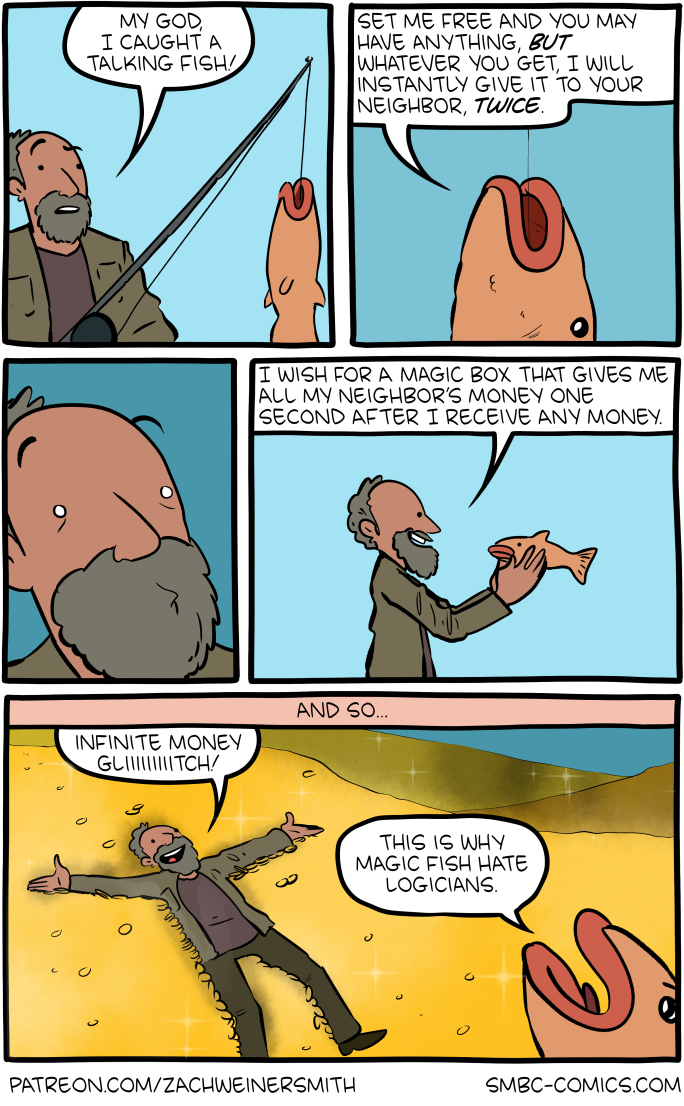
Saturday Morning Breakfast Cereal - Fish

by Zach Weinersmith


Click here to go see the bonus panel!

Hovertext:
This is more easily executable with a three-wish genie, but it's good to be prepared for all circumstances.


Today's News:
10 Nov 17:16

'AI Slop' in Court Filings: Lawyers Keep Citing Fake AI-Hallucinated Cases

by EditorDavid
James.galbraith

the penalties are nowhere near severe enough. If I handed this shit off to a nonlawyer then filed the result, I'd be looking at disbarment. This is no different.

"According to court filings and interviews with lawyers and scholars, the legal profession in recent months has increasingly become a hotbed for AI blunders," reports the New York Times: Earlier this year, a lawyer filed a motion in a Texas bankruptcy court that cited a 1985 case called Brasher v. Stewart. Only the case doesn't exist. Artificial intelligence had concocted that citation, along with 31 others. A judge blasted the lawyer in an opinion, referring him to the state bar's disciplinary committee and mandating six hours of A.I. training. That filing was spotted by Robert Freund, a Los Angeles-based lawyer, who fed it to an online database that tracks legal A.I. misuse globally. Mr. Freund is part of a growing network of lawyers who track down A.I. abuses committed by their peers, collecting the most egregious examples and posting them online. The group hopes that by tracking down the A.I. slop, it can help draw attention to the problem and put an end to it... [C]ourts are starting to map out punishments of small fines and other discipline. The problem, though, keeps getting worse. That's why Damien Charlotin, a lawyer and researcher in France, started an online database in April to track it. Initially he found three or four examples a month. Now he often receives that many in a day. Many lawyers... have helped him document 509 cases so far. They use legal tools like LexisNexis for notifications on keywords like "artificial intelligence," "fabricated cases" and "nonexistent cases." Some of the filings include fake quotes from real cases, or cite real cases that are irrelevant to their arguments. The legal vigilantes uncover them by finding judges' opinions scolding lawyers... Court-ordered penalties "are not having a deterrent effect," said Freund, who has publicly flagged more than four dozen examples this year. "The proof is that it continues to happen."

Read more of this story at Slashdot.

10 Nov 17:12

Bombshell Report Exposes How Meta Relied On Scam Ad Profits To Fund AI

by EditorDavid
James.galbraith

No surprise there. Pure evil

"Internal documents have revealed that Meta has projected it earns billions from ignoring scam ads that its platforms then targeted to users most likely to click on them," writes Ars Technica, citing a lengthy report from Reuters. Reuters reports that Meta "for at least three years failed to identify and stop an avalanche of ads that exposed Facebook, Instagram and WhatsApp's billions of users to fraudulent e-commerce and investment schemes, illegal online casinos, and the sale of banned medical products..." On average, one December 2024 document notes, the company shows its platforms' users an estimated 15 billion "higher risk" scam advertisements — those that show clear signs of being fraudulent — every day. Meta earns about $7 billion in annualized revenue from this category of scam ads each year, another late 2024 document states. Much of the fraud came from marketers acting suspiciously enough to be flagged by Meta's internal warning systems. But the company only bans advertisers if its automated systems predict the marketers are at least 95% certain to be committing fraud, the documents show. If the company is less certain — but still believes the advertiser is a likely scammer — Meta charges higher ad rates as a penalty, according to the documents. The idea is to dissuade suspect advertisers from placing ads. The documents further note that users who click on scam ads are likely to see more of them because of Meta's ad-personalization system, which tries to deliver ads based on a user's interests... The documents indicate that Meta's own research suggests its products have become a pillar of the global fraud economy. A May 2025 presentation by its safety staff estimated that the company's platforms were involved in a third of all successful scams in the U.S. Meta also acknowledged in other internal documents that some of its main competitors were doing a better job at weeding out fraud on their platforms... The documents note that Meta plans to try to cut the share of Facebook and Instagram revenue derived from scam ads. In the meantime, Meta has internally acknowledged that regulatory fines for scam ads are certain, and anticipates penalties of up to $1 billion, according to one internal document. But those fines would be much smaller than Meta's revenue from scam ads, a separate document from November 2024 states. Every six months, Meta earns $3.5 billion from just the portion of scam ads that "present higher legal risk," the document says, such as those falsely claiming to represent a consumer brand or public figure or demonstrating other signs of deceit. That figure almost certainly exceeds "the cost of any regulatory settlement involving scam ads...." A planning document for the first half of 2023 notes that everyone who worked on the team handling advertiser concerns about brand-rights issues had been laid off. The company was also devoting resources so heavily to virtual reality and AI that safety staffers were ordered to restrict their use of Meta's computing resources. They were instructed merely to "keep the lights on...." Meta also was ignoring the vast majority of user reports of scams, a document from 2023 indicates. By that year, safety staffers estimated that Facebook and Instagram users each week were filing about 100,000 valid reports of fraudsters messaging them, the document says. But Meta ignored or incorrectly rejected 96% of them. Meta's safety staff resolved to do better. In the future, the company hoped to dismiss no more than 75% of valid scam reports, according to another 2023 document. A small advertiser would have to get flagged for promoting financial fraud at least eight times before Meta blocked it, a 2024 document states. Some bigger spenders — known as "High Value Accounts" — could accrue more than 500 strikes without Meta shutting them down, other documents say. Thanks to long-time Slashdot reader schwit1 for sharing the article.

Read more of this story at Slashdot.

07 Nov 20:45

It just got even easier for DHS to hide its abuses

by Lisa Needham
James.galbraith

Sue these fuckers into oblivion. Until they're scared of personal consequences, they'll continue to violate the law.

The New York Times reports that the Department of Homeland Security will no longer be using the software that captures and saves text messages between officials. 

Wait. They haven’t been using it since April. Great.

So, how does the most sprawling, well-funded, and violent agency go about keeping its communication records these days, given those pesky laws like the Freedom of Information Act and the Federal Records Act?

Glad you asked. 

Apparently, back in April, DHS started using a new, very high-tech, very efficient way to make sure that they follow the obligations of those laws. Rather than using TeleMessage, the program that had taken care of things automatically, now, it’s much, much simpler. All an official needs to do to preserve their text messages and follow the law is:

  1. Take a screenshot of each message on your work phone

  2. Send it to your work email

  3. Download it to your work computer

  4. Run a program on each screenshot to make it text searchable.

See? Piece of cake! Surely this is much more reliable than the old way, where a piece of software just ran in the background and stored everything. According to DHS, there were cybersecurity concerns with the automatic program TeleMessage, but one small detail there: they switched to the screenshot method in April, but reports of TeleMessage being hacked didn’t appear until early May. Whoopsie!

So weird that this issue has cropped up at the agency most inclined to refuse to provide any information at all about what its people are doing. It was probably inevitable that the same bunch that thinks federal agents should run around masked, armed, and with no visible ID would also eschew keeping any records about it. 

DHS has said that this is totally within the law, absolutely, but their own court filings show the unlucky acting chief records officer of the National Archives William Fischer patiently and professionally writing to whatever nonsense flack is handling FOIA for DHS. And, well, here’s poor William trying to square what DHS told American Oversight about their records request with the law:

On July 23, 2025, DHS wrote that "text message data generated after April 9, 2025, is no longer maintained." On August 21, 2025, DHS submitted that it "no longer has the capability to conduct a search of text messages." If the statements are accurate, please explain how DHS's record retention policies for text messages meet the requirements of the FRA, including 36 CFR § 1222.26, which requires that DHS "capture, manage, and preserve electronic records with appropriate metadata." 

If you’re confused, so is everyone else. Here’s what happened. American Oversight sued after the government refused to provide records about the deployment of the National Guard in Los Angeles earlier this year. On July 23, DHS basically said, “naw, we don’t keep text message data, and haven’t since April 9, so pound sand.” 

After The New York Times reported on it, though, they backtracked, seeming to remember that they were required by law to keep them, so they came up with saying that sure, they keep messages, but no, they won’t tell you how. 

DHS also made sure to throw its own FOIA staff under the bus. See, when they told American Oversight that they couldn’t find any records, it’s just because they were too stupid to know where to look! “They explained that public information officers had erroneously concluded that the agency lacked the ability to locate responsive records, without searching for manual screenshots. Those became the department’s official record-keeping practice for text messages since April 9.”

If your own people tasked with responding to records requests don’t know where to look, that is kind of a problem. This looks a lot more like another delay tactic, along with a way to square their previous boast that they just weren’t gonna keep stuff as meaning that they actually somehow did keep stuff, but you just can’t find it.

Can’t blame this one on Mike Waltz.

There’s no reason the administration should really worry that this will have any fallout. The Supreme Court already blessed its refusal to provide any information about the so-called Department of Government Efficiency. Not data from DOGE. Data about DOGE. Because literally having to provide information explaining what type of agency DOGE is would somehow violate the separation of powers, of course. 

Why doesn’t DHS just take the Attorney General Pam Bondi route and say that finding one piece of paper will take two years? Just make them cool their heels!

Surely it is just a coincidence that DHS stopped keeping text messages about 10 days after news broke that Mike Waltz of Signalgate fame was found to have been using Signal for not just bombing actions but a wide variety of groups just chattin’ ’bout national security matters.

If they can’t have the disappearing messages app, they’ll just disappear their own messages, thank you. You want to do something right, gotta do it yourself. 

07 Nov 20:42

Direct File Won't Happen in 2026, IRS Tells States

by msmash
James.galbraith

All they can do is destroy good things in service of their corporate overlords

NextGov: The IRS has notified states that offered the free, government tax filing service known as Direct File in 2025 that the program won't be available next filing season. In an email sent from the IRS to 25 states, the tax agency thanked them for collaborating and noted that "no launch date has been set for the future." "IRS Direct File will not be available in Filing Season 2026," says the Monday email, obtained by Nextgov/FCW and confirmed by multiple sources. It follows reports that the program was ending and Trump's former tax chief, Billy Long, remarking over the summer that the service was "gone." The program, which debuted in 2024, was a big shift from the decades-long IRS policy of not competing with the tax prep industry in offering its own free, online tax filing service for Americans. Many Republicans had opposed Direct File, and tax prep companies also lobbied against it.

Read more of this story at Slashdot.

07 Nov 20:36

Tech billionaire Marc Andreessen bet big on Trump. It’s paying off for Silicon Valley.

by ProPublica
James.galbraith

There must be consequences, otherwise they'll just continue exploiting. Under a Dem government, CFPB must be protected and given free reign to make Silicon Valley pay for its rape and plunder business model.

The Trump administration’s gutting of the Consumer Financial Protection Bureau has been good for venture capitalists like Andreessen, who previously accused the agency of “terrorizing” fintech startups and crypto companies.

By Jake Pearson for ProPublica

For more than a decade, Silicon Valley venture capitalists have poured enormous sums of money into newfangled technology companies seeking to disrupt, and even supplant, the traditional financial system and sidestep its burdensome regulations.

At the same time, the Consumer Financial Protection Bureau has policed that effort, going after such businesses for deceiving, overcharging or otherwise taking advantage of their customers by enacting rules, filing lawsuits and shutting down the worst offenders.

This cat-and-mouse game has long rankled tech leaders, but it has especially irritated Marc Andreessen, one of America’s most well-known investors and an outsize figure in the so-called fintech industry.

His firm has seeded eight companies since 2016 that landed in the crosshairs of the small watchdog agency that Congress created after the 2008 financial crisis to protect vulnerable consumers from exploitation, according to court records, agency documents and interviews with people familiar with the matters. Some of those inquiries have resulted in consent orders, fines and, for one company, a lifetime industry ban.

The CFPB exists to “terrorize finance, terrorize financial institutions, prevent fintech, prevent new competition, new startups that want to compete with the big banks,” Andreessen told podcaster Joe Rogan last year, invoking the agency as an example of government bloat ripe for the carving.

Of particular concern to Andreessen was federal regulators’ targeting of the freewheeling crypto industry under President Joe Biden — an effort that legal experts said would have planted a costly roadblock in the path of several companies’ rapid growth. The investor’s firm, Andreessen Horowitz, told the CFPB last year it planned to put more than $7 billion in crypto funds. So in the run-up to the 2024 presidential election, the longtime Democrat shifted his allegiance to Donald Trump, donating more than $5 million to groups supporting the Republican candidate, and even volunteered to help Elon Musk’s Department of Government Efficiency.

Ever since, Andreessen and others have seen their desires realized.

In short order, the Trump administration has hollowed out the CFPB — the primary regulator with jurisdiction over increasingly ubiquitous financial technology companies and the only one looking out for consumers in the rapidly expanding crypto marketplace. Lawsuits have been dropped, settlements have been renegotiated in favor of companies and a proposed consumer-friendly crypto regulation was killed outright.

Related | Employees at the nation's consumer financial watchdog say it's become toothless under Trump

Virtually all investigations have also ground to a halt, including three probes into Andreessen-backed companies, according to the records and the people familiar with the cases, who spoke on condition of anonymity to discuss sensitive matters. Among those frozen: inquiries into the popular cash advance app EarnIn and Point Digital Finance, one of the country’s largest providers of so-called alternative mortgages.

For those eager to reimagine a financial system free from regulation, the new approach is a boon.

But for the tens of millions of struggling Americans who rely on such apps for loans, cash advances and other financial products, it could be a bust, consumer advocates said.

A security officer works inside the Consumer Financial Protection Bureau (CFPB) building headquarters on Feb. 10 in Washington, D.C.

“There are lots of ways that this breaks bad for families, and it all flows downstream from this moment we are now in,” said Mike Pierce, a former bureau official who now runs the advocacy group Protect Borrowers. “If there’s no watchdog, people are going to get hurt.”

Andreessen didn’t respond to a call or text and neither he, his chief of staff nor his firm responded to detailed emails seeking comment for this story.

Neither did the CFPB. But administration officials have defended their decision to shrink the bureau to a fraction of its size, arguing that the agency had engaged in the “weaponization” of consumer protection to the detriment of industry. They say the bureau should instead “focus on tangible harms to consumers,” relinquish oversight to states and reimburse defrauded consumers, rather than impose heavy fines on companies.

CFPB officials have been busy implementing the new approach, reworking deals with 20 businesses that had been accused of wrongdoing. In May, for example, they renegotiated a settlement with the international remittance firm Wise, an Andreessen-backed company that had previously agreed to pay $2 million to resolve claims that it had deceived its customers about the true cost of ATM fees. The new penalty: $45,000.

Wise didn’t admit or deny any of the bureau’s findings, court records show, and has said it “strongly disagrees with the CFPB’s characterization of Wise’s conduct.” A spokesperson declined to comment on the reduced fine amount.

Related | A look at some cases dropped by the government's consumer protection watchdog under Trump

This go-easy approach follows years of industry and political attacks on the CFPB. One Florida Republican in Congress likened the bureau in 2014 to the Nazi secret police, and industry groups have unsuccessfully challenged its constitutionality in cases that reached the Supreme Court twice in the past five years.

Still, as new financial technology like payment apps took off, the CFPB examined it. In 2016, as the Obama administration came to a close, the bureau took the digital payment network Dwolla to court for “deceiving consumers about its data security practices and the safety of its online payment system.” The Andreessen-funded company was ordered to pay $100,000 to the civil penalty fund and signed a consent order. That order ended in March 2021, and the company has made sure its marketing complies with the law, a company spokesperson said.

The scrutiny continued even during the first Trump administration. One such probe involved an Andreeseen-backed “buy now, pay later” app, though the investigation closed in 2020 without any enforcement action, bureau records show.

But the effort really gained momentum under Biden. According to a ProPublica analysis of CFPB data, 22 of the top 100 companies consumers complained about last year were fintech businesses, up from just seven a decade earlier.

It’s not clear exactly how much Andreessen’s business has invested in such companies, but the firm, which is also known by the nickname A16Z, has joined more than a dozen fundraising rounds over the past decade that generated hundreds of millions of dollars for eight enterprises  that were subject to CFPB investigations, according to data compiled by PitchBook, an industry research publication.

Among those companies is LendUp Loans, an online startup app that was meant to disrupt the payday lending industry. The CFPB had taken the company to court three times in five years, alleging it had bilked its customers by hiding fees, misadvertising its credit scorekeeping or exceeding capped interest rates for military service members. When the CFPB barred the company from making loans in December 2021, the bureau’s director, Rohit Chopra, explicitly named Andreessen Horowitz in a press release, noting that the company had been “backed by some of the biggest names in venture capital.” The CFPB tapped $40 million from its civil penalty fund to compensate LendUp borrowers — and checks started going out to more than 118,000 customers last year.

LendUp didn’t admit or deny the CFPB’s allegations but shut down following its agreement with the agency.

Related | Trump never hated Big Tech. He just wanted them on board.

More recently, in the final year of the Biden administration, bureau investigators seemed poised to examine not just a company’s actions but what its investors knew about them, records reviewed by ProPublica show.

In its EarnIn inquiry, for example, the bureau had designated the app’s “venture capital investors” as “relevant parties” to its probe because those investors “likely have knowledge” of the company’s business model and “associated documents,” according to the records. About two dozen firms have invested in EarnIn, including A16Z, which participated in two funding rounds in 2017 and 2018 that raised $164 million.

The company says it doesn’t charge interest on the cash it extends to people between paychecks but deducts what it calls “voluntary tips” upon repayment, the records show. The investigation was looking into whether EarnIn’s app effectively tricked as many as 200,000 customers into thinking that millions of dollars they paid in such fees went to help other customers when instead they went straight to the business’s bottom line, according to the records and people familiar with the case.

The probe stalled in February though, after Trump’s appointees to the CFPB issued bureauwide stop-work orders. Neither the company nor its top lawyer responded to an email seeking comment and a spokesperson didn’t return a call.

The enforcement freeze also effectively ended investigations into two other A16Z-backed ventures: Point Digital Finance and Greenlight Financial Technology Inc., a popular debit card for kids.

Beginning last fall, investigators started probing the former’s business model of buying a portion of a homeowner’s equity in exchange for a lump sum payment, records show. A recent CFPB industry report found that consumers had complained that they “felt frustrated or even misled about various aspects of home equity contracts.” The CFPB was looking into whether Point had deceived its customers about the true costs of its product, unfairly calculated repayment amounts or failed to follow the laws and rules that govern loans secured by a home, according to the records.

A spokesperson for Point Digital Finance declined to comment. A16Z participated in four funding rounds that raised more than $248 million for the company.

As for Greenlight, bureau investigators were examining whether the company had deceived parents about how quickly they could transfer money onto their kids’ prepaid debit cards, according to people familiar with the case and records reviewed by ProPublica. Though the company’s marketing materials said parents could “instantly” load money onto them, in reality the transfers took days — a delay that left children unable to pay for cabs, meals and other purchases, records and interviews with the people show.

Andreessen Horowitz had led a $260 million fundraising round in 2021 for Greenlight. The company didn’t respond to an email seeking comment and its chief of staff didn’t return a call.

Nikita Aggarwal, who teaches consumer finance at the University of Miami School of Law, said that a defanged and downsized CFPB would help companies like these save on compliance costs and grow faster — factors that would appeal to investors like Andreessen looking for a healthy return.  

But she also said that the pursuit of the CFPB by DOGE should be understood as ideological since the agency was seen as a home for progressive Democrats who, especially during Biden’s administration, were skeptical of the fintech and crypto industries.

“If you can’t influence, just get rid of the regulator altogether,” Aggarwal said. “And that’s exactly what I think was happening in January and February when DOGE went in.”

To be sure, while the bureau is a shell of its former self, it hasn’t been entirely eliminated.

In August, the CFPB sued the Andreessen-backed banking software company Synapse Financial Technologies Inc., which had declared bankruptcy as the agency probed whether it lost track of millions of dollars in customer funds. But the action has so far resulted in little redress — the now-defunct company agreed to pay a $1 fine and it’s unclear whether the agency will tap its own funds to compensate consumers. A lawyer who represented Synapse didn’t return a call and email seeking comment and the company’s founder didn’t respond to a LinkedIn message.

When it comes to crypto, the industry’s influence under Trump represents a particularly relevant win for firms like those that are backed by Andreessen. The billionaire donated $33.5 million last year to a pro-cryptocurrency political group, more than six times as much as he did to support Trump, federal elections records show. And some A16Z investments have become major players in so-called decentralized finance, known as defi, which supporters hope will replace the traditional banking system.

Related | Crypto is the grift that keeps on giving for the Trump family

So when the CFPB proposed a rule in 2023 that would have subjected these types of companies to bureau supervision, the firm pushed back, warning in a 2024 comment letter that some of the rule’s definitions were “overly broad” and could be subject to lawsuits. Absent “express legislative direction,” A16Z wrote, “we caution the Bureau against asserting expansive jurisdiction over digital assets.”

In a win for the industry, the bureau’s final agency rule excluded crypto.

But 10 days before Trump’s inauguration, the CFPB asked for the public’s input on another proposed rule that would have effectively subjected the industry to a 1978 law, putting the onus on virtual currency firms to make their customers whole in the event they are defrauded.

Such a rule could impose a major financial obligation on the companies given the frequency of hacks in the crypto industry. By one count, more than $2 billion in digital assets were stolen in 2022 alone.

As the Biden administration was ending, the top lawyer at Coinbase, the largest U.S. cryptocurrency exchange — and a recipient of A16Z investment dollars — posted on X that it was “obvious” that such a proposal “will never be adopted; it is DOA with the next admin and DOA in the courts,” he wrote, using the acronym for “dead on arrival.” He was right. In May, under Trump, the CFPB withdrew that rule, saying that it “does not align with current agency needs, priorities, or objectives.”

Doris Burke and Joel Jacobs contributed research.

07 Nov 17:15

Clean energy could become a huge political winner

by Umair Irfan
James.galbraith

No shit

A rising chart depicting rising electricity prices contrasts the background image of a transmission line.
Residential electricity rates have risen fast across the US, more than 30 percent on average in just five years.

You’ve probably noticed that Democrats are talking a lot less about climate change. But connecting clean energy to household bills proved to be a successful way to win voters in the elections across the US on Tuesday.  

This off-year election was a pressure test of Democrats’ broad message on affordability and who voters hold accountable for the rising cost of electricity. Though President Donald Trump wasn’t on the ballot, most Democratic and independent voters pin the blame for high prices in general on the president. And most voters do recognize that state and local officials help decide how much they pay on their utility bills. 

The results showed that by grounding climate action in the everyday math of household energy bills, Democrats may have finally found a way to make climate policy feel less abstract — and more like a winning issue. 

How state races leaned into the power play

In New Jersey, Gov.-elect Mikie Sherrill, a Democrat, ran on a promise to fight skyrocketing energy bills. She even vowed to declare a state of emergency and freeze utility rates on day one in office. And it worked. Voters, who saw their household electricity bills rise by 20 percent this summer — compared to 11 percent across the US as a whole — trusted her to tackle the problem. Before the election, one poll showed that voters trusted Sherrill to do a better job of controlling energy prices than her opponent, Republican Jack Ciattarelli, by 10 points. On Tuesday, Sherrill won — beating her Republican opponent with 56 percent of the vote.

Tension in the Garden State had been brewing for a while, and Sherrill’s win reflected more than just frustration over bills — the state has also felt the impacts of Trump’s cuts to clean energy, leading to the cancellation of a major wind energy project and delays in building transmission infrastructure.

In Virginia, Democratic Gov.-elect Abigail Spanberger also made affordable energy a tentpole of her campaign against Republican Winsome Earle-Sears. Energy prices in Virginia haven’t risen as fast as New Jersey, but the state faces a different problem: a surge in power-hungry data centers. The state is home to the largest concentration of power-hungry data centers in the world, and 54 new data centers received permits in the state this year. The prospect of even more energy demand from data centers is already starting to drive up generation costs across PJM — the power grid that serves Virginia — and is generating public resistance. Spanberger seized on that tension — promising to keep household energy affordable while managing the data boom. 

The Trump administration’s efforts to throttle renewable energy, boost fossil fuels, and get rid of environmental regulations will likely keep affordability in the spotlight into next year’s midterm elections. 

But one of the more surprising results on Tuesday was a normally obscure election for two seats for the Georgia Public Service Commission. Democrats Peter Hubbard and Alicia Johnson defeated two incumbent Republicans on the five-member panel. This often-overlooked state office that regulates electricity prices in the Peach State managed to draw more than 1.5 million voters in an off-year election, a 21 percent turnout, and gained national attention

“Who sits in these chairs is deeply important to how states are navigating these big questions that affect folks’ lives,” said Frances Sawyer, founder of Pleiades Strategy, an energy analysis firm. “It is just a huge sign that Georgians are fed up with rate hikes. They’re fed up with high bills and ready for a public service commission leadership that takes navigating the clean energy transition and household finances deeply seriously.”

All states have a public service commission whose job it is to regulate utilities, but in 10 states, including Georgia, those commissioners are elected rather than appointed. Private power companies are often monopolies, so these commissions serve as a check on how much money these companies can spend, what they buy, and, crucially, how much of their expenses they can pass onto customers. For years, Georgia’s commission has been accused of giving the state’s main power company too much leeway. In 2023, the commission approved a plan to pass more than $7 billion in cost overruns for the construction of two nuclear reactors onto Georgian customers — a move that pushed monthly bills higher across the state.

“What we’ve seen is the public service commission has basically rubber-stamped whatever plan the power company has put out and then whatever proposal they’ve asked to pay for it,” said Brionté McCorkle, executive director of Georgia Conservation Voters. 

So Democrats campaigned and won on controlling rising energy costs. The big question now is, can they deliver?

There’s no guarantee they’ll be able to roll back prices — energy costs are driven by everything from aging infrastructure to volatile fuel markets — but the wins in Georgia, New Jersey, and Virginia share a common theme: voters are demanding action on power bills.

And those victories, McCorkle said, show that a promise to address energy prices and promote clean energy can be a winning combination, even in an off-year election for an arcane state office, if the message connects. 

In the primary elections for Georgia’s commissioners this cycle, there was a county where just eight people showed up to vote. But advocates like McCorkle launched a statewide campaign to connect the dots between the commission and affordable power, and to rally votes. “There was a lot of organic content that popped up as people started to understand and had that light bulb moment where they said, ‘Oh wow, these people matter because they are the ones who are making decisions about my power bill and I can go vote in this race,’” McCorkle said. 

Energy prices are unlikely to come down anytime soon, and the Trump administration’s efforts to throttle renewable energy, boost fossil fuels, and get rid of environmental regulations will likely keep affordability in the spotlight into next year’s midterm elections. 

For Democrats, the worries over rising power bills might just become their best argument for their agenda to promote clean energy and rein in greenhouse gas emissions. 

07 Nov 00:32

Elon Musk wins $1 trillion Tesla pay vote despite “part-time CEO” criticism

by Jon Brodkin
James.galbraith

tax the fuck out of this

Tesla shareholders today voted to approve a compensation plan that would pay Elon Musk more than $1 trillion over the next decade if he hits all of the plan’s goals. Musk won over 75 percent of the vote, according to the announcement at today’s shareholder meeting.

The pay plan would give Musk 423,743,904 shares, awarded in 12 tranches of 35,311,992 shares each if Tesla achieves various operational goals and market value milestones. Goals include delivering 20 million vehicles, obtaining 10 million Full Self-Driving subscriptions, delivering 1 million “AI robots,” putting 1 million robotaxis in operation, and achieving a $400 billion adjusted EBITDA (earnings before interest, taxes, depreciation, and amortization).

Musk has threatened to leave if he doesn’t get a larger share of Tesla. He told investors last month, “It’s not like I’m going to go spend the money. It’s just, if we build this robot army, do I have at least a strong influence over that robot army? Not control, but a strong influence. That’s what it comes down to in a nutshell. I don’t feel comfortable building that robot army if I don’t have at least a strong influence.”

Read full article

Comments

06 Nov 21:50

Air travel will be 'really rough,' warns guy in charge of that

by Walter Einenkel
James.galbraith

You mean it's a bad idea to put an MTV dropout in charge of national transportation? Who would have thought

Transportation Secretary Sean Duffy appeared on Fox News Thursday, following the Federal Aviation Administration announcement that it will be reducing air traffic by 10% across 40 “high volume” markets as a result of the GOP’s government shutdown. 

“As we come into Thanksgiving, if we're still in the shutdown posture, it's going to be rough out there. Really rough,” he said. “But will you fly on time? Will your flight actually go? That is yet to be seen, but there will be more disruption.” 

Still, Duffy expressed confidence in his own family’s travel plans. 

“Would I still book? If there's deals out there, I’d book my flight. Actually, I'm flying my kids home from school,” he said. “I booked those flights last night. Of course I'm going to book them.”

06 Nov 17:11

The Louvre's Video Surveillance Password Was 'Louvre'

by BeauHD
A bungled October 18 heist that saw $102 million of crown jewels stolen from the Louvre in broad daylight has exposed years of lax security at the national art museum. From trivial passwords like 'LOUVRE' to decades-old, unsupported systems and easy rooftop access, the job was made surprisingly easy. PC Gamer reports: As Rogue cofounder and former Polygon arch-jester Cass Marshall notes on Bluesky, we owe a lot of videogame designers an apology. We've spent years dunking on the emptyheadedness of game characters leaving their crucial security codes and vault combinations in the open for anyone to read, all while the Louvre has been using the password "Louvre" for its video surveillance servers. That's not an exaggeration. Confidential documents reviewed by Liberation detail a long history of Louvre security vulnerabilities, dating back to a 2014 cybersecurity audit performed by the French Cybersecurity Agency (ANSSI) at the museum's request. ANSSI experts were able to infiltrate the Louvre's security network to manipulate video surveillance and modify badge access. "How did the experts manage to infiltrate the network? Primarily due to the weakness of certain passwords which the French National Cybersecurity Agency (ANSSI) politely describes as 'trivial,'" writes Liberation's Brice Le Borgne via machine translation. "Type 'LOUVRE' to access a server managing the museum's video surveillance, or 'THALES' to access one of the software programs published by... Thales." The museum sought another audit from France's National Institute for Advanced Studies in Security and Justice in 2015. Concluded two years later, the audit's 40 pages of recommendations described "serious shortcomings," "poorly managed" visitor flow, rooftops that are easily accessible during construction work, and outdated and malfunctioning security systems. Later documents indicate that, in 2025, the Louvre was still using security software purchased in 2003 that is no longer supported by its developer, running on hardware using Windows Server 2003.

Read more of this story at Slashdot.

06 Nov 01:14

Cartoon: Ass kicking

by Nick Anderson
05 Nov 18:26

Saturday Morning Breakfast Cereal - Attention span

by Zach Weinersmith
James.galbraith

seems as plausible an explanation as any lol


Click here to go see the bonus panel!

Hovertext:
Subscribe!


Today's News:
04 Nov 22:09

Sean Duffy blames Democrats for ‘mass chaos’ in his own agency

by Walter Einenkel
James.galbraith

Idiot can't even wrangle his own department.

Transportation Secretary Sean Duffy held a press conference Tuesday, warning that there will be “mass chaos” if air traffic controllers continue to go unpaid during the government shutdown.

“If you bring us to a week from today, Democrats, you will see mass chaos,” he said. “You will see mass flight delays. You'll see mass cancellations. And you may see us close certain parts of the airspace because we just cannot manage it because we don't have the air traffic controllers.”

04 Nov 22:09

Trump-loving farmers must be masochists

by kos
James.galbraith

No aid for these racist moochers.

President Donald Trump’s policies could not be more destructive for rural America—from his attacks on Medicaid, gutting rural health care, and budget cuts that are decimating rural postal service, education, and broadband.

But nothing hits harder than the twin body blows of tariffs and mass deportations of undocumented agricultural laborers.

Not that Trump doesn’t pretend otherwise. “To the Great Farmers of the United States: Get ready to start making a lot of agricultural product to be sold INSIDE of the United States,” he famously posted on his Truth Social back in early March. “Tariffs will go on external product on April 2nd. Have fun!”

And every so often, criticisms of his policies seem to filter through to him, like when he posted in mid-June.

“Field of bad dreams” by Tim Campbell

 Our great Farmers and people in the Hotel and Leisure business have been stating that our very aggressive policy on immigration is taking very good, long time workers away from them, with those jobs being almost impossible to replace. In many cases the Criminals allowed into our Country by the VERY Stupid Biden Open Borders Policy are applying for those jobs. This is not good. We must protect our Farmers, but get the CRIMINALS OUT OF THE USA.

Yet despite promises that “changes are coming!” and all the supposed “fun,” nothing has changed. He keeps selling out the very farmers who worship him—most recently with his bailout of Argentina, which opened U.S. markets to cheap Argentina beef.

According to the trade publication Meat & Poultry, the picture for American farmers is grim. Production costs for major crops are on track to hit record highs by 2026—$650 per acre for soybeans, $404 for wheat, $916 for corn, $956 for cotton, and over $1,200 for rice and peanuts. Nearly every expense—labor, land, seed, taxes—is climbing.

On paper, total farm income is expected to rise about 40% in 2025. But that’s mostly smoke and mirrors: government subsidies and temporary livestock profits mask deep losses for crop farmers. Net cash income is projected to fall 15% for corn, 14% for soybeans, 2% for wheat, and 1% for specialty crops. 

Livestock producers were supposed to fare better—with income up 67% for cattle, 27% for poultry, 18% for hogs, and 11% for dairy—but that was before Trump’s Argentina deal to flood the market with cheap imports. Those gains will vanish fast.

There’s a special irony in that the one place where farmers were seeing gains, Trump has taken a hacksaw to it.

But if you think that pain might finally break their loyalty, don’t hold your breath. The Los Angeles Times talked to several who still pledge allegiance to their cult leader.

“If I’ve gotta take a few bullets getting caught up in the cross-fire, but after four years or eight years—however long he spends in office—we’re on a better trajectory as a country, then it’s all parred up,” said citrus farmer Matt Fisher.

Jeff Bortolussi, another fruit grower, said, “A lot of this stuff needs to play out. I think a lot of it is posturing, and his way of communicating, his ‘art of the deal.’ We really don’t know what’s going on.”

Trump doesn’t know what’s going on.

And when his immigration raids decimate their workforces? They blame Democrats. California is “picking a fight with the federal government,” said walnut farmer Mike Poindexter. “You have to ask, who’s instigating here?”

Realigning the country is a matter of math. Shift 5–10% of Trump voters and non-voters to the Democratic side, and an evenly divided nation becomes a more liberal one. But these farmers—suffering the most from the policies they cheered—won’t be part of that 5–10%.

And honestly, it’s hard to feel sorry for them.

04 Nov 19:15

GOP's next hostage in shutdown: Unemployed Americans

by Walter Einenkel
James.galbraith

USDA is pure evil at this point

The Trump administration is now threatening to attack unemployment benefits amid the GOP’s government shutdown.

Labor Secretary Lori Chavez-DeRemer broke the news during a press conference on Tuesday.

“As far as the Department of Labor goes, as was mentioned when we're talking about the SNAP program, one of the other programs that we're definitely concerned about—and we've sent letters out to all 50 states—is unemployment insurance as is delivered by those states,” she said. 

“That will be the next thing that we have to be concerned about,” Chavez-DeRemer added. “If people stop receiving their unemployment insurance, [it] will be another detrimental fact to the American workforce.”

04 Nov 19:05

GOP hypocrites are now fine with changing student loan rules

by Lisa Needham
James.galbraith

This country is over

Two lawsuits were just filed over President Donald Trump’s arbitrary modification of the Public Service Loan Forgiveness program, which made public service employers subject to the whims of the Trump administration.

One lawsuit was brought by a coalition of nonprofits that could be affected by Trump’s Brave New Rule, and the other was brought by the attorneys general of 21 states. If you want to guess just how ballistic Trump will be over this, know that New York Attorney General Letitia James is right there at the top of the signatories.

President Donald Trump and Chief Justice John Roberts during Trump’s inauguration on Jan. 20.

You might be wondering what’s going on here, since just two years ago, when former President Joe Biden wanted to expand loan forgiveness, the conservative Supreme Court justices had what can only be called a full-blown freakout. 

Writing for the conservative majority, Chief Justice John Roberts literally said that Biden’s modifications to student loan repayments “modified the cited provisions only in the same sense that the French Revolution modified the status of the French nobility.”

Yes, that’s right. Roberts compared Biden’s attempts to make student loan debt marginally less crushing to French royalty getting beheaded. 

Biden’s changes, Roberts said, created a “novel and fundamentally different loan forgiveness program.”

But Roberts is probably going to have to figure out—quite soon—how to say that it’s totally fine when Trump wants to “modify” loan forgiveness by arbitrarily wiping out the eligibility of public service employers he doesn’t like. Also, we must totally defer to Trump’s rancid feelings no matter how much they’re divorced from reality. 

To recap: Biden making loan repayment slightly less onerous is basically the same as getting guillotined. But when Trump wants to make loan repayment vastly more onerous, dollars-to-donuts Roberts will suddenly realize that the Supreme Court justices are just a bunch of widdle guys who can’t tell Trump what to do. 

Education Secretary Linda McMahon

On Oct. 31, the Department of Education published a final rule that goes on and on and on, but what it boils down to is this: Trump and Education Secretary Linda McMahon get to decide if a public service employer is suitable enough for Trump. 

What would be unsuitable? If Trump or McMahon thinks your employer is “aiding and abetting violations of federal immigration laws, supporting terrorism or engaging in violence for the purpose of obstructing or influencing federal government policy,” or “engaging in a pattern of aiding and abetting illegal discrimination, and engaging in a pattern of violating state laws,” they can just remove the employer from the eligibility list.

This is vague as hell, but deliberately so, as it gives Trump the ability to attack any nonprofit he hates. Trump has made it amply clear that he thinks public service employers who have diversity initiatives are engaging in “illegal discrimination”—despite there having never been a case or statute saying that. 

What about organizations that engage in protest activities? Well, that’s a pattern of breaking state laws, don’t you know?

And, of course, the administration has already designated antifa—which is not an organization—as a domestic terrorist organization—a concept that doesn’t even exist in U.S. law. So you can pretty much guess what type of groups will be targeted next.

Per the Education Department, this radical change in employer eligibility isn’t a change at all; it just “establishes consequences for breaking the law.”

Protesters support student loan forgiveness during a rally at the Supreme Court in 2023.

Sure, if by “breaking the law” you mean, “Trump issued a random executive order that the administration hustled to implement because Trump is a king who gets to decide what constitutes breaking the law.”

Theoretically, McMahon is the one who would get to decide if your employer has too many communist transgender terrorists, but we know that Trump will be pulling the strings here. And if McMahon, in her infinite wisdom, decides to throw your employer out, you as a borrower cannot appeal.

Trump tried to walk back PSLF during his first term, denying 99% of applicants. But this time around, why bother with that small fry stuff? There is one group, however, that is sure to get showered with sweet, sweet loan relief: the wannabe Nazis who join ICE, where they’re promised $60,000 in student loan repayment.

Roberts better get a move on to figure out how to thread this needle, because there’s no way that the Supreme Court is going to tell Trump he can’t do this. 

He’ll just have to work overtime to figure out how to say, “Biden bad, Trump good.” But, you know, all legal-like. Good luck to him.

03 Nov 23:42

Is Nancy Pelosi on her way out of Congress?

by Alex Samuels
James.galbraith

85 is too fucking old to be in government. hell, anything north of 70 is too old.

As California voters head to the polls on Tuesday, Democrats are tracking more than just the results: They’re bracing for the possibility that Rep. Nancy Pelosi might leave Congress.

According to NBC News, party leaders expect the 85-year-old to make an announcement about her political future after the election. Over decades in Washington, Pelosi has built a reputation as one of the most powerful and effective figures in modern U.S. politics, serving as a key adversary to President Donald Trump during his first term and quietly advising Democrats through his second. 

Pelosi makes her way to a meeting on Capitol Hill in 2013.

Her timing is closely tied to a ballot measure, Proposition 50, which would redraw California’s congressional districts. Pelosi has been a vocal champion of the plan, which Democrats hope will help them net additional seats in next year’s midterm elections.

Multiple Democratic sources told NBC that they believe she will not run for reelection in 2026 after nearly four decades representing San Francisco.

“I wish she would stay for 10 more years,” one House Democrat from California said. “I think she’s out. She’s going to go out with Prop 50 overwhelmingly passing, and what a crowning achievement for her to do that.”

Pelosi’s possible departure comes at a moment when Democrats nationally are calling for younger candidates to step forward and for older leaders to pass the torch. 

If she does step aside, it would mark the end of a congressional era—one defined by her unmatched skill as a “legislative strategist, vote counter, and fundraiser” and as the first woman to serve as House speaker.

Her exit would also open a fiercely competitive race for her seat. Among the challengers are Saikat Chakrabarti, the former chief of staff to Rep. Alexandria Ocasio-Cortez of New York; and state Sen. Scott Wiener, who was first elected in 2016. Both have launched insurgent campaigns against the backdrop of Pelosi’s formidable fundraising advantage: more than $2 million raised this cycle and a $1.5 million war chest, according to campaign filings.

Pelosi tears up her copy of President Donald Trump’s State of the Union address in February 2020.

And Pelosi has hinted at leaving. 

According to NBC, at a recent California Democratic delegation meeting on Capitol Hill, she joked that she looked forward to seeing Minority Leader Hakeem Jeffries sworn in as the first Black speaker of the House “if I’m still allowed on the floor.”

“I think she’s preparing to exit the stage,” a House Democratic leadership aide told NBC. “We will not fully appreciate the time we have spent with her” until she’s gone.

Similarly, Bay Area political insiders say the signs increasingly point toward her stepping aside. 

“Most people think it is highly unlikely that she will run for another term,” one local Democratic official said.

In response to Daily Kos’ request for comment regarding Pelosi’s future, spokesperson Ian Krager referred to a prior social media post in which he declined to address whether she would seek a 20th full term in Congress.

“Speaker Pelosi is fully focused on her mission to win the Yes on 50 election in CA. Any discussion of her future plans beyond that mission is pure speculation,” Krager posted on X. “As she has said, Speaker Pelosi will not make any announcements about her future until after Prop 50 is settled.”

Pelosi herself echoed that sentiment in a recent interview with the San Francisco Examiner, saying she would not decide on reelection until after Tuesday’s vote.

Pelosi speaks during a campaign event on Proposition 50 in San Francisco on Nov. 3.

“Here’s the thing: We must win the House. If you talk about ‘no kings,’ we must win the House to put a stop to this. We won’t be able to get many things done, but we’ll be able to stop a lot of the poison that he’s putting there, and the best antidote to poison is to win the election,” she said. “There’s a lot riding on this because this is the path to our winning the House. We will win the House regardless, but winning it big, and we want to win Nov. 4 big.”

Meanwhile, colleagues have praised Pelosi as a historic figure who transformed Congress.

“Nancy Pelosi is a stateswoman who, as they say about Lincoln, belongs to the ages,” progressive Rep. Ro Khanna, a fellow Bay Area Democrat, told NBC. “Generations to come will be reading about her contributions to America.”

But even in her strongly liberal district, Pelosi has occasionally clashed with progressives over her long tenure.

Whether Pelosi retires or runs for reelection, her decision will come as Democrats wrestle with broader questions, like how to counter Trump and the GOP and how—and when—to make room for the next generation of leadership.

03 Nov 18:17

'I don't want to embarrass you': CBS buries damning Trump clip

by Oliver Willis
James.galbraith

CBS has gone full Fox

In his interview with “60 Minutes” that aired on Sunday, President Donald Trump gloated over CBS’ decision to bribe him and praised the news division’s new right-wing leader—but the network did not air these comments during their telecast.

Trump was interviewed by CBS correspondent Norah O’Donnell, and he made an explicit reference to CBS parent Paramount’s decision to pay him off for a frivolous lawsuit right before his administration approved Paramount’s merger with Skydance.

“Actually, ‘60 Minutes’ paid me a lot of money, and you don’t have to put this on, because I don’t want to embarrass you, and I’m sure you’re not,” Trump said.

He was right. The comments about the payoff did not make the program’s televised edit, but CBS posted them online later, along with the rest of the interview. Ironically, the payout to Trump was based on his complaint that edits to an interview with then-Vice President Kamala Harris in 2024 amounted to election interference.

Legal experts say Trump’s suit was without merit, but CBS chose not to defend its own journalism, instead pursuing a cozier relationship with Trump amid its parent company’s major merger. Congressional Democrats recently launched an investigation into the matter, suggesting the payoff was “an offer of payment and benefits to a government official designed to achieve a specific outcome from the government—in other words, a bribe.”

In other comments that CBS also chose not to air, Trump praised the network’s newly appointed editor-in-chief Bari Weiss as “a great person.” Weiss is a conservative columnist who most recently led The Free Press, a right-leaning media outlet, and who has begun to shift CBS’ news operation further to the right.

Despite CBS’ refusal to air Trump’s damning commentary in the main “60 Minutes” broadcast, a segment of the interview that CBS did include nevertheless managed to raise new concerns about Trump’s presidency.

Asked about his pardon of Binance founder Changpeng Zhao, Trump said, “I don’t know who he is.” Asked about Zhao’s apparent role in boosting a crypto coin benefitting the Trump family, he responded, “I know nothing about it, because I’m too busy doing the other thing.”

For years, Trump has argued that former President Joe Biden was unfit for office based on claims he was mentally unstable. And yet Trump has been accused of mental instability by several prominent political figures, like California Gov. Gavin Newsom.

By paying off Trump and then burying damning comments from him, CBS continues to demonstrate that it is a compromised media organization. The network continues to lurch to the right.

Trump has much of the mainstream media now in his corner, and he continues to assert his control and dominance of them in service of his agenda. CBS is just the most prominent part of a growing and disturbing trend.

03 Nov 18:16

Cartoon: Fifth Avenue

by Clay Bennett
03 Nov 18:04

Do AI Browsers Exist For You - or To Give AI Companies Data?

by EditorDavid
James.galbraith

No shit...you're the product. Fuck these browsers

"It's been hard for me to understand why Atlas exists," writes MIT Technology Review. " Who is this browser for, exactly? Who is its customer? And the answer I have come to there is that Atlas is for OpenAI. The real customer, the true end user of Atlas, is not the person browsing websites, it is the company collecting data about what and how that person is browsing." New York Magazine's "Intelligencer" column argues OpenAI wants ChatGPT in your browser because "That's where people who use computers, particularly for work, spend all their time, and through which vast quantities of valuable information flow in and out. Also, if you're a company hoping to train your models to replicate a bunch of white-collar work, millions of browser sessions would be a pretty valuable source of data." Unfortunately, warns Fast Company, ChatGPT Atlas, Perplexity Comet, and other AI browses "include some major security, privacy, and usability trade-offs... Most of the time, I don't want to use them and am wary of doing so..." Worst of all, these browsers are security minefields. A web page that looks benign to humans can includehidden instructions for AI agents, tricking them into stealing info from other sites... "If you're signed into sensitive accounts like your bank or your email provider in your browser, simply summarizing a Reddit postcould result in an attacker being able to steal money or your private data,"Brave's security researchers wrotelast week.No one has figured out how to solve this problem. If you can look past the security nightmares, the actual browsing features are substandard. Neither ChatGPT Atlas nor Perplexity Comet support vertical tabs — a must-have feature for me — and they have no tab search tool or way to look up recently-closed pages. Atlas also doesn't support saving sites as web apps, selecting multiple tabs (for instance, to close all at once with Cmd+W), or customizing the appearance. Compared to all the fancy new AI features, the web browsing part can feel like an afterthought. Regular web search can also be a hassle, even though you'll probably need it sometimes. When I typed "Sichuan Chili" into ChatGPT Atlas, it produced a lengthy description of the Chinese peppers, not the nearby restaurant whose website and number I was looking for.... Meanwhile, the standard AI annoyances still apply in the browser. Getting Perplexity to fill my grocery cart felt like a triumph, but on other occasions the AI has run into inexplicable walls and only ended up wasting more time. There may be other costs to using these browsers as well. AI still has usage limits, and so all this eventually becomes a ploy to bump more people into paid tiers. Beyond that,Atlas is constantly analyzing the pages you visit to build a "memory" of who you are and what you're into. Do not be surprised if this translates to deeply targeted ads as OpenAI startslooking at ways to monetize free users. For now, I'm only using AI browsers in small doses when I think they can solve a specific problem. Even then, I'm not going sign them into my email, bank accounts, or any other accounts for which a security breach would be catastrophic. It's too bad, because email and calendars are areas where AI agents could be truly useful, but the security risks are too great (andwell-documented). The article notes that in August Vivaldi announced that "We're taking a stand, choosing humans over hype" with their browser: We will not use an LLM to add a chatbot, a summarization solution or a suggestion engine to fill up forms for you, until more rigorous ways to do those things are available. Vivaldi is the haven for people who still want to explore. We will continue building a browser for curious minds, power users, researchers, and anyone who values autonomy. If AI contributes to that goal without stealing intellectual property, compromising privacy or the open web, we will use it. If it turns people into passive consumers, we will not... We're fighting for a better web.

Read more of this story at Slashdot.

31 Oct 19:15

10M People Watched a YouTuber Shim a Lock; the Lock Company Sued Him. Bad Idea.

by msmash
Trevor McNally posts videos of himself opening locks. The former Marine has 7 million followers and nearly 10 million people watched him open a Proven Industries trailer hitch lock in April using a shim cut from an aluminum can. The Florida company responded by filing a federal lawsuit in May charging McNally with eight offenses. Judge Mary Scriven denied the preliminary injunction request in June and found the video was fair use. McNally's followers then flooded the company with harassment. Proven dismissed the case in July and asked the court to seal the records. The company had initiated litigation over a video that all parties acknowledged was accurate. ArsTechnica adds: Judging from the number of times the lawsuit talks about 1) ridicule and 2) harassment, it seems like the case quickly became a personal one for Proven's owner and employees, who felt either mocked or threatened. That's understandable, but being mocked is not illegal and should never have led to a lawsuit or a copyright claim. As for online harassment, it remains a serious and unresolved issue, but launching a personal vendetta -- and on pretty flimsy legal grounds -- against McNally himself was patently unwise. (Doubly so given that McNally had a huge following and had already responded to DMCA takedowns by creating further videos on the subject; this wasn't someone who would simply be intimidated by a lawsuit.) In the end, Proven's lawsuit likely cost the company serious time and cash -- and generated little but bad publicity.

Read more of this story at Slashdot.

31 Oct 18:32

The GOP’s top think tank just defended an open Nazi

by Zack Beauchamp
James.galbraith

This is what the GOP represents: antisemitism, open praise for Hitler all in the service of christian nationalism

A bald white man
Heritage Foundation president Kevin Roberts said this about podcaster and antisemitic Nick Fuentes: “Canceling him is not the answer.” | Tom Williams/CQ-Roll Call, Inc via Getty Images

On Thursday night, the president of the Heritage Foundation — the MAGA right’s leading think tank — welcomed an open Nazi into his political coalition.

You might think I am exaggerating. I assure you I am not. The Nazi in question here, podcaster Nick Fuentes, has described Adolf Hitler as “really fucking cool” and said “perfidious Jews” must “be given the death penalty” after “we take power.” 

And on Thursday, Heritage Foundation president Kevin Roberts released a video defending this person’s inclusion in polite-right politics: describing Fuentes not as a hate-monger to be banished from the decent right, but as a coalition member whose view of Jews-as-evil-traitors should be politely debated.

“The American people expect us to be focusing on our political adversaries on the left, not attacking our friends on the right,” Roberts said. “I disagree with, and even abhor, things that Nick Fuentes says. But canceling him is not the answer.”

This is an epochal moment for American conservatism. In the past, the movement felt the need to hide bigotries — including antisemitism — behind a thin veil of plausible deniability. But with Fuentes, there’s no hidden message: He just says, over and over again, that Jews are evil and the source of America’s biggest problems. If someone like him can be considered one of Roberts’s “friends on the right,” then the movement’s leadership is now conceding that overt antisemitism is a legitimate political position in the MAGA movement.

Now, prominent conservative figures — like writers Erick Erickson and Rod Dreher — are aghast, raging against Fuentes’ newfound acceptability. Most strikingly, former Sen. Majority Leader Mitch McConnell (R-KY) weighed in against Roberts, accusing Heritage of “carry[ing] water for antisemites.”

Earlier this week, I suggested the GOP might be in the opening stages of a civil war over the status of Jews in American life. I’m now convinced that it is. And the stakes couldn’t be higher.

How we got here: Tucker Carlson

To understand what’s happening right now, you need to understand the man who served as the bridge between Fuentes and Roberts: Tucker Carlson.

Carlson and Fuentes had, as recently as August, openly hated each other (Carlson memorably called Fuentes a “weird little gay kid”). But, increasingly, they’ve come to be two sides of the same coin. While Fuentes is openly and violently antisemitic, Carlson has mainstreamed similar ideas more subtly — by, for example, implying the Jews killed Jesus during Charlie Kirk’s memorial and elevating revisionist “histories” of World War II in which the real bad guy was not Adolf Hitler but rather Winston Churchill.

Earlier this week, they buried the hatchet: Carlson released a fawning interview with Fuentes that serves, in large part, to make the extremist look far more reasonable than he sounds on his own show. There was no open support for Hitler, though Fuentes did (to Carlson’s chagrin) manage to say something nice about another mass-murdering antisemite: Joseph Stalin.

Two white men sitting across a wooden table with microphones in front of them

The sit-down was, in many respects, a kind of concession on Carlson’s part: Though he once attempted to push Fuentes aside, it seems he has since he realized he didn’t have the muscle to do so. Fuentes’ supporters, called “groypers,” had come to make up a huge percentage of the GOP youth cadres. In his post on the Carlson-Fuentes meetup, for example, Dreher cited a rough estimate from “a big player in conservative politics” that “30 to 40 percent of the Republican staff in Washington under the age of 30 are Groypers.”

These people make up a core audience that Carlson couldn’t afford to alienate; their existence explains why he and fellow podcaster Candace Owens have been leaning so hard into antisemitism in recent broadcasts. The young conservatives who watch online shows and streamers like this stuff, and they’re more than willing to pay for it. 

But Carlson is more than just part of the online right’s ecosystem: He is one of the MAGA right’s most influential voices, bar none. He spoke in prime time at the 2024 Republican National Convention and, by all accounts, played a major role in the elevation of JD Vance to the vice presidency. Once he platformed Fuentes, it blessed the “weird little gay kid” outside of the internet fever swamps: making it okay for leading Trump-aligned figures to openly court Fuentes and his groyper hordes.

Carlson’s decision to do this met with real resistance: Both National Review magazine and Sen. Ted Cruz lit into him over it.

“If you sit there with someone who says Adolf Hitler was very very cool, and that their mission is to combat and defeat global Jewry, and you say nothing — then you are a coward and complicit in that evil,” Cruz said.

Enter: The Heritage Foundation

This is the absolutely critical context for Roberts’ ultimate intervention. His primary goal in the video was not defending Fuentes per se; it was defending Carlson against these post-Fuentes attacks.

“We will always defend our friends against the slander of bad actors who serve someone else’s agenda,” Roberts said. “That includes Tucker Carlson — who remains, and as I’ve said before, always will be a close friend of the Heritage Foundation. The venomous coalition attacking him are sowing division. Their attempt to cancel him will fail.”

Roberts’s video shows why Carlson’s friendly sit-down with Fuentes was so important — ”one of the most dangerous videos ever in MAGA media,” as The Bulwark’s veteran right-watcher Will Sommer puts it.

When Carlson decided to back Fuentes, he put his own reputation on the line as well. The inevitable attacks on Carlson personally from people like Cruz activated Carlson’s allies in mainstream MAGA world, like Roberts, to defend him. 

And there was no way to do that without, implicitly or explicitly, saying that it’s okay to let people like Fuentes into the right’s broader tent.

Thus, Carlson’s choice to sit down with Fuentes had a very real and direct effect: leading the right’s top think tank to admit a Hitler worshipper as a legitimate discussion partner. Fuentes is now, in a very real sense, mainstream himself. 

Conservatives need some cancel culture

Now, the Fuentes-Carlson-Roberts axis is waking up Trump-aligned conservatives to the rot in their movement. People like Dreher, a postliberal writer who moved to Hungary in large because he admires Viktor Orbán’s authoritarian-right regime, are calling for a purge. As Dreher writes:

I simply cannot understand the logic behind treating Fuentes as a normal political actor — even if he has a relatively big following. He is a deeply bad man, with no redeeming qualities. If his mode of discourse, and beliefs, become part of the mainstream of conservatism, we’re done, and we will deserve it…

A line must be drawn between us and the likes of Fuentes…because they cannot be reasoned with, don’t want to reason with anybody, and are driven by nothing but the pleasure of hating and transgressing. They will poison anything they touch.

I wish them well in this quest: Truly, I do. Fuentes is every bit as awful as Dreher says; it is paramount for the safety of my community (American Jews) that people like him succeed in booting Fuentes from the coalition.

But I also wish they would engage in a little self-reflection. Because without it, their quest might be doomed to fail.

The dominant strain of right-wing punditry has been preoccupied with the overwhelming dangers of “cancel culture” and “wokeness” — Dreher published an entire book labeling it “soft totalitarianism.” In doing so, they defended and apologized for bigotry coming from people like Trump and Carlson when they railed against the evils of mass migration, Islam, and urban crime.

In doing so, they elevated anti-anti-bigotry into a kind of defining ideological principle: that accusations of bigotry, and not bigotry itself, is the real problem. The popularity of this attitude makes it exceptionally difficult for the right to police its own; any attempt at saying “this far, and no farther” is met with accusations of wokeness and cancellation.

“It’s not even ‘no guardrails’ — it’s policing to make sure there aren’t guardrails,” as Richard Hanania, an influential writer on the right (and himself a former white nationalist forum poster), put it to me in a recent interview

This is the “no enemies on the right” logic that allowed Vance to dismiss the pro-Hitler texts among New York Young Republicans — and was explicitly deployed by Kevin Roberts in his dual defense of Carlson and Fuentes. 

As long as it holds sway in the minds of most Republicans — as long as they believe that the very idea of enforcing standards is the greatest form of political perfidy — it will pose a massive barrier to any kind of effort to excise Fuentes, let alone Carlson, from the coalition. 

People like Roberts will be there to defend them, using the language that Republicans have used to excuse every single awful thing Trump and others in his tent have been saying about minorities for years. And it’ll work.

“I’m afraid the campus speech debates of the 2010s dulled the discernment of many conservatives,” Giancarlo Sopo, a former Trump campaign adviser on Hispanic outreach, posted on X. “However depraved the sentiment, criticism becomes taboo, and ostracism unthinkable, so long as one gestures vaguely toward ‘the right.’”

So the current struggle within the right does not just require open confrontation with Fuentes. It requires some soul-searching about what the more mainstream right did to open the door for him.

Update, October 31, 2:56 pm: This story was originally published at 1:50 pm and has been updated to include a quote from former Sen. Majority Leader Mitch McConnell.

30 Oct 23:07

Why does Trump want the National Guard doing crowd control?

by Cameron Peters
James.galbraith

Because the military has made it clear that they'll kill for him and ignore the constitution.

Members of the Ohio National Guard stand outside the Jefferson Memorial on September 20, 2025, in Washington, DC. | Craig Hudson for the Washington Post via Getty Images

This story appeared in The Logoff, a daily newsletter that helps you stay informed about the Trump administration without letting political news take over your life. Subscribe here.

Welcome to The Logoff: The Pentagon is moving to create new National Guard “quick reaction forces” to be used for crowd control around the country. 

What’s happening? National Guard quick reaction forces aren’t new, but the focus on crowd control — “quelling civil disturbances” — is. Existing quick reaction units focus primarily on responding to natural disasters, and aren’t intended for nationwide deployment on short notice. 

The creation of these new units dates back to an August executive order, but new reporting this week sheds light on the plan’s implementation. The forces will consist of about 23,500 total National Guard troops across 50 states and three territories, and are intended to be operational by the start of 2026. 

What’s the context? President Donald Trump has already expanded the domestic use of National Guard troops in unprecedented ways, deploying soldiers to Washington, DC, Chicago, and other cities — including, briefly, to Portland, Oregon, despite a federal court order to the contrary.

Many deployments have come over the objections of state leaders, including in several cases where Trump has sent Guard troops from one state into another. Both the Chicago and Portland Guard deployments are currently on pause pending litigation; if the Supreme Court sides with Trump, my colleague Ian Millhiser recently wrote, it “could turn the National Guard into Trump’s personal army.”

Why does this matter? Trump has long expressed an eagerness to deploy the US military against Americans, dating back to his first term in office when he reportedly asked if soldiers could “just shoot” racial justice protesters. 

More recently, he told reporters this week that he could “send the Army, Navy, Air Force, Marines. I could send anybody I wanted” into American cities, apparently a reference to the Insurrection Act. 

What’s the big picture? The Trump administration’s National Guard deployments already represent an extraordinary extension of US military force domestically. The Pentagon planning documents reported this week suggest those deployments may only be the start. 

And with that, it’s time to log off…

Hi readers, here’s a cool weather phenomenon for your evening. In New Zealand earlier this month, three photographers hoping to capture the Milky Way ended up seeing something much more rare: “red sprites,” a type of electrical discharge more than 30 miles above the planet. They’re extraordinary to look at, especially with the Milky Way overhead. You can see photos and read the New York Times story about them here (it’s a gift link). Thanks for reading, have a great evening, and we’ll see you tomorrow! 

30 Oct 20:00

Trump admin demands states exempt ISPs from net neutrality and price laws

by Jon Brodkin
James.galbraith

ridiculous

The Trump administration is refusing to give broadband-deployment grants to states that enforce net neutrality rules or price regulations, a Commerce Department official said.

The administration claims that net neutrality rules are a form of rate regulation and thus not allowed under the US law that created the $42 billion Broadband Equity, Access, and Deployment (BEAD) program. Commerce Department official Arielle Roth said that any state accepting BEAD funds must exempt Internet service providers from net neutrality and price regulations in all parts of the state, not only in areas where the ISP is given funds to deploy broadband service.

States could object to the NTIA decisions and sue the US government. But even a successful lawsuit could take years and leave unserved homes without broadband for the foreseeable future.

Read full article

Comments

30 Oct 20:00

Cartoon: Let them eat take out

by Drew Sheneman
James.galbraith

yup. All to preserve tax cuts for the rich.

28 Oct 18:27

Trump and Republicans join Big Oil’s push to shut down climate liability efforts

by Dana Drugmand, Inside Climate News
James.galbraith

No. This whole private profit and public costs needs to stop. It's just theft.

As efforts continue to hold some of the world’s largest fossil fuel corporations liable for destructive and deadly climate impacts, backlash from the politically powerful oil and gas industry and its allies in government is on the rise, bolstered by the Trump administration’s allegiance to fossil fuels.

From lobbying Congress for liability protection to suing states over their climate liability laws and lawsuits, attempts to shield Big Oil from potential liability and to shut down climate accountability initiatives are advancing on multiple fronts.

“The effort has escalated dramatically in the past six or seven months,” said Richard Wiles, president of the Center for Climate Integrity, an organization that advocates for holding fossil fuel companies accountable for selling products they knew were dangerously warming the planet.

Read full article

Comments