Shared posts

18 Oct 21:06

Nancy Pelosi Beefs With Wolf Blitzer, Plus Antonio García Martínez on Content Moderation in Silicon Valley

Tom Roche

VERY EXCELLENT

Hosts Matt Taibbi and Katie Halper go over Nancy Pelosi's strategy for passing a new stimulus bill, and review a contentious appearance of hers on Wolf Blitzer's CNN show. Poly-hyphenate Antonio García Martínez joins the show to discuss the recent report from the ICO in the U.K. that seemed to unravel the heated accusations against Cambridge Analytica from a few years back, and how much influence they may have had on the 2016 US presidential election.

Learn more about your ad choices. Visit podcastchoices.com/adchoices

16 Oct 17:07

First room-temperature superconductor reported

by John Timmer
Tom Roche

pullquote:
> just two catches: we're not entirely sure what [this superconductor] is, and it only works at 2.5 million atmospheres of pressure

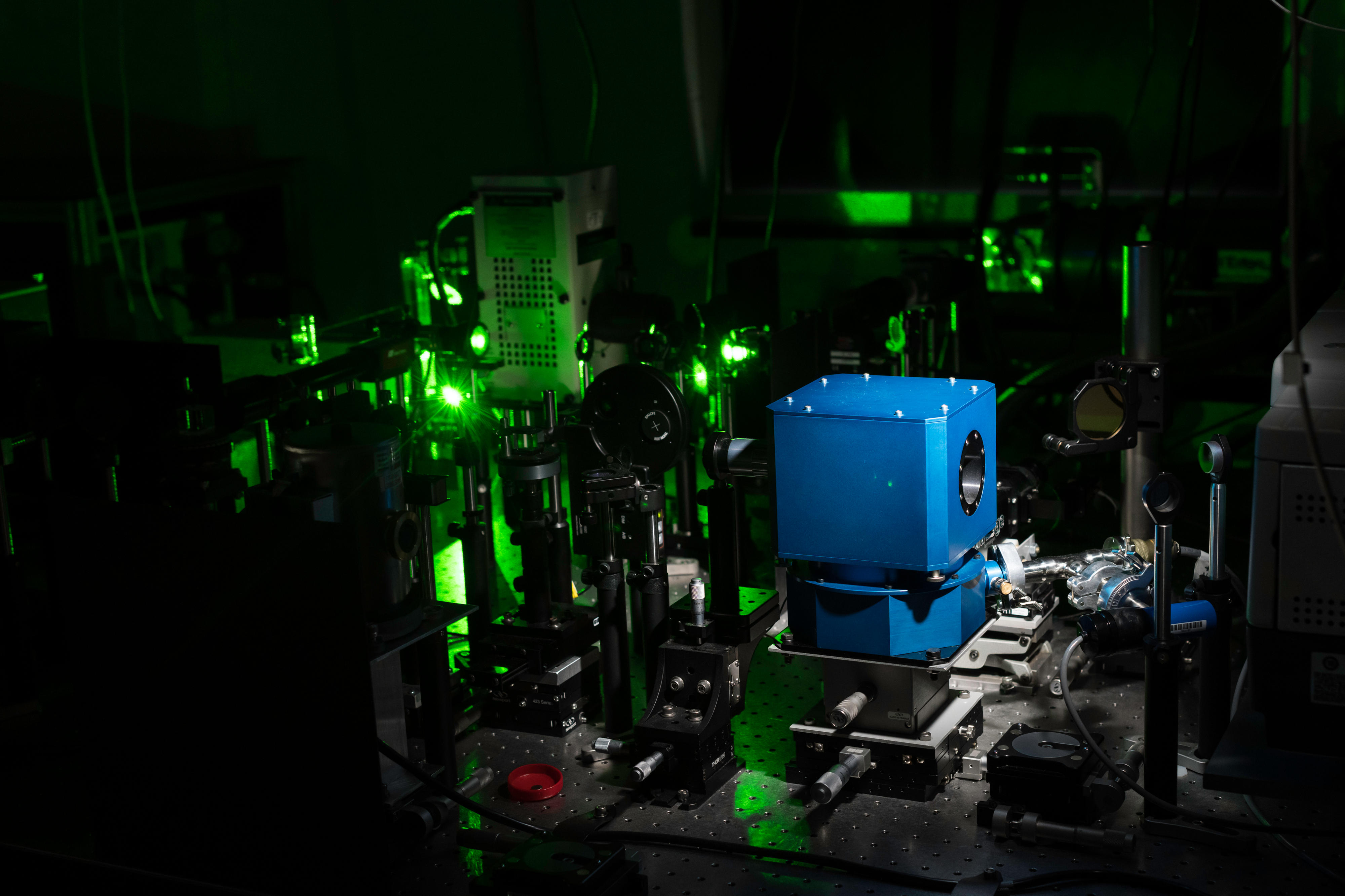
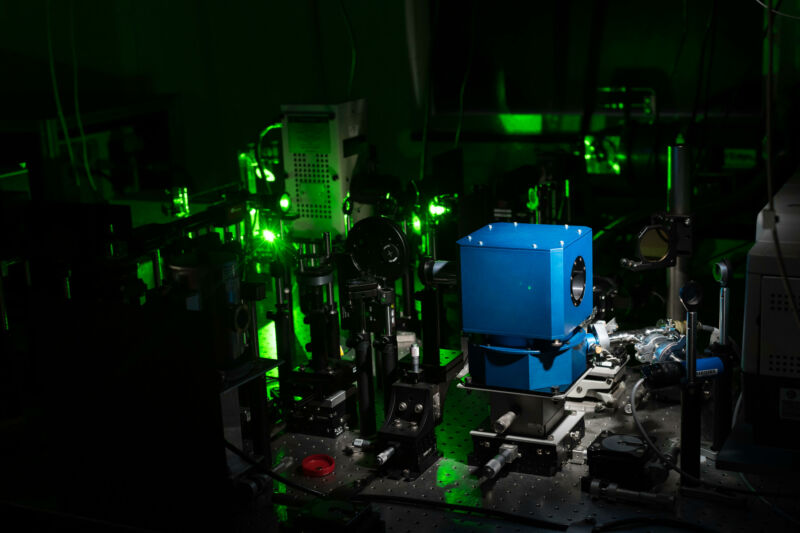
Image of a blue box surrounded by hardware lit in green.

Enlarge / Equipment including a diamond anvil cell (blue box) and laser arrays in the lab of Ranga Dias at the University of Rochester. Undoubtedly, they cleaned up the typical mess of cables and optical hardware before taking the photo.

In the period after the discovery of high-temperature superconductors, there wasn't a good conceptual understanding of why those compounds worked. While there was a burst of progress toward higher temperatures, it quickly ground to a halt, largely because it was fueled by trial and error. Recent years brought a better understanding of the mechanisms that enable superconductivity, and we're seeing a second burst of rapidly rising temperatures.

The key to the progress has been a new focus on hydrogen-rich compounds, built on the knowledge that hydrogen's vibrations within a solid help encourage the formation of superconducting electron pairs. By using ultra-high pressures, researchers have been able to force hydrogen into solids that turned out to superconduct at temperatures that could be reached without resorting to liquid nitrogen.

Now, researchers have cleared a major psychological barrier by demonstrating the first chemical that superconducts at room temperature. There are just two catches: we're not entirely sure what the chemical is, and it only works at 2.5 million atmospheres of pressure.

Read 14 remaining paragraphs | Comments

16 Oct 04:08

The dispossession of Native Americans

Tom Roche

excellent

Historian Claudio Saunt discusses his recent book Unworthy Republic, which tells the story of the forced expulsion of tens of thousands of Native Americans from their lands by the US government in the mid-19th century. The book has recently been shortlisted for the Cundill History Prize. Historyextra.com/podcast


See acast.com/privacy for privacy and opt-out information.

15 Oct 18:37

America, if Trump wins another term

Tom Roche

The fact that LNL is now putting David Frum on ~weekly summarizes the Trump Derangement Syndrome that affects Phillip Adams.

It's taken 240 years, but Donald Trump's Presidency finally brought to life everything that the founding fathers of America most feared. In the words of David Frum, 'they worried ceaselessly about a truly bad man in the office. They built restraints: a complicated system for choosing presidents; a Congress to constrain him, impeachment to remove him'. The system failed. MUSIC; TRACK; Andro Artist: Oneohtrix Point Never
15 Oct 18:35

Democracy Now! 2020-10-15 Thursday

Tom Roche

As a longtime DN! fan, I gotta say, Amy Goodman's performance @ https://www.democracynow.org/2020/10/15/herd_immunity_debate#transcript was cringeworthy. Not just the asking of multiple simultaneous questions (a bad habit which has gotten worse in recent years), but particularly the bit where she pushes

> dozens of fake names had signed the [online Great Barrington Declaration]

... which of course happens anytime one posts something for signatures online. Kulldorff pushed back

> why are you asking about Johnny Bananas instead of many of these thousands of very prominent scientists who have signed this declaration? I’m a simple scientist, so this is something with the media that obviously you know more about than I.

Indeed.

Democracy Now! 2020-10-15 Thursday

  • Headlines for October 15, 2020
  • Herd Immunity: Is It a More Compassionate Approach or Will It Lead to Death or Illness for Millions?
  • Amy Coney Barrett Won't Say Climate Change Is Real; Forgets 1st Amendment Protects Right to Protest

Download this show

15 Oct 00:38

A Look at the 2020 Congressional Landscape

Tom Roche

both segments good

Wordpress entry text: A Georgia senator compares herself to Attila the Hun. An Alaska senate challenger brags about fighting a bear. While the president’s Covid diagnosis has dominated the headlines, local and state races have been getting interesting, and on this week’s podcast DC Bureau Chief Ryan Grim breaks them down with the Washington Post’s Dave Weigel. Then, Pennsylvania’s Lieutenant Governor, John Fetterman, clears up some myths about mail-in voting.

Hosted on Acast. See acast.com/privacy for more information.

15 Oct 00:37

Michael and Us: A "You've Got Mail" Symposium (w/ Meagan Day and Branko Marcetic)

by Jacobin magazine
Tom Roche

VERY EXCELLENT, perhaps the best episode of 'Michael and Us' to date

A podcast about political cinema and our crumbling world. Hosted by Will Sloan and Luke Savage.

Some topics are too vast, too vital for us to cover on our own. Today, we address one such topic. We invited Jacobin Magazine's Meagan Day and Branko Marcetic for a roundtable discussion of Nora Ephron's YOU'VE GOT MAIL (1998), starring Tom Hanks and Meg Ryan. We discover that this parable for gentrification may be the key to all of politics and culture in the 1990s. PLUS: thoughts on the Harris-Pence VP debate and the famous fly.

"Want to Know What a Return to 'Normal' Will Look Like? Stare Into Mike Pence's Dead Eyes" by Branko Marcetic - https://www.jacobinmag.com/2020/10/mike-pence-vp-vice-presidential-debate-trump

13 Oct 23:08

Behind the News, 10/8/20

Tom Roche

[Kathleen Belew @ U Chicago](https://www.kathleenbelew.com/), author of [Bring the War Home](https://www.hup.harvard.edu/catalog.php?isbn=9780674286078), on the history of the white power movement • [Billy Fleming @ U Penn and Data for Progress](https://mcharg.upenn.edu/people/billy-fleming) and [A.L. McCullough @ U Penn](https://mcharg.upenn.edu/people/l-mccullough) on [The 2100 Project: An Atlas for the Green New Deal](https://mcharg.upenn.edu/2100-project-atlas-green-new-deal)
1st/Belew/longer segment is quite good; 2nd is uninteresting beyond "youse should check this out"

Behind the News, 10/8/20 - guests: Kathleen Belew; Billy Fleming and AL McCullough - Doug Henwood
13 Oct 23:06

Ep 185 Patriotic Dissent feat Danny Sjursen

Tom Roche

excellent

Guest: Danny Sjursen. We talk about his new book Patriotic Dissent: America in the Age of Endless War. We talk about the ways that Danny has broken down, categorized and explained the various forms of patriotism and dissent that he sees. He also talks about his own personal evolution in his views of these things. He gives some examples of people in American history who dissented and why that gives him cause for some optimism. One of the people who urged Danny to write this book, Robert Scheer, said: “Sjursen calls for a critical exploration of our allegiances, and suggests a path to a new, more complex notion of patriotism. Equal parts somber and idealistic, this is a story about what it means to be an American in the midst of perpetual war, and what the future of patriotism might look like.” There is an extra bonus segment for patrons: Ep 185EXTRA 9/11 in 2020. 

Daniel A. Sjursen is a retired U.S. Army Major, a prolific writer and speaker, an author/columnist/speaker/podcast host.. He is a contributing editor at Antiwar.com. His work has appeared in the LA Times, NY Times, The Nation, HuffPost, The Hill, Salon, BuzzFeed News, Tom Dispatch and Truthdig.com, among other publications. He is the co-host of the Fortress on a Hill podcast and does interviews on numerous podcasts and other media. He wrote a memoir and critical analysis of the Iraq War titled, Ghostriders of Baghdad: Soldiers, Civilians, and the Myth of the Surge, his new book Patriotic Dissent: America in the Age of Endless War was published this month and he has another book in progress on the history of the United States. 

FOLLOW @SkepticalVet, SUBSCRIBE to the Fortress on a Hill podcast and buy his book Patriotic Dissent: America in the Age of Endless War published by Heyday.

Around the Empire is listener supported, independent media. Pitch in at Patreon: patreon.com/aroundtheempire or paypal.me/aroundtheempirepod. Find all links at aroundtheempire.com

SUBSCRIBE on YouTube. FOLLOW @aroundtheempire and @joanneleon.  SUBSCRIBE/FOLLOW on iTunes, iHeart, Spotify, Google Play, Facebook or on your preferred podcast app.

Recorded on September 17, 2020. Music by Fluorescent Grey.

Reference Links:

  1. Patriotic Dissent: America in the Age of Endless War, Danny Sjursen
  2. September 14, 2001: The Day America Became Israel, Danny Sjursen
  3. What Activists Today Can Learn From MLK’s Bold Anti-War Stance, Danny Sjursen
  4. NYT 1967 response to MLK Beyond Vietnam speech: “Dr. King’s Error”
  5. How Do You Prefer Your Empire: Coarse or Polite?, Danny Sjursen

13 Oct 04:25

Squanto

Tom Roche

gives geolocation error as of 12 Oct 2020 (other 4 in series download as expected)
> {"disclaimer":"This code and data form part of the BBC iPlayer content protection system. Tampering with, removal of, misuse of, or unauthorised use of this code or data constitutes circumvention of the BBC's content protection measures and may result in legal action. BBC (C) 2020.","result":"geolocation"}
~2100 12 Oct 2020 posted download error to https://www.bbc.co.uk/contact/complaints/make-a-complaint/#/Your%20Complaint with 50-char subject='geolocation error on 1 of 5 parts of a series', but did not request response due to their pleading.

Five essays reflect on the impact of the Puritan Pilgrims setting sail on the ship the Mayflower 400 years ago, from Plymouth in England heading west to “the New World”. Writers look at what the anniversary means to Americans in 2020, and create portraits of some of the key players: two of the passengers, and two of the Native Americans who met them. The tale of the 'Pilgrim Fathers' became part of the foundation myth of the United States. On the 400th anniversary of their setting sail, Nick Bryant (BBC New York correspondent) gives an overview of what the anniversary means in America this year, at a time when that myth is under scrutiny more than ever, and Margaret Verble (Cherokee writer, her book ‘Maud’s Line’ a finalist for the 2016 Pulitzer) explores the motivations of Tisquantum, Native American ally and translator to the Pilgrims. Michael Goldfarb (American author, journalist and broadcaster) writes a portrait of John Alden, the crew member turned colonist, Rebecca Fraser (Historian and author of ‘The Mayflower: the Families, the Voyage, and the Founding of America’) uncovers the story of Susanna White-Winslow, Mayflower passenger, and David Silverman (American historian and author) looks at the decisions facing Metacom: a child when the Mayflower landed, he would become a resistance leader. Margaret Verble, author of the Pulitzer finalist novel ‘Maud’s Line’ and ‘Cherokee America’, considers the life and legacy of Squanto, a Native American man who acted as an interpreter and guide to the Pilgrim settlers, whose motives have been blurred by history.
11 Oct 06:04

Andrea Grandi: Using pyenv to install Python and create a virtual environment

How to use pyenv to install a specific version of Python and create a virtual environment with that version

10 Oct 05:58

Trump vs. Covid and 'Amy Hairy Conehead' with David Sirota

Tom Roche

VERY EXCELLENT

Journalist David Sirota joins the show to talk Trump and Covid, Biden and the election, and how 80s pop culture relates to today.

Merch Link: https://teespring.com/stores/useful-idiots

Learn more about your ad choices. Visit podcastchoices.com/adchoices

08 Oct 23:24

Irreal : Research Tools for the Beginner

by jcs

Kieran Haley, a Sociologist at Duke has an interesting paper that provides advice on research tools for beginning graduate students—or perhaps for brand new faculty members—in the social sciences. Haley has a Uses This profile that gives a précis of his background.

It’s Irreal fodder because his primary recommendation is Emacs and R. The paper is from 2013 so it’s a bit dated—he’s using Emacs 23—but its advice is still very relevant today. Actually, Emacs provides an even better solution today than it did in 2013. This is mostly because of the growing ecosystem around Org mode. For example, John Kitchin’s org-ref addresses many of the citation problems that Haley mentions.

One of the things that that Haley calls out as very important is reproducible research and keeping your data, processing code, and text together. Org mode excels in this and provides a way of ensuring that your computed results always match your data.

If you’re just starting graduate school or an academic career in the sciences—even the social sciences—you should definitely take a look at Haley’s paper. It’s got a lot of useful suggestions and makes a few specific suggestions about tools. Emacs and Org are a steep hill to climb, of course, but very much worth the effort.

08 Oct 23:20

Protesilaos Stavrou : My simple note-taking system for Emacs (without Org)

by Protesilaos Stavrou

Update 2020-10-09 06:55 +0300: Added annex with Karl Voit’s comment.

Earlier today I published as part of my dotemacs the initial implementation of usls, the “Unassuming Sidenotes of Little Significance” (USLS). This is a small set of utilities that help me write and maintain timestamped and categorised plain text files in a flat directory listing. It builds on core Emacs commands, such as dired and find-file, while relying on functionality provided by standard libraries like thingatpt.

The present article offers an overview of usls, my workflow, and their underlying values.

Plain text and Emacs commands

USLS is the realisation of a personal note-taking system that I have developed over the course of the last few months. Its primary aim is to remain faithful to a plain text workflow that could, in principle, be implemented with nothing but a POSIX shell.

Everything from the resulting file name to the actual contents must be usable in the most basic computing environment, such as a TTY, or a generic text editor and file manager. It must also be intelligible to non-Emacs users for when I wish to share a note or, perhaps in the future, to ask someone to act on my files.

To accomplish this, we set on a naming convention that offers an adequate filtering mechanism at the visual level (more on naming in the next section). Each filename is written as DATE--CATEGORY--TITLE.txt:

/home/prot/Documents/notes:
20201006_113858--politics--eu-deep-concerns-about-varosha.txt
20201006_120634--economics--google-and-fitbit-merger-is-a-scary-prospect.txt
20201007_124941--economics--plentiful-and-predictable-liquidity.txt

While this may seem primitive, just looking at a long list of that kind will quickly reveal patterns. With the help of dired, we can filter by regular expression. For example:

  • mark items that match a regexp with % m.
  • t to toggle the mark so that you select all the files that did not match the initial search.
  • k to hide those from the list (bring everything back with g).

Simple and super effective.

Speaking of Dired, one can always use j to jump to a file’s line using completion. I have Icomplete with the orderless pattern matching style by Omar Antolín Camarena (check my dotemacs). Jumping to a file using out-of-order groups of flex/regexp matches feels empowering—and is what I am used to doing throughout my Emacs setup.

Same principle for other standard tools, such as when conducting a directory-wide grep. There is no need to have a usls-specific solution when there are plenty of general purpose alternatives in the Emacs milieu, including the capable built-in project.el library that Manuel Uberti recently wrote about (2020-09-18).

In short, usls does not implement a file manager, content searcher, project organiser, etc. Its focus is on streamlining the process of creating notes.

The file’s name and contents

The command usls-new-note is the main point of entry to this tool. Calling it will first open a minibuffer prompt asking for the file’s title. That gets inserted in the resulting buffer as-is, while a hyphenated variant is used to construct the filename. Once that prompt closes, a second one appears asking for a category. Here the user is presented with a list of completion candidates. It is possible to pick an item from those on offer or type in a new one (for Icomplete I bind exit-minibuffer to C-j as a means to forcefully send input, just as for a non-matching item or a substring).

The resulting buffer is as follows (%? indicates the point):

title: Plentiful and predictable liquidity
date: 2020-10-07
category: Economics
orig_name: ~/Documents/notes/20201007_124941--economics--plentiful-and-predictable-liquidity.txt
orig_id: 20201007_124941
------------------------

%?

The date, the original filename and ID are generated automatically. Those header fields are mostly intended for grep operations and to offer a sense of context without having to resort to demanding alternatives for meta-data management (powerful though they may be).

Now here comes the feature I use the most: invoking usls-new-note while the region is active will append its text to the resulting buffer.

title: Plentiful and predictable liquidity
date: 2020-10-07
category: Economics
orig_name: ~/Documents/notes/20201007_124941--economics--plentiful-and-predictable-liquidity.txt
orig_id: 20201007_124941
------------------------

%?

* * *

REGION GOES HERE

This alone makes it easy to benefit from some of that org-capture goodness while remaining faithful to the overarching design principle of simplicity. I use this a lot when going through elfeed news, gnus mails/groups, and even websites accessed via eww. There is no setup for any of them. All we do is copy the region.

Concerning the actual contents of the note, I tend to write long and carefully considered entries, though the system does not impose any particular paradigm. One could easily maintain bullet points. Seeing though as this is plain text, there is not much you can do with graphics or all those extras that Org provides (unless you reinvent Org, but I digress). I actually consider such a constraint an upside: it focuses the mind on the task of distilling an idea or set thereof.

Categories and the absence of tags

Tags never worked for me. This has been true ever since I created my first blog circa 2011. You add a bundle of words to each entry, expecting that over the long term this method will give rise to emergent themes. Wordpress even provides a “tag cloud” widget (last time I checked) so that you can see which word has the most entries. Perhaps this yields returns for large sets of files and is appropriate for data mining on an industrial scale. On my end, however, it always felt like tags were an assortment of terms that offered little insight into the linkages between my writings.

Think about a set of tags for this blog post: “emacs”, “notes”, “library”, “package”. When studied as a group they do have a descriptive value: an emergent quality. We can infer what this is all about. Yet when each of those is interpreted in its own right it is more likely to confuse rather than enlighten us. Imagine having ten entries under “library” and another ten under “books”. You then realise that you must invent more specific tags such as “university-library” or “emacs-library”, until you reach a point where you have too many tags for too few entries. Which eventually forces you to expend energy on administrivia rather than the essence of your text: which tags to select, whether three or five of them are enough, and so on.

As such, I have settled on a simple rule of assigning a single word to each entry, which I call a “category”. It describes in very broad terms what the note is about. To help you choose among competing options, think which one would have the highest descriptive value when read on its own. So the current article would be associated with “emacs” instead of “code”, “library”, “package”…

Categories must be generic though remain sufficiently informative. It would, for instance, be impractical to archive an economics’ piece under “science”, just as it would be tricky to write sub-categories like “monetary”, “finance”, “fiscal”, etc. which would inevitably introduce the same problems as with tags. There is no magic solution here. Just pick a word that makes sense to you and is flexible enough.

On the technical side of things, usls-new-note presents its completion candidates for categories using two sources that get combined in to a single list:

  1. A pre-determined list (usls-known-categories as of this writing);
  2. Dynamically inferred entries based on filenames in usls-directory.

Linking entries and finding connections

Most of my notes are standalone pieces. I elucidate my thoughts as best I can and try not to rely on implicit information or “further reading” material for statements I make (with the understanding that I do have all of it in my head). Still, there are cases where links to other items are mandatory. My answer is quite uninspiring on the surface level: add a unique identity (timestamp) that points to a file name, plus some caret signs.

Some text I am writing.^20201007_124941

^^ 20201007_124941--economics--plentiful-and-predictable-liquidity.txt

Those are conveniently inserted with usls-id-insert, which uses completion to select among a list of files that includes every item in the usls-directory, except the current entry.

Strictly speaking, this is not a link. It is a reference to a file name whose location is assumed as relative to the directory that includes those files. Emacs can handle such cases gracefully. Place the point over either the ID (single caret) or the full name (double caret) and type C-x C-f M-n. There should only ever be a single match. To make this process a bit faster, though still faithful to what Emacs already does, usls-follow-link presents completion candidates of all such references (the “follow link” misnomer notwithstanding).

There is no backward linking feature to speak of. While appealing and probably beneficial in some fields of endeavour, it requires lots of extras to work reliably; extras that I would rather avoid else risk jeopardising my attempt at a minimalist setup.

If you need to find all files that reference a given ID/name, call some grep command (rg.el, counsel-rg and the rest of the bunch, or occur, multi-occur for buffers). It works just fine. Plus, with the wgrep package you can edit the results of grep in a dedicated buffer, in case you ever wish to refactor things—combine that with the standard wdired for maximum effect and don’t forget query-replace, keybard macros or multiple cursors, etc.

This is not a “second brain”

You can already discern the elements of my approach to the task of composing plain text notes: leverage standard Emacs functions, avoid duplication of efforts, minimise dependencies or complexity, and focus on the text you intend to write, all while relying on a straightforward file naming scheme and some ancillary syntactic notation. Any extras can come from existing packages, per the user’s needs.

The name of this library—Unassuming Sidenotes of Little Significance or usls—is a mere joke about it being “useless” when compared with comprehensive solutions that promise to grant you a second brain.

While my code is just an exercise in Emacs Lisp that impliments a simplistic private system for recording thoughts, I do believe that the key to productivity does not rest with any of the tools on offer, but with the clarity of concept one has developed prior to making use of them.

What is the utility of a second brain if you have not yet realised the potential of the first one?

In conclusion, what I have right now is a working prototype. I will continue to iterate on it whenever I discover some area that could be improved further, without deviating from the underlying design values documented herein. The library is currently part of my dotemacs and is available under this heading: https://protesilaos.com/dotemacs/#h:787df548-0d95-4512-a61d-27852198f561. Perhaps it will inspire you to implement a workflow that matches your expectations and makes you feel in control of what is happening.

Also note that usls is not meant as a substitute for Org, such as to track to-do lists, produce an agenda, etc. This is about private records of longer form notes, such as commentary on a paper I read. I still use Org to organise life’s details and also to produce documents such as my literate Emacs configuration (my dotemacs) or the Info manual of my Modus themes.

Annex with comment made by Karl Voit

Karl Voit is an expert on Personal Information Management (PIM) and contacted me to share valuable insights. Message reproduced with permission in the text block below.

The short version of my reply is that I am open to reviewing things and learning from others. Some decisions, such as the format of the date or the lack of spaces are purely stylistic or matters of convenience: I am fine with other techniques. What matters is the general principle of keeping things simple and accessible.

In concrete terms, I plan to use completing-read-multiple so that one could insert more than one category at the prompt (notwithstanding other ideas I may take from Karl’s website, once I eventually read through the wealth of knowledge found there).

From: Karl Voit
Subject: USLS
To: public@protesilaos.com
Date: Thu, 8 Oct 2020 18:11:51 +0200

Hi,

Thanks for writing down about your cool system.

I do have a few remarks on your approach. I don't assume, you will
change your approach. However, I'd like to mention a few things
related to your file name convention and categories.


DATE--CATEGORY--TITLE.txt
with:
20201006_113858--politics--eu-deep-concerns-about-varosha.txt

I'd prefer a more ISO 8601 approach for general compatibility.

My own concept with focus on shell and CLI tools is summarized on:
https://karl-voit.at/managing-digital-photographs/

It consists of conventions + a set of self-written tools.

In my case, the file name convention looks like:

/this/is/a/folder/2014-04-20T17.09 Picknick in Graz -- food graz.jpg
 [ move2archive  ] [  date2name   ] [appendfilename] [ filetags ]

ISO 8601 can not be applied to file names directly because ":" is
not a valid character on Microsoft file systems. Therefore, I
settled with ".".

You do seem to avoid spaces in file names. IMHO, while this was good
practice up to maybe ten or fifteen years ago, I don't see any
reason to continue. I myself switched to spaces and (most recently)
also to special characters in file names as well without an issue.
YMMV. I got sick of looking for "*Vorhaenge*" as well as for
"*Vorhaenge*" in order to locate my own files (german Umlauts as
7-bit-pendants) and file names from others using the proper Umlaut.

Support from all standard tools in my zsh is perfect for special
characters such as Umlauts as well. No reason left to limit myself.


Categories vs. tags:

I do have some background there and this is maybe the main reason
for my comments.

The issues you're describing are very common aspects when tags are
used. IMHO a promising approach is to curate a finite and limited
set of tags, called "controlled vocabulary" (CV). Compare to
https://github.com/novoid/filetags which offers methods to deal with
CVs - even multiple of them - in an elegant way, I think.

This way, you need to limit yourself to high-level concepts instead
of describing the content of the information.

This should avoid the excessive use of new tags for all kinds of
files. 

Furthermore, multi-classification is a good thing to have. 

You're describing one possible approach to curcimvent
multi-classification: choosing the currently most important
category.

This is a valid approach but it comes with a well-studied
disadvantage: your mental model of the world is constantly changing.
The way you're thinking while creating the file name is different
from the world and context when retrieving the information.

From this background, it would be wiser not to have any category at
all and use the content to locate information (3rd order of orders
according to David Weinberger): full-text search.


I experienced with those ideas myself for quite some years until I
defined my method, conventions and wrote my tools.

Again: since you've invested so much already, there will be a very
small chance that you will change anything here. However, I had to
think about similar topics and came out with a different approach.
Maybe there is something you can take away from my result for your
system as well.


PS: If you - for some reason - want to publish my text. I'm fine
with it as long as you omit my email address.
07 Oct 23:39

Harvard's papyrus scandal

Tom Roche

confirmation bias in action

Eight years ago, a tiny fragment of papyrus caused an uproar in academic and religious circles. Harvard University became embroiled in a scandal after Karen King, a historian at Harvard Divinity School, made a major announcement at an academic conference in Rome. She had discovered a fragment of papyrus that bore a shocking phrase. It read: “Jesus said to them, My wife.” But the papyrus was a fake.
06 Oct 19:51

Michael and Us: Rule of Thumb Pt. II

by Jacobin magazine
Tom Roche

very apolitical, but still interesting

A podcast about political cinema and our crumbling world, hosted by Will Sloan and Luke Savage.

What does it mean to be "America's Critic"? What does it take to be the most powerful critic the world has ever known? Several months back we discussed "Siskel & Ebert," but now we turn our attention specifically to Roger Ebert, the Pulitzer-winner who may forever be America's best-known film critic. We watch the Ebert documentary LIFE ITSELF (2014), and ponder the movie's questionable assertion that "He did not get caught up in certain ideologies of what cinema should be." PLUS: why are liberals sending thoughts and prayers to the president?

NOTE: As a special experiment for the month of October 2020, we will be posting two episodes per week - one free, one Patreon-exclusive. Like the show and want more? Go to https://www.patreon.com/michaelandus.

Episode #152 ("Rule of Thumb" Pt. I) - https://soundcloud.com/michael-and-us/152-rule-of-thumb

"Roger Ebert's Zero-Star Movies" by Will Sloan - https://hazlitt.net/feature/roger-eberts-zero-star-movies

05 Oct 17:39

Behind the News, 10/1/20

Tom Roche

[Max B. Sawicky @ CEPR](http://www.maxspeak.org/), author of [this report](https://cepr.net/report/the-us-postal-service-is-a-national-asset-dont-trash-it/), on the postal service’s problems and what could be done about them • [Kelly Grotke @ U Helsinki](http://www.helsinki.fi/erere/pages_team/kelly_grotke.html) on college endowments and selective austerity (janitors lose, portfolio managers win)

Behind the News, 10/1/20 - guests: Max Sawicky, Kelly Grotke - Doug Henwood
05 Oct 02:12

A Goodbye Message from Mehdi

Tom Roche

going to Peacock (new NBC streaming platform), Ryan Grim et al to continue

A special message from Deconstructed host Mehdi Hasan. Mehdi talks to Intercept DC Bureau Chief Ryan Grim about where he's headed and what's next for the podcast.

Hosted on Acast. See acast.com/privacy for more information.

02 Oct 03:21

Matt Layman: Check Web App Security With Bandit - Building SaaS #74

Tom Roche

bandit static analysis tool for automated security checking of webapps

In this episode, I integrated the bandit static analysis tool to do automated security checking of my code before each commit. We talked about pre-commit and how to add in a new hook. After finishing that tool addition, we got deep into Django while removing some messages inserted by django-allauth on sign up. We began by talking about what the bandit tool does and how it works. Once I explained bandit, I focused on the bandit documentation to see how to add the tool.
02 Oct 03:20

Did Russia really poison opposition politician Navalny? And NATO wants a color revolution in Belarus

Tom Roche

excellent, excepting the 'bombshell intercepted recording' parody runs on a bit long

Max Blumenthal and Ben Norton start off with an exclusive, bombshell intercepted recording we were leaked of Russian President Vladimir Putin's phone calls.

Then we speak with journalist Bryan MacDonald, who lives in Russia, about the very suspicious alleged poisoning of opposition candidate Alexei Navalny, and what his real, xenophobic politics are.

We also discuss the NATO/EU attempt to orchestrate a so-called color revolution in Belarus and install a pro-Western neoliberal regime.

VIDEO: youtube.com/watch?v=9ow9-w8nvJM

SECTIONS 0:00 Exclusive, bombshell intercepted recording 8:33 Poisoning of Russian opposition politician Alexei Navalny 45:00 Belarus color revolution attempt 1:21:30 Outro

PART 1 OF 2

Follow Bryan MacDonald on Twitter: twitter.com/27khv

(Episode recorded on September 22, 2020)

01 Oct 13:36

Medieval eels and Englishness

Tom Roche

very excellent!

Eels were a mainstay of the economy in the Middle Ages, and also a part of the developing English identity. Dr John Wyatt Greenlee explains why the fish mattered so much. Visit https://historiacartarum.org/ for more information on Dr Greenlee’s medieval eels project. Historyextra.com/podcast


Enter the podcast survey here: https://immediateinsiders.com/uc/admin/65da/?a=1&b=6


Survey closes Sunday 4th October 2020 at 11:59pm


See acast.com/privacy for privacy and opt-out information.

30 Sep 17:22

Peter Irons on the History of the Supreme Court

29 Sep 17:21

Democracy Now! 2020-09-29 Tuesday

Tom Roche

good Keeanga-Yamahtta Taylor interview, though she bungles Juan Gonzalez's good questions in 1st part. see https://www.democracynow.org/2020/9/29/keeanga_yamahtta_taylor_2020_election_scotus (TODO: archive after transcript is un-rush)

Democracy Now! 2020-09-29 Tuesday

  • Headlines for September 29, 2020
  • Keeanga-Yamahtta Taylor: We Must Rethink Our Society, from Policing to the Supreme Court
  • Keeanga-Yamahtta Taylor: Breonna Taylor's Rigged Case Further Erodes Legitimacy of U.S. Institutions
  • Philly Activists Reclaim 50 Vacant Houses, Creating a Model for Organizing as Mass Evictions Loom
  • David Cay Johnston: Trump Deserves to Be Jailed, But System Is Set Up to Let Rich Avoid Paying Taxes

Download this show

28 Sep 19:27

Simon de Montfort and England’s First Revolution

Tom Roche

rerun

In a talk that she delivered at our 2019 BBC History Magazine History Weekend in Winchester, historian Sophie Ambler tells the story of Simon de Montfort’s doomed rebellion against King Henry III in the 13th century. Historyextra.com/podcast


Enter the podcast survey here: https://immediateinsiders.com/uc/admin/65da/?a=1&b=6


Survey closes Sunday 4th October 2020 at 11:59pm


See acast.com/privacy for privacy and opt-out information.

28 Sep 19:24

How philanthropy benefits the super-rich

There are more philanthropists than ever before. Each year they give tens of billions to charitable causes. So how come inequality keeps rising?. Help support our independent journalism at theguardian.com/longreadpod
27 Sep 20:17

Behind the News, 9/24/20

Tom Roche

[Fredrik de Boer](https://fredrikdeboer.com/), author of [The Cult of Smart](https://us.macmillan.com/books/9781250224491), on dethroning academic “excellence” as the distributor of rewards in this society • Matthew Snyder on building a community land trust in the Inland Empire of California ([that CLT](https://inlandequityclt.org/), [CLTs in general](https://community-wealth.org/))

Behind the News, 9/24/20 - guests: Freddie de Boer, Matthew Snyder - Doug Henwood
27 Sep 17:46

Andrea: Composition Update: Slack links in your Org Agenda

by Andrea
Tom Roche

discusses ol-emacs-slack

27 Sep 17:43

Irreal: Document Preparation with Org, LaTeX, and Docker

by jcs
Tom Roche

See referenced https://www.marcoieni.com/2020/02/doc-org-org-mode-latex-docker-pdf/ , with pullquote=
> [Here](https://github.com/doc-org/examples) there are tons of example documents that are automatically generated by using [GitHub Actions]. Yes, you can version your small plain text files with git and then automatically build the pdf after every `git push`!

Marco Ieni was tired of working with Microsoft Word so he he built a workflow that uses Org mode for document preparation. Irreal readers know he won’t be getting any arguments here. Even putting aside the brain-dead Word UI there are compelling reasons to prefer plain text: you can use effective version control; write with any editor; make use of grep, diff, and similar utilities; and even generate some text programmatically. And, of course, your data is not held captive in some proprietary format.

There’s nothing new about any of that, of course, but Ieni took it a step further and considered the problem of collaborators. He accepts that convincing colleagues to adopt Emacs is basically impossible so he came up with a command line utility, doc-org, to enable non-Emacsers to have a sensible writing environment. Of course, they still have use some sort text editor, which many academics would no doubt consider an intolerable burden but Ieni says that the system is mainly aimed at people who are already using LaTeX and would like to move to the easier Org markup. It’s a good fit for people like that. As Ieni puts it, “The main goal of doc-org is to bring the conciseness of org mode to latex users.”

Ieni concludes his post by saying that he hopes that people will come to realize that “the best way to write documents together is the same of writing code together: plain text + version control systems like git.” Realistically that’s probably not going to happen but the most efficient and successful will probably adopt some sort of notion similar to this.

27 Sep 17:38

Andrea: Org Agenda and Your Future, or how to keep score of your long term goals with Org Mode

by Andrea
26 Sep 03:52

RBG and the Supreme Court with Samuel Moyn

Tom Roche

excellent, esp the interview (which starts @ 34 min) though the pre-interview is also good (just not *as* good)

Yale professor of law and history, Samuel Moyn, joins the show to discuss the Supreme Court after the death of Ruth Bader Ginsburg. Matt and Katie discuss a dustup in Syria that hasn't gotten much media attention.

Learn more about your ad choices. Visit podcastchoices.com/adchoices