13 Sep 13:37
by Verena A. Hintermayr, Alexander F. Richter, Florian Ehrat, Markus Döblinger, Willem Vanderlinden, Jasmina A. Sichert, Yu Tong, Lakshminarayana Polavarapu, Jochen Feldmann, Alexander S. Urban

High-quality hybrid halide perovskite nanocrystals are fabricated through a simple, versatile, and efficient two-step process involving a dry step followed by a ligand-assisted liquid-phase exfoliation step. The emission wavelength of the resulting nanocrystals can be tuned either through composition by varying the halide content or by reducing their thickness.
13 Sep 13:37
by Heng Lu, Jicheng Zhang, Jianya Chen, Qian Liu, Xue Gong, Shiyu Feng, Xinjun Xu, Wei Ma, Zhishan Bo

A ternary-blend strategy is presented to surmount the shortcomings of both fullerene derivatives and nonfullerene small molecules as acceptors for the first time. The optimal ternary device shows a high power conversion efficiency (PCE) of 10.4%. Moreover, a significant enhancement in PCE (≈35%) relative to both of the binary reference devices, which has never been achieved before in high-efficiency ternary devices, is demonstrated.
13 Sep 13:37
by Senyun Ye, Haixia Rao, Weibo Yan, Yunlong Li, Weihai Sun, Haitao Peng, Zhiwei Liu, Zuqiang Bian, Yongfang Li, Chunhui Huang

The feasibility of co-depositing a hole-conductor and a perovskite layer is demonstrated to simplify the preparation process of perovskite solar cells. The CuSCN incorporated in the perovskite layer can participate in forming the perovskite/CuSCN bulk-heterojunction and accelerate hole transport effectively, which eventually leads to a maximum power conversion efficiency of 18.1% with almost no J–V hysteresis.
13 Sep 02:56
Energy Environ. Sci., 2016, 9,3464-3471
DOI: 10.1039/C6EE02255C, Paper
Kwang Hyun Park, Yujin An, Seungon Jung, Hyesung Park, Changduk Yang
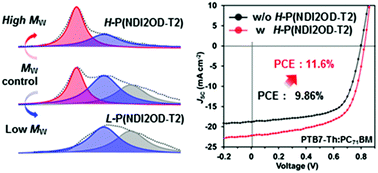
Introduction of an n-type macromolecular additive (P(NDI2OD-T2) polymer) in organic solar cells brings significant improvements in power conversion efficiency along with robust thermal stability.
The content of this RSS Feed (c) The Royal Society of Chemistry

10 Sep 00:49
J. Mater. Chem. A, 2016, 4,15375-15382
DOI: 10.1039/C6TA06607K, Paper
O. J. Weber, B. Charles, M. T. Weller
The phase and structural behaviours of the hybrid perovskites FAxMA1-xPbI3 as a function of composition and temperature have been determined.
The content of this RSS Feed (c) The Royal Society of Chemistry
10 Sep 00:49
J. Mater. Chem. A, 2016, 4,15420-15425
DOI: 10.1039/C6TA06523F, Paper
Zhiming Zhong, Xiao-Ye Wang, Fang-Dong Zhuang, Na Ai, Jian Wang, Jie-Yu Wang, Jian Pei, Junbiao Peng, Yong Cao
BN-DBTTC is added to a PTB7:PC71BM device to suppress the crystallization of PCBM in ternary solar cells.
The content of this RSS Feed (c) The Royal Society of Chemistry
10 Sep 00:49
Energy Environ. Sci., 2016, 9,3007-3035
DOI: 10.1039/C6EE01137C, Review Article
Francesco Di Giacomo, Azhar Fakharuddin, Rajan Jose, Thomas M. Brown
A review and perspective on the development of perovskite solar cells on flexible substrates.
The content of this RSS Feed (c) The Royal Society of Chemistry

09 Sep 08:04
by Toshinori Matsushima, Sunbin Hwang, Atula S. D. Sandanayaka, Chuanjiang Qin, Shinobu Terakawa, Takashi Fujihara, Masayuki Yahiro, Chihaya Adachi

A very high hole mobility of 15 cm2 V−1 s−1 along with negligible hysteresis are demonstrated in transistors with an organic–inorganic perovskite semiconductor. This high mobility results from the well-developed perovskite crystallites, improved conversion to perovskite, reduced hole trap density, and improved hole injection by employing a top-contact/top-gate structure with surface treatment and MoOx hole-injection layers.
09 Sep 08:03
by Sunsun Li, Long Ye, Wenchao Zhao, Shaoqing Zhang, Subhrangsu Mukherjee, Harald Ade, Jianhui Hou

Fine energy-level modulations of small-molecule acceptors (SMAs) are realized via subtle chemical modifications on strong electron-withdrawing end-groups. The two new SMAs (IT-M and IT-DM) end-capped by methyl-modified dicycanovinylindan-1-one exhibit upshifted lowest unoccupied molecular orbital (LUMO) levels, and hence higher open-circuit voltages can be observed in the corresponding devices. Finally, a top power conversion efficiency of 12.05% is achieved.
09 Sep 08:01
by Andrea Capasso, Luigi Salamandra, Giuliana Faggio, Theodoros Dikonimos, Francesco Buonocore, Vittorio Morandi, Luca Ortolani and Nicola Lisi

ACS Applied Materials & Interfaces
DOI: 10.1021/acsami.6b06749

09 Sep 07:58
by Thomas M. Brenner, Yevgeny Rakita, Yonatan Orr, Eugenia Klein, Ishay Feldman, Michael Elbaum, David Cahen and Gary Hodes

Chemistry of Materials
DOI: 10.1021/acs.chemmater.6b01747

08 Sep 13:43
by Severin N. Habisreutinger, Nakita K. Noel, Henry J. Snaith, Robin J. Nicholas
The majority of hole-transporting layers used in n-i-p perovskite solar cells contain 4-tert butylpyridine (tBP). High power-conversion efficiencies and, in particular, good steady-state performance appears to be contingent on the inclusion of this additive. On the quest to improve the steady state efficiencies of the carbon nanotube-based hole-transporter system, this study has found that the presence of tBP results in an extraordinary improvement in the performance of these devices. By deconstructing a prototypical device and investigating the effect of tBP on each individual layer, the results of this study indicate that this performance enhancement must be due to a direct chemical interaction between tBP and the perovskite material. This study proposes that tBP serves to p-dope the perovskite layer and investigates this theory with poling and work function measurements.

The effect of the hole-transporter additive 4-tert Butylpyridine (tBP) on the device performance of perovskite solar cells is investigated. The additive is shown to improve the steady-state efficiency of perovskite solar cells independent of the hole-transport material. A direct interaction between tBP and the perovskite absorber is identified as being responsible for the observed improvement.
08 Sep 10:38
Chem. Soc. Rev., 2016, 45,5951-5984
DOI: 10.1039/C5CS00769K, Review Article
Guan Zhang, Gang Liu, Lianzhou Wang, John T. S. Irvine
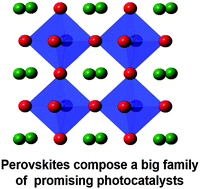
This review specifically summarizes the recent development of perovskite photocatalysts and their applications in water splitting and environmental remediation.
The content of this RSS Feed (c) The Royal Society of Chemistry

08 Sep 00:33
by Jinwoo Byun, Himchan Cho, Christoph Wolf, Mi Jang, Aditya Sadhanala, Richard H. Friend, Hoichang Yang, Tae-Woo Lee

Efficient quasi-2D perovskite light-emitting diodes (PeLEDs) are realized by partially substituting methyl ammonium (MA) cations with phenylethyl ammonium cations in MAPbBr3. The excitons move to the crystals, which have the smallest bandgap, and recombine. The quasi-2D PeLED designed by T.-W. Lee and co-workers, as described on page 7515, shows higher luminance and current efficiency (2935 cd m−2 and 4.90 cd A−1, respectively) compared with 3D MAPbBr3 PeLEDs.
08 Sep 00:32
J. Mater. Chem. A, 2016, 4,15232-15239
DOI: 10.1039/C6TA07120A, Paper
Ming Wang, Hengbin Wang, Michael Ford, Jianyu Yuan, Cheng-Kang Mai, Stephanie Fronk, Guillermo C. Bazan
Two regioregular narrow bandgap conjugated polymers (PM1 and PM2) are prepared and their devices exhibit low Voc loss and high short circuit current Jsc, but, most significantly, display improved fill factors compared to previously reported PIPCP.
The content of this RSS Feed (c) The Royal Society of Chemistry
08 Sep 00:31
by Kidong Park, Jong Woon Lee, Jun Dong Kim, Noh Soo Han, Dong Myung Jang, Seonghyun Jeong, Jeunghee Park and Jae Kyu Song

The Journal of Physical Chemistry Letters
DOI: 10.1021/acs.jpclett.6b01821

07 Sep 09:18
by Yunpeng Qin, Mohammad Afsar Uddin, Yu Chen, Bomee Jang, Kang Zhao, Zhong Zheng, Runnan Yu, Tae Joo Shin, Han Young Woo, Jianhui Hou

A highly efficient fullerene-free polymer solar cell (PSC) based on PDCBT, a polythiophene derivative substituted with alkoxycarbonyl, achieves an impressive power conversion efficiency of 10.16%, which is the best result in PSCs based on polythiophene derivatives to date. In comparison with a poly(3-hexylthiophene):ITIC-based device, the photovoltaic and morphological properties of the PDCBT:ITIC-based device are carefully investigated and interpreted.
07 Sep 07:39
Nanoscale, 2016, 8,16881-16885
DOI: 10.1039/C6NR05917A, Communication
Xiao-Xin Gao, Qian-Qing Ge, Ding-Jiang Xue, Jie Ding, Jing-Yuan Ma, Yao-Xuan Chen, Bao Zhang, Yaqing Feng, Li-Jun Wan, Jin-Song Hu
Tuning the Fermi-level of TiO2 mesoporous layer by lanthanum doping is demonstrated as an effective way to significantly enhance the power conversion efficiency of perovskite solar cells.
The content of this RSS Feed (c) The Royal Society of Chemistry

07 Sep 01:50
by Beomjin Jeong, Ihn Hwang, Sung Hwan Cho, Eui Hyuk Kim, Soonyoung Cha, Jinseong Lee, Han Sol Kang, Suk Man Cho, Hyunyong Choi and Cheolmin Park

ACS Nano
DOI: 10.1021/acsnano.6b05478

06 Sep 02:06
J. Mater. Chem. A, 2016, 4,15788-15822
DOI: 10.1039/C6TA06987H, Review Article
Chin Hoong Teh, Rusli Daik, Eng Liang Lim, Chi Chin Yap, Mohd Adib Ibrahim, Norasikin Ahmad Ludin, Kamaruzzaman Sopian, Mohd Asri Mat Teridi
HTMs with a planar core structure, extended-[small pi] system and electron-rich groups exhibited better intrinsic conductivity, which enhanced the photovoltaic performance.
The content of this RSS Feed (c) The Royal Society of Chemistry
05 Sep 10:05
by Xian-Kai Chen, Mahesh Kumar Ravva, Hong Li, Sean M. Ryno, Jean-Luc Brédas

In organic solar cells, a major source of energy loss is attributed to nonradiative recombination from the interfacial charge transfer states to the ground state. By taking pentacene–C60 complexes as model donor–acceptor systems, a comprehensive theoretical understanding of how molecular packing and charge delocalization impact these nonradiative recombination rates at donor–acceptor interfaces is provided.
03 Sep 00:47
Nanoscale, 2016, 8,18021-18026
DOI: 10.1039/C6NR05330K, Communication
Zhanhua Wei, Ajay Perumal, Rui Su, Shendre Sushant, Jun Xing, Qing Zhang, Swee Tiam Tan, Hilmi Volkan Demir, Qihua Xiong
CsPbBr3 light-emitting diodes reveal a high luminance of 7276 cd m-2 and an outstanding ambient stability (>15 h).
The content of this RSS Feed (c) The Royal Society of Chemistry

03 Sep 00:46
J. Mater. Chem. A, 2016, 4,16036-16046
DOI: 10.1039/C6TA06258J, Paper
K. Zhao, H. Hu, E. Spada, L. K. Jagadamma, B. Yan, M. Abdelsamie, Y. Yang, L. Yu, R. Munir, R. Li, G. O. Ngongang Ndjawa, A. Amassian
Scalable solution-manufacturing is at the heart of the promise of low-cost and high throughput manufactured polymer photovoltaics. We propose a rational process transfer from spin-coating which achieves performance parity in blade-coated solar cells with efficiency up to 9.7%.
The content of this RSS Feed (c) The Royal Society of Chemistry
03 Sep 00:40
by Ning Wang, Yuanyuan Zhou, Ming-Gang Ju, Hector F. Garces, Tao Ding, Shuping Pang, Xiao Cheng Zeng, Nitin P. Padture, Xiao Wei Sun
Perovskite solar cells (PSCs) have been emerging as a breakthrough photovoltaic technology, holding unprecedented promise for low-cost, high-efficiency renewable electricity generation. However, potential toxicity associated with the state-of-the-art lead-containing PSCs has become a major concern. The past research in the development of lead-free PSCs has met with mixed success. Herein, the promise of coarse-grained B-γ-CsSnI3 perovskite thin films as light absorber for efficient lead-free PSCs is demonstrated. Thermally-driven solid-state coarsening of B-γ-CsSnI3 perovskite grains employed here is accompanied by an increase of tin-vacancy concentration in their crystal structure, as supported by first-principles calculations. The optimal device architecture for the efficient photovoltaic operation of these B-γ-CsSnI3 thin films is identified through exploration of several device architectures. Via modulation of the B-γ-CsSnI3 grain coarsening, together with the use of the optimal PSC architecture, planar heterojunction-depleted B-γ-CsSnI3 PSCs with power conversion efficiency up to 3.31% are achieved without the use of any additives. The demonstrated strategies provide guidelines and prospects for developing future high-performance lead-free PVs.

The promise of coarse-grained B-γ-CsSnI3 perovskite thin films as light absorber for efficient lead-free perovskite solar cells (PSCs) is demonstrated. Benefitting from thermally-driven solid-state coarsening of B-γ-CsSnI3 perovskite grains and optimized device architecture, planar heterojunction-depleted B-γ-CsSnI3 PSCs with power conversion efficiency up to 3.31% are achieved without the use of any additives.
02 Sep 13:25
by Masahiro Moriya, Daisuke Hirotani, Tsuyoshi Ohta, Yuhei Ogomi, Qing Shen, Teresa S. Ripolles, Kenji Yoshino, Taro Toyoda, Takashi Minemoto, Shuzi Hayase
Abstract
The interface between the perovskite (PVK, CH3NH3PbI3) and hole-transport layers in perovskite solar cells is discussed. The device architecture studied is as follows: F-doped tin oxide (FTO)-coated glass/compact TiO2/mesoporous TiO2/PVK/2,2′,7,7′-tetrakis-(N,N-di-4-methoxyphenylamino)-9,9′-spirobifluorene (Spiro-MeOTAD)/Au. After a thin layer of 4,4,4-trifluorobutylammonium iodide (TFBA) was inserted at the interface between PVK and Spiro-MeOTAD, the photovoltaic efficiency increased from 11.6–14.5 % to 15.1–17.6 %. TFBA (10 ppm) was added in the PVK solution before coating. Owing to the low surface tension of TFBA, TFBA rose to the surface of the PVK layer spontaneously during spin-coating to make a thin organic layer. The PVK grain boundaries also seemed to be passivated with the addition of TFBA. However, large differences in Urbach energies and valence band energy level were not observed for the PVK layer with and without the addition of TFBA. The charge recombination time constant between the PVK and the Spiro-MeOTAD became slower (from 8.4 to 280 μsec) after 10 ppm of TFBA was added in the PVK. The experimental results using TFBA conclude that insertion of a very thin layer at the interface between PVK and Spiro-MeOTAD is effective for suppressing charge recombination and increasing photovoltaic performances.

Smooth it over: The perovskite (PVK) grain boundaries were passivated with fluoro- and amine-substituted surfactant molecules, serving to provide low surface energy and as anchoring groups, respectively, such as 4,4,4-trifluorobutylamine hydroiodide (TFBA). Charge recombination at the interface between passivated PVK and the hole-transport layer was suppressed and the power conversion efficiency of a device fabricated with this passivated PVK layer was enhanced.
02 Sep 13:22
J. Mater. Chem. A, 2016, 4,15088-15094
DOI: 10.1039/C6TA06152D, Paper
Meng Li, Yi-Hsiang Chao, Tin Kang, Zhao-Kui Wang, Ying-Guo Yang, Shang-Lei Feng, Yun Hu, Xing-Yu Gao, Liang-Sheng Liao, Chain-Shu Hsu
A maximum power conversion efficiency of 17.21% was achieved in CH3NH3PbIxCl3-x:-C-PCBSD based solar cells with improved perovskite crystallization.
The content of this RSS Feed (c) The Royal Society of Chemistry
02 Sep 13:19
by Douglas H. Fabini, Geneva Laurita, Jonathon S. Bechtel, Constantinos C. Stoumpos, Hayden A. Evans, Athanassios G. Kontos, Yannis S. Raptis, Polycarpos Falaras, Anton Van der Ven, Mercouri G. Kanatzidis and Ram Seshadri

Journal of the American Chemical Society
DOI: 10.1021/jacs.6b06287

02 Sep 13:19
by Nailiang Qiu, Xuan Yang, Huijing Zhang, Xiangjian Wan, Chenxi Li, Feng Liu, Hongtao Zhang, Thomas P. Russell and Yongsheng Chen

Chemistry of Materials
DOI: 10.1021/acs.chemmater.6b03323

02 Sep 00:28
by Zhong’an Li, Zonglong Zhu, Chu-Chen Chueh, Sae Byeok Jo, Jingdong Luo, Sei-Hum Jang and Alex K.-Y. Jen

Journal of the American Chemical Society
DOI: 10.1021/jacs.6b06291

02 Sep 00:27
by Kaimo Deng, Liang Li
Organometal halide perovskite solar cells have undergone an unprecedented development as one of the most promising photovoltaic devices for the future. The conversion efficiency of perovskite solar cells has reached over 20% which renders it a position to compete with traditional crystalline silicon solar cells. However, the conversion efficiency still has room to be improved, and the device stability must be addressed to achieve excellent reproducibility and long lifetime. Atomic layer deposition (ALD) is becoming a powerful technology to deposit high-quality thin film with good accuracy and low temperature, which may help to resolve the challenges remained in perovskite solar cells. This review will highlight the key developments using ALD in synthesizing basic building blocks and optimizing solar cell performances. Finally, the challenges faced by the application of ALD in perovskite solar cells are discussed.

Atomic layer deposition (ALD) can deposit high-quality compact thin films with good accuracy and low temperature, which may help to solve the challenges related to power conversion efficiency and stability of organometal halide perovskite solar cells. This review highlights the key developments using ALD in synthesizing basic building blocks and optimizing perovskite solar cell performances.