02 Sep 13:21
Energy Environ. Sci., 2016, 9,3406-3410
DOI: 10.1039/C6EE02016J, Communication

Open Access
Emilio J. Juarez-Perez, Zafer Hawash, Sonia R. Raga, Luis K. Ono, Yabing Qi
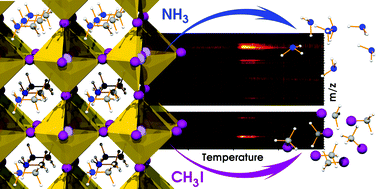
Thermal gravimetric and differential thermal analysis (TG-DTA) coupled with quadrupole mass spectrometry (MS) and first principles calculations were employed to elucidate the chemical nature of released gases during the thermal decomposition of CH3NH3PbI3.
The content of this RSS Feed (c) The Royal Society of Chemistry

01 Sep 05:59
by Pengfei Ma, Shanpeng Wen, Chen Wang, Wenbin Guo, Liang Shen, Wei Dong, Jingbin Lu and Shengping Ruan

The Journal of Physical Chemistry C
DOI: 10.1021/acs.jpcc.6b05216

01 Sep 00:37
J. Mater. Chem. A, 2016, 4,15294-15301
DOI: 10.1039/C6TA05745D, Communication
Xiao Liu, Chu-Chen Chueh, Zonglong Zhu, Sae Byeok Jo, Ye Sun, Alex K.-Y. Jen
Highly crystalline Zn2SnO4 NPs were applied as an efficient electron-transporting layer that can enable both efficient inverted p-i-n PVSC with enhanced ambient stability and efficient conventional n-i-p PVSC on a flexible substrate.
The content of this RSS Feed (c) The Royal Society of Chemistry
31 Aug 09:04
by Giovanna Pellegrino, Stefania D’Angelo, Ioannis Deretzis, Guglielmo Guido Condorelli, Emanuele Smecca, Graziella Malandrino, Antonino La Magna and Alessandra Alberti

The Journal of Physical Chemistry C
DOI: 10.1021/acs.jpcc.6b03798

31 Aug 08:57
by Paifeng Luo, Wei Xia, Shengwen Zhou, Lin Sun, Jigui Cheng, Chenxi Xu and Yingwei Lu

The Journal of Physical Chemistry Letters
DOI: 10.1021/acs.jpclett.6b01576

31 Aug 08:56
by Mian Cai, Xichang Bao, Xiao Wang, Huanrui Zhang, Meng Qiu, Renqiang Yang, Chunming Yang and Xiaobo Wan

Chemistry of Materials
DOI: 10.1021/acs.chemmater.6b02225

30 Aug 00:41
by Weiqiang Liao, Dewei Zhao, Yue Yu, Corey R. Grice, Changlei Wang, Alexander J. Cimaroli, Philip Schulz, Weiwei Meng, Kai Zhu, Ren-Gen Xiong, Yanfa Yan

Efficient lead (Pb)-free inverted planar formamidinium tin triiodide (FASnI3) perovskite solar cells (PVSCs) are demonstrated. Our FASnI3 PVSCs achieved average power conversion efficiencies (PCEs) of 5.41% ± 0.46% and a maximum PCE of 6.22% under forward voltage scan. The PVSCs exhibit small photocurrent–voltage hysteresis and high reproducibility. The champion cell shows a steady-state efficiency of ≈6.00% for over 100 s.
30 Aug 00:40
by Qingchao Zhou, Zelong Bai, Wen-gao Lu, Yongtian Wang, Bingsuo Zou, Haizheng Zhong

A simple and versatile in situ fabrication of MAPbX3 nanocrystal-embedded polymer composite films is developed by controlling the crystallization process from precursor solutions. The composite films exhibit enhanced photoluminescence properties, improved stability, and excellent piezoelectric and mechanical properties. Applications of these composite films as color converters in liquid-crystal-display backlights are demonstrated, showing bright potential in display technology.
30 Aug 00:40
by Arun Aby Paraecattil, Jelissa De Jonghe-Risse, Vytenis Pranculis, Joël Teuscher and Jacques-E. Moser

The Journal of Physical Chemistry C
DOI: 10.1021/acs.jpcc.6b08022

30 Aug 00:39
by Mohammad Mahdi Tavakoli, Rouhollah Tavakoli, Soheil Hasanzadeh and Mohammad Hassan Mirfasih

The Journal of Physical Chemistry C
DOI: 10.1021/acs.jpcc.6b05667

30 Aug 00:38
by Long Ye, Xuechen Jiao, Wenchao Zhao, Shaoqing Zhang, Huifeng Yao, Sunsun Li, Harald Ade and Jianhui Hou

Chemistry of Materials
DOI: 10.1021/acs.chemmater.6b02222

29 Aug 12:15
by Yunlong Li, Weihai Sun, Weibo Yan, Senyun Ye, Haixia Rao, Haitao Peng, Ziran Zhao, Zuqiang Bian, Zhiwei Liu, Huanping Zhou, Chunhui Huang
In the present work, a Pb-assisted two step method is successfully proposed to fabricate high-quality CH3NH3Sn0.5Pb0.5I3 (MASn0.5Pb0.5I3) perovskite film on the indium tin oxide (ITO) glass/poly(3,4-ethylenedioxythiophene):poly(styrene sulfonate) (PEDOT:PSS) substrate. The film shows regular crystalline grains with a flat and compact morphology as well as full coverage on the planar PEDOT:PSS substrate. Remarkably, corresponding devices ITO/PEDOT:PSS/MASn0.5Pb0.5I3/C60/2,9-dimethyl-4,7-diphenyl-1,10-phenanthroline/Ag are fabricated with high reproducibility, achieving a high power conversion efficiency of 13.6%, which is, to the best of knowledge, the most efficient solar cell based on Sn-based perovskite.

A high efficiency inverted planar Sn-based perovskite solar cell is fabricated by utilizing a two-step solution processing technique. Through use of PbI2 in combination with SnI2, the Sn-based perovskite film quality is improved obviously. The lead contents are successfully reduced to 50% in the perovskite layer, and the power conversion efficiency of the best corresponding device reaches up to 13.6%.
29 Aug 00:39
by Chih-Yu Chang, Wen-Kuan Huang and Yu-Chia Chang

Chemistry of Materials
DOI: 10.1021/acs.chemmater.6b02583

27 Aug 00:35
by Shen Wang, Mahsa Sina, Pritesh Parikh, Taylor Uekert, Brian Shahbazian, Arun Devaraj and Ying Shirley Meng

Nano Letters
DOI: 10.1021/acs.nanolett.6b02158

26 Aug 10:45
Nanoscale, 2016, 8,18309-18314
DOI: 10.1039/C6NR04741F, Paper
Chaoyan Ma, Chongqian Leng, Yixiong Ji, Xingzhan Wei, Kuan Sun, Linlong Tang, Jun Yang, Wei Luo, Chaolong Li, Yunsheng Deng, Shuanglong Feng, Jun Shen, Shirong Lu, Chunlei Du, Haofei Shi
2D/3D perovskite hybrids achieved significantly improved moisture stability and analogical device performances as compared with homogeneous 3D perovskites.
The content of this RSS Feed (c) The Royal Society of Chemistry

26 Aug 10:45
J. Mater. Chem. A, 2016, 4,13830-13836
DOI: 10.1039/C6TA04973G, Paper
Mike Hambsch, Qianqian Lin, Ardalan Armin, Paul L. Burn, Paul Meredith
A generic and simple approach to realize solution processed, monolithic large area perovskite solar cells.
The content of this RSS Feed (c) The Royal Society of Chemistry
26 Aug 10:45
J. Mater. Chem. A, 2016, 4,14752-14760
DOI: 10.1039/C6TA05932E, Paper
Wenyan Su, Qunping Fan, Xia Guo, Bing Guo, Wanbin Li, Youdi Zhang, Maojie Zhang, Yongfang Li
Efficient ternary all polymer solar cells (all-PSCs) based on PTB7-Th:PBDD-ff4T:N2200 were reported, where PTB7-Th and PBDD-ff4T were two polymer donors and N2200 was a polymer acceptor. The all-PSCs showed an optimized PCE of up to 7.2% which is superior to those of the binary all-PSCs based on PTB7-Th:N2200 and PBDD-ff4T:N2200.
The content of this RSS Feed (c) The Royal Society of Chemistry
26 Aug 10:42
by Shuai Yuan, Zhiwen Qiu, Chaomin Gao, Hailiang Zhang, Yanan Jiang, Cuncheng Li, Jinghua Yu and Bingqiang Cao

ACS Applied Materials & Interfaces
DOI: 10.1021/acsami.6b06847

26 Aug 10:41
by Katherine E. Roelofs, Vanessa L. Pool, Dara A. Bobb-Semple, Axel F. Palmstrom, Pralay K. Santra, Douglas G. Van Campen, Michael F. Toney, Stacey F. Bent
The rapid rise in power conversion efficiencies of lead-based perovskite solar cells (PSCs) has established their promise, motivating scale-up and commercialization. As a thin film solar cell, interfacial properties are key to the performance of PSCs; there is a need to further understand which properties are critical to control. In this work, the impact of the compact TiO2 (com-TiO2) film properties on the performance of mesoporous PSCs is studied. Com-TiO2 layers are fabricated by spray pyrolysis as well as by atomic layer deposition (ALD), using ALD as a proof-of-concept method to achieve highly conformal films of precisely controlled thickness. The com-TiO2 layers' conformality and surface roughness are examined by microscopy techniques; their relative crystallinity is studied by grazing-incidence X-ray diffraction with a synchrotron source and an in situ annealing chamber; and completed devices are analyzed by J–V and impedance spectroscopy techniques. The results show that an ultraconformal com-TiO2 layer can be thinned to 4 nm and match the performance of a ≈50 nm spray-pyrolysis TiO2 layer. This work concludes that film conformality is the primary consideration for creating a high-performing com-TiO2 layer, overriding any effects of film crystallinity—a finding that can guide fabrication choices for the scale-up of PSCs.

Highly conformal ≈4 nm compact TiO2 layers by atomic layer deposition are demonstrated to match the performance of ≈50 nm spray-pyrolysis TiO2 layers in mesoporous perovskite solar cells. TiO2 films are characterized by grazing-incidence X-ray diffraction using a synchrotron source. Film thickness and conformality are found to be more critical to a high-performing compact TiO2 layer than the degree of crystallinity.
26 Aug 10:40
by Octavi E. Semonin, Giselle A. Elbaz, Daniel B. Straus, Trevor D. Hull, Daniel W. Paley, Arend M. van der Zande, James C. Hone, Ioannis Kymissis, Cherie R. Kagan, Xavier Roy and Jonathan S. Owen

The Journal of Physical Chemistry Letters
DOI: 10.1021/acs.jpclett.6b01308

25 Aug 00:25
by Itaru Raifuku, Yasuaki Ishikawa, Seigo Ito and Yukiharu Uraoka

The Journal of Physical Chemistry C
DOI: 10.1021/acs.jpcc.6b05298

25 Aug 00:24
by Andrea Capasso, Fabio Matteocci, Leyla Najafi, Mirko Prato, Joka Buha, Lucio Cinà, Vittorio Pellegrini, Aldo Di Carlo, Francesco Bonaccorso

In article 1600920, Aldo Di Carlo, Francesco Bonaccorso, and co-workers propose the use of solution-processed molybdenum disulfide (MoS2) flakes in lead-halide perovskite solar cells. In this configuration, the MoS2 flakes enhance the hole collection at the anode while protecting the perovskite from degradation. This has a remarkable effect on the lifetime stability of the cell, yielding power conversion efficiency, after 550 hours of endurance test, which is 33% higher compared to otherwise identical cells that do not exploit the MoS2. An efficiency of 11.5% is also recorded in large area (>1 cm2) cells. This design might boost the commercialization of perovskite-based photovoltaics.
24 Aug 00:52
by Natsumi Ikeda, Tomoyuki Koganezawa, Daisuke Kajiya and Ken-ichi Saitow

The Journal of Physical Chemistry C
DOI: 10.1021/acs.jpcc.6b07101

24 Aug 00:52
by Miguel Flasque, Albert Nguyen Van Nhien, Davide Moia, Piers R. F. Barnes and Frédéric Sauvage

The Journal of Physical Chemistry C
DOI: 10.1021/acs.jpcc.6b05977

24 Aug 00:51
by Zhengrong Shang, Thomas Heumueller, Rohit Prasanna, George F. Burkhard, Benjamin D. Naab, Zhenan Bao, Michael D. McGehee, Alberto Salleo
Doping of organic bulk heterojunction solar cells has the potential to improve their power conversion efficiency (PCE). Deconvoluting the effect of doping on charge transport, recombination, and energetic disorder remains challenging. It is demonstrated that molecular doping has two competing effects: on one hand, dopant ions create additional traps while on the other hand free dopant-induced charges fill deep states possibly leading to V
OC and mobility increases. It is shown that molar dopant concentrations as low as a few parts per million can improve the PCE of organic bulk heterojunctions. Higher concentrations degrade the performance of the cells. In doped cells where PCE is observed to increase, such improvement cannot be attributed to better charge transport. Instead, the V
OC increase in unannealed P3HT:PCBM cells upon doping is indeed due to trap filling, while for annealed P3HT:PCBM cells the change in V
OC is related to morphology changes and dopant segregation. In PCDTBT:PC70BM cells, the enhanced PCE upon doping is explained by changes in the thickness of the active layer. This study highlights the complexity of bulk doping in organic solar cells due to the generally low doping efficiency and the constraint on doping concentrations to avoid carrier recombination and adverse morphology changes.

Ultralow level doping (≈ppm) can increase the power conversion efficiency of organic solar cells. Trap states filling by free charges and trap creation by dopant ions have competing effects on carrier mobility and open circuit voltage thereby imposing constraints on the effectiveness of doping. Measurements are performed to study what electronic process dominates in different materials or fabrication conditions.
24 Aug 00:51
by Ardalan Armin, Jegadesan Subbiah, Martin Stolterfoht, Safa Shoaee, Zeyun Xiao, Shirong Lu, David J. Jones, Paul Meredith
Bimolecular recombination in bulk heterojunction organic solar cells is the process by which nongeminate photogenerated free carriers encounter each other, and combine to form a charge transfer (CT) state which subsequently relaxes to the ground state. It is governed by the diffusion of the slower and faster carriers toward the electron donor–acceptor interface. In an increasing number of systems, the recombination rate constant is measured to be lower than that predicted by Langevin's model for relative Brownian motion and the capture of opposite charges. This study investigates the dynamics of charge generation, transport, and recombination in a nematic liquid crystalline donor:fullerene acceptor system that gives solar cells with initial power conversion efficiencies of >9.5%. Unusually, and advantageously from a manufacturing perspective, these efficiencies are maintained in junctions thicker than 300 nm. Despite finding imbalanced and moderate carrier mobilities in this blend, strongly suppressed bimolecular recombination is observed, which is ≈150 times less than predicted by Langevin theory, or indeed, more recent and advanced models that take into account the domain size and the spatial separation of electrons and holes. The suppressed bimolecular recombination arises from the fact that ground-state decay of the CT state is significantly slower than dissociation.

A detailed study of bimolecular recombination in a high efficiency organic solar cell, comprised of a liquid crystalline donor and PC71BM, is presented. Using multiple techniques, it is shown that the bimolecular recombination is nearly 150 times suppressed with respect to that predicted by Langevin theory. This reduction is attributed to an equilibrium between charge transfer states and free charges.
24 Aug 00:51
by Jiangquan Mai, Tsz-Ki Lau, Jun Li, Shih-Hao Peng, Chain-Shu Hsu, U-Ser Jeng, Jianrong Zeng, Ni Zhao, Xudong Xiao and Xinhui Lu

Chemistry of Materials
DOI: 10.1021/acs.chemmater.6b02264

23 Aug 04:25
by Zhibin Yang, Adharsh Rajagopal, Chu-Chen Chueh, Sae Byeok Jo, Bo Liu, Ting Zhao, Alex K.-Y. Jen

A low-bandgap (1.33 eV) Sn-based MA0.5FA0.5Pb0.75Sn0.25I3 perovskite is developed via combined compositional, process, and interfacial engineering. It can deliver a high power conversion efficiency (PCE) of 14.19%. Finally, a four-terminal all-perovskite tandem solar cell is demonstrated by combining this low-bandgap cell with a semitransparent MAPbI3 cell to achieve a high efficiency of 19.08%.
23 Aug 04:23
by Andrew N. Bartynski, Stefan Grob, Theresa Linderl, Mark Gruber, Wolfgang Brütting and Mark E. Thompson

The Journal of Physical Chemistry C
DOI: 10.1021/acs.jpcc.6b06302

23 Aug 00:40
by Xiaodan Gu, Hongping Yan, Tadanori Kurosawa, Bob C. Schroeder, Kevin L. Gu, Yan Zhou, John W. F. To, Stefan D. Oosterhout, Victoria Savikhin, Francisco Molina-Lopez, Christopher J. Tassone, Stefan C. B. Mannsfeld, Cheng Wang, Michael F. Toney, Zhenan Bao
In this work, the detailed morphology studies of polymer poly(3-hexylthiophene-2,5-diyl) (P3HT):fullerene(PCBM) and polymer(P3HT):polymer naphthalene diimide thiophene (PNDIT) solar cell are presented to understand the challenge for getting high performance all-polymer solar cells. The in situ X-ray scattering and optical interferometry and ex situ hard and soft X-ray scattering and imaging techniques are used to characterize the bulk heterojunction (BHJ) ink during drying and in dried state. The crystallization of P3HT polymers in P3HT:PCBM bulk heterojunction shows very different behavior compared to that of P3HT:PNDIT BHJ due to different mobilities of P3HT in the donor:acceptor glass. Supplemented by the ex situ grazing incidence X-ray diffraction and soft X-ray scattering, PNDIT has a lower tendency to form a mixed phase with P3HT than PCBM, which may be the key to inhibit the donor polymer crystallization process, thus creating preferred small phase separation between the donor and acceptor polymer.

The morphology development of polymer:fullerene and polymer:polymer solar cells is characterized by real-time X-ray scattering and interferometry. Polymer:fullerence blends show a smaller phase-separation due to high glass-transition temperature of PCBM acceptors, compared to polymer:polymer blends.
   This article is licensed under a Creative Commons Attribution 3.0 Unported Licence.


