18 Dec 01:12
by Jiangzhao Chen, Yaoguang Rong, Anyi Mei, Yuli Xiong, Tongfa Liu, Yusong Sheng, Pei Jiang, Li Hong, Yanjun Guan, Xiaotong Zhu, Xiaomeng Hou, Miao Duan, Jianquan Zhao, Xiong Li, Hongwei Han

Mixed-anion perovskite CH3NH3PbI(3−x)(BF4)x has been developed and optimized to enable a highly efficient hole-conductor-free fully printable mesoscopic solar cell. The employment of BF4− in hybrid organic–inorganic halide perovskite significantly improves its optical and electric properties, such as light harvesting ability, carrier concentration, and conductivity, leading to an enhanced power conversion efficiency of 13.24%.
17 Dec 07:09
by Yue Wang, Xiaoming Li, Xin Zhao, Lian Xiao, Haibo Zeng and Handong Sun

Nano Letters
DOI: 10.1021/acs.nanolett.5b04110

Hi and -1 others like this
17 Dec 00:56
J. Mater. Chem. A, 2015, Accepted Manuscript
DOI: 10.1039/C5TA08744A, Communication
fangyuan jiang, Tiefeng Liu, Bangwu Luo, jinhui tong, Fei Qin, sixing xiong, Zaifang Li, Yinhua Zhou
Building tandem structure is an effective strategy to enhance the photovoltaic performance of solar cells. To realize a two-terminal tandem device, the charge recombination layer (CRL) plays an essential role....
The content of this RSS Feed (c) The Royal Society of Chemistry
17 Dec 00:56
J. Mater. Chem. A, 2016, 4,67-73
DOI: 10.1039/C5TA06525A, Paper
Huawei Zhou, Jie Yin, Zhonghao Nie, Zhaojin Yang, Dongjie Li, Junhu Wang, Xin Liu, Changzi Jin, Xianxi Zhang, Tingli Ma
The ideal liquid-solid heterogeneous electrocatalysis should have not only high catalytic activity but also free electron transport.
The content of this RSS Feed (c) The Royal Society of Chemistry
16 Dec 12:32
J. Mater. Chem. A, 2016, 4,11688-11695
DOI: 10.1039/C5TA09165A, Paper
Wenzhe Li, Jiangwei Li, Guangda Niu, Liduo Wang
The interface modification of perovskite thin films has shown great potential to boost the performance of perovskite solar cells during the last few years.
The content of this RSS Feed (c) The Royal Society of Chemistry
16 Dec 12:30
by Ashok Bera, Arif D. Sheikh, Md. Azimul Haque, Riya Bose, Erkki Alarousu, Omar F. Mohammed and Tom Wu

ACS Applied Materials & Interfaces
DOI: 10.1021/acsami.5b09182

16 Dec 12:29
by Chetan R. Singh, Cheng Li, Christian J. Mueller, Sven Hüttner, Mukundan Thelakkat
The influence of different electron extracting interlayers such as calcium (Ca), zirconium acetylacetonate (ZrAcac), and a polyfluorene derivative (PFN) in combination with an aluminum (Al) cathode is investigated on the performance of bulk-heterojuntion solar cells. Two different photoactive systems, P3HT:PC61BM and PDPP:PC71BM, are selected for this study. The electroabsorption measurements have been carried out for obtaining the built-in voltage (Vbi) and transfer matrix simulations for the determination of parasitic absorption. The solar cell performance is influenced by different parameters such as diode turn-on voltage, leakage currents, built-in voltages, and parasitic absorption. The small diode turn-on voltage and high parasitic absorption in Ca contact devices limit the open circuit voltage and short circuit current, respectively. Likewise, high leakage currents using ZrAcac contact limit the fill factor in P3HT:PC61BM solar cell devices. However, the PFN-based devices with small parasitic absorption, smaller leakage currents, and a relatively high Vbi show maximum performance with both material systems. This work highlights the importance of choosing the suitable interlayers in device optimization and clearly demonstrates that not only the low work function of an electron extracting interlayer but also its optical properties and charge selectivity significantly influence the final solar cell performance.

The influence of different electron extracting interlayers including Ca, ZrAcac, and PFN in combination with Al is investigated in normal organic solar cell geometry using electroabsorption measurements and transfer matrix simulations. It is shown that the solar cell performance is influenced by different parameters such as diode turn-on voltage, leakage currents, built-in voltages, and parasitic absorption.
16 Dec 12:28
by Sunsun Li, Hao Zhang, Wenchao Zhao, Long Ye, Huifeng Yao, Bei Yang, Shaoqing Zhang, Jianhui Hou
To realize high power conversion efficiencies (PCEs) in green-solvent-processed all-polymer solar cells (All-PSCs), a long alkyl chain modified perylene diimide (PDI)-based polymer acceptor PPDIODT with superior solubility in nonhalogenated solvents is synthesized. A properly matched PBDT-TS1 is selected as the polymer donor due to the red-shifted light absorption and low-lying energy level in order to achieve the complementary absorption spectrum and matched energy level between polymer donor and polymer acceptor. By utilizing anisole as the processing solvent, an optimal efficiency of 5.43% is realized in PBDT-TS1/PPDIODT-based All-PSC with conventional configuration, which is comparable with that of All-PSCs processed by the widely used binary solvent. Due to the utilization of an inverted device configuration, the PCE is further increased to over 6.5% efficiency. Notably, the best-performing PCE of 6.58% is the highest value for All-PSCs employing PDI-based polymer acceptors and green-solvent-processed All-PSCs. The excellent photovoltaic performance is mainly attributed to a favorable vertical phase distribution, a higher exciton dissociation efficiency (Pdiss) in the blend film, and a higher electrode carrier collection efficiency. Overall, the combination of rational molecular designing, material selection, and device engineering will motivate the efficiency breakthrough in green-solvent-processed All-PSCs.

By introducing a perylene diimide (PDI)-based polymer acceptor PPDIODT with excellent solubility in anisole, a high efficiency of 6.58% is recorded for a green-solvent-processed all-polymer solar cell (All-PSC). Hence, the combination of the rational molecular design of the acceptor material, the elaborate selection of the donor material, and the optimization of the device configuration results in an efficiency breakthrough in PDI-based All-PSCs.
15 Dec 06:35
by Sungho Nam
Article
Forming a dipole layer at the electron-collecting interface is a proposed method of efficiency enhancement in solar cells. Here, Nam et al. report the use of PEOz as a dipole layer, which increases the work function at the electron-collecting interface within the polymer solar cell leading to an efficiency of 10.7%.
Nature Communications doi: 10.1038/ncomms9929
Authors: Sungho Nam, Jooyeok Seo, Sungho Woo, Wook Hyun Kim, Hwajeong Kim, Donal D. C. Bradley, Youngkyoo Kim

15 Dec 04:29
J. Mater. Chem. A, 2016, 4,640-648
DOI: 10.1039/C5TA09080F, Paper
Chih-Yu Chang, Wen-Kuan Huang, Yu-Chia Chang, Kuan-Ting Lee, Chin-Ti Chen
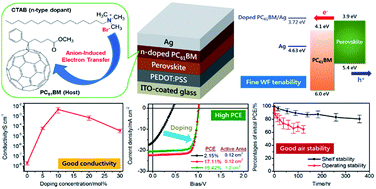
A facile and effective approach to enhance the performance and stability of perovskite solar cells is proposed by using a solution-processed cetyltrimethylammonium bromide (CTAB)-doped [6,6]-phenyl-C61-butyric acid methyl ester (PC61BM) film as a cathode interfacial layer.
The content of this RSS Feed (c) The Royal Society of Chemistry
15 Dec 04:28
Energy Environ. Sci., 2016, 9,411-433
DOI: 10.1039/C5EE02575C, Perspective

Open Access
Hyunwoong Park, Hyoung-il Kim, Gun-hee Moon, Wonyong Choi
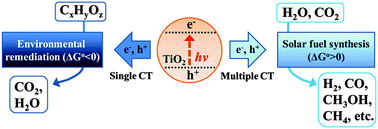
High efficiency solar photocatalysis requires an effective separation of photogenerated charge carriers and their rapid transport to the semiconductor interface.
The content of this RSS Feed (c) The Royal Society of Chemistry

15 Dec 04:26
by Kasparas Rakstys, Antonio Abate, M. Ibrahim Dar, Peng Gao, Vygintas Jankauskas, Gwénolé Jacopin, Egidijus Kamarauskas, Samrana Kazim, Shahzada Ahmad, Michael Grätzel and Mohammad Khaja Nazeeruddin

Journal of the American Chemical Society
DOI: 10.1021/jacs.5b11076

11 Dec 01:44
by Limin She, Meizhuang Liu and Dingyong Zhong

ACS Nano
DOI: 10.1021/acsnano.5b06420

11 Dec 01:43
by R. C. I. MacKenzie, V. S. Balderrama, S. Schmeisser, R. Stoof, S. Greedy, J. Pallarès, L. F. Marsal, A. Chanaewa, E. von Hauff
Performance losses and aging mechanisms are investigated in state-of-the-art PTB7:PC70BM solar cells. Inverted devices incorporating a vanadium pentoxide (V2O5) top contact have efficiencies of 8%. After aging the unencapsulated devices, no changes are observed in the open circuit voltage (Voc) or short circuit current (Jsc); however, the fill factor (FF) drops from 0.7 to 0.61. An s-shape initially appears in the J–V curve after aging, which can be reduced by cycling through the J–V curve under illumination. This is discussed in context of the redox properties of V2O5. With impedance spectroscopy, it is demonstrated that changes to the contact interfaces are completely reversible and not responsible for the performance loss. Intensity modulated photocurrent spectroscopy combined with device modeling reveals that the loss in FF is due to trap formation in the active layer. Additionally it is observed that the performance of pristine devices is limited by optical absorption in the thin active layer and the build-up of space charge which hinders carrier extraction.

Air stable PTB7:PC70BM solar cells with efficiencies of 8% are demonstrated. The device employs a V2O5 anodic transport layer. Impedance spectroscopy is applied to confirm that the device contact interfaces in this architecture are stable under ambient conditions. Intensity modulated photocurrent spectroscopy is used to model the optoelectronic response of solar cell active layer as a function of aging.
11 Dec 01:43
by Tobias Moench, Pascal Friederich, Felix Holzmueller, Bogdan Rutkowski, Johannes Benduhn, Timo Strunk, Christian Koerner, Koen Vandewal, Aleksandra Czyrska-Filemonowicz, Wolfgang Wenzel, Karl Leo
The nanoscale morphology of the bulk heterojunction absorber layer in an organic solar cell (OSC) is of key importance for its efficiency. The morphology of high performance vacuum-processed, small molecule OSCs based on oligothiophene derivatives (DCV5T-Me) blended with C60 on various length scales is studied. The analytical electron microscopic techniques such as scanning transmission electron microscopy, energy dispersive X-ray spectroscopy, highly sensitive external quantum efficiency measurements, and meso and nanoscale simulations are employed. Unique insights into the relation between processing, morphology, and efficiency of the final devices are obtained. It is shown that the connectivity of the oligothiophene-C60 network is independent of the material domain size. The decisive quantity controlling the internal quantum efficiency is the energetic disorder induced by material mixing, strongly limiting charge and exciton transport in the OSCs.

The morphology of highly efficient organic solar cells is analyzed with various experimental and theoretical methods. Depositing the absorber layer at selected substrate temperatures (room temperature, 80 °C, and 140 °C) leads to substantial demixing of the absorber layer, increased domain purity, and decreased donor–acceptor interface area.
10 Dec 04:36
J. Mater. Chem. A, 2016, 4,416-424
DOI: 10.1039/C5TA07688A, Paper
Shaohua Huang, Guangye Zhang, Nicholas S. Knutson, Matthew T. Fontana, Rachel C. Huber, Amy S. Ferreira, Sarah H. Tolbert, Benjamin J. Schwartz, Yves Rubin
A novel methoxylated 1,4-bisbenzyl fullerene adduct gives better performance in polymer:fullerene bulk heterojunction photovoltaic devices than traditional PCBM, and it is easily synthesized.
The content of this RSS Feed (c) The Royal Society of Chemistry
10 Dec 04:36
Energy Environ. Sci., 2015, Accepted Manuscript
DOI: 10.1039/C5EE03460D, Communication
Hiroaki Benten, Takaya Nishida, Daisuke Mori, Huajun Xu, Hideo Ohkita, Shinzaburo Ito
We developed high-performance ternary blend all-polymer solar cells with complementary absorption bands from visible to near-infrared wavelengths. A power conversion efficiency of 6.7% was obtained with an external quantum efficiency...
The content of this RSS Feed (c) The Royal Society of Chemistry

10 Dec 04:33
by Wei Ma, Guofang Yang, Kui Jiang, Joshua H. Carpenter, Yang Wu, Xiangyi Meng, Terry McAfee, Jingbo Zhao, Chenhui Zhu, Cheng Wang, Harald Ade, He Yan

The detailed morphology of high efficiency polymer (PffBT4T-2OD) based organic solar cells is investigated by Wei Ma, Harald Ade, He Yan and co-workers in article number 1501400. It is found that the median domain sizes of PffBT4T-2OD:PC71BM blends processed at different temperatures/spin rates are nearly identical, while the average domain purity and the molecular orientation relative to polymer:fullerene interfaces can be significantly changed by the processing conditions.
10 Dec 04:33
by Hong Zhang, Jian Mao, Hexiang He, Di Zhang, Hugh L. Zhu, Fengxian Xie, Kam Sing Wong, Michael Grätzel, Wallace C. H. Choy

In article number 1501354, Wallace C. H. Choy and co-workers develop a new approach for forming PbI2 nanostructures together with strategically high CH3NH3I concentrations to rapidly form high quality (smooth and PbI2 residue-free) CH3NH3PbI3 perovskite films at room temperature. By employing this approach, high efficiency and stable planar-heterojunction perovskite solar cells can be fabricated.
10 Dec 04:33
by Elizabeth M. Tennyson, Joseph L. Garrett, Jesse A. Frantz, Jason D. Myers, Robel Y. Bekele, Jasbinder S. Sanghera, Jeremy N. Munday, Marina S. Leite

In article number 1501142, Marina S. Leite and co-workers report the use of an imaging platform to map open-circuit voltage in solar cells with a lateral spatial resolution of <100 nm that can be applied to any material. The cover illustration shows an atomic force microscopy (AFM) probe ‘in motion’, a reference to the illuminated in situ measurements.
09 Dec 04:43
J. Mater. Chem. A, 2015, Accepted Manuscript
DOI: 10.1039/C5TA09247G, Paper
Lijian Zuo, Chih-Yu Chang, Chu-Chen Chueh, Yunxiang Xu, Hongzheng Chen, Alex K-Y. Jen
In this work, we demonstrate that the out-of-cell capping layer of an ITO-free microcavity series-connected tandem organic photovoltaic (SCTOPV) plays an important role on manipulating the optical field distribution in...
The content of this RSS Feed (c) The Royal Society of Chemistry
09 Dec 04:32
by Guangwu Li, Xue Gong, Jicheng Zhang, Yahui Liu, Shiyu Feng, Cuihong Li and Zhishan Bo

ACS Applied Materials & Interfaces
DOI: 10.1021/acsami.5b08769

09 Dec 04:32
by Yunyu Tang, Yueqiang Wang, Xin Li, Hans Ågren, Wei-Hong Zhu and Yongshu Xie

ACS Applied Materials & Interfaces
DOI: 10.1021/acsami.5b10624

09 Dec 04:24
Chem. Soc. Rev., 2016, 45,655-689
DOI: 10.1039/C4CS00458B, Review Article
Yixin Zhao, Kai Zhu
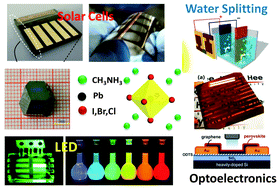
This article reviews recent progress on hybrid perovskites including crystal/thin-film synthesis, structural/chemical/electro-optical properties, (opto)electronic applications, and research issues/challenges.
The content of this RSS Feed (c) The Royal Society of Chemistry

09 Dec 04:21
by Chen Sun, Zhihong Wu, Hin-Lap Yip, Hua Zhang, Xiao-Fang Jiang, Qifan Xue, Zhicheng Hu, Zhanhao Hu, Yan Shen, Mingkui Wang, Fei Huang, Yong Cao
An amino-functionalized copolymer with a conjugated backbone composed of fluorene, naphthalene diimide, and thiophene spacers (PFN-2TNDI) is introduced as an alternative electron transport layer (ETL) to replace the commonly used [6,6]-Phenyl-C61-butyric acid methyl ester (PCBM) in the p–i–n planar-heterojunction organometal trihalide perovskite solar cells. A combination of characterizations including photoluminescence (PL), time-resolved PL decay, Kelvin probe measurement, and impedance spectroscopy is used to study the interfacial effects induced by the new ETL. It is found that the amines on the polymer side chains not only can passivate the surface traps of perovskite to improve the electron extraction properties, they also can reduce the work function of the metal cathode by forming desired interfacial dipoles. With these dual functionalities, the resulted solar cells outperform those based on PCBM with power conversion efficiency (PCE) increased from 12.9% to 16.7% based on PFN-2TNDI. In addition to the performance enhancement, it is also found that a wide range of thicknesses of the new ETL can be applied to produce high PCE devices owing to the good electron transport property of the polymer, which offers a better processing window for potential fabrication of perovskite solar cells using large-area coating method.

The fullerene electron transport layer is replaced by a thickness-insensitive conjugated polymer in p–i–n planar heterojunction perovskite solar cells. The amines of polymer side chains can both passivate the surface traps of perovskite and reduce the work function of the metal cathode. With these dual functionalities, the resulting solar cells show 16.7% power conversion efficiency (PCE), which outperforms those based on fullerene interlayers.
09 Dec 04:20
by Zhenwei Ren, Jin Wang, Zhenxiao Pan, Ke Zhao, Hua Zhang, Yan Li, Yixin Zhao, Ivan Mora-Sero, Juan Bisquert and Xinhua Zhong

Chemistry of Materials
DOI: 10.1021/acs.chemmater.5b03864

08 Dec 00:37
by Muhammad Nawaz Tahir, Bernd Oschmann, Daniel Buchholz, Xinwei Dou, Ingo Lieberwirth, Martin Panthöfer, Wolfgang Tremel, Rudolf Zentel, Stefano Passerini
The synthesis of in situ polymer-functionalized anatase TiO2 particles using an anchoring block copolymer with hydroxamate as coordinating species is reported, which yields nanoparticles (≈11 nm) in multigram scale. Thermal annealing converts the polymer brushes into a uniform and homogeneous carbon coating as proven by high resolution transmission electron microscopy and Raman spectroscopy. The strong impact of particle size as well as carbon coating on the electrochemical performance of anatase TiO2 is demonstrated. Downsizing the particles leads to higher reversible uptake/release of sodium cations per formula unit TiO2 (e.g., 0.72 eq. Na+ (11 nm) vs only 0.56 eq. Na+ (40 nm)) while the carbon coating improves rate performance. The combination of small particle size and homogeneous carbon coating allows for the excellent electrochemical performance of anatase TiO2 at high (134 mAh g−1 at 10 C (3.35 A g−1)) and low (≈227 mAh g−1 at 0.1 C) current rates, high cycling stability (full capacity retention between 2nd and 300th cycle at 1 C) and improved coulombic efficiency (≈99.8%).

The extraordinary electrochemical performance of carbon-coated TiO2 nanoparticles, obtained via in situ polymer functionalization, is reported. The enhanced performance as Na-ion anodes can be ascribed to the synergetic effect of the small particle size (≈11 nm) and homogeneous carbon coating as confirmed via comparison with uncoated particles of comparable size (≈15 nm), and larger (≈40 nm) particles with carbon coating.
04 Dec 02:41
by Young Chan Kim, Nam Joong Jeon, Jun Hong Noh, Woon Seok Yang, Jangwon Seo, Jae S. Yun, Anita Ho-Baillie, Shujuan Huang, Martin A. Green, Jan Seidel, Tae Kyu Ahn, Sang Il Seok

Beneficial effects are demonstrated by PbI2 incorporated into perovskite materials as a light absorber in solar cells. The PbI2 distributed into the perovskite layers leads to reduced hysteresis and ionic migration, and enables the fabrication of remarkably improved solar cells with a certified power conversion efficiency of 19.75% under air-mass 1.5 global (AM 1.5G) illumination of 100 mW cm−2 intensity.
04 Dec 02:41
by Tanghao Liu, Qin Hu, Jiang Wu, Ke Chen, Lichen Zhao, Feng Liu, Cheng Wang, Hong Lu, Shuang Jia, Thomas Russell, Rui Zhu, Qihuang Gong

A mesoporous PbI2 scaffold is demonstrated to achieve high-performance planar heterojunction perovskite solar cells. A remarkable power conversion efficiency (PCE) of 15.7% is achieved under AM1.5G 100 mW cm−2 solar irradiation with almost no hysteresis. The morphologies of the PbI2 scaffolds can be programmed by a controlled nucleation and growth mechanism. Correlations between the PbI2 film morphology and device performance are established.
04 Dec 02:41
by Xu Huang, Kai Wang, Chao Yi, Tianyu Meng, Xiong Gong

PEDOT:PSS doped with PEO (polyethylene oxide) is demonstrated to be an efficient hole extraction layer due to its high electrical conductivity and extremely smooth surface. This material is able to boost the efficiency of planar heterojunction perovskite hybrid solar cells.