05 Dec 05:54
Energy Environ. Sci., 2015, Accepted Manuscript
DOI: 10.1039/C5EE02575C, Perspective

Open Access
Hyunwoong Park, Hyoung-il Kim, Gun-hee Moon, Wonyong Choi
High efficiency solar photocatalysis requires an effective separation of photogenerated charge carriers and their rapid transport to the semiconductor interface. The mechanisms and kinetics of charge separation and interfacial/interparticle charge...
The content of this RSS Feed (c) The Royal Society of Chemistry

05 Dec 05:53
Energy Environ. Sci., 2015, Accepted Manuscript
DOI: 10.1039/C5EE03255E, Paper
Chenyi Yi, Jingshan Luo, Simone Meloni, Ariadni Boziki, Negar Ashari-Astani, Carole Gratzel, Shaik M Zakeeruddin, U Rothlisberger, Michael Gratzel
ABX3-type organic lead halide perovskites currently attract broad attention as light harvesters for solar cells due to their high power conversion efficiency (PCE). Mixtures of formamidinium (FA) with methylammonium (MA)...
The content of this RSS Feed (c) The Royal Society of Chemistry

05 Dec 05:39
by Wei Zhang
Article
An imbalance in I/Pb stoichiometry is thought to lead to defects in metal halide films. Here, Zhang et al . show that the addition of hypophosphorous acid in the precursor solution can significantly improve the film quality and enhance the photoluminescence intensity, leading to improved photovoltaic devices.
Nature Communications doi: 10.1038/ncomms10030
Authors: Wei Zhang, Sandeep Pathak, Nobuya Sakai, Thomas Stergiopoulos, Pabitra K. Nayak, Nakita K. Noel, Amir A. Haghighirad, Victor M. Burlakov, Dane W. deQuilettes, Aditya Sadhanala, Wenzhe Li, Liduo Wang, David S. Ginger, Richard H. Friend, Henry J. Snaith

04 Dec 02:49
by Yongbo Yuan, Qi Wang, Yuchuan Shao, Haidong Lu, Tao Li, Alexei Gruverman, Jinsong Huang

Electrically driven reversible structural conversion between the MAPbI3 and PbI2 phase in MAPbI3 at 330 K is first reported, which provides insights into the intrinsic stability and chemical activities of MAPbI3 materials. Meanwhile, direct visualization of the macroscopic migration of iodine anions is also reported for the first time, which provides strong evidence for the iodine ions migration.
04 Dec 02:45
by Hyangki Sung, Namyoung Ahn, Min Seok Jang, Jong-Kwon Lee, Heetae Yoon, Nam-Gyu Park, Mansoo Choi

Highly efficient transparent conductive oxide (TCO)-free perovskite (CH3NH3PbI3) solar cells are demonstrated by using a graphene transparent anode and organic carrier transport materials. By adding a few nanometer-thick MoO3 layer, wettability and work function of the graphene electrode are enhanced to enable a 17.1% power conversion efficiency, which is so far the highest efficiency for TCO-free solar cells.
01 Dec 14:21
by Samuel D. Collins, Christopher M. Proctor, Niva A. Ran, Thuc-Quyen Nguyen
The field of organic photovoltaics has recently produced highly efficient single-junction cells with power conversion efficiency >10%, yet the open-circuit voltage (VOC) remains relatively low in many high performing systems. An accurate picture of the density of states (DOS) in working solar cells is crucial to understanding the sources of voltage loss, but remains difficult to obtain experimentally. Here, the tail of the DOS is characterized in a number of small molecule bulk heterojunction solar cells from the charge density dependence of VOC, and is directly compared to the disorder present within donor and acceptor components as measured by Kelvin probe. Using these DOS distributions, the total energy loss relative to the charge transfer state energy (ECT)—ranging from ≈0.5 to 0.7 eV—is divided into contributions from energetic disorder and from charge recombination, and the extent to which these factors limit the VOC is assessed.

The open-circuit voltage in organic photovoltaic devices is well below the thermodynamic limit due to high rates of bimolecular recombination and energetic disorder. Here, the effect of disorder on voltage loss in molecular bulk heterojunction solar cells is carefully determined from a range of in situ energetic measurements.
01 Dec 14:21
by Nguyen Huy Tiep, Zhiliang Ku, Hong Jin Fan
Organometal trihalide perovskites have recently emerged as promising materials for low-cost, high-efficiency solar cells. In less than five years, the efficiency of perovskite solar cells (PSC) has been updated rapidly as a result of new strategies adopted in their fabrication process, including device structure, interfacial engineering, chemical compositional tuning, and crystallization kinetics control. To date, the best PSC efficiency has reached 20.1%, which is close to that of single crystal silicon solar cells. However, the stability of PSC devices is still unsatisfactory and is the main bottleneck impeding their commercialization. Here, we summarize recent studies on the degradation mechanisms of organometal trihalide perovskites in PSC devices, and the strategies for stability improvement.

Organometal trihalide solar cells, despite their high efficiency and low cost, still have a serious air instability limitations. Recent studies of the degradation mechanisms of organometal trihalide perovskites in photovoltaics and various strategies for stability improvement are summarized.
01 Dec 14:21
by Bin Kan, Qian Zhang, Feng Liu, Xiangjian Wan, Yunchuang Wang, Wang Ni, Xuan Yang, Mingtao Zhang, Hongtao Zhang, Thomas P. Russell and Yongsheng Chen

Chemistry of Materials
DOI: 10.1021/acs.chemmater.5b03889

30 Nov 03:07
by Xiaoli Ge, Zhaoqiang Li, Chengxiang Wang and Longwei Yin

ACS Applied Materials & Interfaces
DOI: 10.1021/acsami.5b08195

Mr.Q, 成明 and 2 others like this
28 Nov 05:19
Energy Environ. Sci., 2015, Advance Article
DOI: 10.1039/C5EE02979A, Paper
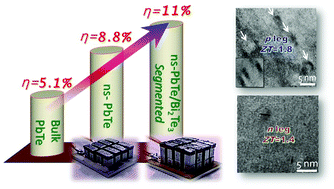
Xiaokai Hu, Priyanka Jood, Michihiro Ohta, Masaru Kunii, Kazuo Nagase, Hirotaka Nishiate, Mercouri G. Kanatzidis, Atsushi Yamamoto
In this work, we demonstrate the use of high performance nanostructured PbTe-based materials in high conversion efficiency thermoelectric modules.
To cite this article before page numbers are assigned, use the DOI form of citation above.
The content of this RSS Feed (c) The Royal Society of Chemistry

28 Nov 05:18
Energy Environ. Sci., 2015, Accepted Manuscript
DOI: 10.1039/C5EE03160E, Communication
Haijin Shin, Seogjae Seo, Chihyun Park, Jongbeom Na, Minsu Han, Eunkyoung Kim
A high color contrast energy saving electrochromic window (ECW) was explored by using low-HOMO level (EHOMO < -5 eV) [small pi]-conjugated polymers (CPs) as bistable electrochromic films and ionic liquid as...
The content of this RSS Feed (c) The Royal Society of Chemistry

28 Nov 05:18
by Yang Zou
Alcohol-soluble Star-shaped Oligofluorenes as Interlayer for High Performance Polymer Solar Cells
Scientific Reports, Published online: 27 November 2015; doi:10.1038/srep17329

27 Nov 10:36
by Zhigang Yin, Qingdong Zheng, Shan-Ci Chen, Dongdong Cai, Yunlong Ma
Currently, one main challenge in organic solar cells (OSCs) is to achieve both good stability and high power conversion efficiencies (PCEs). Here, highly efficient and long-term stable inverted OSCs are fabricated by combining controllable ZnMgO (ZMO) cathode interfacial materials with a polymer:fullerene bulk-heterojunction. The resulting devices based on the nanocolloid/nanoridge ZMO electron-transporting layers (ETLs) show greatly enhanced performance compared to that of the conventional devices or control devices without ZMO or with ZnO ETLs. The ZMO-based OSCs maintain 84%–93% of their original PCEs over 1-year storage under ambient conditions. An initial PCE of 9.39% is achieved for the best device, and it still retains a high PCE of 8.06% after 1-year storage, which represents a record high value for long-term stable OSCs. The excellent performance is attributed to the enhanced electron transportation/collection, reduced interfacial energy losses, and improved stability of the nanocolloid ZMO ETL. These findings provide a promising way to develop OSCs with high efficiencies and long device lifetime towards practical applications.

High efficiency inverted organic solar cells (OSCs) with long-term stability are fabricated using controllable nanocolloid/nanoridge ZnMgO as electron-transporting layers (ETLs). A greatly improved efficiency of 9.39% is achieved for the OSCs with an optimized ZnMgO ETL. The device retains 8.06% efficiency after 1-year storage, which represents a record high value for long-term stable OSCs.
27 Nov 00:49
J. Mater. Chem. A, 2015, 3,24495-24503
DOI: 10.1039/C5TA08193A, Paper
Xingtian Yin, Meidan Que, Yonglei Xing, Wenxiu Que
A solution-derived NiOx film was successfully employed to work as the hole selective contact for a high efficiency inverted planar heterojunction perovskite solar cell with negligible hysteresis.
The content of this RSS Feed (c) The Royal Society of Chemistry
26 Nov 10:51
by Ik Jae Park, Min Ah Park, Dong Hoe Kim, Gyeong Do Park, Byeong Jo Kim, Hae Jung Son, Min Jae Ko, Doh-Kwon Lee, Taiho Park, Hyunjung Shin, Nam-Gyu Park, Hyun Suk Jung and Jin Young Kim

The Journal of Physical Chemistry C
DOI: 10.1021/acs.jpcc.5b09322

25 Nov 02:59
by Yao Liu, Monojit Bag, Lawrence A. Renna, Zachariah A. Page, Paul Kim, Todd Emrick, D. Venkataraman, Thomas P. Russell
Interface engineering is critical for achieving efficient solar cells, yet a comprehensive understanding of the interface between a metal electrode and electron transport layer (ETL) is lacking. Here, a significant power conversion efficiency (PCE) improvement of fullerene/perovskite planar heterojunction solar cells from 7.5% to 15.5% is shown by inserting a fulleropyrrolidine interlayer between the silver electrode and ETL. The interface between the metal electrode and ETL is carefully examined using a variety of electrical and surface potential techniques. Electrochemical impedance spectroscopy (EIS) measurements demonstrate that the interlayer enhances recombination resistance, increases electron extraction rate, and prolongs free carrier lifetime. Kelvin probe force microscopy (KPFM) is used to map the surface potential of the metal electrode and it indicates a uniform and continuous work function decrease in the presence of the fulleropyrrolidine interlayer. Additionally, the planar heterojunction fullerene/perovskite solar cells are shown to have good stability under ambient conditions.

Inverted planar heterojunction perovskite solar cells are optimized to achieve a maximum efficiency of 15.5% by inserting fulleropyrrolidine as an interface modification layer. The interface between silver electrode and electron transport layer is carefully examined using a variety of electrical and surface potential techniques. Interface engineering is critical for achieving high-performance perovskite solar cells.
25 Nov 02:58
by Elisa Collado-Fregoso, Pierre Boufflet, Zhuping Fei, Eliot Gann, Shahid Ashraf, Zhe Li, Christopher R. McNeill, James R. Durrant and Martin Heeney

Chemistry of Materials
DOI: 10.1021/acs.chemmater.5b02948

21 Nov 01:15
by Jan C. Brauer, Arianna Marchioro, Arun A. Paraecattil, Ahmad A. Oskouei and Jacques-E. Moser

The Journal of Physical Chemistry C
DOI: 10.1021/acs.jpcc.5b06911

21 Nov 01:13
by Scott A. Mauger, Melodie P. Glasser, Bertrand J. Tremolet de Villers, Vincent V. Duong, Alexander L. Ayzner, Dana C. Olson
Poly(3,4-ethylenedioxythiophene):poly(styrene sulfonate) (PEDOT:PSS) is less selective for holes in an inverted-architecture organic photovoltaic (OPV) than it is in a conventional-architecture OPV device due to differences between the interfacial-PSS concentration at the top and bottom of the PEDOT:PSS layer. In this work, thin layers of polysulfonic acids are inserted between the poly(3-hexylthiophene) (P3HT):indene-C60 bisadduct (ICBA) bulk heterojunction (BHJ) active layer and PEDOT:PSS to create a higher concentration of acid at this interface and, therefore, mimic the distribution of materials present in a conventional device. Upon thermal annealing, this acid layer oxidizes P3HT, creating a thin p-type interlayer of P3HT+/acid− on top of the BHJ. Using X-ray absorption spectroscopy, Kelvin probe, and ellipsometry measurements, this P3HT+/acid− layer is shown to be insoluble in water, indicating it remains intact during the subsequent deposition of PEDOT:PSS. Current density–voltage measurements show this doped interlayer reduces injected dark current while increasing both open-circuit voltage and fill factor through the creation of a more hole selective BHJ-PEDOT:PSS interface.

Thin layers of sulfonic acid polymers are used to create a doped interlayer in organic photovoltaic devices. The presence of a p-type doped interlayer between the bulk heterojunction (BHJ) and the PEDOT:PSS hole transport layer (HTL) increases the hole selectivity of the BHJ-HTL interface, which increases the open-circuit voltage and fill factor.
21 Nov 01:13
by Ali Dabirian, Silvia Martin de Nicolas, Bjoern Niesen, Aïcha Hessler-Wyser, Stefaan De Wolf, Monica Morales-Masis, Christophe Ballif
Highly transparent electrodes with a well-tuned refractive index are essential for a wide range of optoelectronic devices, such as light emitting diodes and solar cells. Here, it is shown that the transparency of ZnO:Al can be improved and its refractive index can be reduced simultaneously by the addition of SiO2 into the layer. It is found that for low SiO2 concentrations, Si quenches oxygen vacancies and improves the layer transparency. At higher SiO2 concentrations a highly transparent amorphous compound of ZnxSiyO:Al forms, with a refractive index that scales down with the relative Si/Zn ratio. These layers are tested in Si heterojunction solar cells by inserting them between Si and the metallic rear contact of such devices. A consistent improvement is found in the cell short-circuit current density and external quantum efficiency with increasing Si incorporation. Our findings establish a general strategy to tune the optical properties of transparent conductive oxides for improved light management in solar cells.

Transparent conductive oxides with tunable refractive index and optical transparency are obtained by adding the highly transparent and low-refractive SiO2 to ZnO:Al. Si has different functions in ZnO:Al depending on its concentration. A ZnO:Al layer with an optimized SiO2 concentration significantly improves the infrared external quantum efficiency of a c-Si heterojunction solar cell.
19 Nov 04:18
by Martin A. Green, Yajie Jiang, Arman Mahboubi Soufiani and Anita Ho-Baillie

The Journal of Physical Chemistry Letters
DOI: 10.1021/acs.jpclett.5b01865

19 Nov 04:17
by Minwoo Park, Hae Jin Kim, Inyoung Jeong, Jinwoo Lee, Hyungsuk Lee, Hae Jung Son, Dae-Eun Kim, Min Jae Ko

In article number 1501406, Dae-Eun Kim, Min Jae Ko, and co-workers report highly efficient and ITO-free ultra-flexible perovskite solar cells on a shape recovery polymer substrate. The solar cell shows not only outstanding and consistent photovoltaic performance, but also complete shape recovery, even after undergoing repeated bending at an extremely low radius (1 mm) without significant mechanical damage. This provides a potential application to stretchable and wearable energy power supply devices.
18 Nov 11:47
by Khalid Mahmood, Hyun Wook Kang, Seung Bin Park and Hyung Jin Sung
ACS Applied Materials & Interfaces
DOI: 10.1021/acsami.5b10102

18 Nov 11:19
by Li Nian, Wenqiang Zhang, Siping Wu, Leiqiang Qin, Linlin Liu, Zengqi Xie, Hongbin Wu and Yuguang Ma

ACS Applied Materials & Interfaces
DOI: 10.1021/acsami.5b07759

18 Nov 11:19
by Fabio Matteocci, Yan Busby, Jean-Jacques Pireaux, Giorgio Divitini, Stefania Cacovich, Caterina Ducati and Aldo Di Carlo

ACS Applied Materials & Interfaces
DOI: 10.1021/acsami.5b08038

18 Nov 11:19
by Biao Zhao, Bingbing Fan, Yawei Xu, Gang Shao, Xiaodong Wang, Wanyu Zhao and Rui Zhang

ACS Applied Materials & Interfaces
DOI: 10.1021/acsami.5b08383

18 Nov 11:18
by Laura Cantini
Article
Colorectal cancer subtypes can be distinguished by their different biological and molecular properties. Here the authors present microRNA Master Regulator Analysis, a tool to identify microRNAs driving subtype-specific gene expression and cancer variation.
Nature Communications doi: 10.1038/ncomms9878
Authors: Laura Cantini, Claudio Isella, Consalvo Petti, Gabriele Picco, Simone Chiola, Elisa Ficarra, Michele Caselle, Enzo Medico

18 Nov 02:33
by Kristy L. Mardis, Jeremy N. Webb, Tarita Holloway, Jens Niklas and Oleg G. Poluektov

The Journal of Physical Chemistry Letters
DOI: 10.1021/acs.jpclett.5b02111

18 Nov 02:33
by Thomas M. Brenner, David A. Egger, Andrew M. Rappe, Leeor Kronik, Gary Hodes and David Cahen
The Journal of Physical Chemistry Letters
DOI: 10.1021/acs.jpclett.5b02390

18 Nov 02:33
by X.-Y. Zhu and V. Podzorov
The Journal of Physical Chemistry Letters
DOI: 10.1021/acs.jpclett.5b02462

   This article is licensed under a Creative Commons Attribution-NonCommercial 3.0 Unported Licence.