02 Mar 02:51
Energy Environ. Sci., 2016, 9,1224-1228
DOI: 10.1039/C5EE03856A, Communication
A. Achari, Sahana S., M. Eswaramoorthy
MoS2 membranes show high performance H2/CO2 separation at high H2 permeability. The MoS2 membranes were found to be thermally stable up to 160 [degree]C and a significant increase in gas permeability was observed due to the thermally driven phase transition from the 1T to the 2H phase.
The content of this RSS Feed (c) The Royal Society of Chemistry

02 Mar 02:03
by Arulraj Arulkashmir, Vediappan Sudhakar, Kothandam Krishnamoorthy
Recombination of charges residing in the TiO2 and redox electrolyte is one of the factors affecting the efficiency of dye sensitized solar cells (DSSCs). To circumvent this recombination, inorganic oxide barrier layers and organic silanes have been coated on TiO2/dyes. Due to the insulating nature of these layers, the efficiency increase is not very impressive. Conducting polymers with different band edges are used to suppress the charge recombination. Amongst the four polymers that are used as barrier layers, a polymer with a highest occupied molecular orbital energy at −5.8 eV and lowest unoccupied molecular orbital at −3.1 eV is found to increase the electron life time at TiO2 and decrease the charge recombination. The electron life time is found to be 88 ms. In addition to the long electron life time, the recombination resistance of this polymer is also high (91 Ω). This resistance is 18% higher than that measured for DSSCs without polymer barrier layer. These factors impact the efficiency of DSSCs. DSSCs fabricated with this polymer as barrier layer exhibit an efficiency of 9.2%, which is 22% higher than that of DSSCs without polymer barrier layer.

Conjugated polymers with various frontier orbital levels are used to decrease the back electron transfer and increase the overall performance of the dye sensitized solar cells. A polymer with commensurate frontier orbital levels with that of dye as well as redox electrolytes can increase the cell efficiency by 22%.
02 Mar 02:03
by Sebastian Engmann, Felicia A. Bokel, Hyun Wook Ro, Dean M. DeLongchamp, Lee J. Richter
A method to study the structural evolution of organic bulk heterojunctions via real-time, in-situ, steady-state photoluminescence (PL) is presented. In-situ PL, in combination with real-time transmission and reflection measurements, allows us to quantitatively describe the progression of intimate mixing during blade coating of two OPV systems: the common model system poly(3-hexylthiophene-2,5-diyl)/phenyl-C61-butyric-acid-methyl ester (P3HT/PCBM), and the higher power conversion efficiency system 7,7′-(4,4bis(2-ethylhexyl)-4H-silolo[3,2-b:4,5-b′]dithiophene-2,6-diyl)bis(6-fluoro-5-(5′-hexyl-[2,2′-bithiophen]-5-yl)benzo[c][1,2,5]thiadiazaole), p-DTS(FBTTh2)2/[70]PCBM. Evaluating the time dependence of the PL intensity during drying using a 3D-random-walk diffusion model allows for the quantitative determination of the ratio of characteristic domain size to exciton diffusion length during solidification in the presence of the processing additives 1-chloronaphtalene (CN), 1,8-octanedithiol (ODT), and 1,8-diiodooctane (DIO). In both cases, the obtained results are in good agreement with the typically observed fibril widths and grain sizes, for P3HT and p-DTS(FBTTh2)2, respectively.

The average structure in blade-coated active layers containing processing additives for the use in organic solar cells is determined using a combination of in-situ photoluminescence and UV–vis spectroscopy. The morphology evolution can be divided into three characteristic stages. Detailed information on the onset of polymer gelation, molecular rearrangements, and the evolution of phase purity within the bulk heterojunction can be gained via modeling the time-dependent PL intensity with a random-walk exciton diffusion model.
27 Feb 01:04
by Seihou Jinnai, Yutaka Ie, Makoto Karakawa, Tom Aernouts, Yukihiro Nakajima, Shogo Mori and Yoshio Aso

Chemistry of Materials
DOI: 10.1021/acs.chemmater.5b04551

26 Feb 00:46
by Wenke Zhou, Yicheng Zhao, Chenglong Shi, Haonan Huang, Jing Wei, Rui Fu, Kaihui Liu, Dapeng Yu and Qing Zhao

The Journal of Physical Chemistry C
DOI: 10.1021/acs.jpcc.5b11465

26 Feb 00:40
by Joshua Young and James M. Rondinelli

The Journal of Physical Chemistry Letters
DOI: 10.1021/acs.jpclett.6b00094

26 Feb 00:39
by Yu Bi, Eline M. Hutter, Yanjun Fang, Qingfeng Dong, Jinsong Huang and Tom J. Savenije

The Journal of Physical Chemistry Letters
DOI: 10.1021/acs.jpclett.6b00269

26 Feb 00:39
by Bo Chen, Mengjin Yang, Shashank Priya and Kai Zhu

The Journal of Physical Chemistry Letters
DOI: 10.1021/acs.jpclett.6b00215

25 Feb 00:30
by Eric T. McClure, Molly R. Ball, Wolfgang Windl and Patrick M. Woodward

Chemistry of Materials
DOI: 10.1021/acs.chemmater.5b04231

24 Feb 12:57
by Giacomo Giorgi and Koichi Yamashita

The Journal of Physical Chemistry Letters
DOI: 10.1021/acs.jpclett.6b00122

24 Feb 00:35
by Yimhyun Jo, Kyoung Suk Oh, Minjin Kim, Ka-Hyun Kim, Heon Lee, Chan-Woo Lee, Dong Suk Kim

Planar perovskite solar cells (PSCs) fabricated by intramolecular exchange with PbI2(DMSO) and PbI2(NMP) complexes and the high performance of these cells are described. Their films are easily deposited with a one-step spray-coating and were effectively converted into high-quality FAPbI3-based perovskite layers. PbI2(NMP)-derived PSCs yielded a power conversion efficiency as high as 19.5%, higher than that of PbI2(DMSO)-derived PSCs.
23 Feb 13:33
by Jun Haruyama, Keitaro Sodeyama, Liyuan Han and Yoshitaka Tateyama

Accounts of Chemical Research
DOI: 10.1021/acs.accounts.5b00452

23 Feb 00:45
by Sylvie Rangan, Charles Ruggieri, Robert Bartynski, José Ignacio Martínez, Fernando Flores and José Ortega

The Journal of Physical Chemistry C
DOI: 10.1021/acs.jpcc.5b12736

23 Feb 00:45
by Jong-Hong Lu, Yan-Lin Yu, Shiou-Ruei Chuang, Chun-Hung Yeh and Chih-Ping Chen

The Journal of Physical Chemistry C
DOI: 10.1021/acs.jpcc.5b11144

23 Feb 00:40
by Hidetaka Ishihara, Wenjun Chen, Yen-Chang Chen, Som Sarang, Nicholas De Marco, Oliver Lin, Sayantani Ghosh, Vincent Tung
Organic–inorganic perovskites that combine the strength of both chemical worlds have emerged as tantalizing candidates for next generation photovoltaics. Here, the electrohydrodynamically assisted continuous liquid interface propagation as a general, and potentially scalable nanomanufacturing route toward synthesizing high quality perovskite thin films in a rapid and high throughput fashion is reported. This strategy conceptually mimics the advantageous self-organizing features of emulsion droplets where the use of a binary solvent system, concurrently and continuously, initiates a three-stage process of coalescence, spreading, and merging, thus optimizing thin film morphology upon deposition without the needs for additional engineering steps. The resulting perovskite thin film not only exhibits a smooth topology with the root mean square roughness of only a few nm but also reveals hybrid morphology where micrometer-sized grains intersperse between interconnected and continuous crystalline networks. This gives rise to the highest power conversion efficiency of 16.50% and average 14.68%; representing a nearly twofold increase compared to that of conventional spray-pyrolysis approach. As a final critical aspect, the proposed strategy contributes new insights to efficiently managing the environmentally hazardous lead during processing, significantly reducing the amount by two orders of magnitude compared to that of spin-coating to achieve the same thin film thickness.

The idea of regulating the hydrodynamics of perovskite-containing droplets to continuously coalesce, merge, and spread dynamically into uniform thin films suppresses spontaneous rupture of the wet film, reduces detrimental pinhole formation, improves crystal structure, and ultimately increases the power conversion efficiency. In parallel, the knowledge gained contributes new insights to address the perplexing lead consumption during electrohydrodynamically assisted deposition.
23 Feb 00:39
by Maximilian T. Hörantner, Pabitra K. Nayak, Sabyasachi Mukhopadhyay, Konrad Wojciechowski, Clara Beck, David McMeekin, Brett Kamino, Giles E. Eperon, Henry J. Snaith
Perovskite solar cells have shown phenomenal progress and have great potential to be manufactured as low-cost large area modules. However, perovskite films often suffer from pinholes and the resulting contact between hole- and electron transporting layers provides lower resistance (shunt) pathways, leading to decreased open-circuit voltage and fill factor. This problem is even more severe in large area cells and especially in the case of neutral color semitransparent cells, where a large absorber-free area is required to provide the desired transparency. Herein, a simple, inexpensive, and scalable wet chemical method is presented to block these “shunting paths” via deposition of transparent, insulating molecular layers, which preferentially bind to the uncovered surface of the electron collecting oxide, without hindering charge extraction from the perovskite to the charge collection layers. It is shown that this method improves the performance in semitransparent cells, where the enhancement in open-circuit voltage is up to 30% without negatively impacting the photocurrent. Using this method, we achieved an efficiency of 6.1% for a neutral color semitransparent perovskite cell with 38% average visible transmittance. This simple shunt blocking technique has applications in improving the yield as well as efficiency of large area perovskite solar cells and light emitting devices.

Silane based, electrically insulated molecular layers are utilized that attach preferentially in the pin-hole forming regions without hindering the charge transport in the active areas. Using a Ni microgrid-based transparent top electrode, 6.1% PCE with 38% average visible transparency is demonstrated for a neutral color semitransparent perovskite solar cell.
23 Feb 00:35
by Jordi Carrillo, Antonio Guerrero, Sara Rahimnejad, Osbel Almora, Issac Zarazua, Elena Mas-Marza, Juan Bisquert, Germà Garcia-Belmonte
Hybrid lead halide perovskites have reached very large solar to electricity power conversion efficiencies, in some cases exceeding 20%. The most extensively used perovskite-based solar cell configuration comprises CH3NH3PbI3 (MAPbI3) in combination with electron (TiO2) and hole 2,2′,7,7′-tetrakis(N,N-di-p-methoxyphenylamine)-9,9-spiro-bifluorene (spiro-OMeTAD) selective contacts. The recognition that the solar cell performance is heavily affected by time scale of the measurement and preconditioning procedures has raised many concerns about the stability of the device and reliability for long-time operation. Mechanisms at contacts originate observable current–voltage distortions. Two types of reactivity sources have been identified here: (i) weak Ti–I–Pb bonds that facilitate interfacial accommodation of moving iodine ions. This interaction produces a highly reversible capacitive current originated at the TiO2/MAPbI3 interface, and it does not alter steady-state photovoltaic features. (ii) An irreversible redox peak only observable after positive poling at slow scan rates. It corresponds to the chemical reaction between spiro-OMeTAD+ and migrating I− which progressively reduces the hole transporting material conductivity and deteriorates solar cell performance.

Two reactivity sources are identified at interfaces of perovskite solar cells: (i) Weak Ti–I–Pb bonds facilitate an interfacial accommodation of moving iodide ions. This interaction produces a highly reversible capacitive current. (ii) An irreversible chemical reaction between spiro-OMeTAD+ and migrating I− ions progressively reduces the hole-transporting material conductivity and deteriorates solar cell performance.
23 Feb 00:34
by Fuwen Zhao, Zhen Wang, Jianqi Zhang, Xiangwei Zhu, Yajie Zhang, Jin Fang, Dan Deng, Zhixiang Wei, Yongfang Li, Li Jiang, Chunru Wang

Self-doped and crown-ether functionalized fullerene PCMI:K+ works well as a cathode buffer layer in polymer solar cells based on PTB7-Th, with a power conversion efficiency (PCE) of 10.30%, which is one of the highest PCEs to date. A series of experiments are used to shed light upon the mechanism of the simultaneous elevation in photovoltaic parameters with PCMI:K+.
20 Feb 06:19
by Spencer T. Williams, Adharsh Rajagopal, Chu-Chen Chueh and Alex K.-Y. Jen

The Journal of Physical Chemistry Letters
DOI: 10.1021/acs.jpclett.5b02651

20 Feb 01:25
Energy Environ. Sci., 2016, 9,873-877
DOI: 10.1039/C6EE00056H, Communication
Bo Xu, Dongqin Bi, Yong Hua, Peng Liu, Ming Cheng, Michael Gratzel, Lars Kloo, Anders Hagfeldt, Licheng Sun
A low-cost spiro[fluorene-9,9[prime or minute]-xanthene]-based HTM termed X60 showed high PCEs of 7.30% in ssDSCs and 19.84% in PSCs under one sun, respectively.
The content of this RSS Feed (c) The Royal Society of Chemistry

19 Feb 03:04
by Chuyi Huang, Weifei Fu, Chang-Zhi Li, Zhongqiang Zhang, Weiming Qiu, Minmin Shi, Paul Heremans, Alex K.-Y. Jen and Hongzheng Chen

Journal of the American Chemical Society
DOI: 10.1021/jacs.6b00039

19 Feb 03:04
Chem. Soc. Rev., 2016, 45,2544-2582
DOI: 10.1039/C5CS00593K, Review Article
Pei Cheng, Xiaowei Zhan
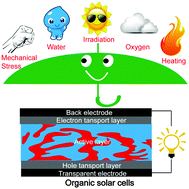
This review highlights the factors limiting the stability of organic solar cells and recent developments in strategies to increase the stability of organic solar cells.
The content of this RSS Feed (c) The Royal Society of Chemistry

19 Feb 03:01
by Zhigang Yin, Qingdong Zheng, Shan-Ci Chen, Dongdong Cai, Yunlong Ma

In article number 1501493, Qingdong Zheng and co-workers report highly efficient and stable inverted organic solar cells by using controllable ZnMgO as electron-transporting layers. The devices, based on nanocolloid/nanoridge ZnMgO, can maintain 84%–93% of their initial efficiencies after 1-year storage, demonstrating their long-term stability.
19 Feb 03:01
by Samuel D. Collins, Christopher M. Proctor, Niva A. Ran, Thuc-Quyen Nguyen

In article number 1501721, the effect of donor and acceptor energetic disorder on the open-circuit voltage loss in organic bulk heterojunction (BHJ) solar cells is determined by Thuc-Quyen Nguyen and co-workers. It is demonstrated that disorder loss depends strongly on morphology and the donor acceptor pairing, where as much as 0.2 V in Voc loss can be attributed purely to excess energetic disorder.
18 Feb 06:25
by Li Na Quan, Mingjian Yuan, Riccardo Comin, Oleksandr Voznyy, Eric M. Beauregard, Sjoerd Hoogland, Andrei Buin, Ahmad R. Kirmani, Kui Zhao, Aram Amassian, Dong Ha Kim and Edward H. Sargent

Journal of the American Chemical Society
DOI: 10.1021/jacs.5b11740

18 Feb 06:24
by Jannic Wolf, Maxime Babics, Kai Wang, Qasim Saleem, Ru-Ze Liang, Michael Ryan Hansen and Pierre M. Beaujuge

Chemistry of Materials
DOI: 10.1021/acs.chemmater.5b04726

17 Feb 01:52
by Jarvist M. Frost and Aron Walsh

Accounts of Chemical Research
DOI: 10.1021/acs.accounts.5b00431

17 Feb 01:04
by Kyung-Geun Lim, Soyeong Ahn, Hobeom Kim, Mi-Ri Choi, Dal Ho Huh, Tae-Woo Lee
Organic–inorganic hybrid perovskite solar cells are fabricated using a water-soluble, self-doped conducting polyaniline graft copolymer based on poly(4-styrenesulfonate)-g-polyaniline (PSS-g-PANI) as an efficient hole-extraction layer (HEL) because of its advantages, including low-temperature solution processability, high transmittance, and a low energy barrier with perovskite photoactive layers. Compared with conventional poly(3,4-ethylenedioxythiophene):poly(styrene sulfonate) (PEDOT:PSS) dispersed in water solution, PSS-g-PANI molecules are dissolved in water because of the polymeric dopant covalently bonded with PANI, and can steadily remain as an initial solution during long-term storage and over a wide pH range to fabricate a HEL with fewer surface defects. The built-in potential and device characteristics are substantially improved because of the surface energy state of PSS-g-PANI below Fermi-energy level. Moreover, the PSS-g-PANI mixed with electron-withdrawing perfluorinated ionomer (PFI) exhibits a higher work function (5.49 eV) and deeper surface energy state below the Fermi level; thus, an ohmic contact at the HEL/methylammonium lead iodide perovskite interface is obtained. Finally, the power conversion efficiency was increased from 7.8% in the perovskite solar cells with PEDOT:PSS to 12.4% in those with the PSS-g-PANI:PFI.

A water-soluble self-doped poly(styrene sulfonate) grafted polyaniline copolymer (PSS-g-PANI) was used to achieve high power conversion efficiency (PCE) in solution-processed planar heterojunction perovskite solar cells. The PCE was increased from 7.8% in the methylammonium lead iodide perovskite solar cell with poly(3,4-ethylenedioxythiophene):poly(styrene sulfonate) to 12.4% in that with PSS-g-PANI:perfluorinated ionomer due to good energy level alignment at the hole extraction interface and high transmittance.
17 Feb 01:00
by Sergiu Draguta, Siddharatha Thakur, Yurii V. Morozov, Yuanxing Wang, Joseph S. Manser, Prashant V. Kamat and Masaru Kuno

The Journal of Physical Chemistry Letters
DOI: 10.1021/acs.jpclett.5b02888

17 Feb 00:52
by Kristofer Tvingstedt, Carsten Deibel
The value and temperature dependence of the ideality factor provides essential information about the dominant recombination route in solar cells. This study presents experimental results of accurate ideality factor determination for representative organic photovoltaic cells (OPV) evaluated at different temperatures over a large current density regime. It is noted that standard dark I–V curves strongly deviate from those obtained by evaluations based on short circuit current density (J
SC)–open circuit voltage (V
OC) pairs. This is attributed to the applied external voltage in a dark I–V measurement not being representative of internal chemical potential, particularly at lower temperatures. Complementary electroluminescence measurements attest that the current density dependence of the ability of the solar cell to emit light is better correlated to the series resistance free ideality factor. For the studied set of OPV devices it is observed that the ideality factors are quite low, and with very weak temperature dependence. The J
SC–V
OC method to determine ideality factors further allows good estimates of activation energies as well as recombination current prefactors J
00. The findings imply that the principal OPV non-radiative recombination mechanism is not recombination of free carriers with trapped carriers in an exponential density of tail states as previously reported.

Improved determination of ideality factors is performed by evaluating open circuit voltage–short circuit current pairs as opposed to traditional dark I–V curves. The true temperature dependence of the ideality factor can then be obtained for organic solar cells otherwise substantially limited by series resistance effects. The relation to radiative efficiency, activation energy, and dark saturation current is clarified.