20 Feb 06:22
by Haining Chen, Zhanhua Wei, Hexiang He, Xiaoli Zheng, Kam Sing Wong, Shihe Yang
Carbon-based hole transport material (HTM)-free perovskite solar cells (PSCs) have shown much promise for practical applications because of their high stability and low cost. However, the efficiencies of this kind of PSCs are still relatively low, especially for the simplest paintable carbon-based PSCs, in comparison with the organic HTM-based PSCs. This can be imputed to the perovskite deposition methods that are not very suitable for this kind of devices. A solvent engineering strategy based on two-step sequential method is exploited to prepare a high-quality perovskite layer for the paintable carbon-based PSCs in which the solvent for CH3NH3I (MAI) solution at the second step is changed from isopropanol (IPA) to a mixed solvent of IPA/Cyclohexane (CYHEX). This mixed solvent not only accelerates the conversion of PbI2 to CH3NH3PbI3 but also suppresses the Ostwald ripening process resulting in a high-quality perovskite layer, e.g., pure phase, even surface, and compact capping layer. The paintable carbon-based PSCs fabricated from IPA/CYHEX solvent exhibits a considerable enhancement in photovoltaic performance and performance reproducibility in comparison with that from pure IPA, especially on fill factor (FF), owing mainly to the better contact of perovskite/carbon interface, lower trap density in perovskite, higher light absorption ability, and faster charge transport of perovskite layer. As a result, the highest power conversion efficiency (PCE) of 14.38% is obtained, which is a record value for carbon-based HTM-free PSCs. Furthermore, a PCE of as high as 10% is achieved for the large area device (1 cm2), also the highest of its kind.

A solvent engineering strategy based on the two-step sequential method is exploited to prepare a high-quality perovskite layer for high-performance paintable carbon-based, hole transport material-free perovskite solar cells (14.38%). By lowering the solvent polarity for CH3NH3I solution, the conversion of PbI2 is accelerated and the Ostwald ripening process is suppressed, leading to an even perovskite layer with enhanced interface (perovskite/carbon) contact and performance.
17 Feb 01:53
by Ingo Salzmann, Georg Heimel, Martin Oehzelt, Stefanie Winkler and Norbert Koch

Accounts of Chemical Research
DOI: 10.1021/acs.accounts.5b00438

17 Feb 01:52
by Qianqian Lin, Ardalan Armin, Paul L. Burn and Paul Meredith

Accounts of Chemical Research
DOI: 10.1021/acs.accounts.5b00483

17 Feb 01:52
by David A. Egger, Andrew M. Rappe and Leeor Kronik

Accounts of Chemical Research
DOI: 10.1021/acs.accounts.5b00540

17 Feb 01:45
Energy Environ. Sci., 2016, 9,1439-1449
DOI: 10.1039/C5EE03806E, Paper
Rachelle Ihly, Anne-Marie Dowgiallo, Mengjin Yang, Philip Schulz, Noah J. Stanton, Obadiah G. Reid, Andrew J. Ferguson, Kai Zhu, Joseph J. Berry, Jeffrey L. Blackburn
Capping perovskite absorber layers with semiconducting carbon nanotubes enables sub-picosecond hole extraction and recombination times of hundreds of microseconds.
The content of this RSS Feed (c) The Royal Society of Chemistry

17 Feb 01:45
Energy Environ. Sci., 2016, 9,932-939
DOI: 10.1039/C5EE03560K, Paper
Kyung-Geun Lim, Soyeong Ahn, Young-Hoon Kim, Yabing Qi, Tae-Woo Lee
Tailoring the interface energetics between a polymeric hole extraction layer (HEL) and a photoactive layer (PAL) in organic photovoltaics (OPVs) and organic-inorganic hybrid perovskite solar cells (PrSCs) is very important to maximize open circuit voltage (Voc), power conversion efficiency (PCE), and device lifetime.
The content of this RSS Feed (c) The Royal Society of Chemistry

17 Feb 01:41
by Simone Meloni
Article
The origin of hysteresis remains an open question in lead-halide perovskite solar cells. Here, Meloni et al . investigate the causes of hysteresis using an experimental and computational approach, finding that the observed hysteresis is due to halide ion-vacancy movement in the perovskite.
Nature Communications doi: 10.1038/ncomms10334
Authors: Simone Meloni, Thomas Moehl, Wolfgang Tress, Marius Franckevičius, Michael Saliba, Yong Hui Lee, Peng Gao, Mohammad Khaja Nazeeruddin, Shaik Mohammed Zakeeruddin, Ursula Rothlisberger, Michael Graetzel

17 Feb 01:01
by Scott K. Cushing and Nianqiang Wu

The Journal of Physical Chemistry Letters
DOI: 10.1021/acs.jpclett.5b02393

17 Feb 00:59
by Rachel E. Beal, Daniel J. Slotcavage, Tomas Leijtens, Andrea R. Bowring, Rebecca A. Belisle, William H. Nguyen, George F. Burkhard, Eric T. Hoke and Michael D. McGehee

The Journal of Physical Chemistry Letters
DOI: 10.1021/acs.jpclett.6b00002

17 Feb 00:54
by Rebecca J. Sutton, Giles E. Eperon, Laura Miranda, Elizabeth S. Parrott, Brett A. Kamino, Jay B. Patel, Maximilian T. Hörantner, Michael B. Johnston, Amir Abbas Haghighirad, David T. Moore, Henry J. Snaith

Highest reported efficiency cesium lead halide perovskite solar cells are realized by tuning the bandgap and stabilizing the black perovskite phase at lower temperatures. CsPbI2Br is employed in a planar architecture device resulting in 9.8% power conversion efficiency and over 5% stabilized power output. Offering substantially enhanced thermal stability over their organic based counterparts, these results show that all-inorganic perovskites can represent a promising next step for photovoltaic materials.
17 Feb 00:53
by Yunlong Zou, Russell J. Holmes

The efficiency of perovskite photovoltaic cells is greatly impacted by the anomalous hysteresis effect. It is found that by applying a forward bias prior to testing, device efficiency (ηp) can be significantly improved. This bias poling effect can be stabilized at temperatures ≤250 K. As a result, hysteresis free operation of a planar perovskite photovoltaic cell is achieved at 170 K with ηp of 19%.
17 Feb 00:53
by Randi Azmi, Havid Aqoma, Wisnu Tantyo Hadmojo, Jin-Mun Yun, Soyeon Yoon, Kyungkon Kim, Young Rag Do, Seung-Hwan Oh, Sung-Yeon Jang
Low-temperature solution-processed high-efficiency colloidal quantum dot (CQD) photovoltaic devices are developed by improving the interfacial properties of p–n heterojunctions. A unique conjugated polyelectrolyte, WPF-6-oxy-F, is used as an interface modification layer for ZnO/PbS-CQD heterojunctions. With the insertion of this interlayer, the device performance is dramatically improved. The origins of this improvement are determined and it is found that the multifunctionality of the WPF-6-oxy-F interlayer offers the following essential benefits for the improved CQD/ZnO junctions: (i) the dipole induced by the ionic substituents enhances the quasi-Fermi level separation at the heterojunction through favorable energy band-bending, (ii) the ethylene oxide groups containing side chains can effectively passivate the interfacial defect sites of the heterojunction, and (iii) these effects occur without deterioration in the intrinsic depletion region or the series resistance of the device. All of the figures-of-merit of the devices are improved as a result of the enhanced built-in potential (electric field) and the reduced interfacial charge recombination at the heterojunction. The benefits due to the WPF-6-oxy-F interlayer are generally applicable to various types of PbS/ZnO heterojunctions. Finally, CQD photovoltaic devices with a power conversion efficiency of 9% are achievable, even by a solution process at room temperature in an air atmosphere. The work suggests a useful strategy to improve the interfacial properties of p–n heterojunctions by using polymeric interlayers.

High-efficiency colloidal quantum dot photovoltaic devices (CQDPVs) are developed by improving the interfacial properties of p–n heterojunctions using a conjugated polyelectrolyte as an interface modifier. The conjugated polyelectrolyte effectively improves charge extraction efficiency by enhancing internal electric field and passivating interfacial defects. Using this strategy, CQDPVs with 9% efficiency are able to be fabricated through room temperature solution process.
17 Feb 00:53
by Lili Ke, Jie Min, Matthias Adam, Nicola Gasparini, Yi Hou, J. Darío Perea, Wei Chen, Hong Zhang, Stefanie Fladischer, Anna-Chiara Sale, Erdmann Spiecker, Rik R. Tykwinski, Christoph J. Brabec, Tayebeh Ameri
An attractive method to broaden the absorption bandwidth of polymer/fullerene-based bulk heterojunction (BHJ) solar cells is to blend near infrared (near-IR) sensitizers into the host system. Axial substitution of silicon phthalocyanines (Pcs) opens a possibility to modify the chemical, thermodynamic, electronic, and optical properties. Different axial substitutions are already designed to modify the thermodynamic properties of Pcs, but the impact of extending the π-conjugation of the axial ligand on the opto-electronic properties, as a function of the length of the alkyl spacer, has not been investigated yet. For this purpose, a novel series of pyrene-substituted silicon phthalocyanines (SiPc-Pys) with varying lengths of alkyl chain tethers are synthesized. The UV–vis and external quantum efficiency (EQE) results exhibit an efficient near IR sensitization up to 800 nm, clearly establishing the impact of the pyrene substitution. This yields an increase of over 20% in the short circuit current density (J
SC) and over 50% in the power conversion efficiency (PCE) for the dye-sensitized ternary device. Charge generation, transport properties, and microstructure are studied using different advanced technologies. Remarkably, these results provide guidance for the diverse and judicious selection of dye sensitizers to overcome the absorption limitation and achieve high efficiency ternary solar cells.

A series of silicon phthalocyanines, axially substituted by a pyrene acid group and peripherally incorporated by tert-butyl groups, are introduced as functional near infrared (IR) sensitizers into the P3HT:PCBM system. An efficient near-IR sensitization of up to 750 nm/800 nm and power conversion efficiency improvement up to 50% is achieved. The influence of the alkyl chain length on the performance, transport, and microstructure is extensively studied.
17 Feb 00:53
by Maxime Guérette, Ahmed Najari, Julie Maltais, Jean-Rémi Pouliot, Stéphane Dufresne, Martin Simoneau, Simon Besner, Patrick Charest, Mario Leclerc

New phenanthridinone-based polymers are designed and synthesized by direct (hetero)arylation polymerization for photovoltaic applications. Bulk-heterojunction solar cells prepared in air and a random terpolymer (P3) blended with PC71BM in o-dichlorobenzene lead to a power conversion efficiency (PCE) up to 6.7%. When the same polymer is processed with PC61BM in o-xylene with blade-coating in a chlorine-free system, a PCE of 4.7% is observed.
17 Feb 00:52
by Zaiyu Wang, Yajie Zhang, Jianqi Zhang, Zhixiang Wei, Wei Ma

The morphology features of polymer/small molecule/fullerene ternary organic solar cells are investigated. For the first time, simultaneously enhanced face-on molecular packing for both polymer and small-molecule donor materials is observed. This optimized morphology yields an enhanced performance at 40% small-molecule composition.
17 Feb 00:52
by Hong Zhang, R. Clayton Shallcross, Ning Li, Tobias Stubhan, Yi Hou, Wei Chen, Tayebeh Ameri, Mathieu Turbiez, Neal R. Armstrong, Christoph J. Brabec
It is shown that the performance of inverted organic solar cells can be significantly improved by facilitating the formation of a quasi-ohmic contact via solution-processed alkali hydroxide (AOH) interlayers on top of n-type metal oxide (aluminum zinc oxide, AZO, and zinc oxide, ZnO) layers. AOHs significantly reduce the work function of metal oxides, and are further proven to effectively passivate defect states in these metal oxides. The interfacial energetics of these electron collecting contacts with a prototypical electron acceptor (C60) are investigated to reveal the presence of a large interface dipole and a new interface state between the Fermi energy and the C60 highest occupied molecular orbital for AOH-modified AZO contacts. These novel interfacial gap states are a result of ground-state electron transfer from the metal hydroxide-functionalized AZO contact to the adsorbed molecules, which are hypothesized to be electronically hybridized with the contact. These interface states tail all the way to the Fermi energy, providing for a highly n-doped (metal-like) interfacial molecular layer. Furthermore, the strong “light-soaking” effect is no longer observed in devices with a AOH interface.

Solution-processed alkali hydroxides significantly reduce the work function of metal oxides, such as zinc oxide or aluminum zinc oxide (AZO), and are further proven to effectively passivate defect states in these metal oxides. The interface states with alkali hydroxide-modified AZO contacts tail all the way to the Fermi energy, providing for a highly n-doped (metal-like) interfacial molecular layer.
17 Feb 00:51
by Dalsu Choi, Hyungchul Kim, Nils Persson, Ping-Hsun Chu, Mincheol Chang, Ji-Hwan Kang, Samuel Graham and Elsa Reichmanis

Chemistry of Materials
DOI: 10.1021/acs.chemmater.5b04804

06 Feb 00:33
by Hyangki Sung, Namyoung Ahn, Min Seok Jang, Jong-Kwon Lee, Heetae Yoon, Nam-Gyu Park, Mansoo Choi

In article number 1501873, Mansoo Choi and co-workers demonstrate highly efficient transparent conductive oxide (TCO)-free inverted perovskite (CH3NH3PbI3) solar cells by using a graphene transparent electrode. Careful engineering of the interface between the graphene electrode and the hole transport layer enables the highest energy conversion efficiency of 17.1% among TCO-free solar cells to be obtained.
06 Feb 00:32
by Xiangwei Zhu, Benzheng Xia, Kun Lu, Huan Li, Ruimin Zhou, Jianqi Zhang, Yajie Zhang, Zhigang Shuai and Zhixiang Wei

Chemistry of Materials
DOI: 10.1021/acs.chemmater.5b04668

27 Jan 06:56
by Pengchen Zhu, Shuai Gu, Xinpeng Shen, Ning Xu, Yingling Tan, Shendong Zhuang, Yu Deng, Zhenda Lu, Zhenlin Wang and Jia Zhu

Nano Letters
DOI: 10.1021/acs.nanolett.5b03504

27 Jan 06:55
by Fan Zhang, Wei Ma, Haizhong Guo, Yicheng Zhao, Xinyan Shan, Kuijuan Jin, He Tian, Qing Zhao, Dapeng Yu, Xinghua Lu, Gang Lu and Sheng Meng

Chemistry of Materials
DOI: 10.1021/acs.chemmater.5b04019

26 Jan 01:09
by Nicholas De Marco, Huanping Zhou, Qi Chen, Pengyu Sun, Zonghao Liu, Lei Meng, En-Ping Yao, Yongsheng Liu, Andy Schiffer and Yang Yang

Nano Letters
DOI: 10.1021/acs.nanolett.5b04060

24 Jan 09:05
by Qianqian Zhu, Xichang Bao, Jianhua Yu, Dangqiang Zhu, Meng Qiu, Renqiang Yang and Lifeng Dong

ACS Applied Materials & Interfaces
DOI: 10.1021/acsami.5b10555

24 Jan 09:05
by Alaa Abdellah, Aniello Falco, Ulrich Schwarzenberger, Giuseppe Scarpa and Paolo Lugli

ACS Applied Materials & Interfaces
DOI: 10.1021/acsami.5b10539

24 Jan 09:04
by Yulei Wu, Xiaohui Liu, Xiaodong Li, Wenjun Zhang, Hai-Qiao Wang and Junfeng Fang

ACS Applied Materials & Interfaces
DOI: 10.1021/acsami.5b10798

23 Jan 08:44
Energy Environ. Sci., 2016, 9,898-905
DOI: 10.1039/C5EE03779D, Communication
Shenghua Liu, Ruibin Jiang, Peng You, Xingzhong Zhu, Jianfang Wang, Feng Yan
We introduced Au@Ag core-shell nanocuboids with broadband plasmonic enhancement in organic photovoltaics, which show multimode localized surface plasmon resonance that can be tuned to match the light absorption spectra of the devices by changing the geometric size.
The content of this RSS Feed (c) The Royal Society of Chemistry

23 Jan 08:41
by Isaac Zarazua, Juan Bisquert and Germà Garcia-Belmonte

The Journal of Physical Chemistry Letters
DOI: 10.1021/acs.jpclett.5b02810

23 Jan 08:40
by Michele De Bastiani, Giorgio Dell'Erba, Marina Gandini, Valerio D'Innocenzo, Stefanie Neutzner, Ajay Ram Srimath Kandada, Giulia Grancini, Maddalena Binda, Mirko Prato, James M. Ball, Mario Caironi, Annamaria Petrozza

Perovskite-based solar cells manifest often an electrical instability in terms of current-voltage hysteresis. In article number 1501453, Mario Caironi, Annamaria Petrozza and co-workers demonstrate how fullerene based electron extracting layers stabilize the short-circuit photocurrent from the very first J–V scan, thanks to efficient electron extraction, while preconditioning cycles are needed to stabilize the open-circuit voltage owing to interaction between migrating iodide ions and the charge extraction layer, which result in the doping of the fullerene.
23 Jan 08:40
by George Kakavelakis, Ioannis Vangelidis, Amelie Heuer-Jungemann, Antonios G. Kanaras, Elefterios Lidorikis, Emmanuel Stratakis, Emmanuel Kymakis

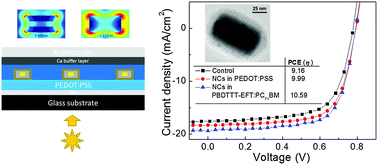
A new light trapping architecture to enhance the power conversion efficiency of organic photovoltaics is proposed and implemented. In article number 1501640, Emmanuel Kymakis and co-workers demonstrate that the incorporation of gold nanorods inside the rear buffer layer, leads to the redistribution of photons inside the active medium mainly through efficient light back-scattering, simultaneously increasing the exciton generation and charge collection.
20 Jan 01:17
by Weiwei Meng, Bayrammurad Saparov, Feng Hong, Jianbo Wang, David B. Mitzi and Yanfa Yan

Chemistry of Materials
DOI: 10.1021/acs.chemmater.5b04213