Shared posts

24 Sep 13:10

The Art of Europe in the Piratey Era

by noreply@blogger.com (Zak S)
Part seven in a series on D&Dable art
Jacques Callot, from "Les Gobbi", 16something
Everybody wore lace and a fancy sword, it was a strange time on a strange continent…

Once anatomy and perspective got going in the Renaissance, Europeans spent the next 400 years treating their newfound ability to make shit look really real like a kid treats a toy on Christmas--or how people are treating photoshop right now.

Oh hey, we can show someone's head getting chopped off:...
Artemesia Gentilleschi-Judith Slaying Holofernes, 16something
Or I can paint my hot wife's disturbing eyes...
Nicholas Hilliard, from the English Renaissance, 1578.
You can usually tell English painters because they're way
behind the style curve and way into blue and white.
Bonus: Do you see the distant John Blancheness lurking here?
…or show you freaks looking at a rhino!...
Pietro Longhi, Rhinoceros, 1751
…or explain what an iceberg looks like...
Caspar David Friedrich, Sea of Ice 1824
So, basically, if somebody in Europe saw it or even just imagined it between 1500 and 1900 there's a painting of it. The range of subjects is unprecedented, even if the range of techniques isn't.

When we look at most modern fantasy illustration and concept design--this is where their bag of tricks came from. Even video games and movies still rely heavily on what this era of painting showed about the variety of different effects you can get just by the changing the light sources or palette.

European art after the Renaissance and before modernism is usually divided up by historians into a series of minutely examined and sequenced -isms. But to the modern viewer (and, likely, from the POV of any pre-20th century non-western culture) these categories seem less like a progression of changing styles than an attempt to fix names on loosely affiliated fashions that swelled, subsided, and mixed within what was essentially a massive tide of overlapping realisms.

The main ones, in the order they appear, are…

Mannerism: the one where everybody is skinny
(I have yet to find an example of a good work of Mannerist art.)

Baroque: the one where everything was dramatic
Bernini's Ecstasy of St Teresa, 1647-52 Which is phenomenal.


Rococco: the one where everything is flowery
This little guy is a Falconet from the Louvre, a clearly chilled
out French descendant of Bernini's impaling italian angel. 1757.
The hair is worse, but the expression is subtler.


Neo-Classicism: the one where everything is serious
Houdon, 1778. He's all THE ONLY BABY I CARE ABOUT IS THE NEW REPUBLIC!
Romanticism: the one where everything is emotional and natural

John Martin, 1851-3 The Great Day of His Wrath. Freak out.
Realism: the one with a lot of grey.
Whistler, Portrait of Master Stephen Manuel 1885
Minor 19th century movements of special interest to RPG folks include the Orientalists, who painted scenes from the far and middle east...
Jean-Leon Gerome. Heads of the Rebel Beys. 18something.
 ...and the pre-Raphaelites…

John William Waterhouse, The Magic Circle
...who spent a great deal of the 19th century painting things from an idealized Middle Ages. They're spiritual ancestors of Tolkien and a lot of the high-fantasy artists and high-fantasy ideas still around today. 

If we imagine every bad artist as a kind of failed experiment in an ongoing attempt to manipulate the bloodlines to create a good artist, people like Waterhouse, Burne-Jones and Gerome (whose paintings--from what I've seen--completely fall apart up close) were necessary to produce like Jeffrey Catherine Jones and Frank Frazetta.
Edward Burne-Jones--The Doom Fulfilled, 18something
As usual, the typical art historian's Bugbear of Relevance rolls right over what's most interesting about the best work from this era which is: it's just really fucking good.

For example, everything below gets called baroque, despite theatricality, drama and action not really being the point…
The extremely insignificant Willem Kalf just painting somebody's dinner
and knocking it out of the fucking park. Click and enlarge
and look at that lobster.
This is Bernini's portrait of Scipione Borghese
Finelli's portrait of the same Cardinal Borghese, less
baroque, but arguably even better than Bernini's.
I love the missing button.
(The idea of an egomaniacal Cardinal who has all these conflicting portraits is a good idea for an NPC.).
This is Vermeer. Now normally I'd be chewing Vermeer
out for that halo of grey over her head, but I've seen this
painting in person and it's actually maybe the best
painting. Period. Ever. So click and enlarge. See if you
can find a single stray scrubby brush stroke anywhere in there.
Rembrandt Human Thief, Level 7, 1634
Velazquez, Portrait of Juan De Pareja, 1650.
Juan was a former slave and painter in his own right who worked in
 Velazquez's studio.
You can tell in the actual portrait that Velazquez did the
face and the lace but some of the lazier stuff
at the bottom may have been done by an assistant.
Or just Velazquez being lazy. Anyway--the top half
in particular is still amazing.

Velazquez himself, 1645

Basically: There were a lot of people painting and sculpting, a few were good and most of their names are familiar.

What art history pretty much completely fails to mention are the prints and the printmakers. The three (otherwise wonderful) big fat survey books I've been relying on to refresh my memory about who did what when for the spine of this series pretty much skip printmaking entirely.
Meister E.S., from the Fantastic Alphabet

Some other letters
Prints are small and not usually in color and, unlike oil paintings, you can't keep them out in museums for long or they'll fall apart. They represent a parallel but not visually equivalent tradition to what's going on in the rest of Europe in Piratey Times yet even in today's art schools the printmaking department is like pretty much where anyone giving a fuck about you goes to die.

Part of the problem is also down to the original art history villain--Vasari. Printmaking was, in the beginning, predominantly a northern art (Durer, Schongauer) and so Vasari was like fuck that whole medium let's talk about Giotto some more, amirite?
from the Triumph of Maximillian, by one of several
German Renaissance printmakers, 15something

In the split you can hear echoes of the crowd-pleasing but gormless bulbous soft-focus warm Italian Renaissance painter/ vs sharp-eyed but uncharismatic joyless angular Northern Renaissance printmaker split today when people discuss digital painting vs black-and-white post-Sutherland RPG art (and lurking beneath that, is an echo of arguments about painting--free, open, colorful, vague--vs illustration--dutiful, precise, detailed. With anything truly great conforming, of course, to neither stereotype.)
Jacques Callot, 16something, bringing a suave and pre-Seussian line

Hendrik Goltzius, 1588. Notice the weird roundness--
either peoples' muscles used to be shaped different or
that's the influence of the Italian Renaissance's eccentric
conception of anatomy

Piranesi's prison drawings were just made up
and dungeony as fuck...

…but they drew on his experience drawing ancient ruins
like this here, Remains of the Tomb of the Metelli--both 17something

The nice thing about the huge archive of old master prints from a gamer point of view is they really do contain a record of every freakshow kind of picture imaginable. What with all these museums digitizing their archives, it's a fucking endless rabbit hole:
Wenceslaus Hollar, 16something

Sebastien Le Clerc
Henry Holiday From the Hunting of the Snark
Wenceslaus Hollar, 1652

Wenceslaus Hollar, 1646

Edit: Holy fuck I forgot Gustave Dore:

24 Sep 00:07

Keith Olbermann Takes A Big Ol' Poo On Derek Jeter

by Tom Ley

For anyone who is fed up with Derek Jeter's season-long victory parade and all of the muck that it has produced , this nearly seven-minute monologue from Keith Olbermann will feel downright pornographic.

Read more...


23 Sep 11:47

Because I Love You All So Much

by John Cole +0

I really wish I could describe how much I like this, but here are iconic portraits throughout history recreated with John Malkovich:

Gordon_Parks___American_Gothic_Washington_D.C._date_2014

Sounds great! Who the fuck is John Malkovich?

FacebookTwitterGoogle+Share


This space reserved for your ad.

22 Sep 22:02

Pew Research Center invites you to take an online quiz to test how your knowledge of religion compar

by Mark Strauss
Zackc43

15 out of 15, better than 99% of the public.

Pew Research Center invites you to take an online quiz to test how your knowledge of religion compares with the average American. So far, atheists and agnostics are among those with the highest scores.

Read more...


22 Sep 16:27

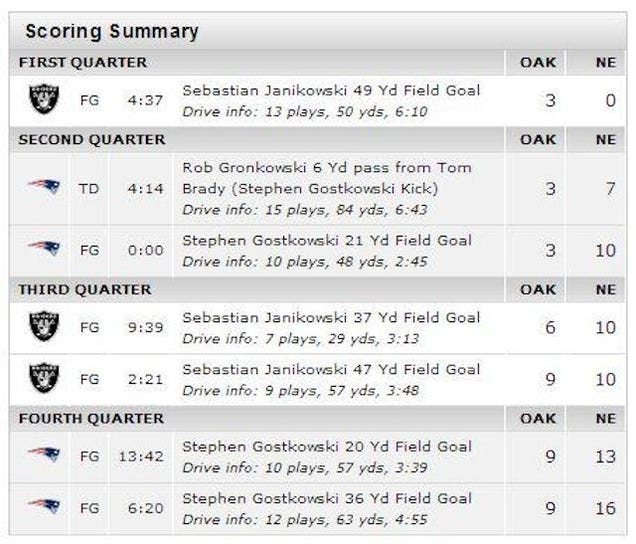
All Of The Points In The Raiders-Patriots Game Were Scored By "-Kowskis"

by Tom Ley

All Of The Points In The Raiders-Patriots Game Were Scored By "-Kowskis"

It was a big game for fans of Polish NFL players.

Read more...


22 Sep 15:40

This Hilarious Key & Peele Sketch Reveals Alien Invaders' Only Weakness

by Charlie Jane Anders

Key & Peele comes back this Wednesday, and this first taste reminds us why that show is so indispensible. In this brilliant sketch, alien invaders can look just like humans, except for one problem: the aliens can't understand human racism.

Read more...


22 Sep 12:59

Gif of the Day: Cats Must Really Have Nine Lives Because This Kitty Escaped From a Burning, Collapsing Hotel

Gif of the Day: Cats Must Really Have Nine Lives Because This Kitty Escaped From a Burning, Collapsing Hotel

The Dauphin hotel is a complete loss after suspected arson. All residents escaped before the collapse, but a cat trapped inside made its escape after the building fell.

Submitted by: (via CTV News Winnipeg)

Tagged: scary , gifs , Cats , animals
22 Sep 12:48

stargates: why is this so hard


stargates:

why is this so hard

18 Sep 19:29

The Best Dog Reveal You'll Watch All Year

Jeff Goldblum sheds a tear of joy every time.

Submitted by: (via Kevin Fuller)

16 Sep 18:15

Worst fake punt ever

by Rob Beschizza

A football team executed a fake punt so terribly that one component of it--a player pretending to have some kind of seizure on the field of play--seemed strangely authentic. Read the rest

16 Sep 14:55

Astro-fracking North Carolina by @BloggersRUs

by noreply@blogger.com (Undercover Blue)

Astro-Fracking North Carolina

by Tom Sullivan

Courtesy of its GOP-led legislature, the great state of North Carolina is exploring fracking Triassic Basin shale deposits in the center of the state. Gov. Pat McCrory this summer lifted the moratorium on the practice in place since 2012. The bill he signed also made revealing the chemical components of fracking fluids a misdemeanor (an earlier draft made it a felony). A friend already has a T-shirt listing fracking chemicals on the back. The front reads, "This T-shirt is illegal in North Carolina."

The Mining and Energy Commission is taking public comment on fracking in the state, naturally. Last week, they held their last public meeting in the mountains at Western Carolina University in Cullowhee. About 550 people attended. Opponents, mostly, and a few astroturf fracking supporters.

Few pro-fracking supporters made themselves visible. People favoring the drilling technology were booed and hissed at during previous fracking hearings. There were some, however. Three or four from America’s Energy Forum and N.C. Energy Forum, groups that receive financial support from American Petroleum Institute. And there was Winston-Salem resident Christian Bradshaw, who said he made the three-hour trip to support “energy-creating jobs” for North Carolina.

According to news reports (and friends who were there), about 18 men arrived wearing “Shale Yes” T-shirts, but seemed unaware of what fracking is. At least one had come from a Winston-Salem homeless shelter because "he had been told it would help the environment." As a friend described it, once the Army veteran realized he'd been duped, he couldn't believe he'd sold out for a sandwich.


“The energy industry keeps claiming that there is support for fracking in WNC. What they fail to mention is that they have to bus the clueless ‘supporters’ in,” said Betsy Ashby, who helped organize Jackson County Coalition Against Fracking.
One of the men apologized to Ashby, saying "I didn't know they were trying to do this to me." Another indicated he had just done it for the money.

"They're being exploited seven ways to Sunday," Ashby told reporters.

Whether the issue is women's health, school funding, Medicaid expansion, or preserving voting rights and the environment -- the Moral Monday Movement's fusion agenda -- that's pretty much how it goes. Among the tens of thousands of Moral Monday protesters, a thousand were willing to be arrested to oppose the NCGOP's radical agenda. The Koch brothers, Art Pope, and the rest of the Midas cult have to buy support. Boy howdy, can they afford to. And even then, they are exploiting people.

(h/t Ashevegas)

15 Sep 13:54

Americans are more likely to work nights and weekends compared to citizens of other developed countr

by George Dvorsky

Americans are more likely to work nights and weekends compared to citizens of other developed countries. In addition to spending more hours on the job, nearly 30% of Americans work weekends and — shockingly — more than a quarter toil away after 10pm. But people who work the extra-long hours tend to be highly educated and well paid. Read the study here.

Read more...


12 Sep 12:57

#1061; In which a Cookie is refused

by David Malki

11 Sep 18:16

In Case You Were Wondering, Jeff Goldblum Has His Own Lyrics for the "Jurassic Park" Theme, and They're Great

10 Sep 15:46

The Other Renaissance, or There Is No Ninja Turtle Named Claus Sluter

by noreply@blogger.com (Zak S)
(Fourth in a series about D&Dish art)

"With a few exceptions, however, Vasari's aesthetic judgement was acute and unbiased.[citation needed] "
-Wikipedia
St Anthony from Grunewald's Isenheim Altarpiece. Why did no-one
ever tell you that art was totally fucking Warhammer?
Because Vasari, that's why.

In the crime novel "Who Killed Everyone's Interest In Art History?" the villain is a man named Giorgio Vasari. However, he also invented art history and did a great deal of the groundwork for the whole rhetorical and social frame that makes us see "art" as a special thing that people do that we should talk about at all. As a working painter whose rent is paid by the continuing mercantile machinations of the international gallery system, I just may owe him my job.
I repeat: this man did not want you to hear about this
giant bludgeoning eagle monster.

Vasari's major work was called "Lives of the Most Excellent Painters, Sculptors, and Architects" and it:

-Was published in 1550
-Invented art history
-First applied the specific term "Renaissance" to what was going on in Italy then
-Helped put Leonardo, Raphael, and Michelangelo on the pedestals they currently occupy
-Has an amusing anecdote about Paolo Uccello and cheese
-Contains a lot of mistakes
-Is fun to read
-Was kind of a piece of pro-Florentine propaganda

"Paolo Uccello would have been the most gracious and fanciful genius that was ever devoted to the art of painting, from Giotto's day to our own, if he had labored as much at figures and animals as he labored and lost time over the details of perspective; for although these are ingenious and beautiful, yet if a man pursues them beyond measure he does nothing but waste his time, exhausts his powers, fills his mind with difficulties, and often transforms its fertility and readiness into sterility and constraint, and renders his manner, by attending more to these details than to figures, dry and angular, which all comes from a wish to examine things too minutely; not to mention that very often he becomes solitary, eccentric, melancholy, and poor, as did Paolo Uccello."
--Vasari

A deposition by Rogier Van Der Weyden
The Italian Renaissance was big on painting baby Jesus.
the Northern Renaissance was big on painting dead Jesus
Although much of what he did was simply record ideas people had already had for a while, the shadow created by Vasari's record is very long. Thales invented philosophy, but people don't still think everything is made of water. Vasari invented art history, and people do still think the Mona Lisa is the best painting ever. There are even people who don't like looking at the Mona Lisa and yet feel like it's still objectively "good" in some way they lack the expertise to describe. There are very intelligent and perceptive people all over the world who are intimidated into not trusting their own eyes when they look at art because of things he wrote 500 years ago. Vasari is the most successful One True Wayist in world history.
Rabbit by Albrecht Durer, or--as Vasari called him in
Lives of the Most Excellent Painters, Sculptors, and Architects--
"Sir Not-Appearing-In-This-Book"

Part of the Italian Renaissance painters' continued pre-eminence is due to the early (if halting and uneven) adoption of innovative realist techniques like perspective, chiaroscuro, sfumato, careful anatomy, and the not-inconsiderable fact that the cities they built are, to this day, still very beautiful due to the influence of their Renaissance buildings--but part of it's just politics and luck.

Let's assume, despite 500 years of evidence to the contrary, for just one moment that pictures actually can speak louder than Vasari's words, :

Here is Michelangelo's Moses done circa 1513-1515
And here is Claus Sluter's Moses, done over a hundred years earlier:
Whatever else you might think, Sluter's wise and horned Jew is way more metal than Michelangelo's.

This is because while the Italian Renaissance was largely a reaction against the symbolism, suffering, and icy clarity of the International Gothic style (the tail-end of Medieval art), the Northern Renaissance was largely just a continuation of the International Gothic with more sophisticated techniques.  I mean no disrespect to the draftsmanship of Leonardo or the many magnificent sculptures of Michelangelo when I remind you: these were still people who looked at Gothic cathedrals and didn't like them.
Jean Fouquet
The great change in Italy was not so much in improved technique (which had been slowly evolving all over the continent since 1300 ) but in taste--and after 1000 years of fear of an angry god, the new Italian sensibility--where Mary was all Disney and round and friendly and held our savior like a radiant and fleshy bowling ball--was the hip new thing.
By the Limbourg Brothers, pre-eminent purveyors
of the International Gothic 
One of the themes of religious painting in the Italian Renaissance was the abandonment of symbolism and detail in favor of humanistic and sentimental themes. This would result in a lull--or at least recategorization--in monsters in art in the following centuries. They typically were pushed into service as foes in mythological paintings, and also made their way into natural history illustrations.
Michael Pacher, Austrian. This painting could be titled
"Bizarre Northern Renaissance Foreground Event
Intrudes On Otherwise Pleasant Italian Renaissance Day"
Reliably D&Dable subjects around this time include St George:
Rogier Van Der Weyden. Totally not giving a fuck
how big you think a horse's head is and putting
an awesome castle on a weird crag because he
fucking can.
Crivelli
Carpaccio. And definitely click to enlarge.
...the Expulsion from Heaven…
Pieter Breugel's Fall of the Rebel Angels


(detail) He'd been specifically commissioned to imitate Bosch
in this painting.

…and the Temptation of St Anthony--who is always depicted as set upon by weird demons:
Schongauer
Good old Hieronymous Bosch
Close up. Because: Death With A Lyre On A Freak Emerging From A Tomato
The Temptation of Anthony theme is itself something of a shibboleth in the unending Western culture war of Art as Excuse To Bore People with Sweetness & Light vs Art As Awesome Inventive Freakshow. The Nazis actually declared Grunewald's Anthony-depicting Isenheim Altarpiece "Degenerate" in their era for being too badass and when Gustave Flaubert fathered all the worst tendencies in the modern novel with Madame Bovary it was because a pair of his boring friends had just heard him read his mind-blowingly hallucinatory Temptation of St Anthony ("Since then I have dwelt in the deep pools left by the Deluge. But the desert grows vaster about them; the winds cast sand into them; the sun devours them; -- and I die upon my couch of slime, gazing at the stars through the water.") and promptly told him to write something boring instead.

So anyway, the upshot for D&D fans is that the Northern Renaissance with its twin and opposing manias for precision and invention is basically the best treasure trove of "What This Thing Actually Looks Like" art outside of purpose-built modern fantasy illustration (much of which is consciously or unconsciously influenced by the art of this era) I mean, check it:
Durer, man, Durer.
…and, likewise, the sort of colored-light-blurriness and ritual vagueness and weightlessness of corporate fantasy illustration is derived from hazy recollections of the Italian Renaissance.

In the end, though, quality knows no real borders. Here's Nicola Pisano being awesome:
…and, y'know, this thing Michelangelo did is pretty good...
That is a seriously dead guy right there--and it's achieved not with blood-spray theatrics but rather with minute attention to positioning--the way Christ's body lays is not just believable (a little more believable than Van Der Weyden's deposition above) but it uses that new believability to push forward to being articulate--it is a pose that tells you at every moment (the armpit, the upper arm, the wrist, the knees) where the weight is going. It reminds you of death in a new way that art--all the skulls and twisted faces of the previous millennia notwithstanding--had not yet been able to do. It puts a new tool in everyone's toolkit going forward.

And, god, we haven't even got to Jan Van Eyck yet:
click and enlarge you fool
Look at that NPC. Look at his very specific face. Look at that floor--isn't it cool someone had that floor back then? Look at that rug. Look at that armor. 

Alright. See you next time.
08 Sep 14:26

Ancient Art Is Basically Monsters

by noreply@blogger.com (Zak S)
(Second in a series)
Many basic prejudices in the way art history is taught date back to when Giorgio Vasari invented the discipline, and one of the most consistent and least discussed is a prejudice against monsters.

The first sculpture you are typically shown in an art history class is the Venus of Willendorf--which is a lady--and the first paintings are the Lascaux cave paintings--which are some deer and some dudes.

These things are explicable. You can look at these images for a very dull three seconds and your teacher can very quickly move on to talking about what art history teachers love to talk about: any subject other than art. The Venus lets you talk about standards of beauty, fertility cults, matriarchal society, stone technology, the Lascaux paintings let you talk about hunting, shamanism, cave-dwelling, realism. Anything but what the goddamn things look like, which isn't much.

Art historians have always loved to talk about humanity--personalities and sociologies--which is a shame because throughout history many of the best artists were interested in something much less- and almost literally un- discussable: the unknown. Our ancestors who made art dedicated a vast quantity of that effort to monsters--hideous confabulated creatures that never existed anywhere but in the object that incarnates them.

It'd be overselling it to say the history of art is a history of monsters, but it is entirely accurate to say a history of monsters is a history of art.

Monsters have a specific interest to art theory outside RPG aesthetics: they are things that are made of (and only of) the medium that describes them. Like: a Lascaux horse is representation of a thing out there--a real horse. Whereas this:
(This is from Greenland.)

…is only this. It has no "real appearance" outside the ivory describing it. The artist themself might even think it is only a crude representation of a real thing that's out there, but there is no thing out there to check it against. In this way, monster art is actually closer to abstract art than it is to art representing animals and people. It goes where the mind does--like monsters do.

Monster art is thus uniquely psychological--in a way the more dutiful kinds of art have a tough time being.

Though even when not making monsters, our earliest artists had a beautiful knack of making everything look fucked up:
The traditional interpretation of this kind of art tends to basically be: inside every ancient artist is a little Italian Renaissance artist struggling to get out, very slowly. Do we have perspective yet? Do we have proper proportions yet? Are we doing individual people yet?

A more expressionist interpretation would be: look at that Sami sculpture on the far right. It's saying something already now. Something unique to it, like FUUUUCK I LIVE ON AN ICE PLANET AND I AM STARING AT THE SKY SCRAPING A ROCK WITH ANOTHER ROCK BECAUSE WHAT THE FUCK ELSE AM I GOING TO DO?

You never know what tribal and traditional art is supposed to be saying--and so it isn't discussed much--but what we here now feel it saying is just as important, or more. After all: that's what's actually happening now to you.

This is art by people who were at level of constant contact with their world (animals, weather, mud) that most of us can barely imagine and yet knew very little about the world (why animals? why weather? why mud?). A great deal of the art was guesses about the forces that dominated the world--attempts to assess it. They knew this: it was other and scary.

Our monsters now (virus zombie, berserk robot) tend to be errors in the natural order. Their monsters were the natural order.

Much of art history before modernism is a record of increasing realism and decreasing emotion. At least when we look at it with our 21st century eyes. The mainline of self-conscious art in China, Japan, India and Europe wouldn't have anyone as crazy as that guy on the far right for thousands of years.

Here are some more Cthulhoids from the Sami (the people from the extreme north of Scandinavia, sometimes called the Lapps):
There is a very special effect in this kind of art: I need to tell you a very specific thing and you will never know what it is.  These are the kinds of images from which pictograms and then written language sprang. It is like someone looking right into your eyes and repeating a sentence over and over in a language you don't know, with emphasis:
E'th'et Kaana F'Vor Est Ina.
E'th'et Kaana F'Vor Est Ina!
E'th'et Kaana F'Vor Est In-a!!!
…the actual ability to communicate is stunted but the intensity and particularity is what gives it power. Like: what is that long-legged doghead monster on the bottom right? Why does it have two rectangles sticking out of its back? What do all these other things going on have to do with it?

We don't know--and in that not knowing there is a wonderful freedom to just enjoy it. It is permanently exotic to us.

The earliest art of almost every part of the world is:
-similar
and
-monstrous.

…and there are still cultures and artists that were producing work very much in this vein up until the 20th century--like the Greenland Inuit:


Here's a thing about ancient art:
It's fucking nuts. Artist historians and archaeologists go through and try to pick out repeated features and iconographies but what's more striking is how much stuff is just out of nowhere. Weird shapes or ways of assembling things that appear once or twice and disappear--seemingly unconnected to anything else before or since, like discarded mutations. All the bullshit about ancient aliens comes from how fucked this art is.

Let's take a look...

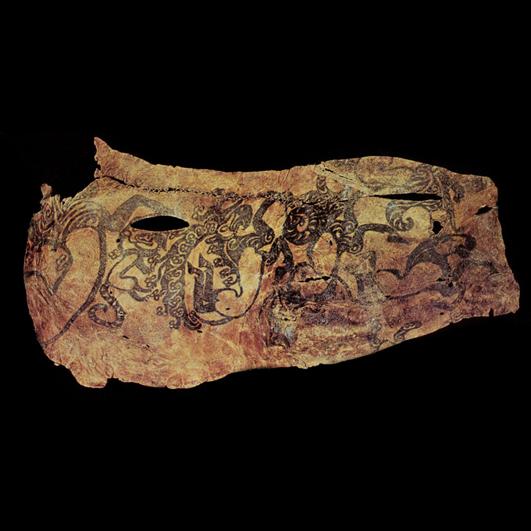
You can watch regional styles develop over the centuries--the looping animal motifs in Scythian art is remarkably consistent regardless of the medium:
One of the earliest tattoos--there are stags in there

The spur of the tattoo on the left appears to be a  hoof
Scythian stonework 
…however this is unusual: in most cases you can see the shapes in the art being formed by the materials the art is executed in. Does that mean the shapes in the stonework (and metalwork later) were derived from tattoo shapes? Hard to tell--the record of tattoos is frustratingly fragmentary: we occasionally get a glimpse of something unbelievably intricate and then nothing for thousands of years. There's a whole history of drawing there that's completely lost.

Here are some Serbian river gods from Lepenski Vir, carved from cobbles. The one on the far right looks particularly freaked out at being graven in stone...

Nobody in Italian Renaissance, Mannerist, Neoclassical, Pre-Raphaelite, Baroque, Roccocco or Impressionist art ever looks that freaked out. 

China, like I mentioned a few days ago, was always way ahead of everyone as this jade pig-dragon proves:

 …although this piece of Iranian proto-elamite silverwork, dating from 3000 BC is by far the most sophisticated thing going for a few hundred years:

While nobody knows what it is or means or who the bull is supposed to be, it points up a recurring theme in ancient art: almost everybody was better at making animals than people.

We all know what people in Egyptian art look like--they look the same for like 3000 years. The Egyptians produced what appears to be the most consistently conservative visual culture in human history. The animals, on the other hand, are generally more sensitive, dynamic, realistic and evocative:

Even sitting still, the back legs suggest the animal could spring forward at any second.

While nobody can know why this is, I have a pet theory. There are rules for depicting people--even today the way people are depicted is a subject of great debate among the ruling and scholarly classes. There are right ways and wrong ways to depict people--the depictions have conventions and rights and wrongs and get tied up with religious, hierarchical, and social codes. In Egypt the codes for depicting people were so strict that when, during the reign of Akhenaten, the codes were briefly relaxed, you can actually see a torrent of totally new styles emerge at shocking speed (and then disappear when the Akhenaten's reign ends). It is true that in some Islamic societies, depicting people was outright forbidden. The human figure is a locus of anxiety--so each culture tends, after a few thousand years, to find a way to depict people and then sticks to it.

Which is not to say these codified ways are universally boring--the Mehrgarh people of the Indus Valley (in modern day Pakistan) decided people looked like oozing freaks:

Anyone whose ever rolled and coiled Play-Doh can see where the characteristic shapes of Mehrgarh terracotta came from.

Japan's earliest consistent and identifiable culture--the Jomon--seem to have developed these distinctive and fantastically stylized figures by deriving human shapes from jug or water-vessel shapes:

China, meanwhile, was deep into bronze--and they already had dynasties and shit with Kings with actual names and stuff, like the Shang and Zhou. Bronze is a big deal, and very flexible. One way to tell early Chinese artifacts apart from Mesoamerican ones are the thin, tapering lines--like on the bottom of the handle of this zoomorphic jug:

 …or on this elephant's trunk:
 …bronze will hold its shape even with these tenuous lines, unlike stone or wood which would snap right off if it was that thin.

Linear complexity is a knock-on effect of the hardness of the material you're using.  If elves were using mithril, that explains those scrolling 19th-century shapes they've got worked into their arms and armor.
…which is not to say mesoamerica wasn't making anything good. In fact, for variety of materials and morphologies (including in the people) it's hard to beat mesoamerican stuff:

This is Coatlique--she has 2 snake heads

Jade masks from Mexico

That nose and those fingers look like nothing else you'll see--
if you find a museum with Colombian or Peruvian art in it
I guarantee you'll see something totally out of left field every
few minutes.

Bat monster
Meanwhile, the Celts were largely ignoring people and developing a mania for linework that wouldn't stop til after Aubrey Beardsley…

And, yeah, there was ancient Greece and Rome. Greek art is generally broken into 4 periods:
Geometric (stiff people with triangle bodies), Archaic (endlessly repeated sculptures of little boys with wavy hair and dumb eyes), Classical (Venus De Milo and whatnot) and Hellenistic. The Hellenistic is the only good one--this was the period where the skills developed during the Classical era were used to present subjects with far more intensity. Here's an old woman:
Even then, the majority of it is pretty stiff--especially compared to what folks like Michaelangelo,  Bernini and Houdon would do with the whole Realism-In-Marble thing hundreds of years later.

The Paracas Culture on the other hand, was having crazy fun:

click to enlarge the madness
You'll notice it looks like pixel art--that's because it essentially is--in needlework, each area is a dot of color. These figures were assembled color by color, square by square.
The Zapotec made some fucking intense monsters--the stone-born simplicity of the constituent shapes makes them far scarier than their curlicued Chinese equivalents.

There's something very modern about the way pre-Columbian cultures just let the materials be the materials--letting the form emerge out of the shapes, colors and textures the images are made from:


This blue nosed guy is apparently a "functionary". It's all very Tekumel: a clearly complicated society, but one with rules and codes we can't begin to guess.
Click on that and enlarge it--that rabbit at the bottom could've been drawn yesterday. And the complexity of the visual space with those stacked floors and ceilings is pretty dungeony.

This is also the period where the largest artworks in the world were made: the mysterious Nazca drawings of animals--only legible from the air. However, there were other giant earth drawings--my favorite is the Atacama Giant from Argentina:

You'll notice African stuff is conspicuous by its absence from this entry (also the art of Oceania, Australia, America, and Southeast Asia)--this is because the majority of the most interesting work was made in wood--which doesn't last long. Because of that, most of the best examples of African art are actually from the past two centuries--the compelling Nok head above being a relatively rare exception. We'll take a look at it later.

08 Sep 14:08

"Where do you think you’re going? Nobody’s leaving....


"Where do you think you’re going? Nobody’s leaving. Nobody’s walking out on this fun, old-fashioned family Christmas. No, no. We’re all in this together. This is a full-blown, four-alarm holiday emergency here. We’re gonna press on, and we’re gonna have the hap, hap, happiest Christmas since Bing Crosby tap-danced with Danny fucking Kaye. And when Santa squeezes his fat white ass down that chimney tonight, he’s gonna find the jolliest bunch of assholes this side of the nuthouse."

[via]

08 Sep 13:02

A Very Special First Half Highlight Reel For Cowboys Fans

by Timothy Burke

The Dallas Cowboys are firing on all cylinders today against the San Francisco 49ers. Here's a highlight reel of all the top plays from the first half, just for Cowboys fans.

Read more...


08 Sep 12:42

Bill Murray On His Personal Philosophy

by Robbie Gonzalez on io9, shared by Billy Haisley to Deadspin

Bill Murray On His Personal Philosophy

Bill Murray showed up after a screening of Ghostbusters in Toronto yesterday, where he spent the better part of an hour answering questions from fans. His best answer was in response to a question about his penchant for weird, unannounced hangouts (crashing the above couple's engagement photoshoot , for instance).

Read more...


05 Sep 14:36

Art History For D&D People, Course Overview

by noreply@blogger.com (Zak S)
(First in a series)
I don't really do that many sweeping survey posts about art even though art's my job because whenever I say something like "Oh yeah, Franz Hals fuck him" someone in the comments always leaves some long thoughtful comment about their relationship to Franz Hals and it makes me forget that like that leaves 2,999 other regular blog readers having no idea what we're talking about.

But then Jez Gordon was like "Who's Egon Schiele?" and was like ok that's weird because clearly the artistic lineage there is:

Jez Gordon ---(influenced by)----> Late Frank Miller ----(influenced by) ----> Mid-era Bill Sienkiewicz ---(influenced by)----> Egon Schiele

...and so if one of the best emerging illustrators in the DIY D&D scene doesn't know his roots, then what about everybody else?

Plus it'll be fun. I like looking at pictures and I like thinking about pictures.

So I'm guessing/hoping this'll be a series of posts. I'm gonna just lay out here how I am thinking I'll organize the entries. I may not do them in order.

(EDIT: I did most of the ones I planned on doing, links below)
Ancient Art:Blasphemous Things You Find In A Cave
Subheadings:
3000 years of China Being Way Ahead of Everyone
Finnish Sculpture Paints That Culture As A Frozen Sinkhole Of Goggle-Eyed Madmen
Egypt: Not Always Boring
Meso-America: Let's Stack Things!
Greece And Rome: zzzzzzzzz

Medieval European Art:Beyond Things With Weird Necks

Indian & (separate entry) Middle-Eastern Art of the Middle Ages:
Imposing a Sense of Bejewelled And Labyrinthine
Order On Every Fucking Thing

The Northern Renaissance & The International Style:Way Better Than That Other Renaissance They TaughtYou About In School
Painting & Printmaking in China and Japan:Mountains, Mist, Nightmarish Tentacle-PornPrecursor Things
Post-Renaissance But Pre-Modern Europe:Guys Holding Swords They Probably Won't Use
Wood, Water, and Wire:The Art That Freaked Colonialists Out
Decadent Art of the Call of Cthulhu Era:
Please Nobody Tell Wundergeek Europe Exists
Symbolism, Surrealism and Other
Products of Drug Abuse

Every Good Early Illustrator I Can Think Of:
A.K.A. The Post That Other DIY D&D People
Have Probably Already Done Better Than
Me But I Should Probably Do Anyway
EDIT: I put these three all together here in the Modernism post.

Fine Art After WW2:
Actually, You Do Like Modern Art, It's Just
They Don't Want You To Know That


05 Sep 13:55

Watch NFL Players Read Mean Tweets About Themselves

by Tom Ley

Jimmy Kimmel got some NFL players and personalities together to film yet another edition of famous people reading mean tweets about themselves. This one is worth it simply for the way Dez Bryant delivers "baby back bitch."

Read more...


03 Sep 19:13

Spoof of classic O\'Reilly geek book cover - Boing Boing

by pit
29 Aug 12:30

Listen to a conservative judge brutally destroy arguments against gay marriage

by Mark Frauenfelder

It's fun to listen to Judge Richard Posner of the 7th Circuit Court slap down disingenuous arguments against gay marriage. It's also fun to listen to the opponents to gay marriage try to defend their illogical opinions, such as Indiana Solicitor General Thomas Fisher, a real asshole.

Image: Chensiyuan/Wikimedia Commons.

28 Aug 15:19

"Come at me bro." Sure


"Come at me bro."

Sure

28 Aug 12:23

Cardinals Fan Has No Idea He's About To Get Hit With A Flying Bat

by Sean Newell

Cardinals Fan Has No Idea He's About To Get Hit With A Flying Bat

You might say this GIF is too long. You would be wrong, and have no understanding of things like delayed gratification and rising action, but you might say something stupid like "this GIF is too long." Do yourself a favor: don't say that, and just watch. It's beautiful.

Read more...


25 Aug 17:54

Adorable Video of the Day: Elephants Dancing to Violin

Submitted by: (via Eleanor Bartsch)

Tagged: dancing , elephants , violin , Video
25 Aug 12:55

Prank of the Day: There's a Dinosaur Loose in Compton!

Submitted by: (via AverageBroTV)

Tagged: trolltube , dinosaurs
20 Aug 12:49

The One Guy That Approves Beer Labels

The One Guy That Approves Beer Labels

This year alone, 29,500 individually designed beer labels have been submitted for approval to the Trade Department's Tax and Trade Bureau. And every single one of those label designs was approved or denied by a single man: Kent "Battle" Martin, a man who is the bane of the beer industry for his power to reject labels for the flimsiest of reasons.


Here are a few of the reasons:
Battle has rejected a beer label for the King of Hearts, which had a playing card image on it, because the heart implied that the beer would have a health benefit.

He rejected a beer label featuring a painting called The Conversion of Paula By Saint Jerome because its name, St. Paula's Liquid Wisdom, contained a medical claim--that the beer would grant wisdom.

He rejected a beer called Pickled Santa because Santa's eyes were too "googly" on the label, and labels cannot advertise the physical effects of alcohol. (A less googly-eyed Santa was later approved.)

He rejected a beer called Bad Elf because it featured an "Elf Warning," suggesting that elves not operate toy-making machinery while drinking the ale. The label was not approved on the grounds that the warning was confusing to consumers.

Submitted by: (via Fast co design)

Tagged: beer , news , wtf , label , funny , after 12 , g rated
19 Aug 15:40

A Compilation Of People Fucking Up The Ice Bucket Challenge

by Barry Petchesky on The Concourse, shared by Rob Harvilla to Deadspin

My thoughts on the ice bucket challenge are complicated and not worth going into here. My thoughts on people falling down, bashing themselves over the head, and otherwise harming and embarrassing themselves are much simpler: I am staunchly pro-slapstick. Enjoy.

Read more...


14 Aug 13:42

Documentary proves girls will play D&D with boys

by Ethan Gilsdorf
A group of boys, aged 9 to 11, plays D&D every other weekend, but their parties never include girls their age. Meredith Jacobson's DnDnG explores the possibility that their female friends could enjoy the game just as much as they do. By Ethan Gilsdorf. Read the rest