Ronald.phillips
Shared posts
Ad Lib Music Archive
10 Documentaries You Should Watch That Are Scarier Than Horror Movies

Sure, movie ghosts and masked-slashers are scary, but if you want real, uncut horror you have to go to the source: Real life. These 10 documentaries would be scary enough as fiction, but the fact that they’re real is terrifying.
Mixing COVID-19 vaccine brands? FDA set to give it the OK - CNET

Get Minion Masters Mordar's Malediction for Free
Windows 10 New Update Will Protect Users from Unwanted Apps
This article has been published at RLSLOG.net - visit our site for full content.

Microsoft Windows is one of the dominating operating systems of 2021 (and all-time). It has a market share of 72.98%, which is way above Mac, Linux, or any other PC OS. With time, Microsoft has released thousands of updates to make the OS better, and the most recent update is a bit different from the others.
As per the latest Windows update by Microsoft, the OS will have the ability to block unwanted programs from installing. The programs are known as PUAs (Potentially Unwanted Applications) or Potentially Unwanted Programs (PUPs). Such tools have very few benefits, and users might not even know how they ended up on their devices.
Hence, Microsoft added this feature to keep these apps from affecting your computer.
What are these PUAs or PUPs?
PUAs or PUPs are unwanted programs that are not malware. However, they can affect your computer in several other ways, such as:
-
Affect the speed. Most of the PUPs are responsible for decreasing the speed of your PC. How? They keep running in the background and consuming memory, which, in turn, affects the speed of the system overall.
-
Irritating Ads. Among the types of PUAs, some can be full of ads. They may target multiple ads to you, which can affect your browsing experience.
-
A medium for other software. A PUA as it is might not be a risk to your security or privacy. However, it can act as a perfect medium for other software to compromise your security. For example, it can give a route to spyware that may steal all of your passwords and track your daily online activities.
Types of PUPs
PUPs can be classified according to their behavior. One note is that PUPs are not malicious. However, their presence is not wanted, and users typically want to get rid of them.
-
Advertisement software. It is software that displays advertisements or promotions, often in a way so annoying you want to delete the app as soon as possible. It includes software that inserts ads on other websites and interrupts your browsing experience with pop-ups every few seconds.
-
Marketing software. You might not know it, but some apps spy on you. Marketers use this to gain insight into consumer habits and interests for their products to be more effective. These are classified as PUAs or PUPs by Microsoft.
-
Evasion software. It tries to evade security products by being different when they are present, but this trickery only lasts for a short time before detection occurs. The deception of the software is what makes it so dangerous.
-
Bundlers. A certain type of software, known as bundlers, offers to install other software that might not be developed by the same entity or is required for the original program to run properly. Detection and removal of bundlers can protect your system from installing PUA (Potentially Unwanted Applications).
-
Torrenting software. The torrent is a type of software that has revolutionized the way we share files. It enables us to download all sorts of content, including movies and music albums, from websites like BitTorrent or The Pirate Bay. Torrenting software is also classified as PUAs or PUPs.
All of the software mentioned above come under the category of PUAs or PUPs. As they can highly affect the performance of your machine, you need to take necessary security measures to counteract their effect.
Some Brilliant Device Security Tips
Here are some of the best security tips for browsing safely online and keeping PUAs away.
Use an Antivirus
Install an antivirus on your computer and make sure you have the most up-to-date virus definitions. Doing so will allow you to detect and delete any viruses that enter your system. It is also a good preventative step against phishing attacks.
However, antivirus might not always do the right job. You need to pick a tool that will detect PUPs as well. Only then can these persistent tools be deleted for good.
Refuse Software Bundles
Some tools you want to install might offer additional programs. Such suggestions will typically appear during the installation process. However, please refuse software that could arrive alongside the tool you have selected.
Use a VPN
A VPN protects your internet traffic from eavesdroppers and some of the questionable tracking practices. Additionally, tools like Atlas VPN take a step further to defend you. Their features include blocking potentially dangerous websites. In some cases, such sites are responsible for distributing PUPs. Thus, if a VPN blocks your access in time, you will not be tempted to download anything unnecessary.
Read EULA Documents
Read EULA documents before installing a particular tool. If software conditions mention additional programs, find out whether you can opt-out of having them. Additionally, look for other red flags that might discourage you from installing specific software.
Final Thoughts
Windows 10 Operating Systems is the most popular and widely used one. This is the reason Microsoft keeps on bringing something innovative to elevate the customer experience. The recent update rolled out in May brought the feature to block PUAs and PUPs, and many users worldwide are already using it. If you haven’t used it, check it out today!
more at RLSLOG.net
In a Tiny Arctic Town, Food Is Getting Harder to Come By
The ‘Storage Space’ Under Your Bed Is a Mess (but You Can Do Better)

For many of us, the space underneath the bed holds nothing more than a stack of old photo albums, a few stray socks, and a layer dust you’ve been meaning to do something about for, oh, a few years now. However, the space under your bed is actually prime storage space—especially if you live in a small home—and one that…
These are the best USB PD fast chargers for phones and laptops in 2022
Fast chargers are very useful in certain situations. If you’re ready to leave the house but your smartphone or laptop battery is low, a compatible fast charger will be able to add a decent amount of charge in a short period of time. While some device makers bundle a compatible fast charger in the box, others either don’t pack any kind of fast charger or bundle a lower-powered charging brick. Also, it’s suddenly becoming a trend not to bundle any kind of charger in the box for smartphones. You can safely blame Apple for that.
So whatever the reason, if you’re in the market for a fast charger that supports USB Power Delivery (USB PD), we can help. In this guide, we’ve selected some of the best USB PD Fast Chargers on the market. You can pick one that matches the supported wattage in your budget.
Navigate this article:
- What is USB PD?
- How to choose the right charger?
- Best USB PD fast chargers with at least one USB Type-A port
- Best USB PD fast chargers with just Type-C ports
- Fast chargers with 45W support (on at least one port)
- Fast chargers with 60W/ 65W support
- Fast chargers with 100W support
- Best USB PD 3.1 compatible chargers
What is USB PD?
USB PD (Power Delivery) is a specification used by manufacturers to deliver increased power over USB to their devices. It works with USB Battery Charging implementations to provide a robust fast charging solution. USB PD was originally introduced back in 2012 and has since been revised multiple times. The latest revision — USB Power Delivery Specification Revision 3.1 — was announced in May 2021, and it supports delivering up to 240W of power over USB Type-C. The USB PD 3.1 chargers are already here and we’ve added a few of them to this collection below.
In terms of cross-compatibility, Qualcomm’s QuickCharge 4.0, 4+, and 5 are compatible with the USB PD specification. Similarly, Huawei and Samsung’s fast charging standards also work with USB PD. So if you have a device with QuickCharge 4 or Huawei SuperCharge support, it can be charged faster with USB PD chargers as well. Notably, some of Samsung’s devices use Programmable Power Supply (PPS), so unless your USB PD charger also supports PPS, you won’t get the top charging speed. Your device will still charge faster than normal though.
If you want to know more about various fast-charging standards and fast charging in general, make sure to read our detailed explainer on fast charging.
How to choose the right charger?
Choosing the right charger for your smartphone or laptop can be a struggle due to the presence of various charging protocols, power requirements, and more. Let’s take a quick look at some of the most important things you need to consider while picking the right charger for your device:
- Supported charging protocol: This is an important factor to consider mainly because not all smartphones and laptops support the universal charging protocol such as USB Power Delivery. OnePlus smartphones, for instance, uses OnePlus’ proprietary Warp charge tech, thereby forcing you to opt-out of third-party options. So, figure out what charging protocol your smartphone supports. Apple iPhones, Samsung Galaxy phones, and Google Pixels all support USB Power Delivery, albeit at lower wattages only.
- Power requirement of your device: The next step is to make sure how much your device needs in watts (W). Apple’s new iPhone 14 Pro Max requires 27W, so you’ll need a charger that supports at least 27W or higher to charge this phone at its maximum supported speed. Typically, most smartphones vary between 18-80W, whereas laptops can easily go up to 140W.
- Chargers with multiple USB ports: You may come across a lot of chargers with multiple USB-C or USB-A ports. While these are great for charging multiple devices, they may not provide the fastest speeds when all ports are used simultaneously due to power sharing. So it’s important to understand how much power a particular charger can deliver through each of its ports individually and simultaneously, and figure if you need all ports to be working at maximum speed all through the day. For instance, a port usually reserved for charging a smartwatch or earbuds will only be active for a couple of hours in a day, allowing you to get away with a lower-powered multi-port charger.
- GaN chargers: Simply put, Gallium Nitride a.k.a GaN chargers are physically smaller in size and are efficient at transferring current as they lose less energy to heat. The pricing for them is a bit on the higher side as the technology is fairly new. We recommend picking up GaN chargers over others if your budget allows for it.
With all the factors in mind, a typical purchase decision will count the number of devices you need to simultaneously charge and how quick you need the charger to be. For example, if you have a Macbook Air and an iPhone charging for most parts of the day, you can get away with a 65W USB Power Delivery charger with two ports. But if you have a more power-hungry laptop and more devices to charge simultaneously, you may need to look at 100W multi-port chargers. If you just have an iPhone to charge, you can get by with a single-port 18W or 30W charger, depending on how recent your phone is.
Best USB PD fast chargers with at least one USB Type-A port
Although USB PD doesn’t work with a Type-A port, the following chargers can be useful when you need to charge multiple devices and one of them doesn’t support USB PD.

Dual-device charging
-
The HPDCA32 PowerVolt USB PD charger from Scosche also includes two USB ports -- one Type-C and one Type-A. But unlike the Anker PowerPort PD 2, the Type-C port on this charger can offer up to 20W charging. It also includes foldable prongs, and is relatively compact.

Foldable plug
-
The Anker PowerPort PD 2 charger comes with two USB ports -- one Type-C and one Type-A. While the Type-C port that supports USB PD can charge up to 18W, the Type-A port only supports 12W charging. It's great if you’re looking only to charge smartphones and tablets.

For international travelers
-
This Native Union Smart Charger is great if you travel a lot internationally as the company bundles adapters for the UK and EU in the box. The charger supports up to 18W charging via the Type-C port and up to 12W via the Type-A port.

Ports galore
-
If you have several devices that often need charging or USB-level power, this Sabrent charger has eight ports, including two Type-C and six Type-A. While the Type-C ports support USB PD and can deliver up to 28W of power, the Type-A ports support up to 15W charging.

Five ports
-
This particular Anker charger comes with as many as five USB Type-A ports, capable of delivering up to 63W of power. It's a good option to consider if you're looking to simultaneously charge an entire family of devices.

Foldable plug
-
The Ugreen four-port PD charger is an excellent option if you are looking for a single charger for your travel needs. It has three Type-C ports, all of which are USB PD-compatible, and one Type-A port. The charger also supports multiple fast charging standards.
Best USB PD fast chargers with just Type-C ports

20W compact charger
-
The Anker 511 charger is super compact at just over one inch on each side, making it very convenient to carry. It supports up to 20W fast charging, and can work with all USB PD compatible devices.

With GaN tech
-
The presence of a Gallium nitride (GaN) chipset in this charger allows it to be smaller, and run much cooler than non-GaN chargers. It supports up to 20W fast charging via the single USB Type-C port. The charger is offered in two colors.

Supports PPS
-
The Belkin BoostCharge USB-C wall charger comes with USB PD PPS support that enables it to provide up to 25W of charging to Samsung phones with PPS support. Non-PPS USB PD devices will get 20W charging. There's only one Type-C port on it.

The slim option
-
The Belkin BoostCharge Pro has a slim design that makes it great for portability. Additionally, it also uses GaN tech like the Spigen ArcStation Pro. The Belkin charger supports up to 20W charging via the single Type-C port.

With two Type-C ports
-
The Spigen ArcStation 40W is quite similar to the ArcStation Pro 20W but it includes two USB Type-C ports. Both ports are capable of delivering up to 30W charging when the other port is not being used. When both ports are being used, the two devices will get up to 20W charging. It also uses GaN tech.

Designed by Samsung
-
This 25W fast charger by Samsung not only works with the company’s devices, it can charge any USB PD device quickly. It has a single USB Type-C port, and can be bought in two different colors. The charger also comes with a Type-C to Type-C cable in the box.
Fast chargers with 45W support (on at least one port)

Dual port charger
-
The Baseus GaN Mini Quick Charger features two USB Type-C ports, both of which are capable of delivering up to 45W charging when just one port is being used. It also uses GaN tech, and includes foldable prongs. The charger is sold in two colors, and you can even buy a version with one Type-A and one Type-C port.

PD and QC 3.0 support
-
Like Samsung, Motorola also sells USB PD fast chargers that can be used with its devices as well as other PD-compatible products. The Motorola TurboPower 50W USB-C Charger comes with a Type-C as well as a USB-A port. Unlike Motorola's older chargers, this one doesn't come with a charger inside the box.

From the house of Samsung
-
Samsung’s 45W wall charger is similar to its 25W option. You get one Type-C port and two color options. The charger can deliver up to 45W power to any USB PD device, not just Samsung’s. Moreover, a Type-C to Type-C cable is bundled in the box.

Cooler and smaller
-
The Spigen 45W ArcStation Pro charger uses GaN technology to generate less heat than a similar Silicon-based charger, and it's compact. The charger features a single USB Type-C port that can deliver up to 45W charging to compatible devices using USB PD 3.0 and PPS support. In addition, it comes with a foldable plug and a Type-C to Type-C cable.

Attached cable
-
The Nekteck charger supports up to 45W charging using USB PD 3.0 and PPS standards. It has a permanently attached Type-C cable that's quite handy. In addition, the charger is USB IF certified and packs several safeguards against over-charging, over-current, and over-heating.

Bundled Type-C cable
-
This 45W fast charger from Elecjet is another good option. It comes with a foldable plug, making it very convenient for storage and traveling. In addition, the charger supports USB PD 3.0 PPS for fast charging up to 45W. It will work great with all your devices that use USD PD standard.
Fast chargers with 60W/ 65W support

Three in one
-
The Baseus 65W Three-Port Mini Quick Travel Charger not just supports USB PD protocol, it can also work with QuickCharge 3.0 and Samsung’s Adaptive Fast Charging. There are three USB ports onboard -- two Type-C and one Type-A. While the first Type-C port can deliver up to 65W charge, the second Type-C port and the Type-A port only support up to 30W charge.

3-port PPS charger
-
The Anker 735 charger comes with two USB Type-C ports and a single USB Type-A port that can deliver up to 65W power. It supports USB PD PPS protocol, meaning it's compatible with a variety of devices out there.

Charge everything
-
The Scosche HPDC60 Powervolt PD charger comes with a single USB Type-C port. It can deliver up to 60W of power to any USB PD device that will allow you to charge pretty much every device, including laptops, with a single charger.

Four-in-one
-
The Ugreen fast charger packs four USB ports that you can use to charge multiple devices simultaneously. There are three Type-C ports and one Type-A, of which the top two Type-C ports can deliver up to 65W of power when only one port is being used. In addition, the charger supports USB PPS.

Compact design
-
The NekTeck 60W charger uses Gallium Nitrate (GaN) instead of Silicon for a compact design and cooler performance. It's excellent for laptops that support USB PD. In addition, you get a single Type-C port that can provide up to 60W of power. NekTeck also bundles a 2 meter Type-C to Type-C cable with it.

Lots of ports
-
The KEEPBLANCE charger packs four USB ports in total -- two USB Type-C ports and two USB Type-A ports. The first USB Type-C port is capable of delivering 60W of power wheres the other one is limited to 18W of power. This charger is great for charging multiple devices at once.
Fast chargers with 100W support

With GaN tech
-
This is an affordable and powerful charger from Nekteck. It packs a single USB Type-C port and comes with a compatible Type-C to Type-C in the box. The charger can deliver up to 100W power using USB PD standard, as its name suggests. In addition, it uses GaN tech and is USB IF certified.

GaN charger for laptop and phone
-
Satechi’s 100W USB PD charger comes with three ports -- two USB Type-C and one USB Type-A -- allowing to to charge up to three devices simultaneously. It uses GaN tech, resulting in a relatively compact body. While the USB Type-A port is capable of delivering up to 12W output, each of the Type-C ports can offer 100W charging when only one port is being used.

GaN tech
-
The Spigen ArcStation Pro is an excellent charger for laptops and smartphones. It packs two USB Type-C ports that deliver up to 100W of power to PD-compatible devices. If you use both ports simultaneously, you’ll get up to 45W of power on each port. In addition, since the charger uses GaN tech, it’s relatively compact and provides a cooler operation.

Supports Quick Charge 5.0
-
Baseus has some really versatile chargers on the market, and this 100W charger is no different. Besides supporting USB PD 3.0 and PPS, it can also work with Quick Charge (QC) 5.0. As QC 5.0 is backward compatible, it can also fast charge all older QC-compatible devices. In addition, it features a single Type-C port.

Four-in-one
-
Unlike the Baseus 100W GaN II Fast Charger that only comes with a single port, this charger packs four ports — two Type-C and two Type-A. When just one Type-C port is being used, the charger can deliver up to 100W watts of power. But when more devices are connected, it’ll intelligently distribute power.

Multiple fast-charging protocols
-
The Ugreen 100W charger supports pretty much all major fast charging protocols, including USB PD 3.0, QuickCharge 4.0+, USB PD PPS, and Adaptive Fast Charging. In addition, it has two Type-C ports, which can deliver up to 100W of power when only one port is connected.
Best USB PD 3.1 compatible chargers
If you have devices that require more than 100W of power, then you’ll have to pick up one of the newer USB PD 3.1 compatible chargers. These chargers are perfect for charging modern devices including the M1 Pro and M1 Max-powered MacBook Pro as they demand more than 100W of power for a quick top-up. As per the USB Implementers Forum’s (USB IF) instructions, the new USB PD 3.1 compatible chargers and cables will carry specific icons to help users identify different chargers before purchasing.

USB PD 3.1 compatible
-
The Anker 717 Charger is one of the most reliable USB PD 3.1 compatible chargers on the market right now. This GaN charger is capable of delivering up to 140W of power to quickly charge your devices when you need them.

Made by Apple
-
Apple's 140W USB-C power adapter is one of the first few USB PD 3.1 compatible chargers to hit the market. It's perfect for those who want to fas-charge their M1 Pro and M1 Max MacBook Pros via the MagSafe port.

GaN PD 3.1 charger
-
The UGREEN Nexode 140W USB PD 3.1 charger is also a great option to consider for charging your devices. This particular GaN charger comes with a 6ft USB-C to USB-C cable for charging all your latest devices.
These are the best USB PD fast chargers you can buy on the market right now. As you can see, there are a number of options with different wattages and port selections. You can choose one depending on your requirements. We’ve also updated this post to include some incredibly fast USB PD 3.1 compatible chargers, so be sure to explore those options too.
Still confused? Choose this charger
If you just need a charger for your phone, the Anker 511 charger and Samsung 25W charger are two good options. However, if you want a single charger for your MacBook or other USB PD laptop and smartphone, you can go for the Anker 735 65W charger.
So which USB PD charger are you planning to get? Let us know in the comments section. Also, check out our recommendations on the Best USB Cables to go along with your new charger.
The post These are the best USB PD fast chargers for phones and laptops in 2022 appeared first on XDA.

Bats with Covid-like viruses found in Laos: study
Scientists have discovered another clue to the origins of the virus that causes Covid-19, with bats living in caves in Laos found to be carrying a similar pathogen that experts suggest could potentially infect humans directly.
The virus has killed millions since it emerged in China in late 2019, and controversy continues to swirl around where it came from.
Some experts say it is animal-driven but others have pointed to the possibility the pathogen leaked from a lab.
Researchers from France’s Pasteur Institute and the National University of Laos said their findings showed that viruses genetically close to the SARS-CoV-2 virus “exist in nature” among bat species in the limestone caves of northern Laos, which neighbours China.
Of the viruses they identified among the hundreds of bats tested in Vientiane Province, three were found to closely resemble the virus that causes Covid-19, particularly in the mechanism for latching on to human cells.
“The idea was to try to identify the origin of this pandemic,” Marc Eloit, who leads the Pasteur Institute’s pathogen discovery laboratory, told AFP.
Eloit, whose team analysed the samples collected, said there were still key differences between the viruses found and SARS-CoV-2.
But he said the work was “a major step forward” in identifying the pandemic’s origin, confirming the theory that the coronavirus that has spread across the world could have started with living bats.
The authors of the study, which has been submitted to Nature for peer review, warned that their findings suggest the new viruses “seem to have the same potential for infecting humans as early strains of SARS-CoV-2”.
“People working in caves, such as guano collectors, or certain ascetic religious communities who spend time in or very close to caves, as well as tourists who visit the caves, are particularly at risk of being exposed,” the authors said.

‘Natural spillover’
International experts sent to China by the World Health Organization (WHO) in January concluded that it was most likely that the SARS-CoV-2 virus jumped from bats to humans via an intermediate animal.
A competing hypothesis that the virus leaked from a lab like the specialised virology laboratory in Wuhan was deemed “extremely unlikely”, although it has yet to be ruled out.
Martin Hibbert, Professor of Emerging Infectious Disease at the London School of Hygiene and Tropical Medicine — who was not involved in the Laos research — said the most closely related virus was found to be able to infect human cells “as easily” as SARS-CoV-2 and therefore might be capable of infecting humans.
But he stressed that the virus is “not an ancestor of the pandemic strain”.
“This work confirms the expected diverse nature of bat infecting coronaviruses and increases the evidence that natural spill-over events from bats to humans can occur,” said Hibbert.
The authors of the Laos study, which has been posted on the site Research Square, said their results suggest the pandemic coronavirus potentially evolved through mixing between different viruses and species of bats.
James Wood, Head of Department of Veterinary Medicine at University of Cambridge — who was also not involved in the research — said it suggests “recombination between different viruses was likely involved, rather than there being a simple evolution of a single lineage over a long period”.
In a comment to the Science Media Centre he said this not only underscores the likely role played by bats and perhaps other animals living closely together, but also shows the “risks inherent in living wildlife trade”, where markets can help drive cross-species zoonotic transmission.
The post Bats with Covid-like viruses found in Laos: study appeared first on ARY NEWS.
from ScienceTechnology – ARY NEWS https://ift.tt/3u2o9ts https://ift.tt/3EFSYsG
The 15 DC Animated Movies You Need To Watch
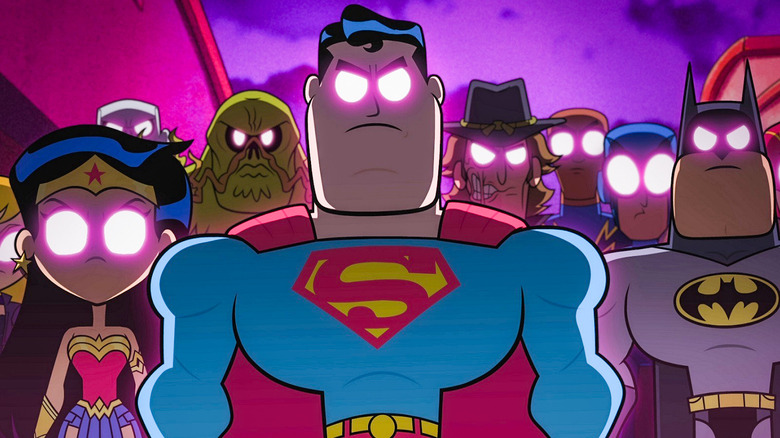
Whereas Marvel has triumphed magnificently over DC in terms of live-action movies, the California-based comics giant has always prevailed when it comes to animated output. With the success of the Spider-verse and "What If...?" projects the tide may well be turning, but ever since the "Batman: The Animated Series" feature-length spin-off "Mask of the Phantasm" was released in 1993, there has been a regular stream of good, quality material emerging from the DC stable.
It'd be churlish to deny there haven't been absolute stinkers as well, but hopefully in the following article we can at least attempt to guide you towards the best DC animated movies on offer. It's no coincidence that a great many of the entries in this list are heavily based on already successful comic storylines, and they let the source material shine. After all, the best animation in the world can't make a bad story good.
Batman: Year One
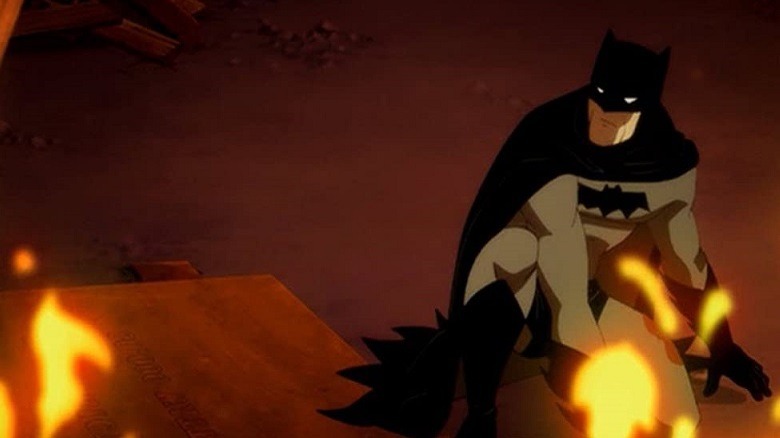
As much a tale of Lieutenant James Gordon as it is of the Dark Knight, "Batman: Year One" sees a young Bruce Wayne returning to Gotham in the midst of a crime epidemic, finding his city under the corrupt grip of bent police officers and mob boss Carmine Falcone. Inspired to take the mantle of the Bat for the first time, Bruce realizes he has an unlikely ally –- and perhaps friend -- in the stoic and incorruptible James Gordon.
A faithful adaption of the original Frank Miller comics, "Year One" was nearly shot as a film by Darren Aronofsky, until being abandoned in favor of Christopher Nolan's "Batman Begins." It's interesting to see how much of the plot of Miller's original still remains in Nolan's first superhero movie.
"Batman: Year One" is far from perfect. It treads old and familiar ground (DC animators must surely be bored of working on the death of Bruce's parents by now), and some of the voice work (barring the ever-reliable Bryan Cranston as Gordon) is below par. But at a running time of just over an hour it's a pacey, spirited, and distinctive introduction to the animated exploits of the Caped Crusader.
All-Star Superman
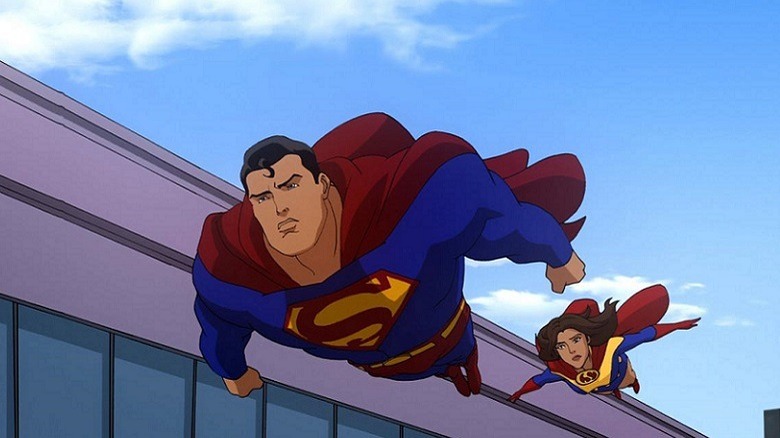
Created by DC's own super-team of Grant Morrison and Frank Quitely, "All-Star Superman" was a 12-issue mini-series from 2005. In it, Morrison attempted to reinterpret Superman mythology freed from DC continuity, creating an ambitious and optimistic epic that's often regarded as one of the best comic series of all time. Like the fevered interest surrounding "Watchmen," any adaptation would struggle to meet that weight of expectation, but "All-Star Superman" does a very reasonable job of doing just that.
Superman, fatally poisoned by solar radiation, seeks to get his affairs in order before the end of his long and fruitful life. It's a chaotic quest that'll see Lois Lane given superpowers, an attack on Metropolis from sentient talking dinosaurs, meetings with lost Kryptonian astronauts, and the Man of Steel solving the riddle of the Ultra-Sphinx.
It's as insane as it sounds, with Grant Morrison's already over-frenzied imagination given full reign. As a result, the pacing does struggle a little and at times it resembles a series of unconnected set pieces, but it's worth it to see this dramatic and original take on our favorite son of Krypton. It's just a shame it never got the two-part treatment like some other entries on this list.
Batman: The Dark Knight Returns - Part One And Two
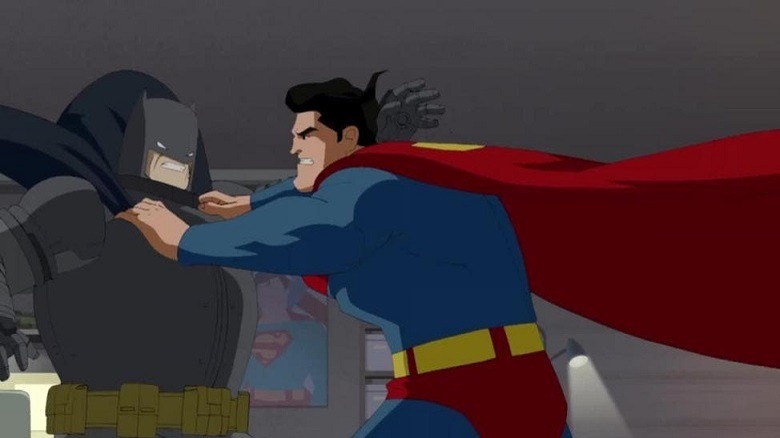
Based on the groundbreaking comic series almost single-handedly responsible for reviving the comic medium, "Batman: The Dark Knight Returns" is an epic two-part tale about Batman returning from retirement as a terrifying new force for vengeance in a dystopian Gotham. Having hung up the cowl after the death of his sidekick, Robin, Batman must remind the city who he is and bring justice no matter what -- even at the expense of one of his oldest friendships.
Culminating in an epic battle against Superman -- now reduced to a flag-draped American political pawn -- the plot of Zack Snyder's "Batman v Superman: Dawn of Justice" is essentially the last act of the second part of this standout animated movie, although it's arguably better handled here.
DC Universe Animated Original Movies can often be accused of varying dramatically in animation style and quality, but it's refreshing to see that the very distinctive visual style of Frank Miller's work on the comic series is lavishly replicated in "Batman: The Dark Knight Returns." Batman is a hulking, muscled behemoth, looking more demonic than his already monstrous foes, and tooled up with paramilitary gadgets. Long gone are the days of Shark Repellent Bat Spray.
Justice League Dark
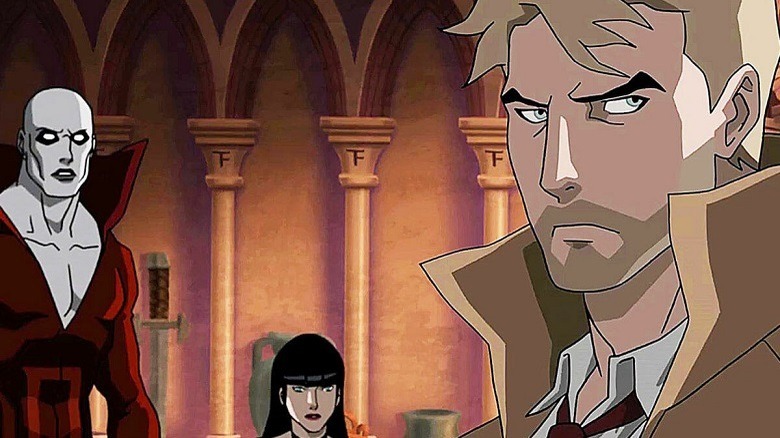
For those disappointed by the cancellation of the "Constantine" TV series, the return of Matt Ryan as the haunted scouse sorcerer in "Justice League Dark" was a welcome relief. When law-abiding citizens start killing people, convinced their victims are demonic monsters, Batman is forced to investigate. With the aid of John Constantine, he begins recruiting members for a new Justice League -- one better equipped to deal with threats of a supernatural nature.
Involving many of the magical characters from DC comics extensive roster -– Constantine, Zatanna, Etrigan, Black Orchid, et al –- the team is a far cry from the unquestioning heroism of the regular JLA, and therein lies the fun. The members of the paranormal Justice League are broken and damaged individuals. As their school reports might say, they "do not play well with others."
Despite the R rating, "Justice League Dark" is relatively tame and bloodless, but is a fun glimpse into a rarely-explored element of DC. It also spawned an equally excellent sequel, "Justice League Dark: Apokalips War," featuring everybody's favorite granite-headed New God, Darkseid.
Justice League: Crisis On Two Earths
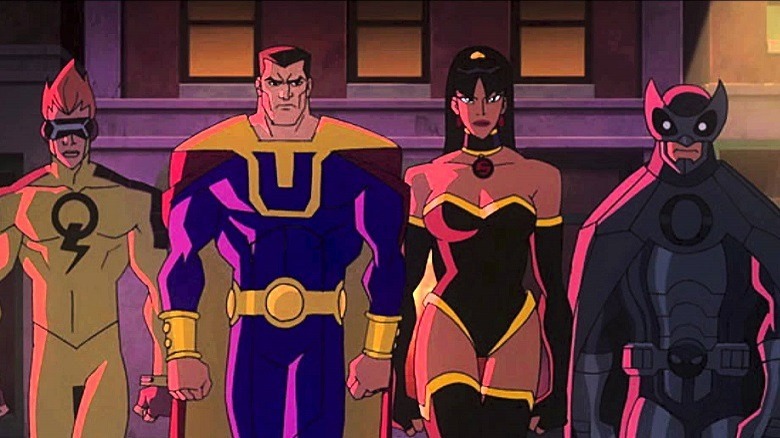
Despite the recent surge in popularity thanks to the "Loki" TV series and the upcoming movie "Doctor Strange in the Multiverse of Madness," Marvel wasn't the first of the big two to come up with the concept of a comic book multiverse. That honor goes to "The Flash" #123 (published in 1961), and DC continuity has only gotten more and more convoluted since -- despite numerous reboot attempts to clear up the whole quantum-entangled mess.
"Justice League: Crisis on Two Earths" envisions one such alternate DC Universe, where heroes are villains and vice versa. Lex Luthor escapes the grasp of the Crime Syndicate –- a twisted analogue of the Justice League -– to travel to our reality and our Earth. He teams up with an initially skeptical Justice League, and they travel across realities to confront the threat of the Syndicate.
Based loosely on Grant Morrison's and Frank Quitely's "JLA: Earth 2" graphic novel, there's a raft of entertainment to be had from seeing familiar characters given an evil spin -– much like in the mirror universe of "Star Trek." It would have been easy to have the entire plot descend into a massive brawl between characters and their counterparts, but there's a surprisingly deep thread about the nature of determinism and free will lurking within the realms of this packed story.
The Flashpoint Paradox
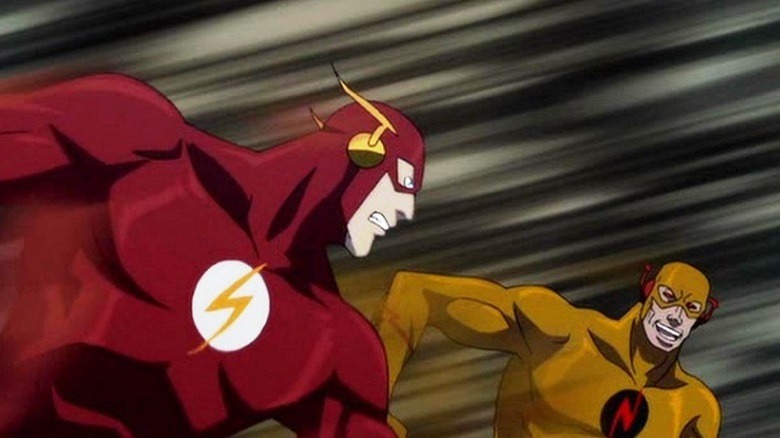
After Barry Allen, aka the Flash, uses his powers to travel back in time and save his mother from dying, he inadvertently alters the timeline in massive and disastrous ways. Trapped and powerless in this alternate reality, Barry has to team up with the dramatically altered heroes of this paradigm to try and restore reality.
An adaptation of the "Flashpoint" comic crossover from 2011, "The Flashpoint Paradox" is the first movie from the DC Animated Movie Universe (DCAMU) -- a reboot of the existing DC Animated Universe, designed to clear up years of muddy continuity. Elseworlds, the DC equivalent of Marvel's "What If...?," was always a fertile platform for storytelling, and this movie is effectively that concept stretched out to a feature-length film. In this universe Superman was captured at birth and held prisoner by the U.S. Government, and it was Bruce Wayne who was shot dead in Crime Alley -- leading his father, Thomas Wayne, to take up the mantle of a far more murderous and vengeful Batman.
Plot elements from "Flashpoint" will also feature heavily in the live-action "Flash" movie (starring Ezra Miller and Michael Keaton), and it's easy to understand the continuing popularity of this epic storyline.
Justice League: Doom
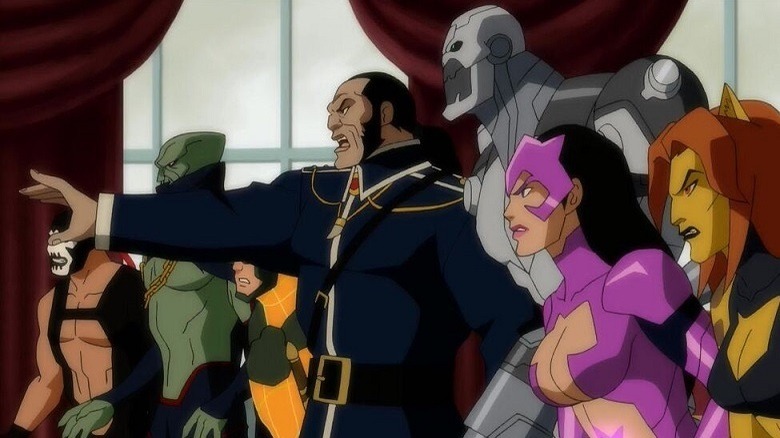
In a plot taken from the Mark Waid-penned JLA storyline "Tower of Babel," the Justice League find themselves under attack in the appropriately-titled "Justice League: Doom." While Batman is distracted by the theft of his parents' exhumed bodies, somebody acquires details of all of the weaknesses of Earth's superheroes in order to defeat them one by one. Loyalties will be stretched to their limit as the League falls into disarray from within.
"Justice League: Doom" is an excellent entry to the DC animated roster, with the singular drawback that the excellent first half is considerably more entertaining than the second, which falls into standard superhero fare. And whereas this particular comic storyline impacted the DC universe for some time to come, it's a little frustrating that there's effectively a reset button pressed at the end of the movie, minimizing its importance.
That said, the movie is fast-paced and features the welcome return of an entire roster of excellent and familiar voice talent. It's also an excellent way to honor Dwayne McDuffie, writer of nearly all the episodes from the "Justice League" animated series, who sadly passed away shortly after finishing his script for "Justice League: Doom." A word of warning, though: It's possibly a little too dark for younger viewers, featuring some brutal scenes of torture and prolonged violence.
Justice League: The New Frontier
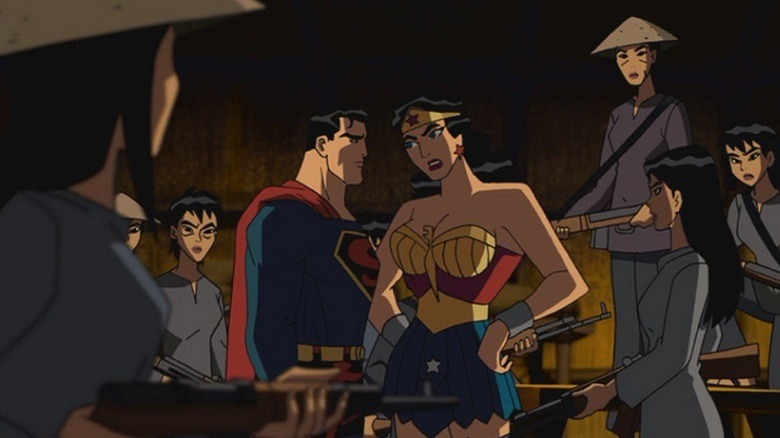
Writer, artist, and general renaissance man Darwyn Cooke released the 6-part limited comic series "DC: The New Frontier" in 2004 to critical acclaim, and DC released the animated adaption of the first volume 4 years later. Revolving around the birth of the Justice League in the face of an alien invasion, it's set during the interim between DC Comics' Golden and Silver ages. "Justice League: The New Frontier" is an origin tale of sorts, bringing together classic and lesser-known characters, all set against a backdrop of the 1950s and the end of the Korean War.
The sadly missed Cooke (lost to us in 2016) had a distinctive retro style, very much in the vein of the 1940s Fleischer Studios "Superman" cartoons: all square jaws and bold outlines. You can tell a Darwyn Cooke panel a mile away, and the movie goes some way to replicate that style. It's notable in DC output that the animation style varies considerably from movie to movie, and that can sometimes be a drawback -– but not here, where it's a triumph. Where DC movie adaptations can sometimes be an exercise in misery, "The New Frontier" is a tale of heroism and optimism.
Batman: Gotham Knight
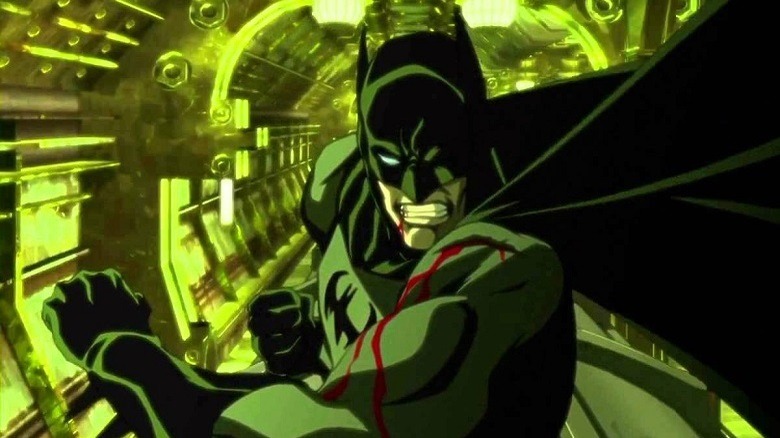
Similar in style to the exceptional "Animatrix" movie released in 2003, "Batman: Gotham Knight" is an animated anthology film. Revolving around Batman's ongoing struggle against the mob and his formidable rogues' gallery, all of the segments are set between the events of the live-action Christopher Nolan movies "Batman Begins" and "The Dark Knight," and each is produced by one of four Japanese Animation Studios.
The reliable Kevin Conroy (of "Batman: The Animated Series" fame) returns for gravelly voice duties, and each of the six segments is notably different in both scripting and artistic style. The anthology format works well; no segment is long enough to outstay its welcome, and it's interesting to see each of the studios take on the Dark Knight -– and for an animated property to be connected with a lucrative live-action franchise. Disney took a similar approach with "Star Wars: Visions" -- again, working heavily with Japanese anime studios -- and /Film's review says that the results "range from good to spectacular."
Superman: Red Son
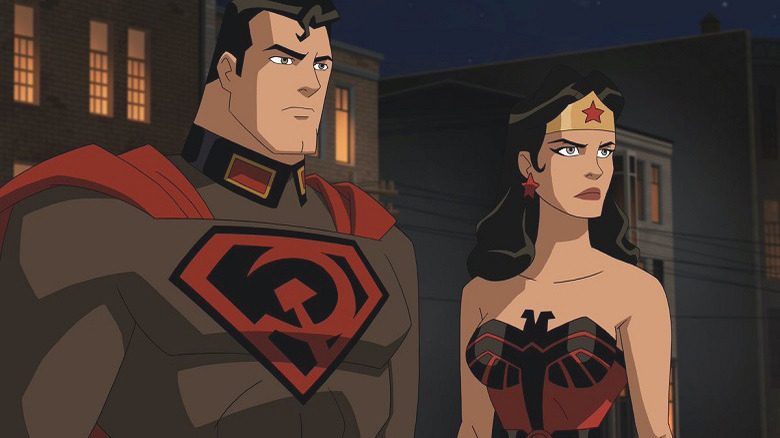
Based on the Mark Millar Elseworlds tale of the same name, "Superman: Red Son" poses an interesting question: What would have happened if Kal-El's Kryptonian rocket had landed in the USSR instead of Kansas? Set during the Cold War of the 1950s, "Red Son" sees Superman introduced to the world not as an American citizen, but as a loyal Soviet military asset. The "S" shield on his chest is replaced by the hammer and sickle, the Soviet symbol of proletarian solidarity.
The most entertaining elements of this surprisingly close adaptation are the side-effects of Superman's displacement from west to east. Batman is now a dissident, his parents killed by Stalin's police, and Lex Luthor is a benevolent super-genius in service of the American flag. The plot centers around the cost of loyalty, and -– despite some sadly missed elements from the source material –- it's one of the most entertaining and original films that DC has produced.
Batman: Mask Of The Phantasm
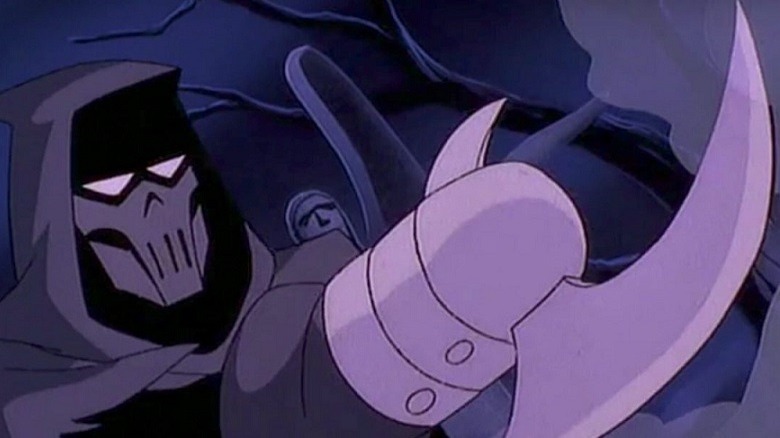
"Batman: The Animated Series" was a huge success in the '90s and arguably responsible for the entirety of DC's animated output. Without it there would have been no "Superman: The Animated Series" and no "Justice League." Sharing the distinctive Danny Elfman theme from the live-action movies, "Batman: The Animated Series" ran from 1992 to 1995, and "Batman: Mask of the Phantasm" was the first DC animated theatrical release, brought out at the height of the TV show's success.
In "Mask of the Phantasm," Gotham's biggest gangsters are being killed by a new nocturnal vigilante, and Batman is framed for murders he didn't commit. In trying to clear his name, Bruce learns that the gangsters are connected –- and also learns the awful truth about their murderer. The TV series was always a triumph of design, and the art deco stylings of Gotham have never looked better than on the big screen, in this loose adaptation of the comic series "Batman: Year Two."
The film never quite hit the giddy success of its Emmy award-winning TV counterpart, but it's a bold example of how to do a movie adaptation. It feels suitably epic, never just like an elongated episode of the series, and presents a multi-layered tale of tragedy and betrayal.
Batman Beyond: Return Of The Joker (Original Uncut Version)
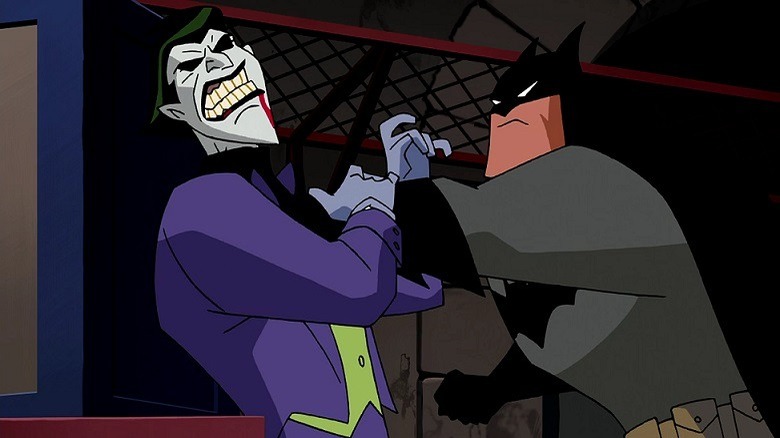
The "Batman Beyond" TV series ran for three seasons from 1999, telling the story of a new Batman –- teenager Terry McGinnis –- operating in 2039 Neo-Gotham under the guidance of a retired Bruce Wayne, with the "Dark Deco" stylings of the animated series replaced by cyberpunk locales and lurid neon.
In "Batman Beyond: Return of the Joker," the first full-length movie based on the series, the Joker -- thought long dead –- has re-emerged to lead The Jokerz, the gang that he was the inspiration for. Terry learns of the events of the last fateful encounter between his mentor and the Clown Prince of Crime, and it's up to this next generation's Batman to defeat the Joker's menace forever.
Mark Hamill was perfectly cast as the Jester of Genocide, and, despite some slightly contrived reasoning, it's a delight to hear him spar off against Kevin Conroy's Bruce Wayne again. This movie is the closest we came to a crossover between the present and future Batmen and sees the welcome return of a few familiar faces. The uncut version is the recommended one, though, upgrading it from a PG certificate to a PG-13.
Constantine: City Of Demons
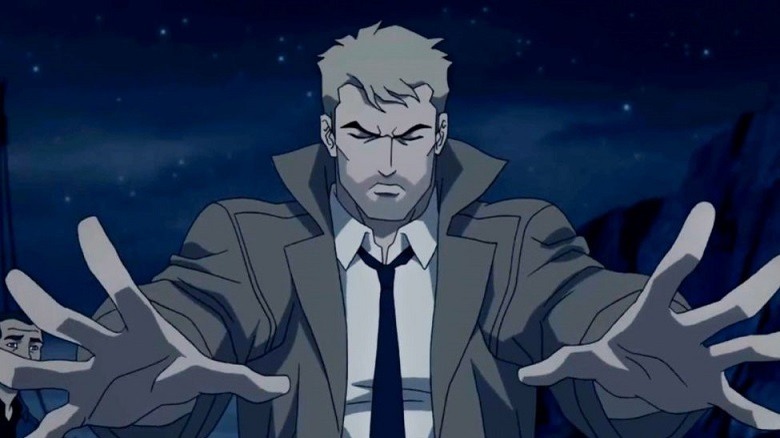
Based on Mike Carey's graphic novel "All His Engines," "Constantine: City of Demons" is a familiar plot for John Constantine fans, having already been loosely adapted for the ill-fated TV series in the episode "Quid Pro Quo." When Tricia, the daughter of Constantine's best friend Chas, falls into a supernatural coma, John sets out to cure her. It's a quest that'll take him through the seedy underbelly of Los Angeles and force the unlikeliest of alliances –- as well as a confrontation with his nemesis.
Matt Ryan once again proves how perfectly cast he was in the role of beleaguered warlock John Constantine. Eventually the character would end up being heavily diluted by (too many) regular appearances in the TV series "Legends of Tomorrow," but this and "Justice League: Dark" are a perfect showcase for both the character and Ryan's portrayal of him. Suitably violent and profane, just as a Constantine tale should be, "City of Demons" serves as an ideal continuation for the short-lived TV show.
Superman Vs. The Elite
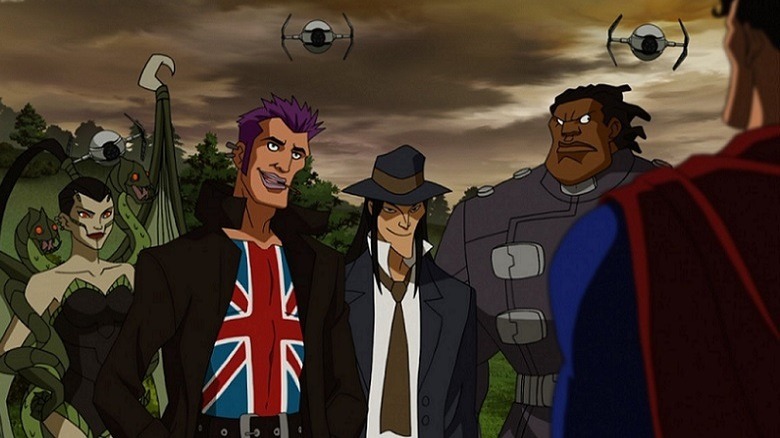
Created as the response to Wildstorm Comics' popular ongoing title "The Authority," "The Elite" were introduced into the world of comics in 2001 in "Action Comics" #775. A team of superpowered antiheroes, this squad –- led by enigmatic telekinetic skinhead Manchester Black –- were posited as the antithesis to the Man of Steel: reckless, aggressive, and with little concern for collateral damage to bystanders or property.
In "Superman vs. The Elite," the rogue vigilantes prove themselves capable of killing to achieve their aims -- a decision which leads them into a direct confrontation with Superman. Yet in a world where even the people in authority turn a blind eye to the Elite's nefarious activities, what chance does truth, justice, and the American way have?
It's a story of surprising depth for a tale that ultimately culminates with super-powered beings knocking each other into next week (or, in Superman's case, the week after that) and which questions the core values of many of DC's core heroes -– why not use their powers to fix the world? It's a valid question, and one that will be addressed again in the DC animated movie "Injustice."
Teen Titans GO! To The Movies
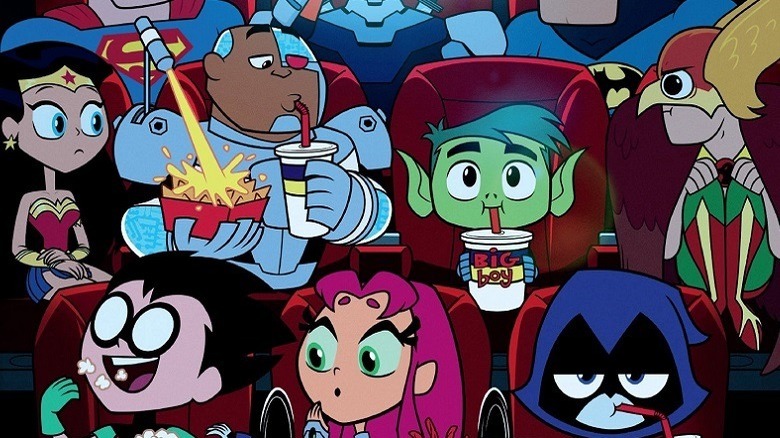
There's a lot of hatred for "Teen Titans GO!," with many seeing it as too frivolous or having doomed other animated projects involving DC's teenage super-team. The long-running television series is certainly an acquired taste: deliberately silly, noisy, and raucous, with a very distinctive "Powerpuff Girls" style of animation. That said, "Teen Titans GO! to the Movies" is a triumph.
It's a brilliantly unsubtle satire of superhero movies, of studios mining even the most obscure and minor properties to make a profit. Annoyed that every other superhero is getting their own film, the Teen Titans head to Hollywood -- where they realize that only by destroying all the other heroes can they make their dreams come true.
It's laugh-out-loud funny, pitched with just the right level of mockery towards beloved characters, and is filled with some excellent songs. It also features the greatest Stan Lee cameo ever put to screen.
Read this next: Upcoming DC Animated Movies To Keep On Your Radar
The post The 15 DC Animated Movies You Need To Watch appeared first on /Film.
The Wire Creator David Simon Pulls HBO Project Out Of Texas Over Abortion Law
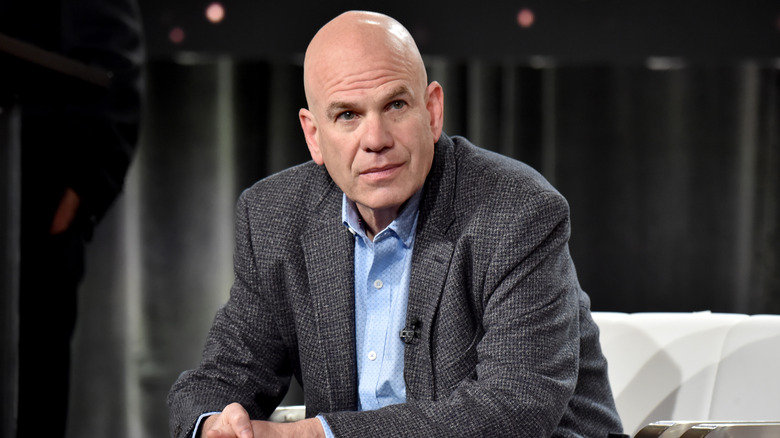
While Texas conservatives continue stripping the rights away of their citizens in an attempt to cover up the death rattle of an antiquated party losing power, some Hollywood creatives are choosing to hit the state where it hurts most: in the pocketbook. Known for creating popular shows like "The Wire" and "The Deuce," David Simon took to social media to announce that despite his new project being set in Texas, he's refusing to film the project there in response to the Texas abortion ban. Simon posted on Twitter stating "I'm turning in scripts next month on an HBO non-fiction miniseries based on events in Texas, but I can't and won't ask female cast/crew to forgo civil liberties to film there. What else looks like Dallas/Ft. Worth?"
The law went into effect in early September after the Supreme Court proved to be disappointingly useless and declined to block this clear infringement on reproductive rights. The new Texas law outlaws all abortions after six weeks when a fetus develops a heartbeat, despite the fact that we determine life in actual living humans, not clumps of cells, based on brain activity and not heartbeats — but go off, I guess. The law also allows citizens to act as proverbial Anti-Abortion Batmen by deputizing people to snitch on anyone they suspect has had an abortion and paying them handsomely if it turns out they're correct.
Dallas Film Commission Fights Back

After Simon made his announcement to pull out of Texas, the Dallas Film Commission replied on Twitter pleading, "Laws of a state are not reflective of its entire population. Not bringing a production to Dallas (a big "D") only serves to further disenfranchise those that live here. We need talent/crew/creatives to stay & vote, not get driven out by inability to make a living." The Dallas Film Commission is correct, it does impact the lives of those who live in the gerrymandered state but Simon was quick to acknowledge that his decision to pull the project out of Texas is not to harm those trying to make a living, but to protect the rights of his production cast and crew.
Plenty of fans replied to Simon continuing to bring up the fact that major production hubs throughout the state in places like Dallas, Austin, Houston, and San Antonio are all heavily populated with left-leaning progressives, but Simon continued to reiterate that this decision is not one based in red/blue politics, but in ethically protecting all members of his cast and crew.
And even after a critic tried to implement a "gotcha" tactic regarding the upcoming IATSE strike, Simon proved that his crew solidarity is the real deal.
No additional details on Simon's Texas-based HBO project have been made available at this time, but unless Texas makes some changes, there's a good chance Simon's project will be the first in a long line of projects changing locations.
(Writer's Note: A reminder that women are not the only people who experience pregnancy and womanhood is not determined by the ability to become pregnant.)
Read this next: 'We Own This City': David Simon And 'The Wire' Veterans Return To Baltimore For An HBO Show About Police Corruption
The post The Wire Creator David Simon Pulls HBO Project Out of Texas Over Abortion Law appeared first on /Film.
How to Fix an Old Doorknob That Sticks
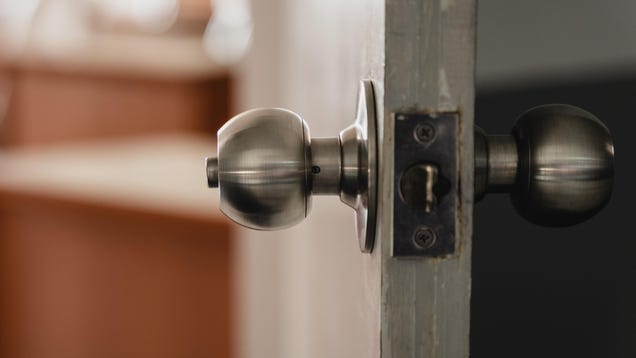
A sticky door knob might not be the most pressing update your home needs, but fixing it can improve your quality of life every day. As hardware ages, knobs can come loose or develop other problems that prevent the latch from engaging or disengaging when you turn them. Although the inner workings of a door latch can…
Lost Ending Explained: No, They Weren't Dead The Whole Time ... But They Weren't Really Living, Either
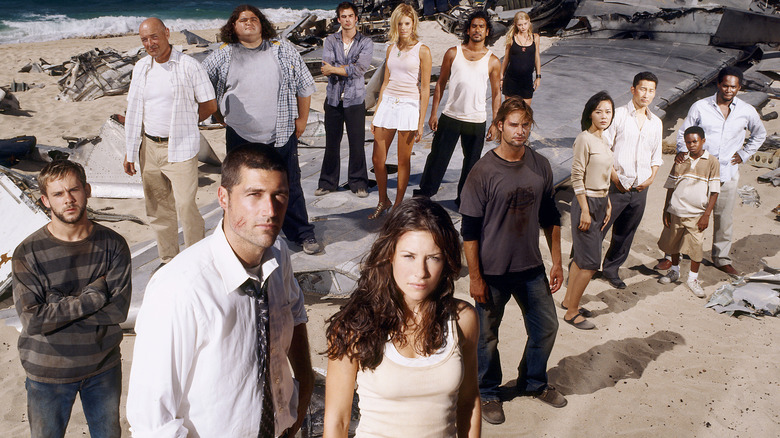
Seventeen years ago today, Doctor Jack Shepard (Matthew Fox) opened his eyes in the middle of a bamboo forest on a mysterious island and jumped into action in the aftermath of a horrific plane crash, and television was never the same again. "Lost" stands tall as a game-changer in serialized broadcast TV, serving as perhaps one of the most effective trailblazers in making full use of the internet's affinity for encouraging fan theories and obsessing over dense mythology. By the time the show wrapped up its run, the fanbase ended up severely split over what "Lost" had even been about all along -- the characters, or the never-ending stream of mysteries. The uneven final season tried to have it both ways by throwing in some unsatisfying and last-minute answers to questions that had long since become irrelevant. To its credit, however, creators Damon Lindelof and Carlton Cuse made their intentions emphatically clear on that front and chose the far better option in the divisive finale.
Well over a decade and a half later, the ending to "Lost" still comes with confusing baggage over whether the cast of characters had been "dead all along" ... and I'm here to reiterate that they most definitely weren't. The question isn't an unfair one, however, as a revisit of the finale makes it clear that -- in classic "Lost" fashion -- the characters hadn't truly been living until the very last moments of the series anyway.
'Guys ... Where Are We?'
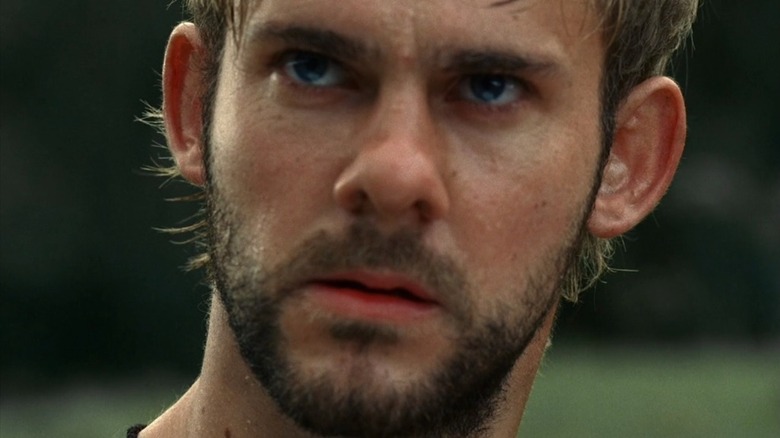
The unsettling question above, posed by Charlie Pace (Dominic Monaghan) at the end of the two-part pilot episode, set the tone for the rest of the series. As Jack, John Locke (Terry O'Quinn), Kate Austin (Evangeline Lilly), James "Sawyer" Ford (Josh Holloway), Sayid Jarrah (Naveen Andrews), Hugo Reyes (Jorge Garcia), and the rest of the survivors scrambled to make sense of their unfriendly surroundings, this became the narrative driving force behind the first season(s) of "Lost." That implicit promise came with expectations of answering tantalizing questions like: what makes the island so special? Will the survivors could find a way off of it? And would they even survive long enough to do so? Polar bears, smoke monsters, the possibility of sinister "Others" inhabiting the island, and the group's ever-present suspicions of one another all combined to turn "Lost" into the weekly must-watch phenomenon that helped set the template for future pop culture hits like "Stranger Things" or "Game of Thrones."
But the idea that we only cared about the inexplicable events of the island because it was happening to this specific group of characters was a reality that went unnoticed by far too many viewers at the time. The clever flashback structure that permeated each and every episode in the early seasons was meant to emphasize that fact, drawing a direct connection between the plot of any given episode and the interior lives of whichever character received the spotlight. Instead, many of us tended to focus on the shocking reveals, coincidental (or fateful?) near-misses between characters who didn't know each other just yet, and breadcrumbs of clues that made the world-building of the show so compelling in the first place. It was a classic example of viewers missing the forest for the trees, latching onto the surface-level joys of the series and neglecting to pay enough attention to the impressive character-building going on right underneath our noses.
It's true that the show itself became preoccupied by going down plot-specific rabbit holes in an increasingly trippy attempt to keep audiences engaged and ratings high, which shifts some of the blame off ourselves and onto Lindelof and Cuse's storytelling instincts. At the same time, however, the one consistent aspect throughout the show's run proved to be the ever-shifting dynamics and relationships between the cast. Back when it was normal for television to stretch beyond merely eight or 10 episodes a season, "Lost" took full advantage of every hour it had and put its characters through an ever-evolving journey that made their eventual fates resonate as much as they did. In that light, the profound disconnect between the two halves of the audience leading up to the conclusion can't quite be rationalized by any neat-and-tidy answers.
So how do we explain the ending of "Lost"? I'm glad you asked.
'See You In Another Life'
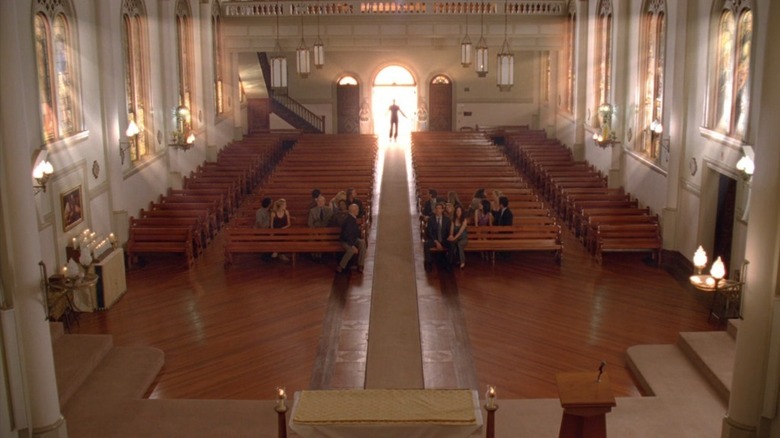
In retrospect, it's easier to see that "Lost" had been building up to some sort of release of pent-up energy for quite some time before the final season debuted -- for better or worse. Seasons 3-5 provided some of the highest highs to be found throughout the show's entire run, but season 5 toyed with the idea of giving the remaining cast of core characters a blank slate and making it so that their flight never crashed onto the island in the first place. The sky-high expectations following the detonation of a timeline-cleansing atom bomb (it's ... tough to explain to the uninitiated) resulted in a concluding season that couldn't possibly live up to the theories and guesses that fans had already concocted in the interim, even if the rush to wind down the series hadn't led to several self-inflicted problems on a script level. Let's put it this way: the less we speak of Sayid's zombie-like role or Claire Littleton's (Emilie de Ravin) wasted appearances throughout the final stretch of episodes, the better!
Continuing the trend of prior seasons, the last season of "Lost" came up with the idea of "flash-sideways" peeks at what initially appeared to be an alternate universe where the bomb's detonation actually had accomplished the job and Oceanic Flight 815 never crashed. The present-day events on the island had never been more confused or shockingly boring as they were here, leading the remaining cast on an oftentimes wheel-spinning journey that ultimately led to Jack and John Locke (who died but became reanimated by the island's original and malevolent deity. Again, it's a lot!) coming into their final conflict and Jack needing to fulfill his destiny by ... using a cork to plug a hole in a cave so that evil wouldn't consume the world.
As much as fans scoffed at this underwhelming reveal as to what purpose the show's main setting served all along, the final season drives home the fact that these characters were never more vibrant, alive, and truly themselves until they met each other after the crash. Remember the depths that Jack, Kate, Sayid, and others sink to after they actually escaped the island and left the others stranded there in season 5? That speaks to just how integral a part they played in each other's lives, with audiences uncovering layer upon layer as we got to know each character at the same time that they got to know each other.
The final reveal that the flash-sideways interludes were actually a glimpse into the shared afterlife that the survivors created for each other well after their deaths -- some in previous episodes, some long after the events of the finale -- may have been too much to throw at audiences at the time. It was easy to mistake the (admittedly vague) explanation of how the action on the island took place before the events of the seemingly alternate universe, which is how the "They were dead the whole time!" narrative became the prevailing interpretation of the finale among some circles. They're dead in the flash-sideways, sure, but their reunion in that church to "move on" from their current purgatory is as striking and lively depiction of the afterlife that I've ever seen. It proves Desmond Hume's (Henry Ian Cusick) repeated catchphrase of "See you in another life" correct, in the end.
All these years later and with the benefit of hindsight, a rewatch of the finale reveals an ambitious ending that strove to prioritize full-circle character journeys over a rote exercise in providing solutions for mysteries. "Lost" will never win over all its previous fans, but its ending is a perfect example of how the destination can be just as meaningful as the journey.
Read this next: The Unpopular Opinion: Seven Years Later, The Ending Of 'LOST' Is A Perfect Send-Off
The post Lost Ending Explained: No, They Weren't Dead The Whole Time ... But They Weren't Really Living, Either appeared first on /Film.
Scientists say Mars may simply be too small to host life - CNET

Australia hit by its biggest earthquake in years - CNET

How to Fix (or Replace) a Leaky Faucet Yourself

Whether you have a slow leak or are just looking to spruce up your kitchen, updating your old faucet can help conserve water and make your kitchen more efficient. Though handling the job yourself may seem intimidating, it’s totally doable, and it will pay dividends in the form of lower monthly bills and avoiding a…
New Nagios Software Bugs Could Let Hackers Take Over IT Infrastructures
Canonical extends support for Ubuntu 14.04 and 16.04 to 10 years from launch
Ubuntu is one of the most popular desktop Linux distributions. Not only do a lot of people who are dipping their toes into Linux for the first time use Ubuntu, but it is also used by smaller businesses for their backend infrastructure. These SMBs usually rely on LTS (Long Term Support) releases of Ubuntu, which are released once every 2 years and are supported for 5 years from their launch. Canonical has now announced that it has extended support for Ubuntu 14.04 and Ubuntu 16.04 to a total of 10 years from their launch.
Canonical has announced a lifecycle extension for Ubuntu 14.04 LTS “Trusty Tahr” and 16.04 LTS “Xenial Xerus”. The original commitment was for 5 years from launch, which marked April 30 2019 and April 29 2021 as the EOL dates for the releases, respectively. Now, 14.04 will be supported until April 2024, while 16.06 will be supported until April 2026. Note that the EOL for Ubuntu 18.04 “Bionic Beaver” and Ubuntu 20.04 “Focal Fossa” remains unchanged at April 2028 and April 2030 respectively.
“With the prolonged lifecycle of Ubuntu 14.04 and 16.04 LTS, we’re entering a new page in our commitment to enabling enterprise environments. Each industry sector has its own deployment lifecycle and adopts technology at a different pace. We are bringing an operating system lifecycle that lets organisations manage their infrastructure on their terms.”
Nikos Mavrogiannopoulos, Product Manager at Canonical
Extended support for the LTS releases beyond the 5 year period is delivered through Extended Security Maintenance, which requires a subscription to Ubuntu Advantage. This lifecycle extension will give organizations more time to deal with their upgrade plans and thus help out with their infrastructure upgrade costs. The prolonged Extended Security Maintenance (ESM) phase of Ubuntu 14.04 LTS and 16.04 LTS enables a secure and low-maintenance infrastructure with security updates and kernel live patches provided by Canonical.
If you’re looking for a release for your personal use on non-critical infrastructure, Ubuntu 21.04 “Hirsute Hippo” was released some months ago and will continue to receive security and maintenance updates till January 2022, after which you can update to the next version.
The post Canonical extends support for Ubuntu 14.04 and 16.04 to 10 years from launch appeared first on xda-developers.

Ah, Kentucky. Southern Hospitality keeps on giving, with a new Covid mutation in a nursing home infecting 45 residents and employees, including some who had been fully vaccinated. Can we name this one Omega? [Sick]

There's finally an article about Gen X - and it's about how much we drink. Who cares [Awkward]

Baby Poop Is Loaded With Microplastics
10 Slasher Movies That Are Actually Good
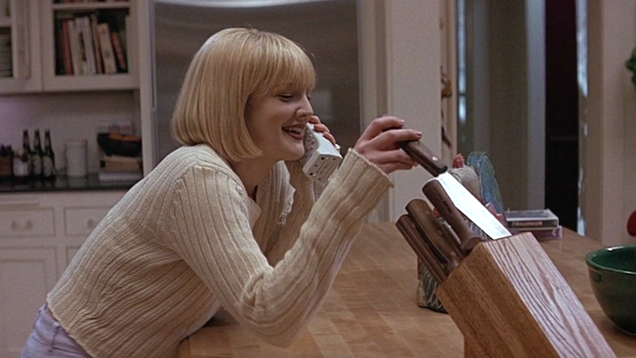
Slasher movies are often seen as the lowest tier of the movie pyramid, but you should reconsider this unfairly maligned sub-genre. In an effort to change your mind, I submit these ten influential, worthwhile, and interesting slasher flicks.
Why You Should Dredge More (and Deep Fry Less)

When people talk about frying fish, they are usually referring to deep frying—or at least that is what I am usually talking about. But pan frying is also a valid form of fish preparation, especially if you don’t feel like dealing with a large amount of hot oil. Not only is a vat of frying oil kind of annoying to…
Jaguar – Netflix Review
The post Jaguar – Netflix Review appeared first on Heaven of Horror.
Intrusion – Netflix Review (4/5)
The post Intrusion – Netflix Review (4/5) appeared first on Heaven of Horror.
Prey 2017 Part 11: Chief Executive Villain
After several hours of distractions and detours, Morgan finally reaches Deep Storage. She’s here to get her arming key, so she can set the station to self-destruct.
As she enters, Alex calls her up. He’s locked the door behind her, sealing her in.
This is actually an attempt at protecting Morgan. On one hand, Alex really doesn’t want his sister to blow up the space station and destroy all of their work. This place is new to memory-wiped Morgan, but this place is home to Alex. The two of them have spent the last few years studying the Typhon and unlocking fantastic new technologies. From Alex’s point of view, his sister has gone a little crazy due to her personality drift and is acting irrationally.
But while he doesn’t want her to destroy the station, he also doesn’t want to see her get hurt. He’s actually helped you out at a couple of points during the adventure. As much as he wants to see your quest fail, it’s even more important to him that you survive.
I love Alex. He’s one of my favorite villains.
Cringe Executive Officer

I recently watched the Netflix original The Old Guard. I liked the premise[1], but the whole thing was ruined by the childish cartoon villain at the center of the story. He was the typical strawman corporate tycoon, constantly talking about how much he wants to make more money. He was pure cringe.
That’s not how corporate leaders talk! Most corporate leaders aren’t nakedly motivated by money like this. If you got to know them, you’d probably discover that their real goals are more likely fame, personal glory, sex appeal, expensive hobbies, or social standing, and making shitloads of money is simply a means to that end.
Even if they really only care about money for its own sake, CEOs don’t brazenly say so in front of other people. People criticize Mark Zuckerberg for being a weirdo alien lizard robot, but even with his particular social handicaps he still knows better than to walk around talking about how awesome money is. Maybe deep down a CEO just cares about money, but on the surface they’ll talk about things in terms of saving jobs, serving customers, creating new technologies, and solving large-scale societal problems.
The CEO Villain

As our society has become more technology-oriented, tech CEOs have become popular villains, occupying roles previously reserved for politicians and crime bosses. That’s fine. Stories need to change with the times. My problem is that Hollywood has no idea how to write this sort of villain. CEO villains end up being strawman loonies who will shove puppies in a blender to make an extra 1%. That’s not interesting, and it doesn’t feel genuine.
EA CEO Andrew Wilson is a heartless jerk that cares nothing for the art of videogames, the artists that create them, or the audience that consumes them. His decisions are entirely focused on direct short-term profits. He is the stereotypical money-chasing CEO, and even he has the wit to avoid saying so. He doesn’t go around talking about how much he loves money and wants more profits. He always frames his obnoxious decisions in terms of “giving consumers what they want” and “innovating”.
This is why I like Alex Yu so much. He’s a villainous CEO who doesn’t talk like a Ferengi at a shareholders meeting. He’s a bad man, but he’s bad in a lot of understandable ways. He does evil things, but he didn’t set out to do evil. He drifted towards evil through a long series of personal compromises.
This is NOT Caveman Science Fiction

I really dislike the trope known as Science is Bad. The story takes the rhetorical position that curiosity is hubris and we shouldn’t meddle with things we don’t understand. You can see the trope parodied in the Dresden Codak comic Caveman Science Fiction.
Stories need some sort of challenge for our protagonists to overcome. We can do the action story thing and have some evil jerk doing nefarious deeds. That’s fine if you’re writing a good guys vs. bad guys story, but if you’re a fan of the sci-fi genre then you’re probably more interested in the science and less interested in villains and their motivations. If you’re trying to write a story about Science Stuff then Dr. Damien B. Nefarious is a distraction and his various machinations are a waste of page space.
But if we’re here for Science Stuff then the economics of storytelling suggest that it’s better to ditch the evil antagonist – or reduce him to the role of a Pandora-style catalyst – and have the mystery and danger come from all the cool Science Stuff that the book is about. At the same time, “Scientists invent a Cool Thing and everything is fine” generally makes for a boring story. We want stories to feature science, and stories need conflict. So we write stories where science-things go horribly wrong and create lots of thrilling danger for our protagonists to overcome and mysteries for them to solve.
A single story like this is fine in isolation, but across an entire culture this constant flood of fictional scientific disasters begins to feel anti-science. Authors need to be careful with their messaging or the whole thing can come off as embarrassingly pro-luddite.
The first Jurassic Park movie falls into this trap with Professor Jeff Goldblum constantly reminding us that there are things we just shouldn’t mess with and things we weren’t meant to know. A more sensible message might be, “Maybe you shouldn’t revive apex predators from millions of years ago and then put them on display for thousands of clueless civilians.” But instead the writer takes the more shorthand approach and suggests that it’s foolish to even experiment with this branch of knowledge.
A lot of popular culture science fiction has this sort of thing going on. Aside from the yucky implication that this can frame ignorance as virtue and incuriosity as wisdom, there’s also the problem that it generally makes for a predictable story.
Prey sort of splits the difference. Sure, Alex Yu is undone by hubris, but no character in the story ever suggests that it was fundamentally wrong or foolish to study the Typhon. Alex is driven, reckless, and casual about the horrific sacrifices he’s willing to force others to make for the good of mankind. When things begin to unravel he’s optimistic to the point of self-delusion about his ability to regain control.
The message here isn’t that science is bad, but rather that bad science is bad. I can get behind that.
Alex Yu Bad Guy

I like Alex Yu because he feels real. I imagine that Alex justifies a lot of his reprehensible actions by saying that he has “no choice”. And in many cases he’s right! He is indeed trapped in “damned if you do” / “damned if you don’t” situations. The problem is that he’s trapped in those circumstances because of poor decisions he’s made in the past. He’s spent years spreading lies of omission, cutting corners, and making moral compromises in the name of some eventual greater good. He didn’t realize it, but he’s gradually created a world that runs entirely on lies and secrets. He can confess the truth and his kingdom will unravel when everyone turns on him, or he can continue his lies and the kingdom will self-destruct due to its own ignorance.
The thing is, Alex really is onto something with this neuromod technology. The ability to share knowledge and skills like this would literally change the world for the better. This would be the biggest boost to human potential since the printing press. This technology is indeed worth risking lives for. The problem with Alex isn’t the risk-taking, it’s the dishonesty and literal human sacrifice.
Alex doesn’t tell the people aboard Talos 1 about the Typhon. If he was honest with people, then the people on the station could be educated about the risks. Everyone would have a predetermined plan to follow in the event of a containment breach. People that weren’t up for that sort of risk could quit and go back to Earth, and it would be trivial to replace them with people who were willing to embrace the job, risks and all. [2] Instead Alex has built a world where there are no fire alarms, no fire drills, nobody knows what to do in the event of fire, nobody knows what fire looks like, and everything is made of wood.
Alex hides the truth from everyone, which means he also needs to hide the problems from everyone, thus forming a feedback loop of escalating secrecy and coverups. His secrecy is inherently self-destructive.
Alex doesn’t tell people that neuromods are based on the Typhon. Maybe this would make people wary of using them. That’s fine! Everyone could decide for themselves how much risk they were willing to take on. Most sane people would pass on the early neuromods, opting to let someone else take the first leap. The thing is, the promise of neuromods is incredible. Regardless of the risk, some people would jump at the chance to use them. Which means Alex would always have a pool of willing volunteers. He could use that eagerness to set up a proper test with sensible safeguards. “Hey, you can have this neuromod that will let you play guitar like Steve Vai. But you need to agree to live in quarantine for X months while we observe you.” (Or whatever. I don’t know how to run a proper scientific / medical study, but I’m pretty sure smart people could devise rules and guidelines for how you ought to do this sort of thing.) If anything went wrong and their brains melted, the blame wouldn’t fall entirely on Alex, because he would have the informed consent of the test subjects.
But instead Alex keeps everything a secret, which means everyone is randomly jamming neuromods into their face, unaware of the possible risks. In this case Alex is lucky and the neuromods don’t seem to cause serious problems.[3] Which is good, because if there were problems it would have necessitated a massive cover-up.
(Actually neuromods might cause long-term problems. The story isn’t clear on this. There are reports of some people exhibiting symptoms of anxiety and paranoia, but I couldn’t determine if this was a problem with early-gen neuromods, or if it was a result of working with the technology in the Psychotronics lab. Or maybe it was the result of living on this spooky space station for extended periods? Or maybe it’s a problem with living in close proximity to the Typhon for too long? This topic didn’t get a proper study before the station fell. Also there’s the problem of Morgan’s personality drift. Maybe that’s a long-term problem with neuromods, or maybe that’s just a side effect of installing and stripping out mods again and again. These are all important things that need to be studied openly, but that doesn’t happen because Alex is in a constant state of denial and cover-up.)
Alex hides security lapses. That spares him from scrutiny and criticism, but it also prevents everyone from taking proper steps to correct those lapses.
At several points in the game we find people who learn “too much”, and freak out. Alex is forced to silence these people to protect his secrets. At one point a researcher finds out that neuromods contain Typhon cells and he freaks out, saying that he needs to “tell everyone”. Alex replies somewhat ominously: ‘Calm down. Don’t do anything rash. I’m sending someone to help you.’ Stuff like this wouldn’t be a problem if everyone already knew.
The story never explicitly states that Alex has anyone killed, [4] but he very likely takes these people and memory-wipes them by removing their neuromods. I’ll bet he hands out free neuromods to every manager arriving on the station, just so he has a way to wipe them if they learn something they shouldn’t.
Morgan’s actions were more overtly evil. Her tests where she fed prisoners to the Typhon were deeply, profoundly immoral. There was no ambiguity in her actions. Alex was complicit in these crimes, but Morgan was the chief instigator.
But despite Morgan’s overt evil, in the end it was control-freak Alex who did the most damage. Morgan’s heinous tests killed a small handful of people, while Alex’s aversion to accountability placed the entire station – and indeed the human race itself – at risk.
The Neuromod Conundrum

Earlier I talked about the virtuous potential of neuromods. If we have a way to download and share knowledge as easily as we share music and books, then this creates the potential to turn humanity into a species of brilliant scholars and innovators. What if anyone could become a brilliant surgeon or physicist in just five minutes? Just imagine the boost to innovation if researchers could be masters of multiple disciplines at once. Someone trying to create anti-aging treatments is likely to find progress easier if they can master genetics and biology and chemistry and internal medicine before age 25. Someone with the energy of youth but the knowledge of the old would be really good at pushing scientific progress forward.
On the other hand, neuromods come from Typhon creatures, and the only way to make those creatures is to feed them humans. You could argue that this means neuromods are inescapably immoral, regardless of any possible boon they might offer humanity. They are based on human sacrifice, and therefore they’re inherently evil.
Maybe that’s what the author intended to say, but I can’t escape the impression that perhaps we can find a way around this problem. For example, what happens if you feed the Typhon a bunch of lab rats? The Typhon feed on “consciousness”, and maybe the mind of a rat is too simple for a Typhon. Or perhaps Typhon are limited by the minds they consume, and therefore feeding them rats would yield a bunch of useless dum-dum Typhon that aren’t sophisticated enough to be made into neuromods?
I don’t mind that the author never answers this question. If we can’t make more Typhon with animals, then fine. What bothers me is that I can’t find any evidence that anyone tried.
What about willing donors? Instead of harvesting death-row inmate “volunteers”, what if we used actual volunteers? Perhaps there are terminally ill patients that are willing to donate their last few days of life to further the cause of neuromods. Maybe they’d do this in exchange for money, or maybe they’d do it as a “fuck you” to cancer. I’m not an ethicist and I don’t know how the general public would react to this proposition, but I can imagine a world where people regard this sort of thing as morally equivalent to (say) organ donors. It sounds creepy to me here in 2021, but organ donation sounded really creepy to people 100 years ago, and we’re basically okay with it now.
The point I’m getting at is that there could be other routes to making neuromods that are less obviously evil. Maybe you could do it with animals. Maybe you could do it as a form of hospice “care”. We can make hamburgers without killing animals these days. If we’re willing to go to that much trouble for a sandwich, then maybe we could figure out a way to make neuromods without needing to kill people.
The problem with these routes is that you’d need to have an open and honest conversation about them. Alex is unwilling to allow other people to judge him or second-guess him, so he can’t allow that conversation to take place. Thus he’s trapped himself in this situation where it’s either direct human sacrifice, or nothing.
I’m Just Doing my Job!

Another thing I love about Alex is that he shows genuine enthusiasm for his work, which you don’t often see in villainous scientist types. He isn’t doing this for personal glory. He isn’t doing this because he wants to show the world they were wrong to doubt him. He’s not in it for money, or power, or to impress a girl. He really is excited to unlock all of this human potential. He loves his sister and he likes working with her. Also, while the story doesn’t delve too much into his upbringing, I get the impression that he feels he has something to prove to his parents. These are all very relatable, non-evil motivations.
Alex didn’t wake up one morning and decide to start murdering people and wiping minds so he could get rich. He was tempted by his natural curiosity to find out what the Typhon can do and what humanity can gain from them.
Once he discovered that Typhon cells could be used to copy knowledge, the potential was obvious. And once he and Morgan discovered that Typhon-based technology could grant people literal superpowers like telekinesis, he couldn’t just walk away. Eventually they ran low on viable Typhon specimens. At that point it’s easy to see how he talked himself into his current behavior. “Hey, these inmates are horrible people that have killed and tortured others. And they’re going to die anyway, right? Why not use their deaths to help humanity? We could save countless lives with this technology. They kinda owe it to humanity anyway. I’m actually doing a public service!“
Of course he couldn’t tell people he was doing this, so he was obliged to lie about it. And once you start with lies, you’re trapped by them. You need to guard your secrets, which prevents you from asking for help when things go wrong. You’ll need additional lies to cover up the Big Lie, and those lies will require additional supporting lies. Pretty soon your job isn’t doing research, but maintaining an ever-growing deception.
Alex is a coward, a weasel, and a bastard. His quest to bring neuromods to the world is theoretically a noble one, which he pursues by deeply unethical means. He’s arrogant enough to think he can do things alone and that arrogance eventually leads to the fall of Talos-1 and the death of nearly everyone on the station. But he made these mistakes for understandable reasons that come from his personality and upbringing.
All of this makes him so very human to me. His decisions are so much more interesting than the antics of another buffoonish strawman tech billionaire obsessed with “profits”.
Train guard refuses to help woman having seizure on his train as she was 'holding up the service'. Then doubles down on the smug after she recovers. "You're not having a fit now, are you?" This should end well [Asinine]

Hundreds of Thousands of Credentials Leaked Due to Microsoft Exchange Protocol Flaw
Cybersecurity researchers have been able to capture hundreds of thousands of Windows domain and application credentials due to the design and implementation of the Autodiscover protocol used by Microsoft Exchange.
Free MK Mugen game, Mortal Kombat Ultimate Revitalized 2.3, released
Mortal Kombat fans, here is something special for you today. Back in July 2020, we informed you about one of the best MK Mugen games, Mortal Kombat Ultimate Revitalized. And last week, Styx has released a brand new version of it. Mortal Kombat Ultimate Revitalized 2.3 features some new characters as well as updates to … Continue reading Free MK Mugen game, Mortal Kombat Ultimate Revitalized 2.3, released →
The post Free MK Mugen game, Mortal Kombat Ultimate Revitalized 2.3, released appeared first on DSOGaming.
The Fastest Ways to Defrost Your Freezer (and Prevent Future Buildup)

It’s nearly impossible to keep a freezer 100% frost-free. Opening the door lets moisture in, and that moisture freezes, building up on the walls, ceiling, and floor of your ice box. You can treat the inside with special frost-prevention sprays—or cooking oil!—to keep the frost from sticking, but most people do not…