Twitter updated its private information safety policy this morning to ban sharing images or videos of private individuals without their consent. From a report: The platform already banned users from sharing others' personal information without permission, like their address or location, identity documents, non-public contact information, financial information or medical data. But this update makes these anti-harassment and anti-doxxing policies more robust. This doesn't mean that Twitter will require consent from all individuals in a photo or video before its posted. But if a person depicted wants the media taken down, Twitter will take it down.
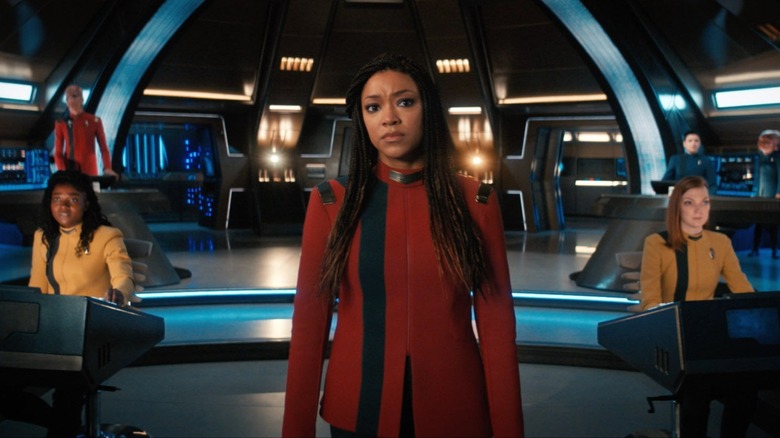
For better or for worse, fan outcry works more and more often these days. The latest entity to bend to consumer will is Paramount+, who will be releasing the fourth season of Bryan Fuller and Alex Kurtzman's "Star Trek: Discovery" series sooner than previously announced. Initially, the latest season to the sci-fi series was only to air in Canada and the United States, as the Paramount+ services did not extend overseas at the time (the show's first three seasons did run internationally, but on a handful of streaming services). But a recent change opened up the international market to the new streamer, and even though there were expansions on the way, the series would not be accessible in any new locations until Paramount launched operations in each respective country. What comes out of all this is that, despite the November 18 air date for North American viewers, anyone else in the world would have to wait until early 2022 to get their Trek on. Naturally, fans found it highly illogical.
In response to the growing static on social media and beyond, Paramount has moved that release date up for international fans. Via an announcement on the official Star Trek website, the streaming service addressed global fans directly and promised a concerted effort to bring everyone access outside of the U.S. and Canada. They even threw in a subscription discount.
A Letter To Fans
Trekkers can rejoice around the world now; though the premiere was still a week behind the original release date, fans in 30 countries have access they didn't have before. They can credit this to some quick agreements with PlutoTV, which makes sense as "Star Trek: Discovery" streamed internationally through Netflix in years past. Whether every episode will stay on these temporary platforms throughout the new season, or Paramount+ takes over hosting as each market location opens up is not yet clear, but fans of the long-running space franchise will surely welcome the ability to hit "Play," worldwide.
The statement, from CBS:
To all of the International Star Trek: Discovery fans: we hear you. We love this series too. We love it for the incredible cast, the hardworking crew, the imaginative storytelling, the groundbreaking, diverse characters who bring the show to life and what it represents to so many people around the world. Star Trek has always put its fans first. We want to do the same.
Therefore, during this transition, we are doing everything we can to get the new season to you as soon as possible. Where Paramount+ is available in Australia, Argentina, Bolivia, Brazil, Chile, Colombia, Costa Rica, Denmark, Dominican Republic, Ecuador, El Salvador, Finland, Guatemala, Honduras, Mexico, Nicaragua, Norway, Panama, Paraguay, Peru, Sweden, Uruguay, and Venezuela, the first two episodes will be available Friday, November 26, with new episodes being released weekly. We are also offering Star Trek fans in these markets a new membership promotion on Paramount+ for 50% off for the first three months with code STARTREK.
In Austria, France, Germany, Italy, Spain, Switzerland, and the United Kingdom, Pluto TV, the leading free streaming television service, will drop new episodes at 9pm local time on Pluto TV Sci-Fi channel each Friday, Saturday and Sunday, with a simulcast running on the Star Trek channel in Austria, Switzerland, and Germany. This will begin with the first two episodes on Friday, November 26.
In the UK, Germany, France, Russia, South Korea and additional select countries, we are also making Season 4 available for purchase on participating digital platforms beginning Friday, November 26.
We too are super fans of Star Trek and incredibly proud of Discovery. We promise to give this franchise and its loyal fans all the global love and visibility it deserves in our expanding universe on Paramount+
Boldly Going To Streaming
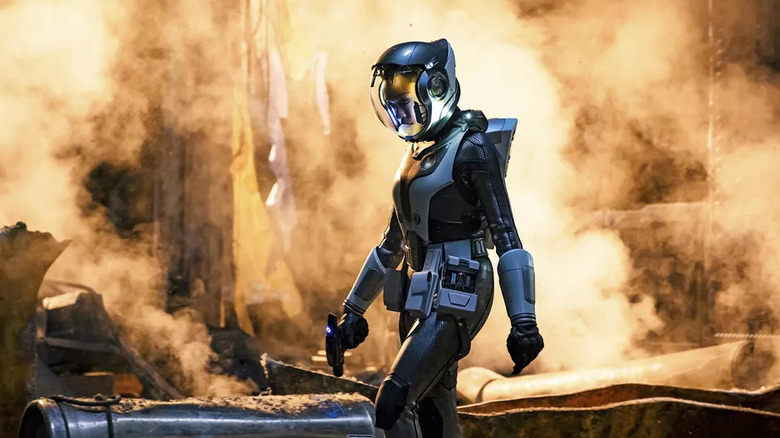
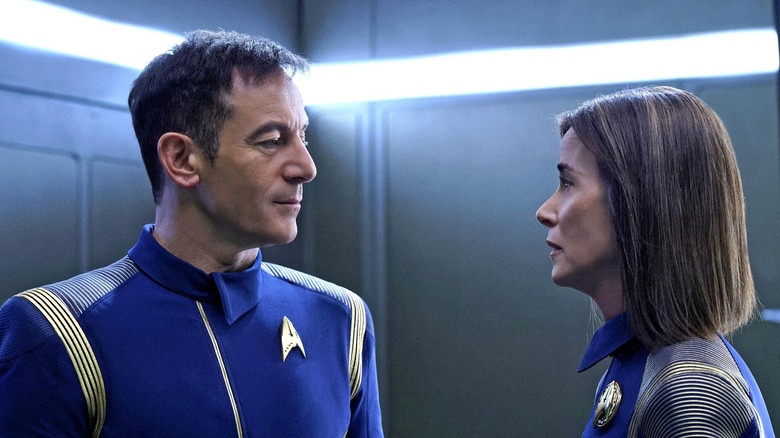
Initially set 10 years before the events of the original "Star Trek" series, "Star Trek: Discovery" has its space explorers under the command of a non-captain protagonist, science specialist Michael Burnham (who is promoted to captain down the line), played by Sonequa Martin-Green. With Burnham at the helm, the crew of the USS Discovery is tasked with conducting scientific research and, at times, aiding in a galactic war. Kurtzman and Paradise are co-showrunners who executive produce "Star Trek: Discovery" along with Heather Kadin, Jenny Lumet, Frank Siracusa, John Weber, Olatunde Osunsanmi, Rod Roddenberry, and Trevor Roth.
"Star Trek: Discovery" is currently streaming on Paramount+ and Pluto TV Europe.
Holiday lights are a cozy tradition—as the days get shorter, a few sparkly strands can really brighten up the endless evenings. While this holiday tradition is worth keeping, traditional filament light bulbs are not. Here’s why you should make the switch to LED lights this year.
I used to be able to understand 99% of the dialogue in Hollywood films. But over the past 10 years or so, I've noticed that percentage has dropped significantly -- and it's not due to hearing loss on my end. It's gotten to the point where I find myself occasionally not being able to parse entire lines of dialogue when I see a movie in a theater, and when I watch things at home, I've defaulted to turning the subtitles on to make sure I don't miss anything crucial to the plot.
Knowing I'm not alone in having these experiences, I reached out to several professional sound editors, designers, and mixers, many of whom have won Oscars for their work on some of Hollywood's biggest films, to get to the bottom of what's going on. One person refused to talk to me, saying it would be "professional suicide" to address this topic on the record. Another agreed to talk, but only under the condition that they remain anonymous. But several others spoke openly about the topic, and it quickly became apparent that this is a familiar subject among the folks in the sound community, since they're the ones who often bear the brunt of complaints about dialogue intelligibility.
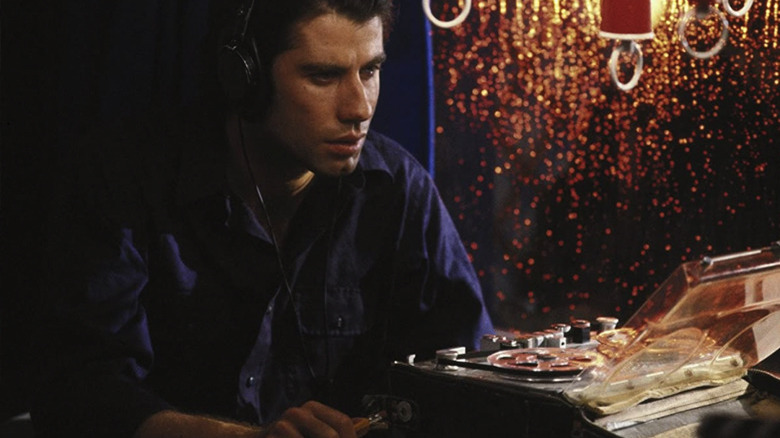
"It's not easy to mix a movie," says Jaime Baksht, who took home an Oscar for his work on last year's excellent "Sound of Metal" and previously worked on Alfonso Cuarón's "Roma." "Everybody thinks you're just moving levers, but it's not like that."
This problem indeed goes far beyond simply flipping a switch or two on a mixing board. It's much more complex than I anticipated, and it turns out there isn't one simple element that can be singled out and blamed as the primary culprit.
"There are a number of root causes," says Mark Mangini, the Academy Award-winning sound designer behind films like "Mad Max: Fury Road" and "Blade Runner 2049." "It's really a gumbo, an accumulation of problems that have been exacerbated over the last 10 years ... that's kind of this time span where all of us in the filmmaking community are noticing that dialogue is harder and harder to understand."
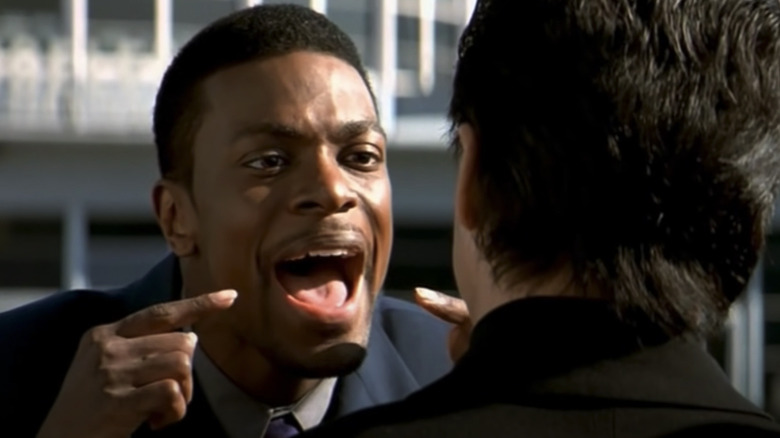
Join me and these industry experts as we sort through that "gumbo" and identify some of the most prominent reasons it has become more difficult to, in the paraphrased words of Chris Tucker's Detective Carter in "Rush Hour," understand the words that are coming out of characters' mouths.
It's A Purposeful Choice
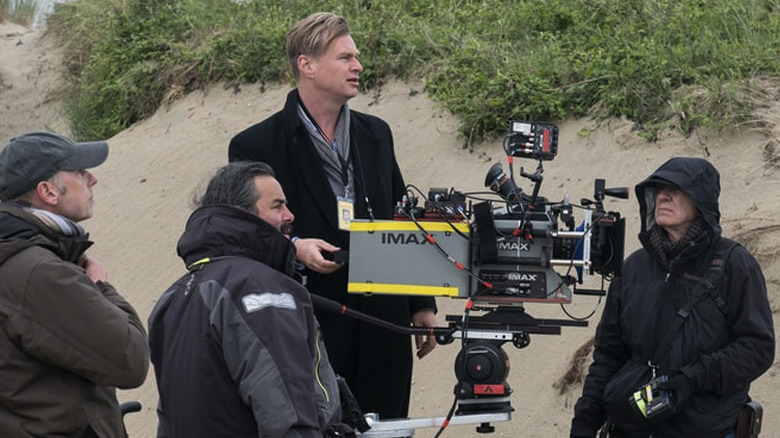
When it comes to dialogue unintelligibility, one name looms above all others: Christopher Nolan. The director of "Tenet," "Interstellar," and "The Dark Knight Rises" is one of the most successful filmmakers of his generation, and he uses his power to make sure his films push the boundaries of sound design, often resulting in scenes in which audiences literally cannot understand what his characters say. And it's not just audiences who have trouble with some Nolan films: the director has even revealed that other filmmakers have reached out to him to complain about this issue in his movies.
Donald Sylvester, who took home an Oscar for his work on "Ford v Ferrari" and is currently serving as the supervising sound editor of "Indiana Jones 5," says Nolan is a singular figure in this regard. "I think Christopher Nolan wears it as a badge of honor," Sylvester declares. "I don't think he cares. I think he wants people to give him bad publicity because then he can explain his methods to everybody and we can all learn. But I don't think other people actually understand it."
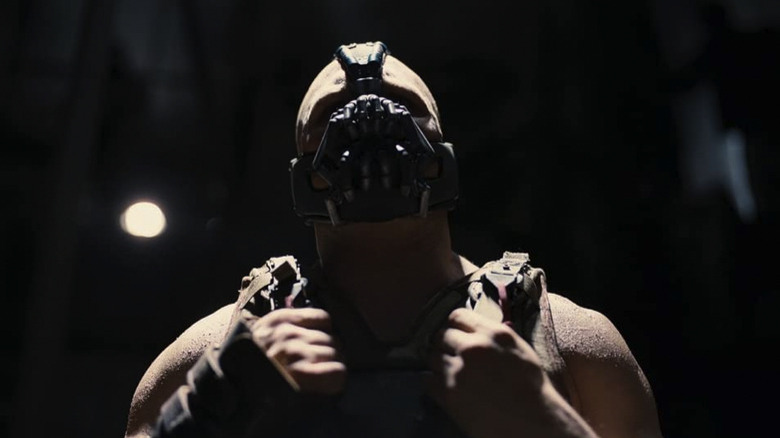
Baksht thinks the complaints about Nolan's work, specifically the hubbub about unintelligibility surrounding last year's twisty action thriller "Tenet," are overblown. "I think in the case of Mr. Nolan, with ["Tenet"], the characters have a mask, and he wants to keep the original sound because I think for him it's more real," he says. Presumably, that mentality also extends to "The Dark Knight Rises," in which Bane's mask muffled a significant percentage of that character's lines.
Thomas Curley, who won an Oscar as a production sound mixer on "Whiplash" and previously worked on "The Spectacular Now," has also seen this type of mentality at work. "Not everything really has a very crisp, cinematic sound to it in real life, and I think some of these people are trying to replicate that," he tells me.
Baksht says that type of creative aesthetic does not need to permeate an entire movie -- it can sometimes change from scene to scene depending on the director's goals in telling the story. Although, as this anecdote illustrates, its effectiveness remains debatable:
"In the case of Alejandro González Iñárritu, he did a movie ['Biutiful'] where all the dialogue was really dirty. They were in Spanish, but you weren't able to understand much. When I asked his sound designer about this issue, he told me the reason they wanted to keep the dirty dialogue was because the situation was so awful in the life of the character that it helped the feeling of depression. I told him, 'Yes, I think the audience got depressed because they couldn't understand anything!' But when [Iñárritu] did 'The Revenant,' the dialogue was pristine and perfect."
I understand his point, although I take issue with using "The Revenant" as an example of pristine dialogue because that film features Tom Hardy in a supporting role, and Hardy is one of the most notoriously difficult-to-understand actors working today.
It's In The Acting
Hardy occupies a unique position in film acting these days, having developed a delivery style that's frequently so indecipherable it's as if he's purposefully challenging audiences to lean in and understand what he's saying. But what about actors who aren't quite on that level of unintelligibility?
"It seems to be a little bit of a fad with some actors to do the sort of soft delivery or under your breath delivery of some lines," Curley says. "That's a personal choice for them. Our job is to record it as well as we can regardless."
Mangini says that in the old days, "you could count on an actor's theatricality to deliver a line to the back seats." But acting styles have changed so dramatically over the years that it has become much more difficult to capture great sound on the set. When actors adopt that more naturalistic style, "it's even harder for the production sound mixer to capture really quality sound. Now we get those compromised microphone positions here in post-production, reaching for a dialogue line that is barely intelligible or maybe even mumbled because it's an acting style, and already, we're behind the 8-ball in trying to figure out a way to make all of those words intelligible."
Karen Baker Landers, whose credits include "Gladiator," "Skyfall," and "Heat," among many others, has her own term for it. "Mumbling, breathy, I call it self-conscious type of acting, is so frustrating," she says. "I would say a lot of the younger actors have adopted that style. I think the onus also falls on the directors to say, 'I can't understand a word you're saying. I'm listening to dailies, and I can't understand.' No amount of volume is going to fix that."
That naturalistic performance style might feel right for actors in the moment on set, but it can be hell for the sound professionals who have to clean it up afterward. "We're very careful to make sure there's clarity," Baker Landers says. "You go in and you volume-graph up a vowel, or one letter. You go in and you surgically – maybe if it's not right on camera, you slow it down. There's all kinds of things we spend hours trying to do that may help a performance. We really strive for that."
But they can only do so much.
Sound Isn't Respected Enough On Sets
Another ingredient in this complicated gumbo is how the sound team is treated during the process of filming.
"What we see from our brothers and sisters in production is a never-ending [complaint] that they don't get the respect they need to get the microphone where it needs to be to capture the sound clearly," Mangini says. "That's because as movies have matured in the last 15 years, movies have become more visually exciting. And because of that, it is less likely that you're going to be allowed to put that boom mic right where the actor is, because it's probably going to drop a shadow because it's in front of a light that the camera team insists has to exist to get the perfect look of the shot. So [the visuals have] taken precedence over what we hear."
Sylvester agrees with that sentiment. "If the sound guy goes, 'Can you get one more take for me?' they go, 'Nope, we're wrapping. We've gotta move on to another setup.' It's because pictures are the most important thing, and we do a good job fixing sound at the end of the day. So they go, 'We'll fix it in post.' That's literally their go-to answer. 'I just need to get this.' 'Yeah, we'll fix it later.' And we do, unfortunately. But it's not because we want to. It's because we have to."
Another "Whiplash" Oscar winner, Craig Mann, acknowledges that less time on set can have a negative effect on the sound crews. "There's more demand on crews to do many setups a day, and that could be a contributing factor," he says. "The production sound guy is the tip of the spear in terms of our first line of defense, and oftentimes if there are problems, the good ones will approach the director or the AD or the DP and say, 'Hey, this isn't working, you're going to miss this.' Oftentimes it gets handled. But on the other side, sometimes there are a lot of production sound guys that do not feel empowered or have had a bad experience about speaking up in the past, or whatever the reason is, and the material gets back to the cutting room and it's a mess, and [they say], 'Well, we thought everything was fine!'"
"I would blame it more on schedule and budget and maybe trying to rush," Baker Landers says when this topic arises. "It's an art form to be a dialogue editor. It's an art form to be a great production recordist. Then to be able to get the clarity of dialogue in a mix with everything else going on and have the dialogue feel natural and not forced is another art form, all of which take time. Budgets and schedules are crunched on a lot of projects, and some of these are amazing films."
Technology (AKA. The Jurassic Park Problem)
One high-profile Hollywood sound professional who wishes to remain anonymous points to the evolution of technology as an ingredient. "The reason people don't remember having these same audio issues with older films is that [now] we have more: more tracks to play with, more options, therefore more expected and asked for from the sound editors," they say. "If you listen to, say, 'Four Weddings and a Funeral,' you'll hear every word ... the sound was cut on film back then, and with limited time, track count, and budget, these are the results you got."
Thomas Curley concurs with that assessment:
"A lot of it has probably happened more recently because of the almost ubiquitous use of digital audio and digital cinema now. Part of the reason with that is because when everything was shot on film and edited with tape, it was a much more laborious process and it was much more technically challenging to do a whole lot with sound design. Everything had to be a very conscious choice and a very intentional soundscape that they create. Since it was so cost-intensive and labor-intensive, they wanted to make sure that the story got across first and emotion gets sort of directed with music, and that's about it. And every pass that you do with an analogue system depletes the quality as well: it's like making a photocopy of a photocopy. But now, they have much faster turnarounds and much more capabilities as far as what they can do with the sound design, including playing around with ambience and sound effects. To put a concrete reason on it is hard, but a lot of it comes down to 'I have this toy, so I'm going to play with it.'"
The anonymous sound pro also pointed to what they view as an increase in the amount of music in modern movies compared to older films, bemoaning directors' over-reliance on music as "pushing emotion" on audiences and the way music and dialogue are forced to jostle for prominence in the mix. "The technology we have today is so vastly improved that there is no limit to what can be added: whatever the director wants, for months on end. We literally have hundreds of tracks at our disposal ... in a final mix, we therefore have a lot to deal with. Unending score smashed up against hundreds of tracks, with the client asking to hear every nuance above every other nuance."
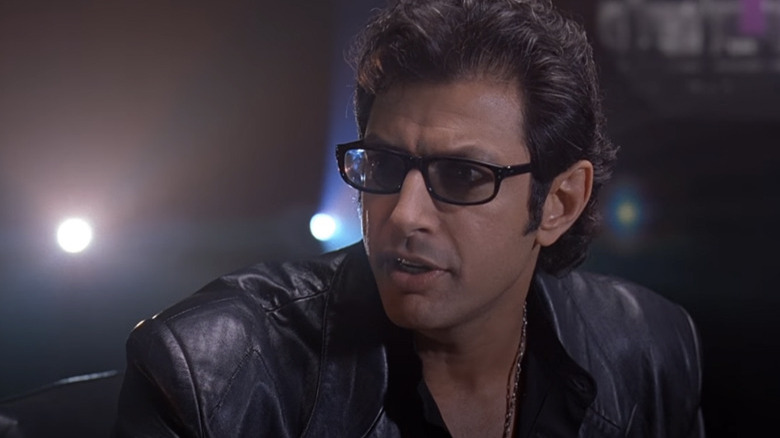
Curley sums it up beautifully. "It might fall into the realm of the 'Jurassic Park' thing: they spend so much time realizing that they can do all these things, but not thinking about if they should do all these things."
Familiarity/Passive Listening
All four of those contributing factors to dialogue unintelligibility are the result of decisions made on sets. But by the time a film makes it to post-production, editors can be afflicted by something Karen Baker Landers calls "passive listening." Donald Sylvester has another name for it – "familiarity" -- and it's exactly what you think it is.
"What I mean by familiarity is, when we're making a movie, it takes a long time," says Sylvester. "It takes weeks and months. If there's something that's unclear at first and you turn to the guy next to you and go, 'What did he say?' and he's like, 'Bring the car around the garage.' The next time you hear it, you go, 'Oh, OK, got it. Bring the car around the garage.' But they get familiar with the bad sound to the point where they no longer find it to be a problem."
Mark Mangini puts it like this:
"The director is sick of talking to the writer and giving them rewrites, sick of talking to the actors and giving them line reads, and by the time you get to post, every single syllable is known by heart. So imagine what that creates in a sound mix where we're supposed to correct the dialogue. We're no longer critically listening like we should be. Because we're in fact zoning out on whether or not the audience is actually getting the critical information they need. We know what the critical information is: we've been dealing with it for months. So in a sense, we have to challenge ourselves daily – and we certainly do this in sound – to try to remove ourselves from that equation and re-inject ourselves with a fresh perspective to see if we're actually making clear dialogue such that the audience understands it."
In Craig Mann's experience, though, the idea of familiarity is not a widespread issue. "As someone that does this on a daily basis, I think dialogue clarity is the number one priority on the mixing stage," he tells me. "Dialogue, mixing, and effects, in that order, is usually the chain of priority. If you can't hear the dialogue, we're going to find a way to hear it. Just speaking of the couple things that we've done even this past year, I can say Joe Carnahan, writer/director, wants to hear every word. Tyler Perry, we just did something with him, wants to hear every word. Sean Penn wants to hear every word. So I don't necessarily agree with getting numb to it. I think it's incumbent upon us to have that fresh ear every time we show up."
Sylvester also points out that unfamiliarity may be an issue in some instances. "What I'm wondering is if, sometimes, some of these films that we see, people are saying words that we don't know what they mean, such as 'Dune,' where they start talking about characters and places that sound unfamiliar. They do it in such a way, offhandedly, where it's like, 'What did he say?' Some of it is the content."
Mixing For Cinemas
One of the most fascinating things I learned when speaking with these folks is the gulf in quality that can sometimes occur between what a film sounds like in the mixing stages and what it can sound like when it plays in a multiplex. Mann says this isn't a new problem -- it's actually been happening for decades:
"You mix it at your level in the mixing room, and theoretically, that is supposed to be the same level that is represented in the movie theaters on the Dolby Cinema processors, therefore giving you an exact translation, more or less, of what you've done on the mixing stage. But what's happened is, particularly in the '90s, because that felt like the time when they were doing the loudest mixes – I didn't mix in those times, but the stories were that mixers and maybe directors would want stuff mixed at a level that was just ear-bleeding. And what would happen is, that would get to the theater, there would be complaints from the patrons, and the theater would be compelled to turn down the mix. And when the next feature came in the next week, the level was never reset, and now that level is playing way low for the regularly mixed movie. That's a problem that vendors have been dealing with for many years. I know [it's still happening]. For example, the Landmark Theater chain does not play their theaters above 5.5 on the cinema processor, where the set standard is supposed to be 7 on that processor.
The idea that a significant theater chain would purposefully ignore industry standards for something as crucial as sound is genuinely shocking. I reached out to Landmark's customer service and asked them directly about this issue, but they did not respond in time for publication.
Thankfully, I have not heard any similar stories about AMC Theaters, the largest theater chain in the United States. However, I was curious about the configurations that occur when a new sound system is installed in an AMC cinema, how frequently their systems are upgraded or replaced, and how the company maintains quality sound conditions across its vast empire of theaters. I reached out to AMC, and they responded with this statement:
In general, our guest feedback, both recently and stretching back the last several years, does not match your assessment about dialogue becoming more difficult to understand. Among guest feedback, which is tracked through survey results and through incoming contacts from guests, there has not been an increase in complaints as a result of the audio, regardless of the type of movie. Regarding your questions about our sound equipment, our speakers and sound systems are calibrated upon installation. They are routinely checked, and recalibrated whenever necessary to ensure the best possible sound quality.
Additionally, for guests who would like to follow the dialogue on screen, AMC now offers Open Caption showtimes at 240 of our locations, and in every major market in the United States with at least two AMC theatres.
Meanwhile, Baker Landers thinks part of the trouble may have begun when theaters shifted away from projecting movies on film. In that transition, union projectionists -- the people who knew the ins and outs of how to properly present a movie with care -- were largely kicked to the curb in favor of inexperienced employees who essentially pressed play on a digital system and could then busy themselves doing other tasks. She tells me a story about how she went to see one of her own movies at a big multiplex and the auditory experience was so bad, she was compelled to point it out to the manager.
"I did a film that was [played] at a 4 [out of 7 on the processor scale]," she says, still appalled by the memory. "I was at a matinee with a lot of elderly people because I took my mom, and I'm like, 'None of these people can hear what's happening.' The manager, who was probably all of 22 years old, said, 'Well, that's how the film was done.' And I said, 'No, I did the sound on the film. That's not how it was done.'"
When sound pros encounter those dumbfounding levels of separation between the mixing stages and theaters, Mann says there can be a schism about the best way to move forward:
"You're going to have some people on the mixing stage who want to turn [up that volume higher than the standard of 7] to compensate for the fact that theaters are playing it low. But [if you do that,] when you go to those theaters that are calibrated correctly, you're going to blow the doors off that theater because it's going to be ripping loud. So one thing we always try to tell our people is that you have to be happy with the mix in the properly calibrated environment, and when you go down to your local movieplex, the speaker could be blown, the level could be low, God knows what's going to happen when you're out in the wild, and we can't control all of that."
Baker Landers knows on which side of that divide she falls. "We mix and release the film for the best case scenario, saying, 'This is how it should be.' A lot of times, we'll hear people say, 'They're not going to be able to hear this in certain theaters in the Midwest, so should we do this louder?' But then you don't have a standard any longer. You have to say, 'This is the standard. We're doing it for the optimum viewing experience.' And hopefully theaters and everyone else rise to that."
Mixing For Streaming
Mixing sound for theaters can be tough, but mixing sound specifically for streaming has its own set of challenges. "We, in fact, do a separate mix for streaming," Mangini says (although I later learned this isn't true for every single movie across the board). But since nothing is ever easy, another problem arises when streaming enters the picture: compression. In layman's terms, think of compression as audio files basically being shrunk down in order to be efficiently transported across the Internet to your viewing device. That process sounds almost magical, doesn't it? It is -- until you realize that those shrunken files are of significantly lower quality than what you'd get if you watched that same movie on a Blu-ray. (If you're keeping score at home, this is yet another point in favor of preserving physical media at all costs.)
"Very often, the streamed audio is a compressed version that you wouldn't get on a Blu-ray," Mangini explains:
"On Blu-ray, if you select 7.1, that is our full fidelity, 48 kilohertz, 24-bit master audio, just as it came from the mixing studio. You can get that on a Blu-ray, and you can get that on certain premium platforms. I think you have to pay extra money for that. But otherwise, it's most common that when you stream, you get a degraded version of what you mix that even we didn't approve. It's done after the fact, after we ship the masters. The only way [streamers] can get the bandwidth they need for you to see image and sound in sync is to compress everything."
Compression is inescapable when streaming is involved, but it turns out not all streaming platforms are created equal. Craig Mann tells me something he says "is not well-known" outside the sound community: different streamers have different specifications when it comes to their audio mixes. "Netflix has excellent specs in terms of dialogue norm and overall levels," he reveals. "They need a particular level in order to pass quality control, and the level is essentially based on the dialogue level throughout the length of the program."
But since there's no industry standard in how to measure audio for streaming, other platforms base their levels on other parts of the sound mix. Case in point: Mann recently worked on Joe Carnahan's "Boss Level," which was originally meant to be a theatrical release. "For a variety of reasons, it ended up at Hulu, and when we got a look at that spec, they require it to be based on the overall [volume] of the film, not on the dialogue level of the film. Consequently, that's a big action movie with shooting and cars and big music, and the result of that is that you have a much more squashed up, un-impactful mix ... there are only a couple different ways of measuring these things these days, and I can only imagine that it's somebody just not understanding the reason why it should be this and not that."
Home Theater Woes
There is yet another important variable in this sprawling equation, and it might be the most important one of all: the home theater experience. "Ultimately, the historical record of the film will not be seen in theaters, it will be what you see in your home theater," Karen Baker Landers says. "That's how most people see certain products. So you want it to be great."
For audio mixers, the theatrical mix comes first, followed by a streaming mix. Then, a stereo mix will often be created, funneling the full scope of the sound mix through just two simple speakers in a process Donald Sylvester likens to "taking a beautiful steak and dragging it through the dirt."
"A lot of people watch it on their flatscreen with their sound bar and they think it's going to be an improved sound situation, but it may not translate," says Sylvester:
"Some TVs take the 5.1 [surround sound mix] and they turn it into a stereo. They have algorithms inside the TV. It's not even our mix. We don't even know what it sounds like. I think a lot of tuners do that, if you have a receiver -- I know they have algorithms, and they also put coloring on it, like 'cinema approach' that adds reflection and noise and stuff that you don't want in the mix. That's another problem. You don't know how it's being presented in the home."
Complicating matters even further is the unfortunate fact that "not every filmmaker knows that you have to rebalance your film so it plays differently on a home theater," Baker Landers explains. "That's a big problem. Because if you've mixed this for spread in a theater and you just do a simple transfer with some kid at night who doesn't know what they're doing, who didn't [work on] the movie [originally], there's a huge problem with that. I think that problem needs to be addressed. People who aren't in the industry complain to me all the time: 'Why can't I understand the dialogue? Why am I always riding the levels? The music comes in huge.'"
Craig Mann tells me most modern movies are required to create a separate mix for home video, but there is still the occasional film which decides to skip that step in the process. "Those mixes often have less dynamic range than the theater mix," Mann says. "If you're really having to ride the volume around a lot, chances are they didn't have a home theater mix on that."
So, How Do We Fix This?
Now that we know the key issues that are contributing to this lack of intelligibility, what can be done to make things more intelligible? From the sound of it, this problem is going to require a multi-pronged approach.
One prong involves educating people about the importance of sound, from studio execs to the filmmakers themselves. "There's a lot of people who don't prioritize sound," says Thomas Curley. "They know that they need to have it, but they don't necessarily think about it in a very creative way and don't really like to bother with it much."
"Sound is still a mystery to a lot of people," Karen Baker Landers asserts. "It's intangible. With picture, you see it. You understand." Ironically, that lack of understanding of how sound works trickles down to audiences literally not being able to understand what characters are saying on screen. Perhaps if the processes of capturing, creating, and shaping great sound were better understood throughout the industry, substantial steps to improving those processes could be implemented.
Another prong involves sound professionals consistently finding ways to up their game to meet the changing circumstances of the moment. "We can do better in post in terms of how we manage those mixes that are designed specifically for a non-pristine sound environment," Mark Mangini admits. "I would argue that we're probably not doing a good enough job with those mixes, and part of it might be that the individuals who are working in those mixes probably have a really super duper sound system at home and they're not fully aware of how compromised the home environment can be."
That involves thinking outside the box and staying vigilant about the ways the average person is watching a movie. "What can we do technically? I think it's our brain that's the technical solution to this," Donald Sylvester explains. "Because all these gadgets and tools that we use to plug into this are just tools to make the storytelling clearer or better or more exciting. They're just components. At the end of the day, you still have to have a brain telling you what needs to be heard, and when and how ... I think the solution is brain power and being aware of what we're losing in these new presentation environments that people are watching these films in."
The third and final prong involves having tough conversations on the set which establish priorities and make sure everyone is on the same page. Here's a story from Mangini illustrating how having a potentially awkward conversation can result in a change that has a notable improvement on the final product:
"There's a director I've worked with five times, and for four films, we have not had great sound. And this director only makes talky movies. Yet, we still have dialogue intelligibility problems. Mostly because the crew, unbeknownst to him, hasn't respected the sound team on set enough to give them the tools and access they need to get a great recording. It took four films with this director for me to finally get up the gumption to say, 'Dude, you keep telling me dialogue is king in your movies, but you don't put your money where your mouth is. This film, here's what you're going to do: you're going to call a department heads meeting, introduce your sound mixer, and you're going to say, 'See this individual? You have to listen to what he asks you to do, or you're going to answer to me.' And you know what? We got the best track we've ever got. All it took was a little bit of collaboration and communication, and all of a sudden, grip and electric are moving generators a hundred yards away instead of having them right around the corner from the set. It takes an infinitesimal amount of extra effort to get us close to what we need, but it takes somebody with authority to make it happen. Me as the sound designer, I'm not a loud enough voice. But a director is."
Sylvester offers an optimistic closing thought which underlines that point. "There's a lot of people who are moviemakers who aren't technicians, so they don't really understand a lot of this. They just like to make movies. But if we explain to them how we're not getting the message out properly and people aren't getting the message, maybe the artists themselves will take steps to fix it."
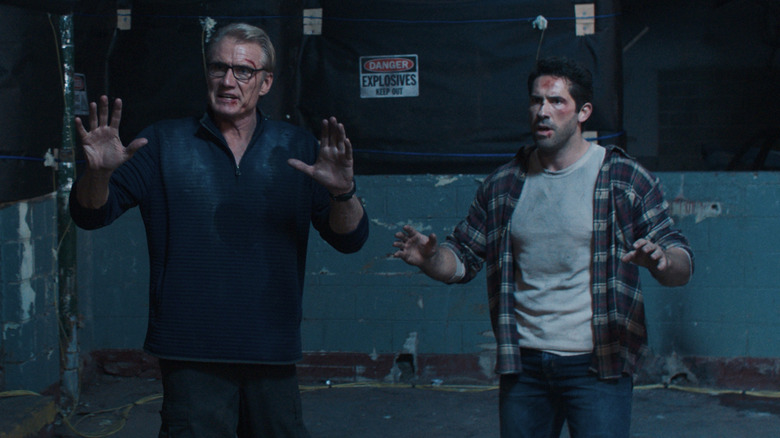
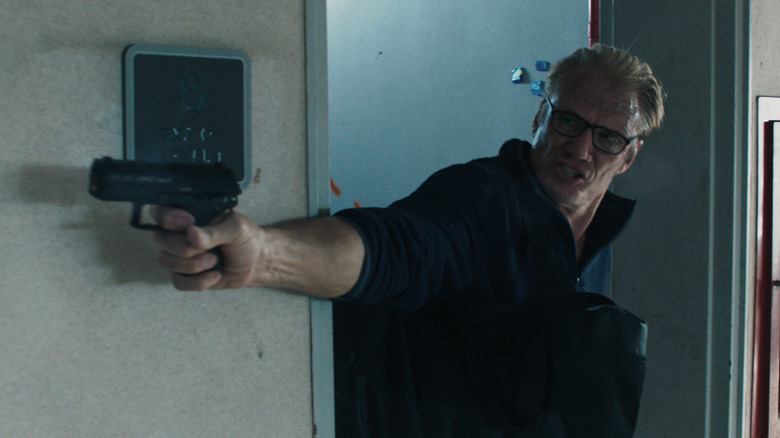
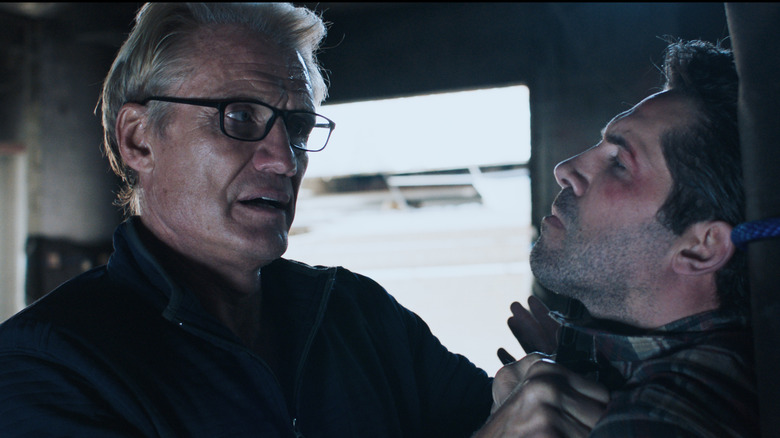
Dolph Lundgren made his name as a physically imposing '80s action hero, but he has been carving out a unique second career for himself, largely with roles in movies like "Aquaman" and "Creed II." And he's also taking an eye towards directing more, resulting in his most recent project, a heist/action flick titled "Castle Falls." This movie unites him with one of cinema's current premier action stars, Scott Adkins. While he may not be a household name, action aficionados are certainly familiar with his work, which ranges from "Accident Man" to smaller parts in major blockbusters like "Doctor Strange."
"Castle Falls" centers on Castle Heights Hospital, which is set to be demolished. However, a select few know that an imprisoned gang leader stashed $3 million in cash he stole from his rivals inside the building. Three different parties want the money, including an ex-fighter (Adkins) who finds it while working as part of the demolition crew, a prison guard (Lundgren) who is willing to do anything to pay for his daughter's cancer treatment, and a ruthless gang of criminals. Let the games begin.
I recently sat down with Lundgren and Adkins in honor of the movie's release this week. We talked about what they both want out of their careers at this point in their lives, some of their upcoming projects (like "Aquaman 2" and "John Wick 4"), and much more.
"I Want To Use That Experience As A Director And See If I Can Find My Own Style."
So Dolph, if I can start with you, you've been acting for a long time and you've done tons and tons of movies, but you're quite a bit more discerning about what you direct. How do you decide what to take on as a starring vehicle versus directing something such as this?
Dolph Lundgren: Well, I've changed a lot over the years. I mean, I took a lot of action movies earlier when I was not really committing a hundred percent as an actor, or there was really no subtext. There was not much going on there dramatically. I was lucky about three or four years ago to start doing movies like "Aquaman" where I was playing a political figure kind of no action, and I had "Creed II." I had some films like that and I decided, well, I want to use that experience as a director and see if I can find my own style or whatever in the kind of movies I like to do. This script came along onto my desk and it was a two-hander, and I wanted to do something with Scott. So he was perfect for the lead, and I thought, "Yeah, let me give it a shot." Of course, it turned out to be much worse than I thought. We got shut down through COVID. Had to shoot the damn thing in 17 days, and eight months later in Alabama. It was a lot of difficulties, but on the whole, it was a satisfying experience, and I think I'll do more things in the future.
Scott, you are very much known as one of our modern leading action men. What was it like being on set with a guy like Dolph, not only acting alongside him, as he's done so much of this, but as a director? What was it like to sort of being able to work with someone in that capacity who's had all that experience?
Scott Adkins: Well, I've done a few films with Dolph before, so we knew each other quite well anyway. Being directed by him, it was a great experience. He let me collaborate very much with the action scenes, which I really appreciated that he truly trusted me to do that. As a director, we went so in-depth on the character to a level that I'd never really been with any other director. We spent hours and hours talking on Skype before we got to Alabama about the character's backstory and all the things like that. It was a really great experience and I really enjoyed it.
You had mentioned, I don't know the exact quote, but I know you had a smaller part in "Doctor Strange" which was one of my favorite superheroes of all time. You had mentioned something about maybe you should have held out for a bigger part in Marvel. At this stage in your career, what sort of things are you looking to do? It seems that you've indicated wanting to take a bit of a different leap.
Adkins: There's many things that I can wish for that maybe Hollywood might give to me. But you can't really wait for those things to happen, right? You got to sort of create your own destiny. So, that's what I'm doing. I'm creative projects for myself. Currently shooting "Accident Man 2," which I've written and [I'm] producing. I'm trying to develop projects that are interesting to me, more character [driven] sort of character action pieces. Hopefully, I can do some bigger movies as well and get an opportunity to play -- well, I think my Marvel card is done, but you know, maybe DC or something. But I would like to hold out for a better part, I should say.
Well, I mean, with the Marvel thing, like Gemma Chan had a small part in "Captain Marvel" and she just led "Eternals." There's no reason you couldn't do the same thing with your character as far as I'm concerned.
Adkins: Well, there you go then. Cool. I'm waiting. [laughs]
"Makes You Feel Young And It Makes You Feel Like You're Alive."
Dolph, as far as going back to you, you mentioned a few years ago that you had a bit of a shift between doing stuff like "Aquaman" and "Creed II." Sort of building on that, at this stage in your career, what keeps you motivated? What makes you still want to get out of bed every day and continue to make movies and keep doing this stuff?
Lundgren: It's the challenge of trying to do things, and try to challenge yourself to do something new or to discover something new in the character, or as a director. Also, I think staying relevant. As you get older, I think it's satisfying as well, to work on things like "Aquaman," which is kind of a family movie, and the fans, a lot of them are young kids. To have an opportunity to do that, I really enjoy it. Makes you feel young and it makes you feel like you're alive. As a director, that's what I'm kind of interested in trying to see where I can go as a director. A lot of it is just instinctual, like "Castle Falls," you just end up doing something you didn't plan it exactly. You didn't know exactly how it was going to turn out, but it comes from the inside and it comes from your dreams, and experience, and whatever it is. It's mysterious, but it's kind of cool to be involved in that creative process.
I know you probably can't say much or anything at all really only because you touched on it. Are we going to see you in "Aquaman and the Lost Kingdom?"
Lundgren: Yeah. I just finished that actually. Shot that in London. I just finished that. It's a really good film. Good script, great people, and good director. I think it's going to be a big, big hit probably
I would assume so. Also you mentioned "Creed II" earlier. Kind of circling back to that same concept, have you seen the new cut of "Rocky IV" that Stallone recently put out?
Lundgren: I haven't seen it yet because I was filming last week. He showed me some clips. It looks good. I mean, he is a smart guy and he has obviously brought something to it. The "Rocky" franchise, it's amazing. It's just one of those creations, like the "[James] Bond" franchise that's just generation after generation. You hear the music and everybody knows what's going on. Whether you're like your 15 years old or 75 years old. I'd love to see the movie. Hopefully, it's got something new and exciting about it.
If I can just wrap up with, what's coming down the pipeline for you guys? What are you working on now? What are you excited about?
Adkins: I got a film called "Day Shift" coming out on Netflix with Jamie Foxx, and then "John Wick 4." I'm currently shooting "Accident Man 2" which is a film I've written and [am] producing. So yeah, plenty coming up.
Real quick. What was it like doing "John Wick 4," man? I'm really excited for that.
Adkins: It was a great, massive fan of Keanu [Reeves], such a nice guy. And I really wanted to work with Chad Stahelski. I think the "John Wick" films are the best action films going at the moment. So very happy to be involved.
Awesome. Dolph, anything you want to talk about?
Lundgren: Well, like you said, I did "Aquaman 2." That's coming out next Christmas. I'm currently shooting "Expendables 4." That's a big action movie with Sly [Stallone] and [Jason] Statham. And we have a few new people, like 50 Cent, and Megan Fox, and Andy Garcia. It's been kinda exciting. Of course, "Castle Falls" is coming in December. I'm in "Minions 2," actually. You know, the yellow little guys running around. I did that and it's coming up this summer. And then I'm going to direct something else, so I'm trying to get that going.
"Castle Falls" arrives in theaters, on digital, and on demand on December 3.
1 ... 2 ... Freddy's coming for you ... and not just within the "A Nightmare on Elm Street" universe. For observant (and dedicated) viewers, it seems that everyone's favorite dream demon may have a connection to those delightfully gruesome deadites from horror maestro Sam Raimi's "The Evil Dead."
Fans of both franchises may have noticed a certain someone's infamous glove appearing in that iconic shed scene in "Evil Dead 2." It's a "blink and you miss it" moment, but there is no doubt. When Ash, played by Bruce Campbell, enters the shed with Linda's head on hand, hanging above the door like some sort of sinister talisman is none other than Freddy Krueger's iconic murder glove.
For many fans, the presence of Freddy's glove has hinted at a possible connection between the worlds of "A Nightmare on Elm Street" and "The Evil Dead," leading to much speculation about how Freddy and Ash could possibly be linked. A few years ago over at Screen Rant, they posited a potential theory that "a still living Freddy had been at the cabin at one point, and possibly used it as a murder location." This is an idea I can sort of get behind, though the shed is definitely a downgrade from Freddy's iconic boiler room. Perhaps the shed was his first hideout before he upgraded his abode to something more steamy and sinister?
Still, there is another theory that is slightly more enticing. It speculates that Freddy is perhaps a deadite himself, brought to life after that fateful reading from the Necronomicon. If this were the case, he'd be a pretty powerful deadite. After all, the ones we are introduced to in "The Evil Dead" tend not to be the sharpest demons in the shed, and Freddy is definitely up there when it comes to malicious intelligence. I mean, he infiltrates your dreams, for gosh sakes. No deadite I've ever known would be capable of that (not that I've known many deadites, but still, Cheryl isn't exactly signing up for Mensa anytime soon).
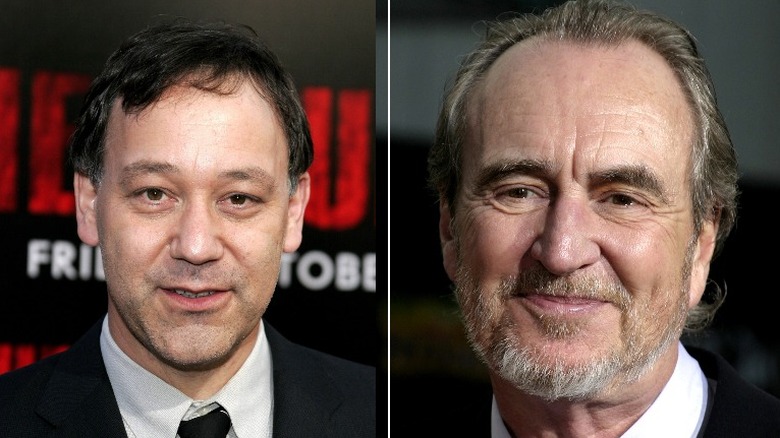
It's a good thing, then, that the folks over at Screen Rant took a moment to review their theory and come up with a new take. It turns out that the glove is nothing more than a fun Easter egg in a long line of Easter eggs traded back and forth between Raimi and Wes Craven throughout their careers.
A Friendly Conversation Between Two Horror Kings
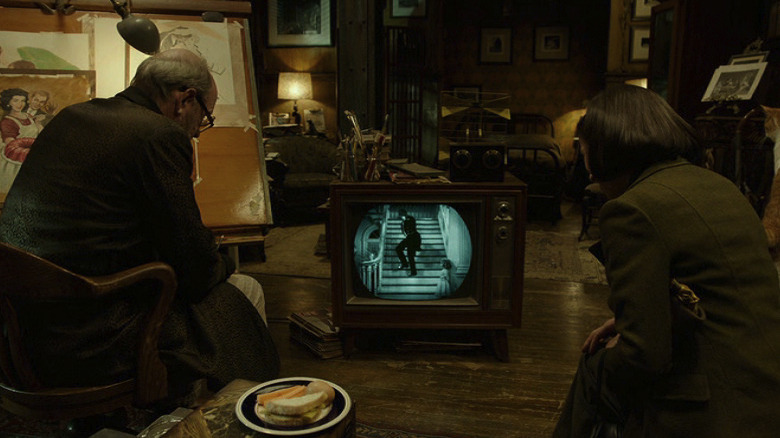
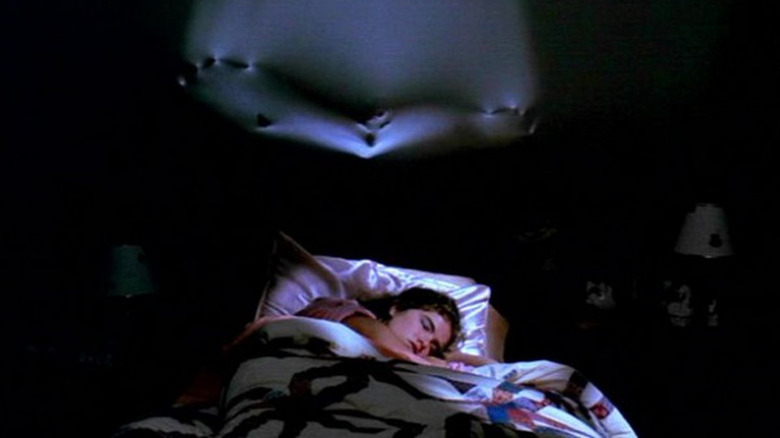
As it was pointed out, Craven also included a nod to "The Evil Dead" in the first "A Nightmare on Elm Street." During a pivotal scene in which Nancy attempts to stay awake for the entire night, she chooses to watch "The Evil Dead" on her bedroom television. Screen Rant notes that "the reason that Nancy is watching 'The Evil Dead' as she tries to stay awake is because the entirety of Raimi's movie takes place in one night. In order to survive the deadites, Ash must survive until dawn, meaning he cannot go to sleep either." This is how the two protagonists become unlikely companions in their separate quests to evade sleep and stay alive. It's a clever nod on Craven's part, but the inclusion of "The Evil Dead" in "Nightmare" also has its roots in a private series of jokes between the two directors.
According to Bloody Disgusting, Craven included a "Jaws" poster in a specific scene in his second film, "The Hills Have Eyes." The poster is of a shark that may or may not be Bruce, and it looks like it's seen better days since it's hanging on the wall with a large chunk of the poster missing. It has been interpreted as a sort of slight to Steven Spielberg, "essentially saying that [Craven's] movie was much scarier than anything on display in Spielberg's hit money-maker." Raimi found this playful sort of visual banter interesting, and he decided to include his own reference to "The Hills Have Eyes" in his film, "The Evil Dead." This decision set off a chain of events that would continue throughout both directors' careers.
It was Craven who next included footage from "The Evil Dead" in the first "Nightmare," which was followed up with Raimi's decision to include Freddy's glove in "Evil Dead II." Neither director had any intention of linking the two universes, but fans will be fans, and as soon as the glove showed up in that deadite-infested shed, the theories started spinning. In the end, the nods are nothing more than two fabulous directors showing a playful appreciation for each other's work, something that continued even after Craven's passing in 2015. "Ash vs. Evil Dead" fans can find Freddy's glove still collecting dust back at that notorious cabin, just waiting for the right person to pick it up and try it on.
Cops love using civil asset forfeiture laws to steal money from innocent people. They get to keep the money to buy fancy militarized armored vehicles and muscle cars with the money and they don't need to bother with arresting the people they legally rob from. — Read the rest
The Grand Theft Auto games are full of jokes - or, as I like to call them, "jokes". I'm referring to the series' habit of replacing words in signs and company names with rude soundalikes or double entendres.
These jokes have been restored by GTA: The Trilogy - Definitive Edition's latest patch, which corrects spelling on signage, puts the hard angles back on the Tuff Nut logo, and stops it raining indoors quite so often.
Good morning everyone, this is the first mod, it is a remastering of the classic version. (I know the DE came out but it still has many bugs and since I developed this mod just 1 year before the remastered version came out, I wanted to share it while the DE bugs are solved). :)
I want to clarify that this is a compilation of mods so I only put them together in the most stable way possible. All credits for mods go to their respective creators.
Enjoy The mod!
Pass: idonthavethemoneysonny021196
Wccf Tech reports a decision for GOG.com to restructure and refocus on a hand-picked selection of games, after poor results in the last quarter.
GOG to Refocus on Core Offering of Hand-Picked Selection of Games After Negative Financial Results
During CD Projekt RED's Q3 2021 earnings call, we learned of major changes coming to GOG....
During CD Projekt RED's Q3 2021 earnings call, president and CEO Adam Kiciński confirmed that both Cyberpunk 2077 next-gen and The Witcher 3 next-gen are on track for their new respective release windows of Q1 2022 and Q2 2022.
During the Q&A segment of the presentation, Kiciński explained why both were delayed out of their original Q4 2021 targets. With Cyberpunk 2077, CD Projekt RED clearly wants to ensure the next-gen version launch will be smooth unlike the original launch on PlayStation 4 and Xbox One consoles. Interestingly, the executive said a set of system-level improvements are also happening with Update 1.5 (due to launch alongside the next-gen version), and that's mostly where the testing is taking place.
The Witcher 3 is different. Due to its relatively old age, CDPR and Saber Interactive (which is leading development on the next-gen ports) want to ensure the newly added technologies like ray tracing won't cause any problems.
As I said during the presentation, the development of both next-gen games is on track to meet their targeted dates. With Cyberpunk 2077, we're currently at the test stage, so we have to be sure that what we are releasing is in a very, very good shape and this requires substantial effort since the next-generation version includes graphical updates exploiting the potential of the new consoles along with a set of system-level improvements. I'm talking about systems that are general to the game, not a revolution, but still, they can interact with other systems so we have to be sure that there is no regression whatsoever and mostly for this, we need some extra time for testing.
With The Witcher 3 next-gen, the situation is a bit different. The next-gen version is being developed by our trusted partner Saber Interactive, of course in collaboration with us, and as The Witcher 3 was originally released almost seven years ago, of course technology has rapidly advanced since then and new solutions have emerged, some of which the original game was lacking them, like ray tracing. This is a purely technical update, there is a small pack of DLCs but we are working mostly on technical things and as we are talking about new technologies that need to be applied to the fairly old game, it turned out that we need a bit more time for this technical task.
Later in the Q&A section, Kiciński also answered a question regarding the likelihood of Cyberpunk 2077 joining subscription services such as Microsoft's Game Pass or Sony's PlayStation Now. It may happen, he said, but not until much later.
We always consider any business opportunity, but this kind of subscription model is good at a certain moment of the life cycle of the product, so not too early. The Witcher 3 was available for some time with those subscriptions, but we have to weigh the benefit and cost each time, we have to compare it to sales and so it's rather a decision based on data. It's way too early for Cyberpunk 2077.
CD Projekt RED is also working on the Cyberpunk 2077 expansion, but no details were provided with regards to its scope or release window.
Anachronox, Ion Storm's attempt at creating a Western JRPG and a bit of a cult classic these days, is positioned as the main focus of this Vice retrospective. However, the article really is more about the Dallas branch of Ion Storm, its history, and the people involved in this disaster of a studio that also produced the infamous Daikatana.
Here's a couple of sample paragraphs to get you started:
In keeping with the general Ion Storm model, the Anachronox team never consisted of more than 13 relatively inexperienced developers.
“I'm pretty sure it was like, we'll hire you if you play Chrono Trigger,” remembers programmer Joey Liaw, who joined the Anachronox team when he was still a teenager. Squirrel Eiserloh, the lead programmer, had a background in Doom mods. Jake Hughes was in California building spaceships for Paul Verhoeven’s Starship Troopers when he got a call to join Ion Storm as an associate producer.
“I'm not sure… they necessarily knew what a producer in a video game company was supposed to do,” says Lee Perry, Anachronox’s art director. Perry, with a couple years in art teams, ranked amongst the most experienced of his colleagues, along with programmer Henrik Jonsson, who was 26.
Hughes didn’t know either. He was responsible for pulling together Hall’s vision in a design document. “Which in hindsight, was not a very good idea, because I didn't know what a design doc was,” he says. “[But from that, it was clear] we were not going to be able to do this game in a year and a half. I looked at it, and I'm like, this is crazy, there's no way.”
During CD Projekt RED's Q3 2021 earnings call, we learned of major changes coming to GOG.com after the digital store owned by the Polish company posted negative results in the last quarter (net profit was down by $1.15 million). Chief Financial Officer Piotr Nielubowicz said there will be some restructuring and a renewed focus on offering a hand-picked selection of games.
Regarding GOG, its performance does present a challenge. Recently we've taken measures to improve its financial standing. First and foremost we've decided that GOG should focus more on its core business activity, which means offering a hand-picked selection of games with its unique DRM-free philosophy. In line with this approach, there will be changes in the team structure. Some GOG developers who have already been working on GOG's online solutions mainly by the studio will transfer away from the project.
Furthermore, at the end of this year, GOG will leave the GWENT consortium. This means that it will neither bear its portion of expenses nor obtain the corresponding share of revenues associated with this project. Alongside all these changes we initiated through organization of GOG's operations, we believe that all of the changes we are introducing will allow GOG to focus more on its core business and improve its financial effectiveness in 2022.
As you probably already know, GOG stands for Good Old Games. CD Projekt RED launched the digital store back in 2008 with the specific goal to provide DRM-free versions of classic games. Over time, though, the store grew to be much larger and more akin to competitors like Valve's Steam, featuring regular new game releases, too.
It seems like the latest financial results have persuaded the Polish company to scale back this enterprise and focus once again on what made GOG special in the first place.
PETA's not new to outlandish and sometimes-offensive publicity stunts (remember when they claimed milk caused autism?). The group's latest is a satirical online store selling goods made of "human" leather. Called "Urban Outrage," it features belts, skirts, and other "The Silence of the Lambs"-type products. — Read the rest
After graduating in Rome, Nicolas Gentile realised that big city life was not for him. He came back to his hometown on the hills of Abruzzo and decided to build his shire to live like a real-life hobbit.
This might be the most perfectly English horror movie setup imaginable. On Friday, November 26, 60-or-so people went to the Tan Hill Inn in Yorkshire — the pub with the highest elevation in Great Britain, at 1,732 feet above sea level — to see an Oasis tribute band. — Read the rest
The US scientists who created the first living robots say the life forms, known as xenobots, can now reproduce -- and in a way not seen in plants and animals. CNN reports: Formed from the stem cells of the African clawed frog (Xenopus laevis) from which it takes its name, xenobots are less than a millimeter (0.04 inches) wide. The tiny blobs were first unveiled in 2020 after experiments showed that they could move, work together in groups and self-heal. Now the scientists that developed them at the University of Vermont, Tufts University and Harvard University's Wyss Institute for Biologically Inspired Engineering said they have discovered an entirely new form of biological reproduction different from any animal or plant known to science.
[T]hey found that the xenobots, which were initially sphere-shaped and made from around 3,000 cells, could replicate. But it happened rarely and only in specific circumstances. The xenobots used "kinetic replication" -- a process that is known to occur at the molecular level but has never been observed before at the scale of whole cells or organisms [...]. With the help of artificial intelligence, the researchers then tested billions of body shapes to make the xenobots more effective at this type of replication. The supercomputer came up with a C-shape that resembled Pac-Man, the 1980s video game. They found it was able to find tiny stem cells in a petri dish, gather hundreds of them inside its mouth, and a few days later the bundle of cells became new xenobots.
The xenobots are very early technology -- think of a 1940s computer -- and don't yet have any practical applications. However, this combination of molecular biology and artificial intelligence could potentially be used in a host of tasks in the body and the environment, according to the researchers. This may include things like collecting microplastics in the oceans, inspecting root systems and regenerative medicine. While the prospect of self-replicating biotechnology could spark concern, the researchers said that the living machines were entirely contained in a lab and easily extinguished, as they are biodegradable and regulated by ethics experts. "Most people think of robots as made of metals and ceramics but it's not so much what a robot is made from but what it does, which is act on its own on behalf of people," said Josh Bongard, a computer science professor and robotics expert at the University of Vermont and lead author of the study, writing in the Proceedings of the National Academy of Sciences. "In that way it's a robot but it's also clearly an organism made from genetically unmodified frog cell."
"The AI didn't program these machines in the way we usually think about writing code. It shaped and sculpted and came up with this Pac-Man shape," Bongard said. "The shape is, in essence, the program. The shape influences how the xenobots behave to amplify this incredibly surprising process."
James Rundle writes via the Wall Street Journal: A few years ago, executives at Intel began to realize they had a problem. The company was making dozens of new products each year, from chips to software platforms, but it didn't have a formal method for cataloging and storing older technology so engineers could test it for security flaws. [...] Intel's answer to this conundrum was to create a warehouse and laboratory in Costa Rica, where the company already had a research-and-development lab, to store the breadth of its technology and make the devices available for remote testing. After planning began in mid-2018, the Long-Term Retention Lab was up and running in the second half of 2019. The lab gives Intel, which is based in Santa Clara, Calif., and has more than 100,000 employees, a centralized, secure location where security tests can be run from anywhere in the world. Access to the building is strictly controlled and approved by senior managers, while surveillance cameras watch the equipment at all times. Even its location is secret -- Intel representatives declined to say where exactly it is.
The lab brings commercial value to Intel, [said Mohsen Fazlian, general manager of Intel's product assurance and security unit.], citing company research that shows customers are more likely to buy technology from manufacturers that proactively test their products. [...] The lab has changed Intel's product development. All new technology is now built with the facility in mind, with technical documentation created to allow engineers to support it for up to 10 years, and units are sent to the lab before they are released, Mr. Fazlian said. "Hopefully, I will never find myself searching eBay for Intel hardware again," he said.
GamesIndustry.biz has the latest financial reporting from CD Projekt. Word is: "The company reported total revenues up 38% to PLN 144 million ($34.7 million), while net profits were down 30% to PLN...
Death, taxes, and the inability to please everyone with an adaptation of a popular story. You can always count on these certainties in life, but that last one takes on even further complications when you're talking about the actual author of the original story. Though it's worth remembering that it took a little time to fully catch on in the early going, "Games of Thrones" eventually transformed into a pop culture juggernaut that had fans taking in every new episode during watch parties or bars as if it were a Super Bowl-sized event. Based on George R.R. Martin's "A Song of Ice and Fire" novels, the violent, no-holds-barred HBO series attracted millions of viewers right up until the final seconds of its wildly divisive final season.
But for some, the signs that "Game of Thrones" had lost its way began to show far earlier than that. According to an excerpt from a new book, George R.R. Martin apparently first started to feel uneasy about the direction the show was taking as soon as season 5.
A War Of Words
Anyone tasked with guiding "Game of Thrones" from beginning to end had to have expected a daunting hill to climb. But as creators of the hit series, David Benioff and D.B. Weiss' jobs couldn't have been any easier with the knowledge that the legendary author of the original series intently watched every step they took along the way. Though publicly he remained diplomatic in his many blog posts over the years during the show's run, a new revelation by his representative is now shedding light on the fact that Martin counted himself among those who were disappointed in the direction that the series eventually took.
According to the popular fan blog Winter Is Coming (via Screen Rant), a new book titled "Tinderbox: HBO's Ruthless Pursuit of New Frontiers" includes a chapter focused on the sensation of "Game of Thrones." Paul Haas, Martin's representative, had this to say about the author's thoughts on the series.
"George loves Dan and Dave, but after Season 5 he did start to worry about the path they were [going down] because George knows where the story goes. He started saying, 'You're not following my template.' The first 5 seasons stuck to George's roadmap. Then they went off George's roadmap."
To be entirely fair, it should be noted that "George's roadmap" wasn't actually completed while Benioff and Weiss were working on bringing the show to its end -- in fact, well over two years since the "Game of Thrones" series finale, the last two planned novels in "A Song of Ice and Fire" still aren't completed. At the same time, it's also fair that the original author would have reservations about the show's much, much different approach to the same material over time. The end of season 5 and the beginning of season 6 marks the point where "Game of Thrones" began to lose me, personally ... but the equivalent marker points in the books (particularly "A Feast for Crows" and "A Dance with Dragons") aren't without their own flaws and shaggy storytelling, as well.
The full report is worth reading, particularly for its seeming contradiction of information regarding what Martin told Benioff and Weiss about his plans beforehand, but it's clear that the saga (controversy?) of "Game of Thrones" isn't going anywhere anytime soon. HBO, meanwhile, is moving forward with its spin-off series "House of the Dragon," premiering sometime in 2022.
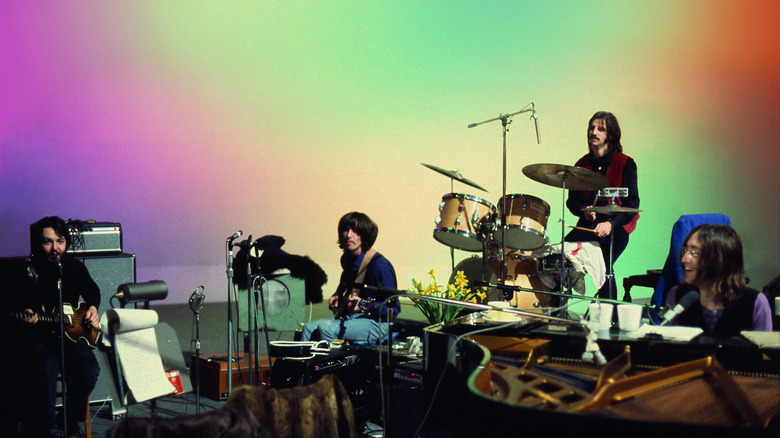
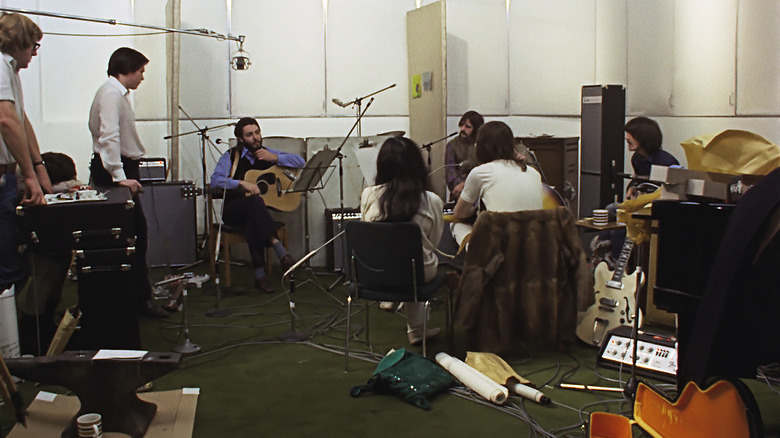
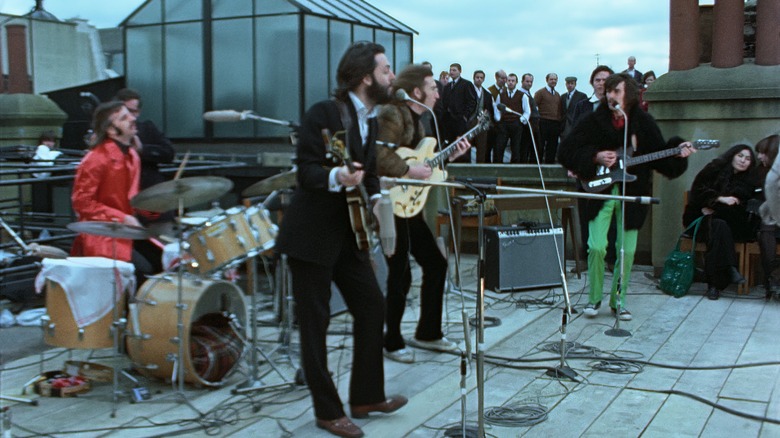
"The Beatles: Get Back," Peter Jackson's eight-hour documentary that pieces together footage and audio recording during the making of the documentary and album "Let It Be," absolutely rules. Even if you're not a huge Beatles fan there's something special about watching these four guys sit around creating music. Jackson and his team took great pains to remaster and restore the footage. Some people have actually taken issue with this – Jackson's work has, in some cases, created almost a motion-smoothing-type effect, and more than a few viewers have expressed a wish that Jackson had simply left the film's grain intact.
But Jackson made a deliberate choice here. The filmmaker wanted to create an experience that felt like the audience was literally in the studio with the Fab Four watching them work, and he felt that any presence of grain would break that illusion. Another thing that might've broken that illusion: bleeping out all the curse words. According to Jackson, Disney really wanted him to cut out all the swearing before the three-part docuseries aired on Disney+. But according to Jackson, it was the surviving Beatles themselves who shot down that idea.
That's How We Talked
Disney likes to bathe itself in a family-friendly sheen, which means their original content shies away from anything too adult. When the filmed version of "Hamilton" came to Disney+, the majority of the curse words peppered throughout the award-winning musical were cut. But that's not what happened with "The Beatles: Get Back," Peter Jackson's wonderful docuseries that showcases the Beatles as they work on what would become their final album, "Let It Be."
The doc has the Beatles sitting around working out songs, and that process involves a lot of banter. And a lot of that banter involves cursing. And according to Peter Jackson, Disney wasn't too keen on that. "Disney wanted to remove all the swearing and Ringo, Paul, and Olivia [Harrison] said: 'That's how we spoke. That's how we talked. That's how we want the world to see us,'" Jackson told NME, adding:
"Paul [McCartney] describes it as being very raw. He said to me: 'That is a very accurate portrayal of how we were then.' Ringo [Starr] said: 'It's truthful.' The truthfulness of it is important to them. They don't want a whitewash. They don't want it to be sanitized."
While Disney doesn't seem like the type of gigantic company that rolls over for people, it's clear that the House of Mouse wasn't willing to say no to the Beatles, and thank heavens for that.
No Notes
In the same interview, Jackson also revealed that when he showed the surviving Beatles the final docuseries, they didn't ask him to change anything – which Jackson wasn't expecting. "When they got to see the finished thing, I was expecting notes. It would've just been normal to get a note saying: 'Oh, that bit where I say that — could you cut that out?' Or 'Could you shorten the conversation there?' And I didn't get a single note," Jackson said, continuing:
"Not one request to do anything. One of them said that they watched it and found it one of the most stressful experiences of their entire life. 'But I'm not gonna give you any notes.'"
Again: good. "Get Back" definitely does not try to sanitize things, nor does it attempt to only portray the Beatles in a positive light. Indeed, the very nature of the docuseries focuses on how this is more or less the end of the road for the band, and to portray that disintegration in an overly cheerful, sanitized light would've been weird.
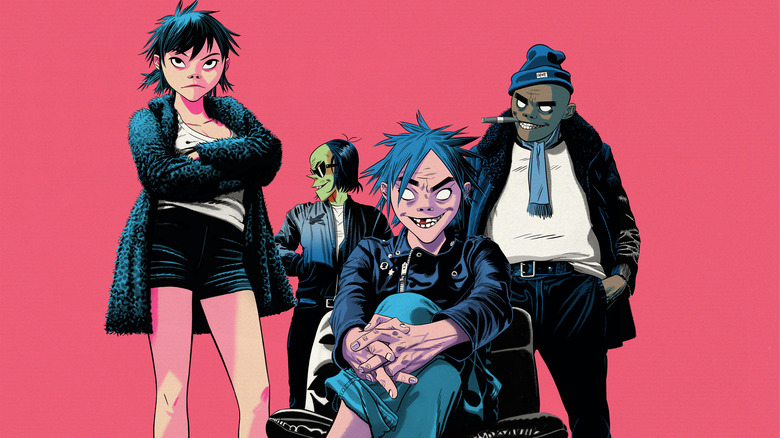
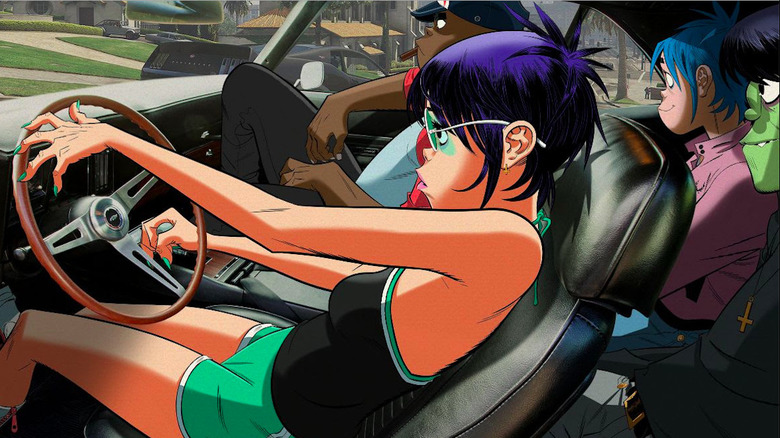
They've been one of the coolest animated bands for more than 20 years, with seven studio albums, a web series, and a crossover with "The Powerpuff Girls." Now, Gorillaz is getting a movie. The animated avatars who represent the real-life band have a complicated history that super-fans have tracked from their self-titled debut, but the movie will expand their stories into a feature-length narrative.
The Band Behind The Band
According to the Damon Albarn Unofficial Twitter account (by way of ComicBook.com), a recent interview with the Gorillaz band member Albarn shared the news that Netflix has greenlit a "full-length Gorillaz film," and that the band is currently in the process of writing the movie.
Albarn, formerly of the Britpop band Blur, created Gorillaz with artist and musician Jamie Hewlett in 1998. Hewlett designed the characters for the band using the signature cartooning style he developed on his seminal comic series, "Tank Girl." Producer Remi Kabaka Jr. joined later, and over the years Gorillaz have collaborated with numerous other recording artists ranging from Mos Def to Danger Mouse. They even had Dennis Hopper record a lengthy voiceover for a track on their second album, "Demon Days."
The fictional band is comprised of lead singer 2-D, bass player Murdoc, drummer Russel, and lead guitarist Noodle. For awhile their bassist was Ace, the leader of the Gangreen Gang from "The Powerpuff Girls," while Murdoc was in prison, though Murdoc has since rejoined the band. Noodle was also briefly replaced with a cyborg version of herself.
As I said, there's a very complicated history to these cartoon musicians.
An Eclectic Movie For An Eclectic Band
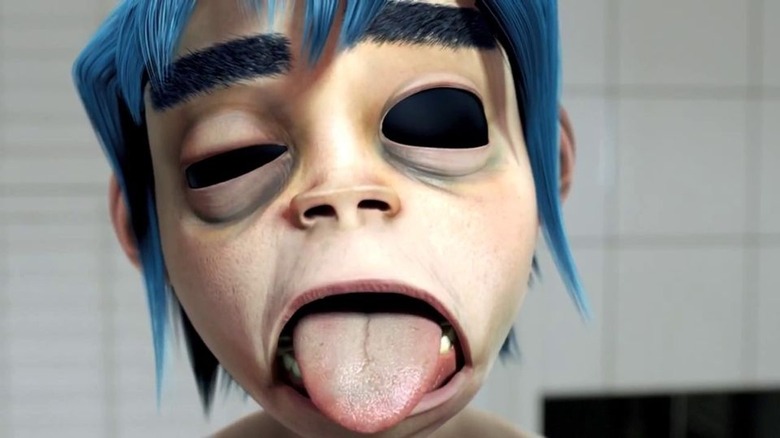
Gorillaz have played with a lot of different musical styles over the years, and the way they've been represented in their music videos has been just as varied. The characters stay the same, but they've been animated in a slew of different styles, including the photorealistic computer-generated "Do Ya Thing" video that shoots past the Uncanny Valley and straight into our nightmares. The 3-D version of 2-D was also joined by Bruce Willis in the crazy cool "Stylo" music video, which might be the wildest combination of cartoon and celebrity cameo this side of that music video with Paula Abdul and a cat.
Hopefully, Hewlett gets a chance to shine, as his animation is truly gorgeous and deserves a much wider audience. The best way to stay true to Gorillaz's eclectic roots might be to go with an anthology, changing animation styles between stories or character perspectives. Whatever they decide to do, it will be a blast seeing Gorillaz grooving on our screens courtesy of Netflix.
Apple announced the new 14-inch and 16-inch MacBook Pro models not so long ago. While the design can be considered a major upgrade, the new M1 Pro and M1 Max chips in the MacBook Pro models feature enhanced performance capabilities and battery life. Following the jump, several tech companies have started to roll out the new powerful machines to their engineers. A Reddit engineer explains how the new M1 Max MacBook Pro will save developers time as well as money. Scroll down to read more details on the subject.
Reddit User Explains How the New M1 Max MacBook Pro Will Save Developers Time and Money
A Reddit staff engineer Jameson Williams shared extensive details on how the new MacBook Pro will bring improvements to the company. In terms of hardware, the addition of more ports will enhance productivity while saving time. Moreover, conjoined with the improved processing power, the new M1 Max MacBook Pro is sure to accomplish tasks more quickly. Williams explained that upgrading nine engineers with the latest MacBook Pro will cost $32,000 and the break-even point would be reached in just 3 months.
In a later post, Williams stated that Reddit has observed the new MacBook Pro finishing a clean build of the Reddit app for Android in half the amount of time it would take on a 2019 Intel Core-i9 MacBook Pro. The clean build of the Reddit app for iOS will take even less time in comparison.
The basic premise of the tweet was to weigh the up-front cost of buying some new laptops, alongside the opportunity cost of not doing so. In other words, I wanted to compare these two formulae:
Net Cost ($) with 2019 i9 MBP =
(No upfront cost) + (Time lost waiting on builds with 2019 MBP) * (Hourly rate of an Engineer)
And
Net Cost ($) with 2021 MBP =
($31.5k up-front cost) + (Time lost waiting on builds with 2021 MBP) * (Hourly rate of an Engineer)
To start, I estimated that an average Android engineer spends 45 minutes waiting on builds each day. (More about this later.) My colleagues and I then benchmarked our builds on some different hardware. We observed that the new 2021 M1 Max MacBook finished a clean build of our Android repo in half the time of a 2019 Intel i9 MacBook. That means an Android developer could save about 22 minutes of build time every day.
The extensive post is a good read for companies as well as individuals who are looking to upgrade to the new M1 Pro or M1 Max MacBook Pro models. We will share more details on the performance of the chips as soon as we have further information on the subject.
What are your views on the subject? Let us know your insights in the comments section below.
While nothing has been confirmed yet, it looks like Apple is planning to eliminate the Lightning port. Reputable sources are speculating that the tech giant will release a portless iPhone next. Without a doubt, it’s an intriguing prospect; one that may even have advantages. But on closer examination, I think it would be a disastrous move.
When Prince changed his name to a signature glyph in 1993, Warner Brothers issues a 3.5-inch floppy with the symbol as a font so that print publications could use it instead of saying "the artist formerly known as Prince."