 |
[link] [21 comments] |
Ronald.phillips
Shared posts
02 Dec 23:03
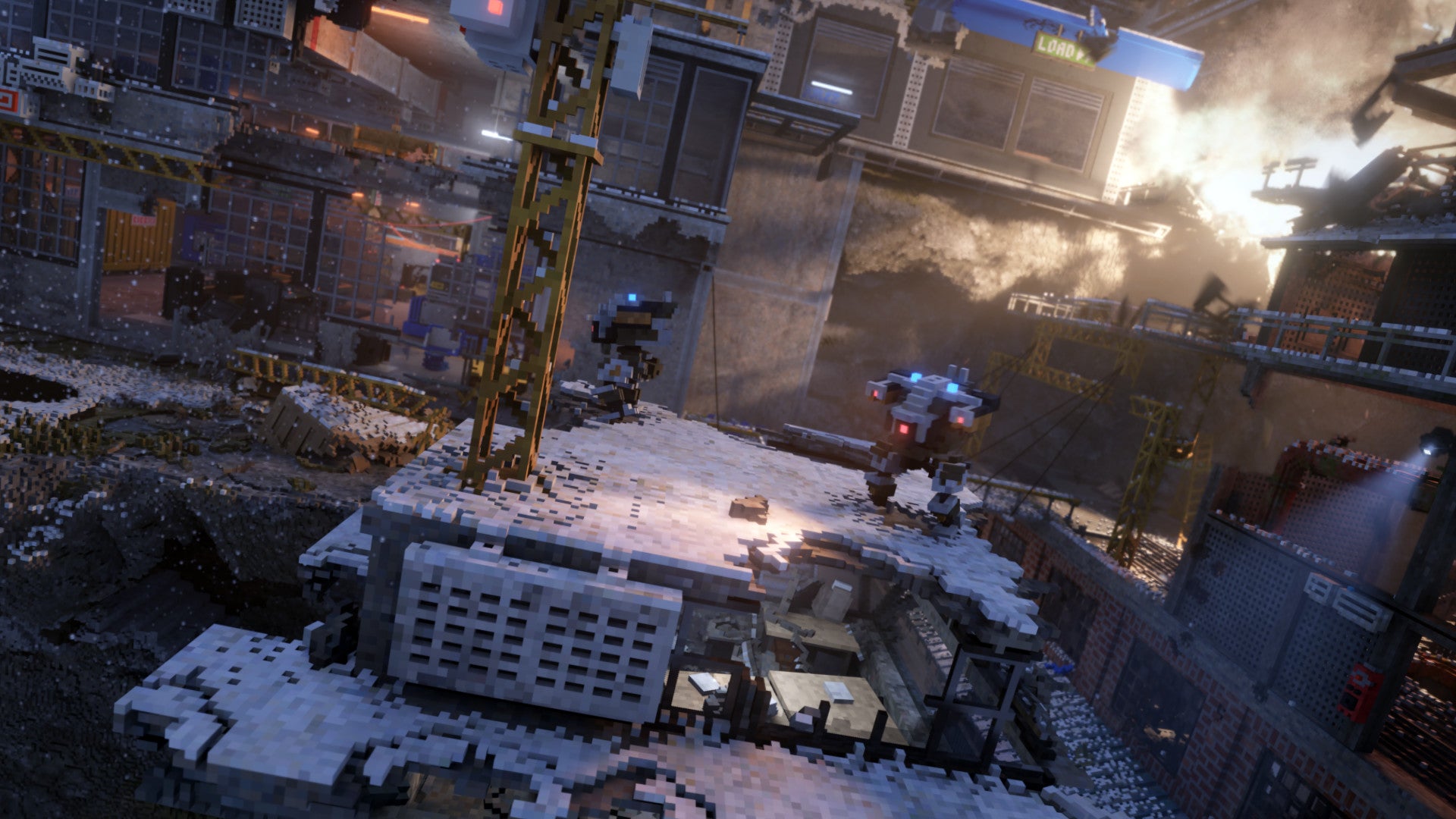


Teardown part two is out now, completing its campaign
by Graham Smith
Teardown is maybe my favourite game from the past couple of years, and today it smashed through another wall on the way to being finished. The newest update adds "part 2", completing its campaign by adding new missions and maps - as well as robots and mod tools.
02 Dec 23:03
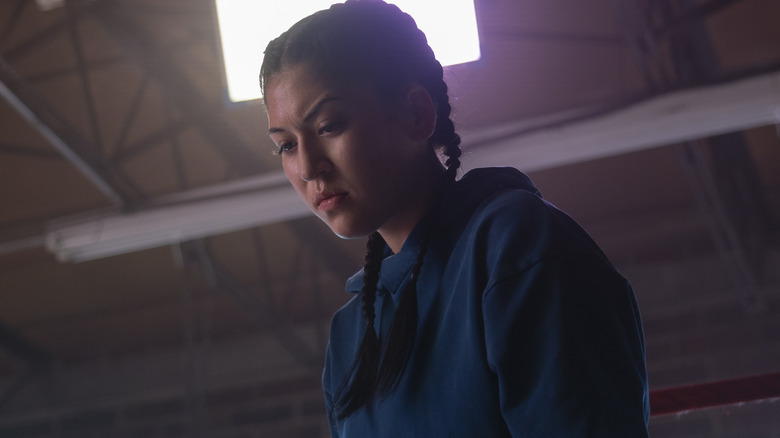
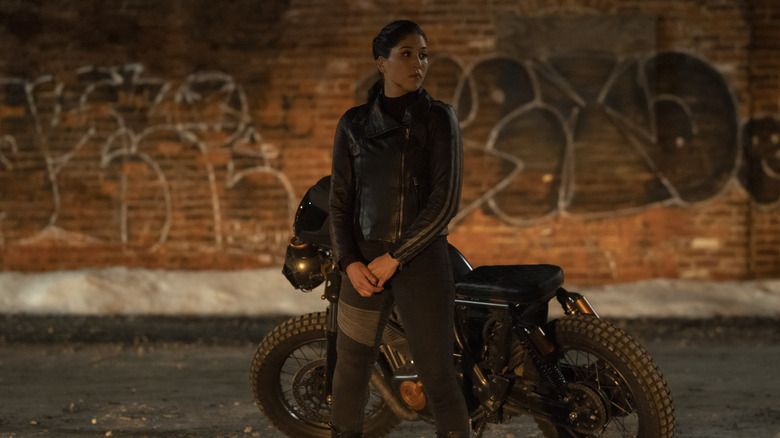
Hawkeye Actors Learned Basic ASL To Make Alaqua Cox Comfortable On Set
by Jenna Busch
Marvel's Disney+ series "Hawkeye" is halfway done, and at the end of the second episode we were introduced to Maya Lopez, aka Echo, played by Alaqua Cox. In episode 3, "Echoes," we got to know a bit of Maya's backstory and see her interact with Hawkeye (Jeremy Renner) and Kate Bishop (Hailee Steinfeld). Obviously there are some spoilers ahead for the third episode, so be warned.
In "Echoes," we learn that Maya has been Deaf since she was little. Cox is Deaf as well, and spoke about how the cast learned some American Sign Language (ASL) to welcome her to the cast. Cox was interviewed for Disney's D23 magazine (via The Direct) and said:
"It was such an honor to work with them both. I think they are spectacular actors, and I have learned a lot from watching them work behind the scenes ... I remember meeting Jeremy on my first day of work on-set; I was a nervous wreck, as this was my very first acting job. He then complimented me in American Sign Language (ASL), which comforted me. Hailee also spelled out her name to me in ASL at the studio where we were doing our stunt training sessions. I thought it was sweet of them putting in efforts to learn basic ASL to communicate with me. It means a lot to me as a Deaf person."
ASL In The Marvel Universe
A little background on Maya Lopez. First of all, we know that her character is getting her own series on Disney+. In the "Hawkeye" series, her beloved father (the incredibly expressive Zahn McClarnon) is killed by Ronin. We don't know if that was indeed Hawkeye in the Ronin suit during his dark years after the Blip, or if it was someone else, but what's important is that Echo thinks it is. She grew up Deaf with a very loving father who taught her to fight and encouraged her to thrive in the world. Echo has made her way up to the top (almost) of the Tracksuit Mafia. Though many of those "bros" haven't learned ASL, her father knew it, and one of her generals, Kazi (Fra Fee) does as well. Hawkeye, who has lost a lot of his hearing from many battles and explosions (and a painful incident in the Matt Fraction comics) knows a little as well.
This is the second time we've seen a Deaf actress in the Marvel universe. In this year's "Eternals" movie, we had Lauren Ridloff playing Makkari. It's a lovely thing to see. By the way, there are a whole lot of indications that Maya's boss/"Uncle" in the Tracksuit Mafia is none other than Kingpin, brilliantly played by Vincent D'Onofrio in the Netflix "Daredevil" series. If he does show up (as reluctant as I am to speculate after the whole "WandaVision"/Mephisto theory debacle), I bet Wilson Fisk knows ASL as well. He does things for the people he loves, despite what he does to everyone else. Either way, it's a wonderful thing.
"Hawkeye" episode 4 will release Wednesday, December 8 on Disney+.
Read this next: Every MCU Post-Credits Sequence Ranked From Worst To Best
The post Hawkeye Actors Learned Basic ASL to Make Alaqua Cox Comfortable on Set appeared first on /Film.
Ronald.phillips likes this
02 Dec 23:02
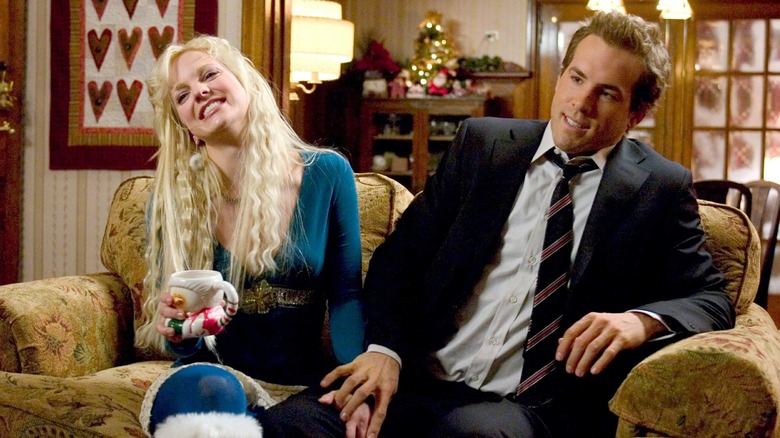

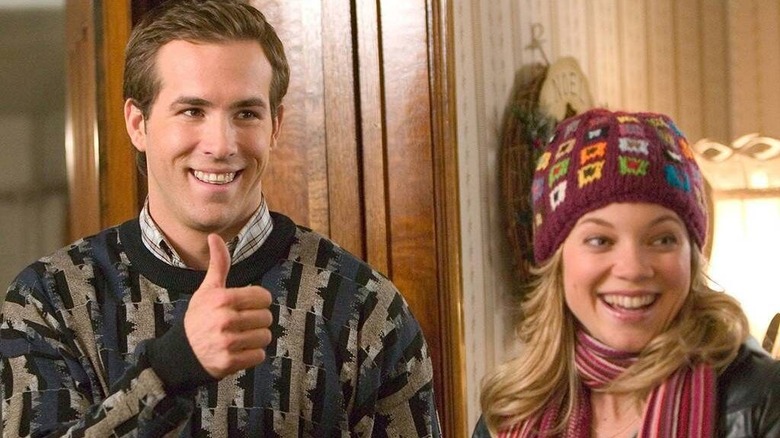

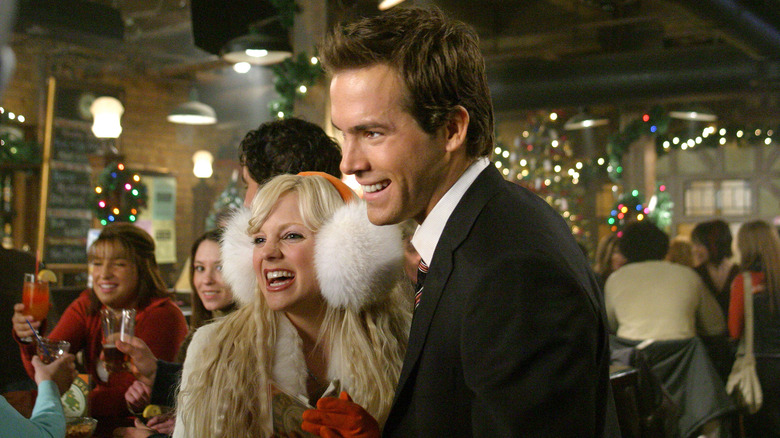
The Daily Stream: Just Friends Perfectly Captures The Weirdness Of Going Home For The Holidays
by BJ Colangelo
(Welcome to The Daily Stream, an ongoing series in which the /Film team shares what they've been watching, why it's worth checking out, and where you can stream it.)
The Movie: "Just Friends"
Where You Can Stream It: Netflix
The Pitch: A decade earlier, Chris Brander (Ryan Reynolds) was a fat, retainer-wearing high school senior relentlessly bullied by his New Jersey peers, and struggling to tell his best friend Jamie (Amy Smart) that he's always loved her. After Chris' attempt to tell Jamie the truth about his feelings blows up in an excruciating humiliation at her graduation party, Chris leaves Jersey and completely changes himself out of spite. Now, Chris is an unrecognizably hot, highly successful, sardonic, and womanizing music executive from Los Angeles.
Just before Christmas, Chris finds himself unwittingly returning to his hometown after his ex-girlfriend, the delusional and unhinged pop megastar Samantha James (Anna Faris), forces a private jet to land in New Jersey after starting a fire by putting tin foil in the plane's microwave. New Chris is now back in Jersey, sleeping in his childhood room, and realizing that now might be his last chance at telling Jamie how he's always felt, hoping to finally make her his girlfriend after an adolescence of living in "the friend zone."
Why It's Essential Viewing
Modern Christmas movies get a lot of flack, especially Christmas rom-coms which at this point are probably written by bots forced to consume Hallmark Channel originals for 30 days, which means "Just Friends" is frequently pushed aside as being "just another Christmas rom-com," when the conversation that should be had is how "Just Friends" is the best Christmas rom-com. It takes the formula of "hotshot city guy visits hometown and finds out home is where the heart is" but actually explores how that realization comes to be. Chris isn't like the protagonists of Hallmark Christmas love stories where a successful woman in a liberal field gives it all up to open a hardware store with her once-upon-a-time prom date who exclusively wears plaid; he's a former bullied teen who lost his identity in the process of trying to outshine everyone who made fun of him. Chris' visit home is just as much about him learning to love himself as it is admitting his love for Jamie.
In Los Angeles, Chris can get any girl he wants by simply name-dropping all the famous people he's worked with, but none of that macho peacocking works on Jamie, who deep down, has always loved Chris too ... but the real Chris. Not the Chris who sits next to P. Diddy at the Grammys; the Chris who loves snow globes, his mother's cooking, making funny voices with his best friend, goofin' on his brother, and lip syncing to All-4-One when he thinks no one is watching.
'Forgiveness Is More Than Saying Sorry'
I've seen plenty of people lament "Just Friends" for putting "the friend zone" into the lexicon of pop culture, but I'm always increasingly annoyed when yet again, people refused to hear what the movie was actually saying and instead just took from it what they wanted. Sure, "Just Friends" deals with the idea of the friend zone, but it also completely dismantles the concept and includes Jamie publicly calling out how disrespectful it is to believe being kind to someone entitles you to sex or a relationship and tells Chris to "grow up." THE FRIEND ZONE ISN'T REAL, Y'ALL. This maturity enhances the romance plot, and offers a depth that other Christmas rom-coms can't compete with.
Chris fails constantly trying to impress Jamie, and it's because he's still trying to follow the so-called "rules" of dating that teach men women are prizes to be won and there's a game to be played in favor of just, you know, getting to know someone and being yourself. Chris only gets the girl in the end because he gets sent packing and for the first time in his life, actually does the work of self-actualization and recognizes that he's gotta stop lying to himself about who he really is. Existing to obtain the instant gratification of being able to one-up the jock who bullied him in high school as an adult is no way to live, and if Chris wants to be with Jamie, he needs to own up to his mistakes, apologize for being a huge douche, and finally be honest with her.
'You'll Always Be Fat To Me, Chris'
Going back to your hometown is a staple in Christmas movies, but few ever acknowledge the awkward universe you step into by going "home." It's a hodgepodge of conflicting emotions and no matter how long it's been since you've visited, there's always a lingering sense of infantilization that occurs. It's like everyone you ever knew can only see you as who you were the last time they saw you — like the living embodiment of Ralphie's aunt in "A Christmas Story" still believing him to be a toddler and gifting him accordingly. For Chris, his bedroom still being adorned with high school polaroids, the waitress at the diner still remembering his old order, and Jamie's dad still going way, way too hard with the Christmas decorations. These weird quirks, regardless of the emotions they elicit, are what make it feel like home.
The moments Reynolds shares with his younger brother Mike (Chris Marquette) are some of the best, as the two still fight and bicker the way all siblings do, and constantly dig at each other's insecurities in a way that's only acceptable if it comes from your little brother. "You'll always be fat to me, Chris," Mike says.
Okay, Yes. Let's Talk About The Fat Suit
This film is also notorious for its opening scene (and end credits extension) that feature Ryan Reynolds as the fat, teenage version of Chris Brander singing "I Swear" by All-4-One in what is largely considered to be one of the most ridiculous fat suits ever put on screen. As a fat person, I have a big problem with actors using fat suits for a multitude of reasons that could constitute their own article, but the only fat suit I've never had an issue with has always been Ryan Reynolds' in this movie, because it's so laughably terrible.
I recognize that the probable intention was trying to get people to laugh over the ridiculous possibility that someone known for being sexy and shredded would ever be fat, but nothing about the fat suit he wears is within the realm of possibility and looks like a child's drawing of what they think a fat body looks like. The unfortunate reality is that the marketing for the film played into the fat suit SO HARD but in the world of the film, the punchline is not that Chris is fat, the punchline is that high schoolers are a-holes. Chris is just a fat kid living his life and owning the crap out of his lip-sync. The people who make fun of him for what he looks like are not heroes, they're all jerks, and they're just jealous they don't have a fraction of his charisma even while fat.
It's Anna Faris At Her Best
"Just Friends" nails the romance plot, but it's also one of the few rom-coms that's legitimately really f***ing funny. Anna Faris as the manic pop star Samantha James is, with no exaggeration, one of the best comedic performances of the 20th century. Hell, The Academy (as in the people who choose THE FRIGGIN' OSCARS!!!!) dedicated an appreciation post to her work as Samantha James just this week because apparently this is one of the few times The Academy and I agree on something.
Farris' commitment to her roles is already well known, but there's absolutely no one else who could have pulled off Samantha James. The control she has over her vocal inflections, the animation of her facial expressions, and her willingness to eat and subsequently drool out an entire tube of toothpaste onto herself is absolute gold. The film is filled with an exceptional supporting cast, but Anna Faris is on a completely different level. For all of the heartfelt messaging hidden in Chris' journey in "Just Friends," the movie belongs to Samantha James.
This holiday season, give yourself the gift of "Just Friends." Shakes come and go, but friends are "furrr-ever."
Read this next: The Daily Stream: A Very Ghoul Log Christmas Is The Cinematic Event Of The Holiday Season
The post The Daily Stream: Just Friends Perfectly Captures The Weirdness of Going Home for the Holidays appeared first on /Film.
Ronald.phillips likes this
![[GOG] (Game) Crime Cities](https://external-preview.redd.it/YbQknHG5JR72I77b0B0Ym7bnV7V0qgjNNrfZbwrENMk.jpg?width=640&crop=smart&auto=webp&s=732d510b27ac12084700a8965ad41a77fa0d22fd "[GOG] (Game) Crime Cities")
02 Dec 20:44



Sharp Objects Ending Explained: The Truth Hurts
by Lindsay Duke
Raise your hand if you're still angry that neither Amy Adams nor Patricia Clarkson won an Emmy for their work on the HBO limited series "Sharp Objects"? No? Just us, sitting here ... still stewing over it a few years later? Fine. Cool.
"Sharp Objects" is one of those shows that lingers within you after you watch it. Or, maybe even malingers within you. Based on the novel of the same name by author Gillian Flynn ("Gone Girl"), "Sharp Objects" is a murder mystery set in a small town, with Amy Adams in the lead role of Camille, a journalist sent to investigate the darkness brewing within her hometown of Wind Gap.
When "Sharp Objects" first aired, there was a lot of talk about its twist ending. The abrupt, daring style in which the killer was ultimately revealed at the very end left some in the audience, even those who read the book, feeling jarred and off-balance. Gillian Flynn even stepped up to give her thoughts on the finale, telling Rolling Stone:
"My thought is, if you've read the books and you've committed to seeing a version of that book, I'm not interested in changing it just because you've read the book. For the most part, people would be outraged if we changed the endings. People who've read the book tend to be very, very loyal to that book, more than anything else I've written."
Fair warning: there are spoilers for "Sharp Objects" ahead. Grab your sweet tea, and let's dive in.
Previously On Sharp Objects
First, a brief recap of how we got to the "Sharp Objects" finale, "Milk." Like the rest of the episodes, this one is titled after one of the self-harm scars on Camille's body, where she has carved a word into her skin. Each of these words seems random, but they hide a subtext. In this case, the word "milk" seems to refer directly to "mother's milk," considering what we've learned about Camille's mother, Adora, in the previous episodes.
Camille has two younger sisters, Marian and Amma. However, Marian died years ago after a chronic illness. While investigating the murders of Ann and Natalie, Camille starts to suspect that Adora is not only capable of being the murderer of the two girls, but that she may have killed Marian as well. Camille has become suspicious that Adora spurred Marian's death along with a toxic concoction, which she fed to her daughter until she died from the chronic poisoning. Eventually, Camille's suspicions about Marian's death are confirmed. Adora has Munchausen syndrome by proxy, known today also as Factitious Disorder, and was responsible for Marian's death.
Knowing this, Camille is left with little doubt as to whether or not her mother could kill others, and knows that she may soon kill again. Adora regularly medicates Amma with the same concoction she used on Marian. Amma and Camille have had a complicated relationship, both of them terrified of their mother, but only Camille is openly defiant.
Finally understanding that Amma has every right to be as dysfunctional as her, Camille decides she must act. With Amma's life on the line, Camille goes back to her mother's house to confront her.
Queen Of The Underworld
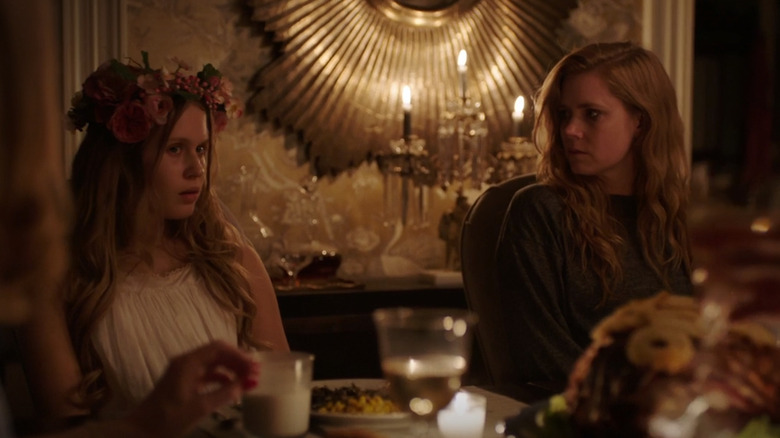
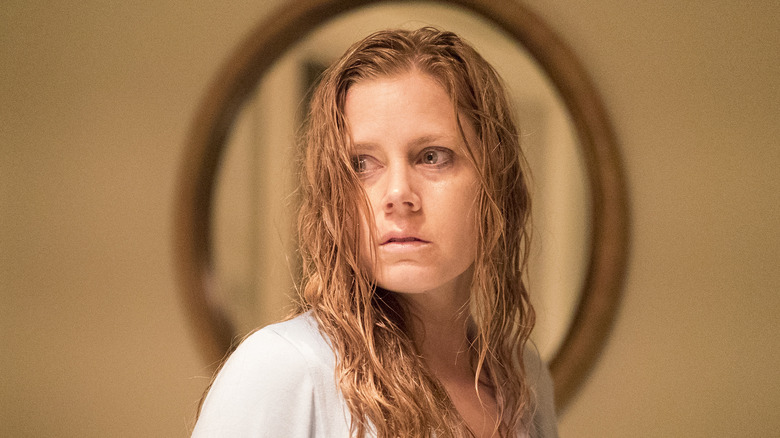
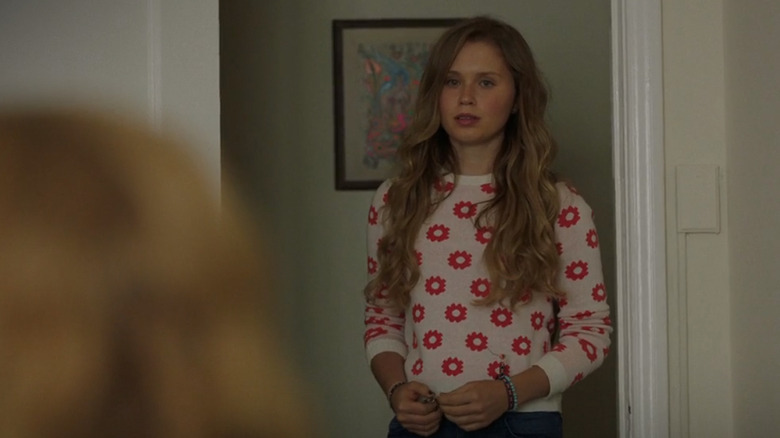
When Camille arrives at Adora's home, her mother, sister, and stepfather are around the table eating dinner. Amma is obviously drugged, clammy with sweat and fever, sitting at the table with a nightgown and a flower crown like some sickly fey creature.
In a brief exchange, Amma tells Camille that she's dressed as Persephone, the Queen of the Underworld, the goddess "in charge of punishment." It's an eerie, otherworldly invocation that makes the entire moment and the scenes that follow seem to invite Camille and the audience into a strange, dark dream.
Before Adora gets the chance to drug Amma again, Camille feigns stomach pains and Adora sweeps in to usher her eldest daughter to bed, swiftly in Nightingale mode. It is here that Camille submits to Adora's treatment. The moment is palpable, with Adams and Clarkson radiating off each other's uneasy energy. Camille, no stranger to self-harm, seems to only need proof of what her mother is doing, and what she has done, but seeks out some of Persephone's punishment for her inability to protect Marian, taking the poisonous dose meant for Amma.
The Bathtub Scene
As Adora's potion does its job, Camille spirals into real illness. It's here where "Sharp Objects" shines once more. In many shows with a crime at its center, the height of the action will crescendo around our protagonist detective finally cornering the bad guy to get answers, usually in some sort of fight or chase scene. This is the audience's reward for their note keeping: the truth coming out in an adrenaline fueled way that feels like winning.
However, in "Sharp Objects," Camille's final confrontation with her mother about her suspicions is held in a dimly lit bathroom as Adora kneels next to her sickened daughter in a clawfoot bathtub. There are no raised voices, only soft words and gentle touches that are supposed to look like a caring mother soothing her child, but instead come off as sinister and toying.
Camille, fevered and weak, tries to get the words out about Marian, but only has the strength for clipped accusations caught between bouts of vomiting. Adora denies, denies, in a soft sing-song voice barely above a whisper. Adora even admits her own mother neglected and abused her, which is the slightest hint we have for an explanation about why she is the way she is.
Clarkson is absolutely terrifying in this scene, a monster finally showing itself in the low light. As Adora flicks water at Camille's face a few times, she grins in a way like someone would if they were playing with a baby in a bath. It's not a smile of a warm mother teasing her child, however. It's a smile of victory: Adora's moment of vanquishing Camille's defiance, finally.
Victories
Adora's victory is short-lived. Detective Richard Willis has been doing his own investigating into Adora's background, learning about her from Camille. As the sisters try to figure out a way to get Amma out of the house so they can get the police, Richard comes swooping in just in time to save them both. All the pieces seem to fall into place, especially with Camille and Amma as living evidence of their mother's poisoning. A pair of pliers are also found in the house, and the blood on them is confirmed to be that of one of the murdered girls.
In the end, Marian's murderer will go behind bars, and Amma is safe. In fact, after their mother is sent to jail, Amma moves in with Camille in St. Louis, and the two seem to have a strong relationship after their harrowing ordeal. All seems well, for once. Camille finishes writing about the case and her experience, and seems to have found some sort of peace. Even Marian is no longer haunting Camille's thoughts.
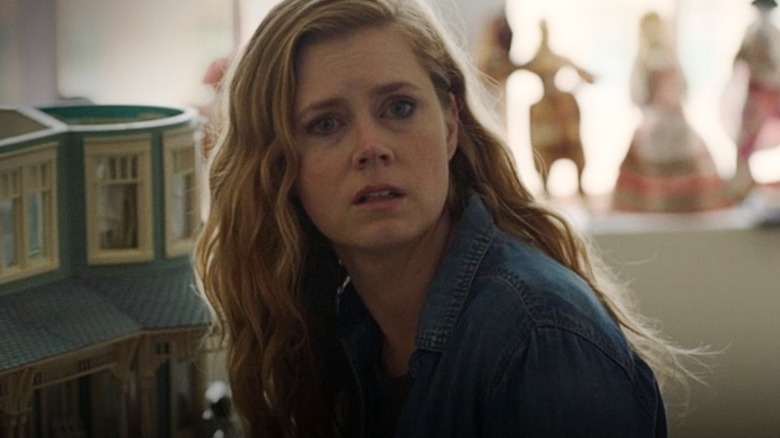
But this victory, too, is short-lived. Camille is approached by the mother of a neighborhood girl whom Amma has befriended, Mae. The girl hasn't come home. Camille assures her that she's probably just with Amma. After their chat, Camille goes into Adora's bedroom and sits next to Amma's dollhouse -- a perfect replica of their family home, the project Amma has been working on for some time to complete. It's spot on, down to the precious ivory tiles on the bathroom floor.
Except, as Camille looks closer, she realizes the tiles in the dollhouse are made of human teeth.
Mama's Little Girl
"Don't tell Mama," Amma says, standing in the doorway to her bedroom as Camille fits all the pieces together, realizing she was wrong about her mother. She killed Marian, but she wasn't the one who killed Ann or Natalie. The horrific, staged deaths of the other two girls were all Amma and her friends, posing the girls like dolls. Amma was the one responsible for pulling the teeth of her victims to use in her dollhouse.
And just like that, "Sharp Objects" ends with a cut to black, leaving the audience stunned, trying to process everything as the credits roll. In another interesting style choice, the post-credit scenes reveal flashes of the murders Amma committed, confirming the kills. Amma was viciously jealous of Ann and Natalie, two people whom Adora gave special attention to.
That jealousy seemingly passed from Adora to Camille in the worst way. In quick bursts of frames, we see that Amma killed Mae earlier, all on her own. Mae was admiring of Camille's career in a way that Amma found threatening, so she had to go. Jean-Marc Vallée, director of the "Sharp Objects" finale, even said that the dollhouse floor wasn't complete, so Amma had to keep killing.
This Is Horror
Gillian Flynn writes crime thrillers. Her novels check those boxes. There's always a murder, a mystery, and secrets to uncover to get to the truth (though not necessarily in that order). But Flynn's work has a darkness and edge to it that we've only seen in another genre -- horror.
"Sharp Objects," "Dark Places," and "Gone Girl" are all, at their very core, horror stories in the shape of detective tales. "Gone Girl" isn't so much about a woman going missing as it is about a giant spider luring a small man into a trap designed for him. The catalyst event in "Dark Places" feels more akin to "The Amityville Horror" or "The Texas Chainsaw Massacre" than a Sherlock Holmes mystery.
"Sharp Objects" is no different. Despite being grounded firmly in reality, here there be monsters. The show offers visuals in the form of mysterious ghostly women in the woods and body horror involving teeth and words carved into flesh. It even blatantly equates Adora to a potion-brewing witch, luring children to their deaths. To top it all off, the reveal that Amma was the one behind the murders all along in the very last second of the show is exactly like watching a scary movie and seeing the monster pop back up one last time in a flash just as our hero thinks they're safe.
That's part of the appeal of Flynn's works. There's no magic needed. These are the things people are able to do to hurt one another. In our world, what is a vampire or werewolf compared to a mother who can poison her own child to make herself feel better? No haunting can compete with the sad, self-destructive behaviors of a girl grieving her sister. And really, is anything scarier than a gang of mean girls?
The last moment that we see Camille on screen, clutching the tooth of a dead girl, staring at her sister in betrayal and confusion? That's skin-crawling. And the immediate cut to black after Amma's final words offer no relief, only the urge to scream as the credits roll.
"Sharp Objects" is available to stream now on HBO Max.
Read this next: The 15 Best Anthology TV Series Ranked
The post Sharp Objects Ending Explained: The Truth Hurts appeared first on /Film.
Ronald.phillips likes this
02 Dec 20:44
This Memorable Godfather Moment Almost Didn't Happen
by Steven Ward
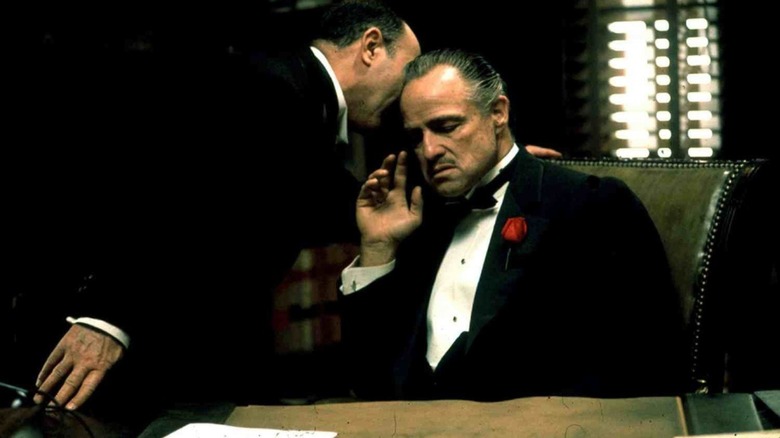
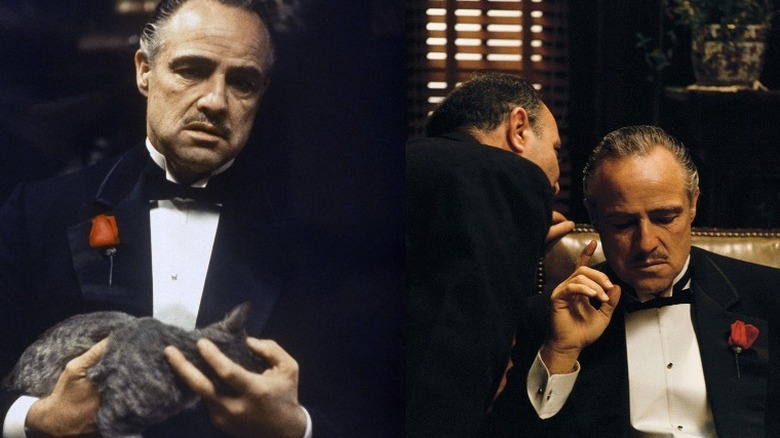
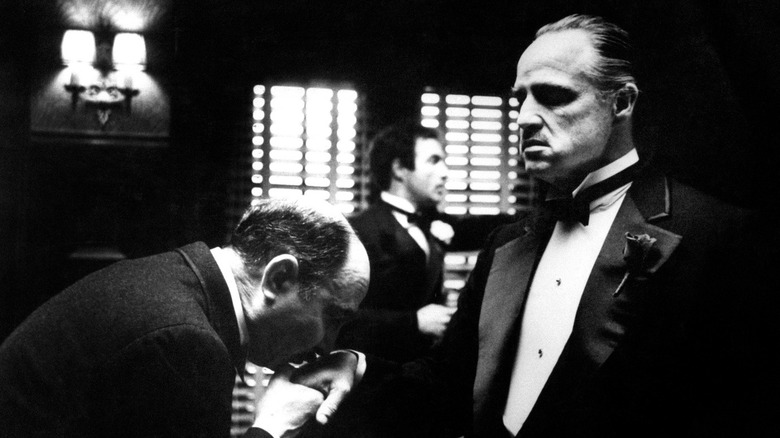
One of the key pieces of the opening scene from Francis Ford Coppola's 1972 film "The Godfather" is the cat that sits on Vito "Don" Corleone's lap for the first few minutes. Apart from being some of the best minutes in cinema history and containing some of the film's most quoted lines, that scene and the image of the cat on the Don's lap is forever burned into my mind — and probably most who've seen it. It paints a portrait of power and reverence that weighs over the film long after Vito exits the story, while the cat juxtaposes the Godfather's formidable power alongside his generosity.
It's no surprise that the imposing image of the Don holding the cat as he negotiates Bonasera's request for justice has led to endless recreations by other filmmakers to the point that it's become pretty much a trope for villainous kingpins. But despite how instantly iconic the image of the cat might be, its very presence on set was pure chance, while its placement in the script was nonexistent.
The Stray Cat Coppola Made A Star
The first shot of the Don holding his feline companion is a disarming one, as it undermines any assumptions of appearance you might've had for the leader of the Corleone crime family. But the cat, which gives audiences an image of a Godfather both intimidating and hospitable, was never supposed to be there. Coppola later said of the scene, per Time Magazine.
"The cat in Marlon's hands was not planned for. I saw the cat running around the studio, and took it and put it in his hands without a word."
Coppola's decision to give Brando the cat transforms an already captivating scene into something indelible. Without it, the Don would've appeared stiff and rigid behind his desk, and Coppola would've missed a brilliant opportunity to reveal more about this complex and magnetic character. It helps that Brando was himself a cat lover, sparking immediate chemistry between the two — unfortunately the animal showed its affection by purring so loudly it ruined all of the actor's dialogue. It was so bad that subtitles were nearly considered until editors managed to loop re-recorded lines over the scene, ensuring this very famous feline was an asset to the film rather than an accidental fiasco.
The Cat Symbolizes The Don's Strategy
Apart from lending a human warmth to Brando's Godfather, the cat also points to his overall strategy as the cunning leader of the Corleone family. As Vito plays with the cat, he leverages Bonasera's desperation for justice over the assault of his daughter to gain a loyal ally. Could the scene have existed without the cat? Possibly, but while the cat's inception might've been random, its presence on his lap isn't just an aimless idiosyncrasy. Instead, the cat has become symbolic of the Don's personality and way of thinking, especially his desire to make indebted friends over bitter enemies. Instead of bullying Bonasera into loyalty, he empathizes with his misplaced faith in American laws and justice. But at no point does the Don forget to remind his subjects who is in total control. Such is the case when he pulls the cat off his lap, as he does to Bonasera when he rejects his request for justice until he calls him "Godfather." The Godfather giveth, and the Godfather taketh away. We're just glad he kept the cat!
The Cat Wasn't The Only Innovation
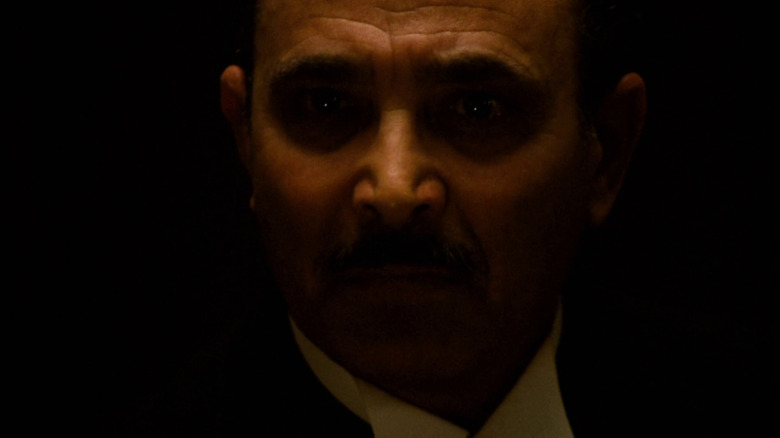
Coppola tossing a studio stray on his lead actor's lap wasn't the only moment of ingenuity to happen on-set. For his enthralling, slow-zoom opening shot the director used a computerized lens to focus on Bonasera's darkened face, building the momentous tension that finds climax in its full body cut to the Don and his cat. The difficult but stunning shot relegates the other men in the room to little more than background furniture as those opening moments of the film focus on only a small group of characters onscreen: Bonasera, Vito, and the cat.
Had Coppola opted for a different opening, like the outdoor overhead shot of the wedding he originally had planned, much of the ambiguity and mystique fostered by the close-up would've been weakened. Instead, the elongated shot keeps an intense spotlight on Bonasera's emotions, while also building this nervous anticipation for the appearance of the Godfather and the reveal of the now-famous cat.
Read this next: The 14 Best Noir Movies Ranked
The post This Memorable Godfather Moment Almost Didn't Happen appeared first on /Film.
Ronald.phillips likes this
02 Dec 20:43

86 Eighty-Six Is One Of The Best War Anime Ever Made
by Rafael Motamayor
(Welcome to Ani-time Ani-where, a regular column dedicated to helping the uninitiated understand and appreciate the world of anime.)
The thing about action anime, especially anime about war and the cost of it, is that they have to make the action engaging to the audience, and in the process end up glorifying it to the point where it renders any anti-war message moot. Sure, there are a few shows that manage to succeed at making you feel bad for liking the action, like most "Gundam" shows, but most still end up being too much fun that you end up forgetting you're watching child soldiers fight to the death.That is not the case with "86 Eighty-Six."
In the anime, which is based on the series of light novels by the same name from Asato Asato, the Republic of San Magnolia has been waging war against the still-functioning autonomous army of drones of a long-dead Empire with their own army of mechanical, "ethically responsible" unmanned drones that result in zero human casualties ... or so they tell the public. In reality, the Republic's army consists of the children of ethnical minorities that the country has rounded up, written off as non-human, and sent to a segregated district 86.
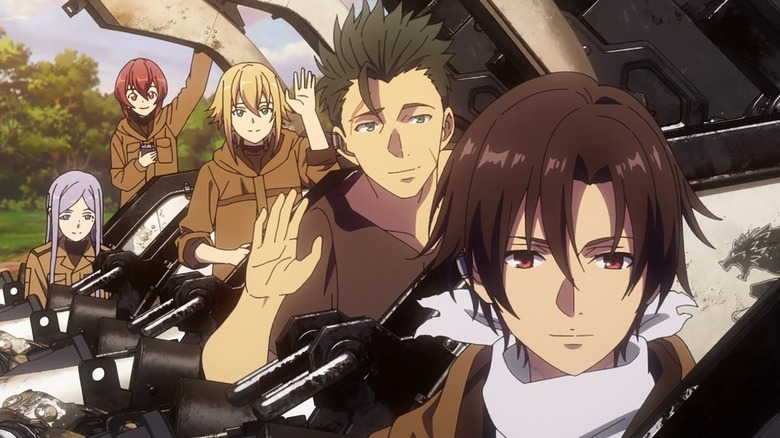
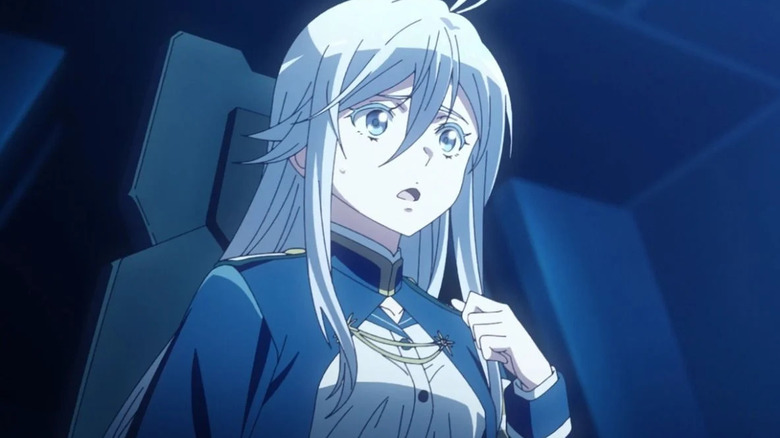
The show follows Lena, a major in the Republic army and the handler of a team of 86, as she discovers that the war is not going as well as the Republic likes to report, and tries to do something about it. From there, the show evolves into a poignant exploration of systematic racism, segregation, and a fantastic interrogation of privilege and white savior tropes, all while delivering a kick-ass war drama with a lot of attention to detail in the artillery department. This is a rare war story from a female creator, and also one of the best anime of 2021.
What Makes It Great
Not unlike "Attack on Titan," we're thrown into a world on the verge of annihilation where the ones on top are living comfortably and blissfully unaware of their own impending doom. From the first episode, "86" does a great job of slowly building its world, dropping small visual hints at a larger story and a larger conflict. There are plot twists upon plot twists that radically change the face of the war without feeling like huge left turns.
The show mostly accomplishes this by splitting the narrative in half, with most of the episodes of the first season cutting away between Lena and Shin, the leader of the Spearhead Squadron on the front lines. We see beautifully storyboarded action scenes from the Spearhead's perspective before replaying the entire sequence from Lena's side, as she is sitting perfectly still in front of a monitor, observing anonymous dots on a screen disappearing one by one. With this, the show constantly draws attention to its themes of racism and prejudice, showing Lena's luxurious and worry-free life in the city, before immediately cutting to Shin and his comrades on the verge of death, emphazasing the systemic racism that allows kids to be written off as non-human pigs just so the silver-haired people in charge won't have to feel bad about war casualties.
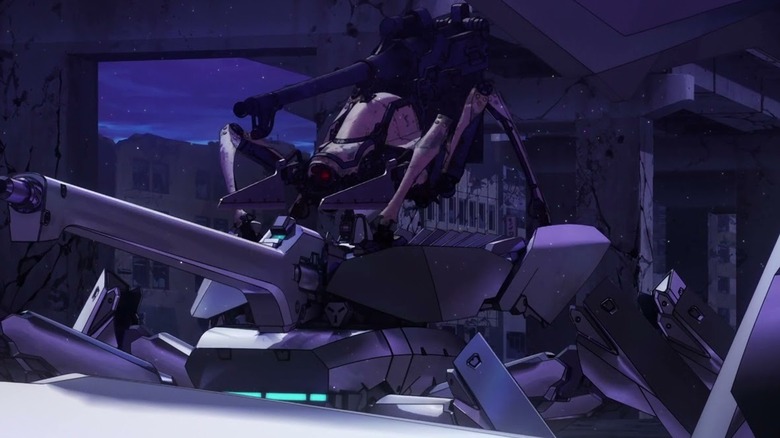
And yet, the animation does make for a very compelling and engaging show, even if the action is not exactly the selling point Bandai Spirits was hoping for when they helped fund the show to push sales for their model kits of the main spider mechs. Studio A-1 Pictures delivers thrilling kinetic action that shows the spider mechs jump and slide around the battlefield like a mechanical Spider-Man, while also cutting to close-ups of the members of Spearhead Squadron to contrast the claustrophobic horror they go through. These are not huge, thick robots like the Gundam, but light aluminum coffins that blow up easily, with guns that run out of ammo and can jam at any time, and the anime is constantly reminding us of that. Indeed, artillery nerds should have a blast examining all the nuances "86" adds to its fighting drones.
The action is also aided by an electrifying score by Hiroyuki Sawano, the Hans Zimmer of anime responsible for other badass scores for projects like "Attack on Titan," "Promare," and "Mobile Suit Gundam Unicorn." Where his music can sometimes distract from what is happening on the screen, his score for "86" perfectly follows the rhythm of the story, increasing the tempo along with the action while slowing down during periods of downtime. Though "86" can and does deliver excellent action sequences with surprisingly effective CG animation, it also knows when to slow down and allow absolute silence to take over for dramatic purposes. Shell impacts deafen the battlefield, or the dead quiet before a fight is interrupted by a single cicada reminding us that there is still natural life beyond the death and carnage of battle. This is a slow burn of a show that pays as much attention to its engaging fights as it does to the kids simply being kids before their next assignment.
A war story, especially one focused on a single squadron, would not be effective if the audience didn't care for the team, and "86" excels at making you fall for these teens before mercilessly taking them away from us — and even using an emotionally devastating yet handy frame during the opening title sequence to update us on who has died after each episode. Despite a great attention to detail given to many plot twists regarding the enemy drones, the show often pulls back to give the Spearhead Squadron time to just be teens, gossip about their comrades, look at the stars and contemplate the possibility of surviving the war.
What It Brings To The Conversation
Though the action sequences are thrilling, "86" never stops reminding you that you're watching child soldiers being sent to die by a nation that wants to exterminate them out of sheer racism. Whether it's plot developments about the status of the 86 within the Republic, or something as simply as calling out the audience for not remembering the characters' names, the anime is constantly reminding you of the fact that yes, you can and should enjoy the cool fights, but you should not take it for granted and forget the gravitas of the situation. Erich Maria Remarque's "All Quiet on the Western Front" is name-dropped in one episode, and that novels' influence can be felt throughout the anime, both in terms of the pain that these soldiers are going through on the battlefield, but also their experience outside of it. Yes, the show has as much subtlety as a sledgehammer, but it works because the show keeps doubling down on its themes.
And yet, as painfully unsubtle as the show is when it comes to its portrayal of segregation and systematic racism — the prejudice-conditioned citizens of the Republic are literally all white or silver-haired, while everyone else is considered non-human swine — the show doesn't rely on, say, armbands with star symbols on them to evoke problematic imagery. Instead, "86" is less interested in showing overtly racist commanders than it is on showing how people can sympathize with the oppressed, yet do absolutely nothing to stop it or speak out against it because they think it is pointless.
But where "86" shines brightest is in its calling out Lena for her privilege and white savior narrative. Unlike "Code Geass" and Suzaku, who tried to change the system from within and did not realize how he was becoming part of the problem, the Spearhead Squaron doesn't take Lena's niceties at face value. She may be the first commander who has taken an interest in their well-being and who feels genuinely sad when one of them dies, but at the end of the day she is still sitting safely in a fortress, watching dots on a screen do all the fighting. The season's most poignant moment comes when a member of the Spearhead unit lashes out at Lena for showing fake sadness over the death of a soldier even as she never even learned the names of the soldiers fighting for her, calling them by their monickers like every other commander before her, whether they were sympathetic to the 86 or not. Lena's arc is not as much about confronting or tearing down the system and becoming a white savior, but learning how her privilege can help the 86, even if she still acknowledges that she hasn't and will not step foot on the actual battlefield.
Why Non-Anime Fans Should Check It Out
Many war stories have played out the "faceless army is actually made up of people" angle, like "Ender's Game," but what sets "86" apart is that it knows when to deliver stunning action and an ever-evolving story while still calling out all the problems with those type of stories. What at first may seem like a rather problematic and dull premise quickly evolves into one of the most complex, fascinating and poignant war tales in the last few years, and one of the best anime of the year.
Watch This If You Like: "Code Geass," "Attack on Titan," "Ender's Game."
"86 Eighty-Six" is streaming on Crunchyroll.
Read this next: The 20 Greatest War Films Of All Time
The post 86 Eighty-Six Is One Of The Best War Anime Ever Made appeared first on /Film.
Ronald.phillips likes this
02 Dec 20:43


As an ensign on Discovery, Adira is everything I ever hoped Wesley Crusher could be.
by wil@wilwheaton.net (Wil Wheaton)
This week’s Ready Room features an interview with Ian Alexander and Blu del Barrio, who play Gray and Adira on Discovery.
I respect, admire, and genuinely like both of these young actors. I can’t imagine the responsibility and weight they carry, not just as young people in a cast of adults (something I’m familiar with and will get into in a quick second), but also as transgender actors who represent so much for so many people. I don’t know how they feel about that. We talk about it a little bit in the interview, but it must be exhausting to constantly hear, “…as a trans person blah blah blah” when something like “…as a person blah blah blah” is an option. It’s a fine line to walk that I’m still learning how to navigate, and I hope I did it with respect and grace.
Now I want to make this all about me for a moment, because this week and next week, you’re going to hear a little bit from me, personally, about how Discovery and its characters have directly touched my life in deeply meaningful ways.
Here’s what I said in this week’s Ready Room, about Adira and Gray:
This week, we have two special guests joining me right here in the studio: Ian Alexander and Blu del Barrio, who play Gray and Adira on Star Trek: Discovery. And real quick before we get to the interview, I’m going to beg your patient indulgence for a brief, personal, sidebar.
It is no secret that I have tremendous respect and admiration for these two actors. We share a similar experience, as the only very young actors on a Star Trek series. And it’s comforting to me to know that there are a few other people in this world who, in their own way, also know what it’s like to be a kid in Starfleet. It’s a small club, and it’s pretty cool to be part of it. At least, it is for me. I do not presume to speak for anyone else who meets the membership requirements.
But I do want to share how much Adira, specifically, means to me, personally. As an ensign on Discovery, Adira is everything I ever hoped Wesley Crusher could be. Surrounded by extraordinary adults, they are a respected, valued, trusted member of their crew. And they don’t take it for granted. We get to watch them work hard to earn and keep it. Starfleet is better, because they are part of it.
In what I think is my best episode of Next Generation, Final Mission, Picard says, “I envy you, Wesley Crusher. You’re just at the beginning of the adventure.” I didn’t fully understand what that meant, then. But watching Adira and Gray begin their adventure, right now? I do. I get it. And that’s pretty cool, too.
Thank you for your patient indulgence. We now return to The Ready Room, already in progress.
Hosting Ready Room is so cool for me. I get to occupy this space as both a veteran of the Star Trek universe, part of what we’re calling Legacy Star Trek (let me tell you how old that makes me feel), while I am also a huge fan.
It is my goal as the host of the Ready Room to bring my fellow nerds into the room where it happens, by asking questions and relating to experiences that I hope are as interesting to the audience as they are to me. This season on Ready Room, there are a couple of episodes that really landed on me in unexpected and profound ways. I chose to talk about those experiences with my guests, and the part of me that is just drowning in endless, bottomless, relentless anxiety has been screaming at me ever since that I fucked up. The rational part of me is telling that other part of me to take a deep breath and trust my instincts that it’s all okay, maybe it’s even good. But WOW am I anxious about all of it.
Anyway, I appreciate the opportunity to say in public, in front of Star Trek and the world, how much these actors mean to me, and how much Adira, specifically, means to me, personally, as the guy who played Wesley Crusher.
02 Dec 20:43


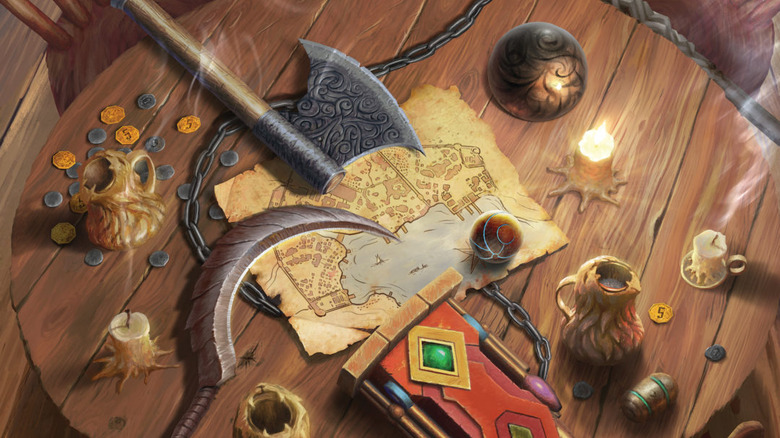
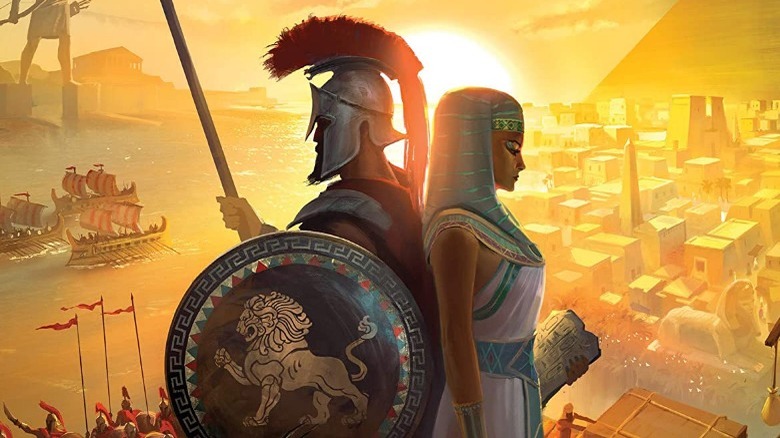
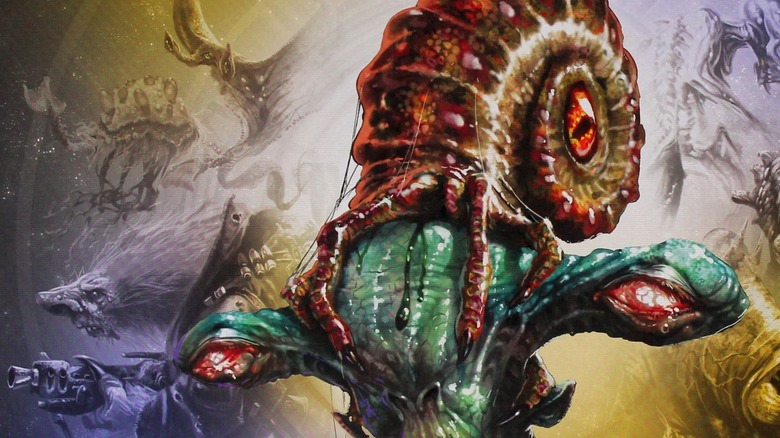

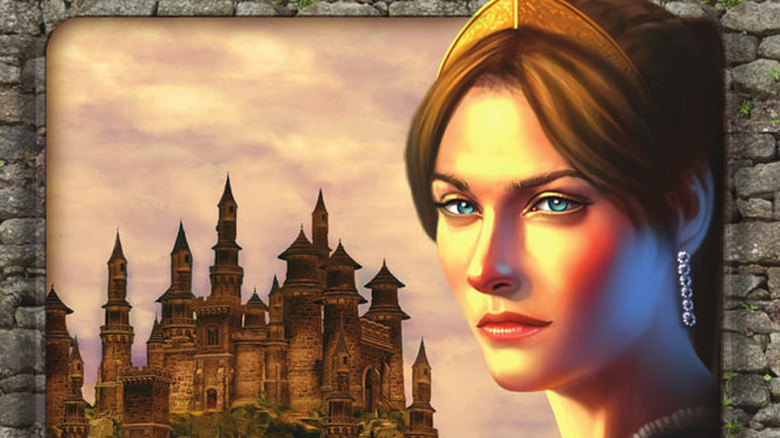
The 20 Best Board Games For Adults
by Matthew Monagle
We are living in the golden age of board games. From million-dollar Kickstarters to luxury big-box titles, board games have become the gaming industry's solution for analog fun. And while there are now hundreds — maybe thousands — of games worth your time and attention, we've done our best to cut through the noise and single out just a few of the games you might want to explore.
While this list should offer a wide variety of themes and mechanics, we have tried to err on the side of accessible titles. Most people searching for board game recommendations outside of established board game communities such as BoardGameGeek and Reddit are probably not quite ready to tackle a game of "Twilight Imperium" or "Brass: Birmingham." Therefore, with the rare exception, we have focused on a game with a "Medium" BoardGameGeek difficulty rating or lower.
Oh, and one last warning before we begin: Treat this list as a personal starting point for your own collection. As you play new games and explore new mechanics, you will respond to some systems better than others. Half the fun of playing board games is learning which types of games are best suited to your game nights, inevitably leading you to add more games with those mechanics to your personal collection.
And on that note, it's time to run down the 20 best board games available at a friendly local game shop near you.
Pandemic Legacy: Season 1
BoardGameGeek Ranking: 2
Reddit Community Ranking: 2
Difficulty: Medium
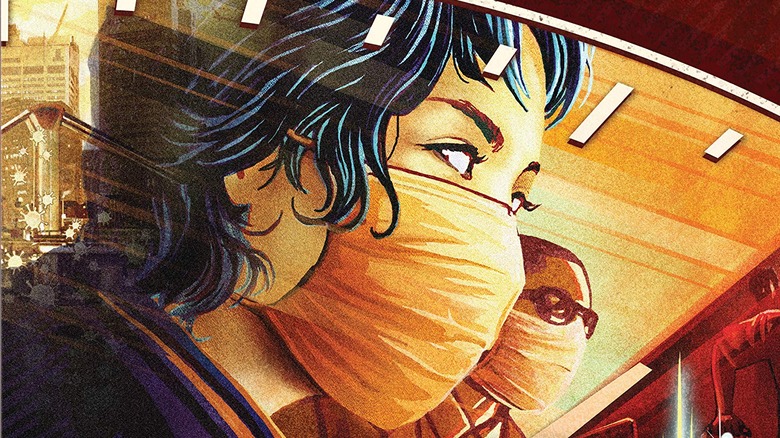
Legacy games are the long tracking shots of the board game world: You might find them everywhere these days, but the truly exceptional ones still stand out. There will always be something fun about making permanent changes to a board game. Even after a half-dozen play sessions, the decision to tear up cards or open sealed boxes can still feel like an act of cardboard revolution. That makes "Pandemic Legacy: Season 1" a force to be reckoned with for any group of players.
Building on the cooperative mechanics of the base game, "Pandemic Legacy: Season 1" presents you with a series of global pathogens threatening to lay waste to entire cities. Over the course of 12 months, your team must complete campaigns and adjust to an ever-evolving board and ruleset. Failed scenarios may not hold you back forever, but be careful: Disease and even character death lurk around every corner.
Those looking for even more "Pandemic Legacy" can also seek out the game's two sequels, each of which put a unique spin on the events of the first. In "Pandemic Legacy: Season 2," you and your ragtag group of survivors are looking to rebuild a broken civilization. In "Pandemic Legacy: Season 0," you trade hot zones for spycraft and investigate the Cold War-era medical research program that may have led to the events of "Season 1."
The Crew: The Quest For Planet Nine
BoardGameGeek Ranking: 41
Reddit Community Ranking: 22
Difficulty: Medium Light
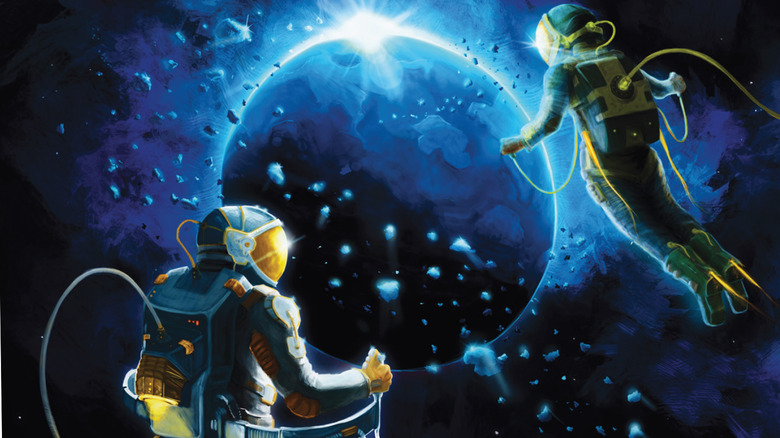
Despite their popularity within the board game community, it takes a lot for me to fall in love with a trick-taking game. Too often, these games offer an unwieldy combination of theme and mechanics, resulting in a Hearts-like experience at 10 times the cost. What makes "The Crew: The Quest for Planet Nine" so special, then, is not just the simple mechanics or the progressively complex missions. It's also how theme and design add to the experience of playing the game.
In "The Crew," you and a group of fellow astronauts take turns drawing task cards. Each card represents a card you need to collect throughout the round. From there, your team will play cards and collect tricks, using its limited communication options to convey to the other players when to be aggressive and when to let you make your move. Be warned, though: If even one player cannot complete a task, the mission is failed, and you begin again.
As the missions evolved and our pleading eyes went unheeded, my group quickly learned that "The Crew" packs a surprisingly complex punch for such a familiar concept. We also grew to love the bright, simple artwork of Marco Armbruster, which added a layer of retrofuturism to our space disasters. Sometimes, you have to credit a game for being the best possible version of what it is.
Blood Rage
BoardGameGeek Ranking: 33
Reddit Community Ranking: 62
Difficulty: Medium
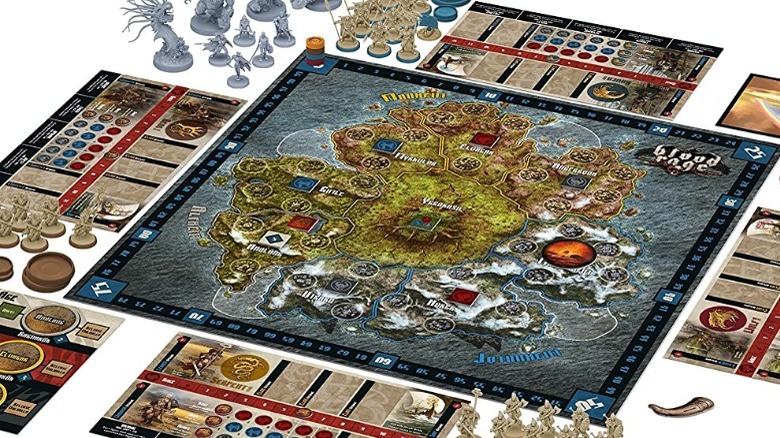
Looking back, I think buying a copy of "Blood Rage" was the beginning of the end of my collection. Sure, I added a game to my shelf that was an instant hit with several friends, and the ensuing battles for blood and glory remain a highlight years later. But for all the happiness "Blood Rage" has created, it was also the game that lured me into the world of beefy miniatures. Once you've become addicted to high-quality pieces of plastic, no Kickstarter project seems entirely out of reach.
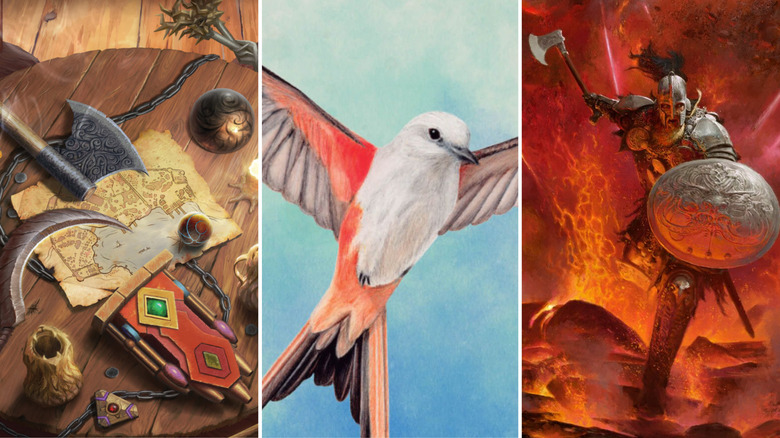
In "Blood Rage," you and your armies compete to control the provinces around Yggdrasil, the tree of life. Players must learn to manage their in-game currency — rage, natch — to spawn troops, upgrade resources, and even introduce game-breaking monsters to the board. Creatures like the Fire Giant or the Sea Serpent can swing the tide of battle and bring glory to your clan, but manage your resources poorly and you may die without glory when Ragnarok arrives.
As the first game in designer Eric Lang's mythic trilogy of games — which also includes "Rising Sun" and "Ankh: Gods of Egypt," both titles in the BoardGameGeek Top 500 — "Blood Rage" is an excellent introduction to modern game mechanics. And the various paths to victory also reward a variety of play styles, even (or especially) if your "play style" is just to collect the biggest and baddest miniatures on the board.
Watergate
BoardGameGeek Ranking: 132
Reddit Community Ranking: 96
Difficulty: Medium Light
Few games can match "Twilight Struggle" for pure two-player conflict. That game, which allows players to replay the Cold War between the United States and Russia, builds a diverse set of rules around historical events and evolves over several stages throughout the game. But while "Twilight Struggle" might be universally beloved, it also requires a tremendous amount of effort on the part of each player. Like most games, whichever player understands the rules best has a natural advantage over their opponent.
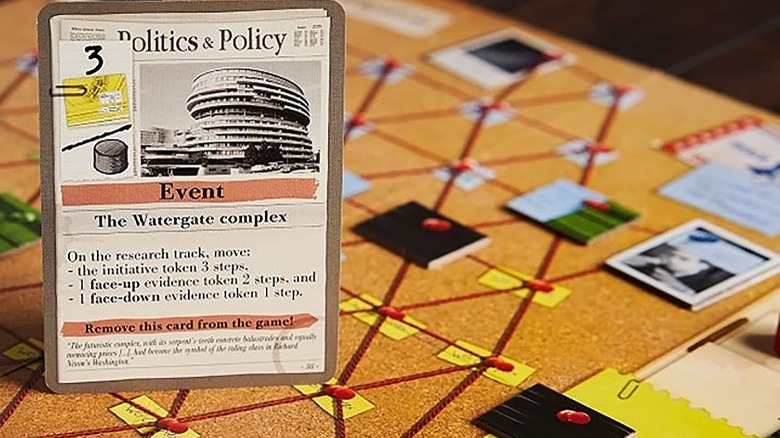
Thankfully, "Watergate" offers players a similar experience at a considerably lower barrier to entry. In "Watergate," players take either side of the famous presidential scandal — reporters on one, the Nixon administration on the other — and compete to unveil or cover up a scandal of presidential proportions. Unapologetically asymmetrical, the game is also steeped in theme, providing the same kind of history-as-theater elements that worked so well for "Twilight Struggle," too.
Will the editorial team fail to connect the Nixon administration back to the Watergate scandal? Will Nixon's attempts to cover up his own misconduct be thwarted by the power of journalism? "Watergate" gives you every chance to bend history to your will, nestling America's most infamous scandal in a kind of uncanny valley of historical politics. But at half the difficulty and a third the playtime, "Watergate" is not so much a "Twilight Struggle" replacement as it is a welcome alternative to the industry's reigning wargame champion.
Codenames
BoardGameGeek Ranking: 100
Reddit Community Ranking: 54
Difficulty: Light
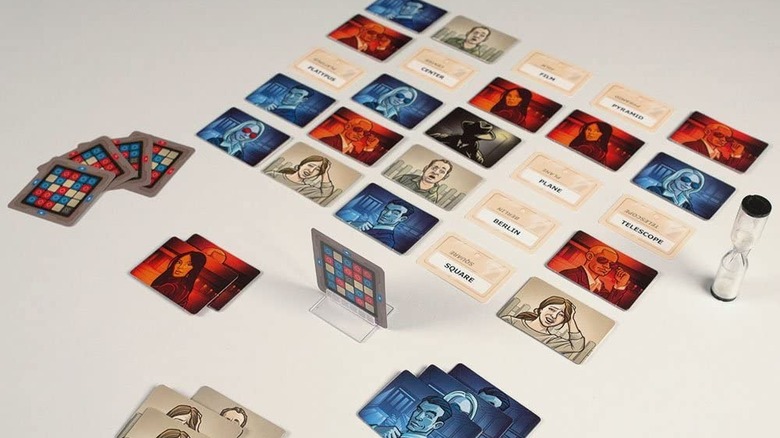
In 2018, data scientist Dinesh Vatvani discovered a clear correlation between the weight of a game and its overall score on BoardGameGeek. Simply, people give higher ratings to more complicated games. To compensate for this bias, Vatvani applied a regression model to the list and shared his findings on his personal website. Lo and behold, the new ranking named "Codenames," the popular social deduction party game, as the second-best board game of all time.
In "Codenames," you and your friends break into teams of spymasters and field operatives. From there, you build a 5x5 grid of words and use a key to identify which words each team must guess. Each spymaster then shares a one-word clue and a number to indicate the hidden word(s) on the board for their operatives. Once a team has correctly guessed their words or accidentally uncovered the assassin card, the game ends.
Winner of the 2016 Spiel des Jahres award, "Codenames" has earned its spot in the tabletop pantheon by offering a consistently fun experience for groups of all sizes. If you grew up playing games of "Taboo" in your household and wish you could take that gameplay experience to the next level, then "Codenames" may be a perfect addition to your board game collection. At the cost of a movie ticket, it honestly might be the most bang you'll ever get for your board game buck.
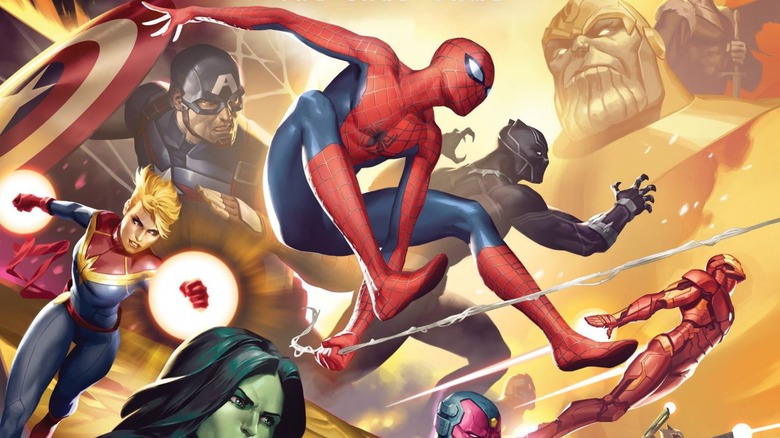
Marvel Champions: The Card Game
BoardGameGeek Ranking: 92
Reddit Community Rating: N/A
Difficulty: Medium
I can't say with any degree of certainty that I've ever won a worker placement game. Sure, I've moved my fair share of meeples over the past decade, and the ongoing boom of app store board games has made it easier than ever to try a little bit of everything. But when push comes to shove, I will always be more interested in building the most satisfying economic engine than doing the things necessary to score victory points.
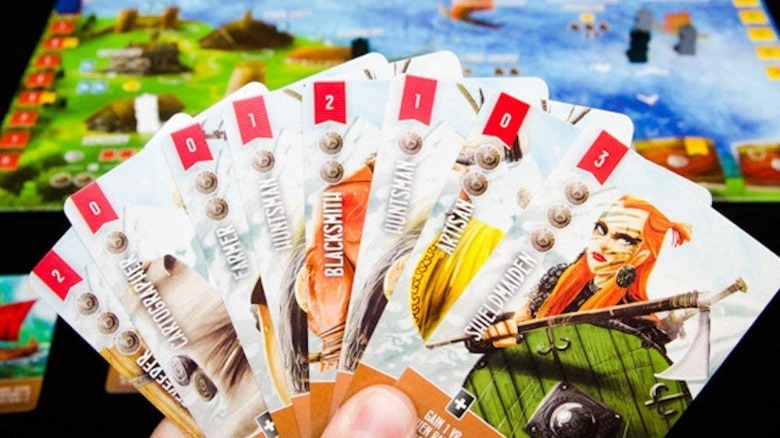
So, if I'm going to lose, I want to lose in style. "Raiders of the North Sea," a Viking-themed worker placement game, offers people like me an alluring balance of theme and choices. Players take turns selecting actions and launching raids on neighboring settlements; as the game unfolds, the raid requirements become increasingly complex, requiring players to make essential tradeoffs in the management of the resources. Three separate end-game triggers also mean that players have a welcome degree of control over when to start wrapping things up on their boards.
Colorful designs and the fun feeling of worker placement "combat" combine to make "Raiders of the North Sea" an enormously engaging game, and the relative simplicity of the rulebook — seven pages! — only adds to that appeal. Plus, "Raiders of the North Sea" translates particularly well to online gaming platforms like Tabletopia, making it easy to play with friends from far away. Losing has never felt this good.
Raiders Of The North Sea
- BoardGameGeek Ranking: 92
- Reddit Community Rating: N/A
- Difficulty: Medium
I can't say with any degree of certainty that I've ever won a worker placement game. Sure, I've moved my fair share of meeples over the past decade, and the ongoing boom of app store board games has made it easier than ever to try a little bit of everything. But when push comes to shove, I will always be more interested in building the most satisfying little economic engine than doing the necessary things to score victory points.
So if I'm going to lose, I want to lose in style. "Raiders of the North Sea," a Viking-themed worker placement game, offers people like me an alluring balance of theme and choices. Players take turns selecting actions and launching raids on neighboring settlements; as the game unfolds, the raid requirements become increasingly complex, requiring players to make essential tradeoffs in the management of the resources. Three separate end-game triggers also mean players have a welcome degree of control over when to start wrapping things up on their boards.
Colorful designs and the fun feeling of worker placement "combat" combine to make "Raiders of the North Sea" an enormously engaging game and the relative simplicity of the rulebook – seven pages! – only adds to that appeal. Plus, "Raiders of the North Sea" translates particularly well to platforms like Tabletopia, making it easy to play board games online with friends from far away. Losing has never felt this good.
Mansions Of Madness (Second Edition)
BoardGameGeek Ranking: 39
Reddit Community Rating: N/A
Difficulty: Medium
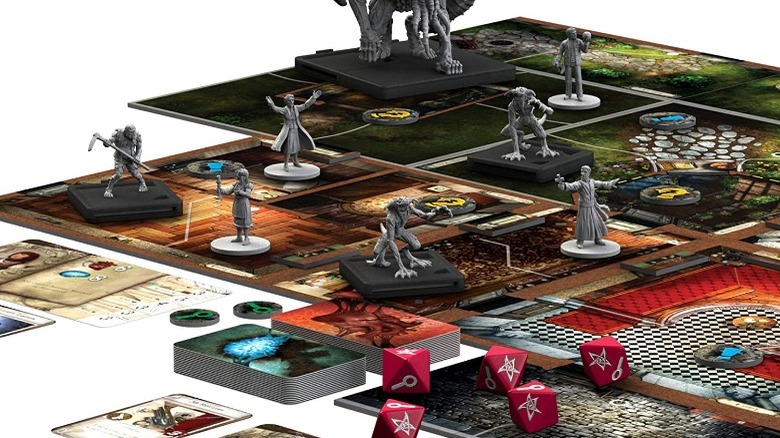
When it comes to serial board game content, nobody holds a candle to Fantasy Flight Games. The publishing giant owns the rights to several major film and book properties, including an embarrassment of riches in both the Marvel and Star Wars universes. But even with its murders' row of intellectual properties, H.P. Lovecraft-inspired games remain the company's creative bread and butter.
If you have played any version of the Arkham Horror Files — a collection of Lovecraft-themed board games that includes titles like "Arkham Horror" and "Elder Sign" — then you are already familiar with the basics. Players take on the role of private investigators, each with their own strengths, weaknesses, and potential for madness. As you and your allies work to solve the mystery, you will find yourself confronted by all kinds of horrible creations from beyond the void.
One of the most significant updates to this game is the addition of app-assisted gameplay. Fantasy Flight is no stranger to app-based content — "Descent: Legends of the Dark" recently ditched its DM-like overlord role in favor of a virtual moderator — and this change allows players to focus on the fun stuff, aka investigating rooms and fleeing from monsters. Even if you are unfamiliar with the Arkham Horror universe and just want to get your elder gods on, this remains one of the best introductions to the property.
Terraforming Mars
BoardGameGeek Ranking: 4
Reddit Community Ranking: 18
Difficulty: Medium
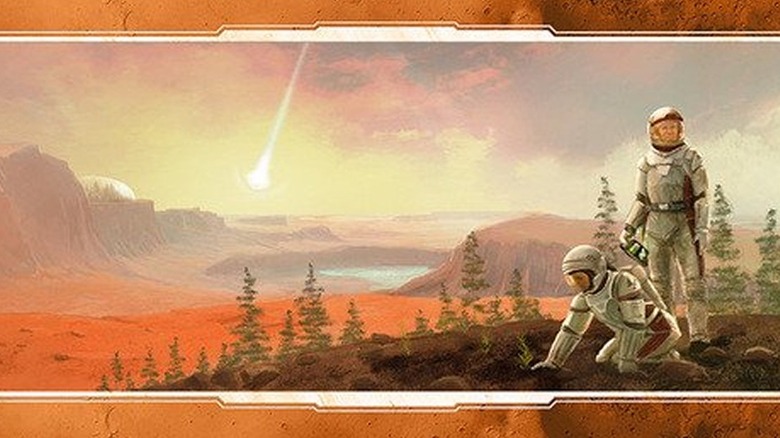
Confession time: I own "Terraforming Mars." I've had a copy in my collection for the past four years. And yet, in all that time, I've never quite managed to get my butt to mars. When you are responsible for organizing your board game nights, there are always games that are easier to teach and faster to play. So, while I will continue to page through the rulebook and tinker with the app version of the game, I feel like I have yet to truly experience one of the best board games of all time.
In "Terraforming Mars," players take on the role of corporations racing to bring a dead planet to life. Over several generations, you will work to complete projects, improve the global parameters — temperature, oxygen, and ocean — and ultimately stake your claim as the financial power behind the future of Mars. While player interactions may be more limited than in some of the other titles on this list, the details inherent in building the perfect little economic engine provide endless complexity and variety.
For those looking for a more contemporary version of "Terraforming Mars," the "Ares Expansion" was released in 2021 and offers players a standalone, card-based variation on the original game. This makes it a strong alternative for newer players, especially given the original game's reputation as being mechanically perfect but aesthetically, uh, a little rough around the edges.
Wingspan
BoardGameGeek Ranking: 22
Reddit Community Ranking: 57
Difficulty: Medium Light
Over the past two decades, gamers have lumped most titles into one of two broad categories. On the one hand, you have American-style board games that heavily favor the theme and often introduce an element of luck to much of their decision-making. On the other hand, there are Eurogames, board games that abstract out their subject matter in favor of precise, predictable mechanics. Each has its place, and the best games — in my opinion, anyways — find a fascinating balance between the two sides.
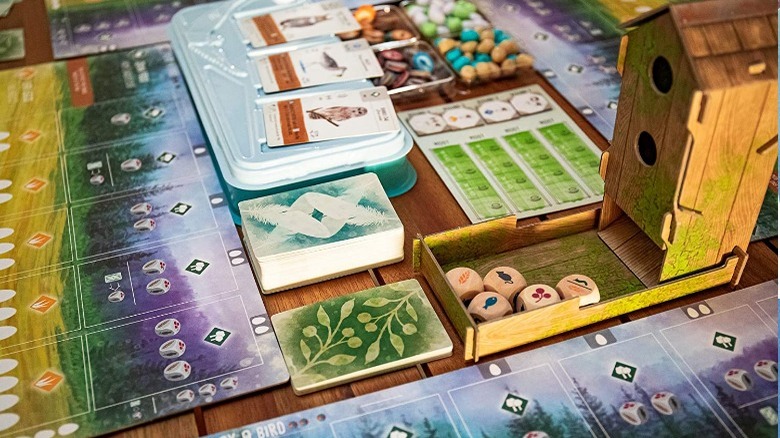
Given that most Eurogames are inherently a bit more complex than their American counterparts, it's rare for one of those titles to become a board game superstar. But Elizabeth Hargrave's "Wingspan," a light Eurogame that pays homage to the designer's love of birdwatching, is the exception that may have just shattered the rule. "Wingspan" is everywhere, selling over a million copies and appearing on even the most casual best board games lists online.
In "Wingspan," players take turns building their aviary by balancing the birds, food, and eggs on their player boards. Managing resources is critical — each type of bird requires a slightly different diet, and balancing your resources ensures that you can keep one foot (bird?) ahead of your neighbors. With dynamic artwork and a little real-world knowledge on each card, you may find that "Wingspan" is a gateway game into birdwatching proper, too.
Race For The Galaxy
BoardGameGeek Ranking: 68
Reddit Community Ranking: 37
Difficulty: Medium
The current generation of deck-building games can sometimes feel a little off the mark for those raised on customizable card games like "Star Wars" or "Magic: The Gathering." Sure, there is no shortage of games that replicate the experience of drawing power-ups and battling enemies, but part of the fun of CCGs was also the experience of building the perfect little economic engine. Thankfully, "Race for the Galaxy" exists for those who want a little Euro flair in their deck-building experiences.
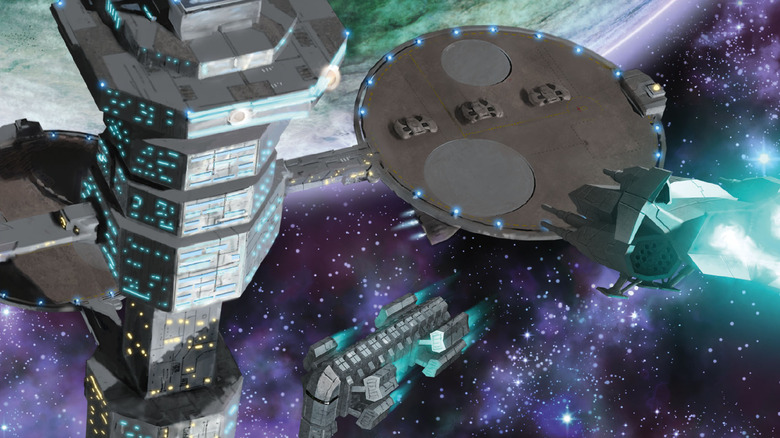
In "Race for the Galaxy," two players take on the roles of competing civilizations. Each turn, you and your opponent will complete a series of actions, expanding your intergalactic presence or adding new technologies to your empire. Whether your civilization is peaceful or warlike is up to you, but like any good engine-building game, how you respond to an evolving collection of resources will determine the odds of your success.
If all of this seems just a touch too complicated — or if you prefer your tabletop experiences to come with a healthy side of dice — then you might also want to check out "Roll for the Galaxy," an alternate version of the game that runs on a six-sided mechanic system. But whichever version you pick it up, it is a testament to Thomas Lehmann's design that a game released in 2007, an eternity ago in board game years, can still compete with the big boys a decade-plus later.
Azul
BoardGameGeek Ranking: 57
Reddit Community Ranking: 43
Difficulty: Medium Light
Since 1978, the most significant honor for board game designers has been the Spiel des Jahres. This annual award, handed out by a panel of German board game critics, is the industry's equivalent of an Academy Award. A win can often boost sales of a game from tens of thousands to millions of copies worldwide. But unlike the Academy Awards, where success and relevance rarely go hand-in-hand, games that win the Spiel des Jahres often remain an essential part of the gaming lexicon for years to come.
In "Azul," you and other artists have been summoned to the Royal Palace of Evora to add decorative tiles to the home of the king. Players will take turns selecting tiles from the Factory displays — the shared pool of tiles in the middle of the table — and place those tiles on their individual player boards. The goal is to fill up your pattern lines with similar sets of colors, allowing you to move them over to the wall and score permanent points for your evolving decorations.
If the mechanics feel something like an 8-bit puzzle game, well, that's all part of the appeal. There may come a day when a game designer creates a better version of "Azul" — like many games, its transformation of a single mechanic leaves it open to evolution somewhere down the line — but for now, "Azul" remains one of the gold standards of gateway games.
Star Wars: Rebellion
BoardGameGeek Ranking: 8
Reddit Community Ranking: 19
Difficulty: Medium Heavy
Recently, I learned that two of my friends had banned asymmetrical games in their household. While this couple maintains a steady diet of two-player games, years of marriage had taught them that games with divergent skill sets and starting conditions only led to real-world grudges. So naturally, as an empathetic and supportive person, my goal is now to get them to play "Star Wars: Rebellion" against each other and enjoy the violence that spills over from the tabletop.
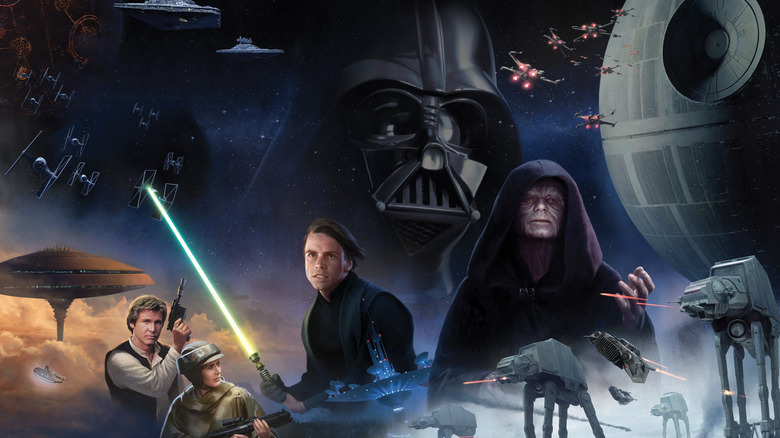
"Star Wars: Rebellion" is arguably the most ambitious "Star Wars" game from Fantasy Flight, the publishing powerhouse that manages everything from the "Descent" series to the "Arkham Horror" titles. In "Rebellion," your group of players splits into two sides: One team plays the Rebel Alliance while the other team plays the Empire. The Empire spends its turns scouring the galaxy for the Rebels' hidden base; meanwhile, the Rebels engage in card-based guerilla warfare, doing their best to stay alive until the turn counter begins to work in their favor.
Birthed from the mind of designer Corey Konieczka, whose "Twilight Imperium" remains the gold standard of 4X games, "Rebellion" should be an appealing title to anyone who likes wargames almost as much as they enjoy the "Star Wars" movies. Just be warned: A game of "Star Wars: Rebellion" will run you a minimum of three or four hours, making this a sizable time commitment for you and your soon-to-be-unloved one(s).
Patchwork
BoardGameGeek Ranking: 93
Reddit Community Ranking: 59
Difficulty: Medium Light
Part of what makes board games so much fun is the variety of themes available to players. Want to be the ruler of an intergalactic empire and spend hours bringing your enemies to their knees through a lethal combination of violence and diplomacy? You can do that. Want to ... collect buttons and make a quilt? You can do that too — and when journalists and designers list their favorite games, no one will be surprised to see the quilt game and the space game ranked equally high.
So, whether you need a gateway game or a simple change of pace, "Patchwork" is a game that deserves your attention. In this two-player game, you and your opponent will take turns pulling fabric swatches to complete your quilt. To succeed, you must balance the game's two currencies — time and buttons — and be ready to block your opponent from getting the perfect piece, even if it means your quilt will be a little threadbare for the next few turns.
And if you read the above description and wanted even more coziness from "Patchwork," you're in luck. With special Christmas- and Halloween-themed editions of the game, "Patchwork" offers a mixture of seasonal aesthetics that make it the perfect cold-weather play for you and a friend. Plus, the new "Americana Edition" released in 2020 can be found for under $20 from most online retailers, making it a no-risk addition to any board game collection.
Dune: Imperium
BoardGameGeek Ranking: 24
Reddit Community Ranking: N/A
Difficulty: Medium
Has a movie release ever resulted in this many good board game adaptations? Over the past year, three new games — "Dune: Imperium," Gale Force Nine's "Dune," and the "Dune: Adventures in the Imperium" role-playing game — have been released to strong reviews that praise both their themes and mechanics. And while both "Dune" and "Dune: Adventures in the Imperium" promise intense dives into the series' mythology, it is "Dune: Imperium" that might have the most significant impact on your board game group.
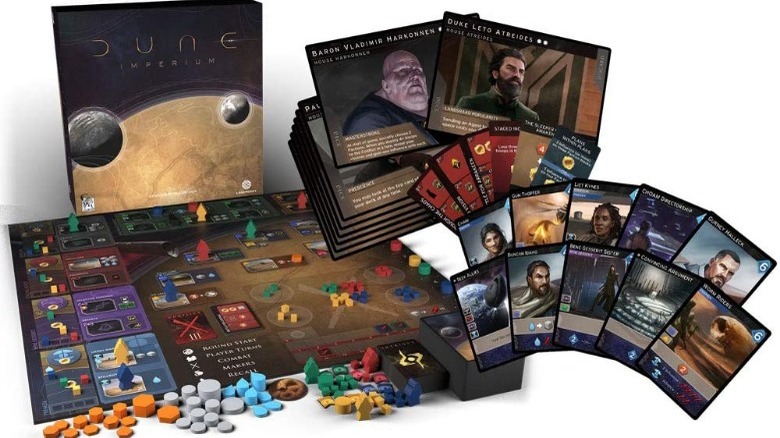
In "Dune: Imperium," players take on the various factions from Frank Herbert's book. With a wealth of actions available to you — but a limited number of agents with which to perform them — you will spend most of the game attempting to squeeze every drop of influence and intrigue from your hand of cards. Helping or hurting you along the way is the combat phase, which sees you vie for additional resources by carving a path straight through your opponent(s).
While "Dune: Imperium" may not have the polish of other titles on this list, the unique combination of two popular game mechanics — worker placement and deck-building — allows the whole to be better than the sum of the parts. This might be a game to replace "Game of Thrones" or "Lords of Waterdeep" in your collection, if only because "Dune: Imperium" is easier to teach and has a variety of different mechanics anchored to a world your group already knows and loves.
Gloomhaven: Jaws Of The Lion
BoardGameGeek Ranking: 101
Reddit Community Ranking: 79
Difficulty: Medium Heavy
While this list focuses on titles with more accessible gameplay, I'd be foolish not to make space for some version of "Gloomhaven." My group has already put about 40 hours into the primary campaign, and each session leaves me ready for countless more. But with a 20-pound box and a campaign that runs for upwards of 200 hours, it is a challenging game to recommend to anyone, let alone less-experienced players.
So, let's compromise. "Gloomahven: Jaws of the Lion" is a streamlined, standalone version of "Gloomhaven" that captures many of the game's best mechanics without the hours of set-up. In "Jaws of the Lion," you and your party will explore the streets of the title city, delving deep into dungeons and fighting monsters through the game's signature card-based combat system. The inventive dual use of the campaign guide — each page of the booklet doubles as the scenario map — takes the sting out of the scenario set-up.
If "Gloomhaven" is an RPG in a box, then "Gloomhaven: Jaws of the Lion" is an RPG-in-a-box in a box. This game evokes the sensation of sandbox dungeon crawling with reasonable bumpers in place. And while the original "Gloomhaven" may cost you upwards of $120 to bring to the table, "Jaws of the Lion" can be found for $40 at any Target near you. It might still be the most complicated game on this list, but at that price point, it's absolutely worth the risk.
7 Wonders Duel
BoardGameGeek Ranking: 16
Reddit Community Ranking: 28
Difficulty: Medium Light
Like many tabletop fans, "7 Wonders" was one of the first grown-up board games I ever played. I had just moved to a new city and was looking for a way to meet new people; before long, I found myself at a weekly neighborhood meet-up immersed in games of "Battlestar Galactica: The Board Game" and "7 Wonders." But what works best as a multiplayer game has been pared down to two-player elegance with "7 Wonders Duel," a modified (and improved) version of the original title.
In "7 Wonders Duel," two civilizations clash for cultural supremacy. Players take turns adding buildings to their empire, each of which adds some combination of resources or victory conditions to their realm. While most games can and will be won by accumulating victory points, "Duel" also features two instant-win conditions. If a player ever achieves military or scientific domination over their opponent, the game ends instantly. This means that players must balance the success of their own civilization engine against the needs of their enemy.
Like most resource management games, "Duel" certainly benefits from multiple playthroughs; the better you and your opponent know the most beneficial patterns and combinations of buildings, the sooner you can get to the real meat of strategy and gamesmanship. But even on the first or second time out, "Duel" offers enough variety to keep even the most inexperienced player on the hook.
Cosmic Encounter
BoardGameGeek Ranking: 154
Reddit Community Ranking: 98
Difficulty: Medium
Bluffing in board games will never get old. Whether you're manipulating a hidden player board or just lying about the cards you have in your hand, the opportunity to look your loved one in the eye and lie with all your heart is part of what makes the tabletop experience great. And few games have managed to tap into the rush of betrayal quite as well as "Cosmic Encounter," a multiplayer scrum of space domination.
In "Cosmic Encounter," each player assumes the role of an alien civilization. Each turn, a player will identify an opposing colony and expand their presence aggressively throughout the galaxy using a combination of cards and unique player powers. With players drawing from the same deck of resource cards, battle outcomes are often just the right balance of posturing and chance.
While "Cosmic Encounter" may not have the sharpest mechanics or the most satisfying minis, it has endless opportunities for interpersonal conflict. This is the perfect zero-sum outcome game; every move you make against an opponent means more space for you and less room for them. Therefore, when (and where) you choose to partner with your opponents makes a massive difference in the game's outcome. Plus, with an endgame that allows for multiple winners, the grievances you carry from a game of "Cosmic Encounter" are sure to last a very, very long time.
Decrypto
BoardGameGeek Ranking: 101
Reddit Community Ranking: 79
Difficulty: Medium Light
Suppose you have even a passing knowledge of the board game industry. In that case, you probably know that "Codenames" is a titan of crowd-pleasing party games. But what you might not know is that "Codenames" does not currently hold the top spot in that category on BoardGameGeek. Instead, that honor now belongs to "Decrypto," a rules-light title that pits two teams against each other in code-based social deduction.
"Decrypto" begins with each group randomly choosing four keyword cards. These words are the key to passing a message to the rest of your team; once a turn, players will draw code cards with digits that match the slots on the keyword reader. To get your own team to guess the sequence, you will write clues on a piece of paper, but if your clues are too easy to decipher, the opposing team will hone in on the concept behind each keyword, making it easier for them to crack your code.
Like "Codenames" or "Taboo," "Decrypto" is a game of balancing information with clues. The game mechanics walk a fine line between saying too much and saying too little, allowing teams to rely upon verbal prowess — and, let's be honest, a healthy dose of private jokes — to secure victory. That makes "Decrypto" a celebration of the subjective nature of language and the kind of game you can break out with any large gathering of friends and family.
The Resistance: Avalon
BoardGameGeek Ranking: 146
Reddit Community Ranking: 99
Difficulty: Medium Light
Raise your hand if you learned the power of bluffing from "The Resistance." Like many other board game players, the original "Resistance" — a hidden-role game set in a dystopian future — was my introduction to the mechanic of productive lies. But it is that game's Arthurian cousin that offers the most longevity in terms of social deduction and outright hostility among large groups of friends.
Much like the original "Resistance," "The Resistance: Avalon" operates through deception and democracy. Arthur and his knights need to complete quests to win the game, but the minions of Mordred are working to infiltrate the ranks of our heroes. While players will have the opportunity to vote on those who participate in these quests, even one failed quest vote can cause calamity. Plus, with the advanced character roles and their extraordinary powers, games of "Avalon" take on an extra degree of strategy.
Is "The Resistance: Avalon" still the best use of hidden roles in a social deduction game? Maybe not. But is it still the gold standard of light, teachable games that encourage people to engage with board games beyond their standard misconceptions of the industry? You better believe it. If werewolves or Hitlers is not your jam, or if you want a degree of character customization that those other games do not provide, then "The Resistance: Avalon" is the game for you.
Read this next: The 15 Best Board Games Of 2021
The post The 20 Best Board Games For Adults appeared first on /Film.
02 Dec 20:35
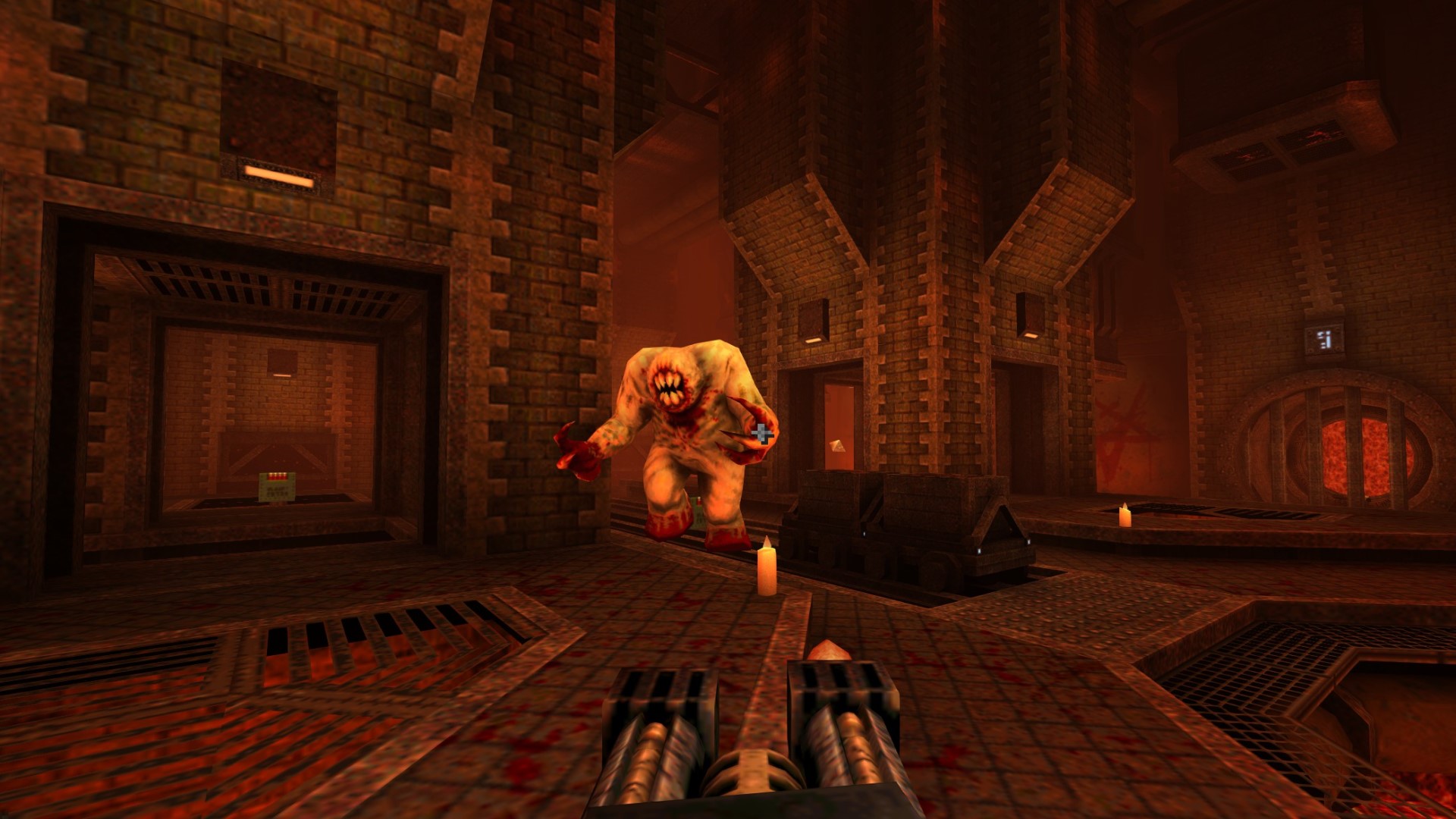
Quake just got a new horde mode, made by the Wolfenstein devs
by Ian Boudreau
Classic FPS game Quake is now 25 years old, but it just got a brand new mode, courtesy of the folks who've been in charge of keeping the Wolfenstein series fresh these past several years. That's right: there's now an official horde mode in the original Quake, and the gang at MachineGames has even thrown in a classic mod as well.
First, though, horde mode. You can find it in the multiplayer menu in the Steam version of Quake now. Just select 'change settings' once you've chosen local or online multiplayer, pick 'horde,' and then choose the number of bots you want, the difficulty, and the map you want to play on.
There are four maps, each with their own distinctive looks and gear selections. You'll blast away at waves of classic Quake monsters, and downing some of the big ones will spawn a silver key, which usually lets you into a room with some powerful gear inside. The key thing to remember in Quake is that you never want to sit still - just keep firing nails, shotgun shells, or lightning bolts at whatever enemies hove into view.
RELATED LINKS: Best FPS games, Best old games, Best multiplayer games
02 Dec 20:35

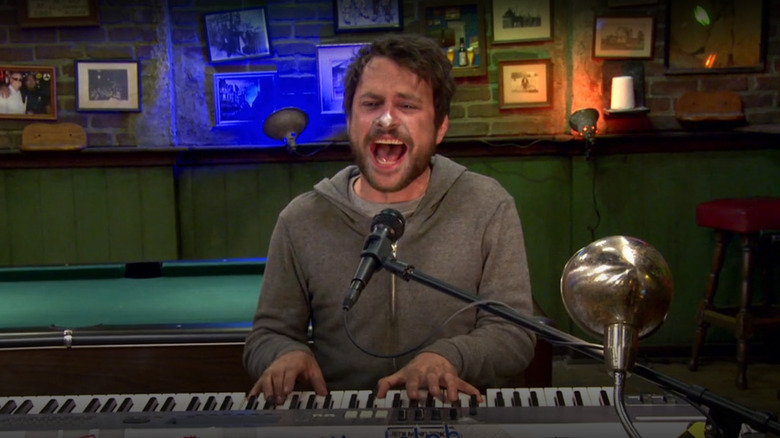
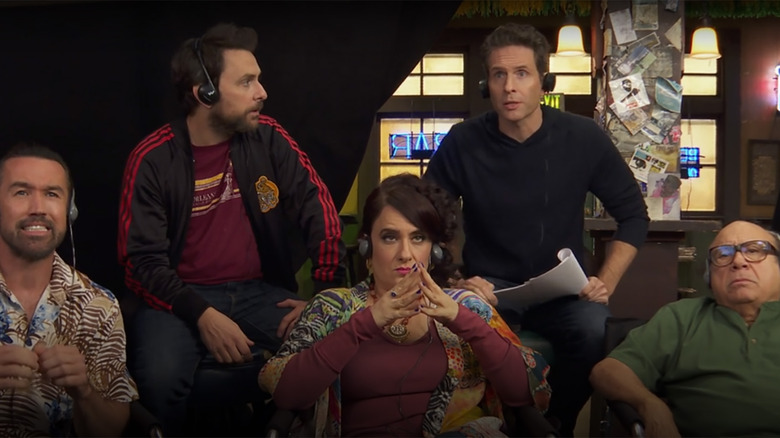
Everything's Changed In It's Always Sunny In Philadelphia, Yet The Gang Remains The Same
by Danielle Ryan
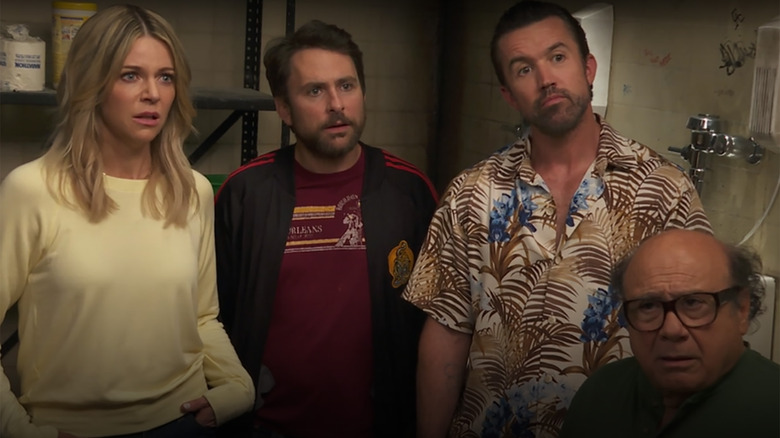
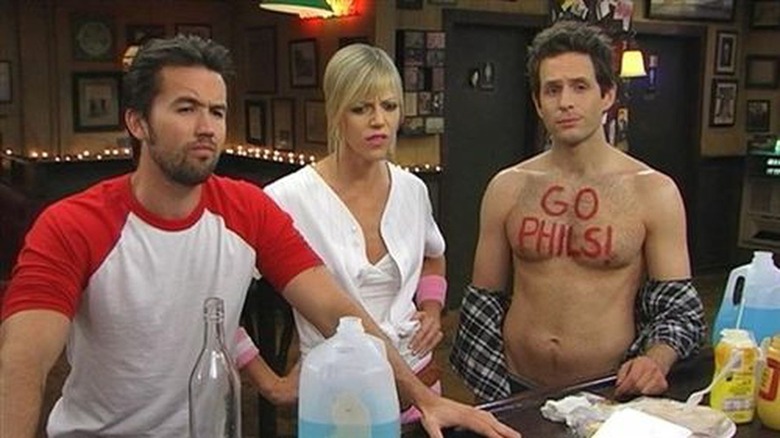
What's up, jabronis? Season 15 of "It's Always Sunny in Philadelphia" is finally here, making it the longest-running live-action comedy series in television history. The series has always been a bit self-referential, but the upcoming season looks like it will be the most introspective yet. While "the gang," comprised of Mac (Rob McElhenney), Dennis (Glenn Howerton), Charlie (Charlie Day), Dee (Kaitlin Olson), and Frank (Danny DeVito) never learn anything and the only kind of self-growth they've ever had was Mac's accumulation of mass in season 7, the creators of the show (McElhenney, Howerton, and Day) have tried to improve their comedy and the series as it progresses. The first two episodes of the 15th season are full of reflection: about the gang's past behavior, the ridiculous state of our nation, and the series' own problematic content over the years.
With 14 previous seasons under its belt, there is a lot of history to the devious doings of the gang. That's why each week, I'll be helping "Always Sunny" fans like a friendly bartender, offering a chaser episode to go with your shot of fresh "Sunny." Comedy cannot work in a vacuum, and the context behind many of the series' best gags makes them that much richer. This week, we were blessed with two episodes of the FXX series, "2020: A Year in Review" and "The Gang Makes Lethal Weapon 7." Both were chock full of classic "Sunny" references, but each had something a bit more profound to say than the crass humor would let on.
The Gang As Agents Of Chaos
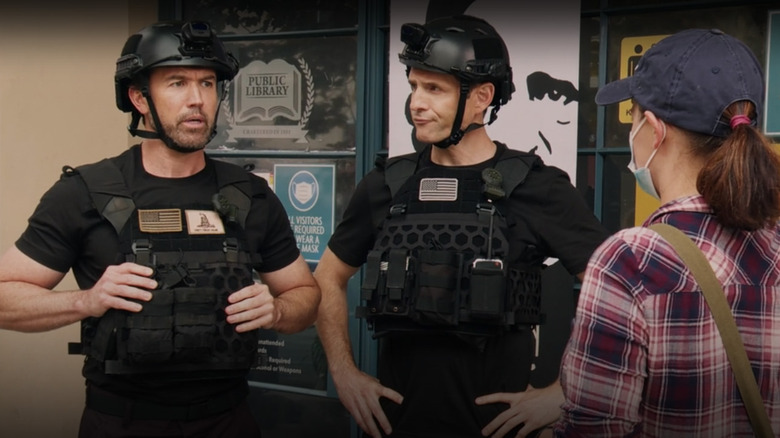
Season 14 of "It's Always Sunny in Philadelphia" ended in November 2019, and they ended it with a riff on Samuel Beckett's "Waiting for Godot," leaving fans wondering if the gang had decided to hang up their hats for good. It's been two years since we've seen Mac, Charlie, Dee, Dennis, and Frank, and it's been hard to imagine how they would handle the events of 2020, one of the most tumultuous years in American history for some time. Thankfully, the first episode of season 15 follows the gang as they recount their 2020 escapades to a bank associate in an attempt to get a fourth PPP (Paycheck Protection Program) loan. It turns out the gang has been using the loans, meant to help small businesses stay open during the pandemic, for their own personal business schemes. Mac and Dennis try to create a security firm for polling places and end up causing election delays. Frank comes up with a new hair dye made from Chinese motor oil that he then allegedly used on Rudy Giuliani before his infamously sweaty news conference. Even Dee and Charlie get in on the business ventures, designing a line of custom masks and clothes that end up being worn by some of the "protesters" who stormed the Capitol on January 6. (They also voted for Kanye for president, because decision-making is clearly not their strong suit.)
The banker is flabbergasted and can't believe their stories. After all, they somehow managed to be a part of multiple national news stories without it ever being reported, and the banker even tells them that they're "not Forrest Gump." The gang has a way of seeing things through a very warped perspective, so their version of events is probably a far stretch from reality. Their myopic worldview is also on display, as they only view the pandemic through how it affects them personally. Instead of concerns for their health or for the well-being of others, they're concerned with "get rich quick" schemes and whether or not football player Donovan McNabb could beat Rocky Balboa in a fight. The world may have turned upside-down, but the gang are just as self-centered and misguided as they've always been.
Chaser: The World Series Defense
One way the series reveals the dysfunction of the gang is by forcing unsuspecting normal people to put up with them. In "2020: A Year in Review," that poor sucker is Gary (Brian Huskey), who has come to collect on the three PPP loans the gang took out during the year. The gang have had to explain themselves quite a bit over the years, whether it's how they ended up in the brig on a sinking cruise ship or how they allegedly were involved in the breaking of the Liberty Bell. If you go back 10 years, however, all the way back to season 5, there's an episode that best shows how the members of the gang justify their abhorrent behavior.
In "The World Series Defense," the gang attempts to get out of a slew of parking tickets by weaving a tale of misfortune for the presiding judge. You see, they decided to go support the local baseball team, the Philadelphia Phillies, in their World Series game. They chugged highly alcoholic homemade "riot punch," Dennis painted his chest, and they had plans for running onto the field. The only problem? Frank left the tickets in his apartment, and it's being fumigated for bugs. They spend the rest of the episode trying to get into the Phillies game to no avail. Their schemes for getting in get progressively wilder, and in the end they still end up outside of the stadium, battered and bruised. As they tell their story to the judge, she is even more shocked than poor Gary, as they have confessed to committing a litany of crimes in order to try to get out of the inconvenience of paying parking tickets.
The gang's sense of reality is and has always been skewed, but it's only when we see them face consequences that it's apparent just how out of touch they really are.
The Gang Gets 'Woke'
Speaking of out of touch ... the second episode of season 15 is "The Gang Makes Lethal Weapon 7," a callback to their previous episodes in which the gang made two unofficial sequels to the 1980s action franchise. Those episodes were pulled from streaming (along with "Dee Day") due to the characters wearing offensive blackface make-up. In a meta commentary on the episodes being yanked, the gang finds out that their "Lethal Weapon" sequels were pulled from the shelves of the local library citing cultural insensitivity. Mac, played by showrunner McElhenney, had worn blackface to try to look like Danny Glover's character Roger Murtaugh. He comments that his "heart was in the right place," but that doesn't matter because intent isn't the important part. McElhenney has been very open about his regrets for some of the missteps of early seasons, like the blackface, the insensitive treatment of a transgender character, and the use of slurs. While the show is about five ignorant white people, the team behind-the-scenes has expanded to include a much more diverse team, much to the series' benefit. McElhenney explained why the diversification was necessary in a recent interview with The New York Times:
"At its foundation, it's a show about five ignorant, white people, right? So, at first we thought, well, how does it even make sense to have different points of view in there? Then we were like, Oh my God, of course. Who could better understand how it feels to be in the wake of ignorant white people than people who aren't ignorant white people? Ignorant white men, specifically."
The characters grapple with how to make a progressive version of their "Lethal Weapon" sequels, trying to make it so that no one is ever offended. Even Dee's portrayal of the ultimate "Karen" doesn't work, and the gang realizes that playing it completely safe is boring. When the other members of the gang want to go back to their old ways, Dennis explains that they have to change or they'll be stuck "having sex with old people," because the youth of today are politically engaged. He then takes three different women on dates only to realize that none of them want debate or discussion, only to have their ideas said back to them. The gang has no idea how they could make everyone happy, so they make it someone else's problem and try to pass it off as benevolence.
They end up giving complete control to one of their performers, a local Black actor who they've worked with several times before, played by Geoffrey Owens. He turns "Lethal Weapon 7" into a documentary on the gang's failings to understand privilege, calling it "White Saviors." It's a great bit of punishment for the gang, and watching them squirm in a movie theater because they're being misunderstood is brilliant. They complain about not being represented, not realizing that they are now feeling the exact pain they've inflicted on others for decades.
Chaser: The Gang Tries Desperately To Win An Award
This one's a little tricky. I could tell you to watch the other two "Lethal Weapon" episodes, but they're not streaming and aren't great episodes anyway. Instead, I'll point you in the direction of one of the series' greatest meta-masterpieces, "The Gang Tries Desperately to Win an Award." This season 9 episode follows the gang as they try to win the "Best Bar in Philadelphia Award," despite the fact that they've never been nominated. It's a hilarious piece of meta-commentary on the fact that despite being an incredibly successful comedy, "It's Always Sunny" never gets nominated for TV awards. In fact, their only Emmy nominations are for Best Stunt Performance.
The gang ask themselves why the bar hasn't won any awards, and you could easily apply the same questions to the series. They list some of the major complaints people have had about the bar, like the gang's tendency to yell over one another, and it still all applies. When they try to copy a bar from down the street that has won tons of awards, it's hilariously off-base, as if the gang are trying to live in a glossy network sitcom with a laugh track instead of being the rowdiest bunch on a cable network. In the end, they realize that they will never fit in or get an award, but they're proud to hang on to their crass behavior. They haven't won any awards because they're unbearable, crude monsters, but that ends up being just fine. "Screw them, I like us," Dee says, and the gang agrees. They're all a little bummed out about not getting an award, but they sure as hell aren't going to do any real change for it.
Much like "Lethal Weapon 7," the gang aren't interested in real progress, only in appearing that way. The changes they make to Paddy's to try to win an award are all surface-level, ignoring the fact that the bar itself is a tetanus infection waiting to happen. They don't work on creating new drinks, fixing up the bar, or becoming better people. Instead they slather Dee in makeup, copy the cutesy will-they-won't-they banter between co-workers from the other bar, and hope for the best. Even if the rest of the world ends up booing in their faces, the gang continue to be their bad, bad selves.
Can The Gang Ever Change?
In the 15 seasons since "It's Always Sunny in Philadelphia" premiered, the characters have gone through just about every conceivable experience. They have been married and divorced, almost died multiple times, and even spawned offspring. There have been some changes, like Dee becoming less air-headed and more devious, and Mac's extended back-and-forth about coming out of the closet, but at their core they're still the same miserable weirdos we met in 2005. Season 15 will see them leaving the United States for the first time, heading to Ireland to dig into Charlie and Mac's heritage while Frank does some shady business. If anything is going to change the gang, it could be visiting their ancestral homeland and getting out of their safety nets. Then again, this is the gang, so change is about as likely as Rickety Cricket winning People Magazine's "Sexiest Man Alive." It could happen, but I wouldn't bet anything important on it.
Check out "It's Always Sunny in Philadelphia" Wednesdays on FXX and the following day on FX on Hulu.
Read this next: 14 Awesome Comedies That Never Got Sequels
The post Everything's Changed in It's Always Sunny in Philadelphia, Yet the Gang Remains the Same appeared first on /Film.
Ronald.phillips likes this
02 Dec 20:33
Behind the unprecedented effort to protect customers against the NOBELIUM nation-state attack
by Emma Jones
This is the third in a four-part blog series on the NOBELIUM nation-state cyberattack. In December 2020, Microsoft began sharing details with the world about what became known as the most sophisticated nation-state cyberattack in history. Microsoft’s four-part video series “Decoding NOBELIUM” pulls the curtain back on the NOBELIUM incident and how world-class threat hunters from Microsoft and around the industry came together to take on the most sophisticated nation-state attack in history. In this third post, we’ll explore Microsoft’s response to the NOBELIUM attack covered in the third episode of the docuseries.
Defending against a major cyberattack requires the same level of readiness that you need for any major crisis, according to Microsoft 365 Security Chief of Staff Elizabeth Stephens, a 19-year Marine Corps veteran who served in three combat deployments. There’s a mission. There’s a plan of action. And there’s an expert team ready to go. Stephens was part of a dedicated response team that was mobilized in response to the NOBELIUM nation-state attack in December 2020.
“All of the teams came together in a way that very much reminded me of the way my Marine Corps came together,” said Stephens. “The way we respond is very much like first responders. We pride ourselves on being able to come together regardless of our areas of specialty and expertise and fill in the gaps between each other very quickly to get a mission completed. [It’s about] selflessness and the sense of, if we weren’t defending then who else was going to?”
As explained in our first post in the series, How nation-state attackers like NOBELIUM are changing cybersecurity, these sophisticated actors are working to further a given country’s interests through cyberespionage or intelligence-gathering efforts. The multi-pronged attack, which included supply chain compromise from NOBELIUM, a Russian-linked group of hackers, is widely recognized as the most sophisticated nation-state cyberattack in history. When an attack of this magnitude is discovered, the response is equally significant. In the second post in the series, The hunt for NOBELIUM, the most sophisticated nation-state attack in history, we covered the initial industry-wide investigation and gathering of data to understand the attack.
In the third episode of our “Decoding NOBELIUM” series, we reveal new details about how Microsoft worked to disrupt the adversary and safeguard the organizations: notifying and supporting impacted customers, deploying novel prevention rapidly, and providing detection measures to protect all of its customers against the threat.
Notifying customers of the NOBELIUM attack
Customers needed to be notified quickly so they could investigate and understand the scope of the attack inside their environments. Once the threat hunters began isolating threat markers for NOBELIUM activity, they could effectively identify and contact impacted customers. The security community, traditionally, tells customers that they will never receive a phone call from defenders—and to view any calls suspiciously. In this case, with attackers having access to victim environments, there was no safe alternative. Making a call with the difficult news of a sophisticated incursion would be hard enough, but in some instances, they had to find creative ways to validate that it was, in fact, Microsoft on the phone. As part of the notification, the team shared information and guidance about the attack to enable the customer to further investigate the scope and act to begin remediation. The news of NOBELIUM’s activity understandably stunned customers.
“To see the look on people’s faces as the gravity of that [situation] settled in, was certainly sobering for me and my team, but it was also a tremendous incentive to keep going until we could get to the very bottom of it,” said Franklin, Microsoft Identity Security Response Team Lead.
Building product detections to support customers
Those customer contacts were just part of Microsoft’s response to this attack. Microsoft’s threat hunters continued to pore over massive amounts of aggregated telemetry—including user, email, collaboration tools, endpoint, cloud activity, and cloud application security—to identify more subtle attack markers. Called tactics, techniques, and procedures (TTP), these markers were used to track NOBELIUM’s movements.
“By taking a holistic view, we are able to track attackers that move from domain to domain and that is usually where they get lost in the noise, in the transitions,” said Michael Shalev, Principal Program Manager for Microsoft 365 Defender.
The team identified more than 70 TTPs associated with the NOBELIUM attack that we shared publicly. Together, they painted a picture of how the NOBELIUM group operated. Microsoft teams determined which TTPs were specific to an organization, and which were found across the impacted organizations. They quickly used these TTPs to build automated detections into security products so impacted organizations could “return their network and assets to a healthy state” and unimpacted organizations could protect themselves from similar threats, Shalev explained.
Releasing detections into security products in response to a specific attack isn’t new; Microsoft regularly releases detections into security products in response to attacks. But the release volume after the NOBELIUM incident was unprecedented. During a three-week period, Microsoft researchers released multiple detections a day—in the form of targeted custom queries shared through blog posts or updates released directly into the products to enable real-time action. “Seconds count when responding to an attack like this,” said Partner Product Manager Sarah Fender of Microsoft Sentinel, Microsoft’s cloud-native security information and event management platform.
For example, the threat hunters discovered specific techniques that NOBELIUM used to evade security software and analyst tools. As there can be benign reasons to turn off sensors or logging, the TTP research was critical to detecting when the activity was malicious. In response, the Microsoft Defender for Endpoint team developed new anti-tampering policies, hunting queries, and detections to identify and send alerts on these specific NOBELIUM-related activities.
“You really have to meet the customer where they are because the attack is so significant that they’re all going to need help in different sorts of ways,” said Cristin Goodwin, Associate General Counsel for the Microsoft Digital Security Unit.
Cybersecurity strategies and available resources
In the third episode of our “Decoding NOBELIUM” series, security professionals share insights on defending customers after NOBELIUM’s discovery. Watch the episode for guidance on effective cybersecurity hygiene. Look out for the final post in the NOBELIUM nation-state attack series, where we will offer a fuller breakdown of the NOBELIUM attack and share predictions and tips for the future of cybersecurity. Read our previous posts in this series:
- How nation-state attackers like NOBELIUM are changing cybersecurity
- The hunt for NOBELIUM, the most sophisticated nation-state attack in history
Microsoft is committed to helping organizations stay protected from cyberattacks whether cybercriminal or nation-state. Consistent with our mission to provide security for all, Microsoft will use our leading threat intelligence and a global team of dedicated cybersecurity defenders to help protect our customers and the world. Just two recent examples of Microsoft’s efforts to combat nation-state attacks include a September 2021 discovery, an investigation of a NOBELIUM malware referred to as FoggyWeb, and our May 2021 profiling of NOBELIUM’s early-stage toolset compromising EnvyScout, BoomBox, NativeZone, and VaporRage.
For immediate support, visit the Microsoft Security Response Center where you can report an issue and get guidance from the latest security reports and Microsoft Security Response Center blogs.
To learn more about Microsoft Security solutions, visit our website. Bookmark the Security blog to keep up with our expert coverage on security matters. Also, follow us at @MSFTSecurity for the latest news and updates on cybersecurity.
The post Behind the unprecedented effort to protect customers against the NOBELIUM nation-state attack appeared first on Microsoft Security Blog.
Ronald.phillips likes this
02 Dec 20:33
Structured threat hunting: One way Microsoft Threat Experts prioritizes customer defense
by Eric Avena
Today’s threat landscape is incredibly fast-paced. New campaigns surface all the time, and the amount of damage that they can cause is not always immediately apparent. Security operations centers (SOCs) must be equipped with the tools and insight to identify and resolve potentially high-impact threats before attackers set up persistence mechanisms, exfiltrate data, or deploy payloads such as ransomware.
Every day at Microsoft, threat hunters work alongside advanced systems to analyze billions of signals, looking for threats that might affect customers. Due to the sheer volume of data, we’re meticulous about surfacing threats that customers need to be notified about as quickly and accurately as possible. This helps ensure that customers can respond to the most critical threats in their environments through our products and services, such as Microsoft Threat Experts, a managed threat hunting service that provides expert-level monitoring and analysis. With Microsoft Threat Experts, customers get Targeted Attack Notifications, which are designed to identify the most important risks and provide technical information, as well as hunting and mitigation guidance. Customers can also consult with our analysts through Experts on Demand.
Microsoft Threat Experts allows organizations to collaborate with Microsoft analysts to benefit from their expertise in tackling critical incidents. This collaborative relationship also gives Microsoft analysts the opportunity to gain invaluable insight into real-world threats, how attackers operate inside enterprise networks, and how security operations teams function. This creates an environment conducive to mutual learning and innovation, which helps improve our processes, protections, and services.
One way we support this close collaboration with customers is through a structured approach to threat hunting. Human analysts are augmented by AI in the search for potential threats to our customers. AI helps our human analysts tease out which events in our data require closer examination. Humans drive the initial hunt, then validate the AI’s findings, and provide deeper analysis and context for each potential threat. By combining what humans and AI are each individually good at, we’re able to process data at speed and scale. The process ultimately decides which potential threats to address first.
Our strategy is designed to evaluate impact and escalate potential threats for investigation, based on how damaging the potential threat would be if it was found to be valid. Our strategy is also designed for speed: due to the highly time-sensitive nature of the threat response, our security analysts need to be confident that the most dangerous potential threats are analyzed first.
This process starts with Microsoft analysts formulating hypotheses to explain suspicious behavior discovered within our data. If the hypotheses pass our initial quality checks, we perform an automated hunt for and collect observations that could ultimately confirm or deny our suspicions.
Once we’ve gathered more evidence, the observations are grouped into potential threats and run through a variety of computations to evaluate the possible impact. One of the key figures we use for evaluating potential threats is the amount of diversity we see across our observations. A more diverse set of observations indicates that a potential threat is more likely to have a broad impact.

Figure 1. Visual overview of the prioritization process.
The computations on the impact of the potential threat are then combined, to calculate a final priority score. The priority score is used to sort potential threats according to how likely they are to require urgent attention. Potential threats that are more likely to have a devastating impact are given higher priority scores, so that they can be addressed more quickly.
Seasoned threat experts investigate and analyze the potential threat once it is ready. If the threat is found valid, our analysts conduct a deep-dive investigation, gathering the information our Microsoft Threat Experts customers need to keep themselves safe. They collect technical details and develop security recommendations. Affected customers are immediately notified with targeted attack notifications, containing detailed information on what the threat is, and what they can do to defend themselves. These steps are summarized in Figure 1.
Our process uses automated hunting and AI to speed up the decision-making, while humans define the observables, adjust and tune the parameters, perform triage, and craft the targeted attack notifications sent to affected customers. A deeper look at our process will show how analysts work closely alongside automation to help protect customers.
Hunting for potential threats
As the first step in our process, threat hunters formulate a hypothesis around data related to a potential threat, such as, “The attacker remotely executed code by exploiting a vulnerability in a system process.” After validating the soundness of the hypothesis by measuring the signal-to noise ratio and using known data sets to ensure that the accuracy is within acceptable limits, the hypothesis is modeled in our hunting systems, which automatically perform data collection, correlation, and enrichment.
These automated systems collect observations through our telemetry, from multiple devices and often from different stages of an attack. Each observation represents a single instance of a hypothesis – in our example, here is the system process, here is what the system process did, and here are the arguments that were passed to it. Examining the observations associated with the hypothesis helps analysts determine if that instance of the hypothesis is valid.
Observations are then grouped into potential threats that represent our best current understanding of a collection of observations. If these observations truly reflect malicious behavior, the picture they paint is that of an attack on a customer’s computing infrastructure. Looking at data associated with these observations can help us understand which potential threats may wreak the most havoc, and prioritize the investigation of more critical threats.
Developing priorities
If a potential threat is malicious, it is more likely to cause critical damage if it involves many devices inside an organization and is associated with many distinct attack stages. A confirmed threat that involves a single observation and is confined to an isolated machine is less likely to have the same level of impact.
Similarly, a potential threat is more likely to have more impact if it involves observations supporting many different hunting hypotheses. If the potential threat is malicious, a greater variety of hypotheses reflects a broad-ranging attack that hits many parts of the organization’s infrastructure in many different ways.
Therefore, a potential threat with more diverse hypotheses is more likely to have a big impact on our customers, and is prioritized for investigation by Microsoft Threat Experts.
Using diversity to prioritize potential threats
How can we measure the diversity of different aspects of a potential threat? Microsoft Threat Experts uses entropy, borrowed from information theory. Entropy measures how many bits (or yes/no questions) it would take, on average, to identify a random element of a set if we know the elements of the set.

Figure 2. A visual representation of entropy, demonstrating how sets with many distinct elements have higher entropy than sets with fewer distinct elements.
A set containing elements that are all alike has zero entropy. Meanwhile, a set with more distinct elements, or the distinct elements in more equal proportions, will have higher entropy.
We use entropy to help decide which potential threats need swift attention, by calculating it for several attributes that the observations in each potential threat might have. For example, we calculate the entropy for the hypotheses associated with observations for each potential threat. We also calculate the entropy for the MITRE techniques associated with the observations in the potential threat.
After the AI automatically calculates an entropy value for each of these categories, and values for other factors, such as the severity of the hypothesis for each of the observations involved, it combines these values together to create an overall priority score for the threat.
Calculating the final priority score
Since our final score takes into consideration many different kinds of information about the potential threat, we need a way to combine these values. To do this, we convert each the results of each calculation into a p-value.
A p-value represents the percentage of potential threats we’d expect to have a certain value or larger in that category. For example, if only 5% of the MITRE technique entropy values were larger than the value from our calculation, then the p-value for our potential threat’s hypothesis entropy would be 0.05.
We do this same p-value conversion using other numbers we’ve generated from the same potential threat, some based on entropy and others not. We then combine all of these p-values into a final priority score.
Validating the potential threat
The final prioritization score is used to sort potential threats, so that the most critical potential threats are analyzed the most quickly. When a potential threat is ready, a dedicated team of security experts look over the results and perform deep analysis to determine the threat’s validity.
The analysts closely investigate suspicious activity related to the potential threat, using information from possibly-affected devices and networks. They search for unexpected events on the device timeline, indicators of compromise, and other evidence that something malicious may have occurred.
If the threat is validated and the activity is found to be malicious, our experts set to work to determine the full scope and protect customers. Related activity surrounding the validated threat is tracked down, technical details about the systems affected are gathered, and the team develops security recommendations to defend against the threat.
Microsoft Threat Experts: Helping defenders help themselves
Whenever we discover and validate a critical threat in the environment of a Microsoft Threat Experts customer, we immediately send out a targeted attack notification. These are special alerts that provide deep context about the threat, with details specific to each customer’s unique environment.
Targeted attack notifications aim to help SOCs formulate a response before a critical attack can wreak havoc on their network. They help highlight the most critical threats, and clearly identify the ones that need aggressive handling. They also contain key technical details, which can assist SOCs in swiftly handling an ongoing threat. Customers receive a timeline of observed events in their organization, as well as advanced hunting queries for surfacing threat activities. These details can aid in understanding the attack flow and discovering the scope of the threat.
A case study in prioritization
Our process can fill the gaps to realize the true scope of a potential threat. Recently, there was a potential threat involving pre-ransomware activity detected by our machine learning. Outside of the context provided by Microsoft Threat Experts, it appeared as if this was just another instance of a widespread Qakbot campaign. It did not initially appear that this threat was any more dangerous than similar instances of the same campaign.
However, the Microsoft Threat Experts prioritization process had pieced together the evidence to suggest that the threat could represent one of the most impactful attacks seen that month. The potential threat was associated with a diverse collection of hunting hypotheses, as measured by entropy, and thus held a high priority for active investigation by Microsoft Threat Experts. Since the process evaluated it to be very high priority, Microsoft Threat Experts quickly assessed the potential threat.
The potential threat was found not only to be valid, but to be every bit as dangerous as suggested: although the techniques were largely typical of the ongoing Qakbot campaign, there was an especially swift progression to reconnaissance and credential theft. In addition, because of the method the attacker used to launch the backdoor, the activity was detected and alerted on, but not fully remediated.

Figure 3. The flow of a more typical Qakbot infection. In this atypical case, human operators began late stage, hands-on-keyboard reconnaissance soon after initial entry.
This sort of progression was not normally associated with the flow of an initial entry campaign, but with human operators attempting lateral movement. The attacker seemed to be rushing to find out as much as they could, to deal out maximum damage. Furthermore, Microsoft hunters had identified these same techniques being used in ransomware attacks, strongly indicating that the operators might soon move to ransom the organization’s devices. Qakbot has been known to facilitate ransomware-as-a-service (RaaS) activity. In the RaaS model, a RaaS operator works with affiliates and provides tools for launching ransomware attacks. The affiliates deploy ransomware payloads by purchasing access to networks with existing malware infections like Qakbot.
Analysts at Microsoft Threat Experts immediately alerted the organization and provided advice on how to deal with the validated threat. Security researchers and experts at Microsoft Threat Intelligence Center (MSTIC) and Microsoft Detection and Response Team (DART) provided further help to prevent the attack from escalating. This aided the defenders at the targeted organization as they moved to remediate the threat. The collaboration between Microsoft and the targeted organization ultimately succeeded in stopping the attack. In spite of the attackers achieving broad lateral movement across the organization and nearly achieving their objective, the organization was not ransomed and were able to recover.
Empower your organization
In this example, and many others, notifications from Microsoft Threat Experts can be invaluable to decreasing the damage threats pose to organizations. Thoroughly warned of the threat at hand, organizations can take immediate action to remediate the threat using information from the notification, and perform further analysis with the suite of investigation tools available through Microsoft Defender for Endpoint.
Targeted attack notifications aren’t the only kind of assistance available through Microsoft Threat Experts. Organizations can also send inquiries to our analysts, through purchasing Experts on Demand. By consulting with analysts through Experts on Demand, customers can get more context on an alert, gain clarity on the root cause of an incident, or receive personalized guidance on how to protect their organization.
Through Microsoft Threat Experts, SOCs are empowered to act quickly and decisively. Learn how your organization can get expert level monitoring and analysis through Microsoft Threat Experts.
The post Structured threat hunting: One way Microsoft Threat Experts prioritizes customer defense appeared first on Microsoft Security Blog.
Ronald.phillips likes this
02 Dec 18:55
New study of COVID survivors finds more than half of those who recovered from severe cases died within a year [Sick]

02 Dec 18:54
Researches Detail 17 Malicious Frameworks Used to Attack Air-Gapped Networks
by noreply@blogger.com (Ravie Lakshmanan)
Four different malicious frameworks designed to attack air-gapped networks were detected in the first half of 2020 alone, bringing the total number of such toolkits to 17 and offering adversaries a pathway to cyber espionage and exfiltrate classified information.
"All frameworks are designed to perform some form of espionage, [and] all the frameworks used USB drives as the physical transmission
Ronald.phillips likes this
02 Dec 18:54


Intel Chief Says Taiwan Instability Calls For Subsidies To American Chip Makers
by Ramish Zafar

Intel Corporation's chief executive officer Mr. Patrick Gelsinger stressed the need to support American companies in the ongoing push to develop a sustainable semiconductor supply chain in the United States. The executive made his comments at the Fortune Brainstorm Tech Conference held in Half Moon Bay, California, with the statements coming in the wake of Korean giant Samsung Group's decision to build a $17 billion semiconductor fabrication facility in Taylor, Texas.
Intel Chief Outlines Significant Subsidies For Chip Firms In Taiwan And Korea As Driving Factor For Semiconductor Industry Growth
Details of his talk at the event, reported by The Nikkei Asian Review, stressed the need to develop American firms that are capable of competing globally when it comes to manufacturing advanced semiconductors. Mr. Gelsinger believes that by supporting firms like Micron Technology, Texas Instruments and Intel, the United States government can ensure that precious intellectual property (IP) related to chip fabrication stays within the country. According to him, the geopolitical fragility of Taiwan necessitates the need to have reliant chip IP based inside the U.S.
As he outlined:
"Do you want to own the IP, the R&D, and tax stream associated with that or do you want that going back to Asia?"
The Intel executive also shared concerns regarding the geopolitical situation in Taiwan. The island, home to the Taiwan Semiconductor Manufacturing Company (TSMC), recently witnessed 27 warplanes from the People's Republic of China enter its air defense buffer zone, an event that seemed to be on Mr. Gelsinger's mind as his comments quoted by The Nikkei outlined:
"Taiwan is not a stable place," said Gelsinger, adding that Beijing sent 27 warplanes to Taiwan's air defense identification zone this week. "Does that make you feel more comfortable or less?"
TSMC is the world's leading contract chip manufacturer, which means that it is responsible for supplying firms with semiconductors built using its own technologies but their designs. The company is currently mass producing its 5-nanometer (nm) chip manufacturing node, which is amongst the most advanced in the world.
Mr. Gelsinger at the Fortune Brainstorm Tech conference yesterday. Image: Future Brainstorm Tech
He also decried the lack of subsidies in America for chip companies when compared to their Asian counterparts in South Korea and Taiwan. According to him, the high subsidies mean that Intel is not competing with companies, but with countries.
Mr. Gelsinger bemoaned that:
"How do you compete with a 30 to 40% subsidy? Because that means we're not competing with TSMC or Samsung, we're competing with Taiwan and Korea. The subsidies in China are even more significant."
Both Samsung and TSMC have received subsidies from U.S. states to build their facilities inside CONUS. Samsung's $17 billion chip plant can fetch as much as $4 billion, while TSMC's $12 billion facility in Arizona is aided by the Pheonix City Council through $205 million in spending to improve infrastructure.
The Brainstorm Tech Conference wasn't the first time Gelsigner stressed on the importance of subsidies for one of the world's largest chipmakers. Intel, which announced a $20 billion investment in Ocotillo, Arizona earlier this year to expand and develop its contract chip manufacturing capabilities, was yet to receive any relief from the U.S. government as of April end this year.
However, the company's boss remained optimistic about the future, sharing that he expected Congress to pass the crucial CHIPS for America Act by the end of this month. This Act, if enacted alongside an amendment to the Endless Frontier Act, will see companies receive as much as $3 billion for individual projects; funding which is integral for the $4 billion in estimated subsidies for Samsung's plant mentioned above.
The post Intel Chief Says Taiwan Instability Calls For Subsidies To American Chip Makers by Ramish Zafar appeared first on Wccftech.

Ronald.phillips likes this
02 Dec 18:54

Cyberpunk 2077 - A Year Later
by ValH
About a year ago, CD Projekt released the highly-anticipated Cyberpunk 2077. And while the game was successful financially, it didn't exactly become the cultural phenomenon both the developers and some of The Witcher fans wanted it to be. The game was plagued by bugs, poor performance, and a general lack of features and RPG elements.
And as a result, a year later, after at least some of those issues have been addressed, we now have this PC Gamer article that compares the game in its release state with the currently-available version. Here's a couple of sample paragraphs:
I'm especially happy to see some quality of life changes, like fewer messages from fixers trying to sell me cars (this, and the rest of the near-constant phone call spam was a major irritant for me), the improved zoom level on the minimap so I don't miss turns while following the GPS, and the fact that open world NPCs now react differently to events instead of all crouching or running or exiting their cars in perfect unison, which was pretty immersion breaking.
I am, however, getting far more frequent crashes to desktop than I ever did. In about eight hours of playing, the game crashed five or six times. That's not great, especially since crashing was one problem I never really had originally (and I'm using the exact same PC). And I'm pretty pleased to report that the cars outside V's apartment no longer ram mindlessly into that barricade.
But like I said, bugs aren't the only problem. I still can't change my appearance after starting the game. The lifepaths still feel entirely pointless. And playing the game again I'm remembering other things I was excited about, like brain dancing, which turned out to be used only a few times to solve some low-level puzzles, and the fearsome Trauma Team, who show up… what, once? Twice? And have absolutely no other part in the game? Surely there was meant to be more of them.
And if that doesn't sound too promising, there's also this TweakTown article quoting a Polish interview with CD Projekt's studio president Adam Kicinski where he states that in the long run, Cyberpunk 2077 "will be perceived as a very good game."
02 Dec 18:53
Epic Games Store is giving away Dead By Daylight on PC for free
by Tonci
Dead by Daylight is a multiplayer (4vs1) horror game where one player takes on the role of the savage Killer, and the other four players play as Survivors. Get this PC game for free at Epic Game Store.
The post Epic Games Store is giving away Dead By Daylight on PC for free appeared first on Indie Game Bundles.
02 Dec 18:53


Prey 2017 Part 21: Alex All Along
by Shamus
I hope this doesn’t feel like I’m beating a dead horse. Elsewhere in this series I skipped over literal hours of gameplay in a sentence or two, so maybe it feels sort of weird to spend 7,500 words on these last three and a half minutes of the game.
But this is a pretty big switch-up that lands after gameplay is concluded and the credits have rolled. This is a very unusual move, and so I have a lot to say about it.
Let’s Argue About The Ending
Alex, how did you go through the apocalypse and STILL not lose weight?
I think this ending scenario would go down easier if the story didn’t suggest that Alex Yu was the only flesh-and-blood human left alive in the world. Of all the people to survive this apocalypse, I can think of very few who are less deserving. Maybe Subject 37, I guess? But Subject 37 was just a creepy serial killer. He was small-time. He wasn’t personally responsible for the extinction of the entire species, plus all the other species on Earth.
Yeah. Alex and his team are responsible for the death of all turtles, doggos, kitties, and buns. Getting all the people killed is one thing, but the buns? That’s going too far.
Alex took so many shortcuts. He was so reckless. He wanted to “shake things up”. And if he was just some starry-eyed tech entrepreneur, that would be fine. He could stake his personal fortune on an idea, and if it didn’t work out then he could go back to sweeping the floor at Monolith Burger. But he wasn’t gambling with his own money. He was gambling with the lives of every human being alive, and every human being to come. Those lives weren’t his to risk.
It was one thing when we were just trying to save the space station and the 250+ lives it contained. That was bad enough. But now we see he managed to get our species wiped out, and he’s still talking about wanting to “shake things up, just like old times”. Alex is a monster.
I think you’ve shaken things up enough, Mr. Yu. Thanks, but no thanks.
Man, I wish I had an option to accept life as a human, but ALSO kill Alex. I realize that doesn't work with what the writer is going for here, but that's how I felt at this point in the story.
In the previous entry, several people defended the ending by saying it “made sense”. Which… fine, I guess? I don’t think that making sense is a problem here. This ending isn’t riddled with plot holes.
Here I suppose I need to stop and acknowledge that not all plot holes are the same. When people complain about “plot holes”, they’re usually concerned with one of two things:
- A contradiction. (Cerberus is a fringe terrorist group / Cerberus is a galactic superpower.)
- Something left unexplained. (What was in the suitcase in Pulp Fiction?)
The first thing really does grind my gears. But the second? That sort of depends on the work in question. Sometimes things are left mysterious because the answer isn’t important and we don’t want to burn screen time explaining it. Sometimes questions go unanswered because the author doesn’t know the answer and didn’t realize the audience would expect it. Sometimes things are left ambiguous on purpose, because the author specifically wants you to ponder the question for yourself.
Unanswered questions aren’t automatically a sin. But when you have a lot of questions appear at once, and none of them have answers, and you’re at the end of the story, then it can feel like the author abandoned you. My gripe isn’t that the writer is saying something dumb or wrong. My main gripe is that they aren’t saying nearly enough. I’m willing to go along with this premise, but I’d really like to know more.
Apologia:
It’s not fair to say that “it was just a dream”. The game sort of tacitly acknowledges that your journey through Talos-1 was real, or a recreation of a real thing. Maybe my version of the story isn’t exactly the same as what happened to the real Morgan, but it was similar.
Counter:
The problem is that we don’t know where to draw the line between dream and reality. This new premise gets very little in the way of explanation, and what little we do get comes from Alex the liar and manipulator. I guess to go along with this we have to accept that Morgan was a real person, that Talos-1 was a real place, and that the events of the game are in some way derived from her memories, but beyond that we can’t know anything.
Was Mikhaila ever our girlfriend, or was that part of the test? Was Igwe ever trapped in a cargo container? Was Dahl a real person? Was subject 37 a real person that Morgan had to contend with, or was the fake cook scenario created by Alex & Co. to test Mophan’s behavior? Did William Yu actually send a corporate assassin to wipe out his employees and children? Was the nullwave device real? Was it ever deployed? Did it do anything? Did anyone make it back to Earth?
Suddenly, the story feels arbitrary and inconsequential.
If you accept Alex, then your tentacles shape themselves into a human hand for a handshake. If you reject him, then you get this.
Apologia:
Maybe the player didn’t play through history as it happened, but by taking part in this experiment they helped determine what would happen to the survivors in the future. Which means that the choices the player made still matter, even after the reveal.
Counter:
It’s pretty hard for those choices to matter if they’re immediately negated. The fact that it was a dream doesn’t invalidate your choices, but the fact that you can decide if it worked at the end does. Alex reveals that everyone is dead and that you’ve failed at everything you set out to accomplish since the start of the game. After that, he reaches out to take your hand. Then you’re free to accept the Morgan identity as your own and shake hands with your “brother”, or you can lash out and kill everyone with your gooey black tentacles. You can pick either option regardless of how you behaved in the game, which means nothing you did during the course of the game has any bearing on how this scenario plays out. The game might as well have started here.
Apologia:
It’s a twist ending and those are interesting and this was properly telegraphed and set up.
There are numerous points in the game where all of this was established. There are emails where people propose putting mirror neurons into Typhon. If you solve a puzzle, you can get into Calvino’s room and see he was working on the next-gen Looking Glass stuff, which is like a VR headset for reliving old memories. There are little five-second cutscenes sprinkled throughout the game, hinting that all is not as it seems.
This isn’t a last-minute ass-pull. It’s a payoff.
Counter:
This is only revealed after the credits. The Sixth Sense and Se7en didn’t put their mind-bending reveals after the credits. This “twist” is completely gutless.
Also, this isn’t really a “twist” so much as a whole new conflict being introduced once the story is supposedly over. One of the gripes with the ending of Mass Effect 3 is that it abruptly sweeps aside the Reapers vs. Civilization conflict and asks us to care about the freshly-introduced Organics vs. Synthetics conflict. Prey is doing a similar thing.[1] After all our work to save Talos-1 / Earth, we learn that both have long since fallen and we’re really just here to see if the mirror neuron transplant worked.
Apologia:
This new ending actually raises the stakes! You thought you were saving a handful of people, but in reality you’re saving everyone.
Counter:
Everyone is dead anyway. Alex is the only survivor we see and the game doesn’t even hint that maybe there are other survivors. It’s pretty hard to care about the world when the only person alive is the person who got everyone else killed.
Apologia:
This ending is actually really reactive to player choice. Each robot comments on some aspect of your behavior, which provides feedback on what happened and how you did.
Counter:
The robots don’t really have very much interesting to say, and what they do say is somewhat muddled. As stated last week, Igwe-bot can’t tell the difference between a psychopath that lets everyone die for giggles, and an anti-Typhon purist that prioritizes Earth above the lives of people on the station.
Lingering Questions
On top of those other problems, this ending drops a lot of other plot threads that only existed within the simulation.
What happened when Morgan got back to Earth? I spent a lot of time wondering what would happen when the disaster was over. When the dust settles, what will happen to Morgan? Will she confess her part in this horrendous mess? Will she make public all the nasty stuff that went on? Will she tell the world about the Typhon, the experiments, the prisoners, and the disaster? Or will she stay in space? Or will she successfully cover everything up?
Most importantly: I really wanted to be there when idiot Walther Dahl landed on Earth and proudly presented his boss with a spaceship full of survivors that he’d been ordered to kill.
How did the real Morgan die? By the end of the game, she was probably the most outrageously overpowered human alive. Like I said earlier, I don’t think the Nightmare ever existed. I sort of assumed it was an artifact of the simulation, that her Typhon self was trying to disrupt the simulation and break her out of this virtual world. It was supposedly the big scary threat of the game, and she kicked its ass several times. If real-Morgan was really that powerful, then how did the Typhon kill her? Did she survive the events on Talos-1 and then perish when the Earth fell? Or did she actually die before the nullwave device went off?
Yes, they used the nullwave. The simulation shows that Alex ALWAYS stayed behind and went down with the ship if you used the self-destruct. If the simulation is based on anything concrete, then this one fact must be respected for all the ways it endures through the permutations of the events on Talos-1. Alex would have died if Morgan had destroyed the station. Alex is alive in this post-conquest world, therefore Morgan didn’t blow up Talos-1.
Either that or the entire scenario is one giant self-aggrandizing wank on the part of Alex, in which case this entire scenario is another layer of lies. Like the Mass Effect Indoctrination Theory, we can always just give up on the text and make up whatever bullshit makes us feel better about how we spent the last 20 hours. I don’t think that’s a particularly rewarding way to engage with a work, but the option is always there if you’re not willing to accept the apparent givens of this new premise.
It would really help if honesty / integrity were part of his personality. His status as a weasel throws everything into chaos.
Given that Morgan used the nullwave, how did ANY of these people die? Dayo Igwe? Danielle Sho? Mikhaila Ilyushin? Sarah Elazar? If they survived long enough to see the nullwave go off, then what got them?
Then again, the ending credits reveal that this entire scene is happening at a “hidden location”. If Talos-1 was still safe, then Alex and his posse would still be there. So we probably have to assume that ultimately Talos-1 fell to the Typhon. Actually, I guess we can assume that in reality, the nullwave didn’t really work. If it had, then they could have used it to defend Earth.
But the really burning question for me is this one…
How did Alex survive?
Aside from Dayo Igwe and MAYBE Morgan, nobody liked this guy. In fact, lots of people hated him. And that was BEFORE he accidentally destroyed his homeworld and got his entire species killed. His father ordered his assassination without the slightest hesitation. His voice didn’t even waver. When Papa Yu ordered the death of his son, he sounded like he was ordering a pizza.
Given his lack of popularity and the fact that he’s not the picture of physical fitness, how did he survive this ridiculous adventure when so many other, fitter, more charismatic people died?
Alex and His “Contingencies”
Alex has a plan (a recording) for how to gain Morgan's trust if Morgan escapes the simulation. But he DOESN'T have a plan for what to do if the Typhon break containment.
The game talks Alex up quite a bit. More than once you’ll hear people claim that “Alex always has contingencies!” This is one of those claims that is demonstrably true and untrue at the same time.
On one hand, he never wound up with a knife in his back. Given how many enemies he had among the crew and the incredible damage he inflicted on the world, he must have been playing some next-level 5-dimensional chess to outwit the endless onslaught of backstabs that were headed his way on a daily basis.
On the other hand… what fucking contingencies? The Typhon broke containment. Then they broke out of Psychotronics. Then they ran rampant across the station. Then they spread to Earth. And as far as we can tell, Alex never even slowed them down. He never had a plan for any of these situations, even though this is the FIRST THING he should have planned for, and he should have had multiple layers of backup plans.
That part where you had to fly around the station getting in slap-fights with Technopaths so you could scan the coral? Why was that a thing? If Alex’s special ability is “having contingencies”, then that shit should have been worked out weeks ago. The nullwave should have been humming away in his office, on his desk, hooked up to a great big glowing red button, ready to be pressed the moment someone in Psychotronics complained about strange noises in the ductwork.
Alex should have been able to single-handedly set off the nullwave long before the first mimic gave its captors the slip and found its way into the vents, which should have had mimic detectors in them. Because like… did Alex ever actually study the Typhon while he was supposedly studying the Typhon? Watch a mimic for twenty minutes and you’ll know what you need to do. “Okay, we need motion detectors and automated psychoscopes in all the vents. Like duh. Maybe some Typhon lures to draw them through the ducts and back into a different containment system?”
And then after ten seconds of thinking about it Alex might add, “And by the way, Psychotronics ought to have its own self-contained HVAC system so a breach will just have the critters running laps in our vents and not escaping to the rest of the station.”
And then while some lackeys are rolling out the HVAC blueprints on a table and trying to figure out what needs to be changed, maybe Alex could start a brainstorming session, “Hey. What if we missed something and they get free anyway? They could tear through the ship pretty fast. Have you seen the tests Morgan has been running with the volunteers? Shit. One mimic in a crowded room can become fifty mimics in an empty room in under a minute. But hey, we have these robot printers all over the station. Could we print out swarms of gunbots in an emergency to slow the spread? Someone roll the dry-erase board over to me. I need to write this down.”
The only contingencies Alex was ever prepared for was making sure he didn’t miss lunch. Screw that guy.
Anyway…
That’s the ending of Prey. I don’t think it was horrible, but I do think it was frustratingly vague and underdeveloped. I’m glad the designers attempted to do something more interesting than an action-movie ending, but this final twist was marred in execution. Also, its status as an after-credits scene means the whole thing lacks conviction.
I really do love this game, so it really stings that the designers stumbled a bit here at the very end.
Next time I’ll end this series by talking about what I’d like to see the team do with the franchise in the future.
02 Dec 18:51
The Coyotes – Netflix Series Review
by Karina "ScreamQueen" Adelgaard
The post The Coyotes – Netflix Series Review appeared first on Heaven of Horror.
02 Dec 18:51
The Forest gets a resurgence on Steam as Sons of the Forest lands a release date
by Iain Harris
Excitement might be building for the follow-up to the survival-horror game The Forest, but that doesn't mean people have forgotten about the original just yet. As per SteamDB, The Forest was hitting highs of around 7,000 concurrent players on Steam at the start of October before leaping to a peak of 40,000 concurrent players by the end of the month. Since then, the first-person survival-horror simulator has steadily reached the heights of 30,000 players at peak depending on the day.
The Forest has benefited from attention from streamers for a while, with the survival game hitting a peak of 64,879 players eight months ago. Last month, though, Félix 'xQc' Lengyel was playing the game, too, which has certainly helped.
Attention is also starting to shift to Sons of the Forest, which is its follow-up game. We hadn't seen anything from the game for a while, though developer Endnight Games has now released a spooky new teaser. Alongside some eerie footage, we have learnt that the Sons of the Forest release date is now May 20, 2022, which is a delay from the previous 2021 window. Thankfully, it looks like players are happy to stick with The Forest for now.
RELATED LINKS: The Forest System Requirements
02 Dec 18:50
What Is DNS Hijacking and How Can You Prevent It?
by Chris Odogwu
A domain name system (DNS) is one of the essential components that foster interactions on the web. Web applications and cloud services depend on it for their performance and validity online. A loophole or vulnerability in the DNS results in the loss of sensitive data, exploitation of site users, and the hijacking of a website by attackers.

Ronald.phillips likes this

02 Dec 18:44

Surgeon fined $3,000 for amputating wrong leg
by Mark Frauenfelder
Oops! A surgeon in Austria accidentally amputated the wrong leg of her octogenarian patient and now she's out $3,000. She blames the botched operation on "human error."
From The Guardian:
— Read the restThe surgeon had marked the wrong leg of the 82-year-old patient for amputation ahead of the operation in May in the central town of Freistadt, noticing the mistake two days after carrying out the surgery.
02 Dec 18:43
The Morning Watch: No Time To Die Honest Trailer, It's Always Sunny In Philadelphia Bloopers & More
by Ethan Anderton
(The Morning Watch is a recurring feature that highlights a handful of noteworthy videos from around the web. They could be video essays, fan-made productions, featurettes, short films, hilarious sketches, or just anything that has to do with our favorite movies and TV shows.)
In this edition, with "No Time to Die" available to rent and buy on digital, Honest Trailers fires shots at Daniel Craig's final mission as 007. Next, watch some throwback bloopers from the fourth season of "It's Always Sunny in Philadelphia." And finally, watch as an expert chef creates a delectable dish of ratatouille, inspired by Pixar's tasty culinary adventure "Ratatouille."
No Time To Die Honest Trailer
First up, now that Daniel Craig has given a long goodbye to James Bond in "No Time to Die," it's time for Screen Junkies to send off 007 in an explosive fashion with an Honest Trailer. Actually, I guess "No Time to Die" did that too, even though it was preceded by roughly 2.5 hours of by-the-numbers Bond with a surprising amount of sadness. Seriously though, has James Bond ever been so desperate? It's a good thing that he found out about his estranged daughter, because I feel like Bond almost lost his damn mind.
It's Always Sunny In Philadelphia Season 4 Bloopers
Last night, "It's Always Sunny in Philadelphia" returned for season 15, so why don't we take a look back over a decade to the show's fourth season with a blooper reel from FX. Watch the younger Mac (Rob McElhenney), Charlie (Charlie Day), Dennis (Glenn Howerton), Dee (Kaitlin Olson) and Frank (Danny DeVito) crack up with line flubs and more. Remember, after all these years, none of them have learned a damn thing, and that's what makes them great.
Making The Best Ratatouille
Finally, Disney brought in a professional chef to recreate a delicious dish of "Ratatouille" that would make food critic Anton Ego cry like a baby. It looks like the tantalizing meal was pulled directly from the movie, right down to its presentation on the plate. Unfortunately, there's no recipe included with the video, but if you really want to make this for yourself, you won't have to look very far for some guidance.
Read this next: The 20 Greatest James Bond Villains Ever
The post The Morning Watch: No Time to Die Honest Trailer, It's Always Sunny in Philadelphia Bloopers & More appeared first on /Film.
Ronald.phillips likes this
02 Dec 18:42
HBO Spent Over $30 Million On The Failed Game Of Thrones Spin-Off
by Jeremy Mathai
The business of filmmaking -- or, in this case, the process of deciding whether to move forward with a show or not -- is not for the faint of heart. HBO has built itself quite a legacy, providing prestige and consistently high quality programming that further blurs the line between movie and television. "Game of Thrones" in particular became a dramatic example of this, with budgets of individual episodes in the final season eventually exceeding that of entire feature films. But such expenses come with quite a high amount of risk, which the network would soon learn the hard way.
According to James Andrew Miller's new book "Tinderbox: HBO's Ruthless Pursuit of New Frontiers," which chronicles the inner workings of HBO's path to success over the decades and recently revealed original "A Song of Ice and Fire" author George R.R. Martin's immense dissatisfaction with the trajectory of the show, the network poured more than $30 million into the production of a pilot episode for a proposed spin-off. Essentially, HBO opted for a risky (and wildly expensive) proof of concept to convince themselves to fully commit and move forward with the series. This didn't happen, of course, but the details we're now learning about are certainly eye-opening.
According to Entertainment Weekly, then-WarnerMedia chairman Bob Greenblatt states in Miller's book:
"They had spent over $30 million on a 'Game of Thrones' prequel pilot when I got there. And when I saw a cut of it in a few months after I arrived, I said to [HBO chief content officer] Casey [Bloys], 'This just doesn't work and I don't think it delivers on the premise of the original series.' And he didn't disagree, which actually was a relief. So we unfortunately decided to pull the plug on it. There was enormous pressure to get it right and I don't think it would have worked."
Of course, this wouldn't be the first time that HBO faced an impossible decision with "Game of Thrones." The pilot episode of the original series infamously required a complete overhaul, resulting in several instances of recasting (including one that led to Emilia Clarke getting the role of Daenerys Targaryen). In that light, it's not completely unheard-of that the proposed spin-off would ultimately meet its end this way ... but it did lead to the greenlight for another series.
Win Some, Lose Some
Fans of the original series will soon have "House of the Dragon" to look forward to, the prequel/spin-off series that takes place hundreds of years before the events of "Game of Thrones." According to this report, however, the loss of the untitled Naomi Watts-led series directly led to HBO giving the go-ahead to this one. As Greenblatt is further quoted in the book:
"I'm the one who encouraged Casey to green-light it to series. I said, 'let's not risk $30 million on a pilot.' You can't spend $30 million on a pilot and then not pick it up. So I said, 'Let's not make a pilot. Let's get a great series that we feel good about, and just make it. Or not.' They made the first pilot because they were protecting their own downside and protecting that brand, which I understand, but it was critical that we somehow continue that franchise and move quickly, which meant getting the series into production ASAP. That's always a nail-biter, but I think the new show that is coming will be incredible."
Ultimately, it's a shame that the initial spin-off series never made it to the finish line, if only because this became the second major project to fall apart for director and executive producer S.J. Clarkson, who was originally meant to direct the fourth "Star Trek" film. On the bright side, fans now have "House of the Dragon," "10,000 Ships," "Sea Snake," and now "Tales of Dunk and Egg" to tide them over. "House of the Dragon" will debut on HBO sometime in 2022.
Read this next: Single-Season '80s Sci-Fi And Fantasy Shows That Deserve A Second Shot
The post HBO Spent Over $30 Million on the Failed Game of Thrones Spin-off appeared first on /Film.
Ronald.phillips likes this
02 Dec 18:42
The Dark Tower Easter Egg You Never Noticed In The Shawshank Redemption
by Joshua Meyer
What do "The Dark Tower" books and "The Shawshank Redemption" movie have in common, besides author Stephen King? A guy named Randall.
Easter eggs are all the rage in today's King adaptations — and movies in general. Back in 2017 (when we proclaimed the King film renaissance), Mike Flanagan's adaptation of "Gerald's Game" featured numerous references to other King stories, not the least of which was a line of dialogue where one character randomly says, "All things serve the Beam." This was a direct reference to "The Dark Tower."
However, before Flanagan started bringing King novels like "Gerald's Game" and "Doctor Sleep" to the screen, the go-to guys for King film adaptations were Rob Reiner ("Stand by Me," "Misery") and especially Frank Darabont, the director of "The Shawshank Redemption," "The Green Mile," and "The Mist." In "Shawshank," you may recall that Andy Dufresne (Tim Robbins) creates a fake identity named Randall Stevens, "a man nobody ever laid eyes on before" until he "strolled into the Maine National Bank" after he escaped prison.
In King's original novella, "Rita Hayworth and the Shawshank," the character was named Peter Stevens, but Darabont changed it for the movie as a shout-out to one Randall Flagg, a major recurring villain across King's work, but specifically the "Dark Tower" series and "The Stand." In his director's commentary for "The Shawshank Redemption," he explained:
"A little secret on changing that name from Peter Stevens to Randall Stevens. Where the name Randall comes from — I'm sure the lawyers won't like this one, either, but — that was from me doing a little homage, a little tip of the hat, to our friend, Stephen King. One of his all-time great villains is named Randall Flagg, from 'The Stand' and also from 'The Dark Tower: The Gunslinger' series. So when I needed to replace Peter, I chose Randall, as a little salute to Steve."
The Many Faces Of Randall Flagg
"The Dark Tower: The Gunslinger," the title Darabont references, is the first book in King's "Dark Tower" series, which begins with the immortal line, "The man in black fled across the desert, and the gunslinger followed." Later books would make it clear that King's "man in black" and Randall Flagg, the villain of "The Stand," were one and the same.
The character goes by other names, such as Walter O'Dim and Marten Broadcloak, and a number of actors have portrayed him on television and in film, including Jamey Sheridan (the 1994 TV miniseries, "The Stand"), Matthew McConaughey (the 2017 movie, "The Dark Tower"), and Alexander Skarsgård (the 2020–2021 streaming series, "The Stand"). King's books and short stories often have an overlap of characters and places; another character who shows up in "The Dark Tower" series is Father Callahan, the priest from "Salem's Lot."
Having a little cross-pollination between films, even just through Easter eggs, is very much in keeping with King's literary spirit. Now, we're just waiting to hear more evidence that Andy Dufresne is, in fact, another version of Randall Flagg, which would upend everything we think we know about "The Shawshank Redemption" and just be mind-blowing.
Read this next: The 14 Greatest Movie Musicals Of The 21st Century
The post The Dark Tower Easter Egg You Never Noticed in The Shawshank Redemption appeared first on /Film.
Ronald.phillips likes this
02 Dec 18:42

How The BBC Lost Over 100 Episodes Of Doctor Who
by Fatemeh Mirjalili
Did you know that a rather large chunk of "Doctor Who" episodes from the show's early years is missing? And no, I'm not talking about the glorious 2005 revival featuring Ninth Doctor Christopher Eccleston.
The BBC unintentionally — or maybe intentionally — lost the first six years of the science fiction series, which means all of the network's original master tapes for the 1960s episodes of "Doctor Who" no longer exist. If it weren't for stills restored by them and a few episodes that were recovered decades later, newer generations would have no memory of how the show began. It would be as if 106 episodes of "Doctor Who" never existed and were a figment of our imagination. I haven't watched many of the old episodes, but like any self-respecting Whovian, I've mourned their loss over the years.
So how does one manage to accidentally lose 106 episodes of a supremely popular show, you ask? Between 1967 and 1978, the BBC routinely deleted archive programs for various reasons, including lack of space, limited materials, and a major lack of rebroadcasting rights. Retaining content worth thousands of hours remained expensive and required resources, so, as time progressed, broadcasters decided to move forward instead of holding on to what they already had.
Broadcasting Rights, Economic Ease, And Other Reasons
Another reason has something to do with broadcasting rights. In the 1950s, the performers union protested against the taping of shows since the ones that were aired were live performances of plays later broadcasted to television. Rebroadcasting them required performers to be hired once again and for the entire play to be re-filmed. So naturally, the people involved pushed against taping to continue keeping their jobs.
When taping shows was finally made possible, the union created agreements for how many times a single taped performance could be broadcasted. A bigger reason behind the wiping out of archive programs was that broadcasters didn't see any value in keeping black and white shows, deeming them obsolete in an era that had advanced to the use of color. Tapes were also expensive back then, so it made sense economically for broadcasters to reuse existing tapes by wiping them clean and using them to store newer shows. It turns out the BBC was deleting their history without knowing what it would cost them years later.
People at the time didn't consume content like we do today — there was no Netflix or Hulu, and until Sony released Betamax in the mid-1970s, there was no way of recording a television show. Oh, the horror. To imagine that countless episodes of "Doctor Who" have been lost to time because there wasn't a demand for rebroadcasting already-aired shows is a lot to think about!
The BBC Deleted Their Own History
To add to that, the BBC has a Film Library where everything shot on film was archived. They didn't store videotapes in that Library, and "Doctor Who" episodes were filmed using a mix of film and video. While assembling the final episodes, they were transferred to 16 mm films by BBC Enterprises to sell copies to other countries. If the episode were on film only, it would have been stored in the Film Library, which curates and holds all BBC titles that originate on film. Because the "Doctor Who" episodes were already taped and transferred, the videotapes were considered production material and not the final product. Thus, they remained in the BBC engineering department, which didn't have the same preservation charter as the Film Library.
That's when the reusing of tapes happened, and the Library ended up having only 47 out of the first 253 episodes on master videotapes. It seems like the BBC personally vandalized their history instead of preserving it, but here's a silver lining: nine episodes have been recovered since!
The original number of the missing episodes was 106 — and now it is 97. In 2013, the BBC announced that nine missing episodes were recovered in the storeroom of a television relay station in Nigeria, where they were just propped up on a table, gathering dust. The quest to discover more of the lost episodes has since continued. If only we had a TARDIS and could go back in time to retrieve the episodes ... wouldn't life be so much simpler?
Read this next: 14 Shows Like Rick And Morty That Are Worth Your Time
The post How the BBC Lost Over 100 Episodes of Doctor Who appeared first on /Film.
Ronald.phillips likes this
02 Dec 18:40
Nightmare Alley Review: Guillermo Del Toro's Carnival Noir Is Stylish As Hell, With A Standout Cate Blanchett Performance
by Chris Evangelista
Stan Carlisle walks away from a house on fire and ends up at a carnival. This is how Guillermo del Toro's gorgeous noir "Nightmare Alley" begins, setting the mood for a wickedly enjoyable tale of freak shows, dark and stormy nights, innocent dames, morally bankrupt schemers, and a femme fatale to die for. Adapted from the 1946 novel by William Lindsay Gresham and the delectably dark 1947 film adaptation starring Tyrone Power, del Toro's "Nightmare Alley" is a carnival funhouse of earthly horrors.
The filmmaker usually dabbles in the supernatural and has a fondness for monsters. But there's nothing otherworldly here, and all the monsters are human. The '47 movie is a bit nastier; a bit meaner. Perhaps del Toro is too much of a dreamer and a lover of darkness to recreate such acidity. That doesn't make his "Nightmare Alley" any less thrilling.
Working with co-writer Kim Morgan, del Toro has conjured up a hauntingly beautiful world where Ferris Wheels glow brightly against dark skies full of bolts of lightning. Where pickled specimens of dead things float in jars full of formaldehyde. Where it seems to always be cloudy. Where snow drifts down through perfectly framed windows. Where every room is choked with art deco baubles. Where a cigarette is perched in the corner of everyone's mouth. Where everyone seems slightly damned.
No Spook Shows
Bradley Cooper is Stan Carlisle, a mysterious loner who spends the first 13 or so minutes of the movie completely silent, even when people are directly talking to him. Who is this man from nowhere? He lands a job helping out at a carnival, starting with manual labor and then working his way up to being part of an act. He works as an assistant to Zeena (Toni Collette), a "clairvoyant" who plays the carnival crowd for suckers. But Zeena and her husband Pete (David Strathairn) have morals. While they're technically bilking the audience, they don't let things get too far. Specifically, they like to avoid "spook shows" -- that is, convincing the crowd that they can talk to dead loved ones. When this happens at one point, Zeena actually goes so far as to take a person aside and tell them the truth -- that it's all an act, that there are no ghosts hovering about.
Stan doesn't get that. As far as he's concerned, the con should go on. He tries to couch this belief by saying that such spook shows will give people hope, but Zeena and Pete, old hands at this, won't hear of it. Pete has seen better days. He used to be a big part of Zeena's act, but he's hit the bottle so hard that he can barely stand up. Strathairn, one of those great character actors who can do so much with so little, turns the character into a sympathetic loser; a guy spiraling down the drain.
During his time at the carnival, Stan also befriends Molly (Rooney Mara), a sweet, innocent gal who pretends to be electrocuted every night with some Tesla coils. Molly seems naive to the extreme, and Stan claims he loves her. Maybe he does. Maybe he doesn't. You can never tell with Stan. Cooper does great work here, constantly playing his Tarot cards close to the vest, never letting the audience into his mind. Is he no good? Is he just a flawed guy trying to get by? It's hard to say, and that's part of the fun.
A Femme Fatale To Die For
Two years later, Stan and Molly have left the carnival behind. Taking what he learned from Zeena and Pete, Stan has a clairvoyant act of his own, and it's not relegated to seedy carnivals, either. Instead, he performs in tie and tails for a crowd of rich folks at a swanky club. And he's a hit, too! Using Molly as his assistant, Stan fools the crowd into thinking he has mind-reading abilities, and the crowd eats it up, diligently gasping and clapping at just the right moments.
But there's someone in the crowd one night who sees through Stan's rouse. This is psychiatrist Dr. Lilith Ritter, and she's the main attraction here. As good as the first half of "Nightmare Alley" may be, it really comes to life when Lilith shows up, played by Cate Blanchett. Blanchett was born to be a femme fatale in a film noir, and del Toro knows it. Dan Laustsen lights her in a consistently alluring way -- there are multiple shots where the top half of her head, including her eyes, are bathed in shadows, and those shadows follow her around as if she had control over them. And from that darkness, those eyes sparkle with menace. Blanchett, with her deliberate way of speaking and the seductive way she breathes cigarette smoke, is simultaneously hot as hell and icy cold, and everything she does here is dynamite. She's pretty poison in an ornate bottle.
Stan sees something of a kindred spirit in Lilith, and he seeks her out. Soon, the two have worked out a little scheme in which Stan is introduced to some of Lilith's wealthy patients, and, using Lilith's confidential knowledge, is able to trick them into paying him huge sums of cash for a reading. Molly is wary of this, especially when Stan starts embracing the spook show life, telling people he can contact their dead loved ones. One such person is obscenely wealthy figure Ezra Grindle (Richard Jenkins), who wants to communicate with someone he lost a long time ago. Lilith warns Stan that Ezra is "dangerous," but he's not worried. He can take care of himself. Right?
Take A Trip Down Nightmare Alley
As sumptuous as all of this is, "Nightmare Alley" does suffer from problems of pacing. Blanchett's introduction to the film is so fierce that when the film starts focusing on anyone other than her, the story starts to feel like it's dragging. Stan's con game with Ezra goes on a little too long (although it's worth noting it goes on even longer in the book), and del Toro and Morgan's script fails to make this section of the story particularly interesting. At least not at first. However, "Nightmare Alley" does manage to eventually right itself, heading into a climax bursting with brutal violence and shocking twists. More than that, it's all building up towards an ending that burns its way into your very soul. Without giving anything away, let me just tell you the final shot of this movie is an all-timer, and even if the film as a whole doesn't work for you, I'm confident you'll walk out of the theater haunted by those last moments.
Del Toro remains a master of his craft, and it should be no surprise that the "Nightmare Alley" production design is impeccable. Every single frame of this thing looks simultaneously gorgeous and ominous. The very vibe of the film itself is downright eerie. And while Blanchett is the knock-out, del Toro peppers his cast with great character actors who all manage to make an impression, no matter how small their parts. Willem Dafoe is a hoot as the no-nonsense carnival owner; Holt McCallany is imposing as Ezra's muscle; and Collette, always great, makes the most of a small part, bringing a weariness to the role of someone who has seen it all. Only Mara seems slightly out of place here, primarily because her character feels undercooked -- she's simply the sweet, innocent kid who gets mixed up in a bad world. A little more character-building here would've gone a long way.
None of this is enough to really harm "Nightmare Alley," which is yet another winner from del Toro, a director who loves the weird, the strange, the wicked, the perverse. Del Toro is perhaps a touch too romantic for this kind of pitch-black material, but it's impossible not to get swept up in the thrills and chills of "Nightmare Alley."
/Film Rating: 8 out of 10
Read this next: The Best Movies Of 2021 So Far
The post Nightmare Alley Review: Guillermo del Toro's Carnival Noir Is Stylish as Hell, With a Standout Cate Blanchett Performance appeared first on /Film.
Ronald.phillips likes this