Before I talk about my games of 2021, I want to circle back and talk about a couple of older games. I spent a lot of time with them this year, and I didn’t get around to writing about them at the time.
Let’s start with…
Two Point Hospital
The name makes it feel like this is a sequel, but it isn't.
Maybe it sounds weird, but
when I got out of the hospital I had a sudden urge to play the 2018 management sim
Two Point Hospital. This game has you training medical staff, building facilities, and curing endless waves of patients from various pun-based diseases. It’s kind of admirable how far the game is willing to go in service of these lame puns, which gives the humor a bit of charm.
I think I spent about a month with the title, although I can’t be sure. I didn’t write about it at the time, and my post-hospital memories are a bit of a blur.
The campaign scenarios were mostly an exercise in frustration and tedium. Each map would be built around a single concept or disease. One map teaches you the importance of keeping people warm in a cold climate. Another teaches the importance of keeping the place cool and clean in a warm climate. Then you get one near a ski resort where you need to deal with lots of broken bones. Each scenario takes a few hours. So it ends up feeling like the whole game is one excruciatingly long tutorial, where 20 minutes of learning are stretched out over 40 hours of gameplay. Then to keep it challenging, the designers make your buildings small and inconveniently shaped.[1]
I told the janitors to stop cleaning the floor, just to see how bad it would get. As it turns out: Pretty freakin' bad. Yikes.
But the game really shines when you get to sandbox mode. You’re given a few huge buildings, a large variety of challenges, and you’re free to tackle them however you like. In this mode the game starts to feel a bit like a city builder where it’s less about finding the one correct answer to a given problem, and more about refining your design over time.
I really dig it.
My Problem with the Hitman Series
Make the world my weapon? WHAT? Is the earth a ranged weapon, or melee? Or do you mean I should kill people with gravity by pushing them off of high places? Please clarify.
This autumn I watched some videos of
bigMooney doing
ridiculous “kill everyone” challenges in the Hitman games. And then I got the itch to revisit the new Hitman trilogy for myself. I tried my hand at omnicide
Hitman 2, which turned out to be harder than it looked. I also ran through the maps properly and explored a bunch of stuff that I missed
back in 2019.
Eventually I got bored with the old maps and decided it was time to pick up the newest entry in the series. But then I discovered that it was still an Epic Games exclusive, with no date for when it might show up on one of my preferred platforms.
This wouldn’t be a big deal, but they[2] went out of their way to link the three games together so that you can use Hitman 3 to play maps from the previous two games. So they created a strong incentive to buy all three games on the same platform, and then they made the third game exclusive to the Epic Games Store. This is self-defeating nonsense. They could have done either of these and gotten away with it, but by doing both, they’ve discouraged me from buying a product I already wanted.
What’s the opposite of marketing?
UPDATE: Just before posting this series I discovered that the developer
will let you import your Steam copies of Hitman and Hitman 2 to the Epic Games Store. That almost got me to make the purchase on EGS, but then I saw that this year-old game was still selling for launch-day prices. Do I want to pay full price for a year-old game on an inferior platform? No I don’t. Apparently Square wants to take the bigger cut offered by the EGS, and they’re not willing to pass any of that savings onto me, despite the many drawbacks and shortcomings of the Epic Games Store.
But then I figured I could revitalize Hitman 2 by picking up some DLC. I saw people playing the Maldives map, which isn’t available in the base game. So which DLC do I need to buy?
Hitman 2 - Expansion Pass

Hitman - GOTY Legacy Pack

Hitman - GOTY Legacy Pack Upgrade

Hitman 2 - Silver to Gold Upgrade
I just… WHAT? What’s the difference between an “Expansion Pass” and the “Silver to Gold Upgrade”? What version do I have now? Is this based on preorder nonsense? Because I don’t remember which games I preordered and which ones I didn’t, particularly not three years after the fact.
The “Silver to Gold Upgrade” states that:
Downloading this item grants access to all of the content included in Expansion Pack 2 and essentially upgrades Silver Edition owners to Gold Edition owners.
What the fuck is “Expansion Pack 2”? That’s not in the list above! The description describes the contents in terms of it containing another product which isn’t for sale.
It’s like I’m trying to buy fast food, and so I ask the guy at the register what’s on a “Superburger”. And he tells me that a Superburger is basically a Deluxeburger. But there’s no Deluxeburger on the menu and no way to determine what it is or what it contains.
How many maps am I buying? Which ones? WHAT ARE YOU TRYING TO SELL ME? Is there an intended order of progression to these? Do some of these contain others? Why not just name them something like “Map pack 1”, “Map Pack 2”, etc?
After taking the time to read the descriptions of all four products, I was mostly convinced that what I needed was the “Expansion Pass”. It was marked down, 80% off. I could get it for just $8.
After I bought the DLC, I discovered that it included only two new maps: Maldives, and New York. It makes it seem like you’re getting four new locations, but two of the locations are “Sniper Assassin” maps where you just headshot waves of idiot AI mooks from your sniper loft, which is pretty antithetical to the Hitman experience and is totally uninteresting to me.
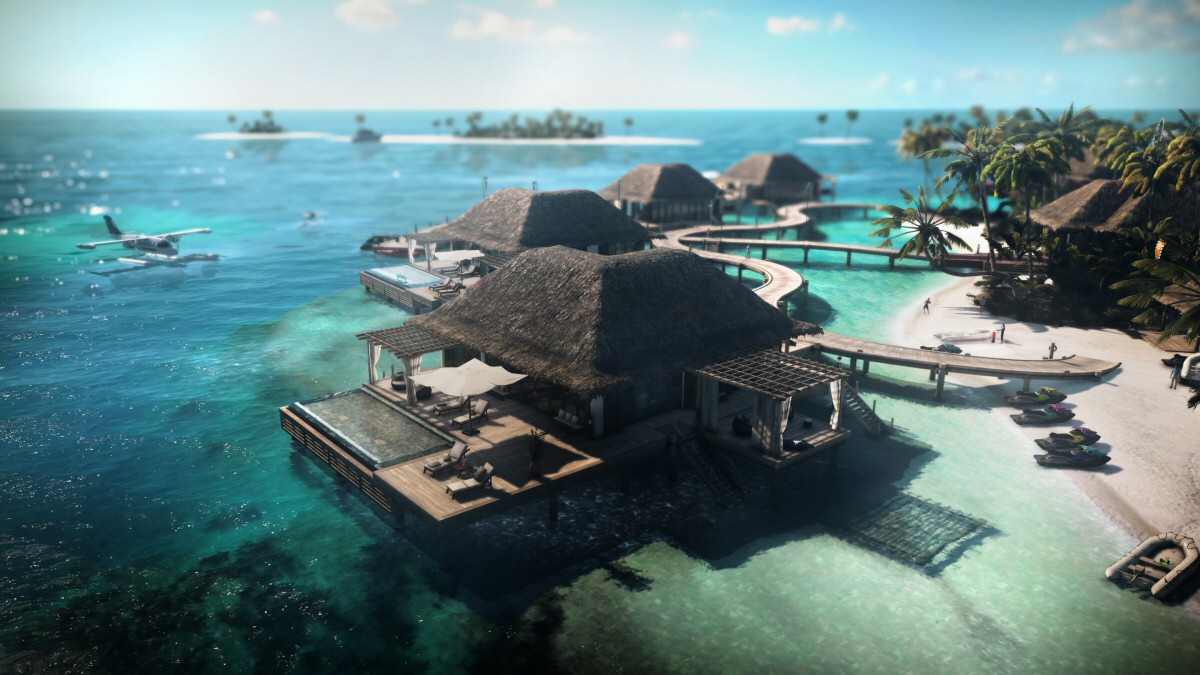
The Maldives. I'm sure you can imagine how deadly it is to tumble off that pier and fall two meters into the calm, warm, refreshing, crystal-clear water.
Maldives is actually a bit janky. Normally the game acts like pushing someone into water is an instant-kill. That makes sense when you’re pushing someone into a well, off a coastal cliff, or into a steep-walled water reservoir. But it makes no sense whatsoever when you’re pushing them off a low pier into hip-deep water that is clear, calm, and inviting. That’s not a murder. That’s barely even a prank.[3]
Also, the AI seems to have trouble with the massive open spaces. I spent a lot of time getting spotted by distant guards through blinds, opaque foliage, and curtains. There’s an entire beachside house where you can’t see much inside because the windows are too reflective, which doesn’t impact the AI. This would be fine as a way of making the level more challenging, but it’s not clear what the rules are or how line-of-sight works. It doesn’t feel like they made the map hard on purpose; it feels like they didn’t do enough playtesting.
It's not a bad map. There's just not much to it, gameplay-wise. The designers make it FEEL substantial by having long empty halls and cavernous rooms, but in terms of routes of ingress, opportunities, and obstacles to overcome, this place is basically a big empty box.
The New York map is absurdly undersized. The whole thing takes place inside of a single bank, and it doesn’t offer nearly the complexity or depth of the locations in the base game. You can compare this to (say) Marrakesh, which has three different locations that are the approximate complexity of the bank, all contained on a single sprawling map.[4]
So despite that deep discount, I still feel like I was kinda ripped off. I paid $8 for 1.3 flat and unpolished new maps. And without the discount, this DLC would cost forty dollars. That’s so outrageously overpriced that it offends me.
I don’t even know who to blame for this mess. Hitman 2016 was published by Square Enix. Then developer IO Interactive self-published some DLC. Then Hitman 2 was published by Warner Brothers.
We can’t blame either publisher, since the same marketing and pricing problems persist across both games. So do we blame IO? Are they deliberately dumbing down their own game while also overcharging for it?
And don’t even get me started on their always-online single-player bullshit. That would make for an entire article-length rant, all by itself.
I don’t know where to point the finger, but someone, somewhere is making a mess of this series. Maybe they’ll get around to putting Hitman 3 on a real platform[5] eventually, but I’m not in a hurry to reward this clumsiness, apathy, and appalling sense of entitlement with $60 of my money.
The Disappointment
Getting rid of Kotick won't magically fix the company or right any of these wrongs. But it would be an important first step.
In these end-of-year write ups, I usually gather my disappointments into a big “worst of year” list. But this year I really only played one game I didn’t like.
[6] So my only major disappointment is that Bobby Kotick still has his job.
I think most people have the gist by now, but if you’re looking for a quick recap then Destructoid has you covered. Here are the highlights from the Destructoid article:
[In July 2021] Activision Blizzard is sued by the California Department of Fair Employment and Housing, as the result of a two-year investigation from the agency, citing allegations of harassment, discrimination, and a toxic workplace culture.
Blizzard executives J. Allen Brack and Fran Townsend address the suit in internal memos. (Townsend’s letter was later found to be written by Kotick.)
Activision Blizzard employees sign a letter, declaring leadership’s response to the lawsuit “abhorrent and insulting.”
Employees organize a walkout and also set forth demands, including a removal of required arbitration and new practices for recruiting, hiring, and promoting.
Activision Blizzard CEO Bobby Kotick calls the company’s response to lawsuit “tone deaf” and promises “swift action.” Employees respond to the letter, highlighting several demands that were not addressed.
[In August] A class action suit alleges Activision Blizzard misled investors over its failure to disclose internal problems.
Workers at Activision Blizzard form a coalition, the ABK Workers Alliance. They send a joint letter to the CEO and leadership criticizing the firm brought on to handle an internal review, WilmerHale, for its previous record of discouraging collective action.
Blizzard Entertainment president J. Allen Brack leaves the company to “pursue new opportunities.” Mike Ybarra and Jen Oneal are installed as co-leaders of Blizzard moving forward. Bloomberg’s Jason Schreier also reports that Blizzard head of HR, Jesse Meschuk, is no longer at the company.
Shareholder group SOC calls Activision Blizzard’s response to the lawsuit “inadequate.”
The state of California expands its lawsuit against Activision Blizzard, alleging the publisher has interfered with the investigation.
Several Blizzard developers, including the director of Diablo IV and the namesake for Overwatch‘s gunslinging cowboy hero, leave the company.
[In September] the Securities and Exchange Commission (SEC) launches its own investigation into Activision Blizzard.
Activision Blizzard releases a statement saying it is cooperating with the SEC’s investigation, as well as those from regulators at the U.S. Equal Employment Opportunity Commission, National Labor Relations Board, and the California DFEH.
Blizzard Entertainment’s chief legal officer Claire Hart leaves the company.
The U.S. EEOC and Activision Blizzard reach an $18 million settlement in lawsuit over the company’s reported harassment and discrimination.
[…]
[In November] Blizzard co-leader Jen Oneal confirms she is leaving the company at the end of the year, with her co-head Mike Ybarra assuming her responsibilities.
A Wall Street Journal report alleges CEO Bobby Kotick was aware of sexual misconduct at the company for years. The story also sheds light on the departure of Oneal, who was reportedly paid less than her counterpart at the helm of Blizzard, and on Kotick’s own alleged interactions with his employees.
Kotick responds to the report, saying that “anyone who doubts my conviction to be the most welcoming, inclusive workplace doesn’t really appreciate how important this is to me.” The Board of Directors says it “remains confident” in Kotick’s leadership.
Activision Blizzard workers organize another walkout, calling for the removal of Kotick as CEO.
Sony Interactive Entertainment president and CEO Jim Ryan sends out an email to employees, as reported by Bloomberg, that criticizes Activision Blizzard’s response to the report. Ryan says Activision Blizzard has “not done enough to address a deep-seated culture of discrimination and harassment.”
Over 1,000 Activision Blizzard employees and contractors sign a public petition calling for Kotick’s removal as CEO.
Xbox head Phil Spencer says he’s “evaluating all aspects” of their relationship with Activision Blizzard and making “ongoing proactive adjustments” in light of the reports, as reported by Bloomberg. “This type of behavior has no place in our industry,” said Spencer.
Activision Blizzard quietly announces a “Workplace Responsibility Committee,” chaired by two existing board members. The company also says it will seek out a “new, diverse director” to add to the board.
Jessica Gonzalez, a senior test analyst who was one of the organizers of the July walkout, announces on Twitter that she is leaving Activision Blizzard, with her last day on Dec. 10. In a message to CEO Bobby Kotick, she says that his “inaction and refusal to take accountability is driving out great talent and the products will suffer until you are removed from your position as CEO.”
[In December] U.S. State Treasures from California, Delaware, Illinois, Massachusetts, Nevada, and Oregon co-authored a statement of intent to meet with Activision’s board, with the general intent seeming to be confronting the company about the ongoing situation at the publisher.
The Game Awards showrunner Geoff Keighley confirms that Activision Blizzard will not be featured at this year’s event outside of the categories its games have been nominated in. Following backlash over an interview with The Washington Post that suggested indecision on how to “navigate” the situation, Keighley posted a series of statements to Twitter. “The Game Awards is a time of celebration for this industry, the biggest form of entertainment in the world,” he wrote. “There is no place for abuse, harassment or predatory practices in any company or any community.”
Following sudden layoffs at Raven Software in the QA department, developers at the studio walked out. They demanded members of the QA team, including those laid off, be offered full-time positions. Reports soon circled that they were promised a pay restructure for months, only to be called in one-by-one and let go. One report indicated employees moved cities for the roles just a few weeks prior.
I apologize for the wall of text. I realize that’s a lot. But I felt it was important to post the whole thing to give you a sense of just how much has happened in the last six months.
The Challenge of Change
...to jail. But I'll settle for him just leaving.
On one hand, I realize that changing the company culture isn’t something you can do overnight. Culture shapes almost everything in a company. How people are hired, how they’re paid, how good work is recognized, how meetings are held, how bad work is discouraged, how problem people are handled, how disputes are settled, how schedules are created, how projects are assigned, how leaders are chosen, and how employees engage with the public.
You can’t magically change all of those behaviors with a memo. A lot of people – middle managers in particular – are going to see this scandal as a temporary disturbance. They’re just hoping to hold onto their positions until this whole thing “blows over” and they can get back to being lecherous, duplicitous, predatory little bullies. At the same time, a lot of other folks are eager for reform. Your problem as a leader is that you can’t tell which group someone belongs to by looking at them. You can’t tell by asking them. Sure, you can ask their boss and colleagues, but how do you know which of them you can trust? No matter how much you care, you can’t personally get to know all of the thousands of people involved. You have to start at the top with people you trust, and push the reforms downward. It’s difficult, slow work.
You need to push your reforms through as quickly as possible, or people will assume you’re all talk. At the same time, you can’t just start firing people or your reforms will turn into a grotesque Stalinist purge. Once the pink slips start flying, people will be eager to demonstrate their fealty to the New Ways by weeding out “evil doers”. That probably sounds nice, but the track record of these sorts of things is not good. What you’re left with is a combination witch hunt / Squid Game. Those sorts of contests favor the ruthless and cunning. The survivors will be people who are good at pointing fingers and tracking grievances, not people that are good at trust and collaboration.
So yes. Fixing Activision is going to be hard. It will take years. It will be messy. Some injustices will go unpunished.
But the first step – the first thing anyone needs to do to begin the process of fixing this – is to get rid of the guy who cultivated the existing way of doing things. It doesn’t matter if he’s magically turned over a new leaf and he’s 100% serious about reform and he’s not just a predatory creep trying to save face. He must go.
He has to go because nobody can take the promises of reform seriously while he’s there. This rotten company culture was created by him. Either he allowed this behavior to fester due to indifference / incompetence, or he served as the toxic template that everyone else emulated.
Here is how stories like this normally go:
Kotick is given a massive severance package and allowed to retire in peace, without needing to admit to any wrongdoing in public. In the following months, the ongoing investigations with various governmental groups will be frustrated Nuremberg-style, with all of the remaining leaders insisting that they didn’t know about and couldn’t stop all of Kotick’s shenanigans.
Kotick’s chair is filled by one of his lieutenants. The new boss will be cut from the same cloth as the old one, and once the media frenzy dies down everything will go back to business as usual.
None of the leaders are punished, and none of the exploited workers receive amends.
The company will experience some very slight reforms. While nobody will say it explicitly, the general gist of it will be “In the future, don’t have so much fun that you create a public scandal.” Instances of harassment will be a little less brazen and a little more “he said, she said”. The company will do a better job at covering up its lies, and exploited overworked people will get paid some tiny percent more.
That sucks, but that’s usually the closest we can get to “justice” when dealing with corruption at this scale.
And we couldn’t even get that.
So that’s the big disappointment of 2021 for me. Next time I’ll run through my list of 2021 titles and talk about what I liked.
Also: If you bump into Santa, please tell him that all I want for Christmas is a good launch for the James Webb Space Telescope. Merry Christmas everyone!