Researchers discovered that the Control Web Panel (CWP) web hosting panel is affected by two serious vulnerabilities that can allow attackers to remotely hack servers, and it’s possible that they may have already been exploited in the wild.
Now's a great time to bid a fond farewell to Harran, the stricken city at the heart of 2015 zombie game Dying Light. As developer Techland gears up for the Dying Light 2 release date, which is less than two weeks away, it's running a limited time event in the original Dying Light - capping off seven solid years of regular content updates.
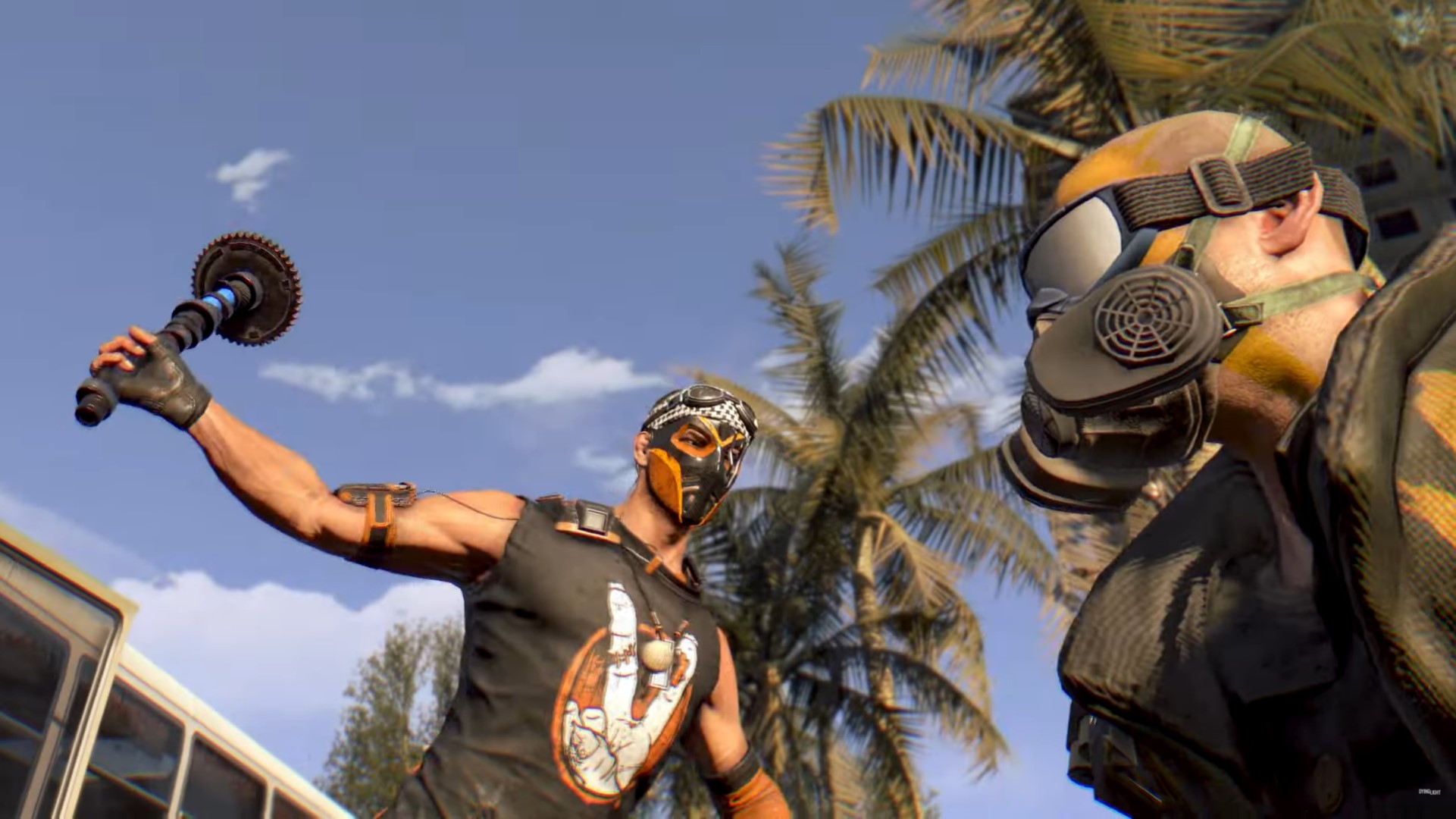
Spike's Story: Last Call is set after the events of Dying Light's campaign. You've dealt with bandit leader Rais, but rather than dispersing, bandits are now flooding into the city. They've broken into a shelter, exposing the survivors there to the zombie infection, and that's created a whole new surge of 'virals' rampaging the streets of Harran.
Your old buddy Spike is setting up a new safe zone for survivors who've escaped the bandits. The first part of the event starts today, January 24, and runs through January 28. During this time, you'll encounter survivors equipped with special protective suits who will fight alongside you, but you'll also run into a lot more virals while you're out there.
Ever since it was first domesticated in the South American Andes roughly 8,000 years ago, the modern potato has changed the world. And while there’s plenty to say about the potato as a food that has made its way into cuisines across the globe, the tasty tuber can also perform a number of functions outside the kitchen.…
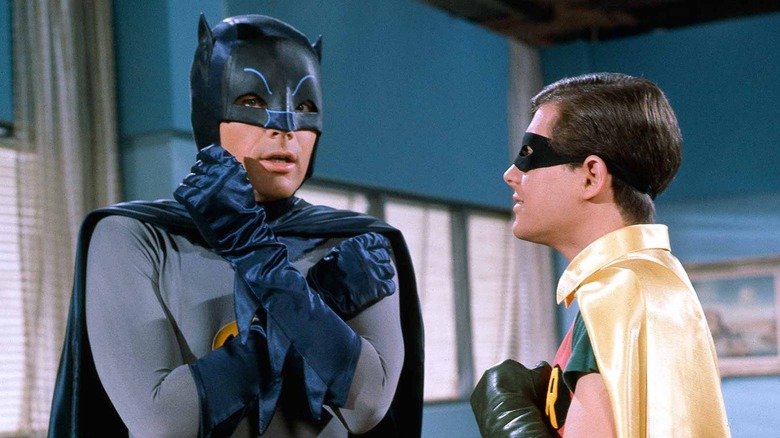
The final episode of "Batman," the sublime TV series starring Adam West and Burt Ward, aired in March of 1968, bringing to a close one of the best TV shows ever made. It would be 21 years until Tim Burton would make the world's biggest smash with his "Batman" feature film in 1989. And while, in 2022, we may be an additional 33 years away from Burton's film (and a full decade from "The Dark Knight Rises." Feeling old yet?), it is the William Dozier-produced TV show that may still carry the character's strongest legacy.
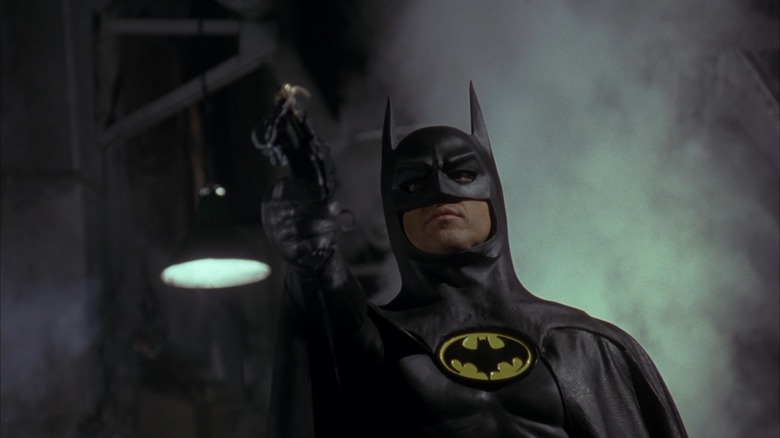
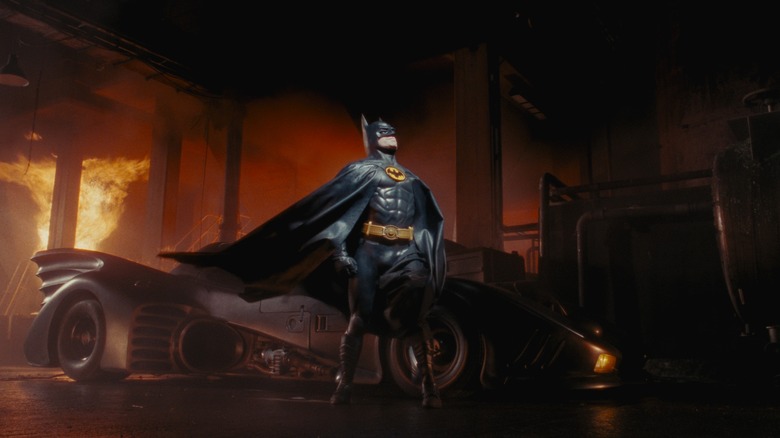
In 1989, when Burton's film was still on the cusp of release, the vast bulk of news coverage devoted to "Batman" compared it to the 1966 TV series (and Leslie Martinson's spin-off film), specifically to highlight how different this new adaptation would be. Gone would be the on-screen "Pow!" sound effects, the colorful costumes, the jokey tone, and the silly supervillains. In their place was Burton's elongated expressionistic set designs inspired by "The Cabinet of Dr. Caligari," a more violent crime plot involving mass murdering the public with poison gas, and a title character who was more stoic and tortured than we had even seen on the screen before.
This was all deliberate. Many readers of the Batman comics -- and of comic books in general -- resented the popularity of the 1966 "Batman" TV series, as it gave the non-comic-reading public the impression that all superhero stories were colorful, campy, and fun. Those who had already discovered more mature, dramatic stories in their Batman comics didn't appreciate that Pow! and Wham! were now the defining features of all conversations about the medium. Indeed, the producer of the 1989 film, Michael E. Uslan -- a Batman fan to his bones -- wanted to ensure that Batman was more in-keeping with devoted fans' vision of the character, and as far from the hated TV series as possible.
Of course, fans of the 1966 TV series resented the change brought about by Uslan and Burton. That includes, perhaps naturally, Adam West, who didn't like Michael Keaton at all.
No One Liked Michael Keaton At First
In an interview from 1989, West expressed an extreme amount of dismay about the casting of Michael Keaton. He says that he cried for an hour. West was saddened that he wasn't asked to contribute to the film in any way. But the actor was also begrudgingly at peace with the new direction that Burton and co. were taking the character. "That's their stuff," he said, "That's their business, and they have a film in mind. I've already done it. I've done my Batman." Then, with a sly whiff on confrontation, West asked "Do you want the Classic Coke, or do you want the New Stuff?"
It's important to remember that Keaton was a controversial casting choice in 1989. At the time, Keaton was better known for his comedy work, and starred in a series of comedy hits like "Mr. Mom," "Johnny Dangerously," "Beetlejuice," and "The Dream Team" released only two months prior to "Batman." Keaton began his career in comedy, working in standup to supplement his theater work and his PA jobs on "Mr. Rogers' Neighborhood." His TV work in the late 1970s and early 1980s was also comedy-forward, with Keaton working on "The Mary Tyler Moore Show," among many others.
To Batman fans, Keaton was seen as being incapable of capturing the brooding angst of Bruce Wayne, and he seemingly lacked the physical prowess to fistfight supervillains. Indeed, Burton's design of the character -- adding fake musculature to the costume -- only seemed to highlight that Keaton wasn't himself a ripped bodybuilder. Burton defended the design by pointing out that Bruce Wayne is trying to pretend to be more powerful and scary than any human, and the fake muscles are a way to highlight his masquerade. If Twitter had been around in 1989, you can bet there would have been an angry hashtag campaign to remove Keaton from the role.
But It All Worked Out
Despite the casting controversy, "Batman" went on to become one of the biggest hits of all time, earning eleventy gazillion dollars domestically (adjusted for inflation). Burton's film also became the inspiration for the Bruce Timm-designed "Batman: The Animated Series," which is still deeply beloved by thirty-somethings to this day. Keaton was not only eventually accepted as Batman, but is now slated to appear as Bruce Wayne in "The Flash" and "Batgirl" movies in the works.
Meanwhile, the 1966 Batman TV series continued its own legacy on the side, eventually reuniting Adam West and Burt Ward to reprise their roles for an animated film called "Batman: Return of the Caped Crusaders," and inspiring any number of toys and comic book series based on the tone and aesthetic of the show.
Because of complicated rights issues, for many years, it seemed that a proper home video release of "Batman" would never see the light of day (Warner Bros. owned the rights to the character, but 20th Century Fox owned the TV show, also ABC might have had some of the broadcast rights ... in short, it was a nightmare of red tape), but in 2014, the show was finally released on DVD and Blu-ray, finally compiling the awesome show for generations to come. The series is also currently available on Tubi.
Meanwhile, Tim Burton's film is on HBO Max. All is right with the world.
Dying Light 2: Stay Human is almost here, and as such, Techland’s support of the original Dying Light will be winding down… although it isn’t quite done yet. Techland has announced one last live event for Dying Light, entitled “Spike’s Story: Last Call,” will kick off today. In this final battle, you’ll attempt to lead survivors to safety, while facing off against bandits and an increased Viral presence. Succeed and net yourself the special Crankshaft melee weapon. You can check out a quick trailer for Spike’s Story: Last Call, below.
Rais has fallen, but it’s not the end of our problems with the bandits. Quite the contrary, to be honest. With their leader gone, they are flooding Harran, all loose and frenzied, ravaging whatever stands in their way. Their strike on a survivors’ shelter exposed those hiding inside to the infection, bringing on a host of freshly-turned Virals to deal with. As if we hadn’t had enough of them already…
But not all’s lost. Spike’s organizing a safe zone for the survivors who managed to escape. There are still many who need help getting there, though, and it will take some real grit and extraordinary skill to brave the storm and bring them to safety. You are their only hope now. Camden wanted to equip them with his special suits, but unfortunately, only some of them managed to get them. As few as they are, they might prove really useful, so keep your eyes peeled! Oh, and as for the zombie situation—think Spike already has an idea on how to deal with it. Just follow his instructions, and we might stand a chance. For your efforts, Spike will reward you with his special melee weapon -- Crankshaft.
The Last Call event will consist of two parts, with the first running from January 24 to January 28. So, it’s likely both parts will be completed before Dying Light 2 launches. Here’s some more specifics about Part 1.
Part I – January 24 to January 28
Friendly survivors in protection suits will be fighting alongside you.
Beware! The number of Virals is fluctuating, and there’s more of them now!
Local Bounty #1: Kill the bandits.
Reward: Crankshaft—the 1st stage of Spike’s new weapon
Local bounty #2: Help the survivors.
Reward: Last Hope blueprint
Global bounty: Kill zombies using the environment.
Reward: 3 King mods
Dying Light is available now on PC, Xbox One, PS4, and Switch, and playable via backward compatibility on Xbox Series X/S and PS5. Dying Light 2: Stay Human is coming to PC, Xbox One, Xbox Series X/S, PS4, PS5, and Switch via the cloud on February 4.
Peter Dinklage, who played Tyrion Lannister in the HBO series "Game of Thrones," has spoken about his thoughts on the upcoming prequel series "House of the Dragon." THR points out that Dinklage was a recent guest on Marc Maron's WTF podcast, where the two spoke about Dinklage's career, and the new series came up during the discussion.
Dinklage will not appear in the series because of the time period, of course (it's set hundreds of years before the events of "Thrones"), but he did have something to say about the new series. He told Maron:
"I think it is going to be a really good show. I know the director and producer of it, who worked on our show, and I think it's going to be really f****** good. But, they took a risk on our show, HBO did. It's all under new leadership over there now. They took a huge risk on our show, and it was a slow start, but why don't they do that again? This isn't a risk. It's a proven thing that works."
Dinklage was the best part of "Game of Thrones" in my opinion. He won an Emmy for his work. The series ending, however, was a disaster. Fight me on that. It was rushed, scenes were so dark that you couldn't make out what was happening, and all the character work that was done for a lot of the players -- and I'm not just talking about Daenerys here -- was left by the wayside at the end.
Taking A Risk
HBO could take a risk here, but as I said, many "Game of Thrones" fans didn't feel like the send-off the beloved series received was the one it deserved. Having a new foray into the world of Westeros and Essos might take the sting out of it. There is so much lore to be mined in the George R.R. Martin books, and it will be really interesting to see if exploring a different side of that massive world will reap rewards for the premium channel.
"House of the Dragon" will premiere on HBO Max in 2022. The cast includes Matt Smith as Prince Daemon Targaryen, Emma D'Arcy as Princess Rhaenyra Targaryen, Olivia Cooke as Alicent Hightower, Rhys Ifans as otto Hightower, Steve Toussaint as Lord Corlys Velaryon, Paddy Considine as King Viserys Targaryen, John Macmillan as Ser Laenor Velaryon, Savannah Steyn as Lady Laena Velaryon, and Theo Nate as Ser Laenor Velaryon.
The series will show the Targaryens at the height of their power, 200 years before the events of the original "Game of Thrones" TV series. The first season will have 10 episodes.
Director Sam Raimi sure does love to have his "Evil Dead" trilogy star Bruce Campbell show up in his other movies, and who can blame him? Of course, the groovy actor is far from the only member of Raimi's inner-circle to appear time and time again in his films and TV shows. Campbell famously cameoed in all three of Raimi's "Spider-Man" movies, leaving it to audiences to devise their own wild theories about the in-universe connection or lack thereof between his characters ("Ring Announcer," "Snooty Usher," and "Maître d'").
Meanwhile, Sam Raimi's brother, Ted Raimi, has similarly popped up "Where's Waldo?" style in his sibling's work over the course of his career, from playing Joxer the Mighty in "Xena: Warrior Princess" to J. Jonah Jameson's hapless employee Ted Hoffman in Sam Raimi's "Spider-Man" trilogy.
But "Spider-Man" also featured an appearance by another trusted Raimi collaborator in the form of Xena herself, Lucy Lawless. Unlike Campbell and Ted Raimi, however, Lawlesss donned a bit of a disguise for her cameo ... assuming a spiky orange wig and punk outfit count as a "disguise," anyway.
Guy With 8 Hands? Sounds Hot
After starring in all six seasons of "Xena: Warrior Princess" — a show that, like many of the projects Sam Raimi has been creatively involved with, combined earnestness with zaniness — Lawless re-teamed with Raimi and Campbell in the 2010s on "Ash vs Evil Dead," a series that picked up with Ash Williams (Campbell) in real-time from where 1992's "Army of Darkness" had left him. What's more, her ties to Raimi and Campbell run even deeper than that, courtesy of her husband, Rob Tapert. The latter co-founded Raimi and Campbell's production company, Renaissance Pictures, back when they made the original "Evil Dead" in 1981 and he's continued to work with them throughout the four decades since then.
What's perhaps most interesting about Lawless' "Spider-Man" cameo is that it's part of a montage showing the webslinger stopping crimes all over New York City, intercut with clips of New Yorkers giving their unfiltered thoughts on Spider-Man in interviews with an off-screen news crew. And that's how we got the horny comments from Lawless' "Punk Rock Girl" seen above.
A scene that explores how average people feel about costumed vigilantes in a world of superheroes doesn't seem so remarkable in the age of the MCU, but it was less common in superhero films back in 2002. This montage also served to give Raimi's version of NYC more personality and spoke to the diversity of the population that resides there, making it a funny but essential part of the director's love letter to Spidey's home turf.
SPEAK NO EVIL is a subtle and sly dissection of how the social compact among human beings and our social conditioning can make us easy prey for predators who know our limitations all too well.
The film is directed by Christian Tafdrup and co-written with his brother Mads Tafdrup. In the introduction for the film at the Sundance premiere, Christian Tafdrup described his and his brother’s ambition to “make the most unpleasant experience for an audience, ever.” Is the film as violent as some of the most notorious gorefests ever made? No, it’s not Cannibal Holocaust, but it does have the evil and smug self-righteousness of human beings inside it, just as the notorious Ruggero Deodato film does.
SPEAK NO EVIL stars Morten Burian as Bjorn, Sidsel Siem Koch as Louise, Fedja van Huêt as Patrick, Karina Smulders as Karin, Liva Forsberg as Agnes, and Marius Damslev as Abel. Burian and Koch do excellent work as naive and bewildered very polite people. Louise is a little more aggressive than Bjorn, but even she cringes away from confrontation for the most part until pushed past her limit. Van Huêt as Patrick is fun and free-spirited until he isn’t and you can see his very real charisma with a hard and nasty undercurrent of spite. Patrick is always weighing his options and continually pushing boundaries because he wants to know what he can get away with and he just enjoys making people feel uncomfortable. Marius Damslev has possibly the most difficult role in the film. He never speaks but he’s an uncomfortable specter flitting among the grown-ups and Agnes.
The story is based on a real-life incident that happened to the director. He and his girlfriend met an “offbeat” Dutch couple on vacation who invited the couple to visit them in Rotterdam. From the story, it sounds like the director felt the situation was weird and they declined the invite. The film imagines what happens if a couple was naive and ignored possible misgivings and accepted that invitation.
The cinematography is tackled by Erik Molberg Hansen who has worked in television and documentary film. It’s bright and sunny when the film is in Tuscany, befitting a happy time, and turns much subdued and dark once the central couple returns to northern Europe. The film’s lighting darkens and becomes more of a sickly golden color as the relations between the two couples become more complex and discordant.
One of the things that make SPEAK NO EVIL so disturbing is watching the polite facades of Bjorn and Louise melt into disappointment. Burian’s performance in particular is one of disappointed betrayal. The actor is quite vulnerable and the hurt look on his face when he is humiliated again and again by the people he thought were his friends is painful to watch.
The other thing that is so disquieting is that the framework of this horror film is set on a polite comedy of manners. It’s very funny and the structure of the film’s script is very much in line with many cringe comedies that you have seen before. But where you would normally find a goofy resolution, in SPEAK NO EVIL, you find cold hard stares and fear seeping out of the protagonists’ pores. It’s the fear of putting your trust in someone and finding out that they do not share your morals or agreement in the social compact of human beings. That they are people who exist not just outside of traditional morality or polite social behavior, but outside of everything that makes us social animals. They don’t have those restraining strictures within them and they don’t care what anyone thinks about it. They can’t be shamed or appealed to by calls to their empathy. They have none. It’s what the victim of a serial abuser or killer finds out when it is far too late to do anything about it. That moment of realization that the world isn’t what you’ve always been told that it was is a terrifying thing. It is especially terrifying when you know that you lack the personality structure to fight back.
SPEAK NO EVIL doesn’t really take a side and that is to its benefit. It merely points out that our normal social conditioning is sometimes what puts us in danger. It tells us that social conditioning doesn’t work on everyone and that there are people out there for whom politeness is not a defense. People who don’t care if they hurt you. People who want to hurt you because they enjoy it. It really brings that truth home to sit on your couch and stare deeply into your eyes.
It’s the loneliness of being separated from the safety of the herd. The cold dark field where all the things that promised protection are rendered useless. It’s the second location that you should never allow yourself to go to. It’s when you realize that all the red flags were there and you ignored them. That’s what SPEAK NO EVIL brings you. The slowly dawning realization that there’s no one to help you and that you don’t know what to do. Extremely well-mannered and archly funny, it freezes your blood.
SPEAK NO EVIL had its world premiere at the 2022 Sundance Film Festival. Shudder subscribers, rejoice! It was picked up for distribution ahead of its premiere and will be dropped on the streaming service at a later date.
Security researchers from Kaspersky said they have discovered a novel bootkit that can infect a computer's UEFI firmware. From a report: What makes MoonBounce -- the name they gave the bootkit -- special is the fact that the malware doesn't burrow and hide inside a section of the hard drive named ESP (EFI System Partition), where some UEFI code typically resides, but instead it infects the SPI flaws memory that is found on the motherboard. This means that, unlike similar bootkits, defenders can't reinstall the operating system and replace the hard drive, as the bootkit will continue to remain on the infected device until the SPI memory is re-flashed (a very complex process) or the motherboard is replaced. According to Kaspersky, MoonBounce marks the third UEFI bootkit they have seen so far that can infect and live inside the SPI memory, following previous cases such as LoJax and MosaicRegressor. Furthermore, MoonBounce's discovery also comes after researchers have also found additional UEFI bootkits in recent months, such as ESPectre, FinSpy's UEFI bootkit, and others, which has led the Kaspersky team to conclude that what was once considered unachievable following the rollout of the UEFI standard has gradually become the norm.
Without question, we live in an era of media over-saturation. Even post-COVID (lol), the industry is still pumping out new movies and new streaming services to host them on at an alarming rate—and those same services mean we also have easy access to thousands of films from the last century. I never need to rewatch a…
Making dinner can be exhausting, especially when you have to do it every single night. It can be especially challenging if you’re trying to cut down on food waste and want to avoid buying specialty ingredients that you’ll only use once.
As gaming security and anti-cheats become an ever-evolving field of design. Cheaters continue to evolve their craft. Anti cheating efforts can take the form of preventing cheaters and the like from disrupting online games and marring the general experience for everyone that plays legitimately, or worse, can damage their computers. Such cheating forms include things like automatic perfect headshots in Destiny 2, for instance. Today, we focus on the latest target, Dark Souls III.
Recently, it was discovered that there existed an exploit in the game’s multiplayer functionality. Namely, the Invaders gameplay feature which, if the invader were to utilize it, could essentially “brick” your PC (make it completely worthless and unusable).
In essence, if used, it allows the world invader to run various forms of malware and trojans to allow them full access to the server, or worse, your entire computer, and that only spells trouble. The original Twitter thread, written by user SkeleMann (@SkeleMann), details this, as well as an identifier of sorts for these hackers, which can be read below.
In it, SkeleMann explains what’s going on with it, and details a mod that, again, identifies hackers such as ones abusing this exploit, the Blue Sentinel mod. Obviously, you can always just play the game offline.
Unsettlingly enough, it's been found that this Remote Control exploit can potentially work with Elden Ring. The exploit has been talked about in several threads on Reddit and a massive warning was issued on discord as well. However, as of the time of writing, Dark Souls III developer FromSoftware has gone ahead and fully disabled all multiplayer servers across the entire series’ PC versions, which you can see below.
PvP servers for Dark Souls 3, Dark Souls 2, and Dark Souls: Remastered have been temporarily deactivated to allow the team to investigate recent reports of an issue with online services. Servers for Dark Souls: PtDE will join them shortly.
Hopefully, the team can figure out a way to fix the matter, but brute-forcing protection, unfortunately, looks like it has to be the move to make. We’ll update you if more information surfaces about the online exploit.
Dark Souls III is available now on PlayStation 4, Xbox One, and PC via Steam. Elden Ring will be released on February 25th, 2022, for PlayStation 5, PlayStation 4, Xbox Series, Xbox One, and PC via Steam.
Last Friday, Quake II RTX received a big new patch, version 1.6. The developers added a bunch of new features, though the most interesting ones came directly from the community, as GitHub user @res2k introduced support for AMD's FidelityFX Super Resolution (FSR) and for High Dynamic Range (HDR) displays.
The game now supports AMD FSR, but what about NVIDIA DLSS? Sadly, in a somewhat ironic turn of events, NVIDIA's prized Deep Learning Super Sampling cannot be added because of the GPL license used by Quake, as confirmed by developer AlexP on the Quake II RTX Steam forum.
Intel's upcoming AI-powered image reconstruction technology called XeSS could be added to Quake II RTX, though, since it's going to be open source.
Meanwhile, here's some footage of the game running on an AMD RX 6800 GPU with FSR enabled, captured by YouTube user CozMick.
Breaking Changes in Quake II RTX 1.6
Re-designed the material definition system for flexibility and modding.
Removed support for the VK_NV_ray_tracing Vulkan extension, which is superseded by
VK_KHR_ray_tracing_pipeline and VK_KHR_ray_query that were added earlier.
New Features in Quake II RTX 1.6
Added a setting to enable nearest filtering on world textures, pt_nearest.
Added a setting to enable the use of texture and model overrides in the GL renderer, gl_use_hd_assets (https://github.com/NVIDIA/Q2RTX/issues/151)
Added support for converting sky surfaces into lights based on their flags, see pt_bsp_sky_lights.
Added support for IQM models and skeletal animation for the RTX renderer.
Added support for making any models translucent, and cl_gunalpha specifically.
Added support for masked materials (https://github.com/NVIDIA/Q2RTX/issues/127)
Added support for polygonal light extraction from MD2/MD3/IQM models.
Added support for smooth normals on the world mesh through a BSPX extension.
Added support for unlit fog volumes. See the comment in fog.c for more information.
Enabled game builds for ARM64 processors.
Extended the "shader balls" feature to support arbitrary test models with animation.
Fixed Issues in Quake II RTX 1.6
Fixed a crash that happened when loading a map with non-emissive lava material.
Fixed loading of multi-skin MD3 models.
Fixed long texture animation sequences.
Fixed some bugs in the model validation code
Fixed some self-shadowing artifacts by increasing the shadow and bounce ray offsets.
Fixed some unlit or partially lit triangles by improving the BSP cluster detection logic.
Fixed the MZ_IONRIPPER sound
Fixed the rcon_password variable flags to prevent the password from being stored
Fixed the background blur behavior when the menu is opened on a system with over 24 days of uptime.
Fixed the barriers in non-uniform control flow in the tone mapping shader
Fixed the buffer flags on the acceleration structure scratch buffer
Fixed the crash that sometimes happened when entering The Reactor map
Fixed the disappearing light surfaces on some polygons with almost-collinear edges.
Fixed the lighting on the first person weapon when it's left-handed.
Fixed the missing frame 0 in repeated entity texture animations.
Fixed the pipeline layout mismatch in asvgf.c
Fixed the rendering of the planet's atmosphere in the space environment.
Fixed the sampled lighting estimator math, improved specular MIS.
Misc Improvements in Quake II RTX 1.6
Allowed changing the VSync setting without reloading the renderer.
Extended the supported light style range to 200% to fix over-bright lighting.
Implemented anisotropic texture sampling for objects seen in reflections and refractions using ray cones.
Improved CPU performance by not re-allocating the TLAS on every frame.
Improved the handling of transparent effects in the acceleration structures.
Removed the fake ambient that was added when global illumination is set to "off".
Removed the initialization of the async compute queue, which was unused. This improves rendering performance and fixes some compatibility issues with AMD drivers.
Removed the MAX_SWAPCHAIN_IMAGES limit for XWayland
Replaced the implementation of model data handling on the GPU to improve scalability
Replaced the material BRDF with a more physically correct one and removed the non-linear albedo correction function.
Replaced the normal map normalization on load with a compute shader to speed up engine startup and map loading.
Contributions by GitHub user @res2k:
Added auto-complete for the ray_tracing_api console variable
Added support for AMD FidelityFX Super Resolution
Added support for HDR monitors
Added support for synthesizing emissive textures and fixing lighting in custom maps
Allowed saving and loading games in expansion packs
Fixed a crash due to invalid clusters on some world geometry
Fixed the debugging features of the bloom pass
Fixed the lighting from light surfaces with animated textures
Implemented full-screen blend effects (such as on item pickup) in the RTX renderer
Improved support for old mods and enabled x86 builds of the dedicated server
Improved the behavior of Dynamic Resolution Scaling on map changes
Improved the FPS counter behavior when r_maxfps is set
Improved the tone mapper
Replaced the rendering of laser beams as billboards with volumetric primitives
Contributions by GitHub user @Paril:
Added settings for texture filtering in the UI
Added support for maps in QBSP format
Merged over 350 commits from Q2PRO
Moved the security camera definitions to per-map files for modding
Social engineering campaigns involving the deployment of the Emotet malware botnet have been observed using "unconventional" IP address formats for the first time in a bid to sidestep detection by security solutions.
This involves the use of hexadecimal and octal representations of the IP address that, when processed by the underlying operating systems, get automatically converted "to the dotted
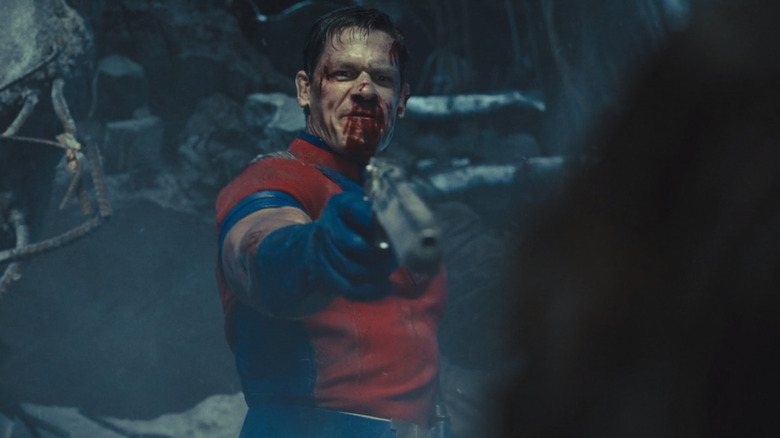
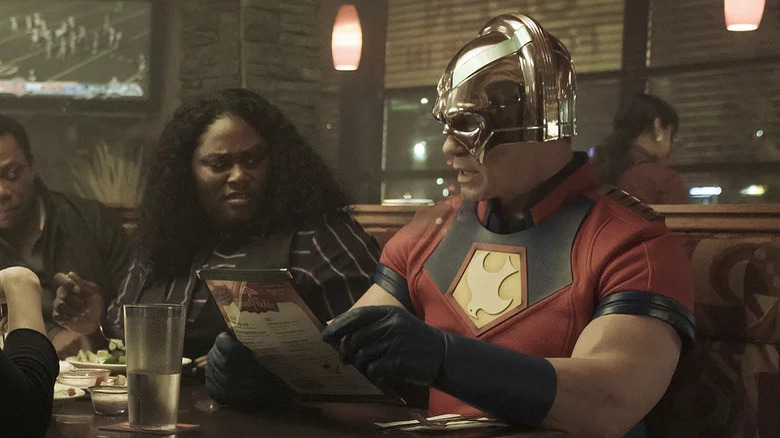
I'm going to be completely frank: I loved "The Suicide Squad," and it was my top movie of 2021, but I initially had no interest in a "Peacemaker" spin-off series. The villainous character, played by John Cena, was nearly irredeemable and a representation of everything that bothers me about America. Writer and director James Gunn has even saidPeacemaker's whole deal is "toxic masculinity at its most toxic," which isn't exactly something I want to see in a character that is supposed to be sympathetic. Many other fans I've spoken with have had similar concerns: how am I supposed to root for the guy that did all of those awful things in "The Suicide Squad"?
Gunn is one of my favorite creators, so I gave "Peacemaker" a chance and was blown away by the nuanced approach to tough topics, all under the guise of a foul-mouthed superhero show. "Peacemaker" is its own kind of origin story, but instead of following a brand-new superhero, it's following a lost one who discovers a totally different side to himself. The series is a lesson on radical empathy, forgiveness, and giving people room for redemption. In an America as conflicted as Peacemaker himself, it's a story we need now more than ever.
Warning: Spoilersfor "Peacemaker" episodes 1-4 and "The Suicide Squad" from here on out. Content advisory: discussion of child abuse, suicide.
"Peacemaker ... What A Joke."
In "The Suicide Squad," Peacemaker is a rude, violent jerk with a bad attitude. Under orders from Amanda Waller (Viola Davis) he kills his hero, Colonel Rick Flag (Joel Kinnaman), and Flag gets one last dig in before he dies, sputtering, "Peacemaker, what a joke." In the movie, Peacemaker really is a total joke of a human being with only tiny moments of humanity, and he does everything he can to hide those from his fellow mercenaries. He's constantly trying to one-up Bloodsport (Idris Elba), he's blindly patriotic to the point of near-fascism, and he's just a total turd. When the credits scene revealed that he had survived being shot by Bloodsport and having an entire building fall on him, I felt a little defeated, like when you find out the killer miraculously got away in a horror movie.
The first episode of "Peacemaker" gives us a version of the character that's already changed in response to what happened in Corto Maltese. Killing his idol did a number on poor Peacemaker (real name Christopher Smith), and leaving the hospital to discover just how alone he was in the world didn't help matters. Later, his "Project Butterfly" teammate Leota Adebayo (Danielle Brooks) describes him as having a "sadness inside him," and that's apparent from the first frame of the series. The bluster and need to constantly prove himself is still there, but the fiery drive is gone from his eyes. Chris has lost faith in his ethos, his motto, and himself.
A Broken Shell Of A Man
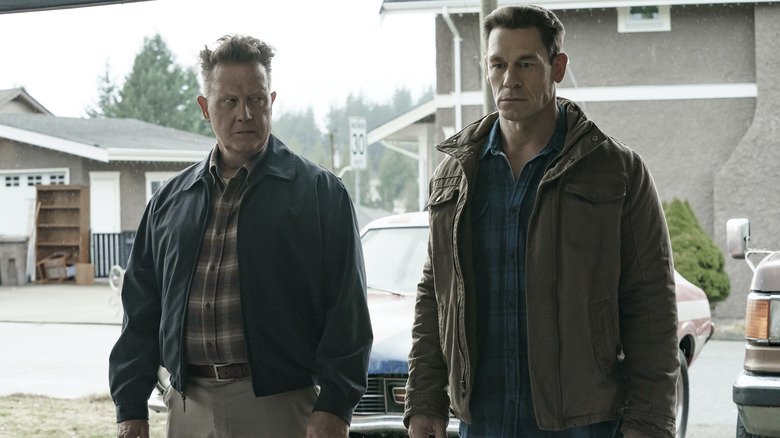
Chris is a mess. His dad, Auggie (Robert Patrick), is a white supremacist supervillain called the White Dragon, and Auggie did everything he could to make his son just like him. In flashbacks during "Peacemaker" episode 4, Auggie forces his school-aged son to kill a man in cold blood, and later to fight his brother while adults bet on them. His brother died as a result of that fight, and it's safe to say that traumatized Chris for life. Not only that, but Auggie is regularly cruel to Chris, and even tells him that the "wrong son died."
Peacemaker has had a horrific upbringing by a hatemonger, but there's still good in him somewhere. Killing Rick Flag made him realize that maybe the blind ideals he had fought for his whole life were a lie, and questioning that leads him on a path of self-discovery.
After Auggie is thrown in prison after being framed for something related to Project Butterfly, Peacemaker goes to talk to him. Adebayo begs him to see that his dad is a monster, but Chris explains that you don't give up on family. Auggie is the only family Chris has, and lifelong abuse is a hard thing to come to terms with. Later, Adebayo explains it to Vigilante (Freddie Stroma): "Chris has a big heart so he wants to find something to love there. But there's nothing to love."
Sins Of The Father
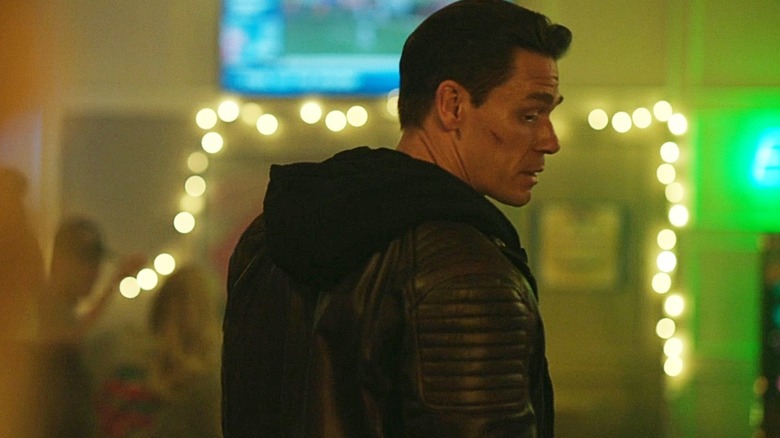
One of the main problems Peacemaker faces upon his return to society is that no one wants to give him a chance. They either assume he's an absolute buttmunch because of his boorish behavior, or they assume he's going to be just like his dad. He's expected to act a certain way, even though he's starting to realize that he doesn't want to be the person he's projected for all of these years. He's not a racist, he's not actually sexist (just confused), and he is deeply empathetic despite forcing himself to be cut off in order to survive.
Chris absolutely has symptoms of Complex Post-Traumatic Stress Disorder, or C-PSTD, including feelings of guilt, self-destructive behavior, detachment, and avoidance. The new trauma of killing Flag has shaken him to his core and opened up old wounds, and his repeated flashbacks of the event are another symptom of PTSD. Chris has been deeply traumatized since childhood, and exists in a world that judges him no matter how he tries to reconcile his childhood.
America has always been divided, but the psychotic fear-mongering of conservative media has driven many of its older white viewers to extremism. People are becoming increasingly radicalized in general, often because they feel misunderstood or lonely. Growth is hard, and learning how to be better is even harder when you're forced to do it on your own. Chris frequently says things the wrong way, though his sentiments are sweet, and it's just proof that he never had proper guidance on social interactions. It's not an excuse, but it is an important explanation. He's not being a jerk just to be a jerk; he's doing it because he doesn't know how else to be.
The Cost Of Loneliness
Peacemaker wants to change. He wants to be a better person, and he actively tries to listen to the advice Adebayo gives him. He's heartbroken that everyone hates him, and it would be incredibly easy for him to just fall back into mutual hatred, the way his father always did.
Going against your upbringing is tough, and doubly so when it's an abusive one. Toxic masculinity hurts everyone, but its male victims are the ones that tend to go unrecognized. The suicide rate in America is highest in middle-aged white men, who often are brought up to believe that showing pain is embarrassing, and talking about your feelings is verboten. Many of these men have good in them, but have been abandoned. The confines of patriarchy don't support them becoming fully-realized people, and those who have been hurt by toxic white masculinity have grown tired and frustrated. It's not easy to show empathy to people whose worldview is completely different from your own, especially when some of their beliefs are genuinely harmful.
Adebayo offers Chris something that's unfortunately incredibly rare: radical empathy. Radical empathy is the practice of allowing yourself to empathize with even your enemies, because you realize that we're all just broken humans. Radical empathy has its limits; someone like Auggie, who lacks empathy entirely, is beyond it. But for someone like Chris, who is damaged and lost, it could save his life and help him become a much better man. "Peacemaker" posits that judging people at face value can only ever divide us further, and that failing to give people room to grow can force them back in the other direction.
The Power Of Love
At a press junket for the series, Gunn said that "Peacemaker" was a "love story" between Peacemaker and Adebayo. It's not a romantic love story, but the love story of two people who discover something about themselves while helping the other grow. Their friendship is a powerful force for good, and without Leota, Chris might have reverted back to his more antisocial tendencies. Gunn explained:
"[Leota's] the first person to be nice to him and the first person to laugh with him instead of just at him, not only in this show, but in 'The Suicide Squad' as well. So I think it's more about, if there's anything, I think it's seeing what a relationship could be like from people who disagree adamantly about all sorts of things. The way to maybe initiate change is not by screaming at each other, which only further radicalizes people."
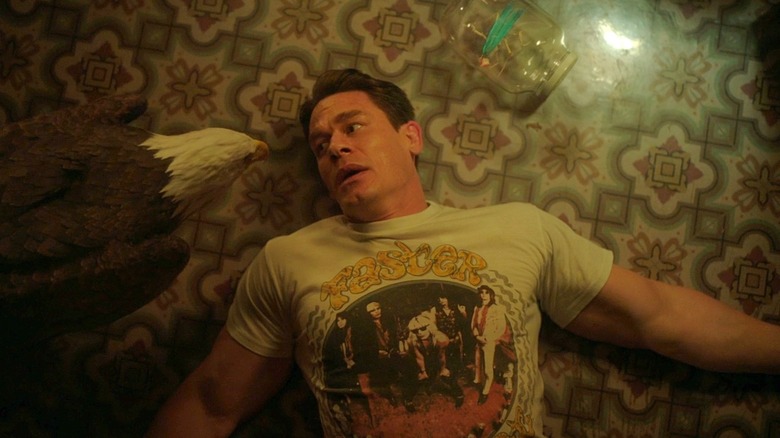
If this all seems a little deep for a show about a guy with a pet eagle and a toilet-seat helmet, don't worry; Gunn's M.O. is putting profound messages alongside profane humor. His career has almost entirely centered on projects that highlight misfits and outcasts, and "Peacemaker" is another in a long line of stories intended to make you think as hard as you laugh. Hopefully we can all learn to give each other a little more room to grow, and help each other change because it can't exist in a vacuum. Radical empathy requires strong boundaries and some tough love, but it can change the world.
New episodes of "Peacemaker" release Thursdays on HBO Max.
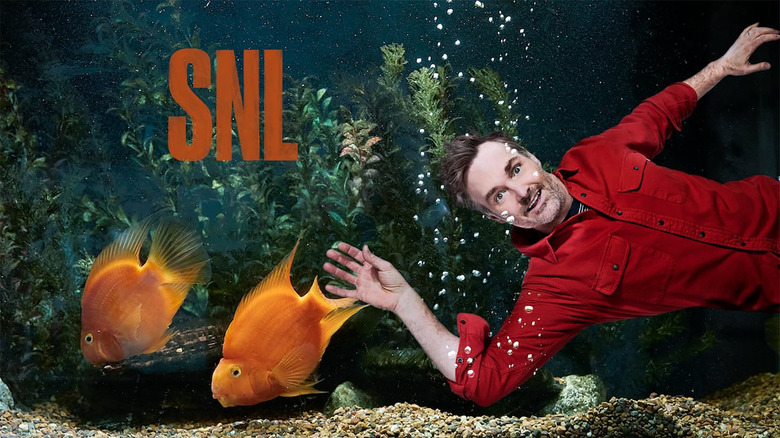
Twelve years after his departure as a regular cast member, Will Forte finally returned to the "Saturday Night Live" stage to host the long-running late night sketch comedy series. Because the "Last Man On Earth" and "Nebraska" star is best known for bringing a number of awkward and somewhat dark characters to life throughout his eight year tenure on the show, Forte has quite a deep well of characters that he could have brought back for his first hosting gig.
Unfortunately, Jeff Montgomery, Hamilton, and Carl the fartfaced businessman were no shows this time around. But Clancy T. Bachleratt did reunite with Jackie Snad to sing about spaceships, toddlers, Model-T cars, and jars of beer again thanks to a cameo from Kristen Wiig. And of course, these episode wouldn't be complete without the return of Forte's most famous "SNL" character. The main event of this week's episode was an all new adventure with MacGruber.
Shut Your Butt!
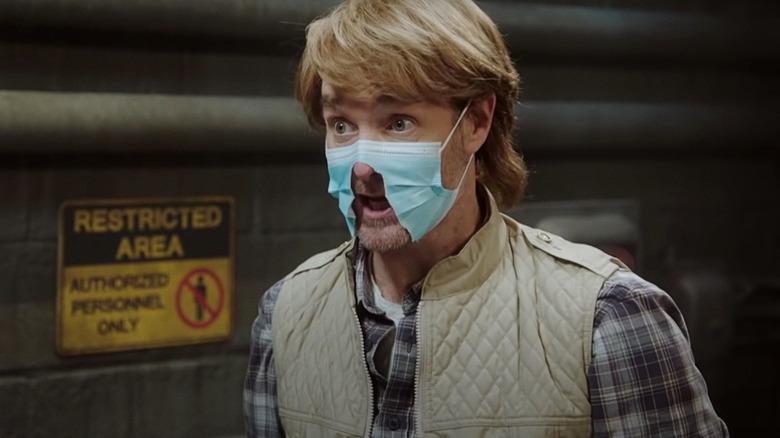
After starring in his own feature film and Peacock original series, special operations agent MacGruber made a glorious comeback to 30 Rock to deactivate ticking bombs once more alongside companions Vicki St. Elmo (Kristen Wiig) and Dixon Piper (Ryan Phillippe). As usual, the fan favorite "MacGyver" parody managed to get distracted by a variety of personal issues. But instead of alcoholism, a fear of aging, or the identity of his real father, it looks like the ultimate hero and uber-patriot MacGruber is more concerned about COVID-19, masks, and vaccinations these days. And not in the reasonable, kind, or helpful way.
In the latest "MacGruber" sketches, the resourceful adventurer has been outed as an anti-vaxxer and an anti-masker. He decides to free himself and his colleagues from tyranny by burning their masks. Then he decides to take questionable medications to fight off his Covi-philis, a new strain of the virus that combines (you guessed it) COVID and syphilis. Finally, after completely succumbing to off the wall right wing Qanon conspiracy theories, MacGruber full on embraces the latest fashion from Donald Trump's Insurrection Collection. But before the last hoax of a bomb explodes, he does get a quick plug in for the NBC streamer, which is where you can find the latest adventures of MacGruber right now.
As Forte alluded to in his monologue, "MacGruber" has not been picked up for a second season as of yet. If it does, let's hope that the titular hero has gotten that COVID denying nonsense blasted out of his system.
Unless you've been living under a rock, you've likely heard of the social media sensation known as TikTok. Whether it's inspiring viral dance challenges, offering make-up and fashion tutorials, showing of the cutest animals, or simply making you laugh or cry in a variety of ways, the mobile video app has an undeniable presence in pop culture with over 3 billion downloads so far. But how did TikTok get here? What makes it more appealing than the likes of Facebook, Snapchat, Twitter or Instagram? And why should we be careful by how much we embrace it? Director Shalini Kantayya answers all these questions and more in her comprehensive and informative new documentary "TikTok, Boom," which is playing as part of the virtual 2022 Sundance Film Festival.
The Rise Of TikTok
With technology becoming an integral part of everyone's lives, it's important to know as much as possible about the social media platforms that we trust with some of our most personal details and experiences. When it comes to TikTok, there's much more bubbling beneath the surface of this video app that continues to make history.
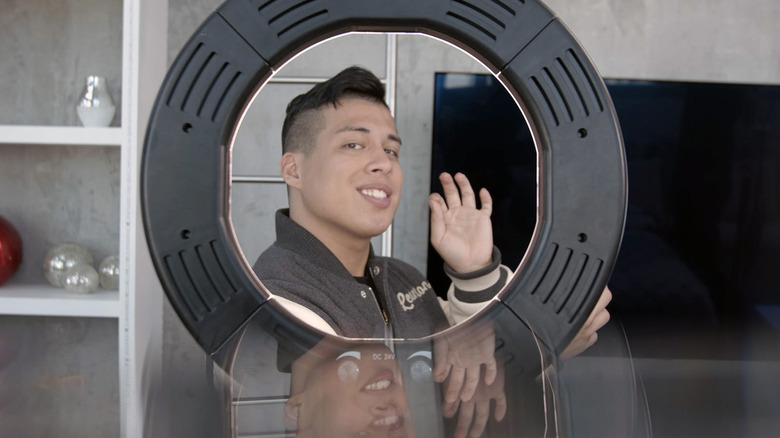
Director Shalini Kantayya begins by keying the audience into exactly why TikTok has become such a hit. Beginning with profiles of famed TikTok creators, or "digital natives" like the beatboxing Spencer X, human rights activist Feroza Aziz, and the politically inclined influencer Deja Foxx, the film lays out the broad spectrum of content and appeal that TikTok has while delving into the origins of the app in China. It's simultaneously informative, thoughtful, and captivating, making it easy to see why TikTok has surpassed so many previously popular social media outlets.
But "TikTok Boom" isn't just about celebrating the success and innovation of this continually fast-spreading app created by ByteDance. With a cavalcade of journalists, tech experts, news reports, and prominent TikTok creators, the documentary digs deep into some of the headline-making issues that have made TikTok even more prominent and relevant across the sociopolitical, economic, and cultural spectrum.
Remember how former President Donald Trump tried to ban TikTok in 2020 leading up to the presidential election? This documentary dives into the reason behind the near-death sentence, highlighting the security issues that have been raised by the government. Furthermore, because the app is based in China, where censorship in the media runs rampant, there have been concerns raised with regards to certain kinds of content being blocked or flagged as inappropriate. TikTok was also secretly limiting the visibility of certain minorities, creating plenty of racial bias within the app's algorithm, though it claimed it was to avoid online bullying. Since filmmaker Shalini Kantayya previously dug into the racial bias that plagued facial recognition and the algorithms based on it in her film "Coded Bias," you couldn't ask for a better person to take on TikTok's many concerns in the tech world.
The Good, The Bad, And The Ugly
Where "TikTok, Boom" shines is how the featured TikTok content creators weave into the looming problems that have come to light in the app's quick rise to online dominance. Feroza Aziz battled TikTok on the cable news circuit after the app tried to hide her criticism of China's treatment of the Uighur Muslims. Deja Foxx turned her political voice into an unfortunately short-lived political position that created TikTok material for Kamala Harris' campaigns until the app was deemed a security threat. Meanwhile, Spencer X represents the personal stakes for those whose career relies on TikTok, complete with millions of fans who recognize him on the streets of Los Angeles. Even when the threats of TikTok's invasive data collection are painted as serious, the documentary doesn't forget the millions of people for whom the app has become a pillar of their life in one way or another.
Even though you might have heard many of the film's talking points on cable news, the documentary offers a fair and balanced perspective. Kantayya chronicles the good and the bad, presenting a neutral journalist's eye on TikTok that presents every side of the story. "TikTok, Boom" seamlessly blends the intimate side of TikTok's impact on pop culture and the individuals who have made a living on the platform with the challenges that its popularity and power presents on a global scale. This is not a black and white issue, and Kantayya provides a dense and engaging chronicle of TikTok as its complex place in history is still evolving. Though that makes for a somewhat incomplete narrative, the documentary offers a necessary starting point for understanding an app that offers both prosperity and danger, especially for the first generation of kids who has lived pretty much the entirety of their life with an online component.
"TikTok, Boom" isn't a finger-waving documentary, though it does offer plenty of cautionary anecdotes. It's also not a glossy profile of an influential app, but you can't ignore the good that such technology has offered to a generation that is having increasing issues finding traditional career paths. It's a compelling, thoughtful, and enlightening documentary. Shalini Kantayya's is the kind of film that should be mandatory viewing for the rising numbers of kids who dream of being social media influences one day, not as a way of discouraging them, but to ensure that they understand the industry that they're striving to become part of, and everything that comes with it.
"If a rock falls on Mars, and no one is there to see it, does it leave a trace?" jokes the New York Times, answering "Yes, and it's a beautiful herringbone-like pattern, new research reveals."
Scientists have now spotted thousands of tracks on the red planet created by tumbling boulders. Delicate chevron-shaped piles of Martian dust and sand frame the tracks, the team showed, and most fade over the course of a few years.
Rockfalls have been spotted elsewhere in the solar system, including on the moon and even a comet. But a big open question is the timing of these processes on other worlds — are they ongoing or did they predominantly occur in the past?A study of these ephemeral features on Mars, published last month in Geophysical Research Letters, says that such boulder tracks can be used to pinpoint recent seismic activity on the red planet. This new evidence that Mars is a dynamic world runs contrary to the notion that all of the planet's exciting geology happened much earlier, s aid Ingrid Daubar, a planetary scientist at Brown University who was not involved in the study...
To arrive at this finding, Vijayan, a planetary scientist at the Physical Research Laboratory in Ahmadabad, India, who uses a single name, and his colleagues pored over thousands of images of Mars' equatorial region. The imagery was captured from 2006 through 2020 by the High Resolution Imaging Science Experiment (HiRISE) camera onboard NASA's Mars Reconnaissance Orbiter and revealed details as small as 10 inches across. "We can discriminate individual boulders," Vijayan said. The team manually searched for chain-like features — a telltale signature of a rock careening down an incline — on the sloped walls of impact craters. Vijayan and his collaborators spotted more than 4,500 such boulder tracks, the longest of which stretched more than a mile and a half...
Roughly one-third of the tracks the researchers studied were absent in early images, meaning that they must have formed since 2006... The researchers suggest that winds continuously sweeping over the surface of Mars redistribute dust and sand and erase the ejecta. Because boulder fall ejecta fades so rapidly, seeing it implies that a boulder was dislodged recently, the team suggest. And a common cause of rockfalls, on Earth and elsewhere, is seismic activity.... Since 2019, hundreds of marsquakes have been detected by NASA's InSight lander, and two of the largest occurred last year in the Cerberus Fossae region.
Today the Mars lander InSight is back in operation after a two-week break to avoid dust storms, while dust storms also delayed the 19th flight of NASA's Ingenuity helicopter.
And elsewhere on Mars, the Perserverance rover successfully dislodged two pebbles stuck in its sample-collecting apparatus.
CNET reports:
Saturn has some famous moons, like Enceladus (a plume-spewing moon of mystery) and Titan (the intriguing target of NASA's future Dragonfly mission). But what about dainty Mimas, a moon that's mostly known for its resemblance to the Star Wars Death Star?
Turns out it might be hiding an ocean.
A study published in the journal Icarus lays out evidence that suggests Mimas has liquid deep under its icy surface. "If Mimas has an ocean, it represents a new class of small, 'stealth' ocean worlds with surfaces that do not betray the ocean's existence," said lead author Alyssa Rhoden in a Southwest Research Institute (SwRI) statement on Wednesday. Mimas might look quiet, but NASA's now-defunct Saturn-studying Cassini spacecraft "identified a curious libration, or oscillation, in the moon's rotation, which often points to a geologically active body able to support an internal ocean," SwRI said.
The libration spotted by Cassini suggests Mimas's interior is warm enough for a liquid ocean, but not so warm it compromises the moon's thick shell of ice.
The researchers calculate that ice shell could be up to 19 miles (31 kilometers) thick. There's a nifty acronym for interior water ocean worlds: IWOWs. Known IWOWs include Enceladus, Titan and Jupiter's fascinating moon Europa. These places are particularly interesting because they may be habitable for microbial life.
"GIF folders were used by ancient civilisations as a way to store and catalogue animated pictures that were once employed to convey emotion," Vice writes:
Okay, you probably know what a GIF folder is — but the concept of a special folder needed to store and save GIFs is increasingly alien in an era where every messaging app has its own in-built GIF library you can access with a single tap. And to many youngsters, GIFs themselves are increasingly alien too — or at least, okay, increasingly uncool. "Who uses gifs in 2020 grandma," one Twitter user speedily responded to Taylor Swift in August that year when the singer-songwriter opted for an image of Dwayne "The Rock" Johnson mouthing the words "oh my god" to convey her excitement at reaching yet another career milestone.
You don't have to look far to find other tweets or TikToks mocking GIFs as the preserve of old people — which, yes, now means millennials. How exactly did GIFs become so embarrassing? Will they soon disappear forever, like Homer Simpson backing up into a hedge...?
Gen Z might think GIFs are beloved by millennials, but at the same time, many millennials are starting to see GIFs as a boomer plaything. And this is the first and easiest explanation as to why GIFs are losing their cultural cachet. Whitney Phillips, an assistant professor of communication at Syracuse University and author of multiple books on internet culture, says that early adopters have always grumbled when new (read: old) people start to encroach on their digital space. Memes, for example, were once subcultural and niche. When Facebook came along and made them more widespread, Redditors and 4Chan users were genuinely annoyed that people capitalised on the fruits of their posting without putting in the cultural work. "That democratisation creates a sense of disgust with people who consider themselves insiders," Phillips explains. "That's been central to the process of cultural production online for decades at this point...."
In 2016, Twitter launched its GIF search function, as did WhatsApp and iMessage. A year later, Facebook introduced its own GIF button in the comment section on the site. GIFs became not only centralised but highly commercialised, culminating in Facebook buying GIPHY for $400 million in 2020. "The more GIFs there are, maybe the less they're regarded as being special treasures or gifts that you're giving people," Phillips says. "Rather than looking far and wide to find a GIF to send you, it's clicking the search button and typing a word. The gift economy around GIFs has shifted...."
Linda Kaye, a cyberpsychology professor at Edge Hill University, hasn't done direct research in this area but theorises that the ever-growing popularity of video-sharing on TikTok means younger generations are more used to "personalised content creation", and GIFs can seem comparatively lazy.
The GIF was invented in 1987 "and it's important to note the format has already fallen out of favour and had a comeback multiple times before," the article points out. It cites Jason Eppink, an independent artist and curator who curated an exhibition on GIFs for the Museum of the Moving Image in New York in 2014, who highlighted how GIFs were popular with GeoCities users in the 90s, "so when Facebook launched, they didn't support GIFs.... They were like, 'We don't want this ugly symbol of amateur web to clutter our neat and uniform cool new website." But then GIFs had a resurgence on Tumblr.
Vice concludes that while even Eppink no longer uses GIFs any more, "Perhaps the waxing and waning popularity of the GIF is an ironic mirror of the format itself — destined to repeat endlessly, looping over and over again."
"Is it possible this is extremely dangerous and we overlooked that part?" That question arises early in "Something In The Dirt," the latest bit of DIY brilliance from filmmaking duo Justin Benson and Aaron Moorhead ("Spring"). The question hangs in the air for a moment and then is pushed aside. It comes up again and again, only to be continually ignored or shrugged off ... until it's possibly too late. By then, we've followed the film's two main characters down a strange, twisting, inscrutable path, and we're not entirely sure what's real and what's staged. "Something In The Dirt" is a film that thrives on the unexplained. It is a story of bored, aimless guys in search of something, anything that might give their lives a semblance of purpose, or an answer to the question: "Why am I even here?"
Set in Los Angeles, "Something In The Dirt" is brimming with what the characters call "magical LA moments." Sure, Los Angeles can be hell, and to hammer that point home the film frequently shows us wildfires burning in the hills, belching huge plumes of smoke like some never-ending volcano. But the place can also offer surreal beats, where coyotes stroll up Hollywood Blvd., grinning at you as they go. As one character puts it: "LA is like Halloween, all the time."
A blend of surreal horror and found-footage aesthetics, "Something In The Dirt" introduces us to two strangers: John (Aaron Moorhead) and Levi (Justin Benson). Levi has just moved into the apartment building where John has resided for nearly a decade, and the two hit it off one day when they meet to smoke cigarettes in the apartment courtyard. A visit to Levi's apartment suddenly shakes everything up: a strange, potentially supernatural force makes itself known, and the two men immediately seize upon the idea of making a documentary about what's going on. Maybe they can sell it to Netflix.
Here's the problem: neither of them can truly pin down the truth. Perhaps no one can. But it doesn't stop John and Levi from spiraling out of control, throwing out one elaborate conspiracy theory after another. These are young men who grew up on "The X-Files," or "History's Mysteries," or other such shows. Now, as they stumble through adulthood, they are in dire need of some sort of balance. Some sort of pattern. Some sort of key to unlocking the mysteries of the universe. And maybe all the weird theories kicking around in their skulls provide the answers. "What's crazier?" John asks. "Believing every coincidence you see, or ignoring them?"
Conspiracy Theories
"Something In The Dirt" is about two guys chain-smoking cigarettes and bouncing ideas off each other. Such a concept could've backfired wildly, but Benson and Moorehead have become so good at this that "Something In The Dirt" is fire on all cylinders. Sometimes you watch a movie and know right from the jump that you're in for something special. That's the case here; this movie is bursting with mad, frenetic energy, and constantly tossing out weird ideas almost immediately, and it hooks you, amuses you, draws you in, and catches you off guard.
While watching this flick, it often feels like someone put every questionable, poorly-sourced History Channel documentary about the Freemasons, the Rosicrucianism, the Bermuda Triangle, UFOs, ghosts, alternate dimensions, psychokinesis, and more into a blender and hit the PULSE button repeatedly. And while there's a darkness lurking under this all, building towards disturbing places, there's also something quaint and charming about watching these two dudes float conspiracy theories back and forth. Once upon a time, conspiracy theories were kind of fun and harmless -- and existed on the fringes of society. Now, thanks to lunatics who believe in things like QANON, they've entered our mainstream in terrifying, soul-crushing ways. This film reminds you of those harmless days. Of course, things don't stay entirely harmless here. And maybe they were never that harmless to begin with. Maybe that's the point. COVID-19 is never mentioned in the film, but it's hard to separate the constantly shifting, incorrect-seeming conspiracy theories of the two main characters here from the "Who cares what the experts say? I'm doing my own research!" crowd so vocal on the cesspool that is Facebook.
Levi is the more laid-back of the two friends. He's prone to drinking too much, and his apartment -- where all the strange phenomena occurs -- is under-furnished to the extreme. He sleeps on a couch. He uses milk crates as a table. He works as a bartender. He never really quite figured out what he wanted to do with his life. When it comes time to make the documentary, Levi gives off the impression that he doesn't entirely care where it's all going -- he's just happy to be taking part in something.
John is a bit sharper. He seems to be the true believer of the two, although it's not entirely clear what he believes in. But as the two men form a wobbly friendship and dig deeper into what's might be going on, it's John who starts coming up with the more elaborate theories ... theories that involve the actual construction of Los Angeles itself. Whenever Levi interjects with a theory of his own, John is quick to shoot it down. Moorhead does a dynamite job making John kind of loathsome and nasty, while we can't help but sympathize with Benson's aw-shucks, go-with-the-flow portrayal of Levi.
The strangeness begins in the form of a floating crystal -- something Levi mistakes for an ashtray. At first, the men assume a ghost must be involved. But maybe not. Maybe aliens are to blame. Or a mysterious secret society. Or magic. Or ... Well, the possibilities are endless. No theory is too outlandish -- unless it's presented by Levi. Then John will swoop in and try to explain whatever Levi is saying away with his own unique theory. The two men go back and forth like this over a period of time. They take road trips. They uncover secrets via clues that seem to have been placed just for them. And they also grow apart -- not that they're very close to begin with. It becomes apparent rather quickly that John looks at Levi with disdain, considering him to be of lower intelligence. And yet, he also behaves as if he needs Levi. Levi, for his part, keeps thinking about getting the hell out of LA, only to get pulled back at the last possible second. If John really didn't like Levi, why would he stop him from leaving? And if Levi really didn't like John, why would he stick around? Like it or not, these two weirdos have no one else. They're stuck with each other.
Unexplained Phenomena
The building shakes. Planes flying overhead seem to lose control. Birds smash into the front door. Strange crystals appear on the floorboards. The ceiling leaks. The closet emits an almost hellish heat. Gravity comes and goes. What does all of this mean? Is any of it really happening? Frequently throughout "Something In The Dirt," Benson and Moorhead pull the rug out from under us, such as when they suddenly start introducing documentary-style talking head interviews from experts addressing what's going on. There's a film within a film here, as the two men keep trying to make their documentary they keep cycling through teams of editors, all of who end up quitting for one reason or another. There are also re-enactments of things we've already seen. It's almost impossible to pin down exactly what's real here, and what is part of the character's fevered imaginations.
The filmmakers convey all of this through a series of quick cuts and inserts. Archival footage is intercut during conversations, recalling the chaotic-yet-brilliant editing style of another conspiracy theory-heavy film, Oliver Stone's "JFK." Like Stone, Benson and Moorhead understand that you can't just drop two guys in a room and let them talk non-stop. That might work on the stage, but it's not very cinematic. By intercutting a smorgasbord of mixed media, the directors have conjured up an unrelenting experience. We're constantly knocked off-kilter here as the characters crash and slam into one weird theory after another.
There's a playful sense of humor built into all of this, specifically from the way the two main characters go about their theories. Nothing John or Levi comes up with by way of explanation is even particularly original – it's all bits and pieces of info stolen from podcasts, half-remembered books, YouTube videos, and TED Talks. And when one theory has been stretched to its limit, it's not a big deal -- it's just time to move on to something else.
As "Something In The Dirt" reaches its dark conclusion, we're no closer to knowing the truth than when we began. And that's all part of the film's fun. Once again, Benson and Moorhead prove that they can produce a stellar, original film with a tiny fraction of the budget of bigger Hollywood filmmakers. The movie landscape is a far better, weird, and beautiful place with them in it.
The world of "Demon Slayer" is populated by bloodthirsty ghouls with tragic backstories, ordinary people who have no idea just how perilous their existence is, and the cartoonishly muscular adolescents and young adults who serve as their protectors.
On the surface, the violence and jacked warrior coeds are pretty par for the course when it comes to shonen anime, but what sets "Demon Slayer" apart from other shows in the genre are the elements of hope and humanity that are so prevalent throughout the series, making it relatable in a way that many other TV shows and movies of any medium sometimes fail to.
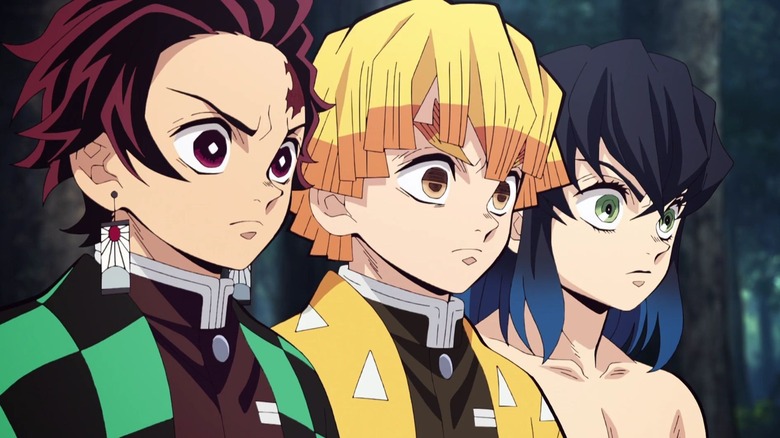
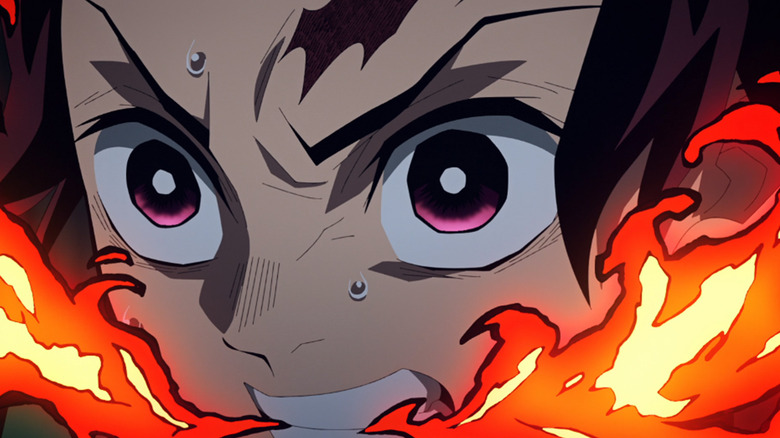
In "Demon Slayer" season 2 especially, I've noticed how each of the main characters struggles with their own personal demons and issues that are sometimes powerful enough to rival the actual, literal demons they're constantly battling. In particular, Tanjiro, Zenitsu, and Inosuke each symbolize various mental and emotional health struggles, and we see them play out through both their actions and their introspective scenes.
Tanjiro — Imposter Syndrome & Self-Doubt
After the events of the Mugen Train Arc, we see Tanjiro grappling with self-doubt and imposter syndrome as he grieves the loss of Rengoku. He decides that he must become stronger, pushing himself beyond his limits and throwing everything he has behind the water-breathing technique he has been wielding throughout the series, but he still struggles with feeling like he isn't enough despite his efforts and achievements. He blames himself for Rengoku's demise, and he wants to protect anyone from having to experience a fate similar to that of his own.
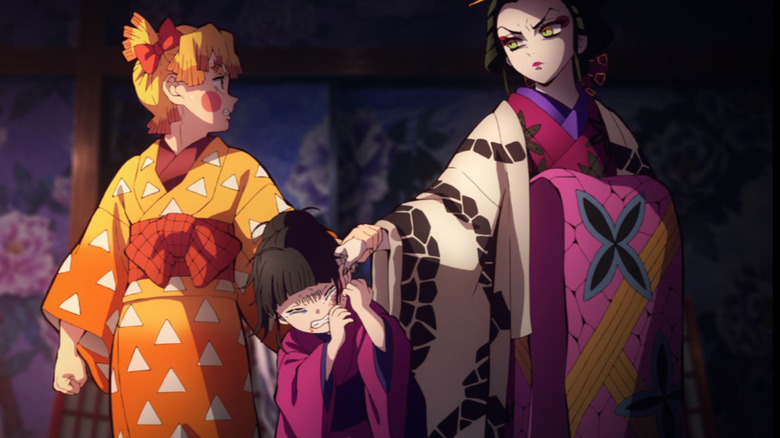
At the start of Tanjiro's battle with Daki, we gain a lot of insight regarding his personal struggles. When she knocks the wind out of him, he immediately enters a defeatist mindset, deciding that he's too weak to take on such a powerful demon. However, he ends up countering those negative thoughts, remembers what's at stake, and talks himself down from what looked an awful lot like a panic attack brought on by self-doubt. As someone who struggles with anxiety, it was refreshing to see a realistic portrayal of having to calm yourself down in dire circumstances, because nobody else is there to do it for you.
Tanjiro also has a super relatable epiphany when realizes that he wasn't reaching his full potential with water-breathing because it wasn't what he was meant to do; he could only begin to tap into the full extent of his power and abilities when he switched to sun-breathing -- his true calling. I relate to this in the sense that I am that one kid who changed their major like 4 times in college, and while I was reasonably adept at everything I tried, it wasn't until I found my "calling" by majoring in communication and media that I finally began to feel like I was working towards living up to my potential. Even so, I still have to fight self-doubt and imposter syndrome, and I sometimes struggle to acknowledge my own achievements. This means that I talk to myself. A lot.
For this reason, Tanjiro's moments of introspection and pep-talks feel a lot more human and relatable than the typical macho monologues that shonen anime protagonists are known for. He doesn't wax poetic about how great and powerful he thinks he is or aspires to be. Instead, he admits when he's scared, when he's struggling, and when he's tired, so a lot of his internal dialog is just him working through these emotions so he can keep going. Tanjiro isn't concerned with being powerful just for the sake of being powerful or any other selfish pursuits. He wants to protect people so they don't die like Rengoku, and so they aren't slaughtered like his parents and other siblings, because he doesn't want anyone else to have to experience the immense pain and grief he carries with him.
He just wants to be enough to do some good in the world, and he struggles with thinking he isn't good enough despite all that he's accomplished so far. Rather than having one victorious moment and never dealing with negative thoughts again, he repeatedly has to fight through them. This is a realistic depiction of the type of inner-battle that comes with imposter syndrome and other forms of self-doubt.
Zenitsu — Anxiety
To the surprise of absolutely nobody, Zenitsu is anxiety incarnate. He starts out the series so paralyzed by fear that he can't even fight when he's conscious, and so he's only able to fight when he's passed out. It's like sleepwalking, but much cooler. By season 2, Zenitsu has worked on himself enough that he doesn't immediately run away or pass out when its time to slay some demons. He still acknowledges that he's terrified, but he also says "there's no point in cowering forever" in the very first episode of the Red-Light District Arc, and he sticks by that.
Zenitsu defends an innocent girl from Daki, whom he realizes is a demon, while fully awake. He fights through his anxieties because he has a job to do, and he realizes he can't let others suffer just because he was too anxious to act. Zenitsu from season 1 would have surely been too immobilized with anxiety to spring into action the way the new and improved Zenitsu of season 2 does. He's still an anxious motherf***er, but he's not letting it control him anymore.
I identify with that as a fellow anxious motherf***er who used to let anxiety keep me from doing things that I wanted or needed to do. As silly as it may sound, there was a time when I couldn't even make phone calls due to the severity of my anxiety. Now ... I still don't like to call people, but I can do it when I have to, even if I still feel nervous sometimes. My anxiety and the various ways it manifests are no longer too great for me to handle; it is a demon I can face and overcome, the same way Zenitsu isn't letting his own anxiety control him anymore.
Inosuke — ADHD And Autism
As an autistic person, I don't consider my autism to be a "personal demon" so much as I understand I'm living in a society that wasn't built for people like me. I am fine with the way I am, but I understand others may not be, and that there are unique challenges I face because of it. I also have ADHD — you know, because it's not enough to be anxious and autistic, and I am nothing if not an overachiever. I bring these traits up to say that I see a lot of my struggles and experiences reflected in Inosuke.
Inosuke is impulsive, put off by large groups of people, and doesn't necessarily trust or relate to others as easily as his peers. He also forgoes societal expectations concerning behavior and appearance. All of these are things I deal with as a result of my ADHD and autism.
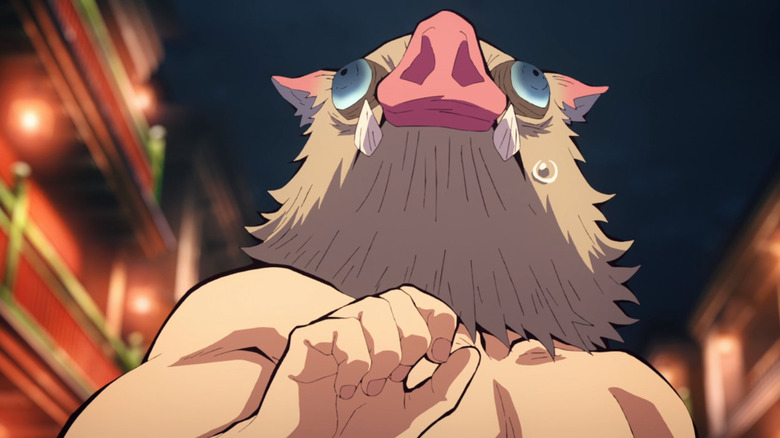
A perfect example of this is when Inosuke first arrives in Yoshiwara. Having lived most of his life outside of society, he is immediately overwhelmed by the sheer volume of people gathered in the red-light district. "What the heck is this?! It's teeming with people!" he remarks, and then we see how everything looks from his perspective: blurry and disorienting. It definitely reminded me of times I've experienced sensory overload in loud, crowded areas. For those who aren't familiar, sensory overload is:
When your five senses — sight, hearing, smell, touch, and taste — take in more information than your brain can process. When your brain is overwhelmed by this input, it enters fight, flight, or freeze mode in response to what feels like a crisis, making you feel unsafe or even panicky.
This sounds a lot like what happened with Inosuke, and he exhibits "flight" mode by running through the crowd in a state of panic.
Another way Inosuke's experiences mirror my own is the fact that he wears the boar mask. According to the "Demon Slayer" manga, he wears it partially because he was raised by boars; however, he is also clearly very attached to it because it seems to bring him a sense of comfort and protection. Examples of this protection include how it makes him invulnerable to Enmu's attacks in "Mugen Train," and how it keeps people from being distracted by his physical appearance.
While I don't walk around in a literal mask, masking is a coping and survival mechanism for some individuals on the autism spectrum. It's basically the act of hiding or minimizing autism traits to fit in with the neurotypical world. In unfamiliar settings or in the presence of people I'm not comfortable around, I tend to be hypervigilant in making sure I don't draw attention to myself by making an effort to "hide" the telltale signs of autism and ADHD that I experience. I force myself to make eye contact even though it makes me uncomfortable and doesn't come naturally to me, and I may not talk as much out of fear of saying the wrong thing or coming off as too enthusiastic about topics people don't care about or find controversial.
There are other times where I've found myself subconsciously mimicking the mannerisms of whoever I'm speaking to so that I don't draw attention to all the ways I'm "different" because, unfortunately, I've been in situations where my failure to do so led to being ostracized or mistreated. There are still a lot of unfair assumptions and stigma associated with being autistic, having ADHD, or showing obvious signs of being neurodivergent. My "mask" helps me function in a world that tends to be hostile or invasive for people with autism and ADHD, the same way Inosuke's mask serves as a form of protection and comfort for him in potentially hostile or unfamiliar settings.
Without his literal mask, Inosuke goes through the figurative process of "masking" when he's undercover at the beginning of the Entertainment District Arc. He's instructed by Tengen not to talk at all because his voice will give him away, and he has to work to suppress his "unusual" behaviors. He can't fully be himself, and it's harder for him to fit in and fly under the radar than it is for Tanjiro and Zenitsu, because Inosuke is so fundamentally different from other people.
Despite these differences, he is still a valuable member of the team, and he does make friends and learn to trust people while still being true to himself. Similarly, despite whatever unpleasant and ignorant assumptions exist about individuals with ADHD and autism, I'm still a good friend, a good mom, and still capable of accomplishing things. My differences don't stop me; they just mean I navigate the world in a way that may be foreign to some. I have learned that it's not always necessary to hide or minimize who I am because there are people who love and accept me, the same way Inosuke is loved and accepted.
Overall, I think the depictions of mental health struggles and other issues in "Demon Slayer" are realistic, well-done, and relatable. It's encouraging to see an anime — or any piece of entertainment media — depict these experiences in such an honest and respectful way. Seeing a group of powerful main characters deal with, and overcome, the same struggles I face gives me hope, and I think that's part of what makes "Demon Slayer" so special for other people as well.
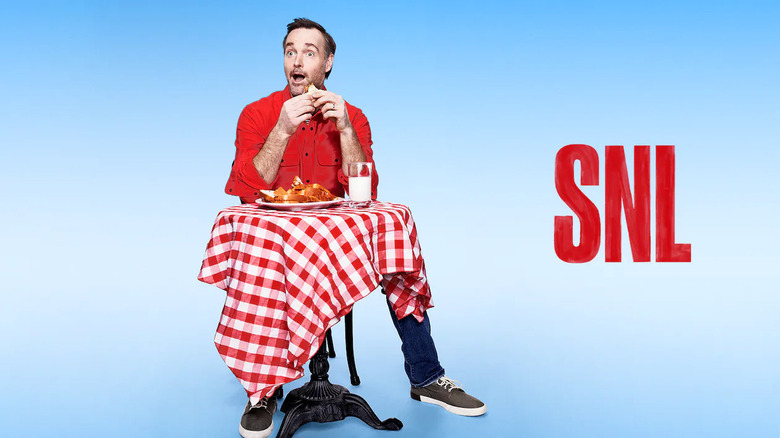
Will Forte finally returned to Studio 8H in 30 Rockefeller Plaza to host "Saturday Night Live" for the first time since leaving the series as a cast member back in 2010, the same year "MacGruber" leapt from the sketch stage to the big screen. So it's only appropriate that he returns to "SNL" just one month after "MacGruber" returned in the form of a streaming series on Peacock (available now).
Thankfully, Forte brought the bomb-disarming, morally questionable government operative with him, along with fellow "MacGruber" cast members Kristen Wiig and Ryan Phillippe. Those weren't the only special guest stars of the night, which was filled with more than one sketch that would have fit in the oddball 10-to-1 slot. Basically, it was a perfectly Will Forte episode, and that's all we wanted.
Let's dig into all the sketches from the Will Forte hosted "Saturday Night Live."
The Best
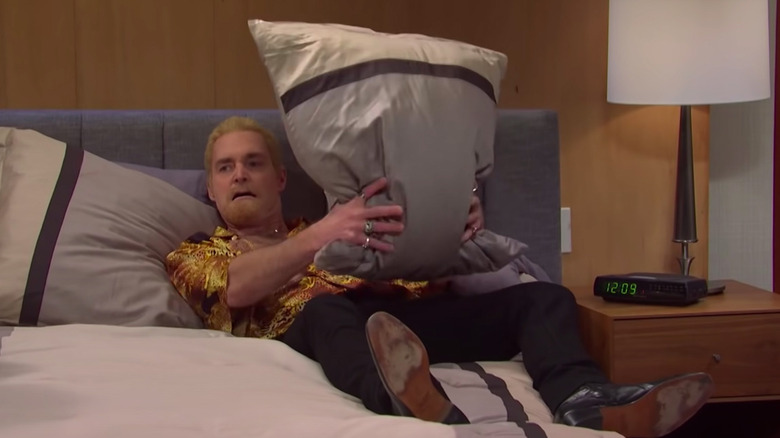
Threesome - On any other night, this would have easily been a 10-to-1 sketch, but when Will Forte hosts "SNL," you let him get weird as much as he wants to. From the moment Forte enters the hotel room as Gannon, who could easily be Guy Fieri's gigolo brother, this sketch never stopped with the laughs. I can't tell you how hard I laughed as Gannon shook the bed vigorously, and his nonchalant attitude about being a third in this arranged threesome only made it that much funnier. Forte's physical comedy here, using a pillow in place of the wife he's about to have sex with, is excellent. We haven't even gotten to the profuse sweating and the 11 towels that were part of the agreement. I'll never be mad that Forte moved on from "SNL," but I can still wish that he would have just stayed on this show forever.
Kid Klash - First up, kudos to the set-building crew and production designer for perfectly recreating a set that looks exactly like it came from Nickelodeon's "Double Dare," which this sketch is obviously lampooning. Again, this is a bit of a weird sketch, with much of the comedy coming from Aidy Bryant having a ongoing problem with finding a flag in a giant cream pie. It's Forte's not-so-encouraging commentary and insulting "fun facts" that enhance the oddball comedy. Bryant's desperation to find the flag in all that cream only makes the game funnier. But I think my favorite part of the sketch is Forte affirming that the nacho cheese in the second obstacle is really hot.
MacGuber: Coronavirus - You just can't go wrong with MacGruber. With the character returning to Peacock last month in his own streaming series, it was a no-brainer to bring him back for Will Forte's hosting stint. Since MacGruber is the kind of dimwit who would easily be fooled by the internet conspiracy theorists, it's no surprise that he hates masks, is anti-vax, and totally buys into Qanon. Oh, MacGruber, you delightful idiot. It was a nice touch to have both Kristen Wiig and Ryan Phillippe back for this one, though I can't help but be a little disappointed that this was pre-recorded rather than being live like it used to be.
The Average
Jackie & Clancy - Unlike the previous oddball sketches, I think this one was the actual 10-to-1 sketch of the evening, even though it came a little earlier than you might have expected due to the second musical performance of the evening arriving later in the evening, followed by the final installment of the three-part "MacGruber" sketch that aired throughout the episode.
With a series of country songs about spaceships, toddlers, Model-T cars, and jars of beer, Jackie & Clancy certainly know how to boogie. I'll be honest, I wasn't in love with this sketch, even if the run through that last song of the sketch was impressive, but it was still thoroughly amusing, mostly because of the energy that Forte and Wiig brought to the table. But I will happily admit to guffawing like an idiot when Kenan Thompson said "Pickletits" as the Delaware city where you can send your order form for this amazing album offer. Plus, the album art alone was worth a laugh, because it's called, "Clancy T. Bachleratt and Jackie Snad Sing Songs about Spaceships, Toddlers, Model-T Cars & Jars of Beer AGAIN."
Cinema Classics: Gaslight - Cinema Classics can be hit or miss, and this entry wasn't one of the better variations, even if the premise was rather ludicrous. Even so, you can always count on Kenan Thompson to deliver as host Reese De'What. Forte and McKinnon are certainly giving their all, but this sketch is mostly one-note joke that's merely mildly amusing throughout.
The Worst
Ingraham Angle (Cold Open) - Why is this sketch eight and a half minutes long? Cecily Strong still appears to be absent from the series, so instead of getting Judge Jeanine Pirro doing her Fox News nonsense, we've got Kate McKinnon as Laura Ingraham. First off, though McKinnon's impersonation is great, her punditry isn't quite as entertaining as Strong's Pirro. Beyond that, this sketch does not need to be so damn long. The Novak Djokovic bit could have been cut completely, and Candace Owens could have been given a little more time instead. And even though the mention of Wordle is topical, using it for Donald Trump's laundry list of nonsense wasn't really the best way to do it. "SNL" writers, please stop making cold opens so long when they don't need to be, and don't feel obligated to do political satire at the top of the show if you don't have to. We're over it.
Weekend Update
The jokes in this edition of Weekend Update weren't the strongest. Michael Che probably had the best joke about Jeffrey Epstein and Ghislaine Maxwell being referred to as Batman and Robin, but he also had the worst joke of the night, with the age-old punchline about women not knowing how to drive. I'm sure Che was going for a classic groaner, and he certainly succeeded there, but it also just feels lazy at this point. Colin Jost also had a solid joke about the age of "Wheel of Fortune" viewers bemoaning the death of the show's 92-year old series director as being "so young." Otherwise, this was a mild edition of Weekend Update.
You can watch the second part of Weekend Update right here.
Chen Biao on the Beijing 2022 Olympics - Chen Biao can be downright hilarious, but this wasn't one of those times. I'm sure NBC has pushed "SNL" to make some kind of allusion to the forthcoming arrival of the 2022 Beijing Olympics coming to the network in February, and this is probably the best way to do it. Bowen Yang isn't unfunny in this bit, but it just doesn't feel like it stacks up against some of the character's better appearances.
Three Guys Who Just Bought a Boat - Even though Alex Moffat typically kills as The Guy Who Just Bought a Boat, with his fast-talking double entendres. But Moffat seemed to psyched himself out as he started stumbling over his fast-paced punchlines, and it kinda derailed the segment until Pete Davidson was brought in to talk about the fact that he and Colin Jost recently bought one of the Staten Island ferry boats. It never fully recovered, but Davidson absolutely lost it during this bit, and he couldn't quite get back in the groove either. There was some funny stuff here, but it all got thrown off for too long, which kept it from being much better.
The Host
What more can we say about Will Forte? The comedian went a little underappreciated during his time at "Saturday Night Live," largely because his weirdest sketch ideas were often just enough outside of mainstream to strike the right chord with general audiences. But Forte is a comedic genius, and I miss the wild, strange energy that he used to bring. Even I didn't appreciate how good Forte was on the sketch series until he was gone, and his return to host reminded me that there's no one quite like him on "SNL." Though Kyle Mooney comes close, it's not exactly the same kind of weird that Forte used to deliver. Now that he's finally returned to host, I hope he gets to do it multiple times like the rest of his "SNL" castmates.
The MVP
Will Forte - That's right, the MVP is Will Forte. Though we expected Forte to be hilarious in his return to "SNL," he exceeded all my expectations, and it's no coincidence that the worst sketch of the night didn't have Forte in it. Furthermore, I appreciate that, with the exception of MacGruber's return, every other sketch was live. Forte was always better in live sketches. He was great in pre-recorded bits too, but it's live comedy where his energy shines. Even the monologue had Forte's signature comedic style, complete with a little cameo from Willem Dafoe before the "Spider-Man" franchise star hosts next weekend. We don't deserve Will Forte, and I'm glad he keeps giving us gold.
The Final Word
Will Forte injected "Saturday Night Live" with a healthy dose of silly, and I couldn't be happier about that. I was hoping that his hosting stint would basically fill the episode with a bunch of 10-to-1 sketches, and I got my wish. The only thing that could have made it better was Jason Sudeikis coming back to deliver a new iteration of Pete Twinkle and Greg Stink on ESPN Classic, but since Sudeikis is across the pond shooting the third season of "Ted Lasso," it just wasn't in the cards. Hopefully Forte or Sudeikis will host again and we'll get a chance a little Twinkle/Stink reunion.
In the meantime, we're looking forward to Willem Dafoe hosting on January 29 next weekend.
If you caught HBO's whip-smart satire "The White Lotus" this past summer, you know that Jennifer Coolidge is having a moment. The actress is beloved for her scene-stealing roles in "American Pie," "Legally Blonde," and the comedies of Christopher Guest. But in a recent interview, she credited someone unexpected with kicking off the latest phase of her career.
Coolidge visited "The Tonight Show Starring Jimmy Fallon" this week, where she referenced a moment in the show that involved Ariana Grande. The singer, who later invited Coolidge to reprise her "Legally Blonde" role for the "Thank U, Next" music video, was prompted by Fallon to share her own Jennifer Coolidge impression when she stopped by the show back in 2018. Grande slipped into an uncanny Coolidge impression that had the audience in stitches before she even got to the punchline. In Coolidge's recent visit to the show, Fallon played the clip for Coolidge, who then got introspective.
A Strong Impression
Speaking on "The Tonight Show," Coolidge shared that she was "going through a dead zone" when the Grande appearance happened, but a friend encouraged her to reach out to the singer about it. "You should know that it was sort of the beginning of a lot of cool things that happened for me," she told Fallon. She explained that she was initially certain that Grande's massive follower count meant she'd never actually see the DM. Grande did see her message, though, and according to Coolidge, "The next thing you know, I was going to her house, getting fit for a wardrobe fitting for 'Thank U, Next.'"
Coolidge was still appearing often in films and shows before the "Thank U, Next" video, but she's done some of her most memorable work since. Among other roles, she appeared in Mike White's "The White Lotus" as the grieving but selfish Tanya McQuoid, and in "Promising Young Woman" as Susan, the mother of the destructive main character, Cassie (Carey Mulligan). She's also set to appear in Ryan Murphy's series "The Watcher" and will reportedly reprise her role in "The White Lotus" season 2.
While audiences shouldn't have needed "Thank U, Next" to remember how great Coolidge is, the epic rom-com homage is a high point of her career, too. In it, she reprises the role of Paulette the nail technician from "Legally Blonde." The whole video is funny, but nothing tops her confessional conversation with Grande about going out with a guy with a real big one --front tooth, that is. Apparently, we can thank Grande and Fallon's penchant for impressions for that moment, which the actress says got the ball rolling on new opportunities.
On December 11, 2021, author Anne Rice passed away at the age of 80. The bestselling writer behind the "Vampire Chronicles," Rice's legacy as one of the 20th century's most influential and iconic writers has long been secured. With over 150 million book sales to her name, we have Rice to thank for our modern-day understanding and tastes for vampire fiction. It's easy to argue that she did more to influence how we perceive vampirism in pop culture than anyone living or (un)dead aside from Dracula's own Bram Stoker. If you've read any vampire novel of the past four or so decades then it was more than likely inspired, influenced by, or thoroughly embedded within the conventions pioneered by Anne Rice.
Rice was born Howard Allen Frances O'Brien in 1941 but changed her name to Anne on her first day of school because being a little girl called Howard presented its fair share of challenges. As an adult, she moved to San Francisco and took night courses at the city's main university. She married Stan Rice, a poet whom she met as a high schooler, when she was just 20. In 1966, her daughter Michele was born, but she passed away at the age of five from acute granulocytic leukemia. While still mourning the loss of her daughter, Rice began working on her first book, which would later evolve into "Interview with the Vampire." It took her five weeks to complete the 338-page novel, and she eventually earned a $12,000 advance for the hardcover rights at a time when most debut authors received perhaps $2,000 at best. Critics were mixed but the sales spoke for themselves. It didn't take long for "Interview with the Vampire" to find its people and it's easy to see why.
I've re-read "Interview with the Vampire" several times over my life, and it always feels startlingly fresh whenever I pick it up. In 1976, it must have seemed radical, especially in comparison to contemporary vampire fiction of the time. The Hammer Horror franchise was spluttering towards an undignified ending, well beyond a parody of its former self. Science-fiction writers like Richard Matheson had turned vampires into violent figures of abject fear, more rooted in the speculative than the gothic. Rice's vampires are baroque, intensely emotional, deeply humane, and unabashedly queer.
The Vampire Lestat And LGBTQ+ Allyship
As the title suggests, "Interview with the Vampire" is written as an exceedingly long and detailed conversation between a human journalist and a vampire named Louis de Pointe du Lac, the latter of whom wants to recount his long and storied life as a cautionary tale of sorts. Over 200 years, Louis has evolved from a grieving plantation owner to perhaps the most emotionally tortured vampire who has ever lived. He struggles with losing his innate humanity thanks to his newfound thirst for blood, and he is contrasted with his master/companion/bratty boyfriend Lestat de Lioncourt, a French nobleman who eagerly slaughters humans and laughs in the face of his frenemy's emotions.
It may have been Louis' story that kickstarted Rice's vampiric reign, but it was Lestat who became her brat prince. Nine years after "Interview," she published a sequel, "The Vampire Lestat," wherein he grabbed the reins of the narrative and told his own origin story, all to the backdrop of his new life in the 1980s as a world-famous rockstar. It is Lestat who laid the road for the modern vampire archetype: arch, dramatic, philosophical, sexual, simultaneously hugely entertained and traumatized by his own immortality. He can be truly monstrous but still contains an immense capacity for love beyond boundaries of gender and sexuality.
Indeed, it is that fluid approach to such topics that helped to make Rice an LGBTQ+ icon. All of Rice's vampires are canonically bisexual, with queer sensuality depicted in a romantic yet matter-of-fact manner that must have felt incredibly exciting in the midst of the '80s (Rice has also talked about her vampires as existing in a world before the AIDS epidemic.) Lestat has several lovers throughout the series, most of whom are men. In "The Vampire Lestat," when he turns his mother Gabrielle into a vampire, she immediately cuts off her hair, begins wearing masculine clothing, and abandons all markers of femininity in favor of a life free of gendered constraints. For queer readers, the image of the vampire that Rice presents, that of a lost soul on the outside of societal restraints who is able to love and life freely, was immediately appealing. Rice spent many years supporting LGBTQ+ causes. After her death, the filmmaker Phaylen Fairchild detailed her experiences with Rice, including her "fabulous" reaction to Fairchild coming out as a trans woman. "She told me at the time that she believed transgender people were sacred," Fairchild said. "That we possessed a unique gift of life experience that few ever would, which would allow us to see the world from 'A view from the greatest height.'" Rice herself talked about often feeling as though she did not have a gender, and millions of people found hope in her words, more so today, when rampant transphobia has seeped its way into the cultural mainstream.
No Winks Or Nods
Rice didn't just write vampires either. She wrote about a multi-generational clan of matriarchal witches haunted by an evil demon. She created maybe the first metaphysical crime series, featuring an assassin who becomes a time traveling detective for angels. She pioneered a highly literary and wonderfully explicit series of erotica that remains vibrant and transgressive decades after its publication. When she became a born-again Christian, she wrote historical novels about Jesus Christ's youth (she later left the church over its anti-LGBTQ+ stances.)
And she took all of these worlds 100% seriously. There are no winks or nods in her vampire novels, no puncturing of the all-consuming melodrama that takes on life and death magnitudes under her penmanship. Nobody loved their own characters so fervently as Rice, nobody believed in their potential to change the world as heavily as she did. Even as her stories got increasingly ambitious and occasionally ludicrous over 15 novels (spoiler: aliens turn up at one point), you never doubted Rice's stalwart commitment to her creation. To Rice, vampires could be so much more than a mere creature of the night. Still, her work was not without its problems, including some issues with Louis' past as an owner of slaves and some uncomfortable moments regarding sexuality and underage people.
Where Are The Anne Rice Adaptations?
There have been surprisingly few adaptations of Rice's work. The 1994 big-screen version of "Interview with the Vampire" is a sumptuous and mostly faithful rendition of her debut that captured Rice's feverish intensity. Rice had initially protested the casting of Tom Cruise as Lestat but later admitted that he was ideal for the part. What director Neil Jordan understood about the novel is how full-throated it is in its commitment to telling a serious story. Much like Rice's work, the film is lavish in its love for these vampires, even the most despicable among them. None of her old-school gothic prose has been watered down or reduced to cheap jokes. While the film makes some major changes and is sadly not as open in its homoeroticism as the books, the core of Rice's intent is fully intact. There's something kind of miraculous about seeing a story like this be treated with such reverence, starring the biggest hunks of the era in a romantic drama made for the biggest audience possible. Sadly, it's a one-off in Rice adaptation history, and we never got to see this team make the follow-up (consider the alternate history where Tom Cruise makes "The Vampire Lestat" instead of "Mission: Impossible.")
A rushed-out and deeply condensed take on "Queen of the Damned" was released several years later with a new cast, a total whitewashing of the material's queerness, and a lot of music by Korn. It didn't do well, and neither did a Broadway musical adaptation with songs by Elton John. A long-awaited television series of the "Vampire Chronicles" is in the works for AMC, which Rice and her son Christopher had been heavily involved with. It's a shame that she never got to see the end results of her many years of development.
Vampires never truly die. They appear and reappear with reliable regularity in the ceaseless cycles of entertainment trends. Anne Rice's vampires, in particular, are immortal in our cultural consciousness. There will always be a need for stories of lost souls who explore power and desire beyond the smothering confines of society's demands. Rice understood that with such passion and clarity. For every lonely kid who feels like nobody gets them, Anne Rice's books will be there to help. Other vampires may come and go, from the sparkly to the parasitic, but Lestat and company will outlive them all.
Twelve-year-old Tinja, an aspiring gymnast, stretches in her family's pristine living room. It almost feels more like a showroom than a familiar space where people actually live, and the camera sneaks closer to the girl, winding past a marble statue, two ottomans, a glass coffee table, and under a chandelier until it finally reaches her. Tinja's mother, who's been holding the camera the whole time, spins the lens onto herself as she tickles her daughter with a giant smile plastered on her face. She's a vlogger obsessed with presenting a "perfect" vision of a traditional Finnish family, so that long before the film's grotesque creature shows up, it's clear this is a horror movie.
Flanked on the couch by her excruciatingly boring husband (Jani Volanen), their younger son Matias (Oiva Ollila), and Tinja (Siiri Solalinna), Mother (Sophia Heikkilä) delivers a sickly sweet address to her selfie stick: "I hope your everyday life is as lovely as ours." But the family's fake smiles are interrupted when a bird smashes into their window and eventually bursts into their living room, kicking off a series of events that will radically challenge the phony reality they're presenting to the world.
Tinja manages to catch the bird by tossing a blanket over it, but in case we needed further confirmation that the family's online lives are a lie, her mom instantly snaps the bird's neck, giving us some insight into the way Mother deals with things that don't conform to her perfectly manicured vision. After discarding the body in the trash ("organic waste," Mother clarifies), Tinja hears pained cawing coming from the woods outside their house at night. After a brief search, she discovers the bird somehow didn't die when its neck was snapped — it made its way back to its nest, where it's protecting an egg. Is the zombie bird real in this moment, or just a twisted vision? Either way, Tinja is drawn to the egg, which she takes home and promises to care for. But it's not long before Tinja realizes this is no normal egg.
The Thrill Of Practical Effects
The egg soon grows to be the size of a bean bag chair, and when it hatches, the film finally settles into its groove. A large bird-like creature emerges from the egg, dripping with sticky goo and patches of mottled hair, like some sort of decaying Skeksis character from Jim Henson's "The Dark Crystal." It's created using practical effects, and in an era in which filmmakers too often rely on CGI to create characters like this, it's genuinely thrilling to watch Tinja interact with a tangible thing right in front of our eyes — even when she's gorging herself on birdseed and vomiting it back up in order to feed the creature.
Tinja and her unconventional pet are connected both mentally and physically. When one experiences pain, so does the other, and at first it seems as if the bond they have is something akin to the one shared by Elliott and E.T. (and like Elliott, Tinja tries to keep her newfound pal hidden in her closet). But their mysterious link is darker than that: When Tinja is annoyed by something — a barking dog, a new neighbor performing better than her in gymnastics class — the creature goes on the hunt and inflicts the type of damage Tinja could never dream of doing herself. And as pressures build in Tinja's life, the attacks become more intense.
An Effective Metaphor
Despite Mother's predilection for filming her family, director Hanna Bergholm isn't interested in delivering a scathing screed against vlogging culture here; instead, she uses it as a shortcut to interrogate unrealistic expectations placed on women of all ages, and how those burdens inevitably lead to cracks in the seams. As the creature slowly sheds its bird-like image and morphs into the spitting image of Tinja — featuring some nasty makeup effects mid-transition with teeth embedded in the side of its face, making it seem like this thing and the death bear from "Annihilation" might have a lot to chat about on a first date — it becomes clear that the shared connection between Tinja and this creature is a metaphor for puberty. Tinja isn't just tied to this thing — she is this thing. (At one point, Tinja is trying to hide the creature under her bed when her father comes in her room, spots a drop of blood on her sheets, assumes she's had her first period, and backs out of the room, making the metaphor textual.)
Ilja Rautsi's screenplay keeps the plotting relatively tight throughout, but despite the movie's 86-minute runtime, it also feels like it hammers the same points home a few too many times. While it doesn't break any new ground in the horror space or do anything super mind-blowing from a narrative perspective, "Hatching" is a successful (if somewhat flat) exploration of that transitional period in one's life when an earlier version of yourself dies and a new version stands in its place.
Kogonada's 2017 feature debut, "Columbus," was one of the standout films from that year's Sundance Film Festival, and the director is finally back with his second movie. "After Yang" is a sci-fi story, but it continues Kogonada's cinematic explorations of grief, loss, lineage, and finding beauty in unexpected places.
Sometime in the future, Yang (Justin H. Min) breaks down. He's a quiet, pleasant android (or, in the parlance of this film, a "techno-sapien") who was purchased to serve as a big brother figure to an adopted young girl named Mika (Malea Emma Tjandrawidjaja) and teach her about her Chinese heritage. Despite the fact that his insides are full of motors and wires and she's flesh and blood, the two characters share a deep familial bond. But when Yang spazzes out and can't be rebooted, Mika's parents, Jake (Colin Farrell) and Kyra (Jodie Turner-Smith) begin to wonder if maybe they've been relying a bit too much on Yang and haven't devoted enough of their own time to raising Mika. Yang's absence throws off the family's dynamic and highlights fractures that may have previously lain dormant. He spends much of this movie sprawled out on a slab, but he exhibits so much life throughout several flashback scenes that you understand why these people miss him so much.
Mika doesn't want to see Yang get recycled, so even though he was purchased as a refurbished model and his warranty is likely expired, Jake goes on a quest to see if someone can fix him. He eventually visits a museum for artificial intelligence, where a curator named Cleo (Sarita Choudhury) hooks Jake up with the technology to be able to access Yang's memory banks, where the android has recorded brief snippets of video for every day of his existence. Jake finds himself deeply moved while sifting through the memories, learning more about this extraordinary being he's taken for granted and discovering the little moments Yang valued that the rest of us often overlook, like the way light falls in a specific room at a certain time of day. He also discovers a woman (Haley Lu Richardson) who appears in many of Yang's memories, and her presence there fuels a mystery in the back half of the movie as Jake learns more about how she and Yang were connected.
Kogonada Does It Again
Kogonada once again utilizes striking set design to fill out his world, using geometric shapes, stacked boxes, and asymmetrical lines to add warmth and definition to the family's open floor plan. He also uses meticulous composition and deliberate blocking to enhance the characters and their journeys; in one deep focus shot that takes place in a dimly lit, backroom chop shop, Jake steps from the farthest reaches of the frame into darkness in the foreground as he tacitly agrees to continue down the path he's on. It's Directing 101, but Kogonada's attention to detail helps make every choice feel both purposeful and meaningful.
While "Columbus" could occasionally feel a bit detached, "After Yang" sometimes walks right up to the edge of cliche. The exploration of Yang's memories looks like a compilation from the 1 Second Everyday app, and while the montage is supposed to be profound, it feels like it's always a split-second away from cutting to a hand slowly waving its way through a wheat field. Then again, when moments like this are done well, they make me feel like there can never be too many movies that extol the virtues of stopping to smell the roses. Example: After seeing Yang's appreciation for the small things in life, Jake steps outside into a light rain, closes his eyes, and lifts his face to the sky. This isn't Andy Dufresne breaking out of Shawshank: Colin Farrell underplays it, and by doing so, he sells it as a genuine, truthful moment of grace for his character.
An effective blend of lyrical impressionism and controlled precision, "After Yang" is another quietly impressive effort from Kogonada. (Note: If none of that made you want to see the movie, may I interest you in Colin Farrell doing a Werner Herzog impression? Because that also happens here, and it's great.)
Cleaning your bathroom may not be your favorite household chore, but at least it’s pretty straightforward. In fact, you probably have some sort of routine down pat: Putting cleaner in the toilet to work its magic while you clear off the floor and counters, giving everything a quick-but-thorough wipe-down, running the…
"Three studies released Friday offered more evidence that COVID-19 vaccines are standing up to the omicron variant, at least among people who received booster shots," reports the Associated Press:
They are the first large U.S. studies to look at vaccine protection against omicron, health officials said. The papers echo previous research — including studies in Germany, South Africa and the U.K. — indicating available vaccines are less effective against omicron than earlier versions of the coronavirus, but also that boosters doses rev up virus-fighting antibodies to increase the chance of avoiding symptomatic infection.
The first study looked at hospitalizations and emergency room and urgent care center visits in 10 states, from August to this month. It found vaccine effectiveness was best after three doses of the Pfizer or Moderna vaccines in preventing COVID-19-associated emergency department and urgent care visits. Protection dropped from 94% during the delta wave to 82% during the omicron wave. Protection from just two doses was lower, especially if six months had passed since the second dose. Officials have stressed the goal of preventing not just infection but severe disease. On that count, some good news: A third dose was at least 90% effective at preventing hospitalizations for COVID-19, both during the delta and omicron periods, the study also found.
The second study focused on COVID-19 case and death rates in 25 states from the beginning of April through Christmas. People who were boosted had the highest protection against coronavirus infection, both during the time delta was dominant and also when omicron was taking over...
The Journal of the American Medical Association published the third study, also led by CDC researchers. It looked at people who tested positive for COVID-19 from Dec. 10 to Jan. 1 at more than 4,600 testing sites across the U.S. Three shots of the Pfizer and Moderna vaccines were about 67% effective against omicron-related symptomatic disease compared with unvaccinated people. Two doses, however, offered no significant protection against omicron when measured several months after completion of the original series, the researchers found.
(Welcome to Year of the Vampire, a series examining the greatest, strangest, and sometimes overlooked vampire movies of all time in honor of "Nosferatu," which turns 100 this year.)
Hardcore Scooby-Doo fans, of which I am one, will tell you that one of the franchise's high water marks came during the dawn of their direct-to-video movies. From 1998 to 2003, Warner Bros. and Hanna-Barbara made five movies that set the new standard for what a Scooby film could look like, mixing a fresh animation style with genuine thrills and a more mature Mystery Inc.
In "Scooby-Doo on Zombie Island," the best of the bunch (meet me back here on the 100th anniversary of "The Wolf Man" to talk about that one), the once-estranged gang reunites after time apart to chase monsters that for once turn out to be real. By the time "Scooby-Doo and the Legend of the Vampire" rolled around in 2003, though, the franchise's winning streak was ending, and the movie is often regarded as the weakest entry of the mini-Scooby Renaissance.
What It Brought To The Genre
Still, "Scooby-Doo and the Legend of the Vampire" is a fun-loving, original vampire story in a franchise that's known for introducing kids to the popular monster canon. The movie sees the Scooby Gang on vacation in Australia, where they decide to attend a music festival at a place called Vampire Rock. "Legend of the Vampire" marked a new, brighter era of Scooby animation that would carry the franchise through the next decade. It's a jarring change-up from the previous four films, but it fits the sun-soaked Australian outback landscape. It's also one of the only films to reunite the series' surviving original castmates, including Casey Kasem, Frank Welker, Nicole Jaffe, and Heather North.
Once they arrive in the outback, Mystery Inc. reunites with The Hex Girls, the beloved trio of Wiccan goth girl rockers (and unofficial queer icons) who were first introduced in "Scooby-Doo and the Witch's Ghost." Their good times are cut short, though, when they become embroiled in a mystery involving a missing band called Wildwind and a local vampire. There are also some vague "Picnic At Hanging Rock" vibes, as Wildwind disappeared around the mysterious red-orange landscape of Vampire Rock.
For some reason, the movie calls its main vampire the Yowie Yahoo, a real name for a Sasquatch-like outback cryptid, despite the fact that the creature's vampiric tendencies more closely resemble the Aboriginal myth of the tree-dwelling bloodsucker Yara-ma-yha-who. This movie treats Aboriginal culture with too much levity, despite its earnest attempts to educate audiences -- and the Scooby gang -- on Indigenous culture. To this day, though, it remains the only take on these unique local myths I've ever seen or heard of on screen.
Scooby Is A Safe Space For Young Horror Fans
The actual vampires in "Scooby-Doo and The Legend of The Vampire" look a lot like the band KISS, which makes no sense but also fits the rock 'n' roll aesthetic that the movie (along with a surprising amount of other "Scooby" properties) sets up from the start. The film has lots of great little moments for anyone willing to look for them, from Scooby getting beat over the head by a koala in a gum tree, to the band that's hilariously called Two Skinny Dudes, to a reference to the colony of screeching bats that kick off the original show's theme song -- a familiar earworm for any erstwhile fan of Saturday morning cartoons. It even features a rare double-unmasking, with its villains (human this time) somehow wearing masks on masks this whole time.
The best contribution "Scooby-Doo and the Legend of the Vampire" makes to the vamp sub-genre is simply that it's for kids, and reached many of them at a crucial time in their pop cultural development. The first "Scooby-Doo" series, made by Joe Ruby and Ken Spears, premiered in 1969, and the franchise has served as a safe space for kids to explore horror ever since. This gang of groovy teens is composed of characters who kids can relate to: the leader, the brainiac, the underestimated one, the scaredy cat, and the faithful companion. Together, they make monster-hunting fun, and despite the ways its evolved over the years, "Scooby-Doo" has always made sure to be more welcoming than scary.
If you're reading this, there's a good chance one of the first vampires you ever saw was a "Scooby" vamp, whether it was Rankor from "The 13 Ghosts of Scooby-Doo," Papa Dracula from "Scooby-Doo and the Ghoul School," or the Australian outback vamps of this film. "Scooby" properties are still keeping the bloodsucking legacy alive -- most recently in an episode of the show's most criminally underrated iteration, the uproarious and meta "Be Cool, Scooby Doo."
"Scooby-Doo and The Legend of The Vampire" isn't the first or fifth or maybe even 20th movie you think of when diving into the vampire canon, but it's a standout in the sub-genre for its creative use of regional vampire lore and its kid-friendly approach to horror. Like the best Scooby-Doo movies, it's inspired a generation of young horror fans to figure out what they love, whether that's regional folk horror, showbiz horror, or extremely cool goth girl witches.