Shared posts

15 Mar 20:26

Why Scientists Say Batman's Costume Makes No Sense

by Fatemeh Mirjalili

Bruce Wayne has done some pretty cool things as the Batman, in both the comics and onscreen. Time travel? Check. Beat up Superman to a pulp? Check. Make a badass-looking costume that lets him glide as he jumps off buildings? Also, check.

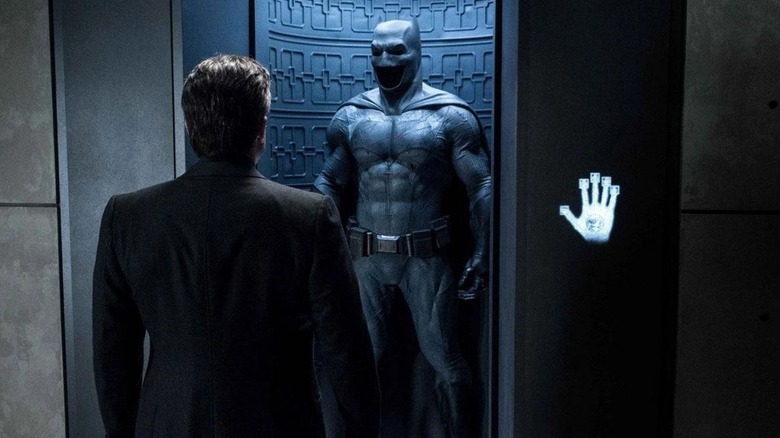
As a superhero, Batman doesn't have any powers. He's just a man of gadgets — but he uses them well. The Batsuit is a rather impressive piece of technology and the most crucial element of Batman's ensemble. Bruce rarely ever leaves the Batcave without his cape (he is the caped crusader, after all), and it's not just any cape — Batman's most precious piece of clothing has a built-in glider mode that lets him maneuver his way over the rooftops of Gotham without worrying for his safety. It can also be adapted into a bullet shield for protection, which proves that it serves more than, you know, aesthetic purposes.

However, scientists have thoroughly examined the Batsuit and discovered that it would never work the same way in real life as it does in comics, cartoons, and movies. The cape might complete his costume and give Bruce a superpower of his own, but from a real-world perspective, it is far from perfect. Using a cape to glide around isn't safe (honestly, it's a wonder it hasn't cost Batman his life yet) and is an impractical element of his suit. If Batman existed in the real world, even with his mighty costume, he'd be better off taking the stairs instead.

The Cape Isn't As Efficient As You Think

As we've established, Batman's suit wouldn't be the same if Bruce decided to lose the cape. It does more than just intimidate the criminals hiding in Gotham's underbelly — it has defensive and aerodynamic capabilities that are essential to Batman's survival. Batman's superhero abilities have been built over the years with the support of comic book lore and an entire universe of Batman cartoons and movies. Still, it would be implausible for him to glide using the same cape, in reality, scientists believe.

"Clearly gliding using a Batcape is not a safe way to travel, unless a method to rapidly slow down is used, such as a parachute," physicists at the University of Leicester wrote in the "Journal of Special Physics Topics" publication back in 2012 (via Wired). Using a parachute wouldn't make Batman as intimidating to criminals now, would it? It would keep him alive, though.

The experts also likened the impact of Batman's cape gliding to being hit by a car at 80 km/h, which would be disastrous if it were to happen. They also confirmed that after leaping from a Gotham City skyscraper that was 150 meters high, Batman could only glide for about 350 meters on a 4.7-meter wingspan before velocity would level off at 110 km/h. After this, an 80 km/h descent would begin, and the DC superhero would most likely fall to his death without any interruptions to save his life.

The Memory Cloth Cape Doesn't Have A Place In The Real World, Either

In Christopher Nolan's "The Dark Knight" trilogy, Batman's cape is made from a fictional material described as "memory cloth," which uses an electrical charge to stiffen the cape for gliding purposes, after which it returns to a standard, fabric-like state. Upon examination, the Leicester team of physicists confirmed the memory cloth material was rigid enough to mimic the aerofoil shape that is employed by other wing gliders. But as the study progressed, its limitations became clear as it presented newer problems.

"If Batman wanted to survive the flight, he would definitely need a bigger cape," co-author David Marshall suggested. He also recommended that Batman use "active propulsion," for instance, a jet to keep him aloft. I'm excited by seeing the prospect of Batman riding a jet — it's still pretty badass looking, but negates the whole bat-like persona of the superhero. While a jet pack might make Batman's flying a lot more realistic, it's still a tricky alternative to navigate because of the challenges posed by Earth's atmosphere, gravity and the restrictions that come with safeguarding the person wearing it.

Marshall further stated that Batman could adopt the method of Gary Connery, the first man to glide to the ground from a helicopter using only a wingsuit. But Connery used a significant number of cardboard boxes to make it safely to the ground. Where the Batman is concerned, using cardboard boxes to safely glide over buildings would make any mission highly problematic and put a dent in his reputation. 

The Batsuit seems to be something of a mess where real-world standards are concerned, despite it being the ultimate suit of armor for the superhero. But hey, at least it looks cool!

Read this next: The 15 Best Batman Comics You Need To Read

The post Why Scientists Say Batman's Costume Makes No Sense appeared first on /Film.

15 Mar 20:23

How to Replace a Broken Window Screen for Less Than $20

by Becca Lewis

Warmer weather is coming. Before it’s time to literally throw caution to the wind and open the windows, it’s time to repair those torn screens that have been picked apart by birds or damaged by winter weather. Letting the fresh air in and keeping the bugs out requires your screens to be in tip top shape, and luckily y…

Read more...

15 Mar 20:22

US Astronaut's Return Hangs in the Balance as Tensions With Russia Escalate

by msmash
The US astronaut Mark Vande Hei has made it through nearly a year in space, but now faces what could be his trickiest assignment: riding a Russian capsule back to Earth in the midst of deepening tension between the two countries. From a report: Nasa insists Vande Hei's homecoming at the end of the month remains unchanged, even as Russia's invasion of Ukraine has resulted in canceled launches, broken contracts and an escalating war of words from the leader of the Russian Space Agency. Many worry Dmitry Rogozin is putting decades of peaceful partnership at risk, most notably at the International Space Station (ISS). Vande Hei, who on Tuesday will break the US single spaceflight record of 340 days, is due to leave with two Russians aboard a Soyuz capsule for touchdown in Kazakhstan on 30 March. He will have logged 355 days in space. The world record of 438 days belongs to Russia. The retired Nasa astronaut Scott Kelly, America's record-holder until Tuesday, is among those sparring with Rogozin, a longtime ally of Vladimir Putin. Kelly has returned a medal to the Russian embassy in Washington but believes the two sides "can hold it together" in space. "We need an example set that two countries that historically have not been on the most friendly of terms, can still work somewhere peacefully. And that somewhere is the International Space Station. That's why we need to fight to keep it," Kelly said. Nasa wants to keep the space station running until 2030, as do the European, Japanese and Canadian space agencies. The Russians have not committed beyond the original end date of 2024 or so.

Read more of this story at Slashdot.

15 Mar 20:22

Russia running out of cloud data storage following Ukraine invasion

by Corbin Davenport

Russia began a military invasion of the country of Ukraine on February 24, which is still ongoing and prompted started a chain of sanctions against Russia. Google, Meta (Facebook’s parent company), Apple, and many other tech companies are in the process of winding down operations in Russia, mostly due to sanctions enforced by Europe and the United States. Russia now has another problem on its hands: the country is running out of storage for cloud services.

The Russian news outlet Kommersant, citing government sources, is reporting that Russia is rapidly running out of domestic data storage for servers and other critical IT equipment. Russia’s Ministry of Digital Transformation reportedly held a meeting on March 9 with representatives Sberbank, MTS, Oxygen, Rostelecom, Atom-Data, Croc, and Yandex. One source told Kommersant that the departure of foreign cloud services like Google and Amazon increased demand on local storage, and the country expects that capacity to run out within the next two months. The shortage could lead to non-essential services shutting down, such as cloud gaming, music streaming, and video sharing platforms.

Russia is also reportedly having difficulty importing equipment from China, due to increased prices (the value of Russia’s currency is tanking) and disputed logistics. One source reportedly told Kommersant (translated), “Two truckloads of servers from a foreign vendor entered the country, but they refuse to give them to us, citing sanctions.” Ironically, Huawei has supposedly stopped shipments to Russia until March 26, which itself has been negatively affected by US sanctions over the past few years.

Russia is exploring a few options for the data storage, including seizing computers from companies leaving the country. The simplest solution would likely be for Russia to stop its invasion of Ukraine, which the United Nations reports has killed around 700 civilians so far, including 48 children.

Source: Kommersant
Via: Bleeping Computer

Featured image: Flag of Ukraine by Wikimedia user UP9, use allowed by Creative Commons Attribution-Share Alike 3.0 Unported license

The post Russia running out of cloud data storage following Ukraine invasion appeared first on xda-developers.

15 Mar 20:20

When You Really Need to Replace Your Running Shoes, According to Reddit

by Beth Skwarecki

You’ve probably heard the advice that running shoes are only good for about 300 to 500 miles, and after that, the cushioning is so broken down that they’re an injury waiting to happen. But that’s not always true, and there are more ways to figure out when to throw out your shoes than just counting the miles.

Read more...

15 Mar 17:36

What other games can learn from Elden Ring’s open world

by Phil Iwaniuk
What other games can learn from Elden Ring’s open world

When Elden Ring's open world was revealed it did look a tiny bit formulaic. Bandit camps, crafting mechanics, tileset dungeons and catacombs, and light emergent gameplay in the form of moving caravans. Nothing new here, right? Now it's out, it's pretty clear that Elden Ring is something special. The kind of special that has us handing out perfect review scores (you can check out our Elden Ring review here) and endlessly poring over every tiny detail. Everyone is talking about it, almost uncontrollably. There are discussions on how to kill massive knights with names like Godrick, Godfrey, and Godwyn, ceaseless chatter about apocalyptic sorceries and impossibly large swords, and arguments about supposed reptiles that are definitely dogs.

This is, then, a fantastic opportunity to take stock. Open-world game development over the past decade has grown increasingly stale, dead-eyed, and predictable. There are crucial lessons that can be learned from Elden Ring's success.

If we could only convince other studios to internalise the spirit and intention of Elden Ring, the genre would be refreshed and revitalised. We wouldn’t let out a heavy, involuntary sigh the next time someone on a conference stage proudly proclaims their game world is 8,000 thousand times bigger than Earth, and contains 900 missions. We’d trust again, like we once did, that open worlds are exciting places.

RELATED LINKS: Best Elden Ring settings, Elden Ring bosses guide, The best Elden Ring classes
15 Mar 17:32

Germany Warns Kaspersky Software Risks Being Exploited by Russia

by msmash
Germany warned against using anti-virus software from Moscow-based Kaspersky Lab due to risks it could be exploited by Russia for a cyber attack. From a report: The Federal Office for Information Security, or BSI, issued the warning on Tuesday, saying that companies and authorities with special security status and operators of critical infrastructure could be "particularly at risk." The danger has increased since Russia's invasion of Ukraine, the Bonn-based agency said in a press release, citing threats made by Moscow against NATO, the European Union and Germany. In 2017, the U.S. government banned all use of Kaspersky Lab software in federal information systems, citing concerns about the firm's links to the Russian government and espionage. The company denied any wrongdoing in that case and pushed back against Germany's move now.

Read more of this story at Slashdot.

15 Mar 17:31

Leaked Email Shows Microsoft Expects Its HoloLens-like Goggles To Disappoint Soldiers

by msmash
An anonymous reader shares a report: Microsoft won a contract worth up to $22 billion to build HoloLens-like goggles for the US military. The contract has had delays and quality problems amid strategic confusion in its mixed reality unit. Microsoft is expecting a negative reception due to ongoing problems with the device's reliability and its performance in low light environments, adding uncertainty ahead of the planned operational tests in May, according to the email. "We (Microsoft) are going into the event expecting negative feedback from the customer," a Microsoft employee wrote on Thursday in a memo to members of the company's military contract team, including AI and mixed reality general manager David Marra. "We expect soldier sentiment to continue to be negative as reliability improvements have been minimal from previous events."

Read more of this story at Slashdot.

15 Mar 01:36

TorGuard Settles Piracy Lawsuit, Agrees To Block Torrent Traffic On US Servers

by BeauHD
TorGuard has settled a copyright infringement lawsuit filed by several movie companies last year. The VPN provider stood accused of failing to take action against subscribers who were pirating films. As part of the settlement, TorGuard agrees to block BitTorrent traffic on U.S. servers; however, it stresses that user privacy is in no way affected by this decision. TorrentFreak reports: "Pursuant to a confidential settlement agreement, Plaintiffs have requested, and Defendant has agreed to use commercially reasonable efforts to block BitTorrent traffic on its servers in the United States using firewall technology," a joint statement reads. This is quite a far-reaching measure as a broad BitTorrent blockade will also affect legal traffic, which includes software updates from Twitter and Facebook. That said, people can still use BitTorrent on servers in other regions. [...] The company confirms that it's blocking torrent traffic on U.S. servers, but that doesn't change anything for the privacy of users. "TorGuard has not been forced to log network usage data. Due to the nature of shared IP's and related hardware technicalities of how TorGuard's network was built it is impossible for us to do so," the VPN provider writes. "We have a responsibility to provide high quality uninterrupted VPN and proxy services to our client base at large while mitigating any related network abuse that should arise. This commitment to user privacy and service reliability is the reason we have taken measures to block Bittorrent traffic on servers within the United States."

Read more of this story at Slashdot.

14 Mar 23:09

GTA Online PS5/XSX Save Transfers Criticized by Fans, Rockstar Promises Fix for Key Issue

by Nathan Birch

Grand Theft Auto V Take-Two Interactive

Grand Theft Auto V: Expanded and Enhanced and GTA Online launch on Xbox Series X/S and PS5 tomorrow (they’re already out in some parts of the world) and Rockstar promises you can transfer your Xbox One/PS4 saves to the new version of the game, although it comes with some caveats that are causing some fan concern. As noted by a Rockstar FAQ, once you transfer your save to the new-gen consoles, it will be deleted on the last-gen consoles…

You can migrate your profile through either the GTA Online Landing Page or Pause Menu once you have signed in to the Rockstar Games Social Club on your preferred console.

Important: Once your progress has been transferred from PlayStation 4 or Xbox One to PlayStation 5 or Xbox Series X|S, your migrated profile will no longer be available on PlayStation 4 or Xbox One. Additionally, profiles cannot be transferred between PlayStation 4 or Xbox One to PC.

Your old save being deleted becomes more annoying when you factor in the fact that GTA Online doesn’t have crossplay – not even between consoles in the same “family” (so PS4 can’t play with PS5, ect.) So, unless your friends are also upgrading with you, you might be leaving them behind.

While everything described so far was intentionally done by Rockstar, there is an issue they’re promising to fix. Players looking to upgrade from PS4/Xbox One to PS5/XSX have discovered they can’t do so if they’ve already migrated their character to PC at some point. This is apparently an error and being fixed.

Grand Theft Auto V and GTA Online are available now on PC, Xbox One, and PS4, and launch on Xbox Series X/S and PS5 tomorrow (March 15).

The post GTA Online PS5/XSX Save Transfers Criticized by Fans, Rockstar Promises Fix for Key Issue by Nathan Birch appeared first on Wccftech.

14 Mar 20:16

The best way to prepare for 'Star Wars: Obi-Wan Kenobi' is to watch this 4.5-hour Episode 3 supercut a few times

by Jason Weisberger

I have just finished my first watch-through of Numerical Joker's 4.5-hour Episode 3: Revenge of the Sith supercut in 4k/5.1 dolby. I am sure I'll go through it one or two more times before Obi-Wan Kenobi hits the airwaves.

Including footage from all the related Star Wars properties especially the Siege of Mandalore, this version is beautifully cut together with the scores maintained. — Read the rest

14 Mar 20:11

David Cronenberg's Darker Take On Total Recall We Never Got To See

by Witney Seibold

Philip K. Dick's 1966 short story "We Can Remember It for You Wholesale" is a clever, brief little sci-fi yarn that plays more like an setup/punchline joke than an actual adventure story. Set in the not-too-distant future, it follows a man named Douglas Quail who goes to a special clinic called Rekal, Inc. that can deliberately implant false memories into the human brain, allowing their customer to remember an elaborate adventure vacation without actually having to go anywhere or experience things firsthand. He asks for an artificial vacation wherein he gets to be a secret assassin who goes on a mission to Mars. When Rekal attempts to implant those memories, however, they discover that Quail actually was a secret assassin who had been on a mission to Mars, and that Quail's wild fantasies are actually suppressed memories from a former life as some sort of dashing government agent. The solution in the story is simple and elegant and I will not spoil the punchline for those who have not read it. 

Philip K. Dick is simultaneously impishly clever, breezily erudite, and often deeply pessimistic. Like an anti-Roddenberry, Dick frequently viewed the future as a time of suspicion and fear, when your own memories could not be trusted, and your identity could be manipulated by outside forces. What's more, his stories tended to be very high-concept, featuring alternate timelines ("The Man in the High Castle"), an elaborate crime-predicting system ("Minority Report"), or a society full of in synthetic people ("Blade Runner"), making them tricky for film adaptation. 

Striking a strange, perfect balance between Dick's playful sense of humor and his twisty cerebral shenanigans is 1990's "Total Recall," adapted from "We Can Remember It for You Wholesale," and directed by another imp, Paul Verhoeven. And while Verhoeven's adaptation made for an exciting, twisted, very strange, and incredibly violent action spectacular, audiences were nearly treated to a version of the picture by Canada's master director David Cronenberg.

The Cronenberg Version

Looking over their respective bodies of work, David Cronenberg and Philip K. Dick are also a good match. Both have a propensity of showing isolated minds devoured by their own dissolution and personal chaos, and both are keen to depict a deep vein of paranoia running through all things. In an interview at the BFI, actor Michael Ironside -- who was in "Total Recall," and who worked with David Cronenberg on his 1981 film "Scanners" -- noted the difference between Cronenberg and Verhoeven's viewpoints. Verhoeven, he noticed, was a sociopolitical filmmaker who often found a political angle to his material, whereas Cronenberg tends to find his viewpoints from a more personal, individualistic angle:

"[Cronenberg] has a way to work that's more cerebral. I'll get slapped for this one by everybody, by the director as well, but I think Paul has a tendency to take a more socio-political position on storytelling, take an overview of things. Where David, if you look back over his career, I think really takes on a kind of interior [storytelling]; social paranoia, social impact on the individual, the individual against the masses."

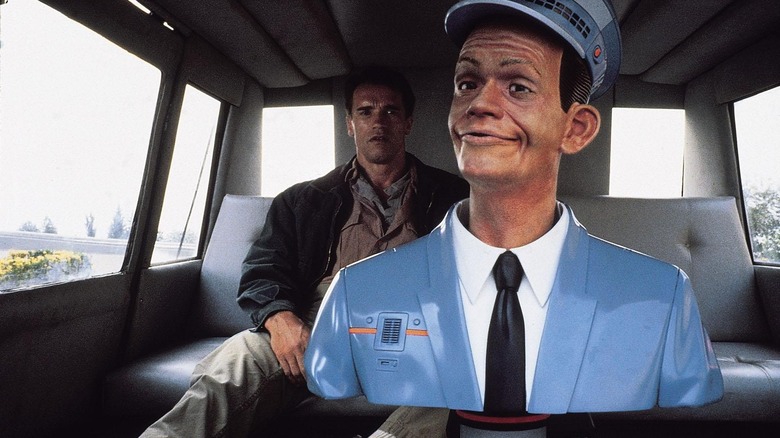
"Total Recall" is full of paranoia as it is, as the lead character -- renamed Douglas Quaid, played by Arnold Schwarzenegger -- is never 100% sure if what he's experiencing is the real world, or merely an elaborate fantasy implanted by Rekall (renamed with an extra "L"). But a large part of Verhoeven's film is the oppression of the Martian people by a militant government presence, and the pervasiveness of violence in a politically charged world. The presence of action star Schwarzenegger underlines this, and the Douglas Quaid of the movie is a far cry from the bookish, introverted Douglas Quail from the original short story. 

 Cronenberg's early version -- in production years before the final film was made -- was to star William Hurt as an emotionally wrecked and more pathetic figure whose desires to escape his humdrum life only lead to a pit of dark conspiracy and an even deeper paranoia about his own identity; it wasn't going to be a fun action romp. Cronenberg worked on the script for "Total Recall" for a year, carefully removing the humor, and adding his own trademark steely isolation.

Sewer-Dwelling Mutant Camels

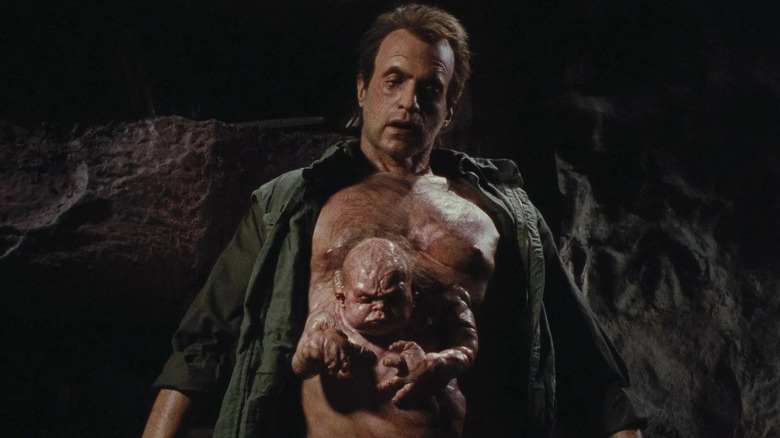
Elements of Cronenberg's original work remain in the finished feature, however. Cronenberg introduced the idea of a rebellion of Martian mutants into the script, and invented the character that would become Kuato, a psychic conjoined twin who lives on another character's abdomen. Cronenberg also authored a more elaborate psychic dream sequence between Kuato and Quaid which would have involved Kuato becoming a sphynx, and then a glowing vagina -- Cronenberg's films sometimes contain genital imagery. The idea that Mars was the home of mutants was Cronenberg's most notable contribution Verhoeven's version. Co-Screenwriter Ronald Shusett, in early drafts, had invented alien beasts of burden called Ganzibulls, that were essentially outsize, gasmask-wearing camels. Cronenberg transposed the Ganzibulls to the sewers, making them stranger, subterranean creatures. 

 Cronenberg's concept for the look of Mars was also drastically different. The dark pyramid in Verhoeven's film was originally meant to be a Martian sphynx -- the one Kuato was to morph into -- and the Martian landscape was meant to look more elegantly architectural; Verhoeven's Martian sets were more industrial, featuring metal paneling and factory-like walkways. Several pieces of concept art, envisioned by artists Ron and Judith Miller, were released to the public for the first time shortly before the easily-forgotten 2012 remake of "Total Recall," and the art is more evocative of David Lynch's "Dune" than of the finished "Total Recall" we got.

Maybe It Was All A Dream

Cronenberg ended up leaving "Total Recall" when the studio recast William Hurt with Richard Dreyfuss, wanting a star who was more lively than laconic; both Dreyfuss and Hurt are excellent actors, but they certainly have different strengths. Cronenberg realized that what the studio wanted was far too different than what he was willing to provide, and he moved onto bigger and better things; In 1988, Cronenberg made the celebrated "Dead Ringers," and in 1991, he and William Hurt would end up making the heady and surreal "Naked Lunch," an adaptation of the drug-fueled, stream-of-consciousness novel by William S. Burroughs. 

Meanwhile, "Total Recall" would evolve quite a bit during its years of development. Australian director Bruce Beresford ("Tender Mercies," "Driving Miss Daisy") was brought on at one point, with Patrick Swayze set to star, ensuring that "Total Recall" was going to be more action-oriented. Eventually, that version, with elements of Cronenberg mixed in, evolved into the Verhoeven/Schwarzenegger version that was released. 

The 1990 version of "Total Recall" is, to editorialize, an excellent film, featuring a fun, violent, nightmare carnival tone that communicated a good deal of playful cynicism, a tone that would become the hallmark of a lot of entertainment in the 1990s. Also, Verhoeven was not shy about extreme gun violence, and the flying bullets, bizarre nasal invasion probes, and arm-severing elevators made for some well-noted cinematic action iconography. The finished product was certainly different from Cronenberg's vision, and Cronenberg would likely have made a great film, but Verhoeven's film did end up striking the right sort of alchemy for a great action picture.

Read this next: Ranking Every Ron Howard Feature Film From Worst To Best

The post David Cronenberg's Darker Take On Total Recall We Never Got to See appeared first on /Film.

14 Mar 17:21

The Daily Stream: Willy Wonka And The Chocolate Factory Is Delightful Nightmare Fuel

by Jenna Busch

(Welcome to The Daily Stream, an ongoing series in which the /Film team shares what they've been watching, why it's worth checking out, and where you can stream it.)

The Movie: "Willy Wonka and the Chocolate Factory"

Where You Can Stream It: Netflix

The Pitch: I have a weird love/lasting fear of "Willy Wonka and the Chocolate Factory" from my childhood. I wasn't around when it came out, but it did play on television. It did two things to me. First, it made me question advertising, since the Everlasting Gobstoppers they sell are not everlasting like they are in the film. Second, it gave me nightmares that I still have to this day. 

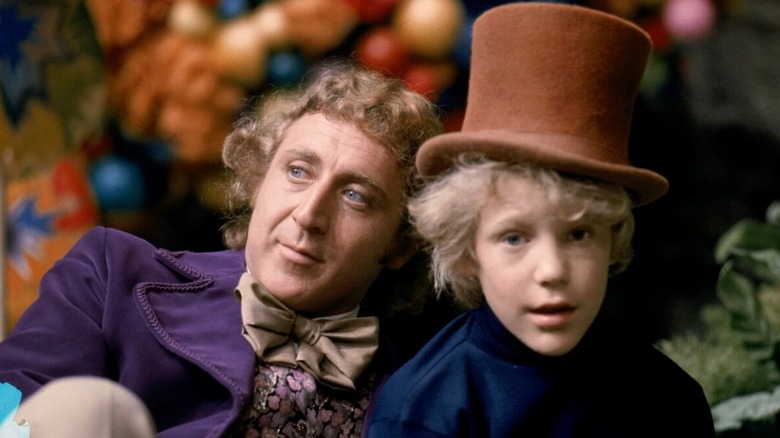
It's the story of Charlie Bucket (Peter Ostrum), a very poor kid who discovers a golden ticket in his Wonka-brand chocolate bar, meaning he gets to go with a few other kids and their guardians to tour Willy Wonka's famous chocolate factory with none other than the reclusive and extremely weird Willy Wonka (Gene Wilder) himself. One by one, the kids do stupid things and get removed from the tour is delightfully awful ways. 

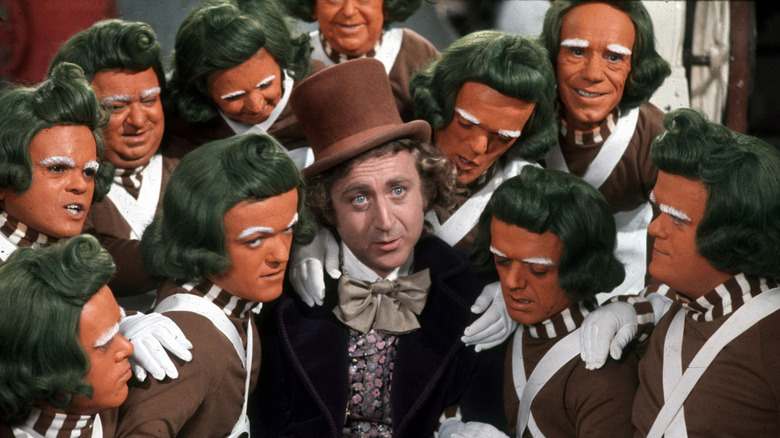
One caveat; there are some very problematic things in here (like the Oompa-Loompas). I am therefore recommending this as a stream if you're an adult, and if you're old enough to understand what those problematic things are or explain them to your kid. 

Why It's Essential Viewing

It sounds like I'm telling you to avoid "Willy Wonka and the Chocolate Factory," but I'm not. This 1971 film features one of the best performances from the legendary Gene Wilder. That man had the uncanny ability to look haunted and sweet and menacing at the same time. It's perfect for Willy Wonka, who doesn't seem to have a problem messing up children, but is still somehow loveable.

I guess in a way that's part of the appeal and wait, I didn't mean to sound psychotic. Children are great! I just love the fact that there are consequences to the choices they make. Augustus Gloop (Michael Böllner) drinks out of the chocolate river, making my inner germaphobe shudder, and he gets punished for it. Veruca Salt (Julie Dawn Cole) thinks she should get anything she wants, and ends up being put down a shoot reserved for "bad eggs." Violet Beauregarde (Denise Nickerson) won't stop chewing her gum and turns into a giant blueberry that has to be squeezed out.

It's Scrumdiddlyumptious!

"Willy Wonka and the Chocolate Factory" is the very definition of poetic justice. No one is really a good guy other than Charlie. Wonka would be up on child endangerment charges today. Grandpa Joe (Jack Albertson) is a complete jerk, letting Charlie's mom cook and clean as he sits in bed for years, and only gets up at the prospect of free chocolate and a factory tour. I like the not-so-perfect versions of kids and the wildly irresponsible adults. I like consequences.

What I also like -- now -- is the sequence as Wonka takes the kids on a boat through a tunnel and scares the crap out of them. There are horrifying pictures on the wall, and Wonka sort of sing/speaks a macabre poem. It's just absurd and creepy, and the delight Wonka takes in messing with everyone appeals to my darker side. I do still have nightmares, but I just watched it again and found myself laughing at how weird the studio allowed this children's film to be. I mean, you could not do this now. We keep trying, of course, but Johnny Depp's version is just uncomfortable to watch.

When you get to the end and the "surviving" child is left, you know that kid earned that place. It's not through the power of love and friendship like rewards usually are in kid films and animated shows these days. It's that he was less awful than the rest of them. It's sort of refreshing.

I apologize in advance for your non-stop humming of "The Candy Man."

Read this next: The Daily Stream: Doctor Sleep Is The Best Of Both Stephen King And Stanley Kubrick

The post The Daily Stream: Willy Wonka and the Chocolate Factory Is Delightful Nightmare Fuel appeared first on /Film.

14 Mar 17:21

The Unbearable Weight Of Massive Talent Review: Nicolas Cage Is Nicolas Cage [SXSW]

by Jacob Hall

Nicolas Cage. Actor. Movie star. Meme. And generally, all three at once as part of a career that defies logical explanation. A weirdo character actor and an Oscar winner and an action hero and a seemingly fallen star stuck in a tragic loop of C-list nonsense to pay off a never-vanishing tax bill — Cage is such a character in the eyes of the public that it was only a matter of time before he became a movie character himself.

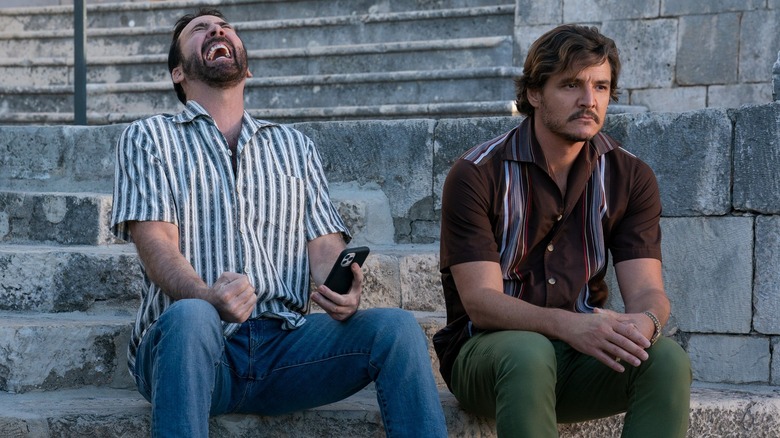
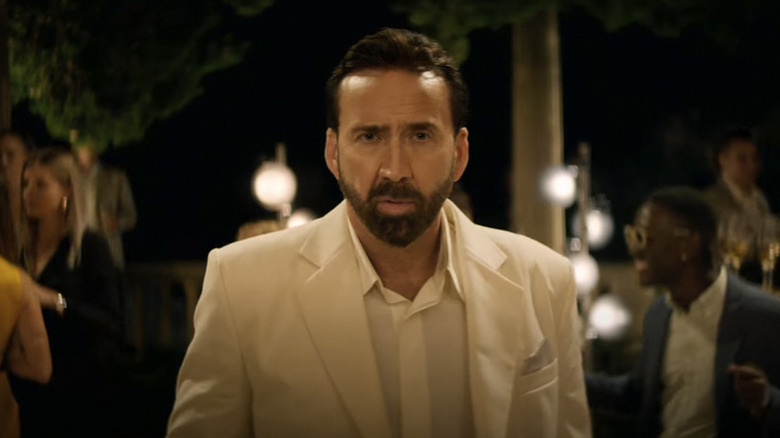
"The Unbearable Weight of Massive Talent" is a movie that feels like it was pitched alongside a giant pile of Nicolas Cage memes, but its success is due to its strangely nuanced tone, where its star plays alongside the joke instead of playing into it. Cage, cast as himself, is often nuanced, generally restrained, and painfully, awkwardly human ... but he's playing a performer who doesn't let the boundaries of traditional acting restrain him. The film walks a high-wire. This is not a movie about the weirdo from the YouTube compilation of his strangest moments in "The Wicker Man," but rather a movie about the man who plays that weirdo.

And while Cage is a lot of fun here, it's a bit startling to watch his co-star, the ever-rising Pedro Pascal, grab the movie and walk away with it. That's the Nicolas Cage curse, one supposes. Always one step behind the comeback that will make everything right.

Despite All My Range...

Pascal ("Game of Thrones" and "The Mandalorian") plays Javi Gutierrez, an obscenely wealthy movie fan who invites a down-on-his-luck Nicolas Cage to attend his birthday party for the un-turn-down-able price of $1 million. Cage's life and finances are a mess — his daughter hates him, he can't secure decent acting work, and he's literally haunted by himself, a figment of his imagination that dials his every meme'd impulse up to 11. These scenes are the ones you'll find ripped to YouTube the fastest, as restrained Cage plays alongside unhinged Cage, the wild young man who wants to know how it got burned, declares that he's a vampire before eating a live cockroach, and who once headlined a David Lynch movie. Yes, these moments are funny as hell. For many, they will be worth the price of admission.

But the real joy comes when Cage and Pascal share the screen, and Javi, the shy kajillionaire, slowly lets his Cage fan flag fly. He credits Cage's work with keeping him upright in his darkest hours, maintaining a small museum of Cage artifacts that movie fans will surely want to examine and re-examine for Easter eggs. Major blockbusters like "Con Air" and "Face Off" are referenced, alongside more niche titles like "Mandy" (a masterpiece, one character rightly declares) and "Guarding Tess" (the unlikely subject of a major plot point).

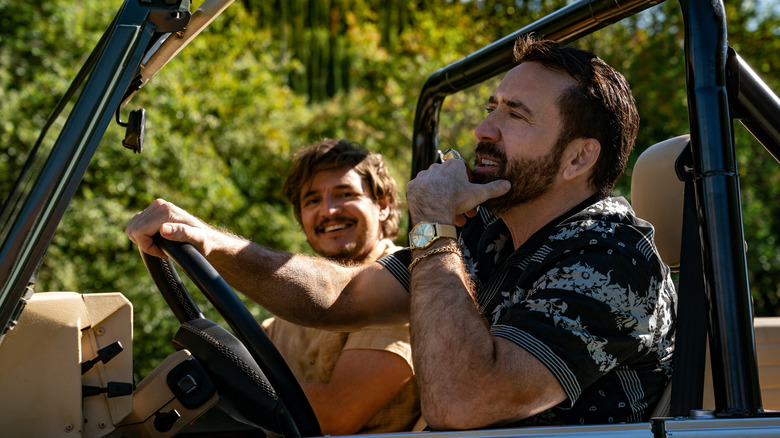
But this artist/fanboy relationship blossoms into a bonafide bromance, as Javi and Nicolas Cage learn that they're made for each other. Instant buddies. Platonic life partners. BFFs. They even watch "Paddington 2" together, a delightful moment in a film chock-full of them. Pascal and Cage share an easygoing chemistry, and the scenes of them hanging out, driving around the Spanish coast, getting high on LSD, and trying to fix each other's lives are a delight. And while Cage is very fun here, it's easy to see why Pascal is currently being cast in every TV show and movie in existence — he's hilarious, sweet, disarming, and seemingly unafraid to be completely silly in service of character or plot. One could argue that Pascal, the complete package of actor, movie star, and weirdo, is being a better Nicolas Cage right now than Nicolas Cage is.

I'm Still Just A Rat In A (Nicolas) Cage

Unfortunately, the movie has to find time for the other side of the plot. You see, Javi is so rich because he's a dangerous man, the leader of a weapons cartel who has seemingly abducted a politician's daughter and plans to execute her. Cage, already roped in for the birthday party, is recruited by the CIA to spy on his new buddy and report the details. These scenes are like a hat on top of a hat, or another scoop of ice cream on top of the sundae. It sounds great, and it sounds silly, and it sounds wild enough to work, but these scenes never gel. Director Tom Gormican is clearly more comfortable with the Linklater and Apatow-esque scenes of Javi and Nic just being dudes than he is with the espionage stuff, which ends up feeling dull in comparison to Cage and Pacal's lightning-in-a-bottle chemistry. As Cage's CIA handlers, Tiffany Haddish and Ike Barinholtz feel a bit lost, scrambling to find the comedy in their infinite reams of exposition.

This plotline takes over the movie entirely in its third act, leading to a conclusion that is a bit too much like the lousy B-movies Cage has been making in recent years to live up to the uproarious joys of the first hour and change. Not even a number of meta-references about how so many adult dramas about real people, man, need action beats to get made can soften it.

But when "The Unbearable Weight of Massive Talent" is good, it's really good, and the kind of gonzo project that has no right to exist. Maybe the CIA plotline was needed to get the movie off the ground (as the script itself slyly suggests), and Gormican and company just chose to have as much fun as humanly possible with the central bromance and hoped for the best with the rest. Two hours of Javi and Nic talking about German expressionist filmmaking and swapping story notes, while nirvana for some folks, wouldn't look as good in trailers as Nicolas Cage screaming with a gun in his hand. It can't help but feel like a compromise.

Still, this is a hard film to dislike. Cage brings what you'd expect, Pascal brings even more, and their awkward, adorable, genuine kinship represents how so many of us feel about Cage these days. We're all admirers, and maybe we were embarrassed about it for a little while, but not anymore.

/Film Rating: 7.5 out of 10

Read this next: The Best Movies Of 2021

The post The Unbearable Weight of Massive Talent Review: Nicolas Cage is Nicolas Cage [SXSW] appeared first on /Film.

14 Mar 17:20

When to Change Your Air Filter (and How to Choose the Right One)

by Becca Lewis

Changing the air filters in your HVAC system regularly is important not only for the air quality in your home, but also for saving money on your energy bill, as well as maintenance costs down the road on your system. A worn-out or clogged filter makes the fans in your circulation system work overtime to push air…

Read more...

14 Mar 17:20

They're Frustrated with Power Utilities - So They're Leaving the Grid Altogether

by EditorDavid
Power blackouts and rising electricity costs have inspired "a small but growing number of Californians" to leave the power grid altogether for their own home-generated energy, reports the New York Times. And thanks to "a stunning drop" in the cost of solar panels and batteries, "Some homeowners who have built new, off-grid homes say they have even saved money because their systems were cheaper than securing a new utility connection...." Nobody is quite sure how many off-grid homes there are but local officials and real estate agents said there were dozens here in Nevada County, a picturesque part of the Sierra Nevada range between Sacramento and Lake Tahoe. Some energy experts say that millions of people could eventually go off the grid as costs drop.... People going off the grid argue that utilities are not moving fast enough to address climate change and are causing other problems. In Northern California, Pacific Gas & Electric's safety record has alienated many residents. The company's equipment caused the 2018 Camp Fire, which killed dozens and destroyed the town of Paradise, about 70 miles north of Nevada City. The utility's effort to prevent fires by cutting off power to homes and businesses has also angered people. One of those residents is Alan Savage, a real estate agent in Grass Valley, who bought an off-grid home six years ago and has sold hundreds of such properties. He said he never loses power, unlike PG&E customers. "I don't think I'll ever go back to being on the grid," Mr. Savage said. For people like him, it is not enough to take the approach favored by most homeowners with solar panels and batteries. Those homeowners use their systems to supplement the electricity they get from the grid, provide emergency backup power and sell excess energy to the grid. The appeal of off-grid homes has grown in part because utilities have become less reliable. As natural disasters linked to climate change have increased, there have been more extended blackouts in California, Texas, Louisiana and other states.... Installing off-grid solar and battery systems is expensive, but once the systems are up and running, they typically require modest maintenance and homeowners no longer have an electric bill. RMI, a research organization formerly known as the Rocky Mountain Institute, has projected that by 2031 most California homeowners will save money by going off the grid as solar and battery costs fall and utility rates increase. That phenomenon will increasingly play out in less sunny regions like the Northeast over the following decades, the group forecasts.... Some energy experts worry that people who are going off the grid could unwittingly hurt efforts to reduce greenhouse gas emissions. That is because the excess electricity that rooftop solar panels produce will no longer reach the grid, where it can replace power from coal or natural gas plants. "We don't need everybody to cut the cord and go it alone," said Mark Dyson, senior principal with the carbon-free electricity unit of RMI.... Scott Aaronson, a senior vice president for security and preparedness at the Edison Electric Institute, a utility industry trade group, said that while off-grid living might appeal to some, it was "like having a computer not connected to the internet.... You're getting some value but you're not part of a greater whole," he said. "When something goes wrong, that's wholly on you...." Off-grid systems are particularly attractive to people building new homes. That's because installing a 125- to 300-foot overhead power line to a new home costs about $20,000, according to the California Public Utilities Commission. In places where lines have to be buried, installation runs about $78,000 for 100 feet. The article ends by pointing out that off-the-grid residents will soon also have a handy alternative to the giant electric batteries that store the excess energy from their solar panels: electric cars like the Ford F-150 Lightning and the Hyundai Ioniq 5.

Read more of this story at Slashdot.

14 Mar 17:18

BBC blows open the story about US biolabs in Ukraine. Turns out the US has been working with Ukraine since 1990s on clearing up Soviet bioweapons, and on researching dangerous diseases. The horror, the horror [News]

14 Mar 17:18

AMD To Unveil FSR 2.0 at GDC 2022: Twice The Performance of Native Resolution With Raytracing, Higher Image Quality Without ML Hardware

by Hassan Mujtaba

AMD is coming out with its next-gen FSR 2.0 technology at GDC 2022, offering improved visual quality & performance boost versus the current version.

AMD FSR 2.0 To Feature Twice The Performance of Native Resolution With Ray Tracing Without Dependence Machine Learning Cores, Launching at GDC 2022

Videocardz managed to get hold of the new slides for FSR 2.0 which will be unveiled at GDC 2022 on 23rd March however the initial introduction is said to take place on 17th March. According to the available information, FSR 2.0 will extend on the existing version of AMD's FiedilityFX Super Resolution technology and feature an advanced temporal upscaler.

AMD FSR 2.0 technology features. (Image Credits: Videocardz)

AMD FSR 2.0 vs DLSS 2.0 - Battle of ML vs Non-ML Image Upscalers

The 'Next-Level' Temporal Upscaling technology is said to deliver image quality that will be better than native resolution by utilizing temporal data and will also include optimized anti-aliasing. This will be comparable to NVIDIA's DLSS 2.0 though the latter still has the advantage of AI assistance. It's something that will only be seen after launch if the extra Tensor cores on NVIDIA's GPUs are able to offer a better-upscaled image versus the non-ML approach from AMD.

This, however, opens the room for AMD to incorporate FSR 2.0 in its existing GPUs with ease since there is no additional hardware requirement in place. Furthermore, the technology won't just be supported by AMD but also competitor GPUs too, offering a boost in framerates in supported AAA games across a wide range of products and platforms.

AMD FSR 2.0 technology performance. (Image Credits: Videocardz)

In one comparison slide, it is seen that AMD FSR 2.0 offers up to twice the performance of the native resolution with ray tracing enabled in Deathloop, a title that will be amongst the first to utilize the new technology.

Some features mentioned in the previous leak by CapFrameX for the AMD FSR 2.0 technology would include:

  • Temporal upscaling + optimized AA
  • Does not need AI
  • Runs on GPUs from all vendors
  • Impressive performance and image quality
  • AMD even claims that it can be better than native

Now, do note that this comparison is done with FSR 2.0 at 'Performance' mode. It is unknown if AMD means 'better than native' image quality at Quality mode or Performance mode. Besides the FSR 2.0 announcement, AMD is also going to ship a new driver that will include RSR (Radeon Super Resolution) support. The tech will work on GPUs starting Radeon RX 5000 series and above but in terms of image quality, it won't be comparable to FSR since it's a driver-level implementation that is going to upscale the whole frame in a running application rather than specific dev-optimized tiles as FSR.

The post AMD To Unveil FSR 2.0 at GDC 2022: Twice The Performance of Native Resolution With Raytracing, Higher Image Quality Without ML Hardware by Hassan Mujtaba appeared first on Wccftech.

14 Mar 17:18

Here’s everything new in the Oculus Quest 2 v38 update

by Samuel Willetts
Here’s everything new in the Oculus Quest 2 v38 update

Meta is steadily rolling out the v38 update for its Oculus Quest 2 and older Quest VR headsets, implementing several social enhancements on the devices that should make playing the best VR games with your friends much easier. This firmware also contains changes that indicate we’re slowly but surely getting closer to the launch of ‘Horizon Home’, the company’s replacement for Quest Home.

After updating your Quest headset to v38, any apps within your App Library that have multiplayer capabilities will be automatically highlighted if you’re in a party of two or more users. Additionally, anyone you’ve recently played online with can now be found within the ‘Recently Met’ menu accessed by pressing the Oculus home button when in an app, or by visiting the ‘People’ tab.

You can now place mixed reality sofas (that’s couches if you’re on the other side of the Atlantic) and desks in your Quest home environment. While this is undoubtedly part of Meta’s wider plans to dominate the metaverse, it should also save you from bumping into their furniture while in the home menu and contributing to growing VR-related insurance claims. Tracked keyboards are now available too, if you fancy working with your headset on.

RELATED LINKS: Best VR games, Build yourself a VR-ready PC for $793, How to set up your Oculus Rift
14 Mar 17:18

Over 500,000 Patients Hit by Data Breaches at Healthcare Firms in Alabama, Colorado

by Ionut Arghire

The information of more than half a million individuals was likely compromised after three healthcare services providers in Alabama and Colorado suffered cybersecurity breaches.

read more

14 Mar 17:18

New Grand Theft Auto V Next-Gen Footage Showcases PS5 Performance RT Mode, Load Times and More

by Francesco De Meo

Grand Theft Auto V

New Grand Theft Auto V next-gen footage has emerged online, comparing load times, showcasing Performance RT mode on PlayStation 5, and more.

The first new video, shared on YouTube by MrWilliamThor, compares load times between the Xbox Series X and Xbox One versions of the game. Unsurprisingly, the Xbox Series X version comes out on top with some very fast loading.

The second new video shared on YouTube by FA Gamez provides a look at Grand Theft Auto V running on PlayStation 5 with Performance RT mode.

Performance RT is only one of the display modes available for Grand Theft Auto V on PlayStation 5 and Xbox Series X, as the game also features the obligatory Fidelity and Performance Modes.

Choose from one of three detailed new graphics settings to tailor your gameplay experience for what matters most to you. Fidelity Mode is tuned for the highest visual quality and targets 30 FPS. In this mode the PlayStation 5 and Xbox Series X support native 4K resolution with ray tracing enabled while the Xbox Series S supports upscaled 4K resolution. Performance Mode is tuned for the most responsive gameplay experience and targets 60 FPS. In this mode the PlayStation 5 and Xbox Series X support upscaled 4K resolution while the Xbox Series S supports a resolution of 1080p. In addition, the PlayStation 5 and Xbox Series X have Performance RT mode, a hybrid of the Fidelity and Performance modes supporting upscaled 4K resolution with ray tracing enabled and targeting 60 FPS.

Grand Theft Auto V and Grand Theft Auto Online launch on PlayStation 5, Xbox Series X, and Xbox Series S digitally on March 15th.

The post New Grand Theft Auto V Next-Gen Footage Showcases PS5 Performance RT Mode, Load Times and More by Francesco De Meo appeared first on Wccftech.

14 Mar 17:17

AMD Updates Spectre Mitigations Following Intel Research

by Eduard Kovacs

AMD last week informed customers that it has updated mitigations for a variant of the Spectre side-channel attack. The update comes in response to research conducted by Intel.

read more

14 Mar 17:17

Why Enterprise Threat Mitigation Requires Automated, Single-Purpose Tools

by noreply@blogger.com (The Hacker News)
As much as threat mitigation is to a degree a specialist task involving cybersecurity experts, the day to day of threat mitigation often still comes down to systems administrators. For these sysadmins it's not an easy task, however. In enterprise IT, sysadmins teams have a wide remit but limited resources. For systems administrators finding the time and resources to mitigate against a growing
14 Mar 10:42

New BioShock Mod released for Half-Life Alyx, featuring over 15 hours of gameplay

by John Papadopoulos

BioShock and Half-Life fans, here is something special for you today. Modder ‘wim.buytaert.1988’ has released the second episode of his amazing BioShock Mod for the latest Half Life VR game, Half-Life Alyx. According to the modder, Return to Rapture Chapter Two has 24 levels and over 15 hours of gameplay. This second episode packs countless … Continue reading New BioShock Mod released for Half-Life Alyx, featuring over 15 hours of gameplay →

The post New BioShock Mod released for Half-Life Alyx, featuring over 15 hours of gameplay appeared first on DSOGaming.

14 Mar 10:41

State of Decay 3 Is Phil Spencer’s Most Anticipated Game (Alongside Starfield)

by Alessio Palumbo

State of Decay 3

Speaking to the XboxEra podcast during its 100th episode, Head of Microsoft Gaming Phil Spencer revealed that State of Decay 3 is currently his most anticipated game (alongside Bethesda Game Studios' Starfield).

This is so hard because we have so many teams that are doing so much great work. You mentioned Starfield, I'll just have to say that because Todd's been a friend for an awfully long time. It's not often that Todd and the team at Bethesda create a new IP. They're doing a lot of engine work, I've been spending some time with Todd and the team and just talking about how things are going and how we're tracking, so a ton of excitement around that.

Another team, and this one's probably not that big of a surprise for people who've watched me play, but I was a big State of Decay 2 player, so Undead Labs. Looking at State of Decay 3, I'm incredibly excited about some of the advancements they're going to make. They have this pattern, they've talked about it publicly, from State of Decay 1 to 2 and 3 and what they want to do. We haven't shown a lot on State of Decay 3 but it's a game that I just really enjoy playing.

I'm a big co-op player, I like building, I like resourcing, and I'm really excited about where that team's going. But you know, again, it's hard because we do have a lot of games in development, some of them talked about some of them not. i don't mean to exclude anything.

As you might remember, State of Decay 3 was formally announced to be in development for Xbox Series S|X and PC during the virtual Xbox Games Showcase event that took place in July 2020. At the time, Undead Labs said the game was still early in pre-production.

We don't know much about the game itself, other than it might be aiming to fulfill the original vision of a zombie MMO that led to the creation of the studio in the first place. Undead Labs is also apparently going to use Unreal Engine 5 to create State of Decay 3.

Hopefully, we'll learn more about it in the near future, as it's been almost four years since the release of State of Decay 2 (which is still getting updated and improved, by the way).

The post State of Decay 3 Is Phil Spencer’s Most Anticipated Game (Alongside Starfield) by Alessio Palumbo appeared first on Wccftech.

14 Mar 00:32

William Hurt, Star Of Broadcast News And The MCU's Thaddeus Ross, Has Died At 71

by Ben F. Silverio

Award-winning star of stage and screen William Hurt died on March 13, 2022 in his adopted hometown of Portland, Oregon. According to Deadline, Hurt's son Will shared that the actor "died peacefully, among family, of natural causes" just one week before his 72nd birthday. Though no official cause of death has been revealed at this time, Hurt was diagnosed with terminal prostate cancer that had spread to the bone in May 2018.

After studying theology at Tufts University, Hurt turned to acting in 1972 and joined the Juilliard School, where his classmates included Christopher Reeve and Robin Williams. He made his feature film debut in the 1980 Ken Russell body horror "Altered States," which earned him a Golden Globe nomination for New Star of the Year. From there, he became known for his Academy Award-nominated performances in "Kiss of the Spider-Woman," "Children of a Lesser God," "Broadcast News," and "A History of Violence," the first of which earned him the Oscar.

While Hurt is also fondly remembered for his roles in "A.I. Artificial Intelligence," "The Village," and "Into the Wild," Hurt also remained active on the stage throughout his career. He appeared in several Off-Broadway productions, such as "Henry V," "Richard II," and "A Midsummer Night's Dream," and earned his first Tony nomination for his performance in the 1985 Broadway production of "Hurlyburly."

However, Hurt is probably most recognizable to younger audiences as General Thaddeus "Thunderbolt" Ross in the Marvel Cinematic Universe. Starting with "The Incredible Hulk" in 2008, he appeared as the stubborn father of Betty Ross and future secretary of state. He reprised the role in four later movies -- "Captain America: Civil War," "Avengers: Infinity War," "Avengers: Endgame," and "Black Widow" -- serving as a grounding presence amid all the high-flying spectacle of the superhero franchise. With appearances spanning 13 years, Hurt had one of the longest tenures in the MCU so far.

Remembering William Hurt

When news broke of Hurt's passing, an outpouring of love came from all corners of the internet to celebrate his life and career. His "Mr. Brooks" co-star Dane Cook said, "He was delightfully sinister in this role & a lovely guy when the cameras stopped. What a career. What a remarkable body of work." 

Hurt's "Broadcast News" co-star Albert Brooks shared similar sentiments by saying, "So sad to hear this news. Working with him on Broadcast News was amazing. He will be greatly missed." Fellow MCU actor and current Hulk Mark Ruffalo (not to be confused with Hurt's first Hulk, Edward Norton) said, "Wow, another major loss to the acting community. Great actor. Great mind." And filmmaker M. Night Shyamalan shared his experience with Hurt on "The Village" by saying "he was a master of his acting craft. Every take was new and revealing."

William Hurt's character in "The Village," Edward Walker, at one point observes that "the world moves for love. It kneels before it in awe." Hurt himself put great care and love into his craft, and both the accolades he earned in his lifetime and the outpouring of grief at the news of his passing are a testament to that. Survived by his four children and with a legion of fans around the world, the great William Hurt will be greatly missed. We at /Film send our condolences to his family and loved ones.

Read this next: The Best Movies Of 2021

The post William Hurt, Star of Broadcast News and the MCU's Thaddeus Ross, Has Died at 71 appeared first on /Film.

13 Mar 21:04

An Amiga can’t do Wolfenstein 3D!

by Scali

Like many people who grew up in the 80s and early 90s, gaming was a 2d affair for me. Scrolling, sprites and smooth animation were key elements of most action games. The Commodore 64 was an excellent gaming machine in the early part of the 80s, because of its hardware capabilities coupled with a low pricetag. In the latter part of the 80s, we moved to 16-bit machines, and the Amiga was the new gaming platform of choice, again offering silky smooth scrolling and animations, but because of advances in technology, we now got higher resolutions, more colours, better sound and all that.

But then, the stars aligned, and Wolfenstein 3D was released on PC. The stars of CPUs becoming ever faster, the PC getting more powerful video and audio hardware, and 3D gaming maturing. A first glimpse of what was to come, was Catacomb 3-D by id Software, released in November 1991:

This game made use of the power of the 16-bit 286 processor, which was starting to become mainstream with PC owners, and the EGA video standard. The PC was not very good at action games, because it had no hardware sprites, and scrolling was very limited. But id Software saw that EGA’s quirky bitplane layout and ALU meant that it was relatively good at certain things. We’ve already seen that it is fast at filling large areas with a single colour, for polygon rendering for example. But it is also good at rendering vertical columns of pixels.

And that is the key to having fast texture-mapped 3D walls. By taking a simple 2D-map with walls, and performing raycasting from the player’s position in the viewing direction, you can make a simple perspective projection of the walls. You use raycasting to determine the distance from the player to the nearest visible wall, and then render a texture-mapped version of that wall by rendering scaled vertical columns based on the distance, with perspective projection.

Catacomb 3-D was a good first step, but the game still felt rather primitive, with the limited EGA palette, and the gameplay not quite having the right speed and feel yet.

But only a few months later, in May 1992, id Software released the successor, where everything really came together. The developers figured out that the EGA trick of rendering scaled vertical columns works nearly the same in the newly discovered ‘mode X‘ of VGA. The big advantage was that you could now use the full 256 colours, which made for more vibrant textures and level design. The game itself was also refined, and now had just the right look-and-feel to become a true milestone in gaming. Things have never been the same since.

Here is an excellent overview of how Wolfenstein 3D evolved:

But… that change did not bode well for the Amiga. Suddenly, everything the Amiga was good at, was no longer relevant for these new 3D action games. What’s worse… these games relied on very specific properties of the EGA and VGA hardware. They did not translate well to the Amiga’s hardware at all.

And to add insult to injury, id Software followed up with DOOM the next year, which again took advantage of ever faster and more powerful PC hardware, and refined the 3D first-person shooter even further.

A few brave attempts were made on the Amiga to try and make Wolfenstein 3D-like or DOOM-like games for the platform, but sadly they could not hold a candle to the real thing:

As a result, the consensus was that the Amiga could not do 3D first-person shooters because its bitplane-oriented hardware was outdated, and unsuitable.

But all that depends on how you look at it. As you know, demosceners/retrocoders tend to look at these situations as a challenge. Sure, your hardware may not have the ideal featureset for a given rendering method… but you can still make the best of it. The key is to stop thinking in terms of EGA and VGA hardware, and instead think of ways to scale and render vertical columns as fast as possible on the Amiga hardware.

One very nice approach was shown at Revision 2019 by Dekadence. It runs on a standard Amiga 500, and achieves decent framerates while rendering with a decent amount of colours and detail:

Another interesting project is a port of the original Wolfenstein 3D-game, which is optimized for a stock Amiga 1200. It achieves good framerates by rendering at only half the horizontal resolution:

The Amiga 1200 has a 14 MHz CPU. We can compare it to the closest 286es, which are 12 MHz and 16 MHz, and those are just about adequate to run Wolfenstein 3D as well, albeit at a slightly reduced window size for better performance. So this is not a bad attempt at all, on the Amiga.

Another touch I really like is that it uses the original PC music for AdLib, and uses an OPL2 emulator to render the music to a set of samples.

Another really nice attempt is this DreadStein3D:

It makes use of the engine for the game Dread, which is currently in development. This game is actually aiming more at DOOM than at Wolfenstein 3D, but it has a very efficient renderer, and rendering Wolfenstein 3D-like levels can be done very well on an Amiga 500, as you can see.

Here is a good impression of what the Dread game actually looks like:

As you can see, it’s not *quite* like DOOM, in the sense that there are no textured floors and ceilings. And it does not support height differences in levels either. But it does offer various other features over Wolfenstein 3D, such as the skybox and the lights and shadows. So it is more of a Wolfenstein 3D++ engine (or a DOOM– engine).

And the performance is very good, even on a stock Amiga 500. So… all these years later, we can now finally prove that the Amiga indeed CAN do Wolfenstein 3D. All it took was to stop thinking in terms of the PC renderer, and making poor conversions of the x86/VGA-optimized routines on Amiga hardware, but instead to develop Amiga-optimized routines directly.

If you look closely, you’ll see that they have a ‘distinct’ look because of the way the rendering is performed. Britelite discussed the technical details of what became Cyberwolf in a thread over at the English Amiga Board. It gives you a good idea of how you have to completely re-think the whole renderer and storage of the data, to make it run efficiently on the Amiga. It has always been possible. It’s just that nobody figured out how until recently.

13 Mar 18:28

Lau Kar-leung: The dragon still dances

by bordwellblog

Lau Kar Leung (aka Liu Chia-liang, 1936-2013); Gordon Liu Chia-hui (aka Lau Kar-fei, 1955-).

DB here:

Back in 2020, I was asked to prepare a video lecture on the Hong Kong filmmaker Lau Kar-leung. Under the auspices of the Fresh Wave festival of young Hong Kong cinema, a retrospective and panel discussions were sponsored by Johnnie To Kei-fung and Shu Kei. The event took place in summer 2021. Tony Rayns also participated, offering a deeply informative talk that’s available here, but mine was not included. At a time when I hope people will continue to remember all that Hong Kong popular culture has given us, I’ve recast it as a blog entry. 

For some years I’ve been arguing that the martial arts cinema of East Asia constitutes as distinctive a contribution to film artistry as did more widely recognized “schools and movements” of European cinema like Soviet Montage and Italian Neorealism. The action films from Japan, Hong Kong, and Taiwan have revealed new resources of cinematic technique, and the filmmakers have influenced other national cinemas. The power of this tradition is particularly evident in Hong Kong cinema’s wuxia pian (films of martial chivalry), kung-fu films, and urban action thrillers  from the 1960s into the 2000s.

Chinese martial arts are well-suited to the movie screen. The performance discipline, seen both in the martial arts and in theatrical traditions borrowing from them, yields a patterned movement that lends itself to choreography. The staccato quality of motion yields a pronounced pause/burst/pause rhythm that can be displayed and enhanced by film technique, as we’ll see.

These aspects of martial arts were captured by filmmakers working for the Shaw Brothers studios between 1965 and 1986. They cultivated a local style that yielded films that looked unlike any others. Thanks to the immense resources of the Shaw Movietown studio, complete with big sets and collections of costumes, the new filmmaking style was given a unique force. With The Temple of the Red Lotus (1965) and Come Drink with Me (1966), what Shaws called its “action era” began, and thanks to international distribution Shaws’ swordplay films gained audiences around the world.


Shaws’ Big 3

Shaw Movietown main office, 1997. Photo by DB.

The new trend benefited from Chinese opera traditions and the martial arts novels of Jin Yong, pen name of Louis Cha Leung-yung. They also owed a debt to Japanese swordplay films, many of which Shaws distributed and urged their directors to study. There was as well the influence of Italian Westerns. Just as important was Shaws’ investment in color and widescreen processes. Updating technology not only allowed the films to compete on the world market; it offered rich opportunities for artistic expression. (See the essay “Another Shaw Production: Anamorphic adventures in Hong Kong.”)

Shaws directors quickly established conventions of the new swordplay film. Conflicts, of course, were expressed through combat, at least three major ones per film. One source of friction was the rivalry between martial arts schools run by masters; there might also be competition among traditions, regions (northern/southern), or nations (China vs. Japan). Typically there would be a hierarchy of villains, with our protagonists fighting them in turn. Plots would be more episodic than is typical in Western films. A looser structure favored including extensive set pieces of training or combat that were the appeal of the genre. And the plot would culminate in a long climactic fight, often to the death. These conventions, consolidated in the wuxia pian, carried over into the kung-fu films of the 1970s.

Two directors played central roles in shaping these conventions, and each had a distinctive approach to them. The vastly prolific Chang Cheh (Zhang Che) dominated the Shaws lot. He favored violent plots turning on revenge and intense male camaraderie, in which the martial arts served as a drama of loyalty or betrayal, friendship or deadly enmity. At the same period King Hu Chin-Chuan created one of the breakthrough “action era” works, Come Drink with Me, which immediately established a very different authorial vision. Hu was interested in historical and political intrigue, women warriors no less than male ones, and the martial arts as a spectacle of cinematic grace. Most of his major works, including A Touch of Zen (1971) were produced after he emigrated to Taiwan, although some were distributed by Shaw Brothers.

Neither Chang Cheh nor King Hu was trained in the martial arts, so they relied on choreographers to supply their action scenes. By contrast, Lau Kar-leung was a martial arts director who came to Shaws in the 1960s and choreographed many films for Chang and others. He took over directing duties in 1976 with The Spiritual Boxer and directed over twenty-five films for Shaws until 1985, when the company ceased producing theatrical features. He went on to direct several one-off projects until 2002.

Lau took the uniqueness of martial arts traditions more seriously than other directors, building entire films around one school or another, or among the contrast of rival traditions. He often opens the film with an abstract prologue showing off characteristic moves and tactics of the style that the film will treat. Unlike Chang, he is less concerned with male loyalty and violent revenge and is more inclined toward redemption and forgiveness. He shares Hu’s refined conception of film technique, but he is less overtly innovative. He refined stylistic conventions that were already in place at Shaws and many of which were basic to world cinema storytelling.

For example, Lau accepted the elevated production values demanded by the Shaw product. His films are filled with elaborate sets, both interiors and exteriors, and rich color values. He also recognized the power of editing, something that King Hu had brought to the fore. In the rest of this entry, I’ll concentrate on four of Lau’s distinctive innovations in the Shaws style.


Filling the wide frame

All widescreen filmmakers faced the problem of filling the spacious frame. (See CinemaScope: The Modern Miracle You See without Glasses” for discussion of American solutions.) The big Shaws sets enabled filmmakers to pack the frame with figures and settings. We therefore find plenty of dense long-shot compositions.

We also find flashy closer views. Chang Cheh was particularly fond of low-angle medium shots, which he considered “warmer” than straight-on or high angles (The Assassin, 1967; choreographed by Lau).
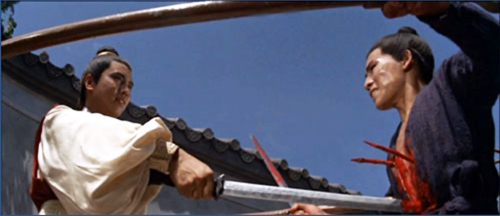
Hong Kong directors relied on “segment shooting” for action scenes. Instead of overall coverage, with repetitions for different camera angles (the US norm), they plotted the fighting moves for specific camera angles and shot them separately. By calibrating the performers’ actions to the camera setup, they created a unique blend of martial arts techniques with film techniques. Rather than simply record martial-arts movements, filmmakers “cinematized” them.

Lau seems to have taken particular pleasure in filling his frames in ingenious, fluid ways. He enjoyed the challenge of staging combat scenes in confined spaces, so that he couldn’t rely on expansive vistas. Partly, this tactic enabled him to show how different moves were required in close quarters. One of his favorite sequences was in Martial Club (1981). He explained:

Gordon Liu is fighting Johnny Wong in an alley that narrows from 7-foot to 2-foot wide. The physical limits of the alley actually make the best showcase for the different boxing schools. How do you fight in a seven-foot-wide alley? You use big arm and leg movements. Going down to five-foot wide, you keep your elbows close to your body because you don’t want to expose yourself. Further down to three-or-four foot wide, you use Iron String Fist. Finally when you get down to two-foot wide, you engage the “sheep trapping pose.” The results were sensational.

At the same time, the narrowing alley offered rich opportunities to fill the frame with body parts and abstract slices of walls.
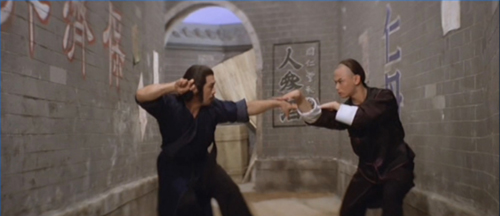
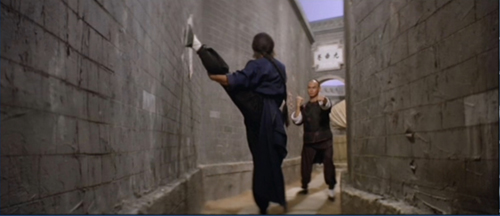
     

Something similar occurs in Legendary Weapons of China (1982), where two assassins must hide in an alley above a third. This time Lau uses some props to fill out the wall areas.
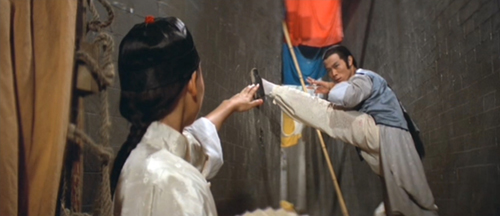
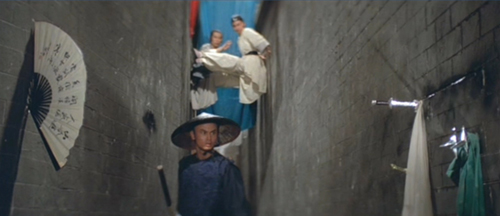
     

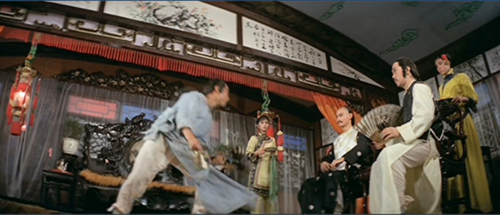
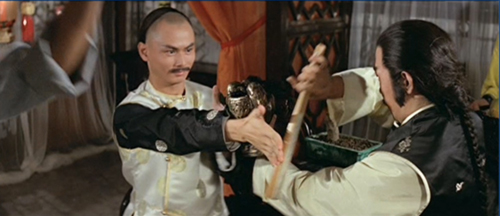
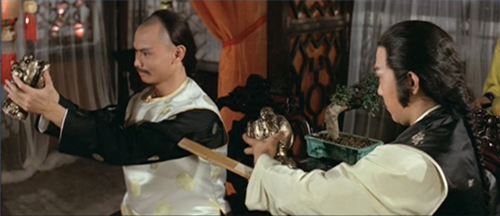
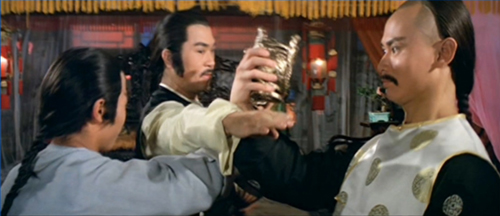
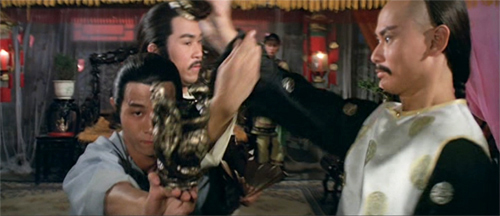
Lau delights in the possibilities of close fighting in any space. Sometimes the confinement isn’t a matter of setting; it’s dependent on letting the film frame itself constrain the action. Take a portion of a  sequence from Dirty Ho (1979). The Prince (in disguise) calls on Mr. Fan, who tries to attack him, all the while pretending to play the host by offering wine.

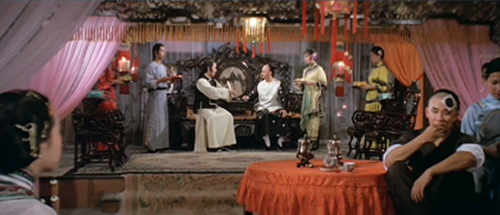
Establishing shots lay out the zones of action to come, the chairs the men will occupy. Even a momentarily unbalanced framing is compensated for by movement in the empty area.
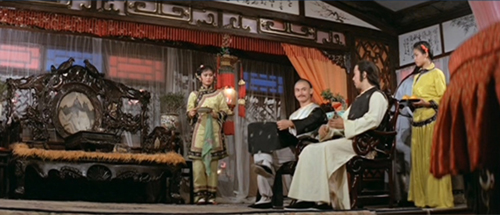
     

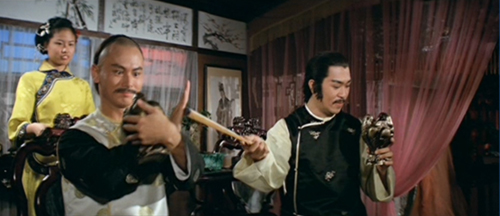
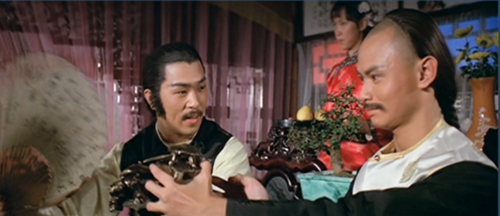
The first phase of the scene takes place in much closer framings, often tight two-shots. It’s here we see Lau’s virtuosity in finding constantly fresh ways to fill the frame, with compositions always picked for maximum clarity: that is, in showing Fan’s aggression and the Prince’s resourceful blocking, sometimes with comic symmetry.
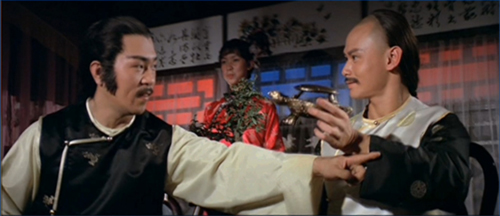
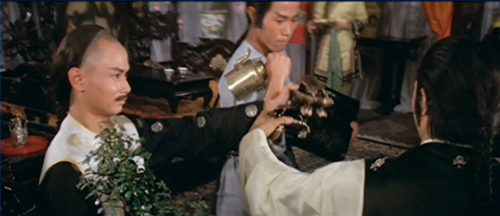
          

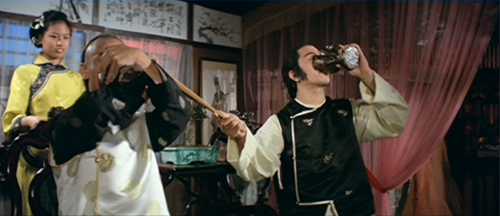
The pause/burst/pause rhythm gets played out in low angles, with slight camera movements to adjust to the gestures.
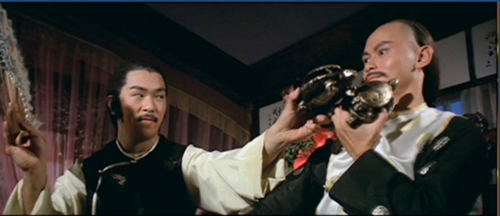
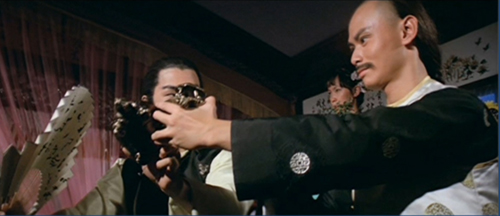
     

The two major props, the fan and cups, get a real workout as they participate in the constant ballet of arms, faces, and fingers. All areas of the screen get activated: top, bottom, corners and sides.
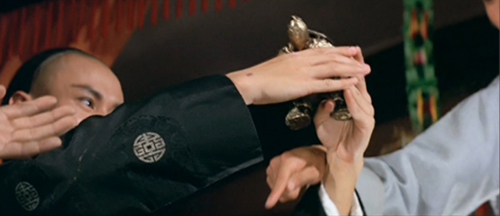
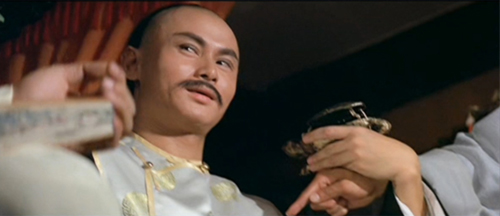


Later in the scene, in a passage I haven’t included in the clip, the servant gets to take part, so now even more body parts are spread across the frame–and a cup even comes out at the viewer.
     

The scene ends with a comic commentary on the props: master and servant collapse at the table as a cup overturns.
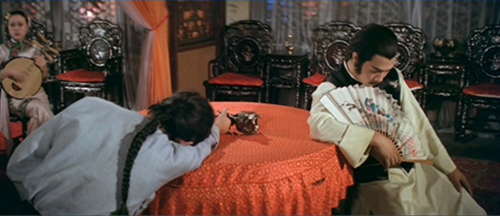
This “close-up action scene” is as fully designed for the widescreen as any expansive long-shot sequence might be, but there’s a particular enjoyment to be had in seeing how a director can do so much with simple components.


Editing: Analytical cutting

Contrary to what many think, Chinese action pictures rely heavily on editing. At Shaws, King Hu pioneered extremely rapid cutting, reducing shots to half a second or less. Lau became a rapid cutter as well; his films from the 1970s and 1980s typically average three to five seconds per shot, with some films containing over 1000 shots.

It’s commonly said that Hong Kong martial arts films favored full shots and long takes, the better to respect the overall dynamic of the combat. Full shots, yes; but not necessarily long takes. While Western directors tended to believe that long shots had to be held quite a bit longer than closer ones, Hong Kong directors realized that long shots could be cut fast if they were carefully composed for quick uptake. Lau’s mastery of composition stands him in good stead when he starts putting shots together: every combat, even the fast-cut ones, are crystal-clear in their execution.

Directors across the world had settled on two major editing resources: analytical cutting and constructive cutting. The first type shows the overall spatial layout of a scene and then analyzes it into partial views. Our Dirty Ho sequence is an example. Constructive cutting deletes the establishing shot and relies on other cues to help the viewer build up the scene mentally. Hong Kong filmmakers made extensive use of both types, and as you’d expect Lau is a master of each.

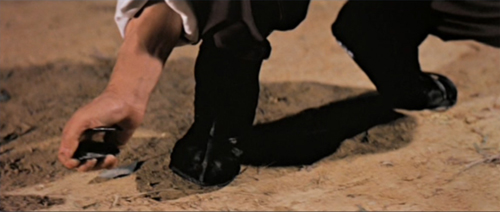
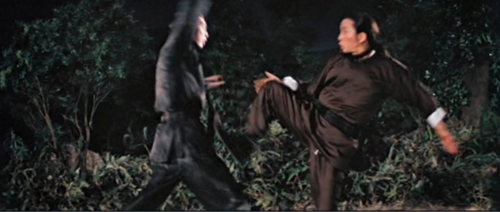
Most Hong Kong directors used analytical editing to favor the actors, to pick out their reactions to the ongoing action. Lau does this as well, as is seen in Dirty Ho. As you’d expect, Lau also uses cuts-in close views to emphasize combat tactics. In Challenge of the Masters (1976), after a villain (played by Lau) has felled his opponent, analytical cuts build to a revelation of a metal attachment to his shoe.
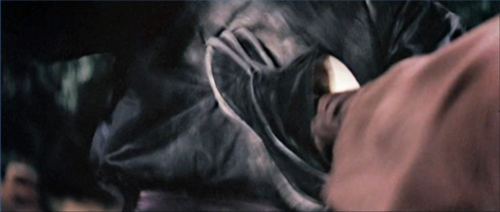


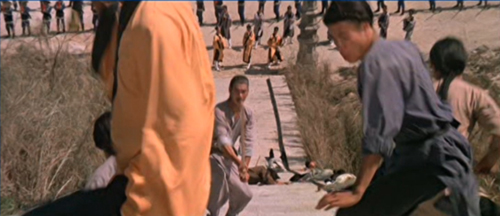
Executioners from Shaolin (1977) illustrates how Lau uses analytical editing during a large-scale fight scene. It’s far less constrained than the tabletop action of Dirty Ho, but he does find ways to narrow the action to particular zones. This is done through cuts to closer views–sometimes very close ones. And the editing is swift, with the average shot lasting only four seconds.

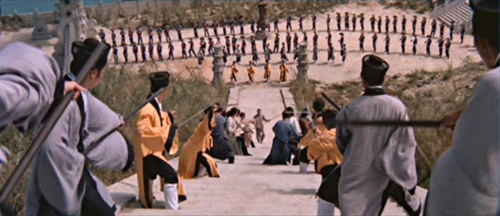
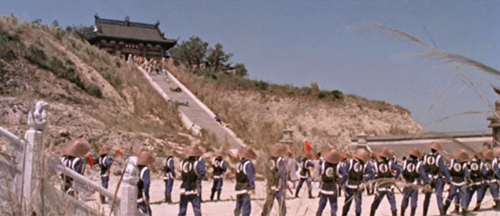
The scene’s opening establishes the hero Hung Hsi-kuan arriving at Pai Mei’s temple. There are two establishing shots, one a pan-and-zoom that presents the temple as Hung arrives, while the other (below) is a zoom back keeping the temple and Hung in the same frame. Both compositions stress the steep stairs leading up the hillside.

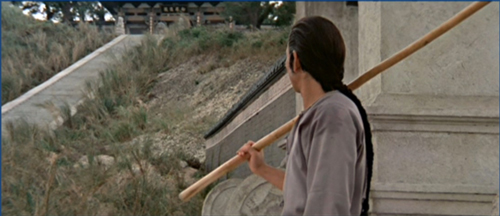
     

Once Hung starts up the stairs, more establishing shots reveal him surrounded. Lau indulges in a feast of different angles, stressing Hung’s vulnerability.
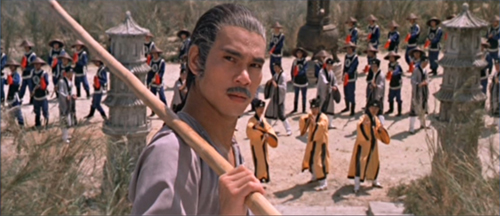
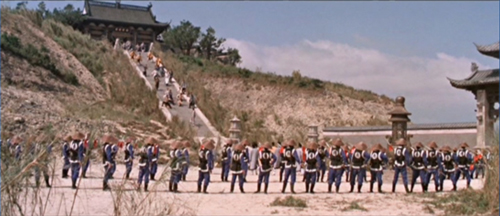
     

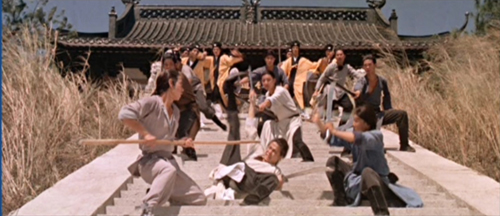
The scene’s second phase follows Hung’s progress up the steps. His encounters with many defenders are captured in a variety of angles, all of them orienting us to the changing situation. (At the top, he’ll encounter Lau himself, wielding a jointed staff.)
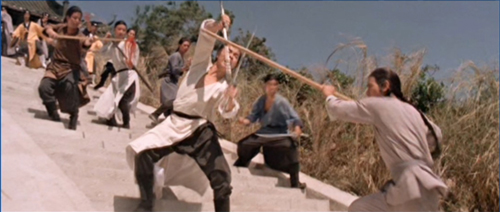
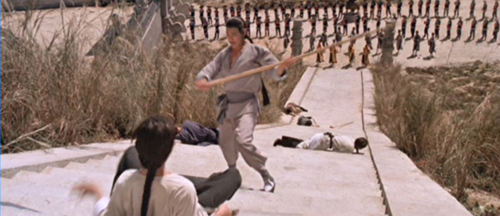


Camera setups on the steps themselves keep us aware of the forces arrayed around him. And the steps function a bit like the alleys in other films to limit the range of action.

The camera really penetrates the action, picking out details in the sort of tightly packed framings we saw in Dirty Ho.
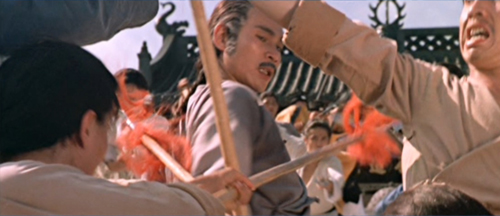
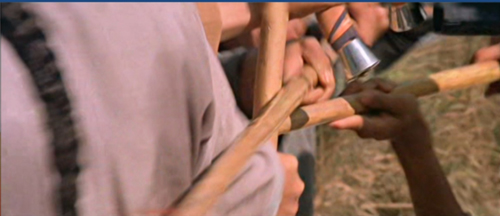
     

Lau remarks: “You can get wonderful scenes of two pairs of hands folding and sliding in and out of each other’s grip.” This sort of tangible physical action is central to Lau’s scene analysis.

Analytical editing can include matches on action, cuts that let movement carry over across shots. Lau gives a virtuoso example in a match-on-action between extreme long-shots of a man in blue sent sprawling. The second shot ends with a zoom back.
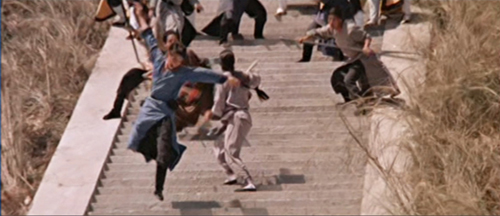
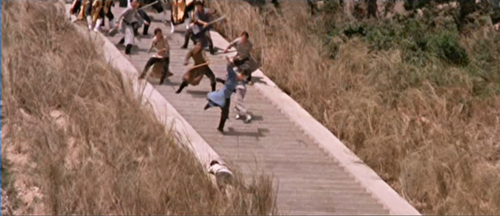
      

It’s possible that Lau used two cameras for coverage of this, but that was a rare option in Hong Kong. It’s just as likely he managed the cut by repeating the fall, a movement stressed by a zoom back.

Again, you get a sense of a filmmaker challenging himself by setting up problems he will need to solve through mastery of his craft.


Editing: Constructive cutting

Trampolines and mattresses in shed on Shaw Movietown lot. Photo by DB.

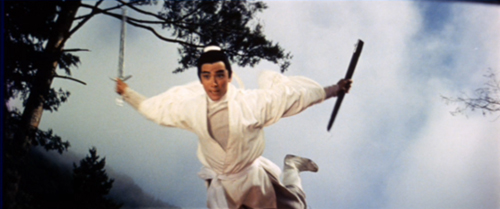
The wuxia tradition features exponents of the “weightless leap,” the ability to spring very high into space. Before the advent of wirework and CGI, these soaring warriors were treated through editing that shows the leap in a series of shots. For instance, constructive cutting in Chang Cheh’s Golden Swallow (1968, choreographed by Lau) shows Silver Roc launching himself, soaring, and descending on his victim.
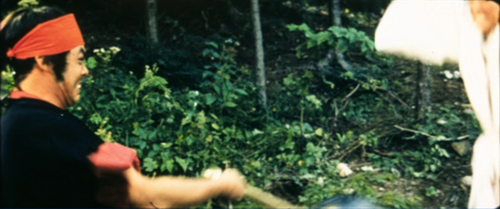
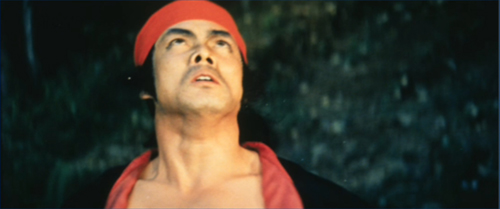


The jump was probably facilitated by a trampoline. On the screen, though, we see portions of the action that we assemble in our heads.

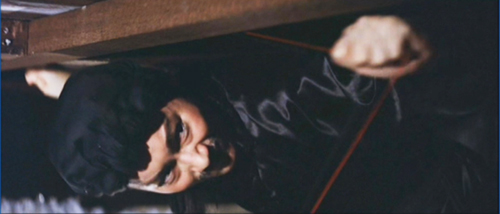
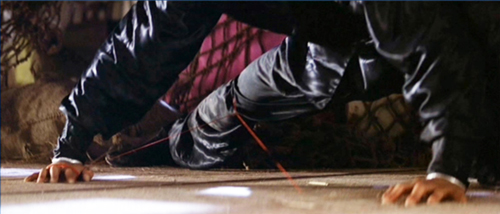
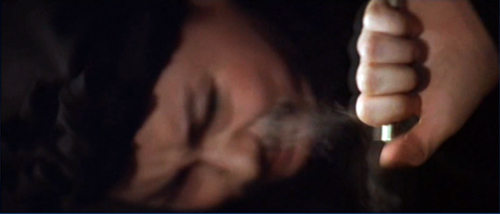
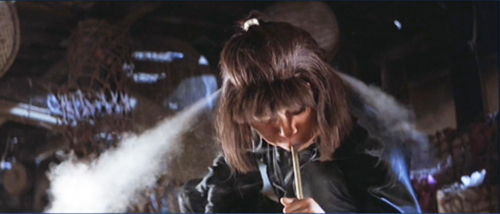
With his usual ingenuity, Lau sought out situations where he could test his skill with constructive editing–not just weightless leaps but combats among fighters at some distance from each other. My example is a brilliant sequence from Legendary Weapons of China (1982). (It takes place in semidarkness, so you may wish to adjust the brightness of your monitor.) Two rival assassins clash in a loft as they try to kill a third in the bedroom below. There ensues a three-way fight, pursued mostly through careful constructive editing.


There are a few establishing shots situating Ti Hau and Fan Shao Ching (disguised as a man) in the loft, but once they change their locations, most of the combat is given through constructive editing. That technique relies on cues of setting and character behavior (body position, facial expression, eyelines), and these are all mobilized early in the scene.
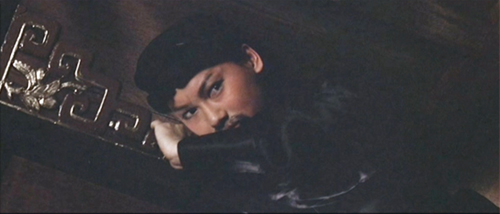
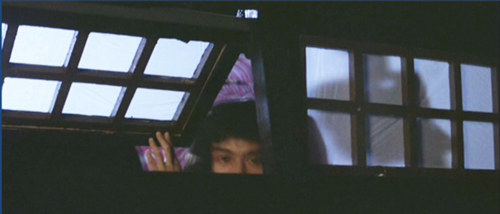
     

Details of props help us understand the action as well: the two threads bearing hooks and especially the gag with gas.
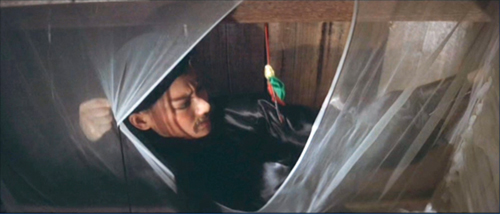
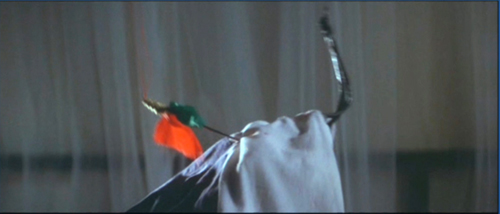


Once the assassin Ti Tan arrives on the floor below, pure constructive editing takes over. There’s no framing that includes him and his two attackers.
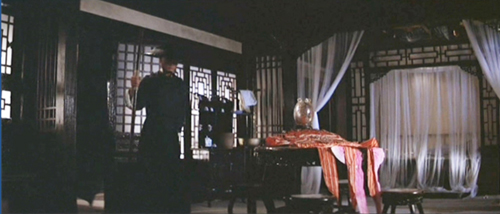
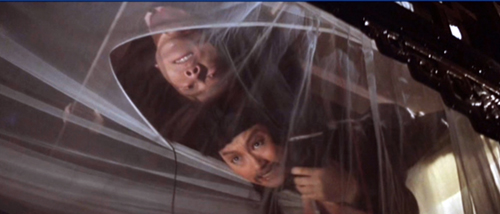
     

So Lau proceeds to cut together an ongoing fight upstairs (complete with fake meows) with Ti Tan’s suspicions downstairs.
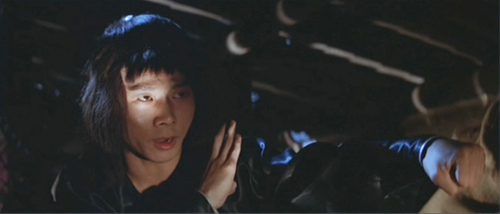
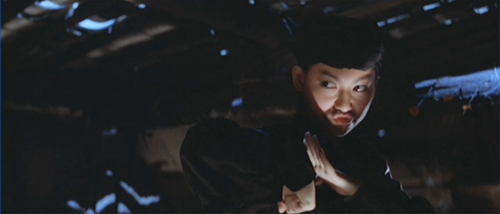
     

The scene culminates in Fan and Ti Hau fleeing as Ti Tan, still suspicious, doubts that all the noise above him was created by a cat–and even the cat is presented through constructive editing.
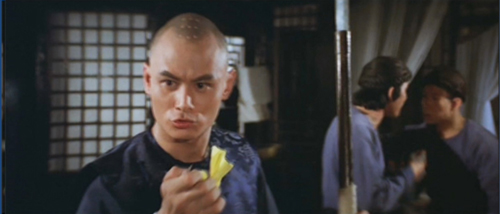
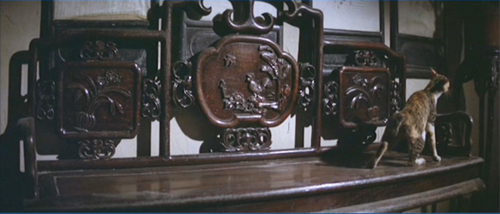
     

In a sequence of 126 shots, the average is about two seconds, but each one is legible at a glance and carries the scene forward with utter smoothness. Lau’s precision in shot design serves him well when we have to assemble the action in our minds.


The smash zoom

Hong Kong action films of the 1960s are notorious for their use–some would say, over-use–of zoom shots. Yet at the time directors throughout the world were exploring the artistic possibilities of zooms. Most notable was the Hungarian Miklós Jancsó, who coordinated the zoom with complex movements of actors and the camera. So we ought to consider the possibility that the zoom in Hong Kong was more than a technical gimmick to spice up action scenes.

For example, a smash zoom can accentuates the pause/burst/pause pattern of the fight. During one combat in Chang Cheh’s The Blood Brothers (choreographed by Lau), the zoom emphasizes sudden bursts of action by whipping back from a fighter.
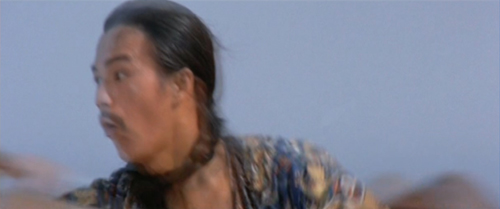
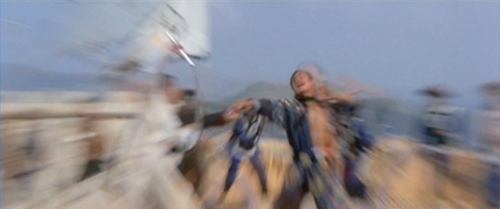
     

Alternatively, the zoom can play up the pause by calling attention to moments of stasis. Here a cut emphasizes the pause as the fighters’s weapons are locked before the fight resumes with a zoom back.
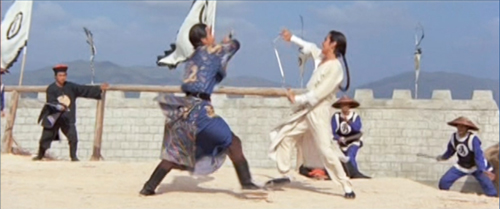



In such ways the zoom can break the fight into discrete stages. A far more elaborate instance takes place in Lau’s Return to the 36th Chamber (1980). Chu Jen-chi has painstakingly learned kung-fu at the temple through an apprenticeship of lashing bamboo poles together to make scaffolding. Accordingly, his technique is based on this very particular set of skills. I concentrate on the early stretches and the clip gives you some extra niceties. The whole thing is exhilarating to behold, thanks partly to energetic zooms.


Early on, the zoom introduces us to the lashing technique by showing the robe’s ripped fabric as a kind of handcuff.
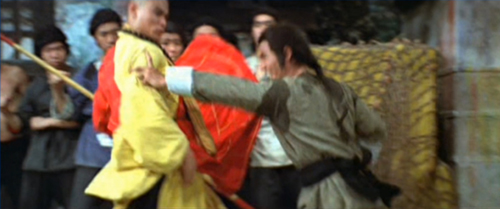


Again we see Lau’s interest in watching how hands work, but here it becomes a specific combat tactic.  The ensuing action will revolve around hands and wrists, and Lau’s zooms set up a question: What is Chu’s overall strategy?

The answer comes in a series of variations. First, Chu lashes his adversary to a bamboo pole like captured wild game.
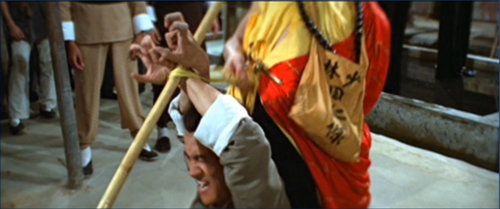
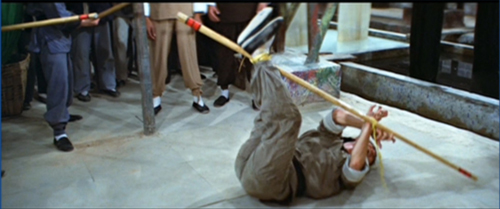
     

Variation 2: Ensemble work. Chu takes on a batch of men, trussing them up horizontally.
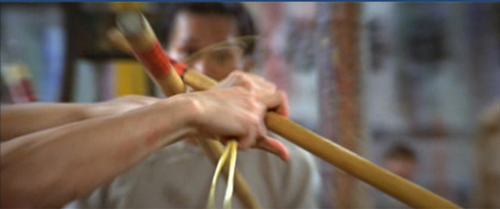
     

He turns out to have in mind an engineering project, a sort of hitching post of miscreants. It’s capped by a shot of one of the Manchu bullies seeing his disciples’ wiggling fingers.
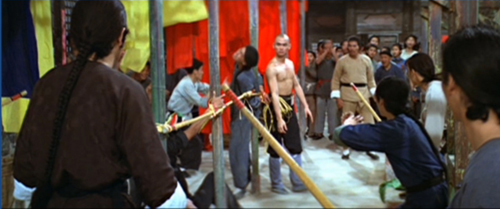
     

Variation 3: More ensemble work, now vertical, with the men’s wrists stacked like a bouquet.
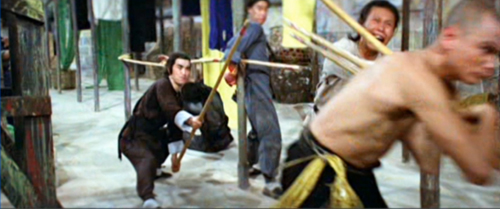


Again, a master shot reveals the result and another close-up shows their wiggling fingers.
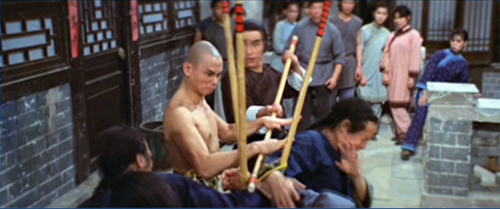
     

The kung-fu is of course extraordinary, but it takes an unusual cinematic imagination to heighten such elaborate patterns of movement in ways that are perfectly clear. Chu’s display of serious efficiency has a humorous side, capped by the gags that show the villains utterly flummoxed. We should ask if today’s action sequences in American films have this sort of unforced rigor and exuberance.


In the mid-1980s Shaw Brothers eased out of theatrical filmmaking, devoting Movietown to television production. Lau went on to one-off projects, some of which (e.g., Tiger on Beat, 1988) are well worth your attention. (Go here for the astonishing climax.) He had a late-career resurgence as choreographer for Tsui Hark’s Seven Swords (2005). But his prime achievements, I think, will remain his vastly entertaining and filmically rich Shaws classics. His dedication to the specifics of martial arts lore, his unique sense of comedy, and not least his precise direction brought unique qualities to the remarkable tradition of Asian action cinema.


Chang’s remark about “warm” low angles is in Chang Cheh, A Memoir (Hong Kong Film Archive, 2004), 82; he discusses shooting The Assassin on p. 86. Lau’s comments on Martial Club come from “We Always Had Kung-Fu: Interview with Lau Kar-leung,” in Li Cheuk-to, A Tribute to Action Choreographers (Hong Kong International Film Festival, 2006), 62; the remarks on hands are on p. 59.

I discuss Lau further in both Planet Hong Kong 2.0 and in this blog entry.
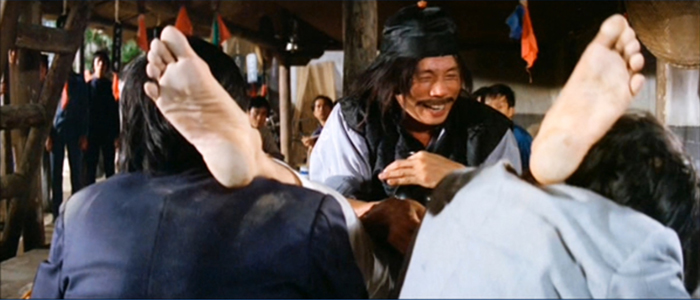
Lau as the drunken master in Heroes of the East (1978).
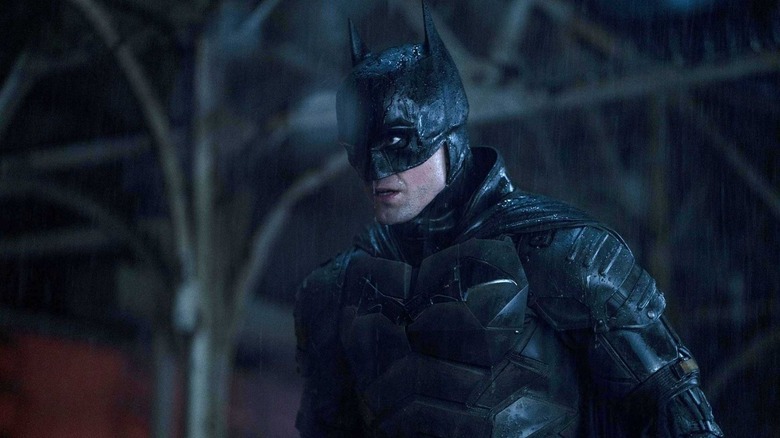
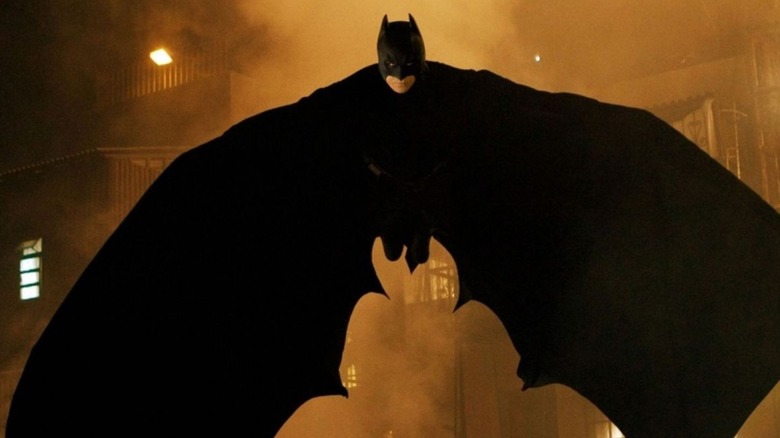
13 Mar 17:49

Russia kills American journalist in Ukraine, throwing out the rules of war [News]

13 Mar 16:55

The Legend of Zelda: Ocarina of Time Unofficial PC Port releases on April 1st

by John Papadopoulos

Last month, we shared a video that showcased an unofficial PC port of The Legend of Zelda: Ocarina of Time. And today, we are happy to report that this unofficial PC port will release on April 1st. Moreover, and on March 22nd, this fan project will get a “Nintendo Direct”-style presentation. This unofficial PC port … Continue reading The Legend of Zelda: Ocarina of Time Unofficial PC Port releases on April 1st →

The post The Legend of Zelda: Ocarina of Time Unofficial PC Port releases on April 1st appeared first on DSOGaming.