Shared posts

21 Apr 15:09

How America became so profoundly stupid over the past decade

by Gareth Branwyn

The Atlantic has a thought-provoking piece by Jonathan Haidt on the last decade's dumbing of America (and the wider world). Spoiler alert (and no great surprise): Social media.

The former CIA analyst Martin Gurri predicted these fracturing effects in his 2014 book, The Revolt of the Public.

Read the rest
21 Apr 11:08

Dungeons & Dragons Gold Box Classics - Steam Edition Impressions

by ValH

Following the recent Steam release of SSI's Gold Box games, we get this PC Gamer article that takes them out for a spin and shares some general impressions. If you'd like to know what to expect from these games, or why you should get the Steam version specifically, you might want to check the article out.

Important to note, however, that the Gold Box Companion mentioned in the article is actually a fairly convenient UI tool, and not some Cheat Engine alternative as the article would lead you to believe.

Here's a quick excerpt:

So what made them classics, and why would anyone want to play them today? The turn-based tactical combat I rhapsodized about above is a huge part of it, and combat makes up the majority of what you'll be doing. Some of the spin-offs went real-time though, with Al-Qadim: The Genie's Curse closer to a Legend of Zelda game, and others were first-person blobbers like Eye of the Beholder. On that subject I bow to the expertise of my esteemed colleague Andy Chalk, who says everyone should play Eye of the Beholder 2: The Legend of Darkmoon.

Beyond the combat, a significant part of their appeal is down to their unique vibe. The journals are responsible for a lot of that, full of text and sometimes diagrams that wouldn't fit on the floppy disks. Everything from overheard tavern gossip to excerpts from books found in a haunted library or crude maps drawn by monsters—all of it could be found in the journal, which you'd be directed to from the game with notes like, "You find information on his body and log it as Journal Entry 4."

Compared to the terseness of most in-game writing at the time, all-caps and brutally edited to fit text boxes, the journal entries were verbose and characterful, whether evoking a haughty villain's speech or a spy's summary of nearby threats. The writers clearly had fun with them, even adding entries that weren't pointed to from anywhere in the games, written to lead astray anyone who tried to cheat by reading paragraphs they hadn't been told to.
21 Apr 01:56

Quake Patched

by Blue
A new patch is now available for Quake, a third major update for the first-person shooter since an enhanced version was released last summer (thanks Nathan). You might say the quarter-century old...
21 Apr 01:56

[Fantaspoa 2022 Review] FOLLOW HER

by Shannon McGrew

[Fantaspoa 2022 Review] FOLLOW HER
Courtesy Fantaspoa
So many of us live our lives publicly on social media. Whether it’s influencers advertising perfectly curated products, photos from a family gathering, or creating FOMO, each and every one of us has chiseled out what we want our identity to be on social media. But what social media shows is only a small portion of what’s happening behind the bright, polished content being posted. And for some, the grass isn’t always greener on the other side. In Sylvia Caminer’s latest film FOLLOW HER, written by Dani Barker, an up-and-coming live-streamer learns the price of what can happen when you push past the boundaries of consent.

In FOLLOW HER, struggling actress and live-streamer Jess Peters (Dani Barker), known to her online followers as J-PEEPS, has finally found her hook: secretly filming creepy interactions she encounters via online job listings, and using the kink of others to fuel her streaming success. For her next episode, she’s been hired to write the ending to a Hitchcockian erotic thriller in a remote, lavish cabin. Once there, Tom (Luke Cook), the alluring self-proclaimed screenwriter, hands her a script in which the two of them are the main characters. This client isn’t what he seems, and even though the money’s great… the real payment here could cost her life.

FOLLOW HER has a lot to say about social media and influencer culture, and the hunger to be relevant and liked. Jess has the drive to accomplish what she wants to become and the talent to go with it, but her approach to gaining notoriety and fame begins to impact the livelihood of other people. When one of her encounter videos goes viral, she learns that the man’s face is accidentally shown in the video. Faced with the decision to delete the video, which has reached over a million views and brought her to the top 10 of the live-stream site, Live Hive, or feign ignorance, her decision ultimately sets in a motion the events to come while forcing the viewer to confront who the real villain of the story is.

The majority of the film takes place in one central location which allows for a contained build-up of tension, passion, and thrills before reaching a crescendo and bursting forth in a shower of deceit, lies, and revenge. It’s clear that writer/star Dani Barker is a fan of Hitchcock as she pays homage to him throughout the film. The setting, like any good Hitchcockian thriller, sets the course of what’s to come as this opulent barn is much more than a home for Tom but a character in and of itself. Additionally, the viewer is constantly challenged by who they can trust and the true nature of the relationship in front of them.

Courtesy Fantaspoa

Like a good tennis game, watching Jess and Tom volley back and forth with one other is nothing short of entertaining. Whether conversing or in the throes of passion, actors Luke Cook and Barker have a strong, natural chemistry that easily felt real. Barker does a great job of capturing the hunger influencers have in order to stay relevant. That being said, as the movie progressed I wished that her character’s background had been fleshed out more, especially upon learning of a horrific tragedy that may have been the catalyst for where she is now. There also could have been more emoting from Barker as her character finds herself in an increasingly precarious situation. Towards the end of the second act, the emotional depth of Jess seemed to be fading and losing steam.

On the other end of the spectrum is Luke Cook who easily steals the show as Tom Brady. As a Bostonian, this gave me quite a laugh. His performance and dedication to the role really brought this movie to another level. Tom is presented as a charming, attractive man that oozes a dangerous, uncontrollable lust. How his character was written and the way in which Luke executed him is the strength of the film. It will very much keep you on your toes and have you guessing what his end game could be.

Director Sylvia Caminer did a superb job of telling Barker’s story, especially in terms of its visuals through cinematographer Luke Geissbuhler’s lens. He really captured the essence of a pop-like vibe that so often accompanies influencer content seen on social media. However, that slowly transforms into a more overcast, foreboding feel the further we descend into the movie. But where Caminer thrives is in how she sets up the tension and uses the camera and framing to make the viewer feel just as confined as Jess. However, where the film suffers the most is in its cohesiveness and tone. At times, it felt like I was watching three different movies, especially when the film transitions into the third act. Furthermore, the initial spark that sets off their desires for one another felt rushed. And the “erotic” portions felt diluted due to humorous quips during the more steamy moments.

Regardless of these bumps in the road, it was refreshing to have a woman’s voice seen through the lens of a female director instead of another cis-straight white man. Erotic thrillers wouldn’t be what they are without women being front and center, but the vast majority of these movies are directed by men. Outside of Katt Shea’s Poison Ivy, I can’t think of another mainstream erotic thriller directed by a woman, which is why a film like FOLLOW HER is so important. And, to Barker’s credit, she did a great job of crafting a story that flips the “erotic thriller” genre on its head.

Overall, FOLLOW HER is a solid addition to the erotic thriller genre. Though there are quite a few bumps along the way, the film is entertaining and thrilling enough to keep viewers interested and engaged. Add in a dash of meta-humor reminiscent of Josh Ruben’s Scare Me, while highlighting the dangers of social media, and you have yourself a layered psychological horror film that’ll have you questioning your own social media presence and how much privacy you actually have.

*This film screened as part of Fantaspoa 2022. For more information on the festival, please visit www.fantaspoa.com.

The post [Fantaspoa 2022 Review] FOLLOW HER appeared first on Nightmarish Conjurings.

21 Apr 01:48

It's planting season in Ukraine, and we're not just talking about sunflower seeds from the pockets of dead Russian soldiers. This a problem for the world food supply [Scary]

20 Apr 23:56

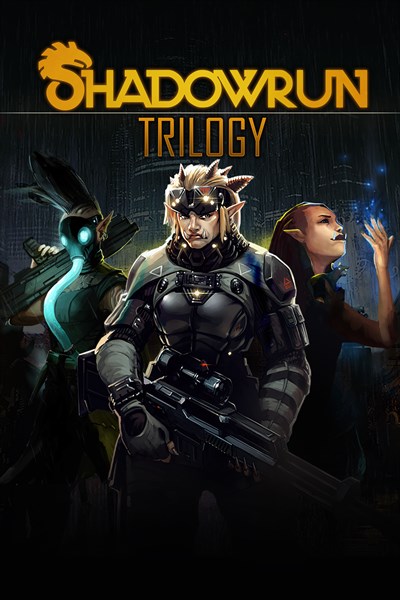
Shadowrun Trilogy Is Now Available For Digital Pre-order And Pre-download On Xbox One And Xbox Series X|S

Xbox Live

Shadowrun Trilogy

Paradox Interactive

☆☆☆☆☆
★★★★★
$39.99 $29.99
Pre-Order the Shadowrun Trilogy bundle now and get a 25% discount off this buy-2-get-1-free bundle! Prepare to explore this dystopian cyberpunk future in which magic has re-awakened! re-Order the Shadowrun Trilogy bundle now and get a 25% discount off this buy-2-get-1-free bundle! Prepare to explore this dystopian cyberpunk future in which magic has re-awakened! The Shadowrun Trilogy comprises 3 cult tactical RPG games taking place in a dystopian cyberpunk future in which magic has re-awakened, bringing back to life creatures of high fantasy. Initially created as a tabletop RPG over 30 years ago, this one-of-a-kind setting that has gained a huge cult following during the past three decades. Shadowrun Returns The unique cyberpunk-meets-fantasy world of Shadowrun has gained a huge cult following since its creation over 30 years ago. Nearly 10 years ago, creator Jordan Weisman returned to the world of Shadowrun, modernizing this classic game setting as a single player, turn-based tactical RPG. In the urban sprawl of the Seattle metroplex, the search for a mysterious killer sets you on a trail that leads from the darkest slums to the city’s most powerful megacorps. You will need to tread carefully, enlist the aid of other runners, and master powerful forces of technology and magic in order to emerge from the shadows of Seattle unscathed. Shadowrun Dragonfall - Director's Cut In 2012, magic returned to our world, awakening powerful creatures of myth and legend. Among them was the Great Dragon Feuerschwinge, who emerged without warning from the mountains of Germany, unleashing fire, death, and untold destruction across the countryside. It took German forces nearly four months to finally shoot her down - and when they did, their victory became known as The Dragonfall. It’s 42 years later - 2054 - and the world has changed. Unchecked advances in technology have blurred the line between man and machine. Elves and trolls walk among us, ruthless corporations bleed the world dry, and Feuerschwinge’s reign of terror is just a distant memory. Germany is splintered - a stable anarchy known as the “Flux State” controls the city of Berlin. It’s a place where power is ephemeral, almost anything goes, and the right connections can be the difference between success and starvation. For you and your team of battle-scarred shadowrunners, there’s no better place to earn a quick payday. Now, a new threat is rising, one that could mean untold chaos and devastation. One that soon has you and your team caught on the wrong side of a deadly conspiracy. The only clue: whispers of the Dragonfall. Rumors that the Great Dragon Feuerschwinge may still be alive, waiting for the right moment to return… Shadowrun Hong Kong - Extended Edition HONG KONG. A stable and prosperous port of call in a sea of chaos, warfare, and political turmoil. The Hong Kong Free Enterprise Zone is a land of contradictions - it is one of the most successful centers of business in the Sixth World, and home to one of the world’s most dangerous sprawl sites. A land of bright lights, gleaming towers, and restless spirits where life is cheap and everything is for sale. As an ex-con living in Seattle, you try to make an honest living but when your foster begs you to meet him in China, things turn grim and you find out the police are trying to arrest you. And by arrest, they mean to kill you on sight! Build your team of Shadowrunners, mercenaries with big personalities who can fight using mystical or technical powers, and turn the tables on the elite corporate and the police. Through real-time exploration and turn-based action, you will be met with deadly conspiracy, corporate greed, Triads, social segregation, and gang wars.

Xbox Live

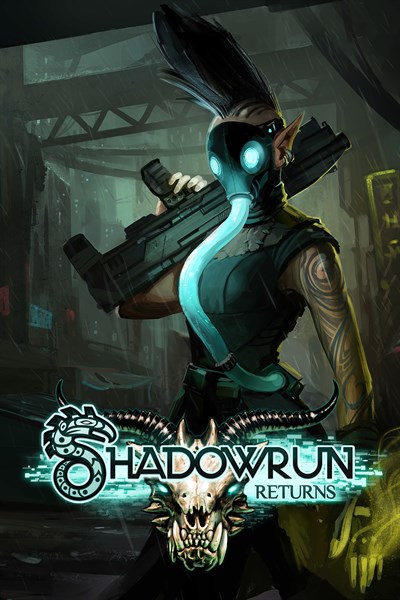
Shadowrun Returns

Paradox Interactive

☆☆☆☆☆
★★★★★
$19.99
MAN MEETS MAGIC & MACHINE. The year is 2054. Magic has returned to the world, awakening powerful creatures of myth and legend. Technology merges with flesh and consciousness. Elves, trolls, orks and dwarves walk among us, while ruthless corporations bleed the world dry. You are a shadowrunner - a mercenary living on the fringes of society, in the shadows of massive corporate arcologies, surviving day-by-day on skill and instinct alone. When the powerful or the desperate need a job done, you get it done... by any means necessary. In the urban sprawl of the Seattle metroplex, the search for a mysterious killer sets you on a trail that leads from the darkest slums to the city’s most powerful megacorps. You will need to tread carefully, enlist the aid of other runners, and master powerful forces of technology and magic in order to emerge from the shadows of Seattle unscathed. The unique cyberpunk-meets-fantasy world of Shadowrun has gained a huge cult following since its creation over 30 years ago. Return to the world of Shadowrun, with this cult-classic turn-based tactical RPG finally ported to consoles. Key Features Gripping Tactical Combat: When you’re running the shadows, every turn matters. Choose your actions wisely - move to better cover, charge into melee, or lob a fireball into a crowd of enemies. With the variety of weapons and spells at your disposal, every turn is filled with meaningful choices. A successful run requires commanding a team of runners with the right balance of combat, tech, and magical abilities. Skill-Based Character Progression: Choose a starting character archetype and build from there! Street Samurai and Physical Adepts use advanced combat skills to dominate the battlefield, Shamans and Mages summon powerful allies and cast deadly spells, while Riggers and Deckers provide critical technological support, projecting their consciousness directly into drones and computer systems. Shadowrun Returns’ classless skill system allows you to grow your character in any direction you choose. Want to start summoning spirits as an ork Shaman and evolve into a cybered-up weapon specialist? Do it! Engaging 2D/3D Art Style: Shadowrun Returns mixes dynamic 3D characters and lighting with a vibrant, hand-painted environment. Illustrated character portraits bring every conversation to life. Explore a world filled with detail, from the slums of the Redmond Barrens to the extravagant offices of powerful corporations. Updated/Redesigned UI: To better experience this cult-classic on consoles, the UI has been redesigned to meet the needs of console players!

Xbox Live

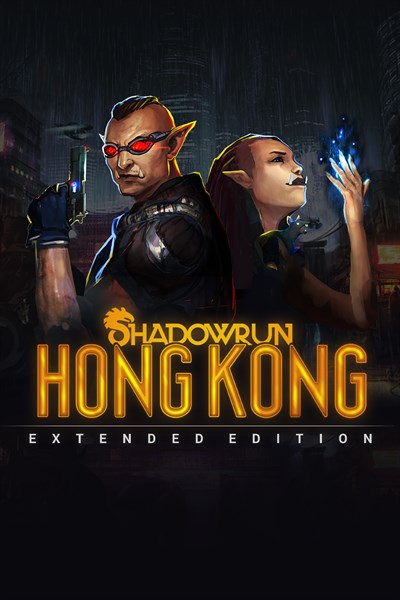
Shadowrun: Hong Kong - Extended Edition

Paradox Interactive

☆☆☆☆☆
★★★★★
$19.99
Shadowrun: Hong Kong - Extended Edition is the definitive version of Shadowrun: Hong Kong, the third standalone game in Harebrained Schemes’ critically-acclaimed Shadowrun cRPG series. The Extended Edition adds 6+ hr Shadows of Hong Kong Bonus Campaign, audio commentary to the game, and a long list of improvements since the game’s initial launch - including new visual effects and updated dialogue. Experience the most impressive Shadowrun RPG yet, hailed as one of the best RPGs and strategy games of 2015, and now available on consoles! HONG KONG. A stable and prosperous port of call in a sea of chaos, warfare, and political turmoil. The Hong Kong Free Enterprise Zone is a land of contradictions - it is one of the most successful centers of business in the Sixth World, and home to one of the world’s most dangerous sprawl sites. A land of bright lights, gleaming towers, and restless spirits where life is cheap and everything is for sale. Key Features Shadows of Hong Kong Bonus Campaign: Set in the weeks following the events of the main campaign, the Shadows of Hong Kong bonus campaign will give you -- and your team -- the opportunity to turn the tables on the elite corporate police force that once hunted you. Through layers of corporate greed and urban strife, you will contend with dangerous enemies, uncover a deadly conspiracy, and cement your reputation as a Prime Runner… assuming that you survive, of course. A Classic, Story-Driven cRPG adapted to consoles: Shadowrun: Hong Kong hearkens back to the golden age of computer RPG’s with a novel-like branching narrative full of sharp prose and deep character development. Immerse yourself in a smart, 15+ hour campaign with a diverse cast of all-too-human characters. A One-of-a-Kind Cyberpunk Setting: Experience the unique “Tech meets Magic” dystopian future of Shadowrun, a fan-favorite game setting. Shadowrun: Hong Kong is a perfect entry point to the setting for those with no prior Shadowrun experience, while providing plenty of classic Shadowrun characters and tech for veteran players to sink their teeth into. Command Your Team: Just like Dragonfall, Shadowrun: Hong Kong features a crew of flawed, dangerous runners with backstories that could only be possible in the tech-meets-magic Shadowrun setting. The members of your team are designed to play contrasting roles during missions, and each has a distinct set of skills, abilities, strengths, and weaknesses. Each team member also has challenges to face in their own lives, which you can choose to brush aside or play an important part in. Gripping, Turn-Based Tactical Combat: When you’re running the shadows, every turn matters. Choose your actions wisely - move to better cover, charge into melee, or lob a fireball into a crowd of enemies. With over 200 weapons and spells at your disposal, every turn is filled with meaningful choices. Skill-Based Character Progression: Choose a starting character archetype and build from there! Street Samurai and Physical Adepts use advanced combat skills to dominate the battlefield, Shamans and Mages summon powerful allies and cast deadly spells, while Riggers and Deckers provide critical technological support, projecting their consciousness directly into drones and computer systems. Shadowrun: Hong Kong’s classless skill system allows you to grow your character in any direction you choose. Updated/Redesigned UI: To better experience this cult-classic on consoles, the UI has been redesigned to meet the needs of console players!

Xbox Live

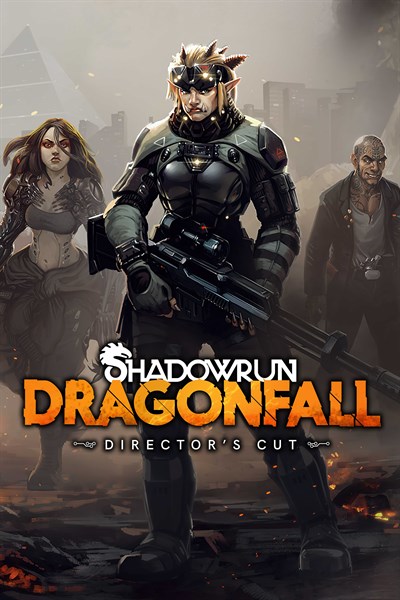
Shadowrun: Dragonfall - Director's Cut

Paradox Interactive

☆☆☆☆☆
★★★★★
$19.99
Shadowrun: Dragonfall - Director’s Cut is a standalone release of Harebrained Schemes' critically-acclaimed Dragonfall campaign, which first premiered as a major expansion for Shadowrun Returns. The Director's Cut adds a host of new content and enhancements to the original game making it the definitive version on consoles of this one-of-a-kind cyberpunk RPG experience. Man Meets Magic & Machine In 2012, magic returned to our world, awakening powerful creatures of myth and legend. Among them was the Great Dragon Feuerschwinge, who emerged without warning from the mountains of Germany, unleashing fire, death, and untold destruction across the countryside. It took German forces nearly four months to finally shoot her down - and when they did, their victory became known as The Dragonfall. It’s 42 years later - 2054 - and the world has changed. Unchecked advances in technology have blurred the line between man and machine. Elves and trolls walk among us, ruthless corporations bleed the world dry, and Feuerschwinge’s reign of terror is just a distant memory. Germany is splintered - a stable anarchy known as the “Flux State” controls the city of Berlin. It’s a place where power is ephemeral, almost anything goes, and the right connections can be the difference between success and starvation. For you and your team of battle-scarred shadowrunners, there’s no better place to earn a quick payday. Now, a new threat is rising, one that could mean untold chaos and devastation. One that soon has you and your team caught on the wrong side of a deadly conspiracy. The only clue: whispers of the Dragonfall. Rumors that the Great Dragon Feuerschwinge may still be alive, waiting for the right moment to return… Key Features A Classic, Story-Driven cRPG adapted to consoles: Dragonfall hearkens back to the golden age of computer RPG’s with a novel-like branching narrative full of sharp prose and deep character development. Immerse yourself in a smart, 20+ hour campaign with a diverse cast of all-too-human characters. A One-of-a-Kind Cyberpunk Setting: Experience the unique “Tech meets Magic” dystopian future of Shadowrun, a fan-favorite game setting. Shadowrun: Dragonfall - Director’s Cut is the perfect entry point to the setting for those with no prior Shadowrun experience, while providing plenty of classic Shadowrun characters and tech for veteran players to sink their teeth into. Command Your Team: Lead a small team of shadowrunners - each with their own outlook, motivations, and backstory. The members of your team are designed to play contrasting roles during missions, and each has a distinct set of skills, abilities, strengths, and weaknesses. But it’s not all about the mission - each team member also has challenges to face in their own lives, which you can choose to brush aside or play an important part in. Gripping, Turn-Based Tactical Combat: When you’re running the shadows, every turn matters. Choose your actions wisely - move to better cover, charge into melee, or lob a fireball into a crowd of enemies. With over 200 weapons and spells at your disposal, every turn is filled with meaningful choices. Skill-Based Character Progression: Choose a starting character archetype and build from there! Street Samurai and Physical Adepts use advanced combat skills to dominate the battlefield, Shamans and Mages summon powerful allies and cast deadly spells, while Riggers and Deckers provide critical technological support, projecting their consciousness directly into drones and computer systems. Shadowrun: Dragonfall’s classless skill system allows you to grow your character in any direction you choose. Updated/Redesigned UI: To better experience this cult-classic on consoles, the UI has been redesigned to meet the needs of console players!
NOTE: You may pre-download this game, but it will not be playable until the release date/time: 06/21/2022 (check the product page for release date/time in your region).
 
Product Info:
Website: Shadowrun
Twitter: @WeBeHarebrained@Codeglue / @PdxInteractive

Affiliate commission may be earned from Microsoft if you click a link and make a purchase.

Related:
OUTRIDERS WORLDSLAYER Is Now Available For Digital Pre-order And Pre-download On PC, Xbox One, And Xbox Series X|S
F1 22 Is Now Available For Digital Pre-order And Pre-download On Xbox One And Xbox Series X|S
Sonic Origins Is Now Available For Digital Pre-order And Pre-download On Xbox One And Xbox Series X|S
20 Apr 23:43

Moon Knight Just Went Full Benson And Moorhead, And Marvel Has Never Been Wilder

by Debopriyaa Dutta

Warning: Major spoilers ahead for episode 4 of "Moon Knight."

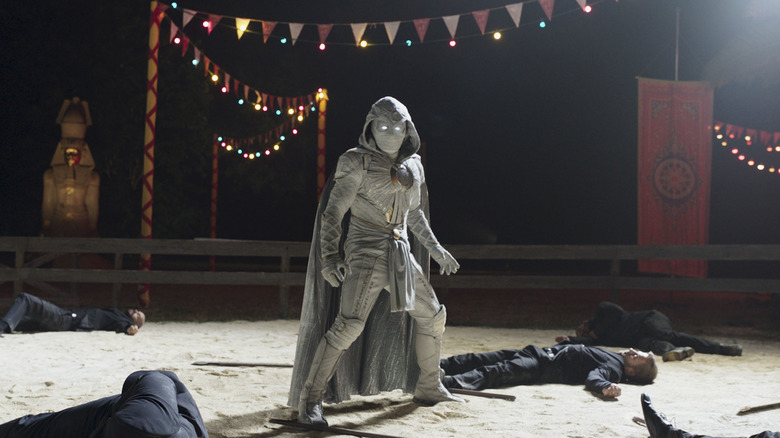
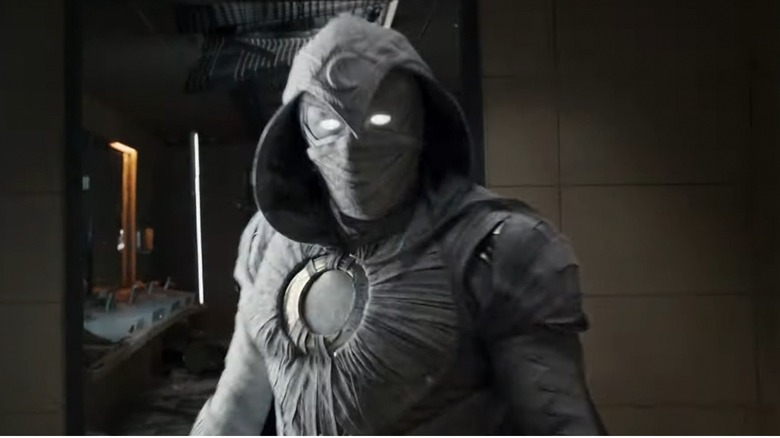
Episode 4 of "Moon Knight," titled "The Tomb," is perhaps the trippiest, most mind-boggling episode so far, proving that episode 4 directors Justin Benson and Aaron Moorhead are perfect for helming the most outlandish sequences.

Primarily, "The Tomb" is a full-fledged puzzle-solving archeological adventure with Steven (Oscar Isaac) and Layla (May Calamawy) at the center, although the final 15-20 minutes of the episodes veer into intense fever dream territory (which warrants at least one proclamation of "what the hell is going on?" out loud). Being a Marvel show, "Moon Knight" has been pushing against the mold of a superhero origin story since episode 1 dropped, and it continues to defy expectations by upping the wild factor, which culminates in the frenetic, delightful spectacle that is episode 4.

Never Have I Ever Grappled With A Heka Priest

The moment Steven and Layla set foot near Dr. Arthur Harrow's (Ethan Hawke) archeological dig site, something feels tremendously off. Given Harrow's obsessive nature (and the fact that his men tailed Marc and Layla across Cairo), the fact that the dig site was abandoned and had absolutely no one around to apprehend the duo spelled danger from the get-go. 

Benson and Moorhead frame these sequences with great skill (obviously), dropping hints for the horrors that lie ahead in the form of a quick shot of fresh blood spilled inside a tent, along with a blood-smeared ancient weapon of sorts. The filmmaking duo is no stranger to depicting entities (including invisible ones, such as in their 2017 film "The Endless"), and the fact that an ancient tomb housing a demoness might be crawling with undead threats further adds to the anticipation.

Steven and Layla (and an utterly seething Marc, who is only able to communicate via Steven's reflection) venture inside the ancient tomb, replete with an intricate maze, marbled sphinxes, and the like. The atmosphere inside is understandably tense, as Layla and Steven are wildly underprepared for anything unsavory they might encounter around the corner, while Harrow's men can be heard shooting at something in the distance. While the puzzle-solving and Egyptian mythology deep dive is entertaining, things get sinister real fast when they see fresh blood smears, littered bones, and recently-filled canopic jars near a stone slab (there's even a shot of Steven finding snakeskin grafted into the shape of ... a hand).

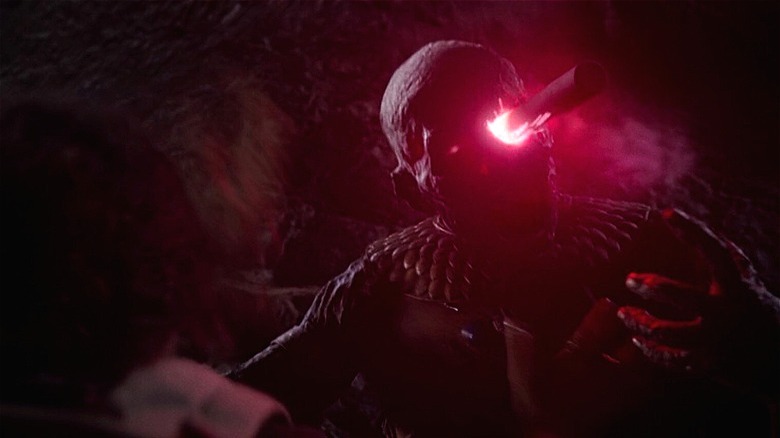
Of course, the thing(s) Harrow's men were shooting at were Heka priests, who are undead guardians meant to protect the pharaoh's chamber from unwanted intruders. The design of the humanoid Heka priests is positively terrifying: they look grimy and make an ominous clicking sound that reverberates across the tomb, and they are decked in ceremonial uniforms and sharp murder weapons, taking no time to rip out intestines and harvest them at breakneck speed. These sequences harken back to Benson and Moorhead's creature features, especially "Spring" and "After Midnight," wherein the former featured various mutant monsters of the slimy variety. The result is terrifying, action-packed mummy horror that branches into something MORE bonkers.

Move Aside Indiana Jones, It's Time For Tomb Buster

After Marc is shot by Harrow inside Alexander the Great's tomb, he falls backward into a pool of water, and this is when the phantasmagoric shift in the episode begins. Suddenly, we are inside a stark, pristine white facility, where Marc is seen in a wheelchair, heavily sedated, clutching a "Moon Knight" action figure. Before you can yell what-in-the-meta-twist-reveal-is-this, the visual cues in the scene constantly feed information that directly challenges whatever we have experienced so far. There's Layla, Crowley, and Donna inside the Putnam Psychiatric Ward, alongside other members, playing bingo, a rough drawing of a pigeon-like figure (Khonshu), a cupcake stand, a painting of the Alpine village, and so on.

Benson and Moorhead, throughout their filmography, have always posited that visual evidence holds more weight than personal experiences of an event, epitomized in their sci-fi horror flick "The Endless." In the film, Justin and Aaron's memories about Camp Arcadia are molded and informed by their individual worldviews, but the dire reality of the visual cues and actual cues proves the existence of a ruthless, primordial entity roaming the grounds of the camp.

In "Moon Knight," this same sensibility is instilled but questioned: while Marc's surroundings provide visual evidence that the events might be a result of a trauma-induced psychotic break, it is Marc and Steven's unified personal experiences with Harrow that affirm that this might just be a psychological limbo forged to entrap them. While this mental institution storyline has been directly lifted from the "Moon Knight" comics, the results are still shocking, as the directors add their own unique flair to the events that unfold.

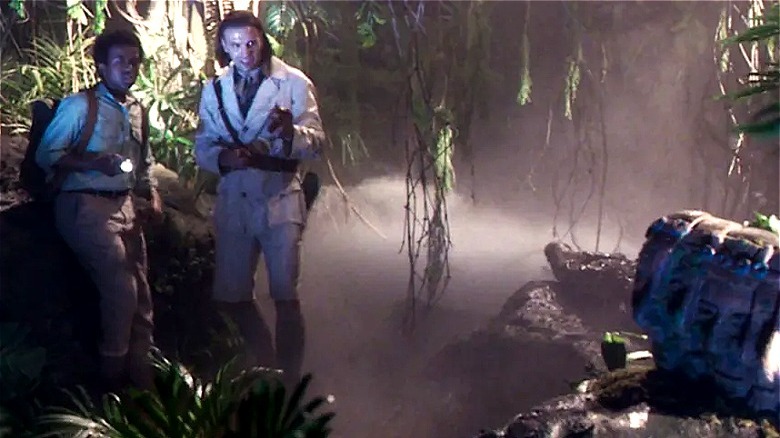
The inclusion of the fake movie, "Tomb Buster," which follows an "Indiana Jones"-esque adventure with a certain Dr. Steven Grant, works remarkably well within the scope of the story. Of course, Hawke as a mustached Dr. Arthur Harrow, who attempts to calm Marc down by explaining that he is mentally ill, only adds to the sheer terror and disorientation of the scene (which is exactly how Marc feels at that moment).

Even You Would Scream During A Talking-Hippo Encounter

Now, Marvel dives into the fantasy realm in its franchise offerings — there are alternate timelines, the opening of the multiverse, time travel, and galactic entities of varying kinds (while some are full-fledged gods). However, what makes episode 4 of "Moon Knight" so refreshingly weird is the melding of grounded and outlandish storylines, executed via compelling characters with rich inner worlds. While there is a supernatural element inherent within a show about an avatar of an Egyptian god, the psychological aspects of "Moon Knight" are layered and grounded in reality, while also sprouting a surreal, symbolically-dense arm to help elevate the story.

After Marc is terrified by the absurdity of his surroundings, he attempts to escape the facility while evading the orderlies who work there. Locking himself inside a room, he sees a sarcophagus, inside which, someone is trapped within, screaming for help. On lifting the lid, Marc is relieved to find out that it is Steven, and the two automatically hug (a sweet, pivotal moment). The duo attempt to escape together, but encounter a hippo decked in ceremonial costume, who squeals a sweet "hi!" at the baffled duo. They scream (no matter how cute she seems to be, it is terrifying). Turns out that the hippo in question is the Egyptian goddess Taweret, who was previously teased as a museum soft toy in episode 1.

Yes, the ending reveal is absolutely wild and offers no immediate answers, but definitely sets the tone for the wild, eventful ride we are in for in the upcoming episodes. No one knows what's real, major character fates hang in the air, and more mysteries lurk in the shadows. This episode of "Moon Knight" really went full Benson and Moorhead, which is always a wonderful thing, and the duo delivered in the best possible way.

Episodes 1 through 4 of "Moon Knight" are currently streaming on Disney+.

Read this next: Every MCU Post-Credits Sequence Ranked From Worst To Best

The post Moon Knight Just Went Full Benson and Moorhead, and Marvel Has Never Been Wilder appeared first on /Film.

20 Apr 23:42

Have Moon Knight's Closing Credits Been Hiding A Secret In Plain Sight?

by Danielle Ryan

Spoilers for "Moon Knight" season 4 ahead.

In the latest Disney+ Marvel series, "Moon Knight," Oscar Isaac plays a man with Dissociative Identity Disorder (DID), splitting his mind into several distinct personalities. While the voice of the Egyptian Moon God Khonshu is an external force, the personalities of both Marc Spector and Steven Grant live inside of the same man. The series doesn't take too long to explore the terrifying reality of sharing your body with someone and not knowing what happened while out of control.

In the end credit sequence for the series, however, there's a pretty spectacular hint that there's more going on than Marc or Steven know about, and it's one that ties into the character's comic book origins.

Four Sets Of Footprints

In the desert sands depicted during the end credits of "Moon Knight," there are several sets of footprints. One set splits halfway, going alongside a smaller set of prints that could be either Layla's or the bird form of Khonshu (they look like little bird feet to me). While one set veers off with the smaller footprints, the other one goes into the distance, where it splits a second time. If you look closely, you can see two sets of footprints going off around the dune, splitting once more after the initial departure. 

This could hint at the fact that Steven split off from Marc, who walks side-by-side with both Layla and Khonshu, though in very different ways. Steven then splits again, into whoever took over their body during the third episode and killed the two henchmen without Steven or Marc knowing how it happened. That personality is likely Jake Lockley, another of Marc's alters who isn't worried about getting his hands dirty. 

Episode 4 ends with Marc in a mental hospital of some kind, and it appears that all of the events we've seen so far were simply his delusions. The sets of footprints are an indicator that not only are Marc's experiences real, but the experiences of his alters are as well. It also hints at the inclusion of more of Jake, or even some of the other alters that Marc encounters in the comics, which is pretty exciting. 

With only two episodes left to go, it will be interesting to see if Steven and Marc get a chance to interact with Jake, or if he will be a mystery to be unlocked in a potential season 2. One thing's for certain: the more Isaac-on-Isaac action, the better. 

New episodes of "Moon Knight" premiere Wednesdays on Disney+.

Read this next: 11 Marvel Comics Villains We Really Want To See In The MCU

The post Have Moon Knight's Closing Credits Been Hiding a Secret in Plain Sight? appeared first on /Film.

20 Apr 23:40

Phoenix Point will get official mod support this summer

by Ian Boudreau
Phoenix Point will get official mod support this summer

The recent Kaos Engines expansion was the final piece of add-on DLC for XCOM-style strategy game Phoenix Point, but it didn't mark the end of the line for new features and updates. Snapshot Games says Steam players can expect official mod support to arrive this summer, along with official Steam Workshop integration.

Modding is already possible in Phoenix Point - there's a hub over on Nexus Mods that's got some good ones, in fact. However, modders will have a lot more power to change and add to the game with official tools in hand, which means both the selection and scope of what's available should grow significantly once they're released.

"We will share more details about how mods will work in the future, but we wanted to congratulate the modding community for the work they’ve already done and look forward to seeing what other mod creators will do when the official support is released," Snapshot writes in a recent update. The developers even highlight the Better Classes mod by the Phoenix Rising Team, which reworks and tweaks the skill trees for all seven Phoenix Point classes.

RELATED LINKS: Phoenix Point review, Phoenix Point tips and tricks, Phoenix Point campaign guide
20 Apr 21:01

Kaley Cuoco Actually Had Nothing To Do With Her Sister's Flight Attendant Casting

by Jamie Gerber

"The Flight Attendant" season 2 will finally arrive tomorrow! Season 1 hit HBO Max back in November of 2020, making for a rather delightful quarantine stream. The series follows Cassie Bowden (Kaley Cuoco), a flight attendant who suddenly finds herself embroiled in a murder investigation for which she is basically the prime suspect. Despite some pretty dark subject matter, the show is ridiculously fun and Cuoco is excellent in it. Season 2 has majorly stepped up its game, giving the actress even more range and delving deeper into who Cassie really is as a person. Of course, all this character growth takes place amidst her trying to unravel a new, even more complex mystery.

Surprisingly, Kaley isn't the only Cuoco appearing in "The Flight Attendant." Her sister, Briana, also has a role in the series. She plays Cecilia, an associate of the mysterious Miranda and her villainous boss Victor. While it's easy to think Cuoco helped her sister win the part, this actually wasn't the case. So, how did Briana Cuoco land the role of Cecilia?

'You Guys Decide'

As it turns out, no one was more surprised by the fact that Briana Cuoco auditioned for "The Flight Attendant" than her sister. Kaley Cuoco (who's also an executive producer on the series) had no idea her sister even wanted to be on the show. The actress told Collider:

"Rewinding to Season 1, no, the character was not written for her. Cecilia was the part. We were casting and no one told me she was auditioning. I was watching self-tapes every night. All the producers were. I went to my Cecilia file, and I was watching everybody, and Bree popped up. I wrote the group, and I was like, 'My sister auditioned? Oh, my God.' I was like, 'Okay, I'm gonna take myself out of this because I'm biased, and I think she's the most amazing thing, ever.' So, I took my opinion out and I was like, 'This is not a fair thing. You guys decide.' And the studio approved her, the network loved her, and she got the job really totally on her own and made it her own."

Cecilia doesn't have a large role in the show, but Briana Cuoco steals every scene she's in. The actress has appeared in her sister's projects previously as well. She guest-starred on "The Big Bang Theory" as Gretchen in season 6, and has also lent her vocal talents to Batgirl and other characters in HBO Max's "Harley Quinn," in which Kaley voices the titular character. The actress has appeared in shows such as "Mom" and "NCIS" as well. Briana has several upcoming projects in the works, perhaps most excitingly, "Dead Boy Detectives," which was recently ordered to series at HBO Max.

It seems like the Cuoco sisters really love working together since they do so fairly often. "The Flight Attendant" is a globetrotting adventure that takes Cassie to plenty of exciting places. It's awesome that Kaley gets to bring her sister along for the ride.

Read this next: 14 Remakes That Are Better Than The Original

The post Kaley Cuoco Actually Had Nothing to Do With Her Sister's Flight Attendant Casting appeared first on /Film.

20 Apr 19:17

Hackers Exploiting Recently Reported Windows Print Spooler Vulnerability in the Wild

by noreply@blogger.com (Ravie Lakshmanan)
A security flaw in the Windows Print Spooler component that was patched by Microsoft in February is being actively exploited in the wild, the U.S. Cybersecurity and Infrastructure Security Agency (CISA) has warned. To that end, the agency has added the shortcoming to its Known Exploited Vulnerabilities Catalog, requiring Federal Civilian Executive Branch (FCEB) agencies to address the issues by
20 Apr 19:17

QEMU 7.0 Released With Intel AMX Support, Many RISC-V Additions

QEMU 7.0 is out today as the newest version of this important piece of the open-source Linux virtualization stack...
20 Apr 19:17

Patches Updated For Linux To Enjoy Consoles Running At Full-Speed

As part of the long ongoing work to improve Linux's printk() code, there has been work to allow for threaded console printing and allowing consoles to run at full-speed. That work is still ongoing but Tuesday saw the third iteration of those printk patches posted...
20 Apr 19:16

Researchers Detail Bug That Could Paralyze Snort Intrusion Detection System

by noreply@blogger.com (Ravie Lakshmanan)
Details have emerged about a now-patched security vulnerability in the Snort intrusion detection and prevention system that could trigger a denial-of-service (DoS) condition and render it powerless against malicious traffic. Tracked as CVE-2022-20685, the vulnerability is rated 7.5 for severity and resides in the Modbus preprocessor of the Snort detection engine. It affects all open-source Snort
20 Apr 19:16

Get Ready for a Decade of Uranus Jokes

by Ramin Skibba
In an influential report that comes out once a decade, researchers propose a space mission to Uranus and a lander to Saturn’s moon, Enceladus.
20 Apr 19:15

Mesa Prepares To Drop Old GLSL-To-TGSI - Big Code Removal, Win For Performance & Fixes

A project more than one year in the making by Emma Anholt is about to mark its completion with GLSL-to-TGSI set to be removed from Mesa whereby Gallium3D will always go through the NIR intermediate representation while older drivers still dependent upon TGSI will make use of the NIR-To-TGSI pass. Using NIR means better performance and getting rid of the GLSL-to-TGSI code path means freeing up more than twenty thousand lines of code...
20 Apr 19:14

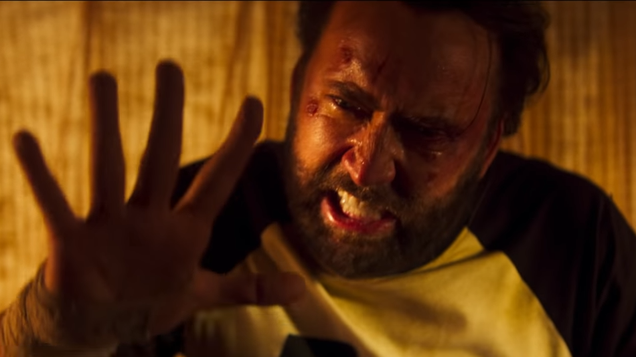
15 of the Wildest Nicholas Cage Performances, Ranked by Intensity

by Ross Johnson

A new Nicolas Cage movie is dropping this week, and it’s the broadest theatrical release for a Cage movie since the long-ago, pre-Covid era. In The Unbearable Weight of Massive Talent, the actor plays...Nicolas Cage in a bit of meta-style shenaniganery. The early reviews have been pretty good, which is good, because…

Read more...

20 Apr 19:14

Serious Vulnerabilities Found in AWS's Log4Shell Hot Patches

by Ionut Arghire

Hot patches made available by Amazon Web Services (AWS) in response to the recent Log4j vulnerabilities could be exploited for privilege escalation or to escape containers, according to Palo Alto Networks.

read more

20 Apr 19:14

What Minor Things Majorly Improved Your Sex Life?

by Meredith Dietz

I’m sure you’re great in bed. I’m sure you’re a god! But since you clicked on this article, you’re probably at least open to the idea that there could maybe, possibly be room for improvement in your sex life.

Read more...

20 Apr 19:13

Fact-check: "woke mob" did not remove the "dick vein" from Snickers bars

by Thom Dunn

You'd be forgiven if you never noticed the similarities between the lumpy chocolate seam that tops off the Snickers candy bar, and the infamously throbbable dorsal vein that adorns the human penis. That being said, you would also be forgiven for being in middle school at some point and saying, "Hey, that candy bar looks like a dick!" — Read the rest

20 Apr 19:13

Organizations Warned of Attacks Exploiting Recently Patched Windows Vulnerability

by Eduard Kovacs

The US Cybersecurity and Infrastructure Security Agency (CISA) says a recently patched Windows Print Spooler vulnerability has been exploited in attacks.

read more

20 Apr 19:13

Sonic Origins is coming to PC on June 23rd, featuring remasters of the first three classic Sonic games

by John Papadopoulos

SEGA has just announced Sonic Origins, a collection that will feature new Sonic the Hedgehog, Sonic CD, Sonic the Hedgehog 2, and Sonic 3 & Knuckles. According to the team, these games will be remastered for modern platforms, so they should look better than the old 16-bit games… hopefully… unless SEGA pulls a Chrono Cross: … Continue reading Sonic Origins is coming to PC on June 23rd, featuring remasters of the first three classic Sonic games →

The post Sonic Origins is coming to PC on June 23rd, featuring remasters of the first three classic Sonic games appeared first on DSOGaming.

20 Apr 19:12

Release: ΔV: Rings of Saturn – Anthropogenesis

The Future wears fur – check a DLC with a complete character overhaul.
Genre: Action, Simulation
Discount: 40% off until 27th April 2022, 10 AM UTC


20 Apr 19:12

Taika Waititi Never Thought He'd Wind Up As A Professional Filmmaker

by Mike Williams

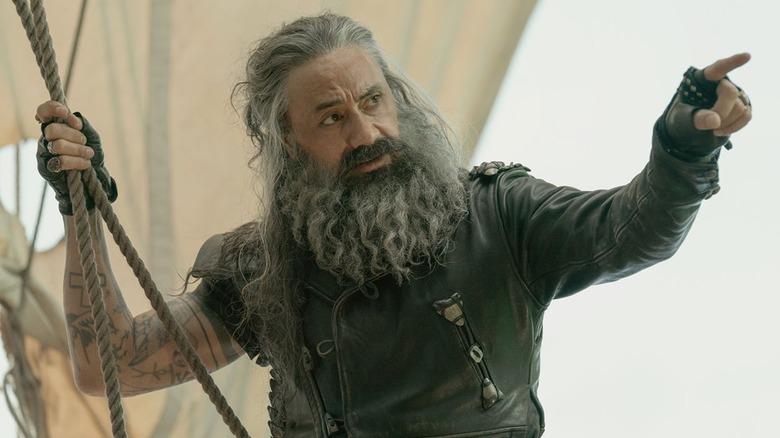
Taika Waititi just keeps going from strength to strength. Not only does he have a creator credit on fun television series like "Wellington Paranormal" and "Reservation Dogs," but he's also starring in the fantastic "Our Flag Means Death" as Blackbeard. As a director, Waititi has two films coming this year: "Thor: Love and Thunder" and "Next Goal Wins."

He's also an award winner for "Jojo Rabbit," with six Academy Award nominations and one win for Best Adapted Screenplay. As a filmmaker, Waititi is one of the most in-demand directors in Hollywood at this point. That's why he's been attached to projects like "Flash Gordon," "The Incal," and an upcoming untitled "Star Wars" movie.

But despite his rampant success, Waititi admitted to Interview Magazine that he didn't necessarily mean to end up as a filmmaker.

A Very Long Tangent

For Taika Waititi, the main drive was to be creative, not to make films. He told Interview Magazine:

"No, I never wanted to be a filmmaker. I still, sometimes, think I got sidetracked by this, like this is a tangent. My main thing was painting; I was just going to do that. I always doing comedy and acting, and I really enjoyed doing that — just making stuff up with my mates. I was basically trying to do everything."

Waititi wrote and directed a small short film in 2002 called "John & Pogo," and followed it up with another one a year later. The second short, "Two Cars, One Night," was nominated for Best Live Action Short Film at the 2005 Academy Awards. When you're nominated for an Academy Award for your second film, it's likely you're well on your way to being a professional filmmaker. He continued to Interview Magazine:

"I thought I would love to have a go at making a film, because I'd been in a few New Zealand features, and some TV shows, and thought I would want to try it out. So I wrote this little short script and threw it together. It ended up that the film did so incredibly well and I got so much encouragement to keep doing film after that. When something like that happens — I made that film, it got nominated for an Oscar — it meant film had to become my job, in a way. Suddenly, I inadvertently got a job."

It's Still A Day Job

Taika Waititi prefers to remain a more freewheeling creative spirit, which can lead to a personal clash with Hollywood. He works within Hollywood but acknowledged that the studio system can lean toward creating products, not projects.

"There are lots of parts of filmmaking that I don't like. At the end of the day, especially on features, the film turns into a commodity. You have to play this entirely new game I'm very uncomfortable with," he told Interview Magazine.

He also explained that making a commercial film sometimes sees a filmmaker interacting with folks you might not get along with, which is the antithesis of a more personal medium like painting. "Often, you're lumped in with people you don't really know, you don't know their style or how they work," Waititi continued. "On the job you find this stuff out. Like, 'Oh my God, I didn't know this person was like this!' You're fast-tracking all these relationships."

Despite falling into the medium, it feels like Taika Waititi, Professional Filmmaker is here to stay. His plate stays overflowing with new projects, to the point that we don't always know which ones are in active production anymore. At the very least, we can be assured that the films he does have coming in 2022 and beyond will be damned fun.

Read this next: The Horror Movies We Can't Wait To See In 2022

The post Taika Waititi Never Thought He'd Wind Up as a Professional Filmmaker appeared first on /Film.

20 Apr 19:12

A Simple Script Problem Led To One Of Barry's Best Moments

by Michael Boyle

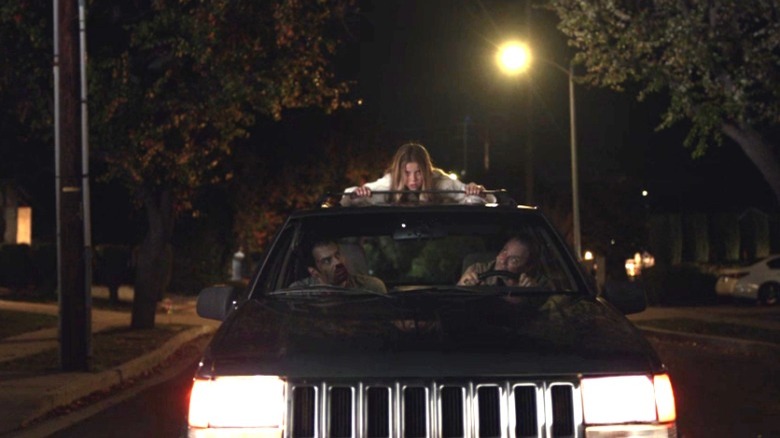
Although HBO's dark comedy series "Barry" has always been a little absurd, it hit strange new heights in season 2 with episode 5, "ronny/lily." After being blackmailed by a crooked detective into killing said detective's ex-wife's new boyfriend Ronny (Daniel Bernhardt), Barry (Bill Hader) starts off the episode by breaking into the new boyfriend's house and trying to convince him to go into hiding for a year. Unfortunately for Barry, Ronny just so happens to be a master of Taekwondo. For the first time in the series, Barry's unable to easily take down his target.

Although "Barry" has always had one foot off reality, this episode turns into a full surrealist comedy the moment Ronny's eleven-year-old daughter Lily (Jessie Giacomazzi) shows up. At first we feel dread at the sight of her because it seems like Barry's going to have to kill her too. Or at the very least, we know she's going to be traumatized by the sight of her father's body on the floor. Instead, she fights Barry like she's been preparing for this moment her whole life, proving to be way more of a threat to the hitman than he is to her. Not only that, but she seems strangely inhuman the whole time. She starts the fight by growling at him like a feral animal, and then she lunges at him, flying just a little too far in the air for a normal human to be able to do. 

The Otherworldly Lily

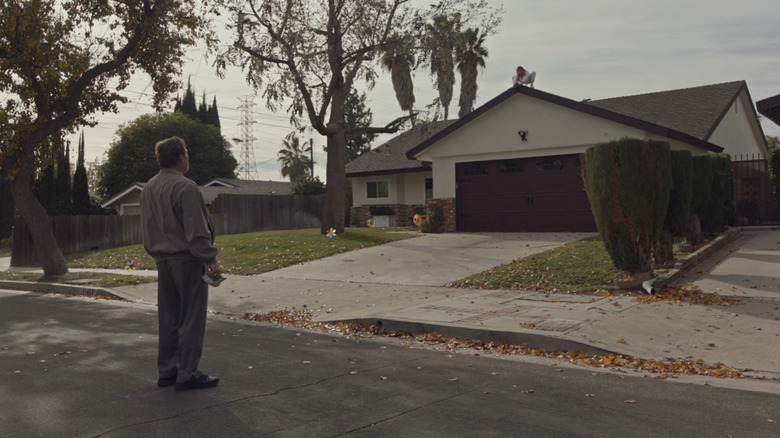
Lily gets a few serious stabs in on him with a kitchen knife, then runs off. Later in the episode, they find a distraught Lily sitting alone on a nearby sidewalk, and despite Fuches' (Stephen Root) insistence, Barry refuses to kill her. "I'm not killing a kid," he says. "Plus, I don't think she's of this world." Fuches tries to coax her into their car, but she responds by climbing up a nearby tree like a squirrel, jumping off a branch onto a nearby roof, and perching herself up there like an angry gargoyle. A defeated Fuches returns to the car and concedes to Barry, "Okay, she's not human."

It's at this point that Barry accidentally rips open the shoddily-done stitches Fuches performed on the knife wound on his back, and Fuches comes up with a simple solution: he rubs some super glue on the open wound with his hands. In an episode already filled with squirm-inducing violence, this moment is still a standout. Barry screams in surprise and pain while Fuches callously keeps going. It's one of the funniest moments of the episode, topped only by what comes immediately after.

Once Fuches finishes rubbing the glue, Lily jumps from the roof of the house onto the roof of their car. Fuches panics and slams on the gas, then steps on the brakes. As they're trying to figure out if the girl really did climb onto the roof, she sneaks into the back seat and bites Fuches' face. Barry tells Fuches to push her off him, but he can't. Why? Because his hands are stuck on the steering wheel. That's the moment when we realize the whole super glue scene from earlier wasn't just a funny scene in itself, but the set up for an even gorier punchline.

Writing Backwards

The decision to have Fuches glue his hands to the wheel came from Bill Hader himself. As he told the New York Times, the original reason why Fuches didn't move in the original draft was because he was in shock at what was happening. The writers told him, "That doesn't really work," which is a reasonable objection considering how long Lily is biting on Fuches's face before she finally fully chomps down. "So, I thought, what if his hands are stuck to the steering wheel?" Hader explained, "And then we came up with the crazy glue thing."

It's a nice example of how writers of good TV can make one simple change to a script and then effectively follow through on that change's ripple effects. Not only does Fuches' screw-up get part of his face bitten off, but his hands are stuck to the wheel for the rest of the episode. It makes an already desperate situation even more desperate, as Fuches is trapped inside the car and Barry, already severely wounded, is forced to take charge.

After Lily bites Fuches' face, she gets out of the car and lets out a guttural scream. Then she runs off in her blood-soaked clothing, never to be seen or heard from again. In what's already a weird episode, this is the moment where the reality of the show fully breaks, leaving audiences wondering how much of the episode really happened within the show's universe.

Although many of the events in the "Barry" episode don't make objective sense (especially considering how few consequences there are), "ronny/lily" works because it embraces the kind of dream logic that makes some of David Lynch's best films so memorable. A common type of dream people have involves a basic task taking an absurd amount of effort to accomplish, and that's what this episode is -- stretched out to thirty minutes.

Why The Episode Works So Well

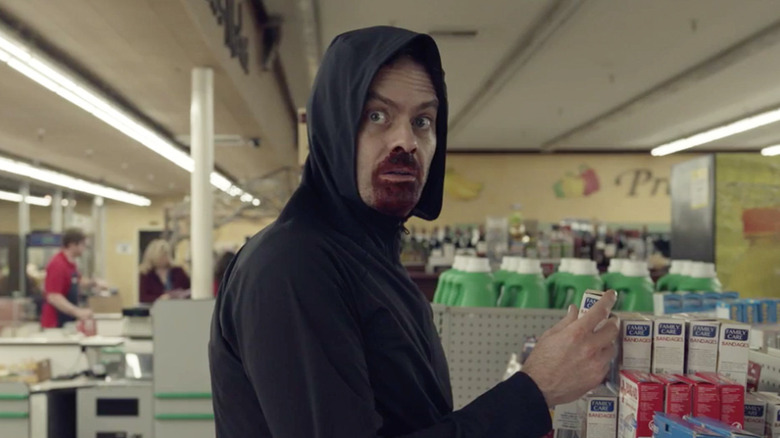
After all, Barry's a professional assassin who's never struggled with a hit before, yet every moment of this episode features another complication to a task that should've been accomplished in a couple minutes at most. First, Ronny turns out to be a martial arts expert; then his daughter shows up -- and she turns out to be a superhuman fighter. Then, Barry's partner-in-crime gets his hands glued to the steering wheel just as said daughter sneaks her way into the back of the car. Finally, when a wounded Barry goes to a nearby supermarket to grab some medical supplies, he runs into Ronny, who is still somehow alive and trying to kill him. It's a bad stress dream played out in full.

And as bizarre as the supernatural daughter plot is, it does make sense in a karmic justice kind of way. The young daughter of the guy Barry was sent to kill should've been a helpless victim in all of this. In another show, Barry would be forced to decide whether to kill her or not, and she'd simply be a plot device used to explore Barry's moral code. Instead, "Barry" takes that choice out of his hands by making her a violent, otherworldly wild card. It sidesteps the expected angst of our protagonist having to kill a child and gives us something way more interesting. 

As we get ready for the season 3 premiere of Barry to come out this Sunday, it's fun to look back at the strangest episode of the last season and what went into making it. The minor hole in the script that led to the glue scene ended up contributing a lot to the increasingly desperate, dream-like feeling of the episode; "ronny/lily" was widely listed as one of the best episodes of not just season 2 of "Barry", but of the entirety of television in 2019, and the glue scene was a big part of the reason why. 

Read this next: 15 Shows Like Brooklyn Nine-Nine You Need To See

The post A Simple Script Problem Led to One of Barry's Best Moments appeared first on /Film.

20 Apr 19:11

Our Flag Means Death has renewed my desire for a proper single player pirate RPG

by Alice Bell

This weekend I managed to watch, after recommendations from every corner of the internet, Our Flag Means Death, a TV show that is perhaps the most literal expression of the 'be gay, do crime' meme yet committed to celluloid. This got me thinking about pirate games again, as I do every 12-18 months or so. Everyone likes the pirate concept, and there is, I think, a collective urge to make piratey games. There are a bunch of them, after all. But there hasn't yet been one that I think provides exactly what I want from a pirate game.

Read more

20 Apr 19:11

The Original Idea For Bill & Ted's Bogus Journey Turned Into The TV Show

by Witney Seibold

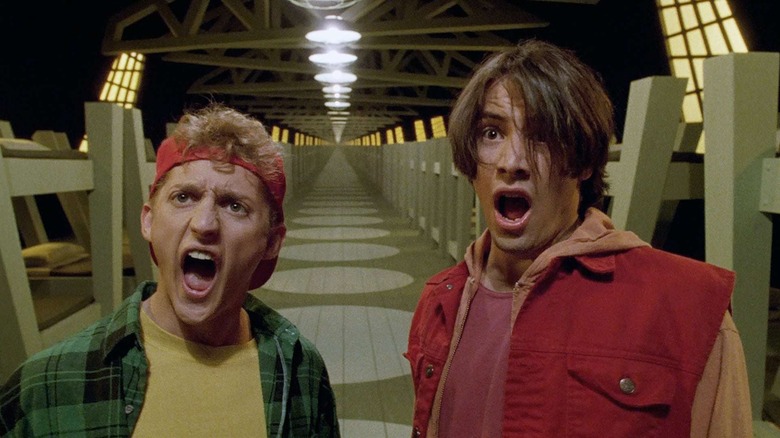
Stephen Herek's time travel comedy "Bill & Ted's Excellent Adventure" became a hit in February of 1989, attended by scads of kids charmed by the surfer-dude, innocuous-metal-loving title characters played by Alex Winter and Keanu Reeves, as well as the film's bonkers story about a high-tech flying phone booth that can take Bill and Ted to meet history's great figures. The premise (via Yahoo) was inspired by a standup improv game that screenwriters Chris Matheson and Ed Solomon created in their college days wherein the two of them would stage conversations between well-known historical figures and brainless SoCal beach rats. The film spun that concept into a story about how the SoCal beach rats were destined to serve as the saviors of humanity by creating rock music so powerfully good, it would unite humanity in the distant future. In order to continue to make music, however, the lead characters must first get an A on their high school history report, and the only way to do that is to get in a time machine brought from a protector from the future (George Carlin) and meet historical figures in person. 

High concept and a little strange, "Bill & Ted's Excellent Adventure" opened with $6 million and went on to gross over $40 million domestically on a budget of $10 million. 

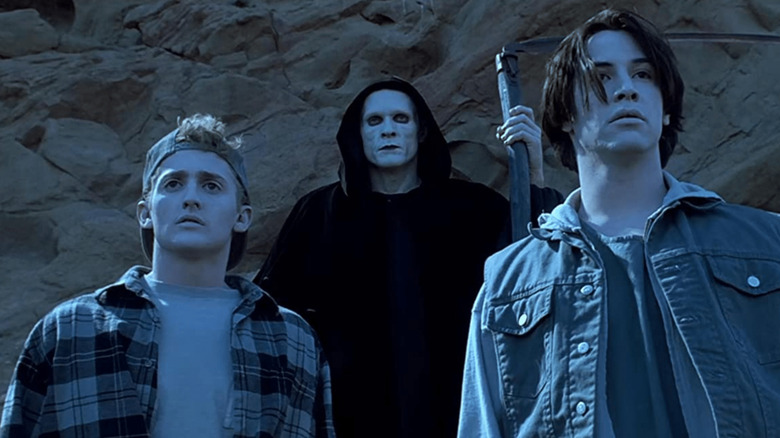
Orion immediately demanded a sequel and, true to the cliché of studio heads being completely risk-averse, they wanted something as similar as possible to "Excellent Adventure." In an interview with ComicBook.com, screenwriters Matheson and Solomon recalled the studio notes thrown at the "Bill & Ted" sequel, the bad ideas they had to deflect, and ultimately, how the stars came in to demand that the more interesting script be made into the "Bill & Ted" sequel. 1991 saw the bonkers follow-up, Peter Hewitt's "Bill & Ted's Bogus Journey," a film about how the title characters are murdered by evil robot clones, and have to traverse the afterlife, meet Death (William Sadler), and somehow resurrect themselves. However, the other idea for the sequel still sent Bill & Ted on adventures elsewhere.

Another Excellent Adventure

The first studio note: Bill and Ted must, once again, meet famous historical figures and bring them into the present. Only this time, the studio wanted a bit of a spin on it, similar to the conceit of "Gumby." Says Solomon: 

"There was a time there was a time when they wanted us to do a sequel to 'Excellent Adventure' that was Bill and Ted go into literature for an English test. And Chris and I railed against the idea, because it seemed like exactly the same movie done again ... And it didn't feel to us like we would be doing something fresh and original, which is why we ended up with what was originally called 'Bill & Ted Go to Hell.'"

The studio were insisting on their idea, however, and it looked like Solomon and Matheson were facing the possibility of doing someone else's idea. Luckily, Winter and Reeves stepped in: 

"And we would have had to have done the Bill-and-Ted-go-into-fiction version had it not been for Alex and Keanu backing us and saying, 'We want to do the where-we-die one.'"

And that was that. In "Bill & Ted's Bogus Journey" a would-be future fascist named De Nomolos ("Ed Solomon" backwards, you see, played by veteran character actor Joss Ackland) sends robot clones of Bill and Ted back in time to kill them and take their places. After their deaths, the real Bill and Ted travel through Hell, work their way up to Heaven, and employ a dead space alien to build "good" robot clones to fight the evil robot clones. Also, there's time travel. The film climaxes at a battle of the bands. Primus makes a cameo. 

The idea of sending Bill and Ted into the world of fiction, however, was not dropped completely. While "Bogus Journey" was in production, Hanna-Barbera produced a 1990 Saturday morning animated TV series inspired by the first movie, and it was called "Bill & Ted's Excellent Adventures." The series even starred Reeves and Winter in its first season. 

The Two Bill & Ted TV Shows

"Bill & Ted's Excellent Adventures" lasted two seasons, its first handled by Hanna-Barbera and its second handed off to DIC Enterprises. Winter, Reeves, and  Carlin reprised their roles from the film, but were  were replaced by Evan Richards, Christopher Kennedy, and Rick Overton respectively in the second season. 

While the premise started as a mirror to the feature film — Bill and Ted go back in time to meet Marco Polo in the first episode, and will later meet Sir Francis Drake, Harriet Tubman, Ivan the Terrible, Henry Ford, Queen Victoria, and Saladin — eventually they find a way to slip the surly bounds of reality and travel into fiction. In a second season episode, Bill and Ted's electrified bodies are transported into their favorite '50s sitcom, "Leave it to Badger." In another, they are merely shrunk to tiny size and have to traverse a human body. The second season plays pretty fast and loose with the time travel conceit central to the feature films. 

Richards, Kennedy, and Overton would return in a 1992 live-action version of "Bill & Ted's Excellent Adventures," a half-hour sitcom that lasted a mere seven episodes. The abilities of their time traveling phone booth were stretched even further when our heroes accidentally created a living comic book character in the pilot episode. In another, Bill and Ted enter a relative's favorite soap opera and interact with the characters. Worry not, purists, as historical figures also appear: Bill and Ted meet Elvis in one episode, and accidentally force Albert Einstein into a standup comedy career in another. 

The animated series is currently available to stream on The Roku Channel. The live-action series seems to have been lost to time. 

Read this next: The Best Animated Film Of Each Decade

The post The Original Idea For Bill & Ted's Bogus Journey Turned Into the TV Show appeared first on /Film.

20 Apr 19:11

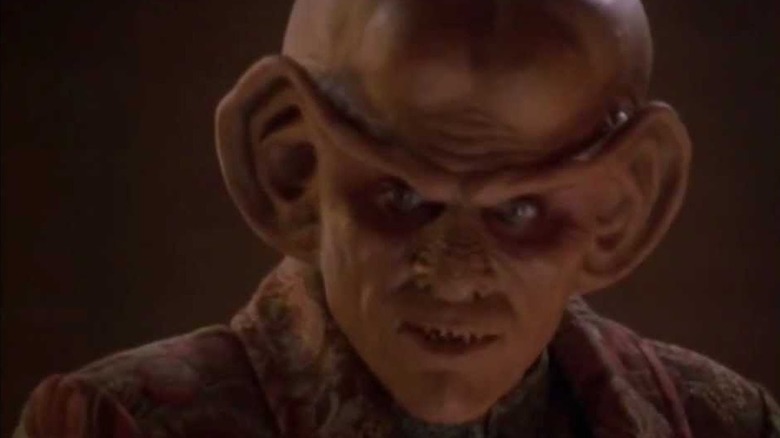
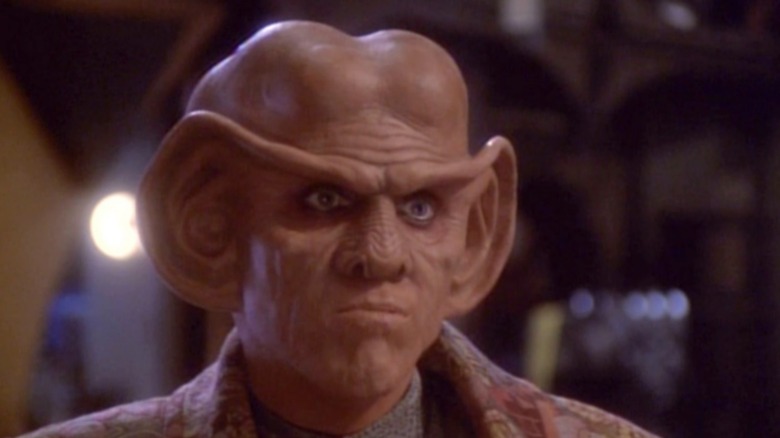
Armin Shimerman Hoped Quark Could Correct A Major Star Trek Misstep

by Witney Seibold

In the first few episodes of "Star Trek: The Next Generation," the Ferengi were spoken of in hushed tones. A new, mysterious, malevolent species had come to power in the span between "Star Trek" and its 1987 sequel series, and they promised to be a galactic threat on the level of well-known Trek baddies like the Klingons or the Romulans. In the first four episodes of the show, allusions would be made to the Ferengi's power and tendency toward violence. In the pilot episode, "Encounter at Farpoint," it was implied that the Ferengi were cannibals who would eat their victims. This was, however, likely a flip joke on the part of Captain Picard. 

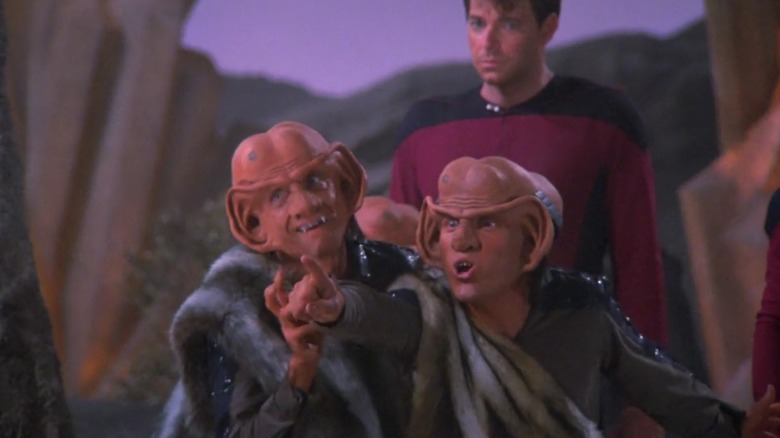
The Ferengi finally made their first appearance on screen in the fifth episode of "The Next Generation," entitled "The Last Outpost." In that episode, the Enterprise and a Ferengi vessel they are meeting for the first time suffer a catastrophic power loss. Investigation reveals the power drain has something to do with an ancient, abandoned outpost on the surface of the planet both ships are orbiting. William Riker (Jonathan Frakes) leads an away team to the planet, where they are confronted by a trio of Ferengi (including one played by actor Armin Shimerman) who snarl and hiss and stun the Enterprise crew with energy whips, a weapon that would be used infrequently in "Star Trek" moving forward. 

After the tussle, both parties are approached by a mysterious, aggressive sentry (Darryl Henriques) who appears from an ancient crystal. He announces he is from the Tkon Empire, and that his species rules the galaxy. Riker calmly explains that the sentry's species went extinct millennia ago, and that he was guarding an outpost that had been empty for many, many generations. As soon as the Tkon sentry appears, the Ferengi immediately begin sniveling and ingratiating themselves, toadying up to the seemingly powerful being. Riker and the Tkon sentry talk about how the Ferengi are merely children in their evolution, and that they should be left alone to grow up at their own pace. A species that was meant to be a grave threat was reduced to pathetic comedy characters. 

In an interview with Gamespot, Shimerman -- who would go on to play the Ferengi character of Quark, one of the regular cast on "Star Trek: Deep Space Nine" -- reveals that "The Last Outpost" was a "disaster," and he felt that he "failed miserably." It took him years of playing Quark to wash the taste of that one episode out of his mouth.

'I Failed Miserably'

Shimerman recalls well the mandates given by Gene Roddenberry, and the way the Ferengi were supposed to be depicted in "The Last Outpost":

"Well, what we were told about the Ferengi and what we ended up with were like night and day. The Ferengi were going to be the new Klingons. They were never meant to be a comical race; they were meant to be ferocious and menacing. And unfortunately, they hired me to play one of the lead Ferengi, and I failed miserably."

Indeed, Shimerman recalls meeting Gene Roddenberry himself, also -- rather unfortunately -- noting his disappointment: 

"My final performance was not at all what Gene Roddenberry wanted. By that point, he was rather sick, and he was not on set. But I met him briefly -- maybe no more than 30 seconds -- when he looked at my makeup and looked at my costume. 'The Last Outpost' was a disaster. And no one bears the brunt of that mistake more than I do."

Shimerman would play a small role in another episode of "Star Trek: The Next Generation" (as a talking robotic crate in the episode "Haven") before being cast as Quark on "Deep Space Nine." He was playing another Ferengi character, and admits that much of his performance as Quark was informed by the disappointment he felt over "The Last Outpost":

"I didn't put it behind me for years; it was like sword of Damocles hanging over my head. All of my work on 'Deep Space Nine,' for the first four seasons, was me trying to eradicate that original performance from everyone's mind. It was my personal agenda to rectify the mistake I made; to take a one-dimensional character and make him a three-dimensional character."

The Arc Of Quark

This must have stung Shimerman, as he admits to watching "Star Trek," and being a fan of the 1966 TV show

"I was a huge 'Star Trek' fan. I watched the original show when it aired. As a young man, I would rush home to make sure I caught every episode. And for the first year [of Deep Space Nine], other members of the cast would come up to me and ask me questions. I remember one person -- I can't remember who -- came up to me and said, 'Armin, you know about this. What's a Klingon?'"

Shimerman also talked about the legacy of "The Last Outpost" in a 2019 interview with TrekMovie. In that interview, he used the word "rehabilitation" to describe what he was doing with Quark. When asked if that was an explicit goal of his, Shimerman was frank: 

"From my point of view, yes, and from all the kind things that have been said about the Ferengi as opposed to what I did -- and primarily it was my mistakes -- in that first episode of 'TNG.' But the rehabilitation wasn't all me. It certainly had to do with Aron [Eisenberg]'s portrayal of Nog, Max [Grodénchik]'s portrayal of Rom, with Cecily [Adams]' portrayal as Moogie. All of those actors together helped rehabilitate this particular culture. And of course, we couldn't have done it without the writers, who created all those stories. I think we did rehabilitate the race and I take full responsibility for the race being founded on such weak premises."

Over the course of "Deep Space Nine," audiences got to know Ferengi culture very well. Taking a page from Ayn Rand, the Ferengi were a species devoted to money and acquisition. Their belief structures all stemmed from accruing wealth, and their afterlife was predicated on paying your way in. Quark was a stalwart businessman whose devotion to wealth carried with it a kind of admirable integrity. Quark became one of the most principled characters on the show, even if his principles didn't necessarily match the Starfleet ideal of self-betterment and compassion. Even as Ferengi culture evolved (it is a brazenly sexist society as well, with women forced to literally stay naked and quiet), Quark remained steadfast. Late in the series, he even bellows "This far and no further!" He will not let changing times change his own beliefs.

The Ferengi were never the threatening villains that the early episodes of "Next Generation" might have you believe, but instead turned into something far more fascinating. Ferengi were often comedy characters, but, given the time to expand and seasons of TV to explore, audiences eventually got to know so much more. Shimerman most certainly succeeded in his goal, and it's a testament to the actor's talent that Trekkies can think of Ferengi in such a positive light today. 

Read this next: 13 Fantasy Films That Never Got Sequels

The post Armin Shimerman Hoped Quark Could Correct a Major Star Trek Misstep appeared first on /Film.

20 Apr 19:11

Moon Knight Episode 4's Big Twist Is A Classic TV Trope

by Devin Meenan

Warning: Major spoilers for the most recent episode of "Moon Knight."

The latest episode of "Moon Knight," "The Tomb," threw us for a loop. Could it be that Marc Spector (Oscar Isaac) is simply a delusional mental patient who's too obsessed with the B-movie adventures of archaeologist Steven Grant? That he's cast his fellow patients as supporting characters in his fantasy and his doctor as the villainous Arthur Harrow (Ethan Hawke)? Is nothing we thought true? Yeah, right.

This premise -- the hero wakes up in an asylum, surrounded by familiar faces telling them the events of the show have been a delusional fantasy -- is a common one in sci-fi and fantasy shows. It makes sense that "Moon Knight" is where Marvel finally explores this trope, given the titular hero's dissociative identity disorder has been a lynchpin for the show. But where has this plot been used before? Let's run down a few classic examples and examine why it's a trope that genre TV shows love to use again and again.

Deep Space Nine – 'Far Beyond The Stars'
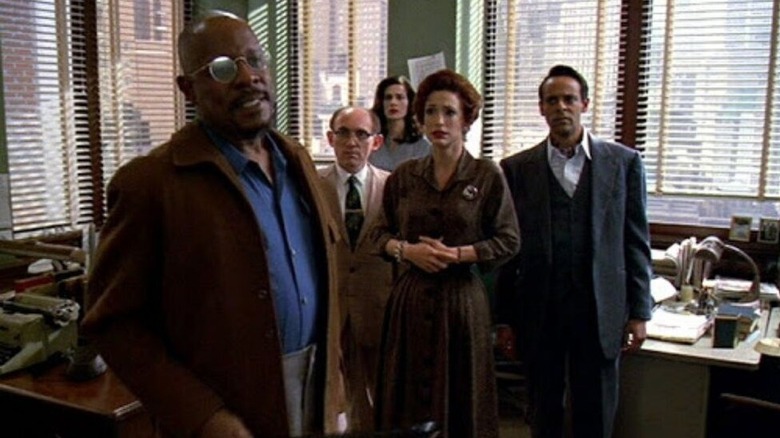
A classic example of this type of story is "Star Trek: Deep Space Nine" episode "Far Beyond The Stars." In the throes of the Dominion war, Captain Ben Sisko (Avery Brooks) is feeling down, especially after a friend dies in combat. The captain then enters a very different world — 1950s New York City, to be precise. Sci-fi writer Benny Russell (also played by Brooks) has written a story about a familiar-looking space station captained by a Black man named Sisko. However, Benny will have to fight tooth and nail with the institutionalized prejudice of the time to see his story published.

The usual cast of "DS9" are assigned different roles throughout the episode, mostly as Benny's co-workers at "Incredible Tales" magazine. Notably, the actors who played the show's alien characters are out of make-up and out of character; Michael Dorn (Worf) is Willie Nelson, Benny's laid-back baseball player friend who couldn't be more different from the stuffy Klingon who Dorn usually plays. Armin Shimerman (Quark) is Herbert Rossoff; far from a traditionalist (i.e. capitalist) Ferengi bar owner, Rossoff is the resident lefty at "Incredible Tales."

Some of the characters' New York counterparts aren't so different; Marc Alaimo (Dukat) and Jeffrey Combs (Weyoun) play a pair of cops who harass Russell and shoot his young friend Jimmy (Cirroc Lofton, usual role Jake Sisko) dead. Most interestingly, Rene Auberjonois (Odo) is Douglas Pabst, the magazine's editor-in-chief. The story takes Odo's role as head of station security and flips it on its head; Pabst is a small-c conservative who refuses to rock the boat by publishing a story with a Black lead. 

"Far Beyond The Stars" is a self-reflexive episode. Kay Eaton (Nana Visitor, aka Major Kira Nerys), who writes under the gender-ambiguous pen name KC Hunter, has to be a reference to "Trek" writer DC Fontana. "Star Trek" has always been socially conscious, but in the utopian future of the Federation, racial prejudice has been eradicated. The framing device of Benny's story "Deep Space Nine" finally gives the show a chance to examine what a big deal the series being led by a Black captain is. 

Benny Russell's world is telegraphed to be hallucinations from the beginning; the show all but states that the Bajoran prophets are trying to revitalize the faith of Sisko, their Emissary. Before Russell's world takes over the episode completely, Dr. Bashir (Alexander Siddig) notes Sisko's brain patterns resemble previous times he's experienced visions from the Prophets. Throughout the episode, a preacher played by Brock Peters (regular role Sisko's father Joseph) encourages Benny to follow the path of Prophets. 

However, the episode ultimately chooses not to give easy answers about which reality is the real one. In a failed bid to get "Deep Space Nine" published, Benny rewrites the ending to make the story the dream of a contemporary Black man. This gives the framing device a level of circular meta-textuality. Before Sisko reawakens on the real Deep Space Nine, the preacher tells Russell, "You are the dreamer and the dream." One part of the meaning is clear -- he's both Ben Sisko and Benny Russell. However, this doesn't answer which one is the dreamer and which one is the dream. Sisko is left uncertain himself by the end; the last shot of the episode is him looking at his reflection and seeing Benny staring back.

Benny Russell would return in the season 7 episode "Shadows and Symbols," where he's been committed to an asylum after his mental break at the end of "Far Beyond The Stars." Showrunner Ira Steven Behr even had an audacious pitch for the series finale involving Russell:

"The final episode would end up with Benny Russell on Stage 17 at Paramount, wandering around the sound stages, realizing that this whole construct, this whole series that we had done for seven years, was just in Benny's head. That is how I wanted to end the series."

Behr's ending would've definitely made Russell into the dreamer and Sisko into the dream. However, in what was probably for the best, the show didn't go through with this. "DS9" series finale "What You Leave Behind" lacks any ambiguity about what is and isn't reality in the "Trek" universe. 

Buffy The Vampire Slayer – 'Normal Again'
A line-of-sight gag in "Far Beyond The Stars" indicates that Rossoff had a rejected story pitch about a cheerleader who fights vampires. This was an inside joke about "Buffy The Vampire Slayer," where Shimerman played hard-nosed Principal Snyder. Fittingly enough, "Buffy" would have its own "is everything a hallucination?" episode in its sixth Season: "Normal Again."

"Buffy" ran for five seasons on The WB, with the final episode "The Gift" featuring the series' heroine (Sarah Michelle Gellar) making the ultimate sacrifice. However, the series was swiftly revived by UPN for two additional seasons. Season 6 opens with Buffy resurrected by her witchy best friend Willow (Alyson Hannigan), in a season that ultimately proved to be the darkest and grimmest of "Buffy." A DVD behind-the-scenes feature even declared that in season 6, "Life is the Big Bad." So, late in the season, when Buffy learns her life might be a fantasy, she can't shrug it off.

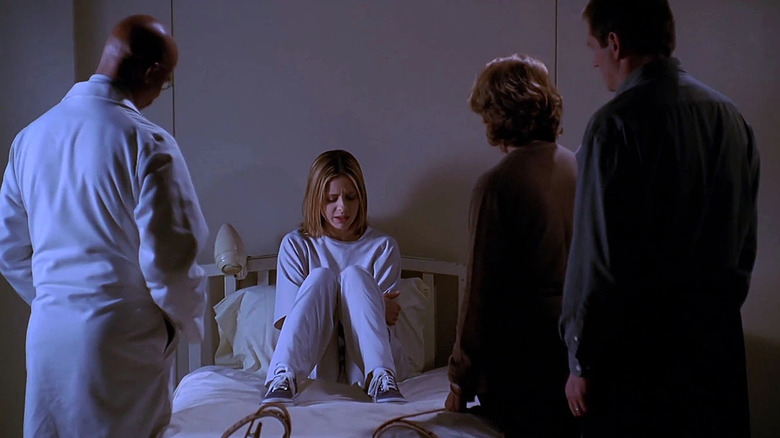
In "Normal Again," a scuffle with a demon leaves Buffy poisoned and suffering hallucinations that she's an asylum patient. According to her doctor, Sunnydale is nothing more than an elaborate illusion she created to sustain her heroism fantasies. Unusually, the show's supporting cast doesn't show up in the "real" world. They're instead painted as constructs of the fantasy that Buffy must slay to regain her grip on reality. The only recognizable face in the asylum scenes is Buffy's late mother Joyce (Kristine Sutherland); a familiar face who anchors the fantasy scenes for both Buffy and the viewer.

As she becomes more seduced by her visions of the hospital, Buffy asks aloud, "What's more real, a sick girl in an institution or some kind of supergirl chosen to fight demons and save the world?" This question illustrates why it's specifically genre shows which use this type of story; it only works when the show's premise is far out enough that it could only be a hallucination in real life. In doing so, the show plays on the audience's own suspension of disbelief. The episode also puts an ironic twist on the escapism that the audience enjoys; Buffy's life slaying vampires is fun for us, but it's gotten so hard for her she prefers to believe it's not real. The more realistic world becomes Buffy's escapism from the "real" supernatural one -- or does it?

The last scene of "Normal Again" is in the asylum, where Buffy's doctor tells her despairing parents that their daughter has permanently succumbed to her illness. The obvious conclusion is that the asylum was indeed the real world and Sunnydale the hallucination. Showrunner Marti Noxon disputes this; in "Slayers and Vampires: The Complete Uncensored, Unauthorized, Oral History of Buffy the Vampire Slayer and Angel," (by Mark Altman and Edward Gross), she says:

"It was a fake out; we were having some fun with the audience. I don't want to denigrate what the whole show has meant. If Buffy's not empowered then what are we saying? If Buffy's crazy, then there is no girl power; it's all fantasy. And really the whole show stands for the opposite of that, which is that it isn't just a fantasy. There should be girls that can kick ass. So I'd be really sad if we made that statement at the end. That's why it's just somewhere in the middle saying "Wouldn't this be funny if ...?" or "Wouldn't this be sad or tragic if...?" In my feeling, and I believe in Joss' as well that's not the reality of the show. It was just a tease and a trick."

While Noxon has her interpretation, it's just that, an interpretation. By ending the way it does, "Normal Again" puts the viewer in Buffy's shoes and forces them to choose which reality they want to believe is true.

Smallville – Labyrinth
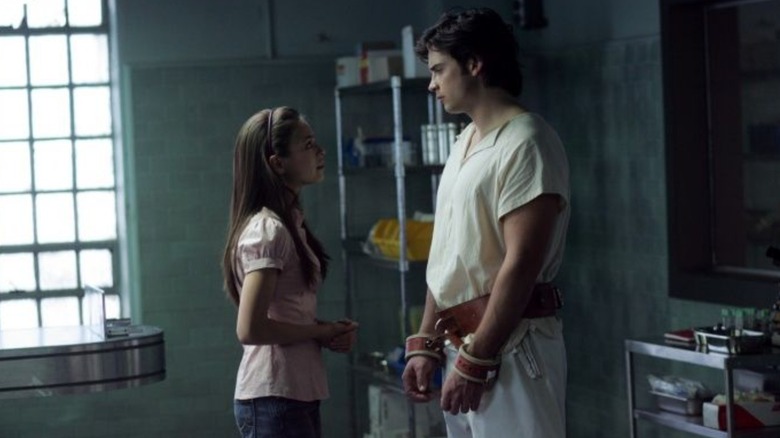
What is "Smallville" if not "Superboy" + "Buffy"? Naturally, "Smallville" had its own "Superhero in the asylum" episode: "Labyrinth." It's a by-the-numbers rendition; Clark Kent (Tom Welling) awakens in a mental hospital. One Dr. Hudson (Matthew Walker) tells him that his Kryptonian origin, superpowers, etc., are all a delusion, created to cope with the death of his birth parents in the Smallville meteor shower.

A twist is that the supporting cast's lives are mostly the same, but reconfigured around the hallucination. Martha Kent (Annette O'Toole) and Lana Lang (Kristin Kreuk) are still a loving mother and girlfriend, respectively, which means they want Clark to get "better." Chloe Sullivan (Allison Mack) is still Clark's confidante, and thus is the one who sustains his delusions about superpowers. The biggest deviation concerns Lex Luthor (Michael Rosenbaum). In the series' pilot, Clark and Lex became friends after the latter crashed into the former; the super-resistant Clark fished an unconscious Lex out of his drowned car, kicking off a doomed friendship. In the "Labyrinth" reality, Clark having no superpowers means Lex came away from the accident paralyzed and with a chip on his shoulder.

"Labyrinth" lacks the introspection of "Far Beyond The Stars" or "Normal Again" and is nowhere near as ambiguous. By "Smallville" season 6, the monsters of the week had changed from "Meteor Freaks" (Smallville residents granted superpowers by Kryptonite exposure) to Phantom Zone escapees. Dr. Hudson turns out to be a Phantom trying to take over Clark's body; our hero defeats him with some help from the Martian Manhunter (Phil Morris).

"Labyrinth" is ultimately a version of a story that's been done before, and done better, elsewhere, but with some DC Comics wallpaper stapled on. That's really "Smallville" in a nutshell, isn't it?

Community – Curriculum Unavailable
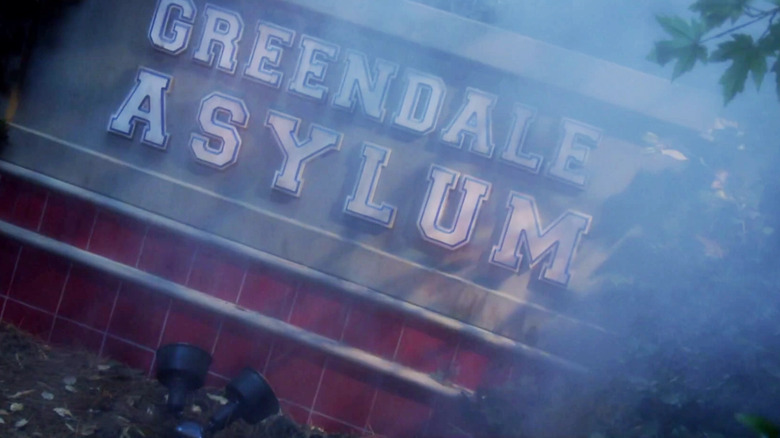
As a sitcom, "Community" might seem the odd one out of these shows. However, that presupposes "Community" is a normal sitcom. Instead, the show is better described as not just a parody of TV, but often of genre itself. Season 3 episode "Curriculum Unavailable" is mostly a parody of clip shows, but it throws in an "it's all a hallucination" sequence towards the end.

In the previous episode, "Course Listing Unavailable," the study group was expelled from Greendale Community college. Abed (Danny Pudi) takes this poorly and begins trespassing on school property; to avoid him being charged, the group takes him to a psychiatrist. Dr. Heidi (John Hodgman) eventually drops the bombshell on the group: There is no Greendale Community College.

The group was institutionalized together and the past three seasons were a shared hallucination. As Heidi explains this, the episode then shows clips of the group in "Greendale Asylum" together. It takes three steps from Heidi's office for Jeff (Joel McHale) to realize the holes in this. For one, Annie (Alison Brie) wore a Greendale College backpack to the session. Heidi caves, revealing he was hired by Ben Chang (Ken Jeong) to lie to the group and deter them from returning to Greendale.

That the deception is so quickly unveiled speaks to the inherent ludicrousness of this premise; "it was all just a dream" is the most hackneyed twist in storytelling for a reason. It also reflects how no series which has done this plot has ever committed to it. So, why do shows keep using it?

Why Is This A Trope?
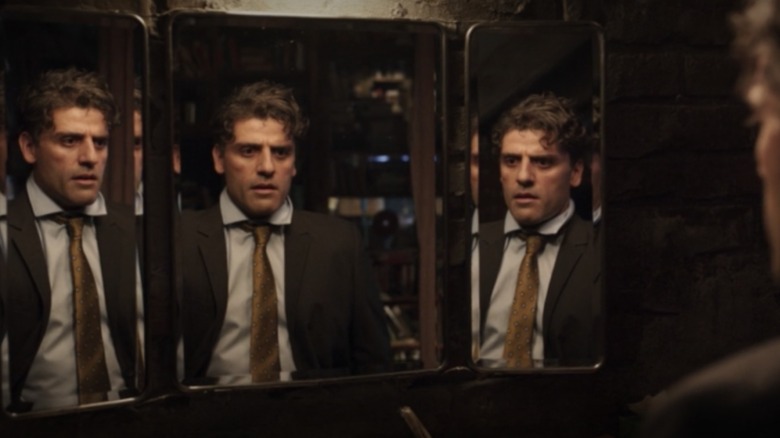
This trope provides a potent metaphor for television itself. After all, the worlds that the characters of "Deep Space Nine," "Buffy," "Smallville," "Community," and "Moon Knight" inhabit aren't real. "Everything was a delusion, you're really in an asylum" puts the character in the place of the viewer, forced to deal with everything they've invested in being fiction.

The premise also strikes the right mix of shock and safety that's essential to television. Done well, an episode with this premise can instill a kernel of doubt in the viewer's mind, but only for a moment. For one, the show must go on; revealing everything about the show's story is false would undermine it to the point it couldn't be continued. It would also be a challenge, if not an insult to the audience; you wasted your time getting invested in something that was never real to begin with. As such, there's a safety hidden in the suspense; of course everything will turn out to be "real" by the episode's end.

After all, no show which has done this premise has pulled the trigger all the way; the indefinite teasing of "Deep Space Nine" and "Buffy" come the closest, but still don't go all the way. Considering its place within the larger MCU, I doubt that "Moon Knight" will be the one to break this rule.

Read this next: Joker's Wild: Ranking The Cinematic Versions Of The Clown Prince Of Crime

The post Moon Knight Episode 4's Big Twist is a Classic TV Trope appeared first on /Film.

20 Apr 19:10

Entwives

No, we actually do have a woman who's basically part of our fellowship. She lives in Rivendell, you wouldn't know her.