When Trump's civil fraud trial in New York started, many wondered why he would let a judge decide on the legal merits of his case instead of taking his chances with a jury of his peers where the odds of acquittal would seem much higher. Well, a simple explanation as mentioned by Justice Engoron in his opening remarks: Nobody asked for one.
As the parties settled into the courtroom for the first full day of the trial, Justice Engoron, the judge Trump has significantly attacked during the past several weeks, asserted that "nobody asked for" a jury trial, which meant that Justice Engoron will preside over the trial.
According to reports, this was a mere oversight by Trump's attorneys who failed to submit the routine demand for jury trial and did not check the requisite boxes on the form.
In New York, a party seeking to have a jury trial may file a jury trial demand either at the time of serving their note of issue or within 15 days of receiving such a note. A note of issue is a document that signifies to the opposing side that discovery in a case is complete.
This deadline passed a while ago in the Trump case and is one that Trump's attorneys failed to acknowledge. As a result, the Judge Trump dislikes will be the one deciding liability as to any remaining claims, and of course, whether damages are appropriate.
Bee taxonomist Lincoln Best pulled a wooden box labeled “impressive bees” from the shelves that lined his lab at Oregon State University and carefully removed the cover. Inside, rows of shiny, green-blue bees filled the box’s inner compartments, each one pierced with a pin as if in a museum. They reflected the overhead fluorescent lights like jewels.
“Osmia cobaltina,” Best says, plucking an amethyst-colored mason bee from the box. “It’s crazy, right? How can a bee be purple?”
Native bees, such as this one, are responsible for pollinating three-quarters of all flowering plants. Tens of thousands of these intrepid indigenous pollinators can be found in almost every corner of the world, including Alaska and even the Arctic. An estimated 4,000 bees are native to the U.S. alone, according to the U.S. Geological Survey. And all around the United States, many of these native bees are in trouble.
While honeybees often steal the pollinator spotlight, they aren’t indigenous to North America. In the 17th century, settlers brought honeybees from Europe across the Atlantic and built a U.S. food system reliant on these human-managed pollinators.
Best aims to change that. He is a bee taxonomist, a biologist specializing in bee classification, at Oregon State University in the small western Oregon town of Corvallis. There, he runs the Oregon Bee Atlas, a program that trains citizen scientists to collect and inventory native bees and the specific plants they pollinate across the state. Best has equipped over 200 of these amateurs with the knowledge to become what he calls “Master Melittologists,” scientists who study bees.
Best’s Oregon Bee Atlas began shortly after the largest native bee kill ever recorded. In 2013, more than 50,000 native bumblebees dropped from the sky after linden trees were sprayed with the insecticide dinotefuran in a Target parking lot in Wilsonville, Oregon, just outside of Portland.
“There was significant public outcry,” Best says, describing “inches of dead bumblebees under these trees in town.” (Bumblebees, Bombus, are a genus containing hundreds of bee species, many native to North America.)
In light of the mass casualty, the state of Oregon invested in the health of native pollinators and launched the Oregon Bee Project, an umbrella program that supports Best’s work through the Oregon Bee Atlas.
Since 2018, Best and his network of Master Melittologist volunteers have collected hundreds of thousands of native bee specimens across Oregon, documenting more than 600 distinct bee species and over 1,400 specific plants they pollinate.
Best’s fascination with native bees began more than 20 years ago on a sunny British Columbia spring day in 2003. Best was there on a canoe trip with friends, and, while walking across some dunes, he noticed native longhorn bees emerging from their sandy nests. Best looked closely at the males, their antennae protruding like horns.
“I couldn’t believe that a bee could have antennae as long as its body. I was red-pilled for bees,” Best says, referencing The Matrix and the life-changing truth the red pill revealed. “It blew my mind.”
Just then, Scott Sublette, a volunteer in his third year as a Master Melitollogist, walked into the lab wearing a tattered Oregon Bee Atlas baseball cap. Sublette used to raise lambs until he had both shoulders replaced. Now he collects bees full-time for the Oregon Bee Atlas, and he’s good at it. Last year he was one of the top collectors for the Atlas, hunting down over 1,800 bees—an amount expected of a typical entomology master’s student.
Sublette collects most of these bees near his home in The Dalles, Oregon, at the eastern edge of the Columbia River Gorge. Pockets loaded up with vials, he embarks with his butterfly net. When Sublette spots a bee on a plant, he snaps a photo in order to keep track of which bees are pollinating which plants.
Then Sublette swipes at the bees with the butterfly net and places the insects in a kill jar, a glass vial containing ethyl acetate, a volatile liquid similar to nail polish remover. He labels the vials with the town’s name, the longitude and latitude, the date, and the plant where he spotted the bee (if he knows it). In a matter of minutes, the bees die, and Sublette brings them back to the lab to be inventoried.
It’s a bit brutal, but killing the bees is the Master Mellitologists’ best chance at understanding them. The statuses of almost all insect species are completely unknown, Best explains, so accuracy is paramount.
In order to correctly identify the specimen, scientists like Best often have to look at each insect beneath a microscope or conduct a DNA analysis—both of which are only possible if the bee is dead. A 2015 study that the Bee Atlas cites also demonstrated that repeatedly catching and killing bees at the same site did not impact the bee populations.
Best turned to his computer and pulled up a map of Oregon, studded with red dots representing where volunteers have collected bees in 2022. Best pointed out The Dalles, where Sublette lives, peppered with red dots. As the dataset grows, Best will overlay other data to create a map that indicates each region’s soil type, precipitation, and temperature.
With enough data documenting where bees have been found, Best can create a predictive model that forecasts where each species may be located, as well as hotspots of species richness. That model can inform land management decisions, such as what areas should be protected from development or farming: It makes more sense to preserve habitats that support 500 species of bees and flowering plants than areas that support only 50 species.
While the computer model represents the richness of native bee species, Best has another tool that illustrates the interconnectedness between these native bees and the plants they pollinate.
Best grabbed a rolled-up scroll and started to unfurl it. Bee names ran along one length of the scroll, plant names on the other side; a network of crisscrossing lines connected the pollinators and plants, based entirely on the bee-flower interactions the Master Melittologists have observed in the field.
Best wheeled backward in his desk chair, revealing as much of the network as he could until he ran out of floor space. The scroll represents about 20 Ph.D.s-worth of data and stretches 80 feet.
“Our data is too big for this earthly plane,” Best jokes.
We have long depended on native bees for free pollination, implicitly understanding that they support biodiversity in our ecosystems, without fully understanding how, or even where they’re located. The scroll, still growing with data that will stretch it well beyond 80 feet, offers a never-before-seen portrait of interactions between native bees and plants—a glimpse of all we take for granted, and all we have to lose.
I followed Best down four flights of stairs and into OSU’s collection of arthropods: a category of invertebrate animals that spans insects (including bees, of course), spiders, and crustaceans, among others. There, Christopher Marshall, a tall man with an impressive handlebar mustache, assembled a metal cart to hold trays of specimens. Marshall curates the 3 million arthropod specimens in the collection, the largest in the Pacific Northwest, including some of the bees melittologists like Sublette have collected.
The Oregon Bee Atlas could exist independently of the arthropod collection, Marshall says. But “biodiversity is a science where, if you want to understand species distribution on the scale that we do, it’s impossible for one researcher to do [it alone].”
With a data set the size of the Oregon Bee Atlas and an insect library the size of the Oregon State Arthropod Collection, species patterns, like abundance and distribution across space and time, and even physical changes in response to the environment, can emerge with better resolution. Each bee specimen the melittologists collect is a single data point in Best’s map.
Marshall placed a box of native Oregon bumblebees on the lab bench. Best pulled an inner chamber from the box with 46 neatly pinned Franklin’s bumblebees—a nearly extinct species, native to Southern Oregon.
Each had a hairy black body, a buttery yellow head, and translucent brown wings. This little box represents half of all known Franklin’s ever collected, these ones, reared in a lab. It’s been 17 years since scientists have captured one in the wild.
“Save the bees!” has long been a rallying cry for environmental and conservation movements. And some bees, like Franklin’s bumblebee, are in trouble. But a so-called “insect apocalypse” is a one-dimensional view of what is happening in the insect world, says Best; the status of most bee species is unknown.
Each species of native bee, out of thousands, responds to stressors differently. A confluence of factors—habitat loss and land-use change, insecticide and herbicide use, climate change, and competition from non-native honeybees that can monopolize pollen and nectar resources—threaten native bees. For the many native bee species already in decline, it’s death by a thousand cuts.
Today, the EPA uses honeybees as a stand-in for all bees in research and toxicity testing. But bumblebees and other native pollinators don’t respond to stressors in the same way, and the EPA only measures mortality, so sub-lethal effects of pesticides are not accounted for.
James Crall, who studies the effects of human- and climate-driven stressors (including pesticides) on native bumblebees at the University of Wisconsin, Madison, likens honeybees to chickens: Some people erroneously think they’re saving birds by raising backyard chickens. “Keeping chickens can be great for other reasons, but it’s not really bird conservation,” says Crall.
“Likewise, thinking about the health of honeybees is great. It's really important for food systems. And they're amazing creatures, but it's not really part of thinking about our own native biodiversity and how to support it.”
Native bumblebees have survived in dramatically different climates for millions of years. But now, our climate is changing faster, and bumblebees may not be able to adapt quickly enough, says Crall. Leveraging clever imaging technology and advanced computing power, his Madison-based team can observe how threats like heat stress and insecticides affect different native bumbles in combination.
Still, Crall describes his field as fundamentally “data limited.” Some native bees are in critical danger, while others are thriving. When it comes to native bees and how they’re doing, we have far more questions than answers.
Best knows some native bees face enormous threats. He knows a mass casualty like the Wilsonville bee kill could happen again. He knows that Franklin’s bumblebee likely won’t make a comeback.
But Best isn’t interested in the traditional model of pushing a specific species through the Endangered Species Act and pouring money and resources into saving that one animal. “It’s mostly a false narrative that you save species, one endangered species at a time,” says Best. Rather, he thinks about preserving entire native bee communities.
“What we’re doing is getting the information to manage all the species at once.” That’s the point of the Oregon Bee Project, to document and invest in biodiversity, to influence decision-making and landscape management, and to “save the bees.” All the bees, all at once.
The Oregon Bee Project's goal is to save the bees—all the bees, all at once.
The efforts of the Oregon Bee Project are ambitious. They train pesticide applicators to apply toxics as safely as possible to ensure we never repeat a mass bee kill. They partner with Oregon vineyard growers to add specific plants to their landscape in order to support native bees in that region—something that’s only possible because of the granular data on plant-pollinator interactions collected by the team of Master Melittologists that Best trains.
I had been hoping to watch Best collect bees in real-time, but at the end of March, the weather was biting, even for bumblebees whose thick coats and powerful flight muscles keep them warm in the cold. But on our way back from lunch, something flew past our heads. Best stopped in his tracks. “That was a yellow-faced bumblebee,” he says. We stepped into a thicket of blooming Japanese andromeda, and another bumblebee whizzed past, this one a fuzzy horned bumblebee, which Best identified on the spot.
Best’s bright blue coat had caught the bees’ attention, and several queens circled around us, their small bodies constantly in motion to keep their flight muscles warm. In a brief, spectacular dance, they dipped in and out of the flowers, never landing, lest they get too cold.
Then they zoomed off, likely to the warmth of their underground nests. There, they would build wax pots to store their nectar and lay eggs in a ball of pollen, coaxing the next generation of bumblebees into an inhospitable world, from nearly nothing.
Republican candidate for Congress Alek Skarlatos has some explaining to do. He's in a competitive Oregon district, so he might have thrown the race to his Democratic opponent over the scandal he's found himself in.
Either that, or Republicans will nominate him to run for President after it was discovered that he repeatedly "liked" photos of underage girls in bikinis on Instagram and joked about strangling women on a podcast shortly before beginning his political career four years ago. I'm sure QAnon will be all over this, right?
Skarlatos' comments about choking women were on a podcast in 2018, and they were talking about celebrities' sex lives.
The conversation about women dying during sex continued, with Stone saying he had plans to sit in on a trial of a man charged with choking his girlfriend to death during what the defendant described as a consensual encounter. Skarlatos then referred to a 2017 Florida case in which a man argued that his girlfriend accidentally suffocated while performing oral sex, saying that the man wasn't convicted and "got off, in more ways than one."
These days, climate scientists are looking hard at Arctic maps. As winter sea ice shrinks and cracks appear, they try to understand the reasons for these changes, and determine what we should expect in the future. Centuries ago, though, when people tried to map the Arctic, they weren't too concerned with what was happening to it—they just wanted to know what the heck was up there. And, if they didn't know, they pretty much made it up. Such was the case with the first known map of the Arctic: the Septentrionalium Terrarum, which is filled with magnetic stones, strange whirlpools, and other colorful guesses.
The map's creator, the Flemish cartographer Gerard Mercator, is best known for the "Mercator projection," the now-famed method of taking the curved lines of the Earth and transforming them into straight ones that can be used on a flat map. The Mercator projection was invented for sailors, who, thanks to its design, could use it to plot a straight-line course from their point of origin to their destination. In 1569, Mercator came out with a map of the world based on this principal, which stretched from East to West and promised, in his words, "no trace… of any of those errors which must necessarily be encountered on the ordinary charts of shipmasters."
In order to make his map useful for navigation, though, Mercator had to sacrifice accuracy in other areas—specifically, he had to stretch out the top and bottom parts of his map, making the lands and seas in the far North and South appear disproportionately larger than those nearer the equator. (This is also why so many people think Africa is the same size as Greenland, when it is really about 14 times bigger—the Mercator projection is still very common in schools.)
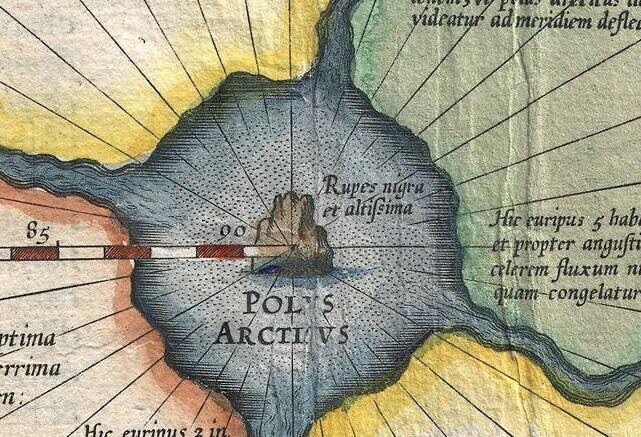
Under the terms of this Mercator math, the North Pole would appear so large as to be almost infinite. So instead of including it in the overall projection, Mercator decided to set a small, top-down view of the Arctic in the bottom left corner of his world map. Geographical historians consider this to be the first true map of the Arctic. Over the subsequent decades, as new information came to light, Mercator and his protégés enlarged and updated this original map—the draft above is an attempt from 1606, updated by his successor, Jodocus Hondius—but those original bones remained in place.
By the 1500s, not very many people had ventured up to the Arctic—no explorer would set foot on the Pole itself until 1909. This didn't stop Mercator, who dug into some dicey sources to suss out what he should include. The most influential, called Inventio Fortunata (translation: "Fortunate Discoveries") was a 14th-century travelogue written by an unknown source; in Mercator's words, it traced the travels of "an English minor friar of Oxford" who traveled to Norway and then "pushed on further by magical arts." This mysterious book gave Mercator the centerpiece of his map: a massive rock located exactly at the pole, which he labels Rupus Nigra et Altissima, or "Black, Very High Cliff."
The presence of this formation was widely accepted at the time. Most people thought it was magnetic, which provided an easy explanation for why compasses point north. But Mercator was not quite convinced by this argument, and included a different rock, which he labels "Magnetic Pole," in the top left corner of the map, just north of the Strait of Anián.
Mercator draws the Arctic in four large chunks separated by channels of flowing water, which meet in the middle in a giant whirlpool. He got this idea from two 16th-century explorers, Martin Frobisher and James Davis, who each made it as far as what is now Northern Canada. Both documented their experiences with vicious currents, which, they wrote, pulled giant icebergs along like they were nothing. "Without cease, it is carried northward, there being absorbed into the bowels of the Earth," Mercator wrote on his original map.
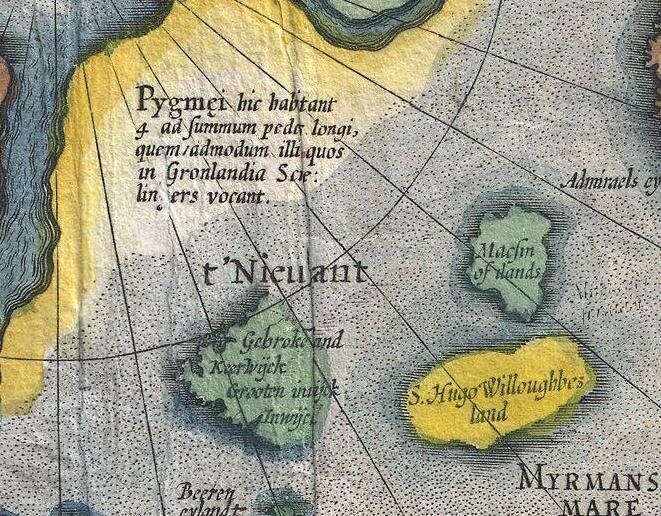
Each piece of the Arctic also has particular qualities. According to Mercator's labels, the one in the lower right is supposedly home to "pygmies, whose length is four feet"—likely another reference to the Inventio Fortunata, which described groups of small-statured people living in the polar regions. (It's possible that the author of the Inventio was referring to the indigenous inhabitants of Lapland.) The one next door, on the bottom left, is apparently "the best and most salubrious" of all the chunks, although no evidence is given to support this—or to explain why the pygmies wouldn't want to live there, instead.
After Mercator died in 1594, explorers continued to gain new knowledge of the Arctic, and cartographers revised their view of both Poles. By 1636, up-to-date maps of the region lacked Mercator's four regions, along with the Rupus Nigra and the central whirlpool. Instead, they showed one large piece of land, surrounded by smaller islands and, often, adorned with the ship's routes that enabled this geographical knowledge in the first place. As we peer at modern Arctic maps, wondering what changes are ahead, it's fascinating to think back to Mercator's original version, mysterious and broken from the beginning.
Map Monday highlights interesting and unusual cartographic pursuits from around the world and through time. Read more Map Monday posts.
Play “Uptown Funk” over practically any silver-screen dance routine, and you’ll be amazed at how well it works, proves a five-minute mega-montage of dance scenes set to the pop hit.
In this video from What’s the Mashup, the song by Mark Ronson with Bruno Mars fits with a dizzying array of dance styles, from moonwalk to disco to twerking. The scenes, cut from 100 movies, are just as varied. Simba, Timon and Pumbaa strut to “Uptown Funk” in the Lion King just as fluidly as MagicMike strips to it and the cast of SlumdogMillionaire Bollywood dances to it.
According to various reports on Twitter, St.
Louis Alderman Antonio
French, who has been tweeting from the protests in Ferguson,
Missouri, over the killing of 18-year-old Michael Brown has been
arrested. I called Ferguson's police department tonight to ask
whether they could confirm French had been arrested. I was
transferred to the jail, which isn't quite a yes but is far from a
no. I left a message with the jail but haven't gotten a response
yet. Given all the reports of arrests tonight, it may take a while.
I'll call back in the morning.
UPDATE 12:37a.m. ET: According to BuzzFeed
sports writer (new media!) Joel
Anderson, the St. Louis county jail says it doesn't have French
in custody there.
UPDATE 12:46a.m. ET: CNN's Brian Stelter
tweets
that a jail official told him French had been booked.
The White House has confirmed that Malaysia Airlines Flight 17 was shot down over the Ukraine Thursday, but who launched the missile remains a mystery.
Ukrainian officials believe Russian separatists fired a ground-to-air BUK missile that downed the plane, but in an interview with TIME, separatists leaders claimed they had nothing to do with the incident.
Vladimir Putin tiptoed around the subject, not openly blaming Ukraine for shooting the plane down, but saying they are responsible for creating a climate of political unrest.
We’ve been poking at Walmart of late because the Bentonville giant appears to have feet of clay. It has been pursuing its relentless cost-cutting strategy to the point where it is damaging its franchise. Bloomberg (and later, the New York Times) described how the retailer had cut headcount to the point where it was having difficulty keeping shelves stocked and checkout lines to a tolerable length. Proving the validity of the Bloomberg account, over 1000 Walmart customers e-mailed the news service, describing their crummy experiences.
Walmart, in a classic demonstration of the behavior of an out-of-touch management, sternly denied the customer complaints, asserting that its impressively-large sounding customer surveys were more accurate and proved all was fine. Astute readers described how surveys like that could be and likely were gamed by store managers.
Walmart is an easy target for criticism. It’s a classic corporate welfare queen pretending to be the face of capitalism. It is the top driver in the increasing use of food stamps. Per a workforce study quoted in Daily Kos:
Wal-Mart’s poverty wages force employees to rely on $2.66 billion in government help every year, or about $420,000 per store. In state after state, Wal-Mart employees are the top recipients of Medicaid. As many as 80 percent of workers in Wal-Mart stores use food stamps.
It plays communities off against one another to get subsidies for new stores, when the primary beneficiaries are the local builders. Walmart is a wage reducer and business destroyer, so it’s hard to see how (once construction is completed) that it is a net plus to a community, unless it sucks revenues away from businesses in neighboring towns.
But Walmart is looking increasingly like a corporate one-trick pony. Anyone who has spent much time in big companies will recognize the symptoms: the environment changes, or the current strategy has simply run its course, leaving the company bereft of growth opportunities, and all management seems capable of is doing what it did in the past, only harder. Hence Walmart’s cost cutting to excess.
But Walmart may have started going off the rails even earlier than the counterproductive staffing cuts suggest. A story in Nation, on a whistleblower lawsuit, buries the lead. The title is “Former Walmart District Manager Accuses Company of Widespread Inventory Manipulation.” But if you understand the allegations, what he is effectively charging them with is accounting fraud, since that was the motivation to tinker with the inventories, to report better financial results.
And rest assured, inventory manipulation can rise to the level of accounting fraud. One classic technique is “channel stuffing” which is making shipments to customers and counting them as sales even if the shipments are in advance of orders. For instance, the SEC sued Bristol Myers for improperly reporting $1.5 billion in revenues resulting from selling excess pharmaceutical inventories to its two biggest wholesalers at the end of two quarters. Bristol Myers paid $150 million to settle the charges.
Now the problem with this sort of activity is that you get a one-shot gain, and you have to continue to engage in similar types of behavior to keep from having to reverse it. Say, as Bristol Myers did, you move $100 million in sales from the next quarter to this one by shipping extra product. So if your revenues, before your clever trick, would have been $800 million this quarter and $815 the next, you’ve just made them $900 million this quarter and $715 the next, unless you steal revenues from the quarter after next. And if you have growth targets, you might not just need to keep rolling $100 million forward now that you’ve gotten yourself on this treadmill, you’ll likely find it necessary to increase it to keep your pretty phony growth pattern going.
Let’s look at the Walmart charges. Sylvester Johnson worked in Walmart’s headquarters, got significant awards for his performance, and became a manager of 11 supercenters in North Carolina in 2003. He was fired in 2009 for manipulating inventory counts. Johnson says the claims are false, that he was outed for resisting pressure to misreport inventories, and was ousted for his resistance. From the Nation (hat tip Economystic):
“We’re talking about hiding tens or hundreds of millions of dollars in losses here—inflating the profits of a store, a district, a region, a division and ultimately the entire company,” Johnson told The Nation. In theory, such a practice could have artificially inflated the company’s profit margins and stock price, amounting to a form of federal securities fraud.
Johnson claims that during his tenure as a Walmart district manager he was pressured by the company’s high command to hide losses due to “shrinkage”—defined as lost or stolen inventory—in order for stores to appear more profitable than they really were. Throughout the course of over six hours of interviews with The Nation, Johnson maintained that top management set shrinkage targets for Walmart Supercenter stores under his supervision that were “not ethically attainable” and then used methods of “fear and intimidation” against him in an attempt to compel him to meet those targets. Shrinkage represents a loss to any firm’s bottom line. It is a major factor in retail profitability…
In June of 2008, a company executive named David Carmon took over as Walmart’s Regional Vice President for North and South Carolina. Johnson claims that, at the time, some stores in his district were losing about a million dollars in shrinkage annually. Carmon instructed him to cut his stores’ shrinkage rates in half—a target that Johnson felt was impossible to hit without resorting to unethical and illegal accounting practices. According to Johnson, Carmon warned of repercussions if Johnson’s shrinkage rate did not fall. “He threatened everybody that if you didn’t get your shrink down, you were going to be terminated,” said Johnson in a court deposition. Speaking to The Nation, Johnson said that Carmon used “tactics of fear and intimidation, and everyone looked the other way.”
Johnson says that recorded shrinkage rates reduced to incredible levels in regions that Carmon oversaw. Carmon left the company in 2010, according to his LinkedIn page, which touts his achievements in reducing Walmart’s shrinkage rates in the Carolinas: “I successfully led some of the company’s largest operating units through remarkable growth and expansion, delivering strong and sustainable financial results. Most notably, the North and South Carolina region responsible for $15.5B in sales has seen a $60M+ reduction in shrinkage loss…”
Although the Nation story does not unpack all the details, Walmart curiously started investigating Johnson, who was one of the few black managers in the company, for manipulating inventory accounting in 2008. One imagines that Carmon anticipated that Johnson would go to higher ups and decided to get out in front of it. Johnson alleges the inventory gamesmanship was widespread:
Johnson says he reviewed the shrinkage rates of over 400 Walmart stores around the country and was astonished at what he saw: impossibly low inventory loss rates to the point that stores would commonly display a negative rate of shrinkage, known as on “overage.” An overage occurs when records show quantities of inventory on hand greater than what was shipped to the store—a sign of either accounting or shipping errors, or deliberate fraud.
“It was a standard practice to look at [the shrink rates of] other stores because everyone competes with each other,” Johnson said.
“When you see these overages in there that clearly should be investigated but the regional VP is saying ‘this is exactly what we’re looking for,’ or ‘outstanding job,’ it is a point of concern,” Johnson said. “I think there is an unspoken culture at Walmart that a store is allowed to have excessive overages if it makes that store and the company look more profitable.”
“This could conceivably be done in some systems,” says Stephen A. Smith, a professor at Santa Clara University and co-editor of the book, Retail Supply Chain Management. “Walmart is famous for having really good information technology systems so that makes it hard to imagine, but maybe someone found a way to do it.”
Johnson has obtained information about the inventories in North Carolina and South Carolina, and is seeking to obtain information from other regions to show it was a company-wide practice. Needless to say, Walmart is fighting his requests.
If Johnson is right, this means Walmart was engaging in desperate measures to maintain its profit targets in 2008. And this would relate to their current self-inflicted wounds directly. First it points to a culture willing to take considerable risks to maintain the illusion of profitability. Second, it has direct implications for inventory management (emphasis ours):
“You could make your profitability look better by doing things like not reporting shrinkage, that’s true,” says Paul Huppertz, Partner at the Progress Group, a distribution and logistics consultancy. “But I struggle to understand how long you do that before you run into major bookkeeping issues.”
Huppertz says that consistent errors in inventory recording would make it difficult for any large company to keep its supply chain working efficiently. He has never heard of a company obscuring shrinkage loss to appear more profitable.
Now Johnson is arguing that he was terminated for race, not for being a whistleblower, since he never got that far. That might not be as bad a case as you think. This theory presumably would allow Johnson to demand the information necessary to have his records regarding how he accounted for inventories and managed the inventory shrinkage reduction program compared to other managers at his level. He might indeed be able to show that he was treated differently than white managers who had records similar to his. But the real issue is that Johnson does not need to get that far. This is the sort of case where he can do tremendous damage to Walmart in discovery. If the judge agrees to force Walmart to divulge inventory records from other regions, and they are as damaging as Johnson alleges, I’d expect Walmart to gear up settlement talks the second the judge’s order comes down. The last thing Walmart would want is to have that sort of information become public because it can open up very costly cans of worms.
I hope Johnson prevails in his discovery requests, and if he does, that he and his attorney understand the leverage they have over Walmart and use it to extract a rich award. Unfortunately, that means, either way, we are unlikely to learn the truth of Johnson’s allegations, unless, say, Mary Jo White decides to use this case to prove her bona fides. Either Johnson loses his request to get information about the other regions and has difficulty arguing his case or he prevails, and Walmart does what it needs to to shut the case down. But if Johnson is right, it means the rot at Walmart is more advanced than even its worse critics might realize.
A NPR report "Unfit For Work" notes the startling rise in those on disability. Here are some interesting facts from the article.
Every month 14 million Americans receive a disability check.
In 1961 the leading cause of disability was heart disease and strokes, totaling 25.7% of cases. Back pain was 8.3% of cases.
In 2011 the leading cause of disability was a hard to disprove back pain, totaling 33.8% of cases. The second leading cause was an equally difficult to disprove "mental illness" at 19.2%. Strokes and heart disease fell to 10.6%.
In West Virginia, a whopping 9% of the population collects disability checks. In Arkansas, 8.2% are on disability, and in Alabama and Kentucky, 8.1% collect disability. In Alaska, Hawaii, and Utah, the figure is 2.9%.
In Hale County Alabama 1 in 4 receive disability checks.
One thing nearly every case in Hale County Alabama has in common is Dr. Perry Timberlake who defines disability in a rather creative way.
Those on Supplemental Security Income, a program for children and adults who are both poor and disabled is nearly seven times larger than 30 years ago.
Once people go onto disability, they almost never go back to work. Fewer than 1 percent of those who were on the federal program for disabled workers at the beginning of 2011 have returned to the workforce.
Percentage of Population On Disability by State
click on chart for sharper image
Children on Disability
How Easy is it to Get Disability?
Hale county's Dr. Timberlake asks a simple question to all his patients. "What grade did you finish?" If you claim "back pain" and do not have a degree, Timberlake believes you are disabled.
The Disability Deal
Getting disability seems easy enough in some states, and especially easy in Hale County Alabama. But is disability better than minimum wage? The answer is yes. NPR author Chana Joffe-Walt explains:
People who leave the workforce and go on disability qualify for Medicare, the government health care program that also covers the elderly. They also get disability payments from the government of about $13,000 a year. This isn't great. But if your alternative is a minimum wage job that will pay you at most $15,000 a year, and probably does not include health insurance, disability may be a better option.
Going on disability means you will not work, you will not get a raise, you will not get whatever meaning people get from work. Going on disability means, assuming you rely only on those disability payments, you will be poor for the rest of your life. That's the deal. And it's a deal 14 million Americans have signed up for.
Disability has become a de facto welfare program for people without a lot of education or job skills.
Parents Force Kids to Underachieve
Joffe-Walt explains the special plight of kids.
When you are an adult applying for disability you have to prove you cannot function in a "work-like setting." When you are a kid, a disability can be anything that prevents you from progressing in school.
Jahleel's mom wants him to do well in school. But her livelihood depends on Jahleel struggling in school. This tension only increases as kids get older. One mother told me her teenage son wanted to work, but she didn't want him to get a job because if he did, the family would lose its disability check.
Kids should be encouraged to go to school. Kids should want to do well in school. Parents should want their kids to do well in school. Kids should be confident their parents can provide for them regardless of how they do in school. Kids should become more and more independent as they grow older and hopefully be able to support themselves at around age 18.
The disability program stands in opposition to every one of these aims.
Clinton Ends Welfare As We Know It
In 1996 Bill Clinton signed a welfare reform act, that he proclaimed to be the "End of Welfare As We Know It". It was. People moved off welfare on to even easier to get disability programs.
Part of Clinton's welfare reform plan pushed states to get people on welfare into jobs, partly by making states pay a much larger share of welfare costs.
The incentive "worked" using the term loosely. Welfare rolls shrank but disability rolls soared.
Welfare Costs States Money Disability Doesn't
A person on welfare costs a state money. That same resident on disability doesn't cost the state a cent, because the federal government covers the entire bill for people on disability. So states can save money by shifting people from welfare to disability. And the Public Consulting Group is glad to help.
PCG is a private company that states pay to comb their welfare rolls and move as many people as possible onto disability. "What we're offering is to work to identify those folks who have the highest likelihood of meeting disability criteria," Pat Coakley, who runs PCG's Social Security Advocacy Management team, told me.
The company has an office in eastern Washington state that's basically a call center, full of headsetted women in cubicles who make calls all day long to potentially disabled Americans, trying to help them discover and document their disabilities:
"The high blood pressure, how long have you been taking medications for that?" one PCG employee asked over the phone the day I visited the company. "Can you think of anything else that's been bothering you and disabling you and preventing you from working?"
The PCG agents help the potentially disabled fill out the Social Security disability application over the phone. And by help, I mean the agents actually do the filling out.
There's a reason PCG goes to all this trouble. The company gets paid by the state every time it moves someone off of welfare and onto disability. In recent contract negotiations with Missouri, PCG asked for $2,300 per person. For Missouri, that's a deal -- every time someone goes on disability, it means Missouri no longer has to send them cash payments every month. For the nation as a whole, it means one more person added to the disability rolls.
Disability Fraud
Who is making the case for the other side? Who is defending the government's decision to deny disability?
Nobody.
And that in a nutshell explains soaring disability roles and massive fraud.
Disability fraud also makes a joke out of reported unemployment numbers. If you have a disability, you are no longer in the workforce.
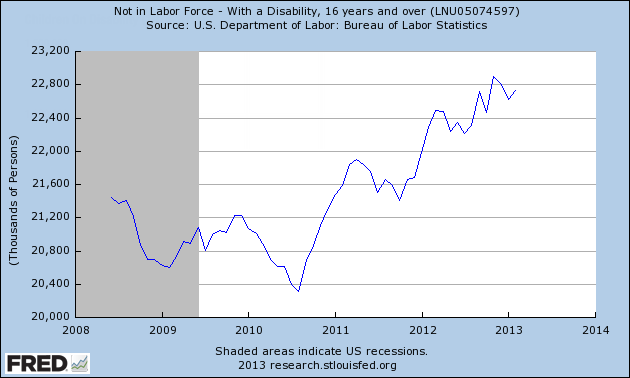
Not in Labor Force With a Disability
I would love to show data pre-recession. Unfortunately, the data only goes back to mid-2008. We can see however, that nearly 23 million Americans are not in the labor force because of "disabilities".
I suggest "fraud" is more like it.
Curious BLS Numbers
Here's the curious thing: 14 million collect disability, but the BLS says 22.726 million are not in the labor force (not working), because of disabilities.
What are the other 8.726 million doing? Is the BLS inflating disability numbers making the unemployment rate absurdly low, or are states doing that poor a job getting people off welfare and on to federal government disability programs? Some of both?
Regardless, we need to stop this madness.
Simple Solution
One easy way to eliminate some of the fraud would be to put someone in charge of making a case for the other side. No, we do not need new Federal programs. All we need do is "Un-end Welfare as We Know It".
If states had any incentive to stop disability fraud, we would not have so much of it. Make states responsible for a large portion of disability claims just as they are for welfare, and the number of people collecting disability will collapse.
I have written many times about disability fraud, its relation to the unemployment rate, and its relation to expiring unemployment benefits. Inquiring minds may wish to consider some Disability Fraud Examples.
Mike "Mish" Shedlock
http://globaleconomicanalysis.blogspot.com
Wine Country Conference
I am hosting an economic conference on April 5 in Sonoma, California. Proceeds go to the Les Turner ALS Foundation (Lou Gehrig’s Disease).
To learn about the economic conference with world-class speakers including John Hussman, Michael Pettis, Jim Chanos, John Mauldin, Mike “Mish” Shedlock, Chris Martenson with guest moderator Lauren Lyster and other Special Guests, please visit Wine Country Conference April 5, 2013 Mike "Mish" Shedlock is a registered investment advisor representative for SitkaPacific Capital Management. Sitka Pacific is an asset management firm whose goal is strong performance and low volatility, regardless of market direction.
Visit http://www.sitkapacific.com/account_management.html to learn more about wealth management and capital preservation strategies of Sitka Pacific.





 According to various reports on Twitter, St.
Louis Alderman
According to various reports on Twitter, St.
Louis Alderman