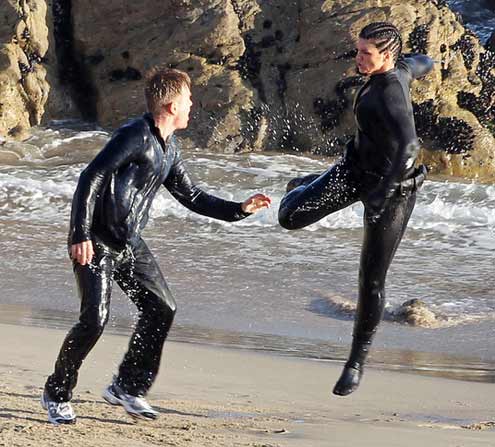
Don't be afraid to get wet, and 9 other ways to embrace the heat. (Photo by Megan Finley on a day SHE was trying to beat the heat.)
I'm not one to complain about heat. I lived in Oklahoma for 12 years, where heat indices of 103 are de rigueur. It's a real privilege to complain about a 94 degree day with a cool breeze, in my opinion. I want to talk about how we can get perspective on our solstice sweat, and how to ride the heat wave into a wonderful summer.
My friends, it gets hot in the summer. So I just don't see a purpose in getting angry about it, or trying to avoid it. Really, the best thing to do is get into it.
As with many things — swimming in a cold lake, childbirth, writing an essay that feels like it's going nowhere — the way out is the way through. We may grit our teeth at the prospect of four more weeks of this heat. We may despise how trapped we feel and how annoying our kids are becoming. We are angry and want to run away. But that will not change the weather. This is the absurdity of our summer condition. We must imagine ourselves happy in the heat. Here are my top 10 ways to embrace the heat:
1. Wear less clothing
"No !*&%, Sherlock!" you're saying, but seriously, this is a common mistake. When I lived in Oklahoma, I packed away everything that went past my knee or elbows. I lived in skirts, shorts, and tank tops. Are you wearing jeans right now? Did you layer your shirts? Were you foolish enough to put on close-toed shoes? Amateurs! Change into something else and see what a difference it makes.
2. Put a fan on your porch
Moving air makes all the difference, even if you're in direct sun. If you have a covered porch with an outlet, plug in an industrial fan and sit outside. You'll get used to the heat. I'm outside right now, on a covered porch with ceiling fans, and it's 90 degrees. I feel completely comfortable.
3. Get up earlier
During my last summer in Oklahoma, I got up at 6am every day and immediately went for a walk. Play or garden before breakfast instead of after breakfast. Get your outdoors fix in before Ellen (or, if you're a NPR hipster nerd like myself, before On Point).
4. Get wet
I bought a swimsuit last week for the first time in six years, and it's amazing how much cooler you feel when you're actually playing in the fountain or swimming in the pool instead of sweltering alongside it. Get your suit on, set up your hose or sprinkler or mister or sink sprayer, and get wet. Suddenly 95 feels comfy.
5. Listen to music really loud
It feels more like an awesome montage in a summer camp movie if you are blasting Panama by Van Halen then if you're listening to the news.
6. Drive with the windows open
Create a breeze. According to the Car Talk guys, the drag created by open windows is probably as energy inefficient as using your AC, anyway. Combine #5 and #6 and you're halfway to a brilliant and beautiful summer memory.
7. Nap in the sun
Lather up with sunscreen and try do this during off-peak hours. Then you'll see why cats like it so much, and, bonus, you'll feel absolutely frigid when you go in the shade or AC.
8. Get yourself on a boat
How long has it been since you went on a boat ride? Did you forget that boats are awesome? I don't care how much of a city mouse you are, flying across any lake — even a dirty, syringe-filled lake — feels incredible.
9. Two words: ICED. TEA.
It doesn't even have to be sun tea, although that is obviously the best kind. We get cold brew bags and stuff our mason jars full of chipped ice and mint leaves or lemon wedges.
10. Fruit
It's on sale. Buy as much of it as you can fit in your trunk and eat it all, tonight. Make your whole meal out of fruit. Bonus points for super cold and refreshing citrus fruits like grapefruit and oranges. I rarely bought fresh fruit when I was a swinging young working single non-parent, but this is the time to take a gamble on a flat of strawberries and challenge yourself to use it all up.
There you go. I bet you are feeling better already.
Recent Comments
Alicia: I'd have to admit that I love being cool rather than hot, but it's fun to drive with my windows ... [Link]
Helen: Vicky - Ooh! I have EDS III alongside my POTS too. And Raynauds, so the blue thing happens to ... [Link]
Octavia: I kinda disagree with point number 1, or more specifically just the bit that says don't wear anything past knees ... [Link]
Vicky: I have pots too and summer is worst for me! I just drink loads to prevent dehydration (which is ... [Link]
Roisin: I third the being in unprepared heat wave england! Good tips guys, thanks. Think we have had enough of heat ... [Link]
Over at Make, writer Sean Michael Ragan has put together an awesome list of clever DIY hiding spots for around the house (or even within your own clothes). The list builds on a trick Ragan wrote about last year, which is pretty genius. He calls it the Doortop Stash, and wrote up the directions on Make.
The goal of the project is pretty simple: hollow out a cylindrical hole in a door to hide money or a USB key full of important documents or diamonds, if you want to get fancy. Since the hole goes in the top of the door, it's nearly impossible to spot.
Photo via Make.
The project only requires a few parts, including a cigar tube, the perfect cylindrical container for your secret stash, and a washer to attach to the top of tube. Since the washer is wider than the cigar tube's cap, it will sit flush against the top of the door and keep the tube from falling out of reach. Some doors have hollow interior sections, and the last thing you want is your money stash falling into the door and rattling around.
Photo via Make.
Another washer, a bolt and a screw hold the washer and cigar tube cap together, and the rest is just drilling the appropriately sized hole in your door of choice. It's a pretty great hiding spot, though not as wild or ambitious as some of the seventeen spots highlighted in this Make post.
Some are pretty straightforward, like a plywood secret compartment (it uses magnets!), a junction box stash and the classic hollowed-out book. Even the classic trick bookshelf makes an appearance, though with a twist--instead of hiding a secret passage, it hides a cubbyhole full of liquor bottles. Sometimes even the library needs a bar.
Most of the projects highlighted on Make have pictures and even instructions showing how it's done, so check them out if you're looking for a clever secret stash.
Unless you're John Collins, the "paper airplane guy," it's not easy to nail a target with a paper airplane. Collins, of course, makes it look effortless, throwing planes that boomerang right back into his hand. Meanwhile, a robotics team at the University of Queensland in Australia have taken the high-tech approach to flying papercraft, building featherweight UAVs out of paper and some minimal electronics.
Their first prototype, the Polyplane, resembles a tried-and-true paper airplane design, but with a twist--two elevon tabs attached to the back of the plane. And, unlike most paper airplanes, the Polyplane can steer itself.
Image via University of Queensland.
Some simple electronics inside the fold of the paper control the elevon tabs in flight. The incorporation of those electronics is also novel--the circuitry will be ink-jet printed onto the paper stock. The light, foldable circuitry won't weigh the plane down, and will make each Polyplane cheap to produce.
The Polyplanes are designed to read atmospheric data in forest fires, and are obviously more disposable than larger, far costlier drones. We'd also be happy to use them to attack parkgoers on nice, sunny days.
Gizmag points out that similar paper airplanes could, conceivably, operate on a massive scale. When Project Space Planes launched paper planes from a balloon 22 miles above Germany, the papercraft rode the jet streams as far as America and Australia. Give those planes some sensors and the ability to fly themselves to a target, and you've got an incredibly cheap and powerful fleet of drones.
After 23 years, a team from the University of Toronto have finally conquered the AHS Sikorsky Prize challenge and claimed its $250,000 prize. All they had to do was fly at least 9.8 off the ground, in a human-powered helicopter measuring less than 32.8 feet square, and stay in the air for at least 60 seconds. Team AeroVelo did it on June 13, but it took a month of verification to earn them their prize.
The Sikorsky Prize's challenge is so tricky that its sponsors have regularly increased the prize from its $10,000 starting point in 1980 up to today's $250,000. The human-powered helicopter used to win the prize is every bit as wild looking as you'd imagine. It weighs only 115 pounds and has four 67-foot rotors to lift it off the ground. It's 190 feet long. A single pilot pedals the entire rig up into the air.
AeroVelo made the award-worthy flight on the last attempt of its allotted testing run on June 13. They had their helicopter set up in an indoor soccer field and only had time for one more shot at breaking the 9.8 foot mark and staying aloft for more than a minute. Then it happened--pilot and engineer Dr. Todd Reicher pedaled his way into the air and slowed his descent enough to keep off the ground for a solid minute.
According to Reichert, descent is the hardest part--the helicopter can be pulled into its own downwash and land too quickly. Watching the helicopter take flight is pretty amazing, and you can easily see it drifting during the test. It's not exactly built for outdoor use--even with the secure environment, the helicopter is easily damaged during test flights.
Check out the video of the record-breaking flight below.
On July 8, Yahoo! shut down 18-year-old search engine AltaVista. Its servers were switched off, its algorithms silenced, its web crawlers laid to rest. Back in 1997, a year before Google first appeared online, AltaVista raked in two million hits per day. AltaVista was one of the most successful search engines to launch in the mid-90s. That success didn't last long in the age of Google, and AltaVista was purchased by Yahoo! in 2003 and eventually relegated to obscurity.
AltaVista's death is a reminder that, pre-Google dominance, there were a ton of search engines with their own quirks, specialties, and varied indexes of the web. Searching one wasn't guaranteed to deliver the same results as the others. The World Wide Web didn't quite feel like a wholly interconnected web, just yet--each search engine or web crawler was a nexus into a unique corner of the Internet.
AltaVista also established a precedent of branching out from search that Google would later build upon. Long after it had lost popularity as a search engine, AltaVista's Babel Fish was the go-to online language translator. And while Google now serves as our general purpose search tool, and makes the operating system for millions of smartphones, and runs the most popular email platform on the web, and dominates Internet advertising, there are still those quirky, speciality search engines out there that do things Google Search can't.
The World Wide Web is far more interconnected and searchable than ever, but it's also bigger than ever. In AltaVista's honor, we've hunted down some of those search engines that still fill a special niche, gotten advice from some Tested readers and highlighted a few old favorites that once seemed amazing and have now been one-upped by the all-consuming Google.
The Wayback Machine: Archive.org's Wayback Machine is the ultimate search tool for things Google can't find--because they no longer exist. According to Archive.org's FAQ, the Wayback Machine hosts more than 350 billion pages, taking up more than two petabytes of storage. Popular websites will often have hundreds of entries archived over years of Wayback crawls, but it's amazing how many obscure Geocities fansites are preserved within the Wayback Machine.
Baseball-Reference: There's no sport with a greater emphasis or appreciation for stats than baseball. Baseball is as much about history as it is the current season's games, and players are often famous more for their RBIs or home runs or strikeouts over a dozen seasons than they are for individual game-winning plays. Baseball-Reference.com has made all those records and statistics searchable since 2000. And we mean all the records. Just look at the immense amount of detail on Hank Aaron's page, for example.
Wolfram Alpha: The "computational knowledge engine" doesn't search the web like Google, but it's definitely smarter--or at least better at math--than our go-to engine. Wolfram Alpha's ability to spit back direct answers to questions still feels a little bit like magic, and it offers a more scientific approach to search results. The results page for Tony Blair, for example, lists notable facts about the British politician, his governmental role, and one physical characteristic. Google has begun to integrate Wolfram Alpha-like results into its search engine by showing similar data for famous people (pulled from Wikipedia), showing weather conditions, and so on.
Giphy: Just a few months ago, Google added an option to narrow Image Search results down to "animated," aka GIF search. Giphy is a brand new startup that offers its own database of searchable GIFs, and each image is tagged. A search for Metal Gear Solid, for example, brings back the kinds of GIFs you'd expect, but a search for something more general--like the word joy--returns very different results. Memes and more expressive GIFs pop up than in a similar Google search. Giphy also tells you how many frames are in each GIF, which is pretty cool.
TinEye: Reverse image search is another tool Google has recently added to its arsenal. But before Google added the ability to search by an existing image, TinEye was an invaluable tool for finding out where a video screencap came from, or to find a larger version of an image, or to track down a mystery artist. TinEye doesn't search by image metadata, but rather through recognition algorithms to identify similar or identical pictures. Also, Google and TinEye present their findings differently. TinEye is extremely focused on its database of 3 billion images, but Google actually uses an image to, first and foremost, return web page results that host a similar image.
Creative Commons Search: Here's a simple one. When you search for a photograph on Flickr or Google Images, often the photographer hasn't' given permission for that photo to be used elsewhere online. So you trudge off, sullen, to find something else. With a Creative Commons search, you can set narrow search results for images, music, or other media that's shared under a CC license.
Can I Stream It: Just a couple years ago, if a movie or TV show wasn't on Netflix or Hulu, you probably wouldn't plan to stream it online. But those days are past--there are now so many competing popular video delivery services with different movie studio deals that it's hard to keep track of what is available where. Can I Stream It is awesome because it searches all of them--streaming options like Netflix and Amazon Instant and Epix, rental options like iTunes and Vudu, even cable services like HBO and Comcast Xfinity. With an account you can also set up notifications to be messaged when a movie becomes available.
Duck Duck Go: This search engine made a name for itself in 2012 by promising not to track its users--Google's privacy issues over the past couple years have been one of the unfortunate side effects of its massive web reach. But the engine also highlights a ton of "goodies" or instant feedback tools akin to Wolfram Alpha--doing matematic calculations, generating random passwords, providing instant recipes. Google can do some of those things, but not all of them, and Duck Duck Go offers a very clean, simple interface.
Google Flights: This may be one of Google's least-known search acquisitions, but it's a great tool. Back in 2010, Google Purchased ITA Software, which ran the airface search system QPX. Never heard of QPX? You've probably used it--the engine was behind travel sites like Kayak, Orbitz, and CheapTickets. Now that data is fed raw into Google Flights, without the annoyance of a travel site trying to sell you hotel rooms or rental cars alongside your plane tickets. We know including a Google site on the list is cheating, but ITA Software built the technology before Google bought them up--that counts, right?
Flightfox: On the subject of airfare searches, Flightfox is a pretty awesome person-driven flight tool. It's not a search engine, exactly, but a pay-for service that draws upon the expertise of frequent flyers and travel agents to net you the best possible deal on airfare. You can go in pre-armed with knowledge about cheap flights and pay a few bucks for the experts to find something cheaper, or describe a desired trip and let them do all the work for you. While paying for Flightfox for short or cheap domestic flights doesn't make much sense, you could potentially save hundreds on major international flights by crowdsourcing the kinds of people who know exactly how to snag the best airfare.
Ever feel like the Universe is trying to get your attention?
How loudly must It scream before you hear it?
Sometimes I find the Universe tells me things or points, loudly, in a direction, asking me to look closely. Does it do the same to you?
At first we may think it's "just coincidence", but what is coincidence, anyway?
Coincidence is the Universe's way of telling you where to look or which direction to go that will ultimately bring you closer towards your heart's content. There are numerous ways the Universe is saying "Hey you!"
There have been times when I keep hearing the same book title over and over a few times from different sources before it dawns on me "perhaps I should read that." Of course, it winds up being a book with particular insight or interest for me in that moment of my life's journey. Or, it may be that many different people say the same thing, over & over again. When something is repeated 3 or more times, it is time to take notice, pay attention, and step up!
Your body may even be in on the plan. Pain, weight gain or loss, imbalances or nagging issues are your body's means of communication - it's trying to get your attention! (Hellloooo!!!) It is telling you that something somewhere is "off." Don't be too quick to "write something off" and expect it to just resolve itself. If it persists, pay attention!
Conversely, feelings of warmth, well-being or a delightful flush of energy can be hints that who/what/where you are with/doing/at are leading you in the direction of your Highest Good, your innermost dreams.
Speaking of dreams... Recurring dreams or vivid dreams often have meaning. The best way to discern them is to look at them symbolically if they're not straightforward.
For instance, many years ago I was engaged to a guy & we were in the midst of wedding planning. We were living together at the time. He was working a lot so I would visit my best girlfriends out of town frequently. For about 3 months I kept having a recurring dream - that he would kiss or be romantic with another woman - right in front of me! Then, when confronted, he would flat-out lie about it, despite that I had just witnessed his behavior. This dream always upset me and left me with a feeling of betrayal. I chalked it up to my fear of something going wrong. Then, one day, I found out he had been watching a lot of pay-per-view porn -sometimes as many as 6 in an evening. No big deal until I found that for months he had also been bouncing checks he had been writing to pay our utilities. I began to wonder what else he might've been hiding. So I did a little digging & found the number for a girl he worked with and decided to call her. Turns out they had been dating for some time! Many of the late nights "working" as well as the weekends I was out of town, he had spent with her! We compared dates with each other and, sure enough, the jig was up. When he got home, I confronted him, having all the information I needed to call him out. And you know what? He flat out lied & denied it all! Even after I told him that his other girl & I had talked! My dreams had been trying to get my attention for some time - and it turned out I was not going crazy after all.
Recently, labyrinths have been coming up for me a lot. Labyrinths are a very old tool for meditation and looking inward for answers and insights to life's questions. To walk a labyrinth is deeply symbolic & intuitive - a way to tap in to one's subconscious.
A client of mine was talking about one she had just walked, I found one in an unusual place near where I live, and some friends of mine asked for help in building their own backyard labyrinth. Last night, during the Super Full Moon, I walked their beautiful labyrinth in the moonlight. It was a peaceful experience where I asked the Universe to continue to guide me & give me clear messages that are easy to understand.
Look, listen, feel - all around us are signs meant to guide us along our life's journey. The more we pay attention without "writing off" what comes to us, the more these signs & coincidences will appear.
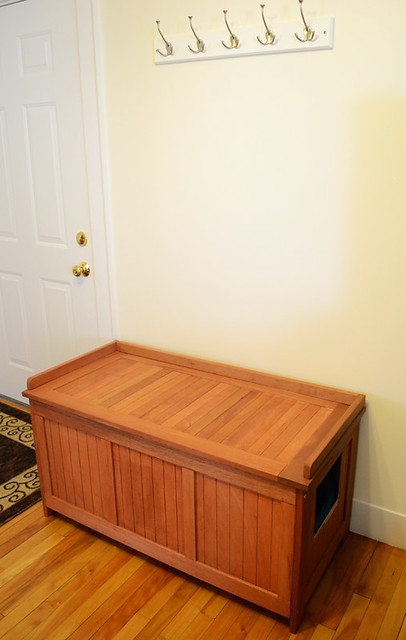
Believe it or not, but those two storage tables underneath Marilyn are kitty litter boxes. Kinda swanky for a dual poop station, ammaright?
I put my litter box outside on the balcony, and before that it fit perfectly in my bathroom between my sink and the toilet. But what if you don't have a good tucked-away spot? What if you need more than one box?
I scoured Amazon, our archives, and even our Flickr pool to find the most decorative solutions for kitty litty boxes. So that when you have company come over, they (and you!) don't have to stare at cat poop.
Hell, with some of these products, your guests may not even know they're looking or even sitting on a cat box.
Good Pet Stuff Hidden Litter Litter Box $60. As a customer noted, "You can easily swap out the ferns for a more appealing silk plant that suits your fancy/decor."
Last week I talked about why I add watermarks to my photos. Today I'll show how I add those watermarks. I use Gimp which is an image editing program like Photoshop. Except it's absolutely free! You will need to install the program on your computer - it's not a web based one. Find Gimp here. In my humble opinion web based editors shouldn't replace a proper program on your computer. But hey, that's just me. ;-)
I have made my watermark text as a .png image with a transparent background, no need to type it every time I need a watermark! I have a folder with several colours and sizes of the watermark. But the one I use the most sits on my desktop.
Once I've edited and resized my photo, I simply drag and drop the watermark file into the image in Gimp. And that's basically it!
A note about the size of the images you put on your blog/other places online: I usually resize my photos to 700px wide (sometimes I go a bit wider, but it depends on the photo). That makes it fairly big on screen but it's not big enough to be of printable quality, meaning that it's less likely that someone will steal my images and use them in print without my permission.
The watermark is automatically placed in the centre of the image but that's not always the best placement, so I usually move it (left arrow). And then I also change the opacity (right arrow) to somewhere around 50% - that's a bit more subtle than 100%. But it also depends on the background. On darker backgrounds the watermark can be at 30% opacity sometimes.
Then I save the image and I'm all done. Adding the watermark only takes an extra couple of seconds and it's well worth it! And these days it's a habit for me, I don't even have to think about it.
In the next post I'll show you how to make the watermark .png file.
. . . . . . . . . . . . . . . . . . . . . . . . .
This is a blog post from Carina's Craftblog - http://carinascraftblog.wardi.dk/
All images and text in this post are copyright of Carina Envoldsen-Harris 2006-2013, unless otherwise attributed.
>>Please do not use this blog feed in a way that republishes entire posts.
At their best, modelmakers create houses and cityscapes and space ships so convincing, we believe they're 100 feet tall when they're only one, or a thousand feet tall when they're really on a miniature set surrounded by other models. They build tiny houses in such excruciating detail, we think they're real when they explode into a million pieces. They build space ships so convincingly, we buy into the universe--even if, upon closer inspection, the white hot engines of a Star Destroyer look an awful lot like aluminum clip-on lights.
Or when R2-D2's holo projector looks like the spitting image of a reading light from a vintage airplane. Or when Luke Skywalker's lightsaber is a dead ringer for a 1940s camera flash with windshield wipers stuck to it to serve as a grip.
At this year's Bay Area Maker Faire, veteran modelmakers from ILM sat together on a panel to talk about the tricks and techniques of professional modelmaking. Like, for example, how they use found objects--just about anything they can get their hands on--to build iconic props like Luke's lightsaber or Han Solo's blaster.
"You can take things that you throw away, like the bubble blister packs that everything comes packaged in nowadays, pop them off, cut them apart carefully, and you've got little domes and cool shapes," said Sean House, a prop maker who's recently worked on the upcoming Pacific Rim and The Lone Ranger. "The things that the razor blades come in--you can plant these things on models and make the most amazing things and nobody will ever know. And yet it adds an air of realism that's grounded in reality. I think that's what made the Star Wars universe work, because people could sorta kinda recognize these things even if they didn't know what they were."
The hour talk included some really interesting modelmaking techniques and more than a few great anecdotes from the making of the original Star Wars trilogy. Two of the other panelists, Lorne Peterson and Charlie Bailey, spent 30 years at ILM, working on Star Wars, Indiana Jones, and dozens of other films. Don Bies, who began working at ILM in the mid-80s after remote controlling R2 units for Lucasfilm, also sat on the panel. Fon Davis, a younger ILM veteran, moderated the talk.
Here are some of the best Star Wars behind-the-scenes stories and tips from modelmakers with more than 100 years of combined experience.
Modelmaking Tips
Lorne Peterson: I have a small story about superglue that is kind of interesting. It's hard to imagine a world without superglue, but in the early 70s it was a pretty rare item. It was an industrial product. I was originally hired as a modelmaker for two months, at the end of '75, just to do one particular project. When I went there, every day, I realized, my god: I was involved with industrial design, so I knew about super glue, but they'd use five minute epoxy with masking tape to do [Princess Leia's] ship. That's the way they were doing it. I knew that there were other ways to do it.
So I brought a bottle of superglue, and I told everybody in the model shop to stop for a minute and take a look, and I took a pencil and I cantilevered it out over the edge of a tabel and shot a little bit of Eastman 910, is what it was called at the time, and then I moved my hands away, and everybody gasped. In a way it changed modelmaking completely. Nobody used five minute epoxy anymore for putting models together, for kit bashing. In late '75 we switched over instantaneously to super glue. Maybe that's why I was still there after the two months were over with.
Also, I got some gasps when I took baking soda, and you fill in gaps--you shoot in a little bit of super glue, then get a puffer thing and shoot some baking soda in. It makes, like, cement that will fill gaps and fillets and it will take a very small contact joint that you can fill from the back side and make it very very strong. A lot of people don't necessarily know that, either, but I guess I came up with a lot of tricks since I stayed for 35 years or something like that.
To create model debris, you can stick pasta in a blender, grind it up, and paint it with different colors.
Fon Davis: One of my favorites is for creating debris when you're blowing up a model. You need a lot of stuff that's going to fly out of the model, and I actually learned this when I was working with these guys at ILM. You can actually take pasta, because pasta comes in these great shapes and a lot of different varieties. You stick it in a blender, grind it up, and paint it with different colors. And you just fill your model with pasta, and that's what you're actually seeing flying out at you in a lot of these different visual effects shots.
Peterson: Just thinking of pasta, I did the imploding house for Poltergeist. One of the problems was I took balsa wood and made little two-by-fours, about 3/8ths of an inch across, as a two-by-four. I realized they actually bend almost like a bow and arrow, it's really springy, and I knew that if the house was to get imploded, these two-by-fours would bounce out of the scene like crazy as soon as some tension was put on them, they'd fly away. I knew that I could oxidize the thing with bleach, so I took 50/50 bleach water and put big lead weights, and I put the two-by-fours overnight under water, and the bleach oxidized all the balsa wood so then when you'd go to bend it, it'd break just like pasta. Pasta reaches that stage where it snaps and just gives up. It was a way of making balsa wood weak, but you could still construct things with it.
Charlie Bailey: The two things that are really hard to work with are water and fire. All the physical things like space ships and buildings we can cheat in scale and sometimes force perspective, putting smaller things in the background, larger things in the foreground.
Peterson: You can always put in a ladder, a scale ladder, and it'll always sell the shot, how big it is.
For water, to get droplets in scale, we would add detergent or alcohol to break up the surface tension to get smaller droplets or smaller splashes.
Bailey: For water, to get droplets in scale, we would add detergent or alcohol to break up the surface tension to get smaller droplets or smaller splashes. For fire we always depended on pyrotechnicians to come up with new chemical compounds to make flames in different sizes and colors.
Peterson: For the crash of the ship into the dock in Jurassic Park...I had a super soaker gun with alcohol. Just before they were ready to shoot I'd wet down...the whole dock which was about 15 feet by 12 feet. Alcohol is much less dense than water, and the meniscus with alcohol is much flatter. And so the alcohol wouldn't last very long, but it looked very much like a wet dock and didn't give away the scale.
Making Star Wars
Bailey: We were really lucky to work with Joe Johnston as our art director. He showed us all how to age models to look like they were old. Before Star Wras all the space ships and aeroplanes you ever saw were brand new. And through Joe and the other art directors, they came up with an aging process, so the rebels all look like they have junkers. Because of that, you can look around here and see robots with aging on them. 40 years ago they would've looked brand new.
Peterson: Theed City [on Naboo] had these very long waterfalls. When it was first drawn up and proposed, usually it's like several racehorses heading to the finish line--there's the model, there's digital--who can do it fastest, who can do it best on budget? Me and this other guy experimented, and we used sugar coming off a little trap door we made coming down in front of velvet. And then we filmed that with side lighting, so all you saw was the sugar falling about four feet and hitting another piece of velvet and falling again, and that could be used over the top of Theed City as an element.
We did that the first day, and we left it set up, and the next day there were ants all over the place because of the sugar. We had to clean it all up and use salt instead. It turned out that Theed City eventually--some of it was digital, a very small amount of it was still salt coming up over the top of the velvet and spilling down the front of a velvet cliff. You can see how easy that would be. Anybody could go home and take a piece of black velvet and a salt container and make a reasonable looking waterfall shot at the right framerate. There's a lot of things like that that we did over the years that were both very complicated, but every once in awhile very very simple. Things you could easily do at home.
Bailey: When we built Theed City, this was a city that was about 100th scale, so a foot tall building would equal a 100 foot building. Doing the miniature greens for it we needed little tiny flowers because Theed City was covered with flowers. We found that little colored candy sprinkles you'd put on a birthday cake were just the right scale for flowers, so we'd decorate the set with those. On the second day of shooting we went out in the morning, turning the lights on, and we noticed all of our flowers were moving. There was a whole army of ants that came in overnight and were carrying off all our candy flowers. If you watch the movie carefully, you can see as time goes on there are fewer flowers, as though autumn set in.
Peterson: On a big stage, you wonder, why would there be ants there? Another funny thing that happened along those lines is, it's a big studio like this, with doors that lock and everything. For Mission Impossible we had a big desert sequence, a desert set with lots of sand and rocks and helicopters. And you arrive in the morning, and cats have used it as a catbox. The perfect catbox. And I'm thinking, we're in the middle of an industrial park, in a locked building, where do those three or four cats come from? And I finally found a hole in the wall about that diameter, and the cats must've been slipping through there and found it the perfect spot to use as a catbox. We had to use it every morning.
For the Mos Espa arena, there were something like 450,000 q-tips painted multiple colors [to simulate a crowd].
Don Bies: One of the cool things, whenever we're working together, is people thinking outside the box, and trying to come up with practical solutions. And in the early days, certainly it was 'let's see if we can beat the CG guys at their own game.' Michael Lynch, one of the modelmakers--he was always really good at looking at things this way--he was looking at the crowds. And when you see a crowd in a stadium you're really just seeing shapes and colors, you're not really seeing people or individual faces.
So he came up with the idea...of using q-tips, cotton swabs, colored, in the stands of the Mos Espa arena. So there were something like 450,000 q-tips painted multiple colors, and he even researched it to find out how many reds versus yellows and blues and greens that should be in there.
And it was a process of just days of painting. Think about 450,000 cotton swabs, how you paint them, and then how you put them in. Everyone took turns at one point sticking them into the stands. And by blowing a fan underneath they kind of twinkled, like people moving around. Ultimately they did put some CG people on top of it, but I always thoght it would be funny if they caught to a close-up of the stands and you saw a cotton swab sitting in the stands next to the aliens.
Peterson: 450,000 is a lot to paint, even if you have a crew of four or five people. So he had to come up with a way of, a slightly downhill trough with oscillating sanders attached to it that would cause the q-tips to vibrate and align themselves, and then they were grabbed as a group and they'd be dyed in large groups so you could do 100 at a time rather than one at a time.
Star Wars Easter Eggs
Bailey: I think the-all time iconic story for special effects came from Ken Rolston when we were working on The Empire Strikes Back. There's a big asteroid belt scene, and Ken was our director of photography. And he put an Idaho potato in the asteroid belt. And we've seen it hundreds of times and could never spot it on the screen. And then on Return of the Jedi, the final battle scene has about 100 space ships or something flying around. One of those ships is Ken's gym shoe. And once again, I've seen it dozens of times and I can never pick out his shoe. But it's in there in the battle scene.
One of those ships in Return of the Jedi is Director of Photography Ken Rolston's gym shoe.
Peterson: I remember a story from the shield generator [in Return of the Jedi] now. Like I said, we always had to work on budget, so if you could find a way to save thousands of dollars, that was a great idea. There were pine trees, it was in a pine forest, so I thought, ah, instead of making all those pine trees, I'll go to an architectural model store, and they had these, oh, 6-7 inch pine trees. I said, well, I'm going to use them at ILM, but I could bring them back exactly as they are. How about we make a deal--I'll pay you a quarter of your price, and then I'll bring them back and you'll get to sell them for full price. They thought that was a great idea.
I talked to the pyro guys and said "The flame isn't going to be very big, is it?" Cause these are just little lead tree trunks with foam on them. And they said oh no, we'll contain it, it'll just be over here. Don't worry about that. I asked, you're not going to come over to our part of the model, are you? The flames aren't going to shoot over there? Well, pyro guys have restraint, but not necessarily as much restraint as modelmakers. The flame of course shot over, and they were lead, they had foam on them, they had spray glue, and a couple thousand dollars worth of miniature trees went up. I had to go back and pay full price. They weren't going to get the litte trees back.
Bailey: My first job at ILM was to build the rocket engines for the big white Star Destroyer. I went off to the hardware store to see what I could find so I wouldn't have to make something, and I found some little aluminum clip-on work lights, took the reflectors off, put projector bulbs in them, decorated them a little bit and stuck them on the Star Destroyer. If you look closely you can see there's a little aluminum reflector in there. A couple years later I used the same concept on E.T.'s little spaceship. All the little domes around the ship are soup ladles of different sizes. Stainless steel soup ladles. It's always fun to look at all these little details and see how we cheated.
Bies: This one I wasn't around for, but it's been told, and I can't verify it for sure. In the original Star Wars they filmed most of it in the UK, but when they came back George wanted to pump up the cantina sequence with the creatures and everything, so they hired Rick Baker and a team of essentially, at that time, stop motion artists, [including Phil Tippett]. They also wanted Greedo to talk. They wanted his mouth to move...But the story goes that they were about to shoot it, the inserts with Greedo talking, but the little mechanism that moved his mouth broke. Quickly someone looked around, and there's always what we call C47s, spring-loaded clothespins, on set. So somebody pulled the mechanism out, hot-glued a C47 in there, put the other end in his mouth, and that's how they made the mouth move.
Peterson: Usually we build more interior than you'd originally think, for explosions, just in the possibility, in anticipation that something might show. Many times it doesn't, the explosion covers it. An example of that is when the Ewoks crush the head of the chicken walker with the logs. We actually made two characters with helmets and all that kind of stuff and a little light inside. We sculpted one to look like George Lucas and one to look like the director of the film. They actually looked like them, because they were about 16 inches tall. The heads got crushed and you never saw them. Most of the time it wasn't necessary, but every once in awhile we did at least a partial interior.
I’m not sure which wine pairs best with a nervous breakdown, but at this point I don’t really care, because wine. That seems like a sentence fragment but it’s not. ”Because wine” is a full sentence and is also an answer to just about anything you could ever ask. ”Why should I leave my house?” ”Why am I crying at an insurance commercial?” ”Why do my cats all have mustaches drawn on them?” BECAUSE WINE.
In fact…why does this post exist? Because wine.
And also because I’ve been fighting through a bitch of a wave of depression for the last several weeks and I’ve been slogging through the days and going through the motions and waiting for this shit to finally break. I’ve been forcing myself to leave the house as much as I can and congratulating myself for showering and moving and breathing, but it’s still hard as hell. I’m not alone. In the last few weeks I’ve gotten tons of comments and emails and tweets from people all feeling equally helpless. And that sucks. It sucks for them, and it sucks for me and it sucks for every person out there who can’t just fix us. There is, however, one bright point about getting those messages from others sailing their own rough waters…I can – without doubt- tell them that depression is lying to them and that things will get better. And then I have to admit that the same thing applies to me…even though at the time I’m fairly sure my emotions are dead forever.
And then, just as quickly as it came, it starts to lift. Yesterday I felt human again for almost two hours. It’s amazing how much you’re missing in a depressive state until you start to come out on the other side. It’s like breathing again after being underwater for far too long. The depression is back again now but I had an hour this morning when I was me again. And a few minutes ago I called a friend to come over to visit. That sounds like a stupid, small thing, but it’s not. It’s big. It’s huge.
When I’m in a depression I want to write about it, but I usually can’t. I’m too overwhelmed and paralyzed and exhausted. I end up writing 100 angsty drafts that never see daylight and I convince myself that no one cares. It’s not true. People care. They care about me and they care about you. If you’re feeling alone, you aren’t. Millions of people struggle with suicide and depression and mental illness. We keep taking pills. We keep talking to shrinks. We keep each other alive. We remind ourselves that depression lies. We keep breathing. And eventually the clouds metaphorically part and – as if by magic – we get a blast of normalcy and remember how amazingly wonderful it can be to feel life instead of suffer from it.
Yesterday I started feeling life again, and it felt wonderful. And I’m writing this to remind myself that it does pass, and that the miasma surrounding you now won’t always cling to you. It will pass for me and it will pass for you.
Keep breathing. Keep living. You are worth it.
PS. This seems unrelated and maybe it is but I’m including it anyway because wine. A few years ago my blog posts were peppered with humorous stories about my severe rheumatoid arthritis. I’d be bedridden for weeks at a time. I was in and out of hospitals. I spent most vacations in a wheelchair. It took many years and lots of different meds and doctors before they finally found the particular drug that cured my symptoms. It isn’t perfect and it’s crazy expensive and involves a lot of injections and constant work, but (knock on wood) I haven’t been in a wheelchair in over a year. I had started to think that my whole life would just be random weeks of pain and that I’d end up hobbled and miserable, but then we found that one drug that worked for me. And if there’s a drug out there that could save me physically then I have to believe that one day there will be one that could save me mentally.
I’m holding out for that miracle. Stay here and keep me company.
PPS. If you’ve found something that works for you, feel free to share it. For me, it’s music. This song has been on replay for me all week and it helps. Maybe it’ll help you too.
Sneezing at sunshine is a genetic thing!!! I knew it wasn't just me!
Genetics in action!
Given the choice, would you rather lose your mind or control of your body? When we were kids we used to play the macabre (and very un-pc) game of Alzheimer’s vs. Parkinson’s in which we dared each other to imagine a life missing either brain or body. We thought it was a riot but as I recall the grown-ups in our lives most certainly did not. Indeed, I have several close family members who died with one of the two dreaded diseases and so you’d think I’d have grown up to be a little less cavalier. Apparently not.
As a Valentine’s Day gift to myself – nothing says romance like buying yourself prezzies! – I got me a genetic workup done courtesy of a sale at 23andMe* (23 chromosomes? Get it? SCIENCE RHYMES!!) Perhaps because the test itself was so easy – they sent me a test tube, I spit in it and sent it back to them – I didn’t really take much time to think about what exactly I was doing. All I knew was that they analyzed my DNA and looked for hundreds of markers for everything from disease susceptibility to personality traits to drug sensitivities which given my fascination with research, numbers and navel gazing was basically the best gift I could have gotten. What could possibly go wrong with that??
So when I finally got my results back a few days ago, I ripped open that e-mail (it was a very aggressive mouse click) and started scanning my results.
Great news, you guys: I have ZERO risk for prostate cancer! Isn’t science great?!
But lest you think I paid all that money** to confirm something that a hand mirror and a moment of bathroom gymnastics could have cleared up, I also learned some other very interesting and valuable things about myself. (23andme has several ways of delivering the information to you. You can read a summary report which just highlights the really important things you need to know from a health standpoint, or you can read an intermediate report that lists everything they tested for along with the probability of having/getting it and a star ranking system to show you how confident they are in the results based on existing research. Or you can read in depth about every genetic marker, what it does, every study done on that topic and how you personally fit into that study’s demographic. Of course you know which one I chose! It’s taken me days but I have Read! It! All!)
Some results were just entertaining – turns out I carry both genes for the “photic sneeze reflex” which explains why I always sneeze a lot when I first walk into bright sunlight. (You should hear my whole family after we walk out of a movie theater, it’s like a sprinkler system going off.) Others were important to know – I apparently am likely to have a fatal reaction to a certain antibiotic (only used outside of the US, thankfully). Yet others were mystifying – turns out I have the genes to allow me to digest lactose all my life long and yet as we all well know, I am violently lactose intolerant. (23andme explained that there may be genetic interactions not yet identified or biologic reasons like the wrong gut flora.) Still others just confirmed what I already had figured out about my body from all these years of living in it – I lack the gene for spacial acuity explaining why I get lost like it’s my job. (I literally smacked my husband awake yelling at him “See?! It’s not my fault!!!”) And of course I was anxiously awaiting the results of the BRCA tests for breast and ovarian cancer – negative for both! Yayayayay! (Also in regards to my boobies: I have the gene for small ones. When I excitedly pointed that out to my husband he was like, “Duh, Charlotte.” Genes, I has them, lolz.)
But then there were the ones I hadn’t even considered at all when I took the test.
As I scrolled through the hundreds of results and pages of information, I came across two “locked” results. At first I thought they were trying to trick me into shelling out more cash but when I clicked on the results for the Parkinson’s and Alzheimer’s test information, I got a warning window telling me, essentially, that there are no known cures for these life-ravaging illnesses and that knowing my genetic predilection for them could have lifelong consequences for not only me but for my genetic relatives (i.e. my beloved kids, who also sneeze in sunlight). It went on to caution me that it was recommended that I talk to a genetic counselor about my familial risk factors and come up with a game plan before deciding whether or not I wanted to know. The site also pointed out that only a certain percentage of these diseases can be attributed to genetics and so simply having or not having the genetic markers does not mean you will or will not get them.
It was a very long, ominous warning and required me to initial it before allowing me to proceed to my results. At which point I fess up: I didn’t consider the ramifications of the test for more than 0.2 seconds before clicking through. I wanted to know! Now! Whether it’s the hubris of youth or just that I’m impulsive, I had already assumed that I would not be genetically predisposed to them.
And it turns out I was right. I don’t have any of the markers for either Alzheimer’s or Parkinson’s. Of course this doesn’t mean that I am immune to them (like I am to norovirus, aka the stomach flu, talk about a genetic score!!) but it just means that my risk is “average.” It was only after I exhaled and mentally thanked my parents for this small mercy (especially considering they gave me the genes that predispose me to depression, anxiety and schizophrenia… but not bi-polar. Wha?) that I realized how awful it would have been had my guess been wrong. If they had been positive at the very least it would have required some serious soul searching and advance planning. And knowing me, it would have changed the way I lived the rest of my life. There would be a kernel of fear at the heart of everything I did. (Or, hey, who knows – maybe it would have taught me to “live like I’m dying” or whatever those country songs say.) As it stands now, I just feel very, very grateful.
The other results that I hadn’t anticipated but have since spent a lot of time thinking about were all the ones about food habits and obesity and weight gain. Scientists estimate that our genetics determine 60-80% of our weight, depending on which gene variants are present and in what combination. For example, a UCLA study from earlier this year showed that people without a certain gene can eat a high-fat diet and not gain weight whereas those with the gene gain weight like crazy on the same diet. (Same exact caloric intake, waaay different results - take that calories in/calories out model!) The 23andme test said that I lack the gene to lose weight from a high-fat diet and that people with my genetic makeup also showed no heart benefit from eating a diet of 40% or more fat. Which might partially explain why The Primal Blueprint/Paleo diets never worked for me. I actually gained 10 pounds every time I tried them. Of course these days I do eat a lot of fat, at least a lot more than I used to. But when I eat intuitively I seem to stay around or below 30% fat. So maybe my body does know best?
Another interesting result was that while I don’t have any of the genes that predispose me to being obese, I do happen to have a lovely little gene that makes me prone to overeating (or “eating with disinhibition” as they put it). Interesting. I also don’t have the “skinny genes” either. So I guess that makes me average? But it made me wonder how I would have felt had I had the genes. There were probably about 10 different markers that had to do with weight and dietary preference (I’m one of the lucky ones who lacks the gene for “bitter taste perception” which is why I adore the taste of cilantro, asparagus and cruciferous veggies!) and I’m honestly not sure what to make of them. Actually my main struggle with the whole test has been to not make too much of them. (Case in point: Apparently I have an inherited genetic disorder called DPD deficiency. Which can be scary and life threatening… only if I take a certain chemo drug. Hmpf. To worry or not to worry?!)
Which leads me to my next point: All of this discussion would be remiss without acknowledging the emerging field of Epigenetics – a science that looks at what causes certain genes to be expressed while others to be inhibited. For example, one study showed that a particular “obesity gene” was “turned off” by regular exercise. So even if you do have the genetic predisposition apparently environment still plays a role in whether or not that gene is activated. See? Fascinating!
In the end, getting my DNA profile ended up being good for more than just entertainment. There were a few things that have made me decide to make a few changes. (Apparently I’ve got 4 times the risk for heart disease as “normal” people do so that makes me even more invested in doing things that are healthy for my heart like exercising only in moderation!) But I keep reminding myself that it isn’t a crystal ball and that a genetic predisposition is a far cry from a certainty. Still, I’m glad I did it. I’m even glad I opened the “locked” tests.
But now I’m SUPER curious – what would you do? If someone was holding your DNA results in their hand, are you like me and would want to know whether you had the genetic marker for a deadly disease like Parkinson’s or Alzheimer’s, consequences be darned? Or would you prefer to just not know and live your life the best you can without that potential shadow? If you did come up positive, would you tell your kids? Any of you know already that you have an interesting genetic marker? Any other light-triggered sneezers out there?!
*I did NOT receive this test for free nor was I compensated by 23andme in any way. I have no relationship with this company at all. I paid for it myself and was so delighted by the results that I simply had to share it with you!
** The DNA test was $99 discounted from $250 when I got it and I just checked their site and as of today (6/9/2013) it’s still $99 if you’re interested! And no, I don’t get any kickbacks or commissions if you do decide to buy.
P.S. Don’t forget to enter my FitnessGlo giveaway! They provide the fitness but the glo is yours to keep;)
I've been meaning to post about this for ages.. just never got round to it. But Diane's post reminded me of it!
This will be a short series on watermarks and adding them to your photos.
Maybe you have noticed that I always put a watermark on my photos? Maybe you haven't? I'm actually curious to know if it is something you notice?
I add watermarks for several reasons.
1. It's your photo, you made it. By the simple action of creating it, you own the copyright to it. But not everyone knows/cares/respects that this is the case and just use any old image in any way they like. - Obviously, if you've borrowed a photo from someone else, hopefully with their permission, you shouldn't put your watermark on it. And always credit and link back to the original source.
2. Because content on the internet is more or less fair game. If you put your watermark on your images people are (a bit) less able to steal or pass your stuff off as their own. Especially if you place the watermark in the centre/near the 'action' in the image where it's more difficult to crop out. - On several occasions I've come across blogs which have stolen my tutorials and passed them off as their own. And cropped out my watermark! That's when I used to put it along the edge, because I didn't want it to distract people looking at the image. Obviously, that's a mistake.
This is how I used to watermark my photos (I've actually been doing it for many years, but not with as much thought as I do now): along the edge and in a pretty font (that's almost illegible, yikes!) But look how easy it is to crop that out! And it doesn't take anything away from the action (a tutorial shot, for example).
Now take a look at how I do it now. Right next to the action! Sure, you can crop it out, but it will be a lot more obvious that it has been cropped.
3. Using watermarks dots your name/blog name around the internet as well as connecting your name with your photos. Think of all those images being pinned lazily (i.e. without a link to the original source!) every day and the never ending chain of un-credited images on Tumblr. If you put your watermark on your images people can see which blog the image originated from, even if there isn't a direct link to a specific blog post.
4. With a watermark there is also the chance that someone will type the name into their browser and check you out. It does happen! On a few occasions people have emailed me after they've visited my blog by typing in the name in my watermark. Those people are awesome! :-)
I must admit that I used to feel that putting a watermark on my photos would make people think I'm terribly full of myself. And maybe some people do, but I'd rather that than having my photos floating around on the internet without attribution.
This is my watermark in its current form. It took me a while to get to one that was fairly simple but also includes a bit of information.
The main bit is the URL (link address) to my blog. I've used the same font as in my blog header + the flower which I use in both the header and my favicon. It's a sort of logo and ties different things together.
I've also included my Twitter@. Not because I imagine that loads of people will check it out, but someone might. And it's a quick way for someone to get in touch - no need to send an email.
And finally the copyright symbol and the year. Adding the year also helps someone who might want to look up a particular post on my blog if they have found my photo some random place. Atleast they will have the year to go by.
In the next post I'll show you how I add watermarks to all my photos in just one (and a half) easy step!
. . . . . . . . . . . . . . . . . . . . . . . . .
This is a blog post from Carina's Craftblog - http://carinascraftblog.wardi.dk/
All images and text in this post are copyright of Carina Envoldsen-Harris 2006-2013, unless otherwise attributed.
>>Please do not use this blog feed in a way that republishes entire posts.
When the very thought of spending a dime does your head in… (Photo by: JD Hancock – CC BY 2.0)
So this is me admitting that I have a problem with money. I grew up really poor. I had a great childhood, my parents are awesome people and I was surrounded by love and relatives. But until I was 10 or so, I thought the power company hung everyone's power bill on the door knob. I wore my boy cousins' hand-me-downs. I didn't ask for stuff that was expensive, because I knew we couldn't afford it. And because I didn't have access to that stuff, I became that kid who did not give a shit about status clothing and labels, for the most part.
When I was in high school, I saved up money from my first job waiting tables so that I could buy my first beloved pair of Docs. I went to college via scholarships and loans, and worked at least one job if not two (sometimes three) all the way through to pay the rest.
Most of my friend group were upper middle class kids whose parents were lawyers and who already had stock portfolios in their names. I'm not judging my college friends — they were great people — they just came from a different place than I. Money, to them, was a constant — something you picked up the phone and ordered in. To me, it was something that I was constantly hustling for — scrubbing toilets, waiting tables, tending bar, and busting my ass just to barely have enough to pay my part of the rent.
And at some point some idiot actually approved me for a credit card, and I went NUTS. Like, OMG, free money, I can BUY STUFF! Like, any time I want! So then I was poor and in debt. And it took me several years of hard work to dig myself out of that hole and realize that credit cards are just not for me, ever.
There is a great article that John Cheese wrote about what growing up poor does to your brain. It's pretty dead-on. One of the things is that when you have extra money, the desire is to spend it RIGHT NOW before some disaster happens and you have to use it to take care of that instead. For years, that was me. And then, after lots of soul searching and hard lessons, I went so far the opposite direction that my cheapness practically qualifies as a mental illness.
There was a day I spent $60 on myself, I then promptly went out to my car and proceeded to have a giant panic attack.
And even though now I actually have money, god help me if I spend one cent of it on myself. The guilt and panic feelings are just overwhelming. I know that it's stupid, but knowing that something is stupid does not make it go away.
I can't take pleasure in buying clothes for myself. I can't drop $100 on a pair of nice jeans that will fit me like I want them to, because I wouldn't be able to live with myself. Because the dog needs a haircut, and the car insurance is due, and the house needs all new screens, and OH MY GOD, WE CAN'T SPEND MONEY because if we do, a disaster will happen.
I'm not sure what disaster (anxiety-related disaster premonitions are not very specific) but something broken in my idiot brain assures me that if I purchase a nice pair of jeans for myself it will be DOOOM. Because it's easy to justify a pair of jeans when they cost three bucks, even if they're not perfect and don't fit quite the way I want. They'll do, right? Because some people don't even HAVE jeans.
Over years of poverty and necessity, I've come to have a lot of my self identity tied up in being thrifty. My mind has always decided that cheaper = better. And we know that isn't true, always. Cheap laundry soap that I make myself, awesome. Cheap concrete for the bridge abutment? Not-so-much.
There was a day I spent $60 on myself, I then promptly went out to my car and proceeded to have a giant panic attack. Because I spent money on myself. I had to sit there for fifteen minutes, smoking, assuring myself that it was okay. It wasn't our last sixty dollars. We have money in the bank. All the major bills for the month are paid. I am no longer living in poverty. I am an adult who owns and runs two businesses, who is about to marry an adult who has been putting money away in savings since before he hit puberty.
Obviously, I'm a work in progress here. And not all my thriftiness is bad. Actually, most of the time, it's useful. But I can't put it on other people, like I have a tendency to do. (Oh my GOD, can you believe she paid that much for X?!) because that is not cool. Plus, I imagine, that I'm not the only one out there who feels this way.
Recent Comments
Hope: Holy shit, I was reading this going, "Wait, did I write this?" It is terrifying because if you've been in ... [Link]
justanothersciencenerd: I think that if you don't TRY to pay off your credit card each month, you are making poor financial ... [Link]
justanothersciencenerd: We were spaced apart, so the circumstances weren't exactly the same. But, it's so difficult not to judge other ... [Link]
BlueCanary: "I wonder if there is any kind of work being done in the therapeutic fields for developing protocols to help ... [Link]
mumsyjr: This is awesome. I saw the Cracked article too and could also really relate. It's nice to see this one ... [Link]
Since John and I don't have cable, most of what we watch is on Netflix - supplemented by occasional online shows and Redbox. We tend to binge on series we like, though, which means I'm always on the look out for new shows.
So several months back I decided to try one that kept coming up in my recommended queue: Nikita.
The only thing I knew going in was that my older brother liked the original version (this one is a remake), which I think was in French, and which he described as a femme fatale spy/action/thriller kind of deal.
(In a nutshell, Nikita is a former secret agent for a corrupt "black ops" division of the U.S. government. She escaped, and is now working to bring that organization down.)
I was afraid the show was going to be all busty bubbleheads prancing around in G-strings and gun harnesses - and frankly some of the promotional photos kind of reinforce that impression - but I'm happy to report that Nikita has SO much more depth than that - and nary a G-string in site. In fact, after watching the first two seasons and now starting on the third, I'm not sure I can say enough good things about this show - but I'm about to try. :)
First and foremost, I love Nikita for the characters. The writers could have made Nikita just another revenge-driven bombshell, but instead they fleshed out a woman who is driven not so much by revenge as by a strong sense of justice and concern for others. She cares. She cries. And - oh yes - she kicks some SERIOUS booty. If you were a fan of Alias back in the day - particularly in the first few seasons when it was still amazing - then you're pretty much guaranteed to love this show. (And can I just say how much I love it that Nikita wears realistic footwear on missions? And when she DOES wear heels, she'll kick them off to run? [Yeah, I'm looking at you, Kate Beckett on Castle.])
Nikita is the main focus of the show, of course, but in the first season she also has a younger female partner, Alex. (Pictured above.) Again, the character writing here goes above and beyond, as these two women start out with almost a mother/daughter dynamic, but then grow to respect each other more and more as equals. Plus all the women on this show (of which there are several key players) consistently pass the Bechdel test with flying colors.
The third main character is Micheal:
He works for the bad guys, and first trained Nikita years ago. Now that she's "gone rogue," he's also the one in charge of hunting her down - despite the fact that he may have feelings for her.
The romantic tension is handled really well, as they lead a merry dance of cat-and-mouse without ever getting too heavy-handed. Back stories are woven in to explain Micheal's choices, and before you know it you're rooting for both of them.
In addition to its brilliant, believable characters, I love that Nikita respects our intelligence as viewers. For example, you know all those times when you're yelling at Primeval because - once again - the characters have done something so mind-bogglingly stupid that there's no way they could have gotten their pants on properly that morning, much less operate heavy machinery?* That never happens with Nikita. And the two or three times I *thought* it was happening, it turned out that the characters and writers were way ahead of me all along, planning a double-cross or a fake-out that soon had me cheering.
[*As you may have guessed, we're still watching Privemal. Can't they just give Lester & Connor their own show and be done with it?]
In season two the show keeps all the same characters, but everything about the story changes drastically - to the point that for the first few episodes I thought Nikita had jumped the shark and was a lost cause. (Plus Alex gets really, REALLY annoying.) Stick with it, though, because after a while Nikita hits its stride again, and the last half of season two is so perfect it actually surpasses the first. (John and I marathoned most of it over the course of a week, as we couldn't wait to find out what happened next!)
In season two many of the minor characters take on a larger role, so that Nikita becomes less just Nikita and more of an ensemble cast. I found I liked nearly all of them, though - especially Birkhoff - so rather than messing with a good thing, this actually just made the show that much better. They also started introducing more humor to the show, so you get some good laughs mixed in with all the non-stop action.
The long-suffering, ever snarky, often hilarious, and eventually awesome Seymour Birkhoff.
In season three the show once again re-invents itself, as Nikita's mission changes yet again. It's neat to see completely new story arcs introduced each season, though, instead of just re-hashing the same old "revenge" plot lines.
Nikita obviously has plenty of violence and killing, plus some torture scenes that get pretty intense, but nothing worse than your average network TV action/thriller. Ditto for language and sex scenes, although there are surprisingly few of those. It's heavier than, say, White Collar (another show I love), but since the good guys almost always win, it's still very much a feel-good kind of show. (Although it has made me cry a few times.)
Netflix only has the first two seasons of Nikita available for online streaming right now, so I've only seen a few episodes of season three so far. (You can buy them individually on iTunes, but at $3 a pop it really adds up!) The season finale of Season 3 just aired about two weeks ago, though, so I'm hoping Netflix gets it soon.
Oh, and I also just learned that there will be a fourth and final season of Nikita, but with only 6 episodes. Kind of a shame, but here's hoping that allows the writers to wrap the storyline up neatly.
So, to sum up, if you like shows with plenty of action, great writing, and strong female characters who seriously kick butt, give Nikita a try! And most importantly, don't tell me what happens in season three yet. I have to catch up!
Ribcage – Knucks Bag: Handbag with ribcage graphic on both sides and steel knuckle handle with skulls. $49.95
Thanks to this amazing ribcage knuckle duster clutch, I just found out that Neatorama's online store has an awesome selection of handbags! From Hello Kitty to skulls and flowers, these bags are the cutest, darkest accessories you'll see this side of the interwebs. And some of them cost as little as $15.
By now I’m sure most of you are familiar with the saying “Strong is the new skinny.” It shows up fairly regularly on fitspo images and in fitness circles as a way of promoting a new standard of female beauty, one that is focused on strength and physical power instead of weight loss and restriction. The words are often accompanied by photos of women showing off glistening muscles while they pose with weights or perform feats of bodyweight strength. If you have spent any time at all in the fit-o-sphere, you’ve seen what I’m talking about.
Now, I support the general idea behind the phrase. I would prefer that women – and men, really – work to cultivate their bodies’ abilities rather than fight against them in an attempt to meet our culture’s incredibly fickle beauty standards. But I also have some issues with the execution, which, as I and many other fitnesswriters have argued, merely exchanges one unattainable physical ideal for another one. I mean, I might have a shot at attaining a visible six-pack, while nothing short of a life-threatening wasting disease will give me a thigh gap, but the effort required for me to get visible abs is so tremendous that I might as well not even consider it a possibility. Plus, it elevates one body type (muscles) at the expense of another (skinny), which is not exactly my definition of body-positivity.
Another issue is that when I think of “strong,” I think of it as an adjective that describes a person’s abilities. I consider myself strong because I can climb a pole or put my husband on my shoulders while we are in the water at the beach. When I see my muscles, I don’t necessarily look at them and go “wow, I’m strong.” Rather, I go, “wow, check out my muscles.” “Strong” is a word that describes actions and state of being, not appearances. Yet fitspo rarely shows women in the act of doing things that require strength, and instead shows them posing and flexing. Posing a-straddle a loaded barbell while showing some impressive underboob might make for some good cheesecake photography, but it does nothing to convey that the woman doing the straddling is actually capable of lifting said loaded barbell. Often, the emphasis continues to be on what a body looks like over what the body can do.
But recently I’ve come to realize that there’s another problem here as well. The expectation behind “strong is the new skinny” is that women who take it to heart will allow the pursuit of strength to supplant the pursuit of skinniness when it comes to their physical goals. But what is actually happening for a lot of women is that they are not abandoning “skinny” in favor of “strong.” Instead, strength has become yet another physical ideal to be piled on top of all of the other physical ideals they are already trying their damnedest to attain.
I had this realization while scanning one of the more popular healthy living blogs, in which the blogger wrote about squatting one-and-a-half times her bodyweight. Her announcement was greeted with comments from young women who wanted to know how she could lift so heavy while still maintaining such thin legs. It took everything I had to keep from head-desking myself into unconsciousness when I read that. For the vast majority of us, this is not possible. If we want to lift weights, we have to have muscle. If we have muscle, our legs will be bigger. Our thighs will be bigger. They might actually touch.
Now, I am willing to grant that it is entirely possible for a person to be capable of doing things like a 1.5xBW squat while still having almost no visible muscle on their thighs, but I think it’s also important to note that the person who is capable of doing this is not the norm. (And please know that I am not trying to turn this into a “ew skinny people are gross and weak” argument either.)
For most of us, this is just not possible. It is not possible for us to train hard without eating a considerable amount of food to support our bodies. (As a triathlete, swimmer and distance runner who lifts weights, I find I have to eat more than 2,500 calories a day just to keep my body from cannibalizing my muscles.) It is not possible for us to build muscle without eating enough food because our bodies need something to build that muscle out of. And it is not really possible for us to eat and train in such a way that we gain nothing but pure muscle. There is a reason why bodybuilders cycle between phases when they build up muscle and ones where they lean out.
Yet there seems to be a whole cadre of women out there who refuse to accept this, despite the fact that it flies in the face of everything that is known about exercise science, nutrition, sports training and biology. So many women believe even though it is flat-out illogical. And then they immerse themselves in self-loathing when they cannot attain this ideal of being strong AND skinny at the same time, feeling as though the fault lies with them for not eating clean enough or training hard enough, instead of recognizing that the ideal itself is what’s wrong.
As much as I want to just blow this off as magical thinking, I also recognize that to a certain extent, this kind of reaction is actually perfectly logical. I mean, maybe it’s not if you tend to be the kind of person who approaches things with an understanding of science, but we don’t really live in a society that values science that much (despite all the much-vaunted promotion of STEM careers we keep hearing about these days). But if you take a step back and take a macro view of all of the messages being flung every which way at women and girls (and increasingly at men and boys) and you try to imagine what it would be like to actually believe all of that bullshit…well, let’s just say that it doesn’t seem quite as illogical as it once did.
After all, we live in a society that prizes female bodies that are small and compact while still having bigger breasts (but not too big, because that’s just obscene). Women eat salads, not meat. They adhere to low-calorie diets so they can keep their “girlish” figures. Diet pills, surgery, liposuction, powders you sprinkle on your food, books and segments on daytime television, superfoods, Skinnygirl margaritas and Skinny Bitch diet books…a billion-dollar industry aimed at Fighting Fat. We are taught to believe that the content of our dinner plates dictates the content of our character. We learn that perfection is equated with self-denial and that appetites are sinful, that moral exemplars know how to exercise self-control and willpower, that only gluttons give into their desires for food, and that it is possible to determine if a person is a moral exemplar or a glutton just by looking at them.
And then you have all the lies put forth by so much of the mainstream fitness media. The gurus that promote 800 calories a day for three weeks to “jump start” a diet for adult women. The fitness magazines that lay out five-day-a-week weight training programs accompanied by diet plans that barely top 1600 calories most days. (I still laugh maniacally when I think of one diet plan’s “cheat meal” – a slice of cheese pizza and a can of light beer.) All of the photo spreads featuring figure models that conveniently leave out the fact that those women only look that way for two or three days at the very most. (And you never hear about the models and figure competitors who wrecked their metabolisms by following high-exercise, low-calorie routines.) Every single fucking magazine that promotes drinking lots of water, not as a way to keep yourself properly hydrated, but as a way of feeling full. And of course, all of the fitspo that shows these new standards of female beauty with their flat stomachs and their ripped bodies with body fat percentages in the low teens.
I give up.
When you look at it like this, it’s really not surprising to see teenage girls and young women wringing their hands in anguish over the fact that they can’t figure out how to deadlift their bodyweight while still keeping their beloved thigh gap intact. The cultural conversation around bodies and fitness and health is so bursting full of internal contradictions that the only way to survive intact is to fight back. (And if you have an eating disorder, you really need to seek psychological help, NOT amateur counseling from bloggers who believe reading a few books on a subject is the same as being an expert.) We have to approach so many of the fitness-related messages we receive with skepticism and critical thought, which I know is so unfair and so tiring, and it sucks that we even have to do it. I wish this wasn’t the case.
We don’t need a new “skinny.” We don’t need a new beauty standard, nor do we need yet another physical ideal hanging over our every thought and move like a little black cloud of doom. What we need to do is change the paradigm so that we value our bodies for all of the amazing things they let us do. We need to expand our standards of beauty to recognize that beauty shows up in all kinds of bodies. And we need to get over this idea that the most important purpose we serve on is to be beautiful for other people. We have a right to have healthy bodies, to take up space, to have appetites, to cultivate our strengths in whatever form that may take. Our time on this planet is precious and we will never, ever get it back, so let’s stop squandering it in pursuit of meaningless ideals we will most likely never attain anyway. We deserve so much better than that.
Big day for Yahoo. Not only did Marissa Mayer announce the acquisition of Tumblr this morning, but Flickr has gone through its biggest revamp since the internet petitioned Mayer to save the photo service. The new Flickr site launched today, along with a new Android app with the same photo-centric interface (and full-resolution uploading capabilities) as its well-received iOS counterpart. Visit Flickr starting today and you'll see a redesigned front-page photostream of activity from friends, user landing pages that are reminiscent of Facebook and Instagram's profiles (with even bigger photos), and large text letting you know that you now have 1TB of free storage. Yup, that's terabyte with a T. But as Will is quick to point out, this ad-driven service may be a downgrade for existing Pro Flickr users who have been paying $25 a year for unlimited storage and no ads. So let's break down the features of the new free Flickr account and how it compares to the old free and Pro accounts.
Here's how the previous free Flickr account compares to the new free account. This applies to the vast majority of Flickr users (myself included), and is undeniably an improvement:
Feature
Old Free Account
New Free Account
Total Storage
200 Photos
1TB
Upload limits
300MB/month
No
Maximum Size per photo
30MB
200MB
Video Uploads
2 videos
1080p, 1GB max
Video Limits
90 seconds
3 minute playback
Full resolution photo access
No
Yes
Photo pool contribution
10 pools
60 pools
And here's how the new free Flickr account compares to the old Pro account:
Feature
Old Pro Account
New Free Account
Total Storage
Unlimited
1TB
Maximum Size per photo
50MB
200MB
Video Uploads
1080p, 500MB max
1080p, 1GB max
Video Limits
90 seconds
3 minutes
Original photo size archiving
yes
yes
Photo pool contribution
60 pools
60 pools
Limiting max photo size for users
yes
yes
Pro badge
yes
no
Detailed statistics
yes
no
Ad-free
yes
no
The biggest three changes between the old Pro and new free accounts are storage capacity (unlimited vs 1TB), viewer statistics (no longer available), and the option to forego ads. To address those needs, Yahoo is offering an ad-free version of the free service, but that costs $50 a year (double the old Pro account rate) and only gets rids of ads. Yahoo also has a new Doublr account that has all the same features as the free account, but allows 2TB of storage for a staggering $500 a year. That's how confident Yahoo is that 1TB will be enough for the vast majority of its users, even its existing paying ones.
And if you're a Pro user who doesn't want to adopt the new model, you can continuing renewing your $25 a month account indefinitely (or until Yahoo decides to stop offering it) and retain the unlimited storage and ad-free benefits. If you're currently a Pro Flickr user, I'd love to know how much the unlimited storage really mattered to you (eg. did you ever surpass 1TB), how you used the viewer statistics, and if ads are that much of a detriment to the experience that you won't move to a free account.
Have you ever thought about how odd it is that stacks of money, or diamonds, or dollar signs, or gold bars, aren't the icons we associate with slot machines? These machines are designed to do one thing, and one thing only: keep us playing. To catch us in a loop, to make us want to win, to make us keep playing and playing hoping to see those symbols line up and spill out a jackpot. We know slot machines are about money, but the iconography we associate with these machines is not dollar signs or gold coins. It's fruit.
99% Invisible recently devoted a 20 minute episode to the ingenious (and insidious) design of slot machines and how they've evolved. And those fruit icons have a long, long history.
Photo credit: Flickr user andresrueda via Creative Commons.
"To circumvent anti-gambling laws in the US, early slot machines masqueraded as vending machines," says 99% Invisible. "They gave out chewing gum as prizes, and those prizes could be redeemed for cash. That’s where the fruit logos come from. In fact, in the UK, slot machines are called 'fruit machines.' Despite outward appearances, slot machines have evolved dramatically since they first appeared in 1895."
That evolution is fascinating, since modern slot machines actually look fairly similar to models from half a century ago. They now have bright LCD screens and buttons to more rapidly start new games, but the visual language of slot machines is more or less unchanged. They still use fruit as icons. They still have levers on the side, which are totally optional--in a computerized system, the lever is simply a novelty. They're now called "legacy levers."
If you've ever wondered what the classic "BAR" symbol represents, it has a similar story. "The near-universal BAR symbol, which I always thought represented stacks of bars of gold, is actually based on the logo of the Bell Fruit Gum Company," says 99% Invisible's Roman Mars.
The three-reel slot machine design has been around for more than 100 years, and it's still what we think of first when we imagine slot machines. But many of today's machines are far more complex, even though they retain the same visual sensibilities. They'll feature multiple rows and columns of matchable objects (including fruit, of course) that produce hundreds--if not thousands--of possible combinations.
The genius behind this design is that it makes the slot machines tremendously profitable and even more addictive--players put in multiple coins for a single play, but are practically guaranteed a small win as a result, which keeps them playing longer. It's not about making money--it's about winning, and being sucked into the feedback loop of playing to win to play.
Most of the 99% Invisible episode deals with the psychology behind why slot machines are so effectively addictive, and why they make more money every year than the movies business, baseball, and theme parks combined. Slot machines may be laughed off as frivolous time-wasters compared to the real gambling going on at the Blackjack and craps tables, but those fruit-matching games rake in billions of dollars per year.
GeoGuesser is my favorite kind of mash up. It shows you a random street corner somewhere in the world using Google Street View images. Your goal is to figure out where you are, using only the cues in the Street View images. Then place your guess on a map. The closer you are to the actual location, the higher you score.
The most difficult guesses for me have been long, desolate stretches of country roads, like the one pictured above. Give it a try, then let me know what your best tips for sussing out the right spots in the comments below. (via Kottke)
Today is Mother’s Day, and while I think that being a mom is a crazy-hard job it’s also one that most of us wouldn’t trade for the world, so it’s always been a bit odd to me that we get to be mothers and we also get a day to celebrate it. Not that I’m judging you. Celebrate the hell out of yourself. You deserve it.
But you know who else deserves it? The women who have struggled to be, or are still struggling to be moms. The women who want children but just aren’t in a safe place in life to have them. The women who don’t want kids and have to listen to a bunch of bullshit about how you’re only worthwhile if you’ve pushed a human out of your vagina. The women who miss the children they once had. The women who miss the children they lost before they ever met them. The women who gave up their children so their child could have a better life than they could provide. The women who were raised motherless, or with shitty mothers, or who have lost their mothers and are reminded of how alone they feel. Mother’s Day is a confusing, weird, very-seldom-wrapped-up-with-a-nice-commercial-bow sort of day, and as for me, I salute you all – mothers or not…you’re here. You’re alive. You continue to survive. You are worthwhile and wonderful. Never forget that.
********
On a personal note, today I’ll be remembering the children I carried who never lived…and the one miracle who did.
PS. This is technically a terrible picture. The lighting is weird. I’m not wearing make-up and the sun is too bright. It was taken with a crappy cell phone. But it’s one of my favorite pictures ever. Why? Because Hailey took it when she was playing around with my phone and she turned it around, put her arm around my neck to pull me in closer and then took the picture. One day soon she’ll be too old to be want to take pictures with me, but I’ll keep this one safe until she survives the teenage years and comes back to love her mom like I adore mine.
I’m incredibly lucky for moments like this, and I hope that I never forget that.
I remember being endlessly entertained by the adventures of my toys. Some days they died repeated, violent deaths, other days they traveled to space or discussed my swim lessons and how I absolutely should be allowed in the deep end of the pool, especially since I was such a talented doggy-paddler.
I didn't understand why it was fun for me, it just was.
But as I grew older, it became harder and harder to access that expansive imaginary space that made my toys fun. I remember looking at them and feeling sort of frustrated and confused that things weren't the same.
I played out all the same story lines that had been fun before, but the meaning had disappeared. Horse's Big Space Adventure transformed into holding a plastic horse in the air, hoping it would somehow be enjoyable for me. Prehistoric Crazy-Bus Death Ride was just smashing a toy bus full of dinosaurs into the wall while feeling sort of bored and unfulfilled. I could no longer connect to my toys in a way that allowed me to participate in the experience.
Depression feels almost exactly like that, except about everything.
At first, though, the invulnerability that accompanied the detachment was exhilarating. At least as exhilarating as something can be without involving real emotions.
The beginning of my depression had been nothing but feelings, so the emotional deadening that followed was a welcome relief. I had always wanted to not give a fuck about anything. I viewed feelings as a weakness — annoying obstacles on my quest for total power over myself. And I finally didn't have to feel them anymore.
But my experiences slowly flattened and blended together until it became obvious that there's a huge difference between not giving a fuck and not being able to give a fuck. Cognitively, you might know that different things are happening to you, but they don't feel very different.
Which leads to horrible, soul-decaying boredom.
I tried to get out more, but most fun activities just left me existentially confused or frustrated with my inability to enjoy them.
Months oozed by, and I gradually came to accept that maybe enjoyment was not a thing I got to feel anymore. I didn't want anyone to know, though. I was still sort of uncomfortable about how bored and detached I felt around other people, and I was still holding out hope that the whole thing would spontaneously work itself out. As long as I could manage to not alienate anyone, everything might be okay!
However, I could no longer rely on genuine emotion to generate facial expressions, and when you have to spend every social interaction consciously manipulating your face into shapes that are only approximately the right ones, alienating people is inevitable.
Everyone noticed.
It's weird for people who still have feelings to be around depressed people. They try to help you have feelings again so things can go back to normal, and it's frustrating for them when that doesn't happen. From their perspective, it seems like there has got to be some untapped source of happiness within you that you've simply lost track of, and if you could just see how beautiful things are...
At first, I'd try to explain that it's not really negativity or sadness anymore, it's more just this detached, meaningless fog where you can't feel anything about anything — even the things you love, even fun things — and you're horribly bored and lonely, but since you've lost your ability to connect with any of the things that would normally make you feel less bored and lonely, you're stuck in the boring, lonely, meaningless void without anything to distract you from how boring, lonely, and meaningless it is.
But people want to help. So they try harder to make you feel hopeful and positive about the situation. You explain it again, hoping they'll try a less hope-centric approach, but re-explaining your total inability to experience joy inevitably sounds kind of negative; like maybe you WANT to be depressed. The positivity starts coming out in a spray — a giant, desperate happiness sprinkler pointed directly at your face. And it keeps going like that until you're having this weird argument where you're trying to convince the person that you are far too hopeless for hope just so they'll give up on their optimism crusade and let you go back to feeling bored and lonely by yourself.
And that's the most frustrating thing about depression. It isn't always something you can fight back against with hope. It isn't even something — it's nothing. And you can't combat nothing. You can't fill it up. You can't cover it. It's just there, pulling the meaning out of everything. That being the case, all the hopeful, proactive solutions start to sound completely insane in contrast to the scope of the problem.
It would be like having a bunch of dead fish, but no one around you will acknowledge that the fish are dead. Instead, they offer to help you look for the fish or try to help you figure out why they disappeared.
The problem might not even have a solution. But you aren't necessarily looking for solutions. You're maybe just looking for someone to say "sorry about how dead your fish are" or "wow, those are super dead. I still like you, though."
I started spending more time alone.
Perhaps it was because I lacked the emotional depth necessary to panic, or maybe my predicament didn't feel dramatic enough to make me suspicious, but I somehow managed to convince myself that everything was still under my control right up until I noticed myself wishing that nothing loved me so I wouldn't feel obligated to keep existing.
It's a strange moment when you realize that you don't want to be alive anymore. If I had feelings, I'm sure I would have felt surprised. I have spent the vast majority of my life actively attempting to survive. Ever since my most distant single-celled ancestor squiggled into existence, there has been an unbroken chain of things that wanted to stick around.
Yet there I was, casually wishing that I could stop existing in the same way you'd want to leave an empty room or mute an unbearably repetitive noise.
That wasn't the worst part, though. The worst part was deciding to keep going.
When I say that deciding to not kill myself was the worst part, I should clarify that I don't mean it in a retrospective sense. From where I am now, it seems like a solid enough decision. But at the time, it felt like I had been dragging myself through the most miserable, endless wasteland, and — far in the distance — I had seen the promising glimmer of a slightly less miserable wasteland. And for just a moment, I thought maybe I'd be able to stop and rest. But as soon as I arrived at the border of the less miserable wasteland, I found out that I'd have to turn around and walk back the other way.
Soon afterward, I discovered that there's no tactful or comfortable way to inform other people that you might be suicidal. And there's definitely no way to ask for help casually.
I didn't want it to be a big deal. However, it's an alarming subject. Trying to be nonchalant about it just makes it weird for everyone.
I was also extremely ill-prepared for the position of comforting people. The things that seemed reassuring at the time weren't necessarily comforting for others.
I had so very few feelings, and everyone else had so many, and it felt like they were having all of them in front of me at once. I didn't really know what to do, so I agreed to see a doctor so that everyone would stop having all of their feelings at me.
The next few weeks were a haze of talking to relentlessly hopeful people about my feelings that didn't exist so I could be prescribed medication that might help me have them again.
And every direction was bullshit for a really long time, especially up. The absurdity of working so hard to continue doing something you don't like can be overwhelming. And the longer it takes to feel different, the more it starts to seem like everything might actually be hopeless bullshit.
My feelings did start to return eventually. But not all of them came back, and they didn't arrive symmetrically.
I had not been able to care for a very long time, and when I finally started being able to care about things again, I HATED them. But hatred is technically a feeling, and my brain latched onto it like a child learning a new word.
Hating everything made all the positivity and hope feel even more unpalatable. The syrupy, over-simplified optimism started to feel almost offensive.
Thankfully, I rediscovered crying just before I got sick of hating things. I call this emotion "crying" and not "sadness" because that's all it really was. Just crying for the sake of crying. My brain had partially learned how to be sad again, but it took the feeling out for a joy ride before it had learned how to use the brakes or steer.
At some point during this phase, I was crying on the kitchen floor for no reason. As was common practice during bouts of floor-crying, I was staring straight ahead at nothing in particular and feeling sort of weird about myself. Then, through the film of tears and nothingness, I spotted a tiny, shriveled piece of corn under the refrigerator.
I don't claim to know why this happened, but when I saw the piece of corn, something snapped. And then that thing twisted through a few permutations of logic that I don't understand, and produced the most confusing bout of uncontrollable, debilitating laughter that I have ever experienced.
I had absolutely no idea what was going on.
My brain had apparently been storing every unfelt scrap of happiness from the last nineteen months, and it had impulsively decided to unleash all of it at once in what would appear to be an act of vengeance.
That piece of corn is the funniest thing I have ever seen, and I cannot explain to anyone why it's funny. I don't even know why. If someone ever asks me "what was the exact moment where things started to feel slightly less shitty?" instead of telling a nice, heartwarming story about the support of the people who loved and believed in me, I'm going to have to tell them about the piece of corn. And then I'm going to have to try to explain that no, really, it was funny. Because, see, the way the corn was sitting on the floor... it was so alone... and it was just sitting there! And no matter how I explain it, I'll get the same, confused look. So maybe I'll try to show them the piece of corn - to see if they get it. They won't. Things will get even weirder.
Anyway, I wanted to end this on a hopeful, positive note, but, seeing as how my sense of hope and positivity is still shrouded in a thick layer of feeling like hope and positivity are bullshit, I'll just say this: Nobody can guarantee that it's going to be okay, but — and I don't know if this will be comforting to anyone else — the possibility exists that there's a piece of corn on a floor somewhere that will make you just as confused about why you are laughing as you have ever been about why you are depressed. And even if everything still seems like hopeless bullshit, maybe it's just pointless bullshit or weird bullshit or possibly not even bullshit.
I don't know.
But when you're concerned that the miserable, boring wasteland in front of you might stretch all the way into forever, not knowing feels strangely hope-like.
A few months ago, my husband was watching “Hunted” on Cinemax while I was puttering around on the series of tubes, and after one particularly action-packed sequence where the female lead dispatches a whole posse of would-be assassins, he says, “I don’t mean to be sexist, but I can’t believe that she can just beat up all of those huge men like that. Look at her! She’s so skinny!”
“But that’s not sexist,” I told him. “It’s actually true.”
After a few minutes, he switched over to the UConn/Notre Dame women’s basketball game and we watched that instead. At some point, UConn center Stefanie Dolson made a solid rebound, and I said, “Why don’t we ever see female action heroes that look like Stefanie Dolson? I’m way more likely to buy that she can beat up a bunch of guys than most of the actresses in these shows.”
My request was answered a few months later, after we joined the rest of the free world and started watching “Game of Thrones.” Partway through the second season, we are introduced to Brienne of Tarth, a highborn woman who ditches the trappings of Westerosi ladyhood in favor of swords and fighting and knighthood. Brienne is often the tallest person in any given scene, she wears her armor like a tank, and most importantly, when she fights off three attackers at once, you believe she could actually do it.
It should probably go without saying that I love Brienne of Tarth. Not only do I like that she kicks ass, but I like that she represents for all of us ladies who have heard over and over again that we are freaky and undesirable because we happen to be a lot taller than the average women (or average man, for that matter). I get her defensiveness and her awkwardness. I get it because I lived those things. (And I’ll admit, I totally ship her and Jaime. They are my OTP. And yes, I am aware that I am outing myself as a ginormous dork in this paragraph. But hey, at least I’m not the only one.)
But even putting aside my own personal feels on the matter – of which I admittedly have many that are quite strong – I have to say that I find Brienne of Tarth refreshing. She is the proverbial tall drink of cool water in a desert filled with size-0 actresses who prepare for their action roles with “rabbit food” diets (h/t Scarlett Johansson during a press junket for The Avengers), which I suppose is understandable considering that the actresses who don’t go the rabbit-food route are showered with criticism for looking “too fat” (as with Jennifer Lawrence in The Hunger Games).
Hollywood’s insistence on giving us female action stars that still look rather underfed is a blatant example of pop culture-makers wanting to have their cake and eat it too. They want to be praised for having “strong female characters,” but they don’t want to deviate too far from the ever-narrowing standards of fuckability. They want to make a grab for female fans but they don’t want to challenge the status quo too much. They want to appear modern while still clinging fiercely to outdated beauty standards.
The end result? Movies and TV shows in which we are asked to unquestioningly accept the premise that a woman with arms courtesy of the Tracy Anderson Method (TM) can throw a punch that would knock out a dude who looks like he body-slams elephants in his free time.
You know, I get that there is a certain suspension of disbelief required when you get involved with pop culture. I am not asking for perfect realism here, but some nod to the realities of human anatomy would be nice, and the reality is that anyone – no matter what their gender – who wants to be able to kick some ass is going to need some muscle with which to propel the instruments of ass-kicking. Male actors regularly spend time in the gym to put on muscle for these kinds of roles, because the role demands it. Actresses undergo training, too, but the most important goal remains making sure they still look good in their mandatory latex catsuit.
It’s not as if the female action hero who actually looks like she can kick ass is foreign to Hollywood. I mean, I can’t possibly be the only person who remembers Linda Hamilton in Terminator 2:
And more recently, MMA fighter Gina Carano in Haywire:
And what about Michelle Rodriguez in, well, everything:
Don’t get me wrong: all of these ladies are still operating very much within the constraints of Hollywood feminine beauty. All of them are slender and beautiful and still recognizably feminine. It only required just the tiniest widening of acceptable appearances – in these cases, by allowing the women to have some arm muscles – for them to become believable as ass-kickers.
Even Gwendolyn Christie, the actress who plays Brienne of Tarth – a character who is mostly derided within the Game of Thrones world as being beastly and horribly unattractive – is really quite beautiful:
As I thought about this and wrote it, I realized that I was inadvertently making the argument that I don’t think thin women can be strong or can fight, which is not my intent. Nor do I think that an actress is necessarily going to be unbelievable as a fighter just because she is thin. For instance, Michelle Yeoh may not have martial arts training but she has the skills to make her stunts look realistic, and I really liked Scarlett Johanssen as the Black Widow in The Avengers. I’m sure we could all think of individual instances in which thin actresses made believable action stars.
But the problem isn’t with the individual actresses and the individual roles. Rather, when you step back and take a look at the big picture of female representation among the fighters and action heroines of pop culture, what jumps out is the lack of diversity. It’s not that some thin, small women are capable of being believable as action heroines. It’s that we only see thin, small women as action heroines. (And let’s be real: we mostly only see thin, small women as ANYTHING in movies and television. This is a problem that is not limited to entertainment that includes violence and action. It is fucking endemic in our culture.)
This kind of lack of diversity of on-screen representation is one of the things feminist media critics address when they talk about the demographics of those responsible for making pop culture. Five percent of directors are women and most of those directors are white. Women of color are even more underrepresented. Women are also underrepresented in screenwriting, producing, cinematography, editing, you name it.
But it’s more than just the fact that white men overwhelmingly dominate the creation of pop culture in our society. After all, George R. R. Martin, who wrote the Song of Fire and Ice series, is a man, and a white one, too. Most of the directors and the show writers are white guys, too. I think it’s simplistic to say that white men are not incapable of creating art and pop culture in which women are given space to exist in a variety of ways, because they certainly do.
It’s more that a sensibility promoted by a certain kind of white guy is what dominates the way things are made. (You could call it the “Michael Bay effect,” I suppose.) It’s the expectation that the only kind of woman who should be seen on-screen should be a fuckable woman, and that what is defined as “fuckable” is a very specific kind of female body and appearance, which in turn is transmitted around the world as the standard of female beauty to which we all should adhere (whether through emulation or through desire).
And if you want to get sociological about it, we can talk about how the seeming contradiction posed by these waif-like ladies who kick ass reflects other trends in our society at large, particularly the way many women and girls feel huge pressures to be perfect at school, their careers and their families, all while maintaining a flawless appearance and making the whole thing seem effortless. “Yep, you can have it all, but you better make sure you look hot while doing it,” the overwhelming message seems to be. (In fact, a whole documentary just came out about this very thing.)
So when I think about the rise of Brienne of Tarth against this messy cultural background, the fact that she even exists feels fantastic. That she’s a total badass makes it even better. I just wish we had more of her.
I’ve made rules that I’m trying to implement in my life. Want to see them? Probably not. But here they are anyway:
RULES FOR LIFE
1. Don’t be shitty.
2. Don’t make happy people sad.
3. Don’t make sad people sadder.
4. If more than two people tell you that you’re being an asshole, consider that maybe you’re being an asshole.
5. Flush the toilet behind you. You’re grossing us all out.
6. Support the under-dog.
7. Critics aren’t automatically bullies and you’re doing yourself a disservice if you ignore all of them out of hand. That being said, it sucks to read shitty stuff about yourself so find an honest friend to read your criticism and tell you if it’s something worth listening to or if the critic is just a crazy fucking douche-canoe.
8. Real bullies are complete assholes but they can’t recognize themselves as such so maybe spray paint an “x” on their forehead so that we can all just recognize them from a distance and ignore them.
9. Be stupid. Be childlike. Be ridiculous. Be happy.
10. Don’t use the word “literally” when you really mean “figuratively”. It literally makes me want to stab you a little but I don’t do it because that’s illegal and also because I have a very limited amount of knives.
11. Read more. Watch shows that inspire you. Embrace whatever makes you geek out. Even if it’s Laura Ingalls. Because Laura Ingalls is fascinating and there’s nothing wrong with obsessively knowing every detail about her life and death. Stop judging me.
12. Bite off more than you can chew. You can always spit it out on the floor if you decide you don’t like it. Women do it all the time.
12b. Embrace your flaws and foibles. If people make fun of you, kick them in the back and then blame it on a ghost.
14. Don’t let other people on the internet tell you what to do. Unless it’s this list. Then I guess just use your best judgement.
15. Become a pirate. Or a monster truck. Or a space toddler. Or a jacket. That’s my favorite one. I just jump on someone’s back and say “Sorry. You looked cold. Zip me up.” It’s awesome.
16. Do something nice for someone you love.
17. Do something nice for a perfect stranger.
18. Do something nice for you.
19. Do ‘The Robot’.
20. Add your own. Go ahead. You can’t fuck this up any more than I have.
So you’ve bought an SLR or Mirrorless camera. You’ve got your first few lenses. And you’ve started taking some really interesting photographs. Congrats, that’s awesome! Now we just need to get you sorted out with the stuff you should have to keep all your gear in good condition, so that you can keep on shooting without trouble.
Photography isn’t a sterile business. Unless you’re shooting in a studio at all times, dust, mist, mud, rain, sea spray, and all manner of other outdoors filth can easily get on your camera. And lets not forget how easily oil from our fingers can smudge a lens. So with this gear guide, you should be set up to clean any problematic dirt that gets on (or in) your camera.
Photo credit: Flickr user tiagoafpereira via Creative Commons.
You know how it goes. An ounce of prevention and all that. The first thing you can do to prevent your lenses from getting dirty and scratched, and your sensor from getting dusty, is to take some basic steps to keeping everything from getting gross in the first place.
For your lenses, keep the lenscap and rear cap on them when not in use. It’s also worth putting a basic UV filter on the front of your lenses, so that if the worst should happen and it gets damaged, it’s a filter that bears it, and not the lens. The downside of this is that it’s adding an extra element to the lens, and so gives an opportunity for image quality to drop, specifically in terms of getting more lens flare and color fringing. A good general purpose brand for this is Hoya, who offer filters that range from $15 up to more than $100, depending on how much lens quality you’re trying to preserve.
Photo credit: Flickr user so_wrong_its_kelly via Creative Commons.
Also, don’t do that thing where you breath on the lens, and then wipe it with your shirt. That’s a really bad idea. Nikon used to specifically recommend against breathing on your lens as they claimed your breath might hurt the lens coating (though the support page no longer says that). What’s probably much more of an issue is what’s on the edge of your shirt that you’re rubbing into the glass. That’s a very easy way to scrape the hell out of your lens.
Be as quick as possible when swapping out lenses, so that the internals of your camera are exposed to dust and air as little as possible. If your camera has a built-in sensor cleaning tool, see if you can’t set it up to run every time you turn the thing on or off, that way it’ll shake loose any gunk that gets on quickly.
See? Easy.
The Lens Cleaning Kit
The area of a camera you’re probably going to want to clean the most is the front element of your lens — the bit of glass that you point at everything. It’s the part of your camera that gets exposed to the most elements, including errant raindrops, fingertip smudges, and dirt and dust.
For a good, step-by-step guide to how to clean your gear, I’d recommend these articles by Roger Cicala at LensRentals and Bob Atkins. We’ll lay out the basics here, but they’re a good source of more detailed explanations, and if you want to read a bit more into how the pros do it.
Your primary tool should be a simple puffer. The Giotto’s Rocket Blaster is seemingly universally loved (well, except by the TSA). It’s your first port of call for blowing off little particles from your lenses (or anywhere else they might be lurking). The advantage to using a blower is that it’s incredibly gentle, and there’s no chance of smudging the lens. Some people use compressed air of one sort or another, but those occasionally have accelerant in them that can leave a residue on the surface you’re blowing.
The next stage in cleaning a lens’s front element is a Lenspen. These pen-sized double-ended cleaners are affordable and come in a variety of shapes and sizes.
On one end, you’ve got a nice little brush for knocking away loose particles, and a carbon-charged felt tip on the other. The carbon end is used to absorb oil and other particles that may have settled on your lens. Each time you cap the pen, it recharges the felt tip with more carbon, letting you use it again to swallow up even more grease and fingerprints. As Cicala points out, “We like several things about them: no liquid residue, simple and easy to use, gets into the edge of the lens better than most other methods. And out of the office, they’re small and easy to carry around. They come in a variety of types and sizes and we use a number of different ones. Smaller ones are perfect for camera viewfinders, angled edges are great for lenses with deep edge recesses like fisheyes, etc.”
Photo credit: Flickr user marc-lagneau via Creative Commons.
But he goes on to point out a caveat:
“The most important point, though, is to not overuse a Lenspen. Once the felt on the tip gets worn, the rubber underneath doesn’t clean, and can leave marks if used with too much pressure. We get, at best, 100 cleanings from a Lenspen, but that varies by which brand we’re using and how big the lenses are being cleaned.”
I talked to Roger Cicala about the differences between brands of pens, and he pointed out the situation is murky, as not only is the largest manufacturer called “Lenspen”, but that they sometimes make pens for other companies to spec, and then there are cheap Chinese versions. Generally speaking you can trust Lenspen brand it seems, and Cicala told me “the only thing I’ve seen consistently is screw on cap lens pens don’t last very long or work as well as pop-off capped ones.”
After you use the pen, give the lens another quick puff of air to blow off any carbon particles that might still be there.
Finally, if that hasn’t totally cleaned the front of the lens, it’s time for some big guns. Some folks will say that a clean microfiber cloth will do a good job. But the problem with that is that since you re-use them, it’s very easy for something to get trapped in the cloth, and then scrape the element. People who stick with them suggest frequent washings of the cloth, and keeping it sealed away from the elements. For safety and convenience, I’d argue you’re better off using a disposable wipe.
Non-abrasive, so they won't scratch up your delicate gear.
Alternatively pick up a dirt cheap big bag of PEC-PADS (which are extremely widely used, and are “among the best on the market”), and some lens cleaning fluid. PEC-PADS are all but universally used. One writer at the-digital-picture called them “integral”, and they come up in any discussion of preferredcleaninggear. Generally, you can trust Eclipse and ROR brands when it comes to fluids. Put a drop or two on the pad, and then clean from the center of the lens outwards in a circular motion. Throw out the lens tissue after use.
I talked to Ben Keough at DigitalCameraInfo, and he said that when he needs to do a wet cleaning, he goes for PEC-PADS and Eclipse fluid. I asked him if he’s had any trouble with Eclipse fluid leaving residue, which some people report, and he told me “Occasionally Eclipse will leave a bit of residue, but I’ve never been unable to clean it up with another dab or two. I think a lot of it has to do with what kind of substance you’re cleaning off the glass. If it’s oily/sticky it’s more likely to leave a residue after being cleaned, regardless of what you clean it with.”
Alternatively, you can roll your own lens cleaning fluid. Some people use isopropyl alcohol to clean the lens, though it’s debated about the best way to approach it. Some recommend using the 99% stuff, some say you take that and cut it 50/50 with distilled water, and some say even add a drop of Dawn soap to the mix (which is apparently used often to clean telescope elements). For a bit more of a discussion of various cleaner types and formulation, here’s a DPReview user who tested a number head to head.
If that still doesn’t do it, then you’re probably best off getting your gear looked at professionally.
There used to be another way of cleaning the lens glass, using a product called Opti-Clean. From what I can gather, this was a thick, polymer cleaner gel. You would paint it on your lens, wait for it to slightly harden, and then peel it off taking any dust and smears with it. Unfortunately, I haven’t been able to track it down online anywhere, the website of the company is gone, and no one has been talking about it for years. The closest I could find is a product specially for telescopes called First Contact, which costs hundreds of bucks for a small vial. Not worth it.
A regimen of blower, Lenspen, then lens tissue and cleaner fluid is enough for almost all situations, and should get your front element shiny and new looking.
Cleaning The Sensor
Unfortunately, despite your best intentions, sometimes something gets inside your camera, and lands on the sensor (technically the filter in front of the sensor, but that’s an unnecessary detail). A bit of dust falls in, and every photo you take has a piece of grime in exactly the same place — you can see a particularly nasty one that I had in the image above. It’s probably safest to send off your camera to a pro to handle this, but that can be pricey, and you’re without a camera while it’s being fixed. The alternative is to tackle it yourself, which is totally doable, if you’re very careful.
Sensor cleaning is a tricky business, and much higher stakes than cleaning lenses. If something goes wrong, you could do some permanent damage to the internals of your camera, which is more than a little scary. Again, Bob Atkins’ guides (1, 2) on how to approach cleaning your sensor are very useful.
The first step should be using your camera’s sensor cleaner, if there is one built-in. These vibrate the sensors extremely fast, knocking any loose dust off of them. After that, reach for your blower again, to try clearing off dust that way. If that fails, it’s time to try and clean the sensor directly. DigitalCameraInfo’s Ben Keough told me that “I always try to use a Giottos rocket blower on a lens or sensor before moving on to a wet cleaning. Most of the time this takes care of the issue, particularly with sensors.” But if you do opt to go for a wet cleaning, you need to lock-up the mirror of your DSLR (check your manual to see how to do that on your particular model) and use something to clean the sensor itself.
We recommend buying a pack of dedicated Sensor Swabs specifically for this. These things are a bit more expensive, but each individually packed swab is assembled and packaged in a clean room, so there’s no chance of their being any dust on them to scratch the sensor. You moisten them with the cleaning fluid we recommended above, and then follow the included directions for how to use them properly.
Photo credit: Flickr user jamesbrobinson via Creative Commons.
Some folks argue that you don’t need to use something disposable for cleaning the sensor. Bob Atkins uses a delicate brush. But if you’re hyper-paranoid about damaging an incredibly sensitive part of your camera, I think it’s worth dropping the bit of extra money on getting a tool you know will be clean.
Or you could just give it to a professional to look at.
What About The Rest of The Camera?
That deals with the super sensitive areas of the camera, but what about the rest of it? Grime on the LCD, dirt on the buttons? There you can be a bit more cavalier. Chamois and microfiber cloths work well. A soft toothbrush for getting into cracks. Basic, gentle cleaners. You can even get special Lenspens specifically for the viewfinder. Generally speaking, straightforward and easy stuff, and shouldn’t provide nearly as much trouble as the more delicate parts.
This story originally appeared in The Wirecutter, published 5/2/2013 and reprinted with permission.