Shared posts

07 Jun 03:00

Irony Alert: John Steele Denies Uploading Anything Ever Despite Growing IP Evidence

by Mike Masnick
Well, well. We recently wrote about a new filing in the Paul Oppold case in Florida, in which lawyer Graham Syfert presents very, very detailed and compelling evidence, as put together by Delvan Neville, that many of the films that Prenda sued people over were initially uploaded by John Steele. The folks over at The Pirate Bay added to this by presenting evidence that the sharkmp4 user who uploaded the works came from the very same IP address that Neville had found (among other evidence) in his findings. Basically, there's a ton of evidence that, at the very least, whoever controlled the Prenda Law domain name, also uploaded the torrent, ran a website "releasing" the movies, controlled John Steele's confirmed email account and commented on various blogs with clear insider knowledge of Prenda Law's actions.

John Steele's response? Deny, deny, deny. Here's him talking to Ars Technica:
"I have never uploaded a torrent in my life, I have never instructed anyone to do so, and I am not aware of anyone I have worked with in any capacity whatsoever (other than pirates of course). I am not sure how much more unequivocal about it I can be. I have no involvement with any case in Florida, including Mr. Oppold's case. I have not read a single document in that case. I don't intend to. As far as Mr. Syfert, you will have to ask him why he is hiring experts to try to connect me to a case I have no involvement with."
For what it's worth, Syfert didn't actually hire an expert to try to connect one to the other, but merely to investigate who did what. That a tremendous amount of evidence then poured out all pointing to John Steele is the result.

That said, here's the really ironic bit: In all of the John Steele cases of copyright trolling, in which he and his partners have been accusing people of copyright infringement and hacking computers, their "evidence" tends to be a single IP address involved in a single action, which they argue is enough information to accurately identify the person and the actions they did. Here, we not only have a single IP address, but a ton of additional information, including that identical IP address showing up in multiple places, while a variety of other evidence directly links Steele to the IP address, yet he insists it's not true. Fascinating.

One of our commenters put it all together in a single image. At this point, not only is the evidence that John Steele was directly involved in uploading the files pretty overwhelming, but on its own it's orders of magnitude more compelling than the evidence that Steele and Prenda have been using against people in court.

Permalink | Comments | Email This Story
07 Jun 02:35

A Password So Secret, You Don’t Consciously Know It

Researchers work to develop passwords so secret that only your unconscious mind knows them.

Some efforts to replace traditional letter-and-number passwords rely on gestures, wearable devices, or biometrics. An approach in the works from research-and-development company SRI International and Stanford and Northwestern takes a different tack: passwords that you know but don’t know you know.

07 Jun 02:32

US Looking To Strip Fair Use & Other Key Protections From Copyright Treaty For The Blind

by Mike Masnick
We had just pointed out that the MPAA is now pretending to be in support of a copyright treaty for the blind, despite its lobbyists doing all sort of things to try to block it. Now we have reports from Geneva, via Jamie Love, that the US is opposing important language in the treaty, which is part of the reason that it's still being held up. First, as noted in the link above, the US is opposing the following footnote, which may seem like a small deal:
It is understood that Contracting Parties who are members of the World Trade Organization (WTO) acknowledge all the principles and objectives of the Agreement on Trade-Related Aspects of Intellectual Property Rights (TRIPS Agreement) and understand that nothing in this Treaty affects the provisions of the TRIPS Agreement, including, but not limited to, the provisions relating to anti-competitive practices.
As Love notes, similar language has appeared in a variety of other agreements, including ACTA and the Beijing Treaty (which would give Hollywood stars their own special copyrights). Why is this language important? Because TRIPS includes key provisions that allow countries to make some of their own decisions about how they implement the agreements, to protect the public's rights. But, the content industry doesn't want that same language in this treaty, which is focused on the public's rights, because they're afraid it will, once again, open the door to countries expanding the public's rights, and pushing back on egregious copyright restrictions on those rights.

As if to drive that point home, in a later update emailed from Love, he notes that the US is now also trying to get the phrase "fair practices, dealings or uses" deleted from the following section of the treaty:
"Contracting parties may fulfill their rights and obligations under this Treaty through, exceptions or limitations, specifically for the benefit of beneficiary persons,other exceptions or limitations,or a combination thereof within their national legal traditions/systems. These may include judicial, administrative or regulatory determinations for the benefit of beneficiary persons as to fair practices, dealings or uses to meet their needs."
In other words, it's just as we said the MPAA is trying to do: sure they claim they want a treaty to help the blind, but not if it includes anything even remotely suggesting an expansion of the public's fair use rights. So, here, they're "fine" with helping the blind get access to works, but not if it's done via fair use.

Incredible.

Permalink | Comments | Email This Story
27 May 17:26

May 27, 2013


Okay, and I got my brother to actually post on his twitter account now. Baby steps.
27 May 17:22

May 24, 2013


Really been enjoying Junior Scientist Power Hour comics.
24 May 02:37

Why I’m Not a Vegan

by eturow

On my recent book tour, I spoke with a number of people about my take on a positive direction for the American diet. I’ve been semi-vegan for six years and in the book (called “VB6,” for Vegan Before 6 p.m.[1] ), I argue that this strategy, or one like it, can move us toward better health.

In the last 30 years, researchers have graduated from the notion that Americans should “eat less fat, especially saturated fat” — the catchphrase of ’80s nutritionists[2] — to widespread agreement that we eat too few unprocessed plants and too much hyperprocessed food, especially food containing sugar and those carbohydrates that our bodies convert rapidly to sugar. There is also compelling evidence that we eat too many animal products (something like 600 pounds per person per year) and too much salt.

None of this is simple. For one thing, we still have much to learn about the composition of plants and the aspects of them that are good for us[3] , although it’s becoming clear that they’re beneficial not so much as a combination of nutrients but as the right package of nourishment, which we might as well call real food. In other words,you’re better off eating a carrot than the beta-carotene that was once thought to be its most beneficial “ingredient.”[4]

Read the rest of this column, here.

The post Why I’m Not a Vegan appeared first on Mark Bittman.

22 May 23:07

So It's Come To This: Seven High School Students Arrested For Throwing... Water Balloons

by Tim Cushing
The weather's (mostly) hot. School's almost out. And what better way to celebrate summer being almost here than being arrested and charged with a misdemeanor for throwing water balloons.

Hail academia, forever teaching our youth that anything and everything will be punished to the fullest extent of the law, even childhood hijinks our parents would have approved of, if only they weren't so busy being arrested themselves.
Seven teenage students in North Carolina were arrested on Thursday and charged with a misdemeanor for throwing water balloons during a school prank. A parent was also arrested during the incident.

The seven boys, all between the ages of 16 and 17, threw balloons filled with tap water as an end-of-year prank at Enloe High School in Raleigh. The balloons were rumored to be filled with “other substances,” but Wake County Public School System spokeswoman Renee McCoy said “all indications” were that only water was used.

Six of the teens were charged with disorderly conduct. The seventh was charged with assault and battery for hitting a school security officer with a balloon.
You've got to respect the uniform -- even if that uniform is a 50/50 polyester/ugly blend. If other students, teachers and administration staff get hit, that's a paddlin' simple "disorderly conduct" (a.k.a., the cop's best friend). And if you can't respect the security guard's uniform, you had damn well better respect the boys in blue, or you'll get thrown to the ground for throwing water balloons.

Kevin Hines, the parent who was arrested, was just acting out of concern for a student's wellbeing. No good deed goes unpunished, not when we're sending cops after kids armed with water balloons.
Kevin Hines said saw Raleigh police officers acting aggressively towards a student they were arresting when he drove up to the school.

"Being lifted up by the neck and taken down hard," Hines said.

Hines said he tried to intervene was but was told he didn't know the whole story. Hines complied and said he wished to speak to the principal.

"You're just trying to cause trouble. Get out," Hines said an officer told him.

Hines said he then attempted to talk to a lieutenant but was approached by two officers and threatening with a TASER. Hines said he told the officers that wasn't necessary.

"They arrested me on grounds of trespassing," Hines said. "So, they put cuffs on me and carried me away."
Swell. An unarmed parent who's concerned that someone (NOT A COP) might get hurt is handcuffed, threatened with a taser and charged for "causing trouble," which apparently goes on the books as "second degree trespassing."

Another parent is "causing trouble" as well, although this might be the kind of trouble that sticks:
The mother of an Enloe High School student has filed a complaint with the Raleigh Police Department after an officer threw her son to the ground Thursday as police responded to a water balloon battle at the school.
Call me naive, but I never thought I'd ever read a sentence this incongruous in my life: "...as police responded to a water balloon battle..." Tase me. Tase me now, lord. At least it wasn't a water pistol fight. Martial law would have been declared and the National Guard called in.

Here's the school's official statement on the "event."
Renee McCoy, a representative of Wake County Public Schools, said they rely on the training of the Raleigh Police Department in these situations. "We leave those decisions up to Raleigh PD," McCoy said.
Punt.

Seven kids with misdemeanors on their records ("released on bail" -- I am not kidding) for throwing weaponized water. I'm not really sure what schools are teaching kids at this point -- that every minor infraction must be dealt with swiftly and brutally? That violating school policies is a criminal offence? Whatever they're trying to teach by jettisoning critical thinking and replacing it with zero tolerance cops on speed dial, it's not getting through. All students are going to learn is that school administration has farmed out its disciplinary responsibilities to a variety of humorless, uniformed thugs -- some private, some public -- and that there really is no crime too small.

Permalink | Comments | Email This Story

22 May 15:58

Makers Of Nutella Force Fan Who Created World Nutella Day To Shut It Down [Updated]

by Timothy Geigner

Update: As of today, there are reports that Ferrero has been in contact with Sarah Russo and has worked out an arrangement by which Nutella Day will be reinstated with the company's blessing. The company is blaming the cease & desist on over-zealous lawyers as opposed to any public backlash. This may satisfy some people, while others will note that aggressive intellectual property laws and protection lead to this kind of collateral damage all the time.

Ferrero, the makers of Nutella, a hazelnut/chocolate spread that enjoys a love from people that I'll never understand (disclaimer: I hate chocolate), sure doesn't like anyone to use anything remotely like its name ever. You may not recall that it pushed back against the P2P network Gnutella a decade ago over their name being too similar. While you could argue that might be at least somewhat understandable, how about when the company went legal on a smoothie shop for selling a shake that used its product and had the daring gall to, you know, tell people what was in it? Well, perhaps you think that at least Ferrero was targeting a commercial enterprise, even if doing so resulted in one less shop buying Nutella. I mean, it isn't like the company was going after ordinary customers who liked its product, right?


Well, ChurchHatesTucker writes in to inform us that Ferrero is doing exactly that, because f#$@ the fans, damn it. See, there is apparently something called World Nutella Day, which is ironically on my birthday (God, I hate Nutella...), where one website encourages everyone on the planet to cook something with Nutella. This, naturally, requires people to buy Nutella. Or it did, rather, until Ferrero threatened the creator of World Nutella Day with a cease and desist, forcing her to shut down the site completely. Via World Nutella Day founder, Sara Rosso:

On May 25, 2013, I'll be darkening the World Nutella Day site, nutelladay.com, and all social media presence (Facebook, Twitter), in compliance with a cease-and-desist I received from lawyers representing Ferrero, SpA (makers of Nutella). The cease-and-desist letter was a bit of a surprise and a disappointment, as over the years I've had contact and positive experiences with several employees of Ferrero, SpA., and with their public relations and brand strategy consultants, and I've always tried to collaborate and work together in the spirit and goodwill of a fan-run celebration of a spread I (to this day) still eat.
Yup, you read that correctly. The makers of Nutella darkened a website purely designed to promote its product, even after directly working with Rosso for the last seven years. It's almost as if Ferrero doesn't want anyone to eat Nutella, with which I happen to whole-heartedly agree. No attempt to work out some kind of an arrangement, no even-handed license of the trademark, no humanity whatsoever. It's just, "Hey, thanks for being a fan, now shut it all down because the lawyers flipped out and somehow think you're harming us."

Honestly, the stunning part to me is how genteel Rosso appears to be about all this.
I've spent hundreds of hours interacting with you, the fans, collecting and sharing your contributions, updating the World Nutella Day website with more than 700 recipes which were painstakingly gathered from bloggers sending me their posts and by scouring the internet for the best Nutella recipes, Tweeting and sharing on Facebook your favorite sayings, stories, and links about Nutella, and encouraging everyone to try it just once! Thanks for letting me be a part of that – it was truly a labor of love by a fan and something I did as a fan, in my (very little) spare time, and I have a full-time job I love. I hope that February 5th stays alive in your hearts and on your spoons, and hopefully it's arrivederci (see you soon) and not addio (goodbye).
It's hard to imagine someone sounding so sweet over the company of which she's a fan pulling such a brash and damnable move. I'd be livid, not hoping to start the site back up once Ferrero had a stupidectomy. I might even be encouraging everyone within earshot not to buy from a company that would pull this kind of stunt. Then again, perhaps I'm not as sweet as Russo because I'm not filled with Nutella spread. Who knows, but I'm sure there are many former customers of Nutella today.

Permalink | Comments | Email This Story


22 May 15:52

DOJ And Dept. Of Education To Colleges: Start Restricting Free Speech On Campus Or Kiss Your Federal Funding Goodbye

by Tim Cushing

Our nation's universities are (or were) usually considered to be places that fostered open discourse and encouraged the discussion of controversial topics in order to promote the growth of both the students and their critical thinking skills. This is no longer the case. Many universities have crafted guidelines and policies that inhibit free speech, usually as an overreaction to offended sensibilities or criminal activity.

Much of what we've covered recently has dealt with private colleges, which have a little more leeway in crafting their speech policies. The chilling of free speech on campus is now spreading to public universities (not that some didn't have this problem already). Worse still, it's a government mandated inhibition of free speech, tied directly to federal funding.

In a letter sent yesterday to the University of Montana that explicitly states that it is intended as "a blueprint for colleges and universities throughout the country," the Departments of Justice and Education have mandated a breathtakingly broad definition of sexual harassment that makes virtually every student in the United States a harasser while ignoring the First Amendment. The mandate applies to every college receiving federal funding—virtually every American institution of higher education nationwide, public or private.

The letter states that "sexual harassment should be more broadly defined as 'any unwelcome conduct of a sexual nature'" including "verbal conduct" (that is, speech). It then explicitly states that allegedly harassing expression need not even be offensive to an "objectively reasonable person of the same gender in the same situation"—if the listener takes offense to sexually related speech for any reason, no matter how irrationally or unreasonably, the speaker may be punished.
What the OCR (the Dept. of Education's Office for Civil Rights) has done is remove the "objective" standard and opened anything said or done to be judged as harassment from a strictly subjective viewpoint. This is coupled with some very broad definitions of the sort of behavior prohibited under these new national codes. Eugene Volokh's in-depth writeup lists some of the prohibited actions.
saying “unwelcome” “sexual or dirty jokes”
spreading “unwelcome” “sexual rumors” (without any limitation to false rumors)”
engaging in “unwelcome” “circulating or showing e-mails of Web sites of a sexual nature”
engaging in “unwelcome” “display[] or distributi[on of] sexually explicit drawings, pictures or written materials”
making “unwelcome” sexual invitations.
There is no longer any stipulation that the offending actions create a "hostile, offensive or abusive environment." And, again, the "objective and reasonable" yardstick has been removed and replaced with subjectivity.

As FIRE (Foundation for Individual Rights in Education) points out, this new OCR letter contradicts a "Dear Colleague" letter issued by the OCR in 2003, in which the office offered the clarification that any guidelines issued were not intended to inhibit free speech on campus.
I want to assure you in the clearest possible terms that OCR's regulations are not intended to restrict the exercise of any expressive activities protected under the U.S. Constitution ...OCR's regulations and policies do not require or prescribe speech, conduct or harassment codes that impair the exercise of rights protected under the First Amendment.
It appears the OCR is no longer interested in protecting First Amendment rights. As FIRE notes, the new OCR letter does not contain the phrases "free speech" or "First Amendment" anywhere within its 31 pages. It also contradicts the OCR's earlier guidance on harassment, where it stated that actionable (or prohibited) behavior "must include something beyond the mere expression of views, words, symbols or thoughts that some person finds offensive."

FIRE also points out that the new codes cover much more than "sexual" speech, being expanded to cover "gender-based harassment," including "harassment based on a person's nonconformity with gender stereotypes." All well and good to bring more people under this "protection," but it does mean that certain protected speech will now lose its protection, at least on campus. FIRE quotes a Third Circuit Court decision [DeJohn v. Temple University, 537 F.3d 301 (3d Cir. 2008)]:
[T]he policy's use of "hostile," "offensive," and "gender-motivated" is, on its face, sufficiently broad and subjective that they "could conceivably be applied to cover any speech" of a "gender-motivated" nature "the content of which offends someone." This could include "core" political and religious speech, such as gender politics and sexual morality.
The OCR's letter does some dangerous conflation, in addition to its general disregard for students' First Amendment rights. By using the criminal sexual assault that occurred at the University of Montana as a springboard for its harassment policies, the OCR aims to kill two birds with stone, but only manages to injure one with its feckless toss -- free speech. The actions condemned (and meant to be prevented) by this letter remain punishable by existing laws and policies. Adding further limits to speech is simply a welcome byproduct for establishments (universities and the government) that seem to feel more and more that only subjectively acceptable speech should be protected. This new, mandated First-Amendment-as-university-doormat will only serve to make students more closed-minded as they toe these aribitrary lines and make our institutions of higher learning pale parodies of their formerly progressive selves.

Permalink | Comments | Email This Story


08 May 17:57

Kitchen Little

by By MARK BITTMAN
The wisdom, and pleasure, of getting children interested in cooking early on.
08 May 16:28

Did FBI Counterterrorism Agent Reveal That Feds Now Record All Phone Calls?

by Mike Masnick
It's long been assumed (or hinted at very strongly by a variety of evidence) that the feds have been making and collecting copies of pretty much every digital communication available. A whistleblower from AT&T more or less revealed the details on that. The NSA's ability to collect all this data is well documented, and people are just now coming to terms with the legal loopholes used to justify this mass sweeping up of communications.

However, for the most part, it was believed that the content of phone calls was not included in this broad sweep. While it's well known that law enforcement can get a wiretap on your phone if they suspect something, there was little indication that other calls are being recorded. Similarly, information about who you called and when you spoke to them tend to be easy for law enforcement to get. However, Glenn Greenwald is noting that a former FBI counterterrorism agent, Tim Clemente, went on TV, and in discussing the investigation of Katherine Russell (the wife of deceased accused Boston bomber Tamerlan Tsarnaev) has clearly said that the contents of historical phone calls are also available to the feds.
BURNETT: Tim, is there any way, obviously, there is a voice mail they can try to get the phone companies to give that up at this point. It's not a voice mail. It's just a conversation. There's no way they actually can find out what happened, right, unless she tells them?

CLEMENTE: "No, there is a way. We certainly have ways in national security investigations to find out exactly what was said in that conversation. It's not necessarily something that the FBI is going to want to present in court, but it may help lead the investigation and/or lead to questioning of her. We certainly can find that out.

BURNETT: "So they can actually get that? People are saying, look, that is incredible.

CLEMENTE: "No, welcome to America. All of that stuff is being captured as we speak whether we know it or like it or not."

It's possible this was an exaggeration, but when questioned about this particular point later, Clemente again insisted that it was the case and specifically added that "all digital communications in the past" are recorded and stored. Of course, again, he may have misspoke. Or he may be exaggerating for effect. There's also the possibility that Tamerlan's phone calls were actually being tapped given the earlier investigation of him for possible terrorist connections.

So there are numerous possibilities here, but it is still a case of an FBI counterterrorism agent claiming, multiple times, that the contents of all phone calls are being recorded which, if true, would be quite a revelation (and probably not something Clemente is supposed to be revealing via an interview with the media). At the very least, it would be good for there to be some serious follow up on this to find out how true Clemente's claims really are.

Permalink | Comments | Email This Story


08 May 16:28

Why Isn't Gatsby in the Public Domain?

by Parker Higgins

When The Great Gatsby rolls out to theaters across the country this weekend, it will bring to the screen a story familiar to millions from a literary classic that's often dubbed the proverbial "Great American Novel." Here’s what many folks don’t know: even though the book was published nearly 90 years ago and is a long-established part of our shared cultural heritage, it has not yet entered the public domain.

Yes, even though F. Scott Fitzgerald died 73 years ago (and is therefore unlikely to be incentivized to produce more work), The Great Gatsby is still restricted by copyright.

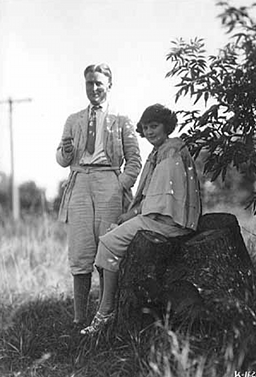
F. Scott and Zelda Fitzgerald

In fact, it won't be truly free to the American public until January 1, 2021 — and even then only if copyright terms aren't extended again. Thanks to the 1998 Sonny Bono Copyright Term Extension Act, no published US works will enter the public domain until 2019.1 Some countries have slightly saner copyright terms, but the U.S. Trade Rep is working diligently to use international agreements like the TPP to ratchet up terms around the world.

Still worse, a tragic 2012 Supreme Court decision declared that even once in the public domain, works can be yanked back out by Congressional action. Between excessively long copyright terms and the uncertainty of public domain status, creating new works that depend on the commons has become difficult and dangerous.

We feel the pernicious practical effects of lengthy copyright terms every day. For example, a study last year of books on Amazon showed that books published after the critical public domain cut-off date of 1923 are available at a dramatically lower rate than books from even an entire century before. The result is a "missing 20th century" in the history of books.

Nor is the problem confined to books. Another study by an MIT economist examined an archive of baseball magazines that included some issues in the public domain and some still burdened by copyright. By contrast, images from the public domain issues can be digitized and redistributed, and so their availability has greatly improved the quality—and thus increased the readership and editing engagement—of Wikipedia articles on baseball players from that era.

You may or may not care about particular baseball players from the 1960s, but the situation repeats itself over and over again across different fields. In the name of preserving profits for a handful of rightsholders, our cultural history is left to decay in legally imposed obscurity.

A diminished public domain doesn't just rob us of past works, but of the future works that could rely on an expanded public domain. Rightsholders have the power to veto derivative works simply by refusing to license the  works. And if the rightsholder can't be tracked down or confirmed — a real possibility when we’re talking about works that are nearly a hundred years old — the difficulty of getting a license can halt production altogether.

Ironically, this hurts the same studios that pushed the Copyright Term Extension Act in the first place. Adapting well-known works is a powerful way to reach an audience familiar with the characters and story, and a strong public domain provides fertile grounds for new works. For example, Disney’s early films mined the public domain freely, leading to classic versions of well-known fairy tales, but its lobbying for expanded copyright restrictions has deprived others — and the public — of the same possibilities.

Gatsby director Baz Luhrmann himself took advantage of the public domain with his 1996 film Romeo + Juliet. The movie was, of course, a heavily modernized and modified version of Shakespeare's classic play—exactly the kind of thing that a rightsholder might veto for "artistic integrity," if there were a Shakespeare "estate" that were as good at lobbying as Disney and the MPAA.

But it was also a critical and popular success, racking up nearly $150 million at the box office, and the world of film would be a poorer place without it. It should be obvious to Hollywood the value of the public domain as a critical component of a thriving creative culture—both in artistic terms and economic ones. Bloating the copyright term may have seemed like a fine way to protect that year's profits, but ultimately it comes at a great cost to both Hollywood and the public interest.

  • 1. That is, no published works will enter the public domain through copyright expiration. However, works by the U.S. federal government, for example, are never subject to copyright restrictions, and the authors of some private works like the animated film "Sita Sings the Blues" have waived all copyright obligations.
Related Issues: 

Share this: Share on Twitter Share on Facebook Share on Google+ Share on Identi.ca Share on Diaspora  ||  Join EFF
23 Apr 21:53

MPAA Tells US Government To Screw Over The Blind, Reject Fair Use

by Mike Masnick
Just this morning we were pointing out the MPAA's long history of attacking fair use. We noted that this often happened in international fora, where the MPAA and others would seek to block fair use in treaties and push rules that would limit or reject the possibility of fair use. And, just like clockwork, up pops an example. Apparently the "fair use defenders" at the MPAA are working overtime to get the White House to back down on promises concerning the decades-long negotiations for a treaty to help blind people not get screwed over by copyright law. The US has flip flopped on this issue over the past few years, but apparently had finally made some concessions that were allowing the process to move forward. The MPAA wants to kill all of that.
In Geneva this week the US government is taking a harder line in the WIPO negotiations for a treaty on copyright exceptions for the blind, and the reason is simple -- lobbyists for the MPAA and publishers have been all over the White House, demanding a retreat from compromises made in February, and demanding that the Obama Administration push new global standards for technical protection measures, strip the treaty text of any reference to fair use and fair dealing, and impose new financial liabilities on libraries that serve blind people. So far the industry lobbying has worked, and the White House has sided with publishers against blind people. Dan Pescod from the World Blind Union says the conditions the USA are imposing are so severe the treaty "won't work", if they are included in the final text.
I guess they figure that blind people don't watch too many movies, so screw 'em. Apparently, it's so bad that even some US negotiators find the MPAA's actions unseemly.
Some US negotiators are uncomfortable with the intensive lobbying by the MPAA and other publishers, but dismayed by the lack of backbone in the White House to resist such pressures.
Yup, those "fair use defenders" at the MPAA sure do have the public's interest in mind, huh?

Permalink | Comments | Email This Story


21 Apr 21:26

New Star Wars film yearly from 2015

Matthew

Hopefully that's not all quantity over quality.

Disney has said a new Star Wars film will appear yearly from 2015, alternating between new episodes in the space saga and spinoff character films.

The announcement, made at CinemaCon in Las Vegas, was reported by Comingsoon.

Star Trek director JJ Abrams will begin the new cycle of movies with Episode VII, from a script by Little Miss Sunshine writer Michael Arndt.

Star Wars creator George Lucas sold his film production company Lucasfilm to Disney last year for $4.05bn (£2.5bn).

The latest announcement was made by Walt Disney Co chairman Alan Horn, at the annual movie theatre convention CinemaCon in Las Vegas.

In February, Disney announced that alongside a new trilogy, a series of films built around existing characters from the Star Wars universe were in development.

It is rumoured the first stand-alone film could focus on the diminutive Jedi master Yoda.

The spinoff films will be written by Lawrence Kasdan and Simon Kinberg.

Yoda statue outside Lucasfilm's San Francisco officesThe character of Yoda was voiced by film director and puppeteer Frank Oz

Kasdan worked on the scripts of The Empire Strikes Back and Return of the Jedi - the second and third instalments of the first Star Wars trilogy while Kinberg is best known for his work on X-Men: The Last Stand and Guy Ritchie’s hit reboot of Sherlock Holmes, starring Robert Downey Jr.

‘Bad feeling’

Fan reaction to Disney’s announcement on social networks and film websites have been mixed. “Ridiculous”, tweeted The Mail Man, “I’ve got a bad feeling about this,” remarked Kurt Brookes, using one of the film’s famous lines.

“New Star Wars every year? My kids are overjoyed,” said Bryan Hitch.

Writing for Forbes magazine, Carol Pinchefsky, said: “The Twitterati are already concerned that there will be a Star Wars overload, that the movies will be “force marched” out as fast as Disney can make them.

“After all, Disney isn’t typically known for pumping out entries in a franchise this rapidly (Pirates of the Caribbean notwithstanding).”

The original Star Wars film, released in the UK in 1977, starred Mark Hamill, Carrie Fisher and Harrison Ford as they took on the evil Empire “in a galaxy, far, far away”.

In a recent interview George Lucas hinted at a cast reunion, revealing the trio were “in final stages of negotiation”.

21 Apr 19:01

In move to pwn boys, Girl Scouts to introduce game developer badge

by Sean Gallagher

On the heels of the Boy Scouts introducing a merit badge for game design, the Girl Scouts are going one better by developing a badge program to bring girls into the world of video game development. The effort is a collaboration between Girl Scouts of Greater Los Angeles and Women in Games International.

According to a report by Girl Gamer, the two organizations are developing an education program designed specifically for the Girl Scouts that meets the organization's requirements for skills badges. "Creating this badge will get young girls excited in technology and science and let them know that they, too, can have a career in the video game industry," WIGI Vice President Amy Allison told Girl Gamer.

Currently, the Girl Scouts of the USA offers four official badges in the area of science, technology, engineering, and mathematics (STEM) education—"Science of Happiness" and "Science of Style" badges being the only ones for older scouts. The Boy Scouts introduced a Game Design merit badge in March, but its description doesn't specifically call for actual game software development. The WIGI-GSLA effort will use Gamestar Mechanic, an educational development tool from E-Line Media, to allow scouts to develop and create their own video games.

Read 1 remaining paragraphs | Comments

21 Apr 18:58

How an accountant created an entire RPG inside an Excel spreadsheet

by Casey Johnston
A communique from the emperor, above, expresses interest at my formidable skill in killing bunnies and koalas with rocks.

Sometimes it's not always easy (or possible) to install your favorite games on your work computer. Sometimes, some Solitaire or maybe a little collaborative Bomberman is as much as you can get away with when you can't install anything downloaded from the Internet. And you'd better make sure whatever you're playing actually looks like work to any nearby screen snoopers around the office.

Throughout a few months ending this past February, Cary Walkin created the perfect solution to this problem: an entire RPG made of a spreadsheet and many macros. The game, called Arena.Xlsm, is a turn-based RPG encompassed entirely in an Excel file. Users can download that and use it to progress through levels, collect items, and battle enemies and bosses with melee and ranged attacks as well as spells.

Read 8 remaining paragraphs | Comments

21 Apr 18:34

Congress Quickly And Quietly Rolls Back Insider Trading Rules For Itself

by Mike Masnick
In November of 2011, the TV show 60 Minutes did a big expose on insider trading within Congress. While everyone else is subject to basic insider trading rules, it turned out that members of Congress were exempt from the rules. And, as you would imagine, many in Congress have access to market-moving, non-public information. And they made use of it. To make lots and lots of money. Of course, after that report came out and got lots of attention, Congress had to act, and within months they had passed the STOCK Act with overwhelming support in Congress to make insider trading laws that apply to everyone else finally apply to Congress and Congressional staffers as well. As that link notes:
The lopsided votes showed lawmakers desperate to regain public trust in an election year, when the public approval rating of Congress has sunk below 15 percent.
Of course, here we are in 2013 and, lo and behold, it is no longer an election year. And apparently some of the details of the ban on insider trading were beginning to chafe Congressional staffers, who found it hard to pad their income with some friendly trades on insider knowledge.

So... with very little fanfare, Congress quietly rolled back a big part of the law late last week. Specifically the part that required staffers to post disclosures about their financial transactions, so that the public could make sure there was no insider trading going on. Congress tried to cover up this fairly significant change because they, themselves, claimed that it would pose a "national risk" to have this information public. A national risk to their bank accounts.

It was such a national risk that Congress did the whole thing quietly, with no debate. The bill was introduced in the Senate on Thursday and quickly voted on late that night when no one was paying attention. Friday afternoon (the best time to sneak through news), the House picked it up by unanimous consent. The House ignored its own promise to give Congress three days to read a bill before holding a vote, because this kind of thing is too important to let anyone read the bill before Congress had to pass it.

And, of course, yesterday, President Obama signed it into law. Because the best way to rebuild trust in Congress, apparently, is to roll back the fact that people there need to obey the same laws as everyone else. That won't lead the public to think that Congress is corrupt. No, not at all.

Permalink | Comments | Email This Story