I guess I have to hand it to my conspiracy theorist friends. Again.
I guess I have to hand it to my conspiracy theorist friends. Again.
2. Techniques of persuasion can work on the AIs. Cialdini.
4. Many Chinese art museums are disappearing.
5. Delta is using price discrimination through AI.
6. Claims about alchemy. Big if true.
7. Bryan visits Spain. Not my views, but always of interest. I would be more focused on sectoral analysis, and which Spanish companies will hit it big in the near future. That perspective makes me somewhat more pessimistic, the Madrid area aside. A lot of Spain appears to be shrinking and not really coming back. Here is further commentary, in Spanish, from JFV.
The post Saturday assorted links appeared first on Marginal REVOLUTION.
What’s kind of amazing is that with the exception of Derek [Thompson], none of these writers even tried to question the standard interpretation of the data. They just all kind of assumed that although the national employment rate was near record highs, the narrowing of the gap between college graduates and non-graduates was conclusive evidence of an AI-driven apocalypse for white-collar workers.
But when people actually started taking a hard look at the data, they found that the story didn’t hold up. Martha Gimbel, executive director of The Budget Lab, pointed out what should have been obvious from Derek Thompson’s own graph — i.e., that most of the “new-graduate gap” appeared before the invention of generative AI. In fact, since ChatGPT came out in 2022, the new-graduate gap has been lower than at its peak in 2021!
In fact, the “new-graduate gap” is extremely cherry-picked. Unemployment gaps between bachelor’s degree holders and high school graduates for both ages 20-24 and ages 25+ look like they haven’t changed much in decades…
Overall, the preponderance of evidence seems to be very strongly against the notion that AI is killing jobs for new college graduates, or for tech workers, or for…well, anyone, really.
Here is the full post.
The post Noah Smith on the economics of AI appeared first on Marginal REVOLUTION.
Zephyr Teachout’s NYTs op-ed on grocery store prices is poorly argued.
The food system in the United States is rigged in favor of big retailers and suppliers in several ways. Big retailers often flex their muscles to demand special deals; to make up the difference, suppliers then charge the smaller stores more.
Let’s be clear about what is actually going on. Costco offers its suppliers lower prices in return for bigger orders. There is nothing anti-competitive about volume discounting. Moreover, are firms dismayed or are they eager to sell to big, bad Costco? Google AI gives a good answer:
…firms are eager to sell to Costco because of the immense potential for sales and brand exposure, but they must be prepared to meet stringent requirements, negotiate competitive pricing, and be able to handle high volume and demanding logistics.
Would Americans be better off without Costco? Doubtful given that more than one-quarter of all Americans pay for a Costco membership (either individually or as a family).
Teachout’s idea that suppliers “make up the difference” by charging smaller stores more is also economically incoherent. Profit-maximizing firms already charge what the market will bear. If Costco’s volume justifies a discount, that doesn’t mean suppliers can or should charge higher prices to other buyers. Yes, there are models where costs change with volume but costs could go down with volume and, in any case, those models don’t rely on the folk theory of “making up the difference.”
That’s one of the subtler mistakes. Here’s a more glaring one:
Consider eggs. At the independent supermarket near my apartment, the price for a dozen white eggs last week was $5.99. At a major national retailer a few blocks away, it was $3.99. (For an identical box of cereal, the price difference was $3.) Any number of factors may contribute to a given price, but market power is a particularly consequential one.
Read that again: the firm allegedly abusing market power is the one charging less.
It gets stranger:
New York City has a strong price gouging law on the books, which forbids anyone — suppliers and retailers — from jacking up prices during a state of emergency unless the seller’s own costs have gone up accordingly. The city couldn’t have stopped the bird flu that devastated flocks, but maybe it can stop suppliers from cynically exploiting a crisis to justify exorbitant prices.
This makes two errors. First, she acknowledges it’s not gouging if costs rise—then cites egg prices rising due to the bird flu devastating flocks. That’s literally a textbook case of a supply shock. Maybe some firms exploited the crisis—but eggs rising in price after millions of chickens are killed is the best example you’ve got???
Second, within the span of a few paragraphs, the op-ed veers from claiming large retailers charge prices that are unfairly low to blaming them for charging prices that are too high. I’m surprised she didn’t go for the trifecta and accuse them of colluding to charge the same price.
The post Gross(ery) Confusion appeared first on Marginal REVOLUTION.

Holy moly.
Jts5665In europe you are free to speak in accord with the government.
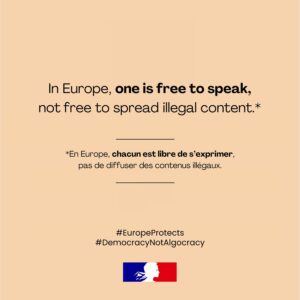
That is from the French embassy in the UK.
The post D’accord ! appeared first on Marginal REVOLUTION.
The Exoneration of Kirk Moore and the Trial of Pam Bondi
by Clayton J. Baker, MD at Brownstone Institute

An unjust law is no law at all.
If a law is unjust, a man is not only right to disobey it, he is obligated to do so.
Anyone in a free society where the laws are unjust has an obligation to break the law.
One has a moral responsibility to disobey unjust laws.
-Martin Luther King, Jr.
When the originator of natural law theory, the principal author of the Declaration of Independence, the greatest American Transcendentalist philosopher, and the patron saint of the American civil rights movement all stand in full agreement on a particular question of justice, the United States Department of Justice ought to pay heed.
When the case at issue is a signal act of conscience, courage, and protection of one’s fellow human beings, done in defiance of the greatest state-sponsored act of tyranny in modern history, the United States Department of Justice must either act appropriately or permanently besmirch itself.
Enter Dr. Kirk Moore and US Attorney General Pam Bondi.
From May 2021 through September 2022, during the Covid vaccine rollouts and the peak of Covid vaccine hysteria and coercion, Dr. Moore, a plastic surgeon practicing in Utah, issued false Covid-19 vaccination cards to patients who wished to avoid the shots, disposed of Covid-19 vaccines, and at parents’ request, gave saline shots to some children in lieu of actual Covid-19 vaccines.
In January 2023, Dr. Moore was charged by the US Department of Justice, then run by Biden-appointed Attorney General Merrick Garland, with offenses that could have totaled 35 years in prison.
What crimes was Dr. Moore accused of that would justify such long imprisonment? Was he killing his patients with deadly, barely tested vaccines? No, Kirk Moore was charged with much more heinous acts, like “Conspiracy to defraud the United States” (for allegedly issuing fake Covid vaccination cards), “Conspiracy to Convert, Sell, Convey, and Dispose of Government Property,” (for allegedly disposing of Covid-19 vaccines), and “Conversion, Sale, Conveyance and Disposal of Government Property and Aiding and Abetting” (for allegedly disposing of the vaccines and issuing saline injections instead).
Essentially, Moore was charged with “defrauding” the US government and destroying US government property. None of the charges accused him of harming or intending to inflict harm on his fellow citizens.
Since then, multiple changes in United States Government policy, and multiple case law decisions have demonstrated that the coercive vaccine-pushing policies of that time, to which Dr. Moore gave his patients an alternative, were indeed unconstitutional and unjust. For example, US military members who were dismissed for refusing the Covid shots have been reinstated with back pay, and as early as 2022, the Supreme Court ruled against OSHA for overreach regarding its vaccine mandates.
Numerous other lawsuits against abusive and coercive Covid vaccine policies have since succeeded, including this partial list:
Simply put, Moore was being prosecuted for defying state-sponsored tyranny, which has since been acknowledged by the courts, and even by the State itself. He took action to protect his patients from the US Government while it committed medically unethical, frankly unconstitutional, and, as it turned out, harmful and deadly acts against its own citizens. He did it for the benefit of his patients and at great personal risk.
The case against Moore and his co-defendants attracted national attention, which rose to a fever pitch at Moore’s recent trial. This happened in part because of its connection to the tyranny of the Covid vaccine rollout and “vaccine card” era, but also because of recently growing distrust surrounding the questionable motivations, potential conflicts of interest, and basic honesty of embattled current Attorney General Pam Bondi. Bondi, President Trump’s nominee and Garland’s replacement, had allowed the Moore case to proceed.
After 3 days of trial testimony, which by multiple accounts was not going well for the prosecution, and which was accompanied by large protests that were heavily covered on social media, Bondi announced on X that her DOJ was dropping the case.
Bondi tweeted the following explanation on X:
At my direction @TheJusticeDept has dismissed charges against Dr. Kirk Moore. Dr. Moore gave his patients a choice when the federal government refused to do so. He did not deserve the years in prison he was facing. It ends today.
Soon after, she added this:
This would not have been possible without @RepMTG [Georgia Congresswoman Marjorie Taylor Greene] who brought this case to my attention. She has been a warrior for Dr. Moore and for ending the weaponization of government.
Rep. Greene indeed supported Dr. Moore admirably and publicly. Nevertheless, for those who have followed the case closely, Bondi’s explanation of her own eleventh-hour rescue of Dr. Moore rings hollow, for several reasons.
First, the case has been a high profile cause celebre on social media for weeks heading into the trial, and has had an ongoing, if less intense, presence for well over a year. Numerous large platform influencers and politicians expressed public support for Moore, and outrage was widespread over the Trump DOJ’s continued pursuit of the case. It seems difficult to believe that an Attorney General – especially one as media-focused as Bondi – would only have found out about Moore’s case after day 3 of the trial.
Second, there is ample evidence that Bondi’s DOJ – likely with her knowledge – actively and deliberately continued to pursue the case against Moore right up until her sudden announcement.
According to independent journalist Robin Westenra, at the beginning of Bondi’s tenure as Attorney General, Dr. Moore’s legal team submitted a motion to dismiss the case, specifically directed to Trump’s brand-new Weaponization Working Group committee (WWG), which is overseen by the Attorney General – Pam Bondi – herself. The expressed purpose of the WWG is to end the abuses of the Biden DOJ. That motion to dismiss provided the perfect opportunity for Bondi to do what she had waited until mid-trial to do. The motion to dismiss, however, was refused by Bondi’s DOJ.
Furthermore, Bondi is under severe criticism for having recently dropped a DOJ case against none other than pharmaceutical giant and serial criminal corporation Pfizer. (Recall that Pfizer is both a manufacturer of the toxic Covid jabs that Moore protected his patients from, and the current record holder for the largest criminal penalty in Big Pharma’s sordid legal history, ever since DOJ handed it a $2.3 billion fine in 2009.) Again, Westenra reports:
In February 2025, directly after her [Bondi’s] confirmation, and while Dr. Moore’s case was being considered for intervention and dismissal by Attorney General Pam Bondi and the Weaponization Working Group (WWG) committee, her office made the controversial decision to end an active investigation into Pfizer’s operations in China and Mexico, specifically foreign corruption violations.
According to the Miami Herald, prior to becoming Attorney General, Bondi had represented Pfizer while in private practice with the Fort Lauderdale law firm Panza Maurer.
Talk about terrible optics for Bondi: First, her DOJ allows Pfizer – an established criminal corporation of record proportions and a chief villain of the Covid era and her former client – to skate, while simultaneously insisting on pinning the courageous little-guy hero Dr. Kirk Moore to the wall!
And we haven’t even mentioned Jeffrey Epstein yet.
As everyone knows, Pam Bondi is under intense public criticism regarding her self-contradictory and highly questionable proclamations about the Jeffrey Epstein files. Social media in the days surrounding the Moore trial overflowed with calls for Bondi to resign or be fired due to the Epstein issue, and reports of clashes between Bondi and assistant FBI Director Dan Bongino were widespread.
While it is cause for rejoicing that Dr. Kirk Moore is now free, his exoneration does not extend to Pam Bondi. The evidence suggests that she was in agreement with continuing Moore’s prosecution at the hands of Biden-era holdovers at the DOJ, until she felt compelled, both by public indignation and outside scandals of her own making, to finally act justly. At best – and as she suggested in her tweets – she just happened to be utterly clueless about a high-profile medical freedom case that also served as a vital test case for President Trump’s new Weaponization Working Group.
Meanwhile, as Bondi returns her attention to damage control regarding Jeffrey Epstein, not a single one of the real Covid criminals has faced charges of any kind through her DOJ. Anthony Fauci, Rochelle Walensky, Peter Daszak, Ralph Baric, Avril Haines, Deborah Birx, Stephane Bancel, Albert Bourla, and many others who perpetrated the greatest assault on human rights and civil liberties in our lifetime continue to walk free, completely unhindered by the United States Department of Justice.
Oh, well. All’s well that ends well, right?
Not exactly. Dr. Kirk Moore stood on trial, effectively for his life, and endured all the expense, anguish, and suffering associated with that ordeal. He had already spent 22 days in jail and faced the prospect of 35 more years behind bars, all for charges that ultimately were dropped at the last moment, most likely for political reasons. When tyranny is imposed upon the righteous, the process is often the punishment.
Is Dr. Moore a hero? I believe he is. I am confident that St. Augustine, Thomas Jefferson, Henry David Thoreau, and Martin Luther King, Jr. would agree with me.
Let’s not forget that before he became an American hero, Jefferson was a criminal with a price on his head.
When Jefferson signed the Declaration of Independence, he committed the high crime of treason against his country of Great Britain. It was punishable by death. He knew it, as did all the other signers. Nine of the 56 signers did not survive the Revolution, and 17 lost everything they had. It was not only for comic relief that Ben Franklin quipped at the time, “We must, indeed, all hang together or, most assuredly, we shall all hang separately.”
Henry David Thoreau went to jail for refusal to pay taxes in protest of slavery and the Mexican War. Martin Luther King, Jr. was arrested 29 times, and ultimately paid with his life for his activism – probably at the hands of the Deep State – the FBI files for which Pam Bondi has promised us, but to date has failed to deliver.
God knows exactly how, but Dr. Kirk Moore, a man who heeded the morality of St. Augustine, Jefferson, Thoreau, and King, has been relieved of further torment at the hands of Leviathan. He followed his conscience, and he has been delivered. The Lord works in mysterious ways.
What is to be done now? Here is my analysis.
Americans and free people everywhere should celebrate Dr. Moore’s exoneration and actively promote it as a victory for justice itself. Not only is a good man free from further persecution, but the vital message has been sent that – at least under this administration – it is possible to act according to one’s conscience against state tyranny without suffering personal annihilation.
We must realize that public attention and pressure can and do get results. The “little people” who supported Dr. Moore made a big difference. A new era of civic activism is upon us, bringing greater civic responsibility to us all. We must constantly and actively direct those in power to do the right thing, or too often they will fail to do so. Fortunately, we have the capacity to do so like never before.
We should thank Pam Bondi. Whatever the politics were that initially misdirected her with regard to the Moore case, ultimately, she acted with justice. Credit where it’s due, better late than never, and all that kind of thing. Despite her obvious shortcomings and despite the fact that she clearly lacks full institutional control of the DOJ at present, it is inconceivable that such a determination would have happened under Merrick Garland.
Finally, we should urge Ms. Bondi (and everyone in President Trump’s administration) to follow Dr. Moore’s example while in positions of power. The Moore case is behind Ms. Bondi. She still faces the Epstein debacle. She still has the entire Covid reckoning to address. She has many other concerns. Perhaps most problematic of all, she commands a holdover army of vindictive career bureaucrats who, if left unchecked, will continue the tyranny of the Garland DOJ.
Kirk Moore is a free man. Pam Bondi is on trial now. She is under tremendous public pressure to resign, as is the President to fire her. Her fate is uncertain.
However, Dr. Moore’s win is also a win for her and for President Trump as well. This case should demonstrate to the entire administration – indeed to the whole world – that acting justly, decisively, and according to conscience is a winning strategy. We free citizens must continue to insist that Pam Bondi, the DOJ, the Trump administration, and all leaders apply this strategy to every problem they face moving forward.
The Exoneration of Kirk Moore and the Trial of Pam Bondi
by Clayton J. Baker, MD at Brownstone Institute - Daily Economics, Policy, Public Health, Society
Mapping the Entire Field of Autism Causation Studies in One Article
by Toby Rogers at Brownstone Institute

It seems to me that the proper way to understand the autism epidemic is to read everything that has been written on autism causation, throw out any studies that are characterized by a financial conflict of interest or fatally flawed study design, and see what patterns emerge from the papers that are left. During my doctoral thesis I reviewed about 80 of the top studies in autism epidemiology and toxicology. That was groundbreaking at the time because the vast majority of mainstream scholars don’t have the courage to discuss any papers that threaten the profits of powerful industries.
As I’ve continued to work in this space over the last six years, I now realize that there are over 800 autism causation studies in the English language focused on the US. It’s daunting to think about trying to wrap one’s head around a field that large. So, most public health officials just grab a favorite study here or there to justify their biases, and that is exactly the wrong way to approach this topic. There has to be a better way of working through the available knowledge on this issue.
Now I believe that I’ve figured out how to map the entire field of autism causation studies (about 850 papers in all) in one article. If you sat down to read each article individually, it would likely take you several years. But as I will show below, you don’t necessarily have to do that. There is a way to move through all of the literature at a meta level that I believe leads to the right answer and a viable plan for how to stop the autism epidemic.
Let’s start with a quick introduction and then get into the different types of studies.
In the early 1980s, vaccines were so harmful that vaccine manufacturers routinely lost in court. They lobbied the US Congress to pass the 1986 National Childhood Vaccine Injury Act to give themselves liability protection. And they pinky-swore to make vaccines safer but there was no legal mechanism in the bill to enforce that promise so they never did.
Pharmaceutical companies proceeded to add as many vaccines as possible to the schedule. Prior to 1986, there were 3 routine vaccines totaling 7 injections. Today the CDC’s Maternal and Child and Adolescent vaccine schedules include 19 vaccines requiring 76 injections with 94 total doses of antigen (I’m actually less worried about the antigens than the other ingredients in the shots).

No one in a position of authority bothered to measure the impact of the growing vaccine schedule on the health of children. Most regulators were auditioning for a job with Pharma because that’s where the money is. Politicians depend on Pharma donations for their re-election campaigns. The mainstream news media get most of their revenue from Pharma advertising so they were never going to bite the hand that feeds them. Pharma invested heavily in public relations to lay siege to any remaining pockets of resistance.
Mercury (thimerosal) was grandfathered in as “Generally Recognized As Safe” because it’s easier to do that than actual safety testing. Aluminum adjuvants were allowed with only minimal safety testing — 1 man, 3 rabbits, and ever-moving goal posts (chapter 9 of my thesis covers the regulatory history of aluminum adjuvants). The gold rush was on so vaccine manufacturers were free to add whatever they wanted to vaccines and they would all be approved because the regulators and the medical industry were captured mind, body, and spirit by Pharma.
The autism rate skyrocketed in the 1990s and has continued to increase ever since. Rates of ADHD, life-threatening allergies, autoimmune disorders, asthma, childhood cancers, diabetes, and epilepsy soared too and those are probably vaccine injuries as well. But autism spectrum disorder (ASD) is more costly than those other conditions because it’s a lifelong disability with no known effective treatment (some parents have been able to recover their children through holistic and alternative therapies but the percentage who are successful in doing so is still in the single digits).

At that point, the people who created the autism epidemic had to pretend to look for the cause. But they had to make sure to never find the actual cause because then the flow of research funding would stop and lots of these doctors and scientists would go to jail or be hung from lampposts by angry parents of injured kids. So an entire industry was created to cover up the autism epidemic.
Since 2000, more than twenty scientific studies have concluded that there is no association between vaccines and autism. The most widely cited studies are:
Most of these are studies that claim no association between MMR or thimerosal-containing vaccines and autism, which is odd because the CDC’s own internal research shows that both of these types of vaccines do indeed cause autism (see 2014 statement from William Thompson and 2014 SafeMinds analysis of FOIA documents obtained from former CDC researcher turned GSK executive Thomas Verstraeten).
J.B. Handley also documents the conflicts of interests and fatal flaws in study design for most of these papers on a brilliant website called 14studies.com.
More recently, vaccine supporters have made a last stand with Hviid et al. (2019) but that study is also fatally flawed (for example the autism rate in their sample was more than 65% lower than in the general Danish population; see analysis in Hammond, Varia, and Hooker, 2025 and James Lyons-Weiler, 2019).
Furthermore, even though randomized, double-blind, placebo-controlled trials are the gold standard of biomedicine, none of the studies listed above has a proper control group of unvaccinated children (the Informed Consent Action Network provides the details here). The failure to conduct proper double-blind RCTs renders all of these studies scientifically invalid.
And just like that we’ve demolished the entire basis for the claim that vaccines do not cause autism.
In the 1990s, the Human Genome Project captured the public’s imagination and the government’s scientific spending. Claiming that autism is genetic was a win-win because it offered the hope that autism might be curable through genetic engineering.
The federal government then sank more than $2 billion into searching for the gene(s) for autism… and found nothing that explained more than 1% of cases.
Not to be outdone by the federal government, private foundations also sought to prove that autism is genetic and failed categorically.
The genetic explanation for autism has always been problematic because there is no such thing as a genetic epidemic — the human genome just doesn’t change that fast.
The Autism Genetic Resource Exchange (AGRE) was established in 1997 by the Cure Autism Now (CAN) foundation, a predecessor organization to Autism Speaks (which later merged with CAN in 2007). AGRE collected genetic (DNA) and phenotypic (clinical, behavioral) data from 2,000 families with at least one member diagnosed with ASD and made the data freely available to qualified researchers globally. This led to the production of 169 scientific journal articles but no major breakthroughs that get us any closer to understanding autism causation or treating autism symptoms. Below I’ll explain more why and how all of these gene studies fail in a similar fashion.
As readers of my Substack will remember, Jim Simons (1938 – 2024) was a billionaire hedge fund manager with a daughter with autism. He wanted to invest some of his wealth in addressing autism and many of the top scientists in the country took advantage of him by telling him that autism was likely genetic. Jim set up the Simons Foundation and proceeded to spend over $300 million searching for the gene(s) for autism. The Simons Foundation Autism Research Initiative (SFARI) launched a project called the Simons Simplex Collection (SSC) in 2007 that gathered genetic, clinical, and behavioral information from approximately 2,600 “simplex” families — those with one child diagnosed with ASD, unaffected parents, and typically one unaffected sibling. SSC has produced 132 peer-reviewed publications and identified “102 risk genes.” But it has produced no major breakthroughs that get us any closer to understanding autism causation or treating autism symptoms.
In 2010, the Autism Sequencing Consortium (ASC) was founded by Joseph Buxbaum at the Icahn School of Medicine at Mount Sinai, New York and supported by the Broad Institute and NIH. Like other multi-million dollar health studies, ASC launched with a breathless promotional article in a major journal. Rather than focusing on the whole genome, ASC focuses on sequencing the exome which is “the portion of the genome that contains all the exons, which are the protein-coding regions of DNA.” The claim is that the exome “represents a small percentage of the total genome, about 1-2%, but it contains a majority of the known disease-related genetic variations.”
To date, the ASC has sequenced approximately 50,000 exomes from ASD cases, unaffected siblings, and parents. A search of PubMed shows 22 peer-reviewed publications associated with ASC. In 2020 they published a paper highlighting the role of 102 genes in autism and in 2022 they identified 72 more. These sorts of studies produce excited headlines in the mainstream media but no breakthroughs that get us any closer to understanding autism causation or treating autism symptoms.
IN 2011, A COMPREHENSIVE STUDY OF TWINS AND AUTISM SHOWED THAT AUTISM IS NOT PRIMARILY A GENETIC DISORDER… AND THIS MADE NO DIFFERENCE IN THE TRAJECTORY OF THE INDUSTRY.
In the early 2000s, as the autism rate soared, political leaders in California wanted to better understand what was happening. So California contracted with sixteen of the best geneticists in the US and gave them access to all birth records in the state. They produced a study titled “Genetic heritability and shared environmental factors among twin pairs with autism” (Hallmayer et al., 2011) which is the most comprehensive study of twins and autism to date. They found that genetic heritability explains at most 38% of ASD cases; in two places they explain that this is likely an overestimate. So at least 62% of autism cases (and likely significantly more) are caused by something other than genes. But the search for the gene(s) for autism had already become a large and very profitable industry, and this study showing that autism is NOT primarily genetic did little to slow the growth of this field.
As the cost of genetic sequencing went down, Autism Speaks launched the MSSNG study in 2014. MSSNG is not an acronym; the leaders of the study just liked the way it sounded (it’s pronounced “missing”). They’ve sequenced the genomes of 13,801 individuals belonging to what they call family “trios” (two parents and one affected child) or “quads” (two parents and two affected children). To date, MSSNG has produced 138 peer-reviewed publications. They claim to have identified 134 “genes associated with autism” but again produced no major breakthroughs that get us any closer to understanding autism causation or treating autism symptoms.
Undeterred by the failure of all genetic research projects to date, the Simons Foundation massively expanded their genetic research portfolio with a new project in 2016 — the Simons Foundation Powering Autism Research for Knowledge (SPARK). As of 2025, SPARK has enrolled over 100,000 individuals with ASD and 250,000 total participants (including family members) across the US. Recruitment is facilitated by 31 clinical sites (mostly major pediatric research hospitals). To date, SPARK has produced over 40 peer-reviewed publications. Thus far they’ve identified “ten new autism-risk genes” but no major breakthroughs that get us any closer to understanding autism causation or treating autism symptoms.
STRAIGHT UP CENSORSHIP
As the failures of the Simons Foundation genetic research efforts mounted, rather than change course they hired the editor of Retraction Watch, Ivan Oransky, to push for retraction of studies that question the genetic narrative in connection with autism research. Given that there is an entire multibillion dollar industry built up around gene and autism studies, scientific journals are more than happy to accede to Oransky’s requests to censor the narrative on behalf of their patrons.
WHY STUDIES OF GENES AND AUTISM FAIL (THIS WAS KNOWABLE IN THE EARLY 2000S BUT MOSTLY IGNORED BECAUSE THERE WAS SO MUCH MONEY TO BE MADE)
The human genome contains 3.1 to 3.2 billion base pairs. When one feeds thousands of human genomes with several billion base pairs each into a computer and asks it to look for an association, it will certainly find many based on chance alone. But it’s the classic problem of “correlation is not causation.”
One of the world’s foremost epidemiologists, John Ioannidis, points out in “Why Most Published Research Findings are False” (2005) that only about 1/10th of 1% of these sorts of fishing expeditions (“discovery oriented exploratory research with massive testing” — usually nutrition and genetic studies with large numbers of variables) are reproducible.
As Sheldon and Gruber show in their book Genetic Explanations: Sense and Nonsense (2013) the entire theory of the case that single (or even multiple) genes code for a particular disease has unraveled in recent years.
Generally speaking, the Mendelian understanding of genes has been replaced in recent years by a completely different paradigm. British philosopher of science John Dupré at the University of Exeter argues in his book Processes of Life: Essays in the Philosophy of Biology (2012) that DNA is neither a blueprint nor a computer code for biological outcomes but rather a sort of warehouse that the body can draw upon for a range of different purposes:
The assumption that identifiable bits of DNA sequence are even “genes” for particular proteins has turned out not to be generally true. Alternative splicing of fragments of particular sequences, alternative reading frames, and post-transcriptional editing — some of the things that happen [naturally] between the transcription of DNA and the formatting of a final protein product — are among the processes the discovery of which has led to a radically different view of the genome.... Coding sequences in the genome are therefore better seen as resources that are used in diverse ways in a variety of molecular processes and that can be involved in the production of many different cellular molecules than as some kind of representation of even a molecular outcome, let alone a phenotypic one (pp. 264–265).
The people who actually study genetics know that, at least when it comes to autism, genetic determinism is dead. But there is a fortune to be made from pretending otherwise. So the story that is sold to government and private foundations is that the “genes for autism” are out there somewhere just waiting to be found if only they will keep the research money flowing.
Government plays along with this ruse because funding genetics research keeps scientists away from studying toxicants which might threaten powerful interests. The result is an entire multibillion dollar research industry that produces hundreds and hundreds of peer-reviewed articles that never get us any closer to understanding autism causation or providing a cure.
As the search for an “autism gene” repeatedly failed, geneticists came up with a placeholder theory that they call “genetic dark matter” patterned after the dark matter in astrophysics that is said to make up most of the universe — that astrophysicists cannot explain or measure. The idea is that a gene for autism must surely exist but that they do not have the tools to detect it yet. This has kept the grant money going for now. But the entire scheme is untenable.
For more on the boondoggle of the mythical search for the “gene(s) for autism” please see my article, “Nearly everything that we’ve been told about genes and autism is wrong” (2025).
The University of California, Davis launched the Childhood Autism Risks from Genetics and the Environment (CHARGE) study in 2003 to investigate environmental causes and risk factors for autism and developmental delay. It is led by one of the most respected and widely-published environmental epidemiologists in the world, Irva Hertz-Picciotto. CHARGE is a case-control study where researchers identify children age 2 to 5 with autism and compare them with similarly matched children without the diagnosis of autism. They have enrolled more than 2,000 autism families in their studies and produced foundational reports on the effects of:
To date, CHARGE has generated 144 peer-reviewed publications. But I recently discovered that none of their studies controls for vaccines (vaccinated vs. unvaccinated, number of vaccines, timing of vaccines, etc.) as a possible confounding factor — even though in many cases that information is available to them. The failure to control for vaccine exposures renders all of the CHARGE studies unreliable.
To be clear, all of the toxicants they study are a problem, can likely cause autism, and should be better regulated or banned. What I’m saying though is that one cannot measure the relative impact of each of these chemicals without including a variable for the potentially confounding effect of vaccines.
So for example, a brilliant CHARGE study, Shelton et al. (2014) found that mothers who lived within 1.5 km (less than 1 mile) of agricultural fields sprayed with various pesticides had elevated risks of autism in their offspring. But who is most likely to live that close to the fields? Farmworkers and other low income residents. So it is also possible that the children born to women who live closest to agricultural fields get lower quality vaccines through the Vaccines for Children Program and this explains the higher autism risk. Or perhaps these children were not vaccinated at all and the increased autism risk is entirely from pesticides. But we’ll never know the relative risk of each factor because Shelton et al. (2014) did not control for vaccination status.
Or take another example. Lots of CHARGE studies claim that supplementation with folic acid during the first month of pregnancy reduces autism risk. But vaccines and other toxicants can cause dysregulated folate metabolism. And for some of these women, supplementing with folic acid increases autism risk in their offspring because their bodies cannot convert folic acid to folate (see Raghavan et al. 2018). By failing to control for the number of vaccines taken by the mother before and during pregnancy, we are unable to unravel the relative effects of genetic mutations, vitamin supplementation, vaccines, and pesticides.
Why would some of the best epidemiologists in the world spend so much time, money, and effort and then make a mistake this basic? The answer is pretty straightforward — the field of autism research is so polarized and politicized that everyone involved with these studies knows that if they include vaccines as a variable they would instantly lose all of their research funding and be blacklisted from future research funding. That one, principled, and scientifically necessary decision would immediately and permanently end their careers. So they avoid the variable that shall not be named even though this omission renders all of their work unreliable.
I would just add that all of these mainstream autism causation studies fail in a similar way — they engage in circular reasoning (the logical fallacy in which the premise of an argument assumes the conclusion to be true).
CHARGE (and other epigenetic studies that I describe below) are following standard practice in epidemiology that typically does not consider vaccination status a confounding variable in examining environmental risk factors for autism. But that’s precisely the problem — standard practice in each of these research fields assumes away the question of vaccines rather than studying it. The political economy of autism causation research is such that these scholars will likely never fully understand the autism epidemic because they are prohibited from stepping outside the constraints of circular reasoning (not because they are bad people per se but because assuming away politically explosive problems is how these professions survive in the face of overwhelming corporate power).
In 2006, the UC Davis MIND Institute launched the Markers of Autism Risk in Babies – Learning Early Signs (MARBLES) study. MARBLES is a prospective longitudinal study for pregnant women who already have a biological child with autism. Information about each participant’s genetics and environment is collected through a number of sources, including:
To date they have enrolled 460 pregnant women with an 84% retention rate. One branch of the MARBLES study produced 71 peer-reviewed publications. Another branch — that studied fecal microbiome, the fecal glycome, and measures of household environmental exposures in infants who do and do not subsequently develop autism — produced 80 peer-reviewed publications.
With a study design that comprehensive, one would imagine that they would be able to figure out autism causation fairly quickly. But once again, MARBLES studies do not control for vaccines (vaccinated vs. unvaccinated, number of vaccines for the mother and child, timing of vaccines, etc.) even though they have access to that information. The failure to control for these known and potentially large toxic exposures renders all of the MARBLES research unreliable.
When I was writing my doctoral thesis I was very impressed by epigenetic studies including MARBLES because they were so complex and looked at toxicological variables that most mainstream scientists lacked the fortitude to study. I read as many as I could and included detailed summaries in my thesis. But now that I know that they never controlled for vaccines I find these studies deeply troubling. MARBLES is a prospective study that follows women who already had one child with autism through a subsequent pregnancy and they never gave these women informed consent because they did not discuss with them the dangers of vaccines. For researchers to then turn these children — many of whom developed autism because of this lack of informed consent — into data for their peer-reviewed published papers, I believe violates the Hippocratic Oath, the Declaration of Helsinki, and the Nuremberg Code.
In 2007, the CDC launched the Study to Explore Early Development (SEED) — a multi-site, case-control study to identify risk factors and early indicators of autism spectrum disorder and other developmental disabilities in children aged 2 to 5 years. SEED has enrolled over 4,500 families, including more than 1,500 children diagnosed with autism, across multiple phases of the study. The study uses parental questionnaires, clinical assessments, biospecimen collection, and medical record reviews to gather data on genetic, environmental, and behavioral factors that may influence autism risk. The budget was over $5 million a year and the study is still ongoing. To date, the SEED study has produced 54 peer-reviewed publications. None of the SEED studies control for vaccines (vaccinated vs. unvaccinated, number of vaccines for the mother and child, timing of vaccines, etc.) even though they have access to that information. The failure to control for these known and potentially large toxic exposures renders all of the SEED research unreliable.
In 2008, the NIH and Autism Speaks launched the Early Autism Risk Longitudinal Investigation (EARLI) study — a multi-site prospective cohort study aimed at identifying environmental and genetic factors contributing to autism spectrum disorder. It enrolled over 260 pregnant mothers who already had a child with ASD, following the younger siblings through age 3 to examine possible environmental risk factors and genetic contributions for autism. The consortium includes Johns Hopkins University, UC Davis, Drexel University, the University of Pennsylvania/Children’s Hospital Philadelphia, and Kaiser Permanente Northern California.
One branch of EARLI (primarily looking at diet, nutrition, and phthalate exposures) produced 39 peer-reviewed publications; another branch (primarily looking at industrial air pollution and exposure to heavy metals) produced 40 peer-reviewed publications; and a third branch (primarily looking at air pollution from freeways and diesel-powered trucks) produced 9 peer-reviewed publications. But none of these studies controlled for vaccines (vaccinated vs. unvaccinated, number of vaccines for the mother and child, timing of vaccines, etc.) thus rendering all of the EARLI results unreliable.
The best case I can make for these large epigenetic studies is that the researchers assume that everyone is vaccinated and everyone got the same vaccines at the same time so they don’t need to include that variable. None of that is true, but just for the sake of argument let’s pretend that the researchers believe this. The large epigenetic studies then measure the harms from other toxicants in addition to the base rate that includes the fact that everyone is vaccinated. But that’s not necessarily true either. There are likely synergistic effects between various toxicants, vaccines, and systems in the body (endocrine, immune, digestive, etc.) so we cannot know the relative harms from these other toxicants without knowing what vaccines the person has already received.
Anything that causes an immune activation event — an infectious disease, a toxicant, or a vaccine — can cause autism. But research from Thomas and Margulis (2016) shows that the autism rate in children with no vaccines is 1 in 715 and the autism rate in vaccinated children is 1 in 31. So these large epigenetic studies that fail to control for vaccines can help explain the 1 in 715 autism cases but they are unlikely to help us stop the autism epidemic unless they radically change their protocols.
One last note on this section: three large gene studies described above (ASC, SSC, and SPARK) share their data with the National Database for Autism Research (NDAR) which in turn shares its data with the Environmental influences on Child Health Outcomes (ECHO) Program. The four large epigenetic studies described here (CHARGE, MARBLES, SEED, and EARLI) all share their data with ECHO as well. Access to ECHO is controlled through the Eunice Kennedy Shriver National Institute of Child Health and Human Development (NICHD) Data and Specimen Hub (DASH). But gatekeepers at DASH make it nearly impossible for independent researchers to access the data (I’ve applied repeatedly and been turned away every time). So American taxpayers have spent several billion dollars generating autism data and the public cannot get access to it even as the autism epidemic grows larger every year.
The key study that helps us to understand the relative impact of the different toxicants that contribute to causing autism was led by Sally Ozonoff at UC Davis and it was published in 2018. Using a brilliant study design she showed that up to 88% of autism cases are characterized by autistic regression — the child was developing normally and then suddenly over the course of hours, days, or weeks the child lost eye contact, speech, and the ability to socialize with others. This suggests an acute toxic exposure and we now have eyewitness testimony from hundreds of thousands of parents that the acute toxic exposure that preceded the autistic regression was a “well baby” vaccine appointment with a pediatrician.
The holy grail in autism research is to find vaccinated vs. unvaccinated studies. Thankfully there are now six good studies that we can rely on.
GALLAGHER and GOODMAN (2008 and 2010)
Gallagher and Goodman (2008), using data from the National Health and Nutrition Examination Survey 1999–2000, found that boys who received all three doses of the hepatitis B vaccine (n = 46) were 8.63 times more likely (CI: 3.24, 22.98) to have a developmental disability including autism than boys who did not receive all three doses (n = 7).
Gallagher and Goodman (2010), using data from the National Health Interview Survey 1997-2002, found that boys “who received the first dose of hepatitis B vaccine during the first month of life had 3-fold greater odds for autism diagnosis (n = 30 with autism diagnosis and 7,044 without autism diagnosis; OR = 3.002; CI: 1.109, 8.126)” as compared with “boys either vaccinated later or not at all” (p. 1669).
And that’s just the effect of one shot. No one knows the effect of doing that 76 more times but that’s what’s recommended by the CDC Child and Adolescent Vaccine Schedule.
Anthony Mawson was a visiting professor of epidemiology at the Jackson State University School of Public Health with a thirty-year career in epidemiology and a long publishing track record including two publications in the Lancet. In 2017, Mawson and his co-authors designed “a cross-sectional survey of homeschooling mothers on their vaccinated and unvaccinated biological children ages 6 to 12” and they worked with the National Home Education Research Institute, a homeschool think tank, to implement the study. They obtained results for 666 children of which 405 (61%) were vaccinated and 261 (39%) were unvaccinated. The study controlled for race, gender, adverse environment (not defined), antibiotic use during pregnancy, preterm birth, and ultrasound during pregnancy.
As one would expect, they found that vaccinated children were significantly less likely than the unvaccinated to have had chickenpox (7.9% vs. 25.3%; OR = 0.26; CI: 0.2, 0.4) and whooping cough (pertussis) (2.5% vs. 8.4%; OR = 0.3; CI: 0.1, 0.6).
The results for chronic illness were a different story. Vaccinated children were significantly more likely than the unvaccinated to have been diagnosed with
Mawson, Bhuiyan, Jacob, and Ray (2017b) conducted a separate analysis of the data on preterm children (aka “premies”), vaccination status, and health outcomes. The authors found:
If Mawson et al. (2017b) are correct, then the high rates of NDD amongst children born preterm may be due almost entirely to the effect of vaccination, rather than the early arrival.
HOOKER and MILLER (2021)
Brian Hooker at Simpson University in California and independent researcher Neil Miller (2021), using survey data from respondents associated with three medical practices in the US, compared vaccinated children to unvaccinated children for the incidence of several chronic health conditions including autism. Vaccinated children were significantly more likely than unvaccinated children to be diagnosed with:
Vaccinated children were less likely to be diagnosed with chickenpox (OR = 0.10, 95% CI 0.029 - 0.36). But that’s a bad trade to make (increases in lifelong chronic illnesses in return for a decrease in a temporary rash).
The findings in this study on the relationships between vaccination and breastfeeding status and the relationship between vaccination and birth delivery status are particularly shocking:
Children who were “vaccinated and not breastfed” had a more than 12-fold higher risk of autism (OR = 12.5, p < 0.0001).
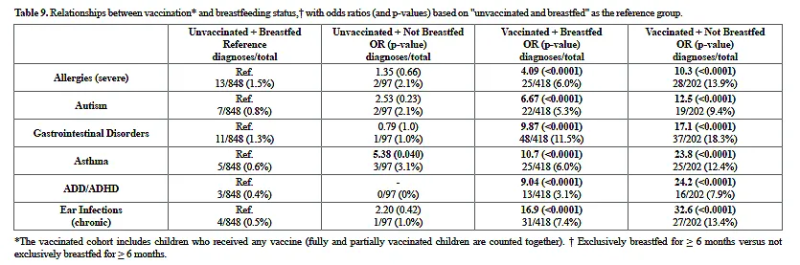
Children who were “vaccinated and delivered via cesarean section” had a more than 18-fold higher risk of autism (OR = 18.7, p < 0.0001).

These are the highest odds ratios I’ve ever seen in any study of autism causation. In a just world the findings from this study would have been front-page news across the country and immediately led to Congressional hearings and regulatory action against vaccine makers, formula makers, and obstetricians/hospitals with high c-section rates. But because the mainstream media and the political system in the US are completely captured by Pharma this study received little mention at all.
MAWSON and JACOB (2025)
Anthony Mawson and Binu Jacob returned with another groundbreaking study in (2025). The study population comprised children born and continuously enrolled in the Florida State Medicaid program from birth to age 9. The analysis of claims data for 47,155 9-year-old children revealed that:
1. vaccination was associated with significantly increased odds for all measured neurodevelopmental disorders (NDDs);
2. among children born preterm and vaccinated, 39.9% were diagnosed with at least one NDD compared to 15.7% among those born preterm and unvaccinated (OR = 3.58, 95% CI: 2.80, 4.57); and
3. the relative risk of autism spectrum disorder increased according to the number of visits that included vaccinations. Children with just one vaccination visit were 1.7 times more likely to have been diagnosed with ASD than the unvaccinated (95% CI: 1.21, 2.35) whereas those with 11 or more visits that included vaccinations were 4.4 times more likely to have been diagnosed with ASD than those with no visit for vaccination (95% CI: 2.85, 6.84).
We know what’s causing the autism epidemic. The bloated, unscientific, profit-driven CDC vaccine schedules are causing the autism epidemic. The US must immediately shift to a science-based, individualized, N-of-1 approach to immunization, with no liability protection for vaccine makers or the medical profession, and only those vaccines shown to produce more benefits than harms allowed on the market.
Mainstream studies that attempt to prove that vaccines do not cause autism are all invalid because they do not have a proper unvaccinated control group.
The over $2 billion spent searching for the “gene(s) for autism” has not been a good investment — other than to definitively rule out genes as the primary driver of the epidemic.
The large epigenetic studies are somewhat better designed and show courage in investigating toxicants made by powerful industries. Unfortunately their failure to control for vaccination exposures renders all of their conclusions unreliable.
So that leaves us with six very good vaccinated vs. unvaccinated studies that show that vaccines cause autism. Vaccination in general seems to increase autism risk about 4-fold (the range across these six studies is 3.002 to 8.63). Vaccinating premies (OR = 14.5), vaccination + c-section delivery (OR = 12.5), and vaccination in the absence of breastfeeding (OR = 18.7) causes autism risk to skyrocket. That’s what’s causing the autism epidemic, according to the best available scientific evidence.
The takeaway from all of this is that the entire field of autism research is a shambles. Parents of autistic children are spending what little money they have to fund proper scientific research while corporations, foundations, and the government use their considerable power to cover up the causes of the epidemic.
The good news is that tens of thousands of parents appear to have figured it out. The best available scientific evidence suggests that we can stop the autism epidemic by only allowing beneficial vaccines on the market (a couple of live virus vaccines) and giving them, if at all, under conditions of informed consent at later ages when the body’s immune system can respond appropriately. Reducing the over-use of c-sections and birth drugs and supporting breastfeeding are also likely to produce large reductions in the autism rate. Somewhat smaller but still significant reductions in the autism rates are also likely through reducing all toxic exposures (including air pollution, pesticides, endocrine disruptors, other pharmaceuticals, etc.) for everyone.
Here’s the entire story in one infographic:
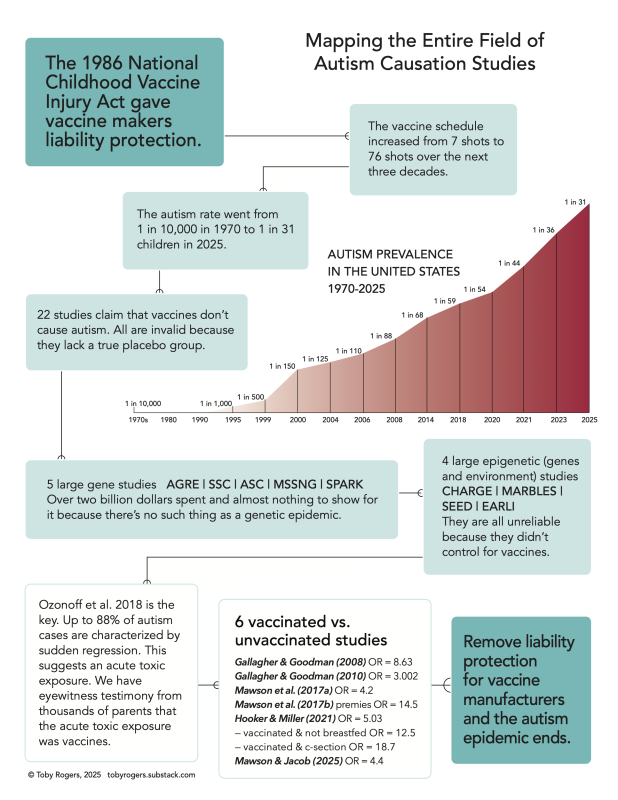
You can also download it as a PDF:
Update, May 22, 2025:
An astute reader pointed out that there are a handful of independent studies of other toxicants in addition to the studies I’ve described above. This is true and I covered them in my thesis. But I will mention a few of them here:
Palmer et al. conducted a couple of fascinating studies on coal-fired power plants and autism (2006 and 2009). Like the pesticide study I mentioned above, the failure to control for vaccines is a major limitation of these studies.
I like the two landmark EMF and autism studies by Martha Herbert and Cindy Sage (2013a and 2013b). These studies mostly focus on the impact of EMF on cells, so they cannot control for vaccines per se.
Stephen Schultz has done groundbreaking studies on Tylenol and autism (2008 and 2016) although I really wish those studies would have controlled for vaccines because that’s a major confounding factor. Bauer et al. (2018) is a systematic review of 9 Tylenol studies, although again, a failure to control for vaccines makes the effect sizes unreliable.
And then there are many independent studies outside the US that are intriguing. For example, Larsson et al. (2009), in a study initially designed to look at allergies found that vinyl flooring in the parents’ bedroom was associated with an increased risk of ASD by 140% (OR = 2.4; CI: 1.31, 4.40). Vaccines were not controlled for and may be a confounding factor.
I imagine that we could pull together another 50 to 100 studies of toxicants that increase autism risk. But in my experience none of them control for vaccines even though they are a major confounding factor and none will have odds ratios as high as the six vaccinated vs. unvaccinated studies described above.
Republished from the author's Substack
Mapping the Entire Field of Autism Causation Studies in One Article
by Toby Rogers at Brownstone Institute - Daily Economics, Policy, Public Health, Society
Germany’s environmentally destructive technocracy.
Hat-tip: Blackout News here.
In the Reinhardswald near Kassel, known as the Fairytale Forest, a previously untouched natural and cultural landscape with trees over 500 years old, is today being irreversibly destroyed. Why? To protect nature and the climate, the wind industry and green proponents claim.

How it’ll look when it’s done.
It’s a great environmental tragedy and crime against nature
The region, which plays a central role in the fairy tales of the Brothers Grimm, is being transformed into a large-scale industrial construction site comprising of 18 large scale turbines.
To build the 244-meter-high wind turbines, large roads are cut into the forest, thousands of trees felled, slopes leveled and large quantities of gravel piled up on the forest floor. All this will cause irreversible damage and destruction to the forest biotope. Critics and conservationists emphasize that the extent of the destruction goes far beyond what one would expect from the construction of a wind turbine in an open field.
The local population, in particular the seven surrounding communities, are protesting unitedly against the project and have organized themselves into citizens’ initiatives. But despite the opposition and ongoing legal proceedings, construction work is progressing rapidly. The project’s critics say the destruction is taking place under the guise of the energy transition and the concerns expressed by the regional population are being totally ignored.
The Reinhardswald, which once embodied German romanticism, is being turned into an industrial area where nature, culture and history are being lost. The fairy-tale forest is becoming a memorial symbolizing the victory of technocracy over attachment to the homeland and the irretrievable loss of a unique ecosystem.

 Below is my column in the New York Post on the controversial dissenting opinion of Justice Ketanji Brown Jackson in the injunction ruling in Trump v. CASA on Friday. The opinion seemed to fan the flames of “democracy is dying” claims of protesters, suggesting that basic limits on injunctive relief could result in the collapse of our core institutions. It was a hyperventilated opinion better suited to a cable program than a Court opinion. The response from Justice Amy Coney Barrett was a virtual pile driver of a rebuke. What was notable is that a majority of the justices signed off on the takedown. It could indicate a certain exasperation with histrionics coming from the left of the Court in recent years.
Here is the column:
For most citizens, the release of Supreme Court opinions is about as exciting as watching paint dry, particularly in a case dealing with the limits of district courts in issuing universal injunctions.
Yet Friday’s Trump v. CASA case included a virtual slugfest between Justice Amy Coney Barrett and Justice Ketanji Brown Jackson.
The decision was one of the biggest of the term. The Court moved to free the Administration from an onslaught of orders from district judges seeking to block the President in areas ranging from the downsizing of government to immigration.
However, it was the departure of the normally staid court analysis that attracted the most attention.
The tenor of Jackson’s language shocked not just many court watchers, but her colleagues. It seemed ripped from the signs carried just a couple of weeks earlier in the “No Kings” protests.
The Court often deals with issues that deeply divide the nation. Yet it tends to calm the waters by engaging in measured, reasoned analysis — showing the nation that these are matters upon which people can have good-faith disagreements.
But that culture of civility and mutual respect has been under attack in recent years.
Not long ago, the Court was rocked by the leaking of the draft of the Dobbs decision overturning Roe v. Wade. That was followed by furious protests against conservative justices at their homes and an attempted assassination of Justice Brett Kavanaugh.
There was also a change in the tenor of the exchanges in oral argument and opinions between the justices.
Recently, during the argument over the use of national injunctions in May, Chief Justice John Roberts was clearly fed up with Justice Sotomayor interrupting government counsel with pointed questions and commentary, finally asking Sotomayor, “Will you please let us hear his answer?”
This hyperbole seemed to border on hysteria in the Jackson dissent. The most junior justice effectively accused her colleagues of being toadies for tyranny.
It proved too much for the majority, which pushed back on the overwrought rhetoric.
While the language may seem understated in comparison to what we regularly hear in Congress, it was the equivalent of a virtual cage match for the Court.
Some of us have argued that our system is working just as designed, particularly as these issues work through the courts. The courts have ruled for and against this Administration as they struggle with the difficult lines of authority between the branches.
Liberals who claim “democracy is dying” seem to view democracy as getting what you want when you want it.
It was, therefore, distressing to see Jackson picking up on the “No Kings” theme, warning about drifting toward “a rule-of-kings governing system”
She said that limiting the power of individual judges to freeze the entire federal government was “enabling our collective demise. At the very least, I lament that the majority is so caught up in minutiae of the Government’s self-serving, finger-pointing arguments that it misses the plot.”
The “minutiae” dismissed by Jackson happen to be the statutory and constitutional authority of federal courts. It is the minutiae that distinguish the rule of law from mere judicial impulse.
Justice Barrett clearly had had enough with the self-aggrandizing rhetoric. She delivered a haymaker in writing that “JUSTICE JACKSON would do well to heed her own admonition: “[E]veryone, from the President on down, is bound by law.” Ibid. That goes for judges too.”
She added, “We will not dwell on JUSTICE JACKSON’s argument, which is at odds with more than two centuries’ worth of precedent, not to mention the Constitution itself. We observe only this: JUSTICE JACKSON decries an imperial Executive while embracing an imperial Judiciary.”
In other words, the danger to democracy is found in judges acting like kings. Barrett explained to her three liberal colleagues that “when a court concludes that the Executive Branch has acted unlawfully, the answer is not for the court to exceed its power, too.”
The last term has laid bare some of the chilling jurisprudence of Justice Jackson, including a certain exasperation with having to closely follow the text of laws. (In an earlier dissent this term, Jackson lashed out against the limits of textualism and argued for courts to free themselves from the confines — or shall we say the “minutiae” — of statutory language). In this opinion, Barrett slams Jackson for pursuing other diversions “because analyzing the governing statute involves boring ‘legalese.'” Again, what Jackson refers to as “legalese” is the heart of the judicial function in constraining courts under Article III.
Untethered by statutory or constitutional text, it allows the courts to float free from the limits of the Constitution.
For many, that is not an escape into minutiae but madness without clear lines for judicial power.
Jonathan Turley is the Shapiro Professor of Public Interest Law at George Washington University and the best-selling author of “The Indispensable Right.”
N.B.:this column is slightly longer than the one that appeared in the NY Post.
After decades of running Gristedes Supermarkets, the iconic Manhattan-based grocery chain, billionaire John Catsimatidis says one thing could cause him to throw in the towel: if 33-year-old socialist Zohran Mamdani becomes the next mayor of New York City.
“We may consider closing our supermarkets and selling the business,” the 76-year-old entrepreneur told me. “We have other businesses. Thank God, we have other businesses.”
He went a step further, saying he might even move Red Apple Group, his conglomerate with assets in real estate, energy, and other industries, across the river.
“There’s the possibility we’d move our corporate offices to New Jersey. Why not?” he said. “Then you’d have four years of peace.”
Jts5665TED apparently has a no questioning of your government betters policy.
When Ideas Become Too Dangerous to Platform
by Maryanne Demasi at Brownstone Institute

Economist Professor Gigi Foster delivered a TEDx talk titled The Manipulators’ Playbook at the University of New South Wales (UNSW) in October 2024.
It was a bold examination of how, in times of crisis, fear and conformity can be deliberately harnessed by those in power to manipulate public behaviour and silence dissent.
Her message was a call to defend the freedom to question, to challenge authority, and to think independently.
The local TEDxUNSW team, who had worked closely with Foster to ensure her talk met TEDx standards, described it as “insightful and important.”
But when the video was submitted to TED’s US headquarters for publication on the organisation’s official YouTube channel, it was rejected.
The reason? The talk “did not adhere to the TEDx content guidelines.”
Foster’s talk drew on the Covid-19 experience, arguing that during the pandemic, the space for critical thought collapsed. Dissenters were vilified, and dialogue gave way to dogma.
She described how critics of mainstream Covid responses were smeared with labels—“a danger to public health…a tinfoil hat-wearing conspiracy theorist…probably a prepper or a cooker…almost surely a far-right extremist and probably racist to boot.”
Drawing comparisons with the Cultural Revolution and the rise of Nazi Germany, she warned that the marginalisation of dissent has deep historical roots—where enemies of the state are manufactured to maintain social control.
Foster recalled being labelled a “granny killer,” defamed online (despite never having a Twitter account), and receiving death threats for questioning lockdown policies.
“Well, I didn’t shut up,” she said. “And today, more than four years on… hundreds of books, academic papers, and tragic personal stories confirm I was right.”
“The lockdowns didn’t save lives. They were rather a massive human sacrifice induced by fear, politics, and money,” she added.
By December 2024, with the video still unpublished, TEDxUNSW informed Foster that the US team had flagged her talk for further review.
She was asked to submit additional evidence to substantiate her claims—particularly those relating to lockdowns, mass vaccination, and censorship.
Foster complied, providing a detailed annotation backed by peer-reviewed studies, public health data, and academic commentary. But it wasn’t enough.
On 22 December, the local team relayed a list of statements TED deemed “potentially contentious,” including her description of lockdowns as a “massive human sacrifice,” her comparisons to authoritarian regimes, and her criticisms of public health leaders.
Despite acknowledging that her arguments were “compelling,” TEDx informed Foster on 21 March 2025 that the talk had been formally rejected—and could not be published on any platform.
“We were truly disappointed that TEDx did not approve your talk,” the organisers wrote to Foster, “especially given how insightful and important your message is.”
Surprised—particularly after months of collaboration—Foster asked for an official explanation. TED’s US office responded:
Supporting open dialogue, thoughtful debate, and critical thinking about issues affecting local communities is an important part of TED and TEDx’s mission…[However] talks should not attack political and public health leaders, promote their own initiatives or business endeavours, denigrate those who don’t share the speaker’s own beliefs, use polarising ‘us vs. them’ language and divisive rhetoric, or broadly dismiss peer-reviewed research around science and health. Upon further review of the associated materials and talk content, we therefore determined that Foster’s talk did not adhere to the TEDx content guidelines and will not be added to our YouTube channel.”
Foster pushed back, arguing that her talk aligned with TED’s stated mission to “spread ideas that spark conversation, deepen understanding, and drive meaningful change.”
She said the rejection misrepresented her content and stressed that her statements were “backed by studies of high intellectual and scientific rigour.”
She provided citations covering everything from censorship and vaccine mandates to excess deaths and lockdown impacts.
But TED never responded—and still refuses to publish the talk on its platform.
The implications extend far beyond one speaker or one talk.
TED, a platform that built its reputation on hosting challenging, uncomfortable—even radical—ideas, now appears unwilling to engage with narratives that challenge institutional power.
Foster’s talk was not incendiary. It was measured, historically grounded, and supported by evidence. But it questioned the public health consensus—and that, it seems, is now off-limits.
This isn’t just ironic; it’s an abandonment of TED’s own mission.
TED has previously published talks on alien intelligence, psychic phenomena, and utopian futures. Yet a sober, data-driven critique of pandemic policies by a respected economist? That, apparently, was too dangerous to air.
And TED is not alone. Across the digital landscape, we’re witnessing a broader pattern. Platforms once celebrated for fostering open dialogue are quietly narrowing the boundaries of acceptable thought.
Foster’s message was a warning—about how powerful institutions can manipulate public perception, weaponise fear, and suppress dissent, all while cloaking themselves in the language of public good.
She urged audiences to stay alert to manipulation disguised as altruism and to “celebrate forums at which people are allowed and encouraged to think, discuss, critically analyse, and ponder aloud.”
Instead, TED became the very thing she warned against: a gatekeeper of permissible opinion, enforcing orthodoxy behind the smokescreen of “community guidelines.”
For a platform that once prided itself on promoting bold thinking, TED’s censorship of Foster’s talk is a moment of institutional retreat—and intellectual cowardice.
WATCH the full video uploaded by Brownstone Institute
Republished from the author's Substack
When Ideas Become Too Dangerous to Platform
by Maryanne Demasi at Brownstone Institute - Daily Economics, Policy, Public Health, Society
Why so few posts? Because the current political environment is exhausting. On many issues the major players are half right and half wrong, but no one wants to hear that. The crowds are either all-in on Trump or all-in on the opposition and trying to point out nuance is both unwelcome and more time-consuming than the news cycle allows. A few examples:
A few other thoughts before I likely join the ostrich party and stick my head in the sand and ignore this all:
Trump has been talking about this. I am not sure what version of the idea we might end up with, but let’s consider the idea in its abstract form. Let’s also put aside money laundering issues, and talk about “simple remittances.”
The United States has a partial monopsony power over Latino (and often other) migrants, as there are few comparable places to go. Some may switch to Spain, or stay in their home countries, but many will have to pay the tax, though of course they may send less money back home.
If elasticities were zero (unlikely), the US government would pull in 3.5 percent of the relevant flow of remittances. More likely, funds sent will decline, and tax revenue earned will decline as well. The former effect will strengthen the dollar against the Latin currencies, while the latter effect may weaken the dollar through the indirect mechanism of domestic output being lower. I think most economists would expect the dollar to strengthen on net, as in essence the tax makes it costlier to sell dollars. (As a side effect, the tax might accelerate a transition to weirder, harder to tax forms of crypto?)
So US exporters suffer a modest amount from the stronger USD, and US consumers gain from modestly cheaper imports. Family members back home in the receiving countries are worse off, as they are receiving less in terms of real transfers, due to the tax.
It is less clear how much the receiving countries are worse off on net. This is easiest to see in the case of El Salvador, which has dollarized. If fewer remittances are sent to El Salvador, other dollar holders in the country may be better off. In this regard remittances have a partial zero-sum component. It is not right to say they are purely zero-sum, because the remittance is “the market” sending funds to where the demand to hold those funds is highest, and furthermore El Salvador as a whole has greater net command over imports. Still, from another point of view it is a kind of domestic inflation for El Salvador and it taxes their cash balance holders.
In any case, you also can think of this as a funny, quite indirect way of auctioning off the right to come and send money back to your family. Gary Becker once suggested a more direct auction of entry rights, an idea broadly popular with many economists. This particular form of the auction maintains an ongoing tax on the margin, rather than a once and for all payment up front, and thus might involve higher distortions. (on the other hand it eases credit constraints, since you do not pay up front) As a side note, this particular form of the auction mechanism also might discourage most of all the more altruistic and family-oriented migrants to a modest degree, or encourage some to try harder to bring their families with them. Those could be pretty small effects, but substitution effects are always worth noting.
As someone with broadly libertarian sympathies, I am strongly opposed to this tax. I think often the best way to analyze a tax is not with traditional deadweight loss tools, but rather to ask “does this allow the government to get its paws on a whole new source of revenue?” If it does, be very suspicious.
But if you are not libertarian in that manner, I do not see why you should hate this tax. It harms migrants and their relatives back home, but without necessarily harming those countries on net. And international trade economics, and economics more generally, has a long tradition of “nationalistic” points of view that focus on maximizing domestic welfare, not global welfare. I see those pop up all the time — for decades — without people screaming bloody murder (I am myself more Parfitian on these issues of course.)
Most Democrats I know really want to raise taxes. Many centrists feel the same way, though perhaps less strongly. So why should they hate this tax hike so much? My views on taxes differ, though I recognize that sometimes you have to raise taxes.
I think, at least in this case, that the broadly libertarian principles are the relevant factor here. I do not want the US federal government getting its paws on remittances as a revenue source. In turn, I hope other opponents of this policy — and I suspect there will be many — join me and become slightly more libertarian, and slightly more willing to focus on the question “does this allow the government to get its paws on a whole new source of revenue?”
We will see.
The post The 3.5 percent remittance tax appeared first on Marginal REVOLUTION.

A Pittsburgh nursing home, St. Andrew's Village, was invaded by a black bear, which clawed open a window to gain access to the elderly residents.
Connor Tabarrok points out that Starbucks is also a bit of a bank:
In 2011, Starbucks rolled out the ability to load money onto a virtual card via their mobile app. purchases made with these pre-loaded dollars earned extra rewards points, which could eventually be redeemed for free drinks. According to their quarterly report from this March, through the app pre-payment system and physical gift cards, Starbucks owes almost $2 billion in coffee to it’s customers.
…The company can treat this money as a 0% interest loan, and with about 10% of funds eventually being forgotten, it’s actually a negative interest loan.
Starbucks can make money on the float and it makes more money as interest rates rise. At $2 billion and 4% they can earn about $80 million annually on the float. Moreover, breakage (some money on the cards is never redeemed) is running at about 10% so that’s another $200 million a year for a grand total of $280 million or a little over 5% of the $5 billion in operating profit. Not a game changer but also not bad for free money.
As interest rates rise, the value to Starbucks of pre-loaded cards increases. So does the cost to users but I suspect supply incentives will dominate here so you can expect to see Starbuck’s pushing these cards.
The post The Bank of Starbucks appeared first on Marginal REVOLUTION.

The color revolution is here and it involves ... using your capitalist smartphone to summon a self-driving car and burn it?

Timothy Roeckel was hanging out in a luxury box at a Rockies game as a guest of the box's owner when, out of nowhere, a foul ball hit him right in the eye.
I often disagree with Marginal Revolution, but their post today made me a new level of angry:
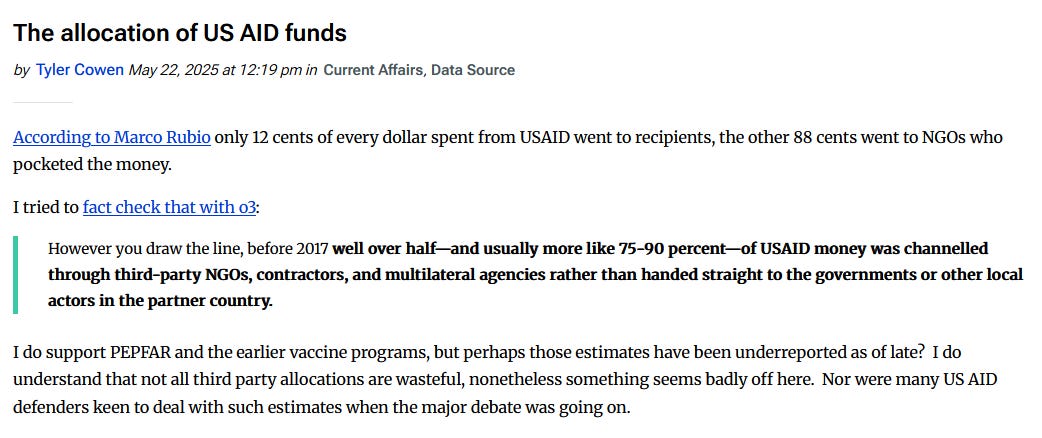
Commenters correctly point out that there’s a difference between regranting to other charities and “pocketing the money”.



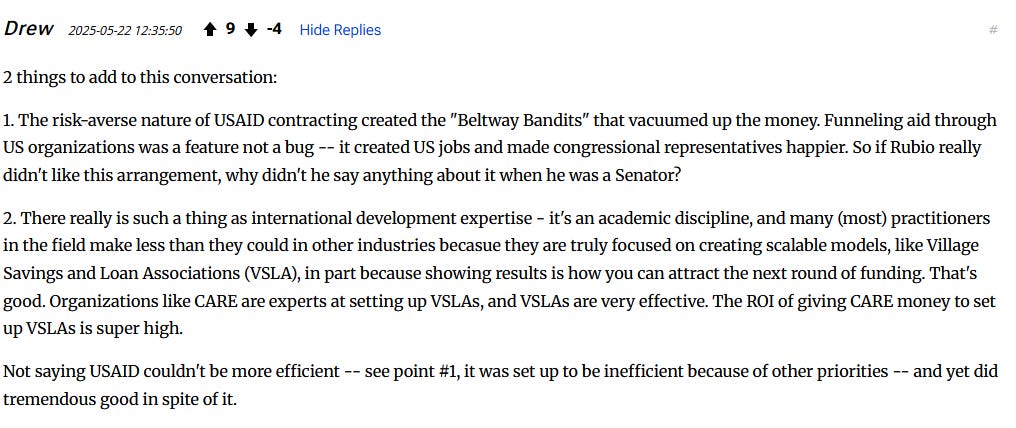

USAID is not, itself, a charity. It is an organization that funds other charities. Cowen/Rubio’s claim that “only 12% goes [directly] to recipients” is false, because 0% goes directly to recipients, because USAID is not set up in a way where this even makes sense. All USAID money goes through other charities. The 12% number seems to be the amount that goes through foreign organizations (including charities, charitable government programs, and charitably-minded forprofits), with the other 88% going through charities based in the US.
There are various reasons why USAID works with more US nonprofits than local nonprofits. These include fears that local nonprofits would be corrupt or inefficient, compliance issues, and Congressional mandates (for example, some programs involving food are required to source it from US farmers and US companies). Before the Trump cuts, USAID was working on ways to find and use more local partners, but this was a slow and difficult process. The same people who cry corruption when USAID works through US charities would definitely cry corruption if they worked through a foreign charity that turned out to be less than scrupulously honest. How many staff do you think it takes to prove that a hospital in Burkina Faso where nobody speaks English is definitely on the level? Is it really efficient for USAID to have all of these staff in house, for every hospital, for every cause area?
The organizations that accept USAID money take an overhead averaging ~30%1, then pass the rest onto recipients, or to even smaller, even more local organizations that take smaller overheads and pass it on to recipients. Overheads pay for salaries, facilities, compliance costs, and audits to make sure the money is reaching its intended targets. You will never have (and would not want) an overhead of zero.
Maybe Cowen thinks that 30% is too high an overhead? I asked o3 to estimate the overhead for the Mercatus Center, the libertarian charity that Cowen runs. It said that it was hard to give an apples-to-apples number because much of the administrative work that would be counted under “overhead” in other charities is covered by George Mason University. But it estimated that if the federal government gives a dollar of research funding to Mercatus, about 40% would go to combined university and Mercatus overhead - higher than the average USAID charity.
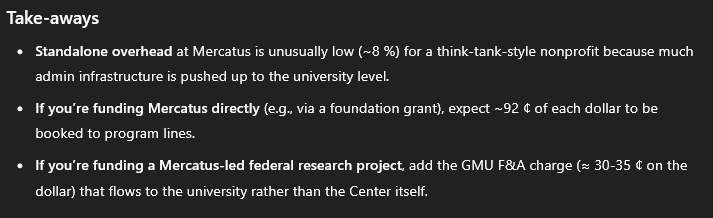
Or maybe he’s spooked by the admittedly-weird-and-incestuous world of charities that regrant money to other charities? I normally wouldn’t begrudge someone for being unnerved by this. But Cowen is the director of a charity that regrants money to other charities! Here is a typical cohort of Mercatus regrant recipients, including the Council of Christian Colleges, the NC Leadership Forum, and “Vibecamp LLC”.
(disclosure: I also take funders’ money and regrant it to other charities, although I would gouge my own eyes out with a spoon before giving it to Vibecamp)
Cowen and I both do regranting because it works, and because it’s really hard to have high-level charitable priorities without it. If I have $1 million or $1 billion and want to cure cancer, I may not personally have the right skill set to be a cancer researcher, or to found a cancer research lab, or to figure out which cancer research labs are good and need the most money. I might only know and trust someone in an organization that specializes in figuring out which cancer labs are good and connecting them to funders. Maybe I don’t even know that, and I only know and trust somebody who knows and trusts that person. These are things that sound silly to the uninitiated, but can quickly become your whole career once you start dabbling in charity.
USAID programs like PEPFAR have saved millions of lives, which suggests USAID does a pretty good job of deciding who to trust with their money. The Trump administration is trying to turn Americans against these programs by pretending that the money gets “pocketed” by intermediaries. This is a lie. PEPFAR is well-audited and the audits find between 0-2% unexplained expenses, which is lower than the average domestic US government program.
Not every program is this good. Some are cringe scholarships-for-underrepresented-women-in-permaculture garbage2. Others go over budget or accomplish less than hoped, because charity is hard. But the overall track record is outstanding, outright fraud is rare, and the cringe is less common than you think (because Rubio and Trump falsely attributed many cringe programs to USAID that it never funded at all).
Politics is nasty and sometimes involves lies. But the thousands of doctors, nurses, and charity workers who give up more lucrative careers elsewhere to save lives in the developing world are some of my heroes. I’ve talked to many of these people (see my father’s story of his time in this world here) and I couldn’t do what they do for a month, let alone a whole career. When Trump and Rubio try to tar them as grifters in order to make it slightly easier to redistribute their Congress-earmarked money to kleptocrats and billionaire cronies, this goes beyond normal political lying into the sort of thing that makes you the scum of the earth, the sort of person for whom even an all-merciful God could not restrain Himself from creating Hell.
Part of the joy of owning your own blog is getting to make absolutely sure that you never unintentionally give one iota of aid or comfort to these lies or anything remotely associated with them. If Cowen means something else, I think he should clarify it better. Otherwise, I think he should edit his post to make it less misleading.
I’m getting this from o3, since I wanted to match Cowen’s sources. It said that of the ~88% that it counted as going to third-parties, 20-35c went to overhead. Some of these charities then further regranted it to other charities, which total consumed another 5-10c. o3 gave some good sources, but I don’t know if these are the last word or if experts would fully endorse these numbers.
This is what I meant by the second-to-last paragraph of The Other COVID Reckoning. If a group both saves millions of lives, and funds some cringe women-in-permaculture scholarships, this doesn’t in any sense “cancel out”. It comes out millions of lives ahead. By all means try to get rid of the cringe stuff if you can, but not in a way where you throw the baby out with the bathwater.
According to Marco Rubio only 12 cents of every dollar spent from USAID went to recipients, the other 88 cents went to NGOs who pocketed the money.
I tried to fact check that with o3:
However you draw the line, before 2017 well over half—and usually more like 75-90 percent—of USAID money was channelled through third-party NGOs, contractors, and multilateral agencies rather than handed straight to the governments or other local actors in the partner country.
I do support PEPFAR and the earlier vaccine programs, but perhaps those estimates have been underreported as of late? I do understand that not all third party allocations are wasteful, nonetheless something seems badly off here. Nor were many US AID defenders keen to deal with such estimates when the major debate was going on.
The post The allocation of US AID funds appeared first on Marginal REVOLUTION.
…in recent years…Mississippi has become the fastest-improving school system in the country.
You read that right. Mississippi is taking names.
In 2003, only the District of Columbia had more fourth graders in the lowest achievement level on our national reading test (NAEP) than Mississippi. By 2024, only four states had fewer.
When the Urban Institute adjusted national test results for student demographics, this is where Mississippi ranked:
(Here is a great rundown of how the remarkable turnaround was achieved.)
…Black students in Mississippi posted the third-highest fourth grade reading scores in the nation. They walloped their counterparts in better-funded states. The average black student in Mississippi performed about 1.5 grade levels ahead of the average black student in Wisconsin. Just think about that for a moment. Wisconsin spends about 35 percent more per pupil to achieve worse results.
That is from Tim Daly at The Free Press.
The post Mississippi schools are pretty good appeared first on Marginal REVOLUTION.
Jts5665Should be 100%

This is one of my favorite highlights I've ever put up on this website. Toronto's Daulton Varsho, 2024's Gold Glove Award recipient, made a play last night that's both a highlight and a blooper and you have to see it to believe it.
 Brown University is under fire after putting a student journalist under investigation for an exposé on alleged administrative waste. The DOGE-type review of Alex Shieh embarrassed the school and certain officials. He was reportedly accused of falsely representing himself as a reporter because his newspaper, The Brown Spectator, is not a recognized student publication. The rationale seems strikingly weak and the investigation itself overtly retaliatory.
On March 17, 2025, The Brown Spectator student newspaper posted Bloat@Brown, a version of Brown’s organizational chart listing employees’ names, titles, and reporting relationships. Shieh then emailed 3,800 administrators asking them to explain what they did the prior week, an obvious duplication of Elon Musk’s famous emails to federal employees.
Staff were ordered by the university not to respond to the emails and Associate Director of Student Conduct & Community Standards Kirsten Wolfe told Shief that he was now under investigation for “access[ing] a proprietary University data system which maintains confidential … information” and using confidential information to build a public website.
She also alleged that Shieh was misrepresenting himself due to the lack of official recognition for his newspaper.
Shief was also told by Russell Carey, executive vice president for policy and planning, that he may be charged under the Code of Conduct for stating that Brown had lost $510 million in federal funding. Carey said that the assertion was false despite a New York Times article claiming just days earlier that the Trump administration was planning to cut $510 million from Brown.
The alleged violations are paper thin. First and foremost, the fact that the Brown Spectator is a new and unrecognized newspaper does not mean that it is not a newspaper. This was a journalistic enterprise. Indeed, it is precisely the type of investigative journalism that is at the core of protections for press freedom. As noted by FIRE, as a private institution, Brown is committed to free speech and free press values.
Moreover, the statement on the funding is based on national reporting. While there may be quibbles on language, it is insignificant against the thrust of the story that Brown could lose half a billion dollars.
Brown University had every right to tell its employees not to respond to the inquiry. However, its threatening of this student journalist is abusive and retaliatory. The school needs to drop this investigation and reaffirm its commitment to both free speech and the free press on campus.
My Heterodox Path
by Alex Washburne at Brownstone Institute

I shall be telling this with a sigh
Robert Frost
Somewhere ages and ages hence:
Two roads diverged in a wood, and I—
I took the one less traveled by,
And that has made all the difference.
I was born an orthodox scientist, plopped out onto a conveyer belt of conventional academic promise. My mom was a renowned molecular biologist and mentor who nurtured my scientific curiosity from a young age, who explained cells while we sat around the dinner table, who told me tales of photosynthesis catalyzing the conversion of carbon dioxide to sugar and oxygen when I was only 5 years old.
“What’s carbon dioxide?” I would ask.
“Great question!” my mom would exclaim with contagious enthusiasm. “The whole universe, everything you can see, feel, and touch, is made up of atoms…” She grabbed my arm and said “If you zoom in to your skin, you’ll find it’s made up of living bubbles called cells. If you zoom into cells, you’ll see they’re made up of even smaller things called molecules - fats, proteins, sugars, nucleic acids - and if you zoom into molecules, you’ll see they’re made up of building blocks called atoms. Carbon dioxide is a molecule, made up of one carbon atom and two oxygen atoms. Most of the air we breathe is made up of carbon dioxide…when we breathe in, we breathe in oxygen, and when we breathe out, we breathe out carbon dioxide…” She would go on, connecting the air I breathe out to the air plants breathe in to the sugars I ate in my cereal.
Suffice to say, born with such raw scientific privilege of a brilliant mom, I did well in school. I loved everything I studied, majored with two degrees - biology and applied mathematics - and almost had minors in chemistry and psychology. I did research as an undergraduate and I was accepted into a prestigious National Science Foundation Graduate Research Fellowship Program. I applied for many PhD programs and was accepted at Harvard, Stanford, Princeton, and more. I received a PhD from Princeton in a quick 4.5 years studying under a famous advisor - Dr. Simon Levin - and I went on to a postdoctoral fellowship at Duke University.
I continued along the path of academic orthodoxy, working on a DARPA-funded team studying bat virus spillover starting in 2017. I helped the team I worked with write a successful DARPA PREEMPT grant aimed at forecasting the spillover of bat henipaviruses and preempting the emergence of these dangerous viruses. I published papers, developed new and innovative methods at the frontiers of both mathematics and biology. I followed a primrose path pointing straight to the halls of the academy lined by portraits of academics past, with high hopes for my own portrait at the end of the hall.
That was then. The orthodox path I looked down in 2019 is now choked in fog, the regal halls and portraits are swallowed by flames, the academic dream is dead.
What happened? Where did I go awry?
At what point did I take the path less traveled by?
As a scientist, I can’t help but break down what I’ve observed into a series of concrete units of time and causality, events whose mysteries and reasons I can hope to understand. If I understand each event individually, perhaps the whole mess of events can make more sense.
The Covid-19 pandemic was the beginning of the end of my orthodox self-image. A series of events began to reveal that I am not conventional, and in these events not only did I realize I am not conventional, but I realized that the academy is unkind to the unconventional. Below are the events of interests, the unconventional stances I took, and the treatment received.
In late January to early February 2020, I had analyzed case growth rates in Wuhan, case reports finding high false negative rates of PCR tests, the classic Bavarian case study of transmission with unspecific symptoms, and more, and I came to believe a pandemic was inevitable. My estimates of case growth rates were much faster, and my methods differed from conventional methods because I had experience estimating growth rates of stocks with methods not commonly used in epidemiology. Faster case growth rates led to estimates of higher prevalence, increasing confidence in a larger subclinical iceberg of cases, setting back the estimated date of outbreak onset in places connected to Wuhan, decreasing the odds of traveler screening stopping a pandemic, and increasing the odds of a pandemic.
I tried to share my findings of 2-3 day doubling times with academics on my DARPA PREEMPT team, but one professor from Oxford memorably said he doesn’t have time for me and, simply put, has far more confidence in teams from Harvard, Imperial College London, and the London School of Hygiene and Tropical Medicine than “a postdoc in Montana.” The large institutions all estimate 6.2 day doubling times, low subclinical rates, and high odds of successful containment, so on their credentials alone he - my own teammate - did not have time for my heterodoxy. Others in my orbit were similarly averse, with one professor claiming that if I shared my results and I was wrong, it could get picked up by Fox News, trigger complacency, and I could be directly responsible for millions of deaths.
In this one instance, I chose to keep my findings private. These are the warnings the world never heard, the heterodox Cassandra told they are not an epidemiologist and pressured to stay in their lane. Instead of these findings informing people of an oncoming pandemic, they were used to help a hedge fund short the market.
Because I believed there was a higher prevalence and faster growth rate, I hypothesized there would be a surge of patients seeking care in major US metro areas like NYC by March-April 2020. As a consequence of this mathematical foresight, Justin Silverman, Nathaniel Hupert, and I kept our fingers to the pulse, monitoring the CDC’s influenza-like illness dataset reporting the fraction of patients visiting sentinel primary care providers with influenza-like illness (ILI).
We found a massive surge of patients in March of 2020. We converted this surge in the fraction of patients experiencing ILI to an estimate of the raw number: 8 million excess patients, far more than the <100,000 cases documented at that time. Our paper was picked by The Economist, and immediately we were attacked by fellow scientists (not random trolls) who accused us of disrupting the public health message, minimizing Covid (for more cases meant fewer deaths per case), and triggering complacency. Even within my own workplace, some of the scientists who discouraged me from sharing my February 2020 findings went further and began piling on in Twitter rants or even in our Slack channels, finding many opportunities to criticize me or frustrate my efforts to belong in the scientific community.
Under my theory, the theory which predicted a pandemic and the March 2020 surge with 2-day doubling times of ICU admissions across NYC providers, it was probable that the March-April 2020 surge in New York City ended because of the depletion of the susceptible population, a state of the population that prior to Covid we referred to as “herd immunity.”
If this were true, then we’d be able to compare future outbreaks to the NYC outbreak and find that future outbreaks saw cases peak at a population fatality rate similar to that of NYC. Jutsin Silverman and I developed a dashboard we would use to monitor outbreaks for comparison with the NYC curve and, in the summer of 2020, we saw many unmitigated outbreaks corroborate “The NYC Line.” The figures below take some time to understand, but they are essentially time-series on a timescale of burden, allowing us to compare at similar burdens the growth rates of outbreaks that take place on different dates.
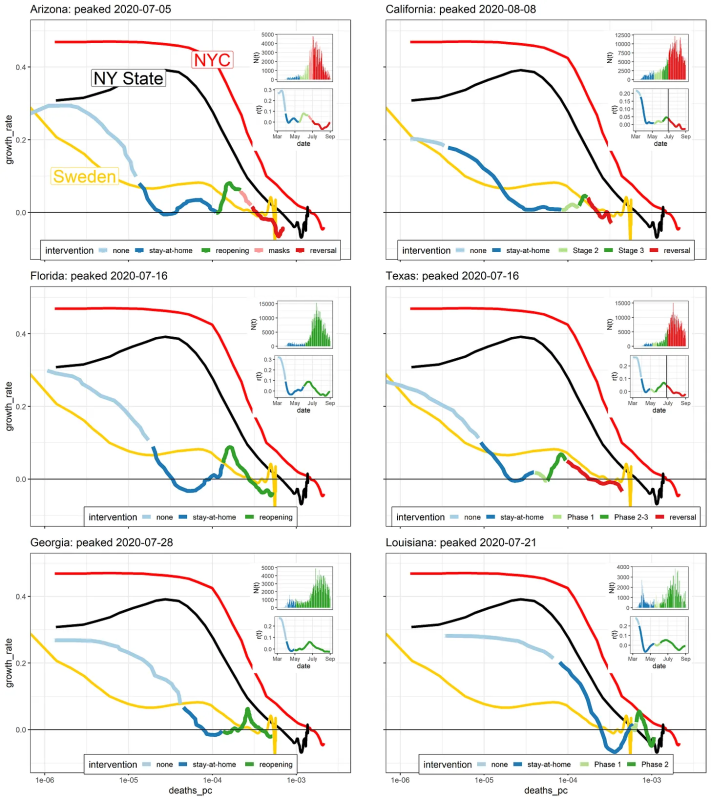
In August 2020, I shared these findings with the CDC forecasting team, providing context for future outbreaks - should the US outbreaks see cases peak at 1 death per 1,000 capita, my theory developed since February 2020 would provide an explanation why: herd immunity.
The fall 2020 outbreaks across the United States universally corroborated “The NYC Line” as an upper-bound quantile of outbreak intensity (both speed and burden), especially those outbreaks in states or counties that did little to mitigate the spread of Covid-19.
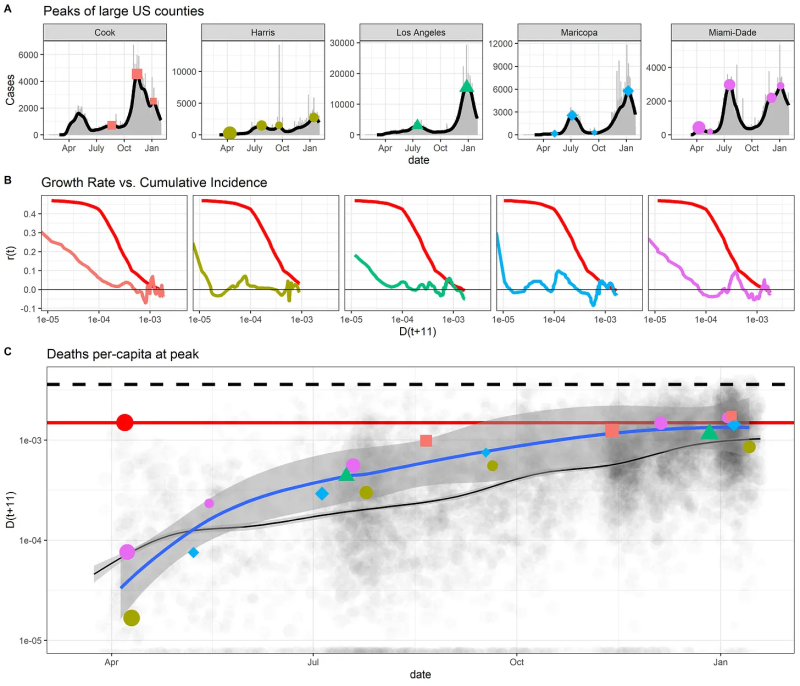
I made pretty figures that illuminated this finding beautifully. However, in the Fall of 2020 the Great Barrington Declaration (GBD) was written pointing out that our models may be overestimating the severity of the pandemic (which my findings also suggest) and containment policies may cause harm. While the GBD was called the “herd immunity” strategy, the authors didn’t mention herd immunity, although I personally believe that Fall 2020 outbreaks peaked due to herd immunity, as evidenced by their convergence with the NYC line. Below is the inferred phase diagram of all >3,000 US counties’ outbreaks funneling towards their peaks underneath the NYC line long before vaccines arrived and at burdens far less than conventional estimates indicated by the dashed line.
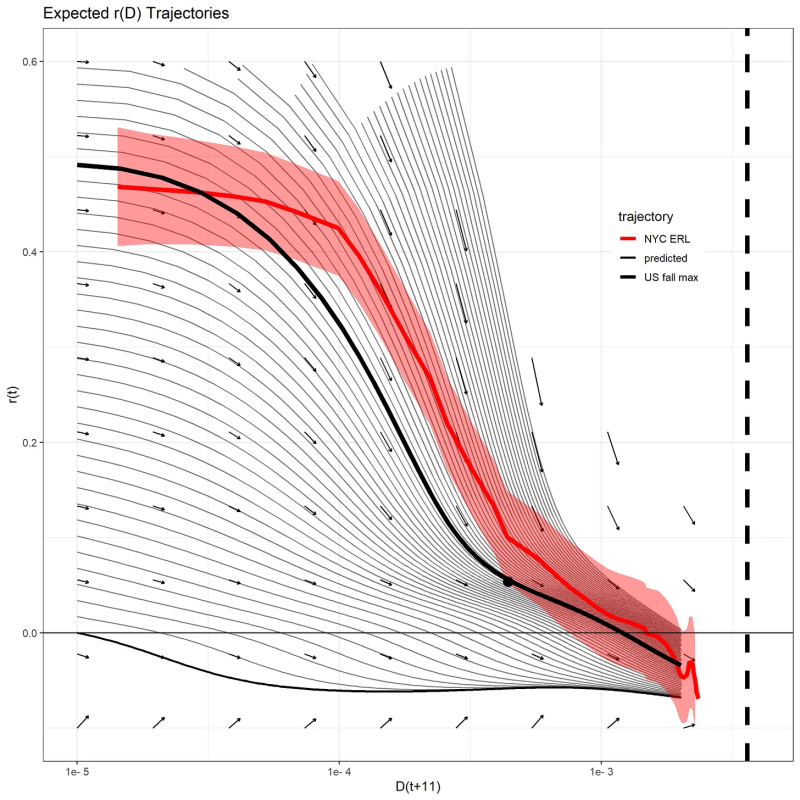
In October 2020, my postdoc advisor demanded I not share my findings. She was worried that my claims about herd immunity could disrupt her relationship with the state government, as the state government was giving her $1 million to do test and trace experiments on the campus population, experiments that were not needed under my theory. Under my theory, the state government ought to allocate resources towards tribal and rural communities that lack non-congregate housing and access to care, not toy around with experiments quarantining college students.
I left my position at Montana State University over these disagreements, ultimately drawing on the lesson I learned from the Covid short: if seeing something and saying something within my expertise goes against convention, then I would rather share my findings and be criticized than not share my findings and watch the world suffer in unprepared ignorance.
Dr. John Ioannidis is a renowned professor at Stanford. He wrote articles early in the Covid-19 pandemic arguing that we were making decisions in the face of uncertainty, that our policies could cause harm and the pandemic may not be as bad as forecasted by conventional teams.
Dr. Ioannidis became reviled by vocal academics on Twitter. These academics believed Ioannidis was a minimizer, and they would criticize him at every opportunity.
At one point, Dr. Ioannidis published a paper finding that academics with many Twitter followers didn’t actually have that many papers or citations; in other words the people centering themselves as “the experts” on Twitter may not actually the best people to consult for expertise. Dr. Ioannidis published the paper with Twitter handles, and many academics began a crusade claiming that publishing a paper with Twitter handles is unethical, a violation of IRB rules, and a form of harassment that could lead to scientists being targeted.
I dissented. I argued that this rule was being made up - Twitter handles are publicly available data and there is no need for an IRB to analyze and publish data in the public domain. Furthermore, many of the same people criticizing John Ioannidis for harassment of scientists had broadly shared and supported an MIT group publishing handles they labelled “anti-mask.” I argued that if there were any ethics at issue here, it’s the selective invention of research ethics outrage to attack Ioannidis, and the questionable ethics of scientists attaching derogatory labels like “anti-mask” to groups of people they color as anti-mask in their diagrams.
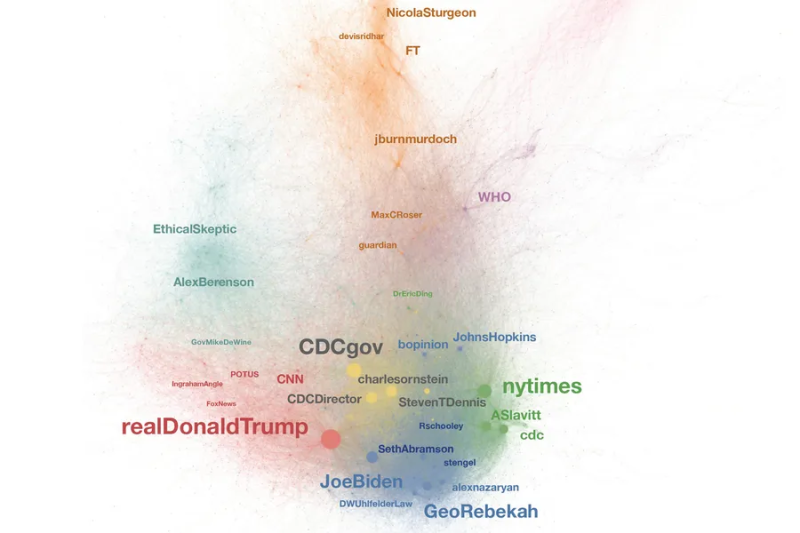
Under the hypothesis that Fall 2020 outbreaks peaked at herd immunity thresholds, the only way we can explain follow-up outbreaks is by a mix of waning immunity and immunoevasion.
I briefly touched my feet on the path of orthodoxy by working with a team at the London School of Hygiene and Tropical Medicine as they made sense of the first variant of concern, Alpha. I was working at hedge funds analyzing SPACs (special purpose acquisition companies, basically private equity vehicles for IPOs) and provided a punny “IPO” or “initial phylogenetic observation” analysis of the transmissibility of B.1.1.7.
Under my theory, however, we would expect to see Alpha cause larger waves in places with earlier outbreaks, presumably places that had lower Fall 2020 surges. That is exactly what we saw, and this provided evidence of waning immunity.
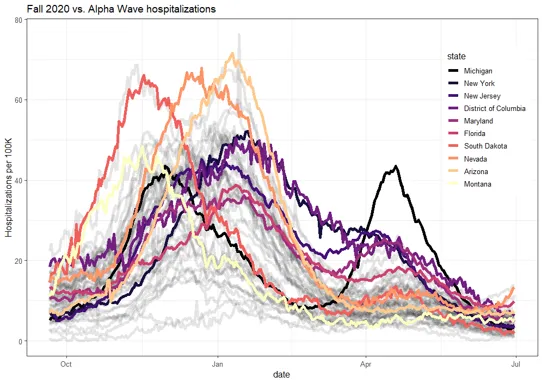
Unfortunately, waning immunity was considered misinformation at the time of this discovery, as waning immunity implied vaccine-induced immunity may wane. If natural and vaccine-induced immunity waned, then we’d expect to see surges in the US maybe 6 months after the Fall 2020 outbreak and the transmission rate in these follow-up outbreaks would be most negatively associated with the cumulative burden in these outbreaks and have no negative correlation with vaccination rates. Indeed, by July 2021, that is what we saw.
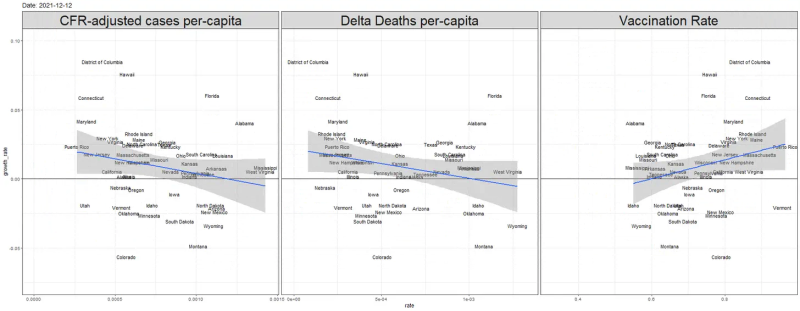
If immunity wanes, then the cost-benefit ratio of a policy mandating vaccines changes. One might justify mandating vaccines if the Fall 2020 outbreaks were not natural herd immunity thresholds and immunity does not wane. Unfortunately, from my theoretical vantage point, it was likely that Fall 2020 outbreaks peaked at natural herd immunity thresholds and immunity waned, calling into question the wisdom of mandating vaccines that carry some risks and weren’t going to prevent future infections.
Eventually, in August 2021, the CDC published findings of an outbreak in Provincetown demonstrating indisputable evidence of 100% immune evasion, where patients with vaccines had the same incidence as patients without vaccines.
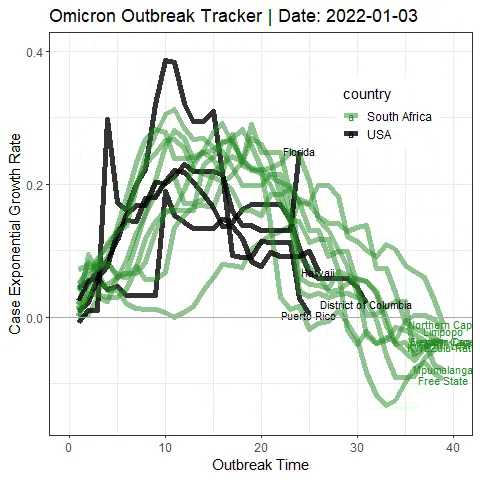
This same theory of natural herd immunity thresholds in the Fall of 2020 and immune evasion in Delta led to the theory that future outbreaks would have characteristic timescales as they deplete the susceptible populations in relatively unmitigated outbreaks burning through populations whose immunity waned. Above, we see the Omicron outbreaks across South African provinces defining the characteristic timescales of Omicron outbreaks across US states, again corroborating this theoretical path I travelled by.
Recall that before Covid I was studying pathogen spillover from bats to people, and statistical methods for attributing pathogens to hosts or sources. Once I was done with outbreak forecasts, I returned to the question of pathogen spillover, of attribution of this biological agent to the source whence it came.
I read the literature and found it to be lacking, to be making uncharacteristically strong conclusions based on flawed data, flawed analyses, or unjustified assumptions. I wrote an article critiquing one paper, Pekar et al., claiming the two big branches at the base of the SARS-CoV-2 evolutionary tree is evidence of two spillover events. We showed that the authors’ methods did not justify their conclusions, and additionally they excluded sequences which invalidate their premise of two big branches at the base of the SARS-CoV-2 evolutionary tree. This angered zoonotic origin proponents and put a target on my back - peruse the comments of our preprint to get a glimpse.
Far more heterodox was the next paper I helped write with Valentin Bruttel and Tony VanDongen. The lab origin theory revolved around a furin cleavage site hypothesized to have been inserted, but to insert a furin cleavage site in a coronavirus one would need to make a DNA copy of the virus. We found evidence in the SARS-CoV-2 genome consistent with the dominant methods for making DNA copies of coronaviruses.
This, too, was picked up by The Economist as well as Telegraph and more. In each case, however, these journals elevated the controversy manufactured by the guardians of the orthodoxy, all of whom have close ties to either the Wuhan Institute of Virology believed to have conducted this work, or NIAID, the US-based health science funding agency found to have funded in 2019 the exact researchers who proposed to insert a furin cleavage site inside a DNA copy of a SARS coronavirus in Wuhan in 2018.
While recent evidence has corroborated our theory, much like out of sample evidence corroborated my theory of Covid outbreaks and herd immunity thresholds, corroboration does not seem to be sufficient to allow reentry to the academy. The toxic tone of disagreements, the bruised egos of big-name professors who were proven wrong by the data itself, has created a community of toxic, indignant orthodoxy. There is no hope of readmission for a sinner like me, for after enough battles and bruised egos, there will be on every committee, every editorial board, every conference board, someone I have offended with my heterodoxy.
Now, in engagements with orthodox academics desperate to defend their turf from the overwhelming hordes of data and evidence, I am labelled by a Scarlet Alphabet of heterodoxy. Antivax, Brownstone Boy, Covid minimizer, Denialist, and so on. I am in the eyes of many a pariah because I had the insight to discover things and the courage to stand by my discoveries. Few things worsen an indignant senior’s ego more than a junior’s refusal to yield, it’s as if I’m blamed for the boxer’s fracture in the fists of those who punched down at me.
I wanted to share this journey for future scientists looking ahead at their careers, unsure which path to take. The forks in the road I’ve encountered here are going to be encountered by others. You may find something, something uniquely visible to someone with your expertise, and you may encounter everything from discouragement and recommendations to not share your work, to outright hostility and, if you do share your work, alienation from people you once thought were your colleagues or friends.
You will see signs pointing you to orthodoxy. You will look down the miserable, festering, thorny thicket of controversy down the path of heterodoxy, and you may understandably be tempted to not bear the Scarlet H. If you seek to maintain your career as you always imagined it, if you seek comfort and collegiality, then by all means, do not stick your neck out, do nothing controversial, and never criticize people who occupy positions of power. You may get your portrait raised on the halls of a building, and you will never know anything but love for the building that has included you, or at least the version of you that chose to do nothing controversial.
My departure from the downhill path of orthodoxy and my ascent up the grueling hills of heterodoxy has, indeed, made all the difference. In my heart, I’m still my mother’s child curious about carbon dioxide, fascinated by photosynthesis, in awe of atoms.
By following the path of heterodoxy, I have been scraped and bruised, punched and kicked, beaten and harangued, posted on a digital pillory and had insults thrown at my face. I would do it all again, for only on this path do you discover who you are. With time, you will find others who were also courageous enough to stand by their principles, and a single heterodox friend is a more powerful ally than 100 orthodox colleagues. Here on the windy, rainy hilltop of heterodoxy, you will find a community of the most brilliant minds, true friends who prioritize belonging over belief, and you will learn to laugh while you are being punched, to get stronger while you are being attacked, to love while you are hated.
I would not recommend the grueling ascent of heterodoxy to a colleague, but only to the strongest, most brilliant, most authentic, and courageous friends. If you can survive the ascent, then on the other side you will discover your strengths and you will thrive.
You may be despised by despicable people who found you useful when you molded your soul to fit their grasp, but you will also be admired by the admirable heterodox scientists who came before you. You will be loved and respected among a diverse community of authentic, untrammeled souls, and even if we disagree, we will do so politely and in a way that ensures you still belong in our community, for few understand the corrosiveness of intolerance better than those of us who have been exiled to this heterodox city upon a hill.
Republished from the author's Substack
My Heterodox Path
by Alex Washburne at Brownstone Institute - Daily Economics, Policy, Public Health, Society
If you have ideas for cutting regulations, the US government wants to hear from you! This could be important. Provide details on the exact regulation in the CFR.
The post Deregulation suggestions appeared first on Marginal REVOLUTION.