Shared posts

13 Dec 15:54

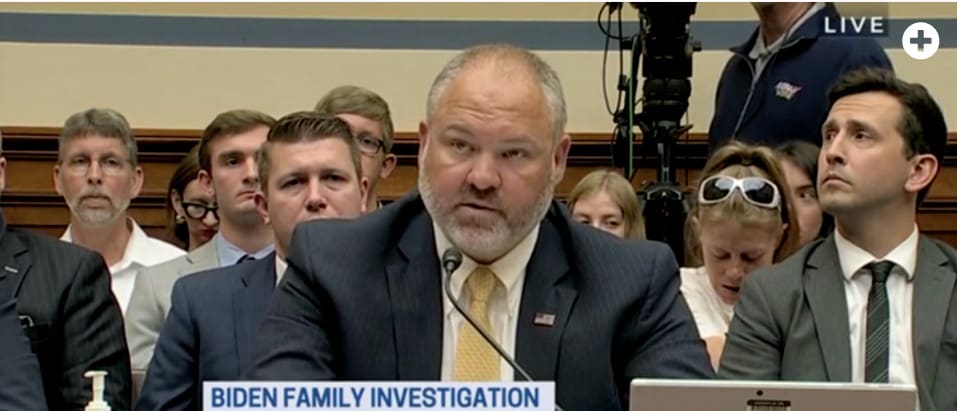
Joe Biden Leads Were ‘Off The Table’ During Hunter Biden Investigation, IRS Whistleblowers Testify

by Daily Caller News Foundation

By James Lynch Any potential investigative leads pointing towards Joe Biden were “off the table” during the Department of Justice (DOJ) criminal investigation into Hunter Biden, new testimony from two IRS agents shows. IRS whistleblowers Gary Shapley and Joseph Ziegler testified Dec. 5 before the House Ways and Means Committee and described how they “weren’t […]

The post Joe Biden Leads Were ‘Off The Table’ During Hunter Biden Investigation, IRS Whistleblowers Testify appeared first on Liberty Unyielding.

13 Dec 15:52

NO ONE’S LIFE, LIBERTY, PROPERTY, OR PRIVACY IS SAFE WHILE THE LEGISLATURE IS IN SESSION: The Trojan

by Stephen Green

NO ONE’S LIFE, LIBERTY, PROPERTY, OR PRIVACY IS SAFE WHILE THE LEGISLATURE IS IN SESSION: The Trojan Horse That Would Force Your Barista To Spy on You.

Even more outrageous is a problematic provision tucked away in this “reform” bill but not so much as mentioned in the committee’s report. Section 504 of the House Intelligence bill requires that those who have access to the “equipment that is being or may be used to transmit or store such communications” shall be treated as “electronic communication service providers” and thus subject to Section 702’s general requirement to (secretly) disclose our data to the government.

Let us unpack this: Under current law, electronic communication service providers include Internet service providers such as Google, Facebook/Meta, and Microsoft. It also includes telecom providers such as AT&T and Verizon. Under the law, these big companies are routinely compelled to hand over billions of foreign communications in addition to vast amounts of Americans’ communications that are “incidentally” caught up in this surveillance net.

But the House Intelligence bill’s expansion to include “equipment” would cover, for example, any small or medium-sized business that simply provides Wi-Fi or stores data. This means that your business landlord, Airbnb host, hotel manager, or coffee shop barista will have a legal obligation to give the government any of your emails, texts, or phone metadata that ran through their equipment. Larger entities, such as data centers, would also be enlisted in spying on Americans.

Send your congresscritter a message that the FISA Reform and Reauthorization Act is unacceptable.

13 Dec 15:13

Ten revelations that changed Americans' understanding of events on Jan. 6

by Steven Richards
These Jan. 6 story developments show that there are still unanswered questions about the riot itself, law enforcement response, and the investigations in the aftermath.
13 Dec 13:23

FREE SPEECH FOR THEM, BUT NOT FOR THEE:  Harvard is so pro-free speech they canceled critic’s talk.

by Sarah Hoyt

FREE SPEECH FOR THEM, BUT NOT FOR THEE:  Harvard is so pro-free speech they canceled critic’s talk.

13 Dec 13:23

ARE WE FOR REAL NOW? WE’RE GOING WITH THIS?  Syracuse ‘Pro-Palestine’ Students Protest Jerry Se

by Sarah Hoyt

ARE WE FOR REAL NOW? WE’RE GOING WITH THIS?  Syracuse ‘Pro-Palestine’ Students Protest Jerry Seinfeld, Who is Jewish, Comedy Show.

This has to be the stupidest timeline.


13 Dec 13:20

Sociology Meetings

by John H. Cochrane

When Jukka Savolainen wrote about it in the Wall Street Journal I couldn't quite believe it, so I had to go look. Indeed, on the website of the American Sociological Association describing its 2024 annual meeting we have the official "theme" of the meeting

"..sociology as a form of liberatory praxis: an effort to not only understand structural inequities, but to intervene in socio-political struggles."

"To intervene." "Political struggles." 

American Sociological Association. My emphasis.

For a long time, people have made fun of the "social sciences" including economics as pretend sciences. We have "physics envy," they said, but will never really measure up. Well, a lot of social sciences are not pretending to be sciences anymore!

There is a lot of attention to the political conformity and censorship going on on campuses, but not enough I think to the similar problems of professional societies and journals.  Professor Savolainen for example doesn't feel particularly "included" these days. 

Hopefully, the explosion into public consciousness over the last few weeks of just how rotten and politicized academia has become will make this sort of thing look pretty embarrassing by springtime. 


12 Dec 19:48

Johnson after pulling votes on dueling FISA reform bills says House will just extend authorization

by Nicholas Ballasy
Jts5665

The alphabet agencies likely have dirt on Johnson. He seems to be doing whatever they want.

The short-term extension will be attached to the defense spending bill
12 Dec 15:52

New Feature: Fact-Checking NewsGuard

by Matt Taibbi

The “counter-misinformation” service NewsGuard fact-checks most major independent outlets, including Racket. They even bless us with a “reliability rating,” based on factors like my willingness to answer questions about funding sources (there are none, the site is 100% reader-financed), the lack of a formal masthead (calling myself editor isn’t good enough, apparently), and incidents like reporting issues disputed by Stanford’s not-always-forthcoming Election Integrity Partnership.

I told NewsGuard I believe its business model is illegitimate, because “media outlets should gain and lose trust based on how they are evaluated by audiences, not paid services.” Since they’re continuing to score sites like mine, I’ve decided to regularly fact-check their content, on a scale of 0-to-4 Marks of Satan. The first entries:

  1. “China’s Defense Ministry Falsely Claims U.S. is Expanding its Nuclear Arsenal,” State-Sponsored Disinformation Risk Briefing, November 16, 2023:

NewsGuard tends to opt for layup fact-checks (do Israelis really drink the blood of Palestinians? Is Ukraine forcing pregnant women to fight?), but on November 16th, they took on the Chinese in a nuanced battle, after Chinese defense spokesperson Wu Qian reacted to a Pentagon annual report to Congress that claimed current Chinese nuclear efforts “dwarf previous attempts in both scale and complexity.” Wu answered by saying the Defense Department was “sensationalizing” a “nonexistent China military threat,” adding the U.S. was making “excuses for itself as it expands its nuclear arsenal to maintain military dominance.”

NewsGuard took issue with Wu’s claim that the U.S. is expanding its nuclear arsenal. Disinformation, NewsGuard wrote!

Rather than expanding its nuclear arsenal, the U.S. has consistently decreased its stockpile of nuclear warheads in recent years. Reports published by the nonprofit organization Bulletin of the Atomic Scientists show that the U.S. has reduced its nuclear stockpile from 3,800 warheads in 2020 to 2,708 in 2023. The U.S. State Department also released a fact sheet in 2021 that shows the U.S. has decreased its nuclear stockpile almost every year from 1996 to 2020. 

Going by warhead count, the U.S. nuclear weapons stockpile has indeed been decreasing since the seventies. So, true. Well done, NewsGuard!

However, the service left out a big part of Wu’s statement. The official complained that the “U.S. in recent years has exited treaties including the Anti-Ballistic Missile Treaty and Intermediate-Range Nuclear Forces Treaty, upgrading the nuclear triad,” while “strengthening the so called ‘Extended Deterrence.’” That’s also true, as is a massive increase in U.S. spending on nuclear weapons development in recent years.

Even milquetoast foreign policy think tanks concede that George W. Bush’s decision to withdraw from the ABM treaty after 9/11 “fueled a new arms race.” The Carnegie Center went so far as to blame Bush and the U.S. for Vladimir Putin’s development of an international hypersonic nuke-delivering glider, describing it as Russia “responding accordingly” to the cancelation of the ABM. U.S. withdrawal from the 1987 INF treaty is often blamed on Russia having violated it first. Russia rejected the accusations, but either way, the U.S. has undoubtedly responded by rapidly upping plans for new delivery systems and warhead-building capacity.

For instance, the U.S. hasn’t regularly built plutonium pits — the core of nuclear weapons — since 1989. Now however the National Nuclear Security Administration (NNSA) has plans to build 30 a year at Los Alamos and 50 more a year at a site in Savannah, Georgia. The Congressional Budget Office is estimating $18-$24 billion in costs for this 80-pit-per-annum capability, which doesn’t sound like much. However, $756 billion over ten years does sound like a lot, because it is. That’s the current CBO estimate for nuclear spending between 2023 and 2032, and it represents a monster $19% increase over the CBO’s previous estimate of $634 billion on nukes for the period of 2021-2030. $76 billion a year is a lot of money even in Washington. For comparison, it’s almost exactly the entire Department of Homeland Security appropriation for 2022.

Overall, while it may be technically correct to say Wu was wrong to complain about an expanded “arsenal,” in a larger sense Wu may not be wrong to say the U.S. is pumping up its nuclear program in search of “hegemonism.” Even according to the DoD’s own projections, as in the case of Pentagon-published graphs like the one below, our spending on nuclear weapons and weapons delivery development is about to skyrocket for just the third time since the early sixties, buoyed by hyper-expensive programs like the nuclear-capable B-21. The latter is needed “to attack Chinese ships in a Taiwan scenario,” as Air and Space Forces put it:

By percentage of the overall DoD budget, nuclear spending is scheduled to double, a point the Pentagon has been anxious to trumpet. NewsGuard quoted a Wall Street Journal article saying China recently “surpassed the U.S. in its number of land-based intercontinental-range missile launchers,” seemingly to suggest a goal of nuclear “hegemony” was disinformation, which it almost certainly is not. This is the kind of report Politifact or Snopes would call “misleading” or “needs context.” Here at Racket, we’ll give it 2½ Satans:

  1. Chinese Officials Spread Graphics Comparing Gaza to Troubled Xinjiang Region,” State-Sponsored Disinformation Risk Briefing, November 22, 2023

    A week after the nuke entry, NewsGuard printed a tweet from the Chinese embassy in France:

NewsGuard, deploying its superior mind-reading technology, described the two-photo spread as an apparent “effort to downplay the Chinese government’s documented abuses of ethnic minorities there and to paint Israel as the real perpetrator of genocide.” How they got that from “sans titre” (“no comment”) isn’t clear, but these types of gruesome photos of Gaza are all over even the American press nowadays. ABC News is running similar apocalyptic pictures from Gaza, with notations about “the more than 1.8 million people who are internally displaced” there, along with 17,000 killed. The BBC described satellite pictures showing 100,000 buildings damaged there, while CBS chronicled a city where residents are “forced to bury their dead in the streets,” because cemeteries are too dangerous to reach. You can find exactly similar pictures on NBC, NPR, the AP, The Guardian, Al-Jazeera, and many others.

NewsGuard noted international organizations say the “Uyghur and Kazakh” minority populations have been “detained en masse by the Chinese government, which may be true. But that doesn’t make the above not a real picture of Xinjiang, nor do they even bother supporting their own weird assertion about Israel and genocide. Basically this is a half-clever meme with two legit pictures where audiences supply all of the controversial conclusions, and NewsGuard is mad that Jackson Hinkle is tweeting it. However, it’s not disinformation by any definition. Three Satans:

12 Dec 14:44

NIALL FERGUSON: The Treason of the Intellectuals: Anyone who has a naive belief in the power of hi

by Glenn Reynolds

NIALL FERGUSON: The Treason of the Intellectuals: Anyone who has a naive belief in the power of higher education to instill morality has not studied the history of German universities in the Third Reich.

In 1927 the French philosopher Julien Benda published La trahison des clercs—“The Treason of the Intellectuals”—which condemned the descent of European intellectuals into extreme nationalism and racism. By that point, although Benito Mussolini had been in power in Italy for five years, Adolf Hitler was still six years away from power in Germany and 13 years away from victory over France. But already Benda could see the pernicious role that many European academics were playing in politics.

Those who were meant to pursue the life of the mind, he wrote, had ushered in “the age of the intellectual organization of political hatreds.” And those hatreds were already moving from the realm of the ideas into the realm of violence—with results that would be catastrophic for all of Europe.

A century later, American academia has gone in the opposite political direction—leftward instead of rightward—but has ended up in much the same place. The question is whether we—unlike the Germans—can do something about it.

We already are, as we strip higher education of its now-undeserved status. Next, the money.

12 Dec 00:15

With the Indictment and Inquiry, Democrats Now Face a Moment of Maddening Truth

by jonathanturley
U.S. House of Representatives

Below is my column in The Hill on the expected formal vote this week on the impeachment inquiry. The vote is only to continue to look into the allegations that President Joe Biden knew of the influence peddling operation of his family and fostered those efforts.  The final line of defense is to acknowledge that this was influence peddling but that Biden was only trying to support his son. The question for this vote is: how do you know? We have millions raised in what most view as corrupt influence peddling. Many of those payments are now confirmed by the Justice Department in the second Hunter Biden indictment. Only an investigation will establish the truth on the President’s knowledge and involvement. Yet, for years, Democratic members have opposed any investigation. They now face a moment of truth.

Here is the column:

Author Aldous Huxley once said, “you shall know the truth, and the truth shall make you mad.”

Such a moment of madness has arrived in Congress as members prepare to vote on the formal approval of an impeachment inquiry. The second indictment of Hunter Biden shattered long-standing denials and narratives repeated by the White House and members of Congress. What is left in its wake is now plain to the public: corruption.

The vote is not whether to impeach President Biden, but whether members support the investigation into these growing allegations of corruption by the Biden family. According to recent polling, nearly 70 percent of voters (and 40 percent of Democrats) believe that Biden has acted unlawfully or unethically or both. Yet with almost half of the Democratic Party viewing Biden’s conduct as worthy of investigation, it is not clear whether a single Democratic member will vote to look into these allegations.

In September, I testified at the first impeachment inquiry hearing and stated that the evidence had clearly passed the threshold for such an inquiry. While there was no requirement to hold a formal vote to start this process (as the Democrats did with Trump), I encouraged the members to hold such a vote.

Since that hearing, the evidence has only mounted against President Biden. It is now clear that Biden lied when he maintained as a candidate, and later as president, that he had no knowledge of his son’s business dealings with foreign interests. Even Hunter himself contradicted the president on this claim.

It is also now clear that he lied in denying that his son never made money in China. The indictment confirms massive transfers from Chinese sources.

It is also clear that Hunter was engaged in raw influence peddling. This included threatening at least one Chinese businessman that his father was sitting next to him and would retaliate against him if he did not send millions to the Bidens.

President Biden also lied when he claimed this week that he had not had any “interactions” with his son’s business associates. There are emails, audiotapes and testimony now disproving that claim.

Millions of dollars flowed to Biden family members through a labyrinth of shell companies and accounts. Hunter Biden sent emails saying that up to half of his income went to his father while they used shared accounts and credit cards for expenses.

Even Biden associates now admit that they were selling “the Biden brand” and influence with Joe Biden. Advocates simply argue that they were merely selling the “illusion” of influence.

It is now time to see if a single Democratic member will stand against corruption and support an inquiry into the president’s role and later cover-up of this corruption. That includes the use of White House staff to spread false claims and attack critics.

I have previously discussed four possible articles of impeachment that warrant investigation.

One of the false narratives being bandied about is that there is no proof that the influence peddling of Biden’s son and brothers benefited the president himself. Thus, the argument goes, even though he was the subject of the influence peddling, Joe Biden did not legally or constitutionally benefit from the payments to constitute bribery or other crimes.

That is utter nonsense. The courts have repeatedly found that benefits to family members (far more modest than the millions in this case) can constitute bribery for a politician. That has also been the position of the Justice Department in past cases. Regardless of whether Hunter or his associates were speaking truthfully about handing over percentages of these funds to Joe Biden, he practically and legally benefited from the millions going to his family.

Even if members insist that they are not yet convinced, it makes no sense to insist that there is no direct evidence while opposing efforts to establish such evidence. These members have opposed any investigation into the allegations from the start.

Polling suggests most people believe there was a massive influence peddling operation built around Joe Biden, and that the president lied about not knowing about these deals. It is now time to get answers directly from the key players, from Hunter Biden to the president himself.

There is more at stake for the members than a Democratic president. The Democratic Party has already embraced censorship and abandoned its long advocacy of free speech. Democrats are now running on the pledge to expand censorship on social media. The question is whether, as a party, it will now vote to shield corruption, even with almost half of Democratic voters calling for answers.

The Democratic Party that I was raised in and supported was more than the party of censorship and corruption. It fought for free speech and good government. There were principles that came before personalities.

That is why we have reached a point of inescapable clarity. There is no principled basis to oppose an investigation into these chilling allegations. Stripped of the false narratives and faux constitutional claims, what remains are raw politics and utter madness.

The only question is, who will step forward on the Democratic side to demand not impeachment but answers?

So let’s call the vote.

Jonathan Turley is the J.B. and Maurice C. Shapiro Professor of Public Interest Law at the George Washington University Law School.

11 Dec 23:52

IT’S GOOD FOR THE PLANET: 4 east African countries are going for nuclear power—why this is a bad

by Glenn Reynolds
Jts5665

The exterminationists don't want cheap power. Or humans thriving, for that matter.

IT’S GOOD FOR THE PLANET: 4 east African countries are going for nuclear power—why this is a bad idea.

If climate change is as big a crisis as they say, the other considerations don’t matter. My advice: Finance it with Chinese loans, then stiff ’em.

11 Dec 23:51

SUGAR IS ACTUALLY AS BAD FOR YOU AS THEY TOLD YOU FAT WAS: A Troubling Trend: The Steady Global Cli

by Glenn Reynolds

SUGAR IS ACTUALLY AS BAD FOR YOU AS THEY TOLD YOU FAT WAS: A Troubling Trend: The Steady Global Climb of Sugary Drink Consumption.

11 Dec 18:32

IPCC Scientists Demand Power to Dictate Global Climate Policy

by Will Jones

Scientists at the UN's Intergovernmental Panel on Climate Change have demanded the power to set global climate policy as they despair at the slow pace of climate action.

The post IPCC Scientists Demand Power to Dictate Global Climate Policy appeared first on The Daily Sceptic.

11 Dec 18:30

The Covid Inquiry Is a Shameless Cover-Up

by Richard Eldred

It increasingly appears that the Covid Inquiry, set up by the Blob, staffed and run by the Blob, sees its job as blaming the politicians and excusing the Blob, says Matt Ridley in the Telegraph.

The post The Covid Inquiry Is a Shameless Cover-Up appeared first on The Daily Sceptic.

11 Dec 16:57

RIP: I see from Mike Williamson that David Drake has passed. I knew his health was failing, but I’

by Glenn Reynolds

RIP: I see from Mike Williamson that David Drake has passed. I knew his health was failing, but I’m still sad and surprised.

If you haven’t read any of his books, you should. He did great work in everything from sword-and-sorcery to military hard SF. (Bumped).

10 Dec 23:26

Former Biden COVID official says Wuhan lab leak may have caused pandemic

by Madeleine Hubbard
The official also warned that the chances of another global pandemic are quite high.
08 Dec 20:09

SHE DOESN’T LOOK LIKE A MAGA TYPE, BUT I’M TOLD BY ALL THE BEST PEOPLE THAT THEY’RE THE THREAT: Wom

by Glenn Reynolds

SHE DOESN’T LOOK LIKE A MAGA TYPE, BUT I’M TOLD BY ALL THE BEST PEOPLE THAT THEY’RE THE THREAT: Woman arrested for pouring gasoline, trying to burn down Martin Luther King Jr.’s birth home. “Police said they have arrested 26-year-old Laneisha Shantrice Henderson and charged her with criminal attempt arson and criminal attempt interference with government property.”

Plus: “Police say two tourists from Utah who were in the area saw Henderson pouring gasoline on the home and interrupted her. . . . Video from a witness shared with Channel 2′s Michael Doudna shows a woman dressed in all black pouring gasoline on the windows and in the bushes of the home. Atlanta Fire Department Battalion Chief Jerry DeBerry said had the witnesses not intervened, the house could have been burned to the ground in moments.”

Black woman dressed as Antifa tries to burn MLK birth home, is stopped by a white guy from Utah and two off-duty cops. But if she’d gotten away with it and those bystanders hadn’t been there, the press would be telling us it was yet another example of white-supremacist domestic terrorism.

08 Dec 20:07

IT IS UNWISE TO DISPLEASE COMRADE XI: Missing Chinese Foreign Minister Died by Suicide or Torture. “

by Stephen Green

IT IS UNWISE TO DISPLEASE COMRADE XI: Missing Chinese Foreign Minister Died by Suicide or Torture. “The report, based on interviews by Politico Europe with unnamed sources who have access to top Chinese officials, spotlights what Politico says was a campaign to dislodge allegedly disloyal officials by Chinese President Xi Jinping — one with echoes of the sweeping purges carried out by Soviet dictator Joseph Stalin.”

That’s old school.

08 Dec 15:12

HOW GOVERNMENT WORKS: Washington State Economist Refused to Lie, So They Forced Him Out.

by Glenn Reynolds
Jts5665

If you want to work for the government in economics, I think you have to say yes to whatever the politicians want or you're out.

08 Dec 13:41

Defying Cavity: Lantern Bioworks FAQ

by Scott Alexander

Lantern Bioworks says they have a cure for tooth decay. Their product is a genetically modified bacterium which infects your mouth, outcompetes all the tooth-decay-causing bacteria, and doesn’t cause tooth decay itself. If it works, it could make cavities a thing of the past (you should still brush for backup and cosmetic reasons).

I talked to Lantern founder Aaron Silverbook to get an idea of how this works, both in a biological and an economic sense. Aaron was very knowledgeable and forthcoming, although he uses the phrase “YOLO” somewhat more often than most biotech founders. This post isn’t a verbatim interview transcript, just a writeup of what I learned based on his answers.

[Conflict of interest notice: Lantern is mostly rationalists and includes some friends. My wife consulted for them early on. They offered my wife and me free samples (based on her work, not as compensation for writing this post); she accepted, and I’m still debating. Consider this an attempt to spotlight interesting work that people I like are doing, not a hard-hitting investigation.]

1: What is BCS3-L1?

BCS3-L1 (brand name “Lumina”) is a genetically-modified strain of the tooth decay bacterium streptococcus mutans.

S. mutans lives on your teeth and metabolizes any spare sugar that comes its way into the waste product lactic acid. If too much s. mutans gets together in one place, all the lactic acid dissolves the tooth’s enamel coating, causing cavities.

BCS3-LI has four main genetic modifications:

  1. It produces a weak antibiotic, mutacin-1140, which kills competing oral bacteria.

  2. It’s immune to mutacin-1140, so it doesn’t kill itself.

  3. It metabolizes sugar through a different chemical pathway that ends in alcohol instead of lactic acid.

  4. It lacks a peptide that its species usually uses to arrange gene transfers with other bacteria.

The antibiotic helps it win the Darwinian competition in your mouth to become King Of The Oral Bacteria. The alcohol metabolism means it won’t produce lactic acid (and so won’t cause tooth decay). The peptide knockout prevents it from transferring genes back and forth with other bacteria that might either inactivate it or leak its advantage.

1.1: Where did this come from? Who invented it?

Professor Jeffrey Hillman of the University of Florida. In 1985, he was surveying the microorganisms on his graduate students’ teeth (as you do). One grad student had an unusual strain of S. mutans with a natural version of mutations 1 and 2 (it produced mutacin-1140, and was resistant to it). Hillman realized the potential, and spent the next few decades adding mutations 3 and 4 and testing the results.

1.2: So how did it end up with a tiny startup in 2023?

Professor Hillman started a company “Oragenics” and applied for FDA approval. The FDA demanded a study of 100 subjects, all of whom had to be “age 18-30, with removable dentures, living alone and far from school zones”. Hillman wasn’t sure there even were 100 young people with dentures, but the FDA wouldn’t budge from requiring this impossible trial. Hillman gave up and switched to other projects (including an intranasal COVID vaccine!)

Aaron heard this story and figured that brash, move-fast-and-break-things Silicon Valley biotech might be able to find an alternative route to commercialization. The strain was off-patent, so he first tried to synthesize it himself from the clues in Hillman’s published papers. When that didn’t work, he made a deal with Oragenics for 10% of profits in exchange for samples and the full recipe.

2: How do you use it?

To apply, you brush your teeth with a special pumice-based product that removes your existing tooth bacteria, then swab it on with a q-tip.

One dose is sufficient; once you use it, it’s in your mouth approximately forever.

2.1: As users kiss their loved ones, who kiss others in turn, will this spread exponentially and take over the world?

There was originally some concern about this, but no.

Remember, the original bacterium was found in the wild, in a random grad student’s mouth forty years ago. There must be thousands of people walking around with various naturally-occurring BCS3-L1-like things. So probably this isn’t a risk for some kind of weird pandemic.

Existing mouth bacteria have fortified their position and have a strong home field advantage. This is why you need to brush your teeth with the special product to apply Lumina.

Lantern’s safety documents note that couples who kiss constantly do end up with similar oral microbiomes. So maybe enough kissing - especially kissing just after a dental cleaning when your existing bacteria are at their weakest - could spread the strain accidentally, very slowly. This rate of spread would be comparable to the rate of spread of every other mouth bacterium.

2.2: When a user kisses their newborn baby, will it spread to the baby?

Okay, this one is true.

Babies have no existing mouth bacteria, and get theirs from their parents’ kisses. Not necessarily their first kiss as a newborn (newborns have no teeth, and BCS3-L1 needs teeth to live), but their first kiss after teeth grow in. If you get this, you’re probably getting it for your whole future family line.

2.3: If you wanted to get rid of it, could you?

Some kind of extreme course of oral antibiotics that nukes everything growing in your mouth would probably eradicate BCS3-L1, but this hasn’t been tested and would have side effects.

3: Is it dangerous to have bacteria secreting an antibiotic in your mouth? Does this mean you’re on a weak antibiotic all the time?

There are already bacteria secreting antibiotics in your mouth. Microbes are in constant war with other microbes, and antibiotics are one of their favorite weapons - remember, penicillin comes from a fungus.

Because bacteria secrete just enough antibiotic to clear their local area, these are tiny quantities, much less than you’d get from taking a medical-grade antibiotic pill. Lantern says the levels of mutacin-1140 dilute to irrelevance “tens of microns” away from the secreting bacteria. In any case, it’s a weak antibiotic that doesn’t survive the digestive tract (Hillman originally hoped to market the antibiotic too, but found it didn’t get absorbed and broke down too quickly).

Neither the grad student with the original strain nor any of Hillman’s test subjects had any noticeable health issues.

See also Lantern’s Safety Review FAQ.

3.1: Is it bad to disrupt your normal mouth microbiome?

When talking about BCS3-L1 “taking over” the mouth, this just means it takes over the streptococcus mutans niche. There are still other bacteria and fungi in the mouth.

The mutacin antibiotic might still disrupt these other bacteria (probably not fungi). But strains like BCS3-L1 already exist in the wild (eg the original grad student), and lots of bacteria and fungi secrete antibiotics, so it doesn’t seem like having mutacin-secreting organisms in your mouth makes you some extreme oral microbiome outlier.

If you eat a normal Western diet, your mouth microbiome is already pretty far from the design specs, and it’s unclear if using Lumina makes things worse.

3.2: Will the other bacteria develop resistance to the antibiotic?

Mutation 4 prevents BCS3-L1 from “leaking” its own resistance. Although in theory other bacteria could develop resistance, mutacin-1140 is a hard antibiotic to develop resistance to, and the other bacteria would have to do it in the short period before BCS3-L1 kills them off and establishes its own home field advantage. In practice, Professor Hillman found that BCS3-L1 remained dominant over many years and nothing developed resistance to it.

Even if a mutacin-resistant strain does develop in one person’s mouth, it will have a hard time getting to anyone else’s mouth, so widespread immunity is unlikely.

4: Is it dangerous to have bacteria secreting alcohol in your mouth? Will you get drunk?

Most people already have some alcohol-secreting bacteria in their bodies.

(there’s a condition called auto-brewery syndrome where those bacteria get out of control and produce enough alcohol to make someone drunk. It’s vanishingly rare in real life, but more common in the legal system: “You gotta believe me, Officer, it was just auto-brewery syndrome!”)

The average person has enough of these bacteria in their gut to have a natural blood alcohol level - even after zero drinks - of about 0.1 mg/dl. Under pessimistic assumptions, BCS3-L1 will add another 0.2 mg/dl, bringing the total to 0.3. This is still a pretty normal number that some people have naturally (it would bring the average customer from the ~50th to the ~80th percentile of natural blood alcohol). It’s also far from the usual threshold for feeling tipsy (30 mg/dl) or too drunk to drive (80 mg/dl).

Under more realistic assumptions, the amount of alcohol produced by BCS3-L1 probably isn’t significant even by the very low standards of natural blood alcohol concentrations.

4.1: Are there some unusual scenarios where this amount of alcohol might matter?

I don’t think Lantern has studied Breathalyzers. Since the alcohol is directly in your mouth, it might have disproportionate effect on a Breathalyzer compared to alcohol in your blood. I think it’s probably still too low to matter, but this is a wild guess.

There is conjecture that “non-alcoholic steatohepatitis”, a liver disease in which non-alcoholics get the same kind of liver damage that alcoholics usually get, might be associated with endogenous blood alcohol in the high normal range. If I’m understanding this paper right, it’s probably because the gut produces levels of alcohol consistent with auto-brewery syndrome, the liver goes into overdrive and metabolizes it away (prevents auto-brewery syndrome from developing), but the liver is damaged in the process the same as if it had to go into overdrive to metabolize normal binge drinking. Since BCS3-L1 produces much less alcohol than auto-brewery, I think it wouldn’t cause non-alcoholic steatohepatitis, even though it might produce final blood alcohol levels similar to those associated with the condition.

I was originally worried that Lumina might activate Antabuse, an anti-alcoholism drug that prevents drinking by causing a very unpleasant (sometimes dangerous) reaction to ethanol. There are some past cases of Antabuse being activated by really trivial quantities, like the alcohol in a chicken marsala dish or a mouth wash. But no, I think BCS3-L1 is less than this too. Chicken marsala can contain several grams of alcohol per serving, but BCS3-L1 probably only produces a few milligrams per day. If you swallow 1/10 of your mouthwash, that’s about 200 mg of alcohol - again, BCS3-L1 is probably only a few milligrams a day. Antabuse usually activates around a BAC of 5 mg/dl; BCS3-L1 only gives you a BAC of about 0.3 mg/dl.

Again, this really is a tiny amount of alcohol.

There might be other edge cases like these. Lantern offers a $100 bounty to anyone who can come up with one they haven’t thought of yet (and sometimes extra if you’re willing to help them research them).

4.2: Has anyone tested this in real life?

As mentioned before, the mutacin-releasing strain (with mutations 1 and 2) exists in the wild and was extensively tested by Professor Hillman.

The full strain with all four mutations has undergone some testing by Dr. Hillman, but nobody had officially infected themselves with it until two months ago, when Aaron finally synthesized it and tried it on himself. He says he’s usually “a lightweight” as far as alcohol goes, and hasn’t felt any different over the past two months.

When first infected, BCS3-L1 makes up almost 100% of the microbiome (because you deliberately removed all your other bacteria, then infected yourself with it). Over time, other bacteria creep back in; over an even longer period (years?), BCS3-L1 reclaims lost territory and reaches a steady state. But the point is that Aaron probably has already passed his period of highest BCS3-L1 activity, and felt nothing.

My wife infected herself about a month ago, and I haven’t noticed her having worse judgment or becoming more impulsive. But at baseline she was the sort of person who would infect herself with an untested genetically-modified bacteria strain, so there might be floor effects.

5: What’s the plan to sell Lumina?

The plan is:

  • Phase 1: (January 2024) Sell to biohackers in Prospera for $20,000.

  • Phase 2: (2025??) Sell to ordinary people in the US for a few hundred dollars.

Lantern spent $400,000 acquiring rights and synthesizing the organism. Their first priority is to get out of the hole. So to start, they’ll be selling Lumina in Prospera, a libertarian charter city in Honduras. Prospera allows the sale of any biotech product under an informed consent rule: as long as the company is open about risks and the patient signs a waiver saying they were informed, people can do what they want.

By good luck, Prospera will soon be hosting a two month super-conference of biotech and crypto entrepreneurs/enthusiasts. Aaron thinks they sound like the sorts of people who might want an experimental cavity-preventing bacterium and have $20,000 to spend, so he’s hoping to sell at least twenty doses. But also, anyone else who wants the product can go on a medical tourism trip to Prospera and get it in their experimental-treatment clinic.

To move beyond the demographic of people willing to fly to Prospera and pay $20,000, Lantern will need FDA permission. The FDA has already set unreachable standards for any drug approval study, so Aaron wants to try a different route.

The FDA has lower standards for probiotics than for drugs. And technically, a bacterium which you take in order to change your natural microbiome is a probiotic. The genetic modifications are no disqualification; a few genetically-modified probiotics have already been approved. Some are almost as creative as Lumina: Zbiotics is a genetically engineered Bacillus species which sits in your stomach and (supposedly; I have not investigated this claim) prevents hangovers by metabolizing alcohol byproducts for you.

Aaron thinks the FDA will most likely see things his way. If that works out, he has to do six months of animal studies (routine, there are companies that handle this) in order to qualify as GRAS (Generally Recognized As Safe) and sell his product as a probiotic supplement.

5.1: Is it kind of crazy that you can get this approved as a probiotic supplement?

If the FDA approves Lumina as safe, would that be the system as designed, or a loophole that works because nobody expected probiotics to be this disruptive? I’m not sure.

Do the six months of animal studies involve testing whether the animals get drunk or not? I can’t imagine there is any regulation that animal testers have to do this. But if not, how do they address the most plausible objection to the product? I trust Aaron and am glad he’s found a way to make this happen, but this is a surprising way for the system to work.

The FDA does have the option of reviewing their studies and asking additional questions, which might include questions about the drunkenness or other concerns.

5.2: Can’t people transfer the bacterium among themselves without paying Lantern?

Yes. The recipient would either have to wait until just after a high-powered teeth-cleaning session at the dentist’s, or research how to give themselves a dentist-quality teeth-cleaning. Then they would find someone who had already bought the bacterium, swab their teeth with a q-tip, and apply it to their own teeth.

(this would risk transferring other salivary pathogens; to avoid this, you could use the more involved process described here)

Aaron thinks of this as a mostly altruistic project, and although he wouldn’t mind getting rich, he doesn’t begrudge anyone who is desperate enough to read up on dentistry and swab their friends’ teeth. He thinks most people would rather just pay the one-time cost of a few hundred dollars.

5.3: Why is local Internet celebrity Aella on the org chart?

Aella ends up involved in everything interesting in the Bay Area, and I have long since stopped being surprised by this. Aaron describes her as “a media and marketing advisor.“

5.4: How can I get this / help with this?

If you’re rich and impatient, sign up here and they’ll contact you when the $20,000 version is ready in Honduras (current plan: January 18, 2024). This is obviously a lot of money for a product which will hopefully go down in price soon, and Lantern is thinking about how to sweeten the deal (they might throw in equity in their company).

Otherwise, scroll further down the page to sign up to hear when they have lower-priced options available (and I’ll try to announce it here too).

If you have some other way you can help (they're looking for investors, wet lab experts, and dentists), go to https://www.lanternbioworks.com/ and connect with them. Remember that biotech investing is hard and anti-recommended for everyone except professionals.

07 Dec 22:20

Ukraine assassinates Zelensky critic inside Russia.

by Kane
07 Dec 17:30

Is Ivy League university “leadership” morally bankrupt? Bill Ackman says, Congressional hearing removes all doubt

by Nitay Arbel (a.k.a. New Class Traitor)

I saw the writing on the wall over a decade ago — which is one reason I relocated to Israeli academia.

https://twitter.com/BillAckman/status/1732179418787783089

The presidents of @Harvard, @MIT, and@Penn were all asked the following question under oath at today’s congressional hearing on antisemitism:

Does calling for the genocide of Jews violate [your university’s] code of conduct or rules regarding bullying or harassment?

The answers they gave reflect the profound moral bankruptcy of Presidents Gay, Magill and Kornbluth. Representative @EliseStefanik was so shocked with the answers that she asked each of them the same question over and over again, and they gave the same answers over and over again.

In short, they said: It ‘depends on the context’ and ‘whether the speech turns into conduct,’ that is, actually killing Jews.

This could be the most extraordinary testimony ever elicited in the Congress, certainly on the topic of genocide, which to remind us all is:

“the deliberate killing of a large number of people from a particular nation or ethnic group with the aim of destroying that nation or group”

The presidents’ answers reflect the profound educational, moral and ethical failures that pervade certain of our elite educational institutions due in large part to their failed leadership.

Don’t take my word for it. You must watch the following three minutes. By the end, you will be where I am.

They must all resign in disgrace.

If a CEO of one of our companies gave a similar answer, he or she would be toast within the hour.

Why has antisemitism exploded on campus and around the world?

Because of leaders like Presidents Gay, Magill and Kornbluth who believe genocide depends on the context.

To think that these are the leaders of Ivy League institutions that are charged with the responsibility to educate our best and brightest.

On the bright side, our congressional leaders deserve accolades for showing tremendous leadership and moral clarity in their statements, by the questions they asked, and the respectfulness with which they conducted the hearing. It was a masterclass of how our government and democracy should operate.

If you have time, please watch the entire hearing. Throughout the hearing, the three behaved like hostile witnesses, exhibiting a profound disdain for the Congress with their smiles and smirks, and their outright refusal to answer basic questions with a yes or no answer.

ADDENDUM: what things look like at Cornholio U. Columbia U. : “antisemitism is the new normal“. The world is standing on its head when moderate Arab countries are (away from the media) more reasonable to Israel than college students whose moral narcissism is only exceeded by their ignorance.

Moving outward from Israelis and Palestinians to the wider Middle East, Hamas has demonstrated that its vision of theocratic fascism and Islamic (non) governance has little support, especially among the most progressive Arab countries. Saudi Arabia, the United Arab Emirates, and Bahrain have all condemned Hamas, officially or unofficially, and kept contacts open with Israel. All are fundamentally threatened by Iran and wish to see Hamas destroyed. The “strong horse” theory of Middle Eastern affairs still prevails, and the signals from these countries have been clear. While lip service has been given to Palestinian civilian casualties, there is no meaningful support from the Organization of the Islamic Conference, the Arab League, or other bodies, much less challenges to the Abraham Accords.

ADDENDUM 2: Powerline comments:

The [university] presidents said that calling for genocide could be bullying or harassment, depending on the context. The required context was never made clear. There was a suggestion that a call for genocide would be bullying if directed toward a particular student or group of students, but given the universality implied by genocide, application to a particular individual might seem superfluous.

The presidents also said that it would be bullying or harassment if it turned into conduct. Like actually committing genocide? Stefanik asked. I have no idea what the presidents meant by this. Attempted murder? They didn’t say.

The presidents’ effort here was obviously to preserve their faux role as guardians of free speech–it’s OK if someone just says, in the abstract, that all Jews should be killed–while acknowledging that problems could ensue, like when actual Jewish MIT students had to seek refuge from a hostile mob in the library.

What is striking to me is how unintelligently these three academics answered Stefanik’s questions. There are actually some interesting issues here, which a smart and principled administrator could have spoken about in a compelling way. But these academic hacks had nothing insightful to say, and were just trying to get out of the hearing as fast as they could, smirking all the while. I would only add that a Harvard student who wrote that all blacks should be murdered–say, in a conservative student paper, if Harvard had one–would not have a future at that institution. There would be no discussion of “context.”

If there are still people who think we should defer to the views of academics because they are smarter than we are, this short video segment should help to disabuse them of that idea.

And Victor Davis Hanson speaks of “Weimar America”.

07 Dec 17:20

LOOK AT THIS COMMUNITY NOTE AND IT’S EASY TO SEE WHY THEY HATE ELON: https://twitter.com/JoeBiden

by Glenn Reynolds

LOOK AT THIS COMMUNITY NOTE AND IT’S EASY TO SEE WHY THEY HATE ELON:

07 Dec 13:29

THE NEW SPACE RACE: NASA says SpaceX’s next Starship flight could test refueling tech. “NASA an

by Stephen Green

THE NEW SPACE RACE: NASA says SpaceX’s next Starship flight could test refueling tech.

“NASA and SpaceX are reviewing options for the demonstration to take place during an integrated flight test of Starship and the Super Heavy rocket,” Russell said in a statement. “However, no final decisions on timing have been made.”

Elon Musk, the company’s founder and CEO, said on November 19 that hardware for the next Super Heavy/Starship test should be ready in three to four weeks. That projection seems dubious because SpaceX hasn’t moved any pieces of the rocket to the launch pad for pre-flight testing, but a test flight early next year appears realistic.

Other factors that could play into the Starship launch schedule include tune-ups or fixes to resolve problems that occurred on the November 18 test flight and receiving a new launch license from the Federal Aviation Administration.

When SpaceX tries transferring 10 metric tons of propellant from tank to tank inside Starship, it will be at a scale never before attempted in space. But it’s a small fraction of the amount of fuel and oxidizer needed to fill a Starship spacecraft in orbit. The ship’s total propellant capacity is some 1,200 metric tons. After the tank-to-tank demonstration, SpaceX will attempt a ship-to-ship propellant transfer between two Starships linked together in Earth orbit.

“That’s really when we start maturing the systems, and when it really gets exciting for HLS, because those are the building blocks that we need, and, frankly, it’s never been done successfully in orbit,” said Lisa Watson-Morgan, NASA’s HLS program manager, in an interview with Ars last month.

Stay tuned…

06 Dec 17:58

‘If you don’t give $60 billion to Zelensky, we will have to use U.S. Troops against Russia.’

by Kane
Jts5665

Extortion. Interesting.

06 Dec 16:55

New Zealand Vaccine Data: Possible Injuries & Misleading Signals

by Briggs

Thanks to everybody from yesterday. I saw nothing that made me change my mind, so I’m publishing my analysis as is. There is this new caveat about the data a reader at the Substack mirror discovered. But as I have always insisted, all analyses are conditional on the data.

Simplified summary which doesn’t excuse you from reading the analysis

Perhaps the vaccine killed a few, probably younger, people, though we cannot tell for sure.

The Data

About three weeks ago, Steve Kirsch gave and asked me to look at the New Zealand data. His analysis can be found here, among other posts at the same Substack. Now that he and others have had a chance to look at it and have their say, I thought I should give my additional perspective.

According to Steve, Barry Young, 56, a statistician, has been arrested by New Zealand for leaking the data. Perhaps because the raw data had names in it, or so I was informed. The news story is not clear, except reports said they were denying bail for Young. Incidentally, the data I was given was obfuscated. No names, just numbers, one per person.

The data, which has over 4 million records representing 2,215,725 individuals, consisted of a medical record number, vax batch ID, dose number (from 1 up to an absurd 32), vax date, death date (if any), vax name, date of birth. From these I calculated whether a person was dead or alive during the period of the data, the number of days after being vaxxed until death (if any). Because the number of shots was somewhat suspect in a handful of cases (like that 32), I grouped them into 1, 2, 3, 4, 5+ shots. (See the above top for a caveat on the data.)

The earliest shot date was 30 April 2021, and the latest was 1 October 2023. The earliest death date was 11 May 2021, and the last was 7 October 2023. Which means this is a very limited set of data: only two and a half years. All long term signals, of any kind, will not be here.

There was no cause of death given for anybody. Just death date for those who had at least one shot and died in this window. There can therefore be no certain proof of any cause of death.

Obviously, but since this is the internet I have to say it, all results are conditional on this data, and any other assumptions I make below. I of course could not vet the data, but I take it that it’s likely genuine, especially since they arrested Young.

Analysis

An insurmountable problem in ascribing cause is the lack of data on people who did not get any shots. Their death and age data is missing. There is no comparison group for the people who got shots. The only comparisons we can make is in people who got various number of shots, and with time.

This no-shot control data, should any be forthcoming, has to be from the same time period as the shot data, to be sure to capture covid and covid “solutions” and other deaths prevailing at that time. I mean, we can’t compare the shot data to control groups compiled earlier or later than these dates. Has to be during covid, because death cause distributions changed during that time.

Again, this means there is no natural comparison group and nothing about cause, therefore, can be said with certainty. Which does not mean that nothing can be said. What it does mean is that we’ll never know (using just this data) whether the number of deaths we saw were greater or lesser than the no-shot group.

Still, we can look at time and age of death with time of shot, and things like that. Our results can only be suggestive.

I only looked at the raw data and did all analyses on my own. There were some absurd numbers of shots, as I said, so I grouped all shots 5 and over as 5+. There were 4,193,438 records and the number of records with shots greater than 6 was 108, so this is not skewing results to any appreciable amount. There were about 10 records of people who had death dates before their vax dates. I removed these from all analyses.

First thing is monthly deaths, which shows the monthly count of deaths by number of shots. Obviously, a person who had only one shot and died could not have two shots, or more. Also, just as obviously, as time goes on the number of people with just 1 shot dramatically goes down, as people got more shots.

The red line is the count of deaths by month for those who had one shot and died, at any point, from (to us) unknown causes, and (for the moment) independent of age. And so on for the other shot numbers.

Here from WHO is the weekly count of ascribed covid deaths in New Zealand, over roughly the same period.

New Zealand, you will recall, was in the China-style group of countries whose Experts insisted their “solutions” were effective. China, for instance, reported just under 122 thousand covid deaths, out of a population of 1.41 billion, about half being ascribed to just January 2023! President Xi declared his “solutions” worked, and who could disagree? NZ only reported 3,522 total (as of 4 December 2023) covid deaths, out of population of 5.1 million.

Since, officially anyway, there were almost no ascribed covid deaths in 2021 in NZ, then the August peak in deaths for those who only had 1 or 2 shots could not be covid and had to be something else. Officially. But we have to be careful, here, because the possibility of an artefact of the short-nature of this data and shot-timing can exist. One does, which we will see below.

The same is true for the January 2022 peak, which had only a handful of official covid deaths, but which saw a large number of people with 3 shots dying. Only a few people with 1 or 2 or 4 or more died in this month (and, of course, those with just 1 or 2 shots who already died in August 2021 could not die again in January 2022!). The NZ government says these were not covid deaths. Therefore, they were something else.

The next peak in deaths is those with 4 shots (and not any other number), in July 2022. That was the month with the largest officially ascribed covid deaths in NZ. Very few people with other shot quantities died during that month. And the same kind of thing, as you can see, happened with those with 5+ shot in May 2022, which was also a minor high in officially ascribed covid deaths.

Now the number of people who got just 1 shot, just 2, and so on, and the percentage who later died in the dataset’s time window, was this:

Shots, N, % Died in window
1, 149,583, 0.98%
2, 533,835, 0.98%
3, 708,313, 2.0%
4, 453,883, 2.8%
5+, 370,111, 1.0%

The peaks in deaths of 3 and 4 shots also coincided with peaks in official covid deaths. Again, a person who got 1 shot and died could not get 2, etc. And do not forget the range of the data.

Next is distribution of days until death after a person’s last shot, which is just that: the number of days until death for those with just 1 shot, just 2, and so on. The shots=3 sticks up the most because 3 shots was the most. Followed by 2, then 4, then 5+, then 1, the smallest group.

If shots were killing some people more or less right away, we’d expect a bump close to the shot day. But you’d also expect that if the shot was killing people, the ones most susceptible would die after the first, or maybe second, shot. Which the first plot above suggests. People would not be as likely to die after 3 or more if they tolerated the first 2, unless there was a cumulative effect. Which we could not reliably see in this short-time-period data.

Also, as time went on, as we will see, older people got more shots, while younger people stayed with 1 or 2, maybe 3.

At any rate, maybe there’s a small signal in the 1-shot group. But other things can account for the early bump, too. Like covid being newer, and people getting the shot not quite in time. Yet, officially anyway, this can not be the explanation, and the deaths have to be from something besides covid. But that doesn’t logically imply it was only the vax: other natural causes could do this.

Now you might be tempted to infer that because there is a rounded bump in small number of days until death for each shot number, followed by a falling off, that this is conclusive proof the vax killed people. This is not so. Take a look at this picture to see why.

This is the date of the shots by the number of days until death, for each total shot. You will notice the triangular shape.

Consider those who got shot 1 right at the beginning of the dataset. And suppose for the sake of argument the shot had no effect whatsoever (good or bad). Then we would expect a roughly uniform number of days until death in any population, people dying more or less evenly on days from 1 to 850, which is the maximum. Make sure you understand this. Pick an early shot date, and then look vertically at the dots at that date: are they uniform or uniform-ish?

If you’re not following this, here is an example, using the people who only got one shot. I’ve erased all but those who got the shot on about the same short number of days and later died. The distribution of days until death should be more or less evenly spread up and down the vertical axis. If the vax does nothing.

If the vax was healthful we’d expect more dots near the top, with a relative dearth at the bottom days: because people lived longer. If the vax was harmful, we’d expect more dots clustered at the bottom with a dearth at top: because people are dying soon after the shot. All things equal. Which we can’t know, so we cannot claim anything definitively.

Those who got the first shot sometime near the middle of the dataset period could only have a distribution of deaths from 1 to about 425 days. And those who got the first shot near the end of the dataset could only have a uniform number of deaths days from 1 to some low number.

That means two things: (1) the triangle shape is explained because the maximum number of days until death can never exceed the number of days left in the dataset from the shot day, and (2) we should certainly see what we see above, a bump in low numbers of days followed by a tailing off, because people got the shot at various days throughout the time period, which means where must be lower number of days until death.

In other words, this bump in the number of days until death after the shot is entirely expected, if the shot does nothing whatsoever.

If you haven’t seen this yet, look at the 5+ shot group. They were only able to get the shot at the end of the dataset time period, and necessarily the number of days until death for those who died must be small.

That being said, look at shot = 1 for the people who got the shot somewhat early on, blown up here:

The yellow circle indicates a possible departure from the uniformity. It is a cluster of deaths quite close to shot day. The same kind of thing is also present in shot = 2, but with slightly more spread.

I view these as suspicious and as real candidates for vaccine injury. We could, if NZ wanted to cooperate, identify all these people, and their exact causes of death could be investigated.

Notice, too, that this kind of early clumping in days until death after the shot disappears (or is not as evident) for those who died with greater number of shots, which is consistent with our theory that if the vax is going to injure you, it would likely do so with the first or second shot. And once these people are dead, they can’t die again after more shots!

We might be able to see more in the next plot, which is age at death. Which is what it says. Age at death by shot number.

There’s a small increase in younger deaths, especially for those with only 1 or 2 shots, and maybe 3. We are comparing the shape of the distributions, here, across those with different numbers of shots, and are not comparing absolute counts. All other things equal, if the shots had nothing to do with age at death, the shapes would be the same. But, of course, all things are not equal, like the timing of reported official covid deaths. And the timing of “advertisements” and official “requests” to get boosted, etc.

In the hopes of clearing up some of that, we have the distributions of age at shot, which shows the ages at which people got the shots, for each number of shots, split by those who lived and those who later died.

Those who lived who got 1 shot then the next, well, you can see how much they aged in between shots right on the plot. And here we see partially that older folks tended to get more shots (see the big peaks in young ages for 1 and 2 shots only). Which is no surprise.

Again, if the shots were killing people, we might expect them to die soon thereafter (in this short-window dataset), especially if they were young and hadn’t had some immunity to shots (and not just the bug) as the old might possibly have by living through any number of infections in their life not very dissimilar to covid or the covid vax. Ccoronaviruses, don’t forget, are one of the causes of common cold.

If there’s any signal, it’s here, as above. Especially after 1 or 2 shots for those 30 and less who died, the second shot coming not that long after the first.

The thing that’s most noticeable is the shape of age distributions at death, which looks the same, roughly, regardless of shot number. Which is precisely what we’d expect if the shots did not cause death. Except, as you can see, for shot = 1 and a little bit at shot = 2, where the young died.

But, perhaps, they could have just died from the bug, too, being sickly or weak. We might be able to see that in these next two (final) plots. The first is the age at shot by shot date, for those who received just 1 shot, just 2, etc.

This is sort of fun because you can see the age-phased rollouts of shots clearly. The youngest did not start getting shots until January 2022—and recall the WHO says covid deaths started ramping up around February–March of that year. The young also got fewer shots: the youngest age rises for each shot increase. This confirms it’s the young, largely, who only had 1 or 2 shots only.

Many of the youngest people (only those from 0 to 10) who only had 1 or 2 shots had a peak in deaths before they got their shots, back in August of 2021. What suspects are there? Not the vax. Government lying about covid? Or is this the same figment of the limited time nature of this data?

On the other hand, those who were 11 and older started getting their shots around the same time of the peak in official covid deaths, in August 2021. So the vax being a cause of death is a real possibility for them. But there not a lot of deaths in this age group: only 6. Here’s the breakdown:

Age bucket, Number of dead
0-10, 6
11-20, 102
21-30, 243
31-60, 2,982
61+, 33,978

As you can see, it’s going to be difficult to guess causes of death in the younger ages because of the small sample size. We might have luck with the oldest, given the larger sample size.

Let’s next look at the age of death by date of death, by number of shots:

The most obvious signal is that the age distribution at death creeps up with shot number, again because the young tended to get fewer shots, and got their first ones later than the older. The 5+ shots came at the end of the time period of the data, which explains why those with the most shots didn’t start dying until the end.

The younger died it seems, roughly, at a fairly routine clip throughout the time period of this dataset. We see the same curiosity of the clustering of deaths in 2021 up through the end of the years, for those who just had 1 or 2 shots (and recall after they died, they couldn’t have more shots!). This reinforces the notion that NZ rulers lied, as many lied, about covid deaths.

Conclusion

Did the vax kill anybody? Very likely. Because all vaxs do, and there is nothing anywhere which shows the various covid vaxs were better in this respect. And there is much (though not necessarily here) that shows they were worse. Like the endless propaganda that vaccines are “safe and effective.” And that if you got the shot, you couldn’t get sick or pass the bug on. Official government agencies told this lie endlessly.

What about this data? There are hints, as described above. I think the signal of Expert and ruler lying is stronger than any signals of vax-caused death, except where noted in the first and possibly second shot. But this surely reflects my bias against lying and boastful rulers and Experts. Well, we’re all used to governments lying by now.

We cannot tell cause from this data. Not with any certainty. We also can’t tell if the shot prolonged anybody’s life. No control group again. But, if New Zealand could release the age and date of death of people with no shots for this same time period, then we’d really be in business. There’s no reason not to, not after the shot data is already out there.

Control data could also prove, as Experts claim, if the vax prolonged lives. Why should we trust them that it did? Answer: there is no reason to trust them. Even better is to have data with official causes of death. Think we’ll get it? As Santa would say: Ho Ho Ho.

This analysis, which is in conjunction to all the other work out there, will please no one. It does not say the vax was a great killer, nor does it say the vax was harmless. Because, using this data alone, we are very limited in what we can say.

Yet I could well be wrong. There is no control group. I am not claiming cause, either. I also did not like at vax batch or manufacturer, which might have signals not apparent in the main data.

Note that this analysis is just looking at the data. No formal models. No survival analysis or cohorts or anything like that, which I believe is just not needed here. Because it would be too likely to obscure what happened. We have more than enough data to say “Here is what happened” and do not need to smooth things over with formal models.

Subscribe or donate to support this site and its wholly independent host using credit card click here. Or use the paid subscription at Substack. Cash App: $WilliamMBriggs. For Zelle, use my email: matt@wmbriggs.com, and please include yours so I know who to thank.

06 Dec 14:55

The presidents of Harvard, Penn, and MIT were asked if calling for the genocide of Jews violated their schools' codes of conduct. NONE of them said yes.

by Not the Bee

Ladies and gentlemen, may I present to you the Three Stooges, the presidents of Harvard, MIT, and Penn:

06 Dec 14:51

EMAILS SHOW OBAMA OFFICIALS SHOCKED BY BIDEN’S ‘AUDIBLE:’ An internal State Department email thread

by Mark Tapscott

EMAILS SHOW OBAMA OFFICIALS SHOCKED BY BIDEN’S ‘AUDIBLE:’ An internal State Department email thread reviewed by The Epoch Times reveals officials there and in the White House National Security Council (NSC) were taken by surprise when they learned that then-Vice-President Joe Biden had told Ukraine its receipt of $1 billion in U.S. backed loans was dependent on them firing Special Prosecutor Victor Shokin.

That’s important because it adds to the steadily mounting evidence of the senior Biden using public office to benefit his family’s business interests managed by his son, Hunter. Even Biden’s briefing materials for the Ukraine visit instructed him to sign the loan agreement with no mention of firing Shokin, but he did it anyway.

It just happened that Biden family members were in business together with certain corrupt Ukrainian officials being investigated by Shokin. Those same corrupt officials three days before Biden arrived in Ukraine begged Hunter Biden to do something about Shokin. And why not, since the Biden businesses were getting millions of dollars from those same corrupt officials? In other words, “Bidenomics” equals influence peddling?

06 Dec 14:51

SARAH HOYT’S SHOCKED FACE IS IN A MEDICALLY INDUCED COMA: DOJ deviated from ‘standard processes,’ ga

by Stephen Green

SARAH HOYT’S SHOCKED FACE IS IN A MEDICALLY INDUCED COMA: DOJ deviated from ‘standard processes,’ gave Hunter Biden ‘special treatment’ in probe, House GOP report says.

“The whistleblowers, who came forward only after IRS leadership failed to address their concerns, noted several deviations by Justice Department officials ‘from the normal process that provided preferential treatment, in this case to Hunter Biden,’” the report states.

The report points to Shapley and Ziegler’s claims that the Justice Department “allowed the statute of limitations on certain charges against Hunter Biden to lapse, prohibited line investigators from referring to or asking about President Biden during witness interviews, withheld evidence from line investigators, excluded the investigative team from meetings with defense counsel, and tipped off defense counsel about pending search warrants.”

As part of the investigation, the committees have heard testimony from nearly a dozen DOJ officials, including Special Counsel David Weiss, who is leading the Hunter Biden probe, and have obtained “hundreds of pages of documents.”

“The testimony and documents received by the committees to date corroborates many of the allegations made by IRS whistleblowers,” the report states.

But Hunter’s six-figure art sales and seven-figure foreign no-show jobs were legit, right?

06 Dec 14:49

Pro Dollarization

by John H. Cochrane

With President Milei's election in Argentina, dollarization is suddenly on the table. I'm for it. Here's why. 

Why not? A standard of value

Start with "why not?'' Dollarization, not a national currency, is actually a sensible default. The dollar is the US standard of value. We measure length in feet, weight in pounds, and the value of goods in dollars. Why should different countries use different measures of value? Wouldn't it make sense to use a common standard of value? Once upon a time every country, and often every city, had its own weights and measures. That made trade difficult, so we eventually converged on international weights and measures. (Feet and pounds are actually a US anachronism since everyone else uses meters and kilograms.  Clearly if we had to start over we'd use SI units, as science and engineering already do.) 

Moreover, nobody thinks it's a good idea to periodically shorten the meter in order to stimulate the economy, say by making the sale of cloth more profitable. As soon as people figure out they need to buy more cloth to make the same jeans, the profit goes away. 

Precommitment

Precommitment is, I think,  the most powerful argument for dollarization (as for euorization of, say, Greece): A country that dollarizes cannot print money to spend more than it receives in taxes. A country that dollarizes must also borrow entirely in dollars, and must endure costly default rather than relatively less costly inflation if it doesn't want to repay debts. 

Ex post inflation and devaluation is always tempting, to pay deficits, to avoid paying debt, to transfer money from savers to borrowers, to advantage exporters, or to goose the economy ahead of elections. If a government can precommit itself to eschew inflation and devaluation, then it can borrow a lot more money on better terms, and its economy will be far better off in the long run. 

An independent central bank is often advocated for precommitment value. Well, locating the central bank 5,000 miles away in a country that doesn't care about your economy is as independent as you can get!

The Siren Vase. Greek 480-470 BC. Source: The Culture Critic

Precommitment is an old idea. See picture. It's hard. A country must set things up so that it cannot give in to temptation ex post, and it will regret and try to wriggle out of that commitment when the time comes. A lot of the structure of our laws and government amount to a set of precommitments. An independent central bank with a price-level mandate is a precommitment not to inflate. A constitution and property rights are precommitments not to expropriate electoral minorities. 

Especially in Argentina's case, precommitment is why full dollarization is better than an exchange rate peg or a currency board. A true exchange rate peg -- one dollar for one peso, as much as you like -- would seem to solve the temptation-to-inflate problem. But the country can always abrogate the peg, reinstitute currency controls, and inflate. An exchange rate peg is ultimately a fiscal promise; the country will raise enough taxes so that it can get the dollars necessary to back its currency. When that seems too hard, countries devalue the peg or abandon it altogether. 

A currency board is tougher. Under a currency board,  every peso issued by the government is backed by a dollar. That seems to ensure adequate reserves to handle any conceivable run. But a strapped government eyes the great Uncle-Scrooge swimming pool full of dollars at the currency board, and is tempted to abrogate the board, grab the assets and spend them. That's exactly how Argentina's currency board ended. Dollarization is a burn the ships strategy. There is no return. Reserves are neither necessary nor sufficient for an exchange rate peg. The peg is a fiscal promise and stands and falls with fiscal policy. 

A currency board, to the government

Full dollarization -- the country uses actual dollars, and abandons its currency -- cannot be so swiftly undone. The country would have to pass laws to reinstitute the peso, declare all dollar contracts to be Peso contracts, ban the use of dollars and try to confiscate them. Dollars pervading the country would make that hard. People who understand their wealth is being confiscated and replaced by monopoly money would make it harder -- harder than some technical change in the amount of backing at the central bank for the same peso notes and bank accounts underlying a devalued peg or even an abrogated currency board. 

The design of dollarization should make it harder to undo. The point is precommitment, to make it as costly as possible for a following government to de-dollarize, after all. It's hard to confiscate physical cash, but if domestic Argentine banks have dollar accounts and dollar assets, it is relatively easy to pronounce the accounts in pesos and grab the assets. It would be better if dollarization were accompanied by full financial, capital, and trade liberalization, including allowing foreign banks to operate freely and Argentinian banks to become subsidiaries of foreign banks. Absence of a central bank and domestic deposit insurance will make that even more desirable. Then Argentinian bank "accounts" could be claims to dollar assets held offshore, that remain intact no matter what a future Peronist government does. 

Governments in fiscal stress that print up money, like Argentina, also impose an array of economy-killing policies to try to prop up the value of their currency, so the money printing generates more revenue. They restrict imports with tariffs, quotas, and red tape; they can restrict exports to try to steer supply to home markets at lower prices; they restrict currency conversion and do so at manipulated rates; they restrict capital markets, stopping people from investing abroad or borrowing abroad; they force people to hold money in oligopolized bank accounts at artificially low interest rates. Dollarization is also a precommitment to avoid or at least reduce all these harmful policies, as generating a demand for a country's currency doesn't do any good to the government budget when there isn't a currency. 

Zimbabwe dollarized in 2009, giving up on its currency after the greatest hyperinflation ever seen. The argument for Argentina is similar. Ecuador dollarized successfully in much less trying circumstances. It's not a new idea, and unilateral dollarization is possible. In both cases there was a period in which both currencies circulated. (Sadly, Zimbabwe ended dollarization in 2019, with a re-introduction of the domestic currency and redenomination of dollar deposits at a very unfavorable exchange rate. It is possible to undo, and the security of dollar bank accounts in face of such appropriation is an important part of the dollarization precommitment.) 

The limits of precommitment

Dollarization is no panacea. It will work if it is accompanied by fiscal and microeconomic reform. It will be of limited value otherwise. I'll declare a motto: All successful inflation stabilizations have come from a combination of fiscal, monetary and microeconomic reform. 

Dollarization does not magically solve intractable budget deficits. Under dollarization, if the government cannot repay debt or borrow, it must default.  And Argentina has plenty of experience with sovereign default. Argentina already borrows abroad in dollars, because nobody abroad wants peso debt, and has repeatedly defaulted on dollar debt.  

The idea of dollar debt is that explicit default is more costly than inflation, so the country will work harder to repay debt. Bond purchasers, aware of the temptation to default, will put clauses in debt contracts that make default more costly still. For you to borrow, you have to give the bank the title to the house. Sovereign debt issued under foreign law, with rights to grab assets abroad works similarly. 

But sovereign default is not infinitely costly and countries like Argentina sometimes choose default anyway. Where inflation may represent simply hugging the mast and promising not to let go, default is a set of loose handcuffs that you can wriggle out of painfully. 

Countries are like corporations. Debt denominated in the country's own currency is like corporate equity (stock): If the government can't or won't pay it back the price can fall, via inflation and currency devaluation. Debt denominated in foreign currency is like debt: If the government can't or won't pay it back, it must default. (Most often, default is partial. You get back some of what is promised, or you are forced to convert maturing debt into new debt at a lower interest rate.) 

The standard ideas of corporate finance tell us who issues debt and who issues equity.  Small businesses, new businesses, businesses that don't have easily valuable assets,  businesses where it is too easy for the managers to hide cash, are forced to borrow, to issue debt. You have to borrow to start a restaurant. Businesses issue equity when they have good corporate governance, good accounting, and stockholders can be sure they're getting their share. 

These ideas apply to countries, and the choice between borrowing in their own currency and borrowing in foreign currency. Countries with poor governance, poor accounting, out of control fiscal policies, poor institutions for repayment, have to borrow in foreign currency if they are going to borrow at all, with intrusive conditions making default even more expensive. Issuing and borrowing in your own currency, with the option to inflate, is the privilege of countries with good institutions, and democracies where voters get really mad about inflation in particular. 

Of course, when things get really bad, the country can't borrow in either domestic or foreign currency. Then it prints money, forcing its citizens to take it. That's where Argentina is. In personal finance, you start with no credit at all; then you can borrow; finally you can issue equity. On the scale of healthier economies, dollarizing is the next step up for Argentina. 

Dollarization and foreign currency debt have another advantage. If a country inflates its way out of a fiscal mess, that benefits the government but also benefits all private borrowers at the expense of private savers. Private borrowing inherits the inflation premium of government borrowing, as the effective government default induces a widespread private default. Dollarization and sovereign default can allow the sovereign to default without messing up private contracts, and all prices and wages in the economy. It is possible for sovereigns to pay higher interest rates than good companies, and the sovereign to be more likely to default than those companies. It doesn't always happen, because sovereigns about to default usually grab all the wealth they can find on the way down, but the separation of sovereign default from inflationary chaos is also an advantage. 

Greece is a good example, and a bit Italy as well, both in the advantages and the cautionary tale about the limitations of dollarization. Greece and Italy used to have their own currencies. They also had borders, trade controls, and capital controls. They had regular inflation and devaluation. Every day seemed to be another "crisis" demanding another "just this once" splurge. As a result, they paid quite high interest rates to borrow, since savvy bondholders wanted insurance against another "just this once."

They joined the EU and the eurozone. This step precommitted them to free trade, relatively free capital markets, and no national currency.  Sovereign default was possible, but regarded as very costly. Having banks stuffed with sovereign debt made it more costly.  Leaving the euro was possible, but even more costly. Deliberately having no plan to do so made it more costly still. The ropes tying hands to the mast were pretty strong. 

The result: borrowing costs plummeted. Governments, people and businesses were able to borrow at unheard of low rates. And they did so, with aplomb. The borrowing could have financed public and private investment to take advantage of the new business opportunities the EU allowed. Sadly it did not. Greece soon experienced the higher ex-post costs of default that the precommitment imposed. Dollarizaton -- euroization -- is a precommitment, not a panacea. Recommitments impose costs on yourself ex post. Those costs are real.  

A successful dollarization for Argentina has to be part of a joint monetary, fiscal, and microeconomic reform. (Did I say that already? :) ) If public finances aren't sorted out, a default will come eventually. And public finances don't need a sharp bout of "austerity" to please the IMF. They need decades of small primary surpluses, tax revenues slightly higher than spending, to credibly pay down any debt. To get decades of revenue, the best answer is growth. Tax revenue equals tax rate times income. More income is a lot easier than higher tax rate, which at least partially lowers income. Greece and Italy did not accomplish the microeconomic reform part. 

Fortunately, for Argentina, microeconomic reform is low-hanging fruit, especially for a Libertarian president. 

Transition

Well, so much for the Promised Land, they may have asked of Moses, how do we get there? And let's not spend 40 years wandering the Sinai on the way. 

Transition isn't necessarily hard. On 1 January 1999, Italy switched from Lira to Euro. Every price changed overnight, every bank account redenominated, every contract reinterpreted, all instantly and seamlessly. People turned in Lira banknotes for Euro banknotes. The biggest complaint is that stores might have rounded up converted prices. If only Argentina could have such problems. 

Why is Argentina not the same? 

Well, for a lot of reasons. Before getting to the euro, Italy had adopted the EU open market. Exchange rates had been successfully pegged at the conversion rate, and no funny business about multiple rates. The ECB (really the Italian central bank) could simply print up euros to hand out in exchange for lira. The assets of the Italian central bank and other national central banks were also redenominated in euro, so printing up euros to soak up national currencies was not inflationary -- assets still equal liabilities. Banks with lira deposits that convert to Euro also have lira assets that convert to euro. And there was no sovereign debt crisis, bank crisis,  or big inflation going on. Italian government debt was trading freely on an open market. Italy would spend and receive taxes in euros, so if the debt was worth its current price in lira as the present value of surpluses,  it was worth exactly the same price, at the conversion rate, in euro. 

None of this is true in Argentina. The central problem, of course, is that the government is broke. The government does not have dollars to exchange for Pesos. Normally, this would not be a problem. Reserves don't matter, the fiscal capacity to get reserves matters. The government could simply borrow dollars internationally, give the dollars out in exchange for pesos, and slowly pay off the resulting debt. If Argentina redenominated interest-bearing peso debt to dollars at a market exchange rate, that would have no effect on the value of the debt. 

Obviously, borrowing additional dollars would likely be difficult for Argentina right now. To the extent that its remaining debt is a claim to future inflationary seigniorage revenues, its debt is also worth less once converted to dollars, even at a free market rate, because without seigniorage or fiscal reforms, budget deficits will increase. 

And that leads to the primary argument against dollarization I hear these days. Yes it might be the promised land, but it's too hard to get there. 

I don't hear loudly enough, though, what is the alternative? One more muddle of currency boards, central bank rules, promises to the IMF and so forth? How do you suddenly create the kind of stable institutions that Argentina has lacked for a century to justify a respectable currency? 

One might say this is a problem of price, not of quantity. Pick the right exchange rate, and conversion is possible. But that is not even clearly true. If the state is truly broke, if pesos are only worth anything because of the legal restrictions forcing people to hold them, then pesos and peso debt are genuinely worthless. The only route to dollarization would be essentially a complete collapse of the currency and debt. They are worth nothing. We start over. You can use dollars, but you'll have to export something to the US -- either goods or capital, i.e. stock and bonds in private companies -- to get them. (Well, to get any more of them. Lots of dollars line Argentine mattresses already.) That is enough economic chaos to really put people off. 

In reality, I think the fear is not a completely worthless currency, but that a move to quick dollarization would make peso and peso claims worth very little, and people would rebel against seeing their money holdings and bank accounts even more suddenly worthless than they are now. Maybe, maybe not. Just who is left in Argentina counting on a robust value of pesos? 

But the state is not worth nothing. It may be worth little in mark to market, or current dollar borrowing capacity. But a reformed, growing Argentina, with tax, spending, and microeconomic reform, could be a great place for investment, and for tax revenue above costs. Once international lenders are convinced those reform efforts are locked in, and Argentina will grow to anything like its amazing potential, they'll be stumbling over themselves to lend. 

So a better dollarization plan redeems pesos at the new greater value of the post-reform Argentine state. The question is a bit of chicken and egg: Dollarization has to be part of the reform, but only reform allows  dollarization with a decent value of peso exchange.  So there is a genuine question of sequencing of reforms. 

This question reminds me of the totally fruitless discussion when the Soviet Union broke up. American economists amused themselves with clever optimal sequencing of liberalization schemes. But if competent benevolent dictators (sorry, "policy-makers") were running the show, the Soviet Union wouldn't have failed in the first place. 

The end of hyperinflation in Germany. Price level 1919-1924. Note left-axis scale. Source: Sargent (1982) "The ends of four big inflations." 

A better historical analogy is, I think, the ends of hyperinflation after WWI, so beautifully described by Tom Sargent in 1982. The inflations were stopped by a sudden, simultaneous, fiscal, monetary, and (to some extent) microeconomic reform. The fiscal problem was solved by renegotiating reparations under the Versailles treaty, along with  severe cuts in domestic spending, for example firing a lot of government and (nationalized) railroad workers. There were monetary reforms, including an independent central bank forbidden to buy government debt. There were some microeconomic reforms as well. Stopping inflation took no monetary stringency or high interest rates: Interest rates fell, and the governments printed more money, as real money demand increased. There was no Phillips curve of high unemployment. Employment and the economies boomed. 

So I'm for almost-simultaneous and fast reforms. 

1) Allow the use of dollars everywhere. Dollars and pesos can coexist. Yes, this will put downward pressure on the value of the peso, but that might be crucial to maintain interest in the other reforms, which will raise the value of the peso. 

2) Instant unilateral free trade and capital opening. Argentina will have to export goods and capital to get dollars. Get out of the way. Freeing imports will lower their prices and make the economy more efficient. Capital will only come in, which it should do quickly, if it knows it can get out again. Float the peso. 

3) Long list of growth - oriented microeconomic reforms. That's why you elected a Libertarian president.  

4) Slash spending. Reform taxes. Low marginal rates, broad base. Subsidies in particular distort prices to transfer income. Eliminate. 

5)  Once reforms are in place, and Argentina has some borrowing capacity, redenominate debt to dollars, and borrow additional dollars to exchange pesos for dollars. All existing peso contracts including bank accounts change on the date. 

Basically, you want people to hold peso bills and peso debt in the interim as claims on the post-reform government. Peso holders have an incentive to push for reforms that will raise the eventual exchange value of the peso.   

6) Find an interim lender. The central problem is who will lend to Argentina in mid stream in order to retire pesos. This is like debtor in possession financing but for a bankrupt country. 

This could be a job for the IMF. The IMF could lend Argentina dollars for the purpose of retiring pesos. One couldn't ask for much better "conditionality" than a robust Libertarian pro-growth program. Having the IMF along for the ride might also help to commit Argentina to the program. (The IMF can force conditionality better than private lenders.) When things have settled down, Argentina should be able to borrow dollars privately to pay back the IMF. The IMF might charge a decent interest rate to encourage that. 

How much borrowing is needed? Less than you think. Interest-paying debt can simply be redenominated in dollars once you pick a rate. That might be hard to pay off, but that's a problem for later. So Argentina really only needs to borrow enough dollars to retire cash pesos. I can't find numbers, but hyper inflationary countries typically don't have much real value of cash outstanding. The US has 8% of GDP in currency outstanding. If Argentina has half that, then it needs to borrow only 4% of GDP in dollars to buy back all its currency. That's not a lot. If the peso really collapses, borrowing a little bit more (against great future growth of the reform program) to give everyone $100, the sort of fresh start that Germany did after WWII and after unification, is worth considering. 

Most of the worry about Argentina's borrowing ability envisions continued primary deficits with slow fiscal adjustment. Make the fiscal adjustment tomorrow.

"You never want a serious crisis to go to waste," said Rahm Emanuel wisely. "Sequencing" reforms means that everything promised tomorrow is up for constant renegotiation. Especially when parts of the reform depend on other parts, I'm for doing it all as fast as possible, and then adding refinements later if need be. Roosevelt had his famous 100 days, not a 8 year sequenced program. 

The Argentine reform program is going to hurt a lot of people, or at least recognize losses that had long been papered over in the hope they would go away. Politically, one wants  to make the case "We're all in this, we're all hurting. You give up your special deal, preferential exchange rate, special subsidy or whatever, but so will everyone else. Hang with me to make sure they don't get theirs, and in a year we'll all be better off." If reforms are in a long sequence, which means long renegotiation, it's much harder to get buy in from people who are hurt earlier on that the ones who come later will also do their part.  

The standard answers

One standard critique of dollarization is  monetary policy and "optimal currency areas." By having a national currency, the country's wise central bankers can artfully inflate and devalue the currency on occasion to adapt to negative shocks, without the inconvenience and potential dislocation of everyone in the country lowering prices and wages. 

Suppose, say, the country produces beef, and exports it in order to import cars. If world demand for beef declines, the dollar price of beef declines. The country is going to have to import fewer cars. In a dollarized country, or with a pegged exchange rate,  the internal price of beef and wages go down. With its own country and a floating rate, the value of the currency could go down, leaving beef and wages the same inside the country, but the price of imported cars goes up.  If lowering prices and wages causes more recession and dislocation than raising import prices, then the artful devaluation is the better idea.  (To think about this question more carefully you need traded and non-traded goods; beef, cars, and haircuts. The relative price of beef, cars, and haircuts along with demand for haircuts is also different under the two regimes). 

Similarly, suppose there is a "lack of demand'' recession and deflation. (90 years later, economists are still struggling to say exactly where that comes from.) With its own central bank and currency, the country can artfully inflate just enough to offset the recession. A country that dollarizes also has to import not-always-optimal US inflation. Switzerland did a lot better than the US and EU once again in the covid era. 

This line of thinking answers the question, "OK, if Argentina ($847 bn GDP, beef exports) should have its own currency in order to artfully offset shocks, why shouldn't Colorado ($484 bn GDP, beef exports)?''  Colorado is  more dependent on trade with the rest of the US than is Argentina. But, the story goes, people can more easily move across states. A common federal government shoves "fiscal stimulus" to states in trouble. Most of all, "lack of demand" recessions seem to be national, in part because of the high integration of states, so recessions are fought by national policy and don't need state-specific monetary stimulus. 

This is the standard "optimal currency area" line of thinking, which recommends a common currency in an integrated free trade zone such as US, small Latin American countries that trade a lot with the US, and Europe. Standard thinking especially likes a common currency in a fiscal union.  Some commenters felt Greece should keep or revert to the Drachma because the EU didn't have enough common countercyclical fiscal policy. It likes independent currencies elsewhere.

I hope you're laughing out loud by now. A wise central bank, coupled with a thrifty national government, that artfully inflates and devalues just enough to technocratically exploit price stickiness and financial frictions, offsetting national "shocks" with minimum disruption, is a laughable description of Argentina's fiscal and monetary policies. Periodic inflation, hyperinflation and default, together with a wildly overregulated economy with far too much capital and trade controls is more like it. 

The lure of technocratic stabilization policy in the face of Argentina's fiscal and monetary chaos is like fantasizing whether you want the tan or black leather on your new Porsche while you're on the bus to Carmax to see if you can afford a 10-year old Toyota. 

Another reason people argue that even small countries should have their own currencies is to keep the seigniorage. Actual cash pays no interest. Thus, a government that issues cash earns the interest spread between government bonds and interest. Equivalently, if demand for cash is proportional to GDP, then as GDP grows, say 2% per year, then the government can let cash grow 2% per year as well, i.e. it can print up that much cash and spend it. 

But this sort of seigniorage is small for modern economies that don't have inflation. Without inflation, a well run economy might pay 2% for its debt, so save 2% by issuing currency. 2% interest times cash which is 10% of GDP is 0.2% of GDP. On the scale of Argentinian (or US) debt and deficits, that's couch change.  

When inflation is higher, interest rates are higher, and seigniorage or the "inflation tax" is higher. Argentina is living off that now. But the point is not to inflate forever and to forswear bigger inflation taxes. 

Keeping this small seigniorage is one reason for countries to keep their currency and peg to the dollar or run a currency board. The currency board holds interest-bearing dollar assets, and the government gets the interest. Nice. But as I judge above, the extra precommitment value of total dollarization is worth the small lost seigniorage.  Facing Argentina's crisis, plus its catastrophic century of lost growth, lost seigniorage is a cost that I judge far below the benefit. 

Other countries dollarize, but agree with the US Fed to rebate them some money for the seigniorage. Indeed, if Argentina dollarizes and holds 10% of its GDP in non-interest-bearing US dollars, that's a nice little present to the US. A dollarization agreement with Argentina to give them back the seignorage would be the least we can do. But I don't think Argentina should hold off waiting for Jay Powell to answer the phone. The Fed has other fires to put out. If Argentina unilaterally dollarizes, they can work this sort of thing out later. 

Dollarization would obviously be a lot easier if it is worked out together with the US government and US banks. Getting cash sent to Argentina, getting banks to have easy payment systems in dollars and links to US banks would make it all easier. If Argentina gets rid of its central bank it still needs a payment system to settle claims in dollars. Accounts at, say, Chase could function as a central bank. But it would all be easier if the US cooperates. 

Updates:

Some commenters point out that Argentina may be importing US monetary policy just as the US imports Argentine fiscal policy. That would lead to importing a big inflation. They suggest a Latin American Monetary Union, like the euro, or using a third country's currency. The Swiss franc is pretty good. Maybe the Swiss can set the world standard of value. 

Both are good theoretical ideas but a lot harder to achieve in the short run. Dollarization will be hard enough. Argentines have a lot of dollars already, most trade is invoiced in dollars so getting dollars via trade is relatively easy, the Swiss have not built out a banking infrastructure capable of being a global currency. The EMU lives on top of the EU, and has its own fiscal/monetary problems. Building a new currency before solving Argentina's problems sounds like a long road. The question asked was dollarization, so I stuck to that for now. 

I imagined here unilateral dollarization. But I didn't emphasize enough: The US should encourage dollarization! China has figured this out and desperately wants anyone to use its currency. Why should we not want more people to use our currency? Not just for the seigniorage revenue, but for the ease of trade and international linkages it promotes. The Treasury and Fed should have a "how to dollarize your economy" package ready to go for anyone who wants it. Full integration is not trivial, including access to currency, getting bank access to the Fed's clearing systems, instituting cyber and money laundering protocols, and so forth. 

Important update: 

Daniel Raisbeck and Gabriela Calderon de Burgos at CATO have a lovely essay on Argentinian dollarization, also debunking an earlier Economist article that proclaimed it impossible. They include facts and comparison with other dollarization experiences, not just theory as I did. (Thanks to the correspondent who pointed me to the essay.) 

Some quotes:

At the end of 2022, Argentines held over $246 billion in foreign bank accounts, safe deposit boxes, and mostly undeclared cash, according to Argentina’s National Institute of Statistics and Census. This amounts to over 50 percent of Argentina’s GDP in current dollars for 2021 ($487 billion). Hence, the dollar scarcity pertains only to the Argentine state....

The last two dollarization processes in Latin American countries prove that “purchasing” the entire monetary base with U.S. dollars from one moment to the next is not only impractical, but it is also unnecessary. 

In both Ecuador and El Salvador, which dollarized in 2000 and 2001 respectively, dollarization involved parallel processes. In both countries, the most straightforward process was the dollarization of all existing deposits, which can be converted into dollars at the determined exchange rate instantly.

in both Ecuador and El Salvador, dollarization not only did not lead to bank runs; it led to a rapid and sharp increase in deposits, even amid economic and political turmoil in Ecuador’s case....

There is a general feature of ending hyperinflation: People hold more money. In this case, people hold more bank accounts once they know those accounts are safe. 

Short summary of the rest, all those dollar deposits (out of mattresses into the banking system) allowed the central bank to retire its local currency liabilities. 

Emilio Ocampo, the Argentine economist whom Milei has put in charge of plans for Argentina’s dollarization should he win the presidency, summarizes Ecuador’s experience thus:

People exchanged their dollars through the banks and a large part of those dollars were deposited in the same banks. The central bank had virtually no need to disburse reserves. This was not by design but was a spontaneous result.

In El Salvador also, 

Dollar deposits also increased spontaneously in El Salvador, a country that dollarized in 2001. By the end of 2022, the country’s deposits amounted to 49.6 percent of GDP—in Panama, another dollarized peer, deposits stood at 117 percent of GDP.

El Salvador’s banking system was dollarized immediately, but the conversion of the circulating currency was voluntary, with citizens allowed to decide if and when to exchange their colones for dollars. Ocampo notes that, in both Ecuador and El Salvador, only 30 percent of the circulating currency had been exchanged for dollars four months after dollarization was announced so that both currencies circulated simultaneously. In the latter country, it took over two years for 90 percent of the monetary base to be dollar‐​based.

Cachanosky explains that, in an El Salvador‐​type, voluntary dollarization scenario, the circulating national currency can be dollarized as it is deposited or used to pay taxes, in which case the sums are converted to dollars once they enter a state‐​owned bank account. Hence, “there is no need for the central bank to buy the circulating currency” at a moment’s notice.

Dollarization starts with both currencies and a peg. As long as people trust that dollarization will happen at the peg, the conversion can take a while. You do not need dollars to soak up every peso on day 1. Dollarization is, above, a commitment that the peg will last for years, not a necessary commitment that the peg will last a day. 

I speculated about private borrowing at lower rates than the sovereign, once default rather than inflation is the only way out for the sovereign. This happened: 

... as Manuel Hinds, a former finance minister in El Salvador, has explained, solvent Salvadorans in the private sector can borrow at rates of around 7 percent on their mortgages while international sovereign bond markets will only lend to the Salvadoran government at far higher rates. As Hinds writes, under dollarization, “the government cannot transfer its financial costs to the private sector by printing domestic money and devaluing it.”

A nice bottom line: Ask people in Ecuador, El Salvador, and Panama what they think:

This is yet another lesson of dollarization’s actual experience in Latin American countries. It is also a reason why the vast majority of the population in the dollarized nations has no desire for a return to a national currency. The monetary experiences of daily life have taught them that dollarization’s palpable benefits far outweigh its theoretical drawbacks. 

Even more important update:

From Nicolás Cachonosky How to Dollarize Argentina  The central problem is non-money liabilities of the central bank. A detailed plan. Many other blog posts at the link. See his comment below.  

Tyler Cowen on dollarization in Bloomberg. Great quote: 

The question is not how to adopt a new currency, it is how to adopt a new currency and retain a reasonable value for the old one. 

Dollarization is easy. Hyperinflate the Peso to zero a la Zimbabwe.  Repeat quote. 

Emilio Ocampo on dollarization as a commitment device

One of the main reasons to dollarize is to eliminate high, persistent, and volatile inflation. However, to be effective, dollarization must generate sufficient credibility, which in turn depends critically on whether its expected probability of reversal is low.... 

The evidence suggests that, in the long-run, the strongest insurance against reversal is the support of the electorate, but in the short-run, institutional design [dollarization] can play a critical role.

Fifty years ago, in testimony to U.S. Congress, Milton Friedman argued that “the whole reason why it is an advantage for a developing country to tie to a major country is that, historically speaking, the internal policies of developing countries have been very bad. U.S. policy has been bad, but their policies have been far worse. ... (1973, p.127).”

In this respect, not much has changed in Argentina since. 

Craig Richardson explains how dollarization failed in Zimbabwe, a wonderful cautionary tale. Deficits did not stop, the government issued "bonds" and forced banks to buy them, bank accounts became de linked from currency. Gresham's law prevailed, the government "bonds" circulating at half face value drove out cash dollars. With persistent government and trade deficits there was a "dollar shortage."