Shared posts

20 Feb 21:39

Why Would the Federal Communications Commission Ask Newsrooms About Their Story Selection Process?

by Jesse Walker

For the last 10 days, FCC-watchers have been abuzz about the commission's upcoming attempt to "identify and understand the critical information needs of the American public." Anxieties about the study have been afoot for a while, but the recent furor began on February 10, when Ajit Pai, a Republican commissioner at the agency, published an op-ed attacking the idea in The Wall Street Journal. Warning that the effort was the "first step down" the "dangerous path" of "newsroom policing," Pai made his case against the study:

Let's see...can I use the UNITED STATES OF PARANOIA cover for this one? No? Hmm...OK, let me pull out this older one.With its "Multi-Market Study of Critical Information Needs," or CIN, the agency plans to send researchers to grill reporters, editors and station owners about how they decide which stories to run. A field test in Columbia, S.C., is scheduled to begin this spring.

The purpose of the CIN, according to the FCC, is to ferret out information from television and radio broadcasters about "the process by which stories are selected" and how often stations cover "critical information needs," along with "perceived station bias" and "perceived responsiveness to underserved populations."

How does the FCC plan to dig up all that information? First, the agency selected eight categories of "critical information" such as the "environment" and "economic opportunities," that it believes local newscasters should cover. It plans to ask station managers, news directors, journalists, television anchors and on-air reporters to tell the government about their "news philosophy" and how the station ensures that the community gets critical information.

The FCC also wants to wade into office politics. One question for reporters is: "Have you ever suggested coverage of what you consider a story with critical information for your customers that was rejected by management?" Follow-up questions ask for specifics about how editorial discretion is exercised, as well as the reasoning behind the decisions.

Pai's piece doesn't mention it, but the commission also plans to look at newspaper and Internet content, areas that are outside the FCC's regulatory dominion.

The agency quickly started dropping hints that it would be changing course. On February 12, Adweek reported that the CIN "may now be on hold," adding: "At the very least, the controversial sections of the study will be revisited under new chairman Tom Wheeler and incorporated into a new draft." This evidently was too vague to be reassuring, as worries about the plan have only intensified since then.

The most bizarre thing about all this may be the disconnect between the study's content and the reason the FCC says it's doing it. The commission is supposed to report to Congress on "regulations prescribed to eliminate market entry barriers for entrepreneurs and other small businesses" and "proposals to eliminate statutory barriers to market entry by those entities." Somehow that requirement led to the CIN. Now, if the study shows that existing stations are ignoring important news, I suppose I can see how that would help make the case for allowing more stations on the air. But it's hard to see how a probe of the media's story selection practices is going to identify any actual barriers to creating those new stations. If you read the commission's research plan—I've embedded a copy at the end of this post—you'll find some pro forma references to finding "potential barriers to entry" but not much in the way of explaining how the questions Pai cited are going to do that.

The good news is that I don't see overt signs of a different regulatory agenda in the plan's pages. The thing is written in the tone of someone who wants to understand what stories are being covered and where people turn for news, not someone with a preset remedy for the problems she might uncover. If this were a proposal at a department of sociology instead of a federal agency, it would be unobjectionable, even welcome.

But because it's a federal agency—worse yet, an agency that decides whether the stations it's studying will have their broadcast licenses renewed—we have a case here of regulators probing people's speech and then being in a position to use its findings against them. What's most worrisome about this research plan may be the way its authors never pause to consider whether it's appropriate for the FCC to be asking about such things in the first place. (The closest it comes is when it notes that some of its questions might be seen as "sensitive." But it treats that as a barrier to getting sources to open up, not a reason to reconsider the project.) Nor is there any awareness of the idea that the government shouldn't be in the role of deciding what news is important. (Presumably we all agree that we need to know about, say, upcoming weather emergencies. But when you start asking reporters about the stories their editors spiked, you're bound to enter dicier territory.) Evidently, the Federal Communications Commission is so accustomed to seeing itself in the information management business that it takes these things for granted.

But then, why shouldn't it? It's been regulating speech for decades now. Start worrying about this stuff, and you might start asking whether the First Amendment, properly understood, actually allows the FCC to issue licenses based on what people say or don't say on the air. And that isn't a conversation the commission will ever be eager to have.

The research plan is embedded below.

20 Feb 16:53

A new source for drug pricing information, Prescription BlueBook

by sean@impactpolicymanagement.com

Prescription drugs are a big part of modern medicine, and they can also be expensive. For self-pay patients who need to save every dollar while getting the medicines they need, getting the best deal is crucial.

As with most of health care however, finding real prices for prescription drugs can be a challenge. In the past I’ve written about web sites like WeRx.com and GoodRx.com, which give users the retail price of drugs offered at nearby pharmacies. And of course there’s also NeedyMeds,* which offers a prescription drug discount card and helps connect patients with the assistance programs offered by nearly every drug manufacturer.

There’s a relatively new web site called Prescription BlueBook that offers a new approach to saving on prescription drugs. Instead of giving patients information or discounts on retail drug prices, they provide individuals with access to the average wholesale price that pharmacies pay for drugs.

The site was founded by a retired pharmacist, Steve Patton of South Carolina. A news release on the site explains the how and why of Prescription BlueBook:

A yearly subscription to PrescriptionBlueBook.com grants access to the wholesale cost of thousands of name brand and generic medications, while also suggesting a fair retail price for each drug. Price changes are routinely updated and new drugs are added to the database as they enter the market. 

… Much like the “dealer invoice” movement gave car buyers in the 90’s, prescription drug buyers can use this powerful information to negotiate pricing, shop around or talk with their physician about lower cost drug options before ever reaching to the cash register.

Mr. Patton is a retired pharmacist who grew his independent pharmacy into one of the largest in South Carolina before retiring in 2008. He believes consumers have been mislead into thinking that all pharmacies charge similar prices. This is simply not the case and some pharmacies charge outrageously inflated prices on a vast array of drugs. PrescriptionBlueBook.com’s mission is to prepare consumers to navigate through the ever-changing prescription drug cost landscape.

User’s have saved hundreds with PrescriptionBlueBook.com. “I’ve been suffering from migraines. My doctor gave me a prescription for 6 tablets of Maxalt. My pharmacy charges $215.00! I checked PrescriptionBlueBook.com and learned a wholesale cost of 6 tablets of Maxalt is $7.50. With this info I called around and found 12 tablets for $59.00. I got twice as many tablets for a fraction of the price the other pharmacy wanted for 6!! I love this website!! Thank you PrescriptionBlueBook.com!!” ~ Anita S.

I checked the drug index to see how extensive the list of drugs with pricing information was, using just about every drug name I could remember that I or my wife have taken over the past decade or so (my wife has severe migraines on top of a few other fairly routine prescriptions, so it’s a pretty extensive list). Every single drug was listed, so based on that I’d say Prescription BlueBook probably has anything you might need covered.

Prescription BlueBook also provides generic drug price information right next to the brand-name information, which can let people know that there’s a cheaper alternative. In fact, they caught something that both GoodRx.com and WeRx.com missed, that there’s a ‘near-generic’ for one of my wife’s medications, albeit in a different form (hence my use of the term ‘near-generic’).

I’m saving it for a post all its own, but the short version is that Cambia, a fairly expensive ($30 – $40 per pill) brand-name drug that helps ‘knock out’ migraines (my wife’s description) does not have a true generic. It’s a powder that is dissolved in water and then drank, which gets it into the bloodstream very quickly. However, there is a generic for the same medicine in tablet form, running about $0.20 per pill. It’s not quite as fast-acting, but it’s an awful lot less expensive and it usually does the job.

So Prescription BlueBook caught the fact that Cambia does have a generic in another form, while the other price comparison sites I routinely rely on missed it.

The site suggests there are three primary ways people can use Prescription BlueBook:

Each time your doctor prescribes a new medication for you or your family, log in and find out the drug’s cost. You’ll know immediately if you should talk with your doctor about less expensive alternative drug treatment, shop for a lower price or negotiate a lower price with your pharmacy.

At only $4 per month to subscribe, Prescription BlueBook seems like a pretty good deal – with one substantial caveat.

Prescription BlueBook does not give users the retail prices of drugs, although it does recommend a ‘fair’ price for the drugs. My concern is that there may be some unrealistic expectations on the part of users, who may think that pharmacy prices should only be a set percentage over wholesale cost, or that they should get their drugs for something close to the wholesale cost.

The home page of Prescription BlueBook raises some red flags for me on this issue. It lists 20 prescription drugs and gives their wholesale cost as well as the ‘National Chain Pharmacy Charges,’ which they suggest are ‘shocking’ and ‘stunning,’ and then calculates the difference and calls that the pharmacy’s profit.

For example, it lists ‘Generic Seroquel, 400mg, 60 pills’ as having a pharmacy cost of $21.08 and shows that the ‘National Chain Pharmacy’ would charge $1,128.99 for that drug, and then calls the $1,107.91 difference ‘Their Profit.’

Well, that’s just ridiculous. Pharmacies have significant costs above what they pay for the drugs that need to be covered, like rent, staff, security, inventory tracking and sales systems, and a bunch of other expenses, all of which must be paid for out of the difference between the wholesale cost and the sale price. And not all drugs have similar overhead expenses – some must be refrigerated, others ordered in on an as-needed basis, and other factors all add additional costs.

And yes, they do need to make a profit as well!

But back to generic Seroquel (which is quetiaphine). I searched for it on GoodRx.com and WeRx.com , and they confirmed that the price of this drug can be pretty high, ranging in my neck of the woods from $41 to $1,405 for that quantity and dosage. Most of the local pharmacies offer coupons or discounts for quetiaphine, so it wouldn’t be too difficult to get it for under $100.

Setting aside the little issue of how they define ‘profit,’ it is easy to see how Prescription BlueBook in tandem with some of the other drug price search sites can result in significant savings. In the case of quetaphine, a self-pay patient could probably deduce that with such a large spread between the wholesale cost and the retail price, it’s worth taking the time to hunt around for the best deal.

Knowing the wholesale price of drugs should be considered one possible starting point for self-pay patients looking for savings on prescription drugs, but users should keep in mind that there’s a lot more to selling pharmaceuticals than just serving as the middleman between the manufacturer and the patient. So long as people keep that in mind, Prescription BlueBook can be a valuable tool for self-pay patients.

* Site Sponsor

20 Feb 15:23

The Feds vs. Craig Zucker

by Jim Epstein

In 2009 Buckyballs, a desk toy comprised of tiny, powerful magnets, started flying off the shelves and into the shopping baskets of fidgety-handed customers. Serial entrepreneur Craig Zucker, the product's creator, saw it reach $10 million in sales that year. By 2009 Maxfield & Oberton, the company Zucker co-founded, had grown its distribution network to 5,000 stores. Two years later, the mini-magnets were still gaining market share, and People named them one of the five hottest trends of 2011.

Today Buckyballs are a sad chapter in the history of consumer product regulation. The federal Consumer Product Safety Commission (CPSC) drove Maxfield & Oberton out of business on shaky grounds. Now the agency is targeting Zucker himself in what appears to be retaliation for speaking out about the case.

Maxfield & Oberton's troubles started in July 2012, when the CPSC began legal proceedings to ban and recall Buckyballs on the grounds that the toy was dangerous for children. If swallowed, the magnets can cause internal bleeding because they attract each other when lodged in a person's bowels or intestinal tract. But banning the product was "statistically ridiculous," as a July 2012 report in The Huffington Post explained. There were 22 reported incidents of ingested Buckyballs from March 2009 through October 2011, or one for every 100,000 sets sold. That makes the product orders of magnitude less risky than dogs, tennis, skateboarding, and poisonous household chemicals. Furthermore, Buckyballs were clearly labeled, "Keep Away From All Children."

Determined to drive the product off the market, the CPSC started reaching out to Maxfield & Oberton's retail partners, including Brookstone and Urban Outfitters, requesting that they stop selling the toys. In what the company described as "a last-ditch effort to regain CPSC's favor and to save its business," Maxfield & Oberton offered to expand its safety program by putting more warnings on the product, distributing a childproof case, and giving Buckyballs a bitter flavor to dissuade kids from putting them in their mouths. The day after the company submitted this plan, the CPSC filed an administrative complaint seeking a total recall of the product.

Rather than suck up to regulators in the hope that they might spare his company, Zucker went on a publicity tour, appearing on national TV and radio to defend his product and speak out against the CPSC's bullying tactics. On its website, Maxfield & Oberton encouraged readers to give the CPSC Chairwoman Inez Tenenbaum a call on her "psychic hotline"-a reference to the agency's claim that it reviewed the company's corrective action plan in time to release its administrative complaint less than 24 hours later. In December 2012, with sales plummeting and legal fees mounting, Zucker gave up and dissolved Maxfield & Oberton.

A couple of months later, the CPSC added Craig Zucker to its complaint, holding him personally liable for the cost of recalling Buckyballs. If the CPSC has its way, Zucker will have to personally reimburse retailers for their costs, notify all distributors and local public health officials of the recall, and submit monthly progress reports to the commission. (The CPSC initially estimated the cost of the recall at $57 million, but an agency spokesperson says the actual cost would be significantly less.)

The case has drawn widespread attention in legal circles because it is extremely unusual for the CPSC to hold a former officer personally responsible for the actions of a defunct corporation. Zucker opposed the CPSC's motion, and three trade groups-the National Association of Manufacturers, the National Retail Federation, and the Retail Industry Leaders Association-filed a joint brief on his behalf. But an administrative law judge ruled that the CPSC's complaint against Zucker can move forward. Although it remains to be seen whether the agency "will adopt this approach in other cases," according to a May 2013 memo from the law firm Gibson Dunn, "at a minimum, this demonstrates just how far the CPSC is willing to push the envelope."

In November 2013, with the pro bono backing of the nonprofit government accountability group Cause of Action, Zucker sued the CPSC for what he calls its "unprecedented regulatory overreach." The suit alleges that the CPSC's actions are aimed at punishing him for speaking out against the agency. In an emailed statement, CPSC spokesperson Scott Wolfson says "CPSC staff filed this case in order to prevent young children, tweens, and teens from suffering serious injuries," adding that the agency "is using enforcement, education, and rulemaking to address a serious and hidden hazard with an entire product line."

Neither case will be resolved anytime soon. In the meantime, Zucker has launched a new line of larger, less ingestible magnets called Liberty Balls, which he is selling to help cover his personal legal fees.

19 Feb 22:40

What Do I Know About Corrupt Cops? My Family Owned a Few.

by J.D. Tuccille

PoliceYears ago, members of my extended family were gangsters connected with the Genovese crime family. They had the ability, which they used, to place people in favored positions within the New York City Police Department. I know this, because my father was offered one of those slots.

This is a big part of why I've always had a problem with claims that you can trust the police, in addition to the civil liberties abuses we report at Reason. Cops can be as crooked as anybody else—and are more dangerous for it, because of their power and position. It's the old problem of "Quis custodiet ipsos custodes?"—"Who watches the watchmen?" The more you give the watchmen to do, the more tempting it becomes to corrupt them, and for them to let themselves be corrupted. And the more temptation for corruption, the more the likelihood that such temptation is the main attraction for people who want to be watchmen.

That temptation sometimes really is the main attraction. Remembering some of the old family stories, I asked my father for details. He told me:

The time was 1954 when I was graduating from high school and my Uncle Puggy, Watermelon King of the East Coast, who presided over the Bronx Terminal Market, told my father he was wasting his money sending me to college. He could get me a beat around the market, located in the South Bronx before it moved to Hunts Point, where I could get on the family’s payroll and get an envelope stuffed with cash every week.

Puggy was called "the Watermelon King" because the New York Daily News once published a picture of him standing on top of a mountain of watermelons. The photo illustrated an article pointing out that he extracted his cut from every banana, every tomato, every kind of fruit and vegetable known to mankind that passed through the Bronx Terminal Market. And, if you're going to be in that kind of business, it's helpful to own the people who are supposed to prevent that sort of thing from happening. Puggy did. He wanted my father to join in the lucrative fun.

My father decided not to go that route.

The law enforcement connections continued and expanded. At the end of the 1960s, that crew pulled off an art heist that was elegant in execution, but went to hell pretty quickly. As it turned out the buyers they arranged were FBI agents. But the thieves were tipped off that the buyers were feds. And they were tipped off about a raid on a house where the paintings had been stored. As my father tells me, "they probably had a plant in the FBI as well." (If you're interested, and it's a hell of a tale, you can read the full story of the heist in Gallery of Fools.)

None of this is news to anybody who remembers Frank Serpico's revelations about the NYPD. But it's also something that doesn't go away. My father's brief opportunity for a law (non)enforcement career passed 60 years ago. The Knapp Commission convened over four decades ago. But the NYPD still faces allegations of corruption, including traditional ticket-fixing, outright theft of cash and jewels, and taking bribes to deliver accident reports to doctors and clinics who then market their services to the victims.

Honest cops who blow the whistle still suffer retaliation for their pains.

Not that the NYPD should be singled out. Baltimore cops have been accused of working as muscle for drug dealers. Cops elsewhere have been drug dealers, taking advantage of the opportunity afforded by their badges to shut down competitors in the illegal but highly profitable trade and keep the opportunities for themselves

And then there are the FBI agents who got tight with Boston mobster James "Whitey" Bulger.

Some of this corruption overlaps with civil liberties violations committed in the course of police work. Those jewel-stealing cops mentioned above also gained a taste for gathering evidence in the absence of warrants. It's probably not surprising that police officers who engage in theft, accept bribes, and carve out illegal narcotics empires might find the Fourth Amendment an unimpressive barrier to further depredations.

There may be no way of doing entirely without professional police forces that are paid and empowered to enforce the laws to some extent (though I'm very willing to consider alternatives). Like many things in life, there's probably no perfect fix. But, so long as we have police forces, we're going to have a problem with police who abuse their positions and succumb to corruption. We'll also have a problem with people who become cops just so they can exploit the opportunity to engage in abuse and get an envelope stuffed with cash every week, offered by the likes of Uncle Puggy.

Asking police officers to suppress highly profitable activities where there's money to be had just for looking the other way is just begging for trouble.

That's enough reason to give extra thought to every job, tool, power, legal protection, and consideration given to police officers. And it's reason to turn a skeptical eye on the people we've hired to keep the peace. Because, in the end, the only people watching the watchers are those realistic enough to admit that it's necessary.

18 Feb 17:48

Venezuelan Authorities Detain Anti-Government Protest Leader - Live Feed

by Tyler Durden

As was expected, President Maduro's forces have detained Leopoldo Lopez - the leader of the anti-government protesters. Having earlier stated, "I present myself here, willing for my arrest to wake up Venezuelans," it appears Venezuelan authorities have stepped in...

  • *VENEZUELA'S LOPEZ SAYS HE HAS NOTHING TO BE AFRAID ABOUT
  • *VENEZUELA'S LOPEZ DETAINED BY NATIONAL GUARD IN CHACAITO

Despite the ongoing proclamations of "absolute calm" the streets (below) appear anything but with hundreds of thousands on the streets... and protesters are blocking the National Guard van that holds Lopez.


Lopez added...

“In Venezuela, there is no justice. This fight is for the students, for those jailed, for the people suffering scarcity, for those without a job, for the youth without a future.”


Live Feed


The van holding Lopez is being held back by protesters...

18 Feb 14:14

Police Beat, Use Stun Gun On Deaf Man After Confusing Sign Language With Threatening Gestures...


Police Beat, Use Stun Gun On Deaf Man After Confusing Sign Language With Threatening Gestures...


(Third column, 25th story, link)

17 Feb 22:32

Report: Almost 1/3 of Sandy Relief Funds Went to Unaffected Areas

The Star-Ledger's new analysis of the distribution of relief funds for victims of Hurricane Sandy has found that almost one third of the federal money provided to New Jersey went to relatively unaffected areas. This is the latest in a string of reports by the state's biggest newspaper suggesting Governor Chris Christie misappropriated Sandy funds.

According to the paper, $47.6 million,meant to build new affordable housing projects for those displaced by the hurricane went to projects in Essex and Middlesex counties--the inland counties home to Newark and New Brunswick, respectively. Essex County received 16.1% of the total money, while Middlesex received 13.7%. Meanwhile, shore areas in Ocean County received 7.7% in federal funds. Ocean County is home to the iconic post-Sandy image of Seaside Heights' signature roller coaster floating in the sea by the ruined boardwalk.

Anthony Marchetta, executive director of the New Jersey Housing and Mortgage Finance Agency, told The Star-Ledger that the distribution of funds made sense and was not based on any political affiliations that would cause the government to give some mayors more money than others, despite the lack of obvious damage. Instead, the state agency sought to provide money to "shovel-ready" jobs already designed and ready to go to provide the fastest new housing for residents. Sometimes, he explained, this would mean building in areas like New Brunswick and moving residents north and away from the side. “Based on what I know," he told the paper, "I think we did a pretty good job.”

Marchetta added that many of the communities receiving funds were not only areas without any particular favor to the Governor, but some were actively hostile. "Jersey City probably got more money and more projects than any other community, and clearly they were not fans of this administration,” he noted. Jersey City Mayor Steven Fulop is currently suing the Port Authority of New York and New Jersey for back taxes and has a famously dicey relationship with Governor Christie. His name appeared in the now-infamous BridgeGate emails as an example of how much the administration did not like Fort Lee Mayor Mark Sokolich: "His name comes right after Mayor Fulop."

Despite the reasoning behind the distribution, critics note that several deeply affected areas are being unfairly ignored for rebuilding. A year ago, The Star-Ledger explored Cumberland County--the western shore of the state that had been almost entirely destroyed by the hurricane. Cumberland County was the poorest in the state before the hurricane and continues to be so; it did not make the list of counties receiving significant federal funding.

The Christie administration has been criticized many times for potentially misusing Hurricane Sandy relief funds. CNN reported earlier this year that the federal government was auditing Christie's use of funds related to the "Stronger Than the Storm" tourism campaign that prominently featured Christie during his reelection effort. It was later revealed that almost $5 million went to building an apartment complex in New Brunswick--an inland town that suffered almost no damage from the hurricane. Despite the millions poured into housing projects across the state, Christie asked the federal government this month to extend FEMA's temporary housing program to benefit the estimated 80 families still living in trailers provided by the government.


17 Feb 21:35

Snowden lawyer 'interrogated and harassed' at Healthrow...

17 Feb 21:22

Snowden's Lawyer Interrogated By UK Authorities At Heathrow Airport

by Glyn Moody

One of the most chilling moments so far in the Snowden saga was when Glenn Greenwald's partner David Miranda was held and interrogated for nine hours at London's Heathrow airport by the UK authorities, in a series of moves worthy of a tinpot dictatorship. And in case you thought that was a one-off, they've done it again -- this time, to Jesselyn Radack, a lawyer who represents Snowden and has spoken on his behalf several times. Here's what happened, as described by Kevin Gosztola on his Firedoglake blog:

Jesselyn Radack told Firedoglake she was directed to a specific Heathrow Border Force agent. He "didn’t seem interested" in her passport. She was then subjected to "very hostile questioning."
After asking what she would be doing in London, and establishing that she would be meeting with Julian Assange at the Ecuadorian Embassy, the border agent moved on to other issues, and showed a surprising knowledge of her recent movements:
"Why have you gone to Russia twice in three months?" Radack said she had a client in the country. "Who?" She answered, "Edward Snowden."

"Who is Edward Snowden?" asked the agent. Radack said he is a whistleblower and an asylee. Then, the agent asked, "Who is Bradley Manning?" To this, she answered, "A whistleblower."

For whatever reason, the agent asked, "Where is he?" "In jail," Radack told the agent. (Now, she is known as Chelsea Manning.)

The agent said, "So he's a criminal?" Radack corrected the agent, "He's a political prisoner." The agent asked if she represented Manning and she said no. Then he followed up, "But you represent Snowden?" She replied, "Yes, I'm a human rights lawyer."
The questions are clearly concerned with one topic -- whistleblowers -- and give the impression that the person asking the questions already knew the answers, but just wanted to put pressure on Radack:
She was "stone face cold" during the interrogation but afterward was shaking and in tears. "How did he know to bring up those names?"
This blatant attempt to intimidate Snowden's lawyer, who was informed that she was on an "inhibited persons list," comes in the wake of news that a US law firm was spied upon as it advised the Indonesian government in a trade dispute with Australia. It confirms that for the US and UK governments, nothing is exempt from their total surveillance, not even information traditionally covered by attorney-client privilege.

Follow me @glynmoody on Twitter or identi.ca, and +glynmoody on Google+


Permalink | Comments | Email This Story


17 Feb 17:55

When Eminent Domain Is Just Theft

by A. Barton Hinkle

Say you buy a car. Drive it around for five years, get plenty of use out of it. Then one day you decide you paid way too much. You really should have paid half what you did. Or even less. So you go back to the dealership and say the car is worth less now, and you want a refund.

Think you’d get it?

Precisely. Yet this is just the kind of stunt the Virginia Department of Transportation is trying to pull on James and Janet Ramsey.

The Virginian-Pilot told the tale a few days ago. In 2009, VDOT took a chunk of the Ramseys’ property to build an on/off ramp for I-264. Through a process called quick take, VDOT obtained title to part of their yard. The transportation agency brought in an appraiser, who estimated the value of the Ramseys’ land and damages at just under a quarter-million dollars. VDOT put the money in an escrow account and moved forward with the project.

The Ramseys wanted more. The disagreement went to court and, as the trial approached, VDOT brought in another appraiser — who said the Ramseys were entitled to only around $92,000. So VDOT asked for the difference back. By then the Ramseys had withdrawn the original deposit and invested it, as they are legally entitled to do. They couldn’t pay the difference back even if they wanted to, because they don’t have $158,000 in spare cash lying around.

Making matters worse: The rules of evidence prohibited the Ramseys from introducing either the original state appraisal, or the state’s escrow deposit, as evidence at trial. So it was their word against the state’s — instead of the state’s word against the state’s. Late last Tuesday, a jury awarded the Ramseys $234,000 — much more than VDOT's second appraisal but still short of its first.

Officials with VDOT say this isn’t intentional — the state isn’t deliberately lowballing later estimates as a litigation tactic. Appraisers retire before cases get to trial. Some die. They’re no longer available to give testimony — so the highway department has to bring in a new appraiser. And it’s perfectly natural for two appraisers to value a property differently. That doesn’t mean VDOT is putting the muscle on anyone.

Some lawyers in the field beg to differ. Paul Terpak told the Pilot the state is trying to discourage landowners from going to court — and that the maneuver is unique to VDOT. “I don’t have this problem with any other entity,” he said. He’s currently representing a client who is being asked to repay more than $232,000. WAVY-TV in Virginia Beach found other examples of VDOT coming in with astoundingly lower second appraisals — such as one that went from $210,000 to $17,000 and another that dropped from $214,000 to just $14,0000.

You could say the landowners who withdraw quick-take deposits are taking a risk — that they should leave the money in escrow until all the dust from a case has settled. Prudence might counsel just such a course. On the other hand, that means VDOT gets to take a citizen’s land right away, but the citizen has to wait for years to collect the compensation that’s rightfully his.

There’s another problem, too: Not every property owner gets to keep part of his land. Some are evicted outright. Gideon Kanner, a lawyer with more than four decades in eminent-domain law, points out that in those cases, the property owner has to use the escrow money to find another place to live: “Since the owner is being displaced, the owner has to draw the money out.” He or she can’t afford to let it sit in an account year after year.

When the government seizes private property, it has to meet two conditions spelled out in the Fifth Amendment: The property must be taken for public use, and the government must reimburse the owner with just compensation. Starting around the middle of the last century, the courts began to stray from the Constitution’s plain language. “Public use” became “public purpose” — if, say, the state wanted to condemn property to eradicate blight or break up a real-estate oligopoly.

Then came the 2005 Kelo case, in which the town of New London, Conn., took private property to give it to other private interests it hoped would use the land better. The Supreme Court gave that the green light, ruling that that any ostensible future benefit to the public — such as more government revenue — qualified as a public purpose and therefore justified condemnation.

As Sandra Day O’Connor noted in dissent, this new view did not “realistically exclude any takings,” and therefore did not “exert any constraint on the eminent domain power.” Earlier this month Justice Antonin Scalia, noting that the redevelopment hoped for by New London never materialized, told law students at the University of Hawaii that Kelo eventually will be overturned.

In the meantime, reaction to Kelo was ferocious. Most states — including Virginia — adopted legislation and even constitutional amendments intended to corral the power of eminent domain in the paddock where it belonged. Virginia’s constitutional amendment, for example, forbids using eminent domain for private gain, private benefit, private enterprise, increasing revenue or economic development.

That was a badly needed and welcome reform. But it still addresses only part of the problem. As the Ramsey case shows, government bodies often will take private property for genuinely public uses, such as a road — and then try to stiff the owners, especially if they don’t take the first offer that’s put in front of them.

That happened to a beachfront property owner in Virginia Beach a couple of years ago: After a jury awarded him 38 times the amount he had been offered, the city decided it really owned the property all along.

Much the same thing happened to Wanda Beavers, who lost part of her land a few years ago to the widening of German School Road in Richmond. The state offered her less than $7,000. She asked for $30,000. The jury gave her $52,000 — and the state spent $61,000 in attorneys’ fees on top of that.

Alan Ackerman, a Michigan lawyer, tells the Pilot “a lot of the government agencies … across the country” are doing what VDOT has done — “lowering their offers to punish people for fighting them.”

Gideon Kanner agrees — he tells me the practice is “very, very common.” In California, where Kanner fought many such cases, it even goes by a special term: sandbagging. Kanner says it sends a powerful signal to the owner that if he doesn’t settle, he runs the risk of having to cough up cash he hasn’t got. Many owners choose to settle.

The battle to end eminent domain abuse won’t end until this gets fixed.

This column originally appeared in the Richmond Times-Dispatch

17 Feb 14:08

Who’d a-thunk it? Student success is not ‘Priority No. 1′ for most unionized public school teachers?

by Mark J. Perry

In Saturday’s Wall Street Journal, Matthew Kaminski interviewed Eva Moskowitz, a Democrat and educational-reform champion who runs New York City’s largest charter school network – Success Academy Charter Schools.  According to Kaminski:

She is the city’s most prominent and vocal advocate for charter schools, and therefore a threat to the powerful teachers union that had been counting the days until the de Blasio administration took over last month from the charter-friendly Mayor Michael Bloomberg. Assailed by Mayor de Blasio and union leaders, Ms. Moskowitz is fighting back with typically sharp elbows.

The 6,700 students at her 22 Success Academy Charter Schools are overwhelmingly from poor, minority families and scored in the top 1% in math and top 7% in English on the most recent state test. Citywide, four in five charters in New York outperformed comparable non-charter public schools.

“A progressive Democrat should be embracing charters, not rejecting them,” she says. “It’s just wacky.

With strong support from most of the city’s unionized public school teachers, New York City’s new mayor has basically declared a war on the city’s charter schools, and has started his promised major assault on the city’s most successful public schools:

In the six weeks since taking office, Mr. de Blasio has energetically begun to make good on his campaign promises. He cut all funding for charter-school construction after 2015. He announced a “moratorium” on putting new charters inside existing schools. He is considering ways to roll back 25 co-locations already approved for the next school year, including 10 Success Academies.

MP: It’s important to note that 10 of the 22 Success Academy schools are located in Harlem, which is where the original Success Academy school opened in 2006, and where the charter network operated exclusively until 2009 when it expanded to poor neighborhoods in the Bronx.

Q: Given Success Academy’s impressive record of proven student success in Harlem and other poor neighborhoods in New York City – for example, students at its first charter school in Harlem rank in the top 1% of all New York State public schools – wouldn’t you think Success Academy and other charter schools would be looked at as models of educational success by the teachers unions, the school board and the Mayor of New York City? Who wouldn’t agree that an inner-city Harlem charter school ranking in the top 1% of all state schools demonstrates that charter schools are doing something right for students?

A: In a more sensible and sane world where students are the No. 1 priority of educators, the educational establishment would be “falling all over itself” to copy and promote the proven educational learning approaches of the charters. But in a distorted teacher union-dominated world you would be wrong, because student success is obviously not the primary concern of the public school monopoly. Preservation of the status quo and a continuation of the current failed public school model, and preserving its power, are the primary concerns of the teachers unions and their administrative enablers, which now includes the New York mayor. In the insane, upside-down world of public school unions, Eva Moskowitz is the teachers union’s Enemy No. 1 for daring to make student success Priority No. 1 at her successful charter schools. Unfortunately, it now looks like continuing and duplicating the success of charter schools including Moskowitz’s Success Academies will be much more difficult in New York City, and thousands of poor children will be casualties of the new mayor’s “War on Charters.”

14 Feb 23:02

Gov't Blocks Images on TWITTER...

Jts5665

Twitter capitulating with the new dictatorship.


Gov't Blocks Images on TWITTER...


(Second column, 11th story, link)
Related stories:
14 Feb 20:20

Friday morning linkage

by Mark J. Perry

koch1. CHART: Koch Industries Ranks #59 in Political Donations from 1989-2014 Behind 18 Different Unions. Combined the 18 labor unions donated more than $35 for every $1 donated by Koch Industries, $640 million vs. $18 million. Source: OpenSecret.

2. Noah Smith: If you get a PhD, make it an economics Phd.

3. Technology Fact: 6 billion new devices (phones, tablets, computers) will connect to the internet in 2014 and another 19 billion by 2017.

4. QUIZ: What US State Do You Actually Belong In?

5. America, Here’s Your War on DrugsLA Police Shoot and Kill an 80-Year-Old Man In His Own Bed, and Don’t Find the Meth They Were Looking For.

midland6. CHART II: Here’s what a housing boom looks like in an oil patch (Permian Basin), check out the phenomenal 350% increase in annual building permits in Midland TX over the last three years.

7. Textbook Sticker Shock: College students take to Twitter to protest outrageously high textbook prices. See #textbookbroke.

8. MAPS: Some of the existing major oil (green), natural gas (red) and products (e.g. gasoline) pipelines in the US are displayed in the first map below. The second map shows smaller regional pipelines. We already have a very extensive network of oil and gas pipelines criss-crossing the nation. So why the big fuss over one more – Keystone XL – which has been under consideration for five full years with on final decision?   united_states_pipelines_mappipelines


14 Feb 16:54

Teen faces 8 years in prison over comment...


Teen faces 8 years in prison over comment...


(Third column, 18th story, link)
Related stories:
14 Feb 14:51

Amid Growing Calls To Release TPP Text, NZ Says Transparency Would 'Destroy' Agreement, While USTR Won't Even Talk If Journalists Are Present

by Glyn Moody

As happened with ACTA, the lack of transparency in the TPP negotiations is emerging as one of the key issues there. Here's a very interesting initiative by politicians from many of the TPP countries:

Senior legislators from Australia, Canada, Japan, Malaysia, Mexico, New Zealand and Peru today issued a joint letter seeking the release of the text of the Trans-Pacific Partnership Agreement (TPP) before it is signed, to enable detailed scrutiny and public debate. The signatories include political party leaders and legislators who currently or previously held senior political office in their national governments.
On the www.tppmpsfortransparency.org site, there's a list of the politicians who have signed up, and it's interesting to see the variation across the different countries. For example, there's just one politician each from Australia and Mexico, two from Canada, but 21 from Peru and no less than 44 from Malaysia. That gives a rough measure of where resistance to TPP is strongest -- Techdirt noted that Malaysia's support for TPP was wavering as far back as 2012.

Despite these widespread concerns about the lack of transparency, the USTR shows no signs of addressing them. Here's what happened recently in the US:

Vermont lawmakers are refusing to meet a demand from the office of the U.S. trade representative that they conduct secret talks over the impacts of a proposed international trade agreement.

An ad hoc group of House members was to have a telephone meeting with officials in the USTR on Thursday about the Trans-Pacific Partnership Agreement. But state Rep. Mike Yantachka says that office stated in an email the media should be barred from attending.
Meanwhile, in New Zealand, politicians are resorting to desperate justifications of secrecy. Here's what Tim Groser, the country's trade minister, had to say on the subject:
the idea that doing all this in the glare of publicity would help the process is naïve, except that my view is that ... actually these people (TPP opponents) are smart," said Groser. "They want this to be done in the full glare of transparency to increase the controversy to the point where it's unmanageable and will destroy the agreement.
The key concern should not be about helping the process at all costs, but making sure that it is in the interests of the public -- here, the New Zealand public. Keeping it secret might well make it easier to sell them down the river, but that's hardly a benefit. And if the "full glare of transparency" does increase the controversy, that suggests there isn't much support for the negotiations in the first place.

In other words, Groser's comments simply confirm what everyone fears: secrecy is being used to push through a bad deal that would never be accepted if negotiated out in the open as happens routinely for other, more democratic discussions.

Follow me @glynmoody on Twitter or identi.ca, and +glynmoody on Google+


Permalink | Comments | Email This Story


14 Feb 06:10

America’s ridiculously large $16 trillion economy, part II

by Mark J. Perry
Rank Top 20 US Metro Economies, 2012 GMP, Billions Equivalent Countries 2012 GDP, Billions
1 New York-Northern New Jersey-Long Island, NY-NJ-PA $1,335.1 Spain $1,322.1
2 Los Angeles-Long Beach-Santa Ana, CA $765.7 Netherlands $770.1
3 Chicago-Joliet-Naperville, IL-IN-WI $571.0 Iran $551.5
4 Washington-Arlington-Alexandria, DC-VA-MD-WV $449.7 Belgium $483.4
5 Houston-Sugar Land-Baytown, TX $446.9 Argentina $477.0
6 Dallas-Fort Worth-Arlington, TX $418.6 Austria $394.4
7 Philadelphia-Camden-Wilmington, PA-NJ-DE-MD $364.0 Venezuela $382.4
8 San Francisco-Oakland-Fremont, CA $360.4 Colombia $369.8
9 Boston-Cambridge-Quincy, MA-NH $336.2 Denmark $314.9
10 Atlanta-Sandy Springs-Marietta, GA $294.0 Singapore $276.5
11 Miami-Fort Lauderdale-Pompano Beach, FL $274.1 Chile $268.3
12 Seattle-Tacoma-Bellevue, WA $258.8 Egpyt $254.6
13 Minneapolis-St. Paul-Bloomington, MN-WI $218.5 Pakistan $215.1
14 Detroit-Warren-Livonia, MI $208.4 Ireland $210.6
15 Phoenix-Mesa-Glendale, AZ $201.7 Kazakhstan $202.6
16 San Diego-Carlsbad-San Marcos, CA $177.4 Ukraine $176.3
17 San Jose-Sunnyvale-Santa Clara, CA $173.9 New Zealand $171.2
18 Denver-Aurora-Broomfield, CO $167.9 Romania $169.4
19 Baltimore-Towson, MD $157.3 Vietnam $155.8
20 Portland-Vancouver-Hillsboro, OR-WA $147.0 Iraq $149.3

The recent CD post (“America’s Ridiculously Large $16 Trillion Economy“) featuring a US map with states renamed for countries with comparable GDP in 2012 generated a lot of mentions and re-posts around the Internet, and the map was re-tweeted more than 1,000 times on Twitter. Given all of that attention and interest, I thought I’d feature another post that helps put America’s $16 trillion economy in 2012 (and $17 trillion in 2013) into perspective, this time by comparing America’s largest 20 metro economies in 2012 (data here from the US Conference of Mayors) to entire countries with similar GDP (IMF data here via Wikipedia) in the chart above.

For example, in 2012 the Gross Metropolitan Product of the larger New York metro area produced slightly more economic output ($1.335 trillion) than the entire country of Spain ($1.322 trillion) and New York would be the 13th largest economy in the world as a separate nation; the LA metro area produced slightly less economic output ($765.7 billion) in 2012 than the Netherlands ($770 trillion) and LA would be the 20th largest economy in the world as a separate country; Chicago’s economy ($571 billion) is slightly larger than Iran’s ($551.5 billion) and it would be the 23rd largest national economy in the world, etc.

Although not displayed here, the US Conference of Mayors report also reveals that: St. Louis is larger than Hungary, Indianapolis is larger than Bangladesh, Virginia Beach is larger than Ecuador, New Orleans is larger than Cuba, Birmingham is larger than Luxembourg, Rochester is larger than Costa Rica, Des Moines is larger than Kenya, and Madison is larger than Panama, etc.

MP: This comparison provides another demonstration of how ridiculously large America’s $16 trillion (now $17 trillion) economy really is by showing that the economies of America’s largest metropolitan areas are equivalent in economic size to the economies of entire countries. In fact, 11 of America’s largest metro economies as separate nations would rank in the top 50 largest economies in the world, and 36 US metro areas would rank in the top 100 largest economies in the world! It’s also a demonstration that “free market capitalism is the best path to prosperity” and it was the “power of the market” that helped transform a minor British colony into an economic superpower and the world’s largest economy.

13 Feb 19:54

Police Shoot, Kill 80-Year-Old Man In His Own Bed, Don't Find the Drugs They Were Looking For

by Zach Weissmueller

In the early morning hours of June 27, 2013, a team of Los Angeles County Sheriff's Department deputies pulled up to the home of Eugene Mallory, an 80-year-old retired engineer living in the rural outskirts of Los Angeles county with his wife Tonya Pate and stepson Adrian Lamos. 

The deputies crashed through the front gate and began executing a search warrant for methamphetamine on the property. Detective Patrick Hobbs, a self-described narcotics expert who claimed he "smelled the strong odor of chemicals" downwind from the house after being tipped off to illegal activity from an anonymous informant, spearheaded the investigation.

The deputies announced their presence, and Pate emerged from the trailer where she'd been sleeping to escape the sweltering summer heat of the California desert. Lamos and a couple of friends emerged from another trailer, and a handyman tinkering with a car on the property also gave himself up without resistance. But Mallory, who preferred to sleep in the house, was nowhere to be seen.

Deputies approached the house, and what happened next is where things get murky. The deputies said they announced their presence upon entering and were met in the hallway by the 80-year-old man, wielding a gun and stumbling towards them. The deputies later changed the story when the massive bloodstains on Mallory's mattress indicated to investigators that he'd most likely been in bed at the time of the shooting. Investigators also found that an audio recording of the incident revealed a discrepancy in the deputies' original narrative:

Before listening to the audio recording, [Sgt. John] Bones believed that he told Mallory to "Drop the gun" prior to the shooting. The recording revealed, however, that his commands to "Drop the gun" occurred immediately after the shooting.

When it was all over, Eugene Mallory died of six gunshot wounds from Sgt. John Bones' MP-5 9mm submachine gun. When a coroner arrived, he found the loaded .22 caliber pistol the two deputies claimed Mallory had pointed at them on the bedside table. 

Mallory had not fired a single shot. The raid turned up no evidence of methamphetamine on the property.

To find out more about this case, including details about what the police did find, watch the above video, featuring Mallory's widow Tonya Pate. Pate has filed a wrongful death lawsuit against the Los Angeles Sheriff's Department, an agency plagued by prison abuse scandals, questionable hiring practices, and allegations of racial profiling and harassment in recent years. 

The Los Angeles County Sheriff's Department declined multiple requests to comment on this story.

Approximately 7:30. Produced by Zach Weissmueller. Camera by Tracy Oppenheimer and Zach Weissmueller. Additional voice acting by Paul Detrick, Alex Manning, and Oppenheimer.

Scroll down for downloadable versions, and subscribe to Reason TV's Youtube channel for daily content like this. 

13 Feb 19:37

Who’d a-thunk it? Central planning leads to economic chaos?

by Mark J. Perry

The economy in Venezuela continues on a downward spiral, thanks the inept central planning by the country’s communist government, here’s an update from USAToday:

1. Toyota Motor Co. said it would shut down its assembly operations in Venezuela due to the government’s foreign exchange controls that have crippled imports and made it impossible to bring in parts needed to build its vehicles. Toyota will close its plant in Cumana in the eastern state of Sucre on February 13, idling 1,300 workers, and affecting an additional 1,500 indirect jobs.

2. Toyota joins a long list of companies saying they are having to curtail or stop operations in Venezuela thanks to the government’s foreign exchange regime, which the late President Hugo Chavez created in 2003 to fight capital outflow.

3. The country’s other car manufacturers, including GM and Ford, haven’t even started operations this year, while waiting for needed parts to arrive. Industry officials say the car manufacturers owe more than $1.5 billion to overseas suppliers.

It didn’t used to be that way:

4. Venezuela’s automotive industry was once the continent’s third-largest, following only those in Brazil and Argentina. But things have changed for the worse:

a. Venezuela’s car manufacturers built 172,418 vehicles in 2007. Last year, the number was just 72,000.

b. The number of models being assembled in Venezuela fell to 42 from 85 in 2007.

c. Sales of all new vehicles have also cratered from nearly half a million in 2007 to around 100,000 last year.

d. Sales of new vehicles fell 85% last month to only 296, the lowest since 2003 when the country was in the grips of a nationwide strike against Chavez.

And other industries in Venezuela are being affected by the country’s inept economic policies:

5. International airlines are refusing to sell tickets in bolivars, the local currency, saying the government owes them $3 billion from sales last year.

6. Empresas Polar, the country’s largest food processor, has already warned that it may have to shut some operations because it owes its overseas suppliers nearly half a billion dollars.

7. Newspapers throughout the country are running out of newsprint, and there are shortages of foodstuffs and medicines. The shortages prompted protests this week against the government.

8. Business associations estimate that Venezuelan companies owe their international suppliers upward of $14 billion to cover past purchases. Many suppliers are now cutting off credit, tired of waiting for payment.

MP: The main difference between communism and capitalism? Capitalism works.

12 Feb 20:53

Counter-Proposal for Kevin Drum on Voting Rights

by admin

Kevin Drum argues that rules preventing voting in many states by felons are unfair.  After all, we don't deny them their first amendment rights for having been in prison, right?

Well, unlike Drum, I put voting further down the list of essentials for a free society, well behind property rights and the rule of law (see here and here).  If I wanted to get worked up about post-incarceration loss of rights, I would address the increasingly draconian post-incarceration restrictions on those convicted of even trivial "sex" crimes (treating 17 years olds that sent a nude selfie the same as a rapist).

However, let's talk voting.  Yes we do not deny ex-cons their first amendment rights.  But we do deny them their second amendment rights.  So I offer this compromise:

I propose this bipartisan compromise: Voting and gun ownership rights for convicted felons should be identical. Set them wherever you think is fair, but make them consistent. I am not sure this is really a very fair comparison -- after all, a politician can do a heck of a lot more damage than a gun -- but as I said, I am willing to compromise.

12 Feb 20:52

Airpot Security Seizes Toy Gun from 'Woody' Doll...


Airpot Security Seizes Toy Gun from 'Woody' Doll...


(Second column, 8th story, link)
Related stories:
12 Feb 16:40

Yet Another Absurd Obamacare-Related Requirement: Business Oaths

by admin

This is just sick, via Fox News and Bryan Preston

Consider what administration officials announcing the new exemption for medium-sized employers had to say about firms that might fire workers to get under the threshold and avoid hugely expensive new requirements of the law. Obama officials made clear in a press briefing that firms would not be allowed to lay off workers to get into the preferred class of those businesses with 50 to 99 employees. How will the feds know what employers were thinking when hiring and firing? Simple. Firms will be required to certify to the IRS – under penalty of perjury – that ObamaCare was not a motivating factor in their staffing decisions. To avoid ObamaCare costs you must swear that you are not trying to avoid ObamaCare costs. You can duck the law, but only if you promise not to say so.

As I have written about before, our company closed some California operations in December and laid off all the employees.  As with most business closures, we had multiple reasons for the closure.  The biggest problems were the local regulatory issues in Ventura County that made it impossible to make even simple improvements to the facilities.  But certainly looking ahead at costs soon to be imposed due to looming California minimum wage increases and the employer mandate contributed to the decision.

So, did I fire the workers over Obamacare?  If Obamacare were, say, 10% of the cause, would I be lying if I said I did not fire workers over Obamacare?  Or does it need to be 51% of the cause?  Or 1%?    Or 90%.  Business decisions are seldom based on single variables.  I am just exhausted with having my life run by people whose only experience with the real world was sitting in policy seminars at college.

Update:  The actual effect of this will not likely be to change business behavior, but change how they talk about it.  Worried that there will be too many stories next election about job losses due to Obamacare, the Administration is obviously cooking up ways not to limit the job losses, but to limit discussion of them.

12 Feb 14:06

The ‘good old days’ are now. Thanks to the ‘miracle of the marketplace,’ a 1964 stereo = 12 electronic items today

by Mark J. Perry

stereo For a “time cost” of 152 hours of work at the average wage, a consumer in 1964 could have purchased only the stereo system above. Today, the following items could be purchased for the same “time cost” of 152 hours of work at today’s average wage.

BestBuyThere is a great online archive of Radio Shack catalogs for almost all years between 1939 and 2005. A few years ago David Henderson commented about these catalogs, “Choose any date earlier than 10 years ago and you get a feel for just how much our standard of living has increased. The items are generally what we regard as junk—and they’re expensive.”

One example from the 1964 Radio Shack catalog is the “Moderately priced, excellent stereo system” (including a stereo amplifier, turntable, and two speakers) on sale for $379.95 (pictured above). That might not seem too expensive, except when you consider that the average hourly wage in 1964 was only $2.50 (data here). When measured in what is ultimately most important—the “time cost” of goods—that 1964 stereo equipment was actually very, very expensive. At the average hourly wage then, the typical American in 1964 would have had to work 152 hours (full-time for almost an entire month) to earn enough income (ignoring taxes) to purchase that “moderately priced” stereo system from Radio Shack.

Adjusted for inflation, the Radio Shack stereo system from 1964 would cost $2,855 in today’s dollars, and certainly wouldn’t be considered “moderately priced”! To further understand how expensive the 1964 stereo system really was, consider that a typical American today would earn about $3,100 working 152 hours at the current average hourly wage of $20.39. Now imagine what you could purchase with a $3,100 budget for today’s electronics products, and you’ll begin to appreciate how fortunate you are now compared to the consumers in previous decades like the 1960s.

For example, the bottom picture above shows the “cornucopia” of 12 electronic items you could get today for $3,105, which is the income the average consumer would earn today from working the same amount of time (152 hours) that enabled the 1964 consumer to buy just the “moderately-priced” Radio Shack stereo system with just a few components:

Here’s the breakdown of the 12 items pictured above and their retail prices today:

1. Yamaha 500W 5.1 3D Home Theater System for $400.

2. Sharp 50″ LED HDTV for $500.

3. Apple 16GB iPod Touch MP3 Player for $215.

4. Sony Smart 3D Wi-Fi Built-In Blu-ray Player for $250.

5. Sony 5-Disc CD Changer/Recorder for $150.

6. Garmin Portable Car GPS (with lifetime map updates) for $140.

7. Canon PowerShot SX500 16.0-Megapixel Digital Camera for $240.

8. Dell Ultrabook 14″ Laptop with 4GB Memory and 500GB Hard Drive for $650.

9. HP Photosmart 7520 Wireless All-In-One Printer for $150.

10. TiVo Roamio DVR for $150.

11. Kindle for $100.

12. iPhone 4 8GB (no contract) for $160.

That list above might not be your personal, preferred bundle of electronics products if you had $3,100 to spend, but it clearly illustrates how much purchasing power consumers have today when it comes to electronic products. After working 152 hours at the average hourly wage in 1964, all an average American consumer would have been able to afford was one very expensive (by today’s standards) stereo system. For that same amount of work in 2013, the average consumer today can afford an entire houseful of electronics goods.

And since none of those items on the list above were even available in the 1960s at any price, it’s a “miracle of the market” that almost all Americans today can purchase low-priced electronics products that even a billionaire in the 1960s wouldn’t have been able to buy. The increasing affordability of electronic products is just one of many long-term trends that demonstrate that the “good old days” are now, and life for the average (and poor) American keeps getting better and better all the time.

11 Feb 20:22

Claims About Snowden's 'Harms' Based On Two Assumptions Unlikely To Be True

by Mike Masnick
There have been multiple attempts lately by the likes of James Clapper and Mike Rogers to insist that the Snowden leaks have created massive "damage" to the US and have put people at risk. Over at the Daily Beast, Eli Lake looks into those accusations and notes that they're based on two assumptions, neither of which are likely to be true:
But the DIA assessment is based on two important assumptions. First, it assumes that Snowden’s master file includes data from every network he ever scanned. Second, it assumes that this file is already in or will end up in the hands of America’s adversaries. If these assumptions turn out to be true, then the alarm raised in the last week will be warranted. The key word here is “if.”
On the first assumption, that he took every piece of data he ever touched, that's almost certainly not true. Snowden himself has detailed a few times how he carefully went through the documents to make sure that what he was sharing was limited and not too broad. In fact, in his very first interview he stated:
"I carefully evaluated every single document I disclosed to ensure that each was legitimately in the public interest," he said. "There are all sorts of documents that would have made a big impact that I didn't turn over, because harming people isn't my goal. Transparency is."
And on the second question, Snowden's also made it fairly clear that he no longer has the documents and even US officials appear to be of the opinion that he never gave them to any foreign government. While there is the possibility that foreign agents have been able to get them from various reporters who have portions of the collection, there's still the first issue about what documents are actually included in all of this.

Either way, just the fact that officials are going around insisting that there's been tremendous harm based on two rather questionable assumptions shows just how far they're willing to go to fear monger about the whole situation when there's still been no actual evidence of any harm anywhere as a result of these leaks.

Permalink | Comments | Email This Story


11 Feb 19:24

Krugman vs. Krugman 3 Days Earlier (A New Record For Self-Contradiction)

by admin

People like to compare what Krugman writes today in his political hack era with what he wrote in his real economist era.  But this time I do not have to look that far back.

On February 5 and On February 6, Krugman essentially agrees with the OMB review of Obamacare effects on employment, saying that the health care subsidies for lower-income workers would cause millions to work less by reducing the incentive to work, which he called "a good thing."  More here.

On February 9, Krugman returns to a theme he has been hitting on for some weeks now, calling the Republicans anti-science, mean-spririted, etc. for actually believing that unemployment benefits might reduce employment by reducing the incentive to work.  And here is what he wrote on the topic on December 8:

The view of most labor economists now is that unemployment benefits have only a modest negative effect on job search — and in today’s economy have no negative effect at all on overall employment. On the contrary, unemployment benefits help create jobs, and cutting those benefits would depress the economy as a whole.

Yes I understand the shape of the subsidy patterns with income are different, but good God man you cannot reasonably argue that the labor supply curve is sensitive to means-tested government subsidies for one program but not at all for another without a heroic analysis that I cannot imagine and Krugman has not supplied.


10 Feb 19:34

IRS Officials Created a New Entitlement Program, Because They Felt Like It

by Michael F. Cannon

Michael F. Cannon

Over at DarwinsFool.com, I summarize a lengthy report issued by two congressional committees on how the Treasury Department, the Internal Revenue Service, and the Department of Health and Human Services conspired to create a new entitlement program that is authorized nowhere in federal law. Here’s an excerpt in which I summarize the summary:

Here is what seven key Treasury and IRS officials told investigators.

In early 2011, Treasury and IRS officials realized they had a problem. They unanimously believed Congress had intended to authorize certain taxes and subsidies in all states, whether or not a state opted to establish a health insurance “exchange” under the Patient Protection and Affordable Care Act. At the same time, agency officials recognized: (1) the PPACA plainly does not allow those taxes and subsidies in non-establishing states; (2) the law’s legislative history offers no support for their theory that Congress intended to allow them in non-establishing states; and (3) Congress had not given the agencies authority to treat non-establishing states the same as establishing states.

Nevertheless, agency officials agreed, again with apparent unanimity, to impose those taxes and dispense those subsidies in states with federal Exchanges, the undisputed plain meaning of the PPACA notwithstanding. Treasury, IRS, and HHS officials simply rewrote the law to create a new, unauthorized entitlement program whose cost “may exceed $500 billion dollars over 10 years.” (My own estimate puts the 10-year cost closer to $700 billion.)

The full post includes details some pretty stunning examples of how agency officials were derelict in their duty to execute faithfully the laws Congress enacts.

10 Feb 19:32

A message from Matt Ridley: ‘Dare to be an optimist’

by Mark J. Perry

worldpoverty1From Matt Ridley’s article “17 Reasons to Be Cheerful“:

1. The rich get richer, but the poor do even better. Between 1980 and 2000, the poor doubled their consumption. The Chinese are ten times richer and live about 25 years longer than they did 50 years ago. Nigerians are twice as rich and live nine more years. The percentage of the world’s people living in absolute poverty has dropped by over half. The United Nations estimates that poverty was reduced more in the past 50 years than in the previous 500 (see chart above showing the amazing 80% reduction in poverty between 1970 and 2006).

2. One reason we are richer, healthier, taller, cleverer, longer-lived, and freer than ever before is that the four most basic human needs-food, clothing, fuel, and shelter-have grown markedly cheaper. Take one example: In 1800, a candle providing one hour’s light cost six hours’ work. In the 1880s, the same light from a kerosene lamp took 15 minutes’ work to pay for. In 1950, it was eight seconds. Today, it’s half a second. In these terms, we are 43,200 times better off than in 1800.

3. By 9 a.m., I have shaved with an American razor, eaten bread made with French wheat and spread with New Zealand butter and Spanish marmalade, brewed tea from Sri Lanka, dressed in clothes made from Indian cotton and Australian wool, put on shoes of Chinese leather and Malaysian rubber, and read a newspaper printed on Finnish paper with Chinese ink. I have consumed minuscule fractions of the productive labor of hundreds of people. This is the magic of trade and specialization. Self-sufficiency is poverty.

4. This generation has experienced more peace, freedom, leisure time, education, medicine, and travel than any in history. Yet it laps up gloom at every opportunity. For 200 years, pessimists have had all the headlines-even though optimists have far more often been right. There is immense vested interest in pessimism. No charity ever raised money by saying things are getting better. No journalist ever got the front page writing a story about how disaster was now less likely. Pressure groups and their customers in the media search even the most cheerful statistics for glimmers of doom. Don’t be browbeaten – dare to be an optimist!

HT: Dennis Gartman

07 Feb 20:42

Laffer Curve Explains Why Obama's Class-Warfare Tax Policy Won't Work

by Daniel J. Mitchell

Daniel J. Mitchell

My main goal for fiscal policy is shrinking the size and scope of the federal government and lowering the burden of government spending. But I’m also motivated by a desire for better tax policy, which means lower tax rates, less double taxation, and fewer corrupting loopholes and other distortions.

One of the big obstacles to good tax policy is that many statists think that higher tax rates on the rich are a simple and easy way of financing bigger government. I’ve tried to explain that soak-the-rich tax policies won’t work because upper-income taxpayers have considerable ability to change the timing, level, and composition of their income.

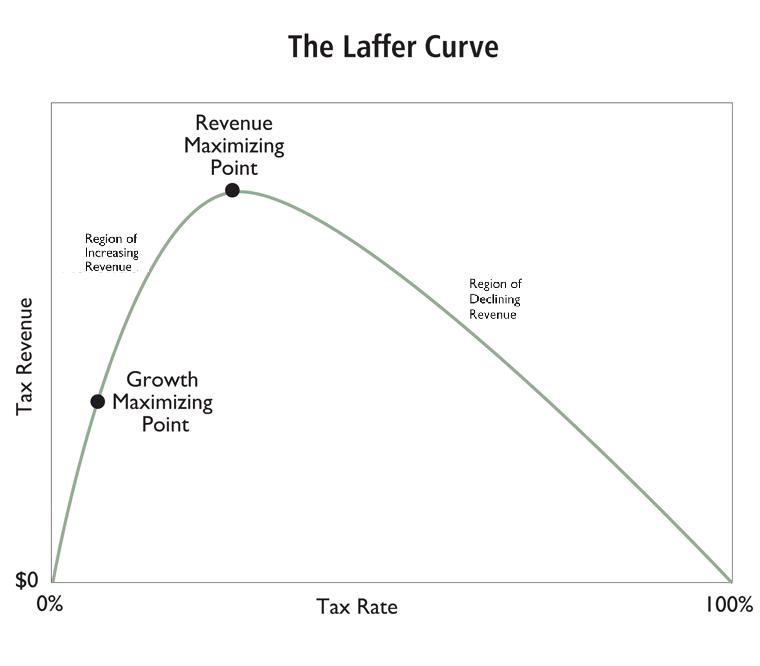
Simply stated, when the tax rate goes up, their taxable income goes down. And that means it’s not clear whether higher tax rates lead to more revenue or less revenue. This is the underlying principle of the Laffer Curve.For more information, here’s a video from Prager University, narrated by UCLA Professor of Economics Tim Groseclose:

Groseclose does an excellent job, and I particularly like the data showing that the rich paid more to the IRS following Reagan’s tax cuts.

But I do have one minor complaint: The video would have been even better if it emphasized that the tax rate shouldn’t be at the top of the “hump.” Why? Because as tax rates get closer and closer to the revenue-maximizing point, the economic damage becomes very significant. Here’s some of what I wrote about that topic back in 2012.

[L]abor taxes could be approximately doubled before getting to the downward-sloping portion of the curve. But notice that this means that tax revenues only increase by about 10 percent. …[T]his study implies that the government would reduce private-sector taxable income by about $20 for every $1 of new tax revenue. Does that seem like good public policy? Ask yourself what sort of politicians are willing to destroy so much private sector output to get their greedy paws on a bit more revenue.

The key point to remember is that we want to be at the growth-maximizing point of the Laffer Curve, not the revenue-maximizing point.

P.S.: Here’s my own video on the Laffer Curve:

Since it was basically a do-it-yourself production, the graphics aren’t as fancy as the ones you find in the Prager University video, but I’m pleased that I emphasized on more than one occasion that it’s bad to be at the revenue-maximizing point on the Laffer Curve.

Not as bad as raising rates even higher, as some envy-motivated leftists would prefer, but still an example of bad tax policy.

07 Feb 18:29

Future Deficits Now Projected to be Even Bigger

by Peter Suderman

America’s current budget deficits have shrunk dramatically over the past few years. But its future deficits are now projected to be bigger than previously expected. When the Congressional Budget Office (CBO) released its updated economic outlook earlier this week, it painted a gloomier picture than it did the previous year. The deficit is now projected to rise by $7.3 trillion over the next decade, a $1 trillion increase since the CBO’s last estimates were published. 

That’s not great news. But it’s actually worse than it sounds. As the budget analysts at the Committee for a Responsible Federal Budget explain, this actually understates the size of the increase.

That’s because last year’s deficit totals were artificially inflated because of a scoring convention that required the budget office to count $425 billion worth of one-time spending on Hurricane Sandy as a recurring annual expense. That assumption is gone this year, but it means that last year’s 10-year deficit total was actually more like $5.9 trillion.

The projections worsen further if you update the time frame. Last year’s projections looked at the 2014-2023 budget window. This week’s report stretches from 2015-2024. Since annual deficits are now expected to grow at a greater clip, that makes for a bigger change. Here’s the CRFB’s graph showing the actual size of the change:

The main reason for the update is that the CBO now foresees slower economic growth over the next decade than it used to. “By 2017,” the budget office report said, “CBO expects that economic growth will diminish to a pace that is well below the average seen over the past several decades.” And the accumulating debt won’t exactly help. The “large and growing federal debt” the CBO expects the nation to shoulder could have “serious negative consequences, including restraining economic growth in the long term.”

So because economic debt is expected to slow, we’ll take on more debt—which could slow growth even further. It’s potentially a rather ugly feedback loop of slow growth and higher debt. 

07 Feb 15:09

President Obama and the Case of the Missing Research

by Jason Bedrick

Jason Bedrick

One of President Obama’s favorite rhetorical tactics is to claim that there is no serious evidence pointing in any direction other than his preferred policy. The president had occasion to deploy this tactic in an interview earlier this week, when Bill O’Reilly asked him why he opposed school vouchers:

O’REILLY - The secret to getting a … good job is education. … Now, school vouchers is a way to level the playing field. Why do you oppose school vouchers when it would give poor people a chance to go to better schools?

PRESIDENT OBAMA - Actually — every study that’s been done on school vouchers, Bill, says that it has very limited impact if any —

O’REILLY - Try it.

PRESIDENT OBAMA - On — it has been tried, it’s been tried in Milwaukee, it’s been tried right here in DC —

O’REILLY [OVERLAP] - And it worked here.

PRESIDENT OBAMA - No, actually it didn’t. When you end up taking a look at it, it didn’t actually make that much of a difference. ... As a general proposition, vouchers has not significantly improved the performance of kids that are in these poorest communities —

The most charitable interpretation of the president’s blatantly false remarks is that he’s simply unaware that 11 of 12 gold-standard studies of school choice programs found a positive impact while only one found no statistically significant difference and none found a negative outcome. Jason Riley summarized the findings of a few recent studies:

A 2013 study by Matthew Chingos of the Brookings Institution and Paul E. Peterson of Harvard found that school vouchers boost college enrollment for blacks by 24%. A 2006 evaluation of a school choice program in Dayton, Ohio, found that “after two years, black voucher students had combined reading and math scores 6.5 percentile points higher than the control group.” A 2010 study in the Journal of Educational and Behavioral Statistics found that voucher recipients had math scores 5 points higher than the control group after just one year. A 2008 study of vouchers in Charlotte, N.C., found that “after one year, voucher students had reading scores 8 percentile points higher than the control group and math scores 7 points higher.”

What about the voucher programs in Milwaukee and Washington that Mr. Obama dismissed as ineffective? A 1998 Brookings Institution study found that “After four years, voucher students had reading scores 6 Normal Curve Equivalent (NCE) points higher than the control group, and math scores 11 points higher. NCE points are similar to percentile points.” And the Obama administration itself released a report on the D.C. voucher program in 2010. “The students offered vouchers graduated from high school at a rate 12 percentage points higher (82 percent) than students in the control group (70 percent), an impact that was statistically significant at the highest level,” according to a summary. “Students in three of six subgroups tested showed significant reading gains because of the voucher offer after four or more years.”

But even Obama’s own faulty reading of the evidence does not warrant opposing school choice. Putting aside the fact that voucher students are more likely to perform better academically and to graduate high school, even if their academic outcomes were roughly the same as government school students, as Obama claims, he should still support school choice because it expands freedom, parents are more satisfied, the schools are safer, and it costs so much less.

According to the U.S. Census Bureau, Washington D.C. spends nearly $30,000 per pupil annually at its government-run schools, more than double the national average. For this “investment” they get practically the worst schools in the nation. By contrast, the low-income D.C. voucher students receive up to $8,256 for K-8 students and $12,385 for students in grades 9-12. 

Perversely, whereas the Obama administration ignores mountains of evidence when opposing school choice programs, the president once again promised universal pre-school in his State of the Union address despite the overwhelming evidence that federal preschool programs do not work. And that’s according to the federal government’s own research!  

It takes a special kind of chutzpah for the Obama administration to repeatedly tout their “evidence-based approach” to policy when they so consistently adopt policies that run counter to the evidence. 

06 Feb 20:47

Edwards’ Law of Government Cost Overruns

by Chris Edwards

Chris Edwards

Here is a rule of thumb to remember when you hear about a proposed government project: If a politician says that it will cost $1, it will end up costing $2 or more. Call it Edwards’ Law.

A never-ending stream of articles reveals the chronic cost overrun problems of government weapon systems, computer upgrades, highway projects, and many other things. The government said that a ship would cost $220 million, and it ended costing $440 million. The government said that a bridge would cost $1.4 billion, and it ended up costing $6.4 billion. The government said that an office consolidation would cost $1.1 billion, and it ended up costing $2.6 billion.

What is the hidden force behind Edwards’ Law? Are governments simply inept, or do they deliberately low-ball initial cost estimates in order to get projects approved? After reading about dozens—probably hundreds—of such incidents over the years, I think the answer is both.

Regarding low-balling, David Boaz pointed out to me this admission from former San Francisco Mayor Willie Brown:

“News that the Transbay Terminal is something like $300 million over budget should not come as a shock to anyone.”

We always knew the initial estimate was way under the real cost. Just like we never had a real cost for the Central Subway or the Bay Bridge or any other massive construction project. So get off it.

In the world of civic projects, the first budget is really just a down payment. If people knew the real cost from the start, nothing would ever be approved.

The idea is to get going. Start digging a hole and make it so big, there’s no alternative to coming up with the money to fill it in.”

Based on Brown’s insight, Edwards’ Law can be reformulated: If a politician says that a project will cost $1, that’s just the down payment. The balance due will be at least another $1.

See here for more on cost overruns.