Shared posts

20 Mar 14:13

Isn't it Ironic: Government Surveillance Version (with Remy)

by Remy

Remy updates the Alanis Morissette hit with a certain senior senator from California in mind. 

Written and performed by Remy. Video and animation by Meredith Bragg. Music performed, produced, recorded, mixed and mastered by Ben Karlstrom.

Approximately 2 minutes. 

Lyrics:
A Senator lady
Got the news one day
The country's being spied on
by the NSA

So she went out defending
on each TV set
but when she found out she'd been snooped on
she got all upset

And isn't it ironic?
I mean, don't you think?

It's like you're at Chris Brown's
and there's punch in the fridge

or if The Bachelor 
passed a geography quiz

Learning Ted Kennedy
happened to be good at bridge
.
And who would have thought?
It figures.

Senator, this may surprise you
and the irony bites
but Congresspeople ain't the only ones
with 4th Amendment rights

It's like a minimalist
who does their laundry with All
or if Woody Allen liked to watch
Kids in the Hall

it's like FDR
got locked in a Honda Accord

a cheap healthcare plan
that you just can't afford

If Oscar Pistorius
really hated The Doors

and who would have thought?
It figures.

I heard the government
is sneaking up on you
.
Life has a funny, funny way
of calling you out
calling you out.

Scroll down for downloadable versions, and subscribe to Reason TV's YouTube Channel to receive automatic notification when new material goes live.

19 Mar 00:35

Obama to Hispanics: We won't deport relatives if you enroll...

19 Mar 00:34

Premiums rising faster than 8 years before Obamacare -- Combined!

18 Mar 22:05

NYPD Claims Secrecy For Its Freedom of Information Request Criteria

by Alyssa Hertig

The New York Police Department has earned a notoriously poor reputation for transparency. According to a report unveiled last year by former New York City Public Advocate and current mayor, Bill de Blasio, about a third of information requests are ignored. When agency representatives do respond, they habitually deny access to material, often citing questionable problems with the requests. To make matters worse, all requests must be made by postal mail. Hoping to dig to the root of this, Shawn Musgrave submitted an information request for the accept-or-reject criteria for an information request. The request was rejected on the grounds that the information is a "privileged attorney-client work-product."

Citizens can submit Freedom of Information Law (FOIL) requests to any New York state agency to promote government transparency and accountability. Agencies are required to respond to requests, but there are several exemptions intended to protect safety, privacy, national security, and other concerns. But Boing Boing argues that the NYPD has “invented its own, extra-legal system of 'classified' documents that it has unilaterally decided it doesn't have to provide to the public.”

In officer Jonathan David's reply to Musgrave, David argues that the requested records “reflect confidential communications between members of the FOIL unit and their attorneys” and “preparation of these records called upon attorneys to apply the skills and talents of an attorney, making these records attorney work product.”

Musgrave, editor of MuckRock, a website that facilitates FOIL request submissions, explains in a blog post, “That a lawyer reviewed or even drafted these documents does not make them exempt from disclosure.” Musgrave continues:

Handbooks and training materials hardly qualify as 'confidential communications,' particularly when the subject matter is transparency itself.

Brand new reports paint an unsettling portrait of transparency requests at the federal level. The Associated Press determined, based on U.S. federal FOIA data, that last year, the “most transparent administration ever” censored or denied access to more information than ever before. In another report compiled by the Center for Effective Government (CEG), 15 agencies were ranked on an A-F grading scale based on their performance in handling FOIA requests—eight passed. Of the eight, four received D's. Perhaps the NYPD is simply a particularly egregious cluster caught in a web of wider unaccountability.

18 Mar 19:21

Medibid patient explains his experience

by sean@impactpolicymanagement.com

One of my favorite services for self-pay patients is Medibid, which allows doctors to bid on providing medical treatments for patients. Back in December, in a blog post on medical tourism, I included the case of Perry Hunt, a 50-year old in California who needed hip replacement surgery. This is the description that originally appeared in a Men’s Health article, which I pasted into my post:

This past June, MediBid helped Perry Hunt, a 50-year-old home developer in Orange County, California, get a new right hip in Texas. Hunt’s local surgeon said the operation would cost $100,000. Hunt was uninsured and did not want to pay that. MediBid had found quotes for India ($8,000), another hospital in California an hour from Hunt’s home ($14,450), and one in San Antonio ($21,000).

Hunt did not want to travel overseas. And even though the Texas surgery would cost far more than the nearby California alternative, he chose to go there because the doctor could perform the procedure with an anterior approach, going in through the front of the hip rather than the buttocks or side, and avoiding cutting through muscle, which makes for less trauma to the body and a speedier recovery…. Hunt was back to playing golf within four months. “I was up walking the very next day,” says Hunt. “I was able to go home the day following surgery, as well, and was given exercises as my rehab. I couldn’t be happier with the results of my experience and the surgery”

Hunt has now done a video describing his experience, which runs about 25 minutes. I thought it would be worth posting here so you can see him talk about how he wound up going through Medibid, his experiences as a self-pay patient, and the quality of the care he received. So here it is:

18 Mar 18:46

New York and California Suck For Taxpayers, and For Freedom

by J.D. Tuccille

United StatesNew York and California are the worst and second worst states in terms of tax burden, in what is less than shocking news from the financial website, WalletHub. The ranking tallies annual state and local taxes, and puts the Golden State and the Empire State at the bottom of the heap, with Wyoming and Alaska at the top as the two least burdensome states for taxpapers in a listing that also includes the District of Columbia (number 37, if you're curious).

In and of itself, the ranking is helpful—but it's also helpful to cross-reference the tax ranking with separate rankings of economic liberty and overall freedom to see how they correlate. The result is a handy guide to places to live—or avoid like the plague.

For its tax rankings, WalletHub compared: real estate tax, state income tax, local income tax, vehicle property tax, vehicle sales tax, sales and use tax, fuel tax, alcohol tax, food tax, and telecom tax.

The five top-ranked states (least burdensome) are:

1. Wyoming: $2,365
2. Alaska: $2,791
3. Nevada: $3,370
4. Florida: $3,648
5. South Dakota: $3,766

The five at the bottom are:

47. Illinois: $9,006
48. Connecticut: $9,099
49. Nebraska: $9,450
50. California: $9,509
51. New York: $9,718

Adjusting for cost of living has some effect—Illinois rises to 38, and Nebraska to 37—but those are the biggest adjustments at the top and bottom, while D.C. and Hawaii plummet in the rankings. But those are the biggest shifts.

WalletHub

What's interesting, though, is how the WalletHub rankings compare to the Mercatus Center's state-by-state ratings of personal and economic freedom. Mercatus scores each state on over 200 issues encompassing fiscal policy, regulatory policy, and personal freedom. These include tax burden, property rights, marijuana laws, gun restrictions, government spending, occupational licensing, marriage freedom, and many more concerns.

Obviously, the final results of such rankings depend to some extent on how you weight each issue, and there's a lot of subjectivity inherent in such comparisons. But using Mercatus's overall score, the top five states for freedom are:

1. North Dakota
2. South Dakota
3. Tenessee
4. New Hampshire
5. Oklahoma

And the bottom of the barrel are:

46. Rhode Island
47. Hawaii
48. New Jersey
49. California
50. New York

As with the WalletHub rankings, you can hover your pointer over each state for scores.

My takeaway, for what it's worth: Stay the hell out of New York and California.

18 Mar 16:34

Inflation rate reaching 57%...

Jts5665

This, I think, is the official rate. I have seen the "implied" rate calculated to be around 300%.


Inflation rate reaching 57%...


(Third column, 8th story, link)
Related stories:
17 Mar 21:53

The 'Most Transparent Administration In History' Sets New Record In Denying Freedom Of Information Requests

by Mike Masnick
On the day of his inauguration in 2009, President Barack Obama announced that his administration would be "the most open and transparent in history." It did not take long for that promise to be tossed aside, and it has been clear for quite a while that this administration is perhaps the most secretive in history. A new analysis by the AP of how the administration responds to FOIA requests confirms that it is becoming even more secretive each year:
The Obama administration more often than ever censored government files or outright denied access to them last year under the U.S. Freedom of Information Act, according to a new analysis of federal data by The Associated Press.
Basically, the administration is doing everything possible to keep information secret. Despite President Obama's memo to the federal government upon taking office on the importance of openness in responding to FOIA requests, the government has done exactly the opposite. His memo, you may recall, stated:
The Freedom of Information Act should be administered with a clear presumption: In the face of doubt, openness prevails. The Government should not keep information confidential merely because public officials might be embarrassed by disclosure, because errors and failures might be revealed, or because of speculative or abstract fears. Nondisclosure should never be based on an effort to protect the personal interests of Government officials at the expense of those they are supposed to serve. In responding to requests under the FOIA, executive branch agencies (agencies) should act promptly and in a spirit of cooperation, recognizing that such agencies are servants of the public.

All agencies should adopt a presumption in favor of disclosure, in order to renew their commitment to the principles embodied in FOIA, and to usher in a new era of open Government. The presumption of disclosure should be applied to all decisions involving FOIA.

The presumption of disclosure also means that agencies should take affirmative steps to make information public. They should not wait for specific requests from the public. All agencies should use modern technology to inform citizens about what is known and done by their Government. Disclosure should be timely.
Compare that to the reality:
In a year of intense public interest over the National Security Agency's surveillance programs, the government cited national security to withhold information a record 8,496 times — a 57 percent increase over a year earlier and more than double Obama's first year, when it cited that reason 3,658 times. The Defense Department, including the NSA, and the CIA accounted for nearly all those. The Agriculture Department's Farm Service Agency cited national security six times, the Environmental Protection Agency did twice and the National Park Service once.

And five years after Obama directed agencies to less frequently invoke a "deliberative process" exception to withhold materials describing decision-making behind the scenes, the government did it anyway, a record 81,752 times.
Yes. It appears that "the most transparent administration in history" has never been all that transparent, and it's only getting worse.

Permalink | Comments | Email This Story


17 Mar 19:24

Domestic Spying Requires a New Probe, Say Former Church Committee Members

by J.D. Tuccille

Sen. Frank ChurchWhen America's spooks got out of hand with sock drawer rummaging at home and whacking foreign dignitaries overseas in the 1970s, the U.S. Senate set up a committee under Sen. Frank Church (D-Idaho) to investigate the shenanigans. In the course of the probe, Sen. Church warned: "If this government ever became a tyrant, if a dictator ever took charge in this country, the technological capacity that the intelligence community has given the government could enable it to impose total tyranny, and there would be no way to fight back." He and fellow committee members recommended reforms for reining the spy agencies in. Now that the country's spooks are back to sticking their noses into Americans' private business, former members of the Church Committee want Congress to launch a new investigation, with renewed limits on the snoops.

The Electronic Frontier Foundation published a letter from the counsel, advisers, and staff members of the Church Committee, which remarks in reference to their original effort:

In 1975, the public learned that the National Security Agency (NSA) had been collecting and analyzing international telegrams of American citizens since the 1940s under secret agreements with all the major telegram companies. Years later, the NSA instituted another "Watch List" program to intercept the international communications of key figures in the civil rights and anti-Vietnam War movements among other prominent citizens. Innocent Americans were targeted by their government...

Our findings were startling. Broadly speaking, we determined that sweeping domestic surveillance programs, conducted under the guise of foreign intelligence collection, had repeatedly undermined the privacy rights of US citizens. A number of reforms were implemented as a result, including the creation of permanent intelligence oversight committees in Congress and the passage of the Foreign Intelligence Surveillance Act.

Now, in the wake of Edward Snowden's revelations:

The scale of domestic communications surveillance the NSA engages in today dwarfs the programs revealed by the Church Committee...As former members and staff of the Church Committee we can authoritatively say: the erosion of public trust currently facing our intelligence community is not novel, nor is its solution. A Church Committee for the 21st Century—a special congressional investigatory committee that undertakes a significant and public reexamination of intelligence community practices that affect the rights of Americansand the laws governing those actions—is urgently needed. Nothing less than the confidence of the American public in our intelligence agencies and, indeed, the federal government, is at stake.

Unfortunately, but perhaps inevitably, some of the reforms implemented by the original Church Committee were turned back on themselves once the committee went away and the snoops went back to work. Modified by the security state, the Foreign Intelligence Surveillance Act passed to rein spies in during the 1970s now serves as an enabler to them. The Foreign Intelligence Surveillance Court that law created as an oversight body has become little more than a rubber stamp.

Which doesn't mean that Congress shouldn't follow up on the letter and make an effort to investigate and once again rein in the NSA and company. But we shouldn't assume that this will be any more permanent a fix than the last effort, or that we'll do more than buy ourselves a little time until new reforms are subverted.

Reformist committees come and go, but the eavesdropping bureaucracy seems to live on, always posing a danger to the people it supposedly protects.

https://www.eff.org/files/2014/03/16/church_committee_-_march_17_2014__0.pdf

17 Mar 15:50

Just Call Us the "Not Smart Enough" Bunch

by Walter Olson

Walter Olson

From a Baltimore Sun article on the regulatory fate of car-sharing services Uber and Lyft, bitterly attacked by their more highly regulated taxi competitors: 

At a recent work session on the issue, Kelley [Sen. Delores G. Kelley, D-Baltimore County] rejected the contention from Lyft and Uber that it’s a matter of consumer choice about whether to use the application to book a ride and they won’t do it if the price is too high. 

“We regulate all sorts of things because the general public is not smart enough to know when they’re about to be fleeced,” Kelley said.

But what about members of the general public who are smart enough to know they’re about to be fleeced, but are unable to do anything about it because it’s lawmakers and market incumbents combining to make that happen? 

14 Mar 22:29

USA GIVES UP CONTROL OF NET; NEW GLOBAL GOVERNANCE...

Jts5665

Given the whole NSA thing my feelings on this are mixed. I hope whatever international community that ends up in charge of this isn't nearly as corrupt as the UN.


USA GIVES UP CONTROL OF NET; NEW GLOBAL GOVERNANCE...


(Second column, 15th story, link)
Related stories:
14 Mar 22:10

Golden Gate Bridge to add nets to save jumpers...

Jts5665

I wonder if this will give thrill seekers incentive to jump and thus, sadly, and unintentionally increase deaths from bridge jumping?


Golden Gate Bridge to add nets to save jumpers...


(Second column, 17th story, link)

14 Mar 15:25

The Regulation Singularity

by admin

Yesterday, I came home exhausted.  I have been working late nearly every night for weeks, at a time of year when most of my business is not even open yet (the business is seasonal).  I realized to my immense depression that I have been spending all my time on regulatory compliance.  I have not been pitching new clients or bidding on new prospects or making investments or improving our customer service processes -- though I have ideas for all of these.  I have been 100% dedicated through 14 hour days to just trying to keep up with and adapt to changing government rules.

Break rules, changing minimum wages, heat stress plans, mandatory sexual harassment training, OSHA reporting, EEO reporting, Census reporting, and most recently changing rules on salaried workers that Obama just waived his wand and imposed -- this is what has been consuming me.  I have been trying to roll out a new safety program to the field and can't do it because I keep having to train for one of these new requirements (one learns there is only a limited number of things one can simultaneously roll out to front-line staff).

At some point regulation will accrete so fast that it will be impossible to keep up.  I am going to call that the Regulation Singularity, and for businesses my size, we are fast approaching it.

Prominent libertarian think tanks often rank state business climate by their tax regimes.  I am all for low, sensibly-structured taxes.  But for most of my time, taxes are irrelevant.  We are shutting down businesses left and right in California and it has zero to do with taxes.

14 Mar 15:22

'I’m offended as an American taxpayer that the federal bureaucracy...is so profoundly dysfunctional,' Writes Former HHS Official

by J.D. Tuccille

David E. WrightThe results of government bureaucracy are all too apparent—wasted resources, endless delays, pointless expenditures. From the outside, bureaucrats often appear to cheerfully function inside a cruel and inefficient loony bin. So how gratifying (if not reassuring) it is when an escapee from the system tells us that the view is no better from the inside.

David E. Wright came from academia in 2011 to take over the Department of Health and Human Services' (HHS) efforts against research misconduct at the Office of Research Integrity. Just over two years later, he's out of his own accord, and saying that, while he enjoyed working with "brilliant scientist-investigators" he describes most of his responsibilities as "the very worst job I have ever had."

ScienceInsider obtained a copy of his February 25 resignation letter to Dr. Howard Koh, M.D., Assistant Secretary for Health. Among other disappointments and roadblocks he details, this may be my favorite:

In one instance, by way of illustration, I urgently needed to fill a vacancy for an ORI division director.  I asked the Principal Deputy Assistant Secretary for Health (your deputy) when I could proceed.  She said there was a priority list.  I asked where ORI’s request was on that list.  She said the list was secret and that we weren’t on the top, but we weren’t on the bottom either. Sixteen months later we still don’t have a division director on board.

Wright also cites Max Weber to note that "public bureaucracies quit being about serving the public and focus instead on perpetuating themselves. This is exactly my experience."

He's concerned, too, that "decisions are often made on the basis of political expediency and to obtain favorable 'optics.'"

Ultimately, the former director writes, "I’m offended as an American taxpayer that the federal bureaucracy—at least the part I’ve labored in—is so profoundly dysfunctional."

Wright's tenure as a government employee ends March 27, after which time he'll publish the daily log he kept as ORI Director.

But while Wright may be out, the bureaucracy he escaped lives on, and on, and on...

14 Mar 03:30

Another Grand Plan Fails

by Tom Naughton

In a couple of recent posts, including part six of Character vs. Chemistry, I wrote that the Grand Plans designed by The Anointed to battle obesity will fail because those plans are based on the belief that weight loss is about character, not chemistry.  Well, in the interest of fairness, I feel obligated to point out that not every Grand Plan imposed on us by The Anointed fails because of biochemical ignorance.  Most fail because of economic ignorance.

In fact, to believe that the typical Grand Plan proposed by The Anointed will actually work, you pretty much have to be an economic illiterate.  You have to believe, for example, that young people who already refuse to buy inexpensive health insurance will flock to buy insurance that costs three times as much if you just run some cute ads encouraging them to spend the holidays wearing pajamas and drinking hot chocolate and #GetTalking with their parents about insurance.  That’s how The Anointed believe it should work, so by gosh, that’s how it will work.

Which brings me another Grand Plan to battle obesity:  spending taxpayer money to make sure plenty of fruits and vegetables are available in poor neighborhoods.  That’s why so many poor people are fat, ya see … they don’t have access to the magical fruits and vegetables that guarantee weight loss.  And of course, if we just make the magical fruits and vegetables available, poor people will flock to buy them (elbowing young people flocking to buy expensive insurance out of the way in the process), eat those vegetables, and then lose weight.  That’s how The Anointed believe it should work, so by gosh, that’s how it will work.

If you’re a long-time reader, you may recall that I’ve pointed out the economic fallacies in that Grand Plan before.  Here’s what I wrote in a post three years ago:

Here’s a simple economics lesson:  businesses don’t determine what consumers will buy.  Consumer behavior determines what businesses will produce and sell.  If fast food restaurants thrive in poor neighborhoods while stores that sell fresh fruit and vegetables don’t, there’s a good reason for it.  Using tax dollars to bring more fruits and vegetables to areas where people don’t buy fruits and vegetables isn’t going to reduce childhood obesity.  It’s just going to lead to a lot of rotten fruits and vegetables.

In fact, one corner-store owner in Philadelphia agreed, at the urging of The Anointed, to sell 15-cent bags of apple slices so poor kids would eat more fruit.  He ended up throwing most of them away – at a loss of $500 to his business.

Here’s what I wrote in another post two years ago:

Even if we’re talking about neighborhoods where there truly aren’t as many vegetables being sold, people get the causality backwards.  The local residents aren’t fat because they don’t have access to vegetables.  The vegetables aren’t available because people don’t buy them.

… Here’s what people like Mrs. Obama can’t seem to grasp:  if enough people in those neighborhoods wanted lettuce and fruit in their kids’ lunches, plenty of greedy capitalists would happily move in to sell them.

… No problem then.  The government’s on the job and planning a comprehensive response.  That of course means a really expensive and ultimately futile response.

Well, I guess that depends on your definition of really expensive.  Since I don’t work in the federal government, a figure of, say, $500 million sounds to me like a huge waste if some comprehensive response doesn’t work.  (I mean, geez, imagine if you spent nearly double that on a crappy web site that didn’t work and then had to go spend even more to get it fixed.)

But of course, part of what makes it so awesomely wonderful about being a member of The Anointed is that you get to spend other people’s money to institute your Grand Plans.  No need to start small to test your theory.  No need to try opening Uncle Sam’s Cheep Fruits and Veggie Stand in a few poor neighborhoods to see if people eat more vegetables and lose weight.  No need to stock some existing grocery stores with cheap fruit and track the sales.  Nope, if you’re a member of The Anointed, you may as well go whole-hog and plunk down $500 million in taxpayer dollars.

So here are the latest results:

With the obesity epidemic in full swing and millions of American living in neighborhoods where fruits and vegetables are hard to come by, the Obama administration thought it saw a solution: fund stores that will stock fresh, affordable produce in these deprived areas.

But now, three years and $500 million into the federal Healthy Food Financing Initiative, there’s a problem: A study suggests it’s not working.

Adding supermarkets to areas with short supplies of fresh produce does not lead to improvements in residents’ diets or health outcomes, according to a report published Monday in the February issue of Health Affairs.

So The Anointed in government thought they saw an untapped market for fruits and vegetables that the greedy capitalists somehow missed, but it turns out they were wrong.  Boy, I’ll bet nobody saw that coming.

When a grocery store was opened in one Philadelphia food desert, 26.7 percent of residents made it their main grocery store and 51.4 percent indicated using it for any food shopping, the report found. But among the population that used the new supermarket, the researchers saw no significant improvement in BMI, fruit and vegetable intake, or perceptions of food accessibility, although there was a significant improvement in perception of accessibility to fruits and vegetables.

Well, if people perceive that they have more access to fruits and vegetables without actually buying them, that’s certainly worth $500 million … although it would have been cheaper to just run TV ads telling them that fruits and vegetables were in great supply.

The report was authored by a team of researchers from the London School of Hygiene and Tropical Medicine and Penn State University’s departments of sociology, anthropology, and demography. The study was funded by the National Institute of Environmental Health Sciences with support from the Population Research Institute, although neither had a hand in the research design, collection, or analysis.

Awesome.  So we’re spending taxpayer money to study why spending taxpayer money on yet another Grand Plan didn’t work.  Is this a great country or what?

The study needs to be replicated in other neighborhoods and other parts of the United States to confirm or refute these findings, said lead researcher Steven Cummins, professor of population health at the London School of Hygiene and Tropical Medicine. The results do, however, mirror findings in the U.K., where researchers created a similar comparison of two neighborhoods in Scotland and observed no net effect on fruit and vegetable intake.

Wow.  It’s almost as if the laws of economics apply all over the world.  But we don’t know that for sure, so we really need to spend more taxpayer money to confirm that spending taxpayer money on yet another Grand Plan didn’t work.

And if the conclusion is borne out, it would suggest that policymakers rethink the Healthy Food Financing Initiative if they want to promote healthier eating and healthier citizens.

Hmmm, let’s see if I can remember what The Anointed conclude when a Grand Plan fails … okay, it came to me:

  • The plan was good but people didn’t implement it correctly because they’re stupid.
  • The plan was undermined by people who opposed it because they’re evil.
  • The plan didn’t go far enough – we need to do same thing again only bigger.

Cummins said in an email that lawmakers ought to consider policies that will change community behavior to incorporate healthy food into everyday diets.

“These might include economic initiatives such as taxes on unhealthy foods and subsidies on healthy foods, marketing initiatives that focus on in-store promotion of healthy food, and programs that focus on skills related to buying and cooking components of a balanced diet,” Cummins said.

Yeah, what we need to do is spend even more taxpayer money trying to tell people what to eat – because it’s worked so well so far.  Then if that doesn’t work, we can spend more taxpayer money to study why spending taxpayer didn’t work.  Oh, and let’s tax the unhealthy foods too.

Anyone care to bet that The Anointed would correctly identify the “unhealthy” foods?

Facebook Twitter Share/Bookmark
13 Mar 16:30

Forced to Unionize: Is this Cesar Chavez's Legacy?

by Zach Weissmueller

"If Cesar were here today, he certainly wouldn't be supporting what's being done now, which is a union trying to impose itself on employees," says Dan Gerawan, co-owner of Gerawan Farms, one of the nation's largest producers of peaches, plums, and nectarines and a major employer of California farm workers. 

Gerawan Farms and some of its employees are in the midst of a fight with the United Farm Workers (UFW) union, which claims to represent Gerawan's workers, despite not having collected dues or bargained on behalf of them for more than two decades.

After years of failed efforts to unionize California's migrant farm workers, a massive grape strike started in the small farming town of Delano sparked a movement leading to the eventual rise of the UFW in 1966. The face of this movement was a man named Cesar Chavez, a man revered by labor historians as the bringer of "peace in the fields," who has roads, schools, and even holidays named after him. He's also the subject of an upcoming biopic starring Michael Peña.

But since then, much has changed in the agriculture industry and in labor politics. The UFW, which once boasted more than 50,000 dues-paying members, now claims fewer than 5,000. Yet with unionization in the industry on the decline, real wages have steadily increased. This might explain why many workers at Gerawan Farms have begun to protest—not against their employer, but against the union. 

Gerawan Farms employs more than 10,000 workers a year—more than double the entire membership of UFW—and points to county employment statistics to back up claims that it's an industry leader in employee compensation. UFW won an election to represent Gerawan Farms' workers in 1990. The company and the union had a single bargaining session, and then UFW disappeared from the scene, according to Dan Gerawan.

UFW refused to participate in the story and has not answered questions about why they disappeared for more than two decades. The truth is, they don't have to answer such questions. Despite its 24-year absence, UFW is still the representative union of the workers under California law. Two years ago, UFW initiated a process called "mandatory mediation and conciliation," which would force Gerawan Farms to impose a union contract and terminate any employees not willing to divert three percent of wages towards union dues. This did not sit well with the workers.

Silvia Lopez has worked in Gerawan Farms' fields for 14 years and raised her two daughters on her salary from the job. She once worked in a union shop and didn't enjoy the experience, saying it was like "having two bosses."

"I never liked a company where they have [a] union," says Lopez. "I don't see that I have to pay somebody to explain me my rights. I know my rights."

Silvia started a petition to hold an election to officially decertify UFW. She collected more than 2,000 employee signatures and submitted them to California's Agricultural Labor Relations Board (ALRB). Silas Shawver, ALRB General Counsel, rejected the petition.

"There were some serious problems with signatures submitted that appeared to be fraudulent," says Shawver.

Lopez denies that there were a significant number of fake signatures on the petition, but she nonetheless tried again, collecting thousands of signatures for a second time. Shawver rejected the petition again, citing allegations made by UFW that Gerawan management was putting pressure on the employees to oppose the union. ALRB, which acts as investigator, prosecutor, and judge in these cases, is pursuing unfair labor practice charges against Gerawan Farms in court in conjunction with UFW.

The appearance of collusion between the ALRB and the UFW disturbed Gerawan management and infuriated many of the workers, who staged a protest in front of the ALRB offices in Visalia. In a move reminiscent of the famous Delano grape strike, some even travelled to Sacramento hoping to have their voices heard by Governor Jerry Brown, the very same governor who created the ALRB while in office 38 years ago to create "peace in the fields" and act as a neutral arbiter between companies, workers, and unions. 

"Often what our employees tell us is, they don't trust the ALRB," says Gerawan. "They've cited Silas Shawver himself as someone they don't trust."

Following the protests, the ALRB finally granted the workers their election, to be overseen by ALRB and administered by Shawver. Prior to the elections, Gerawan Farms granted ALRB access to their facilities to conduct interviews and run private sessions to inform workers of their voting and unionization rights.

What were the election results? We don't know. Shawver has impounded the votes in an office safe, pending further investigation of the unfair labor practice allegations. He failed to provide a timeline for this investigation.

"What does that mean, to have an election and not count the votes?" asks Lopez. "Where is the right of the farm worker? Where is it?"

Lopez and her co-workers have filed a class-action lawsuit against the ALRB for failing to count their ballots. Gerawan Farms is also suing, alleging that mandatory mediation is unconstitutional. UFW continues to call for a contract to be imposed and, alongside ALRB, alleges that Gerawan has engaged in unfair labor practices.

"The main problem is in the ALRB office," says Lopez. "They are supposed to be neutral with us. But they are not. We can see that they are favoring the UFW organization."

Watch the above video for an inside look at this fight, and scroll down for downloadable versions. Produced by Zach Weissmueller. Camera by Sharif Matar and Weissmueller. Approximately 8 minutes.

Scroll down for downloadable versions of this video, and subscribe to Reason TV's YouTube Channel for notifications when new material goes live.

13 Mar 15:51

Why NSA's Betrayal Of Internet Security Is Akin To A Massive Public Health Disaster

by Glyn Moody
One of the most shocking of Snowden's revelations was that the NSA and GCHQ are deliberately weakening the Internet's security -- either by undermining standards, or by using zero-day vulnerabilities to break into systems. More recent news about the huge scale of attempts to infect computers with malware only compounds that outrage. It's hard to convey to ordinary Internet users the seriousness of what the NSA and GCHQ have done here, but in a brilliant new column in the Guardian, it looks like Cory Doctorow has done just that:
I think there's a good case to be made for security as an exercise in public health. It sounds weird at first, but the parallels are fascinating and deep and instructive.
Here's the basic insight:
If you discovered that your government was hoarding information about water-borne parasites instead of trying to eradicate them; if you discovered that they were more interested in weaponising typhus than they were in curing it, you would demand that your government treat your water-supply with the gravitas and seriousness that it is due.
Because that is precisely what the spying agencies are doing: they are intentionally withholding vital information about threats to your digital health -- the fact that programs you use are vulnerable to infections with malware, or that key security technologies you depend upon have backdoors -- regardless of the serious consequences this might have for you. If you try to imagine doctors doing the same in the case of equivalent threats to your health, you begin to get an idea of the depth of betrayal felt by computer professionals here. Doctorow goes on to point out that this is not just a matter of personal harm; the NSA and GCHQ are degrading the basic digital infrastructure of modern life:
This is the most alarming part of the Snowden revelations: not just that spies are spying on all of us -- that they are actively sabotaging all of our technical infrastructure to ensure that they can continue to spy on us.

There is no way to weaken security in a way that makes it possible to spy on "bad guys" without making all of us vulnerable to bad guys, too. The goal of national security is totally incompatible with the tactic of weakening the nation's information security.

"Virus" has been a term of art in the security world for decades, and with good reason. It's a term that resonates with people, even people with only a cursory grasp of technology. As we strive to make the public and our elected representatives understand what's at stake, let's expand that pathogen/epidemiology metaphor. We'd never allow MI5 to suppress information on curing typhus so they could attack terrorists by infecting them with it. We need to stop allowing the NSA and GCHQ to suppress information on fixing bugs in our computers, phones, cars, houses, planes, and bodies.
Doctorow is right on both counts: we can't allow the NSA and GCHQ to withhold vital information that endangers the digital fabric of society, and the way to stop them is to use this public health metaphor to get that message across to politicians and the general public.

Follow me @glynmoody on Twitter or identi.ca, and +glynmoody on Google+ Follow me @glynmoody on Twitter or identi.ca, and +glynmoody on Google+


Permalink | Comments | Email This Story


13 Mar 13:36

Peter Schiff's Offshore Strategies

by Tyler Durden

Submitted by Nick Giambruno via Doug Casey's International Man blog,

Most readers are familiar with Peter Schiff. He is a financial commentator and author, CEO of Euro Pacific Capital, and is known for accurately predicting the 2008 financial crisis.

He also has a very keen understanding of internationalization. Peter shares with me his strategies in this must-read discussion below that I am happy to bring exclusively to International Man readers. (If you are not already a member, you can join for free here.)

Nick Giambruno: Peter, do you see the potential for another financial crisis in the US playing out in the not-so-distant future?

Peter Schiff: Unfortunately, yes. I mean, how soon is very difficult to tell. In fact, right now you’ve got a high level of complacency. The stock markets are rallying to new highs, nominal highs. People seem to be convinced that the worst is behind us, that the central banks of the world have solved their problems by papering them over. But, you know, I don’t think they’ve solved anything. I think they’ve compounded the underlying problems that caused the last crisis, and so now the next crisis will be that much worse because of what the central banks did, in particular the Federal Reserve.

The Fed is right now trying to prop the economy up, the housing market up with cheap money, and it is operating under the delusion that one day it can take that cheap money away and the economy and the housing market will just sustain on their own, but that’s not possible. The Fed is building an economy that is completely dependent on that cheap money. And so if you take it away, the economy implodes, but if you don’t take it away, then it’s worse.

Nick Giambruno: So what measures do you see coming into place—things such as capital controls?

Peter Schiff: Well, certainly as currencies depreciate, governments look to try to find ways to stop the bleeding. What’s really is going on with inflation is that you have a huge transfer of wealth from savers and lenders to debtors, and of course the US government is the world’s biggest debtor, but a lot of American voters are in debt too.

If you’re a saver and you don’t want to watch your assets confiscated through the printing press, then you’re going to try to protect yourself. You might do that by moving your dollars abroad, converting them to foreign currencies, trying to get out of harm’s way, and that’s when you have the government potentially coming in with capital controls.

Putting taxes on foreign currency transactions or maybe outright prohibiting them altogether, that will make it more difficult for you or more expensive to take protective measures. I think we’ve already got the beginnings of capital controls in the United States. The government is making it very difficult for Americans to do business abroad. Many foreign financial institutions, banks, and even bullion depositories are refusing to do business with American citizens for fear of retaliation by the IRS or other government agencies.

Nick Giambruno: So what can Americans and others living under a desperate government do to minimize this risk?

Peter Schiff: Well, the first thing that you could do is minimize your purchasing power risk. So you don’t have to get your money into a foreign bank or foreign brokerage account to get out of the dollar. I help Americans diversify globally within a US account, but their portfolio consists of foreign assets, whether it’s foreign bonds, government bonds, corporate bonds, foreign stocks, dividend-paying stocks, commodities, or precious metals. These are all things that will protect purchasing power in an inflationary time period, and things that the federal government—the Federal Reserve—can’t levy the inflation tax on.

If you’re more worried about political risk—about the US government seizing your assets—then you want to take the next step. This is not just getting out of the dollar, but getting your money out of the country. But again, the US government is making that more difficult right now.

I know personally. I set up a foreign brokerage firm as a subsidiary of my foreign bank, which I also set up, called Euro Pacific Bank. I did this predominantly for foreigners who were having trouble investing with my US brokerage firm. The securities rules and regulations are now so onerous that it almost caused me to view any foreigner as a terrorist. So if somebody in Australia wanted to open up an account with me, there was so much paperwork involved that oftentimes they would just give up halfway through the process. So what I did is I set up this foreign bank so that I wouldn’t have to operate under those confines, so I can be more competitive to a foreign investor, but I can’t offer these services to Americans.

My foreign bank is no different than many other foreign banks. In order to really protect the privacy of my foreign customers, I can’t accept American customers. And if I accepted American customers, my compliance cost would be so high that I would have to charge my foreign customers more for transactions to try to stay in business. So to mitigate all that regulation and the potential of having to share all the information on my foreign clients with the US government, I’m just not taking American customers with my foreign bank.

Nick Giambruno: So Euro Pacific Bank, where is it headquartered and why did you choose that jurisdiction?

Peter Schiff: It’s in St Vincent and the Grenadines (the Caribbean). I did it for a number of reasons: it’s close to me, but also because of the banking laws. You have secrecy, privacy, and you have no tax. They’re not going to impose any income tax on my company as an offshore bank, they’re also not going to impose any taxes, any withholding taxes on my bank’s customers’ interest income or their capital gains. And no one is going to pierce the wall of secrecy. You’re going to have to go in to a St. Vincent’s court and get a local court order to get any information from my bank.

The bank is regulated, but it’s not nearly as onerous as the type of regulations that I would face trying to do this business from the United States. In fact, some of the things we’re doing offshore might be completely impossible because they would no longer be economically viable if I tried to do them in America, but I can do them offshore because the government doesn’t impose these artificial barriers.

(Editor’s Note: You can find out more about Euro Pacific Bank here.)

Nick Giambruno: Generally speaking, which countries are you particularly bullish on?

Peter Schiff: It’s kind of like a monetary or economic triage; I’m always looking around the world to see which countries are in the least bad shape, which countries are the least reckless and the least irresponsible. You really can’t find any one country that’s doing it perfectly. You just have to find the ones that are making the fewest mistakes.

And I think high on that list are Singapore and Hong Kong. Those markets are relatively free of regulation, free of taxation. I mean, it’s not nonexistent, but on a relative basis you have a lot more freedom there, and so you have a lot more prosperity there. You have much better economic fundamentals. And not just in those two places, but in Southeast Asia in general, in a lot of the emerging economies, you’ll find a lot less government and a lot more freedom. People are working harder, they’re saving, they’re producing, and they’re exporting. You don’t have these trade deficits, budget deficits, and you don’t have armies of people looking to retire on government entitlements. In Europe, we still like Switzerland even though they are making mistakes tying their currency to the euro. I think eventually they will change that policy. Scandinavia, we have been investors in Norway, we’ve been investors in Sweden. Also Australia and New Zealand have been longtime favorites. We’ve been investing down there or even closer to home in Canada. We do have some investments in South America. We’re diversifying around the world trying to get into the right countries, the right currencies, the right asset classes.

Nick Giambruno: On a different note, we’ve seen the number of US citizens renouncing their citizenship sharply increase. We have also seen high-profile people like Tina Turner and Eduardo Saverin give up their US citizenship. Would Tina be eligible to use Euro Pacific Bank?

Peter Schiff: Yes, once you renounce your US citizenship. The only people who can’t bank with me are American citizens, or green card holders. So once you are no longer an American citizen, as long as you don’t reside in the United States, then you are welcome at the bank.

I think a lot of people are doing this obviously for tax reasons, although they can’t necessarily claim it’s for tax reasons. You have to fill out a form if you want to renounce your citizenship—which, by the way, you can only get from a foreign embassy or consulate. Those forms used to be free. Now they’re $500 apiece. So think about that. If they can charge you $500 for that form, they could charge $5,000, they could charge $5,000,000. They could basically make it impossible for you to leave. And they’re trying to make it more difficult ever since Eduardo Saverin from Facebook went to Singapore. Now the government is trying to come up with all sorts of ways to punish Americans who try to give up their citizenship, and this really is the sign of a nation in decay. Fifty years ago, nobody would want to give up American citizenship. They would cherish it. The fact that so many people are paying tremendous amounts of money to get this albatross off their neck shows you how much times have changed, that an American passport is not an asset to be cherished but a liability that people are willing to pay to get rid of.

Nick Giambruno: And what about yourself? Do you believe you are adequately diversified internationally?

Peter Schiff: I think my investments are; I own a lot of foreign stocks. I have a lot of precious metals, I have a lot of mining shares. But I still live in the United States, so I’m obviously still vulnerable here. My family is here, so I haven’t done anything about a physical exit strategy. Although I do think I have financial resources that would afford me the ability to relocate, but I haven’t actually taken any steps other than setting up a foreign business. I have the foreign bank in the Caribbean. I have a brokerage firm Euro Pacific Canada, and so I’ve got offices up there. I’m also thinking about opening up an office in Singapore and trying to move more of my business—particularly my asset management business—to move it from the US. Not only because of favorable tax treatment outside the US, but because of the regulatory environment. If you want to be globally competitive, you need to be in an area where you can minimize these costs because if I have those costs and my competitors don’t, then I am at a disadvantage. And also because I think that over time people are going to be more and more hesitant about sending their money to the United States. So if I’m going to manage money, I might have to manage it offshore, because I think people will be worried about sending it here. They might be worried that the US government might take it.

If it ever gets really, really bad that you feel that you have to leave, by then it might be illegal to take any gold or silver out of the country. Right now you can take more than $10,000 worth of cash or cash equivalents—which would include gold bullion—out of the country as long as you tell the government that you’re taking it. And if you don’t tell them and they catch you, there’s a big fine and jail penalty. But one day it might not be the case. It might be that you are prohibited from taking any significant amount of money out of the country, and who knows what the penalty might be if they catch you. But if it’s already out of the country, then you don’t have to worry, because you’re leaving with nothing and the money is on the other side of the border waiting for you.

Nick Giambruno: So the idea is to preempt capital controls?

Peter Schiff: Yeah, well, you get out the window before they slam it shut. That’s the whole idea, and right now those windows are shutting all around as more and more offshore institutions are saying “no thank you” to an American customer. But the other reason that you want to act sooner too is if they impose exchange controls or fees on purchasing precious metals. They don’t ban them, but they have a big tax on the transaction or a big tax on the foreign exchange. If you want to buy Swiss francs, they can have a transaction tax. You want to get your money out of the dollar before those taxes are imposed, because if you wait until they’re imposed, then you can’t get as much money out, because a lot of it is being lost to taxes. In getting out of the dollar, you’re trying to avoid the inflation tax, but they’re hitting you with some other kind of tax in the process because that’s really what they are trying to do. A lot of people are worrying about the income tax or the estate tax and they go through elaborate means to try to minimize those taxes, but then they leave themselves vulnerable to what might be the biggest tax of all: and that’s the inflation tax. So you have to act to protect yourself before so many people are trying to protect themselves that the government makes it almost impossible to do so.

Editor’s Note: Internationalization is your ultimate insurance policy. Whether it’s with a second passport, offshore physical gold storage, or other measures, it is critically important that you dilute the amount of control the bureaucrats in your home country wield over you by diversifying your political risk. You can find Casey Research’s A-Z guide on internationalization by clicking here.

12 Mar 20:56

Photo


12 Mar 20:55

Best Pi Day Ever

Best Pi Day Ever

Submitted by: Unknown

12 Mar 20:51

easyriderr: TL;DR : Watch this incredible story in...

12 Mar 20:06

After Annexing Crimea, Russian Troops Are Piling Up By The East Ukraine Border

by Tyler Durden

Despite the relentless protests of Kiev, and of course the G7 group of world's most indebted nations, in the past two weeks Vladimir Putin once again succeeded in outplaying the west and annexed the Crimea penninsula without firing a single shot (granted there is still potential for material situational deterioration, one which would involve military participation by NATO whose outcome is not exactly clear). The market has "priced in" as much, with prevailing consensus now dictating that Russia will preserve its foothold in the Crimea however without additional attempts for annexation: certainly Poland is hoping and praying as much.

However, as the following photos taken on the Russian side of East Ukraine, one next to Belgorod, and one in the proximity of Rostov, the Russian tanks are now piling up, only not in Crimea, which needs no further Russian military presence, but ostensibly to prepare for the next part of the annexation: that of Russian-speaking east Ukraine.

On the picture below, one can see Russian troops on the move near the border with Ukraine in the Belgorod Oblast, about 20 kilometers from the border with Ukraine near Kharkiv:

)

?????? ???????

?????? ???????

?????? ???????

The indicative location:


Meanwhile, on the birder with Crimea, Ukrainian troops are digging in and mining fields in anticipation of Russians rolling out of the Penninsula:

)

H/T @raymond_saint, Censor.net

12 Mar 19:35

Quotation of the day on the public health model for dealing with drug addiction….

by Mark J. Perry

…. is from an interview with legal scholar Michelle Alexander, author of “The New Jim Crow: Mass Incarceration in the Age of Colorblindness“:

Portugal is an excellent example of how it is possible to reduce addiction and abuse and drug related crime in a non-punitive manner without filling prisons and jails. Supposedly, we criminalize drugs because we are so concerned about the harm they cause people, but we wind up inflicting far more pain and suffering than the substances themselves. What are we doing really when we criminalize drugs is not criminalizing substances, but people.

I support a wholesale shift to a public health model for dealing with drug addiction and abuse. How would we treat people abusing if we really cared about them? Would we put them in a cage, saddle them with criminal records that will force them into legal discrimination the rest of their lives? I support the decriminalization of all drugs for personal use. If you possess a substance, we should help you get education and support, not demonize, shame, and punish you for the rest of your life.

12 Mar 15:47

NSA Using FACEBOOK to Hack Into Your Computer...


NSA Using FACEBOOK to Hack Into Your Computer...


(First column, 15th story, link)
Related stories:
12 Mar 13:25

Quotation of the Day…

by Don Boudreaux
(Don Boudreaux)

… is from page 15 of David Rose’s excellent 2011 book, The Moral Foundation of Economic Behavior (links added):

Yuriy Gorodnichenko and Gerard Roland (2010) …. presented a model showing that while an ethic of individualism produces dynamic effects on growth, an ethic of collectivism produces only static gains.  They also found evidence that individualism significantly contributes to long-run growth.  In a subsequent paper (Gorodnichenko and Roland, 2011) they explored the effect that other factors might have on long-run growth and found that individualism was the most important and robustly significant factor of all.

12 Mar 04:34

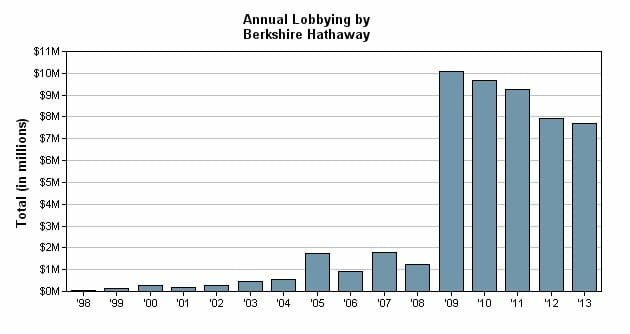
The World's Most Famous Investor Is Now Investing in...

by admin

...government access.  Clearly Warren Buffet saw the writing on the wall in 2009, that the way to make money in the US was no longer to build products and factories but to invest in lobbying to get crony advantages and giveaways.

click to enlarge

This Administration and Senate makes all kinds of progressive noises, but all the while they are running perhaps the greatest expansion of cronyism in US history.  And the smart money knows it.


11 Mar 21:45

The FBI versus the Citizens

by Gene Healy

Gene Healy

This Thursday at Cato, we’re hosting an event for a remarkable new book: Betty Medsger’s The Burglary: The Discovery of J. Edgar Hoover’s Secret FBI (RSVP here). As I explain in the Washington Examiner today, it’s a story as riveting as any heist film, and far more significant:  

Forty-three years ago last Saturday, an unlikely band of antiwar activists calling themselves “The Citizens Commission to Investigate the FBI” broke into a Bureau branch office in Media, Pennsylvania, making off with reams of classified documents. Despite a manhunt involving 200 agents at its peak, the burglars were never caught, but the files they mailed to selected journalists proved that the agency was waging a secret, unconstitutional war against American citizens.  

As a young Washington Post reporter, Medsger was the first to receive and publish selections from the files—over the protests of then-attorney general (and later Watergate felon) John Mitchell, who called the Post three times falsely claiming that publication would jeopardize national security and threaten agents’ lives. 

Four decades later, those claims echo in former NSA head Michael Hayden’s assertion that the US is “infinitely weaker” because of Snowden’s leaks. Like the apocryphal old saw suggests, if history doesn’t repeat itself, at least it rhymes.

“As if arranged by the gods of irony,” Medsger writes, the very morning Hoover learned of the break-in, then-assistant attorney general William H. Rehnquist (later Chief Justice), in testimony the FBI had helped prepare, told a Senate subcommittee that what little surveillance the government engaged in did not have a “chilling effect” on constitutional rights. Among the first documents Medsger reported weeks later, was a memo urging agents to “enhance the paranoia… get the point across there is an FBI agent behind every mailbox.”

Ironies abound. The burglars timed the heist for March 8, 1971, when the country would be distracted by the “Fight of the Century” between Muhammad Ali and Joe Frazier. Medsger notes the “poetic justice” that the much-spied upon Ali would unwittingly help provide cover for exposure of FBI spying. Oddly, it’s acting attorney general Robert Bork–survivor of the “Saturday Night Massacre” and nobody’s idea of a civil libertarian)–who orders the release of key documents on the COINTELPRO program and urged the incoming attorney general to investigate the program. There’s another vignette where President Nixon speaks to an FBI Academy graduating class about “reestablishing respect for the law”–and the next evening orders Haldeman to have someone break into the Brookings Institution and steal a purloined copy of the Pentagon Papers (a zealous Chuck Colson suggested firebombing the think tank to create a distraction).  

"Power Is the Ultimate Aphrodisiac!"The book is full of “truth is stranger” moments: if a historical novelist made up a scenario where, two days before the burglary, the ringleader, Haverford physics professor William Davidon, goes to the White House for a sit-down with Henry Kissinger to argue about the Vietnam War (thanks, ultimately, to an introduction made by Shirley MacLaine), there’s no way I’d have bought it. Stranger still, at the time, Davidon was an unindicted co-conspirator in a bogus kidnapping case engineered by Hoover in which Catholic peace activists had supposedly plotted to hold Kissinger hostage. Kissinger didn’t take it very seriously, having joked to the press that the plot had been engineered by “three sex-starved nuns.” As the meeting began, Medsger reports, “Kissinger immediately turned to Sister Beverly, sitting on his other side, and apologized for his flippant ‘sex-starved nuns’ comment.”

Last week, an indignant Rep. Mike Pompeo (R.-KA) chastised the organizers of Austin’s South by Southwest conference for inviting Edward Snowden to address the group via video feed: Snowden is “a traitor and a common criminal,” he railed, “whose only apparent qualification is a willingness to steal from his own government.” As I’ve said before, the debate over the content of Snowden’s character is a sideshow: what’s important is what he revealed: secret, unlawful surveillance capabilities that J. Edgar Hoover could hardly have imagined 40+ years ago. Unless we’ve made radical improvements in human nature in the interim, those capabilities–and the temptations they represent–should concern us greatly.

The legacy of the Citizens’ Commission shows that their “willingness to steal from their own government” may have been the only way to stop much greater lawlessness. Here’s what the FBI’s own website says about the burglars:

A radical group called “Citizens’ Committee to Investigate the FBI” broke into the office in Media and stole a wide array of domestic security documents that had not been properly secured. Some of the documents mentioned “Cointelpro”, or Counterintelligence Programs—a series of programs aimed to disrupt some of the more radical groups of the 1950s and 1960s. The leaking of those documents to the news media and politicians and the subsequent criticism, both inside and outside the Bureau, led to a significant reevaluation of FBI domestic security policy.

Medsger quotes Neil Welch, one of the few top agents within the Bureau to oppose COINTELPRO at the time:

“If [the burglars] had been convicted, I would have recommended that they should be given suspended sentences because of the major contribution they made to their country.”


11 Mar 21:06

Entitlement nation: The federal government has gradually turned into a gigantic wealth-transfer machine

by Mark J. Perry

Below are some selected excerpts from an excellent article in today’s Investor’s Business Daily by John Merline (“70% Of U.S. Spending Is Writing Checks To Individuals“):

Buried deep in a section of President Obama’s budget, released this week, is an eye-opening fact: This year, 70% of all the money the federal government spends will be in the form of direct payments to individuals, an all-time high (see chart above, data here in Table 6.1).

In effect, the government has become primarily a massive money-transfer machine, taking $2.6 trillion from some and handing it back out to others. These government transfers now account for 15% of GDP, another all-time high. In 1991, direct payments accounted for less than half the budget and 10% of GDP. What’s more, the cost of these direct payments is exploding. Even after adjusting for inflation, they’ve shot up 29% under Obama.

Where do these checks go? The biggest chunk, 38.6%, goes to pay health bills, either through Medicare, Medicaid or ObamaCare. A third goes out in the form of Social Security checks. Only 21% goes toward poverty programs — or “income security” as it’s labeled in the budget — and a mere 5% ends up in the hands of veterans.

Interestingly, despite Obama’s frequent pledges to reduce income inequality, the share of direct payments going toward “income security” has dropped from 25% in 2009 to 20% in 2014. (The average share from 1980 to 2008 was 25.4%.) Obama’s Fiscal Year 2015 budget calls for this share to drop to just 17% by 2019, as his programs devote more and more federal tax money to middle-class entitlement programs such as ObamaCare.

This massive shift in federal spending toward direct payments to individuals not only balloons the size of the federal government, it makes cutting the budget all the harder, since any meaningful spending reductions will invariably mean cutting back on some of these check-writing programs.

The Congressional Budget Office figures that, by 2038, Medicare and Social Security alone will eat up 42% of the budget. The explosive growth in these direct-payment programs is also squeezing traditional government functions, such as national defense, which Obama wants to sharply cut. His budget calls for Pentagon spending to drop from $623 billion in 2015 to $570 billion in 2017.

11 Mar 18:35

Quotation of the day on the political left’s hypocrisy…

by Mark J. Perry

… is from Thomas Sowell, writing in his column today titled “The Left versus Minorities“:

If anyone wanted to pick a time and place where the political left’s avowed concern for minorities was definitively exposed as a fraud, it would be now — and the place would be New York City, where far left Mayor Bill de Blasio has launched an attack on charter schools, cutting their funding, among other things.

These schools have given thousands of low income minority children their only shot at a decent education, which often means their only shot at a decent life. Last year 82 percent of the students at a charter school called Success Academy passed city-wide mathematics exams, compared to 30 percent of the students in the city as a whole.

Why would anybody who has any concern at all about minority young people — or even common decency — want to destroy what progress has already been made?

One big reason, of course, is the teachers’ union, one of Mayor de Blasio’s biggest supporters. But it may be more than that. For many of the true believers on the left, their ideology overrides any concern about the actual fate of flesh-and-blood human beings.

10 Mar 15:05

She Wants X, but Wants Someone Else to Pay for X

by Don Boudreaux
Jts5665

Preservationists who want to dictate what another may do with their own home irk me.

(Don Boudreaux)

Here’s a letter to WTOP radio:

Kate Ryan reports that preservationist Mary Rowse, in an effort to prevent a homeowner from tearing down a 100-year-old house in Chevy Chase, is “collecting signatures from passersby” (“Neighborhood organizes against home ‘tear-down,’ March 10).

Ms. Rowse is collecting cheap currency.  She should instead be collecting cash.  Only if she buys the house from its current owner – someone who pursues his preferences by spending his own money – will we have solid evidence that Ms. Rowse and the passersby truly value the preservation of this house more than its current owner values the prospect of replacing it with a newer home.

Sloganeering and signatures are easy and lay no skin in the game.  Ms. Rowse and those who claim to share her preferences should put their money where their pens are.

Sincerely,
Donald J. Boudreaux
Professor of Economics
and
Martha and Nelson Getchell Chair for the Study of Free Market Capitalism at the Mercatus Center
George Mason University
Fairfax, VA  22030

In short, Ms. Rowse and the pen-wielding passersby prefer to keep the house standing but demand that the bill for satisfying their preferences be footed by the house’s current owner.

UPDATE: This line from Yevdokiya Zagumenova‘s comment to this post deserves to be highlighted in the post itself:

It’s disconcerting that the very same people who rail against the externalized costs of pollution of all kinds think absolutely nothing of forcibly externalizing the cost of their own preferred consumption.