Shared posts

14 May 19:29

Quotation of the Day…

by Don Boudreaux
(Don Boudreaux)

… is from page 444 of Berkeley law professor Robert Cooter’s excellent 1994 article in the Southwestern University Law Review, “Decentralized Law for a Complex Economy“:

Many intellectuals believe that centralized law is inevitable, just as they once believed that socialism is inevitable.  In fact, centralized law, like socialism, is not plausible for a technologically advanced society.  The forces that reversed the trend towards socialism and destroyed central planning are also undermining legal centrism.  An advanced economy involves the production of too many commodities for anyone to manage or regulate.  As the economy develops, the information and incentive constraints tighten upon public policy.  These facts suggest that, as economies become more complex, efficiency demands more decentralized lawmaking, not less.

14 May 15:37

The Social Worker with a Gun

by Jesse Walker

On Monday, Baltimore's city council gave its preliminary approval to an intrusive new curfew law. Luke Broadwater of The Baltimore Sun reports:

This actually comes from Philadelphia, not Baltimore, but I cropped the part of the flier that would show that. But now I've gone and told you anyway, haven't I? Oh, dear.The legislation, approved 11-2, calls for youngsters under 14 to be indoors year-round by 9 p.m. Youths ages 14 through 16 could stay out until 10 on school nights and 11 on other nights.

Currently, all children and teens younger than 17 can stay out until 11 on weeknights and until midnight on weekends. Parents can be fined up to $300 if their children are caught outside after curfew.

The legislation increases penalties to $500, though they could be waived if parents and children attend counseling sessions provided by the city.

The measure does include exemptions for kids traveling to or from certain approved activities, such as a school event or a job. Of course, the police won't necessarily know that's why you're out of the house, so you can be coming home from work or a football game and still be forced to show your ID and explain to an officer why you're using a public walkway.

The Sun quotes the bill's sponsor, Councilman Brandon Scott, claiming the law is for the children's own good. "This bill is not about arresting kids," he reportedly said. "This bill is not about dropping crime. It's about connecting young people and their families with the services they need." That's quite a euphemism, isn't it? "Connecting young people and their families with the services they need" has a much friendlier ring than "first a cop hassles you, then you have to see a 'counselor' if you won't pay a steep fine."

It's true that a kid out late might be in need of help—his family could be homeless, for example. But "help" imposed at the end of a gun ceases to be assistance and starts to be something else.

The bill will probably pass its final vote next month. Mayor Stephanie Rawlings-Blake has promised that if it comes to her desk, she'll sign it.

Bonus statistics: When Scott proposed the law last year, the Sun noted that "Gun violence in Baltimore involving juveniles has been on a steep decline in recent years, though there has been an uptick in 2013....Police arrest data show that juvenile arrests for aggravated assault, drug abuse violations and larceny—the three largest categories—are all down this year compared with the same time last year, though robberies are up 65 percent and stolen car arrests are up 52 percent." Meanwhile, "Of the five youths killed this year in city street violence, only one would have been considered in violation of curfew at the time her killing occurred."

13 May 19:12

Government is Just All of Us Together, Preventing Each Other From Feeding the Hungry

by Brian Doherty

For the "why do libertarians get so mad at the state, which only exists so the less well off won't get screwed by the wealthy and powerful?" file, via NBC News.

In Daytona Beach, Florida, a couple—Debbie and Chico Jimenez—out of the kindness of their hearts have for the past year on Wednesdays offered full cooked meals to the city's homeless in Manatee Island park. Over 100 hungry are typically fed.

Naturally, they've been fined by the city for it, along with some of their helpers—including a wheelchair-bound man who himself just escaped homelessness. (Maybe this fine can push him back in it! See this previous article from me about how even the pettiest of state fines can ruin lives.)

The crew of criminal philanthropists owe a total of $2,238 in fines.

Why? Some people don't like what homeless people do in the park, including human acts of excretion and drunkenness. (As if the people feeding them invented the homeless, or provided or police the park.)

Daytona Beach Police Chief Mike Chitwood stands by his act:

"They were told (the previous Wednesday) that if they come back there, they would be cited and they could risk going to jail," Chitwood said. "There is a segment of the homeless population that is homeless by choice. I don't want to impugn them all. But some are homeless because they are sex offenders, substance abusers and bank robbers. That's why we ask (Good Samaritans) to coordinate with our social service agencies, because they know who needs to be served."

Daytona Beach isn't alone in making sure care for the hungry is centralized and bureaucratized:

According to a report co-released by the National Coalition for the Homeless and the National Law Center on Homelessness & Poverty, during the past seven years Gainesville, Fla., began “enforcing a rule limiting the number of meals that soup kitchens may serve to 130 people in one day;” Phoenix, Ariz., “used zoning laws to stop a local church from serving breakfast to community members, including many homeless people, outside a local church;” and Myrtle Beach, S.C., “adopted an ordinance that restricts food sharing with homeless people in public parks.”

I wrote for Reason back in 2013 about a lawsuit over a similar situation in Dallas that ended with making feeding the homeless a thoughtcrime, OK if done for a religious motive, not if not.

13 May 13:44

Quotation of the Day…

by Don Boudreaux
Jts5665

Ironically those labeled liberal today are probably the most conservative if the dictionary definition of this term is used.

(Don Boudreaux)

… is from page 230 of my colleague Larry White’s excellent 2012 volume, The Clash of Economic Ideas (original emphases):

The free-market or classical liberal position supported by spontaneous-order theory is sometimes labeled “conservative.”  But this label is misapplied, if conservative means “defending the status quo.”  Adam Smith was a leading critic of the status quo policy system in his day, mercantilism.

09 May 21:51

Pentagon will spend $20 BILLION for new presidential helicopters...


Pentagon will spend $20 BILLION for new presidential helicopters...


(Second column, 11th story, link)

09 May 20:33

UPDATE: AMAZON bans company that threatened to sue over negative customer review...

Jts5665

good move on Amazon's part.


UPDATE: AMAZON bans company that threatened to sue over negative customer review...


(Second column, 17th story, link)

08 May 20:07

The Next Shoe Drops Just 2 Days After The Last One

by Tyler Durden

Submitted by Simon Black of Sovereign Man blog,

Imagine for a moment that you have a neighbor who is in debt up to his eyeballs.


This guy is flat broke. He’s racked up six figures worth of consumer debt wasted on worthless knick-knacks. About the only thing he has of any value is his big, beautiful house.


It’s a gorgeous home. Ornate, elegant. It’s by far the nicest in the neighborhood.


You’d think he would want to take pretty good care of it given that it’s his only remaining asset. It would make sense to keep the grass cut, the pool clean, and the roof in good condition.


At a minimum, it would at least make sense to do absolutely nothing.


But no. Your neighbor is such a moron, he decides to ‘renovate’ with a chainsaw and a stick of dynamite.


Needless to say, it doesn’t take very long for your neighbor to destroy the only worthwhile asset he had left.


It’s such an eyesore, in fact, everyone else on the block wants to move.

I know what you’re thinking– no one would ever be so stupid. Yes they would. Because that’s exactly what the US government is doing to the banking system.

Two days ago in our latest Podcast release, I told you about how the US is destroying its banking system.

Just like our pretend neighbor, it’s as if they’re deliberately trying to weaken one of the few things that still gives the US a shred of power in the world anymore.

Global commerce would grind to a halt if it weren’t for the interbank system in New York. This gives the US tremendous power in the world.

Yet everything they’re doing, from devaluing the currency to shutting down interbank ‘nostro’ accounts to regulating everyone on the planet, is EXACTLY what you would do if your goal was to destroy your banking system.

Rather than repeat myself from Monday’s podcast, though, I wanted to alert you to a new development.

The FT reported yesterday that JP Morgan has started freezing accounts, declining credit card charges, and terminating customer relationships with foreign diplomats and politicians.

All of this is under pressure from the US government to scrutinize banking relationships with ‘politically exposed persons’, or PEPs.

(Only foreign PEPs, of course. Members of Congress can bank without any problems.)

Jose Ocampo, a former finance minister of Colombia, told the FT “I had all my money frozen. I am being treated like a criminal.”

I had lunch on Monday in New York with a friend of mine who used to be a minister in Macedonia. He told me he was also being heavily scrutinized, even though he had retired long ago.

Apparently once you’re a PEP, you’re always a PEP. So banks are simply shutting these relationships down.

Talk about shi**ing where you eat!

Banks and governments are in bed with each other. And by unilaterally severing their ties with foreign politicians, the US is practically begging its former clients to create an alternative system that doesn’t rely on the US.

This is such an insane story. And it’s happening so quickly.

It was just 8 days ago that Bank of America embarrassingly admitted they had been overstating their capital for years.

And just two days ago the US imposed this ridiculous FATCA deadline. And now this.

Practically every day, the US goes deeper into debt. They print more money. They create more absurd regulations. And they deliberately make themselves weaker.

How long can this persist before there’s a major reset?

08 May 14:27

Or Is Pennsylvania Ave. the Address of Saints?

by Don Boudreaux
(Don Boudreaux)

Here’s a letter to the Washington Times:

I agree with Cato’s Paul Knappenberger that “[t]he National Climate Assessment is a political call to action document meant for the president’s left-leaning constituency.  What pretense of scientific support that decorates it quickly falls away under a close and critical inspection” (“National Climate Assessment report raises false alarm,” May 8).

But here’s the mystery.  Suppose that Facebook released a report that, after listing a slew of possible dangers of people’s failure to connect even more fully to social media, demands policies that compel greater use of Facebook.  Such a report would rightly be greeted with extreme and widespread skepticism.  It would be seen as Facebook’s self-interested plea for policies that enhance its power, reach, and profits.  So why does so little skepticism greet a government report that demands policies that compel greater use of government?

Why, in other words, does the same healthy distrust of a private company’s alleged demonstration of all the good that will come from forcing people to use more of its services not carry over to government’s alleged demonstration of all the good that will come from forcing people to use more of its services?

Sincerely,
Donald J. Boudreaux
Professor of Economics
and
Martha and Nelson Getchell Chair for the Study of Free Market Capitalism at the Mercatus Center
George Mason University
Fairfax, VA  22030​

07 May 18:45

STUDY: Avoiding sunshine doubles risk of death...


STUDY: Avoiding sunshine doubles risk of death...


(Third column, 15th story, link)

07 May 16:22

FEDS: DRUDGE FACES REGULATION...


FEDS: DRUDGE FACES REGULATION...


(Third column, 8th story, link)

07 May 14:08

Federal Judge Halts Wisconsin "John Doe" Criminalization-of-Politics Probe

by Walter Olson

Walter Olson

In a huge victory for the First Amendment, a Wisconsin federal judge has ordered a halt to a wide-ranging secret prosecutorial probe aimed at groups supporting Gov. Scott Walker. From pp. 1-2 of the court opinion (which is short enough to read, here): “Defendants instigated a secret John Doe investigation replete with armed raids on homes to collect evidence that would support their criminal prosecution.” Judge Rudolph Randa goes on to cite stunningly abusive conduct by the secret prosecutors and law enforcers under their command. (This article has more on Wisconsin’s distinctively broad law allowing so-called John Doe proceedings intended to determine whether a crime has been committed.) 

“The subpoenas’ list of advocacy groups indicates that all or nearly all right-of-center groups and individuals in Wisconsin who engaged in issue advocacy from 2010 to the present are targets of the investigation,” the judge writes. At the homes of targets across the state in the predawn hours of Oct. 3, 2013, “Sheriff deputy vehicles used bright floodlights to illuminate the targets’ homes. Deputies executed the search warrants, seizing business papers, computer equipment, phones, and other devices, while their targets were restrained under police supervision and denied the ability to contact their attorneys.” Target groups were also ordered to turn over essentially their entire records of public advocacy activity over a period of years.

I covered the probe and raids earlier at Overlawyered herehere, and most recently here. One of the most remarkable and harsh aspects of the raids was that they included gag orders forbidding the targets to talk about the episode with anyone other than their lawyers. That is one reason the story seeped out to the public only slowly and partially over a period of months. The Wall Street Journal editorial page helped bring the raids to national attention a month and a half after they took place, and has continued to follow the story since.

The citizens of Wisconsin must now demand a full accounting of how these raids could have happened. They should also insist on changes in state law, in particular the “John Doe” law, aimed at ensuring that nothing like them ever happens again.

07 May 13:29

How The US Gov't Destroyed The Lives Of A Muslim American Man's Entire Family After He Refused To Become An Informant

by Mike Masnick
We recently wrote about a new lawsuit from some Muslim men, suing the US government after they were all placed on the no-fly list for refusing to become informants. Some of the stories were ridiculous, displaying just how aggressive and coercive the FBI has been in trying to force totally innocent people into becoming informants, even when they lack any actual connection to any terrorists or terrorist organizations. But those disgusting stories pale in comparison to a story reported by Nick Baumann at Mother Jones, in which it becomes quite clear that the US government wrecked the lives of multiple family members (mostly US citizens) after one American muslim man refused to become an informant.

You should read the full story of how it all came about, but through a series of events, the FBI came into contact with Naji Mansour, after his (perhaps naive) abundant display of hospitality resulted in two men associated with terror staying in his mother's house in Nairobi. His mother, an American woman from Rhode Island, worked for the US government (as a part of USAID). Eventually, the FBI appears to have realized that Naji had no real connection to the two men, but then they focused on doing everything possible to force him to become an informant. And when he refused, they basically set about to wreck his life, and then his family's lives. After refusing to become an informant, the family suddenly found it difficult to travel:
...the Mansour family headed to the Nairobi airport to fly to Uganda for a visit with Naji's ex-wife and their children. When Naji handed his passport to a security officer, she glanced at her computer screen, stared at him, and asked, "What did you do?" Kenyan security officers detained the family for several hours, releasing them just before their flight took off.

When the family returned five days later, Kenyan airport police questioned Naji again. "The deputy immigration officer said, 'We have nothing wrong with you, but we have a directive not to let you in,'" Naji recalled. Soon, Fogarty and Jones showed up at the airport. The FBI agent reiterated the US government's desire that Naji become an informant. Naji once again declined.
Another time, his mother stopped by the US Embassy in Kenya to add more pages to her passport -- only to have her passport seized. She was told it would only be returned if she met with the FBI agent who had been pushing to turn Naji into an informant. He asked her where Naji had moved to, because they had apparently lost track of him. The very next day, Naji, who had moved to Sudan, and his wife found themselves detained by Sudanese law enforcement:
So on Monday, June 29, Sandra sat down with FBI agent Mike Jones. "He asked, 'Where's Naji now?'" she recalled. "I said, 'He's with me in Juba.'"

The next morning, June 30, Naji and Nasreen—who had come to visit her husband in Juba while Sandra was in Nairobi looking after their children—were about to go out for breakfast when they noticed a man peering through the window. Naji opened the door to find two men in suits, sweating in the heat, with guns on their hips. "One of them looked like African James Bond," Naji told me. "And I say, 'Yes, hello?' And they're like, 'Naji Mansour?' and I'm like, 'Yes.' And they just came in." The agents of the South Sudan Security Bureau asked Naji to bring Nasreen out, and then they took the couple's phones and laptops and hustled them into separate unmarked cars.
His wife was detained for over a week -- never charged with anything and then finally released. Naji was held for over a month. In the middle of his detention, a US State Department official suddenly showed up and told him he should meet with the same FBI agent, Mike Jones, who had been trying to recruit him as an informant. When Naji agreed, Jones immediately walked in with another FBI agent. They demanded some "useful info" to help him get released. He tried to come up with any information he could think of, but the agents told him it was not enough, and then said "All right, Naji, good luck... I hope everything works out for you, buddy" and left.

After a month he was released. No explanation, no charges. A few months later, Jones asked to meet again, and Naji said he wanted to talk by phone first, leading to some calls that Naji recorded, in which Jones appears to directly threaten Naji's family while denying having anything to do with his detention. There's a lot in there (you can read the transcript at the link above), but it becomes clear that they're dragging his mother into this towards the end of the conversations:
Mike Jones [FBI]: As I said, Naji, you know, there's scrutiny on you, and that's not going to go away. There's scrutiny on your mom, she's a contractor with the embassy, that's not going to go away unless we sit down and get down to business. You don't want to come into the embassy, for good– you say for good reason, but meanwhile your mom is employed at the US consulate. So for you to say as an American, "I don't want to go into the embassy to meet with you, and there's a good reason for that." It's just, to us, it should have been done there. We did you a favor by agreeing to do it outside of the embassy, here, in this city. So, you know, Naji, there's really just not more I can say right now.

Naji Mansour: I'm even trying to decipher what you're trying to say right now.

MJ: What I'm trying to say is, you don't want to come into the embassy to do it. Fine. You know, I- we said we'd do it outside of the embassy. This isn't a, meeting hasn't been a priority to you. In fact, you haven't wanted to sit with us, since we've talked, since I've been back in country. Okay. You say you want to get things resolved. I say there's scrutiny on you. There's scrutiny on your mom. She's employed by the consulate, and yet you don't want, or she's employed at the consulate, through a contractor, and you're saying you don't want to come to the embassy, and there's a good reason for that. So I said meet us.

NM: Exactly. My position hasn’t changed. My position hasn't changed. The scrutiny on my mother has nothing to do with anything, unless you you're making a threat. And currently I told you the situation here, [Mike], that in this country I'm kind of like, have you heard of the expression that beggars are not choosers? I'm on contract. I'm on contract, so I'm not giving you any illegitimate excuse. While you're here, I've bent over backwards. And I really don't like your tone. I don't like your tone, [Mike]. I don't like your tone.

MJ: Naji–

NM: You have scrutiny on me for what? What do you have on me? You have nothing on me. I've done nothing. You cannot tell me…

MJ: Then let's sit down and talk about it.
Later in the call, Jones hands the phone over to another FBI agent (who also showed up in the Sudanese prison earlier), Peter Stone (a pseudonym), and Stone is much more direct about the threat:
PS: A series of events is going to be put into motion. And once you put it into motion, and honestly I, I'm out of it. I honestly do not care. I'm going home, you know I got a vacation to plan, I got this [inaudible] other kinda stuff, my life goes on. Yours might change. And it's not going, it might not be necessarily to your liking. But, this is what's going on, but the whole dodging, you're telling, oh, no, this time, that time, all that kind of stuff, frankly I don't believe it. And again, I really don't care. I'm getting ready to pack my bags and go. But when I go, when [Mike] goes, you know, that door closed on ya. A new chapter will open up for ya, and it's going to be a new chapter of your life, but you’re going to remember that this was the day where I could walked through that door, and ya didn't. But that's all I'm going to say, and I'm going to give you back to [Mike], and…

NM: No wait, hold up [Peter], you can't just…

PS: ...and you guys can say nah nah nah nah…

[crosstalk]

NM: That's a blatant threat, and you're going to put in your report that I, how are you? [crosstalk] That I don’t have an excuse to come, when I'm trying to frickin accommodate.

PS: Dude, dude, dude, no let me tell ya, I was not born yesterday. I haven't been doing this job since yesterday, okay? I know when somebody is yanking my chain. Okay? And I'm seeing...

NM: This ain't the states! This ain't the states!

PS: ... a major chain yank. Okay, this is not the first time, believe me. I've dealt with guys who've done that, and all that kind of stuff, and I've just learned, you know I've got a callus built up. I walk away. And then, whatever happens then, honestly, all I know is I can sleep at night knowing that every opportunity was given, you know, the guy decided not. I've helped people out, on the opposite side, people have been helped out tremendously, and that's something that I'm very proud of. People that were in deep shit, who are no longer in shit, and are living a good live, because I was there for them, and they took that door, they took the opportunity and walked through that door, man. And seriously, honestly, it's the same thing that's available to you. But again, you will remember this day, and you're gonna say, "Shit, I shoulda talked to these guys. And I shouldn't have been doing all excuses." If you didn't have any business going on today, or any kind of a things like that, you're gonna find how minuscule and worthless it was compared to this fork in the road, that you're about to take.

NM: What are you talking about? No, why don’t you come out and say it? Why'n't you come out and say what fork in the road are you talking about?

PS: Dude, I honestly don't care. I'm getting out of here. I don't care. Okay? And, you know, when I tell somebody, hey, you know what, if you cross the street without looking you're gonna get run over, that's not a threat. You know, that's advice. [crosstalk] You're about to cross the street without looking both ways...

NM: No.

PS: And I'm telling you, you know what You might get hit by a car—that is not a threat. That is a solid piece of advice. But you don't want to take it. But seriously I'm done, here's [Mike].
It's not too surprising (though no less disgusting) to see what happened next:
Four days later, on November 17, a State Department security officer visited the offices of Management Systems International in Juba. Sandra was fired the same day—less than a week after the company had renewed her contract for another year. She was told her position had been eliminated, but MSI posted the same job a month later. Stefanie Frease, one of Sandra's supervisors, told me the dismissal came at the behest of the US government.

"We all thought she was blackballed," said Inez Andrews, a former foreign-service officer working in the US compound in Juba at the time. "It's awful she hasn't been able to clear this up, that she's being held hostage to a system that was trying to extract information."
Later, his mother was blocked from returning to her own home in Nairobi, and told by an immigration official that it was because of the US government: "If the Americans don't want you here, you ain't coming in." And, then, of course, the US went after other members of Naji's family, including his siblings who are in the US military.
Other members of Naji's family have been targeted, too. In 2011, Naji's sister, Tahani, was detained at the Nairobi airport for three days. "I've heard, 'It's your people'"—that the US is behind her family's troubles with customs officials—"more times than I can count," she told me. "I go to airports now and there's this constant sense of trepidation. Am I gonna make it? Am I gonna get locked up again?"

"As a family we have always been mobile and traveling our whole lives, and as a result completely took it for granted," she told me. "The removal of the liberty to travel was crippling."

One of Naji's brothers says he is frequently questioned about Naji when he crosses an international border. The other, a Marine veteran based in Virginia, was visited by members of the Navy's criminal investigative service, who grilled him about Naji. The FBI even interviewed Naji's uncle and aging grandmother in Rhode Island in 2009.

"They didn't get to me, so they had to target my family," says Naji.
The story is horrific, but chillingly consistent with similar stories that we've heard about the way the FBI operates. Yes, it's important for the FBI to try to find out information about possible terrorists, but they seem to have no concern at all for wrecking the lives of totally innocent people in their pursuit of anyone. These are the kinds of activities that you hear about from authoritarian police states. It's the kind of thing that we were always taught the US doesn't do. Whether or not it was always a lie, it's clearly not the case today.

Permalink | Comments | Email This Story


07 May 13:15

Police Misconduct -- The Worst Case in April

by Tim Lynch

Tim Lynch

Over at Cato’s Police Misconduct web site, we have identified the worst case for the month of April.  It was the story of the five Chicago police officers who each took the witness stand to testify about how evidence was obtained in connection with a drug case. Each officer got up on the witness stand and told the same story, but not one of them was telling the truth.  Video evidence offered by the defense contradicted the coordinated falsehood that the police agents offered up.  This practice (called “testilying” by some) is a serious flaw in the U.S. justice system.  Every now and then, like here, the veil is pulled back—this time thanks to video evidence.  

A few questions to consider:

  • Was this the very first time that these officers committed perjury? 
  • How many cases like this are out there?

Readers help us to track police misconduct stories from around the country–so if you see an item in the news from your community, please take a moment and send it our way using this form.

07 May 13:11

Sophisticated economics

by noreply@blogger.com (Vox)
Lest you be under the impression that the Federal Reserve is in control of anything, consider this informal Q&A with Ben Bernanke:
RUHLE: ... you recently had dinner with Ben Bernanke. What went down? We didn’t get to be there.

EINHORN: Well, it was -- I watched him for years in front of Congress and speaking and watched him on TV and “60 Minutes” and --

RUHLE: And what was your opinion of him before you had dinner?

EINHORN: I was -- I’ve been critical. I’ve been critical of him for a very long time. And the dinner for me, in one way it was cathartic because I got to ask him all these questions that had been on my mind for a very long period of time, right? And then on the other side, it was like sort of frightening because the answers weren’t any better than I thought that they might be.

SCHATZKER: What did you ask him?

EINHORN: I asked several things. He started out by explaining that he was 100 percent sure that there’s not going to be hyperinflation. And not that I think that there’s going to be hyperinflation, but it’s like how do you get to 100 percent certainty of anything? Like why can’t you be 99 percent certain and like how do you manage that risk in the last 1 percent? And he says, well, hyperinflations generally occur after wars and that’s not here. And there’s no sign of inflation now and Japan’s done a lot more quantitative easing than we’ve done, and they don’t have it. So if there is a big inflation, the Fed will know what to do. That was kind of the answer.

RUHLE: What did you say?

EINHORN: That was it. Then it went to the next question. So then a few minutes later it came back and I got to ask him about the jelly donuts. And my thesis is that it’s like too much of a good thing. Like lowering rates and quantitative easing and these stimulative things, they help but with a diminishing return. And eventually you go too far and it’s like eating the 35th jelly donut. It just doesn’t help you. It actually slows you down and makes you feel bad. And my feeling has been that by having rates at zero for a very, very long time the harm that we’re doing to savers outweighs the benefits that might be seen elsewhere in the economy. So I got to ask him about this.

SCHATZKER: Okay, and what did he say?

EINHORN: Well first of all he says, you’re wrong. That it was good. And then he said the reason is if you raise interest rates for savers, somebody has to pay that interest. So you don’t create any value in the economy because for every saver there has to be a borrower.

And what I came back to him was I said, but wait a minute. You said for a long time we haven’t had enough fiscal stimulus, and who’s on the other side of the low interest trade? It’s the government. And so if the government -- if we raise the rates, the government would have to pay more money to savers. You’d have the bigger deficits. You’d create the stimulus, the fiscal stimulus that you’ve been complaining that Congress wouldn’t give to you, right? And savers would benefit from the higher rates and because savings is spent at a very high rate in terms of interest -- interest income on savings is spent at a high percentage, you’d get a real flow through into the economy.
It gets incredibly tiresome hearing these idiot Keynesians - and yes, monetarists are Keynesians - constantly reminding everyone that for every buyer, there has to be a seller. Although Bernanke's formulation is technically incorrect, as there does NOT have to be a borrower for every saver because not all savers are lenders.

We can cut him some slack on that; it was an informal conversation and since the discussion concerned interest rates, only savers who are lenders, (which is to say depositors), were in context here. But what we cannot cut him any slack on is the idea that this statement of the obvious actually addressed the issue.

The real reason there isn't a risk of hyperinflation is the same reason rates have been keep artificially low for years: we are in an ongoing state of credit disinflation. All that cheap credit has gone into the banks and the equity markets to prop them up, but as Einhorn has noted, the law of diminishing returns is beginning to take effect.

Karl Denninger explains the problem with quantitative easing:
The basic economic equality is MV = PQ; that is, "Money"(ness) X Velocity (times each unit of "moneyness" is spent in a given amount of time) = Price (of each item or service produced) X Quantity (number of goods and/or services sold.)

This is a fact and nothing can change it.

Now here's the problem -- we state "PQ" (otherwise known as GDP) in units of "M".

If you don't understand the problem that QE presents (indeed, that any borrowing presents) with this you're not very bright.

Short-term borrowing -- that is, a loan that is quickly extinguished -- doesn't change "M".  It time shifts a transaction but economically is otherwise a non-event from a monetary perspective.  If I borrow $100 from you to buy a night at the bar, get paid on Friday and give you back your $100 (with or without interest) I have simply changed the night at the bar's economic event from Friday to Tuesday; further, the event Tuesday now cannot happen on Friday (as well) because the $100 has already been spent.

I have not changed whether it happens at all.

QE, however, is a permanent change in "M".  It is intended to "make up" for private borrowing for which there is either no demand or no supply.  That is, in the market today there is insufficient incentive for private capital to be loaned either because the interest rate that can be earned doing so is unattractive for the risk inherent in the loan or there is nobody willing and able to borrow at the offered rate.

But since "QE" is not "paid back" and withdrawn it permanently changes the amount of "M" in the system.  Since GDP is stated in "M" to get an accurate account of GDP you must subtract back off any permanent change in "M" from GDP.

QE, on a rolling 12 month basis, is about $1 trillion.  The US Economy is about $17 trillion.  Therefore you must subtract the amount of QE added back out, which is about 5.9% of the total economy!

In other words with the current GDP "growth" of effectively zero (0.1%) the economy is in fact in deep recession as the actual "growth rate" is currently -5.8%.

This is caused by QE.

Posted by Vox Day.
06 May 19:13

Are New York Cops Raiding a Dead Man's Home Just to Squeeze His Son?

by J.D. Tuccille

SWATMost of the headlines about the bizarre New York City Police Department raids on the Brooklyn home of long-dead James E. Jordan focus on the macabre nature the repeated vists have taken on. Jordan's widow, Karen Fennell, has taken to posting his death certificate on the door so cops forcing their way in can't claim that they don't know he died in 2006.

But if you read the federal lawsuit Fennell filed against the raiding police and New York City (PDF), it looks like the cops may not be as forgetful as they claim. They may just be using the raids premised on a dead man's outstanding warrant to put the screws to his son.

Fannell's lawsuit points out that her husband died on March 17, 2006, and "since that time, including at least four (4) separate occasions this year, defendant officers have appeared at the plaintiffs' home on numerous occasions claiming that they had an arrest warrant for the late James E. Jordan."

Even though the plaintiffs have been forced to take the extraordinary step of affixing James E. Jordan’s Death Certificate on their front door indicating that James E. Jordan passed away in March 2006, defendant officers still continue to force their way into the plaintiffs’ home under the guise of executing an arrest warrant against said deceased individual.

But do they have any real interest in Jordan Sr.?

Along with Fennell, the plaintiffs in the lawsuit against the federal government include James Jordan, Jr. and his friend, Anthony Solis. The lawsuit alleges that James and Anthony were arrested for weapon possession (his lawyer says it was a knife) and other "unspecified charges" after police "stormed into the plaintiffs’ home without any warrant and proceeded to perform a warrantless search." The warrantless searches are said to be a regular feature of the police visits, with officers removing personal items when they leave.

Defendants are listed as "John Doe and Jane Doe #1-20 (hereinafter 'defendant officers')," so the latest incident wasn't a casual visit. It was a raid in force.

While at the precinct, James was interrogated by defendant officers who kept asking James to provide them with information concerning drugs and guns in his neighborhood and concerning certain individuals who James doesn’t even know.

Eventually, after detaining James and Anthony for several hours, defendant officers released James and Anthony from their unlawful detention but directed them to appear in court to defend the false charges levied against them.

Eventually, after multiple court appearances, the false charges levied against James and Anthony were summarily dismissed.

All that effort, and the charges just go away?

Not surprisingly, given the nature of the intrusions, the plaintiffs are making claims against the raiding cops on grounds involving the Fourth, Fifth, and Fourteenth Amendments. They also allege a failure to train, supervise, and discipline against the NYPD.

But if police are actually interested in the younger Jordan yet have nothing on him, the cops may well know what they're doing. They may well be using the raids in search of a man they know to be dead in order to squeeze the real target of their interest.

Watever the suspected crimes of the younger Jordan, deliberate constitutional violations as a pressure tactic should raise even more concerns than the possibility of a police department too incompetent to acknowledge that a suspect died eight years ago,

06 May 18:45

Why We Need Guns

by Stephanie Rugolo

Stephanie Rugolo

There are plenty of reasons to support the Second Amendment’s guarantee of our right to bear arms, but an expectation of being the victim of society-collapsing chemical warfare shouldn’t be one of them. Wayne LaPierre, CEO and executive vice president of the National Rifle Association, recently said at the organization’s annual meeting:

“We know, in the world that surrounds us, there are terrorists, home invaders, drug cartels, carjackers, “knock-out game”-ers, rapers [sic], haters, campus killers, airport killers, shopping mall killers, and killers who scheme to destroy our country with massive storms of violence against our power grids or vicious waves of chemicals or disease that could collapse the society that sustains us all.”

People tend to overestimate their vulnerability because politicians, reporters, and interested individuals like LaPierre stand to gain from such misperceptions. My colleague John Mueller reported that as recently as late 2011, 75 percent of Americans polled believe that another terrorist attack causing large numbers of American lives to be lost in the near future is somewhat or very likely. The reality is much tamer: outside of war zones, Islamist terrorism claims about 200 to 400 lives each year worldwide. And the United States is less violent now than it has been in years. In the short 35 years between 1973 and 2008, murder dropped by over 40 percent. Rape dropped by 80 percent over the same period.

The mismatch between perceived vulnerability to violence and reality is one of several public misconceptions that the website HumanProgress.org hopes to amend. This is not to say that the right to self defense is superfluous—quite to the contrary, it is fundamental and firearm ownership is an important component of securing that right. That alone is justification for the right to defensive weapons. But there is no need to exaggerate dangers such as probable and imminent threats from terrorists and psychopaths.

06 May 15:04

How to Keep Your Poop Where it Belongs

by Squatchy
Jts5665

Apparently Leaky Gut is a theme on the paleo food blogs today. More good info here.

Hey everyone!

As many of you know, gut health is becoming a hot topic, and for good reason. There’s more and more information coming out about it all the time. Just search PubMed for terms like “gut permeability” and “gut bacteria”. You’ll come up with thousands of results for each search term. We’ve been talking for years about how important gut health is, and how it can be implicated in so many health issues that it almost sounds crazy. If you’ve read The Paleo Solution, listened to the podcast, or read our blog, you’ve probably heard us stress the importance of gut health numerous times.

Well we’re happy to welcome Jordan Reasoner of SCDLifestyle with this guest post on the oh-so-important topic. He and Steve Wright (who you have probably heard as the co-host of Chris Kresser’s podcast) run SCDLifestyle.com, and have been helping many people with digestive and gut problems for a long time. They even recently created a great program to help guide people in finding out if they have leaky gut issues and what to do about it. Lets face it, it can be confusing, and sometimes you need help. If you think you have health issues that could be related to leaky gut and gut health, check out this post and their free questionnaire and webinar in the links. If you’re one the many people who does have leaky gut and health issues, you may even want to check out their program. It’s good stuff!


—–

Guest post by: Jordan Reasoner

Leakygutcartoon

[Enter Jordan]

I’ll never forget reading Robb’s book, “The Paleo Solution” a few years ago.  I was casually sitting in my office sipping some coffee when I turned over page 81 and snorted hot brew out my nose!

Right there at the top of the page, chapter six was titled “Grains and Leaky Gut – or – Keep Your Poop Where it Belongs.”  When I read it I couldn’t stop laughing (and blowing my nose).

Best. Title. Ever.

The genius of the title isn’t that it made me laugh… but that it was gross enough to get the average reader to keep reading, even if they’ve never heard of leaky gut.  Anyone who reads “Keep Your Poop Where it Belongs” HAS TO find out what this dude is talking about.  To this day, I still can’t believe the publisher let him slip that title into the book and I know it singlehandedly saved a lot of people’s lives.

Because untreated leaky gut is making TONS of people sick

Later on in the poop chapter, Robb shared a ‘short’ list of the problems associated with leaky gut and autoimmune response:

  • Infertility
  • Type 1 diabetes
  • Multiple sclerosis
  • Rheumatoid Arthritis
  • Lupus
  • Vitiligo
  • Narcolepsy
  • Schizophrenia
  • Autism
  • Depression
  • Huntington’s
  • Non-Hodgkin’s lymphoma
  • Hypothyroidism
  • Porphyria

I love that he said ‘short list’ – because it’s the truth.  Nowadays, you can put just about any condition into Google along with “Intestinal Permeability” and find hours of research papers associating the two.

Here’s a few examples (link will open a Google search in a new window):

Then there’s Dr. Alessio Fasano’s groundbreaking “Leaky Gut Theory of Autoimmunity” – which suggests that the 100+ Autoimmune Diseases begin with leaky gut.   With over 10,000+ published research papers on intestinal permeability, you’d think modern medicine would be talking about it like Robb did in his book 4 years ago, but they’re not.  If you ask the average Doctor, very few have heard about it and those that have still think it’s “quackery.”

How do you know if Poop is leaking into your body?

Leaky gut is a tricky condition.  It can masquerade as fatigue, anxiety, depression, digestive symptoms, weight problems, and other serious conditions… and it’s still nicknamed the “Disease Your Doctor Can’t Diagnose.”

It’s not obvious.  In fact, only 70% of people with leaky gut have digestive problems.  You can even find it in people that “look” healthy.

To put it simply: if you’re struggling with chronic health complaints, you’re at risk for leaky gut.

As you can see in the research above, gut health is important for just about every system in the body, and in turn, it can create symptoms and problems in just about every system in the body.  So how do you know if you have it?

There are two common ways to test for Leaky Gut:

1) The Lactulose-mannitol intestinal permeability test

2) Cyrex labs “Array #2”

Both tests have their benefits, for example the Lactulose-mannitol test is commonly used as the gold standard in research settings.  The Cyrex panel is possibly a better option to measure the immune response from leaky gut, but both of these tests have inherent unreliability.

It’s like Chris Kresser always says: “Will the test result change the outcome of the treatment?”

In the case of testing for leaky gut, not necessarily.  Personally, I think you can save money by instead focusing on your risk factors for leaky gut, which is why we put together a leaky gut risk analysis in this free leaky gut quiz.

Of course, an interactive quiz like this can’t diagnosis anything, but it can help you screen for the most important leaky gut risk factors in your life.  Education is the best prevention and with this quiz, instead of knowing whether or not you have leaky gut, knowing WHAT risk factors are damaging your gut can help you take the next steps to start fixing it.

The Pink Elephant in the Room…

I learned this lesson the hard way in my life: Sometimes diet isn’t enough.

If you’re like me, you started the Paleo diet because of chronic illness.  Celiac Disease almost killed me years ago… I was having diarrhea 10-15X a day.  I was definitely a “tough case.”

I got better when I changed my diet.  The diarrhea finally stopped.  But I was still very sick.

Diet was the first step.  I would argue it’s the most important step.  But a common problem I see is that many people stop at changing their diet and don’t take the next step.

At my recent Paleo f(x) talk, I asked people to raise their hand if they started eating Paleo because of digestive problems and about 75% of the room raised their hand.  Next, I asked them to keep their hands up if they STILL have digestive problems on Paleo.  50% of the room still had their hand raised.

So if you’re reading this and you’re still having chronic health problems even after eating a Paleo Diet, you’re not alone.  The first place to start is to address your gut health and common mistakes that can keep your gut leaking.

How to Keep Your Poop Where it Belongs

There are three really common mistakes I’ve seen over the years when people switch to eating real food, but still struggle with chronic health problems.

I’m not talking about your average athlete that eats Paleo for better performance.

I’m talking to those “tough cases” like me struggling with chronic conditions like: autoimmunity, asthma, diabetes, rheumatoid arthritis, depression, anxiety, irritable bowel, kidney disease, psoriasis, chronic fatigue syndrome, and heart failure…

If that’s you, there’s a good chance you’re dealing with leaky gut and these three mistakes could be making things worse for you.

Mistake 1: Eating Holes in Your Gut

If you have leaky gut and you’re still struggling with chronic illness, the 80/20 rule doesn’t fly.  Eat gluten on the weekends?  Stop it.  Occasional beer with your friends?  Stop it.  The research is very clear that gluten contributes to leaky gut and when it comes to dealing with serious health problems, there’s no room for “Cheat Day.”

I get it.  I understand it has its place… for healthy people.  One day you too might be able to live a happy healthy life with 80/20 Paleo.  But not today.

If you haven’t yet, the very first step is to switch to the Paleo Autoimmune protocol.

With leaky gut, there are un-digested food particles sneaking right into your bloodstream, which causes the immune system to attack them as foreign invaders.  That starts a cascade of inflammation.  The autoimmune protocol removes many of the most problematic foods for people with leaky gut, things like eggs, tomatoes & eggplants, peppers including bell peppers and hot peppers, spices such as curries, paprika, and chili powder, and nuts and seeds.

For the majority of us, if we just remove certain classes of foods that are harder to digest and follow the autoimmune protocol, we can begin to reverse leaky gut and hopefully get some relief in the process.

Mistake 2: Popping Pills that Poke Holes in Your Gut

Who hasn’t reached for an Advil or Motrin in times of pain?  I used to get 2-3 headaches a week and carried them around in my wallet.  Then there’s all those aches and pains that follow you home from sports and the gym.  Those mornings when you wake up and your body is locked up and screaming at you.

The inconvenient truth is: Non-Steroidal Anti-inflammatory drugs (NSAIDS) cause your gut to leak.

The worst part is MANY doctors prescribe these meds and NEVER tell people what it’s doing to their gut.

Research shows that 50%-70% of long-term NSAID users have increased leaky gut and 5 days of prescription use can cause 3x increase in permeability.

If you take NSAIDS, especially the stronger kind that are used to treat autoimmune and inflammatory conditions, you’ll be putting your gut barrier at risk.  Immediately talk with your primary care doctor to explore other solutions.

Mistake 3: Stressing Your Gut Apart

If we discovered that sleeping more and reducing our stress would make us live forever, I think we’d all still die.  I’m sure you’re tired of hearing from Robb and everyone else telling you that you need to get 8 hours of sleep and take a breath, so let’s not beat a dead horse.  But here’s the problem: not many people ACTUALLY do it. I’ve struggled with it too and it’s still a focus of mine.

But when you’re sick, it’s the same as the 80/20 diet rule… there’s no room for stress and sleep deprivation if you want to keep your poop where it belongs.

Studies like this are very clear that stress wrecks your gut and makes it leaky.  You WILL not heal your gut if it’s experiencing chronic stress.  Think about it like having a broken bone… we put it in a cast for a reason.  So it stays protected and can heal.

But here’s the rub: sometimes stress isn’t what you think.  Sure, stress can be emotional, like a crappy job or a bad relationship.  But it can also be physical stress, like overtraining.  Working out too hard can be extremely stressful on your body if you’re struggling with chronic illness.

If you’re still sick and doing CrossFit more than 2x a week, stop for a while.

There’s another hidden stressor we’ve seen in about 80% of our consulting clients: gut infections.  Those parasite and bacterial infections are a constant stressor on your body, sometimes just as powerful as guzzling gluten flavored shakes every day.

So if you’re still sick and haven’t had a stool test yet, do it.  I know pooping in a plastic tube doesn’t sound like a party, but trust me: its way better than letting a nasty infection live on in your body.

How to Fix Leaky Gut

Rome wasn’t built in a day… so let’s stick with the clichés – your gut isn’t going to heal in a day.  If you’re already on the autoimmune protocol, avoiding NSAIDs, and reducing your stress… but still suspect your poop isn’t staying where it belongs, there’s more work to do.

Like I said, many of us are “tough cases” and we need more than just the Paleo Diet to heal.  Complex problems rarely ever have simple answers.  But as humans we like simple ideas.  Single causes.  Magic pills and smoking guns.  When it comes to leaky gut, there’s at least 19 common triggers in the research that can be contributing to your problems.

We’re going to be covering these triggers and how to fix leaky gut in a free webinar coming up on May 8th called, “How to Solve Leaky Gut and Reverse Chronic Disease.”

If you need more help healing your gut, click here to register.

Hope to see you there,

- Jordan Reasoner


jordan-reasoner


BIO: Jordan Reasoner is a mechanical engineer turned health engineer. Celiac Disease almost killed him in 2007, but he transformed his health using real food and saved his life. Since then, he’s known for starting SCDLifestyle.com with Steve Wright to help others naturally overcome chronic digestive problems and enjoy perfect poops. He lives in Bozeman, MT with his two children, two mutts, and loves hiking in the mountains.


06 May 14:59

A Primal Primer: Leaky Gut

by Mark Sisson
Jts5665

If you have an autoimmune disease, RA for example, you almost certainly have a leaky gut. Some good info on the subject in this article.

smallintestineAfter I mentioned it in last week’s 10 Principles of Primal Living (Finally) Getting Mainstream Media Coverage post, several readers emailed asking about leaky gut. What is it? How do I know if I have it? Why should I care if I have it? What do I do if I have it? And so on. Turns out many and maybe most people have but a vague idea of what leaky gut actually means.

Today, I’m going to fix that.

In most popular conceptions of human physiology, the gut exists primarily as a passive conduit along which food travels and breaks down for digestion and absorption. It’s where bacteria hang out and digestive enzymes go to work. It’s a “place,” an inert tunnel made of flesh and mucus. Lots of things happen there but the gut itself isn’t doing much.

Except that the gut serves another very important and active role: as a dynamic, selective barrier between us and the external world with all its nasties. Dynamic in that it responds differently depending on what’s trying to get through. Selective in that it’s supposed to let in good things and keep out harmful things.

Lining the gut are epithelial cells whose cell membranes fuse together to form protein complexes called tight junctions. The tight junction is the doorman. These are the dynamic, selective parts of the gut. Like the doorman, the tight junction’s job is to discern between what belongs inside and what doesn’t. What gets passage through the gut lining into our body and what is denied. Tight junctions keep out pathogens, antigens, and toxins while admitting nutrients and water.

That’s in a perfect world, though. Sometimes the doorman shows up to work drunk. Sometimes the doorman can’t turn down the $100 bill enfolded in a handshake. Sometimes the doorman lets the pretty girl and all her friends cut in line. Many variables can affect the doorman’s ability to discern between who belongs and who doesn’t. And the same goes for intestinal tight junctions.

How do you know if you have leaky gut?

Everyone’s gut is a little leaky, a little permissive if not downright permeable.

One way is to take an intestinal permeability test. You drink a solution containing a pre-measured amount of mannitol and lactulose, two indigestible sugars. You collect your urine over the next 6 hours and measure the amount of excreted mannitol and lactulose to determine how much permeated through your gut.

Another way is to measure levels of blood zonulin, a reliable marker of intestinal permeability. You might have trouble convincing your doctor to order this one.

You can also look at the list of conditions commonly associated with elevated intestinal permeability. If you have any or all of them, you may have leaky gut. Put another way, if you have leaky gut, you may be at a greater risk for some of these. What are they?

Celiac disease: When gluten is broken up into fragments in the gut, those fragments induce the release of zonulin, which tells the tight junctions to become more permeable. This happens to everyone whose guts come into contact with those gluten fragments, but the effect is enhanced in people with celiac. Their gluten-induced leaky gut is way more leaky than it should be, and it stays leaky long after the gluten has been gone. In fact, a common test for celiac is the very same intestinal permeability assessment I just mentioned.

Inflammatory bowel disease (IBD): Patients with Crohn’s disease, an inflammatory bowel disease characterized by severe inflammation of the gut lining, tend to have leaky gut. And in general IBD, which includes Crohn’s and ulcerative colitis, high intestinal permeability precedes the development of the disease.

Irritable bowel syndrome (IBS): As discussed yesterday, IBS patients often show increased gut permeability. Some researchers suggest that leaky gut leads to the kind of chronic, low-level inflammation that characterizes IBS.

Asthma: There is a high prevalence of leaky gut in people with moderate to severe asthma, though researchers aren’t sure whether it’s a cause or consequence of the asthma.

Food allergies and intolerances: The transportation of the food allergen across the gut lining appears to be a necessary step in the development of a food allergy, and a 2011 review concluded that an overly leaky gut facilitates this transportation and leads to the inducement of allergy.

Autism: Children with autism and their first-degree relatives tend to have abnormal gut permeability, suggesting a gene-environment component to autism. This is present in some, but not all people with autism.

Rheumatoid arthritis, ankylosing spondylitis, and other autoimmune diseases: Both RA and AS have been linked to leaky gut, and the connection may hold for other autoimmune diseases, too.

Obesity and metabolic syndrome: Both obesity and metabolic syndrome are often linked with intestinal permeability, and a recent paper explores all the potential mechanisms that might explain the link.

Depression: By some accounts, 35% of depressed patients have leaky gut.

Eczema: Going back as far as 1986, researchers have found leaky gut to be common in eczema patients.

Interesting, huh? Leaky gut really gets around. It may not be the whole story, and some of these connections may be coincidental, but plausible mechanisms exist for most of them and I’m confident that fixing leaky gut will improve many seemingly disparate health problems.

Plus, even if it wasn’t the proximate cause of your health problems, leaky gut probably isn’t helping you get better and you should try to fix it. Multiple feedback loops which make teasing apart cause and effect nearly impossible also make it possible to step in the middle of the loop(s) and break it up.

What should you do?

First, avoid things that might cause it.

Gluten. Gluten begets gliadin releases zonulin induces leaky gut. I discussed this in the celiac section above, but it’s important to reiterate that gliadin has this leaky effect on every gut, not just in celiacs. Celiacs just get it worse than non-celiacs.

Stress. Stress can directly induce leaky gut (PDF) and stress can take many forms, as we all know. Bad finances, marital strife, unemployment, too much exercise, lack of sleep, extended combat training, and chronic under-eating all qualify as significant stressors with the potential to cause leaky gut, especially chronically and in concert.

Too much alcohol. Ethanol increases intestinal permeability by changing the gene expression of the proteins involved in tight junction function. If you do drink, be sure to follow best practices and definitely do not drink on an empty stomach. Alcohol also depletes zinc, which is a crucial pro-gut nutrient.

Poor sleep habits. In one recent study, mice whose circadian rhythms were disrupted were more susceptible to liver damage and alcohol-induced intestinal permeability.

NSAIDs. Non-steroidal anti-inflammatory drugs like aspirin and ibuprofen can be helpful in certain situations, but they are far from benign. One of their worst and most pronounced effects is leaky gut.

Then, take proactive steps to improve gut barrier function.

Take whey protein isolate and glutamine. Both supplements have been shown to reduce leaky gut in patients with Crohn’s disease.

Try resistant starch and other prebiotics. Whether potato starch, green bananas/plantains, mung bean starch, inulin powder, jersualem artichokes, leeks, pectin, or apples, start eating RS and other prebiotics on a regular basis. They increase butyrate production (which reduces intestinal permeability) and support the growth and maintenance of healthy microbial populations.

Take probiotics and/or (preferably “and”) eat fermented food. Prebiotics are important, but you also need to provide the right gut bugs if you’re deficient. You can do it with both supplements and food. L. rhamnosus and L. reuteri supplements reduce leaky gut and improve symptoms in kids with atopic dermatitis. L. rhamnosus also helps restore the gut barrier in kids with acute gastroenteritis. In rats with leaky gut, yogurt improves gut barrier function.

Get adequate sunlight and/or take vitamin D3 supplements. Vitamin D helps protect against injuries to the intestinal lining, while a vitamin D deficiency promotes intestinal permeability and inflammation.

Get enough zinc. Oysters, red meat, supplements – zinc supplementation reduces leaky gut.

Make broth, eat gelatinous cuts of meat. I don’t have any scientific references for this one, but it’s such a staple piece of advice in the “healing your gut” scene that it’s worth including. Plus, oxtails are magic, and science can’t quite explain magic just yet.

Exercise intelligentlyIntense, protracted exercise induces leaky gut. This is normally transient and totally manageable, but if taken to the extreme as in chronic cardio, exercise-induced leaky gut can become a chronic condition. The same goes for any kind of chronic exercise. Even too much strength training can probably do it, though you’d have to do a ton of volume without much rest. Meanwhile, moderate exercise improves gut barrier function. The tried and true triumvirate of lifting heavy things, walking lots, and sprinting occasionally is the safest bet.

Check out a free Solving Leaky Gut webinar this Thursday. If you want to hear direct from the experts who’ve helped patients solve and cure leaky gut and many of the aforementioned health issues related to it, you’ll want to attend the webinar this Thursday, May 8 at 9 PM Eastern. It’s part of a larger package called Solving Leaky Gut that gets way deeper into the condition and offers specific, proven tips, tricks, and strategies for improving your gut function, reducing food intolerances, and boosting immune health.

If all this stuff seems daunting and far-reaching, that’s because it is daunting and far-reaching. The gut affects nearly everything. But look at the bright side: fixing your gut may be the key to good health for many of you. It’s actually quite empowering. Don’t you think?

Thanks for reading, everyone!

Not a Subscriber? You Are Missing Out. Subscribe for Free Today and Instantly Get 8 Primal eBooks and So Much More!

05 May 18:34

The Jobs Report Was In Fact a Disaster

by Phoenix Capital Research

About that jobs report.


Upon closer inspection, the report was a total disaster. You wouldn’t know this from the financial media’s coverage, but it was.


The establishment survey shows a gain of 288,000 jobs last month. However, the household survey shows that that the economy lost 73,000 jobs in April.


This is critical. The household survey does not allow for “duplication of individuals,” meaning that if someone holds more than one job, they’re only counted once. In contrast, if someone is working multiple low paying jobs, every single job will be counted in the establishment survey.


Put it this way. If you go from one solid full time job to working as a waiter, cab driver, and tossing pizzas, the establishment survey will show that the economy created TWO jobs (one job lost plus three started= two jobs net) whereas the household survey will show NO growth (one person lost a job and started working elsewhere).


With this in mind, you should be paying attention to the household survey. The household survey shows 73,000 jobs were LOST. This negates the claim that 288,000 were created.


Aside from this oddity, we find that 806,000 people left the labor force. Moreover, reentrants (folks returning to the labor force after being unemployed) fell 417,000. And new entrants (folks entering the labor force for the first time) fell 126,000.


So the number of people in the labor force fell as did the number of people returning to the labor force and the number of folks entering the labor force for the first time.


And yet somehow the jobs picture is supposedly rosy?


In all honesty, this report was totally abysmal. Anyone who spent 2-3 minutes digesting it knows this. But this doesn’t stop the media from trumpeting the drop in the unemployment rate (due to nearly 1 million people leaving the labor force), nor does it counter the claims that 288K jobs were created.


The economy is showing serious warning signs. The fact that stocks are holding up based on misguided hope and delusion makes for a very dangerous environment similar to that of late 2007.


Be warned.


This concludes this article, swing by www.gainspainscapital.com for a FREE investment reports Protect Your Portfolio, which outlines how to protect your portfolio from bear market collapses.


Best Regards


Phoenix Capital Research


05 May 15:10

Guest Worker Visas Can Halt Illegal Immigration

by Alex Nowrasteh

Alex Nowrasteh

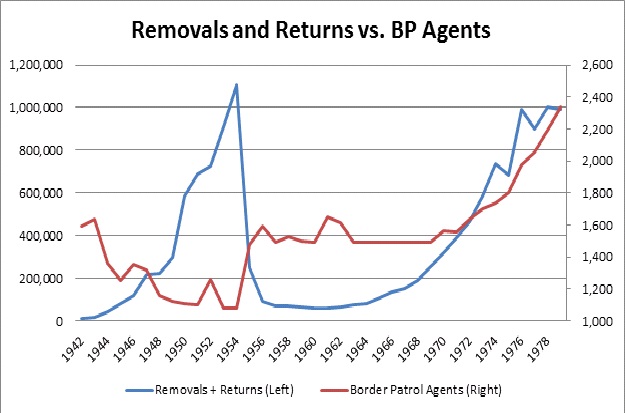
There is a trade off between the number of lower skilled guest worker visas and the number of unauthorized immigrants.  More lower skilled guest workers means fewer unauthorized immigrants.  Fewer guest workers mean more unauthorized immigrants.  We just have to look back to the Bracero program to see this relationship.   

The number of removals and returns is an approximation of the stock of the unauthorized immigrant population and flows.  Many, but not all, of those removed or returned during this time period were funneled into guest worker visas.  Beginning with the adoption of the Bracero program and the H2 visa in the early 1950s, there was a flurry of removals and returns whereby many migrants were funneled into the guest worker visa programs.  After that, my thesis is that the large numbers of work visas decreased the number of apprehensions by shrinking the pool of unauthorized immigrants and channeling future ones into the legal system.  After Bracero was ended in the mid-1960s, the number of removals and returns began a steady increase along with an increase in the stock and flow of unauthorized immigrants deprived of their previous lawful means of entry and work.

Ending the lower skilled guest worker visa programs preceded the modern increase in unauthorized immigration. 

Source: Department of Homeland Security and Immigration and Naturalization Service annual reports.

The more low skilled guest workers there are, the fewer unauthorized immigrants there are to deport. 

One legal worker on a visa seems to be worth more than one unauthorized immigrant worker – meaning a pretty favorable trade off in numbers for those concerned about the numbers of immigrants.  In 1954, 1 guest worker visa replaced 3.4 unauthorized immigrants, meaning that one legal worker seemed to be equal to more than three illegal workers.  If an important goal of a lower skilled guest worker visa is to eliminate the American economic demand for unauthorized immigrants, relatively few guest worker visas can replace a much larger unauthorized immigrant population.

Increases in Border Patrol and border enforcement are also unnecessary to get this result.  By allowing unauthorized immigrants to get the work visas, by not punishing them or employers for coming forward, and by making work visas available to those who want to enter, almost all future and current unauthorized immigrants can be funneled into the legal market without a large increase in enforcement.  This was the policy followed in the 1950s and it appears to have worked:   

Sources: Department of Homeland Security and Immigration and Naturalization Service annual reports.

This chart zooms in on the 1942 through 1965 time period when the Bracero guest worker visa was in effect:

Sources: Department of Homeland Security and Immigration and Naturalization Service annual reports.

This is not to say that Bracero was a perfect program and that it should be replicated today.  There were a lot of problems with it, namely that migrants were constrained in changing employers, migrants were limited to working only in agriculture, and the work visa was annual – all issues that should be fixed in any new lower skilled guest worker visa adopted.  A lower skilled guest worker visa is indispensable to vastly reduce or even halt unauthorized immigration. 

05 May 13:32

John Kerry Claims US Is On The 'Right Side Of History' When It Comes To Online Freedom And Transparency

by Tim Cushing

Once you've ceded the high ground, it's very difficult to reclaim it. At this time last year, the Secretary of State could have gotten away with the following remarks, but just barely. The NSA documents had not yet been revealed, but the US government had been giving up chunks of free speech high ground for quite some time.

Now, with the NSA's programs exposed, along with this administration's quest to punish whistleblowers and maintain the opacity left behind by the Bush administration, there's no approaching the high ground. But that didn't stop John Kerry -- in his remarks to the Freedom Online Coalition Conference -- from planting a flag halfway up and declaring it the summit. (h/t to Dan Froomkin of the Intercept)

[L]et me be clear – as in the physical space, cyber security cannot come at the expense of cyber privacy. And we all know this is a difficult challenge. But I am serious when I tell you that we are committed to discussing it in an absolutely inclusive and transparent manner, both at home and abroad. As President Obama has made clear, just because we can do something doesn’t mean that we should do it. And that’s why he ordered a thorough review of all our signals intelligence practices. And that’s why he then, after examining it and debating it and openly engaging in a conversation about it, which is unlike most countries on the planet, he announced a set of concrete and meaningful reforms, including on electronic surveillance, in a world where we know there are terrorists and others who are seeking to do injury to all of us.
First off, almost every "cyber security" bill has pushed for security at the expense of privacy. CISPA has done this twice. The new CISPA, being presented by the Senate, does the same thing.

Second, the reforms set up by the administration are hardly "concrete and meaningful." They're shallow and limited and do very little to walk back the expansive readings of outdated laws (something Kerry references earlier in his remarks) that have led to these programs being declared "legal." There is a review currently underway, but almost everything the review board has suggested has been ignored.

As for "examining and debating" domestic surveillance, the president only did so because he could no longer ignore it. The leaks weren't simply going to stop and so he finally "welcomed the debate" he'd been making stand out in the foyer for the past several years.

But here's where Kerry treads deepest on his faux moral high ground.
And finally, transparency – the principles governing such activities need to be understood so that free people can debate them and play their part in shaping these choices. And we believe these principles can positively help us to distinguish the legitimate practices of states governed by the rule of law from the legitimate practices of states that actually use surveillance to repress their people. And while I expect you to hold the United States to the standards that I’ve outlined, I also hope that you won’t let the world forget the places where those who hold their government to standards go to jail rather than win prizes.
That last sentence is incredible, in the most pejorative sense. This administration has prosecuted more whistleblowers -- the people who "hold their government to standards" -- than all other administrations combined. And this administration isn't done yet. The infamous "Insider Threat" program, one that tells US government employees to look for warning signs like "dissatisfaction with government policies," began during this administration. Further efforts are being kicked around in the wake of Snowden's departure from the NSA with thousands of documents, including the Director of National Intelligence telling employees they can no longer speak to the media. The CIA spies on the Senate while a Senator sends the DOJ on a mission to find out who leaked bullet points from the still-secret CIA Torture Report to journalists.

As for the prizes, I presume Kerry is referring to the awarding of Pulitzers to journalists who reported on the Snowden leaks. If so, that's a very self-serving statement, considering the government had exactly nothing to do with awarding these prizes and if it was in the administration's hands, those prizes would not have gone to The Guardian and the Washington Post.

Kerry caps it off by casting the internet freedom fight as a battle between right and wrong -- which it is -- but portrays the US government as being firmly on the "right" side.
[T]his debate is about two very different visions: one vision that respects freedom and another that denies it. All of you at the Freedom Online Coalition are on the right side of this debate, and now we need to make sure that all of us together wind up on the right side of history.
This is a very chilling statement, one that suggests the Freedom Online Coalition needs to side with the US government if it wishes to "wind up on the right side of history." As it stands right now, the "right side of history" is almost diametrically opposed to the administration's protection of abusive agencies and persecution of whistleblowers. Kerry's words read more like a subtle threat. Fight the good fight, he says, but never forget history is written by the winners. Your "privacy" will never be worth more than your "security," not when those values are determined by the government.


Permalink | Comments | Email This Story


02 May 14:04

800K QUIT LABOR FORCE IN APRIL...


800K QUIT LABOR FORCE IN APRIL...


(Third column, 1st story, link)
Related stories:
01 May 21:52

Tech firms defy authorities, notify users of secret data demands...


Tech firms defy authorities, notify users of secret data demands...


(Second column, 16th story, link)
Related stories:
01 May 21:49

Cops Harass Wheelchair-Bound Vet, Take His Cellphone Out of Spite, Arrest Him on Probation Violation After Story Goes Viral

by Ed Krayewski

an hero copHealthcare through the Department of Veterans Affairs (VA) is, for now, the closest the U.S. has to government healthcare. Like with all things government, the VA has its own police force. Like other police forces, they seem to have a problem with being recorded, and disrespected.

Wheelchair-bound veteran Todd MacRae says VA police snatched his phone from him while he was trying to record them. He says it all started when he ordered VA cops to leave the room while he was visiting his doctor. They were called when McRae got upset his doctor didn’t accept his answer to a question about his drinking habits. He had calmed down by the time they got there, and the doctor said she could finish her appointment with McRae. Witness what can happen when government and healthcare collides in the worst way.  via Carlos Miller of Photography is Not a Crime reports:

They accused him of “disturbing the peace,” and ordered him, along with his dog, to follow them downstairs to their office, where they could cite them.

“I told them, ‘write me a ticket or shut the fuck up,’” he said, acknowledging that he doesn’t hesitate to speak his mind to the cops…

A week later, his 23-year-old daughter dropped him off for his weekly blood tests, but because she had to attend class at the local college, she left him two hours earlier than his appointment.

So he entered the Starbucks on hospital property with his dog, which is completely allowed, but then one of the cops from the previous week entered, recognized him, and started hassling him about his “vicious dog” not being muzzled.

The cop ordered him off the hospital under threat of trespass arrest, which caused MacRae to miss his weekly appointment for his blood tests that enables him to survive despite having more than 20 pieces of metal in his neck.

“I had to call my daughter to come pick me up and she had to leave school,” the former construction worker said.

On Tuesday, he was at the hospital for another appointment, minding his own business in front of the hospital, when a VA cop walks up and begins hassling him about his dog.

Unlike the two prior incidents, MacRae began recording with his phone, only for the cop to lie and say he was not allowed, then eventually snatching it from him.

Among the problems with this story: state law doesn’t require service dogs to wear muzzles. Neither is recording police against the law in Tennessee. Nevertheless, cops pointed to a federal statute prohibiting unauthorized photography to issue him a citation. So this story has government healthcare, police abuse, and the war on terror.

Even worse, Carlos Miller reports McRae was arrested on a probation violation stemming from a decade-old incident just hours after story went live on Photography is Not a Crime. Read more and watch the video McRae took here.

01 May 18:26

Tim Pawlenty: GOP Should Support 'Reasonable' Minimum Wage Increase

Jts5665

facepalm...

Former Minnesota Governor and failed 2012 GOP presidential candidate Tim Pawlenty said that Republicans should support increases in the minimum wage, though he was against the Senate bill to raise the minimum wage to $10.10 an hour. 

“If you’re going to talk the talk about being for the middle class and the working person, if we have the minimum wage, it should be reasonably adjusted from time to time," Pawlenty, CEO of the Financial Services Roundtable, said on Wednesday. 

He added, "For all the Republicans who come on and talk about, ‘we’re for the blue-collar worker, we’re for the working person,’ there are some basic things that we should be for. One of them is reasonable increases from time to time in the minimum wage."

Pawlenty, who also said on MSNBC that Jeb Bush could win the GOP presidential nomination in 2016, later said that he, too, was for amnesty legislation, which the Congressional Budget Office determined would lower the wages of American workers. 


01 May 16:23

WILL: IRS seizes innocent citizens' assets...


WILL: IRS seizes innocent citizens' assets...


(First column, 15th story, link)

01 May 15:55

GAO Report: Pentagon To Destroy $1.2 Billion in Ammunition Amid Widespread Shortage

The Pentagon plans to destroy $1.2 billion in ammunition amid widespread ammo shortages for private citizens.

According to a Government Accountability Office (GAO) report acquired by USA Today, the ammunition is being destroyed because the Pentagon does not know what ammunition is new and viable and what is not. This is due to the fact that "the Defense Department's inventory systems can't share data effectively," leading to "an inaccurate accounting of ammunition."

Homeland Security and Governmental Affairs Committee chairman Senator Tom Carper (D-DE) said, "There is a huge opportunity to save millions, if not billions of dollars if the (Pentagon) can make some commonsense improvements to how it manages ammunition."

Question: If portions of the ammunition are in a caliber popular in the civilian market, why can the ammo not be sold at a reduced price, as is, to private citizens who are told beforehand that some of it may unknowingly be outdated? 

In this way the Pentagon could recoup a hefty portion of the $1.2 billion it is preparing to throw away and law abiding citizens could get their hands on some of the very ammunition they can no longer find on store shelves.

Follow AWR Hawkins on Twitter @AWRHawkins  Reach him directly at awrhawkins@breitbart.com.


01 May 15:43

Mich. Right-to-Work Law Results in Mass Exodus of Home Caretakers from Union

by Scott Shackford

They've probably stopped clapping.What can we extrapolate about the state of unionized labor in America when 80 percent of one group’s members dropped out in a single year once presented the opportunity to do so?

That’s what happened in Michigan. That hard-fought right-to-work law gave home healthcare workers the chance to choose whether Service Employees International Union (SEIU) would actually represent them. Home healthcare workers, who are often family members of the patients they serve and sometimes not even actually paid, were forced by the state beginning in 2005 to accept SEIU as their bargaining representative and pay them dues, which were deducted from state Medicaid checks for the people the workers were serving.

Now that Michigan workers have been granted the right to refuse union representation and decline to pay union does, the home care workers are showing SEIU Healthcare Michigan the door. According to federal reports examined by the Michigan-based Mackinac Center for Public Policy, 44,000 home care workers have dropped their membership from the union, leaving just under 11,000 members.

Fox News interviewed a couple who had been forced into the union while caring for their own children and had little good to say about their membership. The husband is a retired Detroit police officer. How bad do you have to be to lose them?

[Patricia] Haynes said that every month, $30 was deducted from their children’s Medicare payments, and, while it did not break their bank, they objected on principle.

“They couldn’t get me a raise, they couldn’t get me more vacation time and they certainly did nothing to improve my children’s care,” she said. “I’d hate to say it, but in my opinion, they were stealing.”

Haynes also says that they are also hoping to help others who had to pay dues.

“We are not anti-union. I just don’t understand why we were forced to join because I have two disabled kids,” she said. “That we were told that we had to join a union just because we chose to keep our kids at home to care for them.”

The Mackinac Center calculates that SEIU has skimmed more than $34 million from the Medicaid payments across the state and will lose more than $4 million in annual dues and fees from the plunge in membership. The Mackinac Center is suing to try to get some of those dues the union has already taken back.

Michigan isn’t the only state that has forced caretakers into accepting union representation, and similar requirements in Illinois have led to a Supreme Court case. The court heard arguments for and against forced caretaker unionization in Harris v. Quinn in January. I wrote a summary of the case here, and SCOTUSblog attended and analyzed the arguments presented to the court here. We're still waiting on the decision.

UPDATE: After posting this, Joseph G. Lehman, president of the Mackinac Center for Public Policy, contacted me to clarify that the passage of the right-to-work legislation was not actually what ended the practice of forcing home care workers into SEIU representation. A lawsuit from Mackinac was followed by some complex legislative action and decisions by Gov. Snyder that ultimately ended the practice in a timeline that happens to coincide with Michigan's right-to-work laws.

01 May 15:20

Despite China’s impressive growth, on a per capita basis, the US economy is still a century ahead of China

by Mark J. Perry

In a post this morning (“Sorry, China, the US is still the world’s leading economic power“) Jimmy Pethokoukis reported on a story in today’s Financial Times titled “China poised to pass US as world’s leading economic power this year.” Here’s a key excerpt of the FT story:

The US is on the brink of losing its status as the world’s largest economy, and is likely to slip behind this year, sooner than widely anticipated, according to the world’s leading statistical agencies. The US has been the global leader since overtaking the UK in 1872. Most economists previously thought China would pull ahead in 2019.

Here are some of Jimmy’s comments about the FT story:

Some important context here: on a per person basis, PPP GDP is $51,000 in the US vs. $11,000 in China. Anyway you slice the data, China is still a much poorer nation than America. (More than 30 million Chinese, basically the population of Texas, live in caves.) And at market rates, the US economy is about twice as large as China’s. Also note that within two decades or so, China will have an older population than the United States. The Middle Kingdom has become old before it has become rich. In addition to demographic problems, China is still trying to transition to a sustainable, consumer-driven growth model. So the other team has its problems, too.

Now here is what the FT’s headline, “China poised to pass US as world’s leading economic power this year,” really gets wrong. The US remains the world’s leading economic power due to its technological innovation. Most global innovation surveys put the US at or near the top. For instance, the World Economic Forum ranks the US as the 7th most innovative economy, China the 32nd. Bloomberg puts the US at third, while China did not make the top 30. And which global economy is most critical to expanding the technological frontier, say, Sweden, Bloomberg’s #2 ranked economy with a population of 9.5 million and a $400 billion economy, or the #3 US with its 315 million people and $16 trillion economy. Pound for pound, no nation innovates like America. It’s our deep magic, and a competitive advantage we should be careful not to squander.

MP: The chart above adds some additional context to the FT’s claim that China will overtake the US this year as the world’s leading economic superpower. Displayed above is real GDP per capita in the US (in 2013 dollars), on an annual basis back to 1800, using historical data from Global Financial Data (subscription required). According to the International Monetary Fund, per capita GDP in China last year reached $6,747, which was a level of economic output per capita that was first reached in the US back in 1882, more than 130 years ago. Adjusting for purchasing power in China to make a more accurate comparison between output levels per capita in the US and China, the IMF data show that China’s per capita GDP (PPP) last year was $9,844, which was the level of economic output per person first reached in the US back in 1912, more than a century ago. Even if China’s per capita GDP continues to grow at say 7% for the next three years, it would still only reach the equivalent level of America’s output per capita in 1939. And even if China’s output per person grew at 7% for the next decade, it would still only be at a level the US reached in 1951.

Bottom Line: Yes, it’s true that China has made phenomenal economic gains over the last several decades to become the second largest economy in the world, and it’s true that China will probably surpass the US to become the world’s largest economy this year based on economic output. But adjusted on a per-capita basis, America’s output is still a full century ahead of China, and it could take many decades of economic growth in China before it even comes close to approaching the level of per-capita GDP that the US reached fifty years ago. Before breaking out the champagne and cigars for China’s status as the “world’s leading economic power,” let’s keep it all in perspective!

01 May 15:17

Man's Body Found Inside Fortune Cookie Company's Dough Machine...


Man's Body Found Inside Fortune Cookie Company's Dough Machine...


(Second column, 12th story, link)