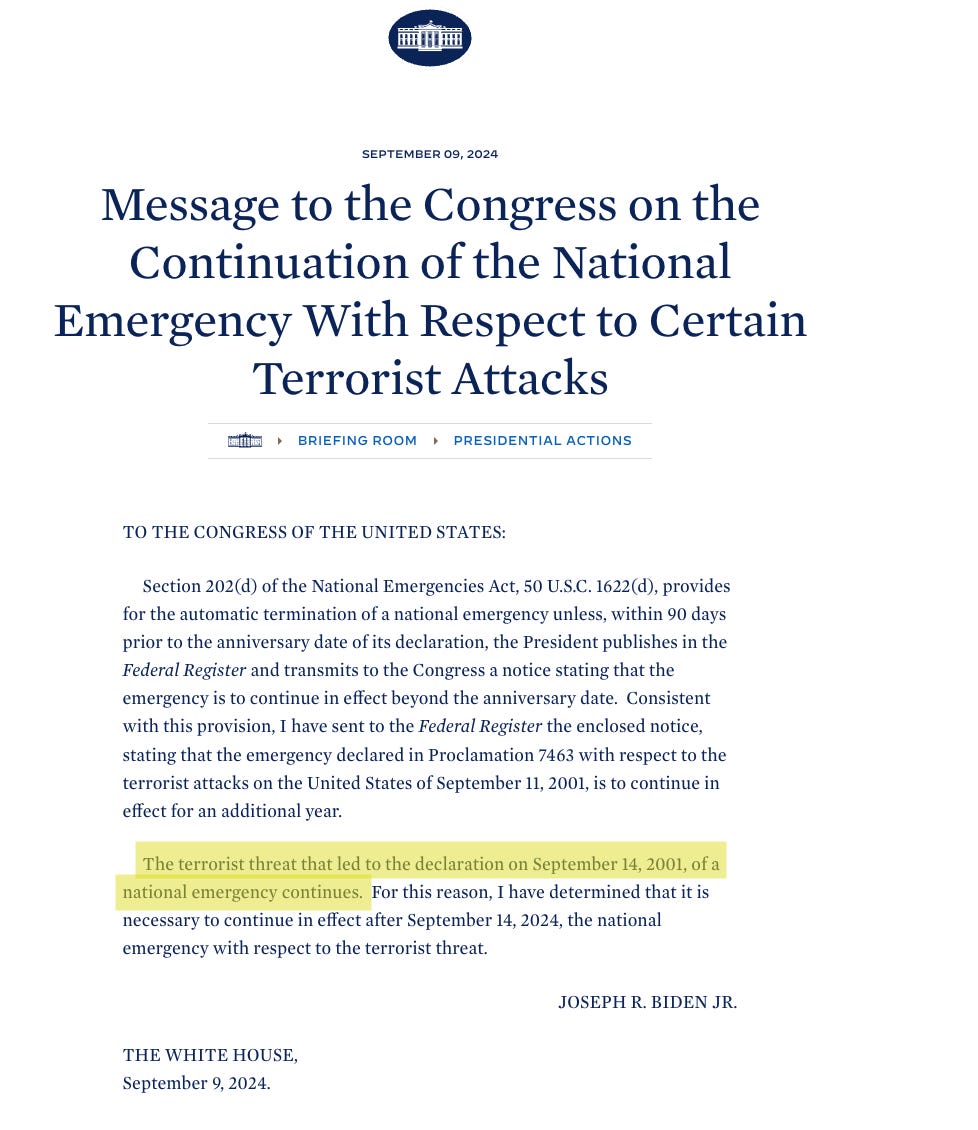
On September 14th, 2001, President George W. Bush signed Proclamation 7463 declaring a “National Emergency by Reason of Certain Terrorist Attacks.” The measure activates over 400 additional provisions of executive authority and has been re-signed every year by every succeeding president, including four times by Donald Trump. As discussed on the new America This Week, Joe Biden just signed its latest renewal, effective tomorrow, noting the threat of twenty-three years ago “continues”:
Along with 200 other Republicans, former Vice President Dick Cheney and former Attorney General Alberto Gonzalez just endorsed Kamala Harris. Gonzalez, who as George W. Bush’s counsel received and signed the infamous torture memos and dismissed the Geneva conventions as “quaint,” said in a Politico essay his reason was that Donald Trump represented a “threat to the rule of law.”
Cheney said Trump tried to use “lies and violence” to stay in power. Beyond pushing “enhanced interrogation” and conducting affairs of state through extralegal mechanisms like the Office of Special Plans, Cheney perfected the institutional whopper. His lies weren’t crazy and off-the-cuff, but monstrous and effective, like saying Saddam Hussein “is actively pursuing nuclear weapons” or had “high-level contacts with Al Qaeda going back a decade.” Putting a Trump lie in a class with one of Cheney’s is like comparing a flatus and a methane planet.
It’s the right metaphor, because that doesn’t mean the Trump experience smells great. But we’ve forgotten the scale of the other thing:
It was one of those conversations you never forget. We were discussing – of all things – the Covid injections, and I was questioning the early ‘safe and effective’ claims put forward by the pharmaceutical industry. I felt suspicious of how quickly we had arrived at that point of seeming consensus despite a lack of long-term safety data. I do not trust the pharmaceutical industry. My colleague did not agree, and I felt my eyes widen as he said, “I don’t think they would do anything dodgy.” Clearly, my colleague had not read the medical history books. This conversation slapped me out of my own ignorance that Big Pharma’s rap sheet was well-known in the profession. It isn't.
With this in mind, let’s take a look at the history of illegal and fraudulent dealings by players in the pharmaceutical industry; an industry that has way more power and influence than we give them credit for.
Before I continue, a word (not from our sponsor). There are many people working in this industry who have good intentions towards improving healthcare for patients, dedicating their lives to finding a cure or treatment for disease. Some therapeutic pharmaceuticals are truly life-saving. I probably wouldn’t be here today were it not for a couple of life-saving drugs (that’s a story for another time). But we must be very clear in our understanding. The pharmaceutical industry, as a whole and by its nature, is conflicted and significantly driven by the mighty dollar, rather than altruism.
There are many players and different games being played by the industry. We ignore these at our peril. The rap sheet of illegal activities is alarming. It seems that barely a month goes by without some pharmaceutical company in court, somewhere. Criminal convictions are common and fines tally into the billions. Civil cases, with their million-dollar settlements, are abundant too.
A 2020 peer-reviewed article published in the Journal of the American Medical Association outlines the extent of the problem. The group studied both the type of illegal activity and financial penalties imposed on pharma companies between the years 2003 and 2016. Of the companies studied, 85 percent (22 of 26) had received financial penalties for illegal activities with a total combined dollar value of $33 billion. The illegal activities included manufacturing and distributing adulterated drugs, misleading marketing, failure to disclose negative information about a product (i.e. significant side effects including death), bribery to foreign officials, fraudulently delaying market entry of competitors, pricing and financial violations, and kickbacks.
When expressed as a percentage of revenue, the highest penalties were awarded to Schering-Plough, GlaxoSmithKline (GSK), Allergan, and Wyeth. The biggest overall fines have been paid by GSK (almost $10 billion), Pfizer ($2.9 billion), Johnson & Johnson ($2.6 billion), and other familiar names including AstraZeneca, Novartis, Merck, Eli Lilly, Schering-Plough, Sanofi Aventis, and Wyeth. It's quite a list, and many of the Big Pharma players are repeat offenders.
Prosecuting these companies is no mean feat. Cases often drag for years, making the avenue of justice and resolution inaccessible to all but the well-funded, persistent, and steadfast. If a case is won, pharma’s usual response is to appeal to a higher court and start the process again. One thing is clear; taking these giants to court requires nerves of steel, a willingness to surrender years of life to the task, and very deep pockets.
For every conviction, there are countless settlements, the company agreeing to pay out, but making no admission of guilt. A notable example is the S35 million settlement made, after 15 years of legal maneuvering, by Pfizer in a Nigerian case that alleged the company had experimented on 200 children without their parent’s knowledge or consent.
Reading through the case reports, the pattern of behavior is reminiscent of the movie Groundhog Day with the same games being played by different companies as if they are following some kind of unwritten playbook.
Occasionally there is a case that lifts the lid on these playbook strategies, revealing the influence of the pharma industry and the lengths they are willing to go to, to turn a profit. The Australian Federal Court case Peterson v Merck Sharpe and Dohme, involving the manufacturer of the drug Vioxx, is a perfect example.
By way of background, Vioxx (the anti-arthritis drug Rofecoxib) was alleged to have caused an increased risk of cardiovascular conditions including heart attack and stroke. It was launched in 1999 and, at peak popularity, was used by up to 80 million people worldwide, marketed as a safer alternative to traditional anti-inflammatory drugs with their troublesome gastrointestinal side effects.
In Peterson v Merck Sharpe and Dohme, the applicant – Graeme Robert Peterson - alleged the drug had caused the heart attack he suffered in 2003, leaving him significantly incapacitated. Peterson argued that the Merck companies were negligent in not having withdrawn the drug from the market earlier than they did in 2004 and, by not warning of the risks and making promotional representations to doctors, were guilty of misleading and deceptive conduct under the Commonwealth Trade Practices Act 1974.
In November 2004 Dr David Graham, then Associate Director for Science and Medicine in FDA’s Office of Drug Safety provided powerful testimony to the US Senate regarding Vioxx. According to Graham, prior to the approval of the drug, a Merck-funded study showed a seven-fold increase in heart attacks. Despite this, the drug was approved by regulatory agencies, including the FDA and the TGA.
This finding was later supported by another Merck-funded study, VIGOR - which showed a five-fold increase, the results of which were published in the high-impact New England Journal of Medicine. It was later revealed by subpoena during litigation that three heart attacks were not included in the original data submitted to the journal, a fact that at least two of the authors knew at the time. This resulted in a 'misleading conclusion’ regarding the risk of heart attack associated with the drug.
By the time Peterson v Merck Sharpe and Dohme, an associated class action involving 1,660 people, was heard in Australia in 2009, the international parent of MSD, Merck, had already paid $4.83 billion to settle thousands of lawsuits in the US over adverse effects of Vioxx. Predictably, Merck made no admission of guilt.The Australian legal battle was a long, drawn-out affair, taking several years with more twists and turns than a cheap garden hose (you can read more about it here and here).
Long story short, a March 2010 Federal Court finding in favor of Peterson was later overturned by a full bench of the Federal Court in Oct 2011. In 2013, a settlement was reached with class action participants which resulted in a mere maximum payment of $4,629.36 per claimant. MSD generously waived their claim for legal costs against Peterson.
What's notable in this battle was the headline-grabbing courtroom evidence detailing the extent of alleged pharmaceutical misdeeds in marketing the drug. The pharma giant went to the lengths of producing sponsored journals with renowned scientific publisher Elsevier, including a publication called The Australasian Journal of Bone and Joint Medicine. These fake ‘journals’ were made to look like independent scientific journals, but contained articles attributed to doctors that were ghostwritten by Merck employees. Some doctors listed as honorary Journal board members said they had no idea they were listed in the journal and had never been given any articles to review.
But wait, there’s more.
The trove of internal emails presented in evidence revealed a more sinister level of operation. One of the emails circulated at the pharma giant’s US headquarters contained a list of ‘problem physicians’ that the company sought to ‘neutralize’ or ‘discredit.’ The recommendations to achieve these ends included payment for presentations, research and education, financial support of private practice, and 'strong recommendation(s) to discredit.' Such was the extent of intimidation, that one professor wrote to the head of Merck to complain about the treatment of some of his researchers critical of the drug. The court heard how Merck had been ‘systematically playing down the side effects of Vioxx’ and their behavior ‘seriously impinge(d) on academic freedom.’
This alleged systematic intimidation was as extensive as it was effective. Result? Merck made over $2 billion per year in sales before Vioxx was finally pulled from pharmacy shelves in 2004. In his testimony, Dr Graham estimated that between 88,000 and 139,000 excess cases of heart attack or sudden cardiac death were caused by Vioxx in the US alone before it was withdrawn.
These systems of influence, manipulation, and tactics were largely operative when Covid arrived. Add to that the ‘warp speed’ development of novel ‘vaccines,’ government green lights, pharmaceutical indemnity, and confidential contracts. Now you have the makings of a pharmaceutical payday the likes of which we have never seen before.
It should come as no surprise then, the recent announcement that five US states – Texas, Kansas, Mississippi, Louisiana, and Utah – are taking Pfizer to court for withholding information, and misleading and deceiving the public through statements made in marketing its Covid-19 injection. That these cases are filed as civil suits under consumer protection laws is likely just the tip of the pharmaceutical playbook iceberg. No doubt the discovery process will hold further lessons for us all.
The Met Office has started reporting "extreme" temperatures, the better to spread alarm. What it doesn't tell you is its record temperatures come from 'junk' stations surrounded by newly built houses and solar panels.
Using gross profit as a metric is incredibly deceptive. That number excludes overhead costs. You could increase gross profit and still have a decrease in net profit which is the real metric for profitability.
The Food Industry Association last month found that 69 percent of Americans feel their income hasn’t kept up with food inflation. But who’s to blame? (Photo by J. L. Anderson/ClassicStock/Getty Images)
At last night’s presidential debate, Vice President Kamala Harris told the American public she has “a plan” to alleviate America’s housing shortage, help small businesses, and “address the price of groceries.” That plan, like the rest of her policies, is elusive, but in a recently released “issues page” on her campaign site, she listed cracking down on “on anti-competitive practices” as a top priority. On the campaign trail she has promised that, if elected, she’ll call for “the first-ever federal ban on corporate price gouging on food and groceries” within her first hundred days in office.
With that line of attack, Harris has certainly tapped into a vein of voter anger: Lots of Americans are upset about their grocery bills, which rose dramatically during the inflation that followed the pandemic and have never come back down. Food prices increased by 11 percent in 2022, professor Ricky Volpe, of Cal Poly’s Agribusiness Department, told The Free Press. And while they’re only projected to rise 0.7 percent in 2025, those 2022 grocery prices have stuck. Americans still notice when they pay $5.24 for a pound of ground beef that cost only $3.80 a few years ago.
Unsurprisingly, a survey conducted by the Food Industry Association last month found that 69 percent of Americans feel their income hasn’t kept up with food inflation. That group includes significant percentages of older consumers (Boomers and Gen X) as well as people at the low end of the income scale.
But it’s worth asking: Why have food prices gone up so much? And does price gouging—the practice of jacking up prices during a natural disaster or other short-term emergency—really have anything to do with it? Volpe told me that, in fact, if food prices are rising beyond what consumers feel is reasonable, the food companies themselves play a surprisingly small role in the price hikes. Grocery stores, for instance—even giant superstores—are intensely competitive. Grocery store profit margins are among the lowest in all of American business, often as low as 1 percent.
According to Volpe, the rising costs of labor, shipping, and packaging have increased more than food prices since the onset of the pandemic and have played a more significant role. Matt Lind, 31, owns a food distribution company, Farmlind Produce, that purchases fresh fruits and vegetables from farms nationwide and trucks them to grocery stores and restaurants on the East Coast. “Post-Covid,” he told me, “freight out of California was around $6,000 this time of year. Last week, I paid as much as $8,400.”
In addition to freight, Lind’s fleet of 28 trucks has cost more to operate since the pandemic, when he was paying, on average, $2.60 per gallon of diesel. Now, he spends over four dollars per gallon. “Customers might think that the retailer and the wholesaler are taking advantage, but there’s so much overhead in this industry to keep it going,” he said.
To get a handle on whether Harris’s proposal would confront the source of rising prices—or is just pie in the sky—The Free Press looked at what’s behind prices in three staples of the American diet: eggs, beef, and salty snacks.
Eggs: When Hens Catch the Flu
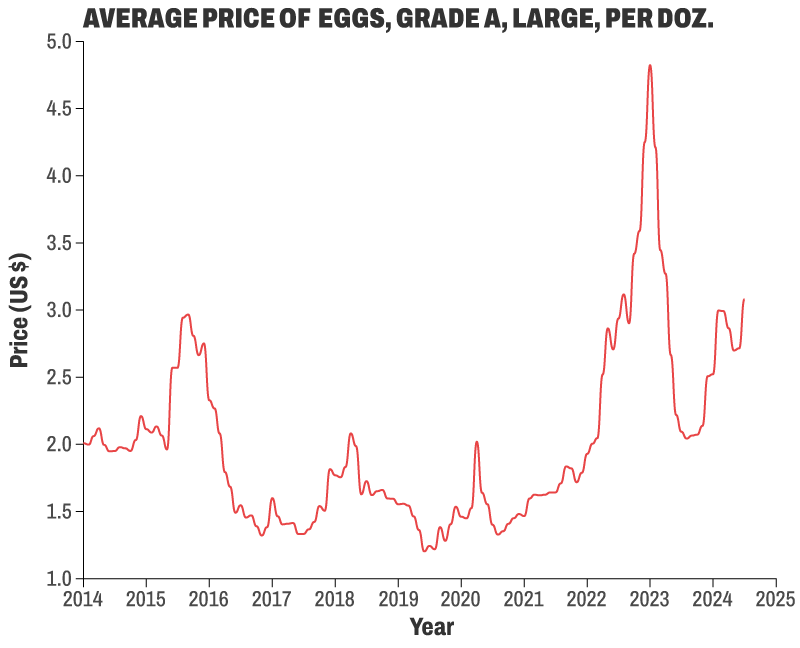
In January 2023, the price of eggs hit an all-time high, $4.82 per dozen on average. The main reason? Millions of chickens were dying from avian influenza, or bird flu. Prices then decreased on average throughout the rest of 2023, hitting a low of $2.07 per dozen in September as the bird flu ran its course, but rose to $3.08 per dozen this July thanks to a second outbreak.
Consumer Price Index average price data of large, grade A eggs per dozen in U.S. cities, not seasonally adjusted. (Source: U.S. Bureau of Labor Statistics)
The CDC reported that as of August, more than 100 million poultry have been culled since 2022 as avian influenza continues to affect flocks nationwide.
This is a basic aspect of price changes in a capitalist economy: If supply (the number of egg-laying hens) goes down, the high demand for the remaining eggs can prompt price hikes.
Why isn’t that price gouging? That’s really a political question more than an economic one. If prices rise quickly, politicians like Harris are quick to blame greedy corporations, whereas economists view it as a natural—even healthy—part of an economy under stress, as we noted in The Free Pressseveral weeks ago.
But consider this as well: If a chicken farm loses thousands of poultry due to bird flu, it still has overhead to cover, wages to parcel out, and shipping costs to pay. None of these costs go down just because a lot of chickens are dead. Does the avian flu qualify as the kind of unexpected emergency that a politician would call “price gouging?” Or is it just part of the food production cycle, like bad weather? Most economists would say it’s the latter.
Brian Moscogiuri, vice president of U.S. egg supplier Eggs Unlimited (Slogan: “Any Egg. Anywhere”), said in an email to The Free Press that the egg industry is currently operating at 25 million hens below what’s needed to keep up with demand. “Generally, we need about one bird per person to account for normal demand,” Moscogiuri said. “But we’ve seen the avian flu hit biannually since the spring of 2022.”
Hens lay about one egg per day 80 percent of the time, so to keep up with U.S. demand, the industry needs between 325 million and 330 million hens. If the bird flu disappeared altogether, rebuilding the egg industry to optimal levels would take about six to eight months. And nothing Vice President Harris mentioned in last night’s debate can change that fact.
Meat: Meatpackers Make Money. Ranchers Don’t.
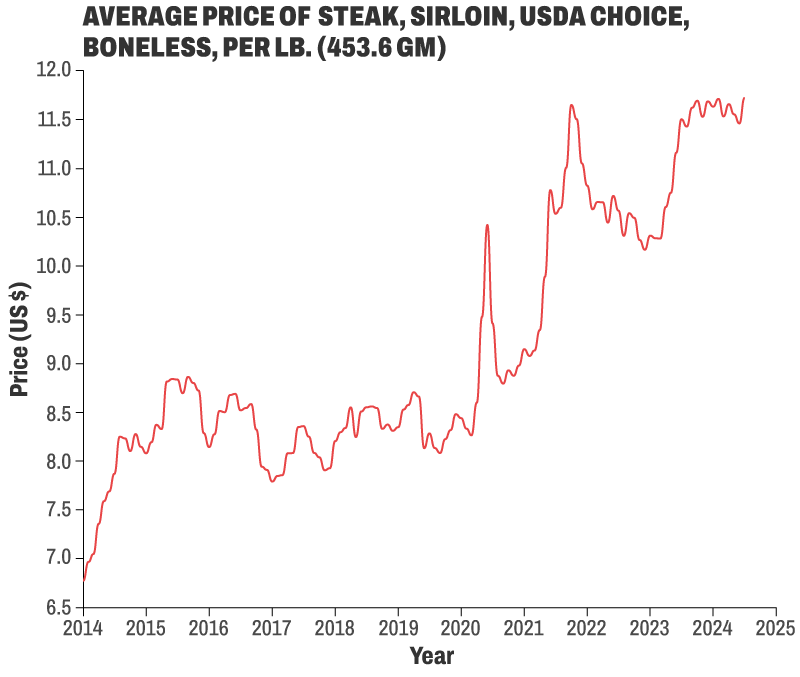
In August 2020, sirloin steak cost, on average, $8.88 per pound. In July of this year, prices hit a record high at $11.73 per pound.
According to the industry, several factors have contributed to this spike, including a drought in the Midwest and increased feed, labor, and transportation costs. But in 2022, when meat prices had risen to almost $10 a pound, the White House accused the industry of, well, price gouging. It noted that the four major meatpackers—Tyson Foods, JBS, Marfrig Global, and Seaboard Corp—had seen a gross profit increase of 120 percent.
Consumer Price Index average price data of sirloin steak, USDA Choice, boneless, per pound, in U.S. cities, not seasonally adjusted. (Source: U.S. Bureau of Labor Statistics)
Ranchers, on the other hand, didn’t necessarily see much of that money.
“Right now in the U.S., we have an inventory of cattle that is about the same size as it was in post–World War II America in the 1950s,” said Volpe—about 28.2 million beef cows. “It takes years for these animals to become market ready, so the prospects for the cattle inventory in the U.S. to expand significantly in the near term are very slim.” Which, in all likelihood, means higher prices still.
Reed Strate, 33, who runs his family farm in Kinsley, Kansas, where he raises beef cattle, says that increasing his herd would mean paying more for veterinary bills, among other things. Space is a constraint, too. “If I only have three fields I want to pasture, I’m limited on how many cows I can buy,” Strate said. “I can’t overgraze my fields.”
Despite the lack of inventory, it’s unlikely that Americans will change their meat-eating habits. “People want their steak, they want their bacon,” said Volpe. And that allows the big meatpackers to raise prices without much fear of falling sales.
Salty Snacks Soar: Shrinkflation to the Rescue
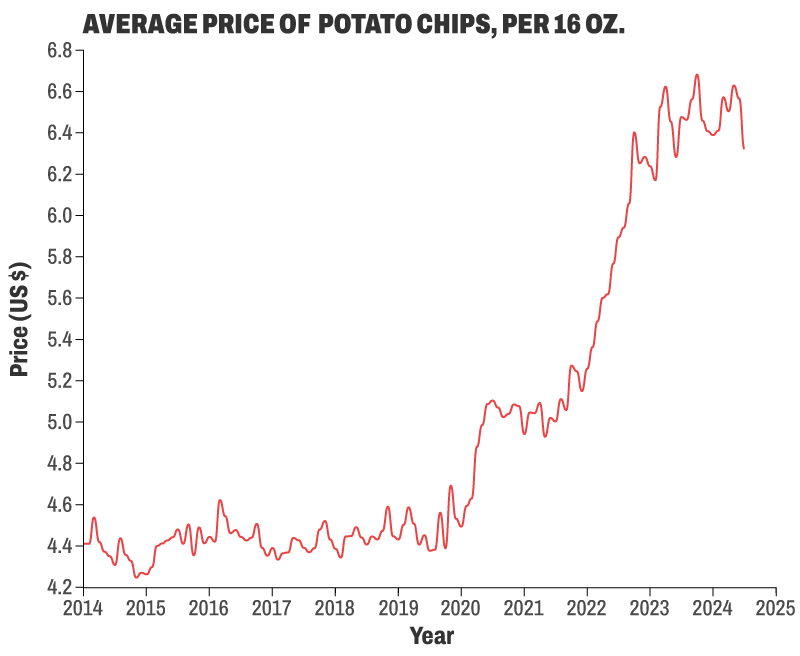
Four years ago, a 16-ounce bag of potato chips cost about $5.00 on average. In October 2023, a bag of chips hit a high of $6.68 on average. Prices have since gone down to around $6.32 per bag, but there’s been some buzz about whether or not the huge conglomerates that control America’s snacks have, er, price-gouged by hiking their prices.
Consumer Price Index average price data of potato chips, per 16 oz., in U.S. cities, not seasonally adjusted. (U.S. Bureau of Labor Statistics}
To be fair, the snack food industry has grappled with labor shortages, sugar, cocoa, and preservative shortages, and changing consumer behavior as more shoppers choose lower-priced private label brands over name brands. In a recent survey of 122 snack food industry executives, 82 percent said that increasing prices of raw materials affected their company, while 54 percent were concerned about consumers spending less on snacks.
Like most companies, PepsiCo and Mondelez, two behemoths in the snack food industry, raised prices on their products, passing inflation costs onto consumers—and then some. In both 2022 and 2023, PepsiCo’s net income was just around $9 billion—but get this: snacks, which make up just 27 percent of its revenue, contribute 44 percent of its earnings. In effect, the company is using its snack business to prop up its much larger drink business, which it can do because it is able to raise snack prices more or less at will.
For instance, during a 2022 call with investors, Hugh F. Johnston, Pepsi’s then-chief financial officer, was asked about the likelihood of snack food price increases. Here was his reply:
“Regarding pricing, we increased prices at the beginning of the fourth quarter based on what we knew at that point. And going forward, with the investments that we’ve made in brands, I still think we’re capable of taking whatever pricing we need.”
Translation: Our marketing is so good that people will buy our snacks no matter how much we charge.
Pepsi has also used another trick of the snack food trade to boost profits. It decreases the number of chips per bag for some products while keeping prices the same—a tactic economists call shrinkflation. This is not the sort of thing a presidential candidate is likely to rail about, but for consumers, it’s galling just the same.
Food shoppers are savvy. The Food Industry Association found that 63 percent of Americans now shop at a mix of grocery stores to keep their bills down, and there are more low-cost grocery options popping up throughout the country to accommodate this. German discount grocery chain Aldi, which already operates over 2,300 locations in the U.S., plans to add 800 more stores by 2028.
“In 2024 and 2025, food prices are becoming more affordable, [but] not because shelf prices are going down,” Ricky Volpe, the agribusiness economist, said. It’s because American consumers and businesses are adapting to the economic hand they’ve been dealt. Just like motorists will sometimes search for the gas station with the lowest gas prices, so do consumers sometimes seek out these lower-priced alternatives to help keep their food bill in check.
Will that economic truth matter when people go into the voting booth?
If you're feeling overwhelmed by the craziness on this planet, take a look at these four astronauts who are peering into God's vast Creation this morning on a historic mission that will pave the way for humans to visit Mars in 4 years:
Department kept working with CCP-linked Chinese Academy of Sciences after its Wuhan Institute of Virology was blocked from federal funding, but Vilsack claimed bird-flu research was not a "collaboration per se."
These record the meetings of the “Covid Crisis Team” that was formed within the Robert Koch Institut (RKI) to advise our politicians on the pandemic response. Part of these minutes – through April 2021 – were first released in heavily redacted form in March 2024; following a public outcry, the Health Ministry agreed to remove all but the most essential redactions, and finally delivered on this promise in May. Thereafter, a former RKI employee leaked all documents available to him in completely unredacted form to the independent journalist Aya Velázquez. She published this enormous leak in July.
eugyppius: a plague chronicle is a reader-supported publication. maybe you subscribe?
The RKI protocols are important for one reason above all: They show that the allegedly independent Scientific of the RKI provided was in fact heavily influenced by German politicians. While our elected leaders claimed to be Following the Science, they were eagerly adjusting the Science behind the scenes wherever necessary to make it into the kind of thing that they already wanted to Follow. We could surmise that this was happening at the time, of course, but the protocols provide hard, undeniable proof of this dynamic. That is why they matter.
The protocols, having undermined a central pillar of pandemic mythology, are now beginning to have legal consequences. Specifically, an administrative court in Osnabrück has said that they call the constitutionality of 2022 vaccine mandates for medical staff and care home facilities into question. The Osnabrück judges have referred the case to the Federal Constitutional Court in Karlsruhe. The constitutional judges ruled two years ago that the vaccine mandates were legal, but they did not have access to the RKI protocols at the time and their ruling leaned heavily on the ostensible independence of RKI assessments.
The case itself is only part of the story. In the course of the Osnabrück proceedings, RKI President Lars Schaade testified and said many astounding things. He admitted in open court that his institute does not provide scientifically independent advice, even though that is what they claim to do. He said that pandemic risk assessments were political rather than scientific; specifically, he said that they were “normative” – that is that they were intended to produce certain behaviours in the public, and not to communicate any concrete, observable facts. Finally, he said that the RKI not only never had any evidence that vaccine mandates do anything to stop transmission, but also that they never even attempted to monitor vaccine effectiveness in stopping transmission.
This is an important story, so I’m going to cover it as thoroughly as possible in four parts. First of all, we’ll go over once again how the RKI protocols undermine the myth of a pandemic Science allegedly independent of politics. Then, I’ll briefly summarise the details of the litigation in Osnabrück, which involves a nursing assistant who was suspended for refusing vaccination in November 2022. Next, I’ll translate Schaade’s incredible testimony, before finally considering a small conspiracy theory relating to the RKI protocols and the real reason they were leaked in the first place.
I previously wrote how a Harris-Walz Administration would be a nightmare for free speech. Both candidates have shown pronounced anti-free speech values. Now, X owner Elon Musk and former independent presidential candidate Robert F. Kennedy Jr. have posted a Harris interview to show the depths of the hostility of Harris to unfettered free speech. I have long argued that Trump and the third-party candidates should make free speech a central issue in this campaign. That has not happened. Kennedy was the only candidate who was substantially and regularly talking about free speech in this election. Yet, Musk and Kennedy are still trying to raise the chilling potential of a Harris-Walz Administration.
In my book “The Indispensable Right: Free Speech in an Age of Rage,” I discuss how the Biden-Harris Administration has proven to be the most anti-free speech administration since John Adams. That includes a massive censorship system described by one federal judge as perfectly “Orwellian.”
In the CNN interview, Harris displays many of the anti-free speech inclinations discussed earlier. She strongly suggests that X should be shut down if it does not yield to demands for speech regulation.
What is most chilling is how censorship and closure are Harris’s default positions when faced with unfettered speech. She declares to CNN that such unregulated free speech “has to stop” and that there is a danger to the country when people are allowed to “directly speak[] to millions and millions of people without any level of oversight and regulation.”
Harris discussed her view that then-President Trump’s Twitter account should be shut down because the public had to be protected from harmful viewpoints.
“And when you’re talking about Donald Trump, he has 65 million Twitter followers, he has proven himself to be willing to obstruct justice – just ask Bob Mueller. You can look at the manifesto from the shooter in El Paso to know that what Donald Trump says on Twitter impacts peoples’ perceptions about what they should and should not do.”
Harris demanded that Trump’s account “should be taken down” and that there be uniformity in the censorship of American citizens:
“And the bottom line is that you can’t say that you have one rule for Facebook and you have a different rule for Twitter. The same rule has to apply, which is that there has to be a responsibility that is placed on these social media sites to understand their power… They are speaking to millions of people without any level of oversight or regulation. And that has to stop.”
In other words, free speech should be set to the lowest common denominator of speech regulation to protect citizens from dangerous viewpoints.
Harris’s views have been echoed by many Democratic leaders, including Hillary Clinton who (after Musk purchased Twitter) called upon European censors to force him to censor American citizens under the infamous Digital Services Act (DSA).
Other Democratic leaders have praised Brazil for banning X after Musk balked at censoring conservatives at the demand of the socialist government. Brazil is where this anti-free speech movement is clearly heading and could prove a critical testing ground for national bans on sites which refuse to engage in comprehensive censorship. As Harris clearly states in the CNN interview, there cannot be “one rule for Facebook and you have a different rule for Twitter.” Rather, everyone must censor or face imminent government shutdowns.
The “joy” being sold by Harris includes the promise of the removal of viewpoints that many on the left feel are intolerable or triggering on social media. Where Biden was viewed as an opportunist in embracing censorship, Harris is a true believer. Like Walz, she has long espoused a shockingly narrow view of free speech that is reflective of the wider anti-free speech movement in higher education.
Harris often speaks of free speech as if it is a privilege bestowed by the government like a license and that you can be taken off the road if you are viewed as a reckless driver.
Trump and the third party candidates are clearly not forcing Harris to address her record on free speech. Yet, polls show that the majority of Americans still oppose censorship and favor free speech.
In my book, I propose various steps to restore free speech in America, including a law that would bar federal funds for censorship, including grants and other funding that target individuals and sites over the content of their views. The government can still speak in its own voice and it can still prosecute those who commit crimes on the Internet or engage in criminal conspiracies. Harris should be asked if she would oppose such legislation.
For free speech advocates, the 2024 election is looking strikingly similar to the election of 1800. One of the greatest villains in our history discussed in my book was President John Adams, who used the Alien and Sedition Acts to arrest his political opponents – including journalists, members of Congress and others. Many of those prosecuted by the Adams administration were Jeffersonians. In the election of 1800, Thomas Jefferson ran on the issue and defeated Adams.
It was the only presidential election in our history where free speech was a central issue for voters. It should be again. While democracy is really not on the ballot this election, free speech is.
Brazil has not just banned X (formerly Twitter) from the entire country, but citizens will now be fined $9000 a day (more than the average salary in the country) for using VPNs to access the platform. X is the main source of news for Brazilians, who will now be left with government-approved sources or face financial ruin in seeking unfettered information.
The Guardian is reporting that the confiscatory fines are part of a comprehensive crackdown on efforts to get news through X, including ordering all Apple stores to remove X from new phones.
The move puts Brazil with China in the effort to create a wall of censorship between citizens and unregulated information.
However, it is Brazil that foreshadows the brave new world of censorship where entire nations will block access to sites committed to free speech values or unfettered news. If successful, the Brazilian model is likely to be replicated by other countries.
The reason is that censorship is not working. As discussed in my book “The Indispensable Right: Free Speech in an Age of Rage,” we have never seen the current alliance of government, corporate, academic, and media interest against free speech. Yet, citizens are not buying it.
Despite unrelenting attacks and demonizing media coverage, citizens are still using X and resisting censorship. That was certainly the case in Brazil where citizens preferred X to regulated news sources. The solution is now to threaten citizens with utter ruin if they seek unfettered news.
The question is whether Brazil’s leftist government can get away with this. The conflict began with demands to censor supporters of the conservative former president Jair Bolsonaro. When X refused the sweeping demands for censorship, including the demand to name a legal representative who could be arrested for refusing to censor users, the courts moved toward this national ban.
The man behind the effort is Justice Alexandre de Moraes, who has aggressively used censorship to combat anything that he or the government deems “fake news” or disinformation. With socialist president Luiz Inácio Lula da Silva, they are the dream team of the anti-free speech movement.
Minnesota Attorney General Keith Ellison responded to the ban with a posting declaring “Obrigado Brasil!” or “Thanks, Brazil!” Ironically, he did so on X.
Ellison previously praised the virulently anti-free speech group Antifa and promised that it would “strike fear in the heart” of Donald Trump. This was after Antifa had been involved in numerous acts of violence and its website was banned in Germany. It is at its base a movement at war with free speech, defining the right itself as a tool of oppression. That purpose is evident in what is called the “bible” of the Antifa movement: Rutgers Professor Mark Bray’s Antifa: The Anti-Fascist Handbook.
Bray emphasizes the struggle of the movement against free speech: “At the heart of the anti-fascist outlook is a rejection of the classical liberal phrase that says, ‘I disapprove of what you say but I will defend to the death your right to say it.’” Bray admits that “most Americans in Antifa have been anarchists or antiauthoritarian communists… From that standpoint, ‘free speech’ as such is merely a bourgeois fantasy unworthy of consideration.”
The question is whether Brazil will become a nightmare for free speech around the world as other nations seek to force citizens to read and hear news from approved, state-monitored sites.
Below is my column in the New York Post on the withdrawal of Robert Kennedy, Jr. from the presidential race and his endorsement of former President Donald Trump. Kennedy’s speech resonated with many long-time Democrats who have found themselves estranged from the party. While Kennedy remains an independent, it is a cautionary tale that is being missed in the “joy” theme of the Democratic National Convention. The fact is that new Republicans are often not the product of ideology and association but anxiety and exclusion. Democrats make Republicans.
Here is the column:
The withdrawal of Robert F. Kennedy Jr. from the presidential race and his endorsement of former President Donald Trump was yet another extraordinary moment in an election that has been anything but predictable.
Only a year ago, it would have been unthinkable that a sitting president would be effectively forced off a ticket and replaced by a candidate who did not secure a single vote for president.
Now, the nephew of John F. Kennedy and son of the Robert F. Kennedy has not just withdrawn from the Democratic Party but endorsed the Republican nominee.
Amidst all of the claimed “joy” of the Democratic National Convention, there is a sobering reality that is being ignored by the ecstatic press and pundits: this is how Democrats make Republicans.
There is an old expression that “a conservative is a liberal who has been mugged.”
Irving Kristol explained the neoconservative movement was built by Democrats “mugged by reality.”
Kennedy has not become a Republican but rather joined the roughly half of Americans now identifying as independents. While this country is solidly under the hold of a duopoly of power in the two main parties, only 25% of the country identify as Democrats, and 25% as Republicans.
Kennedy’s departure from the Democrats has been mocked in the press. However, when he spoke on his withdrawal, many of us who have been lifetime members of the party identified with his remarks.
I come from a politically active liberal Democratic family in Chicago. I spent much of my life working for liberals since I first came to Washington as a Democratic House page in the 1970s. I did stints on the Hill or on campaigns with Democrats ranging from Rep. Sid Yates (Ill.) to Sen. William Proxmire (Wis.) to Mo Udall (Arz.). I even worked on the campaign and ran for delegate for RFK Jr.’s uncle, Sen. Ted Kennedy.
Then the party changed. Where once they defended free speech, Democrats have rallied behind censorship and blacklisting of those with opposing views. They have sought to block dozens of Republicans from ballots, including former President Trump. To make matters worse, they have done so in the supposed name of democracy.
Those actions were raised by Kennedy in his powerful and poignant withdrawal speech. He detailed how the Democratic party moved to stop him from running against President Biden in the primary, including efforts to block him from ballots. It was an ironic moment. After harassing candidates like RFK and Minnesota Rep. Dean Phillips, the Democratic leadership then simply installed their choice at the convention in an unprecedented bait-and-switch.
There could have been a substantive primary that exposed the diminished mental state of Biden and allowed for a democratic choice on the best nominee. Instead, the Democrats prevented such choices from being made and selected a leader with all of the transparency and deliberation of a party Congress in China.
Kennedy observed that “I began this journey as a Democrat, the party of my father, my uncle, the party which I pledged my own allegiance to long before I was old enough to vote.”
He said that his party was the one that championed free speech, government transparency, and opposed unjust wars. “True to its name, it was the party of democracy.”
He said that the party has turned its back on all of the values that once defined it. For former Democrats like Kennedy, running on “joy” is no substitute for these profound changes in the party.
Indeed, the DNC bordered on the creepy as speaker after speaker sold the idea that, if voters could just swallow the Harris candidacy, they would immediately experience joy like some political prozac commercial.
It is not clear whether the red pill/blue pill pitch will be enough, or whether Kennedy’s endorsement will turn the critical votes in swing states.
However, the DNC showed how Democrats make Republicans. The unrelenting identity politics and claims of defending democracy (while opposing democratic choice) only reaffirmed for many that there is no longer a big tent in the party of Roosevelt and Kennedy.
There is a serious question whether John F. Kennedy would recognize or support the current Democratic Party. It now rejects many of his core, mainstream values.
His nephew highlighted the irony of how the party not only worked to block the ability of opponents to challenge President Biden but worked to “conceal the cognitive decline of the sitting president.”
Even the Washington Post recently admitted that “the 81-year-old had shown signs of slipping for a long time, but his inner circle worked to conceal his decline.”
However, the Post failed to note that Vice President Kamala Harris was part of that inner circle. Indeed, she has been touting her close work with Biden in her campaign.
There is little recognition that, if true, it means that Harris, the White House, and leading Democrats lied to the public about Biden’s mental decline for their own political interests.
For Kennedy, it was all too much “and, most sadly … in the name of saving Democracy, the Democratic Party set itself to dismantling it, lacking confidence in its candidate, that its candidate could win in a fair election at the voting booth.”
Mark Zuckerberg has said Facebook and Instagram were wrong to censor posts about Covid during the pandemic and that the company should have fought pressure from the Biden administration.
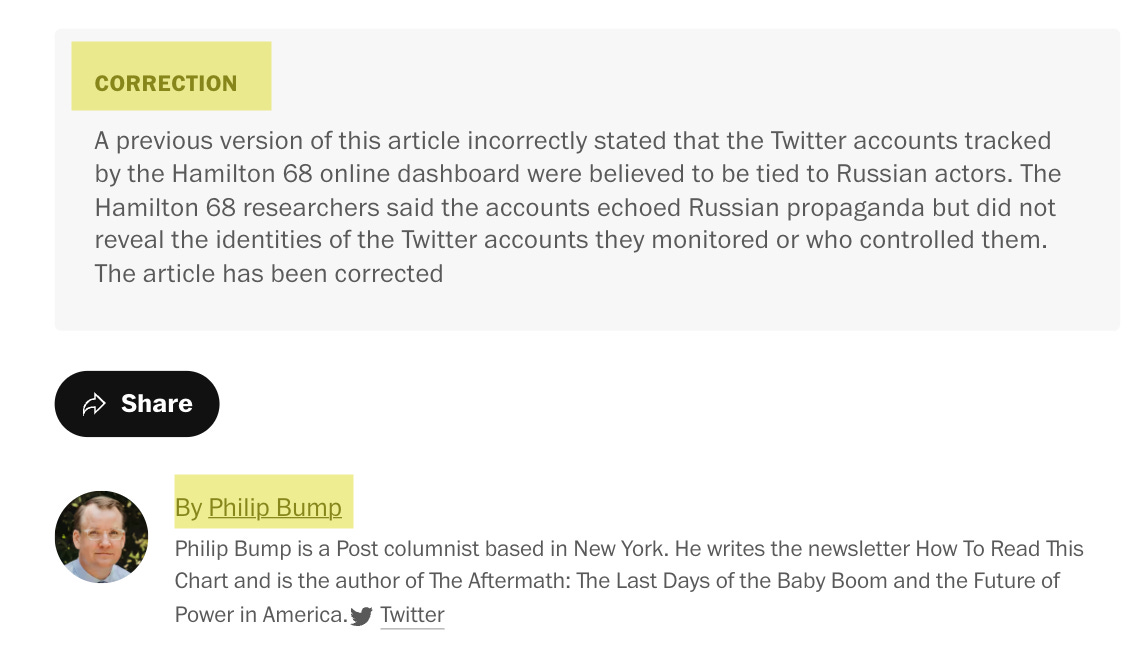
The piece became one of eight Washington Post articles to which corrections would be added because of the Twitter Files. Twitter internal correspondence showed the Hamilton 68 was a fraud, a “dashboard” of 600+ accounts that were “neither strongly Russian nor strongly bots” but “real people” who’d been falsely “labeled Russian stooges.” This was, Twitter executives says, part of a scheme “to assert that any right-leaning content is propagated by Russian bots.” Twitter Trust and Safety chief Yoel Roth concluded: “We need to call this out on the bullshit it is.”
Your own editors agreed, which is why there’s now a correction notice at the bottom of your article:
The accounts you identified as pushing “Russian influence operations” actually belonged to people like Consortium editor Joe Lauria, Chicago-based lawyer Dave Shestokas, and a onetime refugee from Lebanon named Sonia Monsour. None had any connection to Russia.
Years ago as an intern in D.C., and long before the agencies all locked their doors to visitors, I had the occasion to putter around the Department of Transportation and the Department of Housing and Urban Development.
These were obviously not normal workplaces. To my amazement, they were mostly dark, empty, and quiet, and the employees did not seem in the slightest bit busy doing anything at all. It was all kind of spooky.
It then occurred to me that these many hundreds of agencies and millions of employees are not really covered well by the media much at all and certainly not in any detail. They mostly operate without any oversight but for the periodic reporting done for Congress and the sporadic accounting reports from the Government Accounting Office that are mostly ignored.
It’s rather strange, isn’t it? The business pages are packed with details on the hirings and operations of every publicly traded company. We know sales, products, locations, and management structures and changes. But as regards these agencies that are supposed to be responsible to the people, there is a strange lack of curiosity about what they really do and how they do it.
There is at least one organization that takes a deeper look. It is called OpentheBooks, started with an idealistic idea of telling people what the operations of these agencies are really like. They aren’t trying to unearth classified information or otherwise do whistleblowing. They focus on the mundane accounting and goings-on at normal civilian agencies.
What they found would never be tolerated at any private company.
The average pay in 109 of 125 federal agencies was more than $100,000 per employee and after just three years federal employees received 44 days – 8.8 full work weeks of paid time off.
In a report to Congress, the Biden Administration redacted (hid) 350,000 names and 280,000 work locations from the payrolls. And these employees aren’t spies or intelligence officers – they are rank-and-file workers within the alphabet soup of traditional federal agencies like Education, Health and Health Services, EPA, or IRS. As a result, the organization couldn’t tell “who” was working, “where” they were located, and “what” they were doing!
At the Department of Commerce, the Inspector General found 23% of employees sampled were overpaid.
Employees took nearly a year in some instances to update their duty station, which dictates their locality pay. The Department couldn’t verify whether employees were showing up to the office as required.
The Commerce Department has 47,000 employees. The Inspector General sampled only 31 employees and seven of those were overpaid by a combined $43,000!
You are not surprised, right? And you probably assume that this is just the tip of the iceberg also. Indeed, one supposes so. I’m looking at the Federal Register. It lists 429 agencies in the government now, with only a tiny number mentioned in the US Constitution. The rest have been legislated into existence by Congress, going far beyond anything the Founders ever imagined.
Thanks to nearly a century and a half of gradual accumulation, these agencies have a permanent life. The employees cannot be fired except for egregious actions. And the elected president has no control over them. The president can appoint agency heads but then the battle becomes hundreds vs millions, and the hundreds of appointees are new at their jobs and easily driven out with a hint of financial impropriety, real or made up. The permanent class of middle-state bureaucrats with all the institutional knowledge know precisely where the power resides. It is with them.
This system of administrative hegemony has not been seriously tested in court. It is likely contrary to everything the Constitution ever imagined. True, Congress created these agencies but they exist within the executive branch. Congress cannot simply outsource its job to another branch and then wash its hands of the result. That practice makes a mess out of the original Constitutional structure.
Leaving those fundamental issues aside, what’s striking is how little oversight of these agencies really takes place. Very little reporting is done on them at all apart from perfunctory reprinting of agency press releases by major media. The reason is that many reporters rely on the permanent government for information sources and protection after the fact. There is a hand-in-glove relationship going on here and it's been building for many decades, even dating back to the Great War.
Every once in a while, we get a glimpse of the reality on the ground. The work of OpentheBooks makes life briefly hard for agencies that never like to be in the news but very little if anything is ever done about the problem.
There has been some much-welcome talk lately of untangling the cozy relationships between these hundreds of agencies and the industries they oversee. That’s good. We really should not be building a corporatist system that runs contrary to the ideal of free enterprise. But the idea of ending agency capture is also not a permanent solution to the problem.
We must think more fundamentally. With an ideal president and legislature, we would pursue something like what is going on in Argentina today. Whole agencies need to be deleted entirely from the federal budget. And then let the chips fall where they may. So long as I can remember, every Republican president has promised to get rid of the Department of Education. Great. But why does it never happen? I would like to know the answer. Plus, that is only a starter: there are hundreds of such agencies that should be on the list.
The real solution is a complete rethinking of government itself. Every single candidate should be asked to explain their answer to a basic question: what in your view is the role of government? Whatever the answer is, all existing practices of government need to be assessed in light of that. Also, voters should evaluate their answers with an even more fundamental question: what kind of society do we want to live in, a free or centrally managed one? That’s the core question.
The goings-on at the Department of Commerce provide a slight glimpse but the real scale of the problem is far more vast. I have no doubt that if a serious think tank really looked at the details, provided fully and transparently, we would be astonished at what we find. As some news organization has been saying for a while, democracy dies in darkness. Let's shine the light of truth on the vast complex of civilian agencies that purport to manage our lives better than we can ourselves.
Final note: this column is dedicated to Adam Andrzejewski, founder of OpentheBooks, who has died at the age of 55. He was a good friend to Brownstone and to transparency in government. He ran a different kind of nonprofit, not a puffy do-nothing bureaucracy but a production-driven research institute doing what desperately needs to be done. His must-read piece is about how he was cancelled by Forbes. May he rest in peace and may his legacy inspire many more such visionaries.
Conservatives and animal rights activists have become strange bedfellows in recent years on First Amendment, FOIA issues. Exposed interview with lab operator verifies "Beaglegate" allegations Fauci long denied with Washington Post's help.
“Laowhy86″, who lived in China during its economic golden era but (like his YouTube buddy Winston Sterzel/”serpentza”) left with their Chinese wives because they couldn’t take the Xi Jinping totalitarianlism anymore, reports that rumors in the Chinese-language media are rife that the King of all Turtle-Lovers, Xinnie the Flu, has )depending on the source) been sidelined, been placed under house arrest, or been told by the CCP power brokers he will from now on only be a figurehead, with others setting actual policy.
There has long been a rival faction around former leader Jiang Zemin, who continued the more reformist path of Deng Xiaoping. Mind you: the country had/has an appalling human rights records under these strongmen as well, but they were much less given to antagonizing the West and trying to bully the way of China to world hegemony.
Developing…
ADDENDUM: there had been similar rumors back in 2022, but at the time “laowhy86” debunked them. One key feature he points out this time: under normal circumstances, spreading such rumors on social media in China would get you arrested at best and rendered for transplant organs at worst. Now the rumors seem to be tolerated…
The UK seems to have blasphemy laws again, but for blasphemy of islam instead of christianity.
How long will it be before the All Party Parliamentary Group on British Muslims' definition of 'Islamophobia', which prohibits *any* criticism of Islam, is universally adopted by public institutions? asks Steven Tucker.
For over eight years, the world has been told that the United States government relied on a private firm called Crowdstrike to investigate the hack of the Democratic National Committee. Both former FBI Director James Comey and Special Counsel Robert Mueller referred to Crowdstrike as a primary source that Russian “conspirators hacked the DNC.”
That narrative was troubling enough and the subject of questions at Congressional hearings. Attempts by members of the public to obtain Crowdstrike’s analysis through FOIA have been shot down time and again owing to corporate “trade secrets” involved, and with Special Counsel Mueller’s July 2018 indictment of those 12 Russians who are unlikely to ever be apprehended, key facts about their investigation were set to be sealed for decades.
New emails obtained by Racket through the Freedom of Information Act, however, suggest there is more to the story. Cyber researchers at Georgia Tech who were indirectly working with the Clinton campaign and Fusion GPS to produce the Alfa Bank claims, also appear to have influenced Special Counsel Mueller’s investigation of the DNC hack.
Racketpreviously covered the September 2022 letter the Pentagon’s Defense Advanced Research Projects Agency, or DARPA, sent to Senator Grassley, in which DARPA confirmed the cyber researchers authored a DNC hack attribution analysis on August 7, 2016. In relation to other emails and reporting suggesting the cyber researchers also had a hand in assisting Special Counsel Robert Mueller’s investigation, DARPA at the time suggested their work was solely “retrospective”:
DARPA identified the analysis as relating to the indictment, but the Agency’s letter never squared with representations by the cyber researchers that suggested materials were flowing “via DARPA” to the Department of Justice and Special Counsel Robert Mueller. Now we know why. DARPA was either lying or uninformed, and not for the first time.
A FOIA request for emails in the account of Angelos Keromytis, the head of the Enhanced Attribution program for DARPA, shows Keromytis in direct contact with Heather Alpino and providing materials relating to “DCLeaks”, a website associated with the 2016 DNC hack:
Angelos Keromytis was noted throughout emails obtained through Open Records requests to Georgia Tech, where Keromytis was employed after his time at DARPA, which showed that Special Counsel Durham’s team spoke to Keromytis during their investigation about his ties to the Alfa Bank cyber researchers as well as the National Security Division of the Department of Justice.
DOJ attorney Heather Alpino was part of the Special Counsel Mueller team by 2018, detailed to the team from her role inside the National Security Division’s Counterintelligence and Export Control Section, which signed memoranda of understanding with DARPA’s Enhanced Attribution program — a program for which Georgia Tech was awarded a contract in 2016 to develop the science of cyber attribution. An email further down the new email chain suggests that Alpino understood the materials were coming from “performers” in the Enhanced Attribution program, i.e. Manos Antonakakis and David Dagon:
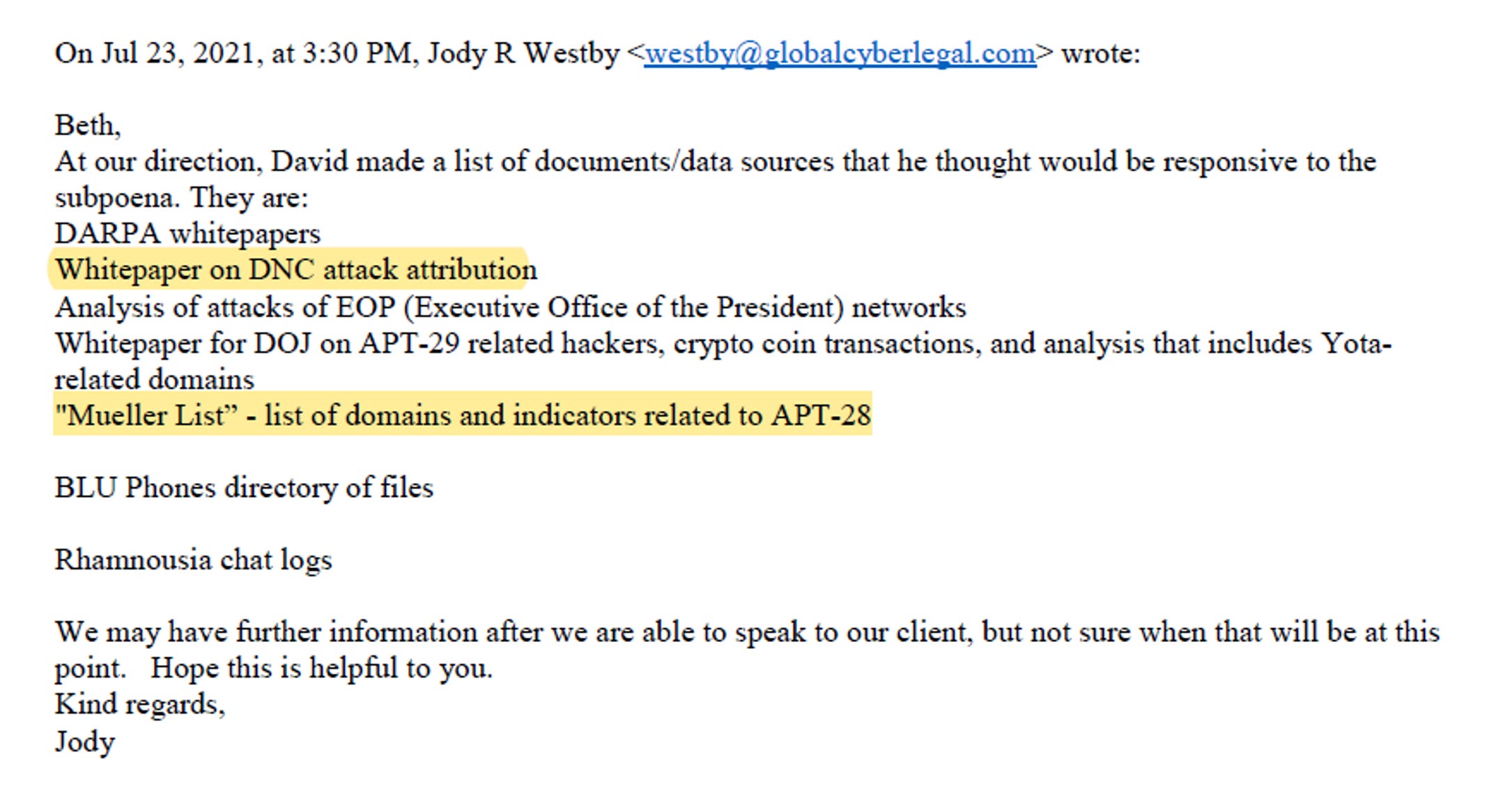
The reference to “domains”, along with additional FOIA pages obtained that list Russian domain names, could indicate that the analysis corresponds to a “Mueller List” of domains and indicators of APT-28, the Russian intelligence group accused of the hack, referenced in an email from David Dagon’s attorneys:
There are strong indications that the same cyber researchers who were working with the Clinton campaign went on to work with the Special Counsel Robert Mueller team on the DNC hack investigation and the indictment of Russians. There’s no doubt the government understood the connection to Clinton attorney Michael Sussmann, Sussmann was the one who had delivered the Alfa Bank allegations on thumb drives that the Clinton campaign paid for.
At the trial of Michael Sussmann, we learned that the FBI had received information from confidential human sources by early October 2016 who alleged that David Dagon was the author of the technical white paper making the claims regarding a secret communications channel between Trump and Russia via Alfa Bank, which the FBI was well on its way to debunking.
We also learned that the requests of FBI field agents involved in that investigation to interview David Dagon were denied by the FBI's leadership. Somehow, these same cyber researchers that had already provided their August 7, 2016 attribution analysis on the DNC hack, in addition to anonymously submitting the Alfa Bank claims through Sussmann, along with later submitting nonsensical Yota Phone allegations, went on to provide materials to Special Counsel Mueller on the DNC hack without raising any eyebrows.
The Mueller team went on to wipe dozens of phones, leaving now obvious questions of whether it was to conceal their contacts with the Clinton-connected cyber researchers. Whether intentional or not, the fact remains that none of the investigations since 2016 have revealed the role of the cyber researchers in the DNC hack investigation.
It’s nearly impossible to see how the government could meet its Brady obligations for a theoretical trial of the Russians. Presumably, all of the cyber researchers’ work on the Alfa Bank allegations would be considered Brady material, going to the credibility of these cyber researchers as witnesses. At least some of that material has not been made available to the government or was destroyed.
And why would the government use these cyber researchers in one of the biggest and most important investigations in history, an investigation the media repeatedly assured us was being run above-board? With unlimited resources at its disposal, it appears the government instead allowed cyber researchers with controversial histories and political connections to influence their investigation.
In March 2022, DARPA stated “DARPA was not involved in efforts to attribute the DNC hack. Dr. Antonakakis worked on DARPA’s Enhanced Attribution program, which did not involve analysis of the DNC hack,” Jared Adams, DARPA’s chief of communications, told the Washington Examiner. “Further, DARPA was not involved in efforts to attribute the Guccifer 2.0 persona, nor any involvement in efforts to attribute the origin of leaked emails provided to Wikileaks.”
DARPA’s statements contradicted a plethora of emails obtained through Open Records requests where the cyber researchers said exactly the opposite. As more emails are produced, it appears that Antonakakis and Dagon were telling the truth about their involvement in the DNC hack investigation and the government is lying.
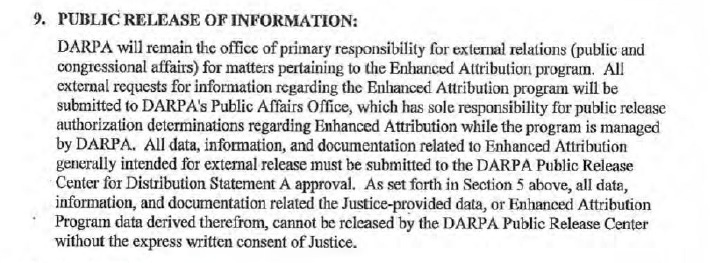
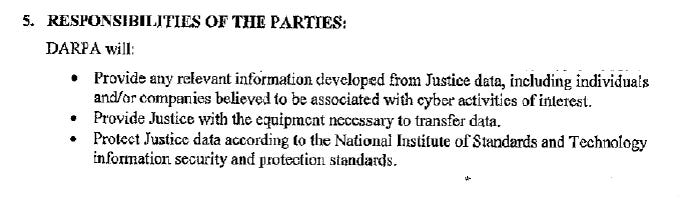
It’s unclear if DARPA is free to speak about their role in the investigation. A June 2017 memorandum of understanding for the Enhanced Attribution program and the National Security Division of the Department of Justice suggests approval must be sought from the Department of Justice before public disclosure:
Responsibilities detailed in the agreement suggest a significant role for the Department of Defense in criminal investigations - away from oversight that might bring uncomfortable questions like those of Senator Wyden’s in 2022:
The work of the Clinton-connected cyber researchers on the DNC hack wasn’t retrospective, as DARPA claimed. It appears to play a key role in the investigation and critically, the public’s understanding of Russian interference. One would have hoped that understanding didn’t rely on methods considered “spoofable” as noted in emails obtained by Margot Cleveland of The Federalist, and on cyber researchers suspected by some of spoofing the data used in the Alfa Bank allegations.
Racket reached out to attorneys for Dagon, Keromytis, and Antonakakis, as well as Georgia Tech and DARPA. None commented for the record. More to come, and as noted earlier, please watch this site for news about a Twitter Spaces on the subject.
Yup. That nothing is done when it is this blatant indicates a very high probability that nearly everyone else in a position to sell influence is also doing the same thing.
The nearly 300-page report on Biden family corruption matters for many reasons, the most important of which is to restore America’s standing in the world.












 The nearly 300-page report on Biden family corruption matters for many reasons, the most important of which is to restore America’s standing in the world.