Shared posts

15 Dec 20:51

What the Library of Congress Decided This Week About 3D Printing

by Dallas Harris
 img

What does 3D printing have to do with the DMCA?

In November 2014, Public Knowledge petitioned the Copyright Office for a number of exemptions to the prohibition against circumventing technological protection measures (i.e. “digital locks”) protecting copyrighted works under Section 1201 of the Digital Millennium Copyright Act.

One of the exemptions we sought would allow users of 3D printers to use the replacement feedstock (i.e. the 3D printer equivalent of replacement ink cartridges or laser printer toner cartridges) of their choice. Earlier this year, we also filed comments in support of the exemption. We made this effort to ensure manufacturers of 3D printers could not use copyright law to lock printer users into using only expensive “brand name” replacement feedstock.

Fortunately, the Library of Congress, at the recommendation of the Copyright Office, granted our request, permitting users to use replacement materials that are not authorized by the printer’s manufacturer without running afoul of copyright law. However, that we even needed to seek permission for something so simple and beyond the purpose of copyright law highlights why Public Knowledge supports efforts to reform Section 1201 and end the absurdity of needing exemptions like this one. Nevertheless, this is a win for competition, tinkerers, and consumers, at least in principle. Unfortunately, the win comes with significant caveats, which we’ll discuss in a moment.

This ruling is the culmination of a process that takes place every three years, where the public must seek the permission of the Librarian of Congress to engage in what is already lawful activity (i.e. noninfringing use of copyrighted works). Other well known examples of lawful activity that requires the Librarian’s blessing every three years include jailbreaking tablets, unlocking cell phones, and allowing documentary filmmakers and educators to extract film clips from DVDs.

Before an exemption can be granted, the Librarian, with the recommendation of the Copyright Office, must first find that absent the proposed exemption, individuals who are users of copyrighted works are, or are likely to be, adversely affected in their ability to make noninfringing uses. The proponent of an exemption has to show that the use at issue is noninfringing under statutory law or established legal precedents. Additionally, the proponent must establish that the noninfringing use is, or is likely to be, adversely affected by the prohibition on circumvention. An exemption is not granted if there are alternatives to circumvention that permit the noninfringing use, regardless of how ridiculous those alternatives may be.

This process results in a constant, and often frustrating, back and forth between the public and the Copyright Office. You can read our thoughts on the flaws of the exemption process as a whole in additional comments we submitted to the Copyright Office as part of this cycle, and learn more on our Anticircumvention page.

So, the Exemption was Granted. That’s a Win, Right?

Well, yes... and no. We are pleased that the Library of Congress stands behind the theory that 3D printer users circumventing a digital lock in order to use replacement feedstock of their choice in their own printers is “likely noninfringing as a matter of fair use.” However, the Librarian added several conditions to the granted exemption, which threaten to swallow the exemption whole.

What’s the Problem?

The Librarian included the following language limiting the exemption:

“The exemption shall not extend to any computer program on a 3D printer that produces goods or materials for use in commerce the physical production of which is subject to legal or regulatory oversight…”

One way to translate this would be: if your printer is capable of producing something for sale (e.g., on Etsy), and that thing is subject to legal rules, you don’t qualify for an exemption to use third-party replacement feedstock. The trouble is, any 3D printer is capable of producing things that can be sold, and tort law applies to nearly everything. In short, the exemption is potentially hollow.

It’s worth asking why caveats to the exemption were needed in the first place. The Librarian has the ability to grant exemptions for 3D printers without differentiating between commercial and personal use. For some reason, the Copyright Office felt like it needed to address concerns that have nothing to do with copyright law, by imposing a somewhat arbitrary distinction between “commercial” printers and “personal” printers. Unfortunately for printer users, it’s a distinction without a difference. This is why both supporters and opponents of the exemption advised the Copyright Office against attempting to make this distinction, but the Office failed to heed the warnings.

Similarly, the Office insisted on adding language about production “subject to legal[…]oversight” in an effort to somehow address safety concerns. It is unclear how giving printer manufacturers a copyright claim against printer users helps protect the public in ways that product safety laws don’t. The result is a muddled exemption that exemplifies what happens when a well-intentioned agency attempts to use copyright law to achieve regulatory goals in which it lacks expertise.

Copyright law should address copyright issues. By trying to solve issues better left to the relevant areas of law, the Copyright Office has given us an exemption that leaves 3D printer users who don’t want to be restricted in using replacement feedstock with as much legal uncertainty as before. Unfortunately, unless Congress takes action to reform the law, this is what we’re left with for now. Maybe the Library of Congress can get it right in three years.

Contact your representative in Congress here to tell them it’s time to revise Section 1201 of the DMCA.

See what consumer advocates are saying about DMCA reform here.

Check out our latest podcast on the Section 1201 exemption process results here.

Image credit: Wikimedia Commons user Subhashish Panigrahi

09 Dec 19:50

Announcing the Open Access Spectrum (OAS) Evaluation Tool

by Shawn Daugherty

The Open Access Spectrum (OAS) Evaluation Tool provides a concrete, quantifiable mechanism to independently analyze publications' policies. It offers unprecedented insight and transparency into scholarly journals’ degree of openness.

09 Dec 19:49

White House Commits to Open Access, Open Education and Open Data in New Open Government Plan

by Nicole Allen

Today the White House released its 2016-2017 Open Government National Action Plan, which includes commitments to expand access to open educational resources and the results of federally funded research. This exciting development shows continued support from the Obama administration for these issues, and sets the stage for continued progress beyond the 2016 elections.

17 Nov 20:26

Librarian of Congress now term limited

by Adam Eisgrau

With the stroke of a pen, the President has established for the first time a set term of office for the Librarian of Congress. Rather than serve for life, the next and all future Librarians will enjoy a 10-year term of office renewable for the same length of time upon reconfirmation by the Senate. Legislation authorizing the change, the Librarian of Congress Succession Modernization Act of 2015 (S. 2162), was 11603rboth introduced in and passed in the Senate by unanimous consent on October 7. It was again approved by unanimous consent of the House less than two weeks later. The Librarian’s position remains vacant in the wake of James Billington’s resignation on September 30th. A successor has not yet been named. ALA has urged the President to appoint a credentialed librarian.

The post Librarian of Congress now term limited appeared first on District Dispatch.

16 Oct 18:47

Public Knowledge Celebrates Court Decision in “Happy Birthday” Case

by Shiva Stella
 img

Yesterday, the district court in Marya v. Warner/Chappell Music, Inc. invalidated one of the most famous, longest lasting, and controversial rights claims in music: Warner/Chappell’s ownership of the copyright in the universally known song Happy Birthday to You.

The following can be attributed to Raza Panjwani, Policy Counsel at Public Knowledge:

“The district court’s decision finding that Warner/Chappell Music never acquired the rights to the lyrics of Happy Birthday to You is a welcome victory for the public. Although this decision does not mean that Happy Birthday is unquestionably in the public domain, it dismantles Warner/Chappell’s unfounded claims of ownership.

“This decision also raises serious concerns as to how much of our culture remains under lock and key on the basis of flimsy or barely credible claims of ownership. Thanks to multiple extensions of copyright term length, copyrights have remained in effect while the records that can definitively answer questions of ownership or public domain status moulder away.

“The somehow ever-lasting term of the copyright in Happy Birthday’s lyrics has been the target of incredulous Supreme Court commentary, mocking disbelief on television sitcoms, and, of importance to this case, serious research into the provenance of the song.

“Unfortunately, few works have received the kind of in-depth study that Happy Birthday has, and the high cost of either litigating copyright ownership, or potentially violating copyright law, remain deterrents to eliminating other specious copyright claims.

“Nevertheless, yesterday’s decision is one worth celebrating.”

16 Oct 18:47

How the Trans-Pacific Partnership Jeopardizes Fair Use

by Michael Baak
 img

Earlier this week, Public Knowledge and 15 other global civil society groups sent a letter to the officials of the various governments that will meet and finalize the Trans-Pacific Partnership (TPP) provisions next week, urging them to rewrite parts of the trade agreement’s current intellectual property chapter. This is Public Knowledge’s latest effort to warn governments and the public of the harmful aspects of the TPP, which has been secretly negotiated among government officials behind closed doors. Recently, we sent letters to the United States Trade Representative and even alerted the White House to the TPP’s potential chilling effects on the right to knowledge and fair use as well as copyright reform efforts of Congress and the Copyright Office. 

We particularly urge the governments to adopt provisions in the TPP that encourage flexible exceptions and limitations (like fair use) to copyright. Only a flexible approach will give each country the opportunity to write domestic laws that best suit the needs of its citizens as consumers of intellectual property and as users of communication technologies.  

Exceptions and limitations are focal points to protect the everyday use of communications products. Although rapid technological developments may require updating intellectual property protections in the U.S. and abroad, such protective schemes should not disrupt the delicate balance between the rights of creators and the rights of average consumers. This balance has been maintained by exceptions and limitations to intellectual property protection. Within these boundaries, the public has enjoyed countless beneficial uses of intellectual property without having to worry about legal liability.

As we stated in our United States Trade Representative letter:

Limitations and exceptions to intellectual property rights are absolutely critical to a functioning marketplace. The digital revolution has ushered in an era of ubiquitous content. Even without actively seeking out knowledge properties, the average American is constantly being exposed to—and interacting with—copyrighted and patented goods. Overbroad intellectual property protections create a minefield of liability through which no consumer, no matter how savvy, can reasonably be expected to navigate.

The current intellectual property chapter of the TPP is the epitome of such overbroad protections, laying out restrictive provisions that weaken U.S. exceptions and limitations. We are chiefly concerned with the following provisions:

1) The retroactive extension of copyright terms that robs culture of 20 years of public domain works.

2) A ban on circumvention of technological protection measures, which threaten people's autonomy over legitimately purchased digital content and devices.

3) Heavy-handed criminal penalties and civil damages in cases where the parties were not involved in large-scale or financially motivated infringement.

4) Overbroad trade secret rules that could criminalize the work of journalists or whistleblowers who report on corporate wrongdoing.

Because next week’s TPP negotiations may be the last opportunity to revise the these provisions, Public Knowledge joins global civil society organizations in urging government officials to revisit the TPP intellectual property chapter and employ strong safeguards to fair use of copyrighted works. We specifically remind the USTR representatives directly involved in the negotiations that, “in order to be adequate, flexible exceptions and limitations language must be mandatory, not merely encouraged, to better enable each TPP country to achieve balance in its copyright rules.”

Our letter to TPP officials can be viewed here.


Image credit: Flickr user MusesTouch

16 Oct 18:46

Public Knowledge Welcomes Sweeping Victory for Fair Use in Google Books Decision

by Shiva Stella
 img

Today, the United States Court of Appeals for the Second Circuit unanimously found that the Google Books project, under which Google digitized, indexed, and permits users to search and view snippets of millions of printed books, constitutes a fair use.

The following can be attributed to Raza Panjwani, Policy Counsel at Public Knowledge:

“The circuit court’s decision is a victory for the public. Judge Leval stated in no uncertain terms that ‘the ultimate goal of copyright is to expand public knowledge and understanding,’ and the Google Books project does precisely that. Researchers can now spend seconds, not lifetimes, searching through libraries across the world to identify relevant books. If copyright law is truly intended ‘to promote the progress of science and the useful arts,’ then this is precisely the kind of access-enhancing use it should permit.

“The opinion also puts to rest two pervasive misconceptions about copyright law: that digitizing or copying an entire work is always a violation of the law regardless of purpose, and that the mere existence of a licensing market eliminates the possibility of a fair use.

“The plaintiffs emphasized over and over that Google digitally copied entire books. However, the Court made clear that what matters for copyright purposes is what human users see, and not what a search algorithm can access.

“The tragedy is that ten years and countless dollars have been spent on lawsuits, instead of on expanding or establishing new programs like Google Books. With this decision, we will hopefully see a renewal of efforts to digitize and open up access to culture and knowledge.”

16 Oct 18:45

The Final Leaked TPP Text Is All That We Feared

by Jeremy Malcolm

Today's release by Wikileaks of what is believed to be the current and essentially final version of the intellectual property (IP) chapter of the Trans-Pacific Partnership (TPP) confirms our worst fears about the agreement, and dashes the few hopes that we held out that its most onerous provisions wouldn't survive to the end of the negotiations.

Since we now have the agreed text, we'll be including some paragraph references that you can cross-reference for yourself—but be aware that some of them contain placeholders like “x” that may change in the cleaned-up text. Also, our analysis here is limited to the copyright and Internet-related provisions of the chapter, but analyses of the impacts of other parts of the chapter have been published by Wikileaks and others.

Binding Rules for Rightsholders, Soft Guidelines for Users

If you skim the chapter without knowing what you're looking for, it may come across as being quite balanced, including references to the need for IP rules to further the “mutual advantage of producers and users” (QQ.A.X), to “facilitate the diffusion of information” (QQ.A.Z), and recognizing the “importance of a rich and accessible public domain” (QQ.B.x). But that's how it's meant to look, and taking this at face value would be a big mistake.

If you dig deeper, you'll notice that all of the provisions that recognize the rights of the public are non-binding, whereas almost everything that benefits rightsholders is binding. That paragraph on the public domain, for example, used to be much stronger in the first leaked draft, with specific obligations to identify, preserve and promote access to public domain material. All of that has now been lost in favor of a feeble, feel-good platitude that imposes no concrete obligations on the TPP parties whatsoever.

Another, and perhaps the most egregious example of this bias against users is the important provision on limitations and exceptions to copyright (QQ.G.17). In a pitifully ineffectual nod towards users, it suggests that parties “endeavor to achieve an appropriate balance in its copyright and related rights system,” but imposes no hard obligations for them to do so, nor even offers U.S.-style fair use as a template that they might follow. The fact that even big tech was ultimately unable to move the USTR on this issue speaks volumes about how utterly captured by Hollywood the agency is.

Expansion of Copyright Terms

Perhaps the biggest overall defeat for users is the extension of the copyright term to life plus 70 years (QQ.G.6), despite a broad consensus that this makes no economic sense, and simply amounts to a transfer of wealth from users to large, rights-holding corporations. The extension will make life more difficult for libraries and archives, for journalists, and for ordinary users seeking to make use of works from long-dead authors that rightfully belong in the public domain.

Could it have been worse? In fact, yes it could have; we were spared a 120 year copyright term for corporate works, as earlier drafts foreshadowed. In the end corporate works are to be protected for 70 years after publication or performance, or if they are not published within 25 years after they were created, for 70 years after their creation. This could make a big difference in practice. It means that the film Casablanca, probably protected in the United States until 2038, would already be in the public domain in other TPP countries, even under a life plus 70 year copyright term.

New to the latest text are the transition periods in Section J, which allow some countries a longer period for complying with some of their obligations, including copyright term. For example, Malaysia has been allowed two years to extend its copyright term to life plus 70 years. For Vietnam, the transition period is five years. New Zealand is the country receiving the most “generous” allowance; its term will increase to life plus 60 years initially, rising to the full life plus 70 year term within eight years. Yet Canada, on the other hand, has not been given any transition period at all.

Ban on Circumventing Digital Rights Management (DRM)

The provisions in QQ.G.10 that prohibit the circumvention of DRM or the supply of devices for doing so are little changed from earlier drafts, other than that the opposition of some countries to the most onerous provisions of those drafts was evidently to no avail. For example, Chile earlier opposed the provision that the offense of DRM circumvention is to be “independent of any infringement that might occur under the Party's law on copyright and related rights,” yet the final text includes just that requirement.

The odd effect of this is that someone tinkering with a file or device that contains a copyrighted work can be made liable (criminally so, if wilfullness and a commercial motive can be shown), for doing so even when no copyright infringement is committed. Although the TPP text does allow countries to pass exceptions that allow DRM circumvention for non-infringing uses, such exceptions are not mandatory, as they ought to be.

The parties' flexibility to allow DRM circumvention also requires them to consider whether rightsholders have already taken measures to allow those non-infringing uses to be made. This might mean that rightsholders will rely on the walled-garden sharing capabilities built in to their DRM systems, such as Ultraviolet, to oppose users being granted broader rights to circumvent DRM.

Alongside the prohibition on circumvention of DRM is a similar prohibition (QQ.G.13) on the removal of rights management information, with equivalent civil and criminal penalties. Since this offense is, once again, independent of the infringement of copyright, it could implicate a user who crops out an identifying watermark from an image, even if they are using that image for fair use purposes and even if they otherwise provide attribution of the original author by some other means.

The distribution of devices for decrypting encrypted satellite and cable signals is also separately proscribed (QQ.H.9), posing a further hazard to hackers wishing to experiment with or to repurpose broadcast media.

Criminal Enforcement and Civil Damages

On damages, the text (QQ.H.4) remains as bad as ever: rightsholders can submit “any legitimate measure of value” to a judicial authority for determination of damages, including the suggested retail price of infringing goods. Additionally, judges must have the power to order pre-established damages (at the rightsholder's election), or additional damages, each of which may go beyond compensating the rightsholder for its actual loss, and thereby create a disproportionate chilling effect for users and innovators.

No exception to these damages provisions is made in cases where the rightsholder cannot be found after a diligent search, which puts the kibosh on ideas for the introduction of an orphan works regime that would cap remedies available against those who reproduce these otherwise-unavailable works.

One of the scariest parts of the TPP is that not only can you be made liable to fines and criminal penalties, but that any materials and implements used in the creation of infringing copies can also be destroyed (QQ.H.4(12)). The same applies to devices and products used for circumventing DRM or removing rights management information (QQ.H.4(17)). Because multi-use devices such as computers are used for a diverse range of purposes, this is once again a disproportionate penalty. This could lead to a family's home computer becoming seized simply because of its use in sharing files online, or for ripping Blu-Ray movies to a media center.

In some cases (QQ.H.7), the penalties for copyright infringement can even include jail time. Traditionally, this has because the infringer is operating a business of commercial piracy. But under the TPP, any act of willful copyright infringement on a commercial scale renders the infringer liable to criminal penalties, even if they were not carried out for financial gain, provided that they have a substantial prejudicial impact on the rightsholder. The copying of films that are still playing in movie theaters is also subject to separate criminal penalties, regardless of the scale of the infringement.

Trade Secrets

The severity of the earlier language on trade secrets protection has not been abated in the final text. It continues to criminalize those who gain “unauthorized, willful access to a trade secret held in a computer system,” without any mandatory exception for cases where the information is accessed or disclosed in the public interest, such as by investigative journalists or whistleblowers.

There is no evident explanation for the differential treatment given to trade secrets accessed or misappropriated by means of a computer system, as opposed to by other means; but it is no surprise to find the U.S. pushing such a technophobic provision, which mirrors equivalent provisions of U.S. law that have been used to persecute hackers for offenses that would otherwise have been considered much more minor.

Top-Down Control of the Internet

ICANN, the global domain name authority, provoked a furore earlier this year over proposals that could limit the ability for owners of domain names to shield their personal information from copyright and trademark trolls, identity thieves, scammers and harassers.

The TPP has just ridden roughshod over that entire debate (at least for country-code top-level domains such as .us, .au and .jp), by cementing in place rules (QQ.C.12) that countries must provide “online public access to a reliable and accurate database of contact information concerning domain-name registrants.”

The same provision also requires countries to adopt an equivalent to ICANN's flawed Uniform Domain-Name Dispute Resolution Policy (UDRP), despite the fact that this controversial policy is overdue for a formal review by ICANN, which might result in the significant revision of this policy. Where would this leave the TPP countries, that are locked in to upholding a UDRP-like policy for their own domains for the indefinite future?

The TPP's prescription of rules for domain names completely disregards the fact that most country code domain registries have their own, open, community-driven processes for determining rules for managing domain name disputes. More than that, this top-down rulemaking on domain names is in direct contravention of the U.S. administration's own firmly-stated commitment to uphold the multi-stakeholder model of Internet governance. Obviously, Internet users cannot trust the administration that it means what it says when it gives lip-service to multi-stakeholder governance—and that has ramifications that go even even deeper than this terrible TPP deal.

ISP Liability

The provisions on ISP liability (Appendix Section I), as we previously found in the last leaked text, are not quite as permissive as we hoped. It will still require most countries to adopt a version of the flawed U.S. DMCA notice-and-takedown system, albeit with a few safeguards such as penalties for those who issue wrongful takedown notices, and allowing (but not requiring) a Japanese-style system of verification of takedown notices by an independent body of ISPs and rightsholders.

It is true that Canada's notice-and-notice regime is also allowed, but effectively only for Canada—no other country that did not have an equivalent system as of the date of the agreement is allowed to benefit from that flexibility. Even in Canada's case, this largesse is only afforded because of the other enforcement measures that rightsholders enjoy there—such as a tough regime of secondary liability for authorization of copyright infringement.

Similarly Chile's system under which ISPs are not required to take down content without a judicial order is explicitly grandfathered in, but no other country joining the TPP in the future will be allowed to have a similar system.

In addition, although there is no explicit requirement for a graduated response regime of copyright penalties against users, ISPs are still roped in as copyright enforcers with the vague requirement (Appendix Section 1) that they be given “legal incentives…to cooperate with copyright owners to deter the unauthorized storage and transmission of copyrighted materials or, in the alternative, to take other action to deter the unauthorized storage and transmission of copyright materials”.

Good Points?

Quite honestly there are no parts of this agreement that are positively good for users. Of course, that doesn't mean that it's not improved over the earlier, horrendous demands of the U.S. negotiators. Some of the areas in which countries rightly pushed back against the U.S., and which are reflected in the final text are:

  • The exhaustion of rights provision (QQ.A.11) that upholds the first sale doctrine of U.S. law, preventing copyright owners from extending their control over the resale of copyright works once they have first been placed in the market. In particular, this makes parallel importation of cheaper versions of copyright works lawful—and complementing this is an explicit authorization of devices that bypass region-coding on physical copies of such works (QQ.G.10, though this does not extend to bypassing geoblocking of streaming services).
  • A thoroughly-misguided provision that would have extended copyright protection to temporary or "buffer" copies in a computer system was one of the earliest rightsholder demands dropped by the USTR, and rightfully so, given the damage this would have wreaked to tech companies and users alike.

But we have struggled to come up with more than two positive points about the TPP, and even then the absence of these tragic mistakes is a pretty poor example of a positive point. If you look for provisions in the TPP that actually afford new benefits to users, rather than to large, rights-holding corporations, you will look in vain. The TPP is the archetype of an agreement that exists only for the benefit of the entitled, politically powerfully lobbyists who have pushed it through to completion over the last eight years.

There is nothing in here for users and innovators to support, and much for us to fear—the ratcheting up of the copyright term across the Pacific rim, the punitive sanctions for DRM circumvention, and the full frontal attack on hackers and journalists in the trade secrets provision, just to mention three. This latest leak has confirmed our greatest fears—and strengthened our resolve to kill this agreement for good once it reaches Congress.


Share this: Share on Twitter Share on Facebook Share on Google+ Share on Diaspora  ||  Join EFF
16 Oct 18:31

Standing Desks Are Mostly Bullshit

by Kaila Hale-Stern on Gizmodo, shared by Charlie Jane Anders to io9

A new study says that standing up at your desk doesn’t actually decrease your risk of death-by-office, unless you’re physically active otherwise.

Read more...


16 Oct 11:58

Tsundoku: Japan’s Word for “Books You Buy But Don’t Read”

by Koichi

While choosing vocabulary words for our kanji learning site WaniKani, I occasionally come across weird-ass Japanese words. This is one of them.

Tsundoku, aka 積ん読 (つんどく). Its definition is:

Buying books and not reading them. [noun] – Jisho.org

Look at your bedside table. Can you relate? I bet a lot of you who are learning Japanese have a big pile of unused Japanese textbooks somewhere, right? Heck, the Tofugu office is guilty of tsundoku, too. I don’t think we’ve read most of what’s on our bookshelf.

tsundoku-tofugu

That being said, tsundoku has more of an image of stacked books. When I think of the word, I imagine somebody’s futon on the floor, with a big pile of unread books and manga right next to it. If you break down the word into its component kanji, this “pile of books, not bookshelf of books” theory makes sense.

積: pile up, stack

読: read

“A pile up or stack of things you read…” or in this case, you don’t read. A quick Google Image search seems to confirm the “pile” theory.

tsundoku

But how do we get to a pile of books we didn’t read? Nothing in the component kanji suggests whether you’re reading these books or not. In fact, I’d argue that when you look at the component kanji on their own, it suggest that this is a pile of books you did read, or are currently reading.

I found the answer on this website. It turns out the word tsundoku is a play on words.

The first half of 積ん読 (tsundoku) comes from the word 積んでおく (tsundeoku), which means “to pile things up and leave them.” The second half (doku) comes from 読書 (dokusho) which means “reading.” Essentially, it’s a combination of the words tsundeoku (to pile things up and leave them) and dokusho (reading). If you paid close attention, you’ll have noticed that tsundeoku and tsundoku are very similar sounding words. Thus, a beautiful baby pun was born.

In terms of how to use this word, Mami has whipped up some example sentences for tsundoku.

僕は約1000冊ほどの積ん読を抱えて生きている。
I’m living with around 1,000 tsundoku (books).

今週末は、積ん読リストを作ろうと思う。
This week I think I’m going to make a tsundoku list.

積ん読用のお洒落な本棚が欲しい。
I want a stylish bookcase for my tsundoku (books).

It’s a noun, so go ahead and use it as you would any other noun. If you were to refer to your pile of books next to your bed, you would say “that’s my tsundoku” (that’s my pile of books I bought but haven’t read).

Tsundoku Elsewhere

And while we’re trying to turn tsundoku into an English word, we might as well apply its feeling to other things as well. Steam library? That’s Steamdoku, and I am so guilty of this.

pasted_image_at_2015_10_06_06_28_pm

And how about smartphone apps? I have so many that I’ve purchased and never used.

To get even more meta, though, I have a folder on my phone of reading-related apps that’s labeled 積ん読. And you guessed it, it’s piled full of things I will probably never read.

tsundoku-smarphone

That being said, I can’t complain. Tsundoku is essentially a mild form of hoarding, which isn’t the worst problem one can have. What parts of your life do you commit the act of tsundoku?

Bonus Wallpapers!


[Desktop ∙ 5120×2880 / 1280×720]

The post Tsundoku: Japan’s Word for “Books You Buy But Don’t Read” appeared first on Tofugu.

14 Oct 11:52

Impending shutdown disastrous for students

Congress has once again failed to complete its basic job description and is relying on a temporary spending bill to prevent utter failure. On October 2, President Barack Obama declared he would not be signing another temporary bill, giving Congress eight weeks to learn how to compromise and fund America’s next fiscal year.

Failure to approve a budget will result in the suspension of many programs, and, unfortunately, college students will feel the brunt of such negligence. 

Since the modern congressional budgeting process took effect in 1976, there have been 17 government shutdowns, the latest of which took place in October of 2013.

The shutdown forced the U.S. Department of Education’s Office for Civil Rights (OCR) to suspend any and all sexual assault investigations, according to the Huffington Post. 

“OCR investigations are not an excepted activity and have been suspended until the shutdown ends,” Education Department spokesman Cameron French told the Huffington Post. “Approximately 94 percent of department staff is on furlough as a result of the shutdown.”

Students across the country were informed that their cases were abandoned and would remain that way indefinitely until a budget was approved. Their rights were no longer protected under the chaotic society a nonfunctioning government had created. 

Luckily, the shutdown was resolved in 16 days, making repercussions minimal for most students. However, an extended furlough would have proven disastrous. 

Funding for research also took a near-critical hit due to the shutdown. Many universities had their research-funding cut and faced shutting down their programs all together if a compromise was not reached. 

Researchers at the University of Hawaii were conducting an investigation of eosinophilic meningitis, when they were barred from their facility. The researches were forced to leave behind years of research as they waited for access to their work. 

According to USF’s website, the university “ranks tenth worldwide among universities granted U.S. utility patents and is ranked among the top 50 universities in the nation, public or private, for research expenditures.”

If that funding were to suddenly end, students would no longer be able to continue the research that has brought USF national attention. 

The current looming shutdown also caused the Department of Health and Human Services to prepare to layoff 52 percent of its employees if a resolution could not be made, as reported by U.S. News and World Report. This would heavily dampen the functionality of clinics and services provided by the department, many of which are utilized by students. 

In 2013, Congress was able to come to a compromise and fulfill its duty.  Realizing that its stubborn actions were causing harm to the public, it finally chose to work together and fund our government. 

Two years later, we find ourselves facing the same crisis. Our elected officials are butting heads instead of doing their job. Failing to fund our government will affect so much more than government employees. 

An extended shutdown would seriously hinder the progress of all students. We will soon feel the consequences of our government’s failures unless Congress overcomes its disagreements within the next few weeks. We cannot afford to have our services and funding denied.

Elisa Santana is a junior majoring in mass communications.

14 Oct 11:49

Time Capsule Found at 1950s Mental Hospital, Contains Film With Message For the Future

by Matt Novak

Construction crews in Indiana were shocked to discover a time capsule from 1958 at a former mental hospital. The most exciting part? It contains a film with a message to the future–a message about electroshock therapy and psychiatric drugs.

Read more...

12 Oct 19:42

The Petticoat Rebellion of 1916

On a December morning in 1916, the polls opened in the small town of Umatilla, Oregon, for a municipal election. As the day stretched on, the town’s men drifted in and out, casting a ballot here or there. By midday, the men started to wonder what had happened to the women. For months, the women had talked of their newly gained right to vote–women in Oregon won the right to vote in 1912, eight years before the 19th Amendment–but election morning came and went without a peep from Umatilla’s fairer residents.

Perhaps the women had decided they couldn’t spare the time to vote. Perhaps they assumed the incumbents would keep their seats with no serious opposition on the ticket. Perhaps it simply slipped their minds. It would fit: The town’s city councilmen often failed–or simply forgot–to attend council meetings themselves.

The men scratched their heads and looked around. Chickens ran in the unpaved streets, and the sidewalks were broken and cracked under dark and useless streetlights, turned off when the city didn’t pay its electric bill. For years, the women had begged, scolded, and commanded the men to clean up the town, to no avail. Yet when they had the opportunity to speak with their votes, the women’s voices were silent…or were they?

In the early afternoon, the women began to arrive at the polling stations, almost all at once, and almost without exception. By the time the polls closed that evening, the women of Umatilla had pulled off a strange sort of conspiracy unlike anything the country had ever seen.

Continue reading ▶

12 Oct 18:48

Affordable College Textbook Act Reintroduced in Congress

by Nicole Allen

SPARC is excited to share that today the Affordable College Textbook Act was introduced in both chambers of the U.S. Congress. The bill aims to reduce the cost of textbooks by expanding the use of open educational resources on college and university campuses.

12 Oct 18:30

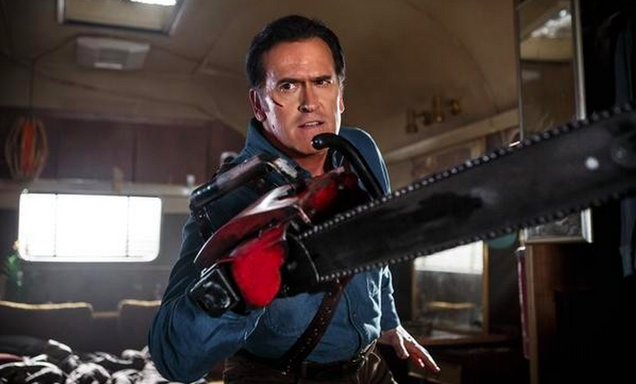
We Saw the First Episode of Ash vs. Evil Dead and It Blew Us Away

by Kaila Hale-Stern

The first episode of Ash vs. Evil Dead was everything an Evil Dead fan could hope for—and more. Start your chainsaws, because this is going to be a very groovy ride.

Read more...


12 Oct 18:16

Yale Just Released 170,000 Incredible Photos of Depression-Era America

by Adam Clark Estes on Gizmodo, shared by Charlie Jane Anders to io9

The photos taken by Farm Security Administration photographers in the 1930s are some of the most iconic images in American history. We’re all familiar with some of the snapshots of craggy-faced farmers, but unseen photos in government archives tell a more complex story of a struggling country. Yale just released a terrific database of 170,000 of them.

Read more...


12 Oct 18:11

The 9 Weirdest Italian Horror Movies

by Cheryl Eddy

Italian horror is, by its very nature, weird as hell. Even the genre’s most acclaimed standouts (Lucio Fulci’s The Beyond, for instance) are disgustingly freakish nightmares. But there are certain titles lurch into realms so intensely bizarre, we can’t quite believe our eyes ... or stop showing them to our friends, and quoting their most memorable lines. And that’s why we love ’em. Here are nine of our all-time favorites.

Read more...


12 Oct 17:56

The New Sherlock Trailer Is A Full-On Victorian Extravaganza

by James Whitbrook on True Crime, shared by Cheryl Eddy to io9

We’ve known for a while that Sherlock’s upcoming special would be set in Victorian London, but man, even we weren’t expecting this much 19th Century love-in goodness. Carriages! Deerstalkers! John Watson’s amazingly fantastic moustache ! This is certainly a trailer that has all of those things.

Read more...


12 Oct 17:41

Pride and Prejudice and Zombies Trailer Promises Proper Zombie Madness 

by Germain Lussier

I’d love to show this Pride and Prejudice and Zombies trailer to my Mom. At the start, she’d probably be interested. “Oh, a nice period love story.” But as the story quickly becomes a bloody mess, who knows what she’d do? It’s such a fun, polarizing juxtaposition.

Read more...


12 Oct 17:34

Latest Clip From Syfy's The Magicians Shows How You Get to Magic College—With Snark

by Lauren Davis

Brakebills University, the secret school of magic in Syfy’s upcoming show The Magicians, isn’t Hogwarts. You don’t get a charming letter saying you’ve gotten in. In fact, this clip shows Brakebills’ admissions are about confusion, entrance exams, and no small amount of snootiness.

Read more...


12 Oct 17:32

A Surprising Animated Love Story About Giant Robots from Outer Space

by Lauren Davis

When giant robots conquer the Earth, a lone man finds himself on the run from a marching horde of mechanical titans. He soon finds himself face-to-face with a redheaded engineering genius and one of the massive invaders. Guess which one he makes a love connection with?

Read more...


12 Oct 17:26

These Stunning Illustrated Sea Dragons Are Part Fish and Part Tree

by Lauren Davis

The Leafy Sea Dragon (Phycodurus eques) is a real fish, a relative of the sea horse with appendages that look like seaweed. Here, artist Piper Thibodeau imagines fanciful versions of sea dragons that grow terrestrial foliage, giving them a different tree-inspired look for each season.

Read more...


12 Oct 17:24

The patron saint of the internet is Isidore of Seville, who tried to record everything ever known

by Matt Novak on Factually, shared by Lauren Davis to io9

In 1997 Pope John Paul II declared Isidore of Seville the patron saint of the internet. Saint Isidore died in the year 636, long before the first host-to-host ARPANET connection in 1969. But Isidore did try to record everything ever known in an encyclopedia that was ultimately published after his death.

Read more...


09 Oct 11:58

Life-term for nation’s librarian running out?

by Adam Eisgrau
The hourglass is running out as Congress considers a term-limit for the Librarian of Congress.

Congress is considering a term-limit for the nation’s Librarian. (photo: wallspapercraft.com)

Hard on the heels of the recent surprise announcement that the current Librarian of Congress, Dr. James Billington, would accelerate his retirement from year’s end (as announced in June) to September 30, the Senate last night approved legislation to limit the service of all future Librarians. Co-authored by all five members of the Senate’s Joint Committee on the Library, and passed without debate by unanimous consent on the day of its introduction, the “Librarian of Congress Succession Modernization Act of 2015” (S.2162) would establish a ten-year term for the post, renewable by the President upon Senate reconfirmation. Since the position was established in 1800, it has been held by just 13 Librarians of Congress appointed to life terms. Comparable House legislation is expected, but the timing of its introduction and consideration is uncertain.

The Senate’s action last night comes as the President is preparing to nominate Dr. Billington’s successor against the backdrop of two scathing reports by the Government Accountability Office detailing serious and pervasive inefficiencies and deficiencies of both the Library of Congress‘ and the U.S. Copyright Office’s information systems and (particularly in the case of the Library itself) management. Deputy Librarian David Mao is currently serving as Acting Librarian.

While no timetable for the President’s nomination of Dr. Billington’s successor has been announced, action by the White House (if not Senate confirmation) is expected before the end of this calendar year. In a letter to him last June, ALA President Courtney Young strongly urged President Obama to appoint a professional librarian to the post, a position since echoed by 30 other state-based library organizations.  This summer, in an OpEd published in Roll Call, ALA Office for Information Technology Policy Director Alan Inouye also emphasized the need for the next Librarian of Congress to possess a skill set tailored to the challenge of leading the institution into the 21st Century.

The post Life-term for nation’s librarian running out? appeared first on District Dispatch.

08 Oct 19:56

Somewhat Off-the-Cuff Thoughts About the Print Vs Ebook Debates

by Maura Smale

I opened the paper this morning to an article discussing the continuing fight for market share between print books and ebooks. In a headline sure to lure in every librarian and avid reader — The Plot Twist: E-Book Sales Slip, and Print Is Far From Dead — the New York Times reports that:

E-book sales fell by 10 percent in the first five months of this year, according to the Association of American Publishers, which collects data from nearly 1,200 publishers. Digital books accounted last year for around 20 percent of the market, roughly the same as they did a few years ago.

It’s a decent article, though to my mind it glosses over many of the issues around print books and ebooks that librarians are well aware of. The reading landscape is complicated — it’s less a matter of either, or and more both, and. We see it at the Reference Desk when some students are happy to have access to an ebook on their device, while others wrinkle their noses if they find a book that’s only available electronically and ask if there’s any way we can get them the hard copy. In my library our printing statistics are through the roof as students print thousands of pages per week; yes, some of these pages are their assignments or journal articles, but some are ebook chapters too.

Ebooks can be troublesome, frankly, even for those who want to use them. As a library user and a librarian and an avid reader, I’m highly motivated to sign into multiple platforms at my university’s library or the public library to be able to read books on my phone or tablet, but the barriers can seem very high to novice ebook users. Alycia Sellie’s recent article in Urban Library Journal notes the trials and tribulations that students in her library experience when they want to use ebooks (among other topics), frustrations which often “makes them dislike the libraries that offer them.” And even those who are extremely digitally savvy may not embrace ebooks. In my house, with an n of 2, I read both print and ebooks (and the paper newspaper), while my spouse, a software engineer, reads only print books (though the newspaper on his phone).

While I do think the Times article doesn’t delve as deeply into the complexities of print vs. ebooks as it could, I’m glad to see it, and especially glad to see that physical bookstores are seeing a boost in print sales. I also hope that folks who have input into the future of libraries — politicians, funders, etc. — take note before issuing proclamations about the death of print books. The public libraries in my city are booming, and they are full of print books, as are all of the K-12 public school classrooms in NYC that I’ve ever been in. My son, who just started high school, reads only print books at home (his choice) and in school, though he did receive one of his textbooks on CD this year. Kids of all ages read lots — for school and for their own interests — and they may not have access to devices that make it easy for them to read ebooks. I think we’ll be living in our both, and hybrid print/digital book world for a while yet.

06 Oct 12:42

Digital Inktober - Day 4

by M. S. Corley
Jack O' Lanterns
02 Oct 11:30

OCLC prints last library catalog cards

OCLC printed its last library catalog cards today, officially closing the book on what was once a familiar resource for generations of information seekers who now use computer catalogs and online search engines to access library collections around the world.

30 Sep 18:37

The Gay Of The Samurai

by Koichi

Remember the popular scene in The Last Samurai where Ken Watanabe and Tom Cruise make sweet, tender love? You don’t? Well, perhaps if the story had been more rooted in reality we could have seen that happen.

the-last-samurai

As it turns out, pre-modern Japan was exceptionally accepting, even encouraging, of male homosexuality and bisexuality. Much like that time we found out that bushido is actually modern-day made-up bullshit, this might surprise you. To be honest, it surprised me, too. I came upon this information while researching an article (still to come) about the current state of the LGBT community in Japan. I wanted to understand the overwhelming societal pressure placed upon people who are LGBT to, well, not be. My hypothesis was that I would find my answers in Japan’s ancient and medieval past, assuming that Japan would be like the West in this regard. I would point to the Japanese version of Judeo-Christian anti-homosexuality beliefs and call it a day. I thought it would be easy.

As is often the case, it turns out I was completely wrong. Japan’s pre-modern society was one that not only tolerated homosexuality and bisexuality, but celebrated and even idealized it. In fact, it appeared to be the rule, rather than the exception, for a majority of Japan’s pre-modern history. How in the world did Japan go from celebrating homosexual lifestyles to being in denial about LGBT issues even existing?

To understand that, we must traverse the annals of history. Let’s go back to the very beginning, right at the moment when Japan was created by the gods.

Sex, And The Creation Of Japan

izanagi-izanami

Japan’s first main religion, Shintoism, is said to have been established as far back as 1,000 BC. Its first known texts, the Kojiki (Record of Ancient Matters) and the Nihon Shoki (The Chronicle of Japan), were completed in 712 AD and 720 AD, respectively. Both relate the creation myth of Japan. In addition to this, the Nihon Shoki records some of Japan’s early history.

Nothing in the Kojiki or Nihon Shoki mention anything about homosexuality, unless you count the fact that the first three generations of deities described in the Nihon Shoki are all male (one Tokugawa-era author joked that the conception and birthing of these generations must have been logistically difficult). But, maybe this is the point. There is no overt approval of homosexual behavior, but there is no condemnation, either.

Let’s step back a moment, however, and think about what the Kojiki and the Nihon Shoki say about sex. The basic question we’re faced with is: does Shintoism view sex as inherently good or inherently evil? Part of the answer lies in the Kojiki—here’s an excerpt in which the deities Izanagi and Izanami create the islands of Japan by, well, totally doing it.

At this time Izanagi-no-Mikoto asked his spouse Izanami-no-Mikoto, saying: “How is your body formed?”

She replied, saying: “My body, formed though it be formed, has one place which is formed insufficiently.”

Then Izanagi-no-Mikoto said: “My body, formed though it be formed, has one place which is formed to excess. Therefore, I would like to take that place in my body which is formed to excess and insert it into that place in your body which is formed insufficiently, and thus give birth to the land. How would this be?”

Izanami-no-Mikoto replied, saying: “That will be good.”

In the Shinto creation story, sex proceeds the birth of a nation and her people. In Judeo-Christian religions, the acknowledgement of human sexuality and their banishment went hand in hand. It’s not surprising, I suppose, that nearly every mention of the word “sex” in the Christian bible is accompanied by ideas of punishment or shame.

adam-and-eve

I’m not saying that one religion is better than the other, or that either is “right” or “wrong”. I’m simply trying to give you context for what’s to come. Much like the ancient Judeo-Christian religions in the West, Shintoism provided the basis for the belief system in Japan, even as the religion evolved and was influenced by other groups and societies.

So, as you might have guessed, Shintoism was quite sex-positive in general. Only, there was the nagging concept of sexual “pollution” (not entirely analogous to the Christian idea of “sin”), which Pflugfelder, author of Cartographies of desire: male–male sexuality in Japanese discourse, describes below:

While male-female coitus was seen as inherently defiling, obliging those (and in particular males) who had engaged in it to undergo purification before entering in the presence of the gods, Shinto authorities did not so characterize male-male sexual practices, showing far less preoccupation with the theological implications of such behavior than their European counterparts. No explicit condemnation of male-male sexuality appears in the Shinto canon, which in fact remains silent on the topic altogether.

This difference in the perception of male-male sexuality versus male-female sexuality, in addition to Shintoism’s general message that “all sexual love is unconditional good,” helps to set the tone (on this issue) for Japan’s second main religion, Buddhism.

The Introduction of Buddhism

homosexual-buddhism-japan

Buddhism was introduced to Japan in the 7th century, well over a thousand years after Shintoism had taken root. In theory, traditional Buddhism viewed sex very differently from Shintoism. Sex in Buddhism was linked to desire, something that practicing Buddhists were supposed to overcome. By doing this successfully, one could gain enlightenment and thus escape from the cycle of death and rebirth.

Buddhist monks and priests were also supposed to take vows of celibacy. This, of course, included both heterosexual and homosexual activity. That being said, there were definite ideas about which was worse. Heterosexual activity was actually the greater offense, as Buddhism considered women to be “evil and defiling” by nature. Homosexual activity amongst practicing Buddhists, on the other hand, was treated more like a “lapse in self control.” Take this Vinaya (a regulatory framework for the monastic community of Buddhism, created by the Buddha himself) for example:

At that time the venerable Upananda, of the Sakya tribe, had two novices, Kandaka and Makhaka; these committed sodomy with each other. The Bhikkus were annoyed…: “How can novices abandon themselves to such bad conduct?”

They told this to the Blessed One… [who declared] “Let no one, O Bhikkus, ordain two novices. He who does is guilty of a dukkata offense.”

Gary Leupp, in Male Colors, The Construction of Homosexuality in Tokugawa Japan, explains:

Here their sexual involvement is seen as the result of their environment; perhaps they share a cell with the monk who ordained them. Although their behavior is plainly regarded as “bad conduct,” they are apparently not punished for it. Rather, the monk responsible for them is censured.

Once again, let’s compare this to Judeo-Christian beliefs, where the hierarchy of “bad sex things” is the opposite way around. Christian priests weren’t supposed to partake in heterosexual activity, but male-male sex was a crime for which one could be severely punished. In Buddhism, male-male sex only resulted in a slap on the wrist. Kind of a “Hey, it happens to the best of us, don’t worry about it guys!” sort of thing. Leupp continues:

Only the holiest and most disciplined of Buddhist priests were thought capable of overcoming sexual desire and faithfully observing the Buddha’s command to abjure all sexual activity. The rest of the clergy, it was widely assumed, would yield to temptation with male or female partners.

Basically, the attitude was one of “If you can’t figure out the whole celibacy thing in this lifetime, well, there’s always the next one!” Ascension to nirvana is much less of a one-time shot than admittance into heaven, after all.

I should clarify that I’m speaking about Japanese Buddhism for the purposes of this article. Some Indian and Chinese Buddhist sects had radically different ideas about the nature of sex and homosexual relationships, but they were far enough away that they had little to little to no impact on thinking in Japan.

So were there any actual rules about sex in Japanese Buddhism? Well… kind of. The “five training principles” of Buddhism do include a section on sexual conduct, but the wording of that section is incredibly vague:

“I take the rule of training not to go the wrong way for sexual pleasure.”

On the subject of this principle, Dharmachari Jñanavira, author of Homosexuality in the Japanese Buddhist Tradition, argues, “[u]nlike the Christian penitentials of the medieval period, Buddhist texts do not go into great detail explicating exactly what the ‘wrong’ and ‘right’ ways regarding sexual pleasure actually are. As with other actions, they are subject to the application of the golden mean: ‘[t]he deed which causes remorse afterward and results in weeping is ill-done. The deed which causes no remorse afterwards and results in joy and happiness is well done.’”

joy-and-happiness

I’d like to think that the world might be a better place if everyone lived by this rule.

It took only a century or two for Japanese Buddhism to start developing its own sexual identity. Take the Tachikawa-ryu branch of Shingon Buddhism—later known as the “the main sex cult of Japan”—as an example. Their Tantra included the idea that “the loss of self in the sex act could lead to an awakening of the spirit.” Essentially, sex could actually help move a person toward enlightenment. For Tachikawa-ryu Buddhists, sex not only became a religious symbol, it was also “viewed as good in itself apart from its role in procreation.” That’s a big deal—if your religion doesn’t really care about whether you’re making babies, then it’s going to care less about whether or not you’re having the kind of relationships were procreation is even impossible.

Now, coming from a heteronormative society, you might expect that these teachings were accompanied by imagery that involved men putting their “excess” into women’s “insufficiency”, but that was not the case. As Jñanavira puts it:

Although present, Tantric sexual imagery which involved the unification of male and female was of marginal influence in Japan. Far more pervasive in male Buddhist institutions was the influence of homoerotic and even homosexual imagery where beautiful acolytes were understood to embody the feminine principle. The degree to which Buddhism tolerated same-sex sexual activity even among its ordained practitioners is clear from the popular myth that the founder of the Shingon school, Kooboo Daishi (Kuukai), introduced homosexual acts upon his return from study in China in the early ninth century. This myth was so well known that even the Portuguese traveller, Gaspar Vilela had heard it. Writing in 1571, he complains of the addiction of the monks of Mt. Hiei to “sodomy”, and attributes its introduction to Japan to Kuukai, the founder of Koyasan, the Shingon headquarters. Jesuit records of the Catholic mission to Japan are full of rants about the ubiquity of pederastic passion among the Buddhist clergy. What particularly riled the missionaries was the widespread acceptance these practices met with among the general populace.

As the last sentence indicates, the homosexual activities of Buddhist monks weren’t a sex cult secret. In fact, they were very public, and the Japanese people of that time didn’t care. It made visiting westerners pretty upset, though.

Father Francis Cabral noted in a letter written in 1596 that “abominations of the flesh” and “vicious habits” were “regarded in Japan as quite honorable; men of standing entrust their sons to the bonzes to be instructed in such things, and at the same time to serve their lust”. Another Jesuit commented that “this evil” was “so public” that the people “are neither depressed nor horrified” suggesting that same-sex love among the clergy was not considered remarkable.

So how did this widespread acceptance of homosexuality—so much so that one could argue that, at that time, gay culture and Buddhism were deeply intertwined—come about? There are several possibilities, but I found the two below most plausible:

The Isolation Of Monasteries

Although Japan was small in comparison to its Buddhist neighbors, it had a lot of monasteries. Leupp says there may have been upward of 90,000 Buddhist establishments during the medieval period of 1185-1572. Most of these were small, but a handful contained a thousand or more monks and monks-in-training, all of them male. Mt. Hiei alone had a population of 3,000, and all of them were expected to stay on the mountain, isolated, for 12 years. That’s a long time to be surrounded exclusively by men. This isolation likely encouraged the openness and growth of homosexual culture amongst Buddhist monks and priests.

They Were Looking Up To China

china

Remember Kuukai, the man blamed by all those western visitors for Japan’s homosexuality “problem”? There may be some truth as to his involvement. The genius monk, credited for the creation of hiragana and katakana, spent some time in China in 806 AD. There, it is said that he learned about the idea of nanshoku (男色 ) or “male colors”.

In the nanshoku tradition, an older Buddhist monk called the nenja would take on a prepubescent boy, called the chigo, as his acolyte. Both the nenja and the chigo were expected to take this relationship very seriously. Some nenja would have to draw up vows of commitment. When the chigo reached adulthood, the nanshoku relationship ended and the nenja would then be free to seek another chigo. Jñanavira goes into more detail:

“However, it must be remembered that the kind of homoerotic liaisons this text recommends take place in very specific circumstances between an adult man and an adolescent youth in the few years before he reaches manhood.  Upon coming of age, any sexual element to the relationship is let go and the bond continues as a close spiritual friendship which is considered to continue beyond the confines of the present life.  The metaphysical  meaning of the relationship lies in both participants’ awareness of the temporality of the affair.  Since the youth’s beauty lasts only a few years before fading for ever, it is considered vain to establish a relationship based only upon physical attraction.  Yet, the role in which physical attraction plays in cementing the bond between the two friends is not denied; it is, in fact, considered a perfectly natural occurrence.  Hence, Faure is right in pointing out that sexual relationships between monk and acolyte were not simply about ‘sex’ but constituted a ‘discourse,’ as he comments: ‘It is in Japanese Buddhism that male love became most visible and came to designate…an ideal of man (and not simply a type of act)’”

Japan followed China’s lead in many ways, and it’s likely they copied this, as well. There are certainly references to similar relationships being formed in Chinese monasteries, as well as amongst people of status—emperors included—who often kept young boys as servants and attendants. I find it hard to believe that such similar traditions developed on their own in such close geographic proximity, especially when you consider how much Japan borrowed from Chinese culture at the time.

Of course, we find the idea of these relationships upsetting now, but they were a reality of the time, so common in monasteries that no one gave them a second thought.

Now, while I will discuss nanshoku and homosexuality closely in the sections to come, I want to make it clear that homosexuality in adults was not caused by nanshoku—instead, it seems that the acceptance of homosexuality in Japan was tied to the initial apathy of the general public toward the practice, and vice versa. As such, the phenomenon bears examination.

Nanshoku and Homosexuality Amongst The Samurai

seven-samurai

By the twelfth century, samurai had become the ruling class of Japan. Their numbers swelled from an initial 6,000 samurai in 1,200 AD to hundreds of thousands just a few centuries later. They adopted the tradition of nanshoku readily, largely due to two factors:

Buddhist Education

The samurai were known to respect the values of Buddhism. Because of this, samurai-class sons would typically be sent to monasteries to receive their education. Once there, many would enter into nanshoku with older monks. In this way, the idea of a romantic relationship between a man and a boy came to be considered normal, even optimal, amongst several generations of samurai.

Male:Female Ratio

During the warring states period (pre-1600s), samurai would be out on the warpath for long periods of time, surrounded almost entirely by men. Even after peace came with the Edo Era (post-1603), samurai were required to leave their home villages and live in castle cities to govern and prevent rebellion. As you might expect with this type of setup, there were far more men in these cities than women. As Saikaku Ihara wrote: “[Edo] was a city of bachelors … not unlike the monasteries of Mt. Koya.” This is a euphemistic way of describing Edo as a city with a thriving gay culture.

Wakashudō: The “Way Of Adolescent Boys”

wakashuudo

As the samurai expanded their influence, they brought nanshoku out of the monasteries and into they cities. In their version, called wakashudō, prepubescent boys would be apprenticed to an older man. He would learn martial arts, life skills, and, if the boy agreed, be the man’s lover until he became an adult. This was formalized as a “brotherhood contract,” according to Leupp. It was considered to be an exclusive relationship, though many a drama is known to have come about due to the cheating of one party on the other.

According to Gregory Pflugfelder, author of Cartographies of desire: male–male sexuality in Japanese discourse, “the idea was that this wakashudō relationship should have a ‘mutually ennobling effect’ on the pair. They were expected to ‘assist each other in feudal duties in honor-driven obligations such as duels and vendettas. Although sex between the couple was expected to end when the boy came of age, the relationship would, ideally, develop into a lifelong bond of friendship. At the same time, sexual activity with women was not barred (for either party), and once the boy came of age, both were free to seek other wakashū lovers.”

It seems that the wakashudō relationship was “‘something both agreeable and disagreeable’ because ‘to throw away ones life [for one’s male lover] is the ultimate aim of shudō. Otherwise, it becomes something shameful. But then one has no life to give in service to one’s lord—so it is both agreeable and disagreeable.’”

Perhaps you can see from these excerpts how aspects of the “way of the samurai” were being worked into Buddhist tradition during this time. As to whether or not people actually believed in these ideals is up in the air, but there is no shortage of historical anecdotes that seem to suggest they did.

A Lot Of Writing

As wakashudō became the commonplace, we begin to see many more references to it in literature. Of course, authors tended to focus on well-known shoguns or famous warlords—Leupp compiled a list of powerful Japanese people who were known to have “beloved retainers”:

  • Shogun Minamoto Yoritomo
  • Shogun Ashikaga Takauji
  • Shogun Ashikaga Yoshimitsu
  • Shogun Ashikaga Yoshimochi
  • Shogun Ashikaga Yoshinori
  • Shogun Ashikaga Yoshimasa
  • Shogun Ashikaga Yoshiteru
  • Shogun Tokugawa Ieyasu
  • Shogun Tokugawa Tsunayoshi
  • Shogun Tokugawa Ienobu
  • Shogun Tokugawa Ieshige
  • Shogun Tokugawa Ieharu
  • Shogun Tokugawa Ienari
  • Hosokawa Takakuni
  • Hosokawa Fujitaka
  • Takeda Shingen
  • Oda Nobunaga
  • Toyotomi Hideyoshi
  • Toyotomi Hidetsugu
  • Uesugi Kenshin
  • Maeda Toshiie
  • Fukushima Masanori
  • Ogasawara Hidemasa
  • Miyamoto Musashi

(Yeah, that Miyamoto Musashi.)

miyamoto-musashi-wakashudo

There was also more general writing about nanshoku and wakashudō that didn’t center on any one political or military figure. We have records of letters between male samurai lovers, poetry, erotic tales… the list goes on and on. There was even a whole subgenre of gay literature devoted to “arguments on the relative merits of men and women”.

For example, in 1640 we see the Denbu Monogatari (The Boor’s Tale). In it, men are bathing in a river to escape the heat. They begin to debate whether the love of a boy or a woman is better. In the end (SPOILERS) the woman-loving side wins, but not before conceding that “male-male erotic pursuits are well suited to the higher circles of the warrior aristocracy”.

Another instance of this ongoing debate can be found in the mid-seventeenth century Iro Monogatari (Tale of Eros) where “an elderly arbiter, after hearing the impassioned arguments of the two sides, counsels that the wisest course is to follow both paths in moderation, thereby helping to prevent overindulgence in either.” In Nishizawa Ippuu’s 1708 Yakei Tomojamisen (Friendly Shamisen of Actors and Courtesans), as well, “a moderator ends the dispute by affirming the equal validity of both ‘ways,’ encouraging each party merely to be devout in his chosen discipline.”

One thing that struck me while reading some of the stories was the way people approached this argument. It’s as if male-male love and male-female love had nothing to do with each other—several other researchers on this topic have come to this conclusion, as well—and neither is judged as being” more acceptable”. Just because you like one doesn’t mean the other isn’t valid. Or, just because you choose one doesn’t mean you can’t participate in the other. It’s treated not much differently than comparing apples to bananas. You can like both. You can eat both. And if someone else doesn’t like bananas then that’s fine, but hopefully they’ve fully-committed themselves to apples, in that case.

banana

Earlier, I mentioned the letters between samurai lovers. Here’s an excerpt from a love letter between Mashida Toyonoshin and Moriwaki Gonkuro, written in 1667.

I made my way at night to your distant residence a total of 327 times over the past three years. Not once did I fail to encounter trouble of some kind. To avoid detection by patrols making their nightly rounds, I disguised myself as a servant and hid my face behind my sleeve, or hobbled along with a cane and lantern dressed like a priest. No one knows the lengths I went to in order to meet you!

Talk about devotion!

There were guidebooks, too,theses on the “proper” way to engage in nanshoku and wakashudō relationships. One such guide was Saiseki (Silkworm Hatchling), written by an anonymous Buddhist monk in 1657. This manual included chapters with titles like: How People Fall in Love; On the Exchange of Glances, How to Answer the First Letter; Favorable and Unfavorable Replies, On Not Talking too Much; On Expressing Much Through Letters, On Taking One’s Leave to Return Home in the Morning, On Feeling Disgusted After One Encounter, On Serving as Nenja, When the Feeling Changes, On Bathing, On Corresponding Through a Messenger, On Wakashu Illnesses, On Various Matters of Etiquette, On Kissing, On Tissue Paper, On Purses on Bed Etiquette, On Smells, On Eyes, On Hair; On Nose Hair, etcetera. Apparently this was quite the popular seller.

Through these debates, stories, and guides, we see samurai and monks depicted as having male lovers, female lovers, boy lovers, and crossdressing lovers. Mostow, in The Gender of Wakashu and the Grammar of Desire, says it best when he concludes that “several works suggest that the most ‘envious’ situation would be to have both many [females] and many [boys].”

From the Samurai Class to the Middle Class

japanese-merchant

As I mentioned earlier, the Tokugawa Shogunate commanded that all samurai move to castle cities, lest they be stripped of their swords and class. This resulted in huge population booms in some areas. By 1700 AD, Edo had a population of over a million, making it one of the largest cities in the world. Kyoto and Osaka had nearly 400,000 people, and there were plenty of other big cities in Japan, as well. Considering that Edo had only around 60,000 people in the year 1600 AD, that’s an impressive jump. With this influx of people came a substantial need for infrastructure and labor. Peasants migrated to cities to fill this demand.

This was really the first time that there was so much interaction between the samurai and common people, and this meant that the latter group was being exposed to the ideas of nanshoku and wakashudō much more frequently than they had been before. Writing from this period indicated that they were impressed. Leupp compiled the following examples:

“Nanshoku,” according to the Nanshoku Yamaji No Tsuyu (Dew on the Mountain Path of Nanshoku, 1730), “is the flower of the military class.” The popular writer Ejima Kiseki (1667-1736) added, “Nanshoku is the pastime of the samurai. How could it be harmful to good government?” Similarly, a character in the early seventeenth century Denbu Monogatari (Tale of a Boor) argues that “it is precisely because jakudou is so refined that the daimyo from great families, and priests of high rank and office, usually favor this way.”

Wakashudō was seen as a high-class thing to do, so it’s only natural that we begin to see non-samurai emulating this behavior in big cities. Although technically of the lowest class, this trickle-down effect began with the merchants, as their wealth allowed them to take on servant boys and apprentices without worrying too much about the financial burden.

This, however, was not an option for everyone. The solution, of course, was to “rent” a lover. More from Leupp:

The commercialization of nanshoku greatly accelerated during the early Tokugawa period. The expansion of the market and the rise of the bourgeoisie produced both a vast labor market of male and female “sex workers” and a large demand for their services. […] so it witnessed a commodification not only of heterosexual pleasure but of homosexual pleasure as well.

Male prostitutes were in great demand, and their numbers grew rapidly. This meant that anyone, could simply pay for either heterosexual or homosexual sex if they so desired, samurai included. You see, as Japan entered a period of peace, training apprentices for war got to be a bother. On top of that, as the middle class grew, the samurai class became poorer, and their chigo became just another mouth to feed. It was easier for them to take their government-issued stipend to the nearest red-light district and simply pay for what they wanted, when they wanted it.

Soon, prostitution expanded out of brothels and into the theaters. Many amateur kabuki actors were actually just male prostitutes in disguise. These actors were highly sought-after by both men and women. When not on stage, they were likely in bed with a (paying) admirers. Because of this, kabuki troupes were closely associated with male prostitution.

With this, we finally reach the golden age of homosexuality in Japan, which lasted from 1650-1750 AD. Lewis Crompton, author of Homosexuality and Civilization says “it was a prosperous and ‘liberated’ age of extravagance and self-indulgence, infatuated with the refined and ephemeral beauty of the ‘floating world.'”

And boy was it.

It’s around this century that we start to see some of the most interesting writing and art on the topic of nanshoku and wakashudō. Perhaps the most famous is Ihara Saikaku’s Nanshoku Ōkagami (The Great Mirror of Male Love), written in 1687. It is a collection of 40 erotic stories, half of which are about samurai and monks, the other half about kabuki actors. To give you a taste, here are a couple of excerpts from Nanshoku Ōkagami.

The Tragic Love of Two Enemies

When the woman woke in the morning, they were both silent, lying in the same bed. She called her son: “Rise up, lazy boy!” But there was no answer. She went into the room and turned back the blanket which covered them, and saw that Shinosuke had pierced Senpatji’s heart with his sword passed through his own breast and out at his back.

His mother stood there for a long time overwhelmed at the sight of these two lovers’ bodies, and then, in her sorrow and distress, killed herself in the same room.

Fun fact: Did you know that the number one cause for revenge killings during this period was discord between two male lovers?

All Comrade Lovers Die by Seppuku

Then the Lord cut off his left hand and asked, “How do you feel, Korin?”

Korin held out his right hand and said, “With this hand I caressed and loved my lover. You must hate this hand a good deal also.”

The Lord at once cut that hand off. Then Korin turned his back to his master and said, “My back is very beautiful. No other page was as attractive as I am. Look at my beauty before I die.” His voice was weak and low through the mortal pain he was enduring. Then the Lord cut off his head and, holding it in his hands, wept bitter tears for the death of his favorite.

Read the whole thing yourself, if you want. Despite being fiction, it gives a lot of perspective on everything you’ve read up to now. If human civilization had ended in the 1800s and all aliens had to go on was Nanshoku Ōkagami, they’d still have a pretty accurate picture of what  went on in Japan during this period.

With male-male love becoming so mainstream and accessible, wakashudō became less and less relevant. At the same time we see a sharp rise in prostitution houses with boys and male lovers. We also see chigo partners in nanshoku relationships getting older, too. As long as men retained a “youthful appearance”, they could remain prostitutes into their twenties and thirties.

Of course, this situation couldn’t last forever. After nanshoku’s peak in the early 1700s, the demand for male prostitutes begins to decline. Leupp writes:

[C]ity government crackdowns on prostitution took their toll; in each of the three great reform periods (the Kyouhou Reform, 1716-1735; Kansei Reform, 1787-1793; and Tenpou Reform, 1841-1843) urban authorities attacked commercial sex, “lewd” art and literature, and extravagance in general. In 1842 all of Edo’s teahouses were closed in the course of Mizuno Tadakuni’s reform efforts, and the kabuki theaters of Sakai-cho, Fukiya-cho, and Kobiki-cho were forced to move to a ward on the city’s outskirts, Saruwaka-cho, in a section of Edo known as Asakusa. (In Osaka, meanwhile, kabuki-troupe directors were forbidden to send out boy-actors and prostitutes.) Homosexual prostitution was not the main target of this movement, and, like most elements in Mizuno’s reform package, the ban does not seem to have been wholly effective.

These crackdowns made it more difficult for male prostitutes to do business. This, coupled with the fact that more and more women were coming to the cities—by the Meiji Era the ratio of men to women was nearly even—signaled a marked decline in open male-male sexual activity. Then, in 1859, Japan opens its ports to foreigners, and things change even more drastically.

Becoming “Modern”

meiji

The shift from homosexual acceptance to homosexual condemnation happened in-step with the Meiji Restoration, foreign influence being a key factor. The ruling elite of this time agreed that they must emulate the West as much as possible. In doing so, they hoped to avoid the fate of China and India, modernize, and become equals with the Western powers.

As you now know, homosexuality was extremely common and open at this time. Plus, there was much popular writing, not to mention (very) lewd art, being circulated too. None of this was a secret.

With the opening of Japan this became a big topic. Newspapers both in Japan and abroad called for the criminalization of male-male relationships. The ruling elite soon agreed, announcing that “same-sex love was ‘unnatural’.”

Opinions like this certainly helped facilitate Japan’s transition into a more homophobic stance. But, they wasn’t the only cause. Leupp writes:

“Thus, Western cultural influence was a major factor in the decline of the nanshoku tradition. But surely this decline also reflects the collapse of the feudal structure that had shaped the development of male homosexuality in Japan. As we have seen, Japan’s nanshoku tradition was not unique in dignifying both partners in role-structure homosexual relationships; […] Such relationships were rooted in, and mirrored, the lord-retainer bond. Even male prostitutes developed in ways that reflected feudal values and institutions. With the fall of the feudal order, these values and institutions were for the most part either weakened or eradicated.”

Values at this time shifted rapidly, with gay culture being increasingly pushed to the fringes of society.

“Nanshoku rapidly moved from the center stage of popular culture to its margins. Homosexual desire was no longer celebrated in literature, theater, and art; rather, it was discouraged as one of the ‘evil customs’ of the past, a national embarrassment given attitudes in the modern West. The concept of of nanshoku-zuki gave way to the German concept of the urning—one suffering from a peculiar psychological disorder. Such an environment was less conductive to the generation of male-male sexual desire than that of Tokugawa Japan; males became less likely to experience, and even less likely to act upon, such desire.”

It seems incredible that a nation once so open to the idea of homosexuality could change its mind so quickly. It makes me wonder whether Japan could make a similar shift back in the direction of LGBT acceptance now. As I hinted at earlier, this will be the subject of an upcoming article, so stay tuned. Until then, if you’re interested in this topic, I highly recommend you read my main sources for this article. They are:

Bonus Wallpapers!

gayinjapan-1280
[Desktop ∙ 5120×2880 / 1280×720] ∙ [Mobile 1 / 2]

The post The Gay Of The Samurai appeared first on Tofugu.

23 Sep 15:32

Botanical Gardens gets buzzing to save bees, make honey

USF’s Botanical Gardens was buzzing about bees this weekend, not just to save the drastically declining bee population, but also for its sixth annual A Taste of Honey event. The Botanical Gardens hosted...
16 Sep 19:40

Close Calls: Three Times When Humanity Barely Escaped Extinction

by Esther Inglis-Arkell

Today it looks like humans will have to launch themselves into space to get enough room for our collective population, but we weren’t always so robust a species. There are three times in history during which humans nearly went extinct. Here’s what threatened us, and how we survived.

Read more...