According to new data, the shift from spring to summer actually appears to lead to an increase in stress levels. Stress is today’s top workforce health risk—surpassing even obesity and inactivity. Busier weekends and extended time with family and friends may make some employees feel overwhelmed during the summer. However, this article suggests that employees should not forego taking vacation. Even if employees can’t afford to take time from the office or library for weeks on end, they can still enjoy mini-vacations spread out through the summer season. Employers that help their staff reduce stress-related burnout can expect more positive, energized and driven employees when they return from vacation.
by George Dvorsky on Gizmodo, shared by Adam Clark Estes to io9
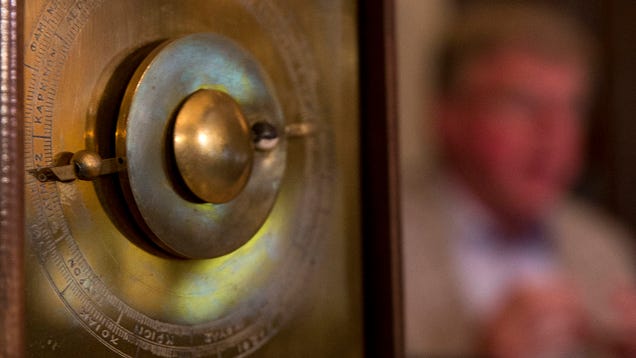
Discovered in an ancient shipwreck near Crete in 1901, the freakishly advanced Antikythera Mechanism has been called the world’s first computer. A decades-long investigation into the 2,000 year-old-device is shedding new light onto this mysterious device, including the revelation that it may have been used for more than just astronomy.
I think that a West Elm catalog came to my house and that’s how I saw these planters. Oooooooh: That aqua! And that yellow! (It still seems relatively rare to find these kinds of items in color colors.) Alas, it looks like the yellow sold out in a hot minute. These are not inexpensive, but oh my goodness, they are oh so pretty!
West Elm has so much nice looking stuff — including many more nicely designed planters.
Copying — unoriginal, dull, and derivative by definition — can be creative, contested, and consequential in its effects. Nick Hopwood tracks Haeckel’s embryos, some of the most controversial pictures in the history of science, and explores how copying put them among the most widely seen.
by Amanda du Preez, Professor in Visual Culture Studies, University of Pretoria
A sign banning selfie sticks in an Osaka train station in Japan. Reuters/Thomas White
According to the popular press it was more likely in 2015 for a person to die while taking a selfie than to be killed by a shark – this is globally. This means that, officially, the deadly “monster” shark from the “Jaws” movie franchise has become less frightening than capturing your own image on a smartphone – that is if the 12 reported selfie deaths of 2015 are compared with the eight fatal shark attacks in the same year.
These are selfies taken from the top of a skyscraper while dangling in mid-air, or while perched on the brink of an overhanging cliff just before the selfie-taker’s foot slipped.
The invention of the selfie stick – which Wikipedia helpfully explains is “a monopod used to take selfies by positioning a smartphone or digital camera beyond the normal range of the arm” – has worsened the situation. Reports show that tourists in particular no longer look where they are going, but are transfixed by their images on their phones’ screens. Many landmarks and tourist places have started to ban selfies and especially selfie sticks to prevent untimely accidents and even deaths. But putting these safety measures in place does not stop adventurous souls continuing to push the boundaries of dangerous activities.
The latest extreme craze exported from Russia is called “skywalking” (Picture 1). It entails “standing or walking atop very tall structures at dangerous heights, such as the rooftop of a skyscraper building or a bridge”. As such these images are breathtaking and awesome. Provided the taker of the selfie does not slip, he or she may be rewarded with hundreds of “likes” on social media. Takers of dangerous selfies are, after all, considered heroes who unflinchingly put themselves in harm’s way to experience what should probably not be experienced.
Picture 1: Skywalker Alexander Remnev on top of a Moscow skyscraper (2013/14).
Skyscraper Dictionary
But how can we determine what counts as “a selfie death” or “death by selfie”? There are at least three types of deadly selfies:
selfies unknowingly taken before death;
selfies of death where the taker’s death is almost witnessed; and
selfies with death where the taker stands by while someone else dies.
In the first instance (unknowingly before death) the selfie is not the cause of death but is taken just before a tragic event. In these cases the selfies signify more as memorials for the departed, who are remembered in the moments before their demise. These are the selfies where we are confronted with the faces a group of friends in an aeroplane minutes before it destructs, as happened with Mexican singer Jenni Rivera and her crew (Picture 2), or of a motorist just before a fatal accident.
Picture 2: Selfie of Mexican singer Jenni Rivera and her crew before an aeroplane crash in December 2012.
In these cases, the viewer cannot help but interpret the faces looking out at him or her as sad and tragic. In fact, one may even convince oneself that the sadness is palpable in the eyes of the deceased, as in the case of the reggaeton singer Jadiel (real name Ramon Alberto González Adam), who posted a selfie in May 2014 shortly before a fatal motorbike accident in Rochester, New York.
In the cases of selfies of death or death by selfie, we are exposed to the hopeful faces of adventurers, extremists and the unlucky ones. Although these selfies overlap with the previous category of selfies before death, they differ in the sense that they are taken in circumstances that can be considered mortally dangerous.
Particularly arresting is the selfie by the young Russian girl, Xenia Ignatyeva (Picture 3), who in April 2014 climbed a high bridge to impress her friends, but then slipped and fell and was electrocuted when she grabbed live cables. Her beautiful young face looks flushed as she stares into the camera, exhilarated and energised. She stares the sublime in the face as her selfie gazes back at her from the smartphone screen with the devouring abyss at her back. Is this the image of her death framed by expectation and self-grandeur?
Picture 3: Image of selfie taken by Xenia Ignatyeva in 2014.
Lastly, there is the case of selfies taken with death. An example is that of the Turkish police officer who, in September 2014, took a selfie while a person committed suicide in the background by jumping off a bridge (Picture 4). Naturally, the selfie was shared on social media by the police officer. Suffice it to say, the police officer was investigated afterwards.
Picture 4: Image of a police officer taking a selfie with a man who jumps
from a bridge in Ankara, Turkey in 2014.
It is an undeniable thrill – and attention-seeking strategy – to be in the presence of another’s death while experiencing how pain subsides into pleasure. One may speculate whether, if the technology were available during the eighteenth century, for instance, people would not take selfies during executions. No doubt a selfie taken against the background of the beheading of Marie Antoinette – France’s queen, who was executed during the French Revolution – would be considered an “ultimate selfie”.
To be taking a selfie of death is a technologically mediated encounter with the unthinkable and can, therefore, be considered a sublime experience. The contemporary obsession to take an “epic selfie”, an “extreme selfie” or the “ultimate selfie” may be interpreted as an extension of the pursuit of the sublime.
by Emma Bell, Professor of Management and Organization Studies, Keele University
Unequal. shutterstock.com
When receptionist Nicola Thorp was told by her employer that she had to wear high heels to work, she pointed out that her male colleagues were not required to do so. When she refused to conform to the company’s dress code policy, she was sent home from her job without pay. The media got hold of the story, public outcry ensued and the firm at the centre of it has now changed its policy.
Unfortunately there is more at play here than an absurd dress code policy. There is a long and complicated history of women’s dress codes in the workplace – especially in the corporate world. Women are scrutinised far more than men for what they wear and high heels epitomise the lose-lose nature of getting the dress code right.
Speaking out against the policy, Thorp said: “There is a history behind high heels that has a sexualised element to it.” And she’s right. High heels are a powerful symbol in our culture. In advertising and the media, we are continually bombarded by images of women wearing them. Heels play a key role in fetishising women’s bodies, and camera shots in films and magazines that focus on a woman’s legs, lips and feet all contribute to this. In popular culture women are often represented as passive objects, judged on their looks rather than their abilities.
Women in public life also continue to be endlessly scrutinised for the way they dress. More column inches are devoted to discussing the dress codes of women political leaders than to scrutinising the sartorial choices of men in equivalent positions of power and authority. And stilettos are seen as an important symbol of power for women, a marker of high status, despite their impracticality and physical strain that they put on a woman’s body. The fact that US presidential hopeful, Hillary Clinton, opts for “nearly flat shoes” is even deemed worthy of comment.
The treatment of former Australian prime minister, Julia Gillard, is another example of how damaging the scrutiny of women’s dress can be to their professional image. As Gillard explained in her recent autobiography, throughout her leadership her body shape and clothing were considered newsworthy in ways which did not apply to male counterparts.
Cameras were trained on her bottom; news reports focused on her choice of clothes; and a situation when she tripped over in India was reported frame-by-frame in a front page spread of a leading Australian newspaper. In the early stages of her political leadership she ignored negative coverage of her image, assuming that eventually it would eventually subside, but then later realised that it had “morphed into a judgement of who she was as a person”.
Dressing for success?
But as Thorp found out, the power of high heels at work is not confined to media celebrities and politicians. It has always pervaded the workplace. Office desks in the 1950s were designed with modesty panels that hid the upper part of the legs of the secretary or receptionist who sat behind them but also revealed her shoes and feet.
Then the power dressing trend in the 1980s involved business women wearing an exaggerated masculine style of dress, pinstripe suits with shoulder pads – but still paired with killer heels – as a way of signalling that their career ambition was equal to that of men. The “dress for success” advice books written for working women at this time recommended they wear high heels as a way of commanding attention and overcoming their height disadvantage in comparison to men, for example when meeting a man for the first time and shaking hands.
The uncomfortable reality.
shutterstock.com
Over several decades, researchers have shown that workplace norms surrounding the body are implicitly masculine. And the result is that women’s bodies at work are implicitly (if not explicitly) seen as different and abnormal, inherently sexual, suspicious and disruptive. Women learn from an early age to discipline their bodies through diet, exercise, clothes, make up and shoes. To a greater extent than men, they must show that they can manage their bodies at work in a way that is culturally acceptable.
All too often, women are either accused of appearing “too sexy” for work through their clothing choices, or excessively masculine. Studies of female professionals show that in sectors like banking and finance, women often feel scrutinised and made to feel out of place. Whether they wear a plain dark suit or a “too bright” dress, women report that they find it almost impossible to blend in and not be the focus of male comments.
US journalist Barbara Ehrenreich captured this well in Bait and Switch, her account of corporate America today. Early on, she meets with an image consultant to improve her chances of getting a white collar job. The consultant tells her that her appearance is “too authoritative” and that she doesn’t look “feminine enough”. The image advice she reads encourages a “somewhat mannish appearance” but “if you go too far in the masculine direction … you somehow err again”.
So, on the one hand, high heels are suggested as a way for a woman to gain height and look more like a man. But on the other, they are used to highlight a woman’s sexuality and emphasise her femininity. Finding a balance between these competing expectations is impossible, not to mention the costs they have on women’s bodies. Whether they form part of a dress code or not, wearing high heels at work is a game women cannot win.
Emma Bell does not work for, consult, own shares in or receive funding from any company or organization that would benefit from this article, and has disclosed no relevant affiliations beyond the academic appointment above.
We’ve seen Voltron himself
already, and even a brief teaser, but Netflix has finally released extended footage from Voltron: Legendary Defender its upcoming reboot of the classic animated series. Check it out!
by Casey Chan on Sploid, shared by Cheryl Eddy to io9
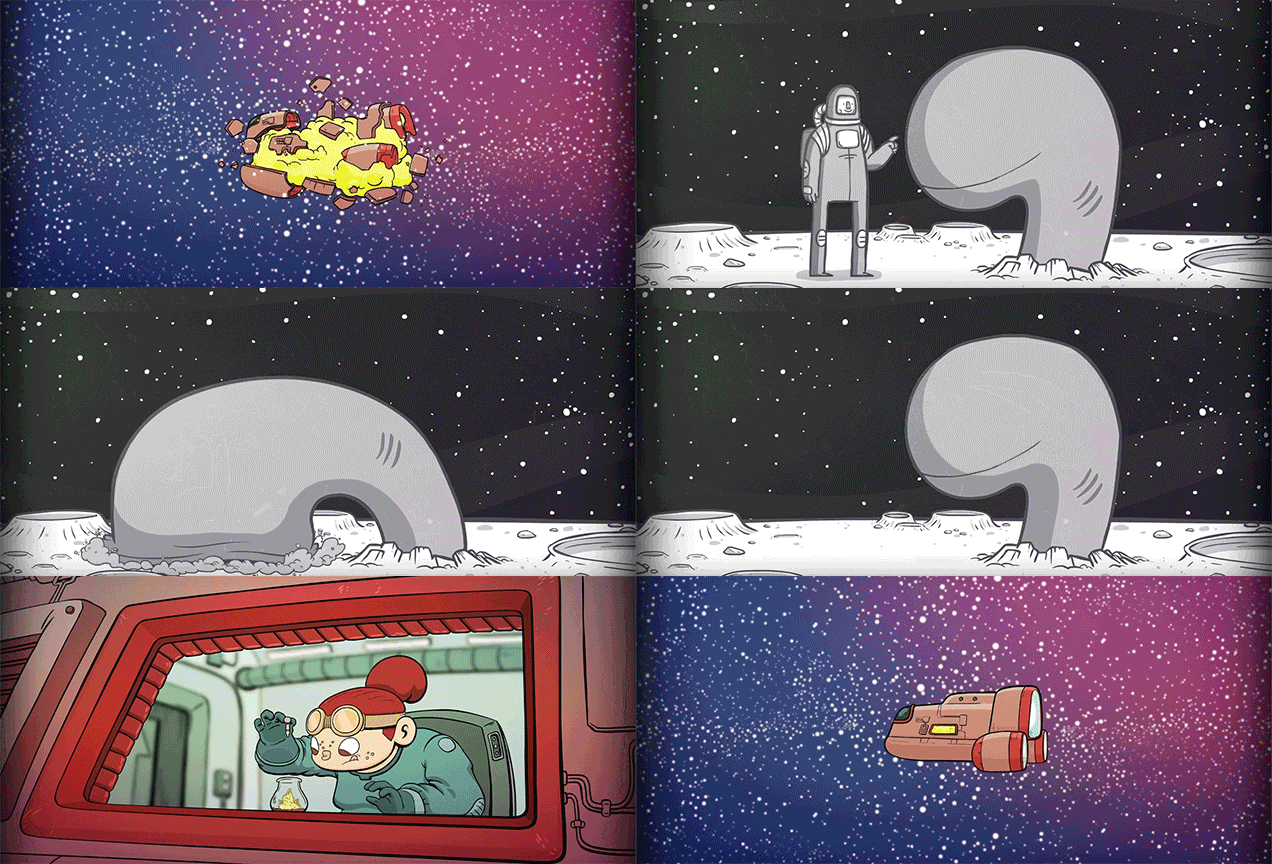
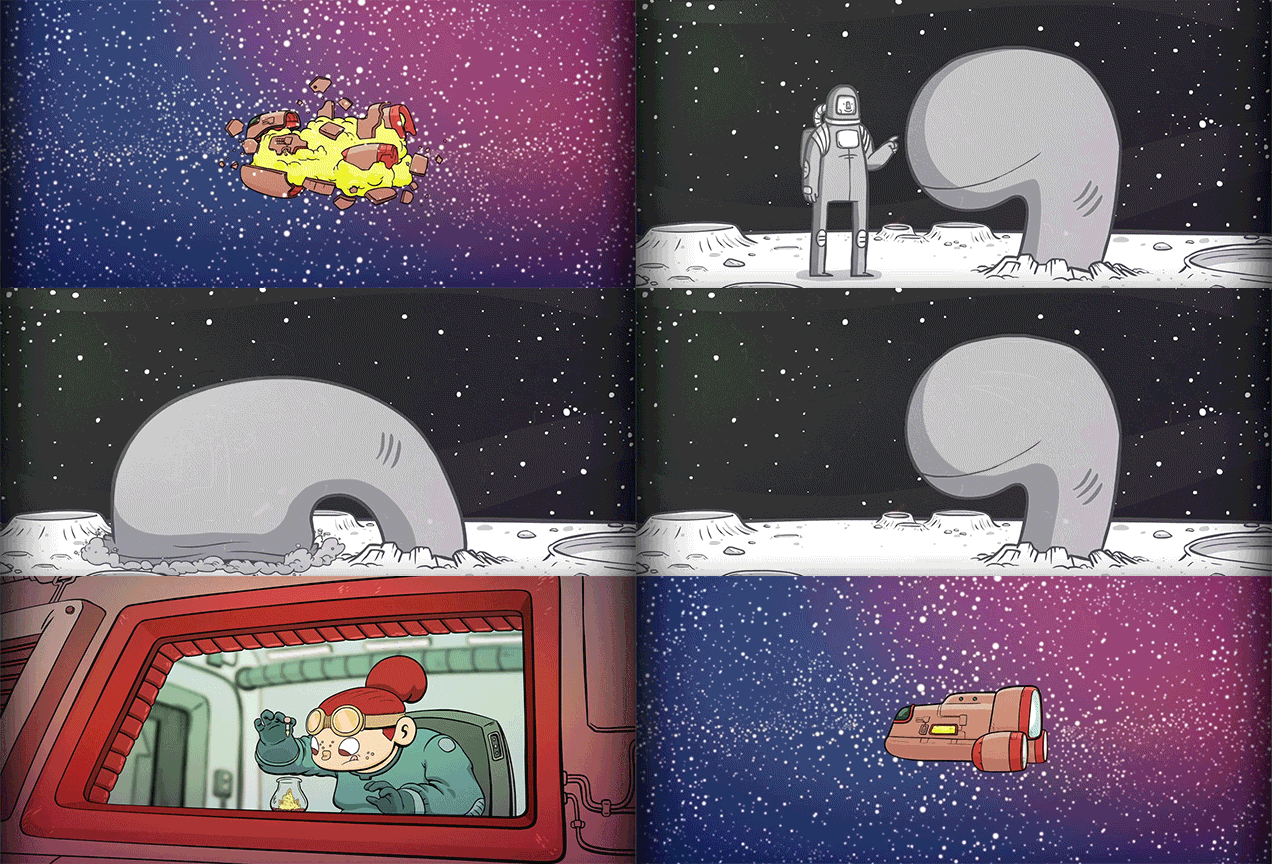
This short animation Death in Space by Thomas Lucas is a collection of two-second scenes that show people dying in space in the most random ways. It’s totally silly, but it’s funny because it pokes fun of the careless curiosity of human nature. Yes, we’re going to jab that creature that might swallow us alive. Sure, we’ll open up this box that might vaporize us. Of course, we’ll add another drop into a solution that might explode.
The Work Projects Administration (WPA) Poster Collection consists of 907 posters produced from 1936 to 1943 by various branches of the WPA. Of the 2,000 WPA posters known to exist, the Library of Congress’s collection of more than 900 is the largest. The posters were designed to publicize exhibits, community activities, theatrical productions, and health and educational programs in seventeen states and the District of Columbia, with the strongest representation from California, Illinois, New York, Ohio, and Pennsylvania. The results of one of the first U.S. Government programs to support the arts, the posters were added to the Library’s holdings in the 1940s.
Library of Congress, Prints & Photographs Division, WPA Poster Collection, LC-USZC2-909
by Beth Webster, Director, Centre for Transformative Innovation
The recently released Productivity Commission report on the Australian intellectual property system is thorough and measured. Its recommendations are far from radical but if implemented would improve the environment for the creation and use of knowledge-based products in Australia. Currently, too many parts of the intellectual property system merely service rent seekers – that is, those who seek rules and regulations that merely transfer income from other people to themselves without any net addition to social wealth.
Copyright is the preserve of rent seekers
The report quite rightly focuses on copyright. The intention of copyright laws are to encourage people to create cultural products such as books; songs, movies and fine art inter alia. The argument goes that if the authors of these works (or their owners) can charge those who enjoy these works royalties, then more people will decide to work as artists.
Royalties mean the artist gets an income and can therefore spend more time creating works. This argument has some merit.
But the right to control who can reproduce these works should not last forever. In fact, it should not last beyond the point at which the royalties has an effect on artists’ decisions to create more. The question is what is this point? One thing we can all agree on is that $1 in 100 years’ time is worth very little today. At a 5% discount rate, it is worth less than 1c. This means that existing copyright laws (which can give control for over 100 years) are merely lining the pockets of movies houses and the heirs of dead authors without having any effect on the current cohort of artists.
The copyright industry is very well organised
The copyright industry is very well organised. The amount of effort they put into shoring up and extending existing copyright laws speaks to the size of the monopoly profits they are protecting. We should not be fooled by their modus operandi of wheeling out our favourite authors and actors to petition on their behalf. Their usual plea is that copyright laws encourage local artists but the reality is that only a small amount of the monopoly profits from copyright go to encouraging Australian artists. Most goes overseas.
Encourage local artists by other policies
The desire to encourage local artists is a commendable cultural policy decision. However, the best way to do this is to raise taxes – say either by raising the GST or moderating income tax breaks – and use the revenue for stipends or grants to local artists. It is not to use copyright to overcharge the ordinary householder; to prosecute 15 year olds for downloading movies; or to waste the time of students and school teachers filling in royalty forms.
Efficient term for copyright
Many people believe copyright should last 20 – 30 years maximum. The Productivity Commission is very moderate in that it does not go this far. It makes only a modest recommendation to replace the narrow ‘fair dealing’ exceptions to a US-style ‘fair use’ exception. Fair use is a small concession to the absurdly long copyright term. Compared with fair dealing it is more flexible and able to adapt to changing circumstances and technologies.
Moral rights?
There are a lot of red herrings in the copyright debate. People (deliberately) confuse the right to charge a royalty with moral rights and fairness. Both are important social norms that should be respected but the question is: Is this the role of copyright? Moral rights imply the obligation to attribute creators and treat their work with respect. This does not mean the artist should be able to decide who can reproduce his or her work for the purpose of genuine enjoyment.
Fairness?
It is sometimes claimed that royalties are justified on fairness grounds. Fairness is important. But if we want to open the fairness debate, we need to look at all occupations. In terms of value to society, a case can be made that the primary school teacher who taught you to read; the civil engineer who brings you drinking water and the surgeon who removed your bursting appendix, should be paid more. Moreover, copyright only delivers an income to very few artists. Is this a fair system? Maybe, we should limit copyright to 20 years and increase our stipends to local artists instead.
Disclosure
Beth Webster receives funding from the ARC, the Commonwealth Government and the Victorian Government but not the Productivity Commission.
The report, though, makes a number of sensible recommendations that will help modernise Australia’s copyright laws for the 21st century. Economically, the report is rigorous and comprehensive.
Morally, the study shows a subtle and nuanced appreciation that copyright law is designed ultimately to promote the public interest of the Australian community.
The proposed reforms will enhance consumer rights, competition policy, access to knowledge and Australia’s ambitious National Innovation and Science Agenda and “ideas boom”.
The report also makes some helpful suggestions regarding Australia’s process for treaty-making in respect of intellectual property.
Parallel importation restrictions largely benefit multinational publishing networks and foreign authors rather than local authors. As the Productivity Commission comments:
Most of the additional income from higher book prices goes to overseas authors and publishers whose works are released in Australia. The Commission estimated the additional income flowing overseas is around 1.5 times that retained by local copyright holders. In effect, PIRs impose a private, implicit tax on Australian consumers that largely subsidises foreign copyright holders. Indeed, none of the authors with top ten titles in the sample provided by HarperCollins are Australian.
The removal of parallel importation restrictions would be beneficial for Australian readers. Cheaper books for Aussie kids would be a great policy outcome.
In response to the Productivity Commission, publishers and authors have been running a scare campaign against the commission’s recommendations. The multinational publishing empire HarperCollins has grimly defended the restrictions.
Authors Thomas Keneally, Richard Flanagan, Peter Carey, Tara Moss and Jackie French have railed against the report. However, their emotive arguments are weak, inaccurate and unconvincing.
Parallel importation laws are not an effective means of protecting local culture or creative livelihoods. The removal of the restrictions will not destroy the local publishing industry. Indeed, opening up the book market may well be beneficial for publishers and authors by removing age-old distortions in the marketplace.
Australian consumers deserve a fair deal in the digital economy. It has been concerning that Australian internet users are paying much more for IT works than our counterparts overseas.
The Productivity Commission was concerned that “Australia’s copyright system has progressively expanded and protects works longer than necessary to encourage creative endeavour, with consumers bearing the cost”.
The defence of fair use in the United States has enabled innovative start-ups to flourish in hot-spots such as Silicon Valley, Boston and New York. Indeed, the US courts recently recognised that Google Books was protected under the doctrine of fair use.
Professor Peter Jaszi has noted that fair use is the “secret sauce” of US competitiveness.
Australia is at a competitive disadvantage because it has only a much more limited, purpose-specific defence of fair dealing. Start-ups may well be reluctant to base themselves in Australia because of fears of copyright litigation by incumbent industries.
The Productivity Commission recommended:
A new system of user rights, including the introduction of a broad, principles-based fair use exception, is needed to help address this imbalance.
The commission observed:
One of the key advantages of a fair use over a fair dealing exception is that the law can adapt to new circumstances and technologies.
The Australian Law Reform Commission has already highlighted how a defence of fair use could future-proof Australia’s copyright laws.
In addition, the Productivity Commission has recommended that all Australian governments should implement an open access policy for publicly funded research.
The policy should provide free access through an open access repository for all publications funded by governments, directly or through university funding, within 12 months of publication. This proposal will help boost Australia’s Ideas Boom.
The open access sharing of research will support the creative industries, as well as science and technology. Ryan Merkley, CEO of the Creative Commons project, has highlighted the benefits of open access publishing.
The Productivity Commission noted that the Mickey Mouse copyright term extension under the Australia-US Free Trade Agreement was incredibly expensive for the Australian community. Australia is a net importer of copyright works, and there was a need to mitigate against the costs of exorbitant copyright term extensions.
Reflecting upon such hectic activity, the Productivity Commission has been critical of the government entering into trade agreements without openly and fully assessing the benefits and costs of intellectual property obligations.
The commission warned:
Agreements embodying provisions on the scope and term of IP protection necessarily involve a ‘wrestle for rents’ – Australia should not capitulate too easily.
Moreover, the commission was concerned about the “spaghetti bowl” of trade agreements that Australia had been involved in:
Further, in more recent times, there has been a tendency to favour bilateral and regional initiatives over multilateral ones, resulting in overlapping and complex rules.
The commission’s report will provide a salutary caution for the Australian Parliament as it evaluates the Trans-Pacific Partnership.
Rather than let the Productivity Commission’s report be lost in the tumult of the 2016 election, Australian politicians should pay heed to the popular interest in the study.
The Australian public has been crying out for copyright reforms to our anachronistic laws to bring them up to date with the digital age of the 21st century.
There is a great opportunity for political leaders to capitalise upon this public interest in competition, innovation, access to knowledge and fair trade.
Matthew Rimmer has previously received grants from the Australian Research Council.
When my friend had her gall bladder out, the doctor said she was a “4F textbook case” because she had a family history and was female, fat and forty-plus.
You can’t change your genes, but there are some food and lifestyle factors you can target to lower your risk. Eat healthily, increase your fibre intake, eat more fruit and vegetables high in vitamin C and drink coffee.
Avoid weight gain and if you do try to lose weight, do it slowly.
What does the gallbladder do?
The gall bladder is a storage sac for bile, which is made in liver. After you eat, bile is squirted into the small intestine.
Bile emulsifies or breaks up the fat in the food we eat into tiny particles, a bit like washing-up detergent. This means that fat-digesting enzymes from the pancreas can mix with the fats from foods and break them down into smaller particles that can be absorbed.
What are gallstones?
Gallstones form in the gall bladder when components of bile, such as cholesterol and bilirubin (a breakdown product of red blood cells), aggregate and form stones.
These stones vary in size from single large hard stones about the size of an apricot and made mainly from cholesterol, to small pebble-sized stones made mainly from bilirubin. Gallstones can also be very tiny, like a grainy sludge.
How can you prevent gallstones?
The good news first. Having a healthy diet lowers your risk of getting gallstones.
In a US study that followed more than 13,000 adults over ten years, women with higher blood levels of vitamin C had a lower chance of developing gall bladder disease. This was not the case for men.
Foods high in vitamin C include capsicum, cabbage, Brussels sprouts, cauliflower, broccoli, green leafy vegetables, tomatoes, citrus fruits, pawpaw, kiwi fruit, strawberries and pineapple. You could try vitamin C supplements, but studies are inconsistent and taking vitamin C supplements can increase the risk of kidney stones.
A higher fibre intake is also associated with lower risk. There is no need to become vegetarian, but eating more legumes, pulses, wholegrains, vegetables and fruit boosts fibre intake.
A review of studies involving more than 200,000 people found people who drank a lot of coffee (four cups or more a day) had a a reduced risk of gallstone disease. However, some studies found this association in women only.
When you markedly cut back your total food and fat intake, you need less bile. Your gall bladder doesn’t need to contract as much and bile salts become more concentrated. This means gallstones are more likely to form.
Cutting down on foods that contain large amounts of fat is a good idea because you reduce total kilojoule intake as a result and therefore lose weight. To ensure your gall bladder still contracts and keeps excreting bile, still consume some fat, around 20 grams, each day.
Other risk factors
Risk factors such as body weight, using hormone replacement therapy and number of pregnancies are theoretically modifiable. Others, such as age and being female, are not. Women are twice as likely as men to get gallstones, due to higher oestrogen levels.
Around the world, Pima Indians have the highest rate of gallstones at 70%, compared to 10-30% among Europeans and North Americans and less than 5% in Asian and African populations.
Treatment
Treatment for gall bladder disease depends on size and location of the gallstones, whether you have other symptoms such as pain and infection, and whether you have other medical conditions.
Silent gallstones are ones that cause no symptoms and generally are not treated. Other approaches include the dietary changes mentioned earlier, lithotripsy for small stones, or surgery to remover the gallbladder along with the stones. See your doctor for advice.
What happens after your gall bladder is removed?
Once your gall bladder is removed, bile can no longer be stored, but trickles constantly into the small intestine.
Your digestive tract will make some adjustment after the surgery, but if you eat a large fatty meal, your body is not able to squirt in extra bile. This means some undigested fat passes through the small intestine and travels into the large bowel where bacteria will try to break it down.
However, a lot of the fat will be malabsorbed, triggering steattorhoea, which means fatty diarrhoea. Some fat-soluble vitamin A and E will be lost in the stools as well.
Boost your intake of these vitamins by eating foods that are good sources of them. The vegetable form of vitamin A, called beta-carotene, is found in dark yellow, orange and dark green vegetables, such as pumpkin, carrots, sweet potato, spinach and broccoli.
Good sources of vitamin E include nuts, seeds, wholegrains, peanut butter, tahini, spinach, broccoli, tomato, avocado, kiwifruit and mango.
When it comes to gallstones, food should be part of prevention and treatment strategies.
Clare Collins is affiliated with the Priority Research Centre in Physical Activity and Nutrition, the University of Newcastle, NSW. She is an NHMRC Senior Research fellow. She created the online Healthy Eating Quiz and the Australian Eating Survey. She has received funding from a range of research grants including NHMRC, ARC, Hunter Medical Research Institute, Meat and Livestock Australia. She has consulted to SHINE Australia and Novo Nordisk. Clare Collins is a spokesperson for the Dietitians Association of Australia on specific nutrition issues, including Australia's Healthy Weight Week.
by Bryan Menegus on Gizmodo, shared by Adam Clark Estes to io9
There are ways to get in trouble with the law for just about everything: smoking weed, theft, horse theft, stealing a horse and teaching it to smoke weed, and even shouting “fire” in a crowded not-on-fire stable full of stoned horses. But numbers are pure and theoretical and definitely exempt from legal action, right?
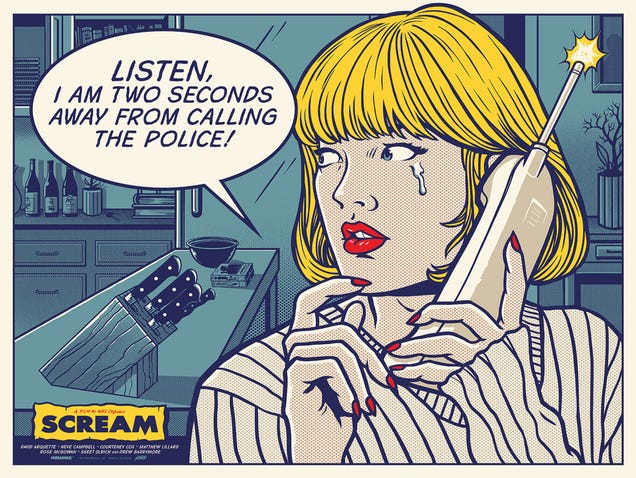
It’s probably too late to book an affordable ticket to Dallas for this weekend’s Texas Frightmare convention, but it may be worth it. Mondo has revealed some crazy cool new posters for Scream, Jaws, A Nightmare on Elm Street, and more that’ll exclusively debut at the event.
In this political climate, academic and public libraries may be in danger. The existence of vast amounts of information – a lot of it free – on the Internet might suggest that the library has outlived its usefulness.
But has it? The numbers tell a very different story.
In spite of the findings of a survey in which Americans say they are using public libraries less, the usage numbers reported by libraries indicate the opposite.
U.S. public library usage statistics: 1993-2012.
Chart created by Donald A. Barclay, using data from the National Center for Education Statistics, CC BY
Here’s what data on circulation (books and other items checked out to library users) and annual visits to public libraries reveal.
The number of books and other items borrowed from U.S. public libraries increased from 6.5 items per capita in 1993 to 8.0 items per capita in 2012 (up 23 percent). Over the same time span, the number of visits to U.S. public libraries rose 22.5 percent.
The one major public library usage measure that did decrease was the number of times library users asked questions of reference librarians, dropping 18 percent from 1993 to 2012.
The popularity of U.S. public libraries is, it seems, at least as strong as it was before the web became a household word (much less a household necessity).
Rise of the e-book
For academic libraries, the data are more mixed. Circulation of physical items (books, DVDs, etc.) in U.S. academic libraries has been on a steady decline throughout the web era, falling 29 percent from 1997 to 2011.
Total circulations (in 1000s) by U.S. degree-granting post-secondary institution libraries: 1997 through 2011.
Chart created by Donald A. Barclay, using data from the National Center for Education Statistics., CC BY
More tellingly, over the same time span and among the same academic libraries, the annual number of circulations (of books, DVDs, etc.) per full-time student dropped from 20 circulations to 10 (down 50 percent).
Number of circulation transactions per full-time student in U.S. degree-granting post-secondary institution libraries: 1997 through 2011.
Chart created by Donald A. Barclay, using data from the National Center for Education Statistics., CC BY
That fewer books are circulating is hardly a surprise given the vast amount of scholarly information (the bulk of it purchased with academic library budget dollars) that is now available to students via their electronic device of choice.
Electronic scholarly journals have driven their print-format predecessors to obsolescence, if not quite extinction, while e-books have become increasingly plentiful.
In 2012, U.S. academic libraries collectively held 252,599,161 e-books. This means that over the course of about a decade, U.S. academic libraries have acquired e-books equal to about one-fourth the total number of physical books, bound volumes of old journals, government documents and other paper materials acquired by those same libraries since 1638 – the year Harvard College established the first academic library in what is now the United States.
E-books are not only plentiful, they are popular with academic users (in spite of some shortcomings in usability). For example, data provided to the author show that when the University of California, San Diego made a collection of academic e-books available to students and faculty through the popular JSTOR interface, the usage numbers proved impressive.
In just under a year, UCSD students and faculty used 11,992 JSTOR e-books, racking up 59,120 views and 34,258 downloads. In response to user demand, the UCSD Library outright purchased over 3,100 of the titles offered via JSTOR, making those e-books a permanent part of the UCSD library collection.
Who needs the encyclopedia?
As with circulation numbers, reference questions asked of librarians in U.S. academic libraries have undergone a sharp decline – standing now at 56,000,000 per year, down 28.4 percent from 16 years ago. For the 60 largest U.S. academic libraries, the average number of reference transactions dropped from 6,056 per week in 1994 to 1,294 per week in 2012 (down 79 percent).
Average number of reference transactions per week for the 60 largest U.S. academic libraries: 1994-2012.
Chart created by Donald A. Barclay, using data from the National Center for Education Statistics., CC BY
Today, students access information digitally. The Google app on their smartphones allows students to look up information they once would have found only in analog, library-owned reference sources. And as for that old reference warhorse, the printed encyclopedia – Britannica churned out its final set in 2010.
Further contributing to the decline of in-person reference service is the fact that students are increasingly able to consult with academic librarians via the Internet.
By 2012, 77 percent of U.S. academic libraries were offering reference services via email or web chat. Currently, over 400 academic libraries provide around-the-clock, chat-based reference service as members of OCLC’s 24/7 Reference Cooperative, a global library cooperative that provides shared technology services.
Given only the above numbers, the hasty conclusion would seem to be that everything is online and nobody uses academic libraries any more.
But not so fast.
Even while circulation and reference transaction numbers were tanking, the data show a steady increase in the number of people actually setting foot in academic libraries.
The cumulative weekly gate count for the 60 largest U.S. academic libraries increased nearly 39 percent from 2000 to 2012. Library gate count data for all U.S. institutions of higher education show a similar (38 percent) increase from 1998 to 2012.
Cumulative weekly gate count for the 60 largest U.S. academic libraries: 2000-2012.
Chart created by Donald A. Barclay, using data from the National Center for Education Statistics., CC BY
So if students are not going to the academic library to access print collections or ask reference questions, why are they going at all?
The lure of the academic library
I believe that students are trekking to academic libraries because academic libraries have been actively reinventing themselves to meet the needs of today’s students.
Academic library square footage is increasingly being converted from space to house printed books to space for students to study, collaborate, learn and, yes, socialize.
Besides providing some of the last refuges of quiet in a noisy, distraction-filled world, academic libraries have taken such student-friendly steps as relaxing (or eliminating) longstanding prohibitions on food and drink, providing 24/7 study spaces and generally recreating themselves to be comfortable and friendly rather than cold and forbidding.
Examples of how forward-leaning academic libraries are attracting students include:
The Grand Valley State University Library’s Knowledge Market provides students with peer consultation services for research, writing, public speaking, graphic design, and analyzing quantitative data. Among a number of specialized spaces, the library offers rooms devoted to media preparation, digital collaboration, and presentation practice.
Library space is changing: three girls using a computer at San Jose library.
San José Library, CC BY-SA
The libraries of North Carolina State University (NCSU) offer Makerspace areas where students get hands-on practice with electronics, 3D printing and scanning, cutting and milling, creating wearables, and connecting objects to the Internet of Things. In addition, NCSU students can visit campus libraries to make use of digital media labs, media production studios, music practice rooms, visualization spaces and presentation rooms, among other specialized spaces.
The Ohio State University Library Research Commons offers not only a Writing Center but also consultation services for copyright, data management plans, funding opportunities and human subjects research. Specialized spaces in the library include conference and project rooms, digital visualization and brainstorming rooms, and colloquia and classroom spaces.
For several generations, academic librarians were primarily preoccupied with the role of their library buildings as portals to information, print and later digital. In recent years, we have reawakened to the fact that libraries are fundamentally about people – how they learn, how they use information and how they participate in the life of a learning community. As a result, we are beginning to design libraries that seek to restore parts of the library’s historic role as an institution of learning, culture and intellectual community.
Any library, public or academic, able to live up to so important a role will never outlive its usefulness.
Donald A. Barclay does not work for, consult, own shares in or receive funding from any company or organization that would benefit from this article, and has disclosed no relevant affiliations beyond the academic appointment above.
by John M Thompson, Lecturer in American Politics and Foreign Policy
After a clean sweep of convincing wins in the latest slew of primaries, Donald Trump looks better placed than ever to secure enough delegates to win the Republican presidential nomination. As Trump put it, with characteristic swagger, he considers himself “the presumptive nominee, absolutely”.
With that in mind, Trump has been taking a number of steps to appear more statesmanlike. Observers have credited this evolution in large part to the influence of a new campaign operative, Paul Manafort, who has advised numerous former Republican politicians.
One of the steps Trump has taken in an effort to appear more presidential and less, well, Trump-like, was a major foreign policy speech delivered at the prestigious Mayflower Hotel in Washington DC. As influential Republican expert Lanhee Chen explained, the speech is “part of the normalisation effort, or the mainstreaming of Donald Trump”.
This is the first time Trump has offered an extended explanation of his foreign policy worldview. The speech built upon the elements of conservative nationalism that he has occasionally mentioned and included plenty of harsh criticism of President Obama and Hillary Clinton. By Trump’s standards, it was a polished performance that featured a coherent structure – something that is usually missing from his rambling campaign speeches. He even went so far as to use an Obama-esque teleprompter.
But however superficially polished, the speech also retained typically Trumpian elements of the clumsy and/or the implausible.
The organising principle of his worldview is apparently to always put “America first”, an unfortunate and presumably unintentional echo of pre-World War II isolationists. Trump insisted that he would ensure that countries such as China would treat the US more respectfully on his watch, but how he would accomplish this was left unexplained.
What should we make of this speech and of Trump’s efforts to cultivate a more serious image? Wouldn’t it be reasonable to expect that as a president Trump would be more sober and predictable once confronted by the awesome responsibilities of the Oval Office?
This is not as implausible as it sounds. There are not a few Republican insiders who’ve long viewed Trump as an acceptable candidate, if far from an ideal one. They believe he’s ideologically flexible (unlike his much-loathed rival, the hardliner Ted Cruz), and that once elected he’d be willing to embrace many of the conventional conservative positions he has scorned on the campaign trail.
Indeed, in his first formal policy speech of the campaign at the AIPAC Conference in March 2016, Trump surprised the audience by keeping to standard partisan Republican rhetoric on the subjects of Israel and the Middle East – a policy area on which his usual populist meanderings would have been especially embarrassing to party leaders.
In addition, Manafort, the new adviser, recently told the Republican National Committee that his candidate has essentially been play-acting for the benefit of conservative voters. He recently informed the party that Trump “gets it": “The part that he’s been playing is now evolving into the part that you’ve been expecting. The negatives will come down, the image is going to change.”
There is every reason to be sceptical. Recent reports indicate that Trump was displeased with Manafort’s comment, and he shows little inclination to discontinue his consistent output of offensive statements. During his most recent victory speech, Trump argued that Clinton is winning the Democratic primary because she is a woman: if she “were a man, I don’t think she’d get five percent of the vote". And of course, Trump has an unparalleled track record of outrageous statements that long predate his run for the Republican nomination.
What, then, could we expect from President Trump in the realm of foreign policy? In spite of what was (at least by the standards of the modern Republican Party) a mostly conventional speech, there is every reason to believe he would be a catastrophic commander-in-chief.
Disaster-in-waiting
Many of the policies Trump advocates would profoundly damage US interests and could destabilise key regions around the world. And never mind his bizarre and unworkable promises to build a wall between the US and Mexico and prevent Muslim immigrants from entering the country – there’s plenty more to chew on.
Another reason to expect that Trump’s statecraft would be problematic is that, as scholars have long understood, personality matters a great deal when it comes to foreign policy decision-making. And despite his noticeably professionalised recent speech, Trump has clearly given little if any thought to most of these questions and has considerable difficultly in discussing them outside the context of prepared remarks. That much was clear during his interview with the Washington Post editorial board last month.
And the limited areas in which he has exhibited consistent tendencies are troubling. These include a bombastic nationalism untempered by intellectual curiosity – a nightmarishly inflated, George W. Bush-esque American chauvinism – and at least a degree of admiration for authoritarian leaders such as Vladimir Putin.
There is ample reason to believe that when it comes to the conduct of foreign policy, rather than a sophisticated understanding of international politics, Trump as president would mostly rely on his instincts. And all indications are that these are, to say the least, unsuitable for the most important elected position on earth.
John M Thompson does not work for, consult, own shares in or receive funding from any company or organization that would benefit from this article, and has disclosed no relevant affiliations beyond the academic appointment above.
by Casey Chan on Sploid, shared by Cheryl Eddy to io9
Dogs just want to love you but cats, well, what the hell do cats want? They have a mind of their own, they seemingly do whatever the hell they want, and their habits are just so weird. Why is that? According to Ted-Ed, it’s because how they developed as both a solitary predator that had to hunt and kill smaller prey for food and stealthy prey who had to hide from larger predators to survive. Their habits today, reflect both!
In case you’ve forgotten the section on the food web from high school biology, here’s a quick refresher.
Plants make up the base of every food chain of the food web (also called the food cycle). Plants use available sunlight to convert water from the soil and carbon dioxide from the air into glucose, which gives them the energy they need to live. Unlike plants, animals can’t synthesize their own food. They survive by eating plants or other animals.
Clearly, animals eat plants. What’s not so clear from this picture is that plants also eat animals. They thrive on them, in fact (just Google “fish emulsion”). In my new book, “A Critique of the Moral Defense of Vegetarianism,” I call it the transitivity of eating. And I argue that this means one can’t be a vegetarian.
Chew on this
I’ll pause to let the collective yowls of both biologists and (erstwhile) vegetarians subside.
A transitive property says that if one element in a sequence relates in a certain way to a second element, and the second element relates in the same way to a third, then the first and third elements relate in the same way as well.
Take the well-worn trope “you are what you eat.” Let’s say instead that we are “who” we eat. This makes the claim more personal and also implies that the beings who we make our food aren’t just things.
How our food lives and dies matters. If we are who we eat, our food is who our food eats, too. This means that we are who our food eats in equal measure.
Plants acquire nutrients from the soil, which is composed, among other things, of decayed plant and animal remains. So even those who assume they subsist solely on a plant-based diet actually eat animal remains as well.
This is why it’s impossible to be a vegetarian.
For the record, I’ve been a “vegetarian” for about 20 years and nearly “vegan” for six. I’m not opposed to these eating practices. That isn’t my point. But I do think that many “vegetarians” and “vegans” could stand to pay closer attention to the experiences of the beings who we make our food.
For example, many vegetarians cite the sentience of animals as a reason to abstain from eating them. But there’s good reason to believe that plants are sentient, too. In other words, they’re acutely aware of and responsive to their surroundings, and they respond, in kind, to both pleasant and unpleasant experiences.
Check out the work of plant scientists Anthony Trewavas, Stefano Mancuso, Daniel Chamowitz and František Baluška if you don’t believe me. They’ve shown that plants share our five senses – and have something like 20 more. They have a hormonal information-processing system that’s homologous to animals' neural network. They exhibit clear signs of self-awareness and intentionality. And they can even learn and teach.
I suspect how some biologists may respond: first, plants don’t actually eat since eating involves the ingestion – via chewing and swallowing – of other life forms. Second, while it’s true that plants absorb nutrients from the soil and that these nutrients could have come from animals, they’re strictly inorganic: nitrogen, potassium, phosphorus and trace amounts of other elements. They’re the constituents of recycled minerals, devoid of any vestiges of animality.
As for the first concern, maybe it would help if I said that both plants and animals take in, consume or make use of, rather than using the word “eat.” I guess I’m just not picky about how I conceptualize what eating entails. The point is that plants ingest carbon dioxide, sunlight, water and minerals that are then used to build and sustain their bodies. Plants consume inasmuch as they produce, and they aren’t the least bit particular about the origins of the minerals they acquire.
With respect to the second concern, why should it matter that the nutrients drawn by plants from animals are inorganic? The point is that they once played in essential role in facilitating animals’ lives. Are we who we eat only if we take in organic matter from the beings who become our food? I confess that I don’t understand why this should be. Privileging organic matter strikes me as a biologist’s bias.
Then there’s the argument that mineral recycling cleanses the nutrients of their animality. This is a contentious claim, and I don’t think this is a fact of the matter. It goes to the core of the way we view our relationship with our food. You could say that there are spiritual issues at stake here, not just matters of biochemistry.
Changing how we view our food
Let’s view our relationship with our food in a different way: by taking into account the fact that we’re part of a community of living beings – plant and animal – who inhabit the place that we make our home.
We’re eaters, yes, and we’re also eaten. That’s right, we’re part of the food web, too! And the well-being of each is dependent on the well-being of all.
From this perspective, what the self-proclaimed “farmosopher” Glenn Albrecht calls sumbiotarianism (from the Greek word sumbioun, to live together) has clear advantages.
Sumbioculture is a form of permaculture, or sustainable agriculture. It’s an organic and biodynamic way of farming that’s consistent with the health of entire ecosystems.
Sumbiotarians eat in harmony with their ecosystem. So they embody, literally, the idea that the well-being of our food – hence, our own well-being – is a function of the health of the land.
In order for our needs to be met, the needs and interests of the land must come first. And in areas where it’s prohibitively difficult to acquire the essential fats that we need from pressed oils alone, this may include forms of animal use – for meat, manure and so forth.
Simply put, living sustainably in such an area – whether it’s New England or the Australian Outback – may well entail relying on animals for food, at least in a limited way.
All life is bound together in a complex web of interdependent relationships among individuals, species and entire ecosystems. Each of us borrows, uses and returns nutrients. This cycle is what permits life to continue. Rich, black soil is so fertile because it’s chock full of the composted remains of the dead along with the waste of the living.
Indeed, it’s not uncommon for indigenous peoples to identify veneration of their ancestors and of their ancestral land with the celebration of the life-giving character of the earth. Consider this from cultural ecologist and Indigenous scholar-activist Melissa Nelson:
The bones of our ancestors have become the soil, the soil grows our food, the food nourishes our bodies, and we become one, literally and metaphorically, with our homelands and territories.
You’re welcome to disagree with me, of course. But it’s worth noting that what I propose has conceptual roots that may be as old as humanity itself. It’s probably worth taking some time to digest this.
Andrew Smith does not work for, consult, own shares in or receive funding from any company or organization that would benefit from this article, and has disclosed no relevant affiliations beyond the academic appointment above.
by Maddie Stone on Gizmodo, shared by Adam Clark Estes to io9
Earlier this week, we heard alarming reports of a “significant” nuclear waste leak
at Hanford, the largest radioactive waste dumpsite in the country. Should we be worried? Absolutely. But mainly because this is a symptom of a much bigger problem that’s been festering for decades.
by oracleeditor@gmail.com (Adam Mathieu, COLUMNIST)
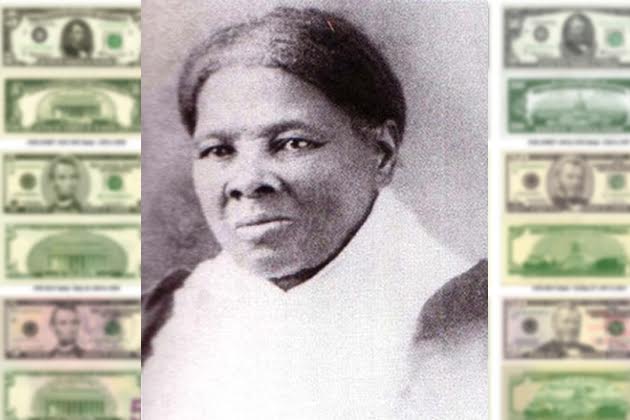
“Our currency will now tell more of our story,” a succinct and accurate description Treasury Secretary Jack Lew made as he announced the addition of Harriet Tubman, among other alterations, to U.S. currency.
The announcement Lew made Wednesday explained Tubman would take over Andrew Jackson’s spot on the $20 bill, a move that is at the very least a start in acknowledging that profound individuals in the nation’s history are not all white men.
It is obvious Tubman is a suitable fit, being that she was an African-American slave who went on to serve as a nurse and spy for the Union during the Civil War. Her story is one that rewards her visage being placed on U.S. currency, and she is more deserving than some who already have the honor.
Many news outlets have detailed Jackson’s background as a slave-owner. Add that to his position on Native Americans, and his being booted off the bill becomes easy to swallow. During his presidency, Jackson took a firm stance on wanting to remove Native Americans and sought the Indian Removal Act.
Jackson showed flashes of greatness in the War of 1812, but his follies — both as a citizen and president — make him a suitable face to see removed from U.S. currency in favor of showing other greats from the nation’s history.
According to NPR, the activist group Women on 20s was responsible for the push toward placing Tubman on the $20. The call for Tubman is a clever choice, as she will become the first African-American to be represented on paper currency in the U.S. in addition to her being the first woman in 100 years to do so, according to Fox News.
Hearing those numbers is alarming. Women should have already had their day on the dollar. Granted it will only mean seeing a different face on the bits of paper stuffed in wallets, it is the symbolic power of becoming an icon at stake here. By placing Tubman’s face on paper bills where we see men such as George Washington and Abraham Lincoln places her in a stratosphere reserved for the greats of the young nation’s history. It extends a feeling of belongingness to those beyond white males and instills a sense of pride in those who call this diverse country home.
An amusing aside of the news is that Lew had been planning on changing the face of the $10, but it went to the wayside as the critically lauded Broadway musical “Hamilton” made for a large fan base of the nation’s first Treasury Secretary. It is for the best given Hamilton’s inspiring story as a West Indian immigrant who infiltrated politics and became a Founding Father.
However, there will be changes to the back of Hamilton’s bill, as rendering of a 1913 march in support of women’s rights will replace the Treasury Department, according to the New York Times. Additionally, the $5 bill will feature Marian Anderson, Rev. Dr. Martin Luther King Jr. and Eleanor Roosevelt.
All of this appears to be small steps to make up for a history of U.S. currency focused on white men. Yet, this no time to be cynical; this is a positive push forward. There will be a generation who will grow up seeing Tubman’s face daily — casually, at that — perhaps spurring a slight erasure of the notion of “other” that some carry in this country.
by Maddie Stone on Gizmodo, shared by Adam Clark Estes to io9
Trees, is there anything they can’t do? Doubtful. Let’s see: producing half the world’s oxygen, providing habitat for millions of species, creating the soil and timber resources we depend on. Not bad. But all that’s just scratching the surface. As new research shows, there’s a lot more going on beneath the forest floor than we realized.
Led Zeppelin’s Robert Plant and Jimmy Page will soon face a jury trial in order to determine whether they copied the opening chords for their 1971 classic Stairway to Heaven from the song Taurus, recorded by the little-known band Spirit in 1968. At a hearing in California last week the presiding judge, Gary Klausner, ruled that the songs were sufficiently similar to warrant further investigation.
The court was convinced that the famed British rock band would have had the chance to listen to Spirit’s song (it seems the two bands toured together in America in the late 1960s) and that the two tunes could have relevant similarities in the first two minutes, arguably the most important and recognisable segments of any piece. Access and substantial similarity between the works are the requirements for a successful copyright case.
The main defence raised by the British band was that the descending chromatic four-chord progression in Taurus is commonplace and not original – and so not protectable by copyright. The court found this unconvincing. In copyright infringement proceedings this kind of defence (based on the so-called scènes à faire doctrine) is frequent. While it is true that that chromatic progression is a common convention which abounds in music – said the judge – the several similarities between the two songs here transcend this main structure.
It is therefore now for the jury in the upcoming trial to decide whether, having in mind the ordinary and reasonable listener, Stairway to Heaven has taken Taurus’ “concept” and “feel”. In copyright jargon this is known as the intrinsic test.
This standard was used by the same court last year in the famous Blurred Line case, when it was found that pop stars Robin Thicke and Pharrell Williams had copied the Marvin Gaye song Got to Give it up. Gaye’s children were awarded $7.4m – although the award was subsequently reduced, and the decision is currently under appeal.
But I’m not a big fan of this test, especially when it comes to music. It’s not always easy to compare the total “concept” and “feel” of a song without mistakenly also taking into account its unprotectable elements. I’m concerned that a blind reliance in the Stairway to Heaven case on this standard – one that is not accepted by all courts – may again end up in a finding of copyright infringement. And this would have the perverse effect of discouraging, rather than stimulating, music creativity.
Need for reform
I don’t think that it is appropriate to consider the act of devising a tune that simply has the same “feel” and “groove” as another as copyright infringement. This is how music creativity often works. Musicians frequently build upon earlier arrangements and styles, and so the increasing occurrence of cases such as these should give us pause.
Copyright laws and principles should take these features of music production into due account. They should be based on a careful balance between creators’ proprietary rights and areas of freedom that permit later musicians to use the building blocks of a particular genre for creating new pieces.
Borrowing from earlier pieces is a structural element of music creation in many genres (a tune cannot always be created from scratch by just improvising). Classical music composers such as Handel, Beethoven, Shubert, Mozart, Bach and Puccini all significantly borrowed from earlier colleagues. The same holds true for jazz (which has built upon popular music and opera), rockabilly (influenced by country), rhythm and blues (which derives from boogie-woogie and gospel) and the Jamaican music scene (where traditionally covering and arranging each others' tunes was widespread and largely accepted).
I wonder what would have happened if the strong copyright protection of present times – which tends to prevent and thus discourage any creation of songs derived from others – had been around since the era of the first copyright statutes. It’s probable that composers and musicians wouldn’t have created many masterpieces because of the fear of violating some legal provisions and suffering negative consequences. Much of the music we now love would just not exist.
The importance of borrowing music has become even more pressing with the boom of digital technologies. Sampling – taking a portion, or “sample”, of a sound recording and reusing it as an instrument in a different song – is the most striking example. This technique of music creation is the backbone of highly popular genres such as hip-hop and rap.
It is time the copyright system started to reflect and take in due consideration the relevance of musical borrowing for creative purposes. Last year’s decision in Blurred Lines already sent a bad signal. I sincerely hope the jury in the Stairway to Heaven case won’t follow that path. Should Led Zeppelin be found liable for copyright infringement, we would have yet another blow to hopes of preserving a creative environment capable of ensuring the advancement of musical arts.
Enrico Bonadio does not work for, consult, own shares in or receive funding from any company or organization that would benefit from this article, and has disclosed no relevant affiliations beyond the academic appointment above.
It’s National Gardening Week, the UK’s “biggest celebration of gardening”, according to the Royal Horticultural Society. And judging by the many, many, many images posted on social media, it’s hard to disagree.
There is much merit in celebrating gardening actually.
Spending time in the garden is good for the mind and body
Good for every part of you.
With more than half the planet’s population now living in cities, gardening is the ideal hobby to ensure we have regular contact with nature.
Gardening is an obvious opportunity for physical activity, a lack of which can precipitate all sorts of cardiovascular diseases and diabetes. But it’s also good for your mental health, Carly Wood explained. Gardeners generally have greater life satisfaction, enhanced self-esteem and fewer feelings of depression and fatigue than non-gardeners.
Gardens could be good for society too – and for the UK’s housing problems
Garden cities, which came out of the 19th-century movement to create greener places to live and work and surrounded by green expanses of land, could be one way to supply more houses. What’s more they would provide more homely towns for people to live and work – instead of sprawling housing estates people that people need to commute to and from work.
As Susan Parham wrote, people really like garden cities. It’s perhaps no surprise then that the government has put aside more than £300m to build a garden city near Ebbsfleet, Kent.
And they may even have spurred a revolution
No patch of land too small or unappealing.
Michael Hardman, CC BY
Guerrilla gardeners in Africa, Europe and the Americas are covertly taking over neglected patches of land in urban areas and cultivating gardens without permission.
For four years, Michael Hardman has been embedded in the guerrilla gardening scene. He documented how students, businessmen, chefs, architects, community workers are coming together to either beautify an area or make it useful via urban agriculture.
So, really there are no excuses not to do some gardening
Do you ever feel like this? It's not helping you get smarter... Chris Hope, CC BY-SA
In the hours since I first sat down to write this piece, my laptop tells me the National Basketball Association has had to deny that it threatened to cancel its 2017 All-Star Game over a new anti-LGBT law in North Carolina – a story repeated by many news sources including the Associated Press. The authenticity of that viral video of a bear chasing a female snowboarder in Japan has been called into question. And, no, Ted Cruz is not married to his third cousin. It’s just one among an onslaught of half-truths and even pants-on-fire lies coming as we rev up for the 2016 American election season.
The longer I study human psychology, the more impressed I am with the rich tapestry of knowledge each of us owns. We each have a brainy weave of facts, figures, rules and stories that allows us to address an astonishing range of everyday challenges. Contemporary research celebrates just how vast, organized, interconnected and durable that knowledge base is.
That’s the good news. The bad news is that our brains overdo it. Not only do they store helpful and essential information, they are also receptive to false belief and misinformation.
Just in biology alone, many people believe that spinach is a good source of iron (sorry, Popeye), that we use less than 10 percent of our brains (no, it’s too energy-guzzling to allow that), and that some people suffer hypersensitivity to electromagnetic radiation (for which there is no scientific evidence).
But here’s the more concerning news. Our access to information, both good and bad, has only increased as our fingertips have gotten into the act. With computer keyboards and smartphones, we now have access to an Internet containing a vast store of information much bigger than any individual brain can carry – and that’s not always a good thing.
Better access doesn’t mean better information
This access to the Internet’s far reaches should permit us to be smarter and better informed. People certainly assume it. A recent Yale study showed that Internet access causes people to hold inflated, illusory impressions of just how smart and well-informed they are.
But there’s a twofold problem with the Internet that compromises its limitless promise.
First, just like our brains, it is receptive to misinformation. In fact, the World Economic Forum lists “massive digital misinformation” as a main threat to society. A survey of 50 “weight loss” websites found that only three provided sound diet advice. Another of roughly 150 YouTube videos about vaccination found that only half explicitly supported the procedure.
Rumor-mongers, politicians, vested interests, a sensationalizing media and people with intellectual axes to grind all inject false information into the Internet.
So do a lot of well-intentioned but misinformed people. In fact, a study published in the January 2016 Proceedings of National Academy of Science documented just how quickly dubious conspiracy theories spread across the Internet. Specifically, the researchers compared how quickly these rumors spread across Facebook relative to stories on scientific discoveries. Both conspiracy theories and scientific news spread quickly, with the majority of diffusion via Facebook for both types of stories happening within a day.
Making matters worse, misinformation is hard to distinguish from accurate fact. It often has the exact look and feel as the truth. In a series of studies Elanor Williams, Justin Kruger and I published in the Journal of Personality and Social Psychology in 2013, we asked students to solve problems in intuitive physics, logic and finance. Those who consistently relied on false facts or principles – and thus gave the exact same wrong answer to every problem – expressed just as much confidence in their conclusions as those who answered every single problem right.
For example, those who always thought a ball would continue to follow a curved path after rolling out of a bent tube (not true) were virtually as certain as people who knew the right answer (the ball follows a straight path).
Defend yourself
So, how so we separate Internet truth from the false?
First, don’t assume misinformation is obviously distinguishable from true information. Be careful. If the matter is important, perhaps you can start your search with the Internet; just don’t end there. Consult and consider other sources of authority. There is a reason why your doctor suffered medical school, why your financial advisor studied to gain that license.
Second, don’t do what conspiracy theorists did in the Facebook study. They readily spread stories that already fit their worldview. As such, they practiced confirmation bias, giving credence to evidence supporting what they already believed. As a consequence, the conspiracy theories they endorsed burrowed themselves into like-minded Facebook communities who rarely questioned their authenticity.
Instead, be a skeptic. Psychological research shows that groups designating one or two of its members to play devil’s advocates – questioning whatever conclusion the group is leaning toward – make for better-reasoned decisions of greater quality.
If no one else is around, it pays to be your own devil’s advocate. Don’t just believe what the Internet has to say; question it. Practice a disconfirmation bias. If you’re looking up medical information about a health problem, don’t stop at the first diagnosis that looks right. Search for alternative possibilities.
Seeking evidence to the contrary
In addition, look for ways in which that diagnosis might be wrong. Research shows that “considering the opposite” – actively asking how a conclusion might be wrong – is a valuable exercise for reducing unwarranted faith in a conclusion.
After all, you should listen to Mark Twain, who, according to a dozendifferent websites, warned us, “Be careful about reading health books. You may die of a misprint.”
Wise words, except a little more investigation reveals more detailed and researched sources with evidence that it wasn’t Mark Twain, but German physician Markus Herz who said them. I’m not surprised; in my Internet experience, I’ve learned to be wary of Twain quotes (Will Rogers, too). He was a brilliant wit, but he gets much too much credit for quotable quips.
Misinformation and true information often look awfully alike. The key to an informed life may not require gathering information as much as it does challenging the ideas you already have or have recently encountered. This may be an unpleasant task, and an unending one, but it is the best way to ensure that your brainy intellectual tapestry sports only true colors.
David Dunning has received funding from the National Science Foundation, the National Institutes of Health, and the Templeton Foundation in the past.
On October 12th, 1983, Bill Landreth called his friend Chris in Detroit to chat. Chris frantically explained that the FBI had raided his house. “Don’t call me anymore,” Chris said in what would be a very short conversation. Bill didn’t know exactly what was happening, but he did know this: If the FBI had come for Chris, then he might be next.
by oracleeditor@gmail.com (Brian Fernandes, CORRESPONDENT)
USF alumnus Lucas Wehle uses his personal experiences to help others. Special to the Oracle
Despite growing up feeling fundamentally out of place, one USF alumnus turned his experiences into a teaching tool to help others.
Raised in Valrico with two siblings, Lucas Wehle always felt out of place. Around age four, he came to the realization that the clothes, hairstyles and standards expected of him seemed contradictory to his nature.
“I was different and definitely felt like a boy, but I didn’t have any terminology for it,” the USF alumnus said.
It wasn’t until his first year at the university that he finally found the term he identified with. “Transgender.”
Born a female, Wehle accepted himself as a male and decided to take the steps in making the physical transition. This process would change the course of his life, his relationships and see him met with serious scrutiny.
In high school, Wehle said he found himself under the most pressure to conform to society’s expectations.
“I really tried to fit myself in that mold,” said Wehle. “I grew my hair out, tried to dress femininely and tried to do all these things I thought I had to do. It was literally the lowest, the most depressed I’d ever been.”
Then college began a new chapter in 2010.
At last, he had found an environment that offered acceptance. In college he was introduced to the lesbian, gay, bisexual and transgender (LGBT) community. In this group, he found other students whom he could relate to and confide in.
“Until I went to college, I didn’t even know ‘trans’ was a thing,” Wehle said. “I had a fit. I had a word to describe how I identified and how I felt.”
He initially “came out” to his girlfriend at the time and his parents would be next.
However, he was raised in a religious household with certain values. Wehle said he tried to stall that conversation, but the pressure was building up.
Six months later, he finally had the discussion with them. The news did not prompt a welcoming response from loved ones.
But the rejection didn’t only come from family; friends and neighbors criticized and rejected him upon hearing the news.
“Just complete and total isolation,” Wehle said. “I got really negative responses — hateful, discriminatory.”
Since then, Wehle said the tension between him and his family has somewhat eased. However, his parents still stand firm that he’s female.
“They don’t call me my name or my pronouns,” he said. “Just respect me to call me who I am and who I’ve been for a long time.”
December 2011 marked another chapter as Wehle began hormone therapy to look the way he feels.
In 2012, he had his name legally changed to “Lucas.” He chooses not to disclose his birth name with anyone, as he’s left that in the past with his former identity.
“He’s a huge mentor to other transgenders,” said Al Molina-Coats, a friend of Wehle’s.
Molina-Coats is a member of Parents and Friends of Lesbians and Gays (PFLAG).
Wehle graduated last year with a bachelor’s in physical education.
He is the current president of the organization, which holds public meetings to educate families on the LGBT community.
Additionally, he also is the youth coordinator at the Metro Wellness Center in St. Petersburg. He offers advice to individuals struggling with their sexuality and mentors family members on how to respond to those situations.
In 2015, Florida struck down the HB-583 bill, which proposed banning transgender individuals from entering the restroom of their choice. Wehle was a strong opponent of the bill.
He was a victim of a bathroom assault in college, making the matter all the more personal.
Wehle said he tries to be patient with those who don’t understand his views, but there are times when he gets frustrated. Despite setbacks, he still pursues educating the public.
John Desmond and his wife, Nancy, founded the Tampa chapter of PFLAG in 2011. Through the program, the couple has formed a close bond with Wehle.
That bond allowed them to open their home to Wehle when he was going through issues with his parents last year.
“He’s cutting edge,” Nancy said. “He’s shaped my husband and I — how we think.”
She recalled how Wehle would always come home from work with a positive attitude and liven the atmosphere.
John has viewed Wehle as being “an expert at cultural competency” and regards him as being a knowledgeable source in regards to the LGBT community.
Wehle uses social media as a means of educating the public.
At age 24, he says he is living his dream job, helping others struggling with their own identity crises.
“When you look in the mirror and you’re able to feel like yourself, it’s all going to be worth it,” Wehle said. “Remember there’s a light somewhere, even if you can’t see it.”



 I think that a West Elm catalog came to my house and that’s how I saw these planters. Oooooooh: That aqua! And that yellow! (It still seems relatively rare to find these kinds of items in color colors.) Alas, it looks like the yellow sold out in a hot minute. These are not inexpensive, but oh my goodness, they are oh so pretty!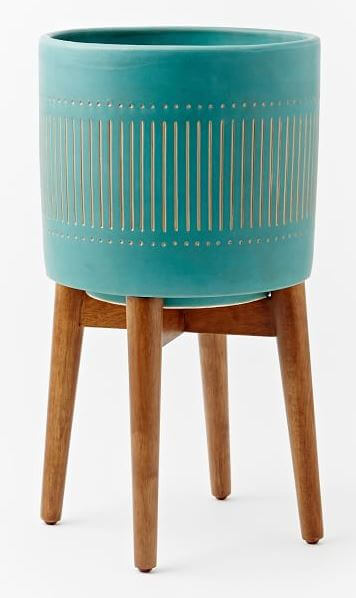






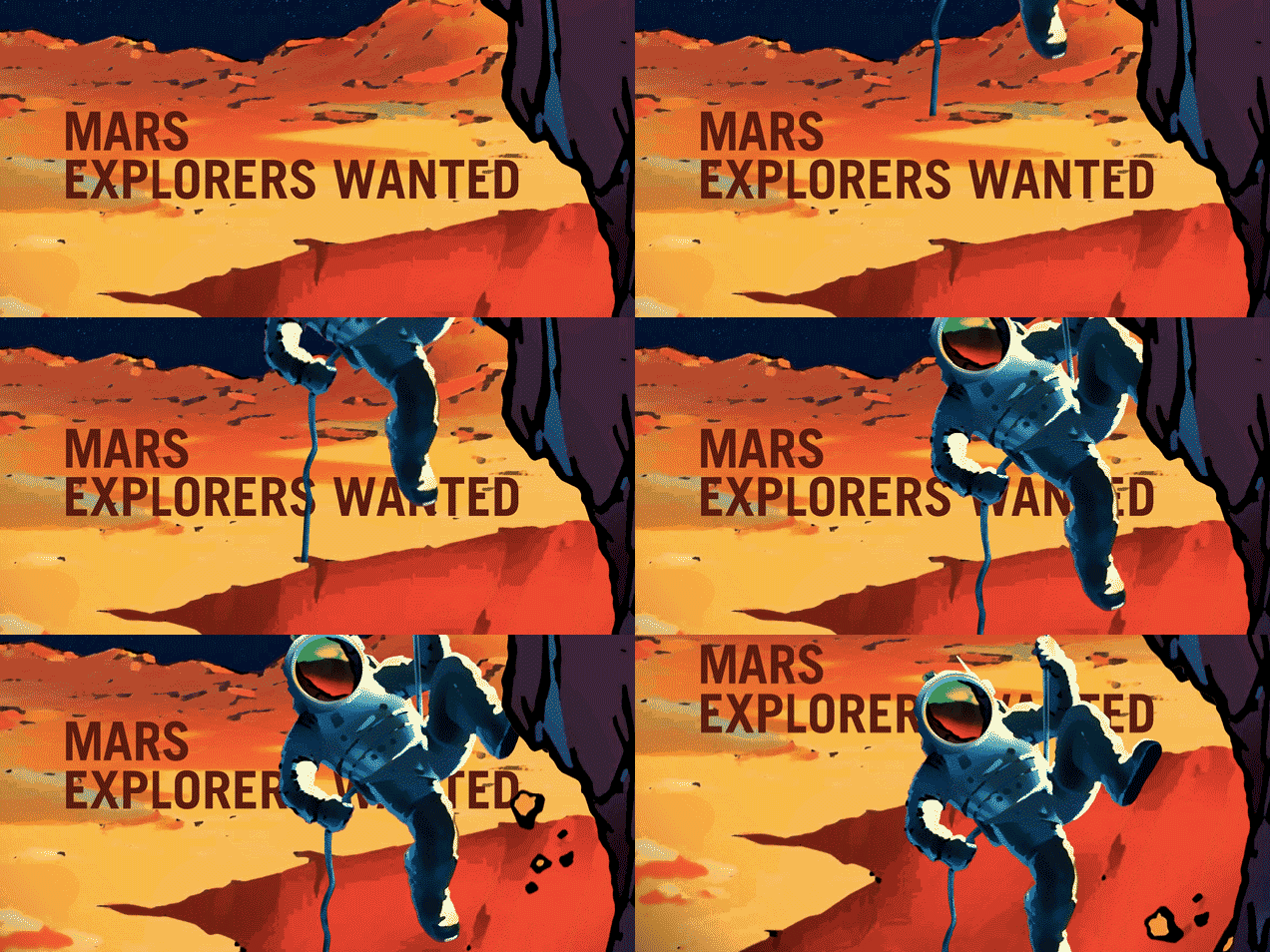
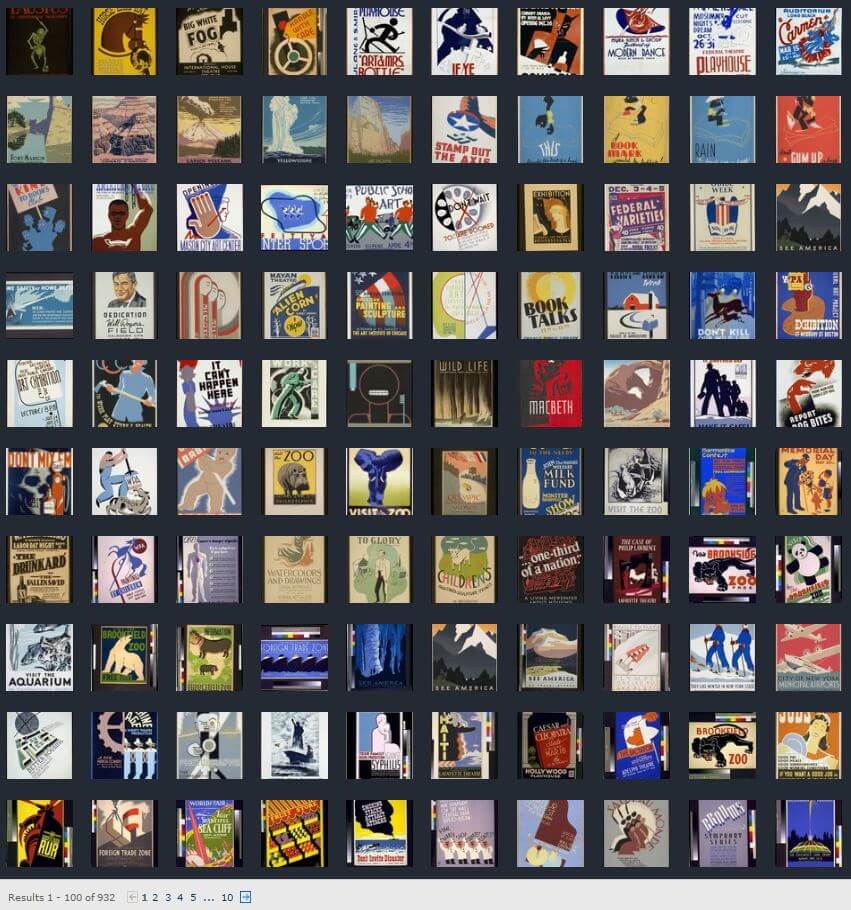 Reader Onawa read our story on the free downloadable NASA Jet Propulsion Lab posters and commented with this great tip: ‘The Library of Congress has a ton of WPA posters available for free download — if you’re willing to slog through their website. I found one I had been coveting and had it printed through a local photo lab once I resized it, and it looks great.” Well guess what? I found the magic link to avoid slogging, and here you go: Access to the complete library of 907 Works Progress Administration (WPA) posters produced from 1936 to 1943. Hours of free fun even just to look at!