Leettaschmidt
Shared posts
What Public Libraries Will Lose Without Net Neutrality
The rollback of net neutrality opens the possibility for ISPs to start to play with how we pay for the internet, but because [it hasn’t] been rolled back yet, we don’t have evidence that they will in fact do those things. It’s a little speculative at this point. I think everyone is speculating a little bit in this. But the indications we got from the ISPs are that there will be paid prioritization and for us, there are specific things that would likely end up in the slow lane.
Universities spend millions on accessing results of publicly funded research

University research is generally funded from the public purse. The results, however, are published in peer-reviewed academic journals, many of which charge subscription fees.
I had to use freedom of information laws to determine how much universities in New Zealand spend on journal subscriptions to give researchers and students access to the latest research - and I found they paid almost US$15 million last year to just four publishers.
There are additional costs, too. Paywalls on research hold up scientific progress and limit the public’s access to the latest information.
Read more: Not just available, but also useful: we must keep pushing to improve open access to research
The project took more than three years because universities originally refused to release the information. I had to make a complaint to the Ombudsman, the government official charged with determining whether information from the state sector should be publicly disclosed.
The Ombudsman’s final opinion ruled unambiguously that the public’s right to know outweighs any commercial interests of the publishers and universities.
The cost of knowledge
The following points stand out in a preliminary analysis of spending by New Zealand universities on subscriptions to journals from Elsevier, Springer, Wiley and Taylor & Francis between 2013 and 2016.
The total amount spent on the four publishers is substantial, around US$14.9 million in 2016 (the total spending on all publishers is likely at least 2-3 times that). The University of Auckland, with 33000 students and 2200 academic and research staff, spent US$3.8 million, including US$1.6 million on Elsevier.
The mean expenditure per academic/research staff member in 2016 was around US$1800.
The University of Canterbury is getting a much worse deal than the others, 35% above the mean.
The rate of increase of subscription costs (17%) over the period clearly exceeds the Consumer Price Index inflation rate over the period (2-3% in New Zealand, USA and Europe).
The publisher with the highest percentage increase over the period was Taylor & Francis (33%).
Obtaining the information
Many journal subscription prices are high (for example, the prominent biology journal Cell is over US$2000 per year), especially given that the funding for the research typically comes from public sources.
With the advent of the internet, many people predicted a major drop in expenditure on journals, but the opposite has occurred. One reason is that the main commercial publishers use anti-competitive practices such as bundling of unrelated journals (so-called “Big Deals”) and confidentiality clauses in contracts.
Price secrecy allows sellers to use differential pricing and weaken the negotiating situation of buyers, leading to market inefficiency. The fact that each journal has a monopoly on its specific content means that journals cannot be easily substituted by others.
In 2014, Timothy Gowers and others used freedom of information laws to extract the relevant price information from universities in the UK. In 2009, less extensive work in the USA had also been done by Ted Bergstrom and colleagues. Data from Finland and Netherlands has recently been made public.
I requested data from seven of New Zealand’s eight universities, which collectively have around 8400 academic/research staff and 130000 students. The process was long and required persistence. Following the Ombudsman’s ruling, the universities complied, supplying me with data on spending on journals from Elsevier, Springer, Wiley and Taylor & Francis.
There are some subtleties, such as assumptions about exchange rate conversions and exactly which products from the listed publishers the money is spent on. Interested readers can consult the raw data.
Is open access the answer?
The restricted access inherent in the subscription model makes it hard for journalists, politicians and the general public to use scholarship for better evidence-based decision making.
Recently, open access journals have emerged. They place no barriers on readers but still have production costs. The “Gold Open Access” model, in which authors or funders typically pay for each article, has become popular with traditional publishers. They often set the article processing charge level at around US$2000 to US$3000.
The analysis above implies that wholesale conversion to such article processing charges will not save money for universities. Several independent estimates put a reasonable article processing charge at no more than US$500 (less in some disciplines).
The key problem is not the particular model of payment for journal article production and distribution, but the dysfunctional market in publishing services. Although they are a large part of the problem, commercial publishers are not entirely to blame. For example, the research community uses historical journal reputation to evaluate researchers, making it harder for new, better run journals to enter the market.
The right kind of open access
Even with the best will in the world, there is an inevitable time lag for new journals to become established. To make faster progress, it is necessary to decouple the ownership of current journal titles from the provision of editorial and publication services, so that competition among publishers helps to control prices. This reclaiming of community control is the most fundamental of the recently formalised Fair Open Access Principles.
New organisations such as MathOA, PsyOA, LingOA and the Fair Open Access Alliance have been set up to facilitate large-scale conversion of subscription journals to an open access model, with community control of journals and no direct author payments. This of course involves mass defections by editorial boards.
We expect that global savings of at least 75% of current payments to journals can be made by using modern publishing providers such as Scholastica and Ubiquity, and by reallocating subscription payments toward article processing charges. What is the research community waiting for?

Mark C. Wilson is a board member for MathOA, and its delegate to the Fair Open Access Alliance. Both of these are nonprofit organizations registered in the Netherlands.
An anthropologist explains why we love holiday rituals and traditions

The mere thought of holiday traditions brings smiles to most people’s faces and elicits feelings of sweet anticipation and nostalgia. We can almost smell those candles, taste those special meals, hear those familiar songs in our minds.
Ritual marks some of the most important moments in our lives, from personal milestones like birthdays and weddings to seasonal celebrations like Thanksgiving and religious holidays like Christmas or Hanukkah. And the more important the moment, the fancier the ritual.
Holiday rituals are bursting with sensory pageantry. These (often quite literal) bells and whistles signal to all of our senses that this is no common occasion – it is one full of significance and meaning. Such sensory exuberance helps create lasting recollections of those occasions and marks them in our memory as special events worth cherishing.
Indeed, there are plenty of reasons to value family rituals. Research shows that they can provide various psychological benefits, helping us enjoy ourselves, connect with loved ones and take a respite from the daily grind.
An anxiety buffer
Everyday life is stressful and full of uncertainty. Having a special time of the year when we know exactly what to do, the way we’ve always done it, provides a comfortable sense of structure, control and stability.

From reciting blessings to raising a glass to make a toast, holiday traditions are replete with rituals. Laboratory experiments and field studies show that the structured and repetitive actions involved in such rituals can act as a buffer against anxiety by making our world a more predictable place.
Many of those rituals may of course also be performed at other times throughout the year. But during the holiday season, they become more meaningful. They’re held in a special place (the family home) and with a special group of people (our closest relatives and friends). For this reason, more people travel during the year-end holidays than any other time of the year. Gathering together from far-flung locations helps people leave their worries behind, and at the same time lets them reconnect with time-honored family traditions.
Happy meals
No holiday tradition would be complete without a festive meal. Since the first humans gathered around the fire to roast their hunt, cooking has been one of the defining characteristics of our species.
The long hours spent in the kitchen and the dining room during the preparation and consumption of holiday meals serve some of the same social functions as the hearths of our early ancestors. Sharing a ceremonial meal symbolizes community, brings the entire family together around the table and smooths the way for conversation and connection.
All cultures have rituals that revolve around food and meal preparation. Jewish tradition dictates that all food must be chosen and prepared according to specific rules (Kosher). In parts of the Middle East and India, only the right hand must be used for eating. And in many European countries, it is important to lock eyes while making a toast in order to avoid seven years of bad sex.

Of course, special occasions require special meals. So most cultures reserve their best and most elaborate dishes for the most important holidays. For example, in Mauritius, Tamil Hindus serve the colorful “seven curries” at the conclusion of the Thaipussam kavadi festival, and in Greece families get together to spit-roast an entire lamb on Easter Day. And these recipes often include some secret ingredients – not just culinary, but also psychological.
Research shows that performing a ritual before a meal improves the eating experience and makes the food (even just plain carrots!) seem tastier. Other studies found that when children participate in food preparation they enjoy the food more, and that the longer we spend preparing a meal, the more we come to appreciate it. In this way, the labor and fanfare associated with holiday meals virtually guarantees an enhanced gastronomical experience.
Sharing is caring
It is common to exchange presents during the holiday period. From a rational perspective, this might seem pointless, at best recycling resources or, at worst, wasting them. But don’t underestimate the importance of these exchanges. Anthropologists have noted that among many societies ritualized gift-giving plays a crucial role in maintaining social ties by creating networks of reciprocal relationships.

Today, many families give each other lists of desired presents for the holidays. The brilliance of this system lies precisely in the fact that most people end up getting what they would buy anyway – the money gets recycled but everyone still enjoys the satisfaction of giving and receiving gifts.
And as this is a special time of the year, we can even allow ourselves some guilt-free indulgence. Last year, my wife and I saw a fancy coffee machine that we really liked, but we decided it was too expensive. But in December, we went back and bought it as a mutual present, agreeing that it was OK to splurge a bit for the holidays.
The stuff family is made of
The most important function of holiday rituals is their role in maintaining and strengthening family ties. In fact, for relatives who live far apart, holiday rituals may be the glue that holds the family together.
Ritual is a powerful marker of identity and group membership. Some of my own field studies have found that taking part in collective rituals creates feelings of belonging and increased generosity toward other members of the group. It’s no surprise, then, that spending the holidays with the in-laws for the first time is often regarded as a rite of passage – a sign of true family membership.
Holiday traditions are particularly important for children. Research shows that children who participate in group rituals become more strongly affiliated with their peers. In addition, having more positive memories of family rituals seems to be associated with more positive interactions with one’s own children.

Holiday rituals are the perfect recipe for family harmony. Sure, you might need to take three flights to get there, and they will almost certainly be delayed. And your uncle is bound to get drunk and start a political argument with his son-in-law again. But according to Nobel Laureate Daniel Kahneman, this is unlikely to spoil the overall experience.
Kahneman’s research shows that when we evaluate past experiences, we tend to remember the best moments and the last moments, paying little attention to everything else. This is known as the “peak-end rule.”
In other words, our memory of the family holiday will mostly consist of all the rituals (both joyful and silly), the good food, the presents and then hugging everyone goodbye at the end of the night (after your uncle made up with his son-in-law). And by the time you get back home, you’ll have something to look forward to for next year.

Dimitris Xygalatas does not work for, consult, own shares in or receive funding from any company or organisation that would benefit from this article, and has disclosed no relevant affiliations beyond their academic appointment.
Fascism’s return and Trump’s war on youth

Fascism is all too often relegated to the history books.
The word conjures up a period in which civilized societies treated democracy with contempt, engaged in acts of systemic violence, practised extermination and elimination, supported an “apocalyptic populism,” suppressed dissent, promoted a hyper-nationalism, displayed contempt for women, embraced militarism as an absolute ideal and insisted on obedience to a self-proclaimed prophet.
But the seeds that produced such fascist horrors have once again sprung to life, returning in new social and political forms.
Today, a culture of fear dominates American society, one marked by massive inequities in wealth and power that not only uphold structures of domination, but also view differences as threats, compassion as weakness and shared responsibilities —if not the common good itself — as pathology.
Fascist thought is on the rise all over the world, but its most blatant and dangerous manifestation has emerged in the Trump administration.
Fear and the ethos of mass consumerism —coupled with widespread insecurity and ignorance —now drive people into a malignant notion of security, self-inflicted cynicism and into the arms of demagogues like Trump. For too many Americans, critical thinking and hope have given way to emotional bonding and the revival of the discourse of ultra-nationalism and bigotry.
Trump: Not Hitler, but dangerous nonetheless
Trump is not Hitler in that he has not created concentration camps, shut down the critical media or rounded up dissidents; moreover, the United States at the current historical moment is not the Weimar Republic.
But in the Trump era, remnants of fascism exist in different shapes and forms and include a celebration of the cult of the leader, systemic racism, the embrace of a toxic macho-populism and state support for ultra-nationalism, racism and the threat of violence against critics.
All of these elements are evident in Trump’s rhetoric and policy initiatives.
Trump’s corporate brand of neoliberal fascism is highly visible in right-wing policies that favour deregulation, corporate power and the interests of the ultra-rich.
Instead of draining the corporate swamp, Trump has embraced the merging of corporate and political power, and in doing so has turned the state into a battering ram designed to serve the most powerful and wealthiest members of society.
Trump’s mode of fascism is a unique product of our times, our commercial culture, and a corporate controlled media, all of which saps the foundations of a viable democracy.
American culture is advertising-saturated and celebrity-based, and has permitted a rich self-promoter to abandon any pretense of civility, accountability or integrity in order to hype, scam and market his way to power.
Call it Fascism, American-Style. It’s returned in the shadow of neoliberalism, with its celebration of the market as the template for governing all of society and its concentration of economic and political power in relatively few hands.
Friendly with dictators
How else to explain Trump’s unapologetic support and friendly attitude toward right-wing dictators such as the self-confessed killer, Rodrigo Duterte, president of the Philippines, Russia’s Vladimir Putin and China’s Xi Jinping, all of whom have a fawning attraction to Trump given he exhibits little interest in their massive human rights violations.

Trump’s fascism is also on full display in his ramping up of the police state, his relentless racist rhetoric, taunts and policies that cast Blacks, immigrants and Muslims as people unworthy of respect, compassion and dignity, and in his support for a war culture.
The latter is marked by his expansion of the U.S. military budget, his provocations aimed at North Korea and reckless policies such as recognizing Jerusalem the capital of Israel —widely condemned by almost all world leaders — that destabilize the Middle East, Asia and other parts of the world.
But there are more subtle, if not under-examined, indicators that point to resurgence of fascist principles in the United States.
One of the most powerful is Trump’s war on youth.
Finance capitalism now drives politics, governance and policy in unprecedented ways. And it’s more than willing to sacrifice the future of young people for short-term political and economic gains, if not democracy itself.
In an apparent war on children, the Trump administration provides a disturbing index of a society in the midst of a deep moral and political crisis — not the least of which was the president’s support and defence of an accused serial pedophile, Roy Moore, in his unsuccessful attempt to win an Alabama Senate seat.
‘Foreclosed hope’
Too many young people today live in an era of foreclosed hope, an era in which it is difficult either to imagine a life beyond the tenets of a savage form of casino capitalism or to transcend the fear that any attempt to do so can only result in a more dreadful nightmare.
Youth today are not only plagued by the fragility and uncertainty of the present, they are, as the late Polish philosopher Zygmunt Bauman has argued, “the first post-war generation facing the prospect of downward mobility [in which the] plight of the outcast stretches to embrace a generation as a whole.”
American youth, especially those marginalized by race and class, are subject to the dictates of the punishing state. Not only is their behaviour being criminalized in schools and on the streets, they are also subject to repressive forms of legislation.
Several states are sponsoring legislation that would make perfectly legal forms of protest a crime that carries a huge fine, or subjects young people to possible felony charges? Increasingly, young people are viewed as a public disorder, a dream now turned into a nightmare.
The most recent example is evident in budget and tax reform bills that shift millions of dollars away from social programs vital to the health of poor youth to the pockets of the ultra-rich, who hardly need tax deductions.
As U.S. children’s rights activist Marian Wright Adelman points out, such actions are particularly alarming and cruel at a time when “millions of America’s children today are suffering from hunger, homelessness and hopelessness.”
She adds: “Nearly 13.2 million children are poor – almost one in five. About 70 per cent of them are children of colour, who will be a majority of our children by 2020. More than 1.2 million are homeless. About 14.8 million children struggle against hunger in food insecure households.”
Cruel mindset
The Trump administration is more than willing to pass massive tax cuts for the rich while at the same time refusing to fund the Children’s Health Insurance Program, which supports over nine million children.
Republican Senator Chuck Grassley, meantime, has argued that tax cuts shouldn’t benefit the poor because they will just waste the money on booze and women.
So if you’re not rich, it’s because you’re lazy. Really? Tell that to the 10,000 people, some of them children, who may die each year as a result of losing their health insurance due to the proposed Senate tax bill.
Such a mindset, and statements like Grassley’s, are more than cruel, they represent a political and economic system that has abandoned any sense of moral and social responsibility.
In this view, children are undeserving of aid because offering such government support flies in the face of a ruthless neoliberal ideology that insists that the only responsibility of government is to aid the rich and powerful corporations.
If the poor are suffering and subject to harsh conditions, according to Grassley’s logic, it is because of a lack of character.
Another under-analyzed example of Trump’s war on youth can be seen his cancellation of the DACA program (Deferred Action for Childhood Arrivals), instituted in 2012 by former president Barack Obama.
Under the program, over 800,000 undocumented immigrants brought to the country as children or teens before 2007 were allowed to live, study and work in the United States without fear of deportation.

In revoking the program, Trump enacted a policy that is both cruel and racist, given that 78 per cent of DACA residents are from Mexico. These are the same immigrants Trump once labelled rapists, drug addicts and criminals.
Trump’s contempt for the lives of young people, his support for a culture of cruelty and his appetite for destruction and civic catastrophe are more than a symptom of a society ruled almost exclusively by a market-driven survival of the fittest ethos.
‘Systemic derangement’
It is about the systemic derangement of democracy and emergence of fascist politics that celebrates the toxic pleasures of the authoritarian state with no regard for its children.
Trump is the apostle of moral blindness and unchecked corruption, and he revels in a mode of governance that merges his never-ending theatrics of self-promotion with deeply authoritarian politics.
One of the most disturbing features of Trump’s fascism is his disregard for the truth and his embrace of an infantilism that demonstrates, for young people, a lack of any viable sense of critical thought, agency and commitment to social and economic justice.
What’s more, Trump has unleashed a rancid populism and racist-fuelled ultra-nationalism that mimics older forms of fascism and creates a culture of cruelty that both disparages its children and cancels out a future that makes democracy possible for them — and therefore all of us.
At the same time, Trump has embraced a merging of corporate power and politics that is characteristic of all fascist regimes, and in doing so, he has shifted wealth and resources away from vital social programs for young people into the hands of the financial elite.
There is more at work here than regressive tax policies, there is also an attempt to disable the welfare state by eliminating its funding.
Domestic terrorism
One result is what might be called the unleashing of a form of domestic terrorism — terrorism practised in one’s own country against one’s own people —in which young people are subject to state violence and relegated to forms of terminal exclusion, spheres of social abandonment and set adrift in a state of disorientation and despair.
Under this new resurgence of fascism, thinking is dangerous, public spheres that promote critical thought are considered pathological and youth are viewed as a threatening disoriented class, especially those marginalized by race, sexual orientation and class.
And so under Trump, the winds of fascism have accelerated into a hurricane and pose a haunting crisis for youth, the future and democracy itself.
That crisis of youth under the Trump regime is a political disaster of the first order and threatens every vital cultural and political ideal, principle, social formation and public sphere that makes a democracy possible. It’s best illustrated by Trump’s support for Moore, a homophobe, unabashed racist and an accused child predator, sexual harasser and sexual abuser.
Yes, fascism us making a comeback and is with us once again — yet Moore’s defeat in the deep-red state of Alabama to his Democratic challenger gives us reason to hope. Black voters, particularly black women, and young voters stood up to say “no more.”
Fascism requires those among us who value equity, fairness, justice and morality to defeat it. To stop fascism, it is crucial that we show that democracy is the only alternative, and that the grotesque elements of fascism will be challenged. Here’s hoping Alabama is just the beginning of such a struggle.

Henry Giroux does not work for, consult, own shares in or receive funding from any company or organisation that would benefit from this article, and has disclosed no relevant affiliations beyond their academic appointment.
When cringeworthy gifts are worse than inconsiderate

Ever wondered why your mom bought you that inexplicable thing? You’re not alone.
I have spent years doing consumer research related to gift giving. In my field, conventional wisdom surmises that when gifts fail to please recipients, it’s accidental. But I’ve determined that sometimes people give bad gifts on purpose.
My personal interest in this dynamic stems from a gag present my dad gave me when I was a kid. As I unwrapped his box in a box in a box, the anticipation grew bigger as the boxes got smaller. When I found that the last box was empty, it crushed me. He thought it was funny. (In my dad’s defense, this happened on April Fool’s Day, an occasion on which we had no gift-giving traditions.)
But I never could shake my urge to learn why someone would give such a rotten gift.

Studying mean gifts
The total cost of unwanted gifts is high, both in terms of dollars and in damaged relationships, I’ve found in my research.
Unwanted merchandise returned to U.S. retailers during the 2015 holiday season (excluding fraud cases) totaled US$60.84 billion. This sum of course leaves out the many unwanted gifts that are regifted, ignored, sold, donated or thrown away.
No data exist about how many presents are cruel, but this problem has implications for brands, retailers, marketers and consumers at a time when the National Retail Federation predicts that Americans are spending an estimated $678.75 billion a year on presents.
Depending on whether you’ve got similar tales of woe, you may (or may not) be surprised to learn that many people intentionally give gifts with no concerns for the recipient’s feelings.
Although it seems nonsensical to give someone a gift that will damage a relationship rather than strengthen it, some people deliberately do just that.
Not only are these returns a drag for businesses, they harm friendships and fray family bonds.
To undertake a study of mean presents, the first of its kind, I did in-depth interviews individually with the people in 15 relationships. Each interview with one member of these couples began with the question, “Can you tell me about gift giving between you and your partner over the course of time?” In these interviews, couples often spoke about gifts exchanged within their families, too.
To broaden the study, I searched family-focused message boards at the Babycenter.com website using the keyword “gifts” and analyzed the more than 400,000 relevant results.
People, it turns out, really like to talk about gifts.
They talk online about great gifts and horrible gifts. They seek help from others to figure out what went wrong. They like to complain when they suspect that someone has intentionally given them an awful present.

5 kinds of inconsiderate presents
After reviewing the data, I identified five categories of inconsiderate gifts.
Confrontational. The first are gifts that are essentially personal affronts. One of my personal favorites is the pregnancy test a woman actually gave her childless daughter-in-law for Christmas.
I was also shocked by this other example that is purely aggressive rather than passive aggressive: A woman bought her grown son a book about Christianity knowing that he had given up the faith and didn’t appreciate being reminded of his mother’s disapproval.
Selfish. “To-you-for-me” gifts benefit givers more than recipients.
One sports-loving man in my study epitomized this category by giving his wife a big-screen television for her birthday, just in time for the Super Bowl that she didn’t plan to watch.
Aggressive. Sometimes gifts are explicitly meant to offend.
For example, after a man in my study gave his wife lawn furniture for Mother’s Day, she told him she hated the pattern and asked him to return it. Instead, he bought her more of that furniture for her birthday a few weeks later.
This category of crummy gifts signals a deteriorating relationship. Indeed, this couple got divorced not long after these incidents.
Obligatory. It’s always hard to select gifts when the giver doesn’t know or especially care what the recipient would want.
These obligatory presents, often exchanged and opened in front of groups, are not malicious gifts. They are simply meant to check a box. If everyone gathering round a Christmas tree is going to be giving each other something, you may feel safer giving your Aunt Sally a completely random thing even if you have no clue about what she’d like.
One woman bought her husband clothes for his birthday even though she knew he would end up returning most of them. When asked, “If you knew he wouldn’t like it, why did you buy it?,” she replied, “Probably just so he would have something on his birthday.” She felt the need to give a gift, but no need to please her husband.
Competitive. Gifts given for bragging rights are intended to “out-gift” someone else. A common example of this is what happens when someone gives their grandchild a present the kid’s parents specifically said not to buy.
One woman in my study reported that her parents were competing with her in-laws to give her kids increasingly large and extravagant gifts over her objections – then posting about it on Facebook.
To be sure, these categories may overlap. Ill-conceived gifts can be be both aggressive and competitive, and “to-you—for-me” presents can also be confrontational.
Typical Americans are buying 15 gifts this holiday season. If any of yours sound like they fit the mold of these crummy presents, there’s still time to alleviate the suffering by not going through with your plan to give someone a cruel gift – or at least to apologize if it’s too late.

Deborah Y. Cohn does not work for, consult, own shares in or receive funding from any company or organization that would benefit from this article, and has disclosed no relevant affiliations beyond their academic appointment.
Trump's manipulation of mass consciousness

We like to think of our memories as sepia celluloid snippets of our life upon this Earth.
We think they “reflect us” and remind us of the person we like to be. True, memories can be iffy sometimes. We don’t always remember all the details, but mostly our memories are real.
For a long time, scientists backed us up. Early memory researchers thought that most memories retained some connection with reality. To be sure, memories were elaborately constructed in a bubbling and boiling cauldron of expectation, emotion, motivation, personal opinion, prejudice and self-delusion — what we scientists call, in our typically obtuse way, self-induced, systematic distortations. But there would usually be some element of reality.
As it turns out, we are wrong. When it comes to memory, reality need not apply.
Psychologists have demonstrated that a skilled manipulator can create memories out of the fantastical thin air. Psychologist Julia Shaw does this in experiments with students. Using basic psychology, she can convince 70 per cent of her subjects that they committed a crime, when in fact they never did. It is “alarmingly easy” to do, she says.
How does she achieve this remarkable fabrication?
First, she makes people trust her. Second, she establishes her authority. Third, she constructs their new memory by invoking, through image, visualization and narrative, the subject’s imagination.
Like a potter at her wheel, she moulds and shapes the memory, layering in detail and reinforcing through repetition. Finally, she fires the new memory in the kiln of social pressure and group membership. Voila, the student is a convicted criminal!
Human survival requires group coherence
It’s shocking, but understandable, from an evolutionary perspective. Neurological mechanisms that create malleable memory do not make us sheeple, but they do go a long way towards creating group identification and coherence, an absolute requisite for human survival before advanced civilization.
Malleable memory is an evolutionary thing, and a lot more common than you think.
For better or worse, we’re all doing it all the time, unconsciously or consciously.
Even — perhaps especially — Donald Trump.
Like Mickey Mouse in Fantasia, he uses his Twitter magic wand to exploit this “malleable memory effect” to achieve ultra-right economic and social goals.

Just as Julia Shaw did with her students, Trump establishes trust by saying things like: “Nobody would fight harder for free speech than me,” “I will create jobs like no one else,” I’m the greater doer of things and suggests I’m a good old down home family boy, just like you.
He establishes authority by saying things like “Nobody knows jobs like I do”, by pretending he’s the smartest guy in the room and the best man for the job.
Highest IQ?
After all, he’s got the highest IQ, and the biggest crowds. He’s the highest-rated and the best thing ever. “Believe me,” he says, and his followers believe him.
He uses images, visualizations and narratives to create whatever memory and new reality he wants. He does it, as he well knows, with consummate mastery and skill.
He practised these skills when he, and the people who were helping him, took down Hillary Clinton. He portrayed her to the people as a crooked, corrupt, incompetent and dangerous failure who would screw over Americans and take them to war. He reinforced it by naming her Crooked Hillary.
And, finally, he invoked group membership and social pressure to lock it all down. He divides Americans into “winners” and “losers,” and invites the winners to stand on his side. They apparently heed his call:
There’s no doubt Trump is a skillful manipulator of people’s memory system. It explains why people who would never ordinarily have voted for Trump cast their ballots for him anyway. He is not a moron, and he’s certainly not crazy.
Addicted to accumulating cash?
He may be heavily addicted to the accumulation of money, to the point where he’d rather invoke nuclear war with Korea than slow its flow, but he’s not mad, stupid or crazy, that’s for sure.
I imagine he’s having a good chuckle. While everybody moralizes and judges, he simply “gets it done.” He is making America great again, for the filthy rich. Under the discredited guise of trickle-down economics, he is accused of trouncing on everybody, and possibly taking us all to war, so he and his brethren can legislate their conservative agenda.

In the interests of the uber-rich, his administration has decimated environmental controls, executed a coup d'état of the American education system and passed into law the “biggest” tax bill and tax cuts in history. The only thing he’s failed at so far is wiping out health care for the poor, but he might also get that job done in the future.
So what to do? I suppose that depends on whether you’re a fan of trickle-down economics or not, or think Trump’s a dangerous traitor or not. Personally, I’m on the side of Will Rogers and the IMF, both of whom say, in their own special way, trickle-down economics is a joke.
If you’re not a Trump fan, recognize that tweets about the Access Hollywood tape and other tweet storms are not madness, they are carefully designed mini-memes designed to manipulate mass memory.
Making fun of him and calling him crazy only serves his agenda. I suggest we all quit playing into his hands and instead do what Chelsea Handler did. Start taking his agenda, and his threat, a whole lot more seriously than we are.

Dr. Mike Sosteric does not work for, consult, own shares in or receive funding from any company or organisation that would benefit from this article, and has disclosed no relevant affiliations beyond their academic appointment.
Charles Dickens: The man who invented Christmas plagiarized Jesus
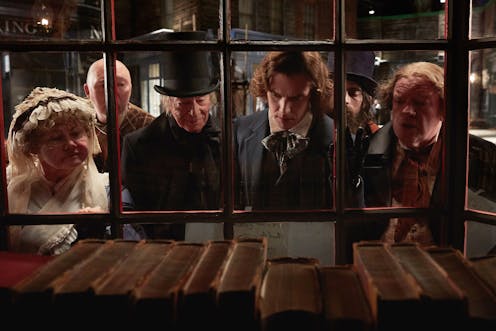
Everyone knows the story of Scrooge, a man so miserly his name has become synonymous with penny-pinching meanness. Scrooge’s conversion from miser to benefactor has been told and retold since Charles Dickens first wrote A Christmas Carol in the fall and winter of 1843. Ebenezer is a wonderful character, so richly portrayed and fascinating he’s echoed in stories from The Grinch to It’s a Wonderful Life.
Pop culture has embraced both Dickens and his tale. With this season’s The Man Who Invented Christmas, Hollywood has done it again.
But who was Scrooge before he was, well, Christopher Plummer? The inspiration for the crotchety Christmas-hater may have been those who put Dickens’ own father into debtor’s prison and were responsible for young Charles working in a shoe-blacking factory.
Some Dickens scholars believe the author’s 1843 visit to sooty Manchester, or to “the black streets of London,” (as he described them in a letter to a friend) influenced him. It may be that the fable was a moral reminder from Dickens to himself, as he teetered on financial ruin. This is the theory proposed in the book by Les Standiford on which this year’s movie is based.
Did Dickens in fact invent Christmas, as we know it? Hollywood may think so, but others, like David Parker in his Christmas and Charles Dickens vehemently disagree.
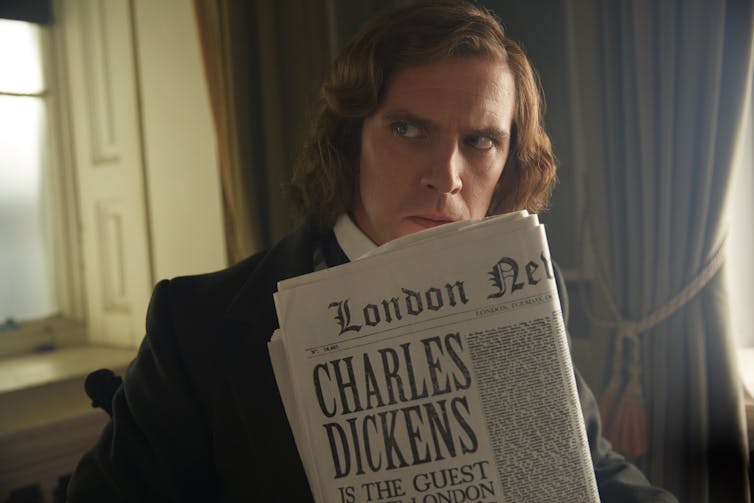
Whatever your opinion, the prevailing wisdom is that A Christmas Carol isn’t particularly religious. As a professor of biblical studies at Concordia University and also a Lutheran minister, I have a different reading.
It’s true that the celebration of the season which Scrooge discovers has much more to do with generosity, family gatherings and large cooked birds, than the Nativity. But maybe those seeking explicit scriptural references in Dickens’ story are underestimating the Victorian novelist’s skill — and his audacity. Perhaps A Christmas Carol contains an alternative to the Bible rather than a simple borrowing from it. And perhaps that’s the point.
Jesus was a master story-teller
Jesus, by all accounts another master story-teller, told a parable that, stripped of Dickens’ English waistcoats, ledgers, fog and shutters, could almost be a mirror to A Christmas Carol:
“There once was a rich man. A poor man named Lazarus lived at his gate, with nothing to eat. Lazarus died and was carried by the angels to Abraham’s side. The rich man also died.”
There follows, in Jesus’ tale, an exchange between the rich man, who is in torment, and Abraham, who acts as the guardian of paradise. It’s hard not to think of the innocent Lazarus as a precursor to Tiny Tim.
First the rich man asks for his own relief from hell. When that’s denied, he pleads: “I beg you, send Lazarus to my father’s house. I have five brothers. Let him warn them so they don’t come to this place of agony.” Abraham replies: “They have Moses and the prophets. They must listen to them.”
“No, Father Abraham!” cries the rich man, “But if someone from the dead goes to them, they will change” (Luke 16:19-31).
One can almost hear the chains of Morley’s ghost rattling. What would have happened if Father Abraham had said yes? Something very like a first-century version of A Christmas Carol.
Let’s not forget that the people of our western English-speaking past, especially artists and writers, were imbued with Biblical references and ideas. As Northrop Frye, among others, has argued, they lived and created in a world shaped by the rhythms, narratives, images and conceptions (or misconceptions) of the King James Bible.
Was Dickens familiar with Christian scriptures? All evidence points to the fact that he was more acquainted than most. Despite an antipathy to organized religion, from 1846 to 1849 Dickens wrote a short biography of Jesus for his children, titled The Life of our Lord.
He forbade that his small retelling of Jesus’ life should be published, until not only he, but also his children, had died. The “Parable of Lazarus and the Rich Man” was one of eight stories of Jesus that Dickens chose to include in that volume. But in his story of Scrooge, Dickens was too much of a writer to leave Jesus’ parable as is, and his age too suspicious of scripture to leave it “unbroken.”
A Christmas Carol unites the deliciously horrific sensibility of the Gothic movement with the powerfully simple narrative style, joined to moral concern, typical of parables.
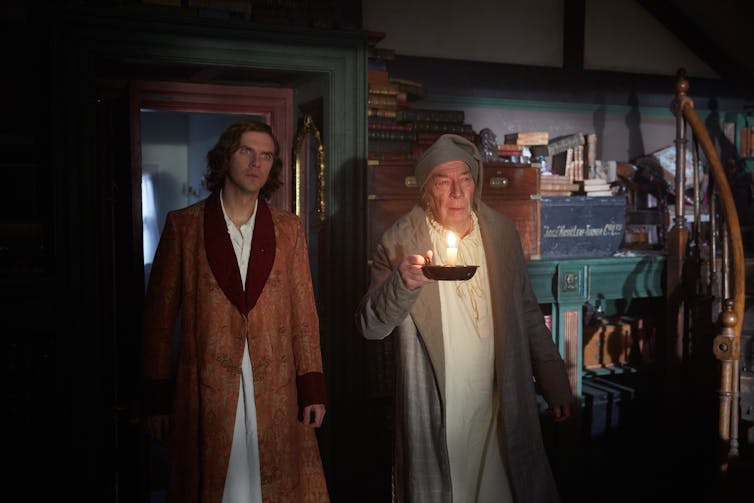
Was Dickens perhaps dozing off some Sunday while the rector droned on about Lazarus, until he wakened with a start dreaming of Scrooge? We will never know. But it’s an intriguing possibility.
Happy endings for the rich
Surprisingly, the Sunday after Dickens was buried in Westminster Abbey, Dean Arthur Penrhyn Stanley, preaching on exactly this text, spoke of Dickens as the “parabler” of his age. Stanley said that “By [Dickens] that veil was rent asunder which parts the various classes of society. Through his genius the rich man…was made to see and feel the presence of Lazarus at his gate.”
I would go further: Dickens took the parable, and then retold and changed it, so that the rich man gets a second chance. As a privileged societal figure who had gone through financial difficulties and who cared about the poor himself, Dickens freely adapted Jesus to come up with a story that’s ultimately more about love than judgement.
When confronted with Marley’s spectre, Scrooge, unnerved but unrepentant, addresses the apparition: “You may be an undigested bit of beef, a blot of mustard, a crumb of cheese, a fragment of underdone potato.”
The perceptive reader (or viewer) of A Christmas Carol can point a finger at Marley’s ghost and add: “Or maybe you’re an ironic but hope-filled riff on Jesus, by a famous nineteenth-century author who wanted to write his own story of redemption.”
Dickens not only invented this Christmas genre, but imagined a happy ending for himself in it. He penned an enduring story about the second chance even a rich person can receive, if haunted by persistent-enough ghosts.

Matthew Robert Anderson does not work for, consult, own shares in or receive funding from any company or organization that would benefit from this article, and has disclosed no relevant affiliations beyond their academic appointment.
Why Trump's evangelical supporters welcome his move on Jerusalem

President Trump’s announcement on Wednesday, Dec. 6 that the U.S. would recognize Jerusalem as the capital of Israel received widespread criticism. Observers quickly recognized the decision as related not so much to national security concerns as to domestic U.S. politics and promises candidate Trump made to his evangelical supporters, who welcomed the announcement..
Historian Diana Butler Bass posted on Twitter:
“Of all the possible theological dog-whistles to his evangelical base, this is the biggest. Trump is reminding them that he is carrying out God’s will to these Last Days.”
It is true that evangelicals have often noted that their support for Trump is based in their conviction that God can use the unlikeliest of men to enact his will. But how did conservative American Christians become invested in such a fine point of Middle East policy as whether the U.S. Embassy is in Tel Aviv or Jerusalem?
For many of President Trump’s evangelical supporters this is a key step in the progression of events leading to the second coming of Jesus. There’s an interesting story as to how that came to be.
Ushering in the kingdom of God
The nation of Israel and the role of the city of Jerusalem are central in the “end-times” theology – a form of what is known as “pre-millennialism” – embraced by many American conservative Protestants.

While this theology is often thought of as a “literal” reading of the Bible, it’s actually a reasonably new interpretation that dates to the 19th century and relates to the work of Bible teacher John Nelson Darby.
According to Darby, for this to happen the Jewish people must have control of Jerusalem and build a third Jewish temple on the site where the first and second temples – destroyed centuries ago by the Babylonians and Romans – once were. In Darby’s view this was a necessary precursor to the rapture, when believers would be “taken up” by Christ to escape the worst of the seven-year-period of suffering and turmoil on Earth: the Great Tribulation. This is to be followed by the cosmic battle between good and evil called Armageddon at which Satan will be defeated and Christ will establish his earthly kingdom. All of this became eminently more possible when the modern state of Israel was established in the 1940s.
But to understand the power of this way of looking at the world, it is necessary to do more than point to theological tenets. It is their dissemination through culture that determines which thought systems take hold and which ones are lost to history.
As author of “Building God’s Kingdom,” I focus on various aspects of conservative American Protestantism in American culture and politics. In my research I have seen how some thought systems get lost in history and others take hold.
Here is what happened with the end-time narrative that made it a core undercurrent to how these Christians look at the world and history.
The origins of this narrative
The end-times framework was popularized in the 1970s with an inexpensive and widely available paperback by evangelist and Christian writer Hal Lindsey called “The Late Great Planet Earth.” Lindsey argued that the establishment of the state of Israel in the 1940s set up a chain of events that would lead to Jesus’s return.

He calculated a date for that return in the 1980s. Lindsey, like many end-times prognosticators before him, argued that he lived in the “first time in history” when the biblical prophecies could possibly be fulfilled. This, he thought, was due in large part to the reestablishment of Israel.
Despite his claim to be reading the Bible literally, Lindsey’s interpretation was far from literal. He said, for example, that the locusts predicted in the one of the plagues in the book of Revelation were “really” helicopters.
As adults were reading Lindsey’s book, a generation of young people watched an “evangelistic” film, “A Thief in the Night,” in church services and youth group meetings.
Beginning with an ominous ticking clock, the film begins at the rapture. It shows how all the faithful Christians suddenly disappeared. For those who remained, there was one more chance to accept the Gospel but that chance required living through extreme persecution.
The film scared young people into conversion by depicting the experiences of these young Christians who were suffering because they had arrogantly dismissed warnings from their friends, families and churches to repent and had missed the rapture.
According to scholar Amy Frykholm, an estimated 50 million to 300 million people viewed “A Thief in the Night.”
The end-times and the culture wars
The use of popular media to spread a terrifying vision of the end of history to draw young people into repentance continued in the 1980s with the apocalyptic novels of Frank Peretti. The Peretti novels depicted a vibrant and active spiritual world in which cosmic forces of good and evil were vying for supremacy all around us.
As the book presented it, every person is obliged to play a part for one side or the other in very literal ways. This applies to all people: “True Christians” were meant to fight on God’s side, and the rest on the side of Satan. The first of these was called “This Present Darkness.”
Though clearly recognized as fictional, these books were also perceived as “real.” For example, while the seat of the diabolical scheming was the fictional local college and the chief antagonist was a fictional professor, it wasn’t lost on readers that they were to perceive colleges and professors as likely enemies.
The depiction of literal “good guys” and “bad guys” as regular people aligned with God and Satan, respectively, played into the increasingly divisive culture war battles of the time. These books were powerful and effective until a decade later when they were replaced in popular Christian culture by the “Left Behind” series, co-authored by culture warrior Tim LaHaye.
These 16 books and four films, released over the course of a decade, also trace the lives of the latecoming believers who had missed the rapture and were now part of the “Tribulation Force,” as they endured the post rapture world and sought to remain faithful despite persecution. The series’ successes included a New York Times best-seller, while seven others set sales records. The entire series sold more than 65 million copies.

It’s impossible to overemphasize the effects of this framework on those within the circles of evangelicalism where it is popular. A growing number of young people who have left evangelicalism point to end-times theology as a key component of the subculture they left. They call themselves “exvangelicals” and label teachings like this as abusive.
It’s hard to get away from the invocation of mythic narratives in American politics. They get used often and are invented and reinvented to be deployed at different times in history. While supporters and opponents of the Trump announcement agree that the results might be cataclysmic, some of the supporters are happy. That is because they are reading it through a lens that promises the return of Jesus and the establishment of God’s kingdom.
Editor’s note: in a previous version of this article the date of President Trump’s announcement about moving the US embassy to Jerusalem was incorrect. It has been corrected to Dec. 6.

Julie Ingersoll does not work for, consult, own shares in or receive funding from any company or organization that would benefit from this article, and has disclosed no relevant affiliations beyond their academic appointment.
A glass of whisky could help you get your head around deep time

The Scottish geologist James Hutton made a proposal in 1788 that, at the time, was extraordinarily controversial. He described Earth as a “beautiful machine”, constantly subjected to long-term decay and regeneration, that could only be understood over many millions of years. This may not sound that contentious, but the challenge this posed to humanity’s sense of time was substantial. Popular contemporary estimates of Earth’s age, such as Bishop Ussher’s calculation that it was created in 4,004 BC, were dwarfed by the magnitude of what Hutton described.
Today, we are more familiar with the enormity of the Earth’s age in contrast with our diminutive timespans. In 1981, John McPhee coined the term “deep time”, highlighting the apparent insignificance of the span of human existence in the face of geological processes. Yet such scale is inherently difficult to conceive of. And so as societies face changing environments, with challenges of energy and food security, the short-term perspective is often politically and economically dominant.
But this way of thinking is high risk. If we are to adequately respond and adapt to landscape change, we need think about time differently, take a more holistic view. As such, over the last year we have been exploring different ways in which we might understand how humans think about deep time, and how it shapes our behaviours.
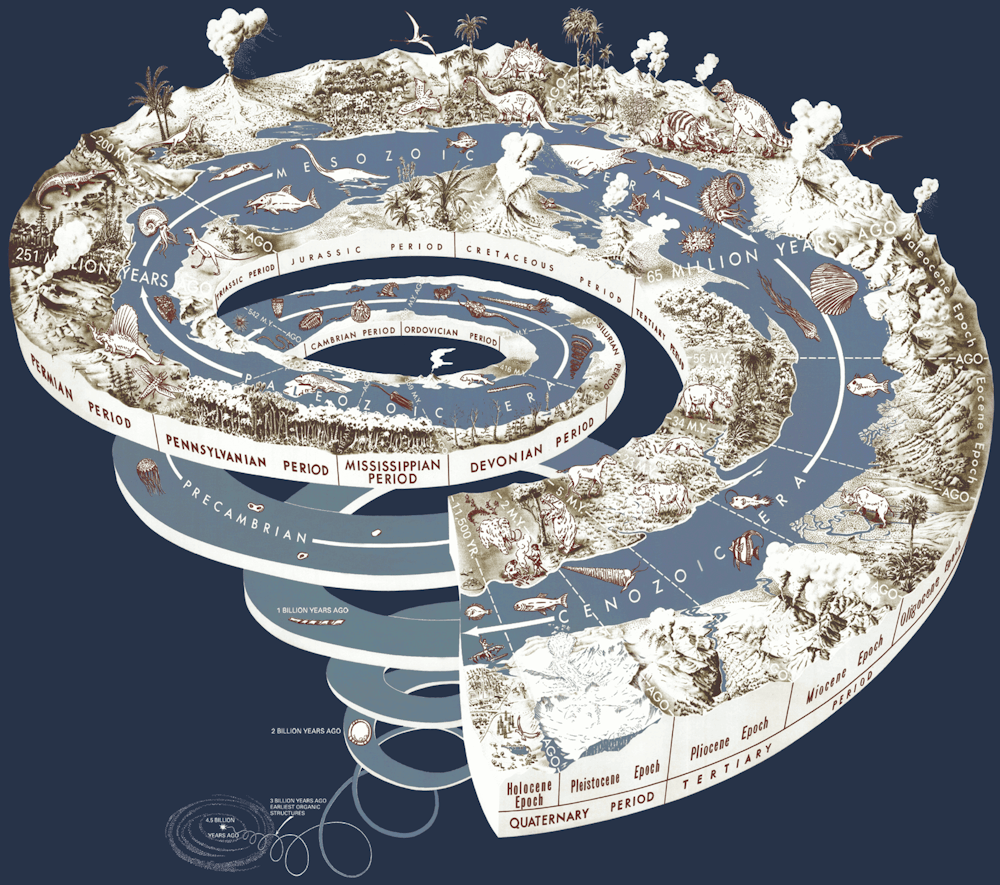
We started by zoning in on the everyday. Deep time, for all its vastness, becomes intimate when we trace it in things that are familiar to us. In a recent article in The Atlantic, David Farrier explains that deep time is “not an abstract, distant prospect, but a spectral presence in the everyday”. It is also in the everyday that we increasingly see our human role in shaping deep time. The Anthropocene era is characterised by the marks that we leave in the geological record.
Deep time is therefore visible in our daily lives, and if we look closely enough we can understand time through the material presence of objects.
Deep whisky
Take a glass of whisky. The processes that have led to the enjoyment of a dram by no means begin with the opening of a distillery. Geological processes occurring over millions of years all contribute towards its particular taste. Our project, conducted by a team consisting of an anthropologist, a geologist, a literary scholar, a palaeoecologist, and a radiocarbon dating expert, was carried out in Orkney, and so for the whisky element of our work we focused on the well-respected Highland Park distillery. Beyond colour, viscosity, aroma, and taste, we wanted to experience and apprehend how long processes of time, far beyond our lifespans, contributed to the amber liquid.
Whisky requires key ingredients: barley, yeast, water, a fuel source (in this case peat), oak wood barrels (often seasoned through years holding Oloroso sherry), and copper crafted pot stills. Water is added to the mix after the barley has been malted and ground down into “grist” to prepare the spirit.
Because so much water is needed, streams percolating through millions of years of rock supply most distilleries. And the chemistry of this water impacts the final taste. Orkney has unusually hard water, drawn through calcareous Old Red Sandstone deposited 359–416m years ago. The malting process also affects the taste. Highland Park, for example, is famous for its floral peaty flavour that derives largely from the peat smoke used in this process. Peat is the slow accumulation of partially decomposed organic matter building up under wet conditions over thousands of years.

Peat through time
The fuel used will connect us with cultural as well as geological history, if looked for. Orkney, for example, has a rich history of cutting peat, a process referred to in the 12th century Norse Orkneyinga Saga but believed to have been started long before then. While few in Orkney cut their own peat today, some still employ their tools and inherited knowledge to get fuel for the cold times.
Local poets such as George Mackay Brown and Margaret Tait captured the communal practice of peat cutting. Mackay Brown depicts men, women and children out on the hill, “small blades glitter[ing]” at dawn as they release the wealth of the peat through a ritualistic exchange of labour. For both poets, peat is also a point of origin, its wet blackness recalling its own beginnings in the fiery “chaos” of the Earth’s centre; the vast temporal and spatial depth of our planet’s core opened up to the human imagination through the everyday presence of the peat.
The characteristics of peatlands also make them excellent archives of environmental change, like a book that can be read through time. Peat exhibits a coherent stratigraphy that captures past landscapes and how humans interacted with and transformed them. Michelle Farrell, for example, has analysed pollen trapped in different peat layers from a 7,000-year-old core sample from Hobbister Moor, the peat used by Highland Park. These microfossils enabled the reconstruction of the environments people inhabited since the Mesolithic, explaining how woodlands retracted owing to climate changes and human impacts, as well as the spread of the characteristic heathland that dominates Orkney today.

The reconstruction of trends that work at time scales beyond our human experience as well as unravelling human-environment interactions are the treasures that a deep time approach gives us.
Past, present, future
Digging into the peat, we also look to the future: is it really sustainable for humans to consume resources thousands of years in the making? The depletion of peat impacts upon unique habitats, highlighting the mismatch between human consumption in the short term and the long-term processes that generate the resources we depend on. Peat can be used in a relatively sustainable manner through careful management and by experimenting to establish the best conditions for peat regrowth. Yet the sustainability of peat extraction remains an open question: as the ecologist Kimmo Tolonen has argued:
Peat belongs to the renewable resources only in the geological timescale.
Thinking about an everyday object in such an interdisciplinary way allowed us to engage with deep time through a seemingly everyday glass of whisky. Appreciating the deep geological timescales that shape rock, water, and the taste of the whisky gave rise to stories about the generations who have worked the peat; the creative poetics and histories of peat; and the environmental and geographical histories revealed by looking at peat under the microscope.
Deep time’s vastness can seem out of scale with human life. Yet thinking through materials and different kinds of knowledge and local expertise, we see how it protrudes into the everyday. Thought of like this, any object might serve as a lens through which to see deep time’s vivid presence today.

Carina Fearnley receives funding from the Arts and Humanities Research Council through the project "Orkney: Beside the Ocean of Time".
Lourdes López-Merino receives funding from the Arts and Humanities Research Council through the project "Orkney: Beside the Ocean of Time”.
Niamh Downing has received funding from the Arts and Humanities Research Council, the Department for Business Innovation and Skills, and the European Social Fund. Orkney: Beside the Ocean of Time is an AHRC funded research project, with partnership from The Pier Arts Centre in Stromness.
Richard Irvine has received funding from the Arts and Humanities Research Council through the projects "Pathways to understanding the changing climate" and "Orkney: Beside the Ocean of Time".
Keep the pressure on Congress to protect net neutrality
 Nearly 9,000 advocates have raised a library voice in favor of net neutrality over the past week, adding significantly to the outcry over the FCC’s draconian draft order rescinding 2015 protections. According to our action center dashboard, 27,319 emails have been sent and, thanks to you, every member of Congress has received at least one email from us. If you haven’t had a moment to write or call your member of Congress, it’s not too late. Go here.
In fact, some members have already spoken out in favor of preserving net neutrality. Maine Senator Susan Collins was the first Republican to oppose the draft order and has been joined by a few other Republicans and many Democrats. If you’re not sure where your member of Congress stands, you can check out the scorecard from our friends at Fight for the Future.
We also are working with other net neutrality allies to focus attention on Energy and Commerce Committee members, who most directly oversee the FCC. The ALA has signed on to this letter. Your institution can join, as well, via this form. The deadline to sign on is Friday, December 8 at 12 p.m. EST.
We’ve seen great activity and received some good questions from you. The most frequent question is why we aren’t targeting grassroots action toward the FCC commissioners who have the most direct power over whether or not these draft rules will be adopted. The FCC was our first stop for activism, with ALA comments joining millions of others from librarians and other advocates. The majority of comments filed before the end of the public comment period that makes up the foundation for rulemaking favored preserving enforceable network neutrality rules. The draft order dismissed these arguments in favor of other legal and economic readings of the issue. The draft order already has been supported by a majority of Commissioners, so it is almost certain to pass unless there is a meaningful intervention.
One possibility is a legal argument to the FCC, which the ALA has supported in a joint letter. Since the FCC order abdicates enforcement to the Federal Trade Commission, this argument is new and highly relevant. Concerns about the integrity of the FCC’s public record for this rulemaking also are significant. But even these concerns may not move a highly partisan FCC. Congressional outcry is the most likely to bring a pause on the intended vote.
Please keep up the pressure and continue to share your questions and ideas for activism. We’ll be back with more news and action items next week.
The post Keep the pressure on Congress to protect net neutrality appeared first on District Dispatch.
Who posted all those articles to ResearchGate anyway?
You may have heard about recent legal action against ResearchGate brought by several large academic publishers organized under name of the “Coalition for Responsible Sharing” (Elsevier, Wiley, Wolters Kluwer, Brill, and ACS). Some of its members filed a lawsuit against ResearchGate and sent ResearchGate copyright takedown notices for many articles posted there. There are some good summaries of the dispute already, including this one by Mike Wolfe at UC Davis and this one on Science Magazine Online.
The dispute is about the millions of copyrighted articles–the Coalition claims there are 7 million–made freely available through ResearchGate. The Coalition publishers, whose business model depends on charging for access to those articles, don’t like that users can get them for free. It’s a familiar dispute, and one that publishers have fought over the years, although on a much smaller scale, with Academia.edu, as well as a variety of universities repositories.
A natural inclination toward open access
So, who posted all those articles to ResearchGate? As far as I can tell, every article shared through ResearchGate was put there by one of its authors. I’m not sure of all of the reasons why authors use ResearchGate, but I believe a major one is that those authors want their work to be as easy to find and read as possible.
I also believe, based on experience working with academic authors on their publishing contracts, that many authors aren’t aware of the details of how their publishing contracts allow them to share their work. They aren’t lawyers, but they shouldn’t have to be.
For most of the ResearchGate articles, I have every reason to think that the publishers are correct in their assertion of legal authority, based on publishing contracts, to remove those articles. Authors often sign publishing contracts that transfer almost all of their rights to publishers. Some agreements grant rights back to authors for some “scholarly sharing”, but the contract terms are often so incomprehensible and limited that they are effectively meaningless to many authors. Some try to figure it out (do a Google search for “Is it legal to post articles to ResearchGate?” and you’ll find lots of advice of varying quality), but it’s far from clear. So instead, many authors opt to follow their natural inclination—despite the risks—to take what steps they can to make their work easier to find, read, and perhaps be cited.
OA the “right” way versus “wrong” way
Scholarly publishing has long struggled with authors who don’t especially respect or even understand the dominant pay-for-access business model. Judging by the 7 million articles authors have shared through ResearchGate, many authors seem to view that model with something from outright contempt to self-interested indifference.
So what are publishers to do with these authors who make their work freely available the “wrong” way? If enough people do it, it may have a serious effect on journal subscriptions. But authors are in a pretty good position; if publishers start actively enforcing copyright law against authors we may react negatively (and possibly very publicly) against not just the particular enforcement action but against the underlying business model. See, e.g., The Cost of Knowledge. So instead, we now see a stream of copyright enforcement not against authors but against the intermediaries that authors use to share their work: ResearchGate, Academia.edu, and university institutional repositories. It puts those organizations in a tough position, but ultimately, the harm is to authors who want to share their work.
As many people have stated before, the goals of open access can best be achieved if authors—who have great power as the initial owners of copyright in their works—hold on to their rights and negotiate their publishing contracts for terms that allow them to widely distribute online. For that matter, authors who want to share their work as openly as they can would do well to use alternatives besides posting to proprietary commercial sites like ResearchGate. But right now, that ideal of broad OA the “right” way seems far off.
Open in order to be read
We’re at the end of Open Access week, as you may have noticed by the encouraging number of OA events over the last few days. This year’s OA Week theme is “Open in order to…” I find one of the simplest but most powerful “open in order to…” statements is “open in order to be read.” To me, a silver lining of the ResearchGate takedowns (among other similar recent actions) is that it signals meaningful, author-created, system-wide pressure against a business model that hinders readership, rather than enhances it. The method and platform demonstrating that pressure isn’t ideal, the legality is questionable, and the result for some organizations (and potentially authors) may be painful. But it’s clear that author-initiated sharing, viewed collectively, is seen as a real threat to that business model. I’m hopeful that means we’re just a little bit closer to seeing that model fade out of dominance and yield to one that emphasizes access and readership.
As for authors today, we can protect ourselves from the risk of takedown notices by retaining our rights. Publishing contracts are not written in stone; they’re negotiable. Increasingly, we can negotiate to keep the rights we need to post our works anywhere we want to be read. For anyone interested, here are some tools for doing this the right way:
- SPARC Author Addendum for publishing contracts
- SHERPA/RoMEO database of publishing self-archiving policies
- Authors Alliance tools to regain your rights for works already transferred to a publisher (for OA or for other types of distribution on your own terms) through Rights Reversion or Termination of Transfer
The post Who posted all those articles to ResearchGate anyway? appeared first on Scholarly Communications @ Duke.
If Any Profession is Known For Its Sense of Humor, Its Librarians.
Check out this group of New Zealand librarians as reported in the Daily Mail UK . They are posing in imitation of the famous portrait of the Kardashians.

President Trump's national monument rollback is illegal and likely to be reversed in court

On Dec. 4, President Trump traveled to Utah to sign proclamations downsizing Bears Ears National Monument by 85 percent and Grand Staircase-Escalante National Monument by nearly 50 percent. “[S]ome people think that the natural resources of Utah should be controlled by a small handful of very distant bureaucrats located in Washington,” Trump said. “And guess what? They’re wrong.”
Native American tribes and environmental organizations have already filed lawsuits challenging Trump’s action. In our analysis as environmental and natural resources law scholars, the president’s action is illegal and will likely be overturned in court.
Contests over land use
Since 1906 the Antiquities Act has given presidents the authority to set aside federal lands in order to protect “historic landmarks, historic and prehistoric structures, and other objects of historic or scientific interest.”
When a president creates a national monument, the area is “reserved” for the protection of sites and objects there, and may also be “withdrawn,” or exempted, from laws that would allow for mining, logging or oil and gas development. Frequently, monument designations grandfather in existing uses of the land, but prohibit new activities such as mineral leases or mining claims.
Because monument designations reorient land use away from resource extraction and toward conservation, some monuments have faced opposition from local officials and members of Congress. In the past two decades, Utah has been a flashpoint for this debate.
In 1996 President Clinton designated the Grand Staircase-Escalante National Monument, a region of incredible slot canyons and remote plateaus. Twenty years later, President Obama designated Bears Ears National Monument, an area of scenic rock formations and sites sacred to Native American tribes.
Utah’s governor and congressional delegation have long argued that these monuments are larger than necessary and that presidents should defer to the state about whether to use the Antiquities Act.
Zinke’s review
In April President Trump ordered a review of national monuments designated in the past two decades. Trump directed Interior Secretary Ryan Zinke to recommend steps to eliminate or shrink these monuments or realign their management with Trump administration priorities.
Secretary Zinke’s review was an arbitrary and opaque process. During a rushed four-month period, Zinke visited only eight of the 27 monuments under review. At the end of the review, the Interior Department released to the public only a two-page summary of Zinke’s report.

In September the Washington Post published a leaked copy of Zinke’s detailed recommendations. They included downsizing, changing management plans or loosening restrictions at a total of 10 monuments, including three ocean monuments.
Trump’s proclamations
Trump’s proclamations on Bears Ears and Grand Staircase-Escalante note the long list of objects that the monuments were created to protect, but claim that many of these objects are “not unique,” “not of significant scientific or historic interest,” or “not under threat of damage or destruction.”
As a result, Trump’s orders split each monument into smaller units, excluding large tracts that are deemed “unnecessary.” Areas cut from the monuments, including coal-rich portions of the Kaiparowits Plateau, will be reopened to mineral leasing, mining and other uses.
In our view, Trump’s justification for these changes mischaracterizes the law and the history of national monument designations.
What the law says
The key question at issue is whether the Antiquities Act empowers presidents to alter or revoke decisions by past administrations. The Property Clause of the Constitution gives Congress the power to decide what happens on “territory or other property belonging to the United States.” When Congress passed the Antiquities Act, it delegated a portion of that authority to the president so that administrations could act quickly to protect resources or sites that are threatened.
Critics of recent national monuments argue that if a president can create a national monument, the next one can undo it. However, the Antiquities Act speaks only of designating monuments. It says nothing about abolishing or shrinking them.
Two other early land management statutes – the Pickett Act of 1910 and the Forest Service Organic Act of 1897 – authorized the president to withdraw other types of land, and specifically stated that the president could modify or revoke those actions. In contrast, the Antiquities Act is silent on reversing past decisions.

In 1938, when President Franklin D. Roosevelt considered abolishing the Castle-Pinckney National Monument – a deteriorating fort in Charleston, South Carolina – Attorney General Homer Cummings advised that the president did not have the power to take this step. (Congress abolished the monument in 1951.)
Congress enacted a major overhaul of public lands law in 1976, the Federal Land Policy and Management Act, repealing many earlier laws. However, it did not repeal the Antiquities Act. The House Committee that drafted the 1976 law also made clear in legislative reports that it intended to prohibit the president from modifying or abolishing a national monument, stating that the law would “specifically reserve to the Congress the authority to modify and revoke withdrawals for national monuments created under the Antiquities Act.”
Since that time, no president until Trump has attempted to revoke or downsize any national monument. Trump’s changes to Bears Ears and Grand Staircase-Escalante depend on an argument that presidential declarations about what a national monument protects are subject to second-guessing by subsequent presidents. These claims run counter to every court decision that has examined the Antiquities Act.
Courts have always been deferential to presidents’ use of the law, and no court has ever struck down a monument based on its size or the types of objects it is designed to protect. Congress, rather than the President, has the authority to alter monuments, should it decide that changes are appropriate.
The value of preservation
This summer 118 other law professors, as well as California Attorney General Xavier Becerra and a number of conservation organizations, cited our analysis in letters to Secretary Zinke concluding that the president does not have authority to downsize or revoke national monuments.
Although many national monuments faced vociferous local opposition when they were declared, including Jackson Hole National Monument (now part of Grand Teton National Park), over time, Americans have come to appreciate them.
Indeed, Congress has converted many into national parks, including Acadia, the Grand Canyon, Arches and Joshua Tree. These four parks alone attracted over 13 million visitors in 2016. The aesthetic, cultural, scientific, spiritual and economic value of preserving them has long exceeded whatever short-term benefit could have been derived without legal protection.
Bears Ears and Grand Staircase-Escalante are home to many natural and archaeological wonders, including scenic bluffs, petroglyphs, burial grounds and other sacred sites and a rich diversity of plant and animal life. The five Native American tribes that supported protecting Bears Ears, led by the Navajo Nation, have vowed to defend the monuments in court. President Trump’s effort to scale back these monuments oversteps his authority and is unlikely to stand.
Editor’s note: This is an updated version of an article originally published on April 27, 2017.

Eric Biber was an associate attorney with Earthjustice from 2003-2006, where he worked on litigation relating to the Grand Staircase-Escalante National Monument.
Mark Squillace served as Special Assistant to the Solicitor at the U.S. Department of the Interior in the year 2000.
Nicholas Bryner and Sean B. Hecht do not work for, consult, own shares in or receive funding from any company or organization that would benefit from this article, and has disclosed no relevant affiliations beyond their academic appointment.
Social networking sites may be controlling your mind – here's how to take charge

How can you live the life you want to, avoiding the distractions and manipulations of others? To do so, you need to know how you work. “Know thyself”, the Ancients urged. Sadly, we are often bad at this.
But by contrast, others know us increasingly well. Our intelligence, sexual orientation – and much more – can be computed from our Facebook likes. Machines, using data from our digital footprint, are better judges of our personality than our friends and family. Soon, artificial intelligence, using our social network data, will know even more. The 21st-century challenge will be how to live when others know us better than we know ourselves.
But how free are we today? There are industries dedicated to capturing and selling our attention – and the best bait is social networking. Facebook, Instagram and Twitter have drawn us closer round the campfire of our shared humanity. Yet, they come with costs, both personal and political. Users must decide if the benefits of these sites outweigh their costs.
This decision should be freely made. But can it be, if social networking sites are potentially addictive? The decision should also be informed. But can it be, if we don’t know what is happening behind the curtain?
Sean Parker, the first president of Facebook, recently discussed the thought process that went into building this social network. He described it as being:
All about how do we consume as much of your time and conscious attention as possible?
To do this, the user had to be given:
A little dopamine hit every once in a while because someone liked or commented on a photo or a post…and that’s going to get you to contribute more.
Parker continued:
It’s exactly the kind of thing that a hacker like myself would come up with because you’re exploiting a vulnerability in human psychology… The inventors, creators, it’s me, it’s Mark [Zuckerberg]… understood this consciously. And we did it anyway.
Human needs create human vulnerabilities
So what are these vulnerabilities? Humans have a fundamental need to belong and a fundamental desire for social status. As a result, our brains treat information about ourselves like a reward. When our behaviour is rewarded with things such as food or money, our brain’s “valuation system” activates. Much of this system is also activated when we encounter self-relevant information. Such information is hence given great weight. That’s why, if someone says your name, even across a noisy room, it automatically pops into your consciousness.
Information relating to our reputation and social rank is particularly important. We are wired to be sensitive to this. We understand social dominance at only 15 months of age.
Social networking sites grab us because they involve self-relevant information and bear on our social status and reputation. The greater your need to belong and be popular, and the stronger your brain’s reward centres respond to your reputation being enhanced, the more irresistible is the site’s siren song.
Is social media addictive?
Gambling is addictive because you don’t know how many bets you will have to make before you win. B F Skinner uncovered this in his Harvard pigeon lab in the 1950s. If pigeons were given food every time they pecked a button, they pecked a lot. If they were only sometimes given food when they pecked a button, they not only pecked much more, but did so in a frantic, compulsive manner.
It could be argued that Skinner’s pigeon lab was resurrected at Harvard in 2004, with two modifications. It was called Facebook. And it didn’t use pigeons.
When you check Facebook you can’t predict if someone will have left you self-relevant information or not. Social network sites are slot machines that pay out the gold of self-relevant information. This is why billions of people pull their levers. So, can they be addictive?
Facebook reportedly originally advertised itself as “the college addiction”. Today, some researchers claim Facebook addiction “has become a reality”. However, this is not a recognised psychiatric disorder and there are problems with the concept.
People undertake many activities on Facebook, from gaming to social networking. The term “Facebook addiction” hence lacks specificity. Also, as Facebook is just one of many networking sites, the term “social networking addiction” would seem more appropriate.
Yet, the term “addiction” itself remains potentially problematic. Addictions are typically thought of as chronic conditions that cause problems in your life. Yet, a 5-year follow-up study found that many excessive behaviours deemed to be addictions – such as exercising, sex, shopping and video gaming – were fairly temporary. Furthermore, excessive social network use need not cause problems for everyone. Indeed, labelling excessive involvement in an activity as an “addiction” could result in the overpathologisation of everyday behaviors. Context is key.
Nevertheless, excessive social network use has been convincingly argued to lead to symptoms associated with addiction. This includes becoming preoccupied with these sites, using them to modify your mood, needing to use them more and more to get the same effects, and suffering withdrawal effects when use is ceased that often cause you to start using again. The best estimate is that around 5% of adolescent users have significant levels of addiction-like symptoms.
Taking back control
How can we benefit from social networking sites without being consumed by them?Companies could redesign their sites to mitigate the risk of addiction. They could use opt-out default settings for features that encourage addiction and make it easier for people to self-regulate their usage. However, some claim that asking tech firms “to be less good at what they do feels like a ridiculous ask”. So government regulation may be needed, perhaps similar to that used with the tobacco industry.
Users could also consider whether personal reasons are making them vulnerable to problematic use. Factors that predict excessive use include an increased tendency to experience negative emotions, being unable to cope well with everyday problems, a need for self-promotion, loneliness and fear of missing out. These factors will, of course, not apply to everyone.
Finally, users could empower themselves. It is already possible to limit time on these sites using apps such as Freedom, Moment and StayFocusd. The majority of Facebook users have voluntarily taken a break from Facebook, though this can be hard.
“I am the master of my fate, I am the captain of my soul,” run the famous lines from Invictus. Sadly, future generations may find them incomprehensible.

Simon McCarthy-Jones receives funding from the Brain & Behavior Research Foundation.
The new tax bill will make Americans less healthy – and that's bad for the economy
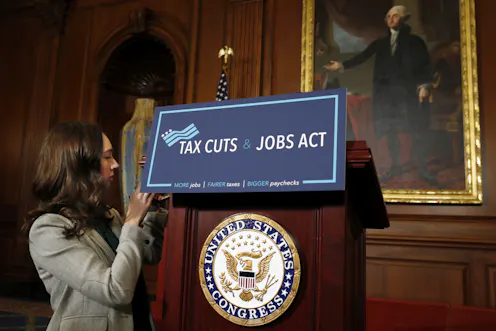
The new tax bill, passed by the Senate early Saturday, is not just about taxes. It has significant consequences for the American health care system – especially for the most vulnerable of our citizens.
If the proposed tax bill comes to fruition, it will reduce the affordability of health care for many Americans. Without access to care, our sickest and most vulnerable – especially the the poor and elderly – will suffer an increasing chance of poorer health outcomes.
What’s more, the bill’s long-term outcomes will be bad for our economy, resulting in lost productivity, lost wages and increased health care costs. If Americans become less healthy and have less access to health care, then everyone loses.
This bill puts much of the health system reforms under the Obama administration in jeopardy. For example, the Senate tax plan includes a repeal of an important part of the Affordable Care Act, the individual mandate. This provision requires that most Americans buy health insurance, or pay a penalty.
Many health care experts see the mandate as the only way to bring healthy people into the insurance marketplaces. Gutting the mandate would result in 13 million more uninsured Americans over the next 10 years.
Additionally, the Senate bill is expected to trigger a US$25 billion annual cut to Medicare, including cuts to cancer care for older Americans covered by Medicare. The House plan also eliminates medical expense deductions, implying that catastrophic expenses will not be as deductible under the new tax proposal.
Many economists believe that the American population has a right to be healthy and productive. This has major implications for the income generated for society. A healthier population has a greater investment in human capital and is more productive in the workforce, yielding greater output and income.
By the same token, a less healthy workforce will work less and be less valuable in the labor market. Health care costs will also increase due to uncompensated care, as more of the population cannot afford basic health care services to prevent disease – let alone chronic or critical care.
Lack of access to care also lowers the productivity of lower income citizens. If health insurance is less affordable and available, then those already at risk for illness will become even more vulnerable. This segment of the population will be likelier to fall ill and lose work time.
Is the right to health only relevant for those with influence or affluence in the U.S.? If so, then we all will pay for the poorer health of our society in the long term. Hospitals and other providers will pass along bad debt and costs associated with charity care for uninsured people. Insurance companies will charge higher premiums to cover the expenses they incur for treating patients who skip preventive care and instead go to the doctor only when they are sick.
As the most vulnerable Americans rack up increasing medical expenses and decline in productivity due to sickness, everyone in the U.S. will have to pay the price.

Diane Dewar does not work for, consult, own shares in or receive funding from any company or organization that would benefit from this article, and has disclosed no relevant affiliations beyond their academic appointment.
The horror and pleasure of misused words: from mispronunciation to malapropisms

American film director Judd Apatow once confessed to Stephen Colbert that he’d been mispronouncing his wife Leslie Mann’s name for nearly two decades. He’d been saying “Lez-lee”, while she pronounces it as “Less-lee”. When he asked her why she hadn’t corrected his mistake, she said she “thought he wouldn’t be able to make the adjustment”. Barbra Streisand, unlike Mann, is reportedly insistent that her name be pronounced correctly by everyone, even Apple’s voice assistant Siri.
In Australia, mispronunciation is often said as “mispronounciation”. Although it is a noun, there’s no “noun” in it. In 1987, Harold Scruby, who later functioned as Deputy Mayor of the Mosman City Council, published a quirky compendium of instances of mispronunciation by Australians. He labelled these “Waynespeak”. Prior to the publication of Scruby’s book, his friend Leo Schofield had run some of the expressions in his Sydney Morning Herald column and been drowned in “a Niagara of correspondence”.
Hordes of respondents regarded these expressions to be at least non-standard, or just plain wrong. Despite this, many of Scruby’s examples remain current today: “anythink” and its companions “everythink”, “nothink”, and “somethink”; “arks” (“ask”); “astericks” (“asterisk”); “bought” (“brought”); “could of” (“could’ve”); “deteriate” (“deteriorate”); “ecksetra” (“et cetera”); “expresso” (“espresso”); “haitch” (“aitch”); “hone in” (“home in”); and so on through to the end of the alphabet with “youse”.
For those of us who wince we hear “youse”, it might be a surprise to find the term in a dictionary. The Macquarie Dictionary feels compelled to explain that the dictionary is a complete record of Australian English. The criterion for inclusion in it is thus “evidence of currency in the language community”.
When I polled friends for their pet pronunciation peeves, many of them listed those in the Waynespeak collection, while others added examples that readers may cringe at: “cachay” (“cache”) and “orientate” (“orient”).
Further reading: Crimes of grammar and other writing misdemeanours
A favourite was “Moët” – often pronounced as “Mo-eee” or “Mo-way”. The name is of Dutch origin and is correctly pronounced as “Mo-wett”. Moët drinkers (and customers of Nike, Hermes, Givenchy, Porsche, Adidas, Yves St Laurent, and Saucony) who wish to check whether they have been pronouncing their luxury products correctly can click on this advice.

My pet pronunciation peeve is the mispronunciation of the word “the” in front of a word beginning with a vowel. Many people, and just about all newsreaders, pronounce it as a neutral “thuh” instead of sounding it out as “thee”, as in “tea”. It’s thee apple, not thuh apple.
Mixed meanings
Some of the suggestions that surfaced in my poll classify as a “malapropism” rather than as a mispronunciation. The term “malapropism” derives from the name of a character in Richard Brinsley Sheridan’s 1775 comedy of manners, The Rivals. Mrs Malaprop’s bungled attempts at erudite speech led her to declare one gentleman “the very pineapple of politeness!” and to say of another, “Illiterate him … from your memory”.
Writers of television scripts often create characters prone to malapropisms: Irene in Home and Away, Virginia Chance in Raising Hope, and Tony Soprano in The Sopranos. The Australian television characters Kath and Kim were notorious for their malapropisms, such as “I want to be effluent and practise serial monotony”.
Tony Abbott once embarrassingly substituted “suppository” for “repository”. In an article about the proposed airport at Badgerys Creek in Sydney, a reporter mentioned “a relatively modest and small group that would have some affectation”. Did the reporter mean “effect”?
The San Remo Hotel in San Francisco, meanwhile, highlights its “turn of the century decorum”. On the UK television show The Apprentice, one of the contestants talked about “appealing to the female genre”.
Other examples that I have noted include “What are you incinerating about me?”; “a Dorian of the theatre”; “a logo that amplifies modernism and professionalism”; “It’s not as if the English language is frozen in aspen” (though it’s pretty cold in Aspen); and “As we approach the footy finals, I can emphasise with the players”.
Justin Bieber once said: “I was detrimental to my own career”. I think we can guess that Justin meant “instrumental”, though he may have been just self-aware. We can also guess what the other malapropisms should have been (decor, gender, insinuating, doyen, exemplifies, aspic, empathise).
Note that there needs to be a tinge of humour for an expression or word to be labelled as a malapropism, and it needs to be a real word. Richard Lederer has a hugely amusing post on malapropisms on his Verbivore site, including this fine example: “If you wish to submit a recipe for publication in the cookbook, please include a short antidote concerning it”.
An extension of malapropism occurs in the malamanteau, which is a word that The Economist defines as an erroneous and unintentional portmanteau.
It was launched as a word on the xkcd comic strip and is apparently unpopular with the Wikipedia administration folks, who objected to the word having an entry on the site. The most quoted malamanteau is George W. Bush’s “I misunderestimated”. Others that have evoked smirks have been “miscommunicado” (from “miscommunicate” and “incommunicado”), “insinuendo” (from “innuendo” and “insinuation”), and “squirmish” (“squirm” and “skirmish”).
I recently heard a sparkling new malamanteau, “merticular”, used to describe a fussy person. It appears to combine “particular” and “meticulous”. When I questioned this and suggested that “meticulous” would do, the speaker said: “No. A merticular person functions at a higher level of "pickyness” than a “particular” person".
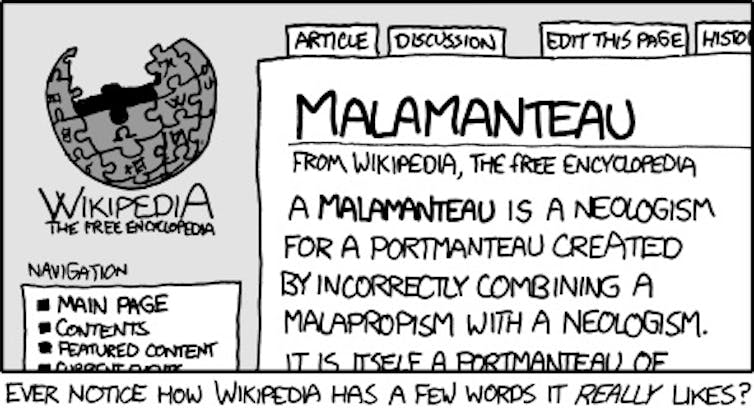
It’s over to you now: Are you merely “picky” or are you “merticular”?
Is it worthy of the moniker of malamanteau? If so, how would you spell it?

Roslyn Petelin does not work for, consult, own shares in or receive funding from any company or organisation that would benefit from this article, and has disclosed no relevant affiliations beyond their academic appointment.
Bucket list: I make a vintage costume jewelry Christmas tree — get my tips!
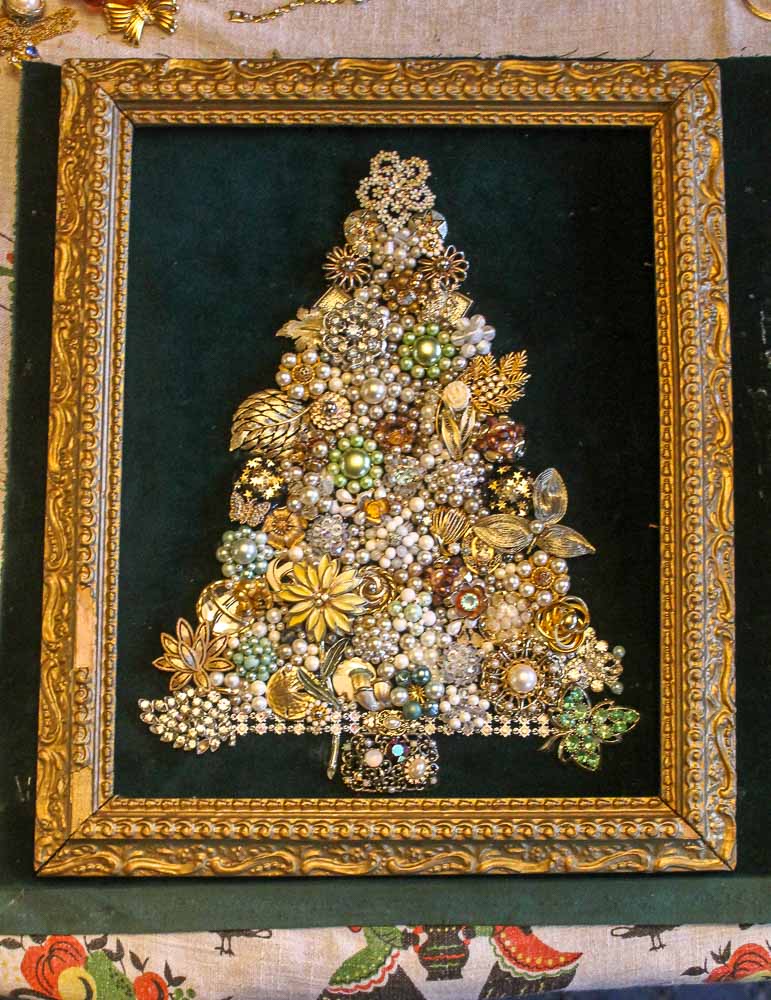 I’ve been collecting broken vintage costume jewelry for several years — with the goal to make a lifetime-achievement crafty: A costume jewelry Christmas tree. This weekend I gathered all my supplies, took over the dining room, and got down to gluing. This project was not easy — like making ornament wreaths, it’s another effort in juggling colors and shapes in three dimensions — made all the more stressful by the fact that it takes a lot more jewelry than you think. That said, I’m pretty darned happy with the result!
 Scene of the crime. Things to collect over time to make this project possible:
- Broken costume jewelry.
- Vintage picture frames.
- Vintage velvet.
 Artsy fartsy.
Voila! My weebit has a new mommy-heirloom!
My Tips:
- Start by reading my DIY story from earlier this year (it includes the glue I used): Making art from broken costume jewelry.
- Calipers are important to have on hand.
- Golly, you never knew how handy it would be to have so many old broken pearl necklaces in your stash. I find these at most every estate sale. Use the pearls — all sizes, all designs, all colors and sheens — to fill in the in-between spots.
- I thought about it first and decided I preferred to not have a “straight” edge to the right- and left-hand sides of the tree. I think it’s more interesting that way. To start, I created my “outline”. Then, I filled in from there.
- Think about your colorway: I wanted the tree to be primarily gold. But then, I realized that I did not have enough jewelry — big pieces — to fill in the tree. So I began to add light green, which I thought worked well because gold has some green in it.
- As you go, keep scanning the tree clockwise, starting at the bottom left, to ensure you are creating focal points, combining colors, “breaking your edge”, and then “building up” in a way that keeps your eyes moving — in way that gives the piece visual dynamism.
- Take it slow. I came back to my wreath probably 10 times over three days to keep working on it. I’ll bet that I worked at least 10 hours on it. My goal-mode when I do projects like this is to Enjoy The Process. So I take my time. It’s cheaper than therapy.
- Next: I am going to paint up the frame a bit more, and probably add some bling to it, too. And, I will reorganize all the jewelry left into colors and decorative pieces so that I can assess what I need to look for in the coming year as I prowl estate sales.
- Throw out all my rules — and make your own!
More link love:
The post Bucket list: I make a vintage costume jewelry Christmas tree — get my tips! appeared first on Retro Renovation.
Could intelligent machines of the future own the rights to their own creations?

Intellectual property may be the legal term for creations, including literary or artistic, but there is something inherently human about it as well.
It has long been taken that only human beings are capable of being intelligent in its fullest form, and the concept of intellectual property strives to protect the product of such human intelligence. This is reflected in a number of intellectual property laws. The US Copyright Office, for instance, talks about the “fruits of intellectual labour” and registers original works of authorship “provided that the work was created by a human being”.
But what if a piece of art, music, literature, photography or other product were not created by a human mind at all, but by a machine embedded with artificial intelligence (AI)?

A judge in California last year accepted a contention that a macaque monkey from Sulawesi, Indonesia, did not have the standing to claim copyright of a “selfie” it had taken. The case came after David Slater, a British wildlife photographer, first claimed use by Wikipedia of the picture – taken by the monkey while his camera was unattended – was a copyright infringement. A case was then brought against him, arguing that it was Slater that was breaching the monkey’s copyright. But, ultimately, the judge rejected the claim.
Intelligence and intellectual property
Why is intellectual property predominantly anthropocentric? Many philosophical and other reasons exist for this. John Locke in his 17th-century work on natural rights, for instance, considered that it is in the common interest that people should have a natural right to what they produce and the results of their labour. There are also many different economic rationales.
The protection of intellectual property is essential for economic advancement. If the results of the intellect were not protected then this may disincentive people from manufacturing the products and providing the services that the market relies on. Human progress would ultimately suffer.
This gives rise to a question concerning the value of “intelligence”. Much rests on this valuable capacity, including progress. It should be protected as a value in itself and that is, indeed, one of the justifications for intellectual property. For this reason, maybe it is right that machines with AI should be recognised as capable of having copyright in order to protect the significance that we give to intelligence.
It is worth noting that many strides have been made in recent decades when it comes to such machines. In the 1970s, Harold Cohen, a British artist, wrote about “machine generated art” and developed software, AARON, which produces spectacular, abstract imagery.
IBM Watson can among other things decode natural language in order to answer questions. Igor Mordatch, a researcher at the University of California in Berkeley, created an algorithm that will enable robots to learn and work out their own optimal means for achieving targets.
But yet despite calling it “intelligence”, many people are unwilling to countenance the idea that machines with AI can own intellectual property. The other side of the argument goes that intellectual property does not only seek to protect intelligence per se. It aims to uphold a particular form of intelligence – that which is human, something that has long been the case across societies.
People on this side of the argument believe that what intelligent machines are doing is just the execution of a program or algorithm ultimately produced by a human programmer. As such, the latter should be given any intellectual property rights that flow.
Intelligent creators of the future
In this way, humans take credit for the products of AI systems – they did build them after all. But does this argument hold up, especially going forward? What about the very value of intelligence in and of itself? One of the many determinants of this question is, indeed, likely to be the significance people have for intelligence in a rapidly changing world.
AI-based machines will become more human like – more capable of learning, more sophisticated and more accomplished in generating complex solutions and products – in the future. They will become better at making decisions that have an impact on our day-to-day lives. So you might therefore argue that, if we want to protect the value of intelligence, we must recognise AI as being capable of owning intellectual property. Otherwise, we risk undercutting the very notion of intelligence.

The European Union has already acknowledged the importance that AI based machines and robots will have in the future and has called for the consideration of a Civil Law Rule of Robots. Intellectual property rights could stem for this, in particular, given that the European Parliament’s resolution is recognising the need for “a specific legal status for robots”.
Let’s not forget that machines are already becoming more human-like, including the humanoid Sophia, who, after being made a citizen of Saudi Arabia, says she wants to have a baby. It seems clear that, while machines may not be able to enforce intellectual property rights (yet), anything less might potentially amount to a violation of the value we place on intelligence in and of itself.

Paresh Kathrani does not work for, consult, own shares in or receive funding from any company or organisation that would benefit from this article, and has disclosed no relevant affiliations beyond their academic appointment.
The final album by LODRSC is...

The final album by LODRSC is here:
https://ladiesofdeathrow.bandcamp.com/album/we-dont-need-another-duder
The Deepest Fish Ever Captured Is So Ugly I Want to Throw It Back in the Sea

The deep sea is a dark place both literally and figuratively, home to the stuff of nightmares. Now, scientists have named a new unholy terror deep beneath the ocean’s surface.
Curious Kids: Why are fern leaves shaped the way they are, and are all ferns identical?

Curious Kids, is a series for children where kids send in questions and we ask an expert to answer them.
Dear Conversation, I am a curious kid and while I was bush walking I noticed these ferns. I wanted to know why fern leaves are shaped they way they are, and if they don’t have flowers does that mean all ferns are identical? Thank you for your help – Heather, age 8, Brisbane
You’ve asked two great questions, which I’ll answer one by one.
Read more: Curious Kids: Are zombies real?
Why are fern leaves shaped the way they are?
Ferns are a very old group of plants that came along more than 200 million years before the dinosaurs walked the Earth. They were food for the plant-eating dinosaurs and they’re really great survivors.
Fern leaves are shaped the way they are because each species has adapted or changed over time to better suit its particular environment. That’s all thanks to evolution.
Some ferns are small and grow on other plants in wet places, while others are tall and tough. There are thousands of types of ferns, which grow in different environments all over the world.
The leaves of ferns are called fronds and they all have different sizes, shapes and textures. There are the tiny, soft fronds of maidenhair ferns.

Then there are the tough, leathery fronds of bracken and the large fronds of tree ferns that may be more than 2 metres long.
The fronds of many ferns begin as small, curled balls. As they grow, they change shape and start to look like the neck of a violin. That’s why they’re called fiddleheads.
Many people think different tree ferns look the same, but if you look closely the various species are very different in size, shape and texture.
If they don’t have flowers does that mean all ferns are identical?
Since ferns are such an old group of plants, they don’t have flowers or cones. Ferns were around for about 200 million years before plants with flowers came along, so they make new ferns in a different way.
Most ferns use things called spores, which are tiny and look like pepper. They can travel long distances on the wind or by getting a lift from a passing animal.
During some times of the year, if you look underneath the fronds, you can see the sporangium (that’s the part of the leaf where the spores are made).

Some look like tiny bunches of grapes, some look like a little brown purse, and others like a dome. Often the sporangium starts out light green and as it ripens, turns dark brown.
Ferns spores develop into what scientists call “gametophytes”, which usually look flat, green and spongy. These gametophytes produce eggs and sperm.

The egg or sperm from one gametophyte can join up with the egg or sperm from a different gametophyte.
When that happens, the baby ferns produced this way are not genetically identical to the parent or to each other. It only works properly if there’s enough water around so that the sperm can swim to the eggs. You can read more about it here.
Some ferns, however, can sprout ferns from their underground stems or from special bulb-shaped bits on their fronts called “bulbils”. When that happens, the baby fern is genetically identical to its parent.
If you want to grow your own ferns, follow the instructions below. It is great fun to watch them grow.

Read more: Curious Kids: What started the Big Bang?
Hello, curious kids! Have you got a question you’d like an expert to answer? Ask an adult to send your question to us. You can:
* Email your question to curiouskids@theconversation.edu.au
* Tell us on Twitter by tagging @ConversationEDU with the hashtag #curiouskids, or
* Tell us on Facebook

Please tell us your name, age and which city you live in. You can send an audio recording of your question too, if you want. Send as many questions as you like! We won’t be able to answer every question but we will do our best.

Gregory Moore does not work for, consult, own shares in or receive funding from any company or organisation that would benefit from this article, and has disclosed no relevant affiliations beyond their academic appointment.
A Spine-Tingling New Book Collects Artist Brian Coldrick's Single-Panel Ghost Stories

A year back, we spotlighted the excellently spooky work of artist Brian Coldrick, creator of webcomic Behind You. Now, his illustrations have been compiled into a book from IDW, titled Behind You: One-Shot Horror Stories. We’ve got a peek at some of the gorgeously-rendered nightmares within.
Better Homes and Gardens’ 1961 Decorating Book — 432 pages — reissued !

Howdy, hudee, here’s a great gift idea: A reissue of the 1961 classic, Better Homes and Gardens Decorating Book: How to Plan Colors and Furnishings That Reflect the Personality of Your Family. At 432 pages, it delivers a lotta bang for your buck, too. Thanks to Heather for this tip! She found her copy at Costco, and also spotted it >> on Amazon here. << Note, I earn a small commission if you click through and buy anything from Amazon links. More info on this hours-of-fun reading:
From the Amazon description:
Take a walk down memory lane with this 1950s decorating classic, re-released for a whole new generation
The year is 1956….And during this boom period, grateful young families thrilled to find themselves homeowners after the uncertainty of the Great Depression followed by a second Great War. Those empty rooms needed filling in order to make the house a home, and homeowners turned to the iconic Better Homes and Gardens brand.
Better Homes and Gardens Decorating Book, the first edition of a title that would spawn ten editions over the years, became the new home bible for injecting class, style (and the occasional misguided cowboy wallpaper) into American homes. While exploring numerous styles, the main theme of the book is the on-trend mid-century modern sensibility, a style as appropriate today as it was six decades ago when the book was initially released.
Filled with hundreds of full-color period photos, dozens of adorable illustrations, and decorating tips and tricks that are both helpful and nostalgic, the book remains a fun classic. With this welcome hardcover release, reproduced exactly as it looked and read in the 1950s, everything old is new again.
Again, ya can nab it >> on Amazon here or via the widget below << or like Heather, maybe a store locally.
The post Better Homes and Gardens’ 1961 Decorating Book — 432 pages — reissued ! appeared first on Retro Renovation.


Schwinn Grey Ghost bike — limited edition reproduction

Just out: Limited Edition Schwinn Grey Ghost Bicycle, available at Dick’s Sporting Goods. My quick search on the google puts these at 1971, and very collectible found original in the wild. Thanks to reader Roach C. for this hot ride tip! Link: Limited Edition Schwinn Grey Ghost Bike at Dick’s.
The post Schwinn Grey Ghost bike — limited edition reproduction appeared first on Retro Renovation.

:origin()/pre00/ab01/th/pre/i/2017/296/1/8/little_demon_of_moorland_by_blackbanshee80-dbrhnrv.jpg)



.jpg)
No, YOU'RE Terrified Of This Insanely Haunted School

There’s this misguided idea that spirits and demons only show up during the month of October, even though the undead are active throughout the year. You think just because it’s hot out and you fell asleep in your American flag bikini holding a hot dog doesn’t mean there isn’t still a poltergeist subtly scooting a book…
WUSF: The end of an era

ORACLE PHOTO/CHAVELI GUZMAN
For five decades WUSF has provided an outlet for growth and experience for students, as well as informative and educational programming for their viewers. On Sunday at 11:59:59 p.m., the station will go dark, according to WUSF-TV General Manager JoAnn Urofsky.
Kim Thurman is a former student who interned at WUSF during her time at USF.
“My last semester of college I interned at WUSF,” Thurman said. “I did a little bit of everything. I was in radio for a couple of weeks and in TV production for a number of weeks as well.”
Thurman was able to take the knowledge and experience she gained during her time as an intern and transition that into a position as an employee of WUSF-TV.
“When I was graduating, they offered me a position as a part-time employee,” Thurman said. “It took a little while, probably around six months, until I was hired part-time in June as the assistant editor in TV. So I prepped everything before the actual editor got to it and made sure that he had everything that he needed.”
Thurman is not the only person to have interned at WUSF before beginning a career in journalism. Larry Goodman interned before his graduation in 1967. He said he considers his time interning and taking courses with WUSF to have been some of the most valuable moments of his academic career.
“I recall a TV Broadcasting class as a student, around 1967, in which we practiced giving news reports as well as a technical class in lighting,” Goodman said. “It will be sad for the students who never had these valuable opportunities and sad to no longer be able to broadcast ‘University Beat’ and interesting news on the latest University research, athletic advancement, extraordinary students.”
Urofsky said internship opportunities for students will still remain plentiful, event without an active TV studio and station.
“Internships will not be limited moving forward,” Urofsky said. “In fact, we have more interns than ever this semester and are planning for even more to join us next semester.
“So, we are pretty enthusiastic about all of the opportunities that we are going to have for students. Even radio is not just audio anymore, it incorporates videos now too. We will need video for our websites and reports, so we are still looking for students who want video experience. “
As far as what the closure means for employees of WUSF-TV, Urofsky said some employees, such as herself, will remain on in other capacities within the station, but others are being offered training in resume building and interviewing skills for their future endeavors.
“Employees have been transitioning out on their own and we did have some layoffs earlier,” Urofsky said. “Not all of the employees are being accommodated within the university, although the university has been very accommodating. They have been able to have access to career counseling, resume writing and interviewing skills.”
For what her future entails, Urofsky, who has been in her position since 2002 said, “We have two radio stations and we have the studios, so we will be transitioning the WUSF TV production studios into ones for radio and other projects both within and outside of the university.”
Goodman said he wishes something different could have been done to salvage the TV station.
“Even if it is going to be used as a lab, that is great, but it had so much more to gain by staying open in so many ways,” Goodman said.
For employees of the TV station, such as Thurman, there is one very important message to convey to the TV station’s audience.
“It definitely is the end of an era,” Thurman said. “The programming that we had on our channel was special and I think our viewers know that, so my message to them would just be a giant thank you. It really was all about the viewers and we could not have done it for as long as we did without them.”