Shared posts

02 Feb 20:17

Social Media Lawlessness: Copyright Infringement in Your Sharing

by sariew

Copyright Librarian, LeEtta Schmidt, has written this helpful post about sharing and reposting on social media. We consume, save, copy, and share information all day long. Our online world facilitates this more than our physical world ever did. The ease with which we can post, comment, share, and re-post an idea is an underpinning foundation of what makes social media sites attractive and enjoyable. But when the idea takes the form of a photograph, sketch, poem, essay, or other original creative content, the ease can help all of us overlook the potentially infringing nature of sharing and reposting content created by others.

Copyright law in the U.S. was also constructed for ease of use in that everything we create, even emails, selfies, and rambling diatribes over Starbuck’s seasonal cups, is copyright to us as soon as we record it without the need to put a © symbol on it or register it with any government office. This copyright protection lasts the life of the author plus 70 years. Considering this, we can assume that most content online is protected by copyright law. What does this mean for sharing and reposting? Well, copyright law gives those authors the exclusive rights to copy, distribute, display, perform and make derivatives. And a copy online is as simple as forwarding an email, right clicking on an image and selecting ‘save as,’ or clicking that Evernote add-on in your browser and ‘clipping to Evernote.’ The exclusive right of distribution is similarly simple to run afoul of, just upload and share.

Before you get overwhelmed by that sneaking suspicion that the authorities might be after you, or, at least, watching your every move, a lot of sharing and reposting within social media sites is perfectly okay. Sharing links, because links are not a copy but a connection to the original material, is not considered copyright infringement (even though it has made news recently), and the way that Facebook automatically pulls in little thumbnails of what you link to has been established in copyright case law as a fair use of material (Perfect 10 v. Amazon.com, Inc.). Similarly, some social media sites require that users agree to terms and conditions that give the site and its users permissions to repost; this is how Tumblr makes sure that its reblogging feature can work the way its users want it to work.
The same Terms and Conditions that establish that users should expect their content to be shared, also require users to promise that the only content they are going to add to the site is their own. Twitter and Tumblr‘s terms and conditions both require the user to ‘respect the intellectual property rights of others.’ Copyright is an Intellectual Property right along with Trademark, and Patent. Similarly, by using Instagram, you are swearing that you ‘own the Content posted by you,’ and to Facebook you are promising that you ‘will not post content…that infringes or violates someone else’s rights.’ So, as long as the content you upload to the site is your own and your sharing and reblogging of material is within the same social media site, then you should be alright. The biggest risk of infringement happens when you or another user upload content that belongs to someone else. This illegal content, like all other uploaded content, duplicates and spreads by sharing and reblogging until social media develops the reputation among artists and authors for being as lawless as the old wild west.

22 Jan 15:01

Why so many Americans think Buddhism is just a philosophy

by Pamela Winfield, Associate Professor of Religious Studies, Elon University
Sakya Monastery of Tibetan Buddhism, Seattle, Washington. Wonderlane, CC BY

In East Asia, Buddhists celebrate the Buddha’s death and entrance into final enlightenment in February. But at my local Zen temple in North Carolina, the Buddha’s enlightenment is commemorated during the holiday season of December, with a short talk for the children, a candlelight service and a potluck supper following the celebration.

Welcome to Buddhism, American-style.

Early influences

Buddhism entered into the American cultural consciousness in the late 19th century. It was a time when romantic notions of exotic Oriental mysticism fueled the imaginations of American philosopher-poets, art connoisseurs, and early scholars of world religions.

Transcendental poets like Henry David Thoreau and Ralph Waldo Emerson read Hindu and Buddhist philosophy deeply, as did Henry Steel Olcott, who traveled to Sri Lanka in 1880, converted to Buddhism and founded the popular strain of mystical philosophy called Theosophy.

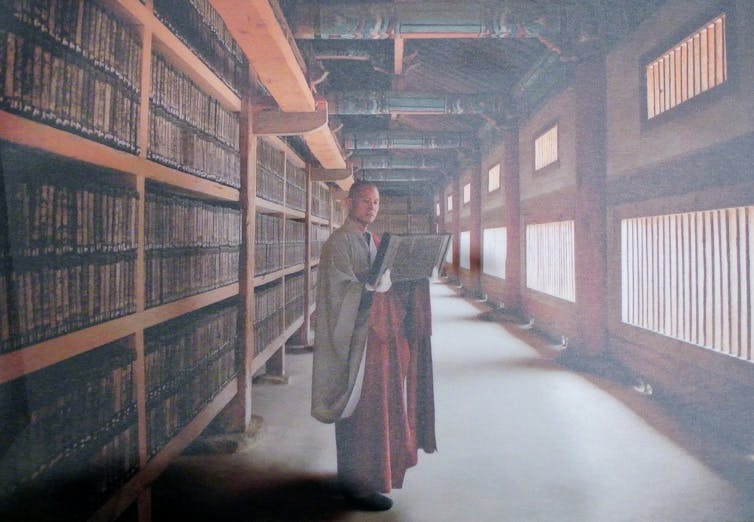
Buddhist monk, Museum of Fine Arts, Boston. Lorianne DiSabato, CC BY-NC-ND

Meanwhile, connoisseurs of Buddhist art introduced America to the beauty of the tradition. The art historian and professor of philosophy Ernest Fenellosa, as well as his fellow Bostonian William Sturgis Bigelow, were among the first Americans to travel to Japan, convert to Buddhism and avidly collect Buddhist art. When they returned home, their collections formed the core of the premiere Arts of Asia collection at the Museum of Fine Arts, Boston.

At the same time, early scholars of world religions such as Paul Carus made Buddhist teachings readily accessible to Americans. He published “The Gospel of Buddha,” a best-selling collection of Buddhist parables, a year after attending the World Parliament of Religions in Chicago in 1893. This was the first time in modern history that representatives from the world’s major religions came together to learn about one another’s spiritual traditions.

The Buddhist delegation in Chicago included the Japanese Zen master Shaku Sōen and the Sri Lankan Buddhist reformer Anagārika Dharmapāla, who himself had studied western science and philosophy to modernize his own tradition. These Western-influenced Buddhists presented their tradition to their modern Western audience as a “non-theistic” and “rational” tradition that had no competing gods, irrational beliefs or supposedly meaningless rituals to speak of.

Continuity and change

Pressmaster/ Shutterstock.com

Traditional Buddhism does in fact have many deities, doctrines and rituals, as well as sacred texts, ordained priests, ethics, sectarian developments and other elements that one would typically associate with any organized religion. But at the 1893 World Parliament, the Buddhist masters favorably presented their meditative tradition to modern America only as a practical philosophy, not a religion. This perception of Buddhism persists in America to this day.

The Buddhists did not deliberately misrepresent their tradition or just tell the Americans what they wanted to hear. They were genuine in their attempt to make a 2500-year old tradition relevant to the late 19th century.

But in the end they only transplanted but a few branches of Buddhism’s much larger tree into American soil. Only a few cuttings of Buddhist philosophy, art and meditation came into America, while many other traditional elements of the Buddhist religion remained behind in Asia.

Buddhism in America

Once it was planted here though, Americans became particularly fascinated with the mystical appeal of Buddhist meditation.

DT Suzuki. Portrait of D. T. Suzuki made by his secretary Mihoko Okamura via Wikimedia Commons.

The lay Zen teacher Daisetsu Teitaro Suzuki, who was Japanese Zen Master Shaku Sōen’s student and translator at the World’s Parliament, influenced many leading artists and intellectuals in the postwar period. Thanks to his popular writings and to subsequent waves of Asian and American Buddhist teachers, Buddhism has impacted almost every aspect of American culture.

Environmental and social justice initiatives have embraced a movement known as “Engaged Buddhism” ever since Martin Luther King Jr. nominated its founder, the Vietnamese monk and anti-war activist Thich Nhat Hanh, for the Nobel Peace Prize in 1967. His Buddhist Order of Interbeing continues to propose mindful, nonviolent solutions to the world’s most pressing moral concerns.

America’s educational system has also been enriched by its first Buddhist-affiliated university at Naropa in Colorado, which paved the way for other Buddhist institutions of higher learning such as Soka University and University of the West in California, as well as Maitripa College in Oregon.

The medical establishment too has integrated mindfulness-based stress reduction into mainstream therapies, and many prison anger management programs are based on Buddhist contemplative techniques such as Vipassana insight meditation.

The same is true of the entertainment industry that has incorporated Buddhist themes into Hollywood blockbusters, such as “The Matrix”. Even professional athletics have used Zen coaching strategies and furthered America’s understanding of Buddhism not as a “religion” but as a secular philosophy with broad applications.

The exotic appeal

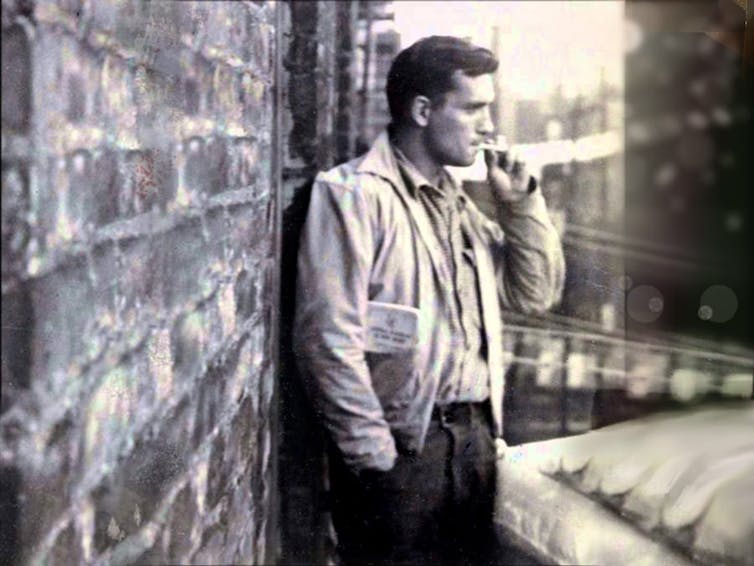
Jack Kerouac. Geoth

But American secular Buddhism has also produced some unintended consequences. Suzuki’s writings greatly influenced Jack Kerouac, the popular Beat Generation author of “On the Road” and “The Dharma Bums.” But Suzuki regarded Kerouac as a “monstrous imposter” because he sought only the freedom of Buddhist awakening without the discipline of practice.

Other Beat poets, hippies and, later, New Age DIY self-helpers have also paradoxically mistaken Buddhism for a kind of self-indulgent narcissism, despite its teachings of selflessness and compassion. Still others have commercially exploited its exotic appeal to sell everything from “Zen tea” to “Lucky Buddha Beer,” which is particularly ironic given Buddhism’s traditional proscription against alcohol and other intoxicants.

As a result, the popular construction of nonreligious Buddhism has contributed much to the contemporary “spiritual but not religious” phenomenon, as well as to the secularized and commodified mindfulness movement in America.

We may have only transplanted a fraction of the larger bodhi tree of religious Buddhism in America, but our cutting has adapted and taken root in our secular, scientific and highly commercialized age. For better and for worse, it’s Buddhism, American-style.

The Conversation

Pamela Winfield has received funding from. The Association of Asian Studies (2013 - short term research trip to Eiheiji temple, Japan) Asia Cultural Council (2007 - 6 months research in Tokyo) Kobe College Corporation / Japan Educational Exchange (2001-2002 - dissertation research in Kyoto)

22 Jan 14:56

Deportees in Mexico tell of disrupted lives, families and communities

by Tobin Hansen, Ph.D. candidate in anthropology, University of Oregon

Ray was born in Mexico and moved to the United States with family members at age 10.

He told me in an interview in 2014, “I’m just a regular American like everyone else.” In middle school, Ray (a pseudonym to protect his identity) learned the Declaration of Independence and memorized all the presidents in order. His first job was replastering swimming pools in Phoenix, Arizona. Ray had a son, who was accepted to officer candidate school to attempt to earn the title of U.S. Marine.

After 29 years in the United States – attending school, working and raising a family – Ray was deported to Mexico.

A man deported in 2013 sits in front of his house in Nogales, Mexico. He lived in the United States for 36 years. Tobin Hansen, CC BY-SA

As an anthropologist, I set out to understand how people like Ray become socially entwined in U.S. communities. I spent 18 months researching and living with deported adults in northern Mexico. I interviewed 56 deported adults who had arrived to the United States before age 13, years or even decades ago.

In English, marked by East Coast pluck, Southern lilt or Southwest flatness, they told me of the ties that bind them to their U.S. home communities. Their experiences raise important questions about the human costs of deportation that Washington lawmakers must consider as they debate immigration policy – particularly as it affects so-called Dreamers, noncitizens who have lived most of their lives in the United States.

Belonging and alienation

The people I interviewed articulated a deep sense of national belonging in the United States. Alfonso (pseudonym) was deported in 2013 after living for 43 years in Tucson, Arizona, since the age of 2. He told me, “The U.S. is everything for me. It’s everything I feel, everything I’ve ever done. It’s who I am. You grow up up there and that’s your life.”

They also spoke of lives that, before deportation, had been enmeshed in the everyday activities, shared understandings, social networks, ways of communicating and values of their local communities. Divorced from home, deportees often felt incomplete, shut out or shut down.

Paco (pseudonym) was born in Mexico in 1971, taken to Phoenix, Arizona, with family at 6 months old, and deported in 2013. He said, “It’s the little things that matter, you know: birthday parties, a quinceñera, graduations. Things happen up there and it’s just once, and you don’t get that time back.”

Deportees also experience wrenching social, psychological and economic stress and alienation after expulsion. They enter unfamiliar worlds when released from U.S. government custody, into northern Mexico border cities.

Paco expressed his disorientation in Mexico: “For me it’s like they dropped me off in Africa … In a place I don’t know, where I have nothing. I don’t know nobody [and it’s] not my home. I have no ties to nobody.”

After deportation, life’s more meaningful projects became daunting – turning a living space into a home, determining a vocation, attending school, connecting deeply with others, or imagining a future. Dustin (pseudonym), a 38-year-old deportee put it simply: “I’ve had enough with this down here. I just can’t do it. It’s just not like up there.”

To be sure, a mix of family support, academic or job skills, hard work, ingenuity and sheer grit, allowed some returnees to reconfigure their lives. In rare cases, some described achieving fulfillment and happiness. But they represent a narrow minority.

Most speak of “getting by” or “making it.” Rabbit (pseudonym), a 22-year-old deportee said, “Depression hit me pretty hard.” Rabbit describes feelings of dispossession and dejection and an inability to live a “normal life.” In characterizing the unrelenting pressure his feels, he said that he “lived in some of the hardest places [in Phoenix], and they didn’t get me. It’s just, Mexico’s got a grip on me now, and won’t let go.”

Fixing immigration policy

The Trump administration’s announcement on Sept. 5, 2017 that it was rescinding Deferred Action for Childhood Arrivals consigned to Congress the responsibility of action on immigration legislation. Most of those I interviewed were given a lifetime ban from legally reentering the United States. They have little hope for returning home. But since DACA’s cancellation, DACA recipients still in the United States risk losing their protection from deportation. Deportees’ sense of belonging in the United States helps illuminate the potential ramifications of legislative inaction.

Lawmakers, citizen and media discourse often focus immigration debates on noncitizens’ potential economic and social benefits to the United States. Nevertheless, the U.S. government also claims to ground policy decisions in principles of basic human well-being. In finding a way forward, legislators should consider the experiences of the untold deportees who, like Ray, have had their lives disrupted by dislocation from home.

The Conversation

Tobin Hansen has received funding from the University of Oregon; the Center for U.S.-Mexico Studies at the University of California, San Diego; the Wenner-Gren Foundation for Anthropological Research; and the Social Science Research Council, with funds provided by the Andrew W. Mellon Foundation.

22 Jan 14:42

Thanks to "consent" buried deep in sales agreements, car manufacturers are tracking tens of millions of US cars

by Cory Doctorow

Millions of new cars sold in the US and Europe are "connected," having some mechanism for exchanging data with their manufacturers after the cars are sold; these cars stream or batch-upload location data and other telemetry to their manufacturers, who argue that they are allowed to do virtually anything they want with this data, thanks to the "explicit consent" of the car owners -- who signed a lengthy contract at purchase time that contained a vague and misleading clause deep in its fine-print. (more…)

22 Jan 14:41

Lost words of English that we should probably reclaim

by Clive Thompson

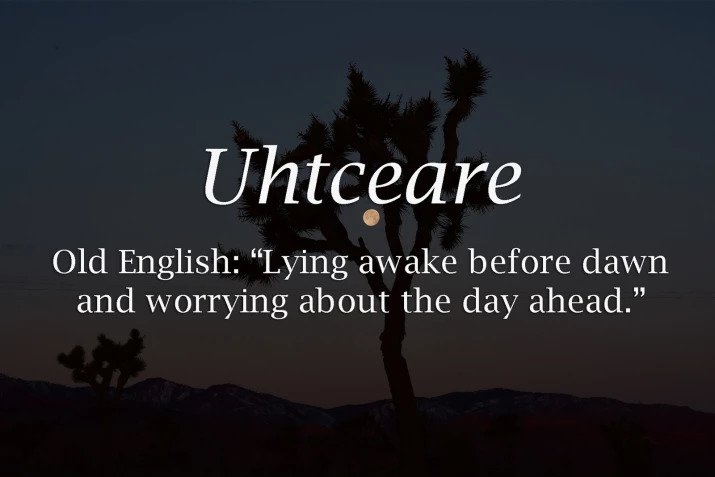
Buzzfeed has curated a list of old words that we should revive, because man, they seem to really fit modern life. Like "fudgel" -- "pretending to work while actually doing nothing at all." Or "ultracrepidarian": "Someone who gives opinions beyond their level of expertise". They're all taken from The Horologicon, a wonderful book by the writer and word-lover Mark Forsyth. My favorite is "uhtceare", which means "lying awake in bed before dawn and worrying about the day ahead". Forsyth's passage in The Horologicon about "uhtceare" is informative:
Uht (pronounced oot) is the restless hour before the dawn, when Aurora herself is loitering somewhere below the eastern horizon, rosying up her fingers and getting ready for the day. But for now, it is dark. And in the antelucan hush you should be happily slumbering and dreaming of pretty things. If you are not, if you are lying there with your eyes wide open glaring at the ceiling, you are probably suffering from a severe case of uhtceare. There's an old saying that the darkest hour comes just before the dawn. However, that's utter tosh. If you get out of bed and peek through the window, you will see a pale glow in the east. But don't, whatever you do, actually get out of bed. It's probably chilly and you'll never get your posture in bed (technically called your decubitus) quite right again. You'll just have to lie there and try not think about how horrid it all is. Ceare (pronounced key-are-a) was the Old English word for care and sorrow, emotions that have an annoying habit of striking during the uht. For some reason these early hours are the time when you remember all your sins and unpaid bills and, perhaps, the indelicate thing you did last night, and as each of these creeps into your mind your uhtceare grows more and more severe. For an affliction so common, uhtceare is a very rare word. It is recorded only once, in a poem called The Wife's Lament, which, surprisingly, isn't about how awful and messy her husband is, but about how he has been exiled to a far country and left her here with her uhtceare and her vicious in-laws. Old English poetry is almost universally miserable, and Old English poets should really have bucked up a bit, but they did give us uhtceare and for that we should be grateful.


19 Jan 15:19

Teaching IP to kids with Ed Shearling, Kitty Perry and friends

by noreply@blogger.com (Rosie Burbidge)
Ducks can come up with great logos in a matter of minutes
Many people have puzzled over how to educate the public about intellectual property.  This task is even harder when trying to educate children.  The UK IPO believes it has found a solution...

Children like cartoons, so they made a cartoon about IP told through the story of Nancy (a French bulldog) and her gang of meerkats.  There are lots of videos and other resources in the series but the episode which caught the attention of the BBC concerns logos...

Ed Shearling - guess the animal...
Nancy is helping her mate Ed Shearling to set up his band.  In an excellent example of client management she starts her meeting by questioning his choice of ducks as backing singers.

With the tough questions over, Nancy delves into the IP issues with the help of a mysterious geezer in a suit.  It then becomes an episode of Mastermind with Ed being introduced to the concept of "logos" and immediately subjected to a tough quiz.  Amazingly, Ed cracks the first clue ("who do you think is behind this logo shaped like an apple?") in record timing - cue major meerkat excitement.

Justin Beaver
Ed Shearling is very inspired by Justin Beaver and doesn't think it would be so bad for people to get them confused.  But Nancy's suited and booted manager cautions against this approach

For those who remember the Moshi Monsters dispute over Lady Goo Goo (who appeared together with Dustbin Beaver), it is particularly surprising that the UK IPO has adopted these names for its cartoon.  Others have criticized whether the £20,000 spent on the videos was money well spent.

One final thought - the BBC's  coverage of the new resources focused on the trade mark videos but the average person reading the article (headline: Kitty Perry and the copyright lessons for seven-year-olds) would assume that copyright is the only form of intellectual property. Admittedly trade marks do get a mention but it is buried in the text).  Perhaps IPO resources would be better focused on educating the media before worrying about kids getting to grips with IP.

Huge thanks to Amit Alagh (Wolters Kluwer) and James Sweeting (Superdry) for flagging this story on the BBC website!

You can watch the band logo video here and all of the Nancy & the Meerkats resources are available on the UK IPO

Edit on 25 January 2018:

Christopher Morcom QC has kindly got in touch to highlight a similar education campaign that WIPO ran a few years ago using more traditional cartoons in comic strip style.  You can see the comics which WIPO prepared re copyright, trade marks and patents at the relevant link.  
19 Jan 13:56

Amazon's useless "transparency reports" won't disclose whether they're handing data from always-on Alexa mics to governments

by Cory Doctorow

Amazon was the last major tech company to issue a "transparency report" detailing what kinds of law-enforcement requests they'd serviced, and where; when they finally did start issuing them, they buried them on obscure webpages deep in their corporate info site and released them late on Friday afternoons. (more…)

19 Jan 13:16

EFF to Court: Linking Is Not Copyright Infringement

by Karen Gullo
Playboy Lawsuit Against Boing Boing Should Be Dismissed

Los Angeles, California—Playboy Entertainment's lawsuit accusing acclaimed website Boing Boing of copyright infringement—for doing nothing more than reporting on a historical collection of Playboy centerfolds—is groundless and should be thrown out, the Electronic Frontier Foundation (EFF) told a federal court today.

As EFF and co-counsel Durie Tangri LLP explain in a request to dismiss the lawsuit filed on behalf of Boing Boing owner Happy Mutants LLC, Playboy’s copyright claim seeks to punish Boing Boing for commenting on and linking to an archive of Playboy “playmate” centerfold images that a third party posted. The blog contained links to an imgur.com page and YouTube video—neither of which were created by Boing Boing. But courts have long recognized that simply linking to content on the web isn’t unlawful.

“Boing Boing didn’t upload, publish, host, or store any images that Playboy owns, didn’t control the images, and didn’t contribute to the infringement of any Playboy copyrights,” said EFF Legal Director Corynne McSherry. “It’s frankly mystifying that an entertainment company that has often fought to defend free speech rights  is trying to punish Boing Boing for doing what has made it a leading online source of news and commentary: unique and groundbreaking reporting on art, science, and popular culture.”

“Boing Boing’s reporting and commenting on the Playboy photos is protected by copyright’s fair use doctrine,” said EFF Senior Staff Attorney Daniel Nazer. “We’re asking the court to dismiss this deeply flawed lawsuit. Journalists, scientists, researchers, and everyday people on the web have the right to link to material, even copyrighted material, without having to worry about getting sued.”

For the brief:
https://www.eff.org/document/playboy-v-happy-mutants-eff-mtd

For more on fair use:
https://www.eff.org/issues/intellectual-property

Contact: 
Corynne
McSherry
Legal Director
Daniel
Nazer
Senior Staff Attorney and Mark Cuban Chair to Eliminate Stupid Patents
19 Jan 13:15

Happy Together Once More: The California Supreme Court and Congress Take Up The Question of Copyright in Old Music Recordings

by Mitch Stoltz

Federal copyright law doesn’t give artists and labels the right to control most ways music recordings are played in public. That’s how FM and AM radio stations work. That’s how stores playing soothing “don’t you want to buy something?” music work. And that’s how restaurants playing music at an uncomfortably loud decibel so you can’t talk to your friends work. But because older recordings aren’t covered by these laws, some copyright holders keep trying to use them to gain more control over how their recordings are played - something they’ve never been able to do.

EFF just weighed in on one of these cases, in the California Supreme Court. In Flo & Eddie v. Pandora Media, we argued that state law, which governs sound recordings made before 1972, doesn’t include a right to control public performances of sound recordings, including radio play. If this sounds familiar, that’s because this fight has played out across the country over the past three years. The high courts of New York and Florida have already ruled that their own state laws don’t let pre-1972 copyright holders control public performances of their sound recordings.

These cases stem from a broader debate about copyright in sound recordings. Although federal copyrights in sound recordings cover reproduction and distribution, they don’t include a general right to control public performances, except for “digital audio transmissions” like Internet and satellite radio. That’s why AM and FM radio stations, and businesses like restaurants that play music, have never had to pay record labels or recording artists, nor ask their permission. (Songwriters and music publishers do get paid for public performances). But recordings made before February 15, 1972 aren’t covered by federal law at all. Instead, they fall under a patchwork of pre-digital state laws and court decisions. The labels have tried for many decades to win a performance right, but so far neither Congress nor state legislatures have created one.

The strange status of pre-1972 recordings created an opportunity for recording artists and labels to try getting from the courts what Congress has never given them: a right to control public performances. Flo & Eddie is a company owned by two members of the 1960s rock band the Turtles, famous for their hit “Happy Together.” Flo & Eddie sued Pandora and Sirius XM under state laws across the country, claiming they should not be allowed to play Turtles tracks and other pre-1972 recordings without permission and payment, even though that's what people had been doing for over 50 years.

EFF filed amicus briefs in each of these cases. We argued that copyright holders should only be given new rights when necessary to encourage new creativity. And we argued that creating those rights is a job for legislatures, not courts. We also pointed out that new rights under copyright (like the digital public performance right Congress created in 1996) are always coupled with limitations. A public performance right under state law, created by courts without the limitations and exceptions that exist in federal law, would create unpredictable legal risks for digital music services, broadcasters, and even restaurants.

Creating a patchwork of new rights through state court decisions would also make complying with copyright law complex and risky for businesses that use music. Pandora and Sirius XM, major digital music businesses with a nationwide reach, could actually win by losing this case. They have the resources and expertise to negotiate licenses with thousands of copyright holders in classic music recordings, while startups and smaller competitors may not. In fact, Sirius XM and Pandora are already making these kinds of licenses through class action settlements and private agreements. In our amicus brief, we pointed out to the California Supreme Court that uniform rules give competition a chance to thrive.

The California case is particularly worrisome, because the decision on appeal, which came from the federal courts to the state supreme court through a “certified question” process, was shockingly broad. The federal district court in Los Angeles ruled that the state “record piracy” statute covered not only public performances of sound recordings but every other right that those copyright owners could possibly have—with a single exception for artists making cover recordings. On its face, that decision seemed to eliminate the fair use defense, the first sale limitation, and other vital limits on copyright.

Since two other state high courts have already ruled that their laws don’t include a public performance right in sound recordings, we’re hopeful that California’s Supreme Court will follow suit.

A final loss for Flo & Eddie would not be the end of this story, because Congress has already taken up the pre-1972 recordings issue. A bill, the CLASSICS Act [PDF], would create a federal public performance right for those recordings, even though they are otherwise governed by state law until 2067. The new federal right would cover only “digital audio transmissions,” not traditional radio broadcasts, or playing music in restaurants and stores. And the bill explicitly applies fair use, the library and archive exceptions, and part of the Section 114 statutory license used by companies like Pandora and Sirius.

Copyright is supposed to provide an incentive for people to create new creative works. The CLASSICS Act doesn’t do that, because it doesn’t apply to new works. Rather, it takes away the public’s ability to perform decades-old, lawfully purchased recordings without permission, and gives control back to the copyright holders. Rather than benefiting the public, this bill is a subsidy to the record labels, and some artists and investors, who hold the rights in hit records from the 1960s and before.

On the other hand, this bill advances some of the goals that EFF has argued for in the Flo & Eddie lawsuits: making the law on performances of pre-1972 sound recordings uniform across the U.S., and making sure it includes robust exceptions and limitations. That will give new digital music businesses a chance to thrive, and help prevent lock-in of the current music giants.

If Congress needs to act at all, a better approach would be to put pre-1972 recordings fully under federal law, as the Copyright Office recommended in its 2011 report. Full federalization would make it easier for music businesses to operate across state lines, and reduce the risk of state-by-state legal opportunism by rightsholders like Flo & Eddie.

On the whole, the Flo & Eddie decisions and the CLASSICS Act are moving this obscure but important corner of copyright law in a positive direction. A win for Pandora in California, and amending the CLASSICS Act to add a complete federalization of copyright in sound recordings, would help even more.

18 Jan 18:47

Copyright, The First Wave of Internet Censorship

by Daniel Nazer

We're taking part in Copyright Week, a series of actions and discussions supporting key principles that should guide copyright policy. Every day this week, various groups are taking on different elements of copyright law and policy, and addressing what's at stake, and what we need to do to make sure that copyright promotes creativity and innovation.

When someone wants to remove speech from the Internet, the Digital Millennium Copyright Act’s (DMCA) notice and takedown process can provide the quickest path. This has made copyright law a tempting tool for unscrupulous censors. As content companies push for even more control over what gets posted online, it’s important to remember that any tool used to police copyright will quickly be abused, then adapted, to censor speech more widely.

We’ve seen abusive DMCA takedown notices from a would-be Senate candidate, small businesses, and Ecuador’s President. We’ve also seen robots-run-amok and sending takedowns and monetization demands for public domain material and white noise. One disturbing trend involves businesses targeting bad reviews. The business, or a shadowy reputation management company acting on its behalf, copies the bad review and “publishes” it elsewhere on the Internet. The business then sends a DMCA takedown notice alleging infringement of the copied, and falsely backdated, review.

Other DMCA takedowns have targeted speech for its political or otherwise offensive content. Although we did not agree with the video’s message, EFF criticized a takedown directed at a video that briefly featured FCC chairman Ajit Pai doing the Harlem Shake. We had similar concerns about a game company that used the DMCA to take down a game stream after a certain YouTube “personality” uttered a racial slur. It is not copyright’s job to police speech.

Copyright as a censorship tool is not limited to the DMCA. For example, when Zillow first threatened architecture blog McMansion Hell, it claimed that the blog’s use of real estate photographs wasn’t fair use under copyright law. But the blog’s use of the photos – annotating them with humorous and critical commentary about McMansions – was a clear fair use (Zillow also didn’t own the photos). EFF responded on behalf of McMansion Hell and the blog remained.

Content owners continue to push for more powerful tools—like upload filtering or suspension of domain names—for removing online speech. While these tools are unlikely to help creators (and will entrench the position of platforms like YouTube that have already spent the money to build filtering mechanisms), they will be useful instruments for censors. The systems are designed to create a quick and easy way to make speech disappear from the Internet without any clear standards or meaningful recourse. When governments move to censor speech, the tools they use will likely have begun life as copyright filters. It is our job to keep those filters from being deployed in the first place.

18 Jan 12:51

New clause in House bill could make USF one university

by oracleeditor@gmail.com (Miki Shine, Editor in Chief)

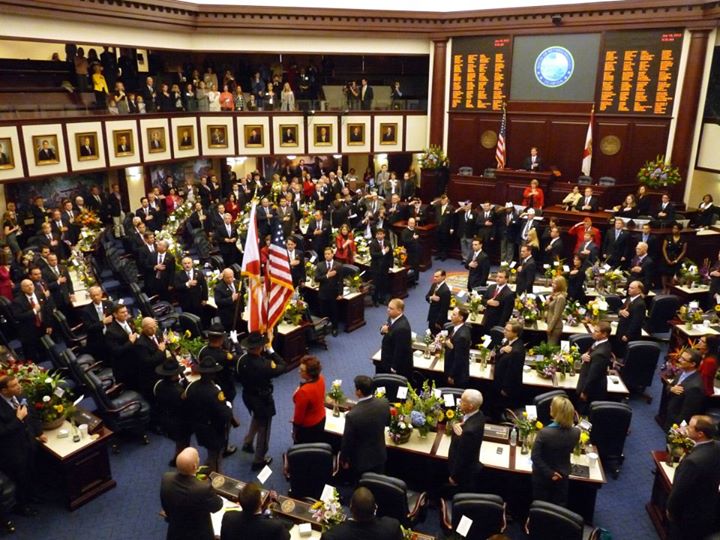
An addition to a bill in the Florida House of Representatives is looking at merging the USF System into one university. It would make USF St. Petersburg and Sarasota-Manatee into satallite campuses. SPECIAL TO THE ORACLE

The University of South Florida has been a system comprised of separate campuses for over 10 years, but a bill in the Florida House of Representatives might be getting ready to change that.

While not the central focus of Bill 423, the current draft making its way through the House includes a clause that would call for USF to become one university with satellite campuses in St. Petersburg and Sarasota-Manatee.

The full bill is looking at Florida Prepaid requirements and that form of the bill passed in the Florida Senate, but tacked onto the end is now a provision that USF come up with a plan to end separate accreditations of the three campuses and instead seek one accreditation and become one university.

In amendments to the bill, the Board of Trustees would be given until Jan. 15, 2019 to come up with a plan to unify the three campuses by June 2020. However, what all that means remains unclear.

One portion that the bill does spell out is that the university’s six-year graduation rate, freshman retention rate and other metrics for receiving state funds would be grouped together from all three campuses.

While the bill states exceptions with students enrolled prior to the bill passing and students who choose to leave the university system prior to the unification under a single accreditation, it still raises questions of where USF would stand in these metrics with the bill fully implemented.

For instance, at the beginning of the fall semester, USF System President Judy Genshaft announced that the Tampa campus now meets the required current benchmarks to be a pre-eminent university.

The current benchmarks include a 90 percent freshman retention rate and a 70 percent six-year graduation rate. At a BOT meeting in March, USF Tampa had a projected 95.7 percent freshman retention rate and a 68.1 percent six-year graduation rate.

However, the St. Pete campus had a 93 percent freshman retention rate and a 34 percent six-year graduation rate, with the Sarasota-Manatee campus having a 88 percent freshman retention rate and didn’t include a graduation rate in the March report.

Combining the metrics of all three campuses could have an impact on the school’s status as pre-eminent and thus the amount of state funding received.

Along with metrics, the university would have to figure out details from University Police staffing to diplomas at the new satellite campuses. However, until the bill is voted on by the House, what will happen to the university system remains up in the air.

University spokeswoman Lara Wade could not be reached for comment, but issued a statement to the Tampa Bay Times earlier in the day.

"Regardless of the outcome, we intend for each USF System campus to continue achieving higher levels of student success and scholarly activity, and as a result we will provide all students with the world-class education they came here to earn," Wade said.

18 Jan 12:33

University of Rhode Island Library Opening Artificial Intelligence Lab

by Blake
Topic: 
In the fall semester of 2018, a new Artificial Intelligence (AI) Lab will be accessible to all University of Rhode Island students on the first floor of the Robert L. Carothers Library. Funded by a $143,065 grant from The Champlin Foundation, the AI Lab is believed to be the first in the nation to be located in a library.
From Artificial Intelligence Lab to be Accessible to All URI Students
17 Jan 20:10

Ethical design is the answer to some of social media’s problems

by Faye Miller, Lecturer / Researcher, University of Canberra
Many of the challenges faced by social media companies come down to failures of design. shutterstock.com

Facebook last week announced a redesign of its news feed to prioritise posts from friends and family over those of news publishers.

While struggling news organisations are likely to take a hit on their social traffic, the move suggests that Facebook CEO Mark Zuckerberg has been paying attention to criticisms around issues such as fake news and adverse mental health outcomes.

In many cases, the biggest shortcomings of these technologies are failures of design.

There is often a disconnect between what digital designers originally intend with a product or feature, and how consumers use or interpret it.

Ethical user experience design – meaning, for example, designing technologies in ways that promote good online behaviour and intuit how they might be used – may help bridge that gap.


Read more: Explainer: what is experience design?


A case study: the Twitter tick

The furor over Twitter’s blue verification tick is a good example of the disconnect between business intent and user interpretation.

The Twitter community has taken the tick to signify an endorsement of a Twitter user and their tweets, or a VIP status symbol indicating power and recognition.

Meanwhile, the company says the tick is intended to authenticate and protect the voices of high-profile users who are vulnerable to identity theft by imposters.

The confusion has caused outrage among Twitter users who accuse Twitter of endorsing white supremacists who spread hate speech on the platform.

The popular meaning of this function has developed over time within the Twitter community through collective action and opinion, and it speaks louder than formal explanation released by Twitter.

If Twitter’s intention was to mark authenticity, then perhaps it shouldn’t have chosen a tick, which commonly symbolises correctness or approval.

The public continues to urge Twitter to rethink its user verification process. Although the company recently clarified its rules to ban or remove verification from users who post violent and abusive tweets, the verification issue remains unresolved in the eyes of its users.

Tweets deemed in breach of the new rules, but seen by Twitter as “newsworthy” (Trump’s nuclear button tweet, for example) show the continued confusion over enforcement of the rules.

How can ethical user experience design help?

User experience design and research has so far mainly been applied to designing tech that is responsive to user needs and locations. For example, commercial and digital assistants that intuit what you will buy at a local store based on your previous purchases.

However, digital designers and tech companies are beginning to recognise that there is an ethical dimension to their work, and that they have some social responsibility for the well-being of their users.

Meeting this responsibility requires designers to anticipate the meanings people might create around a particular technology.

I have been researching the everyday experiences of users on Twitter with my colleagues at University of Southern Queensland’s Digital Life Lab. Preliminary findings show that users perceive “grey areas” when they are confused about rules, etiquette or whether they are using Twitter correctly.


Read more: Engineers, philosophers and sociologists release ethical design guidelines for future technology


Elements of design

An ideal user experience would reduce confusion and harm by blending four digital design elements: contextual, emotional, anticipatory and ethical.

Contextually aware design is capable of understanding the different meanings that a particular technology may have, and adapting in a way that is socially and ethically responsible. For example, smart cars that prevent mobile phone use while driving.

Emotional design refers to technology that elicits appropriate emotional responses to create positive user experiences. It takes into account the connections people form with the objects they use, from pleasure and trust to fear and anxiety.

This includes the look and feel of a product, how easy it is to use and how we feel after we have used it.

Anticipatory design allows technology to predict the most useful interaction within a sea of options and make a decision for the user, thus “simplifying” the experience. Some companies may use anticipatory design in unethical ways that trick users into selecting an option that benefits the company.

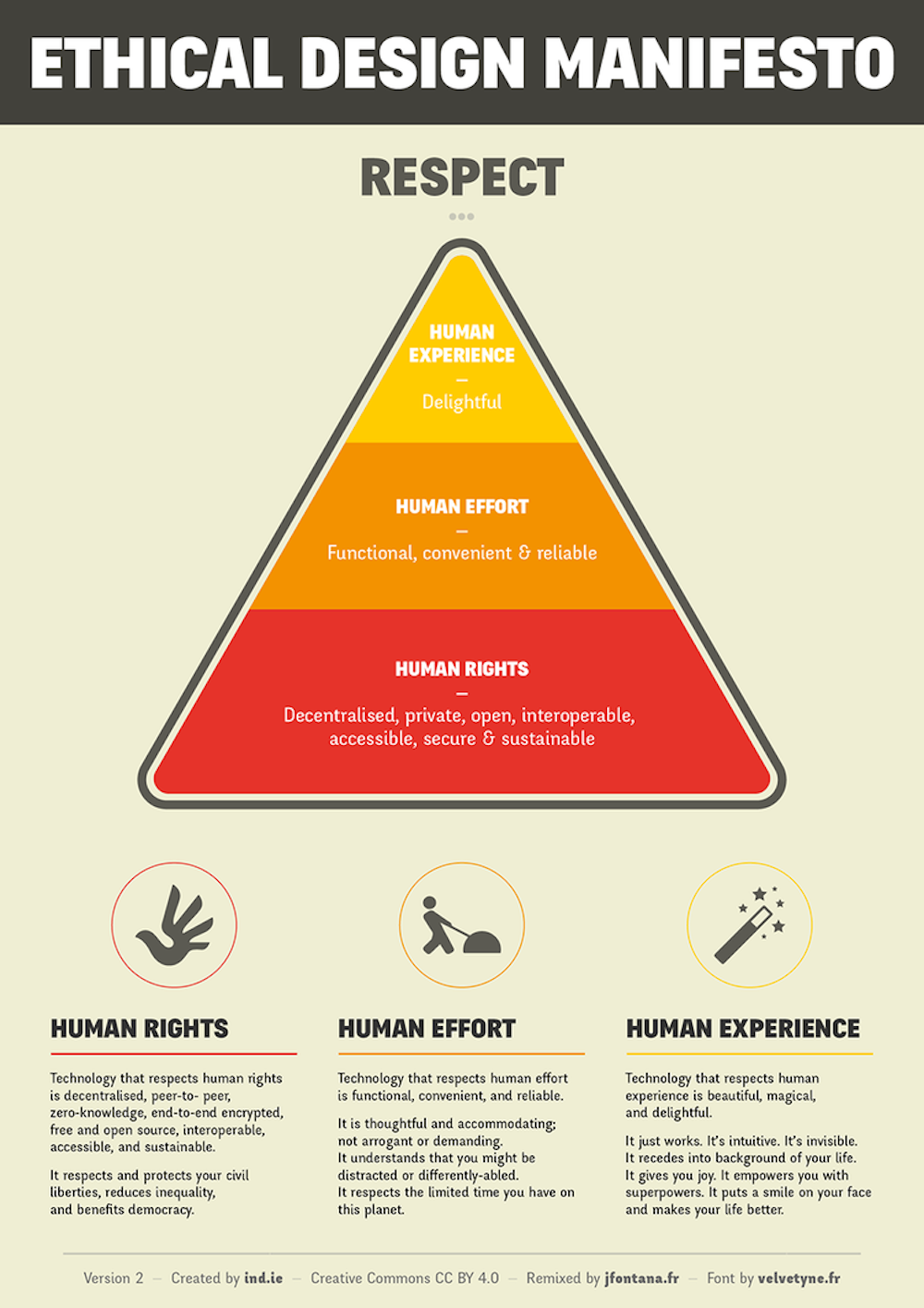
The ethical design manifesto created by UK start-up Ind.ie describes technology that reduces inequality and benefits democracy, is functional, convenient and reliable, and is delightful to use.

Ethical user experience design is a relatively new and complex area. Created by ind.ie and remixed by jfontana.fr, CC BY

Devices, websites and social networks designed with these elements in mind work for the benefit of the user. For example, if a teenager is overusing or oversharing on social media, a pop-up notification might prompt the person to exercise or meditate instead.


Read more: Does Apple have an obligation to make the iPhone safer for kids?


If tech companies don’t respond to these challenges, it could damage their brands and the trust consumers place in their products.

Working within newly developed ethical frameworks, there is a need for human roles within tech companies to monitor and respond to emerging popular meanings around their products.

In this way, ethical user experience design could clarify “grey areas” and prevent harmful consequences on people, organisations and tech-dependent societies.

The Conversation

Faye Miller does not work for, consult, own shares in or receive funding from any company or organisation that would benefit from this article, and has disclosed no relevant affiliations beyond their academic appointment.

17 Jan 18:31

The Public Domain Starts Growing Again Next Year, and It’s About Time

by Katharine Trendacosta

We're taking part in Copyright Week, a series of actions and discussions supporting key principles that should guide copyright policy. Every day this week, various groups are taking on different elements of copyright law and policy, and addressing what's at stake, and what we need to do to make sure that copyright promotes creativity and innovation.

Have you ever wondered how it’s possible for there to be two Jungle Book movies to be in development at the same time? Why everything seems to be based on a work by Shakespeare? Or why it always seems like someone is telling a version of The Wizard of Oz? The answer is that these works are in the public domain, meaning that copyright law no longer prevents other artists from adapting them to create new works.

One major rationale for copyright is supposedly that, by giving an exclusive set of rights to artists for their work, we incentivize creativity by making it possible for artists to benefit from releasing works to the public. But copyright protection is supposed to be limited, and once it expires, a work enters the public domain, where anyone can use it.

In the United States, the length of the copyright term has been steadily extended so that published works are effectively copyrighted for 95 years (for corporate works) or until 70 years after an author’s death (for individual works). This has resulted in a public domain that saw increasingly less materials being added to it, limiting the ability of artists to build on works that came before them. The last time Congress changed the law in the 1998 Copyright Term Extension Act, it was applied retroactively. Effectively, it meant that nothing has entered the public domain in the United States for years. January 1, 2019 will mark the end of this dry spell as works first published in 1923 will finally enter the public domain. That mean works like Cecil B. DeMille's The Ten Commandments and Universal's silent version of The Hunchback of Notre Dame, two movies released in 1923, will be eligible to join the public domain.

Writers, filmmakers, musicians, and artists wear their influences on their sleeves, and whole branches of critique is devoted to teasing them out. It’s not new. The Aeneid was Virgil playing in the universe of Homer. Recently, and infamously, Fifty Shades of Grey was originally a piece of Twilight fanfiction. The Internet speaks in the language of pop culture: GIFs, mashups, retellings, fan fiction—all find life on the Internet.

It’s not just small artists that rely on the public domain. Disney’s built an empire on making movies based on public domain fairy tales. Just last year, Disney released a live-action version of its animated take on Beauty and the Beast, a story that has been around since the 1700s. But Disney hasn’t been the best in allowing its own works to become part of the public domain. Disney is a huge beneficiary of the extended copyright term, locking down more and more famous works and worlds for its sole use.

While new technology has made it easier to make art and find audiences, the expansion of the copyright term has made it easier for huge companies to devote resources to shutting them down. And even if a new creator is in the right, by relying on such doctrines as fair use for example, they often don’t have the resources to prove it. More works in the public domain mean more works indisputably available for new artists to build on. More public domain works mean more books available for free to read, movies to watch, music to listen to. And even if that does not inspire new works, it allows new generations to rediscover works of old.

Our language is made up of references, and our art should reflect that. Creativity is enriched when the public domain is robust and easily accessed, and we look forward to finally seeing it grow once again in 2019.

17 Jan 18:29

'We blinked and I think we have to get back to business'

by oracleeditor@gmail.com (Amanda Lopez, Correspondent)

Civil rights activist Harry Belafonte was inspired to become an activist while growing up and watching his mother. ORACLE PHOTO/AMANDA LOPEZ

Artist and social activist Harry Belafonte shared provocative, yet inspiring, statements about himself, his history and his views on present political situations and racial problems to approximately 700 people Tuesday night at the Marshall Student Center Ballroom.

As an opening statement, Belafonte said he had always been an activist. From birth, he was fascinated by his mother’s dignity and courage when dealing with hardships in America.

“She set the pace,” Belafonte said. “And I followed in her steps.”

Belafonte, 90, said his mother impacted his choices by saying that since she let him see the people of Jamaica, the country where she’d been born and raised, he began to understand more about the black community in the U.S.

“Here in America, there is a rage and an anger, that is, for me, quite overwhelming,” Belafonte said.

He then said that since he stopped singing he’s spent most of his time in the criminal justice system listening to the voices of the hundreds of thousands of men and some women who do not deserve to be incarcerated.

“There is an aspect to the American system who does not mostly look kindly to people of color,”  Belafonte said.

He reflected upon other questions he’s answered in past interviews about his motives for being an activist.

“The motive is very simple: poverty,” Belafonte said. “Poor people have a way of surviving that is really quite a tribute to the dimensions of human behavior.”

Giving the audience an inner perspective on his choices in life, Belafonte acknowledged major influencers with a pensive smile. Some of whom were Dr. Martin Luther King Jr., Lead Belly, Woody Guthrie, Eleanor Roosevelt and Lester Young, who encouraged him to sing.

“I am by all measure, one of the world’s finest actors,” Belafonte said. “It’s rested in the fact I’ve convinced you I’m a singer.”

Belafonte said that after he created a large platform, he became aware of the unusual power a performing artist has.

“My question was ‘what do you do with that power?’” Belafonte said. “Whenever I find injustice, I find people in need, I respond to the best of my ability.”

He explained that after he gained his following, MLK invited him to his speech at the Baptist Church. Belafonte joked that MLK had been meant to talk for 20 minutes, but they left five hours later.

“Almost every moment spent with Dr. King was spent with possibility,” Belafonte said. “In him, I saw a path.”

Belafonte continued, stating his thoughts about the current political status and the populace.

“We’ve taken a turn that’s quite devastating,” Belafonte said. “The last thing I could’ve ever imagined was that with all the sacrifice, all the pain and all the anguish that he went through to shape the character of this country would all amount to being represented by Donald Trump.”

He offered very strong words regarding Trump and called for a rebellion.

“I was curious that America should’ve come to this,” Belafonte said. “It was we who put him in office. Where’s black America? Where is its voice? The rebellion to this racist who sits at the top of the heap thinking he’s harmless and shaped the thinking of our children?”

Expanding on his thoughts on the current racial tensions, Belafonte commented on the constantly diminishing marks left by past civil rights activists.

“Here in America, I could never believe that Malcom X, Dr. King and Ella Baker existed,” Belafonte said.

Belafonte said a voice, like MLK’s, is necessary now more than ever.

“We blinked and I think we have to get back to business,” Belafonte said. “One could almost say we’re lost without oppression. Take away oppression and we become subhuman. There is something wrong with that equation.”

12 Jan 20:21

KodakOne could be the start of a new kind of intellectual property

by Chris Berg, Postdoctoral fellow, RMIT University

It’s easy to be a bit amused about Kodak’s new blockchain and cryptocurrency, the KodakOne. The old photography company is the classic case of a firm that failed to keep up with technological change.

But now Kodak is exploiting one of the most interesting characteristics of the blockchain (the technology behind Bitcoin) to reshape how we understand and manage intellectual property.

Just like Bitcoin demonstrated it was possible to have a digital currency that didn’t require third parties (banks or governments) to validate transactions, KodakOne hints at a future where intellectual property works without the need for third parties to enforce property rights.

Blockchains are a system of decentralised, distributed ledgers (think of a spreadsheet or database that is held on a number of computers at once). Transactions are verified and then encrypted by the system itself.

Kodak’s plan is to use the Ethereum blockchain to build a digital rights management platform for photographs. Photographers will register their photos on the KodakOne platform and buyers will purchase rights using the KodakCoin cryptocurrency.

The platform will provide cryptographic proof of ownership and monitor the web for infringement, offering an easy payment system for infringers to legitimise their use of photographs.


Read more: Demystifying the blockchain: a basic user guide


In one sense, KodakOne resembles one of the many supply chain (or “provenance”) applications for blockchain, which track goods and their inputs (think agricultural products or airplane parts).

But photographs are purely digital assets. In a sense, what we’re seeing is a new form of intellectual property.

In KodakCoin, the underlying asset – the thing that is being bought and sold, the thing that has the economic value – is no longer the photograph, per se. Rather, it’s the entry on the global blockchain ledger. Control of that entry constitutes ownership of the asset.

KodakOne only really gets halfway to this idea. Like so many blockchain applications, the question is how this elegant system will interact with the messy real world. It’s one thing to detect infringing uses of a photograph, it’s quite another to enforce terrestrial copyright law on unco-operative infringers. And KodakOne is hardly the only firm working on digital asset management on a blockchain.

A new kind of intellectual property

But there’s another, more pure example of what blockchains can do for intellectual property that is worth discussing – CryptoKitties.

CryptoKitties is a silly little blockchain game, but the economics are worth taking seriously. Players buy digital cats – cryptographically secure, decentralised, censor-proof digital cats – and breed them with each other. Each cat has a mix of rare and common attributes and the goal is to breed cats with the rarest, most-in-demand attributes.

That’s the game. But in fact what CryptoKitties has invented is a new form of intellectual property. Each cat is a completely unique, entirely digital good. And it is completely, cryptographically secure. It can’t be copied.

Usually the protection of intellectual property requires lawyers and courts. But with CryptoKitties, the intellectual property protection is part of the asset itself – it’s baked in.

This is what blockchains were invented to do. Before blockchains, digital goods could be easily duplicated. That’s a great feature – unless you want to create digital money. Digital money won’t work if everybody can just copy their money and spend it over and over again.

The creator of Bitcoin, known as Satoshi Nakamoto, solved this problem with Bitcoin’s blockchain. Previous attempts to solve the double-spending problem had relied on trusted third parties like banks to validate transactions. Nakamoto managed to get the network to validate itself.


Read more: Blockchain is useful for a lot more than just Bitcoin


KodakOne (and CryptoKitties) show us that intellectual property has much the same problem as digital currency – and may have the same solution. There’s no need for trusted third parties (governments) to enforce property rights. The blockchain does that for us.

Of course, there’s a lot of work to be done before we see real benefits from this sort of blockchain-enhanced intellectual property. CryptoKitties is its own new form of intellectual property – but can we retrofit “traditional” cultural goods like photographs, music and movies onto the blockchain?

Digitisation has challenged the protection of intellectual property like never before. Cultural producers need to find some way to be paid for their work. This is the direction we should be looking.

The Conversation

Chris Berg is a Senior Fellow with the Institute of Public Affairs and has two CryptoKitties.

Jason Potts has received past funding from the Australian Research Coucil. He is affiliated with the Institute of Public Affairs.

Sinclair Davidson is Professor of Institutional Economics at RMIT University, a Senior Research Fellow at the Institute of Public Affairs, and an Academic Fellow at the Australian Taxpayers' Alliance. He has been previously funded by Australian Research Council.

12 Jan 20:08

Scientists have accidentally found the oldest ever butterfly or moth fossils

by David Martill, Professor of ​Palaeobiology, University of Portsmouth
Shutterstock

Butterflies and moths, the Lepidoptera, are among the most beautiful of insects, familiar to almost everyone through thousands of different species from all around the world. But how they evolved has been something of a mystery to scientists because of a surprising lack of Lepidoptera fossils.

Now researchers in the Netherlands have discovered Lepidoptera fossils that are older than any previously found, proving these familiar insects have been around for at least 200m years. The particular type of fossils found mean we have to rethink Lepidoptera evolution. They imply that the long tube butterflies and moths use to suck nectar from flowers actually developed before flowering plants did, so it must have originally evolved for a different purpose.

The fossil record of ancient Lepidoptera is surprisingly meagre. Although butterflies may appear to be delicate creatures, their external skeletons are made of the same tough material, chitin, that all insects are made of. And chitin, or chitin decay products, preserve really very well in the fossil record.

Fossilised wings and body scales. Bas van de Schootbrugge

In fact, some of the best ever fossils are of insects entombed in amber. Fossil Lepidoptera have been reported from a few exceptional deposits. For example, butterflies are known from the famous Florissant fossil beds of North America dating from the Eocene epoch, 34 million-years-old. A fossil caterpillar with the characteristic spinneret (the body part that produces silk) typical of all modern butterflies and moths has been reported from 125 million-year-old Lebanese amber. But until now, the fossil record went back no further.

This is especially odd because the Lepidoptera are closely related to another familiar modern group of insects, the caddis flies or Trichoptera. This group has an excellent fossil record extending back to the Permian period of the Palaeozoic era (250m years ago). As these groups share a common ancestor, the earliest Lepidoptera should, theoretically, also be found in the Permian period.

Lucky accident

The newly discovered fossils aren’t quite that old but they do date to the end of the Triassic period, the beginning of the age of dinosaurs. The delicate fossils bear the highly characteristic scales of butterflies and moths. They were discovered entirely by accident when researchers tried to extract pollen grains from rock samples from a borehole in north Germany to date the strata.

The process dissolves the rock (usually with the incredibly powerful hydrofluoric acid) to leave behind an organic residue that is rich in tough organic material. While this is usually pollen material and other so-called phytodebris from plants, it can include the remains of sclerotised (toughened) exoskeleton from insects and other invertebrates. Bits of fossil scorpions can be found this way for example.

Not many insects have scales on their wings, and those found on the wings of butterflies and moths are very different from those of other insects that do possess them. A characteristic feature of lepidopteran scales is a herring bone (V-shaped) pattern of fine lines in between larger ridges that extend along the scale. There are also characteristic outlines and margins that distinguish butterfly scales. So there is no doubt that the fossil scales found in the German borehole are those of ancient butterflies and moths.

Microscopic moth scales. Hossein Rajaei

Just as interesting, the scales are from a group of butterflies and moths known as the Glossata. Almost all of todays’ butterflies and moths belong to this group, characterised by the tube-shaped mouth part known as a “proboscis” used for feeding on fluids such as nectar. There are some primitive moths with mandibular (biting) mouth parts, and indeed some examples of these have been found from the Early Jurassic epoch (around 190 million-years-old). But the latest discoveries are even older, and push the origin of modern butterflies with proboscises back another 70 million years.

This forces a serious rethink for evolutionary biologists. Until now we’ve thought that the highly modified sucking mouthparts of modern butterflies and moths evolved as flowering plants diversified in the Early Cretaceous, around 100m years after the newly discovered fossils were created.

The researchers who discovered the fossils suggest that Lepidoptera may have first evolved their long proboscis tubes to suck up any available liquids at a time when their environment had become a lot drier. We know this kind of climate change did happen on the super continent of Pangaea in Triassic times, but it’s probably too early to tell if this theory is correct. If the fossil record can be pushed back 70m years in one stroke, it may get pushed back even further, and we’d need another way to explain the change.

Whatever the trigger for the development of the butterfly proboscis, it was clearly an evolutionary innovation that resulted in phenomenal diversity and added immensely to the beauty of planet Earth. Let us hope that many more of these serendipitous discoveries can shed even more light on the wonderful story of biological evolution. The key is in looking for fossils.

The Conversation

David Martill does not work for, consult, own shares in or receive funding from any company or organisation that would benefit from this article, and has disclosed no relevant affiliations beyond their academic appointment.

12 Jan 19:58

Take a Trip Through the Glorious Orion Nebula in This New 3D Visualization

by George Dvorsky on Gizmodo, shared by Cheryl Eddy to io9

By combining actual scientific data with techniques used in Hollywood, researchers with NASA and other institutions have produced the most detailed multi-wavelength visualization ever produced of the Orion Nebula. Traveling at close to the speed of light, the three-minute journey will take you through a distant…

Read more...

10 Jan 20:51

Explainer: where do the names of our months come from?

by Caillan Davenport, Senior Lecturer in Roman History, Macquarie University
Detail from the Roman-era Sousse Mosaic Calendar, El Jem, Tunisia. Ad Meskens / Wikimedia Commons

Our lives run on Roman time. Birthdays, wedding anniversaries, and public holidays are regulated by Pope Gregory XIII’s Gregorian Calendar, which is itself a modification of Julius Caesar’s calendar introduced in 45 B.C. The names of our months are therefore derived from the Roman gods, leaders, festivals, and numbers. If you’ve ever wondered why our 12-month year ends with September, October, November, and December – names which mean the seventh, eighth, ninth, and tenth months – you can blame the Romans.

The calendar of Romulus

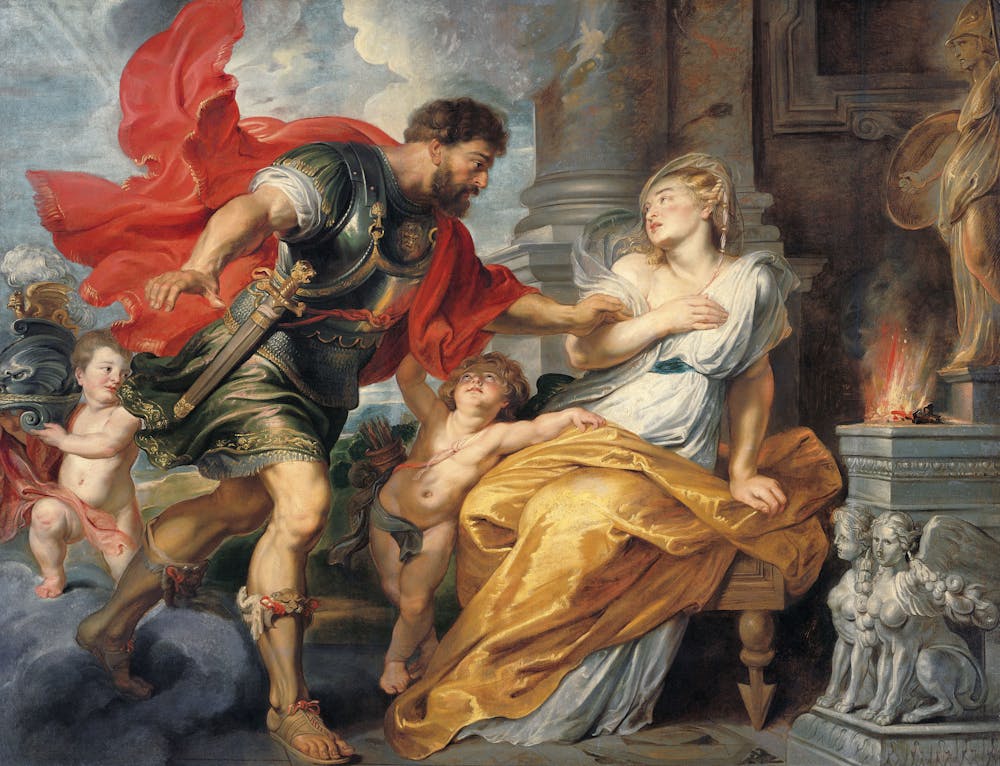
The Roman year originally had ten months, a calendar which was ascribed to the legendary first king, Romulus. Tradition had it that Romulus named the first month, Martius, after his own father, Mars, the god of war. This month was followed by Aprilis, Maius, and Iunius, names derived from deities or aspects of Roman culture. Thereafter, however, the months were simply called the fifth month (Quintilis), sixth month (Sixtilis) and so on, all the way through to the tenth month, December.

Mars and Rhea Silvia by Peter Paul Rubens, c. 1617/20. Wikimedia Commons

The institution of two additional months, Ianuarius and Februarius, at the beginning of the year was attributed to Numa, the second king of Rome. Despite the fact that there were now 12 months in the Roman year, the numerical names of the later months were left unchanged.


Further reading: Explainer: the gods behind the days of the week


Gods and rituals

While January takes its name from Janus, the Roman god of beginnings and endings, February comes from the word februum (purification) and februa, the rites or instruments used for purification. These formed part of preparations for the coming of Spring in the northern hemisphere.

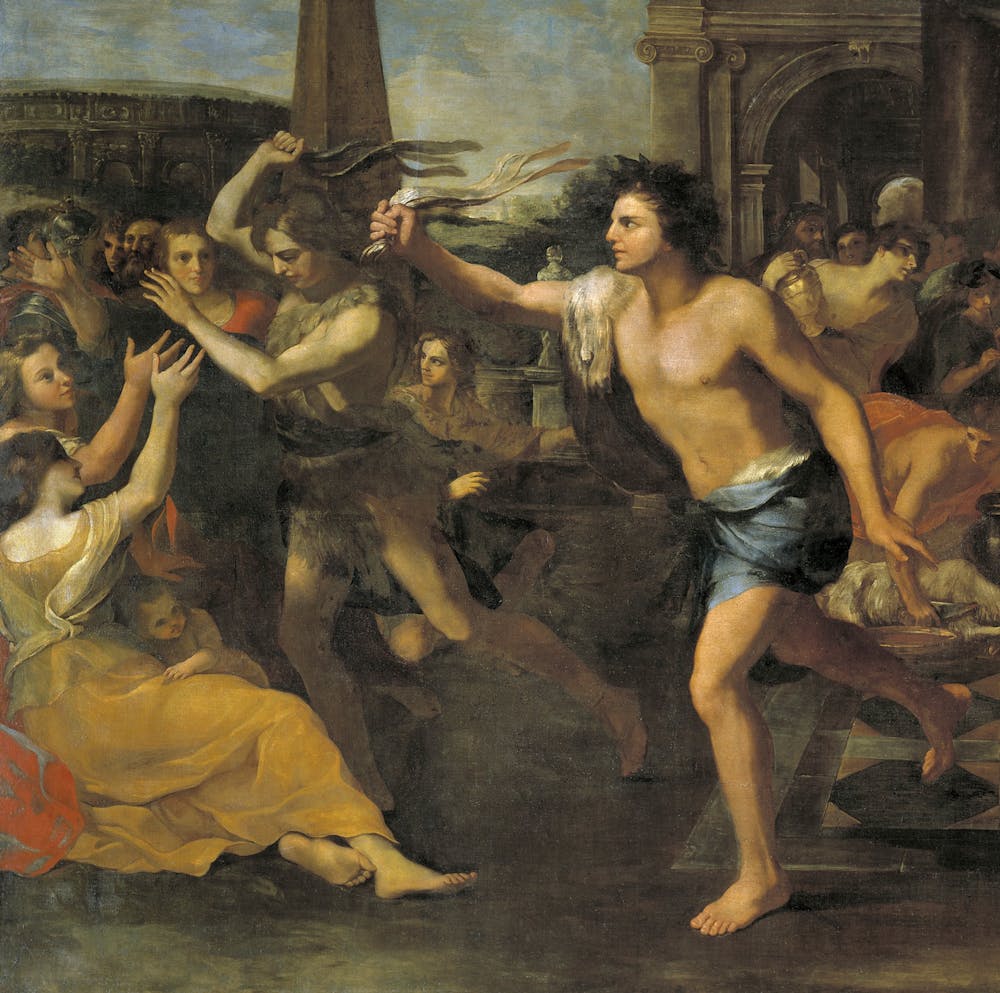
The februa included spelt and salt for cleaning houses, leaves worn by priests, and strips of goat skin. These strips were put to good use in the festival of the Lupercalia, held each year on February 15. Young men, naked except for a goat-skin cape, dashed around Rome’s sacred boundary playfully whipping women with the strips. This ancient nudie run was designed to purify the city and promote fertility.

Detail from Lupercalia by Andrea Camassei, c. 1635. Wikimedia Commons

The origins of some months were debated even by the Romans themselves. One tradition had it that Romulus named April after the goddess Aphrodite, who was born from the sea’s foam (aphros in Ancient Greek). Aphrodite, known as Venus to the Romans, was the mother of Aeneas, who fled from Troy to Italy and founded the Roman race. The other version was that the month derived from Latin verb aperio, “I open”. As the poet Ovid wrote:

For they say that April was named from the open season, because spring then opens all things, and the sharp frost-bound cold departs, and earth unlocks her teeming soil …

There were similar debates about the origins of May and June. There was a story that Romulus named them after the two divisions of the Roman male citizen body, the maiores (elders) and iuniores (juniors). However, it was also believed that their names came from deities. The nymph Maia, who was assimilated with the earth, gave her name to May, while Juno, the goddess of war and women, was honoured by the month of June.


Further reading: Explainer: the seasonal calendars of Indigenous Australia


Imperial pretensions

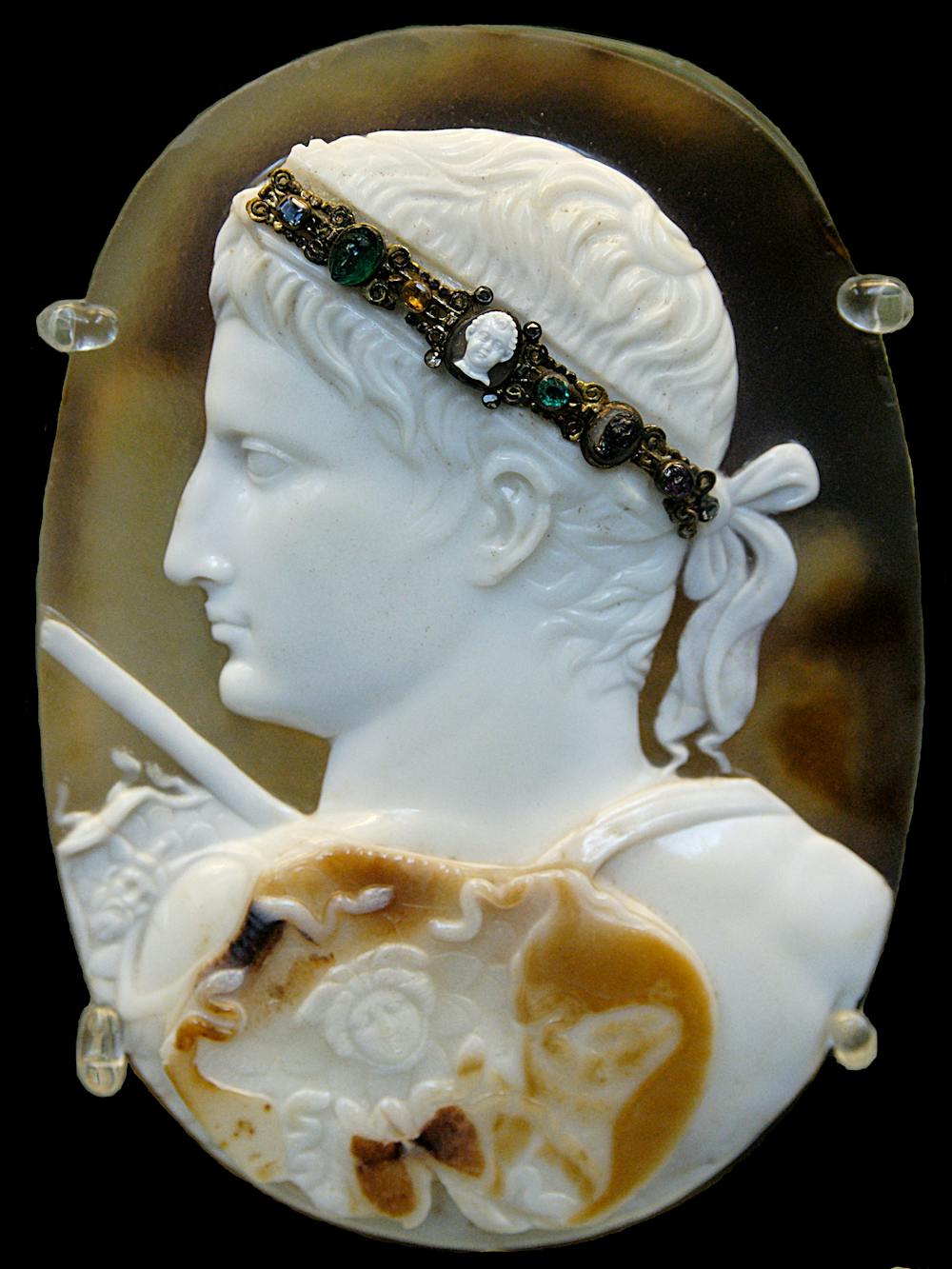
Cameo of the emperor Augustus. © Marie-Lan Nguyen / Wikimedia Commons

The numerical names of the months in the second half of the year remained unchanged until the end of the Roman Republic. In 44 B.C., Quintilis was rebranded as Iulius, to celebrate the month in which the dictator Julius Caesar was born.

This change survived Caesar’s assassination (and the outrage of the orator M. Tullius Cicero, who complained about it in his letters). In 8 B.C., Caesar’s adoptive son and heir, the emperor Augustus, had Sextilis renamed in his honour. This was not his birth month (which was September), but the month when he first became consul and subjugated Egypt.

This change left four months – September, October, November and December – for later emperors to appropriate, though none of their new names survive today. Domitian renamed September, the month he became emperor, to Germanicus, in honour of his victory over Germany, while October, his birthday month, he modestly retitled Domitianus, after himself.

However, Domitian’s arrogance paled in comparison with the megalomaniacal Commodus, who rebranded all the months with his own imperial titles, including Amazonius (January) and Herculeus (October).

If these titles had survived Commodus’s death, we would not have the problem of our year ending with months carrying the wrong numerical names. But we would be celebrating Christmas on the 25th of Exsuperatorius (“All-Surpassing Conqueror”).

The Conversation

Caillan Davenport receives funding from the Australian Research Council.

09 Jan 13:01

Heading back to the office? Bring these plants with you to fight formaldehyde (and other nasties)

by Danica-Lea Larcombe, PhD Candidate in Biodiversity and Human Health, Edith Cowan University

Humans have built high-rises since ancient Roman times, but it wasn’t until the 20th century that they became the default work space for a significant slice of the world’s workers. While these buildings are certainly efficient, they can cause real health issues.

Office buildings, where many Australians spend much of their time, are even worse than apartment buildings. Cubicles in offices usually consist of partitions made of particle board and vinyl carpet, synthetic flooring, a particle board desk and plastic or synthetic office chair, mostly lit by artificial lighting. The lucky few get natural light and a view from a window, but poor ventilation still spreads germs.


Read more: Why apartment dwellers need indoor plants


One excellent way to combat both sick days and stress is by filling your office with plants. Ideally, you want plants that will “scrub” the air of pathogens, improve the office’s mix of bacteria, and survive in low light with little care.

Fight formaldehyde (and other nasty chemicals)

One of the many chemical compounds given off by synthetic office furnishings is formaldehyde, which can irritate the mucous membranes of the eyes, nose and throat, and also cause allergic contact dermatitis.

Irritation of the eyes and upper respiratory tract, as well as headaches, are the most common reported symptoms of exposure to formaldehyde toxins. Other harmful chemicals in the office may include benzene, ethylbenzene, toluene and xylene, and even ammonia from cleaning products. High levels of carbon dioxide breathed out by a roomful of colleagues can give the room that “stuffy” feeling, particularly if there is no air conditioning.

Indoor plants will purify the air, reducing volatile organic compounds, including formaldehyde.

A NASA clean air study tested common indoor plants for the ability to filter pollutants, and found many are very effective at removing multiple kinds of organic compounds from the air (this chart is very handy for finding high performers).

To best remove indoor pollutants, try for one medium-sized plant per 2.2 square metres. Look for species with large leaves (the more leaf surface area, the more efficient it is).

Improve indoor bacteria balance

There are already trillions of bacteria in high-rise offices, but only a limited amount come in through open windows and air conditioning from the outdoor environment. Most of the bacteria, fungi and viruses come from people; we leave behind a microbial cloud from our skin wherever we go.

The office environment then creates new habitats for microbial communities that may be quite foreign to human skin, and may not be good for your health.

Beneficial bacteria on indoor plants and in their soil are an important addition to the office, stabilising the ecology of the built synthetic environment.

Plant-associated bacteria could also help to avoid outbreaks of pathogens by enhancing microbial biodiversity and balancing the complex network of the ecosystem. A wholesome balance may reduce the incidence of viral illness and the number of sick days among staff.

It’s not just the size of the plant that’s important here. Larger pots mean more root mass and soil surface for helpful bacteria and root microbes.

Beat stress

Over the past 30 years, research has shown that green spaces promote public health, and that contact with nature can shift highly stressed people to a more positive emotional state. One study identified eight ways people perceive green urban spaces (described as Serene, Space, Nature, Rich in Species, Refuge, Culture, Prospect, and Social) and confirmed the importance of considering plant life when creating public places.

Offices, particularly those with many people, poor ventilation or low natural light, should also consider plants and green spaces a necessity.

There are a few basic principles for a good office plant. It must be hardy and easy to maintain, and able to survive without water over weekends (or when the regular plant-carer goes on holiday). Many plants will do the most good in cubicles and spaces away from windows, so they need to be adapted to low light.

It’s also a good idea to avoid plants that flower extravagantly, which may cause allergic reactions. Check with your colleagues before introducing new plants.


Read more: Hay fever survival guide: why you have it and how to treat it


Some of the best all-rounders across these categories are Devil’s Ivy, Bamboo Palm, Kentia Palm, Variegated Snake Plant (also known as mother-in-law’s tongue), and the Peace Lily, but there are many beautiful plants that will improve your atmosphere and mood.

So if you’re heading back to work in an office soon (or know someone who is), why not bring along an indoor plant?

The Conversation

The authors do not work for, consult, own shares in or receive funding from any company or organisation that would benefit from this article, and have disclosed no relevant affiliations beyond their academic appointment.

08 Jan 19:34

California Introduces Its Own Bill to Protect Net Neutrality

by Katharine Trendacosta

2018 has barely begun, and so has the fight to preserve net neutrality. January 3 was the first day of business in the California state legislature, and state Sen. Scott Wiener used it to introduce legislation to protect net neutrality for Californians.

As the FCC has sought to abandon its role as the protector of a free and open Internet at the federal level, states are seeking ways to step into the void. Prior to December, the FCC’s rules prevented Internet service providers (ISPs) from blocking or slowing down traffic to websites. The rules also kept ISPs from charging users higher rates for faster access to certain websites or charging websites to be automatically included in any sort of “fast lane.” On December 14th, the FCC voted to remove these restrictions and even tried to make it harder for anyone else to regulate ISPs in a similar way.

Wiener’s proposed legislation, co-authored by ten state assembly and Senate Democrats, has a number of ways to ensure that telecom companies operating in California adhere to the principals of net neutrality. Washington and New York have similar bills in progress and Wiener isn’t even the only California legislator proposing legislation, as state Sen. Kevin de León has introduced a net neutrality bill as well.

The substance of the legislation is still in the works, but the intent is to leverage the state's assets as a means to require networks to operate neutrally. In essence, the California bill would require net neutrality of businesses that operate within the state of California if they are relying on state infrastructure or state funding to provide the service.

EFF supports this bill, as the FCC’s actions in December mean states must provide whatever protections they can to safeguard the Internet as we know it. However, state laws can only restore network neutrality for some Americans, and only a federal rule can ensure that everyone in the country has access to a neutral net.

Even as state legislatures craft bills, state attorneys general are joining public interest groups and members of Congress to challenge the FCC in federal court. Congress has the ability to reverse a change in federal regulation—which is technically what the FCC’s rule change is—with a simple majority within 60 legislative days of the order being published in the federal register. That means you can ask your member of Congress to save net neutrality now, since the rule is expected to be published and the vote therefore required this year.

05 Jan 19:21

The libraries of the future will be made of DNA

by Jerome de Groot, Senior Lecturer, University of Manchester
Jezper/Shutterstock.com

There are 6,000 tweets sent a second. In the time you have read this sentence, 42,000 tweets will have been sent. At an average of 34 characters per tweet that’s 1,428,000 characters.

Worldwidewebsize daily estimates the size of the internet. On the day of writing, it amounted to 4.59 billion pages and a billion websites. This is the “indexed” internet, and doesn’t include the “dark web” or private databases.

The size of the web is measured in two ways. The first is “content” – storage capacity was estimated in 2014 as 1024 bytes, or a million exabytes. The second is “traffic”, measured in zettabytes. Global traffic recently passed one zettabyte, the content of 250 billion DVDs.

More conventionally, the UK published 184,000 books in 2013 – globally, the largest number per inhabitant. Add the increasing ways of measuring a human being in terms of data – DNA sequencing, online family trees, genetic coding, bank accounts, online information of all kinds – or the amount of scientific data being produced and read around the world and the amount of information in the world is staggering. Even the amount of storage most people need for photos and documents has grown hugely in the past few years.

As a species, we are producing information at a massive rate. The “reading” of the mass of data has led to new predictive models for social interaction. Businesses and governments are scrambling to make use of this data as human beings seem ever more readable, manageable and – possibly – controllable through the comprehension and manipulation of information.

But just how might all this information be stored? At present, we have physical libraries, and physical archives, and bookshelves. The internet itself is “stored” on hard-disk servers around the world, using enormous amounts of power to keep them cool. Online infrastructure is expensive, energy hungry, and vulnerable; its longevity is also limited – see Die Hard 4.0 for a dramatisation of this.

Data centres such as this one may soon be a thing of the past. Gorodenkoff/Shutterstock.com

Libraries of the future

The future of information storage may sound dull, but it is a crucial issue for anyone interested in the way that societies remember. A good example is family history, where public archives, such as census records and tax information, are increasingly accessed online. Millions of users around the world use subscription sites such as Ancestry or Findmypast to access this public information and to create their family trees using online software. This proliferation of information raises ethical issues about access (public records being used by private companies to make a profit) and about how this data is stored, managed and used.

We all have a stake in the way that libraries and archives might work in the future, how they might be configured, and what might be stored – and why. Do we really need to store every tweet ever sent? Making any kind of choice over what to store – what to collect, commemorate, archive – provokes a complex discussion. Technologies for accessing – “reading” – information need to be somehow futureproofed, or we will end up with huge amounts of information that cannot be used.

So: what to do? There are wide-ranging discussions at present, from what information to store (including various biobanks full of biological specimens), to how to store it, to where to store it (the Arctic, various locations in space, under water). Most of these discussions are occurring within scientific communities; some technological companies are involved. Those who have spent years thinking about memory, commemoration and archiving – historians and librarians – are often on the fringes of the discussion.

Stored information, old style. By kurbanov/Shutterstock.com

Nanocrystals and DNA

Various different organisations are exploring physical ways of storing humanity’s information. Physical storage on nickel disks (read by microscope) or laser-written barcodes on silica glass have been suggested. Highly experimental – and at present energy-hungry – nanotechnology looks to write information at the near-molecular level (although the use of the word “write” is very much out of date here). Nanotechnological storage would be “read” through sophisticated microscopy and is sometimes the “effect” of chemical change or quite complicated processes, such as nanocrystals converting radiation (infra-red) into something “visible”. Some of the more baroque storage models range from a flash data memory vault on the moon to private companies sending digital content to Mars, to satellites orbiting the earth.

But most of the activity at present seems to be biological. Various scientists have begun to explore the possibility of using DNA to store information, called Nuclear Acid Memory (NAM).

This would involve the data being “translated” into the letters GATC, the base nucleic acids of DNA. DNA strands would then be created which could be translated back into the “original” by being sequenced. Researchers recently stored archival-quality versions of music by Miles Davis and Deep Purple and also of a short GIF in DNA form.

DNA is durable and increasingly easy to produce and read. It will keep for thousands of years in the right storage conditions. DNA might be stored anywhere that is dark, dry, cold, and arguably would not take up a great deal of room.

Much of this technology is in its infancy, but developments in nanotechnology and DNA sequencing suggest that we will be seeing the applied results of experimentation and development within years. Wider questions arise about the ethics of collection and to what extent these processes will become mainstream. Print, and to a certain extent digital, have become common and reasonably democratic ways of transmitting and storing information. It remains to be seen whether future storage and writing will be as easy to access, and who will be in control of humanity’s information and memory in the coming decades and centuries.

The Conversation

Jerome de Groot receives funding from AHRC.

03 Jan 20:50

Keeping Copyright Site-Blocking At Bay: 2017 In Review

by Mitch Stoltz

In 2017, major entertainment companies continued their quest for power to edit the Internet by blocking entire websites for copyright enforcement—and we’ve continued to push back.

Website blocking is a particularly worrisome form of enforcement because it’s a blunt instrument, always likely to censor more speech than necessary. Co-opting the Internet’s domain name system (DNS) as a tool for website blocking also threatens the stability of the Internet by inviting ever more special interests and governments to use the system for censorship.

This year, we’ve kept pressure on ICANN, the nonprofit body that makes domain name policy, to keep copyright enforcement out of their governing documents. And we’ve called out domain name registry companies who bypassed ICANN policy to create (or propose) their own private copyright enforcement machines. Public Interest Registry (PIR), the organization that manages the .org and .ngo top-level domains, announced in February that it intended to create a system of private arbitrators who would hear complaints of copyright infringement on websites. The arbitrators would wield the power to take away a website’s domain name, and possibly transfer it to the party who complained of infringement. The Domain Name Association (DNA), an industry trade association, also endorsed the plan.

EFF pointed out that this plan was developed in secret, without input from Internet users, and that it would bypass many of the legal protections for website owners and users that U.S. courts have developed over the years. Within weeks, PIR and DNA shelved this plan, apparently for good.

Unfortunately, some domain registries continue to suspend domain names based on accusations from major motion picture distributors (whom they call “trusted notifiers”) in a process that also bypasses the courts. Along with giving special privileges to luxury brands and other major trademark holders, and to U.S. pharmaceutical interests, these policies erode public trust in the domain name system, a key piece of Internet infrastructure.

There are worrisome developments in the courts as well. Major movie studios, record labels, and print publishers have continued to ask U.S. courts for broad injunctions that could force many kinds of intermediaries—all of free speech’s weak links—to help block websites.  They do this by filing lawsuits against a website, typically located outside the U.S., accusing it of copyright infringement. When the website’s owners don’t appear in court, the copyright holder seeks a default injunction written broadly to cover intermediaries like DNS registrars and registries, search engines, and content delivery networks, who can then be compelled to block the website. Several courts have granted these broad orders, including one that targets Sci-Hub, a site that gives access to research papers.

That’s concerning because, like the aborted efforts by domain registries, using default injunctions to block websites bypasses the normal rules created by the courts and Congress that define the role of Internet intermediaries. We hope that Internet companies continue to defend their users against censorship creep by fighting back against these orders. In the coming year, we’ll weigh in to help the courts understand why the current rules are worth sticking to.

This article is part of our Year In Review series. Read other articles about the fight for digital rights in 2017.

DONATE TO EFF

LIKE WHAT YOU'RE READING? SUPPORT DIGITAL FREEDOM DEFENSE TODAY!

03 Jan 20:43

Public Domain Day 2018

by Maria Scheid

It is the beginning of another year, which means the welcoming of new works into the public domain for Public Domain Day 2018. Today, countries around the world will expand their public domain with creative works whose term of copyright protection ended in 2017. As public domain works, these books, films, compositions, and works of art can be copied, shared, and remixed without copyright restrictions.

We have written before about the extension of the term of copyright protection under U.S. law and its impact on our public domain (we’ve also written about the ability of copyright owners to bypass this lengthy wait and dedicate their works to the public domain via Creative Commons CC0). As a result of this extension of copyright and Congress’s decision to apply the extension of copyright protection retroactively to existing works, those of us in the United States will need to wait until January 1, 2019 before we see new published works enter the public domain.

For now, the U.S. public domain will add a much smaller group of works—unpublished works whose author died in 1947 and were not registered with the U.S. Copyright Office prior to 1978.

For an interesting read on some of the published works that are entering the public domain in countries around the world, head over to The Public Domain Review for their picks for the Class of 2018.

_____________________________________________________________________________________

By Maria Scheid, Copyright Services Specialist at Copyright Services, The Ohio State University Libraries

02 Jan 20:00

How to tell your new year fortune the Edwardian way

by Lauren Alex O' Hagan, PhD Candidate in Language and Communication, Cardiff University
Leisha Kemp-Walker/Shutterstock

Whether snuggled up at home or out partying with family and friends, the dawn of the new year is something to toast to. But not so long ago, the people of Britain were commemorating the start of the forthcoming 12 months in a very different way – with books.

In the early 20th century, Edwardian Britain was gripped by a reading craze. On the playground at school, on a tea break down the mines, or in the drawing room of a mansion, men, women and children of all classes and ages were rarely without a book.

The idea of giving a book as a gift became popularised in the Victorian era. Books were bought for others to celebrate birthdays, weddings, anniversaries and, of course, Christmas. In fact, by the end of the 19th century, books had come to be so expected at Christmas that one Times reporter claimed that “Christmas would not be recognised without them”.

Books at Christmas is not something unique to British culture. Icelanders have long given books to each other on Christmas Eve and stayed up all night reading them. The custom is so deeply ingrained in Icelandic culture that it causes an annual jólabókaflóðið (“Christmas book flood”), as countless copies of around 700 volumes are published in just over four months. But it is the way that Edwardian Britons used these books that is quite unusual.

As mass consumerism and the formation of a commodity culture grew, the Victorian practice gradually spread to the new year. By 1901, no Edwardian stepped into the new year without a book. But the reason of this was not down to a tradition of gift-giving, it was guided by superstition. The Edwardians believed that bad luck would fall upon any family who did not have a book in hand when the clock struck midnight on December 31.

Predicting the future

Books were said to foretell a family’s fortune for the year. So, on New Year’s Day, families would gather around the fireplace and practice bibliomancy. This involved opening the new book on a random page and reading the passage to predict what would happen in the coming year.

Bibliomancy (from biblio meaning “books” and mancy, “divination by means of”) has a long spiritual tradition. Its origins lie in the Ancient Roman sortes, which involved using the texts of Homer and Virgil to predict the future (The Use of Sacred Books in the Ancient World, Leonard Victor Rutgers). Although the Bible explicitly condemns divination, it was widely adopted throughout the Middle Ages as a “magical medicine” that removed negative forces. In popular culture, bibliomancy occurs frequently throughout works of fiction, from Jules Verne’s Michael Strogoff to Philip K. Dick’s The Man in the High Castle.

Telling the future. Masson/Shutterstock

If Edwardians had been unfortunate enough not to receive a new book on New Year’s Eve, the Bible was chosen. A family member (typically the father) would ask a question, open the Bible at random, close his eyes and circle the text with his finger. When the “spirit” told him to stop, he would open his eyes and read the “answer” wherever his finger landed.

Increased secularity meant that in the absence of a new book or the Bible, much-loved classics like Charles Kingsley’s novel Westward Ho!, Robinson Crusoe by Daniel Defoe, and Pilgrim’s Progress by John Bunyan could all be used to “predict” the future.

In Wilkie Collins’ The Moonstone, bibliomancy is routinely practised by the protagonist Gabriel Betteredge using the pages of Robinson Crusoe.

When my spirits are bad – Robinson Crusoe. When I want advice – Robinson Crusoe. In past times when my wife plagued me; in present times when I have had a drop too much – Robinson Crusoe. I have worn out six stout Robinson Crusoes with hard work in my service.

Although Collins was sending up this popular fad, bibliomancy was an important part of Victorian and Edwardian book culture. It was used by eminent figures including poet Robert Browning, who took to bibliomancy to find out about the fate of his attraction to fellow poet, and his later wife, Elizabeth Barrett. Though he made the unusual choice of Cerutti’s Italian Grammar for the divination, upon randomly opening it his eyes fell on the sentence: “If we love in the other world as we do in this, I shall love thee to eternity.”

Sadly, bibliomancy did not always make for happy endings: some were led to commit crimes and others were even known to have killed themselves over the result of a reading. On April 2 1866 The Belfast Morning News reported the story of a man who stole a set of spoons from a house because he believed that the Bible had told him to do so. He was, consequently, fined and sentenced to hard labour.

Toady bibliomancy is only practised by a few, but if you find yourself at a loss this New Year’s Eve, grab a book from the shelf. Whether it comes true or not, the text you find could inspire a positive outlook for the year ahead.

The Conversation

Lauren Alex O' Hagan does not work for, consult, own shares in or receive funding from any company or organisation that would benefit from this article, and has disclosed no relevant affiliations beyond their academic appointment.

02 Jan 19:39

13 'ye olde' phrases that would be far better in the workplace

by Kate Burridge, Professor of Linguistics, Monash University
Wes Mountain/The Conversation, CC BY-ND

The piece around workplace jargon is moving forward, with the team hitting the ground running. We’ve got our ducks in a row, have drilled down into our learnings — let’s run it up the flagpole and see the result.

Clearly we need to enter 2018 with a fresh set of expressions for the workplace.

Now, I could suggest some spanking-new ones, but lexical novelty comes with risks — besides, we’re all a bit weary of innovation in the workplace.


Read more: Catchphrase to cliché: how corporate-speak became common in our everyday lives


So in the spirit of recycling, I suggest we recruit golden oldies to inject energy into modern managerial jargon, some linguistic gems from the past that deserve a second go.

Reaching out with saucy oars

Linguistic bugbears are always in the eye of beholder, but singing from the same hymn sheet seems to get up most noses. Old nautical jargon might be just what’s needed here, specifically — in the quill or jumping in quill. These are expressions that also meant “working in harmony”.

The quill here isn’t a feather, but an early version of coil (of rope). If you’re all jumping in quill, you’re nicely coiled up in concentric rings, so no need for synergizing either.

The world of business has also given us out over one’s skis. The message is “don’t get too far ahead of yourself”. Skiers I gather are irritated by this one because they feel the imagery is wrong, and those of us who aren’t into winter sports are simply confused.

If the idea is acting prematurely or recklessly, can I suggest we resurrect another couple of nautical expressions? Ships or boats that were rashly venturing were once said to be with saucy rigging or with saucy oars — titillating images for a change:

“They might have been sailing with saucy rigging with that restructure.”

Being loaded for bears when you hit the floor running

Something that makes regular appearances in our workplace memos is getting your ducks in a row, in other words, being organised. Its origin isn’t clear — ceramic flying ducks on a wall, rows of mechanical ducks at the fairground, balls (sitting ducks) lined up to be potted on the pool table.

It could also relate to real live ducks close together and about to be shot, or even the mother duck with her brood. All were possible inspirations.

I’m very tempted to suggest the incorporation of another duck expression here, the 17th century curiosity anatiferous “producing ducks” (from Latin anas (anati) “duck” + ferus “making”)?

But I suspect we need a stronger image for the modern corporate world. So how about being loaded for bear(s), a North American expression from the 19th century that also meant being fully prepared? Here you have to imagine hunters geared up for an bear encounter.

If you’re loaded for bears before the next meeting, you’re ready for anything.

Ideating or bethinking outside the box

The message from many management gurus is that plain and simple English words are what we need to achieve clear communication, and in the interests of de-jargonising modern corporate-speak we could even revive a few.

Sibsomeness, somredness, onehead, onehood all once referred to different aspects of unity of spirit, mind and action. While they lack the profitable association of corporate synergy, that meaning can be supplied:

“The team work resulted in a sibsomeness that was very productive.”

We like to investigate matters meticulously but are thoroughly sick of drilling down or peeling the onion. Now, we could bring back bolting the flour with its different image of a bolting-cloth or sieve. But why not Old English through-seek, with more or less the same meaning and a one thousand year-old pedigree.

The English word furtherhead was overwhelmed by French-inspired priorities and prioritize, and never took off. But as something that can be both noun and verb, it’s a handy replacement for these two foreign-derived expressions:

“The department has failed to futherhead safety within the industry.”

Ferking forthward

Let me finish with going forward, a kind of sentence tag that I equate with the teaspoonful of sugar following the tablespoonful of cod liver oil:

“This is our strategy going forward.”

There’s a fine Old English expression that could replace this overworked corporate morale booster — ferking forthward meaning moving forward, or helping something on its way.

In the modern version of the verb, prepositions are flexible. And whether it’s ferking out, up, off or forward, throughout its long and complicated life this verb has always had direction, action and bucket loads of purpose at its core:

“This ongoing restructuring of the business is a necessary step in creating a leaner organisation ferking up.”

There’s a little extra something here, too. It comes from the subtle vowel change that during the 16th century transformed ancient ferk to the modern-day F-word (undoubtedly this transition was assisted by other sources — successful expressions are usually mongrels).

Now, I know it’s easy to tilt at the jargon of others. But when expressions start doing something to people’s neck hairs, it’s time to let them go.

The Conversation

Kate Burridge does not work for, consult, own shares in or receive funding from any company or organisation that would benefit from this article, and has disclosed no relevant affiliations beyond their academic appointment.

02 Jan 18:41

Neil Gaiman Has Some Good Thoughts About Good Omens Fan Fiction

by Julie Muncy

Recently, a friend of mine and I had a conversation on Twitter about shipping. Specifically, that we share a Star Wars ship: Rey and Kylo Ren (please be kind, commenters). We shared a couple jokes and thoughts about The Last Jedi and Reylo, and then went our separate ways.

Read more...

02 Jan 13:33

Tech Nerds Who Predicted an Internet Utopia Are Sorry For Being So Wrong

by Matt Novak

You probably remember those tantalizing tech predictions from the 1990s. The world wide web was going to become a paradise for access to information and civil discourse. The internet would allow people of different cultures to come together and learn from each other. The information superhighway was supposed to make…

Read more...

19 Dec 20:03

After the FCC vote: continuing the fight for net neutrality

by Ellen Satterwhite

Text that says "Fight for Net Neutrality" with a star burst behind it.On December 14, a majority of FCC commissioners voted to gut net neutrality protections, limiting the power of ISPs to block, throttle, degrade or assign preference to some online content and services over others. This 3-2 vote to roll back strong, enforceable net neutrality protections was made in the face of widespread protests. Here is where we are today.

What Happened
This FCC decision opens the door for very different consumer experiences of the internet, especially within libraries for the patrons and communities they serve. For now, these changes are likely farther in the future. The country’s largest ISPs have told customers they will not see a change in how they experience the web (although past records don’t look bode well). With so many eyes on them right now and the certainty of a legal challenge, it is unlikely these companies will take any immediate action that will draw scrutiny. That said, significant changes are almost certain. In particular, ISPs could create faster delivery lanes for their own content (since many of these companies have media interests). This would make it harder for third-party or competing content (like content created by and in libraries) to reach people with the same quality of service.

Commissioners Mignon Clyburn and Jessica Rosenworcel dissented in last week’s decision and detailed some of their concerns about the potential harms to the public interest and the internet ecosystem as we know it.

What’s Next?
As we’ve noted before, the FCC vote is not the final word. There are a several avenues supporters of net neutrality could take:

  1. Right after the vote, members of Congress announced their intent to attempt to nullify the FCC’s actions. The Congressional Review Act (CRA) gives Congress the ability and authority to do this; the CRA allows Congress to review a new agency regulation (in this case, Pai’s “Restoring Internet Freedom” Order) and pass a Joint Resolution of Disapproval to overrule it. This would repeal last weeks FCC order, restoring the 2015 Open Internet Order and keeping net neutrality protections in place. This Congressional action would be subject to Presidential approval. Senator Ed Markey (D-MA) and Congressman Mike Doyle (D-PA) have both announced their intentions to introduce resolutions to overturn the FCC’s decision using the authority granted by the CRA and Democratic leadership in both Houses have urged their colleagues to support this move. Rep. Marsha Blackburn (R-TN) plans to introduce legislation to codify net neutrality rules. Sen. Bill Nelson (D-FL), the top Democrat on the Senate Commerce Committee, is also calling for Congress to preserve the net neutrality rules. Timing: Congress will have 60 legislative days from when this order is published in the Federal Register. That could be about 5 or 6 months. Other legislation could take even longer.
  2. The FCC will be sued about this decision. Just hours after the vote, 18 state attorneys general announced they would be taking the FCC to court. “There is a strong legal argument that with this action, the federal government violated the Administrative Procedure Act,” Washington state Attorney General Bob Ferguson said in his statement.

    And advocacy groups Free Press and the National Hispanic Media Coalition have also announced they will take the Commission to court, disagreeing with the FCC on their interpretation of the Communications Act. They argue the FCC did not justify its action with any real facts for abandoning Title II classification for broadband ISPs.One important thing to remember is that going to court does not mean a judge will grant an injunction on the rules. And without an injunction, ISPs can still move forward with opening up internet fast lanes while the legal challenges make their way through the courts. Timing: We will know more after the rules are published in the Federal Register (probably any time in the next 60 days) and as cases are announced.

  3. In addition to legal action, several states and localities have indicated they would like to hold ISPs accountable for ensuring a neutral net for consumers in their areas. It is still very early. Some suggestions, like those from the Governor of Washington, are not yet formal legislative proposals. It is worth noting the FCC order specifically pre-empts state and local legislation, but it is not clear yet how expansive this pre-emption will be and whether it will pass legal muster. We will be watching these proposals closely and will update members about which pieces are moving and comport with the strong protections and the principles we have supported. Timing: Many state legislatures introducing bills for their coming sessions, so we expect to see more motion over the next few months.

What ALA is Doing and What You Can Do
ALA is reviewing its options and the best course of action with regard to legal challenges to last week’s vote. In the past, we have submitted extensive friend of the court briefs.

We are also working with allies to encourage Congress to overturn the FCC’s egregious action. You can email your members of Congress today and ask them to use a Joint Resolution of Disapproval under the CRA to restore the 2015 Open Internet Order protections.

ALA will continue to update you on the activities above and other developments as we continue to fight to preserve a neutral internet.

The post After the FCC vote: continuing the fight for net neutrality appeared first on District Dispatch.

19 Dec 19:48

The internet is giving a voice to those on the margins – losing net neutrality will take it away

by Harry T Dyer, Lecturer in Education, University of East Anglia
kalhh

It’s easy to argue that the internet as it exists now is not “neutral”, with some companies and websites creating tech empires and online monopolies. But the decision of US telecoms watchdog, the Federal Communications Commission, to remove regulations that overtly guarantee net neutrality – the basic principle that all information on the internet should be treated equally and should be equally accessible – will certainly not improve matters.

By removing the net neutrality regulations passed in the US in 2015, the balance is tipped in favour of those companies who are able to pay internet service providers and telecoms companies to prioritise the transfer of their data. This is not just a hypothetical position experts theorise might happen: it is already happening in countries such as Guatemala where net neutrality norms have been undermined, with internet access provided in tiers that offer different speed of access for a different monthly fee.

The economic implications of this and what it means for smaller or innovative companies in a competitive marketplace are clear. But there are other hidden victims of a failure to protect net neutrality and deter the monopolisation of the internet. To find them, we must make a short detour into media theory.

The knowledge gap

In 1970 Philip Tichenor, George Donohue, and Clarice Olien proposed the influential Knowledge Gap Hypothesis, which in essence suggests that as the amount of mass media grows, consumers from a higher socio-economic background tend to acquire this information at a faster rate than those from a lower socio-economic background, and so benefit more from it. They suggested this happens for various reasons, including often being the target of this media, and having easier access to it. This means that, despite the apparently egalitarian potential of access to information enjoyed by people from across the socio-economic spectrum, in fact access to knowledge alone may not address socio-economic disparities – and may even exacerbate them further.

Five years later the same authors refined these ideas, suggesting ways to reduce this potential knowledge gap: media focused on events and issues that directly affect local communities, for example, or media that addressed forms of social conflict, and that dealt with shared issues and concerns.

Other factors have since helped close the knowledge gap – most notably access to the internet, described as a “tool for creating a more informed citizenry” by US academics Elizabeth Corley and Dietram Scheufele, and the rise of social media. At the same time, disparity of internet access based on income is quickly shrinking: recent data shows internet use among those earning under US$30,000 a year increased from 54% in 2008 to 79% in 2016, catching up those earning over US$75,000, who have stayed at a steady 95-97% over the same period.

In many ways, the internet fulfils the aim of reducing the knowledge gap by creating an environment through which communities can come together to discuss shared interests. It doesn’t just provide access to news and information, but offers a means to take part in shaping the narratives and pushing for direct action. The internet has provided the means to allow communities to develop, and use social media to reflect their needs and concerns.

Not all knowledge is useful

But, as has become clear recently, other factors affect the degree to which the general public is well informed. The rise of “fake news”, disinformation, and fringe beliefs such as flat-Eartherism, now distributed with ease through social media, has left the public potentially more confused than ever. The Pew Research Center reports that 64% of Americans are confused even to the basic facts of current events, which suggests that although internet access is a useful tool, we cannot assume that the information received is always correct, neutral, or beneficial. As was the case with much of the fake news spread during the 2016 US presidential election of Donald Trump, this disinformation can often be targeted at those from a specific socioeconomic background.

Given this, it’s questionable whether the internet has indeed reduced knowledge gaps, or if it has opened new divides in how and what we understand in a post-truth world. Nonetheless, any attack on net neutrality is likely to further restrict who has access to what information, and at what cost. The social impact of this could easily drive a wedge into and reopen any remaining knowledge gap, undoing some of the benefits achieved so far.

Who has access, and who doesn’t? marcelograciolli, CC BY

Which voices are amplified online?

The internet has, to an extent, amplified voices from diverse socio-economic backgrounds, and it’s vital that rolling back net neutrality doesn’t erode what inroads these less-heard voices have made against the socio-cultural norm. Knowledge on the internet is already problematic. For example, much of Wikipedia is written by white males from the global north, despite being seen as a repository of “the world’s knowledge”.

Spaces for a greater range of voices to take a role in shaping the knowledge available online must be created – not reduce access to only those who can afford it on platforms that pay for quicker access. A tiered internet that is tied to the ability to pay will likely further minimise the diversity of voices online.

There is every chance, looking at the examples of countries that have already removed net neutrality, that websites given faster and easier access will be sites from tech giants such as Facebook and Twitter – companies that have the commercial clout to achieve preferential arrangements with internet providers and telecoms firms, but which often do not reflect or protect disenfranchised communities. Facebook, for example, has nominally added more than two options for gender classification, yet research suggests the platform still classifies all users by a gender binary. Similarly, Twitter’s continued failure to effectively deal with abuse including, but not limited to, racism and misogyny means the site, by design, does not afford the same voice, freedom, or protection to all users.

These popular platforms have a long history of ignoring, mistreating or misrepresenting at-risk communities. Given that they already account for a huge proportion of internet use, it is likely that with the removal of net neutrality, mistreated communities will continue to be marginalised. Similarly, if we slow down, target and punish local blogs and sites aimed at local news and specific communities we potentially undo the conditions through which the internet has lessened knowledge gaps.

There is a long way to go in order to ensure the internet is a space where people from diverse backgrounds are able to access and contribute to knowledge. But removing net neutrality is a step backwards, and will only serve to further silence disenfranchised communities, and reverse the positive steps so far taken to close the knowledge gap.

The Conversation

Harry T Dyer does not work for, consult, own shares in or receive funding from any company or organization that would benefit from this article, and has disclosed no relevant affiliations beyond their academic appointment.