Shared posts

15 Jun 14:24

The UN's top free speech expert just denounced the new EU copyright plan as a "potential violation of international human rights law"

by Cory Doctorow

David Kaye (previously) is the UN's Special Rapporteur on freedom of expression; he just released a detailed report on the catastrophic free speech implications of Article 13, the EU's proposed copyright rule that would make sites filter everything their users post to check for copyright violations. (more…)

12 Jun 13:30

Not quite the end of net neutrality

by Ellen Satterwhite

Today (June 11) is the day the repeal of net neutrality rules goes into effect. The good news is, consumers and patrons are unlikely to see changes to the internet service they buy today. The bad news is, there’s now no “cop on the beat,” no enforceable protections that are essential to ensuring open and nondiscriminatory access to online information for all.

If Internet Service Providers are allowed to control or manipulate the content of internet communications — to block, throttle and prevent you from accessing the internet any way you want — then the work of modern libraries becomes that much harder. But there are opportunities for relief.

First, last month, the Senate voted 52-47 to pass bipartisan legislation under the Congressional Review Act (CRA) to block the FCC’s 2017 rule rollback. As we said at the time: we were pleased to see support from both sides of the aisle to keep the internet free and open. Now, the action has moved to the House. Representatives have the opportunity to put enforceable net neutrality protections in place, by signing the CRA discharge petition and voting to block the FCC’s net neutrality repeal.

Around the country, folks have been showing up to in person events with their House representatives to make their feelings on net neutrality known. My personal favorite story is that of Mr. Dave Mantz, the only attendee at Representative Sensenbrenner (R-WI)’s meeting in Rubicon, WI. What did Mr. Mantz want to talk about? Net neutrality.

Second, states and localities continue to push their own net neutrality rules, hoping to fill the gap left by the FCC’s repeal. At last count, 29 states are considering net neutrality legislation. Two states, Oregon and Washington, have passed laws, and five governors have signed executive orders that would keep the state from doing business with ISPs that violate net neutrality principles. The California Senate has passed a bill from state Sen. Scott Wiener (D) that would restore all of the protections from the FCC’s 2015 Open Internet Order and even go a step further by banning most forms of “zero rating,” which is a business arrangement where a mobile ISP would not charge customers data rates to use certain preferred apps or services. The bill will now go to the full state Assembly.

Third, the court challenges continue. On March 28, 2018, a three-judge panel of the U.S. Court of Appeals for the Ninth Circuit granted an unopposed motion filed by the petitioners–which include public interest groups and the trade association representing major technology companies–to transfer consolidated appeals of the Restoring Internet Freedom Order to the D.C. Circuit.

The D.C. Circuit court has principal jurisdiction over FCC decisions and has heard the two previous appeals of FCC net neutrality actions; of the 2011 Open Internet Order, which it overturned, and the 2015 Open Internet Order, which it upheld. The ALA plans to file as an amicus, or friend of the court, as we did in previous legal cases.

You can help by:

  1. Continuing to tell your members of Congress (or thanking them!) that net neutrality is critical to the modern library and our communities through our action alert.
  2. If your plans and means allow, joining a #DayofAction for net neutrality allies in Washington, D.C. on June 26 sponsored by our allies. Here is a link to register.
  3. Initiating or joining in-district events when your members of Congress are home for recess. Invite them to a library, talk about what an open internet means for your patrons and community–be like Dave Mantz!
  4. Tell your ISP (and your local media and your patrons) that you are watching and expect them to respect their commitments to an open internet. In fact, you’d like them to put it in writing.

The post Not quite the end of net neutrality appeared first on District Dispatch.

11 Jun 14:43

Anti-piracy group's study reveals that pirates are mostly people who couldn't afford, find, or use a commercial version

by Cory Doctorow

Muso is a London-based anti-piracy contractor, helping big entertainment companies conduct surveillance and legal threats against online infringers; in a new CitizenMe study they commissioned, 1,000 British internet users were surveyed; the headline finding: 83% of infringing downloads are triggered by an unsuccessful search for a commercially available version of the same work. (more…)

11 Jun 14:37

Enjoy 10 hours of life under the sea

by Mark Frauenfelder

No narration, no chyrons, no ads. Just a 10-hour loop of sea creatures living their lives in a world that seems light years away.

[via Kottke]

11 Jun 14:32

Government costs rise when the local newspaper dies

by Rob Beschizza

A study (inspired by a John Oliver segment about the decline of local newspapers) looked at data from 1,266 counties and found that the loss of watchdogs leads to less efficient government. The Guardian:

The researchers concluded that Rocky Mountain News stories had served as a watchdog agent. Without it, the spread or yield of newly issued local municipal bonds increased by 37 basis points... The researchers also looked at the Cincinnati Post, which closed in 2007. In that instance too, the median yield spread for newly issued local municipal bonds increased by about 66.1 basis points – another indication, according to the authors, that public finances suffer when a newspaper closes.

08 Jun 12:05

On June 20, an EU committee will vote on an apocalyptically stupid, internet-destroying copyright proposal that'll censor everything from Tinder profiles to Wikipedia (SHARE THIS!)

by Cory Doctorow

The European Union is updating its 2001 Copyright Directive, with a key committee vote coming up on June 20 or 21; on GDPR day, a rogue MEP jammed a mass censorship proposal into the draft that is literally the worst idea anyone in Europe ever had about the internet, ever. (more…)

08 Jun 11:52

Why Mister Rogers' message of love and kindness is good for your health

by Richard Gunderman, Chancellor's Professor of Medicine, Liberal Arts, and Philanthropy, Indiana University
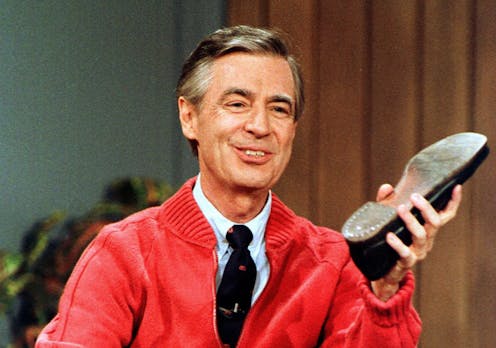
Fred Rogers at a taping of his famous show on June 28, 1989. Gene J. Puskar/AP File

The release of the Mister Rogers documentary, “Won’t You Be My Neighbor?” calls to mind the essential message of Rogers’ long-running children’s program, “Mister Rogers’ Neighborhood.” Fred McFeely Rogers, who died in 2003, was also an ordained Presbyterian minister. Over the course of three decades on public broadcasting, he brought to millions of children what his faith’s General Assembly referred to as “unconditional love.”

In preaching love, Rogers wasn’t just attending to the moral character of his youthful audience. He believed that he was also promoting their health. As he said in 1979, “My whole approach in broadcasting has always been, ‘You are an important person just the way you are. You can make healthy decisions.’ Maybe I’m going on too long, but I just feel that anything that allows a person to be more active in the control of his or her life, in a healthy way, is important.”

Since Rogers’ death, evidence has mounted that he was on to something – namely, that love and kindness truly are healthful, and that people who express them regularly really do lead healthier lives. Simply put, people who are generous and volunteer their time for the benefit of others seem to be happier than those who don’t, and happy people tend to have fewer health complaints and live longer than those who are unhappy.

Love gave rise to a calling

Born in Pennsylvania in 1928, as a young minister Rogers regretted the messages television was conveying to children in the 1960s. He said, “I went into television because I hated it so, and I thought there’s some way of using this fabulous instrument to nurture those who would watch and listen.” “Mr. Rogers’ Neighborhood” debuted nationally in 1968 and won its creator and host many accolades, including a Presidential Medal of Freedom, two Peabody Awards, and over 40 honorary degrees.

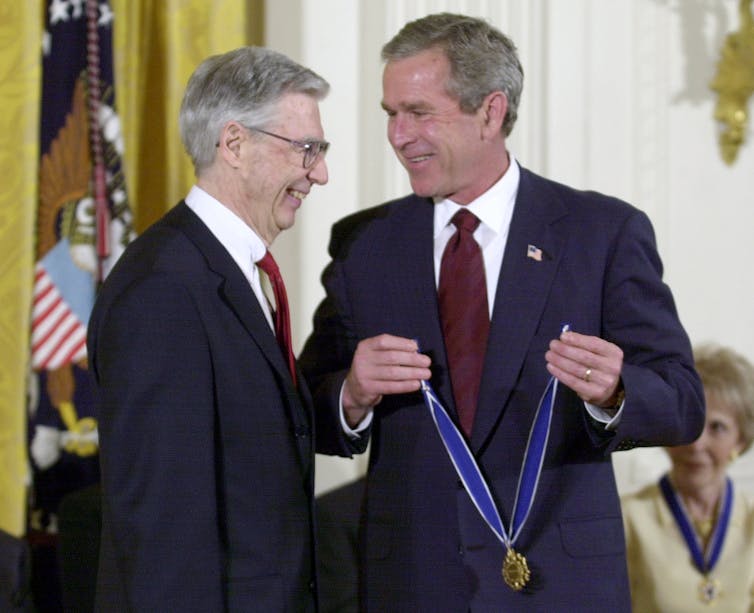
Fred Rogers with Pres. George W. Bush, who is about to place the Presidential Medal of Freedom on Rogers in a July 9, 2002 ceremony. Kenneth Lambert/AP Photo

Rogers believed that the need to love and be loved was universal, and he sought to cultivate these capacities through every program, saying in a 2004 documentary hosted by actor Michael Keaton, one of his former stagehands, “You know, I think everybody longs to be loved, and longs to know that he or she is lovable. And consequently, the greatest thing we can do is to help somebody know they’re loved and capable of loving.”

Love and health

As it turns out, there are many ways in which love and kindness are good for health. For one thing, they tend to reduce factors that undermine it. Doing something nice for someone causes the release of endorphins, which help to relieve pain. People who make kindness a habit have lower levels of stress hormones such as cortisol. Intentionally helping others can even lower levels of anxiety in individuals who normally avoid social situations.

Carrying out acts of kindness, or even merely witnessing them, also increases levels of oxytocin, a hormone with health benefits as diverse as lowering blood pressure, promoting good sleep and reducing cravings for drugs such as cocaine and alcohol. That oxytocin should have so many health benefits is not so surprising when we recall its central role in stimulating uterine contractions during birth, the letdown of milk during lactation, the pleasure associated with orgasm and pair bonding.

Acts of generosity and compassion also appear to be good for mood. A 2010 study showed that while people with money tend to be somewhat happier than those without it, people who spend money on others report even greater levels of happiness, an effect that can be detected even in toddlers. When people give money to others, areas of the brain associated with pleasure are activated, and this response is greater when the transfer is voluntary rather than mandatory.

Such happiness can have big benefits in longevity. For example, a review of 160 published studies concluded that there is compelling evidence that life satisfaction and optimism are associated with better health and enhanced longevity. Another study of older people showed that, even after correcting for other factors such as age, disease and health habits, those who rated their happiness highest were 35 percent less likely to die in five years than those who were least content.

What would Mister Rogers say?

Of course, Rogers would remind us that there are reasons to be committed to love and kindness that extend far beyond their health benefits. Rogers was, after all, not a physician but a minister, and ultimately he was ministering to an aspect of human wholeness that cannot be analyzed by blood tests or visualized with CT scans. In a commencement address at Dartmouth College in 2002, he focused less on the body than what he might have called the spirit:

“When I say it’s you I like, I’m talking about that part of you that knows that life is far more than anything you can ever see or hear or touch. That deep part of you that allows you to stand for those things without which humankind cannot survive. Love that conquers hate, peace that rises triumphant over war, and justice that proves more powerful than greed.”

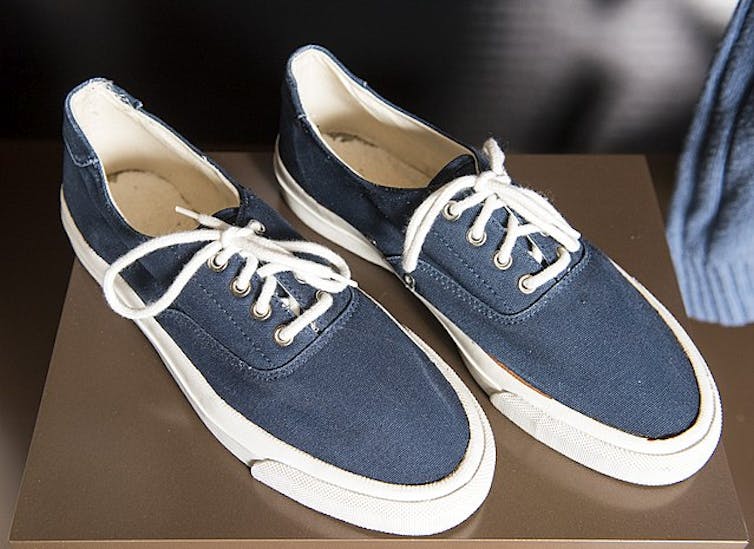
A pair of Mister Rogers’ sneakers at the LBJ Library exhibition to celebrate the 50th anniversary of Pres. Johnson signing the public broadcasting act in 1967. Jay Godwin/LBJ Foundation

When Rogers encouraged children to be kinder and more loving, he believed that he was not only promoting public health but also nurturing the most important part of a human being – the part that exhibits a divine spark. As Rogers indicated in another commencement speech the year before at Middlebury College, “I believe that appreciation is a holy thing, that when we look for what’s best in the person we happen to be with at the moment, we’re doing what God does; so in appreciating our neighbor, we’re participating in something truly sacred.”

In expressing such deeply religious sentiments, Rogers was not trying to undermine a concern with bodily health. In fact, he regularly encouraged his viewers to adopt healthy life habits, and Rogers himself was a committed vegetarian and lifelong swimmer who maintained a low body weight his entire life. Yet he also believed that health alone does not a full life make, and he regarded the soundness of the body as but part of the wellness of whole persons and communities, which may explain why he was able to face his own mortality with such equanimity.

Just a few months before he died, Rogers recorded a message for the many adult fans who had grown up watching “Mister Rogers’ Neighborhood.” In it, he practiced what he preached, saying:

“I would like to tell you what I often told you when you were much younger. I like you just the way you are. And what’s more, I’m so grateful to you for helping the children in your life to know that you’ll do everything you can to keep them safe. And to help them express their feelings in ways that will bring healing in many different neighborhoods. It’s such a good feeling to know that we’re lifelong friends.”

The Conversation

Richard Gunderman does not work for, consult, own shares in or receive funding from any company or organization that would benefit from this article, and has disclosed no relevant affiliations beyond their academic appointment.

06 Jun 19:01

Crayola now has a line of gender-fluid makeup

by Rusty Blazenhoff

I'm not making this up: Crayola is making makeup.

Yep, in a partnership with young adult retail brand ASOS, Crayola now has a line of 58 vegan and cruelty-free beauty products, which includes "face crayons," mascara, highlighters, and eyeshadow palettes. Shades, such as Tumbleweed and Dandelion, match the names of actual Crayola crayons.

Elle notes the collection is "gender fluid," citing a press release about the line from ASOS. They also note that both men and women are shown wearing the product in the campaign's photos.

And no, you can't just use real crayons as makeup. They're not "designed, tested, or approved" for that purpose, according to the crayon giant's website.

(Mashable)

06 Jun 18:55

Mermaid or beluga whale?

by David Pescovitz

According to the excellent wunderkammer of Twitter accounts, We Like To Learn, "Throughout history, sailors have mistaken Beluga Wales for mermaids because of their human-like knees."

(As our helpful commenters point out, those aren't literally "knees" in the image but rather love handles that help the whales steer as they swim. More here.)

(via Daily Grail)

06 Jun 16:37

What is the Loreley? The Legend, the Song, and How to See It…

by karenanne

You are cruising down the Middle Rhine admiring the castles towering over vineyards and small villages when suddenly near Sankt Goarhausen,  the whole ship breaks into song in front of a rock cliff.  You’ve reached the Loreley. But WHAT is the Lorelei? It’s not just a pile of rocks, it is a place of song and […]

The post What is the Loreley? The Legend, the Song, and How to See It… appeared first on A German Girl in America.

06 Jun 12:39

Washington Office at Annual 2018: A policy update and a copyright game

by Shawnda Hines

ALA’s Washington Office is gearing up for the Annual 2018 Conference (June 21-26). Our lineup includes policy-related sessions as well as a full Libraries Ready to Code youth and technology track. We hope you’ll click on the links and add these sessions to your 2018 Annual scheduler!

National Policy and Libraries: What’s Going On
Saturday, June 23, 2018 (2:30 p.m. – 3:30 p.m.), Morial Convention Center Room 393
The national policy landscape continues to bubble and boil – creating challenges and opportunities for libraries. Our expert panel will discuss the issues most central to libraries: funding, digital inclusion, broadband, copyright, improving economic opportunities and more. How might the 2018 election outcomes and new political environment impact federal policies that libraries care about? What is the Census Bureau and ALA doing to prepare for the 2020 U.S. Census? How is the ALA Policy Corps been involved in advocacy at the federal level? Based on decades of inside-the-beltway experience, panelists will provide insider insights of what is really taking place, what is on the horizon, and what we need to do about it to advance the library mission and services.

Speakers: Marc Gartler, manager, Madison (Wisc.) Public Library; Ellen Satterwhite, telecommunications expert and Vice President of the Glen Echo Group; Lisa Varga, executive director, Virginia Library Association; and Alan Inouye, director of public policy, ALA

Play the Copyright Game: a groovy way to learn!
Sunday, June 24, 2018 (4:00 p.m. – 5:00 p.m.), Morial Convention Center Room 391
Join copyright experts in discussions focused on actual copyright situations that librarians face, and then participate in one of the most popular regular ALA conference sessions: the copyright game. This year’s game will consist of a lightning round of “Name that Exception” to learn about the many allowances afforded in U.S. copyright law. In the second round, vote on lawful vs infringing copyright case studies. And for the final round, pose your own real-life copyright scenarios for the audience to vote on and discuss. We also will distribute copyright education materials and groovy swag, including the popular “four coasters of fair use.”

Speakers: Kyle Courtney, copyright advisor, Harvard University; Martin Brennan, copyright librarian, University of California, Los Angeles; Carrie Russell, director of ALA Program on Public Access to Information

Keep reading District Dispatch this week for details about ALA’s Libraries Ready to Code session offerings.

The post Washington Office at Annual 2018: A policy update and a copyright game appeared first on District Dispatch.

05 Jun 17:03

The Bakemono Zukushi “Monster” Scroll (18th–19th century)

by Adam Green
Ghoulish array of shapeshifting monsters from Japanese folklore.
05 Jun 16:59

The Cultural Borders of Songs

We mapped last month’s #1 songs in 3,000 places.
05 Jun 15:13

The art of healing: five medicinal plants used by Aboriginal Australians

by Beth Gott, Honorary Research Fellow, Monash University
Balgo artists: Miriam Baadjo (b. 1957),Tossie Baadjo (b. 1958), Jane Gimme (b. 1958), Gracie Mosquito (b. 1955), Helen Nagomara (b. 1953), Ann Frances Nowee (b. 1964) and Imelda Yukenbarri (b. 1954). Bush medicine: a collaborative work by women from Wirrimanu (Balgo), 2018, acrylic on linen, 120×180cm, MHM2018.32, © Warlayirti Artists; Medical History Museum, Author provided

People have lived in Australia for at least 65,000 years. In all those generations the land provided original Australians with everything they needed for a healthy life.

At least half the food eaten by the first Australians came from plants, and it was the task of women to collect them. Fruits, seeds and greens were seasonal, but roots could usually be dug up all year round, because the earth acted as a natural storage cupboard.

The particular plants eaten or used as medicine varied in different parts of Australia. In Arnhem Land, North Queensland and the Kimberley, many tropical trees bear fruits and seeds, such as native figs (Ficus spp.), lilly-pillies (Acmena, Eugenia and Syzygium spp.) and macadamia nuts.

In Central Australia, where water is scarce, plants are spread thinly over the land. Here the people relied more on the seeds of native grasses and wattles such as mulga (Acacia aneura), wiry wattle (Acacia coriacea) and even the coolabah tree (Eucalyptus microtheca).

In the southern parts of Australia, roots (applying that word to all the underground parts of a plant) were the most important foods.

Treahna Hamm (b. 1965), Dhungala cool burn, 2017 (detail, one panel), acrylic paint, river sand, bark ink, paper 100.9×114cm (each of three panels). MHM2017.2, © Treahna Hamm. Medical History Museum, Author provided

In terms of medicines, many different parts of plants were used. Native mints (Mentha spp.) were remedies for coughs and colds, while the gum from gum trees, which is rich in tannin, was used for burns. The green plum (Buchanania obovata) is enormously rich in vitamin C.

Here are five other plants that have medicinal uses:

1. Kangaroo apple (Solanum aviculare or Solanum laciniatum)

This is a great example of a food source and medicinal plant for many Victorian Aboriginal clan groups. This shrub varies in height. Its leaves resemble a kangaroo’s paw and it produces purple flowers.

The early fruits that form are at first yellow or green and highly poisonous, but can be eaten when they are at their ripest, turning a blood-orange colour. The fruit contains high levels of the alkaloid solanine, which can be infused from the leaves with hot water to create steroids.

Also known as bush apple, it has been farmed in several parts of the world to produce and manufacture oral contraceptives, using extracts from the young leaves and green fruits.

Kathrine ‘Kat’ Clarke (b.1988) , Dyirr-i-laiurrk, kangaroo apple (Solanum aviculare), 2018, acrylic and pencil on canvas, 20.3×14.5cm. MHM2018.23 © Kathrine Clarke. Medical History Museum, Author provided

2. Wattles (Acacia spp.)

Australia has more than 1,000 wattle species. The gum of some species (golden, silver and black wattles) was an important food as well as a useful cement. The seeds of other species are high in protein and carbohydrate and in arid areas were eaten both green and dry.

Wattle blossom was hung in people’s huts to promote sleep. In Victoria, the bark of blackwood (Acacia melanoxylon) was infused and used to bathe rheumatic joints, or ingested as a mild sedative for rheumatism or indigestion.

Treahna Hamm (b. 1965), Yorta Yorta bush medicine first aid kit, 2017 Paperbark, kurrajong pods, Lomandra, she-oak pods, bark ink, riverbed clay, charcoal, billabong sediment, raffia, bottlebrush wood and bloom, ash, possum bone, mussel shell, black wattle bark, stringybark, river sand, Eucalyptus leaves, tree bark, sap, 4×12×27cm, MHM2017.1, © Treahna Hamm. Medical History Museum, Author provided

3. Old man’s weed (Centipeda cunninghamii)

Commonly found along the Murray River, as well as in other low-lying, swampy habitats, this plant is useful for treating many complaints, including eye infections, tuberculosis and skin complaints. It is administered as an extract in water, or sometimes rubbed onto the skin.

It’s usually used for colds and coughs and chest infections, but, being a natural restorative plant, it can help strengthen the immune system and mobility.

Kathrine ‘Kat’ Clarke (b.1988), Gukwonderuk (Wotjobaluk) or old man’s weed (Centipeda cunninghamii), 2018, acrylic and pencil on canvas, 20.4×14.7cm, MHM2018.22, © Kathrine Clarke. Medical History Museum, Author provided

4. Drooping she-oak (Allocasuarina verticillata)

In Victoria, mature cones from this tree were ground up and applied to sores to treat rheumatism. Extracts from the bark and wood can also be used as a general medicine.


Read more: Traditional Aboriginal healers should work alongside doctors to help close the gap


5. Hop bush (Dodonaea viscosa)

This plant grows across Australia. In Queensland the juice of the root was applied for toothache and cuts.

The chewed leaf and juice were put on stonefish and stingray stings and bound up for four or five days.

Rosie Ngwarraye Ross (b. 1951), Bush flowers and bush medicine plants, 2015 acrylic on linen, 91×91cm, MHM2017.3, © Artists of Ampilatwatja. Medical History Museum, Author provided

Kathrine “Kat” Clarke, artist and proud woman from the Wimmera, contributed to this article.

The artworks used in this article are on display at the University of Melbourne’s Medical History Museum, as part of The art of healing: Australian Indigenous bush medicine exhibition, which runs until September 28. This article is made up of essay extracts published in the exhibition’s catalogue.

The Conversation

Beth Gott does not work for, consult, own shares in or receive funding from any company or organisation that would benefit from this article, and has disclosed no relevant affiliations beyond their academic appointment.

04 Jun 19:37

Emotions shape the language we use, but second languages reveal a shortcut around them

by David Miller, Postdoctoral Researcher, University of Reading
Swearing can come more easily to people in their second language. durantelallera/Shutterstock

A taxi driver recently cut me up on the motorway. Without hesitation, I machine-gunned a string of vulgarity at the poor man. What struck me was that every word that came out of my mouth was in Spanish. As a native speaker of English, having learned Spanish as an adult, English should have been the more readily accessible language. Yet there I was, cussing out this stranger in Mexican-accented Spanish alongside an assortment of inappropriate hand gestures.

Most people will know what it’s like to have your emotions take control of you in a scenario like this, but why is it often so much easier to vent frustration in a language that is not your native one? As most foreign language learners will appreciate, anything taboo is fairly easy to pick up in a second language and even entertaining to use. While I wouldn’t profane in English in my grandma’s presence, in Spanish I’m a wannabe Tony Montana.

Incidentally, there is a scientific explanation for why we often demonstrate greater emotional detachment in a foreign language. While this detachment can make it easier for us to say rather distasteful things, recent studies have also shown that it can affect our perception of morality.

Language shapes our brain

Along with genetics, our brains are shaped by experience and, from the moment we are born, we experience a great deal of life through language. Years of immersion in our native tongue afford us a deep understanding of the way it is used with certain people and in certain contexts. We know when it is appropriate to recount a bad case of gastroenteritis, for example, and when it isn’t. We learn to bite our tongues when we’re upset with our boss, and we can appreciate the flow of poetry when trying to woo a partner.

Whether discussing taboo subjects, swearing, or evening listening to certain lyrics and music, language readily prompts heightened emotional responses in certain contexts. In this sense, our native language and our emotions are woven together in a way that makes taboo words taboo or inspiring words inspiring precisely because our brains have been shaped through repeated experience.

Subsequently, our experiences influence the development of neural pathways in the areas of our brain responsible for the control and regulation of emotions, such as the insular cortex and amygdala. Our experiences also help shape the (pre)frontal cortex, which, in addition to regulating impulse control and emotion, is the seat of many of our higher order cognitive capacities such as reasoning and decision-making.

The combination of these processes makes emotion and decision-making inseparable. Given language’s pervasive role in our daily experiences, and its shared link between emotion and reason, it also readily influences our behaviours. But what about a non-native language?

Sticks and stones may break my bones …

Unfortunately, we make most decisions based on implicit, automatic, and very emotional reflexes. The parts of our brain that primarily engage with emotions are faster to respond than the more rational regions of the cortex. In general, however, emotion works in tandem with reason. The dichotomy of the two concepts is really a false one, as they are inextricably intertwined.

Our moral compass is affected by the language in which we wrestle dilemmas. Triff/Shutterstock

To drive the point home, consider the following question: would you take the life of a stranger in order to save the lives of others? Most people say they would, which would exhibit reasoning of the greater good, but careful thought of ending a life would no doubt prompt a heavy emotional response. After all, killing violates many of our moral intuitions.

However, a recent study sheds light on factors that disrupt the cooperation of reason and emotion. Faced with an ethical problem – choosing whether to kill a stranger in order to save many others – the study found that, when the dilemma was posed in their second language, less proficient foreign language speakers were more likely to decide to kill a stranger compared to more proficient second language or native speakers. Interestingly, this foreign language effect was stronger when the mode of killing was more intimate, such as pushing someone off of a footbridge as opposed to pulling a switch to divert an oncoming train.


Read more: You are more likely to deny the truth in your second language


Many foreign language experiences are not as emotionally entrenched as those of a native language, so the study’s authors attribute the above result to reduced emotional reactivity between the speakers and their second language. The result is that the decision-making process is a slower and more deliberate cost-benefit judgement. In other words, decisions made in a foreign language were not as susceptible to emotional biases as those made in a native language.

True, our bilingual world is not exclusively made up of classroom learners such as those in the study, nor is the bilingual experience homogeneous. In fact, many bilinguals do have deep connections with their additional language(s). Nevertheless, it is clear that bilingualism can have broader implications than mere dinner table etiquette. In a globalising world, many of us may find ourselves making important decisions in non-native tongues. Whether it’s saving a life or voting for the next governmental official, an awareness of the many factors motivating our decisions could help us make sounder judgements.

While bilinguals do not roam the streets wreaking havoc in larger numbers than any other community, the next time you casually drop the F-bomb in Chinese over spilt milk, remember that bilingualism may offer a means to establish a meaningful collaboration between reason and emotion, or a means to end one.


Read more: People with depression use language differently – here's how to spot it


The Conversation

David Miller received funding from Advancing the European Multilingual Experience (AThEME), a grant funded by the European Union's Seventh Framework Programme for research (no. 613465).

01 Jun 18:56

Three Problems with the ACCESS Act

by Jonathan Bailey

Monkees Album CoverAs I was hitting publish on my previous piece about the CLASSICS Act, Senator Ron Wyden introduced the “Accessibility for Curators, Creators, Educators, Scholars, and Society to Recordings Act” or the “ACCESS to Recordings Act”.

The act is another attempt to address the issue of pre-1972 sound recordings but this act takes a different approach. Where the CLASSICS Act aims to strategically smooth out some of the rougher edges of pre-1972 sound recordings, the ACCESS Act aims to bring those works fully under federal protection.

Philosophically, I agree with this idea. Though it may not always be a popular view, I believe that having two separate copyright systems with different rules, courts and laws is untenable. Full federalization, in my view, should be the ultimate goal.

The problem is that there are several key challenges that make full federalization of pre-1972 sound recordings incredibly difficult. If it had been easy, it probably would have been done in 1972 when newer sound recordings were put in federal protection.

Either handling these challenges poorly or ignoring them not only risks making the pre-1972 sound recording situation worse, but could end up damaging our entire copyright system.

Unfortunately, that’s exactly what the ACCESS Act is, an act that either ignores or poorly addresses key challenges in bringing pre-1972 sound recordings under federal protection and the act risks doing far more harm than good.

A Brief Recap: How We Got Here

Mamas and the PapasAs we discussed in more detail here, pre-1972 sound recordings are not protected under federal copyright law. Instead, they are covered under a hodgepodge of state and common law.

This is because the Copyright Act of 1909 did not automatically extend copyright protection to new technologies (unlike the Copyright Act of 1976, which replaced it). Though Congress moved to extend federal protection to sound recordings in 1971, it only applied to works created on or after February 15, 1972. All sound recordings from before then remained under the old system.

This created a lot of problems as time went on, including how do pre-1972 sound recordings work under the Digital Millennium Copyright Act (DMCA), which provides safe harbor to web hosts and other service providers, and under the Digital Performance Right in Sound Recordings Act, which gave sound recordings a limited public performance right when streamed digitally.

The CLASSICS Act, which we wrote about here, is an attempt to smooth out some of those rough edges. It aims to grant pre-1972 sound recordings the same digital public performance rights as later songs. It, along with the Music Modernization Act it is a part of, would also make a compulsory license for that right and create an agency for the handling of royalties. The CLASSICS Act would also clarify that pre-1972 sound recordings are covered under the DMCA.

However, the CLASSICS Act would not provide full federalization. Most of the rights in the sound recordings would remain with state law.

This has led to some criticisms of the CLASSICS Act. Though it doesn’t alter the date of expiration and only federalizes rights that pre-1972 artists have won in court (at least in practice), it has been called by some a rights grab or a copyright extension, though it is neither.

As a response to those criticisms comes the ACCESS Act, which aims to fully federalize copyright protection for pre-1972 sound recordings. However, it does so in a way that is dangerous not just to owners of pre-1972 works, but to all content creators.

The Basics of the ACCESS Act

John ColtraneThe ACCESS Act is a relatively short bill that basically makes it so that, in one fell swoop, all pre-1972 sound recordings would come under federal protection.

The act makes it clear that whoever is the copyright holder currently would remain so. There would also be a three year grace period where such rightsholders could still receive statutory damages and attorneys fees without a timely registration and it would adjust the term of copyright on such sound recordings to match the current law, either 95 years after publication or 120 years after creation, whichever is less.

This would mean that many sound recordings would likely lapse into the public domain immediately or soon after the act is passed. However, for sound recordings published between January 1, 1923 and December 31, 1930, there would be a grace period where the work would not expire until December 31, 2025.

However, that grace period would only apply if the rightsholder complied with regulations created by the Register of Copyrights and the work was available for normal commercial exploitation.

Beyond that, the act doesn’t say very much, which is a huge problem since there are some significant challenges that the ACCESS Act fails to address.

Problem 1: The Registration and Deposit Requirement

Chuck Berry AlbumUnder U.S. copyright law, copyright is imbued in a work the moment it is fixed into a tangible medium of expression. However, if you want to sue over an infringement of your work you’ll have to register the work with the U.S. Copyright Office and deposit the work with the Library of Congress.

Furthermore, if you want to collect statutory damages and attorney’s fees, you’ll have to register the work timely, which is either within three months of publication or before the infringement takes place.

However, pre-1972 sound recordings are not registered with the U.S. Copyright Office. There was no reason to do so as there was no federal protection. Any act that attempts to federalize pre-1972 sound recordings must address this issue, otherwise, millions of rightsholders may not be able to go to court to address infringements.

The ACCESS Act, however, doesn’t really address this problem. Though it grants a three-year grace period for filing registrations, it leaves it up to the Register of Copyrights to determine what changes need to be made to the registration and deposit requirements. However, those changes won’t be announced for up to one year after the bill is enacted, meaning right before the bill’s effective date.

But the copyright registration process is already a big mess. According to Copyright Office, even under ideal circumstances (web claim with no correspondence) it takes an average of 7 months to turn around a copyright registration. Adding millions of more works (nearly 50 years of sound recordings) onto this pile without a concise plan is going to cause the time to increase exponentially.

To make matters worse, the process is financially burdensome to rightsholders. Currently a standard application costs $55 and a single application (one work, one author) costs $35, not count the time and expense in preparing the applications (I charge a minimum of $150 for the service). This amount, as we’ll see in a second, is about to get even more burdensome.

While it may not be hugely onerous for one or two applications, many rightsholders are going to be tasked with filing thousands of applications within a few years, creating a huge burden for many of them.

But as bad as it is for rightsholders, it’s equally bad for the Copyright Office. According to a recent evaluation, the Copyright Office loses between $35 and $51 per registration filed. In short, the Copyright Office will likely lose millions trying to keep up.

Because of this loss, the Copyright Office has proposed increased fees of $75 for a standard application and $55 for a single application, which increases the burden on creators without fully eliminating the burden placed on the Copyright Office.

In short, the copyright registration process is barely functioning as is. Though modifications to the registration and deposit requirement could limit the impact, the bill makes it so that we don’t know what those modifications might look like until a year AFTER it’s passed.

This could harm not just owners of pre-1972 sound recordings, but ANY creator that wants to register their work.

Problem 2: The Notice Requirement

The Copyright Act of 1976 eliminated any requirement to have a copyright notice placed on  it. However, prior to that, it was a requirement if a work wanted copyright protection.

There are many examples of works losing copyright protection for being distributed without a notice, one of the most famous is the film Night of the Living Dead.

However, pre-1972 sound recordings were often distributed without a copyright notice. Since they weren’t covered under federal law, the notice requirement didn’t apply.

If federalization of pre-1972 sound recordings were to maintain the notice requirement as is, many such recordings could lose protection simply for following the law as it was written when they created their work.

While it would be simple to eliminate the notice requirement for pre-1972 sound recordings, the act doesn’t do that. Instead, it once again puts the onus on the Register of Copyrights to come up with appropriate modifications to the notice requirement within a year of it passing.

In short, another important question the act could have and should have answered is punted on, letting the Register of Copyrights address the issue a year after the act is enacted.

Problem 3: The Takings Clause

Note: Once again, Terry Hart at CopyHype has a longer post on this topic. I highly recommend checking it out if this interests you. 

The Fifth Amendment states, among other things, that no private property shall be taken for public use “without just compensation”. This is known as The Takings Clause and applies to copyright.

In 2011, when the U.S. Copyright Office evaluated the prospect of providing federal copyright protection to pre-1972 sound recordings, they recognized the takings clause as a serious issue.

Basically, the Copyright Office felt that, as long as all state rights had a federal analogue, there was no takings clause claim on the rights themselves. However, by shortening the term of the copyright, such federalization could open the door to the takings claims as it would be taking private property, some of it still is significant economic value, and making it available for public use (placing it in the public domain) without compensation.

The Copyright Office came up with a novel solution. Grant pre-1972 sound recordings the default copyright term (95 years after publication or 120 years after creation) but makes the eligible to be protected until 2067, the current term.

To secure the 2067 date, rightsholders would have to take some additional action, including  making the work commercially available and providing notice to the Copyright Office that it is. Since, according to the Copyright Office, such steps would not be identified as a taking under the Fifth Amendment, it complies with the the Takings Clause.

However, the ACCESS Act doesn’t do that. Instead, it provides the current default term and uses a similar principal of commercial sale/notice requirements but only to extend the copyright term on 1923-1930 sound recordings to 2025. Outside of early 1972 sound recordings, no pre-1972 sound recordings would have a term of 2067 under the ACCESS Act.

While there are many legitimate reasons to express concern over such a lengthy copyright term. The fact is that reducing it opens up the ACCESS Act to constitutional challenges, challenges the Copyright Office feels have a good chance of succeeding.

This, in turn, risks making an even bigger mess of pre-1972 sound recordings, placing the ultimate impact (or even existence) of the ACCESS Act in the hands of judges and rulings that likely won’t come for many years.

Bottom Line

As I said above, I philosophically support the idea of federalizing pre-1972 sound recordings. However, there are many challenges to doing so and those challenges haven’t gotten easier with time.

The ACCESS Act either fails to address those challenges or simply punts on them, asking the Register of Copyrights to solve them AFTER the act is enacted.

The danger here isn’t just to pre-1972 sound recordings. Anyone who wants to register their work with the U.S. Copyright Office needs to pay attention as it could easily impact them.

The lack of attention to these issues lends credence to the idea that the ACCESS Act is not a serious act, but rather, an attempt to derail the CLASSICS Act and the Music Modernization Act it is currently a part of.

While I agree with the ultimate goal of federalizing protection for pre-1972 sound recordings, doing so is difficult. That’s why it hasn’t been done before now.

Any serious attempt to do as such needs to address these and other issues, which the ACCESS Act doesn’t. The CLASSICS Act isn’t perfect, but it doesn’t raise any of these issues  and attempts to smooth out some of the worst rough edges.

So, while the CLASSICS At may be an ill-fitting bandage, it’s better than a rushed and unplanned open heart surgery, which is what the ACCESS Act is.

Want to Republish this Article? Request Permission Here. It's Free.

Have a Plagiarism Problem?

Need an expert witness, plagiarism analyst or content enforcer? Check out our Consulting Website

The post Three Problems with the ACCESS Act appeared first on Plagiarism Today.
01 Jun 18:46

Author Trademarks the Word 'Cocky,' Earns the Ire of Romance Writers Everywhere

by Katharine Trendacosta

It’s a bad idea to come after romance authors’ favorite double entendres. Unfortunately, Faleena Hopkins, holder of a trademark on the word “cocky” and a shaky understanding of trademark law, fired a bunch of shots and not only missed the mark, but managed to turn her entire industry against her.

Hopkins is the author of a series of romance novels about the “Cocker Brothers” which she has named “The Cocky Series.” Hopkins obtained a trademark for the word “cocky” on April 17, 2018. On May 7, 2018, Kevin Kneupper filed a challenge [pdf] to the trademark. That’s only three weeks, but a lot happened in that time.

Hopkins filed for two trademarks. One is for the word “cocky” in a specific font. The second is just for using the word in a series of books, downloadable and regular, “in the field of romance.” Once Hopkins had that mark, things spiraled.

Authors T.L. Smith and Melissa Jane were contacted by Audible about their upcoming book Cocky Fiancé, telling them they had received a notice that their title was infringing. They then got an email from Hopkins, followed very quickly, they told Vox, by a notice from Amazon about infringement. Seeing that Hopkins did have a registered mark, the two changed their book title to Arrogant Fiancé and ate the cost of the merchandise with Cocky Fiancé printed on it.

They were not alone. Jamila Jasper reported getting a letter for her book Cocky Cowboy, which has since been renamed The Cockiest Cowboy To Have Ever Cocked. Author Tara Crescent, whose Cocky Series predates Hopkins’s, also received a notice from Amazon. Claire Kingsley told Slate that she was contacted by Hopkins last summer, before Hopkins had the trademark, and told to change the title of her Cocky Roommate. And there are many more said to have been contacted and had books removed from Amazon in a kerfuffle known as #cockygate.

It got so bad that the Romance Writers of America (RWA), the trade organization for romance authors, consulted a lawyer about the issue, soliciting information from members. RWA contacted Amazon and got it to stop suspending the books with “cocky” in the title and got it to reverse the removals it had already taken out. And of course, there’s Kneupper’s pending challenge to the trademark.

Hopkins claimed that she’d received complaints from people thinking they’ve bought one of her books when they bought one of these other books. But you can’t get a trademark for a book title, only a series. So single book titles like Cocky Fiancé shouldn’t have been targeted. You’re also not supposed to get a trademark when others have already used your proposed mark (“cocky”) in your market (romance novels). As you might expect, “cocky” was a popular word in romance titles before Hopkins’ series came onto the market. So she should never have received this trademark in the first place.

There’s a lot that went wrong here. Hopkins was able to get a trademark and use it to intimidate authors like T.L. Smith and Melissa Jane into throwing away money to change the title of a book when they didn’t have to. Even when faced with an illegitimate claim, independent authors won’t always have the resources to fight back.

Amazon’s quick draw on suspensions is also very dangerous—and reminiscent of what we see all the time in copyright takedowns. Even though a claim is bogus or based in an overinclusive trademark, creators who don't have the resources to fight back are still deprived of a large marketplace. If companies like Amazon act unthinkingly in response to infringement claims, even shaky ones, it creates a sledgehammer that is all too simple to wield. And not everyone is going to be lucky enough to generate enough noise to get backup.

In short, what a crock.

01 Jun 17:19

How to Draw a Black Lady

by Andrea James

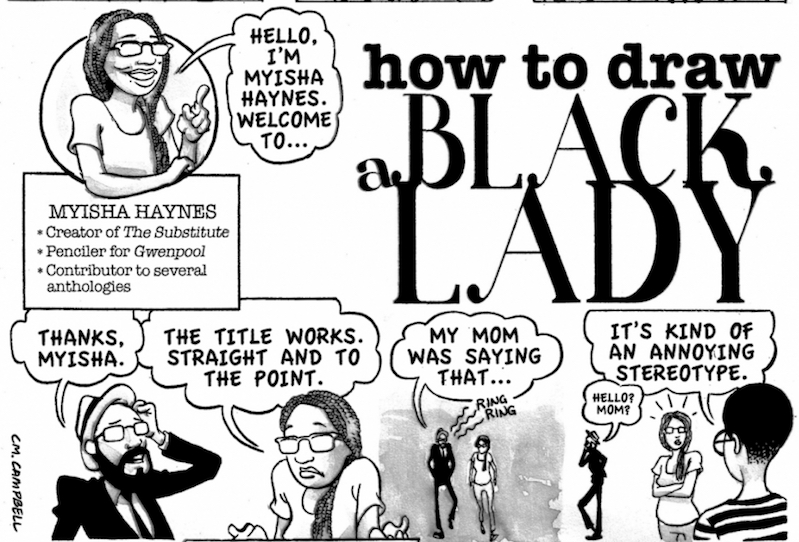
Myisha Haynes and Jaz Malone released the second in their fun and interesting series on how cartoonists can draw black people while avoiding imagery fraught with negative connotations. (more…)
31 May 19:00

The sage grouse isn't just a bird – it's a proxy for control of Western lands

by John Freemuth, Professor of Public Policy and Executive Director, Andrus Center for Public Policy, Boise State University
Male sage grouse at the Seedskadee National Wildlife Refuge, Wyoming. Tom Koerner/USFWS, CC BY

The Trump administration is clashing with conservation groups and others over protection for the greater sage grouse (Centrocercus urophasianus), a bird widely known for its dramatic mating displays. The grouse is found across sagebrush country from the Rocky Mountains on the east to the Sierra and Cascade mountain ranges on the west.

This region also contains significant oil and gas deposits. The Trump administration is revising an elaborate plan developed under the Obama administration that sought to steer energy development away from sage grouse habitat. Conservation groups are suing in response, arguing that this shift and accelerated oil and gas leasing threaten sage grouse and violate several key environmental laws.

This battle is the latest skirmish in a continuing narrative over management of Western public lands. Like its Republican predecessors, the Trump administration is prioritizing use of public lands and resources over conservation. The question is whether its revisions will protect sage grouse and their habitat effectively enough to keep the birds off of the endangered species list – the outcome that the Obama plan was designed to achieve.

By popping their brightly colored air sacs, male sage grouse create a sound that can carry 3 kilometers to attract females to their display ground.

Sage grouse under siege

Before European settlement, sage grouse numbered up to 16 million across the West. Today their population has shrunk to an estimated 200,000 to 500,000. The main cause is habitat loss due to road construction, development and oil and gas leasing.

More frequent wildland fires are also a factor. After wildfires, invasive species like cheatgrass are first to appear and replace the sagebrush that grouse rely on for food and cover. Climate change and drought also contribute to increased fire regimes, and the cycle repeats itself.

Concern over the sage grouse’s decline spurred five petitions to list it for protection under the Endangered Species Act between 1999 and 2005. Listing a species is a major step because it requires federal agencies to ensure that any actions they fund, authorize or carry out – such as awarding mining leases or drilling permits – will not threaten the species or its critical habitat.

Current and historic range of greater sage grouse. USFWS

In 2005 the U.S. Fish and Wildlife Service declared that an ESA listing for the sage grouse was “not warranted.” These decisions are supposed to be based on science, but leaks revealed that an agency synthesis of sage grouse research had been edited by a political appointee who deleted scientific references without discussion. In a section that discussed whether grouse could access the types of sagebrush they prefer to feed on in winter, the appointee asserted, “I believe that is an overstatement, as they will eat other stuff if it’s available.”

In 2010 the agency ruled that the sage grouse was at risk of extinction, but declined to list it at that time, although Interior Secretary Ken Salazar pledged to take steps to restore sagebrush habitat. In a court settlement, the agency agreed to issue a listing decision by September 30, 2015.

Negotiating the rescue plan

The Obama administration launched a concerted effort in 2011 to develop enough actions and plans at the federal and state level to avoid an ESA listing for the sage grouse. This effort involved federal and state agencies, nongovernmental organizations and private landowners.

California, Colorado, Idaho, Montana, Nevada and Wyoming all developed plans for conserving sage grouse and their habitat. The U.S. Forest Service and Bureau of Land Management revised 98 land use plans in 10 states. And the U.S. Department of Agriculture provided funding for voluntary conservation actions on private lands.

In 2015 Interior Secretary Sally Jewell announced that these actions had reduced threats to sage grouse habitat so effectively that a listing was no longer necessary. A bipartisan group of Western governors joined Jewell for the event. But despite the good feelings, some important value conflicts remained unresolved.

Interior Secretary Sally Jewell announces the sage grouse rescue plan in Colorado, Sept. 22, 2015. Behind Secretary Jewell are, left to right, Colorado Gov. John Hickenlooper, Wyoming Gov. Matt Mead, Montana Gov. Steve Bullock, and Nevada Gov. Brian Sandoval. AP Photo/Brennan Linsley

Notably, the plan created zones called Sagebrush Focal Areas – zones that were deemed essential for the sage grouse to survive – and proposed to bar mineral development on 10 million acres within those areas. Some Western governors, such as Butch Otter of Idaho, viewed this element as a surprise and felt that it had been dropped on states from Washington, without consultation.

The Trump administration wants to cancel creation of Sagebrush Focal Areas and allow mining and energy development in these zones. Agency records show that as Interior Department officials reevaluated the sage grouse plan in 2017, they worked closely with representatives of the oil, gas and mining industries, but not with environmental advocates.

Can collaboration work?

If the Trump administration does weaken the sage grouse plan, it could have much broader effects on relations between federal agencies and Western states.

Collaboration is emerging as a potential antidote to high-level political decisions and endless litigation over western public lands and resources. In addition to the sage grouse plan, recent examples include a Western Working Lands Forum organized by the Western Governors’ Association in March 2018, and forest collaboratives in Idaho that include diverse members and work to balance timber production, jobs and ecological restoration in Idaho national forests.

Warning sign in Wyoming. Mark Bellis/USFWS, CC BY

There are two key requirements for these initiatives to succeed. First, they must give elected and high-level administrative appointees some cover to support locally and regionally crafted solutions. Second, they have to prevent federal officials from overruling outcomes with which they disagree.

When the U.S. Fish and Wildlife Service announced in 2015 that an endangered listing for the sage grouse was not warranted, the agency committed to revisit the bird’s status in 2020. To avoid having to list the grouse as endangered, the Trump administration must provide enough evidence and certainty to justify a decision not to list, as the Obama administration sought to do. If Interior changes land management plans and increases oil and gas leasing, that job could become harder. It also is possible that Congress might prohibit a listing.

Finding a lasting solution will require the Trump administration to collaborate with states and other stakeholders, including environmental advocates, and allow local land managers to do the same. Then, whatever the outcome, it cannot reverse their efforts in Washington. As Matt Mead, Wyoming’s Republican governor, warned in 2017, “If we go down a different road now with the sage grouse, what it says is, when you try to address other endangered species problems in this country, don’t have a collaborative process, don’t work together, because it’s going to be changed.”

The Conversation

John Freemuth receives funding from the U.S. Geological Survey and the Bureau of Land Management, and is Executive Director of the Andrus Center for Public Policy at Boise State University. The Center was founded by Cecil D. Andrus, former governor of Idaho and Secretary of the Interior in the Carter administration.

31 May 18:39

How much are teachers paid in every US state?

by David Pescovitz

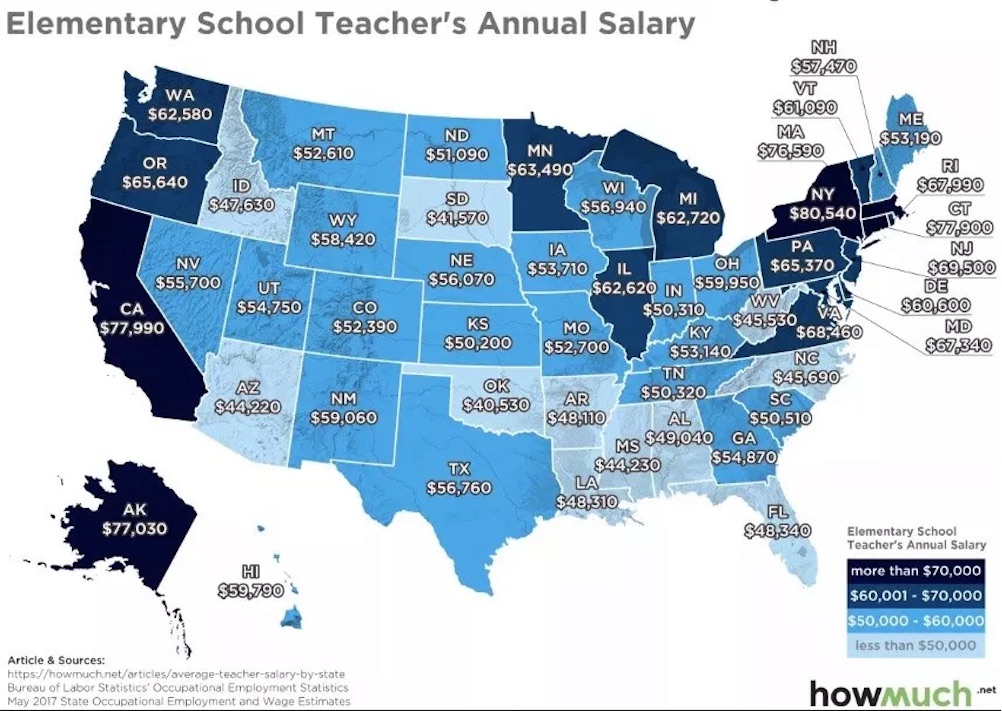
How much money are teachers in the US paid? The correct answer, of course, is "not enough." As nationwide teacher strikes continue, HowMuch created infographics showing the average annual teacher salary by state. Above is the elementary school infographic.

The coasts offer the highest salaries, led by liberal states like New York and California, where teachers can make tens of thousands of dollars more than the national average wage of about $49k. There are also a couple of states in the Upper Midwest where teachers can make between $60-70,000, including Illinois, Minnesota and Michigan. The combination of above-average incomes with great benefits like a pension make these places ideal for teachers.

See the middle school and high school data here: "The Best (and Worst) States for Teacher Compensation"

31 May 18:16

Last night was Manhattanhenge: It. Was. Glorious.

by Cory Doctorow

I'm obsessed with Manhattanhenge, the two nights a year when the sunset aligns with the prevailing east-west streets of the New York City grid, a phenomenon that Neil deGrasse Tyson named in 1992. (more…)

31 May 18:13

Tell your parents: Trump is lying to them about Medicare

by Cory Doctorow

The Center for Medicare Advocacy, Justice in Aging, and the Medicare Rights Center have issued a joint statement condemning the 2018 edition of Medicare & You, the annual guide published by the federal government; the groups say that the Trump administration is lying to seniors in order to trick them into switching to privatized, HMO-run Medicare Advantage programs, away from the superior, publicly maintained Meidcare system. (more…)

31 May 18:12

The time Davy Crockett met Bigfoot who warned him about the Alamo

by David Pescovitz

In 1835, Davy Crockett reportedly wrote a letter to his brother-in-law Abner Burgin telling him of a rather strange experience in the Mexican province of Texas just six months before Crockett was killed at the Battle of the Alamo. From the letter:

“William and I were pushing through some thicket, clearing the way, when I sat down to mop my brow. I sat for a spell, watching as William made his good and fine progress. I removed my boots and sat with my rations, thinking the afternoon a fine time to lunch. As the birds whistled and chirped, and I ate my small and meager ration, I tapped my axe upon the opposite end of the felled tree I rested upon.

“Whether it was the axe’s disturbance or possibly the heat of the sun which caused an apparition to slowly form in front of my eyes, I know not. As a Christian man, I swear to you, Abe, that what spirit came upon me was the shape and shade of a large ape man, the likes we might expect among the more bellicose and hostile Indian tribes in the Territories. The shade formed into the most deformed and ugly countenance. Covered in wild hair, with small and needling eyes, large broken rows of teeth, and the height of three foundlings, I spit upon the ground the bread I was eating.

“The monster then addressed a warning to me. Abner, it told me to return from Texas, to flee this Fort and to abandon this lost cause. When I began to question this, the creature spread upon the wind like the morning steam swirls off a frog pond. I swear to you, Abner, that whatever meat or sausage disagreed with me that afternoon, I swore off all beef and hog for a day or so afterward.”

"Sasquatch Classics: The Davy Crockett Incident" (Texas Cryptid Hunter via The Anomalist)

31 May 18:07

Despite Professors’ Misleading Rhetoric, CLASSICS is a Big Win for Everyone

by CPIP

By Matthew Barblan

America’s music industry is experiencing a historic moment. For the first time ever, stakeholders from across the industry have set aside their differences and come together to find a way to modernize our music licensing system. And what’s more, these diverse stakeholders—ranging from artists and record labels, to songwriters and music publishers, to the technology companies that distribute music throughout the country—have finally agreed on a framework for legislative reform. The resulting bill is the Music Modernization Act of 2018 (H.R. 5447, S. 2823, hereafter “MMA”), which passed the U.S. House of Representatives in April by a vote of 415-0 and is now under consideration in the U.S. Senate.

Nearly everyone sees the bill as the kind of win-win compromise that exemplifies lawmaking at its best. Nobody gets everything they want, but everyone gets something they need, and everyone is better off. Tech companies that distribute music will get relief from an uncertain patchwork of state laws for digital performances of pre-1972 sound recordings and from the difficulty of identifying the songwriters associated with millions of songs available on popular platforms like Spotify. Songwriters and music publishers will get a willing buyer/willing seller royalty rate for use of their songs that more closely resembles a rate negotiated in a free market, along with a brand new licensing collective to distribute royalties. Artists and record labels will get long-overdue recognition of the economic value of music recorded before 1972, which finally will be subject to the same federal licensing scheme for digital performances that applies to post-1972 sound recordings (and the licensing scheme, in turn, will be modified to create platform parity by applying the same royalty rate to all digital platforms).

Importantly, the public will get a healthier music ecosystem that spurs creativity by (1) giving artists and songwriters more confidence that the fruits of their labor will be protected and rewarded, and (2) giving technology platforms and others more confidence to distribute music without risking exposure to uncertain liabilities.

But not everyone is happy. Two weeks ago, a group of professors submitted a letter to the Senate Judiciary Committee complaining about the bill. Specifically, the professors take issue with the section of the bill that creates a federal right and a federal compulsory licensing scheme for the digital public performance of pre-1972 sound recordings. This section, titled Compensating Legacy Artists for their Songs, Service, and Important Contributions to Society (CLASSICS), takes a small step towards correcting a historical injustice inflicted upon artists who recorded their songs before 1972. Unfortunately, instead of acknowledging the importance of correcting this injustice or exploring how CLASSICS will improve artist/songwriter/platform confidence in America’s music ecosystem, the professors make several misleading claims about CLASSICS and ultimately argue that it will harm the public.

This essay provides an important corrective.

The Misleading Term Extension Argument

In their letter to the Senate, the professors accuse CLASSICS of being an unjust extension of copyright term. One of the letter’s signatories—Professor Larry Lessig—further echoed this criticism in a high profile op-ed in Wired, lamenting that “the fight for [copyright] term extension has begun anew.”

It is deeply misleading to characterize CLASSICS as copyright term extension, and lawmakers and the public should not be fooled by this rhetorical ploy. The truth is that CLASSICS does nothing to extend the copyright term of pre-1972 sound recordings. That term is set by a combination of state law and Section 301(c) of the federal Copyright Act, which was enacted long ago and which CLASSICS would not change. Under the existing law of most states, the copyright term for pre-1972 sound recordings is perpetual, but Section 301(c) of the Copyright Act will step in to extinguish state law copyrights for pre-1972 sound recordings in February of 2067. This is the framework now, and this will continue to be the framework if CLASSICS is adopted as law.

CLASSICS does create a new federal cause of action that owners of pre-1972 sound recordings (secured under state copyright law) can use to protect their property from unjust exploitation. Specifically, CLASSICS protects pre-1972 sound recording copyright owners from unauthorized digital public performances of their works. But this new federal cause of action does not extend the copyright term of pre-1972 sound recordings. In fact, with respect to the new cause of action, CLASSICS actually shortens the applicable enforceability period by excluding sound recordings made before 1923. By contrast, when it comes to reproduction, distribution and other rights protected under state copyright law, sound recording copyright owners can sue infringers regardless of how old the sound recordings are.

Furthermore, since the new cause of action would not be retroactive and would not take effect until after the MMA is signed into law, the effective enforceability period for the CLASSICS cause of action will be less than 50 years. If the law takes effect in 2019, it would run for 48 years from 2019 to 2067. This modest enforceability period is a far cry from the “total term of protection of 144 years” that Professor Lessig claims the bill provides.

In this context, to call CLASSICS a copyright term extension defies logic. Rather, the bill would create a new cause of action—attached at the hip to already existing copyrights—that does nothing to affect the already-existing term for those copyrights.

The Misleading Statutory Limitations Argument

Unfortunately, the misleading criticism of CLASSICS does not end with claims of term extension. In the same letter, the professors complain that CLASSICS “arbitrarily exempts pre-1972 sound recordings from almost all the statutory copyright limitations that apply to other types of works.” As an example, the professors note that, under CLASSICS, pre-1972 sound recordings would not be subject to Section 114 of the Copyright Act.

But it takes only a cursory glance at the bill to see that CLASSICS squarely situates pre-1972 sound recordings within Section 114’s compulsory licensing scheme. While CLASSICS prevents digital distribution platforms from profiting off of pre-1972 recording artists’ hard work without providing any compensation in return, CLASSICS does not give pre-1972 sound recording copyright owners a right to negotiate license rates in a free market. Instead, just like for post-1972 sound recordings, digital platforms will still be able to publicly perform pre-1972 sound recordings by simply complying with the terms of the Section 114 license. In light of this, it is truly bizarre to see professors complaining that CLASSICS exempts pre-1972 sound recordings from Section 114.

It is equally bizarre to see Professor Lessig argue in his Wired op-ed that because “there is no registry of [pre-1972 sound recording] owners anywhere,” if CLASSICS were to become law “no public or non-profit website could even begin to bear the cost of assuring they were not committing a crime.” For one thing, the Section 114 compulsory license is not limited to private or for-profit entities, and it does not require the licensee to identify the particular pre-1972 sound recording copyright owner in order to take advantage of the license. CLASSICS also makes the digital public performance of pre-1972 sound recordings subject to the Copyright Act’s statutory limitations for uses by libraries, archives, and educational institutions—limitations that would not otherwise apply to pre-1972 sound recordings. In doing so, CLASSICS makes it easier, not harder, for public and non-profit institutions to publicly perform pre-1972 sound recordings without risking liability.

Additionally, despite Professor Lessig’s suggestion to the contrary, CLASSICS would not create any criminal penalties. Simply reading the first sentence of the first subsection of CLASSICS makes clear that the cause of action is limited to the civil remedies codified in Sections 502 through 505 of the Copyright Act. Unfortunately, once Professor Lessig’s op-ed was published, thousands of Wired readers were potentially misled into thinking that Congress was trying to create new criminal penalties through the MMA.

Furthermore, it is deeply misleading to characterize CLASSICS as “arbitrarily exempting” pre-1972 sound recordings from any of the Copyright Act’s statutory limitations. CLASSICS itself doesn’t include any such exemptions; rather, the Copyright Act’s failure to include pre-1972 sound recordings as federal copyrightable works in the first place is the source of any so-called “exemptions.” In fact, CLASSICS significantly increases the statutory limitations applicable to pre-1972 sound recordings. And far from doing so “arbitrarily,” CLASSICS applies the limitations that are most relevant to the digital public performance of pre-1972 sound recordings. The professors lament that CLASSICS doesn’t make pre-1972 sound recordings subject to the limitations in Section 119 of the Copyright Act. But why would it? Section 119 deals with “secondary transmissions of distant television programming by satellite.” It’s simply not relevant to the new cause of action that CLASSICS would create.

To assert that CLASSICS “arbitrarily exempts” pre-1972 sound recordings from the Copyright Act’s limitations ignores both the fact that CLASSICS provides no such exemptions in the first place and the fact that CLASSICS, for the first time, subjects pre-1972 sound recordings to the most significant limitation in the Copyright Act—statutory licensing.

The Misleading “Purpose of Copyright” Argument

The professors also argue that because CLASSICS “grants new federal protections to old works,” it “does nothing to incentivize the creation of new works,” and as a result it does not serve the purposes of copyright law. Professor Lessig echoes this argument in his Wired op-ed, stating that CLASSICS “has nothing to do with the constitutional purpose of ‘promot[ing] Progress’” because it is a “blatant a gift without any public return as is conceivable.” This argument is misleading for two reasons. First, it implies that the only purpose of copyright law is the direct incentive to create new works. And second, it assumes that giving new protections to old works necessarily does nothing to incentivize the creation of new works. Neither of these assumptions are reasonable.

It is baffling to see scholars of copyright law ignore the fact that copyright serves more than one purpose. Simply looking at the way that copyright operates in the creative industries reveals that in addition to incentivizing the creation of new works, copyright also incentivizes investment in the dissemination and curation of pre-existing works. After all, the public interest—or the “Progress of Science”—isn’t served by the mere existence of creative works. The public interest is served by the existence of creative works that people actually know about and consume—the books and songs and movies and works of art that change our lives and contribute to a flourishing human experience. Like other property rights, copyright is the underlying asset that secures crucial investments in commercializing, marketing, and distributing products (in this case creative works) so that the public actually gets to enjoy them.

By adding clarity to the legal status of digital public performances of pre-1972 sound recordings—and jettisoning an uncertain patchwork of state laws—CLASSICS makes it easier for businesses and other organizations to disseminate these works without facing potential liability under the laws of the various states. Yes, they’ll have to secure a license to do so, but by bringing digital performances of pre-1972 sound recordings into the framework of the Copyright Act, including the provisions of Section 114, CLASSICS also makes it much easier to secure that license than at present. As a result, CLASSICS serves the purposes of copyright by making it easier to license and disseminate pre-1972 sound recordings.

CLASSICS also serves the purposes of copyright by rewarding pre-1972 sound recording artists for their creative labors, the results of which enrich our musical culture to this day. By finally securing to pre-1972 sound recording artists exclusive rights to the digital public performance of their sound recordings, CLASSICS acknowledges that these artists deserve to own the fruits of their hard work, and that doing so will promote a stronger and healthier music ecosystem. Securing property rights to artists for the fruits of their creative labors—and thus facilitating the myriad transactions that enable a thriving creative economy—is a core part of an effective copyright system, and it clearly serves the purposes of copyright.

But even under a narrow theory that copyright’s only purpose is to incentivize the creation of new works, CLASSICS will also help in that effort. By preventing digital platforms from selling access to pre-1972 sound recordings without paying anything to the artists who recorded those songs, CLASSICS will demonstrate to all artists that Congress is capable of correcting injustices that result from unpredictable changes in technology. As a result, CLASSICS will give artists more confidence that the fruits of their creative labors won’t be wrongfully expropriated in the future, and that if new technology makes it possible to unfairly exploit their works without compensating them, there is at least a chance that Congress will change the law to correct the injustice. This confidence will spur more artists to use their time and money (not to mention their hearts and souls) to create new works.

Whether you take a broad view of copyright’s purpose that considers the way that copyright actually functions in the music industry, or a narrow view that focuses solely on new works incentivized, CLASSICS clearly serves the purposes of copyright law.

A Good Result for the Public

 So where does the public fit into all of this? Reading the professors’ letter and Lessig’s op-ed, a lay observer might conclude that CLASSICS would rob the public of a precious resource without providing any benefit in return. That simply is not the case.

CLASSICS benefits the public in many ways. For starters, the public has an interest in treating people fairly. By preventing the unjust exploitation of artists who recorded their music before 1972, CLASSICS contributes to a society that rewards people for the fruits of their labor and that closes loopholes that allow multi-million dollar companies to profit off the backs of artists without compensating them. To the extent post-72 artists take note, CLASSICS further benefits the public by increasing artists’ confidence that the laws that govern the music industry will change over time to ensure the industry’s continuing health. CLASSICS also benefits the public by fostering a music ecosystem that enables companies and other organizations to invest in the dissemination of pre-1972 sound recordings without risking exposure to an uncertain patchwork of potential state law liability.

And what is the cost of these benefits? It’s simple. Just like for post-1972 sound recordings, if you want to digitally publicly perform pre-1972 sound recordings, you have to pay. And CLASSICS makes it easy to pay. Last I checked there wasn’t a public shortage of access to sound recordings from 1973 or later. There is simply no reason to believe that CLASSICS will hurt the public’s access to pre-1972 sound recordings.

Despite a few professors’ misleading rhetoric to the contrary, CLASSICS is a big win for everyone.

Matthew Barblan is Executive Director of the Center for the Protection of Intellectual Property and Assistant Professor of Law at Antonin Scalia Law School, George Mason University, where he teaches copyright and trademark law.

29 May 19:22

Germany's scientific texts were made free during and after WWII; analyzing them today shows the negative effect of paywalls on science

by Cory Doctorow

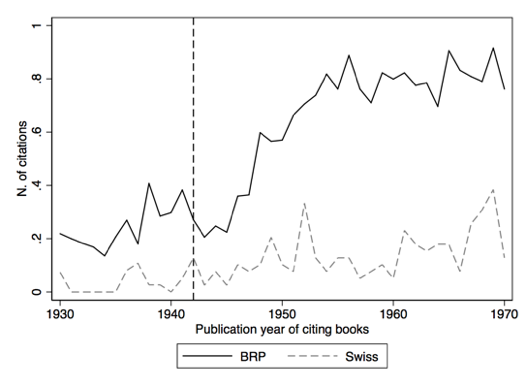
In 1942, the US Book Republication Program permitted American publishers to reprint "exact reproductions" of Germany's scientific texts without payment; seventy-five years later, the fate of this scientific knowledge forms the basis of a "natural experiment" analysed by Barbara Biasi and Petra Moser for The Center for Economic and Policy Research, who compare the fate of these texts to their contemporaries who didn't have this semi-public-domain existence. (more…)

29 May 19:21

Futuristic designs for products the EU's stupid new copyright law would kill

by Cory Doctorow

The Polish thinktank Centrum Cyfrowe commissioned designers to come up with "speculative designs" for products that could be enabled by a European approach to copyright reforms that favored a more equitable balance tilted towards creators and the public and away from large corporations -- even as the EU is preparing to kill this future by passing an extreme, corporate-aligned copyright regime that runs on censorship and mass surveillance. (more…)

25 May 11:10

'Be Bullish'

by oracleeditor@gmail.com (Matthew Cutillo, Staff Writer)
Leettaschmidt

Merriam-Webster Definition of bullish
1 : suggestive of a bull (as in brawniness)
2 a : marked by, tending to cause, or hopeful of rising prices (as in a stock market): a bullish market,
bullish policies, bullish investors
b : optimistic about something's or someone's prospects: bullish on the company's future

USF will launch "Be Bullish" as its new university tagline in the fall in an effort to recreate the image of the university.

Joe Hice, USF’s chief marketing officer, is attempting to push the new tagline into the general student population. The new tagline will replace USF’s previous one of 15 years, “Touching Lives, Improving the World.”

“To ‘Be Bullish’ is a statement to be positive about something or someone’s future,” Hice said. “We feel with everything that’s going on at USF, we have a bright future and we’re all very positive about what’s to come for students who are currently attending and even after they  graduate.”

The new campaign will attempt to give students and faculty a new feeling of optimism toward USF and the opportunities the university can provide, Hice said.

The phrase is being named USF’s “tagline” opposed to “slogan” because USF views the phrase as being a long-term marketing tool, opposed to being used for a single campaign — which is what slogans are predominantly used for.

“Our goal is to have an impact on our university’s ability to positively affect our students' futures,” Hice said.

As the fall approaches, Hice and the rest of the USF’s marketing department are preparing to push the campaign in a variety of ways, including on-campus tabling and activism.

“The timing now is that we’re developing an ongoing communications campaign that will launch with the start of the new fall semester,” Hice said. “We’ll get out on campus and do a lot of activism. We’ll have information stations, banners and signs up, and we’ll work with student organizations. Working closely with the people of WUSF will aid us in telling the story. All of those traditional means will be a huge help.”

With a large campus like USF, Hice said he and his team needed to develop a tagline that best encompassed the entire university and all of its different departments.

“The other challenge you have when you’re trying to develop a communications program for an organization as big and complex as the university is that you need to find something that works everywhere,” Hice said. “It’s real easy to ‘Be Bullish’ about journalism and communications, education and engineering or USF health ... It’s not necessarily meant to be a headline or an ad, but more of a tagline that kind of underlines the messaging and positive energy that we want to push forward.”

The “Be Bullish” campaign is occurring while campus consolidation is in the works, which will see USF’s Tampa, St. Petersburg and Sarasota-Manatee campuses unify as one. Hice said the new tagline will be another way of creating unification between the three locations because, “It’s one of those phrases that can work everywhere.”

The university also announced last fall that it's working to to clarify its brand across all three campuses by focusing on the “U” logo of USF Tampa, instead of having different ones for each campus.

Student involvement helped shape the new tagline, though the absence of students on campus during the summer has led to some setbacks, Hice said.

“Students are key and one of the challenges of trying to put all this together in the summer is that there’s not a lot of students on campus that can work with us on it,” Hice said. “We’ve been working with Student Government, but once it starts rolling out we’ll be more involved with the general population.”

Before becoming the chief marketing officer at USF, Hice previously worked with the University of Florida. Taking what he has learned from his experiences as the chief marketing officer of UF, Hice said he hopes to help develop the sense of pride he experienced at UF.

Some of Hice’s successes at UF included the coining of Florida’s famous “Gator Nation” slogan.

Hice said he hopes USF’s new tagline will help shed light on the many things the university can give students to be proud of.

“USF has great academics and a great campus lifestyle,” Hice said. “I think people are really just starting to understand that and this new campaign will help to make sure people do.”


24 May 19:47

Victory For The First Amendment: Court Rules That Government Officials Who Tweet to the Public Can't Block Users Who They Disagree With

by Karen Gullo
Lawsuit Against President Trump Brought by Twitter Users He Blocked

New York, New York—President Donald Trump's blocking of people on Twitter because they criticize him violates the First Amendment, a federal judge in New York ruled today in a resounding victory for freedom of speech and the public’s right to communicate opposing political views directly to elected officials and government agencies.

The ruling comes in a lawsuit filed by the Knight First Amendment Institute alleging the president and his communications team violated the First Amendment by blocking seven people from the @realDonaldTrump Twitter account because they criticized the president or his policies. The seven individuals include a university professor, a surgeon, a comedy writer, a community organizer, an author, a legal analyst, and a police officer.

The plaintiffs were blocked by Trump on Twitter shortly after they posted tweets to the @realDonaldTrump account that were critical. President Trump and the other defendants conceded that they did so because they disliked the viewpoints the plaintiffs expressed in their tweets. U.S. District Judge Naomi Reice Buchwald ruled that such viewpoint-based exclusion is “impermissible under the First Amendment.” The ruling is a win for the public’s right to speak out to public officials and engage with other members of the public on social media.

In an amicus brief filed on behalf of the plaintiffs, EFF argued governmental use of social media platforms to communicate to and with the public, and allow the public to communication with each other, is now the rule of democratic engagement, not the exception. As a result, First Amendment rights of both access to those accounts and the ability to speak in them must apply in full force.

“The court ruling is a major win for the First Amendment rights of the public on social media,” said EFF Civil Liberties Director David Greene. “Governmental officials and agencies, big and small, at all levels of government, are using social media to speak to the public and allow the public to speak to them and each other. This development has brought democracy closer to the people. But the people’s First Amendment rights to see these messages and respond to them must be respected.”

For the ruling:
https://knightcolumbia.org/sites/default/files/content/Cases/Wikimedia/2018.05.23%20Order%20on%20motions%20for%20summary%20judgment.pdf

For EFF’s brief:
https://www.eff.org/document/knight-first-amendment-institute-v-trump

For EFF’s analysis of First Amendment rights on social media:
https://www.eff.org/deeplinks/2017/11/when-officials-tweet-about-government-business-they-dont-get-pick-and-choose-who

Contact: 
David
Greene
Civil Liberties Director
24 May 17:02

Book review: Propertizing European Copyright – History, Challenges and Opportunities

by noreply@blogger.com (Mathilde Pavis)

In Propertizing European Copyright’,Caterina Sganga considers a question well-known to intellectual property lawyers: is copyright a property right? Whilst the question is not novel, Sganga’s answer should pique your interest. Briefly put, the author argues that there is nothing to fear, but much to gain, by framing copyright squarely within the logic of property. Doing so would replace the current patchwork of copyright rationales and justifications currently existing at the European level with property theory as the theoretical foundation for its existence and enforcement.


The author identifies the current foundational patchwork of copyright as one of the main causes crippling its implementation, not least in the place of copyright exceptions, as expressed in the jurisprudence of the Court of Justice of the European Union. Where many would see the assertion of copyright as a property right as the kiss of death for users’ interests and the public domain, Sganga demonstrates that giving copyright a single legal identity, such as property, may be the only way to obtain a balanced framework capable of protecting both authors’ and users’ interests.


For instance, a property theory of copyright would allow national and EU courts to introduce into copyright the notion of ‘abandonment’ – allowing unexploited copyright works to enter the public domain and be freely reused by others (p. 241-244). The author argues that the non-use of protected content already triggers similar consequences under trade mark and patent law – so why not copyright? The author rightly points out that copyright authors are less likely to be market competitors compared with the vast majority of patent-holders and trade mark owners. As such, a large number of copyright holders would be unlikely to receive legal assistance in the management of their intellectual property rights, making this group of right-holders particularly vulnerable to abandonment for non-use. 

More property theory for copyright?
...and now, an abandonment theory?


This may create an undesired imbalance in protection between copyrights owned by corporations and those owned by individuals. For this reason, the theory of abandonment could not be brought in copyright via mere judicial interpretation. Rather, it would require a reform of EU copyright law that would put in place the appropriate safeguards to ensure that if the non-use of copyright works was to trigger the loss of economic rights, authors will have access to appropriate support and recourse to challenge this process.


A bit of property never hurts if you
stay on top of it...
The book juxtaposes the historical evolution of the concepts of property and copyright across four national jurisdictions: the UK, France, Germany and Italy (see Chapter 1, 2 and 4). Sganga shows the extent to which the uneasy theoretical framework of European copyright law is attributable to the differences in conceptualizing  copyright and property  across these countries (Chapter 3 and 4). Propertizing European Copyright’ does not cover the question of Brexit, most likely due to the timing of the event. It will be interesting to see whether the narrative on European copyright changes post-Brexit, and if the underlying rationale of copyright evolves as the main common-law jurisdiction of the EU pulls out of the copyright  harmonization project the EU has been engaged in since the 1990s. Will Brexit facilitate copyright harmonization within the remaining countries and encourage a stronger property-based rationale under European copyright law? 


The book will be useful to academics in intellectual property law interested in the foundational theories of copyright. Chapter 1 and 2 will be particularly helpful to students as they provide a clear and concise summary of the justifications for copyright, a topic that is the starting point of most curricula on copyright.


Book reviewed: Propertizing European Copyright – History, Challenges and Opportunities by Catarina Sganga (2018) Edward Elgar. 336 pp. Hardback Price: £90.00 Web: £81.00. ISBN: 978 1 78643 040 3. An electronic version of the book is also available from £21.60, see  e-books.com or Google Play Books. For more information, click here.
24 May 14:46

Library Copyright Alliance applauds new ACCESS to Recordings Act

by Carrie Russell

The Library Copyright Alliance – consisting of the American Library Association, the Association
of College and Research Libraries, and the Association of Research Libraries – applauds today’s
introduction of the Accessibility for Curators, Creators, Educators, Scholars, and Society
Recordings Act (“ACCESS to Recordings Act”) by Senator Ron Wyden. The bill would provide full
federal copyright protection to sound recordings fixed prior to 1972, which currently receive
protection only under state copyright law.

By providing full federal copyright protection to pre-1972 sound recordings, the ACCESS to
Recordings Act is superior to the Compensating Legacy Artists for the Songs, Service, and
Important Contributions to Society Act (“CLASSICS”), which has been introduced in the Senate
as S. 2393 and part of S. 2823. The House recently passed CLASSICS as part of the Music
Modernization Act (H.R. 5447).

CLASSICS does not provide full federal copyright protection to pre-1972 sound recordings.
Instead, CLASSICS provides only a digital performance right to such sound recordings—in other
words, it would prevent only unauthorized streaming. The ACCESS to Recordings Act, in
contrast, would prevent unauthorized reproductions and performances in any format.

While the ACCESS to Recordings Act provides more protections to artists than CLASSICS, it also
provides more protections to libraries, archives and museums. The federal copyright standard
provided by the ACCESS to Recordings Act includes important exceptions that permit digital
preservation of pre-1972 sound recordings. These uniform exceptions would enable cultural
heritage institutions to engage in critical preservation activities without concern about violating
a multiplicity of different state law regimes. CLASSICS, conversely, leaves the state copyright
system in place for activities other than digital performances.

Moreover, by bringing pre-1972 sound recordings under the federal copyright umbrella, the
ACCESS to Recordings Act establishes a reasonable term of protection for these sound
recordings: 95 years from publication. CLASSICS, on the other hand, would protect these sound
recordings until 2067. This means that a 1927 sound recording would receive protection 140
years after publication. Thus, under CLASSICS, a library that wanted to commemorate the
centenary of Pearl Harbor Day would be able to place photographs from December 7, 1941, on
its website, but not sound recordings.

We encourage Congress to proceed with the ACCESS to Recordings Act rather than CLASSICS.

The post Library Copyright Alliance applauds new ACCESS to Recordings Act appeared first on District Dispatch.