Shared posts

01 Jun 19:04

Melania Trump Faces New Plagiarism Allegations

by Jonathan Bailey

On July 18, 2016, Melania Trump took the stage at the Republican National Convention to give a speech in support of her husband, then Presidential candidate Donald Trump. However, her speech contained several lines lifted near-verbatim from Michelle Obama’s 2008 speech at the Democratic National Convention.

The story quickly caught fire. On a grand stage, the now-First Lady, plagiarized a political opponent. It was a significant unforced error to say the least.

But, as embarrassing as the story was, it did little to derail the campaign. President Trump went on to win the election and the lessons about plagiarism were clearly not learned. The Trump Presidency racked up half a dozen plagiarism scandals before inauguration was over and since then has seen several more.

However, now Melania Trump has stepped back into the plagiarism spotlight. In launching a new booklet to help kids be safe online, many quickly noticed an uncanny similarity between the work and a 2014 booklet published by the FTC.

Originally spotted by Ryan Mac at Buzzfeed, the story of Melania Trump’s plagiarism is once again exploding and, this time, it’s not detracting from a Presidential campaign, but from a serious issue the First Lady claims is a passion of hers.

Understanding the Plagiarism

Cover ImageIn January 2014, the Federal Trade Commission (FTC) released Net Cetera: Chatting with Kids About Being Online. The 26-page booklet advised parents on how to speak with their kids about security on the internet.

On Monday, May 7, Melania Trump published her guide to the subject entitled Talking with Kids About Being Online. The controversy, however, is that the two documents are virtually identical with almost all of the same text, design, images and links.

In short, the First Lady, or someone working for her, clearly took the original FTC document, made minor modifications to it, and is releasing it as a new document.

What’s interesting about the duplication is that the new document also appears to come from the FTC, complete with the FTC seal and name on the back page. Furthermore, all of the links in the new document point to the FTC site, albeit a different page. However, that page lets you download the 2014 document, not the 2018 one.

In short, the 2018 one is currently only available from the White House website, not the FTC site. Combine that with a page added by the Melania Trump that highlights the importance of this subject to her and it’s clear that this is meant to be a work representative of the First Lady, even though nearly all of it comes from the FTC without clear attribution.

Especially since this is a public-facing document that’s coming from the First Lady’s office, it should have more clearly stated it’s a revised/updated version of the original FTC document. The fact it didn’t, makes this document a source of ridicule even though the subject is definitely one that needs more attention.

Still, the plagiarism is a good opportunity to analyze what is original in the First Lady’s version. After all, Melania Trump’s office did make several changes to the document and they are worth examining.

What’s New in Melania Trump’s Version

To compare the two versions side-by-side, I used Draftable, which is a tool that is mostly used to detect differences between two versions of the same document. Normally, such a tool isn’t very useful in plagiarism evaluations (it’s generally better to highlight similarities than differences) but, here, the documents are so similar it was truly the only way.

With that in mind, here’s the Draftable comparison of the two works.

As you go through, you’ll see a list of small changes, rewriting sentences to either be shorter or longer and rearranging lists. However, there are still several key differences between the documents:

  1. Melania Trump’s Author Page: In the First Lady’s version, she added a full page to the document that discusses how important this issue is to her and why she feels passionately about it.
  2. No P2P Discussion: On page 20 of the 2014 document, the FTC included a lengthy discussion about being safe while using peer-to-peer file sharing tools. The First Lady’s document omits that, replacing it with a discussion about securing your home network. The First Lady’s document also rewrites a portion about using secured Wi-Fi networks away from home, encouraging kids to not do any shopping or banking away from home.
  3. Updated Images: Both documents use most of the same images though the First Lady’s document updated many of the images to be more modern. This is especially true of phones, which now look more like smartphones we know today (see below).
  4. Added a Section About Multi-Factor Authentication: The First Lady’s document adds a section about multi-factor authentication on page 18. To maintain formatting, it reduces the size of the section regarding keeping software up to date. It also rewrites the section about creating strong passwords, but keeps most of the information the same.
  5. New Page of Links: The next to last page in the First Lady’s document is new (much as is the second page) and simply adds links to relevant FTC pages. This page was most likely added to counter the First Lady’s about page while keeping the document at an even number of pages.

Page 15 Image

These changes are, in a word, insignificant. They represent only a small percentage of the booklet and, even when combined with the other grammar changes and rewrites, only  make up a tiny fraction of the work overall.

The most interesting change is the removal of the P2P content as it may indicate that the First Lady’s office is either responding to the changing nature of piracy or decided to omit it on moral grounds.

Either way, while this version is definitely an update, the changes are not significant and not worthy of much discussion outside of curiosity and possible political interest.

Why This Plagiarism Matters

In March of last year, when discussing allegations of press release plagiarism against the Trump administration, we examined why it matters. Much of what was said there holds true today.

While it’s true that plagiarism scandals don’t have the impact they once did and this story will also likely disappear with enough time, it still points to a serious problem.

Other administrations, both Republican and Democrat, have gone to great lengths to vet and check content that they put out to the public. They’ve worked hard to prevent plagiarism from being a distraction to their message.

The Trump administration, for whatever reason, has been far less successful at that. Though this is the first such story in some time, it’s an embarrassing doozy of one. Any reasonable check of this document would have found its cohort. Furthermore, the entire thing could have been prevented by simply being upfront and saying that this is a revised/updated version of the 2014 document, especially since it was coming from a different office.

Whoever compiled this document, and it wasn’t likely the First Lady herself, was careless and reckless but so were those who approved it. Whether they intended to be dishonest or not isn’t important, a few lines of citation and clarification could have saved everyone this distraction.

And a distraction this is.

But not only is this a distraction for the Trump administration and the office of the First Lady, it’s a distraction for the topic of children’s safety online. The document, both documents, give overall solid advice on how to keep safe online. The administration it was written under isn’t important.

But instead of a conversation about how to keep individuals, in particular children, safe online, the headlines are about plagiarism.

Though such a distraction was inevitable with the way this document was released, it’s still an unforced error getting in the way of a good and relatively non-divisive message.

Bottom Line

This entire story could have been avoided so easily, a statement in the document or even in the release that it’s an updated version of the 2014 document would have made a world of difference.

Instead the First Lady opted to release this document in a way that indicated to the world it was both new and original even though it was neither. The original was bound to be discovered, the new document literally links to it, there was simply no reason to omit that information.

Instead, the controversy takes away from the issue the First Lady wanted to talk about and, more to the point, makes her claims to be passionate about it seem weak. This level of carelessness does not indicate passionate concern.

It’s perhaps the most egregious unforced error in an administration that’s made over half a dozen such errors when it comes to plagiarism.

The only hope we have is that, this time, the lessons about plagiarism stick.

Want to Republish this Article? Request Permission Here. It's Free.

Have a Plagiarism Problem?

Need an expert witness, plagiarism analyst or content enforcer? Check out our Consulting Website

The post Melania Trump Faces New Plagiarism Allegations appeared first on Plagiarism Today.
23 May 19:19

Mindbendingly cool Mexican psychedelic music from 1981

by David Pescovitz

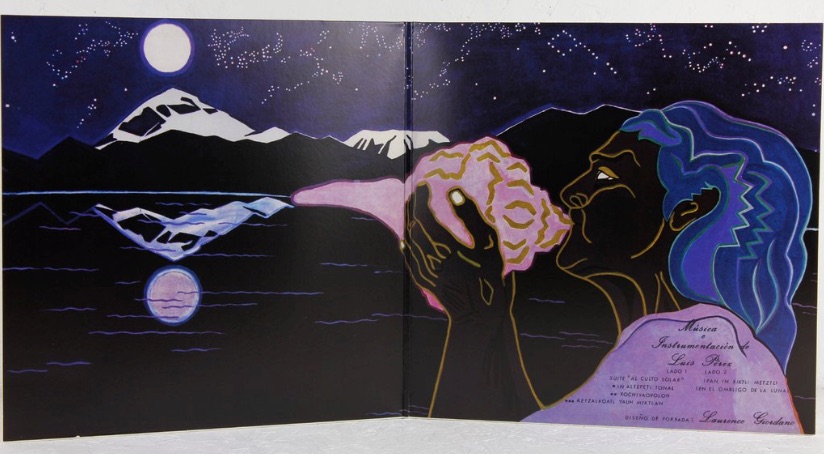
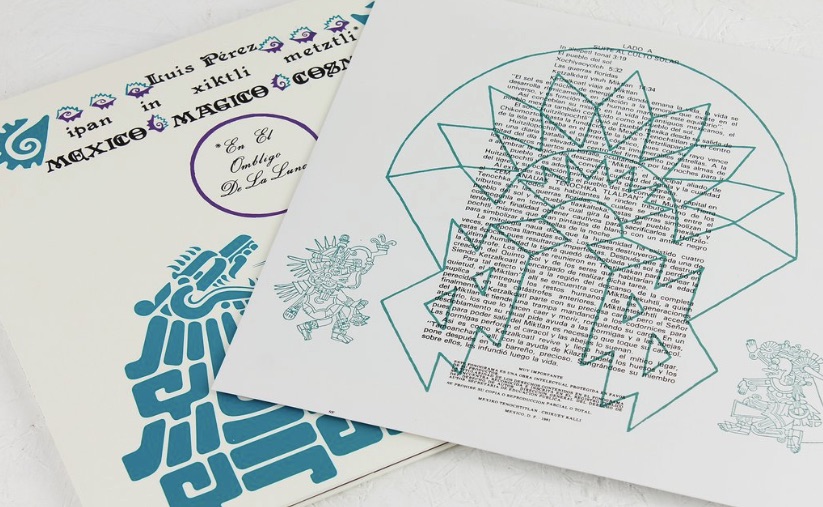
I'm familiar with the psych music scene that emerged in the 1960s-1970s in some Latin American countries like Brazil, Chile, and Argentina, thanks to fantastic reissues of rare LPs on labels like Luaka Bop, Goma Gringa, Now Again, and Mr Bongo. Now, the esteemed diggers at Mr Bongo have brought us a stunningly spacey psych record from Mexico: Luis Pérez's "Ipan In Xiktli Metztli, México Mágico Cósmico, El Ombligo de la Luna."

In the 1970s, Pérez studied the pre-Columbian instruments and musical traditions across Mexico, from the Maya and Nahuatl to Raramuri and Wixarika. He then channeled those influences into his own gorgeous electronic and experimental psychedelic songs that make up this record first released in 1981. Listen below.

As Mr Bongo writes, Pérez "delves deep into the past but also exists entirely outside of time."

Far fucking out.

23 May 17:22

An expanding universe and distant stars: tips on how to experience cosmology from your backyard

by Michael J. I. Brown, Associate professor in astronomy, Monash University
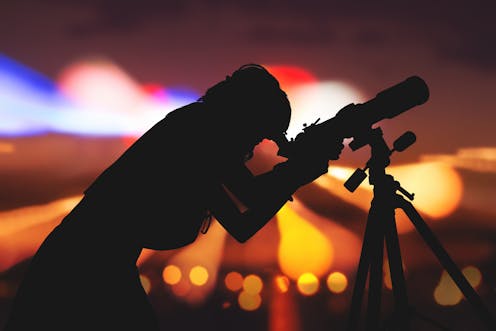
The things you can do with an amaterur telescope. Shutterstock/AstroStar

For people like me, light years, the expanding universe and the Big Bang are part of daily language.

You might perceive these as distant and abstract concepts, best left to professional astronomers with million-dollar telescopes.

Or perhaps not. I think you can experience cosmology from your backyard, just by looking at the night sky or using an amateur astronomer’s telescope.


Read more: Looking at the universe through very different 'eyes'


Space may be unimaginably vast, but you can experience and measure it for yourself. You can even measure the universe expanding.

Here’s are some tips on how to get there.

Tip 1: look up, and imagine

Look at the night sky. There are stars aplenty, but much of the sky is dark and this tells us something very important.

Imagine an infinitely large and old universe filled with stars. Travel in any direction and, eventually, you will run into a star. In this universe, an imaginary Earth’s night sky wouldn’t be dark - it would be spectacularly bright.

This is Olbers’ paradox, which has several escape clauses. A finite universe is one. Another is a universe with a finite age, so that light from distant objects hasn’t had time to reach us.

Without even grabbing a telescope, we’ve done some backyard cosmology. The dark sky we see from Earth hints at the universe’s finite age.

Tip 2: capture the stars

Now grab your telescope. Beautiful images of stars can be taken with a telescope and camera on an equatorial mount, which can track stars as they seem to move across the sky. Telescopes on equatorial mounts can cost less than A$1,000 (although the sky’s truly the limit with astronomical kit).

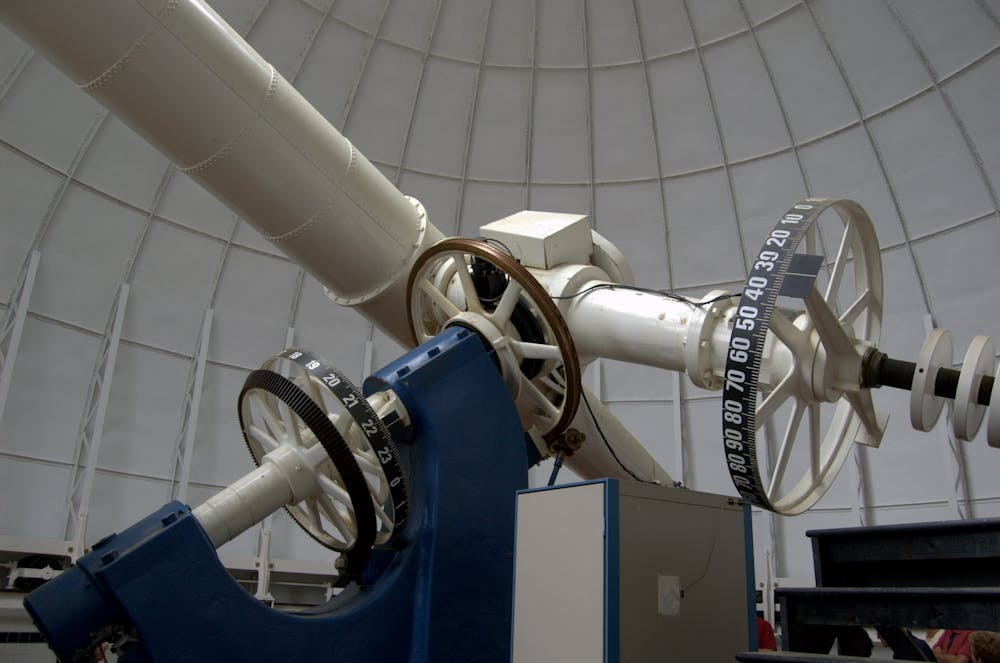
An equatorial mount is different from your typical camera tripod, as it has one axis aligned with Earth’s axis of rotation. The mount can track stars by rotating just one axis, and is literally a mechanical model of the spinning Earth.

An equatorial mount has one axis aligned with the axis of rotation of the Earth. Flickr/Photo Phiend

Compared to your eye at the eyepiece, a telescope and camera on an equatorial mount can reveal more of the universe. With your eyes you can see, but with a camera you can measure, turning your telescope into a cosmology machine.

Tip 3: watch star positions

How far away are stars? Even small telescopes provide clues.

As Earth travels around the Sun, the direction to nearby stars will change. The nearest stars seem to move back and forth relative to more distant celestial objects.

This is parallax, and it’s a bit like using our two eyes to perceive distance, except using telescopic observations separated by the diameter of the Earth’s orbit around the Sun (300 million km).

If the nearest stars were located 12,000 times the Earth-Sun distance (1,800 billion km), their positions in the sky would change by a hundredth of a degree.

This sounds tiny, but this is about the same as the angular size of Jupiter, and would be easy to see with a backyard telescope. Instead, even the nearest stars are so far away that it’s a real challenge for backyard astronomers to measure their distances.

Some of the closest stars are easy to find but still unimaginably distant. Alpha Centauri, the brightest of “The Pointers” near the Southern Cross, is a pair of stars whose distance from us is 270,000 times the Earth-Sun distance.

The two Pointers (bottom left) are bright neighbours of the Southern Cross (above right). Flickr/Ryan Wick, CC BY

Sirius, the brightest star in the sky, is a tad further at 540,000 times the Earth-Sun distance.

With a telescope, camera, and a little history, you can appreciate that some stars are even further still.

Tip 4: watch star brightness

In 1908, American astronomer Henrietta Swan Leavitt discovered that stars known as Cepheids vary in brightness with a period that depends on their luminosity, or how bright they are. The longer the period, the brighter the star. Cepheids became the tool that allowed astronomers to measure distances to galaxies.

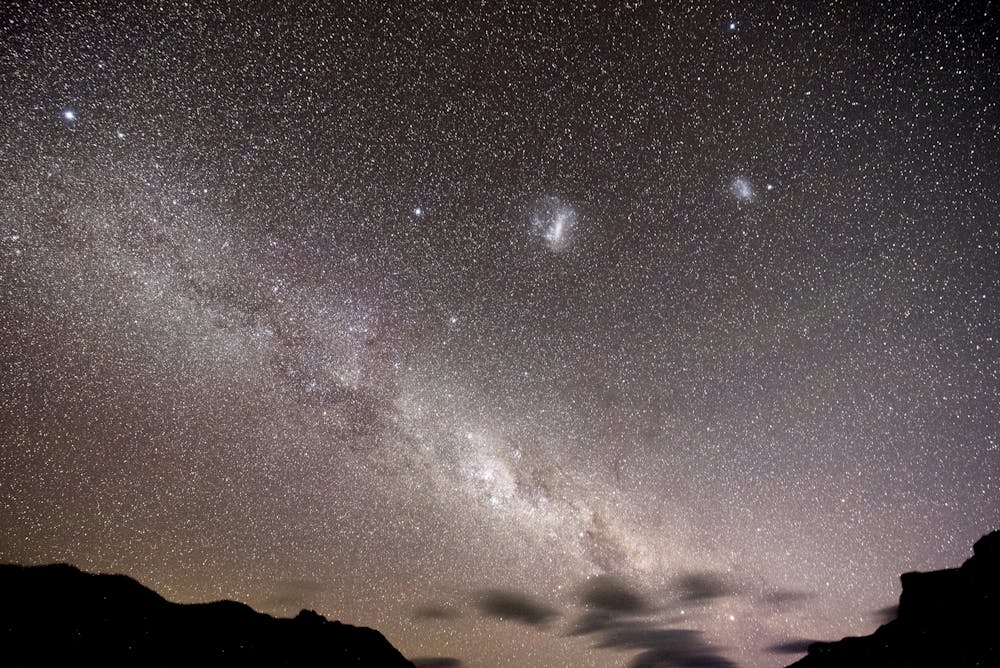
A single two-minute exposure of the southern sky, tracked with an iOptron SkyTracker, showing the Milky Way (left), the Large Magellanic Cloud (centre) and Small Magellanic Cloud (right) taken from Victoria, Australia. Flickr/cafuego, CC BY-SA

You can see the brightest Cepheids in the Large Magellanic Cloud, which is 160,000 light years away from Earth, with a telescope and eyepiece. With a camera, you can take images over time to measure Cepheids getting brighter and fainter, just as Henrietta Swan Leavitt did a century ago.

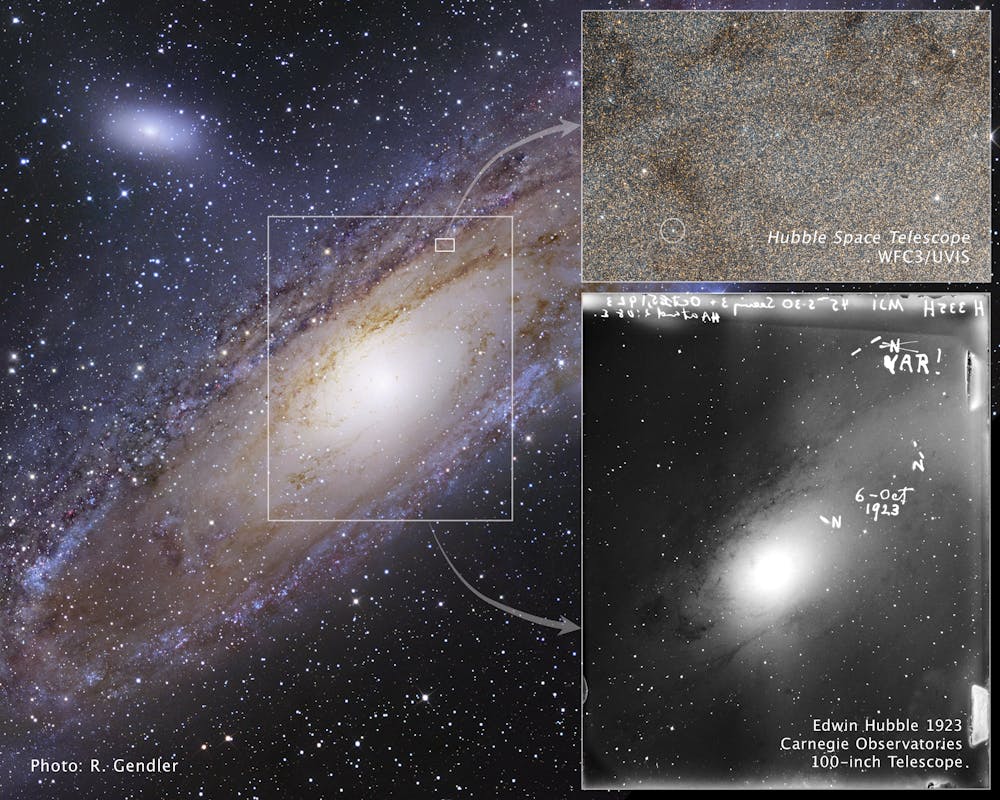
In 1923, Edwin Hubble detected a Cepheid in the Andromeda “nebula” and realised that Andromeda is another galaxy, containing many billions of stars. He concluded that the universe is vast and full of such galaxies.

With a telescope, a modern DSLR camera (or CCD) and long exposures at a dark site, you can spot the very star Hubble used to make his momentous discovery. A star so far away, its light takes two million years to reach us.

Hubble’s discovery of the Cepheid V1 changed changed our perspective of the universe. NASA, ESA, and the Hubble Heritage Team (STScI/AURA); Illustration Credit: NASA, ESA, and Z. Levay (STScI)

Tip 5: measure shifted light

The expanding universe may be one of the strangest of cosmological discoveries. Most galaxies across the universe are rushing away from us and each other.

How can you measure the speed of galaxies across the vastness of space? With a speed camera, of course.

A speed camera on Earth measures the Doppler shift of light bounced off a speeding car. We cannot bounce light off a galaxy, but we can measure the Doppler shift of light emitted by particular elements and molecules.

Hydrogen is the most abundant element in the universe, and it produces a very distinctive spectrum of light. We can see this spectrum in celestial objects if we add a diffraction grating to our telescope.

Hydrogen atoms produce a very distinctive spectrum of light. Wikimedia/Jan Homann, CC BY-SA

If we take spectra of quasars, some of the most luminous yet distant of astronomical objects, we can see the spectrum of hydrogen. But the emission lines are Doppler-shifted to redder colours (wavelengths) by the expanding universe.


Read more: You too can be an astrophysicist with your new telescope


Quasar 3C 273 is so bright that a 15cm telescope can detect the hydrogen alpha line in its spectrum in one hour. On Earth the hydrogen alpha has a wavelength of 0.66 microns, but for 3C 273 this line is shifted to 0.76 microns.

So what speed does 3C 273 clock? 47,000 kilometres every second!

You can observe the expanding universe, with your own telescope.

The spectrum of 3C 273, which can be measured by amateur astronomers, reveals the expansion of the universe. ESA/Hubble & NASA

Cutting-edge cosmology may require the Hubble Space Telescope, LIGO and the Square Kilometre Array. But if you’re organised, motivated, and have the budget for a few key items, you can be a backyard cosmologist.

The Conversation

Michael J. I. Brown receives research funding from the Australian Research Council and Monash University.

23 May 17:21

Agatha Christie: world's first historical whodunnit was inspired by 4,000 year-old letters

by Nicky Nielsen, Lecturer in Egyptology, University of Manchester
Agatha Christie Trust

When the ancient Egyptian priest and landowner Heqanakhte wrote a series of rather acerbic letters to his extended family sometime during the 12th Dynasty (1991-1802BC), he could not have known that he was creating the framework around which the British crime writer Agatha Christie (1890-1976) would, some 4,000 years later, weave one of the world’s first historical crime novels.

Death Comes as the End (1944) is the only one of Christie’s novels not to be set in the 20th century and not to feature any European characters. The death of a priest’s concubine sets off a series of murders within the family and, as in Christie’s more familiar 20th-century whodunnits, the scene is soon littered with bodies. The book is due to be adapted for the screen by the BBC in 2019.

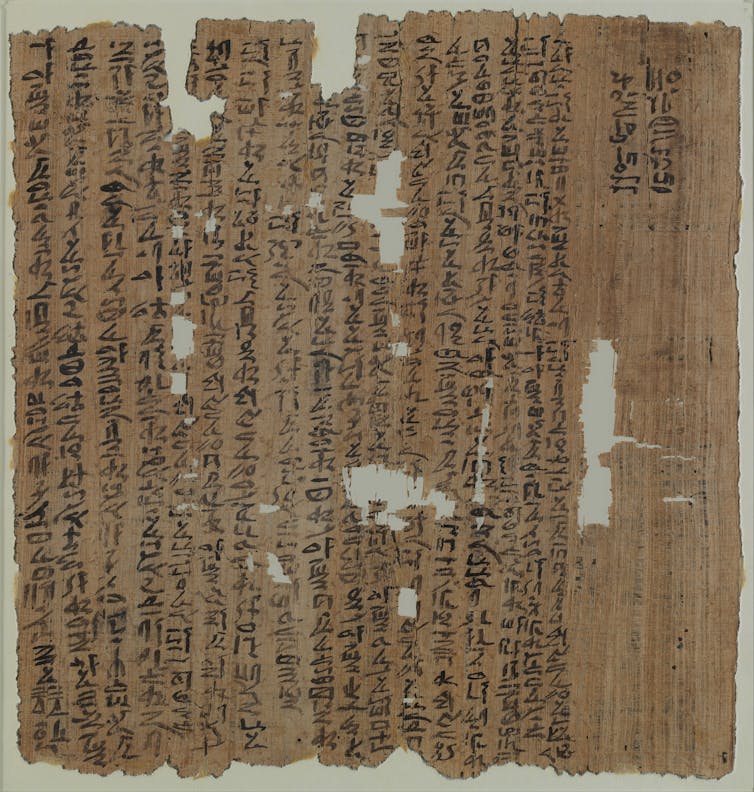
While there are numerous plot parallels in the Heqanakhte Letters (as these papyri would come to be known), the letters themselves provide an unparalleled glimpse into land management and everyday family life in ancient Egypt. In the letters, Heqanakhte provides his children with meticulous calculations of crop yields and instructions for land investments followed by the stern injunction that he would consider any deviation from his instructions akin to theft.

The letters also contain allusions to some disharmony within the family caused by the recent addition of Heqanakhte’s second wife to the household, much like in the novel where the arrival of Imhotep’s concubine, Nofret provokes murderous hatred.

Heqanakht Letter I, Rogers Fund and Edward S. Harkness Gift, 1922. New York Metropolitan Museum of Art

The Heqanakhte Letters are trivial in their content but unique in their form: It is very rare for this level of detail concerning the family dynamics to survive the thousands of years which separate us from Middle Kingdom Egyptians. The letters were found in the 1920s by American archaeologists from the Metropolitan Museum of Art while excavating the tomb of the Middle Kingdom vizier Ipi near modern-day Luxor. Translations of the papyri and scholarly investigations followed shortly afterwards, a study which continues to this day.
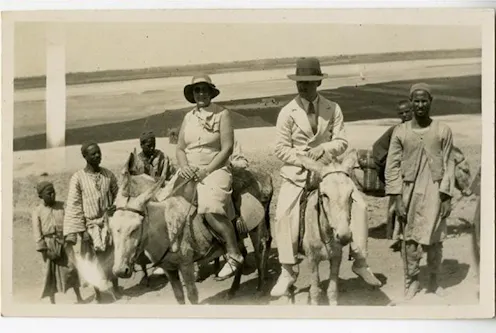
Christie in Egypt

Christie certainly knew a thing or two about both ancient and modern Egypt. She first visited the country as a young woman in the winter of 1910, staying with her mother Clara for three months at Cairo’s glitzy Gezirah Palace Hotel. The experience had a clear impact on her – her first (unpublished) novel Snow Upon the Desert (1910) was set in Cairo.

Later, she drew further on her experience of life in Egypt and the experience of tourists visiting the country during the first half of the 20th century when writing the short story, The Adventure of the Egyptian Tomb (1923) and, 14 years later, Death on the Nile, which follows the orotund Belgian detective Hercule Poirot as he attempts to solve the (some might argue needlessly complicated) murder of a wealthy heiress honeymooning in the Land of Pharaohs. In other words, peak Christie.

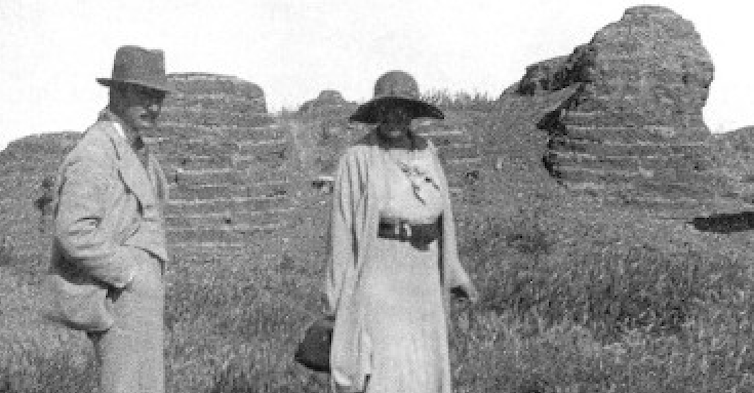
Agatha Christie with Max Mallowan at Tell Halaf in Syria.

Christie’s marriage to British archaeologist Max Mallowan in 1930 reinforced her fascination with the ancient Near East and ancient Egypt. The marriage – and the financial success of her novels – provided her with ample opportunity to travel both as a tourist and an archaeologist in the region, experiences which in turn resulted in the autobiographical Come Tell Me How You Live (1946) and inspired further travels for her fictional Belgian detective in Murder in Mesopotamia (1936) and Appointment with Death (1938).

Bringing Egypt to life

However, it was her friendship with the Egyptologist Stephen Glanville, a professor at University College London who served with Mallowan during World War II, which prompted her to explore the possibility of writing a historical whodunnit moving her narrative from Art Deco drawing rooms to the dusty desert on the Theban West bank. Death Comes as the End was written by Christie during the height of war and, as Christie herself states in the author’s note, “the inspiration of both characters and plot was derived” from the Heqanakhte letters. Glanville served as a historical sounding board and consultant, a role for which he was eminently suited, having written the seminal book Daily Life in Ancient Egypt in 1930.

While the book received praise from critics upon its publication in 1944, it did cause some ructions in Christie’s own family life. Mallowan was not altogether happy that she had collaborated with Glanville. He wrote to Glanville expressing concern about the work to which Glanville rather pointedly replied: “I am not clear whether you are afraid that the book will damage her reputation as a detective story writer, or whether you think that archaeology should not demean itself by masquerading in a novel.”

Death Comes as the End is not among Christie’s most famous works, but it remains a fascinating experiment: a marriage between archaeology, Egyptology and fiction writing, a formula many later authors have dutifully followed. Along with Christie’s other works set in Egypt and the Near East it is also a tangible testament to the enduring fascination Western societies have for these ancient cultures.

The Conversation

Nicky Nielsen does not work for, consult, own shares in or receive funding from any company or organisation that would benefit from this article, and has disclosed no relevant affiliations beyond their academic appointment.

23 May 17:20

These CRISPR-modified crops don't count as GMOs

by Yi Li, Professor of Plant Science, University of Connecticut
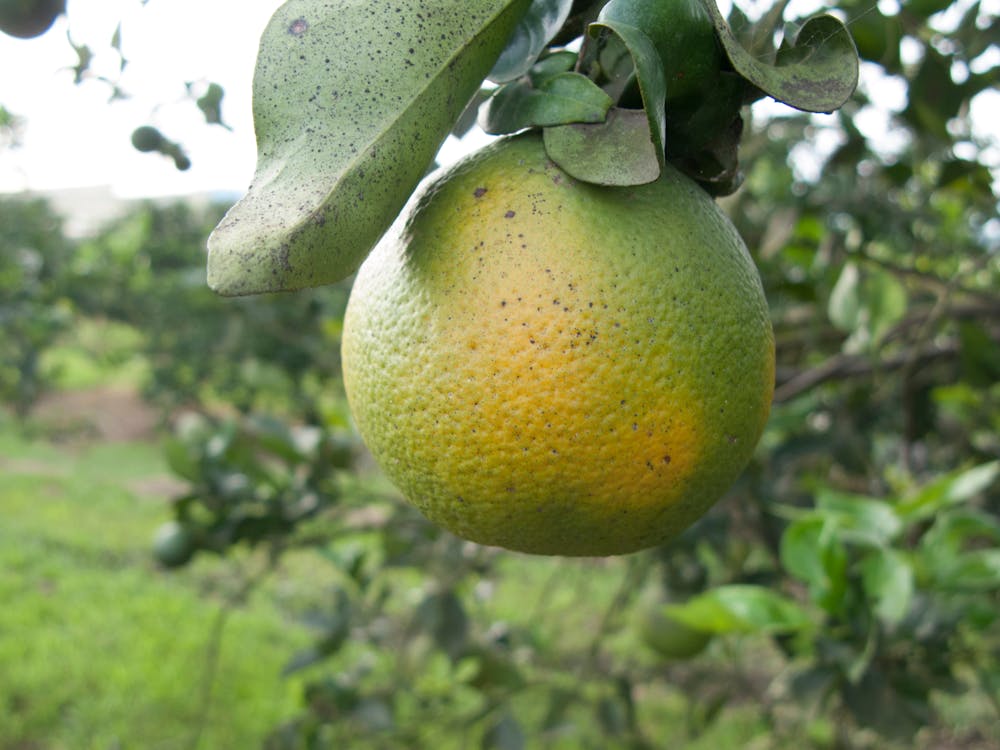
The lighter citrus plants have been edited using CRISPR to alter the phytoene desaturase (PDS) gene which gives them a white color. Yi Li, CC BY-SA

To feed the burgeoning human population, it is vital that the world figures out ways to boost food production.

Increasing crop yields through conventional plant breeding is inefficient – the outcomes are unpredictable and it can take years to decades to create a new strain. On the other hand, powerful genetically modified plant technologies can quickly yield new plant varieties, but their adoption has been controversial. Many consumers and countries have rejected GMO foods even though extensive studies have proved they are safe to consume.

But now a new genome editing technology known as CRISPR may offer a good alternative.

I’m a plant geneticist and one of my top priorities is developing tools to engineer woody plants such as citrus trees that can resist the greening disease, Huanglongbing (HLB), which has devastated these trees around the world. First detected in Florida in 2005, the disease has decimated the state’s US$9 billion citrus crop, leading to a 75 percent decline in its orange production in 2017. Because citrus trees take five to 10 years before they produce fruits, our new technique – which has been nominated by many editors-in-chief as one of the groundbreaking approaches of 2017 that has the potential to change the world – may accelerate the development of non-GMO citrus trees that are HLB-resistant.

HLB yellow dragon citrus greening disease has infected orchards in Florida and around the world devastating the citrus crops. By Edgloris Marys/shutterstock.com

Genetically modified vs. gene edited

You may wonder why the plants we create with our new DNA editing technique are not considered GMO? It’s a good question.

Genetically modified refers to plants and animals that have been altered in a way that wouldn’t have arisen naturally through evolution. A very obvious example of this involves transferring a gene from one species to another to endow the organism with a new trait – like pest resistance or drought tolerance.

But in our work, we are not cutting and pasting genes from animals or bacteria into plants. We are using genome editing technologies to introduce new plant traits by directly rewriting the plants’ genetic code.

This is faster and more precise than conventional breeding, is less controversial than GMO techniques, and can shave years or even decades off the time it takes to develop new crop varieties for farmers.

There is also another incentive to opt for using gene editing to create designer crops. On March 28, 2018, U.S. Secretary of Agriculture Sonny Perdue announced that the USDA wouldn’t regulate new plant varieties developed with new technologies like genome editing that would yield plants indistinguishable from those developed through traditional breeding methods. By contrast, a plant that includes a gene or genes from another organism, such as bacteria, is considered a GMO. This is another reason why many researchers and companies prefer using CRISPR in agriculture whenever it is possible.

Changing the plant blueprint

The gene editing tool we use is called CRISPR – which stands for “Clustered Regularly Interspaced Short Palindromic Repeats” – and was adapted from the defense systems of bacteria. These bacterial CRISPR systems have been modified so that scientists like myself can edit the DNA of plants, animals, human cells and microorganisms. This technology can be used in many ways, including to correct genetic errors in humans that cause diseases, to engineer animals bred for disease research, and to create novel genetic variations that can accelerate crop improvement.

Yi Li inspects his CRISPR altered plants in his lab. Xiaojing Wang, CC BY-SA

To use CRISPR to introduce a useful trait into a crop plant, we need to know the genes that control a particular trait. For instance, previous studies have revealed that a natural plant hormone called gibberellin is essential for plant height. The GA20-ox gene controls the quantity of gibberellin produced in plants. To create a breed of “low mowing frequency” lawn grass, for example, we are editing the DNA – changing the sequence of the DNA that makes up gene – of this plant to reduce the output of the GA20-ox gene in the selected turf grass. With lower gibberellin, the grass won’t grow as high and won’t need to be mowed as often.

The CRISPR system was derived from bacteria. It is made up of two parts: Cas9, a little protein that snips DNA, and an RNA molecule that serves as the template for encoding the new trait in the plant’s DNA.

To use CRISPR in plants, the standard approach is to insert the CRISPR genes that encode the CRISPR-Cas9 “editing machines” into the plant cell’s DNA. When the CRISPR-Cas9 gene is active, it will locate and rewrite the relevant section of the plant genome, creating the new trait.

But this is a catch-22. Because to perform DNA editing with CRISPR/Cas9 you first have to genetically alter the plant with foreign CRISPR genes – this would make it a GMO.

A new strategy for non-GMO crops

For annual crop plants like corn, rice and tomato that complete their life cycles from germination to the production of seeds within one year, the CRISPR genes can be easily eliminated from the edited plants. That’s because some seeds these plants produce do not carry CRISPR genes, just the new traits.

But this problem is much trickier for perennial crop plants that require up to 10 years to reach the stage of flower and seed production. It would take too long to wait for seeds that were free of CRISPR genes.

My team at the University of Connecticut and my collaborators at Nanjing Agricultural University, Jiangsu Academy of Agricultural Sciences, University of Florida, Hunan Agricultural University and University of California-San Diego have recently developed a convenient, new technique to use CRISPR to reliably create desirable traits in crop plants without introducing any foreign bacterial genes.

We first engineered a naturally occurring soil microbe, Agrobacterium, with the CRIPSR genes. Then we take young leaf or shoot material from plants and mix them in petri dishes with the bacteria and allow them to incubate together for a couple of days. This gives the bacteria time to infect the cells and deliver the gene editing machinery, which then alters the plant’s genetic code.

In some Agrobacterium infected cells, the Agrobacterium basically serves as a Trojan horse, bringing all the editing tools into the cell, rather than engineering plants to have their own editing machinery. Because the bacterial genes or CRISPR genes do not become part of the plant’s genome in these cells – and just do the work of gene editing – any plants derived from these cells are not considered a GMO.

After a couple of days, we can cultivate plants from the edited plant cells. Then it take several weeks or months to grow an edited plant that could be planted on a farm. The hard part is figuring out which plants are successfully modified. But we have a solution to this problem too and have developed a method that takes only two weeks to identify the edited plants.

Genetically designed lawns

The shorter lawn grasses on the left (perennial ryegrass) need to be mowed less frequently than their conventional counterpart, shown on the right. The shorter grasses were produced using a traditional plant breeding technique. Yi Li is currently using the CRISPR technique to create grasses of other species that require less maintenance. Yi Li, CC BY-SA

One significant difference between editing plants versus human cells is that we are not as concerned about editing typos. In humans, such errors could cause disease, but off-target mutations in plants are not a serious concern. A number of published studies reported low to negligible off-target activity observed in plants when compared to animal systems.

Also, before distributing any plants to farmers for planting in their field, the edited plants will be carefully evaluated for obvious defects in growth and development or their responses to drought, extreme temperatures, disease and insect attacks. Further, DNA sequencing of edited plants once they have been developed can easily identify any significant undesirable off-target mutations.

In addition to citrus, our technology should be applicable in most perennial crop plants such as apple, sugarcane, grape, pear, banana, poplar, pine, eucalyptus and some annual crop plants such as strawberry, potato and sweet potato that are propagated without using seeds.

We also see a role for genome editing technologies in many other plants used in the agricultural, horticultural and forestry industries. For example, we are creating lawn grass varieties that require less fertilizer and water. I bet you would like that too.

The Conversation

Yi Li receives funding from USDA and Citrus Research and Development Foundation.

23 May 17:11

Bunya pines are ancient, delicious and possibly deadly

by Ian Wright, Senior Lecturer in Environmental Science, Western Sydney University
Flickr/Tatters/The Conversation, CC BY-SA

Welcome to the first edition of Beating Around the Bush, a series that profiles native plants: part gardening column, part dispatches from country, entirely Australian. Read more about the series here or get in touch to pitch a plant at batb@theconversation.edu.au.


The Bunya pine is a unique and majestic Australian tree – my favourite tree, in fact. Sometimes simply called Bunya or the Bunya Bunya, I love its pleasingly symmetrical dome shape.

But what I really love about it is that there are just so many bizarre and colourful stories about this tree – the more you learn, the more you find it fascinating. (That is, unless the tree has harmed you; they come with some hazard warnings.)


Read more: Curious Kids: Where did trees come from?


CC BY-ND

Can you grow it?

Bunya pines (botanical name: Aracauria bidwilli) are living fossils. They come come from a fascinating family of flora, the Araucariaceae, which grew across the world in the Jurassic period. Many of its “cousins” are extinct. The remaining members of the family are spread across the former landmasses of Gondwana, particularly South America, New Zealand, Malaysia and New Caledonia, as well as Australia.

This family includes one of the most amazing botanical discoveries of the 20th century, the Wollemi pine (Wollemia nobilis).


Read more: Where the old things are: Australia's most ancient trees


Bunyas used to be much more widespread than they are now. Today they grow in the wild in only a few locations in southeast and north Queensland. One such area, the Bunya Mountains, is the remains of an old shield volcano – about 30 million years old, with peaks rising to more than 1,100 metres. The Bunya pines grow in fertile basalt soils in this cool and moist mountain environment.

If you want to grow a Bunya, I would suggest that you need a large garden. The tree needs fertile and well-drained soil, and regular watering in drier climates. A shaded position will also help – it can struggle in direct sunlight in its youth.

Bunyas also produce highly valued timber, which is used for musical instruments. It is particularly valued as “tonewood” for producing stringed instruments’ sound boards. Saw logs for Bunyas come from plantations only, as they are protected in their national park wild habitat.

Stand well back!

While many people love Bunya pines, this love affair comes with a health warning. They are best regarded with both distance and respect!

The trees are big and typically range from 20m to 50m in height. Their leaves have strings of very rigid and sharply pointed leaves. If you come into physical contact with its leaves or branches, you must wear protective clothes and carefully handle them to avoid pain or even cuts. As a child, the swinging branch of a Bunya made a formidable garden weapon.

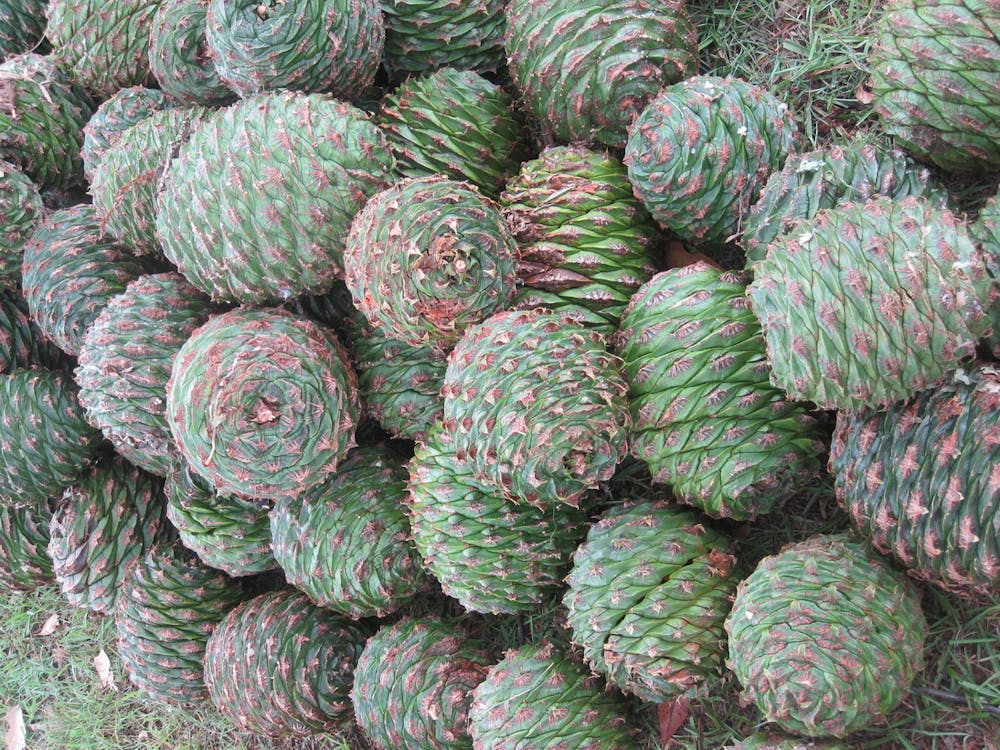
But that is nothing compared to this tree’s ability to hit you on the head, possibly with serious consequences. When in season (generally December to March) they can produce dozens of massive cones weighing up to 10 kilograms. These can drop from up to 50m without warning.

TreeMappa 2.0/Flickr, CC BY

I first learned of this when a fellow university student in the 1980s scored an impressively large Bunya cone dent in the roof of his battleship-solid FB Holden ute. My university campus has beautiful gardens displaying dozens of massive Bunyas, but one was perhaps a bit close to the car park. My university friend was lucky not to get hit. Many people have not been so lucky and some have even been hospitalised.

Bunya pines are beautiful trees in large gardens and are a feature of parks around Australia, but their habit of “bombing” people and property causes considerable angst. Many local councils erect warning signs or rope off the danger zone during cone season. Others hire contractors to remove the cones to protect their residents (and perhaps limit their own legal liability). Sadly, some Bunya pines have been cut down to remove the risk.

Indigenous use

The cultural connection of the Bunya pine to Aboriginal Australians is very powerful. The Bunya Mountains in southeast Queensland used to host massive gatherings of Aboriginal groups.

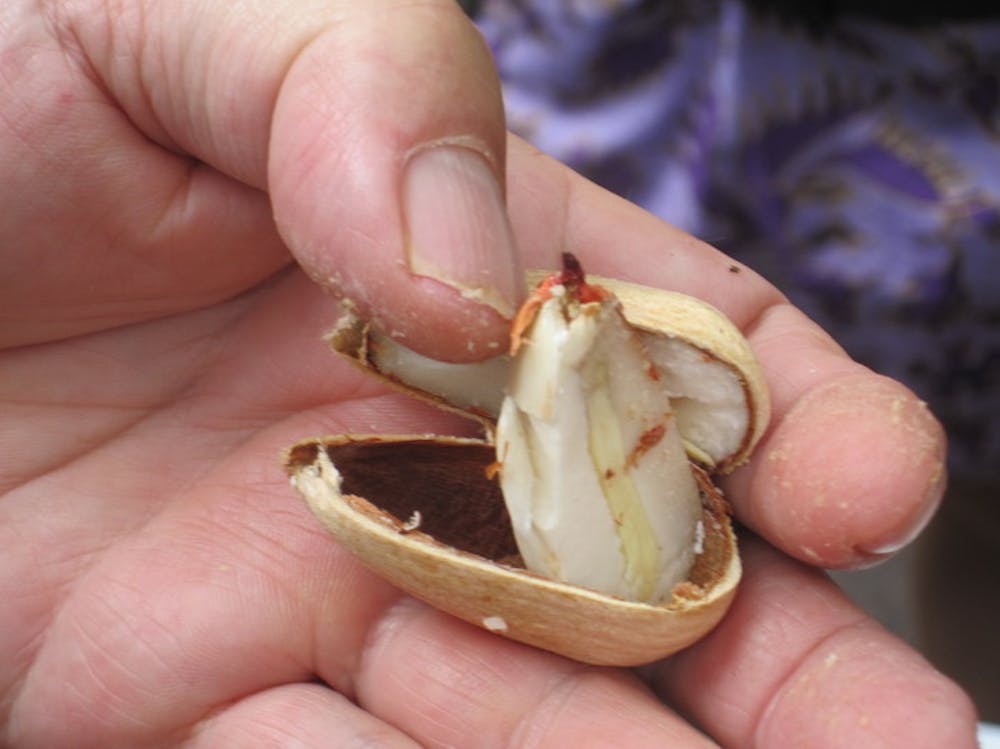
People came to visit the Bunya pines and feasted on the nuts in their abundant cones. Some travelled from hundreds of kilometres away, and traditional hostilities were dropped to allow access. The seed in the Bunya cone is a delicious and nutritious food, a famous and celebrated example of Australian bush tucker.

TreeMappa 2.0/Flickr, CC BY

Today some trees remain marked with hand and foot holes that Aborigines made in the trunks of older Bunyas. The climbers must have been brave and agile to harvest the cones from such heights.

Sadly, the last of the Aboriginal Bunya festivals was held in about 1900, as European loggers came to the area for its many timber resources.

But even those European timber pioneers realised the significance of the Bunya Mountains area. The Bunya Mountains National Park was declared in 1908, creating Queensland’s second national park.

The Conversation

Ian Wright does not work for, consult, own shares in or receive funding from any company or organisation that would benefit from this article, and has disclosed no relevant affiliations beyond their academic appointment.

21 May 19:54

5 things to know about mass shootings in America

by Frederic Lemieux, Professor of the Practice and Faculty Director of the Master's in Applied Intelligence, Georgetown University
Outside Santa Fe High School in Texas on May 18, 2018. AP Photo/David J. Phillip

At least 10 students were killed at a Santa Fe, Texas high school on May 18 after a classmate opened fire with a shotgun and a .38 revolver.

The shooting came just three months after another teen shooter killed 17 in Parkland, Florida, sparking nationwide youth-led protests over gun violence – and a familiar debate over what changes could really make a difference.

As a criminologist, I often hear misconceptions creeping into the debate that springs up whenever a mass shooting occurs.

Here’s what the research actually shows.

#1: More guns don’t make you safer

A study I conducted on mass shootings indicated that this phenomenon is not limited to the United States.

Mass shootings also took place in 25 other wealthy nations between 1983 and 2013, but the number of mass shootings in the United States far surpasses that of any other country included in the study during the same period of time.

The U.S. had 78 mass shootings during that 30-year period.

The highest number of mass shootings experienced outside the United States was in Germany – where seven shootings occurred.

In the other 24 industrialized countries taken together, 41 mass shootings took place.

In other words, the U.S. had nearly double the number of mass shootings than all other 24 countries combined in the same 30-year period.

Another significant finding is that mass shootings and gun ownership rates are highly correlated. The higher the gun ownership rate, the more a country is susceptible to experiencing mass shooting incidents. This association remains high even when the United States is withdrawn from the analysis.

Similar results have been found by the United Nations Office on Drugs and Crime, which states that countries with higher levels of firearm ownership also have higher firearm homicide rates.

My study also shows a strong correlation between mass shooting casualties and overall death by firearms rates. However, in this last analysis, the relation seems to be mainly driven by the very high number of deaths by firearms in the United States. The relation disappears when the United States is withdrawn from the analysis.

#2: Mass shootings are more frequent

A recent study published by the Harvard Injury Control Research Center shows that the frequency of mass shooting is increasing over time. The researchers measured the increase by calculating the time between the occurrence of mass shootings. According to the research, the days separating mass shooting occurrence went from on average 200 days during the period of 1983 to 2011 to 64 days since 2011.

What is most alarming with mass shootings is the fact that this increasing trend is moving in the opposite direction of overall intentional homicide rates in the U.S., which decreased by almost 50 percent since 1993 and in Europe where intentional homicides decreased by 40 percent between 2003 and 2013.

#3: Restricting sales works

Thanks to the Second Amendment, the United States has permissive gun licensing laws. This is in contrast to most developed countries, which have restrictive laws.

According to a seminal work by criminologists George Newton and Franklin Zimring, permissive gun licensing laws refer to a system in which everyone except specially prohibited groups of persons can purchase a firearm. In such a system, an individual does not have to justify purchasing a weapon; rather, the licensing authority has the burden of proof to deny gun acquisition.

By contrast, restrictive gun licensing laws refer to a system in which individuals who want to purchase firearms must demonstrate to a licensing authority that they have valid reasons to get a gun – like using it on a shooting range or going hunting – and that they demonstrate “good character .”

The differences between these type of gun laws have important impacts. Countries with more restrictive gun licensing laws show fewer deaths by firearms and a lower gun ownership rate.

#4: Background checks work

In most of the restrictive background checks performed in developed countries like Canada and Australia, citizens are required to train for gun handling, obtain a license for hunting or provide proof of membership to a shooting range.

Individuals must prove that they do not belong to any “prohibited group,” such as the mentally ill, criminals, children or those at high risk of committing violent crime, such as individuals with a police record of threatening the life of another.

Here’s the bottom line. With these provisions, most U.S. active shooters would have been denied the purchase of a firearm.

#5: Most mass shootings are not terrorism

Journalists sometimes describe mass shooting as a form of domestic terrorism. This connection may be misleading.

There is no doubt that mass shootings are “terrifying” and “terrorize” the community where they have happened. However, not all active shooters involved in mass shooting have a political message or cause.

For example, the church shooting in Charleston, South Carolina, in June 2015 was a hate crime but was not judged by the federal government to be a terrorist act.

The majority of active shooters are linked to mental health issues, bullying and disgruntled employees. Active shooters may be motivated by a variety of personal or political motivations, usually not aimed at weakening government legitimacy. Frequent motivations are revenge or a quest for power.

Editor’s note: This piece was updated on May 18, 2018 and Oct. 2, 2017. It was originally published on Dec. 3, 2015.

The Conversation

Frederic Lemieux does not work for, consult, own shares in or receive funding from any company or organisation that would benefit from this article, and has disclosed no relevant affiliations beyond their academic appointment.

21 May 18:37

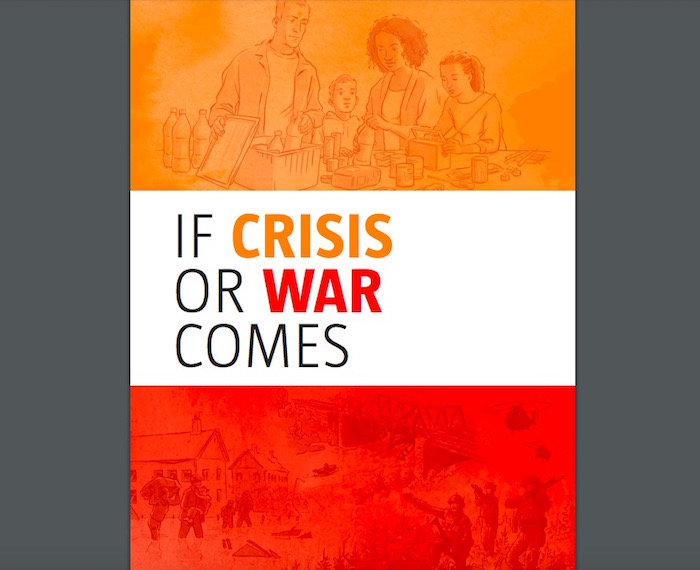
Sweden sends "If War Comes" booklet to all of its 4.8 million households

by Carla Sinclair

Sweden is sending out 4.8 million booklets to households across the country called, "If Crisis or War Comes" (Om Krisen Eller Kriget Kommer).

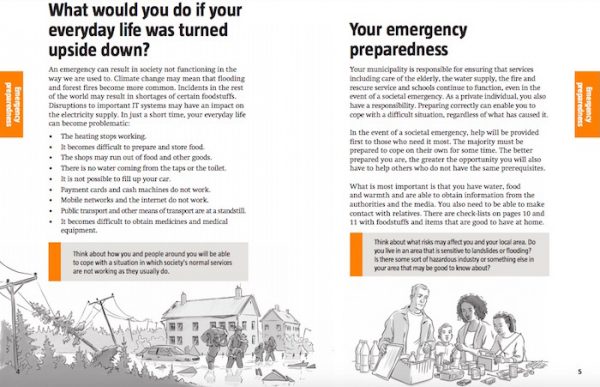
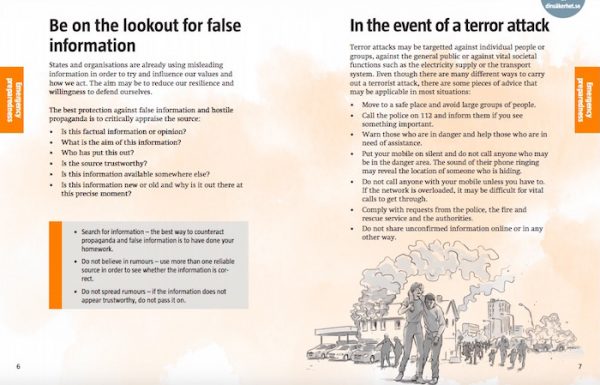
The booklet is 20 pages long and explains what to do if there is a terrorist attack, if all the shops run out of goods, if tap water stops running, if infrastructure is sabotaged, if you hear a broadcast emergency alarm, and loads of other really scary scenarios. The booklet is meant to help citizens "cope with a major strain."

This isn't the first time Sweden has prepared its citizens for wide-spread disaster. Last time it distributed a similar pamphlet was during World War II.

According to The Guardian:

Similar leaflets were first distributed in neutral Sweden in 1943, at the height of the second world war. Updates were issued regularly to the general public until 1961, and then to local and national government officials until 1991.

The publication comes as the debate on security – and the possibility of joining Nato – has intensified in Sweden in the wake of Russia’s annexation of Crimea in 2014 and recent incursions into Swedish airspace and territorial waters by Russian planes and submarines.

You can read the entire booklet here.

17 May 19:22

Enjoy this delightful live mini-concert from Superorganism

by Andrea James

Hipster quirkcore band Superorganism recorded this delightful live performance replete with sounds made by toy cars, apples, and soda cans. (more…)

16 May 18:36

Artist summons supernatural animals in these gorgeous images

by Andrea James

Polish artist Dawid Planeta created his "mini people in the jungle" series to include gentle gargantuan animals which appear before silhouetted humans. (more…)

16 May 18:34

Scientists declare octopi life from another world

by Jason Weisberger

Evidence of the octopus evolution show it would have happened too quickly to have begun here on Earth. Published in the Progress in Biophysics and Molecular Biology Journal, 33 scientists have declared the invertebrate sea-dweller an alien whose eggs landed from space.

Via Express:

But the scientists go on to make an even more extraordinary claim concerning octopuses, which seem to have evolved on Earth quite rapidly something like 270 million years ago, 250 million years after the Cambrian explosion.

The paper states: “The genome of the Octopus shows a staggering level of complexity with 33,000 protein-coding genes more than is present in Homo sapiens.

“Its large brain and sophisticated nervous system, camera-like eyes, flexible bodies, instantaneous camouflage via the ability to switch colour and shape are just a few of the striking features that appear suddenly on the evolutionary scene.

“The transformative genes leading from the consensus ancestral Nautilus to the common Cuttlefish to Squid to the common are not easily to be found in any pre-existing life form – it is plausible then to suggest they seem to be borrowed from a far distant “future” in terms of terrestrial evolution, or more realistically from the cosmos at large.

“One plausible explanation, in our view, is that the new genes are likely new extraterrestrial imports to Earth - most plausibly as an already coherent group of functioning genes within (say) cryopreserved and matrix protected fertilized Octopus eggs.

“Thus the possibility that cryopreserved Squid and/or Octopus eggs, arrived in icy bolides several hundred million years ago should not be discounted as that would be a parsimonious cosmic explanation for the Octopus' sudden emergence on Earth circa 270 million years ago.”

16 May 18:31

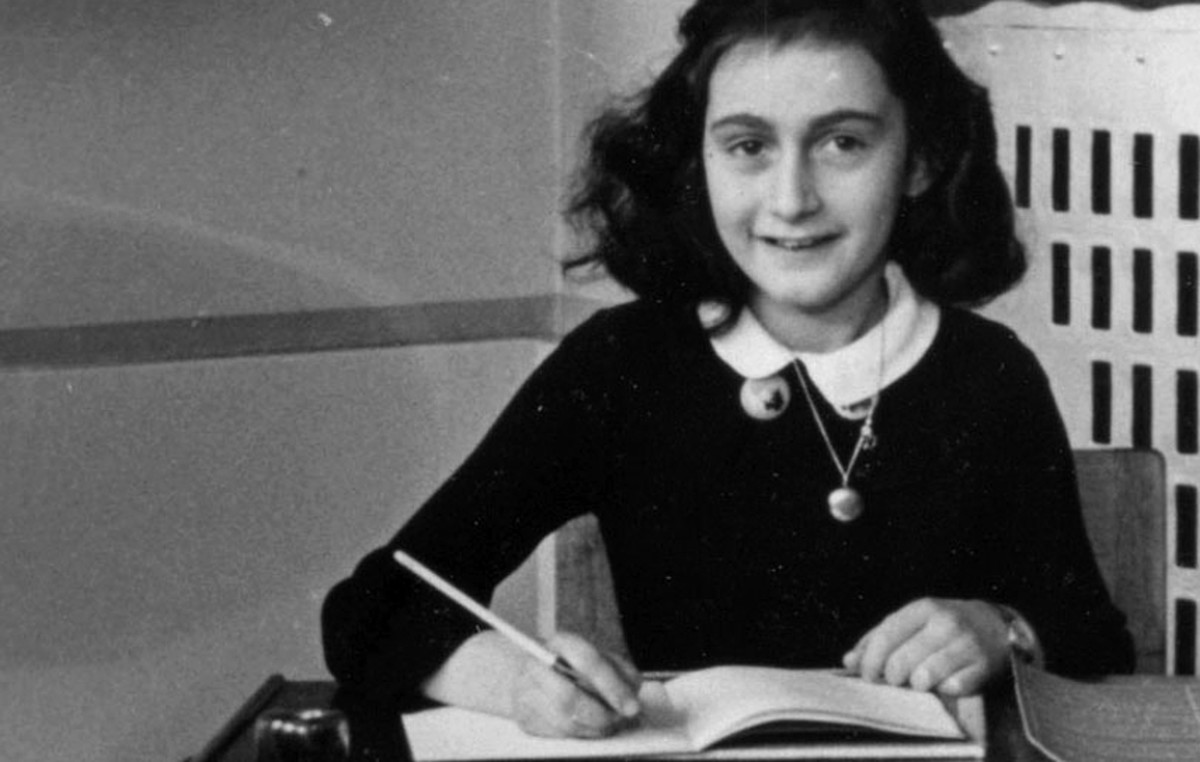
"Dirty jokes" found in Anne Frank's diary

by Rusty Blazenhoff

There was more to Anne Frank's diary than we once thought. Two pages, which were previously covered in a brown masking paper, have been revealed by researchers at Dutch museums. The pages contained "four risque jokes and candid explanations of sex, contraception and prostitution" written by the Jewish teen, according to The Guardian.

The Anne Frank Museum, the Institute for War, Holocaust and Genocide Studies and the Huygens Institute for the History of the Netherlands used digital technology to show the writing on the pages.

They photographed the pages, backlit by a flash, and then used image-processing software to decipher the words, which were hard read because they were jumbled up with the writing on the reverse sides of the pages.

In the passage on sex, Anne described how a young woman gets her period around 14, saying that it is “a sign that she is ripe to have relations with a man but one doesn’t do that of course before one is married”.

On prostitution, she wrote: “All men, if they are normal, go with women, women like that accost them on the street and then they go together. In Paris they have big houses for that. Papa has been there.”

Anne wrote her diary while she and her family hid for more than two years. The family was provided with food and other essentials by a close-knit group of helpers, until 4 August 1944 when they were discovered and ultimately deported to Auschwitz.

Only Anne’s father, Otto Frank, survived the war. Anne and her sister died in Bergen-Belsen camp. Anne was 15.

Frank van Vree, the director of the Netherlands Institute for War, Holocaust and Genocide Studies, says, “The dirty jokes are classics among growing children. They make it clear that Anne, with all her gifts, was above all also an ordinary girl.”

Anne Frank's 'dirty' jokes found on diary pages she covered over

15 May 13:50

Cartoonist Lucy Bellwood captures the ways inner demons sabotage in her latest comic book

by Rusty Blazenhoff

If there's anyone out there who's never felt like an imposter, or suffered from FOMO (fear of missing out), or struggled with self doubt, I sure would like to meet them.

Yet, just because these are common human experiences, it doesn't make it any easier to deal with when they happen to you. (Can I get an a-men?!)

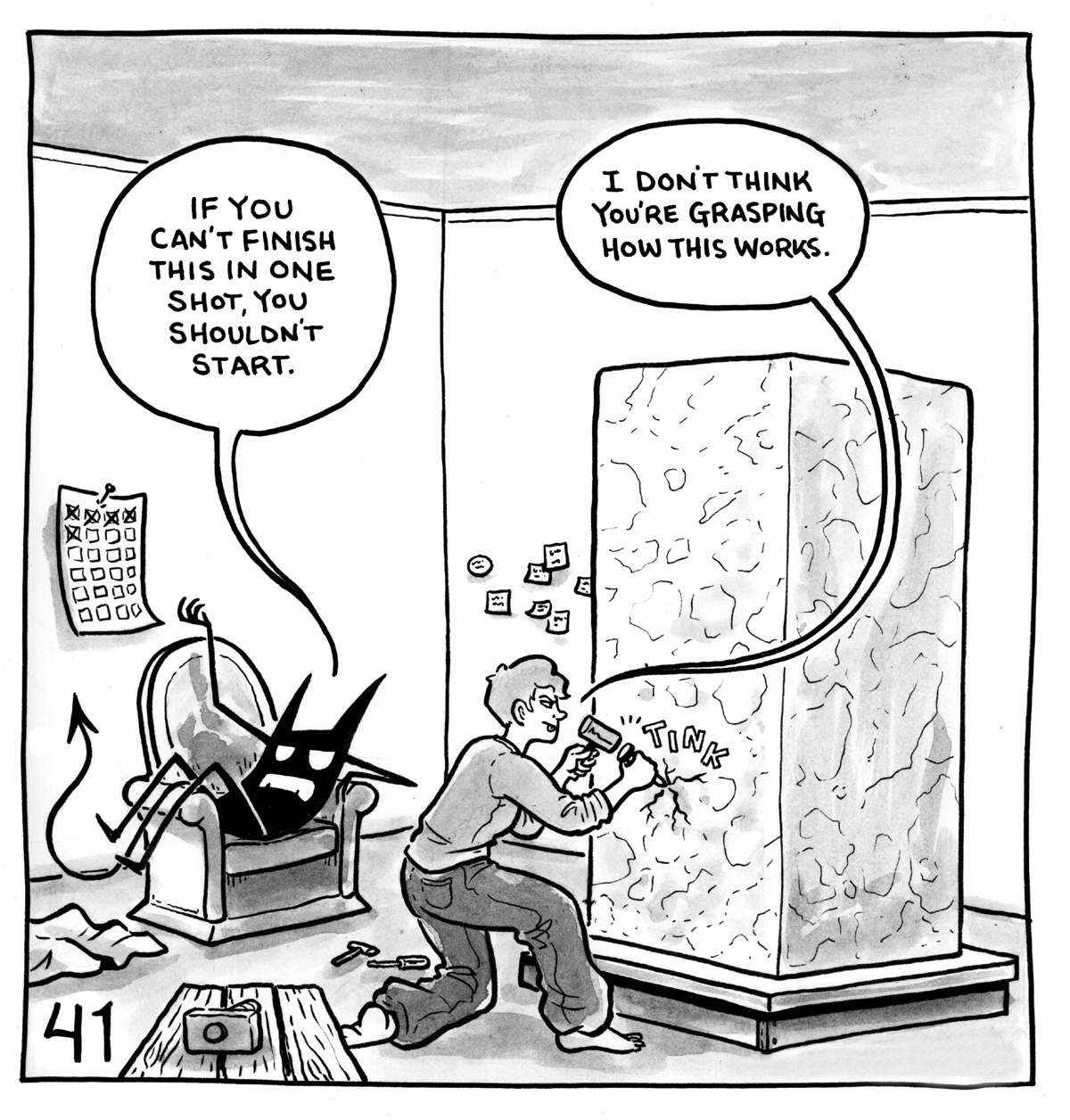
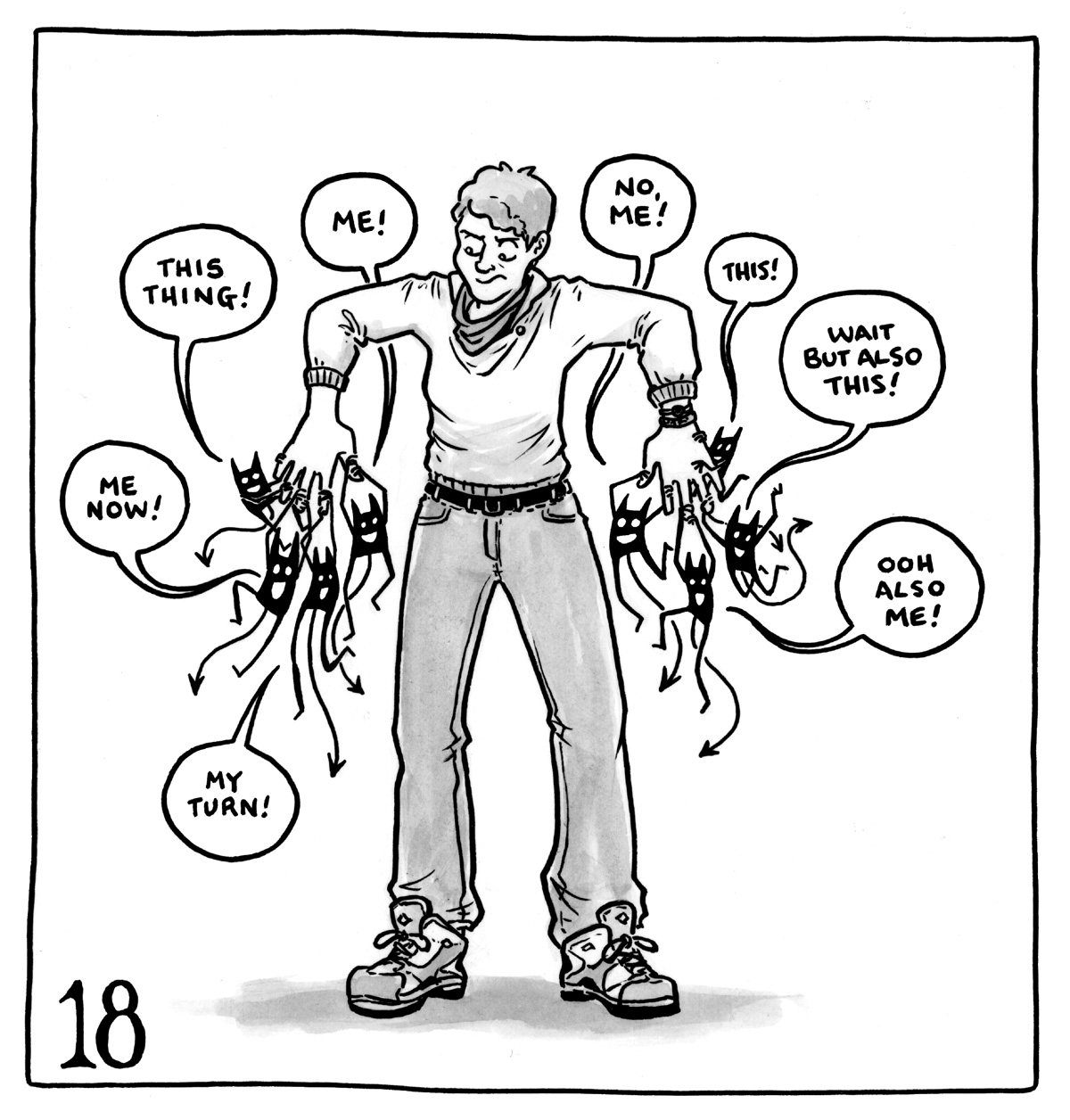
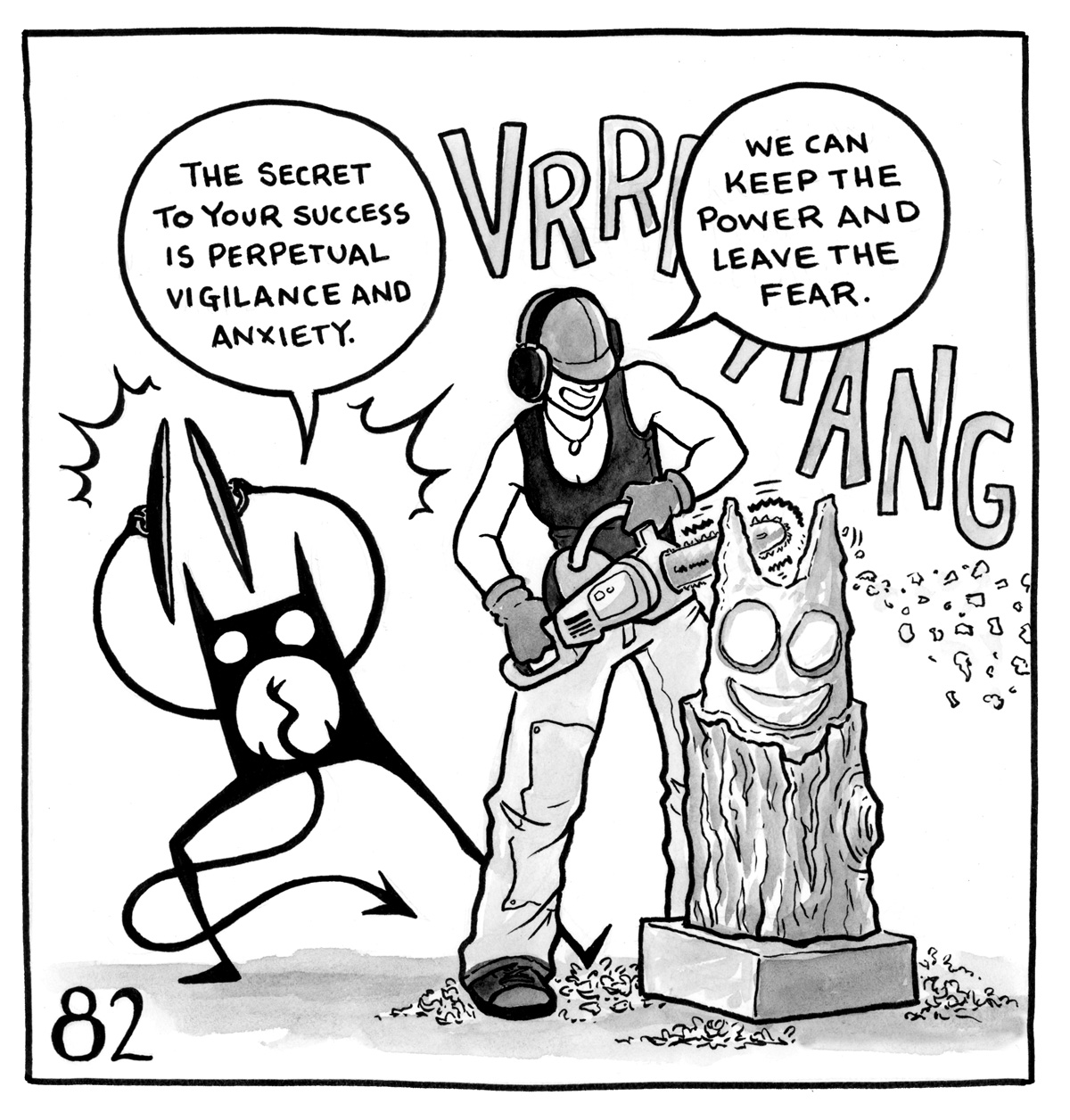
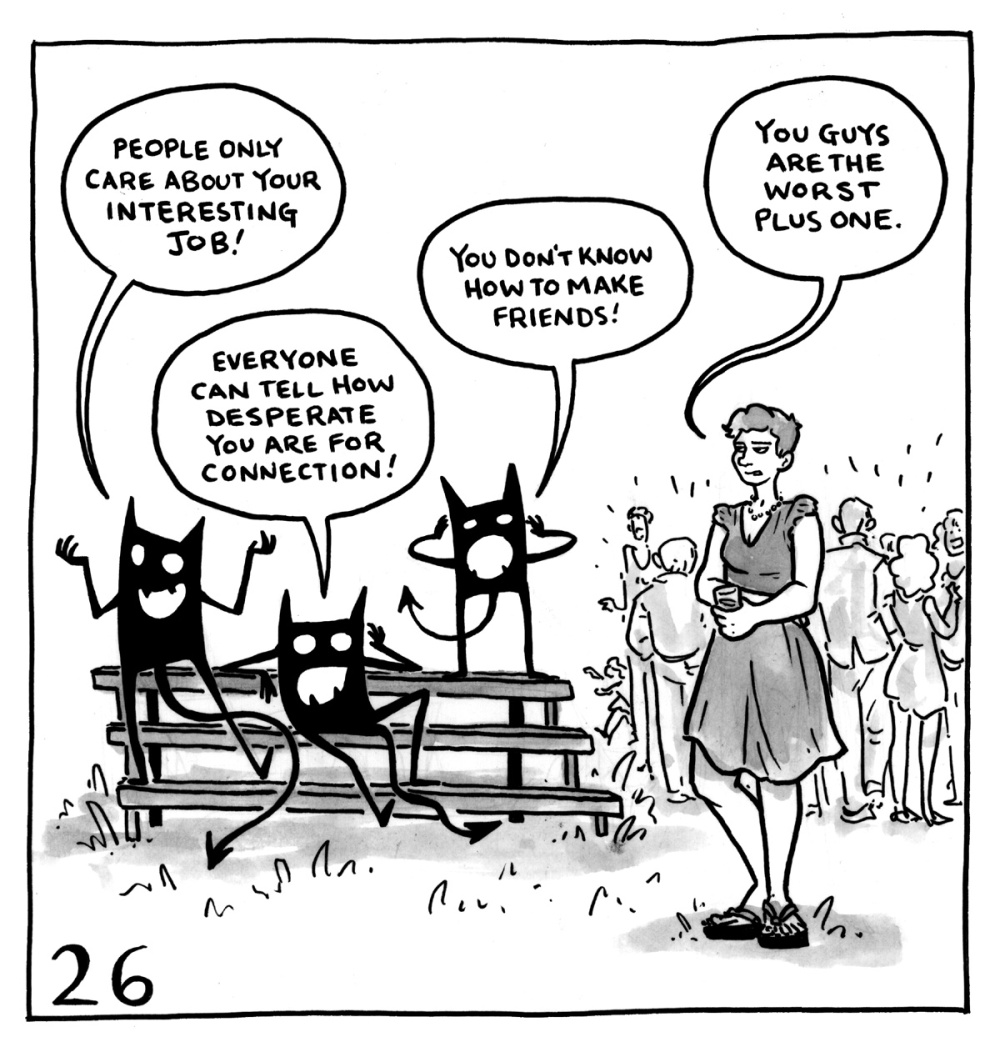
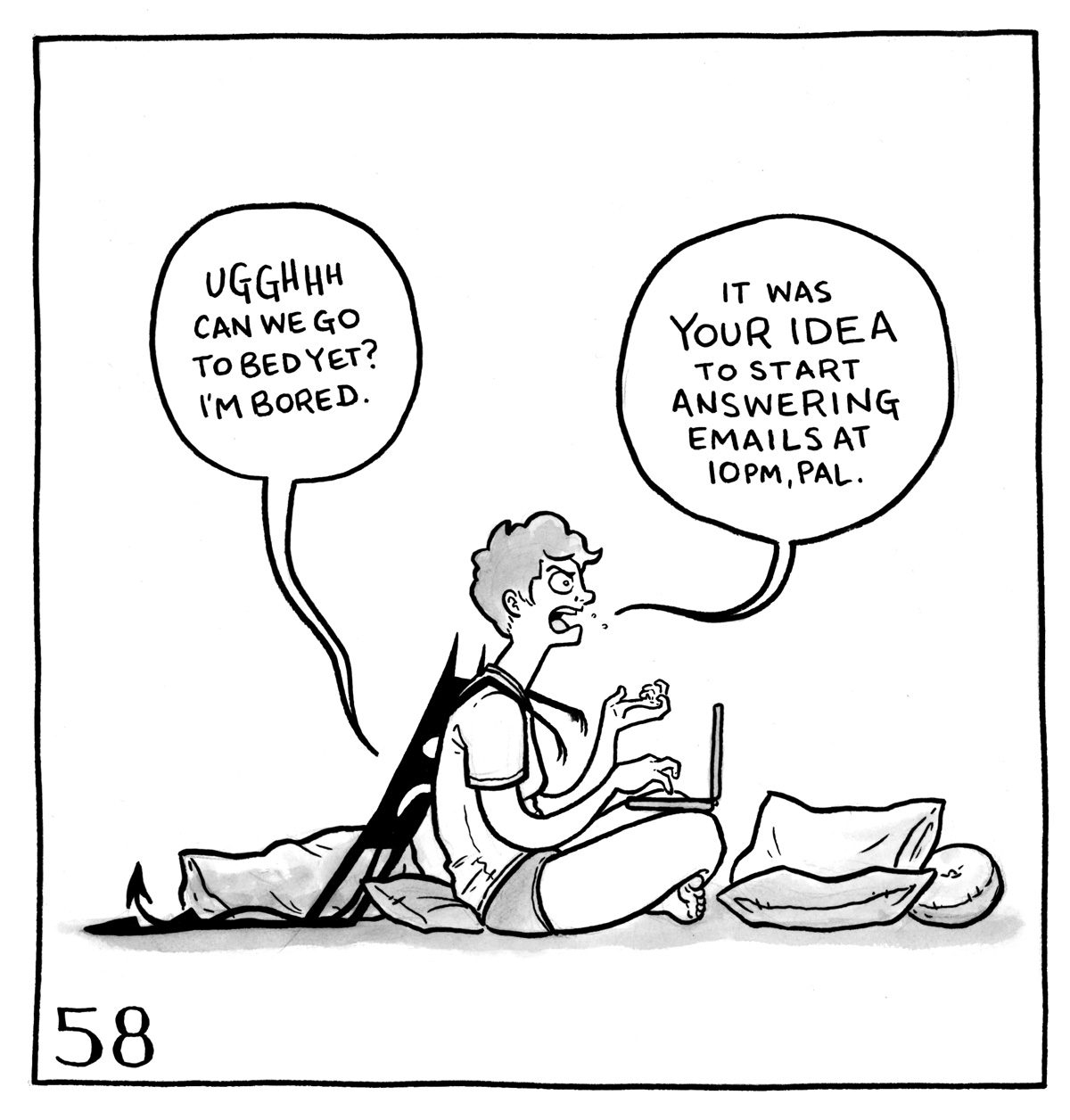
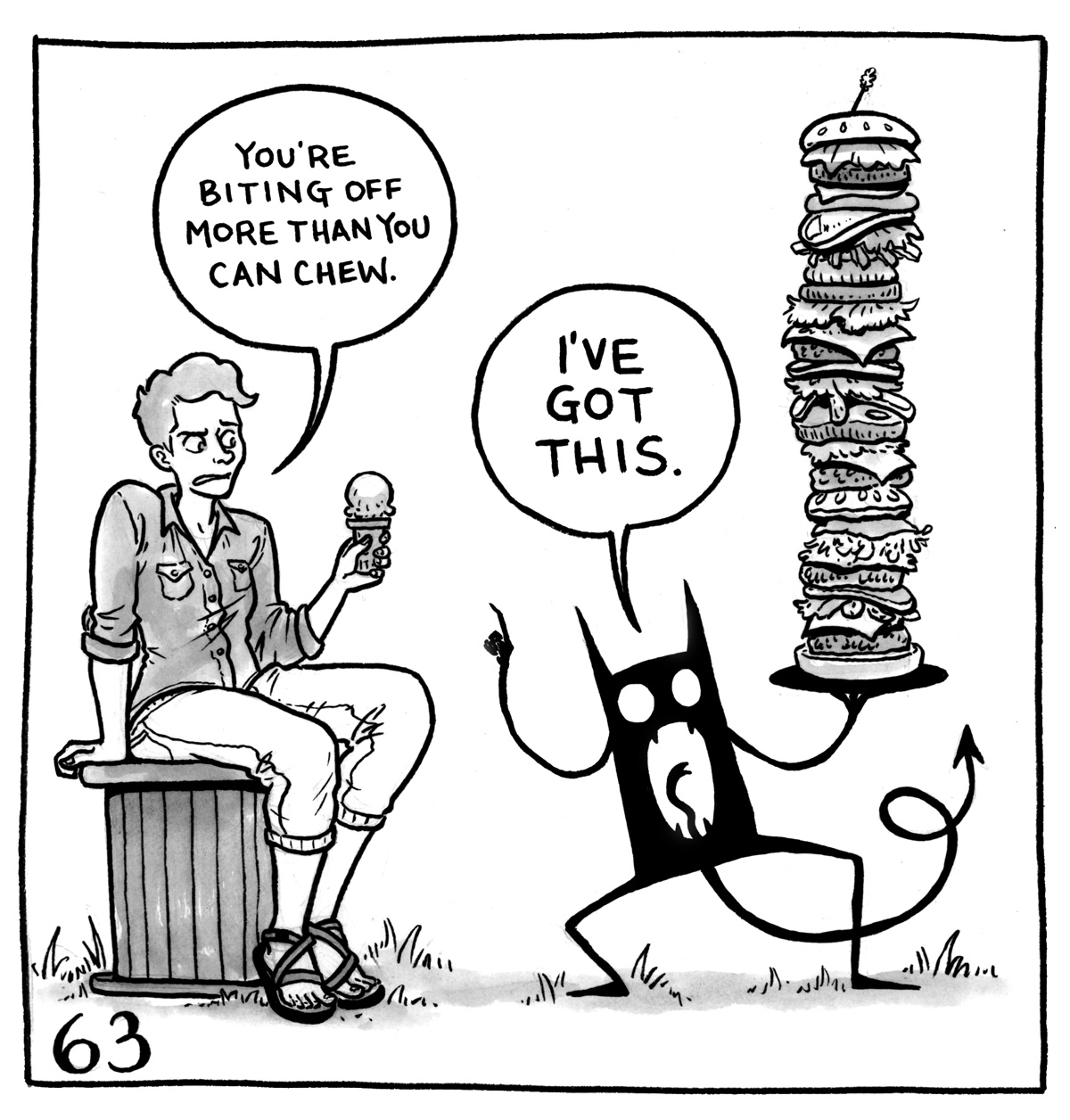
In 2017, for the 100 Day Project, Portland-based cartoonist Lucy Bellwood penned her own demon in a series of 100 comics. Those illustrations have now become a book titled 100 Demon Dialogues.

In the forward she writes, "Back in 2012, entering my first year as a full-time freelance cartoonist, I hit an art rut. Trying to shake things up, I doodled a picture of a tiny, taunting inner imp who apparently believed I’d never make anything of myself."

"He cropped up time and time again over the next five years — when things were going well and I was worried I’d lose everything, or when things were going poorly and I thought it’d never get any better. Each comic I drew about him brought a little more humor or clarity to our relationship, but I still felt like I was at his mercy," she continues.

"Then, in April of 2017 I set out to complete my second 100 Day Project, a themed challenge in which participants do something creative every day for 100 days. Spanning just over three months, it seemed like the perfect chance to really dig into what was going on with this little jerk and get a handle on how to banish him for good."

Her project resonated with people of all walks of life. Here's a taste:

100 Demon Dialogues goes on sale June 19 but is available to pre-order now for $14.99 (paperback) or $7.99 (Kindle). Portlanders can meet Bellwood at the book's release party on June 4 at Ford Food & Drink.

In addition to the book, she's got some cool demon-themed schwag and prints including this plushie for $25. I suggest making poking it with pins like a voodoo doll when self doubt starts creeping in.

Previously: Sailor tattoos decoded and Comic about three weeks on an oceanographic research vessel

15 May 13:47

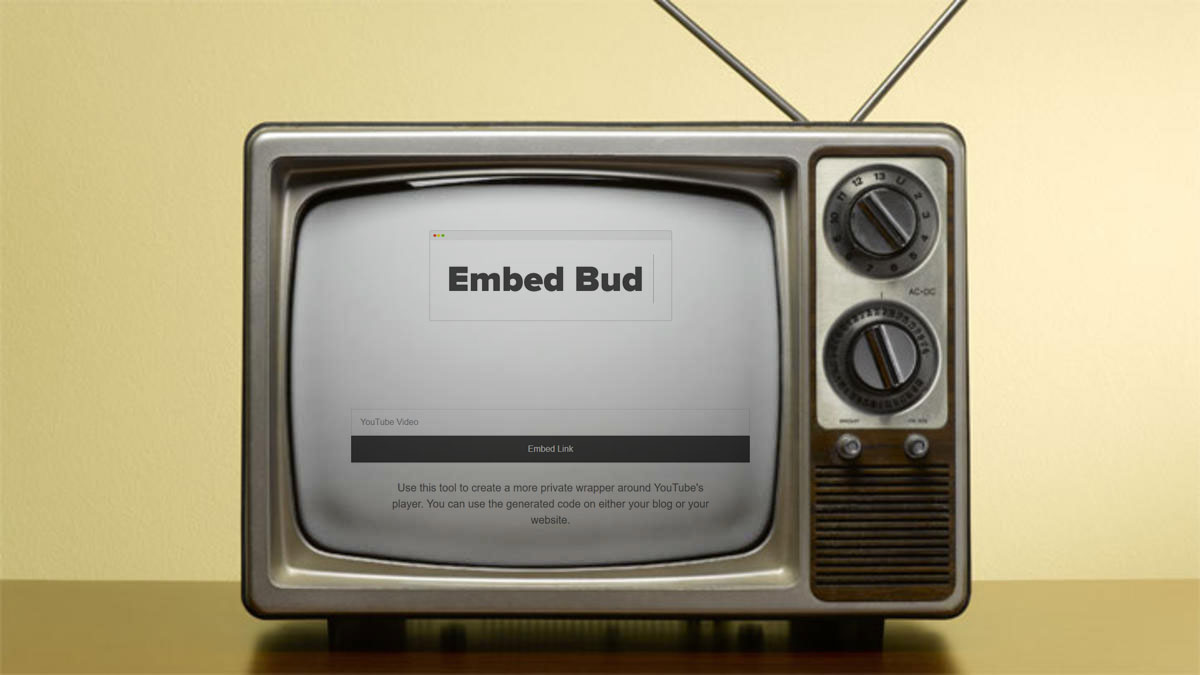
Site generates privacy-preserving YouTube embeds

by Rob Beschizza

Jag Talon''s Embed Bud is a single-serving site (made with Glitch) that generates less invasive YouTube embed snippets to use on the web. It's a simple trick that adds the encrypted-media attribute to the http iframe so you don't have to. Suggestion: it could also add modestbranding and showinfo (to remove logos and telltale overlays), rel=0 (to remove next-up recommendations based on user history), and start=15s (because the only thing that ever happens in the first 15 seconds of a YouTube video is logos, music and "hey guys")
14 May 11:18

La tazza dei folletti

E ora qualcosa di completamente diverso: dai racconti di fate di William Butler Yeats, un omaggio a "Owney e Owney-na-peak".
Serie di 6 illustrazioni, ecco la prima!

"The cup of the pixies"
And now something completely different: from the fairy tales of William Butler Yeats, a tribute to "Owney and Owney-na-peak".
Set of 6 illustrations, here is the first one!
thumbnail
11 May 19:52

Supreme Court to rule on your First Amendment right to silence

by Robert A. Sedler, Distinguished Professor of Law, Wayne State University
The justices have previously ruled that the government cannot compel people to speak its message or associate with ideas they do not hold. www.shutterstock.com

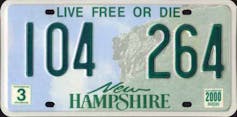
New Hampshire’s state motto “Live free or die” is, for many residents, a stirring evocation of the independent spirit of colonial America.

But not all New Hampshirites agree with this well-known slogan that is emblazoned on the state’s license plates. In 1975, George Maynard was sent to jail because he didn’t believe in it.

Maynard and his wife were Jehovah’s Witnesses, a Christian denomination that teaches that true believers will enjoy eternal life. The couple felt that the state’s motto violated this tenet. So Maynard covered up the “or die” part on his vehicles’ license plates.

Police gave him three different tickets for illegally altering the plates. When he refused to pay the fines, which totaled US$75, he was given a 15-day jail sentence.

Rouge Falconer/Wikimedia

Maynard then filed a lawsuit that reached the U.S. Supreme Court. In 1977, the Supreme Court ruled that the First Amendment gave Maynard the legal right to cover up those two words. In other words, the First Amendment – which guarantees the right to free speech – can also give people the right to remain silent.

Flowing from free speech

I am a legal scholar, so when I learned that the Supreme Court will decide two right-to-silence cases this term the Maynard case came to mind.

The Maynard decision was not the first time the court ruled in favor of a Jehovah’s Witness’ right to be silent. Both decisions hinge on the justices’ determination that the First Amendment includes, in the court’s words, the right “to avoid becoming a ‘mobile billboard’ for the State’s ideological message.”

It may sound contradictory to say the right to be silent flows from the right to speak, but it is not.

The First Amendment protects a person’s right to convey his own message, to voice her own ideas and not to be compelled to publicly disclose personal beliefs and associations. When the government tries to compel a person to speak its message, these rights are seriously damaged.

The right to free speech is likewise violated when people are required to associate themselves with an idea with which they disagree.

This issue first came before the Supreme Court in 1943, when a West Virginia school board expelled a Jehovah’s Witness student for refusing to recite the Pledge of Allegiance because saluting the American flag salute would violate the biblical command “Thou shall not bow down to graven images.”

The court, then lead by Chief Justice Robert H. Jackson, agreed. The First Amendment prevents the government from forcing citizens to express patriotism by saluting the flag.

“If there is any star fixed in our constitutional constellation,” Jackson wrote, “it is that no official, high or petty, can prescribed that what shall be orthodox in politics, nationalism, religion, or other matters of opinion, or force citizens to confess by word or act their faith therein.”

Carrying the government’s message

The first case that will return this issue to the Supreme Court’s scrutiny in 2018 is National Institute of Family and Life Advocates v. Becerra. It involves religiously based “crisis pregnancy centers” in California that try to discourage women from seeking an abortion.

New legislation requires those centers to post notices about other women’s health services available in the state, including abortions.

The pregnancy centers have sued the state, contending that the law forces them to speak the government’s message. California contends that the law is a reasonable regulation of licensed medical facilities.

It will be up to the Supreme Court to decide if the clinic’s claimed right “to avoid becoming the courier for the State’s ideological message” is a valid interpretation of the First Amendment.

Disagreeable association

The second right-to-silence case before the Supreme Court this term, Janus v. American Federation of State and County Municipal Employees, tests the related guarantee that people cannot be forced to be associated with an idea they do not hold.

Forty years ago, the court ruled that a union can require non-members to pay an “agency fee” for their representation by the union. The union may not use any part of the agency fee to advance ideological purposes unrelated to the union’s primary function of collective bargaining.

Now, with Janus v. AFSCME, non-union public employees contend that the required agency fee violates their First Amendment rights because it is not possible to separate bargaining collectively from advancing ideological purposes.

For government workers, they say, issues like salaries, pensions and benefits are inherently political for government workers. And some employees may not agree with the union’s position on those matters.

The unions contend that since all employees benefit from the union’s collective bargaining efforts, allowing workers to opt out of paying the agency fee would enable “free riders.”

Regardless of how the court rules in these two cases, the American right to silence is on trial this year. Both Janus and National Institute of Family and Life Advocates will be decided by the end of June, when the court closes its present term.

The Conversation

Robert A. Sedler is a member of the Democratic Party and has previously engaged in litigation for the American Civil Liberties Union.

11 May 19:47

I go undercover into arms fairs – and secretly draw caricatures of the 'hell' I find there

by Jill Gibbon, Senior Lecturer in Graphic Arts, Leeds Beckett University
© Jill Gibbon, Author provided

The arms multinational BAE Systems is in the final stages of a deal to sell 48 Typhoon fighter jets to Saudi Arabia, despite mounting evidence of war crimes in Saudi-led airstrikes in Yemen. International humanitarian law prohibits attacks against civilians but the Saudi-led coalition has bombed Yemeni schools, markets and hospitals, killing more than 10,000 people including children, while survivors face disease and starvation with the collapse of infrastructure.

Fragments of bombs made in Britain and the US have been found in the debris of some of these attacks, yet both countries continue to sell arms to the Saudi regime.

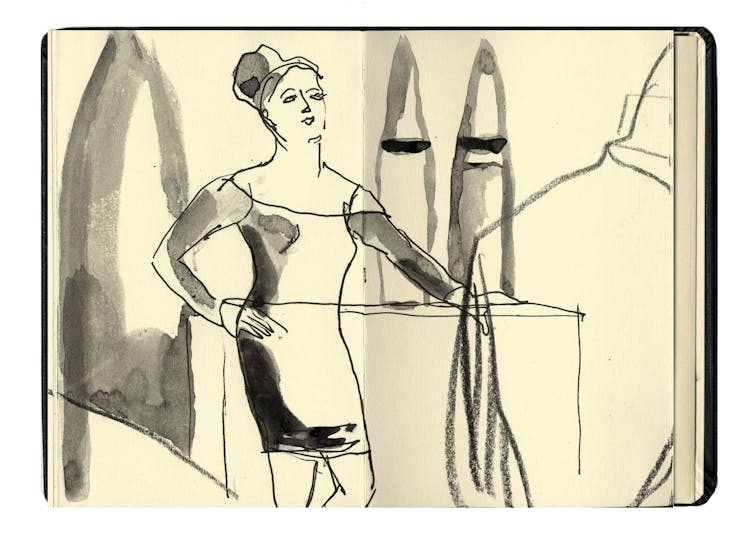
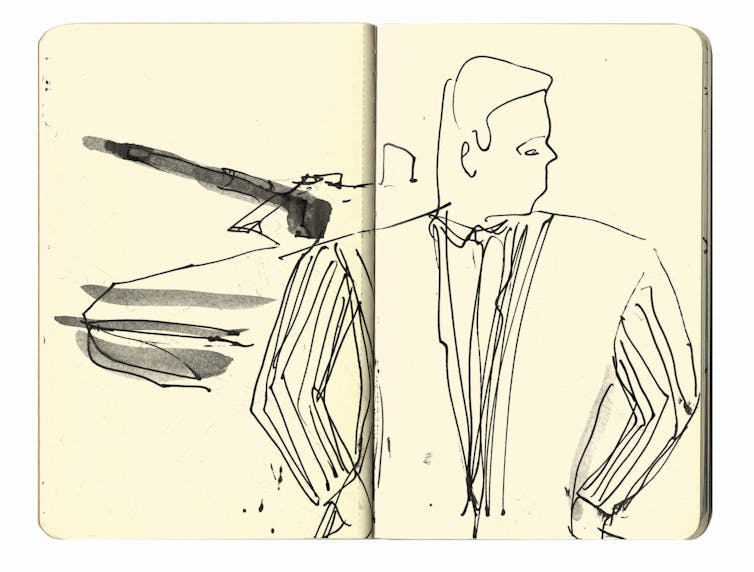
Such deals take place in arms fairs, away from the public eye. I have drawn undercover in fairs in Europe and the Middle East for the past ten years, in an attempt to understand how international arms sales are normalised and legitimised. Access is restricted, but I get in by dressing up as a security consultant with a suit, heels, fake pearls, and a sham company. My performance is a metaphor for the charade of respectability in the industry.

A sales rep. © Jill Gibbon, Author provided

Arms fairs emerged from the globalisation of the military industry in the late 1990s. At the end of the Cold War, defence budgets were cut. There was a brief opportunity to convert military production facilities into civil areas such as medical equipment, transport and renewable energy; instead, arms companies merged into multinationals, expanded into security, and focused on a global market. Arms fairs were set up to provide venues for these deals.

The largest, DSEI (the Defence Security Exhibition International) takes place every two years in London, with similar fairs in Paris, Bahrain and Abu Dhabi. Here, weapons are displayed to an international clientele including countries at war, unstable states and repressive regimes.

DSEI welcomes 75% of the countries that the UK Foreign Office has listed as “Human Rights Priorities”, where “the worst, or greatest number of, human rights violations take place”.

A tank salesman. © Jill Gibbon

Inside a fair, missiles, bombs and bullets are arranged under spotlights; guns are available to try out for weight and size, and to aim at imaginary targets; mannequins pose in camouflage offering private military services and tear gas; tanks are open for viewing. “Lethality” is a sales slogan. Manufacturers boast of the precision of their products, as if war could be refined through science.

As with most advertising, such claims turn out to be exaggerated when the weapons are actually used. Bombing is inevitably inaccurate, compromised by an inbuilt margin of error, malfunctions, mistaken intelligence and the weather. The difference between a combatant and civilian is also increasingly unclear, as Yemen shows. Yet such claims make war more likely.

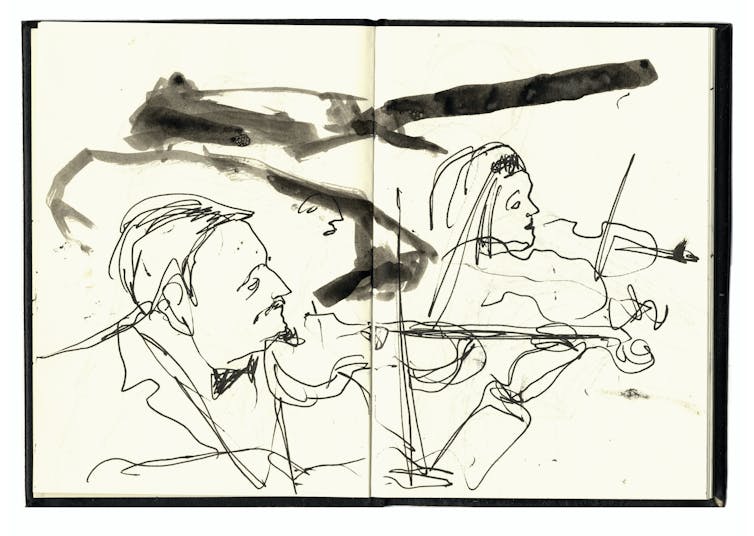
String quartet. © Jill Gibbon, Author provided

Many stalls hand out gifts as an alternative to business cards – stress-balls in the shape of bombs, grenades and tanks, branded sweets and pens. A gas mask manufacturer has condoms with the slogan, “The ultimate protection”. Waiting staff hover with trays of wine, beer and grapes, while a string quartet plays Handel and Mozart.

Grenade stress relief. © Jill Gibbon, Author provided

There are also promotions. The BAE subsidiary Bofors has a live satellite link to its weapons testing facility in Sweden where a military vehicle explodes in a cloud of light and metal. Alongside the video screens, bowls are filled with toffees in wrappers saying, “Welcome to hell”. Brochures explain that the Bofors test centre is “Hell for your product, heaven for your investment”. The impact on people of the weapons that pass through the test centre is oddly missing. In an arms fair, missiles are forever products.

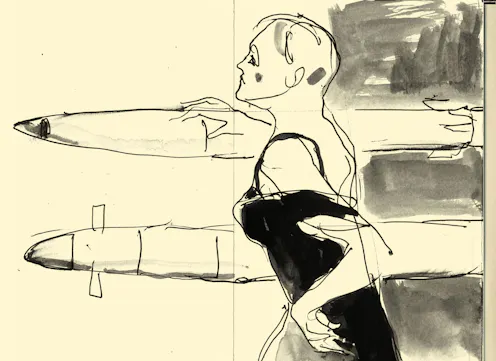
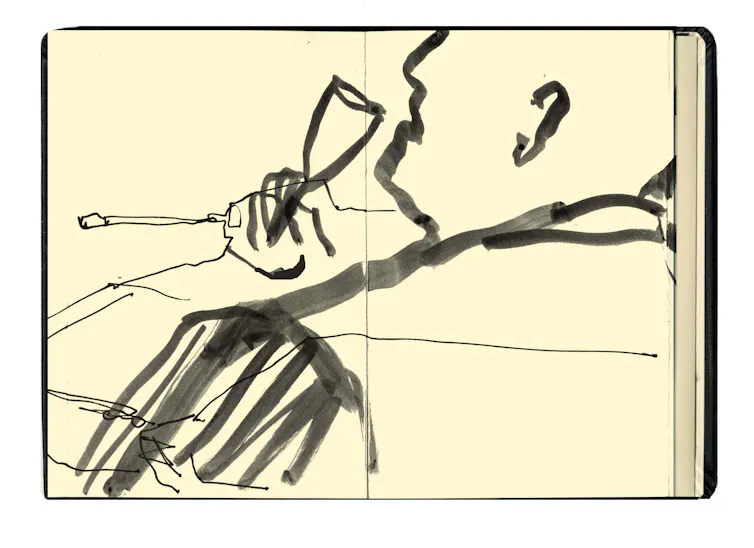
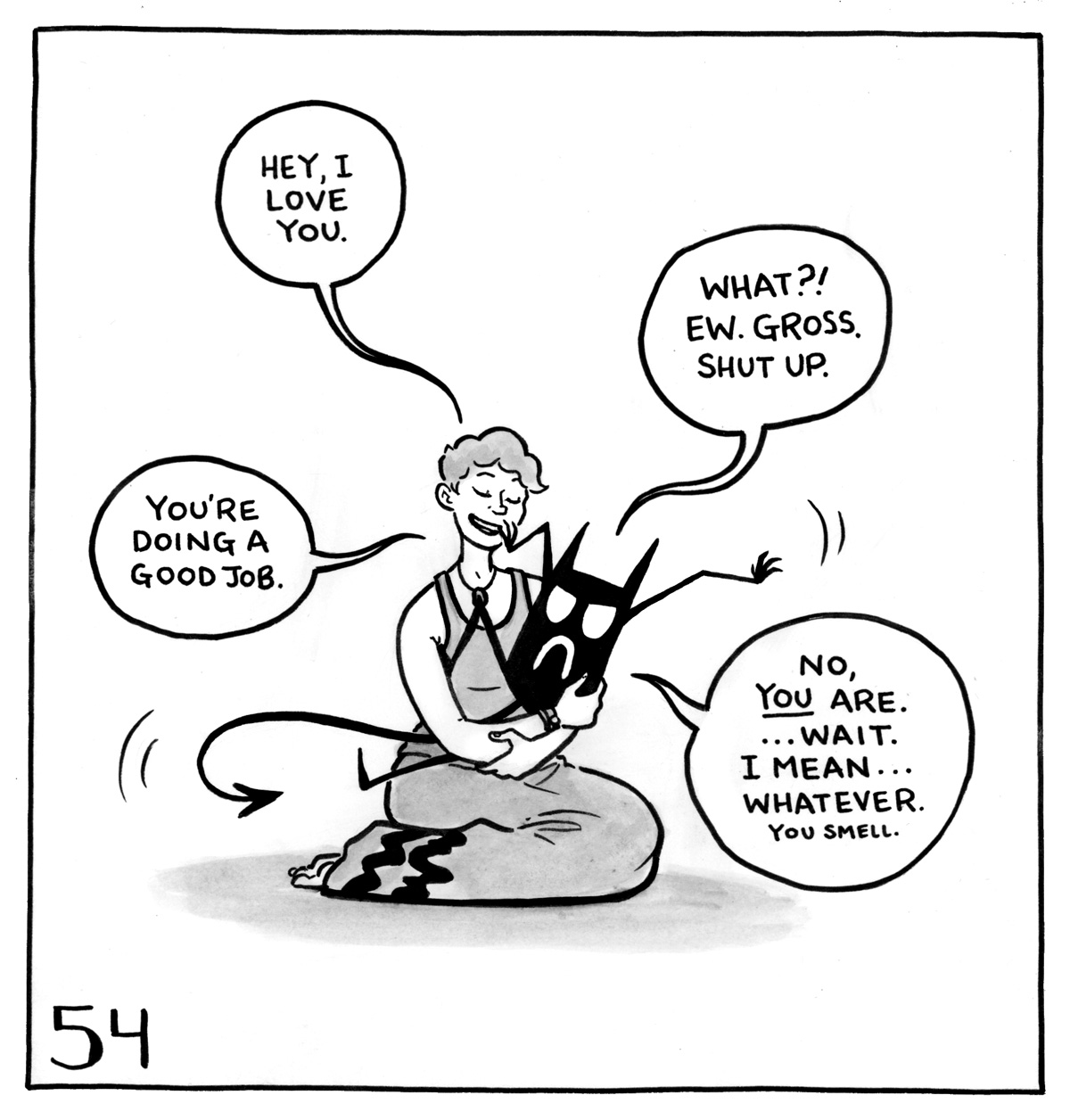
How to draw this? My drawings veer between caricature and observational methods. Mainly, I focus on the etiquette that gives the industry an appearance of respectability – the handshakes, pinstriped suits, hospitality, and violins. I also draw cracks in the façade – a lewd advance, a rep slumped in a chair with his head in his hands, the continual, desperate drinking. Brecht used the Latin word gestus to describe an attitude that expresses a social role or condition. In his plays, gestures are frozen so they seem strange. Perhaps drawing can be used in a similar way.
Drinking. © Jill Gibbon

Or, perhaps the gifts are sufficient in themselves to reveal the strange amorality of an industry that uses war as a sales opportunity. The BAE Bofors toffees might be intended to convey the impact of a test centre on weapons with the slogan “Welcome to hell” – but sweets are usually meant for children.
The Conversation

Jill Gibbon receives funding from the Independent Social Research Foundation.

11 May 18:52

Why everyone is talking about Childish Gambino's "This Is America"

by Cory Doctorow

https://www.youtube.com/watch?v=VYOjWnS4cMY

Since Donald "Childish Gambino" Glover debuted his single "This Is America" on last week's Saturday Night Live, the song and its accompanying video have raced around the internet, sparking analyses and arguments. (more…)

09 May 19:48

Relic from a shameful chapter of American history returned to the Dakota People by an anonymous donor

by Seamus Bellamy

In an age of decadence, narcissism and shit behavior from well-to-dos that's excused with mutterings of affluenza, it's always nice to be surprised by someone anonymously throwing a large sum of money at a worthy cause.

Before talking about the inherent good that some affluent individual pulled out of thin air earlier this week, we need to talk about The U.S.-Dakota War of 1862, also known as the Sioux Uprising. For the uninitiated, it was a brief, ugly piece of American history. The short version of events: The Dakota people were pissed: the United States government had been screwing them out of land, coming up late with agreed-upon shipments of essential supplies and submitting them to unfair trade practices, contrary to what had been signed off on in treaties between the Dakota/Sioux nations and the United States of America. Tempers flared, as they do over issues of trust and sustenance. A group of Dakota killed a party of Minnesota settlers. War between the U.S. Government and the tribes broke out.

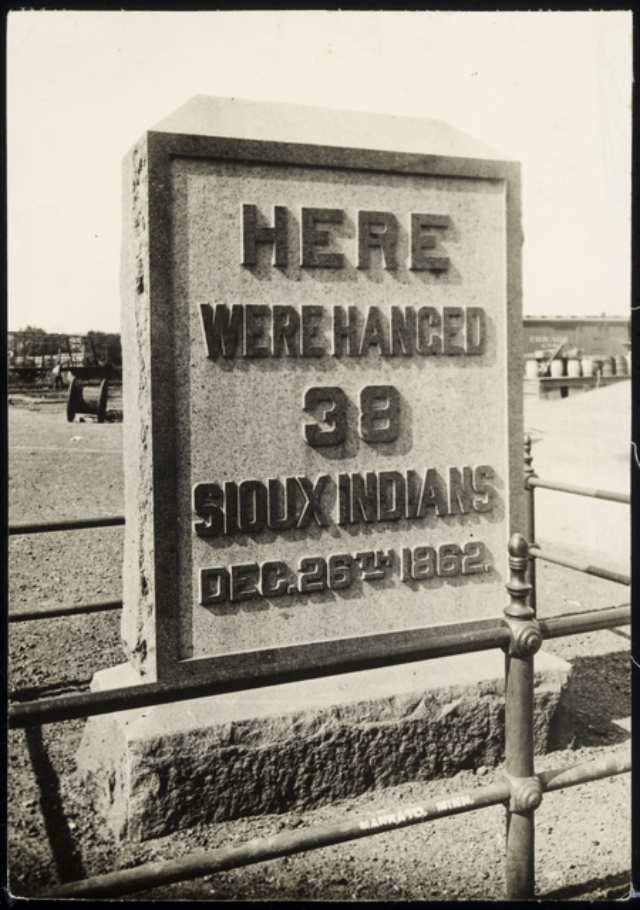
38 Dakota men were captured and convicted of war crimes. They were hung in response to the killing of the settlers: it was the largest single day mass execution in American history. By April of 1863, having lost to superior government forces, the remaining Dakota people were forced out of Minnesota as the United States Congress abolished the tribe's rights to their reservations. Hundreds of people on both sides of the war died as a consequence of the conflict.

Fast forward to the present day: a peace pipe with a history that traces back to the U.S.-Dakota War of 1862 was included in an auction being held in Boston. Skinner, the company hosting the auction, listed the peace pipe as with an estimated value of between $15,000 to $20,000. The pipe, according to a note on its auction information page, was presented to a U.S. Army officer by a Sioux Chief named White Dog while he was being held prisoner. White Dog was killed in 1862 as one of the 38 people chosen for execution in Mankato. The peace pipe ended up in the hands of a private collector in Boston. As it's an important part of their history, when the Lower Sioux Indian Community heard that the pipe was coming to auction, they tried, unsuccessfully, to put a stop to the sale of the pipe.

This past weekend, the auction went ahead, as planned. The peace pipe offered by White Dog to his captor sold for $39,975: close to twice of what it was estimated to be worth.

From MPR:

On Monday afternoon, however, Prairie Island Tribal Council President Shelley Buck said that shortly after the auction, the tribe learned that the buyer had bought the pipe "for the sole purpose of returning it to the Dakota Oyate (people)."

The donor of the pipe wishes to remain anonymous, Buck said in a statement, adding, "We are humbled by and grateful for this honorable act. Pidamayaye to the donor for your respect and generosity."

More gracious, heartening stories like this, please.


08 May 19:55

Don't expect professors to get fired when they say something you don't like

by Frank LoMonte, Director of the Brechner Center for Freedom of Information, University of Florida
Public university professors enjoy great protections when it comes to free speech. Lightspring/www.shutterstock.com

A college professor lashes out on social media with a caustic political opinion. Online commentators explode with outrage and demand firings.

Does the university stand behind the instructor and accept a reputational beating? It depends both on the law and the fortitude of campus administrators.

Fresno State University’s Randa Jarrar is the latest to incite condemnation with her stream of celebratory Twitter posts marking the April 17 passing of Barbara Bush. Jarrar denounced the former first lady as a “witch” and an “amazing racist.” For good measure, the English professor taunted her critics by boasting that tenure protected her from being fired.

Jarrar’s situation isn’t uncommon. Professors from Kansas to Connecticut have provoked online outcry with incendiary posts about touchy social or political topics.

What’s noteworthy is that Jarrar has toughed out the criticism and remained on the job. Social media firestorms often end professors’ careers.

Last year, a Drexel University political scientist resigned after a flippant tweet that stated all he wanted for Christmas was “white genocide.” The tweet followed other comments in which the professor expressed disgust with the military and called white people “inhuman” for mistreating minorities.

Around the same time, a visiting professor at the University of Tampa lost his job after tweeting that Hurricane Harvey, which killed more than 100 people, was payback for Texas’ support of Republicans.

One difference is that, unlike Drexel or Tampa, Fresno State is a public university. And at public universities, the First Amendment limits the ability of supervisors to penalize distasteful speech.

As researchers with the University of Florida’s Brechner Center for Freedom of Information, we’ve spent months digging into the rights of public employees when they speak with the news media. While Jarrar was publishing directly and not through a journalistic intermediary, the same constitutional principles protect her speech and that of all state employees – within limits.

The workplace and the First Amendment

It’s well-established by decades of case law that the First Amendment prevents government agencies – including states that run many universities and community colleges – from restricting the content of citizens’ speech, or punishing them after the fact for what they say. When a private employer, including a private college, fires someone over a social media post, there’s no constitutional violation.

At the same time, the U.S. Supreme Court has recognized that the government has valid interests in being able to provide services efficiently. As a result, employee speech that interferes with workplace harmony can be restricted or even penalized with a firing.

So is a professor at a state-run college more of a citizen – or more of an employee?

In a 2006 case, the Supreme Court upheld disciplinary action against a government employee who wrote a memo undermining his supervisor, a California prosecutor. The justices said employees give up their First Amendment protection when they speak “pursuant to official duties.”

But more recently, the Supreme Court backpedaled. In 2014, the justices unanimously overturned the firing of an Alabama community college employee who blew the whistle on misspending at his state agency. Speech doesn’t lose protection, the court ruled, just because it is about information learned on the job.

The First Amendment especially applies to comments about prominent political figures and political issues. To the relief of bloggers and talk show hosts everywhere, speech does not lose protection merely because it is insulting or mean-spirited. So even uncivil name-calling about the Bush family is difficult for a state agency to restrict.

If Jarrar was tweeting as part of her job duties, she’d have no First Amendment protection; the speech would belong to her employer. But political commentary is probably beyond the job description for an English literature professor. So her tweets are entitled to at least some constitutional protection.

And the First Amendment may apply even more forcefully when the speaker is a college instructor.

Do professors represent a ‘special’ class?

Outside of higher education, it’s become common to see public employees fired for caustic social media posts. Teachers, principals, police officers and firefighters have all lost their jobs for thoughtless excesses – whether real or perceived – on Facebook or Twitter.

Even for employees of state or local government, legal challenges often fail. Employers can prevail by producing enough complaints to show that the speech upset workplace morale or undermined public trust.

But in higher education, academic freedom is a cherished value. The term refers to the latitude that college educators are given to explore provocative ideas in the classroom, even unorthodox ones.

In cases brought by professors in North Carolina and Washington, federal courts have given greater free speech protection to college faculty than ordinary government employees would enjoy.

Stephen Salaita, a professor of American Indian studies, obtained an US$875,000 settlement in a lawsuit against the University of Illinois, when his job offer was withdrawn following outrage over his Twitter posts criticizing Israel. Salaita’s case shows how limited a public university’s options are in responding to indecorous speech by faculty members, particularly posts made on personal time about political concerns.

Tweet and counter-tweet

Supreme Court Justice Louis Brandeis famously wrote in 1927 that the proper response to “evil” speech is “more speech,” not suppression or punishment. Like all government executives, college presidents can freely voice disapproval of obnoxious speech to distance their institutions from it.

That’s just what Fresno State President Joseph I. Castro did. In informing the public that Jarrar wouldn’t be disciplined for her off-duty tweets, Castro disavowed the speech as “contrary to the core values of our University.” Castro is also holding two forums to air public sentiments about the Jarrar controversy.

The Supreme Court has described college campuses as a “marketplace for ideas,” and the marketplace has largely disdained Jarrar’s choice of words.

Social media speech is easily avoided, and remarks like Jarrar’s quickly dissipate if ignored. If the marketplace greets the next professorial online rant with a yawn and a click of the “unfollow” button, then the message will fail to find an audience – and the market will have spoken.

The Conversation

The authors do not work for, consult, own shares in or receive funding from any company or organisation that would benefit from this article, and have disclosed no relevant affiliations beyond their academic appointment.

08 May 19:37

Five problematic sex messages perpetuated by advice manuals

by Meg-John Barker, Senior Lecturer in Psychology, The Open University
Sex advice falls short. Mavich Stock Man/Shutterstock.com

I can’t recommend reading over 60 sex advice manuals. I spent several months doing this and it results in a particular combination of sadness, anger and frustration that I’d rather never repeat.

The reason for my painful few months was my new book, Mediated Intimacy: Sex Advice in Media Culture with Rosalind Gill and Laura Harvey. The book explores the changing forms of “sexpertise” and how they influence ideas and practises around sex. In addition to sex manuals, we studied blogs, magazines, reality TV shows such as Sex Box (which actually gets people to have sex in a box), newspaper problem pages, websites, apps, and more.

We emphasise throughout our book that it’s rarely a matter of any sex advice being all good or all bad. Rather, sexpertise often opens up some things – in terms of ways of understanding or experiencing sex – at the same time that it closes down others. And the same text has the potential to be read in different ways by different readers. For example, somebody might read sex advice to get ideas, to enjoy sexual images, to find humour in it – or a combination of these.

But it’s also important to acknowledge just how deeply problematic the vast majority of mainstream sex advice is. Especially in this moment of #MeToo, and greater awareness of intersecting systems of privilege and oppression, it’s most concerning how few texts even mention consent, and how many assume that sex equates to penis-in-vagina intercourse, often depicted by endless images of young, white, slim, non-disabled, normative male/female couples.

When the panic around the messages young people receive about sex so often focuses on sexually explicit material, it’s about time we turned our attention to the insidious and disturbing messages that people are receiving from materials which are supposedly designed to educate, inform, and advise about sex.

So – in true sex advice “top tips” form – here are the top five problematic messages that we’ve found are perpetuated by the majority of sex advice.

1. There’s a set script for ‘proper’ sex

As sex therapist Clare Staunton puts it, the “kiss, kiss, boob, boob, penis in vagina” approach to sex is found everywhere. Even advice which tries to expand sex beyond this formula often defaults to an assumption that penetration is somehow better or more ideal than other forms of sex. In addition to the number of sexual identities and practices this excludes or marginalises, it also makes ongoing consent more difficult as it is easy to simply default to the script without checking whether you find this pleasurable or whether it is what the other person wants.

2. Certain bodies are sexy and sexual, others aren’t

People are encouraged to engage in surveillance and disciplining of their bodies in order to have a sexy appearance, and to perform sexually. From the images found throughout mainstream sex advice it’s clear that older bodies, disabled bodies, and fat bodies are not deemed sexual given that they are absent or – if they ever do appear – clothed. Again, this marginalises many bodies, and encourages people to treat their bodies in unkind ways that takes them away from the potential for embodied erotic experiences.

3. Individuals are responsible for having great sex

The ideal self in sex advice is one who has banished repression, overcome taboos, dealt with any “issues”, and become a properly adventurous neoliberal lover. Sexual problems are almost always located within the individual – often a woman – who is also told they are responsible for improving themselves through various “technologies of sexiness” (toys, techniques, and so on). There’s very little consideration of how wider cultural messages and social structures frequently restrict our capacities for sexual desire and pleasure.

4. Pleasure is imperative (but restricted)

Sex advice emphasises that people must experience sexual pleasure – even suggesting that it’s an imperative of being a healthy person or having a healthy relationship. But there’s little unpacking of what pleasure is. Rather, it’s assumed that the range of acts presented in sex advice will be pleasurable – often equated with resulting in orgasm. There’s little consideration of the complex interweaving of pleasure and other experiences in sex (such as duty, shame, validation, disappointment, relief), or the ways in which goal-focused approaches to sex often result in less pleasure and more pressure.

5. No need to mention consent

Shockingly, hardly any mainstream sex advice we looked at mentioned consent in any detail. When it was touched upon it was almost always in relation to having safewords for kinky sex, with no sense that other forms of sex may also require consent, and that it may be about far more than just “saying no”. Advice about communication hardly ever gave consent as a reason for communicating, or as something that people might need to communicate about.

This is even more concerning considering that much sex advice actually gives messages that run counter to treating yourself – and others – consensually. For example, women are encouraged to provide unwanted quickies or forms of sex they did not enjoy so as not to risk losing the relationship, to allow partners to do anything they liked at the point of orgasm, or to begin having sex when they didn’t feel like it – because supposedly women don’t get into it until they’ve been doing it for a while.

The most recent NATSAL survey found that nearly half of people report a sexual difficulty of some kind. This seems unsurprising given the the pressures and restrictions sex advice places on sex, and the lack of advice about how to expand our erotic imaginations, to tune into and communicate our desires, and to have sex in ways that don’t risk further non-consensual experiences.

The Conversation

Meg-John Barker is involved in a sex advice project of their own with Justin Hancock (http://megjohnandjustin.com), which is also discussed in the book Mediated Intimacy.

08 May 19:33

Five brain-boosting reasons to take up martial arts – at any age

by Ashleigh Johnstone, PhD Researcher in Cognitive Neuroscience, Bangor University
Lucy Baldwin/Shutterstock

We are all aware that exercise generally has many benefits, such as improving physical fitness and strength. But what do we know about the effects of specific types of exercise? Researchers have already shown that jogging can increase life expectancy, for example, while yoga makes us happy. However, there is one activity that goes beyond enhancing physical and mental health – martial arts can boost your brain’s cognition too.

1. Improved attention

Researchers say that there are two ways to improve attention, through attention training (AT), and attention state training (AST). AT is based on practising a specific skill and getting better at that skill, but not others – using a brain training video game, for example. AST on the other hand is about getting into a specific state of mind that allows a stronger focus. This can be done by using exercise, meditation, or yoga, among other things.

It has been suggested that martial arts is a form of AST, and supporting this, recent research has shown a link between practice and improved alertness. Backing this idea up further, another study showed that martial arts practice – specifically karate – is linked with better performance on a divided attention task. This is an assignment in which the person has to keep two rules in mind and respond to signals based on whether they are auditory or visual.

2. Reduced aggression

In a US study, children aged 8-11 were tasked with traditional martial arts training that focused on respecting other people and defending themselves as part of an anti-bullying programme. The children were also taught how to maintain a level of self-control in heated situations.

The researchers found that the martial arts training reduced the level of aggressive behaviour in boys, and found that they were more likely to step in and help someone who was being bullied than before they took part in the training. Significant changes were not found in the girls’ behaviour, potentially because they showed much lower levels of physical aggression before the training than the boys did.

Interestingly, this anti-agression effect is not limited to young children. A different piece of research found reduced physical and verbal aggression, as well as hostility, in adolescents who practised martial arts too.

In control. El Nariz/Shutterstock

3. Greater stress management

Some forms of martial arts, such as tai chi, place great emphasis on controlled breathing and meditation. These were strongly linked in one study with reduced feelings of stress, as well as being better able to manage stress when it is present in young to middle-aged adults.

This effect has also been found in older adults – the 330 participants in this research had a mean age of 73 – too. And the softer, flowing movements make it an ideal, low-impact exercise for older people.

4. Enhanced emotional well-being

As several scientists are now looking into the links between emotional well-being and physical health, it’s vital to note that martial arts has been show to improve a person’s emotional well-being too.

In the study linked above, 45 older adults (aged 67-93) were asked to take part in karate training, cognitive training, or non-martial arts physical training for three to six months. The older adults in the karate training showed lower levels of depression after the training period than both other groups, perhaps due to its meditative aspect. It was also reported that these adults showed a greater level of self-esteem after the training too.

5. Improved memory

After comparing a sedentary control group to a group of people doing karate, Italian researchers found that taking part in karate can improve a person’s working memory. They used a test that involved recalling and repeating a series of numbers, both in the correct order and backwards, which increased in difficulty until the participant was unable to continue. The karate group were much better at this task than the control group, meaning they could recall longer series of numbers. Another project found similar results while comparing tai chi practice with “Western exercise” – strength, endurance, and resistance training.

Evidently, there is far more to martial arts than its traditional roles. Though they have been practised for self-defence and spiritual development for many hundreds of years, only relatively recently have researchers had the methods to assess the true extent of how this practice affects the brain.

There are a such a huge range of martial arts, some more gentle and meditative, others combative and physically intensive. But this only means that there is a type for everyone, so why not give it a go and see how you can boost your own brain using the ancient practices of martial arts.

The Conversation

Ashleigh Johnstone receives funding from the Economic and Social Research Council (ESRC).

08 May 17:19

Artist creates digital paintings using only HTML and CSS

by Mark Frauenfelder

Diana A. Smith is a user interface engineer, and to show off her skills, she creates art using hand-coded HTML and CSS. The results are stunning.

08 May 16:50

Syllabus for a course on Data Science Ethics

by Cory Doctorow

The University of Utah's Suresh Venkatasubramanian and Katie Shelef are teaching a course in "Ethics in Data Science" and they've published a comprehensive syllabus for it; it's a fantastic set of readings for anyone interested in understanding and developing ethical frameworks for computer science generally, and data science in particular. (more…)

08 May 15:20

"I Agree": Visualizing terms of service with long scrolls of colored paper

by Cory Doctorow

"I Agree" is an art installation that prints the terms of service for common apps on scrolls of colored paper, creating a bar chart of the fine print that neither you, nor anyone else in the history of the world, has ever read. (more…)

08 May 15:19

Study: two spaces after a period makes reading easier

by Clive Thompson

Amongst people who care deeply about typography and fonts -- which is, in our typographic age, probably a reasonable chunk of people online -- there's been a low-level war about spacing after a period. Specifically: When you finish a sentence, do you type one space, or two?

There are many heated views on this matter.

But recently, a couple of scholars decided to science this one out, and ... things did not turn out well for the one-spacers.

As the Washington Post reports:

So the researchers, Rebecca L. Johnson, Becky Bui and Lindsay L. Schmitt, rounded up 60 students and some eye tracking equipment, and set out to heal the divide.

First, they put the students in front of computers and dictated a short paragraph, to see how many spaces they naturally used. Turns out, 21 of the 60 were “two-spacers, ” and the rest typed with close-spaced sentences that would have horrified the Founding Fathers.

The researchers then clamped each student's head into place, and used an Eyelink 1000 to record where they looked as they silently read 20 paragraphs. The paragraphs were written in various styles: one-spaced, two-spaced, and strange combinations like two spaces after commas, but only one after periods. And vice versa, too.

And the verdict was: two spaces after the period is better. It makes reading slightly easier.

Mind you, the reading-speed improvement with double spaces was only 3%, so we're talking about a pretty tiny delta here.

Small enough, in fact, that this study has not so much resolved this debate as fanned its eternal, eldritch flames. Over a Lifehacker, Nick Douglas notes that the study didn't really model the type of reading people do all day long: The text was typed out in a monospaced font with double-spaced lines, whereas the majority of reading we do online (and in print) is with proportional fonts, and rarely double-spaced. Meanwhile, Matthew Butterick wrote -- in a proportional font, bien sur -- a terrific essay looking at these questions from the perspective of typographers.

Me, I'm a one-spacer. When I cut and pasted the text from the Washington Post into this blog post, I immediately noticed that the Post writers had composed their story using two-spaces, those sly dogs. (In a wonderfully meta turn of events, the reason I was able to notice this is that the "text" editing format in Wordpress, the CMS in which we write these Boing Boing posts, itself uses a monospace font. So maybe monospace isn't quite as dead, for composition, as one might think!)

Anyway, the instant I saw the double-spacing, I aesthetically recoiled. Like any normal person would. So I dumped the text into Clean Text, a little Mac app I keep open all day long while I'm at work, because it's great for quickly cleaning up the wonky formatting of text cut-and-pasted off the web. It's even got a preset command for "Fix spaces", which of course means "take all double spaces, which are an affront to all right-thinking citizens of good conscience and discernment, and replace 'em with single spaces".

And I hit it.

(CC-licensed photo via J E Theriot)

08 May 15:16

Where the manatees are

by Rob Beschizza

Manatees love warm water, evidently, and igotcharts.com posted this lovely manatee map to help you find them. What's with manatees heading up to cold-water parts of the US? Do they love us?
08 May 15:06

The simplest online note-taking website

by Rob Beschizza

Jan Erik Klouman's jjjjjjjjjjjjjjjjjjjj is a clever feat of minimalism: a web-based notepad so simple that the saved-to-desktop HTML file works as-is just like it did at the website. On Firefox, it even lets you paste images in! It's almost a joke--it's just a single HTML box with the "contentEditable" attribute--but it works, so who cares? [via Hacker News]

To save a note just store it on disk (cmd/ctrl+s). To add images, drag and drop them onto the text area. Remove the contenteditable attribute from <body>, save, and voila, you now have a static lightweight blog post ready to be published! Formatting can be a bit wonky but should work in some browsers (cmd/ctrl+b/i/u). Copy+pasting formatted text can potentially break things a bit.

The two colors are from Solarized. Feel free to download the file and update style/markup to your preference.

Some ideas/variations:

Dark theme: https://jjjjjjjjjjjjjjjjjjjj.github.io/new-note/dark.html

Serif: https://jjjjjjjjjjjjjjjjjjjj.github.io/new-note/serif.html

HN theme: https://jjjjjjjjjjjjjjjjjjjj.github.io/new-note/hn.html

With heading: https://jjjjjjjjjjjjjjjjjjjj.github.io/new-note/with-heading...

It's hard to one up this, and trying only makes it less attractive, but here goes: paste

data:text/html, <html contenteditable style='padding:10%;'>
into your browser bar and hit return, then drag the generated page's info icon/navicon from the URL bar to the bookmarks bar, thereby creating a bookmarklet. Clicking that bookmarklet will create new blank contenteditable pages that can be saved the same way. Customize the look by stuffing your favorite CSS into that style attribute. Adding a whole <style> section used to be possible but doesn't seem to work anymore, presumably because modern browsers won't run any old nonsense pasted into a URL bar.
07 May 17:31

May 9: Internet Red Alert in support of net neutrality

by Ellen Satterwhite

On May 9, Senate Democrats will take the first legislative action in support of net neutrality, officially filing the petition to force a vote on the Senate floor to attempt to preserve strong net neutrality protections passed in 2015. The Senate bill is a Congressional Review Act (CRA) resolution from Sen. Ed Markey (D-MA), which would block the Federal Communications Commission’s (FCC) December repeal of net neutrality rules. Senator Markey has led this effort in the Senate and announced plans via Twitter this week.

The Senate bill now has bipartisan support from 50 of 100 senators and would be assured of passage if just one more Republican backs the effort. From the Senate, the effort would move over to the House of Representatives where it will need 218 votes to pass, and would move on to President Trump for his signature or veto.

Modern libraries rely on the internet to collect, create and disseminate essential online information and services to the public, and ALA is working with allies to encourage Congress to overturn the FCC’s egregious action.

You can join us and others on the internet May 9th for a coordinated “Red Alert” day of action. You can join the Red Alert by using our tool to email your members of Congress and ask them to–or thank them for–supporting a Joint Resolution of Disapproval under the CRA to repeal the December 2017 FCC action and restore the 2015 Open Internet Order protections.

You can also increase visibility for the issue and encourage others to join you via social media.

  • Suggested posts prior to May 9th: “BREAKING: The Senate will officially “discharge” the Congressional Review Act (CRA) petition on May 9th and force a vote to restore #NetNeutrality. Starting then, the Internet goes on #RedAlert.”
  • On and after May 9th: “#RedAlert: Congress has the chance to force a vote to restore #NetNeutrality. Tell (or Thank!) your member of Congress to support the CRA and libraries. bit.ly/2K9vuiT

We will continue to update you on the activities above and other developments as we continue to fight to preserve a neutral internet.

The post May 9: Internet Red Alert in support of net neutrality appeared first on District Dispatch.

07 May 13:28

The mysterious Cambridge library tower, supposedly full of banned books, is opening to the public

by Blake
Topic: 
At 157ft tall and 17 floors, Cambridge University Library’s tower can be seen for miles around but has largely kept its secrets to itself and its contents (approaching one million books) have given rise to much speculation. But now in a new free exhibition, Tall Tales: Secrets of the tower, we reveal some of the truth about what the great skyscraper really holds.  
From The mysterious Cambridge library tower, supposedly full of banned books, is opening to the public | The Independent

Cialis is definitely excellent. Allow me to first Buy Cialis Tablets Uk start off of by means of saying cialis dosage for the document that we're Certainly not someone who acquired paid to analyze Cialis. My partner and i'meters a new men's as part of his delayed 20s i recently started recognizing which my personal foreplay ended up being starting to reduce fairly swiftly and that i looked for this physician intended for help. In addition to some recommendations we consider work outs for men to treat my Male impotence, he offered me a 25-working day test associated with Cialis to have my own confidence back sovaldi price again. I had been supplied a drugs the other day Buy Cialis Without Prescription and also had taken only 1 having a dish contributing to several hrs in the future, appropriate when i had Cheap Cialis mattress, a stuff just quit within when i seemed to be eyeballing my wife in addition to exactly what come had been amazing and spectacular. This erection has been sustained approximately an hour day-and-night. My partner and i Recommend hepititus c that.