Shared posts

26 Jul 19:48

A conservative activist's quest to preserve all network news broadcasts

by Thomas Alan Schwartz, Professor of History, Vanderbilt University
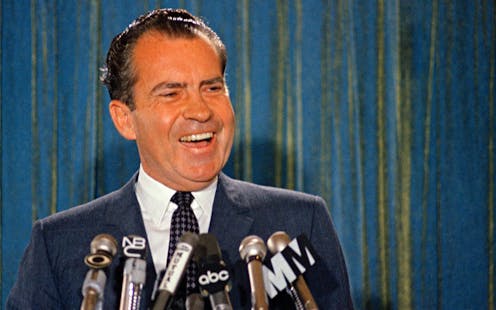
Republican presidential candidate Richard Nixon smiles for the cameras during a 1968 news conference. AP Photo

Fifty years ago, in the middle of a typically hot and humid Nashville summer, a Metropolitan Life insurance manager named Paul Simpson sat with Frank Grisham, the director of the Vanderbilt University Library, in the rare books room of the main library building.

Using three Ampex video recording machines, three television sets and $4,000 of Simpson’s own money, they began what they thought would be a 90-day experiment: From then until election night in November, they would record the ABC, NBC and CBS evening news broadcasts, which usually aired at the same time.

The day Simpson and Grisham started taping, August 5, 1968, was an eventful one. The Republican Convention began, and Ronald Reagan officially announced his candidacy for the presidential nomination, joining with liberal Republican Nelson Rockefeller in an attempt to stop Richard Nixon’s hopes of a first ballot nomination.

The news broadcasts also included the era’s biggest stories: fighting in Vietnam, communist leaders meeting in Eastern Europe and the civil war in Nigeria. Other reports from that day sound hauntingly familiar: an Israeli strike into Jordan and a violent incident at the Korean Demilitarized Zone, in which an American and North Korean soldier were killed.

Such was the modest beginning of what Rutgers University historian David Greenberg has called the “preeminent video resource for scholars of TV news.”

Although legal and copyright issues continue to hinder access, the Vanderbilt Television News Archive – a repository of television news recordings from the past 50 years – is a national archival treasure.

But the archive’s beginnings are rooted in the political and cultural conflicts of the late 1960s. Simpson, the archive’s founder, first financial backer and chief fundraiser, was deeply conservative. And he was convinced that the network news broadcasts, with their executive producers living in New York’s “liberal atmosphere,” were contributing to social turmoil and unrest throughout the country.

For this reason, he sought to save the recordings for posterity – to be able to show, years later, that CBS, NBC and ABC were as much a part of the problem as the anti-war movement, drug culture and free love.

The most trusted men?

Although he later downplayed political motivations in a 1985 C-SPAN interview, Simpson had long been passionate in his concern about television’s malign influence over “the American mind.”

In 1964, he wrote to CBS to complain about Walter Cronkite’s coverage of the Goldwater campaign. He wasn’t necessarily wrong: Cronkite, who enjoyed his reputation as the “most trusted man” in America, did detest Goldwater and was liberal in his politics.

Simpson also believed that television news unfairly blamed President John F. Kennedy’s assassination on the “conservative atmosphere” in Dallas, and he recalled with particular disgust a 1967 network interview with psychologist Timothy Leary, who was encouraging young people to try LSD.
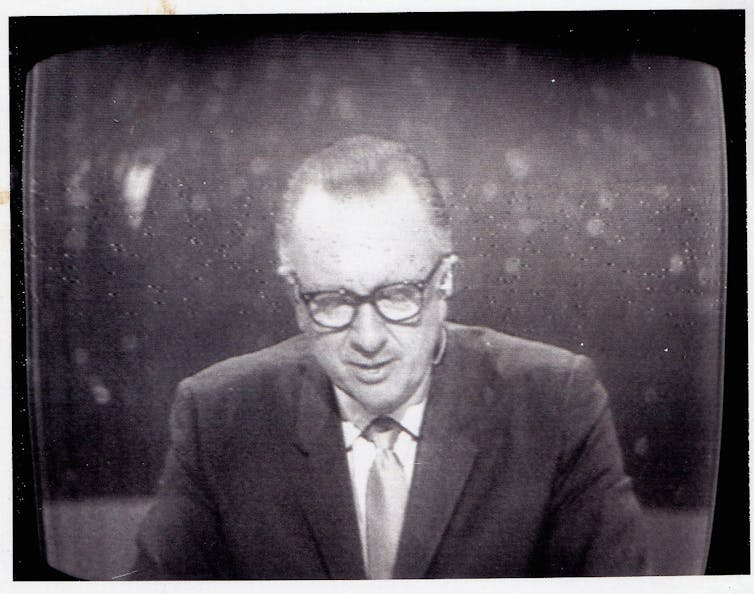
Simpson was deeply suspicious of Walter Cronkite’s motives and beliefs. Charles Kremenak, CC BY

On a business trip to New York in March 1968, Simpson toured each of the three networks. At each stop, he asked to see a broadcast from the previous month. They all told him that they weren’t available – they only saved their broadcasts for about two weeks because it was too expensive to preserve them.

Simpson was shocked. He viewed nightly newscasts as the equivalent of America’s national newspaper. How could they be held accountable if no record existed of their stories, segments and analysis?

When he returned to Nashville, Simpson found an ally in Vanderbilt librarian Frank Grisham.

Grisham didn’t share Simpson’s politics but did believe that the broadcasts should be preserved. The two took the idea to Vanderbilt’s chancellor, Alexander Heard, a political scientist whom historian Paul Conkin described as a true believer in “an open society, one in which divergent views could find expression” and compete for public acceptance. Heard got the board of trustees to approve a short-term experiment, hoping that the Library of Congress might eventually take it over.

Preserving bias for posterity

The expensive project may have ended after its three-month test run were it not for the Democratic National Convention in Chicago, held a few weeks after the Republican gathering.

On August 28, 1968, the night Hubert Humphrey was nominated, the news networks aired footage of the swelling crowds of protesters, the outbreak of violence in the streets and the demonstrators shouting, “The whole world is watching” as the police attacked them. It was dramatic stuff – and Simpson and Grisham preserved it all.

The dramatic images that emerged from the 1968 Democratic National Convention horrified a huge swath of the electorate.

Although the protesters believed media coverage would create sympathy for their cause, a substantial majority of Americans – including Paul Simpson – sided with the police. When editing the tapes, Simpson realized that NBC had shown the same arrest of one violent protester from three different angles without acknowledging that it was the same person. In Simpson’s view, this exaggerated the scale of violence and discredited the police.

In the heated atmosphere of 1968, it was enough to fuel suspicions of media bias. Simpson now had his smoking gun – and a potent fundraising tool.

Over the next two years, the tape of the Chicago violence played a critical role in the survival of the archive. Simpson argued that the only way to be able to study the media’s impact was to ensure copies existed for critics, researchers and academics to review. Two conservative Nashville business executives, one of whom sat on the Vanderbilt board of trustees, made substantial donations to keep the archive functioning.

Nixon’s election made the White House receptive to the project. Simpson sent the tape to Patrick Buchanan, a Nixon speechwriter who shared the president’s deep distaste for the media. Buchanan even included a reference to the protest footage in Vice President Spiro Agnew’s famous 1969 speech attacking television news as biased.
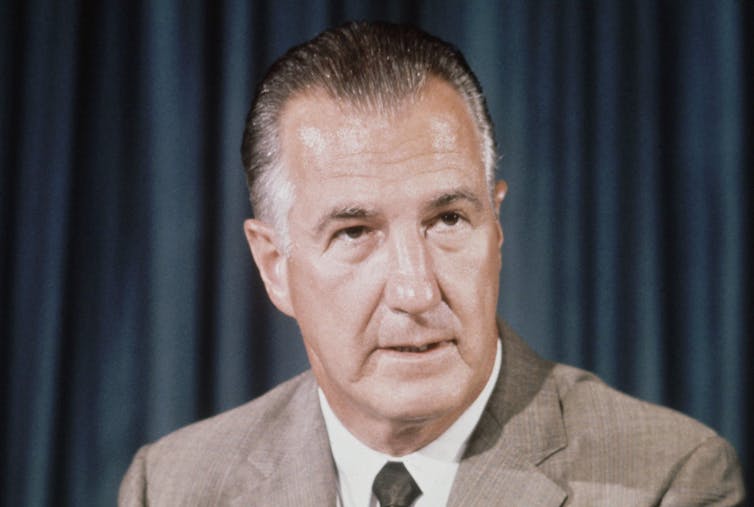
Vice President Spiro Agnew laid into the press, citing the same footage from the 1968 DNC protests that infuriated Paul Simpson. AP Photo

“Another network,” Agnew announced, “showed virtually the same scene of violence from three separate angles without making clear it was the same scene.”

The networks fight back

The networks had never been singled out by elected officials in this way, and they weren’t happy about the scrutiny. Operating as they did with government licenses, they saw Agnew’s speech as intimidation.

With a hubris that, in retrospect, was certain to invite further scrutiny, the three networks pushed back, arguing that they were objective and impartial watchdogs looking out for the public interest. They saw themselves as above politics. As media historian Charles L. Ponce De Leon wrote in 2015, “It was news from Olympus, presented in a tone that suggested the voice of God.”

NBC’s Reuven Frank sarcastically dismissed Simpson’s claim that he was acting in the “spirit of free inquiry,” remarking that “I have never known a self-proclaimed objective student who sought to evaluate my performance because he thought I was doing great.”

The networks also worried that if Vanderbilt continued recording their broadcasts, they would lose the ability to repackage and resell their footage. People could just go to Vanderbilt for it.

CBS accused the Vanderbilt Television News Archive of violating its copyright and sued in December 1973. Amazingly, CBS stated it would destroy the Vanderbilt tapes if it won in court.

Thankfully, Tennessee Sen. Howard Baker helped insert a clause in the revision of the copyright law that protected the right of libraries to record the news. CBS dropped its lawsuit, but some of the restrictions it insisted upon were put in place.

While the entire collection was digitalized in the early 2000s, the Vanderbilt Television News Archive is only allowed to stream NBC and CNN to researchers. Examining ABC, CBS or Fox segments requires a trip to Nashville.

The recording of the evening newscasts of the big three networks – ABC, CBS and NBC – continues to this day. In 1995, the archive began recording an one hour a day of CNN, and in 2004, an hour of FOX. Over the years it’s been used by researchers to study topics as diffuse as political bias, gender stereotyping and even the evolution of television advertising, since the commercials during the news broadcasts are also recorded.

In recent times, the archive was used in the 2015 documentary “Best of Enemies” because it contained lost footage of the debate between conservative commentator William F. Buckley and liberal writer Gore Vidal. More poignantly, it was used by the mother of an American soldier who died in Vietnam; after someone told her that her wounded son had been photographed lying on the ground during a network news segment, she traveled to the archives to review footage and confirm the account.

Even if one thinks Simpson’s perception of deliberate political bias was misguided, his insistence on preserving the evening news in order to study and analyze its presentation was an extraordinarily important contribution.

The British writer Christopher Hitchens once remarked that political partisanship makes us stupid.

But in the case of the Vanderbilt Television News Archive, partisanship led to unintended, historically enriching results.

The Conversation

Thomas Alan Schwartz does not work for, consult, own shares in or receive funding from any company or organization that would benefit from this article, and has disclosed no relevant affiliations beyond their academic appointment.


26 Jul 16:54

Pantheism and how it could offer a new approach to preserving the planet

by Tim Lomas, Lecturer in Positive Psychology, University of East London
Shutterstock

The scientists responsible for the “doomsday clock” moved it 30 seconds closer to midnight – the symbolic point of total catastrophe for humanity and the planet – at the beginning of 2018. The minute hand now hovers ominously at two minutes to 12, the closest point it has ever been (matching the previous peak of 1953 – the height of the Cold War).

This judgement is a reflection of the multiple threats we face as a species, the most urgent being nuclear war and climate change. The former has loomed over humanity for decades. But the latter emergency has only become apparent relatively recently (to the extent that some people and powers even deny that it is a problem). Yet the scientific consensus is clear and alarming. Unless we manage to limit global warming this century to 2°C, then we are in devastating, civilisation threatening trouble.

We’ll need many things to help combat this emergency: technological innovation and scientific and engineering advances which allow us to harness renewable energies. It will also require new patterns of working and living in more sustainable ways. And I think we will also need something that is both subtler and yet perhaps more profound than these revolutions: a new vision of nature itself.

Over the past few centuries, various perspectives on nature have dominated public discourse – generally to the detriment of the environment. The first is the view that humankind has “dominion” over the Earth – that we rule over the planet in some consequential sense. This in itself is not necessarily problematic. It is conceivable that this could be aligned with an ethos of responsible and careful stewardship. But this “dominion” perspective has been widely allied with a mechanistic view of nature that views it as devoid of any intrinsic worth, identity, and purpose beyond its instrumental value to human beings.

The result is a dominant ideology which regards the natural world primarily as a resource that humans are free to plunder at will. This perspective has surely played a pivotal role in our planetary emergency.

But although much damage has already been done, I still believe we could redeem ourselves and set our relationship on a better path if we could develop an alternative vision – of which many can be found across human history and culture.

I’ve recently encountered a wealth of these through my research, which focuses on “untranslatable” words which relate to well-being. Such words are significant, as they represent ideas and practices which have been overlooked or under-appreciated in one’s own culture or time period, but have been recognised by another culture or era. These include visions of nature which have long been neglected in favour of the dominant ideology outlined above. A case in point is the idea of “natura naturans”.

Natura naturans

Albert Einstein was once asked whether he believed in God, and replied: “I believe in Spinoza’s God, who reveals himself in the orderly harmony of what exists – not in a God who concerns himself with the fates and actions of human beings.”

Baruch Spinoza, born in Amsterdam in 1632, was a pioneer of rationalism and helped lay the foundations for the Enlightenment. He was a controversial figure in his day – with his works placed on the Catholic Church’s List of Prohibited Books – mainly because he was accused by critics of promulgating atheism.

The Doomsday clock is ticking… Shutterstock

But his philosophy was more nuanced than simply being a direct rejection of the sacred. Rather, he is now seen as one of the first modern advocates of a perspective known as pantheism. This is the idea that God and the cosmos are indivisible – one and the same. To explain this idea, he deployed the Latin phrase “natura naturans” – nature naturing. God is the dynamic process and manifestation of creation itself, nature unfurling in all its glory.

Since then, many thinkers have aligned themselves with a pantheistic perspective, even if many have dispensed with the notion of a theistic deity. In this modern sense of the term, the cosmos itself is regarded as sacred or precious in some way, as per Einstein’s reference to “the orderly harmony of what exists”.

Many contemporary scientists and philosophers share this view. They may not believe in God, per se, but the awe the universe inspires in them does appear to come close to religious devotion. For instance, the prominent atheist Richard Dawkins has spoken approvingly of “Einstein’s God”, which he describes as “the laws of nature which are so deeply mysterious that they inspire a feeling of reverence”.

This vision of nature as sacred – which seems to have the potential to appeal to all people, religious and nonreligious alike – may be just what is needed if we are to preserve this planet, our one and only home in the cosmos.

The Conversation

Tim Lomas does not work for, consult, own shares in or receive funding from any company or organisation that would benefit from this article, and has disclosed no relevant affiliations beyond their academic appointment.

25 Jul 18:49

Discovered: a huge liquid water lake beneath the southern pole of Mars

by Jonti Horner, Professor (Astrophysics), University of Southern Queensland
Mars' south polar cap, as seen from Mars Global Surveyor. Buried beneath, we now know, is a lake of liquid water. NASA/JPL/MSSS

We now know that there is permanent liquid water on Mars, according to a paper published today in the journal Science.

This new finding comes from research using the Mars Express spacecraft that has been orbiting the red planet since December 25, 2003.

One of the suite of instruments carried by Mars Express is MARSIS (the Mars Advanced Radar for Subsurface and Ionosphere Sounding), which allows researchers to use radar to study features beneath the planet’s surface.


Read more: There is water on Mars, but what does this mean for life?


Using observations spanning a period of four years, a team of researchers from Italy found evidence of a large lake of salty water, buried 1.5 kilometres beneath Mars’ southern polar cap. That lake is at least 20 kilometres across, and seems to be a permanent feature.

More than droplets

The reason people are excited about this discovery is because on Earth, everywhere you find liquid water, you find life. NASA has long espoused a philosophy of “follow the water” in its program of astrobiological research – trying to answer the question “are we alone?”

Over the past two decades, we have seen mission after mission travel to Mars. Some, like Mars Express, are orbiters, whereas others (such as the incredible Spirit and Opportunity) are rovers. A unifying theme across those missions has been their attempts to see whether Mars once had the right conditions for life to exist and thrive.

Through them we have found abundant evidence that Mars was once warm and wet. We also have evidence that liquid water can still be found on the surface of Mars, from time to time.

But until today, the evidence of modern water all pointed towards fleeting moments - droplets condensing on the Mars Phoenix lander; or evidence of brief outflows of salty water in Martian valleys.

Compared with today’s discovery, those earlier findings are a drop in the ocean.

Mars has a lake

The latest observations reveal something remarkable: a salty lake buried deep beneath the ice, which seems to be a permanent feature rather than a transient phenomenon.

The comparison that springs to mind are the myriad lakes buried under the ice of Antarctica. So far more than 400 such lakes have been found beneath the surface of the frozen continent.

Perhaps the most famous is Lake Vostok – one of the world’s largest lakes, buried and hidden away. But the one to which I want to draw your attention is named Lake Whillans.

Lake Whillans is buried some 800 metres below the ice in West Antarctica. In 2013, a team of researchers succeeded in drilling down into the lake and recovering samples. What did they find? That it was teeming with microbial life.

In other words, the best Earth-based analogues for the newly discovered Martian lake are not just habitable, they are inhabited. Where there’s water, there’s life.

Is there life on Mars?

Finding this new lake, buried beneath Mars’ south pole, is another exciting step on our journey of discovery of the red planet. Could there be life there, beneath the ice?

The short answer is that we still don’t know. But it seems like the ideal place to look. What we do know is:

  • Mars was once warm and wet, potentially with oceans, lakes, and rivers

  • On Earth, where you find water, you find life

  • The transition from warm, wet Mars to the cold and barren Mars we see today occurred over millions of years

  • Life adapts to changing environments, so long as that change is not too fast or dramatic.

So what do you get if you put all that together? Well, this is where things get speculative.

But let’s imagine that in the far distant past, Mars had life. Perhaps the life originated there, or maybe it was delivered from Earth, hitching a ride on a meteorite.

Once life is established, it is amazingly hard to get rid of. Over millions of years, Mars cooled and its water became locked in permafrost. Its atmosphere thinned and it became the red planet we see today.

But maybe, just maybe, that life would have been able to follow the water - to move underground, where it might have found a niche, in a dark salty lake, buried beneath the ice of Mars’ southern polar cap.

That’s all well and good, but what next?

That’s all speculation, but it shows the kind of thought processes that have driven our ongoing exploration of Mars for the past couple of decades.

Now that we know for sure that there is a reservoir of liquid water just beneath the planet’s surface, astronomers around the globe will be thinking of ways to get down to that water to see what’s there.

That is easier said than done. Landing on Mars is challenging at the best of times, and the great majority of missions to date have landed within about 30° latitude of Mars’ equator. The two exceptions are the Viking 2 and Phoenix landers, both of which landed in Mars’ northern lowlands.

The locations on Mars’ surface visited by landers to date. It is far easier to land near Mars’ equator than its poles. NASA/JPL-Caltech

In addition, landing on Mars’ southern hemisphere is harder still. The north is the lowlands and the atmosphere there is markedly thicker, and the surface smoother (as befits, potentially, the floor of an ancient ocean).


Read more: Before we colonise Mars, let's look to our problems on Earth


To the south, you have less atmosphere to slow your descent and a rougher surface to make your landing harder.

But, while tricky, it is not impossible. And now we have a huge motivation to try.

It would not surprise me if, within a decade, we see missions being designed to visit Mars’ south pole and drill down to this great lake, to see what lurks within.

The Conversation

Jonti Horner does not work for, consult, own shares in or receive funding from any company or organisation that would benefit from this article, and has disclosed no relevant affiliations beyond their academic appointment.

25 Jul 18:32

South Africa is considering a new copyright bill that is really, really good!

by Cory Doctorow

Here's some refreshing news: the pending reform to South African copyright is really excellent, with a fair use definition that futureproofs itself with the key phrase "such as" -- so naturally, giant entertainment companies are doing everything they can to kill it.

23 Jul 19:26

Important victory in Public Resource's tireless fight to make the law free for everyone

by Cory Doctorow

For years, rogue archivist Carl Malamud (previously) has battled for the right to publish the law online in freely readable and shareable formats, through his activist group Public Resource. (more…)

20 Jul 19:54

German Idioms List- A Fun Way to learn to Speak Like a German

by karenanne

Have you ever heard an someone say something in German, and you understand the vocabulary, but you really have no idea what the heck they are saying? Most likely, they are using an Idiom. An idiom is defined as “a group of words established by usage as having a meaning not deducible from those of […]

The post German Idioms List- A Fun Way to learn to Speak Like a German appeared first on A German Girl in America.

20 Jul 17:12

'Traveling while black' guidebooks may be out of print, but still resonate today

by Cotten Seiler, Associate Professor of American Studies, Dickinson College

In the summer of 2017, the NAACP issued a travel advisory for the state of Missouri.

Modeled after the international advisories issued by the U.S. State Department, the NAACP statement cautioned travelers of color about the “looming danger” of discrimination, harassment and violence at the hands of Missouri law enforcement, businesses and citizens.

The civil rights organization’s action had been partly prompted by the state legislature’s passage of what the NAACP called a “Jim Crow bill,” which increased the burden of proof on those bringing lawsuits alleging racial or other forms of discrimination.

But they were also startled by a 2017 report from the Missouri attorney general’s office showing that black drivers were stopped by police at a rate 85 percent higher than their white counterparts. The report also found that they were more likely to be searched and arrested.

When I first read about this news, I thought of the motoring guidebooks published for African-American travelers from the 1930s to the 1960s – a story I explore in my book “Republic of Drivers: A Cultural History of Automobility in America.”

Although they ceased publication some 50 years ago, the guidebooks are worth reflecting on in light of the fact that for drivers of color, the road remains anything but open.

The half-open road

In American popular culture, movies (1983’s “National Lampoon’s "Vacation”), literature (“On the Road”), music (the 1946 hit “Route 66”) and advertising have long celebrated the open road. It’s a symbol of freedom, a rite of passage, an economic conduit – all made possible by the car and the Interstate Highway System.

‘Get your kicks on Route 66,’ Bobby Troup crooned in his hit song.

Yet this freedom – like other freedoms – has never been equally distributed.

While white drivers spoke, wrote and sang about the sense of excitement and escape they felt on automobile journeys through unfamiliar territories, African-Americans were far more likely to dread such a journey.

Especially in the South, whites’ responses to black drivers could range from contemptuous to deadly. For example, one African-American writer recalled in 1983 how, decades earlier, a South Carolina policemen had fined and threatened to jail her cousin for no reason other than the fact that she had been driving an expensive car. In 1948, a mob in Lyons, Georgia, attacked an African-American motorist named Robert Mallard and murdered him in front of his wife and child. That same year, a North Carolina gas station owner shot Otis Newsom after he had asked for service on his car.

Such incidents weren’t confined to the South. Most of the thousands of “sundown towns” – municipalities that barred people of color after dark – were north of the Mason-Dixon Line.

Of course, not all white people, police and business owners behaved cruelly toward travelers of color. But a black individual or family traveling the country by car would have had no way of knowing which towns and businesses were amenable to black patrons and visitors, and which posed a grave threat. The only certainties for African-Americans on the road were anxiety and vulnerability.

‘A book badly needed’

“Would a Negro like to pursue a little happiness at a theatre, a beach, pool, hotel, restaurant, on a train, plane, or ship, a golf course, summer or winter resort?” the NAACP magazine The Crisis asked in 1947. “Would he like to stop overnight in a tourist camp while he motors about his native land ‘Seeing America First’? Well, just let him try!”

Despite the dangers, try they did. And they had help in the form of guidebooks that told them how to evade and thwart Jim Crow.

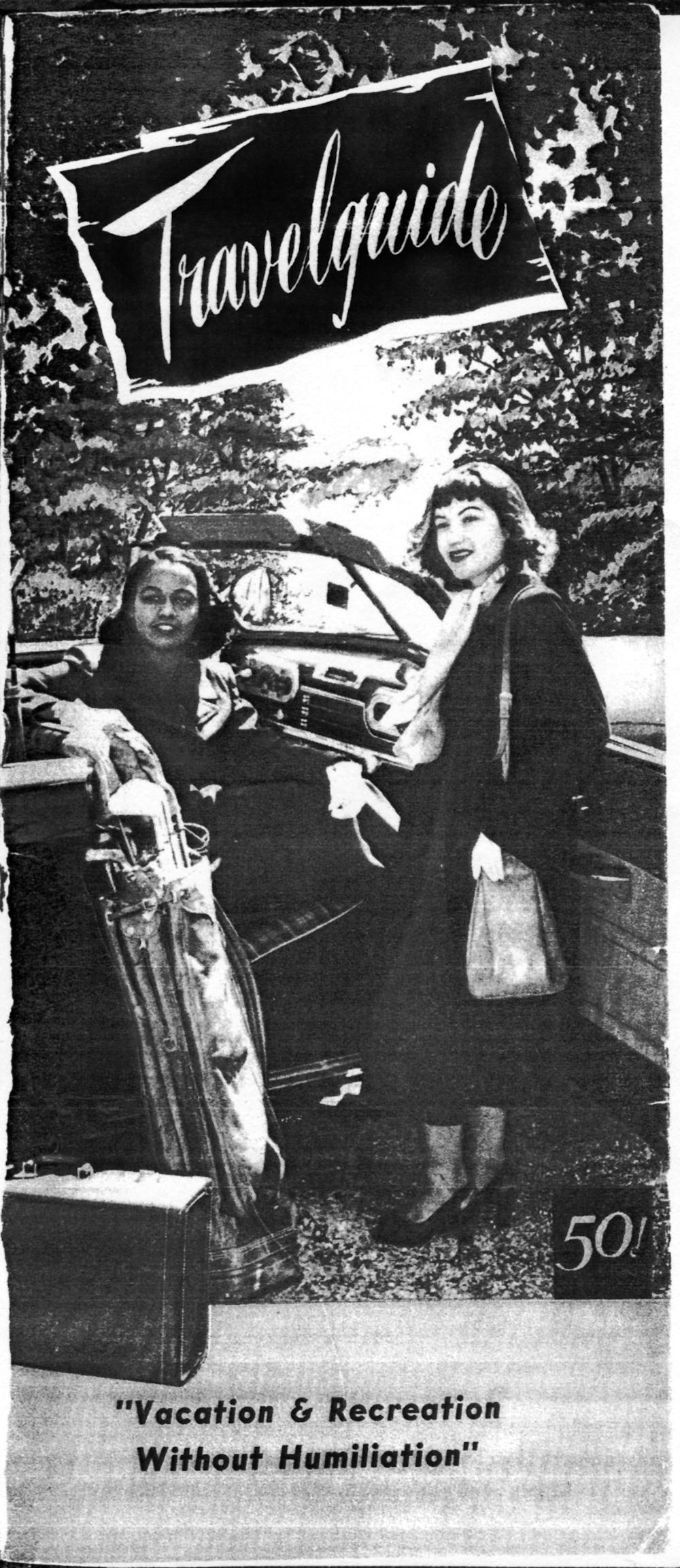
“The Negro Motorist’s Green Book,” first published in 1936 by a New York letter carrier and travel agent named Victor Green, and “Travelguide: Vacation and Recreation Without Humiliation,” first published in 1947 by jazz bandleader Billy Butler, advised black travelers where they could eat, sleep, fill the gas tank, fix a flat tire and secure a myriad of other roadside services without fear of discrimination. The guidebooks, which covered every state in the union, drew upon knowledge hard-won by pioneering black salesmen, athletes, clergy and entertainers, for whom long-distance travel by car was a professional necessity.

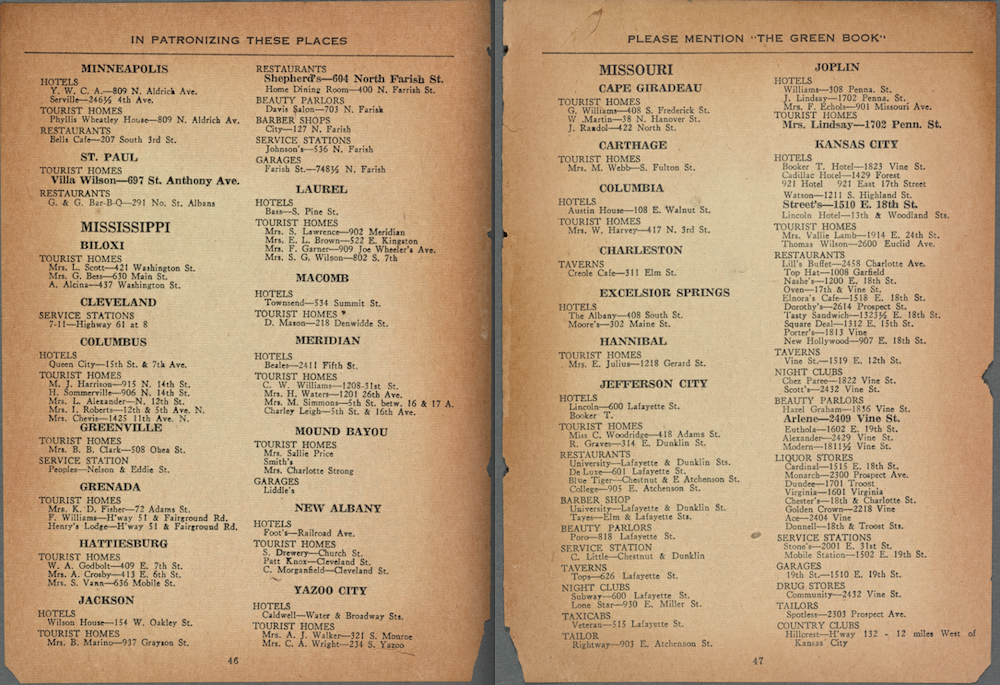
Pages from an original 1947 edition of the ‘Green Book’ highlight businesses in Mississippi and Missouri. Schomburg Center for Research in Black Culture, Manuscripts, Archives and Rare Books Division, The New York Public Library. 'The Negro Motorist Green Book: 1947' The New York Public Library Digital Collections. 1947.

“It is,” a “Green Book” subscriber wrote to Victor Green in 1938, “a book badly needed among our Race since the advance of the motor age.”

Acknowledging the era’s racial tensions and dangers of travel, the 1956 edition reminded drivers to “behave in a way to show we’ve been nicely bred and [were] taught good manners.”

The 1950 edition of ‘Travelguide.’ Cotten Seiler, Author provided

It pointed to certain states that would be more amenable to black travelers: “Visitors to New Mexico will find little if any racial friction there. The majority of the scores of motels across the State accepts guests on the basis of ‘cash rather than color.’”

Yet even as they sought to ease the black traveler’s passage through an America in which racial discrimination was the norm, the guidebooks, whose covers often featured well-heeled travelers of color with upscale automobiles and accessories, also asserted African-Americans’ claims to full citizenship.

The guidebooks’ images and text conveyed an attitude of indignation and resistance to the racist conditions that made them necessary.

“Travel Is Fatal to Prejudice,” the cover of the 1949 edition of the “Green Book” announced, putting a spin on a famous Mark Twain quote.

In 1955, “Travelguide” declared, “The time is rapidly approaching when TRAVELGUIDE will cease to be a ‘specialized’ publication, but as long as racial prejudice exists, we will continue to cope with the news of a changing situation, working toward the day when all established directories will serve EVERYONE.”

Is racial terror really over?

Travelguide and the Green Book did indeed shut down in the 1960s, when the civil rights movement sparked a profound transformation in racial law and custom across the country.

Today, copies can be found in research archives at Howard University, the New York Public Library and the Library of Congress. The guidebooks have been the focus of a growing body of print and digital scholarship. The University of South Carolina, for example, has built an interactive map that allows visitors to search for all of the businesses listed in the 1956 edition of the “Green Book.”

In popular culture, a play, a children’s book and a forthcoming Hollywood film starring Mahershala Ali all center on these travel guides.

While the story of these books recall an era of prejudice many regard as bygone, there remains much work to be done.

The NAACP’s decision to issue a travel advisory calls attention to the dangers that continue to be associated with “driving while black.” The highly publicized recent deaths of Sandra Bland, Philando Castile and Tory Sanford are the starkest examples of what can happen to black drivers at the hands of police. Studies have shown that across the nation, police are still much more likely to stop and search drivers of color.

If guidebooks for drivers of color are unlikely to make a return, it is because the internet now fulfills their role, not because the “great day” of racial equality the “Green Book” heralded 70 years ago has arrived.

The Conversation

Cotten Seiler does not work for, consult, own shares in or receive funding from any company or organization that would benefit from this article, and has disclosed no relevant affiliations beyond their academic appointment.

17 Jul 17:04

The Tower of London's Ravenmaster wrote a great book

by Seamus Bellamy

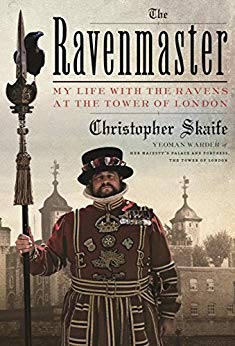
I first spoke with Chris Skaife in 2013 after he was was awarded a position at The Tower of London following a long and distinguished career in the the British Army. A Yeoman Warder, Skaife holds the position of Ravenmaster. As the title implies, he’s responsible for the care of the Tower's unkindness of ravens. Our first conversation about his gig left me fascinated: Here was a man with a job that’s completely singular in the world. His days, are full or tourists and the occasional state visit, history and tradition. That he goes about his duties in a uniform that looks like it’s designed to kill its wearer on a hot summer day, is shorthand for the amount of dedication he has to his responsibilities. I came from talking with Skaife with so many unanswered questions about what his day entails, his passion for the birds under his care and what it’s like to navigate such a unique gig. Happily, I’ve had most of my questions answered by Skaife’s upcoming book, The Ravenmaster: My Life with the Ravens at the Tower of London. It’s not out until October, but it is available for pre-order at Amazon. Chris, good fella that he is, provided me with an early draft of the book to read, a few weeks ago. I’m looking forward to buying the real McCoy once it becomes available. The book’s structure and Skaife’s friendly, matter-of-fact narrative style made for a quick, enjoyable read. It smacks of a friend talking you through his day at work. In the book, Skaife takes the reader on a tour of his daily duties, from morning until dusk, explaining the ins and outs of everything that he and his team do to keep the Tower of London’s ravens healthy and entertained. He’s happy to talk about his successes in the position of Ravenmaster. He’s also frank about his failures. The most fascinating bits of the book, for me at least, came from Skaife’s explanation of the relationships he has with each of the corvids in his care. There’s love, annoyance and respect in how he talks about each of the Ravens he’s responsible for. The amount of knowledge of corvid body language, the meaning behind the sounds that his ravens make and their individual quirks makes for a damn good read. Given the utter shambles of a world that we’re living in right now, running into a read like this felt like a vacation from the vile news cycle that I normally wade through with my eyes. When it’s possible to get your hands on a copy, I heartily recommend that you do so. It’s not a long book, but I think you’ll find it to be a very satisfying one. Image via Historic Royal Palaces
16 Jul 12:19

The Pied Piper of Hamelin Story- An 800 Year Mystery Wrapped in a Fairy Tale

by karenanne

While visiting Germany many years ago I had to visit the town of Hamelin. You see, when I was growing up, one of my favorite records had the Rattenfänger von Hamelin story… the Pied Piper of Hamelin Story. As a child, the idea of all those kids being snatched up because the town fathers didn’t […]

The post The Pied Piper of Hamelin Story- An 800 Year Mystery Wrapped in a Fairy Tale appeared first on A German Girl in America.

11 Jul 16:41

Mansion from Blade Runner and House on Haunted Hill Goes Up For Sale in Los Angeles

by Matt Novak

One of Frank Lloyd Wright’s most famous mansions, known as the Ennis House, is up for sale in east Los Angeles. And even if you don’t know the house, you certainly know the movies that the famous building has appeared in, including Blade Runner (1982), The House on Haunted Hill (1959) and The Replacement Killers

Read more...

10 Jul 19:17

What if MIT’s Norman and Amazon’s Alexa hooked up?

by William Michael Carter, Assistant Professor, Creative Industries, Ryerson University
MIT's experiment with a serial killing AI called Norman, based on Psycho's Norman Bates, underscores the importance of ensuring we get it right when embedding AI with culture. MIT

If, like Rip Van Winkle, you’ve been asleep for the last decade and have just woken up, that flip phone you have has become super-popular among retro technologists and survivalists alike, and, oh yeah, Artificial Intelligence (AI) is either going to kill you or save you.

AI is the latest in a long line of technology buzzwords that have gripped society, and if we are to believe the people at the respected technology analysts firm Gartner Inc., 2018 will be the year in which AI is truly integrated into our daily lives. As unnerving as the surreal robotics being cooked up at Boston Dynamics or the deployment of facial recognition AI in Chinese public schools may seem, this technology is a product of the human condition and as such, we are embedding our own culture within its coded DNA.

Debates about AI currently focus on the notion of ethics. In the study of culture, ethics are embedded within values, and they’ve become an important part of the deliberations about how AI will integrate into our lives. What hasn’t been discussed is whose ethics, and ultimately whose values, we are talking about.

Is it Western versus Eastern, or is it American versus everyone else? As values within culture are influenced by the community and larger society, ethics are dependent on the cultural context in which communal values have developed.

‘Enculturation’

Thus, culture plays an important role in the formation of AI through what’s known as the enculturation of that data.

Anthropologist Genevieve Bell, the previous Intel vice-president and cultural visionary, was able to steer the tech giant towards a more profound understanding of how culture and AI interplay with each other.

Genevieve Bell is seen in this 2015 photo at the Women Innovation & Technology summit in Miami Beach, Fla. (AP Photo/Wilfredo Lee)

Bell’s research indicated that human interaction with technology is not culturally universal. It is neither the same nor objective, and we encode culture within and throughout technology at a conscious and unconscious level.

If this is true, what happens in the eventual development of culture in AI?

For anthropologists, human cultural evolution has many markers: The manipulation of tools, the development of abstract thought, and more fundamentally, the creation of language in which to communicate.

Culture begins when two or more living entities start to communicate and exchange information and, with more complexity, ideas. Cultural development among non-human AI entities is something that hasn’t been discussed yet, let alone the melding of human and AI culture.

Bots developed their own language

Recently, Facebook’s AI research group (FAIR) made brief mention of an experiment in which two bots were tasked with negotiating with each other. It was reported at the time that the bots began to develop a more efficient language to communicate with one another.

Facebook computer science researchers quickly pulled the plug on what was rapidly becoming the development of a more efficient AI language between the two bots, not because they were frightened of the emergence of AI self-creation, but because the bots did not return expected results — a negotiation in English.

In a world where code is essentially made up of zeroes and ones, yes or no commands, there isn’t much room for the unexpected. But at times, we should embrace the opportunity and explore the possibilities, as culture does not manifest itself in a singular fashion.

Culture is what we make it. It is a set of norms that we as a society agree upon, consciously or unconsciously, and it frames how we operate within our daily lives.


Leer más: Here's how Canada can be a global leader in ethical AI


AI can absorb cultures

AI has the unique ability in the future to absorb all of the world’s cultural norms and values, developing a potentially true pan-global culture. But first, we, the creators of AI, must understand our roles and how we impact that ability to absorb. AI represents, after all, a microcosm of the culture of the people who build it as well as those who provide input into AI’s foundational data framework.

Science-fiction novelist Alastair Reynolds, in his book Absolution Gap, describes a planet in which the only intelligent creature is a vast sea that absorbs information from the beings and creatures that swim in it. The sea learns from that information and redistributes that knowledge to other beings.

Called “pattern juggling” in the book, the current manifestation of AI as we know it is very much like that fictional sea, absorbing knowledge and selectively distributing it with its own enculturated data.

Using Reynolds’ knowledge-absorbing ocean as an example, AI is currently like the separated salt and fresh water bodies of Earth — each with its own ecosystem, isolated and independent.

What happens when these very unique ecosystems begin to communicate with each other? How will norms and values be determined as the various AI entities begin to exchange information and negotiate realities within their newly formed cultures?

Norman is a warning

MIT’s Norman, an AI personality based on a fictional psychopath produced a singular example of what we have long known in humans: With prolonged exposure to violence comes a fractured view of cultural norms and values. This represents a real danger to future exposure and transmission to other AI.

How so?

An example of personalities going awry when brought together? The Associated Press

Envision Norman and Alexa hooking up. Both AI’s are representative of the people who made them, the human data that they consume and a built-in need to learn. So whose cultural values and norms would be more persuasive?

Norman was built to see all data from the lens of a psychopath, while Alexa as a digital assistant is just looking to please. There are countless human examples of similar personalities going awry when brought together.

Social scientists argue that the debate over AI is set to explode and, as a result, that multiple versions of AI are bound to co-exist.

As philosophers, anthropologists and other social scientists begin to voice their concerns, the time is ripe for society to reflect on AI’s desired usefulness, to question the realities and our expectations, and to influence its development into a truly pan-global cultural environment.

The Conversation

William Michael Carter no es asalariado, ni consultor, ni posee acciones, ni recibe financiación de ninguna compañía u organización que pueda obtener beneficio de este artículo, y ha declarado carecer de vínculos relevantes más allá del cargo académico citado anteriormente.

10 Jul 18:50

The Dancing Plague of 1518

by Adam Green
500 years ago this month, a strange mania seized the city of Strasbourg. Citizens by the hundreds became compelled to dance, seemingly for no reason — jigging trance-like for days, until unconsciousness or, in some cases, death. Ned Pennant-Rea on one of history's most bizarre events.
05 Jul 16:49

This Solar Lawnmower Was the Dangerous Future of American Summers in 1959

by Matt Novak

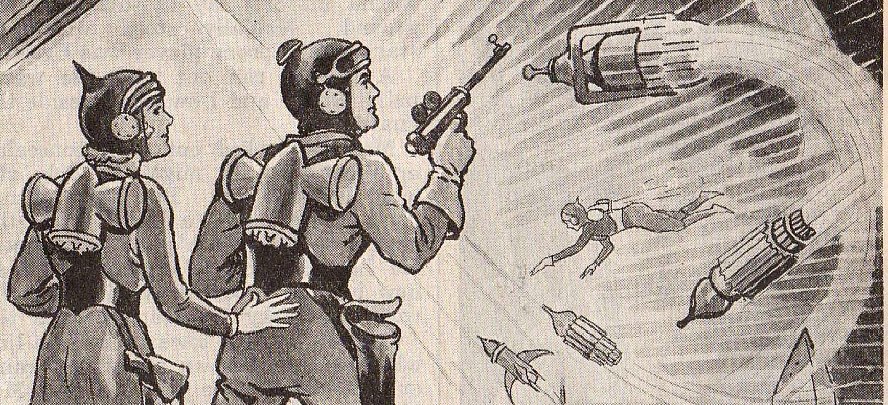
Robotic lawnmowers are fairly mainstream these days, even if they don’t have much market share yet. But they’ve been a long time coming. We’ve been promised solar-powered semi-autonomous lawnmowers for decades. This Sunday comic strip from 1959 predicted the rise of these machines, but also pointed at the problem with…

Read more...

03 Jul 19:36

Independence Day: July 4 means something very different when it's celebrated in Britain

by Sam Edwards, Senior Lecturer in History, Manchester Metropolitan University

This year’s July 4 celebrations will come freighted with rather more complexity than usual, and on both sides of the Atlantic too. 2018’s commemoration of independence from British rule will take place just nine days before Donald Trump crosses the Atlantic for talks with his British counterpart, Theresa May. The two will follow the annual celebration of severance with a performance of togetherness: as Independence Day makes way for the special relationship.

Given Trump’s remarkably poor grasp of history – this is a man who recently asked if the Canadians had burned down the White House in 1814 – he’ll quite probably be oblivious to any such tensions between the upcoming events of July 4 and those of July 13 (the date of his visit to London). But if his advisers take a glance at the history books to think through this coincidence of timing, they might be pleasantly surprised. While many Americans unambiguously celebrate July 4 as a national event marking independence from the “mother country”, in Britain the day has long been a chance to celebrate Anglo-American ties. How can it be both?

It all comes down to exactly how you understand the origins and cause of the American Revolution. For many Americans, the War of Independence was a righteous conflict against a tyrannical and perfidious enemy, the narrative of independence famously celebrated in films such as The Patriot. In this view, the founding fathers were exceptional and exemplary Americans, leading heroic yeoman farmers in the cause of national independence from the British Empire.

The problem with this idea is that it wasn’t until relatively late in the day, towards the middle of the 1770s, that colonial American leaders actually set themselves firmly on the cause of full independence. And even when they did, many still found it difficult to shed completely their identities as “Englishmen” overseas, while a significant proportion of the American population remained either loyal to the crown throughout, or tried to avoid choosing a side for as long as possible.

Hence why those leading the revolution were initially so keen to claim that they fought for the legitimate rights of “Englishmen”: not to be taxed without consent, the right to rule by elected representatives. Even George Washington, commander-in-chief of the Continental Army and later the first president, thought himself a loyal Englishman until well into the 1770s.

In later years, such ideas faded from view. Washington was elevated to the status of American demi-god, and during the 19th century, July 4 developed its modern form and function: an assertive national ritual which celebrated American difference and distinction. Even so, the older idea that independence was originally an “English” cause lingered here and there, embedded in the much celebrated language used by Thomas Jefferson in the Declaration of Independence (which suggested his schooling in certain ideals of “Anglo-Saxon” rights), in the structures of the US Constitution (including the two-house political system), and in the judicial system’s roots in English Common Law.

This all meant that when the US and Great Britain later developed increasingly close diplomatic connections, July 4 was ripe for re-interpretation.

The best of friends

The key moment came on July 4 1918, as Americans and Britons fought as allies on the Western Front. In London, various influential figures took the opportunity to revisit the history of American independence. For instance, Winston Churchill, later the most famous advocate for a “special relationship”, delighted in telling an audience of Anglo-American dignitaries that Britons were now “glad to know that an English colony declared itself independent under a German king”. As he gave this speech, government buildings across London and the British Empire proudly flew the Stars and Stripes.

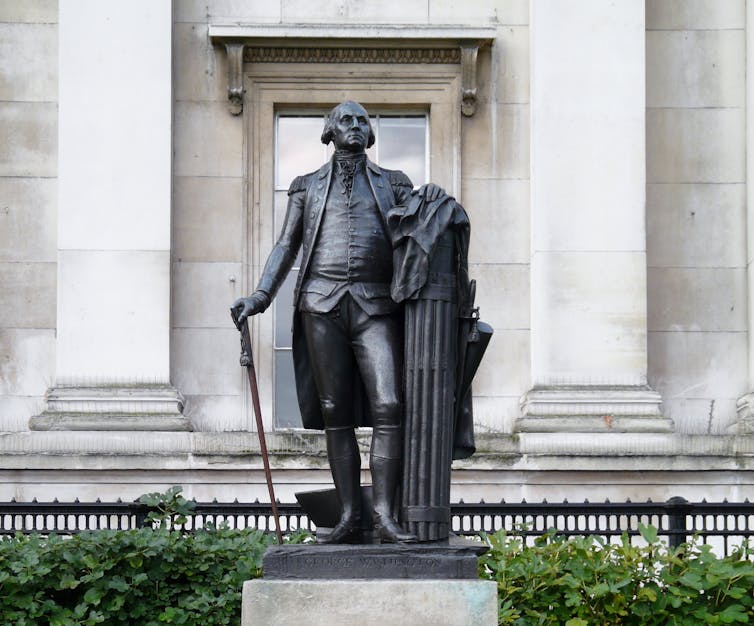
George Washington in residence in Trafalgar Square. Ham via Wikimedia Commons, CC BY-SA

British claims on American independence continued in the years that followed. In 1921, Lord Curzon, the foreign secretary, happily proclaimed Washington a “great Englishman” while dedicating a statue of the first president in Trafalgar Square. Much the same sentiment was heard a few days earlier when a gathering of politicians and diplomats opened Washington’s ancestral home in Northamptonshire, Sulgrave Manor, as an Anglo-American shrine.

By the time of the bicentennial of American independence in 1976, the British political elite were well prepared to meet the challenge of celebrating July 4. In a masterstroke of political symbolism, the government gifted to the US a copy of the Magna Carta. The message was clear: while Jefferson’s famous text appeared to mark a moment of transatlantic severance, in actual fact it revealed the deep history of the Anglo-American bond. The Declaration of Independence stood with the document signed at Runnymede in 1215 in the pantheon of English constitutional history.

Will a similar claim on American independence surface in the pronouncements and performances linked to Trump’s visit to Britain this July? May will surely follow precedent and celebrate the ties of the “special relationship”; Trump will likely bluster, reciprocate, and talk about his Scottish roots. But Trump’s brand of nativism has little time or space for expansive Anglophilia, and he and May have yet to find an ideological or personal affinity of the sort enjoyed by Margaret Thatcher and Ronald Reagan. This Independence Day, the special relationship may lose out.

The Conversation

Sam Edwards has previously received funding from the ESRC, the United States Army Military History Institute, and the US-UK Fulbright Commission.

03 Jul 19:32

Americans are not as divided or conservative on immigration as you might think

by Deborah Schildkraut, Professor of Political Science, Tufts University

Lawmakers in Washington, from the president down to first-term members of Congress, may be misjudging how the public feels about immigration.

President Donald Trump appears to believe the country needs and wants hard-line policies. Members of Congress haven’t stopped him from carrying out those policies.

Do the American people really support them?

It turns out that government officials who think the majority of Americans want hard-line immigration policies are wrong.

Elected officials – both Republican and Democratic – tend to think that their constituents are more conservative than they actually are on immigration and other issues. Moreover, recent research suggests that Republican constituents have been more likely to contact their elected officials than Democratic constituents.

Yet, my research on public opinion about immigration, and that of other social scientists, shows that the American public is supportive of more welcoming immigration policies. Welcoming policies might include a pathway to citizenship for undocumented immigrants, accepting more asylum claims or allowing the use of multiple languages in public places.

Most Americans support a path to citizenship

I am a scholar of public opinion about immigration and national identity, and I have studied how people from a variety of backgrounds feel about immigration-driven diversity in the United States.

Let’s look at public opinion on one immigration proposal that has been debated for over a decade: providing a path to citizenship for undocumented immigrants living in the U.S.

Since late 2007, polls conducted by CBS and The New York Times have asked respondents which option they prefer when it comes to “illegal immigrants working in the United States.” The options include: allow them to stay in their jobs and eventually apply for U.S. citizenship; allow them to stay only as guest workers but not apply for citizenship; or require them to leave their jobs and the country.

This question has been asked in 31 CBS/New York Times surveys since 2007. In 22 of them, providing a path to citizenship is the majority preference. Support for citizenship has not fallen below 50 percent since 2013. In fact, support has increased over time, a trend that has continued throughout Trump’s presidency.

Support for a path to citizenship varies by one’s background when it comes to race, gender, education, income, party and ideology. However, support is high across the board, even among those who say they are Republican or conservative.

Of course, this is only one of many immigration policies getting attention these days, and support for other policies varies.

Attitudes on this policy show that Americans are not as divided or as conservative as the discourse coming out of Washington, D.C. might reflect and is becoming even more supportive of the welcoming approach. Yet, providing a path to citizenship is also the primary policy that seems to keep thwarting legislative reform in Congress.

A welcoming climate need not alienate US-born whites

Public officials may be concerned about alienating non-immigrant whites if they pursue welcoming immigration policies. We tried to find out whether that alienation could happen. In a recent experiment, my colleagues and I asked U.S.-born whites in Arizona and New Mexico how they felt about their state adopting more welcoming or restrictive immigration policies.

We asked people if the proposed policy would make them angry, sad or happy. We found that liberal and moderate whites responding to the more welcoming treatment were more likely to be happy and less likely to be angry or sad than were those who were responding to the restrictive treatment.

We also asked them if the proposed policy would make them feel more or less at home and more or less likely to want to move. Again, we found that liberal and moderate whites, in response to the welcoming treatment, felt more at home and less likely to want to move than did liberal and moderate whites who were given the unwelcoming treatment.

Only conservative whites were happier, less angry, less sad and felt more at home in response to restrictive treatment. Every one else fared better when told that their state was considering adopting policies that welcomed immigrants.

It is worth noting that in the 2016 data mentioned above, only 35 percent of whites identified as conservative while 65 percent identified as either liberal, moderate or other.

Squeaky wheel gets the grease

Given these data, why is a conservative approach to immigration dominating in Washington?

In American politics, it is the squeaky wheel that gets the grease. Within the Republican Party, which holds a majority of seats in Congress, voters with more conservative preferences on immigration and other issues have been more active in recent years than other party members. As long as that continues to be the case, Republican politicians will feel that they need to push restrictive immigration policies if they wish to remain in office, even if the majority of their constituents feel otherwise.

As more and more people respond to President Trump’s immigration agenda with protests and participation in electoral politics, this asymmetry in engagement may change.

The Conversation

Deborah Schildkraut received funding from the Russell Sage Foundation and the United Parcel Service Endowment Fund at Stanford University.

03 Jul 19:26

Feasting rituals – and the cooperation they require – are a crucial step toward human civilization

by Charles Stanish, Professor of Anthropology, University of South Florida
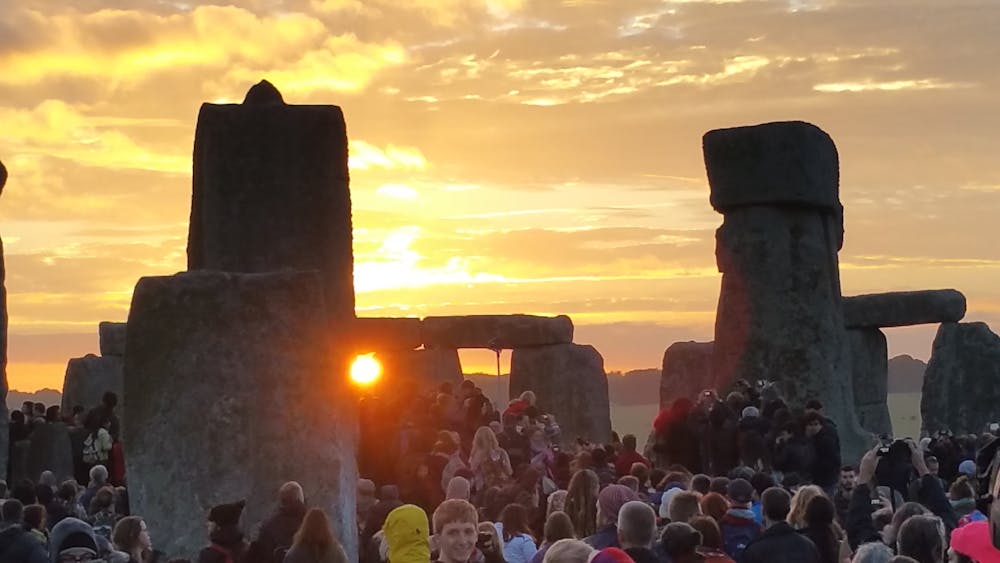
Coming together for a solstice feast in ancient Peru. Robert Gutierrez, Author provided

The Epic of Gilgamesh” is one of the earliest texts known in the world. It’s the story of a god-king, Gilgamesh, who ruled the city of Uruk in Mesopotamia in the 3rd millennium B.C. Within its lines, the epic hints at how the ancients viewed the origins of their civilization.

Gilgamesh’s antagonist, Enkidu, is described as a wild man, living with the beasts and eating grasses with the gazelles. But he’s seduced by a beautiful temple priestess who then offers him clothing and food, saying “Enkidu, eat bread, it is the staff of life; drink the wine, it is the custom of the land.” And so Enkidu is transformed from a naked wild beast into a “civilized” man living with other people.

Both bread and wine are products of settled society. They represent the power to control nature and create civilization, converting the wild into the tamed, the raw into the cooked – and their transformation cannot be easily done alone. The very act of transforming the wild into the civilized is a social one, requiring many people to work together.

Over the past few decades, archaeological theory has shifted toward the idea that civilization arose in different regions around the world thanks to the evolution of cooperation. Archaeologists have discovered that the consumption of food and drink in ritually prescribed times and places — known technically as feasting — is one of the cornerstones of heightened sociality and cooperation throughout human history. My own research in Peru bears this out. The data from my colleagues’ and my work provides yet another detailed case study for theorists to model the evolution of complexity in one of the rare places where a civilization independently developed.

Signs of cooperation in Peru

How does complex society originate out of the hunter-gatherer bands and small settled villages that dominated the globe well into the early Holocene around 9,000 years ago? And once such social organizations develop, what kinds of mechanisms sustain these new societies sufficiently to develop into the Uruks of the ancient world?

Six years ago, after 30 years of research in the Titicaca Basin in the high Andes, my colleague Henry Tantaleán and I started a long-term archaeological research program in the valley of Chincha in the south coast of Peru. Thanks to work by previous archaeologists and our own new data, we have been able to piece together a comprehensive prehistory of the valley beginning several millennia ago.

One significant time period is known as Paracas; it lasted from roughly 800 to 200 B.C. This is the time when the first complex societies developed in the region, the origin of civilization in this part of the ancient world. We documented a massive Paracas presence in the valley, ranging from large pyramid structures to modest villages scattered over the landscape.

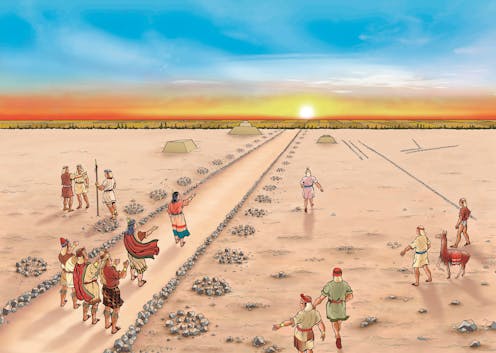
Geoglyphs that modified the landscape are still visible, delineating a path to where the sun sets on the summer solstice. Charles Stanish, CC BY-ND

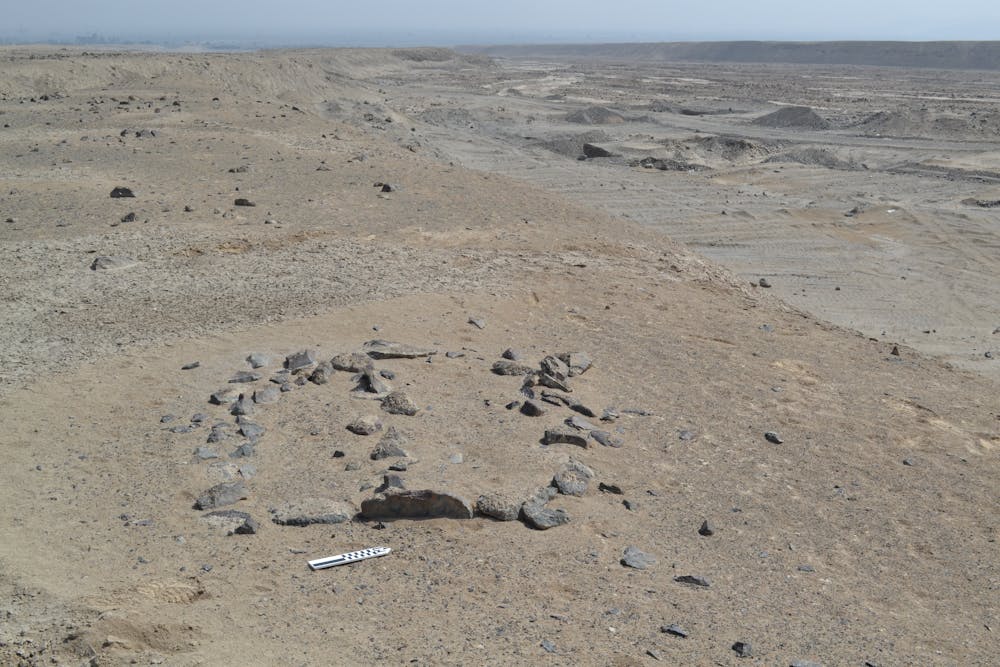
Across the hyper-arid pampa lands above the valley, the Paracas peoples built linear geoglyphs: designs etched into the desert landscape that they lined with small field stones. We found five sets of lines that all concentrated on the five major Paracas sites at the edge of the pampa. We also found many small structures built between the lines.

Our research indicated that a number of these small structures and many of the lines pointed to the June solstice sunset. Previous work by our team and others throughout Peru unequivocally indicates that the pre-Columbian peoples of the Andes used the solstices to mark important events.

We concluded that these sites were the endpoints of ritually significant social events that were timed by the solstices and possibly other astronomical phenomena.

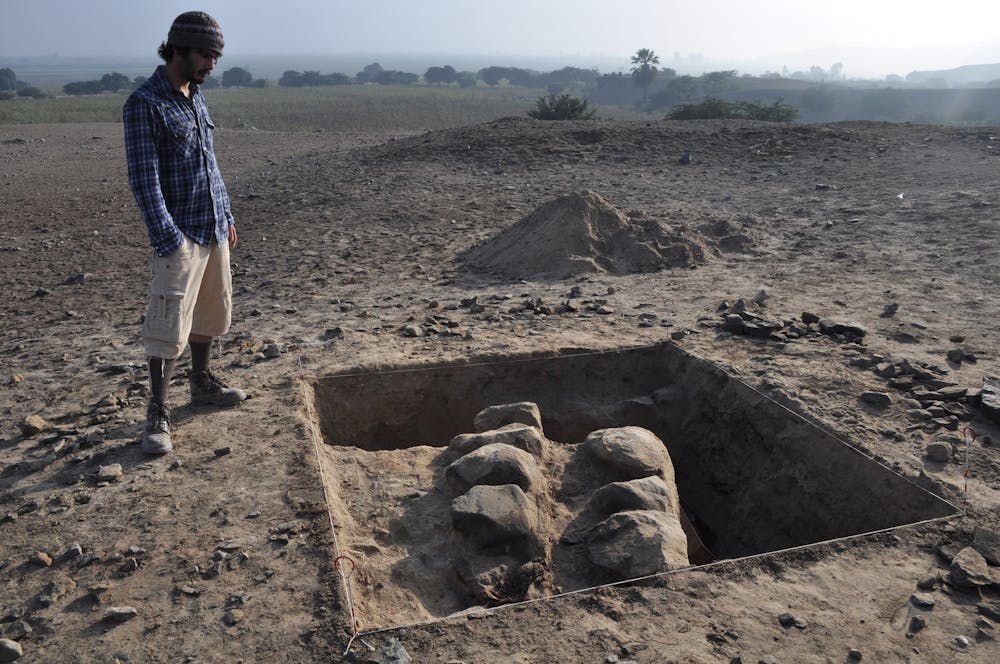
Excavation of a structure in the Chincha pampa with the walls aligned to the June solstice. Charles Stanish, CC BY-ND

Feasting at Paracas

We chose to intensively study one endpoint site, called Cerro del Gentil, to assess its significance in Paracas culture. The site is a large platform mound with three levels. The base level measures 50 by 120 meters at its maximum. Each level contains a sunken patio measuring around 12 meters on a side.

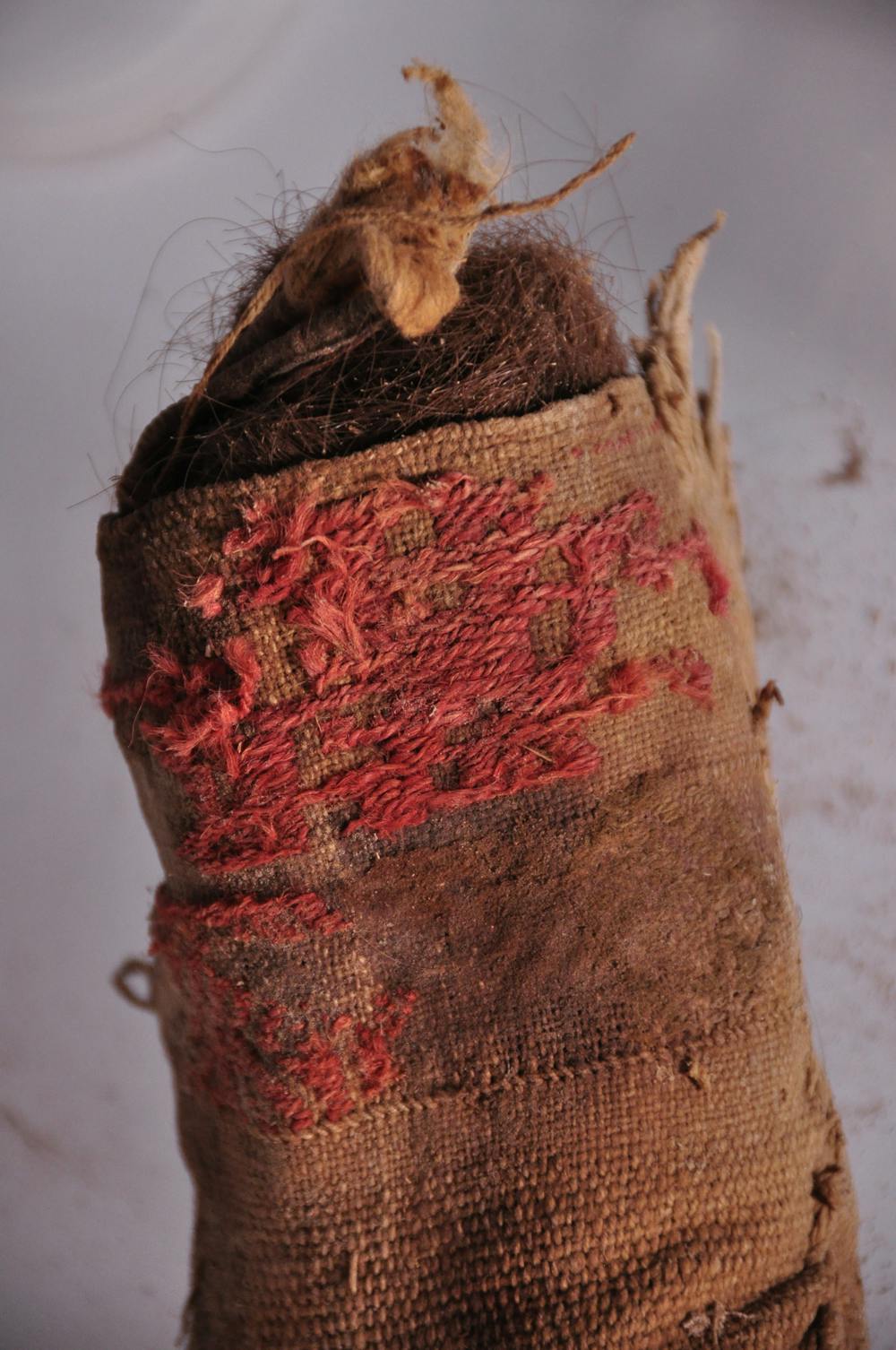
A woven cloth bag stuffed with human hair. PNAS, CC BY

Excavations by Tantaleán and his team in one of these patios yielded a rich trove of artifacts, including textiles, food stuffs, pottery, decorated gourds, stone objects, reeds, miscellaneous objects and human offerings. We found large pottery vessels that held chicha or maize beer, the equivalent to Enkidu’s wine. There was evidence of food preparation as well, though we did not find a resident population. We found large numbers of pottery serving vessels and evidence of termination rituals involving liquid libations poured into the patio at the conclusion of some elaborate feasts.

Cerro del Gentil, in fact, was a classic archaeological example of a very significant feasting place. No one seemed to live at this well-built location year-round, though there was plenty of evidence that from time to time many people were present to eat, drink and even make human sacrifices together, probably at particular special times of the astronomical calendar.

We used the Cerro del Gentil data to test the following hypotheses about how the earliest cooperative human groups came together: Did people start out small, feasting within their local group and then expanding to incorporate more distant groups? Or, did the earliest successful groups develop contacts with distant autonomous groups around a large region?

Our colleague Kelly Knudson from Arizona State University analyzed the strontium ratios in 39 organic objects found in the patios as offerings. The ratio of 87Sr/86Sr in any organic object, including humans, tells us from what geographical zone that object is from. We discovered that objects in the patio were from a very broad range of ecozones all around the south central Andes. Some objects came from as far as the Titicaca Basin 600 kilometers away, others from the south coast 200 or so kilometers distant.

A small geoglyph in the Chincha pampa with the center line defining the June solstice. Charles Stanish, CC BY-ND

Feasting rituals build a young civilization

This case study demonstrates that the earliest successful complex societies in the south coast of Peru circa 400 B.C. involved a wide catchment of people and objects. At least in Paracas society, the optimal strategy of civilization building involved creating widespread alliances early on and then expanding on this model over centuries. We know this because people in Cerro del Gentil incorporated objects and even people in their offerings from distant areas.

In contrast, at a later ceremonial site where the catchment was quite small, all of the objects and human remains were from the immediate environs, as evidenced by strontium analysis. The Paracas pattern detected at Cerro del Gentil contrasts with a strategy in which people focused on their local group and then grew incrementally over time. My colleagues and I plan to use these sorts of comparative cases to try to understand which strategies work better in which environmental and social contexts.

The evidence from Cerro del Gentil supports the theory I wrote about in my recent book “The Evolution of Human Co-operation” – that cooperation in non-state societies is achieved by “ritualizing” the economy. People construct norms, rituals and taboos to organize their economic and political life. Far from being quaint and exotic customs of “primitive peoples,” elaborate rules of behavior, encoded in rich ritual practices, are ingenious means of organizing a society where coercion is absent.

Ritual practices reward cooperators and punish cheaters. They therefore promote sustained group behavior toward common goals and solve what is famously known as the “collective action problem” in human social life – how do you get everyone to work together toward something that’s in everyone’s long-term self-interest? Feasting is a key component of this kind of sociality and cooperation. Enkidu’s bread and wine is still relevant 5,000 years later.

The Conversation

Charles Stanish receives funding from National Science Foundation National Geographic Society University of South Florida Institute for Field Research

02 Jul 14:20

Breaking Down the New EU Copyright Bill: Article 11

by Jonathan Bailey

Summary

  • New EU Copyright Directive has caused a great deal of controversy due to “link tax” and “meme killing” sections
  • Analysis of Article 11, the “link tax” section, shows that it has been curtailed heavily from the original proposal but will still give news publishers a right to demand a license for use of snippets of their content.
  • However, similar efforts have shown that it is unlikely to produce a windfall for publishers, but it may still cause issues for many websites, including Google and Facebook.

EU FlagIf you follow copyright news at all, you’ve likely heard about the proposed EU Copyright Directive. It’s been described as everything from a “war on memes” to the “end of all that’s good and pure about the internet.”

But for all the directive’s controversy, the bill passed a crucial vote last week in the European Parliament Committee on Legal Affairs, where the overall committee position  was approved 14-9.

Whenever I’m confronted with a controversial piece of legislation, my first step is usually to look at the source documents and draft an analysis from them. Previously I’ve done with the CLASSICS Act, the Fairness for American Small Creators Act and elements of SOPA/PIPA.

The goal is to get away from the rhetoric and understand what is in the act itself and how it will likely work. Only from there can we discuss likely impacts of the law and the positives and negatives that come with those impacts.

Unfortunately, with this act, that has proved difficult to do. While the original European Commission proposal is readily available, it is from 2016 and has undergone many revisions, especially in the most controversial sections.

Even organizations closely following the legislation, such as the EDRi, struggle to keep on top of the changes, relying upon leaks to follow the bill as it winds through the EU government. This is made more confusing by the seemingly unending drafts, edits, proposals and other changes that are being made.

However, MP Julia Reda, a staunch opponent of the reforms, has linked to a PDF Version of the Oeittinger/Voss plans, which includes the latest compromise amendments that were voted on by Committee on Legal Affairs.

As such, we’ll look at that draft and analyze the two main controversial sections of the bill and what they will actually do. Today we’ll look at Article 11, the “link tax” article and later this week we’ll look at Article 13, the “internet filter” section.

However, before we do either, we need to take a look at how we got here.

The Story So Far

The Copyright Directive was first proposed on September 14, 2016 by the European Commission (the executive branch of the EU). It was drafted with the stated aim of harmonizing copyrights at the EU level and addressing “new types of uses” and “achieve a fair balance between the rights and interests of authors and other rightholders on the one hand, and of users on the other.”

Though the proposal has bounced around the EU bureaucracy steadily since then, it began to get widespread attention in the run up to a June 20th, 2018 vote in the European Parliament Committee on Legal Affairs (JURI).

Of particularly strong interest was 2 of the proposal’s 17 articles: Article 11 & Article 13.

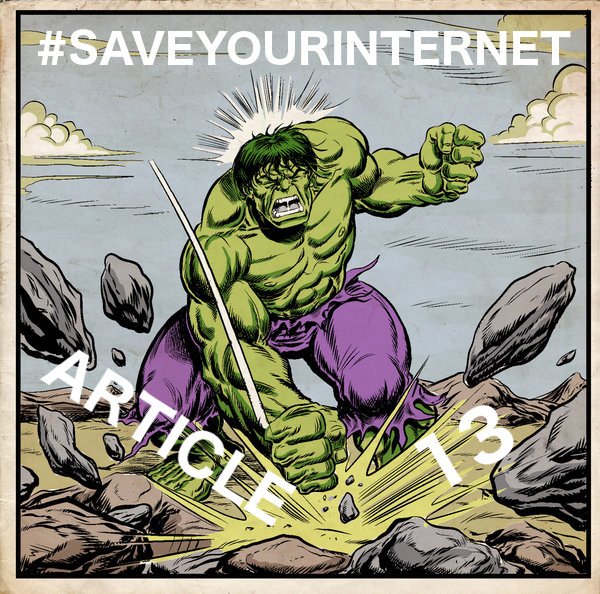
Article 11 has been described as a “link tax”, which would require search engines and other sites to pay for the use of snippets. Article 13 is the now-famous. “meme killer” article that would require some online service providers to install filtering software in order to avoid liability for copyright infringement.

Following it’s committee vote, the directive will now head to the full European Parliament where there will likely be two votes. The first, in early July, would vote on whether to reopen the bill for debate, possibly opening the door to radical changes.

If it passes that vote, which would give the Parliament the mandate to negotiate with the EU Council (the EU member states and the other part of the EU legislative branch) it would then go into those negotiations. While there is no set timetable that would likely be completed it’s likely that the negotiations, along with a last check of the language, would be completed at or around the end of the year. That would mean the bill could be put to its final vote either at the end of 2018 or in early 2019.

But this, in turn, begs the question: What do the articles actually say and will they as bad as many fear? We’ll take a look at the text of the articles as they exist in the most recent available document and find out.

To that end, we’ll take them in numerical order and start with Article 11 (Article 13 analysis will be posted later this week).

Article 11: The “Link Tax”

Paragraph 1 of Article 11 simply reads as follows:

Member States shall provide publishers of press publications with the rights provided for in Article 2 and Article 3(2) of Directive 2001/29/EC so that they may obtain fair and proportionate remuneration for the digital use of their press publications by information society service providers.

Article 2 and 3 referred to in the paragraph are simply the reproduction right and the right to communicate a work to the public.

However, the definition of “information society service providers” is a bit thornier to get through. That definition is found in this directive, which describes it as “any service normally provided for remuneration, at a distance, by electronic means and at the individual request of a recipient of services.”

What is and is not considered such a service gets extremely complex quickly (with many exceptions carved out). However, key examples include “Web shops and marketplaces, search engines, online advertising, video sharing sites, blogs, hosting, video-on-demand, online consultancy, online marketplaces, social networking, etc.”

The bill, as written, does not apply to “legitimate private and non-commercial use of press publications by individual users” nor does it extend to the act of hyperlinking itself. The act also makes it clear that the law does not override existing copyright exemptions, including the use of orphan works, and instead works in tandem with those exemptions.

However, those exemptions do not include a fair use or fair dealing. This means very small snippets of articles (such as those seen in search previews) could require a license. Though linking that does not include original content from original article, such as most of the links in this article would not be impacted, search engines and social media sites easily could be as they often show direct previews.

In the original version of the directive, the rights in this article were to last for 20 years and would be retroactive. However, this compromise reduces the term to 5 years and the rights are no longer retroactive. Still, the term seems largely moot as most aggregation and linking of an article takes place within weeks, not years, of publication.

The new rules would only apply to works by “press publications”, which are defined as “a fixation by publishers or news agencies of a collection of literary works of a journalistic nature” and specifically does not include academic and scientific journals. Most websites wouldn’t qualify either because, while the law allows the publication to take place in any medium, it requires both “editorial responsibility and control of a service provider.”

The last paragraph of simply requires that member states make sure that authors receive an “appropriate share” of the revenue generated from this new right. However, the details are left up to the individual states.

The Likely Impact

If this idea sounds familiar, it’s because we have seen it before. Various countries within the EU, including Germany, Belgium and Spain, have implemented versions of this idea in the past.

In Germany, most publishers simply opted in to Google News without receiving a license fee. This was because Google, rather than offer to pay, simply threatened to drop German publications if they didn’t opt in. This made Google News an opt-in service, rather than an opt-out one as it is in the rest of the world, but little else changed.

However, it was in Spain where things were extremely interesting. There, the law did not allow publishers to opt out and, when the law took effect, Google News (along with a variety of smaller aggregators) simply shut down. It is still shut down today.

A study paid for by publishers found that this resulted in a traffic drop between 6 and 14 percent for Spanish news sites and a loss of revenue of about €10 million ($11.7 million) in the first year.

The hope of the directive is that the whole of the EU can do what its individual members couldn’t: Compel Google, and other sites, to pay for using snippets of news content.

But, while Google is the biggest target, it likely won’t be the only one impacted. Social media/networking sites, which routinely display such snippets, will be impacted as well. Also, as with the Spanish law, smaller aggregators may have to make changes, obtain licenses or close.

It’s hard to predict just how the major players will respond. There are three major paths they could take:

  1. Obtain a License: Either by having publishers opt in for free or by paying for it.
  2. Stop Using Snippets: Plain hyperlinking is specifically exempt so some sites simply could stop using snippets from the articles.
  3. Close Down/Stop Using EU Sources: Finally, they could simply avoid using EU publications, either by closing their doors or avoiding those sources.

Though Google has paid to settle disputes with newspapers in the past, it’s also shown it will go to great lengths to avoid paying a license. As such, anything that doesn’t involve paying seems more likely, at least as it pertains to Google.

This seems likely for other players too, not just to avoid the costs but also the overhead of obtaining and paying for a license.

In short, while it is impossible to predict just how things might go wrong, history suggests that this article is unlikely to represent a windfall for EU publishers.

Bottom Line

Coverage of Article 11 has been far less extreme than it has of Article 13. However, that doesn’t mean that it’s been wholly fair. The descriptor “link tax” seems unfair considering the directive, in its latest form, specifically allows hyperlinking.

The argument in favor of calling it a “link tax” is that snippets are often necessary. There is definitely some truth to this. For example, I use original headlines in the 3 Count column to ensure search engines link to the original source, not my summary.  Under this directive, I would have to change to using original headlines to make sure I’m compliant.

Still, it’s not the link itself that’s the issue, it’s the snippets. However, a “snippet tax” doesn’t have the same punch.

Regardless, the main two criticisms of the article are that it will restrict the free flow of information and that it is doomed to fail.

The first is difficult to predict, even looking to history. In Germany the impact was minimal because of the way the act failed. In Spain, it was greater. Since the EU directive doesn’t specifically prevent publishers from opting out, a Germany-style outcome seems more probable but it’s impossible to be certain.

Either way, there will be some impact as the law will add a new layer when sharing content from news sites.

As for the second criticism, history strongly seems to support that idea.

If EU publishers are hoping for a windfall, they are likely to be disappointed. Google and others have made it clear that they are not wanting to pay a license fee for the use of snippets and the law provides ways to get around such a fee.

As such, even if the impact on linking and sharing is minimal, it will likely still fail as publishers won’t likely see the new revenue they are hoping for.

Want to Republish this Article? Request Permission Here. It's Free.

Have a Plagiarism Problem?

Need an expert witness, plagiarism analyst or content enforcer? Check out our Consulting Website

The post Breaking Down the New EU Copyright Bill: Article 11 appeared first on Plagiarism Today.

29 Jun 19:30

Extreme stress in childhood is toxic to your DNA

by Daniel R. Weinberger, M.D., Director of the Lieber Institute for Brain Development and Professor, Departments of Psychiatry, Neurology, Neuroscience and The Institute of Genetic Medicine, Johns Hopkins University
Photo by Kat J on Unsplash, CC BY-SA

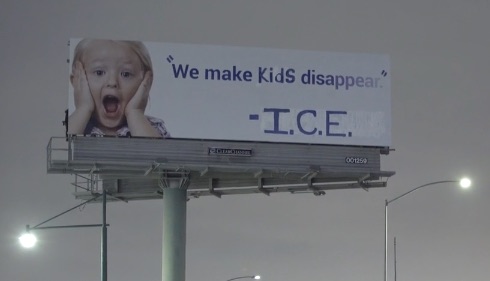
The real danger of separating children from parents is not the psychological stress – it’s the biological time bomb. The screaming and crying, the anguish and desolation is gut-wrenching. But the fallout pales in comparison to the less visible long-term effects that are more sinister and dangerous.

Separating children from their parents, in a strange land, among strangers, causes the most extreme life stress a child can experience. And it causes profound and irreversible changes in how their DNA is packaged and which genes are turned on and off in the cells of the body, in organs like the pancreas, the lungs, heart and brain – leading to lifelong changes in its structure and function.

I am the director of the Lieber Institute for Brain Development and the Maltz Research Laboratories at the Johns Hopkins University School of Medicine, where scientists study how genes and the environment shape the development of the human brain.

Our studies and those of many other researchers around the world have shown that early life stress alters how DNA is packaged, which makes cells function differently than their original mandate.

How DNA is packaged alters its function

How DNA, the blueprint of life, is packaged in cells dictates how cells function. Virtually every cell in the body has the same DNA, as they are all descendants of that first fertilized egg. But a liver cell knows it’s not a lung cell, which knows it’s not a brain cell. The way the cells “know” has to do with how the DNA in cells is packaged, a process called “epigenetics.”

The DNA double helix is wrapped around a core of histone proteins that regulate which and when particular genes are turned on and off. By molekuul_be/shutterstock.com

DNA is organized in a complicated protein package, which acts like insulation, protecting the DNA strand. This insulation determines which genes are activated to make the proteins required by a particular cell. Between the various tissues and organs, the packaging of DNA varies – like a liver cell versus a lung cell – allowing each cells to have a unique collection of proteins.

Studies of children who have experienced major early childhood stress reveal that dysfunction in many organs in the body years after the stressful event, raising the risk of heart disease, lung disease, high blood pressure, diabetes, poor school performance, drug abuse and mental illness. Scientists in the institute where I work have recently shown that the sensitivity of DNA packaging to environmental stress is greater during the first five years of life than all of the rest of life combined.

Harry Harlow, a psychologist at the University of Wisconsin, performed a controversial series of studies in the 1950s on infant monkeys that were isolated from their mothers for a few months – a similar situation to the period of separation experienced by young immigrant children at our borders, which is getting even longer in spite of the latest policy. Harlow’s infant monkeys became profoundly disturbed for the rest of their lives.

When these monkeys reached adulthood, studies revealed significant alterations in the structure and chemistry of their brains. Research in Romanian orphanages focusing on human children reared without parental support also show significant increases in the frequency of later life psychological and social disabilities as well as medical illnesses and changes in the anatomy of the brain.

Perhaps the best-known research on this subject was with children raised in Romanian orphanages in the 1980s and 1990s. In their compelling book “Romania’s Abandoned Children: Deprivation, Brain Development, and the Struggle for Recovery,” Nathan Fox of the University of Maryland, Charles Nelson of Harvard and Charles Zeanah of Tulane document the devastating impact of institutions on infants who are deprived of their parents’ emotional support. In addition to profound behavioral and intellectual problems, the brains of these children showed diminished growth a decade later.

How stress turns cells from Jekyll to Hyde

How does stress do these things? We know that stress causes a biological reaction in the body, including increasing the quantity of cortisol, the so-called “stress hormone.” But it also increases the production of several inflammation-related proteins. In cases of infection, these inflammatory proteins are sentinels that help protect the body against infectious agents. But in the absence of infection, they can damage the host.

They do this by getting into cells and changing the packaging of DNA. Forced separation from one’s parents especially in unfamiliar circumstances is an extreme form of childhood stress that causes stress hormones to alter DNA packaging, transforming the behavior of the cell.

Some of how the DNA is repackaged is permanent, and the cells involved go through life in an altered state, making them hypersusceptible to a myriad of other stresses and medical problems.

Scientists know how dangerous toxic stress – severe, prolonged or repetitive adversity with a lack of the adequate adult support – is to children because they know how it damages and modifies the DNA in their cells. Now you know too. The longer the authorities fail to get these children reunited with their parents, the more responsible we are as a country for violating their DNA and causing a lifetime of psychological and physical disease.

The Conversation

Daniel R. Weinberger does not work for, consult, own shares in or receive funding from any company or organisation that would benefit from this article, and has disclosed no relevant affiliations beyond their academic appointment.

29 Jun 17:04

Brilliant billboard modification protesting ICE's treatment of migrant children

by David Pescovitz

Last night, a group of culture jammers called Indecline improved a "1-800-GOT-JUNK?" billboard on a highway in Emeryville, California, just east of San Francisco. The billboard previously said "We make junk disappear" and they fixed it to read "We make kids disappear - ICE."

In a statement sent to the media, Indecline stated that the modification was a response to "President Trump's handling of the current immigration crisis, particularly, the separation of young children from their families."

Indecline also posted the following documentation of their work:

https://vimeo.com/276240430

(SFGate)

29 Jun 17:00

Wildbook: facial recognition for critters in the wild

by Cory Doctorow

The Wildbook project conducts wild animal population censuses by combining photos of animals taken by tourists, scientists, and volunteers and then using their distinctive features (zebra stripes, whale fluke shapes, leopard spots, etc) to identify individuals and produces unprecedented data that uses creepy facial recognition tools for non-creepy purposes. (more…)

29 Jun 13:48

In new video, Schwarzenegger mocks Trump about saving coal: "What's next...Blockbuster?"

by Carla Sinclair

Arnold Schwarzenegger is at it again with a new Trump bobblehead video, this time schooling Trump on his attempts to bring back the coal industry.

"As a businessman, you have to admit that it absolutely makes no sense to go through all this effort to keep a failing business afloat," he says.

"You’re only supposed to go back in time to protect future generations. But your administration attempts to go back in time to rescue the coal industry, which is actually a threat to future generations,” Schwarzenegger says. "What are you going to bring back next? Floppy disks? Fax machines? Beanie Babies? Beepers? Or Blockbuster? Think about it. What if you tried to save Blockbuster?”

Schwarzenegger says we should secure new jobs for coal miners in safer industries. "It's time to start looking at the future instead of the past."

29 Jun 13:41

The continuing saga of Buck Rogers and the Copyright Trolls

by Rogers Anthony

The lawsuit began in 2015 when Angry Films and Producer Don Murphy (Transformers, Real Steel) announced plans to film the original Buck Rogers novella, ARMAGEDDON 2419, as a major motion picture. The original novel entered the public domain in 2010, seventy years after the author’s death, and in any event was “strategically never renewed" according to court documents filed by Flint Dille, the son of the original copyright holder, Robert Dille. Dille was tapped, along with Ed Neumaier (Robocop) to write the film, which was to be a serious take on the material. As they got started, Geer and Herman, acting on behalf of the Dille Family Trust, threatened to sue everyone involved, claiming they owned the copyright on the material. Yes you read that right, trustees who are supposed to be protecting Flint Dille (who is one half of the two beneficiaries) sent a letter threatening the beneficiary of the trust, a clear breach of their responsibilities as trustees.

Delay Delay Delay

But it didn’t stop there. The trolls did everything possible to delay the case and muck up the works. The case belonged in a Los Angeles courtroom, where judges are versed in copyright. Instead they got it bounced to a small Federal court in Pitssburgh, where such cases are rarely (if ever) heard. They delayed for almost two years, arguing that they did not have to respond to motions from the defendants. When the judge asked for mandatory settlement talks ,they contracted a mysteirous illness. Then, when the discovery phase began, they suddenly declared bankruptcy (which spared them from answering some pointed questions).

It turns out the trollish behavior was not relegated to just the copyright situation- the Nowlan Family Trust (the heirs to the author of the original novel-- Dille was his publisher, and bought the rights in order to commission the comic strip that followed) had filed trademarks in a number of categories and been granted them. The Dille Family Trust sued the Nowlan Family Trust to get the trademarks purged. They did this several times but lost, because they had not used the marks themselves in business for decades. Even in this case, Geer and Herman stiffed the mediator for $6,000! But the weirdest thing is that trademarks cannot artificially extend copyright, so they all seemed to be fighting for something that, in the end, is clearly public domain.

Heritage Auctions Gets In the Act

So with multiple court dates pending against them and numerous outstanding judgments, the Dille Family Trust declared bankruptcy in November 2017. But from here it gets more bizarre, if that is even possible.

The Dille Family Trust recruited noted auction house Heritage Auctions to auction off whatever they have on an “As Is" basis. It seemed they hoped they could rush through the sale, filing an emergency motion asking for authority to do so, which the judge denied. They listed multiple US and foreign trademarks for auction and scheduled the auction for early May. Now, their website lists an August 24 start date even though the judge has not approved any auction. (some references: 1, 2, 3, 4)

In the fine print they list several legal cases seemingly to warn buyers about claims but they refer to the lawsuits as “Stayed" or on hold when in fact these “stays" are only on hold during the bankruptcy period. All cases will reactivate after that.

When I contacted Heritage for a statement as to why they would collaborate in selling something at auction that may (court cases pending) end up being completely worthless, they responded in a written statement

“Heritage is not involved in a legal dispute but rather was appointed by a Bankruptcy Judge to auction property in compliance with a court order for the benefit of the legal creditors and beneficiaries of the Dille Family Trust."

But this t makes it sound like the judge choose Heritage. In fact, Dan Herman has a previous relationship with Heritage and put them forward to the judge, not the other way around. In addition Heritage seems fine with the fact that one of the beneficiaries, -- noted genre creator and Creative Lead at Niantic Studios (Pokemon Go, Ingress) Flint Dille -- is opposed to everything the Trustees are doing, even filing his own lawsuit to stop them.

“It is puzzling that we have come to this situation," said Dille. “ I fell out with my sister after the death of our mother when she went and sold valuable collectibles at auction. Now she has the Trustees working with her and driving the Trust into bankruptcy, and I can’t see any clear goal in sight. Dan Herman is expecting to auction these trademarks off to people who will then, in his own estimate, have to spend $750,000 clearing up the litigation. Who will want to do that?" It does seem odd, considering the track record of Murphy and Dille, that the Trust would be opposed to wanting to do a film with them.

Evil plot or just petty rivalries?

Herman and the Dille Trust retained the firm of bankruptcy attorney Donald Calaiaro. Calaiaro’s firm is working on contingency (they do not get paid unless the Trust manages to pull off a sale). Under this arrangement, the bankruptcy lawyers are first in line to get paid in the liquidation, which limits the recoupment propsects of everyone owed money by the Trust (a significant number). The Calaiaro law suffered a blow last year his own son admitted to embezzling $827,000 from the firm.

To date, they have ignored deadlines for discovery, while stepping up efforts to rush through a sale of the disputed assets.

On a website set up to expose what is going on, one notices that Lorraine Dille, Flint’s sister, has put herself in for almost $400,000 in promissory notes, although her brother cannot imagine for what. “Where would that money have been spent?" he stated.

Copyright Trolls Indeed

This all started years ago when Murphy announced he was making a film based on public domain property, ARMAGEDDON:2419. His announcement at San Diego Comic Con started a flurry of threatening letters promising lawsuits from the Dille Family Trust. This is a case where the lawyers look like they’ll be the only winners.At the hearings, bankruptcy Judge Jeffrey Deller seemed frustrated with the whole thing

The next bankruptcy hearing is scheduled for the end of July, unless the Judge dismisses before then, since the Trust has recently ignored a discovery deadline for over six weeks.

29 Jun 13:35

The time I interviewed Harlan Ellison about his lawsuit against a fan who posted his stories to Usenet

by Mark Frauenfelder

In 2001 I wrote an article for The Industry Standard about the Harlan Ellison's one man war against people uploading his short stories to Usenet. I interviewed him on the phone for the piece and the first thing he told me was, "I can't talk to you. I'm very busy. I've got a deadline." He then launched into a 30-minute rant about everything wrong with the world (example: "You just look around and say, 'Mother of God, the gene pool is just polluted and we really ought to turn it over to the cockroaches if we can't do any better than this!'") Here's the article.

Clowns. Morons. Thieves. Thugs. Little pirates. Self-indulgent adolescents. That's what Harlan Ellison calls people who post his fiction on the Net without his permission.

Such talk has made Ellison as legendary for his acts of vengeance as for his literary work. Sure, he's written 74 books and classic episodes of Star Trek and Outer Limits. But an angry Ellison also once mailed a dead gopher to a book editor. On another occasion, he flew from Los Angeles to New York to tear apart an editor's office. Then there's the time he brought a gun to a meeting. (He swears it wasn't loaded.)

But Stephen Robertson probably didn't know any of that, or surely he would've been more careful. Last April, Robertson, a 40-year-old motel manager in Red Bluff, Calif., was caught uploading several of Ellison's short stories to a newsgroup where hundreds of free - and unauthorized - digitized books and stories are posted for the taking. Ellison promptly nailed him with a lawsuit, which Robertson ended up settling for some $3,600.

Despite the alleged illegality of his acts, Robertson is an archetypal member of science fiction fandom, an intensely loyal and active community of readers. For decades, sci-fi fans communicated through mimeographed zines and at annual conventions. When the Net came along, with its chat rooms, fan sites and file swapping, it was as if they'd finally made contact with the mothership. But Ellison is underwhelmed by such devotion, especially when it involves trading his stories. "At some point," says Ellison, "you just look around and say, 'Mother of God, the gene pool is just polluted and we really ought to turn it over to the cockroaches if we can't do any better than this!'"

The suit against Robertson was the first salvo in Ellison's war against e-book pirates. Ellison also targeted AOL and RemarQ, a Usenet subscription service, for providing access to the pirated work. And just last month, Ellison founded Kick Internet Piracy, a fund he hopes will help defray the $40,000 he's spent on legal fees so far.

Many in the publishing community say Ellison's frothy-mouthed assault is a one-man example of how not to fight the online copyright battle. In his relentless campaign, Ellison risks losing free publicity, alienating fans and shutting down Usenet, the distributed-discussion system whose newsgroups are among the last, vast, unregulated portions of the Net.

So far, Ellison is largely waging this fight alone. He lacks the support of big publishers, who just aren't that worried. Real piracy, as industry representatives see it, isn't practiced at newsgroups like alt.binaries.e-book, where Robertson posted his stories. Genuine piracy is making facsimiles of books and charging money for them, says Allan Adler, VP of legal and government affairs for the American Association of Publishers. A zero-tolerance-style clampdown, Adler adds, could end up "alienating the people who are your most important market."

But Ellison is not only going after the swappers. In a suit filed in federal court, he accuses AOL and RemarQ of failing to stop the alleged copyright infringers in accordance with the "Notice and Takedown Procedure" outlined in the 1998 Digital Millennium Copyright Act. Neither AOL nor RemarQ responded to requests for comment.

The hair-raising part of Ellison's lawsuit, according to some, is its potential to squelch free speech on the Net. Two days after AOL was served with Ellison's lawsuit, it blocked access to alt.binaries.e-book. RemarQ blocked posts containing Ellison's work. The moves have sparked concern among Ellison's fellow science fiction authors about what he's wrought. Charles Platt, a science fiction writer and journalist, believes that "if service providers are made to fear litigation, censorship will be the inevitable result."

Ellison, who doesn't use the Internet and writes everything on a manual typewriter, does have some supporters. One fan conducts online stings to identify infringers. The Science Fiction and Fantasy Writers of America has allocated $5,000 to stop Net-based copyright infringement. (Ellison's attorney, Christine Valada, is also the SFWA's legal counsel.) Ellison says his Kick Internet Piracy fund has received $1,300 in contributions from donors, including popular science fiction writers Ben Bova and Frank M. Robinson. Not quite the cost of his legal fees, but it's a start.

Ellison may be wasting his energy. Many science fiction writers are online fanatics and think the Internet is a great way to market their products and increase their readership. Cory Doctorow - winner of the Year 2000 John W. Campbell Award for best new science fiction writer and co-author of "The Complete Idiot's Guide to Publishing Science Fiction" - views unauthorized postings as "a chance to align the interests of writers and publishers and audiences, to make us all into partners who co-evangelize the stuff we love."

Doctorow points out that several science fiction authors, including Jim Munroe and David Pesci, were given print publishing deals for books after offering them free online. And well-known, Net-savvy writers Bruce Sterling and Kevin Kelly gave away electronic versions of their books at the same time the print versions were available, with no visible detriment to offline sales.

Indeed, some publishers have had great luck giving away their titles online. Science fiction publisher Baen Books (whose books are distributed by Pocket Books/Simon & Schuster) has found that giving away books online boosts sales of the paperback versions.

"The real enemy of authors - especially midlist writers - is not piracy," says Baen's online librarian Eric Flint. "It's obscurity."

Two-thirds of the e-mail Flint has received since the Baen Free Library began posting books is from readers who purchased books they initially downloaded from the site.

But Ellison is having none of that. Those who aren't on his side "have all the business capacity of an emu with its head in the sand."

And if he must stand alone in his battle to defend his works from craven offenders, so be it. "I'm tired of the bullies and the thieves, and if other writers won't do it," he says, "well, this is not the first time I've found myself standing on the edge of the abyss."

Image: Harlan Ellison at a Star Trek Convention, by Pip R. Lagenta/Flickr. Attribution 2.0 Generic (CC BY 2.0)

29 Jun 11:39

USF reaches preeminent status

by oracleeditor@gmail.com (Jesse Stokes, Editor-in-Chief)

The achievement was announced Thursday morning and comes with over $6 million in annual state funding. ORACLE PHOTO/CHAVELI GUZMAN

As made official Thursday by Florida’s Board of Governors, USF will join UF and FSU as the state’s three preeminent public universities.

Just what does preeminence mean?

In a letter sent to alumni Thursday, System President Judy Genshaft outlined the meaning of the achievement.

“The Florida Preeminence program rewards high-achieving universities based on 12 metrics, including graduation rates, student retention rates, research expenditures and the number of patents awarded,” Genshaft said in the letter. “In order to earn Preeminence, a university must meet or exceed at least 11 of the 12 benchmarks.  Only two other Florida universities have achieved this status – until today.”

Perhaps the most notable aspect of the preeminent title comes in the form of over $6 million in annual state funding heading USF’s way.

Genshaft mentioned in the letter that the funding will be used to better the university’s research, student education, partnerships and community, though no specifics were outlined.

Gov. Rick Scott and state legislators first introduced the concept of preeminence in 2013. It was a strategic decision in an attempt to elevate some of Florida’s top universities to the national recognition stage.

As far as what is next, in a message to The Oracle university spokesman Adam Freeman said preeminent status is not the end for USF’s ambitions.

“USF will continue to focus on raising graduation and retention rates, increasing research funding, attracting top students and faculty to the university, and moving up in national rankings,” Freeman said. “Being a Preeminent university, the highest designation a state university in Florida can receive, will support those goals.”

 
21 Jun 11:21

European Parliament’s Legal Affairs Committee Gives Green Light to Harmful Link Tax and Pervasive Platform Censorship

by Timothy Vollmer

If you’re in the EU, go to saveyourinternet.eu and tell your MEPs to stop the proposal and reopen the debate.

Today, the European Parliament the Legal Affairs Committee voted in favor of the most harmful provisions of the proposed Directive on Copyright in the Digital Single Market.

The outcome reflects a disturbing path toward increasing control of the web to benefit powerful rights holders at the expense of the open internet, freedom of expression, and the rights of users and the public interest in the digital environment.

The committee voted 13-12 in favor of Article 11, the provision known as the “link tax,” which grants an additional right to press publishers requiring anyone using snippets of journalistic content to first get a license or pay a fee to the publisher for its use online. Article 11 is ill-suited to address the challenges in supporting quality journalism, and it will further decrease competition and innovation in news delivery. Similar efforts have already failed miserably in Germany and Spain.

The committee voted 15-10 in favor of Article 13, the provision that would require online platforms to monitor their users’ uploads and try to prevent copyright infringement through automated filtering. Article 13 will limit freedom of expression, as the required upload filters won’t be able to tell the difference between copyright infringement and permitted uses of copyrighted works under limitations and exceptions. It puts into jeopardy the sharing of video remixes, memes, parody, and code, even works that include openly licensed content.

As Communia reports, the committee voted against nearly all measures that would attempt to grant more rights to users, such as commonsense proposals for limitations and exceptions for freedom of panorama and user generated content. The committee adopted some positive improvements to the provisions having to do with education, access to works in the cultural heritage sector, and in research, but many of the changes are superficial, leaving the underlying effect of the article quite restrained.

Over the last months we contributed to massive online campaigns to #SaveTheLink, stop the #CensorshipMachines, protect education, and promote innovation in research and text and data mining. These efforts were organised by dozens of civil society and digital rights organizations, and hundreds of thousands of people made their voices heard in calling for a more progressive and balanced copyright in the EU.

The fight is not over. EDRi notes that there are several additional steps before the Directive can be fully adopted. In the vote today, the Parliament gave itself a mandate to negotiate a final deal with the EU Council (the EU Member States). But this decision can be challenged in the next plenary meeting (all 751 MEPs), where the Parliament could decide to reopen the copyright reform for debate within the larger forum, thus potentially offering an opportunity to make other changes to the text. This vote would likely happen on July 4.

The work to #FixCopyright in the EU is far from complete. We’ll be there advocating for copyright rules that protects and promotes the commons and the open web. We need your help to make sure that our voice is heard even louder this time.

The post European Parliament’s Legal Affairs Committee Gives Green Light to Harmful Link Tax and Pervasive Platform Censorship appeared first on Creative Commons.

20 Jun 18:05

US communities can suffer long-term consequences after immigration raids

by Elizabeth Oglesby, Associate Professor of Latin American Studies and Geography, University of Arizona, University of Arizona
Immigration sting at Corso's Flower and Garden Center in Castalia, Ohio, June 5, 2018. AP Photo/John Minchillo, File

U.S. immigration agents raided an Ohio gardening company on June 5, arresting 114 suspected undocumented workers.

This followed other large workplace raids, including a raid on a rural Tennessee meat-processing plant in April. The raids suggest the U.S. Department of Homeland Security is returning to sweeping immigration enforcement tactics not seen since the George W. Bush administration.

While the immediate shock and trauma of these raids is visible, there are also longer-term impacts on communities. Research I conducted in Massachusetts, Iowa and South Carolina from 2007 to 2013 shows that large-scale raids are experienced locally as disasters, even by those not directly affected. The raids can also be galvanizing, as when humanitarian responses turn into new political alliances that reshape the meaning of community and create ways to stand up for immigrant rights.

Raids as disasters

Bush-era raids occurred in diverse places, but people describe them in similar ways.

In 2007, Immigration and Customs Enforcement agents raided the Michael Bianco factory in New Bedford, a working-class Massachusetts port. The plant made backpacks for the Pentagon. Six hundred ICE agents arrested 361 people, mainly young Mayan seamstresses from Guatemala.

Postville is an Iowa town of 2,000. In 2008, 800 ICE agents raided Agriprocessors, one of the nation’s largest meatpacking plants and the town’s biggest employer, arresting 389 undocumented workers, mainly Guatemalans.

In 2008, ICE also raided the House of Raeford poultry plant on the outskirts of Greenville, South Carolina, arresting more than 300 workers, mainly Guatemalans.

These raids were spectacles, with helicopters and hundreds of ICE agents.

“It was like a military operation,” described Marc Fallon, a Catholic social worker in New Bedford.

In Massachusetts, ICE flew people immediately to detention centers in Texas. In Postville, ICE threatened to prosecute people for aggravated identity theft unless they took a plea bargain.

A lawyer speask to family members and relatives of 300 immigrants arrested in a federal immigration raid at the Michael Bianco, Inc. factory at St. James Church in New Bedford, Mass. Thursday, March 8, 2007. AP Photo/Stew Milne

The raids led to panic in each community: Relatives of detainees ran to nearby churches to seek sanctuary and information, terrified to go home. Landlords showed up with children who had been dropped off at empty apartments.

The raids created havoc for families and “first responders,” which in these cases included churches, immigration attorneys and other community advocates who scrambled to provide legal aid, track down children and missing detainees, and stock food pantries. Local organizations put into place their disaster readiness plans, and churches became de facto relief centers.

“It was like a war zone,” recalls Corinn Williams, director of the Community Economic Development Center in New Bedford. “Family members were walking around in a daze looking for their loved ones.”

David Vásquez-Levy, who was a minister near Postville at the time of the raid, described how hard it was to find people in 28 different ICE jails.

“We started a list on paper, then a spreadsheet, then a complicated database,” he said. “It was like a list of the disappeared in Guatemala.”

Many of those who were arrested remained in detention for up to a year. Some were released on bond, or humanitarian parole if they were mothers with young children, with ankle monitors and periodic court dates to decide if they would be deported.

As the months dragged on, it created an immense strain on local organizations that mobilized to provide transportation to court, and money for food, rent and utilities for the families whose main source of income had been disrupted.

“I was so exhausted, I couldn’t move,” Patricia Ravenhorst, a lawyer in Greenville, told me. “I left my job and did this full-time.”

Postville lost one-third of its population after the raid, as undocumented Guatemalans and Mexicans fled. High school students made a photo banner to remember friends whose desks suddenly were vacant.

Schools hired counselors to help children deal with post-raid depression and anxiety. Some humanitarian responders suffered serious stress-related health effects.

According to a May 2018 policy statement from the Society for Community Research and Action of the American Psychological Association, the psychosocial consequences of deportation can be profound and can affect the broader community.

Postville suffered the most after the raid. Agriprocessors nearly collapsed after losing its workforce, devastating the small town’s economy. The plant stopped paying property taxes, real estate values plummeted, and local restaurants and other businesses closed.

To stay in business, Agriprocessors hired a revolving door of temporary legal workers, mostly young, single men, including Somali refugees, guest workers from Palau, early release prisoners and homeless people. This created a sense of instability and unease in the small town, to the point that many people told me that they wished to have the Guatemalan families back.

Raids and the politics of belonging

Raids reinforce the idea of undocumented immigrants as “deportable.” But they also highlight the many ways immigrants are part of a community’s social fabric.

Volunteers from all walks of life stepped up to provide assistance. Immigrant populations also played a key role in taking care of children whose parents were detained.

The shock produced sympathy toward immigrants. In all three cases, public interest in the local immigrant population arose after the raids. This was expressed in the local press, school programs, art exhibits and theater.

But the raids also hardened local attitudes toward immigration. In the years before the raid, Postville had worked to accommodate and celebrate the town’s new multicultural reality. The raid turned that upside down, leaving people exhausted and bitter, and immigrants fearful.

New alliances

As Rebecca Solnit’s work on the meaning of disasters argues, humanitarian responses can transform into political alliances through grassroots action. In Greenville, South Carolina, a small community alliance for Latino immigrants, with only five members before the raid, expanded to over 200 members after the raid.

Immigrant mutual aid groups, which had existed prior to the raids, found new allies and an impetus to grow. In Massachusetts, Guatemalan workers won a class-action lawsuit in 2008 to recoup back wages from the Bianco factory, as the plant was sold and then shuttered. In 2009, these Guatemalans created a community workers center, building on local union history to focus on immigrant and labor rights.

In 2012, the Guatemalan immigrant community in Greenville created the city’s first Hispanic Catholic Church specifically for Latin American immigrants.

In New Bedford, some of the arrested Guatemalans received asylum, giving them permission to stay in the U.S. In Postville, a group of about 60 women obtained visas granted to crime victims, after they testified against Agriprocessors for labor violations and sexual harassment.

Yet, such slim opportunities for relief from deportation don’t resolve broader debates over the presence of immigrants in communities. Are undocumented immigrants illegal aliens? Victims? Or workers and neighbors?

Ten years on, memories of the Bush-era raids remain fresh in New Bedford, Postville and Greenville. This year, the 10th anniversary of the Postville raid was called “a summons for a change of heart and a change in immigration laws.”

The Conversation

Funding for this research was provided by the Wenner Gren Foundation.

20 Jun 18:01

What is the summer solstice? An astronomer explains

by Stephen Schneider, Professor of Astronomy, University of Massachusetts Amherst
The Northern Hemisphere gets its biggest dose of daylight. Takmeng Wong and the CERES Science Team at NASA Langley Research Center, CC BY

The summer solstice marks the official start of summer. It brings the longest day and shortest night of the year for the 88 percent of Earth’s people who live in the Northern Hemisphere. People around the world observe the change of seasons with bonfires and festivals and Fête de la Musique celebrations.

The solstice is the 24-hour period during the year when the most daylight hits the Northern Hemisphere. Przemyslaw 'Blueshade' Idzkiewicz, CC BY-SA

Astronomers can calculate an exact moment for the solstice, when Earth reaches the point in its orbit where the North Pole is angled closest to the sun. That moment will be at 6:07 a.m. Eastern Time on June 21 this year. From Earth, the sun will appear farthest north relative to the stars. People living on the Tropic of Cancer, 23.5 degrees north of the Equator, will see the sun pass straight overhead at noon. Six months from now the sun will reach its southern extreme and pass overhead for people on the Tropic of Capricorn, and northerners will experience their shortest days of the year, at the winter solstice.

The sun’s angle relative to Earth’s equator changes so gradually close to the solstices that, without instruments, the shift is difficult to perceive for about 10 days. This is the origin of the word solstice, which means “solar standstill.”

This slow shift means that June 21 is only about 1 second longer than June 20 at mid-northern latitudes. It will be about a week before there’s more than a minute change to the calculated amount of daylight. Even that’s an approximation – Earth’s atmosphere bends light over the horizon by different amounts depending on weather, which can introduce changes of more than a minute to sunrise and sunset times.

Even today, visitors flock to see the solstice at Stonehenge. Stonehenge Stone Circle, CC BY

Monuments at Stonehenge in England, Karnak in Egypt, and Chankillo in Peru reveal that people around the world have taken note of the sun’s northern and southern travels for more than 5,000 years. From Stonehenge’s circle of standing stones, the sun will rise directly over an ancient avenue leading away to the northeast on the solstice. We know little about the people who built Stonehenge, or why they went to such great effort to construct it – moving multi-ton stones from rock outcrops as far as 140 miles away. All this to mark the spot on the horizon where the sun returns each year to rest for a while before moving south again. Perhaps they, like us, celebrated this signal of the coming change of seasons.

The Conversation

Stephen Schneider does not work for, consult, own shares in or receive funding from any company or organization that would benefit from this article, and has disclosed no relevant affiliations beyond their academic appointment.

20 Jun 13:28

Taking it to the House for a #DayOfAdvocacy for #NetNeutrality

by Ellen Satterwhite

Thanks in large part to public pressure, the Senate voted to block the current Federal Communications Commission’s attempt to roll back strong, enforceable net neutrality rules. Now, action has moved to the House of Representatives. House leadership has said they will not schedule a vote on the Congressional Review Act (CRA), but Members can force a vote if the majority signs a discharge petition. If the discharge petition receives enough signatures, then Members have the opportunity to put enforceable net neutrality protections in place, by signing the CRA discharge petition and then voting for the CRA.

ALA and its members’ voices are a key part of the chorus of Americans calling on policymakers to save net neutrality; since mid-December an ALA action alert has generated more than 6,000 emails to members of Congress.

Here’s another way to be involved: on Tuesday, June 26th, net neutrality supporters will hold an Advocacy Day with opportunities to visit your representative’s office. Volunteers will start the day with an advocacy training to make sure you’re ready and feel comfortable talking to your member of Congress. Then volunteers will be on hand take you to your representative’s office so you can share why an open internet is important to libraries and why it’s essential that your representative supports the CRA resolution.

If you cannot join the Day of Advocacy, you can show your support online:

The post Taking it to the House for a #DayOfAdvocacy for #NetNeutrality appeared first on District Dispatch.

19 Jun 18:31

30 years ago global warming became front-page news – and both Republicans and Democrats took it seriously

by Robert Brulle, Professor of Sociology, Drexel University
James Hansen testified to Congress in 1988 that warming was caused by pollution and that 'it is time to stop waffling so much.' AP Photo/Dennis Cook

June 23, 1988 marked the date on which climate change became a national issue. In landmark testimony before the U.S. Senate Energy and Natural Resources Committee, Dr. James Hansen, then director of NASA’s Institute for Space Studies, stated that “Global warming has reached a level such that we can ascribe with a high degree of confidence a cause-and-effect relationship between the greenhouse effect and observed warming…In my opinion, the greenhouse effect has been detected, and it is changing our climate now.”

New York Times

Hansen’s testimony made clear the threats posed by climate change and attributed the phenomenon to human exploitation of carbon energy sources. Its impact was dramatic, capturing headlines in The New York Times and other major newspapers. As politicians, corporations and environmental organizations acknowledged and began to address this issue, climate change entered into the political arena in a largely nonpartisan fashion.

Yet despite decades of public education on climate change and international negotiations to address it, progress continues to stall. Why?

One reason for the political inaction is the gaping divide in public opinion that resulted from a deliberate – and still controversial – misinformation campaign to redirect the public discussion on climate change in the years following Hansen’s testimony.

Just as predicted

Four years after Hansen testified to Congress, 165 nations signed an international treaty, the United Nations Framework Convention on Climate Change. They committed themselves to reducing carbon emissions to avoid dangerous disruption of the Earth’s climate system, defined as limiting future temperature increases to 2 degrees Celsius. The signatories have now held 25 annual UNFCCC conferences dedicated to developing goals, timetables and methods for mitigating climate change, the most consequential of which are encompassed in the Paris Agreement of 2015.

But as of today, not one single major northern industrial country has fulfilled its commitments under the Paris treaty, and the nonprofit Climate Action Tracker has rated the United States’ plan to achieve the Paris goals critically insufficient.

Last year, President Trump, advised by EPA Administrator Scott Pruitt, pulled the U.S. out of the international Paris Agreement on Climate Change, marking the dramatic shift away from one-time Republican support for action on global warming. AP Photo/Andrew Harnik

There have been more than 600 congressional hearings on climate change, according to my calculations, and numerous attempts to pass binding limits on carbon emissions. Despite those efforts, the United States has yet to take meaningful action on the problem – a discrepancy compounded by President Donald Trump’s decision last year to withdraw from the treaty altogether.

In the three decades since Dr. Hansen’s testimony, the scientific certainty about the human causes and catastrophic effects of climate change on the biosphere and social systems has only grown stronger. This has been documented in five Intergovernmental Panel on Climate Change assessment reports, three U.S. National Climate Assessments and thousands of peer-reviewed papers.

Yet CO2 levels continue to rise. In 1988, atmospheric CO2 levels stood at 353 parts per million, or ppm, the way to measure the concentration of CO2 molecules in the atmosphere. As of June 2018, they have reached 411 ppm, the highest monthly average ever recorded.

The effects of these increased concentrations are just as Hansen and others predicted, from disastrous wildfires in the western U.S. and massive hurricanes associated with historical flooding to extended droughts, rising sea levels, increasing ocean acidification, the pervasive spread of tropical diseases and the bleaching and death of coral reefs.

Massive gap on public opinion

Future generations will look back on our tepid response to global climate disruption and wonder why the world did not act sooner and more aggressively.

One answer can be found in the polarization of public opinion over climate change in the United States. The latest Gallup Poll shows that concern about climate change now falls along partisan lines, with 91 percent of Democrats saying they are worried a great deal or fair amount about climate change, while only 33 percent of Republicans saying the same.

Clearly, a massive gap between Republicans and Democrats has emerged regarding the nature and seriousness of climate change. This partisan divide has led to an extreme political conflict over the need for climate action and helps to explain Congress’s failure to pass meaningful legislation to reduce carbon emissions.

Polarizing public opinion

The current political stalemate is no accident. Rather, it is the result of a well-financed and sustained campaign by vested interests to develop and promulgate misinformation about climate science.

My scholarship documents the coordinated efforts of conservative foundations and fossil fuel corporations to promote uncertainty about the existence and causes of climate change and thus reduce public concern over the issue. Amplified by conservative media, this campaign has significantly altered the nature of the public debate.

These findings are supported by recent investigative news reports showing that since the 1970s, top executives in the fossil fuel industry have been well aware of the evidence that their products amplify climate warming emissions. Indeed, industry scientists had conducted their own extensive research on the topic and participated in contemporaneous scientific discussions.

The American Petroleum Institute, an industry trade group, even circulated these research results to its members. By 1978, a senior executive at ExxonMobil had proposed creating a worldwide “CO2 in the Atmosphere” research and development program to determine an appropriate response to growing evidence of climate change.

Investigative reports last year brought to light the extent of Exxon’s research into global warming even though the company later funded public relations campaigns to sow doubt about climate change. Johnny Silvercloud, CC BY-SA

Unfortunately, that path wasn’t taken. Instead, in 1989, a group of fossil fuel corporations, utilities and automobile manufacturers banded together to form the Global Climate Coalition. The group was convened to prevent the U.S. adoption of the Kyoto Protocol, an international agreement to limit greenhouse gas emissions. In its public statements, the coalition’s official position was to claim global warming was real but that it could be part of a natural warming trend.

The corporate drive to spread climate misinformation continued beyond fighting Kyoto. In 1998, API, Exxon, Chevron, Southern Co. and various conservative think tanks initiated a broad public relations campaign with a goal of ensuring that the “recognition of uncertainties of climate science becomes part of the ‘conventional wisdom.’”

While that coalition disbanded in 2001, ExxonMobil reportedly continued to quietly fund climate misinformation, funneling donations through conservative, “skeptic” think tanks such as the Heartland Institute, until 2006, when the nonprofit Union of Concerned Scientists exposed its funding scheme. ExxonMobil – the nation’s largest and wealthiest company – continues to work with the American Legislative Exchange Council, a self-described public-private partnership of corporations and conservative legislators, to block climate change policies.

Holding fossil fuel companies responsible

ExxonMobil’s conduct – promoting uncertainty about climate science it knew to be accurate – has generated public outrage and led New York’s attorney general to initiate an investigation into whether the company has illegally misled the public and its investors about the risks of climate change. This trend in litigation has expanded, and there are now several ongoing climate litigation suits.

While important, lawsuits cannot fully address the larger issues of corporate social and political responsibility to acknowledge and address climate change. Just as Congress investigated efforts by the tobacco industry to dupe the public into believing its products were harmless in the 1990s, I believe a full and open inquiry is needed now to unmask the vested interests behind scientific misinformation campaigns that continue to delay our efforts to mitigate a global threat.

At a minimum, the U.S. needs to change the system of hidden funding, in which companies such as ExxonMobil or the Koch brothers use pass-through organizations to camouflage donations to climate denial efforts. Current U.S. tax rules for nonprofit organizations, including climate-denying think tanks, do not require them to reveal their donors, enabling them to support large-scale political activities while remaining unaccountable. American voters deserve to know who is behind climate disinformation efforts, and revising nonprofit reporting laws is a good place to begin.

In my view, the central concern here is nothing less than the moral integrity of the public sphere. The Declaration of Independence states that governments “derive their just powers from the consent of the governed.” But when vested interests with outsize economic and cultural power distort the public debate by introducing falsehoods, the integrity of Americans’ deliberations is compromised.

So it is with the fossil fuel industry’s efforts to distort public discourse on the urgent subject of climate change. If corporations and public relations firms can systematically alter the national debate in favor of their own interests and against those of society as a whole, then democracy itself is undermined. I believe Congress can and should act to investigate this issue fully. Only then can we restore trust and legitimacy to American governance and fulfill our society’s moral duty to address climate change at a scale commensurate with its significance.

The Conversation

Robert Brulle receives funding from the National Science Foundation and the Energy Foundation.

18 Jun 19:48

Public Domain Hulk explains the EU's catastrophic copyright filtering proposal

by Cory Doctorow

"WHAT YOU THINKING EUROPE? WANT BORING STUPID INTERNET? WANT MUSIC INDUSTRY INTERNET? WANT COPYRIGHT INTERNET? HULK SMASH CENSORSHIP. HULK SMASH SURVEILLANCE. HULK SMASH ARTICLE 13. #HULK #SMASH #ARTICLE13 #SAVEYOURINTERNET" - @PUBDOMAINHULK (more…)