Shared posts

19 Aug 19:11

California reports first bubonic plague case in 5 years

by Jason Weisberger

Hardly exciting news in 2020! Someone has been diagnosed with the plague in South Lake Tahoe, CA. Last seen in nearby Yosemite National Park, bubonic plague is spread by fleas that ride on rats and mice.

LA Times:

Health officials have confirmed a case of plague at South Lake Tahoe — the first in California in five years.
El Dorado County officials said Monday that the California Department of Public Health had notified them of the positive test of a resident who is under medical care while recovering at home.

Plague bacteria are most often transmitted by fleas that have acquired it from infected squirrels, chipmunks and other wild rodents. Dogs and cats may also carry plague-infected fleas.

Health officials believe the South Lake Tahoe resident may have been bitten by an infected flea while walking a dog along the Truckee River corridor or in the Tahoe Keys area on Tahoe's south shore.

14 Aug 19:53

Speaker Nancy Pelosi +174 House Democrats tell Trump's Postmaster General to reverse changes that threaten mail-in voting

by Xeni Jardin

House Speaker Nancy Pelosi (D-CA) and 174 other House Democrats are demanding that Donald Trump's new Postmaster General reverse all of the operational changes they say could harm mail-in voting for the November election.

Read the entire document here.

14 Aug 19:44

Explore NYC in the 1930s and 1940s with this street view photo map

by Mark Frauenfelder

Julian Boilen, a full stack software engineer in NYC, created this cool map that lets you see photos of New York City in the late 1930s and 1940s. "Zoom in!" he says. "Every dot is a photo."

Between 1939 and 1941, the Works Progress Administration collaborated with the New York City Tax Department to collect photographs of every building in the five boroughs of New York City. In 2018, the NYC Municipal Archives completed the digitization and tagging of these photos. This website places them on a map.

14 Aug 19:37

A state-by-state guide to voting in the age of COVID-19

by Mark Frauenfelder

FiveThirtyEight made this useful guide on how to vote in each of the U.S. states.

Click on your state in the map to see a lot of the information you need in order to cast a ballot this fall — by whatever method you choose. This page will be updated on a regular basis with the latest developments. While we've made every effort to ensure the accuracy of this information, always double-check with your local election official before acting upon it. Thanks to the pandemic, election laws are constantly changing, and certain voters — like those living overseas or in the armed forces — may be subject to special rules.

Image: David Huang for FiveThirtyEight

11 Aug 15:30

Plagiarism in Pop Culture: The Golden Girls

by Jonathan Bailey
The Golden Girls Poster

The Golden Girls was a TV sitcom that, in many ways, was far ahead of its time. Though a comedy, the show made it a habit of tackling difficult and controversial subjects such as LGBTQ issues, racial issues, elder abuse and much, much more.

Told through the prism of four senior women who share a home, the show worked to balance the humor with the gravity of its subject matter. To that end, The Golden Girls was an unconventional show. This is especially true for its time, which includes 7 seasons and 177 episodes released between 1985 and 1992.

However, for a show dealing with as serious of topics as The Golden Girls, plagiarism is a bit out of place. As important as plagiarism is, it’s a bit odd that a show that earned a reputation for tackling some of society’s biggest issues would cover it.

But cover it the show did. Toward the end of the show’s run, in episode 14 of season 7, plagiarism took center stage. The episode, entitled Goodbye, Mr. Gordon, takes a short but deep dive into the subject of plagiarism and highlights just how stark the personal impacts of plagiarism can be.

Content Warning: Spoilers for The Golden Girls Season 7, Episode 14

The Plot

Dorothy on the Phone
Dorothy on the phone

The episode begins with the phone ringing. Blanche answers and says that there is no Dorothy there and that he must have the wrong number despite the fact Dorothy is in the room. Blanche then says it was a man’s voice and that there was no way a man could want to talk with her.

When the phone rings a second time Dorothy answers it and, after a brief call, agrees to meet the other person for lunch. Dorothy reveals the person on the other end of the line is Mr. Gordon, her 11-grade English teacher from Brooklyn. She says he’s moved to Miami and is wanting to reconnect.

Sophia, Dorothy’s mother, reveals that Dorothy used to have a crush on Mr. Gordon (who was only 6 years older) and this crush drove her to do everything she could for him including grading his papers, doing his laundry and rotating his tires.

Plagiarism in Pop Culture: The Golden Girls Image
Dorothy and Mr. Gordon reconnect with each other

The next day, while waiting for Mr. Gordon to show up, Sophia expresses concern about Dorothy seeing him again. To calm her, Dorothy agrees to let her come along for lunch. However, once Mr. Gordon shows (and insists on her calling him Malcolm) she is instantly smitten and tries to push her mother out of the lunch date.

Over lunch, Mr. Gordon, now just Malcolm, reveals that, despite his retirement, he’s doing work writing for a book review in a local publication and was struggling with getting started. Dorothy agrees to help and they schedule a time to meet up the next day.

When Malcolm shows up the next day, he brings Dorothy flowers and even kisses her, sending Dorothy into a state of delighted shock.

Dorothy Writing
Dorothy Writing

That night, Dorothy is working on the article at the kitchen table and both Rose and Sophia express concern about how hard she is working on what is not her paper. However, Dorothy deflects saying that he is under a lot of pressure and, in a slip up, says she doesn’t want him to “kiss his deadline.”

After recalling how he kissed her, she goes back to work on the article.

Sometime later, Malcolm comes back by the house with an advance copy of the book review and, much to Dorothy’s horror, she quickly realizes it was just her version of the article without any changes. He says, “I didn’t need to add much” to which Dorothy responds, “I see you didn’t add my name to it.”

Dorothy spots the plagiarism.
Dorothy spots the plagiarism

Malcolm promises to do it next time, but Dorothy says that there won’t be a next time. Malcolm attempts to explain that he rewrote Dorothy’s piece but the paper wanted a slew of changes with almost no turnaround time so he just submitted her version. He promises it won’t happen again to which Dorothy says, “No it won’t” before showing him the door.

The episode ends with Dorothy telling Sophia she was right and the two of them end the show with a long discussion keeping fantasies and dreams alive.

Understanding the Plagiarism

The plagiarism itself in this episode is easy to understand. Malcolm took a version of the review written by Dorothy and submitted it under his name. That is about as clear cut as a plagiarism can get.

Regardless of the time pressures he was under, he was in the wrong. His wrongness is made worse by three factors. First, this was an optional job for him and a retirement career. He didn’t need this job to live. He had the option to walk away if the pressure was too great or he wasn’t up to the task.

Second, he manipulated Dorothy into doing the work for him. Even if he did have feelings for Dorothy and was genuine with his overtures, he still exploited the fact that Dorothy had feelings for him to get her to do the work.

Finally, he was Dorothy’s English teacher and retired after forty years of work. If anyone should have known how wrong plagiarism is and worked to avoid it, it should have been him.

For Dorothy, the story is easy to understand. Her character on the show is someone that is extremely intelligent and a great writer but also someone that struggles with romance. This made her an easy target for Malcolm to exploit.

From the personal side, this story is a great one. It looks at how plagiarism sometimes happens and examines the emotional toll both from the plagiarist’s perspective and the victim’s. However, from a professional standpoint, it’s much less so.

Malcolm’s only punishment is that Dorothy boots him out of her life. She would be well within her rights to tell the editor of the paper about the plagiarism and to seek a correction for the article’s byline. There may be difficulties in proving that she wrote it (especially given the was set in 1992), but she certainly has the right to try.

In many ways, Malcolm is the winner in this story. If we assume his feelings for Dorothy were not genuine, he got the column printed and it was a success. He is free to either start writing his own work or conning someone else into “helping” him next time. He has no significant repercussions for his actions.

Dorothy did the right thing by throwing him out of her life, but Malcolm deserves professional consequences on top of the personal ones. After all, the newspaper and its readership were the ones ultimately lied to.

Still, the goal of the episode wasn’t to focus on the professional consequences of plagiarism and, instead, it focused on the personal ones. To that end, it did a solid job.

Bottom Line

The Golden Girls had a simple but effective way of approaching serious topics: Humanize them.

Rather than waxing poetic about moral platitudes or turning the show into an after school special, it focused on the human impacts of abstract concepts that often seems too distant or large to understand. It’s no different with plagiarism.

The show avoids making a big stand on plagiarism and the word “plagiarism” isn’t even used in the episode itself. Instead, it focuses on the personal toll that plagiarism takes and sought to humanize both the plagiarist and the victim.

While it may not be the most realistic approach when dealing with plagiarism, it is an effective one, especially if you’re trying to make people care about something that often seems too distant to be worried about.

Further Reading

Want more plagiarism in pop culture? Check out the other installments in this series below:

Want to Republish this Article? Request Permission Here. It's Free.

Have a Plagiarism Problem?

Need an expert witness, plagiarism analyst or content enforcer? Check out our Consulting Website
10 Aug 20:47

Trump vs. the U.S. Postal Service: Democrats demand investigation of Postmaster General Louis DeJoy’s cost-cutting and investments

by Xeni Jardin

President Donald Trump's hand-picked Postmaster General Louis DeJoy launched a major overhaul of the U.S. postal mail service. Among the changes, the two top executives overseeing day-to-day operations have been let go and replaced with DeJoy's new picks, according to a reorganization memo released Friday.

“The shake-up came as congressional Democrats called for an investigation of DeJoy and the cost-cutting measures that have slowed mail delivery and ensnared ballots in recent primary elections,” reports the Washington Post:

Twenty-three postal executives were reassigned or displaced, the new organizational chart shows. Analysts say the structure centralizes power around DeJoy, a former logistics executive and major ally of President Trump, and de-emphasizes decades of institutional postal knowledge. All told, 33 staffers included in the old postal hierarchy either kept their jobs or were reassigned in the restructuring, with five more staffers joining the leadership from other roles.

The reshuffling threatens to heighten tensions between postal officials and lawmakers, who are troubled by delivery delays — the Postal Service banned employees from working overtime and making extra trips to deliver mail — and wary of the Trump administration’s influence on the Postal Service as the coronavirus pandemic rages and November’s election draws near.

It also adds another layer to DeJoy’s disputes with Democratic leaders, who have pushed him to rescind the cost-cutting directives that have caused days-long backlogs and steady the Postal Service in the run-up to the election. DeJoy clashed with House Speaker Nancy Pelosi (D-Calif.) and Senate Minority Leader Charles E. Schumer (D-N.Y.), in a meeting on the issue earlier this week.

More at the Washington Post:
Postal Service overhauls leadership as Democrats press for investigation of mail delays

06 Aug 18:52

Pee-wee for President: 'In your guts, you know he's nuts'

by Rusty Blazenhoff

Pee-wee Herman for president? SURE, WHY NOT?! Stranger things have happened. At least Pee-wee's slogan is honest: "In your guts, you know he's nuts."

Go to Pee-wee's new store for the "Pee-wee for president" buttons (and tees and pins and stickers and hoodies) but stay for that terrific animated banner!


Francis, his running opponent, is taking a different route with his campaign slogan, the familiar "I know you are, but what am I?" one

images via Pee-wee Store

06 Aug 17:58

Mystery Chinese seeds "innocuous" say experts, but please don't plant them

by Rob Beschizza

Mysterious packages of seeds have been turning up in American mailboxes, mailed from China. The consensus is that vendors are using the seeds to create "completed shipment" data as cheaply as possible to run up their ratings on Amazon and other online marketplaces.

Though officials worried the seeds might include invasive species, tests so far show they are "innocuous", reports CBS News. Mustard, cabbage, morning glory, mint, sage, rosemary and lavender are among the gifts falling from the cracks in the Amazon Marketplace.

Nonetheless, don't plant them, experts say. Read the FAQ posted by the USDA as a nice convenient PDF.

Robin Pruisner, a state seed control official at the Department of Agriculture and Land Stewardship in Iowa, told Reuters that she has heard reports of a coating of possible insecticide or fungicide on the seeds, which could prove especially harmful to crops.

And if you receive them, it means someone knows enough about you to mail stuff to you and use the delivery confirmation to pose you as a verified customer on some online platform or other.

06 Aug 17:56

LA taxpayers paid out $55 million in lawsuits against cops in violent secret societies

by Mark Frauenfelder

Los Angeles taxpayers are on the hook for about $55 million stemming from "dozens of lawsuits and claims involving Los Angeles County deputies associated with tattooed groups accused of glorifying an aggressive style of policing," reports The Los Angeles Times. These secret cop societies have names like the Vikings, Regulators, 3000 Boys, and the Banditos, and their street gang-like criminal behavior extends back to 1990. Elected sheriffs and an FBI probe have been unable to stop the violent groups from operating.

From The Los Angeles Times:

"This has been a cancer of the Los Angeles Sheriff's Department for decades," said Ron Kaye, an attorney who represented Carrillo. "The only reason that this type of illegal activity and lawlessness under the color of law can survive is if the department and its administration looks the other way."

Another lawsuit involving a bicyclist shot and killed by deputies in South L.A. was settled for $1.5 million in 2018 in part because one deputy had probably committed perjury when he denied that he was a member of the Regulators operating out of the Century station, officials said.

Several of the payouts involve the 3000 Boys and the 2000 Boys at Men's Central Jail. A top jail official had described exclusive gangs of deputies who would “earn their ink” by breaking inmates’ bones.

06 Aug 17:46

[Guest Post] Warming Up: The Legality Issue of Fan Fiction Is Back on Appeal in Mainland China

by Tian Lu
The IPKat is delighted to receive a guest post by Xi Lin (PhD candidate in IP law at Maastricht University) commenting on Jin Yong v Jiang Nan. It was the first fan fiction case in China, in which the legal status of unlicensed fan work was tested in court.

Here’s what Xi writes: 

Unconstraint state of mind (?) 💡

The legality of unlicensed fan fiction is quietly returning to judicial attention in Mainland China. In August 2018, the trial judgment of the first case concerning fan fiction was rendered in Cha v Yang et al. – more commonly referred to as Jin Yong v Jiang Nan, the pseudonyms of the complainant and the primary defendant [case reference: Tianhe District People’s Court of Guangzhou City, Guangdong Province (2016) Guangdong 0106 Minchuzi No. 12068 (in Chinese)]. See the full text of the ruling here. The trial was live-streamed and can be watched here].

The trial court held that making fan fiction using characters from another author’s works did not infringe copyright, but the exploitation of said fan fiction amounted to unfair competition. The decision was appealed, but the complainant passed away shortly after the trial judgment was rendered. The litigation was therefore suspended for succession, so that it could be determined who should take the author’s place as appellee. Nearly two years have passed, and now the preparation for the appeal is once again underway. Thus, it is high time to take another look at the copyright rules relevant to fan fiction in Mainland China.

Background

There is a restrained tension between copyright and fan fiction. Typically, fan fiction is created spontaneously by a fan who, having consumed the original work (the ‘canon’), adapts selected elements from it to new contexts. Fan fiction commonly builds around the characters in canon because of their referential value: canon characterisation provides a generally accepted framework of reference regarding the personality of individual characters and the relationships between them. Moreover, using these characters’ names in fan fiction efficiently guides the reader to the content in canon. This reference mechanism saves effort for both creators and readers of fan fiction – creators only need to specify what the canon does not cover. Because of the general ease of internet access, works of fan fiction are often posted online and attract like-minded readers who can tell what is borrowed and what is new. Such fan fiction may infringe copyright due to it being an unauthorised adaptation and/or due to subsequent actions, such as the writer making it available online. However, because fan fiction is created and consumed within a group of like-minded people, the influence of such potential infringement is largely self-contained. This phenomenon is thus left in a copyright penumbra – with much depending on the individual rightholder’s own tolerance.

Legal Framework

To establish that a character-based piece of fan fiction has infringed the adaptation rights of a canon work in written form, one should prove that:

(1) the character design in canon literature is protected, and

(2) the use of the character design amounts to an unauthorised adaptation.

Regarding the first point: character designs from written works are protectable as original expression. ‘Character designs’ here refers collectively to the personality of individual characters and the relationships between them. Like all elements from written works, character designs cannot be protected as independent works, because one written work derives only one copyright title [Chao v Qujing Cigarette Factory, case reference: High People’s Court of Yunnan Province (2003) Yunnan High Minsanzhongzi No. 16 (in Chinese). See the summary and commentary of the ruling here].

Character design is protected as original expression to the extent of being delineated by plot design. ‘Plot design’ here refers to individual scenes in a plot and a sequence of scenes. The borderline between idea and expression is delicate in written works, because language is a natural instrument for the expression of ideas: if the protection of written works were confined to identical or near-identical copying, the exclusivity of copyright would not even extend to paraphrase, let alone adaptation! Therefore, Chinese courts determine the scope of original expression in a written work through a continuous process of abstraction and filtration. In story-telling works, abstraction ends where character design and plot design mutually confirm each other [Li v Shi, and Writers Publishing House, case reference: Beijing No. 2 Intermediary People’s Court (2008) Erminzhongzi No. 02232 (in Chinese). See the summary of the ruling here].

The name of a character falls outside the scope of character design due to its general lack of originality and the impossibility to consider it a 'work'. According to the definition of character design, characters are essentially protected as their characterisation, whereas a name is a sign that can identify that characterisation. On its own, a name is too short to reflect originality: true originality arises from cumulative expression, as is reflected by the content filtered out in the process of identifying original expression in character design. Isolated personality traits such as being resourceful or loyal, or having a birthmark, are not original; nor are simple relationships like those between family, lovers, a master and disciple, or colleagues, if they are not delineated in more specific detail by the plot. While a character design counts as original expression, a name is but an ontological reference to it. A character with a name but no characterisation is not protectable – for example, Godot from Samuel Beckett’s play Waiting for Godot.

Regarding the second issue: using a character design from a written work does not automatically amount to unauthorised adaptation. Infringement of adaptation rights is determined by seeing whether there is a relationship of source and re-creation between the complaining and defending works [Yu et al. v Chen, case reference: Beijing High People’s Court (2015) Gaomin(zhi)zhongzi No. 1039 (in Chinese). See the commentary of the ruling here]. Such a relationship is established if the creator of the allegedly infringing work is likely to have accessed the claiming work and if the two works are substantially similar to suffice incremental creation. With fan fiction, access is rarely disputed, as fans are highly likely to have accessed the canon; thus, the debate mainly concentrates on substantial similarity.

For story-telling works, substantial similarity requires at least both character design and plot design to support that the similarities between two works are both qualitatively and quantitatively substantial. The defending work is abstracted into character design and plot design, which are paired and compared with those of the claimant's work. The question of adaptation rights infringement also considers background setting: on the one hand, a consistent background setting between two works (e.g. one being a sequel or prequel to the other) indicates incremental creation; but, on the other hand, any similarities arising from historical background should be dismissed, because such similarities must be attributed to history instead of any author’s original expression [Zhang v Lei et al., case reference: Supreme People’s Court (2013) Minshenzi No. 1049 (in Chinese). See the full text of the ruling here]. What separates fan fiction from conventional infringement of adaptation rights, such as plagiarism, is that fan fiction breaks the mutual confirmation of plot design and character design. Fan fiction creators use canon content primarily as reference, because they and their readers have little interest in repetition. In adapting character design to a new context, the character design is not necessarily used as expression. Therefore, fan fiction referring to canon through characters alone is not enough to constitute the substantial similarity required to establish the infringement of adaptation right.

Trial Judgment

The trial judgement of Cha v Yang et al. brought these rules to public attention due to the reputation of both the canon author and the fan fiction creator. The author – Louis Cha or Cha Leung-yung, better known by his pseudonym, Jin Yong – was an iconic novelist in Chinese literature, celebrated for his wuxia franchise of martial arts heroes in ancient China. Each novel tells an independent story featuring a separate group of characters. There is some interaction between the various works in the franchise, in that characters are sometimes put into family or master-disciple lineages that bridge multiple novels. Through wide circulation and extensive adaptation, characters from Cha’s wuxia franchise are well known to the Chinese public.

The primary defendant and fan fiction creator Yang Zhi, better known by his pseudonym Jiang Nan, started writing fan fiction based on Cha’s franchise and posting it online for fun in 2000. The popularity of his posts emboldened him to publish his fan fiction in hard copy. The book was initially marketed as fan fiction of Cha’s works; that market strategy was later dropped and Yang’s work remarked as an independent creation, though readers would still have understood it to refer to Cha’s works. Five editions had been published by the time Cha sued. Yang had used the names of 65 characters from several of Cha’s works to play out a plot concerning campus life, against a background irrelevant to martial arts. The substantiality of use varied from character to character: the personalities of and relationships between primary characters in Yang’s work are largely consistent with Cha’s, but some secondary characters are modified to a larger degree. The trial court held that the similarity was limited to isolated personality traits and simple relationships, because the new plot and background installed different characterisation under the same names. Consequently, the similarities could not support Cha’s claim of copyright infringement.

Although copyright law might have provisionally given fan fiction the green light, the exploitation of fan fiction is a matter of unfair competition. Copyright is an exclusive right. It does not entitle a rightholder to exploit; rather, it vests in the rightholder the power to exclude others from exploitation. Therefore, concerns about unfair competition could bar Yang from publishing his work in hard copy. The dismissal of the copyright infringement claim left Yang still at large as a free rider of Cha’s work, so the trial court then proceeded to examine Yang’s exploitation under the Law Against Unfair Competition. Interestingly, the court held that it was permissible to create and post fan fiction online for fun, but taking advantage of its ensuing success exceeded Yang’s initial objective. Using characters’ names as references to Cha’s works appealed to the vast audience base Cha had built over several novels. On grounds of good faith, the trial court concluded that Yang’s exploitation amounted to unfair competition.

To Be Continued

The attempt of the trial court to condemn free riding overstretched the Law Against Unfair Competition. Article 5 of the Law of 1993 (Article 6 under the Law of 2019) enumerates three types of unfair conduct, with a bottom clause prohibiting market behaviours that induce misconceptions about the source of a product or the relationship between products. Simply deviating from good faith is not enough to establish unfair competition according to the bottom clause: the market behaviour needs to cause misconceptions. In Cha v Yang et al., it was apparent that Yang’s exploitation of his work of fan fiction was irrelevant to the three types of behaviours enumerated; the issue therefore concentrated on whether his exploitation was misleading. Yang’s work was exploited, first, as fan fiction of Cha’s work and, then, as a work of independent creation. Neither presentation was likely to have misled consumers as to the origin of Yang’s work and its relationship with Cha’s works. Marketing it as fan fiction was honest with regard to its origin and its relationship with Cha’s works – by definition, fan fiction does not originate from the canon author. Nor was it likely that marketing it as a work of independent creation was misleading. That the two works are not substantially similar within the meaning of copyright is sufficient that Yang’s work would not confuse consumers, especially considering that campus literature and wuxia literature target different readers and they are sold in different sections in real and online bookshops. If consumers were under no misconception, Article 5 should not apply.

The over-stretching of the Law Against Unfair Competition exposes a lacuna in Copyright Law: what is the threshold of originality for a borrowing work to declare independence from the work borrowed? The trial judgment had an ulterior motive when it condemned benefiting from free riding (even at the cost of misusing the bottom clause of Article 5 of the Law Against Unfair Competition). Harnessing the influence of earlier works may well be a natural course of creation, which copyright should acknowledge. It is not uncommon for later works to come under the influence of pre-existing works, and there is a point at which they transcend earlier influences to become independent and original. To establish independence from an earlier work, a later work should demonstrate that its own originality far exceeds that which was borrowed, rather than merely meeting the minimal level for copyright protection. In Cha v Yang et al., the crux of the matter is whether Yang’s originality transcended Cha’s originality borrowed into Yang’s material; specifically, whether Yang’s originality in the background, plot design and character design transcended Cha’s originality in those aspects, to the extent the names of the characters refer readers to Cha’s canon. It is possible for a name to be tied to a specific set of characterisations under certain circumstances. Taking ‘rose’ as an example, ‘a rose by any other name would smell as sweet’ for Romeo of Montague, but it is a term the Little Prince reserved for his one and only on asteroid B612. 

Hopefully, this lacuna will be filled out by the appeal judgement.


Image information: 

The left half of the inserted image is courtesy of Lin Xi; 
The right half of the inserted image is Shelley (Tian's kitten).

28 Jul 20:37

EFF and 45 Human Rights and Civil Liberties Groups Condemn Federal Law Enforcement Actions Against Protesters in Portland

by Matthew Guariglia

EFF joined dozens of other groups in a letter condemning the behavior of federal law enforcement agencies in Portland, Oregon. Despite the wishes of local government officials, the federal government deployed law enforcement, including U.S. Marshals and Customs and Border Protection officers, to Portland. The federal government officially explained these actions as an effort to protect federal buildings, but it appears to be a militarized counter-insurgent effort to suppress protesters and the residents of Portland.

The coalition—which includes Fight for the Future, Media Justice, and PDX Privacy—called for unwanted federal forces to be removed from Portland and urged Congress to investigate the pattern and practice of abuses against protesters. 

Read the letter in full and learn more from EFF’s coverage and analysis of police response to the 2020 protests

17 Jul 20:59

In an ominous sign for economy, 32% of US fell short on July housing payments

by Mark Frauenfelder

One third of US households failed to make a housing payment in the month of July, according to a survey by online rental platform Apartment List.

From CNBC:

About 19% of Americans made no housing payment at all during the first week of the month, and 13% paid only a portion of their rent or mortgage.

That’s the fourth month in a row that a “historically high” number of households were unable to pay their housing bill on time and in full, up from 30% in June and 31% in May. Renters, low-income and younger households were most likely to miss their payments, Apartment List found.

Image: Jumpstory / CC0

17 Jul 20:51

U.S. passports are worthless — "Welcome to the Plague States of America"

by Mark Frauenfelder

"Americans have gone from having access to most of the world to being banned from most of it," writes Indi Samarajiva for Medium Politics. "An American passport is now worthless."

The world now looks at Americans as unhygienic, arrogant, willfully ignorant, science hating, magical thinking, untrustworthy, selfish rule-breakers.

The most reliable projections are saying 200,000 dead and 50 million infected by election day in November. Even these projections struggle to account for completely irrational federal actions like denigrating masks, pushing to reopen early, and pushing students back into schools. This is not the absence of public health, this is its opposite.

It is, in effect, governance by COVID-19. Not a failed state. A plague state.
Even after election day, Donald Trump will still be in power for nearly 3 months, until January 20th. Besides impeaching a dead-duck President, there’s nothing America can do but wait, while COVID-19 grows ever stronger. Grows completely out of control. In a pandemic, days matter, hours matter. A year is entirely too late.

America will be lucky to exit this pandemic with less than a million dead and 100 million infected. The living will be lucky to exit their country within the next five years.

17 Jul 20:51

How can a disease with 1% mortality shut down the United States?

by Mark Frauenfelder

A 1% mortality rate might not seem like much, but the death rate for COVID-19 is just the tip of a massive iceberg that the US economy is heading towards full-steam ahead.

From Franklin Veaux's Quora post:

For every one person who dies:

  • 19 more require hospitalization.
  • 18 of those will have permanent heart damage for the rest of their lives.
  • 10 will have permanent lung damage.
  • 3 will have strokes.
  • 2 will have neurological damage that leads to chronic weakness and loss of coordination.
  • 2 will have neurological damage that leads to loss of cognitive function.

So now all of a sudden, that “but it’s only 1% fatal!” becomes:

  • 3,282,000 people dead.
  • 62,358,000 hospitalized.
  • 59,076,000 people with permanent heart damage.
  • 32,820,000 people with permanent lung damage.
  • 9,846,000 people with strokes.
  • 6,564,000 people with muscle weakness.
  • 6,564,000 people with loss of cognitive function.

His conclusion: "The choice is not 'ruin the economy to save 1%.' If we reopen the economy, it will be destroyed anyway. The US economy cannot survive everyone getting COVID-19."

Image: Jumpstory / CC0

17 Jul 20:14

Unidentified federal forces enter Portland, pull protestors into unmarked vans

by Rob Beschizza

Numerous videos shot in the last two days show unidentified armed agents driving around Portland, Oregon, in unmarked vans and forcing protesters into them. The Department of Homeland Securuity admits they sent them in, but local authorities say they have had no contact with the armed men and are not coordinating with them.

Senator Jeff Merkley posted his outrage at the presence of the mystery forces: "Authoritarian governments, not democratic republics, send unmarked authorities after protesters," he wrote on Twitter.

The Portland Tribune:

"I am very concerned that I have seen these pictures (of federal officers) with no ID who are on the streets with camouflage and military-style equipment," he said. "Who are they? Were those U.S. marshals? What organization were they from? How many of them were on the street? Do their protocols allow them to shoot peaceful protesters with rubber bullets? I could get no answers.

"If they cannot be transparent with the public about their role and what they are doing, they should not be here at all. They are probably making the situation worse, rather than better."

Merkley said Driscoll would not discuss how the marshals are coordinating with Portland police — if at all — but promised someone would be designated as a liaison with police. Merkley said he got the impression that they are under a directive to do "whatever is needed" to defend federal buildings.

Some of those taken report being driven around aimlessly, and one reported that they were made to disembark in a building they were later told was the federal courthouse. Whether any have actually been arrested and charged is not clear; the agents' refusal to identify themselves or explain exactly why they are detaining people is one of the signatures of the reported incidents.

The lack of mainstream media coverage of this, especially given that Trump plainly stated he was planning to do it in other major cities, is alarming.

16 Jul 12:52

Estate Of Sir Arthur Conan Doyle Alleges Copyright Infringement Over Sherlock's Emotional Awakening

by Timothy Geigner

Let us do a little deductive reasoning, shall we? Copyright law has a term length. While that term length has been extended to the point of near-bastardization, that copyright exists on a term at all leads any investigator to conclude that the makers of that law intended for copyright protections on a given work to come to an end. If distinct characters and settings are offered copyright protections, as they are, then it reasons that those, too, were intended to have those protections end after a prescribed period of time. And if Sherlock Holmes is a literary character, an assertion that cannot be doubted, then it stands to reason that the law as written intended for the copyright protections covering his character were also to end after a period of time.

Therefore, all you Watson-esque readers witnessing my astounding logic, when the Estate of Sir Arthur Conan Doyle suggested back in 2013 in a lawsuit that the clock didn't start running as to when a character would enter the public domain until that character had ceased to be developed, the Estate's assertion clearly and undoubtedly runs afoul of the intention of those that crafted copyright law, since an author could simply forever-develop a character, and have him or her never enter the public domain! It's elementary!

But not to the Conan Doyle Estate, apparently, which has sued Netflix over its forthcoming movie about Sherlock's sister, entitled Enola Holmes. In the suit itself, the estate points out in the previous court ruling that, while most of the Sherlock stories and characters are in the public domain, the remaining ten are not. Which is true! But the estate also argues that the Sherlock character is different in those last ten stories because he... wait for it... is more emotional. And, therefore, since the Sherlock character in Enola Holmes is also emotional... copyright infringement!

"After the stories that are now in the public domain, and before the Copyrighted Stories, the Great War happened," states the complaint. "In World War I Conan Doyle lost his eldest son, Arthur Alleyne Kingsley. Four months later he lost his brother, Brigadier-general Innes Doyle. When Conan Doyle came back to Holmes in the Copyrighted Stories between 1923 and 1927, it was no longer enough that the Holmes character was the most brilliant rational and analytical mind. Holmes needed to be human. The character needed to develop human connection and empathy."

And so Sherlock "became warmer," continues the complaint, setting up the question of whether the development of feelings is something that can be protected by copyright and whether the alleged depiction of Sherlock in Enola Holmes is somehow derivative.

Imagine for a moment if this argument were allowed to win the day in court. Suddenly any author who managed to develop the characters in any series of novels would get never ending copyright on those characters. Luke Skywalker is suddenly a dick in Episode 8? New copyright term on his character. Harry Potter goes through puberty and gets romantic with his best friends little sister? Well, first, come on man, but also... new copyright term on his character!

That isn't how any of this is supposed to work, of course. Again, it's quite obvious that the framers limited copyright to a term for a reason, and that reason was that works and characters that are protected by copyright are supposed to eventually end up in the public domain. Playing these games as to when a character that is otherwise in that public domain got some characteristic to end run around the term and still get copyright protection doesn't change that.

If the court has any sense, this suit should find the garbage pail with the quickness.

16 Jul 12:49

Citation as a Basic Function of Language

by Jonathan Bailey

In 2016, we looked at the idea of writing in a cleanroom and how citation and attribution is part of the writing process, not the editing process. 

Two years later, in 2018, we looked at the idea of citation and code-switching and how, as we change the way we communicate based on the audience, we also change the way we cite.

However, these ideas converge into a singular point: Citation isn’t just an ethical obligation; it’s also a core function of grammar and language. Being able to indicate which words and thoughts are our own versus what came from others is a key aspect of communication.

Teaching that skill as a writing skill can help students understand not only how citation works and why it’s essential, but make the process of including citations natural and automatic.

If we want to teach citation and discourage plagiarism, we can’t simply tell students it’s a responsibility and will face punishment if they don’t. We have to show why it’s a fundamental part of writing and communication. 

Why Citation is Important

The citation discussion is still too often framed as being a matter of ethics or duty. If you don’t cite, you’re a plagiarist and may face dire consequences.

The problem with that argument is that it doesn’t mesh with experiences students face outside the classroom. Post a meme on Facebook or Instagram? No one calls you a plagiarist if it’s not attributed. Post a video on TikTok? You likely don’t attribute the song or the dance.

It can be jarring for students to spend much of their day sharing content without citation and never face any consequences only to be warned of dire ones when doing so in the classroom.

Until teachers can explain this dichotomy, encouraging proper citation is going to be an uphill battle. However, fixing that problem will mean shifting the focus of plagiarism away from the ethics, and onto the implications citation has for communication.

Citation as Function of Communication

The purpose of citation isn’t merely to give credit where credit is due or bolster arguments, even though it does both things.

Instead, citation is intended to indicate the words and ideas that are not yours and make them stand apart from the ones that are. This form of highlighting is something we do all of the time, even in the most casual environments.

For example, if I’m going to tell a joke to a friend, I will likely preface it with, “Do you want to hear a joke I read/heard?” 

That simple statement has a complex meaning. In addition to asking if the other person wants to hear a joke (which from me they likely don’t), it makes it clear I didn’t create the joke, even if I don’t recall where I heard it.

Outside of stand-up comedians and other professional joke-writers, we are not expected to come up with our jokes and mostly repeat things we’ve heard. This is how jokes are shared and passed down. Despite that norm, we commonly preface jokes and indicate they are not our creation.

In other environments, there is even less expectation of originality. Memes are an often-cited example as there is very little expectation the person sharing a meme created it. One of the things that make memes so viral is just how freely they can be shared. 

Academic writing, however, is the opposite. The expectation is that every word and every idea is original to the author unless indicated otherwise. This is why academic writing has the citation standard it does, not just to give credit, not only to leave a trail for others to follow but to indicate what is novel in the paper.

Citation isn’t just an ethical obligation; it is a core function of communication. Looking at it in that way makes it easier to see why citation rules change when communication methods change. That, in turn, may help students better adapt to academic writing and even apply the lessons they learn there to other kinds of writing they encounter.

Bottom Line

The truth is this: Everyone cites content all the time.

Whether it’s as simple as “Dave told me” or as complicated as an MLA footnote, we constantly attribute the words and ideas of others when we are communicating. It’s a natural part of all communication.

The trick is expanding that idea to cover academic writing. Academic citation standards can seem foreign and weird to students used to hyperlinks and @mentions, but they are part of the academic style of writing. 

Teaching citation not as an ethical obligation but a natural part of language and communication can help students understand why there are different standards and why they should follow the ones given to them.

It may seem like a small victory, but students that understand are more likely to follow the guidelines and even make them a habit. Students with the habit are much less likely to plagiarize, even when confronted with temptation.

This approach makes students better communicators AND better researchers. That, in the end, should be the goal for anyone teaching students how to write. 

Want to Republish this Article? Request Permission Here. It's Free.

Have a Plagiarism Problem?

Need an expert witness, plagiarism analyst or content enforcer? Check out our Consulting Website
15 Jul 12:26

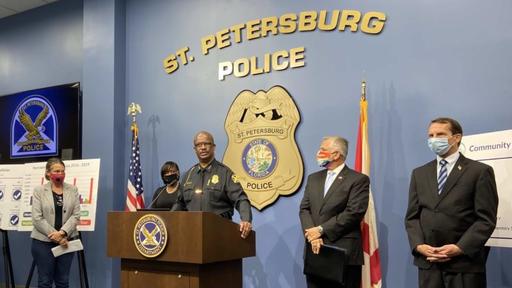
OPINION: St. Petersburg police listen to protesters, hire social workers over new officers

by Nicholas Cousineau, CORRESPONDENT
St. Petersburg showed that its true objective is the safety of its citizens by providing someone with interpersonal training to intervene in nonviolent police calls. SPECIAL TO THE ORACLE

Starting Oct. 1, the St. Petersburg Police Department will send community and social service professionals instead of armed police officers to handle nonviolent situations as part of the Community Assistance Liaison (CAL) program. The program started in response to daily protests and public outcries that began May 31 after an incident of police brutality in Minnesota led to the death of George Floyd on May 25.

The program shows protesters that the police department is listening and it has aligned itself with the protesters’ goals to reduce crime and make the city safer without the need for police. It’s a step toward a reimagined police department that all cities should be taking. 

During a press conference July 9, Chief Anthony Holloway explained that these professionals would respond to calls relating to disorderly intoxication, drug overdoses, mental health or suicide crisis, disorderly juveniles, truancy, panhandling, homeless complaints and neighborhood disputes.

Holloway continued by saying that the police department is sometimes unequipped to help someone raise their kid or assist someone with a mental health issue. 

“Yes, we go to a lot of training, but not enough, we’re not experts in that,” Holloway said at the press conference.

The St. Petersburg Police Department was awarded $3.1 million in June and planned to use the funds to hire 25 new officers, but will now be using the money along with the funds they set aside to match the grant to retain a social service agency to respond to the listed nonviolent calls.

Many small changes are being made to try and satisfy larger demands from Black Lives Matter activists like Quaker Oats, which owns the Aunt Jemima syrup and pancake mix brand, pledging to change the brand’s name due to the name and logo being related to a stereotype of an older Black woman. While this is a good step and should be done, these changes are demonstrative and lack meaningful impact.

The CAL program reflects a primary demand of the Black Lives Matter movement — defunding the police.

Overall, this decision is a win for everyone. Hopefully, this will not be the last time a city official enacts change to make their community safer for everyone.

Nicholas Cousineau is a senior majoring in broadcast journalism.

06 Jul 19:30

The US Department of Justice was originally created to tackle white supremacy

by Thom Dunn

Americanism has a weird obsession with vague notions of "law and order." At its core, there's nothing unique about a society whose existence depends on a collective respect for its own internal rule system — indeed, that's basically just a society. But those who buy the narrative of Good Ol' American Jingoism love to toss around their platitudes about being a "nation of laws," without giving much thought to what that actually means, or who is served by that law and order. Whatever the status quo they got used to, that's the way things have always been, and thus, it is right.

Consider the US Department of Justice. I've never even given much thought to its founding; I hadn't thought much about the origins of police departments growing out of slave patrols until it was explicitly brought to my attention either.

But Smithsonian Magazine has a great new piece about the origins of the DoJ, which began on July 1, 1870 — exactly 150 years ago this month. And it turns out, it's a direct extension of Reconstruction-era struggles, and was created specifically to enforce racial equality by fighting voter suppression and the KKK:

In 1870, the United States was still working to bind up the nation’s wounds torn open by the Civil War. During this period of Reconstruction, the federal government committed itself to guaranteeing full citizenship rights to all Americans, regardless of race. At the forefront of that effort was [Amos T.] Akerman, a former Democrat and enslaver from Georgia, and a former officer in the Confederate Army.

[…]

Akerman’s work caught the attention of President Ulysses S. Grant, who promoted the Georgian to Attorney General in June 1870. On July 1 of that year, the Department of Justice, created to handle the onslaught of post-war litigation, became an official government department with Akerman at its helm. The focus of his 18-month tenure as the nation’s top law enforcement official was the protection of black voting rights from the systematic violence of the Ku Klux Klan. Akerman’s Justice Department prosecuted and chased from Southern states hundreds of Klan members. Historian William McFeely, in his biography of Akerman, wrote, “Perhaps no attorney general since his tenure…has been more vigorous in the prosecution of cases designed to protect the lives and rights of black Americans.”

This is a fascinatingly complex piece of history, and the article does a great job of tracing the origins of the DoJ all the way through to the founding of its offspring in the FBI (which … has certainly not been historically concerned with Black equality). And notice how there's nothing in the core founding of the DoJ that involves acting as a personal fixer for multiple Presidents.

If you ask me, these are the kinds of historical details that more of us should learn about, instead of staring at statues of subjugators.

Created 150 Years Ago, the Justice Department’s First Mission Was to Protect Black Rights [Bryan Greene/ Smithsonian Magazine]

Image of Amos Akerman: Public Domain via National Archives / Wikimedia Commons

06 Jul 14:30

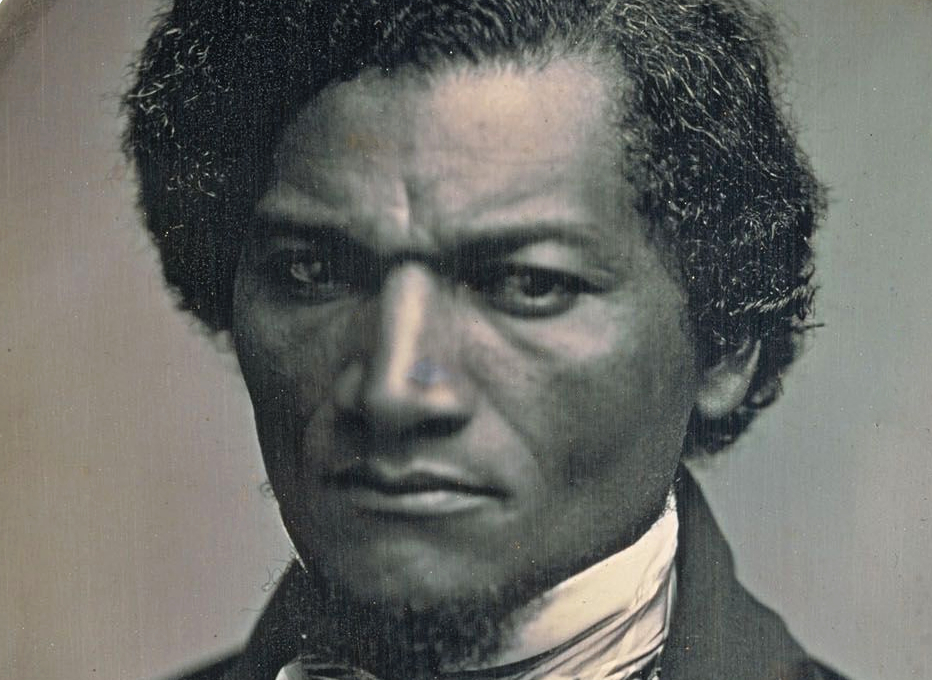
First Edition Pamphlet of Frederick Douglass' "What to the Slave Is the 4th of July?" (1852)

Douglass' famous anti-slavery oration, one of the most important speeches in the history of the United States.

30 Jun 17:47

Week Of Aussome

by Richard of DM
I love Australia. Their films are something else. No really, I don't know what in the heck is up with them! I decided to gather together some Australian films, some unseen and some I hadn't watched in many, many years, to see what I could um... see. There wasn't time for a proper moviethon so I just spaced out the films over a week to save myself from going completely insane. Was I successful? Let's find out.


Monday

Dangerous Game (1988)

Some dumb and irresponsible college ne'er-do-wells run afoul of a deranged Irish police officer named Murphy (Steven Grives) and make matters worse by breaking into a department store after hours. The aforementioned psycho cop follows them to the store, traps them inside, and hunts them down. This incredibly colorful and stylish effort comes from Stephen Hopkins, the director of A Nightmare on Elm Street: The Dream Child (1989).

Grives's performance of Murphy is completely unhinged and freakin' intense. With its delirious visions and unreal atmosphere, it's no wonder that Dangerous Game has stuck in my head since I was a kid. The film is a little overlong but I think they just needed time to sneak in more weird shit. When a consumer dream turns into a nightmare, you'd better watch out! I'm too scared to check and see if that's a real tagline for this film.


Tuesday

The Cars That Ate Paris (1974)

If I've seen this before then I must've been drunk because I don't remember a damn thing about it. In a tiny town called Paris, there's a conspiracy afoot- or should I say "awheel"? Arthur (Terry Camilleri), an unemployed duder, gets stranded in Paris after his brother is killed in a horrific car accident. It isn't long before he begins to suspect that the citizens' unique economy might be more than slightly sinister.

The music score by Bruce Smeaton is utterly gorgeous. Speaking of gorgeous, Max Spence of Mad Max 2: The Road Warrior (1981) and Mad Max Beyond Thunderdome (1985) is in this! The Cars That Ate Paris is darkly funny and tragically sad. And it just turned into a spaghetti western. We'll be seeing more from director Peter Weir this week.


"I hope you realize I'm being flippant."

Thursday

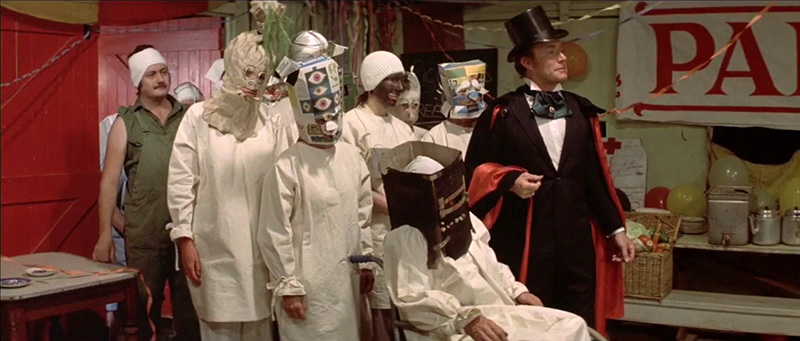
Out of the Body (1989)

Woops! I had to skip a day to recover from a sinus headache but I'm back at it. Brian Trenchard-Smith, you magical bastard! An invisible force is killing successful women and college professor/composer David Gaze (Mark Hembrow) is somehow connected. I'm getting a giallo vibe from this wacky stuff. Gaze dreams of the crimes as they happen but doesn't know how to stop the killer. Finally, Gaze thinks he's got his big break once he dreams of a famous newscaster but thinks don't go so well when tries to warn her.

Wait, is his cat supposed to be involved in the crimes? And why is the killer collecting the eyes of his victims? I have no idea. But there's a sub-subplot where a detective constantly sexually harasses his female coworker. Classy, dude. There's a swimming pool at night scene! I love those. Always consult your physician before you even consider astral projecting. This one is kind of a wacko Aussie version of The Eyes of Laura Mars (1978). I like it!


Friday

Picnic at Hanging Rock (1975)

It's been so long since I've seen this film that the only thing I remember about it is that it's beautiful and the giant cave of genetically engineered albino half-man, half-wombats at the end. Sorry for the spoiler. Of course, Aussie mainstay, John Jarratt, is in this one! I adore the magical, science fiction-y vibe of this classic. I don't want to say that the cause of the mysterious events at Hanging Rock (a really big rock) is aliens but it's aliens.

Three young girls and a teacher disappear on a field trip out to Hanging Rock. This was back in the early 1900s so they didn't have Instagram or anything. LeEtta and I would like to know why the fat character has to be so annoying. We feel attacked! Damn, this gets creepy. What the frick? The haunting vocal bits of the score remind me of The Beyond (1981). Hold up, this wasn't based on a true story? Did everyone else know that but me?


The Last Wave (1977)

The Last Wave has been on my radar but it has kept eluding me, until now. Some movies are lil rascals! Freak weather patterns throw Australia into chaos. It's up to Richard Chamberlain to save the day! He uncovers a gang of Eco-terrorists who've hijacked a weather machine and unless the government enacts stricter emissions testing, they will drown Australia in a snowdrift. There's water in every scene of this film which means that the viewer has to peepee.

Chamberlain gets called in as legal council for a group of Indigenous Australians accused of killing a man under mysterious circumstances. The weird thing is that he's been dreaming of their de-facto leader Chris Lee (David Gulpilil) for days before ever meeting him. The sound design in this film is so damn good. I hope that movies are still being made with sound nowadays. By the end of this film, I'm in awe. Tonight was a quite a journey. Thank you, Mr. Weir(d).


Saturday

Fortress (1985)

Here comes a blast from my past. As a kid, this movie freaked me out so bad. A gang of creepos in animal masks kidnaps a (hot) teacher named Sally Jones (Rachel Ward) and her schoolchildren to get some of that bloody red Australian ransom money. They take the kids and their teacher out to Hanging Rock and stick them in a hole while waiting for the parents to pay up.

Some of the music in this film is blowing my mind and not a good way. Sally ("Miss Jones" if you're nasty) and her kids are very resourceful and MacGyver their way out of their hole and into our hearts. Fortress is much less disturbing now that I'm in my late 80s but it's still got some bite to it. Hoo boy, if there was ever a film that teaches you not to mess with Australians, this is it. Director Arch Nicholson served as second unit director on the next film I'm covering!


Razorback (1984)

LeEtta and I were watching The 13th Floor (1988) when the sound on my copy went perilously out of sync. It was not ideal. So I decided to jump into this unseen-by-me film, even though I was saving it for Sunday. I always considered renting it from the video store but somehow never did pull the trigger. The cinematography by Dean Semler, who shot Max Max 2: The Road Warrior (1981) is so damn good that I can hardly stand it. Throw in some bonkers ass larger-than-life Australian rednecks and some truly bizarre imagery and you have a winner. What's it about? It's about a 9 foot tall soccer player named Razorback who wins the big game but not before learning a valuable lesson! You need to see this. Director Russell Mulcahy went on to helm frickin' Highlander (1986)!

Sunday

Thirst (1979)

Well, I guess had to stop somewhere. For the final Aussome film of the week, I figured what could be better than a vampire version of The Bitch (1979)? Veteran TV director Rod Hardy brings a unique touch to this film that could not have been made at any other time than the late-1970s. To say that this is a product of its time is an understatement and I love it. Our heroine Kate (Chantal Contouri) wakes up in a coffin and bam! We get our titles. The End. The film rewinds a week and we find out that a cabal of dang weirdos are watching Kate's every move.

Before things got crazy, her life was a bland but very chic fantasy. From her meticulously decorated mansion to her mustachioed hunky boyfriend and their fireside romance novel-style lovemaking to her vague high-powered position as a cosmetics executive, this shit is ridonk. Once the aristocratic race of vamps reveal their plan for Kate, she's decidedly not into it. Victor Silva and David Hemmings are on hand to class things up. The conspiratorial vibe is fun but I'm really here for the blood shower. Well, thanks for hanging out, my friends. I will definitely be returning to this fine country in order to sample its brilliant and inimitable cinematic output again sometime.


30 Jun 12:48

New Pride intersection mural to be painted in Tampa

by Andrew Harlan

The Tampa Bay LGBT Chamber has partnered with the Tampa Downtown Partnership for Pride Month to reveal the permanent intersection mural located in the historic Tampa Heights neighborhood of Tampa’s Downtown. The vision of the painting is to signify unity and to showcase Tampa’s diverse community.

At a time when we need to come together, we celebrate our community with the Pride Mural, signifying the unity of the LGBTQ+ community, with the Black Lives Matter Movement, people of color, and our Trans brothers and sisters. We honor each other and look to build a better future for generations to come,” said Justice Gennari, President & CEO of the Tampa Bay LGBT Chamber.

Prolific artist Cam Parker created the design

Local artist Cam Parker was commissioned for the project. Cam has painted several murals in the Tampa’s Downtown, including in the Tampa Heights neighborhood.

The City of Tampa has proclaimed Saturday, June 27, as “Unity Mural Day.” Volunteers will be painting murals at five locations within the City of Tampa. In conjunction with the City of Tampa’s Lift Up Local and Vision Zero initiatives, street murals are a way to celebrate the unique aspects of neighborhoods, strengthen community bonds, and improve the safety and livability for our communities.

Second in a series of intersection murals

Several weeks ago, the City unveiled a street mural at the intersection of Franklin Street and Twiggs.

Lift Up Luck—designed by local artist, Meaghan Farrell Scalise of Traditional and Digital Arts, LLC—celebrates Tampa’s resilient spirit, mirrors the city’s Lift Up Local program, and adds a touch of beauty to the intersection of Franklin St & Twiggs St in Tampa’s Downtown.

The post New Pride intersection mural to be painted in Tampa appeared first on That's So Tampa.

23 Jun 14:08

Black People Are Allowed To Be Angry

by DW McKinney
HOW CAN YOU NOT BE?


What I see most often in response to the protests, is people, often white people, saying Black folks have to be peaceful right now. We have to be calm because anger detracts from our message. We can’t be angry because then the racists win. We can’t be angry because it snuffs out our joy—as if joy is a limited thing that can only be bought with a special coupon. 

What I see most, are platitudes that erase the validity of Black emotions.

People say: 

“You’re better than this.”

“Being angry solves nothing.”

“They don’t deserve your anger.”

On the contrary. Racists deserve every sharp word my Black brothers, sisters, and I have to give. And then some. There is so much to be angry about, that to instead paste a neat smile across my face, and pretend that racism, murders, and systemic oppression haven’t happened, would be delusion.

I’m grieved by the Black mothers, fathers, cousins, aunties, brothers, and friends that have died at the hands of police. Sorrow shakes my every bone. So, I swallow it down and when I do, the sunburst of anger aching in my chest rises to replace it.

I’m angry that I had to tell my four-year-old last week about the protests, and the people “hating Mommy’s skin.” I’m angry that I then had to tell her that their hatred is also tied to her biracial heritage. Her face slackened, her eyes furrowed, and I could see the worry building inside her. I’m angry that I had to snatch away a little more of her innocence.

I’m angry that people who supposedly love me have turned their backs on me. Their ignorance and silence is only kindling.

I’m angry that it has taken so long for our distress to be heard. I’m angry that it has taken so long for our history to be considered. I’m angry that this is happening now. That it didn’t happen in 2016 or 2014, or end with all the stomping and marching my grandparents participated in.

I’m angry that it has taken near economic collapse, a pandemic, and quarantine to force people to sit with this nation’s raggedy truth.

To say that I should not be angry, means you don’t understand. To say that I should not be angry, means that you cannot empathize with me.

To say that I should not be angry, that I should be. . .

. . . anything else, something you can agree with, something more palatable to you, is you asking me to be submissive to your needs. 

Saying that Black folks shouldn’t be angry is admitting that we have disturbed you. It’s as if we spoke too loud. We interrupted your favorite television show, upended a coffee table in the safe confines of your home. Where once there was serenity, we’ve marred it. 

Good. This means our anger has upset you. It has nipped at the thing inside of you. Would you rather us go away? Prefer our silence so that you no longer have to experience discomfort? 

To tell me to not be angry, that it doesn’t have a place in protest, that it should be filed away, muted, is to invalidate it — is to invalidate me. 

Perhaps you only equate anger with violence, and not what else it could be: grief, pain, or righteousness.

Let me ask you this: Why should I not be angry?

Should I not be angry that I’m policed in grocery stores, and have been since I was a child? Should I not be angry that window shopping means something different for me than it does for you, that it means enduring surveillance and restraining my actions in the store so that no one thinks I’m a criminal?

Should I not be angry that job opportunities have been denied to me because of how I looked? Or given to me, not because I was qualified, but because in the words of employers, I was Black and made them look “good”? Should I not be angry that I’ve had to smooth down and rein in my Blackness so that I could be acceptable enough to earn a meager paycheck?

Should I not be angry at the folks who have called me n*gger, Black bitch, monkey, and whatever foulness shaped their lips?

Should I take the unjust deaths of Black men and women, Black queer folks, Black activists, and Black innocents with a smile on my face? Should I turn the other cheek and say, “Oh well. Time to keep on living! Gotta keep being respectable!”

How can you not be angry?

How can you see people dying on your television, on your phones, on your computers, and not be disgusted? How can you not see that the folks whose lives are being stolen are friends, loved ones, people who deserve to live?

How can you not care? 

Or, maybe, you don’t.  


The White House

By Claude McKay (1889-1948)

Your door is shut against my tightened face,

And I am sharp as steel with discontent;

But I possess the courage and the grace

To bear my anger proudly and unbent.

The pavement slabs burn loose beneath my feet,

And passion rends my vitals as I pass,

A chafing savage, down the decent street;

Where boldly shines your shuttered door of glass.

Oh, I must search for wisdom every hour,

Deep in my wrathful bosom sore and raw,

And find in it the superhuman power

To hold me to the letter of your law!

Oh, I must keep my heart inviolate

Against the potent poison of your hate.

The post Black People Are Allowed To Be Angry appeared first on On Our Moon.

17 Jun 20:39

Copyright and Ghostwriting

by Jonathan Bailey

The ethics of ghostwriting are often the subject of much debate. Though often seen as plagiarism, such as with the battle over Christiane Serruya story, it remains a common practice for many books and creations in general.

Simply put, there are times where, despite someone’s name appearing on the cover of a book, there’s no sincere audience expectation that they actually wrote it. This is also true for many speeches, celebrity social media accounts and so forth.

But all of this raises an interesting question: Who owns the copyright of a work when the name attached to it is different from the person who created it? If copyright normally rests with the creator of a work, how is ghostwriting handled from a legal perspective?

The answer is both simple and complicated at the same time. However, a good place to look for the answer to that question is in Bangladesh, where a recent case highlighted just how muddy these waters can be.

The Spy and The Copyright Office

In Bangladesh, the Masaud Rana book series of espionage thrillers is as popular as it is prolific. First launched in 1966 and continuing today, the series has more than 460 novels under it.

While the books are attributed to author Qazi Anwar Hussain, it’s an open secret that the books themselves are actually produced by a group of ghostwriters with many fans saying that they can tell which author wrote which of the books.

One of the main ghostwriters, Sheikh Abdul Hakim, recently filed a petition with the country’s Copyright Office to attempt to gain control of the copyright over the 260 books he had penned. According to Hakim, there was no contract or agreement in place between him and the publisher and, as such, the copyright in those books should transfer to him.

The Bangladesh Copyright Office ultimately agreed with him and granted him the copyright in the books he wrote, which included 50 books in a separate series. According to the Copyright Office, Hakim was neither an employee nor a staffer of Hussain or the publisher and there was no freelance contract.

As such, there was nothing to stop him from claiming copyright in the books and nothing to prevent him from collecting royalties for his work.

But while it’s an interesting case it’s also an unusual one. Such squabbles over the copyright of a ghostwritten work are surprisingly rare. The reason is quite simple: Most of the time, there IS some sort of contract.

It’s All About the Contract

Hakim’s case is very much the exception, not the rule. Most of the time, ghostwriters do not reserve any claim in the copyright of the work they produce. The reason is that most ghostwriters have clearly laid out terms that prevent them from later trying to claim ownership of the work they produce.

This happens one of two ways:

  1. Direct Employment: Often times ghostwriters are direct employees for whomever they are writing for and it is very much their full-time job. For those writers, the copyright in the work they make as part of that employment goes directly to their employer.
  2. Freelancer Contract: If the ghostwriter is a freelancer, then the contract that they sign will either designate the work as a work for hire (if appropriate) or will otherwise state that the copyright is to be transferred to the person paying for the work.

It’s only in situations like Hakim’s where he is not an employee and there was no contract that a ghostwriter can come back and claim ownership of the work they did. However, even then, it’s not a guarantee.

In the United States, the courts have to look at what both parties intended based upon their actions and try to draw some kind determination of who should own the rights. It’s a messy, complicated process that often leaves neither side happy.

However, those situations are very rare overall.

That said, all of this highlights the importance of being careful when approaching ghostwriting contracts and agreements. It is especially crucial that such agreements spell out who owns the end product. While this is true of all freelancing agreements, with ghostwriting arrangements the danger is especially potent as the person whose name on the work may end up not owning or controlling it.

Bottom Line

Ultimately, a ghostwriter isn’t significantly different from any other freelancer or hired writer. The ownership of the piece hinges upon the simple questions of whether they are an employee and, if not, what the terms of the contract were.

Things only get messy when either there is no contract or the contract is poorly written. Contracts are ultimately about setting expectations between the parties and, when those expectations are not clearly understood, problems arise. That’s true across all areas of law.

Still, ghostwriting feels very different because there’s the very real danger the person who is listed as the author of a work may not end up owning it. As such, if you’re recruiting a ghostwriter, it’s crucial to be extra careful to nail these contracts and make sure everything is thoroughly understood.

Otherwise, the situation could turn very messy, very fast.

Want to Republish this Article? Request Permission Here. It's Free.

Have a Plagiarism Problem?

Need an expert witness, plagiarism analyst or content enforcer? Check out our Consulting Website
16 Jun 17:59

American Food and Race: Ten Things I Learned from Writing and Living The Cooking Gene

by michaelwtwitty

At the end of the prologue to my book The Cooking Gene (HarperCollins Amistad imprint, 2017/2018) I reflected on whether or not the Southern table could give us some insight into America’s second original sin–the enslavement of Africans and the consequences that resulted:


The lazy, laughing South / With blood on its mouth /And I, who am black, would love her,” wrote Langston Hughes, a refugee of Joplin, Missouri, the poet laureate of black America. The poems I was bid to remember frequently referenced a place that was caught up in a weird braid of nostalgia, lament, romance, horror, and fear. Forsyth County, Georgia, is no longer the same place it was nearly thirty years ago, and black people have long since moved in. And yet across the region, flashpoints continue, the shootings, the draggings, the overreach of police authority, the obstruction of the vote, inequalities and inequities and silent and sturdy boundaries between white and black. For some, “we” are the South, but “they” are Dixie, and yet we and they all know the old hanging trees and the strange fruit they once bore. I dare to believe all Southerners are a family. We are not merely Native, European, and African. We are Middle Eastern and South Asian and East Asian and Latin American, now. We are a dysfunctional family, but we are still a family. We are unwitting inheritors of a story with many sins that bears the fruit of the possibility of ten times the redemption. One way is through reconnection with the culinary culture of the enslaved, our common ancestors, and restoring their names on the roots of the Southern tree and the table those roots support. The Old South is where I cook. The Old South is a place where food tells me where I am. The Old South is a place where food tells me who I am. The Old South is where food tells me where we have been. The Old South is where the story of our food might just tell America where it’s going. The Old South / With soul food in its mouth / and I, who am African American, must know her.”


Now we are here, another flashpoint, a triple threat in a perfect cauldron of a pandemic, a massive economic downturn and an election year under a controversial and often divisive presidency.  I had hoped originally this would be a cap to the Obama presidency, then I hoped it would be a great way to open the Clinton presidency and then I resigned myself to the fact that his project was going to have to suit itself to the challenges of the Trump era.  Now we are closing in on 4 years and I am just waking up from a weeklong fog.  My immense grief over the continued murder of African Americans and the brutal means by which peaceful protestors and others have been repulsed by rogue law enforcement has been too much.  The ticker tape of word salad flowing through my consciousness is muddied but slowly approaching some clarity.


In 2012 Rabbi Michelle Goldsmith sat me down after a presentation that I gave at her then synagogue in Birmingham, Alabama.  She said, “You realize your life isn’t going to be the same.” She elaborated and she was right.  Then I was still on my Southern Discomfort Tour, a trip though the South to find my family roots and trace food routes from the colonial and antebellum South through to the childhood of my grandparents, themselves one generation removed from enslavement.  Almost four years removed from the publication of The Cooking Gene, and having traveled through 8 countries in West Africa, the journey seems easier but the world seems so much less full of hope than it did when I thought my book would get me into the good graces of Barack and Michelle for a photo opp.  
So what does a detective story in drag about food and genealogy and contemporary food politics have to teach about race and systemic racism? Or a better question, what did I learn after the fact, once the book was closed thinking and linking back to what I wrote?


1. White America and African America are inherently connected, Black folks know this, but many white people are still surprised or in denial and it is this more than blatant appropriation that pisses us off.  

My great great great grandfather, Richard Henry Bellamy, Captain CSA. Many of his relatives are in denial that we are connected. I have the DNA to prove it.
My great great grandmother, Hattie Bellamy


Why do many white people seem terrified about addressing their genetic, familial, historical and cultural connections to Black people? What does working through the technical difficulties look like?  


2. Food has meant working in historical and cultural spaces that are really challenging to Black mental health and contemporary identity from the big house kitchen to the contemporary urban dining room.  The inherent vulnerability you have to have to do this work and the fear that it is marketing our traumas is more repulsive and problematic to Black folks now than ever before. This is happening simultaneously as Black folks in America get more interested in genealogy and finding their family’s place in the bigger global narrative.  
What is it about the times we are living in that makes people far more reticent to rehearse and relate stories of past oppression and resistance in the ways those of the past two generations?  How can we achieve a better place where we can critique our experience in a brave new way?  How do we tell our family stories now and in the future?  


3. Acknowledging multiple languages and multiple ideologies is not “both sideism,” its just breaking down why we have an ongoing disagreement about the past, the present and the future.
Is it possible to engage in these conversations acknowledging the words and thoughts of “alternative visions,” of the same exact history without amplifying myths or lending them validity?  Can you understand and discuss their language and ideas without becoming toxic or losing your own sense of revolution and evolution?  


4. Food was a window for me into the fact Southern white people and their descendants are the most African-rooted white people in mainland North America.
How do we make sense of the engrained African, Afri-Creole and African American impact on Southern whites and at the same time acknowledge Black erasure and the decentering of Black narratives in the service of white supremacy?  


5. Africa was an absolutely necessary part of my journey, but I feel valid and full as an extension of Africa in America.
In a space where the Diaspora wars wage on social media and a racist president describes modern Africa and Africans in demeaning terms, what did Africa mean to my food and identity journey and how did it change my perceptions about being African American for the better?  What does it feel like to recover my original family names?  


6. The politics of race and food and culture in the American South is far from just Black and white and we must repeat that racial inequality and systemic racism are not only baggage born by the South.
How do we have a more inclusive conversation that includes all Southerners, addresses parallel issues in the Black or African Atlantic world and moves the discussion from being Southern to all-American?


7. People of all backgrounds really don’t know the full story of African American food in the South, and that’s because a simplistic, one note narrative that can be quickly digested and spat out has become the prevailing narrative of African American food—and most African American culture in the marketplace of ideas.  Soundbite size, one note, simple narratives are often how we communicate our feelings about “race.”
What will it take to guarantee that this story of Black resistance, travail, hope, memory and creativity becomes an ongoing movement for cultural literacy and cultural awareness for all?


For the next 7 posts, I’m going to try to tackle each one of these in 1500 words or less.  This is a very, very serious time for thinking about “race,” and what it means and how systemic racism and the legacy of 1526/1619 lives on with us 4 and almost 5 centuries later.  Each post will come with discussion questions that you can go over with a group.  If you have a copy of The Cooking Gene, great.  If you don’t please consider purchasing a RSADR (Retail Purchases Support Authors During Rona) copy and have an even richer conversation inside yourself and with your friends, family and neighbors about the themes of the work and politics of race and culinary history and culture in American life.  

Homework:
1. Use this time apart to collect family recipes over the phone or by computer.
2. Design a menu that reflects the life of one Ancestor in your family tree.
3. If there is a person in your family or community who is a culture or culinary tradition bearer surprise her with a meal to honor her knowledge and skill.
4. Eat well.

11 Jun 17:14

Flying Ambulances for the Navajo Nation

by Mary K. Greer

My friend, John Irving, is currently flying medical planes within the Navajo Nation that’s being devastated by COVID-19. I asked him to send me his story that I could post here to let people know what is actually going on. It’s just one story from the midst of this crisis. I want to add that John has been the chief pilot for heads of state as well as flying humanitarian missions around the world both professionally and personally, for instance to bring survival supplies to remote areas ravaged by floods or earthquakes. He’s one of the most caring people I know, who acts immediately to help those in need wherever they are. From this point on I’ll let John tell his story.

JOHN IRVING: I first started doing humanitarian flights in Alaska in 1976. One type of flight was taking Alaska State alcoholism counselors to native villages devastated by alcoholism. Frequently, after an emergency call-out, we would find all adults and teenagers in a village drunk and/or unconscious with children outside (exposed to the elements), kids who had not been fed for days. I also flew typical medevac flights in both helicopters (from oil platforms and fishing boats) and in airplanes.

Now I fly single-engine air ambulances for Guardian Flight, one of more than a dozen air ambulance companies owned by Global Medical Response (GMR). GMR operates ground and air ambulances in 40 states. In Gallup, New Mexico we normally have two Swiss-made single turbine-engine PC-12s, a twin engine Beech King Air 90C and one helicopter, all serving the Navajo and Zuni nations.

Now, during the corona virus pandemic about 80% of our flights are with Covid-19 patients, flying them from regional clinics and small hospitals on the reservation to larger hospitals in Albuquerque, Phoenix, Tucson and near El Paso.  

Covid-19 is slamming the Native reservations at a rate 3.5 times the rate of America in general.  This is a higher rate than even that suffered by America’s black and Hispanic communities.  

The reasons for this high rate of infection and death are simple.  Many American Natives suffer from diabetes, obesity, alcoholism, heart disease and respiratory problems, all of which increase the probability of getting Covid-19.  Social distancing is anathema in cultures where traditionally multiple generations live in a single dwelling, eat communally and care for each other instinctively.  Many of the homes on the reservation do not have running water.  Instead, they have an outside hand-pump.  This makes regular hand-washing difficult or impossible.  Many of these families live hours from the nearest medical facility, so often their illness is quite advanced before they go to a clinic or hospital.

We hear so little about the dire situation on the Navajo and other Native reservations because mainstream America has for centuries, paid little heed to the suffering of our poorer brown and black citizens.

Recently, many teen-age and young-adult Navajos and Zunis are collaborating in doing wellness-checks and bringing food, water, and sanitation supplies to elders who live alone.

Normally Gallup, New Mexico is the busiest air-ambulance base in the United States.  With the explosion of Covid-19, GMR has added 30 medical crew-members and seven addition air ambulances to the ‘four-corners’ region (New Mexico, Arizona, Colorado & Utah) occupied by the Navajo Nation.  This has made us much more responsive to the requests for emergency medical transport from the regional clinics and hospitals.

On a typical 12-hour shift I will fly two Covid-19 patients and one non-Covid patient from Gallop or one of the reservation airstrips, to an airport near a major hospital facility.  Typically I am in the air less than 30 minutes after being called out.  If the patient is local, I will prepare the aircraft readying it for the patient, while the clinical crew (nurse & paramedic) go to the hospital, assume the medical care of the patient, then bring the patient by ambulance to the airport.  If the patient is at a remote location, we will fly together to the nearest airport and operate from there.

With the Covid-19 patients, the pilot, nurse and paramedic are all wearing full personal-protective-equipment while loading the patient into the air ambulance, during the entire flight, unloading the patient into the ground ambulance and then to the receiving hospital.

While my clinical crew rides in the ground ambulance with the patient to the hospital, I will use spray alcohol and sterilizing wipes to thoroughly disinfect the aircraft; then I’ll drive a van to the hospital to take my crew back to the airport for our next mission.

The other night I had a singular honor.  My patient was a 100-year-old Navajo Code Talker; one of the great heroes of WW2.  He had served in the Pacific when my two uncles were there.  He was bright, funny and flirtatious with our medic who is 75 years younger than he is.  I am delighted to tell you we got him to the hospital in time and now he is well and back home with his family near Fort Defiance, Arizona.

Regularly, while flying back to base, Air Traffic Control will pass on a request from our dispatch center, asking us to divert to different airport for our next patient.  My normal shift is 12 hours, 12 off, but 16-hour days or nights are not unusual.

Best regards,
Capt. John Irving CEO, Drone Surveys & Reports, LLC

If you leave a message for John in the comments I’ll make sure he gets it.

11 Jun 15:37

General Mark Milley sorry for posing with Trump in combat uniform after protesters gassed by goons

by Xeni Jardin

• "I should not have been there.”
• Milley said his presence “created a perception of the military involved in domestic politics.”

America's top general said that showing up in combat fatigues with impeached President Donald Trump after a violent dispersal of protesters outside the White House last week was a "mistake."

General Mark Milley is Chairman of the Joint Chiefs of Staff. He said he was "outraged" by the killing of George Floyd, and the protests speak to "centuries of injustice toward African Americans."

"As senior leaders, everything you do will be closely watched. And I am not immune. As many of you saw, the result of the photograph of me at Lafayette Square last week. That sparked a national debate about the role of the military in civil society," Milley, said in a pre-recorded speech to a group of graduates from the National Defense University released Thursday.

"I should not have been there. My presence in that moment and in that environment created a perception of the military involved in domestic politics. As a commissioned uniformed officer, it was a mistake that I have learned from, and I sincerely hope we all can learn from it," he added.

"I am outraged by the senseless and brutal killing of George Floyd. His death amplified the pain, the frustration, and the fear that so many of our fellow Americans live with day in, day out," added Milley, in the speech.

"The protests that have ensued not only speak to his killing, but also to the centuries of injustice toward African Americans," he added, saying "we should all be proud that the vast majority of protests have been peaceful."

Read more at CNN:
Top general apologizes for appearing with Trump in combat uniform after forceful removal of protesters


PHOTO: Army Gen. Mark A. Milley takes oath as 20th Chairman of Joint Chiefs of Staff, photo by Jim Garamone | Defense.gov | Oct. 1, 2019

10 Jun 17:15

The ACLU analyzed the number of police in schools compared to social workers, and the results are staggering

by Thom Dunn

In March of 2019 — about a year after the Parkland shooting at Marjory Stoneham Douglas High School — the ACLU released a report titled "Cops and No Counselors: How the Lack of School Mental Health Staff Is Harming Students." Based on publicly available federal civil rights data from 2015-2016, this report offered a comprehensive analysis of the school support resources, breaking it down by state and demographic, to get a better look at how we're serving students in America.

The results were not good:

The ACLU’s report found over 90 percent of students nationwide attend schools that fail to meet the nationally recommended ratios for student-to-counselors, psychologists, nurses, and social workers. Over 14 million of these students were in schools that reported having law enforcement present despite lacking critical mental and physical health personnel. The report cites research indicating that students would benefit more from increased access to mental health professionals than the increased school hardening the commission recommends.

[…]

  • The average number of students each school counselor serves is 444 — nearly double the already limited recommended student-counselor ratio of 250:1
  • At least 43 percent of our nation's students attend schools with onsite police, and in some states more than 68 percent of schools have police
  • 31 percent of the nation's students attend schools that have school police, but no psychologist, nurse, social worker, and/or counselor
  • Black girls account for 16 percent of girls enrolled nationwide, but account for 39 percent of the girls arrested in school
  • Native American and Pacific Islander students were more than twice as likely to be arrested as white students nationwide
  • Black and Latino boys with disabilities are 3 percent of students, but were 12 percent of school arrests.

What I personally found most staggering was that 94 percent of "serious offenses" by students involved threats or actual physical fights … without a weapon.

It's not crazy to think that some kids are going to scrap in the schoolyard. Yet somehow, that qualifies as a "serious offense." And only a small chance of anything worse than a fight.

But this is still how we focus our resources:

When people worry about what would happen if we didn't have police in schools — well, the data shows that it can't be much worse than what's already happening when we do have police in schools. Police don't prevent mass shootings, for example; social workers do.

ACLU Report Highlights Staff Shortages, Over-policing, and Discriminatory Discipline in Schools

Image: Public Domain via U.S. Air Force photo by Airman 1st Class Zoe M. Wockenfuss

10 Jun 14:26

You Have a First Amendment Right to Record the Police

by Sophia Cope

Like the rest of the world, we are horrified by the videos of George Floyd’s murder. Once again, police brutality was documented by brave bystanders exercising their First Amendment rights. Their videos forcefully tell a painful truth that has further fueled a movement to demand an end to racism and abuse of power by police officers.

Recordings of police officers, whether by witnesses to an incident with officers, individuals who are themselves interacting with officers, or by members of the press, are an invaluable tool in the fight for police accountability. Often, it’s the video alone that leads to disciplinary action, firing, or prosecution of an officer.

This blog post provides some practical tips to record the police legally and safely, and explains some of the legal nuances of recording the police.

What to Know When Recording the Police

  • You have the right to record police officers exercising their official duties in public.
  • Stay calm and courteous.
  • Do not interfere with police officers. If you are a bystander, stand at a safe distance from the scene that you are recording.
  • You may take photos or record video and/or audio.
  • Police officers cannot order you to move because you are recording, but they may order you to move for public safety reasons even if you are recording.
  • Police officers may not search your cell phone or other device without a warrant based on probable cause from a judge, even if you are under arrest. Thus, you may refuse a request from an officer to review or delete what you recorded. You also may refuse to unlock your phone or provide your passcode.
  • Despite reasonably exercising your First Amendment rights, police may illegally retaliate against you in a number of ways including with arrest, destruction of your device, and bodily harm. We urge you to remain alert and mindful about this possibility.

Your First Amendment Right to Record Police Exercising Their Official Duties in Public

You have a First Amendment right to record the police. Federal courts and the Justice Department have recognized the right of individuals to record the police. Although the Supreme Court has not squarely ruled on the issue, there is a long line of First Amendment case law from the high court that supports the right to record the police. And federal appellate courts in the First, Third, Fifth, Seventh, Ninth, and Eleventh Circuits have directly upheld this right. EFF has advocated for this right in many amicus briefs.

Federal appellate courts typically frame the right to record the police as the right to record officers exercising their official duties in public. Thus, if the police officer is off-duty or is in a private space that you don’t also have a right to be in, your right to record the officer may be limited. 

Special Considerations for Recording Audio

The right to record the police unequivocally includes the right to take pictures and record video. There is an added legal wrinkle when recording audio—whether with or without video. Some police officers have argued that recording audio without their consent violates wiretap laws. Courts have generally rejected this argument. The Seventh Circuit, for example, held that the Illinois wiretap statute violated the First Amendment as applied to audio recording on-duty police officers.

There are two kinds of wiretaps laws: those that require “all parties” to a conversation to consent to audio recording (12 states), and those that only require “one party” to consent (38 states, the District of Columbia, and the federal statute). Thus, if you’re in a one-party consent state, and you’re involved in an incident with the police (that is, you’re a party to the conversation) and you want to record audio of that interaction, you are the one party consenting to the recording and you don’t also need the officer’s consent. If you’re in an all-party consent state, and your cell phone or recording device is in plain view, your open audio recording puts the officer on notice and thus their consent might be implied.

Additionally, wiretap laws in both all-party consent states and one-party consent states typically only prohibit audio recording of private conversations—that is, when the parties to the conversation have a reasonable expectation of privacy. Police officers exercising their official duties in public do not have any reasonable expectation of privacy. Neither do civilians in public places who speak to police officers in a manner audible to passersby. Thus, if you’re a bystander and want to audio record an officer’s interaction with another person in a public space, regardless of whether you’re in a state with an all-party or one-party consent wiretap statute, you may audio record the encounter.

Finally, the Massachusetts wiretap statute is unique in that it prohibits the secret audio recording of conversations without regard to whether those conversations are private absent all-party consent. There is a case pending in the First Circuit that is challenging under the First Amendment the Massachusetts wiretap statute to the extent it prohibits secretly audio recording police officers when they are engaged in non-private activities—that is, performing their official duties in public. The plain view rule also applies in this state because, as the First Circuit has held, open recording is not surreptitious.

The ability to secretly record the police (whether with photos, video or audio) is critically important given that officers often retaliate against individuals who openly record them. A good example of this is a case that’s currently pending in the Tenth Circuit, in which a bystander used his tablet to record Denver police officers punching a suspect in the face as his head repeatedly bounced off the pavement, and tripping his pregnant girlfriend. The officers retaliated against the recorder by seizing his tablet without a warrant and deleting the video (which he was later able to retrieve).

Do Not Interfere With Police Officers

While the weight of legal authority provides that individuals have a First Amendment right to record the police, courts have also stated one important caveat: you may not interfere with officers doing their jobs.

The Seventh Circuit, for example, said, “Nothing we have said here immunizes behavior that obstructs or interferes with effective law enforcement or the protection of public safety.” The court further stated, “While an officer surely cannot issue a ‘move on’ order to a person because he is recording, the police may order bystanders to disperse for reasons related to public safety and order and other legitimate law enforcement needs.”

* * *

Independent recordings of police officers are critical for ensuring police accountability. We urge individuals to keep recording. We hope this blog post helps you to do so legally and safely.

10 Jun 14:11

Hello From The Year 2020

by Richard of DM
The human race needs to figure out that we're all here to be born, live for a while, and then croak on this rock (or maybe in space). We are not all the same but we are all stuck with each other. This is not a bad thing if we can just stop being jerks. If you're blind to what's going on, staying out of it, adding to the problem, or just willfully ignorant, then wake up. We are officially living in the future but we are stuck in the past. I've been hearing the same racist garbage come out of people's mouths since I was a kid. Seriously, I'm 43 years old and the racist rhetoric and disgusting manipulation by those in power HAS NOT CHANGED. It's pathetic and it needs to stop right now.

So sign petitions, protest, donate $$ to causes, scream into the ether, or just listen to oppressed people. Whatever you need to do, do it. But give people understanding and help when they need it. Let's make compassion popular again. Let's rise above racism, homophobia, sexism, classicism, and religious persecution. End all inequality wherever its hiding. If that means overhauling our criminal justice system then let's make it happen. We can do this. So to all my friends of color, LGBTQ+ buds, frickin' awesome women, friends whose religions are different than mine, people of different economic classes, anyone different than me in any glorious way, etc. just know that I love you.