Their bill proposes to have the US Copyright Office mandate that all websites accepting user-uploaded material implement technologies to automatically filter that content. We’velongbelieved that these kinds of mandates are overbroad, speech-limiting, and bad for both creators and reusers. (We’re joined in this view by others such as Techdirt, Public Knowledge, and EFF, who have already stated their opposition.)
But one part of this attempt stands out to us: the list of “myths” Sen. Tillis released to accompany the bill. In particular, Tillis lists the concern that it is a “filtering mandate that will chill free speech and harm users” as a myth instead of a true danger to free expression–and he cites the existence of CC’s metadata as support for his position.
Creative Commons is strongly opposed to mandatory content filtering measures. And we particularly object to having our work and our name used to imply support for a measure that undermines free expression which CC seeks to protect.
CC licensing is designed to let creators choose to share their work beyond what copyright allows by default–to grant more permissions, not impose more restrictions. And while our license metadata does let reusers know critical information about licensed rights, this metadata exists to convey important information about licensed works, not to restrict their use. Critically, CC licenses were never designed or intended to override the limitations and exceptions to copyright that allow for free expression.
We believe in giving creators choices about how to share their work, and the importance of respecting those choices. But those rights to choose extend only as far as copyright does. Limitations and exceptions are a crucial feature of a copyright system that truly serves the public, and filter mandates fail to respect them. Because of this, licensing metadata should not be used as a mandatory upload filter–and especially not CC license data. We do not support or endorse the measures in this bill, and we object to having our name used to imply otherwise.
NASA's climate spiral visualization shows the changes in global temperatures from 1880 to 2021 compared to their averages. The animation makes it clear that human activities have increased global temperatures over time.
From NASA's Climate Change YouTube channel:
These temperatures are based on data from NASA's Goddard Institute for Space Studies (GISS).
by James Brown, Associate Professor in Biology and Biomedical Science, Aston University
The sweetener aspartame is found is many common foods and drinks, such as diet sodas. Kmpzzz/ Shutterstock
Sweeteners have long been suggested to be bad for our health. Studies have linked consuming too many sweeteners with conditions such as obesity, type 2 diabetes and cardiovascular disease. But links with cancer have been less certain.
An artificial sweetener, called cyclamate, that was sold in the US in the 1970s was shown to increase bladder cancer in rats. However, human physiology is very different from rats, and observational studies failed to find a link between the sweetener and cancer risk in humans. Despite this, the media continued to report a link between sweeteners and cancer.
But now, a study published in PLOS Medicine which looked at over 100,000 people, has shown that those who consume high levels of some sweeteners have a small increase in their risk of developing certain types of cancer.
To assess their intake of artificial sweeteners, the researchers asked the participants to keep a food diary. Around half of the participants were followed for more than eight years.
The study reported that aspartame and acesulfame K, in particular, were associated with increased cancer risk – especially breast and obesity-related cancers, such as colorectal, stomach and prostate cancers. This suggests that removing some types of sweeteners from your diet may reduce the risk of cancer.
Cancer risk
Many common foods contain sweeteners. These food additives mimic the effect of sugar on our taste receptors, providing intense sweetness with no or very few calories. Some sweeteners occur naturally (such as stevia or yacon syrup). Others, such as aspartame, are artificial.
Although they have few or no calories, sweeteners still have an effect on our health. For example, aspartame turns into formaldehyde (a known carcinogen) when the body digests it. This could potentially see it accumulate in cells and cause them to become cancerous.
Our cells are hard-wired to self-destruct when they become cancerous. But aspartame has been shown to “switch off” the genes that tell cancer cells to do this. Other sweeteners, including sucralose and saccharin, have also been shown to damage DNA, which can lead to cancer. But this has only been shown in cells in a dish rather than in a living organism.
But it’s still unclear from these animal and cell-based experiments precisely how sweeteners initiate or support cancerous changes to cells. Many of these experiments would also be difficult to apply to humans because the amount of sweetener was given at much higher doses than a human would ever consume.
The results from previous research studies are limited, largely because most studies on this subject have only observed the effect of consuming sweeteners without comparing against a group that hasn’t consumed any sweeteners. A recent systematic review of almost 600,000 participants even concluded there was limited evidence to suggest heavy consumption of artificial sweeteners may increase the risk of certain cancers. A review in the BMJ came to a similar conclusion.
Although the findings of this recent study certainly warrant further research, it’s important to acknowledge the study’s limitations. First, food diaries can be unreliable because people aren’t always honest about what they eat or they may forget what they have consumed. Although this study collected food diaries every six months, there’s still a risk people weren’t always accurately recording what they were eating and drinking. Though the researchers partially mitigated this risk by having participants take photos of the food they ate, people still might not have included all the foods they ate.
Based on current evidence, it’s generally agreed that using artificial sweeteners is associated with increased body weight – though researchers aren’t quite certain whether sweeteners directly cause this to happen. Although this recent study took people’s body mass index into account, it’s possible that changes in body fat may have contributed to the development of many of these types of cancers – not necessarily the sweeteners themselves.
Finally, the risk of developing cancer in those who consumed the highest levels of artificial sweeteners compared with those who consumed the lowest amounts was modest – with only at 13% higher relative risk of developing cancer in the study period. So although people who consumed the highest amounts of sweetener had an increased risk of developing cancer, this was still only slightly higher than those with the lowest intake.
While the link between sweetener use and diseases, including cancer, is still controversial, it’s important to note that not all sweeteners are equal. While sweeteners such as aspartame and saccharin may be associated with ill health, not all sweeteners are. Stevia, produced from the Stevia rebaudiana plant, has been reported to be useful in controlling diabetes and body weight, and may also lower blood pressure. The naturally occurring sugar alcohol, xylitol, may also support the immune system and digestion. Both stevia and xylitol have also been shown to protect from tooth decay, possibly because they kill bad oral bacteria.
So the important choice may be not the amount of sweetener you eat but the type you use.
James Brown has previously received funding from the EU Horizon 2020 scheme to study personalised approaches to food choices.
We are all tired of COVID. But even though the news has moved on to other concerning geopolitical issues, it is a fact that COVID is still very much with us. Vaccines have certainly helped drive down its worst effects, but the disease is here to stay, and we must learn to live with it.
So what should you do now if you get COVID? Anecdotally, many people seem to be ignoring the virus and carrying on regardless. This is perhaps not surprising given the end of self-isolation requirements in England, with Wales set to lift them very soon too. The message seems to be that COVID is no longer so important. But even as the rules do relax, living with COVID must not mean ignoring it.
Here are five things that COVID has shown that we need to do, especially as cases are yet again increasing and new variants like deltacron continue to be discovered.
Working to make a difference in the world but struggling to save for a home. Trying to live sustainably while dealing with mental health issues. For those of us in our twenties and thirties, these are the kinds of problems we deal with every day. This article is part of Quarter Life, a series that explores those issues and comes up with solutions.
Colds and respiratory illnesses are quite common, especially during the autumn, winter and spring months. For the majority of people, they are an inconvenience and not harmful.
But the older you get, the riskier they become. So even if you are young and at low risk, there are plenty of people who might get very ill if you give them COVID. Likewise, there are plenty of people with complex health conditions who are at high risk of getting severely ill if they catch the coronavirus. COVID can also trigger life-changing conditions such as type 1 diabetes in people who are susceptible but otherwise apparently healthy.
So if you start to feel ill, rather than carrying on regardless, acknowledge the infection. Look at your diary and reschedule events where you will come into contact with lots of other people. Take advantage of flexible working opportunities if available. The sicker you are, the more you should stay away from others, as this is the best way to stop the virus spreading (although clearly seek medical help should you need it).
Your employer should respect this, as even in England, where self-isolation is no longer legally enforced, government advice is still to self-isolate if you have tested positive or have COVID symptoms. You can use the NHS website to get an isolation note following a positive PCR test should you need to provide evidence.
2. Treat illness with respect
If you are the “carry on regardless” type, you may also be quite active and used to exercising. But if you sense you’re getting ill, give your body a break.
When living a fast-paced life, it can be difficult to slow down. But sometimes a day or two in bed and then returning to exercise slowly can be the main factor in preventing longer-term ill health.
As children, we are trained to wash our hands often, so the COVID advice to keep good hand hygiene was perhaps not a surprise. However, people’s response to wearing face masks was far more complex.
Face masks are particularly important if you have a respiratory infection like COVID because they stop you spreading germs over other people, much like covering your mouth when you cough or sneeze.
If you are suspicious that you are developing COVID, or even just a cold, wear a face mask if you have to be around other people. Face coverings are far more socially acceptable in western nations than they were prior to COVID, and people will thank you.
4. Stay up to date with vaccines
During childhood, vaccines are taken care of for you, but as an adult it is very easy to let your vaccinations lapse, especially if they are not explicitly required for your profession. For example, prior to COVID annual flu vaccines were increasingly being offered, but uptake was generally quite low.
It is possible that annual COVID vaccinations could be offered moving forward. If they are, it would be wise to take advantage of this, even if you’ve had COVID, because the virus will mutate and previous immunity will wane over time. Vaccines have been, and will continue to be, our best defence against COVID.
5. Think about the long term
Very few of us can drop everything and hide for ten days should we become ill. Work and caring responsibilities in particular can be difficult to avoid. But over the medium to long term, our health and that of our families or colleagues is more important than missing a couple meetings, sports activities or a holiday.
If you think back over time, it is amazing how many “critical” activities turned out to be not quite so important as they felt at the time. Unfortunately, illness is a part of life. Come to terms with the idea that plans can, and do, change.
If you think there’s a chance you have a respiratory virus like COVID, wear a face covering in public.
DimaBerlin/Shutterstock
These five points probably sound a lot like common-sense behaviour. However, one fascinating aspect of ethics is that people refer often to “common sense”, but almost always in the context of accusing other people of not having it – suggesting sense might not be quite as common as the phrase suggests.
On the contrary, evidence from the last few years suggests that many people won’t follow this advice. Sadly, this means that people will continue to get severely ill and die from COVID and other preventable diseases.
Simon Kolstoe is the independent chair of UK Health Security Agency's Research Ethics and Governance Group.
by David L. Pike, Professor of Literature, American University
At the end of the Academy Award-nominated film “Don’t Look Up,” with a meteor hurtling toward Earth, the movie’s three scientist-protagonists gather with family and friends for a last supper around a dinner table in central Michigan.
Having exhausted their efforts at action, they eat the food they’ve prepared and purchased, give thanks and pray before “dying neighborly” – to borrow a phrase coined by poet and writer Langston Hughes in 1965.
“Dying neighborly” was something of a common refrain in the small number of stories told by those writers and artists in the 1960s and 1980s who recognized the dangers of nuclear war but were unwilling or unable to accept the only measure recommended by the government: to buy or build your own shelter and pretend that you’d survive.
These stories didn’t get as much attention or acclaim as “Don’t Look Up.” But they continue to influence how the climate emergency or nuclear war is depicted in books and films today.
Although in Europe and elsewhere, vast public shelters were built, the community bomb shelter was almost universally rejected in the U.S. as communistic. As a result, sheltering was available primarily to the military, government officials and those who could afford it. The practicality and the morality of private shelters were debated publicly. The morality or survivability of nuclear war itself seldom was.
Hughes’s phrase comes from “Bomb Shelters,” one of his “Simple Stories.” These were brief and humorous vignettes of the serious issues faced by Jess and Joyce Semple, a fictional working-class Black couple living in Harlem. In this story, Jess vainly tries to adapt the government’s basement and backyard bomb shelter initiative to his cramped urban neighborhood.
With so many people living in every rooming house, “Even if the law required it, how could landlords build enough shelters for every roomer?” he wonders. “And if roomers built their own shelters – me and Joyce living in a kitchenette, for instance. … How would we keep the other roomers out in case of a raid?”
Jess then imagines Joyce’s response following an air raid test: “Thank God, you’re saved, Jess Semple! But let’s tear that shelter down tomorrow. I could not go in there and leave them children and Grandma outside. … If the bomb does come, let’s just all die neighborly.”
The opposite of dying neighborly was the mainstream debate over the right to shoot someone you didn’t want intruding into your private shelter.
This debate was dramatized in a 1961 episode of “The Twilight Zone,” in which desperate neighbors storm the entrance to the basement shelter of the only suburban family with enough foresight to build one.
Yet as musician Bob Dylan recalled of the mostly working-class region of Minnesota where he was raised, nobody was much interested in building shelters because, “It could turn neighbor against neighbor and friend against friend.”
Resignation and retreat
The binary Cold War equation of “shelter or die” meant that the only story that effectively expressed resistance to the premise of nuclear weapons was to die with dignity, according to one’s values.
And it meant that stories of resistance were nearly always elegiac retreats to traditional values of community, religion or family that echoed the hodgepodge collective at the dinner table in “Don’t Look Up.”
In Lynne Littman’s low-budget 1983 drama “Testament,” the citizens of an isolated northern California community cling to their liberal small-town values until they succumb to nuclear fallout from a war viewers never see. Near the end of the film, the surviving and adopted members of the Wetherly family make their last, meager supper a testament to what they have already lost.
In Helen Clarkson’s 1959 novel, “The Last Day,” the members of a Massachusetts island community pool their resources, take in urban refugees, and even tolerate dissenting voices as they die peacefully, one by one, from nuclear fallout.
‘We’ve already survived an apocalypse’
Stories of active resistance, radical policy proposals and advocacy for change really were there for the telling during the Cold War, and they’re certainly there today.
But most of the stories that get told, and especially on the biggest platforms, are still formed by the “shelter or die” scenario. This constrains the way change is imagined.
Whether it’s a meteor strike, climate disaster or nuclear war, the end has nearly always been told in the same way for over 60 years: abruptly, hopelessly and completely. Any solutions tend to be limited to the kinds of short-term reactions or speculative technological quick fixes we see in “Don’t Look Up” rather than long-term change or human-centered initiatives.
Until culture finds effective ways of telling other stories than the one I call the “bunker fantasy,” it will be difficult to sustain effective action in response to the climate emergency or the persistent threat of nuclear war.
This is not to say that the bunker fantasy story is useless as a tool for activism or change. As the popularity of “Don’t Look Up” demonstrates, the specter of instant apocalypse can be galvanizing and focusing on a large scale. And in the right hands, its form can be bent toward messages other than “shelter or die.”
But a better use to which we can put the bunker fantasy today is to show how partial a story it really is. The more storytellers can learn to recognize the limitations of certain forms, the more open readers and viewers may be to conceptualizing what the end of the world means.
I don’t think it’s an accident that the examples I’ve found of “dying neighborly” all come from marginalized perspectives: African Americans in Harlem; rural working-class communities in the upper Midwest; female writers. In many ways, these people – as Ohkay Owingeh Pueblo speculative fiction writer Rebecca Roanhorse observes – have “already survived an apocalypse.”
In other words, if you’ve experienced genocide, slavery, colonizing, patriarchy or the explosion of an atomic bomb, you don’t need the specter of imminent destruction to focus your attention. You know all too well that apocalypse is not the end of human history. It has always been part of it.
When survival is something you’re thinking about every day of your life, apocalypse is not a newly emerging threat but an ongoing existential condition. And perhaps the best way to learn how to survive cataclysm while retaining your humanity is by listening to the stories of those who have already been doing it for centuries.
David L. Pike does not work for, consult, own shares in or receive funding from any company or organization that would benefit from this article, and has disclosed no relevant affiliations beyond their academic appointment.
A new omicron subvariant of the virus that causes COVID-19, BA.2, is quickly becoming the predominant source of infections amid rising cases around the world. Immunologists Prakash Nagarkatti and Mitzi Nagarkatti of the University of South Carolina explain what makes it different from previous variants, whether there will be another surge in the U.S. and how best to protect yourself.
What is BA.2, and how is it related to omicron?
BA.2 is the latest subvariant of omicron, the dominant strain of the SARS-CoV-2 virus that causes COVID-19. While the origin of BA.2 is still unclear, it has quickly become the dominant strain in many countries, including India, Denmark and South Africa. It is continuing to spread in Europe, Asia and many parts of the world.
The first omicron subvariant, BA.1, is unique in the number of alterations it has compared to the original version of the virus – it has over 30 mutations in the spike protein that helps it enter cells. Spike protein mutations are of high concern to scientists and public health officials because they affect how infectious a particular variant is and whether it is able to escape the protective antibodies that the body produces after vaccination or a prior COVID-19 infection.
BA.2 has eight unique mutations not found in BA.1, and lacks 13 mutations that BA.1 does have. BA.2 does, however, share around 30 mutations with BA.1. Because of its relative genetic similarity, it is considered a subvariant of omicron as opposed to a completely new variant.
While standard PCR tests are still able to detect the BA.2 variant, they might not be able to tell it apart from the delta variant.
Is it more infectious and lethal than other variants?
BA.2 is considered to be more transmissible but not more virulant than BA.1. This means that while BA.2 can spread faster than BA.1, it might not make people sicker.
Does previous infection with BA.1 provide protection against BA.2?
Yes! A recent study suggested that people previously infected with the original BA.1 subvariant have robust protection against BA.2.
Because BA.1 caused widespread infections across the world, it is likely that a significant percentage of the population has protective immunity against BA.2. This is why some scientists predict that BA.2 will be less likely to cause another major wave
However, while the natural immunity gained after COVID-19 infection may provide strong protection against reinfection from earlier variants, it weakens against omicron.
As long as the SARS-CoV-2 virus continues to infect people, it will have opportunities to produce variants.
How effective are vaccines against BA.2?
A recent preliminary study that has not yet been peer reviewed of over 1 million individuals in Qatar suggests that two doses of either the Pfizer–BioNTech or Moderna COVID-19 vaccines protect against symptomatic infection from BA.1 and BA.2 for several months before waning to around 10%. A booster shot, however, was able to elevate protection again close to original levels.
Importantly, both vaccines were 70% to 80% effective at preventing hospitalization or death, and this effectiveness increased to over 90% after a booster dose.
How worried does the US need to be about BA.2?
The rise in BA.2 in certain parts of the world is most likely due to a combination of its higher transmissibility, people’s waning immunity and relaxation of COVID-19 restrictions.
CDC data suggests that BA.2 cases are rising steadily, making up 23% of all cases in the U.S. as of early March. Scientists are still debating whether BA.2 will cause another surge in the U.S.
Though there may be an uptick of BA.2 infections in the coming months, protective immunity from vaccination or previous infection provides defense against severe disease. This may make it less likely that BA.2 will cause a significant increase in hospitalization and deaths. The U.S., however, lags behind other countries when it comes to vaccination, and falls even further behind on boosters.
Whether there will be another devastating surge depends on how many people are vaccinated or have been previously infected with BA.1. It’s safer to generate immunity from a vaccine, however, than from getting an infection. Getting vaccinated and boosted and taking precautions like wearing an N95 mask and social distancing are the best ways to protect yourself from BA.2 and other variants.
Prakash Nagarkatti receives funding from the National Institutes of Health and the National Science Foundation.
by Rachel Pistol, Research Fellow, European Holocaust Research Infrastructure, King's College London
The Russian invasion of Ukraine has sparked global outrage and a desire to show support for Ukrainian citizens. Many people who are not in Ukraine have felt desperate to do something positive, something that will help.
But alongside this positive support for Ukraine is a more negative rejection of anything – and everything – associated with Russia. Military anthems by long-dead Russian composers have been stricken off concert playlists. Russian cats have been banned from international feline exhibitions.
This begs the question of what these actions seek to achieve and who is being impacted. As my research shows, the second world war offers multiple examples of destructive antagonism directed at German, Italian and Japanese citizens living in the UK and the US. As always in times of war, it is citizens who suffer the consequences of the actions of their government.
Amid the sanctions imposed on the Russian government, there have also been calls to boycott all things Russian, or even just Russian sounding. Boycotts, of course, give individuals a say through collective action. But many non-Russian products have been accidentally targeted.
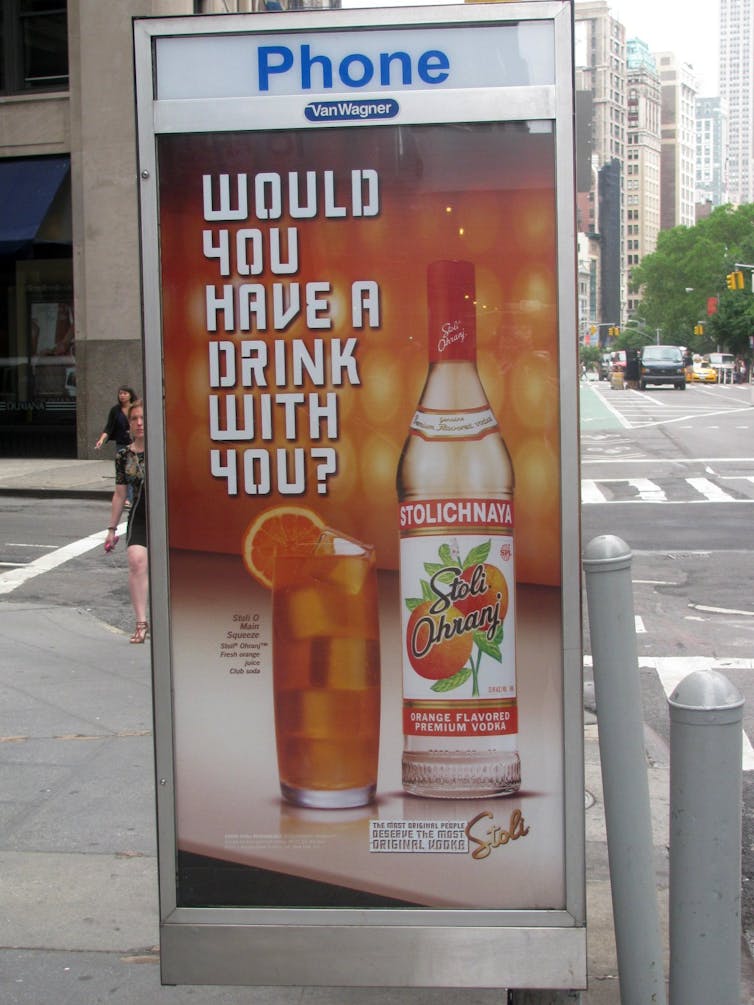
Bar owners in the US have dumped Stoli Vodka, which is actually made in Latvia by a company headquartered in Luxembourg. The action may be symbolic but it is nonetheless misguided.
When Benito Mussolini declared war on Britain on June 10, 1940, there were riots across the UK. Italian shops were looted, Italian businesses had their windows smashed.
Similar scenes have played out recently across the US, with Russian restaurants having their premises vandalised. Both then and now, however, there is confusion over which businesses genuinely belong to “the enemy”. And no consideration is given to the suffering caused to innocent civilians caught in the crossfire between their native country and their country of domicile.
A lack of geographic knowledge and understanding among the general public has always caused issues in times of war. Ukrainians and Latvians are currently being targeted because people mistakenly think they’re Russian.
This is merely people’s continued manifestation of xenophobic bullying based on a desire to “do” something but with little understanding of how best to direct their anger. During the second world war, Asian Americans wore badges stating they were not Japanese, in order to stave off attacks on themselves or their property. Similarly, in the UK, the US and elsewhere, businesses whose names include the word “Russian” are having to change to names less likely to attract attention from xenophobes.
Luxembourgeois company SPI has had to change the Russian name of its vodka, which is made in Latvia, to Stoli, after being boycotted.
Eden, Janine and Jim | Flickr, CC BY
Civilians harmed
More concerning are the calls for deporting ordinary Russian citizens from western countries, even if they are opposed to Putin and his regime. In scenes that directly echo the treatment of so-called “enemy aliens” during the second world war, shortly after Russia invaded Ukraine, Californian congressman Eric Salwell suggested “kicking every Russian student out of the United States” as a means of retaliating against Putin.
In the UK, the MP for North Thanet in Kent, Roger Gale, went even further. He called for all Russians to be “sent home”, even though he acknowledged that many “good and honest” people would be caught as “collateral damage”. During the second world war, much harm was inflicted on innocent bystanders because of policies like these.
Most Italians who suffered during the rioting had lived in the UK for decades and held strong loyalties to Britain. This did not stop male Italians who had lived in the UK for less than 20 years from being interned behind barbed wire in camps on the Isle of Man, deported to camps in Canada or Australia, or, tragically for some, perishing on the torpedoed Arandora Star.
In the US, meanwhile, Japanese immigrants had called the west coast their home for decades before the attack on Pearl Harbor in December 1941. They had raised their children and grandchildren as proud American citizens. Had anti-Asian legislation not existed to prevent Asians from naturalising, many Japanese immigrants would have become American citizens like their American children.
Denied this opportunity, all those with Japanese ancestry – including their Japanese American children, who were American citizens by right of their birth – were forcibly removed from their homes and places of work and incarcerated behind barbed wire. Research has shown the lasting trauma this has caused and how this was done in a manner tantamount to ethnic cleansing.
Calling for all Russian citizens to suffer for the actions of Vladimir Putin does nothing to place meaningful pressure on the Russian government. Death threats, damage to property, physical attacks and cyber stalking do nothing to help Ukrainians. This is simply bullying.
A clear distinction must be drawn between Russian government officials and those Russians who have earned their wealth via corruption and support of Putin, who need to be sanctioned, and ordinary Russian citizens living abroad. The latter find themselves in a dangerous situation, regardless of how staunchly they oppose their government’s invasion of Ukraine.
Many Russian citizens and Russian speakers –- which includes many Ukrainians – are suffering xenophobic abuse. If history is to be repeated, they are at risk of incarceration, and even deportation. What Ukraine needs is political, military and humanitarian assistance, not hatred directed at innocent Russian citizens living in the west.
Rachel Pistol does not work for, consult, own shares in or receive funding from any company or organization that would benefit from this article, and has disclosed no relevant affiliations beyond their academic appointment.
Former Miss Ireland, Chelsea Farrell, recently shared the story of how she ended up in the emergency room in severe pain with a twisted ovarian cyst.
After over two-and-a-half years of symptoms, Farrell found out she had endometriosis, polycystic ovary syndrome (PCOS) and an ovarian cyst. She had suffered pain, irregular periods, bloating and pain during sex, but thought this was normal.
Farrell’s story isn’t unique. Many women face difficulties getting diagnoses, care and treatment for such conditions – with some women even reportedly waiting up to 12 years for help.
There are many complex reasons behind why women with these conditions wait so long for proper help and treatment. But part of it comes down to how women’s pain is often normalised and dismissed in healthcare settings – and even society more widely.
Working to make a difference in the world but struggling to save for a home. Trying to live sustainably while dealing with mental health issues. For those of us in our twenties and thirties, these are the kinds of problems we deal with every day. This article is part of Quarter Life, a series that explores those issues and comes up with solutions.
In 2020, an Oxford school caused controversy after suggesting girls should not miss school because of period pain. It reportedly stated: “Learning to deal with a monthly inconvenience is all part of being a woman.”
Not only does this show a lack of understanding of how debilitating menstrual pain can be, but also how girls are taught early on to endure pain rather than to seek help or medical advice.
This could also mean girls living with possible signs of endometriosis or PCOS won’t seek the help that they need. In fact, many women with PCOS or endometriosis report they felt expected not to to complain and “get on with it”, and to accept that “it’s a woman’s lot to suffer.”
This attitude means that women are often not involved in their own care and that their complaints are often dismissed as “women’s problems”. This “arrogant culture” of not taking women’s concerns seriously has even led to decades of medical scandals, avoidable patient harm, and needless suffering.
Unnecessary wait
For the last decade, the average wait for an endometriosis diagnosis in the UK is eight years. Patients often have up to ten doctor visits before being diagnosed.
For PCOS, it can often take more than two years and appointments with around three doctors for a diagnosis. Both endometriosis and PCOS are complex conditions with symptoms that may vary widely and also resemble other conditions. So, the diagnostic process is also complex, which explains to some extent why diagnosis is slow.
But complexity around diagnosis is not just about symptoms. The UK government’s recent Women’s Health Survey captured how women continue to be dismissed and ignored when seeking care. It can be difficult for them to put their pain into words and they report not always being believed.
Having their pain dismissed leads many women on a quest for “credibility” in the hopes of being believed that symptoms are not just “in their head”. But when your experiences aren’t believed by healthcare professionals, it can lead to lower self esteem and even depression.
Gender health gap
The struggles that many women experience when trying to receive a diagnosis for these types of conditions is part of a larger problem when it comes to women’s health. Historically, women have experienced inequality in the kind of healthcare and treatment they have received – which is known as the gender health gap.
The gender health gap may explain why women are more likely to suffer poorer outcomes when treated by male doctors. It may also be why women are more likely to die from heart attacks, as their symptoms can be different from men’s, whose symptoms still dominate medical textbooks and messaging around first aid.
Women’s pain is treated less aggressively than men’s even when they rate it more severely, it lasts longer or occurs more often.
The gender health gap is even wider for black women living in the US and UK. Black women are less likely to be diagnosed with endometriosis than white women. They’re also more likely to develop uterine fibroids and are significantly more likely to have debilitating symptoms because of them.
While problems with women’s health are increasingly being recognised, repeated calls in the past to raise awareness and education for girls, women, and healthcare professionals haven’t led to much-needed change. It’s essential that better, evidence-based resources are developed for both women and health professionals to ensure that every woman – no matter her health needs or experiences – can receive the right care.
But it’s simplistic to assume that the difficulties women face in accessing equitable healthcare and the right diagnosis will be solved by more information alone.
We must also address the larger societal issues of stigmatising and de-prioritising women’s health, the inadequate funding for women’s health research and the implicit gender and racial biases that underpin current health inequalities.
It’s unlikely that significant changes in the way women’s healthcare is delivered will happen anytime soon. So for now, it will be important that women continue to advocate for their own health.
If you suspect you may have endometriosis or PCOS, continue to seek help. Consider keeping track of your pain and symptoms so you can discuss them with your GP. Remember, pain is not something you have to put up with.
Anne-Marie Boylan has received funding from the National Institute of Health Research (NIHR).
Annalise Weckesser has received funding from NIHR and ESRC previously.
Sharon Dixon work on endometriosis in primary care was funded by the National Institute for Health Research (NIHR) School for Primary Care Research (project number: 403).
by Margaret M. Russell, Associate Professor of Law, Santa Clara University
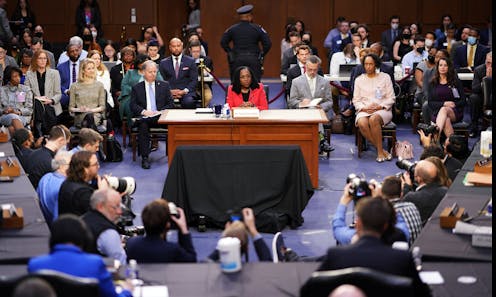
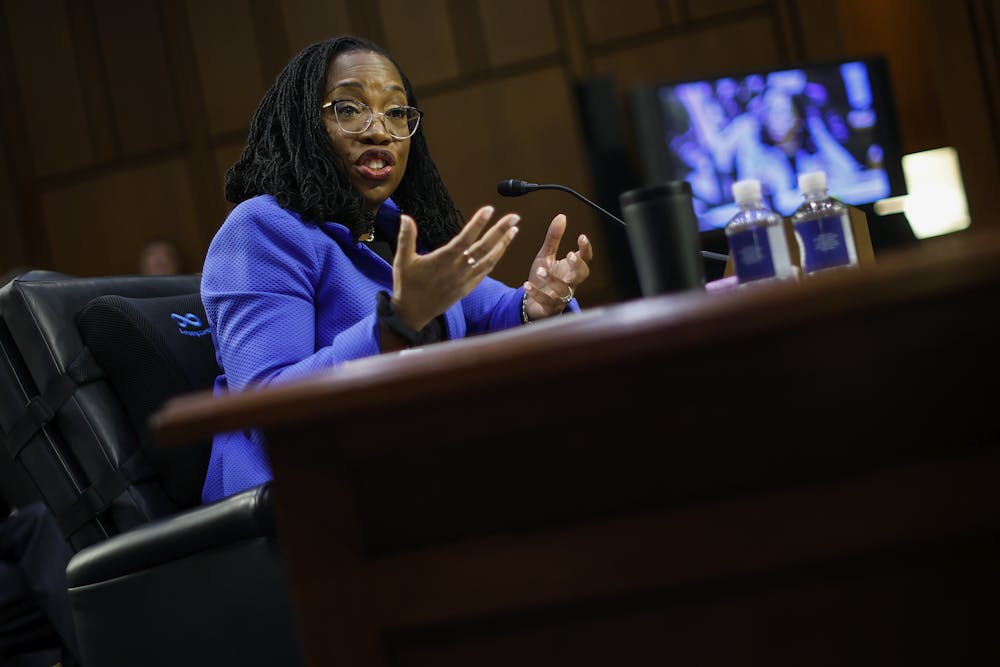
Ketanji Brown Jackson, speaking during her confirmation hearing on March 22, 2022, would be the first Black woman to serve on the court. Doug Mills-Pool/Getty Images
U.S. Sen. James Eastland posed a question to U.S. Supreme Court nominee Thurgood Marshall during his August 1967 confirmation hearings.
“Are you prejudiced against white people in the South?”
Eastland, a known white supremacist,
could not be clearer in conveying his fears about Marshall and race.
Fifty-five years after Marshall’s hearings, U.S. Sen. Marsha Blackburn asked a similar question of Supreme Court nominee Ketanji Brown Jackson on March 22, 2022, during Jackson’s Senate Judiciary Committee confirmation hearings.
“You have praised the 1619 Project, which argues the U.S. is a fundamentally racist country, and you have made clear that you believe judges must consider critical race theory when deciding how to sentence criminal defendants,” Blackburn said. “Is it your personal hidden agenda to incorporate critical race theory into the legal system?”
However, Blackburn – and other Republican senators – injected race-baiting into Jackson’s confirmation hearings.
President Joe Biden nominated Jackson, 51, on Feb. 25, 2022, to fill Justice Stephen Breyer’s seat, shortly after Breyer announced his retirement plans. Biden had publicly promised during his 2020 presidential campaign to nominate a Black woman to the high court.
Jackson’s confirmation hearings are scheduled to end on March 24. The entire Senate, which is evenly split between Democrats and Republicans, is expected to confirm Jackson after the proceedings, with Vice President Kamala Harris serving as a tie-breaking vote. It’s also possible some Republicans could vote in Jackson’s favor.
As a constitutional law professor who focuses on the Supreme Court, I find it striking that race has surfaced in such a major way in these hearings, more than five decades after Marshall’s nomination. In some respects, there has been progress on racial equity in the U.S., but aspects of these hearings demonstrate that too much remains the same.
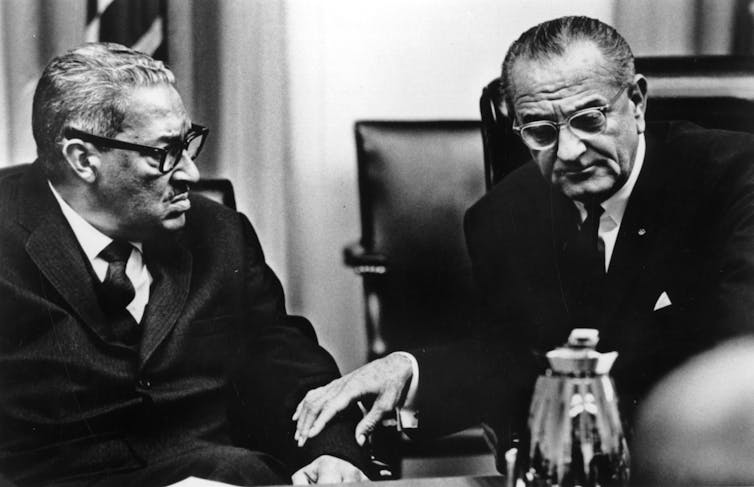
Justice Thurgood Marshall, left, talks with former President Lyndon Baines Johnson following Marshall’s appointment to the Supreme Court in August 1967.
Keystone/Getty Images
Some common ground
Marshall was the first African American man who served on the Supreme Court. If confirmed, Jackson will be the first African American woman on the court.
The full Senate’s final vote on Marshall reflected divisions based on racial desegregation and Marshall’s past as an NAACP lawyer, rather than a straight partisan split. President Lyndon B. Johnson, a Democrat, nominated Marshall.
But most Southern Democrats voted against him. Sixty-nine senators – 37 Democrats and 32 Republicans – voted to confirm Marshall. Eleven senators – 10 Democrats and one Republican – voted not to confirm, and 20 senators – 17 Democrats and three Republicans – dodged their senatorial voting responsibilities entirely and were recorded as “not voting.”
Jackson is now a judge on the U.S. Court of Appeals for the D.C. Circuit. Breyer and other legal experts have routinely praised Jackson’s intellect and legal experience. Jackson has also worked as a federal trial court judge, vice chair and commissioner on the U.S. Sentencing Commission, private law firm lawyer and federal public defender. She also served as a judicial clerk for Breyer.
The American Bar Association Standing Committee on the Federal Judiciary unanimously rated Jackson “well qualified,” its highest ranking.
Twenty-seven Republican senators have also previously voted to confirm Jackson for her federal court positions.
But Jackson has faced arduous and sometimes histrionic cross-examination during her hearing. Certainly, partisan hostility and political theater have marked every Supreme Court nomination for decades.
Jackson’s hearings, however, stand out. They have been drenched in questions about race, both obviously and not so obviously, most caustically from Sens. Blackburn, Ted Cruz, Josh Hawley and John Cornyn.
On March 22, Cruz questioned Jackson about the teaching of critical race theory at Georgetown Day School, a private school where she serves on the board of trustees.
Jackson, like Marshall, fielded the charged questions in a straightforward manner.
“Senator, those ideas, they don’t come up in my work as a judge, which, respectfully, is what I’m here to discuss,” Jackson said.
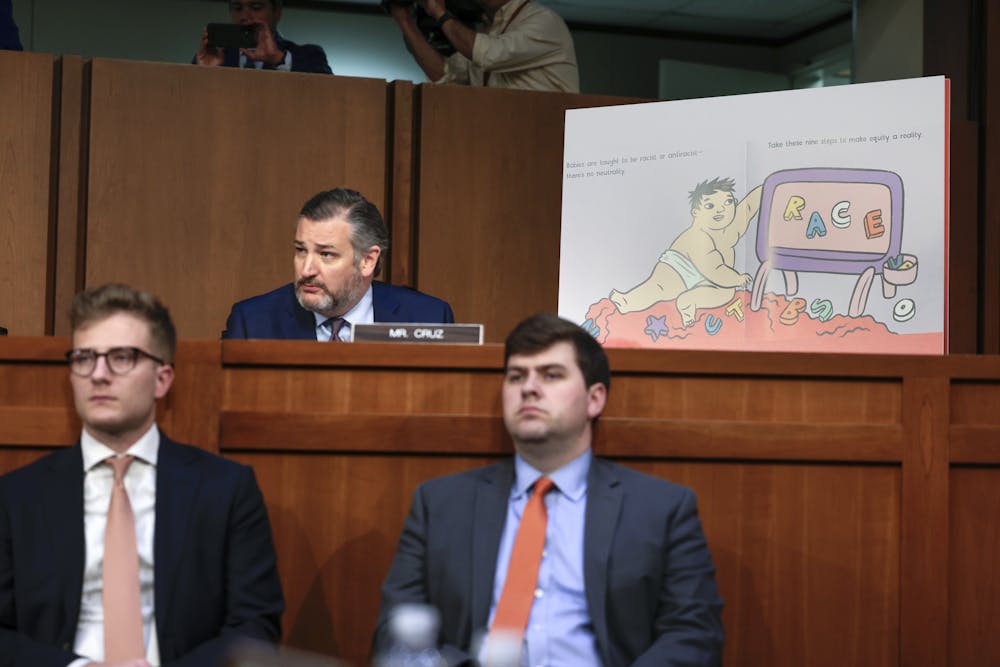
Sen. Ted Cruz questioned U.S. Supreme Court nominee Judge Ketanji Brown Jackson on critical race theory during her March 22 confirmation hearing.
Anna Moneymaker/Getty Images
A preoccupation with crime
In addition to the explicit interrogations of Jackson’s views on race, her hearings – like Marshall’s – have featured a preoccupation with the nominee’s views on crime.
Republican senators have repeatedly accused Jackson of being soft on crime – specifically, that she was lenient as a trial judge in sentencing child pornographers.
Fearmongering about crime often carries a racialized connotation, whether blatant or unspoken. Media distortions and carceral inequities fuel the myth that Black and brown men are presumptively criminal.
Jackson’s actual sentencing record reveals no anomalies or disproportionate leniency when compared with that of other judges nominated by both Republican and Democratic presidents.
But Jackson’s hearing was a flashback to Marshall’s August 1967 confirmation hearing, when Sen. John McClellan questioned Marshall and suggested that he did not take crime seriously.
“First, I would ask you if you do not agree with me that the mounting incidence of crime in this country has reached a critical stage,” McClellan said. “How do you plan to deal with it? … Do you think it is reaching proportions where we will have a reign of lawlessness and chaos?”
Marshall answered the questions politely, never hinting at the offensiveness of the implication that he somehow supported crime and lawlessness.
Republicans’ treatment of Jackson
Republicans now sitting on the Senate Judiciary Committee have conflated legal representation of criminal defendants with a disregard for the rule of law and public safety.
Republican Sens. Blackburn, Lindsey Graham, Cruz, Hawley, Tom Cotton and Cornyn have gone far beyond insinuation to outright vilification of Jackson’s legal representation of criminal defendants.
Blackburn incorrectly said on March 21 that Jackson “consistently called for greater freedom for hardened criminals.”
Cornyn incorrectly accused Jackson of using the phrase “war criminal” to describe former President George W. Bush and former Secretary of Defense Donald Rumsfeld during the course of her legal work for Guantanamo detainees.
Cotton incorrectly said she “twisted the law” as a judge in applying the law of compassionate release, in which inmates can be released if they are very sick or elderly, for example. Cotton also suggested that she was “sympathetic” to a “fentanyl drug kingpin.”
U.S. Supreme Court nominee Ketanji Brown Jackson testifies during her confirmation hearings on March 23, 2022.
Chip Somodevilla/Getty Images
Transformative change is slow
Like the Dixiecrat senators – Democratic senators from the South who believed in white supremacy – who grilled Marshall about his views on crime, the present-day Senate Judiciary Committee Republicans have repeatedly insinuated that Jackson is soft on crime for performing her job responsibilities as a defense lawyer and trial judge in a manner that has been shown to be well within the mainstream of these legal roles.
This racialized fearmongering brings to mind the divisive political tactics of the Willie Horton advertisement during the 1988 presidential campaign. That advertisement linked crime with African American men, and then linked both to Democratic presidential candidate Michael Dukakis, who eventually lost the race to Republican George H.W. Bush.
Marshall’s confirmation was a giant step forward in Supreme Court and U.S. history, but along the way he faced Senate Judiciary Committee questions that were race-baiting, arrogant, irrelevant and picayune.
Jackson’s historic hearings have unfolded in a similar way. In all likelihood, Jackson will become the next justice of the U.S. Supreme Court, representing another momentous step forward for this country. But it is also another reminder that transformative change on race, while continuing to progress, happens slowly in the U.S.
Margaret M. Russell serves as a chapter faculty adviser and lawyers council member for the American Constitution Society.
The act aims to reform the relationship between online service providers and content creators by promoting the use of “standard technological measures” that would, theoretically, help prevent infringing material from being reuploaded to the service after it is removed.
However, critics have also lined up against the bill, including Re:Create, a tech-backed organization that calls for “balanced copyright”.
The prospects for this bill are, in general, seen as not good. According to an article on Politco, not only has there been no similar legislation introduced in the House of Representatives, but the bill faces an uphill climb against both the tech industry and other legislative priorities.
Still, it is an interesting piece of legislation and represents a new direction in copyright discussion. However, as we will quickly see, it’s not that the concepts themselves are new, just the possibility of them being enforced so broadly.
Background on the SMART Copyright Act
Understanding the SMART Copyright Act actually first requires a revisit of the Digital Millennium Copyright Act (DMCA), which was passed in 1998.
One of the key parts of the DMCA set up what we know today as the notice-and-takedown system. This system provides safe harbor to online service providers that host content for their users. This protects sites from the site of Facebook and YouTube all the way to small forums and image hosts.
In short, such providers cannot be held liable for copyright infringement by their users as long as they meet certain criteria. Among that criteria is that they designate a DMCA agent to receive notices of copyright infringement and then work to remove or disable access to any works they are notified about.
However, the law also requires that such providers must “accommodate and not interfere with standard technical measures (STM).” However, that element of the law has largely fallen off the radar. It is rarely enforced and rarely applied.
According to the Senators, this is for two reasons. First, hosts and other service providers fear losing safe harbor security if they implement such tools. Second, the original definition of an STM was so narrow that none have been identified since the law passed 20+ years ago. This is despite the fact that multiple technological solutions exist, many of which are already in use, that could fill that role.
The SMART Copyright Act aims to address that issue, and it does so through a process that is both novel and familiar.
Breaking Down the SMART Copyright Act
The SMART Copyright Act aims to identify and name STMs by handing the issue over the U.S. Copyright Office and the Librarian of Congress.
Specifically, the act creates a rulemaking process, which would be overseen by the Librarian of Congress, The process would be a public one where all relevant parties are represented as well as public comments accepted.
In short, every three years the Librarian of Congress would determine what tools, services or approaches qualify to be considered STM. The rulemaking will also consider what services such an STM would apply to and to what kinds of content they apply to.
From there, the technical measure will become a designated technical measure (DTM). The law makes it clear that such DTMs must be available on nondiscriminatory terms and either royalty-free or on a “reasonable royalty basis.” The goal is to ensure that providers are not overly burdened by this process.
Providers that run afoul of this may be hit with statutory damages. Those damages are capped at $150,000 for the first violation, with subsequent violations multiplying. Whether the provider is an innocent infringer may also be weighed and damages reduced accordingly.
That sections of the DMCA deals with the circumvention of digital rights management (DRM). The DMCA made such DRM circumvention broadly illegal, but allowed the Copyright Office to craft exemptions to the rule, which are determined every three years.
According to the Senators, this process proves that the U.S. Copyright Office has both the ability and the expertise to perform such duties when it comes to STMs.
This likely won’t do much to appease critics of the bill, including tech companies that fear additional regulations and various groups that fear such technology could overreach and harm free speech online.
What Will It Do?
It’s impossible to say what it would look like if this particular bill should pass. The reason is that the bill setups a process for determining what STMs should be used and by whom, but says nothing about what measures could or should be implemented.
In short, all that we know is that, if this bill becomes law, there will be a new rulemaking process on this issue and what that process will entail. We do not know what technological measures will be adopted, who they will apply to, or what kinds of content they will be required to block.
That is deeply frustrating but also unavoidable. The bill recognizes that technology evolves and advances. Tools that were once industry standards fall behind while new ones emerge. Any system that is going to require online service providers to block infringing uploads needs to be flexible.
This was understood with Section 1201 of the DMCA, which is why that rulemaking process was created. This bill simply takes that idea, and applies it to the technological measures to prevent infringing content from being uploaded.
While it’s impossible to predict how the U.S. Copyright Office would implement this, the Section 1201 process has shown that they do tend to be conservative with their use of their powers, reserving it for issues where there is limited dispute. That would likely carry over here.
Still, the uncertainty that this bill creates is understandable and there is simply no way to know for certain what the Copyright Office might carve out if given the chance.
Bottom Line
As I said before, the prospects for this bill do not look particularly great. However, that will likely not be the end of it. The CASE Act, for example, was only passed in 2019. That act created the Copyright Small Claims Board, an idea that had its roots as far back as 2006.
Even if the SMART Copyright Act doesn’t progress very far, it’s kicking off a new conversation in copyright. The idea likely will be back again and again, especially with the backing of so many rightsholders.
This is an idea and a direction that is likely going to be talked about a great deal more over the coming years. Even if it doesn’t pass this go around, it’s almost a guarantee that we’ll see this concept come up in the future.
After all, it’s an idea that’s literally 23 years in the making.
You may have noticed a whole bunch of stories about copyright lawsuits lately against famous musicians for having songs that sound just kind of like some other songs. I’d been meaning to write up something talking about all of these stories about how Ed Sheeran is supposedly a “magpie” who “borrows” songs, or about how Dua Lipa was sued not once, but twice, claiming her song “Levitating” infringes on the copyrights of others. Or maybe about how it took Katy Perry eight years to finally have an appeals court note that she didn’t actually infringe on someone else’s copyright.
But then I came across this moderately infuriating Guardian article talking about a few of these cases, and saying that “music industry figures” are claiming that all of these lawsuits show how copyright needs to change because “making music is so different to how it was 50 years ago.”
Hayleigh Bosher, associate dean of intellectual property law at Brunel University, who researches the music industry, said “the law needs to move with the times” as “making music is so different to how it was 50 years ago”.
She added: If Sheeran loses, I imagine we will see even more cases. I don’t think copyright is doing its job properly if songwriters are afraid, that’s stifling creativity.”
And, yes, obviously, copyright law needs to change. These lawsuits are crazy, and we’ve been saying that for a long while now.
But there seems to be something worth noting when the industry is only starting to come around on this because of a bunch of lawsuits targeting famous white songwriters. Because for all the talk about how “music is so different” today, we went through another period of time when a whole bunch of brilliant musicians were sued over copyright infringement… and the response from the industry was a lot more muted.
Back in the late 80s and early 90s there was a flood of sampling lawsuits — almost all of which were targeting hip hop artists. And then you had crazy legal rulings like Bridgeport Music v. Dimension Films in which a court announced “get a license or do not sample” and (ridiculously) “we do not see this as stifling creativity in any significant way.”
But did we see the music industry screaming about how we needed to fix copyright laws back then? Nope. If you haven’t seen it, I highly recommend watching Kembrew McLeod’s one hour documentary Copyright Criminals (which, apparently, is now available on YouTube), which does such a great job of showing how copyright basically destroyed a whole genre of hip hop music, but the industry didn’t much care, because hip hop involved mostly artists of color, rather than white pop music.
One great line in that documentary is that after someone says that hip hop artists sampling other musicians is “lazy,” someone notes that it’s not that different than saying a photographer is lazier than a painter because they just snap a picture of what’s already there, rather than painting it from scratch.
The simple fact is that copyright law has gotten in the way of creativity for ages. Creativity has always been based on building on the works of people who came before you. Sometimes it’s homage. Sometimes it’s appropriation. Sometimes it’s just because there are only so many ways certain notes can be played together.
But if people are getting sued over creating new music, and musicians are now afraid of getting sued for making music, then it’s a huge problem. And it was a huge problem in the 80s, 90s, 2000s and today. Perhaps it’s good that more people are realizing how broken the system is and how it’s stifling creativity, but it does seem at least slightly infuriating that it’s only once it’s famous white pop singers are facing the same thing that black hip hop artists faced in the 80s and 90s that its treated as a “real” problem.
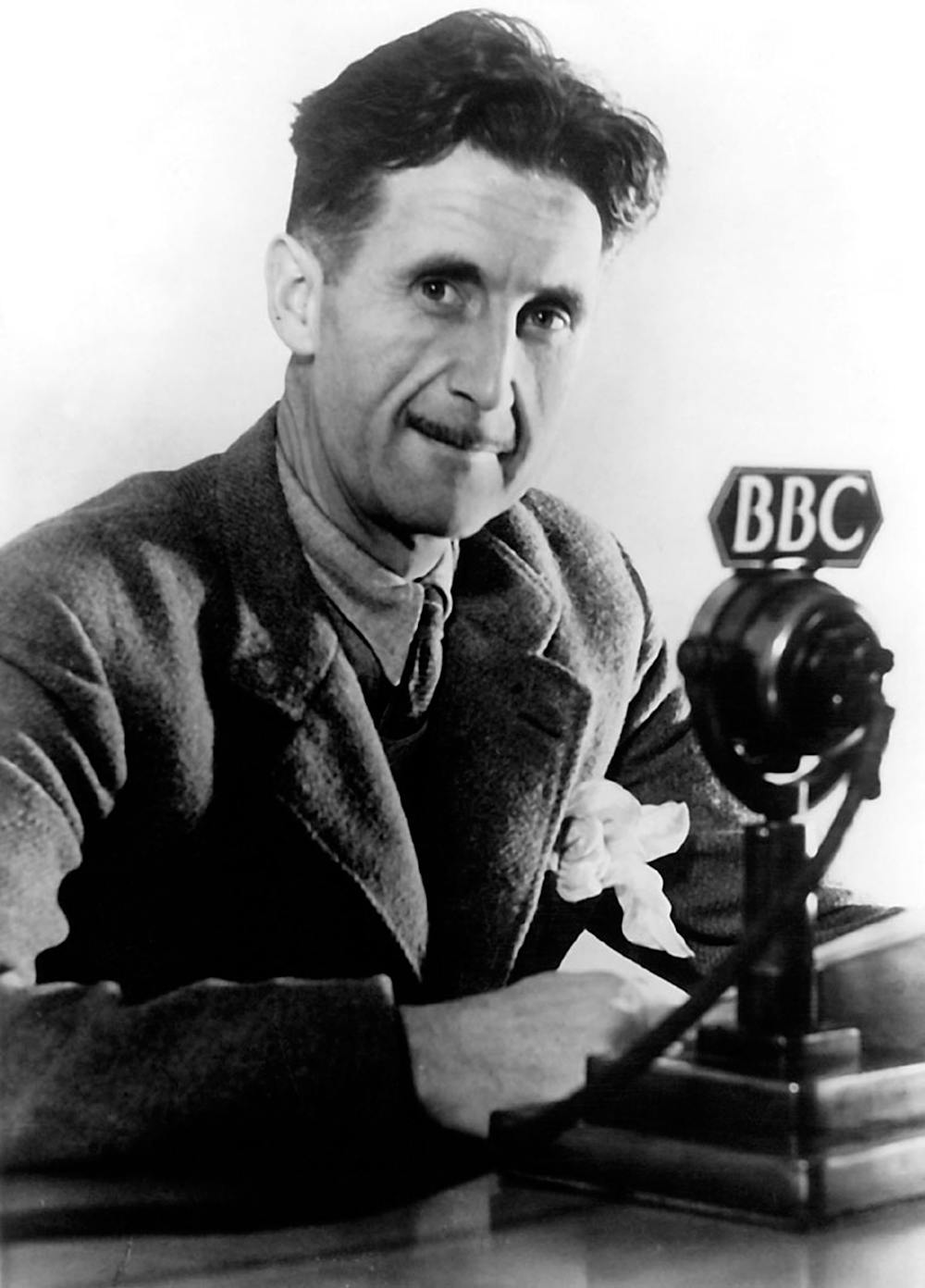
· hatred of authoritarianism · deep concern over the corruption of language and politics by lies, propaganda and poor writing · propensity to value clarity of language and honesty of intentions · vehement rejection of totalitarianism of any hue, left or right · genuine belief in equality and democracy · love of private life and all its pleasures and joys · distaste for supervision and intrusion
by Robert Nasi, Director General, Centre for International Forestry Research
Shutterstock
Africa’s forests are some of the natural wonders of the world. As someone who has spent decades studying the ecology and management of tropical forests, I’m constantly amazed by the unique forest ecosystems on the continent.
Some of them are most likely unknown to the public at large, yet so fascinating and important to face our world’s current biodiversity and climate challenges. Starting in the north-west and ending in the south-east, I’d like to share the ones that are special to me. This is a totally personal choice; others would have chosen other unique African forests, so large is the choice. But for how long?
African forests, like many others, are threatened by over-exploitation, conversion to other land uses and climate change. Many will likely disappear or be degraded to such an extent as to pass tipping points and become something else, something less.
I hope this trip across Africa will help raise interest and trigger the urge to better conserve and manage these unique ecosystems.
Morocco’s argan trees
Not far from Agadir, on the Moroccan Atlantic coast, grows the argan tree (Argania spinosa). It is the only member of the large Sapotaceae family growing in the northern hemisphere, the only species of its genus and endemic to an area of about 800,000 hectares.
Argan tree.
Liubov Mikhailova/Shutterstock
It’s been exploited and managed by humans for more than 3,000 years for argan oil. Argan oil is the most expensive oil in the world, costing up to US$300 a litre in a US$500 million market. Argan oil is perhaps most commonly used as a moisturiser and is often found in products such as lotions, soaps and hair conditioners.
In addition to the oil, argan trees are also a source of wood for fencing, charcoal and fodder for goats. It’s a true multipurpose tree, critical especially for women’s livelihoods.
Unfortunately, despite its status as a UNESCO biosphere reserve, the argan forest is slowly dying from over-grazing, deforestation and climate change. Hopefully the argan oil boom will help to conserve and restore this unique forest ecosystem.
An argan forest.
Kokhanchikov
Congo Basin rainforest
Flying south-east, over the Sahara Desert and the Sahelian savannas, we reach the Congo Basin rainforest.
The Congo Basin rainforest is the second largest rainforest in the world (after the Amazon). It’s home to many forest giants, trees like the Sipo or Moabi. These and other giants are the origin of precious timber but also of important resources for local people, such as food and medicines. It’s also home to animals like forest elephants, buffaloes, and lowland gorillas.
Western lowland gorilla in the forest.
Photo by: Education Images/Universal Images Group via Getty Images
Deep in the heart of the Congo Basin forests lies the largest peat swamp forest of the world. Only recently “discovered” by science, this place was known by the Aka community who live there as the place where roamed the Mokele Mbembe, a mythical dinosaur-like monster the size of an elephant.
No one has never seen it but now we know that this peatland forest stores more than 30 billion tonnes of carbon. Should these be released, by clearing the forest above, into the atmosphere, we will have unleashed a much worse monster than the Mokele Mbembe.
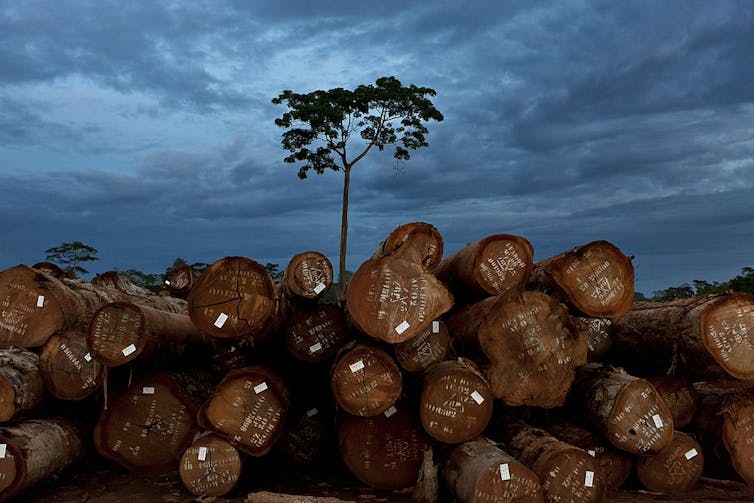
Logging in Cameroon.
Photo by Brent Stirton/Getty Images
Fortunately, because of its remoteness and difficulty of access, the Congo Basin peatland complex has been naturally protected till now, but it could be threatened soon by oil exploration should we not pay attention.
East Africa’s Afromontane forests
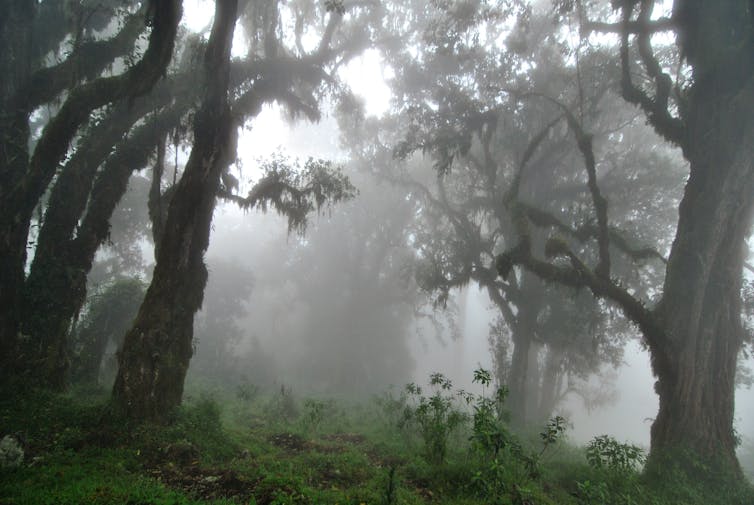
At the eastern border of the Congo Basin rise the Ruwenzori mountains. On the mountain slopes are the last Afromontane forests.
These forests are home to the tallest tree in Africa, a whopping 81.5 metres tall Entandrophragma excelsum hidden in a remote valley of Mount Kilimanjaro.
Lena Ha/Shutterstock
These forests harbour a high level of endemism – meaning many of the trees can only be found here – and biodiversity. They also act as water towers, regulating and providing water for the lowlands and their inhabitants.
These Afromontane forests store more carbon per hectare than the Amazon rainforest. Sadly, in the past 20 years, 0.8 million hectares of mountain forests have been lost to agriculture. This is mostly in the Democratic Republic of the Congo, Uganda and Ethiopia. This has resulted in over 450 million tonnes of carbon dioxide being emitted into the atmosphere.
Miombo woodlands
Continuing our journey down south, we soon reach the immense area of Miombo woodlands. They span an estimated total area of around 2.7 million km² from Angola in the west to Tanzania in the east, and down to the northern edge of South Africa.
Over 65 million people rely on these ecosystems for their livelihoods, making use of resources such as fuelwood, timber, charcoal production, fruits, honey, mushrooms, medicinal plants, and fodder for livestock.
One tree species only makes the canopy, Colophospermum mopane.
They are an important ecosystem for large mammal diversity and biomass in southern Africa, including some of the most significant remaining populations of black rhinoceros, elephant, white rhinoceros, hippopotamus, buffalo, giraffe and greater kudu.
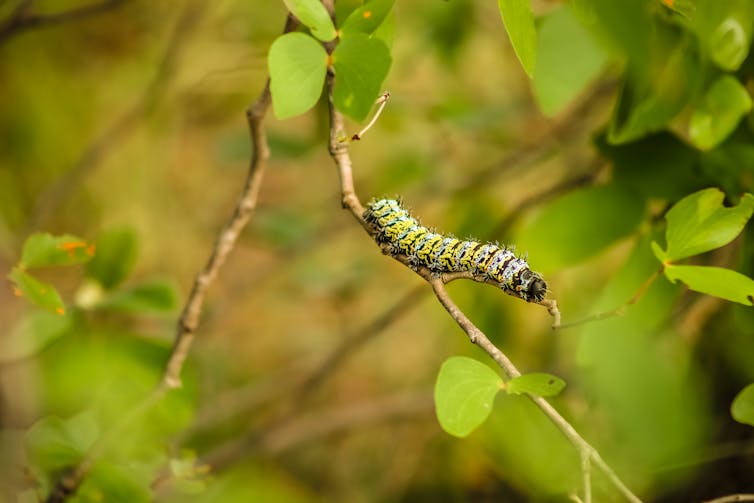
The forest is also the only source of a less emblematic but very important animal: the mopane worm. Gonimbrasia belina, by its Latin name, is a very important seasonal source of protein for the populations living near mopane woodlands.
Mopane worm.
Shutterstock
Unfortunately, decline in mopane tree density, lower-than-normal precipitation, and higher-than-normal temperatures have significantly affected mopane worm availability and outbreak events, threatening the already precarious livelihoods of local populations.
Madagascar’s Spiny Forest
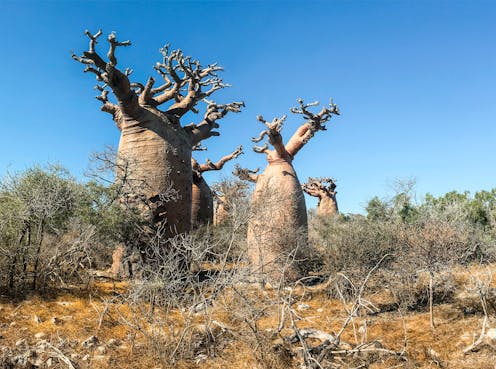
Crossing the Mozambique channel, we arrive in Madagascar. On the south-west of the “Grande Ile” grows the Spiny Forest. It’s a place like nowhere else on Earth, where endemic oddities like the octopus tree (Didierea madagascariensis) and other strange members of the Didieraceae family grow mixed with swollen baobabs (Adansonia rubrostipa) and other bottle trees (Pachypodium geayi).
The Spiny Forest is inhabited by even weirder animals, ghostly white lemurs impervious to thorns, birds that sing communally and a chameleon that spends most of its life as an egg.
Unfortunately like the other unique forest wonders of Africa, the Spiny Forest is threatened by over-exploitation for charcoal production as local farmers have been put out of business by the more and more unpredictable climate and have few other opportunities in the impoverished and dry Madagascar south-west.
We have reached the end of our trip over Africa. Our choices are subjective and we could have presented other forest wonders but we hope this will be enough to convince you of the importance of these ecosystems and of their threatened status because of us, humans. We should better protect and manage these ecosystems as we depend on them for our survival.
Robert Nasi does not work for, consult, own shares in or receive funding from any company or organisation that would benefit from this article, and has disclosed no relevant affiliations beyond their academic appointment.
by John Casellas Connors, Assistant Professor of Geography, Texas A&M University
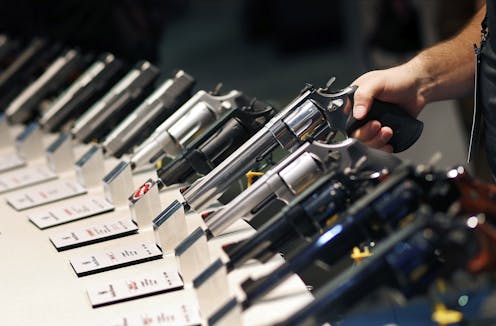
Smith & Wesson handguns on display at the Shooting, Hunting and Outdoor Trade Show in Las Vegas, Jan. 19, 2016. AP Photo/John Locher
Gun and ammunition sales in the U.S. have skyrocketed in recent years. And although it may come as a surprise, this trend has supported conservation activities.
That’s because every firearm and bullet produced or imported into the U.S. is subject to an excise tax dedicated to wildlife conservation and restoration. In 1998, these taxes generated about US$247 million in inflation-adjusted apportionments to state fish and wildlife agencies from the federal U.S. Fish & Wildlife Service, which collects and manages these funds. By 2018, these revenues had more than tripled to $829 million.
These taxes on guns and ammunition sales provide a growing share of budgets for state fish and game agencies. But as scholars of environmental politics, conservation and wildlife management, we have found that the growth in conservation funding driven by exploding guns sales presents at least three critical moral and ethical issues.
First, the original argument for using gun taxes to fund conservation was that most gun users were hunters who used lands and wildlife, and should help to support those resources. But our research shows that gun use is increasingly unrelated to hunting.
Second, the recent spike in gun sales is linked to violence and social unrest. Even if most gun owners never commit a crime, this means that overall, conservation is benefiting from gun-related social strife and harm.
Finally, recent changes to the law allow the use of gun-related excise taxes to support activities with little or no connection to hunting, wildlife or outdoor recreation.
Hunting and fishing fees are an important funding source for conservation in the U.S. But as hunting declines, gun-related conservation funding increasingly comes from firearms and ammunition sold for other purposes.
A marriage of guns and conservation
At the end of the 19th century, many wild species across the U.S. were threatened by over-hunting and unregulated markets for wild game products. Companies used bison bones to make “bone china” and bird plumage to decorate hats. Many species were hunted to the brink of extinction. Some, like the passenger pigeon, were fully exterminated.
In an effort to restore game populations for sport hunters, federal and state governments established fish and wildlife agencies. But these offices were often underfunded.
The Federal Aid in Wildlife Restoration Act of 1937, commonly known as the Pittman-Robertson Act, increased conservation funding by redirecting an existing excise tax on firearms to a dedicated wildlife management fund. Over time, the law expanded to include excise taxes that manufacturers today pay on long guns, handguns, ammunition and archery equipment. To access these funds, states must use fees from hunting licenses exclusively to support fish and wildlife agencies.
Pittman-Robertson funds make up a large fraction of state fish and wildlife agency budgets. In 2018, for example, we estimate that about 25% of the Ohio Division of Wildlife’s $62 million appropriations came from excise taxes generated by Pittman-Robertson. In Massachusetts, the number was 43%.
Since the early 2000s, however, gun and ammunition sales have begun to disconnect from hunting. Nationally, the number of hunters declined from a peak of 17 million in 1982 to 11.5 million in 2016. By comparison, in the same year, Gallup estimated that about 93 million Americans owned guns.
These numbers suggest that only about 1 in 8 gun owners hunted in 2016. This pattern echoes a 2015 analysis by Southwick Associates, a consulting firm that works closely with the firearms industry, that found that 80% of firearms sales in 2015 were for nonhunting activities like sport shooting, gun collecting and self-defense.
Although most guns sold in the U.S. will not be involved in violent crimes, Pittman-Robertson does not differentiate between firearms and ammunition used for hunting and sport shooting versus those that are used to harm people. The guns and bullets involved in over 45,000 gun-related deaths in 2020 generated excise taxes used to fund wildlife conservation. This means that protecting public lands and wildlife is irrevocably linked to social violence. It is also why some commentators worry that gun regulations could hurt conservation efforts.
Sandhill cranes at the Whitewater Drew State Wildlife Refuge, near McNeal, Arizona.
Leah Moffatt/Flickr, CC BY-SA
Wildlife conservation is benefiting from the fear, racism and sustained social conflict that drive gun sales. This raises a moral question: Is this the right way to fund conservation?
Promoting nonhunting gun use
As gun sales grow, the firearms industry has pushed to use Pittman-Robertson funds to support nonhunting gun uses. Gun manufacturers and sportsmen groups endorsed a set of reforms to Pittman-Robertson that became law in 2020. These changes allow state and federal agencies to use Pittman-Robertson funds to promote recreational shooting and purchase land for shooting ranges.
Other groups have proposed ways to make wildlife conservation less dependent on guns.
One idea from some backcountry hunters and Forest Service employees is to create a “backpack tax” on equipment used for outdoor activities like hiking and birding. The outdoor industry has opposed these proposals, arguing that it is impossible to discern the actual use of outdoor products, and that such taxes may create more barriers for low-income individuals to participate in outdoor activities.
Another proposal – this one embraced by the outdoor industry – asserts that Congress should leverage existing funds from other sources to support conservation. Moving away from funds generated by hunters could also give state agencies greater freedom to undertake projects for species other than popular game like deer and elk, which often are the focus of state conservation policies.
This idea has bipartisan support and is moving through Congress as part of the Recovering America’s Wildlife Act. That bill would direct $1.3 billion from the Treasury to the Pittman-Robertson Account, with a dedicated portion for endangered species recovery.
So long as hunting is part of the U.S. model of wildlife management, firearms will be intertwined with conservation. As we see it, though, proposals to change funding sources could help to address the moral concerns that grow out of this relationship, and could create opportunities for more effective conservation.
John Casellas Connors receives funding from the National Science Foundation.
Christopher Rea does not work for, consult, own shares in or receive funding from any company or organization that would benefit from this article, and has disclosed no relevant affiliations beyond their academic appointment.
A new blueprint on open access to digital cultural heritage collections in the United Kingdom (UK) has been hailed as a significant opportunity to prevent historical works from being “locked down” behind copyright walls.
The study concludes there is no consensus in the sector on what open access means, or should mean, and policies across the country vary widely.
The UK’s institutions hold an immense amount of cultural heritage in trust for the public and in stewarding these collections, GLAMs can make use of new technologies and CC licenses and tools to open access to collections online to enable wider public participation. But several institutions still engage in the mistaken practice of claiming copyright over faithful digital reproductions of works.
While the situation is legally clear in the United States and settled at the EU level, where no new rights can arise in reproductions of works of visual art that are in the public domain, it has not been resolved in the UK.
The new report recommends that no new rights should be able to arise in non-original reproduction media generated around public domain works in the UK.
Brigitte Vézina, director of policy for open culture and GLAM with Creative Commons, said:
“GLAMs’ open sharing of public domain heritage content can unlock limitless creativity. When public domain works are widely shared by GLAMs, anyone can reuse them and build upon them to create something new and unexpected. Open access to cultural heritage holds the promise of many benefits for GLAMs themselves, including increased global visibility, new and greater audiences, and enhanced relevance in today’s digital society. This report shows that we must prevent historical works from being locked down and seize the opportunity to deliver open access so that we can advance universal access to and sharing of knowledge and culture, thus fostering creativity, innovation, and collaboration for a brighter future.”
Who isn’t thinking about gas prices these days? For so many, especially those on a fixed income or those in entry-level jobs, pump prices over $4 a gallon can cause considerable financial pain. A local St. Pete bank has some easy tips on how to save gas and prepare for the future.
Climate First Bank in St. Petersburg is offering some solid advice on what to do to save gas money and loosen the grip fossil fuels have on so many lives.
“I think these prices are just a sign of what is to come,” said Lauren Dube’, director of Client and Mission Partnerships for Climate First Bank. “Fossil fuels are a limited resource and as we continue to use them, there is only going to be more wars” and other upheaval in the world revolving around resources that are detrimental to the planet.
As a bank, Climate First focuses on ESG—Environmental, Social and Governance—as its three pillars of business. “Those principles give Climate First Bank a framework to stay transparent and accountable to our mission,” Dube’ said.
Finance, she said, is a big motivator when it comes to deciding about what to invest in. “We can use that as a force for good.”
Going electric
For those who can afford it, now is the time to purchase an electric vehicle, something the bank promotes, Dube’ said. “As the supply of fossil fuels decreases and the demand remains, it impacts prices at the pump. Solar and EV don’t rely on those resources. We have the ability to be independent from those resources as we continue to make changes.”
And changes, such as switching to electric vehicles, will have a positive effect on the environment, she said. “Look at the impact climate change is having on our environment. Global temperatures are rising, which impact sea level, which affects our coastal communities. Car emissions impact pollution levels. All we are doing right now is buying ourselves time, but things are only getting worse.”
Gas prices are having a dire impact on low-income communities, so the bank encourages local communities to build more EV charging networks so more people have access.
Gas saving tips
Keep up with routine vehicle maintenance. Including oil changes and tire pressure to help vehicles run more efficiently.
Drive less aggressively. Avoid speeding, then stopping quickly. It saves gas and makes you a more considerate driver.
Consider joining a carpool. “A lot of people are averse to carpooling, especially with COVID, but if you have friends you are comfortable with, carpooling is a great way to save on gas,” Dube’ said.
Combine errand runs. While running out to the grocery store, hit the post office, the hardware store and the nail salon all in one trip.
Carpool kids to school. For those already hauling their youngster to school, team up with other parents to share rides. If three students are riding, parents can take turns transporting them to school and home each day. “It’s important with gas prices so high and it makes you a better neighbor,” Dube’ said.
Take the most fuel-efficient route. When using a GPS, use the feature that gives an option for taking the most fuel-efficient option. “Every time I pull up my phone, I find new ways to travel that are better on gas, routes I might never have considered,” Dube’ said.
Turn off the car air conditioner during these cooler days of spring. “My grandfather used to always yell at me about the AC in the car,” Dube’ said. “It affects fuel consumption. One thing I try to do is if I don’t need it, I turn it off. If I am only a few miles from home, I turn off the AC and just use the cooled car for those last few miles.”
Leave the car windows down when driving locally. But once a car is on the interstate, driving with the windows down causes a drag, so roll them up.
Be mindful of what might be in your car. Rooftop travel rack? Remove it if it is not in use. That trunk full of tiles? Get them out of the car to drive with more fuel efficiency.
Use mass transit if available. It makes for a more relaxing commute to work without spending so much to travel back and forth.
WFH. Businesses should employees to continue working from home or give them a hybrid schedule, where they only come to the office when necessary.
“Gas can be a good percentage of someone’s income,” Dube’ said. So, using some simple tips can save some of that money.
Many Florida residents are building their backyards for more eco-friendly activities during the summer. If you want your backyard to be a place to learn about native Florida wildlife and connect to nature, follow these tips.
Florida is home to some of the richest and most biodiverse ecosystems in the country. Our everglades, protected wetlands, beautiful beaches, and miles of state park trails offer incredible opportunities to observe and learn about wildlife within your region. However, you don’t have to plan a trip to the park to discover some of Florida’s most incredible wildlife.
Observing the wildlife in your neighborhood is a great hobby that brings you closer to nature and can provide an educational opportunity for yourself and your children. If you want to discover more wildlife in your backyard, the best way is to make your backyard more eco-friendly.
Animals need food, water, and shelter to thrive in any environment. By adding these elements to your backyard, you are more likely to find birds, bugs, reptiles, and other wildlife in your yard and neighborhood:
Add a bird feeder and house
A bird house with a built-in feeder will provide both food and shelter for a variety of native birds. This may also attract squirrels, chipmunks, and other small animals that can feed on the birdseed.
Build a rain garden or bird bath
Animals will be more likely to stay if they have access to water and food. A small rain garden (a garden planted in a depression in the ground that creates a small pond when raining) or a birdbath can offer a source of water for birds, small reptiles, and other wildlife to enjoy. Running water sources can also attract wildlife and are often safer in mosquito-prone areas.
Grow your garden
Gardens provide sources of food, water, and shelter to local wildlife. Edible plants can feed both your family and the local animals, and help keep water in the soil for animals to keep cool in the summer. A lush garden provides plenty of shelter from predators, which will have animals flocking to your backyard to enjoy throughout the year.
Once you’ve created a wildlife-friendly backyard, get out a journal and camera and start recording the changes you see in your backyard. Record what animals you see every day, and how they interact with the ecosystem you’ve created. You’ll be amazed at the changes that occur even over the course of a few weeks, as well as from season to season.
For more information about wildlife activities to enjoy in Hillsborough County, visit the Hillsborough County Park and Recreation site here.
As part of its deadly assault on Ukraine, Russia has taken the rare step to use intellectual property rights as a war tactic. In early March, the Russian government issued a decree saying that Russian companies are no longer obliged to compensate owners of patents, utility models and industrial designs from “unfriendly” countries. These are the western states who have issued sanctions against Russia, including the UK and US.
This means that Russian businesses can use intellectual property, such as patented inventions or fashion designs, without having to pay or seek the consent of the rights holders. Affected companies cannot enforce their patents and designs against Russian imitators.
This effectively legalises intellectual piracy in a country already known for failing to adequately protect intangible assets. Last year, Russia was added to a US government “priority watch list” of countries which do not sufficiently protect US intellectual properties.
Vladimir Putin’s move is clearly a reaction to the west’s economic sanctions and suspension of Russia’s trade privileges. It is also an answer to many multinational companies’ decisions to cease doing business with Russian companies.
The suspension of intellectual property rights as an economic weapon in the context of a conflict is unprecedented, at least in recent decades. Historical examples date back to the first world war, when the US introduced the Trading With the Enemy Act. This act seized copyright and patents owned by enemy countries, including the patent to aspirin, famously a German invention.
Following the war, the Aspirin trademark owned by the German pharmaceutical company Bayer was given up to the US, France, UK and Russia, as part of Germany’s war reparations agreed in the Treaty of Versailles.
Russian officials have hinted that other intellectual property rights owned by western countries may be soon restricted, including software and trademarks. This could allow local entrepreneurs to appropriate and exploit – without permission and for free – brands such as McDonald’s. One Russian restaurant chain has even recently adopted, and applied to register locally, a logo very similar to the famous golden arches.
McDonald’s, perhaps the most famous western trademarks, now at risk of intellectual piracy in Russia.
Al.geba / Shutterstock
The sanctions have also led a Russian judge to dismiss a copyright and trademark infringement lawsuit brought by the British company that produces animated series Peppa Pig. Andrei Slavinsky said in court that the “unfriendly actions of the United States of America and affiliated foreign countries” influenced his decision.
Ukraine, for its part, has not been inactive in this intellectual property battle. Its ministry of defence recently hacked and leaked confidential documents it claimed to have taken from a Russian nuclear power station.
Does it violate international law?
Russia’s suspension of patents and other intellectual property rights owned by western companies may violate international treaties which protect these assets at global level. All countries of the World Trade Organization (WTO) need to respect these laws and guarantee that foreign businesses can enforce intellectual property rights against imitators.
Countries damaged by the Russian measure may bring Russia to a WTO court and ask for additional sanctions to be imposed. This would again hit Russian businesses, especially those which rely on brands and patented technology, as well as the creative industry sector.
The only way Russia could justify the measure would be to rely on a security exception made available by the WTO itself. This exception allows countries to take any action they consider necessary to protect their essential security interests in times of war. But it has never been invoked by any state in the context of an armed conflict, and therefore never tested before the WTO judges.
If Russia is expelled from the WTO club, as has been proposed, that would, paradoxically, insulate it from global intellectual property challenges. No country would be able to bring Russia before a court of an organisation it is no longer a member of.
These are predictions of what could happen if the war continues. It goes without saying that a prompt end to the conflict may instead relax the tension between the west and Russia, and put an end to the current intellectual property battle.
The authors do not work for, consult, own shares in or receive funding from any company or organization that would benefit from this article, and have disclosed no relevant affiliations beyond their academic appointment.
Households making less than $25,000 a year are audited by the IRS at a rate of 13 per 1,000 returns. Households making more are audited at a rate of 2.6 per 1,000 returns. These figures come from researchers at Syracuse University, who data-mined public IRS records. — Read the rest
The US Senate just passed a bill that would make Daylight Savings Time permanent, starting in 2023. From Reuters:
The Senate approved the measure, called the Sunshine Protection Act, unanimously by voice vote. The House of Representatives, which has held a committee hearing on the matter, still must pass the bill before it can go to President Joe Biden to sign.
Brightline continues to grow in the state of Florida. Officials have their sites set on a connection to Tampa, next.
“That ultimate connection to Tampa is our vision and we are working closely with FDOT to accommodate us in the I-4 corridor,” said Christine Kefauver with Brightline. Kefauver told the Hillsborough Transportation Planning Organization that Brightline is working with Tampa officials to determine where a terminal should be located, along with the most effective route.
“The last thing we want to do is disrupt communities. And no additional tall operational ramps and so forth for Brightline,” Kefauver said. “So the closer we can stay to impacted corridors, we feel the better it is for the communities at hand.”
Photo via Brightline | Facebook
Brightline continues to connect major Florida cities
Another major project that would extend its current system from West Palm Beach to Orlando International Airport is about 75% complete and should be finished in early 2023.
The Tampa terminal location is still TBD. Brightline will most likely set up its hub in Historic Ybor City. The connection between Tampa and Orlando could provide a major boost to the local economy. This would also potentially open up the job market for those living in either Tampa or Orlando, and give residents easier access to the major attractions here in the Sunshine State. A comprehensive mass transit system would also broaden the appeal of Tampa, and the entire region to major companies looking to move/expand their headquarters.
Strong WiFi is available in Brightline stations and onboard the trains. Riders can enjoy a contactless ticketing process. Food and beverages are also available in a majority of Brightline stations. trains are designed to easily welcome all guests using wheelchairs, walkers, and other assistive devices.
Photo via Brightline | Facebook
Bike- and pet-friendly rides
Did you know that Brightline trains are also pet-friendly? Yes, the high-speed service can accommodate your furry friend. Bike racks are also available on board, and guests traveling with large luggage are more than welcome to check their bags.
Mad Hatter’s (Gin &) Tea Party is an immersive experience in a wonderland installation. The concept has traveled to major cities across the US and received rave reviews. Visitors will enjoy a trip down the rabbit hole and head straight to one of the most whimsical parties around. The location of the event is still a secret. Its precise location will revealed to ticket holders at a later date.
The experience lasts 90 minutes. Please arrive 5-10 minutes before the start time on your ticket. Doors will close at the start time on your ticket. No late entry is permitted. This is a 21+ event, though alcohol free beverages will be available to guests. The dress is casual, but Alice in Wonderland costumes are of course encouraged.
Photo via Mad Hatter’s Gin & Tea Party | Facebook
Mad Hatter’s Gin & Tea Party brings Wonderland to Tampa
“The Mad Hatter, Dormouse, and the March Hare are unleashing teatime mayhem with a brand new experience and taste of Wonderland in Tampa,” write the event organizers. “Your hosts for the evening, The Mad Hatter and his even madder guests, invite you to delight and bewitch the senses as you enjoy a colorful 90-minute cocktail menu.”
Three tantalizing cocktails await each mad guest, and each carefully constructed beverage is brimming with ingredients that’ll befuddle your taste buds. The festivities begin on June 30, 2022 and run though July 24. Tickets and official showtimes are available online.
Event organizer Fever is known for its wild events across the globe. Fever is the leading global entertainment discovery platform, helping over 50 million people every month to discover the best experiences in their cities.
The massive Howard Frankland expansion project is underway, and officials say the project is on track to be completed by 2025. FDOT is rebuilding the existing northbound bridge, which was originally constructed in 1959, and adding capacity to alleviate traffic congestion.
““A project this size is a large logistical effort,” FDOT project manager Austin Petersen said in an interview with WTSP.
The plan for the Howard Frankland Bridge was announced back in 2017. Following the announcement the Florida Department of Transportation conducted public outreach as part of the Tampa Bay Next process and gathered valuable input to enhance the project.
In March 2020, construction costs for the project were estimated to be $865 million.
Artist Rendering
Howard Frankland Bridge expansion include bike/pedestrian lanes
The new bridge provides four general purpose lanes and two tolled express lanes in each direction. The project also includes a bike/pedestrian path that will connect Pinellas and Hillsborough Counties. Once complete, drivers can use use four general purpose lanes and two tolled express lanes in each direction.
The new design improves incident management in emergency response situations and provides additional capacity along a critical evacuation route. A portion of the new bridge is being constructed to hold additional weight and can accommodate potential future transit, up to a light rail transit system. Should light rail transit be locally supported for implementation, the existing southbound (1991) bridge would then be widened and travel lanes shifted to the widened bridge.
The bike and pedestrian path is being constructed to provide the community another way across Tampa Bay. The path is approximately 12 feet wide and is separated from the roadway by a barrier. Along the path, four bridge overlooks provide users a resting spot with shade and seating. The pedestrian path connects near 4th Street in Pinellas County and near Reo Street in Hillsborough County.
A massive design-build project that will include express lanes
This project is a design-build project, which means that an overall design concept was put out to bid with design requirements specified in a Request for Proposals. The successful contractor was selected from multiple qualified firms bidding on the contract.
The project includes two tolled express lanes in each direction to provide additional capacity, relieve congestion and provide a more reliable travel time option for passenger and transit vehicles. Tolling will be “dynamic” meaning prices change based on the amount of traffic in the express lanes which maintains a steady traffic flow in the lanes.
You can learn more about the project on the FDOT’s website.
If you’ve been paying attention to how Russian President Vladimir Putin talks about the war in Ukraine, you may have noticed a pattern. Putin often uses words to mean exactly the opposite of what they normally do.
He claims to be engaging in “denazification” of Ukraine while seeking to overthrow or even kill Ukraine’s Jewish president, who is the grandson of a Holocaust survivor.
He claims that Ukraine is plotting to create nuclear weapons, while the greatest current threat of nuclear war appears to be Putin himself.
Putin’s brazen manipulation of language is drawing attention. Kira Rudik, a member of the Ukrainian Parliament, recently said of Putin in a CNN interview:
“When he says, ‘I want peace,’ this means, ‘I’m gathering my troops to kill you.’ If he says, ‘It’s not my troops,’ he means ‘It’s my troops and I’m gathering them.’ And if he says, ‘OK, I’m retreating,’ this means ‘I’m regrouping and gathering more troops to kill you.’”
Orwell uses this feature of the novel to draw attention to how totalitarian regimes – like the book’s fictional state of Oceania – perversely warp language to gain and retain political power. Orwell’s keen understanding of this phenomenon was the result of having witnessed it himself.
In grappling with Putin’s lies and spin, it’s helpful to look at what previous thinkers and writers, like Orwell, have said about the relationship between language and political power.
Orwell, an Englishman who lived from 1903 to 1950, experienced war, imperialism and poverty during the first half of his life. These experiences led Orwell to identify as a socialist and member of the British political left.
It might seem inevitable, then, that Orwell would have favorably viewed Soviet Communism, a leading force on the political left in Europe at the time. But this was not so.
Instead, Orwell believed that Soviet Communism shared the same defects as Nazi Germany. Both were totalitarian states where the desire for total power and control crowded out any room for truth, individuality or freedom. Orwell did not think Soviet Communism was truly socialist, but rather that it only had a socialist façade.
At age 33, Orwell served as a volunteer soldier in the Spanish Civil War. He fought with a small militia as part of a larger left-leaning coalition that was trying to stop an insurrection from Spain’s Nationalist right. This left-leaning coalition was receiving military support from the Soviet Union.
But the small militia Orwell was fighting with ultimately became a target of Soviet propagandists, who leveled a range of accusations against the militia, including that its members were spies for the other side. This was a byproduct of the Soviet Union’s attempts to use its involvement in Spain as a way of gaining political power.
Orwell observed how the militia he had fought with was maligned in the European press as part of this Soviet smear campaign. He explained in his book “Homage to Catalonia” that this smear campaign included telling demonstrable lies about concrete facts. This experience deeply troubled Orwell.
He later reflected on this experience, writing that he was frightened by the “feeling that the very concept of objective truth is fading out of the world.” That prospect, he claimed, frightened him “much more than bombs.”
In that essay, Orwell reflects on the relationship between language, thought and politics. For Orwell, language influences thought, which in turn influences politics. But politics also influences thought, which in turn influences language. Thus, Orwell – like Putin – saw how language shapes politics and vice versa.
Orwell argues in the essay that if one writes well, “one can think more clearly,” and in turn that “to think clearly is a necessary first step toward political regeneration,” which I believe meant to him that a political order could recover from destructive political influences like totalitarianism. This makes good writing a political task.
Orwell’s desire to avoid bad writing is not the desire to defend rigid rules of grammar. Rather, Orwell’s goal is for language users “to let the meaning choose the word, and not the other way about.” Communicating clearly and precisely requires conscious thought. It takes work.
But just as language can illuminate thought and regenerate politics, so too language can be used to obscure thought and degenerate politics.
Putin sees this clearly and seeks to use this to his advantage.
Orwell explored what mutual corruption of language and politics in a totalitarian regime looks like in his dystopian “1984.” In the world of “1984,” the only crime is “thoughtcrime.” The ruling class seeks to eliminate the possibility of thoughtcrime by eliminating the language needed to have the thoughts they had criminalized – which included any thought that would undermine the party’s totalitarian control. Limit language and you limit thought, or so the theory goes. Thus, the Russian Parliament passed, and Putin has signed, a law that could result in criminal charges for using the Russian word for “war” to describe the Ukraine war.
Orwell also uses “1984” to explore what happens when communication conforms to the desires of political power instead of demonstrable fact.
[Over 150,000 readers rely on The Conversation’s newsletters to understand the world.Sign up today.]
Doublespeak is a tool in the arsenal of tyranny. It is one of Putin’s weapons of choice, as it is for many authoritarians and would-be authoritarians around the world. As Orwell warned: “Power is in tearing human minds to pieces and putting them together again in new shapes of your own choosing.”
Mark Satta does not work for, consult, own shares in or receive funding from any company or organisation that would benefit from this article, and has disclosed no relevant affiliations beyond their academic appointment.
by Timothy Graham, Senior Lecturer, Queensland University of Technology
Shutterstock
In February this year, reports surfaced on Twitter and Facebook that the Ukrainian government was undertaking a mass genocide of civilians. Around the same time, conspiracy theorists began saying Ukrainian president Volodymyr Zelenskyy was an agent of the “New World Order”.
These claims have been thoroughly debunked, but not before attracting millions of views and offering a purported justification for Russia’s invasion of Ukraine. More recently, Russian and Chinese officials have claimed the United States has funded bioweapons research in Ukraine.
Social media has played a crucial role in the spread of these and other false claims. We have identified a network of dozens of Russian government Twitter accounts using a loophole in the platform’s rules to run a coordinated program of disinformation.
The dangers of disinformation
By “disinformation”, we mean factually incorrect material distributed with the aim of unsettling or damaging something or someone: a politician, a political party or system, or a way of life.
Democracy relies on citizens’ ability to make informed decisions about policy, politics and world affairs. This ability is severely compromised when fake and (deliberately) misleading claims are promoted as fact.
Disinformation itself is not new, but over the past decade it has found an ideal place to flourish on social media platforms.
Why disinformation loves social media
Facebook, Twitter, YouTube and many other platforms are designed as amplification systems. They are built to be open to all comers and increase the volume on any type of content.
Anyone with an internet connection can access social media, where all kinds of content can be shared with a speed and reach that was impossible with heritage media.
The sheer speed at which disinformation is disseminated – especially via automated “bot accounts” – makes it hard for content moderators to keep up. The emotive, partisan nature of much online disinformation also means internet users and journalists are more likely to spread it without checking it too closely.
Russian accounts on Twitter
Russian government Twitter accounts have played a key role in the spread of pro-Russia disinformation. While Twitter has fewer users than Facebook or Instagram, it is a pivotal site for the production and dissemination of news.
We tracked the Twitter activity of 75 official Russian government accounts and found they are a major source and amplifier of disinformation. At time of writing these accounts together have a total of 7,366,622 followers. They have been retweeted 35.9 million times, received 29.8 million likes, and 4 million replies.
Between 25 February and 3 March 2022, about these accounts made 1,157 tweets – and around three quarters were about Ukraine. The accounts have tried to spread false narratives to justify the invasion.
Daily tweet volume in 2022 of Russian government accounts (coloured by tweets about Ukraine versus other).
The tweets below show Russian government accounts spreading disinformation narratives: delegitimising Ukraine as a sovereign state, sowing doubt and mistruths about the Ukraine government and neo-Nazi infiltration, spreading “whataboutisms” that downplay the Ukraine invasion by drawing attention to alleged war crimes by other countries, and spreading conspiracy theories about Ukraine/US bioweapons research.
Russian government accounts have tweeted and retweeted disinformation about Ukraine.
A loophole for governments
Twitter has recognised the disinformation possibilities of state-affiliated media, putting warning labels on their content and not recommending or amplifying them.
However, these rules do not apply to government-controlled accounts not labelled as media, such as foreign embassies.
As a result, these accounts are flooding the platform with propaganda. This is a critical gap in Twitter’s moderation practices, and one that has received little attention.
A coordinated network
The 75 Russian government accounts we studied are also working together to amplify disinformation. We analysed their tweets and found they often retweet the same content at about the same time.
This is a well-known tactic of coordinated disinformation or “astroturfing”, where a network of accounts retweet content together repeatedly to amplify it and maximise its reach.
Coordinated retweeting of disinformation by official Russian government Twitter accounts.
The picture above shows a network visualisation of coordinated retweet behaviour among the 75 Russian government accounts. Larger nodes coordinate more often, links indicate retweeting within 60 seconds of one another, and the colours represent “communities” of accounts that tend to co-retweet especially frequently.
The most prominent accounts re the two Russian Ministry of Foreign Affairs accounts (@mfa_russia and @mid_rf), the Russian Mission in Geneva (@mission_russian), and the Russian Embassy in USA (@rusembusa).
What can be done?
Twitter needs to do more to safeguard the platform from harmful content by state actors. Government accounts are still free to flood the space with false information.
Twitter’s policies and rules need to be modified to suit special circumstances such as war. They also need to adapt to non-Western contexts where disinformation is easily missed by automated moderation tuned to the English language and the norms of the US and western Europe.
Platforms have traditionally taken their cues from the techno-libertarian adage that “information wants to be free”. This has turned out to be a disaster for liberal democracy and public health.
Some positive changes have been made, particularly after the January 6 Capitol riots in the US, but platforms are still designed on the principle that the other side should always be heard.
This design is not simply the result of an impoverished understanding of political theory by young white male Silicon Valley entrepreneurs. It’s good for business: blocking government disinformation could result in governments blocking platforms in retaliation, cutting off valuable users.
Do your homework
Individual Twitter users can also help stem the spread of state-issued disinformation by doing exactly what conspiracists and disinformation actors have long encouraged: their own research.
Users can and should ask themselves: How accurate is this claim? How can the claim be verified? Who is posting this information about Russia? What stake does that person or persons have in Russian state affairs? How might amplifying this content, even to criticise it, unwittingly spread it further?
If a piece of information cannot be verified, or appears to be driven by bias or prejudice, it is in everyone’s best interest not to tweet or retweet.
Timothy Graham receives funding from the Australian Research Council for his Discovery Early Career Researcher Award (DE220101435), 'Combatting Coordinated Inauthentic Behaviour on Social Media'. He also receives funding from the Australian Government Department of Defence.
Jay Daniel Thompson does not work for, consult, own shares in or receive funding from any company or organisation that would benefit from this article, and has disclosed no relevant affiliations beyond their academic appointment.
by Alfons Weersink, Professor, Dept of Food, Agricultural and Resource Economics, University of Guelph
The war in Ukraine will continue to push up food prices as the supply from the 'Breadbasket of Europe' is cut in the short term and, possibly, the long term. (Shutterstock)
Even before the Russian army crossed into Ukraine, food prices had been on the rise for the past year. But the world has seen large jumps in the cost of food over the the last two months.
Globally, food is 20 per cent more expensive now than it was a year ago, with prices rising four per cent since January this year. In Canada, the annual food inflation rate hit 6.5 per cent in January, the highest in more than a decade.
The war in Ukraine will continue to push up food prices as the supply from the “Breadbasket of Europe” is cut in the short term and, possibly, the long term depending on how the conflict plays out.
War and wheat prices
Ukraine and Russia represent around 10 per cent and 20 per cent, respectively, of global wheat production, and nearly 30 per cent of all wheat exports come from these two countries. Most of this wheat is imported by countries in the Middle East and North Africa.
For example, Lebanon and Tunisia, two countries with vulnerable economies, import more than half of their wheat from Ukraine. Consequently, production from Ukraine, or lack thereof, influences global food security. While Ukraine has been a consistent supplier in the past, we’ve seen global shortages impact food security before.
Proportion of calories from food that are imported from Russia and Ukraine.
(David Laborde)
The wheat export supply chains from Ukraine have been disrupted by the conflict. Port facilities in Ukraine have suspended commercial operations, preventing the outflow of the wheat crop harvested in 2021.
While the 2022 wheat crop was planted last fall, other crops need to be planted soon. Final production for all crops in Ukraine depends on farmers being in their fields, not fighting a war, to fertilize, harvest and move the crop, if the supply chain is sturdy enough.
Since Russia invaded the Ukraine, concerns about supply disruptions have pushed up wheat prices on the Chicago Board of Trade by over 50 per cent to nearly US$13 per bushel. Prices rose by the maximum possible allowed by the board for the first five trading days of March — an unprecedented increase.
Domestic and international impacts
Higher wheat prices will translate into higher food prices for all. But the impact will depend on the farmer share of their food dollar, and the percentage of an individual’s income spent on food.
A significant increase in the price of wheat won’t mean an equally large increase in the price of bread in Canada and the United States. This is because the average farmer’s share for every dollar spent on a loaf of bread is four cents (four per cent). For flour, which is less processed than bread, the farmer’s share is 19 cents (19 per cent).
In contrast, there is a strong correlation between wheat price and bread price in developing countries, where the farmer share of the food dollar can be close to 50 per cent. Wheat price increases will have a significant impact on the price paid for wheat-based products.
Income matters too
The relative effect of any food price increase will also depend on the share of income spent on food. This share declines with the wealth of the nation or consumer, as summarized by Engel’s Law.
The average Canadian household spends less that 10 per cent of its income on food. An increase in the cost of food can be absorbed, although it will lower the amount of disposable income for other goods and services. Food price increases take away income for things like leisure activities.
In less-developed countries — and for poorer households domestically — the share of income spent on food can be above 40 per cent. For example, Lebanon and Yemen will need to import wheat at a higher cost than what they were paying for wheat from Ukraine, in a tight market. The large price increase will force a corresponding large increase in the price of bread, given the higher farmer share of the food dollar.
Egyptian traditional ‘baladi’ flatbread, at a bakery, in el-Sharabia, Shubra district, Cairo. The war in Ukraine has stopped shipments of wheat and other staples to North Africa and elsewhere.
(AP Photo/Nariman El-Mofty)
The financial consequences for those consumers will be large given the relatively high percentage of income spent on food, and bread in particular. With less room to divert income from other expenditures, food security may be compromised. Low-income Canadians who are also facing rent increases will be similarly squeezed.
Another factor influencing the distributional impact of an increase in wheat price is whether the household or region is a wheat producer or consumer. Developing countries with a large share of poor households in urban areas are especially vulnerable to the financial hit of an increase in wheat price.
A decade ago, when crop prices last rose significantly, food riots broke out in countries with a high concentration of poor consumers in urban areas, including Egypt, Mexico and Pakistan. In contrast, other developing countries with a high proportion of small farms can sell some of their crop into the market. These farmers benefit from a commodity price increase and the benefits also accrue to the broader economy as these small farmers have a bit more money to spend.
The compounding factor of energy prices
The Russian invasion of Ukraine has also shocked energy markets. Russia produces 23 per cent of the world’s natural gas, and about 40 per cent of the European Union’s natural gas comes from Russia. Russia is also a major exporter of oil.
Sanctions have helped pushed up Brent crude oil prices by more than 60 per cent since the beginning of the year, although they are not the only reason the price of oil is high.
In developed countries, including Canada, the increase in energy prices is the major driver of food inflation. The food supply chain from the production at the farm level to the transportation, processing, storing and eventually selling at retail, relies heavily on energy. In developing countries, the increase in energy prices does not have the same relative impact but it will further exacerbate the increase in food prices.
The impacts felt most by the most vulnerable
The Russian invasion of Ukraine has set off a series of direct and indirect supply shocks to commodity markets. The impacts of these shocks will vary with the degree of reliance on wheat and energy from these countries.
The most vulnerable are net importing food countries that are dependent on Ukraine. The risk to global food security in these regions can be mitigated to a degree by allowing food trade to continue. One means is to avoid sanctioning Russian food exports, and the other as advocated by G7 agricultural ministers, is for other countries to not use export bans that would restrict movement of food out of their country.
However, the only way to ultimately reduce the impact is stop the conflict in Ukraine and get wheat flowing again.
Alfons Weersink receives funding from the Ontario Ministry of Agriculture, Food and Rural Affairs, and the Canada First Research Excellence Fund Program.
Michael von Massow receives funding from a variety of organizations including the Ontario Ministry of Agriculture and Food, Genome Canada, and Protein Industries Canada.
When you hear the words Sulphur Springs, Tampa, you may think of a few things. Perhaps the landmark Sulphur Springs Water Tower or the public Sulphur Springs Pool. But few people remember what Sulphur Springs used to be — a popular vacation spot. Luckily, the Sulphur Springs Museum and Heritage Center is here to remind us of this vibrant, local history.
The Hillsborough River behind the Sulphur Springs Museum and Heritage Center. Photo courtesy of Gillian Finklea
Florida’s own Coney Island
From the late 19th century until the 1940s, the independent community of Sulphur Springs was a national tourist attraction. People came to bathe in the beautiful mineral water and ride on the 40-foot water slide. There was even an alligator farm and the Sulphur Springs Hotel and Arcade, Florida’s first indoor shopping venue.
Josiah Richardson, the original owner of the property, built up an oasis for the middle and working class. The Sulphur Springs Hotel and Arcade featured apartments, shops, post office, barbershop, sheriff, jail and bank. It was recognized in Ripley’s Believe It or Not as an entire city under one roof.
That all changed in the 60s when the springs shut down. Sulphur Springs experienced bacterial outbreaks in the water because of nearby sinkholes and pollution. Even after the springs were shut down to swimmers, the City of Tampa still pumped water from the springs to its reservoir whenever the city experienced a drought. The continued abuse and pollution have made the springs unsalvageable. And despite public opposition, the city tore down the Arcade in 1975 in order to make extra parking for the local dog track.
Sulphur Springs Hotel and Apartments, 8100 block Nebraska Avenue Sulphur Springs Pool, 1920.
Keeping the history alive
Sulphur Springs, Tampa may never return to its glory days. But the Sulphur Springs Museum and Heritage Center is determined to keep the history of the area alive. Founded in 2006 with USF, the museum is dedicated to contributing to the community’s economic growth, increasing respect and preservation of natural features, and providing educational resources and opportunities for all who visit. Museum director Amy Dao wants the museum to be a resource and exciting cultural center.
“We want to show people the rich history. There was a lot going on here back in the day that people don’t know about. So we’re here to be an education resource center for the neighborhood,” Dao says.
Along with a permanent exhibits that highlight the history of Sulphur Springs, Tampa, the museum also has rotating exhibits. Currently, an exhibit celebrating the 50th anniversary of the Freedom Riders is on display until March 27. The next exhibit starting April 8, is Have Blues, Will Travel: Driving While Black.It will highlight the dangers Black musicians faced while traveling in the Jim Crow era.
There’s also Speaker Sundays, a monthly event at the museum where a guest speaker talks about issues related to the current exhibit. This March features guest speaker and journalist Kenya Woodard who will discuss the history of the Black press in Florida. Speaker Sundays happens every third Sunday of the month. Admission is free and refreshments are provided. In April, John Capouya will talk about soul music and the Civil Rights movement.
The Sulphur Springs Museum and Heritage Center is open Wednesday to Saturday from 11 a.m. to 4 p.m.
Sulphur Springs Hotel Sulphur Springs Theatre Alligators at Sulphur Springs Park Second floor porch at Sulphur Springs Hotel. Sulphur Springs Pool and surrounding grounds, 1920. Sulphur Springs Pool, swimmers on toboggan ride, 1922. Sulphur Springs Pool,1923.
All photo courtesy of Tampa-Hillsborough County Public Library System.