Shared posts

12 Jul 19:18

Revisiting: Will the Future of Scholarly Communication Be Pluralistic and Democratic, or Monocultural and Authoritarian?

by Rick Anderson

Rick Anderson revisits a 2020 post: One way or another, the #scholcomm community is going to choose either a diversity of publishing models or a monoculture, because it can't have both. How will this choice be made, and by whom?

The post Revisiting: Will the Future of Scholarly Communication Be Pluralistic and Democratic, or Monocultural and Authoritarian? appeared first on The Scholarly Kitchen.

12 Jul 18:57

Watch: Fox didn't like Jean-Pierre's answer to Peter Doocy's question, so they faked it

by Carla Sinclair

Fox isn't even pretending to be "News" anymore, deleting a key point in one of Press Secretary Karine Jean-Pierre's responses to reporter Peter Doocy in order to mislead viewers.

When asked by Doocy if President Biden thought it was appropriate for protestors to intimidate Supreme Court justices while they are eating in a restaurant (referring to a crowd of protestors outside of Morton's Steakhouse in D.C. — Read the rest

12 Jul 17:20

You Don’t Own What You’ve Bought: Sony Removes 100s Of Movies Bought Through PS Store

by Dark Helmet

We have done many, many posts explaining how, unfortunately, it seems the idea of a person owning the things they’ve bought has become rather passe. While in the age of antiquity, which existed entire tens of years ago, you used to be able to own things, these days you merely license them under Ts and Cs that are either largely ignored and clicked through or that are indecipherable, written in the otherwise lost language known as “Lawyer-ese”. The end result is a public that buys things, thinks they retain ownership over them, only to find out that the provider of the things alters them, limits their use, or simply erases them from being.

Take anyone who bought a movie distributed by StudioCanal in Germany and Austria through Sony’s Playstation store, for instance. Sony previously had a deal to make those movie titles available in its store, but declined to continue offering movies and shows in 2021, stating that streaming services had made the deal un-competitive.

Sony’s PlayStation group stopped offering movie and TV show purchases and rentals, as of Aug. 31, 2021, citing the rise of streaming-video services. At the time, Sony assured customers that they “can still access movie and TV content they have purchased through PlayStation Store for on-demand playback on their PS4, PS5 and mobile devices.

And when Sony said that, it apparently forgot to add two very important words to its statement: “for now.” Instead, Sony decided to drop the bomb with yet another statement regarding StudioCanal content in Germany and Austria. It essentially amounts to: hey fuckers, that shit you bought is about to disappear, mmkay bye.

“As of August 31, 2022, due to our evolving licensing agreements with content providers, you will no longer be able to view your previously purchased Studio Canal content and it will be removed from your video library,” the notices read. “We greatly appreciate your continued support.”

Poof, it’s gone! That remark about appreciating the public’s “continued support” seems more like begging than acknowledging reality. Especially once you start asking the questions that immediately leap to mind.

For example: will customers get a refund for the movies that they bought and now can’t access? As per the source article “it’s unclear”, which likely means “hahahahaha nope.” How many movies were delisted? Literally hundreds. Are these just small-time movies? Nope, they include AAA titles like The Hunger Games and John Wick.

And so a whole bunch of people are going to find out that they didn’t buy anything, they rented some movies for a previously indefinite period of time that just became definite, long after the purchase was made. It’s hard to imagine something more anti-consumer than that.

12 Jul 17:20

Tampa launches “Litter Skimmer” boat to clean local waterways

by Andrew Harlan
a boat collects trash via a conveyer belt loop in the water

A trash skimming boat, Litter Skimmer, is now cleaning up the waters around the city of Tampa. We appreciate you, Litter Skimmer, and you’re now the real MVP of Champa Bay. The City of Tampa unveiled the new trash collecting boat during a press event on July 9. Other cities have used these types of boats/trash wheels to clean their waters. Baltimore’s Mr. Trash Wheel has grown into an Insta-famous tool for environmental protection.

“Litter Skimmer” by the City of Tampa’s Solid Waste Department will operate eight hours a day, four days per week, picking up floating trash along the Hillsborough River, Davis Islands, and the Bay. According to the Ocean Conservancy, the top contributor to marine debris is single-use, or disposable, plastic products, including container caps and lids, beverage bottles, plastic bags, food wrappers, cups, plates, cutlery, and drinking straws. Single-use plastic utensils and containers threaten marine environments because they do not fully break down or decompose.

Litter Skimmer keeps Tampa Bay beautiful

When littered or caught by the wind, these items get washed into stormwater drains that empty into streams, rivers, bays, and other waterways. Over 168,000 pounds of aquatic trash was recovered from the Hillsborough River in 2019. The city continues to implement measures to keep the waters, and parks of Tampa clean. This includes the Bead Free Bay initiative for Gasparilla.

The best way to reduce environmental impacts when it comes to waste is to prevent making it in the first place. Practicing waste reduction leads us to divert less materials to regular disposal methods like waste-to-energy or landfills. Not only does it lead to less items going to disposal but it also reduces litter, saves resources, and saves money. This will require some new habits of refusing disposable items, repairing what can be fixed, and reducing our food waste.

Tampa officials have gathered a list of resources and mechanisms for folks to reduce waste at home, at work, and elsewhere — and you can view their entire advisement on Tampa’s official website.

What to read next:

The post Tampa launches “Litter Skimmer” boat to clean local waterways appeared first on That's So Tampa.

11 Jul 18:36

5 Things New Students Need to Know About Plagiarism

by Jonathan Bailey

With the summer months upon us, many students are preparing for the next phase of their academic journey. Whether that is going to university, starting grad school or simply entering high school, it’s a time of change in academia.

However many of those students are unprepared or at least under prepared for the standards they will be held to. Confusion about plagiarism is rampant, and it is only getting worse.

That confusion is often mixed with fear. This is especially true as schools push forward zero tolerance policies on plagiarism and hand down dire warnings of expulsions and suspensions over plagiarism issues.

So, if you’re a student entering a new phase of your academic career, there are a few points about plagiarism that you need to be clear on. Fortunately, none of them are that complicated, but failure to grasp these things can harm your academic career easily.

To that end, here are five things that every new student should know about plagiarism before starting school.

1: It’s Not Just About Text

Plagiarism detection software is really just copy detection software. Though the tools are getting more advanced at detecting authorship, not just copying and pasting, a lot of the focus in matters of plagiarism is on the text itself.

However, your work is more than just a collection of words. It’s a series of facts, ideas and theories. If those come from outside sources (beyond facts that are considered common knowledge), they needed to be cited as well.

While this may not be as severe as copying an essay off the internet or using an essay mill, failure to cite facts and ideas can definitely lower your grade and, if severe enough, result in disciplinary action.

2: How to Write in a Cleanroom

Far too many students believe that the way you create “original” text is by copying and pasting from outside sources and then editing it to make it “their own.” 

That, to be clear, doesn’t work and is not how paraphrasing or writing works. 

The only way to ensure that your work is plagiarism-free is to use the cleanroom writing method. With this, outside materials never mixes with your original writing. Everything that is brought in, including facts and ideas, are cited immediately. 

The goal here is to have no outside text in your work, and ensure that everything that requires a citation gets one. Trying to go back and add citations later just opens the door to mistakes and potentially difficult conversations about plagiarism.

3: Your Teachers Are Your Friends

With all the fear and tough language surrounding plagiarism, it can be difficult to even ask questions. However, teachers are almost universally happy to help you with citation if you have questions.

Unsure if something is common knowledge? Unclear on how to cite something? Need help writing a passage in your own voice? Ask your teacher. 

Failing that, most schools have student help centers that can be a resource in times of need. 

Coming forward with questions, either in class or privately as appropriate, doesn’t make you look like someone trying to get away with cheating. Instead, it makes you seem like someone who is putting in extra effort to not plagiarize. 

This can help a great deal if an issue is discovered down the road.

4:  Most Cases of Academic Plagiarism Don’t End in Expulsion

Most schools do reserve the right to take strong punishments against plagiarists. This can include a failing grade in the class, suspension or even expulsions.

However, the harshest punishments are typically only reserved for the most extreme cases. It’s very rare for first time offenders to be treated anywhere nearly that harshly.

According to one survey, teachers rarely even report the first incident of infringement that they detect and simply handle the matter in class, either giving a failing grade on the assignment, forcing the student to repeat it or forcing the student to take some other disciplinary action.

While buying a term paper online or copying your entire work from Wikipedia may still bring the hammer down, it is very unlikely that an unintentional plagiarism issue will have too big of an impact on your academic career. This is especially true if you seek help before the issue arises.

So, while you should still be very vigilant about how you incorporate outside sources into your writing, you shouldn’t worry that a single mistake is going to end your college career.

5: Not Everyone is Doing It

Finally, it’s easy to believe that everyone is committing plagiarism, that is incredibly common and the majority of students are not doing it.

Before the pandemic, only about a third of students admitted to committing any kind of plagiarism over the course of their academic career. Most of these students are not buying papers off the internet or turning in works of wholesale plagiarism. Instead, many likely only plagiarized a few sentences that weren’t properly cited.

When you look at students that report taking those drastic steps, only 7% admitted to doing anything on that scale and only 3% admitted to obtaining a paper from an essay mill. 

By all accounts, the number of students who committed any level of plagiarism went up drastically during the pandemic, to around 45%. However, even under the most difficult circumstances, more than half of all students didn’t commit any amount of plagiarism in their work.

To be clear, educators are rightfully alarmed by these numbers, but students should not move forward with plagiarism simply because “everyone else is doing it”. The simple truth is that most of your classmates are not, even during the most difficult of times.

Bottom Line

To be clear, this list could be much longer. Someday, it may even be wise to do a sequel.

However, these are five key takeaways that every new student should know about plagiarism right now.

In the end, perhaps the most important thing for a student to know is that they should pay attention to their school’s policies, ask questions when they have them and learn how to write in a cleanroom environment. 

If you do those three things, you shouldn’t have any issues with plagiarism over the course of your academic career. 

The reality is that avoiding plagiarism isn’t that difficult, even if it can be intimidating to think about the subject when writing. 

The post 5 Things New Students Need to Know About Plagiarism appeared first on Plagiarism Today.

11 Jul 18:16

Library shares the random stuff they find in their books

by Rusty Blazenhoff

I discovered Oakland Public Library's "Found in a Library Book" project quite by accident but, wow, am I glad I did! Their librarians have catalogued found art, notes, photos and other things left behind in their books, or in the library itself. — Read the rest

08 Jul 19:34

Internet Archive Seeks Summary Judgment in Federal Lawsuit Filed By Publishing Companies

by Josh Richman
Internet Archive’s Controlled Digital Lending Program Is Lawful Fair Use That Preserves Traditional Library Lending in the Digital World

SAN FRANCISCO—The Internet Archive has asked a federal judge to rule in its favor and end a radical lawsuit, filed by four major publishing companies, that aims to criminalize library lending.

The Internet Archive, headquartered in San Francisco, is a 501(c)(3) non-profit library which preserves and provides access to cultural artifacts of all kinds in electronic form. The motion for summary judgment, filed Thursday in the U.S. District Court for the Southern District of New York by the Electronic Frontier Foundation (EFF) and Durie Tangri LLP, explains that the Archive’s Controlled Digital Lending (CDL) program is a lawful fair use that preserves traditional library lending in the digital world.

The brief explains how the Internet Archive is advancing the purposes of copyright law by furthering public access to knowledge and facilitating the creation of new creative and scholarly works. The Internet Archive’s digital lending hasn’t cost the publishers one penny in revenues; in fact, concrete evidence shows that the Archive’s digital lending does not and will not harm the market for books.

“Should we stop libraries from owning and lending books? No,” said Brewster Kahle, the Internet Archive’s founder and digital librarian. “We need libraries to be independent and strong, now more than ever, in a time of misinformation and challenges to democracy. That’s why we are defending the rights of libraries to serve our patrons where they are, online.”

Through CDL, the Internet Archive and other libraries make and lend out digital scans of print books in their collections, subject to strict technical controls. Each book loaned via CDL has already been bought and paid for, so authors and publishers have already been fully compensated for those books. Nonetheless, publishers Hachette, HarperCollins, Wiley, and Penguin Random House sued the Archive in 2020, claiming incorrectly that CDL violates their copyrights.

“The publishers are not seeking protection from harm to their existing rights. They are seeking a new right foreign to American copyright law: the right to control how libraries may lend the books they own,” said EFF Legal Director Corynne McSherry. “They should not succeed. The Internet Archive and the hundreds of libraries and archives that support it are not pirates or thieves. They are librarians, striving to serve their patrons online just as they have done for centuries in the brick-and-mortar world. Copyright law does not stand in the way of a library’s right to lend its books to its patrons, one at a time.”

Authors and librarians are speaking out in support of the Internet Archive.

“In the all-consuming tide of entropy, the Internet Archive brings some measure of order and permanence to knowledge,” said author Tom Scocca. “Out past the normal circulating lifespan of a piece of writing—or past the lifespan of entire publications—the Archive preserves and maintains it.”

“The library’s practice of controlled digital lending was a lifeline at the start of the pandemic and has become an essential service and a public good since,” said Benjamin Saracco, a research and digital services faculty librarian at an academic medical and hospital library in New Jersey. “If the publishers are successful in their pursuit to shut down the Internet Archive’s lending library and stop all libraries from practicing controlled digital lending, libraries of all varieties and the communities they serve will suffer.”

For the motion: https://www.eff.org/document/hachette-v-internet-archive-internet-archives-memorandum-summary-judgment 

For more on the case: https://www.eff.org/cases/hachette-v-internet-archive

Contact: 
Josh
Richman
Media Relations Director
08 Jul 17:39

100 years of Howard Avenue: Bern’s Steakhouse to The Chatterbox

by Andrew Harlan
inside a restaurant with black and white booths, and red carpets

The city of Tampa is turning 135, and to celebrate they’re spotlighting archives awareness week, a concept that will bring Tampa’s vibrant history to life through walking tours, lectures, archival footage and more. Tampa Bay History Center is a waterfront gem that offers multiple floors of Tampa, Florida, and world History. Larger than life ships, old cabins, cute citrus shops and more are housed inside the facility along the Tampa Riverwalk. It’s also home to a Columbia Restaurant, whose original location in Ybor City is one of the oldest continuously operating restaurants in the U.S.

On July 14, at 11am, the Tampa Bay History Center will host “100 Years of SoHo.” Howard Avenue was originally the dividing line between the City of Tampa and Hillsborough County and has been home to a vibrant commercial district for over a century. From culinary icons like Bern’s, the Old Meeting House, and Alessi’s to nightlife joints like Tiny Tap and the Chatterbox, SOHO has long been a hot spot for Tampeños.

Black and white photo of an old general store.
Li’l General Store at 1015 South Howard Avenue : Tampa, Fla.

Visitors are invited to explore archives from The Tampa Tribune, the Burgert Brothers Collection, and the Touchton Map Library to learn about over a hundred years of history along Howard Avenue.  The event is presented by Dr. Cameron Hunt McNabb, a fourth-generation Tampa native, who was a long-time resident on South Howard. She is an Associate Professor of Humanities at Southeastern University.

On Friday, July 15, The Tampa Bay History Center will host a Historic Ybor City Walking Tour at 10am. Visit Tampa’s only National Historic Landmark District and learn about early Ybor City people, social life and work culture. Stroll past mutual aid societies, the Ybor Cigar Factory and other key landmarks. Join the tour at the Cuban Club to hear the stories behind one of Florida’s oldest immigrant communities. Those interested in attending can register online.

Black and white photo of a three story building. An old car is driving off the distance.
Marjory Apartments with Howard Avenue Delicatessen, at southeast corner of South Howard (1200 block) and Marjory (2100 block) avenues : Tampa, Fla.

What to read next:

The post 100 years of Howard Avenue: Bern’s Steakhouse to The Chatterbox appeared first on That's So Tampa.

08 Jul 17:38

The Strawberry Hut is the sweetest roadside stop in Florida

by Andrew Harlan
Exterior of a roadside farm stand with signs for breakfast and lunch hanging from the exterior

For those who need Florida Strawberries, there’s no better spot to visit this time of year than Plant City, a pretty quick drive from downtown Tampa. If you visit just one spot for your strawberry fix this summer we highly recommend you pull up to The Strawberry Hut, a little roadside spot that’s been serving tasty Cuban sandwiches and beautiful strawberry shakes since 1993.

Local have voted Strawberry Hut for best Cuban for more than a decade straight. The team behind the counter has even crafted a 3-foot-long Cuban sandwich. It’s no surprise that the cute hut’s menu include sensational strawberry shortcake. A most clutch beverage during the hot summer months is The Hurricane. These drinks pack a maelstrom of sweetness, are made with real fruit and candy including peanut butter cup, Oreo, Butterfinger, M&M, strawberry, pineapple, and banana.

a strawberry shortcake topped with whipped cream and fresh strawberries sliced on top

Indulge in foot-long Cubans at their adorable picnic tables, sample the Spanish bean soup, a family recipe, and just enjoy a business that has served the community for nearly 30 years. The Strawberry Hut operates tw locations:

  • 743 E Memorial Blvd, Lakeland
  • 1505 N Wheeler St, Plant City

If you know you’re headed out that way you can always order in advance online. Owners Troy and Betty Wilson made the decision to expand the Strawberry Hut back in 2014.

What to read next:

The post The Strawberry Hut is the sweetest roadside stop in Florida appeared first on That's So Tampa.

07 Jul 19:40

2022 Florida Python Challenge Set To Begin in August

by Staff

Governor DeSantis has announced dates for the 2022 Python Challenge. The challenge is an effort to reduce invasive python populations. This damaging species of snake has been wrecking the Florida ecosystem since the 1980s. The Python Challenge involves local hunters to help take part in the conservation of Florida’s everglade ecosystems. 

2022 Florida Python Challenge

Registration for the 2022 Florida Python Challenge is now open. The annual 10-day event will be from August 5 to 14, and is open to the public for participation. Upon completion of an online safety and training course, participants can enter to win prizes of up to $2,500 for the most and largest Burmese pythons caught in the everglades. The competition is open to both professional and novice participants. 

Burmese pythons are an invasive species to the Everglades, as are iguanas and other exotic reptiles. People often buy them as pets and they can either escape or people release them into the Everglades. Here they cause problems for the native wildlife. However, the state department and Florida Fish and Wildlife Service are making an active effort to reduce python populations and restore the Everglades to its natural harmony. 

The Freedom First budget makes a record investment of up to $3 million for python removal efforts. This includes supporting research and development of innovative technologies that detect and remove invasive pythons.

History of the challenge

The Florida Python Challenge was created in order to help reduce python populations and to involve Florida residents in the preservation of their state’s beautiful wildlife. Participants in the 2021 event removed 223 invasive Burmese pythons from the Everglades. This is more than double the number removed in 2020. Over 600 people from 25 states registered to take part in the 10-day competition in 2021. 

Related: Florida Aquarium Raises and Relocates Corals

“The Florida Python Challenge provides an opportunity for people to actively participate in Everglades conservation by removing the Burmese python, an invasive species that is actively damaging our native wildlife populations,” said Florida Fish and Wildlife Conservation Commission (FWC) Executive Director Eric Sutton. “We are grateful for the leadership of Governor Ron DeSantis, who continually demonstrates his commitment to combating invasive species which is a critical component of conserving our native species.” 

Click here to register for this year’s challenge.

The post 2022 Florida Python Challenge Set To Begin in August appeared first on ModernGlobe.

06 Jul 19:50

Energy charter treaty makes climate action nearly illegal in 52 countries – so how can we leave it?

by Chamu Kuppuswamy, Senior Lecturer, School of Law, University of Hertfordshire
ZoranOrcik/Shutterstock

Five young people whose resolve was hardened by floods and wildfires recently took their governments to the European Court of Human Rights (ECHR). Their claim concerns each country’s membership of an obscure treaty they argue makes climate action impossible by protecting fossil fuel investors.

The energy charter treaty has 52 signatory countries which are mostly EU states but include the UK and Japan. The claimants are suing 12 of them including France, Germany and the UK – all countries in which energy companies are using the treaty to sue governments over policies that interfere with fossil fuel extraction. For example, the German company RWE is suing the Netherlands for €1.4 billion (£1.2 billion) because it plans to phase out coal.

The claimants aim to force their countries to exit the treaty and are supported by the Global Legal Action Network, a campaign group with an ongoing case against 33 European countries they accuse of delaying action on climate change. The prospects for the current application going to a hearing at the ECHR look good. But how simple is it to prise countries from the influence of this treaty?

The energy charter treaty started as an EU agreement in 1991 which guaranteed legal safeguards for companies invested in energy projects such as offshore oil rigs. Under Article 10 (1) of the treaty, these investments must “enjoy the most constant protection and security”. If government policies change in order to curtail these projects, such as Italy’s 2019 decision to ban drilling for oil and gas within 12 miles of its coast, the government is obliged to compensate the relevant company for its lost future earnings.

The legal mechanism which allows this is known as an investor-state dispute settlement. A letter to EU leaders signed by 76 climate scientists argues this could keep coal power plants open or force governments into paying punishing fees for shutting them down, at a time when deep and rapid cuts to emissions are desperately needed.

Money spent compensating fossil fuel investors will deprive investment in renewable energy and other things vital to the green transition, such as public transport. While withdrawing from the energy charter treaty is possible for any country to do, losing the benefits of membership – such as fewer duties and taxes on imports of oil and gas – will make it a difficult decision.

Furthermore, the obligations of countries that have been signatories to the treaty are not nullified upon exiting it, but instead linger for 20 years thereafter. Investors can still bring disputes against former members and, if successful, must be compensated by the state in question. Russia and Italy withdrew from the energy charter treaty in 2009 and 2016 respectively, and continue to face multiple claims.

Leaving the treaty

Meanwhile, the European Commission is poised to expand the influence of the energy charter treaty into countries in Africa and Latin America, potentially embroiling these states in the same investor-state dispute settlements that have hindered climate action in Europe.

The political declaration for a new international energy charter, based on the principles of the original European treaty, was signed by 87 countries in 2015. Negotiations continue, but the 25-point list setting out the priorities of the signatories only includes one reference to “sustainable development”.

An update on negotiations mentioned that existing fossil fuel investments are due to be protected until 2033, meaning governments will be liable for compensation if they close a coal plant prematurely. The UK and EU reached a deal to exempt new fossil fuel projects from protection as of mid-August 2023.

A striped chimney belching sooty smoke.
Investment earmarked for renewable energy could go up in smoke. Savva_25/Shutterstock

Drastic action is urgently needed to meet the goals of the Paris Agreement and reduce greenhouse gas emissions in line with limiting warming to 1.5°C at best and 2°C at worst. Countries will need to regulate and close emission sources – yet at the same time, fossil fuel investors, including oil and companies and energy utilities, are asking for more time and money in order to adapt to the transition.

The claim filed by RWE against the Dutch government in February 2021 argued the latter had failed to give enough time for the company to transition from coal to biomass. But this is something the Dutch government cannot afford to do – it was found to be acting unlawfully by its own supreme court in 2019 in taking too long to implement emissions cuts.

One way to address this problem is for parties contracted to the energy charter treaty to withdraw from it en masse, and so escape the sunset clause which holds them liable two decades after leaving. These countries could also enter into a separate agreement to exclude investor-state dispute cases against each other.

Sustained public pressure – and a favourable ruling in the ECHR for the five claimants – could encourage enough governments to act decisively, fatally weakening the treaty and its grip on international climate action.


Imagine weekly climate newsletter

Don’t have time to read about climate change as much as you’d like?
Get a weekly roundup in your inbox instead. Every Wednesday, The Conversation’s environment editor writes Imagine, a short email that goes a little deeper into just one climate issue. Join the 10,000+ readers who’ve subscribed so far.


The Conversation

Chamu Kuppuswamy is affiliated with the European Society of International Law.

06 Jul 17:21

Ukraine is losing this war at the moment. The west needs to massively step up its military aid

by Frank Ledwidge, Senior Lecturer in Military Strategy and Law, University of Portsmouth

For a few weeks I’ve been in Kyiv, partly as a visiting fellow at leading Ukrainian thinktank the Transatlantic Dialogue Center. Kyiv is an astonishingly elegant and beautiful city; a premier league European capital. The regular air raid warnings delivered on your phone, as well as by the baleful second world war-style sirens, are largely ignored now – despite the occasional missile strike.

Cafes and restaurants are open and largely busy. It was in one of the latter that I met a senior Ukrainian government official who had contacted me, expressing approval for something I had said in the international media.

“You know, don’t you, that this time next year, a Russian soldier could be sitting right where you are,” he said after a brusque introduction. “We are losing this war.”

He is right. There were the great victories at Kyiv, Chernihiv and Kharkhiv. But with setbacks in Donetsk and Luhansk, the appalling realisation is sinking in that this is likely to be a very bloody war, lasting years. The country’s coastline is in the invaders’ hands and its ports are blockaded. A serious economic crisis is looming both in Ukraine and more widely. While Ukraine is not winning, it is losing.

Last week’s Nato summit stated that it would assist member states “adequately” in providing support to Ukraine, while recognising each member’s “specific situation” – presumably the specific situation of some countries being unwilling to contribute usefully to the defence of Ukraine.

Assistance in the form of weaponry is still carefully enumerated, itemised and counted – doing Russian intelligence officers’ jobs for them, by giving them often precise information as to the numbers and capabilities of the weapons provided by donors.

All that notwithstanding, western weapons have helped Ukraine hold the line, and are likely to continue to do so. They will, however, be unable to impose strategically meaningful costs on Russia’s leaders.

Between 20,000 and 30,000 soldiers killed and one-third of Russia’s tank force turned into scrap are meaningless irrelevancies to Vladimir Putin. Generals fired or killed? Plenty more where they came from. The original Russian objective of neutralising Ukraine as a viable state is being achieved.

Strategic objectives

For Ukraine, as for Russia, the key strategic front is in the south. Retaking Kherson – the ancient city on the Black Sea coast that Russia seems to be planning to annex as part of its scheme to “return Russian land” – would be a real blow to the Kremlin. Ukrainian forces entering Crimea, a short tank ride from Kherson, would send the message: “This is what strategic defeat looks like.”

So to attempt this would make sense both militarily and politically. But Ukraine’s problem, as matters stand, is that it lacks the combat power to be certain of success. The trend of weapons supply is nowhere near what will be required to ensure the recovery of Ukrainian lands and a consequent end to this war – by negotiation, or decision of arms.

Some weeks ago, the US stated as its aim that Russia is “weakened to the degree it can’t do the kind of things it has done in invading Ukraine”. That is all very well, but the problem is the means by which the west has chosen to achieve this – long-term attrition, rather than decisive defeat.

Wanted: greater firepower

What the west calls its “arsenal of democracy” is open – but barely. Serious doubt hangs over whether the US is serious about its war aims. The question is: does the US want Ukrainians to win, or does it want them to bleed for years?

If the former, arrangements need to be made very soon to release the thousands of M1 Abrams tanks, Bradley armoured fighting vehicles, artillery, attack helicopters and other systems – much of which are currently in storage rather than in service.

No units of the US armed forces need to be depleted. All of this equipment was, by the way, specifically designed to destroy the equipment the Russians now deploy. Biden’s pledge to “stick with Ukraine as long as it takes” has something of a double-edged feel. Without a step change in the delivery of weapons, “as long as it takes” – a phrase we’ve heard before from western leaders concerning Iraq and Afghanistan – might indicate a very long time indeed. There is of course, sadly, the possibility of western boredom with a long war setting in first.

Preparations must begin for a move from drip-feeding weapon systems in single figures towards numbers in the hundreds. Ukraine also requires an extensive and systematic regime to form and train brigades capable of imposing that really heavy strategic cost upon Putin. No such system of mass “training-and-equipping” seems to be planned.

Back in Kyiv, a colleague’s partner Sergiy (until February in product design) was deployed to the Donetsk region two weeks ago. He now lives in a bunker near the frontline. His group is armed with ancient Soviet gear, and ammunition for their weapons is running out

Since deployment, two of Sergiy’s unit have been killed. As matters stand, at best he will be doing these deployments for years as the rest of the world becomes bored, Nato bolsters its borders, and the west provides a trickle of weapons.

In 1941, Nazi officers enjoyed their leave passes in Paris – but not London – as Winston Churchill spoke the words: “Give us the tools and we’ll finish the job.” Like those Germans, Russian officers could yet enjoy Ukraine’s beautiful capital. All that is stopping them are Ukrainian soldiers and their still mostly outdated tools.

The Conversation

Frank Ledwidge is affiliated with. The Transatlantic Dialogue Center, Kyiv.(visiting fellow (non-stipendiary)

06 Jul 17:19

Abortion decision cherry-picks history – when the US Constitution was ratified, women had much more autonomy over abortion decisions than during 19th century

by Maurizio Valsania, Professor of American History, Università di Torino
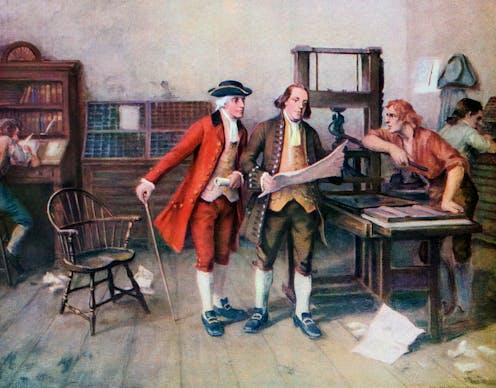
Ben Franklin, center, inserted an abortion recipe in a popular textbook he republished in 1748. GraphicaArtis/Getty Images

Justice Samuel Alito appears spellbound by the 19th century.

In Dobbs v. Jackson Women’s Health Organization, the decision Alito wrote overruling 50 years of constitutional protection for women’s right to get an abortion, he deploys arguments that are based on several historical precedents. He uses the phrase “history and tradition” regularly.

But for Alito, the 19th century looks like the true golden age: “In 1803, the British Parliament made abortion a crime at all stages of pregnancy and authorized the imposition of severe punishment.”

He goes on and on: “In this country during the 19th century, the vast majority of the States enacted statutes criminalizing abortion at all stages of pregnancy.”

“By 1868, the year when the Fourteenth Amendment was ratified,” Alito concludes, “three-quarters of the States, 28 out of 37, had enacted statutes making abortion a crime.”

But in his rather selective forays into history, Alito doesn’t ask what to me, as a historian, constitutes a set of fundamental questions: Why was abortion eventually criminalized during that time? What was the broad cultural and intellectual context of that period? And, more important, is there something peculiar about the 19th century?

As far as women’s bodies and abortion are concerned, the 19th century saw a decrease in the trust in, and power of, women themselves.

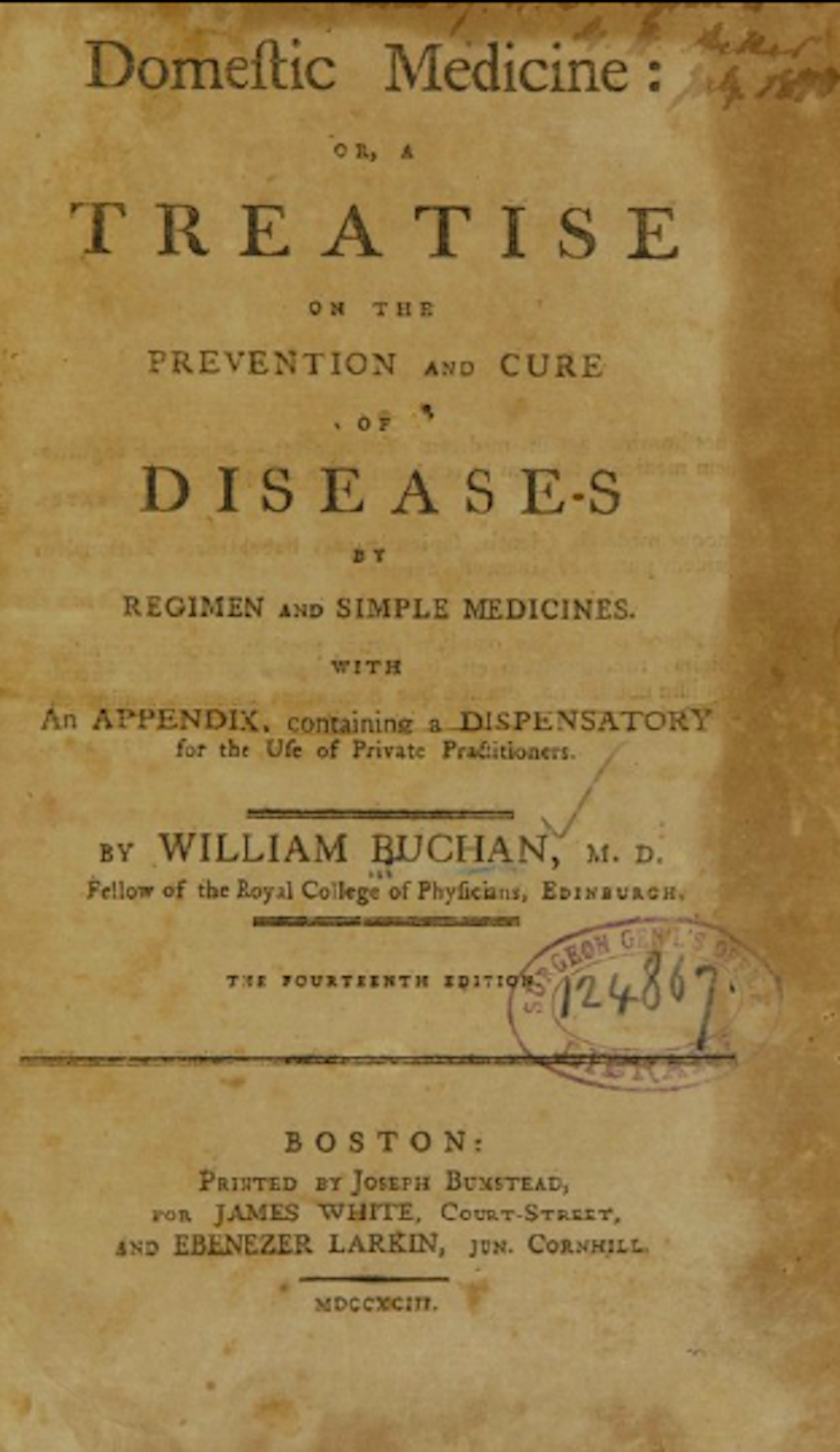
An aged title page for a book, 'Domestic Medicine.'
William Buchan’s book ‘Domestic Medicine,’ first published in 1769 and found in many American homes, contained instructions for an abortion. National Library of Medicine

18th-century woman: Active and in control

To begin with, 17th- and 18th-century legal authorities Edward Coke, Matthew Hale and William Blackstone had all advocated for or condoned abortion. They fretted only when the procedure was carried out after “quickening,” the moment when the mother realizes that the fetus moves in her womb, approximately the fourth month of pregnancy.

As a medical procedure, abortion was widespread in Colonial and 18th-century America. By using more or less safe techniques, midwives and medical practitioners performed many types of operations on their patients. The woman could easily die, of course; but when she sought an abortion, no social, legal or religious force would have blocked her.

Also, a woman could choose from many available remedies rather than have an operation. Derived from juniper bushes, “savin,” or Juniperus sabina, was one of the most popular abortifacients. Other herbs and concoctions were similarly taken: pennyroyal, tansy, ergot, Seneca snakeroot or cotton root bark.

Benjamin Franklin inserted an abortion recipe in a popular textbook he republished in Philadelphia in 1748. He didn’t prompt any scandal.

The truth is that America’s founders, together with their contemporaries, had a rather democratic understanding of the female body. They believed that women, physiologically speaking, weren’t qualitatively different from men; the two sexes were equal and complementary.

Men’s and women’s composition, medical doctors argued, was identical in essence – the only difference was anatomical, in that male sexual organs were more externally distended than female organs.

Just like the male, the female was thought of as fully in control of the workings of her physiology, including her sexuality. It was believed that both the man and the woman had to reach orgasm, better if simultaneously, for pregnancy to ensue.

This made 18th-century men attentive to the satisfaction of their female partners, though for utilitarian reasons.

Especially when sex was aimed at procreation, the woman had to be as active as the male partner. The 18th-century woman was active and in control. She trusted her bodily feelings, including her pleasures.

And crucially, only she could detect whether quickening had taken place in her womb. Consequently, she could immediately tell whether terminating a pregnancy at a given time was acceptable. Or if it was a crime.

An antique magazine cover with a woman's image on it, holding a baby.
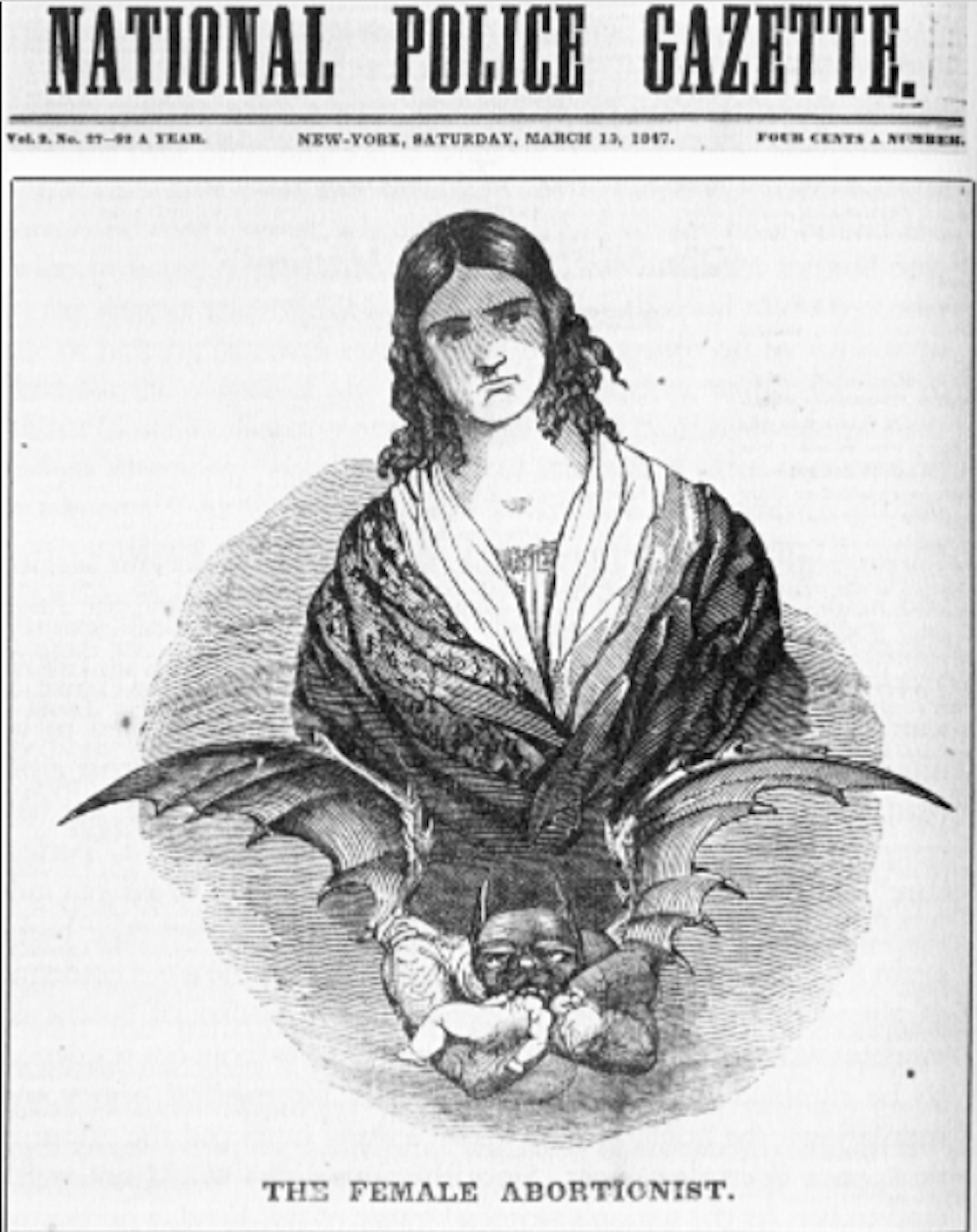
19th-century American abortionist Ann Trow Lohman, who performed abortions in New York City and was referred to by one anti-abortion advocate as ‘the monster in human shape.’ Wikipedia

19th-century woman: Weak and chaste

The 19th century changed all that. The understanding of physiology and the mechanisms of the female body underwent a deep transformation. European and American doctors, now, saw women as essentially different from men: From a “one body” model, the medical discourse shifted toward a “two body” model.

Women’s level of self-determination decreased accordingly. Suddenly, they were not only weaker or softer than men, but inherently passive, too. Instead of being encouraged to take part in sex, actively and with vigor, 19th-century women were expected to be withdrawn.

They were thus recast as pure, chaste and modest. Commendable women were virgins, wives, mothers. Or else they were prostitutes, nearly criminals, which reflects the Victorian dualistic mindset. Instead of being urged to trust the quickening and other physiological events happening in her womb or her vagina, the honest woman had to trust her doctor.

Anti-abortion campaigns began in earnest in the mid-19th century. They were waged mostly by the American Medical Association, founded in 1847, and were fundamentally anti-feminist. They chastised women for shunning the Victorian “self-sacrifice” expected of mothers.

Anti-abortion campaigns were targeted against midwives and tried to discredit women’s firsthand experience of pregnancy. Male doctors claimed pregnancy as a medical terrain - a realm that belonged to them exclusively.

Based on women’s own bodily sensations – not on medical diagnosis – quickening was denigrated. Quickening, of course, made doctors dependent on women’s self-diagnosis and judgment. Dr. Horatio R. Storer, the leader of the medical campaigns against abortion, described quickening as “in fact but a sensation.” In such a context, it could no longer be framed as the basis from where all moral, social and legal standards emerged.

In the Dobbs decision, Alito says: “The Court finds that the right to abortion is not deeply rooted in the Nation’s history and tradition.” This is a historical fact: Protection of the right to abortion wasn’t around in America before Roe.

But it is also an incomplete picture of the full story. The criminalization of abortion, plus the decentralization of the woman’s experience, plus the medicalization of her feelings that led to that decision, are facets that belong to the long-gone 19th century.

No American lives in that century any more - not even Justice Alito.

The Conversation

Maurizio Valsania does not work for, consult, own shares in or receive funding from any company or organisation that would benefit from this article, and has disclosed no relevant affiliations beyond their academic appointment.

06 Jul 17:15

Sister Rosetta Tharpe, singer who inspired Elvis: one of many women sidelined from musical history

by Freya Jarman, Reader in the Department of Music, University of Liverpool
James J Kriegsmann/WIkipedia, CC BY-SA

Elvis Presley is the perfect subject matter for Australian film director Baz Luhrmann. Not just because the opulence of Presley’s showmanship and Lurhmann’s trademark visual style are perfect bedfellows, but because the “Presleyverse” itself is not about Elvis Presley. It’s about the idea of Elvis, the great myth of Elvis – and Luhrmann trades in great myths.

What this particular myth is about is the inspirational story of a white man and how he changed everything – what it’s never about is the black women singers and musicians who forged the way.

We can summarise the conundrum by comparing two quotes. In Luhrmann’s screenplay, Elvis acknowledges: “Rock'n’roll is basically gospel and rhythm and blues”. Off-screen, the “godmother of rock‘n’roll” Sister Rosetta Tharpe spoke wearily from the flip-side of that truth:

These kids and their rock‘n roll is just sped up rhythm and blues. I’ve been doing that forever.

And indeed she had. Born in Arkansas in 1915 to a family of sharecroppers, Tharpe spent her formative years immersed in the musical world of the Church of God in Christ, a Pentecostal denomination with a largely African-American congregational base.

Pentecostal churches generally were at the heart of the development of gospel music in the United States, most famously in black communities but no less so among white Pentecostals, actively encouraging the passion and fervour that music could arouse in a congregation.

It was in this context that young Rosetta learned to play guitar and inspire people through music. Tharpe swiftly earned a musical reputation among the religious community in Chicago, and at the age of 19 she moved to New York City, where her performances broadened out into the popular sphere. Throughout her career, she moved seamlessly between the sacred and secular musical worlds, enjoying high-level success in both.

Tharpe’s vocal performances dance the line between speech and song, clearly drawing from a lifetime of listening to charismatic preachers. It is exactly the vocal choreography on which rock‘n’roll was built. Her guitar performances pioneered distortion and string-bending techniques on newly emerging amplified instruments whose very use was championed in its earliest years by another woman, Memphis Minnie.

Black woman in an oval gravestone picture from 1930.
Memphis Minnie, another forgotten female blues musician. Wikipedia, CC BY

In Tharpe’s groundbreaking technique, we can hear the direct sonic ancestors of the canonical guitar players of popular music history, players whose lineage is far more commonly credited to male guitarists such as Muddy Waters, Chuck Berry, or BB King.

The sidelining of women from musical history is nothing new. Bach, Mozart, Schumann, Mendelssohn and Mahler could testify to that – Anna Magdalena, Marianne, Clara, Fanny, and Alma – the wives or sisters of the more famous male classical composers, I mean. In the sciences, there’s even a name for the specific phenomenon to which Memphis Minnie and Sister Rosetta have been subject: the “Matilda Effect.

First described in 1870 by Matilda Joslyn Gage, it describes the tendency to attribute discoveries solely to the male colleagues of women working on particular projects. Consider, for instance, Rosalind Franklin, whose work was central to the discovery of DNA’s double helix structure, but whose name has long been overshadowed by those of Francis Crick and James Watson.

In music, it might be harder to point to specific moments of "discovery”, because identifying an exactly “new” thing is not always so straightforward. But still, we could talk of a “Rosetta Effect,” wherein a woman’s musical contributions are eclipsed by those of the men nearby.

Talented women

In 20th-century popular music, there is admittedly something of a canon of great women. Even a cursory interaction with pop history 101 would yield names like Aretha Franklin, Billie Holiday, Ella Fitzgerald, Dinah Washington, Mahalia Jackson. But these women are primarily remembered for their voices, not their musical innovations or instrumental technique.

In the grand narratives of popular music history, women have been carefully contained in particular roles and sidelined from others. Even Nina Simone, a classically trained pianist, is known as the voice of Civil Rights-era America, not its piano accompanist.

And even acknowledging that Simone’s exceptional piano playing is part of the overall brand, the instrument itself is notable. Female singer-pianists are easy enough to find: in addition to Simone, there’s Tori Amos, Regina Spektor, Alicia Keys, Norah Jones, and Carole King. But Karen Carpenter was encouraged out from behind the drums, Delia Derbyshire’s technological wizardry on the Doctor Who theme was hidden behind the anonymity of the BBC Radiophonic Workshop, and Memphis Minnie’s name is nowhere near as well-known as that of her contemporary Muddy Waters.

Long overdue stories

The history of women in popular music is not as hard to trace as it may be for their classical counterparts, but the story (and indeed the reality) boxes them in to particular functions. Timeless, iconic voice is one of those functions – trailblazing musical innovator is not.

Luhrmann’s film faces head-on the musical debt that Presley – and by extension rock‘n’roll – owed to African American musical culture. It does so sympathetically to Presley, setting up black gospel music and the Beale Street music scene as his creative homes, sound worlds he shared with white America because he had been steeped in them since his childhood.

It’s not without its problems as a representation. Presley also sits in a long and complicated history of white artists’ relationship to culture outside of the white mainstream. This includes capitalising on musical styles with black origins (including Eminem in rap, or Amy Winehouse in jazz), making popular covers of songs by black artists (The Beatles’ Please Mr. Postman or Eric Clapton’s I Shot the Sheriff), or simply straight-up cultural appropriation (think Iggy Azalea’s Bounce or Justin Bieber’s dreadlocks).


Read more: Rosalía: raising reggaeton’s global cachet or robbing it of its roots?


The question of authenticity hangs heavy over Presley’s musical legacy, and it’s not a simple one to answer. The history of rock‘n’roll is inextricably linked to the long, grim history of racial politics in America, and telling it requires great care and sensitivity.

We may, though, be long overdue for an equivalent story on the subject of women like Sister Rosetta Tharpe in popular music history.

The Conversation

Freya Jarman does not work for, consult, own shares in or receive funding from any company or organisation that would benefit from this article, and has disclosed no relevant affiliations beyond their academic appointment.

06 Jul 17:12

Freakonomics' legalized abortion/crime link to get real-world validation in 15-20 years

by Andrew Yi

When it came out in 2005, one of the most contentious topics presented in the book Freakonomics was Steven Levitt & John Donohue's hypothesis on the link between unwanted pregnancies, legalized abortion, and crime.  For the uninitiated, Levitt & Donohue published their paper, "The Impact of Legalized Abortion on Crime" in 2001, stating that "Legalized abortion appears to account for as much as 50 percent of the recent drop in crime." — Read the rest

06 Jul 14:53

What Does It Take To Be Wealthy in America?

by Staff

The goalposts of wealth are always shifting due to inflation and other factors. For example, someone with a net worth of $1 million several decades ago would have been considered very wealthy. According to recent survey results, however, $1 million is only enough to feel “financially comfortable” today. In this infographic, we’ve visualized several money milestones to give you a better idea of what it really takes to be wealthy in America.

Net Worth Milestones

This table lists the data used in the above infographic.

It covers data on what it takes to get into the top one percent for wealth in key states, along with broader survey results about what net worth thresholds must be crossed in order to be considered “comfortable financially” or even “wealthy”.

According to Charles Schwab’s Modern Wealth Survey, a net worth of $774,000 is needed to feel “financially comfortable”, while $2.2 million is needed to be considered “wealthy”.

Both of these milestones are far greater than the average (median) American’s wealth, which according to the Federal Reserve, was $122,000 in 2019.

Related: How Much Health Insurers Pay for Almost Everything Is About to Go Public

Joining the One Percent

Research by Knight Frank determined that in order to be a member of America’s one percent, one would need a net worth of $4.4 million. This is very high compared to other developed countries such as Japan ($1.5 million), the UK ($1.8 million), and Australia ($2.8 million).

The difference is partly due to America’s large population of ultra high net worth individuals, which includes the country’s 724 billionaires. See below for a list of the top five countries by number of billionaires.

Focusing again on the U.S., we can also see large discrepancies at the individual state level. Entry into California’s one percent requires a net worth of $6.8 million, which is 62% higher than the national average.

California is famously home to many of the world’s richest people, including Google co-founder Larry Page, and Facebook founder Mark Zuckerberg.

Being a one percenter in Mississippi, on the other hand, requires $766,000. That’s 83% lower than the national average, and just a tad lower than the amount needed to be “financially comfortable” by the average American. This is partially due to Mississippi’s poverty rate of 19.6%, which according to the U.S. Census Bureau, is the highest in the country.

Story attributed to Visual Capitalist.

The post What Does It Take To Be Wealthy in America? appeared first on ModernGlobe.

06 Jul 14:52

Hidden History: The Tampa Theatre

by Gillian Finklea

Streaming movies may be the preferred method of entertainment at the moment, but in Tampa one historic movie palace still has a special place in movie-lovers’ hearts. Almost 100-years-old, the Tampa Theatre is a gorgeous piece of Tampa entertainment history. The theater shows everything from silent films to the latest blockbuster. Find out how the theater has stayed open for so long and become an important landmark for Tampa residents.

A product of the studio system

The Tampa Theatre opened on October 15, 1926. It was built by Paramount Studios. Back then, movies studios took part in vertical integration where they owned every part of the movie-making process, — the stars, the directors, the movies and even the theaters the movies were shown in. This system eventually became a monopoly, which the United States Supreme Court put an end to in 1948 with the case United States v. Paramount Pictures, Inc.

  • Historic Tampa Theatre and Office Building, 1979
  • Eddie Ford playing the organ at the Tampa Theatre, 1931
  • Historic Tampa Theatre and Office Building, 1979
  • Movie advertisement inside Tampa Theatre, 1941.
  • Crowd outside Tampa Theatre at automobile drawing, 1931

But in the mid-1920s, lavish movie theaters were being built all around the country. For 25 cents you could be ushered in to an air-conditioned palace and watch the latest “talkie” in plush velvet seats. Tampa Theatre was designed by John Eberson, a Chicago-based architect who wintered in Florida and was inspired by the multi-ethnic opulence he associated with the state:

I was impressed with the colorful scenes that greeted me at Miami, Palm Beach and Tampa. Visions of Italian gardens, Spanish patios, Persian shrines and French formal gardens flashed through my mind, and at once I directed my energies to carrying out these ideas.

John Eberson, Tampa Tribune, October 15, 1926

And the style of the Tampa Theatre is certainly unique. The lobby is made to resemble a Mediterranean courtyard with columns, cascading flowers, gargoyles and Spanish tile. The actual theater, which can sit over 1,000 people, has an artificial nighttime sky complete with twinkling lights.

Making history

With the rise of television in the 1950s, movie theaters fell in popularity. Ticket prices increasing combined with the fall of the studio system, led to many historic movie theaters being demolished. In fact, in 1973, the Tampa Theatre was headed in that direction. But enough citizens and local community leaders saw the value of keeping the Tampa Theatre around and the Tampa City Council purchased the theater. It was reopened in 1977, named in the National Register of Historic Places in 1978, and became a Tampa City Landmark in 1988.

Preservation even saved the Theatre’s organ. Known as “The Mighty Wurlitzer Theatre Organ,” it was installed in the Theatre’s early history to accompany silent films. “Talkies” eventually dominated the movie market in the 1930s, so the 1,400-pipe organ was sold to a local church. However, in the 1980s volunteers from The Central Florida Theatre Organ Society (CFTOS) reacquired and reinstalled The Mighty Wurlitzer. Organ music is still played before movies and whenever the Theatre hosts a concert or shows a silent film.

Talk of the town

Nowadays, the Tampa Theatre is a big part of the Tampa Bay social scene. The Tampa Theatre hosts over 700 events every year, including:

  • Movies
  • Live concerts
  • Stand-up shows
  • Educational programs
  • Summer camps for kids

You can also just have a tour of the magnificent movie palace. So if you’re looking to beat the summer heat, head down to Franklin Street to check out a piece of Tampa history.

  • WineFest 2016: “Caskablanca” Wine Pairing
  • Isle of Dogs Adoption Event
  • BeerFest 2019: Ferris Brewer’s Day Off
  • BeerFest 2019: Ferris Brewer’s Day Off
  • Pulitzer Prize-winning, New York Times Bestselling author, Colson Whitehead talks about his book, The Nickel Boys.

More Hidden Histories

The post Hidden History: The Tampa Theatre appeared first on ModernGlobe.

05 Jul 18:22

US Copyright Office advises not to introduce ancillary copyright protection for press publishers in the US

by Eleonora Rosati
In 2019, the EU legislature introduced an EU-wide related right (Article 15 of the DSM Directive, on which see Katposts here) for EU-based press publishers in relation to online uses of their press publications by information society service providers, including news aggregation services, social media, and search engines.

But is the EU press publishers’ right a model for other legislatures to follow too?

According to the US Copyright Office, for the United States the answer is NO.

In a report released last week, the Copyright Office advised against adopting additional rights for press publishers. Specifically:
[A]ncillary copyright protections have not been shown to be necessary in light of publishers' existing rights, and would likely be ineffective so long as publishers depend on news aggregators for discoverability. Moreover, to the extent that any ancillary copyright protections would lack traditional copyright limitations and exceptions [this is not the case of the EU press publishers’ right, which has both limitations in scope and remains subjected to inter alia the application of all available exceptions under Article 5 of the InfoSoc Directive], they would raise significant policy and Constitutional concerns.
The Office found that under US law press publishers generally own a copyright in the compilation of materials that they publish already, as well as in individual articles and often photographs too, through the work-made-for-hire doctrine.

All this said, the Copyright Office did acknowledge that the press sector and journalists are facing challenges that are worthy of congressional attention, including through antitrust intervention. In this regard, the Office highlighted how the copyright protection already available to press publishers may be considered ineffective because “[p]ublishers may have difficulty requiring news aggregators to pay to use news content due to disparities in bargaining power.” But this, noted the Office, is not a copyright-specific challenge.

Comment

As readers who have followed the developments leading up to the adoption of Article 15 of the DSM Directive will recall, the considerations undertaken by the US Copyright Office echo very similar points made in Europe.

That the press sector is facing a very significant crisis is a fact.

Albeit that declining revenues in the press publishing sector are not a new phenomenon (in some countries the decline began with the advent of television in the 1950s), they have become particularly problematic since the early 2000s, with some indicating the internet and news aggregation services as primarily responsible for that. If you wish to get an idea of the numbers, see here for telling data relating to the Italian press sector.

Possible solutions to tackle these problems were discussed in a number of EU Member States prior to the adoption of the DSM Directive. Initiatives encompassed both the conclusion of agreements between news aggregators and local press publishers (e.g., in Belgium, France, Italy) and the adoption of legislative initiatives in relation to news content (Germany, Spain). In 2013, Germany introduced a related right over press publications, while in 2014 Spain adopted a mandatory fair compensation requirement for press publishers as part of its reform of the quotation exception. Neither initiative proved successful.

Status of the investigation for alleged abuse of dominance:
in progress

Indeed, the Impact Assessment accompanying the Commission’s proposal for a DSM Directive referred specifically to the German and Spanish experiences, and acknowledged that these had been “ineffective”. It linked such ineffectiveness to “the lack of scale of national solutions” This, in turn, served to justify legislative intervention on an EU-wide scale.

So, where are we now in Europe, 1+ year after the expiry of the deadline for the national transpositions of the DSM Directive?

First of all, not all EU Member States have yet completed the transposition of the DSM Directive into their own laws. For those that have, insofar as the press publishers’ right is concerned, there seems to be the potential of greater effectiveness of the related right in favour of press publishers than national solutions alone. That seems however to be so not because of this new right but because of the use of competition law tools and a greater willingness of national competition authorities to use them.

France was indeed the first EU Member State to transpose, as early as 2019, Article 15 into national law, with no language addressing the possibility of a waiver of the right (this was the main, though not only, reason why the pre-DSM Directive German right failed). Initially, Google announced that, similarly to what it had done in Germany a few years prior, it would not seek licences from French press publishers to use their content. Unlike what had happened in Germany, however, the French Competition Authority decided to open an investigation and subsequently ordered Google, as an interim measure, to negotiate in good faith with press publishers. In 2021, the same authority issued a fine against Google for failure to comply with the interim measure issued the previous year. A few weeks ago, as also reported by Politico, the Authority accepted legally binding commitments from Google to negotiate licences and disclose information that would serve to determine whether the proposed amounts could be regarded as being fair.

Insofar as Germany is concerned, also there the Federal Competition Authority appears keener to look into these issues now (under the old right, the Authority ruled out that Google's refusal to negotiate licences would amount to an abuse of dominance). In early 2022, it announced that it would be holding consultations with Google over competition-related concerns facing the latter’s News Showcase service. While the contracts relating to such a service are unrelated to the negotiations regarding licences under the German related right adopted to transpose Article 15 of the DSM Directive, that Authority noted that a close monitoring of said negotiations would be also undertaken.

In conclusion, whether copyright was the right lens through which the press sector's issues could be addressed is not just an academic issue. In this sense, the answer that the US Copyright Office has provided to the question whether the US should imitate Europe does not appear too surprising either.


05 Jul 16:53

YouTube removes criticism of dangerous fractal wood burning instructions, but leaves up the lethal tips

by Rob Beschizza

"Fractal wood burning" refers to using hacked microwave power supplies to char Lichtenberg figures into wood. It is extraordinarily dangerous, and dozens of people have been killed following instructions contained in viral videos. Ann Reardon recently posted a thorough debunking of the method, which quickly became popular in its own right—a timely and essential remedy to a lethal problem that social media companies are under no obligation to deal with themselves. — Read the rest

05 Jul 11:16

Giant African Snail — What You Need To Know

by Gillian Finklea

A few Giant African Snails have been popping up in Pasco County. The first sighting was confirmed on June 23. They are invasive, posing a threat to vegetation as well as potentially spreading rat lungworm. Luckily, you are unlikely to see one and if you do; they are easy to spot. However, they do breed rapidly, so if you happen upon a Giant African snail, here’s what you need to know.

What do Giant African Snails look like?

The adult snail is around 7 cm (2.8 in) in diameter and 20 cm (7.9 in) or more in length. The shell is cone shaped and brown.

Where do they come from?

The Giant African Snail is native to East Africa, predominantly in Kenya and Tanzania. However, they are highly invasive as they are highly adaptable to new environments. Releasing them into the wild is illegal the species can now be found in many humid, subtropical climates — including Florida.

Currently in Pasco County, a quarantine is in place, starting at the northwest corner of U.S. Highway 19 and Ridge Road. Proceed east on Ridge Road, south on Little Road, west on Trouble Creek Road, north on U.S. Highway 19. This is near where the last snail was seen.

What do they do?

The Giant African Snail is an herbivore that eats a wide variety of plant material including fruit, vegetables, lichens and fungi. However, they have also been known to eat paper, cardboard, sand and even small pebbles. Sometimes they will eat stucco in buildings as a source for calcium.

In terms of reproduction, they lay shelled eggs numbering at about 200 eggs per clutch, 5 to 6 clutches per year. So when they reproduce — it’s a lot. They can also live for up to 10 years.

What to do if you see a Giant African snail

In Pasco County, the Florida Department of Agriculture and Consumer Services has begun to survey the area. They started treatment for the snail on June 29, 2022. FDACS will treat properties with a metaldehyde-based molluscicide (snail bait). The treatment is labeled by the U.S. Environmental Protection Agency for residential use.  

If you see a snail in your yard, call 1-888-397-1517 or email DPIHelpline@FDACS.gov

The post Giant African Snail — What You Need To Know appeared first on ModernGlobe.

05 Jul 11:14

How Much Health Insurers Pay for Almost Everything Is About to Go Public

by Staff

Consumers, employers, and just about everyone else interested in health care prices will soon get an unprecedented look at what insurers pay for care. This might help answer the question: Are we getting the best deal we can?

As of July 1, health insurers and self-insured employers must post on websites just about every price they’ve negotiated with providers for health care services, item by item. About the only thing excluded are the prices paid for prescription drugs, except those administered in hospitals or doctors’ offices.

The federally required data release could affect future prices or even how employers contract for health care. Many will see for the first time how well their insurers are doing compared with others.

Related: More States Allowing Students To Take Mental Health Days Off

The new rules are far broader than those that went into effect last year requiring hospitals to post their negotiated rates for the public to see. Now insurers must post the amounts paid for “every physician in network, every hospital, every surgery center, every nursing facility,” said Jeffrey Leibach, a partner at the consulting firm Guidehouse.

“When you start doing the math, you’re talking trillions of records,” he said. The fines the federal government could impose for noncompliance are also heftier than the penalties that hospitals face.

Federal officials learned from the hospital experience and gave insurers more direction on what was expected, said Leibach. Insurers or self-insured employers could be fined as much as $100 a day for each violation, for each affected enrollee if they fail to provide the data.

“Get your calculator out: All of a sudden you are in the millions pretty fast,” Leibach said.

Determined consumers, especially those with high-deductible health plans, may try to dig in right away. They can use the data to compare what they will pay at different hospitals, clinics, or doctor offices for services.

But each database’s enormous size may mean that most people “will find it very hard to use the data in a nuanced way,” said Katherine Baicker, dean of the University of Chicago Harris School of Public Policy.

At least at first.

Entrepreneurs are expected to quickly translate the information into more user-friendly formats. Then it can be incorporated into new or existing services that estimate costs for patients. And starting Jan. 1, the rules require insurers to provide online tools that will help people get upfront cost estimates for about 500 so-called “shoppable” services. This means medical care they can schedule ahead of time.

Once those things happen, “you’ll at least have the options in front of you,” said Chris Severn, CEO of Turquoise Health, an online company that has posted price information made available under the rules for hospitals, although many hospitals have yet to comply.

With the addition of the insurers’ data, sites like his will be able to drill down further into cost variation.

“If you’re going to get an X-ray, you will be able to see that you can do it for $250 at this hospital, $75 at the imaging center down the road, or your specialist can do it in office for $25,” he said.

Everyone will know everyone else’s business. For example, how much insurers Aetna and Humana pay the same surgery center for a knee replacement?

The requirements stem from the Affordable Care Act and a 2019 executive order by then-President Donald Trump.

Related: Adventurous play outdoors leads to stronger mental health for kids

“These plans are supposed to be acting on behalf of employers in negotiating good rates, and the little insight we have on that shows it has not happened,” said Elizabeth Mitchell, president and CEO of the Purchaser Business Group on Health, an affiliation of employers who offer job-based health benefits to workers. “I do believe the dynamics are going to change.”

Other observers are more circumspect.

“Maybe at best this will reduce the wide variance of prices out there,” said Zack Cooper, director of health policy at the Yale University Institution for Social and Policy Studies. “But it won’t be unleashing a consumer revolution.”

Still, the biggest value of the July data release may well be to shed light on how successful insurers have been at negotiating prices. It comes on the heels of research that has shown tremendous variation in what is paid for health care. A recent study by the Rand Corp., for example, shows that employers that offer job-based insurance plans paid, on average, 224% more than Medicare for the same services.

Tens of thousands of employers who buy insurance coverage for their workers will get this more-complete pricing picture. And may not like what they see.

“What we’re learning from the hospital data is that insurers are really bad at negotiating,” said Gerard Anderson, a professor in the department of health policy at the Johns Hopkins Bloomberg School of Public Health, citing research that found that negotiated rates for hospital care can be higher than what the facilities accept from patients who are not using insurance and are paying cash.

That could add to the frustration that Mitchell and others say employers have with the current health insurance system. More might try to contract with providers directly, only using insurance companies for claims processing.

Other employers may bring their insurers back to the bargaining table.

“For the first time, an employer will be able to go to an insurance company and say, ‘You have not negotiated a good-enough deal, and we know that because we can see the same provider has negotiated a better deal with another company,’” said James Gelfand, president of the ERISA Industry Committee, a trade group of self-insured employers.

If that happens, he added, “patients will be able to save money.”

That’s not necessarily a given, however.

This kind of public release of pricing data hasn’t been tried widely in health care before. So how it will affect future spending remains uncertain. If insurers are pushed back to the bargaining table or providers see where they stand relative to their peers, prices could drop. However, some providers could raise their prices if they see they are charging less than their peers.

“Downward pressure may not be a given,” said Kelley Schultz, vice president of commercial policy for AHIP, the industry’s trade lobby.

Baicker, of the University of Chicago, said that even after the data is out, rates will continue to be heavily influenced by local conditions, such as the size of an insurer or employer — providers often give bigger discounts, for example, to the insurers or self-insured employers that can send them the most patients. The number of hospitals in a region also matters. If an area has only one, for instance, that usually means the facility can demand higher rates.

Another unknown: Will insurers meet the deadline and provide usable data?

Schultz, at AHIP, said the industry is well on the way, partly because the original deadline was extended by six months. She expects insurers to do better than the hospital industry. “We saw a lot of hospitals that just decided not to post files or make them difficult to find,” she said.

So far, more than 300 noncompliant hospitals received warning letters from the government. But they could face $300-a-day fines for failing to comply, which is less than what insurers potentially face, although the federal government has recently upped the ante to up to $5,500 a day for the largest facilities.

Even after the pricing data is public, “I don’t think things will change overnight,” said Leibach. “Patients are still going to make care decisions based on their doctors and referrals, a lot of reasons other than price.”

Story from Kaiser Health News.

The post How Much Health Insurers Pay for Almost Everything Is About to Go Public appeared first on ModernGlobe.

01 Jul 19:54

The courage of their convictions

by Judy G. Russell

The Genealogy Guys take a stand

George Morgan and Drew Smith are The Genealogy Guys — educators, writers, speakers, and producers of the popular podcast by the same name.

They have long been counted among The Legal Genealogist‘s friends.

And never have I been prouder of that fact — prouder of them, and their courage — than I am today.

Genealogy Guys banner

You can see from the banner of their website that, yesterday, they listed five sponsors: MyHeritage, RootsMagic, Vivid-Pix, Newspapers.com and Find A Grave.

As of this morning, they have three sponsors.

At midnight last night, George and Drew terminated their sponsorship by Find A Grave and its sister Ancestry site Newspapers.com over the failure — indeed, the refusal — of Ancestry to take meaningful steps even in the wake of the Uvalde shooting tragedy to enforce genealogical ethics on its Find A Grave site.1

Their reasons are clearly stated in their blog this morning. Speaking for their corporate entity, Aha! Seminars, Inc., they wrote:

The genealogical community has repeatedly requested that Ancestry.com, the parent company of Find a Grave, establish ethical policies and processes for controlling the addition of memorial records at its site. These include, but are not limited to, preventing “volunteers” from creating memorials indiscriminately for anyone they choose, especially for the recently deceased to whom they have no connection. Ancestry.com has incentivized such activity by publishing the number of memorials created by individuals. Ancestry.com has further encouraged competition by publishing announcements on Facebook and elsewhere naming “Volunteer of the Month’ for the number of new records created.

Within hours of the identification of victims of the recent massacre at the public school in Uvalde, Texas, “volunteers” added memorial pages for Find a Grave for the victims. These “volunteers” were not family members and did not have complete or correct personal information for the victims. These people usurped the rights of families. The genealogical community has been outraged that Ancestry.com has not implemented ethical and respectful policies that prevent this egregious activity by non-family members and impose a respectful delay on when and by whom memorials for recent deaths can be created.

Aha! Seminars, Inc., contacted an Ancestry.com representative to appeal for changes and received boilerplate responses that neither acknowledged the problems nor indicated that any changes were forthcoming. Those boilerplate responses were apparently sent to all persons who contacted Ancestry.com to complain.

Inasmuch as Ancestry.com has continually failed to address the problems and develop responsible, ethical, and respectable policies, especially after the Uvalde massacre, Aha! Seminars, Inc., no longer wishes to have Ancestry.com’s subsidiaries, Find a Grave and Newspapers.com as sponsors of our podcast. We invoked cancellation clauses in the sponsorship contracts and effected the discontinuation of the sponsorships effective June 30, 2022.2

Folks, it takes a special kind of courage to take this kind of action. Many many members of the genealogical community have pleaded with Ancestry to act in a meaningful way. We’ve spoken out out directly and as powerfully as we can. But George and Drew have done so in a way that affects them in their pocketbook. They have literally put their money where their mouth is. They have shown, in the most direct way possible, the courage of their convictions.

In their blog post, The Genealogy Guys concluded: “We hope that Ancestry.com will take action on this long-standing problem.”3

So do we all, my friends.

So do we all.

Ancestry… are you listening?


Cite/link to this post: Judy G. Russell, “The courage of their convictions,” The Legal Genealogist (https://www.legalgenealogist.com/blog : posted 1 July 2022).

SOURCES

  1. See generally Judy G. Russell, “Ancestry, this one’s on you,” The Legal Genealogist, posted 31 May 2022 (https://www.legalgenealogist.com/blog : accessed 1 July 2022).
  2. George G. Morgan and Drew Smith, “Genealogy Guys Podcast Terminates Sponsorships by Find a Grave & Newspapers.com,” The Genealogy Guys Blog, posted 1 July 2022 (http://blog.genealogyguys.com/ : accessed 1 July 2022).
  3. Ibid.
01 Jul 19:51

33 Problems With Media in One Chart

by Staff
infographic listing problems with media, including bias, sensationalism, and more

One of the hallmarks of democratic society is a healthy, free-flowing media ecosystem.

In times past, that media ecosystem would include various mass media outlets, from newspapers to cable TV networks. Today, the internet and social media platforms have greatly expanded the scope and reach of communication within society.

Of course, journalism plays a key role within that ecosystem. High quality journalism and the unprecedented transparency of social media keeps power structures in check—and sometimes, these forces can drive genuine societal change. Reporters bring us news from the front lines of conflict, and uncover hard truths through investigative journalism.

More from Modern Globe: Who’s Still Buying Fossil Fuels From Russia?

That said, these positive impacts are sometimes overshadowed by harmful practices and negative externalities occurring in the media ecosystem.

The graphic above is an attempt to catalog problems within the media ecosystem as a basis for discussion. Many of the problems are easy to understand once they’re identified. However, in some cases, there is an interplay between these issues that is worth digging into. Below are a few of those instances.

Explicit Bias vs. Implicit Bias

Broadly speaking, bias in media breaks down into two types: explicit and implicit.

Publishers with explicit biases will overtly dictate the types of stories that are covered in their publications and control the framing of those stories. They usually have a political or ideological leaning, and these outlets will use narrative fallacies or false balance in an effort to push their own agenda.

Unintentional filtering or skewing of information is referred to as implicit bias, and this can manifest in a few different ways. For example, a publication may turn a blind eye to a topic or issue because it would paint an advertiser in a bad light. These are called no fly zones, and given the financial struggles of the news industry, these no fly zones are becoming increasingly treacherous territory.

Misinformation vs. Disinformation

Both of these terms imply that information being shared is not factually sound. The key difference is that misinformation is unintentional, and disinformation is deliberately created to deceive people.

Fake news stories, and concepts like deepfakes, fall into the latter category. We broke down the entire spectrum of fake news and how to spot it, in a previous infographic.

Simplify, Simplify

Mass media and social feeds are the ultimate Darwinistic scenario for ideas.

Through social media, stories are shared widely by many participants, and the most compelling framing usually wins out. More often than not, it’s the pithy, provocative posts that spread the furthest. This process strips context away from an idea, potentially warping its meaning.

Video clips shared on social platforms are a prime example of context stripping in action. An (often shocking) event occurs, and it generates a massive amount of discussion despite the complete lack of context.

This unintentionally encourages viewers to stereotype the persons in the video and bring our own preconceived ideas to the table to help fill in the gaps.

Members of the media are also looking for punchy story angles to capture attention and prove the point they’re making in an article. This can lead to cherrypicking facts and ideas. Cherrypicking is especially problematic because the facts are often correct, so they make sense at face value, however, they lack important context.

Simplified models of the world make for compelling narratives, like good-vs-evil, but situations are often far more complex than what meets the eye.

The News Media Squeeze

It’s no secret that journalism is facing lean times. Newsrooms are operating with much smaller teams and budgets, and one result is ‘churnalism’. This term refers to the practice of publishing articles directly from wire services and public relations releases.

Churnalism not only replaces more rigorous forms of reporting—but also acts as an avenue for advertising and propaganda that is harder to distinguish from the news.

The increased sense of urgency to drive revenue is causing other problems as well. High-quality content is increasingly being hidden behind paywalls.

More on Modern Globe: Study Finds ‘Nordic Diet’ Could Prevent Childhood Obesity

The end result is a two-tiered system, with subscribers receiving thoughtful, high-quality news, and everyone else accessing shallow or sensationalized content. That everyone else isn’t just people with lower incomes, it also largely includes younger people. The average age of today’s paid news subscriber is 50 years old, raising questions about the future of the subscription business model.

For outlets that rely on advertising, desperate times have called for desperate measures. User experience has taken a backseat to ad impressions, with ad clutter (e.g. auto-play videos, pop-ups, and prompts) interrupting content at every turn. Meanwhile, in the background, third-party trackers are still watching your every digital move, despite all the privacy opt-in prompts.

How Can We Fix the Problems with Media?

With great influence comes great responsibility. There is no easy fix to the issues that plague news and social media. But the first step is identifying these issues, and talking about them.

The more media literate we collectively become, the better equipped we will be to reform these broken systems, and push for accuracy and transparency in the communication channels that bind society together.

Story attributed to Visual Capitalist.

The post 33 Problems With Media in One Chart appeared first on ModernGlobe.

30 Jun 18:39

Kremlin tightens control over Russians' online lives – threatening domestic freedoms and the global internet

by Stanislav Budnitsky, Postdoctoral Fellow in Global and International Studies, Indiana University
Russia has pioneered the concept of digital sovereignty and used it to severely restrict Russians' access to the internet. NurPhoto via Getty Images

Since the start of Russia’s war on Ukraine in late February 2022, Russian internet users have experienced what has been dubbed the descent of a “digital iron curtain.”

Russian authorities blocked access to all major opposition news sites, as well as Facebook, Instagram and Twitter. Under the new draconian laws purporting to combat fake news about the Russian-Ukrainian war, internet users have faced administrative and criminal charges for allegedly spreading online disinformation about Russia’s actions in Ukraine. Most Western technology companies, from Airbnb to Apple, have stopped or limited their Russian operations as part of the broader corporate exodus from the country.

Many Russians downloaded virtual private network software to try to access blocked sites and services in the first weeks of the war. By late April, 23% of Russian internet users reported using VPNs with varying regularity. The state media watchdog, Roskomnadzor, has been blocking VPNs to prevent people from bypassing government censorship and stepped up its efforts in June 2022.

Although the speed and scale of the wartime internet crackdown are unprecedented, its legal, technical and rhetorical foundations were put in place during the preceding decade under the banner of digital sovereignty.

Digital sovereignty for nations is the exercise of state power within national borders over digital processes like the flow of online data and content, surveillance and privacy, and the production of digital technologies. Under authoritarian regimes like today’s Russia, digital sovereignty often serves as a veil for stymieing domestic dissent.

Digital sovereignty pioneer

Russia has advocated upholding state sovereignty over information and telecommunications since the early 1990s. In the aftermath of the Cold War, a weakened Russia could no longer compete with the U.S. economically, technologically or militarily. Instead, Russian leaders sought to curtail the emergent U.S. global dominance and hold on to Russia’s great power status.

They did so by promoting the preeminence of state sovereignty as a foundational principle of international order. In the 2000s, seeking to project its great power resurgence, Moscow joined forces with Beijing to spearhead the global movement for internet sovereignty.

Despite its decades-long advocacy of digital sovereignty on the world stage, the Kremlin didn’t begin enforcing state power over its domestic cyberspace until the early 2010s. From late 2011 to mid-2012, Russia saw the largest series of anti-government rallies in its post-Soviet history to protest Vladimir Putin’s third presidential run and fraudulent parliamentary elections. As in the anti-authoritarian uprisings in the Middle East known as the Arab Spring, the internet served as a critical instrument in organizing and coordinating the Russian protests.

Following Putin’s return to the presidency in March 2012, the Kremlin turned its attention to controlling Russian cyberspace. The so-called Blacklist Law established a framework for blocking websites under the guise of fighting child pornography, suicide, extremism and other widely acknowledged societal ills.

However, the law has been regularly used to ban sites of opposition activists and media. The law widely known as the Blogger’s Law then subjected all websites and social media accounts with over 3,000 daily users to traditional media regulations by requiring them to register with the state.

An iPhone screen shows a Telegram account in Russian
OVD-Info, a Russian organization that tracks political arrests and provides legal aid to detainees, said that government regulators had blocked its website. AP Photo/Alexander Zemlianichenko

The next pivotal moment in Moscow’s embrace of authoritarian digital sovereignty came after Russia’s invasion of eastern Ukraine in the Spring of 2014. Over the following five years, as Russia’s relations with the West worsened, the Russian government undertook a barrage of initiatives meant to tighten its control over the country’s increasingly networked public.

The data localization law, for example, required foreign technology companies to keep Russian citizens’ data on servers located within the country and thus easily accessible to the authorities. Under the pretext of fighting terrorism, another law required telecom and internet companies to retain users’ communications for six months and their metadata for three years and hand them over to authorities upon request without a court order.

The Kremlin has used these and other legal innovations to open criminal cases against thousands of internet users and jail hundreds for “liking” and sharing social media content critical of the government.

The Sovereign Internet Law

In April 2019, Russian authorities took their aspirations for digital sovereignty to another level with the so-called Sovereign Internet Law. The law opened the door for abuse of individual users and isolation of the internet community as a whole.

The law requires all internet service providers to install state-mandated devices “for counteracting threats to stability, security, and the functional integrity of the internet” within Russian borders. The Russian government has interpreted threats broadly, including social media content.

For example, the authorities have repeatedly used this law to throttle the performance of Twitter on mobile devices when Twitter has failed to comply with government requests to remove “illegal” content.

Further, the law establishes protocols for rerouting all internet traffic through Russian territory and for a single command center to manage that traffic. Ironically, the Moscow-based center that now controls traffic and fights foreign circumvention tools, such as the Tor browser, requires Chinese and U.S. hardware and software to function in the absence of their Russian equivalents.

Lastly, the law promises to establish a Russian national Domain Name System. DNS is the global internet’s core database that translates between web names such as theconversation.com and their internet addresses, in this case 151.101.2.133. DNS is operated by a California-based nonprofit, the Internet Corporation for Assigned Names and Numbers.

At the time of the law’s passing, Putin justified the national DNS by arguing that it would allow the Russian internet segment to function even if ICANN disconnected Russia from the global internet in an act of hostility. In practice, when, days into Russia’s invasion in February 2022, Ukrainian authorities asked ICANN to disconnect Russia from the DNS, ICANN declined the request. ICANN officials said they wanted to avoid setting the precedent of disconnecting entire countries for political reasons.

Ukrainian activists are attempting to pierce the digital Iron Curtain to get news of the war from sources outside of Russia to the Russian people.

Splitting the global internet

The Russian-Ukrainian war has undermined the integrity of the global internet, both by Russia’s actions and the actions of technology companies in the West. In an unprecedented move, social media platforms have blocked access to Russian state media.

The internet is a global network of networks. Interoperability among these networks is the internet’s foundational principle. The ideal of a single internet, of course, has always run up against the reality of the world’s cultural and linguistic diversity: Unsurprisingly, most users don’t clamor for content from faraway lands in unintelligible languages. Yet, politically motivated restrictions threaten to fragment the internet into increasingly disjointed networks.

Though it may not be fought over on the battlefield, global interconnectivity has become one of the values at stake in the Russian-Ukrainian war. And as Russia has solidified its control over sections of eastern Ukraine, it has moved the digital Iron Curtain to those frontiers.

The Conversation

Stanislav Budnitsky does not work for, consult, own shares in or receive funding from any company or organization that would benefit from this article, and has disclosed no relevant affiliations beyond their academic appointment.

30 Jun 18:36

Ukraine Recap: Putin plays historian while the west closes its ranks

by Jonathan Este, Associate Editor, International Affairs Editor

On day one of Vladimir Putin’s invasion of Ukraine, February 24, Russian troops seized Snake Island, a tiny rocky outcrop south-west of Odesa which – before the war – played host to a marine research station and a lighthouse. Resistance to the Russian assault became a propaganda coup for Ukrainians. The defenders gave a Russian warship the finger and sent the message: “go fuck yourself” – something that became shorthand for the defiant Ukrainian resistance. It is now reported that the Russians have been forced to withdraw, a serious strategic and propaganda coup for Ukraine.

I mention this because, in last week’s Recap, we featured a story from Basil Germond, a maritime power expert from the University of Lancaster, who pointed to the strategic importance of the island and predicted that Russia’s increasing impotence in terms of naval power is likely to become its undoing. It looks as if we may be seeing this theory playing out in real-time. More about this in next week’s newsletter.

While Russia’s grind through the Donbas region continues, leaving grieving relatives and homeless families in its wake, most of the headlines this week have concerned the diplomatic front, where some important decisions taken by world leaders at summits of the EU, the G7 and Nato will reorder global security in response to Russia’s aggression and China’s increasingly assertive economic and military posturing.

Writing before the summit, meanwhile, the University of Birmingham’s Mark Webber, observed that most of the biggest contributions Nato could make to the cause of Ukrainian self-defence would be off the table: the idea of a no-fly zone was ruled out early on, while a naval operation to break the blockade is also unlikely. And the idea of fast-tracking Ukraine into the alliance is also a non-starter. For now, writes Webber, Nato remains an alliance committed to defending the territory of its member nations.


Read more: Ukraine war: Nato summit to meet in a world reordered by Russian aggression and Chinese ambition


Ukraine Recap weekly email newsletter

This is our weekly recap of expert analysis of the Ukraine conflict. The Conversation, a not-for-profit news group, works with a wide range of academics across its global network to produce evidence-based analysis. Get these recaps in your inbox every Thursday. Subscribe here.


Webber’s Birmingham colleague Stefan Wolff sees the main takeaways from the Nato summit and the G7 meeting which immediately preceded it as the limit to western-dominated global governance in the face of forces the west cannot control. Russia’s war on Ukraine and its associated food blockade, on the one hand, and China’s COVID clampdown on the other are creating a shortage of food and fuel and disrupting supply chains, forcing up prices across the board.

Meanwhile, the decision to admit Finland and Sweden to Nato will merely ratchet up the temperature another notch, while inviting Australia, Japan, Korea and New Zealand as “key partners” hints at the intention of creating an equivalent alliance in the Asia-Pacific, although this is something that Nato’s secretary general Jens Stoltenberg has denied.


Read more: G7 and Nato summits lay bare deep and hostile divide between Russia and China and the west


The Nato and G7 summits followed a meeting of the EU at which Ukraine and Moldova were accepted as candidate members. But, writes Stephen Hall – an expert in international politics at the University of Bath, whose focus is the post-Soviet space – this is where the hard work will really begin for both countries. Some candidate members – Turkey and various Balkan countries spring to mind – have been made to wait many years.


Read more: Ukraine and Moldova gain EU candidate status but face a long road to full membership


So, at present, international support for Ukraine is limited to the supply of advanced weaponry and the application of ever more stringent sanctions on Russia and various prominent Russians. Our colleagues from France have published this excellent piece from a team of economists at the French research network CEPII, which highlights that the deeper the sanctions, the more blowback on the countries doing the sanctioning. And after six separate packages, these sanctions are huge.


Read more: Sanctions against Russia: taking stock four months after the start of the war


The propaganda war

We have consistently pointed out that the battle for hearts and minds is as crucial as the military operation. That remains as true for Russia as for Ukraine, truer perhaps – after all, Putin needs to continue to motivate the Russian people to send their sons and daughters into harm’s way as well as endure the privations brought on by the above-mentioned western sanctions. So far the Kremlin’s propaganda machine appears to be succeeding in maintaining support for the Russian president and the war (in April, 83% of Russians said they supported their president and most also backed the war).

Julia Khrebtan-Hörhager, from Colorado State University, and Evgeniya Pyatovskaya, from the University of South Florida, explain that much of Putin’s message is rooted in his understanding of history: the hankering after empire and restoration of the national pride that had been so damaged by the dissolution of the Soviet Union in 1991 and the years of turmoil and hardship that followed.


Read more: Putin’s propaganda is rooted in Russian history – and that's why it works


But Putin’s knowledge of history appears to be rather coloured by his own self-image. Earlier this month he gave a talk to a group of young entrepreneurs and scientists during which he compared himself to Peter the Great, whose 1721 conquest of lands formerly controlled by Sweden enabled him to transform Russia from a tsardom to a Eurasian empire. “Putin the Great” has a certain ring to it, one imagines him thinking.

But, as Oxford historian Olivia Durand points out, Peter the Great, one of whose greatest achievements was to build St Petersburg, Russia’s “window on the west” (and Putin’s birthplace), actually had very little in common with the Russian president. Durand runs through a few Russian rulers who might make a more apposite comparison, including Ivan the Terrible.


Read more: Ukraine invasion suggests Putin is more Vladimir the Reactionary than Peter the Great


Ukraine Recap is available as a weekly email newsletter. Click here to get our recaps directly in your inbox.

The Conversation
29 Jun 16:46

The People's CDC is a collective of public health practitioners, scientists, and others working to reduce the harmful impacts of COVID-19

by Jennifer Sandlin

If you are still concerned about COVID and want to continue mitigation practices, but are also wary of the CDC and suspicious that its COVID maps and recommendations are influenced by corporate interests (hint: the answer is yes, they are!), then I've found your people. — Read the rest

29 Jun 10:54

Power through Pride: Logan Fields advocates for LGBTQ intersectionality through community organizing

by Hannah Wagner, STAFF WRITER
Recognizing the lack of representation among on-campus queer organizations, computer science PH.D. student Logan Fields created the Queer and Trans People of Color Collective to provide a safe space for students. SPECIAL TO THE ORACLE/LOGAN FIELDS

Despite the impact he has made in furthering inclusivity among on-campus queer organizations, computer science PH.D. student and president of the Queer and Trans People of Color Collective (QTPOCC) Logan Fields said he never envisioned himself directly engaging in activism when beginning his doctoral degree at USF.

Fields completed his undergraduate degree at FAMU, a historically Black college and university (HBCU), prior to transferring to USF to continue his postgraduate research career. Although he expected to find a similar sense of community given the diversified nature of USF’s student body, he said he was surprised by the lack of racial diversity in LGBTQ organizations and their respective leadership boards.

“There’s quite a few queer organizations on campus, which are all fantastic in their own way, but a lot of these organizations are also very niche. We have organizations for pre-medical students, for trans students and for LGBTQ communities and pride,” he said.

“But what I found, especially with coming from an HBCU, was that there was not a specific organization or a specific kind of codified space for queer students of color. That was something that the Office of Multicultural Affairs (OMA) was working really hard towards … but there wasn’t necessarily a space for queer students of color to convene together.”

After sitting down with his friends to explore new clubs to join, Fields said he felt inspired to create a space for queer students of color that had been underrepresented. Alongside one of his friends, he formed the QTPOCC in March 2020 as a partnership with OMA.

In contrast to other LGBTQ organizations on campus, Fields said the collective’s primary objective has been to not only provide club members a sense of belonging, but a historical background of queer social movements led by people of color.

Advocating for intersectionality has always been an inherent aspect of his identity, according to Fields. While support for learning more about LGBTQ history has risen in recent years, he said the exclusion of racial minorities from much of queer history has motivated him to continue fighting for equal representation.

Former USF student and Fields’ wife Tori Clayton said her husband’s desire to help others can be felt both in his work and at home, where herself and Fields can often be found reading various science fiction novels together. As she struggles with her mental health, Clayton said Fields never fails to stand steadfast as a pillar of emotional and psychological support.

“Logan’s equally warm as he is focused and he’s the sort of person that loves with his whole being. He’s a generous, loyal person in a way that makes his friendships more familial and casual,” she said. “At home, he has been a strong ally during some of my weakest moments. He is always there with a kind word or patient ear whenever I need it most.”

His success in community organizing is something Fields said often requires him to reflect upon the adversities he has overcome. He said although he has faced various forms of discrimination given his identity as a Black and queer individual, an experience during his undergraduate career served as the catalyst to his involvement in social advocacy.

A lack of protections for gender and sexual orientation under FAMU’s anti-discrimination policies during Fields’ freshman year allowed professors to verbally accost him and other queer students on the basis of their identities without recourse. From making comments about queer students’ appearances to questioning their sexual orientation outright, Fields said he often felt ostracized from his peers despite the sense of belonging he previously felt.

Enraged by blatant incidences of discrimination from their professors and university leadership, Fields and fellow queer students were able to organize a campuswide protest in support of stronger protections. As a result of Fields and his peers’ protest, FAMU became the first HBCU nationwide to adopt more inclusive language in their anti-discrimination policies the following academic year.

During his time as president of the QTPOCC, Fields said he has attempted to use his background in community organizing as an educational resource for club members. From informing students of different forms of protest to providing emotional support to one another in times of adversity, Fields said he hopes his fight for change can be recognized as a continuation of countless struggles for inclusivity.

“I think that every person of color has at some point found themselves being the only face of color in a room and that every queer person has at some point found themselves as the only queer voice known. Anybody who has an identity such as those would understand how isolating that feels and how freeing it can be when you find other people like yourself,” he said.

“If anybody is lucky enough to have never been a minority in a predominant space, then maybe they don’t understand how isolating that feeling is.”

Responding to those that question the value of separate spaces for queer people of color can at times be difficult, according to Fields. While the club continues to be open to all students interested in learning about inclusive LGBTQ history, he said preserving time for queer students of color to come together remains the QTPOCC’s intended purpose.

“Our organization is not meant to exclude anyone who wants to join, but to provide a space where queer students of color can specifically go and say ‘Yes, I know that I will find other students of color in this space, that I am not alone in this sea of predominantness, that this is why we exist and why finding community is necessary.’”

For Fields, the celebration of Pride Month represents both a positive step toward the future of LGBTQ rights and a potential threat to racial inclusivity in mainstream queer social movements. Proceeding into the future, he said he is optimistic people will be able to take inspiration from the initial intention of pride when mobilizing to fight for social change.

“The significance of Pride Month to me is that the intention of its formation is often overlooked. The first pride was a riot orchestrated by Black and brown trans women and lesbians and it has become so corporatized and whitewashed over the years that I think only recently people have started to get back to its roots, to taking to the streets in protest,” he said.

“To me, pride is being subversive and breaking through the barriers people put in front of you by any means necessary. Whatever one has to do to get through those barriers, I certainly don’t believe in respectability. Niceties cannot be prioritized when it comes to matters of human dignity.”

28 Jun 19:18

Witchcraft, Paganism, and Detective Fiction

by Chas S. Clifton

Jen Bloofield’s Witchcraft and Paganism in Midcentury Women’s Detective Fiction is avallable as a free PDF download from Cambridge University Press through 7 July 2022, if I understand correctly. Paperback copies are US $20.

From the publisher:

Witchcraft and paganism exert an insistent pressure from the margins of midcentury British detective fiction. Gladys Mitchell’s Come Away, Death is dedicated to ‘Evelyn Gabriel, whom Artemis bless and Demeter nourish; upon whom Phoebus Apollo shine’.Ngaio Marsh’s Off With His Head revolves around a folk dance when ritual words are muttered and a murder is committed. Margery Allingham’s Look to the Lady depicts the spontaneous rebirth of witchcraft in the depths of the English countryside. The theme appears across the work of multiple writers, going beyond chance occurrence to constitute an ongoing concern in the fiction of the period. This Element investigates the appearance of witchcraft and paganism in the novels of four of the most popular female detective authors of the British mid twentieth century. I approach the theme of witchcraft and paganism not simply as a matter of content, but also as an influence which shapes the narrative and its possibilities. The ‘witchy’ detective novel brings together the conventions of Golden Age fiction with the images and enchantments of witchcraft and paganism to produce a hitherto unstudied mode of detective fiction in the midcentury.

28 Jun 14:46

Donating to help women get abortions is a First Amendment right – protected by Supreme Court precedents

by Lucinda M. Finley, Professor of Law and Director of Appellate Advocacy, University at Buffalo
An abortion provider in San Antonio had to turn patients away after the June 24, 2022, Supreme Court ruling. Gina Ferazzi/Los Angeles Times via Getty Images

Several Texas abortion funds – which are charities that help people who can’t afford to get an abortion pay for their travel, lodging and medical bills – paused disbursements on June 24, 2022, after the Supreme Court ruled that Americans have no constitutional right to the procedure.

The Lilith, Equal Access, Frontera and other funds said they were taking this step to assess the legal consequences of the court’s ruling in Texas, which already had some of the nation’s strictest abortion laws. Abortion funds in some other states, including Oklahoma, were also reportedly halting their work.

Some funds active in Texas made this decision based on concerns that their financial assistance to women seeking abortions may now be illegal in that state, as well as fears that their donors could also be sued for violating Texas law.

But as an expert on reproductive rights and First Amendment law who has argued before the Supreme Court, I believe that donating to abortion funds – even in places where helping people get abortions is illegal – is protected by the U.S. Constitution.

Precedent in Schaumburg, Illinois

The Supreme Court has ruled on several occasions that fundraising, whether it’s by charitable organizations or political candidates, is a form of speech protected by the First Amendment.

The court handed down the first relevant ruling in 1980, with its Schaumburg v. Citizens for a Better Environment decision. The court struck down an Illinois city ordinance that had prohibited charitable organizations from soliciting contributions unless 75% or more of their revenue was used directly for charitable purposes, rather than for salaries, administration and overhead costs.

The city of Schaumburg had defended that ordinance by contending it regulated conduct involving commercial transactions and was necessary to prevent fundraising for fraudulent causes. The Supreme Court rejected this characterization, asserting that fundraising is a form of protected speech because it is “intertwined with informative and perhaps persuasive speech seeking support for particular causes or for particular views on economic, political, or social issues.”

The court further noted that without the right to seek and receive donations, “the flow of information and advocacy would likely cease.”

Campaign contributions as free speech

Several campaign finance rulings have reinforced the Schaumberg ruling.

The best-known among them is Citizen’s United v. Federal Election Commission. Two other key rulings are Buckley v. Valeo, which preceded the Schaumberg case, and McCutcheon v. Federal Election Commission. All three established that contributions to political candidates, and spending by those candidates, is a form of speech protected by the First Amendment.

In the eyes of the law, seeking donations and making contributions are two sides of the same coin. The Supreme Court has said that both are important ways to show support for political preferences, advance ideas and advocate for policy changes.

The First Amendment right to solicit or give funds is not limited to charitable organizations or candidates. Simply panhandling on the street, the most basic form of soliciting funds, is entitled to First Amendment protection, according to several lower federal courts.

The right to donate – to controversial causes

The Supreme Court has also held that the freedom of association principle embodied in the First Amendment protects the right to support a cause by making donations or paying dues.

Based on the freedom of association, which includes the right to join together with others for social or political purposes, the court has been very protective of the right of donors to remain anonymous. That has especially been the case for donors who support controversial causes and when revealing their identity might subject them to harassment, threats, public hostility or other forms of reprisal.

In 1958, the Supreme Court ruled in NAACP v. Alabama that the First Amendment barred Alabama from forcing the NAACP to disclose the names of its members or donors who resided in the state. The court pragmatically recognized that compelling disclosure of supporters of a civil rights group in Alabama in the 1950s could endanger the donors.

Protecting both sides

This First Amendment principle of protecting the speech and the rights of donors to fund charitable causes guards both sides of the political spectrum.

In July 2021, for example, the Supreme Court decided a case brought by two organizations considered to be conservative: the Americans for Prosperity Foundation and the Thomas More Law Center. The two organizations challenged a California law that required them to disclose the names of their donors who gave more than $5,000.

California tried to justify this law as necessary to prevent fraud by registered charities – the same “preventing fraud” rationale that Schaumburg had unsuccessfully asserted as the reason it needed to restrict charitable solicitation.

Relying on the NAACP case among others, the Court held in Americans for Prosperity Foundation v. Bonta that the compelled disclosure requirement violated the donors’ right to freedom of association.

Based on this body of law, the First Amendment protects the right of abortion funds to seek contributions and to make contributions to individuals in Texas and other states where abortion is illegal to support their activities. The First Amendment also protects the right of people to make donations to abortion funds.

Restricting financial help for abortions in Texas

A 2021 Texas law known as Senate Bill 8 prohibits “aiding and abetting” an abortion after six weeks into pregnancy. The measure specifically mentions providing financial assistance as a form of aiding and abetting.

The law authorizes any person in the world to bring a civil damages lawsuit against anyone who “aids and abets” an abortion, and to recover attorneys’ fees in addition to at least $10,000.

One reason why abortion funds might be leery right now is that Texas law permits someone to seek a court order to force others to hand over information that might provide a basis for suing them.

Two individuals have already sought such an order to require the Lilith Fund to disclose information about its funding and donors in order to determine if they violated the 2021 restriction on “aiding and abetting” an abortion by giving money.

The Thomas More Law Society – the same organization that successfully asked the Supreme Court to protect it from having to disclose its donors – is representing the people seeking donor information from the Lilith Fund, and tweeted that Lilith Fund donors could face legal action for violating the Texas abortion law’s aiding and abetting prohibition.

A Texas trial court judge has found that the provisions authorizing anyone to sue someone who provides or “aids and abets” an abortion likely violate the Texas Constitution, and has temporarily enjoined the law, meaning that it is on hold pending appeal.

The case is likely to go to the Texas Supreme Court. How that court rules will have a great impact on the liability risk faced by the Lilith Fund for providing financial assistance to women to help them get an abortion. While the legal process is playing out, the Lilith Fund is trying to minimize its legal risk by suspending the distribution of money to women.

If the Texas appellate courts eventually uphold S.B.8, the ban on providing financial assistance to Texas women could be enforced. In that event, the Lilith Fund would be able to make a strong case that they don’t need to reveal any information because of First Amendment protections.

The right to disburse money

If states try to punish abortion funds – or individuals – for providing a woman with financial assistance to get an abortion in another state where it remains legal, including the money required to travel there, that would likely violate the Constitution.

Giving money to people who want to obtain a legal abortion would not be “aiding and abetting” a crime. Moreover, the Constitution protects the right to interstate travel. The freedom to cross state lines is a right deeply embedded in U.S. history dating to the Articles of Confederation, prior to the Bill of Rights.

Assisting someone with obtaining a legal abortion by giving them money also could be protected as a form of free speech because it can be one aspect of advocating for and supporting the right to legal abortion. Disbursing these funds could also be protected under the Constitution as an aspect of the freedom to associate with women who seek legal abortions – by giving them financial support.

The Conversation

Lucinda M. Finley does not work for, consult, own shares in or receive funding from any company or organization that would benefit from this article, and has disclosed no relevant affiliations beyond their academic appointment.

28 Jun 14:43

Roe v Wade: the religious right has long influenced law in the US - here's how abortion rights could be challenged elsewhere

by Pam Lowe, Senior Lecturer in Sociology, Aston University
The US Supreme Court. flysnowfly/Shutterstock

The US Supreme Court has formally announced its decision in the case of Dobbs v Jackson Women’s Health Organization. This has overturned the 1973 case Roe v Wade, which enshrined access to abortion as a constitutional right in the US.

The threat to Roe has been the outcome of a strategy specific to US culture and legal structures. But this does not mean that other nations should feel secure in their current access to abortion. There are conservative religious organisations, politicians and activists who seek to constrain reproductive rights around the world.

The Roe case in 1973 provided a landmark ruling that the law against abortion in Texas, where the case originated, violated a constitutional right to privacy. The ruling applied to the whole country and therefore abortion in early pregnancy could not be banned in any state.

Almost immediately after the Roe case, campaigns were launched to try to reverse the decision. An important part of this was repeated attempts to change the constitution of the US to explicitly protect the foetus as a way to ban all abortions. These attempts are known as human life amendments. None of the attempts to get a human life amendment came close to succeeding.

A concerted campaign

The 1980s saw the rise of the religious right as a political force in the US. The religious right established law schools and legal training programmes with the express intention of reversing legal secularism and promoting a vision of law rooted in their understanding of Christian theology. By training Christian lawyers, they could challenge issues they objected to through the courts.

Amy Coney Barrett, a Supreme Court justice nominated by Donald Trump, has been a speaker at a fellowship programme aimed at promoting Christian law.

This decades-long strategy of seeking power and influence in the US political and legal system has culminated with the end of Roe. This leaves each state with the power to decide the extent abortion is permissible, including many which will severely reduce access or ban it completely.

More generally, critics have argued that the conservative Christian justices, who hold the balance of power at the Supreme Court, are undermining the historic separation between church and state in the US. This criticism has even been made by an associate justice of the Supreme Court, Sonia Sotomayor.

While many people seemed shocked that Roe could fall, it is not a surprise to those who have been following the situation. This anti-abortion strategy is unlikely to be fully replicated elsewhere, as it was shaped specifically around the US structures of law, education and politics, but it is illuminating.

The history of abortion is complicated. In many parts of the world, abortion was not legally prohibited before the 19th century. Colonialism played a key role in spreading abortion bans, particularly the British Empire, which imposed British law against abortion on its colonies. The 20th century saw a push back against this, but there has not been uniform progress towards reproductive rights.

In Poland, the law was changed to allow abortion in the 1950s. Women travelled there from other countries to access abortion. This liberal position on abortion was reversed in the 1990s after the fall of the Berlin wall, and this is widely associated with the heavy influence of the Catholic Church.

Crowd with placards
Protest against abortion restriction in Kraków, Poland, October 2020. Silar/Wikipedia Commons, CC BY-SA

In Britain, the 1967 Abortion Act, which outlines when abortion is permitted, remains in place. But there have been repeated attempts in parliament to restrict abortion, which started shortly after the Act was passed.

Although access to abortion in Britain has not been seriously threatened for decades, this is due to constant vigilance and campaigning by pro-choice activists. It is worth remembering that Northern Ireland, which was excluded from the 1967 Abortion Act, only saw the liberalisation of abortion law in 2019.

Global movement

There are anti-abortion organisations, funders and political leaders around the world that seek to learn from each other in their overall mission to ban abortion. While the US religious right is a significant force in this, they are not the only major players.

Research by the European Parliamentary Forum for Sexual and Reproductive Rights found that European and Russian organisations were by far the biggest funders of “anti-gender” initiatives across Europe. “Gender” or “gender ideology” is the term that is used by the religious right to describe a range of issues such as abortion and same-sex marriage. Anti-gender organisations use a variety of legal, political and media strategies, depending on the situation in each country, to try to assert “traditional” family values, and prevent or reverse liberal and secular understandings of reproductive rights, marriage and family life.
The Catholic church plays a central role in the “anti-gender” position. In France and Slovakia, Catholic politicians with links to the Vatican founded or led both Christian political parties and NGOs that campaign against abortion. In the European Parliament in 2021, anti-abortion MEPs unsuccessfully tried to prevent a resolution that declared abortion as a human right and condemned countries where access is restricted.

Regardless of what happens in the US, reproductive rights in other nations have always been insecure. It is a constant battle to increase and maintain abortion access due to the power of those who are opposed. This will continue even without the influence of the US. The fall of Roe is a significant boost to the global anti-abortion movement. It will encourage this movement to pursue additional routes to power and influence in other nations and pan-national organisations.

The Conversation

Pam Lowe has received funding from the British Acacemy to work with the British Pregnancy Advisory Service. She is also a member of Abortion Rights.