Stop us if you’ve heard these: piracy is driving artists out of business. The reason they are starving is because no one pays for things, just illegally downloads them. You wouldn’t steal a car. These arguments are old and being dragged back out to get support for rules that would strangle online expression. And they are, as ever, about Hollywood wanting to control creativity and not protecting artists.
When it comes to box office numbers, they’ve remained pretty consistent except when a global pandemic curtailed theater visits. The problem facing Hollywood is the same one that it’s faced since its inception: greed.
From the fever-pitch moral panic of the early 2000s, discussions about "piracy" disappeared from pop culture for about a decade. It’s come back, both from the side explaining why and the side that wants everyone punished.
Illegal downloading and streaming are not the cause of Hollywood’s woes. They’re a symptom of a system that is broken for everyone except the few megacorporations and the billionaires at the top of them. Infringement went down when the industry adapted and gave people what they wanted: convenient, affordable, and legal alternatives. But recently, corporations have given up on affordability and convenience.
The Streaming Hellscape
It’s not news to anyone that the video streaming landscape has, in the last few years, become unnavigable. Finding the shows and movies you want has become a treasure hunt where, when you find the prize, you have to fork over your credit card information for it. And then the prize could disappear at any moment.
Rather than having a huge catalog of diverse studio material, which is what made Netflix popular to begin with, convenience has been replaced with exclusivity. But people don’t want everything a single studio offers. They want certain things. But just like the cable bundles that streaming replaced, a subscription fee isn’t for just what you want, it’s for everything the company offers. And it feels like a bargain to pay for all of it when a physical copy for one thing costs the same as a month’s subscription.
Except that paying for every service isn’t affordable. There are too many and they all have one or two things people want. So you can rotate which ones you pay for every so often, which is inconvenient, or just swallow the cost, which is not affordable. And none of that guarantees that what you want is going to be available. Content appears and disappears from streaming services all the time.
Disney removed Avatar from Disney+ because it is re-releasing it in theaters ahead of the sequel. Avatar is a 13-year-old movie, and rereleasing it in theaters should be a draw because of the theater-going experience. Avatar shouldn’t have to be removed from streaming since its major appeal is what it looks like on a big screen in 3D. But Disney isn’t taking the chance that the moviegoing experience of Avatar alone will get people to pay. It’s making sure people have to pay extra—either by going to the theater or paying for a copy.
And that’s when the content even has a physical form.
After the Warner Bros. merger with Discovery, the new owners wasted almost no time removing things from the streaming service HBO Max, including a number of things that were exclusive to the streaming service. That means there is no place to find copies of the now-removed shows. People used to joke that the internet was forever—once something was online it could not be removed. But that’s not the case anymore. Services that go under take all of their exclusive media with them. Corporate decisions like this remove things from the public record.
It’s a whole new kind of lost media, and like lost media of the past, it’s only going to be preserved by those individuals who did the work to make and save copies of it, often risking draconian legal liability, regardless of how the studio feels about that work.
When things are shuffled around, disappeared, or flat out not available for purchase, people will make their own copies in order to preserve it. That is not a failure of adequate punishment for copyright infringement. It’s a failure of the market to provide what consumers want.
It’s disingenuous for Hollywood’s lobbyists to claim that they need harsher copyright laws to protect artists when it’s the studios that are busy disappearing the creations of these artists. Most artists want their work to find an audience and the fractured, confusing, and expensive market prevents that, not the oft-alleged onslaught of copyright infringement.
Hollywood Cares About Money, Not Artists
There’s a saying that, in various forms, prevails within the creative industry. It goes something like “Art isn’t made in Hollywood. Occasionally, if you get very lucky, it escapes.”
Going back to Warner Bros. and HBO Max: another decision made by the new management was to cancel projects that were largely finished. This included a Batgirl movie, which had a budget of $90 million. The decision was made so that the studio could take a tax write-off, against the wishes of its star and directors, who said, “As directors, it is critical that our work be shown to audiences, and while the film was far from finished, we wish that fans all over the world would have the opportunity to see and embrace the final film themselves. Maybe one day they will insha’Allah.”
The point is that Hollywood isn’t in the art business. It’s in the business business. It is never trying to pay artists, it’s always trying to find a way to keep money out of artists’ hands and in the corporate coffers. There’s a reason “Hollywood accounting” has a Wikipedia entry. It’s an industry infamous for arguing that a movie that made a billion dollars at the box office actually made no money, all to keep from paying the artists involved.
Traditional movie making is a unionized endeavor. Basically everyone involved save the studio has a guild or union. That means that there are minimum standards for the employment contracts that studios have to meet. New technology is attractive to studios because it isn’t covered by those union agreements. They can ignore the demands of labor and then, if the unions threaten to refuse to work with them, they get to negotiate new terms. That’s why the Writers Guild went on strike in 2007.
The new streaming landscape also allowed studios to mistreat their below-the-line workers; everyone who is not an actor, producer, writer, or director. So, most people. IATSE, the union that represented most of those workers, overwhelmingly authorized a strike over working conditions. They particularly called out how streaming projects paid them less, even if they had budgets larger than that of traditional media.
Streaming has ruined the ability of writers to make a livable wage off of a job, and has all but eliminated mentoring and on-set experience, contrary to the desires of the actual people who make the shows. Instead of investing in writers, studios push for more “efficient” models that make writing jobs harder to get and producing experience nearly impossible.
So when Hollywood lobbyists argue for draconian copyright laws “for artists,” it should ring especially hollow.
What they want is exclusive control. That includes the ability to constantly charge for access, which means preventing people from having their own copies. Hollywood has fought against audiences having their own copies for as long as the technology has existed. They sued to eliminate VCRs and when they lost, then they started selling tapes. They sued the makers of DVRs, and when they lost again they opened up to video-on-demand. And now, streaming has given them what they’ve always wanted: complete control over copies of their work. No one owns a copy of the material they watch on a streaming service, they get only a license to watch it for a temporary period.
This way, the studios can make you pay for something every month instead of once. They can take it down so you can’t watch it at all. They can edit things post-release, losing some of the history of the creation. And without copies available to own, they prevent creative newcomers from exercising their right to make fair use of it. All of this is anti-artist.
Studios want to point to an outside reason for their actions. Copyright infringement is convenient that way. And when they endorse draconian legislation like the filter mandates of the Strengthening Measures to Advance Rights Technologies Copyright Act, that is why. But when infringement happens, it’s a symptom of a market not meeting demand, not the cause of the problem.
Preparing meals in bulk and reheating is a great way to save time in the kitchen and can also help to reduce food waste. You might have heard the myth that you can only reheat food once before it becomes unsafe to eat.
The origins of food myths are often obscure but some become embedded in our culture and scientists feel compelled to study them, like the “five second rule” or “double-dipping”.
The good news is that by following some simple steps when preparing and storing foods, it is possible to safely reheat foods more than once.
Why can food make us sick?
There are many ways bacteria and viruses can end up in foods. They may occur naturally in environments where food is harvested or contaminate foods during processing or by food handlers.
Viruses won’t grow in foods and will be destroyed by cooking (or proper reheating). On the other hand, bacteria can grow in food. Not all bacteria make us sick. Some are even beneficial, such as probiotics in yoghurt or starter cultures used to make fermented foods.
However, some bacteria are not desirable in foods. These include bacteria which reproduce and cause physical changes making food unpalatable (or spoiled), and pathogens, which cause illness.
Some pathogens grow in our gut and cause symptoms of gastroenteritis, while others produce toxins (poisons) which cause us to become sick. Some bacteria even produce special structures, called endospores, which survive for a long time – even years – until they encounter favourable conditions which allow them to grow and produce toxins.
While cooking and reheating will generally kill pathogenic bacteria in foods, they may not destroy toxins or endospores. When it comes to reheating foods, toxins pose the greatest risk of illness.
The risk increases in foods which have been poorly handled or cooled too slowly after initial cooking or reheating, since these conditions may allow toxin-producing bacteria to grow and proliferate.
The food ‘danger zone’ is between five and 60 degrees.
ella olsson/unsplash, CC BY
Bacteria that cause foodborne illness typically grow at temperatures between 5°C and 60°C (the “temperature danger zone”), with fastest growth occurring at around 37°C.
Foods that are best able to support the growth of these bacteria are deemed “potentially hazardous” and include foods or dishes containing meat, dairy, seafood, cooked rice or pasta, eggs or other protein-rich ingredients.
A common culprit of food poisoning linked to reheated foods is Staphylococcus aureus which many people carry in their nose or throat. It produces a heat-stable toxin which causes vomiting and diarrhoea when ingested.
Food handlers can transfer these bacteria from their hands to foods after cooking or reheating. If the contaminated food is kept within the temperature danger zone for an extended period, Staphylococcus aureus will grow and produce toxins. Subsequent reheating will destroy the bacteria but not the toxins.
To limit the growth of bacteria, potentially hazardous foods should be kept outside of the temperature danger zone as much as possible. This means keeping cold foods cold (less than 5°C) and hot foods hot (above 60°C). It also means after cooking, potentially hazardous foods should be cooled to less than 5°C as quickly as possible. This also applies to reheated foods you want to save for later.
When cooling foods, Food Standards Australia New Zealand recommends the temperature should fall from 60°C to 21°C in less than two hours and be reduced to 5°C or colder in the next four hours.
In practice, this means transferring hot foods to shallow containers to cool to room temperature, and then transferring the covered containers to the fridge to continue cooling. It’s not a good idea to put hot foods straight into the fridge. This can cause the fridge temperature to increase above 5°C which may affect the safety of other foods inside.
If food has been hygienically prepared, cooled quickly after cooking (or reheating) and stored cold, reheating more than once should not increase the risk of illness. However, prolonged storage and repeated reheating will affect the taste, texture, and sometimes the nutritional quality of foods.
If food has been hygienically prepared, cooled quickly, and stored cold, reheating more than once should not increase the risk of illness.
ello/unsplash, CC BY
When it comes to safely reheating (and re-reheating) foods, there are a few things to consider:
always practice good hygiene when preparing foods
after cooking, cool foods on the bench either in small portions or in shallow containers (increased surface area reduces cooling time) and put in the fridge within two hours. Food should be cold (less than 5°C) within the next four hours
try to reheat only the portion you intend to immediately consume and make sure it is piping hot throughout (or invest in a thermometer to ensure the internal temperature reaches 75°C)
if you don’t consume reheated food immediately, avoid handling it and return it to the fridge within two hours
err on the side of caution if reheating food for vulnerable people including children, elderly, pregnant or immunocompromised people. If in doubt, throw it out.
With the ever-increasing cost of food, buying in bulk, preparing meals in large quantities and storing unused portions is convenient and practical. Following a few simple common sense rules will keep stored food safe and minimise food waste.
Enzo Palombo receives funding from the Fight Food Waste CRC.
Sarah McLean does not work for, consult, own shares in or receive funding from any company or organisation that would benefit from this article, and has disclosed no relevant affiliations beyond their academic appointment.
by Jennifer Ann McDonell, Associate professor, University of New England
Scold's bridle, a torture device used to prevent women speaking. Wikimedia commons, CC BY-SA
An earworm has gnawed its way into my brain, looping the same melody over and over. It is Italy’s most famous resistance song, Bella Ciao, which I recently heard played as a high-decibel dance remix in an exclusive Balinese bar overlooking the Indian Ocean. Well-heeled patrons of diverse nationalities bopped to the catchy tune in the glow of a glorious sunset and, fuelled by exotic cocktails, chanted the chorus. I wondered how a sacred anthem of radical credentials could have strayed so far from its original meanings and contexts.
Bella Ciao began as a partisan anthem, possibly with roots in folk laments sung by exploited workers in the north of Italy. It is associated in Italian minds with the resistance of 1943–45.
The song’s popularity peaked when it was used as a soundtrack for the popular Netflix series Money Heist (2017). It was sung from balconies in Europe during the pandemic; it is de rigueur at political rallies by groups of all political leanings. It is used to sell burgers in Korea and to celebrate quashing an opponent in football matches (“Messi Ciao”). Unanchored from its local habitation as a protest folk song, Bella Ciao is now a tune that can travel anywhere and represent everyone and everything.
The less benign phrase “cancel culture” (and its cognate “cancelling”), which has roots in oral Black vernacular traditions, has suffered a similar semantic drift.
“Cancelling” originally referred to a practice among the disempowered of “calling out” socially unacceptable behaviour and discrimination. It has now become a catch-all phrase, imprecisely applied to all manner of people, places and things. It is used to signify everything from vigilante justice, hostile debate, intimidation and harassment, to levelling statues and de-platforming books and lectures in universities and school syllabi.
Cancel culture is often conflated with adjacent phenomena such as outrage culture, boycotts and backlashes. It is linked to debates about censorship, free speech, decolonising the curriculum, “wokeness” and “political correctness”. The noisy doxxing and bad faith piling-on feels, to many, like a rudderless surrogate of the judicial process, at once chaotic and ritualised, and has invited comparisons by some commentators to ancient, ritualised practices of scapegoating.
A real phenomenon
While cancel culture may be a hot topic among journalistic and intellectual elites, a recent UK YouGov survey found that only around a third of Britons (35%) think they know what “cancel culture” means. Of the two-thirds who don’t know what it means, close to four in ten claimed never to have heard the expression in the first place (38%).
That many people have not heard of “cancel culture” doesn’t mean the phenomenon isn’t real. On August 19, the NSW Minister for the Arts, Ben Franklin, demanded that Sydney’s Festival of Dangerous Ideas cancel a talk about bestiality by eminent historian Joanna Bourke. After being contacted for comment by 2GB talkback radio host Ben Fordham, Franklin’s office said he was
deeply concerned by the contents of Bourke’s scheduled talk entitled “The Last Taboo”, and is demanding festival organisers remove it from their program.
Festival curator and Ethics Centre director Simon Longstaff refused to comply with the request, stating Bourke’s views have been misunderstood. “If somebody was to provide a history of cannibalism or slavery,” said Longstaff, “does that mean they are therefore encouraging us to eat each other or enslave our fellow man?” As a result of this media attention, he added, Bourke has been “trolled by lowlifes”.
In 2019, the Macquarie Dictionary committee named “cancel culture” Word of the Year, noting it captured an important aspect of the zeitgeist. According to its definition, it describes community attitudes that
call for or bring about the withdrawal of support from [for] a public figure, such as cancellation of an acting role, a ban on playing an artist’s music, removal from social media, etc., usually in response to an accusation of a socially unacceptable action or comment.
Franklin’s attempt to cancel Bourke falls squarely within this circumscribed definition.
Is this attempt to “cancel” Bourke simply another example of the anti-intellectualism evident across the political spectrum? Is vitriolic misinterpretation really replacing thoughtful debate?
Attempts at “cancelling” often aim to inflict maximum reputational or economic damage to otherwise out-of-reach public figures and celebrities. But as the case of author J.K. Rowling suggests, the more famous you are, the more difficult you are to topple. Rowling appears to have suffered no significant career setbacks following calls for her cancellation after she tweeted controversial views on gender identity and biological sex.
Cancelling, in this sense, is a bit like executing the strikethrough option in the keyboard: a function that enables you to draw a line through a word while allowing it to remain legible and in place.
Cancel culture is not always discerning in its targets. The transnational #MeToo movement, to cite one example, has contributed to the exposure of high-profile sexual predators such as Bill Cosby and Harvey Weinstein, leading to criminal convictions. But other cancellations enact a more casual cruelty on ordinary, innocent people. I am reminded of the US writer Shirley Jackson’s story The Lottery (1948), in which a member of a small American community is selected by chance and stoned.
Origins in social justice
The idea of cancelling or calling out transgressions has its origins in the creative spaces occupied by marginalised groups. Exemplified by hashtag-oriented social justice movements such as #BlackLivesMatter and #MeToo, the strategy has been successfully deployed by activists to call out real harms and demand accountability.
Journalist Aja Romano notes the idea of cancelling a person, place or thing has long circulated within Black culture, and traces it to Nile Rodgers’s 1981 single “Your Love Is Cancelled”.
Writer and researcher Meredith D. Clark argues that “calling out”, which begat cancelling, is “an indigenous expressive form” of “useful anger” perfected by Black women. The practice was colourfully deployed to name individual transgressions. In its networked forms, it became a critique of systemic inequality.
It developed into a socially mediated phenomenon with origins in queer communities of colour. In the early 2010s, Black Twitter – a meta-network of culturally connected communities – made the language of being “cancelled” into an internet meme.
The term “cancel culture”, however, has become unmoored from its history and its original significations. In its clamorous current form, it has no coherent ideology: cancellations come just as steadily from the right as the left. Reframed by the dominant culture, and amplified by the media, it has come to be used as a term of approbation wielded against minorities to maintain the status quo.
In the attention economy of the 24-hour news cycle, journalists routinely extract and decontextualise rich traditions of collective resistance (or in Bourke’s case, scholarly research) to meet the demand for attention-grabbing content. In doing so, they often fail to explain why these debates should or shouldn’t be part of mainstream public discourse.
Franklin is on record as championing freedom of expression and diversity of opinion. Earlier this year, he stated an artist’s boycott of the Sydney Festival was “censorship” and that it risked silencing diverse voices and important perspectives to the “great detriment” of society.
Given free speech is a sovereign human right many liberals and conservatives claim to hold dear, attempting to cancel a reputable academic seems an awkward spot to be occupying. Bourke is a prizewinning author of 14 books and a Fellow of the British Academy. She is an expert on the history of violence in British, Irish, US and Australian societies. Her work includes histories of rape, fear and killing. Her most recent book, Loving Animals: On Bestiality, Zoophilia and Post-Human Love (2020), has been widely reviewed in scholarly journals.
How is it that the most ardent defenders of free speech and diversity are often the same people who seek to silence those with whom they do not happen to agree, without a sound knowledge of the ideas on which they are passing judgement?
Let’s be clear. Platitudes about freedom of expression, in the contexts we are discussing, are not about the abstract principle of free speech as such. They are about the greyer areas of where we draw the boundaries. What kind of discourse and actions are considered acceptable? Which are morally out of bounds? And, crucially, who gets to decide?
All societies place some limits on the exercise of speech, because it always takes place in a context of competing values. And in the case of cancel culture, this exercise of free speech is mediated by commercially owned social media platforms such as Twitter – the main arena of cancel culture – which, while free, thrives on the scandal that generates profit.
In this respect, it is useful to remember that the kinds of speech and actions that society deems acceptable are historically contingent and an effect of power relations.
Societies evolve; norms change; attitudes progress; the boundaries of moral acceptability are redrawn over time. It is also in the nature of linguistic meaning to be fluid and provisional, not fixed or rigid. As Judith Butler explains in Excitable Speech: A Politics of the Performative (1996), speech acts are constrained by a larger set of discursive rules. Those rules are negotiable. In this sense there is, strictly speaking, no such thing as free speech, in the sense of unlimited and decontextualised speech.
An idea deeply embedded in liberal democracies is that people are equally empowered to engage in debate and freely express their ideas. But is this really so? The public sphere is a fractured space of competing elites. Idealistic visions of equal access fail to acknowledge disparities of knowledge and resources between social elites and disempowered groups.
Right-wing politicians and commentators have claimed in recent years that a progressive cancel culture has silenced alternative perspectives and stifled robust intellectual debate. The pejorative label “cancel culture” has been misappropriated to discredit social justice movements like #BlackLivesMatter and #MeToo.
The question that remains to be answered is why, even as pundits condemn cancel culture as the mob running amok, the injustices and systemic inequalities that cancelling strategies evolved to name remain largely in place. The example of Franklin and Bourke suggests hypocritical censoriousness remains part of the dominant political culture.
Understanding the genealogy of “cancel culture”, and how its language has been reframed and mobilised, may help us see such moral condemnations for what they really are: a reactive rearguard reflex by those in power, who are no longer congruent with the progressive liberal culture that dominates a fractured public sphere.
Jennifer Ann McDonell does not work for, consult, own shares in or receive funding from any company or organisation that would benefit from this article, and has disclosed no relevant affiliations beyond their academic appointment.
Paraphrasing is an important skill for any writer to have. Simply put, it is the means through with which authors convey information that they learned from outside sources in their own words.
Simply put, all writers, in particular non-fiction writers, need to be able to do this. When you work with outside sources, it’s crucial that you are able to incorporate their information but retain your own voice.
This is especially crucial for students, who are routinely tasked with writing essays and other papers that incorporate outside material. Proper paraphrasing can be the difference between a good grade and an accusation of plagiarism.
However, paraphrasing is also deeply misunderstood. Many writers, including many students, hold some strong misconceptions about paraphrasing and how it’s supposed to be done.
Part of this due to the way plagiarism detection tools have changed writing. Students, seeking to avoid plagiarism issues, often become too focused on the specific words and not the concept of paraphrasing.
To help dispel these misconceptions, today we’re going to look at both why paraphrasing is important and how to do it properly.
Why Paraphrase?
There are many reasons why paraphrasing is a crucial skill.
This means that you should only quote when the quote adds something to the essay or paper. This could be because the information is particularly important or especially well-stated by the original author. Either way, overusing quotes dilutes the power of quotation and diminishes your own voice.
However, there are also benefits to the author. By paraphrasing properly, you, the author, also show that you have learned the information. By taking the information and writing it in your own words, you not only show a mastery of the knowledge, but the process itself can help you learn it.
Finally, paraphrasing is an opportunity to present the information to a new audience. For example, if the source material is a complicated document, such as a legal document or a research paper, paraphrasing is a way to take the information from it and present it to a layperson audience that may not have full understanding of the language the source material uses.
In short, paraphrasing allows you to pull information from a wide variety of sources and then present that information to your specific audience, regardless of the audience the source material was meant for.
Important First Steps
The first and most important step in properly paraphrasing is to take a cleanroom approach to your writing. Do not mix your notes and research with your original writing. Any time you do copy and paste outside material into your writing, quote and cite it immediately.
If your notes and original writing get mixed up, there’s no hope of being able to paraphrase correctly.
Second, you need to understand that, even with a good paraphrase, you are still required to cite the source of the information and, once again, it’s best to do so as you write. Waiting until you are editing the work just opens up the possibility of making mistakes and leaving out key citations.
If you have questions about what you are required to cite, please speak with your instructor or editor. If you aren’t able to do and are a student, seek out your school’s writing center/lab or their student help center.
Without these steps, no amount of proper paraphrasing will help. Contrary to what many believe, plagiarism doesn’t just cover the copying of words without attribution. Copying ideas, concepts and facts without citation can, just as easily, lead to allegations of plagiarism.
How to Properly Paraphrase
With those initial steps taken, paraphrasing is actually fairly simple:
Read the original passage carefully and try to focus less on its words, but its meaning. What is the core concept? What is the key piece of information?
Set the original aside. Put it somewhere that you can’t look at it to avoid subconsciously copying it.
Write that core concept or information in your own words. If it helps, pretend that you are telling your friend or your teacher about what you just learned. Use your voice,
Compare what you wrote to the original material. If you find that there’s a great deal of similarity in the word choice, try it again. Also, see if your words are carrying roughly the same meaning as the source.
Add the citation for the source material.
Repeat the process for the next piece of information that you want to share.
To be clear, this process can be anything from a part of a sentence to whole paragraphs of a paper as appropriate. The matter is simply how long it takes to explain the information you need to convey from that one source.
Bottom Line
Ultimately, the most important thing to remember is that paraphrasing is not simply “rewriting someone else’s words.” Paraphrasing is not rewriting, it’s putting the ideas and information in your own words. The words should be wholly original and only the information should remain the same.
Still, paraphrasing is a confusing and complicated topic. To make matters worse, what separates a good paraphrase from an outright plagiarism is often a separation of degrees and can be very subjective.
As such, the best source to go to if you need help with paraphrasing is either to your instructors, your school or your editor. Talking with the people that will be assessing your work is crucial to understanding what is expected of you with your writing.
There, we noticed several patterns. The majority of cases were self-represented, a plurality of them involved photographic/visual works, and most dealt with infringements that were ongoing.
However, one pattern stood out from the rest. Though several cases featured large companies as prospective respondents, all the claimants were either small-to-medium sized companies or individuals.
So while names like, including Disney, Turner Broadcasting and Warner Chappell Music, etc. appeared in the respondent column, none appeared as a claimant.
That is, until August 24. That was the date that Paramount Pictures became the first large media company to file a claim with the CCB. However, their target wasn’t a suspected pirate of their movies, but an organization that specializes in pop up restaurants.
It’s an interesting case and one that highlights the potential ways the CCB can be used by not just smaller organizations, but the bigger ones as well.
Understanding the Case
Paramount filed the case against a company named JMC Pop Ups LLC (JMC). According to the claim, JMC infringed on two of their films, the 1988 film Coming to America and its 2021 sequel Coming 2 America.
Both films feature a restaurant named McDowell’s, a knock-off of McDonald’s that the film’s protagonists get a job at in order to be closer to the film’s romantic interest.
According to the filing, in February 2021, as the second film was preparing to be released, JMC announced that it would host a “McDowell’s” themed pop up in April. However, before the event happened, Paramount learned of the event and sent a cease and desist letter to JMC requesting that they cease the event.
Initially, JMC responded saying that they were within their rights to host the event, but later said that they were seeking to accommodate Paramount’s requests. The two sides went back and forth, but Paramount said that there was no legitimate way for the event to go on.
Nonetheless, JMC hosted their event between April 16-25, 2021. The restaurant not only featured the McDowell’s name but, according to Paramount, featured other elements such as identical product names, similar menus and even promised to bring to life both characters and sets from the first film.
However, no action was taken after the first pop-up and, in February 2022, JMC began promoting a second event, starting with a series of Facebook posts. Paramount says that they became aware of this event in April 2022 and a similar exchange took place, with Paramount once again saying that they were not interested in the event moving forward.
That second event was held May 20 – June 5, 2022, in Virginia and featured many of the same issues as the first one.
This resulted in Paramount filling the case with the CCB, where they are seeking damages, either statutory or actual damages up to $30,000, as well as attorneys’ fees.
(Note: Attorneys’ fees can only be claimed in CCB cases where one side acted in bad faith)
But, while the facts of the case may not be particularly interesting, this has the potential to be one of the most important copyright cases in some time, in particular one of the most important for the CCB.
Why This Case is Important
The case is important for one simple reason: It easily could have been a “normal” copyright infringement case.
Paramount has no issues with filing a full copyright infringement lawsuit. They do so semi-regularly. When you factor in that the damages are capped at $30,000 and there are issues involved in this case that the CCB can’t even hear, in particular potential questions of trademark, the decision to file with the CCB is an interesting one.
To make matters worse for Paramount, the CCB is almost completely untested. The board has handed down no verdicts yet as none of the cases have been completed. Also, respondents have the option of opting out, which would force Paramount to file with a federal court if they wanted to continue pursuing this case.
Right now, no one knows why Paramount made this choice. However, there are several possible reasons.
First, they might not feel that there’s a reasonable chance of collecting damages beyond the $30,000 cap. This could be because the damages themselves may not be higher than that, or they don’t think JMC is capable of paying more than that. Either way, $30,000 is likely not enough to justify a copyright infringement case in federal court.
If that’s the case, then it makes sense to roll the dice on a much less expensive and more streamlined system, even if the damages are capped.
Second, they may be concerned that their case isn’t as strong as it seems at first blush. Heather Antoine analyzed the case for Forbes, and she described the claims as “shaky.”
The reason for that is McDowell’s was, itself, a parody of McDonald’s, and she argues that the JMC pop-ups are much in the same spirit of parody. She hypothesized that McDonald’s may actually have the stronger claim in this case.
This, in turn, raises questions of fair use and those types of cases are often long, drawn out, expensive and difficult to predict. In short, fair use is largely subjective and there is a great deal of uncertainty when heading into such a case.
If Paramount does see the case as risky, once again, it makes sense to go the CCB. Even if damages are limited, you avoid a long and expensive legal battle with an uncertain outcome.
Admittedly, this is all pure speculation. No one outside of Paramount and their lawyers know why they chose this route. However, it could still be an indicator of what is to come.
Bottom Line
The CCB was designed to give small creators and rightsholders a new tool to protect their copyright. Everything about the system, from the low costs, the lack of a need for lawyers and the streamlined presentation of evidence, was designed to make it more accessible to individuals and small businesses.
However, even large companies face situations where filing a full lawsuit doesn’t make sense. Paramount clearly feels that this is one of those cases.
However, as of right now, the CCB is still very untested. We don’t know how many respondents are going to opt out, we have no indication on how the board itself will rule, what kinds of damages it will award and so forth.
These things will become clear over time, but we are still very early in the CCB process, and the claimants in all the 138 cases that have been filed are taking a risk.
Luckily, the CCB makes it so that risk level is fairly low. But until we hear more from both the respondents and the board itself, no one really knows what is likely to happen with these cases.
Anyone who has driven around Tampa has 100% caught a glimpse of the Sulphur Springs Water Tower. The structure looks like a castle built for Rapunzel and stands tall over a gorgeous park. It’s visible from the highway akin to a Disney attraction. A local group is looking to raise funds to preserve and restore parts of the tower. This is the main influence behind the always fun “River Tower Festival.” The event takes place November 12 from 2pm-10pm at 401 E Bird St.
The festival will include live music, DJ performances, arts vendors and food vendors. Gates open at 1 pm. Tickets for the event are $15 in advance and $20 at the door. We are also offering VIP tickets for $50 which include access to our covered VIP viewing area, 3 drink tickets, a River Tower Festival T-shirt, and parking within the venue.
Celebrating the the wild structure at River Tower Park
There will be a variety of local live music ranging from Rock, Americana, and Reggae. The very talented all girl teen band, Boycott, will kick us off and then other talented Tampa performers include The Resonance, Rebekah Pulley, Navin Ave, Tribal Style, Will Quinlan, and our headliner Have Gun, Will Travel. There will also be music by DJs, Chris Preston and Gabe Echazabal.
Sulphur Springs Park was an amusement park established in the early 1920’s about 7 miles north of the city on the Hillsborough River. It could be reached by trolley. The central features of the park, according to a 1924 Tampa Tribune article, were “the famous flowing spring and bathing pool; and the alligator farm with thousands of live alligators of all ages on display. Canoes were available for journeys up the beautiful Hillsborough River.
Tampa history stands tall
The Sulphur Springs Water Tower has been a part of Tamp’s history since 1927. It stands 214 feet tall and was built on top of an artesian well. It was designed by Grover Poole and commissioned by Josiah Richardson, the owner and developer of the Sulphur Springs Arcade. Richardson’s dream was to build an entertainment empire featuring a Ferris wheel, a hardwood dance floor, swimming pool and a gazebo amid the area’s Sulphur Springs. He started the Springs Hotel and Arcade, which was featured in Ripley’s “Believe it or Not” as a city under one roof. The first indoor mall housing a hotel, barber, pharmacy, etc. His dream was well on its way and near completion when Richardson realized he didn’t have the drinking water needed to supply the area.
Richardson mortgaged his property and borrowed the $180,000 needed to build the tower. Tower construction was announced in January of 1927 and took one year to complete with around the clock construction. In January of 1928 a powerful revolving searchlight was placed on the new tower with a light that had a radius of 5 miles.
In 1933 the TECO dam broke during heavy rains and destroyed much of the resort area. Richardson could no longer pay the interest on his loan and lost much of his property in foreclosure. Sulphur Springs never recovered. In 1976 the arcade was destroyed and replaced by a parking lot. The Sulphur Springs Water Tower is one of the few remaining structures from this important time of history that was so instrumental in the development of Tampa.
Sulphur Springs Water Tower through the decades
The Tower was used a water source until 1971 when the city became the main water supplier to the area. From 1952 until 1985, the 12-acre tower site became the home to the Tower Drive-In Theater. The theater was demolished in 1985 after being condemned by the city. The Tower became forgotten and taken for granted. It became a sight of graffiti and deterioration for the next decade.
In 1989 the tower was repainted in preparation to sell the property to developers. After interference by preservationists, the developer abandoned their goal of developing the property and in 2005 the City of Tampa purchased the property and installed lighting. This was the last time that the Tower received any sort of attention.
In 2019 the River Tower Festival was born in an effort to bring attention to the neglected tower and create a revenue stream for its preservation. It was the hope of the newly formed River Tower Foundation that the festival would grab the attention of the City of Tampa and bring the need to preserve this historic icon to the forefront. We were successful in 2019! Although the festival was held on a rainy and cold day, we managed to bring folks together and raise funds for the cause. The city is now working with the Foundation to make improvements with a vote going before City Council soon to budget funds for pressure washing and painting the tower.
You can learn more, and get tickets on the River Tower Festival’s website.
With a current overpopulation issue in Hillsborough’s foster care system, the abortion ban will only accelerate its issues. SPECIAL TO THE ORACLE/100DAYSINAPPALACHIA/BRYNN ANDERSON
After HB 5 went into effect July 1, concerns have come up as to whether it will have a negative effect on Tampa’s already overwhelmed and chaotic foster care system.
While Gov. Ron DeSantis’ attempts to provide reforms to help foster kids and encourage more parents to raise them, it will not be enough to remedy the disorder that already exists and mitigate further chaos that will result from the abortion ban.
As of this year, Hillsborough County was estimated to have 3,100 children in foster care, making it the county with the most in Florida, according to a Feb. 11 Tampa Bay Times article.
Hillsborough has repeatedly failed them, with reports of abuse, neglect, child endangerment and uncontainable overcrowding from its former child welfare service Eckerd Connects.
The agency, which had been tasked with providing safe homes for these children, came under criminal investigation for its maltreatment in November. In a press conference addressing the investigation, Pinellas County Sheriff Bob Gualtieri called the children’s living situation “deplorable conditions” in a Nov. 4 interview with the Tampa Bay Times.
There were reports of overcrowding, with one caseworker reported having to take care of 154 children when they are encouraged to only have no more than 17 at a time, according to the Tampa Bay Times.
Eckerd Connect’s contract with Hillsborough ended July 30 and transitioned to the new child welfare agency Family Support Services (FSS). But with so many children in the system, concerns have been brought up as to whether FSS will really be able to remediate the foster system’s long history of inadequacy.
Angela Hart, the mother of a former Eckerd Connects foster child who died of an overdose, said in an August interview with WFLA, “Everything is the same. If your service providers and case managers are still the exact same, what changed?”
Parents are worried that despite the new name for the agency, its practices will stay the same and will not be any more equipped to handle the overabundance of foster children. But in this reality of the post-Roe world, Tampa must prepare for the foster care system to get even more crowded.
Contrary to the belief that adoption will be the cure-all for abortion, over 90% of these women actually choose to raise the child themselves, according to the National Library of Medicine.
DeSantis signed SB 7034 on March 12, which gives subsidies of $200 a month to relatives and non-relatives who serve as caregivers to foster children, as well as bolstering tuition and fee-waiver programs to help prepare foster kids for state colleges.
While financially supporting education is a good step, throwing more money into an already broken system is not enough to solve the issue. It seems like DeSantis is putting a bandaid over the gaping wound that is Tampa’s rampant overpopulation in the foster care system.
Florida’s Department of Children and Families received at least 1,000 referrals about abuse in foster homes in 2020, including 800 cases of neglect and 100 cases of molestation, yet terminated only 29 caregiver’s licenses, according to studies found in USA Today.
The fact that the foster care system is continuing to place children in unsafe homes is despicable and shows the corruption of a system that is meant to protect our most vulnerable. If Florida’s system cannot find the resources to provide safe homes for children now, they are definitely not equipped to handle this issue once the overcrowding worsens as a result of HB 5.
Improper care inside foster homes and by social workers contributes to the shocking statistics, like how 25% of youth leaving foster care will be incarcerated within a few years of turning 18, according to Georgetown Law.
While HB 5 highlights the importance of adding more foster parents into the system, it is evident it is not just a quantity issue, but a quality issue. The mental and physical health of these children have been overlooked in both the agency and the foster home, and we can only imagine how the system will bear under the pressure of taking in more children.
The foster care issue is one that is pervasive on all angles, and we will not see a solution until leadership tackles it from the roots.
More attention needs to be paid as to why so many children are being separated from their parents in the first place. More mental health services must also be provided for these children in order to ensure their well-being.
While SB 7034 is important in getting the ball rolling to help foster kids, it will not be strong enough to contradict the negative effects that DeSantis has brought by banning abortion. We can only hope that Florida Support Services and DeSantis are prepared to handle this, and will work hard to overcome the long history of abuse and neglect in Tampa’s foster care system.
by Andrew King, Senior Lecturer in Climate Science, The University of Melbourne
Extreme floods are devastating Pakistan, caused by a combination of heavy monsoon rains and melting glaciers. While Pakistan is no stranger to deadly floods, this event is especially shocking with more than 1,100 people dead so far and many millions more affected.
This Northern Hemisphere summer has seen extreme weather event after extreme weather event, from record-breaking drought in Western Europe, the United States and China, to flooding in Japan and South Korea.
This begs the question of the extent climate change is to blame. And, if so, is this what we should expect from now on?
A summer of extremes
The flooding in Pakistan is the latest in a sequence of exceptional disasters in the Northern Hemisphere.
Western Europe and central and eastern China have experienced record-breaking heatwaves and droughts leading to water restrictions. These heatwaves and droughts have also caused crop shortages, which are adding to the rising costs of food around the world.
China was plunged into an energy security crisis. And Italy’s longest river is flowing at one tenth of its usual rate. These droughts and their significant impacts are forecast to continue for the foreseeable future.
It has also only been a few months since we saw temperatures reach 50℃ ahead of the monsoon rains in northern India and Pakistan.
Putting it into perspective
While it’s true that several of this summer’s extreme events have been exceptional, we normally see more high-impact extreme weather events in Northern Hemisphere summer than any other time. This is because extreme heat, very heavy downpours, and drought are more likely at the warmest time of year.
Two-thirds of the planet’s land and more than 85% of the world’s population are in the Northern Hemisphere. This means there are more people to be affected by extreme weather than in the Southern Hemisphere, making the Northern Hemisphere summer the prime time for disasters to have severe impacts.
Additionally, extreme weather events can occur at the same time over different places, because of large-scale atmospheric waves called “Rossby waves”, which are a naturally occurring phenomenon, like La Niña and El Niño.
Back in 2010, western Russia experienced severe heat and wildfires while Pakistan had some of their worst floods to date. These events were connected by a Rossby wave causing a high pressure pattern to get stuck over western Russia and low pressure to persist over Pakistan.
Rossby waves can also result in heatwaves occurring at the same time, thousands of kilometres apart. Earlier this Northern Hemisphere summer, we saw simultaneous heatwaves strike the western US, western Europe and China.
Rossby waves may well have contributed to simultaneous disasters this summer, but it’s too soon to say for sure.
With so many extreme weather events causing mass deaths and large economic and environmental problems, it’s worth considering whether climate change may be making these events worse.
Human-caused climate change has warmed the planet by about 1.2℃ to date and this has caused some types of extreme weather to become more frequent and more intense,
particularly extreme heatwaves and record-high temperatures.
Every heatwave in today’s climate has the fingerprint of climate change resulting from our greenhouse gas emissions. Indeed, rapid analyses have already demonstrated that the human effect on the climate greatly increased the likelihood of the extreme heat in India and Pakistan in May, and the record high UK temperatures in July.
Research also shows climate change is increasing the occurrence of simultaneous heatwaves in the Northern Hemisphere, mainly due to long-term warming.
It’s less clear whether the Rossby wave pattern that causes simultaneous heatwaves in different places is becoming more frequent.
Climate change is also shifting rainfall patterns resulting in worsening drought in some areas, such as in much of Western Europe.
And severe downpours and extreme short-duration heavy rain, such as that seen in Seoul and Dallas in recent weeks, are being intensified by climate change. This is because global warming results in the air being able to hold more moisture – for every 1℃ of warming, the atmosphere can hold 7% more moisture.
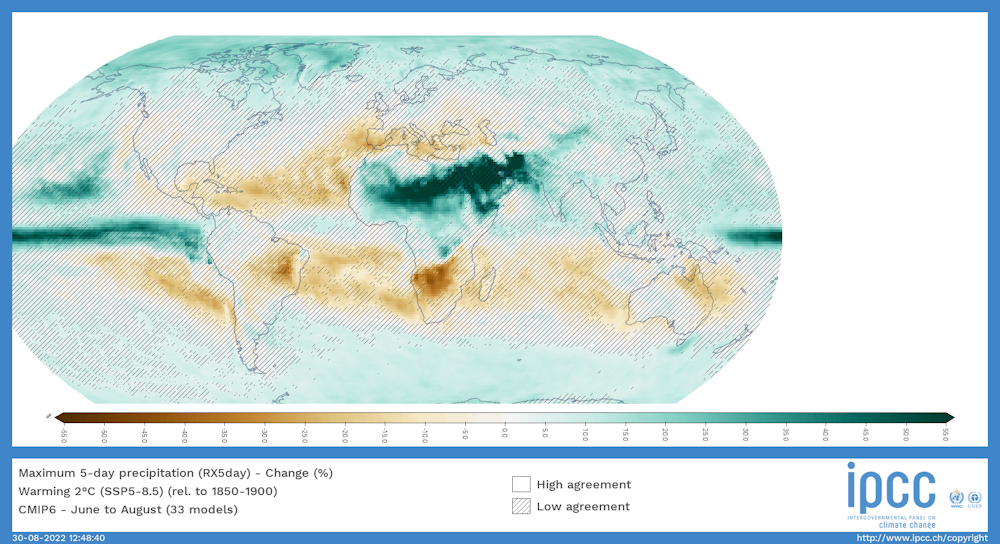
Indeed, the heavy rains in Pakistan follow an observed trend towards increasing extreme daily rainfall totals. This area of the world is projected to see a continued intensification of daily and multi-day extreme rain events over summer, as the planet warms.
Maximum 5-day rainfall in June-August is projected to increase in Pakistan at 2°C global warming.
IPCC AR6 Interactive Atlas
Some heat extremes in recent years have been far beyond what we thought would happen after just over 1℃ of global warming, such as western North America’s record heat of last summer. But it’s hard to tell if our projections are under-forecasting extreme heat.
In any case, the world must prepare for further possible record-shattering high temperatures in the months, years and decades to come. We need to rapidly decarbonise to limit the damage caused by future extreme events.
by Wolf Gruner, Shapell-Guerin Chair in Jewish Studies and Professor of History; Founding Director, USC Dornsife Center for Advanced Genocide Research, USC Dornsife College of Letters, Arts and Sciences
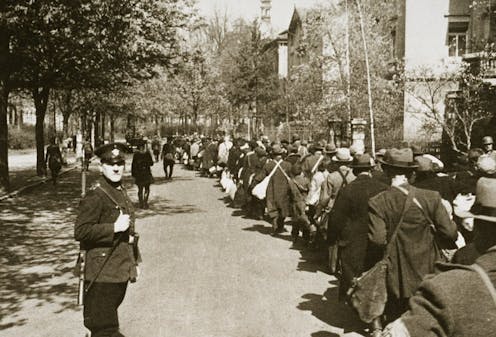
Although the Nazis deported hundreds of thousands of Jewish men and women, for many places where those tragic events happened, no images are known to document the crime. Surprisingly, there’s not even photographic evidence from Berlin, the Nazi capital and home to Germany’s largest Jewish community.
The lack of known images is important. Unlike in the past, historians now agree that photographs and film must be taken seriously as primary sources for their research. These sources can complement the analysis of administrative documents and survivor testimonies and thus enrich our understanding of Nazi persecution.
I searched for unpublished images in all the archives I visited during my research. But I have to admit that I – along with many of my colleagues – did not take the gathered visual evidence seriously as a primary source and rather used it to illustrate my publications.
During the past decade, scholars have realized how pictures can contribute to our understanding of mass violence as well as the resistance to it. Some can provide the only evidence we have about an act of persecution – for example, a photograph of anti-Jewish graffiti. Others will reveal additional details, as in the image of a court proceeding against anti-Nazi resistors.
Photographs are now in some cases the sole objects of scholarly inquiry. They are used to identify perpetrators and victims in specific cases, when other sources would not reveal them.
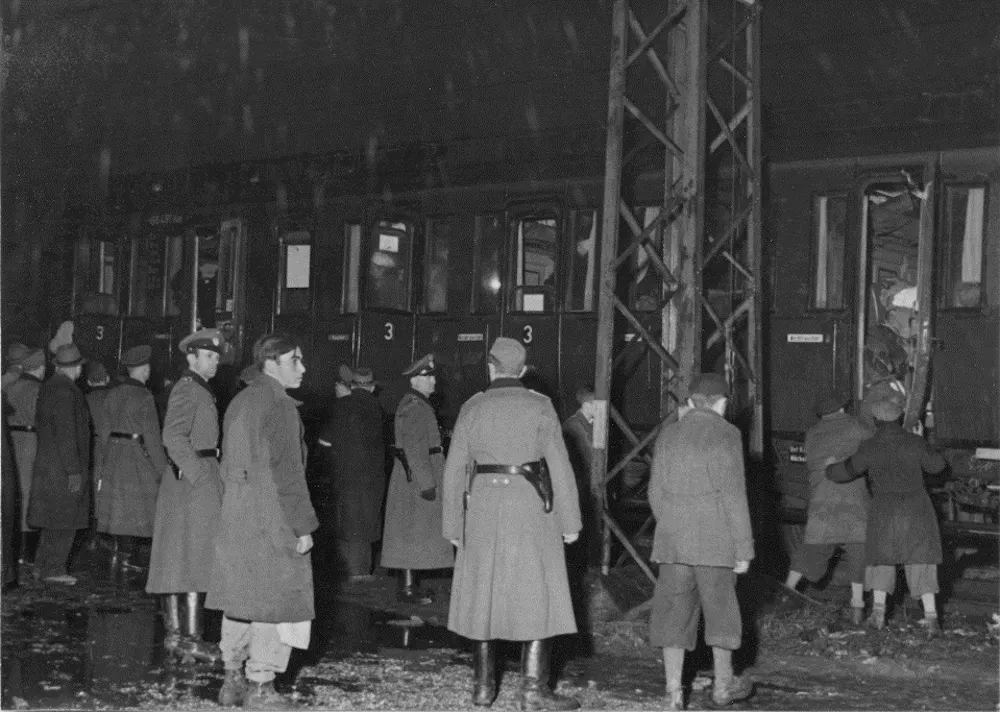
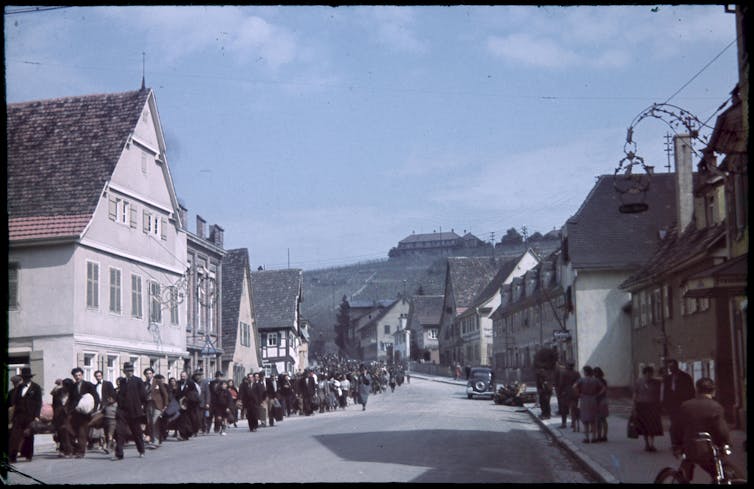
Here’s one example: An image shows uniformed Nazis standing in front of a passenger train filled with German Jews in Munich on Nov. 20, 1942. Who were those men? More importantly, what are the stories of the barely recognizable victims behind the windows in this image?
The deportation of Munich Jews to Kowno in Nazi-occupied Lithuania, Nov. 20, 1942.
City Archive Munich, DE-1992-FS-NS-00015, CC BY-SA
Investigating photos of Nazi deportations
Between 1938 and 1945, more than 200,000 people were deported from Germany, mainly to ghettos and camps in Nazi-occupied Eastern Europe.
This effort aims to locate, collect and analyze images of Nazi mass deportations in Germany. The deportations started with the forced expulsion of around 17,000 Jews of Polish origin in October 1938, right before the widespread antisemitic violence of Kristallnacht, and culminated in the mass deportations to Nazi-occupied Eastern Europe between 1941 and 1945.
The mass deportation targeted not only Jews, but also people with disabilities as well as tens of thousands of Romani.
Romani families, in total 490 people, from Germany’s southwest border region are deported to Nazi-occupied Poland, May 22, 1940.
Research Office for Racial Hygiene, Federal Archive Germany, Barch R 165, 244-42.
What can we learn from the pictures? Not only when, where and how these forced relocations took place, but who participated, who witnessed them and who was affected by the persecution acts.
I work with the USC Dornsife Center for Advanced Genocide Research to manage the outreach for the #LastSeen Project in the English-speaking world. The project has three main goals: first, gathering all existing pictures. These images will then be analyzed to identify the victims and perpetrators and recover the stories behind the pictures. Finally, a digital platform will provide access to all the images and unearthed information, both enabling a new level of study of this visual evidence and establishing a powerful tool against Holocaust denial.
When the project began, the partners were skeptical of whether we would find a significant number of never-before-seen images of mass deportations.
But after addressing the German public and querying 1,750 German archives, within the first six months of the project we received dozens of unknown images, more then doubling the number of German towns, from 27 to over 60, where we now have photographs documenting Nazi deportations.
Many of these photos had collected dust on shelves in local archives in Germany, and some were found in private homes. In the future, the project hopes for discoveries in archives, museums and family possession in the U.S. and the U.K., but also in Canada, South Africa and Australia. We know that liberators took photographs with them from Germany at the end of the war, and survivors received them later via various channels.
Tracing unknown images beyond Germany
The project has already located photos in the United States. In two cases, survivors had donated them to archives, which project staff learned during research visits. Simon Strauss gave an image to the U.S. Holocaust Memorial Museum depicting the deportation in his German hometown of Hanau. He wrote on it, “Uncle Ludwig transported.” The second photo was at the Leo Baeck Institute in New York, which had received the hitherto only known picture from the Nazi deportation of the Jews in Bad Homburg.
To locate more photos, the project counts on the help of ordinary citizens, researchers, archivists, museum curators and survivors’ families.
After joining the project, I searched the USC Shoah Foundation Visual History Archive, which holds over 53,000 video testimonies of Holocaust survivors. Many of the Jews who gave testimony talked about Nazi deportations. All interviewees shared photographs. While many of these more than 700,000 images are artifacts of personal value, such as family and wedding photos, some images depict Nazi persecution.
Within minutes of my search using the term “deportation stills” I was staring at photographs showing a Nazi deportation in a small town in central Germany. At the end of his 1996 interview, Lothar Lou Beverstein, born in 1921, shared two photographs from his hometown of Halberstadt that he had received from friends after the war. Beverstein identified his father, Hugo, and his mother, Paula, in an image showing Nazis lining up deportees in front of the city’s famous 13th-century Gothic cathedral.
Both of Lou Beverstein’s parents were deported to the Warsaw Ghetto on April 12, 1942. In his interview, Beverstein declared that to his knowledge nobody survived from that transport, which supposedly consisted of 24 men, 59 women and 23 children. Now the project needs to locate Lou Beverstein’s family in the United States or connect to other descendants from Halberstadt to find out more about the origins of the images and the identities of the deportees depicted in them.
Naming and recognizing victims
The identities of deportees and perpetrators in the existing images are often unknown. Most photographs show groups of victims whom project staff aim to identify so they and their stories can be acknowledged. This is very difficult, since there are seldom close-up shots.
Two Jewish girls awaiting deportation in Munich on Nov. 11, 1942. Their identities are not known.
City Archive Munich DE-1992-FS-NS-00013
by Helena Gjone, PhD candidate (creative writing), Griffith University
Pikene på Broen/Bernt Nilsen
As an international student at the Bolshoi Ballet Academy in Moscow in 2012, I remember studying Rekviem (requiem) by Russian poet Anna Ahkmatova, an elegy she penned in secret as a tribute to the countless victims of Stalin’s murderous purges.
Akhmatova’s writing revived the atrocities, delivering their darkness into the light.
Her words spoke of constant fear permeating lives; of distrust, anxiety and betrayal; of the secret police arriving to drag you or your family away.
To avoid detection and retribution, Ahkmatova whispered the poem to her friends who committed it to memory. She burned the incriminating scraps of paper.
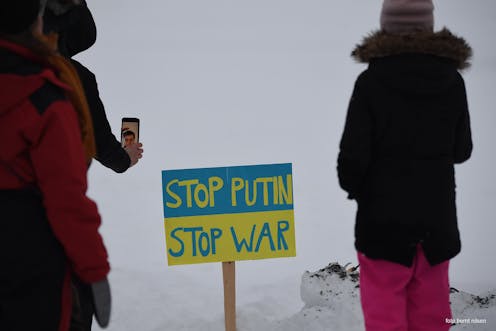
In the first four-and-a-half months following Putin’s attack against Ukraine, over 13,000 anti-war protesters were detained in Russia.
Some estimates are that hundreds of thousands fled Russia in early 2022, among them thousands of artists who no longer felt safe in the climate of increasing censorship.
Some of these artists have found themselves in Kirkenes, a small Norwegian town 15 kilometres from the Russian border.
Artists performing outside Pikene på Broen, an artist collective in Norway near the Russian border.
Pikene på Broen/Torben Kule
Russia’s protest art
Russian and Soviet artists have a long history of art as protest.
The poem Stalin’s Epigram (1933) authored by Osip Mandelstam depicted Stalin as a gleeful killer. Authorities imprisoned and tortured Mandelstam, then deported the poet to a remote village near the Ural Mountains.
After returning from exile, he persisted writing about Stalin until he was sent to a labour camp in Siberia, where he died in 1938 at the age of 47.
Under the comparatively liberal rule of Stalin’s successor Nikita Khrushchev from 1953, the Soviet Union began to enjoy previously unimagined freedoms.
Protest art reflected these newfound liberties, becoming increasingly provocative and experimental.
Many famous art movements surfaced during this period, including Sots Art — a fusion between Soviet and Pop Art — as Russian artists tested the boundaries, exposing the grim realities and unhappiness of life under Stalin’s regime.
In 1962, the legendary composer Shostakovich set his 13th symphony to a series of poems by his contemporary, Yevgeny Yevtushenko. One of these poems was Babi Yar, which criticised the Soviet government for concealing the massacre of 33,371 Jews in a mass grave outside Kyiv.
In contemporary Russia, Pussy Riot came to the attention of the world in 2012 when members stepped behind the altar in Moscow’s golden-domed Christ the Saviour Cathedral wearing neon-coloured balaclavas to deliver a “punk rock prayer”.
Their voices echoed off the cavernous, hand-painted ceilings, raging against Putin’s affiliation with the Orthodox church and the homophobic, anti-feminist policies that followed.
They were sentenced to two years imprisonment.
Today, pictures from Russia reveal anonymous anti-war graffiti on the sides of buildings, “no war” chiselled into a frozen river, and yellow and blue chrysanthemums and tulips left at the feet of Soviet war memorials.
Cross-border collaborations
Pikene på Broen (girls on the bridge) is an arts collective based in Kirkenes.
They have spent the past 25 years curating art projects to promote cross-cultural collaboration and tackle political problems in the borderland region.
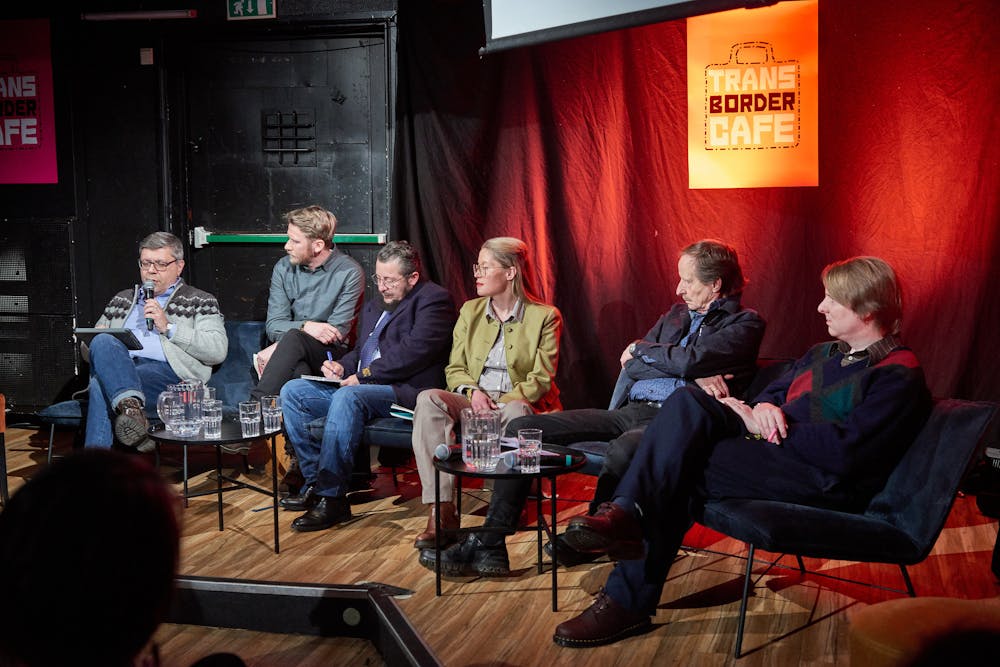
Pikene på Broen is host to the the annual art festival BarentsSpektakel (spectacle), an international artist residency including Russian, Norwegian and Finnish creatives, the gallery and project space Terminal B in Kirkenes town, and the debate series Transborder Café.
The venue has become a hub for open discussions relating to current political and cultural issues, drawing contributions from artists, musicians, writers, politicians and researchers.
Russian and Norwegian artists in discussion at the Transborder Cafe in Kirkenes.
Pikene på Broen/Mikhail Slavin
Evgeny Goman, an independent theatre director from Murmansk, Russia – about 200 kilometres from Kirkenes – has been collaborating with Pikene på Broen for over 10 years.
After moving to Norway in early 2022, Pikene på Broen worked with Goman to organise Kvartirnik (from the word kvartira, meaning apartment), an online talk group for Russian and Norwegian artists to exchange ideas.
Following Putin’s attack on Ukraine, Kvartirnik shifted to an underground movement for dissident artists. Ironically, the name Kvartirnik derives from the clandestine concerts arranged in people’s apartments during the Soviet Era when musicians were banned from performing in public.
Kvartirnik derives its name from the clandestine concerts held in apartments during the Soviet era. The tradition continues today.
Pikene på Broen/Astrid Fadnes
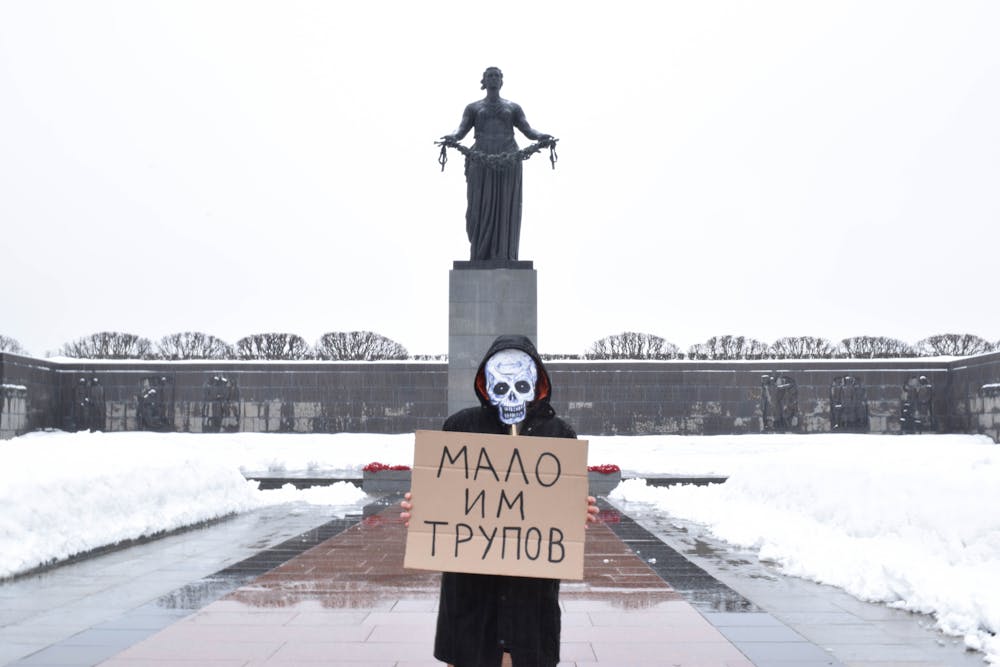
Party of the Dead is one of several Russian protest art groups who participated in Kvartirnik.
Pictures from the snow-decked Piskaryovskoye Cemetery in Saint Petersburg reveal members dressed as skeletons, holding placards reading: “are there not enough corpses?”.
Artists are protesting against the war even in Russia.
Party of the dead
I spoke with Goman about the art coming out of Kvartirnik today.
“In peaceful times, art is more about entertaining,” he says.
But in war and conflict, art is more important because it’s the language we use to express our pain. And through metaphors and symbolism, it allows us to speak about things that are censored.
Countering propaganda
Kvartirnik collaborators in Murmansk have also produced and distributed Samizdat (self-publishing), an anonymous newsletter containing art suppressed by the state.
“We have to be really smart now about how we do things in Russia,” Goman says. “Subtle.”
Attendees at Barents Arts Festival in Norway protested against the war in Ukraine.
Pikene på Broen/Torben Kule
Goman is pessimistic about Russia’s future. But he believes the key to moving forward is keeping communication open. He tells me the West’s decision to ban Russian culture has backfired on their plan to pressure Putin into ending the war against Ukraine.
Instead, he says, the divide is steadily increasing, leaving dissident artists isolated inside a country operating on fear and propaganda, furthering Putin’s agenda.
“Putin wants us to not affect Russian minds. And that’s why we have to keep the dialogue going,” he says of the importance of cross-border collaborations like those he has undertaken in Kirkenes.
If we stop communicating, Putin wins. Propaganda wins.
Helena Gjone does not work for, consult, own shares in or receive funding from any company or organization that would benefit from this article, and has disclosed no relevant affiliations beyond their academic appointment.
by Ana Estefanía Carballo, Honorary Research Fellow in Mining and Society, School of Geography, Earth and Atmospheric Sciences, The University of Melbourne
Chile may soon be the second country in the world to grant constitutional rights to nature, under astoundingly progressive reforms proposed by the government. If approved in the national referendum on 4 September, the new constitution would deliver profound changes to the country.
It’s no surprise that 50 of the 387 constitutional provisions concern the environment. Like Australia, Chile is facing mounting environmental pressures. This includes an escalating water crisis made significantly more challenging by the mining industry, long seen as a key pillar of the economy.
The proposed constitution seeks to rapidly pivot Chile toward ecological democracy, one that can transition an economy long dependent on mineral extraction toward cleaner, less resource-intensive, and more socially just forms of living – _buen vivir_.
While the votes aren’t yet in, there are valuable lessons in this process for Australia and other countries grappling with similar concerns.
Initially unstructured and spontaneous, the protests were sparked by an increase in public transport costs, but quickly coalesced into a widespread constitutional crisis.
This crisis was an outcry against the deeply entrenched socio-economic inequalities seen as rooted in and perpetuated by the country’s legal framework. This is a legacy of the Pinochet dictatorship (1973-1990), which saw soaring wealth inequalities and power concentrated in the hands of business elites and private corporations.
In the face of both social and ecological breakdown, further intensified by the arrival of COVID-19, over 80% of Chileans voted in favour of re-writing the constitution in 2020.
In May 2021, a constitutional convention was elected, formed by 155 representatives from across the country. Notably, 50% of them were women, and it was led by Mapuche linguist and Indigenous rights activist Elisa Loncón.
In July 2022, the convention delivered the much-anticipated draft constitution, which was immediately heralded by supporters as an “ecological constitution”.
What are the reforms?
Over the last decade, both Ecuador and Bolivia have been at the global forefront of advocating for the “rights of nature” or “the rights of Mother Earth”. These rights have made it possible to bring cases on behalf of ecosystems into courts, and to challenge the extractive imperatives of state ministries.
The proposed changes to Chile’s constitution build on these experiments, but take them considerably further.
Not only would Chile become the second nation after Ecuador to grant nature constitutional rights, they would also create an “ombudsman for nature” tasked with monitoring and enforcing them. According to the draft text, it would be the duty of the “state and society to protect and respect these rights”.
Chile has vast reserves of lithium deposits.
Shutterstock
Citizens would also be empowered to bring environmental lawsuits, even before an environmental impact assessment has been approved. The monitoring of these rights would extend all the way down to the local level, decentralising environmental regulatory authority that has historically been concentrated in the capital of Santiago.
But perhaps even more significant are the proposals aiming to reverse another legacy of the Pinochet dictatorship: Chile’s decades-long privatisation of water.
Articles in the proposed constitution concerning water rights, the human rights of water, and the protection of glaciers and wetlands significantly roll back these trends. They declare that water is not a commodity but, instead, incomerciable or “unsellable”.
Overturning this decades-long controversial market mechanism is the direct result of involving social and Indigenous movements in the constitutional process. It reflects and affirms their often-repeated recognition that Agua es vida, or “water is life”.
Beyond enshrining water protection measures, the draft constitution represents a renewed effort to bolster Chile’s natural resources governance, a move with significant impacts on the mining industry. It specifies that exploration and exploitation of mineral resources should ensure environmental protection and the interest of future generations.
There are also requirements to ensure sustainable management of land sites after a mine has closed, and for the promotion of value chain linkages (where mineral processing occurs in the country and benefits its people).
Such considerations are particularly crucial for the global transition towards renewable energy, which poses high demands on Chile’s copper and lithium industry, minerals used for energy storage.
The global rush for these minerals is increasing governance challenges and putting pressure on communities already under environmental and water stress. Strong legal support for a more equitable, fair and sustainable governance framework is imperative.
Lessons for the world
Many questions remain about how these reforms would be put into practice. Nevertheless, they represent the culmination of dialogue between sectors that have historically been excluded from political power.
Australia has much to learn from this process. Most important, perhaps, is that despite the resistance of pro-market sectors, including the mining industry, sweeping and rapid transformations are indeed imaginable in the climate crisis. Other worlds are possible. Other forms of democratic practices are possible.
Addressing climate change while ensuring a sustainable energy transition with inter-generational and inter-cultural equity means prioritising the voices of those who have been systematically excluded – particularly Indigenous communities. Australia would do well to heed this lesson.
And the lessons aren’t just for Australia. While many countries have reluctantly acknowledged the climate emergency that continues to engulf us, Chile is nearly alone globally in acting with the sense of urgency required. What it has already achieved is historic.
From an outcry in the streets to the election of an outstandingly diverse constitutional convention, Chile has crafted one of the most progressive and environmentally conscious legal texts on the planet. Chile’s experience demonstrates that bold, just, and democratic action is not only possible, but necessary.
Ana Estefanía Carballo is a Research and Programme Manager, Accountable Mining, Transparency International Australia.
Erin Fitz-Henry does not work for, consult, own shares in or receive funding from any company or organisation that would benefit from this article, and has disclosed no relevant affiliations beyond their academic appointment.
by Andrew Stokes, Assistant Professor of Global Health, Boston University
As of August 2022, COVID-19 vaccination rates in Black and Hispanic people exceeded those of white Americans nationally, but only for the initial shots. FatCamera/E+ via Getty Images
But boosters are a different story. Comparable booster vaccine promotion efforts have been lacking. Confusion in the public health messaging surrounding boosters and limited federal funding for rolling out vaccination campaigns have resulted in slow booster uptake across the country.
As a result, divides have once again emerged. A recent study of COVID-19 booster rates found that 45% of white adults and 52% of Asian American adults had received boosters by January 2022. But only 29% of Black adults and 31% of adults who reported another racial or ethnic identity, such as American Indian, Alaska Native, Native Hawaiian, Pacific Islander or multiracial, were boosted.
As of late August 2022, the U.S. Centers for Disease Control and Prevention reported that 36.3% of white adults in the U.S. 50 years or older and eligible for a second booster shot had received one. This is compared to only 28.4% for the Black population, 31.3% for American Indian or Alaska Native populations, and 25.1% for the Hispanic population.
Vaccine studies suggest that adults age 50 and older who receive a booster shot have 90% lower death rates from COVID-19 than those who receive only the initial vaccine regimen. But the extent to which boosters have translated into health gains at the population level remains unclear.
Preliminary analyses by our team indicate that people in the U.S. living in counties with low booster uptake are dying from COVID-19 at higher rates than people living in counties with high booster uptake. In particular, in comparing the counties in the bottom 10% of booster rates with those in the top 10%, the COVID-19 death rates for residents of the bottom 10% of counties were 64% higher. Our analysis applies to the period from January to June 2022. It also adjusts for residents’ ages.
This difference in death rates may in part reflect the fact that counties with greater booster protection also tend to have higher rates of primary-series vaccination. Nonetheless, these findings suggest that at the population level, booster rates are now a key factor behind COVID-19 deaths.
A prior study found that vaccination strategies that target high-risk geographical areas save more lives than strategies based on age alone. Thus, the evidence suggests that limited federal funding for COVID-19 booster promotion should be sent to geographical areas that are currently reporting high rates of COVID-19 deaths.
Learning from the community
An effective booster campaign could build on lessons learned from prior vaccination campaigns. Specifically, this involves bringing vaccines directly to people. From the earliest days of vaccine distribution during the pandemic, partnerships with faith-based organizations, housing communities and trusted community organizations have been successful in reaching populations with low vaccination rates.
Other strategies to make boosters more accessible include increasing access to vaccine centers via public transit and outside of typical working hours. In rural areas, evidence-based strategies to promote vaccination include education of community ambassadors, use of social media and operation of mobile vaccination sites.
In the absence of federal funding, community efforts have aimed to make boosters more accessible. A New Yorker documentary filmed in 2021 explored the challenges that one rural community in Alabama – Panola – has faced with vaccination. It highlights community leader Dorothy Oliver as she promotes vaccination with little to no support from the government. Her efforts included door-to-door campaigns, discussions with residents about their fears and concerns and coordination of vaccination logistics, including scheduling and transport.
In a similar way, Minneapolis’ Seward Vaccine Equity Project increased booster shots among East African immigrant families by having volunteers call members of their own communities and offer them a booster appointment and a ride. The volunteers were also available to answer residents’ questions and address any concerns. Successful efforts like those could be carried out by health departments on a much wider scale.
Andrew Stokes receives funding from the Robert Wood Johnson Foundation, the W.K. Kellogg Foundation, and the National Institute on Aging.
Elizabeth Wrigley-Field is a member of the Seward Vaccine Equity Project, discussed in the article. She receives funding from the Eunice Kennedy Shriver National Institute on Child Health and Human Development via the Minnesota Population Center and from the National Institute on Aging via the Life Course Center, both at the University of Minnesota.
Dielle Lundberg and Rafeya Raquib do not work for, consult, own shares in or receive funding from any company or organisation that would benefit from this article, and have disclosed no relevant affiliations beyond their academic appointment.
Abortion travel isn’t new. People have been crossing national and state borders to get abortion care since the 1960s, when air travel became more common and affordable.
As a sociologist who studies gender, reproduction and health, I have interviewed hundreds of women who have sought abortions, many of whom had to travel for care. My recent study on the experiences of people who had to travel across state lines for abortion care can help people better understand what costs abortion patients face when they have to travel.
For those living in states that have restricted abortion, traveling for a procedure can be expensive, daunting and lonely.
1. Why do people travel for abortion care?
People travel for medical care for many reasons. In the case of abortion travel, they are typically traveling because abortion is either legally restricted or unavailable in their home area. To get an abortion, they have no choice but to travel.
2. What are the main costs of traveling for abortion care?
Most people rightly anticipate that abortion travel entails expenses like gas money or plane tickets and hotel charges. As research shows that most abortion patients are at or just above the federal poverty line, it is easy to see that these costs alone could represent a substantial burden.
But traveling for an abortion often also includes numerous other costs. For instance, most abortion patients are already parenting children, so they must figure out child care logistics when they have to travel for abortion care. People who do not have access to a reliable vehicle may need to rent a car to make a long-distance drive across state borders.
Abortion funds – nonprofit organizations that provide practical and financial support to people seeking abortion care – can help people who are financially struggling navigate some of these costs. But often this aid isn’t sufficient to cover all costs. There are also real questions about whether funds can meet the growing demand.
And then there is the issue of lost wages during the time a patient must spend traveling. For many people engaged in hourly work, when you don’t work, you don’t get paid.
Some companies, like Starbucks and Dick’s Sporting Goods, are offering financial support to employees who travel for an abortion.
Abortion travel can also entail emotional costs. I’m currently working on a new study based on interviews with 30 women from around the U.S. about the emotional impacts of having to travel out of state for abortion care. Based on these interviews, I’ve learned that having to travel for abortion care can mean the stress of having to navigate a new place. For some people, this could be their first time in that city or even away from home. It also means being removed from their usual support systems and the physical and emotional comforts of home. This, too, can take an emotional toll.
And, of course, having to travel means having to explain to others – including co-workers and family members – why they are traveling, which can also come at a high personal and emotional cost.
3. Are there any positives to traveling for abortion care?
There is not much work on this question to date. Most research on abortion travel has focused on its negative aspects. But in my research, some of the women who had to travel for abortion care talked about how much they appreciated the emotional support they received in their destination clinic – especially after the hostility to abortion they had experienced in their home communities.
Seeking out nonjudgmental, compassionate care might motivate someone to prefer to travel for abortion care. But in the post-Roe landscape, few will have that luxury. Rather, travel will be a necessity, not a choice. Even with the possibility of emotional benefits, travel for abortion care exacts clear and substantial costs.
Katrina Kimport receives funding from the Society of Family Planning, the David and Lucile Packard Foundation, and an anonymous foundation.
by Aaron Pilkington, US Air Force Analyst of Middle East Affairs, PhD Student at Korbel School of International Studies, University of Denver
In July 2022, Iran provided the Russian military with training for using Iranian-produced weapons, including the Shahed-129 drone, displayed here at a 2019 military show in Tehran. Morteza Nikoubazl/NurPhoto via Getty Images
The war in Ukraine is helping one country achieve its foreign policy and national security objectives, but it’s neither Russia nor Ukraine.
It’s Iran.
Iran is among Russia’s most vocal supporters in the war. This has little to do with Ukraine and everything to do with Iran’s long-term strategy vis-à-vis the United States.
As Russia’s war on Ukraine passes six months and continues eroding Russia’s manpower, military stores, economy and diplomatic connections, leader Vladimir Putin has opted for an unlikely but necessary Iranian lifeline to salvage victory in Ukraine and also in Syria where, since 2015, Russian soldiers have been fighting to keep Bashar al-Assad’s government in power.
Putin’s move has, in turn, helped Iran make progress in promoting its national interests.
Iranian Supreme Leader Ayatollah Ali Khamenei, center, and Russian President Vladimir Putin, greet each other as Iranian President Ebrahim Raisi stands at right during their meeting in Tehran, Iran, on July 19, 2022.
Office of the Iranian Supreme Leader via AP
Opposing the US everywhere
Since the Islamic Revolution of 1979, Iran’s leaders have believed the United States is constantly scheming to topple Iran’s government. They view leaders in Washington as the greatest threat and obstacle to promoting Iranian national interests – achieving economic self-sufficiency, international legitimacy, regional security, power and influence.
The fears of Iran’s leaders are not irrational – the long history of U.S. meddling in Iranian affairs, continuous open hostility between the two countries and decades of U.S. military buildup in close proximity to Iran greatly concern leaders in Tehran.
The U.S. has military forces in many Middle Eastern countries, with or without invitation. To promote its national interests, Iran is working to force the U.S. military out of the region and reduce U.S. political influence there.
Iran has an even bigger aim: to overthrow what it sees as the U.S.-dominated global political order.
Iran counters U.S. influence by maintaining partnerships with an assortment of nonstate militias and governments united by their fierce anti-U.S. hostility. The country nurtures a network of militant partner and proxy groups, whose own political preferences and ambitions align with Iran’s objectives, by providing weapons, training, funds – and, in some cases, direction. Among the recipients are Hezbollah, Hamas and Palestinian Islamic Jihad, friendly Iraqi militias and Ansar Allah in Yemen, better known as the Houthis or the Houthi rebels.
Through these militias and their political arms, Iran extends its influence and works to shape an Iran-friendly government in states like Lebanon, Syria, Iraq and Yemen. It threatens U.S. forces and antagonizes Western-allied governments in states such as Israel, Jordan, Saudi Arabia, Kuwait, Bahrain and the United Arab Emirates.
At the national level, Iran maintains no permanent mutual defense treaties. Its closest strategic partners include Syria, Venezuela, North Korea, China and Russia. They cooperate politically, economically and militarily to create an alternative to what their leaders perceive as the U.S.-led world political order.
Few political leaders understand Putin’s newfound political isolation and related animosity toward the United States more than Iranian leader Ayatollah Ali Khamenei. But Iran-Russia relations are complicated.
The two countries found common cause in helping Syrian strongman Assad defeat his country’s opposition forces, but for different national interests.
Saving Assad helps Russia reassert itself as a major power in the Middle East. For Iran, a friendly Syria is a critical link in Iran’s anti-U.S., anti-Israel coalition.
As Russia and Iran fought to sustain Assad, they also competed for lucrative postwar reconstruction and infrastructure contracts in that country, and to shape the post-civil war political environment to their advantage.
But neither country was bold enough to influence the way the other operated in Syria. Consequently, sometimes Iranian-backed and Russian forces cooperated, and at other times they squabbled. Mostly they left each other alone.
Ultimately, though, Russia’s plight in Ukraine compelled its leader to solicit Iran’s help in two ways.
First, the Islamic Revolutionary Guards Corps, a branch of the Iranian military, provided supplementary manpower to fill the void left when Russia reallocated troops from Syria to its Ukraine campaign.
Second, Russia will use Iran’s low-cost and battle-proven unmanned aerial vehicles, commonly known as drones, to counter Kyiv’s Western-supported arsenal and buttress its own struggling forces and surprisingly inept warfighting capabilities.
U.S. National Security Adviser Jake Sullivan tells reporters on July 11, 2022, that Iran planned to send ‘several hundred’ drones, including some equipped with weapons, to Russia.
Ukraine war promotes Iran’s interests
This warming alliance may not help Russia defeat Ukraine. It will promote Iran’s national interests.
Russia’s Syria drawdown brought additional Iranian soldiers there to further prove their fighting abilities and entrench themselves in Syria. That then allows Iran to control territory threatened by anti-Assad forces and maintain an open corridor or “land bridge” by which Iran extends support to its network of anti-America and anti-Israel partners and proxies.
Second, Russia’s acquisition of Iranian arms will significantly boost Iran’s weapons industry, whose primary clientele right now is its own militias. Iran’s recent efforts to expand drone manufacturing and exports yielded limited success in small, mostly peripheral markets of Ethiopia, Sudan, Tajikistan and Venezuela.
Lastly, Russia’s war in Ukraine extends a new avenue by which Iran might directly counter U.S.-provided weapons, as well as the opportunity to undermine U.S. and NATO influence in Eurasia. Iran’s drones could afford Moscow an effective and desperately needed response to U.S. weapons wreaking havoc against Russian forces in Ukraine – the High Mobility Artillery Rocket System, the Javelin anti-tank guided missile, the Switchblade “kamikaze” or suicide drone and others.
Iranian weapons may force Ukraine’s Western benefactors to allocate additional billions for counter-drone or air defense systems, or aid to replace assets that Iranian weapons potentially neutralize.
Limited tactical victories scored by Iranian drones may prolong and further destabilize the war in Ukraine, but they will not tip the scales of conflict in Russia’s favor.
Their greater contribution is to Iran’s national interests: They allow Iran to directly check and undermine the U.S. and NATO outside of Iran’s usual regional area of operations. They boost Iran’s profile among countries that also wish to challenge the United States and NATO’s political, military and economic power. And they strengthen solidarity among those countries.
As Iran’s fighters, advisers and weapons proliferate to new areas and empower U.S. adversaries, Iran further promotes its national interests at the expense of U.S. national interests.
Aaron Pilkington is a U.S. Air Force analyst of Middle East affairs now studying at the University of Denver, conducting research on Iranian national security strategy. He will later join the Military & Strategic Studies department at the U.S. Air Force Academy. The views expressed are those of the author and do not reflect the official position of the Department of Defense, Department of the Air Force, the United States Air Force Academy, or any other organizational affiliation.
by Cristian Apetrei, Professor of Immunology, Infectious Diseases and Microbiology, University of Pittsburgh Health Sciences
Disinformation can derail public health measures vital to controlling the spread of infectious disease. AP Photo/Jeff Chiu
Since health officials confirmed the first COVID-19 cases, misinformation has spread just as quickly as the virus. Social media may have made the amount, variety and speed of misinformation seem unprecedented, but COVID-19 isn’t the first pandemic where false and harmful information has set back public health.
What sets the COVID-19 pandemic apart, however, is the sheer magnitude of damaging disinformation put in circulation around the world. Data shows that regions and countries where disinformation thrived experienced more lethal pandemic waves despite vaccine availability. In the U.S., for example, viewership of a Fox News program that downplayed the pandemic is associated with increased COVID-19 cases and deaths. Similarly in Romania, disinformation is a contributing factor to the country’s disastrous fourth wave of COVID-19.
The COVID-19 infodemic began as soon as the first few cases of infections were confirmed.
The problem of misinformation has been so widespread that it has its own word: “infodemic,” a portmanteau of “information” and “epidemic.” Coined by journalist David Rothkopf during the 2003 SARS outbreak, it describes a situation where “a few facts, mixed with fear, speculation and rumor, are amplified and relayed swiftly worldwide by modern information technologies.”
Infodemics can affect economies, politics, national security and public health. The COVID-19 infodemic became such a problem that the Royal Society and the British Academy released an October 2020 report noting its significant impact on vaccine deployment, endorsing legislation that prosecutes those who spread misinformation.
As a researcher who studies HIV and lived through the AIDS pandemic, I felt a sense of déjà vu as COVID-19 disinformation spread. In the 40 years since the emergence of AIDS, society has learned how to cope with the disease with more effective diagnostics, treatments and preventive strategies, transforming AIDS from a lethal condition to a chronic disease.
In general, these groups tend to also deny germ theory, claiming that infectious diseases are not caused by pathogens like viruses and bacteria. Instead, they promote the idea that pathogens don’t cause disease, but rather are a consequence of it.
Misinformation is just one common theme between the COVID-19 and HIV/AIDS pandemics.
Likewise, some denied the role of the HIV virus in AIDS infection. AIDS denialist Peter Duesberg was one person who disseminated this misinformation, which had been refuted by the scientific community at large. But his erroneous claim still reached the then president of the Republic of South Africa, Thabo Mbeki, who banned the use of lifesaving antiretrovirals in public hospitals. This decision resulted in the deaths of over 330,000 people from HIV/AIDS between 2000 and 2005.
Mbeki’s decision was considered so damaging that scientists and physicians worldwide signed the Durban Declaration, reiterating that HIV indeed causes AIDS and urging Mbeki to reconsider his decision. While the government did reverse the ban after strong international political pressure, the damage had been done.
Gain of function claims
Gain of function experiments involve manipulating a pathogen to understand what contributes to its ability to cause disease. At the same time, such experiments can give pathogens new abilities, such as making viruses more transmissible or more dangerous to humans. Conspiracy theorists have made claims that the COVID-19 virus resulted from alterations to a bat version of the virus that gave it the ability to replicate in human cells.
But these claims ignore several key facts about the COVID-19 virus, including that all coronaviruses from bats can infect humans without additional adaptation. The mutations that increased the transmissibility of COVID-19 occurred after it started circulating in people, resulting in even more infectious variants.
HIV also saw conspiracy theories claiming that it was created in a lab for genocide. But research has shown that HIV also naturally evolved from an animals. African non-human primates are natural hosts to a vast group of viruses collectively called simian immunodeficiency viruses (SIV). Despite their high rates of SIV infection in the wild, these primate hosts typically don’t experience symptoms or progress to AIDS. Throughout the evolutionary history of SIV, jumping to a new host species involved naturally occurring genetic changes over the course of thousands of years.
Miracle cures
During a public health crisis, researchers and health officials are learning about a disease in real time. While missteps are expected, these can be perceived by the public as hesitation, incompetence or failure.
There are some steps you can take to identify misinformation.
As researchers looked for possible COVID-19 treatments, others were offering their own unproven drugs. Multiple treatments for COVID-19, including ivermectin and hydroxychloroquine, were tested and abandoned. But not before large amounts of time, effort and money were spent on disproving claims that these were supposed miracle treatments. Similarly for HIV, frustration and anxiety from a continued lack of available treatments amid rising deaths led to fraudulent cures, with price tags of tens of thousands of dollars.
Even though treatment delays and changing guidelines are a natural process of learning about a new diseases as it unfolds, they can open the door to disinformation and generate distrust in doctors even as they care for infected patients.
Preventing misinfodemics
The next pandemic is not a question of if but when and where it will occur. Just as important as devising ways to detect emerging viruses is developing strategies to address the misinfodemics that will follow them. The recent monkeypox outbreak has already seen similar spread of mis- and disinformation about its source and spread.
As author Gabriel Garcia Marquez once said, “A lie is more comfortable than doubt, more useful than love, more lasting than truth.” Countering misinformation is difficult, because there are reasons other than ignorance for why someone believes in a falsehood. In those cases, presenting the facts may not be enough, and may sometimes even result in someone doubling down on a false belief. But focusing on urgent scientific and medical needs to the exclusion of rapidly addressing misinformation can derail pandemic control. Strategies that take misinformation into account can help other pandemic control measures be more successful.
Cristian Apetrei receives funding from the National Institutes of Health/National Institute of Diabetes and Digestive and Kidney Diseases/National Institute of Allergy and Infectious Diseases: R01 DK113919, R01 DK119936, R01 DK131476, R01 AI119346.
by Rhodri Jeffreys-Jones, Professor Emeritus of American History, University of Edinburgh
In the early 1990s, Senator Patrick Moynihan campaigned for the abolition of the CIA. The brilliant campaigner thought the US Department of State should take over its intelligence functions. For him, the age of secrecy was over.
For 30 years the intelligence community systematically misinformed successive presidents as to the size and growth of the Soviet economy … Somehow our analysts had internalised a Soviet view of the world.
In the speech introducing his Abolition of the CIA bill in January 1995, Moynihan cited British author John le Carré’s scorn for the idea that the CIA had contributed to victory in the cold war against the Soviet Union of Leonid Brezhnev and his successors. “The Soviet Empire did not fall apart because the spooks had bugged the man’s room in the Kremlin or put broken glass in Mrs Brezhnev’s bath,” Le Carré had written.
This was one of the CIA’s lowest points since its establishment in 1947 (my new book marks the agency’s 75th anniversary). It was created with two key goals in mind: thwarting Soviet expansionism, and preventing another surprise attack like that carried out by the Japanese on Pearl Harbour during the second world war. While Moynihan’s campaign to shut down the CIA did not ultimately prevail, there was certainly a widespread perception that the agency was no longer fit for purpose and should be curtailed.
This story is part of Conversation Insights The Insights team generates long-form journalism and is working with academics from different backgrounds who have been engaged in projects to tackle societal and scientific challenges.
Throughout the cold war, many had regarded fighting communism as the CIA’s raison d’être. With the collapse of the Soviet Union, the agency’s role was less clear, and it came under heavy criticism for having distorted intelligence and “blatantly pandered” to one ideological viewpoint: blind anti-communism. Without the cold war, Moynihan predicted, the CIA would become “a kind of retirement programme for a cadre of cold warriors not really needed any longer”.
Three decades on, however, Vladimir Putin’s invasion of Ukraine has put Russia’s threat to the stability of the world back at the top of the US foreign agenda. With a formidable Kremlinologist now in charge of the CIA and Donald Trump out of the presidential picture (for the moment, at least), the agency might be expected to be an influential player in the US response to this “new cold war”. But how much does Washington trust the CIA these days – and how much influence does it really have on events in Ukraine? To shed light on these questions, we need to go back to the early days of the Ronald Reagan presidency.
‘Stay the f-ck out of my business’
As US president from 1981 to 1989, the neoconservative Reagan unleashed the CIA from restrictions that had been imposed on it during the reforming post-Vietnam 1970s.
Like other anti-communists, Reagan saw the agency as a prime weapon in weakening the Soviet Union, which he famously denounced as the “evil empire”, and preventing the worldwide spread of communism. The new US president was convinced that in opposing an unethical foe, one could not afford to be too scrupulous. He chose as his CIA director Bill Casey, a veteran of intelligence in the second world war – a time when it had been “gloves off” for dirty tricksters.
An outright cold warrior, Casey resuscitated old CIA habits, running covert operations against the left-leaning – but democratically elected – Sandinista government in Nicaragua from December 1981 to the ceasefire of March 1988. Even the veteran conservative senator Barry Goldwater admitted he was “pissed off” when, in 1984, the CIA mined Nicaragua’s harbours without informing Congress. Accosted with this oversight, the uncompromising Casey replied: “The business of Congress is to stay the fuck out of my business.”
The CIA worked closely with the Contras, right-wing terrorists who sought to overthrow the Sandinista government. The agency trained these guerrillas in secret camps in adjacent countries and organised munition drops from planes stationed in clandestine bases. In one initiative, a contracted CIA operative wrote a manual for the Contras explaining how to assassinate individuals on one’s own side – skulls had to be fractured in just the right way – and then blame the enemy.
A disapproving US Congress banned these weapons drops and cut off the necessary funds. To get around this, arms were illegally supplied to Iran (then at war with Iraq) via Israel – paid for by covert Iranian financial assistance to the Contras. However, fearing the wrath of Congress should this ruse be discovered (as it later was), the Reagan administration bypassed the CIA in administering the Iran-Contra scam. While the president had not lost confidence in the agency, this was a sign that the CIA was becoming increasingly toxic in the eyes of Congress – making it too risky to deploy its spooks in the customary manner.
On the threat posed by the Soviet Union, though, there was far greater accord. CIA director Casey lined up with the secretary of defence, Caspar Weinberger, and the majority of Reagan’s cabinet in adopting an intransigent stance towards Moscow. They were supported by the CIA’s senior Russia expert, Bob Gates, who having gained his PhD in Russian affairs without ever visiting the country, proclaimed that the Soviet Union was an example of “oriental despotism”.
A keen boy scout in his youth, Gates – whether out of conviction or career calculation – glued himself to the American flag and offered no challenge to any president who wanted to play up the Moscow menace. Under Reagan, Casey and Gates, the CIA worked tirelessly to undermine the Soviet Union – secretly supporting Poland’s opposition movement Solidarity, and engaging in acts of economic sabotage against the Soviet economy.
Indeed, according to Republican partisans who argued that President Reagan won the cold war (the “victory thesis”), the US launched its Strategic Defense Initiative (SDI or “Star Wars”) with the aim of forcing Moscow to respond, thus ruining the Soviet economy and bringing about the collapse of communism. SDI was a multi-billion-dollar space defence system designed to intercept and destroy incoming enemy missiles. According to the victory thesis, Gates’ exaggerated estimates of Soviet military might were not an instance of unthinking anti-communism but rather, a cunning ploy designed to persuade Congress to fund the Star Wars bluff.
Gates would go on to lead the CIA from 1991-93, the years when Senator Moynihan was campaigning for its abolition. The Senate confirmation hearings that preceded Gates’ tenure would be the occasion for some bitter denunciations from erstwhile colleagues. Gates later recalled that these charges of 1980s intelligence distortion “truly imperilled my confirmation”.
Jennifer Lynn Gaudemans, who in 1989 had left the CIA’s Office of Soviet Analysis (Sova) in a disillusioned state of mind, accused Gates of seeing Soviet conspiracies around every corner, and of “blatantly pandering to one ideological viewpoint”.
At the Senate hearings, Gaudemans testified that Sova analysts were deeply upset when Gates suppressed their findings that the Soviet Union was not, in fact, orchestrating mischief in Iran, Libya and Syria. She claimed he had denied them even the opportunity to publish dissenting footnotes. Sova division chiefs were, she said, routinely dismissed for being “too soft” on issues such as Soviet policy in the developing world, and arms control.
But while the agency’s analysts had problems with Gates, more powerful individuals – not least, the US secretary of state George Shultz – were prepared to listen. Sova-generated data and findings made their way on to the desks of US negotiators.
On November 18 1985, the eve of Reagan’s summit meeting with Soviet leader Mikhail Gorbachev in Geneva, the president and his negotiators received an intelligence assessment to the effect that, while Gorbachev was repairing the economic damage of the Brezhnev era, he would not meet his growth targets. Because of this and the acute nationalist discontent in Poland, CIA analysts told Reagan that Gorbachev was ready to deal with the US.
Through such insights, the agency played an important role in ending the “old” cold war, culminating in the dissolution of the Soviet Union on Christmas Day, 1991. But in the process, it also unwittingly contributed to the idea that the CIA might no longer be needed by the now-globally dominant US.
Intelligence to please
A decade later, the US’s confident post-cold war demeanour changed at a stroke when two hijacked planes flew into the World Trade Center on September 11, 2001. And the CIA would be the fall guy.
The attack masterminded by Osama bin Laden glaringly exposed the CIA’s inability to uphold its founding mission of preventing another Pearl Harbour-style attack on the US. Under renewed pressure to justify its existence, the agency succumbed to the demands of the George W Bush administration in the “war on terror” that arose from the ashes of 9/11.
As the US government desperately sought a rationale for invading Iraq, a deal was struck. Senior leaders of the agency may squirm at the charge, but the CIA supplied intelligence to please in exchange for the right to survive. Its leadership endorsed the mythical charge that Iraq was developing weapons of mass destruction (WMD). And when the ensuing war was a disaster, the CIA took the hit for having delivered that faulty intelligence.
With the role of the CIA thus diminished, the US intelligence community became an unresolved puzzle. Demoralised CIA personnel threw up their hands in despair. CIA veteran Art Hulnick, now teaching intelligence studies at Boston University, was at a loss to explain to his students the new arrangements for analysing intelligence. Hulnick complained of an overreaction to what he termed the “threat du jour”.
Resources were being poured into the huge and unwieldy Department of Homeland Security; the Department of Defence was poaching assets from the CIA; and the agency had even lost its monopoly on preparing the president’s daily briefing (the first item on the president’s desk each morning, memorably described by Michelle Obama as the “death, destruction and horrible things book”.)
By the mid-2000s, intelligence work was being heavily outsourced to private businesses in accordance with the ideology of the George W Bush administration. Private recruiters such as Blackwater were appearing at the CIA HQ’s cafeteria in Langley, Virginia, hiring personnel with promises of big salary increases before sometimes subcontracting them back to the agency at inflated rates.
The CIA had never been a fainting lily but now, in the interests of its own survival, its directors agreed to engage in unsavoury practices including torture, illegal kidnapping, and execution-by-drone without trial. Waterboarding, whereby water is poured over a cloth on the victim’s face to produce a sensation of drowning, was a common practice in the agency’s “dark sites” – secret interrogation centres in Poland, Egypt and other countries around the world where kidnapped suspects were held.
Investigative journalism and persistently curious congressional committees are staples of American democracy, and these dubious practices were bound to come to light – with the aid of whistleblowers such as Edward Snowden. Snowden had worked for the CIA as a highly regarded computer security expert before moving to a private subcontractor engaged by the US foreign signals intelligence organisation, the National Security Agency (NSA).
In 2013, Snowden leaked numerous files to the Guardian and Washington Post before fleeing to Russia in order to evade rendition by the CIA. His revelations about US internal surveillance practices infuriated the guardians of America’s secrets, and fed the fears of those who deplored the use of dirty tricks abroad – and the development of a “secret state” at home. Snowden was accused of having revealed the identities of CIA personnel on active duty to the possible detriment of their safety – a form of treason (should it be proved) that was a deeply sensitive matter within CIA headquarters. It was fortunate for the agency, though, that the main thrust of Snowden’s revelations was about the NSA’s role in global surveillance.
An end to CIA ‘groupthink’
By 2007, while the Iraq war grew mired, the Bush administration was talking loudly about another familiar Middle Eastern foe: Iran.
In 1953, the CIA had conspired to overthrow the country’s democratically elected but mildly leftist government headed by Mohammad Mossadegh. There followed a period of despotic royal rule by the last shah of Iran, Mohammad Reza Pahlavi. His overthrow in 1979 saw a period of priestly mullah rule and of alienation, mitigated only briefly by the Iran-Contra deal.
While the Iraq war continued, the US shared the concerns of Israel, its fellow nuclear power and Iran’s regional rival, that Tehran was developing the wherewithal to produce an atomic bomb. The hawks in the Bush administration issued strident warnings on the subject, but had to contend with a rising force in the intelligence community: the US National Intelligence Council (also known as “Nick”).
By this time, Nick was generating national security estimates that informed US security and foreign policy. While it traced its origins to pre-CIA days, once the agency was founded Nick became reliant on the data and analysis it provided – an arrangement that increasingly caused resentment on the part of state department officials.
After 2004, however, things changed: Nick could now call in other experts to help formulate its analyses and conclusions. And in 2007, Nick determined that Iran, contrary to claims made by the vociferous hawks in the Bush administration, was not developing nuclear weapons. This was an outstanding example of “intelligence to displease” – of speaking truth to power. The CIA was still supplying Nick with data and with some skilled analysts. But according to Thomas Fingar, who presided over Nick at the time of the 2007 Iran estimate, CIA “groupthink” no longer prevailed.
As Nick drew on a wider base of experts, it could not be accused, as the CIA had been, of gnawing at the same bone over and over again. Fingar’s colleagues backed his firm stance on Iran. Overcompliance was avoided in a manner that had not been possible in earlier cases such as the WMD scandal, when the CIA had enjoyed unalloyed supremacy.
Perhaps because of this, many CIA analysts appear to have been at ease with the new arrangement – a point stressed by Peter A Clement, who was in charge of Russian analysis at the point of transition to the new system. Elsewhere in the intelligence bureaucracy, however, there was discontent. The CIA’s counterterrorism unit’s absorption into a new National Counterterrorism Center (NCTC) elicited this comment from former agency employee and sociologist Bridget Rose Nolan:
There is a general sense that NCTC was almost a knee-jerk reaction to 9/11 – a way for the government to treat the symptoms, but not the cause, of the perceived problem.
Compared with others within the agency, the CIA’s analysts could think themselves fortunate. Though some of them had transitioned to other units, their own team of Russian experts remained intact and unrivalled within the US intelligence community.
‘I’m a smart person’
Perhaps surprisingly, the CIA’s fortunes really began to revive with the election of Donald Trump as the 45th US president on November 8, 2016.
At first glance, Trump’s election looked like more bad news for the CIA. In keeping with its mission, the agency was alert to any threat to American interests and security posed by the Kremlin. Trump, on the other hand, was keen to achieve an era of renewed Russian-American friendship – an ambition fuelled by his appetite for deal-making, his acquaintance with Russia’s president Vladimir Putin, and perhaps even his ambitions to make a memorable contribution to world peace.
The indications were that Trump, once in office, would not wish to bolster the role played by the ever-suspicious CIA in Russo-American relations. Yet in the immediate aftermath of his election, the outgoing Barack Obama administration effected a policy shift which saw a significant strengthening of the CIA’s Russia capability. This shift arose from the specific circumstance of Russia’s interference in the 2016 election – but in the process, promised a wider and timely refocusing of the US intelligence effort.
In the words of the subsequent US Senate inquiry, a St Petersburg entity called the Internet Research Agency had “sought to influence the 2016 US presidential election by harming Hillary Clinton’s chances of success and supporting Donald Trump at the direction of the Kremlin”. It was an attempt to subvert American democracy, and the ease with which the Russians obtained Clinton’s confidential emails confirmed there was a wider threat to national security.
Trump gave the CIA little support during his presidency (2017-2021) and treated its personnel with contempt. He accused the agency of being elitist and of conspiring against him in the 2016 election. He dispensed with the daily intelligence briefing to which the CIA still contributed, telling Fox News: “You know, I’m, like, a smart person … I don’t have to be told the same thing and the same words every single day for the next eight years.”
But President Obama’s boost to Kremlinology has endured beyond the Trump presidency, and now looks fortuitous in light of current circumstances. Experts on the Kremlin need informers-in-place, and they are scarce assets.
We know, for example, that the CIA had to exfiltrate a key Kremlin mole in 2016, in case they were identified as the source of the agency’s information on Russian smear tactics against Hillary Clinton. The mole had alerted the agency that in June 2016, Russian cyberwarfare personnel had released thousands of hacked emails from Clinton’s Democratic campaign and from the computers of the Democratic National Committee. Time will tell what else this mole was telling the CIA about Kremlin tactics and intentions, up until their hasty departure from Russia.
A formidable Kremlinologist
In 2021, newly elected US president Joe Biden nominated his longstanding friend William J Burns as the CIA’s new director. Unlike some of his recent predecessors, Burns was no pushover.
When Biden declared his intention of continuing the Trump policy of withdrawing US forces from Afghanistan, Burns made it known he was unhappy with the intelligence implications. The Taliban who took over in the wake of American withdrawal had a history of shielding terrorists. So when the CIA pinpointed the location in Kabul of Al Qaeda leader Ayman al-Zawahiri, leading to his assassination by a drone-dispatched Stinger missile on July 31 2022, the event satisfied both men – even if it smacked of gunslinger diplomacy.
But the new CIA director also brings more subtle skills to the role. Crucially, Burns has many years’ experience of Russo-American relations, making him exceptionally well qualified to help shape America’s response to the Russian invasion of Ukraine.
Certainly, he is a very different character from Casey, his predecessor from the Reagan era. Burns is a formidable Kremlinologist with an impressive negotiating pedigree. His father, Major-General William F Burns, engaged in arms control negotiations and, in the final year of the Reagan administration, was director of the US Arms Control and Disarmament Agency.
The younger William Burns served in the Moscow embassy in the 1990s and as US ambassador to Russia from 2005 to 2008, describing it as his “dream job”. During that period of engagement with Moscow, he repeatedly warned that Nato expansion was anathema to Putin, a leader who back then appeared potentially open to an accommodation with the US.
Burns was capable of empathising with Moscow while appreciating its threat to mankind. He was a devotee of behind-the-scenes diplomacy well before he became CIA director (the title of his 2021 autobiographical study of modern US diplomacy is The Back Channel). According to the Hoar Amendment adopted by the US Senate in 1893, secret agents are not supposed to engage in official diplomacy, but it is a rule that has been much honoured in the breach. As ambassador to Russia, Burns reached agreement with the Kremlin on how to inhibit nuclear-weapon proliferation – but he was under no illusions about Putin.
Burns had accompanied Biden, then the US vice-president, on a mission to Moscow to discuss instability in Libya at the time of the Arab Spring in 2011. In his memoir, Burns wrote that Russia’s then-president, Dmitri Medvedev, was a reasonable man who cared about humanitarian issues and admired President Obama. In contrast, Putin was “dyspeptic about American policy in the Middle East” – especially when it aimed at toppling autocrats.
In November 2021, Burns led a discreet delegation to Moscow that signalled, according to the New York Times, “heightened engagement between two global adversaries”. On this occasion he met Putin’s adviser Nikolai Patrushev. Their conversation ranged over nuclear disarmament, cyberspace rivalry, Russians’ hacking activities and climate policy, as well as problems of mutual interest affecting Iran, North Korea and Afghanistan.
Burns’ efforts did not, however, signify CIA complacency over Russian intentions regarding Ukraine. Together with British intelligence (but meeting with incredulity elsewhere in Europe, except for Scandinavia), the agency’s Kremlinologists were convinced that Putin intended to invade Russia’s neighbour.
Banned by Putin
Burns is under no illusion about the threat posed by the Russian leader. Having previously likened him to the Romanov czars, he has warned that Putin may resort to using nuclear weapons. When Russia’s president retaliated against western sanctions by issuing travel bans on selected individuals, Burns was on his list.
From Putin’s perspective, the US and its CIA preach civilised values but do not observe them. He wrote in 2012 that they had spent decades upholding dictatorships in Latin America, regimes that routinely tortured to death thousands of their own citizens. To Putin, it was all part of a pattern:
The development of the American continent began with large-scale ethnic cleansing that has no equal in the history of mankind. The indigenous people were destroyed. After that [came] slavery … That remains until now in the souls and hearts of the people.
The CIA is doubtless operating within Russia, but autocracies are difficult to penetrate – and the agency does not have a great record of success in this regard. The extent of its covert actions will likely also be limited because the US remains reluctant to risk being seen as directly involved in the conflict.
While US armed forces are responsible for passing on military intelligence such as that which enabled the sinking of Russia’s flagship the Moskva, the New York Times reported in June 2022 that CIA personnel were “directing much of the vast amounts of intelligence the US is sharing with Ukrainian forces”. Though few other concrete details have emerged, the report stated that the CIA’s presence “hints at the scale of the secretive effort to assist Ukraine”.
If precedents are a guide, the CIA will be engaged in intelligence gathering and dissemination as well as “black” propaganda – psychological warfare aimed at Russians, Belarusians, Ukrainians and the wider world. Through undeclared strategies including the secret funding of both Ukrainian and international front organisations, it will attempt to bend world opinion to favour the Ukrainian cause and isolate the Russians.
But there is also no reason why Burns cannot revive back channel diplomacy, should the opportunity arise. Whether or not undertaken by the CIA, diplomatic engagement with Russia depends on good intelligence on both sides. It is reliant on Putin getting reliable analysis from his own people, and being prepared to act in light of that analysis.
In early February 2022, Russia’s Federal Security Service (FSB) collected opinion data in Ukraine which found that 40% of those polled would not fight to defend their country. Peter Clement, who worked for the CIA until 2017, observed to me that Putin and his advisers should have noted this meant that 60% were either willing to fight or undecided. The Russian leadership paid insufficient heed to such analysis.
The future of the CIA
How strong is the CIA’s team of Russian analysts today? Hundreds of analysts were recruited after 9/11, largely in response to Muslim radicalism – Hulnick’s “threat du jour”. Yet the agency’s Russian affairs division suffered a relative setback.
It was obliged to ask for volunteers among its analysts to quit Kremlinology and work instead on counterterrorism. According to a senior official who oversaw these sensitive changes, an effort was made to hang on to linguistic and area specialists, but the division had to give up gifted individuals who had transferable skills.
A reorganisation of the CIA in 2015 led to the formation of a Directorate for Digital Innovation, which gave the agency potentially greater capability of assessing Moscow’s disinformation via social media. This was on the initiative of John Brennan, President Obama’s admired pick to lead the CIA from 2013 to 2017. But for civil liberties reasons, the 1947 National Security Act which established the CIA also banned the agency from operating domestically. So it is still not capable of tracking Moscow’s use of US-based, but Russian-controlled, digital media sources in stirring up divisions in American society.
Nonetheless, the standing of the agency’s Kremlinologists received a boost under Obama – and have again under Biden. Meanwhile the “distractions” of recent decades such as the debate over torture are receding. We still get periodic reminders of CIA ruthlessness, such as the recent assassination without trial of al-Qaeda’s al-Zawahri. But the leadership of CIA directors Brennan and Burns has set the agency on a path that bodes well for its role in seeking a resolution to the current Ukraine crisis.
The CIA, being the instrument of a democracy, is a broad church and there will always be conflicting voices. One senior source tells me the agency opposed the expansion of Nato that Moscow finds so abhorrent. Another, a veteran of Reagan’s Office of Soviet Analysis, insists its Kremlinologists are too apolitical for that kind of judgement to be upheld – and does not believe today’s analysts will be able to contribute to intelligence successes such as those achieved during the 1980s cold war era.
But these competing views reflect a healthy struggle within the CIA to get at the truth. While the agency still has vocal critics and always will do, no one is calling for its dissolution today.
To hear about new Insights articles, join the hundreds of thousands of people who value The Conversation’s evidence-based news. Subscribe to our newsletter.
Rhodri Jeffreys-Jones does not work for, consult, own shares in or receive funding from any company or organisation that would benefit from this article, and has disclosed no relevant affiliations beyond their academic appointment.
by Stephen Hall, Lecturer (Assistant Professor) in Politics, International Relations and Russia, University of Bath
Russia's oldest synagogue in Irkutsk: around 20,000 Russian Jews have left the country since the war with Ukraine started. Shutterstock
It’s not the first time that Jews have felt it necessary to flee Russia, but the invasion of Ukraine has resulted in the fourth wave of exiles in the past hundred years.
Since Putin became president for the second time in 2012, the authorities have become increasingly repressive towards minorities, as well as cracking down on freedom of speech and getting rid of any opposition figures. But it was the 2022 invasion of Ukraine that was the final straw for many Jewish people.
With anti-Jewish crackdowns between 1880 and 1906, about 2 million people left the Russian empire for the US; many were Jews. From 1970-88 around 291,000 Jews left the Soviet Union and in the 1990s a further 128,000 left for Germany. The new Jewish exodus has been sudden, and many are still trying to leave. Out of 165,000 Jews in Russia at the beginning of the war, reports suggest that 20,500 have left in the past six months.
Since the war began in February 2022, the authorities have doubled down on repression, changing it from a targeted practice to mass repression. An example is the arrest of children for placing flowers outside the Ukrainian embassy in Moscow in March. This is something that the Russian authorities have not done before. At the same time, the economy appears to be spiralling beyond the control of the authorities.
Historically, when economies tank, governments often look for minorities to blame – and Russian Jews know this could be the case again.
Data from the International Monetary Fund in early August 2022 suggested that the Russian economy would only contract by 6% in 2022, rather than the predicted 8.5%. Although the economy has not collapsed – as predicted by many western specialists – businesses are leaving or have curtailed operations in Russia, and sanctions are beginning to cripple the economy.
People gather at Moscow’s Beis Menachemn synagogue on International Holocaust Remembrance Day in 2012. Today many Russian Jews are worried about their future.
Pavel L Photo/Shutterstock
Although Russia’s Jewish population is very small at 165,000, compared to the whole Russian population (145.2 million), it makes up a disproportionate number of the Russian middle class. This group has been in decline for a while, but the possibility of mass conscription, a failing economy and increased restrictions over the few independent areas of life have led to about 200,000 middle-class Russians leaving during the Ukraine war for Georgia, Turkey, Armenia and beyond.
Significantly, Moscow’s chief rabbi, Pinchas Goldschmidt, left Russia in July after the authorities put pressure on him to support the war in Ukraine. In late July, the ministry of justice of the Russian Federation announced it would shut down the Moscow office of the Jewish Agency, which organises migration to Israel, after Israeli prime minster, Yair Lapid, condemned the war.
Both of these actions put many Russian Jews on high alert. In an interview after he left Russia, Goldschmidt said that the sanctions and pressure to support the war changed Russia from a modern country back to one echoing the Soviet Union.
History of Jewish repression
Sadly, antisemitism has a long and painful history in Russia. The expansion of Muscovy – a name given to combine the Grand Duchy of Moscow (1263-1547) and the Tsardom of Russia (1547-1721) – to the east and west, culminating in the pronouncement of the Russian empire in 1721, saw Russia incorporate a large Jewish population.
The partitions of Poland between 1772 and 1795 and victory over the Ottomans in the 17th century gave Russia a large Jewish minority. The Pale of Settlement, an area where Jews were forced to live, was created in 1791 to keep most Jews in the newly annexed territories and away from inner Russia.
Throughout the period of the Russian empire (1721-1917) the Jewish population experienced numerous pogroms (organised massacres). In the late Tsarist period (1905-1917), famine and state support of nationalist groups, such as the Black Hundredsresulted in the need to locate an “enemy” to blame for Russia’s woes. The Jews served this purpose and pogroms, like the one in Kishinev in 1903 (present day Chișinău, capital of Moldova) were widespread across the empire.
The Tsarist regime was imbued with a deep antisemitism, epitomised by the deep fake publication the Elders of Zion. This document was created by the Tsarist secret police – Okhrana – to justify this antisemitism and create the conspiracy that the Jews were trying to control the world.
This antisemitism continued into the Soviet Union, which was anything but the egalitarian society it claimed to be. Jewish schools and cultural institutions were closed, Jewish leaders murdered and antisemitic plots were created by the Soviet system to justify crackdowns. The 1953 doctors plot, where Jewish doctors were accused of murdering Stalin is the most famous example of these fake creations.
This persecution, combined with Israel being a key ally of the US in the cold war, put Jews in a difficult position. Facing discrimination at school and in the workplace many Russian Jews chose to leave the Soviet Union. This led to the term refusenik, where many Soviet Jews had “refused” stamped in their visa applications.
Claims circulated that Soviet Jews were a fifth column, a set of organisations aiming to undermine the national interest, and in cahoots with the US. This led to further persecution, more Soviet Jews fleeing and further accusations.
Soviet similarities
While Russia is not the Soviet Union, the Putinist system is increasingly reactionary and autocratic – some would say fascist. Autocracies generally need an enemy to put the public on their side and show that they are fighting instability and protecting the population.
The phrase came up recently, during a state-sponsored rally in the Luzhniki Stadium in Moscow in March 2022, when Putin spoke about a fifth column and national traitors. Authoritarian leaders often like to cite an internal enemy as well as an external enemy.
The fear of Russian history repeating itself doesn’t go away. Past and present Russian regimes have always blamed Jews for their problems. Many Russian Jews are not waiting around to find out if Russia is about to take this dark path, again.
Stephen Hall does not work for, consult, own shares in or receive funding from any company or organisation that would benefit from this article, and has disclosed no relevant affiliations beyond their academic appointment.
by Matthew A Baum, Marvin Kalb Professor of Global Communications & Professor of Public Policy, Harvard Kennedy School
An Indiana Senate committee hearing on a GOP proposal to ban nearly all abortions in the state, at the Statehouse in Indianapolis, July 26, 2022.
AP Photo/Michael Conroy
Both are conservative-leaning states that supported President Donald Trump’s reelection bid by near-identical margins in 2020 - 56.1% to 41.5% in Kansas and 57% to 41% in Indiana. So what explains the different outcomes?
The answer is that in Kansas, voters decided the outcome directly. In Indiana, legislators did so. This distinction matters because for contentious issues like abortion, as well as in other high-profile instances, state legislatures do not always represent public preferences within their states.
We are a multi-university team of social scientists that has been regularly polling Americans in all 50 states since April 2020. In the wake of the Supreme Court’s Dobbs decision overturning the constitutional guarantee of the right to abortion, our polling found a disconnect between the wave of new state laws restricting abortion access and the preferences of those states’ residents.
This raises the question of why public policy is sometimes inconsistent with what the public wants.
Here are four factors that help explain such disconnects.
Abortion rights supporters react to the vote to maintain the right to abortion in Kansas on Aug. 2, 2022.
Dave Kaup/AFP via Getty Images
In many states, partisan state legislatures often create districts to maximize their party’s dominance in upcoming elections. In North Carolina, despite a 50%-49% presidential vote in 2020, indicating an evenly divided voting public, an electoral map proposed by the Republican-controlled state legislature would, if implemented, result in Republicans likely winning 10 of 13 congressional seats in 2022.
In Illinois, Republicans won 41% of the 2020 presidential vote. Yet the proposed electoral map – drawn by Democrats – would, if implemented, likely yield Republicans only 3 of 17 congressional seats in the 2022 election.
Gerrymandering can lead to elections in which one party’s candidate is primed to win, resulting in noncompetitive general elections where the only real contest occurs during the primary election. Since the abortion issue is strongly polarized between the two major political parties, gerrymandering can result in elected officials who do not represent the majority of constituents on this issue.
2. Low and uneven voter turnout
Policies enacted by democratically elected governments can fail to reflect the will of the people they represent if people don’t – or can’t – vote.
Turnout in U.S. elections, especially at the state and local levels, and in nonpresidential years, can be abysmal. For instance, turnout in national midterm elections since 2002 has averaged just 42% of eligible voters.
Numerous factors influence the decision to vote, including whether people feel their voice matters and, to a smaller extent, how easy it is to vote. The U.S. has a long history of restricting access to the ballot box, and in recent decades the Supreme Court has weakened laws protecting voting access. In the post-civil rights era, however, most political scientists have concluded that restrictive election laws are less important than whether individuals think their votes will influence the political process.
So far, there are mixed signals on whether the Dobbs decision will prompt greater turnout. Polls have found that the people who care most about abortion after the Dobbs ruling tend to hold pro-choice attitudes. However, our research and a recent Washington Post-Schar School poll find that Americans who are most concerned about abortion are less certain that they will vote in the upcoming midterm elections than their less concerned counterparts.
In contrast, a large, representative republic bound by the Constitution theoretically creates a system in which interests would counteract one another to prevent any one from dominating the others. The system was intended to elect representatives who were more patriotic, enlightened and committed to the public good than the people at large, and thus to limit the direct representation of the people.
But the Founding Fathers’ design of American political institutions also contributes to the disconnect between the people and public policy.
For instance, Americans do not vote directly for president. They vote for electors to the Electoral College, who then cast their vote for president. Each state’s delegation of electors is equal to the state’s federal congressional delegation. Because every state automatically has two senators, individuals in states with small populations have outsize influence in presidential elections and in the U.S. Senate.
Even in cases where the Electoral College winner aligns with the winner of the national popular vote, both chambers of Congress must pass a bill in order for the bill to be signed into law by the president. Because of Senate rules, enacting most legislation requires a supermajority of senators.
This combination of design and rules means legislative processes are skewed toward inaction, sometimes contrary to the will of the majority of Americans.
4. Geographic polarization
The U.S. is politically polarized along geographic lines, particularly among states and across population density. Rural areas tend to support Republicans and are more anti-abortion compared to urban areas.
The primary causes of this geographic polarization are the influence of location itself, including local sociocultural differences, as well as preexisting demographic patterns that reflect differences between typical members of the two parties.
So, for instance, urban city centers tend to appeal to relatively young, highly educated and ethnically diverse people who tend to align with the Democratic Party. Residents of rural areas tend to be older, less educated and white, all characteristics typically associated with the Republican Party.
Rural areas and states with smaller populations have more electoral influence at the national level, especially due to features such as the Electoral College and equal numbers of senators per state. In turn, national-level partisan tendencies can affect decisions such as judicial appointments.
In the case of abortion, geographic polarization has contributed to a disconnect between public preferences and government policies by yielding state legislatures whose members are, on average, more strongly anti-abortion than the overall state populations they represent.
The U.S. system of government was forged in the 18th century from a compromise between relatively rural and urban states with widely varying population levels. It was designed to insulate the government from popular passions while making policy change difficult, and has inevitably led to public policies that fail to reflect the will of the majority.
Recent trends like those described above have exacerbated these tendencies. Abortion is merely the latest, and among the more contentious, cases in point.
Matthew A Baum has received funding from The National Science Foundation and the Russell Sage Foundation.
Alauna Safarpour and Kristin Lunz Trujillo do not work for, consult, own shares in or receive funding from any company or organisation that would benefit from this article, and have disclosed no relevant affiliations beyond their academic appointment.
by Marni Sommer, Associate Professor of Sociomedical Sciences, Columbia University
Many young people receive limited guidance about what to expect as they near menstruation. SolStock/E+ via Getty Images
One thing few people have been talking about since Roe v. Wade was overturned is how abortion restrictions will affect young girls across the United States.
Around the time of their first period, many young people learn the basic mechanics of managing their periods, such as how to put on a pad or tampon and that it happens once a month. Traditionally they might also receive some admonishment to keep their period hidden. Young people may get information about menstruation from a family member, friends or a teacher, or by searching on the internet.
But often it is only later that they learn and truly understand the more complex details about the menstrual cycle. This includes guidance around regular and irregular patterns and when to seek medical care for any shifts in timing, duration or the overall experience, including the severity of menstrual pain or heavy bleeding. These conversations also have clear implications for ovulation and pregnancy prevention.
Now, with the overturning of Roe v. Wade, young people who begin to menstruate will also need to learn early on how to recognize a missed period as soon as possible. In the past, a young person’s delay in mentioning that a period was late or skipped a few months might not have presented any particular urgency. However, going forward, in contexts where a ban on abortions beyond a very short period of weeks exists, even one missed period could have serious implications for a young person’s life.
Conversely, it’s critical that young people know that irregular periods can be normal and that it’s not always cause for alarm.
Based on those suggestions and insights, we published “A Girl’s Guide to Puberty and Periods,” a body-positive illustrated graphic novel-style book that includes first period stories, advice and questions written by girls.
Globally, I have learned that girls growing up in Africa, Asia and here in the U.S. often receive inadequate information and support about their periods.
Information about menstruation is inadequate
Menstrual health literacy, or a person’s understanding of the menstrual cycle and its intersection with one’s health and well-being, is essential from the time leading up to the first menstrual period through menopause.
These professional societies suggest that health care providers prepare girls and their families for the onset of menstruation and ensure that they understand the variation in menstrual patterns.
My team’s U.S. study focused on adolescent girls in Los Angeles, New York and Chicago. Our findings, along with research on state-level menstruation education standards across the country, suggest that the U.S. is a long way from delivering menstrual health literacy to the population. Our research indicated that many girls received no guidance before their first period or had been given information that felt dated and hard to relate to. Think educational videos made in the 1990s.
The menstrual cycle can lead to highs and lows in mood and energy level.
A recent publication from the U.S. Centers for Disease Control and Prevention found that the median age of onset of menstruation decreased from 12.1 years old in 1995 to 11.9 by 2017. This means that nowadays, many girls are in elementary school when they get their first period.
For this reason, it’s clear that young people in fourth or fifth grade need to be receiving health education that addresses menstruation. Girls who do not receive education and support – particularly those who get their first period at a young age – are more likely to experience depression and low self-esteem. Low-income and minority girls are particularly vulnerable.
Yet many American girls still do not learn the basic facts about their menstrual cycles at home or school or from health care providers. As our study found, parents are often uncomfortable discussing periods, perhaps because it feels too linked to sexuality.
Our research also captured American girls’ first-period stories across 25 states and found that many young people are afraid, ashamed and do not know whom to ask for advice when their menstruation starts.
How to discuss the menstrual cycle with a young person.
Missed opportunities
The internet and social media, which are important sources of news and guidance for many young people, may deliver misinformation or reinforce menstrual stigma. And a 2020 study of members of the American Academy of Pediatricians found that 24% of pediatricians surveyed do not regularly provide guidance before the first period. Furthermore, 33% do not discuss periods with their menstruating patients. Male pediatricians were also less likely to assess a patient’s menstrual cycles and provide information, perhaps because of discomfort with the topic.
Schools also may not be delivering the necessary guidance. In New York state, where I work, there is no requirement for the provision of menstrual health education, and sexual education is not required to be taught or to be medically accurate. Only 30 states and Washington, D.C., mandate sexual education in schools, but not all of them require medical accuracy.
It’s hard to know if many states are even including menstrual health in the curriculum, as data is limited and public information is not always available. I believe that, given the critical importance of some menstrual health literacy by late elementary school, schools could consider delivering puberty education – including menstrual health – separate from sexual education. This is particularly true in states that are hesitant to mandate sexual education.
Menstrual health literacy translates to health literacy
One survey of women of childbearing age suggested that fewer than 50% knew the average number of days of a regular menstrual cycle. Not knowing what is “normal or not normal” in relation to an average menstrual cycle – ranging from how often you get your period to the extent of bleeding or pain experienced – increases the health risk for an adolescent girl or woman.
Health – including menstrual health - is a basic human right. For those who menstruate, this means a right to menstrual health literacy, along with being able to seek care for the myriad menstrual and reproductive health disorders. These range from dysmenorrhea, or severe pain, to endometriosis, a condition in which endometrial tissue grows outside the uterus and can cause menstrual irregularities and significant discomfort. Both require diagnosis and treatment.
Menstruation is an issue of public health, and one long overdue for increased attention and resources, starting with – but not limited to – menstrual health literacy. The fall of Roe adds urgency to this public health priority.
Marni Sommer receives funding from the Bill & Melinda Gates Foundation to develop guidance on indicators and related measures for improving national level monitoring of progress on menstrual health and hygiene globally.
by Clark D. Cunningham, W. Lee Burge Chair in Law & Ethics; Director, National Institute for Teaching Ethics & Professionalism, Georgia State University
The seal of the Federal Bureau of Investigation is seen outside of its headquarters in Washington, DC on August 15, 2022. Mandel Ngan/AFP via Getty Images
Large portions of the affidavit were blocked from public view, leaving many questions about details of the investigation. Nonetheless, what is visible shows the FBI had solid evidence that Trump took documents critical to national security to his Mar-a-Lago estate.
Florida federal Judge Bruce Reinhart had ordered on Aug. 22, 2022, that the affidavit – which typically contains key details about an investigation to justify a search warrant – be made public following a lawsuit from media organizations and other groups. But Reinhart also said in his order that he would allow the Justice Department to first redact some of the affidavit’s most critical information, like “the identities of witnesses, law enforcement agents, and uncharged parties … the investigation’s strategy, direction, scope, sources, and methods, and … grand jury information.”
It’s the latest development in the legal conflict over government documents, including national security material, that Trump has kept in violation of the law, according to the affidavit. The document shows that there is what the law calls “probable cause” to believe that Trump committed various crimes, including violation of the Espionage Act.
We asked Georgia State University legal scholar and search warrant expert Clark Cunningham to answer five key questions to help explain this new development.
1. What is a search warrant affidavit?
Let’s start with a search warrant, which is a court order authorizing government agents to enter property without an owner’s permission to search for evidence of a crime. The warrant further authorizes agents to seize and take away such evidence if they find it.
In order to get a search warrant, the government must provide the court one or more statements made under oath that explain why the government believes a crime has been committed, establishing that there is sufficient justification for issuing the warrant. If the statement is written, it is called an affidavit. This is why the first sentence of the unsealed affidavit has the words “being duly sworn” following the blacked-out name of the agent making the statement.
2. What’s the most important takeway from this affidavit?
Given that a lot of the information on the affidavit has been blacked out, probably the most telling new information is that the FBI agent says that a review of Mar-a-Lago documents the government had already obtained by grand jury subpoena earlier this year were marked in a way that would clearly indicate national security was at risk.
3. How does the affidavit show national security was at risk?
The affidavit reveals that some of the documents stored at Mar-a-Lago were marked HCS, indicating they were intelligence derived from clandestine human sources – or what we would think of as secret intelligence information provided by undercover agents or sources within foreign governments. If the identity of agents or sources is revealed, their intelligence value is compromised and, even, their lives may be at risk.
There were also documents marked FISA, meaning they were collected under the Foreign Intelligence Surveillance Act, documents marked NOFORN, meaning that the information cannot be released in any form to a foreign government, as well as documents marked SI, meaning they were derived from monitoring foreign governments’ communications.
4. Is it common for a court to unseal an affidavit while an investigation is underway?
Because a search warrant affidavit usually lays out the government’s case and identifies witnesses, it is very rare for a search warrant affidavit to be unsealed if there is an ongoing criminal investigation. That’s why there were so many redactions in the version of the affidavit that was released. If such an affidavit is unsealed, it’s most often later in the process, when criminal charges are actually filed.
Security officers guard the entrance to the federal courthouse in West Palm Beach on Aug. 18, 2022, as the court holds a hearing to determine if the Trump affidavit should be unsealed.
Chandan Khanna/AFP via Getty Images
5. What does this say about the investigation and the seriousness of Trump’s alleged crimes?
The information revealed in the affidavit indicates that the country’s national security and the safety of intelligence agents were possibly put at severe risk when national defense documents were apparently stored in a room at a resort in Florida.
It’s a little confusing – there’s been much talk in the media about classified information. Improper storing of classified information is a crime, but that is not what is being investigated here. A much more serious crime under the Espionage Act is at stake.
It’s been documented that a Chinese spy penetrated Mar-a-Lago while Trump was president. It is an unsecured location. If a foreign spy got into that room and walked out with information disclosing U.S. undercover agents around the world, or how we have been monitoring and collecting classified information around the world, I see the potential harm as staggering.
Clark D. Cunningham does not work for, consult, own shares in or receive funding from any company or organisation that would benefit from this article, and has disclosed no relevant affiliations beyond their academic appointment.
On the off chance you’ve yet to weigh in, now would be a good time to see where you stand. Please answer the following:
8÷2(2+2)=?
If you’re like most, your answer was 16 and are flabbergasted someone else can find a different answer. Unless, that is, you’re like most others and your answer was 1 and you’re equally confused about seeing it another way. Fear not, in what follows, we will explain the definitive answer to this question — and why the manner in which the equation is written should be banned.
Our interest was piqued because we have conducted research on conventions about following the order of operations — a sequence of steps taken when faced with a math equation — and were a bit befuddled with what all the fuss was about.
Clearly, the answer is…
Two viable answers to one math problem? Well, if there’s one thing we all remember from math class: that can’t be right!
A person following this order would have 8÷2(2+2) become 8÷2(4) thanks to starting with parentheses. Then, 8÷2(4) becomes 8÷8 because there are no exponents, and “M” stands for multiplication, so they multiply 2 by 4. Lastly, according to the “D” for division, they get 8÷8=1.
Were different ways of teaching the order of operations responsible for confusion?
(Shutterstock)
By contrast, Canadians may be taught to remember BEDMAS, which stands for applying brackets, exponents, division, multiplication, addition and subtraction. Someone following this order would have 8÷2(2+2) become 8÷2(4) thanks to starting with brackets (the same as parentheses). Then, 8÷2(4) becomes 4(4) because (there are no exponents) and “D” stands for division. Lastly, according to the “M” for multiplication, 4(4)=16.
Do not omit multiplication symbol
For us, the expression 8÷2(2+2) is syntactically wrong.
Key to the debate, we contend, is that the multiplication symbol before the parentheses is omitted.
Such an omission is a convention in algebra. For example, in algebra we write 2x or 3a which means 2 × x or 3 × a. When letters are used for variables or constants, the multiplication sign is omitted. Consider the famous equation e=mc2, which suggests the computation of energy as e=m×c2.
The real reason, then, that 8÷2(2+2) broke the internet stems from the practice of omitting the multiplication symbol, which was inappropriately brought to arithmetic from algebra.
Inappropriate priority
In other words, had the expression been correctly “spelled out” that is, presented as “8 ÷ 2 × (2 + 2) = ? ”, there would be no going viral, no duality, no broken internet, no heated debates. No fun!
Had the problem been correctly presented as 8 ÷ 2 × (2 + 2) = ?, there would be no heated debate.
(Egan J. Chernoff), Author provided
Ultimately, omission of the multiplication symbol invites inappropriate priority to multiplication. All commentators agreed that adding the terms in the brackets or parentheses was the appropriate first step. But confusion arose given the proximity of 2 to (4) relative to 8 in 8÷2(4).
We want it known that writing 2(4) to refer to multiplication is inappropriate, but we get that it’s done all the time and everywhere.
Nice symbol for multiplication
There is a very nice symbol for multiplication, so let’s use it: 2 × 4. Should you not be a fan, there are other symbols, such as 2•4. Use either, at your pleasure, but do not omit.
As such, for the record, the debate over one versus 16 is now over! The answer is 16. Case closed. Also, there should have never really been a debate in the first place.
Egan J Chernoff received and receives funding from SSHRC (Social Sciences and Humanities Research Council of Canada) which is not explicitly related to this article.
Rina Zazkis received funding from SSHRC (Social Sciences and Humanities Research Council of Canada ) which is not explicitly related to the article
Americans dislike Congress, especially when it fails to act on pressing problems. They are then surprised by legislative accomplishments on climate change, gun control and maintaining competitiveness with China.
We have spent more than a decade exploring the thousands of bills and hundreds of laws produced by members of Congress each year. We find that individual representatives and senators vary dramatically in how interested they are in lawmaking and how effectively they advance their proposals. And we see opportunities to build a better Congress.
We have devised and generated a “Legislative Effectiveness Score” for each member of the House and Senate for each two-year Congress for the past 50 years. These scores are based on 15 metrics, capturing how many bills each lawmaker sponsors, how far they progress toward law and how substantively significant they are. The scores are politically neutral, with members of both parties scoring higher upon advancing whatever policies they think are best.
Voters can use these scores to see how their political representatives have fared in this measure, perhaps finding them among the 23% of representatives or 19% of senators who were highly effective in the most recently completed Congress. And researchers use them to determine the factors that make lawmakers effective in Congress.
Based on our work, we have identified five ways that legislators, reformers and voters can help promote effective lawmaking in Congress.
Lawmakers willing to work with those from the other party are the most successful at advancing their bills through Congress. GOP Sens. Mitt Romney of Utah, left, and Lisa Murkowski of Alaska and Democratic Sen. Joe Manchin of West Virginia talk during a joint session of Congress.
Win McNamee/Getty Images
1. Lawmakers can focus their legislative agendas on their interests, committee assignments and constituency needs
Members of Congress face many demands on their time. They are almost always campaigning or raising money for the next election. Their time on Capitol Hill is punctuated with committee meetings and calls to votes on the House or Senate floor.
Such pressures leave little time to formulate new policies, build coalitions and advance their proposals. Effective lawmakers do not have more time than others – they simply align these various activities toward a common goal of lawmaking.
Effective lawmakers introduce bills that combine their own interests and passions with the needs of their constituencies and their committee assignments.
Thus, time spent away from Washington, in their home states and districts, is focused on identifying the policy needs of their constituents and highlighting their policy successes; time in committee is spent making and refining their policy proposals; time milling around between votes is used to build coalitions.
For the effective lawmaker, all these different activities form a coherent whole.
2. Legislators can view lawmaking as a team sport
No member of Congress can accomplish anything by himself or herself. Effective lawmakers recognize this and build a successful team.
They then join with like-minded colleagues to take advantage of the added resources provided by legislative caucuses, such as additional staff support and independent policy analyses, apart from the help provided by party leadership.
Moreover, for effective lawmakers, their team is not limited to their political party. Those willing to co-sponsor bills written by members of the other party find more bipartisan support for their own efforts. Our analysis demonstrates that such bipartisan lawmakers are the most successful at advancing their bills through Congress.
3. Lawmakers can specialize and develop policy expertise
Members of Congress need to be generalists to vote knowledgeably on diverse policy topics on any given day. Many take that generalist view to their lawmaking portfolio, sponsoring legislation in each of the 21 major issue areas addressed by Congress.
But we find that the most effective lawmakers dedicate about half of their time, attention and legislative proposals to a single issue area. By becoming an acknowledged experts in issues of health or education or international affairs, for example, lawmakers become central to policy formulation in their area of interest.
4. Reforms can reinforce good lawmaking habits
Individual lawmakers in Congress could adopt any of the practices above to become more effective. But institutional reforms could help reinforce such good behaviors.
Election workers in Pittsburgh recount ballots on June 1, 2022, from the recent Pennsylvania primary election.
AP Photo/Gene J. Puskar
5. Voters can reward effective lawmaking
Without electoral rewards for effective lawmaking, members of Congress may focus on being show horses rather than legislative workhorses.
The role of voters starts with the initial selection of candidates. Voters might consider whether candidates demonstrate policy expertise and speak about the benefits of bipartisanship, for example. They might consider our analysis showing that effective state legislators and women tend to be more effective lawmakers in Congress, on average.
On the whole, Congress can function much better. Effective lawmakers from the past have shown the path forward. Our analysis of 50 years of data offers lessons that any representative or senator can adopt, as well as reforms and electoral pressures that can nudge them in the right direction.
Craig Volden co-directs the Center for Effective Lawmaking, which receives funding from the Democracy Fund and from the U.S. Democracy Program at the Hewlett Foundation.
Alan Wiseman is the Chair of the Department of Political Science at Vanderbilt University and he co-directs the Center for Effective Lawmaking, which receives funding from the Democracy Fund and from the U.S. Democracy Program at the Hewlett Foundation.
I was always an Addams Family fan. The Munsters were more lighthearted and peppy, but the Addams were creepy and odd. This new series from NetFlix looks like it'll cover the bases nicely. Wednesday seems appropriately murderous.
Watch this terrifying video below of a crocodile that looks like it fully intends to capture and devour the man running away from it at an Orlando, Florida park. The original video was posted by Gatorland Orlando and features one of their Cuban crocodiles—appropriately named "Chainsaw"—galloping toward a man who is, quite sensibly, running away. — Read the rest
The New York Times podcast The Daily recently did a story called "The Rise of Workplace Surveillance," which provided a deep dive into the ways in which companies are remotely monitoring the productivity of employees. Unsurprisingly, some of this monitoring is intrusive and unfair — the tracking systems often penalize workers when they are actually working, because they are incapable of counting work done out of the view of the screen or offline. — Read the rest
The answer is, quite simply, not much. According to the study, only one in 25 even attempts to transfer copyright ownership with the purchase of the NFT and even that may be ineffective.
The “vast majority” of NFT projects did not attempt to convey any ownership of intellectual property rights. In those that did, the language was often confusing and, even when the language was clear, it’s still unclear how those transfers would hold up in court.
In that regard, The Galaxy study mirrors one by Cornell University and the Initiative for CryptoCurrencies and Contracts that was published in January. Simply put, the legal issues of copyright ownership are complicated even under the best of circumstances, and NFTs are far from the best of circumstances. This may explain why most NFT projects aren’t even attempting to spell out those rights.
However, from the perspective of NFT sellers, this isn’t a bug, it’s a feature. NFTs were never meant to address copyright issues, they had a different purpose altogether.
Scarcity, Not Copyright
As I said in my post earlier this month, blockchain technology has a long history of being a solution looking for a problem to solve. To that end, blockchain and cryptocurrency supporters have long looked to copyright as an area where they could make an impact.
However, as we’ve seen time and again, those pushing blockchain technology as a solution to copyright issues, rarely understand the issues that they are trying to solve. Though there are potential uses for blockchain in this space, they are niche uses and are largely incompatible with the current marketplace.
To that end, NFTs have long been heralded as a great solution for transferring copyright in a simple, elegant way. However, NFTs were never designed for this purpose. Despite the confusing language that many still use, buying an NFT does not (necessarily) convey any rights to the work.
But that shouldn’t be a big deal. NFTs weren’t meant to transfer copyright, they were meant to create scarcity.
The problem is that, in our digital world, one digital work is the same as any other. This is an especially large problem for photographers and visual artists, whose works are trivially copied and reshared. Since there is no difference between an original digital photograph and a copy of that photography, there’s no scarcity online. This is why such images are considered fungible.
NFTs, as per their name, are non-fungible. A photographer or an artist can mint a limited number of NFTs based on a work and, theoretically, only that number will exist. So, while anyone and everyone can download the image an NFT is based on, only those that purchase the NFT will own that token.
However, the token itself is of limited value. Outside of limited uses, such as Twitter’s octagonal profile pictures, the token is just a line sitting in a blockchain. It’s easy to verify ownership, but it doesn’t give anyone special rights over the work the NFT is based upon.
Still, any scarcity could have been a boon for a wide variety of artists, in particular those that work with digital media. Unfortunately, that ended up not happening either.
Why Scarcity Failed
The big problem with NFTs turned out to be a dead obvious one. There’s nothing stopping anyone from minting NFTs based on anything they want.
NFTs failed to create scarcity because there is no limit on who can create NFTs. Some blamed artists for not jumping on the bandwagon fast enough, but those infringers were always going to be there, especially in a boom market, and they would always outnumber the legitimate creators.
So, if NFTs can’t fulfill their meager promise of creating digital scarcity, how can they be useful in handling copyright issues? The answer is simple: They can’t.
This is why we need a complete reimagining of how Blockchain is used. The current approach is useful for speculative investing and private money transfers, and not much else. More controls and checks could expand that usefulness, but those concepts go against the very ethos of blockchain and cryptocurrency.
In short, as long as blockchain and NFTs are so heavily unregulated, they are likely to be little more than a headache for artists. It’s not a place where they can reliably make money, but it’s a place that their work can and will be regularly exploited by others.
This is especially true now that the NFT market has shrunk so profoundly. Legitimate artists only have a limited number of works that they can sell, namely, works they created. For infringers, the sky is the limit and there are no such restrictions. This means that, even if they make only a small amount per transaction, they can still take in a decent amount of money.
With the boom over, NFTs will not be a financial windfall for artists. The only people that can reliably profit from it, are either those that ignore the rules around copyright, or those that automatically generate a large volume of works.
Simply put, as the value of NFTs have dropped, it’s become more a matter of quantity over quality and that is not only disadvantageous for legitimate artists, but counter to the idea of scarcity that NFTs were supposed to represent.
Bottom Line
I believe that many crypto supporters genuinely want to help artists. They see the struggles that I see and want to help just as badly as I do. However, for crypto and blockchain to provide any real solutions, it’s going to require a complete overhaul of not just the technology, but of how people think about the technology.
Sadly, there’s no motivation to do that.
Blockchain cannot be both a speculative investment and a solution to real-world problems. We have seen this time and time again. NFTs failed to create digital scarcity. Blockchain technology has not solved a single copyright issue.
In fact, all attempts at using blockchain to address copyright issues have come from outside and have been hacks overlaid on top of the blockchain rather than pure blockchain approaches.
With that in mind, it’s little surprise that virtually no NFT projects make any mention of copyright. NFTs were not designed to be a copyright panacea, they were designed to create scarcity, something they failed to do.
In the end, the confusion over the rights NFT holders have is very much by design. NFTs were never meant to transfer copyright and likely couldn’t even if they were. As such, leaving the issue ambiguous was probably the best thing that NFT creators could do, at least in terms of keeping the value high.
This new study simply highlights that, making it incredibly clear that NFTs will never be a copyright panacea, but that they were never meant to be at all.
by Sandra Jeppesen, Professor of Media, Film, and Communications, Lakehead University
The Black Lives Matter movement began as a hashtag started by Black women in the United States, and grew into a global protest. (AP Photo/Frank Augstein, File)
Swatting involves calling 911 to falsely report a high-risk emergency at their victim’s home, triggering deployment of a SWAT team. In some swatting cases, victims have died at the hands of police.
She is a new type of intersectional digital activist. These activists work on intersectional issues, drawing connections between systems of oppression including race, gender, sexuality, and so on. And a great deal of their activism takes place online.
Digital campaigns such as #MeToo and #BlackLivesMatter have been successful partially because young women, Black peopleand LGBTQ+ are the power users of social media — they are online more often and particularly adept at using social networks.
But despite successes in social justice campaigns, intersectional activists are increasingly at risk — both online and off.
Intersectional activists are also doxxed at higher rates, meaning personal information is dumped online, such as their address, phone number or workplace. Sorrenti’s swatting is a textbook example — there are ongoing emotional impacts of her doxxing, including confronting transphobic police behaviours such as using her deadname (the name used before transitioning) and incorrect gender.
Global News reports on the swatting of activist Clara Sorrenti, who was arrested at gunpoint.
One type of algorithmic bias is shadowbanning, which happens when a platform limits the visibility of specific users without outright banning them. Activists have noted that social media content about intersectional issues is often shadowbanned.
Algorithmic bias and shadowbanning of marginalized users can make intersectional activists feel invisible, with their posts facing challenges to achieve the virality crucial to activist campaigns.
Response strategies
One tactic activists have used to address intersectionality online is to create a “breakaway hashtag.” The #MeToo movement is a powerful example of hashtag activism that drew global attention to sexual harassment and abuse. However, for Egyptian-American writer Mona Eltahawy, #MeToo did not feel like the right space for her as a Muslim woman. She created #MosqueMeToo to draw attention to sexual assault in the Muslim community, focusing on the intersectional context of gender, Islamophobia and racism.
Breakaway hashtags like #MosqueMeToo add intersectional dimensions to the premise of a mainstream hashtag, both relying on the original hashtag’s virality and challenging its limitations.
Digilante justice
Young feminist women who are trolled online use the tactic of “digilante justice,” or “digilantism,” which involves using digital means to fight for justice, in this case against trolls. They learn how to hack social media platforms to reveal the identities of trolls and confront them in real life. Activists have also excluded trolls from their personal social networks through “hackback” tactics, which are hacker tactics used against hackers.
In another example, feminist game developer Randi Harper was intensely trolled by misogynists in an incident known as GamerGate. In response, Harper developed Good Game Auto Blocker (ggautoblocker) that blocks users who follow misogynist Twitter accounts, the digital equivalent of walking out of a room when someone spews hateful speech.
Digital solidarity
Digital activists understand that social media platforms are designed for the capitalist exploitation of content and data produced by everyday users. Countering this, intersectional hacktivists (hacker activists) have designed technologies for solidarity rather than exploitation.
For example, activists in Athens designed an app to share text message costs so media activists within a group would not have to foot the whole bill. The program itself was designed with sharing in mind, illustrating that technologies do not have to be exploitative.
Intersectional activists aim to empower both givers and receivers of support, acknowledging that all citizens play both roles, sometimes needing support and other times contributing it. This is sometimes called mutual aid.
Digital mutual aid can take place through mentorship and skillshare workshops that might teach new marginalized activists how to code computers, promote social media posts, produce radio shows or write media releases. Workshops are conducted by individuals sharing some aspect of their identities with participants to create a safer space through a shared experience of lived oppression.
Digital solidarity and mutual aid are important strategies of support and care that can work toward countering the negative emotional tax of being trolled, doxxed, shadowbanned or subjected to algorithmic bias.
More work to be done
Beyond intersectional digital activism, more work needs to be done by the tech industry, police services and broader social movements to eliminate the colonialism, racism, sexism and transphobia of online interactions and the devastating offline impacts they can have in people’s everyday lives.
This work is important to a well-functioning, inclusive and diverse democracy, as it aims to ensure that online participation is available equally — and safely — to all citizens.
Sandra Jeppesen receives funding from Social Sciences and Humanities Research Council of Canada
by Robyn Ober, IRC Fellow, Batchelor Institute of Indigenous Tertiary Education
It’s essential for non-Aboriginal researchers to establish relationships with First Nations people when conducting research in their communities.
Past research practices have left a legacy of mistrust towards non-Indigenous researchers among many First Nations people. This is because research has been steeped in colonial practices, including viewing research as something done to Indigenous peoples without them having a say in how they are represented.
First Nations people and communities have had data about them collected with little or no input into the processes or questions asked. Even now, standard questions used for data collection do not always acknowledge that First Nations ways of living may be different from the rest of the population.
This includes things like the effects of intergenerational trauma, the fact First Nations family systems often involve more people than are blood related, and different cultural needs within health services.
This is where research practices such as “yarning” can offer an opportunity to establish relationships with these communities.
Once researchers establish a connection with people from the place they’re wishing to conduct their research, a mutual and inclusive relationship can be forged. This is essential to ensuring First Nations research participants are included in research, and not seen as research subjects.
Being able to build a relationship is vital to ensuring the lives of First Nations people are accurately portrayed and recorded, participants are not taken advantage of, and communities can benefit from the research.
A history of research ‘on’ instead of research ‘with’
Since colonisation, Indigenous people have had negative experiences of Western research. Through fields such as anthropology, First Nations peoples were observed without permission, and had remains stolen.
Because non-Aboriginal researchers lack significant knowledge about First Nations people, their cultures and societies have often been judged by the degree they conform to Western customs and norms. As a result, misconceptions have followed, and Aboriginal and Torres Strait Islander Peoples have received very little benefit from the research conducted about them.
However in the past two decades, research has been undergoing a significant transformation. This is through incorporating First Nations practices such as yarning into the way research is conducted, providing additional insight into First Nations ways of being, doing and knowing.
Not only does yarning have the power to decolonise Eurocentric research practice, but it can also contribute to non-Indigenous researchers gaining a better understanding of Indigenous peoples and their communities.
Yarning is a tradition practised for thousands of years by many First Nations people in Australia. It is an integral part of Indigenous ways of learning and sharing.
It is usually undertaken by Aboriginal people coming together informally to unwind or in more formal ways such as discussing community or cultural matters. Storytelling is an important part of yarning that allows for reflection on recent or past histories and lived experiences and sharing knowledge.
Researchers can take part in “yarning” by talking to First Nations people about where each of them is from, people they know in common, and their connection to the place on which they meet, just to give a few examples.
Relationships are important in research
We have explored relationships between researchers and Aboriginal and Torres Strait Islander participants, and have found building trust is essential, but can be difficult.
For example, we found when a young non-Indigenous teacher started work in an Aboriginal community it took her roughly a year before the Aboriginal community decided she was ready to know about their land and culture. According to the teacher, the time proved she was “serious” about being the children’s teacher.
Researchers in First Nations communities need to make connections through sharing dialogues and lived experiences, mutual investment and building trust and credibility. This can be done by taking trips out to the bush and demonstrating commitment to the communities they wish to learn about.
Establishing relationships with the community like this also allows researchers to become acquainted with non-verbal communication such as body language and gestures fundamental to how some Aboriginal people interact.
Ideally these relationships should extend beyond local Aboriginal communities to relevant Aboriginal service providers, educators, practitioners, policymakers, academics and even park rangers. This will ensure additional background information, cultural contexts, and by extension, more robust research.
Researchers need to ask themselves how the research they are undertaking could have useful outcomes for communities, not just academia. This reciprocity can potentially address mistrust with some First Nations people.
It’s important researchers undertake culturally appropriate research that gives back to communities. Through establishing relationships and taking the time to listen to these communities, this will better ensure research undertaken is safe, ethical and useful for them too.
Robyn Ober receives funding from Australian Research Council
Rhonda Oliver receives funding from Australian Research Council.
Sender Dovchin receives funding from Australian Research Council.
Work around cars long enough, and you'll start to notice certain products have a ubiquitous presence in garages; certain products like Heli-coil, Bondo, and Loctite, have earned success to the point that their brand names often replace the respective product type name, e.g. — Read the rest
Internet users’ private messages, files, and photos of everyday people are increasingly being examined by tech companies, which check the data against government databases. While this is not a new practice, the public is being told this massive scanning should extend to nearly every reach of their online activity so that police can more productively investigate crimes related to child sexual abuse images, sometimes called CSAM.
We don’t know much about how the public gets watched in this way. That’s because neither the tech companies that do the scanning, nor the government agencies they work with, share details of how it works. But we do know that the scanning is far from perfect, despite claims to the contrary. It makes mistakes, and those mistakes can result in false accusations of child abuse. We don’t know how often such false accusations happen, or how many people get hurt by them.
The spread of CSAM causes real harms, and tech companies absolutely should work on new ways of fighting it. We have suggested some good ways of doing so, like building better reporting tools, privacy-respecting warning messages, and metadata analysis.
An article published yesterday in the New York Times reports on how Google made two of these false accusations, and the police follow-up. It also highlights Google’s refusal to correct any of the damage done by its erroneous scans, and the company’s failed human review processes. This type of scanning is increasingly ubiquitous on tech products we all use, and governments around the world want to extend its reach even further, to check even our most private, encrypted conversations. The article is especially disturbing, not just for the harm it describes to the two users Google falsely accused, but also as a warning of potentially many more such mistakes to come.
Google’s AI System Failed, And Its Employees Failed Too
In February of last year, Google’s algorithms wrongly flagged photos taken by two fathers in two different states as being images of child abuse. In both cases, the fathers—one in San Francisco, one in Houston—had small children with infections on their genitals, and had taken photos of the area at the request of medical professionals.
Google’s algorithms, and the employees who oversee them, had a different opinion about the photos. Without informing either parent, Google reported them to the government. That resulted in local police departments investigating the parents.
The company also chose to perform its own investigation. In the case of Mark, the San Francisco father, Google employees looked at not just the photo that had been flagged by their mistaken AI, but his entire collection of family and friend photos.
Both the Houston Police Department and the San Francisco Police Department quickly cleared the fathers of any wrongdoing. But Google refused to hear Mark’s appeal or reinstate his account, even after he brought the company documentation showing that the SFPD had determined there was “no crime committed.” Remarkably, even after the New York Times contacted Google and the error was clear, the company continues to refuse to restore any of Mark’s Google accounts, or help him get any data back.
Google’s False Accusations Cause Real Harm
Google has a right to decide which users it wants to host. But it was Google’s incorrect algorithms, and Google’s failed human review process, which caused innocent people to be investigated by the police in these cases. It was also Google’s choice to destroy without warning and without due process these fathers’ email accounts, videos, photos, and in one case, telephone service. The consequences of the company’s error are not trivial.
We don’t know how many other people Google has wrongly accused of child abuse, but it’s likely many more than these two. Given the massive scope of the content it scans, it could be hundreds, or thousands.
Mark and Cassio, the two fathers wrongly flagged by Google, were accused within one day of each other in February 2021. That could be coincidental timing, or it could suggest that one or more flaws in Google’s system—either flaws in the AI software, or flaws in the human review process—were particularly manifest at that time.
Google’s faulty CSAM scans caused real harm in these cases, and it’s not hard to imagine how they could be more harmful in other cases. Once both Google employees and police officers have combed through an accused parent’s files, there could be consequences that have nothing to do with CSAM. Police could find evidence of drug use or other wrongdoing, and choose to punish parents for those unrelated crimes, without having suspected them in the first place. Google could choose to administer its own penalties, as it did to Mark and Cassio.
Despite what had happened to them, both Mark and Cassio, the Houston father, felt empowered to speak out to a reporter. But systems like this could report on vulnerable minorities, including LGBT parents in locations where police and community members are not friendly to them. Google’s system could wrongly report parents to authorities in autocratic countries, or locations with corrupt police, where wrongly accused parents could not be assured of proper due process.
Governments Want More Unaccountable CSAM Scans
Google isn’t the only company doing scans like this. But evidence is mounting that the scans are simply not accurate. A Facebook study on 150 accounts that were reported to authorities for alleged CSAM found that 75% of the accounts sent images that were “non-malicious” and were sending images for reasons “such as outrage or poor humor.” LinkedIn found 75 accounts that were reported to EU authorities in the second half of 2021, due to files that it matched with known CSAM. But upon manual review, only 31 of those cases involved confirmed CSAM. (LinkedIn uses PhotoDNA, the software product specifically recommended by the U.S. sponsors of the EARN IT Bill.)
In the past few years, we’ve seen governments push for more scanning. Last year, Apple proposed a form of on-device scanning on all of its devices that would search user photos and report matches to authorities. That program was scuttled after a public outcry. This year in the U.S., the Senate Judiciary Committee considered and passed the EARN IT Act, which would have opened the door for states to compel companies to use CSAM scanners. (The EARN IT Act hasn’t been considered in a floor debate by either house of Congress.) The European Union is considering a new CSAM detection law as well. The EU proposal would not only search for known and new abuse images, it would use AI to scan text messages for “grooming,” in an attempt to judge abuse that might happen in the future.
Earlier this month, EU Commissioner Ylva Johnasson wrote a blog post asserting that the scanners they propose to use have accuracy rates “significantly above 90%.” She asserts “grooming” detection will be 88% accurate, “before human review.”
These accuracy rates are nothing to brag about. If billions of private messages in the EU are scanned with a false positive rate of “above 90%,” it will result in millions of falsely flagged messages. This avalanche of false positives will be a humanitarian disaster even in wealthy democracies with rule of law—to say nothing of the autocracies and backsliding democracies, which will demand similar systems. Defenders of these systems point to the very real harms of CSAM, and some argue that false positives–the kind that result in erroneous reports like those in the article–are acceptable collateral damage.
What we’re being asked to accept here is nothing less than “bugs in our pockets.” Governments want companies like Google and Apple to constantly scan every digital space we have, including private spaces. But we’re seeing the results when companies like Google second-guess their own users’ family lives—and even second-guess the police.
The Solution is Real Privacy
At EFF, we’ve been fighting against spying on peoples’ digital lives for more than 30 years. When police want to look at our private messages or files, they should follow the 4th Amendment and get a warrant. Period.
As for private companies, they should be working to limit their need and ability to trawl our private content. When we have private conversations with friends, family, or medical professionals, they should be protected using end-to-end encryption. In end-to-end encrypted systems, the service provider doesn’t have the option of looking at the message, even if they wanted to. Companies should also commit to encrypted backups, something EFF has requested for some time now.
The answer to a better internet isn’t racing to come up with the best scanning software. There’s no way to protect human rights while having AI scan peoples’ messages to locate wrongdoers. The real answer is staring us right in the face: law enforcement, and elected leaders, that work to coexist with strong encryption and privacy, not break them down.